The Lumberjack


Students Serving The Cal Poly Humboldt Campus and Community Since 1929

Tag: News

  • Controversial casting choice reveals ongoing student frustration in Cal Poly Humboldt’s Theatre Department

    By Jake Hyslop

    Theater students are outraged and frustrated after Troy Lescher, an associate professor in Cal Poly Humboldt’s theater arts department, has been cast in this semester’s theater production of The Life of Galileo. The casting decision has faced fierce opposition from students within the theater program, who argue that it undermines opportunities for aspiring actors, and raises questions on inclusivity and fairness in casting. 

    By casting Lescher in the role, the students argue that the department has removed the opportunity for a student to gain valuable learning experience in a leading role. It’s the last straw in a series of decisions and experiences that the students believe have left them unprepared for the world of professional theater. 

    Lescher declined to be interviewed, but provided a statement in response to his casting. 

    “When faculty artists and student artists collaborate… students have opportunities to develop knowledge and skills in realistic ways, preparing them for the diverse production experiences they will encounter after graduation. As a member of The Life of Galileo ensemble, I look forward to applying my professional training put and experience to help strengthen student learning; promote learner success; and bring a special and relevant story to life on the university stage.” 

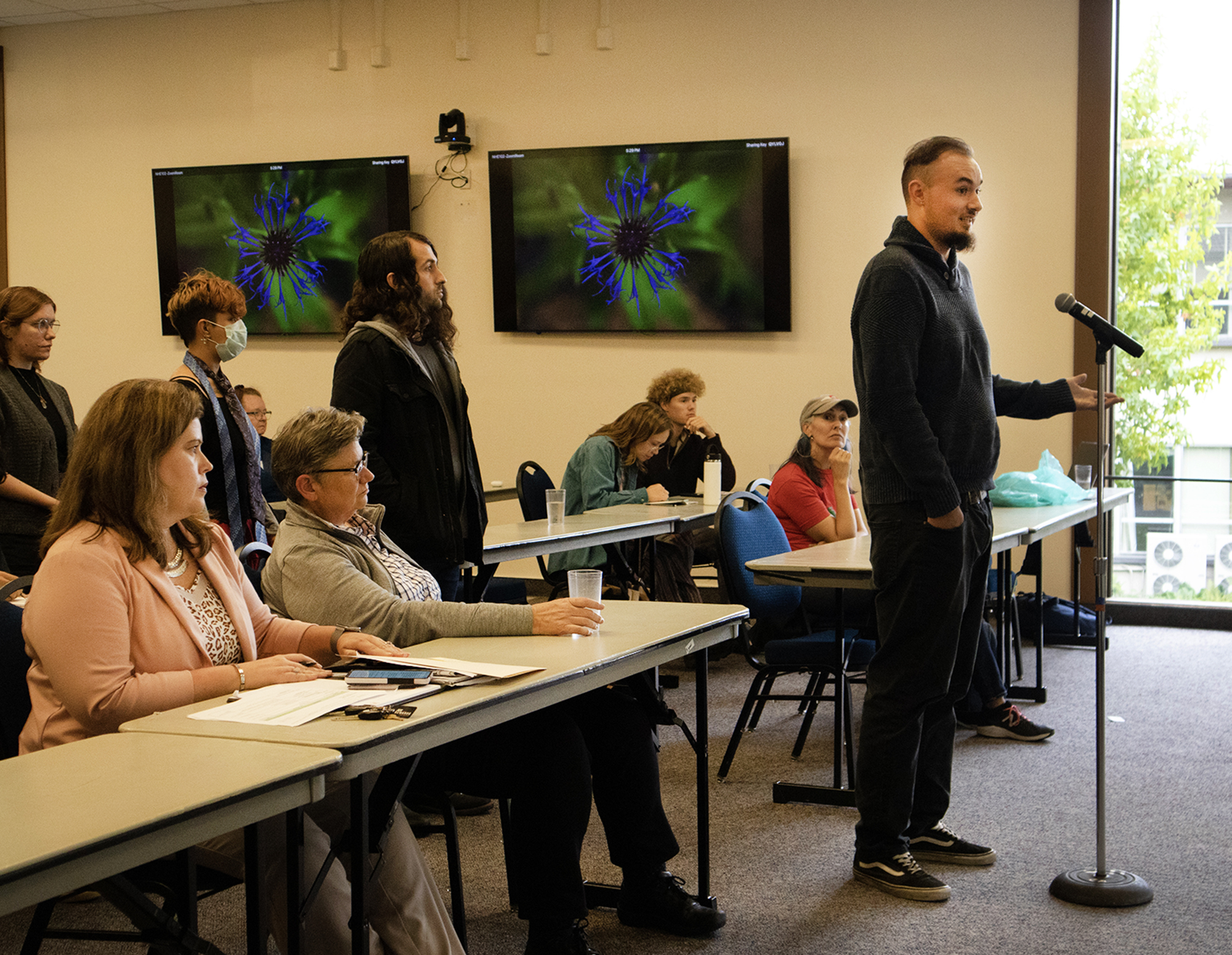
    Rumors of the casting spread before it was officially announced at the theater program’s “Welcome Back” event on Aug. 24th. Several disgruntled students showed up to challenge the casting decision. Miah Carter, a senior in the program, was among these students. 

    “We just wanted to, first and foremost, make sure that all the students who are in this program and attending were aware that this is not something that benefits college students,” Carter said. 

    At the event, the students asked why Lescher was cast before auditions were held. Linda Maxwell, the theater program leader, did the bulk of the responding. One reason for Lescher’s casting was the scope of the lead role. 

    Cindy Moyer, chair of the Department of Dance, Music, and Theatre, said that Lescher has spent his summer working on the part, and asking a student to put that breadth of work in half a semester isn’t feasible. 

    Maxwell and Julie Eccles-Benson, the co-director of the show, declined to be interviewed. 

    Maxwell spent a large part of the meeting blaming the students’ frustration over not being able to audition for the lead role.

    “Yeah, I’m mad,” Carter said. “Mad I’m not getting the education I’m paying for, not because I wasn’t cast as the lead in a show. Look at me. I’m a young Black woman. I was never going to be slated to play as Galileo himself.”

    Carter wasn’t surprised at the results of the encounter. 

    “We pretty much expected them to give the reaction they did and the excuses they did,” Carter said. “They didn’t really want to hear us out, which didn’t surprise me.” 

    Carter suggested that if the faculty knew The Life of Galileo was going to feature a lead role too bulky for a student, they should have chosen a different show that catered more towards student interest. 

    According to Moyer, the justification for casting a faculty member over affording the opportunity to a student boiled down to how the role of Galileo was too large a workload for a student to handle and how Lescher’s casting afforded an opportunity for collaborative learning. 

    “For Galileo, the theater faculty thought carefully and felt that this play provided an appropriate opportunity for students to learn by working side-by-side with a professional actor,” Moyer said. “It may be several years before students will get this valuable and exciting opportunity again.” 

    Ash Quintana, a theater major in his senior year, felt that the faculty had taken away students’ agency. He said that taking away the students’ choice pampers them and doesn’t prepare them for professional theater, where they’ll often have to multitask between theater and work.

    The students didn’t accept the collaborative learning rationale provided by the department. 

    “When it comes to acting, you learn more by doing than by watching somebody,” Quintana said. “If you want a student to learn, put them in that role, and have the resources to guide them to success, instead of just assuming they can’t do it on their own.” 

    Lescher’s casting is the latest in a series of controversial choices for theater program students. The program once had a season selection committee for choosing future shows, including both faculty and students, but in recent years only two students, including Carter, were on it.

    “It was pretty easy for them to dismiss what we were saying,” Carter said. “I do think they made a little bit of effort to be like ‘oh yeah, here, you’re making some good ideas,’ but it never felt like they were actually considering what we wanted to do.” 

    The season selection committee was disbanded by the fall semester of 2022. The faculty provided no reason why.  During that same semester, they emailed a survey to students, to gather their opinions on shows the faculty had already selected for consideration. Many students only recognized Into the Woods, the show slated for Spring 2024, out of four faculty-selected shows. 

    In Spring 2023, an email announced an in-person show selection meeting. Only one student attended. Carter explained that students didn’t want to bother showing up when they weren’t going to be heard or meaningfully included in any way. 

    The other big issue theater students have faced is the recent glut of “no-prep” auditions. “No-prep” auditions require no preparation going in, and often involve theater games and activities where the director(s) will cast or send callbacks to performers by judging their contributions. Out of the past five semesters since coming back in-person from the Covid-19 pandemic, four of them have been non-traditional or “no-prep.” 

    “I’ve been to a couple of those,” said Zoe Estelle Rose, a child development major. “Nonsense, they’re just nonsense auditions. They don’t prepare you for anything.” 

    When an audition announcement is made with the words “no-prep” attached, many students audibly groan. They don’t feel that actors who attend these auditions are being taught anything useful regarding professional auditions. 

    “We’re going to graduate and go off and try to audition for a real production,” Carter said. “And we’re going to fail immensely. And when they ask us where we trained, we’re going to say ‘I went to Humboldt where they did no-prep auditions and we could just show up and get casted if we were silly.’” 

    In Quintana’s advanced acting class this semester, he noted that many students asked to learn how to audition and recite monologues. 

    “The school is not teaching us how to do that,” Quintana said. “We are not going to be cast in professional shows in the real world.” 

    Moyer said that these nontraditional auditions have been the result of selected directors, but that in the future the department will address this concern and make sure the students get more professional audition exposure.

    The concerned students are speaking out because they don’t want new students to transfer to the department unaware of the issues they’re facing. Both seniors mentioned they wouldn’t have transferred to Humboldt’s theater program if they’d known that going in. 

    Maxwell has started meeting with the frustrated students to open up a dialogue for making the theater program more inclusive, and cut down on the communication divide between faculty and students going forward. 

    “I feel like I’m getting a lot of examples of what not to do in a theater program,” Quintana said. “I personally haven’t had too many opportunities to fully learn theater. I’ve been here for two-and-a-half years, and I’m not really going away with that much.” 

    Here is Lescher’s full statement: 
    Thank you, Jake, for wanting to share additional context and insight on theatre-making within the Cal Poly Humboldt Theatre Arts (TA) academic program. As a TA Major who has acted on our stage several times, you can attest to the frequency of TA Faculty serving in major creative capacities on mainstage productions. Project-based learning is one of the central components of performing arts education within the Department of Dance, Music & Theatre. When faculty artists and student artists collaborate as choreographers, composers, directors, designers, dancers, musicians, and actors, students have opportunities to develop knowledge and skills in realistic ways, preparing them for the diverse production experiences they will encounter after graduation. As a member of The Life of Galileo ensemble, I look forward to applying my professional training and experience to help strengthen student learning; promote learner success; and bring a special and relevant story to life on the university stage.

  • Cannabis festival “Cannifest” brings buds together

    Cannabis festival “Cannifest” brings buds together

    by Andrés Felix Roméro

    As the sun was setting on the Eureka Waterfront, a few people in their boat called out to the festival-goers on the shore. Through shouts across the water, they requested some weed to enjoy on their aquatic cruise. One kind gentleman was more than happy to oblige and passed along a joint to one of the boatmen who swam to shore on his boogie board. This was just one of many instances of communal actions and feelings present at the 2023 Cannifest, which ran from Sept. 9th-10th.

    For the first time since the pandemic, a cannabis-centric festival returned to Humboldt county with the three-day celebration of the plant and the culture surrounding it through Cannifest. Primarily run and organized by Joe Moran and Steve Gieder, the festival was a hit to those who love to spark, smoke, eat and other methods of enjoying weed. There was no lack of colorful and engaging sights with plenty of music, food, art, activities and of course, cannabis.

    Day 1

    For some, the Cannifest celebrations began not in Humboldt, but on Friday, Sept. 9th in San Francisco. The Roast and Toast bus tour aspect of Cannifest was helmed by the founder of Humboldt Cannabis Tours, Matt Kurth. He acted as the group’s tour guide, spouting fun facts about the surroundings, as the bus reenacted the pilgrimage many people took following the San Francisco Summer of Love in 1967.

    Photo by Andrés Felix Roméro. Snail-Nail Dab Company representative shows off his dab rig that is powered by his Bigfoot statue.

     “There’s always a group of people where mainstream society doesn’t work for them,” said Kurth. “Because Summer of Love only lasted three months and fell apart, some of the people still wanted to find a new way of living because they needed it. So, they started the Back to the Land Movement, leaving the city and going to try to find new ways of living out in the country. The first cheap land was northern Mendo and southern Humboldt, that’s why [the people] stopped there”

    The bus made stops at Santa Rosa dispensary OrganiCann and the Hopland restaurant Rock Seas. At these stops, the passengers happily shared their buds with each other. The passengers ate lunch and took dabs with fruit pairings to enhance the turpentines. Self-described gonzo journalist Cameron Hussain described the desire for community that many of the passengers and cannabis lovers carry, and the importance of accurate representation of the cannabis community.

    “We are contributing to the narrative of the culture just by being here,” said Hussain. “[The community has] been so long underground, we are hungry to connect and enjoy this plant we all love.”

    The bus made its final stop for the day at the Red Lion hotel in Eureka so that the passengers could get ready for the first true party of the weekend, the Cannifest Gala at the historic Eureka Theater. At the Gala, there was cannabis history trivia, the winners of the Cannifest competitions were announced, and the night ended with performances by local artists such as Flow J. Simpson, Eli Fowler, and Object Heavy. 

    Day 2 and 3

    Event Highlights

    The Cannifest Festival properly kicked off Saturday, Sept. 9th. Even for any seasoned festival goers, it would be difficult to experience everything the venue and 50-plus booths had to offer. The backdrop of the Eureka Waterfront was soothing to those wanting to enjoy delicious, diverse food from taco trucks and soul food booths with a calm breeze. A favorite by many was a locally owned Native women business, Frybread Love, which offered fry bread topped with lettuce, sour cream, ground beef and chili beans.

    Besides people sitting and laughing while eating, many community aspects of the event were present thanks to the constant sharing of cannabis between everyone. Everywhere you looked, there were smiling people passing smoking blunts and joints. Plenty of booths offered free dabs to anyone who came by. One gentle soul only known by Big L was rolling free blunts for any passerby to enjoy. 

    Photo by Andrés Felix Roméro. Festival-goer dressed as a stoner icon, Towlie from South Park, enjoys quality time with his class piece.

    The ability to enjoy the event was diverse. Those with a Sativa high could enjoy the music and dancing, and those with an Indica low had plenty of comfortable seats to enjoy. Katie Dalmasso attended Cannifest after just returning from Burning Man, and remarked how the festival was great to reset following the hectic desert festival.

    “What a beautiful way to decompress, coming to a cannabis festival right after [Burning Man],” said Dalmasso. “It’s kind of the same feeling [as Burning Man] but more relaxed, everyone getting together as a community and having fun and supporting each other.”

    In many aspects of cannabis culture, feelings and desires for healing are present, which was case-and-point with the arts at the event. Many who were dancing at one of the two stages looked carefree and happy in their outfits that were peak Humboldt. Festival-goers were treated to music by Hip-Hop legendary duo Dead Prez, and Grammy-award winning Reggae rapper Kabaka Pyramid. 

    Healing and Community Aspects

    Besides music, plenty of other art forms were present. There was a series of amazing murals painted with a variety of different techniques as part of an art competition centered on social justice. Other amazing mediums included dancing, paintings on large canvases, and a glassblower doing his work live. There were plenty of activities to participate in, such as massage chairs, yoga and even a mobile barber.

    Not suprining to Humboldt and Cannabis culture, the event was welcoming not just to bipeds, but to our four-legged canine friends. As diverse as the arts were in Cannifest, dogs of all breeds and sizes accompanied their owners. One individual brought his best friend Roscoe, and also found healing and solace through cannabis culture following a tumultuous childhood, was Jake “Big Jake” Lawrence, a judge for Cannifest and the founder of the non-profit MedVets.

    “My parents used to sell methamphetamine to the cops, I grew up in hell-on-earth, [what] I’ve been through makes most grown men cry,” said Big Jake. “This entire community is part of my larger family. It’s really about the community and supporting the community as a whole that helped [Cannifest] actually exist.”

    These feelings of hegemony, community, and love was the endgame of Cannifest founder and executive director, Steve Gieder.

    “I think it’s important [we have events like Cannifest] because of so many reasons,” Said Geider, “but one of them is bringing people together socially. The way that we do things like dancing, eating and partaking [in this community]. When people dance together and get loose it takes us back to being primal. It brings us back to who we really are as people and can be and can be an opportunity for people to get comfortable expressing themselves in all these different ways, and that helps us learn and grow together.”

  • Cal Poly Humboldt considers Clayco – a company with record of wrongful death, wage theft and malpractice – for $100 million construction contract

    Cal Poly Humboldt considers Clayco – a company with record of wrongful death, wage theft and malpractice – for $100 million construction contract

    by Andrés Felix Romero and Emma Wilson

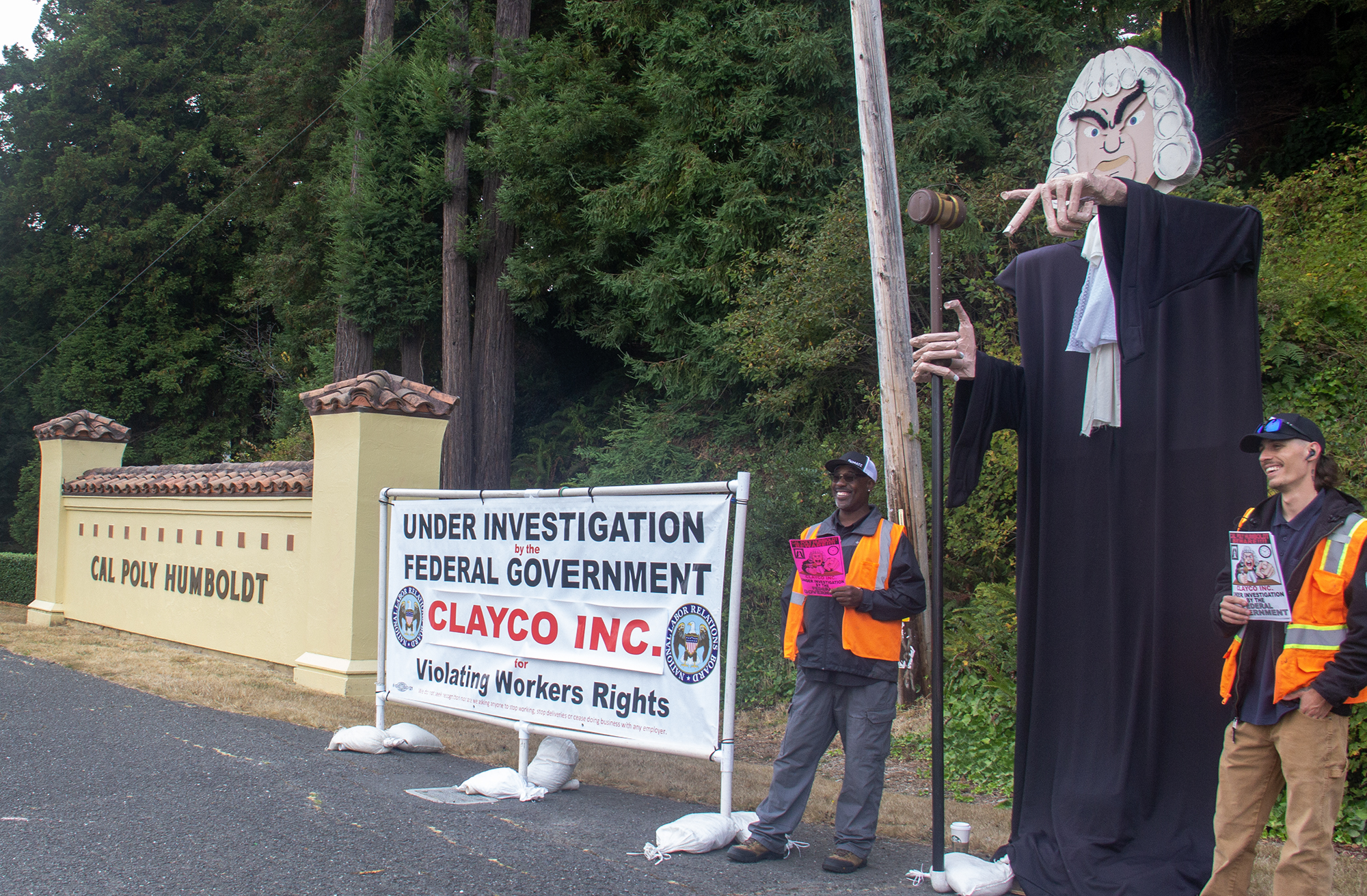
    A giant stood on LK Wood. It was twice the height of the men around it, armed with a massive hammer and a demonic scowl. It pointed with a long, curled finger at every soul underneath its gaze, framed by a wooden wig and caterpillar eyebrows. It was a judge, and judge it did. 

    Photo by Alex Anderson | Members of the carpenters union placed a tall judge statue in front of the Cal Poly Humboldt entrance sign to protest Calyco

    “Judgment day is coming,” it said. “Shame on you. Shame, shame, shame!”

    No ogre was laying waste to Arcata. It was built as a protest by Local Carpenter’s Union 751 against Clayco, one the companies in the running to bid on the Cal Poly Health, Housing and Dining Infrastructure project, also referred to as #PLY106. The Union and their main goal is to bring the company’s legal issues and history of malpractice to the attention of the campus committee that awards infrastructure projects, and to the community in general.

    THE CONSTRUCTION PROJECT

    Construction on the Housing, Health, and Dining building is set to begin fall 2024. The new facilities include a new health center and dining hall, and will be able to house roughly 450-500 students. The facilities are planned to be operating by August 2026, or summer 2027 at the latest. The direct construction will cost at least $108.9 million and the guaranteed maximum budget is $131.9 million. The winning contractor will be announced in October of this year.

    MALPRACTICE AND WORKING CONDITIONS 

    In a legally fact-checked letter from Union Local 751 to the CSU Board of Trustees, there is a list that cites Clayco’s history of legal issues due to allegations of malpractice. Clayco has been a defendant in at least 22 cases since March 2000. Since 2010, they have had at least 17 OSHA violations brought against them, resulting in fines around $81,336. Clayco’s legal issues include an active investigation by the Federal government concerning allegations of violating worker’s rights and harassment of union members, a pending case concerning allegations of wage theft, and a wrongful death lawsuit concerning a worker’s death that was settled last year.

    OSHA Citation against Clayco documents details on Kirk Smith’s accident

    In August 2017, Kirk Smith, an employee of the subcontractor Watson Companies Inc., fell 35 feet to his death while working on the construction of an Ulta Beauty warehouse in Fresno CA. The fall was a result of a weakened roof not being fixed for employees to safely work on, as well as a lack of warnings concerning the stability of the roof. Smith left behind a wife and children, who then sued Clayco along with Ulta and Watson for wrongful death in April 2018. Clayco, along with the other defendants in the case, eventually settled with the Smith family for $5 million in 2022. Attorney Brett D. Beyler, representing Smith’s family, wrote in the court settlement document that the incident was entirely avoidable.

    “On August 9, 2017, Kirk Smith (the decedent) arrived at the Project,” Beyler wrote in the settlement document. “He was directed by Watson [Companies Inc.] foreman, Mr. Rabideau, to cut out the membrane and insulation on top of the metal decking. As Mr. Smith was cutting the membrane and insulation out with a hand knife, the weakened metal decking gave way like a trap door, causing Mr. Smith to fall nearly 40 feet to his death. This incident was entirely avoidable. Unfortunately, due to the negligence of Clayco and NDBS [National Design Build Services], Mr. Smith is no longer alive.”

    WAGE THEFT

    Decision by US District Judge John Mendez gives background info on allegations of wage theft

    Clayco is currently in an active case regarding wage theft. These allegations are brought forth by labor rights organization, The Workforce Defence League (WDL), representing laborers who worked on Amazon Fulfillment Centers in Sacramento and Tracy who say that they have not been compensated for their overtime work or use of their own tools in the construction project. 

    According to the WDL, the laborers worked 58 hours a week and were promised $20-24 an hour. They weren’t fully paid for their regular or overtime hours, and they didn’t receive their work breaks and only got one meal break. They also didn’t get compensated for the missed breaks.

    HARASSMENT OF UNION REPRESENTATIVES

    NLRB charge against Clayco for allegations of harassing Union members

    Clayco is also under current investigation by the federal government for allegations of violating workers’ rights as well as harassment of union representatives. Two separate documented charges brought against Clayco by the National Labor Relations Board were filed as recently as November 2021. They claim that the contractor unfairly fired a subcontractor from their position, and attempted to prevent the Carpenter’s Union from conducting their activities by barring them from Clayco properties and instructing Clayco employees to limit contact with Union representatives. Additionally, videos on the Local 751-run website, Claycofails.com, show alleged harassment of Union organizers. One instance alleges that a Clayco foreman followed and videotaped an organizer.

    “[Clayco] interfered with the exercise of protected rights by firing a Union signatory subcontractor when Union Agents tried to access the site,” one document read. 

    “[Clayco] interfered with the exercise of protected rights by calling the police when the Union tried to access the job site, surveilled and videotaped Union agents and ordered workers not to talk to the Union,” according to the other document.

    CLAYCO’S RESPONSE

    In an email, Clayco’s Vice President of Marketing and Communications Sarah Green forwarded a statement from Clayco’s legal team. The statement said that Clayco is the target of a campaign of Union harassment. The statement made the case that the Union has no legal right to access any Clayco properties and that the Union’s ultimate goal is to get Clayco to sign a collective bargaining agreement with them.

    “Since 2021, [Union members] have filed 11 unfair labor practice charges against Clayco with the National Labor Relations Board (NLRB),” according to the email. “8 out of these 11 charges have either been withdrawn or dismissed, and the remaining three charges will go to hearing in October [2023]. Nor does the [Union] report that the NLRB matters arise from the [Union] and/or its members attempting to forcibly enter two Clayco California projects despite having no legal bona fide right to enter those projects – resulting in them having to be removed by police.”

    Labor Counsel for Clayco, Andrew Martone, adds that no one affiliated with Clayco has brought charges against the company through the National Labor Relations Board, and that any Federal investigation against Clayco is a result of Union actions only.

    “No Clayco employee and no employee at any Clayco worksite has filed a complaint with the NLRB,” said Martone. “Charges brought are by the [Union], and they don’t represent any Clayco employee.”

    Court document provided by Clayco that has been given a red flag by Westlaw

    Green also stated that the Union has been misleading in their campaign.

    “The [Union] misleads the reader to believe OSHA citations were issued against Clayco that were in fact issued to other entities,” said Green, “and reports OSHA Citations without informing the reader that OSHA found no violations existed.”

    However, Lumberjack reporters were able to find OSHA violation documents concerning the death of Kirk Smith. Clayco shared a court statute with Lumberjack writers that documented tactics by the Union. However, the statute was labeled as “amended, repealed, superseded, or held unconstitutional in whole or part” by Westlaw, a legal research company. Unfortunately, since Lumberjack writers were unable to gain further access to Westlaw files, we are unable to say why it was labeled as such.

    UNIVERSITY INVOLVEMENT 

    Lumberjack writers reached out to Procurement Specialist, Addie Dunaway of Contracts and Procurement department of Cal Poly Humboldt, as well as Humboldt Director Planning, Design & Construction, Kassidy Banducci of the Facilities Management Department. Both expressed a desire to comment, but were limited in their ability to speak as the bidding process is still active. Any comment on Clayco’s involvement from Cal Poly Humboldt staff and admin could violate legal obligations, as well as compromising fairness to the other three potential contractors. 

    University documents confims that Clayco, Sundt, and Swinerton are three companies on the shortlist for the #PLY106 contract. A fourth potential bidder is currently unconfirmed. The Union has also sent a letter to the Board of Trustees concerning Sundt’s history of malpractice.

    Communications Specialist with the News and Information department, Grant Scott-Goforth, shared some information on the infrastructure project, though he was unable to comment on any allegations brought against potential contractors.

     “The Committee remains diligent in their work towards a fair and equitable evaluation process governed under the provisions of the law in the state of California,” according to a statement released by the University. “Cal Poly Humboldt is committed to its responsibility under California regulations for public work projects and the better good of the construction industry. Any information regarding the performance or behaviors of proposing firms will be considered against CSU policies and State regulations.”

    UNION AWARENESS

    Union Organizers from Local 751 spread awareness to the campus community about where their money may be going—especially the funds that students give to the school as part of their tuition.

    “How has a contractor with this history got this close to a major project?” said Harvey McKeon, a field representative for the Union. “Which, at the end of the day, is [funded by] public money, and it’s also by extension student’s money, and [the students] should have some sort of control and say over how that money is spent.”

    The organizers from Local 751 want to make it clear that although they are a union, their endgame isn’t to try and have a union-backed construction company be awarded the contract. Rather, they want to ensure that a company with multiple legal issues and allegations of malpractice isn’t able to gain a foothold in the community and public works projects, and to try and create a better and safer working environment for all laborers.

    “As a union, our recent track record has been to lift standards for workers whether they’re union or non-union,” McKeon said. “The reason why we are seeking to generate awareness about Clayco is because we want to draw attention to what Clayco does to workers that we don’t formally represent, but we care about their working conditions.” 

    Beyond a desire to bring Clayco’s past and current legal issues to light and try to create safer environments for workers, some organizers such as McKeon feel a personal responsibility to ensure a safe working environment for both contractors and the community at large due to their personal experience as a worker without union support. The union also wants those at Cal Poly Humboldt that awards infrastructure projects like #PLY106 and potential contractors that there must be precedence for companies rooted in ethics.

    “I’ve been in jobs before I was a labor union organizer where I didn’t have anyone looking out for me because I wasn’t in a union, and I don’t think that’s a reason why you shouldn’t have people not look out for you,” McKeon said. “We’re trying to represent [all laborers] even if they’re not currently union members. It’s like trying to plant a tree whose shade you may never sit in.”

    Editing note:

    On Sept. 6, this article was edited to clarify that Clayco’s Vice President of Marketing and Communications Sarah Green shared Clayco’s statement from legal team with a reporter via email. The statement made the case that Clayco is the target of a campaign of Union harassment and that the Union has no legal right to access any Clayco properties and that the Union’s ultimate goal is to get Clayco to sign a collective bargaining agreement with them.

    The article was also edited to remove reference to a contractor who’s bid on the project could not be confirmed.

  • California State Universities propose 6% tuition increase 

    California State Universities propose 6% tuition increase 

    By Peyton Leone and Carlina Grillo and Christina Mehr

    The California State University Board of Trustees will vote on the Multi-Year Tuition Proposal on Sept. 13. If passed, tuition at all CSU campuses would rise by 6% for five years starting fall 2024 until fall 2028.

    On Thursday Aug. 31 Cal Poly Humboldt’s Associated Students held a meeting to inform students about the tuition increase proposal. There were more than 30 people in attendance.

    Photo by Jillian Wells. Students and staff gather at the Tuition Increase Town Hall on Aug. 31.

    “The 6% increase covers all of the different levels of education,” said Amber Blakeslee, Executive Director of Finance and Budget at Cal Poly Humboldt. “So that’s undergraduate, credential and graduate student tuition. It also covers in-state tuition, out-of-state tuition, and the graduate business professional fees.”

    For example, the proposal would raise the tuition rate of an in-state full-time undergraduate degree from the current $5,742 to $7,682 in fall 2028, a 34% increase over the first five years. This does not include the fees for each campus, which vary. This semester full-time student fees at Cal Poly Humboldt totaled $2,170.

    The CSU system is funded from two main sources: tuition and state funding.

    CSU reported in a document titled the “Sustainable Financial Model Workgroup Report” that there was a nearly $1.5 billion gap between money the system received and the costs to keep the CSU system running in 2021-2022.

    The same report concluded that “even with aggressive assumptions about increases in-state general fund and tuition” would not be enough to close the gap.

    The California State Student Association, a nonprofit group representing nearly 500,000 CSU students, unanimously voted to oppose tuition increases according to AS president, Sam Parker.

    “The proposal lacks measurable outcomes, a clear termination date, and fails to articulate plans for generating other revenue sources,” CSSA said in a July 11 press release.

    According to the Multi-Year Tuition Proposal, 60% of students at the CSU system would not be affected by increases. Their attendance is covered by the Cal Grant, Pell Grant or tuition waivers.

    The proposal notes that increases will exceed the maximum Pell Grant award by over $280 by the 2028-2029 school year, and that Cal Grant may not rise to cover tuition raises into the future given.

    Photo by Jillian Wells. Peggy Metzger, Director of Financial Aid, (left) addressing questions by Nova Presley (right) at the Tuition Increase Town Hall on Aug. 31.

    “It discourages me from even wanting to continue through school,” said sophomore Sonny Buckner after the town hall meeting, noting that affording school and finding housing were affecting his time as a freshman. “…I barely even passed all my classes. It’s ridiculous that these are the things I have to put my priorities on when I came here to be a student.”


    The CSU Board of Trustees will meet from Sept. 10-13 in Long Beach, California. The board will take public comment on the proposal on Sept. 12 at 9:00 am. Public comment can be sent to trusteesecretariat@calstate.edu. before Sept. 11. Instructions on how to give live public comment virtually or in person can be found at www.calstate.edu/csu-system/board-of-trustees/Pages/information-for-bot-attendees.aspx
    Caption: Data from https://www.calstate.edu/attend/paying-for-college/tuition-increase/Pages/proposed-tuition-adjustments.aspx

  • First fall for fresh Cal Poly Humboldt Admin

    First fall for fresh Cal Poly Humboldt Admin

    by Andres Felix

    Three new individuals with years of experience in education and community service have been selected for the roles of Dean of Students, Dean for the College of Extended Education and Global Excellence, and the Vice President of Enrollment Management and Student Success. Hailing from all corners of the nation, these leaders are here to accept the challenge to provide support to the academic institution and its community from their respective roles and offices. 

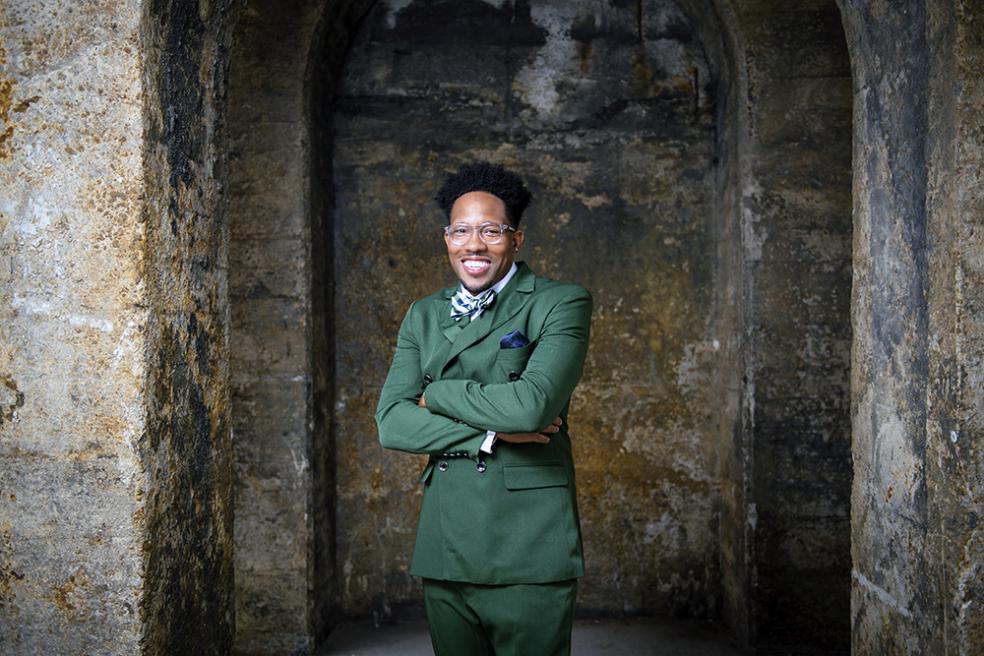
    Dr. Mitch Mitchell – Dean of Students

    Fresh Dean of Students (DOS), Dr. Mitch Mitchell, began his position in Spring of 2023. He made his first major appearance in his role in the commencement ceremony. Mitchell wants to provide support to the students in any way he can to ensure their best chances of success.

    “[My focus is] anything outside of the academic environment,” said Dr. Mitchell. “What students are thinking, what they’re passionate about, what they’re feeling, what they’re doing. I help cultivate whole students that are holistic that can go out and make a difference in this world.”

    Dr. Mitchell wants to focus on supporting and expanding cultural centers on campus such as ITEPP and Umoja, as well as ensuring that this community is safe for students to be able to get their education and enjoy themselves.

    “My goal is to make Cal Poly [Humboldt] the best place to live, learn, and thrive,” said Dr. Mitchell. “It’s ok to be your authentic self and be different. You’ll find people here that are part of your community here, so this is a place for everybody.”

    Dr. Mitchell came of age with many of the odds stacked against him.

    “I grew up with a survivor mentality,” said Dr. Mitchell. “I grew up in [Washington] D.C. during a tumultuous time, the height of the crack epidemic and it was the murder capital.”

    Dr. Mitchell credits his introduction to higher education and the guidance of his fraternity brothers to smoothing out his rougher edges, and for providing a space where he felt safe to be his authentic self.

    A lover of the outdoors, Dr. Mitchell wanted to come to Humboldt due to the lovely nature in the area. When he first visited Humboldt in Spring of 2023, he fell in love with the energy of the area. He noted that it wasn’t just the redwood backdrop, but the people of Humboldt that added to his love of this community.

    “From the moment I stepped into Humboldt County, I felt the energy and people pouring into me.” said Dr. Mitchell. “When you come here and you feel the energy and you feel the love, it changes you, and you realize the difference from [other communities] is that it’s really an oasis here.”

    From his first visit to the campus in April 2023, many noted his sharp suits and outfits, many of which have the school colors. When asked about his style, Dr. Mitchell explained that dressing sharp is essentially in his DNA.

    “Fashion is an art form and a way to express yourself,” Dr. Mitchell explained. “It’s like music, it’s like painting. I will say that the [artform] is in my bloodline. My grandfathers on both sides were really some fly people. My father specifically had monogram collared shirts with his initials on them. I would say [fashion is] in me, and it’s on me.”

    Dr. Cindy Bumgarner – Dean for the College of Extended Education and Global Engagement

    Photo courtesy of Cal Poly Humboldt.

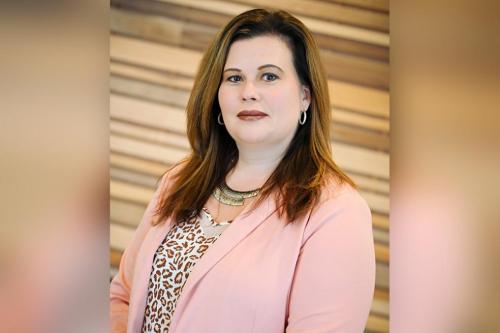
    Coming off a position as Assistant Vice Provost for the Division of Undergraduate Education at UC Berkeley, Dr. Cindy Bumgarner became the Dean for the College of Extended Education and Global Engagement (CEEGE) on July 1st. 

    Dr. Bumgarner and her office focuses on supporting international students and students who study abroad through Global Engagement by offering immigration service support and academic counselors. On the side of Extended Education, Dr. Bumgarner supports graduates in their professional career, as well as students that are returning to their degree following a hiatus. 

    “I would imagine that some [students] just had life circumstances or needed to go out and do some work,” said Dr. Bumgarner, “or had something happen in their family, and they just really want to get back and complete their degree.”

    On top of this, Dr. Bumhgarner and her office are working on developing certificates from the college such as one in IT. Although she has many tasks, she is excited to rise to the challenge. It’s this opportunity for growth and previous vacations to the Humboldt area while teaching at CSU Chico that drove Dr. Bumgarner to take up a position on this campus.

    “[Humboldt] was a spot for me to cool off [from Chico in the summers], but I got to know the community and always sort of paid attention to what was going on the campus,” Dr. Bumgarner explained. “So the idea that I could bring a bunch of knowledge and positively contribute to a campus trying to reaminge itself just really appealed to me.”

    Dr. Bumgarner is no stranger to intensity, challenge, and being under pressure. In her early college days, Dr. Bumgarner competed in Division I basketball for Indiana State University. It was this time as an athlete that she developed tenacity to prepare her for future challenges.

    “The piece I learned from sports,” said Dr. Bumgarner, “is that when you set some goals,  even if they’re not fully defined, if you know, ‘I want to help more, I want to do more, I want to contribute more,’ that can lead you in interesting ways.”

    These lessons helped her as she was working on her undergraduate degree as well.

    “In the educational process it was transformative to me,” said Dr. Bumgarner. “As a young poor kid, to realize that this undergraduate degree was going to completely change my life, and it did.”

    Dr. Chrissy Holliday – Vice President for Enrollment Management and Student Success

    Photo courtesy of Cal Poly Humboldt.

    The honor of being Cal Poly Humboldt’s newest Vice President goes to Dr. Chrissy Holliday. Although she began her term in the position in January this year, this is her first fall on the Humboldt campus. In her role as the Vice President for Enrollment Management and Student Success, she is leading the team behind admissions, and continuing to support students that choose Humboldt as their campus to study.

    “[We] make sure that our current students have the best experience they possibly can,” said Dr. Holliday, “and they successfully get to graduate and have their careers after that.”

    Currently, Dr. Holliday is focusing on the growth of the new Cal Poly, and ensuring the infrastructure is available to sustain that growth. By renovating housing and dining, she aims to improve students’ overall academic experience. Overall, Dr. Holliday wants students to feel at home on the Humboldt campus, similar to how she felt at home in the community when she arrived at Humboldt.

    “[Humboldt] feels like home,” said Dr. Holliday. “I want our students to have that same feeling. A lot of what we’re doing is looking at everything from recruitment all the way through graduation and asking, ‘how can we make this a better experience for our students?’”  

    Dr. Holliday is originally from North Carolina, just outside of Charlotte. For most of her education career, she has been steadily moving westward, working at South Carolina and then Colorado. The opportunity for challenge and growth at Humboldt pushed her to come to Arcata.

    “[Cal Poly] Humboldt is poised for growth and greatness in a very different way than most higher-ed institutions right now,” said Dr. Holliday. “It really is the opportunity to be part of something different to help strategize how we serve all students in California.”

    Besides professional reasons, Dr. Holliday also had personal reasons to take up a position at California’s newest Cal Poly.

    “This place spoke to me a lot,” Dr. Holliday said. “I came here, smelled the ocean…growing up in the South, I had spent a lot of time on the coast. I told my husband that [Humboldt] smells like home.”

    Outside of Dr. Holliday’s professional life, Dr. Holliday has a love for the horror genre. Her passion began with books through authors such as Christopher Pike and Stephen King. Her husband later helped to develop a fondness for horror films. One of Dr. Holliday’s favorite horror villains is Damien Thorne of The Omen.  

    In addition, Dr. Holliday  is also an avid fan of music and concerts. One of her favorite experiences with live shows was seeing Nirvana and the Red Hot Chili Peppers perform at the same music festival. Dr. Holliday’s personal favorite show to date was Five Finger Death Punch. Even today, Dr. Holliday tries to make time for music.

    “I’m going to one of my bucket list shows later this fall,” said Dr. Holliday. “I’m going to go see Rob Zombie and Alice Cooper!” 

  • Cal Poly Humboldt project 2,000 more students for Fall semester, yet only delivered 98

    Cal Poly Humboldt project 2,000 more students for Fall semester, yet only delivered 98

    by Brad Butterfield

    Back in March, the university projected over 2,000 more students for the Fall 2023 semester than from the Fall 2022 semester; in reality, there are only 98 more students enrolled this fall.

    On March 7th, the University Resources and Planning Committee (URPC) had an Open Forum to discuss budget recommendations and feedback. In that forum enrollment for fall was projected to increase by about 2,000 students to have around 7,449 total students. However the current data from the university’s Institutional Research, Analytics, and Reporting shows only 5,964 total enrolled students. This difference is meager compared to last fall when total enrollment was 5,866.

    Of the nearly 6,000 students in attendance, there are 959 new freshmen undergraduates and 758 transfer undergraduates. These are preliminary totals, as final enrollment data will be available after the add/drop deadlines on September 18th.

    According to the university website, “Cal Poly Humboldt would expect to see enrollment increase 50% within three years and 100% within seven years.” At current growth of enrollment rates, it appears unlikely for the university to meet this goal. 

    Citing a hectic start to the semester, Chrissy Holliday, Vice President for Enrollment Management and Student Success, could not comment on the low enrollment numbers and advised the Lumberjack to talk to university Communications Officers. 

     Although there is growth, it is attributed to the university’s transition to becoming California’s third polytechnic campus. This transition promised $433 million of one-time funding and $25 million in ongoing base support, a name change, a host of new majors and hundreds of new on-campus dorm rooms. While new majors like cannabis studies (BA) and applied fire science and management (BS) have been added for the first time this fall, additional on-campus housing has not yet been achieved. 

    “The University expects this to be its second consecutive year of fall semester growth, and that is something to celebrate. Given the fact many colleges and universities in California and across the nation continue to suffer enrollment losses,” Grant Scott-Goforth, the university’s Communications Specialist said. Cal Poly Humboldt aims to bring enrollment up to 7,000 students by Fall of next year.

    The expansion of Cal Poly Humboldt is inevitable. At least two satellite properties west of highway 101 have been purchased by the university and the ‘Craftsman’s Mall’ project promises 800 new beds in the coming years. 

    “The Student Housing Project now in construction is expected to be completed in Fall 2025, with others rolling out in the coming years,” Scott-Goforth said.

    Although there is a lack of growth in enrollment, the university is still suffering. In the spring semester of 2023, an already understaffed University Police Department had to provide shuttle service to students housed in hotel rooms miles north from campus, while student-led housing protests ignited in the quad in the early part of the semester. Growing pains were felt by students and faculty alike. It’s apparent that the university is under strain from the exponential growth it’s undertaking, however this has not caught the school off guard.

    “Leadership knew that the first application cycle as a polytechnic would be different, and that it would take some time to develop the right infrastructure to capitalize on the increased admissions interest in the institution,” Scott-Goforth said.

    All this to say, welcome home to all of the new Lumberjacks and a warm (probably overcast) welcome back to the seasoned ‘jackers of Cal Poly Humboldt.

  • Student workers ask the CSU for union rights 

    Student workers ask the CSU for union rights 

    by August Linton

    Originally published May 3, 2023

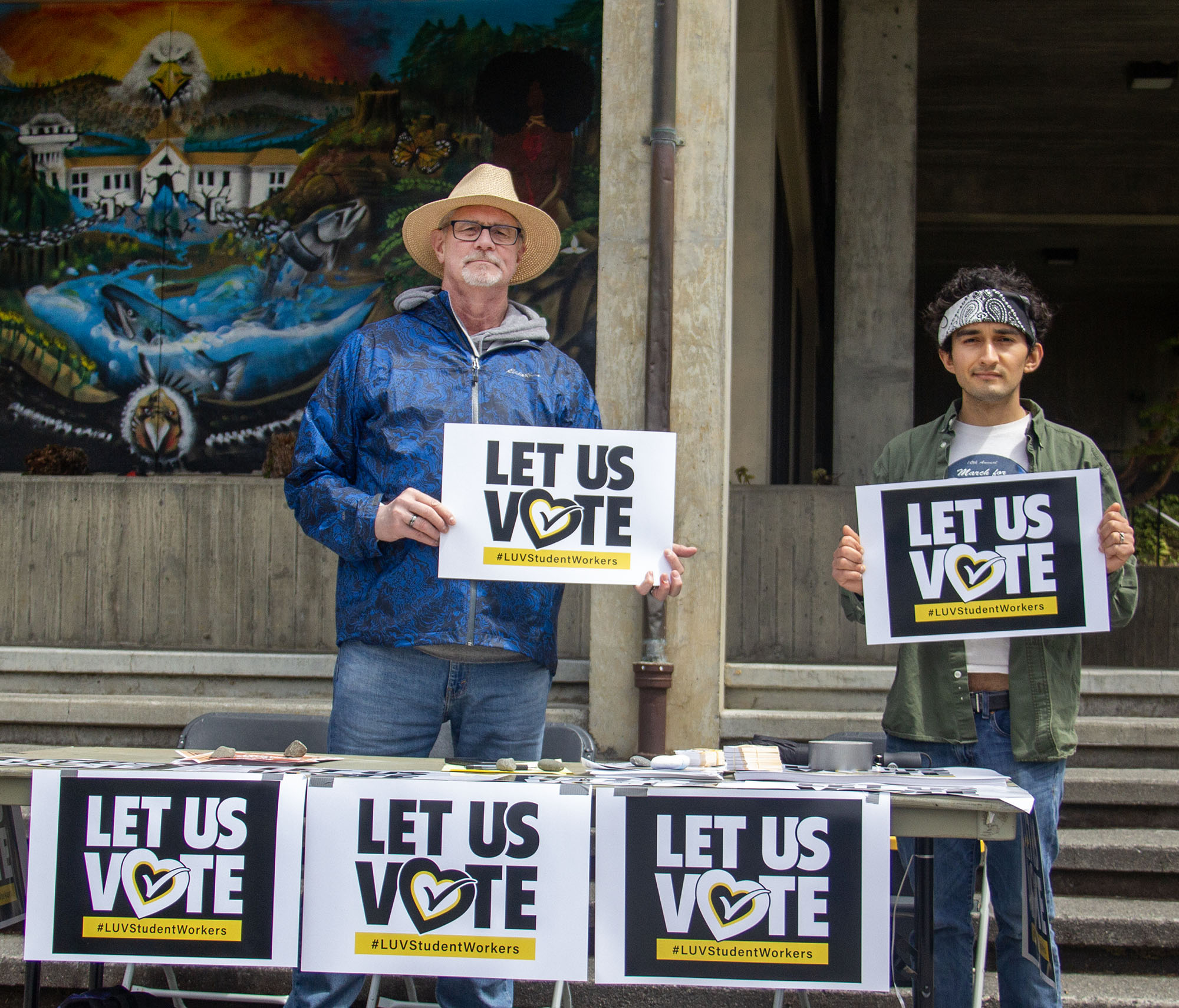
    CSU officials are now deciding whether student workers should be allowed to unionize, after students petitioned the California Public Employment Relations Board (PERB) on April 17 for the right to take a union vote. This was accompanied by around 4,300 signatures from CSU student workers.

    Daniel Chaidez is a student assistant at CPH, working for the university’s Waste Reduction Resource Awareness (WRRAP) Program. He says that the Let Us Vote campaign will hopefully give students a better foothold for bargaining with the university. 

    “It would just make things a little more equitable and bring a little more awareness to the issues that student workers are currently facing,” Chaidez said.

    Chaidez tabled on the UC Quad on April 18 along with Stephen Green, a labor relations representative for CSUEU, the CSU employees union. The CSUEU is taking an active role in supporting students working for unionization. 

     “When hiring a lot of student assistants it’s very unorganized in a lot of ways,” Chaidez said. “It feels like it’s just a way for the school to get easy labor from students.”

    “[Student Workers are] a pretty significant part of the workforce that keeps this campus running, or the system running,” Green said. “And they don’t get treated with a lot of respect. They get abused, and they have no voice at all in their working conditions.”

    Chaidez thinks that better parking infrastructure for student workers would be a good first step, either with subsidized/discounted parking passes or reserved spaces. Another concern for Chaidez is the weekly hours caps for student workers. 

    “A lot of students are cut off at 6 or 7 hours a week,” Chaidez said. “And that’s not really working for a lot of people.” 

    Many student assistants and employees are paid minimum wage, and at 6 or 7 hours a week, this forces them to supplement with second or even third jobs to make ends meet. More jobs means less time for students to study, let alone relax. 

    Some CSU student workers are even paid less than the minimum wage in their area. This is because the CSU only pays state-wide minimum wage as a state-wide organization, as reported by CalMatters.

    If the board approves this request, workers at CSU universities will have the opportunity to organize, something which is automatically given to non-student workers. 

    “It’s kinda a new thing for students to have a union on campuses,” Chaidez said. 

    Other universities and university systems have had high-profile unionization processes recently, including the University of Oregon and the UC system, according to Green. If the request to unionize at the CSU is approved and the students vote to unionize, the resulting organization would be the largest student employee union. 

    “Generally, the PERB is pretty worker-friendly,” Green said. “I think we have a pretty good case, that we’ve submitted a sufficient amount of legitimate signatures.”

    In the meantime, advocates continue to gather support, hoping to apply pressure to the PERB.

    Student workers who wish to join the unionization effort can contact the CSUEU to sign a union card, and to add their signature to the PERB petition.

    “You don’t want to assume these things, so we’re still gathering more signatures,” Green said.

  • The UPD is still understaffed and without a police chief – but not desperate

    by Brad Butterfield

    Originally printed May 3, 2023

    An expected 2,000 additional students are anticipated for the Fall ‘23 semester, threatening to strain an already understaffed police department at Cal Poly Humboldt. The UPD is currently absent a police chief and shorthanded in both dispatchers and officers. Since early March, the number of new hires onto the force has not increased—not for lack of effort. Despite working long hours to compensate for the lack of personnel, Sergeant Andy Martin remains optimistic.

     In early March a candidate for police chief, Kevin H. Williams, was interviewed by the hiring committee. Williams, a former LAPD lieutenant with a long resume as a public servant in many departments, filed a lawsuit against the City of Los Angeles in 1999. The suit claimed racial discrimination and cited that Williams suffered from pseudofolliculitis-barbae, which allegedly prevented him from shaving his beard and commonly afflicts Black men. A federal district court would later dismiss the case. Martin, who serves on the hiring committee for the department, couldn’t divulge the reasons Williams was not hired onto the UPD force. With extensive medical tests, background checks, psychological evaluation and training required in the hiring of any officer, Martin explained that it is unlikely CPH will have a police chief come the Fall ‘23 semester.

    “I would be shocked if it all happens before fall semester starts, but things happen. I’ve been surprised before, but I don’t think so,” said Martin.

    Although short staffed, the department is not rushing the hiring process. 

    “Our Vice President [Dr. Jenn Capps] puts a lot of expectations and weight behind the police chief and so, she’s made it clear – she’s not just going to hire anybody. She wants to make sure she’s hiring the right person for the job and what we need on campus,” Martin said.

    While scrupulous hiring is partly to blame for the lack of personnel on the force, it is far from the only force at play here. The very features of Humboldt county which attract many residents often work against the UPD’s effort in enticing new officers to join the force. 

    “The county tends to be a little behind the rest of the country in some aspects. You know, the night life completely shuts off at a certain hour. It’s a quiet place,” Martin said. “We don’t have the fast food chains. We don’t have what you would expect in some of the bigger cities. That can be a detriment for us sometimes because we are asking somebody to come to a more remote and isolated spot.”

    Martin further explained that being behind the ‘Redwood Curtain’ filters out many potential officers. 

    “It’s just hard to convince somebody to come work up here in a smaller department… It’s intimidating for a lot of people if they’ve never been here,” Martin said.

    Just as in March, dispatcher Jennifer Gomes is still working long hours as one of only two full time dispatchers employed by the UPD. Two potential hires for dispatcher are being considered currently, but even if both are hired, “they’ll probably still be in training as the next semester gets going,” Martin said. Additionally, one officer is currently going through the hiring process. 

    “I am optimistic that they will be here before this next semester,” said Martin.

    Evidently on the backfoot, the likely addition of two dispatchers and one officer will still leave the UPD undermanned. Lack of officers means that there is often just one officer on duty. In anticipation of the rapidly expanding new polytechnic university, the UPD will be hiring another sergeant and a couple more officers. 

    “That process is just getting started,” Martin said. “So I expect that some of them will start mid [fall] semester at some point.” 

    Regarding the massive influx of students coming to Arcata for the fall semester, Martin is confident that the department will be ready.  “Our staff is incredible. You can tell by the hours people put in and the heart that they give to this department,” Martin said before adding, “It would be a little more comfortable if we had more people though.”

  • Queer students are afraid to use TimelyMD counseling option

    by August Linton and Camille Delany

    Originally printed April 26, 2023

    Art Wardynski has lost almost all of his adult family members in the past few years, most recently his mother. He reached out to Counseling and Psychological Services (CAPS) for support, and was only offered a telehealth appointment with TimelyMD. 

    This wasn’t acceptable to him. As a queer person, Wardynski wasn’t comfortable with the fact that TimelyMD is a Texas-based company, or that they offer faith-based therapy as an option for universities. 

    “When I’m already going through such a vulnerable time in my life, I don’t want to risk being discriminated against,” Wardynski said. “They told me that my only option was to go through TimelyCare, and that is not an option for me.”

    After the death of his mother, on whose insurance he was dependent, Wardynski wasn’t sure if he had the ability to access off-campus healthcare, either. In the meantime, he’s just been trying to finish the school year.

    “I feel like I’m just chipping away at energy that I don’t even have,” Wardynski said.

    He isn’t alone in his concerns. Many queer students have voiced fears about the safety of the service, according to Landon White, Outreach Director for CPH’s Eric Rofes Multicultural Queer Resource Center (ERC).

    TimelyMD is an online mental health company which markets itself to universities as a stopgap and after-hours counseling service. CPH has contracted with the company, it says to provide students with after-hours healthcare.

    TimelyMD’s location in Texas, a state that is currently considering over 50 bills which limit the rights of transgender people, is one of the main issues that White has with Humboldt’s use of it.

    Other than the objection to university dollars going into Texas, the likelihood of being paired with a non Queer-affirming therapist is too high for many students’ comfort. Even in the relative haven of trans rights that is California, many therapists are transphobic, according to trans students. 

    “There are other telehealth organizations out there,” White said. “We need accessible mental health services that don’t come at the cost of forcing Queer and BIPOC students to play roulette.”

    The ERC advocates for the university to employ more CAPS counselors, especially those familiar with Queer and BIPOC issues. That would take competitive pay, job security, and outreach, said White. They also point out that the accessibility of telehealth is definitely a good thing, but don’t think that TimelyCare is a good option. 

    The use of online therapy services as replacement for in-person treatment by CAPS forces students into a situation that many are not comfortable with, should they need mental healthcare. 

    An open letter to the Associated Students, signed by campus groups including the Students for Quality Education (SQE), Queer Student Union, Black Student Union, and clubs such as the Mycology Club and Critical Race, Gender, and Sexuality (CRGS) Club, took a direct stance against TimelyMD. They asked AS to support the campaign against the service, something the body has not yet done.

    Student Allison Miranda also feels uncomfortable going to TimelyCare for mental health support due to her and her family’s Queer identities.

    “I need support. My tuition is paying for Timely,” Miranda said. “But I know that… LGBT+ students haven’t felt supported by them.”

    Miranda is a transfer student from College of the Redwoods, and said that she feels comparatively unsupported at Humboldt.

    “They [CR] had three different people, licensed therapists, who were trained in addiction counseling and all this stuff,” Miranda said. “Coming to HSU I expected an equivalent, if not better, experience. [Not having therapy] has impacted my studies.”

  • Dean of Students candidates vie for position

    by Andres Felix Romero

    Originally printed March 22, 2023

    Prospective Dean of Students candidates made their intentions heard through forums and Q+A sessions held on March 7 and March 8. 

    One candidate, Ryan Griswold, was recently the Dean of California Maritime Academy, leaving the position in July 2022.

    Griswold expresses a passion for working with students across institutions, especially at Cal Poly Humboldt. 

    “In terms of connections with the student population, I’m not going to say that this is different for me than a lot of institutions, because my passion for working with students really is universal. That’s not to say that the population isn’t different here,” Griswold said. “Every campus has its own demographics.”

    Griswold recounted a story about a previous institution he worked at, where he and student volunteers came together to help students around finals using what he says is his love language: food.

    “I have this tradition wherever I work, I like to find a way to incorporate food into things. We would get one of the industrial kitchens on campus, and we would bake banana bread for six, eight, or nine hours,” Griswold said. “Then we would take 200 loaves of banana bread and give it out to students at about 11 o’clock around finals.”

    Other candidate Micah Mitchell is currently the Assistant Dean of Students and Case manager for Winston Salem State University.

    Mitchell emphasized that to build that relationship, faculty must listen to student voices to understand how they are impacted by admin decisions.

    “[Myself and other leadership are] doing stuff, we’re changing stuff, and trying to support stuff,” Mitchell said. “But if I’m not knowledgeable of what [the students] are going through, it’s gonna be hard for me to effectively support you.”

    Mitchell also showed concern over the impending growth of the student population, and if campus resources can match the needs of those students. He is also conscious of overloading the current staff with the stress of supporting more students.

    “The growth is great,” Mitchell said. “But going too fast is dangerous. Do we have the institutional support to support the changes? Because if not, we’ll have this influx of students, then have an influx over the inability and strain our system. So how can we grow and sustain and maintain at the same time…we can’t expect the same staff to expand and do more work with regard to doing that. So I think it’s about…people getting the resources and figuring out how we can successfully support the growth.”

    Student and Indian Tribal and Educational Personnel Program (ITEPP) representative Mazacuauhtli Burrola wants whichever candidate that gets the job to integrate themselves into the campus community. Burrola wants to see this through the future DOS being open with their communication; by setting up methods to hear student voices such as dropboxes and a phone number to the dean of students publicly displayed on campus. 

    “You want to be our DOS, then you better move into my fricking house,” Burrola said. “You better be standing there in the quad. This is not a game. Our lives are at stake here, our futures.”

  • Wildberries employees speak on store-wide profiling

    Wildberries employees speak on store-wide profiling

    By Dezmond Remington and Jasmin Shirazian

    Colorful and bright, full of fresh produce, natural foods and community bulletins, Wildberries looks like the perfect hippie store. A store where people of all kinds can purchase their $10 a pound granola and oat milk free from judgement. They have juice and salad bars, a cafe and even a sunroom. It’s the platonic ideal of suburban crunchiness. It doesn’t look like the kind of place where customers are regularly judged on their appearance. You wouldn’t think it’s the sort of place where employees are instructed to watch certain customers and follow them around the store. It is. 

    Former employee Samuel Alatorre worked at Wildberries from Oct. 2020 to March of 2021. In his time there, he said he saw many instances of management profiling customers. Often, when someone they thought looked suspicious came into the store, a manager on the PA would use a code word and an aisle number to tell employees who to keep a specific eye on. 

    “It’s usually someone who has a backpack, if somebody looks like they’re houseless, and also usually racial profiling—I’ve seen that as well,” Alatorre said. “It’s never been outright said ‘that person looks suspicious because they’re black,’ but OTW [one to watch] aisle four if it’s someone of color.”

    One instance in particular stood out to Alatorre when a man that looked homeless tried to shop at Wildberries. He was stopped outside the store and got into an argument with a manager. When he was finally allowed inside, he was followed by several people everywhere he went. Even after paying for his items, he was still being followed until he left the store. 

    “That kind of incident right there, where you continue to follow him even after you’ve seen he hasn’t taken anything, is where it just kind of seems like it’s more of a power trip thing than anything else,” Alatorre said. “It’s more of a hate against the homeless community than anything else.”

    Alatorre said Wildberries management often felt like they were untouchable, taking any opportunity they could to exercise their authority. Head manager Aaron Gottschalk was especially prone, whom Alatorre said he saw on multiple occasions physically confront people suspected of shoplifting. 

    “He in particular sees an opportunity to be that person in a position of power and he wants to exercise it by any means,” Alatorre said. 

    Alatorre doesn’t think that using force or profiling people to prevent shoplifting is justifiable as there are other ways to stop shoplifting, such as hiring loss-prevention security. 

    “I don’t think shoplifting is right,” Alatorre said. “But I also don’t think that using force in the way he does is right either.”

    Not every Wildberries employee agrees with Alatorre. One current employee (who requested to remain anonymous) who has worked there since late August thinks the profiling is understandable. 

    “Some people know about certain customers and tell them to leave, and some customers just have this sketchy kind of energy about them and some of my managers who have been working there for 15 to 20 years seem to have a pretty good sense of who doesn’t have good intentions there and who does,” he said. “And while there is some profiling going on, I don’t think it is racial and I don’t think it’s based off of how they look.”

    However, the employee did later contradict himself, saying those people with the “sketchy energy” often looked like they were homeless or even just didn’t look like they had good intentions. 

    “I guess [justifiable] profiling would be pointing out people who they know have already stolen or following your gut instinct based on how you see a person acting,” he said. “A lot of my managers can tell the difference between a person who’s coming in there to shop and a person who’s coming in there to steal just based off of their gut instincts, and how they’ve dealt with those people before and watch them come in and watch them leave.”

    He also disagrees with other characterizations of Gottschalk as somewhat violent and vindictive. He said that Gottschalk was generally a good person, if at times a little awkward, and all-around an outstanding member of the community. Any violence is just his years of experience coming into action. 

    “I can sympathize with what he was probably feeling when he [pinned a 16-year-old girl to the ground several months ago],” the employee said. “I don’t think Aaron woke up that day and said, ‘hey, who am I going to target’ or ‘who am I going to pin to the floor,’ that’s not the type of guy he seems to be to me.”

    According to former employee Tatum Keller, shoplifting skirmishes were fairly common in their experience there. They also saw people who looked to be homeless being followed around the store, especially people of color and younger people.

    “It was probably every single day, if not every other day, someone was chased out whether they had something or not,” Keller said. “…It happened before I worked there, it happened during the time I worked there and it’s going to continue to happen still.”

  • Beloved student Camile Nauta dies at 21

    Beloved student Camile Nauta dies at 21

    By August Linton

    Camile Nauta, a beloved CPH student and community member, was hit by a truck and killed while out walking their dog Wilson with friend Rune Kubbany on Jan. 17. Wilson was also killed in the accident, and Kubbany was hospitalized. Nauta was 21 years old. 

    They are already sorely missed by everyone who knew them. They were enigmatic and whimsical, described by many that knew them as a ‘fairy,’ a ‘cowboy,’ or a ‘forest creature.’

    They’re remembered by everyone who knew them as a kind, quiet person, who sometimes came off as standoffish just because they were shy. They had a unique ability to make people comfortable and to bring out that joy in others, which they also reveled in. 

    Multiple people remember them for the silly accents that they loved to perform. They were an animal lover and a vegan. Taro smoothies, lying in the sun and spending time in nature were other things that Nauta loved.

    Student Holly Ford described how familiar a part of the CPH world Nauta was.

    “They’d walk through the forest and everyone knew them,” said Ford. 

    Dorm-mate Tommy Broedner remembers the quiet companionship that they shared with Nauta when they met in the kitchen, and many people mention how much they loved coffee. Girlfriend Elizabeth Edens describes them as constantly jittering.

    “There’s not coffee grounds on the counter anymore,” Broedner said.

    Nauta posing with a camera at College Cove during the first semester of their sophomore year, in 2020

    Grayson Ford remembers how Nauta waited for them when they fell behind on walks in the forest. Others said how Nauta’s energy and compassion made them feel comfortable dancing at shows, something that Nauta was known to do with abandon. 

    Being a part of punk and local music subculture was important to Nauta. They were a regular at the Arcata music venue Blondies, went to various house shows, and loved dancing and moshing. 

    Edens went with Nauta to many local shows. 

    “They enjoyed being in the mosh pit a lot, they talked about it being like therapy for them,” Edens said. “They were always beautiful, it was great to see them in the pit because they’d always be having fun even on their own.”

    People loved and were sometimes, at-first, almost intimidated by their intricate facial piercings, bright green mullet-hawk and patched clothes. The combination of a punk exterior and compassionate, loving interior is what defined their image.

    “They styled themself as if they were a punk little forest goblin who occasionally engaged in witchcraft,” said their sibling, Lily Nauta. Nauta had a very close relationship with their sibling, who many described as their best friend. 

    They broke their arm in the mosh pit at a “Days N’ Daze” show, and sported a scar on their shoulder for the rest of their life. 

    Being queer and non-binary identity were very important to Nauta. They wore queerness on their sleeve, and found kinship, community, and love in the Humboldt queer community. The small size of this group in Humboldt is one reason why Nauta’s absence stings so keenly. They were known by most in the community.

    “They were the best cheerleader for people finding their true gender identity and celebrated all of the things dominant culture shames queer people for,” Lily Nauta said. “They reclaimed it all and helped others do the same. They were the best lil nonbinary twink a guy could have the pleasure of knowing.”

    A psychology major, Nauta was involved in many different programs at CPH. They were the first student intern from the school at local organization Queer Humboldt, where they helped to start a Discord chat server so queer people around the area could connect with each other.

    Queer outreach was very important to Nauta, and they also worked on the Historic InQUEERies project teaching the queer history of  historic people to classes in those related fields.

    Nauta was always with their dog Wilson, who also was killed in the accident. Whenever possible, they were always together, whether in the forest, at school, or around town. After they got him in Summer 2022, his presence helped Nauta open up, according to roommate Shayne Jarvie. 

    “They started to kinda come out of their shell and be super goofy with everyone,” Jarvie said. “Everyone loved Wilson and Wilson loved everyone.”

    “[Wilson and Nauta] were both each-other’s emotional support animals,” Edens said.

    Nauta was very close with their family, whom they always nurtured. Their mother Lisa Nauta described how they nursed her back to health while she had COVID-19.

    “Me, Lily, and Camile, we used to call each-other the three peas,” Lisa Nauta said. “They’ve always been a hugger, always giving love.”

    “They’d offer to make the whole family tea nearly every night,” Lily Nauta said. “Words can’t describe how heartbroken we are and how much we’ll miss them.”

    The natural world was one of Nauta’s loves. They spent much of their time in the forests surrounding campus or on the local beaches with friends. They found themself in nature. Jarvie said that Nauta was at peace while digging in the dirt, and feeling the sun. 

    At a Jan. 24 memorial held for them on campus, mourners braved the winter cold to gather outside.

    Friend Charlie Deible spoke about Wilson at the memorial, stating that it’s what Camile would have wanted.

    Many who knew them spoke while the sun set, and several stated that they will always see Nauta in the trees and in the stars.

    “I can not imagine a more practical place for them to be than up hiding in the cracks and ridges of the trees,” Lily Nauta said. “Please continue to visit them and Wilson in the trees.”

    Camile Nauta at Sue-Meg park in 2021, post-leaf coronation
  • Cal Poly Humboldt lab safety under scrutiny

    by Ollie Hancock

    From admin to student, everyone on campus has responsibility for the dangers of working with hazardous waste and materials. Spills, breaks, and general accidents are expected in any lab. No one can prevent a beaker from breaking, but the university should give students and employees the tools, equipment, and training to react appropriately. Instead, departments create patchwork standards without direction from the administration. A messy lab can indicate a campus-wide issue. 

    “I know that beakers break pretty often, and spills are common too. It’s eventful in there. I don’t think they filed reports for those or anything,” said Clara Lanesskog, a Cal Poly Humboldt student in a chemistry class. “We just clean it up and go on with the day.” 

    Beyond safety oversight and training in case of accidents, students need quality lab safety education. Lanesskog has seen classroom accidents escalate due to lack of risk management. Students see lab accidents frequently and don’t know how to report them.

    “Our instructor disappears a lot,” Lanesskog said. “So if we were to spill acid or something, we don’t know where to find him unless he came back.” This was the case when Lanesskog spilled acid on her leg during a lab.

    “You’re on a time limit, so you feel rushed. There’s not enough space for you to work. Everyone is bumping into each other, trying to rush, and that is how I ended up spilling,” Lanesskog said. She didn’t submit a report.

    “My professor wasn’t there, and he’s not usually there towards the end of our lab,” Lanesskog said. “Honestly, it didn’t seem like too big of a deal to me because other people have done it too.”

    On the University of California Santa Barbara EH&SS website there are public reports of every school chemistry accident and date, including near misses where no one was injured. Their transparency shows awareness and rigor regarding preventative measures. They treat each incident seriously, regardless of scale. At Humboldt, incidents have gone unreported. Only recently has the EH&SS reevaluated how professors are trained to react to incidents. According to our standard operating procedures, any incident should be reported in 24 hours. On Humboldt’s EH&SS website, there is no obvious link to the incident report form.

    Terrilyn Stoflet worked as a hazardous materials technician at Humboldt during the pandemic. In the course of their job, they often felt unsafe.

    “I don’t think we have a very good safety culture on campus,” Stoflet said. “It just never gets talked about until something bad happens.”

    They felt the campus didn’t have enough staff or administrative support to be accountable for environmental health and safety.

     In 2019, Humboldt underwent a Health and Safety audit as part of a CSU-wide investigation. The completed audit cited 21 violations, reflecting a lack of rigor in campus safety regulations. This campus is not alone. A state audit of the CSU system found that Sonoma State and Sacramento State also cited limited resources as explanation for their violations. The story was similar across CSU campuses; the state concluded that the CSU chancellor’s office was responsible. 

    “For over two decades, the University Audit has repeatedly recommended that the CSU Chancellor’s Office increase its oversight of employee and student health and safety training and inspections of laboratory equipment and workplace hazards,” read the audit report by state auditor Elaine Howle. 

    Training programs failed to check if all employees and students who handled hazardous materials and waste were certified. There was no record of which employees worked with hazardous materials, and in the stockroom, waste wasn’t consistently labeled. No self-assessments for safety were conducted in labs, and lab techs didn’t dispose of waste in a timely manner. The list of issues goes on. No serious incidents have occurred as a result, but the audit reveals a looming threat to the campus and community. 

    Sabrina Zink is the Environmental Health & Safety Services (EH&SS) coordinator and the only admin charged with attending to these issues. Zink says she was relieved when the audit brought attention to the problems.  After the audit in 2019, EH&SS planned to meet the regulations set by the CSU. Three years later, progress is unclear.

    “Before we just had a paper reporting system,” Zink said. “We worked out a new incident reporting process so we can keep track of if it was a training issue or operator error, or an issue with oversight. And reiterated to faculty that [incidents] do need to be reported.”

     Funding made available by the polytechnic transition along with an increase in the administration’s willingness to address these issues made way for some progress in Fall 2022. More administrative staff and on-the-ground technicians have since been hired by EH&SS. However, many solutions are still waiting to be rolled out. 

    “Now we have another coordinator in the EH&SS to help with implementing all the audit findings,” Zink said. “And we’re looking for another person for occupational safety to address incident follow up.” 

    After the 2019 audit of campus health and safety, the EH&SS office made a plan to introduce new training and support to address the violations found. Then, the COVID-19 pandemic shifted the EH&SS office’s priorities to managing the spread of the virus on campus. The small team was tasked with writing the trainings, mandates, and regulations that defined campus life for two years. Corrections to every-day safety policy based on the audit were left behind in the shuffle. EH&SS struggled, lacking the bandwidth and support to solve these issues on top of managing COVID-19 concerns.

    “A few years back, before this audit, I had been screaming from the mountain tops,” Zink said. “Please, someone take this seriously.”  

    Due to the fragmented nature of campus departments, there was no consistency in the content or frequency of safety training. The audit found no record of who is certified to handle hazardous materials and waste. Zink wrote trainings that were never assigned. New trainings will roll out in the spring 2023 semester, Zink says. 

     Aside from organizational problems, the campus has inadequate facilities that made some employees feel unsafe.

    “This shed, which is at facility management’s place, it’s unsafe,” Stofelt said. “What my partners and I have had to do in that shed is so stupid, and it’s dangerous. There’s a bunch of rat excrement everywhere.” Beside the rats, the shed itself has structural hazards. A set of detachable stairs leads to racks on the second level, where lab techs carry 15-gallon drums of chemicals and hazardous waste up and down.

    Hazardous waste jugs from various departments are processed in the shed, which is also full of personal protective equipment (PPE) and supplies for HAZMAT technicians. According to Zink, the shed is already outdated for campus needs. 

    “We need something more fit for our needs, especially as we grow and potentially would be generating more hazardous waste,” Zink said. “We’re going to need more space and something that doesn’t leak during the winter.” 

    There are plans to build a new shed, but no location has been chosen.

    Safety standards and regulations vary from department to department. This inconsistent system lets minor infractions slip through the cracks. Facilities often don’t relay the message to techs when bins need disposal. In the darkroom, bins of used chemicals sat full for weeks, nearly overflowing. 

    As the campus grows with polytechnic status and an emphasis on STEM classes, these issues will only grow. The EH&SS has made some progress toward addressing the issues brought up in the audit, but there is still much work to be done.

  • Faculty union challenges TimelyMD

    by Tucker Caraway

    In the print version of this article, Dr. Loren Cannon was referred to as a psychotherapist. He should have been identified as the Cal Poly Humboldt CFA President.

    An Unfair Labor Charge has been filed against the Cal Poly Humboldt Board of Trustees on November 8th due to violations found in their contracting with Timely MD. The Public Employee Relations Board found the University in violation of government codes regarding the failure to notify Unions in contracting decisions. 

    The charge was originally filed back in October 2021 by the California Faculty Association after being made aware a contract was signed with Timely MD without their knowledge.

    “They signed this contract before meeting with CFA, the union that represents counselors, and that’s a big no-no. That’s the basis of our unfair labor practice charge,” said Loren Cannon, president of the Humboldt chapter of the California Faculty Association.

    Timely MD, also known as TimelyCare, is a Texas based counseling provider that works in conjunction with CAPS.  They provide 24/7 counseling support as well as individual counseling sessions during breaks and outside business hours. 

    “I’ve heard when you try to get an in person appointment, they refer you to TimelyCare,” said Chelsea Rios-Gomez, intern for Students for Quality Education. 

    TimelyCare has been available to Cal Poly Humboldt students since March 2022 after switching from the platform ProtoCall due to complaints of long wait times. 

    “If you’re in a mental health crisis, you don’t want to wait online. So they were looking to have something to improve that. But in doing so, they contracted with a company that isn’t just doing emergency counseling, they’re doing regular counseling, which is a union job,” Cannon said. 

    Outsourcing union jobs to out of state entities not only puts faculty at a disadvantage, but also poses a new risk to students engaging with TimelyCare. 

    “You will be finding good counselors. Not all of the counselors there are going to be bad.

    But there are some counselors, some faith based counselors, more specifically Christian counselors, who are perpetrating harm to our students,” said Rios-Gomez.

    Timely MD, while not a Christian organization,  offers faith based counseling services to Christian universities and has a working partnership with the Council for Christian Colleges and Universities. 

    “We’re outsourcing union jobs, and we’re also outsourcing responsibility for our students’ wellbeing,” Cannon said.

    Texas is a state with a reputation for anti LGBTQ+ policies and practices. Five years ago, Gavin Newsom Passed Assembly Bill 1887, which prohibits state-funded travel to Texas and 23 other states with discriminatory LGBTQ+ policies and practices. 

    “We can’t even fly to Texas for an academic conference because we’d be putting money in the Texas economy,” said Cannon. 

    Thanks to legal loopholes in state jurisdiction, students logging into TimelyCare who, for example, would want to file a Title IX lawsuit, would have to do so in Tarrant County, Texas.

    “The Council for Christian Colleges and Universities actively argues that religious colleges should be able to receive federal funding, and to be able to discriminate against LGBTQ+ students, basically saying they are not protected under title 9,” said Cannon. 

    Students for Quality Education, who work in coordination with the California Faculty Union, has been made aware of an array of discriminatory encounters on on the platform. 

    “It’s a lot of invalidating of trans identities and queerness in terms of pushing Christinaity in that way,” said Rios-Gomez.

    When it comes to addressing the needs of the Cal Poly Humboldt community, Cannon said it’s important for unions to be involved in contracting these services, so CAPS can find vetted counselors that actually understand the needs of the community they’re involved in. 

    “What is the most important thing is to value the people doing the important work on our campus,” Cannon said. 

    As of November 8th, the Board of Trustees has 20 days to respond to the complaint charges by proving they didn’t violate labor laws and union members rights. 

    “The fact that it went forward from that initial step is that the people at the PERB must think that our charge has merit, and I’m not a lawyer, but it’s pretty cut and dry without talking to us and without negotiating it,” Cannon said.

  • Festivities marked one year anniversary of entheogen decriminalization

    Festivities marked one year anniversary of entheogen decriminalization

    by Camille Delany

    Thursday, Oct. 6 marked one year since the passage of a resolution that decriminalized entheogens, or plant-based psychedelics, in the City of Arcata. Celebrations took place in Redwood Park at an event organized by Lissie Rydz of the Do Nothing Society and Danielle Daniel of Microdosing Humboldt. The sky had been overcast all morning, but as the event was underway the sun began to shine through the clouds, illuminating the colorful hammocks and blankets clustered in one corner of Redwood Park.


    Danielle Daniel, a local microdosing coach who led advocacy for decrminizalitation at the City Council meeting one year ago, reflected on a year of decriminalization in Arcata.
    “I’m just excited, and feel so blessed, and just like really relieved that everything’s fine,” Daniel said. “That was the big fear of decriminalization. Like, ‘What’s going to happen?’ ‘People will just be tripping in the streets!’ It’s like, no, it opens up access for people to heal.”
    The decriminalization process took a concerted effort from the community, the support of the Arcata City Council, and hard work on the part of organizers


    “Coming into it last year, it was really stressful. It took a lot of energy. It really drained me,” Daniel said. “It was freaking hard! And when it was decriminalized, I was so happy, but I was so drained at that time.”


    “Since then it’s just been really magical just feeling safe to be able to provide my services in educating the community about microdosing and the healing potential,” Daniel said.
    Daniel handed out free microdoses of psilocybin mushrooms (decriminalization permits the gifting, but not selling, of entheogens) in baggies that included a card with her contact information to adults over 21 with proof of ID.


    “There’s been quite a few people coming up to me that have never done [psilocybin] before and they feel safe enough to do it here,” Daniel said. “It’s very cool, witnessing that fear dissipating more and more.”


    Students mingled with members of the larger community as art supplies, snacks, and books were shared across vibrant blankets. Roslyn Gilbert, a Cal Poly Humboldt student, often attends Do Nothing events and values their atmosphere of friendly relaxation and inclusion.


    “Being a trans woman, I feel like there’s a lack of spaces in this world that are friendly to trans women without being explicitly queer,” Gilbert said. “This is a very safe place to be trans. It doesn’t feel like I have to carve out a safe area.”


    Hosting the event with Daniel was Lissie Rydz, who started the Do Nothing Society over the summer. With the Do Nothing Society, she aims to create public spaces for social relaxation in the face of growing productivity culture. The Do Nothing Society isn’t always entheogen-specific, but held Thursday’s “Microdose and Do Nothing” celebration in honor of one year of decriminalization.


    “I credit most of my growth as a person to psychedelics,” Rydz said. “So I think that it’s beautiful that [since decriminalization] there’s not all this fear and anger.”


    Rydz advocates for building community, enjoying public spaces, and making time to play. Do Nothing events are public and, when not held at Redwood Park, can often be found at houses of community members, local events, or a nice river spot.


    “It’s proof of concept by doing it,” Rydz said of decriminalization. “It’s not scary, it’s sweet!”

  • Police chief candidate views cause concern among students

    Police chief candidate views cause concern among students

    by Carlos Pedraza

    The Chief of Police Search Committee held an open forum on Wednesday, Oct. 19 for students to ask questions of Thomas Calucci, one of the police chief candidates. A Cal Poly Humboldt email stated the meeting was being held in the Library Fishbowl but was changed at the last minute to the Great Hall above the Marketplace. In total, only two students were present to ask questions.

    Calucci is a former police captain from the University of Texas at San Antonio and was a member of the Behavioral Intervention Team, an organization that provides mental health checks. While at UTSA, Calucci collaborated with school counseling faculty to provide crisis training to university police.

    Calucci wants to bring a similar program to Cal Poly Humboldt.  

    “I want social workers to ride with our police officers,” Calucci said. 

    He went on to explain how he wanted police to integrate with the community and was against the us vs. them mentality of the thin blue line.

    “I need our cops to understand at this university, we are not here to kick ass and take names, we are here to protect you all,” Calucci said.

    Still, Calucci made it clear his main goal was to protect the university from those whom he saw as outsiders. 

    “I’m fairly certain that somewhere, someone in this community has a grievance against this university,” Calucci said. “Whether it be a faculty member or other student, I’m fairly certain that person is planning revenge… I wanna be here to protect you from them, not from yourself.”  

    When Calucci was asked who “them” was, he answered, “there are people who intend to do you harm, those are the people who I don’t like.” 

    Calucci appears to understand that policing has caused problems, specifically citing police-related generational trauma. Though he is aware of it, Calucci does not consider it his role to solve this problem. 

    “I did not sign up for the things you are asking me to do,” Calucci said.

    Humboldt student Elizabeth Rubio explained how the police system has a history of racism, prejudice, and violence, and asked how Calucci would handle prejudice in his staff and himself. 

    “First thing you said is we live in a racist society and that sucks you feel that way.” Calucci said. He acknowledged that racism was present in society. “ If I could wave a magic wand and make it go away I would because of that crap,” Calucci said in response to Rubio.  

    Rubio proceed to asked if Calucci was aware of the murder of Josiah Lawson and the case surrounding the alledged murder. Calucci said he saw a sign supporting Justice for Josiah, but he did not know any specifics of the case.

    Rubio also asked about the police response to student homelessness. Calucci said police would not harass students sleeping in cars and wanted them to feel safe. He stated his main goal was to get students off the streets and find temporary housing for them. 

    Jue Smith, the other student at the forum, felt that both police chief candidates were unprepared. 

    “Neither candidate did their homework about this area or legislation that’s been passed,” Smith said.

  • Yurok Tribal Council hosts Summit on Missing and Murdered Indigenous People

    Yurok Tribal Council hosts Summit on Missing and Murdered Indigenous People

    by Andres Felix and Ollie Hancock

    On Oct. 4, The Yurok Tribal Council hosted the first inaugural Northern California Tribal Summit on Missing and Murdered Indigenous People (MMIP). Tribal leaders from across the state, as well as government and State representatives, gathered in Goudi’ni (known as Arcata, California) to discuss the pressing issue of violence against indigenous communities, with a focus on Californian Tribes. 

    “The crisis of missing and murdered Indigenous people has touched every tribal citizen in California and throughout the United States. This has gone on long enough. The time for action is now,” said Yurok Chairman Joseph L. James. “The purpose of this summit is to develop a series of mutually agreeable actions that tribal, federal, and state stakeholders can take in the short- and long-term to protect Indigenous Californians.”

    The National Crime Information Center reports 5,712 cases of missing Native women and girls since 2016. This contrasts with the U.S Department of Justice’s missing person database of just 116 cases reported. Complications in jurisdiction between state, local, federal, and tribal law enforcement make it difficult to pursue justice in these cases. According to the FBI, Native Peoples totaled 1,496 out of the total 9,575 active end-of-year missing person cases across the United States in 2020. The movement has recently moved from referring to the movement as ‘Missing and Murdered Indigenous Women’ to ‘Missing and Murdered Indigenous People.’ 

    The summit panels were open to comments from members of the audience. Ronnie Hostler attended the summit to seek justice for his missing granddaughter Khadijah Britton. Britton of the Round Valley Indian Tribes went missing in 2018. Hostler expressed he was upset with the lack of urgency from Mendocino County about his missing granddaughter. Hostler recounted how Mendocino county Sgt. Matthew Kendall told him there was nothing more he could do to solve his granddaughter’s case. 

    “I asked Matt Kendall if he was looking for any resources, and he said ‘no,’” Hostler said. “I said what about the FBI, and he said ‘they can’t do any more than what we’ve already done.’ He started telling me, ‘why don’t you go to the [Bureau of Indian Affairs]?’ Then he said a few harsh words about the Bureau of Indian Affairs.”

    Chief Greg O’Rourke of the Yurok police department describes how public law 280 impedes tribal law enforcement. 

    “[Public Law 280] takes jurisdiction away from tribal law enforcement and hands it over to the state,” O’Rourke said. “It means reservations rely on state law enforcement to provide a quality response, a timely response to the reservations when somebody is reporting a crime or a call for service.” 

    Dr. Blythe George spoke in the Primer on MMIP & Systems Change panel. The panelists broke the systemic obstacles to addressing MMIP. The panel explained how violence and assault against native women and men began with colonization, genocide, slavery, racism, and the sexual objectification of Indigenous people. 

    “With this issue, you have to realize that some days are going to be so hard, and you don’t want to come to work because it’s gonna be the day you get a call and you know the person.” George then told a story of a mentor who went missing. That experience pushed her into this field. 

    “We have to realize how heavy the work is, even on the good days when we sit here together and we can see tangible next steps,” George said. “So please take care of yourselves after today. Hug each other hard and realize that tears are a necessary part of this work, but it’s time to do something.”

  • Question For Facilities Management

    by Carlos Pedraza

    On Wednesday, Sept. 14th the Cal Poly Humboldt Facilities Management and Smith Group in Nelson Hall presented their physical campus plan for expanding the campus to the community. The plan is in the discovery phase. 

    The forum was led by Associate Vice President of Facilities management Mike Fisher. A full work plan was shown beginning with the forum and ending in July 2024 when the final plan will be presented. 

    During the forum, students and community members asked questions of plans. A major concern from the community was housing. Throughout, there were questions and shouts about housing. When Fisher addressed the question and made the point that the University wants to work with the town of Arcata, a man in the crowd shouted, “It’s been a problem for 40 years,” referring to the housing crisis in Humboldt county. 

    Ed Fitzgerald, a retiree who has lived in Humboldt since 1973, said, “Adding more housing on the existing infrastructure is not a good idea, we need more infrastructure.” 

    In regard to housing, Fisher said, “You find a lot of the housing inventory has been absorbed by single family homes by non-students and that’s driving difficulties.”

    Fisher went on to state that to solve the housing problem will require a community effort with the university.  

    Candance Kelsey, a Humboldt alumni and local business owner, inquired how the plan would keep money local and in the community. Fisher responded, explaining there is public bidding and other opportunities for smaller businesses to work with the university. 

    “When there are suitable candidates that can [fulfill the bid], then they’re in the running,” Fisher said.

    Staff from the Student Disability Resource Center also brought up accessibility issues on campus and maintenance of current housing. Another question asked by a student was the plan for gender neutral and inclusive bathrooms. 

    The student speaker said, “I have to go five minutes away to use the bathroom for my classes.” 

    Audience member Arlene Wynn also asked for shower facilities for gender neutral students. 

    Rosa Sheng, a presenter from Smith Group, responded, “In our work as architects, the next phase of design is the inclusive all gender design.” 

    She explained how the planning wants to add gender inclusive bathrooms and lactation rooms in the new buildings and current ones. 

    Throughout the meeting students entered and left as classes started, repeatedly asking for the hour-and-a-half long forum to be at a more appropriate time for students and those who work 9 to 5 jobs. Fisher acknowledged the comments.

    The physical campus plan website is the point of contact for students, community members, and organizations to express their concerns or views to the University.

  • District attorney candidates debate on Cal Poly Humboldt Campus

    by Liam Gwynn

    Humboldt County district attorney candidates Stacey Eads, Micheal Acosta, and Adrian Kamada debated a variety of pressing issues on Monday in Cal Poly Humboldt’s Native American Forum.

    Students from the sociology department moderated the debate, choosing questions submitted by Cal Poly Humboldt students. Each candidate was given a two minute introduction and a two minute closing statement. After the introductions, the moderators would ask candidates a question and they would each get a two minute response followed by a round of one minute rebuttals.

    The Three Candidates

    Stacey Eads is currently the Assistant District Attorney and has 20 years of experience as a criminal prosecutor. She is the lead prosecutor for the Sexual Assault & Child Abuse Crimes prosecution team . She touts her many years of experience, connection to the current District Attorney Maggie Fleming, and love for Humboldt as leading factors in why people should vote for her.

    Micheal Acosta has been a practicing defense attorney for twenty years. Acosta moved to Eureka after being recruited by the California Indian Legal Services as a staff attorney. He’s a controversial figure and is running on the idea that he would implement major changes to face problems like policing for profit, racial inequality, and gender discrepancies in sentencing. Acosta isn’t just controversial because of his ideas, he’s also currently facing a felony drug possession charge in the Humboldt Superior Court.

    Adrian Kamada graduated from Cal Poly Humboldt with a BA in Political science and a minor in Environmental Science and Ethics. Kamada has eight years of experience. He served as Deputy District Attorney from 2014 to 2020, when he transitioned to a position as a public defender. Kamada is running on a promise to lower the crime rate, which he says has risen by 30% in the last five years. He wants to do this by implementing new methods of criminal correction for first-time offenders that focus on keeping people out of the criminal justice system with alternative help like mental and drug abuse treatment.

    Standout Questions

    Could you please explain what racial justice means to you and could you provide concrete examples of instances where you’ve helped promote racial justice in Humboldt county?

    Acosta was called to respond first and was prepared with direct instances citing cases he worked on with the California Indian Legal Services. He cited a case where he was able to reduce a black man’s sentencing that was disproportionate to the sentencing that white people had received for the same crime.

    “Where you really see it in sentencing is where dispositions are made, and people of color get harsher sentences and get treated differently by the probation department,” said Acosta.

    Eads responded to the question by denying that race played a role in prosecutions but providing instances of how she has helped minorities by prosecuting for children who had experienced child abuse but were not believed because their community didn’t think that someone in their race could commit that type of abuse.

    “I think that race, outside of a hate crime type of analysis, really doesn’t have a role in terms of how we prosecute an individual,” said Eads.

    Kamada responded by acknowledging the fact that minorities are incarcerated at a higher percentage and saying that the problem needs to be fixed.

    “Religion, race, ethnicity, those things don’t have anything to do with justice, but we can’t ignore the fact that there has been injustice for a long time towards people of color,” said Kamada.

    If you are elected DA, will you prosecute the Lawson case?

    Eads answered first saying that she wants to prosecute the case but that they need to have enough evidence before taking it to the preliminary hearing again, because if the judge doesn’t think there’s enough evidence then it will be almost impossible to prosecute in the future.

    “We can only bring it before the judge one more time, and if we don’t have enough evidence to do that we will not be able to find Justice for Josiah,” said Eads.

    Kamada gave a similar response saying that he won’t promise anything he can’t guarantee while reassuring everyone that it would be a priority and claiming that he has the support of Charmaine Lawson in his election.

    “I will do everything possible, including coming up with new investigation techniques if necessary, but I can’t make a commitment that I can prosecute that case unless I’ve seen the entire case file,” said Kamada.

    Acosta’s response was bold, saying he would prosecute the murder case and bring charges not just to the murderer but also to accomplices in an attempt to get information from a plea deal.

    “There is significant new evidence this time to bring charges back and whether you do that through the complaint process or the grand jury indictment process is open to question, but absolutely yes, probably against more than one person,” said Acosta.

    Registered Humboldt County voters will be able to vote for the Humboldt County district attorney position during the Statewide Direct Primary Election on June 7.

  • Gutswurrak official naming ceremony

    Gutswurrak official naming ceremony

    by Ione Dellos

    On Wednesday, April 20th, the University officially renamed the Student Activities Center to the Gutswurrak Student Activities Center in a ceremony at the building located by the UC quad. Pronounced “guts-wuh-dock”, it is the Wiyot word for “many people gather”. The name for the student union was originally suggested by the Wiyot Tribe, led by Wiyot Tribal Chair Ted Hernandez. He was also a guest speaker at the event, and he expressed his gratitude to the University and to the students, who pushed the renaming effort.

    The event started right at noon, with opening remarks from Wendy Sotomayor, director of the SAC, and Micheal Moore Jr., associate director of the SAC, and the two read Humboldt’s new formal land acknowledgment. Working with the College of the Redwoods, Humboldt has developed the following land acknowledgment:

    “We acknowledge that the land on which Cal Poly Humboldt is located in the unceded territory of the Wiyot people who continue to live and thrive today. It is surrounded by the traditional, ancestral, and present homelands of several indigenous nations including the Hupa, Karuk, Mattole, Tolowa, Wailaki, and Yurok that make up Humboldt County.”

    Following the land acknowledgment, Vice President Jason Meriwether spoke about coming together with the local Native tribes, and on the importance of a name.

    Ted Hernandez gave his remarks after Meriwether’s speech and welcomed students and staff members alike into his home. He offered his blessings to the building, not just to the students who came to the ceremony, but for all students in the future.

    Adrianne Colegrove-Raymond, special assistant to President Jackson, unveiled a new special feature of the building, which is a QR code on the wall that links to a recording of Wiyot youth and adults pronouncing “gutswurrak”. Anyone who visits the SAC can now scan the QR code with their phone and hear the recording of the Wiyot word.

    It was a relatively small ceremony, although, despite the small size of attendees in the SAC, the speakers definitely filled the room with their presence. The event was originally set to be held in the SAC quad, which might have increased the number of students that attended, but was moved indoors to the SAC West Lounge due to the rain. The ceremony only ran until about 12:30, as the speakers were done giving their presentations at that time. Students filtered through the small crowd like minnows, darting from space to space to grab a complimentary t-shirt and a handful of free food on their way out.

    The renaming effort is part of Humboldt’s effort to bring Native histories to the forefront of the University, which has not been the case in the past. The University is attempting to build new bridges and improve their relationship with Native communities through community activities like the SAC renaming.

  • Humboldt State has officially been erased and replaced, but at what cost?

    by Ione Dellos

    From the new signs at the campus entrance to the Cal Poly header on your “Possible COVID Exposure” email from the Student Health Center, the new polytechnic status of Humboldt has been hammered home to students many times in the past few months. Despite the many open forums and countless emails the University has sent to students explaining the new polytechnic status, does anyone really know how much things cost?

    Starting in August of 2021, California Governor Gavin Newsom approved a $458 million investment in Cal Poly Humboldt. The allocation of funds is supposed to overhaul the university, with investments in updating aging infrastructure, adding several new majors by fall 2023, and several new buildings on campus. The impressive financial package also includes a yearly infusion of $25 million from the state, which Humboldt has built into its initial planning estimates.

    Graphic by Ione Dellos
    Graphic by Ione Dellos

    Initially, the $25 million will be used primarily for one-time spending initiatives, like rebranding and marketing the campus. For the 2021-2022 school year alone, $1.3 million has been set aside for rebranding/marketing efforts. Another $665,000 has been set aside for rebranding through campus signage, and if you didn’t think all of the Cal Poly Humboldt signs seen while fighting for your life up the stairs to Founder’s Hall were excessive, the University has set aside $983,000 for additional campus signage for the 2022-2023 school year. This does coincide with the school’s budgeting plans, as 2021-2022 costs are supposed to cover program start-up costs, while 2022-2023 costs will ramp up with the ongoing new projects. Additionally, the 2022-2023 school year will cover the first round of faculty hiring ahead of the 2023 program launch.

    Higher education marketing firm SimpsonScarborough is working with the University to “energize and elevate” their brand, as stated in a December email to students. They are rolling out a multiple-phase branding campaign. The campaign started last November with the announcement of Humboldt’s polytechnic status, and will continue for years to come as Humboldt aims to get their brand out to students nationwide. This is the start of a multiple-year effort that begins with extensive research with the campus community, and the full timeline is displayed below:

    PHASE 1: November 15 – January 14, 2022
    Transitional communications and marketing plan; audience research to inform the brand.

    PHASE 2: January 14 – May 6, 2022
    Brand strategy and development; creation of graphic identities; brand awareness campaign; prospective student recruitment collateral.

    PHASE 3: May 6 – August 5, 2022
    Refreshed digital presence and web templates; assessment of internal capacity and structures.

    ONGOING EFFORT: Starting August 6, 2022
    Sustained buildout and implementation of the brand through digital and traditional media, advertising strategies, media relations, and more.

  • USA TODAY investigation brings Humboldt Professor’s sexual assault allegations to light, one department chair who spoke out has experienced retaliation

    by Liam Gwynn

    Correction: The department chair who has spoken out against John Lee was not fired but was put on temporary suspension.

    USA TODAY released an investigative expose on a professor and former Dean of Professional Studies accused of sexual assault and how the school has continued to employ him for years. One dean who spoke out against the school in the article has already been fired for unstated reasons.

    Last week the USA TODAY published an extensive expose, unearthing sexual assault allegations against a former dean and current professor who is currently teaching in the College of Professional Studies at Cal Poly Humboldt. Since the release of the story, another dean has been fired and Lee continues to work, even if people aren’t showing up to class.

    In 2015, John Lee was a dean at Cal Poly Humboldt but after an investigation organized by the school found evidence of four counts of sexual harassment, Lee was given three months of paid leave and transitioned into a tenured professor position. The two women who accused Lee were forced to work in the same department as the man who allegedly assaulted them.

    One unnamed professor told the USA TODAY that Lee had groped and tried to forcibly kiss her on three occasions. Her husband corroborated the story saying that on one occasion he had to physically pull Lee off his wife. Before the sexual harassment claims were submitted, the school had already received numerous complaints about Lee, citing bullying and abusive behavior.

    Lee was able to maintain a position at the school because he evoked “retreat rights” that can be found in a majority of CSU dean contracts. “Retreat rights” give deans the right to a full-time professor position if they are ever fired from their position as a dean. These contracts did not have any stipulations regarding Title IX violations. This is how Lee was able to get a teaching job paying $154,000 a year working in the same department as the two women who accused him of sexual misconduct.

    School representative Grant Scott-Goforth told USA TODAY that Cal Poly Humboldt changed the contracts after John Lee’s case so that retreat rights wouldn’t apply to faculty that violate campus policies. However, USA TODAY reporter Kenny Jacoby found two contracts from administrator’s currently working at Cal Poly Humboldt, neither of which had any changes that the school claimed they made.

    In a conversation with the Lumberjack, Jacoby says that he contacted the school asking about the two aforementioned contracts. The representative simply asked who gave the contracts to him and when he told them, they never responded. The Lumberjack also reached out for a response regarding the John Lee situation, but after asking about the changes in the contracts, they stopped responding.

    The school’s official response to the situation has been very limited so far. They sent out an email three days before the USA TODAY story was released, attempting to reassure students and faculty that the school has resources for sexual assault survivors followed by instructions on what to do if contacted by the media.

    “For media inquiries about campus policy, decisions, and similar, spokespeople are designated by News & Information. You should not speak to the media on behalf of the campus unless you have been designated to,” states the email. “This is important to maintain consistency and to ensure that questions are answered as completely as possible.”

    That email is important because three days after the USA TODAY article was published, a dean who was quoted in the article speaking out against the school, was quietly relieved of his position as dean. The now-former dean, who wishes to remain anonymous, told the Lumberjack that he had already spoken to the reporter weeks prior to them sending out the notification not to talk to the media. That didn’t stop him from being demoted to a professor position, although officially, he was given no reasoning for the termination of his position.

    The school has yet to address whether or not they plan on reconsidering Lee’s position. Lee still vehemently maintains his innocence and although he originally would not speak to the press, he recently issued a statement to the Lumberjack which is linked below. In this statement, Lee denies all accusations and claims the investigation conducted by the school was biased against him and didn’t provide the proper due process. Lee also claims he had evidence that was dismissed and believes the school treated him unfairly. He goes on to detail all the work he’s done for women and minorities on campus and how the pushback he received was really just because people disagree with his decisions supporting BIPOC and women.

    Although the statement gets a little off-topic, he makes his stance clear, he is owning up to nothing. With the school making it so difficult for people to speak out, it’s unclear if we will ever see any change with the contracts here. However, the Lumberjack will continue to investigate this story as the situation unfolds and if anyone has any information regarding John Lee you can reach out to us at contactthelumberjack@gmail.com as well as the Campus Advocate Team’s 24/7 confidential line (707) 445-2881.


    Official Statement give to The Lumberjack by John Lee

    The allegations brought against me in 2015 are false. Like you, I condemn sexual harassment in any form. As I said back then and continue to maintain today, I did not sexually harass anyone. The allegation is simply untrue. The investigation conducted by the campus at the time was biased and flawed from the very beginning and in no way provided me due process. Evidence provided by me as well as testimony provided by others was ignored and dismissed. A few months after my appeal was denied, I was notified that my contract as dean was non-renewed. There was no cause mentioned for the non-renewal. My position was at will, so there were no legal avenues for me at the time. I had done nothing wrong, yet was told I was not to discuss the case, making it impossible for me to defend myself against the rumors I knew were spreading like wildfire.


    My life’s work has been about fighting for justice and creating a better and safer world for all, but especially women and children and those who face adverse experiences or discrimination of any kind. I was hired in 2010, because my mission aligned with the changes the university under then President Rollin Richmond and Provost Bob Snyder wanted to make. One of the goals was to provide better support for our increasingly diverse student body, which included creating paid internships and increasing our recruitment of faculty of color. During my tenure, we increased student enrollment, continued to diversify our student body, and significantly increased our hiring of BIPOC and female faculty.

    Most of my conflicts as dean stemmed from the push back I received from some who did not embrace these changes. I was also an outspoken critic of the well-publicized dismissal of an administrator who held to account the new administration for recruiting but not providing the supports Native American students needed to feel welcomed and thrive at Humboldt. The period before and after the non-renewal of my contract saw the dismissal and non-renewal of numerous administrators. Although there were few administrators of color at the time, most of them were either non-renewed, pushed out,
    or encouraged to move on. We have seen similar trends on the faculty side and student body since.


    So I have had conflicts for sure and I would be the first to admit that I have also made my share of mistakes. People who know me know I am not the person described in the USA Today article. Had other people been interviewed who were present during the time of the alleged events, a story closer to the truth could have emerged. But that was clearly not the author’s purpose. I strive to learn from my mistakes and experiences, but none have involved sexual harassment or other repugnant violations. While I do not seek conflict, I will continue to be vocal, combat injustices and work to improve the lives of those who have not been given fair access to education and life opportunities.


    DISCLAIMER: We at The Lumberjack post John Lee’s statement for the benefit of the public and the community’s right to all information regarding this subject, not in agreement or support.

    Extra Note: While in Lee’s statement he says “Had other people been interviewed who were present during the time of the alleged events, a story closer to the truth could have emerged. But that was clearly not the author’s purpose,” we were told by the original author Kenneth Jacoby that he had reach out to John Lee for an interview but was ultimately turned down.

  • Cal Poly Humboldt admin can’t be fired, even after investigations conclude he sexually harassed colleagues

    by Angel Barker

    USA Today published an article on Monday, April 18 describing how a current Cal Poly Humboldt professor is still employed with the university, even after investigations concluded that he “groped two colleagues.” 

    John Lee, current professor in the School of Education and former dean in the College of Professional Studies, is still working at the university because of a loophole in his contract, called “retreat rights.” Retreat rights mean that even though he was fired as an administrator, through his contract he has the right to remain employed as faculty.

    The full story published by USA Today can be found at https://archive.ph/iifTo and a followup story will be published in The Lumberjack on April 27.