The Lumberjack


Students Serving The Cal Poly Humboldt Campus and Community Since 1929

Tag: shelter in place

  • Reading “Big Sur” in Shelter-in-Place While Going to Big Sur

    Reading “Big Sur” in Shelter-in-Place While Going to Big Sur

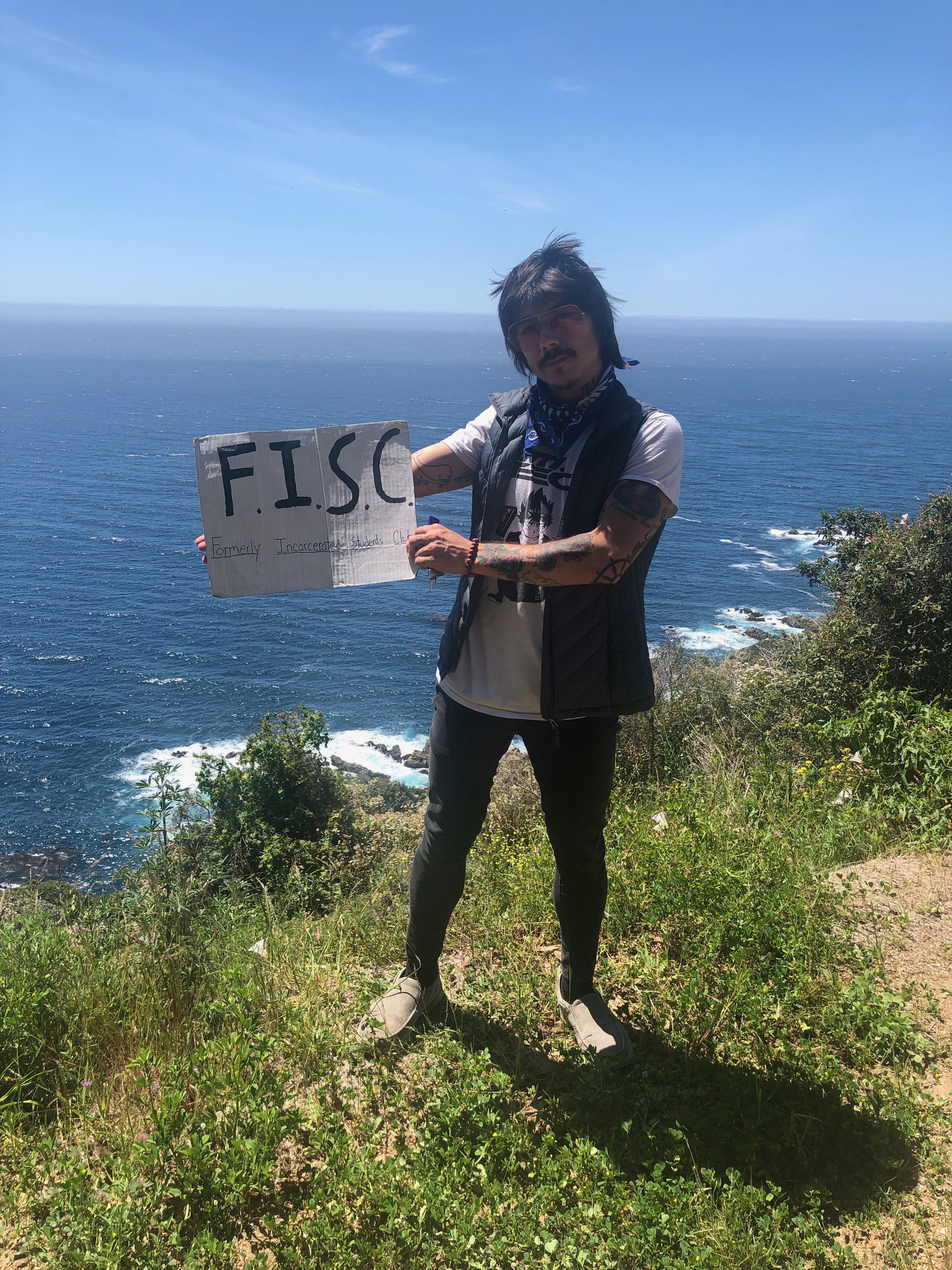
    A reflection from a former Lumberjack news editor

    When the entire world is going mad and cities are in disarray and the economy is through the tubes and the government is ordering the people to stay indoors and keep distant from human contact and all the unknowns and uncertainties and precariousness are causing anxieties and confusion and insane isolated thinking, then the only logical solution is to search for the magnificent eternal golden light in Big Sur where Jack Kerouac lost his illumination and was succumbed to mad mad maddening disillusion and deterioration of mind.

    Amidst a global pandemic and forced isolation (both for curving the spread of the disease and government say-so) Kerouac’s “Big Sur” may seem like an unlikely companion during cabin fever tendencies but he nails the coffin of loneliness surrounded by madness…and we are swimming in madness in 2020 and social distancing is causing us loneliness…he may be known for traveling on the road but the majority of his writing deals with the personal struggle of the unrevealed and intangible and intrapersonal relationships with exile and aloneness.

    It was time to go back to find some sanity while the whole world was ravaging in chaos.

    Last week I received a card from my obaasan written in shaky cursive:

    “I’m not myself now/can’t think much things now…” Her youngest son died in the middle of all this virus business and the experience of losing her youngest before her own passing into the next existence and not being able to perform a proper Japanese funeral has weighed a heavy heart on my nearly 90-year-old reincarnation of the bodhisattva Quan Yin. The letter is marked from Monterey, my hometown, just a couple dozen miles from Big Sur, which I am currently in the thick of. Whereas Kerouac fell into his madness, I was born into mine…and it was time to go back to find some sanity while the whole world was ravaging in chaos.

    Passing San Jose on the 280 at rush hour, or what normally is, and we stop not one time and I am convinced there is a God in heaven and miracles exist and coincidences mean something more than just what they don’t.

    A pitter patter of rain began to fall as my partner and I sped away from our Arcata apartment and headed down the curvy empty roads of the 101 en route to console an ailing mother from 6 feet away. My paint-scratched and hood-dented Volkswagen happily ate the white lines through redwood country, wineries, extending bridges and golden rolling hills full of deer and foxes and chirping birds. With everyone staying in doors, the urbanized are becoming again what Gary Snyder calls “wild.” Only 10 cars on the Golden Gate Bridge and all of the city, void of the Tenderloin, which sidewalks are unseen due to the amount of popup tents and stretched out tarps and rucksacks rolling in the gutters. Passing San Jose on the 280 at rush hour, or what normally is, and we stop not one time and I am convinced there is a God in heaven and miracles exist and coincidences mean something more than just what they don’t. Seven hours and not a minute more since we left Humboldt County the magnificent sand dunes of my childhood explode into view as the sun sinks behind cannery row, the fisherman’s wharf and into the pacific.

    We knock on the windowpane glass without warning. My obaasan, 4-foot-5 in frame in blue uwabaki and nearly all white thick Hokkaido curls reminiscent of the ancient Ainu people of our ancestors opens the door white as a ghost. We appear as road warriors traveling to find oil but she is happy nonetheless to see her most handsomest grandson and granddaughter in law (I know this because she tells us so in a faint whisper of grief). She is nearly silent and full of half smiles and sad lonely eyes staring off into a point in space I am unable to see. There is nothing more difficult than to deny a Japanese grandmother’s invitation of hot food and conversation… but these are harrowing times and one must put down their foot for the betterment of others… especially kindhearted compassionate grandmothers who want nothing more than to fill bellies and tell stories.

    Without being able to hug her or get close enough for her to hear me hurt my soul but the space we shared amidst all the craziness going on filled my heart with such joy that I could feel the sanity I had lost while sheltering in place replenish.

    We part for the night with three bows and head to Big Sur first thing in the morning. We were supposed to spread the ashes of my uncle but bureaucracies have slowed down (who would have thought possible they could move even slower) and checks clearing takes longer and so we had no urn and only mandatory intention of flying down the beautifully rugged pacific coast cliffs hugging the Santa Lucia Mountains to the east and infinite deep neon blue waters crashing west. All parks are closed and scattered hikers from who-knows-where park along the highway to hike in. We stop at Bixby Creek of Kerouac’s “Big Sur” but it is not the same for all the turnoffs are filled with parked cars and tourists and selfies… or maybe it is the same because on his last hitchhiking adventure up from Big Sur to Monterey 1,000-2,000 cars passed him by and he was no longer able to relate. We ate lunch beneath the shade of an oak tree 100 feet above the water and 15 miles from the hot springs. We were by ourselves with the lonely wails of the sea and the roaring of the waves and the ghostly spirits of Kerouac and my uncle.

    On our way out of town we said goodbye to my grandmother. She stood behind the screen door as we stood in the sun with bandanas and masks wrapped around our faces. She was in a cheerier mood and her energy level was heightened. She wore full smiles behind her grief and talked about the chaos of the world being unbalanced. Without being able to hug her or get close enough for her to hear me hurt my soul but the space we shared amidst all the craziness going on filled my heart with such joy that I could feel the sanity I had lost while sheltering in place replenish. Kerouac pronounces, “The more ups and downs, the more joy I feel. The greater the fear, the greater the happiness I feel,” and I believe it to be important we share the same intimacies while we are submerged in the unknown dangers of threats and hazards.
  • Shelter-in-Place is Not a Productivity Race

    Shelter-in-Place is Not a Productivity Race

    Quarantine shelter-in-place offers escape for some and anxiety for others—both are damaging

    Inhale, pause, exhale. We are living through an unprecedented, intimidating and stressful time, but now is not the time to beat yourself up.

    While the world seems at a standstill, many people have taken this time away from their normal daily duties to start new hobbies, lose weight or even learn new languages. These tasks and goals are not a reflection of yourself, nor should they be used to show off your journey through social distancing.

    A 2013 study by a psychologist at the University of Michigan examined the effects of social media on people’s mental wellbeing. The study found that social media, Facebook in particular, does not facilitate beneficial social interactions.

    The same, and worse, can be said in regard to many other social media platforms. For example, Instagram can be a mindless escape for some but a shame-inducing harbor for others.

    There’s a constant creation of new challenges and trends coming up everyday, whether it’s the pushup challenge, #untiltomorrow or even celebrities singing tone deaf tunes. Or perhaps it’s a stream of self improvement posts and revitalized New Years goals.

    Whatever is clouding your social media feed, it doesn’t have to be a standard for you to live up to. This isn’t a productivity competition.

    Some of us might have more time on our hands, but that doesn’t make things easier—and some people still working or now taking care of children might not have more time. We are also still dealing with pre-existing mindsets on top of the stress of a viral global outbreak.

    Don’t waste this time comparing yourself to someone who’s lost 10 pounds walking in circles in their driveway or to someone who’s learned how to speak Italian while in quarantine.

    We need to have compassion for ourselves always, but especially now. The Centers for Disease Control and Prevention’s COVID-19 webpage provides a section for stress and coping information. This page offers insight to stress causes and outcomes all while underscoring the importance of knowing everyone deals with stress differently.

    Thus, we escape to viral social media trends for entertainment and relief.

    In a recent Vox article, writer Rebecca Jennings supports the flood of Instagram challenges. She argues people should continue this outpour of personal content because it offers connections that will stay in this ephemeral time.

    However, instead of cluttering a platform with more dog picture reposts or pictures of people wearing pillows as clothing that only distract from the now, we should contribute to the conversation by being honest and doing something that honors yourself and others. Let your friends on social media know how you really feel—open up, cry, laugh and inspire. If you’re up for it, of course.

    Don’t waste this time comparing yourself to someone who’s lost 10 pounds walking in circles in their driveway or to someone who’s learned how to speak Italian while in quarantine. Of course, if walking in circles in your driveway while rambling in broken Italian is your thing, go for it.

    Being honest with others allows for accountability. If you continue to keep up a guise of happiness when you’re truly suffering inside, you won’t receive the help you deserve.

    Speaking up about how you feel is a challenge more people should face. You don’t need to make immediate changes to improve, but you owe it to yourself to take the time you need.

  • Lessons from When the Spanish Flu Hit Humboldt in 1918

    Lessons from When the Spanish Flu Hit Humboldt in 1918

    Looking to the past to learn about the present pandemic

    There’s a saying that goes something like, “In order to prevent future mistakes, we should look to the past for guidance.” While this current pandemic may be new to all of us, humans have gone through this before. Some of the more recent pandemics include the SARS virus, the H1N1 virus, Ebola and HIV.

    The term pandemic is defined as something “occurring over a wide geographic area and affecting an exceptionally high proportion of the population.” Obviously, the current COVID-19 virus fits into this category. While some of the aforementioned pandemics did not enact a devastating, history-altering toll on Humboldt County, another pandemic did.

    From 1918 to 1920, the Spanish flu swept across America, resulting in an estimated 675,000 deaths according to the U.S. Department of Health and Human Services. The first official report of the Spanish flu in California was reported Sept. 27, 1918, just two weeks after an outbreak on the East Coast. By November 1918, the total cases throughout the state hit about 115,000—overwhelming doctors and government officials from north to south.

    One of three doctors that helped Spanish flu patients in the Ferndale area.

    Although Humboldt County sits in an isolated area protected by the “Redwood Curtain,” the area was soon amassed in its own troubles combatting the illness. Humboldt County had a population of about 37,000 people with Eureka holding around 12,000. The Spanish flu resulted in around 200 deaths (although it is thought to be much higher) and thousands grew ill.

    In 2012, Humboldt State alumnus and McKinleyville native Jeff Benedetti-Coomber wrote a detailed history of the impact the Spanish flu had on Humboldt County. For it, he was awarded the Charles R. Barnum History Award by HSU’s history department. For his research he scoured through old newspaper clippings for primary source documentation. He read academic analysis on how the Spanish flu affected the entire nation and he cited Matina Kilkenny, a researcher and local author for the Humboldt Historical Society who also wrote about the impacts the Spanish flu had on Humboldt County.

    What prompted Benedetti-Coomber to focus on the Spanish flu was its lack of local research. As his peers decided to look into European history, he decided to focus his attention on the effects locally.

    “I was walking through the graveyard in Arcata and noticed a family of graves, not necessarily related to the [Spanish] influenza but it got me thinking about what effects the flu may have had because it was around the same time,” he told me over the phone from his place in Los Angeles. “Once I started researching it I saw how it did affect the county and I was pretty amazed.”

    Benedetti-Coomber’s senior thesis, titled “Death In the Redwoods: The Effects of the Spanish Influenza on Humboldt County,” spans 30 pages and breaks down how each town dealt with the outbreak. He highlights what preventative measures seem to have worked and where officials, the public and the media went wrong and what they got right.

    “It’s just like today when you tell people to do something and they kind of resist. A lot of people had that with the Spanish influenza and it was a reason a lot of people died, because they didn’t take it seriously.”

    Jeff Benedetti-Coomber

    Some of the highlights from his research that still stand out to him are how Eureka initially closed all schools, which flooded the streets with children. They soon changed their minds and brought the kids back into the school to try to quarantine the children. Another nugget of research that sticks out in his mind has to do with masks and the public’s initial reluctance to wear them.

    “It’s just like today,” Benedetti-Coomber said, “when you tell people to do something and they kind of resist. A lot of people had that with the Spanish influenza and it was a reason a lot of people died, because they didn’t take it seriously.”

    When the Spanish flu hit Humboldt, the United States was in the middle of World War I and young men from Humboldt were signing up to join the war effort. There were war rallies and large gatherings of people throughout the towns in Humboldt in the fall of 1918 as the Spanish flu began to creep in.

    “Although the Great War was still the main focus in Humboldt County, more and more citizens were beginning to take notice of the spreading pandemic,” Benedetti-Coomber wrote.

    Some of the newspapers in Humboldt at that time seem to have downplayed the seriousness of the Spanish flu. Benedetti-Coomber points to an ad that was in the Humboldt Standard by Vicks VapoRub that was “disguised as an article… and it assured readers that the [Spanish flu] was ‘Nothing new simply the Old Grippe and la Grippe that was the epidemic in 1889-90.’”

    Benedetti-Coomber wrote that it is believed the Spanish flu was brought to Humboldt County by locals traveling to other parts of the state to help care for sick family members and then returning before symptoms started to show. By mid-October 1918, reports of the Spanish flu were starting to pop up in the local newspapers.

    “The Humboldt Times also reported that there were roughly 150 cases in Eureka by [Oct. 22] and hospitals were short staffed. Doctors were so busy they did not have the time to report new cases or treat the majority of their patients.”

    Jeff Benedetti-Coomber

    “The Humboldt Times and Humboldt Standard newspapers offered daily accounts of what was happening,” he said, adding that they also seemed to not care about the Spanish flu at first.

    On Oct. 12, 1918, four cases were reported in the Humboldt Times and those infected were quarantined in a “‘safe house’” on 8th Street where they could be quarantined and cared for,” Benedetti-Coomber wrote.

    At first, the mayor of Eureka downplayed the danger to the public, but two days later, five more people were infected. By Oct. 22, 1918 there would be more than 150 cases and one death.

    “According to the Humboldt Times, Mrs. Garber Dahle was the first person in Humboldt County to die from the deadly virus,” Benedetti-Coomber wrote. “The Humboldt Times also reported that there were roughly 150 cases in Eureka by [Oct. 22] and hospitals were short staffed. Doctors were so busy they did not have the time to report new cases or treat the majority of their patients.”

    Action to combat the Spanish flu across the county began to take root. Arcata was the first town to pass a requirement that all residents had to wear a mask while out in public, and by Nov. 7, 1918, the entire county was required to do so. Emergency hospitals were soon established across the county with some residents offering up their homes for the infected.

    Arcata escaped the pandemic with only four deaths, but the same can’t be said for Eureka and especially for the logging camps in the remote areas of the county. The number of cases grew in the urban areas, and by Oct. 23, 1918, the logging camps were left to fend for themselves.

    “Logging camps and small towns were informed by the newspapers and from local physicians that they would have to face the Spanish Influenza on their own as all of the county hospitals were completely full,” Benedetti-Coomber wrote while citing a Humboldt Times article titled “Influenza Increases Alarmingly in Two Days.”

    Young women wearing masks in Humboldt County.

    But one logging camp was able to escape the pandemic with no cases at all. In her article, “Missing Faces,” Matina Kilkenny reported how Carl Munther set up a quarantine system for his workers who decided to go into town. (Kilkenny’s article has a number of great photographs of life in Humboldt County during the Spanish flu.)

    “Munther required every person returning to camp… to stay four days in a tent he’d pitched some distance from the workers’ cabin,” Kilkenny wrote, adding that the returning workers were also required to work and eat separately from their peers. “Thanks to their boss, very few men chose to leave the Barrel Company camp and not one case of influenza occurred there.”

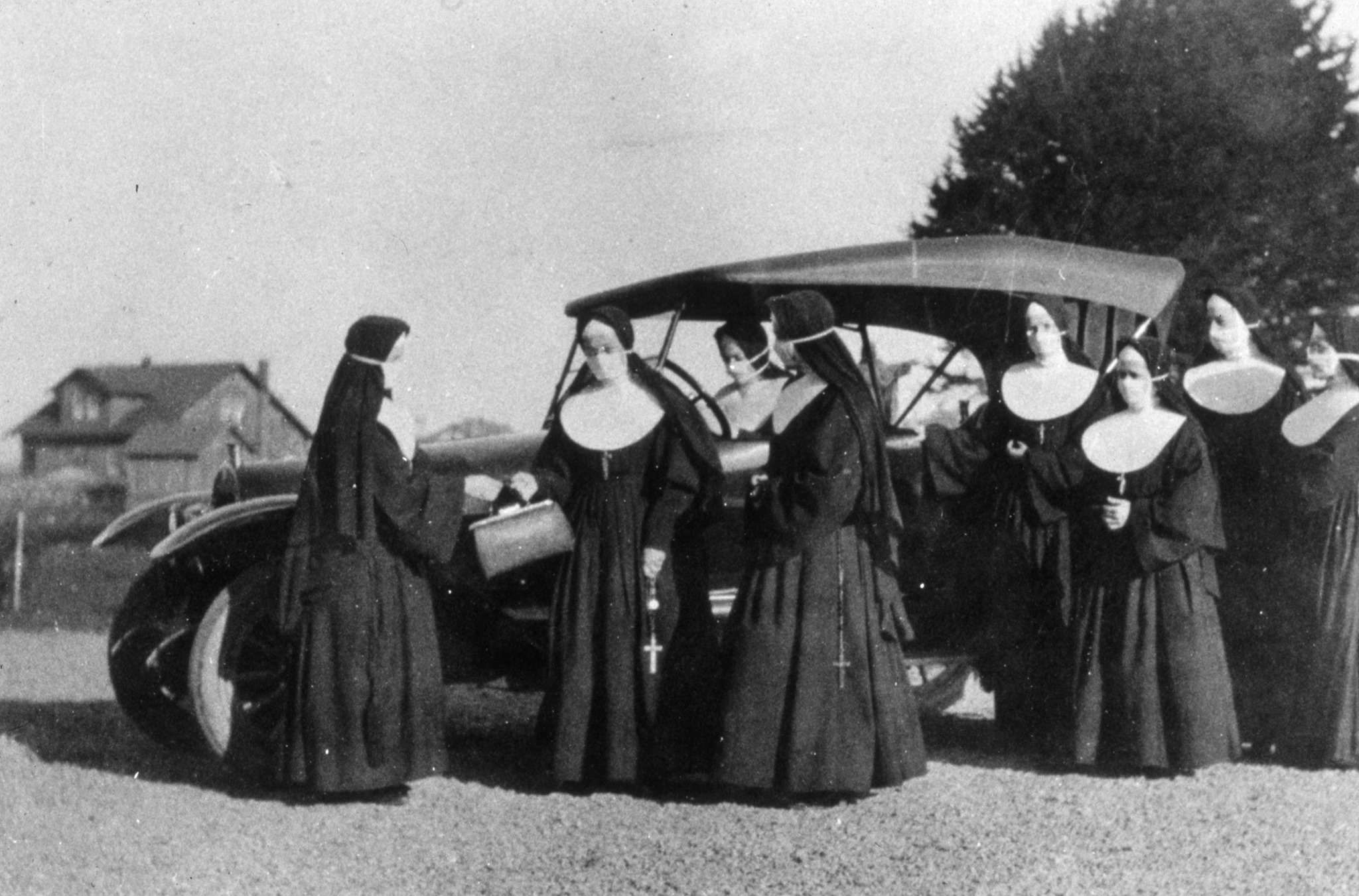
    Sisters of St. Joseph wearing masks during the Spanish flu. The sisters helped many patients in Humboldt from 1918-1920.

    Throughout her research, Kilkenny was able to find where a number of hospitals were set up across Humboldt. There was a Red Cross Hospital in Korbel, Arcata, Blue Lake and Eureka. Kilkenny also came across an interview between a member of the Sisters of St. Joseph of Orange in Eureka and a man named Brad Geagly. Kilkenny wrote the following:

    “[Mother Bernard] sent [the Sisters] out in twos, in cars provided by the Red Cross. She armed each Sister with a kit containing camphor and sweet oil, castor oil, and mustard plasters. Into the homes… the sisters came, arriving at seven o’clock and leaving at the end of a 12-hour shift, to be replaced by two other Sisters. They would attend first to the adults….They would bathe the delirious victims completely, rubbing their chests deeply with the camphorated oil. Mustard plasters would be applied, and then the sisters would wrap the sick tightly in whatever woolen material they could find; then they would tend the children. Once they had been bathed and medicated, the sisters turned to washing linens or cleaning house. They fed their charges warmed milk and broth prepared from the food furnished by the Red Cross.”

    Kilkenny noted that, generally, it was the poor who were admitted into the hospitals, while the more well-off were cared for in their homes. Because of this the actual tally for those infected and the deaths attributed to the Spanish flu is unknown. Kilkenny also points out how the Native American tribes were hit hard by the Spanish Flu as well.

    “Of the [11] Native Americans whose deaths are on record at the County Courthouse, five were from Table Bluff, two from Hoopa, one from Miranda, one from Orleans, one from Requa, and one was a laborer at Korbel,” Kilkenny wrote. She also noted evidence that many Native Americans often refused treatment by White settlers around this time period.

    Kilkenny was also able to find county death records from that time and noted that between Sept. 1, 1918 and April 1919, 175 Humboldt residents died with 91 of them between the ages of 20 and 40.

    And so what can we learn from this history?

    There is evidence that social distancing works by the example set by Carl Munther at his logging camp and how travel throughout the state can spread the virus. We can see how hospitals were eventually inundated with those infected with the Spanish flu and how staff were stretched thin. We can also see how it is important to get ahead of a pandemic and try to prepare as much as possible.

    Humboldt County seems to be doing just that. They have recently distributed around 30,000 pieces of personal protective equipment to first responders and medical staff across the county. Humboldt State chipped in and prepared 1,250 COVID-19 test kits. Also, as I’m sure you are aware, we are in a “shelter in place” order that was enacted to help stop the spread of the virus and to give medical staff the ability to fight the virus without being overwhelmed.

    Towns across Humboldt are also doing their part to help prevent an outbreak. Trinidad passed a moratorium on all short-term rentals and added some pretty forceful consequences to anyone who breaks it.

    “Over the course of the meeting, council members added some teeth to the resolution with language saying that a single violation may result in the City revoking a proprietor’s short-term rental license for up to a year,” the Lost Coast Outpost’s Ryan Burns recently reported, adding that the county may consider a similar measure.

    A stained glass piece by Humboldt artist Colleen Clifford.

    As this thing progresses, we are all going to have to make some sacrifices, but we’ll get through it. Help out the elderly and the immunocompromised if you can. Help out each other by not going out or attending pretty much any gathering of any number of people.

    Let’s all work together — but at least six apart — to help “flatten the curve.”

  • A Rundown of All The Emails HSU Has Sent Students

    A Rundown of All The Emails HSU Has Sent Students

    Since March 15 HSU has sent out over a dozen emails on their response to COVID-19

    Here is a summary of emails Humboldt State University has sent out since March 15.

    March 17: HSU informed students of its efforts to supply students with reliable laptops from the library as well as internet access for students without a reliable connection. HSU provided a list of locations where the university’s Eduroam Wi-Fi connection is strongest, as well as a list of services that are providing free Wi-Fi services during the COVID-19 crisis.

    March 19: HSU informed students of Humboldt County’s shelter in place order. HSU confirmed that essential employees would be asked to continue to work on campus, and all others would work by teleconferencing. In a second email on the same day, HSU confirmed rumors that commencement, originally planned for May 16, would be canceled. HSU asked in a now-closed Google form for creative alternatives to celebrate graduation.

    March 21: HSU released a more detailed email regarding its policies related to essential employees and payroll. Positions listed as essential included public safety, information technology, the library, University Center, health center, Oh SNAP!, residence life, dining, facilities management, research continuity, business services, payroll and mail distribution. HSU announced that its payroll department would be working on creating digital timesheets for employees working from home and that emergency pay would not be in effect as it was during the blackouts of the fall 2019 semester.

    March 23: HSU revealed its guidelines on returning to campus. HSU asked students returning to Humboldt from areas with community spread or international destinations to self isolate for at least 14 days before returning to campus. HSU also advised students who are feeling ill to contact the Student Health Center at (707) 826-3146 before visiting the center.

    March 24: HSU asked that students who live in on-campus housing and were on any of these three flights to contact Housing and Residence Life at (707) 826-3451:

    • March 16: United flight #5827 from Los Angeles Airport to Arcata
    • March 18: Delta flight #4124 from Seattle, Washington to Medford, Oregon
    • March 18: United flight #5555 from San Francisco Airport to Arcata

    March 26: HSU announced that the library would close on Friday Mar. 27 in response to the ongoing COVID-19 situation.

    March 27: HSU extended the deadline for changing the grading mode of classes to May 9. HSU said it’s looking into expanding the number of courses that can be switched to credit/no credit, as well as lifting restrictions on the number of courses that can be taken as credit/no credit.

    March 30: HSU announced the closure of Siemens Hall’s computer labs and the University Center to reduce transmission of COVID-19.

  • Photos Show Life Around Arcata in the Time of COVID-19

    Photos Show Life Around Arcata in the Time of COVID-19

    A photo series from the end of spring break

    Photographer and Sports Editor Thomas Lal captured these scenes from around Arcata on March 21 at the end of spring break at the beginning of Humboldt County’s shelter in place order.

    The storefronts on the Arcata Plaza look out on mostly empty streets.
    An employee sits at a computer while a sign advertises that the business is still open during the first week of a shelter in place order.
    The shelves in the Arcata Safeway.
    The Humboldt State Library.
    A lone person walks through the mostly empty parking lots at Humboldt State University.
    The Humboldt State Library.
    The Humboldt State Library.
    A single person works at the Humboldt State Library.
    A carton of eggs sits on the shelves at the Arcata Safeway.
    A lone person stands just off of the Arcata Plaza.
    An employee puts up a sign in the door of the Jitter Bean on the Arcata Plaza.