The Lumberjack


Students Serving The Cal Poly Humboldt Campus and Community Since 1929

Tag: Students

  • My bikini is not an invitation

    My bikini is not an invitation

    by Ione Dellos

    Here’s how getting stared at on the beach usually happens for me: I’ll be minding my business at the beach, neither having a good time or a bad time, just a time. I get the familiar feeling that I’m being stared at, and after a quick look around, there it is, an ogling pair of eyes looking me over. Just because I’m wearing a bikini to the beach does not mean that I am inviting any sort of negative attention. I am wearing this bikini to the beach because I thought it was cute when I bought it. Now, I am no longer having a time, but a bad time, all because some man couldn’t keep his eyes anywhere else but my body.

    I shouldn’t have to flip off and swear at men just to get them to leave me alone at the beach. I will not fight for scraps of respect but expect it paid in full. My body and gender don’t make me less than, and they don’t make me an object either.

    Not counting the fact that ogling random strangers is incredibly rude, you never know what’s going on in someone’s mind. This could be their first time wearing a bikini on the beach in a long time, or they could simply be wearing it because they bought it and want to get their money’s worth. They could have insecurities about their body that can be exaggerated by excessive staring, or maybe they just don’t like getting stared at (like most sane individuals).

    Despite being attracted to women, I can comfortably go to the beach without ogling women with no effort on my part. Believe it or not, not staring at women on the beach is incredibly easy! As a gay woman who grew up with gym locker rooms and camp changing rooms, I snapped my eyes away every time my friends would get changed, and I was terrified to even go in a Victoria’s Secret for the longest time. I know I have a different relationship with how I view women than your typical straight man with male pattern baldness. Also, as someone who possesses a body that gets stared at frequently, I know what it’s like to be stared at. I don’t like to do it to other people.

    When spring break rolls around this semester, straight men, find it in your hearts to not obviously stare at every woman wearing a bikini at the beach (eyes on the road, please). There is a whole world of gender identity behind the pair of boobs you’re ogling, and every feminine-presenting person isn’t necessarily feeling feminine on the inside. If you find that you just have to choose objectifying women over all other activities, then do the women in your life a favor and don’t hit the beaches this spring.

  • Sharing is caring… unless it’s propaganda: The Russia-Ukraine Crisis

    by Kris Nagel

    Everyone has an impact on someone’s perspective of the world. Almost anything we do or say affects someone in some way. The same holds true for the things we post on social media. We are all influenced by the people around us. When the subject of our virtual discourse is something as poignant as international conflict, our sympathies can be weaponized without us even knowing it.

    Roughly half of Americans regularly get their news from social media, according to a 2021 study from the Pew Research Center. The information we share online can challenge our belief system but oftentimes reinforces it. Al Tompkins, a journalist with the Poynter Institute, says that truth gets little consideration when the content we share aligns with our worldview.

    “We tend to support those things that agree with your position on anything,” Tompkins said. “Whether it’s the designated hitter in baseball or invading Ukraine, we tend to repeat and share things that we agree with.”

    The internet has changed the way information is spread through society. It’s easier than ever to produce fake information.

    “The other piece of it is this,” Tompkins said. “Disinformation is a very powerful weapon. The Russians know it but, let’s face it, the Americans know it too. The American government, particularly through the CIA, has done lots of disinformation over the years. You would expect that they do, it’s kind of part of what they do.”

    Understanding that misleading content is built into our news feed requires us to take a critical look at what we share before we share it. Tompkins’ approach asks four questions:

    What do I know?

    What do I need to know?

    How does that source know what that source claims to know?

    And is there any other way to look at this other than the way that source is telling me?

    Vicky Sama saw the real-time effects of media coverage and propaganda in the several wars she covered during her career at CNN. Sama is now the department chair for Cal Poly Humboldt’s journalism and mass communications program.

    “So there’s two parts of war, usually,” Sama said. “You have the war, the actual war with fighting and then you have the information war, the propaganda war, and that is an essential part of what happens in war as well.”

    When we see things happening live, there isn’t an editing process that we can rely on to verify what we see. Live television, live broadcasting, and live streaming allow for that to happen. Now that consumers are a part of the distribution process, Sama argues they also need to be part of the editing process.

    “If everybody’s going to start considering themselves a journalist just because they have a cell phone, then they need to start doing the work of a journalist and start verifying the information before they put it out there as well,” Sama said.

    However, verifying everything we see is seldom an intuitive process. Kirby Moss, a Cal Poly Humboldt professor in the journalism department, teaches a range of media analysis classes. Moss said that the fundamental way to verify information is to look for other sources reporting on the subject.

    “I tell students, if you find some information that you’re researching on, try to cross-check it with at least three sources if you can,” Moss said. “And then they find out sometimes like, ‘Well I went to one source but the other source says something else, the other says something else,’ and so then they begin to question that message.”

    It takes familiarity to be confident that the information you get is credible. That is not to say that there aren’t tools we can use to check the things we share. Vicky Sama is working on adding a media literacy course for freshmen to the department catalog. In the meantime, JMC 309: Analyzing Mass Media Messages will be open for registration near the end of the semester. Online courses on media literacy are also available to everyone through the Poynter Institute.

    [DISCLAIMER: The Lumberjack rarely uses journalism department faculty as sources for stories. However, an exception was made for this story due to the expertise our professors have on this particular subject. Vicky Sama and Kirby Moss do not exercise editorial oversight on the content The Lumberjack publishes.]

  • Cal Poly Humboldt’s Library Cafe sees the light of day

    Cal Poly Humboldt’s Library Cafe sees the light of day

    by Lex Valtenbergs

    The Library Cafe lifted its shutters for the first time in several years on Friday, Feb. 26. The cafe serves delicious coffee blends from Muddy Waters Coffee Co. as well as pastries, veggie wraps, drinks, and more.

    Recent biology graduate Kate Mendoza was just hired by the private company Chartwells Higher Ed to work at the newly reopened cafe.

    “Chartwells is really awesome,” Mendoza said. “Honestly, they work really well with students from what I’ve seen.”

    Mendoza’s go-to drink is the cappuccino.

    “I usually like to do the cappuccino,” Mendoza said. “It’s just espresso, steamed milk, and a lot of foam. I think the foam is my favorite part.”

    Mendoza’s coworker Ahmad Shah, a senior majoring in communication, recommended the hazelnut mocha.

    “I like a hazelnut mocha,” Shah said. “Sometimes coffee is a little bit bitter. The sweetness helps balance the bitterness of the espresso.”

    Communication senior and Learning Center academic peer coach Kas Colwell ordered a vanilla latte with two espresso shots from the Library Cafe on March 3.

    “I’m so glad y’all are open again,” Colwell said to Mendoza while ordering. “It’s exponentially improved my quality of life.”

    After getting her drink, Colwell sat down at a nearby table in the dining area. As a library employee, she appreciates how easy it is to get to the cafe.

    “It’s the convenience because I literally work in the library, so it’s on my regular route,” Colwell said. “I don’t have to go walking somewhere else to get coffee.”

    The Library Cafe is available to all Cal Poly Humboldt students and faculty and is currently open on weekdays from 7:30 a.m. to 5 p.m.

  • Goth Night at Richard’s Goat

    Goth Night at Richard’s Goat

    by Cherish Fulcher

    Photo by Lexi Rangel | (left to right) Lalo Rivera, Gigi Salazar, Chris Servi, and Josie Licavoli pose for a photo at Goth Night at Richard’s Goat on Feb 25.

    On Friday, Feb. 25, Richards’ Goat Tavern & Tea Room hosted its first ever Goth Night, created by recent Cal Poly Humboldt graduate Jamie Cocking. The event was a tribute to the Goth subculture, which originated in the United Kingdom in the early 1980s. The subculture is open ended, yet is heavily saturated with darker tone aesthetics and music.

    “I think goth subculture is all about expressing yourself in your truest form,” Cocking said. “Since I’ve lived here and have turned 21, I haven’t found any clubs or events with the music that I love to dance to, so I just decided to do it myself.”

    Being a small town, Arcata is not well-known for its nightlife. However, contributions to the scene, such as Goth Night, keep it going.

    “I just wanted to create a space where people could dress up as much as they wanted and not feel like they are sticking out like a sore thumb,” Cocking said. “Because for me, I mean everyday is Halloween.”

    Richards Goat will be hosting another Goth Night on April 9.

  • I am a queer Christian, not an oxymoron

    I am a queer Christian, not an oxymoron

    by Matthew Taylor

    My entire existence is a tightrope balancing act between two facets of myself, that are constantly told they cannot exist together. Yet these facets can not be divided from me nor from one another. I am queer. I’m a person of faith. I am a trans and bisexual Christian.

    As Lent rolls in, I often find myself having to reflect upon these two identities. I take this time of the year to re-orientate myself back to my spiritual core. It is a beautiful process that reminds me of my humanity and the love I receive everyday from my Creator, but it is a side that I often feel compelled to hide, just as I am often compelled to hide my queer side from the greater Christian community.

    It is a fine line. I’m constantly aware of my fellow queer peers’ religious trauma, something I’d never want to make them relive. It hurts, though, to know that my faith comes with so many automatic assumptions of my character.

    Some have ideas that I’m conservative in my politics or that I don’t affirm my own queer identity. I am neither of those, and neither are many other queer people of faith. So, I stay silent. Yet in this very silence I only continue to feed into the false narrative that all religious persons or persons of faith are non-affirming of queer identities, bigoted, or close minded.

    Growing up, I was extremely lucky to live in both a queer affirming and religious household. I was raised predominantly in a Christian denomination that had already begun to take the steps towards full LGBT+ inclusion by the time I was born.

    It is a huge privilege, one I constantly try to stay aware of. I also believe it is a statement of hope. I am living proof that one can grow up as Christian, as a religious person, and still fully affirm their own queer existence. It is because of this very truth that I continue to live knowing these two identities are not mutually exclusive.

    I don’t wish to proselytize or to convert any person to my own faith, nor to any religion in general. There is truth, validity and importance to be found in both agnosticism and atheism. All I wish is to break the narrative that all people of faith are non-affirming.

    This perception erases the amazing work that queer people of faith all around the world are doing to create rightful places for us in these sacred spaces. More frightfully, it gives more power to those of faith who may wish to silence us, oppress us or destroy us both within these religious spaces and out of them.

    I want to extend my love and validation to any fellow LGBT+ people out there who also desire to stay in or are currently part of any certain religion, whether you be Christian, Jewish, Muslim or belong to any other faith. There are people out there just like you, and there are resources out there that can allow you to flourish fully and wholly as you are.

    This Lent, as many like me take this moment to pause and self-reflect on ourselves, I hope to show through my actions and pure existence that religion and spiritual expression are as much a right to LGBT+ people as they are to others.

  • Madison Parry has standout year as freshman

    Madison Parry has standout year as freshman

    by Mekiah Glynn

    Madison Parry started playing basketball when she was 6. Now, she’s a freshman on the Cal Poly Humboldt’s women’s basketball team. Throughout this season that lifetime of practice has become apparent with her contribution to the ‘Jacks.

    Parry leads the team with 363 points total for the 2021-22 season and started in 23 games. She said that Family, friends, and her teammates are all factors that keep her motivated to continue pushing herself and playing her best.

    “[The coaches] challenge me every day with practices and games,” Parry said. “They always motivate me to be the best version of myself.”

    The practices involve competition that makes it fun for Parry and gives the athletes a reason to push themselves.

    After all the practice Parry finds her joy in the crowd when she plays home games. She said that her favorite part of the games is the atmosphere.

    “When playing in the Lumberjack arena, It’s really amazing,” Parry said.

    Parry said she appreciates the energy and motivation that having a crowd full of Cal Poly Humboldt students brings and while they don’t have that at away games, Parry believes that the away games bring the team together more.

    “A highlight from this season would probably be the Chico game,” Parry said. The Chico game resulted in a Humboldt win after the game had 3 overtimes. Parry scored 20 points in the game against Chico.

    For the remainder of the season, Parry hoped to finish strong with more wins. “We’re not gonna make the tournament,” Parry said. “But if we win these games we can change other team’s rankings.”

    The Basketball season came to an end for the ‘Jacks on Feb. 26 where they fell to the Cal State San Marcos Cougars 47-75.

  • International Education Week: Feb. 14 – 18, 2022

    by CPH’s International Studies Students

    Global Engagement Begins at Home

    This year’s keynote speaker, Mary Akpovi, who was born in Nigeria but has lived most of her life in California, inspired us to be both local and global citizens. While Akpovi has spent most of her career in public accounting, her true passion, in recent years, has been charity work. Having been involved with several charity organizations here in the United States and abroad, she has a lot of wisdom to offer.  

    Photo courtesy of Mary Akpovi

    In California, Akpovi was previously a board member for the Exceptional Children Foundation, an organization that provides services to children and adults with learning and developmental challenges. She also worked with Hope of the Valley Rescue Mission, an organization that assists people experiencing homelessness. 

    Her international work has been centered in Sierra Leone, Uganda, and Kenya. She has been instrumental in opening vocational training centers in these countries and continues to support several vocational schools, primarily in tailoring, catering and salon care. 

    When asked where her passion for charity work comes from, she said it was the support she received in her own life, from her father, her religion, and from others.  Now, she is paying it forward by mentoring, and it is at the heart of everything she does. In her opinion, it is one of the best investments a person can make. She hopes participants got the overall message that everyone has potential. That potential can be fostered by encouraging one another, being intentional, and “staying in your lane,” a phrase that Akpovi holds close to her heart.

    by Rachel Hood

    Movement and Identity

    In light of forced displacements, violence, and complex geo-political issues, Dr Tani Sebro (PSCI) explored the cultural performances that have served the critical function of Myanmar’s refugee population in her session “Aesthetic Nationalism: The Dance of War and Exile along the Thai-Myanmar border.” 

    In the context of conflict and exile, music, dance, and the performing arts play a pivotal role in creating a sense of national and community, according to Sebro. As a cultural ethnographer who also underwent training in the traditional performance arts called Jaad Thai, Sebro was able to experience how dance and performing arts made life possible outside the contemporary nation-state system for exiled people. In essence, physically synchronized rhythmic movement promotes a strong sense of unity within all cultures, religions, and nations. It also holds potential for expressing ethnic identity for refugees, especially for the Tai living in a time of danger.  

    by Johnny Mendoza

    IEW Highlights Black Voices 

    On Feb. 14, Professor Maxwell Schnurer kicked off International Education Week with a presentation about the music and activism of Fela Aníkúlápó Kuti, a Nigerian Pan-Africanist and musician. 

    During his life, Kuti reinvented African culture as a revolutionary act to subvert colonialism and reassert his autonomy as a Black person. “I never thought about it, being African as such,” Kuti said in an interview from the 1970s. “It didn’t mean anything to me until much later in my life.”

    Schnurer deconstructed the sociology of colonialism to provide a framework for cultural appropriation, a phenomenon that exploits indigenous Black cultures in particular. Colonialism is a kind of discourse that perpetuates a narrative of European superiority. 

    “You’re born out of the womb into a world of discourse,” Schnurer said. “Your grandparents, your aunts and uncles had language on this planet, before you arrived.” 

    Umoja Center for Pan-African Academic Excellence Coordinator and International Studies alumnus Doug Smith also spoke, sharing his ongoing master’s research about Pan-African identity. 

    “For many people of color, the use of English as a language, as a means of communication, is very tied into their history and engagement with colonialism and settler colonialism,” Smith said. 

    by Emma Roberts and Lex Valtenbergs 

    Levels of Connection

    International Education Week helps inform us about the issues that connect us wherever we are in the world; two presentations made this point very clear. 

    COVID-19 is perhaps the most immediate example of how globalization affects our daily lives. Economics professor Beth Wilson brought this idea closer to home by looking at the impact of the pandemic on education. 

    Wilson’s information-packed presentation examined the different ways that the pandemic has affected the lives of one billion students worldwide, particularly in developing countries with little access to technology. Short term decisions made by local authorities will have long term economic consequences Wilson argued that “COVID-19 is the biggest education disruption in history.”  

    To finish out the week and bringing the world back to Humboldt, alum Viridiana Preciado discussed the work done by the Sovereign Bodies Institute, an organization that helps locate missing and murdered Indigenous women. 

    Preciado’s presentation highlighted the injustices that indigenous communities face on a daily basis and talked about the work SBI has done locally with the Yurok tribe and offered ways people can support this effort. She concluded her presentation by pointing out that she got her job after meeting the CEO of her organization at an IEW session two years ago. 

    “I just followed my heart and introduced myself after the session. I told her I really wanted to help make a difference and here I am,” said Preciado. 

    by Laura Gurney

    Following the Flow: Coffee and Gold

    We are very fortunate here at Cal Poly Humboldt to have professors who are passionate about the work they have done, and who want to share their knowledge and experience. International Education Week offers faculty from across the university the opportunity to showcase their work. 

    Gordon Ulmer and Noah Zerbe traced the “social life” of two very different commodities economically and culturally. 

    Together, they explored the impact of global markets for gold and food (and specifically for coffee) on local communities around the world. Each of these common goods ties together different social, cultural, political, and economic ideas. They also asked us to think about our own responsibility in that global exchange. 

    “Starting my day with a cup of coffee connects us, connects me, connects all of us to these broader economic, political, cultural, environmental questions,” Zerbe said.  

    by Abby Reina-Guerra 

    Only 1% of College Students Study Abroad – Stand Out from the Crowd

    Despite COVID-19 and lockdowns, Cal Poly Humboldt is beginning to plan for study abroad again. Five different sessions during International Education Week helped students prepare for their trips. Videos are available on the IEW website (iew.humboldt.edu/schedule) where you can hear from students about their own experiences; from budget planning and cell phone plans to what it was like to be a student of color in a strange place. 

    Professors Matthew Dean and Joseph Diémé also hosted a session to talk about their Leon, Spain and Nantes, France programs scheduled to take place this summer. They discussed the appeal of faculty-led programs, including the ease of transferring credits and even the possibility of gaining a minor. More information can be found on the Humboldt Study Abroad website, which also includes information about other programs through the CSU or third-party providers. All programs are available to any student at Humboldt regardless of major. 

    A final look at study abroad was presented by Jonathan Maiullo of College of the Redwoods, who discussed the importance of recognizing the impact you have in the communities where you travel. He stressed the importance of “responsible storytelling” as a way to share your experiences with others while respecting the culture you visit. If you are thinking study abroad is not for you because of cost, there are a number of scholarships with deadlines coming soon. 

    Stand out from the crowd – study abroad: https://humboldt-international.terradotta.com/

    by Debora Rios

    A World of Love, Education and Grief

    Kicking off on Valentine’s Day, it seemed natural for anthropologist Mary Scoggin to speak of love in the context of China.She discussed the many different ways in which we understand and express our affection, and how even our most cherished emotion is rooted in our own cultural history. 

    Educating the next generation is deeply rooted in culture. Vincent Biondo, Department Chair of Religious Studies at Cal Poly Humboldt, talked about Islam and citizenship education in Europe. Biondo addressed the question of how Europe should respond to diversity and incoming migrant communities, specifically Muslims. Biondo argued that Europe should invest in schools that teach pro-social values. 

    “There’s a lot of evidence that shows that people solidify their prejudices by the time they’re in middle school,” Biondo said. 

    In other words, if one educates students at a younger age about diversity, communities would become more accepting. 

    On the other end of the spectrum, Kerri Malloy of San Jose State discussed a workshop he was asked to help host in 2019 on promoting and protecting civil and human rights. That year the seminar was exclusively designed for members of the US civil service like ICE and FBI agents. Perhaps more importantly, it took place at the Auschwitz concentration camp as organizers felt there was no better place to talk about the erosion of human and civil rights. 

    As Malloy showed multiple pictures of the camp, he asked his audience to consider these images not simply as foreign, but to think of places here in California that are also places of violence. 

    As he repeatedly observed, “These places were built to last – they have a permanence – they mark the landscape forever.”   

    by Haley Rodden and Cataleena Tchieng

    Work Around the World 

    International careers offer an extraordinary experience for anyone to branch out of their comfort zone and explore the world. Through your experience abroad you can gain a stronger understanding of other types of cultures, peoples, environments, and governments depending on the work you choose. People who work in an international setting are often pushed to confront extraordinary new elements that open any number of lifetime options. 

    Careers extend from working on a campus to help students to build their own international experience. Nora Montoya of Cal Poly Humboldt’s Academic and Career Advising Center took time to work for the Peace Corps, and Ryan Gliha worked for the State Department. He has since spent his career helping build strong relationships between the United States and other nations around the world. Now, as the diplomat in residence for California, Gliha is helping students join the foreign service. 

    Even while still in college there are ways to build a strong international profile. For example, the State Department has remote internships around the world and every government department hosts internships that could help you build your career. 

    “International work is an opportunity like no other,” Gliha said. “It will change your life”. 

    For support or more information contact ACAC and Nora Montoya (nora.montoya@humboldt.edu), John Keller, Peace Corps (Jkeller2@peacecorps.gov) or Ryan Gliha, State Dept (DIRnorthwest@state.gov).

    by Leslie Ortiz


    About International Studies

    Photo courtesy of the International Studies dept.

    International studies is an interdisciplinary major that examines the drivers of globalization. The goal is to better understand the forces that shape the world so we can make changes in that world. Students study other languages and are required to study abroad as part of their own exploration of the interconnections between people and places local and global. 

    International Education Week, now in its 23rd year at Humboldt, is a 1-unit colloquium crossed-listed by six majors and open to the community, but required for international majors. This year, IEW brought together faculty and staff from across Humboldt, California and the world via Zoom to present 30 hours of programming to well over 700 attendees. 

    Students in this year’s international capstone class acted as hosts for each session and wrote this report of the week’s events. We are honored to be guest reporters for The Lumberjack and hope this helps you feel less distanced in a time of COVID-19. We are rooted in this community but still reaching for the world.

    If you have any questions about IEW or international studies, my door is always open. 

    Professor Alison Holmes (alison.holmes@humboldt.edu). 

    International Education Week would like to thank its sponsors and all of our presenters. The full schedule and videos of sessions from 2022 (and 2021) can be found online: https://iew.humboldt.edu/. 

    International Studies Capstone Class Spring 2022
    Laura Gurney, Rachel Hood, Johnny Medoza, Leslie Ortiz, Abby Reina Guerra, Debora Rios, Emma Roberts, Haley Rodden, Cataleena Tchieng, Lex Valtenbergs

  • Men need to stop talking to me

    Men need to stop talking to me

    by Sophia Escudero

    Today, I was sitting at the bus stop with a significantly more male friend of mine when a man I had never seen before approached us and asked when the next northbound bus was coming. My friend didn’t know, but I pulled up the bus schedule on my phone and informed the stranger that he had another three minutes to wait.

    “Thank you,” the man said with a smile. “You know, I thought you were a huge bitch at first, but you’re actually really nice.”

    I am not a woman, but by accident of my birth, I am often perceived as such. I have experienced the casual misogyny and willingness of strange men to just say things that probably didn’t need to be said since at least the age of ten, when a man first leaned out of a car window and shouted the specifics of what he would like to do to me, and while he’s at it, to the small dog I was walking, in my general direction.

    I speak with experience when I say that men on the street will really say the most bizarre things and go about their day, while the person they shouted at just has to live with the garbage that they spewed without a second thought.

    What really gets me about this man specifically was his sincerity. He truly believed that he was paying me a compliment, and likely went about the rest of his day believing he’d had a pleasant talk at the bus stop.

    It is important to note that I had never seen this man before in my life. What was it that convinced him so thoroughly that I, a stranger at the bus stop minding my own business, was indeed a massive bitch? Was it my short, butchy hairstyle? My Captain Marvel t-shirt? The fact that my friend and I had just been discussing sexism in women’s sports when he got here? If so, why was I the only bitch? Shouldn’t the person agreeing with me be a bitch as well, if that was the case? While I know that when a man is a bitch he is weak and when a woman is a bitch she is a rabid animal, wouldn’t he be a bitch (masculine, derogatory) for cowing to my radical feminist notion that women should not be forced to expose more skin than they are comfortable with, even though he had brought that point up in the first place? Although, the man only told me, not him, that I was really nice and not a huge bitch. Perhaps he meant to suggest through omission that my friend was the huge bitch here?

    I wish I had said, “Oh no, I actually am a massive bitch. You were right the first time.”

    I am a feminist and a lesbian, and if this man’s general vibe was an accurate reflection of who he is, then I imagine both of those words are threats to him. Yet, if I had declared myself a bitch, would he have realized that maybe calling a stranger a bitch for no clear reason is a super weird thing to do? Or would he have laughed at my attempt to assert myself, before going home and complaining online that biologically, women can’t be funny?

    I refer to myself using all kinds of things people have hurled at me —dyke, bitch, man-hater and the like— and have reached the point where I embrace them. I’m a bitchy man-hating dyke on purpose, and I’m proud of it.

    I can certainly reclaim this for myself, but would this man on the street even register that I was subverting the patriarchy by refusing his words their intent? Would he care? Is this even about me?

    Unfortunately, I was too stunned by the fact that a person would just walk up to a stranger, congratulate them on not being as bitchy as anticipated, and think they did something to express all this in the three minutes before his bus got here. I could only say, “…okay?” in a voice I hope adequately expressed how much he was embarrassing himself, and resumed talking with my friend where we had left the conversation.To all the men who are thinking of saying something to a stranger in public, I say only this— don’t. In fact, don’t say anything to anyone, no matter where you are. Just don’t talk. To anyone. Please shut up forever, thank you.

  • What Lesbianism Means to Me

    What Lesbianism Means to Me

    by Ione Dellos

    To me, being a lesbian feels warm, like sunshine. It’s a part of you, more than just who you end up with at the end of the night. It’s in the way you get dressed in the morning, putting on what you want to wear instead of dressing for the male gaze. Maybe it’s wearing something that you would never have worn before, for fear that you wouldn’t be hot or sexy enough in it. It’s when you put a Princess Bubblegum and Marceline sticker on your laptop and start doing your eyeliner in ways that you would never have thought of before. It’s a breath of fresh air, to finally exist for yourself and no one else, free from the constraints of what once weighed you down.

    It can be looking up an “Am I Gay” quiz when you were fourteen and then promptly ignoring the results, or never looking at Victoria’s Secret when you pass it in the mall. It’s also learning to move past these things when you are older and wiser, laughing at the memories with friends who had similar experiences. Lesbianism is an act of resistance, to say no more to the patriarchal systems that run your life and live wholly and unapologetically without men. While it can be challenging, as it seems like you have to fight the heteronormative appropriation of your sexuality left and right, it is very important to resist these inaccurate deceptions of lesbianism. Think of ads, no matter where you’ve seen them, of two women posing suggestively to sell a product or yet another overly sexual lesbian indie film (cough “Blue is the Warmest Color” cough). Doing that can be as easy as waking up every morning, just existing as your authentic lesbian self. Being a lesbian feels like dancing like nobody’s watching, celebrating all the little lesbian traits inscribed on your body.

  • Humboldt Circus clowns around campus

    Humboldt Circus clowns around campus

    by Gabriel Zucker

    As his staff flew around his body. It became an extension of himself, twirling over the pavement. Man and tool became one through dance. Liam Boyd, a transfer student, and part-time circus performer ran up to the booth with a clown nose and a staff in hand. He had no idea Humboldt had a circus club and was overjoyed to meet everyone. Boyd started to perform with his staff and soon was joined by others, slowly growing into a full-grown performance.

    The Humboldt Circus is one of many student-led Cal Poly Humboldt clubs. These clubs give students a safe place to meet like-minded individuals and learn new skills.

    Photo by Gabriel Zucker | Louis Parr and Isla Marten sit behind the Circus Club banner, calling people over to check them out. Feb. 11.

    On Wednesday, Feb. 10, student clubs set up booths around the Quad. This gave new students a chance to learn about and join these clubs, opening the door for new friendships and experiences.

    Louis Parr, President of Humboldt Circus, brought a box full of circus props to their booth. Immediately the traffic in front of the booth increased.

    “Circus is a magical place, full of fun and free creativity,” Parr said. “You are allowed to do whatever you want to, within the circus.”

    Every week Circus hosts “Play Time” Monday from 5-8 pm at the West Gym. There they give students a chance to let their inner freak out in an artistically unique way. In this space, students are given complete freedom to explore and experiment to their heart’s content, trying new things every time, or perfecting one act over the course of the year.

    Isla Merten, a longtime member of Humboldt Circus, walked around the Club Fair. They juggled everything from bowling pins to thin disks. Soon they were joined by more and more interested students, all signing up for the club and trying out some of the cool props. By the end of the club fair, multiple students had stopped what they were doing and taken a couple of minutes to try out different props and write down their emails.

    Photo by Gabriel Zucker | Louis Parr, President of Circus Club, does bike tricks around the quad, during the Club Fair on Feb. 11.

    Humboldt Circus gives its members endless possibilities for what they can perform and act out. Character acting and improv also have a place in Humboldt Circus. Props are used for tricks, laughs, and skits, adding a new layer to the performance. This year Merten moved away from the props and instead focused on improv and clowning.

    “A clown means being creative and open to work with what you are given,” Merten said. “The spirit of play and creation.”

    Embodying the clown, they act out scenes by themselves and with others. Merten uses improv to expand and perfect their character. Humboldt Circus, like all the other student clubs, gives a social place for students to bond with one another. When asked about who usually joins the club, Merten didn’t miss a beat.

    “It’s a club for introverted weirdos,” Merten said with a laugh. “We have extroverted weirdos too.”

  • Umoja Center hosts Black History Month Art Exhibit

    Umoja Center hosts Black History Month Art Exhibit

    by Lex Valtenbergs

    Student-made poster boards detailing the lives and legacies of Black artists and activists filled the Gold and Green Room in Founders Hall during the Black History Month Art Exhibit hosted by the Umoja Center on Feb. 17.

    The exhibit was an opportunity for Cal Poly Humboldt’s Black students to express themselves and celebrate their African heritage, much as their forebears did before them in a self-determined push to resist the injustices of slavery, segregation and ongoing oppression.

    “It is a creative way to show our unity and stand for everyone who identifies as Black,” said Demi Ogunwo, a Masters student at Cal Poly Humboldt and Charter President of the National Society of Black Engineers. “It’s a lot of activists, a lot of people who broke out of the norm of oppression to make a name for themselves.”

    Photo by Abraham Navarro | Asia Anderson, a Cal Poly Humboldt chemistry senior stands next to a photo of her great aunt Marion Anderson.

    Biochemistry senior Asia Anderson comes from a line of radical Black women who defied the norm during their lifetimes. She made a poster board about her late great aunt Marian Anderson, a renowned Black opera singer. It was a popular exhibit among the attending students.

    “I don’t sing worth beans, but I do chemistry,” Anderson said. “I still think about her strength and not letting a ‘no’ close doors. That was passed down through the line of women in my family.”

    Jovie Garcia-Diaz, a senior majoring in Environmental Engineering, was a student attendee at the exhibit. Her favorite poster board detailed the appropriation of Black culture in popular social media culture.

    “That’s something that I see a lot on social media that stands out to me,” Garcia-Diaz said. “People who aren’t Black get praised and get popular for [appropriated elements from Black culture.]”

    Cal Poly Humboldt students and faculty alike visited the exhibit as the evening went on. Frank Herrera happens to be both. He is a student pursuing a Masters degree in Business Administration and the Coordinator of the Social Justice, Equity, and Inclusion Center on campus.

    A collage poster board about the life of Fredrick Allen Hampton, former Chairman of the Black Panthers, stood out to Herrera. Herrera was alive in the final years of the Black Panthers’ existence before it dissolved.

    “I had met folks who were involved, I just remember the guys in leather jackets and the energy,” Herrera said. ”It’s amazing what they were doing, the bravery and courage they had during the time.”

    Photo by Abraham Navarro | Students look at posters of black leaders and events in history during the Black History Expo in the Green and Gold room in Founder’s Hall on Feb. 17.

    According to Ogunwo, the art exhibit in general characterized three of the seven guiding principles of the Nguzu Saba, or African heritage, that the Umoja Center stands They are Kuumba (creativity), Umoja (unity) and Kujichagulia (self-determination).

    “The pillars reinforce what we stand for and how we want people to see us,” Ogunwo said.

    Anderson feels a deep connection to her great aunt and to her heritage that empowers her. To her, the exhibit was a chance for Black students to see themselves in the trailblazers before them.

    “They weren’t the first,” Anderson said. “You’re not going to be the last. It feels good because one day, those boards are going to be about you.”

  • Community speaks on Black History Month

    Community speaks on Black History Month

    by Ollie Hancock

    35 to 40 community members gathered in the Arcata Plaza to speak about Black History Month on Feb. 17. A flyer, created by community organizer and artist Nikki Valencia, urged people to come out and show that their allyship wasn’t seasonal or conditional. When Valencia spoke in the plaza, they noted they did not feel that support.

    “This is the perfect time to center Black marginalized folks, but that energy is not here,” Valencia said. “Black History Month is about more than educating. It means nothing if you know Black people are struggling and do nothing about it.”

    Photo by Morgan Hancock | Steve Bell leads protesters in a chant at the Black History Month protest on the Arcata Plaza Feb. 17.

    Marlon Andrew Jones II, who works at Cal Poly Humboldt, spoke at the gathering. He said the voices supporting Black communities are never loud enough. Jones said that students, faculty, and admin need to listen to their communities if they want to support Black people.

    “If you’re a white person and you’re listening to this and it’s making you uncomfortable, it’s supposed to,” Jones said. “You’re not supposed to be comfortable, because there is a community that has lived in discomfort for so long.”

    In Jones’ speech, he urged empathy from white members of the community. The lived experience of Black Americans can be traumatic. Jones believes that white people need to do more than be accountable, they need to love their Black neighbors.

    “Love is an action, and that’s what the Black community needs,” Jones said. “We need people to love us enough to take action and make a difference. Sometimes you don’t know what someone is going through, but you can hold their hand through it.”

    Photo by Morgan Hancock | Raquel Bell speaks about the importance of valuing Black women at the Black History Month protest held on Feb. 17 in the Arcata, Ca. plaza.

    Raquel Bell is a local student who spoke on the importance of valuing Black women. Black women exist at intersections of systemic struggles and deserve love and support. Bell said that when Black women are uplifted, so is the society around them.

    “If you want change, first you need to love the Black woman,” Bell said. “Once her needs are met, you know everyone’s needs are met. Once you love a Black woman you change the world. The Black woman is strong, she is beautiful, she is me.”

  • A.S. President Finley impeached in unanimous vote

    A.S. President Finley impeached in unanimous vote

    by Matthew Taylor

    Former A.S. President Jeremiah Finley was impeached Sunday, Feb. 20, after an almost seven hour trial. All members of the Board were present, many providing their testimonies and evidence against Finley. Impeachment was under the violations of A.S Government Codes Section 9, subsections F, J, L, M, and O. He was voted guilty on four of these five charges.

    Photo by Abraham Navarro | Social Justice and Equity Officer Lizbeth Cano Sanchez crying at the Associated Students meeting in Siemens Hall on Feb. 5.

    “In order to effectively serve students, we must eliminate fear,” said Social Justice and Equity Officer Sachez, the opening speaker for the trial. “Fear that we will not be allowed to speak our minds without retaliation and fear that, despite mediation, nothing will change.”

    Under subsection F, overstepping the bounds of their office without the advice or consent of the Board of Directors, Finley was found guilty of unilateral decision-making, violation of California Law AB 361, and violation of the Gloria Romero Open Meeting Act of 2000.

    College of Natural Resources & Sciences Representative Tashenae Burns-Young gave testimony towards these violations. She stated that President Finley refused to give her Zoom access to Feb. 4’s meeting unless she divulged personal reasons to her non in-person attendance. At the time, only Parliamentarian Kate Bourne was given Zoom access by President Finley.

    “I would like to start as being a black woman on Associated Students,” Burns-Young said. “I have never felt [more] oppressed by my former BIPOC peers, than by our current president.”

    While Burns-Young was able to attend the meeting thanks to Bourne’s own decision to give the Zoom link to all other members, Finley did not count her as quorum and ignored any votes she made during that meeting.

    Under subsection L and M, President Finley was found guilty of conduct that was deemed to be causing distress to the Board as a collective whole and continuous displays of disrespect aimed at students of the association. Resigned A.S. member Malluli Cuellar gave testimony to this section.

    She gave examples of her many conflicts with President Finley as an A.S. member. In the summer prior to fall 2021, during an agenda prep meeting, Finley had requested that she include a talking point within the agenda that he wished to speak on. She expressed discomfort in allowing this agenda item to be added purely in its state as it wouldn’t allow for a debate between the Board, instead she offered similar alternatives.

    “He expressed to me that if the chair was unwilling to work with him,” Cuellar said. “He would simply amend it on to the agenda [in the state he wanted it in].”

    This incident caused her immense embarrassment and a growing panic towards speaking with President Finley. While she explained that they later spoke one-on-one and he apologized for his actions, his disrespectful words and actions continued up again not long after.

    Lastly, the violation of subsection o. negligence to thoroughly communicate with fellow board members, was testified by both Executive Director Jenessa Lund and College of Natural Resources & Sciences Representative Mark Bulgara.

    “When I would support the President in putting agendas together,” Lund said. “I always encourage, like ‘hey can we link it here it’s always best to provide things ahead of time, so people have time to review it and digest it.’ I always got denied.”

    Bulgara stated that Finley had neglected to properly educate him on important legislation and his voting rights when he appointed him to his current position. In the end, this ignorance often led him to blindly follow President Finley’s own words on any matter.

    “Seeing [this] now, I regret every second that I voted yes for him,” Bulgara said. “Because he has done nothing but betray our trust and he abused my ignorance in being a new member.”

    Photo by Abraham Navarro | Student Affairs Vice President Chase Marcum and Social Justice and Equity Officer Lizbeth Cano Sanchez speak to President Jeremiah Finley at the Associated Students meeting in Siemens Hall on Feb. 5.

    Throughout the entire trial President Finley expressed that all accusations against him were refutable and that he never did anything to break any legal laws nor did he mean to hurt any member with purposeful intent. While he did extend apologies when explicitly asked to by Bulgara, he also expressed himself as a victim to these accusations. He believed many of these accusations to actually stem from personal disagreements and opinions to his own past decisions.

    “I don’t see anything in here that results in the punishment that this board is wanting to pursue,” Finley said. “In fact, I feel as though I am being retaliated against for a lot of the ways that I’ve advocated for our students.”

    The impeachment trial ended with a unanimous vote by all Board members to impeach Jeremiah Finley from his role as A.S. president.

  • Letter to the Editors

    To our Cal Poly Humboldt Family, 

    Associated Students do not stand nor condone any kind of disrespect. We value everyone’s thoughts, opinions, and presence within AS. 

    We are aware of an unsettling situation that occurred during our Executive cabinet meeting on Feb. 4 concerning members of the Associated Students and members of AS Core Programs at Cal Poly Humboldt. 

    During the meeting, President Jeremiah Finley was uncooperative with fellow board members and had cut the meeting short. During this meeting, the WRRAP’s R.O.S.E branch team was expecting a response from the board, but would not move forward due to solely wanting in-person attendance. 

    In addition to this, President Finley neglected his team by failing to acknowledge the presence of appointed members who joined through Zoom, assuming that, “they only joined through Zoom simply because they didn’t want to be in attendance in person,” though this was not the case. 

    First and foremost, we, the Associated Students do not accept or tolerate the sort of behavior that was presented on that evening. We understand the concern, the anger, and the feelings of disrespect. You are heard and your feelings matter. 

    Next, we find it critical, to be honest with our student body and with each other. Unfortunately, there has been an unhealthy power dynamic within AS. There have been many issues regarding communication, equality, and access to opportunities. These are issues AS members have been dealing with but have managed to persevere through while keeping our student body and AS Core Programs at the top of their priority list. We are actively working towards community building and furthering our relationships with our staff and student leaders. 

    Due to the continuous amounts of disrespect and unacceptable behavior, AS will be moving forward with the impeachment process. 

    Associated Students stands for the purpose to educate, empower, and most importantly elevate all student voices. 

    Signed, 

    Associated Students of Cal Poly Humboldt

  • Humboldt Athletes are ‘DAM WORTH IT’

    Humboldt Athletes are ‘DAM WORTH IT’

    by Morgan Hancock

    Photo by Morgan Hancock | Gracie Kasberger finishing the 400M Log Relay on Feb. 12 at the Cal Poly Humboldt Redwood Bowl.

    Athletes live in a culture of perfection and pressure that can lead to high stress, these Cal Poly Humboldt students want to address that. Gracie Kasberger founded this campus’ branch of Dam Worth It. Dam Worth It is a nonprofit that supports athletes struggling with mental health. Athletes’ mental health has become a bigger conversation since the recent double feature Olympics. High-profile athletes are setting precedents by putting their mental health first. Students like Kasberger are laying the groundwork for a new culture in athletics. 

    Kasberger is a kinesiology major and track athlete, she saw a need to support her peers. The athletics department doesn’t have any counseling services for athletes, so students are on their own. They balance classes, practice, work, and self-care. Kasberger expressed that students will often put their mental health on the back burner. 

    “I’ve noticed more pro athletes coming out about their mental health and saying that they are struggling,” Kasberger said. “It’s something that is being normalized. Athletes go in and get help when they’re injured, but they’re not doing the same for their mental health. We’re bringing attention to it, we want athletes to have access to help and feel like they can speak out.”

    Photo by Morgan Hancock | Travis Allen in the 60M hurdles on Feb. 12

    Travis Allen is a track athlete who opened his season at the Green and Gold event last weekend. Allen expressed how sports can offer a mental haven for athletes, but with it also comes added stress.

    “Mental Health is often overlooked, especially with athletes,” Allen said. “Teammates are like a family, there is a lot of support from each other.” 

    Each athlete filled out a card with the reason why they are ‘dam worth it’.

    “I’m ‘dam worth it’ because I am me,” Allen said.

    Sue Grigsby, Lumberjack class of ‘79  track hall of famer and record shatterer, attended the legacy event. Grigsby has seen the pressures change for students over the years. Students have increased pressures from athletics and an unstable world. 

    “If you have a vision problem or dental problem or a knee injury you seek help,” said Grigsby. “Athletes should do the same for their brains. It’s okay to seek help, there are ways to get help.”

    Student-Athletes often define themselves by their sport. They use athletic success as a measure of their worth. Clara Lenihan struggled to define herself outside of her sport once she ended her soccer career.

     “When I introduce myself I start with ‘oh I play soccer,” Lenihan said. “Now that I don’t play anymore I don’t know what to say. Sports is such a big part of our lives.” 

  • AS President Finley’s refusal to resign leads to more conflicts

    by Matthew Taylor

    Prior to the AS meeting last Friday at Siemens Hall, President Finley received a letter by the collective student body calling for his resignation that evening. If he failed to do so, actions would be taken towards impeachment. This letter was written in part due to his actions at the previous AS Meeting on Feb. 5th, which can be read about here.

    “I have come to understand that recently there are many that felt disrespected,” Finley said, in response to the letter during the meeting. “Reduced to only a vote to count as opposed to the valued team member they are throughout the year by my unintentional behavior.”

    The president continued in offering apologies to any members he may have unintentionally hurt over the past months. He pleaded with the student body to talk personally with him and to allow him to end his final semester, both as a student and president, without burnt bridges. He explained that the extra weight of responsibility expected of him as a Black leader in a predominantly white university may have also gotten the better of him.

    “I cannot leave till I have had a chance to put in order what is out of place for those that are hurt and be your champion once again,” Finley said, ending his speech and thus refusing to resign.

    No members present at the time had further comment. Conflict between Board members and the president continued later on in the meeting, however, as Finley attempted to appoint a new student for Legislative Vice President.

    “First, I want to apologize to you,” At-Large Representative Gio Guerrero said, to the new candidate. “Our Associated Students are in a really big hurdle at the moment, internally. I don’t feel confident that we can support an additional new member on this Board until we get through [this] storm.”

    All other Board members, excluding Finley, concurred with this sentiment. Members expressed that they did want the candidate to be appointed but only once internal conflicts had been figured out. Finley accused the Board of allowing personal opinions of him to cloud their decision. All members present disagreed and appointed Student Affairs Vice President Marcum and Guerrero to keep in contact with the candidate. Plans to properly vote in this appointee are scheduled to happen at the next AS meeting.

    The next AS meeting will be held on Friday, Feb. 18, at 4 pm in Siemens Hall 117.

  • Symptomatic and want to teach online? Steer clear of Cal Poly Humboldt

    by Liam Gywnn

    Dr. Christopher Aberson came into contact with COVID-19 the weekend before he was supposed to teach. He requested the school let him teach over zoom and his request was denied. The school would not let him switch his modality despite the Omicron surge and the numerous COVID-19 cases reported on campus.

    “I was told I was not authorized to change modality. After several emails, clarification came that I could not move online. I have symptoms. I am well enough to teach. Not allowed to,” said Dr. Aberson.

    Dr. Aberson is the Professor of Psychology at Cal Poly Humboldt and came into contact with the virus after one of his son’s friends tested positive. He claims that this issue is larger than his individual case.

    “My issue with the surge has and continues to be that faculty who agreed to teach in person are not being allowed to change to online. Faculty agreed to teach in person at times when it seemed we had gotten over the hump and were headed toward a better situation,” said Dr. Aberson in an email, he continued. “In both the fall and spring semesters, as I understand it, most requests to change to online were denied. Both semesters began during surges.”

    Dr. Aberson has been outspoken about a number of issues on campus and believes that could be playing into why he wasn’t allowed to teach online.

    “I have been outspoken about under-compensation of chair duties — it is a full-time job but during the summer and other off times, we are grossly under-compensated for our time. Also, campus safety and working conditions during both the delta and omicron surges,” said Dr. Aberson.

    The California Faculty Association (CFA) negotiated a Memorandum of Understanding (MOU) with campus administration regarding teaching during COVID-19. The document was signed by CFA and Cal Poly Humboldt management. Dr. Aberson presented a passage from the MOU that explicitly supports his position.

    “During the time that an employee may be waiting for an appointment or for testing results every effort should be made for them to be able to work remotely,” states the MOU.

    Prior to Dr. Aberson’s situation, the CFA had already made an official statement addressing the administration and their lack of leniency.

    “No faculty member should be forced to work in conditions that put themselves or their loved ones at risk, especially when there are alternatives,” states a press release provided by the CFA.

    CFA Humboldt president Loren Cannon still supports this idea and thinks the administration needs to be more flexible in situations like Dr. Aberson’s.

    “We have urged that Administration approve all such requests for temporary, or sometimes permanent change in modality,” said Cannon.

    Cannon acknowledges that for some cases transitioning to online can be difficult, however for many other classes transitioning online for a week or two is relatively easy.

    “I believe that at this time, as we still are not ‘in the clear’ of this incredible health crisis, we need to trust each other and make decisions that recognize the complexity of individual context,” said Cannon.

    Leadership has yet to make an official statement regarding the MOU breach and has also failed to respond to our request for an interview.

  • Black chemists celebrate diversity at Umoja Center event

    by August Linton

    Claps and cheers echoed through Founders Hall 118 during the Umoja Center’s Black Excellence in STEM event, probably far more than had graced the room in quite a while. Many HSU community members filled out the seats, just as their enthusiasm and passion filled the room.

    Dr. Kim White, Cal Poly Humboldt professor of chemistry, hosted the event at the request of Umoja Center for Pan African Academic Excellence.

    After an indigenous land acknowledgement, she began by paying homage to several Black scientists under whom she studied. One of these was Dr. Loyd Noel Ferguson, the first Black person to earn a PhD in chemistry from UC Berkeley.

    “He was the original backyard chemist, he synthesized moth repellent and stain removers in his backyard in Oakland when he was growing up,” White said. “He also used his academic talent not only to propel his own career but also to create opportunities for others.”

    She also spoke fondly about Dr. Phillip Crews, a UC Santa Cruz professor of chemistry known for his involvement in diversity programs.

    “Phil instilled in me a strong desire to use my privilege for the benefit of others… seeing him use his strengths to lift up others was pretty fundamental in the trajectory of my career,” White said.

    Dr. Chris Harmon, another member of Cal Poly Humboldt’s chemistry department, spoke next. He spoke on the importance of acknowledging and celebrating the growing diversity within science.

    “It matters where you come from, it matters what language you grew up speaking, and absolutely the color of your skin matters, Harmon said. “When I got into chemistry, one of the things that I loved was all of these rich, beautiful colors that you would see in the lab… if we celebrate the colors of the chemicals why can’t we celebrate the colors of the chemists?”

    Photo by Morgan Hancock | Dr. Kensha Clark speaks to students of her work in chemistry via Zoom at Founders Hall on Feb 11

    Harmon introduced Dr. Kensha Clark, a highly celebrated and accomplished Black chemist currently teaching at the University of Memphis.

    After brief technical problems, she appeared on the projector screen, Zooming in to the event.

    Clark discussed her work, both as a private sector chemist with Chevron and as an academic. Her current fields of interest include molecular electronics, solar energy conversion, and small molecule activation, among others.

    In her lab, she makes sure that students of all backgrounds feel welcome.

    “I think [our diversity] makes our science all the better,” Clark said.

    When she was a student, however, Clark felt that her interest in science was quashed. She described only being encouraged to become a writer or an artist, all the while never wavering from her passion for science.

    Even though strong familial support allowed her to achieve her dream, Clark is still faced with a shocking lack of diversity in her field.

    “By default, you are the representative of your people,” Clark said. “It makes it exciting when one sees up-and-coming scientists of color.”

    Photo by Morgan Hancock | Asia Anderson explains her research into membrane protein isolation on Feb 11.

    Cal Poly Humboldt student Asia Anderson took the stage after Clark, to a joyous round of applause from the audience. A transfer student from College of the Redwoods, Anderson is obviously beloved to the campus community.

    She spoke about the community and support that she has found while studying chemistry at Cal Poly Humboldt, and how her mother’s going back to school to study English inspired her.

    “I feel like every step of the way I’ve had this ushering of peers around me… I will also be the first person in my family to graduate from college,” Anderson said.

    Anderson’s research during her undergraduate degree at Cal Poly Humboldt has been in the targeted extraction of membrane proteins. She said that the proteins’ sensitivity to light means that further study could illuminate ways to use these proteins for targeted medication delivery.

    After graduation, Anderson will study to receive a graduate degree at UC Santa Cruz.

    The Umoja center hosted this event in collaboration with NSBE, the National Society of Black Engineers. Demi Ogunwo is a masters student in Cal Poly Humboldt’s Energy Technology and Policy Program, and spoke at the event as the president of the school’s NSBE chapter.

    “NSBE offers a platform for students to network and get mentored by … Black professionals,” Ogunwo said. “It’s not for engineers alone, it’s for all STEM students.”

    NSBE is a community focused on supporting Black scientists, whether academically or professionally. They will be hosting a social hangout for students potentially interested in joining this Friday Feb. 18, from 1 pm to 3 pm in the University Upper Quad.

  • My mental illness makes me a better leader

    My mental illness makes me a better leader

    by Lex Valtenbergs

    You sleep too much or too little and neglect your personal hygiene. You’re a ticking time bomb that can’t be defused. You oscillate between extremes like a pendulum. Your own thoughts wage war against you and, in some circumstances, the people around you.

    Being mentally ill is a constant struggle, and that is only the surface of it.

    In my case, I have undiagnosed traits of borderline personality disorder (BPD), specifically a subset of the disorder called quiet BPD, as well as comorbid anxiety and depression.

    To be clear, I am not diagnosed due to being assigned female at birth (AFAB) in a rural county, one with a disproportionately high rate of Adverse Childhood Experiences (ACEs) and inaccessible or understaffed mental healthcare facilities.

    Seeking and getting a diagnosis from a psychiatrist is also protracted and difficult, especially during the ongoing COVID-19 pandemic.

    It must also be said that being branded borderline in our society is not ideal, especially as someone who was is perceived as female. There is a lot of stigma around the four Cluster B personality disorders: narcissistic, borderline, histrionic and antisocial personality disorder.

    I stigmatized narcissism in particular, before I became self-aware and realized that narcissism is merely the inverse of codependency. Both stem from traumatic formative experiences with maladaptive object constancy and abandonment, but they manifest differently. For me, narcissism was a mirror into my own dark traits that I wasn’t able or willing to peer into.

    Most borderlines are stuck in an incredibly alienating and painful catch-22. The people who understand us aren’t necessarily healthy for us, and the people who don’t understand us are usually stabilizing for us. Couple that with the chronic emptiness that borderlines endure daily and you quickly rack up a series of short, toxic relationships that end in violent staccato.

    The Western culture of individualism makes things worse for mentally ill people. In our society, we have a tendency to overlook our ability to affect other peoples’ lives. We also have the tendency to sell ourselves short. We would rather shrink than dare to take up space. The latter is contingent upon us being vulnerable, which includes the risk of failure.

    Because my judgment is skewed by my mental illness, I make a lot of mistakes. I assume the worst of people who don’t deserve it. I misread peoples’ intentions before giving them the benefit of the doubt, or idealize people who haven’t yet earned my trust or respect. These behaviors open me up to exploitation and abuse. I can also be abrasive, intense and even callous, but that doesn’t mean that I don’t have compassion or remorse.

    If anything, I feel too much, more strongly and longer than the average person does. I constantly emotionally regulate myself, to grapple with my volatile moods and intense emotions. Most of these emotions go inward towards myself rather than radiate outward.

    Believe it or not, my mental illness makes me a better leader. Because I am mentally ill, I have put myself in situations where I needed to be held accountable for the sake of myself and people around me.

    I couldn’t play the victim. I had to own up to my behavior, even though it stemmed from something out of my control. At the end of the day, I am fully responsible for my choices and the consequences.

    Owning up to your dark side every time it creeps up and wreaks havoc enables you to build healthy, strong relationships. Relationships are hard work.

    Good leaders have good relationships. Good relationships are contingent on accountability, boundaries, trust and clear communication.

    The first step of realizing your ability to lead others and trying it is hard no matter what, but mentally ill people just have more barriers to overcome.

    I have had to learn how to use the dark side of my mental illness to harness my light and use it to influence others around me. The skills that I’ve developed to cope with my borderline traits, anxiety and depression allow me a self-insight which is extremely useful.

    Every day, we have the choice to be a positive or negative influence in the lives of people we know. Try to go against the grain of your darkest tendencies of your humanity and use your light as a guide.

  • Disconnected

    by Cheyenne Wise

    These past few years have created this heavy and strange feeling that has found itself settling on my chest. It’s a constant feeling of disconnect—a disconnect from my peers, professors, friends, and even family. I’m staring at a black screen or the muted faces of people I should know, but it feels like I’m watching a TV show.

    I was 21 when COVID-19 hit, and now I’m 24. I’ve already lost most of my early 20s, and I don’t know when I’m ever going to get it back. A lot of people are telling me, “well, you could have gone out and partied with your friends or traveled” as if COVID-19 doesn’t exist or like I’m not terrified of getting sick. I was supposed to be a graduate and living in another state working a dream job, but here I am, sitting in my room in my hometown, waiting for my next class to start while getting ready for work. I’m not unhappy with where my life is, but I’m not exactly delighted with everything. I love my jobs, my coworkers, and the fact that I’m living with my childhood best friend, but some part of me is mourning the loss of what could have been, just like many people.

    I miss having exciting conversations with my peers and being excited about my classes. The disconnect and lack of inspiration are like a smack to the face when I sit down to log onto Zoom for my lecture. I’ve become one of those black screens that remains muted, and I hate it. Even writing has become a struggle for me. I’m a storyteller, but all I have is nothing when I sit down to write. There’s no ‘aha’ moment of what story needs to be told or list of potential events to look to reporting on.

    I know I’m not alone in this feeling because I see it everywhere. Other college students are no longer being inspired by their studies. I just wish I had some great advice on mediating a solution, but I don’t. It’s a dreadful feeling, and I feel a particular type of guilt for not having a remedy.

  • Let the bodies hit the floor at RWC

    Let the bodies hit the floor at RWC

    by Matthew Taylor

    On Monday, Feb. 7, the deep and thunderous sounds of student bodies hitting the floor echoed down the halls of Cal Poly Humboldt’s Recreation and Wellness Center. Instructor Mairead Sardina, the department’s Adventure Program Supervisor, pushed student after student onto large cushioned mats. She instructed them to copy her previously demonstrated method of proper falling. This was the second class within Sardina’s “Intro to Self Defense” workshop.

    The course focused on utilizing multiple different martial arts techniques for the purpose of self defense and self empowerment. Lessons within the course included energy cultivation and energy negating practices. Students first began with a simple guided meditation by the instructor.

    “We’re trying to push away the outside world,” Sardina said. “But the reality of meditation is it makes us more connected to the outside world, by being more connected to ourselves.”

    As the evening progressed the lessons became more physical and hands-on. Lessons would involve activities such as swinging each other around with a red rope and fighting against the instructor whilst blindfolded.

    “The human brain is amazing, it can do insane things,” Sardinia said. “If a parent can flip a car off of a child, we can protect ourselves.”

    Many of the students laughed at each other as they attempted many of the strange yet effective techniques. An audible shock heard amongst them whenever they found themselves accomplishing a seemingly impossible task.

    Photo by Matthew Taylor | Instructor Mairead Sardina (right) teaches blindfolded Theodore Lee (left) to use his other senses when in combat at the Reaction and Wellness Center on Feb. 7.

    “[The classes have] been fantastic,” Theodore Lee, a major in wildlife conservation, said. “I’ve always wanted to learn martial arts and this made me understand the concepts.”

    Another student and participant, Ada Erlewine, a biology major, explained that she had been searching for a self defense course to go to for awhile. She stated that her friend had found the course while checking the RWC website and told her.

    “[I] wanted to be more confident in my body and my power,” Elrewine said, explaining why she joined. “[It’s my] first extracurricular outside of schooling since transferring during COVID.”

    These were the last scheduled workshops, however, future courses may be offered if enough students express interest by reaching out to cntract@humboldt.edu.

  • There are no safe options for restaurants during the pandemic

    by Ian Vargas

    While there was only a lockdown for a short period of time in 2020, a lot of restaurants weren’t open for indoor seating. Businesses typically ended up dropping employees they didn’t need. They also had to adjust to significantly less income, and many closed down as a result.

    That’s obviously bad for the restaurant and the people who got fired, but the alternative is that both the employees and customers would have died of COVID-19.

    With the advent of the vaccine most of that has changed; most restaurants are open for both indoor and outdoor seating. They frequently stress social distancing and wearing a mask on your way in, but people are rarely seen sitting very far apart. Cal Poly Humboldt’s dining options have followed the same trajectory. As soon as people could get vaccinated, everything went back to mostly normal.

    Like many students, I’m very poor. When I came up to Humboldt and started looking for work, I did as many do and went to one of the restaurants nearby. This was when everything was still take out only. Businesses had been losing employees like crazy, so getting into something wasn’t too hard.

    Working in any place that has a lot of people coming in and out seems risky, but thankfully I did not typically have to see any customers. I could at least remain mostly isolated, aside from my coworkers. Once people could get vaccinated and everyone started reopening for indoor seating, that changed.

    Now I’m in close contact with unmasked and dubiously vaccinated customers all the time, my job feels very unsafe. Vaccines have given people a lot of inadvisable confidence about their safety. Vaccinated people can still get sick very easily, and even when you don’t get sick there is a danger of spreading disease with an asymptomatic infection.

    Restaurants are particularly dangerous in this regard since there isn’t any way to eat and keep your mask on. Food going down doesn’t push the germs back into your lungs. Walking in with a mask just to take it off as soon as you sit down doesn’t sound like an effective way of limiting the spread of an airborne disease.

    I don’t think restaurants are doing anything wrong, everyone has to get paid somehow after all. Rather, I think that they’re in a position where there isn’t any good options for a response. The initial 2020 lockdown should have been longer and more consistent, and everyone should have received monthly stimulus checks.

    Unfortunately that didn’t happen, which places people in the unfortunate position of risking whatever new strain comes around. At some point, one of them is going to start getting people way sicker than before and there’s no way we’re going to be able to deal with it. More places will close for good and more people will lose their jobs or their health.

  • I traveled and got COVID-19

    by Angel Barker

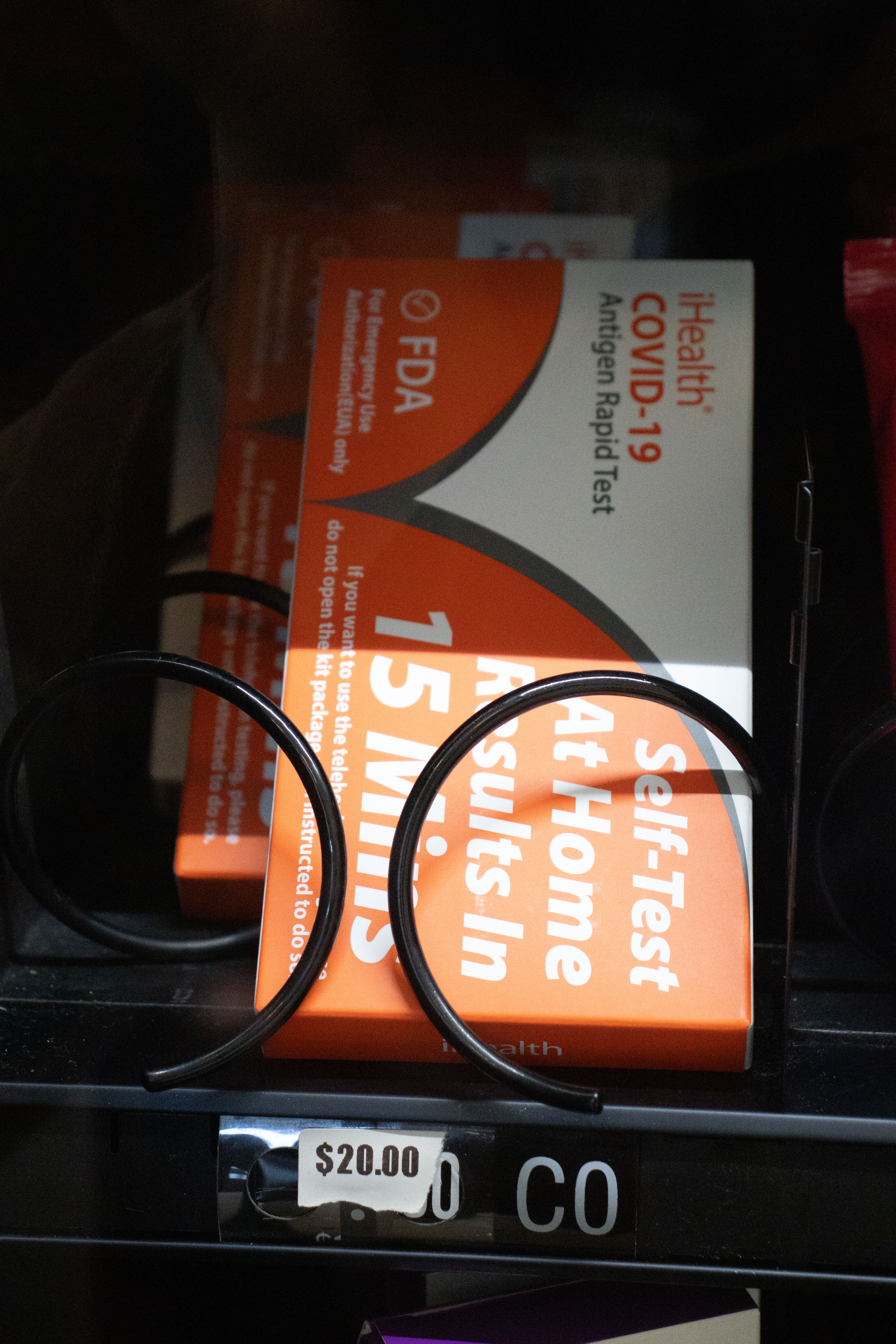
    Last week I talked about how one of my main fears while traveling during a pandemic is contracting the virus. Well, it happened. To get back to the United States, you have to show a negative COVID-19 test within the last 24 hours. My trip was planned from Thursday to the following Friday. I got tested on Thursday, Jan. 20, and planned to fly out on Friday, Jan. 21. The test came back negative, and I genuinely felt fine.

    I get home Friday night and still feel fine, just tired from traveling. Saturday and Sunday roll around, and I am still okay. On Sunday evening, I feel a trickle in the back of my throat and think nothing of it. On Monday morning, I go to work as usual at 3:45 am, absolutely exhausted with a sore throat. I figured I was dehydrated. It was the same thing on Tuesday, except a cough had developed.

    I called my doctor because it was getting to the point of being sick. Having asthma makes me immunocompromised, and I have never had a cold that was just a cold. It always turns into pneumonia or bronchitis, so I was worried. I really do not have the time to be sick as a full-time student working part-time.

    The nurse comes in and talks to me about my symptoms and wants to test me since it had been five days since my last test. It comes back positive. The doctor sends me home with a quarantine flyer, which is the end.

    Before I went to Mexico, I received my booster shot on Jan. 3. I tested positive 22 days after I got my booster shot. The symptoms I had weren’t mild, but they also weren’t super severe. I had a cough, sore throat, fatigue, headache, runny nose, shortness of breath, body aches, etc. I think my weirdest symptom was that my teeth hurt like it felt like I had braces again, and I had just gotten them tightened. I also had shooting pains in my back.

    Three people so far have blamed it on travel or on me for traveling. It felt very judgmental and almost degrading. I could have gotten it at work, school, the grocery store, or from people I know. I am pretty sure I got it in a restaurant in Mexico, but the same thing could have happened here. Don’t blame me for living my life and having fun.

    I do not think it is fair to judge the ones you love or anyone for that matter on their decisions to travel or whatever they do in their personal time, especially if they are safe. I wore a mask on the plane, the airport, around town, and in the restaurant except when eating. I did my part, and I still got COVID-19.