On Feb. 25, 2023, I was transported to Mad River Hospital after Sergeant Andy Martin of Cal Poly Humboldt University Police expressed concern for me. I had lost my phone at the Student Activity Center, and after I got it back I told him and other officers that someone had bugged my phone, people were following me and there were recording devices in my dorm room. Because of Martin’s commitment to helping, I was later given a diagnosis that answered so many questions: schizophrenia and bipolar I. If it weren’t for Sergeant Martin, I don’t know what would have happened, or where I would be.
Martin knew me before the incident because he had picked up my knocked-over motorcycle for me. I brought him and the dispatcher, Jennifer Gomes, Harley-Davidson keychains and candy as a thank-you gift. Martin and Gomes knew that something was wrong with me because they knew me as a confident, Harley-riding girl – not a scared, paranoid kid.
“Law enforcement’s role in mental health is complicated, to say the least,” said Martin. “Mental [illness] is not a crime.”
Because my paranoia was high, the emergency room and the hospital in general was a scary place to be.
“Some of the [hospital] staff and I have had conversations. They know that it’s not the ideal,” said Martin.
Following the Lanterman-Petris-Short Act, those under 5150 hold must be taken to a facility designated by the county, which is either the emergency room or county mental health, which has only been taking voluntary patients since COVID. To me, this is a shame. I strongly believe that they should be transported to an inpatient facility for those in immediate mental crisis.
“It’s designed for medical care, not psychiatric care,” said Martin, referring to the hospital. He recognized that there could be some overlap in the type of care needed for patients. In my case, my second hospital stay warranted medical care because I ran three miles barefoot thinking my hometown was littered with explosives, which tore my feet up. This happened the night after I was released from Mad River to my dad, who took me home to Redwood Valley.
College is a time in life in which mental illness often manifests. The American Psychiatric Association states that 75% of mental illnesses start by the age of 24.
“We see more than our fair share of it,” said Martin. I was given my diagnosis at the age of 22, which is right in that sweet spot for when such illnesses surface.
5150, also known as the Welfare and Institutions Code, is what allows police to detain a person if they are deemed a danger to themself or others.
“Those are actually very strict criteria, the idea being that law enforcement shouldn’t be able to detain somebody without good cause,” said Martin.
The way it works is that if an officer is concerned about someone, they’ll express their concern and give two options, voluntary admission to the hospital or 5150 if the case is severe enough. I was technically voluntarily admitted and I just learned after the fact that I could have left if I wanted to, but hospital staff repeatedly told me that I couldn’t leave.
If someone refuses admission to the hospital, UPD can put them in contact with an on-campus counselor or county crisis. UPD also works with the Office of Students Rights and Responsibilities (OSRR), who work with Counseling and Psychological Services (CAPS) and Campus Assistance, Response and Engagement (CARE).
I have a great support system, and I’ve been told that by several people, including Sergeant Martin. I consider him and all of UPD to be part of my support system. I’m very blessed to have so many compassionate and caring people in my life.
If you are concerned about yourself or another student, please fill out “Reporting Students of Concern” at deanofstudents.humboldt.edu/CARE or call UPD at 707-826-5555. If it’s an emergency, call 911.
After a spring semester that saw The University Police Department’s force spread so thin that single-officer patrols were a norm, they have recently hired two new dispatchers, promoted an officer to sergeant, and hired one new officer. While slightly better than before, the department’s staffing issues have forced many members of its small team to still work long hours with few days off. Despite the successful recent hirings, the department remains without a permanent police chief and ever-cautious in its search for a new one. The still understaffed force has had to rely on its committed team working overtime to remain functional.
As many students will have been made aware of through the UPD’s advisory emails, it has been a hectic start to the fall semester. The last two weeks have seen an uncharacteristic barrage of criminal activity on our typically peaceful campus among the redwoods. From “Suspicious Bags Found in Wildlife & Fisheries Building” to “Trespassing Arrest at the Children’s Center” and a tragic “Collision That Injured Student” at one of the campus’s few intersections which left a student in critical condition, this has been an unusually chaotic start to the semester.
Throughout this spring semester, Lieutenant Peter Cress filled the role of police chief in addition to his normal duties as lieutenant. Currently, Fernando Solozano, a retired police chief from Long Beach, has stepped in as interim chief until a permanent one is finally hired.
Unfortunately, a timeline for the hiring of a permanent chief is difficult to nail down with so many factors at play. Even if the perfect candidate showed up on Harpst street tomorrow, they’d still need to go through a full background check, potential recertifications and additional police academy training (depending on where they transferred from). So, it will likely be exactly a while-longer before Cal Poly Humboldt has a permanent police chief.
On top of all that, hiring a police chief for a university – especially one as unique as Cal Poly Humboldt – has a number of additional hurdles as compared to your average city police department. Most notably are the Clery Act and Title IX federal civil rights, which affect police operations on a university campus distinctly from those at a typical city police department.
Moreover, the bureaucracy of a college campus means that a very unique skillset and experience is necessary to perform the job tactfully.
“The CSU system has its own challenges in different ways. It’s not just a police department in a town where you can go to your mayor and say, ‘Hey, what’s going on?’ We have our presidents and we have our chancellor, so we have lots of different steps… What would be nice is if we had somebody who is familiar with the CSU system, who is eager to grow a police department, and comes in with knowledge, all those things,” Martin said before adding, “we’re not looking for a unicorn, but I mean, kind of we’re looking for somebody who can do all of that.”
The chief of the police sets the tone for the entire department, Martin explained. They look fifteen years down the line and act as captain of the ship, adjusting course towards innovation and progress. The fact that the department has been absent a chief for so many months and remains not only functional but reliable, serves as testament to the unwavering dedication of each member of the department. Importantly, though the search for a permanent police chief remains a top priority for the department, they are not rushing the process and will not pull the trigger unless the fit is perfect.
“Our VP [Sherie Gordon] has a very set criteria of what she wants to hire. She just doesn’t want to settle. She wants somebody who’s going to do justice to the police department and our campus,” Martin said.
Martin’s explanation for the still vacant chief position hinted that perhaps having no police chief is better than having the wrong police chief.
“It’s about finding somebody who wants to be here, who is willing to put in the work,” Martin said before continuing, “Somebody who’s progressive, understands what we’re trying to do here. And we’ve struggled at finding a very qualified person that can slide into that role and help our police department grow.”
This spring saw the lean department frequently functioning with only one officer on duty at any given time.
The recent new hires have eased that strain slightly but they’re currently still running some single person patrols, as they are having trouble finding qualified officers.
Aware of the mounting need for more personnel, the UPD have put together an incentive package and have hired a firm to recruit nationwide to find fitting candidates. A common theme in talking about the difficulties in hiring was UPD’s emphasis on hiring the right candidate. They are not interested in hiring just anybody so that they have additional boots on the ground. They’ve got to be the right boots. And of course, this is Humboldt – they’ve got to have the right vibe.
“We are not just filling boxes and trying to put a cop in a seat just because I need a number. I’ve got people who are willing to come here,” Martin said. “We just want people who are going to be a positive addition to the police department and how they interact with our community and how they’re willing to change and how they’re willing to grow.”
“We are looking for the right people to be a part of that police department as we grow,” Martin emphasized.
Remaining a community based police force appears to be a top priority for the department when considering new hires.
“Our community as a whole is more laid back,” Martin said. “100% we want to be able to be part of that culture.”
The understaffed department has relied on its indomitable staff to keep the peace on campus.
“It’s been the staff. The staff is really the reason that we’re still moving forward and getting stuff done,” Martin said. “A lot of overtime for different people, a lot of hours are being put in and everybody’s just still getting the work done.”
Martin put in about thirty hours of overtime last month, with this month’s overtime hours quickly racking up. Impressive as that is, dispatcher Jennifer Gomes’ work schedule borders on super-human.
“I have, technically, one full day off this month. My normal schedule is day-shift Sunday through Wednesday,” Gomes said. “But I’m covering graves for the second half of the week right now, and then my one day off for the week is the day that I rotate back to day shift. So, I sleep all day to try to accommodate coming back to day-shift.”
With two new dispatch trainees set to complete their training in October, respite is on the way. The dispatch ‘family’ will be back to three days off per week with just one dispatcher role left to fill. An unsung hero of Humboldt, Gomes explained her reasoning for weathering the recent tough times at the UPD.
“Everybody’s pulled their weight, come together kind of as a family and just pushed through the staffing issues,” said Gomes. “Just push through the hard times here, we’re all coming out of it.”
With millions upon millions being put toward Cal Poly Humboldt’s expansion, it seems the unstoppable force of dollar-driven change is also working overtime here in Humboldt county. Change is a comin’.
“As our faculty and our staff grow, there are gonna be different expectations as we modernize our campus and in the directions that we had. So, we’re also gonna have to keep up,” Martin said. “We want to maintain that same service that we’ve had, we want to be able to have these conversations. We want to be able to play pool with our students and whatever events and be accessible and always there. And that’s one of the things we look for when we’re trying to hire people.”
An expected 2,000 additional students are anticipated for the Fall ‘23 semester, threatening to strain an already understaffed police department at Cal Poly Humboldt. The UPD is currently absent a police chief and shorthanded in both dispatchers and officers. Since early March, the number of new hires onto the force has not increased—not for lack of effort. Despite working long hours to compensate for the lack of personnel, Sergeant Andy Martin remains optimistic.
In early March a candidate for police chief, Kevin H. Williams, was interviewed by the hiring committee. Williams, a former LAPD lieutenant with a long resume as a public servant in many departments, filed a lawsuit against the City of Los Angeles in 1999. The suit claimed racial discrimination and cited that Williams suffered from pseudofolliculitis-barbae, which allegedly prevented him from shaving his beard and commonly afflicts Black men. A federal district court would later dismiss the case. Martin, who serves on the hiring committee for the department, couldn’t divulge the reasons Williams was not hired onto the UPD force. With extensive medical tests, background checks, psychological evaluation and training required in the hiring of any officer, Martin explained that it is unlikely CPH will have a police chief come the Fall ‘23 semester.
“I would be shocked if it all happens before fall semester starts, but things happen. I’ve been surprised before, but I don’t think so,” said Martin.
Although short staffed, the department is not rushing the hiring process.
“Our Vice President [Dr. Jenn Capps] puts a lot of expectations and weight behind the police chief and so, she’s made it clear – she’s not just going to hire anybody. She wants to make sure she’s hiring the right person for the job and what we need on campus,” Martin said.
While scrupulous hiring is partly to blame for the lack of personnel on the force, it is far from the only force at play here. The very features of Humboldt county which attract many residents often work against the UPD’s effort in enticing new officers to join the force.
“The county tends to be a little behind the rest of the country in some aspects. You know, the night life completely shuts off at a certain hour. It’s a quiet place,” Martin said. “We don’t have the fast food chains. We don’t have what you would expect in some of the bigger cities. That can be a detriment for us sometimes because we are asking somebody to come to a more remote and isolated spot.”
Martin further explained that being behind the ‘Redwood Curtain’ filters out many potential officers.
“It’s just hard to convince somebody to come work up here in a smaller department… It’s intimidating for a lot of people if they’ve never been here,” Martin said.
Just as in March, dispatcher Jennifer Gomes is still working long hours as one of only two full time dispatchers employed by the UPD. Two potential hires for dispatcher are being considered currently, but even if both are hired, “they’ll probably still be in training as the next semester gets going,” Martin said. Additionally, one officer is currently going through the hiring process.
“I am optimistic that they will be here before this next semester,” said Martin.
Evidently on the backfoot, the likely addition of two dispatchers and one officer will still leave the UPD undermanned. Lack of officers means that there is often just one officer on duty. In anticipation of the rapidly expanding new polytechnic university, the UPD will be hiring another sergeant and a couple more officers.
“That process is just getting started,” Martin said. “So I expect that some of them will start mid [fall] semester at some point.”
Regarding the massive influx of students coming to Arcata for the fall semester, Martin is confident that the department will be ready. “Our staff is incredible. You can tell by the hours people put in and the heart that they give to this department,” Martin said before adding, “It would be a little more comfortable if we had more people though.”
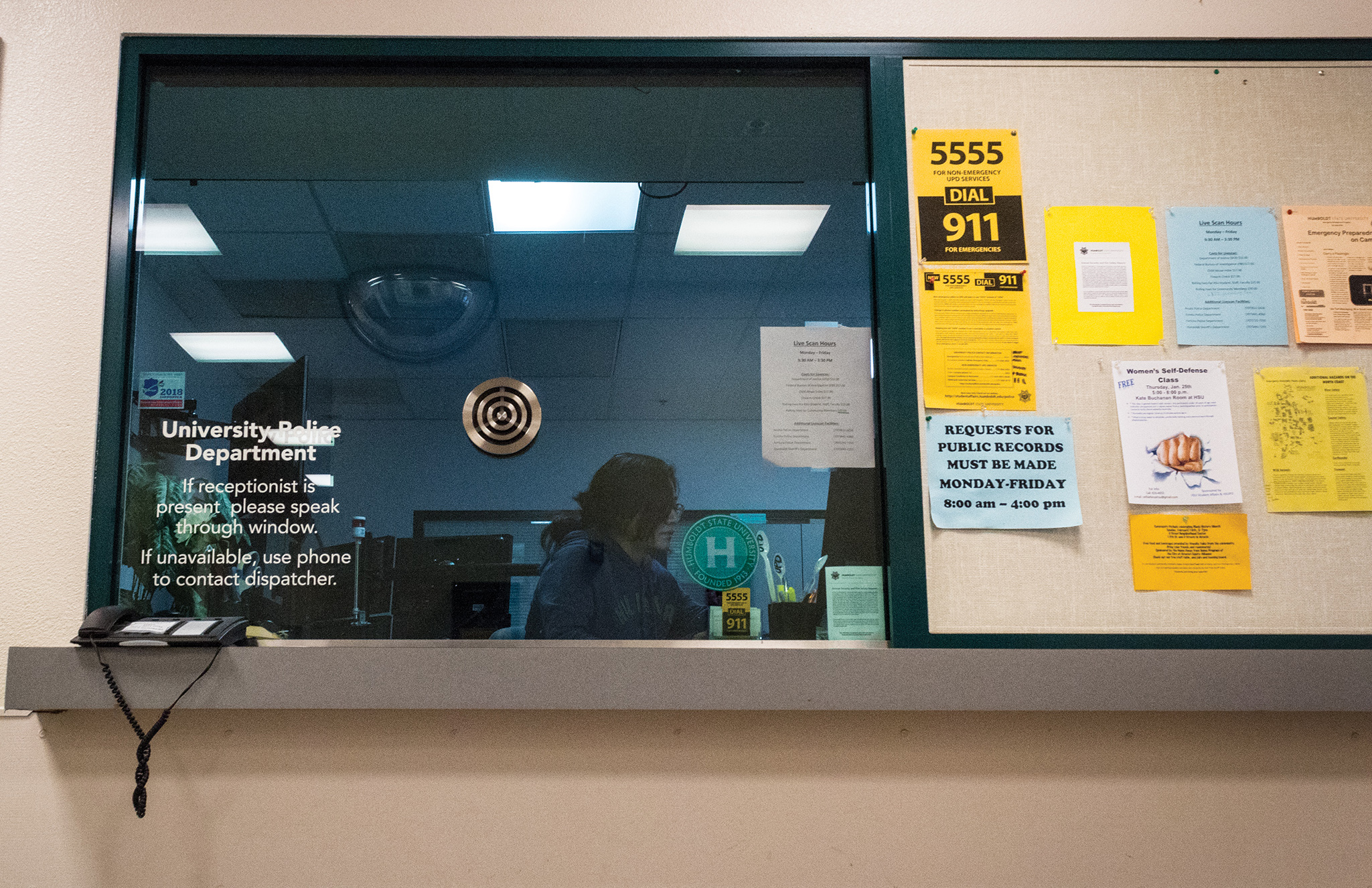
A few weeks ago, I accompanied a friend to the University Police Department after her wallet went missing during the Durand Jones and the Indications concert.
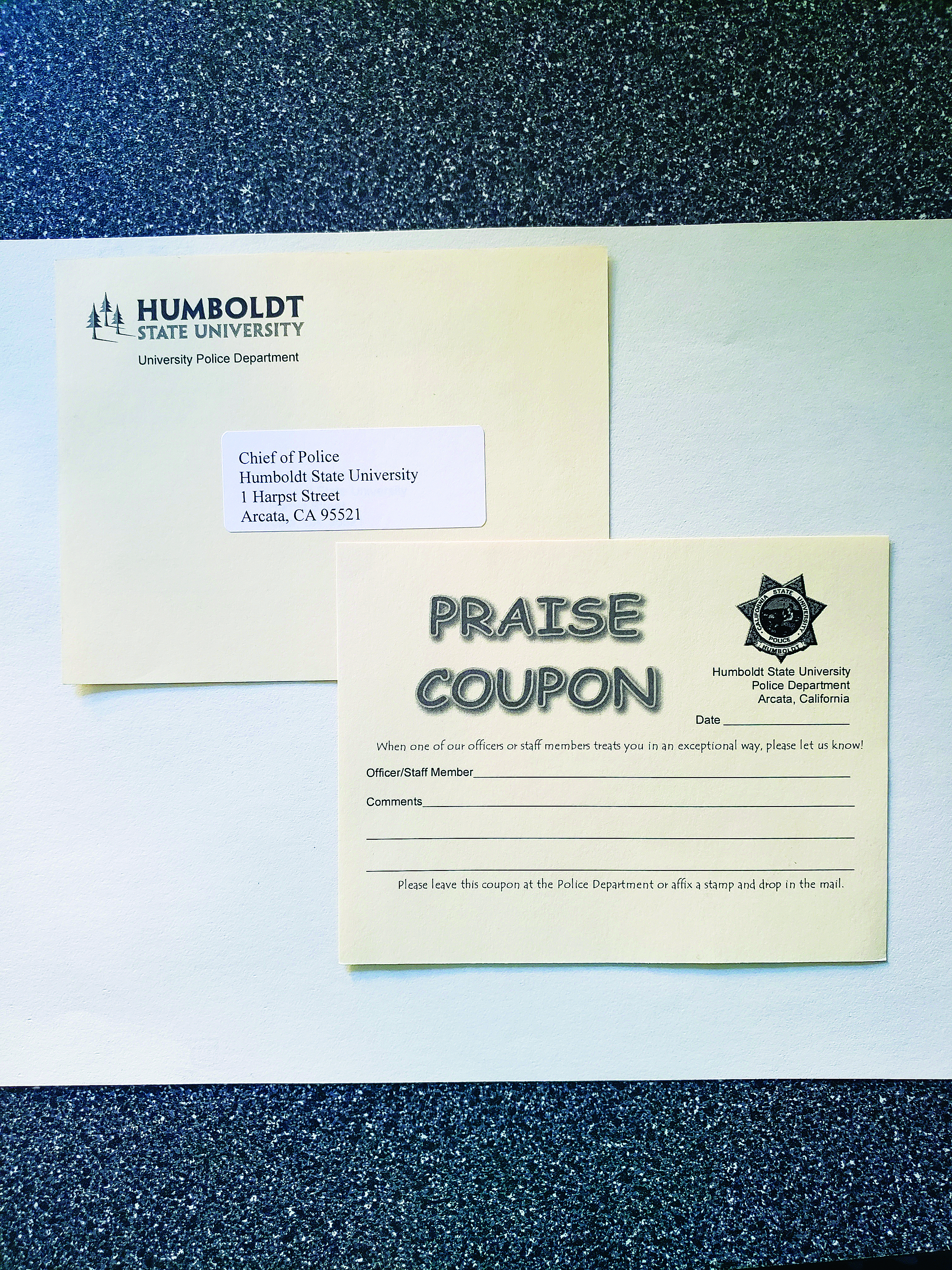
While in hopeful pursuit of her wallet, I was quickly reminded of the dystopian nightmare we live in when I came face to face with a neatly stacked pile of yellow “PRAISE COUPONS” prominently displayed atop the UPD information desk. “When one of our officers or staff members treats you in an exceptional way, please let us know!”, the coupons exclaim in a migraine-inducing font combination of Papyrus and Comic Sans. There are also blank lines left for comments and the name of the officer or staff you wish to praise.
Good to know our Cal Poly windfall went to these babies. Who would’ve thought University police would need “good job” stars to get their jobs done? Although the pile did look pretty untouched the last time I saw it. After this experience, I pondered the reason for these praise coupons’ existence.
I wondered why UPD officers are the only ones with access to these praise coupons. Why can’t I give one to the nice lady at the housing desk? Or the groundskeepers who wake up at 5 a.m. to beautify our campus? Why isn’t there a pretty little stack of coupons at every help desk on campus to show some love to our staff? Sure, I could make my own coupons to show my appreciation, but how come the UPD gets the fancy ones on cardstock?
I then began to wonder what the reason would be for an officer to receive these praise coupons. Refraining from use of excessive force? Oh, I know, maybe we actually got someone to stay in the position of police chief for longer than a year?
Then it hit me. It was right in front of my face the whole time. Praise kink. I realized that maybe all of the UPD officers might just have a little bit of a praise kink. Hey, I’m not judging you! This is the only plausible answer to why you have “PRAISE COUPONS” strewn about your department. I mean, you even give people the opportunity to mail the coupons to you if they slap a stamp on them. At least you’ve made it easier for the sender by pre-addressing them to the Chief of Police on the back of each card. It comes off as a little desperate to me, but I’m not here to yuck your yum.
I may have judged you too soon, UPD, when you’re just trying to find some pleasure in your work—literally. I wouldn’t say incorporating others into your fantasies is the most humane choice, but you’ve gotten away with far worse human rights violations.
For real though, students: show some appreciation for university staff that help you with your daily dilemmas without needing a PRAISE COUPON. Cal Poly Humboldt would crumble without their behind-the-scenes work. Remember kids, validate your local cop’s praise kink, because we don’t kink shame!
Captain of the University of Oregon police department, Jason Wade, puts his hat in the ring for UPD chief at HSU.
Following the retirement of former chief, Donn Peterson, in the end of May, the University Police Department has begun its official search for a new chief. Current captain of the University of Oregon Police Department, Jason Wade, is one of the two candidates currently in contention for the position.
Wade has more than 20 years of experience in law enforcement, working primarily for the University of Colorado, Boulder Police Department and for the past six years with the UOPD. In his time with the UOPD, Wade has served as an instructor and director for their cadet academy, developed their body camera program and served as the internal affairs investigator managing the background process for new employees.
In today’s atmosphere of nation-wide calls for radical change regarding the country’s law enforcement system, Wade believes that rather than defund police departments, we need to re-think them.
“The police in the past were seen as the catch all. You know, if you have a problem you call them,” Wade said. “And the expectation was that they were able to respond and serve equally no matter what.”
Wade is of the mind, not every call for service requires the response of a police officer and that many non-violent calls would be better handled by mental health professionals.
“The police still are responsible for enforcing the laws and keeping people safe but how can we better address those issues,” Wade said. “That’s one of the largest levels of police reform, is the calls for service and how we respond with what we respond with.”
According to Wade, the benefit of having a campus police department, in specific, is the collaboration with the university that wouldn’t take place with a city department.
“The campus police department can be brought forward to help the campus,” Wade said. “We can be trained. We can work with the campus to develop the department that the campus needs.”
Campus police departments can also be held to a higher level of accountability by the university. Given the job, Wade plans to implement the policy work groups system currently in place at the UOPD.
The system involves reading every new policy or change in policy at the UPD to a community panel made up of students, staff and faculty of the university who are given the opportunity to weigh in on each policy.
“At some level there has to be oversight that allows the community to see what occurs behind the walls of a department,” Wade said. “So, they know that if a complaint, an allegation of misconduct or something is going on inside the department, that it’s being handled and handled appropriately – and if there is misconduct, that we’re taking measures to not let it happen again.”
When Wade started as a young police officer, he said it was all about how many tickets he would write, how fast he could drive and the fancy gadgets he got to play with.
“That was the mindset back in the late 90’s,” Wade said. “There were problems then, but we didn’t address them. We didn’t have the concepts of implicit bias training or crisis intervention training. I’ve seen change occur, but we’re not there, where we need to be, yet.”
Ultimately, Wade believes, rather than acting in the interest of whoever is in power, a UPD has to hold the best interest of the entire community above all, in order to succeed in creating a safe learning environment for students.
“This should never be the ‘Jason Wade’ Police Department,” Wade said. “Because that will not be successful.”
Incidents of racism from the former UPD Chief, past examples of excessive force from current officers and a shrinking university budget.
In recent months, demonstrations against police brutality and the killing of Black and Brown people have increased. Black Lives Matter protestors have called not only for the demilitarization of police but for a move towards defunding the police and reinvesting those funds to community-centered organizations for public safety.
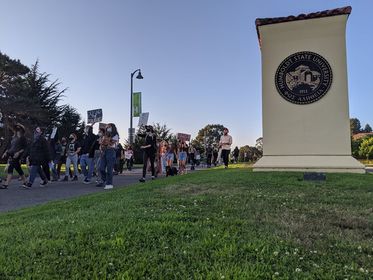
On Sept. 4, Humboldt State University students and other community members met at the Arcata Plaza in support of defunding HSU’s campus police department. As of last quarter, HSU’s University Police budget sits at over 3 million dollars a year. The University Library sits just below 3.5 million dollars a year.
According to the HSU’s Annual Security Report for 2018, 89 percent of law enforcement on campus consists of drug and alcohol referrals. UPD made a single drug-related arrest in 2018. The other 11 percent of cases reported were theft and assault. Referrals are basically reports filed directly to HSU that are not criminal but often result in administrative action. This job is something expected of R.A.’s who report alcohol use as referrals.
Incidents of racism from the former UPD Chief, past examples of excessive force from current officers and a shrinking university budget
With the existence of the Arcata City Police, and their own $6 million dollar budget, the necessity of an entire force for these offenses leaves the HSUPD as an utter redundancy.
HSU student and Check-It staff member, Shelley Magallanes, compiled research about complaints against HSUPD for use of excessive force and shared it on their Instagram. Currently on the payroll is Delmar Tompkins who has been involved in two accusations of police brutality, cases were settled for $135,000 and $43,000. As well as Justin Winkle who was involved in an incident of excessive force that left the victim dead in his jail cell hours later. The City of Eureka settled this case for $4.5 million.
Former University police Chief Donn Peterson resigned on May 31 while he was on leave and under fire from a multitude of accusations including racist remarks and manipulation of crime statistics. Peterson served as police chief of UPD for six years and to assume that his actions are that of “one bad apple” just doesn’t do this issue justice. His actions exemplify the prevalence of a racist culture that pervades the criminal justice system.
The nationwide movement for defunding the police has been sparked by the way that force is used and applied recklessly to BIPOC. This comes after a long history of police operating as a militant arm of white supremacy and working to disproportionately incarcerate POC, leading to further widespread racial inequities. Allowing the persistence of unjust systems on campus, while alternatives are proven to work more effectively at promoting public safety is negligent. We have an opportunity to work towards a more just and equitable campus through the many organizations that we already have established.
HSU is facing widespread budget cuts, losing funding to the array of vital multicultural centers, diverse academic programs and student-led organizations, the UPD budget and existence looks especially obsolete.
Humboldt State University police say a student on campus gets their bike stolen every day
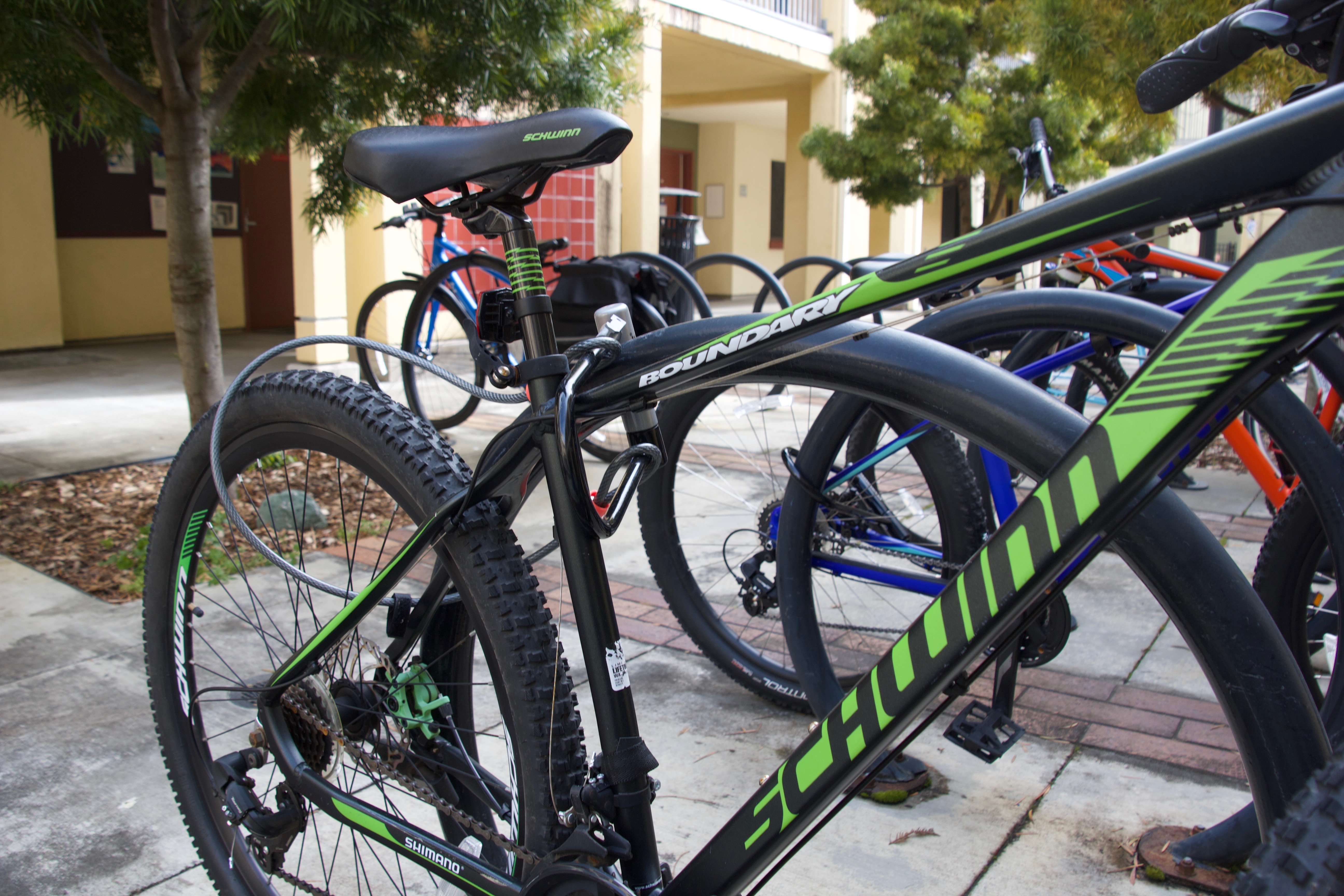
Many Humboldt State University students have their bikes disappear from where they left them. Either a front wheel attached to a bike rack with the lock around it or a frame without a back wheel remain. Some thieves can even take the whole bike by using bolt cutters to cut the bike lock. Bikes are expensive, and having them stolen is a real cost to a student.
Kaitlin McKie, a 23-year-old student at HSU majoring in engineering, lives off-campus. Her partner’s bike was stolen at their apartment complex. She said bike theft has been going on for a while.
“Use U-locks instead of the cable locks,” McKie said. “They’re a little bit heavier—a little bit harder to put on the bike rack—but it’s definitely worth the investment.”
Bike thieves can dismantle newer bikes from the front and back tires by lifting a lever on the wheel and unscrewing it, which releases the wheel from the frame. This makes it easy to remove the frame from the front tire or remove the back wheel. This technique is manufactured for bike owners to easily break them down to create a more convenient way to travel.
University Police Department Sergeant John Packer said a student’s bike is stolen on campus every day.
Jack McLaughlin, a freshman chemistry major at HSU, said three of his friends had their bikes stolen this semester on campus.
“Never leave your bike for a minute,” McLaughlin said. “Always keep your eyes on your bike. If you can, bring it into the classroom with you. If you’re leaving it somewhere overnight, bring it inside with you.”
University Police Department Sergeant John Packer said a student’s bike is stolen on campus every day. While it’s hard to stop these crimes from happening, there are ways to prevent it.
Packer suggested you register your bike at the police station. This allows officers to match your serial number to a newly confiscated bike to return to you if it is stolen.
Police officers can find your bike at a pawn shop by matching the serial number to the numbers that the pawn shop will register in their system. Pawn shops can even give police officers copied images of the seller’s ID, which police can use when investigating the crime.
“Ride your bike every day,” Packer said. “If you’re doing that, you know where it is, you’re locking it up, you’re moving it around from point A to point B. It will be with you at that point in time.”
Packer also suggested investing in a Kryptonite bike lock. These bike locks are well known for being tough, reliable and hard to cut. If you don’t want to buy one a Kryptonite lock, Packer said a simple, thick chain with a lock can do the trick.
Retired creative writing teacher Jesse Austin supports John Packer wholeheartedly
Recently the Lumberjack has run a couple of stories about our campus UPD personnel.
Here is my opinion: I am a big fan of John Packer, UPD sergeant.
I salute him for going public with the UPD Chief’s racist remarks, and his unprofessional manner of leading the department.
I am a retired creative writing teacher and have known John on the HSU campus for 15 plus years. I have seen him in scores of interactions with students, teachers, staff and other UPD personnel and he has always carried himself in a cheerful, engaging and professional manner.
I have also taught at Sonoma State, Chico State and Reed College in Oregon and John is one of the best at his job I have ever seen.
To my mind a big part of UPD officer duties include being visible, available and educational (about the rules, laws and mores of the campus) – and John Packer is exceptional in all of these areas.
Officer John Packer recounts racist remarks from UPD Chief Donn Peterson
In August, nine of 10 University Police Department officers made votes of “no confidence” in Chief Donn Peterson. Now, UPD Sergeant John Packer has released a statement detailing some of the racist remarks made by Peterson to Packer.
In one instance, Packer was in an evaluation meeting with Peterson and UPD Lieutenant Melissa Hanson. Hanson told Packer that she and him weren’t friends and never would be. Packer didn’t know what that had to do with the evaluation, but he agreed.
Then Peterson escalated the situation, according to Packer.
“It went right from the first statement of me saying ‘I agree’ to him saying, ‘You know, John, you’re obligated to work as a slave unto his master,’” Packer said. “’And I’m like, in my head, ‘What the heck?’”
Packer said the next morning, Peterson made another comment to him while walking in the hallway.
“He says to me, ‘Hey John, I can say that because we both read the Bible,’” Packer said. “And now I’m speechless. So now you’re justifying what you said last night?”
John Packer shows his Sergeant’s badge. Packer has been a police officer for 26 years. 16 of which have been with UPD. | Photo by Deija Zavala
Earlier this month, Packer, who is the only African American officer on Peterson’s staff, wrote a statement distributed by the Statewide University Police Association detailing Peterson’s remarks.
However, Packer said before he released his statement, Peterson purposefully moved him to graveyard shift. According to Packer, sergeants have priority pick of shifts, but on Aug. 28 Packer was moved to graveyard under the guise of a Personal Improvement Plan.
Packer told the Lumberjack that the PIP listed two reasons for the shift change: compliance with university procedures and documentation, and maintaining a professional and equitable relationship with all members of the UPD team.
According to Packer, Peterson wrote on the paperwork that he suspected Packer’s “inability to perform” in the first reason was closely tied to the indifference Packer demonstrated in the second.
Packer, an HSU graduate, has lived in Humboldt for nearly 40 years. He served with the Arcata Police Department for 10 years before coming to UPD. He has been with UPD for 16 years.
After serving under seven police chiefs during his 26 years as an officer, Packer said that although he has faced racist comments from people in the workplace and some he has arrested, he has never faced such consistent racism from a superior.
Packer’s statement was released in response to statements made by Peterson in interviews with the North Coast Journal and the Times Standard. According to Packer, Peterson’s claims of misinterpretation of his statements are insulting and do not excuse his actions.
Although he has faced racist comments from people in the workplace and some he has arrested, Packer said he has never faced such consistent racism from a superior.
Packer said six to nine months after the first incident, Peterson, while frustrated, made another comment.
“He said, ‘John, you’re like dealing with the North versus the South,’” Packer said. “And I’m like, okay, I have no idea what you mean by that. I’m not going to get into that.”
Packer wrote that such remarks have only become worse over time.
“Chief Peterson has become more emboldened over the past four years, and moved from making private remarks in our meetings, to demonstrating obvious displays of racism and contempt towards me in whatever audience is available,” Packer wrote.
SUPA’s press release came almost a month after the nearly unanimous vote of no confidence, and Packer’s statement came soon after.
In the statement, UPD Officer Billy Kijsriopas accused Peterson of frequent absenteeism, manipulation of crime statistics and the creation of a hostile work environment that included racial slurs.
The statement also noted that Peterson left his previous job with Florida’s Broward County Sheriff’s Department “amid scandal.”
“Chief Peterson has become more emboldened over the past four years, and moved from making private remarks in our meetings, to demonstrating obvious displays of racism and contempt towards me in whatever audience is available.”
UPD Sergeant John Packer
According to a 2015 article from a Florida news channel, Peterson was involved in a scandal in which multiple department officials used impounded vehicles to avoid toll fees. The Broward Sheriff’s Office was eventually assigned to investigate itself and no arrests appear to have been made.
Peterson denied the recent UPD allegations last month over the phone, but said he supported the investigation as he wanted to strive for transparency.
Peterson declined to comment for this story, and instead referred The Lumberjack to HSU Director of News and Information Aileen Yoo, who then forwarded an email from Vice President for Administration and Finance Douglas Dawes.
In the email, Dawes said HSU has retained the Office of Independent Review, an independent law enforcement firm, to investigate the allegations.
“Out of respect for the process, which could take several months, I have asked Chief Peterson not to comment further until the investigation has concluded,” Dawes said.
SUPA President Jeffrey Solomon said over the phone that it wouldn’t be fair for him to comment on the investigation either, as he called it a local matter. However, Solomon acknowledged what he called “an overwhelming amount of information” that has come forward.
“I have no reason not to believe those officers and their allegations,” Solomon said.
The SUPA Facebook page shared articles from the Times Standard and Lost Coast Outpost on Friday, Nov. 8, about the vote of no confidence and the retention of the OIR.
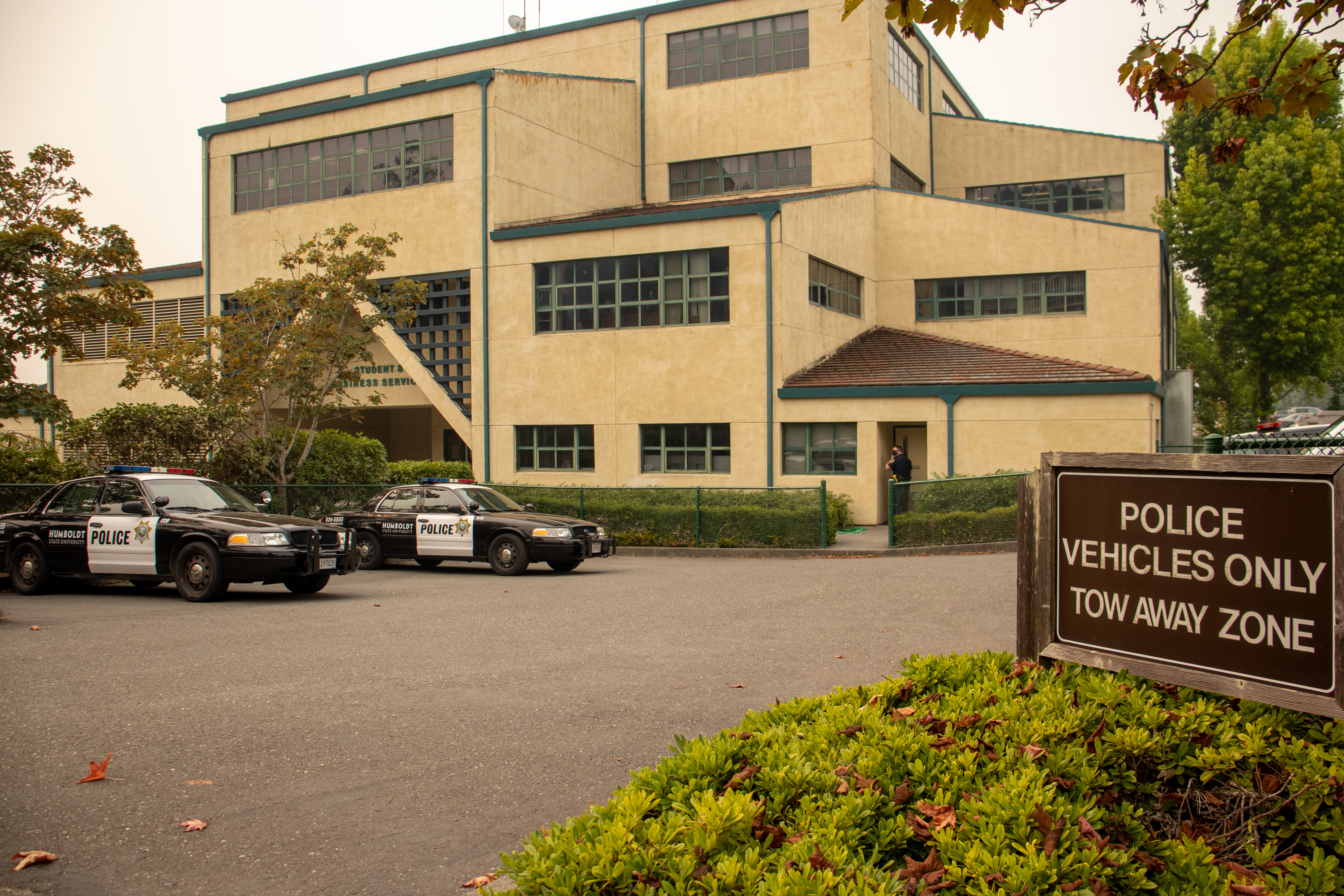
A Humboldt State University University Police Department vehicle on Nov. 10. UPD Chief Donn Peterson is curently under investigation for the use of racist slurs, frequent absenteeism and the manipulation of crime statistics. | Photo by James Wilde
Despite the events of the last two months, Packer said the UPD office environment does not feel awkward or uncomfortable, as the department already made a vote of no confidence before Packer shared his experiences.
“It’s not awkward right now amongst the officers and dispatchers because we already knew that we had a consensus before I released my statement,” Packer said.
Packer returned to the office, and normal day shifts, after several days off on Nov. 7. It was Packer’s first time since the release of his statement.
Thus far, Packer said no words have been exchanged between him and Peterson.
“I got a nod, and you know, that’s fine,” Packer said. “But no conversations so far. Nothing negative happened.”
Packer said Peterson has always been very professional in public. However, Packer said he has begun to be critiqued through department emails.
“Included in that email will be, you know, ‘We still have divisiveness in the department and you’re still at the center of that and I need you to own the fact that you’re the center of that,’” Packer said.
Packer said Peterson has also berated him to other officers behind his back.
Packer said interviews with the OIR are coming up in a few weeks, and he hopes the investigation will examine and validate the allegations and bring them to HSU.
“They will put together a packet for the University—I assume that will go to the vice president,” Packer said. “These are the things that are inherently prohibiting this police department from functioning professionally.”
Full Statement from Sgt. John Packer:
My name is John Packer and I have served under seven Chiefs during my 26 years as a police officer in this community and currently serve as a sergeant at the University Police Department (UPD). I am the senior police officer in the department and have served under Chief Donn Peterson for approximately five years. I am the only American of African descent serving at University Police Department under Chief Peterson.
I am compelled to share my experiences after reading Chief Peterson’s statements in the October 11, 2019 online issue of the North Coast Journal and the October 14, 2019 online issue of the Times Standard. Chief Peterson claimed that “Anyone who knows me knows I don’t talk politics or religion in a professional setting or during work.”
Chief Peterson’s claim is not true. Chief Peterson claimed that “The racist remarks never happened in the way the officers say.” Chief Peterson’s claim is not true.
I firmly believe that the color of one’s skin, as with all immutable characteristics, is not a predictor of behavior or intelligence or ability, etc. While I have experienced incidents of racism and bigotry during my life, it has been my practice to disregard the ignorance expressed by the person and not carry an angry sentiment with me. I do however clearly remember the times when I have been targeted by racist and bigoted intolerance related to my race and beliefs.
I clearly remember being at a scheduled evaluation meeting with Chief Peterson and Lt Hansen. During that meeting in the Chief’s office, Chief Peterson was extremely upset to the point of using profanity directed at me. The Chief’s frustration and anger stemmed from his opinion that I did not respect Lt Hansen, that I created division at the Department and that I fail as a leader because I am not a “follower.” At the end of the meeting, Lt Hansen stated to me, “We’re not friends and we never will be, admit it.” I agreed with her statement. Chief Peterson followed with, “John you know you’re obligated to work as a slave unto his master.”
At the beginning of my next shift Chief Peterson approached me in the hallway outside the dispatch center and stated, in reference to the slavery comment he made in our meeting, “John I can say that because we both read the Bible.” I was speechless and walked away without responding to the Chief.
Over time Chief Peterson has made additional derogatory statements to me such as, “John you’re like dealing with the North verses the South,” and he excuses himself with follow up statements such as, “I’m just trying to find analogies that work with you.”
Chief Peterson has become more emboldened over the past four years, and moved from making private remarks in our meetings, to demonstrating obvious displays of racism and contempt towards me in whatever audience is available. What once only occurred behind closed doors, has now progressed to belittling statements in department meetings, and to outright derogatory statements at sergeant’s meetings.
Any claim that Chief Peterson’s analogies, historical quotes, nuances or his intent were misinterpreted by me or other officers is insulting and does not excuse the impact or justify Chief Peterson’s actions.
John Packer
Full Statement from Vice President for Administration and Finance Douglas Dawes:
As communicated to the campus community in October, the University has retained the OIR Group (Office of Independent Review) to review the allegations and complaints against Chief Peterson.
The OIR is an independent and respected law enforcement assessment firm. The University has been working with the OIR by providing information the firm needs to conduct a thorough and rigorous investigation. Out of respect for the process, which could take several months, I have asked Chief Peterson not to comment further until the investigation has concluded.
HSU officers cast an almost unanimous vote of no confidence in police chief
The Statewide University Police Association published a press release on Monday stating that officers of the Humboldt State University Police Department submitted an almost unanimous vote of no confidence in Police Chief Donn Peterson.
Nine of the ten officers in the department cast a “no confidence” vote while one abstained. Peterson has allegedly manipulated crime reports, frequently left the office to go out of state, created a hostile discriminatory work environment and violated labor laws.
In a phone interview with Peterson, he said he does not agree with the allegations. However, he enthusiastically supported the association’s examination.
“I have a profound respect for the seriousness of the allegations and the people who made them,” Peterson said. “So I want to respect that.”
Peterson said he wants to be as transparent as possible, but he hopes to continue to be the UPD Chief.
Associated Students President Yadira Cruz said she was surprised when she learned about the vote on Monday.
“I was genuinely shocked,” Cruz said. “Like what the fuck?”
After thinking about it more, Cruz said she wasn’t all that surprised. Cruz said UPD’s problems probably go beyond the chief.
HSU’s Vice President for Administration and Finance Douglas Dawes sent out a campus memo at 4:50 p.m. on Monday, Sept. 30. Dawes said he has high expectations for all employees within UPD and remains committed to helping them be effective.
“Chief Peterson and his team have enhanced outreach to students through the Chief’s Advisory Panel, created the safety escort program, and worked closely with Equity Arcata,” the memo said. “We will thoroughly investigate all of the allegations brought to our attention.”
While the Justice for Josiah movement previously worked closely with UPD, they also inspired the Chief’s Advisory Panel. On Monday the Justice for David Josiah Lawson Facebook page posted a call to action in regards to the news.
“Who is going to protect our students, because it is obvious Humboldt State does not give a damn about their safety?” the post read. “It’s time to start cleaning house President Tom Jackson, get rid of the slackers. Put OUR students first.”
The press release noted that the vote does not automatically oust Peterson. However, UPD Officer Billy Kijsriopas hopes a new chief will take Peterson’s place.
“The damage to morale and the risk to campus safety is too great,” Kijsriopas said in the memo. “It’s past time we had a new chief.”
The full press release from Statewide University Police Association:
Arcata, CA. — According to officials with the Statewide University Police Association (SUPA), its officers at the Humboldt State University Police Department have cast a vote of no confidence in the Department’s police chief, Donn Peterson. Nine of 10 officers who completed the survey voted against the Chief, while the remaining voter abstained.
SUPA conducts annual leadership surveys at each CSU campus. The most recent nearly unanimous vote of no confidence in Police Chief Donn Peterson is in line with previous year’s results. Chief Peterson took the job at HSU after leaving his former post with Florida’s Broward County Sheriff’s Department amid scandal. Peterson still regularly spends time out of state with his family in Florida.
According to HSU Officer Billy Kijsriopas, “Chief Peterson’s frequent, extended bouts of time out of state leave the department in the hands of a Lieutenant who also spends an unusual amount of time away from campus. Our officers look to the Chief for guidance and leadership, but he has fallen short of the standards they and the University community deserve.”
According to Officer Kijsriopas, absenteeism is only a fraction of the failure in leadership the Department has seen since Peterson came to HSU in January 2015. Among the Chief’s other offenses, Kijsriopas cites manipulation of crime statistics reporting, creating a hostile work environment including making racial slurs aimed at minority officers, multiple violations of the Public Safety Officer’s Procedural Bill of Rights Act and blatant violations of labor laws that include a derogatory, anti-labor letter which Peterson authored and posted publically [sic].
Says SUPA president Jeff Solomon, “Our members in the Humboldt State University Police Department have consistently reported absenteeism, mismanagement and more in departmental leadership. When you have a department united like this, clearly there is a problem.”
When asked what steps he and other HSU officers would like to see, Kijsriopas replied, “The damage to morale and the risk to campus safety is too great – it’s past time we had a new chief.”
Arcata incident renews doubts of local safety and transparency
A black 18-year-old HSU student reported being slashed with a knife near 14th and G streets in Arcata on Aug. 26, according to a Humboldt State University press release sent out Friday, Sept. 27.
The incident occurred more than a month ago, but students are only just hearing about it. Associated Students President Yadira Cruz wished HSU had notified students to avoid feelings of mistrust.
“To avoid that, just send out an email as soon as it happens,” Cruz said. “Just develop that transparency.”
The press release went on to summarize the events after the student fled Arcata and returned to HSU.
“Paramedics were called, and they were taken to Mad River Community Hospital where they were treated for the injury,” the press release, written by HSU Interim Vice President of Enrollment Management Jason Meriwether, said.
Cruz said the student has reported being physically fine as of Monday.
The incident, which largely flew under the radar until reporting from Lost Coast Outpost dug it up for a story published on Thursday, Sept. 26, is now under investigation by the Arcata Police Department.
The HSU press release noted multiple media narratives and sought to clarify the situation. On the night of the incident, HSU determined that no threat to the campus existed, and did not send out a notification.
The release also noted no evidence of the incident being a hate crime, which would warrant notification.
“If there had been an imminent threat or evidence of a hate crime, the campus community would have been alerted by text and email using HSU Alert,” the release said.
Cruz, along with several HSU faculty and staff, reviewed and gave consultation for the release.
Cruz first heard about the incident from a Lost Coast Outpost reporter seeking her comment. Cruz wondered whether HSU would’ve notified students if it weren’t in the midst of an enrollment decline.
In any case, Cruz wished HSU had notified the campus, regardless of whether the incident appeared to be a hate crime.
“Saying it’s not race-related is not a valid excuse,” Cruz said.
The press release emphasized Humboldt’s close-knit community and called HSU the “Humboldt Family.” However, Cruz doubted the sincerity.
“The campus tells us they care about us only when something bad happens,” Cruz said.
This week in drug-related activity was pretty chill. Nobody was charged with possession and nobody was caught in the act of smoking weed. However, we do have to salute a fallen soldier. On Wednesday Feb. 6 in the Alder residence hall, “marijuana related contraband located during a fire drill was seized for destruction,” according to a police report. It is unfortunate that the individual lost their bong, bowl, pipe, vape or whatever; but let’s look on the brightside—nobody caught a charge! And that my friend is dope a.f.
Possession charges = 4
Contraband/Paraphernalia= 1 (no one was charged but someone did lose a piece, so I’m counting it)
Hootie Hoo!—what the cops are up to:
Monday Feb. 4
STOP! (in the name of love)—A cyclist ran a stop sign at 17th and Wildlife Lane. They were just warned, but everyone should know that bikes must obey the same traffic laws as vehicles.
Petty Theft—Someone stole a purse from the Student Health Center and that is lameeeee.
Tuesday Feb. 5
LOUD NOISES! —Multiple burglary alarms went off on Tuesday. One of them was due to a broken window at Room 142 of the Wildlife building.
I swear this isn’t cocaine—Someone spilled a whole bunch of flour near the Pedestrian Underpass near LK Wood Blvd. The subject helped clean up the white powder and then went along with his day.
Serving the community—UPD helped with a flat tire, a locked car door and two dead batteries, all in one day. If the cops help you, make sure to give them a hug, handshake, or a “thank you.”
Vandalism—Someone drew something on something somewhere (Gist Hall). Freakin’ yawnnn. Who cares about vandalism anymore, I got student loan debt to worry about.
An issue worth addressing—A “male non-student was warned for…camping/sleeping on campus property…” Arcata’s new mayor Brett Watson said he wants to focus on helping our fellow citizens-in-need during his first term as mayor. Let’s hope he can succeed in helping those who call our streets home.
Whoa bro!—Somebody got warned for skateboarding on campus where they shouldn’t be. Next!
Help I’m stuck!—Around 1 p.m. someone got stuck in the elevator in Founder’s Hall. Talk about a nightmare.
Wednesday Feb. 6
Someone literally lost their car—Someone thought they parked their car at the Children’s Center when they actually parked it in the Jolly Giant lot. That is literally on the other side of campus ya silly goose!
Annoying neighbor—Someone called the cops because a car was parked on B Street “for the last two days and has not moved.” Come on! You live in a college town. This person probably opposes new housing projects too. Lame!
Good Guys—The cops jumpstarted someone’s car. That’s pretty cool, right?
Drug Activity! (it’s weed again)—It’s the same thing I told you about in the Rolling Count. Next!
Those dang skateboarders are at it again—Skateboarding is not a crime, until they cite you for doing it on campus. This person was skating near B Street in someplace they shouldn’t be. I once heard that heaven is a halfpipe, so you got that to look forward to.
Grand Theft Laptop—Someone stole a laptop, which can be devastating. I mean if someone stole mine, I would probably cry and freak out and have a panic attack, because all of my school work is on here. Don’t steal laptops, or in general. Stealing’s bad, mkay?
Thursday Feb. 7
Burglary—The Pacific Southwest Research Lab on Bayview Street was broken into around 11 p.m. A 37-year-old man was arrested. No details were listed about what he tried to take.
Smokin’ ciggies—An “anonymous crime tip email of two females smoking cigarettes” near the Student Health Center was reported around 2:30 p.m.
Paranormal activity—There were five calls to UPD from the Library elevator. The report says it was due to an “equipment malfunction,” but I think it is ghosts so that’s what’s going into the public record.
Good guy alert—Someone got an escort to their car from UPD at 1:39 a.m.
Friday Feb. 8
Petty Theft—Someone stole a bike chain… but not the bike… hmm
9:08 a.m.—“Officer contacted a subject who appeared to have a bulge in their waistband under a coat. It was not a weapon.” This occurred at the intersection of Union and 10th.
Saturday Feb. 9
IT SNOWED!!!!
Paranormal activity 2 (ghosts are real)—There was a report of a tarp and other items left in front of the Natural History Museum on G Street. But when the cops showed up…it was gone! Ghosts came and cleaned up the mess, definitely not a person, but ghosts.
Sunday Feb. 10
Paranormal activity 3—Four times throughout the day 911 was dialed and “voices were heard.” Ghosts, guys, freakin’ ghosts.
Heroes!—A “male non-student was transport to Mad River Community Hospital due to possible hypothermia.” Our counterparts that call our streets and wooded areas home are always in need of warm clothes and food donations. Donations can be dropped off at the Arcata House at 501 9th Street. Bedding, socks and raincoats are always in need.
There is stuff everywhere—Downed tree limbs, power lines and other stuff in the street were reported on Sunday. Probs due to that dang snow! Send me to L.A. I’m over this rain/snow stuff! (JK there’s too many people there).
HELP WE’RE STUCK!—Eight people were stuck in elevators on Sunday due to power outages (or ghosts). Eight! I’m taking the stairs from now on.
As mentioned in a previous article, it is still illegal to possess weed on campus. Since the new year, four people have been charged with marijuana possession on campus, two of them being for individuals between the ages of 18-20. Although it happened last year, it is worth noting that there were 22 cases of either paraphernalia or “contraband” being seized in 2018. “Contraband” can be considered bongs, bowls, pipes, grinders, you know all the things needed to “blow ‘dro”, “puff cheeba”, “blaze up” or whatever else you call it.
As part of this series, The Lumberjack will be keeping track of all marijuana possession charges, as well as paraphernalia and “contraband” charges. So far the “Rolling Count” for possession charges is at four and the the “Rolling Count” for paraphernalia and contraband is at zero.
“Hollerin’ ‘hootie hoo!’ when we see the cops”
Monday Jan. 28
Ew what is that?!?!—Bloody tissues were found along side a blanket near the Rohner Admission Center around 9:00 a.m., however the owner of the bloody tissues and blanket were nowhere to be found.
Someone stole something—A petty theft of an item valued over $50 was taken from the Music B building at around 1:30 p.m. hopefully the item will be returned in the near future.
Tuesday Jan. 29
Someone buttdialed the cops—This happens way too often as you will see in future Blotter Bytes.
You can’t smoke here bro!—UPD was called to respond to multiple reports of someone smoking on campus. Listen up folx, HSU is a no tobacco campus, puff that stuff elsewhere.
A case of mistaken identity (aka fraud)—A camera was previously checked out from the Library using someone else’s ID and was not returned and was reported at 8:19 a.m. as fraud.
A trespassing charge was issued to a man “asking the housing department desk for info regarding a homeless shelter.” It is shameful to think that when a person was asking for help, he was detained and arrested instead. Shame on the powers that be.
Wednesday Jan. 30
The skatepark is that-a-way homie!—Someone called the cops to report “skateboarders creating a hazard to pedestrians.” Skateboarding is not a crime…unless UPD catches you.
Thursday Jan. 31
An issue worth addressing—Some of our more marginalized and needing counterparts call our streets, parking lots, forested areas and underpasses home for the night. UPD was called because of a camping violation under the underpass that leads from campus to G Street. The individual was let go without a ticket.
Another unneeded call to 911—Arcata Police (UPD and APD work together sometimes) responded and the caller said it was an accident.
No Fly Zone—A man was flying a drone around campus at 11:46 p.m. UPD responded and told the individual to land his aircraft, because people thought that aliens were coming. JK JK aliens aren’t coming here, he just didn’t have the proper paperwork.
Friday Feb. 1
Nothing too substantial happened. Just another unneeded 911 call (I told you this happens a lot), someone drew something on a “Telecom box” outside of Maple Residence hall and some people were pulled over for not stopping at a stop sign. I thought Fridays were supposed to wild.
Saturday Feb. 2
Umm excuse me, but you don’t live here—“Two suspicious subjects” were asked to leave the Sunset Residence hall at around 10:00 p.m.
Drug Activity! (calm down it’s just weed)—Someone was cited for 11357 (a)(2) at around 10:15 p.m. 11357 (a)(2) is written out for marijuana possession for adults ages 18-20.
What the eff is that smell?—A burning smell was reported in Fern Residence hall at 3:14 p.m. Turns out nothing was on fire but a fan in one of the bathrooms stopped working.
Sunday Feb 3.
Super Bowl Sunday! Things are going to get lit AF for sure, right?!?! Turns out not really. Just a couple of people got pulled over and someone accidentally went into the wrong room.
40 adults charged with weed possession since legalization
From Nov. 30, 2016 to Nov. 29, 2018 University Police issued 81 citations for marijuana possession, according to a public records request. Five of those citations were issued to minors, 36 were issued to adults between the ages of 18 and 20, and 40 infractions were issued to people over 21 in a state where marijuana is legal.
“The rule in California is, you can possess up to one ounce of marijuana, but the campus can have their own policy and that can be different,” explained Adrian Kamada, Deputy District Attorney for Humboldt county. “Basically, with legalization it is decriminalized and not completely legal.”
California State Universities have the authority to enforce their own policies using the University Code of Rules and Regulations. According to the UCRR, HSU was granted the authority to “enact rules and regulations governing the conduct of all persons upon the campus in Arcata and upon the satellite areas under the jurisdiction of the [university] president.” Since the university is technically state property, it does not have to abide by local ordinances that govern the surrounding areas.
Angelica Preciado-Nessen, records and dispatch supervisor with UPD, said the university uses three to four laws to issue citations for marijuana possession on campus. Charge 11357 (A) (2) is used to charge for possession of marijuana or concentrates for adults ages 18-20, Charge 11357 (A) (1) is used to charge for possession by a minor and UCRR 5200 which states “any drug, narcotic or controlled substance… is prohibited on the university campus.”
“They’re all infractions, they go away after so many years,” Preciado-Nessen said. “If we do not choose to enforce them, the federal government can pull our funding. We would not be able to fund ourselves with just state funding.”
On Nov. 9, 2016 former Governor Jerry Brown signed Proposition 64, the Adult Use of Marijuana Act, allowing the recreational use of marijuana. This let individuals in California over 21 possess up to one ounce of marijuana and no more than 8 grams of cannabis concentrates.
“Under 18 is generally a diversion and drug education program, 18 to 20 is a ticket,” Deputy DA Kamada said. “Over one ounce and over 21 is a misdemeanor up to a $500 fine and up to 6 months in jail. Same with over 8 grams of concentrates.”
The public records request also revealed 34 complaints between August 2016 and December 2018 for marijuana smells, with most complaints coming from the Canyon and Jolly Giant common areas. There were 257 incidents where UPD responded to calls for suspected drug activity with 78 of them resulting in some sort of citation. Of the 257 incidents, 130 of them were called to the Canyon and Jolly Giant areas. During that same time period, only one person was charged for selling marijuana and four people were charged with 11377 (a), possession of a controlled substance. Deputy DA Kamada said that individuals charged with 11377 (a) were most likely caught with meth, MDMA or mushrooms. Three people were charged with 11350 (a), most likely for possession of heroin or cocaine according to Deputy DA Kamada.
Objects get set down, forgotten and lost. Owners search high and low, their heads turn from side to side, frantically tracking down their lost objects. All lost and found items eventually end up in the University Police Department.
UPD evidence technician Zan Mendonca uses an ongoing online auction website called Property Room to sell the unclaimed property after being held for a period of three months.
“People bid like eBay, and then once they get their funds, they take a portion of it and send the check to us,” Mendonca said. “I think it is great. They have saved us a lot of money.”
Mendonca said that the check, which is received from Property Room, doesn’t normally come in a large amount, because there are not too many items of value that are turned into UPD.
“A lot of people think it goes to buy bullets and badges and stuff like that, but it actually goes back to the students, which is awesome,” Mendonca said.
Sandy Wieckowski, student financial services manager, explained that previously the money went to a HSU Short Term Student Loan Fund.
“At one time, the state told us, and the Chancellor’s Office said, you could either do it in short-term loans or in scholarships,” Wieckowski said. “We were putting some of it originally in the short-term loan fund, so we could give short-term loans, but we have enough money in short-term loans.”
According to Wieckowski, it was decided to switch the funds to HSU’s Emergency Scholarship about a year ago, with the reason being short term loans have to be paid back.
“If you truly have a financial crisis, a lot of the time, you can’t pay it back,” Wieckowski said. “Financial aid monitors that scholarship fund to help students out during desperate needs.”
Peggy Metzger, director of financial aid, works behind the scenes helping students. A small portion of lost and found money is put into a special scholarship. The money goes to students, but isn’t anything that students apply for.
“It’s basically sort of a little wiggle fund for me,” Metzger said. “Every once in a while, like for instance, say the scholarship is $500, but the interest is only in $427, but I want to give the student 500. I’ll take a little over from the fund, and shove it over so that the student gets the whole amount.”
Student Financial Services isn’t dismayed when they look at the lost and found money, because there’s not a substantial amount made from unclaimed lost and found money. It’s not like money gained from a Pell Grant.
“The caveat to claiming a lost property is that you cannot be an employee,” Mendonca said.
Mendonca always asks herself how this would look from a different perspective. How would it look if an employee dipped their hands in lost and found?
“They might get upset,” Mendonca said, “because they’re not legally able to claim it. Then I can say, oh, you know all this money that is brought back goes back to the Short Term Student Loan Fund.”
The money made from lost property no longer goes to the HSU Short Term Student Loan Fund. The change is a positive one, because it means more money is going to a separate fund to help students.
“It goes back to the students,” Mendonca said. “It usually takes the winds out of people’s sails, and what can you say? It is an awesome place for it to go.”
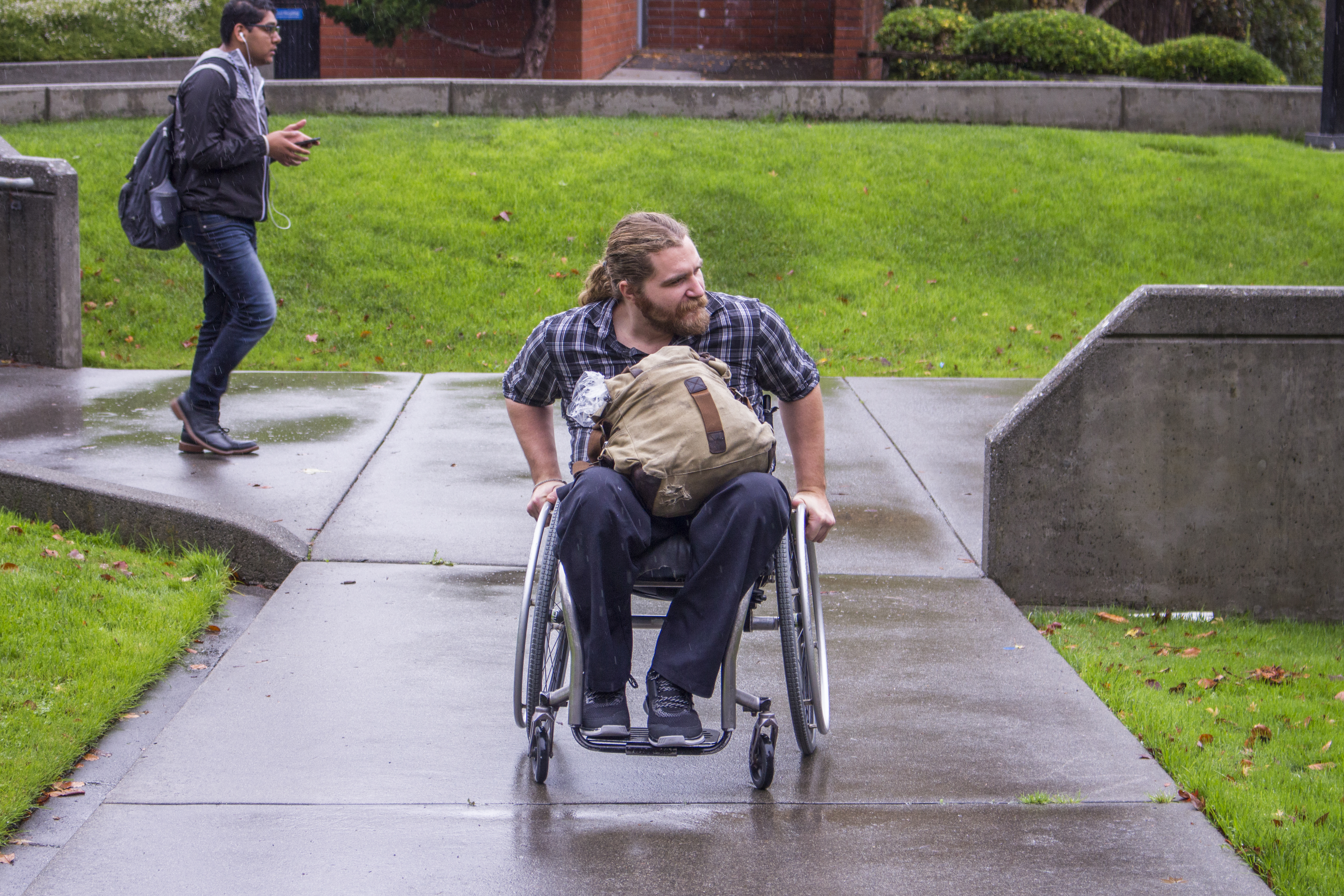
Jeremy Meed’s strength is tested every time he hauls himself up into his truck from his wheelchair. Meed lifts his whole body weight up into the passenger seat of his truck every night to sleep in his vehicle. His feet swell up from sleeping upright. All his personal belongings lie in the passenger seat and the cab of the truck. Since the beginning of summer, Meed’s truck has been his home.
“Using the bathroom, not having a comfortable place to sleep and not being able to cook,” are some of the hardest parts of living in his truck said Meed.
When Meed first moved out to Humboldt from Ohio he lived on campus at the College Creek apartments. Unfortunately, this semester his financial aid was only enough to cover his tuition.
Meed is part of possibly up to 15% of HSU students who are homeless according to a survey done by Chant’e Catt of the HSU Homeless Students Advocate Alliance in 2016. Meed is also physically disabled making it even more difficult to find housing in an area with an already severe housing shortage.
At the age of 16 Meed ran away from home with his girlfriend from South Carolina in his Subaru. Somewhere on the outskirts of Atlanta Meed fell asleep at the wheel and crashed his car. The next thing Meed remembers is waking up in a hospital.
“I woke up with a tube in my chest and I couldn’t feel my legs,” said Meed.
Since then Meed has been paralyzed from the chest down.
Meed used to sleep in his truck on campus until University Police Department told him it was illegal to do so. Now Meed finds places away from people’s homes to park his truck and sleep. He doesn’t feel safe staying at the homeless shelter in Eureka and said he wouldn’t feel safe parking near the shelter either.
Meed is continuing to look for housing but it’s difficult for a low income paraplegic to find housing in a county that the Humboldt County Grand Jury in 2015 said has a “critical lack of affordable housing”.
There is the Humboldt County housing section 8 voucher waitlist Meed was hoping to get onto which helps low income non elderly disabled residents with rent but the voucher waitlist has been closed now in Humboldt County for over two years.
According to Affordable Housing Online there are around 1,500 affordable low income apartments available in Humboldt County. But according to the U.S. Census Bureau, roughly 20% of Humboldt County residents are living in poverty. That’s 20,000 people.
Many of the low income apartments available are upstairs making them inaccessible to Meed. Others don’t have the proper bathroom door width for a wheelchair to fit into.
Now in his second year as a music major, Meed spends his days practicing his guitar at the music department. He picked up his love for guitar while living in Ohio with his family around seven years ago.
Meed also works at the Humboldt State University Testing Center which helps students registered with the Student Disabilities Resources Center take tests and also provides a space for make up exams.
“I try to stay out of my truck as much as possible,” said Meed.
Meed said that Humboldt State University complies to ADA standards but doesn’t do much more than that.
Getting around campus is another test of strength for Meed.
“The hills are the hardest part,” said Meed.
Meed’s wheelchair is a manual chair, meaning it’s push powered, not electric.
“An new electric wheelchair costs about $5,000.” said Meed. “Some insurance companies will help pay the cost, but they will only help replace the chair every five years,” said Meed.
In spite of the adversity Meed goes through on a daily basis getting around the aptly nicknamed hills and stairs university in a wheelchair and living in his truck, Meed is determined to continue his education and graduate within the next three years. The resilience he displays is honorable.
“I’m a unique situation,” said Meed.
In an area like Humboldt with an obvious shortage of low income housing, it’s necessary that situations like Meed’s be addressed so others like him can get the support they need to live in Humboldt and continue their education.
Grabbing or groping a person without their consent are desperate acts of perversion. The same goes for ogling at someone’s body for too long or texting unsolicited photos. While they may not seem like a big deal, you’re ruining someone’s day to say the least. There is no excuse for sexual harassment.
Contrary to the sexual harassment case that was reported to the University Police Department this month, many survivors choose not to speak up, especially survivors of rape.
Allie Jones, 20, is majoring in geography and journalism at HSU. She was harassed and assaulted twice last semester by two different men, both on and off campus. The worst incident involved stalking and attempted rape.
It took Jones almost a month before calling UPD, yet she disguised her report with hypothetical questions about how to deal with sexual assault. Jones did not get help that day. In fact, she didn’t want help.
“I realized that I didn’t want to talk about it,” said Jones. “I didn’t want to rehash it… you just want some normalcy, because you just want to move on.”
Before long, Jones opened up to her friends and accepted their emotional support. She also signed up for Counseling & Psychological Services (CAPS) and credits them for partial recovery.
Sergeant Janelle Jackson of UPD handles cases of sexual misconduct. She says that sexual harassment is “a burden to hold in.”
Survivors who don’t speak up are suppressing trauma that may lead to long-term consequences of phobias and chronic stress. If many stories go untold, sexual harassment wins. Speak up in numbers and let your voices be heard.
If you feel inclined to speak up, there are resources available to you, including North Coast Rape Crisis Team (NCRCT), Sexual Assault Prevention Committee (SAPC) and Campus Assistance Response and Education (CARE).
Graphic by Michelle Meyers
This website uses cookies to improve your experience. We'll assume you're ok with this, but you can opt-out if you wish. Cookie settingsACCEPT
Privacy & Cookies Policy
Privacy Overview
This website uses cookies to improve your experience while you navigate through the website. Out of these cookies, the cookies that are categorized as necessary are stored on your browser as they are essential for the working of basic functionalities of the website. We also use third-party cookies that help us analyze and understand how you use this website. These cookies will be stored in your browser only with your consent. You also have the option to opt-out of these cookies. But opting out of some of these cookies may have an effect on your browsing experience.
Necessary cookies are absolutely essential for the website to function properly. This category only includes cookies that ensures basic functionalities and security features of the website. These cookies do not store any personal information.
Any cookies that may not be particularly necessary for the website to function and is used specifically to collect user personal data via analytics, ads, other embedded contents are termed as non-necessary cookies. It is mandatory to procure user consent prior to running these cookies on your website.