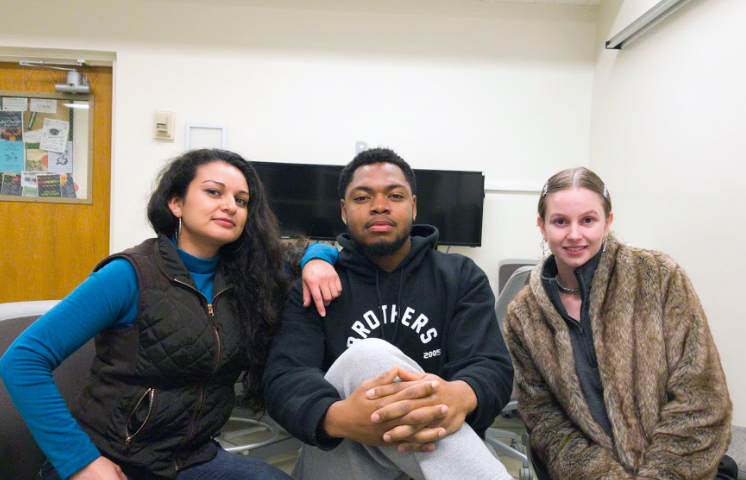
Humboldt State University’s debate team dedicates 13 hours a week discussing uncomfortable subjects.
The HSU debate team debated against the Irish National Debate Champions on April 11. The team spoke on why “violence is necessary for political action.”
The HSU debate team argued the positives of the topic.
The three competing members of the HSU debate team are Ruby Aguirre, Olivia Gainer and DaMon Thomas. Aguirre and Thomas have been on the debate team for two years. Gainer has been on the debate team for a year and is the team’s vice president.
Ruby Arguirre of the HSU Debate team. Video by Luis Lopez.
Aguirre is a masters social work graduate.
“People always get nervous when we talk about heavy topics,” Aguirre said. “But people need to understand that what we talk about happens everyday.”
Thomas is majoring in communications.
“One of the topics that we talk about that gets me passionate is Black rights or minority diversity,” Thomas said. “Debating is like doing reps. I get comfortable talking about these topics.”
Gainer is majoring in philosophy.
“When it comes to being nervous in front of people, that’s something that never goes away,” Gainer said. “But with practice, I overcome those nerves.”
The way a debate works is each member presents their argument to the audience. The affirmative (HSU debate team) speaks on the topic, and the opposition (Irish debate team) can raise their hand to question the argument. After the affirmative is done speaking, the opposition can argue about the negatives of the affirmative’s argument.
Aodhan Peelo of the Irish National Champions. Video by Luis Lopez.
Judgement was done by the audience’s vote. The audience voted in favor of the Irish debate team by 70 percent.
Both teams presented their arguments with passion on the controversial topic.
Aaron Donaldson is the coach of the HSU debate team.
“The debate team has traveled eight times each year to attend debate exhibitions,” Donaldson said. “This will be the first time this year that the debate team will be having a debate on campus.”
From April 12-16 the HSU debate team attends the U.S. National Debate Championship held at Stanford University.
“I think especially now more than ever it is important to have debates on difficult subjects,” Donaldson said.
Survivors of sexual violence share their experiences through the events of Take Back the Night
Take Back the Night delivers the message that domestic partner violence, intimate partner violence and other types of violence will not be tolerated.
Xochitl Cabrera runs the Humboldt State’s Women’s Resource Center, which hosts Take Back the Night every year.
“Sometimes people don’t need you to help them, you may need to take a step back. Some people just need to heal themselves,” Cabrera said.
The Women’s Resource Center is a campus resource for people who need a safe place to study or find the help you need for survivors of sexual violence experiences.
“The Women’s Resource Center knows that sexual violence and domestic violence happen all of the time, but it is up to the survivor to reach out to the Women’s Resource Center,” Cabrera said. “Take Back the Night is not for everyone. People tend to avoid the trauma it brings up.”
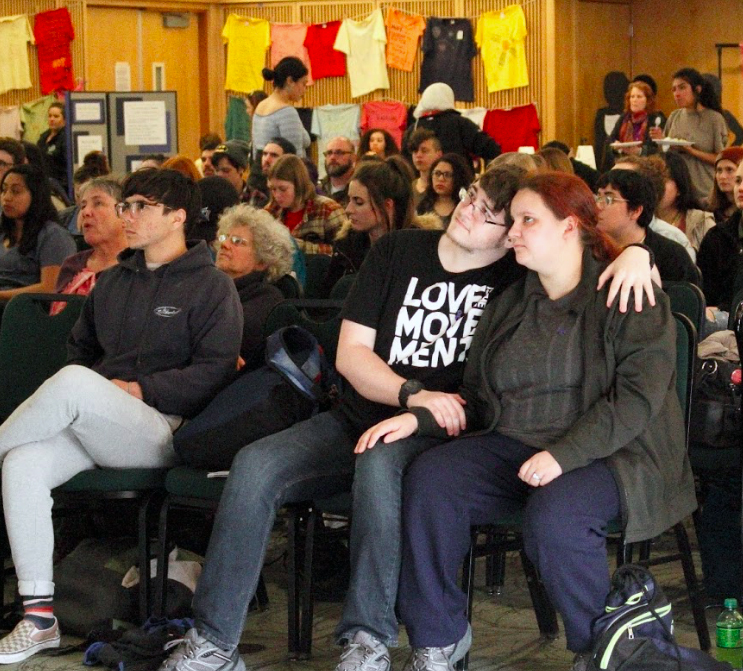
Hanging on the walls of the Kate Buchanan Room are T-shirts from survivors of sexualized violence and friends of people who died from sexualized or domestic violence. The T-shirts had messages written telling of horrible acts of sexualized violence from family members, friends and others.
“The T-shirts are difficult to look at, but their story needs to be heard. They are not nice. It is painful but necessary,” Jodie Huerta, HSU sociology major, said.
Messages written on T-shirts decorating the walls of the KBR. Photo by Ahmed Al-Sakkaf.
Assistant professor of Native American studies Cutcha Risling-Baldy was the guest speaker for Take Back the Night. Risling-Baldy’s talk was based on systemic violence toward people of color. Before her talk on missing and murdered indigenous women, Risling-Baldy acknowledged the death of HSU student David Josiah Lawson.
“If David Josiah Lawson were not a person of color, his death would be on the news every day,” Risling-Baldy said.
The Native Americans view domestic violence differently.
“In an interview with a Wiyot woman, the anthropologist asks what happens if a man rapes a woman,” Risling-Baldy said. “The Wiyot woman replies, ‘That never happens.’ Asked why it never happens, the Wiyot woman said, ‘Because that person would be killed.’”
Speaking out can trigger traumatic experiences for people.
“People choose to come if they feel comfortable speaking on their testimony, and they choose not to come because they don’t feel comfortable speaking on their testimony,” Cabrera said.
Some of the speak-out testimonies were about sexual violence that occurred during childhood and adolescence, while some of the testimonies were about sexual violence that happened at HSU. Sexual violence happens to HSU students, for which most of us are unaware.
“Everybody knows that sexual violence is happening, but nobody is doing anything about it. It is just getting swept under the rug,” Grace Lamanna, HSU recreation major, said.
People tend to restrain themselves from being in these spaces, because of the trauma it brings to them.
“Some folks don’t feel safe in this space, because they don’t identify with domestic violence and sexual assault. People feel like they are taking up space and say, maybe this isn’t the space for me, I’ll take a step back,” Cabrera said. “That’s totally fine, because we want to prioritize those individuals that have experienced sexual assault and sexual violence at some point in their lives. That is what this space is mainly for.”
Students hold hands in a circle behind the McKinley statue on the Plaza. Photo by Ahmed Al-Sakkaf.
HSU sociology major Omar Miranda helped as a monitor for the Take Back the Night march as part of his class.
“I feel like I made a difference. Big or small. Something small to me could make the biggest difference to the survivors,” Miranda said.
The survivors gathered after the speak-out for the Take Back the Night march. Marchers wore orange safety vests, gathered in groups of five and were assigned a monitor. Monitors had received tactical training for this march and could protect the group if some danger presented itself.
The marchers left school chanting, “Hey! Ho! The patriarchy has got to go!”
The marchers went from school to the plaza downtown and were heckled by a few passersby in cars, as well as people along the route.
On the plaza, the Take Back the Night members and public in attendance gathered in a memorial for the people who have died from sexualized and domestic violence. In silence, the less fortunate victims of this violence were honored.
As the Take Back the Night march left the plaza, the declarative chanting could be heard echoing off buildings and down alleyways.
“Take back the moon, take back the stars, take back the night because the night is ours!”
This website uses cookies to improve your experience. We'll assume you're ok with this, but you can opt-out if you wish. Cookie settingsACCEPT
Privacy & Cookies Policy
Privacy Overview
This website uses cookies to improve your experience while you navigate through the website. Out of these cookies, the cookies that are categorized as necessary are stored on your browser as they are essential for the working of basic functionalities of the website. We also use third-party cookies that help us analyze and understand how you use this website. These cookies will be stored in your browser only with your consent. You also have the option to opt-out of these cookies. But opting out of some of these cookies may have an effect on your browsing experience.
Necessary cookies are absolutely essential for the website to function properly. This category only includes cookies that ensures basic functionalities and security features of the website. These cookies do not store any personal information.
Any cookies that may not be particularly necessary for the website to function and is used specifically to collect user personal data via analytics, ads, other embedded contents are termed as non-necessary cookies. It is mandatory to procure user consent prior to running these cookies on your website.