Month: May 2018
-

Letter to the Editor
I recently read the article “40-day anti-abortion protest begins in Eureka” by Abigail LeForge. I found the article to be biased and lacking in investigative journalism. Though it is generally lacking in perspective, my main contention is with two points at the end of the article.
The first is the section about the press release for the event wherein LeForge wrote, “the press release…boasts the success of these campaigns, claiming they have saved 14,000 children.”
There is no further elaboration on how this number was achieved. What is their measure for saving a life? Are these 14,000 abortions post-eight weeks, 12, 14? There is a huge difference in what a woman goes to go through depending on whether or not it’s post-eight weeks.
Also, it states that “children” are saved, which is a term predominantly understood to be based on age; post-birth, pre-pubescent. Using the term “children” in reference to the beginnings of a fetus is an emotionally provocative inaccurate and inaccurate.
My second problem with the article is the use of the term “abortion facility.” It was a quote from an interviewee and LaForge missed an opportunity by not clarifying for readers that our Eureka Planned Parenthood isn’t an “abortion facility.” It supplies woman, myself included for the last 17 years of my life, with mammograms, Pap smears, STD and STI testing, birth control, cancer exams for both men and women etc…you get the picture.
Lastly, to end this article on a note about the closure of abortion facilities is frightening. Who is recording the closure of abortion fascilities? Is this county wide, state wide or nation wide? Were all these closures based on the successful campaigns of anti-abortion protesters? A new bill being passed? The merging of fascilities into one? Again, more questions are raised then answered.
At the end of t day, the misinformation by exclusion of a balance of views within this article hinders the progress for women’s right to their bodily autonomy.
If you made it here, thank you for taking the time to read through. This article seriously has me considering picking up journalism again. I guess that’s a good thing.
Have a wonderful day and thank you
Annie Bond
Student
-
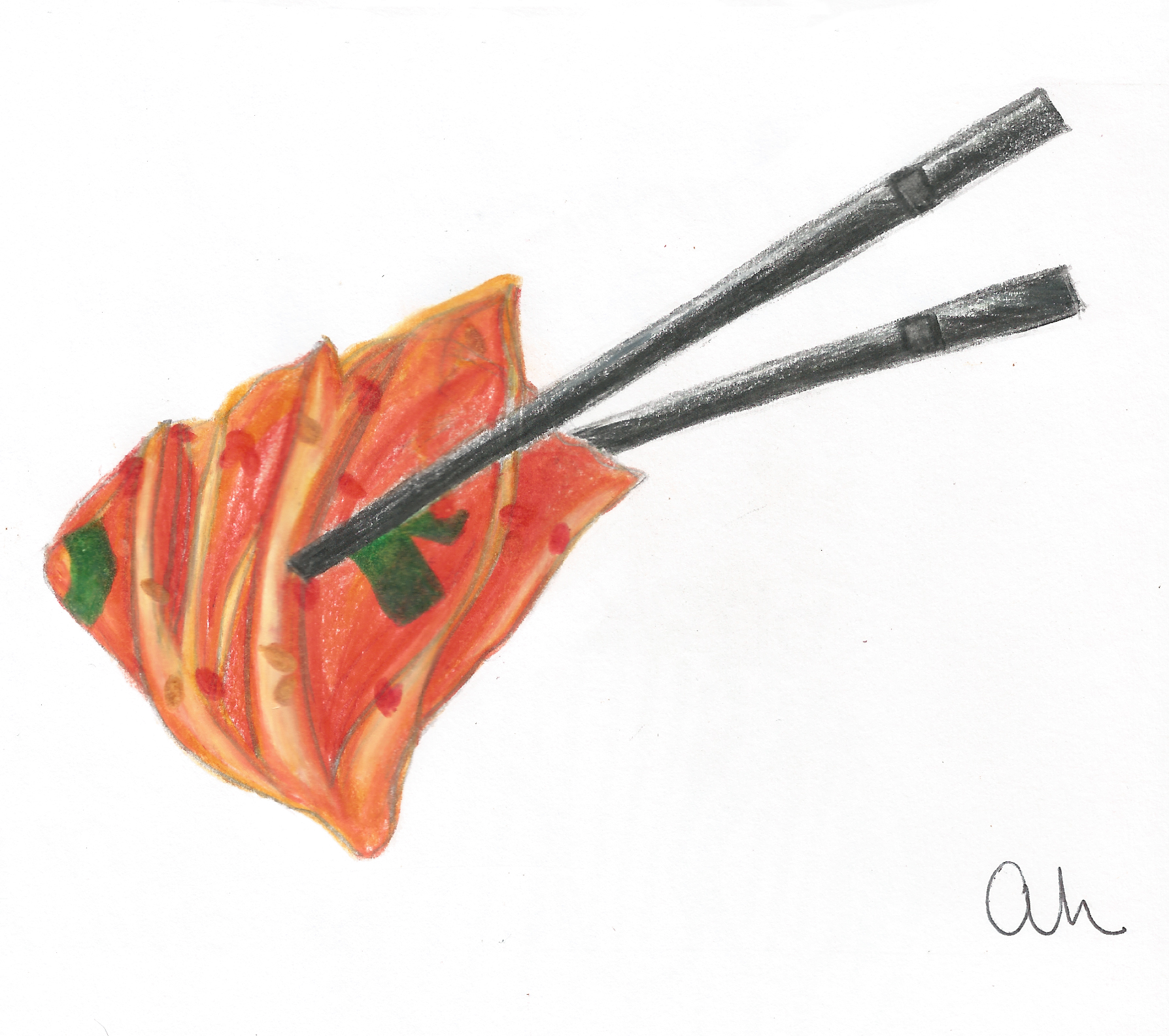
Kimchi trend is hard to swallow
Many Koreans who grew up in the U.S. probably understand why the recent kimchi trend is a little irritating. Korean Americans know full well the shame they had to endure by their non-Korean friends who expressed disgust of the pungent smell and taste of kimchi. That sense of shame is then heightened by alienation, making them feel as if Korean culture isn’t normal.
“I see a lot of white guys making Korean food ,and I’ll be honest, it pisses the shit out of me,” David Chang, renowned Korean American chef, said. “It’s everywhere now. Kimchi this, kimchi that. You weren’t like, ostracized in elementary school because everyone thought when they visited your house that it smelled like garbage. They didn’t have to endure emotional hardship. And now it’s cool.”
Kimchi is a staple Korean food made from various vegetables, most commonly with napa cabbage and radishes. It contains an assortment of spices, including seafood sauce, red pepper paste, garlic and ginger. It has a sour taste, a crunchy texture and a fishy smell that is packed with probiotics, vitamins and minerals.
“Kimchi is a traditional Korean food manufactured by fermenting vegetables with probiotic lactic acid bacteria,” the Journal of Medicinal Food wrote. “Accordingly, kimchi can be considered a vegetable probiotic food that contributes health benefits in a similar manner as yogurt as a dairy probiotic food.”
Nowadays, you can find kimchi in supermarket chains, taco trucks and on hot dogs. What used to ostracize Korean Americans has now become trendy, which is annoying in some ways, but exciting that the western world is finally appreciating Korean food.
Popularization is a foolish way to appreciate ethnic foods. Waiting for celebrity chefs and publications to tell us what cuisine is worthy of attention is a small-minded way of enjoying foods outside of your comfort zone.
“Declaring an entire ‘ethnic’ cuisine a trend is inherently dismissive,” Khushbu Shah, Thrillist’s senior food features editor, said. “Filipino food, for example, is the main source of sustenance for more than 100 million people around the world today and has been eaten for centuries, even in the United States. So the very nature of tagging something as a trend also gives it a shelf life that is set to expire after its moment of popularity. But that’s not how cuisines work.”
Kimchi’s trendiness will likely wane, but it will certainly not lose its cultural significance. The first step in exploring foods past your customary tastes is to have an open mind. If you don’t like it, that’s fine, but don’t hold it against us.
-

Physics professor resigns
This article has been updated on May 3 at 3:35 p.m.
This semester has been plagued with budget cuts, walkouts and campus strikes. Tension between faculty and administration have reached a peak.
Amidst all this, Physics and Astronomy professor Paola Rodriguez-Hidalgo decided to turn in her resignation. At the end of her third year here at Humboldt State, her office is filled with boxes that have yet to be unpacked ,and won’t be until she settles in at the University of Washington Bothell.
“I wanted to make my home here but, in my humble opinion, I believe HSU is experiencing an identity crisis,” Rodriguez-Hidalgo said. “There is a lack of balance between the teaching I’m supposed to do and the research I’m supposed to do, and at the end of the day I felt that research component was not really valued that much. When I came to HSU, I was expecting a better balance between the two; I don’t know how much I was misled or how much I misinterpreted what I was told.”
Rodriguez Hidalgo said she believes HSU is asking too much of its faculty. She explains how they are expected to plan hours of lecture, lead student research, guide advisees, sit on committees, attend conferences, grade papers and show up to class every day.
Rodriguez Hidalgo thinks as more jobs are put on professors, they will have less time and energy for teaching and research.
“I think the faculty want to put the hours into creating good learning experiences which is what students are going to remember,” Rodriguez Hidalgo said. “But if you don’t have the time at some point you need to give up on the excellence. Last semester I was working 80 hours plus a week and I was burning out. If I stayed here, how much longer was I going to like my job? I love being a professor; this is a job I don’t want to hate.”
Rodriguez Hidalgo said she doesn’t place the blame on HSU or any administrator in particular. To her, it’s the system that HSU exists in. She said our current situation is the consequence of years of a constant revolving door of administrators.
“It is very hard to have a vision when people are always coming and going,” Rodriguez Hidalgo said. “For me, personally, I wasn’t seeing that leadership. I wasn’t seeing that heart. I wasn’t seeing that support. What the faculty needs is a support structure that allows me to do my job to the best of my capabilities.”
3:35 p.m.: The professor’s title has been corrected from physics to physics and astronomy. Her quotes have been updated to reflect direct quotes.
-

HSU dives deeper into research
Marine protected areas, or MPA’s, are areas of the ocean set aside for conservation. The new California statewide network of marine protected areas was established between 2007-2012 for a total of 124 MPAs in places along 1,100 miles of California’s coastline.
The implementation of 20 MPAs and seven special closures along the Northern Coast of California in 2012 completed the statewide network. Since implementation, there has been a series of harmful events that have altered the underwater habitat and are threatening the existence of kelp beds, sea stars and red abalone.
Sean Craig is a marine biology professor at Humboldt State that studies both MPA’s and non-protected marine environments with his graduate and undergraduate students.
“Kelp beds are getting decimated, the water temperature has changed, there is a warm water blob along the coast, purple sea urchin populations have increased, sea star wasting disease has come along, harmful algae blooms hit along the Sonoma Coast and El Niño brought warm water right next to shore,” Craig said. “All of these conditions, in multiple ways, could have led to the drop in kelp forests and macroalgae (seaweed).”
Craig gave a talk on MPA’s at the Arcata Marsh Interpretive Center on Friday, April 27.
“Protecting areas underwater provides a sanctuary for fishes,” Craig said, “which should enhance the number of fishes, enhancing the number of species in that area and allowing more fish to get larger and reproduce. That leads to a more functional marine web.”
The addition of MPA’s along the north coast of California has given HSU marine biology and scientific diving students incredible research opportunities. Grants funding base line data surveys are helping undergraduate students and graduate students to get field research and diving experience.
Richard Alvarez is the HSU diving safety officer who teaches scientific diving. Alvarez sees the potential in North Coast MPA habitat restoration, noting the successful restoration of some Southern California kelp beds and improvements in the Van Dame MPA in Mendocino.
“Van Dame was the most heavily-hunted abalone area, and it is now robust. Kelp is there and urchin barrens are smaller. There is a chance to get ahead of the urchins eating all of the kelp,” Alvarez said.
Craig has been a part the research along the North Coast MPA’s since their inception. The North Coast MPA surveys were a combined effort of HSU, UC Santa Cruz, San Francisco State, the Moss Landing Marine Labs and the Smith River Rancheria.
HSU student scientific divers gathered underwater baseline data on the abundance of kelp and macroalgae and identified fishes, noting their abundance and sizes. Divers also collected data on aquatic macroinvertebrates, such as abalone, sea stars, sea urchins and mussels.
The Sunflower sea star, Pycnopodia, with 15-24 arms has disappeared due to Sea Star Wasting Syndrome or SSWS.
“The Sunflower star that feeds on purple urchins is no longer out there,” Craig said.
There are ecological processes that are occurring with the purple urchin out competing other species in the kelp forest. The disappearance of Pycnopodia that eats purple urchins is having a ripple affect. Abalone are starving because the urchins are eating all of the kelp, additionally sea temperature is also affecting the ability of kelp to grow.
“Data collected on sea stars in 2014 shows major contractions in their populations,” Craig said. “In the summer of 2014, data collected at Pyramid Point MPA shows a healthy population of the Ocher sea star, and the following survey at Pyramid Point in the winter of 2014 shows populations decimated by Sea Star Wasting Syndrome. And the following summer of 2015, there were practically none left at Pyramid Point.”
The rocky intertidal region of the North Coast MPA surveys were conducted by UC Santa Cruz, under the direction of Peter Raimondi and Sean Craig. The survey collected data on seaweed and surf grass, as well as mussels, sea stars and other intertidal organisms.
The North Coast MPA sandy beach surveys were led by San Francisco State, under the direction of Karina Nielsen. Beach surveys collected data on sand crabs that burrow into the sand, surfperch (a family of perciform fish) that eat sand crabs and the wracks of seaweed washed up on the beach containing amphipods that crabs and birds feed upon.
“The wrack of kelp that washes up on the beach ties into the microinvertebrates that live on the beach, increasing the sand crab population and shore bird population,” Craig said. “This is the sort of data that would make anyone wonder why they would want to rake up the wrack off the beaches in Southern California to make it prettier, which is totally changing the entire ecosystem.”
After Craig’s presentation, HSU alumnus Gary Bloomfield, who is a renowned wildlife artist, passed out and signed his MPA poster titled “Safeguarding an underwater wilderness.”
“I hope this poster is educational for people to learn about the ocean and MPA’s,” Bloomfield said.
“In summation, we know MPA’s aren’t saving us from everything, but we can follow Sea Star Wasting Syndrome and see its devastation,” Craig said. “In addition, we have learned a great deal about sandy beaches and the trophic links between species.”
-

In constant motion
Susan Connors knew no matter what her daughter Gabby decided to pursue, she would never give up.
“A lot of people don’t follow their dreams, they say I can’t do it or I can’t make it. She’s not like that,” Susan Connors said. “She tries her hardest to make sure it happens. She has a strong sense of self and a strong character.”
Gabby Connors, a 19-year-old dance major at Humboldt State University, is set to teach advanced ballet at North Coast Dance next fall.
Gabby Connors has spent 13 years of her life dancing, a talent she inherited from her grandmother.
While reflecting on her journey, the young dance major said dance is a never-ending journey.
“You have to keep working no matter what,” Gabby Connors said. “You can only advance so much in one day and then the next day you’re just off.”
Gabby began dancing when she was in the second grade after her best friend’s mother opened a dance studio.
“Dance is a very vulnerable artform,” Connors said. “You are asking your body to do crazy stuff, and you are asking your mind to let you release yourself and show those emotions and be vulnerable in front of strangers.”
Gabby said that in spite of compliments from others and all the years she has put into dancing, she does not always recognize her talent.
“I perceive it more as hard work than I do natural talent,” Connors said.
Susan never danced growing up and was surprised by Gabby’s ability to pick up dance so effortlessly.
Gabby has been dancing from the age of six, but said her path was never simple.
“It hasn’t always been easy choosing dance as what I want for my life,” Connors said. “It’s really difficult when the one thing that brings you the most fulfillment and peace is also the root of a lot of your self-doubt and criticism.”
It can be very difficult to manage the stress that comes with participating at such a high level in dance.
Susan said that while she does not know much about HSU, she does know that Gabby is trustworthy when it comes to making the right decisions for herself.
“Gabby is very independent so we didn’t have much of an input into where she would go,” Susan Connors said. “She was accepted into UC Irvine’s dance program, but they focused on pointe and she wanted to go with contemporary. I think Humboldt is a good fit for her.”
Regardless of where Gabby chose to attend college, Susan said that she knew she would thrive wherever she went.
“As long as she stays healthy, I think she could go very, very far,” Susan Conners said. “I am proud of her and glad that she followed her dreams.”
Gabby transferred to HSU with over two and a half years completed in credits because of her advanced placement classes, and is already expected to graduate in the fall of 2019. She felt that she had gotten everything she could out of her high school experience, and that it was time for her to move on and grow.
Connors said she moved from Washington to study dance at Humboldt State, not only because she loves the ocean and the trees, but also because of the smaller learning environment.
“One of the many perks about the dance program here is that we are a smaller school so it’s a smaller program, which means you get a lot more individual attention.” Connors said “[It] is important for any major, but is very important for dance.”
HSU Dance Program Lead, Linda Maxwell, is one of Gabby’s professors. Maxwell has been teaching at HSU for 12 years. Out of those 12 years, she said Gabby Connors stands out.
“Gabby is probably the most talented student that I’ve ever had at Humboldt State University in the 12 years that I have been here,” Maxwell said. “She never talks during class. She does everything full out, and she is very supportive for students that are not of her level.”
Maxwell said she remembers when a guest dance company traveled to HSU and taught a master class on HSU’s campus.
“She picked up every detail. A lot of students were struggling and she was able to do it full out,” Maxwell said. “She has that ability to pick up anything.”
For Gabby, dancing comes down to her ability to manage and transgress her emotions on the stage.
“Having danced so long, I have gotten very comfortable wearing all of my emotions very openly on my face at all times,” Connors said. “I am a very emotional person so dancing is very comfortable for me.”
-

“Avengers: Infinity War” spoilers
Each Marvel movie has its own tone. Whether it is the quirky, fantastic realm of Taika Waititi’s “Thor: Ragnarok,” the darker, more realistic world of the Russo brother’s “Captain America: Winter Soldier” or the reality-warping ethereal world of Scott Derrickson’s “Doctor Strange.” Bringing all of these different worlds and tones together into one world with one tone is not a simple task.
The simple way around that monolithic problem is to avoid it entirely.
“Avengers: Infinity War” is supposed to be Marvel’s final boss. Every Marvel Cinematic Universe movie up to this point has been leading up to this event. It was never really supposed to be a movie; instead it is more of a superhero convention. The agreed upon prediction for “Avengers: Infinity War” was that the superhero convention would start with a bit of interpersonal conflict between all the different characters. They meet up for the first time, a big bad boy appears and all the main characters have to re-re-re-learn the lesson of teamwork. The reward would be the friends they made along the way.
It is wonderful that the predictions were mostly wrong.
The name of this movie should have just been “Thanos.” The real plot line is a strange character study shrouded in the guise of an Avengers movie. Thanos lurks in the corner of the MCU films. Whether he’s mentioned in passing by the main characters or shown in the flesh during an end-credits scene, he has always been in the background doing absolutely nothing. Now he takes center stage, and the superhero convention that is “Avengers: Infinity War” is just unnecessary weight. All the characters we know and love tend to drag the movie down, especially the ones that stay on earth for the entire movie. The concerns of Captain America or The Vision do not matter in the face of Thanos.
It is such a shame the movie had to be an Avengers film.
The best parts of this movie are beautifully surreal. There is thought put into landscapes and so much detail put into the expressions on the CGI purple face of Thanos. The most memorable moments are slow and touching or strangely twisted.
The best fights in the movie are not punch-ups. The weapon that Thanos uses can control reality, so it is perplexing that the audience is asked to take swarms of heroes and faceless villains with all of their explosives and magical fists seriously. The movie makes it clear that Thanos is on a whole other level. He can manipulate the universe as he chooses. The movie would have been improved if most of the scenes on earth were completely cut out and replaced with further explorations of Thanos’ character and reality-bending powers. The threat Thanos posed to earth was on a different scale; so much so that all the explosions and action-packed fight scenes felt hollow.
Before this goes on, here are the recommendations: If you haven’t enjoyed the MCU so far, this “film” is not for you. If you like the MCU so far, you will probably be glad you went to the theater. There are some shake-ups, some touching moments, some wit and a whole lot of sadness.
This next part has many spoilers. Do not read on if you have not seen the movie.
Thanos wins. He snaps his fingers and half of all life in the universe disappears. It cements the movie as something different. Nothing the main characters do to physically stop Thanos really mattered. The ending is heartbreaking and it should stay that way. Peter Parker panicking while dissolving in Tony Stark’s arms genuinely digs into the soul if you already care about these characters.
But of course, Peter Parker cannot stay dead because there is another Spider-Man movie in the works. The weapon used to kill over half the main characters has the ability to rewrite time, so it does not take a genius to see what is going on.
The biggest fault of this movie, and every other Marvel movie, is not a single part of the movie. Instead, It is the fact that it cannot just end.
-

Jacks talent moves on to NFL
The Tampa Bay Buccaneers chose our very own Alex Cappa as the 94th overall pick in the 3rd round of the 2018 NFL draft.
Cappa is a four-time Great Northwest Athletic Conference Offensive Lineman of the Year and a three-time All-American. Cappa was recognized as a top lineman in NCAA Division II and played in the Reese’s Senior Bowl in Mobile, Alabama back in January.
“I would just like to thank everyone [at Humboldt],” Cappa said, “there was a huge support system there. The community, my team, the coaches; they all definitely prepared me for this.”
Five minutes before hearing his name called on national television, Cappa received a call from the Buccaneers. He was in Arizona with teammates Mick Johnson, John Hanson, his father and girlfriend, Emily when the Buccs let him know that they would be announcing him as their 5th pick of the 2018 draft.
“It was pretty cool,” Cappa said, “my family was super excited as well, probably more excited than I was to be honest.”
Cappa is from Dublin, California and has only been playing football since his freshman year of high school. He claims that he was not that great of a player during his high school years but progressively increased his skill level and had a successful college career.
“He is very strong and has mastered his techniques, even the strongest guys cant do anything to him,” Robert Mathews said, a football graduate and former offensive lineman for the Jacks.
Cappa’s teammates talk about his encouraging work ethic and positive mindset that always helped the camaraderie of the team and success on the field.
“I appreciate the energy [Cappa] brought to the game,” Mathews said, “he was like another coach. He was always ready to play football.”
Cappa’s teammate, All-American running back Ja’Quan Gardner, has also received an NFL opportunity. Gardner was invited to join the San Fransisco 49ers in their rookie minicamp this weekend. Gardner has worked very hard for this opportunity and is excited to show the 49ers what he can do.
Cappa will be flying to Florida on May 10, where he will soon begin the Buccaneers rookie minicamp. After the camp, the rookies will get to gather with the rest of the team and then receive some time off before training starts for the 2018 NFL season.
“I think this is phenomenal for [Cappa],” strength and conditioning coach Drew Peterson said, “I cant say enough about his accomplishments, and its a testament to his hard work.”
-
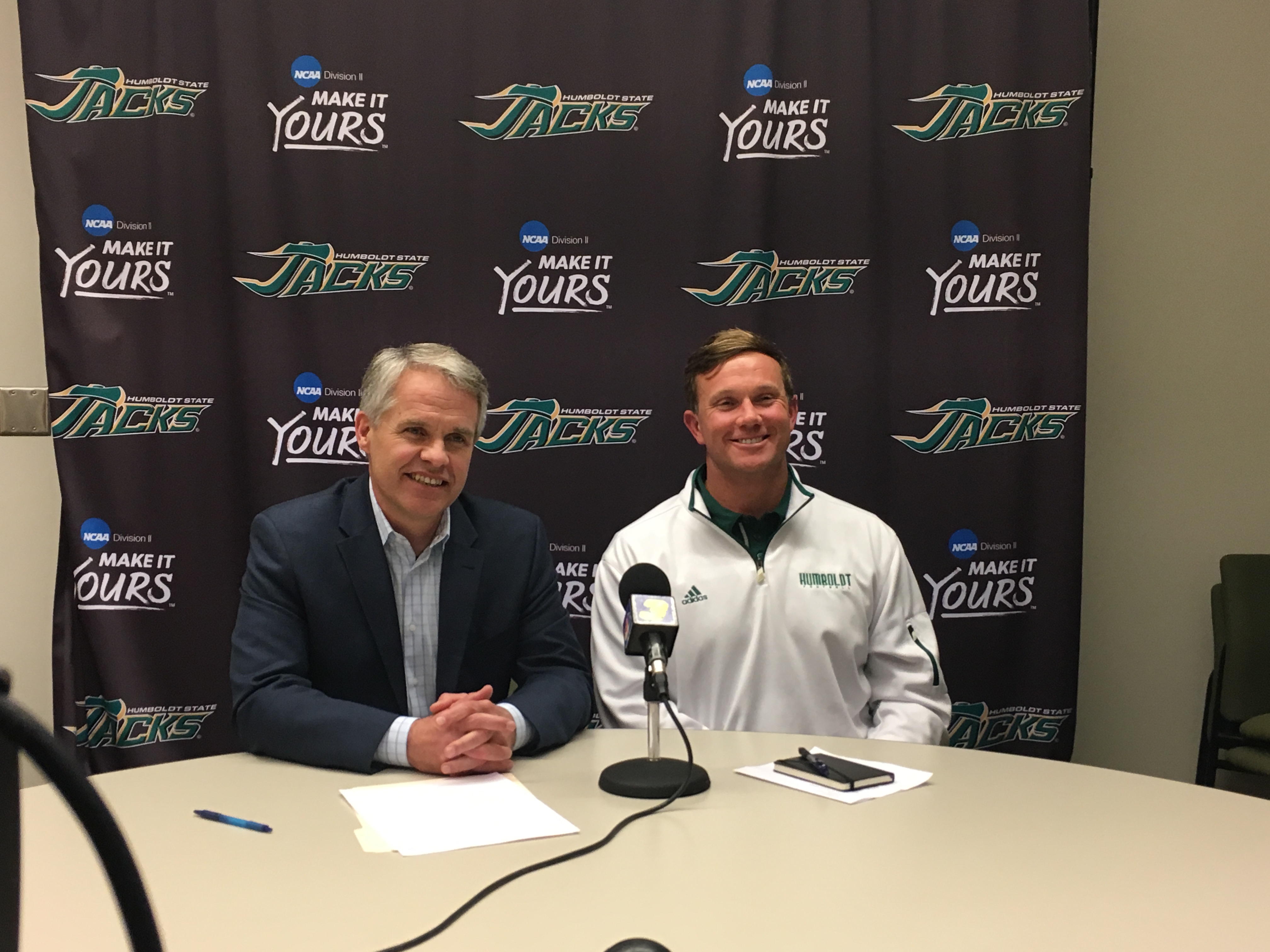
HSU boosters call for athletic director’s replacement
After the final two potential head football coaches for the Lumberjacks stepped back from visiting the campus at the last minute, a head group of boosters responded immediately and started a petition asking President Lisa Rossbacher to remove Interim Athletic Director Duncan Robins from the position.
“We believe Duncan is not qualified for the job,” said Jim Redde, “and he is basically trying to choke the football program.”
Redd is a major booster for the Lumberjacks, as well as the co-chairman of Save HSU Athletics, that was founded last year to help raise funds and keep the football program alive.
“[Duncan] does not interact with the community at all,” said Redd, “and he has not helped to do one thing in raising the $500,000 to save the program.”
Robins has been the interim AD since June and plenty of students, athletes, community members, alumni, and boosters feel that he has not put forth his best effort in helping the program stay alive and the athletic department succeed.
Robins explained that a full national search by a search committee took place before the five final potential coaches were chosen. Initially, there were 79 applicants for this position and after the search committee conducted verbal interviews with their top 15 choices, five were put forward for Duncan to consider.
“It is now my job to entice them with everything that is Humboldt,” Duncan said, “and let them know that they can help us rebuild this program.”
Former Head Coach Rob Smith stepped down from the position for reasons including the fact that he could just no longer work under Robins’ authority.
According to the boosters, both head coach Charlie Roche of Siskiyous and head coach Jeff Sims of Garden Community in Kansas backed out of visiting the campus this week. Roche was supposed to visit May 1 and Sims was supposed to visit May 3.
Roche was contacted, but prefers to speak about his decision after the search process has been completed.
The boosters suggest that these coaches stepped down because they would be forced to keep the current group of coaching assistants, be limited to a certain number of players, and be entering a hiring clause providing them with no security for their position.
Before the search began, several coaching assistants were hired to keep the program functioning through the spring. However, their contracts are only valid through the end of 2018.
The boosters believe that scenarios like this one are all a part of Duncans plan to slowly deteriorate the progression of the program.
“He has done some good things,” Redd said, “I’ve got to give him credit for helping the academic side of athletics.”
Duncan’s true motives for the football program have been exhibited after this major setback in finding a head football coach has come about, said the boosters. They believe he has intentionally stalled the hiring of a full time coach as his process to eventually get rid of the program altogether.
Redd states that his biggest issue is the fact that the community distrusts Duncan. The community is the Lumberjack’s biggest ally, and Redd argues that without trust from the athletic director, it is hard to stay supportive.
“I either have to turn my back on this program or fight for it,” said Redd, “and this athletic department is worth fighting for.”
The petition is expected to be online at https://savehsuathletics.com by the end of the week.
-

We still don’t feel safe
Racial discrimination on campus is rampant
I, Skye Kimya, believe I was detained on Feb. 14 over a $40 on-campus parking ticket because of the color of my skin.
Around 8 a.m. that morning, I walked out of a building on the northeast side of campus to find two parking officers giving me a ticket for where my car was parked.
After getting into a small verbal altercation with these parking officers, I realized it wasn’t worth the argument. I asked them to give me the ticket and let me go about my day.
The parking officers were not happy with me driving off while they were still giving me my ticket, and before I knew it, Humboldt State police Chief Donn G. Peterson was pulling me over in an undercover vehicle.
Within minutes, another University Police Department vehicle arrived to the scene. I was interrogated for approximately 10 minutes by two officers on each side of my car about the incident that had just occurred. After the officers spoke with each other for a few minutes, another cop car pulled up, and UPD officer Delmar Tompkins made his way to my driver side.
“Please step out of your vehicle and put your hands behind your back,” Tompkins said.
“Excuse me? I don’t understand,” I said.
I was told I was being detained under suspicion of assault with law enforcement. After questioning this accusation, I was told I was a threat at that time and needed to be detained for the safety of the officers because they did not know the full story yet.
Confused and scared, I got out of the car, did what Tompkins asked me to do and began to cry like a baby as he placed me in the back of his cop car.
Imagine being detained and told you are a threat, under suspicion of assault, by a white officer twice your size. Imagine feeling confused and alone. Imagine questioning what could possibly happen next.
When you grow up trying to understand the purpose behind discrimination, you begin to notice how common it is and wonder if it will ever go away.
At times, you lose hope for your children’s generation. Yet other times, you want to become the greatest activist that has ever walked this planet, in order to actually make things right for those future generations.
Students at HSU don’t feel at home. We don’t feel as though there are people by our side, and we don’t see the amount of people of color around campus that the HSU pamphlets and website photos presented to us when we were deciding which university to attend.
According to HSU’s “fast facts,” the incoming class of fall 2016 consisted of 549 Hispanic/Latino students, 51 African American students, 31 Asian students, 11 American Indian students and four Pacific Islander students.
Additionally, the entire fall 2016 student body consisted of 2,869 Hispanic/Latino students, 271 African American students, 279 Asian students, 89 American Indian students and 20 Pacific Islander students.
With a student body total of 8,503, you can imagine what it is like to see only 270 other faces similar to yours on one side, and only 88 other faces similar to yours on the other side.
Hispanic and Latino students made up almost 35 percent of the entire student body that same year. Seems like a reasonable amount, right?
HSU actually receives funds from the U.S Department of Education ever since they became a Hispanic-Serving Institution at the start of the fall 2013 semester.
To become a Hispanic-Serving Institution, the university has to have an undergraduate full-time equivalent enrollment of at least 25 percent Hispanic students, and HSU was at 26.6 percent for the fall 2013 semester.
HSU continues to flaunt a great amount of diversity that it does not have. These incoming students, like many of us who were once in their shoes, attend HSU and slowly begin to witness and experience how diverse this campus and community is truly NOT.
Just the other day, the NAACP Eureka Branch called out HSU and asked them to stop recruiting students from minority-majority neighborhoods until changes are made around campus and within the community.
A majority of the students of color who have attended HSU for at least two academic years have experienced some type of discrimination, whether it was verbal, physical or emotional.
In 2013, Tompkins had a civil lawsuit filed against him by a Fieldbrook man who alleged he was the victim of a brutal assault back in January 2012. It turns out the Fieldbrook man wasn’t lying and the Cal State University system paid him $135,000 to keep him quiet.
As students of color at this university, how are we supposed to feel safe if our own UPD officers don’t do things the right way and have our back?
Cases like the murders of HSU African American students Corey Clark (2001) and David Josiah Lawson (2017) are still unsolved to this day, and we as students have not seen enough action taken by our president, UPD and even the Arcata Police Department.
Students of color do not feel safe, nor protected here. The NAACP Eureka Branch is right and something has to change before HSU tries to drag more students of color to this campus.
-

To all of my kinky people
I am not a hair guru, but I do know my hair. My hair type can be best described as 4c.
The hair chart guide starts from type 1, which is your typical straight hair. This hair type is typically more hydrated. However, it gets greasy easily. Type 2 can be best described as wavy, a mixture of straight and curly hair. Type 3 is curly, which has a defined s-shaped pattern. These curls can get weighed down with too much hair product and will look greasy. Type 4 is the kinky hair type. This hair type has a tightly coiled pattern with a zig-zag shape.
This hair type is the most fragile and driest of them all. It requires the most care and the most moisture.
The problem many gals and Humboldt State University students with 4c hair likely face, is the lack of ethnically diverse hair care products in Humboldt County.
As a newly self-proclaimed “natural,”my hair is in its raw state, not permanently altered by chemicals or heat. Since I’m new at this, I’m still looking for the right hair care products.
If you’re looking for products that properly nourish, moisturize, detangle, tame frizz, add shine, give great body, leave hair soft, oil deeply and lock-out humidity, you can’t get that from typical hair products found at CVS, WinCo Foods or Walmart. But there are at least a few shelves of ethnic hair care options available at local stores.
There are local beauty supply stores in Eureka, but they have a small supply. Unfortunately, they sell items that are remarkably priced higher than items back home, but desperate times call for desperate measures.
Minority-majority areas typically have a plethora of beauty supplies and supply stores that cater to the needs of people of color.
Unfortunately, many HSU students have to either bring supplies from home during the break or spend an arm and a leg to ship it up here.
The HSU Bookstore now has items for their ethnically diverse student body, but prices could be better.
HSU Clubs and Activities coordinator Tanza Triggs wants to put together a planning committee with a club called The Legacy in the fall. It would be a hair expo for people with ethnic hair.
The purpose of the expo is to bring in local stylists and beauty supply owners to welcome HSU students with hair care contacts. This should create a drop in prices for hair care products and an increase in stock.
I usually use Cantu products. However, I’ve taken a small break from my Cantu products, and I’ve now decided to experiment with Lottabody products. The Cantu products can be found in Humboldt County, but I have yet to find Lottabody products.
I also use the Moisturize Me Curl and Style Milk in hopes to define my curls, tame frizz and add moisture with brilliant shine. So far, the results have been wonderful.
I hope other people of color will be able to find the hair care products that properly serve their hair type while living in Humboldt.
-

NAACP demands university to cease from minority-majority community recruiting
The Eureka chapter of the NAACP posted a press release on their website on April 26 asking recruiters from Humboldt State University to stop going to majority-minority areas and recruiting students of color.
The press release listed several demands of the university changes and a call on the university to “forgo” the access to money that this recruitment opens up to the university.
In the press release the NAACP said “HSU recruiters continue to travel to minority-majority communities, with the intent to enroll more students of color. Yet there has been no consistent presence of HSU administrators at the monthly vigils organized and facilitated by the students and Charmaine Lawson, the mother of Josiah Lawson.”
The NAACP also expressed that HSU should be more transparent to students of color when it comes to racism in HSU.
“If HSU is ‘number one for Social Justice’ as advertised, the University must accept responsibility for the negative impacts of its actions and inactions on students of color immediately,” the NAACP said..
The NAACP also called out the college’s responsibility to protect students from “foreseeable violence on campus and in school-related activities off campus,” claiming that HSU was not taking action to do so. This responsibility is based off a California Supreme Court ruling in March that colleges must protect their students from foreseeable violence in a classroom setting.
HSU President Lisa Rossbacher sent out a brief statement in response, expressing her thoughts on the NAACP’s press release.
“I was astonished that the Eureka NAACP chapter would suggest that HSU could or should stop recruiting students of color,” Rossbacher said in her statement. “HSU is deeply committed to diversity and equality, and that would be a giant step backward for the values and mission of this university.”
It‘s no secret to some that Humboldt State University’s administration has been facing criticism from students for lack of acknowledging racism around the campus, and its failure to protect students from the murder of HSU student Josiah Lawson to the students who have shared experience of rampant racism in Humboldt county.
-
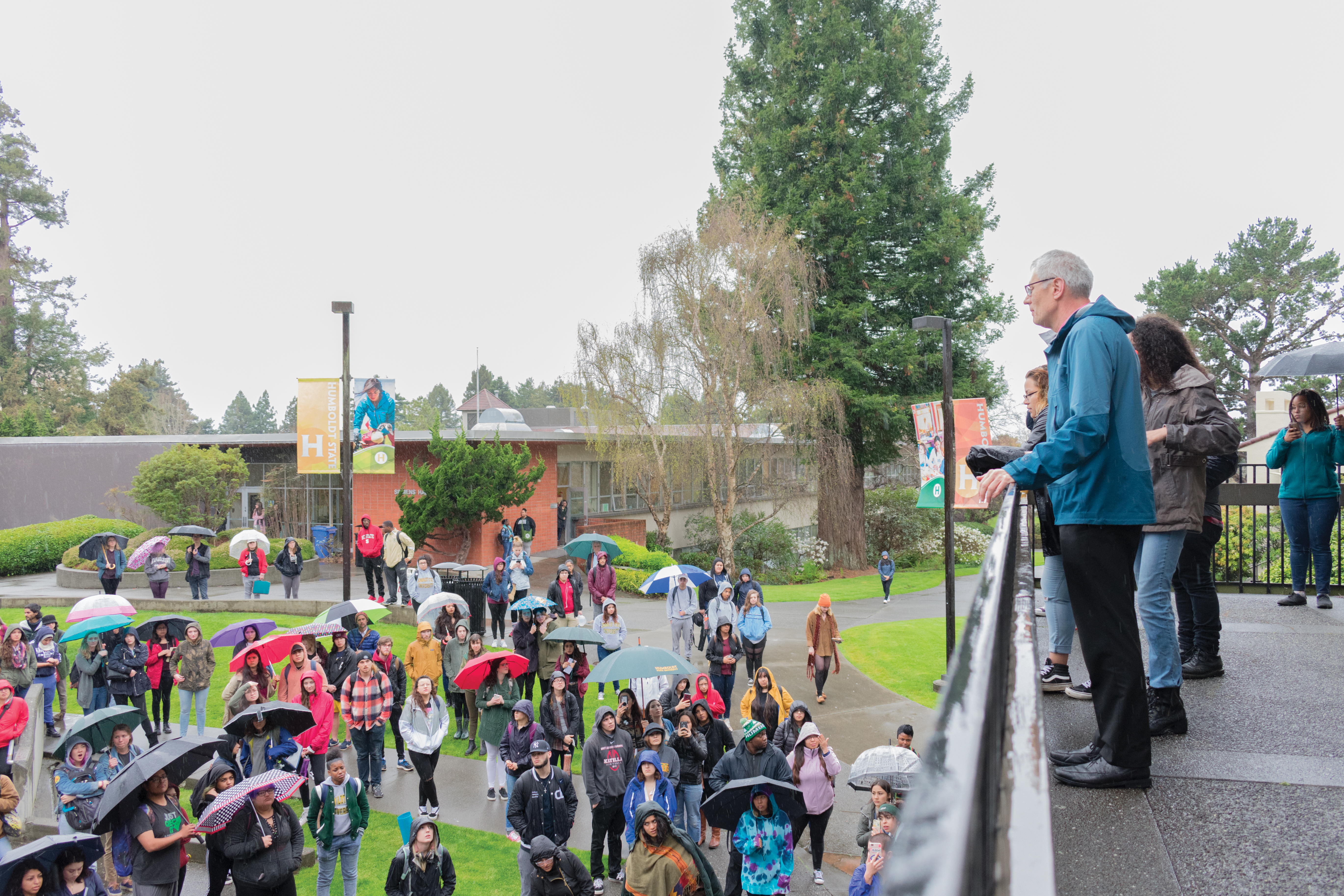
Administration’s feigned empathy, not enough
Humboldt State University must strongly consider the Eureka NAACP chapter’s letter about recruitment of students of color.
The Eureka NAACP posted a press release on April 26 insisting the college stop sending recruiters to minority-majority communities for the sake of the money these students bring the college.
Colleges will receive access to certain federal funding based on a number of reasons, one of those is the amount of diversity in student enrollment. For example, Humboldt State is a Hispanic-Serving Institution.
According to an article in the Sacramento Bee, to be a Hispanic-Serving Institution means the college’s demographic is at least 25 percent latino. The government awards this title and this allows the college access to “new programs and millions of dollars in targeted grants.”
Therefore the ENAACP asks that HSU stop recruiting students of color for the sake of access to this type of funding, claiming it is misleading to gather students to a toxic environment.
The ENAACP continues to present several reasonable demands in addition to ceasing minority-majority recruitment.
The ENAACP asks of HSU to:
- “Honor the experiences of students of color by confronting its institutional racism and actively engaging with the campus community, the City of Arcata and the surrounding communities in speaking to the racism that students experience.
- Ensure that support is in place so that students of color thrive in this community.
- Provide budget for permanent staff and student support for the Cultural Centers for Academic Excellence
- Transparency concerning the climate of racism in Humboldt County be the top priority in recruiting and marketing
- Do more to serve our diverse population of students with appropriate funding and staffing for the programs that serve them
- Prioritize hiring more faculty of color, and training current faculty and staff in “cultural competency””
We believe that these are reasonable requests to follow and that HSU must act accordingly.
Though the demand to cease recruitment of students of color is extreme, we believe it is rightfully based off of the reality of the discriminatory climate in Humboldt county. The organization is not without proof.
“Students of color at Humboldt State University have shared with us their experiences of racism in many forms including micro-aggressive behavior in HSU classrooms, overt racism on the streets, systemic racism in the pursuit of housing and employment, and institutional racism in the form of more punitive measures than their white counterparts,” ENAACP said in the press release. “We hear them.”
However, it seems that HSU is quick to defend and less quick to act. In a response letter, HSU President Lisa Rossbacher expressed minor empathy for the basis of these demands and proceeded to insist HSU is doing what it can.
“I disagree with many of the statements in the letter, but I do agree with the larger point that HSU and the North Coast need to do more,” Rossbacher said. “Our country struggles with a history of racism and racial inequality on the national and local levels. We must find ways, and work together, to create a brighter future for all our students.”
This is an indirect response to a list of clearly well made ideas and initiatives that the college could easily adapt to. Although Rossbacher agree’s, she does not address these bullet points and does not respond with any implications of having an actual plan to address the major issue of racism, just keeps insisting more must be done.
For example, Rossbacher has been consistently missing from discussions on dialogue and protests over the murder of HSU student Josiah Lawson. April 15 marked a year since his death and his case remains unsolved. When students gather in remembrance and protest of his death, Rossbacher is consistently nowhere to be found.
The press release also addresses the lack of presence from administration, stating that “there has been no consistent presence of HSU administrators at the monthly vigils organized and facilitated by the students and Charmaine Lawson, the mother of David Josiah Lawson.”
They also note the lack of regular presence of administration at the monthly Dialogue on Race meetings and recognizes that this is unacceptable.
Though we do not believe HSU should stop recruiting in the middle of a budget crisis, we do believe HSU and its admins and leaders, such as Rossbacher, should stop responding with feigned empathy, she should start acting and start showing up to represent the students of color that represent the institution.
We, as HSU students who have experienced this discrimination and have heard the stories of discrimination against our peers, are angry. We are tired of repeating ourselves. The toxic and racist climate of Humboldt county and Humboldt State University must be acted upon immediately.
-
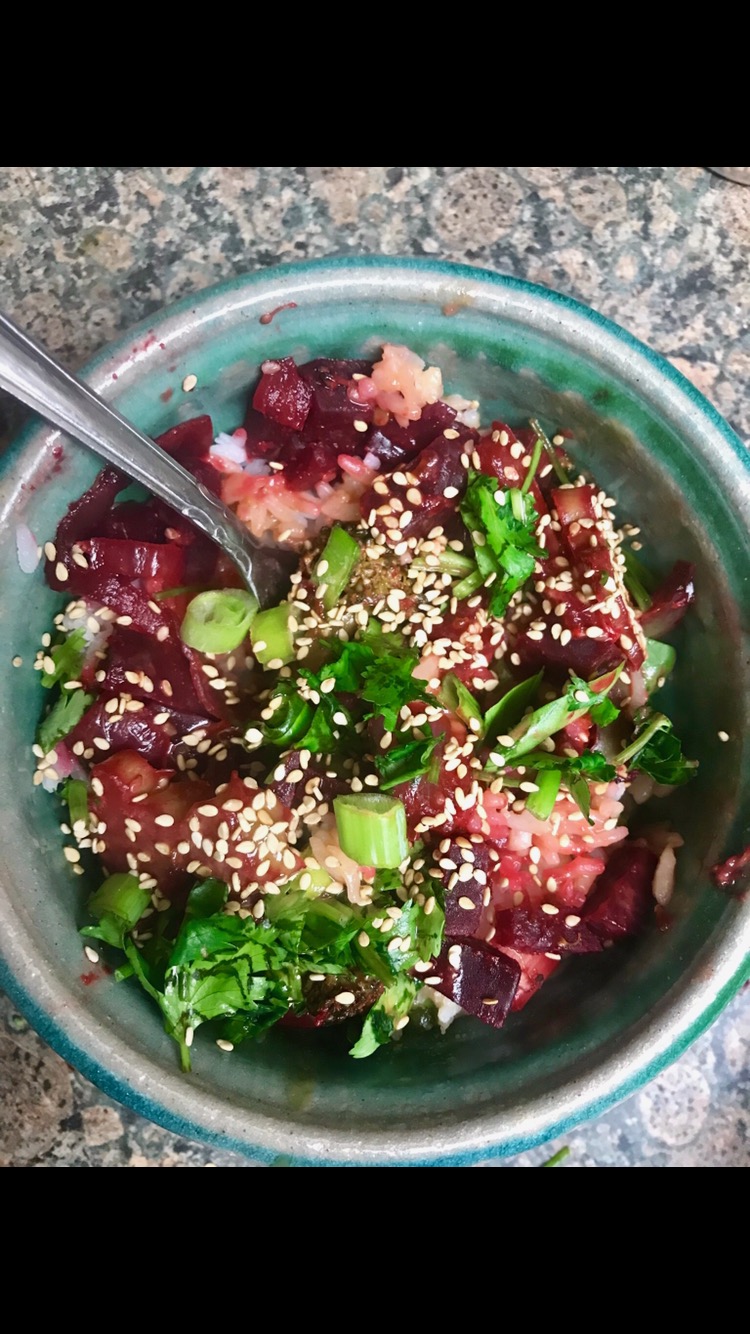
Drop the BEET
A simple vegan recipe to try this summer.
Ingredients
2 large beets
1 purple onion
5 cloves of garlic
2 bell peppers (whatever color, I used green)
Spinach
Sesame oil
Sesame seeds
Red pepper flakes to taste
Green onions, cilantro, and lime for aesthetic appeal (and taste!)
For the Sauce
¼ c soy sauce
¼ c coconut milk
3 tbsp peanut butter
2 cloves garlic
1 inch of ginger
Squeeze of sriracha
Squeeze of honey
Sprinkle of black pepper
Chef it up
Mince your garlic, slice onions and peppers. Peel and dice beets.
Pour 2-3 tbsp of sesame oil in a hot pan (coconut oil works well too)
Add garlic, red pepper flakes, and onions, then fry until onions start to get soft. Next, the diced beets go in the pan with ¼ c of water.
Cover and steam until beets are mostly cooked through (about 20 minutes, adding more water if needed)
Now is a good time to make the peanut sauce: Put soy sauce, coconut milk, and peanut butter in a mason jar. Shake it up!! Add garlic, ginger, sriracha, honey, and black pepper. Shake it up some more!
Refrigerate until thick and beets are cooked.
At this point, add more red pepper flakes and sesame oil to the beets for more flavor.
Then, throw in bell peppers and sesame seeds. Cook uncovered to the end (about 10 more minutes).
If you want your spinach cooked, add it in now too!
Serve cooked beets over spinach and rice. Drizzle peanut sauce generously. Garnish with sesame seeds, green onions, cilantro, and lime! Enjoy!!