The Lumberjack


Students Serving The Cal Poly Humboldt Campus and Community Since 1929

Month: September 2018

  • Room for improvement

    Room for improvement

    University sustainability assessments reveal strengths and weaknesses of Humboldt State University’s campus wide environmental impact

    Humboldt State University’s total energy consumption from clean and renewable resources is .07 percent, according to figures from a 2017 sustainability assessment report.

    In another assessment, HSU ranked 31 out of 269 college institutions as being a sustainable “cool school” according to Sierra Club rankings.

    The ranking was based on unique Sierra Club metrics which the Club said were designed to measure how a university is addressing the climate crisis. The ranking included scores from categories such as research, air & climate, energy, water, and waste.

    According to the Sierra Club website, the organization ranks schools on sustainability in order to serve as a guide for prospective students, and to raise environmental standards on university grounds.

    HSU sociology major Isaiah Hall said he wasn’t aware of the Sierra Club ranking. Hall, who plays on the Lumberjacks football team, said students would benefit if the university focused on sustainability upgrades such as LED lights and more solar panel arrays.

    This was the first year HSU participated in Sierra Club’s annual ranking system. Notable universities that ranked higher than HSU included: UC San Diego, Chico State and UC Irvine. Chico State was ranked 9.

    In order to participate in the Sierra Club “cool school” ranking HSU had to forward data from a separate and more comprehensive university sustainability tracking report which was compiled in 2017.

    The more extensive report, The Sustainability Tracking, Assessment, and Rating System, is an online tool that universities can use to measure their campus-wide sustainability.

    Katie Koscielak works as a Sustainability Analyst for HSU and is responsible for coordinating the campus sustainability report.

    Koscielak said compiling data for participation in the assessment was an expansive project spanning collaboration from 25 university departments.

    Humboldt State has participated in two Sustainability Tracking, Assessment & Rating System reports. The first STAR report was in 2013. The latest report in 2017.

    According to Koscielak between the first and latest reports HSU improved by 14 percent and went from a silver to gold rating. The reports are public and specific details about HSU’s score can be found online.

    “This indicates we’re performing well,” Koscielak said.

    In the latest rating HSU received a gold star, which requires a minimum rating score of 65. HSU received a score of 69.28.

    Gold is the second highest rating category currently in place. Platinum, which requires a score of 85 or higher, is the highest. Only four schools have platinum ratings: Colorado State, Stanford, UC Irvine, and the University of New Hampshire.

    Ratings are considered valid by The Association for the Advancement of Sustainability in Higher Education for three years.

    In the 2017 report, HSU scored high in academics, engagement, and the planning and administration credit sections. The school received poor marks in operations.

    The operations credit section includes: air and climate, buildings, energy, food & dining, grounds, purchasing, transportation, waste, and water categories. The university scored lowest in buildings, energy, food & dining, grounds, and transportation.

    HSU strongly promotes social and environmental responsibility in its mission statement as well as commitment to sustainability and environmental economic and social responsibility in its vision and values.

    However, In the report HSU energy received poor scores due considerably to having a total energy consumption from clean and renewable sources of less than 1 percent.

    “We have room for improvement,” Koscielak said.

    Koscielak said that launching renewable energy projects can be extremely expensive and larger universities tend to have advantages in this regard because of more funding opportunities.

    By comparison UC Irvine has a total energy consumption from clean and renewable sources of 2.14 percent. In fall of 2017, Irvine had enrollment of over 35,000.

    Another category HSU received low scores on in the operation category was Grounds. Credit was given to institutions who have official integrated pest management programs or an organic land care standard or landscape management program which uses ecologically preferable materials.

    According to Koscielak HSU uses integrated pest management strategies but does not have an official plan.

    HSU Waste, Recycling, and Grounds Coordinator Megan Tolbert said one of the integrated pest management strategies that the university currently uses is live traps. Poison is never used to control rat pests on campus and using live traps also helps prevent harm to other wildlife.

    HSU masters student Megan Awwad said she wasn’t surprised about the universities low renewable energy statistic. Awwad, who previously attended University of Calif. Riverside, said Riverside promoted itself as being a sustainable school.

    “That’s how universities function,” Awwad said.

  • Women’s soccer comes up short in home opener

    Women’s soccer comes up short in home opener

    The Lumberjacks women’s soccer team lost 1-0 at home against the San Francisco State Gators Sept. 16.

    The Gator’s senior defender Madison Messier scored in the first two minutes to give SFSU the lead they held the entire game.

    “We didn’t come out as hard as we should have,” said Jacks senior goalkeeper Nora Goodrie, “We just got in our heads and we messed up.”

    Although Goodrie had four saves throughout the game, the Jacks began the match poorly. A defensive blunder allowed Gators defender Niko Baila to cross the ball from the right corner into the crowded box. From there, Messier reached over a pair of Jacks players for a header that was just out of reach for Goodrie.

    “We struggled to get control of the game until the half,” said Jacks head coach Paul Karver. “We had our chances to score but didn’t finish them, and in this conference that will send you home pretty quickly.”

    The loss moves the Jacks’ record to 2-3-1 on the season along with a 0-2 record in conference play.

    The Lady Jacks tried to respond in the second half by shifting a few players around and eventually found success.

    “I thought we were able to keep our energy at the same level,” said junior midfielder Cameron Mejia. “We work better as a team when we respond and our second half was a lot stronger.”

    Although the team played better in the second half, the offense still remained in a drought and the Jacks remained scoreless in it’s second consecutive game while only putting up eight shots on goal.

    “It lit a fire under our butts to make us work harder,” said senior outside midfielder McKenna Dunn. “We have a night game on Friday so we just have to work hard so we can get back to it.”

    The Jacks will attempt to revitalize their offense as they hit the road for their next game. They will travel down to Southern California to face the Golden Eagles of Cal State Los Angeles on Friday, Sept. 21. The match will begin at 7 p.m.

  • Ripple in the radio

    Ripple in the radio

    Conflicts continue within KHSU

    Live air shows after 10 p.m. could be headed towards syndication after new time changes at KHSU.

    The decision to limit the operations of KHSU from 7 a.m. – 10 p.m. is the latest administrative decision that has left staff, volunteers and community at odds of where KHSU is heading.

    Kimberly Comet is the director of risk management and safety at HSU and says that the majority of building hours on campus is 7 a.m. – 10 p.m. With KHSU moving buildings due to the construction for seismic retrofitting they are moving to a building that isn’t staffed by employees past 10 p.m.

    “We are trying for consistency and safety for all,” Comet said.

    Comet says that volunteers are there to augment the university, not to be in the place of an employee. Staff-employees would be needed to keep the doors open past 10 p.m.

    “Employees have training, follow different directions and have different tasks,” Comet said.

    KHSU general manager, Peter Fretwell, says they would blow a hole in the budget for a paid staff. He asked risk management if they could change the time to midnight and they told him no. Some hosts say keep the times and others say no due to safety.

    “The radio side of me disagrees. The human side of me agrees,” Fretwell said.

    Others are not convinced with the decision. They feel it was too fast and had no time for a group discussion. Barbara Boeger has been on KHSU’s community advisory board (CAB) since the early 2000s and said that the decision was made rapidly although the move of buildings had been known for a while. She was very disappointed in the last minute notice that came in the form of an email to all staff and volunteers from Fretwell.

    “I feel like he threw us under the bus,” Boeger said, referring to the HSU community.

    The big concern is whether or not shows will disappear as well as the connection with the local DJs.

    Lorna Bryant, KHSU office manager as well as late-night host, said the recent decisions have affected morale at the station as well in the sense of long time listeners who won’t be able to call in and make requests.

    “It seems there is no alternative and no plan to find a remedy applicable for all parties involved,” Bryant said.

    With the direction that HSU administrators are heading, Bryant can’t see a change anytime soon.

    In regards to the new building Bryant said the disadvantage is losing the ambient sound they once had, but there are some advantages. KHSU may be losing real estate in the building they were in but because of the move they are gaining an extra studio that has all brand new equipment.

    “We’re in a very well taken care building and that’s a cool thing,” Bryant said.

    Liam Warner, host of the Buck Jr. show at KRFH and son to Tim Warner, the host of KHSU’s Buck Calhoun show, isn’t impressed with the moving of buildings and rather see shows running instead of cancelling.

    “KHSU was doing fine before administration hired a new general manager,” Warner said. “Since then things have spiraled out of control from there.”

    Both Warner and Boeger raise concerns on the administration’s intent regarding KHSU volunteers. They agreed that there is a dismantling of the volunteer base and it is a for-profit decision.

    Volunteers are harder to manage than employees when it comes to bringing change into the station. Warner said KHSU and the University realize they can make money off the radio station and this is the reason for the recent changes.

    With hours cut and late live-shows unavailable, everyone is concerned about the station becoming a more pre-recorded program. There are shows that won’t be able to be accommodated and local DJs that won’t be able to host.

    “If people stop criticizing the direction of the radio (KHSU) while still supporting it then it’s heading towards a syndicated program,” Warner said.

    With syndicating programs, connection will be lost between community and station. The local flavor that listeners get would soon be pre-recorded programs. It would be a different station than the one Warner and many others chose as a reason to attend HSU.

  • Students seek justice for all

    Students seek justice for all

    The HSU community was burdened with the loss and murders of David Josiah Lawson in Arcata, California April 15, 2017 and Corey S. Clark in Eureka, California Oct. 6, 2001.

    The justice movement for Lawson and Clark has continued to gather students in efforts to raise awareness to other students and the community they live in.

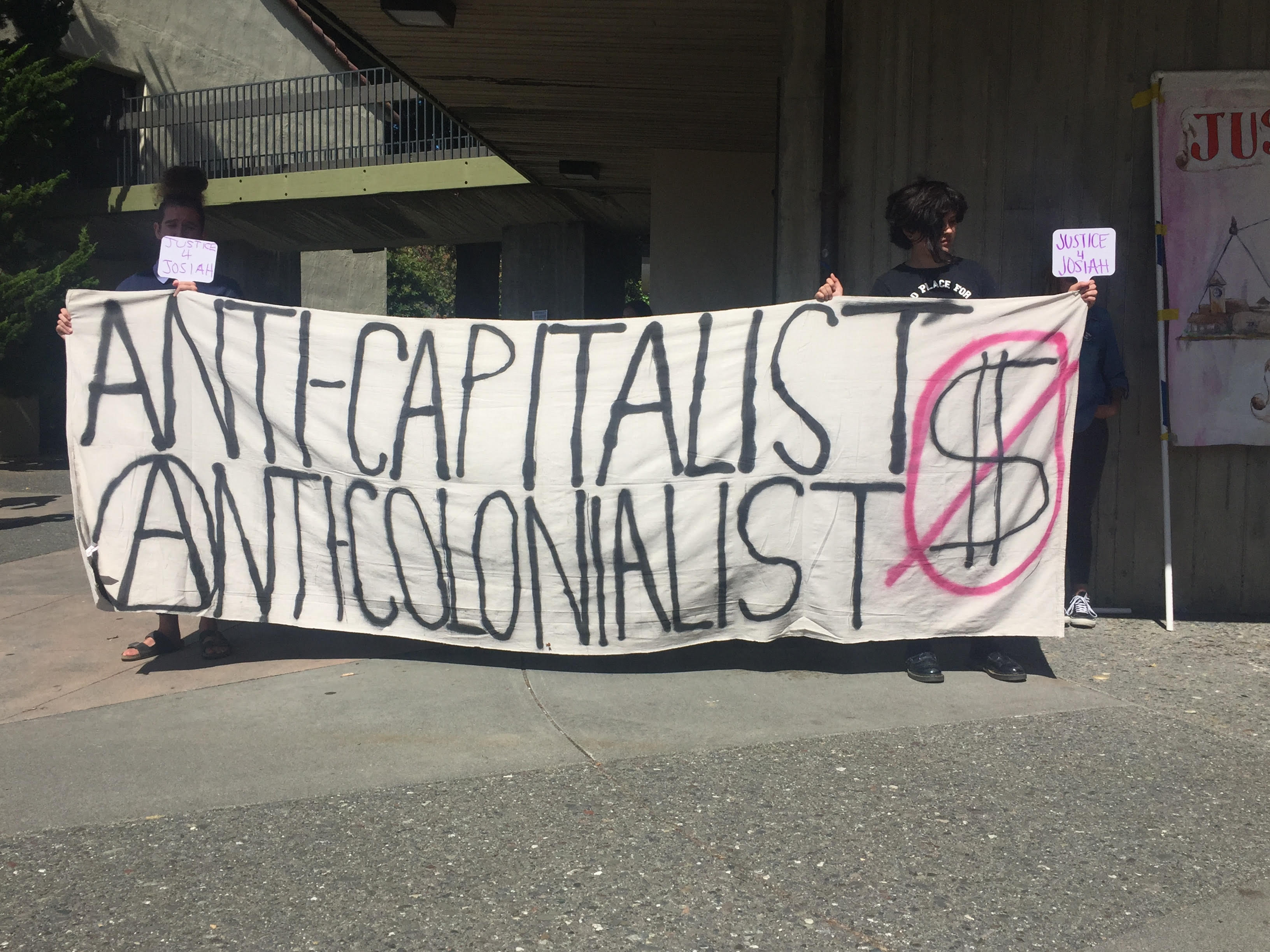
    ‘The Diversity Is Not Inclusion Rally’ brought students together at the HSU quad on Sept. 12, to further inform students about the loss of Lawson and Clark, and speak about universities who should be held accountable for failing to protect and support students of color.

    Vice President of the Black Student Union, Barbara Singleton lead the rally held at the quad, and voiced her concerns about HSU and the handling of students of color.

    “At Humboldt State, students here are viewed as economical commodities. If they (Humboldt State University) bring us up here, they have to know we are bringing in black and Hispanic culture. If they can’t respect us, then don’t bring us up here,” Singleton said.

    Hot topic issues such as student homelessness and budget cuts to the universities institutions were also some of the issues brought to the students attention in attendance. The focus of the rally was to reiterate the issue of the two unsolved murders of HSU students, Lawson and Clark, and to raise awareness for students that there lays a capitalistic mentality towards students on and off campus.

    Senior Nathaniel McGuigan, part of the Justice for Josiah movement, first came to HSU as a freshman completely unaware of any racism,

    “Like many other new students, I was unaware of what happened in the community, I did not learn about many of these issues until my second year,” McGuigan said.

    The rally further voiced more awareness to future HSU students, in order to keep them informed of a divide that seems apparent between students on and off campus.

    “We want the Humboldt State Administration, to get involved in the case, to actually put pressure on the Arcata City Council and helping us seek justice for Josiah,” McGuigan said.

    Meg Stofsky, one of the speakers at the rally, spoke about her view of the racism she feels that is present in Arcata.

    “I came here and found…really a ghetto. HSU feels like a ghetto to me, and so does Arcata, where the systemic and historic racism means that you can kill people and get away with it, and it does not matter,” Stofsky said.


  • Tribute to Jazz Prince Of Darkness

    Tribute to Jazz Prince Of Darkness

    Local trumpeter summons the spirit of Miles Davis

    73 years since dropping out of Julliard School of Music and 17 years since his death, Miles Davis comes back to life from the lungs of Arcata local, Nicholas Dominic Talvola.

    On Sept. 9 on stage at Arcata Playhouse, local players Tim Randles (keyboard), Ken Lawrence (bass), Tommy Fitzmaurice (drums), Russ Thallheimer (sax), and Brian White (trombone) were lead by Nicholas Dominic Talvola on the trumpet to pay tribute to one of the most influential figures in the history of Jazz and 20th century music.

    “Miles Davis is a big inspiration for me,” Talvola said.

    Born and raised in Arcata, Talvola has recently returned home from performing internationally with his band The Johnny Freelance Experience. For any resident in Arcata the timing couldn’t be more perfect.

    A quarter after 8 p.m. the band is on stage beneath dimly lit blue and red lights. The playhouse is packed and nearly every seat filled. Talvola walks on stage looking like a mix between Bob Dylan, era ’65, and Wayne Coyne, lead singer of The Flaming Lips. Black dress coat over white button up and bow tie, black jeans cuffed at the ankles and shiny black loafers. His hair is a salt and peppered bird nest and a beard to match, and of course he wore signature jazz Ray Ban sunglasses.

    miles5
    Arcata local musicians Brian White, Russ Thallheimer, Nicholas Tralvola and Ken Lawrence on stage at Arcata Playhouse during the Miles Davis tribue show on Saturday Sept. 8 2018. (T.William Wallin)

    “I know you’re wondering about the playlist. There’s nothing classic,” Talvola said to the audience in between songs.

    The first half of the first set Talvola is right, there isn’t a single song off “Kind Of Blue”, arguably the most well known album of Miles Davis, but the songs are hand picked from Talvola as being especially inspirational in his musical career. One could argue every Davis song is a classic and the band made it seem so.

    “The Theme” is the first song to warm up the audience, the bass takes the first solo and soon quiets down as Talvola hammers the melody faster. Next songs are “If I Were a Bell” , “I Fall In Love Too Easily” and “Well You Needn’t”, not original Davis compositions but all songs played the way he performed them.

    By this time the audience is fully submerged in the mood and so is the band, who since the beginning have played on the same wavelength. One can feel the friendship and comfortableness each player has with one another, setting a tone that invokes relaxation with fierceness.

    As a surprise the second to last song before intermission is off “Kind Of Blue”, a tactic Talvola uses to keep the audience on their toes and keep the set unpredictable. An energetically charged solo by Thallheimer, the saxophone player, in “Stella By Starlight” is then followed by a fast and ferocious “Mile Stones”,the title track off the album with the same name. That offers Talvola a solo that leaves the audience stunned, his style of trumpet playing takes the listener back to the Beep Bop era of smoke filled speakeasies pouring out musical giants.

    After intermission songs are played back to back until the dark and luminescent “Nefferti”, off Talvola’s favorite Davis album, which bares the same name, and his playing shows his gratitude and influence.

    “I think I’ve listened to that album every day for 12 years,” Talvola said.

    Next the night becomes strange and funky. The sextet becomes a septet and a guitarist is added to the bandstand. Pedals and distortion join the show as well. It’s time for Davis’ experimental sound, unconventional style and rejection of traditional jazz rhythms.

    Songs of “Bitches Brew” era, which is Davis’ electronic instrument experimental album in the 70’s, are wildly played and thrown out like gas to fire, all with eloquence and careful measure. Between Thalleimer and Talvola’s solo’s feeding off the guitar reverb and electric keyboard the entire stage is moving.

    The song with the title track off “Bitches Brew” starts at 10:48 and doesn’t end until 11:03 p.m. The song was said to be the last but Talvola in the last minute shocks the audience by shouting they may not have classics but they have “So What”, which is the title track of “Kind of Blue” .

    The night ends with the classic that everyone knows, “So What”, and every instrument is played magically. The tapping of everyone’s foot is matched and the blowing of brass is completely in sync.

    The lights come on and a standing ovation is performed. The diversity of age in the crowd proves the music of Miles Davis is timeless and Talvola and fellow band mates continue that legacy.


  • EDITORIAL: Modern Day Battle of the Sexes

    EDITORIAL: Modern Day Battle of the Sexes

    Sexism runs rampant in the professional tennis world and what happened to legendary player Serena Williams on Sept. 8 is proof.

    A showdown between Williams and Naomi Osaka in the U.S Open culminated with tears running down both women’s cheeks for very different reasons.

    In the heat of the match, with both competitors fighting fiercely for a Grand Slam Finals victory, Williams was given code violations by umpire Carlos Ramos.

    First, Ramos handed Williams a violation warning for coaching after he believed Williams’ coach, Patrick Mouratoglou, gave her signals from the bleachers.

    The next violation came when a clearly frustrated Williams smashed her racket on the court and she was handed a point penalty. The line of sexism was crossed when Ramos docked Williams an entire game for calling him a “thief.”

    “You stole a point from me and you’re a thief,” Williams told Ramos.

    The International Tennis Federation released a statement in support of Ramos’ decision to penalize Williams:

    “Carlos Ramos is one of the most experienced and respected umpires in tennis. Mr. Ramos’ decisions were in accordance with the relevant rules and were re-affirmed by the US Open’s decision to fine Serena Williams for the three offenses.”

    After the match, Williams told reporters that Ramos’ calls were clearly rooted in sexism.

    “I’m here fighting for women’s rights and women’s equality,” Williams said. “And for me to say ‘thief’ and for him to take a game, made me feel like it was a sexist remark. He’s never taken a game from a man, because he said thief. For me, it blew my mind.”

    We should be talking about Osaka and her dream of beating Serena Williams in a Final coming true. Yet, we have to address the elephant in the room once again.

    Williams was fined $17,000 by the U.S Open for the violation but her male counterparts have come to her defense.

    <blockquote class=”twitter-tweet” data-lang=”en”><p lang=”en” dir=”ltr”>I will admit I have said worse and not gotten penalized. And I’ve also been given a “soft warning” by the ump where they tell you knock it off or I will have to give you a violation. He should have at least given her that courtesy. Sad to mar a well played final that way. <a href=”https://t.co/xhBzFZX8Wq”>https://t.co/xhBzFZX8Wq</a></p>&mdash; James Blake (@JRBlake) <a href=”https://twitter.com/JRBlake/status/1038619979938189313?ref_src=twsrc%5Etfw”>September 9, 2018</a></blockquote> <script async src=”https://platform.twitter.com/widgets.js&#8221; charset=”utf-8″></script>

    <blockquote class=”twitter-tweet” data-lang=”en”><p lang=”en” dir=”ltr”>I’ve regrettably said worse and I’ve never gotten a game penalty</p>&mdash; andyroddick (@andyroddick) <a href=”https://twitter.com/andyroddick/status/1038642213427789826?ref_src=twsrc%5Etfw”>September 9, 2018</a></blockquote> <script async src=”https://platform.twitter.com/widgets.js&#8221; charset=”utf-8″></script>

    Just in the last few months, there have been other instances where female tennis players were treated differently than the males.

    French tennis player Alize Cornet was handed a violation for briefly taking her shirt off on the court. She had been in the locker room to change during a 10-minute break and when she returned to the court she realized her shirt was on wrong and fixed it.

    Tennis pro John Isner changed his shirt 11 times during his match against Juan Martin del Potro. Novak Djokovich, one of the game’s elite players, sat shirtless for several minutes while waiting for his opponent to return from a break. Neither player was penalized.

    Earlier this year, in her first match since giving birth to her first baby, Williams wore a full body all-black catsuit at the French Open that helped her blood circulation after having a rough birth.

    French Tennis Federation President Bernard Giudicelli made an announcement banning Williams’ catsuit and introduced a new dress code that banned players from wearing form fitting clothes.

    Williams responded in perfect fashion by wearing a $500 Louis Vuitton tulle skirt (tutu) for her first match at the U.S Open.

    Tennis has a long way to go in achieving equality for women at every level. The most polarizing and dominant player in tennis shouldn’t have to be in this fight but she is. Now that the GOAT has spoken up for women’s rights in a game ruled over by men, maybe the road will be easier for the next generation of women in sports. We can only hope.

  • Arcata community fights suicide stigma

    Arcata community fights suicide stigma

    Residents and students alike came together on the 4th annual Arcata “Out of the Darkness” community walk on Sept. 9 to raise awareness for mental health and suicide and to reduce stigma in the local community through connection. The event was also to fundraise for the American Foundation for Suicide Prevention (AFSP).

    Heather Freitas is the lead organizer for the AFSP Out of the Darkness community walk in Arcata. Freitas said the walks are a way for the community to come together and create awareness as well as fight negative stigma against mental health.

    “It is not possible without the community,” Freitas said.

    The walk starts in Arcata Square where participants checked in, looked at mental illness informative booths and engaged in activities that share a connection with suicide.

    180909-093545.jpg Participant Sarah Zerkel writes a personal message for a posting board during the Arcata Out of the Darkeness event on Sept. 9, 2018. The board is made of memorials, pictures and tributes that other participants put up. | Photo by Michael Weber

    Before the walk, community members were able to show support and learn about mental illness by wearing self identifying beads, sharing stories, and listening to speakers talk about mental health.

    The walk itself was an estimated three miles long and took an hour and a half for all participants to complete the walk.

    A major landmark of the walk was passing through a “bridge of support,” where motivational and inspirational posters made by former volunteers were put up for display.

    180909-100033.jpg One of the numerous posters filled with messages for participants of the Arcata Out of the Darkness Walk in Arcata, CA on Sept. 9, 2018. | Photo by Michael Weber
    180909-101227.jpg Participants of the Out of the Darkness community walk in Arcata, CA cross the St. Mary’s Catholic Cemetary on Sept. 9, 2018. | Photo by Michael Weber

    In the end, participants walked through the finish line and were congratulated for completing the walk.

    180909-104456-4.jpg

    For the closing ceremony, Friedas shared her personal experience to the crowd.

    “On this day in 2011,” Friedas said her first loss to suicide was her dad. She said he hid it well, and passed away when there was no one to check up on him.

    “We don’t grieve just the loss of a life, we grieve with how our relationships change as well,” Friedas said in her speech.

    Sept. 9 is also the start of suicide prevention week. As national suicide rates are rising, according to the CDC, support for mental health will continue in the community of Arcata.

  • Jack attack is on the rise

    Jack attack is on the rise

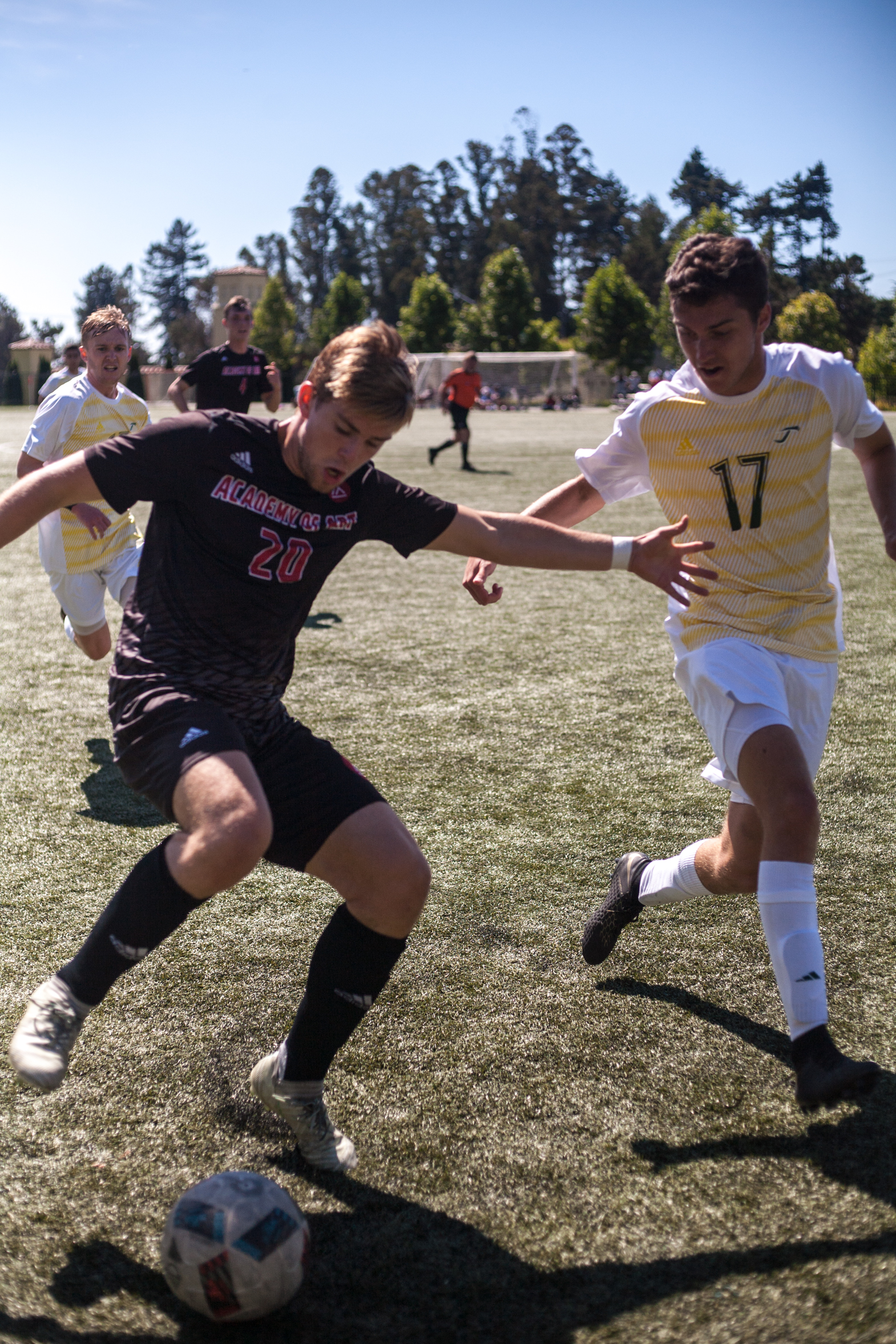
    The men’s soccer team continued their hot scoring this weekend after beating Concordia University 3-0 on Sept. 7 and adding a 3-1 win Sept. 9 against the Academy of Arts Urban Knights.

    Sunday’s beautiful weather had the fans out to cheer on the pumped and motivated Jacks after coming away with a big win on Friday.

    Jacks defender Gus Baxter got the team going with an unassisted goal at the 17:52 minute. Three minutes later, off of a set piece from seniormidfielder Max Steinmetz, Baxter assisted Jacks sophomore forward Alejandro Cortes Garcia to take an 2-0 lead against the Urban Knights.

    “The ball and I had a great day today,” Baxter said. “My teammates were working hard and you could see that from the first 20 minutes of the game.”

    The Jacks took care of business the first half. They were communicating with every pass made and a sense of control was present whenever they held possession.

    The Jacks had seven shots, one corner kick, and only committed six fouls. The Urban Knights responded with four shots and zero corner kicks, followed by six fouls.

    With the start of the second half, the Jacks were not as crisp with their passes as they were in the first half. At the 60:26 minute, the Urban Knights took advantage and freshman midfielder, Edvard Edvarsson, nailed the top left corner off a set piece to give the Urban Knights their first goal.

    The Jacks took the jab thrown by the Urban Knights leaving the score at 2-1, and started to slow the game down and play to their tempo. The back line fixed their mistakes and held the Urban Knights to only three shots the entire second half, leaving Jacks senior goalkeeper, Bryan Hernandez, to save one other shot.

    “We came out knowing we were in control,” Hernandez said. “What was hurting us were the little passes that where coming up short to get an attack going.”

    Toward the end of the game the Jacks held their composure and continued to seek out another goal. At the 84:00 minute they were rewarded with an own goal by the Urban Knights sealing the deal with a 3-1 victory.

    Steinmetz helped create the tone in the first half and commented on how his team performed.

    “We came out aggressive and capitalized on set pieces,” Steinmetz said. “We as a team say, ‘come out with the beast’, and that beast was heard today with this win.”

    The Jacks are set to play their first away game this season against rival Sonoma State on Sept. 12 at 4 p.m.

  • 110 flights of stairs

    110 flights of stairs

    Humboldt County firefighters honor the fallen on 9/11

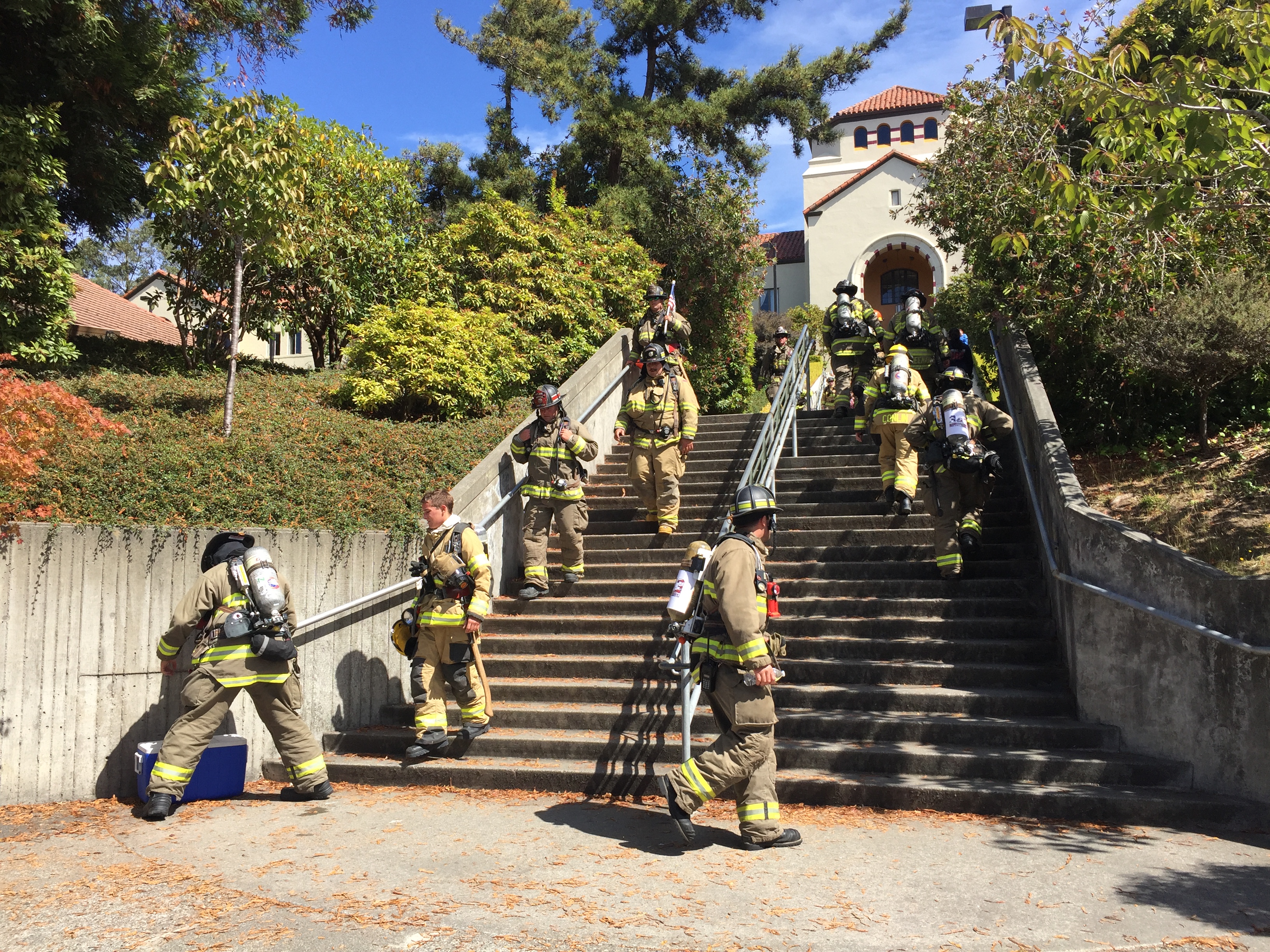
    Within 45 minutes, local firefighters and nearby volunteers walked up and down Humboldt State University’s Founders Hall 18 times in memory of 9/11.

    Of the 2,977 victims that were lost during the attack on the World Trade Center in New York City on Sept. 11, 2001, 343 of them were firefighters.

    For several years now, fire departments nation wide walk an equivalent of 110 flights of stairs to honor those that entered the buildings.

    “I think I speak for every firefighter when I say that this is a very daunting day for us,” said Arcata firefighter Jacob Cliff.

    Cliff has now organized this event for the past two years to assure that Humboldt County firefighters continue to show their appreciation and recognition of their fellow fighters that endured the unfortunate happening of 9/11.

    Last year Arcata Fire Department walked HSU’s Cypress Hall stairs after briefly deciding to start the event over a dinner table conversation.

    This year, several nearby departments came out to participate, including: Arcata Fire Department, Fortuna Fire Department, Humboldt Bay Fire Department, Rio Dell Fire Department, and Samoa Peninsula Fire District.

    “They are carrying their 75-100 pound gear on their backs as they walk these steps,” said President of the Volunteer Firefighter Association, Rob Cannon. “Because that is what those 343 firefighters had to do that day.”

    Several nearby students and faculty members joined the local firefighters on the walk up and down Founder’s Hall. The departments provided gear for the volunteers that wanted to experience the walk with the extra pounds on their back.

    “I decided to participate out of respect to those that actually had to do this,” said volunteer Fortuna firefighter Morgan Tuel. “It was a lot more challenging than I was expecting.”

    At the bottom of the stairs was a blue cooler full of cold water bottles for any participants who needed a quick thirst quencher. Anybody passing by was welcomed to join, and most that were curious about what was going on, did not fail to do so.

    “It is a nation wide patriot day,” said Cliff. “It is very humbling to see others out here honoring our fellow brothers and sisters as well.”


  • Women’s volleyball falls to Monterey

    Women’s volleyball falls to Monterey

    HSU’s Ladyjacks’ early season struggle continues

    In the Lumberjacks first home game of the season against the Cal State Monterey Bay Otters, excitement was in the air.

    The Jacks men’s soccer team attended the volleyball match to support the Lady Jacks along with some of the Jacks men’s basketball team.

    It was a close game. The first set ending with a win for the Otters, 26-24. Our Lady Jacks had their work cut out for them, but it didn’t dull their spirits. Jacks senior outside hitter Natalie Picone was determined to lead the team to victory.

    Junior outside hitter Lauren Reid had 15 kills in the game scoring for the Jacks.

    “Monterey Bay is a very good team,” head coach Kelly Wood said. “They have a really good setter and they run a 5-1 setup.”

    Even with the effort put in by our Lady Jacks, the Otters held a fast paced offense. The time frame between setting and hitting was a matter of seconds.

    The Jacks were quick on the defense with a total of eight team blocks, but every set fell right behind the Otters.

    Despite this setback, Picone gave a pep talk after the second set ending in another loss for the Jacks, 25-20. Picone shared reassuring words to her fellow teammates in the huddle.

    During the final set, energy was heightened and the pressure was on. Our Lady Jacks were determined to finish strong no matter what.

    The pace of the game quickly picked up and the Otters finished the set 25-19, causing the Jacks to let go of their home opener and lose in straight sets, 3-0. Their record now stands at 3-7.

    The Jacks will travel south to play Cal State San Bernardino Sept. 14 at 7 p.m.

  • Leaving the nest

    Leaving the nest

    As the second month of the school year is well under way, first year students start to settle in to their new living situations on campus.

    Moving out of a family home to a university can be a daunting experience. The idea of leaving the safety and stability that parents have provided their whole life is something a lot of young adults have to deal with.

    While nerve-wracking, this experience can also be something extremely exciting. Students get to meet new people and make friends from all around the country and the world.

    Michael Dunn, who moved from Oakdale, California, describes it as a very new and interesting experience that he’s not used to.

    “I come from a small town, so it’s been real different meeting so many new people at once. It’s been real diverse,” Dunn said.

    While the idea of meeting new people from around the world can be a lot of fun, leaving the safety of your family and your home is a very different thing. There’s a lot to enjoy with the freedom, but it’s not always easy abruptly leaving your parents.

    Baciro Jalo who moved here from Washington, D.C. enjoys his independence.

    “I definitely enjoy my total freedom and being away from home. Nobody is telling me what to do and when to do it. It’s still hard because I also miss them,” Jalo said. “We are young and away from our parents, away from people who control us. Here we have total freedom. This is where we choose the way we want our life to be. This is where you can do bad things, and good things, whatever you choose to do.”

    Roy Licona-Tamiriz who moved here from Madera, California, describes it almost as a ritual.

    “It’s kind of like a bird leaving it’s birds nest. You have to learn on your own and adjust to it all, to the outside environment.”

    As the first weeks can be crucial for these young adults to settle in to their new lifestyle, it’s important to reflect on what can be done to make things even easier for them. While setting up freshmen groups and events is a great start, working to make it easier in other ways might help these new students even more.

    When asked about if there are things the University could do to help make the process of moving in and settling into the new life on Campus easier Licona-Tamiriz said, “I would say having more freshmen oriented programs, having the freshmen more involved, introduce them to study groups early on in their first classes and get them to interact with each other.”

  • Out of the Darkness Community Walk

    Out of the Darkness Community Walk

    American Foundation for Suicide Prevention Walk Sept. 9.

  • Pair of Jacks take gold at Patrick’s Point

    Pair of Jacks take gold at Patrick’s Point

    Cross Country men and women’s team push boundaries, individual athletes accomplish goals

    The Humboldt Cross Country Invitational on Sept. 8 displayed a new leader in the women’s 6k.

    Sophomore Kaylee Thompson ran a 21:49.00 college best inside the redwood’s famous Patrick’s Point State Park.

    Thompson attributed preparation as key to the season opener.

    “We knew what challenges were ahead, and we knew where we were going,” Thompson said. “Being able to practice here and feel more comfortable definitely helped me in today’s race.”

    It was a sunny day for running as weather conditions stayed in the upper 50s all morning. Having home field advantage over competing schools like Oregon Tech, Sonoma State University, Simpson University, Shasta College, and College of the Siskiyous was beneficial.

    Jacks sophomore Cessair Mckinney placed fourth and clocked in an impressive 22:28.00 time in the race. Mckinney was excited for this race for weeks enduring conditioning all through August.

    “I had a rough track season but I’m happy to be back for cross country,” McKinney said. “We have the leadership to look up to but our team is young and we are so excited to see what we can accomplish.”

    Energy is high on this women’s squad and they are looking to carry it over to the upcoming meets.

    On the men’s side, first-place finisher and returning senior leader Daniel Tull didn’t need a photo finish as he raced a 25:49.00 ten seconds ahead of the competition.

    Sophomore Carson Cohn was the next Jack to cross the finish line with a fourth-place finish and a solid time of 26:21.00.

    Huddled around the table, high fives were in the air and all smiles on the men’s faces as Tull and some teammates geared up for another run.

    Jacks cross country will only have two home meets this year but it isn’t a problem for them.

    “We want to travel, we just want to race people,” Tull said. “New faces but all of us are getting along great, chemistry and work ethic are incredible this year.”

    Jacks sophomore men’s runner Jeran Sykes finished with a time of 28.06.00 and also had gratitude toward the team’s performance.

    “Races early in the season are perfect rust busters,” Sykes said. “So many pleasant surprises, we help each other through the struggles, we really make each other way faster.”

    Scott Pesch, longtime cross country head coach, retired last season and the Jacks found their match in new head coach Jamey Harris. Harris, coming from UC Santa Cruz, continued building the legacy of Jacks distance running at today’s event.

    “Alumni’s and the local community came out and we got to show them who we are,” Harris said. “They all performed admirably today.”

    Women’s and men’s club both finished a second off of the total time. They fell short and placed second in team rankings.

    Women’s Team Total

    1. Oregon Tech 1:52:29

    2. Humboldt State 1:53:43

    3. Sonoma State 1:58:10

    Men’s Team Total

    1. Oregon Tech 2:13:18

    2. Humboldt State 2:14:16

    The Jacks take a three week break from competing before heading to the Willamette Invitational in Salem, Oregon on Sept. 29.

  • Men’s soccer shuts out Concordia University 3-0

    Men’s soccer shuts out Concordia University 3-0

    Humboldt State goes back in the win column with 3-0 victory over non-conference opponent Concordia University from Portland, Oregon.

    Concordia out shot the Jacks 9-7 in the first half but couldn’t capitalize. The Jacks were able to go up 1-0 at the 5:35 mark thanks to a pass from junior Gus Baxter to sophomore forward Alejandro Cortes Garcia for a header over the goalkeeper.

    Baxter continued to lead the offense for the Jacks in the first half by scoring a goal at the 23:02 mark from an assist from freshman forward Devin Hauenstein.

    Behind 2-0 entering the second half, Concordia raised its intensity on offense by putting up another 10 shots with zero scoring. The Jacks responded with seven shots including one goal by junior forward Isaiah Dairo at the 86:23 mark.

    A corner kick from sophomore Marco Silveira found Dairo as he put it in the back of the net for his 3rd goal of the season, leading the Jacks in goals.

    “It was great to get back on track with a hard-fought win against a difficult Concordia team,” said HSU Head Coach Fred Jungemann. “We started quick and got a couple of early goals, but they put us under some pressure after that.”

    Jacks goalkeeper, Bryan Hernandez, finished the day with nine total saves over the full 90 minutes. Dairo, Baxter and senior Francisco Calderon were the key to the offense by putting up three shots a piece for 12 of the Jacks’ 14 shots.

    “Our guys defended well, though, and we eventually found the third goal to put the game away,” said Coach Jungemann. “Hopefully, that is something we can carry forward into conference play.”

    HSU now sits at 2-1. Men’s soccer will face the Academy of Art from San Fransisco on their home field at 2 p.m. on Sunday Sept. 8.

  • At home tattoo counterculture

    At home tattoo counterculture

    At home tattooing is often cheaper and more accessible for artists and customers

    Emi bought a tattoo gun a couple of months ago and did her first one on herself.

    Since then the Humboldt State alumna and artist has been tattooing friends for a much smaller fee than a professional parlor.

    “People have been asking me for tattoos for years,” Emi said. “I didn’t want to give people shitty tattoos.”

    While studying art at HSU, Emi lived with another tattoo artist who taught her most of what she knows. Though she has only been tattooing for a short time, you wouldn’t be able to tell from her work.

    Though it is easy to get a cheap tattoo gun online, Emi knows that getting a tattoo is a big commitment and doesn’t want to use cheap supplies. Just one basic component of her machine cost her $250. She also takes very careful steps to ensure everything is clean and sanitized to prevent infections.

    Tattoos used to be reserved for sideshows, sailors and punks, but now it seems like everybody has one. Modern tattoo shops have been around since the 1960s.

    In recent years, it has become much easier for an unlicensed person to buy a tattoo gun. You can buy a kit on Amazon for as low as $20. Because of this, there are many people buying kits and setting up impromptu tattooing stations in their home.

    IMG_6529
    Photo by Deven Chavannes | Madison shows off her tattoo immediately after amateur tattoo artist Emi finished it Sept. 3 in Emi’s home.

    Madison has around 13 tattoos and has no issue with getting them from her friends because she knows that even though they are unlicensed, she is familiar with their work and is confident knowing what they are doing. In fact, she prefers getting them from her friends because it strengthens their friendship.

    “Pretty much every single one of them was done by a friend except for the ones done by me,” Madison said.

    The biggest concern with tattoos done in the home is safety and precision. Professional tattoo artists need to have a license in California to legally tattoo someone. This is because of the health risks that come with repeatedly puncturing somebody’s skin with a needle.

    Some of these risks include infection, allergic reaction to the ink, or the spread of blood borne diseases such as HIV or hepatitis. That is why it is important for everything to be cleaned and sanitized.

    Brian Kaneko is the owner of True Nature Tattoo in Arcata and has been a professional tattoo artist for 20 years. All of the tattoos he has he got in a shop, and he has never tattooed anyone outside of one. However, Kaneko does understand the appeal. Tattoos are rooted in counterculture, and getting them done in the home by a friend feeds into that idea.

    “In general, young people are less concerned with repercussions” Kaneko said.

    Kaneko also compared getting a tattoo in someone’s house to unprotected sex. It’s more fun and often times you’ll be fine, but the possible repercussions if something goes wrong are not worth it.

    “You don’t have to be a carpenter to build furniture in your garage,” Kaneko said “but if you don’t know what you’re doing, you can really mess someone up.”

    Update 9/13: The last name of Madison has been removed upon request. Contact us for more information.
  • OPINION: Nationalism disguised as morality

    OPINION: Nationalism disguised as morality

    Double V for Victory, “Victory at home and Victory away,” is a statement with a connotation that is still prevalent today. The rhythm of this sentence represents the almost theatre like performance of how some veterans and politicians in the United States claim civil activism against the idea of the American flag is “Un-American.”

    We see people like Donald Trump whining about the un-patriotic protesters of the flag like Colin Kaepernick and others in the NFL and yet when I see his rhetoric on such, it reminds me of his own denial of patriotic action.

    What would the deceased Senator Daniel Inouye say if he saw politicians saying protesting the flag was “Un-American” and anti-Veteran? He wasn’t even considered American as he was both fighting for his country and the lives of himself and those around him. But still, Japanese-Americans like himself were illegally detained under the guise of a presidential order that seemed to change what was American and wasn’t overnight.

    Nationalism and nation building might have been controlled by the military and the US government, but in the 20th and 21st century our country has been embraced by the warm and comforting feeling of civil and legislative action that attacks these pillars of U.S nationalism. We as an American people might be brandished by the toxic scorns of racism, xenophobia, misogyny and white-ethno nationalism but that does not mean that’s what defines us.

    The constitution is a living document, so why does nationalism seem to be the equivalent of beating a dead, racist horse. I call out these things because as we look at the American political landscape, we may see a prevalent theme of ignorance formed around what can be protested and what cannot. So far, many conservative leaning politicians, citizens and business persons find protesting the flag more repugnant protesting a woman’s right to choose the fate of their own bodies.

    The U.S flag is not some stationary object that represents America in a positive light. It stands for all of America and when we generalize someone’s protest against the flag, we start to ignore the reasons why they are protesting.

    I respect Colin Kaepernick. I take that back. I want to strive to be like Kaepernick because he represents the ultimate purveyor of freedom of speech. He puts the rights of his own culture and background before his own financial and societal stability.

    This is something I see represented in athletes of antiquity, like Muhammad Ali, who’s famous words on the Vietnam war still echo in the American consciousness today.

    “I got nothing against no Viet Cong,” Ali said. “No Vietnamese ever called me a n****r.”

    This quote shows us why it’s important to understand that the protest against the policy and actions of some Americans and governmental entities does not mean the wholesale denial and disrespect to a nation, but rather against specific problems one takes with a nations actions.

    This generalization is an action taken by government infrastructure to ensure that national rhetoric on a subject that breaches the ideas of what some consider U.S nationalism, becomes associated with something ‘unpatriotic.’

    This is where the fallacy and mythos of nationalism becomes involved because as we stride closer and closer to a world where people live in diverse communities of all religions, ethnicities and cultures, we will begin to understand Nationalism as the barrier it is rather than the culture and history it supposedly represents.

    So as Colin Kaepernick becomes the pariah of all supposedly patriotic citizens, he also becomes the hero of all those who are deemed not.

  • Student life after prison lacks resources

    Student life after prison lacks resources

    Nine California State University campuses offer programs assisting formerly incarcerated students, HSU is not one of them

    The current nationwide prison strike has shed light on the inhumane conditions reflecting slave labor, prisoner mistreatment and the absence of education within prison walls.

    But life after prison is still a challenge for prisoners. Specifically for those who go back to school.

    Steven Ladwig, associate director of admissions at HSU, says there is definite need for some kind of program at HSU for formerly incarcerated students.

    When Ladwig was an Educational Opportunity Program advisor 20 years ago there was a formerly incarcerated student running Operation U-Turn, which was a club helping other incarcerated students. Since that student graduated the club ended and Ladwig hasn’t seen anything like it since.

    “We need a safe space for the incarcerated attending HSU. We need a center, advisors, the whole nine yards,” Ladwig said.

    Stigmas and stereotypes can create barriers and separations for the formerly incarcerated. These judgments follow them outside prison walls and make it difficult to adjust into the real world, especially when wanting to further their education.

    The Opportunity Institute and the Stanford Criminal Justice Center, both designers of Renewing Communities, state that to address the staggering mass incarceration in the nation, over 2.2 million people, California is using higher publication education but is still falling short.

    Before 2014 there was no one enrolled in face-to-face community college in CDRC. After California Senate Bill No. 1391 was passed there were 4,443 inmates enrolled in fall 2017.

    According to Correction to College, there are currently 700,000 Californians in the correctional system and another 8 million residents with arrest records. 30 of the 35 prisons in California teach face-to-face community college.

    One-third of the 114 California community colleges have student groups or programs that build support systems for recently incarcerated students.

    20 miles south of HSU, College of the Redwoods in Eureka, has partnered with the Humboldt County Jail to create an educational pipeline for inmates, howvever Humboldt State itself has nothing to offer formerly incarcerated students.

    Renee Byrd, assistant professor of sociology whose current research areas are mass incarceration and prisoner re-entry, said some of her best students have been formerly incarcerated.

    “There’s definitely space and a need for resources,” Byrd said.

    But HSU has nothing specifically targeting formerly incarcerated students. She knows that there are barriers for people getting out and education is the number one way to improve their lives and economic standing and HSU should make it easier.

    Schools such as UCLA, UC Berkeley and UC Davis offer The Underground Scholars Initiative. Nine CSU campuses, Sacramento, Bakersfield, Fresno, San Bernardino, Fullerton, Los Angeles, Pomona, San Diego, and San Francisco, all successfully support the Rebound Project: a 50-year old program started at SFSU in 1967 by John Irwin that offers support to those who have been incarcerated in transitioning to life on an University campus.

    When asked about a program like Project Rebound migrating north to HSU, Byrd said she is very supportive but it would not only take time and money but a coalition of faculty and administrators who are having a hard enough time making sure students are housed.

    “I think this is precisely where this institution should go,” Byrd said. “HSU should be a leader in this rather than following.”

    In 2016, a Humboldt County Reentry Resource guide was published along with an HSU master thesis called “Reintegration in rural community; strengths, barriers, and recommendations for reentry in Humboldt County.” The author Vanessa Vrtiak, who has since earned her masters in sociology and is active in the community’s prison activism, said there hasn’t been a difference before or after the resource guide was published.

    This might be because it isn’t posted anywhere easily accessible or in any HSU buildings. If one wants to find it they have to search for it on the internet.

    Vrtiak created the resource guide because there was nothing put together for anyone who had been formerly incarcerated to know what resources were available in that community, especially for those people who aren’t from the area. It is still like that on campus for those searching for some kind of help.

    “Not a lot of people organizing in our community,” Vrtiak said.

    While a student she coordinated a week long criminal justice dialogue on campus that had an event each day. The topics included housing, employment, success stories, resources and barriers. But just like Ladwig, this was all she witnessed that addressed formerly incarcerated students and once the week of events ended there wasn’t anything else.

    Vrtiak had Project Rebound come up to HSU in the past and thinks it would be great if the program was integrated permanently because the biggest resource at the moment is the probation office. If you were formerly incarcerated but off probation or parole you no longer have that option of resources.

    With a 400 inmate capacity jail in the middle of Eureka and Pelican Bay only 60 miles away this problem is in Humboldt county’s backyard. California is starting to address the need for educational transitions from correctional facilities and support is needed to move north to HSU.

    “The goal always is to educate the community and ask for compassion for people who are incarcerated,” Vrtiak said.

    Formerly incarcerated students with questions on resources or who would like to talk can reach Tony Wallin at tww22@humboldt.edu or Vanessa Vrtiak at vp24@humboldt.edu and https://www.facebook.com/HumboldtCountyReentry/

  • Fact and Flattery

    Fact and Flattery

    The Academic and Career Advising Center hosted a grad school workshop for science majors in the Humboldt Scholars Lab in the library Sept 5. Career Adviser Kristina Hunt attempted to prepare prospective graduate students for what’s to come when applying to colleges across the country.

    Hunt clicked through slides aimed at arming students with application information and timelines often available, but almost never compiled into one place. The presentation was designed to streamline the process and nuances of applying to grad school.

    The to-do list was lengthy but calculated to optimize time and resources. The tips were varied, but insightful; ranging from hunting for fee waivers, to rationalizing a gap year, to quantifying the social compatibility of prospective new research groups.

    After the last slide faded, two students attending the seminar had mixed reactions to the workload ahead.

    Hannah Atwood, a student of environmental science and management, left convinced her window to apply had already shut.

    “I should have been at this presentation last year,” Atwood said.

    Atwood redrew the blueprints from research to a career in teaching.

    “I started working with a youth program when I moved here last year,” Atwood said. “And as Kristina mentioned experience in research being important, it made me realize that I already know I enjoy working with kids.”

    By shifting gears towards education, Atwood stands to save thousands of dollars and can expect to earn teaching credentials in one year at HSU.

    Though Atwood left the seminar courting other options, one student left with hope for the lengthy process.

    Junior student Matthew Lotakoon, who studies Hydrology in the Forestry department, is looking forward to grad school, and wants to be “at 100 percent.”

    “I want to put together a plan like I did in high school,” Lotakoon said.

    Assembling a plan hasn’t always been easy for Lotakoon. During his first two years at HSU, Lotakoon, like many others, struggled with balancing a full schedule and his part in the many clubs he’s joined. That’s in the past. The weight of what’s ahead isn’t stopping him from attempting to be the first in his family to bring home not only a college degree, but a Ph.D.

    Hunt sees many students in both Atwood and Lotakoon’s position. Building the foundation to implement the dream of grad school or otherwise is what she does daily in the Career Advising Center.

    “I try to pave a path,” Hunt said.

    She deals with many different types of students. Some, Hunt said, come in twice a week. Those students are on their own path to graduate school. It’s Hunt’s job to help put it down on paper. Others, she sees only once and is left to wonder.

    Hunt does have hope for the job prospects surrounding students pursuing careers at any level in science. Though the sciences, especially environmental, have seen public funding slashed, Hunt says there is hope in the private sector.

    With environmental innovations being funded by corporations, there are still research jobs available, with potentially higher pay. Hunt noted that companies like Apple are likely to pay scientists more than the federal government would.

    Science students at HSU have options after graduation. There is research work to be done right here in Humboldt County. There is still more literally everywhere else.

    Regardless of the next big step the seminar reinforced something for Atwood, a senior looking at graduation, that most students can relate to.

    “Applying for school again,” Atwood said. “It stresses me out.”

  • Sister city ties

    Sister city ties

    I Street block party helps Arcata fund sister city Camoapa, Nicaragua

    Hosted over the Labor Day weekend, Arcata had its 33rd Annual I Street Block Party located on I street between 10th and 11th street outside of Los Bagels. This annual block party continued its fundraiser for the Arcata Sister City Project.

    All proceeds raised from the block party went to the outreach city of Camoapa in Nicaragua, which has been connected with the city of Arcata since the 80’s.

    Thirty years ago the citizens of Arcata wanted to have a sister city in the country of Nicaragua, and then mayor of Arcata, Thea Gast, believed it to be a great idea but wanted to make sure it was a supported issue.

    “I wanted it to be supported by a broad range of people in the city, rather than some that were against what was happening at that time politically with the Nicaraguan Revolution between the Condinstas and Contras,” Gast said.

    To Gast, it was a political statement to support the people rather than supporting the fighting that was going on in Nicaragua.

    The block party originally started off as donations sent to the city to help fund the now recognized sister city in Camoapa. After three years of receiving donations from the citizens of Arcata, founder/owner of Los Bagels, Dennis Rael, was one the first project members to help create the I Street Block Party, and continues to host the party there since 1985.

    “Everybody here donates their time. Every year we come close to netting $10,000 that goes straight into the project,” Rael said.

    The fundraiser goes to different projects that the Arcata Sister City Project have on going. Currently the Arcata Sister City Project run some scholarships in school programs in Nicaragua. In the past they have redone medical clinics, dental clinics, and help set up preschools.

    One of the first trips down to Camoapa a bus was taken down that was filled with medical supplies, school supplies, and clothing. The bus was also donated to help with transportation for the locals.

    Since that first trip down to Camoapa, the city of Arcata has continued to do a great service for their sister city. A recent 8-year-project to get a hospital in Camoapa and a steady source of water was completed. A well was dug and a transit line and pump were installed.

    According to Chuck Swanson, staff engineer at SHN Engineers & Geologists, Inc., there is a lot of bureaucracy which ends up slowing that progress down.

    “There is local politics down there that turn over and change regularly, and when that happens a lot of the opinions and support for these projects change as well,” Swanson said.

    Project member David Maccuish likes the idea of keeping close relationships with the communities.

    “Progression I don’t think is the right word, I think it’s a continuance of the relationship,” Maccuish said. “People from both cities like each other. We have created a lot of bonds between a lot people in these two communities and maintaining those bonds are very important. What is important is that the love between the two communities stays strong.”

    Monday’s block party was a good representation of the love in Arcata. Steady beats flowed through the streets that came from the parking lot of Los Bagels that had old and young people alike dancing to music. The hungry conjured to the hot grill that provided patrons with barbeque chicken, grilled fish, and tofu.

    For 33 years the Arcata-Camoapa Sister City Project has had people going south and north, connecting families from Arcata and Camoapa.

    Nora Wynne, a member of the Sister City Committee for about 20 years summed up the importance of what the connection between the block party and what it does for Arcata and Camoapa.

    “The most important thing it does is create real people to people relationships,” Wynne said. “With that, peace is more likely in the world, because you know people and you know what their struggles are.”

  • Buses running… out of time

    Buses running… out of time

    Part-time driver hourly limits, retirements and failed drug tests put stress on transit system schedules

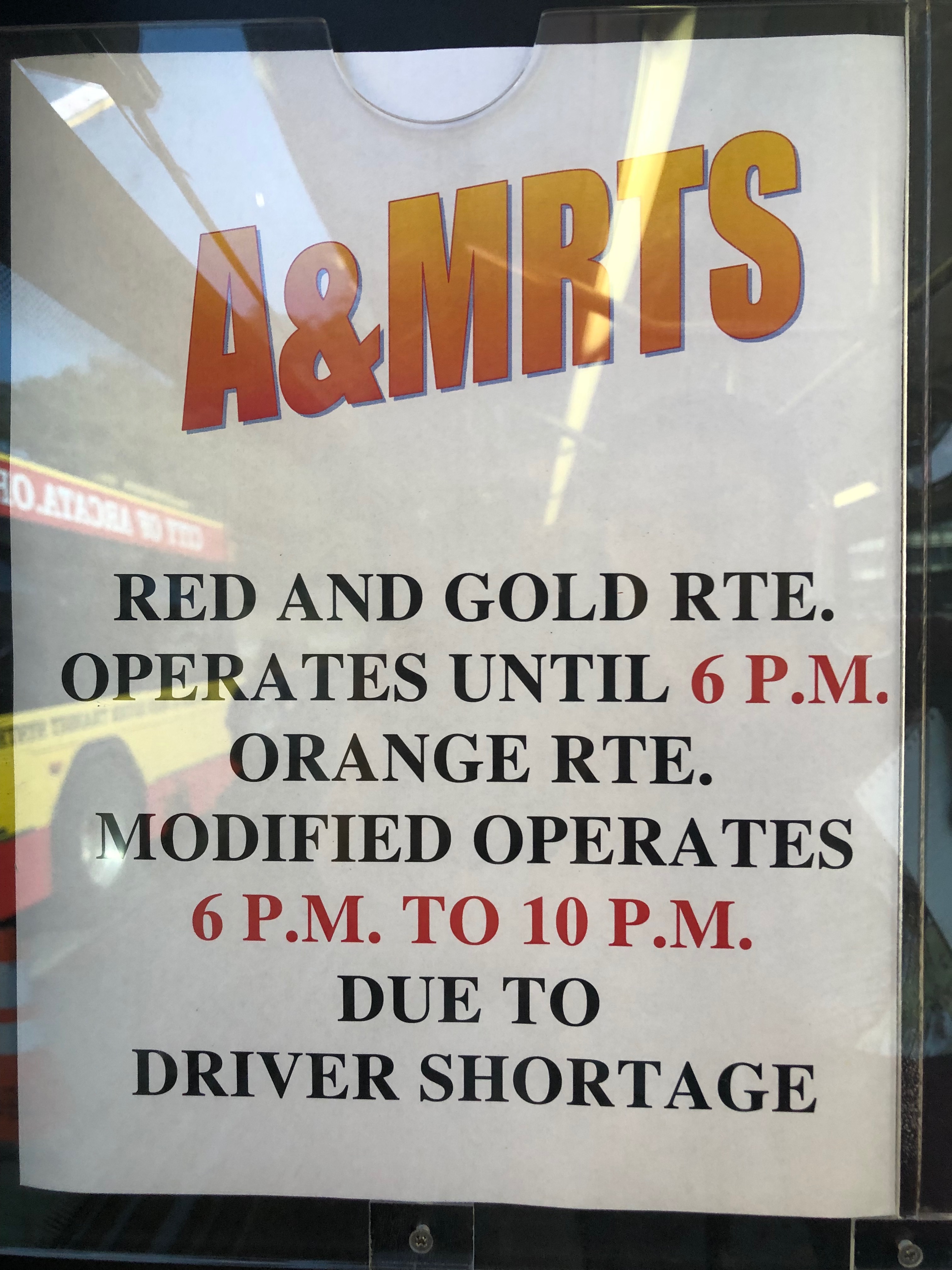
    The Arcata and Mad River Transit System, run by Arcata Public Works Department, is experiencing a shortage of bus drivers. A problem which has affected bus routes and scheduling.

    The Red and Gold bus routes now merge into the Orange bus route from 6-10 p.m. on weekdays.

    Director of Public Works Doby Class said a few drivers had to retire during the summer for age and health related issues.

    Since then, replacements have been hard to come by for Arcata Public Works.

    “We’re actively trying to contact agencies, temp help,” Class said. “We’re doing much more outreach than in the past.”

    Finding qualified candidates has been the most difficult road block for A&MRTS.

    “It’s so hard to find people who can pass a drug test, wants to work with the public, reliable and can drive a bus,” said bus driver Doug Thompson. “Lots of my friends who would love this job can’t (do it), simply because they can’t pass a drug test.”

    Class said transit manager for A&MRTS LeAnn Schuetzle, whose main job is to manage the bus system, hire and train drivers, has been driving the bus herself due to the shortage.

    A&MRTS also has another hiring predicament which may worsen existing conditions.

    The Arcata bus system only hires part-time drivers in order to save on costs. Part-time bus drivers are limited to 1,040 hours a year, meaning that if a driver is to reach their limit, they are no longer allowed to work for the rest of the year.

    According to Class, there are current employees who are nearing the 1,040 hour limit and may soon be unable to work. This means their current driver shortage may become worse.

    “We’re running on borrowed time,” Class said.

    Class hopes that by Jan. 2019 the driver shortage issue will be resolved.

    There are proactive plans to get new drivers including a joint training program with Redwood Transit System in Eureka to provide a bus driver’s “learner permit” in order to train new drivers for a B-class driver’s license.

    Students and citizens, including retired workers, are eligible for this “bus driver in training” position so long as they are willing to work and can pass a drug test.

    Some residents of Arcata have been affected mildly by the driver shortage.

    According to Joannah Harris, her old route had been cut off by the new routes.

    “I had to get used to the new scheduling,” Harris said.

    According to Frank Moldy, the change happened abruptly with no notice and left him stranded at a bus stop. “Let people know, have some ads so we know,” Moldy said.

    “It didn’t really affect us,” resident Annie Bernier said. “But, we would be stuck (here) without the bus.”

    Beyond the scope of the driver shortage, Class wants to expand the current bus system. He wants Arcata residents to have the same half-hour bus stops that HSU students enjoy. There are also plans with HSU to connect the University with off campus parking south of G Street, according to Class.

    “We want to be the best little bus system in the west,” Class said.

    Until A&MRTS can solve their driver shortage effectively, future expansion will have to wait.


  • California fights fire with fire

    California fights fire with fire

    California fire season far from over

    As fire crews fighting the Humboldt County Mill Creek Fire wrap up local operations after 100 percent containment, California State officials warn that this year’s record breaking fire season is far from over.

    According to California’s Climate Change Assessment released last week, a study found that by 2100, if greenhouse gas emissions continue to rise, the frequency of extreme wildfires would increase and the average area burned statewide would increase by 77 percent.

    Locally, firefighters at the Mill Creek Fire, reached 100 percent containment last Thursday Aug. 30. The fire, which has been burning since Aug. 16, is located just north of Hoopa, and has burned over 3,600 acres.

    The wildfire is believed to have been sparked by arson. There is a $10,000 reward offered for information regarding the origins of the fire.

    According to Jeff Knudson of the Great Basin National Incident Management Team 6, no one was harmed by the Mill Creek Fire, and no infrastructure was damaged, but there was significant damage to the Hoopa Tribe’s timber base.

    Knudson, the Deputy Incident Commander, said the team is made up of firefighters from federal, state, and local partners from Nevada, Oregon, Wyoming, Utah and Idaho. He has over 30 years of experience fighting wildfires and says that over the years he has seen some changes in wildfires.

    “We’re seeing longer fire seasons,” Knudson said. “The fires are more intense.”

    On Friday Aug. 31 Great Basin Team 6 was getting ready to head home after returning command of the Mill Creek Fire to the Hoopa Fire Department.

    Meanwhile, last Friday Aug. 31, Cal Fire released a Labor Day Weekend news release warning that wildfire risk remains high. The Director of Cal Fire, Chief Ken Pimlott, said that this year firefighters have been busier than ever with record breaking wildfires.

    “This year, Cal Fire has responded to 4,434 fires that burned 876,428 acres, compared to last year when we responded to 4,170 fires for 228,803 acres,” Pimlott said.

    Cal Fire, with collaboration from the California Environmental Protection Agency, and the California Natural Resources Agency announced earlier this year in their California Forest Carbon Plan that increasing fire treatments through prescribed fires is a California State goal. A recent study has attributed 55 percent of the increase in dry fuels to human-caused climate change.

    By 2020 Cal Fire wants to double the current rate of forest restoration and fuels reduction treatments, including planned fires, to 35,000 acres per year for non-federal forest lands.

    Additionally, findings from the state’s Fourth Climate Change Assessment supported Cal Fire’s goal further with scientific backing that doubling forest restoration and treatments statewide, by 2020 is an important step.

    Jeffrey Kane is an associate professor of Fire Ecology and Fuels Management at HSU and Chair of the Northern California Prescribed Fire Council. Kane said he is encouraged that California is taking steps to scrutinize its legacy of fire suppression. Kane said that the bottom line is California is a fire prone state.

    “California needs fire like it needs water and sunlight,” Kane said.

    Lifelong Hoopa resident Matthew Sylvia said growing up in the area fires weren’t as severe as they are now. He said regular prescribed burning used to be a tribal practice and spoke of some of the benefits they see from routine low intensity fires such as the thinning of the forest from brush and the removal of pests such as ticks and acorn infesting weevils.

    “We also burned for basket weaving materials, and mushrooms,” Sylvia said.

    Sylvia said that after a fire, edible mushrooms and grasses used to make baskets would spring up from the ashes.

    Kane said the integrated pest management and ecological benefits after a prescribed fire that Sylvia described is called traditional ecological knowledge.

    Sylvia, a business major, said being so close to Redding, Calif. and coming off the heels of the Carr fire there was an initial panic in the community from the fire.

    “People were worried about it sweeping up the whole valley,” Sylvia said.

    Kane said that increasing the amount of prescribed fire treatments isn’t a magic solution but it is a step in the right direction.

  • Former Jacks’ star pro career on hiatus

    Former Jacks’ star pro career on hiatus

    Alumnus’ future in NFL uncertain after being released from 49ers finalized roster

    The San Francisco 49ers announced their signing of Humboldt State University’s star running back Ja’Quan Gardner to a three year deal on August 28. However, Gardner did not make the final 53 man roster.

    Gardner was invited to the 49ers rookie minicamp in May earlier this year but did not receive another invitation to offseason training.

    Gardner suited in No. 38 on August 30 in the 49ers last preseason game vs the Los Angeles Chargers.

    “I’m probably going to be on some special teams then get some carries 4th quarter,” Gardner said. “It’s going to be straight, I’m going to be more scared running out of the tunnel onto the field.”

    Which he was, but that was the only chance he got to see the field.

    “He did a good job in our rookie tryout camp,” Kyle Shanahan Head Coach of 49ers said in the San Francisco Bee, “he was a guy who picked the stuff up in the weekend he was here. We liked him as a person. We always liked his college tape, and he ran well while he was here. We’re down some guys and we wanted to make sure we got another guy in here and he was a guy that we had on our shortlist since he was here in the tryout camp.”

    Gardner was the 2015 Harlon Hill runner up for college football. He finished his Lumberjacks career with 5,495 rushing yards and 72 touchdowns in just 42 career games. He holds all the statistical rushing records at HSU.

    Gardner’s girlfriend Emma Gutierrez was one of the first to hear the news.

    “I was crying. I was very proud of him,” said Gutierrez. “It was a lot of different emotions at once.”

    Gutierrez still attends HSU while Gardner is back at home training but the two still seem to work it out when asked about it.

    “It’s hard but it is not as hard as I thought it would be,” said Gutierrez. “Distance is the hardest but we have really good communication.”

    In his first practice Gardner did not get to participate in many team drills. He participated in a couple of individual drills with the running backs and observed for most of practice.

    Gardner was really close with his teammates and got along with everybody and was as humble as they come. You wouldn’t even know he had all these accomplishments, someone would have to tell you. Former teammate Jamere Austin played on the team last season he was just as excited for Gardner as anybody else.

    “I was really proud of him, I thought about a lot of the talks me and my boy had and dreams came true, couldn’t be nothing but happy,” said Austin.

  • EDITORIAL: Football program cut will create ripple effect

    EDITORIAL: Football program cut will create ripple effect

    Loss of football program also means loss of diversity, opportunity

    Lumberjacks football has been a staple of Humboldt for over 90 years. But this season will be the last for the foreseeable future and this community is losing more than just a team.

    Football brings more to the table than just sports. Student-athletes chose this school to pursue their education and to chase their dream of playing college football.

    Terminating Jacks football will be the conclusion of a program that has been a part of Humboldt since 1924, not long after HSU’s founding. The program has seen some standout stars and big-time players along the way. Lumberjacks 2017 All-American offensive lineman Alex Cappa was selected 94th overall by the Tampa Bay Buccaneers in this year’s NFL draft.

    HSU says they do their due diligence to remain somewhat ethnically balanced while bringing in students from all over California. This practice is misleading as the university’s surrounding areas have many racial undertones. The football team is one part of the school that was true to HSU’s message of inclusivity.

    Where there were once young men of all races working diligently towards the same goal, there will no longer be. The locker room that once brought men together will be empty.

    HSU will honor scholarships for eligible players through the 2018-19 academic year, and coaches and staff will also help players contact other programs. At the end of the season, players will get a full release, which means they could choose to play at another institution.

    President Lisa Rossbacher called it an unfortunate but necessary step in addressing the University’s structural deficit and protecting the school’s core academic mission. In her “mission” she has neglected a big part of what is supposed to make this university great.

    The closing statement of our mission states: “We help individuals prepare to be responsible members of diverse societies.”

    Less than four percent of HSU’s student population is African American and less than two percent of faculty are African American. Where is the diversity? Where is the care for the individual student?

    HSU has experienced lower enrollment over the last two years. Fall enrollment has dropped by more than 400 students. This dip has had a measurable impact on the budget and the loss of football will expectedly lead to an additional decline in enrollment, which in turn will bring less people of color.

    While getting rid of the football program could possibly be the right decision fiscally, the loss will be felt by many. People may not have ever met, had it not been for the football team. Familiar faces will change into strangers faces. What once brought a sense of camaraderie to this campus will now no longer exist.

    HSU hopes that contributors and boosters will continue to support HSU athletics but the $200,000 or more increase in contributions last year was for football. Loss of the football program will have a long-term ripple effect. Where and what gets hit the hardest remains to be seen.