by Emma Wilson and Griffin Mancuso
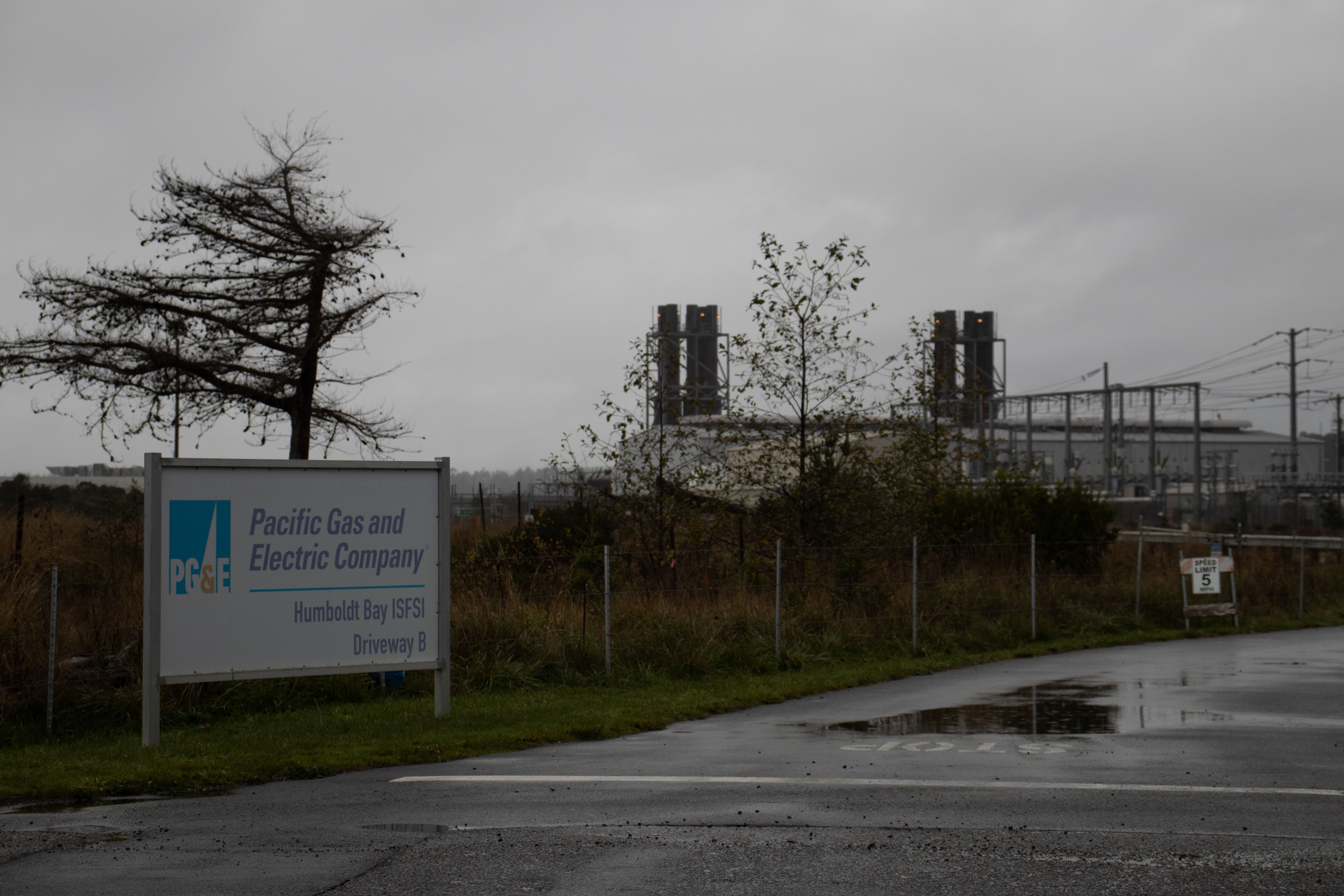
By 2065, sea levels in Humboldt Bay are projected to rise by 3.3 feet, which would turn the Humboldt Bay Independent Spent Fuel Storage Installation — a decommissioned nuclear plant — on Buhne Point into an island. This would make it exponentially more difficult to relocate the underground nuclear waste storage and, if the salt water reaches the nuclear waste, potentially contaminate the nearby environment.
While 2065 may seem far away, preventative environmental activism is critical for situations regarding nuclear waste. The potential environmental impacts of this nuclear plant resulted in the creation of the 44 Feet Project. The nuclear waste is located 44 feet above mean high tide, which the project was named after.
What is the 44 Feet Project?
According to the 44 Feet Project website, the project’s main goals are to improve current safety analysis to take into account future risks to Humboldt Bay, and uplift the voices of local tribes and community members in decision-making. Another goal is to place trust, communication and public awareness at the same level as scientific analysis in regards to responsible long-term management of decommissioned nuclear fuel sites.
Jennifer Marlow, an assistant professor of environmental law, environmental science and management, founded the 44 Feet Project. The project was created in 2021, with two graduate students working full-time and several undergraduate students working as research assistants.
“So, the 44 feet project is a coalition of community collectives that [are] trying to understand the risks of climate and coastal hazards to the spent nuclear fuel site on Humboldt Bay,” Marlow said. “And to gather perspectives and values on responsible long-term management of that fuel, and then to direct — hopefully — some of the decision making regarding the fate of the fuel and where it ends or how it’s managed.”

Concerns About The ISFSI
The Humboldt Bay Independent Spent Fuel Storage Installation, also known as ISFSI, sits in a precarious area. If sea levels do rise by at least 3.3 feet by 2065, the water will reach the underground casks containing the nuclear waste and potentially erode the metal. The nuclear plant is also vulnerable to natural disasters like tsunamis and earthquakes, being located near the active King Salmon fault.
Marlow had concerns about PG&E’s timeline for removing the nuclear waste from the ISFSI. She also emphasized the need to consider local concerns and the use of outdated science in safety reporting. According to Marlow, PG&E plans to move the waste by 2032 or 2033, but she has concerns about their lack of a concrete timeline.
“We’re not wanting to cause unnecessary alarm, but we are concerned that the timelines assumed for the life of the project will be exceeded,” Marlow said. “And then, in those future states, there will be increased climate and coastal hazards. And those increased risks aren’t really being adequately considered. So, our project focuses on trying to center that discrepancy and try to bring new science and perspectives around that so that we can have a better understanding as a community about potential safety risks, and ways to mitigate and manage those.”
Julie Sorfleet, a graduate student who joined the 44 Feet Project this semester, plans to analyze public opinion and concerns regarding the decommissioned plant’s license in perpetuity, meaning there is no set plan to relocate the nuclear waste.
“So obviously, you know, you’ve got the spent nuclear fuel site, and the NRC [Nuclear Regulatory Commission] deemed it safe,” Sorfleet said. “It’s just kind of looking at future planning — how can we ensure that coastal and climate hazards and community voices are taken into account when ensuring that this site might be here in perpetuity? Because that’s what it’s licensed for. My specific work is going to be looking at the viewpoints and attitudes towards, ‘What if the fuel wasn’t licensed in perpetuity?’”
Alec Brown, a graduate student who has been involved with the project since its creation, has visited the ISFSI several times and reported that the casks were very secure, but PG&E needs to take into account the uncertainty of our climate’s future.
“They’re engineered pretty well, but those are human-made things and we can fix them,” Brown said. “I mean, we just really can’t maintain the natural world as well, and so those are things we have to adapt to. We can’t like force them into our little black box of like, ‘Oh, we got this and we’re controlling it.’”
Community Involvement
Brown has been trying to foster community engagement through a variety of channels, including focus group workshops, panels and community events.
Last year, staff members attended a play called “The Children,” directed by Cal Poly Humboldt lecturer Craig Benson and originally written by Lucy Kirkwood. The play explored possible outcomes of a nuclear meltdown and themes of intergenerational equity, which afterwards was followed by a feedback panel.
“These are just the events that are happening in the community,” Brown said. “And it’s melding art and science and trying to reach a broad audience, [which] is — I think — really critical.”
The project has also collaborated with local tribes like the Wiyot people.
“They’re really interested in the [nuclear plant] site, because it is their ancestral part of their ancestral territory,” Brown said. “Preceding the focus group workshops, we actually did a little site tour with a lot of those people that were attending the focus group workshops.”
The visit was led by former tribal chair Cheryl Seidner, who led the attendees through her experience and the importance of the land the nuclear plant sits on.
“It was just really moving,” Brown said. “We sat there and we kind of closed our eyes and listened to the wind and the waves and the sand. And we’re just like, ‘Could you imagine if this was undeveloped? And if we still had control over this, and maybe it wouldn’t be a potential toxic site.’”
Community involvement is a critical component of the 44 Feet project. It is important to engage and gather as a community to keep action moving by spreading awareness and making impactful decisions through education.
“That has sort of been, you know, the crux of this entire project,” Brown said. “How do we engage, you know, a diverse group of people to put our minds together and embrace that uncertainty?”
Accomplishments and Setbacks
Alongside community engagement, the 44 Feet Project has been advocating for policy changes that implement security measures and other contingencies. The project has seen several successes in addressing outdated policies and scientific reporting. They’ve had the California Public Utility Commission request that PG&E update their Tsunami Hazard Assessment page on their website as part of a legal settlement. The update will be done by the end of 2024.
The 44 Feet Project has been trying to address outdated policies and scientific data that companies like PG&E and the Nuclear Regulatory Commission are using for nuclear sites like the ISFSI.
“We are concerned that the timelines assumed for the life of the project will be exceeded, and then in those future states, there will be increased climate and coastal hazard, and those increased risks aren’t really being adequately considered,” Marlow said. “So, our project focuses on trying to center that discrepancy, and try to bring new science and perspectives around that so that we can have a better understanding as a community about potential safety risks and ways to mitigate and manage those.”
One of the major issues with addressing the nuclear waste at the ISFSI and main questions addressed in the project’s focus group workshops was whether the waste should be relocated, and if so, where. Brown said that determining what to do with the waste is dependent on a lot of factors and what communities will be affected by that waste.
“First of all, we don’t have the capacity to [relocate the waste], we don’t have the jurisdiction, but also morally and for reasons of equity, should we be taking this and giving it to someone else?” Brown said. “Equitably, can we give this to Nevada? Or can we give this to a desert community? Can we give this to a tribal community? Do they want our waste, and is that fair? We benefited from the electricity generation of this plant and that’s our waste. We can’t just go bury it in someone else’s backyard.”
Hopes for the Future
Sorfleet hopes to use her knowledge of GIS analysis and her experience with drones to monitor the area around the ISFSI.
“I feel like drones could have a really cool usage to maybe just look at the bluff in front of the sea,” Sorfleet said. “I’ll potentially monitor the riprap wall that’s right there, or the bluff for erosion. Maybe not us on the 44 feet project doing that, but it could be a cool use case for drones in relation to long-term management of the site.”
Marlow emphasized the project’s goal to take preventative measures against uncertainty, which means implementing security against all possible outcomes that could pose risks to the ISFSI, as well as the surrounding environment and community.
“There’s a lot of future change that we didn’t anticipate, because we chose to ignore the potential, right? So we have one official future,” Marlow said. “And that’s the future, and 44 Feet’s framework is that there’s more than one official future. That’s a scenario planning mindset, which is, ‘Let’s not plan for one official future, let’s plan for multiple futures,’ so that we’re robust in light of uncertain change.”
Brown hopes for the project to be involved in more community events in the future. Another Which Way The Wind festival will be taking place next year, which uses performance arts to bring awareness to climate change and the risks of nuclear weapons.
Since changing policy and addressing nuclear waste is a years-long process, the project is primarily focusing on awareness and education.
“Nuclear safety is a journey, because it’s so long-lived,” Brown said. “It’s a technology that’s really obscure for people and it’s out of sight, out of mind in a lot of ways. And it’s long, because some of these radio nucleotides live for like thousands of years, and we can’t just not think about them. But in that whole entire arc of safety, we just have to have little wins and continue to address this and like, ‘Okay, well, it’s better now. It’s better now.’ And that makes me feel good and hopeful.”
Leave a Reply