COVID-19 rages through US as students struggle with online schoolwork
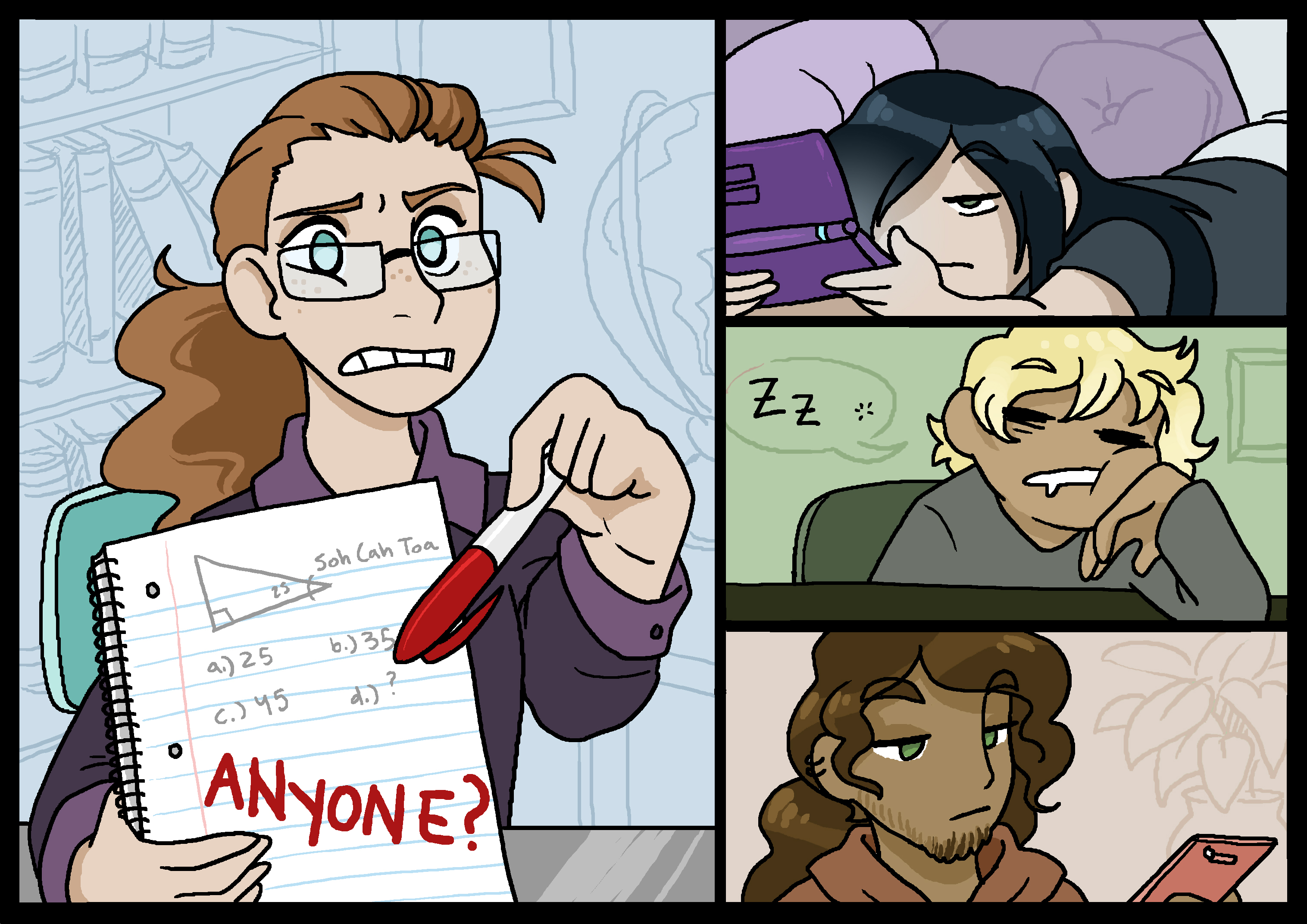
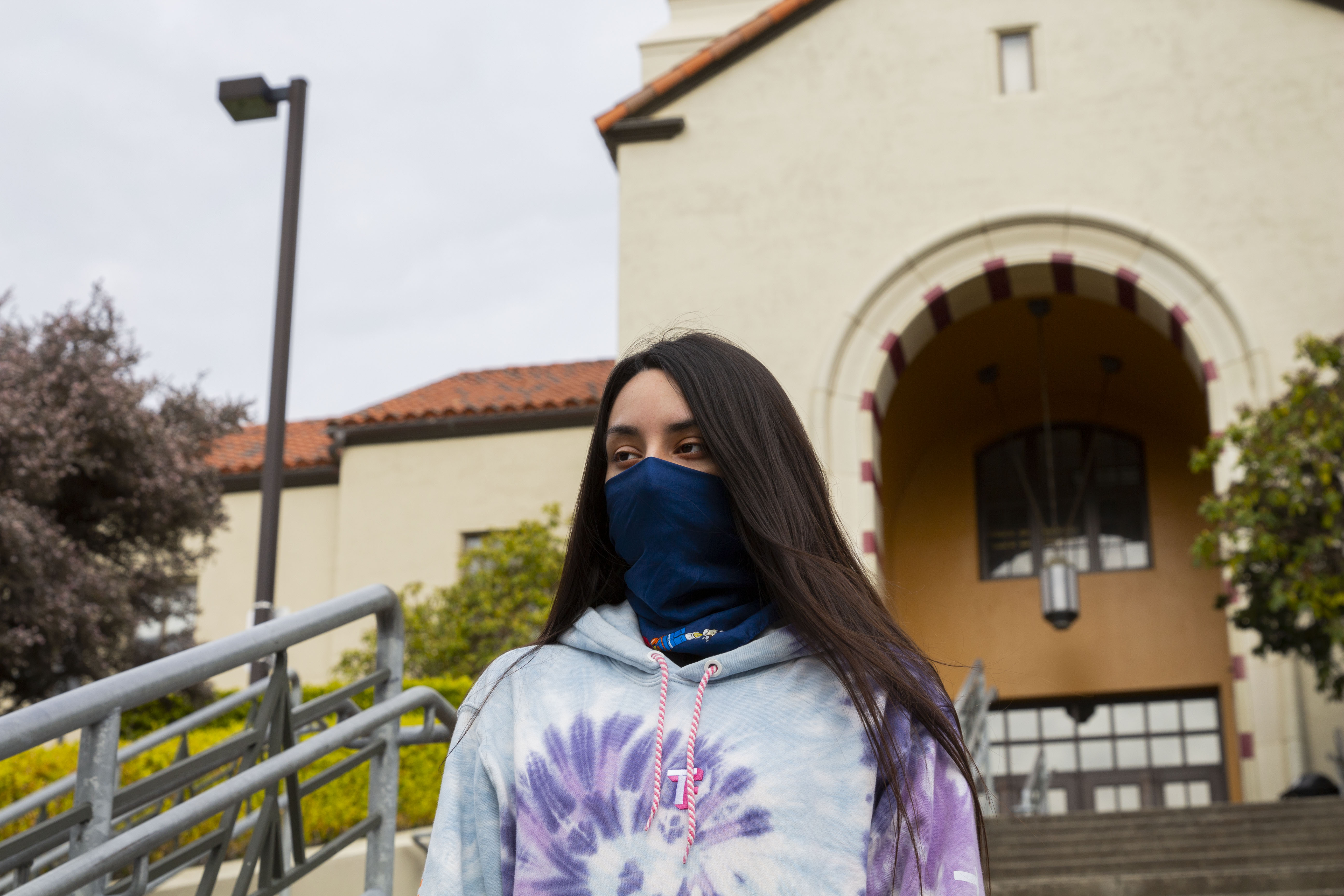
Humboldt State University transitioned to online instruction for the rest of the semester on March 26. Since then, some students have had a hard time staying focused and motivated in online classes.
Deana Lopez, a third-year zoology major at HSU, admitted that this hasn’t been an easy transition.
“I feel overwhelmed with the amount of emails professors and instructors are sending, and everything seems all over the place,” Lopez said. “I have been neglecting my school work so much that I forget that I still have classes. I’ve missed quizzes and assignments already because it’s so easy to forget that I have to do them without a professor reminding me.”
Third-year psychology major Madeline Baker said she was having a tough time staying motivated without face-to-face instruction.
“Not being able to have classes in person further discourages me,” Baker said. “Holding classes through Zoom has been easier for me in contrast to pre-recorded lectures, but they still aren’t the same. Not having that in-person connection alters the learning environment in a way that makes me feel disconnected from my overall learning experience.”
Not only are students dealing with the move from face-to-face instruction to online classes, but they also have to manage the stress of living in a pandemic. With many students moving back home, there’s added family stress as well.
Not only do I feel like my beginning of therapy has been interrupted, but the full college experience for this semester.”
Madeline Baker
Lopez was feeling pressure from school alongside tension from life in general.
“I know I can find the motivation, but everything is hectic at the moment,” Lopez said. “My grandma recently passed away so there was that on top of the COVID-19 situation, and a lot of family problems have occurred as well. I’m trying to get myself and my surroundings organized before I can actually put all of my focus into school.”
No matter how good a job professors are doing, online education doesn’t appear to be the same. For the students, it’s not just the classes they feel they’re missing out on, but the whole college experience.
Meanwhile, the state of the world may be taking a toll on student mental health.
“The resource I would like to use most right now is CAPS,” Baker said. “Before all of this happened, I finally decided to go in and begin appointments, something I feel like I’ve needed to do for a while now. I feel like that has now been interrupted for me. I had a private safe space provided to speak with someone and learn to cope with things. Given my current housing situation, I do not have a private enough space in which I would feel comfortable confiding in someone and work through my personal feelings and issues over the phone or video. Not only do I feel like my beginning of therapy has been interrupted, but the full college experience for this semester.”
Many students are also dissatisfied about paying full-price tuition for resources they won’t be able to access for the rest of the semester.
Kayla Rodenburg, a third-year English major, thinks the tuition price doesn’t add up with all classes now online.
“I do feel like the tuition price is too high for online classes,” Rodenburg said. “Online university is dirt cheap and we are paying CSU prices for that which is kinda ridiculous in my opinion. I’m pretty sure many parts of our tuition fund things on campus that we now don’t have access to, so I hope some type of refund happens, even though it’s kind of a stretch.”
Though the actual fatality rate is unknown, it is much higher than past pandemics such as H1N1 (swine flu). Even if it was low, a small percentage of the total global population is still a staggering amount of people.
Misconception: I don’t have symptoms like fever, cough or difficulty breathing, so I must not have it and I can’t spread it.
Misconception: If I wear a mask, I don’t have to practice social distancing.
Reality: Simple masks for people without symptoms and people not in high-risk groups are recommended by the Centers for Disease Control and Prevention more to protect others from you while in public. Since many cases are asymptomatic, it may help prevent people unaware of their own infection from spreading it. Masks are an additional measure, not a replacement measure. The CDC recommend social distancing along with a mask.
Misconception: There is a cure for COVID-19.
Reality: As of April 2020, there is no specific medicine or cure for COVID-19. Antibiotics are not effective against the viral illness, and there is no evidence of any effective home remedy. There are ongoing trials and possible vaccines being considered, so that may change soon.
Despite Humboldt State University going digital, campus housing remains open
Humboldt State University President Tom Jackson announced via email March 18 that the school would be going entirely online, and he encouraged students to vacate campus housing if possible.
“It is important we reduce the number of people on campus,” the email read. “We encourage students who can return to a home off-campus to do so. We will not displace students who are facing housing insecurities or homelessness.”
“They should have just made the choice before people left for spring break to keep it as safe as possible.”
Calista Tutkowski
Freshman Calista Tutkowski was among those who decided to move back home after learning that classes would transition online. Tutkowski considered her choice the right one for her own physical and mental wellbeing.
“It felt like things were just going to get worse and worse on campus and around the world, so if I was going to be doing online classes, I wanted to be home with my family,” Tutkowski said.
Tutkowski was frustrated with the sudden notice from the school. By the time the school sent out the notice that they were going online and encouraging students to leave the dorms, she had already gone home for spring break and was out of state. Like many other students, she had to return to campus to pick up her things, potentially putting herself and others at risk by traveling.
“They should have just made the choice before people left for spring break to keep it as safe as possible,” Tutkowski said.
Some students are still on campus. Emma Bradley-Solis is one of those who elected to remain in campus housing despite virus concerns.
“I live in Washington and it is a lot worse there,” Bradley-Solis said. “I thought it would be smarter for me to self-quarantine here.”
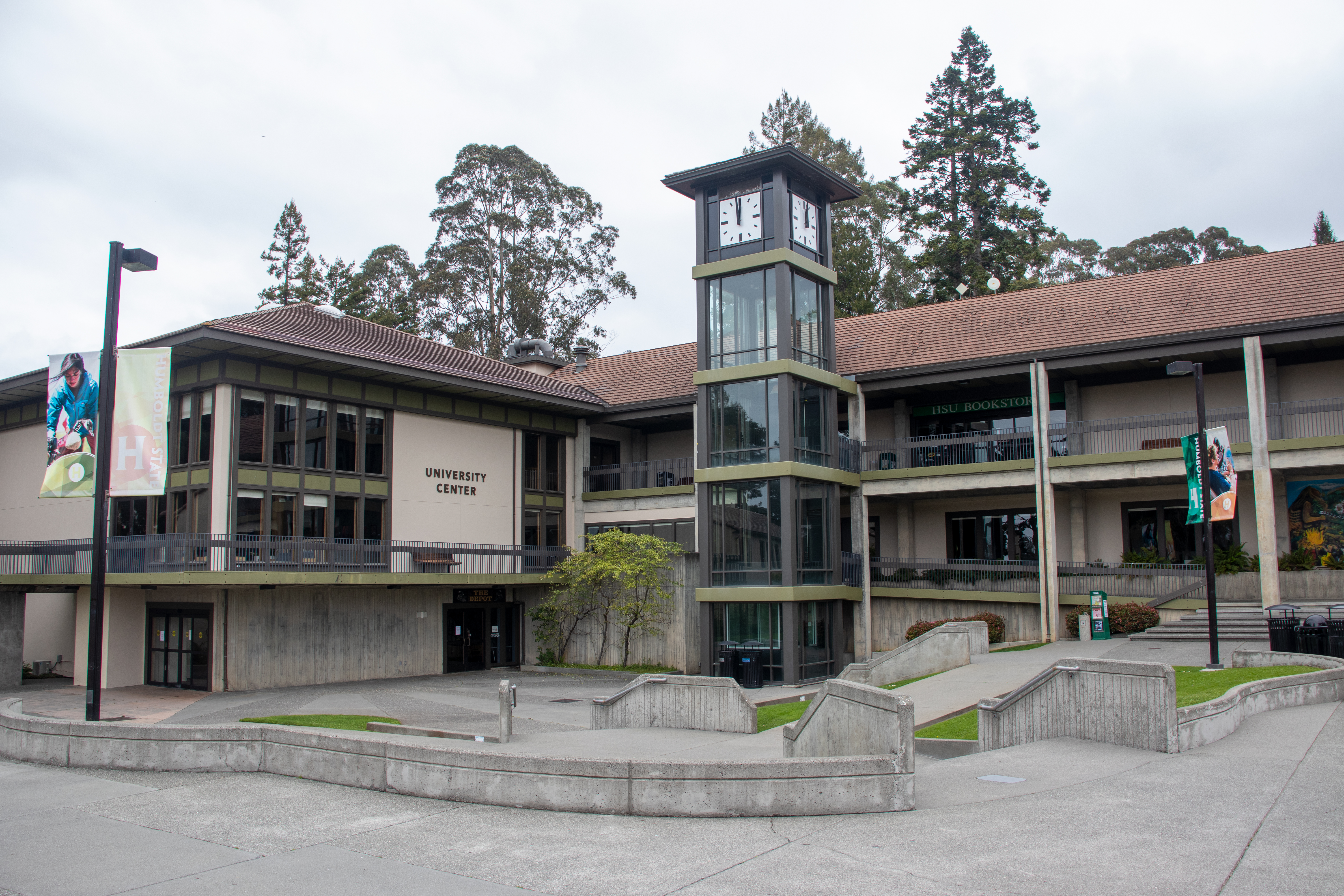
According to an April 7 Enrollment Management report, about 300 students remain on campus. Most of the campus facilities are closed, including the library, computer labs and University Center.
With the severely reduced numbers of students left behind, pickings are slim. There isn’t much variety left in the food selection, and many staples such as rice, pasta and fresh fruit are out when Bradley-Solis goes to the marketplace. For students who rely on J-points to eat, this is both a serious problem and a waste of the money spent on their meal plans.
“I feel like they could take care of the students still here better—like better food,” Bradley-Solis said. “We paid a lot of money for J-points.”
With life disrupted, lecturer Kerri Malloy perseveres with flexibility and humor
A professor noticed students often left Kerri Malloy’s class laughing. One day the professor asked what he was teaching.
“Oh, that’s my genocide class,” Malloy said.
Malloy teaches courses in the Humboldt State Native American studies department on colonialism and genocide. With such somber subjects, Malloy relies on humor and honesty to engage students. Now that classes have gone online during the pandemic, Malloy has employed those traits, alongside plenty of flexibility, to keep students connected.
“The hurdle is going to be maintaining that connection with the students,” he said.
He created class blogs for students to post what they want—questions, memes, dog or cat or reptile pictures. Glance through Malloy’s Instagram, Twitter or Snapchat accounts, and you’ll find lots of memes, like one he posted April 3 on Instagram:
“The year 2020. Brought to you by the letters W, T & F.”
“I think you have to walk into it—at least my plan is to walk into it—with an incredible amount of flexibility.”
Kerri Malloy
“I love a good meme,” he said in one of two Zoom interviews. He sat in his home office. Behind him, family photos and a Star Wars Yoda action figure topped a bookshelf. He wore glasses and a button-up shirt.
Memes dominate Malloy’s social media accounts, but there’s more to the accounts than humor. They make him accessible to students. He receives messages on those accounts about class, and he replies happily.
“There are times where I’m like, ‘Why am I doing this?’” he said. “And then I realize, I’m getting to see a different side of students, and my colleagues, too.”
Malloy also emphasized the importance of flexibility.
“I think you have to walk into it—at least my plan is to walk into it—with an incredible amount of flexibility,” he said. “And let them—let the students—help guide where we’re going to go.”
Yurok and Karuk by heritage, Malloy was born on the Oglala Lakota Reservation in South Dakota, but he grew up on the Quinault Indian Nation Reservation in Washington.
Marlon Sherman, chair of the HSU NAS department, knew Malloy from working together for the Yurok tribe. Sherman and Malloy have a family connection, as Sherman grew up on the Oglala Lakota Reservation where Malloy was born.
“If it wasn’t for Kerri, there might not be a NAS department right now.”
Marlon Sherman, chair of the Native American studies department at Humboldt State
After working together for the Yurok tribe, Sherman and Malloy parted. About six years ago, Sherman asked Malloy to come to HSU to teach two courses for a semester.
Shortly after Malloy came on board, Sherman had to take time off. He had cancer. Sherman returned in about a year, but Malloy became program leader and helped steer the department. Sherman said Malloy basically did all the work and helped the department hire two professors.
“If it wasn’t for Kerri, there might not be a NAS department right now,” Sherman said over the phone.
Malloy said Sherman was too generous, but there’s no doubt that Malloy works, a lot—so much so that Sherman joked it might be illegal.
Malloy wakes up around 4:30 a.m. every day. He gets up so early partly because he finds those early hours productive, and partly because his back is built on metal rods and pins that make lying flat for too long unbearable. He’s not exactly sure how he damaged his back—maybe a car accident—but he had to have surgery that put him out of commission for three years.
He estimated he’s on eight to 10 HSU committees, from the University Resources Planning Committee to the Diversity, Equity and Inclusion Committee. Malloy does this while teaching multiple classes as a lecturer—a position with an uncertain future amid HSU’s projected enrollment decline and budget cuts. He joked when asked how he has the time.
“People usually don’t like my answer,” he said. “How do I have the time? A calendar.”
Kumi Watanabe-Schock, a 23-year HSU employee, works in public programming and as the library media coordinator. She first met Malloy when he was an HSU student getting degrees in economics and Native American studies.
Since then, Watanabe-Schock has worked with Malloy on committees and for classes. Every time she talks to Malloy, he seems to be attending workshops or giving talks around the world. She praised his willingness to help out.
“He’s not good at saying, ‘No,’” she said over the phone. “I don’t know if he’s that way with everybody, but when you ask him to do a favor he always follows through and he always says, ‘Yes.’ So I really am appreciative, yeah. He’s a good person.”
When not working, Malloy is more private. He has a husband and three dogs. He has two sisters and 14 nieces and nephews he tries to see every year. Around 8 p.m. every night, he tries to unwind. Maybe he’ll watch some TV, or maybe he’ll read a book about genocide. Fun.
While COVID-19 has pushed teaching online, Malloy has found his courses as relevant as ever.
A key concept in Native American studies is survivance, a portmanteau of survival and resistance. Survivance is about the living of Native American lives in the present tense. By surviving, Natives resist, and by resisting, Natives survive.
Malloy said people must fight right now to have their voices heard, like many Natives must do at all times. He said individual voices humanize current events and prevent people from kicking the ball of reality down the road.
On that note, Malloy told a story. Last summer, he taught Native history in a program that spent two days in Auschwitz I, the main site of the Nazi concentration camp. One day he stopped and looked out a window. The bizarreness of the situation dawned on him. Here they were, decades later, standing in a place of horror and trying to learn from it.
A window at Auschwitz I, the main site of the Nazi concentration camp on August 20, 2019. | Photo courtesy Kerri Malloy
Later that night he received an email from then-HSU President Lisa Rossbacher. She was checking in, so he wrote back.
“If we can educate in such a place of incredible horror and death, we have the ability to change the world,” he remembered writing. “We really do. If we can actually go into these places and find this incredible darkness and turn it into something that allows us to reach out to other human beings and get us to talk to each other and push the things that really don’t matter aside, I think we can do this.”
To get people to talk, Malloy uses humor, which he said can get us past anything—and Malloy does seem capable of getting past anything. It seems strange to call research on genocide a passion, but Malloy approved the descriptor.
“Passion’s a good word for it, actually,” he said. “You’ll find that for those of that this is what we do, it is a passion.”
Every student interviewed for this story agreed on a few descriptions of Malloy. He’s open and funny, they said, and he can be brutally honest. They warned against getting into an argument with him.
“If you’re gonna have an argument with him, you better have good stats and have all your ducks in a row, because you’re not gonna win Kerri in an argument—I’ve tried,” HSU biology major Michelle Navarette said over the phone.
“And he told me, like, ‘You can’t let the system fuck you up and throw you down.’”
Michelle Navarette, Humboldt State biology major
Navarette, a senior, first had Malloy for a 9 a.m. general education course. Once she got to know him, she tried not to miss his class. Since that first course, she’s tried to have a course with him every semester.
Navarette’s appreciation of Malloy goes beyond the classroom. She said she was losing her job last semester due to discrimination from her boss. She didn’t know what to do, so she went to Malloy.
“He sat me down and was like, ‘You know what, this is just a portion of how life is,’” she said. “’You’re gonna have these obstacles all the time.’ And he told me, like, ‘You can’t let the system fuck you up and throw you down.’”
When she thinks of Malloy, she remembers his honesty.
“I think he was like the first person to tell me, ‘This shit is going to be hard.’”
As a lecturer of general education courses, he usually has to work for the attention of students. He goes into his courses hoping for students to leave with more questions than answers. Students have told him he gives too many assignments, but no interviewed students said Malloy graded harshly.
“My philosophy,” he said, “is if I can get one brain cell to function per student on an assignment, we’ve succeeded.”
Malloy once had a student he didn’t think he had triggered any brain cells in. Malloy said the student believed everyone should be committed to a single belief. Malloy respected the devotion, but he worried about the implications.
About a year after the student left his class, Malloy received a message on one of his social media accounts. The student wanted to know if a site he shopped on looked like a hate group.
“I went and checked the site out and went, ‘Yeah, this is definitely an organization that supports anti-Islam—very Islamophobic,’” he said.
The student thanked him and decided to shop elsewhere. Malloy remembered that as a success.
“It’s when you see those little things, you’re like OK,” he said. “Even at some small level, we were able to plant some idea, some seed that is getting people to think differently, or at least question.”
Like many of Malloy’s students, Joshua Overington, an HSU environmental science senior, only took Malloy’s introductory Native American studies course for a general education requirement.
The class was so good Overington signed up for more. He eventually worked with Malloy on the Northwest Genocide Project, an online archive Malloy manages.
Overington also worked with Malloy on a research project on Tuluwat Island for HSU’s IdeaFest, which led into a research paper Overington is now finishing.
“He is incredibly passionate in what he does and he is uncompromising in his views,” Overington said over the phone. ”If Kerri feels something or has an opinion, he always speaks his mind and really, he’s always the one who’s honest and puts himself out there. And that’s not something I see at all in other teachers.”
“If we can make those connections on that level, this is much more understandable. And then we get to be more willing to go, ‘Alright, maybe I need to look in the mirror.’”
Kerri Malloy
Malloy likes to tell people teaching about genocide is fun. People usually give him a blank stare and change the subject. But if asked, Malloy will elaborate.
“And what it means is not fun as in, ‘Yay, happy stuff.’ It means that it’s fundamental,” he said. “Atrocity is a fundamental part of the human existence. Peace is a fundamental part of the human experience. It’s understandable—we can understand why it happened, how it happened, what needs to be done to prevent it. And it’s necessary.”
Malloy knows most people don’t want to talk about atrocities all day. To get past that, Malloy said we have to be willing to look at ourselves.
Malloy tries to relate concepts directly to his students. He sometimes asks if students curate their social media profiles—do they post every photo they take? They admit they do some curating, and he suggested history books do the same.
“If we can make those connections on that level, this is much more understandable,” he said. “And then we get to be more willing to go, ‘Alright, maybe I need to look in the mirror.’”
Malloy teaches because he believes we’re all here to learn. He admits his own ignorance and encourages others to do the same. That openness to learning is perhaps what makes Malloy love his job. His willingness to let students guide his classes is perhaps what makes students love him.
“I tell my students this directly: ‘This is not my class,’” he said. “’This is yours. You guys are the ones who are paying for it. I am just the tour guide on this expedition.’”
Malloy always ends each of his classes—each chapter of the expedition—with the same message.
“Go out and learn something,” he tells his students. “Go out and breathe.”
Social distancing has strained my relationship, so be grateful if you’re still with your partner
Social distancing life isn’t much different from my usual life. I’m not physically going to school or work anymore, but I’m doing my assignments in bed like I normally would. My free time before quarantine would consist of doing homework, eating, watching movies with my roommate and spending time with my partner. There’s only one of those things that I can’t do anymore—spending time with my partner—and it’s the one that hurts the most.
Life was busy before the days of sheltering in place, and I hadn’t seen my partner much. We vowed after spring break we would spend more time together since I was going to be leaving after graduation and they will be staying up here. But now it looks like our long-distance relationship has started a lot sooner.
If you find yourself being in quarantine with your partner, but want to get away from them, there are little things you can do for some space.
Some of my friends have said they were tired of being quarantined with their partner because they were getting on their nerves and they just needed space. When social distancing started, there were a lot of memes going around about how women trapped their partners in their houses with them so that they can talk about their issues and the partners can’t go anywhere. That’s funny, but you shouldn’t need a quarantine to finally talk about your issues. You should be able to do that all the time.
China reported a spike in the divorce rate and the same is expected for the United States. Due to the quarantine, people’s daily lives have changed and they aren’t used to being stuck with their partners all day. Which is understandable, but also sad. I would love to be stuck inside with my partner during this quarantine. We’ve talked a lot more which is nice, but actually having them under the same roof as me would hit differently.
If you find yourself being in quarantine with your partner, but want to get away from them, there are little things you can do for some space. Maybe put yourself in another room if you have another room—but if you don’t, maybe take a nice long shower.
Instead of both of you going to the grocery store together, make a list and have only one of you go. I would hope that you wouldn’t need to distance yourselves and that this time would be enjoyable for you two, but maybe that’s just because I wish I could be watching movies or getting creative with my partner.
If you’re stuck with your partner and are getting annoyed with the way they do the dishes or something small like that, well, get over it. Either tell them it bothers you or take over the task. There are so many people out there, like myself, that would rather be stuck in a room with their partner no matter how much they annoy them, not to mention all the single people that wish they had a partner to be quarantined with.
An account of one HSU surfer’s last breath of clean, fresh air
When Humboldt State University forestry major Gavin Schreiner set out on a 10-day surf trip over spring break, he had no clue what he would return to.
Planned months in advance, Schreiner wasn’t going to let a virus stand in the way of his vacation. Packing over 50 pounds of food and supplies, he and a friend hiked nine miles up the coast of California. Schreiner stopped along the way to admire otters, countless shells and of course, to surf.
“Surfing is obviously my favorite part and that’s the drive to go, but I love camping anyway,” Schreiner said. “I’m an avid backpacker. I’ve been through the Trinity Alps and definitely backpacked into SoCal a bunch.”
A territorial surfer, Schreiner requested the location not be named, especially after this trip. Between spring break and COVID-19, the waves were packed.
“It’s definitely my life path to surf until I die.”
Gavin Schreiner
“It was the most crowded anyone has ever seen that spot,” Schreiner said.
Fortunately for those adventurous enough, there are nine miles of coast to surf on the way.
“There’s the main surf spot out there, but there’s countless other waves along there,” Schreiner said. “It’s like a wave park. There’s so many different types of waves and different spots you can surf, and all offer different excitements.”
Time between surf sessions consists of eating, sleeping and battling the elements to stay comfortable.
“On the coast the weather changes super quick, so you have to be shedding layers, putting layers back on and also watching the waves 24/7 to make sure you get the best seshes [sessions] in,” Schreiner said.
This is the longest trip Schreiner has taken so far, but he wants to break the record.
“If we could spend a month, I would be in for that,” Schreiner said.
At 20 years old, Schreiner has been surfing over half his life.
“Surfing and the ocean is my number one priority,” Schreiner said. “It’s definitely my life path to surf until I die.”
When he returned from his 10-day trip, Schreiner was greeted by strangers wearing masks and businesses with closed doors. The virus was not a factor in the trip. Surfers treated each other with the same brotherly love and competition. Schreiner would’ve stayed longer if it weren’t for school.
“We kinda knew a little bit going into it that shit was going crazy,” Schreiner said. “The only thing we reconsidered was whether or not we could stay indefinitely and figure out a way to complete homework assignments out there.”
Now that he’s back home, he tries to surf every day to take advantage of the opportunity.
“I know a lot of my friends down south can’t surf because they’re closing the beaches, so I definitely feel super blessed to be up here right now,” Schreiner said. “I can follow social distancing and still go out every day.”
Student resources for school, finances, food, housing and counseling
Here is a list of resources Humboldt State is offering for students. Click here for a student-created site of community resources. Click here for the site in Spanish.
Educational advice:
Enoch Hale is the director of the Center for Teaching and Learning at Humboldt State University. He provided five tips to help students with online learning during the shelter in place order. His tips revolved around being kind and flexible.
“Kindness is having the patience and the benefit of the doubt to know that everyone else is struggling,” Hale said. “Be flexible—no one signed up for this and we are going to have to be agile in our expectations in the changing patterns.”
Five tips to help with online school from Hale:
Don’t ignore feelings—reflect on them so they don’t manage us.
Communicate with professors more, not less.
Log on more frequently. Check your emails and canvas more often. Not all courses will be on Zoom.
Set a schedule, use a study calendar and stick to a routine.
HSU Coordinator of Student Services for the financial aid office Morgan McBroom provided financial advice to students. McBroom suggested students in a crisis contact the financial aid office.
For students who are hard-pressed for money, there is a student emergency loan that ranges from $500 to $1000. It is a short-term loan and can come within a few days. Financial services will work to help students pay it back. Students who have not used all of their student loans from the previous semester may also still have access to them.
Due to the COVID-19 crisis, students’ loan interests are being waived, but the estimated date that it will stop is in June. As of now, the end date hasn’t been established. If you are an HSU graduate, you can have your loans waived for a year with no interest.
Contact: finaid@humboldt.edu or (707) 826-4321.
Housing:
In addition to her advice on financial matters, McBroom also provided housing advice. There is emergency housing available on campus. The off-campus liaison is a resource if you’re struggling with rent.
Contact: housingliaison@humboldt.edu
Food:
1. The recreation room on the first floor of the Jolly Giant Commons offers pre-made bags with food items. This happens twice a week on Wednesday from 10 a.m. until 12 p.m. and Thursday from 1 to 3 p.m. Vegan and vegetarian meal bags are also available.
If you cannot make those times due to isolation or quarantine, contact mira@humboldt.edu and she can set up a delivery time.
2. Oh SNAP! can also help you load your student ID card with J points. You need to express a financial need for food support. If you have over $40 in J points, you need to wait until your card is under $40. You can receive $60 every four weeks, but this is subject to change. If there is an increase of funds there could be an increase in the amount given to students. You can also donate your J points to help students in need.
Contact: ravin.craig@humboldt.edu.
3. For extra help, try applying for CalFresh, a state-funded program to help pay for food. Students not working 20 hours a week can apply for CalFresh, except for students in the Educational Opportunity Program program, students with specialized grants and work-study students. You can qualify for up to $200 a month for groceries.
Contact ravin.craig@humboldt.edu if you need help with the application process or would like to see if you qualify.
Counseling:
Mira B. Friedman is the lead for health education and clinic support services. She provided information about counseling for students.
HSU Counseling and Psychological Services is offering virtual appointments.
Students can call (707) 826-3236 to make an appointment. There’s also a 24/7 hotline for immediate crisis outreach for students to speak with a therapist by phone at (707) 826-3236.
HSU freshmen got the short end of the stick after facing blackouts and the COVID-19 pandemic
Humboldt State students have experienced a crazy school year. From blackouts in October and COVID-19 ending face-to-face classes, it’s been quite the ride for everyone. For freshmen, this was their first experience with college.
Freshmen learn to live on their own, make new experiences and acclimate to their new surroundings. For the freshmen that entered in fall 2019, it’s been a different story.
Mikayla Diaz, an environmental science management major from Torrance, California, struggled with scheduling her first semester during the blackouts.
“It was just really unexpected,” Diaz said. “Starting college, people will tell you how to stay organized and to keep a weekly planner and stuff like that, so everything I heard just kind of went out the window. Like, I wanted to keep a weekly planner but how do I if I don’t even know if I’m having class? It was difficult to make my way and get the bare minimum done.”
“Keeping in contact with my teachers has been helpful, but it is difficult to do the Zoom thing with my teachers. It’s kind of awkward.
Mikayla Diaz
HSU has a prominent science program, and with that comes a lot of lab classes. Megan Bach, a wildlife management major from Boulder, Colorado, admitted that the blackouts affected her lab class.
“Because of both blackouts I missed two labs,” Bach said, “which I was super bummed about because we didn’t get to do certain activities. Same with the coronavirus too though.”
COVID-19 has affected students throughout the world by pushing classes that are normally face-to-face online. Classes are conducted from home and teachers have been forced to cut assignments that can’t be done from home or without certain equipment.
Bach is concerned about the lack of hands-on learning, specifically for her chemistry lab.
“The teachers are doing a great job. I’m still getting all the information,” Bach said. “It’s just rough because it’s hard, especially from home. I hate online classes. It makes everything harder. I’m a very hands-on learner and I can’t even imagine how they’re gonna do my chemistry lab.”
Although classes are changing to accommodate online learning, students are missing out most on science classes.
“Teachers are cutting out a lot of work,” Diaz said. “Keeping in contact with my teachers has been helpful, but it is difficult to do the Zoom thing with my teachers. It’s kind of awkward. For classes—especially lab classes—I need to go to the Arcata Marsh or something and I can’t go and do that because I’m in SoCal. It’s just kind of disappointing.”
Science students feel they aren’t getting the education they paid for. Science and freshman botany professor, Mihai Tomescu, admits some of his students are struggling with the online format.
“There’s just a lot of stuff I’m missing out on.”
Mikayla Diaz
“Just recently I had a student emailing me and she was a really good student until COVID hit,” Tomescu said. “She was really involved in class, really liked the material, was there in lectures all the time, worked in the lab really hard, she really enjoyed it. She missed an assignment and I checked in with her to see how things were going and she told me that she has really big problems with the internet.”
Tomescu admits that he can’t directly do anything about the situation or to help in any way with the problems his students are facing, such as internet access.
“It’s either slow or not available or spotty. Parts of lectures will stop and she’ll have to wait for the internet to come back on and stuff like that,” Tomescu said. “That’s very worrisome, especially when you see that in a student that was doing really well in class and she was excited. I don’t want it to be a missed opportunity.”
Doing school from home can be frustrating, difficult and demotivating. At times, it’s inaccessible for people that don’t have the resources they need to complete the work. Not only are students missing opportunities on campus or in classes, but they’re also missing out on social opportunities they’ll never get back.
“It’s really frustrating because I’m not getting the material for my classes,” Diaz said. “There’s just a lot of stuff I’m missing out on.”
Humboldt State faces enrollment drop, budget cuts and academic department reorganizations
If Humboldt State University was a ship, it would be sailing straight into uncharted seas, thick with fog.
Atop the tallest mast, HSU administrators spy an enrollment drop of around 20% for the fall semester, mainly due to COVID-19. Administrators project a resulting budget cut of around $7.4 million for the next school year and $20 million in the next two years, according to HSU’s most recent enrollment report and webinars held April 13 and 15.
Faculty and staff are scrambling across the deck to reorganize HSU’s academic departments.
Vice President of Academic Affairs and Interim Provost Lisa Bond-Maupin said HSU’s colleges are looking at combining department staff and faculty and adjusting fall course schedules for a smaller student population.
“Those are the strategies we’re looking at—combining staffing where it makes sense and combining chair leadership where it makes sense,” Bond-Maupin said via Zoom interview. “We’re not doing away with academic programs.”
A proposed plan emailed to department chairs of the College of the Arts, Humanities and Social Sciences divided CAHSS departments into four schools, each of which would have one chair. The presumed thinking behind the plan would be to eliminate the need for each department to have its own chair and free up chairs to teach more courses—reducing the number of other needed faculty.
Bond-Maupin did assure that HSU has no plan to cut any academic departments—but semester course offerings will depend on what students need.
Bond-Maupin said that exact proposal probably would not move forward. Bond-Maupin said she and the deans of the HSU colleges are still figuring out what they will do.
With department reorganizations and course offerings expected to be adjusted for the fall, lecturers will likely end up with fewer courses to teach. Bond-Maupin said schedules for a reduced number of students inevitably affect the availability of work. In other words, if all of a lecturer’s courses are pushed off the fall schedule, they would be thrown overboard too.
Bond-Maupin did assure that HSU has no plan to cut any academic departments—but semester course offerings will depend on what students need.
“As enrollment changes, we need to sort of follow the needs of the students,” Bond-Maupin said.
Over 2,000 individuals signed a change.org petition asking for HSU tuition to be reduced for the spring. Bond-Maupin said a change in tuition would come from the California State University Chancellor’s Office, not HSU.
Tuition reduction or not, HSU faces serious challenges. In an April 13 webinar HSU held on the enrollment decline and budget cuts, Vice President of Enrollment Management Jason Meriwether delivered dire news on enrollment.
“If the CSU is in a recession for enrollment, Humboldt State needs to worry about being in a depression for enrollment,” Meriwether said. “I hate to use those terms, but it just forecasts the impact HSU could face in the terms of COVID-19.”
HSU has refunded nearly $2.5 million to students for housing, parking and dining and projects to lose around $7 million by the end of June.
“We are hearing from the governor that there may be some return to being together but with some new social distancing parameters—so that’s possible.”
Lisa Bond-Maupin
Vice President of Administration and Finance Douglas Dawes emphasized the importance of the campus understanding the need to make quick budget cuts. Dawes said HSU is looking into a mix of measures, including hiring chills, spending freezes and retirement incentives.
These hits to the hull come despite progress HSU made before it entered the murky waters of the pandemic—208 local students accepted the Humboldt First scholarship, up from 32 local students per year for the last three years.
Both Meriwether and Bond-Maupin said details of the fall semester remain uncertain and hinge on public health recommendations. Bond-Maupin said HSU is preparing for a variety of potential scenarios, from remaining online to opening partially.
“We are hearing from the governor that there may be some return to being together but with some new social distancing parameters—so that’s possible,” Bond-Maupin said. “We might work with spacing. We also may look at timing. One scenario I can think of is that we are delayed in going back fully to face-to-face, so we begin online. I think we just have to plan for all those scenarios.”
The Lumberjack requested an interview with HSU President Tom Jackson multiple times for this story, but he could not be reached. HSU Communications Specialist Grant Scott-Goforth cited an “incredibly busy time.”
Associated Students prepare for massive budget cuts
Associated Students is anticipating a nearly 20% cut to the Instructionally Related Activities Committee budget.
As of April 7, the IRA Committee budget for the 2020-2021 academic year is predicted to be about $375,000, compared with around $520,000 approved for the 2019-2020 budget. This accounts for an anticipated loss of around $27,000 due to COVID-19.
As a condition of enrollment at Humboldt State University, each full-time student pays about $3,900 in student fees, around $2,900 of which is tuition. The remaining amount of about $1,000 is split between six student fees, including a $337 contribution the IRA.
From that $337 paid by each student, the IRA budget is divided into about $260 for athletics, $8 for the Humboldt Energy Independence Fund, about $17 for the Jack Pass and about $19 for the IRA Committee. Made up entirely of Associated Students board members, the IRA Committee votes on the allocation of their budget among instructionally related activities.
Executive Director of AS Jenessa Lund is heavily involved in the committee.
“It’s interesting that there is not a lot of money compared to the big budget, but what I’ve realized over the past couple of years is because they are so visible, people react to them very strongly,” Lund said. “IRA is less than $500,000, and compared to the campus budget that’s just drops in the bucket. But because it means whether or not a group of students can go compete, or do something, they feel it directly.”
“We had conflicting pieces of arguments that said, ‘You do this, but you don’t do that in these cases,’ which makes it very hard to evaluate who’s gonna be in and who’s gonna be out.”
Sandy Wieckowski
IRAs are limited to those that are disciplined, department-based and sponsored, and are integral to formal instructional offerings. They are intensive, structured activities that reflect active rather than passive student involvement. They are considered essential to the quality of an educational program and an important instructional experience, and they demonstrate skills derived from intensive coursework. They include everything from The Lumberjack newspaper to club sports, and almost everything in between.
Made up of majority student voters, the IRA Committee has been meeting to re-evaluate their funding guidelines, based on the Education Code, their current IRA funding guidelines and memos between the AS president and HSU president from the 2019-2020 academic year that outline the direction they were headed. Sandy Wieckowski is currently the longest-acting board member.
“This is the same thing we hit last year,” Wieckowski said. “We had conflicting pieces of arguments that said, ‘You do this, but you don’t do that in these cases,’ which makes it very hard to evaluate who’s gonna be in and who’s gonna be out.”
Lund blamed the rotating chairs for inconsistent goals.
“This current model has annual turnover,” Lund said. “It’s new faculty on this committee every year, and it’s often new student leaders every year.”
On top of HSU having new administration for the past three years, AS has had four presidents in three years. With administrations in a constant state of change, it’s much more difficult to accomplish progress.
“I’ve been on the committee four years and we’ve done it different every year,” Wieckowski said.
Board members were assigned budget applications from IRA groups to review in advance of their April 7 meeting. During the meeting, the board looked at each application and adjusted the proposed budgets where they saw fit. As Lund scrolled down the list of submissions, board members weighed in with their recommendations.
One significant impact looks to be the denial of a budget for the campus sexual assault prevention program, CHECK IT, as the “swag” the budget was requested to pay for wasn’t considered a priority.
Other impacts include The Lumberjack newspaper, which faces over $8,000 in cuts from a budget of around $28,000. Osprey magazine faces about $4,000 in cuts from a $10,000 budget, and the KRFH student radio station also faces a $5,000 cut from their budget of $10,000. AS Public Relations Officer Cassaundra Caudillo suggested the cuts.
“All of the publications on campus tend to over-print,” said Caudillo. “I think all of the publications could probably take a little bit of a cut because of that.”
Despite the budget crunch, the IRA committee managed to make room for programs that did not receive IRA funding in the 2019-2020 academic year, including $2,500 for the Youth Educational Services program, $5,000 for reserve library textbooks and $3,000 for the Society of American Foresters Quiz Bowl. The IRA budget recommendations have been finalized, but they currently have an open appeals period before the budget will be sent to HSU President Tom Jackson by April 30.
A potentially significant factor in next year’s budget is possible carry-over from money that didn’t get spent in the 2019-2020 academic year. That amount, for now, is yet to be known. However, the IRA Committee felt comfortable over-allocating about $25,000 they expect to gain in roll-over.
“We have all these potential expenses out there that we need to get covered and tidy up before we try and allocate that money to next year,” Lund said.
In the past, AS has put in place a contingency plan to allocate money based on a projected headcount in case there is money left over from the previous school year’s budget.
“If money were to roll forward and be available in addition to what we’re looking at today, then they gave three priorities, and that was already voted,” Lund said. “So, it made it a pretty clean process for us if there was funding there.”
Students on campus can still reach out to medical services
The Humboldt State University campus is closed to the public, but the Student Health Center expects to remain open for the remainder of the semester to help any students remaining on campus. The health center is limiting face-to-face contact as much as possible, but is still helping students without physical appointments when possible.
“We’re doing everything we can to help minimize the risk of exposure for students and Student Health and Counseling staff by limiting as much face-to-face contact as possible,” HSU Director of News and Information Aileen Yoo said. “For emotional support, for instance, students can talk to a CAPS counselor over the phone and, in most cases, if preferred, Zoom.”
The Health Center is still offering other essential services like prescription refills and COVID-19 testing.
“For those who are sick or suspect they have COVID-19, we have urged them to call before visiting the health center,” Yoo said. “When it comes to COVID-19, our main focus is assessing the student and collecting swab samples if we think that’s necessary.”
“It is normal to have ebbs and flows with your mood and productivity levels but if you get “stuck” in a dark space for an uncomfortably long time, consider reaching out to get help such as from a counselor at CAPS.”
Jennifer Sanford, director of Counseling and Psychological Services and associate director of student health and wellbeing
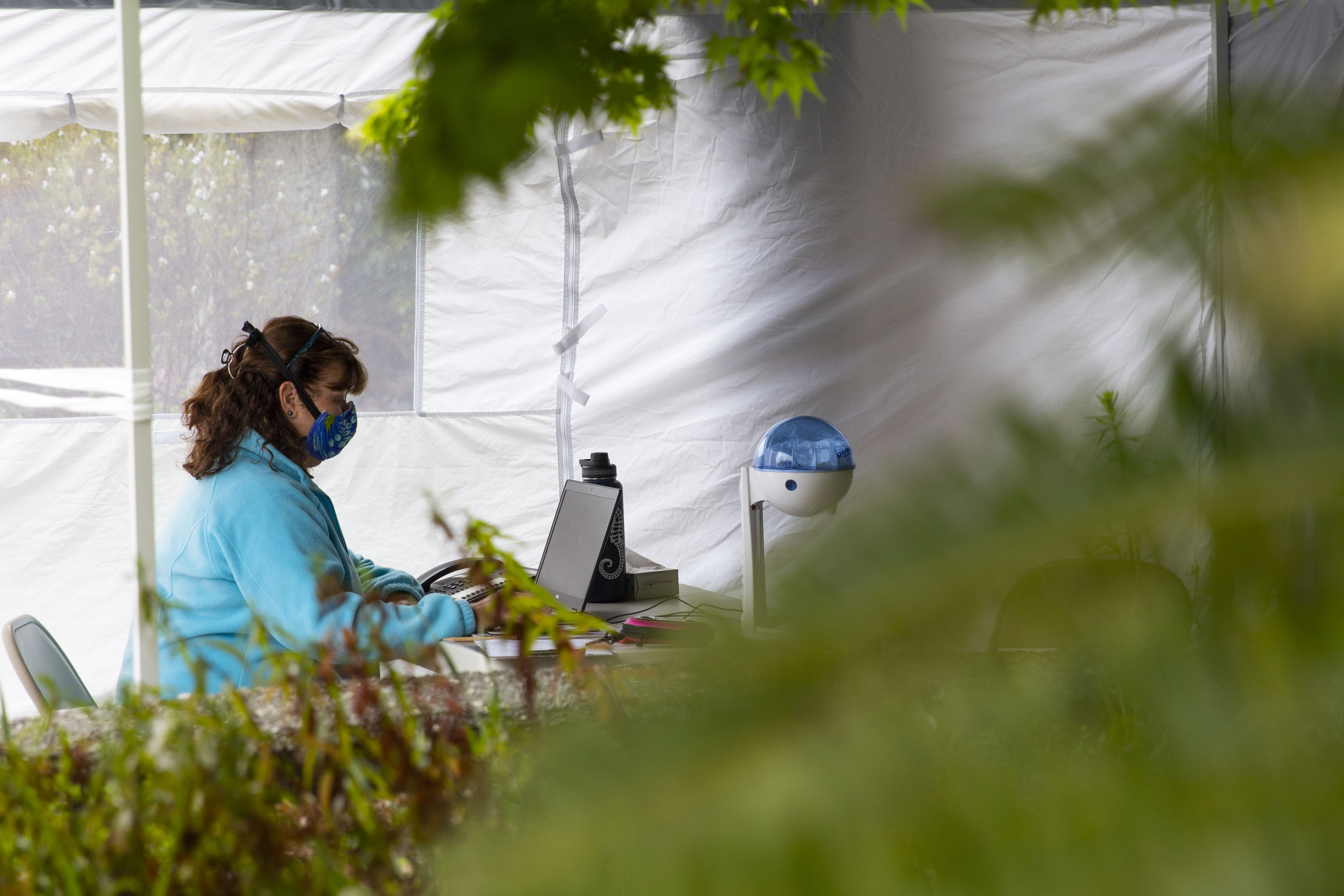
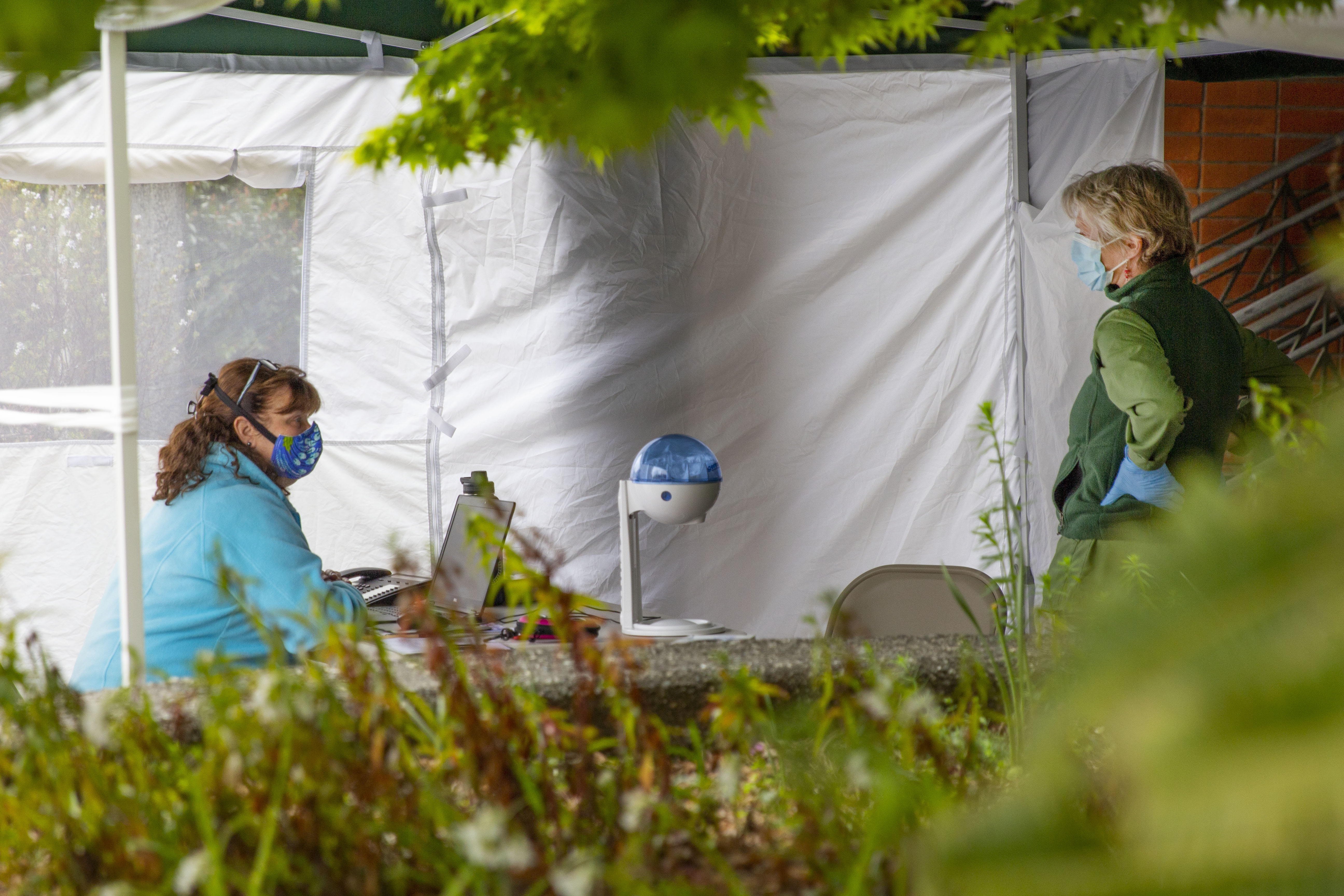
The Health Center set up white triage tents in front of the building to help students check in and get assessed. If a student tests positive for COVID-19, the Health Center will work with county health services to make sure the student gets the treatment they need.
During a pandemic, the disease itself isn’t the only medical problem facing students. The Center for Disease Control warns the stress of a pandemic can cause or worsen mental health problems, and recommends calling a health care provider if symptoms persist.
The Director of Counseling and Psychological Services and Associate Director of Student Health and Wellbeing Jennifer Sanford asked students to consider reaching out to Counseling and Psychological Services if they feel their mental health is deteriorating.
“Pay attention to how your thoughts and attitudes in any given moment are impacting your mood and overall wellbeing,” Sanford said. “Talk with others, connect. It is normal to have ebbs and flows with your mood and productivity levels but if you get “stuck” in a dark space for an uncomfortably long time, consider reaching out to get help such as from a counselor at CAPS.”
Sanford said that this can be an uncertain time, but it’s important to see social distancing as community care.
“The reality is that in our physical distancing, we are displaying compassion and care for our elderly and medically compromised,” Sanford said. “We are allowing our healthcare system to better manage the flow and care of patients, and we are caring for ourselves by lessening our own risk.”
California houses, shelters and aids homeless as COVID-19 cases continue to rise
With at least 151,278 homeless individuals in California, measures to keep them safe and healthy during the current shelter-in-place order are crucial.
Governor Gavin Newsom and his administration have sought ways to provide shelter and temporary homes for the homeless. On March 18, Newsom published a statement addressing what actions are to take place to ensure that everyone in the state maintains their health.
“People experiencing homelessness are among the most vulnerable to the spread of COVID-19,” Governor Newsom said. “California is deploying massive resources to get these vulnerable residents safely into shelter, removing regulatory barriers and securing trailers and hotels to provide immediate housing options for those most at risk. Helping these residents is critical to protecting public health, flattening the curve and slowing the spread of COVID-19.”
To help with the crisis, Newsom released $150 million to local governments to pursue leases with hotels and motels for temporary shelter. An additional $650 million is said to be released on April 1 from last year’s budget, to ensure that enough supplies are given to shelters and other medical resources. Shelters all over the state are struggling to gain more medical supplies and are losing volunteers.
Around 130 homeless individuals are staying in shelters around Arcata and Eureka.
“This is one of the biggest challenges our homeless system has ever seen,” Deputy Secretary for Homelessness for the Newsom administration Ali Sutton said. “And our population is one of the most at risk.”
Newsom also said he and his administration are working on creating leases lasting a few months with hotels and motels in order to house more homeless. According to an article from The Latest, Newsom announced 2,400 more hotel and motel rooms have been secured to house those on the streets, with 1,900 of those rooms coming from San Diego alone. There are now 4,000 rooms secured statewide. San Diego plans to continue sheltering the homeless by moving them to the city’s Golden Hall, the downtown Convention Center (home to Comic-Con), and other vacant rooms in hotels.
Humboldt County is also working to gain more shelters, rooms and supplies for those on the streets. Around 130 homeless individuals are staying in shelters around Arcata and Eureka. Some shelters have already taken place like Eureka Rescue Mission and Arcata House Partnership.
Each shelter in Humboldt County is expected to receive $300,000 in order to keep up with medical resources and other supplies, but shelters might still need more help to make sure they have everything they need. Eureka Rescue Mission, for example, had to close their thrift store, which was a main source of income, making sheltering the homeless more difficult as the pandemic continues.
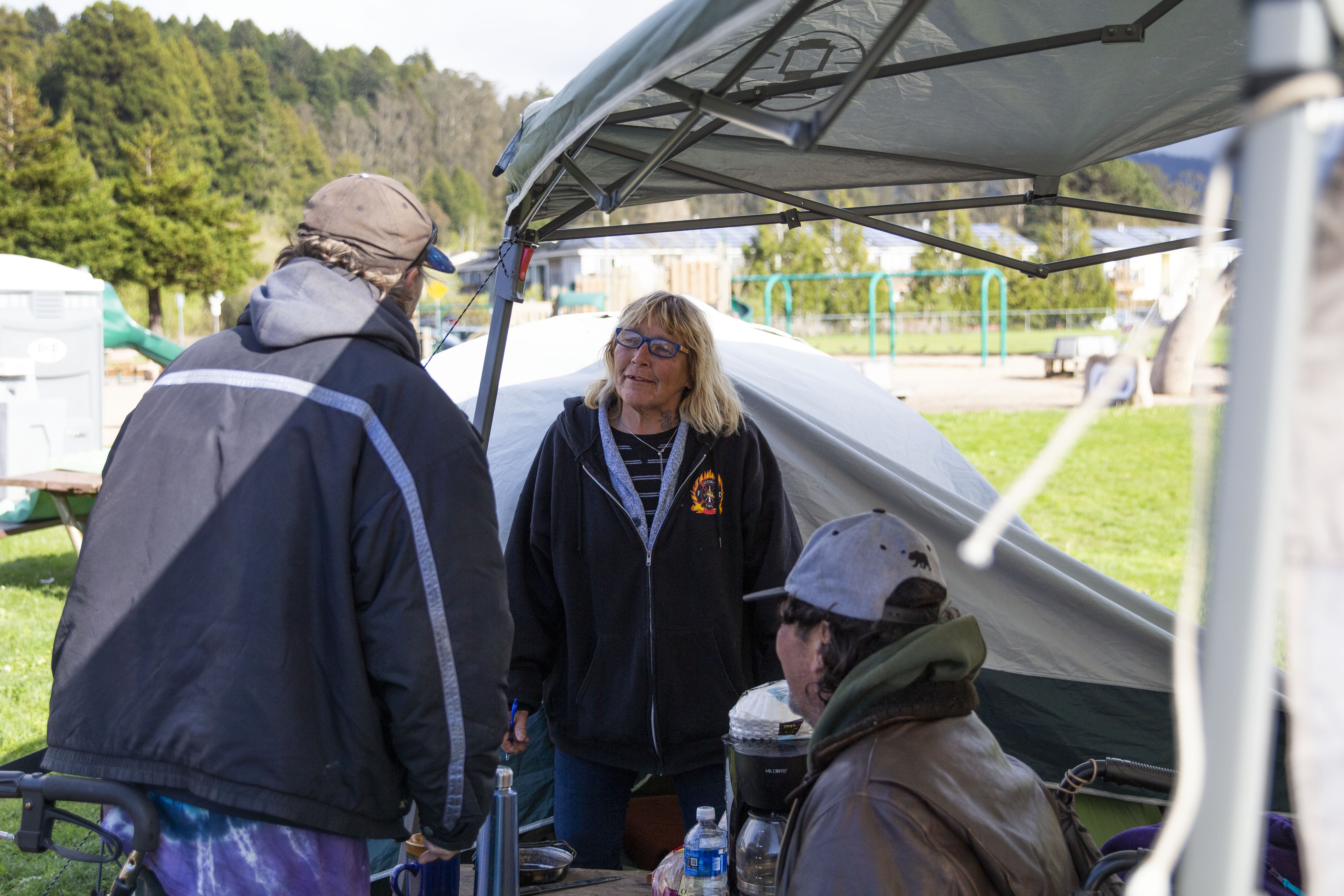
The city of Arcata, along with AHP, have been working together to find other ways to help. After calling and surveying businesses and other organizations, Arcata was able to secure two parking lots in town. The lot on G Street can maintain at least 19 people, while the Transit Center lot can hold up to 15 people. Tents inside the lot are recommended to be six feet apart. AHP is working with Affordable Housing Homeless to ensure portable showers, sinks and bathrooms are provided for the lots. The lots can also expect to soon see mobile health services to make sure individuals are healthy.
The Centers for Disease Control and Prevention set out guidelines for how to manage tent camps, recommending that local law enforcement should not force individuals out of the camps unless there is immediate housing available for them to go to.
Hotel and motel rooms, meanwhile, are still in the process of being secured for more individuals. Arcata is also giving out food at the Arcata Food Pantry on Wednesdays from 4 p.m. to 6 p.m at the Trinity Baptist Church.
Telehealth has a chance to make a name for itself in the US
Many physicians and patients aren’t likely to want to or be able to do face-to-face appointments for now and into the foreseeable future. In the midst of this, a potential solution lies in telehealth.
Telehealth—also known as telemedicine—involves the interaction of medical practitioners and patients through virtual means. Doctors and other physicians can attend to more serious matters in-person while remotely prescribing and treating other, less critical patients.
“I think people are gonna be more and more open to going to the doctor full-time via telehealth if not doing a follow-up visit. I think that we’ve made more progress in the last six months than we have in the last six years and I think it’s only gonna go this way forward.”
Jacob Horn
Jacob Horn is the managing director at Vivo HealthStaff in Dublin, California. A Humboldt State University graduate, Horn now contracts with various medical clinics and offers immediate telehealth solutions for more rural communities. He projected a lot of growth for telehealth.
“Before this COVID-19, it was very meager, to say the least—it was underutilized,” Horn said in a phone interview. “I think people are gonna be more and more open to going to the doctor full-time via telehealth if not doing a follow-up visit. I think that we’ve made more progress in the last six months than we have in the last six years and I think it’s only gonna go this way forward.”
Horn detailed what he sees to be the benefits of telehealth.
“I think it will address provider burnout,” he said. “I think it will increase patient satisfaction because now they have a wider access of care. I think it will also make the insurance companies happy because follow-up visits might not cost them as much. But also, the patients will see, hopefully, a savings by seeing their doctors at home for low-acuity visits.”
Kate Schiff, a physician assistant in the HSU Student Health Center, is trying to incorporate telehealth into her practice in a multitude of ways.
“For the most part, we are utilizing the phone for triage, evaluation of new problems, and management of existing problems and conditions,” Schiff wrote via email. “We are also managing most of our medication refill requests this way.”
Schiff also uses Zoom video calls to conduct business.
“We do have the capability to have Zoom visits which we are primarily using for mental health visits at this time,” she wrote. “Counseling and Psychological Services is using the phone and Zoom to provide individual and group therapy for students.”
Dr. Caroline Connor, a local physician, wasn’t sure how regular telehealth would become in the future.
“I think it’s gonna bring more accessibility to healthcare, especially for seniors, in Humboldt County but also to the HSU students.”
Jacob Horn
“The question is—how regular it’s going to be—is gonna be a very interesting story that has not yet been written,” Dr. Connor said. “If I was still in practice, how many of my patients would still be coming in? Now, most patients, if they had the choice, would rather see you in person, I think. But you wonder—busy millennials, if they want to get an appointment, will they just start making telemedicine appointments? And how is that gonna be incorporated into the daily life of a physician? I have no idea.”
Speaking of busy millennials, HSU students are no stranger to the lack of healthcare in Humboldt County. Horn said telehealth could help fight that shortage.
“I think it’s gonna bring more accessibility to healthcare, especially for seniors, in Humboldt County but also to the HSU students,” he said. “We have a massive shortage, we have long waitlists and a lot of people are leaving the county for certain specialty care. I think in the next year, that will switch up—you’ll be able to have more resources at your disposal in Humboldt County due to telehealth.”
Connor said nursing students in HSU’s revitalized program could take advantage of telehealth to connect with remote specialists.
“Let’s say somebody is going through nursing school and they have to learn a little about the intensive care unit—there might not be enough educators in Humboldt County about nursing intensive care units,” Connor said. “So, maybe they’ll have telemedicine education.”
I woke up on St. Patrick’s day—my birthday—to sobbing. My roommate was curled up on her bed, across the room, crying her eyes out. She cried for half an hour, if not more, because she’d just received the Humboldt State email canceling our graduation and asking students to leave campus if they were able. An achievement she has been working toward for seven years and one I have been busting my ass off for four years was all taken away in seconds.
Instead of celebrating and going to the bars—in true St. Paddy’s day fashion—I spent the day in quarantine having to tell my family to cancel their plane tickets and Airbnb reservations because I wasn’t going to be able to walk.
As one of the students left on campus, it’s strange, to say the least. When my roommate and I go for walks or head to get food from OhSNAP!, the university looks like a nightmarish scene from some dystopian novel. Usually, the only people you’ll find walking around campus are construction workers, nurses or other essential HSU staff. Every once in a while there’s the odd student or two, using what little resources are left available on campus.
In front of the health center, a tent is set up to greet all students where they sanitize their hands and grab a face mask before being allowed to enter the building—even students who just need to pick up medication from the pharmacy.
The only students allowed to be seen at the health center are those who show severe symptoms like a fever, sore throat or difficulty breathing. But for those of us who need regular prescriptions through their pharmacy, be it for anxiety medication, emergency inhalers, birth control pills or other medications they offer, we can still access the pharmacy during their posted hours.
In my opinion, this is one of the most concerning aspects of COVID-19. Students and community members cannot be tested through campus for the illness unless they are extremely sick, which leaves carriers with less severe symptoms to go untested.
Before campus was closed, my roommate and I came down with a cough and fatigue that wouldn’t seem to go away so we decided to visit the health center to see what was wrong, maybe a bit paranoid that we might have contracted the coronavirus somehow. But who isn’t a little paranoid during this pandemic?
We were seated outside and only admitted into the entrance of the health center one-by-one. A blood pressure monitor, thermometer and other equipment were set up in the hallway, with two nurses wearing masks and gloves. We were given masks, examined and told that, unfortunately, if we did not show severe symptoms, they were unable to test us.
In my opinion, this is one of the most concerning aspects of COVID-19. Students and community members cannot be tested through campus for the illness unless they are extremely sick, which leaves carriers with less severe symptoms to go untested.
My roommate and I were told we had post-viral infections and given medicine to treat that, but the truth is, we could very well have had the illness and not known because of arbitrary rules only allowing people very ill to access tests.
I’m still sad that graduation was canceled and I know that it’s a momentous accomplishment that I will never get back. But it’s more important to me that we keep people safe than having the chance to walk across the football field to accept a degree.
There are “asymptomatic” carriers of COVID-19, meaning there might be tons of people in the area infected with the coronavirus without any knowledge they are sick. There might be people who have mild symptoms who are unable to be tested and are unintentionally spreading illness because they think they aren’t that sick. We aren’t only putting the health of students at risk by not testing those concerned they might have the illness, we are endangering the nurses and doctors who are still working through the health center, members of the community that students might come into contact with while grocery shopping or performing essential tasks during quarantine.
But this isn’t only a concern in Arcata. The reason behind such arbitrary testing rules is because, as reported by The New Yorker, there is a critical shortage in medical equipment necessary to perform tests. This is why those who are extremely ill are being prioritized over people who don’t show as many symptoms. We simply do not have the resources to test everyone, so people infected with the illness are falling through the cracks, living their normal lives and potentially spreading the illness because they are unaware they even have it.
While those who are sick, but not sick enough, cannot get tests, celebrities who show no symptoms of COVID-19 are allowed to be tested, leaving medical professionals, sick patients and community members to wonder if their lives are less important than the rich.
I’m sitting in my dorm right now going a bit stir-crazy, still trying to find things to do to occupy my time while I practice social distancing in quarantine. Last week, my roommate and I painted canvases to pass the time. I started learning embroidery because I was that bored and today I went to my Zoom English class, then spent the day writing and watching movies with my roommate. We’ve downloaded TikTok just to pass the time.
I’m still sad that graduation was canceled and I know that it’s a momentous accomplishment that I will never get back. But it’s more important to me that we keep people safe than having the chance to walk across the football field to accept a degree.
Looking to the past to learn about the present pandemic
There’s a saying that goes something like, “In order to prevent future mistakes, we should look to the past for guidance.” While this current pandemic may be new to all of us, humans have gone through this before. Some of the more recent pandemics include the SARS virus, the H1N1 virus, Ebola and HIV.
The term pandemic is defined as something “occurring over a wide geographic area and affecting an exceptionally high proportion of the population.” Obviously, the current COVID-19 virus fits into this category. While some of the aforementioned pandemics did not enact a devastating, history-altering toll on Humboldt County, another pandemic did.
From 1918 to 1920, the Spanish flu swept across America, resulting in an estimated 675,000 deaths according to the U.S. Department of Health and Human Services. The first official report of the Spanish flu in California was reported Sept. 27, 1918, just two weeks after an outbreak on the East Coast. By November 1918, the total cases throughout the state hit about 115,000—overwhelming doctors and government officials from north to south.
One of three doctors that helped Spanish flu patients in the Ferndale area.
Although Humboldt County sits in an isolated area protected by the “Redwood Curtain,” the area was soon amassed in its own troubles combatting the illness. Humboldt County had a population of about 37,000 people with Eureka holding around 12,000. The Spanish flu resulted in around 200 deaths (although it is thought to be much higher) and thousands grew ill.
In 2012, Humboldt State alumnus and McKinleyville native Jeff Benedetti-Coomber wrote a detailed history of the impact the Spanish flu had on Humboldt County. For it, he was awarded the Charles R. Barnum History Award by HSU’s history department. For his research he scoured through old newspaper clippings for primary source documentation. He read academic analysis on how the Spanish flu affected the entire nation and he cited Matina Kilkenny, a researcher and local author for the Humboldt Historical Society who also wrote about the impacts the Spanish flu had on Humboldt County.
What prompted Benedetti-Coomber to focus on the Spanish flu was its lack of local research. As his peers decided to look into European history, he decided to focus his attention on the effects locally.
“I was walking through the graveyard in Arcata and noticed a family of graves, not necessarily related to the [Spanish] influenza but it got me thinking about what effects the flu may have had because it was around the same time,” he told me over the phone from his place in Los Angeles. “Once I started researching it I saw how it did affect the county and I was pretty amazed.”
Benedetti-Coomber’s senior thesis, titled “Death In the Redwoods: The Effects of the Spanish Influenza on Humboldt County,” spans 30 pages and breaks down how each town dealt with the outbreak. He highlights what preventative measures seem to have worked and where officials, the public and the media went wrong and what they got right.
“It’s just like today when you tell people to do something and they kind of resist. A lot of people had that with the Spanish influenza and it was a reason a lot of people died, because they didn’t take it seriously.”
Jeff Benedetti-Coomber
Some of the highlights from his research that still stand out to him are how Eureka initially closed all schools, which flooded the streets with children. They soon changed their minds and brought the kids back into the school to try to quarantine the children. Another nugget of research that sticks out in his mind has to do with masks and the public’s initial reluctance to wear them.
“It’s just like today,” Benedetti-Coomber said, “when you tell people to do something and they kind of resist. A lot of people had that with the Spanish influenza and it was a reason a lot of people died, because they didn’t take it seriously.”
When the Spanish flu hit Humboldt, the United States was in the middle of World War I and young men from Humboldt were signing up to join the war effort. There were war rallies and large gatherings of people throughout the towns in Humboldt in the fall of 1918 as the Spanish flu began to creep in.
“Although the Great War was still the main focus in Humboldt County, more and more citizens were beginning to take notice of the spreading pandemic,” Benedetti-Coomber wrote.
Some of the newspapers in Humboldt at that time seem to have downplayed the seriousness of the Spanish flu. Benedetti-Coomber points to an ad that was in the Humboldt Standard by Vicks VapoRub that was “disguised as an article… and it assured readers that the [Spanish flu] was ‘Nothing new simply the Old Grippe and la Grippe that was the epidemic in 1889-90.’”
Benedetti-Coomber wrote that it is believed the Spanish flu was brought to Humboldt County by locals traveling to other parts of the state to help care for sick family members and then returning before symptoms started to show. By mid-October 1918, reports of the Spanish flu were starting to pop up in the local newspapers.
“The Humboldt Times also reported that there were roughly 150 cases in Eureka by [Oct. 22] and hospitals were short staffed. Doctors were so busy they did not have the time to report new cases or treat the majority of their patients.”
Jeff Benedetti-Coomber
“The Humboldt Times and Humboldt Standard newspapers offered daily accounts of what was happening,” he said, adding that they also seemed to not care about the Spanish flu at first.
On Oct. 12, 1918, four cases were reported in the Humboldt Times and those infected were quarantined in a “‘safe house’” on 8th Street where they could be quarantined and cared for,” Benedetti-Coomber wrote.
At first, the mayor of Eureka downplayed the danger to the public, but two days later, five more people were infected. By Oct. 22, 1918 there would be more than 150 cases and one death.
“According to the Humboldt Times, Mrs. Garber Dahle was the first person in Humboldt County to die from the deadly virus,” Benedetti-Coomber wrote. “The Humboldt Times also reported that there were roughly 150 cases in Eureka by [Oct. 22] and hospitals were short staffed. Doctors were so busy they did not have the time to report new cases or treat the majority of their patients.”
Action to combat the Spanish flu across the county began to take root. Arcata was the first town to pass a requirement that all residents had to wear a mask while out in public, and by Nov. 7, 1918, the entire county was required to do so. Emergency hospitals were soon established across the county with some residents offering up their homes for the infected.
Arcata escaped the pandemic with only four deaths, but the same can’t be said for Eureka and especially for the logging camps in the remote areas of the county. The number of cases grew in the urban areas, and by Oct. 23, 1918, the logging camps were left to fend for themselves.
“Logging camps and small towns were informed by the newspapers and from local physicians that they would have to face the Spanish Influenza on their own as all of the county hospitals were completely full,” Benedetti-Coomber wrote while citing a Humboldt Times article titled “Influenza Increases Alarmingly in Two Days.”
Young women wearing masks in Humboldt County.
But one logging camp was able to escape the pandemic with no cases at all. In her article, “Missing Faces,” Matina Kilkenny reported how Carl Munther set up a quarantine system for his workers who decided to go into town. (Kilkenny’s article has a number of great photographs of life in Humboldt County during the Spanish flu.)
“Munther required every person returning to camp… to stay four days in a tent he’d pitched some distance from the workers’ cabin,” Kilkenny wrote, adding that the returning workers were also required to work and eat separately from their peers. “Thanks to their boss, very few men chose to leave the Barrel Company camp and not one case of influenza occurred there.”
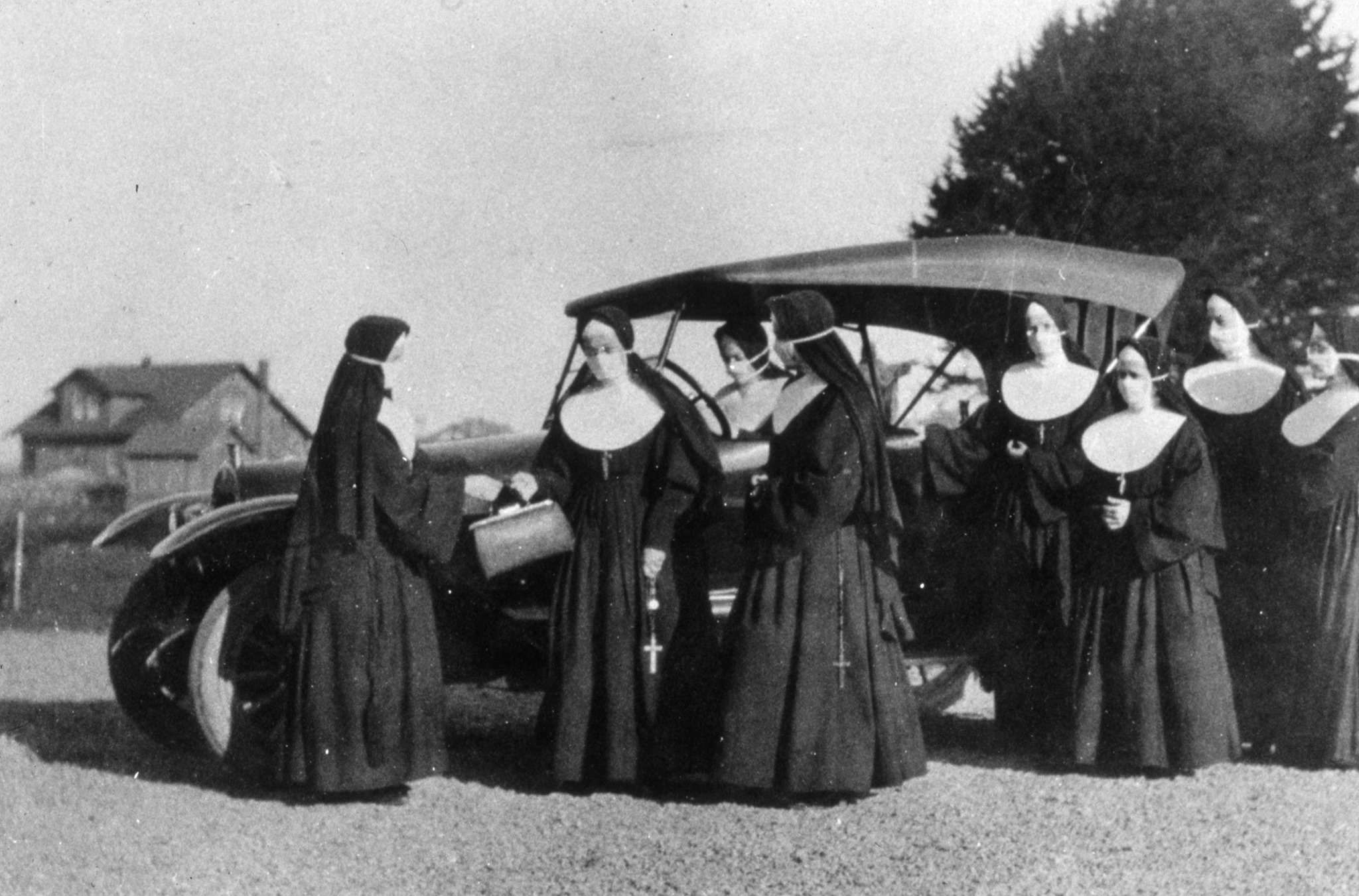
Sisters of St. Joseph wearing masks during the Spanish flu. The sisters helped many patients in Humboldt from 1918-1920.
Throughout her research, Kilkenny was able to find where a number of hospitals were set up across Humboldt. There was a Red Cross Hospital in Korbel, Arcata, Blue Lake and Eureka. Kilkenny also came across an interview between a member of the Sisters of St. Joseph of Orange in Eureka and a man named Brad Geagly. Kilkenny wrote the following:
“[Mother Bernard] sent [the Sisters] out in twos, in cars provided by the Red Cross. She armed each Sister with a kit containing camphor and sweet oil, castor oil, and mustard plasters. Into the homes… the sisters came, arriving at seven o’clock and leaving at the end of a 12-hour shift, to be replaced by two other Sisters. They would attend first to the adults….They would bathe the delirious victims completely, rubbing their chests deeply with the camphorated oil. Mustard plasters would be applied, and then the sisters would wrap the sick tightly in whatever woolen material they could find; then they would tend the children. Once they had been bathed and medicated, the sisters turned to washing linens or cleaning house. They fed their charges warmed milk and broth prepared from the food furnished by the Red Cross.”
Kilkenny noted that, generally, it was the poor who were admitted into the hospitals, while the more well-off were cared for in their homes. Because of this the actual tally for those infected and the deaths attributed to the Spanish flu is unknown. Kilkenny also points out how the Native American tribes were hit hard by the Spanish Flu as well.
“Of the [11] Native Americans whose deaths are on record at the County Courthouse, five were from Table Bluff, two from Hoopa, one from Miranda, one from Orleans, one from Requa, and one was a laborer at Korbel,” Kilkenny wrote. She also noted evidence that many Native Americans often refused treatment by White settlers around this time period.
Kilkenny was also able to find county death records from that time and noted that between Sept. 1, 1918 and April 1919, 175 Humboldt residents died with 91 of them between the ages of 20 and 40.
And so what can we learn from this history?
There is evidence that social distancing works by the example set by Carl Munther at his logging camp and how travel throughout the state can spread the virus. We can see how hospitals were eventually inundated with those infected with the Spanish flu and how staff were stretched thin. We can also see how it is important to get ahead of a pandemic and try to prepare as much as possible.
Humboldt County seems to be doing just that. They have recently distributed around 30,000 pieces of personal protective equipment to first responders and medical staff across the county. Humboldt State chipped in and prepared 1,250 COVID-19 test kits. Also, as I’m sure you are aware, we are in a “shelter in place” order that was enacted to help stop the spread of the virus and to give medical staff the ability to fight the virus without being overwhelmed.
Towns across Humboldt are also doing their part to help prevent an outbreak. Trinidad passed a moratorium on all short-term rentals and added some pretty forceful consequences to anyone who breaks it.
“Over the course of the meeting, council members added some teeth to the resolution with language saying that a single violation may result in the City revoking a proprietor’s short-term rental license for up to a year,” the Lost Coast Outpost’s Ryan Burns recently reported, adding that the county may consider a similar measure.
A stained glass piece by Humboldt artist Colleen Clifford.
As this thing progresses, we are all going to have to make some sacrifices, but we’ll get through it. Help out the elderly and the immunocompromised if you can. Help out each other by not going out or attending pretty much any gathering of any number of people.
Let’s all work together — but at least six apart — to help “flatten the curve.”
With labs, classrooms and most facilities on campus closed, what is being done with student tuition?
After Humboldt State University canceled in-person classes three weeks ago, students created a change.org petition calling for a reimbursement of tuition. With 2,000 students and supporters rallying behind it, perhaps HSU will bring their concerns into the conversation. Regardless of the administration’s acknowledgement, or lack thereof, HSU students are and will be experiencing a drop in the quality of their education.
As a journalism major, our classes haven’t been heavily impacted, but our access to the university spaces we all pay for is not as integral as for majors like art, dance, theatre and lab sciences.
Bryan Gambrel, a kinesiology major at HSU, said the switch to online labs has affected his motivation to learn the material. With an inability to use the lab spaces, the only way to show comprehension of the reading material is through quizzes.
“My difficult class has become now something that’s based off of reading rather than three hours of experimenting in a lab,” Gambrel said. “I’m not even sure how they can credit it for your GE.”
Lindsey Miller, an HSU freshman, signed the petition. She is a part of the environmental resources department and is taking a chemistry lab course this semester. With the switch to online classes, lessons consist of videos of the professor completing the experiment. She felt like this semester’s labs were a little more challenging than her first semester.
“Without having that hands-on experience in the lab, I don’t know when people are gonna learn it again.”
Raili Makela
“I was only kinda picking up on it before spring break,” Miller said.
Raili Makela is a fourth year marine biology major at HSU. This semester she had signed up for two labs and two lectures that have now been transitioned into online courses. Makela noticed the switch to online labs has made understanding the concepts more difficult.
“It’s because of that hands-on learning that I really start to understand the other material,” Makela said.
While she has learned a lot from her earlier labs and can work from that knowledge, she is worried about how those getting their first lab experience will be impacted.
“Without having that hands-on experience in the lab, I don’t know when people are gonna learn it again,” Makela said.
The situation we are in is reasonable. There isn’t another option that would keep our students, staff and faculty as safe as the current measures we have in place, but it is our money that’s no longer being spent to keep the doors open. Our tuition is not a goodwill donation. It is an exchange for the resources provided by the institution, and if those resources are not being provided, then we are getting shortchanged on our education.
A conversation with a College of the Redwoods student at Pelican Bay State Prison
We now have more than 1.5 million people worldwide infected with COVID-19 and over 90,000 deaths. The United States has surpassed every other country in cases with just over 450,000. People are being told to socially distance themselves with six feet of space between others and isolate inside. But what about the millions who are incarcerated that don’t have that option?
Kunlyna Tauch is housed at Pelican Bay State Prison and is a student in the College of the Redwoods Pelican Bay Scholars Program at Pelican Bay State Prison. He is slated to graduate with his associate degree for transfer this summer. Tauch is also a student and contributor in Paul Critz’s audio journalism class, which produces Pelican Bay’s podcast “Pelican Bay: UNLOCKED.” Tauch has been a spokesperson of sorts for the recent programming at Pelican Bay and an advocate of the changes being made inside the supermax prison.
Cases of the coronavirus have risen just over 1,300 throughout 100 federal prisons, thousands of jails and 1,700 state-run facilities nationwide. The Federal Bureau of Prisons says 138 inmates and 59 employees have tested positive and at least seven inmates have died, bringing the total to at least 32 COVID-19-related deaths inside the nation’s prisons and jails.
On March 31, California state prison officials announced they would be releasing 3,500 incarcerated individuals early to help free space in cramped prisons due to a possible coronavirus outbreak. Governor Gavin Newsom announced a halt in the transfer and intake of incarcerated individuals and youths into California’s 35 state prisons.
According to the California Department of Corrections and Rehabilitation website, there are, as of April 9, 12 incarcerated persons at California Prison, Los Angeles County, 19 incarcerated persons at California Institution for Men in Chino, one incarcerated person at North Kern State Prison in Delano and one incarcerated person at Substance Abuse Training Facility in Corcoran who have tested positive for COVID-19. Seventy-one CDCR or California Correctional Health Care Services employees have tested positive for COVID-19 in 21 incarcerated facilities, and hundreds have called in sick for work.
In the past five years there have been more programs in Pelican Bay than ever before and the culture inside is changing. After a lawsuit was awarded to the incarcerated individuals participating in the 2011 and 2013 hunger strikes and their advocates, one of the two solitary housing units was shut down and terms of isolation were limited to five years. This caused the prison to mitigate the effects of solitary confinement with programs like education and therapy. I spoke with Tauch on what it’s like in Pelican Bay State Prison as a college student amid the changes COVID-19 has brought to the infamous prison.
Kunlyna Tauch looking upward in June of 2019. Tauch is slated to earn his associate degree for transfer through College of the Redwoods’ Pelican Bay Scholars program this semester. | Photo by T. William Wallin
Tony Wallin: What’s it like in Pelican Bay State Prison right now and what are your concerns?
Kunlya Tauch: First of all, CDCR stopped all visitation and there are no programs. So we’re doing like old prison time, right. Which is us in prison going to yard and trying to occupy ourselves with whatever we have, which is not that much. My concern is that people on the streets are so socially distant from each other they become callous of each other and become more segregated and more disconnected. But from what I am seeing on TV is a lot of good, which is making me happy. The little acts of kindness and videos of people on the street coming out, I love it. There’s actually a little silver lining out of this.
TW: Yeah. There’s a lot of opportunity for positivity through all of this.
KT: It’s hard to pass on those opportunities because it’s so in-your-face.
TW: What’s it like in there with programs shut down? What are you doing to keep busy?
KT: College of the Redwoods has been the only program that is really working on shifting their whole business model to make it work for us. They are still running classes through correspondence and we’re getting hella work like every Friday. Our teachers are saying, ‘This is what we expect. Your next essay is due this date, send it in the mail,’ but because I have five classes I have enough work to sustain me, plus I have hella books I’ve got to get through. I am pretty occupied but it’s pretty restless in here, you know? People are constantly checking on their family, making sure they are well. They aren’t reading, they aren’t programming, they aren’t going anywhere, so their day consists of the phone and the yard. The yard schedule in itself [has changed], we aren’t seeing the regular people we used to see. They’re making it real limited, they’re not giving the day room. They literally made some new rule where only five cells in the day room at a time, which prohibits ourselves from doing what we want to do. It’s kinda stressful. It feels like we are taking a lot of steps back as far as prison goes.
TW: CDCR said they were going to send out more cleaning supplies to all prisons and make sure every prison has what they need. Are you seeing that?
KT: That’s never been a problem. The cleanliness of the place isn’t a problem. Right now I have a personal friend who had some symptoms, they didn’t even test him and they just took him to quarantine and is on two weeks lockdown with no mail, no phone, no nothing. Just to see if he has it or not.
TW: Where do they have the quarantine right now? What do they have blocked off?
KT: They have one on A yard and one on B yard and it’s one section of one building and they’re basically in the SHU [secure housing unit]. They’re like kicking off drugs by themselves. That’s their treatment and I guess the nurses are going over, but I don’t know. I assume nurses are checking on them professionally. There’s too much of a shortage of testing, but one thing about medical is they are a separate entity than CDCR, so CDCR can’t dictate what they do.
TW: Interesting. They operate differently? The warden doesn’t have a say on the medical side of things?
KT: No, medical community operates the medical community. All records are sealed and confidential. The prison has to accommodate that or else there’s a big lawsuit. I think CDCR concedes medical and there’s an agreement [between them]. According to the American government this is it and [CDCR] is only the California government, same with religion and same thing with tech. For some reason the tech, IT, here is their own entity and they suck. It takes like a month to transfer music onto our laptop [for the podcast]. It’s been stagnant. I’ve been feeling lethargic. I feel like they caged me back up and I’m really back in prison again. Pelican Bay was really doing good with their programs and everything running everyday and now it feels like this modified program where it feels like we’re just on lockdown. I feel like a lot of our minds aren’t being stimulated because a lot of us aren’t in those programs we are forced into or choose to be in.
TW: Right. It feels like pre-2014?
KT: Yes. Real shit. It feels like before and it feels like out of mind will cause more trouble. I am waiting for the ball to drop. I am waiting for something to happen. I’m almost mad that personally we’re on lockdown, but the whole fucking world is on lockdown and I can’t make more moves happen.
TW: Yeah, the irony in all of this is everything is locked down globally. How is your morale and the overall morale in the prison? Are there still positive interactions?
KT: I feel like we’re losing that. I feel like the tank is draining every single day. Guys that were motivated are losing that motivation. I see my college peers going like, ‘I don’t even feel like doing the work.’ But you don’t have that motivation no more because you’re not in front of the teacher anymore, you’re not engaging. You have questions but you can’t get an answer. I have a bleeding heart for my community in here, but it’s hard for me to help them because I have five courses and I have to study. We’re getting hella shit to read and it’s like, ‘I don’t have the time to worry about you guys because I have to get this out of the way first.’ Before all of this coronavirus I was approved to transfer to Lancaster [California State Prison, Los Angeles County]. That’s a level three. That was a big decision I had to make because that means I have to detach myself from this place I grew roots in. The process of this whole coronavirus—I’m back worrying about college and I can’t really be the catalyst to get my guys rallied up to do their work because I have to just worry about my work. So, I’ve been feeling like the morale is ‘Let’s see what happens while we are in this state of limbo,’ which is worse than staying stagnant because we’re losing the momentum, you know? We work on momentum on the programs that are on a level four yard. Without that momentum it’s like, ‘I’ll just watch Jerry Springer all day.”
TW: It’s gotta be rough going from so many programs for the first time at Pelican Bay and then, in an instant, they’re gone. For those of you that are students at College of the Redwoods, can you study together?
KT: Everything in person is shut down but we can do our own personal study groups, but we are divided. So, we only see our own dudes in our own yard and maybe another building and they’re across the fence so we can’t even have a study group out there. Also the COs [correctional officers] are really cracking down on what stuff we can bring out and they’re asking us, ‘Why were you bringing books and stuff out to the yard since programs are shut down?’ So we can’t even have that. So technically no, we can’t have a study group. We can have an impromptu one if there’s a cool CO that says it’s cool, we can sit out there.
Some unedited recommendations and brief reviews from some of our staff
Life and Arts Editor Grace Caswell
What I’m watching:
Just finished “Tiger King.” It’s the most ridiculous and unbelievable show I’ve seen yet with a surprising amount of depth.
What I’m reading:
“Noam Chomsky” by John Lyons.
What I’m playing:
None :/
What I’m listening to:
Lots of new music is being released but right now Toro y Moi and Jhene Aiko.
What else I’m doing:
Yoga and meditation has been a go to as well as cooking healthy foods. Anything to keep my mind at ease and health immunity high.
Managing Editor Chelsea Wood
What I’m watching:
I’ve been watching the final season of “Schitt’s Creek” which has been a bittersweet reflection of the last five seasons.
What I’m reading:
I’ve been reading more of a book I started last summer. It’s called “The Spaceship Next Door” and it about a teenager who grew up in a small town where a spacecraft crashed years ago but never left.
What I’m playing:
Minecraft. I trash talked this game as a teen, but it’s amazing and I love creating things on it. It’s extremely entertaining and relaxing.
What I’m listening to:
I’m listening to lots of downbeat songs—music that soothes the soul with catchy beats. Just stuff to satisfy this melancholy phase I’m swimming through.
What else I’m doing:
I picked up an old hobby, basket weaving. It’s a relaxing and simple task that yields a useful item. And no that’s not a BS excuse, basket weaving is the shit.
Editor-in-Chief James Wilde
What I’m watching:
I just finished season three of “Ozark.” It’s a crime drama with superb characters and writing that had an unexpected depiction of mental illness that probably hit a little too close to home and (full disclosure) made me tear up.
What I’m reading:
I just finished “Why Time Flies,” by Alan Burdick, a fun little foray into the way we think about time. Next up: “The Glass Hotel,” by Emily St. John Mandel.
What I’m playing:
Call of Duty: Warzone with my brother and some friends. I hate the premise of Call of Duty and, you know, shooting people, but as long as I ignore that it’s lots of fun.
What I’m listening to:
Kind of all over the place, which isn’t out of the ordinary. Indie stuff to hip hop to alt rock to electronic stuff to jazz to whatever else. Oh, and random Tiny Desk Concerts.
What else I’m doing:
Walking or going on runs to get out of the house. Drowning in schoolwork. Lying on the floor.
Opinion Editor Alexis Parra
What I’m watching:
“Gentrified”- A show that hits home for people of color. “Tiger King”- A cult war in the world of big cats.
What I’m reading:
“Z: The Beginning of Everything”- the untold story of Zelda Fitzgerald and beautifying her life.
What I’m playing:
None.
What I’m listening to:
My playlist on LJ- All of my favorites songs and energy that I carry into one playlist. “La Platica”- A bilingual podcast where the host is funny and talks about dumb shit and real shit.
What else I’m doing:
Painting. Make-up. Face masks. Talking to my family. Getting creative while also taking care of my skin and keeping in touch with my loved ones.
Sports Editor Thomas Lal
What I’m watching:
“Drive To Survive,” a super fun look into the 2019 F1 season with the dramatic thrills and spills to match!
What I’m reading:
“Permanent Record” by Edward Snowden. An intriguing and somewhat terrifying read.
What I’m playing:
The Witcher 3. This game has consumed my life. Loving the story and exploring the world.
What I’m listening to:
So much music, mostly ska, punk and jazz along with the “Every Little Thing” podcast.
What else I’m doing:
Being sad without any sports to watch.
Web Editor Seth Finnegan
What I’m watching:
“Community.” The always funny comedy about students at a community college.
What I’m reading:
None.
What I’m playing:
Dead Rising and MLB The Show 19. Filling the sports void with hitting baseballs and zombies with baseball bats.
What I’m listening to:
The “Adventure Zone” podcast. Three brothers and their dad play D&D together.
What else I’m doing:
Learning to play darts. It’s very frustrating but very fun!
Video Editor Benjamin Zawilski
What I’m watching:
The filmography of David Fincher and Hayao Miyazaki, and “The Good Place” on Netflix.
What I’m reading:
Rereading “Peter and the Starcatchers” by Dave Barry and Ridley Pearson, which was one of my favorite book series as a child
What I’m playing:
Overhearing my sister play Animal Crossing.
What I’m listening to:
The film scores of Mark Mancina, Alexandre Desplat, and James Newton Howard.
What else I’m doing:
Hiking at least five miles a day, sometimes up to seven, and have done a considerable amount of housecleaning.
Reporter Deion Alston
What I’m watching:
“Coffee & Kareem.” Cop dates kid’s mother and him and kid (Kareem) uncover a conspiracy of dirty cops.
What I’m reading:
Haven’t been reading books tbh, but a lot of news article pertinent to sports, COVID-19, crimes etc.
What I’m playing:
Fortnite and NBA 2K 20. Fortnite is a shooting game and 2K is professional basketball at your finger tips.
What I’m listening to:
For podcasts, I listen to “Up in Smoke” hosted by two former NBA players, Matt Barnes and Stephen Jackson. It’s very interesting—great interviews and guests as well. For music I’m listening to a lot of Lil Uzi, G Herbo, Tory Lanez. So basically rap, hip-hop and R&B.
What else I’m doing:
I’m cooking a lot more—takes time up in the day. Do my 250 push-ups everyday and step-ups for some cardio. And occasionally throw the football in the drive way.
Reporter Dakota Cox
What I’m watching:
“Seinfeld” & “Empire.” “Seinfeld” is a wonderful waste of time. “Empire” is a must-binge, cutthroat musical.
What I’m reading:
“Hurricanes” by Rick Ross is a fairly generic success story in terms of rapper autobiographies. “The Alchemist” is an extraordinary journey of the body, mind and soul.
What I’m playing:
Animal Crossing; don’t ask questions, go pick up the game!
What I’m listening to:
Going back and forth between oldies and hip-hop, gotta keep the serotonin up. Michael Jackson, Bob Marley and The Beatles are timeless, go listen! Gambino got the best album of 2020, @ me!
What else I’m doing:
Slipping out of sanity; would not recommend. Get a mask-on walk in when the sun shows it’s face; I like to play a little game called guess the gang members.
Reporter Sarah Blunt
What I’m watching:
I just finished “I am not okay with this.” It was a really good show with short episodes that have a lot going on in them. 10/10. I also just recently watched “Freedom Writers.” That one was really good and empowering, also took place in Long Beach (where I’m from) so that was relatable (kind of).
What I’m reading:
“Looking for Alaska.” I’ve already seen the show on Hulu but I realized I had the book. So far it’s really good and John Green (the author) writes really descriptively so I never feel bored when I’m reading it.
What I’m playing:
None.
What I’m listening to:
Tons of music. Nothing in particular just going through my music apps and looking for things I haven’t heard before, or even music from shows i’ve watched that I liked the soundtrack. That’s most of what I spend my free time doing.
What else I’m doing:
Lately I’ve been taking bike rides alone just to get fresh air and not be stuck in the same surroundings. I never ride bikes but lately it’s just been a really nice way to get out the house but also keep my social distance from others. 10/10
Reporter Ivan Ramirez
What I’m watching:
“Castlevania,” the show. “Mewtwo Strikes Back: EVOLUTION,” the movie.
Meditating, talking to people on Discord, Instagram.
Reporter Alberto Muro
What I’m watching:
I have started watching the Amazon Prime series “The Boys.” It has an interesting take on superheroes proving that not all of them are super. It’s a world where super heroes exist, now imagine their lack of empathy for saving people.
What I’m reading:
Currently reading through my textbooks so that I don’t fall behind on homework.
What I’m playing:
I am currently playing the remake of Resident Evil 3 which has updated graphics and character development.
What I’m listening to:
I am listening to the “Tinfoil Hat” podcasts since conspiracies take my mind on a wild ride
What else I’m doing:
I have transitioned from a student using critical thinking to an essential asset during a global pandemic thus turning me into a critical drinker.
There’s never been a better time to start reading books
You’re stuck inside. You’ve already watched all the best shows on Netflix. You’ve already done your homework. Instead of wasting away the hours on social media, do something good for yourself and your mental state. Read a book.
Maybe you’ve never read a book for fun, but don’t let that discourage you. Reading is for everyone. You don’t have to be an intellectual to enjoy books.
Listed below are a few my favorite books—hopefully you can find something to check out.
If: you want to read a dystopian satire set in a world eerily similar to our current pandemic-stricken one,
Where should you buy a book if you want to pick one up?
I always recommend supporting your local, independent bookstores, especially right now. Each book above is linked to Powell’s bookstore—probably the most famous independent bookstore, located in Portland, Oregon.
If you’re in Arcata, you can order books online from Northtown Books and pick it up on the curb as of March 25. You can also order a book from Tin Can Mailman, which is shipping orders of $10 or more for free to anywhere in Humboldt, and orders of $40 or more for free outside Humboldt.
While sports may be at a standstill, you can still relish and relive your favorite game moments
Every major sports league, from the UEFA Champions League to the NBA, has canceled or postponed their league for the remainder of the year to help slow the spread of the coronavirus. This is a very tough pill to swallow for sports fans around the world, but there are still opportunities for fans to relive past games and watch sports shows and documentaries while practicing social distancing.
One way these professional leagues are accommodating their fans is by offering free league passes to watch any past game you could think of. Leagues like the NBA, NFL, NHL and MLB are offering these free league passes until May 31.
If you have a cable provider like Spectrum or AT&T, channels like ESPN, FOX Sports, TUDN and CBS sports are showing daily replays of old football, basketball, baseball, hockey and soccer both at the professional and college levels.
In addition to all these replays, ESPN has pushed up the release of one of their most anticipated documentaries, “The Last Dance,” to April 19. The documentary is based on Michael Jordan and the 1990s Chicago Bulls, who won six NBA championships and are generally considered the greatest basketball dynasty of all time. The documentary is a 10-part series of never-before-seen behind-the-scenes.
From movies to shows, sports are being given to us at an all-time high rate through many mediums.
Netflix is also doing its part in getting more sports to us through shows and documentaries. Some of the more popular documentaries include three must-sees. First, “I Am Bolt,” detailing the athletic legacy of the greatest Olympic sprinter in history, Usain Bolt. Second, “Q-Ball,” a documentary about the basketball league in San Quentin prison. Third, “Notorious,” the documentary on UFC’s bad boy, Conor McGregor, and his rise to fame in the sport.
Sports TV shows can also help entertain you through social distancing. One of the more popular shows right now is “All-American.” The show is based around Spencer, one of the best high school football players in the country from Crenshaw in Los Angeles, who transfers to Beverly Hills High School. The TV drama is basically “90210” meets “Friday Night Lights.”
If you’re a wrestling fan, you’re in luck. Hulu has every episode of WWE’s “Raw” and “Smackdown” so you can relive the best fights. The same goes for the “Ultimate Fighter,” which produced some of the best UFC fighters such as TJ Dillashaw, Rashad Evans and Tony Ferguson.
YouTube can also help with sports withdrawals. It has any kind of highlight you can think of, from France’s run toward the 2018 World Cup, to Lebron James’ first championship in 2012 with the Heat, to highlights from Super Bowl LII when the Eagles upset Tom Brady and the Patriots. The list goes on. Any sporting memory you have is almost guaranteed to be on YouTube.
These are just a few options we have during social distancing to stay in touch with our inner fan. From movies to shows, sports are being given to us at an all-time high rate through many mediums. So stay home, stay healthy and drown your sorrows of social distancing with your favorite sports.
HSU, like all colleges, prepares for tough times and serious measures
Humboldt State University is preparing for an enrollment drop of around 20% for the fall and a budget cut of around $20 million by the 2022 fiscal year, according to a joint press release from HSU and College of the Redwoods.
Before the COVID-19 pandemic, HSU projected an enrollment drop for total students of around 14% for the fall and had proposed a budget cut of around $5.4 million by the 2022 fiscal year.
Given the uncertainty of the next year, HSU is planning for an even larger enrollment decline and budget cut. HSU currently projects new student enrollment to drop by 30%. The specifics of what the budget cuts will mean are still being worked out.
“Many options are being looked at, including combinations of a hiring chill, spending freeze, operational changes, incentives for retirements, travel reductions, and more,” the press release said.
In a Zoom interview, HSU Vice President of Enrollment Management Jason Meriwether said a worst case scenario projection might be only 500 new students and 500 transfer students admitted to HSU in the fall.
These numbers, to be clear, are projections. No one knows exactly how the next year will play out. Meriwether hoped HSU could keep enrollment and retention as high as possible.
“The sad part is, I don’t know,” Meriwether said. “There’s no benchmark. There’s nothing to project against. We could be doing all this and, you know, 1400 students show up—which would be wonderful.”
HSU is not alone. As noted in Meriwether’s Tuesday enrollment management report to the HSU Senate, colleges everywhere are facing enrollment drops amid the pandemic. The report cited articles from Forbes and the Associated Press along with some early data suggesting one out of every six college-bound students won’t attend college in the fall.
With education expected to shift to a more local focus, Meriwether pointed out that HSU already shifted to local recruitment in the last year with measures like the Humboldt First Scholarship.
Compared to an average of about 32 local students attending HSU per year in the last three years, HSU currently has 208 local students confirmed to attend HSU in the fall with the Humboldt First Scholarship.
“The good news is we’re not starting local recruitment today because there’s a problem,” Meriwether said. “That’s the best part of all this—is that we already have a really solid foundation that we built in the community over the last eight or nine months.”
The enrollment management report includes a graph of enrollment scenarios, with red lines for lower enrollment scenarios and a blue line for a growth scenario. Meriwether hoped for HSU to remain close to the blue line.
“Essentially, pray we get as close to the blue line as possible,” he said.
Meriwether pointed out that, since COVID-19 has hit everywhere, current students might not have much reason to transfer. If classes are still online in the fall at HSU, they will presumably be online everywhere.
“Let’s say a student says, ‘OK, well, you know, I want to transfer because I didn’t want this experience,’” he said. “OK. Well, the question will be, ‘What school are you going to transfer to?’ Because every school is stuck in this scenario right now.”
Nevertheless, the pandemic will likely temporarily derail HSU’s efforts to improve enrollment.
“Long term, you know, prior to COVID-19, prior to this hit, we had a plan of getting to an FTE of 7600 students [full-time students] in about four years,” he said. “So now, what if the COVID-19 environment says, well, gosh, it can make us take eight years to get there.”
Meriwether was optimistic that eventually, HSU would get through this.
“I believe that we will bounce back, and I believe we will bounce back strong if the hit is really bad,” he said. “This is a marathon. Enrollment is a marathon.”
Update 11:10 a.m.: a second email sent yesterday from College of Natural Resources Dean Dale Oliver and obtained by The Lumberjack makes similar points but does not give a specific number to the expected enrollment drop for fall beyond noting that a 15-20% drop was expected prior to the COVID-19 outbreak. We will update this story when we have confirmed the numbers below. The second email is pasted below.
Humboldt State University has issued a budget directive to take immediate action to prepare for the fall semester, including the freezing of open staff positions and the reduction of the number of academic departments, according to an email sent to faculty and staff of the College of Arts, Humanities and Social Sciences Tuesday morning.
The email, sent by Interim Dean of CAHSS Rosamel Benavides-Garb, projected a freshmen class for fall 2020 of around 500 students, down from around 1,400 students five years ago and down from around 1,000 students for fall 2019.
“The scale and impact of our current predicament is grave and as a result our budgetary practice has to be reconsidered and reformulated based on the simple equation of demand and resources,” the email said. “We have become, de facto, a much smaller institution, which compels us to undertake a comprehensive reset at HSU.”
The email listed six directives, including requests to freeze all vacant staff positions, reduce the number of academic departments and develop online programs for current and transfer students to complete their degrees.
The email promised to make the process consultative and sustainable.
“We remain committed to “the student first” approach,” the email said, “and are extremely aware of the critical importance, now more than ever, of issues of social justice, equity, and inclusion in all we do.”
The full email is copied below:
Dear CAHSS Colleagues,
On April 2, the deans of all three academic colleges received new administrative directives from Interim Provost Lisa Bond-Maupin regarding the coming academic year. The directives are a call to action, issued in response to the budget and recruitment/retention reality at HSU. The Interim Provost reiterated these directives yesterday, Monday, April 6 in her Provost/VPAA Report to the senate.
As we all know, our student enrollment has been declining for several years and the institutional budget has been negatively impacted. The administration’s efforts to address the problem must now be reframed in light of new and profound challenges the current COVID-19 pandemic poses for HSU, and the CSU system in general.
We are projecting a freshmen class of 500~ students across all three colleges. Five years ago, the freshmen class numbered 1,400+ students. The scale and impact of our current predicament is grave and as a result our budgetary practice has to be reconsidered and reformulated based on the simple equation of demand and resources. We have become, de facto, a much smaller institution, which compels us to undertake a comprehensive reset at HSU.
The Interim Provost has directed the three academic deans to reduce spending and grow retention/recruitment. Her directives require our college to implement the following action areas immediately:
1. Freeze all vacant staff positions: This is indefinite or until each college develops a plan to organize staff support within colleges and across colleges.
2. Reduce the number of academic administrative units (departments): This needs to be planned immediately and be in place for this next fiscal year so we are reorganized starting fall 2020.
3. Develop online degree completion opportunities for certain existing majors in the last two semesters of their programs.
4. Develop two-year degree online completion opportunities for transfer students of certain majors beginning fall 2020.
5. Develop a partnership with CEEGE related to workforce development, responding particularly to a post COVID-19 context.
6. Integrate the Center for Teaching and Learning (CTL) in the development and implementation of new teaching capacity.The Interim Provost has also indicated that she expects this process to be:
The Interim Provost has also indicated that she expects this process to be:
· Consultative with unit leadership.
· Consultative and collaborative across colleges.
· Sustainable by creating new retention and recruitment opportunities.
The deans of the three colleges have already begun discussing the directives. I have also initiated planning within CAHSS, in collaboration with the three associate dean fellows, and will continue to discuss budget with the chairs. We will move forward together, exploring multiple budget management opportunities to make our colleges strong and resilient in the face of present and future challenges. We can also regard these adjustments as unique opportunities to explore new and exciting programs to attract and serve our ever-diverse student population in a shifting and challenging workforce environment. We remain committed to “the student first” approach and are extremely aware of the critical importance, now more than ever, of issues of social justice, equity, and inclusion in all we do.
Sincerely and in solidarity,
Rosamel
Email from CNRS Dean Dale Oliver:
April 6, 2020
CNRS Faculty and Staff
Dear Colleagues,
Earlier today Interim Provost Lisa Bond-Maupin sent out her report to the HSU University Senate in preparation for Tuesday’s meeting. Included in her report was a call for collective action to prepare for fewer students and fewer resources in the next academic year. I’ve pasted the relevant section of the Provost’s report below my signature.
Current estimates indicate we could have 20% fewer students in Fall 2020 that we had in Fall 2019. This reduction is significant, and we must plan over the next weeks and months so that those students who start or continue with us in the fall experience high quality, engaged learning that will prepare them well for STEM professions and advanced study.
Three items from the Provost’s report that I want to highlight are personnel, administrative re-structuring, and online education.
Personnel: Although we will be finishing out the two faculty searches currently underway, and ensuring we have sufficient temporary faculty to deliver our curriculum, all other hiring is frozen for the moment, including those which are currently vacant and those which will soon be vacant due to expected retirements. Through improving business processes, realigning and reorganizing staff positions, and targeting professional development we will find a way to support our educational enterprise without hiring additional personnel. This work will be both necessary and challenging, and require collaboration with relevant unions and careful consideration of multiple factors.
Administrative restructuring: At the Dean’s level we were already planning a partial re-assignment for Associate Dean Rick Zechman to manage the marine lab while marine lab director Brian Tissot transitions from full-time director to FERP faculty. We are also being asked to reduce the number of administrative units in the college, meaning that some departments will be merged or reformed. This work will be done in close collaboration with the CNRS Council of Chairs and the other two academic deans.
Online Education: There are some programs in CNRS for which one of the following scenarios might make sense: provide an online degree-completion option for a group of students who have a year or less left to complete their degree; provide a degree-starter program for a group of first year (or transfer) students to get started with HSU from home during the fall 2020 semester, and then begin on campus in Spring 2021; provide more online sections of general education courses for undeclared students or majors from outside CNRS. For the moment, I recommend that faculty discuss within their departments whether one or more of these scenarios might be appropriate for their program.
For this week I am collaborating with the Provost’s office, with the other academic deans, and with a working group of CNRS Chairs to create possible models for administrative restructuring that can then be discussed among all of the CNRS chairs the following week. Relatively soon I will also set up a mechanism by which input can be given from across the college.
We face a significant challenge as a college and university over the next few months and years, but I am confident that we will find solutions that serve our students and the citizens of California well. My confidence rests solidly on the incredible talent, dedication, and creativity of our faculty and staff, whom I am proud to serve.
Best wishes, safety, and health to you and your families,
Dale R. Oliver, Dean
College of Natural Resources and Sciences
From Interim Provost Lisa Bond-Maupin’s report to HSU’s University Senate, April 6, 2020
Realignment of Spending with Reduced Revenue
In addition to supporting instructional continuity and Academic Master Planning, our division leadership is turning our attention to budget planning for next fiscal year and beyond. Prior to COVID-19, our enrollment picture for next academic year was apparently trending toward a 15-20% fall-to-fall (one year) student headcount decline. We were likely headed toward a reduction to the HSU budget for next fiscal year that was double that anticipated when the URPC created its annual budget recommendations to President Jackson. While the college-going enrollment impact of the pandemic is unknown for all in higher education across the nation, it is clear that the CSU and HSU will experience further decline in student enrollment. Given the enrollment challenges felt across the state, it is likely that impaction at our southern campuses will be lifted. It is highly likely that more students will choose for financial and other reasons, in the shorter term at least, to remain at home or closer to home to study.
While we await the release of up-to-date enrollment projections and budget information, Academic Affairs is implementing a few immediate strategies toward student retention and recruitment on the heels of the pandemic and toward further reducing our spending. As we do so, we are guided by the URPC principles and our own commitments to meeting the instructional needs of our students and protecting employment. In addition to continuing to adjust our academic offerings for Fall, immediate strategies also include:
• Working with each dean and director to reduce budget allocations for FY 21
• Freezing hiring in all open staff positions for now and planning to absorb staff attrition
• Working collaboratively with staff within and across colleges and budget units in Academic Affairs to reimagine and reorganize our staff support
• Working collaboratively with department chairs and faculty to condense the number of separate academic administrative units in the colleges
• Working within the Office of the Provost to realign and reorganize staffing
• Identifying academic programs ready to continue to offer upper division major courses online into next year and beyond to: a) help students in their final semesters to study from home and complete their degrees, and b) offer new transfer students an opportunity to complete their degrees online
• Identifying a COVID-era retention specialist in Academic Affairs who will support the continued offering of all existing retention efforts in a virtual format and will work in collaboration with ODEI to implement inclusive retention practices at a distance.
Each one of us will be implicated in and needed for this work. It is tough and unavoidable at this time. Each one of us has a very important role to play, now, more than ever in maintaining close connections with our students, helping them to problem-solve their educational needs and connect to resources and to stay connected to HSU. We need our students. And I think we are finding in their response to our transformed instruction – they need us. This powerful connection will ultimately move HSU through and beyond this tough moment in our collective history to the future we envision. Thank you.
HSU student athletes share grief at abrupt endings
Humboldt State University and the California Collegiate Athletic Association canceled sports for the spring semester back in March due to COVID-19. Student athletes have been left to deal with the aftermath.
Mariah Kalamaras is a graduating senior and a member of the HSU softball team. The softball season came to an end less than halfway through.
“This was my last season playing a sport that I truly love, and to have it cut short so abruptly is devastating,” Kalamaras said. “I felt like the world was ending.”
Following the NCAA’s decision to cancel winter and spring championships, the current sports landscape has been flat, with professional sports also forced to come to a halt. Fortunately for spring athletes, the NCAA will be granting eligibility relief, provided students remain enrolled while participating in athletics.
Sydney Oliver is a senior and captain of the HSU club cheer team. Although the basketball season had already wrapped, the cheer club would have continued to meet for practice through the end of the academic year.
“I have dreamt of walking across that graduation stage since I was a little kid.”
Sydney Oliver
“It’s kind of sad that I can’t see my teammates and help influence them to do better, as well for them to push me,” Oliver said. “Because we did a lot of working out together.”
Senior athletes were in for another disappointment when HSU also canceled the 2020 commencement ceremony. Kalamaras said she felt like she’s missing out on a rite of passage.
“I have dreamt of walking across that graduation stage since I was a little kid,” Kalamaras said. “To hear the song, wear the gown, to hear your name and to hold that diploma high into the air and say, ‘I did it! I made it.’ It makes all the sleepless nights, all the hard work on the long road trips, all the class time, and all the stress worth it.”
The shutdown has also had significant impacts on the daily lives of student athletes. Students have gone without school and sports—and work, for some—but they’re also encouraged to avoid gathering with friends to comply with social distancing.
“Now that it’s not an option to see them, it’s kinda like you wanna see them,” Oliver said. “As opposed to when it was an option and you could see them anytime, and you’re like, ‘Oh, I’ll see them tomorrow.’”
“Since all of the classes are online, it’s basically on us, the students.”
Gabrys Sadaunykas
Students are also now forced to finish their semesters online. As a kinesiology major, Oliver wasn’t stressing the change.
“I like my subject, so it’s not hard for me to still be passionate about it,” Oliver said.
Other students are less enthusiastic about the shift online. Gabrys Sadaunykas is an international student from Lithuania and a basketball player at HSU.
“Since all of the classes are online, it’s basically on us, the students,” Sadaunykas said.
Although Sadaunykas’ season was already finished, he’s stuck here until the end of May.
“Of course, it’s hard, because all of my friends are back with their families and I’m here by myself basically,” Sadaunykas said. “But it’s a nice place. I like Humboldt—it’s got a lot of nature.”
Not for the reasons athletes were expecting, COVID-19 has created an unforgettable 2020 spring season.
“It has taken so much away and although I understand that this global shutdown is necessary, it doesn’t make it hurt any less,” Kalamaras said. “I won’t be able to play my sport at this high level ever again. I won’t get to walk across a stage to show the world I got my diploma. I don’t get to go out and experience all [of] this great place I have had the privilege to call home the past two years.”
This website uses cookies to improve your experience. We'll assume you're ok with this, but you can opt-out if you wish. Cookie settingsACCEPT
Privacy & Cookies Policy
Privacy Overview
This website uses cookies to improve your experience while you navigate through the website. Out of these cookies, the cookies that are categorized as necessary are stored on your browser as they are essential for the working of basic functionalities of the website. We also use third-party cookies that help us analyze and understand how you use this website. These cookies will be stored in your browser only with your consent. You also have the option to opt-out of these cookies. But opting out of some of these cookies may have an effect on your browsing experience.
Necessary cookies are absolutely essential for the website to function properly. This category only includes cookies that ensures basic functionalities and security features of the website. These cookies do not store any personal information.
Any cookies that may not be particularly necessary for the website to function and is used specifically to collect user personal data via analytics, ads, other embedded contents are termed as non-necessary cookies. It is mandatory to procure user consent prior to running these cookies on your website.