The Lumberjack


Students Serving The Cal Poly Humboldt Campus and Community Since 1929

Category: COVID-19

  • Happy Thoughts and Hot Liquids Won’t Save Us

    Happy Thoughts and Hot Liquids Won’t Save Us

    A reminder of the few things we know that help prevent the spread of COVID-19

    I received a text from a housemate recently recommending we all drink hot liquids and think happy thoughts to get us through the COVID-19 pandemic. Sadly, happy thoughts and hot liquids won’t save us.

    In the midst of a pandemic, it makes sense that people will seek home remedies—they can give you actionable measures to take to try to inoculate yourself against COVID-19. But peddling bunk medicine like a medieval plague doctor only makes things worse.

    Random herbs, hot liquids and happy thoughts do nothing against COVID-19 (neither does weed). What can help stop the spread of COVID-19 are these much less sexy things you’ve probably already heard, adapted from the Centers for Disease Control and Prevention:

    • Social distancing. Hang out with yourself for a while. The crushing introspection may seem scary, but who knows, maybe you could learn something about yourself. The CDC gives suggestions on how to cope in this stressful time.
    • Frequent hygiene. Wash your hands with soap and water for at least 20 seconds. Sanitize doorknobs in your home. Sanitize your debit or credit card if you’re grocery shopping. You might even go so far as to ask to scan your own groceries at the checkout stand.
    • Don’t touch your face. According to disease expert Michael Osterholm, the virus behind COVID-19 chills out in the throat and lungs, and it likes to get in your body through your eyes, nose and mouth. Your hands provide an Uber ride for the virus straight into your system.
    • Also, cover your face. The CDC have shifted course and now recommend people cover their face with a cloth mask in public, especially in high-risk areas like grocery stores or pharmacies. If you have a sewing machine, here’s how to make your own mask. If you don’t have a sewing machine, the CDC provides a video on its site on how to make a mask out of any old cloth and a couple rubber bands.
    • Keep your body healthy. Eating a well-balanced diet, getting enough sleep and exercising all maintain a healthy immune system.
    • Find a new hobby. Don’t allow depression to set in from all the time spent indoors. Netflix is nice, but it’s not a hobby. Try reading, painting, knot-tying or bread-making. Blogger Matt Gilligan compiled a list of 19 inexpensive hobbies for self-quarantining.
    • Connect with your friends and family. Don’t gather with people in person. (No group hugs.) Instead, take advantage of your phone and call up your friends and family. For a more socially stimulating experience, use FaceTime or Zoom to have a video chat. Invite all your pals and make it a virtual party. If you happen to be posted up in a house with a friend, try to hang out with them rather than hiding away in your room.

    We have no cure for COVID-19. A vaccine, by all accounts, remains a long way off. If you end up with the coronavirus, we only have treatments that can relieve symptoms as suggested by the Mayo Clinic, like Tylenol, cough syrups, rest and fluid intake.

    I’m no stranger to distrusting authority or being suspicious of science—I grew up in Southern Humboldt and wasn’t vaccinated until I was a teenager. But for the sake of yourself and the rest of the world, put your suspicions aside and have a little faith in the only proven measures we know against COVID-19.

  • Online Learning Isn’t for Me

    Online Learning Isn’t for Me

    Online classes don’t feel like real learning and stifle student motivation

    Spring semester has turned into one of the worst semesters of my life, and online classes aren’t helping.

    Don’t get me wrong, online classes are nice to clear up some room in your schedule for work or other classes. They are still classes and shouldn’t be forgotten. I’ve taken at least one—but no more than two—online classes per semester.

    But online classes usually have a set schedule. Something like: discussion posts due Monday, comments due Wednesday and a quiz every Friday, plus a project like an essay or media presentation due at some point in the semester. Online classes that start at the beginning of the semester allow both the professor and students to be prepared for the whole semester.

    Online classes that start in the middle of the semester? Yeah, those aren’t for me. They’re also not what I paid for.

    None of us know what is going on right now and we’re all taking it day by day, but when your professors start to panic, you start to panic. Some professors know what they’re doing and let you know everything right away, while others don’t know what to do or don’t know how to use Zoom or record online lectures.

    It took me a minute to learn how to use Zoom, and although I appreciate the service and enjoy seeing my classmates’ faces, it’s awkward. It’s just a big FaceTime where your professor is trying to make the education worth your money. And just like in an everyday classroom, not everyone talks in the Zoom sessions. Zoom sessions always seem to glitch and are mostly only useful for group discussions, critiques and presentations.

    We’ve all lost motivation, and quite frankly, it doesn’t even feel as if we’re in school anymore.

    I learn better on paper and in person. I realize a lot of work is done on computers and submitted on Canvas, but being in a classroom and taking notes while a professor is lecturing is how something sticks in my head. There are too many distractions at home that I can’t get away from that just make it even harder to learn.

    Social media tells me that a lot of people feel the same way. Even though we get to be home and work at our own pace, most of the time being at home just makes us not want to work.

    We’ve all lost motivation, and quite frankly, it doesn’t even feel as if we’re in school anymore. Having to remind myself is getting pretty annoying.

    With all of this said, I know we should probably be grateful we’re still getting some kind of education. This is my last semester of college, and although I’m not a fan of how it’s ending, I’m grateful I won’t have to take any more online classes.

  • A Rundown of All The Emails HSU Has Sent Students

    A Rundown of All The Emails HSU Has Sent Students

    Since March 15 HSU has sent out over a dozen emails on their response to COVID-19

    Here is a summary of emails Humboldt State University has sent out since March 15.

    March 17: HSU informed students of its efforts to supply students with reliable laptops from the library as well as internet access for students without a reliable connection. HSU provided a list of locations where the university’s Eduroam Wi-Fi connection is strongest, as well as a list of services that are providing free Wi-Fi services during the COVID-19 crisis.

    March 19: HSU informed students of Humboldt County’s shelter in place order. HSU confirmed that essential employees would be asked to continue to work on campus, and all others would work by teleconferencing. In a second email on the same day, HSU confirmed rumors that commencement, originally planned for May 16, would be canceled. HSU asked in a now-closed Google form for creative alternatives to celebrate graduation.

    March 21: HSU released a more detailed email regarding its policies related to essential employees and payroll. Positions listed as essential included public safety, information technology, the library, University Center, health center, Oh SNAP!, residence life, dining, facilities management, research continuity, business services, payroll and mail distribution. HSU announced that its payroll department would be working on creating digital timesheets for employees working from home and that emergency pay would not be in effect as it was during the blackouts of the fall 2019 semester.

    March 23: HSU revealed its guidelines on returning to campus. HSU asked students returning to Humboldt from areas with community spread or international destinations to self isolate for at least 14 days before returning to campus. HSU also advised students who are feeling ill to contact the Student Health Center at (707) 826-3146 before visiting the center.

    March 24: HSU asked that students who live in on-campus housing and were on any of these three flights to contact Housing and Residence Life at (707) 826-3451:

    • March 16: United flight #5827 from Los Angeles Airport to Arcata
    • March 18: Delta flight #4124 from Seattle, Washington to Medford, Oregon
    • March 18: United flight #5555 from San Francisco Airport to Arcata

    March 26: HSU announced that the library would close on Friday Mar. 27 in response to the ongoing COVID-19 situation.

    March 27: HSU extended the deadline for changing the grading mode of classes to May 9. HSU said it’s looking into expanding the number of courses that can be switched to credit/no credit, as well as lifting restrictions on the number of courses that can be taken as credit/no credit.

    March 30: HSU announced the closure of Siemens Hall’s computer labs and the University Center to reduce transmission of COVID-19.

  • How to Sew Your Own Face Mask

    How to Sew Your Own Face Mask

    A step-by-step guide to making face masks

    Although N95 face masks are the only masks proven to protect against COVID-19, companies and people across the nation are rushing to their sewing machines to help produce protection for frontline healthcare workers.

    New York City Governor Andrew Cuomo asked companies to shift their operations to make face masks and ventilators at a press briefing March 20.

    “I’ll fund a new business if you can make these products,” Cuomo said. “I’m trying to make these products. If you are in this line of work, we need masks. If you are making clothing, figure out if you can make masks. I’ll fund it.”

    Deaconess, an Indiana healthcare provider, has also asked the public for help to produce masks. They released a video tutorial in which they show how to sew a surgical face mask that complies with the Centers for Disease Controls and Prevention guidelines.

    Hand-sewn masks compliant with CDC guidelines are permitted to be used by healthcare workers, but the masks are still considered a last resort by the CDC.

    Considering the dire circumstances, a homemade mask is better than no protection at all. Here’s how to hand sew a face mask (all photos by Rachel Marty):

    Materials needed:

    • Two pieces of 7-inch elastic
    • Two sheets of 9-inch by 6-inch tightly woven and recently-purchased cotton
    • A sewing machine
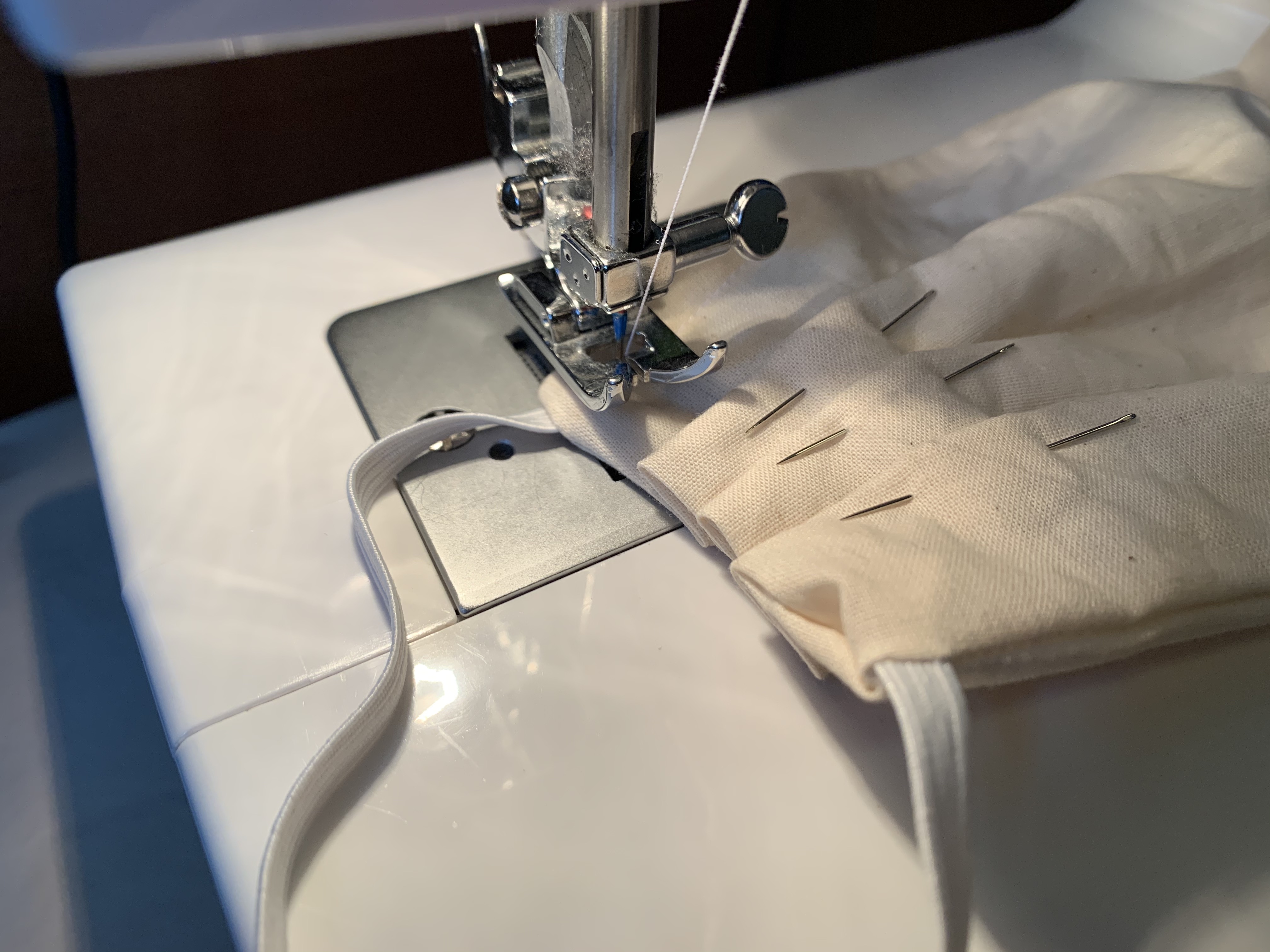
    1. Pin the two sheets of cotton fabric together and start sewing around the perimeter, leaving a quarter of an inch for the edge.
    2. At every corner, stop and place the end of the elastic in between the seam, making sure you place the straps horizontally on the 6-inch sides. The straps should go behind the ears, not vertically, or the straps will rest above your mouth and chin.
    3. Make sure to leave your perimeter undone. Leave an inch or two so you can turn it inside out.
    4. Turn inside out.
    5. Make three tucks on each side of the mask and pin them in place. Make sure they are going in the same direction on each side.
    6. Again, sew around the perimeter of the mask, leaving a quarter of an inch on the edge. Repeat twice to make sure it’s secure.
    7. And you’re done!
  • Photos Show Life Around Arcata in the Time of COVID-19

    Photos Show Life Around Arcata in the Time of COVID-19

    A photo series from the end of spring break

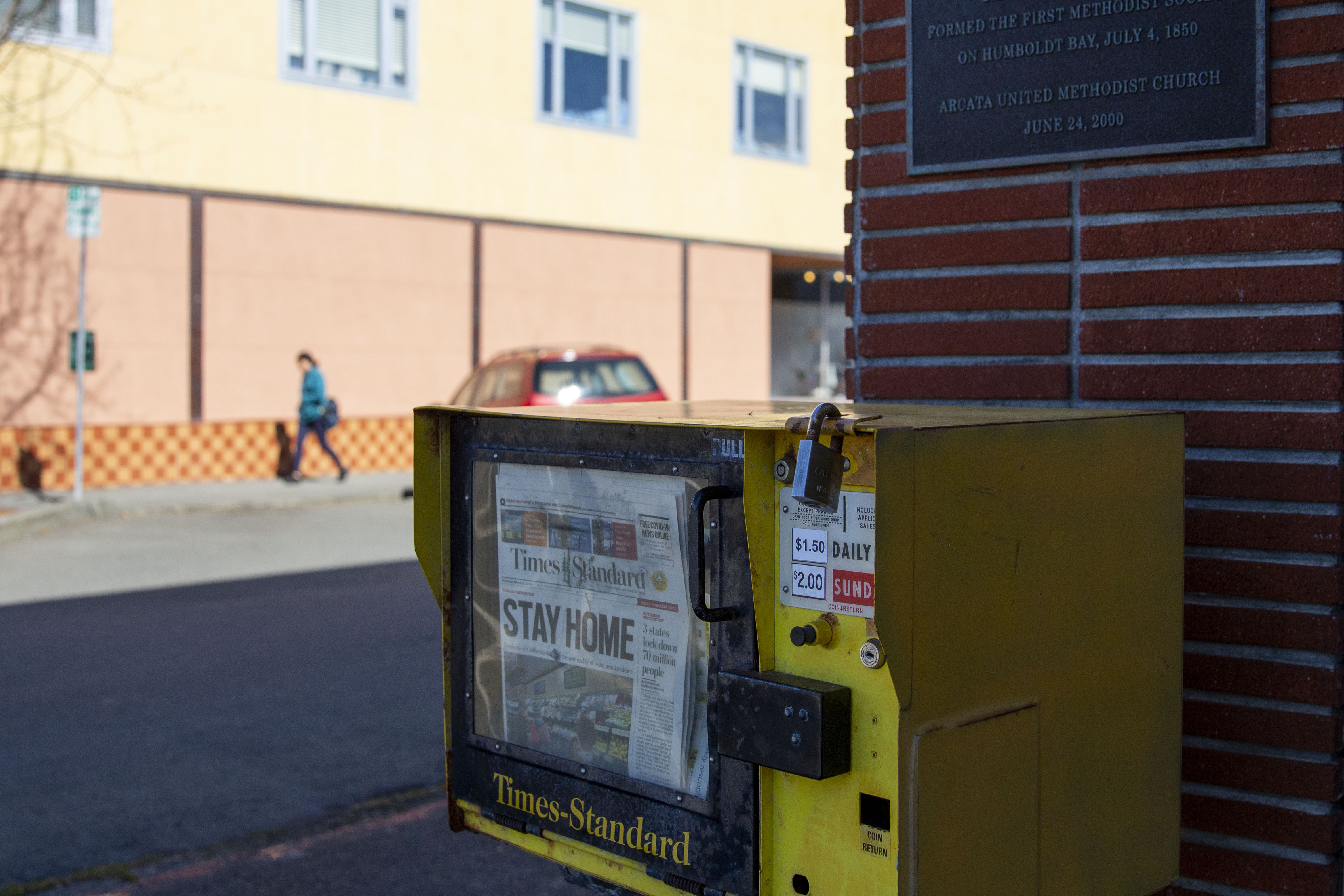
    Photographer and Sports Editor Thomas Lal captured these scenes from around Arcata on March 21 at the end of spring break at the beginning of Humboldt County’s shelter in place order.

    The storefronts on the Arcata Plaza look out on mostly empty streets.
    An employee sits at a computer while a sign advertises that the business is still open during the first week of a shelter in place order.
    The shelves in the Arcata Safeway.
    The Humboldt State Library.
    A lone person walks through the mostly empty parking lots at Humboldt State University.
    The Humboldt State Library.
    The Humboldt State Library.
    A single person works at the Humboldt State Library.
    A carton of eggs sits on the shelves at the Arcata Safeway.
    A lone person stands just off of the Arcata Plaza.
    An employee puts up a sign in the door of the Jitter Bean on the Arcata Plaza.

  • Associated Students Elections Delayed Due to COVID-19

    Associated Students Elections Delayed Due to COVID-19

    Associated Students Board of Directors redesigns spring elections

    The Associated Students Board of Directors motioned to push their voting period for their upcoming elections back two weeks and expand the period from three to five days, now April 27 through May 1.

    The March 27 AS Board meeting held through Zoom included the extension of the filing period for AS candidates to April 16 and several other amendments to the upcoming elections. Elections Commissioner Cassaundra Caudillo said postponing the election could be beneficial.

    “It allows for professional staff and the Elections Commission to promote elections a bit longer, so that way we raise our chances of having candidates for each position,” Caudillo said. “Because at the moment, we don’t have a candidate for every position. Not only that, but it also allows students themselves to have an additional two weeks to apply for candidacy.”

    “In general, postponing elections for two weeks allows everyone to have a fair and equitable chance at running.”

    Cassaundra Caudillo, AS Elections Commissioner and Public Relations Officer

    AS Executive Director Jenessa Lund said students expressed interest running in this election who haven’t had the opportunity to take the necessary steps to sign up before the office closed.

    “In general, postponing elections for two weeks allows everyone to have a fair and equitable chance at running—keeping in mind the situation we’re all in and how much added stress we’ve all been faced with as students and as human beings,” Caudillo said.

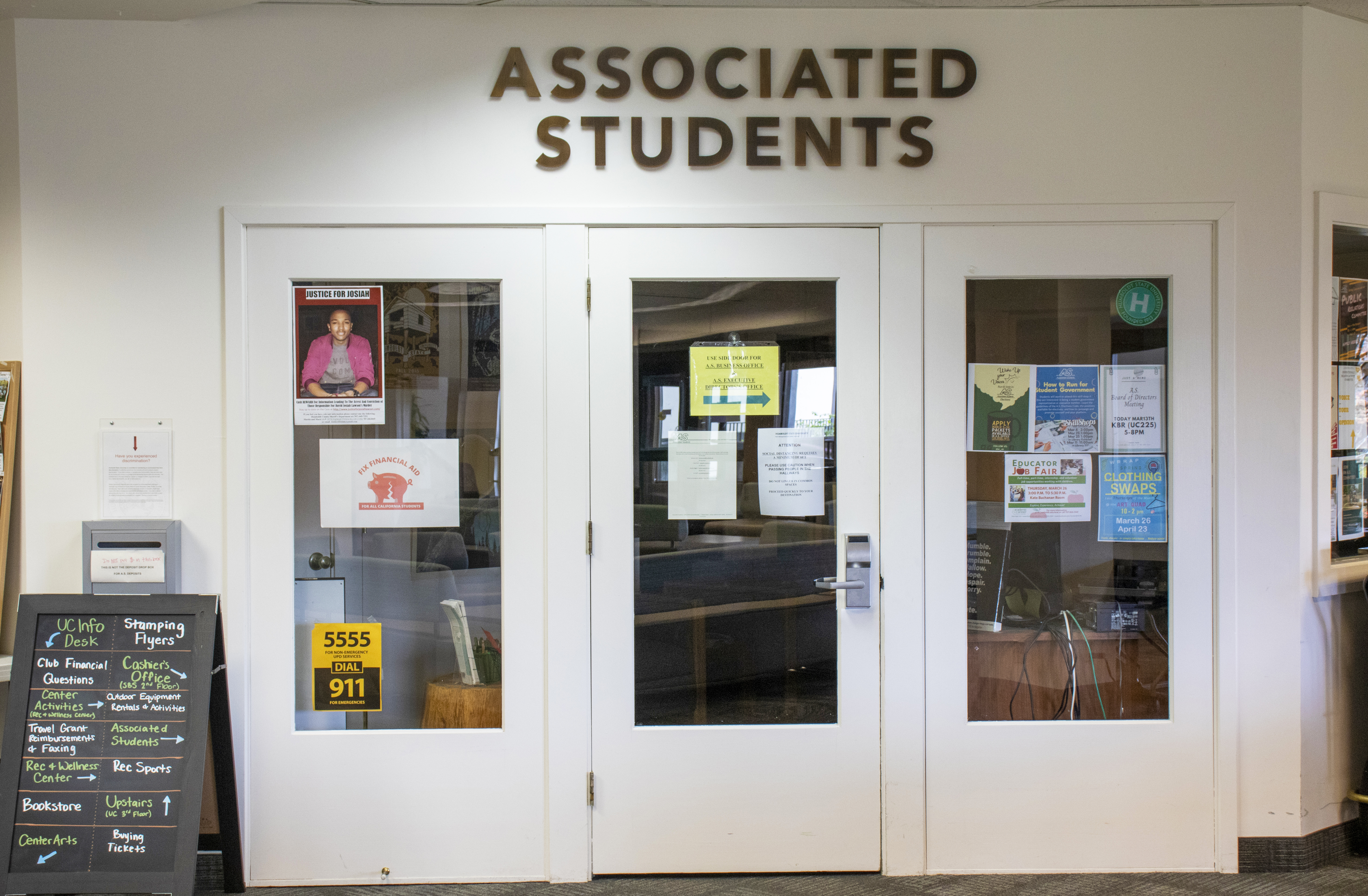
    While minimum residency and unit load qualifications are still in place, candidates are no longer required to appear in person to obtain their nomination materials, as the AS office has closed its doors. Students can find everything they need under the “Elections!” tab on the AS website.

    Students are also no longer required to supply petitions with 150 student signatures. The candidate quad talk will be replaced with one-minute videos of candidates reading their speeches that will be shared on AS social media. Requirements of wet signatures from candidates will be swapped with a Google forum, and the candidate orientations will now be held over Zoom on April 16 and 17.

    The AS Board is willing to review and consider reimbursing any campaign supplies that can no longer be distributed.

    AS President Lizbeth Cano-Sanchez described the value of joining AS in a separate interview with The Lumberjack.

    “Education is power, and in AS you can put your education to practice, because there’s a lot of things that correlate with it,” Cano-Sanchez said. “It helps you develop yourself, and at the same time, we’re students serving students and that’s really important.”

  • Here Are the Refunds Students Can Expect from HSU

    Here Are the Refunds Students Can Expect from HSU

    Refunds for various fees are available for Humboldt State students in the midst of the COVID-19 outbreak

    With closures and cancellations occurring left and right, many Humboldt State University students are wondering what kinds of refunds they can receive from the university. Here’s a list of them.

    Tuition and Fees:

    • Tuition and campus-based fees will continue on as normal for students that are taking courses from their professors to receive grades that factor into graduation.
    • If a student wants to withdraw from all spring semester courses, they must act by April 5 to be eligible for a prorated refund of tuition and fees.
    • Classes that students with financial aid are withdrawing from will be looked over and potentially adjusted based on the amount of days enrolled.

    Housing and Parking:

    • If students leave on-campus housing, they will get prorated refunds for both housing and dining fees once they check out.
    • Student parking permits will be automatically refunded back to student accounts to the tune of $78.75, 25% of the initial permit cost.

    Commencement:

    • Automatic refunds will be doled out to students graduating in spring or summer 2020. For more information, email HSU-cash@humboldt.edu
    • For unopened and unused regalia, refunds will be issued using the same method the order was placed with.
    • For the Graduation Writing Proficiency Exams on March 28 at 9 and 11 a.m. and April 11 at 9 and 11 a.m., all charges will be returned to the students’ accounts and refunds will follow if the student doesn’t have outstanding charges. Keep in mind that the GWPE is still required to graduate, and will be held online for the time being.
  • Students Bused Back to HSU Met with Mixed Messages

    Students Bused Back to HSU Met with Mixed Messages

    Locals react to HSU students bused back to Humboldt from coronavirus-afflicted areas

    A bus chartered by the Humboldt State Homeward Bound program picked up 31 HSU students March 21 from San Francisco and Los Angeles—two cities where the coronavirus has become more and more prominent—and brought the students back to Humboldt.

    Lost Coast Outpost posted an article about the bus March 24. The Facebook post for the story has 433 comments as of March 29, many of which are critical of HSU.

    “This is beyond irresponsible of HSU,” one comment reads.

    “And one more reason we feel GREAT about not sending our kids to HSU,” reads another.

    Sarah Ray, an environmental studies professor, defended the students.

    “Quite a few of our students live here and have moved here and have their lives here and they were visiting family,” Ray said. “So, just like we would expect and hope that kids and students who are from Arcata and the area—we would fully respect and appreciate that they would want to come home and be home with their families once their classes got cancelled in this really frightening moment—it’s reasonable that students would want to go where they’re most comfortable and feel at home.”

    She went on:

    “There’s also a lot of research out there about how many students across the nation going through this exact problem are not safe at home, and this might be a safer place for them,” Ray said.

    “I feel like it’s not a simple solution to just say, ‘Go back there,’ because many of these students live here.”

    Xochitl Andrade, HSU English and biology major

    Grant Scott-Goforth, communications specialist for HSU, explained the precautions implemented on the buses returning to HSU.

    “The buses were partially full so that people could have social distancing on the buses while they rode,” Scott-Goforth said. “And then, obviously when they return, we’re asking everyone to shelter-in-place, to quarantine if you’ve been exposed or been to an area with exposure, and to contact the Student Health Center or hospitals with concerns about health.”

    As much as HSU wished it could’ve been in command over which students came and which students left Humboldt, there was no way to do that. Of course, as Scott-Goforth asserted, the coronavirus situation is nothing to sneeze at.

    “I think it’s terribly unfortunate and I’m very sad for them and I feel very protective of students because it’s what I do.”

    Sarah Ray, HSU environmental studies professor

    Xochitl Andrade, an HSU senior majoring in English and biology, said the situation is complicated.

    “I feel like it’s not a simple solution to just say, ‘Go back there,’ because many of these students live here,” Andrade said. “They may have no where else to go if they were told to go back. We don’t know if they were just visiting friends or family. And for those who don’t have any family to go back to, what are they supposed to do?”

    While Andrade agrees that the students should be quarantined, she said she thought HSU knows what it’s doing.

    Ray hoped the harsh words toward HSU students from the Lost Coast Outpost article weren’t representative of the Arcata community.

    “I think it’s terribly unfortunate and I’m very sad for them and I feel very protective of students because it’s what I do,” Ray said. “I would like to think that it’s only an extreme, fringed, vocal, internet types of social media people who are saying those kinds of things. The vast majority of the university, especially the community and many people in the community—that’s not the kind of sentiment I see.”

  • Learning from These Sudden Senior Year Goodbyes

    Learning from These Sudden Senior Year Goodbyes

    I wasn’t prepared for the school year to end so abruptly

    I’m no good at saying goodbye. Give me no time to prepare, and I think I’m even worse. Amidst the COVID-19 pandemic and the sudden end of the rest of my in-person senior year in college, I’ve had to say goodbye to several friends and colleagues with little warning.

    This abrupt ending has thrown me off. I hate to whine, but I wasn’t ready to part ways with so many people. It takes time to reflect on others and consider what I want to say when I might never see them again.

    No goodbye is easy, and no goodbye ever feels adequate. But it takes a while for the reality of a goodbye to settle in. The natural buildup of expectation over the course of the last semester of college, which Dan Chiasson wrote about for The New Yorker, helps to ease the transition between college life and post-college life.

    Of course, not getting to say a proper goodbye is small potatoes compared to more serious issues people are facing right now, like losing jobs, homes or loved ones. Those things are awful, but they don’t make the little things suck any less.

    Of course, not getting to say a proper goodbye is small potatoes compared to more serious issues people are facing right now, like losing jobs, homes or loved ones. Those things are awful, but they don’t make the little things suck any less.

    In day-to-day life, it’s easy to let the specifics of what you appreciate about someone go unnoticed. Saying goodbye, for me, requires a bit of excavation into those little things. With some time, I can at least have a couple words to say. Even if what I say is inadequate, something is better than nothing. A couple words can signal a greater appreciation I might be trying to articulate.

    In my most recent goodbyes, I’ve tried to give thanks to the person for whatever they’ve done that has made them worth a goodbye in the first place. I try to let them know what I think of them. Then I probably wish them luck. And finally, I might just say “bye,” which is too small a word to encompass all the emotion in a parting of ways.

    There’s nothing wrong with any of that. It just hasn’t felt adequate. And it hasn’t helped that we’re supposed to be avoiding getting too close to anyone. Hugs or anything like them are off the table.

    Maybe all I’m really getting at is that saying goodbye is one hell of a difficult task, and doing so right now almost feels cruel. Being a true digital age child, I browsed the internet for tips on saying goodbye and got some vague ideas and a suggestion to give the person a memento—which, again, doesn’t seem smart right now.

    But no matter how much you prepare, goodbyes are always going to hurt.

    If you’ve made it this far, congratulations, you get my cliché takeways: if you have the chance, make your goodbyes worthwhile. Take time. And if you don’t have to say goodbye to someone yet, treasure them, and let them know how much you appreciate them as a friend or colleague or whatever else.

    You never know when the world might be struck by a pandemic and you have to say goodbye without warning. Be grateful and appreciative and let those that matter know it. Oh, and wash your hands and stay the hell home as much as possible.

  • Myths and Truths of Surgical Face Masks

    Myths and Truths of Surgical Face Masks

    Mirage of safety causes mask supply to plummet and xenophobia to reemerge

    The emergence of everyday people using surgical masks amidst the COVID-19 pandemic has caused mass misinformation and the perpetuation of xenophobic ideas.

    Myth: Surgical masks make you immune to COVID-19

    Typically found on hospital workers and sick personnel as a safety barrier, surgical masks are almost regarded as invincibility devices, protecting the body from outside pollutants and threats. The implied purpose of surgical masks is to protect patients from the secretions of a doctor’s mouth or nose during surgical procedures or to protect doctors and nurses from infected patients. Either way, a basic surgical mask prevents the exchange of bodily fluids, not air particles. Surgical masks are often mistaken as invincible shields against all viruses and bacteria.

    Surgical masks show no evidence of prohibiting the inhalation or contraction of the virus that causes COVID-19. The COVID-19 virus particles are too minuscule to be stopped by a surgical mask barrier. According to the Centers for Disease Control and Prevention, “most facemasks do not effectively filter small particles from the air and do not prevent leakage around the edge of the mask when the user inhales.” In no way do surgical masks prevent or obstruct contaminated air.

    While surgical face masks are virtually pointless against COVID-19, N95 filtering facepiece respirators are different. These masks are personally fitted to the face and “filter out at least 95% of very small (0.3 micron) particles, capable of filtering out bacteria and virus particles,” according to the CDC. These masks are typically worn by hospital and treatment personnel that come in direct contact with infected patients. N95 masks prevent the inhalation of micro-particles.

    Truth: Surgical and N95 masks are running low

    Due to the personal fitting of each N95 mask, they begin to degrade overtime depending on their usage, storage and environment. The assigned expiration date and high demand due to the current pandemic has resulted in an unexpected shortage in supply. Doctors are now reusing their masks, but they risk contamination due to degrading components affecting the protection and performance of the mask. Government administrations are requesting N95 donations as well as demanding some occupations to give up their assigned mask for medical workers.

    While N95 masks are needed most, surgical masks are running low as well. Infected patients wearing masks benefit surrounding parties by limiting exposure of emitted particles into the air. The pandemic panic has misinformed the public to go buy surgical masks when patients and medical workers need them most.

    Myth: DIY masks provide reliable protection

    YouTube and social media platforms are advertising do-it-yourself face mask tutorials in response to the shortage in surgical mask supply. The misinformation has continued as people attempt to protect themselves with faulty protection materials. Bras and bonnets to sandals and plain cloths are being cut and trimmed to replicate surgical face masks. But, as previously mentioned, surgical face masks provide no protection against COVID-19 virus particles. Any alteration of store-bought or recycled material will have the same, if not less, protection against COVID-19 than a surgical mask.

    Truth: Mask usage has reignited xenophobic ideas

    Surgical masks provide zero protection from contracting COVID-19, but they have effectively reignited xenophobia. It’s completely normal for the mind to want to assign a face to an infected COVID-19 individual or picture what a threat would look like out of caution. Assuming someone wearing a face mask has the virus and extending that assumption past the mask, to their race or ethnicity, is disgusting, racist profiling. In a time of crisis, people should be exercising neighborly behavior and picking one another up, not perpetuating racist, profile-based assumptions on others in an attempt to accuse others of the chaos. It’s unproductive and invasive.

  • 5 Dystopian Films to Watch Now That You Now Live in One

    5 Dystopian Films to Watch Now That You Now Live in One

    Lock yourself indoors and pretend these films are strictly fiction

    With a deplorable excuse of a federal administration lying through their teeth about having the situation under control, it’s starting to feel like the world is descending into the plot of an apocalyptic or dystopian film. Fortunately, there are quite a few films to compare with the current state of the world.

    1. Equilibrium (2002)

    “Equilibrium” is a brilliant 2002 futuristic thriller starring Christian Bale in a fascist police state mandates daily medication that eliminates all feelings. “Sense offenders” that refuse their medication are rounded up and disposed of in ovens, and books and other forms of media that might inspire emotion are burned. Subtlety is not this film’s forte, but that’s to be expected when it also boasts brilliantly-staged action sequences where Christian Bale uses his guns as all-purpose weapons. It’s “The Giver” meets “1984” meets “The Matrix.” The fighting style is referred to as “gun-kata,” and its efficiency and balance reflects the tightness of the film’s storytelling.

    2. Snowpiercer (2013)

    Did you like Bong Joon-ho’s Oscar-winning “Parasite” from 2019? If so, you might enjoy one of his previous masterpieces. In “Snowpiercer,” Earth is in the midst of a new ice age, leaving humanity to survive within the confines of a train that runs on a perpetual track. The train spins its wheels around the icy remains of the former metropolitan homes of the billionaires responsible for the crisis in the first place. An extreme contrast in quality of life lingers on the train, which continues to spin its wheels until a rebellion begins. “Snowpiercer” is another brilliant deconstruction of the class divide and inequity that reminds us that we all live in a capitalist country.

    3. Looper (2012)

    From Rian Johnson, director of the best Star Wars film, comes an exciting thriller in which time travel is possible, but outlawed. Gangsters send victims back in time to be killed by a hit man until he becomes the target. Unlike most time travel films, this one accepts and plays around with many of the potential paradoxes of time travel and stages scenes only possible in films with time travel. It takes great advantage of the strengths of its cast, as all Rian Johnson films do, and is a whole lot of fun, as all Rian Johnson films are. All of them.

    4. Kingsman: The Golden Circle (2017)

    OK, this one takes place at the time that it was made, and isn’t particularly dystopian, but to be fair, it’s about a group of rich vigilantes, who already killed the entire Obama administration in the previous “Kingsman” film, “The Secret Service.” Thus, they are indirectly responsible for the Trump presidency, which is a major part of the plot of this film. Now investigating a foreign cartel with a monopoly on drug trade, they discover the cartel’s plan to poison cannabis users and hold the planet hostage so that drugs will be legalized. In the real world, this would just mean that Big Pharma takes a huge share of the market and kills their business. But in the Kingsman world, it means a healthy helping of flashy action helped out by an Elton John appearance.

    5. Planet of the Apes (1968)

    Before the Andy Serkis trilogy and the underwhelming Tim Burton effort was the original 1968 classic, “Planet of the Apes.” It watches more as an extended “Twilight Zone” episode than a futuristic adventure film, and it is superbly well-crafted, with intricate and detailed sets. The chemistry between the humans and the apes is a wonderful tone balancing act that offers plenty of ideas on race relations. And its brilliant twist ending goes down as an all-time classic.

  • Updated: Summarizing HSU’s COVID-19 Updates

    Updated: Summarizing HSU’s COVID-19 Updates

    All classes to go online for the rest of the semester and other plans, plus a translation

    Humboldt State University informed its students March 12 through email that classes would be going online following spring break. Concerns of spreading COVID-19 led the California State University system to suspend face-to-face instruction. HSU initially said it would be shifting to online classes March 26 until at least April 17. But in a March 17 message from President Tom Jackson, HSU announced classes would be taught online for the rest of the semester.

    Jackson’s message said all exams, labs, field trips and in-person meetings are canceled. HSU encouraged students living on-campus to return home if possible. However, HSU promised it would not displace students living on campus.

    Other notes from Jackson’s message included: non-essential student employees will work from home. Campus will close to the general public. Most of campus will close, with the exception of the Student Health Center, the University Center and the library, all of which will remain open with reduced staff. Finally, HSU said it will review alternatives to celebrate commencement.

    HSU has also launched a web page with resources for working from home. HSU plans to provide laptops for students without computers and internet hotspots for students with no internet at home. Programs like the Adobe Creative Cloud Suite and SPSS are expected to be available on HSU’s remotely accessible virtual lab and for downloads to personal computers. Multiple phone and internet companies have also agreed to waive late fees, not cutoff service and open up internet hotspots.

    HSU began updating students and staff through emails starting Feb. 24, when it informed them of the single case of COVID-19 confirmed in Humboldt County. They continued to provide updates weekly on how HSU would be handling a potential pandemic. The week before students were meant to head home or hunker down in Humboldt, HSU ramped up its online communications.

    HSU suspended all international and non-essential domestic travel March 10 for the remainder of the spring semester. In a March 11 email, they defined essential domestic travel as travel for academic credits that are necessary for graduation and cannot be postponed or substituted.

    Through several emails on March 11 and March 12, HSU canceled all instruction from March 23-25 to allow faculty to prepare for online classes. HSU then canceled all intercollegiate and club sports.

    HSU canceled non-essential events on and off campus March 13. Essential events—following HSU’s previous definition of essential—are any events done for academic credit necessary to meet a graduation requirement that cannot be postponed or substituted.

    On March 15, HSU noted the closure of local K-12 schools, and how that may affect staff and faculty. HSU later advised faculty aged 65 and older, or those with underlying health issues that make them more vulnerable to COVID-19, do not come to campus. HSU will arrange telecommuting for adaptable positions, but anyone not able to work remotely will be placed on administrative leave at their current rate of pay and for their normally scheduled work hours.

    Find all HSU COVID-19 updates here.


    Humboldt State University President Tom Jackson’s March 17 Message to Campus:

    Message from President Tom Jackson on Plans for the Semester

    Dear Campus Community: Over the last week, I have had the privilege of observing the amazing work of so many people in their efforts to assist others. The work by all of you to not only protect yourself, but to care for your family and our students is beyond remarkable. We are a very caring Lumberjack Family and I thank you.

    Things are changing rapidly and these updates are subject to change based on the fluidity of this situation. Every day, nearly every hour it seems, we are asked to pivot and address a new challenge in our efforts to reduce the spread of COVID-19. Our guiding light remains the health and safety of our Lumberjack Family while also helping our students to progress in their education. At times these efforts may appear in conflict, but they are not. At the root of all we do is our humanity and our underlying willingness to do what must be done.

    The time has come for HSU to implement a number of additional contingency plans and bolster our COVID-19 precautions. While there are no known active COVID-19 cases in our County at this time, and there have been none on campus, these additional precautions are consistent with recent federal and state health directives. In short, we must now do more to protect the health and safety of our campus and local communities.

    HSU will operate virtually through the end of the semester.

    1. Beginning today, we will shift as quickly as possible to virtual operations. Non-essential employees, including student staff, are to work remotely (telecommute) once they have received direction from their supervisor. Please continue to work with your supervisor on your work assignments and technology support needs.
    2. It is important we reduce the number of people on campus. We encourage students who can return to a home off-campus to do so. We will not displace students who are facing housing insecurities or homelessness. More information will follow.
    3. From Monday to Wednesday, March 23-25, the faculty will prepare for a complete shift to virtual instruction by Thursday, March 26. All professional development and preparation activities will now occur remotely. For the remainder of Spring 2020, all instruction is to be virtual and the primary operational state of campus is to be virtual. There will be no face to face meetings, events, instruction, exams, instructional labs, field trips, live performances, or small group seminars.
    4. We have closed all access to campus facilities to the general public.
    5. Most campus facilities will be closed to the campus community, including all sports and recreation facilities. We have also suspended all intramural and recreational activities for students. Any services remaining open for students – such as the library, student health center, and university center – will be operating with reduced staffing and must implement social distancing.
    6. As a campus we must continue to carefully practice social distancing techniques for those essential individuals who remain on campus, including students in our residence halls who truly have no other place to reside, and the food services and other staff who are supporting those students.
    7. Lastly, and sadly, we must review other ways to celebrate degree recipients instead of the traditional Commencement. We are a very creative campus and we will find alternative ways to celebrate our students’ success.

    There are many questions to be answered, and we will do our best to answer them in a timely way. We will share more information soon as we prepare campus to shift to virtual operations.

    We are resilient. From the Marching Lumberjacks doing what they do, to alumni making a difference in the world, to hiking in the Redwoods, to kayaking in the great Pacific ocean, we are Humboldt. This pandemic is challenging us but it will not break us. We are Humboldt, and while we may be socially distant for now we remain close at heart.

    Thank you for all that you are doing. I ask you to be flexible and understanding as we work together to protect the health and safety of the campus community. You are appreciated.

    Respectfully,

    Tom Jackson, Jr.
    President


    El Mensaje en Español:

    Mensaje del Rector Tom Jackson sobre los planes para el semestre

    Estimada comunidad universitaria, durante la última semana he tenido el privilegio de observar el increíble trabajo y esfuerzo de tantas personas que quieren ayudar a otros. El trabajo de todos ustedes, no sólo para protegerse, sino que también para cuidar a su familia y a nuestros estudiantes es notable. Somos una familia muy cariñosa de leñadores y se los agradezco.

    Las cosas están cambiando rápidamente debido a la fluidez de la situación. Todos los días, parece que casi cada hora, se nos pide que viremos y abordemos un nuevo desafío en nuestros esfuerzos para reducir la propagación del COVID-19. Nuestra luz guía sigue siendo la salud y seguridad de nuestra familia de leñadores y, al mismo tiempo, el apoyo necesario para que nuestros estudiantes progresen en su educación. A veces, estos esfuerzos pueden aparecer en conflicto, pero no lo están. La raíz de todo lo que hacemos está nuestra humanidad y en nuestra voluntad fundamental de hacer lo que sea necesario.

    Ha llegado el momento de implementar en HSU una serie de planes de contingencia adicionales para reforzar nuestras precauciones acerca del COVID-19. Si bien no hay casos activos conocidos del COVID-19 en nuestro Condado en este momento, y no ha habido ninguno en el campus, estas precauciones adicionales son consistentes con las recientes políticas de salud de nivel federal y estatal. En resumen, ahora debemos profundizar nuestros esfuerzos para proteger la salud y seguridad de nuestro campus y comunidades locales.

    HSU va a funcionar virtualmente hasta el fin del semestre.

    1. A partir de hoy, pasaremos lo más rápido posible a operar virtualmente. Los empleados no esenciales, incluyendo el personal estudiantil, deben trabajar de forma remota (teletrabajo) una vez que hayan recibido instrucciones de sus supervisores. Por favor continuar trabajando con su supervisor en sus tareas de trabajo y apoyo técnico.
    • Es importante que reduzcamos la cantidad de personas en el campus. Alentamos a los estudiantes que puedan regresar a sus hogares fuera del campus que lo hagan. No desplazaremos a los estudiantes con inseguridad de vivienda o falta de vivienda. Proveeremos más información sobre este tema.
    • Del lunes 23 al miércoles 25 de marzo, los profesores se prepararán para un cambio completo a la instrucción virtual, a comenzar el jueves 26 de marzo. Ahora todas las actividades de capacitación profesional y preparación se realizarán de forma remota. Durante el resto de la primavera del 2020, toda la instrucción será virtual y todo el campus funcionará de forma virtual. No habrá reuniones presenciales, eventos, instrucción, exámenes, laboratorios, excursiones, presentaciones en vivo, o seminarios de grupos pequeños.
    • Hemos suspendido todo acceso público a las instalaciones del campus.
    • La mayoría de las instalaciones del campus estarán cerradas a la comunidad del campus, incluyendo todas las instalaciones deportivas y recreativas. También hemos suspendido todas las actividades extracurriculares y recreativas de los estudiantes. Cualquier servicio que permanezca abierto para los estudiantes, como la biblioteca, el Centro de Salud Estudiantil y el Centro Universitario, funcionará con un personal reducido y se deben implementar distanciamiento social.
    • Como campus, debemos continuar practicando cuidadosamente técnicas de distanciamiento social. Esto se aplica a aquellas personas en roles esenciales que permanecen en el campus, incluyendo a los estudiantes en las residencias universitarias que realmente no tienen otro lugar donde ir, y proveedores de servicios de comida y otro personal que apoya a estos estudiantes.
    • Por último, y lamentablemente, debemos explorar otras formas de celebrar a los nuevos licenciados ya que no podrán tener una ceremonia de graduación tradicional. Somos un campus muy creativo y encontraremos formas alternativas de celebrar el éxito de nuestros estudiantes.

    Hay muchas preguntas por responder y haremos todo lo posible para responderlas de manera oportuna. Compartiremos más información pronto, a medida que preparemos el campus para cambiar a operaciones virtuales.

    Somos resistentes. Desde la banda de los “Marching Lumberjacks” que hacen lo que saben hacer, y los egresados que hacen una diferencia en el mundo, y las caminatas en los bosques de los gigantes rojos, hasta el paseo en kayak en el gran océano Pacífico, somos Humboldt. Esta pandemia nos desafía, pero no nos romperá. Somos Humboldt y aunque es posible que estemos socialmente distantes por ahora, seguimos estando cerca en el corazón.

    Gracias por todo lo que están haciendo. Les pido que sean flexible y comprensivas/os mientras trabajamos juntos para proteger la salud y seguridad de nuestra comunidad universitaria. Todos son apreciados. 

    Respetuosamente,

    Tom Jackson, Jr.
    Rector

  • Ask Evergreen: Concerned Citizen

    Ask Evergreen: Concerned Citizen

    How to live through a pandemic

    Ask Evergreen is an advice column by the students of The Lumberjack


    Dear Evergreen,

    How do I live in this pandemic?

    Dear Concerned Citizen,

    We’re living through history right now amidst the COVID-19 pandemic. There are many ways you can prevent potential exposure while still leading a balanced life.

    Educate yourself. Learn about the causes, symptoms and preventative measures of this respiratory virus. The California Department of Public Health has pertinent information you should read up on. While Humboldt County is not on the list for community transmissions, it is offering lab testing for suspected cases of the illness. The CDPH news updates page offers consistent updates.

    Isolate yourself. Don’t go out unless it’s necessary. While you may want to see your friends during spring break, don’t expose yourself to others who may not be practicing precautionary measures.

    If you’ve traveled home for break, be mindful of where you go out. It’s OK to not do normal spring break activities. Avoid going to clubs, restaurants, bars and breweries. It’s unlikely someone diagnosed with COVID-19 will be out in these places, but for the benefit of the doubt, you never know if they’ve been in contact with someone who has.

    Protect others. You may not realize how vulnerable certain age groups are to infectious diseases. Young children, the elderly and those with weakened immune systems are more susceptible to become ill. These groups are also less likely to be able to fend off illnesses, so limit interactions with the outside world for the sake of those near you in these populations.

    Prepare yourself. It’s going to get worse before it gets better. Practicing all of the former will help you better understand this illness and prevent further spreading. Just like after any natural disaster, awareness is heightened and preparedness begins for the next event. We shouldn’t wait for something to happen to be prepared for it the next time.

    Instead, we should always be ready for anything—cautious, but not panicked. Take this time to assess your emergency plans and supplies. Don’t stock up on unnecessary items like toilet paper. Do gather important survival gear to assemble a go-bag if you haven’t already. Ensure you have enough non-perishable food to last a potential quarantine or even a self-isolation period. Make sure you have your prescriptions filled, disinfectant stocked and all other daily necessities.

    Advocate for yourself. Perhaps your work has shuttered its doors and you’re worried about your next paycheck. Speak to your boss about what this pandemic means for your employment. Conserve your finances. With the stock market as unstable as it is right now, it’s wise to curb your spending. Don’t waste money on another bottle of hand sanitizer—instead, invest in the necessities.

    Relieve yourself. Don’t forget to take your mental health into account during this chaotic time. Reach out to loved ones and check on their well-being while updating them about yours. Find some stress relieving activities for you to do as you practice social distancing. Paint something, start meditating, study a new language or even do your taxes. There are plenty of things to occupy yourself with that are both peaceful and productive.

    We’re in this together.

    Sincerely,

    Evergreen


    If you have any questions you’d like to send in, email us at contactthejack@gmail.com. We won’t publish any names and you don’t need to use one.

  • Students Stressed and Frustrated Going into Somber Spring Break

    Students Stressed and Frustrated Going into Somber Spring Break

    Students react to in-person class cancellations due to global pandemic

    As spring break arrived and the COVID-19 pandemic continued its tear across the globe, many Humboldt State University students wondered what to do as HSU canceled face-to-face instruction until at least April 17. Some students stuck around while others went home. The pandemic, directly or not, has affected all students.

    “I feel like it’s a very serious outbreak and people need to take it seriously. I do think it’s getting blown out of proportion in some ways and people are panicking before they need to, but it’s just something I’m kind of trying to roll with, essentially.”

    Ashley Bailey, molecular biology major

    Ashley Bailey, a junior molecular biology major, planned to travel home. She admitted feeling stressed.

    “I feel like it’s a very serious outbreak and people need to take it seriously,” Bailey said. “I do think it’s getting blown out of proportion in some ways and people are panicking before they need to, but it’s just something I’m kind of trying to roll with, essentially.”

    Kiera Price, a junior journalism major, also said she would travel home. She thought both academic and national leaders should be more vigilant.

    “I feel like instead of limiting social interaction, they should do more to prepare for it,” Price said. “Like, for example, the fact that there isn’t more of a stricter way to limit survivors from coming in.”

    Price recognized there isn’t a lot to be done, but still expressed a longing for something more.

    Tim Arceneaux, a senior English major, looked forward to staying in Humboldt. With a sigh, Arceneaux said he understood the measures taken by HSU.

    “I think the precautions that the University is taking here and all around the country make sense, but at the same time, I find them to be really frustrating,” Arceneaux said. “I hope that this issue will bring the global community together and allow people to realize the importance of universal healthcare.”

    Arceneaux said there was one key thing HSU could do to mitigate the spread of the novel coronavirus.

    “They could try to alert students more about the health resources on campus,” Arceneaux said. “Because I feel like at this point, it’s almost an inevitability that someone is going to contract the coronavirus, and I’m not sure exactly what health resources are going to be available to students that contract the disease.”

    Norbert Rodriguez, a junior film major, had planned to travel to Southern California to visit family, but decided to stick around once the coronavirus broke out. He said he thought HSU took too long to respond to the pandemic compared to other universities.

    “At the moment, there aren’t any test kits [in Humboldt], so there’s really no way of knowing that there are any confirmed cases,” Rodriguez said. “I feel like it should’ve been a bit more proactive.”

    Editor’s note: St. Joseph and Redwood Memorial Hospitals have set up screening tents for patients with COVID-19 symptoms.

  • Updated: HSU Suspends Classes After Spring Break, Also Cancels Sports and Large Events

    Updated: HSU Suspends Classes After Spring Break, Also Cancels Sports and Large Events

    Classes will be taught remotely starting March 26

    Latest press release from HSU:

    • All classes are canceled on March 23-25.
    • Classes will be taught in alternative modes starting March 26 to April 17.
    • The campus will remain open and all student services will be available.

    Humboldt State University will suspend face-to-face instruction and move to alternative modes of instruction on March 26. This will follow the regularly scheduled Spring Break and an extended three-day faculty preparation and development period (March 23-25) during which instruction is canceled. Based on the parameters set forth by the CSU system, this suspension of face-to-face instruction is temporary and currently scheduled to remain in place through April 17. 

    The schedule and agendas for three days (March 23-25) of mandatory faculty preparation and development is forthcoming. Lecturer faculty will receive a stipend for participation. 

    The schedule and agendas for three days (March 23-25) of mandatory faculty preparation and development is forthcoming. Lecturer faculty will receive a stipend for participation. 

    Alternative modes of instruction will include use of Canvas, Zoom, and other instructional technologies. For more information on preparing to use alternative modes of instruction please see the Keep Teaching website

    Students: Please look for email and Canvas-based communications from your instructors about plans for individual courses. Please also see the FAQ page on the HSU COVID-19 web page: https://covid19.humboldt.edu/faqs for general information. 

    The decision is intended to mitigate spread of coronavirus (COVID-19), and is based on current guidelines from the CSU system, Office of the Governor, as well as local and state health officials. It was made following consultation and meetings of the academic department Chairs, Deans, Provost and Chair of the University Senate. 

    The decision was not made lightly. The goal of these changes is to minimize the need to gather in large groups or spend prolonged time in close proximity in spaces such as classrooms.

    The University remains open. Residence halls, dining, student support services, health, counseling, disability services and other related offices remain fully available in support of all students. Students who need computers, Wi-Fi, or other technological support can continue to use the Library and computer lab spaces on campus. A social distancing policy is likely to be in place on campus following Spring Break. More information on HSU’s social distancing policy is forthcoming. All staff are expected to report to work. Student employees should return to their normal work as scheduled following Spring Break unless alternative arrangements are made with their supervisors.

    There is currently no community spread of COVID-19 in Humboldt County. There have been no cases of COVID-19 on campus. Because information about the virus is changing rapidly, please check your humboldt.edu email and HSU’s COVID-19 websitefrequently during the break for announcements from HSU and California State University system.

    Don’t forget there are basic steps you can take to protect yourself and help prevent the spread of COVID-19

    • Stay home if you are sick or have a fever. 
    • Wash your hands frequently and avoid touching your face and eyes, nose, mouth.
    • Routinely clean your home, particularly high touch surfaces like doorknobs.
    • Consider limiting attendance at optional large gatherings because this is where colds, flu, and other respiratory viral infections are spread.

    It’s important to remember to treat each other with care, respect, and empathy as the virus continues to disrupt daily life. 

    Please know that support and health and wellbeing services are available on campus. Students who would like to talk with a counselor can contact Counseling & Psychological Services in Student Health & Counseling at 707.826.3236 anytime. Staff or faculty seeking additional support may call the Employee Assistance Program at 707.443.7358.

    Old press release:

    Humboldt State University acknowledges its important role in the North Coast in bringing thought-leaders, visitors, artists, musicians, and entertainers to campus and the local community. In an effort to mitigate the possible spread of COVID-19, HSU continues to assess the impact of hosting large events on campus.

    There is no one response that works for all events. HSU understands that each event is different.

    HSU leadership, consistent with CSU guidelines and guidance from local health officials, continues to assess events and their relationship to HSU’s core mission. This ongoing assessment looks at event outcomes and whether postponement or other alternative modalities (such as virtual) can be used, participants’ ability to travel, participants’ relationship to high-risk areas or populations, local health standards, size of the event, fiscal and opportunity costs related to the event, and any other unique campus contexts that warrant consideration.

    Subject to change, effective Saturday, March 14 until Friday, April 17 all on-campus large events (greater than 150 attendees) are suspended. Event planners will be asked to cancel, postpone, or use an alternative modality (virtual). Events after April 17 will continue to be assessed on a case-by-case basis, with additional information and campus decisions made as more information becomes available. 

    All HSU-sponsored athletic events are scheduled to continue. However, based on strong guidance from CCAA, events will now be “fan-less,” meaning there should be no fans at the events and only essential personnel are permitted for the event.

    The campus continues to assess the most appropriate guidelines for smaller events, and will communicate new guidelines when available.

    This is a difficult decision, but the University asks the community and event planners to support these efforts in trying to reduce the spread of COVID-19.

    • Please consider staying in Humboldt during Spring Break.
    • If you leave during Spring Break, plan carefully about where you travel.
    • After Spring Break, classes, assignments, and exams are cancelled on March 23-24.
    • Instruction resumes as normal on March 25.
    • Stay home if you are sick or have a fever. 
    • Wash your hands frequently and avoid touching your face and eyes, nose, mouth.
    • Routinely clean your home, particularly high touch surfaces like doorknobs.
    • Consider limiting attendance at optional large gatherings because this is where colds, flu, and other respiratory viral infections are spread.

  • HSU Activates Pandemic Planning Committee

    HSU Activates Pandemic Planning Committee

    With COVID-19 spreading, HSU plans post-spring break response

    Humboldt State University is planning for a possible partial or full campus closure in response to the spread of COVID-19.

    HSU has sent multiple emails since March 4 to students and faculty communicating the steps and measures the campus is taking to address the spread of COVID-19. In addition to creating a website with updates on the virus, HSU has organized the Pandemic Planning Committee.

    In the most recent email, sent out March 10, HSU suspended all international and non-essential domestic university-related travel. Communication Specialist Grant Scott-Goforth clarified to The Lumberjack that students are free to travel where they wish outside of school. Scott-Goforth said HSU would send out more messages in the coming days to define essential travel.

    “The idea is that we’re creating a flexible solution, and our main goal is to ensure that we can provide services and instruction.”

    Kris koczera

    The Lumberjack spoke with the emergency coordinator at HSU, Kris Koczera, who sits on the PPC. Koczera said the PPC is meeting weekly, but that is subject to increase if the outbreak becomes more severe locally. She was hesitant to talk specifics due to the committee’s confidential status and the pandemic’s shifting nature.

    “The idea is that we’re creating a flexible solution, and our main goal is to ensure that we can provide services and instruction,” Koczera said.

    Graphic by Jen Kelly

    Representatives from Dining Services, Housing and even the Dean of Students have attended meetings to address concerns about how the pandemic will impact their departments. Much of what the PPC is doing is modeled after other campuses in the California State University system and is advised by direct communication from the Chancellor’s Office of the CSU.

    “We have the benefit of kind of looking at what they are doing, the timing of what they’re doing and using that as almost a case study for us to move off of,” Koczera said.

    As of March 10, several college campuses including the University of California, Berkeley, UC Santa Cruz, San Francisco State and Stanford have suspended most of their in-person classes and will be offering all lecture courses through online instruction services like Zoom and Canvas.

    HSU has advised faculty to create a contingency plan in the event of a full campus closure. Koczera says life is first and foremost for the PPC and that they’re aiming for a fluid-but-reactive approach.

    “It doesn’t matter how great instruction is,” Koczera said,” if we have no students to instruct.”

  • Humboldt County Coronavirus Case Update

    Humboldt County Coronavirus Case Update

    Department of Health and Human Services quells concerns

    The Humboldt County Department of Health and Human Services informed the public Feb. 20 via press release they had received confirmation of one confirmed case of coronavirus in Humboldt County. A close contact of the confirmed patient has symptoms and is also being tested for the disease. 

    Information has come, and will continue to be provided from the California Department of Public Health and the U.S. Centers for Disease Control and Prevention.

    The DHHS has since been fielding questions from the concerned community.

    The Lumberjack spoke with Hava Phillips, the supervising public health nurse at DHHS. If you are concerned that you may have contracted the disease, she asked that you call them before visiting their department.

    For now, the county is not considering this a public outbreak, and the ill individuals are self-isolated and under close watch by the Public Health Communicable Disease Surveillance and Control Unit. This doesn’t mean they’re not prepared for the disease to spread.

    “We are making sure we have the infrastructure in place if this were to become a larger outbreak,” Phillips said.

    Phillips said because it’s also flu season, people should be following basic precautions to prevent the spread of communicable diseases of all varieties, summed up by these tips from the DHHS press release:

    • Stay home when you are sick.

    • If you have a fever, stay home or go home if you are already at work or school, and stay home for at least 24 hours after you no longer have a fever (without the use of fever-reducing medicine).

    • Wash your hands frequently and particularly before eating or drinking.

    • Promote good hand hygiene in your home by educating household members and making sure soap, hand sanitizers and tissues are available.

    • Avoid touching your face, particularly your eyes, nose and mouth.

    • Encourage proper cough etiquette. Cough or sneeze into a tissue, sleeve or arm. Do not use your hands.

    • Perform routine surface cleaning, particularly for items which are frequently touched such as doorknobs, handles, remotes, keyboards and other commonly shared surfaces.

  • First Case of Coronavirus Confirmed in Humboldt

    First Case of Coronavirus Confirmed in Humboldt

    Press release from Humboldt County Department of Health and Human Services Public Health Branch

    Press release:

    The Humboldt County Department of Health & Human Services Public Health Branch has received confirmation from the California Department of Public Health and the U.S. Centers for Disease Control and Prevention (CDC) of one case of COVID-19 in a Humboldt County resident. A close contact who has symptoms is being tested as well.

    This marks the first confirmed case of the novel coronavirus in Humboldt County. Presently, the ill individuals are doing well and self-isolating at home, while being monitored for symptoms by the Public Health Communicable Disease Surveillance and Control Unit.

    Close contacts of these individuals will also be quarantined at home and monitored for symptoms by Public Health staff. With the amount of foreign travel by county residents, including travel to China, it is not surprising that a case has emerged locally. Additional cases may occur either in returning travelers or their close contacts.

    “It’s important to remember that the risk to the general public remains low at this time,” said Humboldt County Health Officer Dr. Teresa Frankovich. “Despite the fact that Humboldt County now has a confirmed case of COVID-19, there is no evidence to suggest that novel coronavirus is circulating in the community at large.”

    Frankovich added that transmission in the U.S. to date has been among close contacts and not among the general public.

    Public Health suggests the following precautions to prevent the spread of COVID-19 and all infectious diseases, including common illnesses like colds and flu:

    • Stay home when you are sick
    • If you have a fever, stay home or go home if you are already at work or school, and stay home for at least 24 hours after you no longer have a fever (without the use of fever-reducing medicine).
    • Wash your hands frequently and particularly before eating or drinking.
    • Promote good hand hygiene in your home by educating household members and making sure soap, hand sanitizers, and tissues are available.
    • Avoid touching your face, particularly your eyes, nose and mouth.
    • Encourage proper cough etiquette. Cough or sneeze into a tissue, sleeve or arm. Do not use your hands.
    • Perform routine surface cleaning, particularly for items which are frequently touched such as doorknobs, handles, remotes, keyboards and other commonly shared surfaces.

    The county’s Communicable Disease Surveillance and Control Unit will continue to provide updated information about COVID-19 to health care providers, hospitals and schools, as well as the general public.

    The county’s Communicable Disease Surveillance and Control Unit will continue to provide updated information about COVID-19 to health care providers, hospitals and schools, as well as the general public.

    For updated information about COVID-19, please continue to check the https://www.cdc.gov/coronavirus/.

    If you are ill and in need of medical care and have been in China within the previous two weeks or have been in contact with an individual who has COVID-19, please contact your health care provider or emergency department before presenting for care. Arrangements will be made to have you evaluated in the safest manner possible for health care staff and other patients.

  • News Recap: Coronavirus Outbreak

    News Recap: Coronavirus Outbreak

    The coronavirus continues to spread across the globe

    What is it?

    A new coronavirus strain has afflicted over 20,000 people across the globe, according to data from Johns Hopkins University. A coronavirus is a type of virus found in mammals and birds. Most coronaviruses are mild, but certain strains can be severe and potentially fatal. Previous notable strains include SARS (severe acute respiratory syndrome) and MERS (Middle East respiratory syndrome).

    The new strain, scientifically called 2019-nCoV, has symptoms including fever, cough and shortness of breath. As of Feb. 4, over 400 people have died from the virus in China, with one reported death in the Philippines and one reported death in Hong Kong.

    Where is it?

    The virus strain began in Wuhan in China’s Hubei province. Eleven people have been confirmed with the coronavirus in the United States, with hundreds being screened. A case has been confirmed in the Bay Area, but no cases are known in Humboldt County.

    Should I be concerned?

    Thus far, those who have died from the disease have had other illnesses that limited their immune system, according to the World Health Organization. The disease is mainly spread through coughing or sneezing. The virus can cause pneumonia.

    The United States State Department raised the threat level of the virus to level four, the highest level, on Jan. 31, meaning that travel to China is no longer advised. Many airlines have since canceled or reduced flights to China.

    The World Health Organization determined coronavirus to be a Public Health Emergency of International Concern on Jan. 30. The virus has spread to at least 27 countries.

    According to a report by The Guardian, the current estimated mortality rate for the coronavirus is around 2% (though this is likely high, as many people without severe symptoms may not have gone to hospitals). Seasonal flus typically have around 1% mortality rates, while SARS has a mortality rate of 10%. Given current evidence, panic doesn’t appear warranted.