The Lumberjack


Students Serving The Cal Poly Humboldt Campus and Community Since 1929

Category: Life & Arts

  • Scene Kids Make A Scene At Emo Night

    Scene Kids Make A Scene At Emo Night

    by Ione Dellos

    During the pandemic, the Van Duzer Theater Hall sat empty, no encores, no cheers, just silence. Tonight, that all changed. Dozens of black-clad students flooded the doors of the theater, brimming with anticipation for the chance to see one of their favorite songs from middle school played live before their eyes. There was no shortage of smudged eyeliner among the patrons who filled the theater for the sold-out show. 

    With this level of attendance for a show, there are a lot of moving parts involved. Amanda Kachevas, Programming and Event Coordinator for Center Arts, told me about the planning behind this event. They booked the band six months in advance, and had been setting up the concert since 10 am. The event ends at 1 am, so the Center Arts crew will still be there until 2 am breaking the whole thing down. When I asked Kachevas if she gets to go to sleep, she laughed at the prospect.

    “Never!” Kachevas said.

    At around 8:40 pm the band took the stage, and instantly started the show off with an electrifying on-stage presence. Their lead singer, Marcus Leonardo, belted out beloved emo numbers such as “I’m Not Okay” by My Chemical Romance and “Sugar, We’re Going Down” by Fall Out Boy. The lead guitarist, Stephen Henry, leapt around the stage as he shredded run after run, and would even place his guitar behind his head for complicated solos. 

    Concertgoer Liam Boyd, asked if he was having a good time at the show, responded enthusiastically.

    “YEAHHH!” Boyd said. 

    He beamed with joy that the band had played his favorite song, “Welcome to the Black Parade” by My Chemical Romance, just moments before. 

    The crowd coursed with energy, further fueled by the band playing nostalgic hit after hit. Songs from the concert included “Sugar, We’re Going Down” by Fall Out Boy, “I’m Not Okay” and “Teenagers” by My Chemical Romance, “King For a Day” by Pierce the Veil, “Dear Maria, Count Me In” by All Time Low, “American Idiot” by Green Day, “I Write Sins Not Tragedies” by Panic! At The Disco, and more. 

    Large crowds need an even larger security detail, so I asked the Center Arts staff what it’s like to work these events. Lavender Deng, a second-year student at Humboldt who works security for Center Arts, told me a little about what it’s like to work security for the school. 

    “It’s fun,” Deng said. “You just get to watch all of the shows and make sure nobody brings in something that they’re not supposed to.”

    Watching the electrifying setlist, I knew that I needed to get closer to truly capture the band’s presence. Thanks to the help of two concertgoers, Vance Fewell and Taylor Danel, I was able to work with the Center Arts staff to get in front of the barricade. Words cannot describe how incredible it was to get to see the musicians perform less than two feet from my face, and feel the barricade shake behind me as the crowd rocked with the music. 

    Overall, this was a wonderful concert, and it was a hell of a way to relive my middle school years (minus the middle school part).

  • New arts faculty hit the scene

    New arts faculty hit the scene

    by Jasmin Shirazian and Jack Hallinan

    With the recent upgrade to a California Polytechnic, many changes have been occurring on campus. Among these changes is the addition of new arts faculty members Justin Maxon and Sarah Lasley.

    Justin Maxon is a photographer and educator who grew up on the Hoopa Reservation and in Eureka. He moved to Santa Cruz to attend Cabrillo College, where he had his first experience with photography in an academic setting. 

    “I wanted to do environmental science, and then I took a darkroom class and I was just like, ‘this is it,’” Maxon said. “I already loved photography, but I didn’t actually think that I could do it, then as soon as I took that class, I was like, ‘this is what I have to do.’”

    As an artist, Maxon’s focus lies in community based work that has an impact. Although he has a background as a journalist, he considers himself a documentary photographer who prefers to work on long term projects. Maxon’s recent work “A Field Guide to a Crisis” is an ongoing project in collaboration with people residing in sober living homes in Eureka. The work focuses on flipping the narrative of those dealing with substance abuse disorders by “repositioning them as experts in how to survive crisis.” Maxon brings this philosophy of community-based work to the classroom when he teaches his Professional Practices class. 


    “A lot of the folks in the program are like, ‘I wanna work in a specific communal context…’ Well, that can be your art form,” Maxon said. “How you collaborate with people, and the aesthetics of that collaboration and how that is visualized [can be art].”

    This semester Maxon is teaching Darkroom Photography I, Digital Photography I, and Professional Practices in Art. 

      Sarah Lasley, an award winning filmmaker, has joined Cal Poly Humboldt’s film department. Lasley previously taught at the Yale School of Art for over a decade, and later at the University of Texas San Antonio. Lasley is now a part of the Lumberjack family, teaching FILM 378, a digital production workshop showing students the ropes of video and film editing.

    Lasley has had her work featured in several film festivals, including the world-renowned AVIFF Cannes FIlm Festival in France. 

    Lasley has been creating art of all mediums from a very young age, though she began her filmmaking journey in 2006 during her time at Yale School of Art, where she was attending school for painting. 

    “A month into the painting program, I stopped painting and I picked up a video camera,” Lasley said. “Growing up, I had a VHS camcorder, and I would make stop motion animations with my Barbie dolls, so motion had always been in my groove.” 

    Lasley’s most well known film, “How I Choose to Spend the Remainder of my Birthing Years,” is a solo film she created during the COVID-19 quarantine lockdown, in which she replaces Baby in “Dirty Dancing.”

    “I had just moved alone, at the age of 38, to a city where I knew no one, away from everyone, as a single woman,” Lasley said. “I was like, I guess this is it. This is it for me, I’m going to just focus on being alone, and I was feeling down on myself, so I put on Dirty Dancing. I thought, ‘You know what would be so funny?’ To remove the 16 year old who’s romancing the 30 year old, and put like a 40 year old in there.”

    Lasley, who has been in the arts for over a decade, knows the struggles of being a student trying to get their foot in the door of the industry. 

    “Just never quit… going into an industry like film, you’re going to have so much burnout because there are big pockets of long hours,” Lasley said. “You can burn out fast, but what you can’t do is let go of making your own work and your own side projects.”

    Lasley currently has two upcoming screenings for her new film, “Welcome to the Enclave,” a contemporary think-piece on the different reactions received by the Black Lives Matter movement. The showings will be held at the Burb Contemporary in Sacramento, California and The MAC in Dallas, Texas.

  • Take a Hike, why dontcha: A guide to the best hiking spots near Cal Poly Humboldt

    Take a Hike, why dontcha: A guide to the best hiking spots near Cal Poly Humboldt

    by Alina Ferguson

    Cal Poly Humboldt is famous for its forest and hiking. Arcata is centrally located between hills, forests and beaches, so there are a lot of options for anyone looking to backpack, camp or simply take a hike. 

    Maired Sardina, program coordinator for the Center Activities Recreation and Wellness Center on the CPH campus, has some tips and trips for aspiring hikers.

    The Arcata Community Forest is right here on campus. It is easily accessible for those without cars or any other mode of transportation. This hike is relatively low intensity, so it is not required to be a seasoned or skilled hiker. 

    This hike is also safest for beginners or anyone new to the area, as it is connected not only to campus, but to the town as well, so it is difficult to get lost. “There are so many options to get back into town” said Sardina.

    According to returning senior, seasoned hiker and R.A. Alexis Quiroz, the Community Forest is best for beginners because there are resources available close by.

    “If you get lost or injured and you dial 911, it connects you to the UPD instead of the Arcata Police because the forest is within the school boundary,” said Quiroz. 

    Last semester, Olivia Greenwood, an education major here at Cal Poly, said she spent practically every day in the Arcata Community Forest. 

    “I was hiking like everyday last semester, I would hit the trail at like 4pm and I went pretty deep into the forest,” claimed Greenwood, “Hiking during covid was pretty isolating but kind of nice, to be alone with nature.” 

    A hidden gem that is really only ever traveled by locals, a part two to this hike, is called Beith Creek Loop. While not on the campus itself, it is a short distance away, within the Arcata main town. 

    A 10 minute drive away from the CPH campus, the Ma-Le’l Dunes are a historically significant hiking spot. These dunes lead to the waterfront. This route is the site of many historical events, which mostly occurred during the late 1990s and early 2000s, as protesters lived in trees. To find more information, the Humboldt Nature center has hikes available. 

    The Coastal Nature Center has a visitor center with plaques listing facts about the dunes and the nature around the dunes. 

    “That’s one of my favorite areas” said Sardina, “It’s gorgeous there” 

    Headwaters Forest Reserve is a progressive hike. The first mile is all paved, so it is most popular for casual strolls, skateboarding or dog walking. However, the next four miles are all trail, so the intensity picks up. 

    “You get to choose your own adventure,” said Sardina. “You can choose, I want to go a mile on the pavement, I want to go a mile on the trail, or you can choose to do all ten miles, 5 miles in and 5 miles out” 

    Fern Canyon is one of the busiest and most famous hiking spots in Humboldt. So much so that a permit is now required to get in until October 1st. The canyon itself is a flat hike, with fallen trees and trails partially submerged underwater. Hikers can park directly next to the canyon or hike in from the Prairie Creek Visitor Center, about a 11 mile round trip according to the National Park Service.  

    This hike is much further from campus, about a 40 minute drive. However, the hike leads to a beach called Gold Bluff, where camping out for the night is an option. 

    Prairie Creek Redwood National Park is home to the tallest trees in the world. To see these giants, it takes 45 minutes from campus, if not by car, then by bus as all Cal Poly Students can use their student IDs for free transport.  This is the spot for anyone looking to camp, or go backpacking for a day. Backcountry campsites are very common to find, a couple of the biggest being 44th Camp and Elon Camp. 

    “I couldn’t recommend it more,” Sardina said.

  • Van Duzer Theatre hosts again!

    Van Duzer Theatre hosts again!

    by Nina Hufman

    This semester, the John Van Duzer Theatre will host a variety of shows, musicians, and speakers. 

    Performances already began earlier this week. On Sunday, the theater hosted Durand Jones and the Indicators, an Indiana based funk and soul band. The show also featured guest performer Keifer.

    Another upcoming performance is the Emo Night Tour on Sept. 8 at 8 pm. According to the Cal Poly Humboldt Center Arts website, the tour will feature DJs playing punk and rock music from bands like Fall Out Boy, Taking Back Sunday, Panic! At The Disco, and My Chemical Romance. Tickets for this event are also free to Cal Poly Humboldt students. 

    “The Emo Night Tour DJs will be spinning all the angst your teenage dirtbag heart desires all night long,” the Center Arts website says. “A special guest band will make you feel like you’re at Warped Tour ‘08 minus all the dust and melting in the sun!” 

    Upcoming comedy performers include Paul Reiser and Aida Rodriguez. Reiser is a comedian, actor, and writer. He is known most recently for his roles on Stranger Things and The Kominsky Method. Reiser’s show is on Sept. 9. Tickets are five dollars for Cal Poly Humboldt Students. Rodriguez is also a comedian, actor, and writer and currently has a standup special streaming on HBO Max. Rodriguez will be at the Van Duzer on Sept. 22. Tickets for her show will be free for students.

    Music and comedy are not the only performances that will come to Cal Poly Humboldt. Cirque Mechanics will be performing their newest show, Zephyr, on Oct. 4. 

    “Cirque Mechanics, although inspired by modern circus, finds its roots in the mechanical and its heart in the stories of American ingenuity. ” the Center Arts website says. “The stories are wrapped in circus acrobatics, mechanical wonders and a bit of clowning around.”

    For performance dates, ticket prices, and additional information, visit the Cal Poly Humboldt Center Arts Website or the Cal Poly Humboldt Featured Events page.

  • Local bands rock the Gutswurrak

    Local bands rock the Gutswurrak

    by Ione Dellos

    Band members wait in front of the bathrooms, eyes anxiously fluttering from the stage to the growing audience in the Gutswurrak Student Activities Center. After the deepest sigh one could possibly take, they make their way to the stage and prepare their set. It’s Local Band Night at the SAC. Humboldt’s local bands overcame their nerves and brought the good times to the stage.

    Starting the night off, local duo Cowboy Daddy took to the stage. Composed of lead vocalist and guitarist Skye Freitas and drummer/keyboard maestro Conner West, the two have performed as Cowboy Daddy for a little over a year. They work well together, always looking to each other while on stage. They lock eyes to land the ending chords of a song, or to check on each other mid-set.

    This was Freitas’s first live performance in over a year, but aside from temporarily losing her guitar pick, the performance went off without a hitch. She soon discovered it in the right hand pocket of her jacket.

    “The right is always right,” Freitas said.

    Photo by Abraham Navarro | Shaggy Joon’s guitarist and vocalist Lily Worthington sings at the Gutswurrak Student Activity Center on April 28.

    The second band to perform was Shaggy Joon, composed of local duo Lily Worthington and Grant Apicella. Worthington plays guitar and sings, and Apicella backs them up from behind the drumset.

    They came up with the name for the band in Worthington’s dorm room, and they’ve been playing together for about a year. Complicated strumming patterns and rapid chord changes are handled without a sweat when Worthington is on stage, and the assured confidence with which they handle a guitar are nothing to point a finger at. Worthington dedicated one of the songs to their girlfriend.

    “If you got somebody you love, pull them tight,” they said.

    They encouraged the crowd to dance a little slower to the song. Concert attendees locked hands and exchanged loving stares as they swayed gently, the gentle guitar riffs and bubble lights setting a dreamy mood.

    Shaggy Joon closed out the set with “2 a.m.,” one of Worthington’s favorite songs to perform live. They thanked the remaining audience for sticking around until the end of the show, and began to pack up their things. Despite the small crowd size, most attendees stuck around until the end of the night.

  • Chicano Batman brings growing Latino music scene to Humboldt

    Chicano Batman brings growing Latino music scene to Humboldt

    by Abraham Navarro

    Hit Los Angeles band Chicano Batman sold out the Arcata Theater Lounge on April 27. The American/Colombian band Divino Nino warmed up the audience. Received with open arms and a few reeling mosh pits buzzing with fervent energy, this show firmly confirmed a living foothold for the growing Latino music scene in Arcata.

    Divino Nino were joyous to receive before the main event. They started with the intoxicating song “Quiero” from their 2019 album Foam, which got the crowd swaying to song after song.

    Divino Nino, formed by childhood friends from their hometown of Bogota, Colombia, plays surreal psychedelic dream-pop with Spanish lyrics and a unique style perfect to open for Chicano Batman.

    When Chicano Batman were ready to perform, the crowd was reeling and ready for the four piece team to rock the night.

    Their iconic sound is marked by familiar basslines and funky swaying beats, characteristics of the psychedelic-soul twisting inspirations they derive from.

    Photo by Abraham Navarro | Lead vocalist Bardo Martinez and guitarist Carlos Arévalo of Chicano batman at the Arcata Theater Lounge on April 27.

    “Polymetronomic Harmony” from their 2020 album Invisible People was the haymaker that turned the crowd into a swarm of music hungry fiends, flailing every which way in the pit.

    The energy out of every note nudged listeners to their feet, electric energy flowing through the audience as lead guitarist Eduardo Arenas’ fingers flew across every fret of his guitar with lightning speed. For some songs, he danced gracefully up and down the neck of his bass, laying out the backbone for the rest of the band to follow up and deliver.

    Carlos Arévalo rocked the guitar and held the melody together from his stronghold on stage right. Though he seldom moved from his spot, his presence was felt throughout the entire set.

    The music was medicine, but the performance was deliverance. Lead vocalist Bardo Martinez took the entire stage, jumping in the air and dancing like a possessed person writhing to the beat of the music and the rhythm of the roaring crowd.

    Not only did Martinez sing, but he took on the keyboard, kept up with his bandmates on the guitar and danced his heart out to the screaming fans in the sold out show.

    Not a single fan walked out without the marks of Chicano Batman firmly on their souls.

  • Cal Poly Humboldt Theatre presents the return of the 24 hour play festival

    by Sophia Escudero

    Putting on a play is traditionally no quick process. It takes months to take a script, design the set, costumes, and lights, cast actors, direct it, and have something polished enough to perform. The 24 hour play festival, however, turns that notion on its head. From 7 p.m. Friday night to the same time Saturday, a group of theater students wrote scripts and presented them as a series of short plays before an audience.

    The event was entirely student run and organized, and was produced by Cal Poly Humboldt students Austin Maisler and David Fisher.

    Maisler served as a producer, director, light designer, and stage manager. He had heard about the 24 hour play festival in his first year at Cal Poly Humboldt, but nothing came of it due to the COVID-19 pandemic. When campus reopened, the idea for the festival returned.

    “Spring came along and our department chair, Dr. Troy [Lescher] brought it up, like, ‘hey, does anybody want to run this?’” Maisler said. “I didn’t want to run it, I wanted to act in it, but nobody came forward so I talked to David. David and I decided to step forward and run this thing.”

    The process of organizing the festival was, by its nature, chaotic. Scripts were written overnight, and given to directors at 7 a.m. the next morning. The actors were cast less than twelve hours before they had to be off-book and ready to present the scene, and rehearsals were intermittently interrupted by costume fittings and discussions of the script. Lighting was finalized shortly before the house opened, and many people found themselves taking on roles that they had not previously had experience in.

    “This is the first show I’ve ever designed lights for,” Maisler said. “I’m actually in the lighting class this semester, so I just stepped forward, like, I kind of know how to do this, so I’ll just do it.”

    The four scenes, each about ten minutes long, took on themes of college-aged ennui, failing romance, finding meaning in absurdity, and impending doom. Of the four playwrights, two also participated as actors, and one as a director.

    Actor and writer Ben Wimer had not been involved in a 24 hour play festival before in either capacity. He found writing for a 24 hour play festival to pose a unique challenge. As the script is to be presented less than a day after its completion, certain factors had to be considered.

    “I wanted to write something that was simple, but had an authenticity to it, and had dialogue that was easy for the actors to memorize⁠— hopefully, it was easy to memorize⁠— but still gave them a lot to play around with,” Wimer said.

    Mollie Donaldson had participated in a previous 24 hour play festival at Cal Poly Humboldt in early 2020 as an actor, a role she repeated two years later. She considers the festival to be intense, but rewarding.

    “It’s definitely stressful,” Donaldson said. “You’re handed a script at 8 a.m. and told at 7 p.m. that you’re supposed to perform it and block it and have everything memorized. It’s a stressful thing, but one of my favorite things is kind of shocking myself with how quickly I can memorize things.”

  • Reese Bullen Gallery features Cal Poly Humboldt student artists

    Reese Bullen Gallery features Cal Poly Humboldt student artists

    by Nina Hufman

    The Arts Graduate Exhibition for the class of 2022 is now open at the Reese Bullen Art Gallery at Cal Poly Humboldt.

    Kylie Maxfield, a senior whose work is featured in the exhibit says that having one’s work in a gallery is an integral part of being an artist.

    “Being a student artist myself, I think it’s really important to be able to showcase my work,” Maxfield said. “To feel validated for what I’ve been working on. It inspires me to continue my education in art.”

    Photo by Angel Barker | Reflective Perspective, made of bronze and glass by Lisa Heikka Huber

    The exhibition showcases the work of graduating students in the Art Department. It features work from a variety of mediums including painting, sculpture, illustration, drawing, printmaking, photography, ceramics, and jewelry.

    “There’s a lot more diversity than I would expect,” said student Duncan McDougall.

    Another student, Justin Henderson, also appreciated how diverse the selection of art is within the gallery.

    “Each one is pretty unique,” Henderson said. “I like that there’s a lot of creativity going on.”

    McDougall and Henderson were excited to be able to attend an exhibition of their peers’ art. Student exhibitions allow for their work to be seen by those outside the art department.

    “Otherwise, I wouldn’t see any of their art,” said Henderson. “I don’t have any art classes, so I’m never over here.”

    “There’s a lot of student creativity,” McDougall said. “You don’t really see a lot of these student galleries.”

    Displaying their work also gives student artists new opportunities.

    Photo by Angel Barker | “Present” by Kaitlyn Ladines. This paining invites students to be apart of the exhibit by sitting in the chair. This piece won 2nd place for the Glenn Berry Painting Award.

    “Having this graduate exhibition also gives students the chance to be awarded for what they’ve been working on,” Maxfield said. “I think that if students didn’t have the opportunity to do something like this that feels real, then they probably wouldn’t make as much or be inspired to.”

    One of the opportunities that Cal Poly Humboldt art students have is the opportunity to win the Permanent Collection Purchase Prize award. The honor is given to one student from each graduating class. The work is then added to Cal Poly Humboldt’s permanent collection of student artwork.

    Maxfield says that selecting the correct piece for an exhibition is a challenging task.

    “I think critiques really narrow down, like what are people interested in and what is catching people’s attention,” Maxfield said. “Getting a lot of opinions on what strikes people as an interesting photograph.”

    Maxfield also discussed challenges with her chosen medium, photography.

    “I think that sometimes it’s hard to get through with people,” Maxfield said. “Like a lot of people kind of think ‘oh, well they just press a button.’ With paintings or drawings it’s a lot more evident the amount of work that goes into it, but with photography, not as much.”

    Photo by Angel Barker | “Human Flower” by Emily Newark. Made from low-fire white clay. This ceramic sculpture won the Phoenix Ceramic Award.

    There were many interesting pieces featured in the gallery. One sculpture entitled The Human Flower was the topic of discussion among students.

    “I think The Human Flower rules,” McDougall said. “If I had a million dollars, I’d buy it right now.”

    Another opinion on the piece was offered.

    “I appreciate that a lot of work went into that, but it just freaks me out,” Henderson said.

    The exhibition will run through Saturday, May 14 with a reception to follow the College of Arts Humanities & Social Sciences commencement ceremony.

  • Gutswurrak official naming ceremony

    Gutswurrak official naming ceremony

    by Ione Dellos

    On Wednesday, April 20th, the University officially renamed the Student Activities Center to the Gutswurrak Student Activities Center in a ceremony at the building located by the UC quad. Pronounced “guts-wuh-dock”, it is the Wiyot word for “many people gather”. The name for the student union was originally suggested by the Wiyot Tribe, led by Wiyot Tribal Chair Ted Hernandez. He was also a guest speaker at the event, and he expressed his gratitude to the University and to the students, who pushed the renaming effort.

    The event started right at noon, with opening remarks from Wendy Sotomayor, director of the SAC, and Micheal Moore Jr., associate director of the SAC, and the two read Humboldt’s new formal land acknowledgment. Working with the College of the Redwoods, Humboldt has developed the following land acknowledgment:

    “We acknowledge that the land on which Cal Poly Humboldt is located in the unceded territory of the Wiyot people who continue to live and thrive today. It is surrounded by the traditional, ancestral, and present homelands of several indigenous nations including the Hupa, Karuk, Mattole, Tolowa, Wailaki, and Yurok that make up Humboldt County.”

    Following the land acknowledgment, Vice President Jason Meriwether spoke about coming together with the local Native tribes, and on the importance of a name.

    Ted Hernandez gave his remarks after Meriwether’s speech and welcomed students and staff members alike into his home. He offered his blessings to the building, not just to the students who came to the ceremony, but for all students in the future.

    Adrianne Colegrove-Raymond, special assistant to President Jackson, unveiled a new special feature of the building, which is a QR code on the wall that links to a recording of Wiyot youth and adults pronouncing “gutswurrak”. Anyone who visits the SAC can now scan the QR code with their phone and hear the recording of the Wiyot word.

    It was a relatively small ceremony, although, despite the small size of attendees in the SAC, the speakers definitely filled the room with their presence. The event was originally set to be held in the SAC quad, which might have increased the number of students that attended, but was moved indoors to the SAC West Lounge due to the rain. The ceremony only ran until about 12:30, as the speakers were done giving their presentations at that time. Students filtered through the small crowd like minnows, darting from space to space to grab a complimentary t-shirt and a handful of free food on their way out.

    The renaming effort is part of Humboldt’s effort to bring Native histories to the forefront of the University, which has not been the case in the past. The University is attempting to build new bridges and improve their relationship with Native communities through community activities like the SAC renaming.

  • Indigenous Foods Festival highlights the importance of food sovereignty

    Indigenous Foods Festival highlights the importance of food sovereignty

    by Krisanne Keiser

    On a bright sunny Saturday morning, students, faculty, and local tribal peoples came together to celebrate the Rou Dalagurr Food Sovereignty Lab & Cultural Workspace at the Indigenous Foods Festival. The event was held on the Cal Poly Humboldt campus on April 16 and was part of a month-long Food Summit that is focused on educating students, staff, and the public about food sovereignty. The event featured special featured films, keynote speaker presentations, and numerous outdoor volunteer opportunities working with plants and learning thoughtful ways to gather that respects Indigenous self-determination of land.

    Several speakers presented in the Native American Forum, each giving information about their respective organizations and how they are practicing food sovereignty. One event hosted by the California Indian Museum & Cultural Center was incredibly informative. Executive Director Nicole Myers-Lim led the presentation and discussed the projects their native youth are working on as part of the museum’s Tribal Youth Ambassadors program. One of those projects was creating acorn bites, which was an idea that came from one of the youths, and was being sold during the event. I must add that they were extremely delicious!

    During the presentation, Myers-Lim reminded the audience that in order to practice food sovereignty, there are several elements to consider such as land access, settler laws and regulations within park systems, as well as handling public harassment and racism when gathering on public lands. Additionally, the monetization and over-harvesting of natural foods such as abalone have prevented their tribe— the Pomo Tribe— from utilizing this natural resource, which is a large part of their culture.

    “Our Pomo food that we love is abalone…we can’t eat abalone right now but when abalone was harvested, it was overharvested,” said Myers-Lim. “We’re really trying to educate non-native communities that this is our cultural resource; we need it for the continuity of our culture. It doesn’t have to be sold for $70 dollars on a plate at Oma’s in San Francisco.”

    Another aspect that Myers-Lim highlighted was how native youth had gradually lost interest in gathering natural foods and resources due to being subjected to harassment by the public. At one point the racism and harassment became so severe that the youth feared practicing their traditional gathering activities at local parks on local trails. To help mitigate this issue, the Native Youth Program created an educational card pamphlet called the ‘Culture Card: Tribal Member Educational Handout’ to give to park visitors who questioned, disturbed, and accused them of harming the environment while they were gathering. The culture cards discuss the cultural significance of traditional harvesting and gathering as well as explaining how and why gathering is a healthy activity. It also highlights gathering and harvesting permits.

    “We’re out there praying and giving gratitude to the plants that are sustaining us and so to be accused of abuse is ironic,” said Myers-Lim. “After hundreds of years of the abuse that’s happened through the Gold Rush, the wildfires and the dams and everything else.”

    If that wasn’t harmful enough, the program also has to obtain special 24-hour permits before gathering which is just another hoop to jump through.

    “We have to work with them to have ancestral gathering rights that are recognized throughout the state,” said Myers-Lim. “As tribes we need to advocate for that through our consultation policies and try to change that on those levels.”

    Past Cal Poly Humboldt chemistry major, Sunny Rojas (Yurok/Karuk/Apache) stated that his people were not equipped to consume processed foods, and doing so has caused much damage to the health of his community.

    “It has a devastating effect on Americans and my people…we never ate like that in the past and our bodies are not quite equipped to deal with a lot of things that are surprisingly allowed in our food,” said Rojas.

    He expressed that one of his goals as a chemistry major was to learn more about the components of the earth, people, and the contents of America’s food.

    “I wanted to try and find some way to help this poisoned food system we have in America right now,” said Rojas.

  • Take Back the Night coordinators raise concerns about event speaker

    Take Back the Night coordinators raise concerns about event speaker

    by Matthew Taylor

    Corrections: The event was not hosted by CAT or the North Coast Rape Crisis Team but instead the Women’s Center at CPH, they were important guests and coordinators there.

    Cal Poly Humboldt’s Campus Advocacy Team (CAT), along with the help of the North Coast Rape Crisis Center, hosted the annual international event known as Take Back the Night last Friday. This college campus-focused event looks to empower women and other vulnerable minorities. This year’s event began with a presentation by Dr. Rachel King, a specialist in issues of sexual misconduct within higher education. Her presentation explored the usage of restorative justice in situations of sexual assault on college campuses.

    Restorative justice focuses on the rehabilitation of offenders through reconciliation with their victim(s) and the community at-large. The framework often assumes that the offender committed their crime due to a perceived need in their life that wasn’t being met or a lack of knowledge towards the harm they inflicted. Proponents say that restorative justice has the capability to be incredibly effective and healing to all parties involved in a crime. However, should we assume sexual assault falls into this category of effectiveness?

    An hour into the presentation, many participants were disheartened, disgusted, and frustrated. At multiple points in the Zoom-based presentation, King implied that many perpetrators of sexual assault did so based on a simple ignorance or misunderstanding of the situation. While this could be true for a minority of cases, statistically, the vast majority of sexual assaults are done with the explicit understanding that these actions were unwanted.

    “It’s not about ignorance, it’s about power and control,” an event coordinator said after the presentation.

    Many of the event coordinators present refused to speak on the record regarding their feelings on the hour-long speech. Their reasons ranged from the sensitivity of the topic to a perceived backlash from the administration.

    “I personally have a very hard time with restorative justice as a survivor myself, working as an advocate, and hearing survivors on a daily basis,” another event coordinator said. “I’m not saying that the normal system is [made] to protect the survivors in any way. It’s not. The traditional justice system is very re-victimizing and very re-traumatizing for survivors, but the model that was shown today could also be set up for survivors to be re-victimized and re-traumatized.”

    Whether intentional or not, restorative justice processes can put the offender and the victim on equal levels of legitimacy. In the case of sexual assault, this makes little to no sense. As advocates in this area, the members of CAT and the North Coast Rape Crisis Center know that these actions predominantly come from an abuse of power or a complete apathy towards the victim, not due to innocent miscommunication.

    “I feel like this presentation weighed a bit too heavily on the perpetrator and their choices,” a coordinator said. “It just wasn’t all that comfortable for me to hear, it’s like ‘if they get this little bit of accountability, then they’ll never do it again’ when we know that that’s not true.”

    The event ended four hours earlier than its intended conclusion, in part due to the extremely low turnout. It is unknown if CAT and the North Coast Rape Crisis Center will continue to use Rachel King as a resource for sexual assault trainings, especially in light of the negative reaction towards her presentation.

    Both teams stand firm in their mission to empower survivors on campus, whether they wish to take a restorative justice approach or a traditionally retributive one. Their concern lies solely with the victims and their personal well being.

    The Campus Advocate Team runs a 24 hour anonymous support line for any and all student victims of sexual assault that can be reached at (707) 445-5881.

  • Cal Poly Humboldt campus hosts Food Summit

    Cal Poly Humboldt campus hosts Food Summit

    by Angel Barker

    A three-week-long Food Summit is on campus, and you’re invited. On-campus organizations El Centro, HEIF, Umoja Center, the Food Sovereignty Lab, Oh Snap!, WRAPP, and La Comida Nos Une all collaborated to make this event happen.

    Liszet Burgueno, Developmental Manager for the Humboldt Energy Independence Fund (HEIF) and environmental resource engineering major, talked about the nature of the event.

    “The Food Summit is a collaborative event where multiple campus organizations came together to start conversations about food justice, food sovereignty, and to give people food,” Burgueno said.

    The first week was about the general topics to introduce people to the issues of food sustainability and justice. This week is about jobs and exploration in the food industry, and next week is about environmental justice and social justice.

    HEIF is funding the Food Summit according to Katie Koscielak, Cal Poly Humboldt’s sustainability analyst and advisor for the event.

    “The campus has done other food summits, but not in several years, and this is the first one funded by HEIF,” Koscielak said.

    Photo by Angel Barker | Katie Koscielak, sustainability analyst for the campus, and Liset Burgueno, development manager for HEIF and environmental resource engineering major at the table for HEIF at the food summit on April 6.

    HEIF funds sustainability projects on campus through instructionally related activities fees that students pay for each semester. Past projects have included water refilling stations, compost bins, lots of lighting upgrades throughout campus, hand dryers, and many more. These projects take effect when students submit proposals to the organization.

    “Last semester, El Centro came to HEIF and submitted an idea paper, where they wanted to get reusable utensils,” Burgueno said.

    Darin Torres, criminology and journalism major, pitched the idea this semester for a food summit. Torres spearheaded the ideas and planning, and after months of collaborating with many campus groups and local organizations, the event planning has been successful.

    “I am really proud of what we’ve done so far,” Torres said. “Education is power.”

    This event is not only to educate, but to get students involved with interactive events to help make the planet a better place. This event is really important to Torres, as food insecurity is a huge part of the greater Humboldt community.

    “We have issues with indigenous cultures’ food not being respected,” Torres said. “Food is a major insecurity in Humboldt County, we have students who face hunger and homelessness so much. So we just wanted to incorporate it all into the food summit.”

    “We have regenerated, and hopefully it will continue,” said Fernando Paz, coordinator for El Centro.

    According to Paz, the event itself is, a way to really reflect on our carbon impact in terms of food that we use.

    This Thursday, April 14, there will be a film screening of Gather hosted on Zoom, and on Friday there is a plant tour on campus and an opportunity to volunteer at Bayside Farm. Many more events are also scheduled throughout the week. To find the whole event schedule, go to https://lcae.humboldt.edu/food-summit.

    “This event is made for you in mind, it was made for students, by students,” Torres said.

  • Toyon volume 68 heals tender wounds

    Toyon volume 68 heals tender wounds

    by August Linton

    The 68th edition of Toyon, Cal Poly Humboldt’s multilingual literary magazine, was released on Tuesday, March 29. It is the culmination of a year of work by the staff, through forced distancing caused by COVID-19, across vast distances, and from a multitude of perspectives.

    Contributions to this year’s Toyon came from countries around the globe. The submission base’s broad scope means that works in many languages are featured. Some of the works originally submitted in a language other than English are presented in both languages, and some of the translation work is only available online on Toyon’s website.

    Maurizio Castè’s ‘Germogli verdi,’ or ‘Sprouts of green,’ published in both the original Italian and translated into English by Toti O’Brien, is a gently insistent witness to the beauty of spring, and to nature’s resilience in the face of climate change. This is a theme that surfaces at other points in Toyon 68, in Dobby Morse’s “The Fate of the Earth,” “Climate Change” by Larissa A. Hul-Galasek, and Meghan E. Kelley’s “What’s Left for the World to Say?”

    In these works, there is a deep veneration of both nature’s delicacy and of her strength. There is also an anger that seems to well up from deep within the Earth; anger for the future of humanity in the face of a climate apocalypse and for the fate of the natural world in our aftermath.

    There are many other standout poetic works in Toyon 68. The magazine’s opening work “Each Time I Held a Dying Bird” by Grace E. Daverson pulls the reader into delicately described and emotional pocket memories. As Daverson methodically describes each bird she has known, the wild joy of holding a bird in one’s hand and the childlike wonder of shining a flashlight into developing eggs organically melt into the glass-sharp grief of not being able to protect the ones you love.

    Toyon also publishes short stories, academic literature, and visual art.

    “Dismantling Structural Systems of Oppression Through a Revolutionized Pedagogy” by Ambar A. Quintanilla systematically explores the institutional barriers to education which Latinx and Black students face, multiplied by conditions during the COVID-19 pandemic. Quintanilla’s emotional connection to the subject matter as someone who has experienced these barriers (and who has seen the people she cares about be affected by them) is as important to the piece as her efficient and insightful analysis of the complex contributing socioeconomic factors.

    Among the magazine’s small selection of visual art, “Thinking” by Ernie Iñiguez and Mario Loprete’s “Concrete Sculptures” stand out. “Thinking” is a polished and pastel digital illustration of a meditating robot, while “Concrete Sculptures” is photos of the artist’s graceful and haunting sculptures of folded clothes.

    The theme of Toyon 68 is “hope and healing,” which is self-evident from the works within. The contributors’ love for this world and for the always painful process of healing is strung throughout the magazine, as taut and musical a guitar string. Healing takes time, passion, work, and love, and Toyon 68 has all of those. On the back cover of the volume, their sendoff is this:

    “WARNING: This product contains love, anxiety, dysphoria, tenderness, birds, affection, grief, orange juice, trauma, anger, and maternal bonds. Side effects may include self-reflection and a sense of inner peace.”

    Toyon 68 is available now in print and online.

  • Cal Poly Humboldt music department performs a once-in-a-decade recital

    Cal Poly Humboldt music department performs a once-in-a-decade recital

    by Sophia Escudero

    One o’clock on a Tuesday afternoon is not the usual time for a music recital. However, this particular performance was more than just a display of student skill. Accreditors from the National Association of Schools of Music were in attendance, after two days on campus visiting classes, listening to students perform, and ensuring the university meets standards for music programs. According to music department chair Cindy Moyer, this process is one that happens only once every ten years.

    “For this particular recital, what they wanted to see was the full spectrum of the program, which is why you can see there were all different music concentrations and students performing,” Moyer said.

    A highlight of the afternoon’s performances was staff accompanist John Chernoff’s rendition of a moody piano piece by composition major Theo Singer. The audience watched in captivated silence as Chernoff played through to the last, lingering note with an intensely focused expression, leaving the music hanging in the air for a moment, before breaking the spell as he turned to the audience with a wide smile and a quick bow, freeing the listeners to rapturous applause. Singer is a senior, but the performers comprised the full range of experience.

    “This was hard because we needed a real breadth of things, we had to find freshmen and sophomores,” Moyer said. “We do an honors recital every year and that’s pretty easy, students audition and the very best play— but that was not the goal here. The goal was not the most advanced, most skilled performers entirely, it was the whole spectrum of performers.”

    Marimba player Makani Bright was singled out by Moyer as a particularly talented senior performer. Bright has been playing for about 12 years, and has an upcoming senior solo recital on April 10. They are a double major in percussion performance and applied mathematics, finding beauty in both.

    “The way that I relate both of my majors in my mind is that I think of them artistically,” Bright said. “I think of mathematics as an art form, it’s perfect and there’s many beautiful things you can do within mathematics. Both of them, to me, are an art.”

    Bright’s piece, “Chain” by composer Kazunori Miyake, was not one they had previously performed before an audience. The instrumental composition had almost narrative elements, combining multiple different feelings and rhythms into a complex and beautiful melody.

    “I feel really good about it,” Bright said. “I feel like I was able to express what I wanted to express and I really enjoyed myself.”

    The majority of the music on display was instrumental, with pianists, percussionists, and a saxophone quartet as standouts, but music education major Pablo Murcia was selected to represent the vocal arts.

    “I’m very honored, honestly,” Murcia said. “I was the only singer chosen, and that’s quite an honor. I’m very flattered, and happy that some people came out to support me. That was nice.”

    Murcia’s piece was an aria from Mozart’s Don Giovanni, “Deh, vieni alla finestra.” He performed in Italian, but his smooth baritone voice, expressive performing style, and connection with the music (which has been part of his repertoire since last semester) carried the story of the song to the audience.

    “Don Giovanni, he’s a Don Juan, he’s a player, and he’s trying to get the attention of a woman at her window,” Murcia said. “The whole piece is just him saying, come to me, come to me, trying different tactics to get her attention, and she just keeps sort of playing coy, and finally, by the end of the piece, she finally gives into his charms.” He laughs. “Quote, unquote charms— he’s kind of a narcissistic jerk, but yeah.”

    Music department ASA Samantha Heppe was excited to be involved in such an important production for the university.

    “I’m just excited for our music students to showcase their talents,” Heppe said. “This recital is in honor of the accreditation team, so this type of recital won’t happen again for another ten years.”

  • Painting it teal for sexual assault awareness

    Painting it teal for sexual assault awareness

    by Matthew Taylor

    Pamphlets and papers flew around the UC Quad. Three teal blue tables stood to the right of The Depot entrance, pushed up close to the SAC’s concrete stairs. Dozens of paint bottles cluttered the leftmost table while various pins cluttered the right. April is international recognized as Sexual Assault Awareness month and The North Coast Rape Crisis Team alongside its on campus program Campus Advocate Team (CAT) have worked together to host its annual Take Back the Night week. The week-long event lasts from April 4 to April 7 and includes activities such as Denim Day, Clothesline Project Workshop, and Take Back the Night.

    Photo by Matthew Taylor | Liliana Cortez (center) speaking with students on the UC Quad about Teal Day on April 4.

    Tuesday marked Teal Day, a day dedicated to the awareness of sexual assault survivors and their stories. Students at the tabling event were encouraged to paint their expressions of positive growth and healing. By the end, all the small canvases would be placed together to form a larger mural. Liliana Cortez, the Violence Prevention Advocate at the Women’s Resource Center, expressed that the mural was an optional part of the activity.

    “It’s up to them,” Cortez said. “If they want to create their piece and keep it, or if they want to go ahead and give it to us so we can make it part of [the mural].”

    Together with Cortez, CAT Education Coordinator Kira Morse was also present at the table.

    “We provide services here on campus for survivors of sexual assault,” Morse said. “We have counseling, we have an office here, and we also respond out if there’s any incidents or things like that and help with [things] like Title IX and accommodations.”

    Rachel Mack, a Rangeland Resource Management major, was one of the handful of students painting at the table.

    Photo by Matthew Taylor | Painting by Rachel Mack created during the Teal Day event at the UC Quad on April 5.

    “It’s nice to have something positive as well as it being important for what it stands for,” Mack said, whilst painting her sunflower piece. “I think [it’s] really important for survivors to be able to have control over their own situation.”

    Alexa Farias, a Critical Race, Gender & Sexuality Studies major, expressed this event is very important to her work and role within Students for Violence Prevention.

    “We actually want to be part of the whole Speak Out, because it’s a really good way to show people what it feels like to really look through the situations,” Farias said.

    Speak Out is one of the many sub-events planned within Friday’s Take Back the Night program. This event will provide a safe space with counselors on hand for survivors to ‘speak out’ about their experiences and tell their stories.

    “The main movement and push with Take Back the Night is that people can feel safe here on campus and have their voices heard,” Morse said. “I feel a lot of times that survivors feel like they’re hush hushed. There’s not that open space where people can name their experiences. Take Back the Night, there is a lot of this amazing support where people feel comfortable.”

    Friday’s event will begin with a speech by Dr. Rachel King that will culminate into a rally and the aforementioned Speak Out event. Lasting between 6 to 10 pm, the event will end in a vigil dedicated to the victims of sexual violence.

    “I feel like [this] is really good,” said psychology major John Clark. “If this could happen at most events, then people would start to see that this is a [common] thing that we should talk about.”

  • Slack is Back at Cal Poly Humboldt

    Slack is Back at Cal Poly Humboldt

    by Liam Gwynn

    Ethereal flute, harmonious tarot prophecies, and a faint vaguely skunkish smell: you’d think it was a description of a sixties wet dream. However, you would be wrong, that dream is very much alive in Humboldt county, particularly with a group of students who have started a slacklining group that meets every Sunday.

    Before the pandemic, Cal Poly Humboldt had a thriving slacklining community with a club that would meet weekly. The club fell apart in 2020, however, one former member has gathered a group of fellow slackers and begun the process of getting this group turned into an official club at Cal Poly Humboldt. Joseph Aguilar, organizer of the prospective slacklining club, joined the original club in 2019 and has been slacklining ever since.

    “I love how when you’re on [the slackline] it’s just you, you have to be focused and present, and in that moment and you have to be hyperaware of all the muscles in your body,” Aguilar said. “It’s really good for core strength and all sorts of stuff.”

    Aguilar decided to start throwing “Slack Sundays” with a group of his friends and it gradually blossomed into a communal gathering of musicians, slack enthusiasts, and an assortment of nature lovers.

    The atmosphere at “Slack Sunday” was laid back and welcoming. Unlike many sports activities, there was no sort of competitive spirit or pressure to perform perfectly. People stretched back on picnic blankets and relaxed while others painted, played a variety of instruments, gave tarot card readings, threw a frisbee, and even tossed around a boomerang. Others came just to meet new people and hang out.

    The skill levels at “Slack Sunday” were equally diverse. For some, it was their first time and veterans held their hands and gave tips on how to cross. On the opposite side of the spectrum, genuine professionals showed off their skills with remarkable tricks on a line five feet off the ground.

    Photo by Abraham Navarro | Gabriela Vargas and Joe Mallory, both experienced slackliners do tricks and balance on their lines at the Mad River Pump Station on March 22.

    One of those professionals was Gabriela Vargas. She started by slacklining in her hometown Mexico City and moved to the US after receiving a sponsorship for competing in a trick line competition. Vargas originally moved to Colorado but was attracted to Arcata because of the slacklining culture that exists here.

    One issue that many professional slackliners face is debilitating injuries. Vargas said one injury she had forced her out of the competitive space after a leg injury that took six months to recover.

    “I like to take my healing slow, because if you don’t let it fully heal and just go back to doing it, it can get chronic and I don’t want that to happen,” said Vargas.

    Despite the setback from her injuries, Vargas has continued to expand her skills and has become proficient in highline, when a slackliner is harnessed to the slackline and balances over massive heights. Vargas showed a picture of her slacklining over an incredible drop of over 6,500 feet.

    People enjoy slacklining for a variety of reasons but one central theme is the benefits of achieving mental and physical balance when on the line. The appointed treasurer of the prospective club Ella Feick explained how her passion for slacklining stemmed from that need for balance.

    “You’re thinking in your head, you’re breathing in your body, and you’re focusing on your balance in a way that you’re not typically. If you’re stressed out or having a hard day you can’t really be thinking about all that stuff, you’re just there,” Feick said. “It’s a very present activity.”

    “Slack Sundays” are hosted every Sunday from 12-5 p.m. at the Mad River Pump Station 4 – Disc Golf Course.

    Photo by Abraham Navarro | Destiny Vera, Joey Agualar, Ella Feic, Ang Younger and Younger, all students interested in the Slacklining club on campus, at the Mad River Pump Station on March 27.
  • Students jam out on campus

    Students jam out on campus

    By Lex Valtenbergs

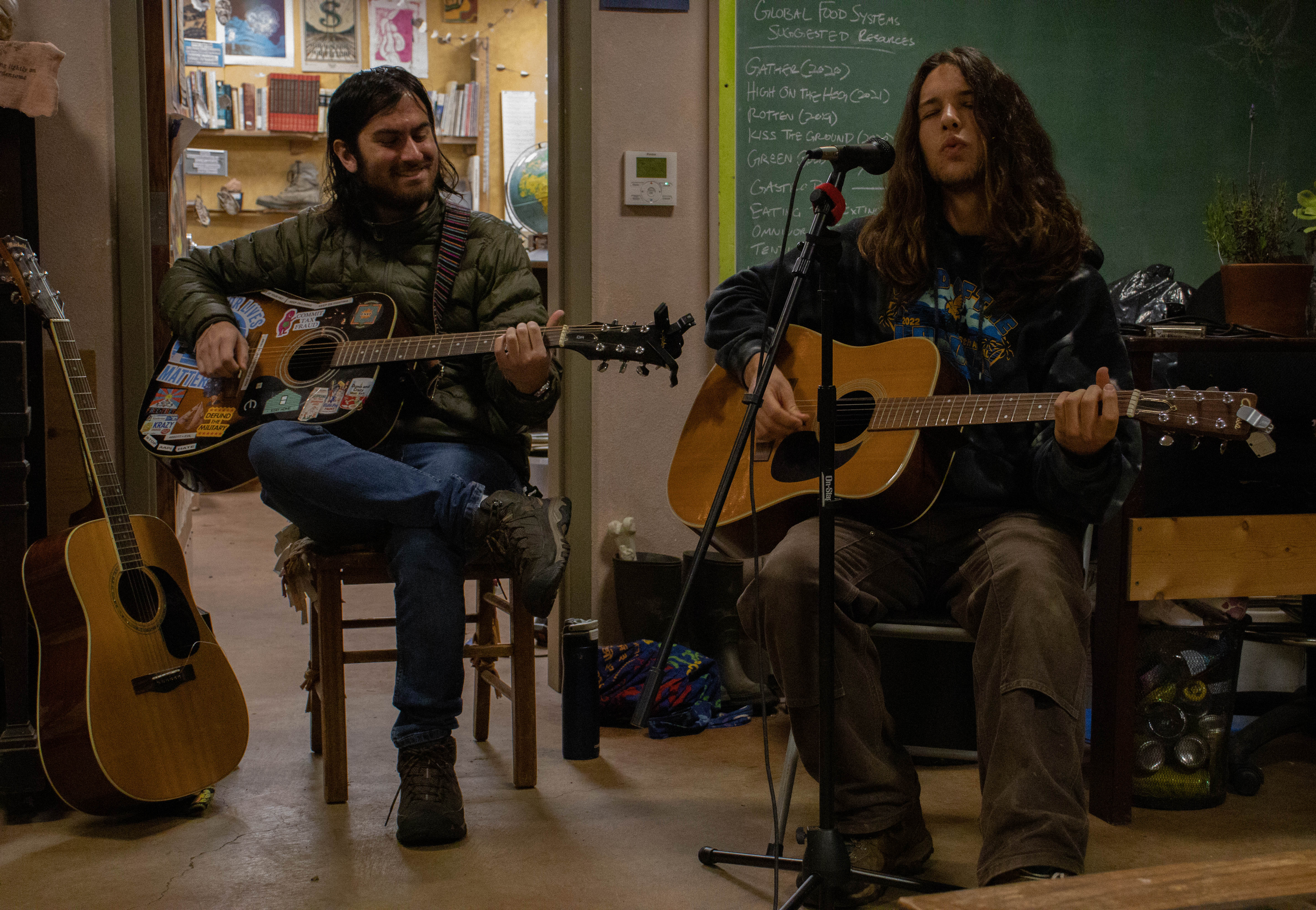
    On a sunny day in early March, Wildlife sophomores Olie Espinoza and Dee Naranjo played guitar and conga drums in a hidden alcove near the Art Quad. The sound of the impromptu music could be heard from several feet away.

    Photo by Abraham Navarro | Dee Naranjo Plays the Conga drum he uses for for class near the art quad on March 7.

    Espinoza (@itsolie_909 on Instagram) just started learning how to play guitar last year and has been playing it ever since.

    “I picked it up in maybe June of last year,” Espinoza said. “It’s definitely something that I always wanted to do and I never got a chance to do it.”

    Espinoza and Naranjo met in the dorms during their freshman year and jam together whenever they get a chance. Naranjo (@deedeedeedeedeedeedeeeeeee on Instagram) didn’t play any drums prior to learning how to play the congas in a class that they took to fulfill a General Education requirement.

    “I just took it as a GE class for the credits, for the art section of GE,” Naranjo said. “I saw it, it sounded cool. I’ve only been taking it for a month so far, so I don’t know much but it’s been really fun.”

  • Sex toys for the soul

    Sex toys for the soul

    By Alana Hackman

    The college experience is something you hear about before you get the chance to step foot on campus. Whether it’s beer talk with dad or sorority rushing advice with mom, we all get a little taste of the dining hall food and frat parties from the people closest to us before our own orientation day, but they usually skim over one major detail: sex. Blame it on your nearing 20s or the newfound freedom of living hours away from your parents, but sex is definitely a part of the college experience. Whether you participate in it or not, with sex comes sex toys.

    Graphic by Sierra Cosper

    Cal Poly Humboldt’s Peer Health Educators (PHE Humboldt) are here to promote sexual and mental health on campus. The program is funded through the Student Health Center and works to provide student-to-student education surrounding sexual and mental health. The peer educators apply their and others’ experiences to create interactive health promotions such as workshops or guest speakers. The program also focuses on sexual wellness within yourself as well as with partners. The educators encourage the use of sex toys and even have some silicone dildos on display in their office located in the Recreation and Wellness Center in room 127.

    The current Peer Health Educators are Sierra Cosper, Selena Aguilera, and Emily Black. All have been with PHE for over two years now. Cosper explained how they feel there is still a stigma around sex toys and sex education as they experienced it first hand as a peer health educator. Cosper also noted that discussion about sex toys and the use of sex toys sometimes intimidates those who identify as male and is more taboo in their daily discussions compared to women.

    “Sometimes when I talk to them [men] about the job I’m doing they’ve said ‘oh why would I come in here to know anything,’” said Cosper. “ There’s this idea with men and sex toys that they can’t be better than their penis.”

    Black also added they have a tendency to leave out the part about sex toys when explaining their job role to new people they have met to avoid assumptions. She also mentioned how she lacked exposure to toys and sexual wellness before coming to CPH and participating in PHE events.

    The group recommended the local storefront Good Relations in Eureka for those interested in dipping their toes into the world of sex toys for a wide selection of toys in discrete packaging as well as informative and helpful staff.

    “If you’re too embarrassed to go, you gotta remember they’re choosing to work there, they want people to come,” said Aguilera.

    “And then come,” joked Cosper.

    “They want you to be as healthy and comfortable about it as possible,” said Aguilera.

    The group also advised beginners to use toys by themselves before introducing them to a partner as it can cause some miscommunication sometimes. Although, all agreed using toys doesn’t have to be solitary and using them with others is an experience as well.

    Graphic by Sierra Cosper

    “It puts a lot of pressure on relationships sometimes, like ‘I’m not good enough’ feelings cause you’re using this toy, but they’re actually just really fun,” said Cosper. “You can’t expect your partner to get you off every time also.”

    “It’s supposed to enhance your experience not take anything away from it,” added Aguilera.

    Black, Cosper, and Aguilera also encourage proper care of sex toys to avoid sexually transmitted diseases or infections. They recommended a lot of toys are able to be boiled but toys usually come with care instructions on how to clean and properly care for them, also mentioning to steer clear of toys made of porous material and the use of silicone lubes on silicone toys to avoid degradation over time.

    “Something people forget to do sometimes is clean communal toys, which are more popular in queer communities,” said Cosper. “The communal strap-on, you should be using condoms on it between each person. Same with vibrators to avoid any risks of spreading.”

    The PHE educators all agreed they encourage more open discussions about sex toys to break the fears and taboos surrounding them, which is exactly what they’re doing within their roles on campus.

    Black encourages students to participate in their tabling events to enter a safe space for open conversations about sexual health and wellness.

    “Everyone gets embarrassed, but liking what you like is sexy,” said Aguilera. “Not being afraid to show what you like is nothing to be ashamed about, you know.”

    Join the Peer Health Educators at their annual Sexland event on April 23, a sex-positive, kink-based, informative event including sex toy giveaways and much more.

  • Jimmy Baca brings poetry to the people with Project Rebound

    Jimmy Baca brings poetry to the people with Project Rebound

    By Abraham Navarro

    A group of formerly incarcerated students picked up their ultra-wide pizza slabs and towering salad mounds from the counter at the Arcata Pizza Deli. They dragged two tables together, commandeering chairs from the surrounding tables and gathered for the feast. Each of the Project Rebound members were hungry for conversation with the famous award-winning Chicano poet, memoirist and member of the family Jimmy Santiago Baca.

    One of them asks him across the table as he takes a sip of his drink, “So, what’s the pale white monster that’s coming up to get you, Jimmy?”

    They were asking about an excerpt he read from a story where he steps out over frigid ice as it splinters beneath his weight to prove his love for his wife, Stacy.

    “Ah when you’re a kid you look deep in the water under the ice, you imagine all sorts of things,” Baca says.

    Photo by Abraham Navarro | Jimmy Santiago Baca, Chicano Poet, speaks to Cal Poly Humboldt Project Rebound in the Great Hall on March 23.

    Baca has a deep raspy voice, and he lights up when he talks to the student. He has a shaved head, furrowed brow with welcoming brown eyes and a warm complexion. Although he’s bundled up against the Humboldt evening chill in a black turtleneck and a blue down jacket, he feels cozy and right at home amongst the formerly incarcerated and system-impacted students from Cal Poly Humboldt’s chapter of Project Rebound.

    Earlier in the evening in the Great Hall above the College Creek Marketplace he read exclusive excerpts from some of his unpublished work and other poems and stories of his during the Project Rebound’s third annual Reentry Forum.

    Project Rebound is a program for formerly incarcerated and system impacted students at Cal Poly Humboldt. According to their website they aim to empower individuals convicted of a crime in a county, state, or federal jurisdiction who have clearly expressed their desire and readiness to earn a degree at Humboldt.

    Baca has been to previous reentry forums, even attending via Zoom during the pandemic restrictions to show his support for Project Rebound and getting to know the members like Tammy Phrakonkham, 30, a Cal Poly Humboldt Project Rebound member and a returning graduate student majoring in geology in the fall.

    When Phrakonkham heard Baca read his stories and share his wisdom, she felt as though her experiences being formerly incarcerated were validated. Her family comes from Laos as refugees to the United States. Growing up in impoverished conditions, she remembers her brothers and uncles all working in gangs, and she followed suit. Phrakonkham was incarcerated for stealing cars and trafficking ecstasy.

    “It was all I knew,” she said. “When I listen to Jimmy, I feel like I’m not the only one.”

    Despite years of isolation due to the pandemic, Baca was happy to make an appearance in Humboldt to visit his friends at Project Rebound, the first event he said he has been to since COVID-19 caused the shift to online events.

    “You all have become like my adopted family,” he said to them. “If it wasn’t Project Rebound I wouldn’t have even gotten on that flight!”

    Baca was adamant that poetry was for the people, those who suffer and work, play, cry, feel, live and die; poetry was not something that could be hoarded by the wealthy, kept from the poor. It was created by the people and it should be given back to the people. By sharing his work with Project Rebound, Baca feels like he has done that, and he has made a family out of them in the process.

  • Doug Smith curates space for Black liberation

    Doug Smith curates space for Black liberation

    by Lex Valtenbergs

    Growing up as a Black person who attended a predominately white school in his hometown of Palmdale, California, Doug Smith learned early on how to code-switch, or alter his behavior to fit white societal norms. Still, his peers expected him to act a certain way because he was Black.

    “People had perceptions of what it was like to be Black; they have their own ideas,” Smith said. “I remember one time a new Eminem song had come out and some white dudes in my P.E. class knew the lyrics and I didn’t know the lyrics, and they’re like, ‘Oh, so we’re Blacker than you are.’”

    Smith’s formative lived experiences with code-switching and microaggressions – subtle statements or actions that are discriminatory against members of marginalized groups – made him very cognizant of other peoples’ perceptions of him early on.

    “That was really my first understanding of code-switching,” Smith said. “I would totally present differently because I was really conscious of how people were perceiving me.”

    As a Cal Poly Humboldt international studies alumnus, staff member and graduate student majoring in English, Smith has been involved in the campus community since 2013. Today, he is the coordinator at the Umoja Center for Pan African Student Excellence at Cal Poly Humboldt, a position that he has held since July 2019.

    “It’s such a rare opportunity for Blackness to be centered,” Smith said. “So I really want Black students to be able to make it theirs.”

    Smith’s vision for the Umoja Center going forward is to foster Black student development, including but not limited to publishing their writing, and foster Black liberation by curating spaces that are made for and by Black people. Amplifying Black voices that often get silenced or ignored is key.

    “[I’m] always visible because I’m a Black person, because you stand out,” Smith said. “But then at the same time, I think that oftentimes my voice isn’t always audible or isn’t always heard.”

    Although the Umoja Center is first and foremost a space for Black students, faculty and staff, it’s open to everyone on campus.

    “I think it’s so cool that we have an educational, Black-centric space [at] a university that really has an opportunity to educate our campus and local community,” Smith said.

    To learn more, visit the Umoja Center in Room 206 at Nelson Hall East, follow @umojahumboldt on Instagram, or go to umoja.humboldt.edu. To get involved, attend an event listed on the website or volunteer with the Umoja Center on Fridays from 11 p.m. to 3 p.m. at Bayside Park Farm on Old Arcata Road.

  • Something Rotten! opens at Cal Poly Humboldt

    Something Rotten! opens at Cal Poly Humboldt

    by Nina Hufman

    The Cal Poly Humboldt School of Theater’s production of Something Rotten! was entertaining, energetic, and full of innuendo. On opening night last Friday, March 25, patrons filled the Van Duzer Theater to see the comedy, set in the 16th century.

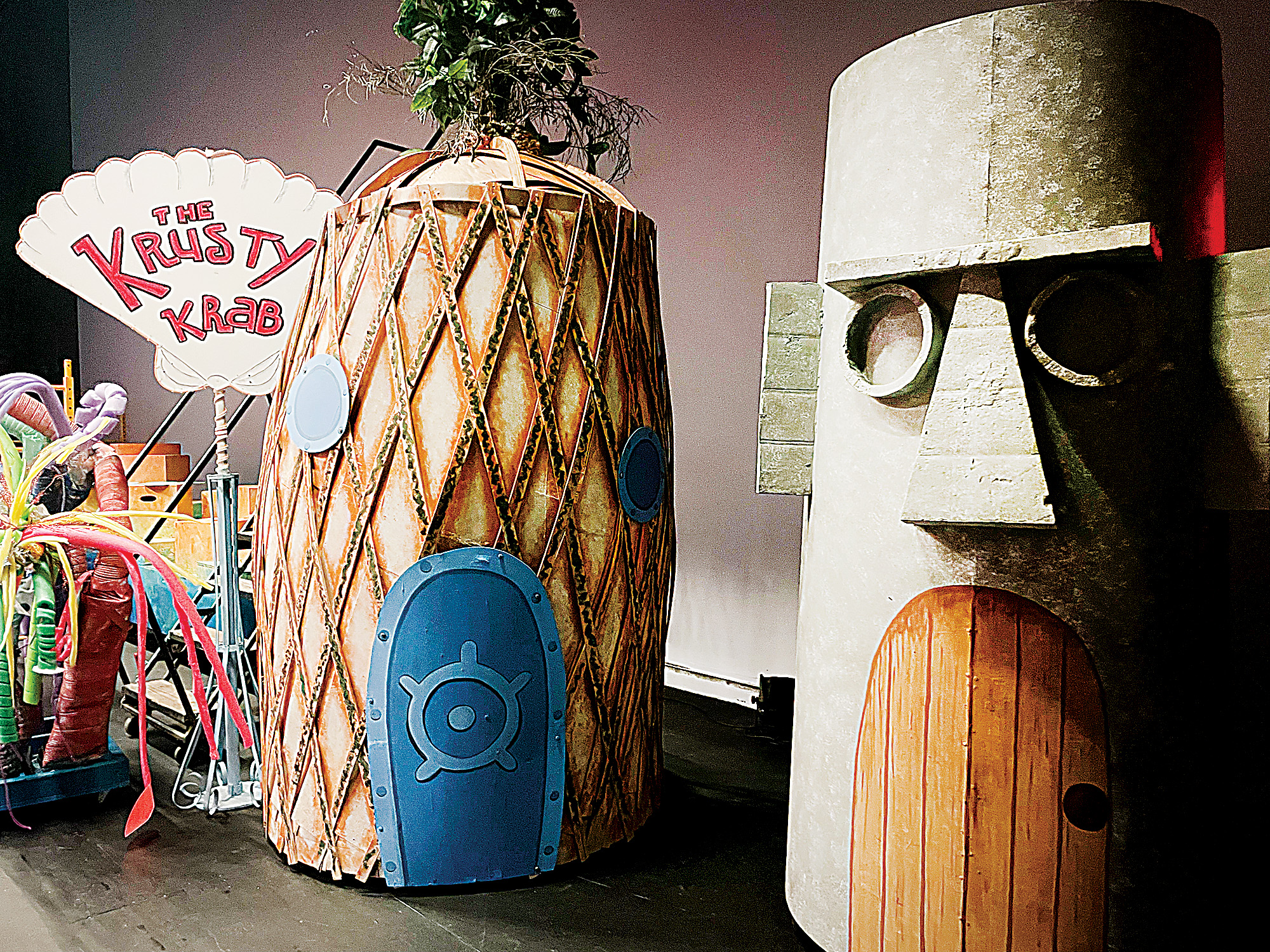
    From the opening song, ‘Welcome to the Renaissance,’ the cast dazzled in beautiful costumes on a stunning set. All of the actors are extremely talented singers and performers. It was clear that they all put in a lot of work and are proud of what they have accomplished. Jeremy Stolp, an English Education major who played one of the lead roles, Nick Bottom, feels that being in theater is a rewarding experience.

    Photo by Michael Thomas | Jeremy Stolp (left) and Miah Carter (right) star as power couple Nick and Bea Bottom.

    “Theater is such a privilege and so much fun to do,” Stolp said. “If you ever have the opportunity, I suggest you try it.”

    The musical was incredibly entertaining. Some of my favorite scenes included Shakespeare’s John Cena-esque entrances, Bea’s hope for a gender-equal future, and the show’s lampooning of religion. One of the best songs was “Will Power,” featuring a leather pants-clad William Shakespeare (Jaese Lecuyer) and his crowd of adoring fans. I also enjoyed “A Musical,” a comic number during which fortune-telling Nostradamus (Sammi Pietanza) tells Nick Bottom that the next big thing in the theater will be musicals, all while wearing a hat that I am convinced was a paid actor. Many of the jokes are meant to be ironic, making fun of musicals and the theater. The way that this is incorporated into the story is very clever.

    The cast was rightfully proud of what they accomplished and are looking forward to adding to each performance in future shows.

    “I don’t think that they (the cast) expected the reaction that they got so when they did it was just this moment of awe,” said Katie Lem, a member of the ensemble. “Everybody standing up at the end was such a beautiful moment for everybody.”

    Photo by Michael Thomas | Zoë Saylor performs an upbeat musical number about the bubonic plague.

    One of the most compelling performances was Miah Carter as Bea, Nick’s wife. Throughout the play, Bea disguises herself as a man to maintain several different jobs and help her husband financially and push for gender equality. Carter’s performance showcased her talents as an actor and singer, particularly in her solo “Right Hand Man.”

    “This is my first ever lead, so this was a good step up for me,” Carter said.

    Carter says that theater is a great community to be a part of and that they are all incredibly supportive of one another.

    “All of us were so proud of what we pulled through,” Carter said. “I love everyone in this cast.”

    The cast and crew are looking forward to continuing to develop this musical as they perform it more.

    “I’m excited for the depth and complexity that we kind of add into it every single show,” Lem said. “Not every night is the same.”

    The musical is running this weekend on Friday and Saturday at 7:30 p.m and on Sunday at 2 p.m. The musical will have you loving to hate William Shakespeare right along with the Bottom brothers.

    Photo by Michael Thomas | From left to right: Zoë Saylor, Sophia Escudero, Jeremy Stolp, Jaese Lecuyer, Jake Hyslop, Michael Jaye, and Miah Carter pose on set of Something Rotten!
  • Gander at these Geraniums

    Gander at these Geraniums

    by Nina Hufman

    These lavender-blue blooms belong to the Wallich geranium, also known as the Wallich cranesbill. The full scientific name of this species is Geranium wallichianum. The flowers pictured here are of the Buxton’s Blue variety, distinguishable by their purplish-blue petals with pale centers and purple veins.

    Like other species of geranium, Wallich geranium flowers have five petals and five sepals, the green leaf-like structures surrounding the petals. The plants grow low to the ground and have wide leaves with three to five lobes. Another noticeable feature of these flowers is their dark purple stamens, or pollen organs, that project from the flowers’ centers. Stamens are usually present in multiples of five. The National Gardening Association says that Wallich geraniums are pollinated by various insects including honeybees, bumblebees and butterflies.

    According to the Missouri Botanical Garden Association, Wallich geraniums are native to highland regions in the Himalayas from Afghanistan to Kashmir. These hardy plants can grow at elevations up to 3500 meters. The Buxton’s Blue variety is a result of a naturally occurring, whole plant mutation and was discovered by Sylvia Morrow in 1999. This particular variant received a U.S. Plant Patent in 2010.

    Wallich geraniums belong to the herbaceous family Geraniaceae. This group of flowering plants is characterized by low-growing foliage, lobed leaves, and floral features such as petals, sepals and stamens in multiples of five.

    According to nativeplants.org, members of Geraniaceae either actively eject their seeds or use hook-like structures to grip onto the fur of animals in order to disperse their seeds. In addition to geranium, the Geraniaceae family includes the genuses Erodium and Pelargonium.

    Wallich geraniums can be seen in several places in the Cal Poly Humboldt campus, including in the flower bed in front of the theater building. These plants bloom throughout the spring and summer, so we can look forward to seeing these lavender-blue blossoms in the months to come.

  • Cal Poly Humboldt Directors in the spotlight

    by Carlos Pedraza

    In the Van Druzer theater on Thursday, March 3 for the first time since the start of the pandemic student films were shown to a live audience. Around 40 people came to the showing of Cal Poly student films. Several of the films were made in the fall of 2020 there showing being delayed by the COVID pandemic.

    The short films ranged from psychedelic, documentary, serious, and funny; some of the films were a combination. The audience made sounds of laughter, shock and sadness reacting to each film with emotion equal to the film itself.

    A film director who was in the audience was Kylie Holub, a senior film major. Holub directed and wrote the film “Abstraction” in the fall of 2020. They film . During the pandemic Houlb said “ just keeping our crew really lean and realing thinking about how to tell stories with minimum actors.”

    The narrative film “Abstraction” is the story of a beach treasure hunter finding an alien artifact and the fallout of her discovery. The unknown and aliens being major inspiration for the film.

    Holub said “ you see a lot of people with metal detectors, we know very little about the ocean and aliens are fun to play around with.”

    Another director was alumnus Valerie Rose Campbell created the experimental film “Recipe for Young Mothers.”. Campbell goes through the recipe of banana bread while she narrates the experience of a young mother and her attempts to reclaim her life from an abusive relationship and societal expectations of a mother.

    The COVID pandemic heavily impacted the creation of the film Campbell said “ everything got done digitally and that was really hard.”

    The film is inspired by Campbell’s own experience in the local family system. “ How it felt so unjust for my kids and family.” said Campbell describing her own life experiences.

    There will be another film showcase in the fall of 2022 showing films created in the spring.