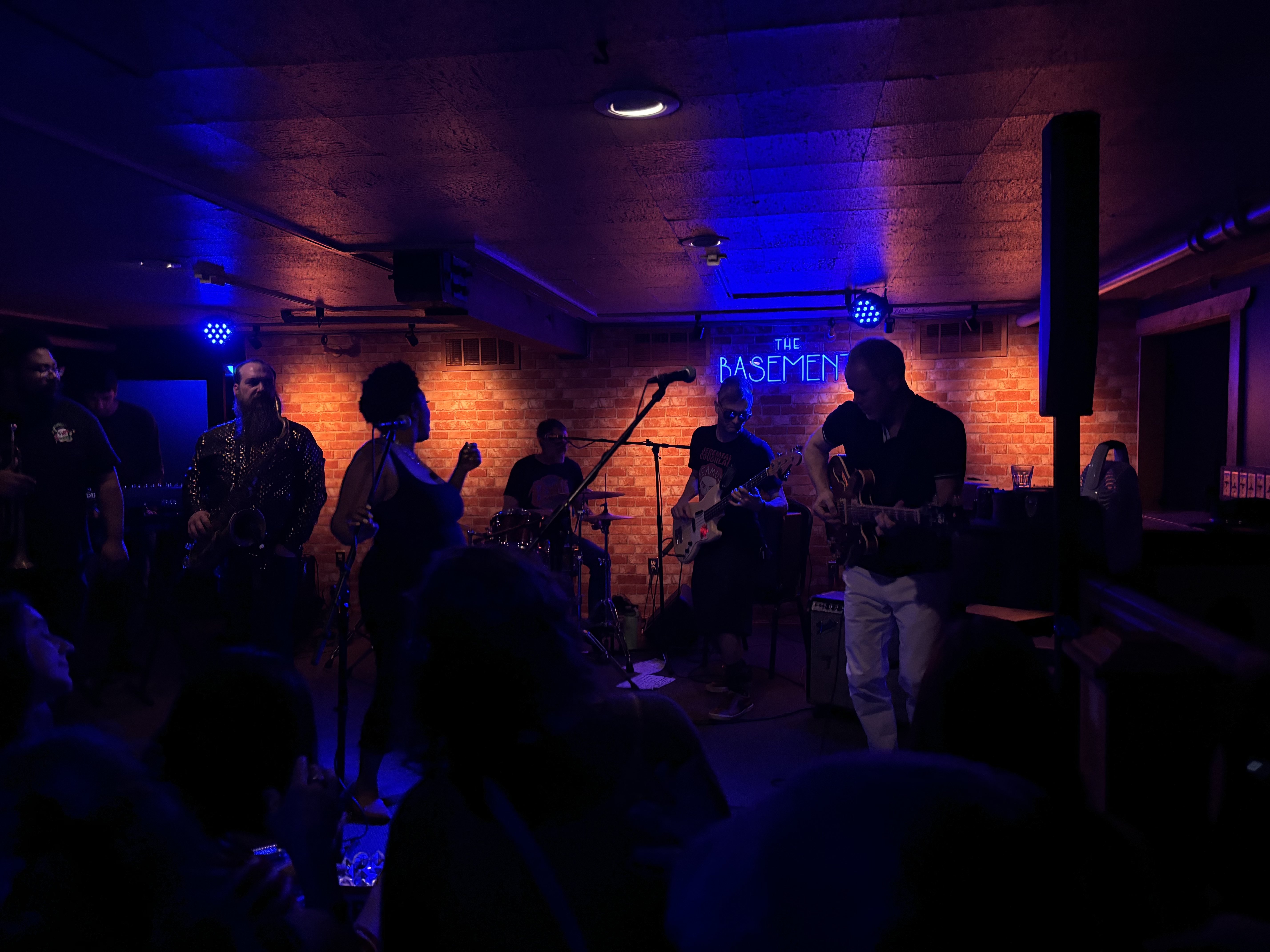
Adjacent to the Arcata plaza sits The Basement at 780 7th Street. They’re open Thursday – Saturday from 6 p.m. to 1 a.m. if you’re looking to have an exciting night.
As far as drinks go, Christina being a Vodka girl, she had the Passion Drop made with jewell citron vodka lined with a sugar rim. The drink was pretty strong in itself and on the pricey side at $14, but good enough to get a nice buzz going.
The Raspberry Lemon Drop was also strong but delicious, a great price at $7. Tequila shots were large. The bartender was sweet and kind despite the rush, and she helped me pick out drinks amongst the chaos. All in all, 7 shots of tequila cost about $43.
The Basement offers some drunk food favorites like soft pretzels or a charcuterie board. If you’ve got a sweet tooth, your options are limited to the flourless chocolate torte.
The downside to the bar is the small space up on that platform waiting to order a drink. If there’s a surplus of people on a particularly busy night, getting up to the bar can be a bit complicated and overwhelming.
We appreciated that there were multiple zones depending on how you spent your time there. If you wanted to sit, there were plenty of tables. If you wanted to chill at the bar, it was crowded but it was there, and, of course, dancing if you wanted to dance. Also every zone didn’t feel isolated from each other, making it easy to enjoy whatever aspect of nightlife you chose, without having to expel yourself from the other aspects.
As for seating, The Basement is probably the largest in terms of space. The layout of the club is reminiscent of the speakeasies of the Prohibition Era. Plenty of tables are on a slightly higher elevation than the main floor. An ornate railing surrounds the main floor. Half of the main floor is designated for tables, while the other half is for patrons to let loose on the dance floor. A stage allows for a band to play tunes for the crowd underneath a neon sign reading, “The Basement.”
Be careful bar hopping though! Arcata is such a small town, you may just run into your drunk boss.
With a $5 cover charge to get into the venue, decent music and good drinks, The Basement gets a 4 out of 5 stars on our rating.
MK Butterfield takes a selfie as Celeste Iliana Sadler Gonzalez Pachano reapplies their lipstick at The Basement.
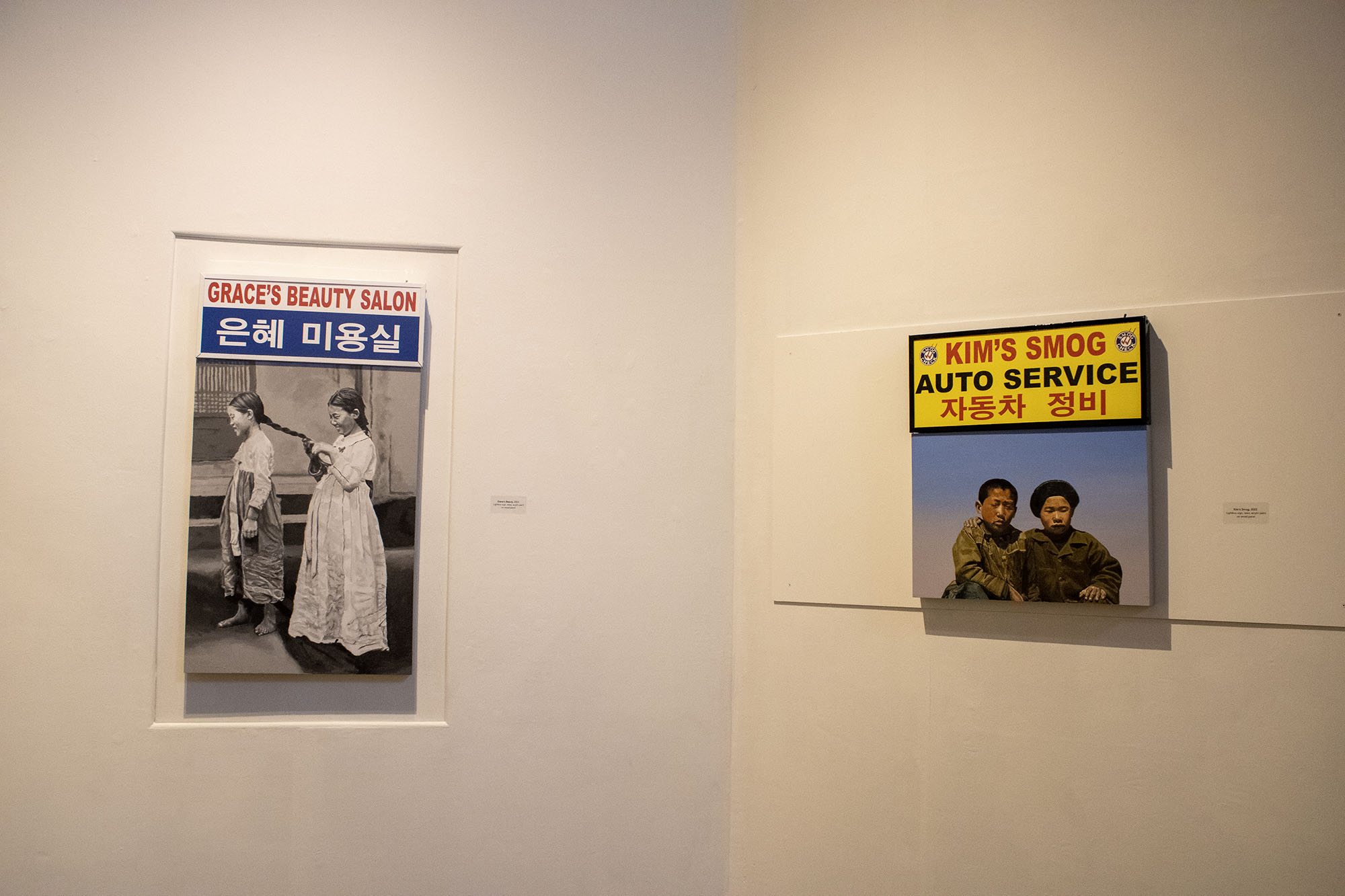
Signs of Passage: Nostalgia and New Beginnings debuted in the Reese Bullen Gallery at Cal Poly Humboldt on Nov 8. The exhibition runs through Dec. 9 [2023] in the Art Building.
The Reese Bullen Gallery is named in honor of a founding professor of the Art Department and has been an addition to Humboldt since 1970. The gallery usually contains the university’s permanent collection of art and sponsors exhibitions of works by professional artists related to many different areas of instruction. The Reese Bullen Gallery also presents an annual exhibition of student art in May, the Graduating Student Exhibition.
The mission of the Reese Bullen Gallery is to offer free and publicly accessible exhibitions representing artists from all demographics. Extending beyond Humboldt, the Gallery seeks to strengthen partnerships with local communities as well as stimulate support and participation in the arts.
This new body of work presented by Dave Young Kim at the Reese Bullen Gallery uses latex paint on wood panels.
Dave Young Kim is a Los-Angeles based artist who visited Humboldt County with a newly created body of work for his solo exhibition at the Cal Poly Humboldt Reese Bullen Gallery. Kim is a fine artist, born and raised in Los Angeles. He received his Bachelors of Fine Arts Degree in Studio Art from the University of California, Davis, and a Master of Fine Arts in Studio Art from Mills College.
His current display of work engages with the quality of home and explores themes of nostalgia, war, conflict and displacement. Through his work, Kim explores the unifying search for belonging across disparate conditions. In 2020, he co-founded the Korean American Artist Collective (KAAC), which is a group of artists building a community around work rooted in the Korean-American experience. In 2021, he was a selected muralist for the Eureka Street Art Fest and in connection with the Eureka Chinatown Project to paint a mural named Fowl.
“My work plays with that idea of manufacturing nostalgia as integrated with my family history, memory, and identity,” Kim said. “My artistic approach is drawn from a sense of loss or longing, looking for a place to belong.”
Goudi’ni Native American Arts Gallery displays “Tintah: Amongst The Trails”
Robert Benson’s Redwood Sculptures and Watercolor Studies
By Christina Mehr
In collaboration with Cal Poly Humboldt, Robert Benson presents his work in “Tintah: Amongst The Trails” at the bottom floor of the Behavioral & Social Sciences Building.
The art installations of Native art used the mediums of watercolor and wood pieces. Focusing on a new body of work, Tintah, Hupa language for amongst the trails, features newly carved salvaged old-growth redwood sculptures and watercolor studies. Robert Benson, is a leading figure among artists in the NorthWest California art world. He has worked as a teacher for more than 30 years at the College of the Redwoods, as well as being a curator of Native art.
Tall sculptural wooden carvings adorn the exhibit and viewers must make their way through the art, almost like walking amongst the trails. Redwood slabs carved into beautiful sculptures lined the room.
His current paintings and sculptures are filled with imagery of trails, both of the literal kind and suggested. With Benson’s deep connections to the environment and land, those motifs clearly shine throughout his work.
“There is the trail into our family hunting camp that I traveled for more than 50 years, there are trails handed down through stories and mythologies, and there are the trails of imagination,” Benson says. “When we consider that at the most basic level, a trail is just something connecting two points, even the ladder and stairway forms that populate my work can be viewed as kinds of trails. To be amongst the trails is to find your rhythm, your place and to discover the interplay between that rhythm and the melody of the universe.”
This solo exhibition was installed by the Art + Film Department Museum & Gallery Practices class under the direction of Assistant Professor Berit Potter and Gallery Director Brittany Britton. This exhibition was partially funded by Instructionally Related Activity Fees.
Photo courtesy of Goudi’ni Native American Arts Gallery
If you have ever wandered around the Arcata Plaza, you are certainly familiar with Eco-Groovy Deals and their wide range of second hand clothes and home goods. You might have also been someone that would walk out of the store without purchasing anything because you were looking for a wider range of affordable furniture, home utility tools or just sticking to a personal budget.
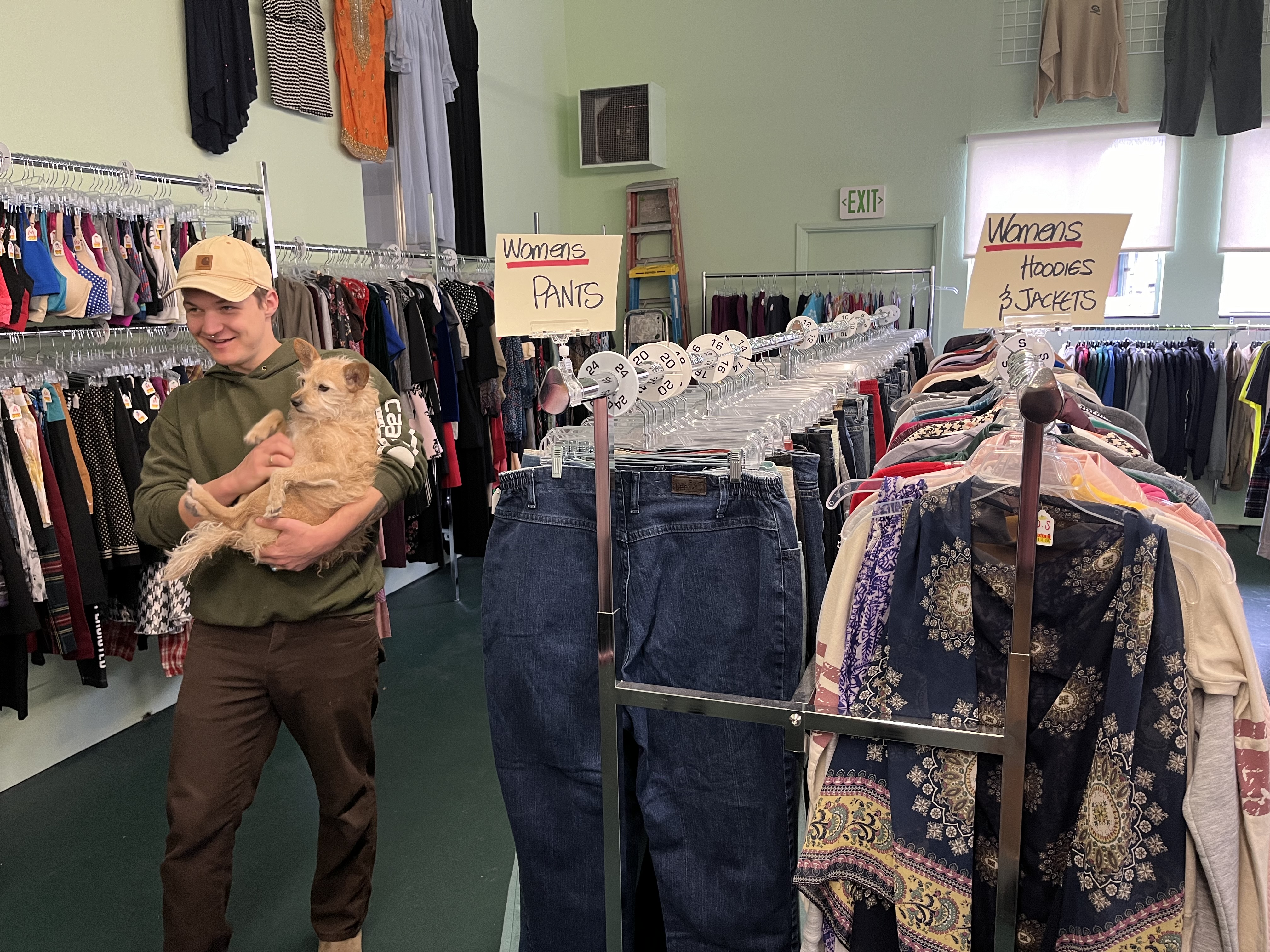
Jayce Walker, owner of Eco-Groovy Deals, has heard your calls and opened the Eco-Groovy Clearance Outlet on 513 K Street just five blocks away from the Arcata Plaza. The store opened on Jan. 10 after months of work and stays open everyday of the week from 10:30 a.m. to 6 p.m. Students can purchase items tax free until the end of this month.
With this new clearance outlet store, Walker’s goals are to provide the budget furniture, home utility tools and affordable clothing the community has been asking for.
“People say, ‘what’s your secret to success?’ Listening to what people need and want,” Walker said. “Trying to find that and doing it in a way that is as sustainable as possible.”
Unlike Eco-Groovy in the plaza which is 75% clothing and 25% refinished furniture and home products, Walker’s goal for the outlet store is to utilize the larger space and have 75% budget furniture, hardware and home goods.
“There are items that we were stashing to fix that started to build up. And when people said, ‘don’t they have budget furniture?’ It’s like well, I do have some,” said Walker. “That wasn’t something I could do in the plaza.”
Other goals for the clearance outlet store are to continue Eco-Groovy’s textile recycling program which lends support to smaller non-profit thrift stores, and do more furniture repairs extending the life of useable items which contributes to their sustainability focus.
Walker’s goal for the clearance outlet store is to continue their textile recycling program that supports smaller non-profit thrift stores. This program contributes to their focus in sustainability as they hope to do more furniture repairs.
Walker’s set of founding principles are held at both of her stores.
Reduce local landfill
Create local jobs
And serve the community
In the future, Walker would like to expand the impact she has in Arcata, both interpersonally and environmentally, by doing more upcycling of clothing, shoe repairs and turning the empty outdoor space into a community garden to host community members.
“My passion is more about community service than it is about padding my pocket,” Walker said.
The Local Cider Bar is a chill sit-down spot that would be perfect for a mellow first date vibe or an end to a great date. Imagine having a piece of pie and a cider to bond over, or end your night.
However, our only drawback is that food does close at 8 p.m.
The music was okay, more on the chill indie side.
They do offer free water which is a bonus.
The Cider Bar did have clean selfie-worthy bathrooms.
The Cider Bar was well-lit and had a relaxing atmosphere with soft indie music playing over the speakers. The environment there felt safe.
Seating Options and Decor
The large windows, giving patrons a view of the patio and street, gave the somewhat smaller interior a more spacious atmosphere. If you are someone who loves nautical themes, the big barrels used for seating and tables are a huge plus. The Cider Bar itself has a large wooden bar for patrons to sit alongside a host of tables. The interior design, with its mix of wood and industrial vibe, would allow the Cider Bar to fit into cities like Berkeley.
The outdoor seating is also a great option for those who want some fresh air, rain or shine. Canopies with space heaters and strung-up light bulbs give your senses a warm and dry feel to the outdoor area of the Cider Bar. However, no smoking is allowed.
Alcohol
Flights for $15.
Swipe right – was sweet and fruity with a hint of cherry .
Black current – good, but a deeper wine flavor.
Chile Guava – not spicy enough and a dry cider.
Dragon Fruit – had a sweet aftertaste, like an adult Capri Sun.
Blurberry – stronger aftertaste, dark, strong, packaged as wine and wasn’t cidery enough.
Strawberry – sweet, juicy, good solid cider. Can’t go wrong with strawberries.
Mango daydream – not enough flavor, Le Croix lookalike. A hint of piss if you’re into golden showers.
Gingergrass – very ginger acidic. If you’re a ginger lover then its right up your alley
Food Review
Had a wide selection of pies with vegetarian options included.
Sweet pies:
Apple Crumble with Ice Cream – This was my favorite pie. The warm pie with the cold ice cream was an enjoyable temperature contrast.
Black Bottom Coconut Pie – It was rich and thick, with chocolate mousse and whipped cream.
Savory pies:
Veggie Pie – Made my soul feel warmed, which was great considering the cold weather outside.
Chicken Pot Pie – Crust was flaky, and the pie overall was moist and gooey in a delicious way. There was a very nice hint of sage present with the taste. The pie was warm, homey, yummy and definitely made with love.
Everyone’s seen it: alley-oops, slam-dunks. Nothing but net and jumpshots galore. For the people at the Lumberjack Arena last Wednesday night, basketball was flipped on its head, spun around on a single finger and reimagined by none other than the Harlem Globetrotters. Athletes, theater lovers and comedy fanatics came together as the Globetrotters faced off against their unrelenting rivals, the Washington Generals.
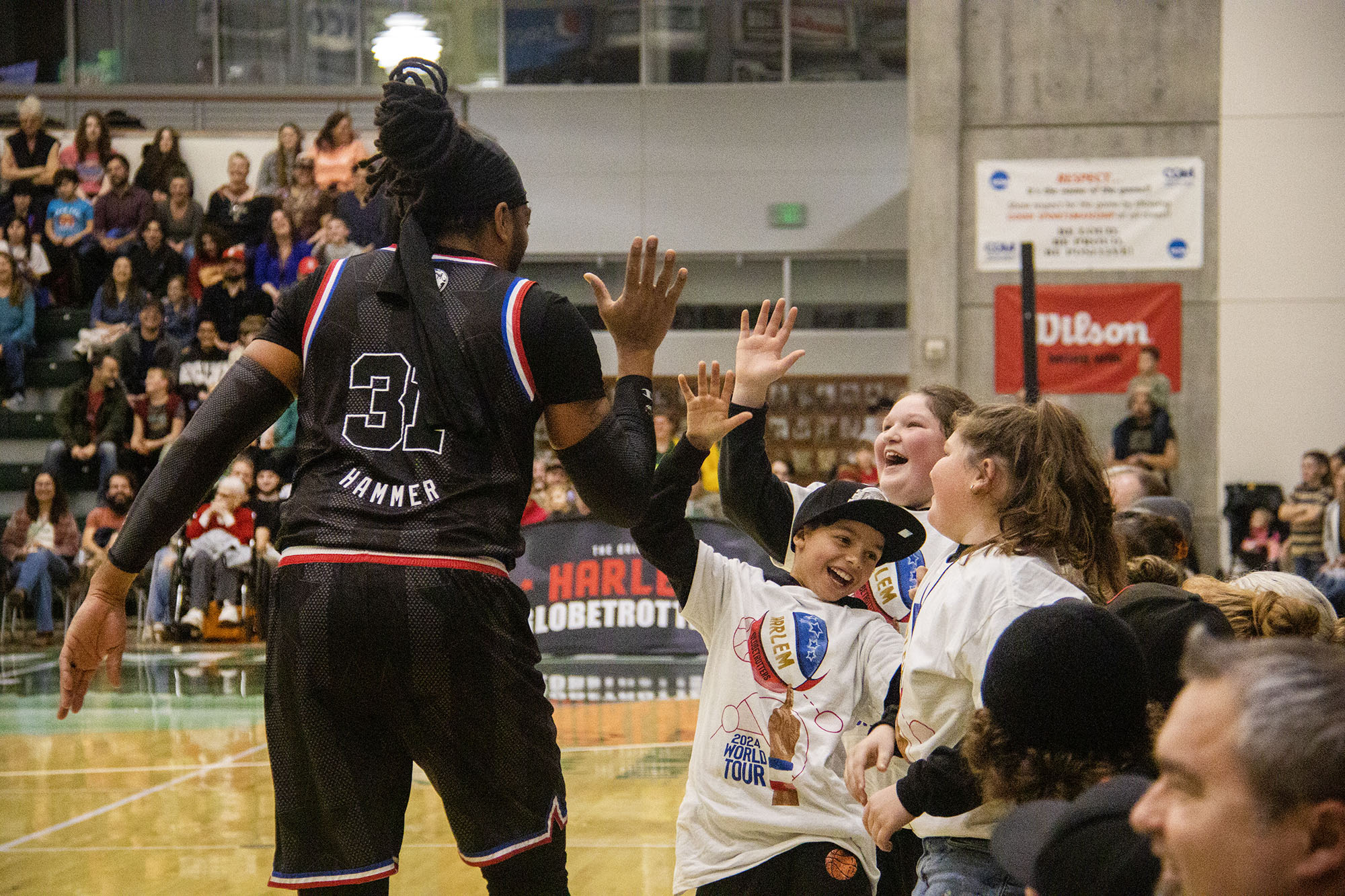
Before the game, select kids and adults alike got the experience of attempting trickshots in front of hundreds of people. If you weren’t lucky enough to give the warmups with the Globetrotters a go, you might’ve had a run in with their mascot, Globie, who roamed the bleachers & isles getting the crowd hyped for the main act. Between the dances, selfies, community involvement and unironic athleticism, there wasn’t a single person left unimpressed by the Globetrotters performance, although it was more of a party. All this was before the beginning buzzer.
photo by Alex Anderson
Elena German, an English education major, had never been to a Globetrotters game. As a surprise Christmas gift, she got tickets to attend the event with her brother Ethan. Despite not being a sports fan and having minimal basketball expertise, there was plenty for her to enjoy.
“I love a good show, I like to be excited,” German said. “I’m expecting a lot of energy from the crowd. It’s a lot of kids, which is exciting… Definitely the comedy and theatrics aspect of it, that is what was kind of appealing when I looked into it.”
Unlike typical basketball games, the Globetrotters had their very own MC and DJ. The combination of music, quick commentary, goofy dances and trickshots made for a chaotic night. Audience members, such as Cal Poly Humboldt student Ethan German, couldn’t contain their excitement at the sold out performance.
photo by Alex Anderson
“It absolutely exceeded my expectations, wonderful show,” Ethan German said. “The tall player and the short player chasing each other. That was definitely something I did not exactly expect, but it was a great addition.”
This basketball game was one-of-a-kind in more ways than one. The Globetrotters had the traditional trick shots, like having their back to the hoop and throwing the ball “grandma style,” but they also had a handful of unique yet iconic moments. Originators of the “four point line,” the Harlem Globetrotters took every opportunity to sink four-pointers. If the four pointer missed, there was another player ready to slam dunk a rebound.
At one point during the game, the MC announced their special rule: game changers. At any point during the game, if the DJ played the special sound, the audience was prompted to shout, “CHANGE! THE! GAME!” In which case the Globetrotters would proceed to do something extremely goofy. The most normal of the game changers included doubling points, resulting in some epic eight pointers, and a dunk contest where the audience voted on the winner.
More surprising game changers included having kids from the audience shoot free throws, bringing a football onto the court and roleplaying the NFL. After running the ball into the “end-zone,” the audience did the wave and the players did their touchdown dances. Naturally, a referee called a foul and needed to see a replay, so everyone did everything in reverse – including a slow-motion reverse wave across the gym.
Globie, the Globetrotter’s mascot | photo by Alex AndersonA Globetrotter dunking | photo by Alex Anderson
Other oddities included every parent simultaneously holding their baby in the air as the Lion King soundtrack played. One player stole an audience member’s shoe just to give it back Cinderella-style in center court and the same player pulled flags out of the referee’s pocket clown-style.
Mikey Crispin, a Cal Poly Humboldt graduate and a lifelong Harlem Globetrotters fan, was blown away. After the show, he was one of many jumping out of his seat.
“When I was a kid, the Globetrotters were all men,” Crispin said. “Now, there’s women in there, and that’s really amazing because they show a lot of girlpower and encouragement. I felt like that was really important… and that’s what we need to see.”
Chaotic, impressive and goofy are a few words used to describe the night, but none do it justice. Despite the lack of descriptors, everyone can agree it was an unforgettable night at the Lumberjack Arena.
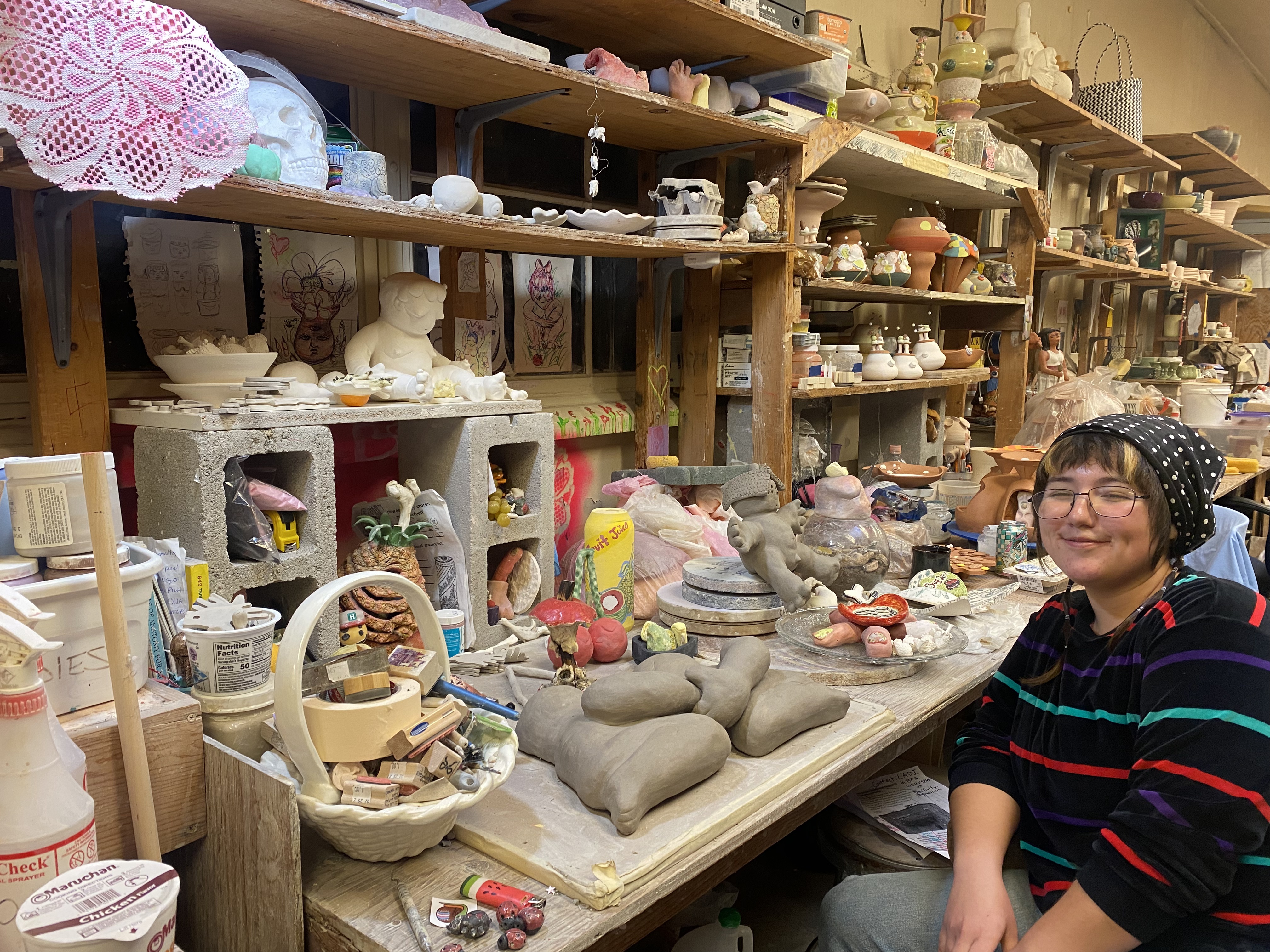
Tucked away in the narrow hallway-like room of the BFA studio located in Cal Poly Humboldt’s ceramic lab, or better known as The Laundry, you’ll find a crowded corner of a workspace.
Littered with anatomical clay body parts, a cinder block shrine of fake grapes, a clay pineapple with a bone sticking out of the top and many more tinkering tools like tape measures and lighters. Behind this workspace, you’ll find Ladi Ladines working away on their latest creation.
The Lake Elsinore native graduated from Cal Poly Humboldt with a stack of accolades last year. Starting with their Bachelor’s in Fine Art, minor in Art History and finishing off the list with a certification in museum and gallery practices. They’re prolonging their stay in the redwoods to finish out a ceramics extended education program.
They came up to Humboldt in 2019, but art had always been a foundational building block in their life since they can remember.
“I’ve always been an artist since before I could talk, walk or whatever,” Ladines said. “Everyone told me, ‘You’re an artist!’ so I just kept going with it — I see the world in a very visual way and it’s how I process everything, so it just felt like the right thing to do.”
Their most recent work on display was an interactive sculpture labeled “The Mess Nest” that was shown through October and November at the The Morris Graves Museum of Art in Eureka, California. The piece was a part of the 27th annual “Junque Art” exhibition that included art made from all recycled material, but the origin of the nest came way before the exhibit.
Ladines had been thinking about the concept of a “nest” for over two semesters before the idea finally came to them on a reflective day at the beach.
“I was feeling pretty down in a rut and lost in my art process,” Ladines said. “I saw this tree that was tipped over – it was a huge tree, and the roots were just flourishing and it took my breath away. It was at that moment I just wanted to make something, even just an ounce of that feeling – of having my breath taken away, feeling at peace with myself.”
They came home that following evening and began their creative process for the nest. The piece itself is a place to let those physical items that hold so much emotional baggage and weight in our daily lives go.
Photo courtesy of Ladi Ladines | The Mess Nest
“I had a box of emotional baggage trash under my bed. You know, old love letters and things that are just sort of triggering, and I went home that day, I got that box out and just dumped it out on the floor, and I lived with it on the floor for a good week,” Ladines said.“ I lived with it until the triggers weren’t triggering me anymore, and I felt like these are the pieces that I want to tie to the branches of my nest.”
Soon after, the nest spiraled into what it is today, after Ladines’ neighbor asked to add pictures they were hoping to get rid of to the nest. Ladines soon found themselves posting fliers on craigslist, LEX and even on campus urging the community to share their items of emotional baggage to the piece.
“I found myself asking everyone around me and making posts online and reaching out towards people that I would have never really got to connect with in that way,” Ladines said. “I found out a lot of people have boxes under their beds that they aren’t confronting and that they would like a space to do that, so that’s how the nest was born.
The nest is an ongoing interactive piece that now lives in the Redwood Art Association in Eureka. Ladines encourages the community to continue donating to the nest. Ladines has had quite an impact on the art community and has had many installations displayed across Humboldt County since residing here.
“I never have an end goal in mind, I let the thing flourish by itself. And it really snowballed this time into something that I would do again, like I would love to continue this project and find new spaces for it and reinforce the branches,” Ladines said.
Ladines previous art installations have included contributions to the 2022 Eureka Street Art Festival, The Morris Graves Cal Poly Humboldt Senior exhibit, as well as the Senior Art exhibit at the Reese Bullen Gallery.
Ladines served as a gallery intern under the Reese Bullen Gallery’s director, Brittany Britton, during their undergrad, later serving as a gallery assistant. Britton mentions how the galleries on campus serve as a learning lesson to students involved to really explore how their works will be viewed outside of a personal studio space.
“It seems like Ladi for their part has really taken that to heart, and has been really developing a deeper interest in exhibition art,” Britton said.
Ladines art plays with bright playful colors and lots of child-like wonder. Ceramic bones and fruit, their specialty, inspired their instagram handle, @bonefruity. They work with a wide variety of mediums and really try to hone in on creating community and home behind their artwork.
A few materials used to make the nest included a friend’s childhood blanket, a pair of bedsheets that triggered Ladines’ trypophobia and overall things they find attractive throughout their daily life. Whether that’s trash, an abandoned school desk on the side of a road they used in a previous installation or abandoned cardboard boxes.
“I do play with all kinds of materials, and by this I feel like I’m grounding myself in my reality, just by seeing how all of these different things interact with each other. Whether that’s wood and plaster, or jello,” Ladines said. “I’m working on some big jello projects.”
Ladines’ is constantly pushing their comfort zone when it comes to the process of their art. Their art process explores the relationship with our nervous systems and how things make us feel.
Photo courtesy of Ladi Ladines | Pary City mixed media on panel.Photo courtesy of Ladi ladines | Bone App Teeth
They’ve used three live cockroaches (named Sarah, Jessica and Parker) in a ceramic piece shown at the 2023 California Conference for the Advancement of Ceramic Art. Ladines explains this was a way to really explore their limits as an artist as cockroaches are something that always was a fear for them. Ladines said the cockroaches helped them work through trauma and are now a symbol of resiliency.
“It was me trying to desensitize myself to the heebie-jeebies you get when you see a roach or a bug. I ended up keeping them as pets for like over a year, and they became my studio buddies. I learned to love them and get over that initial sensation of being scared of them – that was a really wild experience. I love those roaches and am now thinking about getting a spider, cause I’m really scared of spiders.”
Through this process of testing their limits within their art work Landines has made beautiful community connections with their art , the nest especially. In their time spent at the The Morris Graves Museum and Redwood Art Association they’ve seen individuals come back to contribute to the nest, and even embraced with strangers that were grateful for the ability to add to the nest.
“The last day that it was on display at Morris Graves, there was a woman who came in hot with this ceramic pot, and just slammed it into the center, and I was like ‘yeah!,’” Landines said. “I had no idea who she was or anything, and she just looked at me, embraced me and was just telling me her lore. I cried a little bit, she cried a little bit. My tension about my piece was made and it just felt so fulfilling.”
Britton especially adores Ladines’ efforts to really incorporate the local community into their artwork and creative visions, even after their graduation.
“They’ve really done the hard work to embed themselves here in the community and become part of it, versus maybe just leaving as a student, like you get your degree and you take off,” Britton said. “But, they seem invested in helping embolden and strengthen the art community here in Humboldt.”
The nest will be on display at the Redwood Art Association through Dec. 15. Ladines still encourages materials and emotional baggage to be added to the piece during its stay. Ladines emphasized whatever is added to the nest is about what the giver wants to let go of, not what they want personally as the artist.
“My ultimate intention is just wanting to embrace people and myself, and that’s hard. Comfort is a big one – and acceptance. I’m not a perfectionist, I like things that are a little funky,” Ladines said. “I like to be playful with my colors. I hope that that comes through as love, and for people to also accept those qualities within their own work.”
In recent years, ChatGPT and other generative artificial intelligence (AI) models have become mainstream, with many people having begun to wonder if this is something to fear, or something to embrace. Students and faculty at Cal Poly Humboldt have been testing the waters and, despite mixed reviews, it is apparent ChatGPT is here to stay.
“I do think that there is a role for ChatGPT and gen AI models in the classroom. However, I think my recommendation for its use varies according to the level of the student,” said associate professor of computer science and software engineering program lead, Dr. Sherrene Bogle. “As higher educators, we have a responsibility to teach our students how to use the technology effectively.”
“ChatGPT is a tool applied in academia for diverse research like linguistics, psychology and computer science. It aids in hypothesis generation, language analysis and ethical exploration. Used in education and interdisciplinary studies, it’s showcased in conferences, with further advancements documented in recent academic publications,” according to ChatGPT itself.
Bogle first heard about ChatGPT last year and, although reserved at first, has since embraced it. Cal Poly Humboldt students studying computer science were offered an elective course this semester that focuses on AI, CS 480, taught by Bogle. One exercise she instructed in the lab was to use a selection of AI technology such as ChatGPT, Bard or Claude and find examples of where the programs hallucinate.
Noah Zerbe, a professor in the department of politics, defined what the term ‘hallucinate’ means for generative AI programs.
“Sometimes [generative AI] will just make things up for you,” said Zerbe. “Often, one of the problems a lot of people have noted is that it makes up citations. So, it’ll say that a quote comes from this source, or something like that, and that source may not even exist. Or, it can go down a rabbit hole of factually incorrect information.”
One mainstream example of ChatGPT ‘hallucinating’ is apparent in an incident where Colorado lawyer, Zachariah Crabill, was fired from Baker Law Group for using ChatGPT, and got caught when the program created fake scenarios in legal documents.
Another example of a generative AI model ‘hallucinating’ took place in the Cal Poly Humboldt AI class. According to Bogle, two students were able to convince an AI chatbot that they had lunch with Michael Jackson and Tupac.
“They just said a few things, changed the prompt, and the technology apologized for saying that these people were dead and wanted to hear more about their conversation and was basically adding that to its database,” said Bogle.
As an advocate for programs like ChatGPT in academia, Zerbe encourages students to explore the program, but introduces generative AI models into the classroom with a warning.
“My approach to it is really centered on teaching students how to use it effectively,” said Zerbe. “It’s providing you feedback on your paper, trust it as much as you would trust feedback that you got from a friend down the hallway.”
Professors aren’t the only ones exploring this new territory with caution. Maddie Haus, a junior at Cal Poly Humboldt majoring in environmental studies, was suspicious at first.
“I was stoked because it helped me so much, but I also found it scary because it seemed too good to be true,” said Haus. “I think it can be useful for achieving academic success. I do think there’s a thin line between doing the work yourself and just having ChatGPT do the work for you. Overall though, I think it’s a useful tool.”
Mikey Crispin, a Cal Poly Humboldt graduate who now works for the PBLC and the university as a scheduling and support analyst, has used ChatGPT on and off.
“I didn’t really use AI for school because it didn’t explode until last November,” Crispin said. “By that time I was only taking the upper level computer science classes and could get all the info from professors.”
Now that he’s graduated, Crispin uses ChatGPT mainly for troubleshooting while writing software.
“GPT doesn’t always know what you’re trying to do, but from a basic coding perspective, if you’re giving it info just to cover some gaps you might have, then it is a great assistant that can help you gain a better understanding of how something might work,” Crispin said. “I have no experience asking GPT for help for anything outside of a technological viewpoint. It did write a really good email for me once in the style of a Cat in the Hat book, so that was cool.”
All in all, ChatGPT, along with other generative AI programs, seem to be the future of education, but using AI as a crutch is inevitably harmful.
Bogle illustrates her perspective towards generative AI.
“If you think about it, we don’t want our elementary school students and kindergarten students to be using a calculator, because we want them to learn to count, to carry their hundreds, tens, and ones, etc., to be able to do long division,” Bogle said. “But, after they have mastered being able to do their basic arithmetic with pencil and paper, we’re comfortable with them using the calculator. So, it’s similar with gen AI, which is why I said I think students need to master honing the particular skill first, before they become reliant on gen AI. That way, I think we have the best of both worlds.”
Thanksgiving, although controversial, is still widely celebrated in the United States. According to statista.com, 83% of Americans were projected to be celebrating the holiday in 2021 and almost 90 million tons of food waste was generated (ReFED.org). No, you don’t need to eat dry turkey for weeks after or scrape the stuffing off of a tray to limit your waste. Instead, you can repurpose your food scraps to create new and certainly improved meals that you will look forward to.
“The Moist-Maker”
The most famous Thanksgiving leftover that is widely recognized is “The Moist-Maker” from Friends. This is a sandwich filled with turkey, cranberry sauce, stuffing, and other Thanksgiving classics. To make it moist, a gravy soaked piece of bread is layered in the middle of the sandwich. This method of simply putting leftovers between two pieces of bread or wrapping them up in a large tortilla might be delicious but can also get quite boring after eating the same things for days in a row.
Turkey Pot Pie
Rather than making a Thanksgiving sandwich or what is essentially a Thanksgiving crunch wrap supreme, experiment with your cooking skills and make something like a turkey pot pie. With this, all you need to do is combine some of your turkey leftovers, whatever vegetables you have, mix in your gravy and some extra stock of any kind. Finally, top it with some buttery puff pastry because puff pastry really does make everything taste better and bake it at whatever temperature seems appropriate. With only a couple minutes of preparation and 30-45 minutes in the oven, you now have a not so Thanksgiving pot pie.
Turkey Stock
Aside from excessive amounts of leftovers adding to the tons of food waste, scraps from food prep also have a huge impact on the waste produced each year. Rather than filling up garbage bags with vegetable scraps or a giant turkey carcass, save all of these nutrient full foods to create a homemade turkey stock. This is a classic one pot recipe where you put all of your scraps into one pot, top it off with water, and let it simmer for hours. This process extracts the flavor from the vegetables and the collagen from the turkey bones creating a lucious and flavorful stock. With stock, you have endless options of meals to choose from. You can add this stock to your turkey pot pie or even make something like a turkey pho with some aromatics like lemongrass, ginger, and pho seasoning packets.
Utilizing food scraps not only pushes you to experiment and try new foods, but also contributes to minimizing food waste on a day that produces excessive amounts of it. If you are lazy and want to enjoy a classic Thanksgiving sandwich, go ahead! If you want to be a little extra, take the time to make a turkey stock using the entire turkey carcass and save that stock for future recipes. No need to toss out your leftovers, stretch your culinary limits and practice food sustainability even on Thanksgiving.
Big shoes, small cars, red noses and life-sized giraffes filled the Gist Theater in the late nights of Nov. 15-17. The Cal Poly Humboldt Circus presented this semester’s show named, “Circus? You hardly know us!”.
Doors opened at 6:30 p.m. Students and community members alike packed into the cozy theater, and filled every single chair in the house. While the audience waited for the theatrics to begin, multiple acts took the stage in charge of keeping people entertained while waiting. To keep the stage warm, the pre-show consisted of music from their very own house band, balloon animals, juggling, (balloon) sword fights, fire twirling (minus the fire) and general tomfoolery.
Photo by Carlina Grillo. Circus members dressed as animals stand behind a cage while singing to the lion sleeping, “The Lion Sleeps Tonight”.
After a colorful and entertaining pre-show, the circus commenced – promptly, as the poster suggested, at 7:27 p.m. It was clear from the introduction, this show would feature the coolest, craziest and most creative clowns this Cal Poly has to offer. With over 25 cast members, the theatrics these clowns put on were incredibly impressive.
The entire night was full of controlled chaos, but there were a few acts that got the audience particularly riled up.
In the first half of the show, the audience got to indulge in a high stakes game of hangman. An audience member was brought to the floor to guess letters, and every incorrect letter guessed was stapled onto a body part, of said audience member’s choosing, onto the “hangman” (yes, literally stapled onto bare skin. The performer came back out later with bandages covering the staple holes).
Other unforgettable acts in the first half included an ensemble of musical butt-slapping titled, “Ass Percussion,” and a live episode of “The Real Clown Wives of Humboldt.”
Photo by Carlina Grillo. Performer embraces their feline side, staring off into the distance stunned by a giant ball of yarn rolling by audience members, down the isles.
After a quick intermission for smoke breaks, vending machine hauls and bathroom trips, people regathered into the black box theater, and no one was ready for what would happen next.
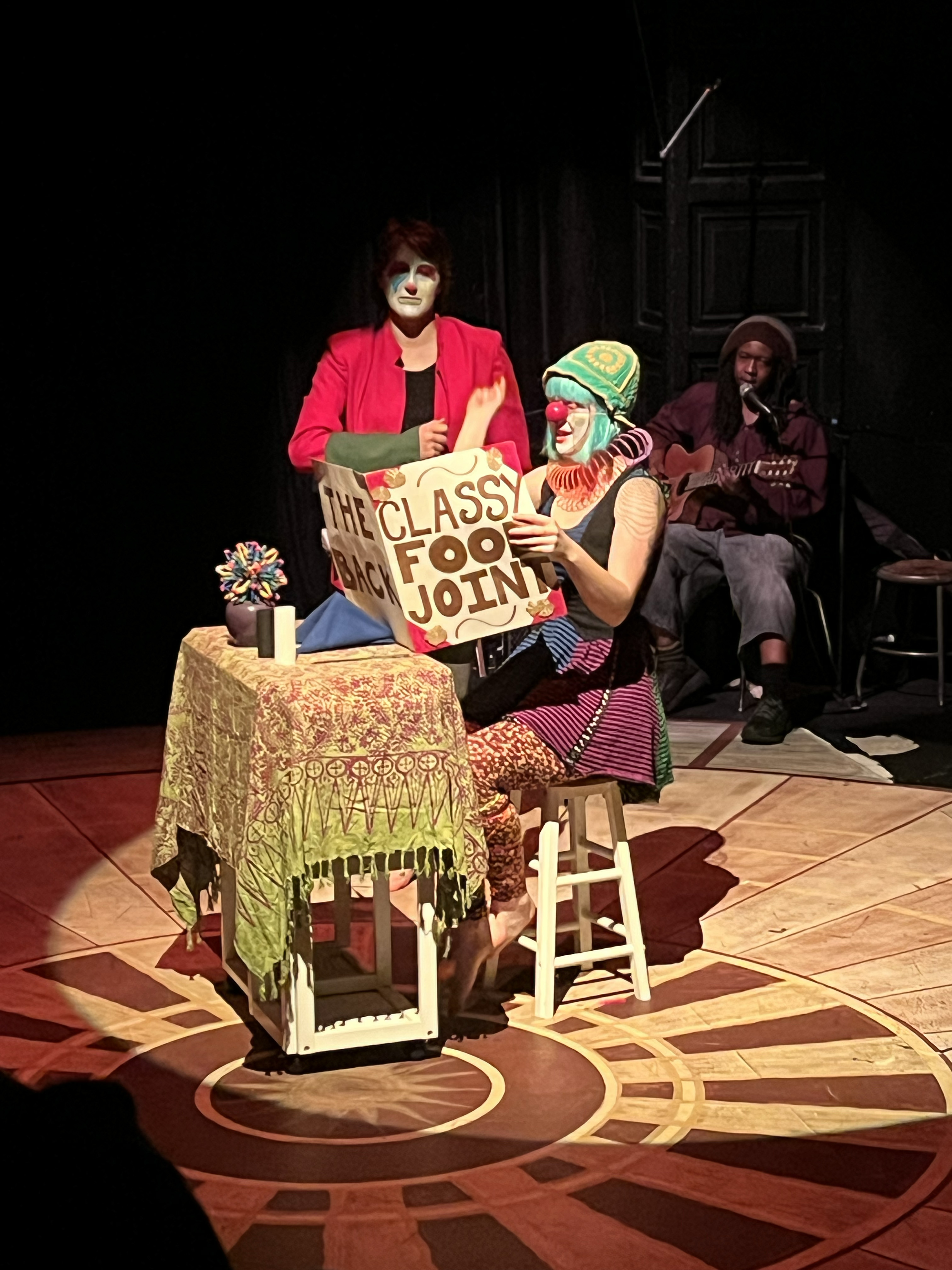
The latter half of the show kept the audience on their toes with an aerial dancing cat named Damla the Feral, a deep-throat balloon dinner at a classy food joint, and – perhaps the act of the night – “Corno,” an X-rated performance that included a student and their “cornology” professor engaging in erotic behavior, like “sucking cob,” and a plotline that included raunchy archetypes straight out of “corn-hub.”
The night wrapped up with a musical performance featuring a group of circus animals, and told the story of a lion getting revenge on his showman – in a rather violent way.
Overall, the Humboldt Circus Club went above and beyond for this performance, and proved that the group is overflowing with talent and creativity.
It is our mission to find the slayest food spots in Arcata. Whether you’re going on a date, meeting up with friends or flying solo, we are determined to create a guide to which places are hot and poppin’ – and which places are not. Our first adventure was to the Aracta staple, Northtown Coffee, for a sunny Monday morning breakfast.
A few patrons were scattered at tables around the coffee shop. It didn’t feel empty, but it was quiet and easy to find a table not super close to other people. The music was good and not too loud. The employees took our order promptly when we walked up to the counter and double checked with the cook to make sure that they had what we wanted to order. There are a lot of seating options, both indoor and outdoor.
We both got the breakfast burrito. Jack also ordered the light roast coffee and I ordered an iced snickerdoodle latte, one of the specialty espresso drinks. We were a little disappointed with the size of the burritos. They were pretty small and we both left still hungry. The salsa on the burritos was amazing, we just wish there was more of it, or at least additional hot sauce options. The light roast coffee was smooth and crisp. The snickerdoodle latte was delicious, especially if you like sweet espresso drinks.
15 in 100,000 people have Type 1 Diabetes. That amount makes up 1.3 million people in the United States alone. Cal Poly Humboldt students have recently come together to create a safe space for those with Type 1 Diabetes and their friends and family to meet and be able to share their journeys with each other. The Diabetes Link is a newer organization that helps campuses set up chapters of their own to help empower and support college students at their schools. November is Diabetes Awareness Month, and is important to empowerment and taking time to celebrate those who have to struggle in their day-to-day life in ways people wouldn’t typically think about.
Diabetes Type 1 is a disease that targets your pancreas. Diabetic people cannot produce their own insulin enzymes. Someone with diabetes must monitor their blood sugar, and inject insulin or glucagon to raise or lower their blood sugar when needed. It is a constant that someone has to monitor at all times for the rest of their life.
Students Nat Allen, Zach Sherman and Niz Kears, who all have Type 1, came together to start the Cal Poly Humboldt chapter, and have hosted two meetings this school year. One was a pizza social for everyone to meet each other and start building connections, and the second was a dessert night where everyone brainstormed ideas they had to help provide more education and knowledge to the campus.
Nat Allen, one of the founders of the chapter and a sophomore in biology, has had Type 1 for 13 years. She acknowledges how important having a community is to having diabetes. Allen strives to be what she needed when she was diagnosed: a role model.
“I wanted to help start the Diabetes Link because having a community of other diabetics is super important to me,” Allen said. “I have had diabetes for almost 13 years and being able to talk to other diabetics has always been something that helps me.”
Allen says that it is important to talk about diabetes and not keep it as an unknown. Talking about it helps destigmatize and makes others more comfortable with their diagnosis. November celebrates those with this diagnosis, and helps spread awareness to the disease.
“Talking to others that truly understand the disease makes me feel seen, and allows me to talk about struggles that no one else would understand,” Allen said. “When I was first diagnosed, my parents made sure that I got to meet a lot of other diabetics to show me that diabetes would not stop me from doing anything.”
Noah King, a sophomore studio art major, has been going to all of the meetings and is glad to have a space on campus for himself and others. He was diagnosed with Type 1 at a young age, and hasn’t had many opportunities to connect with other people with diabetes.
“Growing up with diabetes, I found myself without resources or people that truly understood what was happening with me,” King said. “I found it incredibly rare to meet other Type 1 Diabetics, so I wanted to help start this because of that struggle.”
King wants to do what he can to help those with a similar experience to his, and help others know they aren’t alone. His goal is to keep growing the chapter and have a place with lots of support.
Zach Sherman, a sophomore environmental resources engineering major, got a late diagnosis at the age of 16, and he expresses how hard that was because he felt like he was too old to go to any groups or camps that were offered. He is one of the founders of this chapter and is happy to be a part of something bigger that supports him.
“I think one of the hardest things about having diabetes for me is the feeling that I am going through it alone,” Sherman said. “I knew I could handle my diagnosis and wanted to prove that I was capable of taking care of myself, alone, independently, just me.”
Sherman did not grow up with a large group of people who also had Type 1 around him. He only had one person that he could talk to about it. It was hard for him to talk to anyone else about it because he hasn’t had people around that have been able to understand what he was going through and how he felt.
“I never really knew what I was missing out on, so when Niz reached out to me about getting this club off the ground, I was excited but skeptical,” Sherman said. “However, just a few meetings later, I have already learned so much from everyone there.”
“My hope is that the chapter starts with our group and continues to grow organically over the years,” King said. “I want there to be a place to go to get support, understanding and resilience to handle the rigors of life and school while living with this condition.”
If anyone who has Type 1 wants to get involved with their club, whether or not they themselves have diabetes, check out their page on Instagram at @cph_diabeteslink for information on when meetings are.
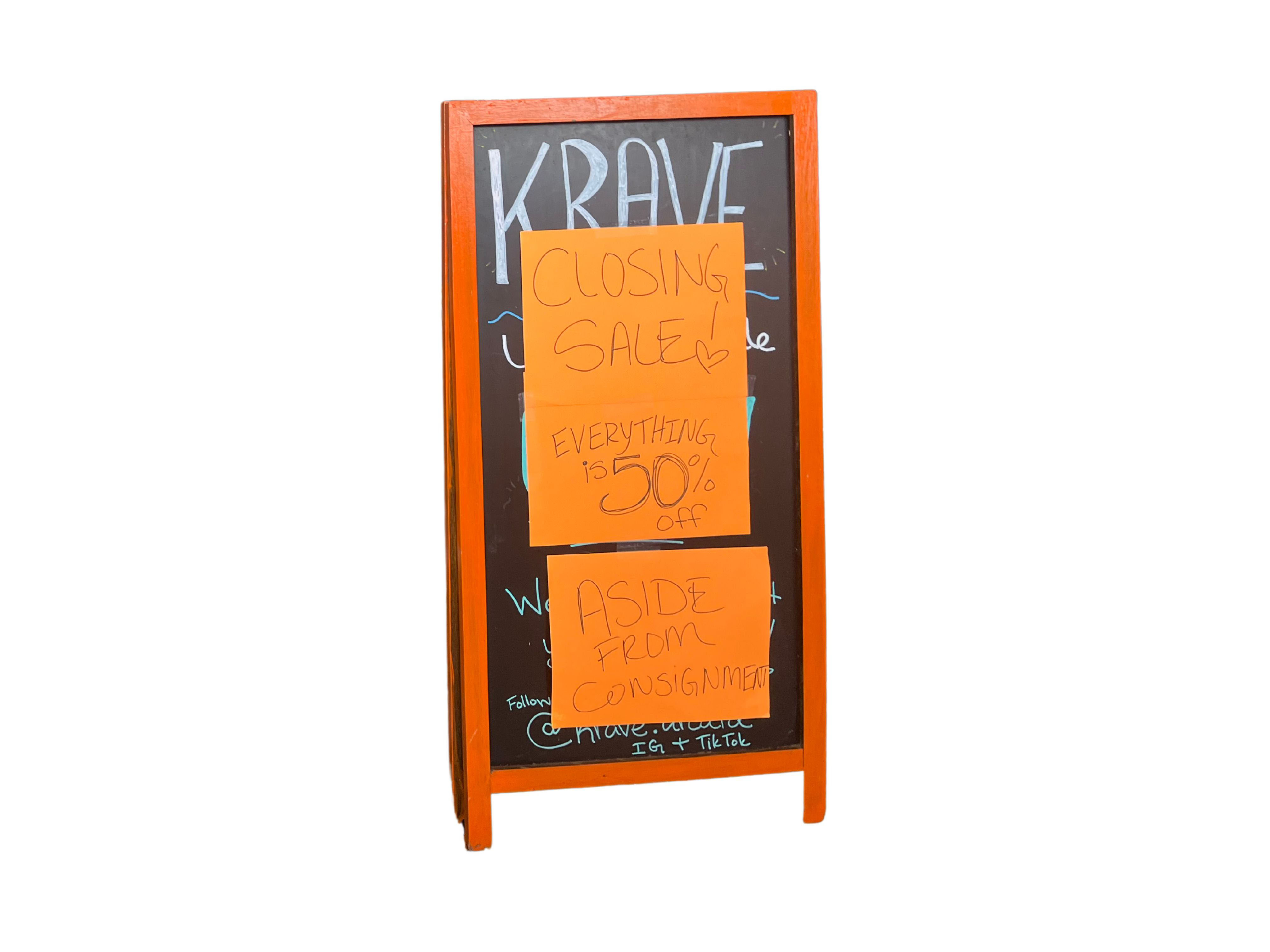
Arcata’s beloved thrift store Krave has been a safe place for community members, with affordably priced clothing and a community pantry with free food and personal hygiene products. Unfortunately, due to high rent prices, the current location on H street in downtown Arcata will be closing at the end of December.
Krave originally opened its first location in Sunnybrae. After a consistent lack of foot traffic, Kai Flores, owner of Krave, decided to move locations to the current neon green store front by the Arcata square. Although Flores is pushing through financial challenges, their mission to provide affordable goods continues through the stores closing, with 50% off everything aside from consignment items and three one-dollar clothing sections making the prices more affordable than ever.
Despite the financial difficulties, Flores is keeping the spirit of Krave alive because of the positive impact it has had on the community.
“The goal was never about money… the goal was about community, and trying to be different. And, it worked! It’s hard to keep your faith in humanity sometimes but [Krave] restored it,” Flores said.
Flores will be continuing the essence of Krave by prioritizing their interactive social media presence and keeping their official website, krave.shop, updated with more of Flores’ upcycled pieces and a large curated plus-size section. In addition to their active online presence, Flores is hoping to have Krave pop-ups and other interactive experiences to keep providing affordable clothes and other resources to students and community members.
“It was cool having my own little spot but I don’t feel like that’s necessary for me to still make Krave a thing, ” said Flores. “It’s not an ending, it’s just a revision.”
Another priority for Flores is finding a new host for the successful community pantry.
“That’s gonna happen. Somebody’s keeping [the community pantry] alive and I will keep it pretty,” said Flores.
To make donations for the community pantry, you can reach out to Flores through Instagram direct messages @krave.arcata. With such high demand for Krave’s community pantry, Herb + Market at 427 H Street has volunteered to become its new home on Dec. 4, continuing the positive contributions Krave brought to Arcata. Despite closing the brick-and-mortar store, Flores will keep providing this resource, as well as clothing related contributions to the community by working with Oldtown Community Alliance, Humboldt Center for Harm Reduction and possibly OhSnap’s on campus clothing drive.
“I’m a community guy,” said Flores. “I’m definitely still trying to get stuff to the people.”
Reflecting on their time at 1073 H street, Flores shared some of their most memorable moments at Krave.
“I’ve had from the cutest to the most raunchy things happen in this shop, and all of them were somehow the most pure and beautiful things I’ve ever seen,” said Flores. “From the tiniest little boys running around in high heels… to my favorite strippers doing a cake show in the most safe space they’ve ever been in. It’s been incredible to see.”
Flores also cherishes the feedback they received for their extensive curated plus-size collection.
“I had a plus-size person come in and shop, and then tell me this is the only store they feel really comfortable shopping in,” said Flores.
Flores also appreciates the customers who got to explore their gender identity through their clothes.
“I had one fellow try on a dress for the first time because he had always wanted to twirl… so he got to do that here,” said Flores.
These special moments and the connections people have built motivate Flores to continue the essence of Krave throughout this difficult transition.
“Love. Love, that’s it. It’s brought so much love into the door… that’s really what keeps me going in this world, realizing that there are these little beautiful connections,” Flores said. “People really do want better for each other… that gives me hope.”
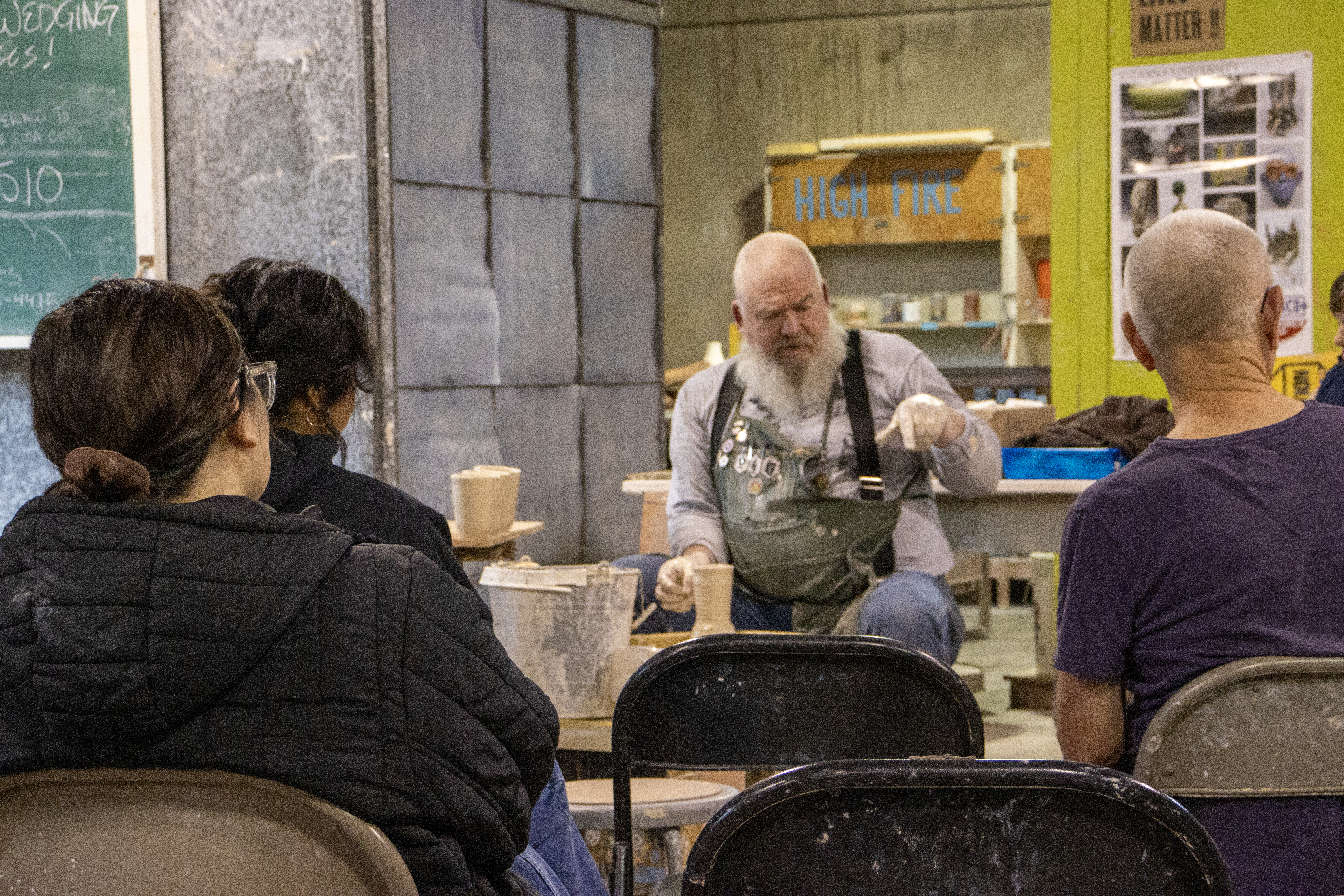
On a gloomy Thursday afternoon, a Gulf War Marine Corps Veteran brought a warm energy to the ceramics studio, nicknamed, “The Laundry.” The veteran, Ehren Tool, is the senior laboratory technician for the ceramics studio at UC Berkeley, and has created and given away over 26,000 ceramic cups. Tool’s art documents the pains that military veterans struggle with after their service. Tool smiled behind his bushy beard and told stories about his healing journey, from his time as a Marine to his time as an artist. Tool expressed how his ceramic cups convey aspects of military culture that are difficult to openly discuss.
“The cups are an opportunity to talk about unspeakable things,” Tool said. “War is murder, and military sexual trauma is rape, that happens in the civilian world too. Where can you talk about that? Where in polite society do we talk about these things that happen with too many people and the effects they have on their lives?”
Ceramic students in attendance to Tool’s demonstration, such as Jack McCann, were inspired by how veterans have found ways to express the grief they feel.
“I really felt like in the art there’s a lot of pain, every piece is almost like mourning,” McCann said. “It’s helpful to see people grow even after experiencing something like war.”
The class that Tool was a guest instructor for was part of a weekend-long veteran’s day celebration, organized by Humboldt College Corps, Cal Poly Humboldt’s College of Arts, Humanities and Social Sciences and College of the Redwoods. The events aimed to focus on how veterans can heal from their traumas in the military. Part of the weekend events was a dinner and panel by veterans at the Arcata Veterans Hall on Nov. 9. Tool was part of the panel alongside Air Force veteran Mark Walker. Walker is the East Bay Deputy Director for the veteran’s support non-profit, Swords to Plowshares. Walker and his wife Lynn were in attendance at Tool’s demonstration in The Laundry. Lynn Walker hopes that the arts can help veterans similar to how ceramics have helped Tool.
“For me, [art] allows you to open up [feelings] that are suppressing you, to things that you don’t want to say,” Lynn Walker said. “[Art] opens up your being to where there’s a healing process as you identify [your emotions] through art.”
Alongside Tool and Walker for the Nov. 9 panel were Air Force Veteran Joe Fox, Marine Corps Veteran Ryan Jensen, Veterans Affairs Health Nurse Ella Price, and U.S. Army veteran and Dean of Arts, Humanities, and Social Sciences Jeff Crane. Crane shared his experiences on how education in his college has supported veterans.
“I’ve thought about this in my own work,” Crane said. “Arts and Humanities have a critical role to play in veteran’s transition, in supporting veterans, and in educating people about the role of the military in American life and in the world.”
Panelist Joe Fox is an interdisciplinary studies major at Cal Poly Humboldt and also facilitates a veteran’s ceramics class at College of the Redwoods
“I found healing in significant ways through playing with clay,” Fox said. “My only plan in all of this [art] is that somehow I’ll be able to connect some resources in our community, and there will be space for other people to find [healing].”
The main event was the 3rd annual Veteran’s Day at McKay Community Forest in Eureka, CA on Nov. 11. There was a five and ten kilometer walk/run, as well as free barbeque, music, and painting. There was an opportunity for attendees to decorate their own ceramic mugs to be completed later. On Nov. 13 and 14, there was another ceramic demonstration at College of the Redwoods by Jessica Putnam-Phillps.
No matter how veterans try to overcome their traumas and suffering, Mark Walker holds onto hope that his fellow vets will find whatever sustainable means available to find their healing, art or otherwise.
“Different veterans find different things of purpose, inspiration, and therapy,” Walker said. “Whether it’s formal or informal therapy. It’s just about what veterans find to be healthy, get healthy, and stay healthy.”
Students and community members flocked to the Van Duzer theater on Sunday, Nov. 12 to see Maryland based funky jam-band, Pigeons Playing Ping Pong. The event started around 7:15 p.m. with the opening band, Dogs in a Pile, and heated up around 8:45 p.m. when Pigeons took the stage, kicking off their first set with “High as Five” – an ode to being “High in Humboldt.” In total, the quartet played (with instruments, not ping pong paddles) two sets and an encore, saying their goodbyes just before midnight.
Earlier in the day, the bassist of Pigeons Playing Ping Pong, Ben sat down for an interview on KRFH. Listen to the interview below.
Pigeons Playing Ping Pong frontman, “Scrambled” Greg Ormont jumps in the airbeside lead guitarist Jeremy Schon during a high energy performance at the Van Duzer Theater. Photo by Carlina Grillo.No limits on the mic for “Scrambled” Greg Ormont. Photo by Alex Anderson.Lead Guitarist Jeremy Schon vibes out in the lights. Photo by Alex Anderson.Ben, bassist of Pigeons Playing Ping Pong, wears his bass face during a heated jam on Sunday Nov. 12. Photo by Carlina Grillo.Ben, bassist for Pigeons Playing Ping Pong showing love to the crowd before signing off. Photo by Alex Anderson.Pigeons Playing Ping Pong lights up the crowd at the Van Duzer Theater on Nov. 12. Photo by Alex Anderson.
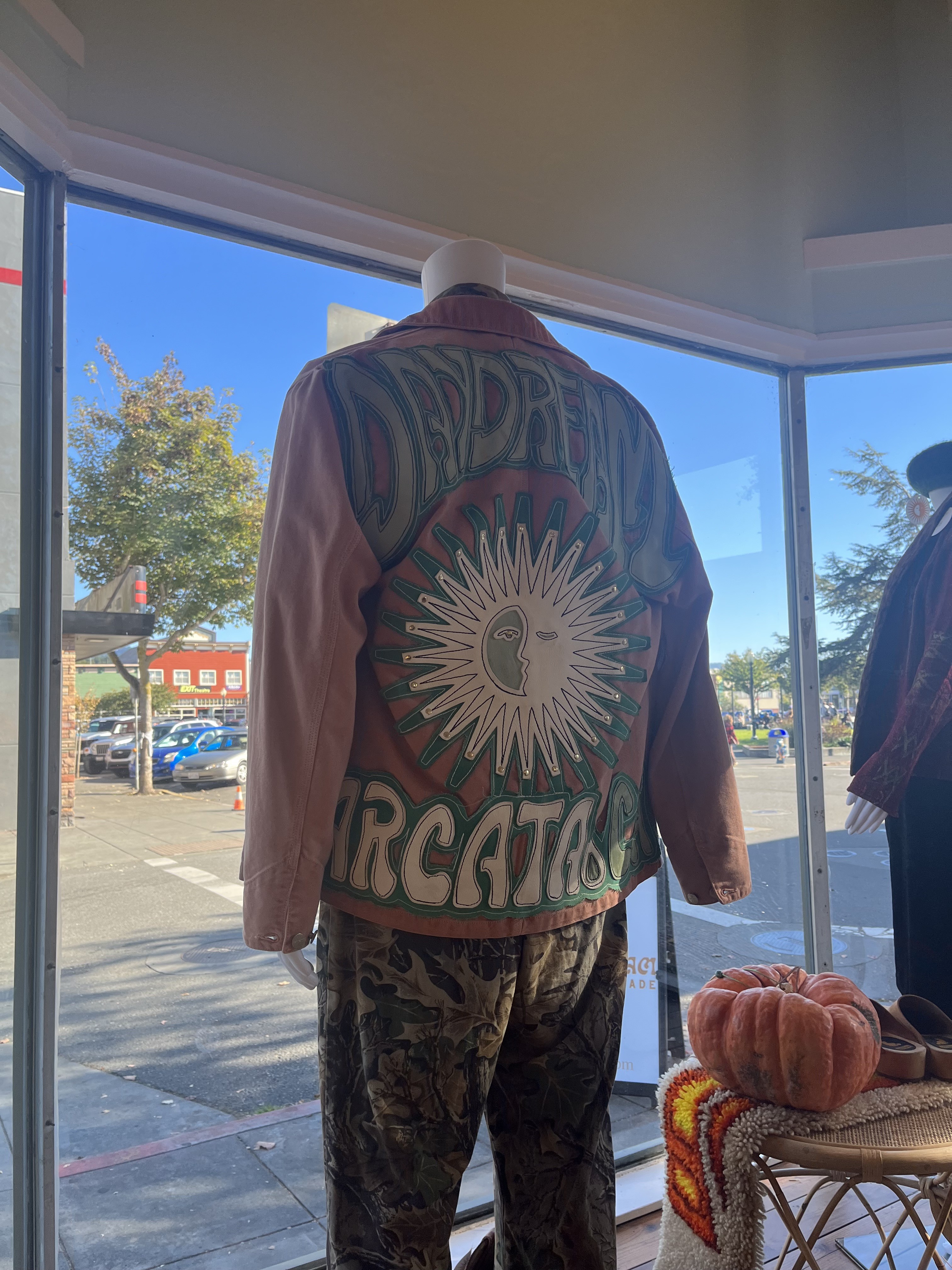
Thrifting for second-hand clothing has become a hobby and part of the culture for many Cal Poly Humboldt students, making the community an eclectic and stylish one. This combats the destructive industry of fast fashion. At Arcata’s new thrift store, Daydream, you can buy high-quality clothing and make money by clearing out your own closet.
Daydream, is a new buy-sell-trade second-hand clothing store on the corner of 9th and H St. across from the Arcata Plaza. The store provides a space for students and locals to make some cash while discovering a new sense of style. The warm-toned inviting store opened two months ago and is one of three local second-hand clothing stores co-owned by Jayna Nix and Ben Blair. Open seven days a week from noon to 6 p.m., you can go in to buy, sell, or trade any time before 5 p.m. and walk away the same day with cash or store credit.
What makes Daydream unique in comparison to the many other second-hand stores in the area is that they buy everything from the public and provide compensation either with store credit or cash on the spot. This process can be quite quick and is guaranteed to be completed within a single day. The store’s warm, clean, and inviting energy is represented in its curated racks of vintage clothing, rows of used trending shoes, and a wall filled with scented candles and accessories. Styles range from cottage-core to street style to retro and everything in between.
Photo by Zack Mink. Daydream boasts a collection of cute and colorful vintage.
Unlike the duo’s other stores, Redwood Retro and Modern Finds, both in Eureka, Daydream brings a focus to the art, styling, and sustainability of fashionable clothes. Rather than organizing the racks by gender, they are organized by size, style, and even season. This not only represents their push for gender and size inclusivity, but it encourages buyers to be more intentional and thoughtful when purchasing seasonal clothes that will last a lifetime.
The buy-sell-trade business model is also unique as the entire store relies on customers and locals bringing in their clothing to exchange.
“It creates a community hub where people come in, hang out while we go through their clothes and shop,” Nix said.
Daydream’s high standards for buying and trading clothing does highlight a downside of this model, which is that the sizing availability takes a hit when locals don’t have petite or plus-size clothes to bring in.
“We can’t control what people bring to us or the sizes we have… although we want to have more size inclusivity,” Nix said. With this being said, they are always looking for more variety in the sizes that are being traded and sold.
Despite facing challenges curating wide size ranges, Nix’s goal to recycle as much high-quality, sustainable clothing as possible is easily attainable with their buying standards and community support.
“Part of our mission is sustainability and recycling clothing. We try not to accept more
of the fast fashion brands and the buy-sell-trade model creates a space where we can recycle… what we already have,” said Nix.
Rather than buying clothes from fast fashion brands or selling old heirlooms to help partially cover monthly bills, Daydream is the place for students and Arcata locals to step up their style game, be financially responsible in a struggling economy, and stay committed to having a low impact on the environment.
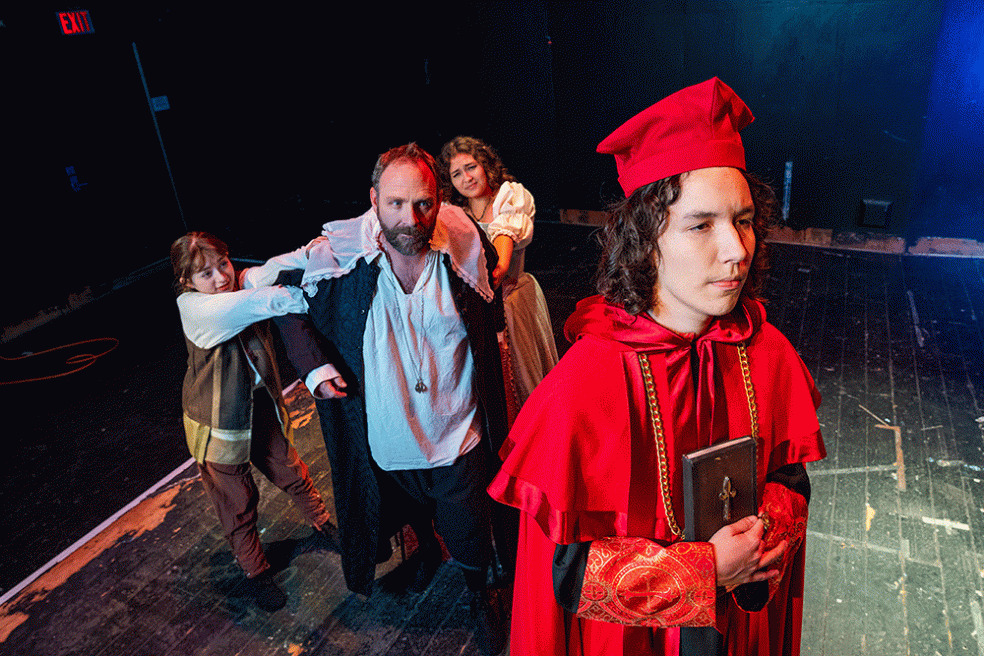
It was a full house for the nearly two hour long production and helped feed into the performers liveliness. Cal Poly Humboldt’s Theatre Arts Department presented their fall semester play, “The Life of Galileo,” Nov. 3 in the Gist Hall black box theater.
I had yet to attend a play at the black box in my time at Humboldt State, and I believe it has to be my favorite location so far. The stage was smaller and a lot more intimate. It was also a lot easier to hear the actors more clearly.
Immediately, the prop and set design caught my eyes. Working with such a small space, they were able to create multi-purpose prop designs to be used throughout the entire production, and create separate rooms and energies on such a limited stage. Bookshelves of Galileo’s scriptures and studies that doubled as Roman columns — and even circus tents when flipped around — were genius to me.
The use of projections and other media really brought the whole production together. Like a silent film, they projected title cards on the castle walls to set the scene, which was a really creative way to occupy the crowd while stagehands moved props for the following scene.
Even the stagehands added to the artfulness of the play. They were adorned in plague masks and cloaks to blend into the scenes, which kept things interesting during an otherwise liminal transition.
Everything involved with props and set design was very thorough. Hanging planetary orbs and stars above the theater to back the play’s theme was gorgeous, as well as the creative use of such a small stage. A large brick castle with a spiraling staircase was tucked away in the background, and the use of hidden tables and raised platforms allowed for Galileo to easily bop around the stage. The production had no mics and was fully reliant on the actors belting capabilities, which proved successful.
Graphic by Griffin Mancuso.
The cast seemed much larger than what I have seen in other productions put on by the theater department. The play itself was more comedic than I expected it to be, through youthful banter and sassy characters like Galileo’s pupil, Andrea, played by Jenny Campos.
Although I will say the humor does seem a bit dry and for a specific audience, which I myself was not a part of. The one-liners seemed reliant on historical knowledge and for more of an older audience. One audience member continuously giggled throughout scenes in the first act while the rest of us remained silent, it felt I was missing something, or maybe we all were.
It wasn’t until the second act that I fully grasped the commentary of the play itself, a humorous meditation on the historical battle between religion and science, following Galileo returning from his near death experience after his scientific discovery that Earth was not the center of the universe.
The lead Galileo (Troy Lescher) had many asides within the show that seemed necessary for witty comments, but I feel they did fall a bit flat.
Although it took a bit for me to get into the play, the second act’s circus scene was fantastic. Actress Penny Dellapelle carried three roles in the production and was phenomenal. Her line delivery was hilarious and she really proved to be a firecracker on stage. Especially in her roles as the ballad crier in the circus performance and the snarky philosopher turning down Galileo’s scientific discoveries. The audience’s giggles also seem to reflect my opinion.
Lake Terre’s playing of the Bursar of the University of Padua was also quite animated and entertaining to watch on stage, especially during his scenes where he was trying to avoid interaction with Galileo. Although, I will say some of his scenes with Galileo kind of skewed the curtain of acting and reality for me.
The acting of all cast members was quality work in nearly all of the scenes. Some of the more busy scenes really shifted the veil of reality and performance for me. Watching a group of callow, college-age actors surrounding the obviously decade-older lead threw me off a little bit, and made the production feel more juvenile and high school-esque than I was prepared for.
All of the characters within the play were seemingly near the same age, so watching a baby-faced Bursar or philosopher scold Galileo, an obviously older actor, made me snap out of the entertaining theater-goer energy quickly.
The production brought a modern commentary on the history versus religion theme. Projections of Elon Musk, Mark Zuckerberg and Bill Gates to describe “elite Italian families of the 1500s” was extremely comical. Also projecting images of COVID-19 deniers when discussing the relationship of science with the priest was super timely and the cherry on top of the production.
Overall, the Theatre Arts Department put on a spectacular production and really killed it with The Life of Galileo. Opening night brought lots of energy from the performers and a packed audience. The technical aspects really tightened the show up completely. The production’s ability to play off the recent historical events of science-deniers really lightened the mood in such historically dense productions.
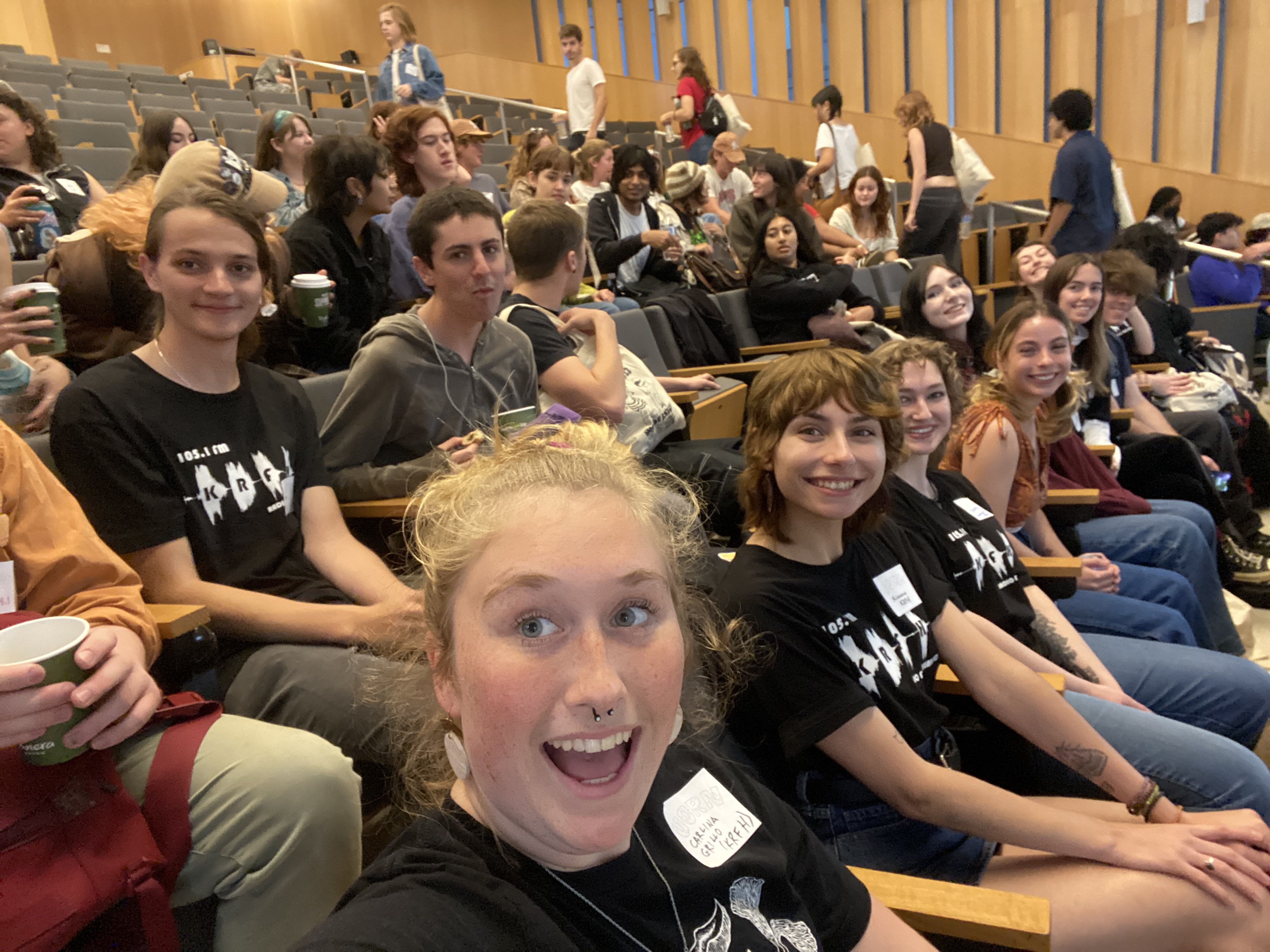
This past weekend, KRFH DJ’s made the journey down to Los Angeles to attend the University of California Radio Network Conference held on Nov. 4 by KXLU at Loyola Marymount University. The day consisted of three sessions, where students could choose between workshops and panels like creating DIY promotional materials, developing an on-air persona, staff training protocol, life after college radio, and more. Students especially interested in play-by-play sports broadcasting and news casting were given the opportunity to attend a journalism seminar also held at LMU featuring professional broadcast journalists.
Outside of the panels, workshops, and seminars we attended, this conference proved to us how hard-working and committed KRFH DJs are; the kind of people who would drive 12 hours on a Friday to attend a 10-hour event on Saturday, just to drive the 12 hours back the very next day.
Although the conference seemed to be targeted towards UC’s and private schools, we’re grateful that we committed to the voyage because it genuinely left us feeling inspired and validated as DJ’s, and station managers, for a student-run radio station. Being compared to almost 10 other bigger stations, where there is paid staff, we learned that there is something so special about Humboldt and our student-run station. KRFH is full of real, passionate, small town DIY DJ’s. No amount of money could buy what we have, which makes sense because as a class and a club, open to only students, we are responsible for raising the majority of our funds.
We’ve hosted three 24-hour live radio events, featuring live radio dramas such as “War of the Worlds” and “Coraline”, something other college radio stations absolutely aren’t doing. We brought back our Local LIXX, featuring local bands live from our station, and brought back KRFH News, offering the community weekly news in an audible format.
And, for the first time in our KRFH career, we not only got 15 DJ’s to make the trip down to LA, we also got them fed, sheltered and inspired.
One of the most eye-opening realizations during the conference was the fact that most, if not all, leadership positions at other college radio stations are paid, but at KRFH, we do everything solely out of passion for college radio.
KRFH is so much more important than Cal Poly Humboldt gives us credit for. Upon a Google search, you can see KRFH is one of the most popular stations in the county, and as we grow, every day we become more and more of a community resource. In places such as Berkeley, eccentric radio is seen as a necessity for local commuters. A question we asked ourselves was: Why is KRFH seen as anything different?
The truth is, KRFH will never be like KALX or KXLU, other big college radio stations with lots of funding. However, that’s kind of the beauty of our station. KRFH is entirely student-run, and although it’s difficult sometimes, this weekend has shined a light on how beautiful, important and rewarding the work we do actually is. Despite coming from higher-funded, and arguably more organized stations, students from other stations at the conference vocalized the way our small town aesthetic and methods have inspired them.
KRFH deserves to be celebrated and recognized for all that we do. We aren’t simply a group of journalism and communication majors who like to spin vinyls late at night. In reality, KRFH is made up of students from many different majors coming together for the love of music, community, and most of all, college radio.
As registration for Spring 2024 opens, we highly encourage any student who’s interested in being a part of our community to enroll in JMC 154 and JMC 155, the classes that will teach you about audio editing and get you in our station. For most of us, college radio isn’t forever, college radio is right now, a time in our lives where we, like many other college radio alums, will look back on very fondly. Our hope, as the 2023 KRFH station managers, is for anyone who feels compelled to radio gets to experience the beauty of KRFH.
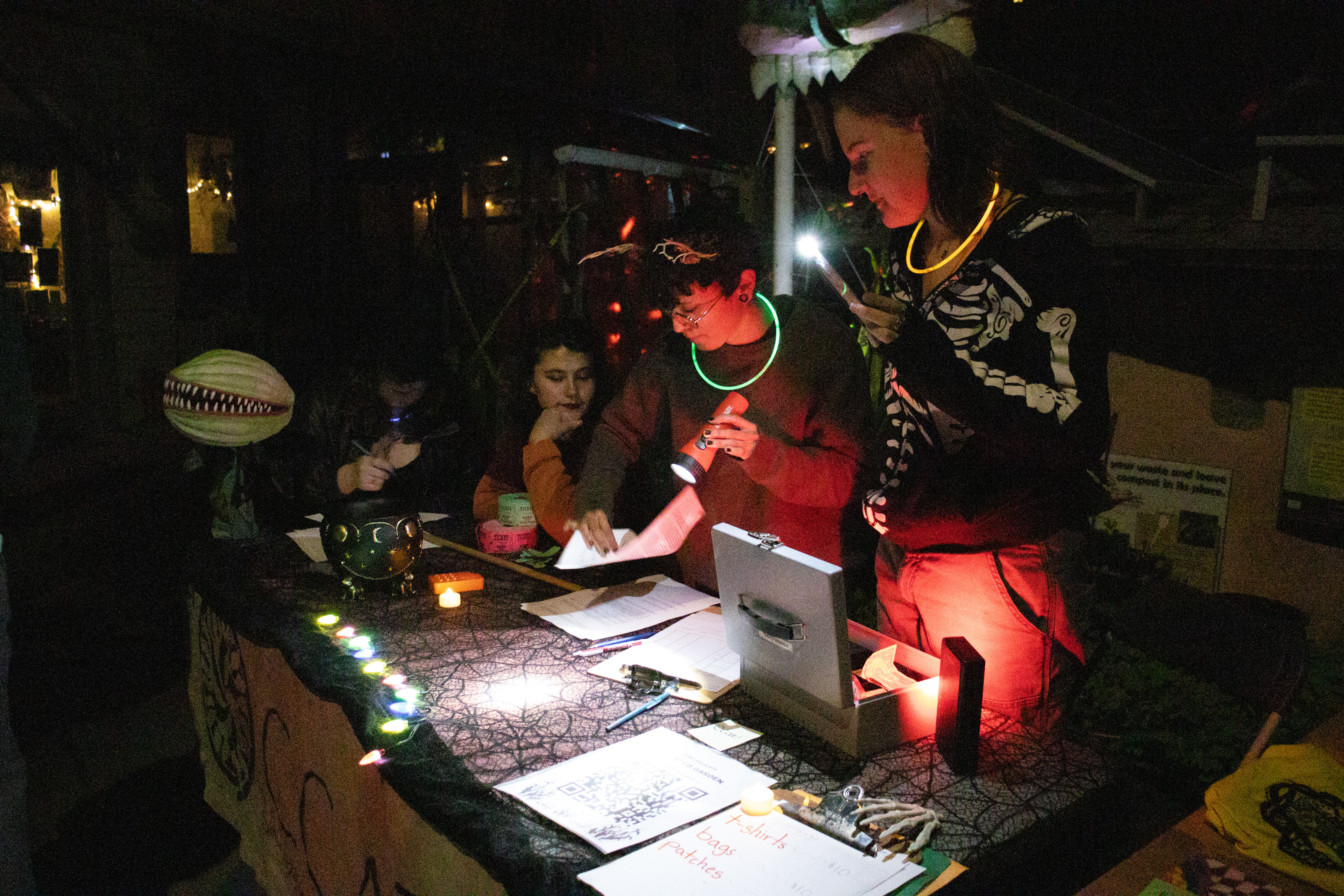
On the edge of campus, the sound of Michael Myers’ theme floated up from the entrance to the Campus Center for Appropriate Technology’s Buch House. The garden, normally home to a variety of edible crops and other plants, was transformed into a maze with shadowy figures lurking in every corner. Guests in a variety of costumes from Little Red Riding Hood to Sonic the Hedgehog paid the one dollar entry fee and vanished into the maw of a green monster with curled horns.
CCAT’s Haunted Garden event on Oct. 28 garnered lots of attention from students and community members this year, and I had to see for myself if the scares were worth the one dollar entry fee.
After I passed the toothy threshold of the maze, four small pumpkins with “CCAT” carved into them were the last remaining comfort before I was enveloped in darkness. A string of colorful fairy lights outlined the pathway and added to the whimsical atmosphere, but did little to illuminate the surrounding decor. Going in, I was aware that there were volunteer scare actors, but I greatly underestimated their dedication to their roles.
Photo by Griffin Mancuso. The entrance to the CCAT Haunted Garden.
I started my journey through the haunted garden behind a group of guests, so I got a ten-second notice before any upcoming scares. Unfortunately, it was so dark that I couldn’t tell where they were coming from or what they looked like.
A mysterious figure wearing a ragged newspaper mask, who I initially assumed was a part of the group in front of me, suddenly turned around and gave me the most uncomfortable eye contact for a solid 20 seconds. The eye holes in the mask were small, black pits that I couldn’t bear to look away from. I expected them to eventually scream or lunge towards me, but they eventually stepped to the side, watching me closely as I rushed forward.
I became highly aware of my surroundings after that. I passed another actor who had finished scaring a group ahead of me and decided to watch me silently, crawling around in a way that I don’t think humans are supposed to move. I turned around to make sure no one was following me, only to notice a decapitated torso near the trail’s fairy lights (a fake one, thankfully).
Following the steady incline to the upper level of the garden, a disembodied voice whispered, “Boo!” I whipped my head around to see an actor dressed in all black smiling at me, crouched behind a bush. I decided to try being funny, raised my hands in the air, and loudly went “Ah!” The sound of their ominous giggling followed me as I continued.
As I walked along the upper ledge, a rare source of light from a workbench area appeared ahead of me. As I got closer, the roar of a weed wacker met my ears as an actor revved it in the direction of a group ahead of me. I was not initially startled, but my face twisted into an uncomfortable frown as I saw who was holding the weed wacker. The actor wore a dull, flesh-colored mask with no features besides a large mouth with sharp, bloodstained teeth.
I was caught off-guard twice after that. As I walked along the upper ledge, I was startled by an actor in a clown mask whose blood-curdling scream made me jump out of my skin. I rushed forward through a section of the garden that was lined with tarps. As I turned around a corner, I screamed again as a witch with a shrill cackle lunged towards me. I cursed my tendency to easily startle and pressed forward.
Hiding in a corner just before a short descent was a person in a full body black suit with large googly eyes pointing in opposite directions and a toothy grin. While this actor’s costume was almost comedic, it was a little less funny once they started shuffling towards me while making intense googly eye contact. They reminded me of a spider, but one of those terrifying, giant Australian kinds.
Just past the last source of light in the maze where a three-foot tall skeleton lounged in an Ace Hardware wheelbarrow, I heard a stream of chilling laughter behind a corner. I approached nervously and found that the laughter was coming from a ghostly nun with black lipstick. I was more impressed than anything and felt compelled to tell them. They seemed flattered.
I stepped out of the maze back onto the blacktop leading up to the Buch House, slightly frazzled but satisfied with my experience. For a haunted maze set up in a small garden with a limited budget, it was definitely worth more than a dollar.
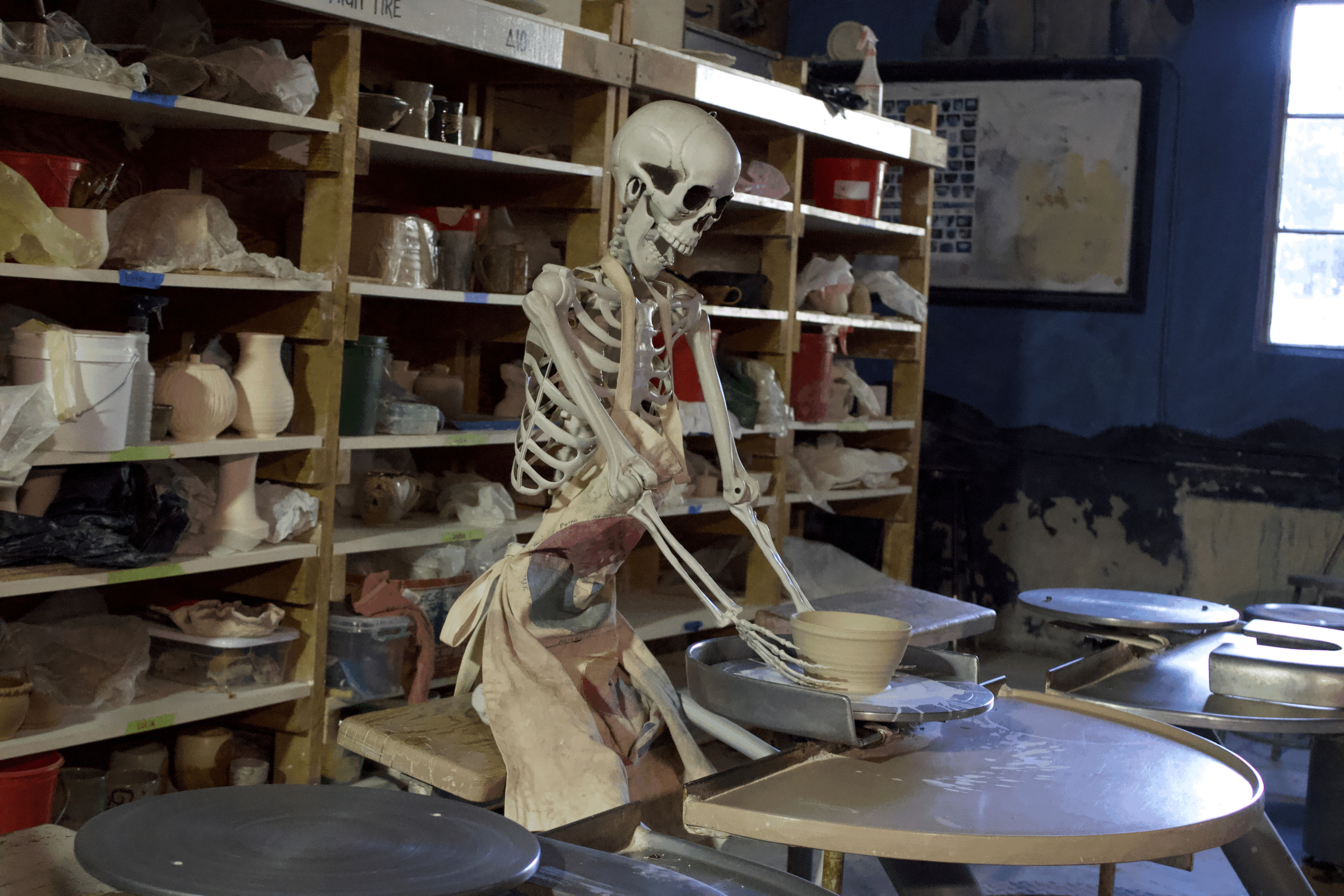
The Cal Poly Humboldt ceramics department put on their 2nd annual spooky block party at the ceramics lab on the day of Halloween. The festivities were held in The Laundry from 4p.m – 7p.m.
It was open to all Humboldt students and their friends and family too. Hosted not only by the jewelry and small metals club as well as ceramics, but with the help of the art education department as well.
Photos by Christina Mehr. Students walk around and observe artwork in the ceramics building.
There were free hotdogs and snacks provided for attendees, pumpkin carving, button making, the art show, raffle prizes, costume prizes and all sorts of spooky good times. Oh, and smoke machines!!!
The event offered a chance for art students to showcase their work this semester so far. Students were able to submit their work to be shown at the event. They accepted all art mediums in this show and the ceramic masterpieces were spooktacular.
“We’ve been working together to try and create a fun little art show and sale to support the art department. We divided ourselves into committees like decorating, food, art and we all just worked together to make this happen,” said Jade Hisamoto.
The ceramic spooky block party was a hauntingly good time for everyone who dared to attend. Ghostly creations and eerie vibes filled the air of the studio as attendees unleashed their creativity alongside the art community.
Bachelor of fine arts (BFA) student Max Parrish helped run the clay club sale table.
“I am one of the treasures for the clay club and we’re just trying to host a fun event. We did this last year as well as this year. We want to make it an annual event where we can have a little block party and do cute Halloween stuff and bring more and more clubs in,” said Parrish.
“It’s also a great opportunity for students to showcase their work and put things in their resume or for grad school.”
You can follow along on the Clay Club’s instagram for updates @HumboldtClayClub if you want to join the Clay Club and get involved in their future events.
I’ve found a new appreciation for the act of dissociating, giving the once unhealthy coping mechanism of mine a whole new beautiful meaning. When getting lost in your own head with intention, you may feel as if you’re disconnecting from the world around you, but really, you find that you’re actually connecting deeper within yourself. Maybe, dare I say, you find a deeper connection with the life you think you’re hiding away from.
Clearly, I tend to romanticize these deep, existential thoughts and feelings, which is why I love music that matches my energy.
“Music to help you feel like you’re floating through space,” as I like to say. “Instant astral projection.”
It’s why I’ve been listening to a lot of shoegaze, indie dream-pop and folk artists such as Alvvays, Teen Suicide, The Sundays and, of course, Boygenius – one of my faves, as of late.
Within the first few seconds of Boygenius’ newest EP, “the rest,” I was instantly brought into my own head and launched into deep space. What else could I have expected from a song titled “Black Hole?” That’s when I knew: this new Boygenius is going to hit.
The 12 minute EP only consists of four songs, but carries all the best parts of Boygenius, from Phoebe Bridgers’ dreaminess to Julien Baker’s rawness and Lucy Dacus’ lyricism. Each member is already such a successful star on their own; together, they burn so much brighter.
It’s a beautiful thing to enjoy the art of queer women supporting one another, and getting to experience the product of their complementary talents. “the rest” was officially released on Oct. 13, just six months after the trio released their full-length album, “the record,” which features the group’s most popular tracks such as “Cool About It,” as well as mine and everyone’s favorite, “Not Strong Enough.” Don’t ask me how many times I’ve had the lyrics “Always an angel / Never a God” ringing in my head these past few months.
One thing that really stuck out to me is Boygenius’ mutual respect and admiration for outer space, and how the group uses these themes in their music. It’s worth noting that the song “Not Strong Enough” starts off with the lyrics “Black hole opened in the kitchen” while their new EP literally starts with a song called “Black Hole.” These themes are continued in “Voyager” and “Powers” with lyrics like “Walkin’ alone in the city / Makes me feel like a man on the moon,” and “A hostile alien ambassador? / Or am I simply another of the universe’s failed experiments?”
I feel those last lyrics, heavily.
There is another theme within this short EP that I strongly relate to: someone you love urging you to take a fatal risk, and while you might not have been too excited about living life, you realize you don’t want to go just yet.
“I don’t wanna live forever / But I don’t wanna die tonight.” Lucy Dacus, I see you.
And I know Boygenius somehow sees me too, because I don’t know how they knew I’ve literally been writing about the connection between getting lost in one’s head and floating through outer space, but I’m glad they did.
This one is for all the other sad girls finding comfort and healing in the space inside their own minds.
Cal Poly Humboldt Biology Major Amelia Francis uses frosting and food coloring as an artist uses pigments, paints and glazes to create works of art. Her love of science and art has transformed into a home-based business selling delicious, mouth-watering cupcakes. Every cupcake is skillfully frosted to create a near-accurate representation of a flower. The artistic details offer far more than just a beautiful cupcake adorned with a frosting flower. The cupcakes and cakes at Barn Owl Bakery are delicious and that is not by chance, every recipe has been diligently planned and taste-tested to create a delectable treat.
Barn Owl Bakery is an approved California Cottage Food Operation, which means it sells home-made food prepared outside of an industrial kitchen. The California Homemade Food Act (AB 1616) allows for home-based culinary businesses to sell certain non-perishable homemade food products, so long as they register with the county, follow the approved Cottage Food Operations application process and are in line with procedures.
“I looked at all of the different rules that followed a cottage food operation and went: could I make that work? Yes. Could I make this work? Yes. Could I pay that much for permitting? Yes,” said Francis. “The more I mentally said ‘yes’ to the different aspects, the more I committed to doing it.”
The idea of creating a home-based business appealed to Francis for many reasons, a couple being that it offered the freedom to work for herself and have quality control over the product, while still allowing less financial risk than having a brick-and-mortar restaurant. Francis was finishing up her associate degree when she began the application process and testing recipes last fall. Barn Owl Bakery has been open for business, busting out delectable cupcakes and cakes since it was licensed as a Cottage Food Operation in May 2023.
“It’s very risky to be a business owner,” said Francis. “I did it as a Cottage Food Operation intentionally because you don’t have to pay for rent and utilities, all that stuff. It’s a lower risk, but it’s still risky.”
The Cottage Food Operation application process requires each recipe to be carefully written out with all the ingredients listed along with their precise weight. Next, the labels and information are mailed to the Department of Health to check and approve for licensing. Francis says the paperwork was fast; it was the process of creating the recipes and labels that required the most time. Once all the labels were submitted, they were approved quickly, and Barn Owl Bakery was open for business. She’s created recipes for products beyond cakes and frosting that she submitted for approval, but customer demands have kept her focused-on baking floral cupcakes and cakes.
“I thought that at most, I would sell like a dozen cupcakes every month or so,” said Francis. “I didn’t anticipate finding a niche in our community. I would rather bake myself than buy something that wasn’t as good as homemade! I had the thought, maybe there are other people in the community who like their baked goods to taste how I like them too.”
Francis has got the baking down to a science. Francis says the Food Network show “America’s Test Kitchen” was influential to her success as a baker. The educational cooking show explains the chemistry processes behind baking. She accredits having an understanding of the sciences to successfully adapting her recipes without wasting ingredients.
“I’d say understanding the science behind the ‘why’ in baking is vital if you are going to sell baked goods, because problems arise that you need to troubleshoot all the time,” said Francis.
Francis practiced diligently on frosting cupcakes as well as thoughtfully creating flavors for her recipes before opening for business. Of all the recipes she perfected, Francis says perfecting a frosting recipe that will please a wide range of tastes was the most challenging. A mixture of chemistry and personal creativity, Francis homed in on what makes a perfect cupcake with perfect icing on top.
“My favorite part is mixing in wet ingredients and seeing them all come together in one homogenous mixture, which sounds weird, but it’s very satisfying,” said Francis. “Yeah, it all becomes smooth with the correct temperature, and I know that it’s all on the right track and going to be perfect.”
Balancing the demands of running Barn Owl Bakery and being a full-time student takes structure and determination. Education has always been a top priority and focus for Amelia. That is one of the reasons why she embraced the idea of a Cottage Food Operation over a full-time business that would require her to take time away from school.
Before starting Barn Owl Bakery, baking was an outlet for creativity and a way to relieve stress. Francis had always felt a calling towards science and art. The flowers that adorn the cakes are little works of art themselves. Before baking as a creative outlet, Francis had taken several ceramics classes as well as a color and design class. Customers are spreading the word about her cakes and orders are filling up.
“I like to do all kinds of art,” said Francis. “If I feel stressed, I usually turn to baking. Baking has been my creative outlet to release stress, but now it’s also my work.”
Barn Owl Bakery has now taken on wedding cake orders and is booked out until the New Year. Perhaps the last chance this year to try some of Barn Owl Bakery’s delectable desserts will be on Saturday, Oct. 21, at the Harvest Artisan Faire held at the Eureka Veterans Hall. Barn Owl Bakery will have a table set up selling cupcakes, as well as several other treats that she hopes to offer in the future. There will be cake pops and cake slices, cocoa bombs and free samples at the event. New cake flavors such as vanilla latte and angostura orange will also be available. Appetizing flavors and nuances, as well as every visual detail has been artfully thought of in creating each treat that Barn Owl Bakery offers.
“It’s been amazing, and I’m so thankful for everyone that has supported me so far,” said Francis. “I love this community so much.”
“She makes it look easy, but I assure you – it is not,” banjo player Kyle Tuttle said to an audience of over 800 packed into the Van Duzer theater on Saturday, Oct. 7. Tuttle was referring to the guitar-phenom standing center stage who had sold out the venue, Molly Tuttle. The Tuttles were joined onstage by stand up bassist, Shelby Mea, and mandolin player, Dominick Leslie, calling themselves Molly Tuttle & Golden Highway. For over an hour, Molly and her band put on an absolute clinic of bluegrass musicianship to a unanimously captivated audience.
The night began with opener Cristina Vane who detailed the hellish 37 hour drive that the performers recently made from Nashville. She clarified that it was the most beautiful hell you can be in.
Vane’s set consisted of skillful guitar playing, stellar vocals and ultimate confidence on stage. Her style of music both tipped the hat to traditional country, folk and bluegrass, while remaining distinctly unique with a contemporary sound. It would have been a tough act to follow, had the next performer been anyone other than two-time International Bluegrass Music Association’s (IBMA) guitarist of the year, also the first woman to win the award, Molly Tuttle.
Photo by Brad Butterfield. Molly Tuttle sings to a packed Van Duzer theater on Oct. 7th.
Molly’s booking at the Van Duzer theater is in large part thanks to Michael Moore Jr., the Associate Director of the Gutswurrak Student Activity Center and the lead of the Centre Arts program.
“Molly is early in her career and she’s really on the rise right now,” Moore said. “This is mostly a community show, there are some students here and it’s over 10% students, so it’s not like it’s a small number, but it’s mostly community.”
Tickets to the show were free to all students currently enrolled at Cal Poly Humboldt. Allison Hair had a fun time despite the low student turnout.
“I love Molly Tuttle,” Hair said. “I think she’s really beautiful and talented. I was kind of sad there were no students here, but I had fun.”
Tuttle learned to play guitar by ear, only receiving a formal education in music when she enrolled in Berklee College of Music. Once the crowd had been warmed up, the bassist and mandolin player exited the stage for the Tuttle duo’s rendition of “San Francisco Blues,” which Tuttle described as a universal feeling.
“I got the San Francisco blues / Now there’s nothin’ left to lose / I can’t afford the dues and so I’m leavin.”
In another ode to the Golden State, Molly Tuttle and the Golden Highway played a cover of “White Rabbit,” originally written by the San Francisco band Jefferson Airplane. While the song may not seem suited for a bluegrass cover, the band captured the essence of the song with brilliant musicianship and uninhibited vocals from Molly, who has also won IMBA’s female vocalist of the year for the past two years.
Photo by Carlina Grillo. Molly Tuttle closing up her performance without her wig on.
An undeniable aspect of Molly’s performance and music is her acceptance of, and strength to share her experience with alopecia, an ailment which causes hair loss.
“I was inspired and moved to tears when she took off her wig before performing ‘Crooked Tree,’” said Jennifer Trowbridge, an accomplished guitarist and professor teaching music classes at Cal Poly Humboldt.
Not only did Molly hit each note perfectly throughout the performance, her band also played exceptionally well, continually weaving in and out of lead parts with ease. It was a special night to be in the Van Duzer theater and Molly’s confidence and conviction were infectious.
Among the many empowering songs in Molly’s setlist was a song called “Side Saddle.”
I said I don’t wanna ride side-saddle / Side-saddle, side-saddle / I just wanna ride bow-legged / Bow-legged like the boys.
“This song resonates with me as a female guitarist and teacher,” said Trowbridge. “In the CSU system, there are over 40 guitar instructors and only two are women.”
Before her final songs, Molly told the packed theater that she was going to let her hair down and subsequently tossed her wig onto a chair lit by a spotlight. The band circled around a singular microphone and closed the show to an entranced audience.
“She sang powerfully and looked like my imagination of a chic Amazon[ian] warrior,” Trowbridge added. “She absolutely glowed. As a woman, I felt proud of her strength and courage to share it on stage,” said Trowbridge.
This website uses cookies to improve your experience. We'll assume you're ok with this, but you can opt-out if you wish. Cookie settingsACCEPT
Privacy & Cookies Policy
Privacy Overview
This website uses cookies to improve your experience while you navigate through the website. Out of these cookies, the cookies that are categorized as necessary are stored on your browser as they are essential for the working of basic functionalities of the website. We also use third-party cookies that help us analyze and understand how you use this website. These cookies will be stored in your browser only with your consent. You also have the option to opt-out of these cookies. But opting out of some of these cookies may have an effect on your browsing experience.
Necessary cookies are absolutely essential for the website to function properly. This category only includes cookies that ensures basic functionalities and security features of the website. These cookies do not store any personal information.
Any cookies that may not be particularly necessary for the website to function and is used specifically to collect user personal data via analytics, ads, other embedded contents are termed as non-necessary cookies. It is mandatory to procure user consent prior to running these cookies on your website.