Photo by Lexi Rangel | (left to right) Lalo Rivera, Gigi Salazar, Chris Servi, and Josie Licavoli pose for a photo at Goth Night at Richard’s Goat on Feb 25.
On Friday, Feb. 25, Richards’ Goat Tavern & Tea Room hosted its first ever Goth Night, created by recent Cal Poly Humboldt graduate Jamie Cocking. The event was a tribute to the Goth subculture, which originated in the United Kingdom in the early 1980s. The subculture is open ended, yet is heavily saturated with darker tone aesthetics and music.
“I think goth subculture is all about expressing yourself in your truest form,” Cocking said. “Since I’ve lived here and have turned 21, I haven’t found any clubs or events with the music that I love to dance to, so I just decided to do it myself.”
Being a small town, Arcata is not well-known for its nightlife. However, contributions to the scene, such as Goth Night, keep it going.
“I just wanted to create a space where people could dress up as much as they wanted and not feel like they are sticking out like a sore thumb,” Cocking said. “Because for me, I mean everyday is Halloween.”
Richards Goat will be hosting another Goth Night on April 9.
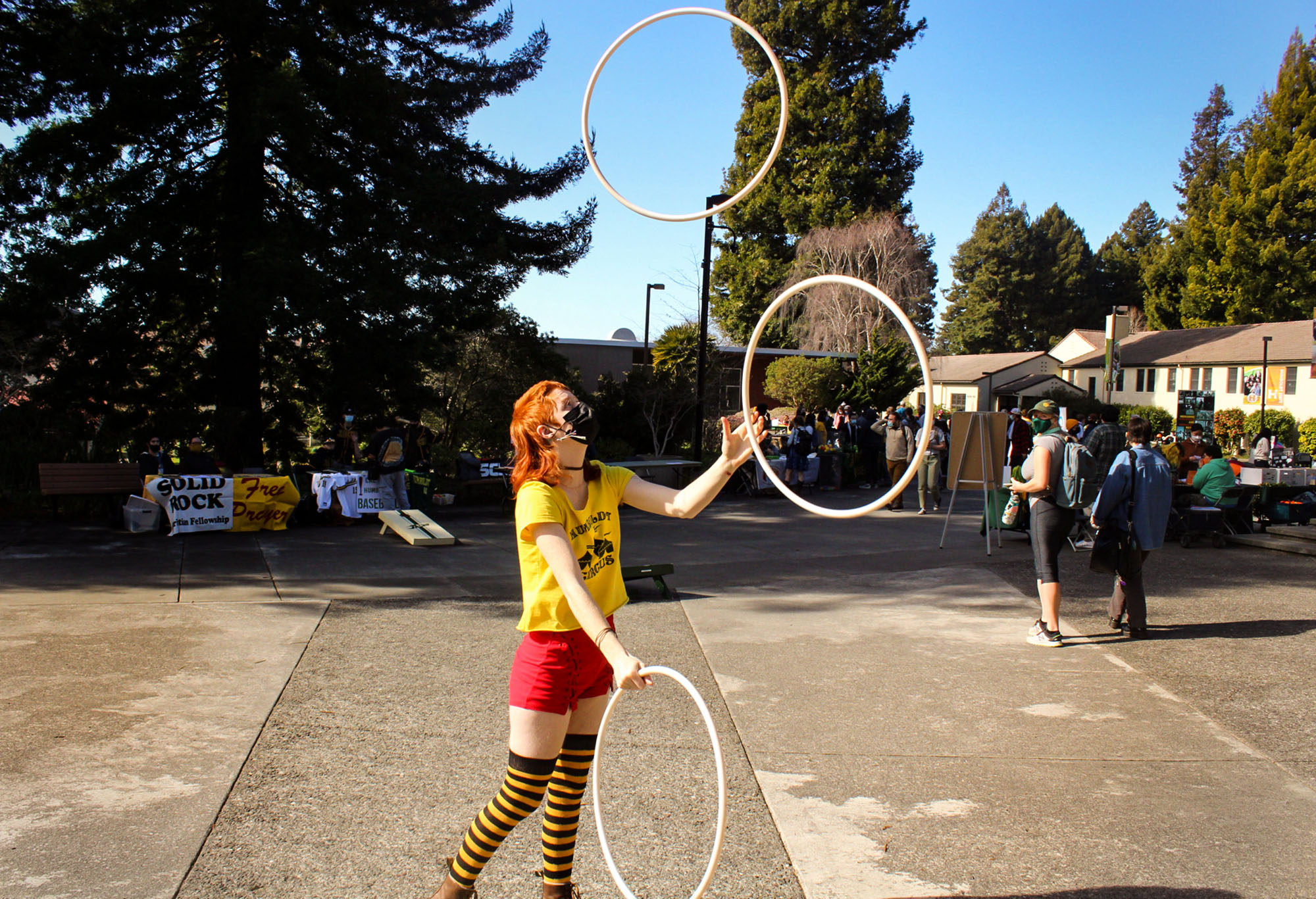
As his staff flew around his body. It became an extension of himself, twirling over the pavement. Man and tool became one through dance. Liam Boyd, a transfer student, and part-time circus performer ran up to the booth with a clown nose and a staff in hand. He had no idea Humboldt had a circus club and was overjoyed to meet everyone. Boyd started to perform with his staff and soon was joined by others, slowly growing into a full-grown performance.
The Humboldt Circus is one of many student-led Cal Poly Humboldt clubs. These clubs give students a safe place to meet like-minded individuals and learn new skills.
Photo by Gabriel Zucker | Louis Parr and Isla Marten sit behind the Circus Club banner, calling people over to check them out. Feb. 11.
On Wednesday, Feb. 10, student clubs set up booths around the Quad. This gave new students a chance to learn about and join these clubs, opening the door for new friendships and experiences.
Louis Parr, President of Humboldt Circus, brought a box full of circus props to their booth. Immediately the traffic in front of the booth increased.
“Circus is a magical place, full of fun and free creativity,” Parr said. “You are allowed to do whatever you want to, within the circus.”
Every week Circus hosts “Play Time” Monday from 5-8 pm at the West Gym. There they give students a chance to let their inner freak out in an artistically unique way. In this space, students are given complete freedom to explore and experiment to their heart’s content, trying new things every time, or perfecting one act over the course of the year.
Isla Merten, a longtime member of Humboldt Circus, walked around the Club Fair. They juggled everything from bowling pins to thin disks. Soon they were joined by more and more interested students, all signing up for the club and trying out some of the cool props. By the end of the club fair, multiple students had stopped what they were doing and taken a couple of minutes to try out different props and write down their emails.
Photo by Gabriel Zucker | Louis Parr, President of Circus Club, does bike tricks around the quad, during the Club Fair on Feb. 11.
Humboldt Circus gives its members endless possibilities for what they can perform and act out. Character acting and improv also have a place in Humboldt Circus. Props are used for tricks, laughs, and skits, adding a new layer to the performance. This year Merten moved away from the props and instead focused on improv and clowning.
“A clown means being creative and open to work with what you are given,” Merten said. “The spirit of play and creation.”
Embodying the clown, they act out scenes by themselves and with others. Merten uses improv to expand and perfect their character. Humboldt Circus, like all the other student clubs, gives a social place for students to bond with one another. When asked about who usually joins the club, Merten didn’t miss a beat.
“It’s a club for introverted weirdos,” Merten said with a laugh. “We have extroverted weirdos too.”
John Chernoff doesn’t carry most of the music he plays with him. Instead, the students he plays with bring it to him. He’s been the on-staff piano accompanist at Cal Poly Humboldt for what he figures to be about 16 years, playing a larger volume of music daily than probably anyone else on campus.
Chernoff plays at choral rehearsals, other ensemble practices, and individual sessions with any music student who needs accompaniment. Piano is often a catch-all substituted for what will eventually be other instruments, so Chernoff ends up filling a lot of roles for almost every type of music student.
“I play with basically anybody who needs a piano to be played with them,” he said.
One of his favorite types of music to play during working hours is when he accompanies the school’s musical theater rehearsals. He studied classical music up to the post-grad level, but says he appreciates the multi-faceted nature of musical scores.
Chernoff practices his craft almost every day. He’s able to sight-read any piece of music put in front of him almost flawlessly, and it seems ridiculous that the Music Department ever functioned without him. Learning new music quickly has always been one of his strengths, he says.
However, he is only one person, solely responsible for the needs of many students. Anybody who works with him knows well his constant, almost harried-seeming air as he rushes from practice room to practice room.
“The transition between [personal and professional] worlds is a rough one for me,” Chernoff said. “I have to confess, once you’ve heard vocal warmups enough times it’s kind of like water torture. It’s an inexorable ascent of key. So sometimes I’m not too eager to get to the beginning of certain things.”
Becoming a professional musician wasn’t always Chernoff’s goal. He first learned to play piano as a child, and says it was something he deeply loved, but mostly fell into. Even while seriously studying music, he thought that he would fall back to working in tech.
“I think the moment it happened actually was, there was a year where I was working as a computer programmer … I remember I would go into the office, and there would be people who didn’t know who Mozart was.”
At conservatories, concert pianists mostly learn virtuosic solo music, but he found that playing collaboratively was more fulfilling to him as a musician.
Photo by August Linton | John Chernoff plays the piano in a Music Room B practice room on Feb 22.
“There’s only so many notes you can jam into your brain when you’re learning solo piano music, before it starts to become kind of obnoxious … chamber music always seems like it has a more genuine purpose,” Chernoff said.
Upcoming March 4 and 5, the Eureka Symphony Orchestra will be debuting an original piano concerto composed by Chernoff as a part of their show ‘Inspirations, New and Timeless.’ He’s been working on the piece since before the pandemic.
“I have often been pressed into duty to play piano concertos with the Eureka Symphony, which is a fun thing to do,” Chernoff said.
The piece, simply titled ‘Piano Concerto,’ is Chernoff’s way of melding the 19th century golden age of classical piano with 21st century sensibilities.
“The 19th century tends to be the era where the piano shines particularly, so many great composers wrote for the piano at that time,” said Chernoff. “So that’s sort of part of my DNA. The thing is we can’t really write in that idiom today completely, because it’s not us. But it is a lot of us.”
The idealism of Debussy or other composers involved in the romanticism of the 19th century created an extreme, modernist reaction, according to Chernoff. He views this concerto as a sort of counter-counter reaction.
“I think what’s happened, is … [the cynicism of modern musical sensibilities] not really enough, modernism in a lot of ways has not worked out that well for humanity,” Chernoff said.
Another aspect of the piece, one which is uniquely reflective of Chernoff himself, is what he describes as a sort of awkwardness.
“When we write music, we can’t help but express our own personalities and such,” he said. “It’s alright to see the strings once in a while; I hope people can forgive the imperfections, the awkward turns of phrases, that all-too imperfect humanity the piece tends to have.”
Even after playing piano for other people’s projects all day, Chernoff goes home and continues to pursue his musicality. He plays jazz piano, and explores what bluegrass on the piano would sound like.
He’s also a zealous chess player, and still codes for fun occasionally. Merging three of his largest passions, he created a computer program which assigns musical traits to different moves within chess games.
Chernoff also livestreams on Twitch as @zugaddict: playing chess, performing different piano pieces, or even streaming the digital fantasy card game Hearthstone. He says he tried playing chess and piano simultaneously on a stream once, but that the act of multitasking took away the musicality.
“I try to do a lot of different things,” he said. “This piano piece of mine too, does this a lot, it has trains of thought it gets obsessed with.”
Tucked away in a small alley behind Six Rivers Solar on Broadway in Eureka is John Gibbons Glass. At his glass art workshop, Gibbons can be found coaxing hot molten glass into stunning art pieces or after melting down raw glass in his homemade furnace.
Photo by Lex Valtenbergs | John Gibbons (left) and Matthew Gagliardi (right) shaping a glass sphere at Gibbons’ glass art shop in Eureka on Feb. 1
Gibbons was first introduced to glass art by his father at antique glass shows when he was five or six years old. He’s been hooked ever since. While studying glass art at college, he dreamed of it when he slept.
“All I could think about was blowing glass,” Gibbons said. “I dreamed about it every night for a year.”
The glass artist community in Humboldt County is small but tight-knit. Matthew Gagliardi, a glassblower with three decades of experience under his belt, has worked with Gibbons for the last five years. Gibbons and Gagliardi both use soft glass, a fluid type of glass that is ideal for sculpting.
“We all kind of work with each other,” Gagliardi said. “There’s only so much of us in the county that work with soft glass.”
Photo by Lex Valtenbergs | Michelle Coelho diverts heat from John Gibbons’ face with wooden heat shields while Gibbons shapes a glass sphere in his shop in Eureka on Feb. 1
Michelle Coelho is another one of the few Humboldt-based glass artists who works with soft glass. She has been doing it for 20 years, about as long as Gibbons has. Gibbons, Gagliardi and Coelho all specialize in Venetian glassblowing, a technique that dates back to the 8th century AD. The type of tools that they use goes back to the 14th century AD.
The trio worked in synchronized harmony on the morning of Feb. 1 to transform a glob of raw glass into a beautiful pendant light, a lime green sphere with a hypnotic spiral pattern rolled into the glass on a steel table – a marver – and inlaid with a mold.
“It’s like a well-orchestrated dance,” Coelho said. “John’s body language tells us what to do next. It’s not so much verbal, it’s visual.”
They were constantly in motion to prevent the glass from losing its temperature and shattering or drooping down towards the floor like viscous honey falling off a honeycomb, as Coelho put it. They have to be on sharp alert at all times. Not only is the glass is heated up to over 2,000 degrees Fahrenheit, the operating costs involved are expensive as well.
“There’s a lot of trust, and also money,” Gibbons said. “You gotta trust them not to break your investment because there’s a lot of money that goes into it.”
Photo by Lex Valtenbergs | A close-up shot of a hypnotic pendant light made by John Gibbons, Matthew Gagliardi and Michelle Coehlo at Gibbons’ glass art shop in Eureka on Feb. 1
Gibbons hired a media assistant in April 2021 to vamp up his online presence. Makayla Sandifer worked in information technology before she found a niche in media production and picked up the job at Gibbons’ shop.
As a Black woman in a white and male-dominated field, Sandifer enjoys the opportunity to work in such a dynamic space that fosters her creativity.
“It’s honestly awesome,” Sandifer said. “It allows me to bring diversity to spaces that didn’t have it previously and to reflect that in my work. It’s super gratifying.”
The product photos that Sandifer takes for Gibbons’ Etsy profile do justice to his vibrant glass art pieces. Whimsical starfish vases, turtles with bubbles of glass trapped inside their shells, and light fixtures adorned with alluring spiral patterns boggle the mind with their complexity, vibrant colors, and otherworldly beauty.
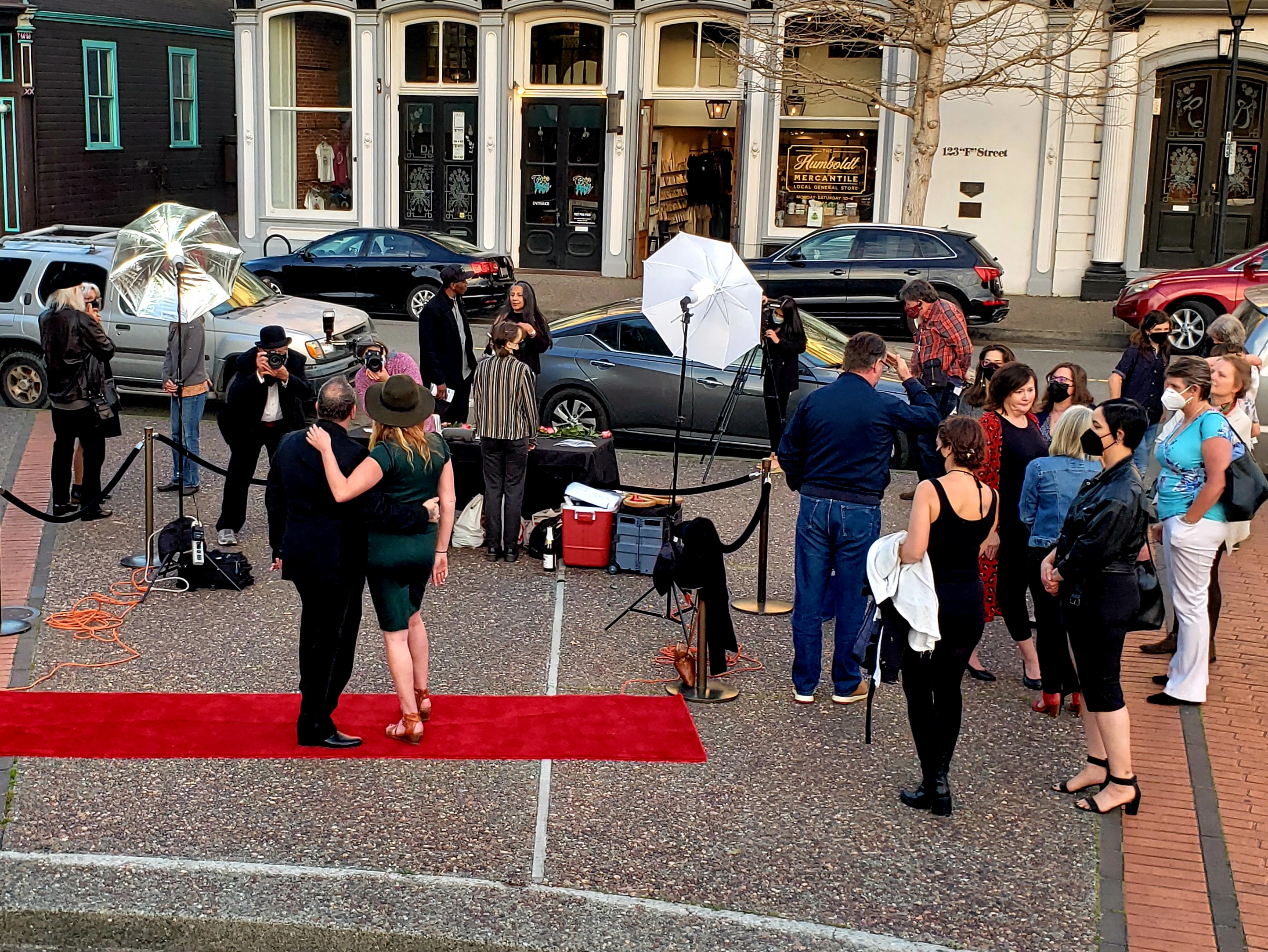
On Friday, Feb. 11, the A24 movie “The Sky is Everywhere” premiered on Apple TV+, accompanied by a red carpet event in Old Town Eureka. Filming took place locally on such locations as Moonstone Beach, Arcata High School, College of the Redwoods, and Sequoia Park, and over 500 locals were involved in the production, myself included.
The film itself explores the grief of Lennie Walker, a high school girl grappling with the sudden loss of her idolized older sister. Lennie, portrayed by actress Grace Kaufman, finds herself caught between a grief-forged connection with Toby, her late sister’s boyfriend (Pico Alexander), and Joe, an intriguing new music student fresh from a Parisian conservatory (Jacques Colimon), but more than that, she finds herself torn between mourning and moving on.
Director Josephine Decker depicts this world through a lens of magical realism. Lennie’s inner turmoil causes a storm around her only she can see, and the act of playing music literally leaves her walking on air. While these slightly surrealist aspects could serve to take one out of a film, here it serves to highlight Lennie’s turbulent emotions and sense of unreality. The visuals help set “The Sky is Everywhere” apart from many other YA dramas, while characterizing it with a certain twee sensibility and aesthetic.
The film’s minor characters round out the ensemble with heart and soul. Tyler Lofton’s nice guy Marcus, Ji-Young Yoo’s supportive bestie Sarah, and Jason Segal’s stoner uncle Big are all highlights, but Cherry Jones as Lennie’s grandmother Fiona is the standout star of the ensemble. Jones grounds the piece with her kind yet authoritative presence, quietly stealing the show without detracting from her costars. Though the film focuses on Lennie, it, unfortunately, does so at the cost of the people around her. We never get more than one or two shallow notes on many of the people populating this world, despite the actors turning in genuine performances with what they were given.
Still, nothing is quite like seeing my own hometown (and in one scene about four minutes in, my own face) filmed so beautifully and professionally on the silver screen. Humboldt is on full display here, with every scene reminding the local viewer of a place they know well. A jubilant dance scene appears before the Old Town Gazebo, a heartfelt apology takes place in the streets of Ferndale, and the Arcata Presbyterian Church hosts the funeral that sets so much into motion. The emotion of seeing one’s home in this way was one shared by Deputy Director of the Humboldt Film Commission Nate Adams, who I interviewed at the red carpet.
Photo by Sophia Escudero | Eureka Mayor Susan Seaman cuts the red ribbon commemorating the Old Town gazebo as a site of filming Feb. 11.
“It’s overwhelming, trying to focus on the movie and seeing the locations, and the people, and the art, and even my friend’s stickers made it into the movie,” Adams said. “It’s just overwhelming to see so much of Humboldt.”
Film Commissioner and HSU alum Cassandra Hesseltine teared up as I asked her about her experience helping create this production.
“I cried at the end of the movie yesterday when I watched it,” Hesseltine said. “Part of why I cried is because I love working in film. I wanted to work in film since I was five. Besides the content of the movie, and it is a beautiful movie, the reason why I cried was just to think about how all this happened in my community, that I helped it happen, and it was really, really special.”
“The Sky is Everywhere” is available for streaming at Apple TV+.
None of us thought we would wake up one morning and be told that we could no longer make connections the way we were used to. COVID-19 became a part of our daily lives, affecting us at every turn.
Dating during a worldwide pandemic has impacted us all in unique ways, including CSH students.
Local resident and Cal Poly Humboldt alumnus Olivia Brock shared their experience.
“Dating during COVID times for me is for sure more online now at the beginning of talking to someone,” Brock said. “It definitely restricts what we do … all the dates I’ve been on have been outside usually somewhere in nature with a mask on.”
Once you’ve managed to meet someone, COVID-19 precautions also complicate bringing them home. Having roommates means that bringing over a new flame has to involve conversations about masking, exposure, and testing.
“But once enough of the outside dates and FaceTime dates have happened and it feels worth it, then we could move forward with figuring out how to add someone to our exposure bubble. It’s a lot of logistics and communication,” said Brock. “I enjoy FaceTime dates a lot, because I don’t have to leave my house and they’re easier to schedule.”
Building connections online does have its advantages, according to Brock. She says it forces her to be more engaged in the conversation, because that’s the only way there’s any hope of forging an online connection.
“Overall, COVID has forced me to go slower in relationships and communicate boundaries more effectively,” she said.
History major Victoria Bankson often worries about the vaccination status of potential partners. She says that if the person she’s interested in has purposely chosen to avoid getting vaccinated, that completely changes her opinion of them and weighs into her decision to ultimately not date them.
“I’m not going to mess around with somebody who’s unvaxxed, that’s just not right,” Bankson said. “We don’t have the same values if you’re that way.”
She also shared that conversing online isn’t the most enjoyable way for her to get to know someone, but that having a phone conversation feels more intimate and comfortable.
“I don’t like texting online, and I don’t feel like I’m the best communicator that way,” Bankson said. “I’m much more of a ‘give me a phone call’ [person,] which is very much opposite of what things are now.”
Junior Franziska Daumberger doesn’t feel like COVID-19 changed the dating scene for her personally, but acknowledges that it added some new challenges.
“People would either be careful about COVID and say like ‘oh I’m vaccinated’ or ‘I wear a mask’ or wanting to meet in outdoor places,” said Daumberger. “And then that’s further stipulation upon whether or not I was interested in them or not … if they didn’t care at the height of it I was like ‘I don’t wanna be even knowing you because your beliefs don’t align with mine.”
A new local restaurant opened on the Cal Poly Humboldt campus. Located inside the College Creek Marketplace, Taste of Bim is now serving the public. The grand opening for this Caribbean-inspired spot happened on Wednesday, Feb. 2.
Gabrielle Long is the owner of the Eureka-based restaurant. She was accompanied to the grand opening by her mother Verna. Long says she is excited for the opportunity to bring a fresh set of flavors to campus.
Photo by Abraham Navarro | Gabrielle Long, owner of Taste of Bim and her mother Verna Long serve up carribean cuisine at the ribbon cutting ceremony on Feb. 2 outside the College Creek Marketplace.
“Bim is slang for Barbados,” Long said in her statement before the ribbon-cutting ceremony, “I want to continue to spread Caribbean love and flavor.”
The menu will go through rotations depending on the day of the week, featuring many items including plantains, jerk wings, burgers, curry chicken, and more.
“A Taste of Bim seeks to satisfy your soul via your taste buds in a warm and classy atmosphere,” the restaurant’s website says on its welcome page. “Our cozy little restaurant specializes in Caribbean cuisine inspired by our family’s heritage.”
This all authentic food is now available to students, staff, and the public. James Richards, Resident Dining Director, was ecstatic for the opening.
“It is the kind of place you’re going to go and leave full,” Richards said in his speech.
Richards went to the restaurant prior to the opening on campus and loved it. Taste of Bim was recommended to him by Dr. Jason Meriwether, Cal Poly Humboldts Vice President, who also loved the food.
“The food spoke for itself,” Long said. “Dr. Meriwether came down and tried the food and he loved it.”
All that was left was the logistics. College Creek Marketplace had an open spot for new food and it was a perfect place to add some flair and flavor.
Many people came out for the grand opening ribbon-cutting ceremony. There were free samples and swag. Janaee Sykes, Social Events Specialist in the Admissions office went for two reasons.
Photo by Abraham Navarro | Cal Poly Admissions speciallists Rickiyah Mcgrady and Janaee Sykes, enjoy carribean cuisine at the Taste of Bim ribbon cutting ceremony on Feb. 2 outside the College Creek Marketplace.
“I came out to support local black business. It’s quite refreshing to have them on campus,” Sykes said. “I really liked the cod fritter, it was probably my favorite. I usually don’t like fish but it is not super fishy.”
Sykes mentioned she had been to the original spot before and it was always delicious with great customer service.
“The customer service was 20 out of 10, totally recommend,” Sykes said.
“The plantains are really delicious,” said Admissions Counselor Rickiyah McGrady. “And the beef empanada is just delicious.”
Many Cal Poly Humboldt faculty and staff showed their support for the new business during the grand opening.
Featuring all student employees, Taste of Bim is now open Monday through Friday from 11 am to 7 pm. Head there any day of the week to experience flavors from Barbados and the Caribbean.
To Zephie Harvey, Black History Month is an acknowledgment of the depth and value of Black heritage and culture.
“Black History month means looking back at my heritage and knowing where we came from,” said Harvey.
Photo by Abraham Navarro | Cal Poly Humboldt student Zephie Harvey
However, they also say that it should serve as a reminder of the inequities that Black people still face. Black History Month is also about the history being made right now. Harvey points out that there are many areas in which Black people have only recently been allowed to exist.
“It’s 2022 and we’re still having firsts for things,” they said.
Like many people of color and especially Black people living in Humboldt County, Harvey felt a bit isolated before finding community resources like the Umoja Center.
“I’m from an area that’s very heavily populated with Black people so it’s hard finding that community here,” Harvey said.
Harvey is a dance major here at CPH, and will be performing in the “Evening of Dance” show later this semester.
To Nicole Rahman-Garnier, Black History Month means celebrating the accomplishments of Black people.
Photo by Abraham Navarro | Cal Poly Humboldt graduate student Nicole Rahman-Garnier
“In the last couple of years, that script has kind of flipped and we’ve been able to more celebrate the triumphs rather than focus on the tribulations that we’ve faced,” Rahman-Garnier said. “It’s a little more of a positive notation of what it means to be Black, what things that we’ve done.”
As for her experience in Humboldt, Rahman-Garnier says that becoming a student has connected her to the Black community here. “It’s changed over time, when I first moved here it was hard to find a place,” she said.
“It’s weird being [a Black person] in the sciences because that’s not something that you see a lot here. That’s something that I’m kind of working on changing right now too, not only for the campus culture but for Humboldt culture in general,” said Rahman-Garnier.
Rahman-Garnier is a grad student at CPH studying the morphology of fish olfactory organs.
Gloria Thompson and Joi Mehn table in the Quad for CPH’s Umoja Center for Pan African Student Excellence.
To Mehn, Black History Month means simply “celebrating Black people.”
The events that the center is holding over the course of this month represent different facets of that celebration. Among others, these include an event highlighting Black achievements in STEM, a Black history expo, an African diaspora celebration, and regular “Kuumba: Dance for Creativity” classes every Saturday.
Photo by Abraham Navarro | Cal Poly Humboldt student Gloria Thompson
Everyone is welcome and encouraged to attend.
“Not holding a Pan African identity does not disqualify anyone from participation in any events or programs, we value cultural exchange and invite people from other backgrounds to ground with us,” said the Center’s website.
Thompson said that her experience being Black in Humboldt has been “Interesting, but I’ve been finding my people, and that connection is really important.”
Correction (2/4/22): Co-owners Sage and Sprout did not meet while looking for a job but instead meet years prior as mutual HSU students.
Moon Cycles, a brightly colored bike shop located on the side of the road near the intersection of Foster and Alliance in Arcata, is hard to miss. The bike shop was founded in October 2016 by nonbinary duo Sage and Sprout, a queer tour de force.
Sage and Sprout serve the local cycling community by offering a queer-friendly space that goes against the grain of the male-dominated bike industry. Even the shop name is a pun that alludes to queer identity.
Photo by Alexis Valtenbergs | Sprout standing in the doorway of their store Moon Cycles in Arcata on Jan. 27.
“It’s a play on words, the moon being associated with femininity and the menstrual cycle,” Sage said. “Even if we don’t feel like women, the moon is a signal to our queerness and difference.”
Sue Hilton, a 71-year-old lifelong bicyclist, is a regular customer at Moon Cycles. Hilton first caught wind of the shop in the L-Word, a lesbian newsletter based in Humboldt County.
“My friend Susan did an article for the L-Word, so once I heard about it I started going,” Hilton said. “I loved the idea since I’m a big bike rider. Just that they’re great people, and they’re queer-friendly.”
Although Moon Cycles is queer-owned, it’s not just for queer people. Moon Cycles an accepting space for everyone, regardless of gender or sexuality.
“I’ve seen that especially with men but like most people, if they come in and they don’t know the words for things, they’ll feel apologetic,” Sprout said. “We’re not looking down on anyone for not knowing correct terminology or what the names of parts are or stuff like that.”
Sage and Sprout met in Humboldt County while trying to find jobs at other bike shops, to no avail. After facing gender discrimination in the hiring process and being looked over in lieu of men, they decided to open their own shop instead.
Photo by Alexis Valtenbergs | Sage (left) and Sprout (right) inside Moon Cycles in Arcata on Jan. 27
“One year, neither of us could find jobs here,” Sprout said. “We kind of just started scheming and thought, ‘well, maybe we should just try to open a bike shop.’”
“There’s an important caveat there,” Sage added. “Which is that I applied to all the bike shops here and I felt – I knew – I was being discriminated against and judged by my gender.”
Sage won a mechanic scholarship from Quality Bicycle Products. The scholarship was an attempt to include more women and gender-nonconforming people in the bike industry.
“They were trying to bring women – and gender-nonconforming people more recently – into the world of bike mechanics so that the whole industry can get more diversified,” Sage said. “And they can tip the balance a little bit away from men dominating the whole thing.”
Ever since Moon Cycles opened, Sage and Sprout have played an integral part in tipping the balance in Humboldt. To learn more about Humboldt’s first and only queer-owned bike shop, check out @arcatamooncycles on Instagram.
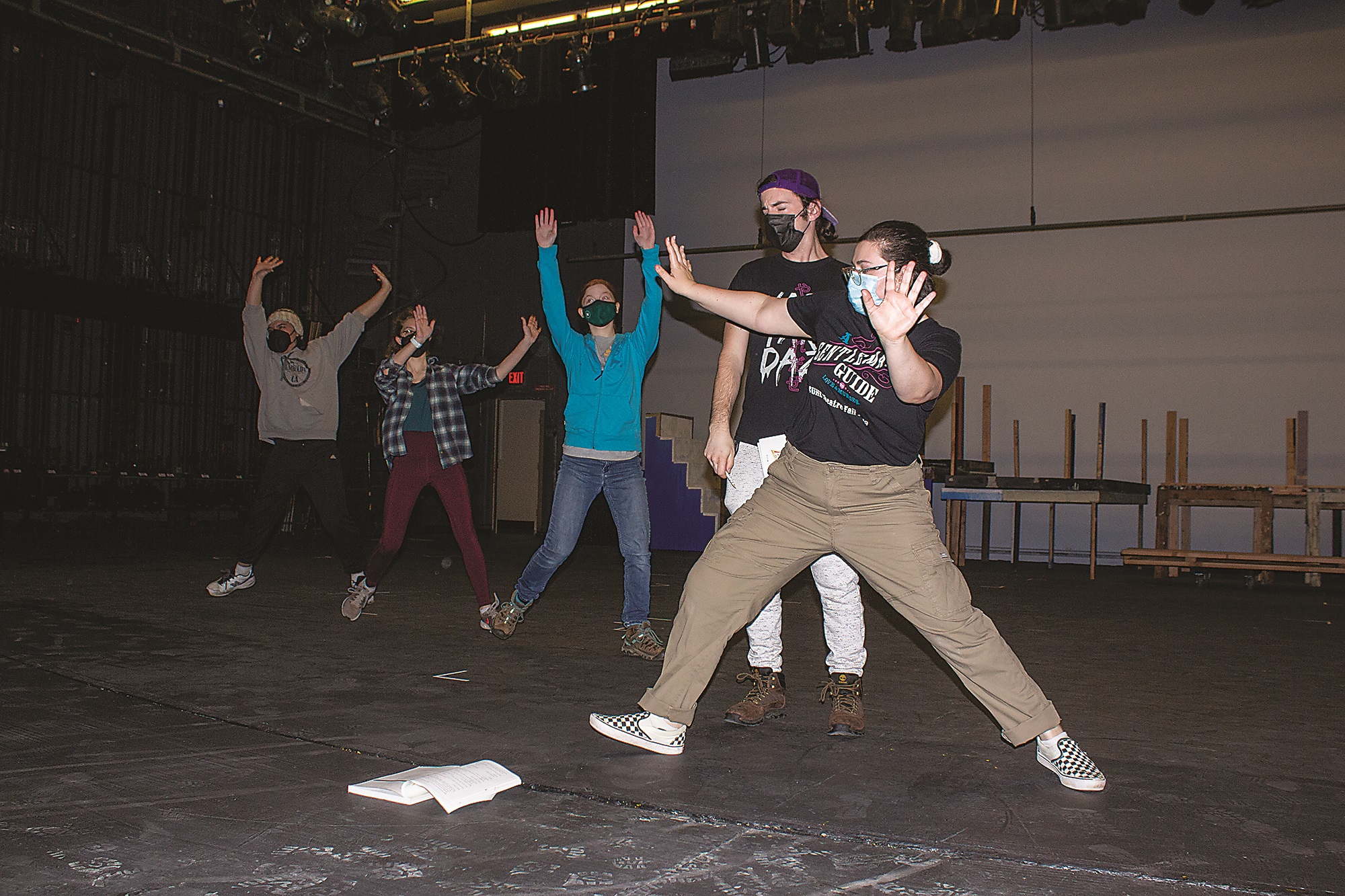
The cast and crew of Cal Poly Humboldt’s spring musical have been meeting for two weeks now, ever since the start of the semester. Rather than fully polished scenes, their rehearsals consist of bare-bones run-throughs, scripts in hand and tape on the floor where the set will eventually be.
The show is “Something Rotten,” a farcical comedy set in an anachronistic 16th century. The two main characters, the Bottom brothers, invent the concept of a musical and feud with their rival, Shakespeare. The show re-characterizes The Bard as a rocker, not dissimilar to a Freddie Mercury type charismatic frontman.
“The show is about love, relationships, ego, and anachronism,” said director Michael Thomas. “You’ll see a cell phone or two, there might be a modern toilet plunger.”
Although “Something Rotten” is set in the Renaissance, the music and dancing are rooted in Broadway tradition. At this particular rehearsal, choreographer Carrie Walpole was working with the cast on the dancing for the track “A Musical.”
This number will feature the cast tap-dancing, and is best described as a classic musical theater style composition. Another track, “Will Power,” performed by the character of Shakespeare, is unmistakably rock. The Bard croons out his famous lines “Shall I compare thee to a summer’s day? Thou art more lovely and more temperate,” over a driving bass line.
“It’s more like a rock musical, it’s a very upbeat score,” said Thomas.
Cast members and crew alike were required to be at Wednesday’s rehearsal for most of the evening. Stage manager Ian Aguilera and his two assistant stage managers Benji Salisbury and David Fisher spend just as much time as the actors, if not more, preparing for and producing the final musical.
Before the rehearsal had even started, before the director or most of the cast had arrived, Aguilera was at Van Duzer Theater, preparing.
“Tech and acting are kinda fifty fifty,” said Aguilera, when asked about how much the crew do behind the scenes. “The director’s not here, I am.”
With the support of the crew literally behind the scenes, the musical’s cast can do their best work. While the actors go over scenes, Aguilera sits at the front of the stage assisting with minute production details and even helping with direction.
“Something Rotten” takes advantage of its self-aware premise for comedic effect.
“It’s a musical about a musical,” said Aguilera. “It’s [the main characters] versus Shakespeare.”
In one scene, the soothsayer Thomas Nostradamus, played by Sammi Pietanza, looks into the future of theater. He says that the characters will break into song and dance, and a glass of wine at concessions will cost an exorbitant amount of money.
Pietanza’s character acting is silly, joyful, and extremely animated, even at this early stage of production. They said that it’s easier for the director to scale back an overdone performance than to draw more out of a timid one. They were the center of attention on stage, striking wizardly poses and speaking the script with mystical energy.
“The character [Thomas Nostradamus] is like a human goblin,” Pietanza said. “Like a Danny DeVito kinda trash rat.”
This energy that Pietanza brings seems emblematic of the production as a whole. It’s a whole lot of passionate people, coming together to make something silly, dramatic, and distinctly musical theater.
Director Michael Thomas is looking forward to what will hopefully be a live, in person performance of “Something Rotten” in April.
“People should come see it because it’s a fun, silly evening,” said Thomas. “It’s full of action, it’s colorful and upbeat.”
Two months ago, ‘Arcane’ dropped and took the world by force. The animated steampunk series is a League of Legends adaptation that debuts a few show-exclusive characters, most notably the villainous kingpin Silco.
For people who don’t play League, ‘Arcane’ sets itself apart as an alternative canon to its video game predecessor – and it does it right, something that isn’t always the case for TV and film adaptations.
‘Arcane’ catches the viewer’s undivided attention within the first few minutes of the pilot episode and consistently maintains it throughout the course of the tumultuous, action-packed storyline. Beloved League legends roam the streets of the undercity and maneuver testy politics in the edifices of Piltover as the two worlds collide with explosive consequences.
Viktor, a chronically ill Hextech inventor with a progressive disability, straddles both as undercity stock working far above the poisoned squalor of his original home. He and his research partner Jayce face various moral dilemmas as they make the push for progress, at great cost to themselves, particularly Viktor. An aged-up Ekko, a far cry from the young boy introduced at the start of the series, takes the helm of the Firelights, an undercity rebel group, with unabashed swagger and style.
Caitlyn, the posh rifle-wielding daughter of a prominent council member in Piltover, finds her bearings in the undercity as Vi, tattooed and grisled from her formative years in the undercity and subsequently in prison, shows her the ropes. While the two women initially find each other at odds, they soon form a strong sapphic bond that defies the strictures of their respective differences in social status and upbringing. Korra and Asami from ‘Legend of Korra’ and Adora and Catra (and many more) from ‘She-Ra’ walked so Caitlyn and Vi could run.
The unique art style, bombastic musical score, and thorough character development flourish the compact plot, which largely centers around the estrangement of Vi and her younger sister Powder, aka Jinx. The tragedy of Jinx lies in her inability to reconcile her younger self, Powder, with her present self. The inclusion of Silco is necessary to piece together Jinx’s elusive backstory while still maintaining congruence with the original canon of League, a feat that Arcane managed to pull off seamlessly.
Jinx’s mental health issues are spurred on by Silco, who took on the role of her adoptive father at the end of the third episode and psychologically groomed her to become an explosive human weapon as a means to meet his nefarious ends. In the backdrop of this central conflict, mounting tensions between the elites of Piltover and the vagabonds of the undercity rise to a dramatic crescendo and abruptly halt with a jaw-dropping cliffhanger that leaves the viewer teetering on the razor thin edge of Jinx’s deteriorating mental health.
When done right, TV and film adaptations embellish the canon of the original source material, not detract from it or contradict it. In the span of only nine episodes, Arcane succeeded and kept its viewers braced for the second season.
About half of Xoë Sioux’s wardrobe is covered in scraps of fabric, plastered with the names and logos of various bands and bits of art.
“The whole thing about punk is to dress your own way, how you want to look and not fit into society’s views of you, and so a big part of it is like creating your own clothes,” Sioux said.
Wearing patches on their clothes identifies Sioux to other members of their subculture.
“Other punk kids, or metal kids, or anybody in the subgenre- if they see it and they appreciate it, then that makes me happy,” Sioux said.
According to Sioux, the history of decorating clothes with patches dates back to the origin of punk itself in the 70’s and 80’s.
“People were creating patches for all the bands that they liked, like The Clash, Discharge, Sex Pistols unfortunately,” Sioux said. “They started stitching them onto their clothes to create a statement.”
Patches also serve as free advertising for the bands they represent. Nat Cardos, who came up in the southern California punk scene and now plays in several local bands, explains the process.
“You have these punks who buy your patches at your show that you make yourself,” said Cardos. “When they sew them on people will see them, and be like, oh, what’s that band.”
In addition to the aesthetic value they add, patches also help extend the longevity of garments. When the original fabric gives way, a patch can allow one to continue wearing the item of clothing for years to come. Many punks have taken to using more durable dental floss to secure their patches rather than sewing thread.
“I like the look of it, and they stay together way better in my opinion,” Sioux said. “And they make me smell good because I smell like mint.”
Sioux’s favorite patch is from a band called Bathory, her favorite band of all time. The band took inspiration from the Countess Elizabeth Báthory de Ecsed of the former Kingdom of Hungary, who was infamously convicted of torturing and killing hundreds of girls and women, in what some say was an effort to retain her youth. The patch, in classic alternative style, depicts a disembodied goat head above the band’s name in gothic script.
For the people that wear them, patch jackets can be a chronicle, the time and place where each patch was attached forever sewn into the fabric. Cardos recalls exactly what their first patch was as it is still on one of their jackets.
“I bought it online, and you’re probably going to have to censor this, but it says: ‘fuck all crooked cops, may their corpses rot,’” Cardos said. “It’s my favorite patch I own.”
Cardos says that patch-making is an integral part of the DIY subculture within punk. In addition to buying patches that bands sell as merch, most also make some of their own patches. There is no set method.
“A lot of people make them using either screen-printing ink and canvas, or a lot of people also will just use sharpie if they have a light enough fabric for it,” said Cardos.
Sioux has some guidelines for others looking to get into wearing patches.
“It’s really fun to dress weirdly, and dress out of the norm, and patches make you look really cool,” Sioux said. “But I definitely highly recommend listening to the music that you’re putting onto your clothes, nobody likes a poser.”
Arroz con leche is a delectable delight, come to save you on your freezing nights. This Mexican rice pudding had my tongue rolling out of my mouth like a fruit roll-up as I would float through the hall after a hovering trail of steam all the way to my mama’s sweet, creamy arroz.
The soft sweet rice will over stuff you and your friends, leaving plenty of leftovers for you to fiend after at midnight (I wont tell if you don’t) because arroz con leche tastes good hot AND cold, and you’ll want to try it both ways, trust me.
The name translates to “rice with milk,” which is pretty much all this dish is (two kinds of milk, to be specific), making for an uber-simple recipe that takes less than an hour to prep and cook. This dish is simple and sweet with miles of room for improvisation and improvement. Add raisins, almonds, chocolate, strawberries, bananas, churros, apple slices- these are just a few of the unlimited ideas you could throw in the rice. There are lots of different variations, but without further ado: my mama’s bomb ass bare-bones recipe.
Here’s what you’ll need:
Ingredients

1 cup regular long grain ricey rice

3 cups soaking wet water

2 sticks of cinnamon

1 14 oz can of sweetened condensed milk

1 12 oz can of evaporated milk

Ground cinnamon to sprinkle on top
In a big ol’ pot on the stove, add your water and cinnamon and bring to a rolling boil. Once boiling, add your rice and reduce the heat. Let simmer for about ten minutes, or until the water has reduced about half way. At this point, lower the heat a touch more and add in your evaporated and condensed milks, stirring it in and mixing every few minutes until hot. Bada bing, bada boom- rice in your spoon, taste it and you’ll be on the moon. Give it to your lover and they’ll swoon. Dust with cinnamon powder, top it off with whatever you fancy, and chow down!
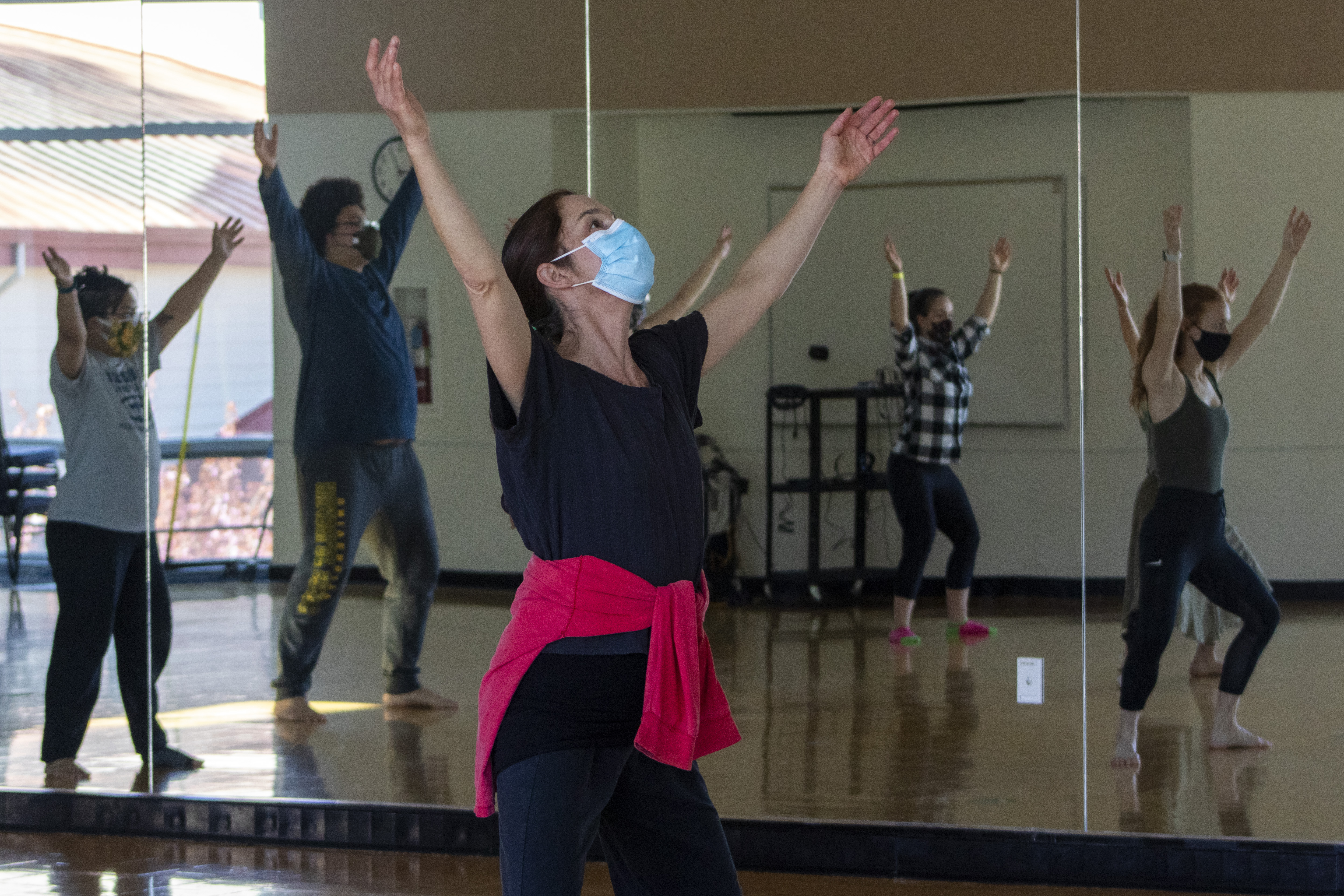
Before Jandy M Bergmann began her tenure as a dance professor at HSU, she was a student in the program – in a manner of speaking.
Shortly after dropping out of the University of Michigan, Bergmann moved to northern California and found a job at a plant nursery. She began crashing dance classes at HSU and fell in love with the non-competitive learning environment that prioritizes growth. Bergmann left Humboldt to complete her education, but returned a decade later to become an official member of the department, where she’s spent the last 23 years.
Unfortunately, the global pandemic has hit the dance department at HSU especially hard. Class sizes in the department have collectively shrunk since shelter-in-place began and others have been cut altogether.
“Dancing is just about the hardest thing to do in isolation,” Bergmann said. “There’s so much learning we can’t do.”
Though the majority of dance classes are now being held partially in-person, there are still significant factors limiting students’ ability to learn. For the classes that take place entirely online and during the quarantine periods of each in-person class that are taught on Zoom, the barriers to learning are drastically more obtuse.
Dance and social work double major DiOria Woods has noticed some of her skills have begun to decline during the pandemic, without her usual access to a conducive learning environment.
“There are dance classes online, but some of them are a little more expensive and I don’t have the proper floor to do certain moves, so I have to really contain it,” Woods said. “I can’t really practice the leaps and the jumps and the turns that I want to.”
Despite the challenges presented by the pandemic, Woods said she couldn’t picture a world where she doesn’t dance.
“I know there’s more to me besides dancing, but I’ve done it for so long and it’s such a big part of me and who I am,” Woods said. “Even if I was never to perform again, I would still be in my dance room [and] in my living room dancing.”
In addition to being a dance major, Chloe Schmidt is also an instructor at Arcata’s Trillium Dance Studios, where she took classes as a child. For Schmidt, the limitations created by the pandemic have fueled her passion for dance more now than ever.
“I think [dance is] actually keeping me going during the pandemic,” Schmidt said. “I think it’s been really important for a lot of people, even if dance isn’t their life’s passion.”
In pursuit of a professional dance career, along with her regular coursework, Schmidt has begun attending Zoom classes with teachers from New York and Los Angeles. While the online format provides the opportunity to learn from instructors Schmidt wouldn’t normally have access to, the experience still manages to be underwhelming.
“Zoom classes [are] really hard. Dancing in your room with no one else around is really different than what we’re used to,” Schmidt said. “Dance, for me, is really about connecting with people. So, that was a challenge to have that cut off.”
Dance and kinesiology double major Calvin Tjosaas has been dancing on and off for 10 years, whenever he can afford the time and financial commitments.
“Studio access is everything,” Tjosaas said. “I can dance at home, but it really doesn’t feel the same and the space is not always conducive to creativity and expression. So, being [in the studio] is really good for the soul.”
Even being back on campus for the majority of this semester, Tjosaas still feels dance majors are missing out on a huge aspect of the experience, not being able to interact with one another.
“Working with other dancers is one of the reasons I love dancing,” Tjosaas said. “There’s just nothing like feeding off of another person’s energy.”
When the pandemic first began, Bergmann admitted dancing was the last thing she wanted to do.
“We’re all swallowing this big thistle of worry and sadness,” Bergmann said. “You have to really want this if you’re going to put on the mask and follow all these rules.”
Even with vaccinations being distributed and classes continuing to trend back in the direction of normal operations, Bergmann is concerned for the future of the program, given the impact the pandemic has already had.
“It feels like a vulnerable time for dance,” Bergmann said. “We just got hit really hard and we’re just hoping we can come back.
Having had all classes online since March 2020 when the campus closed due to the pandemic, HSU is now transitioning to in-person classes for Fall 2021.
As a safety precaution, CSU recently announced that HSU will require all students, faculty, and staff to be vaccinated before using campus facilities. More vaccinations have become available in Humboldt County for citizens for ages 16+. However, some students are feeling anxious about going back to in person classes.
Steffi Puertis is a journalism major whose anxiety has worsened during online classes.
“When I talk through Zoom I don’t see anyone’s reactions, and there’s a lot of silence,” Puertis said. “It kinda makes you feel like you are on the spot, which is super scary and makes me more nervous to talk. Sometimes my professor will ask a question and I know the answer but I get too anxious to reply.”
Although more vaccinations have been given out throughout the county, not everyone has taken the right precautions.
“One thing that does make me nervous about going back to in person classes would be that some people might not take COVID-19 protocols seriously,” Puertis said. “They think that everything is back to normal, which it isn’t.”
Courses will be offered as face-to-face, virtual, and hybrid options for the fall.
“[Offering options] does ease my anxiety because it gives students who don’t feel comfortable attending campus the choice to feel the same at home,” Puertis said. “As well as giving the opportunity to students who want to be back in the classroom that choice.”
Ryan McRae is an ecology major. His anxiety is worse during online classes because there is no accountability.
“I always found myself doing anything other than school work, which would make my anxiety worse,” McRae said.
Even though HSU is taking strict precautions, not everyone feels comfortable going back to campus.
“I am excited for classes to start in person again but I am waiting until all classes are face to face to return myself,” McRae said. “I am most nervous about the social aspect since I’ve been quarantined for over a year.”
Destiny Cypres is a creative writing major. She feels her anxiety is worse during in person classes.
“I have a fear of public speaking in general, but at least over Zoom I can take a minute for myself to collect my thoughts in a safe environment,” Cypres said.
Though HSU is taking precautions to help make students feel more comfortable on campus, Cypres still has concerns.
“I am vaccinated, and I still am pretty fearful of going back to in person classes; I just think everything is moving a bit fast,” Cyprus said. “To immerse myself back into that environment with so many people kinda scares me.”
However, Cypres feels that face to face learning is much more valuable than looking at a screen.
“I just want everyone to be safe, including myself,” Cypres said. “I don’t think I’d feel comfortable coming back if they didn’t [require vaccinations].”
This week is the start of Humboldt State University registration for returning and new students for fall semester 2021. As a junior journalism major, I wanted to give some helpful insight into the top five classes freshman should take including factors such as potential in-person or online classes. It is decided between requirements of freshmen as well as good experience for the first-year semester of college.
Number Five
Science with a lab: I am not great at science so I waited, but one of the requirements for all college students is to take science with a lab course. These courses are not only mandatory but can be fun. Considering that when they were in person they are interactive between labs and lectures but can be difficult depending on the individual class. Since the pandemic, there have been some in-person labs.
Number Four
Communication and/or critical thinking: Communication and critical thinking is a required course and a part of the Golden Four which is communications, critical thinking, oral communication, and math. Communications and oral communication involves speech classes where one will present speeches.
A critical thinking course involves any type of subject involving critical thinking. I took A psychology critical thinking course because I was interested in the subject and involved that golden four. Critical thinking courses can be found in other subjects as well.
Number Three
Electives such as art, music, and language: These courses can be a very fun and good way to start an interest, especially in the first semester. Not only are elective courses required but encouraged. These courses contain all types of students such as seniors and down. These courses allow you to maybe express your artistic side and spark interest in a minor. I took art history and found it fascinating to learn about art all around the globe and found friends as well within the course.
Number Two
GE requirements such as math, English, science, and history: These courses are close to first because they are one of the most important to knock out of the way as a freshman. These courses usually fill up fast since most freshmen try to take them as soon as possible so remember to have them in your enrollment cart and ready to go for registration.
Don’t go too high of a course if you think you’re not ready, take only what is required or bare minimum regarding general education so you don’t become overwhelmed. I recommend a 100 level course for general education, I took all my GE courses within my freshman year besides science and it was a lot easier.
Number One
Major course classes: This is where one can branch off into what they are passionate or interested in and get the hang of the subject and what the future will look like in this course. I took one major course my first semester and then two my next and it helped me get a plan for my future semester and what my interests were. If a freshman is coming in undeclared which is completely fine, stick to general education and perhaps take a course that interests you as well.
To graduate on time in four years, 15 units per semester is the goal. This means if each class has 3 units, 5 classes a semester is what to aim for. Next semester may be limited to in-person classes because of the pandemic so plan accordingly. Take this advice in mind and now have a goal but still enjoy the college experience.
Sappho is probably the most influential poet in the queer canon. From her name we get sapphic, another word for women who love women. From her Greek island Lesbos, we get the word lesbian. Her writings give us a look into ancient Greek sapphic culture that tended, and still tends, to be overshadowed by queer men. Most of her writing was lost in the Fourth Crusade, and was found in an archeological dig in the 1800s. Her poems were preserved in papier-mâché coffins. #Goals
“Can you love an eagle,
Tame or wild?
Can you love an eagle,
Wild or tame?
Can you love a monster
Of frightening name?
Nobody loves a genius child.
Kill him—and let his soul run wild.”
-Langston Hughes, in “Genius Child”
Langston Hughes is one of the more elusive poets. While he rejected his father’s attempt to conform to white ideas, he also rejected embracing queer culture, even as Harlem was thriving in drag balls. There is no concrete evidence that he was gay, but the majority of his poems read as gay and he has been claimed by the queer community.
“Sometimes the wind
Is a tulip of fear,
A sick tulip,
Daybreak of winter”
-Fredrico Garcia Lorca, in “Gacela of The Remembrance Of Love”
Fredrico Garcia Lorca was a gay Spanish surrealist who traveled widely with La Barrca, his theatre trope. They performed classics and some of his own tragic plays. He traveled from Harlem to Buenos Aires, seeing connections to his cante jondo poems everywhere. Cante Jondo is a serious type of folkloric flamenco. He was assassinated by the Spanish government for his sexuality and socialist views.
“Love can not fill the thickened lung with breath,
Nor clean the blood, nor set the fractured bone;
Yet many a man is making friends with death
Even as I speak, for lack of love alone.”
-Vincent Millay, in “Love Is Not All (Sonnet XXX)”
Vincent Millay was known for being unconventional. She refused her more feminine name even as she dealt with a professor that would call her anything that began with a V, as long as it was a ‘girl name.’ She was the first woman to win the Pulitzer prize for poetry in 1923. She attended Vassar and had an open relationship with her husband, and lovers of all genders. Her activism encouraged women to take charge of their bodies and explore their sexualities.
The pandemic has affected many students at Humboldt State University by limiting their access to food. When the pandemic hit in late May 2020, HSU’s eateries had limited hours and there was little to no access to the cafeteria. The cafeteria was the easiest way for students to save their J-points due to meals being not as costly as other places on campus.
Now as HSU is adjusting to the safety and regulations of opening up campus once more, there are still complications and not every student can afford daily meals.
In order to provide support to students in these rough times, fellow college students at HSU joined together to provide a service called Oh Snap! It is located in the Jolly Giant Commons on the first floor. According to Oh Snap! the service is intended to provide nutritional food to students who have limited access and spread awareness on food insecurity.
In order to support HSU, Oh Snap! has released several workshops via Zoom teaching students how to cook and prepare their own meals. Students can receive the ingredients for free and have them delivered to their dorms safely following COVID-19 guidelines.
Oh Snap! has also provided food bags for students including fresh produce to have and is also deliverable across Humboldt County. In order to attain a food bag, students must fill out a form every Wednesday which is posted on Instagram. If it is sent in before 12:30 pm the following day, they have secured a delivery.
According to the history of Oh Snap! on their Facebook page, they started out with just 10 students and two faculty members on the team. They did a lot of outreach with Calfresh food stamps and as they spread awareness, their service only continued to grow.
This is especially helpful to students who cannot afford J-points especially as the pandemic increased the limited access to food. According to Humboldt State University’s 2019 J-point Budget Sheet, it cost $945.00 for 94500 J-points. This can be difficult for many students to pay and manage especially with limited eateries being open on Humboldt State’s campus.
Oh Snap! has benefited many students, with 1,000 students visiting the first week and an average 1,900 visits after.
With any student being welcome to use the pantry once a week and have open access to applying for Calfresh food stamps application, this service continues to promote food for all.
On Friday, April 2 at 8 pm, the first play of two commenced as HSU students within the Theatre, Film and Dance Department presented via Zoom their own new-aged rendition of “The Living Newspaper.”With topics including the unexpected effects of gender-reveal parties, relationships with virtual friends and robots during the time of COVID-19, the erasure and silencing of marginalized voices, and more. The second play will be streamed on Friday, April 16 at 8 pm.
Michael Thomas, lecturer, publicist and production manager for the department of theatre, film and dance at HSU describes what a living newspaper is and where the theme originated from.
“Living Newspaper is a type of theatre that presents plays about current events,” Thomas said. “This idea was created during the Great Depression, in the 1930’s, by a government production called the Works Progress Administration. The idea was to give jobs to the people.”
Thomas further spoke upon the validity within this type of play and the importance of accurately presenting current news and events to the public.
“In the past they did shows on things that were bothering people at the moment: housing situations, lack of housing, slum housing, the lack of electricity, how some people have electricity, some don’t, they did shows on contaminated water supply and social-political conditions,” Thomas said. “They researched all the facts and put it in the plays. It’s all very factual-based. That was very important to them. They wanted people to be able to depend on this. Current events of the day put on stage — people loved it!”
This production is featuring a partnership with three directors from Dell’Arte: Michael Fields, Carlos Gallegos and Elizabeth Colón Nelson.
Michael Fields, founding member and producing artistic director of the Dell’Arte Company, and director of the California State Summer School for the Arts explained the intent of this project in a press release last week.
“These pieces will be ‘devised’, that is, created collectively as an ensemble in a short time with a specific intent,” Fields said. “It will give voice to this generation at HSU. It is an opportunity to experience something that has not been done before with new voices.”
Both shows are created, performed and stage-managed by HSU students alongside dramaturg, producer and associate professor, Dr. Troy Lescher. They will be available to stream after their opening performances.
Dr. Lescher shared his excitement for the production in last week’s press release.
“[This is] such an exciting project-based learning experience,” Dr. Lescher said. “This project and collaboration with Dell’Arte engages students in creative processes that diverge from our usual approaches and encourages students to reimagine how they can participate within and serve the ensemble.”
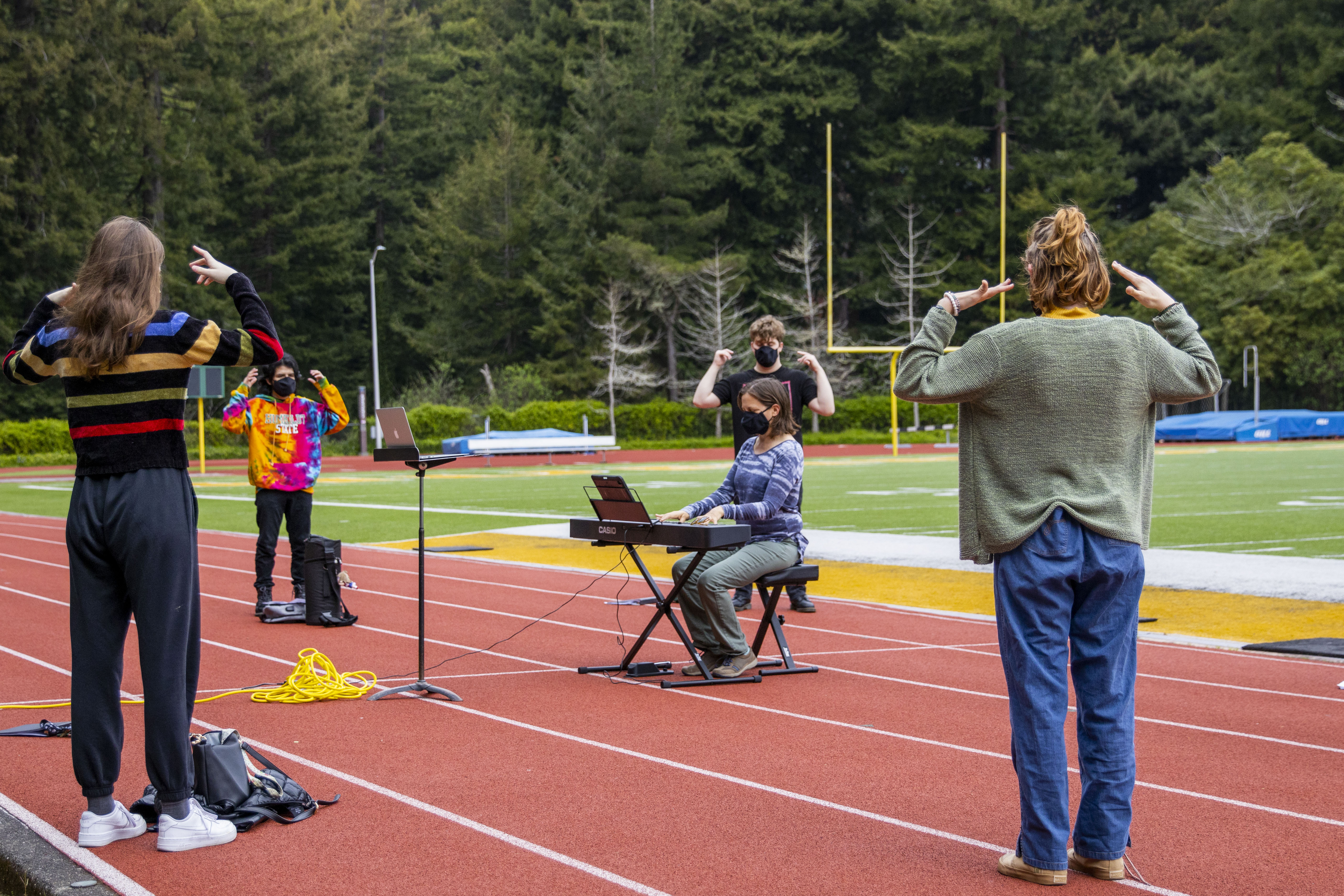
Humboldt State Professor Rachel Samet plays the piano as she walks her MUS 106B University Singers class through voacl warm-ups in the morning outside in the Redwood Bowl arena on the HSU campus on April 5. | Photo by Thomas Lal
Students in the MUS 106B University Singers class go through voacl warm-ups in the morning outside in the Redwood Bowl arena on the HSU campus on April 5. | Photo by Thomas Lal
Humboldt State Professor Rachel Samet plays the piano as she walks her MUS 106B University Singers class through voacl warm-ups in the morning outside in the Redwood Bowl arena on the HSU campus on April 5. | Photo by Thomas Lal
Emily Morse takes a moment to sit on the track while singing in the University Singers class outdoors on April 5 at Redwood Bowl in the morning. | Photo by Thomas Lal
The MUS 106B University Singers class meets in Redwood Bowl outdoors while maintaining proper soical distance with roughly half off the class atteneding virtually on a laptop used by Professor Rachel Samet on April 5. The class meets three times a week with rotating sections coming for in-person instruction. | Photo by Thomas Lal
Jenna Lynn sings as part of the soprano section during the Universoty Singers class as they hold class outdoors at Redwood Bowl on April 5. Singers masks which are specifically designed for use by singers were supplied by Professor Rachel Samet for students. The masks are much wider than normal ones which allow the students to have more space while singing. | Photo by Thomas Lal
Rachel Samet is holding her choir class outside in the Redwood Bowl. The class is split up into eight students groups three times per week to meet up and sing. The class also broadcasts on Zoom for those not scheduled for the in-person choir class or not local.
Pablo Murcia, a music education major, is one of the students attending this class. He has thoroughly enjoyed the class and learning from the professor. It has been better than the alternative, strictly online through Zoom. The students practice all sorts of types of music and songs.
“There is a soprano, alto, tenor and bass, and we sing a variety of music,” Murcia said. “We sing renaissance type music, we sing contemporary pieces, and mostly acapella.”
By singing outside while following COVID-19 guidelines, the students get the normal experience from before the pandemic. Doing it through Zoom left out that feeling.
“The way we’ve been doing it is through Zoom and we are all muted and our teacher takes us through all the different parts and warms us up,” Murcia said. “It’s been weird doing it over Zoom because, in a choir, you want to be able to hear the other singers.”
Now the students can hear and sing together in a more choral style as opposed to online video recordings. Soprano Dulcie Feinstein, a vocal performance major at HSU has been with the group and class for four semesters and is a teacher’s assistant. Feinstein also had difficulty with choir and music classes over Zoom.
“We started this semester just online,” Feinstein said. “It’s hard to know what we are doing or how we sound. It’s hard to unify those voices.”
Now, later into the semester, the class meets three times a week outside and the rest of the week online. Now that it is partially in person, Feinstein finds it motivating.
“Obviously one of the pros is just to be able to do it in general, and I can already see so many improvements,” Feinstein said.“ Just being in person the first day it was like wow. It’s crazy how much we have forgotten how to be a choir.”
Emily Morse, a music education major at HSU, is another soprano in the group. Morse has taken the class before and has enjoyed it so much to continue through the pandemic.
“I love being in class with Rachel Samet, she is the best choir teacher that I’ve ever had and she has helped me improve my voice,” Morse said. “It’s kind of like a little family.”
Morse was also excited about being able to be outside while singing but it is different compared to when the choir sang in the recital hall on campus.
“Rachel has kept it pretty much the same. It’s just the fact that only eight of us can sing at a time, it kind of sucks,” Morse said. “At least we get the in-person experience to how we were before.”
Morse also enjoys the idea of singing outside in nature since the choir class is being held in the Redwood Bowl.
“It’s nice actually to sing outside, especially when the weather is nice because we didn’t get to do that before COVID hit,” Morse said. “I feel like music and nature are connected so it’s nice to be able to sing with the trees, as silly as that may sound.”
As soon as the pandemic hit, many Humboldt State University students were cut off from the world. With isolation and stay-at-home orders increasing, staying connected to the community was often challenging. However, students were able to find a glimmer of hope for it seemed as if video games brought them closer than ever before.
In order to stay connected, many sisters from Delta Phi Epsilon, a sorority on Humboldt State’s campus, had turned to video games as a way to bond and still be in touch with sisters during extremely tough times. Sorority sister Krystal Padilla had a particular love of Animal Crossing.
“I played Animal Crossing New Horizons with some of my sisters and we even made a group chat, it was nice,” Padilla said. “During the pandemic, I would just eat and sleep but playing with sisters helped me calmed down and reminded me why I loved playing video games in the first place.”
Padilla even named her island Opal which was her nickname in the sorority.
Fellow sister Tabitha Page was able to also share her experience about how the pandemic brought her closer to sisters and reminded her of her love for video games.
“Since classes take up less time, I can sometimes hop on and play on my Switch more than I could before,” Page said. “Animal Crossing had a big impact on the first few months of COVID and I was able to stay connected with some of my sisters.”
Page named her island after Lofoten, Norway, a place she hopes to visit one day. She also enjoys playing The Legend of Zelda on her Nintendo Switch.
“Similar to Animal Crossing, my older brother was really into video games, so I saw him playing Legend of Zelda and I wanted to play too,” Page said.
Meghan Burket, another sister from Delta Phi Epsilon, also shared her experience about how video games helped her get through this pandemic.
“I started playing Animal Crossing New Horizon from the day it came out, it was something great to play with during quarantine and helped a lot with my motivation,” Burket said.
“With Judas and the Black Messiah,” director Shaka King produces the thrilling true story about the radical Illinois Black Panther chairman Fred Hampton and FBI informant William O’Neal. From beautifully shot scenes to the stunning performances of Daniel Kaluuya (Hampton), LaKeith Stanfield (O’Neal), Dominique Fishback as Hampton’s supporting partner, Deborah Johnson, and many more; this exhilarating motion picture left me paralyzed for half an hour trying to process it all. This film carries you along an emotional rollercoaster of hope, love, anger, and utter disappointment with O’Neal’s betrayal that ultimately led to the late Hampton’s tragic end.
Watching the trailer I knew this was going to be an intense film, but I was not prepared to be as angry and upset as watching the entire film made me. I was familiar with the story of Fred Hampton; a promising leader succeeding in creating a “Rainbow Coalition,” facing a common enemy of brutal police presence in their communities as well as the systemic oppression brought upon by America’s government.
It crushed my soul knowing what was going to happen as the film approached its climax after witnessing how caring, wholesome, and powerful of a person he was. Someone so inspiring and generating a genuine difference was met with an unjust death due to racism and overall inhumane acts of the FBI. I even shed a few tears in the end.
The cause of Hampton’s death is no secret, in fact the FBI admitted to his inhumane murder that took place in 1969 — gunned down in a police raid, sleeping in his own home. Even though we know the tragic story of Hampton, the story this film presents will inspire you to believe there must have been a better outcome for the charismatic and sensational leader.
Something that stuck to me was the overall conflicting feelings that the young FBI informant O’Neal had when he became a part of the organization. You can honestly see a young man fighting with himself on whether he is making the right decision or not. After being welcomed into this party by Hampton, you can truly see that O’Neal is believing that he too is helping with the revolution that Hampton is so determined to make happen; that he believes in the cause that the Black Panthers stand behind.
In the late 60s, The Black Panthers were deemed as “The greatest threat to the internal security of the country,” according to the FBI director at the time, J. Edgar Hoover who was portrayed in the film by Martin Sheen. The BPP has always been criticized as a terrorist, militant group. Though they promoted open carry, they used this to spread awareness to Black citizens that are constantly threatened with police brutality, have the right to act in self defense. The BPP was a political organization that also provided free after school meals for children, medical funds and education for their neighborhoods, and advocated for class struggle no matter the race.
Hampton wanted to advocate for all those who were affected due to government corruption and injustice. Hampton’s radical Socialist views on how we can create a better future encouraged many to stand alongside him. When he died, Hampton was in the midst of building a revolution against a racist and classist government, helping people understand that no matter what walk of life you come from, you have the power to come together and make an earth shattering change.
This film represented the true African American experience in the 1960s. “Judas and the Black Messiah,” showed what could have been and what could still be, as long as there are people willing to fight for change. Throughout this film, Hampton reiterates that “Where there are people, there is power,” much like the voices that have been echoing the words “Black lives matter,” for years. We all must remember that we have power in our voices, we are able to make change happen, and in the words of Chairman Hampton and supporting organizations of a once promising coalition… “I am a revolutionary!”
The Bachelor this season was full of drama and controversy but not a proposal in sight.
The Bachelor is a reality TV show that revolves around one man who is looking for love among 30 romantic interests who ultimately wants to get engaged by the end.
This season’s bachelor was Matt James, 29, a person of color who even though has never been on the show was past contestant Tyler Cameron’s best friend.
Choosing James was the first time ever choosing a bachelor of color. They have had one person as The Bachelorette, Rachel Lindsey in 2017 who was the first African-American chosen for that role.
This season was history making by showcasing a biracial bachelor. The results however, did not exactly end in a happily ever after. Every season, the host, Chris Harrison, says it’s “the most dramatic season ever.” But this season was filled with more drama than anyone could ever have imagined.
After leaving the show with Georgia native, Rachael Kirkconnell, who received James’ final rose, James called it off and broke up with her after some controversial photos of her resurfaced.
Aliyah Khan is an HSU alumna who graduated in 2020. Being a person of color watching The Bachelor, she had strong opinions against this season specifically.
“I think it’s great to have people of color on The Bachelor because the past has been quite, white,” Khan said.
The photos of Kirkconnell showed her at a party in college with friends wearing a dress that represented the period of time before slaves were freed. It was also discovered that she liked racist photos on Instagram including one showing two Caucasian women posing in front of a Confederate flag.
“I think Rachael Kirkconnel was old enough to know what she was doing was wrong at the time,” Khan said. “Considering it was only just in 2018 and Matt still had to explain why it was so horrible.”
Khan believes growth is possible in everyone. Even though she did not agree with Kirkconnell’s actions, she is hoping she learns from this.
“I sure hope Rachael educates herself,” Khan said. “It’s the best way to acknowledge the past and move forward correctly and continuously learn and think about others when you make decisions.”
Chelan Rooney is an HSU alumna who graduated in 2019. She was never a big fan of Kirkconnell and was really rooting for Michelle, the runner up.
“I personally did not like Rachael,” Rooney said. “I felt like she was fake and was just on the show to gain attention and for the fame. It looked like there was no connection between her and Matt, but apparently it was just one that wasn’t obvious.”
Rooney was not surprised there was controversy with racial tensions on the first ever Bachelor with a person of color and was not surprised it involved Kirkconnell.
“I think the after the final rose episode was held perfectly and I’m happy they all addressed the controversy,” Rooney said. “Whether Rachael was being genuine or not, I don’t know, but I think it was awesome how they addressed her.”
After watching an entire season of James and Kirkconnell falling in love with each other, Rooney believes Matt did the right thing.
“I think Matt made the right decision breaking up with her,” Rooney said. “If he stayed with her, there would be no lesson to learn and he would forever struggle with doubts.”
Jasmine Masterson is an elementary education major in her last year at HSU. She has been watching the series for years.
“I feel like looking back on the situation, what she did looked bad, but at that time in the South, it was a pretty normal event,” Masterson said. “So I don’t think that Rachael did those things with bad intentions. I just don’t think that she knew any better. I’m sure now that she knows and understands she will hopefully not make those same choices again.”
Along with Kirkconnell’s controversy, Harrison was interviewed to discuss the issues. He was seen defending her actions which led The Bachelor franchise to fire him from hosting next season.
“I’m not sure how I feel about the whole Chris Harrison deal,” Rooney said. “I think it’s heartbreaking that he’s not going to be on the show since he was the face of it since the beginning, but I also think weeding out celebrities from the industry that are ignorant is very important in order to make a change. Allowing something like this to happen with no repercussions is a slippery slope.”
This website uses cookies to improve your experience. We'll assume you're ok with this, but you can opt-out if you wish. Cookie settingsACCEPT
Privacy & Cookies Policy
Privacy Overview
This website uses cookies to improve your experience while you navigate through the website. Out of these cookies, the cookies that are categorized as necessary are stored on your browser as they are essential for the working of basic functionalities of the website. We also use third-party cookies that help us analyze and understand how you use this website. These cookies will be stored in your browser only with your consent. You also have the option to opt-out of these cookies. But opting out of some of these cookies may have an effect on your browsing experience.
Necessary cookies are absolutely essential for the website to function properly. This category only includes cookies that ensures basic functionalities and security features of the website. These cookies do not store any personal information.
Any cookies that may not be particularly necessary for the website to function and is used specifically to collect user personal data via analytics, ads, other embedded contents are termed as non-necessary cookies. It is mandatory to procure user consent prior to running these cookies on your website.