COVID-19 rages through US as students struggle with online schoolwork
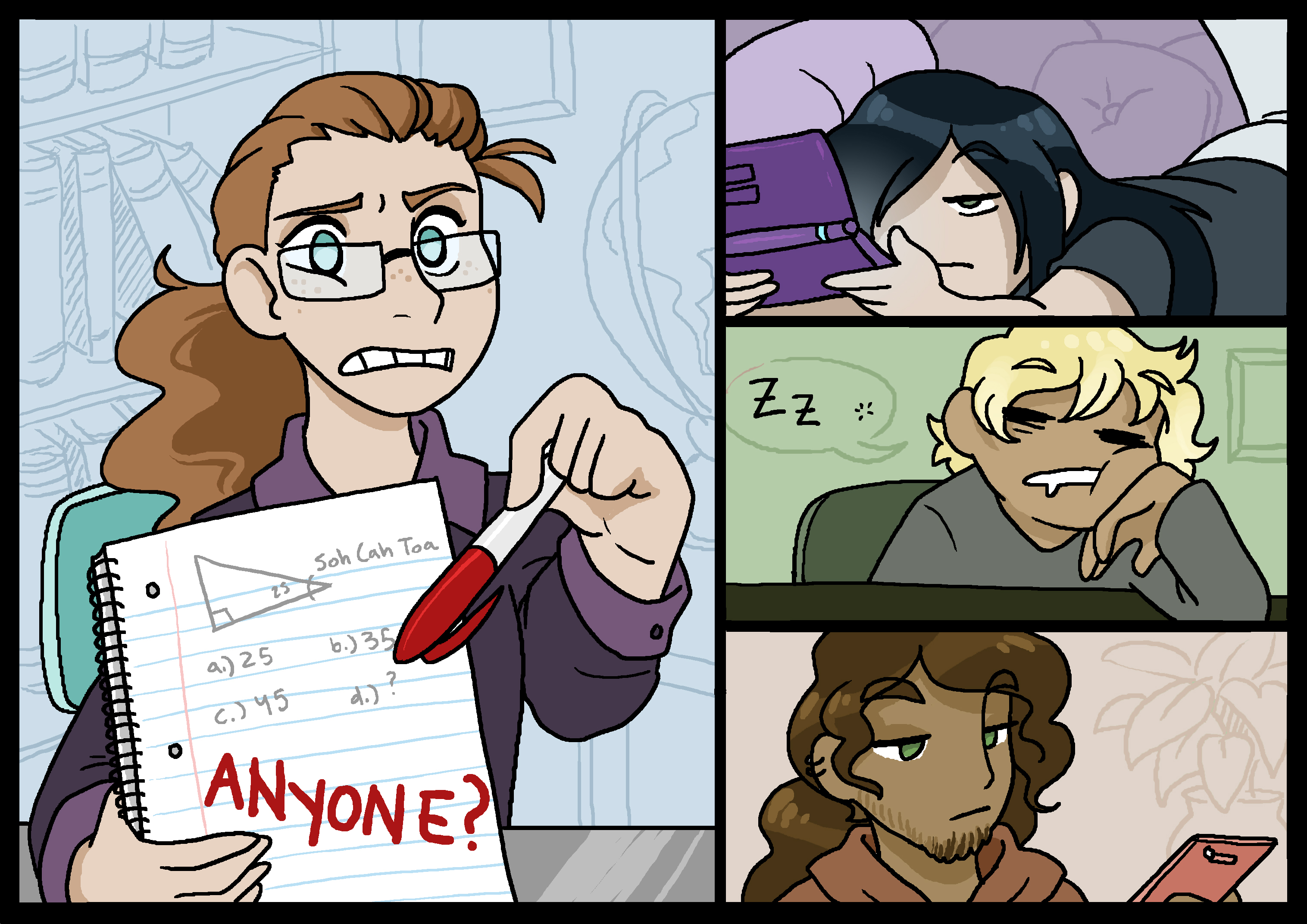
Humboldt State University transitioned to online instruction for the rest of the semester on March 26. Since then, some students have had a hard time staying focused and motivated in online classes.
Deana Lopez, a third-year zoology major at HSU, admitted that this hasn’t been an easy transition.
“I feel overwhelmed with the amount of emails professors and instructors are sending, and everything seems all over the place,” Lopez said. “I have been neglecting my school work so much that I forget that I still have classes. I’ve missed quizzes and assignments already because it’s so easy to forget that I have to do them without a professor reminding me.”
Third-year psychology major Madeline Baker said she was having a tough time staying motivated without face-to-face instruction.
“Not being able to have classes in person further discourages me,” Baker said. “Holding classes through Zoom has been easier for me in contrast to pre-recorded lectures, but they still aren’t the same. Not having that in-person connection alters the learning environment in a way that makes me feel disconnected from my overall learning experience.”
Not only are students dealing with the move from face-to-face instruction to online classes, but they also have to manage the stress of living in a pandemic. With many students moving back home, there’s added family stress as well.
Not only do I feel like my beginning of therapy has been interrupted, but the full college experience for this semester.”
Madeline Baker
Lopez was feeling pressure from school alongside tension from life in general.
“I know I can find the motivation, but everything is hectic at the moment,” Lopez said. “My grandma recently passed away so there was that on top of the COVID-19 situation, and a lot of family problems have occurred as well. I’m trying to get myself and my surroundings organized before I can actually put all of my focus into school.”
No matter how good a job professors are doing, online education doesn’t appear to be the same. For the students, it’s not just the classes they feel they’re missing out on, but the whole college experience.
Meanwhile, the state of the world may be taking a toll on student mental health.
“The resource I would like to use most right now is CAPS,” Baker said. “Before all of this happened, I finally decided to go in and begin appointments, something I feel like I’ve needed to do for a while now. I feel like that has now been interrupted for me. I had a private safe space provided to speak with someone and learn to cope with things. Given my current housing situation, I do not have a private enough space in which I would feel comfortable confiding in someone and work through my personal feelings and issues over the phone or video. Not only do I feel like my beginning of therapy has been interrupted, but the full college experience for this semester.”
Many students are also dissatisfied about paying full-price tuition for resources they won’t be able to access for the rest of the semester.
Kayla Rodenburg, a third-year English major, thinks the tuition price doesn’t add up with all classes now online.
“I do feel like the tuition price is too high for online classes,” Rodenburg said. “Online university is dirt cheap and we are paying CSU prices for that which is kinda ridiculous in my opinion. I’m pretty sure many parts of our tuition fund things on campus that we now don’t have access to, so I hope some type of refund happens, even though it’s kind of a stretch.”
Despite Humboldt State University going digital, campus housing remains open
Humboldt State University President Tom Jackson announced via email March 18 that the school would be going entirely online, and he encouraged students to vacate campus housing if possible.
“It is important we reduce the number of people on campus,” the email read. “We encourage students who can return to a home off-campus to do so. We will not displace students who are facing housing insecurities or homelessness.”
“They should have just made the choice before people left for spring break to keep it as safe as possible.”
Calista Tutkowski
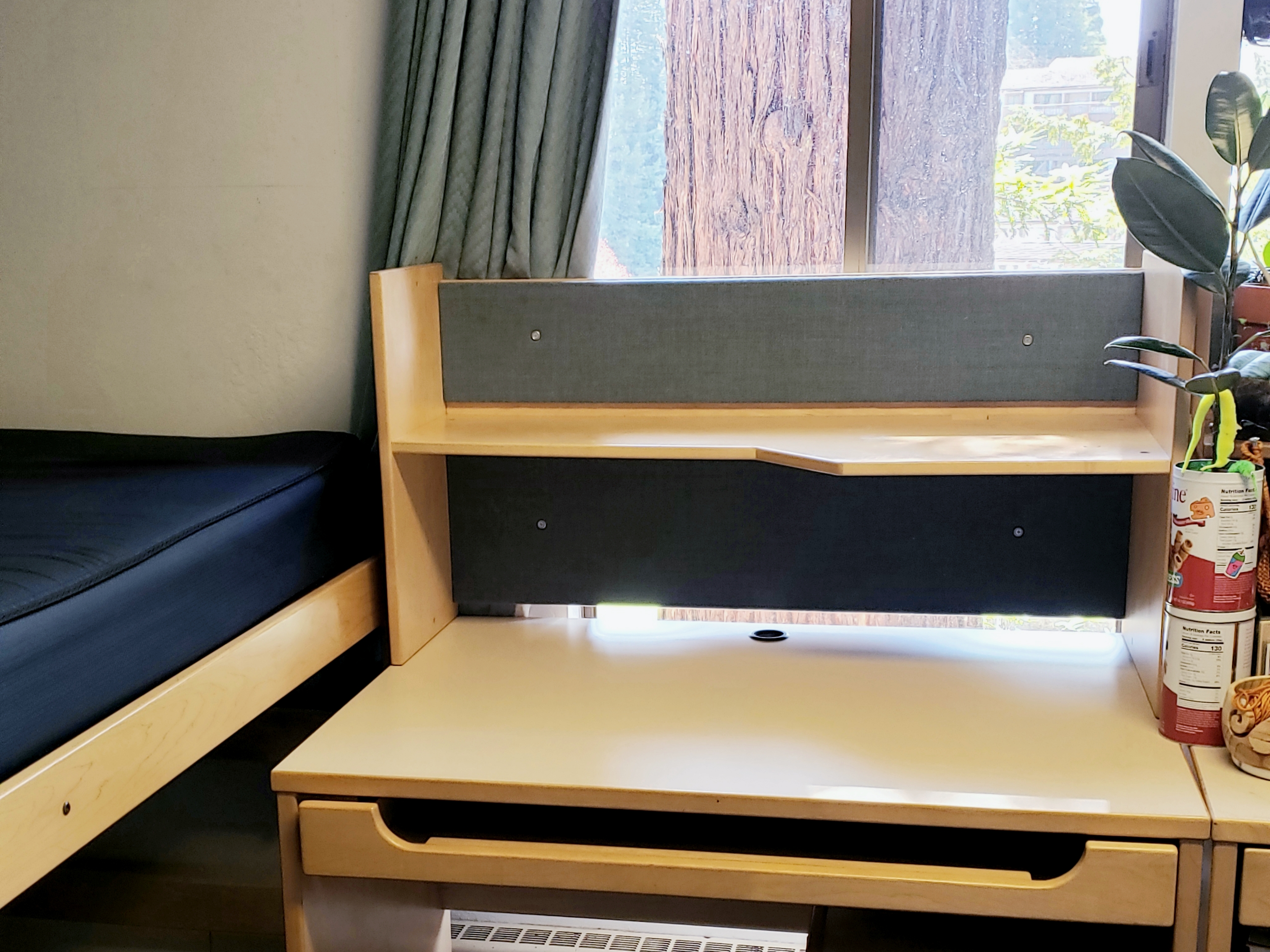
Freshman Calista Tutkowski was among those who decided to move back home after learning that classes would transition online. Tutkowski considered her choice the right one for her own physical and mental wellbeing.
“It felt like things were just going to get worse and worse on campus and around the world, so if I was going to be doing online classes, I wanted to be home with my family,” Tutkowski said.
Tutkowski was frustrated with the sudden notice from the school. By the time the school sent out the notice that they were going online and encouraging students to leave the dorms, she had already gone home for spring break and was out of state. Like many other students, she had to return to campus to pick up her things, potentially putting herself and others at risk by traveling.
“They should have just made the choice before people left for spring break to keep it as safe as possible,” Tutkowski said.
Some students are still on campus. Emma Bradley-Solis is one of those who elected to remain in campus housing despite virus concerns.
“I live in Washington and it is a lot worse there,” Bradley-Solis said. “I thought it would be smarter for me to self-quarantine here.”
According to an April 7 Enrollment Management report, about 300 students remain on campus. Most of the campus facilities are closed, including the library, computer labs and University Center.
With the severely reduced numbers of students left behind, pickings are slim. There isn’t much variety left in the food selection, and many staples such as rice, pasta and fresh fruit are out when Bradley-Solis goes to the marketplace. For students who rely on J-points to eat, this is both a serious problem and a waste of the money spent on their meal plans.
“I feel like they could take care of the students still here better—like better food,” Bradley-Solis said. “We paid a lot of money for J-points.”
With life disrupted, lecturer Kerri Malloy perseveres with flexibility and humor
A professor noticed students often left Kerri Malloy’s class laughing. One day the professor asked what he was teaching.
“Oh, that’s my genocide class,” Malloy said.
Malloy teaches courses in the Humboldt State Native American studies department on colonialism and genocide. With such somber subjects, Malloy relies on humor and honesty to engage students. Now that classes have gone online during the pandemic, Malloy has employed those traits, alongside plenty of flexibility, to keep students connected.
“The hurdle is going to be maintaining that connection with the students,” he said.
He created class blogs for students to post what they want—questions, memes, dog or cat or reptile pictures. Glance through Malloy’s Instagram, Twitter or Snapchat accounts, and you’ll find lots of memes, like one he posted April 3 on Instagram:
“The year 2020. Brought to you by the letters W, T & F.”
“I think you have to walk into it—at least my plan is to walk into it—with an incredible amount of flexibility.”
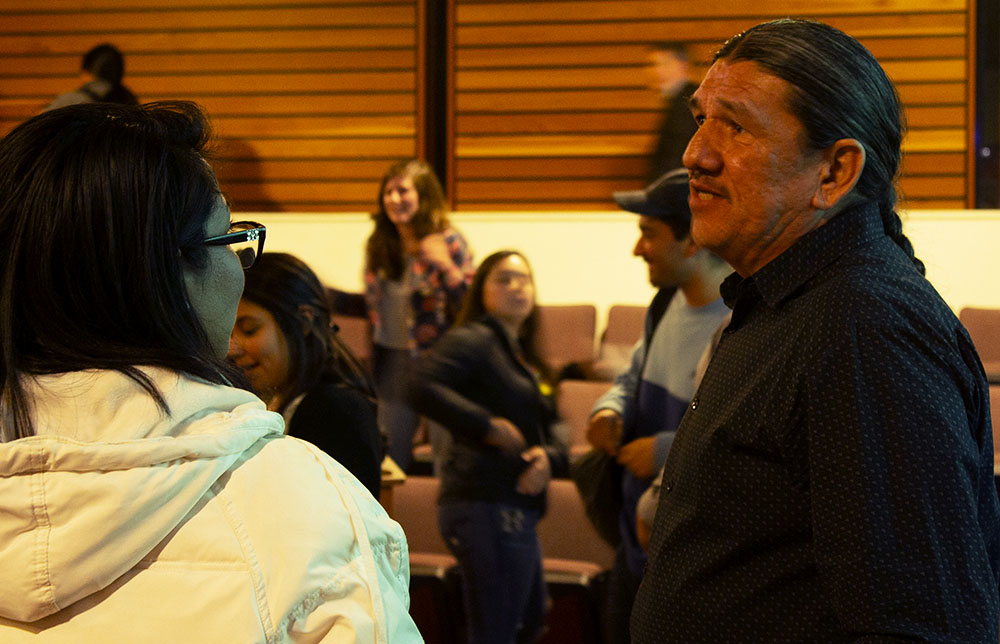
Kerri Malloy
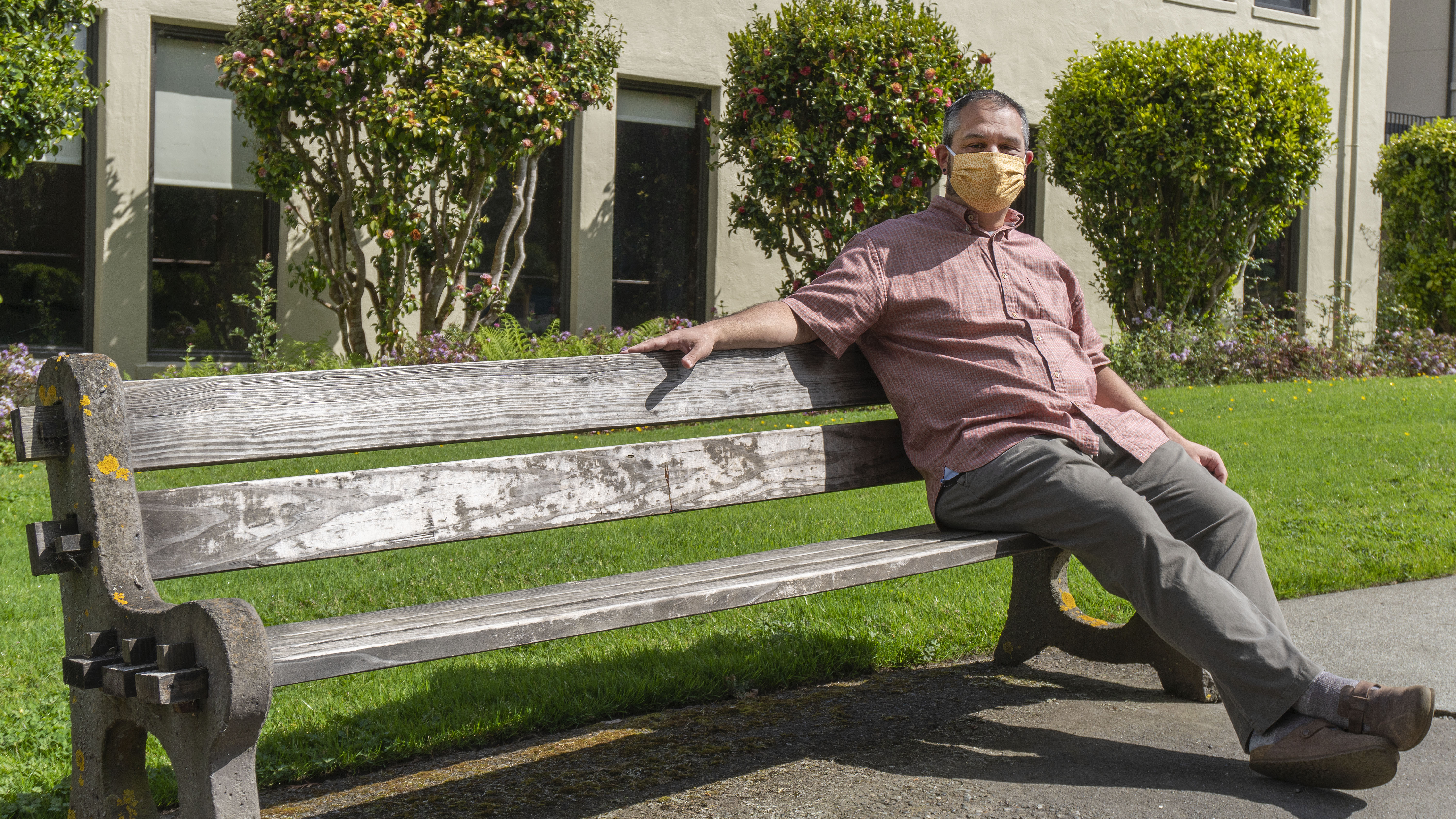
“I love a good meme,” he said in one of two Zoom interviews. He sat in his home office. Behind him, family photos and a Star Wars Yoda action figure topped a bookshelf. He wore glasses and a button-up shirt.
Memes dominate Malloy’s social media accounts, but there’s more to the accounts than humor. They make him accessible to students. He receives messages on those accounts about class, and he replies happily.
“There are times where I’m like, ‘Why am I doing this?’” he said. “And then I realize, I’m getting to see a different side of students, and my colleagues, too.”
Malloy also emphasized the importance of flexibility.
“I think you have to walk into it—at least my plan is to walk into it—with an incredible amount of flexibility,” he said. “And let them—let the students—help guide where we’re going to go.”
Yurok and Karuk by heritage, Malloy was born on the Oglala Lakota Reservation in South Dakota, but he grew up on the Quinault Indian Nation Reservation in Washington.
Marlon Sherman, chair of the HSU NAS department, knew Malloy from working together for the Yurok tribe. Sherman and Malloy have a family connection, as Sherman grew up on the Oglala Lakota Reservation where Malloy was born.
“If it wasn’t for Kerri, there might not be a NAS department right now.”
Marlon Sherman, chair of the Native American studies department at Humboldt State
After working together for the Yurok tribe, Sherman and Malloy parted. About six years ago, Sherman asked Malloy to come to HSU to teach two courses for a semester.
Shortly after Malloy came on board, Sherman had to take time off. He had cancer. Sherman returned in about a year, but Malloy became program leader and helped steer the department. Sherman said Malloy basically did all the work and helped the department hire two professors.
“If it wasn’t for Kerri, there might not be a NAS department right now,” Sherman said over the phone.
Malloy said Sherman was too generous, but there’s no doubt that Malloy works, a lot—so much so that Sherman joked it might be illegal.
Malloy wakes up around 4:30 a.m. every day. He gets up so early partly because he finds those early hours productive, and partly because his back is built on metal rods and pins that make lying flat for too long unbearable. He’s not exactly sure how he damaged his back—maybe a car accident—but he had to have surgery that put him out of commission for three years.
He estimated he’s on eight to 10 HSU committees, from the University Resources Planning Committee to the Diversity, Equity and Inclusion Committee. Malloy does this while teaching multiple classes as a lecturer—a position with an uncertain future amid HSU’s projected enrollment decline and budget cuts. He joked when asked how he has the time.
“People usually don’t like my answer,” he said. “How do I have the time? A calendar.”
Kumi Watanabe-Schock, a 23-year HSU employee, works in public programming and as the library media coordinator. She first met Malloy when he was an HSU student getting degrees in economics and Native American studies.
Since then, Watanabe-Schock has worked with Malloy on committees and for classes. Every time she talks to Malloy, he seems to be attending workshops or giving talks around the world. She praised his willingness to help out.
“He’s not good at saying, ‘No,’” she said over the phone. “I don’t know if he’s that way with everybody, but when you ask him to do a favor he always follows through and he always says, ‘Yes.’ So I really am appreciative, yeah. He’s a good person.”
When not working, Malloy is more private. He has a husband and three dogs. He has two sisters and 14 nieces and nephews he tries to see every year. Around 8 p.m. every night, he tries to unwind. Maybe he’ll watch some TV, or maybe he’ll read a book about genocide. Fun.
While COVID-19 has pushed teaching online, Malloy has found his courses as relevant as ever.
A key concept in Native American studies is survivance, a portmanteau of survival and resistance. Survivance is about the living of Native American lives in the present tense. By surviving, Natives resist, and by resisting, Natives survive.
Malloy said people must fight right now to have their voices heard, like many Natives must do at all times. He said individual voices humanize current events and prevent people from kicking the ball of reality down the road.
On that note, Malloy told a story. Last summer, he taught Native history in a program that spent two days in Auschwitz I, the main site of the Nazi concentration camp. One day he stopped and looked out a window. The bizarreness of the situation dawned on him. Here they were, decades later, standing in a place of horror and trying to learn from it.
A window at Auschwitz I, the main site of the Nazi concentration camp on August 20, 2019. | Photo courtesy Kerri Malloy
Later that night he received an email from then-HSU President Lisa Rossbacher. She was checking in, so he wrote back.
“If we can educate in such a place of incredible horror and death, we have the ability to change the world,” he remembered writing. “We really do. If we can actually go into these places and find this incredible darkness and turn it into something that allows us to reach out to other human beings and get us to talk to each other and push the things that really don’t matter aside, I think we can do this.”
To get people to talk, Malloy uses humor, which he said can get us past anything—and Malloy does seem capable of getting past anything. It seems strange to call research on genocide a passion, but Malloy approved the descriptor.
“Passion’s a good word for it, actually,” he said. “You’ll find that for those of that this is what we do, it is a passion.”
Every student interviewed for this story agreed on a few descriptions of Malloy. He’s open and funny, they said, and he can be brutally honest. They warned against getting into an argument with him.
“If you’re gonna have an argument with him, you better have good stats and have all your ducks in a row, because you’re not gonna win Kerri in an argument—I’ve tried,” HSU biology major Michelle Navarette said over the phone.
“And he told me, like, ‘You can’t let the system fuck you up and throw you down.’”
Michelle Navarette, Humboldt State biology major
Navarette, a senior, first had Malloy for a 9 a.m. general education course. Once she got to know him, she tried not to miss his class. Since that first course, she’s tried to have a course with him every semester.
Navarette’s appreciation of Malloy goes beyond the classroom. She said she was losing her job last semester due to discrimination from her boss. She didn’t know what to do, so she went to Malloy.
“He sat me down and was like, ‘You know what, this is just a portion of how life is,’” she said. “’You’re gonna have these obstacles all the time.’ And he told me, like, ‘You can’t let the system fuck you up and throw you down.’”
When she thinks of Malloy, she remembers his honesty.
“I think he was like the first person to tell me, ‘This shit is going to be hard.’”
As a lecturer of general education courses, he usually has to work for the attention of students. He goes into his courses hoping for students to leave with more questions than answers. Students have told him he gives too many assignments, but no interviewed students said Malloy graded harshly.
“My philosophy,” he said, “is if I can get one brain cell to function per student on an assignment, we’ve succeeded.”
Malloy once had a student he didn’t think he had triggered any brain cells in. Malloy said the student believed everyone should be committed to a single belief. Malloy respected the devotion, but he worried about the implications.
About a year after the student left his class, Malloy received a message on one of his social media accounts. The student wanted to know if a site he shopped on looked like a hate group.
“I went and checked the site out and went, ‘Yeah, this is definitely an organization that supports anti-Islam—very Islamophobic,’” he said.
The student thanked him and decided to shop elsewhere. Malloy remembered that as a success.
“It’s when you see those little things, you’re like OK,” he said. “Even at some small level, we were able to plant some idea, some seed that is getting people to think differently, or at least question.”
Like many of Malloy’s students, Joshua Overington, an HSU environmental science senior, only took Malloy’s introductory Native American studies course for a general education requirement.
The class was so good Overington signed up for more. He eventually worked with Malloy on the Northwest Genocide Project, an online archive Malloy manages.
Overington also worked with Malloy on a research project on Tuluwat Island for HSU’s IdeaFest, which led into a research paper Overington is now finishing.
“He is incredibly passionate in what he does and he is uncompromising in his views,” Overington said over the phone. ”If Kerri feels something or has an opinion, he always speaks his mind and really, he’s always the one who’s honest and puts himself out there. And that’s not something I see at all in other teachers.”
“If we can make those connections on that level, this is much more understandable. And then we get to be more willing to go, ‘Alright, maybe I need to look in the mirror.’”
Kerri Malloy
Malloy likes to tell people teaching about genocide is fun. People usually give him a blank stare and change the subject. But if asked, Malloy will elaborate.
“And what it means is not fun as in, ‘Yay, happy stuff.’ It means that it’s fundamental,” he said. “Atrocity is a fundamental part of the human existence. Peace is a fundamental part of the human experience. It’s understandable—we can understand why it happened, how it happened, what needs to be done to prevent it. And it’s necessary.”
Malloy knows most people don’t want to talk about atrocities all day. To get past that, Malloy said we have to be willing to look at ourselves.
Malloy tries to relate concepts directly to his students. He sometimes asks if students curate their social media profiles—do they post every photo they take? They admit they do some curating, and he suggested history books do the same.
“If we can make those connections on that level, this is much more understandable,” he said. “And then we get to be more willing to go, ‘Alright, maybe I need to look in the mirror.’”
Malloy teaches because he believes we’re all here to learn. He admits his own ignorance and encourages others to do the same. That openness to learning is perhaps what makes Malloy love his job. His willingness to let students guide his classes is perhaps what makes students love him.
“I tell my students this directly: ‘This is not my class,’” he said. “’This is yours. You guys are the ones who are paying for it. I am just the tour guide on this expedition.’”
Malloy always ends each of his classes—each chapter of the expedition—with the same message.
“Go out and learn something,” he tells his students. “Go out and breathe.”
An account of one HSU surfer’s last breath of clean, fresh air
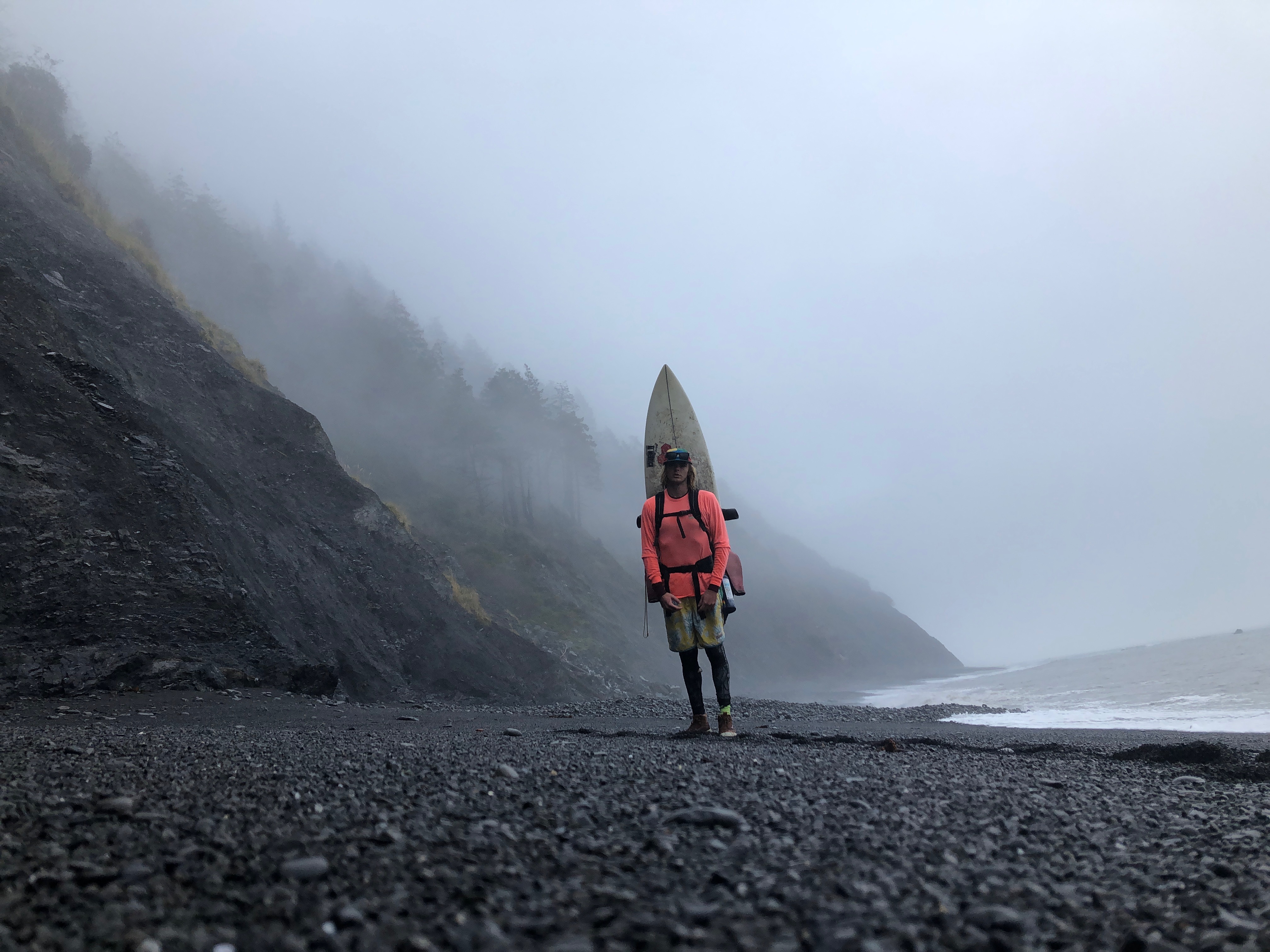
When Humboldt State University forestry major Gavin Schreiner set out on a 10-day surf trip over spring break, he had no clue what he would return to.
Planned months in advance, Schreiner wasn’t going to let a virus stand in the way of his vacation. Packing over 50 pounds of food and supplies, he and a friend hiked nine miles up the coast of California. Schreiner stopped along the way to admire otters, countless shells and of course, to surf.
“Surfing is obviously my favorite part and that’s the drive to go, but I love camping anyway,” Schreiner said. “I’m an avid backpacker. I’ve been through the Trinity Alps and definitely backpacked into SoCal a bunch.”
A territorial surfer, Schreiner requested the location not be named, especially after this trip. Between spring break and COVID-19, the waves were packed.
“It’s definitely my life path to surf until I die.”
Gavin Schreiner
“It was the most crowded anyone has ever seen that spot,” Schreiner said.
Fortunately for those adventurous enough, there are nine miles of coast to surf on the way.
“There’s the main surf spot out there, but there’s countless other waves along there,” Schreiner said. “It’s like a wave park. There’s so many different types of waves and different spots you can surf, and all offer different excitements.”
Time between surf sessions consists of eating, sleeping and battling the elements to stay comfortable.
“On the coast the weather changes super quick, so you have to be shedding layers, putting layers back on and also watching the waves 24/7 to make sure you get the best seshes [sessions] in,” Schreiner said.
This is the longest trip Schreiner has taken so far, but he wants to break the record.
“If we could spend a month, I would be in for that,” Schreiner said.
At 20 years old, Schreiner has been surfing over half his life.
“Surfing and the ocean is my number one priority,” Schreiner said. “It’s definitely my life path to surf until I die.”
When he returned from his 10-day trip, Schreiner was greeted by strangers wearing masks and businesses with closed doors. The virus was not a factor in the trip. Surfers treated each other with the same brotherly love and competition. Schreiner would’ve stayed longer if it weren’t for school.
“We kinda knew a little bit going into it that shit was going crazy,” Schreiner said. “The only thing we reconsidered was whether or not we could stay indefinitely and figure out a way to complete homework assignments out there.”
Now that he’s back home, he tries to surf every day to take advantage of the opportunity.
“I know a lot of my friends down south can’t surf because they’re closing the beaches, so I definitely feel super blessed to be up here right now,” Schreiner said. “I can follow social distancing and still go out every day.”
Student resources for school, finances, food, housing and counseling
Here is a list of resources Humboldt State is offering for students. Click here for a student-created site of community resources. Click here for the site in Spanish.
Educational advice:
Enoch Hale is the director of the Center for Teaching and Learning at Humboldt State University. He provided five tips to help students with online learning during the shelter in place order. His tips revolved around being kind and flexible.
“Kindness is having the patience and the benefit of the doubt to know that everyone else is struggling,” Hale said. “Be flexible—no one signed up for this and we are going to have to be agile in our expectations in the changing patterns.”
Five tips to help with online school from Hale:
Don’t ignore feelings—reflect on them so they don’t manage us.
Communicate with professors more, not less.
Log on more frequently. Check your emails and canvas more often. Not all courses will be on Zoom.
Set a schedule, use a study calendar and stick to a routine.
HSU Coordinator of Student Services for the financial aid office Morgan McBroom provided financial advice to students. McBroom suggested students in a crisis contact the financial aid office.
For students who are hard-pressed for money, there is a student emergency loan that ranges from $500 to $1000. It is a short-term loan and can come within a few days. Financial services will work to help students pay it back. Students who have not used all of their student loans from the previous semester may also still have access to them.
Due to the COVID-19 crisis, students’ loan interests are being waived, but the estimated date that it will stop is in June. As of now, the end date hasn’t been established. If you are an HSU graduate, you can have your loans waived for a year with no interest.
Contact: finaid@humboldt.edu or (707) 826-4321.
Housing:
In addition to her advice on financial matters, McBroom also provided housing advice. There is emergency housing available on campus. The off-campus liaison is a resource if you’re struggling with rent.
Contact: housingliaison@humboldt.edu
Food:
1. The recreation room on the first floor of the Jolly Giant Commons offers pre-made bags with food items. This happens twice a week on Wednesday from 10 a.m. until 12 p.m. and Thursday from 1 to 3 p.m. Vegan and vegetarian meal bags are also available.
If you cannot make those times due to isolation or quarantine, contact mira@humboldt.edu and she can set up a delivery time.
2. Oh SNAP! can also help you load your student ID card with J points. You need to express a financial need for food support. If you have over $40 in J points, you need to wait until your card is under $40. You can receive $60 every four weeks, but this is subject to change. If there is an increase of funds there could be an increase in the amount given to students. You can also donate your J points to help students in need.
Contact: ravin.craig@humboldt.edu.
3. For extra help, try applying for CalFresh, a state-funded program to help pay for food. Students not working 20 hours a week can apply for CalFresh, except for students in the Educational Opportunity Program program, students with specialized grants and work-study students. You can qualify for up to $200 a month for groceries.
Contact ravin.craig@humboldt.edu if you need help with the application process or would like to see if you qualify.
Counseling:
Mira B. Friedman is the lead for health education and clinic support services. She provided information about counseling for students.
HSU Counseling and Psychological Services is offering virtual appointments.
Students can call (707) 826-3236 to make an appointment. There’s also a 24/7 hotline for immediate crisis outreach for students to speak with a therapist by phone at (707) 826-3236.
HSU freshmen got the short end of the stick after facing blackouts and the COVID-19 pandemic
Humboldt State students have experienced a crazy school year. From blackouts in October and COVID-19 ending face-to-face classes, it’s been quite the ride for everyone. For freshmen, this was their first experience with college.
Freshmen learn to live on their own, make new experiences and acclimate to their new surroundings. For the freshmen that entered in fall 2019, it’s been a different story.
Mikayla Diaz, an environmental science management major from Torrance, California, struggled with scheduling her first semester during the blackouts.
“It was just really unexpected,” Diaz said. “Starting college, people will tell you how to stay organized and to keep a weekly planner and stuff like that, so everything I heard just kind of went out the window. Like, I wanted to keep a weekly planner but how do I if I don’t even know if I’m having class? It was difficult to make my way and get the bare minimum done.”
“Keeping in contact with my teachers has been helpful, but it is difficult to do the Zoom thing with my teachers. It’s kind of awkward.
Mikayla Diaz
HSU has a prominent science program, and with that comes a lot of lab classes. Megan Bach, a wildlife management major from Boulder, Colorado, admitted that the blackouts affected her lab class.
“Because of both blackouts I missed two labs,” Bach said, “which I was super bummed about because we didn’t get to do certain activities. Same with the coronavirus too though.”
COVID-19 has affected students throughout the world by pushing classes that are normally face-to-face online. Classes are conducted from home and teachers have been forced to cut assignments that can’t be done from home or without certain equipment.
Bach is concerned about the lack of hands-on learning, specifically for her chemistry lab.
“The teachers are doing a great job. I’m still getting all the information,” Bach said. “It’s just rough because it’s hard, especially from home. I hate online classes. It makes everything harder. I’m a very hands-on learner and I can’t even imagine how they’re gonna do my chemistry lab.”
Although classes are changing to accommodate online learning, students are missing out most on science classes.
“Teachers are cutting out a lot of work,” Diaz said. “Keeping in contact with my teachers has been helpful, but it is difficult to do the Zoom thing with my teachers. It’s kind of awkward. For classes—especially lab classes—I need to go to the Arcata Marsh or something and I can’t go and do that because I’m in SoCal. It’s just kind of disappointing.”
Science students feel they aren’t getting the education they paid for. Science and freshman botany professor, Mihai Tomescu, admits some of his students are struggling with the online format.
“There’s just a lot of stuff I’m missing out on.”
Mikayla Diaz
“Just recently I had a student emailing me and she was a really good student until COVID hit,” Tomescu said. “She was really involved in class, really liked the material, was there in lectures all the time, worked in the lab really hard, she really enjoyed it. She missed an assignment and I checked in with her to see how things were going and she told me that she has really big problems with the internet.”
Tomescu admits that he can’t directly do anything about the situation or to help in any way with the problems his students are facing, such as internet access.
“It’s either slow or not available or spotty. Parts of lectures will stop and she’ll have to wait for the internet to come back on and stuff like that,” Tomescu said. “That’s very worrisome, especially when you see that in a student that was doing really well in class and she was excited. I don’t want it to be a missed opportunity.”
Doing school from home can be frustrating, difficult and demotivating. At times, it’s inaccessible for people that don’t have the resources they need to complete the work. Not only are students missing opportunities on campus or in classes, but they’re also missing out on social opportunities they’ll never get back.
“It’s really frustrating because I’m not getting the material for my classes,” Diaz said. “There’s just a lot of stuff I’m missing out on.”
Half-Life: Alyx is the first properly high budget virtual reality effort from a major studio
The previous game in the Half-Life series ended on a cliffhanger, and since then, the franchise sat in limbo for over a decade. By the time Half-Life: Alyx was announced, most had given up hope of a sequel. The inflated expectations for a new Half Life game made constructing a sequel too daunting a task for developer Valve to ever release anything, but now they have. Does it live up to the hype?
For the most part, yes.
With the majority of people currently stuck inside, virtual reality is one of the best ways to pretend you’re not. The problem is the high price point. Currently the barrier for entry for a VR headset is a minimum of $400, and that doesn’t include a gaming PC that meets the hefty requirements of VR. Those PCs generally start at $600. Up to this point, small-scale games made up the majority of the VR catalog. VR lacked a system seller to justify the high price point.
The game’s story is excellent, but can feel sparse at times. Some chapters should have more dialogue than they do, but the writing and performances that are there are excellent.
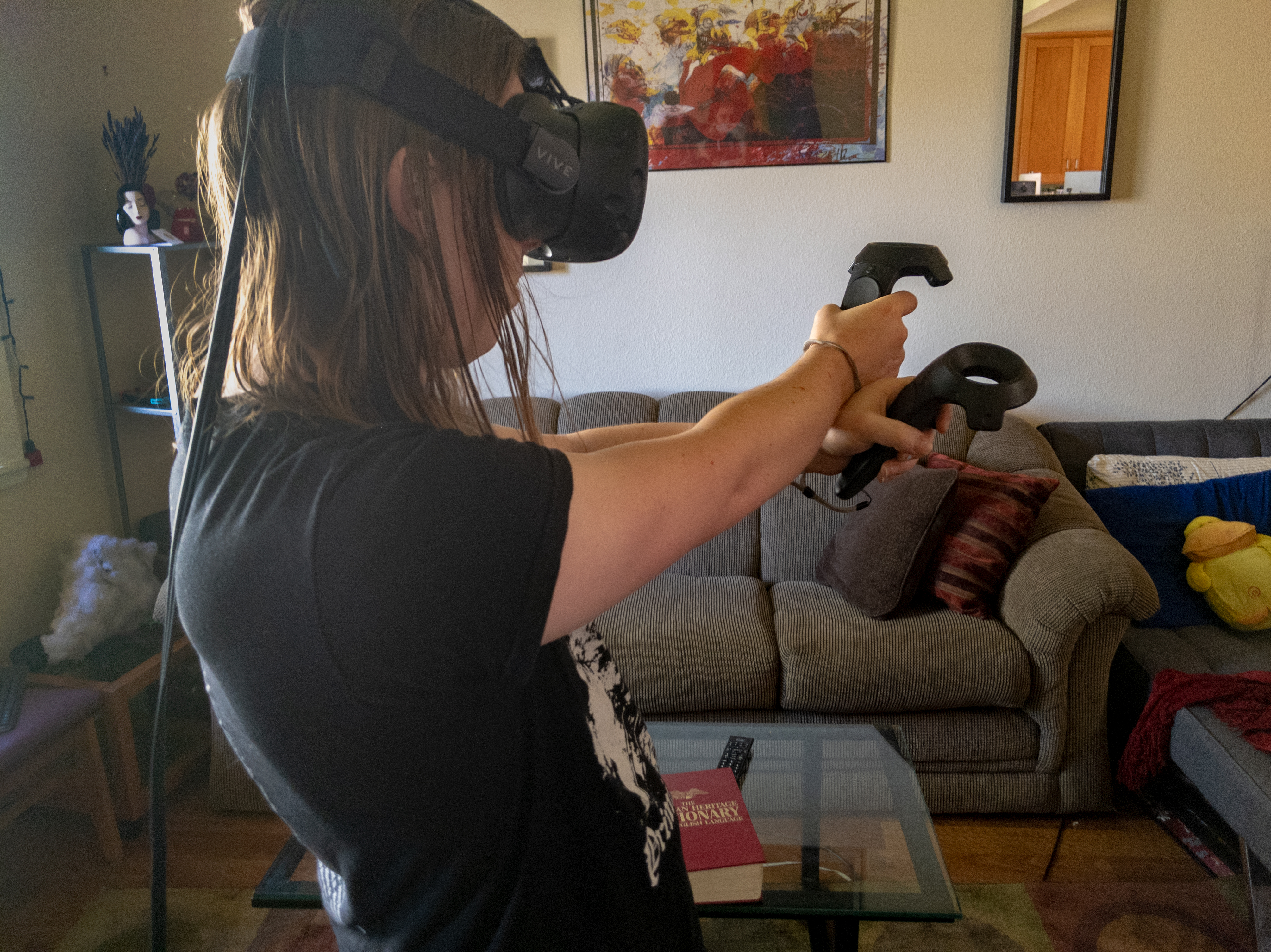
Luckily, Half-Life: Alyx is an incredible game. It takes what made the older Half-Life games great on a 2D screen and translates them to the 3D space with an incredible amount of polish.
In Half-Life 2, your main method of interacting with the world was the gravity gun, the weapon that could pick up and manipulate nearly any object in the world around you. In Half-Life: Alyx you have gravity gloves.
These gloves let you aim your hands at nearly any object, press the grab button and flick your wrist to bring that item towards you. It’s an action so simple and satisfying to perform that since playing I have on several occasions found myself with the urge to perform it in my day-to-day life.
The game’s story is excellent, but can feel sparse at times. Some chapters should have more dialogue than they do, but the writing and performances that are there are excellent.
During those few encounters with human characters I was in awe at how life-like they were. If there’s anything about the game that is a disappointment, it would have to be the lack of melee weapons. You can pick up almost anything in the environment, but none of it can actually harm enemies. Half-Life is known for having the crowbar as a weapon, so it’s weird to not have that in this game.
These are all nitpicks though. Half-Life: Alyx is proof that VR as a medium can work. It’s proof that virtual reality can be its own storytelling medium, with its own stories and experiences and that gets me excited for the future of gaming.
Lizbeth Cano-Sanchez steps up to the Associated Students presidency
Lizbeth Cano-Sanchez is the first sophomore to serve as president of Associated Students at Humboldt State University since at least 1975.
Cano-Sanchez took over as president of AS following the previous president’s resignation in December 2019. Formerly the administrative vice president, Cano-Sanchez decided to run for HSU student government after serving as president of the Hill dorms and a member of the Resident Hall Association board in her freshman year.
“Sometimes in my life, and I thank God for it, things align and things happen, but I push for them, and I work for them,” Cano-Sanchez said.
AS Legislative Vice President Jeremiah Finley began working with Cano-Sanchez as a fellow dorm president on the RHA.
“During any transition period in any organization, things can get a little hectic and challenging as the new person comes to fill the role left behind,” Finley said. “That being said, after she became AS president, working with her has been the most valuable experience that I have had in my young professional life.”
“I don’t think I was intimidated. I was very excited. But I could feel a little bit of sadness within me, because I knew I had to make a choice between sacrificing more leisure time or self care time or I was going to be sacrificing running.”
LIzbeth Cano-Sanchez
Originally from Mexico, Cano-Sanchez was raised in Monterey Park, California. She currently has temporary residency in the U.S. and is making her way toward citizenship.
Cano-Sanchez initially came to Humboldt to be a part of the track and field team and the cross-country program. She’s taken part in both varsity sports since her freshman year at Schurr High School. She was the MVP for cross-country her freshman and senior years, and MVP of track and field her sophomore and junior years. She became captain of the cross-country team her sophomore year, and the track and field team her junior year. She also currently holds the 5K record at Schurr High.
Cano-Sanchez decided to step away from sports this spring to make much-needed room for her new role as AS president.
“I don’t think I was intimidated,” Cano-Sanchez said. “I was very excited. But I could feel a little bit of sadness within me, because I knew I had to make a choice between sacrificing more leisure time or self care time or I was going to be sacrificing running.”
Cano-Sanchez said her relationship with running also changed.
“I wasn’t setting goals for myself in that area anymore, and it was because I was trying to grow in other areas,” Cano-Sanchez said. “Now that I’m away from it I can see all of my errors, but I still have some growing to do before I go back.”
As a business major, Cano-Sanchez chose to run for the administrative vice president’s position during the 2019 spring elections because of its practical application to her major. She ran with a platform advocating for a stronger student union, having visited other universities with more efficient systems.
“We have a very lenient and flexible system at the moment,” Cano-Sanchez said. “It calls for innovation and creativity, and that’s a huge thing that I value. So, I’m not talking about making things more strict, not at all. I’m talking about having a more efficient system, within ourselves, in order to successfully serve our students.”
As the AS administrative vice president, Cano-Sanchez made efforts to centralize HSU’s funded programs. She also resurrected the AS Funded Programs Committee that’s been chaired by the AVP position in the past.
“Being AS president is very time consuming and Lizbeth has done a phenomenal job at doing what she can, but also delegating tasks and roles to other AS board members.”
Jenessa Lund, Executive Director of AS
“At first, only a few showed up,” Cano-Sanchez said. “Then the second meeting, more showed up and I felt very happy to see them getting involved and wanting to have their voice be represented. That was a hard one to let go of [the AS Funded Programs Committee] because I liked seeing how the money worked and how our students were being served through their student fees.”
As the fill-in president of AS, Cano-Sanchez has taken on the position as if she ran for it. She has weekly advising meetings with the AS professional staff, monthly meetings with HSU President Tom Jackson, and has created strong communication between the AS board.
Executive Director of AS Jenessa Lund has worked closely with Cano-Sanchez for the academic year.
“She has consistently demonstrated that she is willing and capable to prioritize her AS roles,” Lund said. “Being AS president is very time consuming and Lizbeth has done a phenomenal job at doing what she can, but also delegating tasks and roles to other AS board members.”
Cano-Sanchez admitted the position takes time.
“But it’s worth it,” Cano-Sanchez said. “Students need to know and my board needs to know in order to communicate it down.”
Cano-Sanchez’s main focuses with AS are improving the internal structure and raising awareness of AS resources that can help to meet student needs. Cano-Sanchez has also decided to run for AS president for the 2020-2021 academic year.
Juggling classes with a presidency is enough to stress out anyone, but Cano-Sanchez feels she was made for it.
“I think that I’m very much a natural born leader, ” Cano-Sanchez said. “I know that I am. I know that I can tell when things need to be fixed, and I have been fixing them.”
Looking to the past to learn about the present pandemic
There’s a saying that goes something like, “In order to prevent future mistakes, we should look to the past for guidance.” While this current pandemic may be new to all of us, humans have gone through this before. Some of the more recent pandemics include the SARS virus, the H1N1 virus, Ebola and HIV.
The term pandemic is defined as something “occurring over a wide geographic area and affecting an exceptionally high proportion of the population.” Obviously, the current COVID-19 virus fits into this category. While some of the aforementioned pandemics did not enact a devastating, history-altering toll on Humboldt County, another pandemic did.
From 1918 to 1920, the Spanish flu swept across America, resulting in an estimated 675,000 deaths according to the U.S. Department of Health and Human Services. The first official report of the Spanish flu in California was reported Sept. 27, 1918, just two weeks after an outbreak on the East Coast. By November 1918, the total cases throughout the state hit about 115,000—overwhelming doctors and government officials from north to south.
One of three doctors that helped Spanish flu patients in the Ferndale area.
Although Humboldt County sits in an isolated area protected by the “Redwood Curtain,” the area was soon amassed in its own troubles combatting the illness. Humboldt County had a population of about 37,000 people with Eureka holding around 12,000. The Spanish flu resulted in around 200 deaths (although it is thought to be much higher) and thousands grew ill.
In 2012, Humboldt State alumnus and McKinleyville native Jeff Benedetti-Coomber wrote a detailed history of the impact the Spanish flu had on Humboldt County. For it, he was awarded the Charles R. Barnum History Award by HSU’s history department. For his research he scoured through old newspaper clippings for primary source documentation. He read academic analysis on how the Spanish flu affected the entire nation and he cited Matina Kilkenny, a researcher and local author for the Humboldt Historical Society who also wrote about the impacts the Spanish flu had on Humboldt County.
What prompted Benedetti-Coomber to focus on the Spanish flu was its lack of local research. As his peers decided to look into European history, he decided to focus his attention on the effects locally.
“I was walking through the graveyard in Arcata and noticed a family of graves, not necessarily related to the [Spanish] influenza but it got me thinking about what effects the flu may have had because it was around the same time,” he told me over the phone from his place in Los Angeles. “Once I started researching it I saw how it did affect the county and I was pretty amazed.”
Benedetti-Coomber’s senior thesis, titled “Death In the Redwoods: The Effects of the Spanish Influenza on Humboldt County,” spans 30 pages and breaks down how each town dealt with the outbreak. He highlights what preventative measures seem to have worked and where officials, the public and the media went wrong and what they got right.
“It’s just like today when you tell people to do something and they kind of resist. A lot of people had that with the Spanish influenza and it was a reason a lot of people died, because they didn’t take it seriously.”
Jeff Benedetti-Coomber
Some of the highlights from his research that still stand out to him are how Eureka initially closed all schools, which flooded the streets with children. They soon changed their minds and brought the kids back into the school to try to quarantine the children. Another nugget of research that sticks out in his mind has to do with masks and the public’s initial reluctance to wear them.
“It’s just like today,” Benedetti-Coomber said, “when you tell people to do something and they kind of resist. A lot of people had that with the Spanish influenza and it was a reason a lot of people died, because they didn’t take it seriously.”
When the Spanish flu hit Humboldt, the United States was in the middle of World War I and young men from Humboldt were signing up to join the war effort. There were war rallies and large gatherings of people throughout the towns in Humboldt in the fall of 1918 as the Spanish flu began to creep in.
“Although the Great War was still the main focus in Humboldt County, more and more citizens were beginning to take notice of the spreading pandemic,” Benedetti-Coomber wrote.
Some of the newspapers in Humboldt at that time seem to have downplayed the seriousness of the Spanish flu. Benedetti-Coomber points to an ad that was in the Humboldt Standard by Vicks VapoRub that was “disguised as an article… and it assured readers that the [Spanish flu] was ‘Nothing new simply the Old Grippe and la Grippe that was the epidemic in 1889-90.’”
Benedetti-Coomber wrote that it is believed the Spanish flu was brought to Humboldt County by locals traveling to other parts of the state to help care for sick family members and then returning before symptoms started to show. By mid-October 1918, reports of the Spanish flu were starting to pop up in the local newspapers.
“The Humboldt Times also reported that there were roughly 150 cases in Eureka by [Oct. 22] and hospitals were short staffed. Doctors were so busy they did not have the time to report new cases or treat the majority of their patients.”
Jeff Benedetti-Coomber
“The Humboldt Times and Humboldt Standard newspapers offered daily accounts of what was happening,” he said, adding that they also seemed to not care about the Spanish flu at first.
On Oct. 12, 1918, four cases were reported in the Humboldt Times and those infected were quarantined in a “‘safe house’” on 8th Street where they could be quarantined and cared for,” Benedetti-Coomber wrote.
At first, the mayor of Eureka downplayed the danger to the public, but two days later, five more people were infected. By Oct. 22, 1918 there would be more than 150 cases and one death.
“According to the Humboldt Times, Mrs. Garber Dahle was the first person in Humboldt County to die from the deadly virus,” Benedetti-Coomber wrote. “The Humboldt Times also reported that there were roughly 150 cases in Eureka by [Oct. 22] and hospitals were short staffed. Doctors were so busy they did not have the time to report new cases or treat the majority of their patients.”
Action to combat the Spanish flu across the county began to take root. Arcata was the first town to pass a requirement that all residents had to wear a mask while out in public, and by Nov. 7, 1918, the entire county was required to do so. Emergency hospitals were soon established across the county with some residents offering up their homes for the infected.
Arcata escaped the pandemic with only four deaths, but the same can’t be said for Eureka and especially for the logging camps in the remote areas of the county. The number of cases grew in the urban areas, and by Oct. 23, 1918, the logging camps were left to fend for themselves.
“Logging camps and small towns were informed by the newspapers and from local physicians that they would have to face the Spanish Influenza on their own as all of the county hospitals were completely full,” Benedetti-Coomber wrote while citing a Humboldt Times article titled “Influenza Increases Alarmingly in Two Days.”
Young women wearing masks in Humboldt County.
But one logging camp was able to escape the pandemic with no cases at all. In her article, “Missing Faces,” Matina Kilkenny reported how Carl Munther set up a quarantine system for his workers who decided to go into town. (Kilkenny’s article has a number of great photographs of life in Humboldt County during the Spanish flu.)
“Munther required every person returning to camp… to stay four days in a tent he’d pitched some distance from the workers’ cabin,” Kilkenny wrote, adding that the returning workers were also required to work and eat separately from their peers. “Thanks to their boss, very few men chose to leave the Barrel Company camp and not one case of influenza occurred there.”
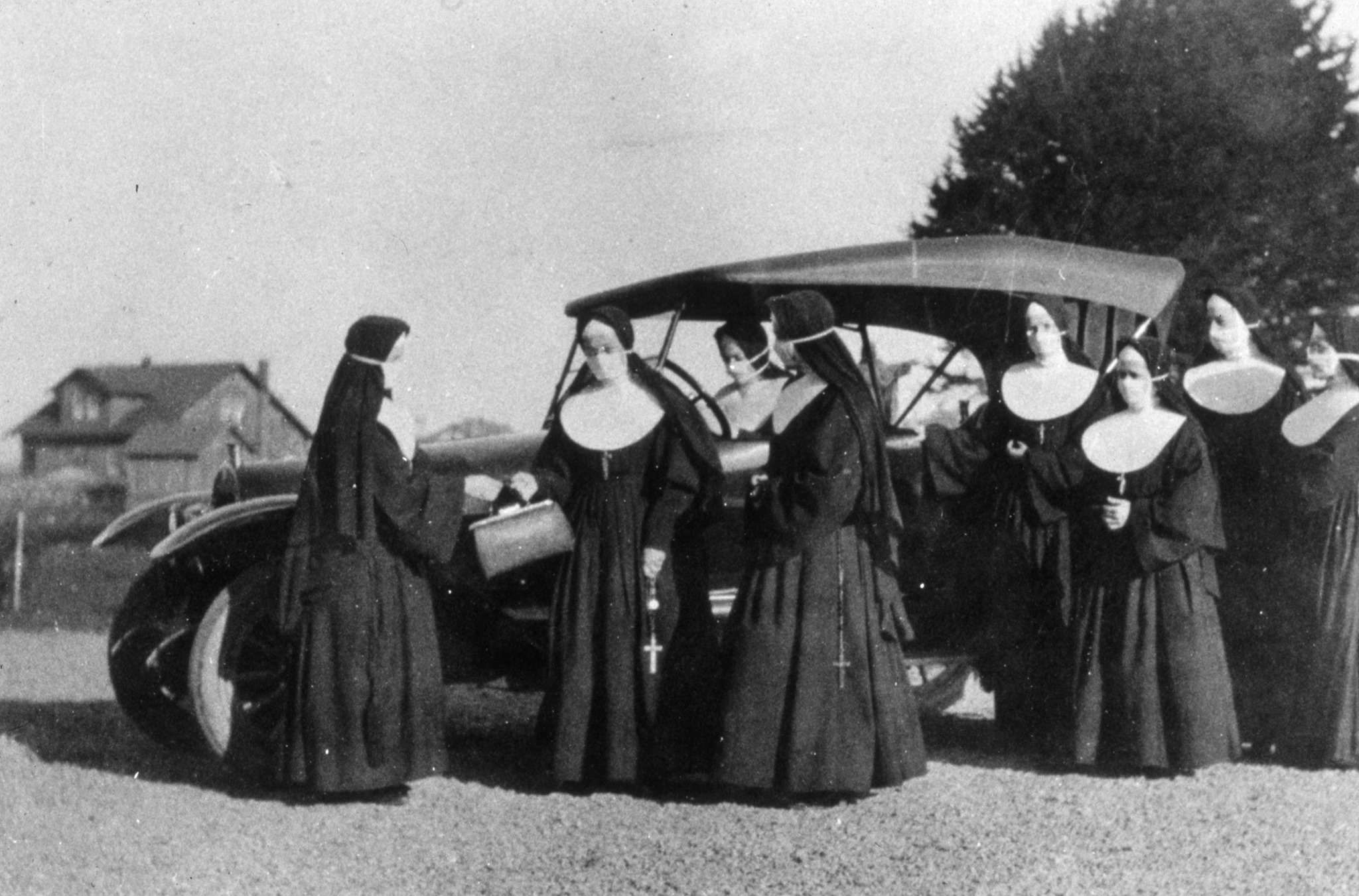
Sisters of St. Joseph wearing masks during the Spanish flu. The sisters helped many patients in Humboldt from 1918-1920.
Throughout her research, Kilkenny was able to find where a number of hospitals were set up across Humboldt. There was a Red Cross Hospital in Korbel, Arcata, Blue Lake and Eureka. Kilkenny also came across an interview between a member of the Sisters of St. Joseph of Orange in Eureka and a man named Brad Geagly. Kilkenny wrote the following:
“[Mother Bernard] sent [the Sisters] out in twos, in cars provided by the Red Cross. She armed each Sister with a kit containing camphor and sweet oil, castor oil, and mustard plasters. Into the homes… the sisters came, arriving at seven o’clock and leaving at the end of a 12-hour shift, to be replaced by two other Sisters. They would attend first to the adults….They would bathe the delirious victims completely, rubbing their chests deeply with the camphorated oil. Mustard plasters would be applied, and then the sisters would wrap the sick tightly in whatever woolen material they could find; then they would tend the children. Once they had been bathed and medicated, the sisters turned to washing linens or cleaning house. They fed their charges warmed milk and broth prepared from the food furnished by the Red Cross.”
Kilkenny noted that, generally, it was the poor who were admitted into the hospitals, while the more well-off were cared for in their homes. Because of this the actual tally for those infected and the deaths attributed to the Spanish flu is unknown. Kilkenny also points out how the Native American tribes were hit hard by the Spanish Flu as well.
“Of the [11] Native Americans whose deaths are on record at the County Courthouse, five were from Table Bluff, two from Hoopa, one from Miranda, one from Orleans, one from Requa, and one was a laborer at Korbel,” Kilkenny wrote. She also noted evidence that many Native Americans often refused treatment by White settlers around this time period.
Kilkenny was also able to find county death records from that time and noted that between Sept. 1, 1918 and April 1919, 175 Humboldt residents died with 91 of them between the ages of 20 and 40.
And so what can we learn from this history?
There is evidence that social distancing works by the example set by Carl Munther at his logging camp and how travel throughout the state can spread the virus. We can see how hospitals were eventually inundated with those infected with the Spanish flu and how staff were stretched thin. We can also see how it is important to get ahead of a pandemic and try to prepare as much as possible.
Humboldt County seems to be doing just that. They have recently distributed around 30,000 pieces of personal protective equipment to first responders and medical staff across the county. Humboldt State chipped in and prepared 1,250 COVID-19 test kits. Also, as I’m sure you are aware, we are in a “shelter in place” order that was enacted to help stop the spread of the virus and to give medical staff the ability to fight the virus without being overwhelmed.
Towns across Humboldt are also doing their part to help prevent an outbreak. Trinidad passed a moratorium on all short-term rentals and added some pretty forceful consequences to anyone who breaks it.
“Over the course of the meeting, council members added some teeth to the resolution with language saying that a single violation may result in the City revoking a proprietor’s short-term rental license for up to a year,” the Lost Coast Outpost’s Ryan Burns recently reported, adding that the county may consider a similar measure.
A stained glass piece by Humboldt artist Colleen Clifford.
As this thing progresses, we are all going to have to make some sacrifices, but we’ll get through it. Help out the elderly and the immunocompromised if you can. Help out each other by not going out or attending pretty much any gathering of any number of people.
Let’s all work together — but at least six apart — to help “flatten the curve.”
A conversation with a College of the Redwoods student at Pelican Bay State Prison
We now have more than 1.5 million people worldwide infected with COVID-19 and over 90,000 deaths. The United States has surpassed every other country in cases with just over 450,000. People are being told to socially distance themselves with six feet of space between others and isolate inside. But what about the millions who are incarcerated that don’t have that option?
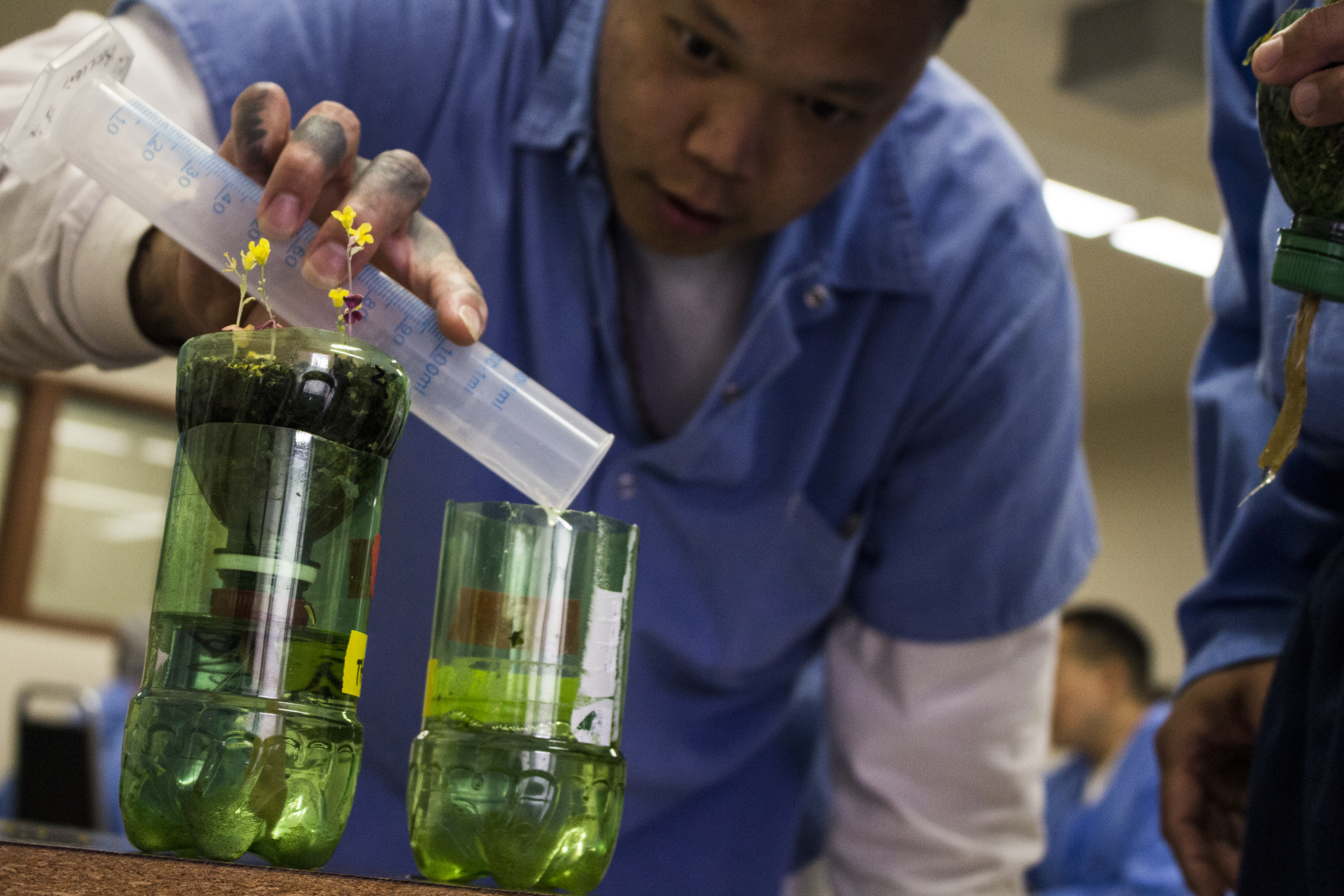
Kunlyna Tauch is housed at Pelican Bay State Prison and is a student in the College of the Redwoods Pelican Bay Scholars Program at Pelican Bay State Prison. He is slated to graduate with his associate degree for transfer this summer. Tauch is also a student and contributor in Paul Critz’s audio journalism class, which produces Pelican Bay’s podcast “Pelican Bay: UNLOCKED.” Tauch has been a spokesperson of sorts for the recent programming at Pelican Bay and an advocate of the changes being made inside the supermax prison.
Cases of the coronavirus have risen just over 1,300 throughout 100 federal prisons, thousands of jails and 1,700 state-run facilities nationwide. The Federal Bureau of Prisons says 138 inmates and 59 employees have tested positive and at least seven inmates have died, bringing the total to at least 32 COVID-19-related deaths inside the nation’s prisons and jails.
On March 31, California state prison officials announced they would be releasing 3,500 incarcerated individuals early to help free space in cramped prisons due to a possible coronavirus outbreak. Governor Gavin Newsom announced a halt in the transfer and intake of incarcerated individuals and youths into California’s 35 state prisons.
According to the California Department of Corrections and Rehabilitation website, there are, as of April 9, 12 incarcerated persons at California Prison, Los Angeles County, 19 incarcerated persons at California Institution for Men in Chino, one incarcerated person at North Kern State Prison in Delano and one incarcerated person at Substance Abuse Training Facility in Corcoran who have tested positive for COVID-19. Seventy-one CDCR or California Correctional Health Care Services employees have tested positive for COVID-19 in 21 incarcerated facilities, and hundreds have called in sick for work.
In the past five years there have been more programs in Pelican Bay than ever before and the culture inside is changing. After a lawsuit was awarded to the incarcerated individuals participating in the 2011 and 2013 hunger strikes and their advocates, one of the two solitary housing units was shut down and terms of isolation were limited to five years. This caused the prison to mitigate the effects of solitary confinement with programs like education and therapy. I spoke with Tauch on what it’s like in Pelican Bay State Prison as a college student amid the changes COVID-19 has brought to the infamous prison.
Kunlyna Tauch looking upward in June of 2019. Tauch is slated to earn his associate degree for transfer through College of the Redwoods’ Pelican Bay Scholars program this semester. | Photo by T. William Wallin
Tony Wallin: What’s it like in Pelican Bay State Prison right now and what are your concerns?
Kunlya Tauch: First of all, CDCR stopped all visitation and there are no programs. So we’re doing like old prison time, right. Which is us in prison going to yard and trying to occupy ourselves with whatever we have, which is not that much. My concern is that people on the streets are so socially distant from each other they become callous of each other and become more segregated and more disconnected. But from what I am seeing on TV is a lot of good, which is making me happy. The little acts of kindness and videos of people on the street coming out, I love it. There’s actually a little silver lining out of this.
TW: Yeah. There’s a lot of opportunity for positivity through all of this.
KT: It’s hard to pass on those opportunities because it’s so in-your-face.
TW: What’s it like in there with programs shut down? What are you doing to keep busy?
KT: College of the Redwoods has been the only program that is really working on shifting their whole business model to make it work for us. They are still running classes through correspondence and we’re getting hella work like every Friday. Our teachers are saying, ‘This is what we expect. Your next essay is due this date, send it in the mail,’ but because I have five classes I have enough work to sustain me, plus I have hella books I’ve got to get through. I am pretty occupied but it’s pretty restless in here, you know? People are constantly checking on their family, making sure they are well. They aren’t reading, they aren’t programming, they aren’t going anywhere, so their day consists of the phone and the yard. The yard schedule in itself [has changed], we aren’t seeing the regular people we used to see. They’re making it real limited, they’re not giving the day room. They literally made some new rule where only five cells in the day room at a time, which prohibits ourselves from doing what we want to do. It’s kinda stressful. It feels like we are taking a lot of steps back as far as prison goes.
TW: CDCR said they were going to send out more cleaning supplies to all prisons and make sure every prison has what they need. Are you seeing that?
KT: That’s never been a problem. The cleanliness of the place isn’t a problem. Right now I have a personal friend who had some symptoms, they didn’t even test him and they just took him to quarantine and is on two weeks lockdown with no mail, no phone, no nothing. Just to see if he has it or not.
TW: Where do they have the quarantine right now? What do they have blocked off?
KT: They have one on A yard and one on B yard and it’s one section of one building and they’re basically in the SHU [secure housing unit]. They’re like kicking off drugs by themselves. That’s their treatment and I guess the nurses are going over, but I don’t know. I assume nurses are checking on them professionally. There’s too much of a shortage of testing, but one thing about medical is they are a separate entity than CDCR, so CDCR can’t dictate what they do.
TW: Interesting. They operate differently? The warden doesn’t have a say on the medical side of things?
KT: No, medical community operates the medical community. All records are sealed and confidential. The prison has to accommodate that or else there’s a big lawsuit. I think CDCR concedes medical and there’s an agreement [between them]. According to the American government this is it and [CDCR] is only the California government, same with religion and same thing with tech. For some reason the tech, IT, here is their own entity and they suck. It takes like a month to transfer music onto our laptop [for the podcast]. It’s been stagnant. I’ve been feeling lethargic. I feel like they caged me back up and I’m really back in prison again. Pelican Bay was really doing good with their programs and everything running everyday and now it feels like this modified program where it feels like we’re just on lockdown. I feel like a lot of our minds aren’t being stimulated because a lot of us aren’t in those programs we are forced into or choose to be in.
TW: Right. It feels like pre-2014?
KT: Yes. Real shit. It feels like before and it feels like out of mind will cause more trouble. I am waiting for the ball to drop. I am waiting for something to happen. I’m almost mad that personally we’re on lockdown, but the whole fucking world is on lockdown and I can’t make more moves happen.
TW: Yeah, the irony in all of this is everything is locked down globally. How is your morale and the overall morale in the prison? Are there still positive interactions?
KT: I feel like we’re losing that. I feel like the tank is draining every single day. Guys that were motivated are losing that motivation. I see my college peers going like, ‘I don’t even feel like doing the work.’ But you don’t have that motivation no more because you’re not in front of the teacher anymore, you’re not engaging. You have questions but you can’t get an answer. I have a bleeding heart for my community in here, but it’s hard for me to help them because I have five courses and I have to study. We’re getting hella shit to read and it’s like, ‘I don’t have the time to worry about you guys because I have to get this out of the way first.’ Before all of this coronavirus I was approved to transfer to Lancaster [California State Prison, Los Angeles County]. That’s a level three. That was a big decision I had to make because that means I have to detach myself from this place I grew roots in. The process of this whole coronavirus—I’m back worrying about college and I can’t really be the catalyst to get my guys rallied up to do their work because I have to just worry about my work. So, I’ve been feeling like the morale is ‘Let’s see what happens while we are in this state of limbo,’ which is worse than staying stagnant because we’re losing the momentum, you know? We work on momentum on the programs that are on a level four yard. Without that momentum it’s like, ‘I’ll just watch Jerry Springer all day.”
TW: It’s gotta be rough going from so many programs for the first time at Pelican Bay and then, in an instant, they’re gone. For those of you that are students at College of the Redwoods, can you study together?
KT: Everything in person is shut down but we can do our own personal study groups, but we are divided. So, we only see our own dudes in our own yard and maybe another building and they’re across the fence so we can’t even have a study group out there. Also the COs [correctional officers] are really cracking down on what stuff we can bring out and they’re asking us, ‘Why were you bringing books and stuff out to the yard since programs are shut down?’ So we can’t even have that. So technically no, we can’t have a study group. We can have an impromptu one if there’s a cool CO that says it’s cool, we can sit out there.
Some unedited recommendations and brief reviews from some of our staff
Life and Arts Editor Grace Caswell
What I’m watching:
Just finished “Tiger King.” It’s the most ridiculous and unbelievable show I’ve seen yet with a surprising amount of depth.
What I’m reading:
“Noam Chomsky” by John Lyons.
What I’m playing:
None :/
What I’m listening to:
Lots of new music is being released but right now Toro y Moi and Jhene Aiko.
What else I’m doing:
Yoga and meditation has been a go to as well as cooking healthy foods. Anything to keep my mind at ease and health immunity high.
Managing Editor Chelsea Wood
What I’m watching:
I’ve been watching the final season of “Schitt’s Creek” which has been a bittersweet reflection of the last five seasons.
What I’m reading:
I’ve been reading more of a book I started last summer. It’s called “The Spaceship Next Door” and it about a teenager who grew up in a small town where a spacecraft crashed years ago but never left.
What I’m playing:
Minecraft. I trash talked this game as a teen, but it’s amazing and I love creating things on it. It’s extremely entertaining and relaxing.
What I’m listening to:
I’m listening to lots of downbeat songs—music that soothes the soul with catchy beats. Just stuff to satisfy this melancholy phase I’m swimming through.
What else I’m doing:
I picked up an old hobby, basket weaving. It’s a relaxing and simple task that yields a useful item. And no that’s not a BS excuse, basket weaving is the shit.
Editor-in-Chief James Wilde
What I’m watching:
I just finished season three of “Ozark.” It’s a crime drama with superb characters and writing that had an unexpected depiction of mental illness that probably hit a little too close to home and (full disclosure) made me tear up.
What I’m reading:
I just finished “Why Time Flies,” by Alan Burdick, a fun little foray into the way we think about time. Next up: “The Glass Hotel,” by Emily St. John Mandel.
What I’m playing:
Call of Duty: Warzone with my brother and some friends. I hate the premise of Call of Duty and, you know, shooting people, but as long as I ignore that it’s lots of fun.
What I’m listening to:
Kind of all over the place, which isn’t out of the ordinary. Indie stuff to hip hop to alt rock to electronic stuff to jazz to whatever else. Oh, and random Tiny Desk Concerts.
What else I’m doing:
Walking or going on runs to get out of the house. Drowning in schoolwork. Lying on the floor.
Opinion Editor Alexis Parra
What I’m watching:
“Gentrified”- A show that hits home for people of color. “Tiger King”- A cult war in the world of big cats.
What I’m reading:
“Z: The Beginning of Everything”- the untold story of Zelda Fitzgerald and beautifying her life.
What I’m playing:
None.
What I’m listening to:
My playlist on LJ- All of my favorites songs and energy that I carry into one playlist. “La Platica”- A bilingual podcast where the host is funny and talks about dumb shit and real shit.
What else I’m doing:
Painting. Make-up. Face masks. Talking to my family. Getting creative while also taking care of my skin and keeping in touch with my loved ones.
Sports Editor Thomas Lal
What I’m watching:
“Drive To Survive,” a super fun look into the 2019 F1 season with the dramatic thrills and spills to match!
What I’m reading:
“Permanent Record” by Edward Snowden. An intriguing and somewhat terrifying read.
What I’m playing:
The Witcher 3. This game has consumed my life. Loving the story and exploring the world.
What I’m listening to:
So much music, mostly ska, punk and jazz along with the “Every Little Thing” podcast.
What else I’m doing:
Being sad without any sports to watch.
Web Editor Seth Finnegan
What I’m watching:
“Community.” The always funny comedy about students at a community college.
What I’m reading:
None.
What I’m playing:
Dead Rising and MLB The Show 19. Filling the sports void with hitting baseballs and zombies with baseball bats.
What I’m listening to:
The “Adventure Zone” podcast. Three brothers and their dad play D&D together.
What else I’m doing:
Learning to play darts. It’s very frustrating but very fun!
Video Editor Benjamin Zawilski
What I’m watching:
The filmography of David Fincher and Hayao Miyazaki, and “The Good Place” on Netflix.
What I’m reading:
Rereading “Peter and the Starcatchers” by Dave Barry and Ridley Pearson, which was one of my favorite book series as a child
What I’m playing:
Overhearing my sister play Animal Crossing.
What I’m listening to:
The film scores of Mark Mancina, Alexandre Desplat, and James Newton Howard.
What else I’m doing:
Hiking at least five miles a day, sometimes up to seven, and have done a considerable amount of housecleaning.
Reporter Deion Alston
What I’m watching:
“Coffee & Kareem.” Cop dates kid’s mother and him and kid (Kareem) uncover a conspiracy of dirty cops.
What I’m reading:
Haven’t been reading books tbh, but a lot of news article pertinent to sports, COVID-19, crimes etc.
What I’m playing:
Fortnite and NBA 2K 20. Fortnite is a shooting game and 2K is professional basketball at your finger tips.
What I’m listening to:
For podcasts, I listen to “Up in Smoke” hosted by two former NBA players, Matt Barnes and Stephen Jackson. It’s very interesting—great interviews and guests as well. For music I’m listening to a lot of Lil Uzi, G Herbo, Tory Lanez. So basically rap, hip-hop and R&B.
What else I’m doing:
I’m cooking a lot more—takes time up in the day. Do my 250 push-ups everyday and step-ups for some cardio. And occasionally throw the football in the drive way.
Reporter Dakota Cox
What I’m watching:
“Seinfeld” & “Empire.” “Seinfeld” is a wonderful waste of time. “Empire” is a must-binge, cutthroat musical.
What I’m reading:
“Hurricanes” by Rick Ross is a fairly generic success story in terms of rapper autobiographies. “The Alchemist” is an extraordinary journey of the body, mind and soul.
What I’m playing:
Animal Crossing; don’t ask questions, go pick up the game!
What I’m listening to:
Going back and forth between oldies and hip-hop, gotta keep the serotonin up. Michael Jackson, Bob Marley and The Beatles are timeless, go listen! Gambino got the best album of 2020, @ me!
What else I’m doing:
Slipping out of sanity; would not recommend. Get a mask-on walk in when the sun shows it’s face; I like to play a little game called guess the gang members.
Reporter Sarah Blunt
What I’m watching:
I just finished “I am not okay with this.” It was a really good show with short episodes that have a lot going on in them. 10/10. I also just recently watched “Freedom Writers.” That one was really good and empowering, also took place in Long Beach (where I’m from) so that was relatable (kind of).
What I’m reading:
“Looking for Alaska.” I’ve already seen the show on Hulu but I realized I had the book. So far it’s really good and John Green (the author) writes really descriptively so I never feel bored when I’m reading it.
What I’m playing:
None.
What I’m listening to:
Tons of music. Nothing in particular just going through my music apps and looking for things I haven’t heard before, or even music from shows i’ve watched that I liked the soundtrack. That’s most of what I spend my free time doing.
What else I’m doing:
Lately I’ve been taking bike rides alone just to get fresh air and not be stuck in the same surroundings. I never ride bikes but lately it’s just been a really nice way to get out the house but also keep my social distance from others. 10/10
Reporter Ivan Ramirez
What I’m watching:
“Castlevania,” the show. “Mewtwo Strikes Back: EVOLUTION,” the movie.
Meditating, talking to people on Discord, Instagram.
Reporter Alberto Muro
What I’m watching:
I have started watching the Amazon Prime series “The Boys.” It has an interesting take on superheroes proving that not all of them are super. It’s a world where super heroes exist, now imagine their lack of empathy for saving people.
What I’m reading:
Currently reading through my textbooks so that I don’t fall behind on homework.
What I’m playing:
I am currently playing the remake of Resident Evil 3 which has updated graphics and character development.
What I’m listening to:
I am listening to the “Tinfoil Hat” podcasts since conspiracies take my mind on a wild ride
What else I’m doing:
I have transitioned from a student using critical thinking to an essential asset during a global pandemic thus turning me into a critical drinker.
There’s never been a better time to start reading books
You’re stuck inside. You’ve already watched all the best shows on Netflix. You’ve already done your homework. Instead of wasting away the hours on social media, do something good for yourself and your mental state. Read a book.
Maybe you’ve never read a book for fun, but don’t let that discourage you. Reading is for everyone. You don’t have to be an intellectual to enjoy books.
Listed below are a few my favorite books—hopefully you can find something to check out.
If: you want to read a dystopian satire set in a world eerily similar to our current pandemic-stricken one,
Where should you buy a book if you want to pick one up?
I always recommend supporting your local, independent bookstores, especially right now. Each book above is linked to Powell’s bookstore—probably the most famous independent bookstore, located in Portland, Oregon.
If you’re in Arcata, you can order books online from Northtown Books and pick it up on the curb as of March 25. You can also order a book from Tin Can Mailman, which is shipping orders of $10 or more for free to anywhere in Humboldt, and orders of $40 or more for free outside Humboldt.
Grammy-nominated rapper Joyner Lucas shares his debut album, “ADHD,” with the world
Joyner Lucas, the 31-year-old rapper, first caught traction with his 2015 music video, “Ross Capicchioni.” In the video, Lucas reimagined the true story of a gang initiation gone wrong that nearly claimed the life of a high school student.
The video’s success can be attributed to the unique strategy Lucas chose, taking on both the perspective of the victim and the criminal. Lucas has managed to keep his name relevant over the years with a string of viral music videos, including the critically praised “I’m Not Racist” and the polarizing “Devil’s Work.”
Humboldt State University alumnus De’Aundray Gooden has been a fan of Lucas since “Ross Capicchioni.”
“I think he brings a lot of awareness to certain subjects people don’t feel comfortable talking about,” Gooden said.
Gooden’s favorite Joyner Lucas songs are “I’m Sorry” and “Devil’s Work.” The first track follows a suicide note as it’s being written into the hands of the victim’s brother or cousin. In the latter song, Lucas calls out to God, questioning his choices in the young men and women he’s chosen to take.
“We don’t pay attention to people until they die,” Gooden said. “We need to pay attention to the people who are alive, and appreciate them for what they’re doing now.”
Lucas also racked up hundreds of millions of views on YouTube over a short series of remixes, between 2016 and 2018, and eventually caught the attention of rap god Eminem. Lucas secured a spot on the highest performing song from 2018’s “Kamikaze,” “Lucky You.” The high-tier rapping ability that earned Lucas the legendary co-sign has also contributed to beef with platinum-selling rapper Logic and R&B singer Tory Lanez. The beefs have since been squashed, both resulting in gained exposure and new content, including the third single from “ADHD,” “ISIS,” featuring Logic.
HSU’s soccer goalkeeper, Tab Heinz, is a fan of old school hip-hop, and appreciated Lucas’ meaningful lyrics and authentic sound.
“I appreciate the older stuff a little bit more than the newer stuff,” Heinz said. “I like the older style of making music. He has a super cool flow and rhyme scheme. I like the way he doesn’t sound too mainstream. He kinda has more of the underground style.”
Lucas followed up “ISIS” with the rags to riches track, “Broke and Stupid.” The song paints a picture of all the hard work that has paid off for Lucas. With no chorus, it still competes for best song on the album. Apparently unready to release the project, Lucas proceeded to drop five more singles over the next nine months, at least three of which would’ve been better off left for the album.
Just two days before the release of “ADHD,” Lucas dropped his ninth single, “Will,” along with another viral music video paying homage to Will Smith. With four skits on the album, including voicemails from Chris Tucker and Kevin Hart, Lucas left fans with a total of five new songs out of 18 on the album.
Fans were given hope, with features from R&B legend, Chris Brown, industry favorite, Young Thug, and veteran-rapper, Fabolous, that “ADHD” would deliver. Unfortunately, out of the five new songs, only the “I Lied” intro track lives up to the hype. Brown and Thug’s features on “Finally” and “The War” are the most memorable moments of the remaining new tracks.
After two years of waiting, as Tucker points out in his skit, and with how much of the project we had already been teased leading up to the official release, the anticipation for “ADHD” worked to its detriment. Despite Lucas arguably not producing a bad single, anything less than greatness from all of his new efforts on the album would’ve been a letdown. With most of the new content generating nothing to write home about, fans will be disappointed. Those just now discovering Lucas are much more likely to enjoy what “ADHD” has to offer.
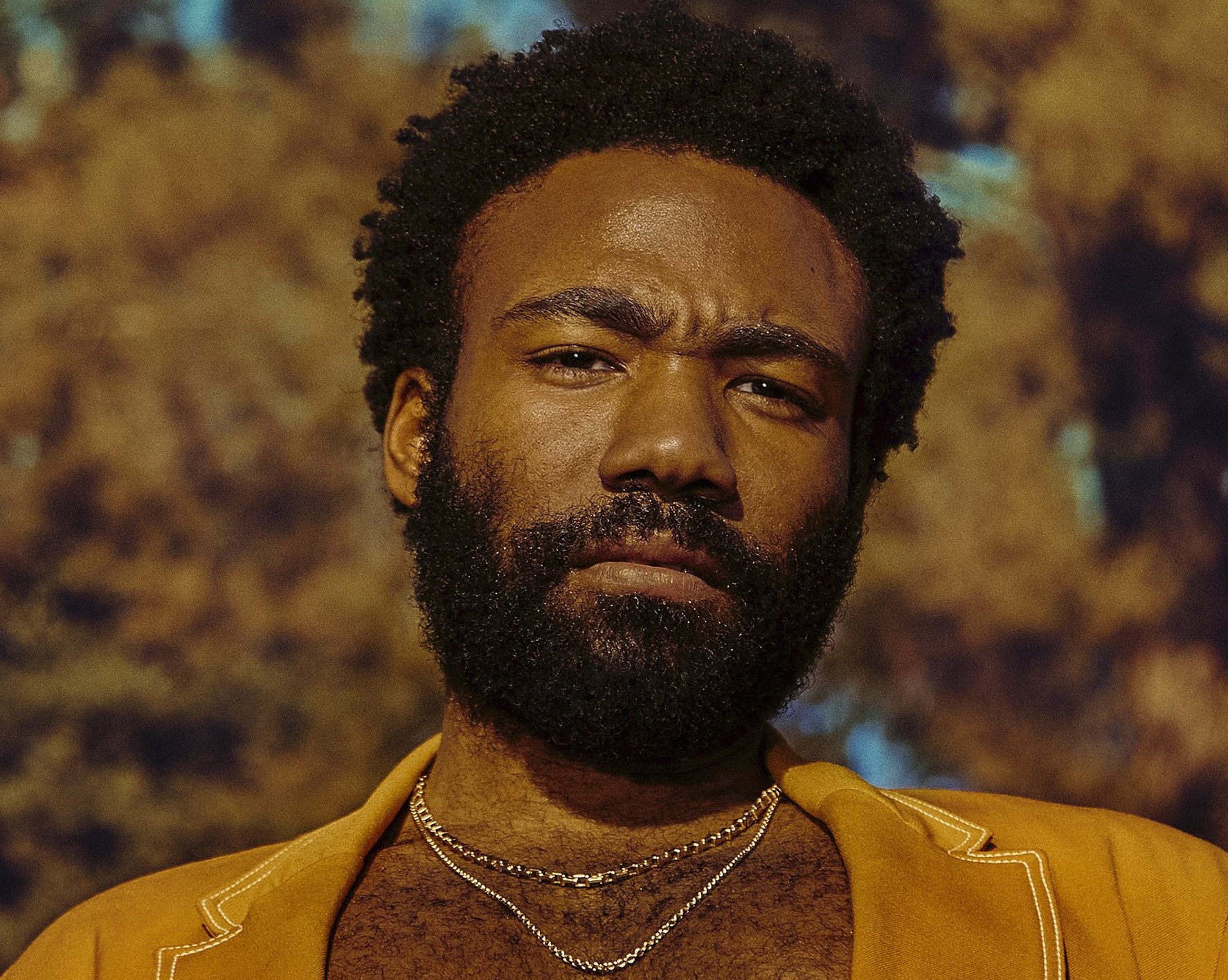
The Swiss Army knife of creative minds, Donald Glover, also known by his musical alias Childish Gambino, has returned with his fourth and final studio album, “3.15.20.”
Glover announced the planned retirement of his Gambino alias at the 2017 Governors Ball Music Festival.
“I’ll see you for the last Gambino album,” Glover said.
Glover, meanwhile, has kept himself extremely busy between musical releases, starring as Lando Calrissian in 2018’s “Solo: A Star Wars Story” and voicing Simba in 2019’s rendition of “The Lion King.” Glover also writes, directs, produces and stars in his own television show, “Atlanta,” which is currently green lit for two more seasons.
Karen Castañeda, a Humboldt State University environmental studies major, discovered Glover through his show, “Atlanta.”
“I love him as an actor and I blew through the whole show really fast,” Castañeda said. “He’s super talented and I really support everything he puts out.”
“3.15.20” saw its official release on March 21, after briefly appearing on donaldgloverpresents.com before it was removed and replaced with a countdown clock.
The album is peppered with conscious messages that apply now more than ever, in the current pandemic circumstances. The first real song of the album, “Algorhthym,” was unofficially released to fans that attended the This is America Tour in 2018. On the track, Glover addresses brainwashing of humans by social media to make them feel inadequate.
Particia Pettit-Blair, an HSU psychology major, discovered Glover’s music through friends, and has listened ever since. Despite the unique sounds he creates by layering instruments and combining styles, Pettit-Blair finds Glover’s lyrics to be extremely meaningful and relatable.
“I like that he kinda takes a different approach to music,” Pettit-Blair said.
On the previously released “Feels Like Summer,” now titled “42.26,” Glover confronts the climate crisis with a global warming public service announcement.
Glover reinforces the same message on the track, “Time.” The song sounds like a remix to “Feels Like Summer,” and stresses the obvious truth that “We’re running out of time.” Glover is able to address serious issues without compromising the quality of his music because they come off as organic with the brand he’s built.
Glover carries his unorthodox approach to the release of “3.15.20” into the album itself. Out of the 12 tracks, 10 on the LP are simply named after their linear location on the album. The project also has two tracks with hidden features, including pop-star Ariana Grande on the song, “Time,” and Grammy-award-winner 21 Savage on the next track, “12.38.”
On top of a cinematic intro track, each song has its own intro or outro, providing a transition between each one. This gives the album the cinematic experience Glover was after with his 2013 album, “Because the Internet.”
“3.15.20” is packed with Glover’s versatile singing and the unique sounds he’s developed over the span of his career. He largely leaves rap behind, as he did on “Awaken, My Love” and his “Kauai” EP, with the exception of his distorted verses on the song “Algorhythm” and the highly aggressive flow on the outro track. Glover takes the hardcore fans of his music on a trip down memory lane, incorporating sounds from all of his previous projects into the album.
Glover brings back the chaotic energy of his debut single, “Bonfire,” on his weirdest song to date, “32.22.” Glover continues to push the boundaries of his audience with the mostly incomprehensible track that can only be described as a war chant. Glover gives fans more deja vu on the track, “19.10,” with a heavy dance vibe resembling Glover’s 2014 single, “Sober,” along with several other tracks from “Kauai.”
The project with the most influence on “3.15.20” is the most recent and most unique, “Awaken, My Love.” The album’s presence can be felt on multiple tracks, including the heartwarming love song, “24.19,” sung in the same style as his biggest hit, “Redbone.”
Paired with some of Glover’s most meaningful messages, the experimental sounds Glover has flirted with since he first came on the scene have come together in spectacular fashion for the ultimate payoff on the last Childish Gambino album.
Alpha Psi Omega attempts a comeback with new students and adviser
Humboldt State University’s theatre fraternity is trying a comeback to campus (or it was, prior to the COVID-19 outbreak). Alpha Psi Omega intends to allow students to increase funding for competitions and student-directed shows.
Rae Robinson, the faculty adviser for APO, said the return of the fraternity excited her.
“The first chapter was like 1919 or 1920,” Robinson said. “There have been a few different departments as long as there has been Humboldt State.”
Robinson said APO was reinstated when she arrived at Humboldt State 14 years ago. APO had a few years of club work, but the group of students interested in the fraternity graduated. APO went dormant.
“We want to pull all of our performing art students together so we can all support each other better.”
Jaiden Clark, APO president
“Those kids graduated, the MFA was dissolved by the university, and it went under the radar for a while,” Robinson said. “Last year we had a new group of incoming students and they said, ‘We want a theatre club again,’ and I said, ‘We have Alpha Psi Omega.’”
APO President Jaiden Clark said they’re passionate about creating change within the theatre department by unifying performing arts students through APO.
“We want to pull all of our performing art students together so we can all support each other better,” Clark said. “We want to make more connections with more clubs around the school like the improv club and the circus club.”
APO’s fundraisers will allow students to determine how the money is used instead of the theatre department allocating funds. The fundraiser money will allow for student competitions and student-operated shows.
“School-wide enrollment is down, and as far as I understand, the school can’t afford to hire another faculty member to the theatre department. We need the students to feel empowered to do more.”
Jaiden Clark
“They don’t give us the money that we need in this department,” Clark said. “Neither have any schools in any theatre department that I have ever been to. So the students are going to pick it up.”
Clark said the theatre department is low in faculty members, and having a more unified body of performing arts students would better support the students.
“We lost a lot of faculty all at once,” Clark said. “School-wide enrollment is down, and as far as I understand, the school can’t afford to hire another faculty member to the theatre department. We need the students to feel empowered to do more.”
Professor Patrick Ulrich, assistant adviser for APO, looked forward to working with the students to reach their goals.
“I would like to work directly with the students,” Ulrich said. “Making money for their goals, serving their community, getting our name out to everybody and really just having an avenue for an honors fraternity.”
APO would give the students freedom to advertise themselves how they see fit.
“It really is in the hands of the officers,” Ulrich said, “who are all students.”
Although N95 face masks are the only masks proven to protect against COVID-19, companies and people across the nation are rushing to their sewing machines to help produce protection for frontline healthcare workers.
New York City Governor Andrew Cuomo asked companies to shift their operations to make face masks and ventilators at a press briefing March 20.
“I’ll fund a new business if you can make these products,” Cuomo said. “I’m trying to make these products. If you are in this line of work, we need masks. If you are making clothing, figure out if you can make masks. I’ll fund it.”
Deaconess, an Indiana healthcare provider, has also asked the public for help to produce masks. They released a video tutorial in which they show how to sew a surgical face mask that complies with the Centers for Disease Controls and Prevention guidelines.
Hand-sewn masks compliant with CDC guidelines are permitted to be used by healthcare workers, but the masks are still considered a last resort by the CDC.
Considering the dire circumstances, a homemade mask is better than no protection at all. Here’s how to hand sew a face mask (all photos by Rachel Marty):
Materials needed:
Materials Needed
Two pieces of 7-inch elastic
Two sheets of 9-inch by 6-inch tightly woven and recently-purchased cotton
A sewing machine
Pin the two sheets of cotton fabric together and start sewing around the perimeter, leaving a quarter of an inch for the edge.
At every corner, stop and place the end of the elastic in between the seam, making sure you place the straps horizontally on the 6-inch sides. The straps should go behind the ears, not vertically, or the straps will rest above your mouth and chin.
Make sure to leave your perimeter undone. Leave an inch or two so you can turn it inside out.
Turn inside out.
Make three tucks on each side of the mask and pin them in place. Make sure they are going in the same direction on each side.
Again, sew around the perimeter of the mask, leaving a quarter of an inch on the edge. Repeat twice to make sure it’s secure.
The Weeknd’s fourth album, “After Hours,” has arrived
The R&B villain, better known as The Weeknd, has returned with his fourth studio album, “After Hours.” In this album, The Weeknd revisits the same themes of drugs, lust and heartbreak found in previous releases, but this time, with a different approach. In the past, his music has come off generally unapologetic, but “After Hours” brings a mix of emotions on his lifestyle.
After nearly a decade of partying and coming onto the scene in 2011, The Weeknd reveals on track eight, “Faith,” that he’s spent the last year sober. Still battling the urge to return to the fast life, The Weeknd comes to terms with the choices he’s made in “After Hours” and the mental war he’s fighting to avoid making those same mistakes.
Coming into this project, The Weeknd set the tone by dropping two pop singles at the end of November, claiming the top position on the Billboard Hot 100 chart with his lead single, “Heartless.” His follow up, “Blinding Lights,” is currently peaking at number two on the Hot 100 chart in the wake of the album release. He followed up in the second half of February with the title track, “After Hours,” as an unofficial single. The song is slow to build, but is equal parts patience and pop, making it clear that the pop-star style is here to stay.
“I will always prefer his earlier stuff. It’s just a sound you couldn’t have found anywhere else at the time.”
Alexa Noperi, HSU film major
Alexa Noperi is a film major at Humboldt State University, and she hasn’t been happy with The Weeknd’s direction since he dropped “Starboy.”
“I will always prefer his earlier stuff,” Noperi said. “It’s just a sound you couldn’t have found anywhere else at the time.”
The Weeknd’s gradual transition to pop music has left some of his day-one fans behind in the darkness of his mixtapes. Made official by his 2016 album “Starboy,” the style shift can be attributed to the success of his biggest single, “Can’t Feel My Face,” along with other pop efforts on “Beauty Behind the Madness,” including “Earned It” and “Angel.”
When he released his first EP, “My Dear Melancholy,” in 2018, the day-one fans that were left behind were delighted by the return of a dark Weeknd. With his latest release, The Weeknd is likely to disappoint hardcore fans again, as he mostly leaves behind the dark, moody atmosphere of his earlier music to make room for the pop sound that generated so much success with “Starboy.”
“After Hours” is a rollercoaster of indecisiveness. The Weeknd’s desires constantly clash with one another on his quest for true happiness.
The album begins with chilly instrumentals that build into their own pop section. The Weeknd flaunts his typical unremorseful attitude, claiming, “It’s too late to save our souls,” on the song “Too Late.”
“After Hours” is the most consistently solid project The Weeknd has dropped so far.
Track four, “Scared To Live,” marks the first shift in his approach. He begins to express remorse for his actions, as well as an authentic desire to leave the fast life behind on the stand-out track “Snowchild,” reinforced on the next song, “Escape From LA.”
Unfortunately, The Weeknd relapses, back to the fast life on his song, “Heartless.” This marks the beginning of the pop-star section that dominated the sound of “Starboy,” this time, with a heavy ’80s electro-dance influence.
“After Hours” then enters its final section, returning to the slower, chilly instrumentals that opened the album on the “Repeat After Me” interlude. The Weeknd concludes his fourth album, echoing a desire to leave the fast life behind and asking for one last chance at a normal life.
Though it may be missing the unique, dark sound of The Weeknd’s early music, found on songs like “D.D.” and “The Hills,” as well as the beauty and optimism found on “True Colors” and “I Feel It Coming” from “Starboy,” “After Hours” is the most consistently solid project The Weeknd has dropped so far.
“It’s not bad background music to try on jeans to. But I don’t think I will be playing it again.”
Isabelle Eddisford, HSU political science and dance major
This album marks a growth in his discipline, but also in experimentation. Following the massive success of “Starboy” and the widely-positive reception of “My Dear Melancholy,” the less-than-spectacular “After Hours” might just leave all of his fans a little disappointed.
Isabelle Eddisford, an HSU student studying political science and dance, felt disappointed that the new songs sounded the same. She described the album as something that would be playing in an Abercrombie and Fitch store.
“It’s not bad background music to try on jeans to,” Eddisford said. “But I don’t think I will be playing it again.”
With predicted first-week sales of 400,000 units for “After Hours,” The Weeknd’s continued success in the pop genre may mean the death of his dark times.
Lock yourself indoors and pretend these films are strictly fiction
With a deplorable excuse of a federal administration lying through their teeth about having the situation under control, it’s starting to feel like the world is descending into the plot of an apocalyptic or dystopian film. Fortunately, there are quite a few films to compare with the current state of the world.
1. Equilibrium (2002)
Equilibrium (2002). | Image courtesy of Miramax
“Equilibrium” is a brilliant 2002 futuristic thriller starring Christian Bale in a fascist police state mandates daily medication that eliminates all feelings. “Sense offenders” that refuse their medication are rounded up and disposed of in ovens, and books and other forms of media that might inspire emotion are burned. Subtlety is not this film’s forte, but that’s to be expected when it also boasts brilliantly-staged action sequences where Christian Bale uses his guns as all-purpose weapons. It’s “The Giver” meets “1984” meets “The Matrix.” The fighting style is referred to as “gun-kata,” and its efficiency and balance reflects the tightness of the film’s storytelling.
2. Snowpiercer (2013)
Snowpiercer (2013). | Photo courtesy of RADiUS/TWC
Did you like Bong Joon-ho’s Oscar-winning “Parasite” from 2019? If so, you might enjoy one of his previous masterpieces. In “Snowpiercer,” Earth is in the midst of a new ice age, leaving humanity to survive within the confines of a train that runs on a perpetual track. The train spins its wheels around the icy remains of the former metropolitan homes of the billionaires responsible for the crisis in the first place. An extreme contrast in quality of life lingers on the train, which continues to spin its wheels until a rebellion begins. “Snowpiercer” is another brilliant deconstruction of the class divide and inequity that reminds us that we all live in a capitalist country.
3. Looper (2012)
Looper (2012). | Photo courtesy of Alan Markfield, Looper, LLC
From Rian Johnson, director of the best Star Wars film, comes an exciting thriller in which time travel is possible, but outlawed. Gangsters send victims back in time to be killed by a hit man until he becomes the target. Unlike most time travel films, this one accepts and plays around with many of the potential paradoxes of time travel and stages scenes only possible in films with time travel. It takes great advantage of the strengths of its cast, as all Rian Johnson films do, and is a whole lot of fun, as all Rian Johnson films are. All of them.
4. Kingsman: The Golden Circle (2017)
Kingsman: The Golden Circle (2017). | Photo by Giles Keyte, courtesy of Twentieth Century Fox Film Corporation
OK, this one takes place at the time that it was made, and isn’t particularly dystopian, but to be fair, it’s about a group of rich vigilantes, who already killed the entire Obama administration in the previous “Kingsman” film, “The Secret Service.” Thus, they are indirectly responsible for the Trump presidency, which is a major part of the plot of this film. Now investigating a foreign cartel with a monopoly on drug trade, they discover the cartel’s plan to poison cannabis users and hold the planet hostage so that drugs will be legalized. In the real world, this would just mean that Big Pharma takes a huge share of the market and kills their business. But in the Kingsman world, it means a healthy helping of flashy action helped out by an Elton John appearance.
5. Planet of the Apes (1968)
Planet of the Apes (1968). | Image courtesy of 20th Century Fox
Before the Andy Serkis trilogy and the underwhelming Tim Burton effort was the original 1968 classic, “Planet of the Apes.” It watches more as an extended “Twilight Zone” episode than a futuristic adventure film, and it is superbly well-crafted, with intricate and detailed sets. The chemistry between the humans and the apes is a wonderful tone balancing act that offers plenty of ideas on race relations. And its brilliant twist ending goes down as an all-time classic.
Inoue confronts the supremacist ideas within American academia
From unkind flyers to nasty messages written on bathroom walls, Humboldt State University has dealt with its fair share of acts of hatred and racism.
Asao B. Inoue, a professor and associate dean at Arizona State University, studies student writing assessment, race and racism. In a Social Justice Summit talk and an exclusive interview with The Lumberjack, Inoue pondered how a university can be anti-racist and address white supremacy.
“I was asked to come here and give a talk at a workshop, and I love doing that—it feels like an important part of the public work that I do in the academy,” Inoue said. “I help teachers think about ways to do social justice projects in their class, particularly around literacy classrooms and the grading evaluation and feedback of student literacy projects or writing.”
Inoue’s objective is to change the ways professors think about language and white language supremacy, and to start a revolution within the American grading system.
“My scholarship and research is in writing assessment and racism studies and the intersection of those two things,” Inoue said. “This [workshop] is an extension of that by trying to engage with writing faculty, English faculty and the curriculum.”
Inoue described white supremacy as a condition in which a particular group’s dialogue dominates others.
Inoue said white supremacists are often middle to upper-class people from the East Coast that attended an elite school. Inoue said these conditions collectively make up the identities of white supremacist perpetrators.
“It’s rarely, if ever, anybody else but that group of people from their particular material conditions in life that produce a certain language, which we tend to call standard or proper English,” Inoue said.
Inoue called out academia for actively perpetuating racist standards. He said the American grading system reaffirms racist ideals and practices through assigned curriculum.
Inoue said proper English can be especially problematic in academic settings.
“There’s lots of research that shows that we don’t actually agree about what that standard looks like,” Inoue said. “But I’m talking about when the rubber meets the road and you have to grade a paper based off of this, or decide whether something is consumable for the public. That’s where we start to have a lot of disagreements.”
Inoue called out academia for actively perpetuating racist standards. He said the American grading system reaffirms racist ideals and practices through assigned curriculum.
“I don’t want one to confuse me calling the system racist, with me calling people racist,” Inoue said. “[Professors] are thinking about the disciplines they have to teach and they’re not always thinking about, ‘How do I teach this?’”
One of the structural flaws within the educational system that Inoue noted was that professors fail to question the academic system and how it reaffirms practices of white language supremacy.
“It’s difficult to be critical of a system that has really benefited you,” Inoue said. “It seems like everything is working.”
Inoue said the façade of the education system being equally supportive can be convincing enough that people don’t see the flaws. Inoue said many professors inherit the practices that were inflicted upon them, and because those practices worked for them, they assume they work for others.
“It’s a fairly narrow economic and social bandwidth of people, so that means that all those practices are fairly narrow and the language practices are fairly narrow,” Inoue said. “So it doesn’t really leave a lot of room for considering differences or changes or being critical about those things.”
Campus discussion touches on importance of traditional knowledge
Students, faculty, friends and family packed the Native American Forum March 5 to listen to author Kari Norgaard and Karuk environmentalist Ron Reed discuss Norgaard’s most recent book, “Salmon and Acorns Feed our People: Colonialism, Nature, and Social Action.”
Before the speakers began, Cutcha Risling Baldy, assistant professor of Native American studies, announced the NAS department’s 25th anniversary at Humboldt State University.
An introduction followed, led by Reed’s son, Charlie. Charlie Reed, a recent alumni from HSU’s NAS program, has continued as an environmentalist to help battle climate change. Before the talk began, Reed said it was important to give proper acknowledgement to the lands of Indigenous peoples. HSU sits on ancestral Wiyot land, and recognizing the land’s history is of utmost importance.
“There is a symbiotic relationship between our environment and our people.”
Charlie Reed
“Whether you are a faculty member or student or just a community member, it starts with a conversation,” Charlie Reed said. “You never know who is in the room who has something to offer or give back the things that have been taken from Indigenous people.”
Growing up with his father, Reed learned about his culture and the traditional ceremonies that tied in not just physically, but spiritually with the environment.
“There is a symbiotic relationship between our environment and our people,” Charlie Reed said.
With a warm thank you to the Reed family and the community, the floor was given to author Norgaard and Ron Reed. Reed introduced himself and what he learned as a child. Reed said learning the traditional ways of his people at a young age taught him how to sustain the environment.
“That’s where it all begins, ladies and gentlemen, when you have the ability to be taught things that you don’t even know you’re being taught,” Ron Reed said. “That will stay with you the rest of your life.”
In one of Norgaard’s chapters, she mentions an Indigenous tradition of using fire to cleanse or manage the land. Western science has given us the narrative that fire is dangerous and destructive. Thanks to “Smokey the Bear” and other forms of wildfire prevention advertisements, fire is seen as something to fear.
Even though fire can be seen as scary, Norgaard argued it’s also a way to help manage landscapes by getting rid of invasive species and even enhancing plant growth. Indigenous peoples used fire to help the environments they lived on, not to destroy or cause damage. Reed stressed the importance of bringing that narrative to our attention.
“We’re trying to get back to an intact world. Climate change can be a vehicle for that because of the awareness it brings to so many.”
Kari Norgaard
“We Native Americans—we the family—cannot let that narrative go,” Ron Reed said. “I don’t need some lone ranger to tell me the way. I know the way.”
With Indigenous knowledge and science being pushed to the side when it comes to environmental issues, Norgaard said settler colonialism is still causing misinformation about the knowledge base of Indigenous peoples. Norgaard said this is changing.
“Indigenous concepts and ideas have been making their way into academic spaces,” Norgaard said.
Climate change is perhaps the most pressing modern issue, but Norgaard and Ron Reed agreed it would help bring more awareness in our communities.
“We’re trying to get back to an intact world,” Norgaard said. “Climate change can be a vehicle for that because of the awareness it brings to so many.”
The consensus of the talk was that combining Indigenous knowledge with western science can change the way we view the world as well as how we take care of it. Coming together and working with each other on both sides of science can also help combat climate change. From the ways of the rivers to the fires of the forests, Indigenous knowledge can teach us more about our world.
“We need all the community on the river, but don’t forget us,” Ron Reed said. “Don’t forget the first people on this nation, on this ground that has created the environment that we’re trying to reestablish in this world today.”
Personal accountability paves way for future of transformative justice
Writer, educator and community organizer for disability and transformative justice Mia Mingus attended Humboldt State University March 6 as the keynote speaker for the Social Justice Summit. As a queer, physically disabled, Korean, transracial, transnational adoptee, Mingus faces adversity in all major facets of life and advocates for dignity and the end of violence, harm and abuse.
Mingus took the stage for an hour, discussing everyday transformative justice and how to achieve transformative justice on a societal level. Transformative justice is about finding alternative solutions to violence, harm and abuse outside of our punitive system.
“The system that we have is so based in, ‘You’re a bad person, so bad things deserve to happen to you,’” Mingus said. “Rather than, ‘We are all human, and human beings make mistakes, and we are all flawed, and we are all living in incredibly violent conditions.’”
“If you’re not proactively building accountable relationships in your life, you’re proactively building an unaccountable life.”
Mia Mingus
Instead of focusing on big picture questions, like what will replace our current system and how to end violence, Mingus insisted to focus on the ways that transformative justice can improve our own lives, and in return, impact the world.
“We can start small, because it’s just like building a muscle,” Mingus said. “You don’t go into the gym and start bench pressing 400 pounds immediately, or if you do, you’re gonna get really hurt.”
Mingus walked the audience through her four steps of accountability.
“If you’re not proactively building accountable relationships in your life, you’re proactively building an unaccountable life,” Mingus said.
“It doesn’t matter how good of an apology you gave or how well you repaired the relationship. If you keep doing the harm, what does it matter?”
Mia Mingus
For the first step of accountability, Mingus said we must possess self-reflection, without which you can’t achieve any transformative justice.
Second, we must be capable of genuine apology, demonstrating our remorse and understanding of our improper actions.
Third, we must be willing to repair and mend broken relationships and earn back trust.
Finally, we must change our behavior.
“It doesn’t matter how good of an apology you gave or how well you repaired the relationship,” Mingus said. “If you keep doing the harm, what does it matter?”
Transformative justice operates under the belief that acts of violence are deeply connected to the conditions that helped create and perpetuate those incidences of violence.
“That violence doesn’t happen in a vacuum,” Mingus said. “They are connected to the conditions that we live in, and we all participate in creating those conditions, and we all have a collective responsibility for ending violence, harm and abuse.”
“It’s not enough just to change the systems that we’re up against. We also have to change ourselves, and I really appreciate that.”
Mia Mingus
As a society, Mingus said we need to practice preventative actions, rather than respond with punishment.
“When we publicly shame people, or when we shame and blame people in general, it doesn’t actually get the violence to stop,” Mingus said. “It usually just teaches people how to hide the violence or harm better. It doesn’t actually make the kind of deep fundamental change that we actually want.”
After her lecture, Mingus elaborated on fundamental change in an exclusive interview with The Lumberjack.
“It’s not enough just to change the systems that we’re up against. We also have to change ourselves, and I really appreciate that,” Mingus said. “And vice versa, you know, it’s not enough just to change yourself. You have to also help change the world too because I think that’s where the magic lives.”
Mingus said transformative justice focuses on the fundamental improvements that must be made along the way.
“We’re working on a micro level but we’re doing it with a macro perspective because we’re actually trying to interrupt generational cycles of violence and harm,” Mingus said. “That’s the goal.”
Mingus gave a final piece of advice for helping with world progression.
“Learn as much as you can, give as much as you can,” Mingus said. “But like, generally, just start from where you are, with what you have, and don’t get overwhelmed by trying to change the whole world.”
This cannabis-infused brownie recipe uses coconut oil as a butter substitution and base for a vegan cannabis butter.
Photo by Rachel Marty
Coconut oil is a great replacement for butter and absorbs cannabinoids in the same manner.
The first step is to make the “cannabutter.”
Depending on how much marijuana you use, your brownies can have a higher or lower dosage of THC. When making cannabis-infused products, always be cautious of your dosage and measurements.
Start by decarboxylating the marijuana.
Photo by Rachel Marty
The decarboxylation process is simple: spread marijuana out on a tray and place it in an oven preheated to 245 degrees for 30 minutes.
Photo by Rachel Marty
Photo by Rachel Marty
This is an essential step. Decarboxylation heats up the cannabis flower and allows the body to absorb the cannabinoids, essentially activating the cannabis. This process happens instantly when marijuana is smoked, but when making edibles it must happen slowly to preserve the product and not burn it.
The next and longest step is to infuse the coconut oil with the decarboxylated marijuana.
Throw the coconut oil and decarboxylated marijuana in a sauce pan and let it simmer on the lowest heat setting for three hours.
Photo by Rachel Marty
Photo by Rachel Marty
Heat on the lowest heat setting ensures your oil will be fully infused and that the baked marijuana will not burn.
Don’t leave the house or kitchen when you are infusing your oil. Three hours is a long time, but leaving your stove unattended is dangerous and could potentially start a fire.
After three hours your coconut oil will no longer be clear and will have a deep green color to it.
Photo by Rachel Marty
The next step is to separate the cannabis-infused oil from the actual cannabis. To do this, use a cheesecloth.
Photo by Rachel Marty
A regular strainer’s holes are too big and will leave you with little bits of marijuana in your oil. Using cheesecloth on top of a strainer is the best course of action and will ensure your oil is as pure as possible.
Photo by Rachel Marty
Next, measure out however much oil you need for your brownie recipe.
Photo by Rachel Marty
It’s important that the coconut oil does not sit out for too long or the oil will become dense and harder to incorporate into the mix. No worries if your oil does set up. Just reheat it.
As for eggs, almost every brownie recipe out there calls for them, but just like butter, there are some great substitutes you can use. Applesauce is a good substitute, which is what this recipe uses, but you can also use mashed-up bananas or yogurt.
Photo by Rachel Marty
Finally, mix all of your ingredients together, pour it out into a pan and put it into the oven.
Photo by Rachel Marty
When your brownies come out of the oven, they may look soft or even underdone, but let them rest in a cool space for 10-15 minutes and they will set. Fresh out of the oven, the coconut oil will be very apparent on the top of the brownies and make them look oily, but as they cool the oil will absorb and become denser.
Photo by Rachel Marty
Again, be careful of your dosage when consuming any cannabis-infused product.
The hype is real for the new Animal Crossing game after their recent presentation
The first console Animal Crossing game since 2015 is less than a month away from its March 20 release date. Nintendo just announced a list of new features for the upcoming Animal Crossing: New Horizons for the Nintendo Switch.
Animal Crossing is a series that puts you in control of a small town filled with anthropomorphic animal villagers. In this edition, you have bought the Deserted Island package, which gives you an island to build your town on. Despite being put into debt immediately by Tom Nook, the owner of the company that you bought the package from, there is no need to pay back the loan. There is no time limit or interest—pay it back whenever.
That’s one of the main draws of the series. There is no push to play it one way or the other. Whether you want to spend your days fishing or collecting fossils, or just decorating your home, the game will never push you. You’re free to play at your own pace and relax with the other villagers that populate your town.
On Feb. 20, Nintendo aired Animal Crossing: New Horizons Direct. The press conference, given by Tom Nook, the series’ resident loan shark, was broken up into three parts. It gave a refresher of what had been shared before along with new developments that will appear in future updates to the game. It ended with a FAQ section.
The main addition this iteration of the peaceful life simulator brings is customization.
When you’re first put into the game, you’re told to choose from four different island layouts for your town and to choose your hemisphere. This will help accurately portray which seasons are happening in your town at their specific times. You’ll also be able to terraform your island so you aren’t limited to the exact layout you choose at the start for the whole game. You can add hills and create new rivers and waterfalls. The island will be truly yours.
Another big addition is the ability to determine where villagers move in. In past games, villagers just moved in where they saw fit, even if it was on your flower bed or on top of your favorite apple tree. This time you get to map out exactly where villagers move in and shape your town around that.
The game now allows eight people to live on your island at the same time—not just non-playable villagers, but your friends and family. The game even adds four-player co-op, where you and three friends can explore your island together on the same console.
Later updates to the game will be for holidays. The first announced update, for Bunny Day in April, will be released the same time as the game, March 20.
This website uses cookies to improve your experience. We'll assume you're ok with this, but you can opt-out if you wish. Cookie settingsACCEPT
Privacy & Cookies Policy
Privacy Overview
This website uses cookies to improve your experience while you navigate through the website. Out of these cookies, the cookies that are categorized as necessary are stored on your browser as they are essential for the working of basic functionalities of the website. We also use third-party cookies that help us analyze and understand how you use this website. These cookies will be stored in your browser only with your consent. You also have the option to opt-out of these cookies. But opting out of some of these cookies may have an effect on your browsing experience.
Necessary cookies are absolutely essential for the website to function properly. This category only includes cookies that ensures basic functionalities and security features of the website. These cookies do not store any personal information.
Any cookies that may not be particularly necessary for the website to function and is used specifically to collect user personal data via analytics, ads, other embedded contents are termed as non-necessary cookies. It is mandatory to procure user consent prior to running these cookies on your website.