The Lumberjack


Students Serving The Cal Poly Humboldt Campus and Community Since 1929

Category: Life & Arts

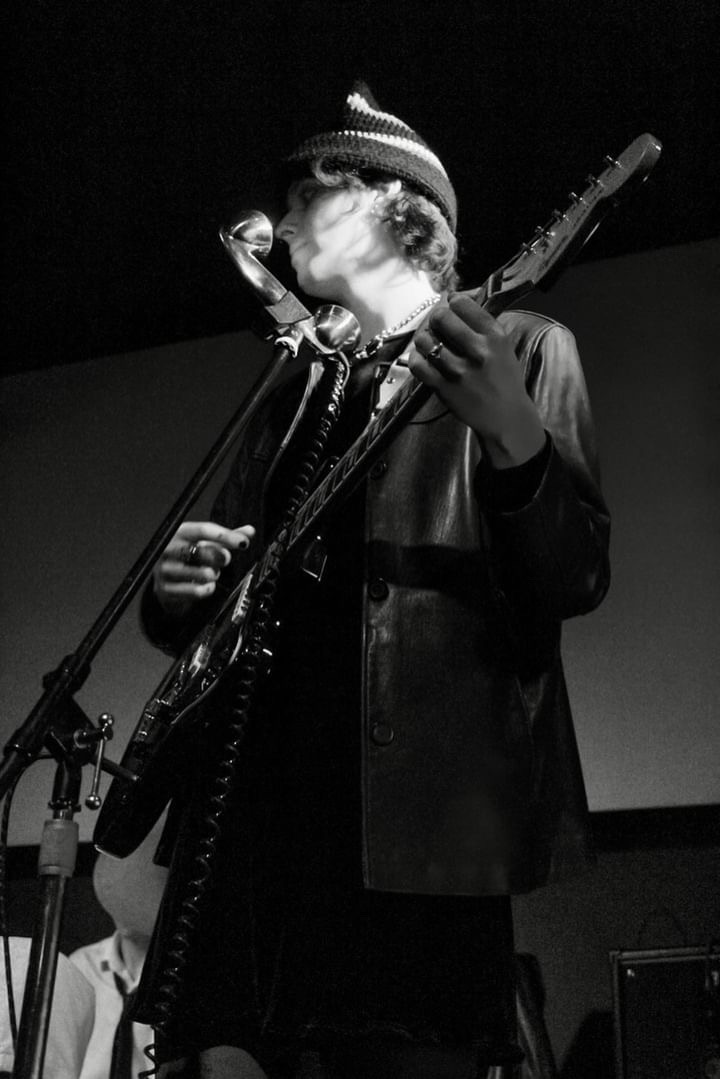
  • Femme Fronted: local bands to check out

    Femme Fronted: local bands to check out

    By Mia Costales

    Picture this: you’re mindlessly scrolling through your Instagram feed when you stumble across a repost of a hand-drawn show poster and the words, “DM for address.” After a quick pep-talk to the reflection in your mirror, you muster up the courage to DM the account and get the address for quite possibly the greatest night of your short 16-year-old life. As you walk up to the door you are instantly hit with the smell of American Spirits, PBR and a gaggle of grown men who are way too old to be hanging out with teenagers. 

    The music is great and you’re right—this is probably the best night of your life. But you can’t help but feel a little out of place in the sea of mustached, rolled beanie, American traditional tattooed guys that will inevitably ask you if you’ve ever listened to Sonic Youth. The unfortunate truth is that this may sound all too familiar to femmes. Luckily, Arcata has a small but mighty music scene. While there is always room for improvement, there are a handful of queer and femme musicians that are putting in the work to make the scene safer and more inclusive for everyone. Here are two Arcata bands who are diversifying the scene and putting on damn good shows while they do it. 

    Porcelain Dog

    Porcelain Dog is the indie three-piece composed of guitarist Jack Hallinan, drummer Jude Daughdrill, and bassist and singer Vivian Spear. The self-proclaimed loser-rock band has made strides in the Arcata music scene, playing house shows, local venues, and even playing a live set on Cal Poly Humboldt’s very own student-ran radio station, KRFH. Spear has been open about her queer identity and has actively encouraged other queer femmes to join the scene on platforms such as Instagram and KRFH.

    “I think Arcata is probably better than most places,” Spear said. “It’s such a small scene. I feel like we all look out for and support each other. I just wish there were more queer girl bands here. I know there’s a lot of creative queer femmes here, I think we’re just more inclined to feel self-conscious about putting ourselves out there.”

    Spear attributed iconic femme musicians such as Kathleen Hannah of Bikini Kill and Le Tigre, and Kim Deal of Pixies and The Breeders to inspiring her openness to vulnerability in her songwriting. 

    “I held myself back for so long because I felt not good enough,” Spear said. “Now that I’ve been in this band for six plus months, I know that I’ve been ready for a while. If you feel you have something to say or just want to play then go for it—you’ll pick it up along the way.”

    Heart Eyes

    Heart Eyes, the feminist queercore punk trio, is bringing back the gritty enthusiasm of 90s riot grrrl, but with a modern twist on the genre. Members Kianna Znika, Lexi Takaki, and Milo Lorence-Ganong aim to make music with punk and emo influences that portray an authentic depiction of the highs and lows of the queer experience. Local scenes can be a breeding ground for casual misogyny and bigotry. However, Heart Eyes have used these experiences as inspiration for their songwriting and hope to expand Arcata’s scene to be as inclusive as possible. 

    “It’s been hard to overcome being labeled as a ‘girl band,’” Takaki said. “We are a punk band regardless of our gender and identities. We want to be seen as musicians in the local scene, not a token band because of our perceived gender.”

    The band also encourages fellow queer and femme musicians to reach out to them and get involved in the local scene by making connections with like-minded people. 

    “Go to open mic nights and local shows, talk to musicians you like and make connections,” Lorence-Ganong said. “Your unique perspective as a femme or queer person will be appreciated, don’t feel the pressure to cater your artistic message to a wider audience. Maybe most importantly, just do it! Even if you are new to music, even if everyone else in the room knows more than you, even if you can’t afford nice equipment, don’t be intimidated. Your creative spirit is valuable, and don’t let anyone have you believe otherwise.”
  • Mar’s Gaming Garage : The Legend of Zelda: Tears of the Kingdom

    Mar’s Gaming Garage : The Legend of Zelda: Tears of the Kingdom

    By Mario Orozco

    Welcome back to Mar’s Gaming Garage. This week’s game is “The Legend of Zelda: Tears of the Kingdom,” and was requested by a rangeland resource science major. “Tears of the Kingdom” (TOTK) is the newest entry in a long line of Zelda games and picks up sometime after the events of “The Legend of Zelda: Breath of the Wild.” 

    Going into the game, my expectations were through the roof. Its predecessor was awarded game of the year in 2017, so I expected TOTK to live up to this legacy. Thankfully for me and my wallet, this game exceeded my high expectations.

    TOTK’s story is amazing, from the main quests to the side quests. The game does a great job expanding on the stories of previous characters and creating compelling stories for the new faces. The game stands out as a sequel when compared to others because of the brand new mechanics. Most sequels I have played take similar gameplay and insert them into a new world. TOTK does the opposite, taking a different style of gameplay and putting it into an expanded version of the “Breath of the Wild” world. These mechanics assist in making the game feel completely different than the original, despite sharing many similarities. The expansion to the world is massive; it allows for players to enter the depths of the original map and go underground in what is essentially a second full world. The sequel also introduced islands in the sky that can be explored. 

    While “Tears of the Kingdom” improves on the overall gameplay and provides more for the player to do, there are a couple things that fall short when compared to the precursor. The first of these shortcomings is the storytelling. While I enjoyed the story of TOTK more than “Breath of the Wild,” it was told in such strange ways at times. Multiple different questlines can be completed out of order, which can cause a lot of confusion. For instance, if you find the Master Sword before completing its dedicated questline, it completely ruins what I believe to be the most impactful cutscene in the entire franchise by showing it with none of the required buildup. The other issue is the graphics. The quality is a slight downgrade from “Breath of the Wild” despite being released six years later. This isn’t really a problem for me, as the reasons for the downgrade are the expanded world combined with the limits of the Nintendo Switch. While slightly disappointing, graphics were sacrificed for extra content and extra content is never a bad thing.

    “The Legend of Zelda: Tears of the Kingdom” took a total of 63 hours and 42 minutes to complete and is arguably just as good as, if not better than, “Breath of the Wild.” I rate this game a 4.8/5. If you can afford to invest a considerable amount of time into a game, then I wholeheartedly recommend this one to you. “The Legend of Zelda: Tears of the Kingdom” is worth the purchase.

    If you have any games you would like me to review, you can email marsgaminggarage@gmail.com.

  • Being a part of the fourth estate: The Lumberjack attends the ACP conference in La Jolla

    Being a part of the fourth estate: The Lumberjack attends the ACP conference in La Jolla

    By Griffin Mancuso

    One of the distinctive qualities of a journalist is that they never truly stop working. They may finish working on a story or taking photos, but they are always thinking of their next story, their next assignment, their next grand idea to pitch to their editor. A great journalist can make a story out of almost anything.

    One of my greatest qualities (and downfalls) is my ability to turn what was supposed to be my vacation into another article.

    Every March, just before spring break, a handful of journalism students at Cal Poly Humboldt get the chance to attend the Associated Collegiate Press Conference (ACP), where we get to attend panels on journalistic practices, connect with companies and other students, and submit our work for the chance to win awards. It takes place in a different city in California every year, which gives us the opportunity to travel to new places and see all the local sights.

    This year, the ACP conference was held in La Jolla, a sunny beachside town populated by rich people and entitled seagulls. Journalists travel from all over the country to attend this conference and, hopefully, win some awards for their student media. Apparently, this year had the most attending journalism students out of any ACP conference, according to a fellow journalist who interviewed me for an article. Even with the large number of attendees, there was an unspoken sense of comradery and understanding among us, even if we had never met each other.

    One of the appeals of the conference, besides the opportunity to network and learn new skills at the dozens of panels, is getting to explore the city as a group. I didn’t have the opportunity to stick around and enjoy the city at last year’s conference, so I’m happy I had the chance to spend time with the rest of the Lumberjack team. We had a group breakfast of homemade eggs and potatoes made by our editors. We visited the Birch Aquarium where I stared at the leopard shark tank for a good ten minutes. We browsed downtown La Jolla and I made everyone visit my mother’s yoga teacher’s deli shop. I got to swim at the beach for the first time since high school.

    I make an effort to attend panels with differing topics to broaden my knowledge and gain an appreciation for the other jobs in the newsroom. I learned about the particular but important art of typography, I got a refresher on inclusive design for newspapers and websites, I learned about covering LGBTQ+ communities in San Diego County, and I attended the panel on satire news hosted by our amazing adviser and one of our editors-in-chief. Everyone was laughing for a good half of the presentation, so I consider that a success. I smiled as journalists from other schools ecstatically told me how they planned to pitch a satire issue to their publications. Holding figures of authority accountable is much more fun when you get to be funny about it.

    The biggest part of the conference for our newspaper is the awards. The ACP hosts its own award show, and a separate group called the California College Media Association (CCMA) has its own awards on the last night of the conference. ACP is a national organization, and out of all the schools with less than 15,000 students, we still won 5th place in Best in Show for one of our papers. Not too shabby for a staff of less than 30.

    The CCMAs focuses more on awards for individual journalists and is where we get most of our recognition. We all watch with anticipation as the announcer reads off each category, waiting for our school’s name to appear on the projector.

    Being unable to take a break ever, I took it upon myself to film all of our announced awards for social media. As the announcer read off the top three winners for Best Headline Portfolio, I narrowed my eyes as three familiar headlines rolled across the screen. I soon realized they were my headlines and I had won second place out of all California schools with under 15,000 students. I can now proudly put on my resume that I have the second best headlines in the state, and I have the piece of paper to prove it.

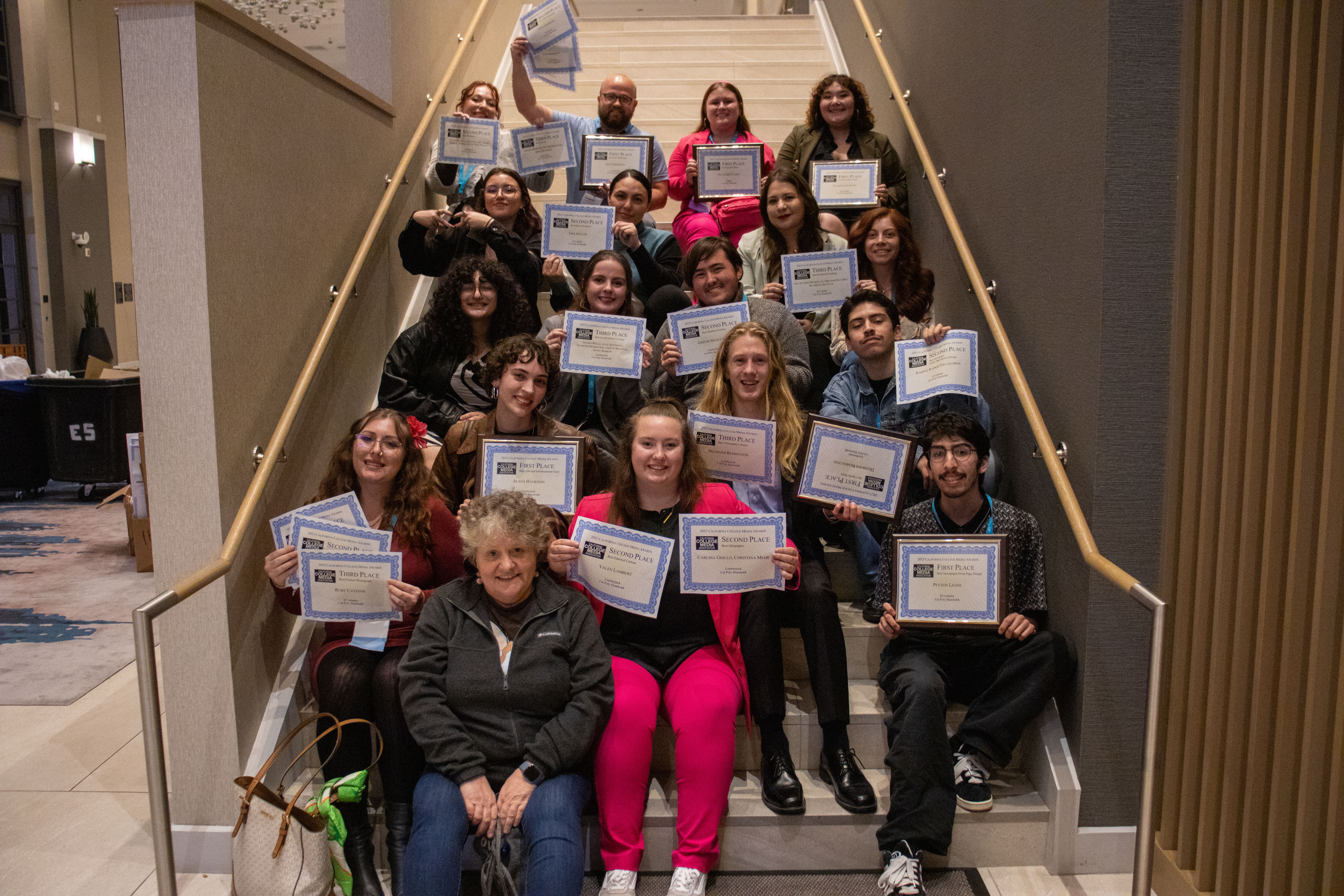
    We embraced one another and cheered as we collected a total of 14 awards for the Lumberjack. We placed in categories like Best Social Justice Coverage, Best Feature Photo, Best Arts and Entertainment Story, and Best in Show. We were struggling to get a photo with all of our awards together on the table, even when I stood on a chair and raised my camera in the air. Our advisor soon approached each of us to get a snippet of our reactions for social media. At the time, I was so overwhelmed with excitement and pride in my team that I couldn’t give the groundbreaking, heartfelt speech I wanted. I can at least give that speech in writing.

    I didn’t originally come to Cal Poly Humboldt as a journalist. I was an English major and I wanted to write novels. I joined the student magazine, Osprey, during my first semester and fell in love with it. I loved learning from people and giving that knowledge to the public. I knew I wanted to write. When I took the Lumberjack workshop, I didn’t expect to be writing for an award-winning paper. I’m grateful to be a part of the process and I am honored that our hard work gets to be recognized on a state and national level. The pressure of working on The Lumberjack is intense, but you take on that pressure as a team. No matter what else is going on in our lives, we get together every Tuesday, hunker down in the newsroom, and make a newspaper for our campus.

  • How to interact with a service dog – don’t.

    How to interact with a service dog – don’t.

    By Griffin Mancuso

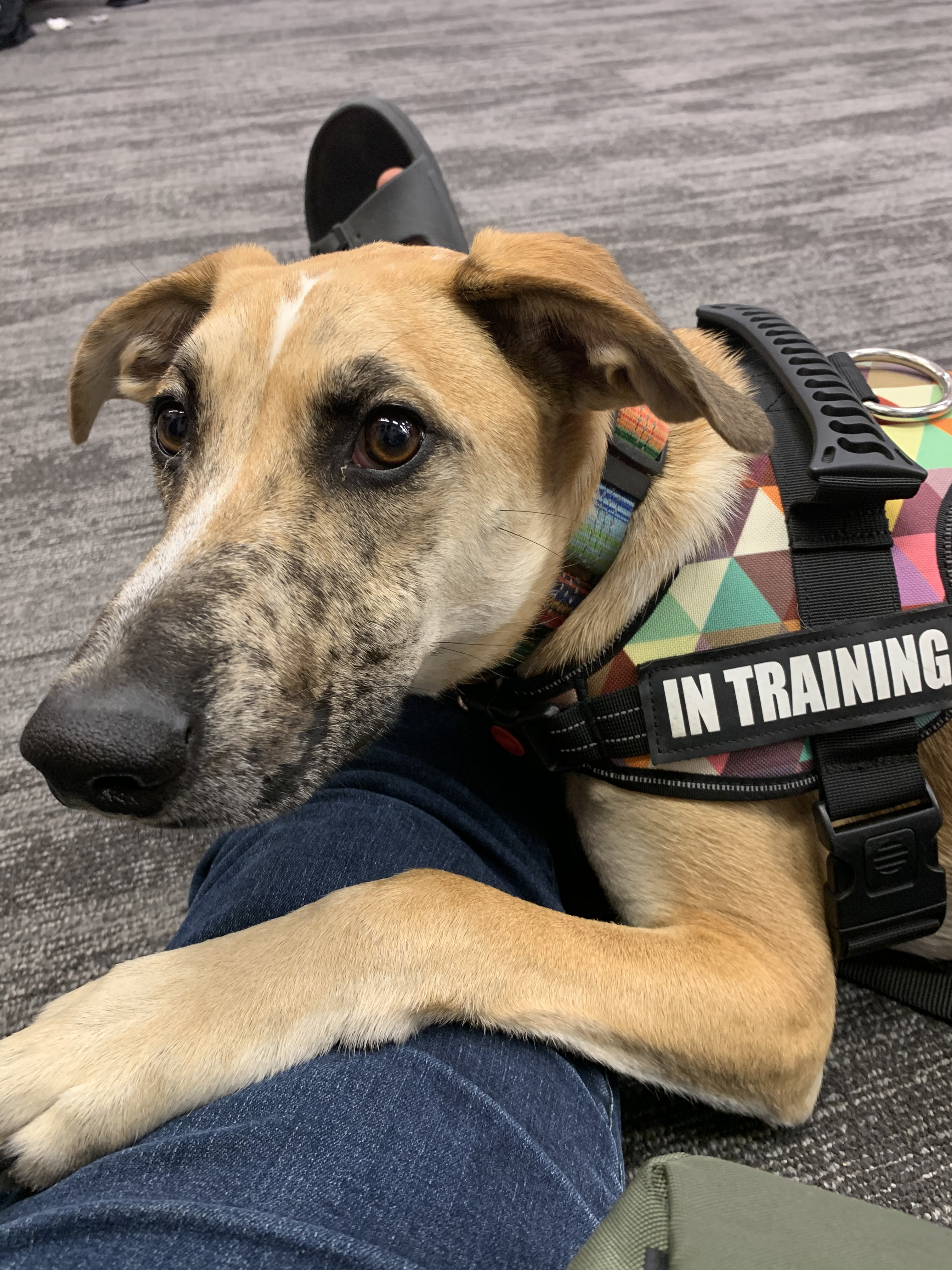
    On my second day of public access with my service dog in training, I braved the crowded hallways of The Depot in search of brunch. After paying for my food, I found a booth and used the opportunity to practice deep pressure therapy with my service dog, which is his favorite task because it involves him laying on my legs and getting a bunch of treats. The pressure helps decrease my heartrate, and thus, lowers the constant buzz of anxiety any time I go into a public place. 

    A group of men in the booth next to me took notice of my service dog. I didn’t pay them much attention until I heard one of them say, “Hey, there’s a way you can point out a fake service dog, watch this.”

    My blood ran cold as one of the men tried to call my dog over in an excited, high-pitched voice. Even though it was his second day on the job and he was seven months old at the time, my angel of a dog stayed put and watched them with the same amount of bewilderment I had. Apparently, that glance was enough for the men to start gasping and pointing. Feeling embarrassed and defeated, I rushed out of The Depot and hid in my apartment for several hours.
    Thankfully, that was the worst situation I have faced with my service dog. Since then, I gained more confidence in me and my service dog’s abilities and know how to advocate for his space. I also did a little bit of reading on the law.

    According to California Penal Code 365.6, section A, anyone who intentionally interferes with a service dog’s ability to perform their tasks could be charged with misdemeanor. They can face time in jail for up to six months, a fine between $1500 and $2500, or both.

    Two years later, I have realized that many people do not know how to interact with a service dog in public. Generally speaking, the key is to not interact with them at all. In fact, pretend like they aren’t even there.

    The Americans with Disabilities Act defines a service dog as a dog that is trained to perform a task that alleviates the symptoms of a person’s disability. A service dog can be any breed and are not required to be certified or go through a professional training program. They are also not required to wear a vest or identification showing that they are a service dog, but most handlers will identify their dogs in some way to prevent access issues.

    The types of tasks service dogs can perform include retrieving items, deep pressure therapy, acting as a brace if their handler falls down, alerting to rises in cortisol or blood pressure, reminding their handler to take medication, protecting their handler’s head during a seizure, and many more. In a legal sense, service dogs are medical equipment and can be life-saving. They empower their handlers to live independently and improve their quality of life.

    Therefore, it can be detrimental, or deadly, if someone distracts a service dog, no matter what their intentions are. The Depot incident was the only time a person’s intentions were clearly malicious, but most of the time people just really, really want to say hello to my dog. 

    I’ve noticed that many passersby develop what I call doggy tunnel vision. They see the dog and feel intensely compelled to talk to them or approach them, without much thinking in between. I get it, I really do. I love dogs with my whole being. If you are an adult, I promise that you have enough self-control to leave service dogs alone. If you must say something, talk to the handler directly.

    When talking to a handler, some may be more comfortable answering questions about their dog than others. I will put up with a lot of questions and comments. You’d be surprised how many stories I get about people’s dead dogs. Not everyone is as tolerant as I am, so please be respectful of the handler’s comfort level and save your stories for later. Most importantly, do not ask about their disability.

    Some handlers are okay with their dog being pet, and some aren’t. Petting them may interfere with their ability to task or the dog is simply not interested in greeting strangers. Some handlers will have a badge saying something like, “Ask to pet,” but you should always ask before you reach your hand out.

    Most of the time, if a dog is tasking, it is best to let them do their job. You wouldn’t go up to a cashier at a store and ask them if they need help. 

    If you pass by someone having a medical episode and their service dog is tasking, assess the situation before immediately dialing 911. Ambulance rides are expensive and not always necessary.

    I am personally more patient with children when it comes to my service dog. They often don’t know any better and are following their parent’s example. Half of the time, parents will redirect their children away from my dog or take a few minutes to explain that my dog is working. Those are my favorite parents. My least favorite parents are the ones who are either blissfully unaware of their child approaching my dog or actively encourage them talking to or petting my dog.

    Living in Humboldt County, I understand that I live in a pretty dog-centric area. Some people bring their pet dogs everywhere they go, including non-pet friendly stores. Most of the time, these dogs are behaved enough and not bothering anyone, but I have no way to tell if those dogs are a danger to my service dog. Service dogs come with the expectation that they will not lunge, bark, or attack other dogs while working. Pet dogs do not.

    Some dog owners try to bypass this restriction by putting a vest on their pet dog and bringing them anyway. Legally, store employees are only allowed to ask service dog handlers if their dog is, in fact, a service dog, and what tasks they perform. This is meant to prevent employees from asking handlers invasive questions about their disability, but some pet dog owners abuse this system. 

    There is no definitive way to tell a fake service dog from a real one, so you’re doing a disservice to service dog handlers by trying to pass your dog as an essential piece of medical equipment. The best case scenario is that they are an inconvenience we have to avoid while shopping. The worst-case scenario is that your dog injures our service dog and puts them out of work permanently, or kills them.

    Having a disability can be hard. We navigate a world that was not built with us in mind, and if the dog allows me to go to the grocery store and find the minced garlic without panicking, so be it. Please don’t make our outings harder than they need to be. We appreciate those who respect us and our service dog’s space, and we’d love more people to join that crowd.

    Griffin Mancuso is the photo editor and a prolific graphic designer for The Lumberjack. He is also a service dog handler and overall dog enthusiast/nerd. You can contact him at gm249@humboldt.edu.

  • Recasting the narrative at the Latino Film Fest

    Recasting the narrative at the Latino Film Fest

    By Savana Robinson

    Chatter ceased as the house lights dimmed. Hands rustled in bags of popcorn and miniscule pieces dropped to the floor on their way to a mouth as an impressive scene of the Amazon appeared on the massive screen.

    The 25th annual Latino Film Festival at Mill Creek Cinema was held Feb. 27 through Feb. 29. This year’s theme for the festival was environmental issues. The films shown were “Nostalgia de la Luz” (Nostalgia for the Light), “El Abrazo de la Serpiente” (The Embrace of the Serpent), and “A Million Miles Away.”

    “Nostalgia de la Luz” is a documentary that takes place in the Chilean Atacama Desert, where a woman is searching for remains of loved ones whose lives were taken under the regime of Augusto Pinochet. At the same time, astronomers are looking for answers about the past of the cosmos.

    “El Abrazo de la Serpiente” shows a shaman in the Amazon who leads a sick man and his colleague to a flower that may cure him. Years later, a botanist leads him back to the sacred flower, which the shaman had forgotten. The film is set with overtones of the importance of protecting indigenous cultures and sharing knowledge.

    “A Million Miles Away” is a biopic about the life of José Hernández, a migrant farmworker who becomes an astronaut. The film is about hardship, perseverance, and the power of a dream.

    Gabrielle Gopinath, professor of history of cinema and art at college of the Redwoods, was part of the panel discussion after the screening of “Abrazo de la Serpiente.” Gopinath noted the distinct difference between the film and others of its kind.

     “Films about the jungle typically cast the global south as a crucible existing outside time and history,” Gopinath said. “Indigenous characters only come into focus insofar as they play subsidiary roles in a white protagonist’s journey. However, in “Abrazo de la Serpiente,” the white characters and their quest are accessory to Karamakate’s central character arc.”

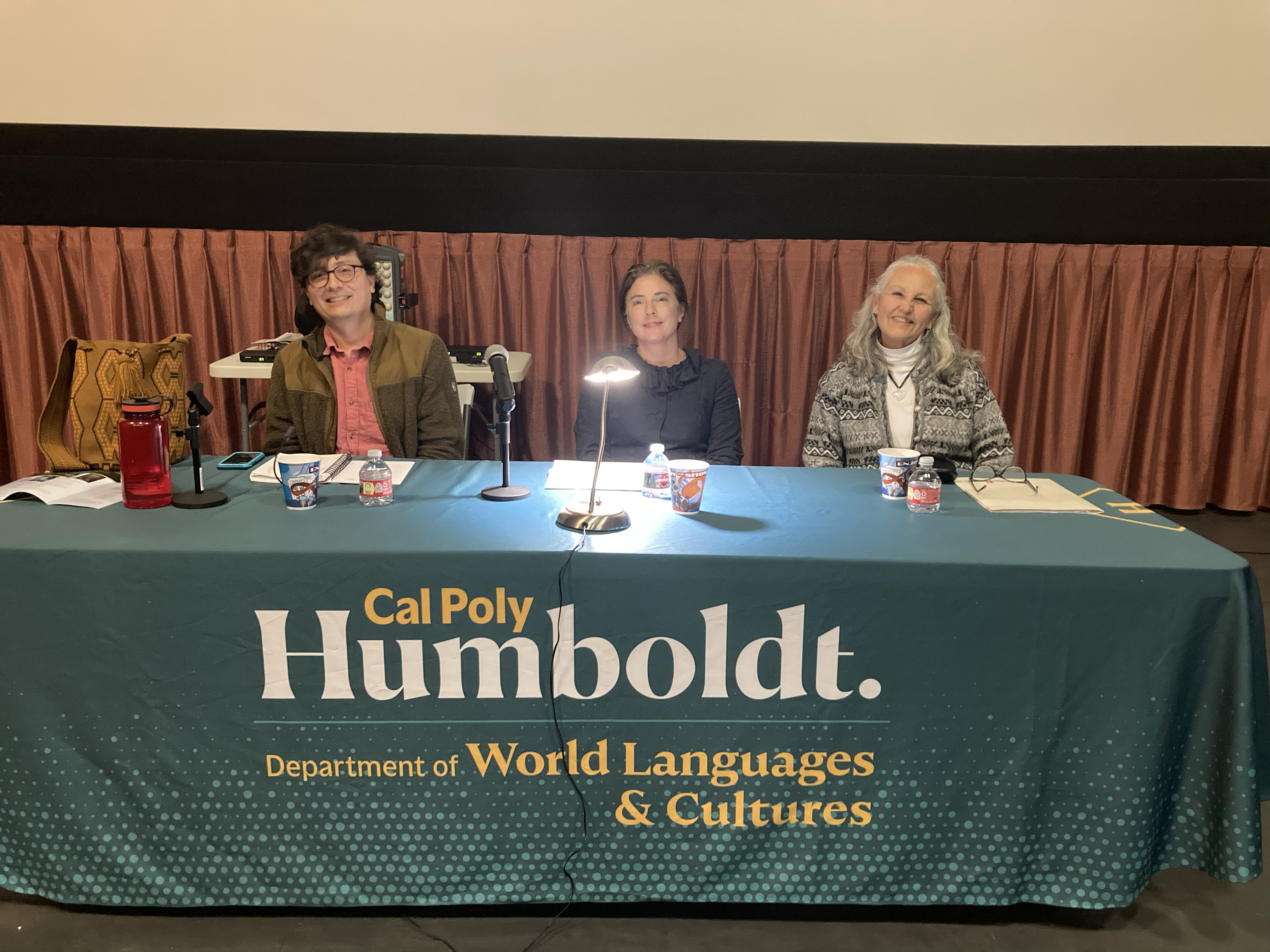
    José Marin Jarrín, a professor of fisheries biology at Cal Poly Humboldt, gave a speech during the panel after the screening of “A Million Miles Away.” Jarrín said that the movie reminded him of the history and stories of all immigrants.

    “When we arrive, we change who we are to try to assimilate with the majority,” Jarrín said. “We also eventually realize there’s nothing wrong with who we are, and that we should be very proud of where we come from.”

  • Mar’s Gaming Garage; “Dead Space”: a classic worth a playthrough.

    Mar’s Gaming Garage; “Dead Space”: a classic worth a playthrough.

    By Mario Orozco

    Welcome to the debut of Mar’s Gaming Garage. I will be playing video games that our fellow students recommend, good or bad, and give my honest opinions to tell you whether or not it’s worth buying. 

    For the first week of Mar’s Gaming Garage, I was asked by an anthropology major here at Cal Poly Humboldt to review the game “Dead Space,” the original from 2008, not the remastered one from 2023. This is a game that I have always wanted to play, but the survival horror vibe always sort of scared me off. With this request, I finally had a reason to set my fears aside and dive into this game. I am happy to say it was well worth it.

    “Dead Space” thankfully wasn’t as scary as I had feared. Don’t get me wrong, I was still scared, but it was a fun fear. The storyline followed our main character Isaac Clarke fighting his way through a ship that was taken over by these creatures called Necromorphs. The Necromorphs appeared after the former passengers found an artifact called The Marker. The story of this game was fantastic and was honestly one of the best single-player survival games that I have ever experienced. The terrifying creatures were both gross and really cool to look at. It had very fun gameplay, heartbreaking losses, and multiple shocking twists that I genuinely never saw coming. The twist that concluded the game has been a constant in my mind ever since I saw it.

    However, there are a couple issues I had that I’d like to share. First, the camera is at a weird angle, making the creatures rushing at you really difficult to see, especially in such a dim game. As a result of the camera angle, the controls are sort of awkward; when you rotate the camera, your character doesn’t turn in that direction like in other survival games, meaning you have to rotate the character and camera independently of each other. This makes it more difficult to get shots on anything rushing that’s not directly in front of you, this mixed with the weird angle can be slightly frustrating at times. These negatives are really just me nitpicking, this game was an absolute joy and if I could go back in time and play it for the first time again, I would.

    “Dead Space” took me a grand total of  8 hours and 48 minutes to finish and was worth every one of those minutes. I rate this game a 4.6 out of 5. Whether you’re into survival horror or not, I recommend this game to you all. So yes, “Dead Space” is well worth the purchase.

    If you have any games you would like me to review you can email marsgaminggarage@gmail.com.

  • Dual enrollment; seeing double on campus

    Dual enrollment; seeing double on campus

    By Carlina Grillo

    Ever seen a classmate who seems to be in two places at once? 

    They could be a track star, master of teleportation, hologram – or more simply, a twin. 

    The chances of being an identical twin are three or four in 1000, but what are the odds of both twins going to the same college, or more specifically, a small university tucked away in the redwood forest of Northern California?

    Without a school-wide survey asking about twins, it’s hard to say, but there are at least a few pairs of identical twins right here on campus. 

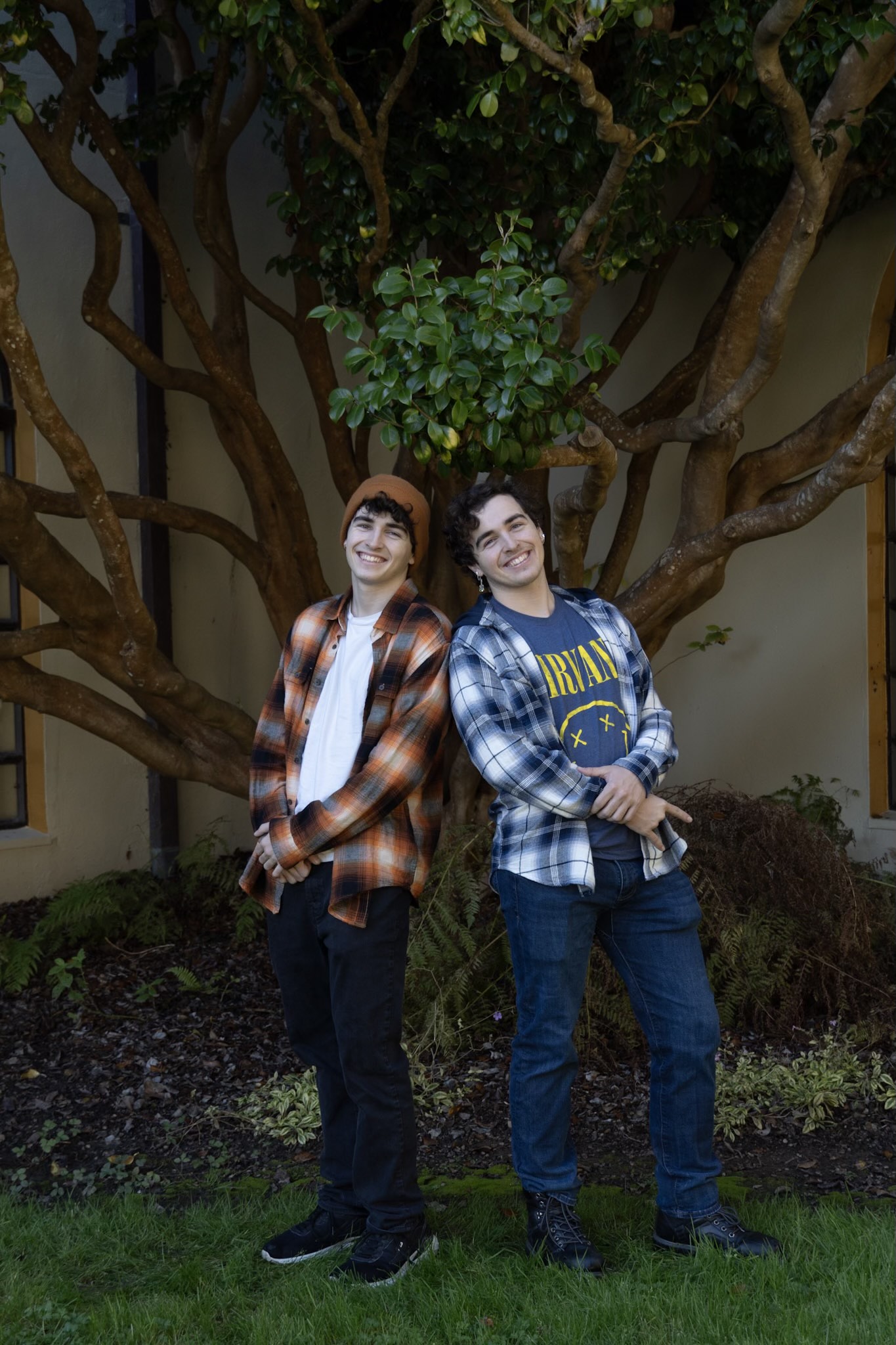
    Marley and Wiley Thrift are a pair of sophomore computer science majors who grew up in Humboldt, and didn’t think much about going to the same college. 

    “Both of our parents work here, it was an easy choice to go to Humboldt,” Wiley Thrift said. “Our dad works in computer science, so that’s kind of where we got the inspiration from.”

    According to Wiley, the difference between being twins in highschool and college is mostly the size of campus and the larger population. It doesn’t always come up in conversation at first, so there will always be confusion.

    “If I see somebody that Marley knows on campus and they wave to me, I usually just wave back but I don’t know the person,” Wiley Thrift said. “If they try to talk to me, I’ll say ‘I’m not Marley,’ and it’s a little awkward, but it’s kind of funny too because I know it’s happened before, and I know what’s happening.”

    Hunter and Tanner Circe are seniors majoring in environmental studies who also grew up in Humboldt and went to highschool in Mckinleyville.

    “It’s easy to have a built-in roommate… because neither of us really had the desire to live with other people,” Tanner Circe said. “It just kind of made sense.”

    “We also rent from our parents in Arcata, so It’s a convenient reason to go to Cal Poly [Humboldt],” Hunter Circe said. 

    The Circes have a similar experience to the Thrifts, describing the same situation of people approaching the wrong twin. 

    “It’s like talking to a lot more strangers because he knows them,” Hunter Circe said. “This is our experience, it’s not unique [to us].”

    “You’re walking by and people will just look, and you know you’re getting the look like, ‘Oh, they’re twins,’” Tanner Circe said. 

    In many ways, the media has portrayed twins to be a certain way and check certain boxes. This causes a constant flow of stereotypical questions from peers.

    “I’m tired of, ‘Is one of you evil? Do you feel each other’s pain?’ It’s just so silly to me,” Hunter Circe said. “People like to put us in like ‘box A’ and ‘box B’. Like, ‘he’s the artsy one,’ or ‘he’s the sporty one…’ Why does there have to be ‘the one?’”

    “We’re siblings who look the same,” Tanner Circe said. “Its’ unique but… a little bit mystified on TV and stuff.”

    At the end of the day, twins are just like any other siblings, but the same age.

    “I think it’s a lot more similar to normal siblings than people realize,” Tanner Circe said. “[People think] it’s this mystical thing, but really, I think it’s just from growing up together.”

    For all these siblings, the future is still unwritten. 18 days is the longest time the Thrifts have spent apart, but they plan on extending that time next semester, with many miles in between.

    Both Marley Thrift and Tanner Circe have plans to travel abroad while their twins stay in California. 

    “Being a twin’s great, you should try it,” Marley Thrift said. 

  • Bitch n’ Stitch in the Makerspace

    By Jasmin Shirazian

    Whether it’s due to the rise of fast-fashion or the misogyny surrounding what is traditionally considered “women’s work,” sewing is often overlooked as a valuable life skill. Nonetheless, the opportunities that come with understanding the basics of sewing are endless. 

    Studio art major Sawyer Armitage is the host of the Sew Easy event held every Monday at the Makerspace in the library. They walked me through my very first fully finished sewing project: an itty-bitty, stuffed piece of pie. 

    Armitage has been working as a student assistant at the Makerspace since Dec. 2022. They only recently began hosting the sewing circle this semester, having learned the basics over winter break. 

    “I love to make tiny [things],” Armitage said. “I was lucky to have someone throughout my whole life who knew how to sew and was willing to teach me, and I wish I [had] taken them up on it. It’s been super empowering to learn, not only small alterations, but also to teach people how to hand-sew, to use the Singer sewing machine for the first time, hem their clothes, create new designs… it’s genuinely a good, functioning life tool.” 

    Armitage started me off by handing me a piece of felt, a pen and a set of shapes to trace onto the fabric. Afterwards, they handed me a needle and some embroidery thread. The endless struggle of getting the thinnest piece of string through the narrowest eye of the needle followed me throughout the entire sewing process.

    Emerald Dowd, a wildlife major, joined us halfway through the first hour and almost immediately began crocheting a flower with the prettiest yellow yarn. By the time it took me to finish cutting out my pieces out of the felt, she was halfway through the first layer of her flower. I spent some time trying to figure out if she was fast or if I was just slow. 

    As we sat and worked on our projects, we talked about all different aspects of our lives and personalities. Different people joined and left us throughout our two hours together, some coming to work on unrelated projects, others just stopping by to chat or borrow supplies. As Armitage, with the occasional help from Dowd, showed me how to do a blanket stitch, we all shared our favorite musicals, what got us into sewing, Armitage’s new band that they’re songwriting for and everything in between. Sitting and engaging with each other, in what Armitage called parallel play, filled a sense of community that I didn’t know I was missing. 

    Nova Presley is an environmental management major who utilizes the Makerspace not only for resources, but for getting independent work done.

    “I have really bad issues with getting myself to do tasks that I want to do unless somebody else is also doing [something] next to me,” Presley said. “The Makerspace is really helpful because, like, I’m not even here for sewing right now, I’m here for a different thing that’s graphic design. As long as everyone else in the area is working on something creative, it’s a lot easier for me to hangout and do something creative.”

    Presley has found the Makerspace to be a good source of forming friendships on campus.

    “It’s a very like-minded space, it’s fun to meet people outside of the typical avenues,” Presley said. “It’s hard to find people in Humboldt to hang out with.”

    Learning to make and mend clothing is also environmentally and financially sustainable. Instead of having to buy an entirely new garment when something tears or a zipper breaks, you can fix it yourself – or better yet, create something out of quality materials. 

    “When you don’t have a lot of money, whether you’re a person crafting or a higher institution that doesn’t have a huge budget, you have to figure out how to make things work with what you have,” Armitage said. “Being able to change what you have, or make it fit something new, that’s what sewing is a lot of the time.”

    Dowd sews for many reasons, starting with the love of creating and altering clothes. 

    “It’s a creative outlet, that you can then wear around and be like, ‘This is who I am, and this is what I like,’” Dowd said. “It’s this way of expressing yourself.” 

    Dowd comes to the Makerspace at least once a week for the Monday sewing circle. Otherwise, they often make use of the many resources that are offered, such as the communal sewing machine or the 3D printer. 

    “It’s a stitch-n-bitch,” Dowd said. “It’s a place for community; a place for people with similar interests to join together and to help each other out. If you’re just learning, and you’re like, ‘Hey, I don’t know how to do this yet,’ the people who are into sewing and into crafting are like, ‘I will indoctrinate you.’”

  • Humboldt gamer enters the competitive scene

    Humboldt gamer enters the competitive scene

    By Mario Orozco

    Competitive gaming and esports have risen to the mainstream with audiences captivated by the elite gameplay and competitive events. This rise in popularity has birthed thousands of professional gamers all competing for the top spot in their respective games. One of these competitive gamers is here at Cal Poly Humboldt, taking his talents for Super Smash Bros. to the competitive scene. 

    Deven Teixeira, a communication major at Cal Poly Humboldt, recently competed in GENESIS, an annual tournament held in Oakland and San Jose. GENESIS is considered to be one of the premiere tournaments with thousands of players competing for the top spot in the event. Teixeira was driven to compete in the tournament to test his skills after winning some smaller competitions.

    “What inspired me is that I won a decent amount of online [tournaments] and some locals in Central California,” Teixeira said.

    A tournament of this size and importance calls for different types of preparation. Apart from just gameplay, Teixeira typically prepares both his body and mind to ensure he’s at his best.

    “I usually get good sleep and eat very healthy meals, not greasy or saturated in fat meals,” Teixeira said. “Meditation through breathing exercises is a staple to my prep as well.”

    This journey into esports started with a healthy rivalry between Teixeira and his high school best friend. The two began by competing against one another in a modded version of Super Smash Bros. Brawl called “Project M” while in their freshman year of high school. This mod made the game more like the former Super Smash Bros. Melee and after some time they decided to test their skills and compete in some local Project M tournaments. They eventually found they were no longer satisfied with the modded game and wanted the real thing, putting together some money to buy two copies of Melee. This led to them attending their first major tournament, with Teixeira crediting his best friend for being one of the main reasons he competes to this day.

    While not placing first in tournament, being eliminated from the bracket going 3-2 and ranking 513th out of around 2000 participants, Teixeira isn’t upset about his placing in the tournament. He views the experience as beneficial and inspiring.

    “I’m not upset with my placing,” Teixeira said. “I’m more inspired to do more majors and try to do even better each time.”

    Competitive gaming is a difficult task that requires a lot of time and practice. Teixera offers advice to any students who are looking to step foot into the competitive gaming scene.

    “My advice is to challenge yourself,” Teixeira said. “If things bring you discomfort in gaming, use that discomfort as a threshold for learning. Reach out to me. I’m easily accessible and I can help people get to top level quick if they want to do that grind.”

    Teixera hopes that Melee becomes more prominent locally. He wants to revive the game on campus and see the competitive scene flourish once again. 

    “Revive Melee in Humboldt,” Teixeira said.

  • Breakfast burritos in the backwoods of Humboldt

    Breakfast burritos in the backwoods of Humboldt

    By Zack Mink

    Arcata is filled with small businesses and food trucks with a wide variety of styles, cuisines, and loyal customers. From Mexican food to hibachi, cravings can be satisfied simply by making a quick stop. One thing that has been missing from the local food scene is a good old fashion breakfast burrito. Something that will motivate you to get out of bed or cure your hangover on a Sunday morning. A burrito that is both classic and unique, giving you something to look forward to all week. This craving has been satiated with Backwoods Burritos, a local food cart serving up those reliable, tasty, and satisfying breakfast burritos people have been looking for. 

    Britton Latham, founder of Backwoods Burritos, serves up his Southwest inspired breakfast burritos every Thursday through Monday in front of Arcata Theater Lounge and at the North Coast Farmers Market in Arcata. With four different options, three meat and one vegetarian, everyone can get their fix of breakfast burritos. Prices range from $10-$12, featuring Latham’s original redwood chili in each one. 

    “It’s super unique because of the redwood chili,” Latham said. “It’s basically like a green chili, except with the seasonings and peppers I put in it, it turns red… It’s a very signature flavor.”

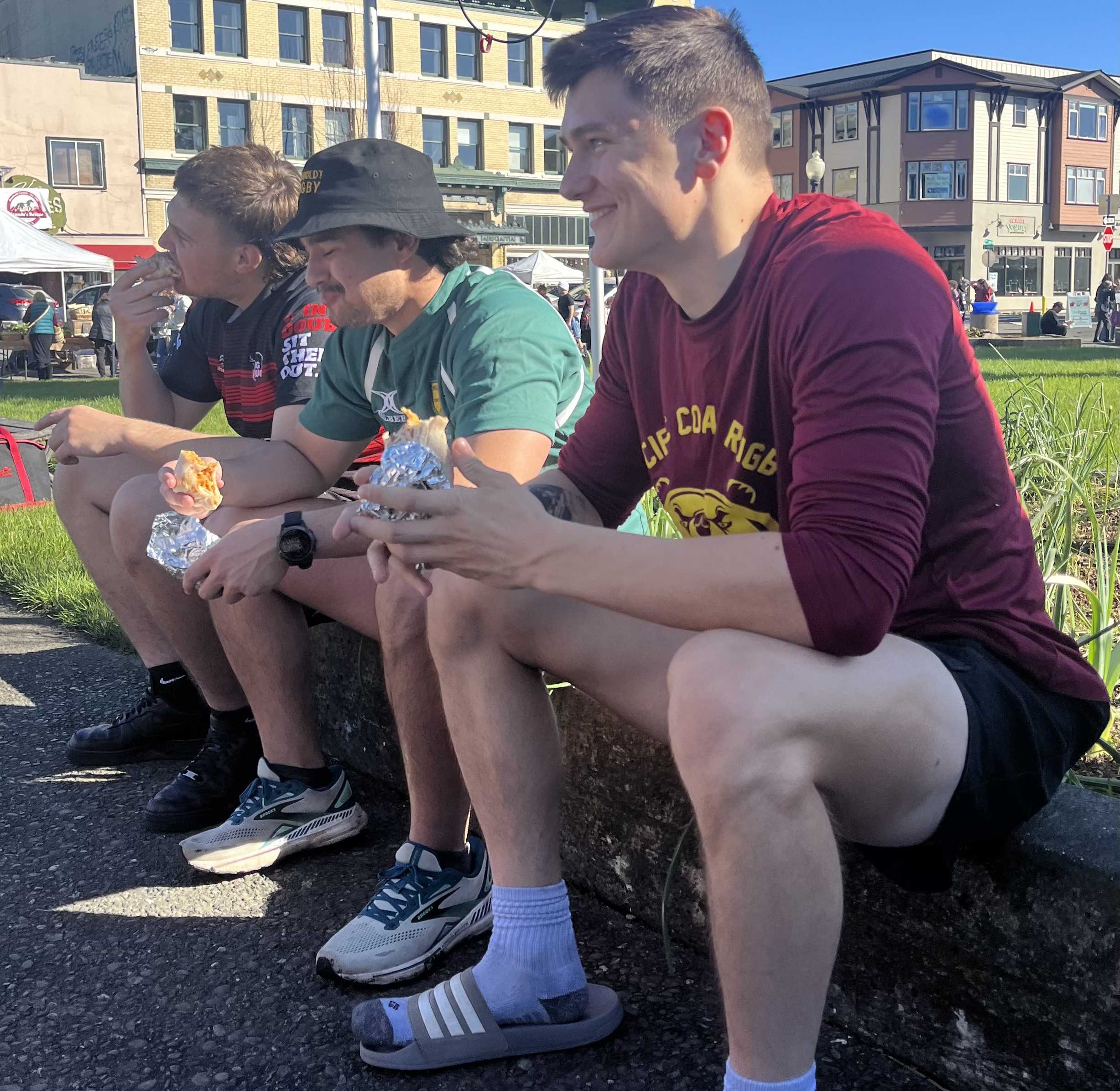
    Britton Latham serving up Backwoods Burritos at the North Coast Farmers Market in Arcata. photo by: Zack Mink 2/10/24

    Along with this original recipe, Backwoods Burritos is special because consistency is prioritized for customers to have the best experience possible.

    “The first bite tastes like the last bite, and that’s super important,” Latham said. “That makes it really unique, and it’s sold out of a little cart with a UFO on it.”

    After taking some breakfast burritos on a camping trip in the backwoods with friends, Latham realized they could be his new culinary venture and become a successful business. During this time of recipe development, UFO testimonies played in the background as he cooked, inspiring him to pursue an alien theme, strongly branding himself. Latham began selling his Humboldt backwoods/alien themed breakfast burritos in October of 2021, but has outgrown his home kitchen and now utilizes The Kitchen Arcata for commissary.

    Recently, Backwoods Burritos became an approved vendor for Cal Poly Humboldt events, bringing the burritos from downtown Arcata to campus for students to indulge in.

    “Yes, and that’s the dream,” Latham said. “I didn’t even go to college, so to be slinging burritos at a college… this is the closest I ever came.”

    Aside from sharing his creation with students, Latham has goals of selling burritos every day of the week, creating a brick and mortar store, vending at local music festivals, and spreading his impact across Humboldt County.

    “I definitely have the goal of more carts, getting more carts through Humboldt,” Latham said.

    With Backwoods Burritos beginning with friends and locals, Latham gives back and encourages community members to not only support himself, but other local businesses with his golden burrito program. The golden burrito, based off of Willy Wonka’s golden ticket, is a random burrito secretly wrapped in gold foil. The winner receives gift certificates to local businesses that he loves and wants to support. 

    Latham is also starting what he calls the Backwood Running Club, which brings people together to not only run, but to spend time outside in the backwoods of Humboldt County.

    Backwoods Burritos isn’t just about making money for Latham. It’s about building a strong community and making memories with new and old friends.

    “We’re all friends,” Latham said. “Started with friends and now it’s just like expanding with more and more friends… that’s what I love about it.”

    Graphic by Griffin Mancuso
  • A night of Gov’t Mule at the Van Duzer

    A night of Gov’t Mule at the Van Duzer

    Photos by Alex Anderson

    Lead singer Warren Haynes vibing out under the green light in Van Duzer.
    Lights shine down on Warren Haynes to kick off the show in Van Duzer on Feb. 13.
    Lead singer for Gov’t Mule under the lights for the Feb. 13 show in Van Duzer.
    Lead singer for Gov’t Mule Warren Haynes laying it down in Van Duzer.
    Gov’t Mule guitarist Danny Louis also putting in time on the keyboard during the performance in Van Duzer on Feb.13.
  • Lora Webb Nichols: Photographs Made, Photographs Collected

    Lora Webb Nichols: Photographs Made, Photographs Collected

    By Christina Mehr

    Immediately when you walk into the art exhibit, you are taken into the life and work of Lora Webb Nichols. Located in the Reese Bullen Gallery at Cal Poly Humboldt, Nichols’ black and white photography is displayed for all to see. Her work covers candid portrait shots of those around her.
    The massive archive of prints has been preserved through the volunteer efforts of Nancy Anderson, Victor Anderson, and Nicole Jean Hill.

    Hill is a Professor of Art at Cal Poly Humboldt and the chair of the department of art and film. Her area of expertise is in photography and she teaches photography classes and professional practices in art. Hill is also the co-curator of the Lora Webb Nichols collections. 

    “When I first dove into the archive, I didn’t know what was [there] because it wasn’t actually viewable yet,” Hill said. “Only a very small portion of it was accessible to the public. It was kind of a leap of faith, but I was intrigued by the fact that it was an archive made by a female photographer who got a camera at the age of 16 in 1899 and saved 24,000 negatives.”

    Over the course of some time, Hill has worked on digitizing the photographs, organizing the corresponding text, recovering the photographer’s diaries and letters, and collaborating with the Grand Encampment Museum and the American Heritage Center to secure a permanent home for the negatives.

    Lora Webb Nichols was a photographer, businesswoman and homemaker living on the Wyoming frontier in the 20th century. She got her first camera at the young age of 16 and over the course of her lifetime, she produced a grand number of 24,000 negatives. The images she captured are about the domestic, social, and economic aspects of the frontier of south-central Wyoming. 

    “When you’re 16 years old and you get a camera, you’re unfiltered, and I was excited to see what that would be like,” Hill said. “Then, once I was actually physically able to see what was in the archive, it was even more exciting than I could have imagined in terms of the variety of subject matter and Lora’s skill as the photographer.”

    The most eye-catching work of the exhibit were the two cork boards with many printed images pinned across them both. On a pedestal below sat a book filled with many more photographs.

    More of Nichols’ photographs and writing can be found online through the American Heritage Center or in person at the Grand Encampment Museum. 

    “I love that this art exhibit has brought people to campus that otherwise would not come to see an art exhibit,” Hill said. “It has a multigenerational attraction to it.”

  • Unpacking Black Joy with Kirby Moss

    Unpacking Black Joy with Kirby Moss

    By Carlina Grillo

    If money is the root of all evil, when do people feel joyful about it? Kirby Moss, a professor and head of the journalism department at Cal Poly Humboldt, asked nearly 20 students and community members last Tuesday, Feb. 13. It left people stumped. 

    Topics discussed were Black representation in the media, feelings around finances and money, how to navigate being a first generation student while saving money for college, and hypotheticals about splurging on a life experience or saving and investing said money. 

    Rather than lecturing, Moss guided a conversation by asking plenty of thought-provoking questions. 

    “We’re in college, this is an academic setting, this is a setting of intellectual exploration. Do you think we should be learning more about money or not?” Moss said. “This conversation today is about money, but it’s not about material stuff. It’s about autonomy, it’s about options.”

    Aundrea All’love is a community member and business owner who was invited to share their experiences. One experience they have as a Black business owner is balancing mental health and community value, while still recognizing their worth and being paid a sustainable amount. 

    “From going from homeless, to some stability, to slowly growing my business now, the biggest shift I did was to focus on what brings me joy. Having faith in my ability and understanding my value,” All’love said. “I have been choosing more opportunities to make money and less scrumping down on my savings.”

    Jeremiah Keys is a sophomore at Cal Poly Humboldt who shared experiences about college being the foundation for the rest of his life. 

    “It’s not just going to be college then careers. It’s like college, then another college, then career and then struggles in between those things, but I’m still going to get through it,” Keys said. “Providing for my family and friends suits me, because I love doing it. That’s the expression that we love. Do something that suits you, but don’t push yourself to where you end up judging yourself more and more and more, and not looking at all the good that you’ve already done and all the good you can possibly do in the future.”

    This event was a part of a month-long series of events for Black Liberation Month, held by The Umoja Center for Pan African Student Excellence. For more information on upcoming events the Umoja Center can be found on Instagram at @umojahumboldt.

    “Money is not power. It’s all about us,” Moss said.

  • Learning to live with Premenstrual Dysphoric Disorder

    by Mia Costales

    For the better half of my teenage and young adult life, I’ve dealt with intense bouts of sadness in the days leading up to my menstrual cycle. These episodes usually only lasted around a week and were characterized by heightened irritability, anxiety, fatigue, decreased interest in activities and in the most extreme cases, suicidal ideation. Due to these symptoms, I chalked it up to being some form of major depressive disorder that was exacerbated by the hormonal shift during that week. However, thanks to a couple Google searches and several trips to my doctor, I was diagnosed with Premenstrual Dysphoric Disorder (PMDD) and was able to start taking the steps to learning to live with PMDD. 

    According to Dr. Alison Palacios, a physician at the Cal Poly Humboldt Student Health Clinic, PMDD is considered the most severe form of Premenstrual Syndrome (PMS) as maintained by the American College of Obstetricians and Gynecologists. 

    “Patients’ symptoms must include behavioral symptoms and often include physical symptoms. The most common behavioral symptoms are mood swings and frequently include irritability, anxiety/tension, sad or depressed mood, increased appetite/food cravings, sensitivity to rejection and diminished interest in activities,” Palacios said. “The most common physical manifestations of PMS are abdominal bloating and an extreme sense of fatigue.”

    While PMS symptoms and PMDD symptoms can look extremely similar, PMDD differs in that feelings of sadness, hopelessness, and anxiety are almost consistently present. Both may include symptoms such as bloating and intense mood swings, but PMS is not considered a mental disorder and is typically pretty manageable. PMDD on the other hand, is considered a mental disorder by the Diagnostic and Statistical Manual of Mental Disorders (DSM) and can be debilitating in some extreme cases. 

    In order to be diagnosed with PMDD, at least five of the symptoms presented in the DSM must be present in the week leading to menstruation, start to improve with the start of menses, and be minimal to gone by the end of the menstrual cycle. These symptoms include marked depression, anxiety, affective mood, irritability, decreased interest in activity, difficulty concentrating, lethargy, change in appetite, hypersomnia or insomnia, and physical symptoms such as joint or muscle pain. This criteria presented in the DSM must have also been met for most menstrual cycles that occurred within the last year. Yet despite PMDD being a recognised mental disorder, it is an underrepresented condition. 

    “It is not well reported, but worldwide prevalence is 2%, and in the U.S., it was 2.9% among Black females versus 4.4% White females,” Palacios said. “It is probably quite underdiagnosed and especially so in Black females and other people of color. Some with the diagnosis assume their symptoms are ‘normal’ for menstruating people or seek healthcare for years to decades before receiving the correct diagnosis.” 

    As per Palacios’ advice, moderate to severe symptoms can be treated with antidepressants, hormonal birth control and cognitive behavioral therapy. Milder symptoms may be treated with exercise, herbal remedies and supplements. Bilateral oophorectomy, the surgical removal of the ovaries, is reserved for the most extreme cases of PMDD. 

    There are resources on campus for those who may think they are experiencing PMDD. The Student Health Clinic can help address symptoms and provide diagnostics and treatment for the condition. They can also refer to specialists if needed. TalkNow sessions with TimelyCare and the Counseling and Psychological Services line are also helpful resources for managing PMDD symptoms. If you are experiencing any thoughts of harming yourself, the Suicide and Crisis Lifeline (phone number 988) is available 24 hours. 

    PMDD can be extremely hard to live with, but like most conditions, finding coping mechanisms and support can help dramatically. For LJ Ferris, coping looks like realizing that PMDD shouldn’t affect their self-worth. 

    “In the midst of it, it seems like it’s never going to end. Then, your period comes and you realize you indeed are still a human deserving of love,” Ferris said. “It is not supposed to be normal to want to die leading up to your period. It is not supposed to be normal to have such severe physical and emotional pain around periods.” 

  • Coming out of the deck: the aces of Cal Poly Humboldt

    Coming out of the deck: the aces of Cal Poly Humboldt

    by Alexandra Berrocal

    We’ve all heard of straight, gay, and bisexual people. But what about asexual people?

    Asexual people are people who do not experience sexual attraction.

    Abigail Vonderschmitt, a music major who is in her first year at Cal Poly Humboldt, has always known that she is asexual. When she discovered the term a couple of years ago, she instantly related to the term. When she came out, nothing really changed. People treated her normally.  

    She made it clear to her partner early on, and she was blessed with an understanding partner. 

    “There’s more to it than what the media portrays,” Vonderschmitt said. “I know how to express myself and know how to put into words how I feel,” she said.

    A history major going only as Adam with a concentration in education, currently identifies as demisexual, which is an identity that is on the asexual spectrum. 

    “It’s something I’ve been exploring for about a year now,” he said.  

    He acknowledges that for masculine people, questioning your (a)sexuality is not the norm.  Adam has not really come out, at least not to his parents. He has noted that people don’t understand asexuality the way they do other sexualities.

    “I imagine there’d be a lot of explaining to do,” Adam said. 

    Adam believes that it’s important to continue educating people and that gender roles need to be addressed. He wishes people understood the intricacies of asexuality, and that people could go beyond stereotypes and understand how identities can be fluid.  Being on the spectrum of  asexuality has definitely made for some challenges in the dating realm, because for many, sexuality goes hand in hand with romantic attraction.  

    “People come in with expectations and you can’t deliver on them,” Adam said.

    He believes it would be easier to fit into the societal norm, but has done the work to break free.

    “I love understanding myself better and understanding I’m not broken for not wanting to be a certain way,” Adam said.

    An anonymous computer science major, who asked to be called “Jane”, knew she was asexual back in middle school. When she tried to speak about it to others, she got backlash; some told her it wasn’t a real thing. Jane went back into the closet after that. It was only recently that she started to accept herself again. She is not out to her parents, as they are not very queer friendly. Her former partner told her that asexuality wasn’t possible, which is one of the reasons they broke up. Her current friend group is accepting, however. She doesn’t want to explain or defend herself, so she hasn’t come out to very many people.

    “I still get imposter syndrome,” Jane said. 

    Jane has seen doubtful comments on social media, but tries to surround herself with supportive people. She wishes people understood that sexual attraction is different from arousal. Asexuality is not feeling sexual attraction to people, no matter how your body reacts.  

    “It’s a wide spectrum,” Jane said. “[It’s impacted my dating life] a lot.”  

    “Honestly, I haven’t had any luck finding asexual guys,” Jane said. “[However], I feel like I have a deeper understanding of sexuality, and how diverse and fluid it can be.”

    She’s had sex, though she doesn’t feel much of anything during it.  

    Another asexual student, going by E., is an Environmental Studies major with a concentration in ecological restoration in her third year at Cal Poly Humboldt. She first realized she was asexual in middle school. She changed her mind for several years, but a couple of years ago, rediscovered the asexual spectrum and has identified as asexual ever since. According to her, it has been a winding journey. Her parents didn’t take her ace identity seriously. They thought it was a phase and didn’t care much. She also came out as a trans woman, and this was taken more seriously by her parents. Most of her friends accept her, however. She said that being asexual has never been used against her very directly, though many people are ignorant about it. She has found it very annoying, but it hasn’t caused her real issues. She says she wishes people knew there isn’t just one option, or way, asexuality can look.  

    “Asexuality is a really broad spectrum,” E. said. “People have different interests.” 

    The biggest impact for her is if a person has expectations, it will turn out badly for them. E. noted that since she doesn’t experience sexual attraction, she is drawn to people by aesthetic attraction. E. is also aromantic, meaning she doesn’t experience romantic attraction either. However, she still wants deep emotional relationships. She is currently in a relationship, and cares for her partner deeply, more than a close friend even. E. wishes people would be more aware of this.  

  • Discover the great big world of paraphilias

    Discover the great big world of paraphilias

    by Sydney Isaac

    What does paraphilia mean?

    The word paraphilia can be broken down to its roots to broadly explain itself; para means abnormal and philia meaning love. To define paraphilia, i.e. abnormal love, would need a definition of normal love. Any human emotion is difficult to define, especially one as subjective as love, but defining behavior is more objective and universally applied. The definition of paraphilia is, “patterns of sexual attraction and behavior that deviate from the social and cultural norms,” (Lehmillar, 2018). 

    Causes?

    These abnormal sexual urges start to develop around adolescence to young adulthood. Paraphilias have the same roots as all sexual attitudes in our biology, psychology and social factors, known as biopsychosocial factors. Biological factors include hormones and neurotransmitters, such as testosterone and serotonin, that affect paraphilic interests. Psychological factors such as conditioning and personality profiles can be linked to developing a paraphilia. What is hopeful about this evidence is that if paraphilias can be developed through conditioning, then it is theorized that behavioral and social skills therapy could treat paraphilias (Graves, Openshaw, & Adams, 1992. Read in The Psychology of Human Sexuality).

    Categories of paraphilias

    There are two categories of paraphilias: (1) non-coercive and non-victimizing, and (2) coercive and victimizing. Non-coercive and non-victimizing paraphilias, “involve only the self or include consenting adults,” (Lehmiller, 2018); an example being fetishism, which can range from being intensely sexually aroused by a specific body part (ex. feet) to a specific object (ex. high heels), or, “almost anything,” (Plaud & Martini, 1999. Read in The Psychology of Human Sexuality). Coercive and victimizing paraphilias such as voyeurism (viewing unsuspecting person) and exhibitionism (revealing genitals to unconsenting person) are generally illegal and taboo because these sexual acts require a unconsenting victim. 

    Unusual Paraphilias

    If you look up, “How many paraphilias are there?” Wikipedia will have a list of over 500  from a book on sexual pathology by Anil Aggrawal. As said previously, people can become sexually aroused by almost anything, so it would be an educated assumption there would be many, many paraphilias. There are many paraphilias that are not widely known about, such as, formicophilia is being sexually aroused by small creatures crawling on one’s body and/or genitalia. Symphorophilia, having sexual arousal when witnessing a disaster – which could lead to the person staging accidents. Last but not least, Vorarephilia is being sexually aroused by the thought of eating or being eaten by someone whole and alive.

    Legality and paraphilias  

    The definition of what a paraphilia is depends on the culture. For example, even though homosexuality is not considered a disorder and is not against the law in the United States of America, there are social groups within the U.S.A. that are intolerant and hateful of the LGBTQ+ who are actively trying to criminalize this community. In other countries, such as Iran, Saudi Arabia and some states of Nigeria, homosexuality or any queer identity is completely outlawed with the punishments being as harsh as death.

    There are some paraphilias that are commonly outlawed with threat of severe punishment across cultures. These paraphillias include: pedophilia (prepubesent children), necrophilia (corpses), and zoophilia (non-human animals).

    Disorder

    Are these abnormal behaviors considered disorders? The DSM-5 (2013) is the most recent version of the Diagnostic and Statistical Manual of Mental Disorders, which is used in many aspects of the United States of America. The DSM-5 is used, and criticized, by the healthcare system, legal system, education system within the U.S.A and worldwide. The International Classification of Diseases is used as the global standard of health information. There are various differences in the descriptions and criteria for diagnosis between these two manuals, but the definition of paraphilic disorder defined by the DSM-5 is used around the world. Paraphilic disorders are defined as, “is causing distress or impairment to the individual or a paraphilia whereby satisfaction entails personal harm, or risk of harm, to others,” (Sorrentino, 2016. Read in The Psychology of Human Sexuality). In other words, coercive and victimizing paraphilias are considered to be disorders and can have legal consequences. 

    This is a student submission from psychology major and family studies minor
    Sydney Isaac.

  • Cruising at Cal Poly Humboldt

    Cruising at Cal Poly Humboldt

    by Zack Mink

    Waiting in a bathroom stall, hoping to see a tapping foot. Hearing someone enter and then going into the empty stall next to you. All of a sudden – that tapping foot appears. They’re not just listening to music or procrastinating in between classes. This person is looking for some kind of sexual encounter in the public restroom. This encounter is an age-old tradition many people call cruising.

    “[Cruising is] walking or driving about certain areas, called cruising grounds, looking for a sexual partner. These meetings are usually one-off, anonymous encounters,” Birmingham LGBT, a queer health and community resource, stated on their website.

    It’s not for everyone, but it is popular and a somewhat underground activity that typically happens discreetly everywhere and anywhere. Gloryholes are a classic example of cruising 

    that you might be familiar with, but not always required for a good experience while searching for a public sexual encounter.

    On campus at Cal Poly Humboldt, cruising does in fact happen. Without revealing the popular spots, bathrooms and the community forest are classic places that students go to cruise. People typically look for hidden spots with either quick access to hide or an easy escape. Around the corner and behind the tree some might say.

    While looking for cruisers to contribute to this piece, I did notice an irregular lack of horny guys. Typically, there are plenty of headless profiles on Grindr looking to “blow their load” or “swap some head” but no one was around willing to share about their sexual desires.

    I guess students on campus are too busy to cruise right now in the semester. Maybe they’re finding themselves stuck in committed relationships, or just not horny enough to wait on the bathroom floor for an anonymous penis to slide under a stall. But I can assure you cruising is alive and well in Humboldt County. 

    Baker Beach is the only nude beach in Humboldt County and is a well-known cruising spot for regular cruisers. On the beach, down the shore, and around the big rocks, guys wait for someone willing to get down and dirty. Aside from this popular spot, parks, hiking trails, and parking lots are places where cruisers can find others looking for sexual encounters. 

    Despite your desperation though, protecting yourself is always important while having sex, especially with random men. Condoms, PrEP, and getting regularly tested are the easiest ways to protect yourself while hooking up with sexy men in the forest and random restrooms.

    Free sexual health resources are provided at the Student Health Center and in the Peer Health Center. To contact the Student Health Center you can email health@humboldt.edu or call (707) 826-3146.

  • Is Three a Crowd?

    Is Three a Crowd?

    by Noah Pond and Eli Farrington

    Moonlight shone through the bedroom window. A plethora of naked bodies wriggled and writhed. This was the experience of Cal Poly Humboldt sophomore Calvin Kulpa, a psychology major who recently embarked on his first ever sexual encounter with more than one other person. 

    “I might have been feeling a little frisky or adventurous being in college as a young adult, and I got myself into a couple of sexual situations,” Kulpa said. 

    Senior anthropology major Alfonso Aviles also began to experiment with group sex once he got to college. Aviles has had mostly positive experiences with group sex in the past, and the only time he experienced anything negative was when there was a lack of communication. 

    “A lot of people think of sex as a one-on-one thing, and that’s fine, but if you decide to bring in a third party, or if you are the third party, there’s often a lot of boundaries that have to be discussed,” Aviles said. “It’s a good way to explore a whole different route and open yourself up to new opportunities.” 

    Aviles also stressed the importance of open communication during group sex as a way to make sure that everyone in participation is on the same page. He believes that keeping an open mind and being honest with each other is the key to having a positive group sex experience. 

    “If you’re curious about it, and you know that you want to try it eventually, don’t be afraid to discuss it with a partner, or whoever,” Aviles said. “Just put it out there, talk about it, establish boundaries, and try to stay open-minded. Acknowledge your emotions before, during and after, and talk about it after. See how you feel, and if you don’t like it, don’t let that ruin what you had.”

    Sophomores Chloe Nye and Sophia Fox have also dabbled in group sex. Nye is a studio art major and Fox is studying business marketing. The two of them are good friends, and have engaged in group sex together in the past. 

    “I think it brought me and Chloe a lot closer,” Fox said. “We became a lot more comfortable around each other.”

    Although they both enjoyed the experience, they agreed that they each prefer one-on-one sex over group sex. 

    “I think it’s fun, but I don’t think it’s as personal to be honest,” said Nye. “I would say that it’s fun for the story, but it’s not necessarily as intimate and meaningful as one-on-one sex.” 

    Kulpa was on the same page with Fox and Nye, and explained that while group sex can be a blast, he prefers the intimacy of sex with just one partner. 

    “It’s like a whole different thing,” Kulpa said. “It’s not as intimate because there’s more people involved. It does seem more fun, but one-on-one sex is more intimate because it’s just you two.” 

    Lots of college students are open minded when it comes to group sex – but it’s not for everyone, and that’s okay. 

    “I don’t think I would go seek out another something-some,” Kulpa said. “But the door is open.” 

  • Ten other movies filmed in Humboldt County

    by Eli Farrington

    Humboldt County Residents were recently buzzing with excitement as Warner Bros. Pictures’ mysterious new production codenamed, “BC Project,” began filming in Eureka and Arcata. The film, directed by Paul Thomas Anderson, is set to star Leonard Dicaprio, Regina Hall, and Sean Penn. Other than that, little to no information is available on the secretive motion picture. Until more information on the “BC Project” is made available, here is a list of 10 other movies shot in Humboldt County to watch in the meantime. 

    1. “A Lass of the Lumberlads, Episode 1: The Lumber Pirates,” (1916).

    This silent film serial, or chapter film, was the first fictional movie series to be shot in Humboldt County, starring Helen Holmes and Thomas G. Lingham. The episode follows Lingham in his pursuit of purchasing land from a tribe of Klamath Native Americans so that he can use their lumber to fulfill a contract for 10-million-feet of timber. He ultimately succeeds, but ends up murdering the chief of the tribe in the process. His wife, who witnessed the murder, fears for her life and flees with their newborn daughter, but is swept away in a river clinging to a log. 

    1. “East of Eden” (1955). 

    Based on the acclaimed novel by John Steinbeck, this film adaptation follows Cal Trask played by James Dean as he attempts to win his father’s approval from his golden child brother, Aron, played by Richard Davalos. The storyline is loosely based on the biblical story of Cain and Abel, and follows Cal’s venture to gain his father’s love by pursuing a business opportunity that could save the family farming business. Along the way, Cal meets his estranged mother (Jo Van Fleet) and begins to develop feelings for Aron’s girlfriend (Julie Harris). 

    1. “Star Wars: Episode VI – Return of the Jedi” (1983)

    Once they have rescued Han Solo from Jabba the Hutt, Luke and Leah join back up with the rest of the growing rebel fleet and prepare for their final battle with the empire. At the same time, Palpatine and his troops have constructed a new death star above Endor, and the rebels must team up with the Ewoks, Endor’s furry inhabitants, in order to defeat the evil empire once and for all. 

    1. “Ganjasaurus Rex” (1987).

    This cult classic was originally conceived by the Reagan Administration as an attempt to infiltrate the stoner community and curb cannabis consumption, but after numerous budgeting problems, rewrites, and directorial changes, Reagan’s vision backfired and the film became the hilarious masterpiece that it is today. Andy Serkis stars as the mesozoic pothead in this surprisingly well-received horror comedy. 

    1. “The Lost World: Jurassic Park” (1997).

    After the destruction of the main park, John Hammond (Richard Attenborough) and Ian Malcolm (Jeff Goldblum) venture to a secret secondary site where other dinosaurs are being kept in hiding. Chaos ensues as Malcolm attempts to monitor the beasts, who have been released into the wild to fend for themselves. 

    1. “Butterfly” (2000). 

    This TV Documentary follows the journey of Julia “Butterfly” Hill’s protest of the Pacific Lumber Company in Humboldt County. She set up camp over 100 feet in the air in the branches of a 1,500-year-old redwood tree to protest the clear cutting of ecologically important forests. Hill resided in the tree, which she nicknamed “Luna,” for a total of 738 days without letting her feet touch the ground until the lumber company agreed to her terms. 

    1. “Humboldt County” (2008).

    An aspiring doctor’s (Jeremy Strong) life is thrown off course when his father and medical school professor fails him. Unsure of his next move, he aimlessly wanders the streets of Los Angeles until a one-night-stand sweeps him into a journey up the coast to Humboldt County. Once there, he finds himself stranded in a community of weed farmers and immersed in a culture that he never imagined himself in. 

    1. “The Love Witch” (2016). 

    Elaine (Samantha Robinson), a gorgeous young witch, moves to Arcata to practice witchcraft and search for a man who will love her. She enchants and seduces multiple men to be with her, but her spells are too powerful and she ends up with a collection of men who are all obsessed with her. Eventually, she meets her dream man, but her compulsive need to be loved will come at a cost. This delightfully raunchy romance/horror film tackles gender roles of both men and women, and is a must-watch. 

    1. “Weed and Wine” (2020). 

    This documentary explores the similarities and differences between two farming families that are continents apart. One family – a French mother and her son, tend to their classy old-school vineyard and winery in Southern Rhônes. The other Family, a father and son from Humboldt County, manage and operate a legal organic cannabis farm. This documentary compares and contrasts the centuries-old winemaking traditions of France with the practices of California’s blossoming cannabis industry. 

    1. “Sasquatch Sunset” (2024). 

    Starring Jesse Eisenberg and Riley Keough, this comedy follows the day-to-day lives of two sasquatches over the course of a year as they try to navigate the constantly changing world around them. Directed by David and Nathan Zellner, this highly anticipated hilarious adventure is scheduled to release later this year. 

  • Godzilla gaming: a free workshop

    Godzilla gaming: a free workshop

    by Mario Orozco

    Over a dozen students gathered to attend the Computer Science (CS) Club’s second workshop of the year. The workshop showcased, “Godzilla! The First Person Shooter,” a Godzilla-inspired first-person shooter game developed on the Unity engine.

    Hosted in the library, the CS Club provided detailed instructions on the development process of their game. The workshop gave students an opportunity to gain insight into the realm of game development and taught the basics of using the Unity engine. 

    The game was being developed by the attendees, becoming more fleshed out throughout the course of the workshop. What started as a simple blank terrain transformed into a full city filled with buildings and roads. Godzilla also evolved throughout the event, evolving from two stiff arms unable to move to a fully mobile fire-breathing monster in less than an hour.

    Without the assistance of an experienced developer’s coaching, creating a game is a time-consuming task that comes with its fair share of difficulties. One of these challenges that hinders the development process is the lack of a large team and resources. CS club Vice President Anthony Cavuoti discussed the goal of the workshop as well as how they planned to assist students in overcoming these hurdles.

    “We’re showing people how to use the Unity engine,” Cavuoti said. “We want to show them how to properly utilize assets to create big games without the need for a big development team.”

    The use of both the Unity engine and assets – items used in-game, such as 3D models – help remedy the lack of resources and creates a more accessible introduction into the world of video game creation.

    Club president Amy Wguyen shared that apart from the development of their game and the workshops they host, the CS club partakes in many activities and events with both their ICPC event, as well as the annual hackathon coming over the horizon.

    “Our ICPC event is coming up soon,” Wguyen said. “Last year, our team placed 12th in the region. We also have the hackathon approaching sometime in April.”

    Whether you’re experienced with coding or you’re just at the beginning of your journey, the CS club has room for you. The club provides clear instructions that are suited for all levels. If game development and technology interest you, a discord invite can be found on their website csclubhumboldt.org. 

    “The CS club has workshops that anyone can do, regardless of their experience with coding,” Wguyen said, “Whether you’re very experienced or not, you can come and learn from the workshops.” 

  • A-listers in Arcata; student extras go to prom

    A-listers in Arcata; student extras go to prom

    by Carlina Grillo

    Hollywood has made its way into the Humboldt scene and Cal Poly Humboldt students are getting in on the action.

    The filming of a new movie, dubbed “BC Project,” occurred right across the freeway from Cal Poly Humboldt. Directed by Paul Thomas Anderson and ushering in other big names like Leonardo Dicaprio, Regina Hall and Maya Rudolph, this film has gained tons of traction among local residents. 

    Among the crowds of bystanders who gathered to watch the filming take place on G street in Arcata, students reflected on their major film debut. Days prior, students were cast as extras for select scenes. 

    Jasmyn Lemus, a sociology major, signed up for the casting call reluctantly. 

    “I saw a casting call and it was [requesting] specifically Hispanic people, and I was like ‘oh my gosh, that’s me,’” Lemus said. “I didn’t know what the scene was going to be until [an email] said ‘booked,’ and I actually read it and it said ‘school dance.’ I was like, ‘uh, I’m playing a high schooler?’”

    At Eureka High School, teenagers and young adults gathered to reenact a high school prom. Many of these extras were local high school and college students.

    Michael Osswald, a computer science major, was one of those students. After seeing filming take place outside of his house, he looked into the project and was casted as an extra. 

    “I danced all day, jumping up and down,” Osswald said. “I liked getting to see the inside of Hollywood.”

    Another student who got to jump up-and-down all day was John Farley, a film major at Cal Poly Humboldt. Farley found out about the casting call through an email from a professor. 

    “Through some internet sleuthing with a couple of my friends, we put the pieces together that it was probably going to be a Paul Thomas Anderson movie,” Farley said. “About two weeks before I came on set, an article was published announcing that Leo was casted in it. As far as actual production goes, I wasn’t even sure where we would film until the day before we were called to set. The casting people told us to dress warm, so after dancing for a while, I was definitely breaking a sweat. At the end of the day, I was absolutely tired.”

    Lemus considered herself lucky for getting to sit down on a table rather than having to dance throughout the day. 

    “We got there at [6 a.m.], keep in mind we had to stay there until 8 p.m. I was working for 13 hours straight,” Lemus said. “It felt like a really low budget quality prom. I’m sorry, but I would be so disappointed if I had to pay 80 dollars to go to prom and my prom looked like that.”

    Lemus mentioned sympathy she had for other extras who had to repeat more intense movements throughout the day, such as dancing in high heels and lifting crowd surfers. 

    “There was a really big lack of communication the whole time we were there,” Lemus said. 

    Jack McCann, an environmental studies major, found out about the casting call via Instagram and also recalled long work days. 

    “The first day, I was on set most of the day. We were there for around 12 hours. The second day, I was there around six hours before being needed on the set,” McCann said. “An interesting group of people for sure.”

    Many locals have speculated on what the movie is about after watching filming take place. Multiple rumors have floated around, with some people more skeptical than others. 

    “I’ve heard from others that it may be based on the Thomas Pynchon novel, ‘Vineland,’” Farley said. “I would see this as a pretty good assumption as this is not the first time the director has adapted a novel from that author.” 

    “I heard some rumors about it being based on a book, but there was no conclusive evidence to convince me either way,” McCann said.

    Despite differing opinions and theories, Cal Poly Humboldt students all agreed it was a unique experience to be a part of and an interesting day to be a Humboldt resident. After all, it’s not every day Leonardo DiCaprio is seen running down Highway 101.

    “​​As a film major, the entire experience was a dream come true,” Farley said.

  • Umoja Center helps people make friends

    Umoja Center helps people make friends

    by Dezmond Remington

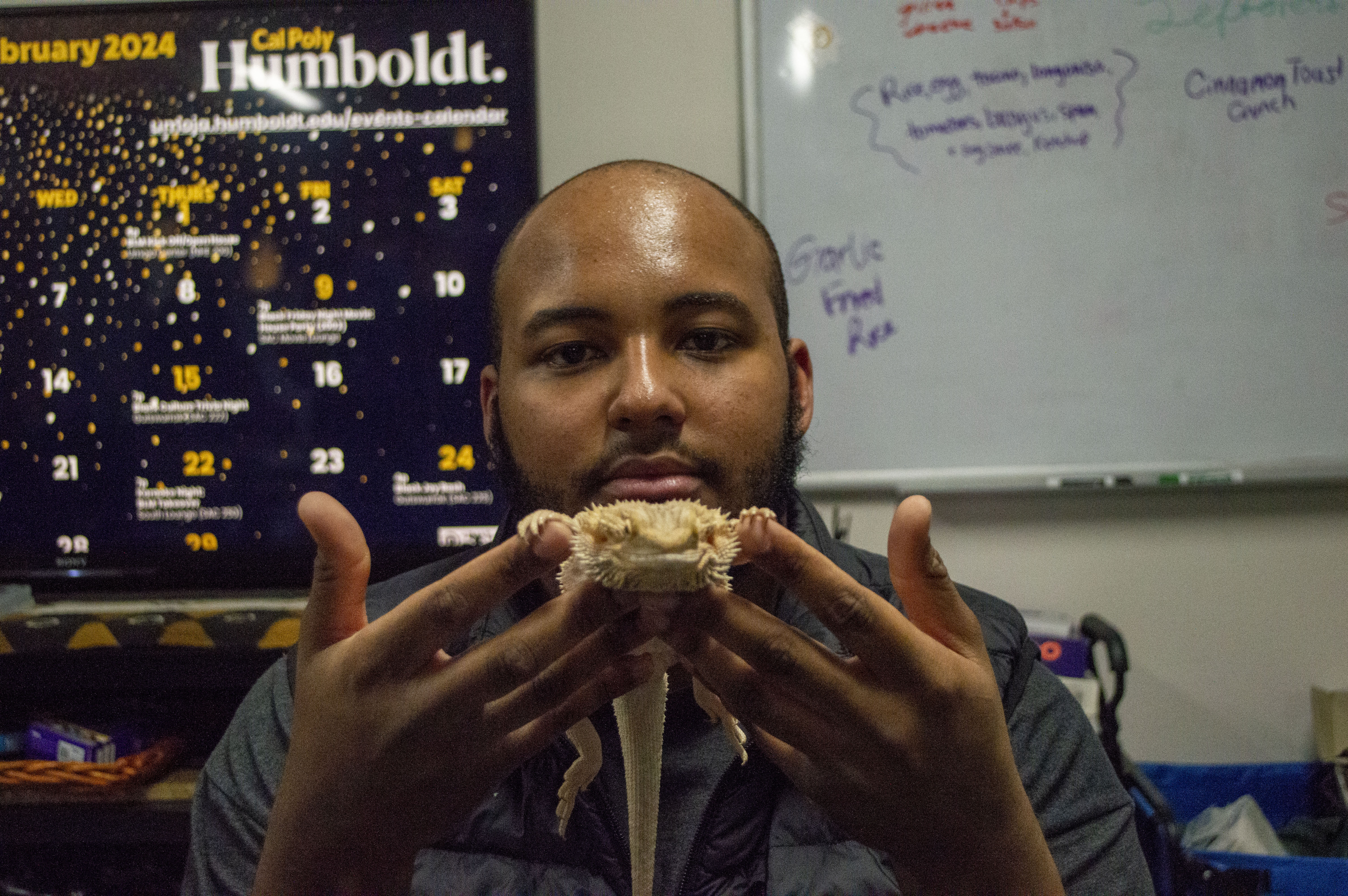
    Tigger doesn’t have any stripes. He isn’t furry, and his jumping skills are horrible. His scales are nice and smooth, and his facial hair rivals a 19th century president’s. Tigger the bearded dragon is just one of many attractions people at the Umoja Center can offer.

    The Umoja Center for Pan-African Student Excellence, located in Nelson Hall East, kicked off a month of events for Black Liberation Month on Feb. 1 with an open house. 

    Student art and photos of Black activists, athletes, musicians, and historical figures line the walls from floor to ceiling. “I love my melanin,” said one sign. A box with loanable art supplies sits at the front desk, free for anyone to use.

    The center hosts many events, such as discussions about Black joy and movie screenings or even a Black trivia night. The center also offers academic advising and computers students can use, but the most important thing most students take from the center is community.

    Many Black students have found community at the Umoja Center — a difficult thing to do when, according to the Cal Poly Humboldt website, only 3% of students at Humboldt are Black. Delaena Montes, a student assistant at the center, said it’s a place she could feel like herself.

    “It’s an open space,” Montes said. “I can reach back to my roots here, my background. I felt like it was somewhere I could be myself. It’s freedom at a very white school. Having a place to escape is a great feeling. I feel comfortable here.”

    Kamar Little holds Tigger the bearded dragon at the Umoja Center Feb. 1. Photo by Dezmond Remington

    Jerry Turner, Tigger’s owner, agrees. He found the center when he was a freshman last year. He’s a mechanical engineering major with a lot of coursework, so having a place to relax and make friends is important to him. 

    “It’s a family,” Turner said. “That’s the best way I can put it… all of my friends I’ve met here, at the Umoja Center. It’s just beautiful.”

    Ryen Price joined the Umoja Center last year after living in the Sankofa House, the Black culture-focused dorm in Cypress. She started coming to the Umoja Center to meet other Black students. She said she’s made a lot of good friends, the type she has potlucks and in-depth discussions with.

    “I love how different we are, but also how similar,” Price said. “We’re like a family here.”

    Montes is surprised more students don’t show up to the center, as well as other culturally-focused programs such as the Indian Tribal & Educational Personnel Program or El Centro, located down the hall from the Umoja Center.

    “People should know about these places,” Montes said. “There’s a lot of culture up here [in Nelson Hall].”

    That doesn’t surprise Kamar Little, a Student Advisory Group for Equity representative at the Office of Diversity, Equity, and Inclusion. Little works to connect students with those centers.

    “I’m making them a bigger name,” Little said. “I’m letting people know things exist. There have been instances where people have never heard of [the programs].”

    Price said anyone curious or doubting should lay those worries to rest and visit the center.

    “People ask themselves, ‘[am I] black enough?’” Price said. “It’s the right place. Don’t think. You’re always welcome here. Don’t be shy, just come.”

  • Blondies goes out with a bang at fifteenth anniversary show 

    Blondies goes out with a bang at fifteenth anniversary show 

    by Mia Costales

    Distorted guitars and the punch of a kick drum reverberated off the muraled walls as Humboldt locals and music lovers alike crammed into the cozy one-room venue. The energy was electric. Bodies contorted in the neon light, pushing and pulling to the brink of exhaustion. There was a euphoric yet somber tone to the room; an acknowledgment amongst the crowd that this feeling was fleeting, as that night was the last Blondies show they would ever attend. 

    Saturday, Jan. 27 marked the last live show at Blondies, with over ten bands on the lineup. Celebrating their 15th anniversary, the beloved venue advertised the show as a birthday party, adorning the entrance with balloons and handing out festive hats at the door. Music started at 5 p.m. and went on into the night as the room swelled to the boom of the bass. Faster sets were accompanied by moshing and crowd surfing. 

    Blondies has been a staple in the Arcata music scene for years. However, they didn’t get their start with putting on live shows. Blondies owner, Johanna Nagan, recalled getting their foot in the door with open mic nights. Open mic gave community members a chance to showcase their musical abilities in a safe and judgment free environment. 

    “I think it was important for us to have a yes attitude towards if people had an idea, or if they wanted to try something,” Nagan said. “We intentionally made this space not too precious, so that people could feel relaxed enough to try something new. We felt like that was really important for people to have.” 

    Eventually, Blondies would go on to host all sorts of live music events such as live shows and jazz nights. 

    Nagan and the rest of the Blondies crew committed themselves to providing a secure and inclusive spot for seasoned performers and novices. On days when there was no live music, people could be found enjoying sandwiches, craft beer or what some would consider the best tater tots in town. The news of Blondies closing struck the hearts of many because of the environment they had fostered. The announcement was met with many customers reminiscing in the comments of Blondies’ Instagram. 

    On Sept. 24, the Blondies Instagram account, @blondiesfoodanddrink, announced that the business would officially be for sale after a 15 year run. The caption detailed how to contact the owner with regards to buying Blondies as well as a thank you to all of their faithful patrons over the years. 

    While many have questioned why Blondies has closed after all these years, Nagan said that they had faced some challenges in expanding the business. There was also concern expressed by the landlord over the types of events they were holding in the building. It is important to note that Blondies also had their liquor license suspended on Jan. 18 after it was revealed an employee had sold alcohol to an underaged patron who was working with the Alcoholic Beverage Control’s Minor Decoy Program. However, there is talk of potentially opening a similar space when and if the time is right.

    Blondies can now be immortalized as the spot where many Arcata bands got their start. Cal Poly Humboldt alumni and members of local Arcata self-proclaimed “loser rock” gfjuband Porcelain Dog, Jack Hallinan and Vivian Dawn, were able to squeeze in a show right before they closed. 

    “The owners were so cool,” Dawn said. “They were just super interested in helping the scene, and as a new band it was super encouraging.” 

    The Arcata music scene may have lost an iconic venue this weekend. However, all of those jazz nights, open mics and lasting memories will never be forgotten. 

    “It’s kind of hard to put a feeling into words,” said Bailey Allott, junior at Cal Poly Humboldt and guitarist for Mambo Green and Queen Karma. “You build up all this energy during the week and that was the one night that you could just let it all out. Just feeling like no matter what you’re going through, you just felt like you were a part of something bigger.” 

    Concert-goer crowd surfing at Blondies during California Poppies set. Photo by Mia Costales