The Lumberjack


Students Serving The Cal Poly Humboldt Campus and Community Since 1929

Category: News

  • Cal Poly Humboldt Pro-Palestine Occupation and Protest Timeline

    Cal Poly Humboldt Pro-Palestine Occupation and Protest Timeline

    By Madison Montiel

    Monday 4/22/24

    4 p.m. 
    Students enter Siemens hall - they previously organized a Pro-Palestinian sit-in with some original student protesters planning to hold a seder in the building, bringing games, books, and art supplies.
    4:15 p.m. 
    UPD asks students to leave the building
    Siemens Hall operational hours: 7 a.m. - 10 p.m.

    Protesters refuse to leave, UPD evacuates non-protesters out of the building

    Protesters lock doors and access points into the building until only the quad entrance is open. Barricades are constructed in front of the doors inside the building using materials such as chairs, desks, and other items from within Siemens Hall.


    5 p.m.
    Police show up with riot gear, and many students gather with protesters both inside and outside the building. 
    
    Some students can be seen moving to the front of the protest line and beginning to pray.
    5:57 p.m. 
    Humboldt Alert - Siemens Hall Closed, Classes Canceled Tonight
    Classes in Siemens Hall have been canceled, and the building is closed until 7:30 a.m. tomorrow morning. Please contact your instructor for further instructions.
    7:30 p.m. 
    Riot cops arrive on scene with protesters both inside and outside Siemens Hall. The police officers attempt to remove protesters from the building which results in injuries to multiple protesters.

    Protesters can be heard both inside and outside of the building chanting “Cops go home!”

    Multiple students report riot cops threatening to use pepper balls and rubber bullets.

    A Cal Poly Humboldt truck is backed towards the entrance to the building and tension continues between riot cops and protesters both inside and outside the building.
    8:53 p.m.
    Humboldt Alert - Campus Closed as Dangerous Situation Continues at Siemens Hall
    Campus is closed through Wednesday, April 24 for the safety of the campus community as protestors continue occupying Siemens Hall.
The campus community is advised to avoid the area of the building, as it is a dangerous and volatile
situation.
The University is deeply concerned about the safety of the protestors who have barricaded themselves inside the building. The University is urgently asking that the protestors listen to directives from law enforcement that have responded and to peacefully leave the building.
In-person classes and activities are transitioning to remote where possible. Check in with your instructor or supervisor for next steps.
    The protesters had one demand for the first hours of the protest--for the police to leave.
    10:50 p.m.
    The police leave the site.

    Student protesters continue adding materials, making barricades bigger and more complex in front of entrances inside and outside the building.

    Tuesday 4/23/24

    Protesters continue to occupy Siemens Hall.


    Protesters release their demands stating that if the demands are met they will vacate campus, remove donations and belongings, and help clean and cover up art and graffiti.
    
    Students, faculty, and community members drop off donations of food, water, cooking equipment, hygiene products, clothing, PPE, art supplies, and much more. This continues throughout the next few days of the protest.
    
    Mutual Aid Kitchen (MAK) is created and set up on tables in front of the Siemens Hall main entrance.
    
    Protesters created the MAK to be a central space where anyone could go to get free supplies and hot meals. Schedules were posted for cooking, serving, restroom cleaning, security watch, etc., and were based on a volunteer sign-up system to divide duties and share the workload of the space.
    
    The Water Jug memes begin as video footage of a protester “bonking” a riot officer with a 5-gallon water jug during the initial struggle at the quad entrance of Siemens Hall, goes viral.
    
    
    https://www.instagram.com/p/C6HnJfESWzg/?utm_source=ig_web_button_share_sheet&igsh=MzRlODBiNWFlZA==
    3 p.m. 
    University Senate meeting held and protest discussed
    5:33 p.m. 
    Humboldt Alert - Campus Operations Update as Protests Continue
    Dozens of protestors continue to occupy Siemens Hall and have
barricaded themselves in the building by blocking entrances with furniture, creating safety hazards.
The campus community and families of students are understandably concerned. Campus officials continue
to encourage protestors to cooperate and remain open to dialogue around a peaceful resolution to the situation.
Significant world events and crises often hit close to home for members of our campus and local
communities. The University supports free speech through open dialogue that is respectful and constructive, but will not tolerate endangering people, destroying property, and disrupting campus.
As a community, we are committed to keeping our students, staff, and faculty safe and fostering a learning and working environment where the campus community can feel safe, included, and respected.
Check humboldt.edu/emergency for updates. Details on the campus closure are below.
Remote Work, Instruction, and Campus Operations
The campus remains closed through Wednesday, April 24 for the safety of the campus community. Buildings are locked down and key cards won’t work.
Academics
Classes: In-person classes and activities are transitioning to remote where possible through Wed., April 24. Instructors are posting course updates online.
Off-campus academic activities: Buses will not be transporting students to field trips, but any
activities such as academic internships or field placements that can be conducted safely off campus can continue.
Employees
Remote Work: Those who are able to work remotely will continue to do so. Contact your supervisor
for alternative work options. Your supervisor will contact you if you need to report to campus for work.
Campus Services: Limited services will be available to all students.
Housing and dining: Students living on campus are safe and the residence halls are operating
normally. The J Dining Hall will be open until 9 p.m. and will continue normal hours of operation. The College Creek Marketplace will open at 4 p.m. today until 9 p.m. tonight. The Cupboard is open normal hours, 5 p.m. to midnight. Dining hours of operation
Health and counseling services: Timely Care is currently available to students and Student Health
& Wellbeing Services will reopen for in-person medical and counseling appointments starting Wednesday morning for regular operating hours. Student Health & Wellbeing Services appointment info and hours of operation.
    Events
The University is working to relocate athletics events and activities. Coaches will share information with athletes.
All other on-campus events have been canceled through Wed., April 24.
The University is moving forward with Commencement ceremonies and activities for our students next month.

    Wednesday 4/24/24

    The Lumberjack covering the police response and initial occupation of Siemens Hall.
    The Lumberjack posts an article written from within Siemens Hall.
    The Lumberjack interviews a community member who was arrested on Monday the 22nd during the protest.
    12-4 p.m. 
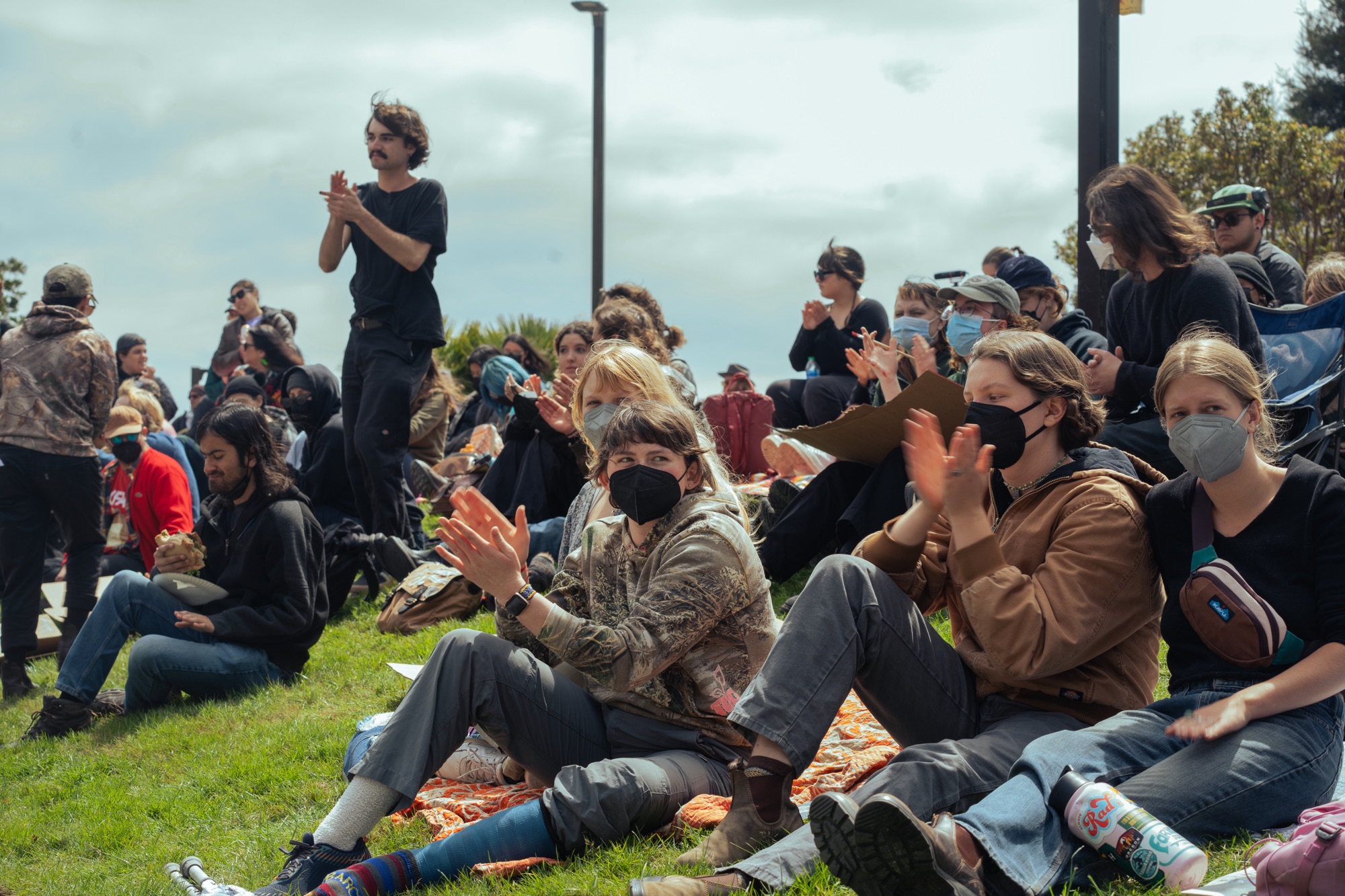
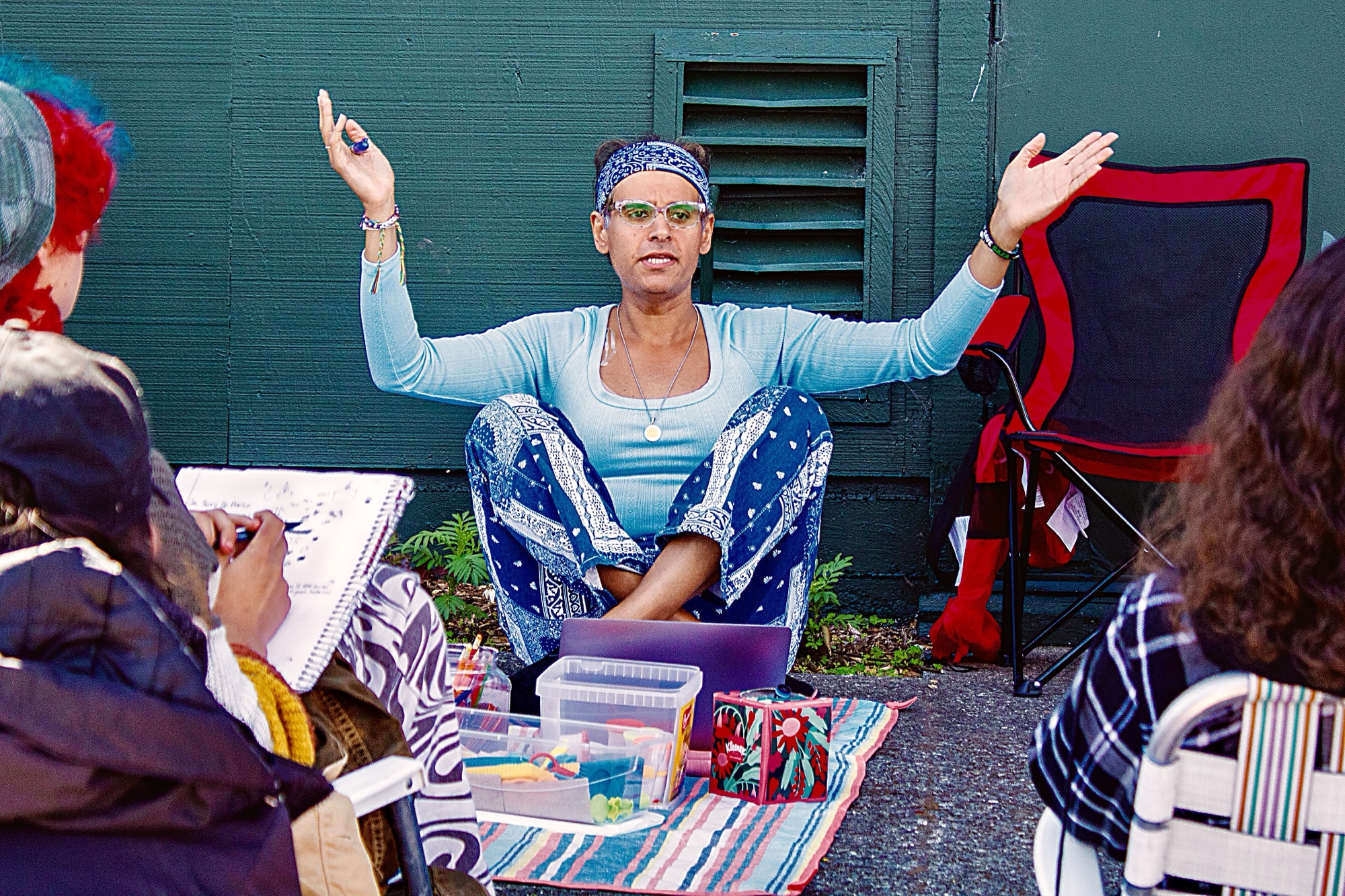
    CFA Teach-in held on campus quad where faculty, students, and community members attended while multiple faculty members spoke and led short workshops.

    2:12 p.m.
    Humboldt Alert - Campus Closed Through Sunday
    Campus will be closed through Sunday, April 28, and work and instruction continue to be remote due to protestors who continue to occupy Siemens Hall. More details to follow.

    Thursday 4/25/24

    8:55 a.m.
    Humboldt Alert - Update on Remote Instruction and Work, and Campus Operations
    Protestors continue to occupy Siemens Hall and Nelson Hall East at Cal Poly Humboldt. Campus will now be closed through Sunday, April 28, and work and instruction continue to be remote. The University is
making various contingency plans, including possibly keeping campus closed beyond that.
The occupation of Siemens Hall causes complex operational challenges that require the closure of other facilities on
campus. In particular, there is a risk of other buildings being occupied, as protestors have shown a willingness to enter
unlocked buildings and either lock themselves in, vandalize, or steal equipment. The occupation is also having a negative
impact on other students, who are trying to complete classes at the end of the semester.
Numerous laws have been broken, including resisting arrest, destroying and damaging property, criminal trespass, and
more.
As protestors have been told, the continued occupation of the building is causing the ongoing closure of other campus
facilities. Upcoming activities and events are being canceled, while other important events such as IdeaFest are in question.
Academics
Classes: In-person classes and activities are transitioning to remote where possible through Sunday, April 28.
Instructors are posting course updates on Canvas.
Off-campus academic activities: Buses will not be transporting students to field trips, but any activities such as academic internships or field placements that can be conducted safely off campus can continue.
Employees (Staff, Faculty, and Students)
Remote work: Those who are able to work remotely will continue to do so. Contact your supervisor for alternative work options. Your supervisor will contact you if you need to report to campus for work. More details to follow about employee and student pay.
Computer pickup: Information Technology Services is working on a process for essential computer pickup to facilitate remote work only. More details to follow.
Paychecks: The Cashier’s Office will be operating within The Campus Store on Thursday, April 25, and Friday, April 26, from 10 a.m.–2 p.m. The Campus Store is located at 697 8th St., Arcata. During these hours students and staff will be able to:
Pick up paychecks
Pick up financial aid checks
Pick up cash advance checks
Campus Services and Resources: Limited services continue to be available to all students.
Housing and dining: Students living on campus are safe and the residence halls are operating normally. The J, the College Creek Marketplace, and the Cupboard are all open during normal hours. Dining hours of operation
Health and counseling services:
Students: Student Health & Wellbeing Services is open for in-person medical and counseling appointments during regular operating hours at the SHWS. Student Health & Wellbeing Services appointment info and hours of operation. Timely Care is available 24/7 for on demand and scheduled medical and counseling services through telehealth.
Employees: Staff or faculty seeking additional support may utilize the Employee Assistance Program, LifeMatters, offered through Empathia 24 hours a day, seven days a week.
The Children’s Center is open.
    Events
The University is working to relocate athletics events and activities. Coaches will share information with athletes.
All other on-campus events have been canceled through Sunday, April 28. If you had catering services scheduled
for your event, all services will be canceled with no fees applied.
The University is moving forward with plans for Commencement ceremonies and activities for our students next
month.
Off-campus events are still scheduled
    4 p.m. 
    Open forum between protesters and CPH Admin held in the Goodwin Forum in Nelson Hall.
    
    Open dialogue was held between protesters and Provost Jenn Capps and Dean of Students Mitch Mitchell, with other admin present such as Jeff Crane.
    
    Full livestream of the forum: https://www.instagram.com/reel/C6NGj1Yx08r/?utm_source=ig_web_button_share_sheet&igsh=MzRlODBiNWFlZA==
    5:36 p.m. 
    Humboldt Alert - Administrative Pay Information Due to Campus Closure
    Campus is closed through Sunday, April 28, and work and instruction continue to be
remote. The University is making various contingency plans, including possibly keeping campus closed beyond that.
The President has authorized Administrative Pay for certain employees who were both scheduled to work and either don’t have access to campus or are unable to telecommute due to the closure through April 28.
Administrative Pay (Leave)
Eligible:
Staff, both exempt and non-exempt, who were both scheduled to work and either don’t have access to campus due
to the campus closure and/or are unable to telecommute due to lack of proper equipment and/or the nature of their job assignment.
Students who were both scheduled to work and either don’t have access to campus due to the campus closure
and/or unable to telecommute due to lack of proper equipment and/or the nature of their job assignment (paid for scheduled hours).
Note: Exempt staff who are able to work remotely will be paid their regular pay. Non-exempt staff who are able to work remotely should report their regular hours worked. Hours not worked will be eligible for Administrative Pay subject to the above conditions.
Not Eligible:
Staff who had already scheduled sick leave, vacation, personal holiday, or compensatory time off during the closure will still be charged for that time, unless called in to work due to the nature of their position or job
assignment.
Staff who would have been absent on any day of the closure because they were in non-pay status will not be granted leave due to the campus closure.
Intermittent hourly employees who were not scheduled to work.
    Sense of the Faculty Resolution on A Vote of No Confidence In President Tom Jackson
    WHEREAS: On April 22, 2024 students protesting the ongoing war and tragic loss of life of
Palestinians in the Gaza Strip entered Siemens Hall; and
WHEREAS: Shortly after students occupied Siemens Hall, the university called on multiple law
enforcement agencies to respond, including law enforcements, which included dozens of
armed, non-university police officers arriving at Siemens Hall wearing body armor and
carrying shields; and
WHEREAS: Such a swift and disproportionate police response created unnecessary escalation
resulting in physical assault on students and faculty and injury of law enforcement personnel;
and
WHEREAS: President Tom Jackson and Chief of Staff Mark Johnson, through their unfamiliarity
with the Cal Poly student body mishandled the protest by calling those law enforcement
agencies to attempt to extract protestors from Siemens Hall, which led to the injury of
students and faculty of Cal Poly Humboldt; and
WHEREAS: It is the responsibility of all members of Cal Poly Humboldt campus community to
ensure the safety of our students, now, therefore, be it
RESOLVED, That the General Faculty of Cal Poly Humboldt have no confidence in the
leadership of President Tom Jackson and his Chief of Staff Mark Johnson; and be it further
RESOLVED, That the General Faculty demand Cal Poly Humboldt not pursue disciplinary action
or legal prosecution against any students for actions taken in connection with the protest and
occupation of Siemens Hall; and be it further
RESOLVED, That the Faculty and University provide all necessary and reasonable accommodations to ensure that every student has the opportunity to successfully complete their coursework and fulfill their academic requirements for the semester; and be it further
    RESOLVED, That the General Faculty demand that Cal Poly Humbolt guarantee full
compensation for all student employees irrespective of their ability to perform their usual
duties; and be it further
RESOLVED, In keeping with our desire to maintain a campus that is safe for our students and
return to the work of educating those students, that the General Faculty of Cal Poly
Humboldt demand the immediate resignation of President Tom Jackson and Chief of Staff
Mark Johnson; and be it further
RESOLVED, That this resolution be distributed to:
The Office of the Chancellor of California State University
The Academic Senate of California State University
Gavin Newsom, The Governor of the State of California
Representative Mike McGuire
Representative Jared Huffman
    The Lumberjack article: “President Tom Jackson should resign, say Cal Poly faculty and CFA”

    Friday 4/26/24

    The Lumberjack posts an article: “Dozens of protesters decide to stay on Cal Poly Humboldt campus, occupation continues”
    10:28 a.m. 
    Humboldt Alert - University Response to Protestor Demands
    The following was shared yesterday during a conversation with student protestors.
This is an initial response intending to make a good faith effort to respond, and is meant to lead to additional dialogue.
The Cal Poly Humboldt pro-Palestine protests have elevated a remarkable number of important questions, opened a space for difficult, meaningful conversations, and also raised concerns about what principles of the community we bring into spaces of disagreement. Even in the midst of this challenging period for our community, we remain firmly rooted in our University’s purpose: to provide the highest quality and affordable college education built on the contributions of
diverse students, staff, and faculty who are committed to a just and sustainable world.
We write today in this spirit, while also reasserting our responsibility for civil discourse and fact-based debate. In particular, we would like to provide context and feedback to the stated demands of the protesters. They have asked the
campus to:
1. Disclose all holdings and collaborations with Israel. 
It is important to highlight that Cal Poly Humboldt is among the higher education leaders in environmentally and socially
responsible investing. In 2014, with extensive student involvement, an investment strategy focused on reducing
investments in the fossil fuel industry and in tracking investments in socially concerning sectors was adopted. Last year,
again with student involvement and assistance, a new policy focused on Environmentally & Socially Responsible (ESR)
investing was adopted. This policy takes a “positive investment” approach to select funds with strong environmental, social, and governance practices, and again puts Humboldt at the leading edge of responsible investing within higher education.
The investments in the University’s endowment does not include any direct investment in defense companies or any
securities issued by Israeli companies or organizations, or to defense firms. In fact, because of the relatively small size of
the endowment, the investment strategy does not include direct investment in any specific companies or securities.
Instead, the portion of the investment in securities is in mutual funds, which are bundles of many securities that reflect the
portfolios of numerous different investment managers.
So any holdings of the securities in question would represent indirect investment. Our estimates put the potential indirect
investment in the areas that are asked about at less than 1% of the investment portfolio of more than $51 million. Of this,
our estimate of potential defense investment is less than 0.5% of the entire portfolio, though that can fluctuate over time.
This estimate is probably high as these companies do not produce weaponry but rather components of various industrial products (like wind turbines and aviation parts). The portion of the indirect investment in Israeli companies or organizations is likewise less than 0.5%, and can fluctuate over time. These securities, which again are bundled in different mutual funds, are software companies and banks, and there is also less than 0.1% in bonds. Any of these holdings could be sold by the fund manager at any time.
We would welcome the opportunity to discuss the investment policies in the future.
2. Cut all ties with Israeli universities.
Cal Poly Humboldt has a commitment to global engagement. While we have no current ties with Israeli Universities, we are open to connecting with universities across the world in an effort to build connections and expand understanding. The Cal Poly Humboldt catalog listing for a study abroad program with the University of Haifa in Haifa, Israel is a California State University International Study Abroad (CSU IP) program, not a Cal Poly Humboldt program. The CSU IP Haifa program is not currently enrolling students. Current Bilateral Exchange Programs with Cal Poly Humboldt are listed online.
    Information about agreements with other universities is also available on campus websites or with an email to the Dean of
Extended Education & Global Engagement. We encourage our students to speak and engage with faculty as well as campus administrators. Our doors are always open to our students.
3. Divest from companies and corporations complicit in the occupation of Palestine:
Please see the investment information in #1. We do not have a way of measuring the specific language included in this
request.
4. Drop charges against and halt the harassment of student organizers by law enforcement.
University policy and conduct violations will follow established procedures, and there will be consequences for actions that
violate policy or law. However, students who elect to evacuate the building and support efforts to clear the building will have their actions considered as a mitigating factor within those processes.
5. University to publicly call for a ceasefire and end to the occupation of Palestine.
Cal Poly Humboldt is committed to social justice and the Graduation Pledge to guide everyone’s social and environmental consequences of their decisions. We are supportive of a peaceful and just world which affords the opportunity for all human beings to flourish and achieve their potential.
6. “We want the university to either amend or remove the time, manner or place clause [of its free expression policy] which allows them to call the police on students for organizing in ways that they deem inappropriate.”
The University's Time, Place and Manner (TPM) policy exists to protect the rights of the entire campus community to a
secure environment that is conducive to the pursuit of knowledge, freedom of inquiry, freedom of speech and freedom of assembly. The policy is content-neutral in its approach to speech and assembly, protecting our freedoms while also ensuring that the rights of the rest of the campus community to a safe and secure environment are protected. Part of protecting our rights is protecting the health and safety of persons, and the security of property, for which uniformed police officers may be required.
    12:28 p.m. 
    Humboldt Alert - Campus Closed Through the End of the Semester, Remote Instruction and Work Continue
    Campus is now closed through May 10, and work and academic
instruction will be remote as individuals continue to occupy Siemens Hall and Nelson Hall East. More details to follow about campus operations and remote work.
The occupation of Siemens Hall and Nelson Hall East is causing ongoing inability to open other campus facilities. Since Monday night, protestors have attempted several times to break into multiple locked buildings with the intention of either locking themselves in, vandalizing, or stealing equipment. Vandalism and theft have continued across campus.
    Various meetings held throughout the day including open public forums by protesters and faculty, admin were present during at least one.
    
    Many meetings were held between various groups of people inside Nelson Hall as well as in other spaces to discuss the group's demands, tactics, and ways to move forward.
    
    Livestream of public forum: https://www.instagram.com/reel/C6PXXK0SmN0/?utm_source=ig_web_button_share_sheet&igsh=MzRlODBiNWFlZA==
    1:49 p.m. 
    Humboldt Alert - Check-out Option for Protestors 
    For protestors who have continued to participate in the occupation of Siemens Hall and Nelson Hall, or are violating the Time, Place, Manner policy (such as camping illegally around those facilities), we are offering a one-time checkout process Friday, April 26, from 2 pm to 4 pm that will allow you to vacate the premises without fear of immediate arrest. 
This in no way eliminates responsibility for any potential student conduct or criminal charges, but it does provide a safe and calm process for exiting campus. Voluntary participation in this check-out process WILL be considered as a mitigating factor in University conduct processes and may reduce the severity of sanctions imposed.
Students who elect this check-out option will meet University representatives, not police, at one of two locations and be escorted to a nearby outdoor checkout location.
Meeting points will be 1) The northwest Siemens Hall first floor entrance nearest Student Health Center, or 2) The west entrance of Nelson Hall, facing the Student Health Center. You will be asked to provide basic identity information (name, student number, birthdate, address, phone number, etc.). Participating peacefully in this process allows the University to guarantee that you are not handcuffed and taken to jail at the time of your exit.
Law enforcement has declared the current activities to constitute an unlawful assembly, and has ordered all of those assembled in the impacted area to immediately disperse, which means to break up the assembly and leave the area. They have been notified that not doing so can lead to arrest.
While not all students are actively engaged in the protest, we are sharing this message with all Cal Poly Humboldt students to ensure awareness of this time-sensitive offer, as we work to return our campus to safe and normal operations.
To anyone who has participated in the occupations or knows anyone who is occupying those buildings or violating Time, Place, Manner policy, please encourage them to take this opportunity to leave.
    This action was called “self-narcing,” or turning oneself in, by protesters.
    
    The Lumberjack article on self-checkout:
    2:06 p.m.
    Humboldt Alert - Campus Offers Chance to Leave Buildings with No Immediate Arrest
    4:39 p.m.
    Humboldt Alert - Check-out option update
    
    The deadline for the check-out option is extended until 5 p.m.
    5:20 p.m. 
    Protesters open Siemens Hall Quad entrance to the public for a walkthrough of the building

    For the first time since Monday 4/22 when the occupation of the building began, it was opened up and anyone was allowed to walk inside (mainly the top floor) and witness and document the state of the building as well as President Jackson’s Office.

    Walkthrough of Siemens Hall: https://www.instagram.com/reel/C6PtKQsRnHG/?utm_source=ig_web_button_share_sheet&igsh=MzRlODBiNWFlZA==

    Two Arcata City Council members write in support of a solution

    The Dean of Students office provides an outline to students on the quad that will be sent out to those involved with the protest, outlining the risk of being put on interim suspension.
    University Senate Sense of the Senate Resolution On A Call for a Permanent Ceasefire in Gaza
    WHEREAS, The vision of Cal Poly Humboldt states: Cal Poly Humboldt will be a campus for those who seek above all else to improve the global human condition and our relationship with the environment; and
WHEREAS, Since the October 7, 2023 Hamas attack on Israel that killed 1,163 Israelis, and
captured still held 134 hostages, the state of Israel has maintained a disproportionate response
killing more than 42,500 Palestinians, including 38,621 civilians, of which 10,091 were women and 15,780 were children, and
WHEREAS, UN independent human rights experts have determined that 5,800 students and teachers have been killed, “more than 80 percent of schools in Gaza [have been] damaged or
destroyed,” and 625,000 students are left without places to study and learn due to attacks on
schools and universities; and
WHEREAS, The Students, Faculty, and Staff of Cal Poly Humboldt are deeply committed to peace
and humane treatment of all people; now, therefore, be it
RESOLVED, That Cal Poly Humboldt Senate Executive Committee, acting on behalf of the University Senate, calls for an immediate and permanent ceasefire in Gaza; and be it further
RESOLVED, That this resolution be distributed to:
The Office of the Chancellor of California State University
The Academic Senate of California State University
The Cal Poly Humboldt University Senate
The Faculty, Staff and Students of Cal Poly Humboldt
Governor Gavin Newsom, State of California
Senator Mike McGuire, President Pro Tempore of the California Senate
Representative Jared Huffman, US House of Representatives
    6:20 p.m.
    Rabbi Bob Rottenberg and a group of students and community members enter the protest zone and set up on the quad to welcome Shabbat, receiving Hamotzi, sharing grape juice and Matzah, and singing.

    Saturday 4/27/24

    12:35 p.m.
    Cal Poly Humboldt Alert - Enforced Hard Closure of Campus
    A hard closure of campus is now being enforced. Individuals are prohibited from entering or being on campus without permission.
This includes road closures at Harpst and B as well as Plaza and LK Wood.
This closure means that nobody without authorization by University Police is allowed on the campus. Anyone on campus
without permission is subject to citation or arrest.
Students who live on campus in residence halls are presumed to have permission to remain in the limited area of the hall they live in and dining facilities. Until further updates, student residents do not have permission to be in other parts of campus.
The campus is closed due to ongoing occupation of Siemens Hall and Nelson Hall, as well as continued challenges with
individuals breaking laws in the area surrounding the buildings and the quad.
    Bail fund set up for Cal Poly Humboldt Students by the Bay Area Anti-repression Committee: https://antirepressionbayarea.com

    An open letter was sent out by Arcata City Council members Stacy Atkins-Salazar & Sarah Schaefer.

    “As City Council members, and more importantly as humans, we support peaceful resolutions and open dialogue. It is essential to respect the rights of our community members, including and especially students, to peacefully express their views. We believe in the power of de-escalation and constructive conversation to promote understanding globally and foster solutions locally. We send our young people to universities such as Cal Poly Humboldt to foster critical thinking and encourage them to make the changes in the world that they deem necessary. This is what they are doing.  In this emotionally charged situation, a non-violent approach should, and must be used by all parties involved. As a council we heard from and worked with community members, including students, to have an open dialogue and create a cease-fire resolution for Arcata. This type of dialogue and conversation can bring our community together without violence.”
    1:45 p.m.
    Cal Poly Humboldt Places cement blockades at three main campus entry points, in front of Plaza Ave off LK Wood (Library Circle), in front of the entrance to the faculty and visitor parking lot behind the library, and a police vehicle and an electronic sign that read “Campus Closure Will Be Enforced,” blocking B st. heading north at the Harpst St. intersection.
    6:03 p.m.
    Humboldt Alert - A message to Students from Cal Poly Humboldt
    Cal Poly Humboldt Students:
This past week has been a time of great distress and sadness for our campus, as we have grappled with a protest that has grown into a significant health and safety concern resulting in campus closure at a critical time in the semester. The safety and security of our campus community—our students, faculty, and staff—are at the forefront of every decision we are making. We know that many of you, regardless of whether or not you support the protest itself, are upset about the current state of affairs and the disruption it has caused in your student experience.
How did we get here?
Please know that Cal Poly Humboldt’s leadership takes seriously our responsibility to our campus community, particularly our students, during this difficult time. This is especially true for those of us who provide leadership to areas directly responsible for our students’ success and wellbeing.
Police were called on April 22 to remove protesters from Siemens Hall because the situation was becoming increasingly dangerous. The protestors had blocked exits and other spaces, creating safety hazards, both for themselves and others who were working and attending class in the building at that time. Since Monday, hateful graffiti has been painted on campus buildings and there has been other damage throughout campus, all of which is certainly well outside the bounds of our expectations for student behavior. The University supports free speech, however, there are many options to express those views that don't put others
in danger, destroy property, and completely disrupt campus.
While Siemens Hall and Nelson Hall East are most directly impacted, individuals have attempted to break into other spaces across campus. The occupied buildings create health and safety issues that cannot be ignored. We are hearing from families and students with various perspectives, including those who are asking us to end this immediately to allow students to return to the important work of learning. We are also hearing from those of you who feel unsafe because of this protest, not because of the law enforcement presence, but because of the actions of the protesters. So please know that the impacts of this are widely varied within our campus community, and we are balancing our response as best we can in recognition of that reality.
Are we working to end the disruption to campus?
Absolutely. Since the occupation of Siemens Hall began Monday, efforts have been underway to engage with protesters, while ensuring the safety and security of those who are choosing to instead focus on finishing out the semester. Much of that work has been behind the scenes and has included outreach at various times from both of us, as well as other campus and academic leaders, beginning Monday evening and continuing to current time.
On our part, that means encouraging them to cease this disruption within a space that is essential to our academic purpose. Friday, we offered to students who were in the buildings, and included this in
direct messaging to all students who received notices of conduct proceedings and interim
suspensions, a chance for a check-out process that ensured their safe passage from the occupied buildings at this time, but did not eliminate the conduct and legal repercussions of the recent
activity. Saturday’s hard closure of campus is our next step towards restored normalcy. This is in no way an exhaustive list of all that has been done to bring this to a close, but we wanted to share some of it with you, and assure you that Cal Poly Humboldt’s primary focus is resolving this in a manner that prioritizes the health, safety, and educational success of our students.
    What about Commencement?
This time is particularly difficult for our seniors, who are looking forward to graduating on May 11 and, in many cases, did not have the joy of an in-person high school graduation due to COVID. As the situation continues to evolve, we do not yet know how Commencement will look at Cal Poly Humboldt. However, our campus leadership understands the importance of Commencement to all of you and your families, and we are doing everything in our power to ensure you have the opportunity to walk across a stage and hear your family and friends cheer as you receive your diploma. Expect more communication about Commencement in the coming days.
What if I need support dealing with this disruption?
Any student who needs additional support navigating the current situation is encouraged to contact the Dean of Students office by emailing dos@humboldt.edu. Members of that team can provide assistance in connecting you with resources needed for your online classes, or connecting with faculty about special accommodations.
If you have concerns about your grades or progress in your courses, please reach out to your faculty members via email and also check Canvas, as many faculty members are posting updates and
announcements that you will find helpful there.
Student Health & Wellbeing Services is open for telehealth visits and looking forward to continuing to support our students. Please email health@humboldt.edu for medical appointments or email
humboldtcaps@humboldt.edu for counseling appointments. We will strive to address your needs as
promptly as possible. Please know you also have 24/7 access to TimelyCare for both acute and scheduled medical and counseling sessions as well as health coaching and other resources.
We have continued to provide support for our Jewish students and all students who may feel unsafe or experience negative interactions on our campus. Those requests for support can be sent to
dos@humboldt.edu, or incidents of concern can be reported using this form, or emailing
complaints@humboldt.edu.
Once the situation has further stabilized, the EMSS Division and Dean of Students Office will host
opportunities for community conversations with our students, among other efforts, in order to ensure we are moving forward and healing as a campus. We are grateful for your participation in our campus community, and we are saddened by this difficult situation we are navigating together. We ask for your continued patience and want to reiterate that our teams are here to support you and do everything we can to return our campus to normal operations.
Dr. Chrissy Holliday
Vice President for Enrollment Management & Student Success
Dr. Mitch Mitchell
AVP of Student Success & Dean of Students
    6:30 p.m. 
    Group March/Protest from Plaza to Campus in support of on-campus protesters

    A group of people including faculty, students, and community members, marched from the plaza to the police-created barricade on LK Wood below Library Circle.
    9:30 p.m. 
    Unknown Metal band gives Protest crowd on LK Wood a free concert.
    
    An Unknown Metal band pulled up in a UHaul on the opposite side of LK Wood as the police enforced cement barricade and gave protesters a free concert for about 40 minutes.
    https://www.instagram.com/reel/C6SpC1rL5h5/?utm_source=ig_web_button_share_sheet&igsh=MzRlODBiNWFlZA==

    Sunday 4/28/24

    7:35 p.m. 
    Humboldt Alert - Campus Access, Resources, and Support
    This has been a challenging time for all of us. The safety and security of our entire campus community are at the forefront of every decision being made. Since Monday, the University’s goal has always been to bring a peaceful end to the occupation. The University continues to talk to anyone willing to have productive and respectful dialogue.
[See the University’s response to the protestors’ demands at humboldt.edu/emergency.]
The individuals who are occupying Siemens Hall and Nelson Hall East, or illegally camping around those facilities, are urged to leave the campus peacefully now. Leaving voluntarily will be considered as a possible mitigating factor in University conduct processes and may reduce the severity of sanctions imposed. This does not, however, eliminate responsibility for any potential conduct or criminal charges.
Campus leaders are offering to escort individuals who are concerned for their safety off campus.
A hard closure of campus is now being enforced through May 10, and individuals are prohibited from entering or being on campus without permission. Work and academic instruction will be remote.
There have been requests by many across campus to participate in decision-making related to the recent events,
and we are grateful for your desire to help us navigate this difficult time. Once the situation has further stabilized, the University will host opportunities for conversations with the campus community in order to ensure we are moving forward and healing as a campus. Housing and Dining: Student residents are allowed to come and go from campus and access Dining facilities, and have been emailed details. Residents and authorized staff are permitted to be in the residence halls and dining facilities areas. Residence halls will remain open to residents and housing operations will remain the same through the end of the semester.
The J, College Creek Marketplace, and the Cupboard will continue to operate during their regular business hours. Residents with meal plans will maintain access to these locations for their dining needs. Student residents should refer to the email that was sent to them.
Access to Campus: University Division leadership or supervisors will email personnel who are authorized to access campus to provide instructions on the check-in procedure for accessing campus, which will be effective Monday morning. Authorized personnel are approved based on their inability to maintain business continuity in a fully remote environment.
Commencement: Many people have asked about Commencement. The University is planning for various scenarios to help students and families celebrate this important milestone.
Technology Support
Computer pickup: Information has been emailed to staff and faculty about a process for computer pick up to facilitate remote work.
Laptop Loaners for students:
A limited number of loaner laptops are available for students who need to complete instructional related work.
Students must schedule an appointment with the Information Technology Services department in advance by sending an email to help@humboldt.edu with the subject: Student Loaner Laptop Request, and including the following information: software needed, description of use case, contact phone number and preferred pickup time (between 8:30 a.m. and 4:30 p.m. Monday through Friday)
ITS will respond with a specific time confirmation and meeting instructions.
Please bring your Humboldt ID, we cannot get you a laptop without it.
    Health and Counseling Services
Students: Student Health & Wellbeing Services is open for telehealth visits during regular operating hours. Please email health@humboldt.edu for medical appointments or email
humboldtcaps@humboldt.edu for counseling appointments. TimelyCare is available 24/7 for both acute and scheduled medical and counseling sessions as well as health coaching and other resources.
Employees: Staff or faculty seeking additional support may utilize the Employee Assistance Program, LifeMatters, offered through Empathia 24 hours a day, seven days a week.
Events
The University is working to relocate athletics events and activities. Coaches will share information with
athletes. 
All other on-campus events have been canceled through May 10. If you had catering services scheduled for your event, all services will be canceled with no fees applied.
Off-campus events are still continuing as scheduled.
Off-campus academic activities: Buses will not be transporting students to field trips, but any activities such as academic internships or field placements that can be conducted safely off campus can continue.
Children’s Center: The Center is open during regular operating hours.
FAQs: General information and frequently asked questions can be found at humboldt.edu/emergency/faq

    Monday 4/29/24

    2:15 p.m. 
    The CFA organized a march from the Arcata Plaza to the cement barricades at library circle, then marched back to the lawn in front of the Cal Poly Humboldt sign on the corner of LK Wood and 14th St. where they held signs, had a band playing instruments and singing, blew bubbles, and chanted.
    https://www.instagram.com/reel/C6XL_WBP4CR/?utm_source=ig_web_button_share_sheet&igsh=MzRlODBiNWFlZA==
    4:18 p.m. 
    Humboldt Alert - Reminder of Authorized Access During Hard Closure
    To ensure the safety of our campus community, Cal Poly Humboldt is currently under a hard closure. This means that access to campus is restricted, and individuals are not permitted to enter or be on campus
without prior authorization. This measure is essential for safeguarding the wellbeing of the campus community.
The failure to follow this directive may lead to corrective or disciplinary action, up to and including termination of
employment.
    Tensions in the protest Zone are high as mixed information from different sources claims that large numbers of police are being hosted at the Blue Lake casino, and multiple cop cars are seen driving on the 299 West and the 101 North, towards Arcata.
    7 p.m.
    A group of at least 50 people marched from Arcata Plaza to the cement barricades on LK Wood at Library Circle where the group protested and held a Seder. The group grew to approximately 200 people who chanted, sang, and said prayers. The size of the group got smaller throughout the night but there were still people at the cement protest line until approximately 4 am.
    https://www.instagram.com/reel/C6Xqu3VLiqK/?utm_source=ig_web_copy_link&igsh=MzRlODBiNWFlZA==
    10 p.m.
    Two UPD officers drive a UPD vehicle up to one of the protest zone barricades and play a recorded message from Chief of University Police Peter Cress through a speaker strapped to the top of the vehicle. The message states that protesters have 15 minutes to leave the ‘unlawful assembly’ or be at risk of the use of plastic/rubber bullets and chemical agents.
    
    Video recording of message: https://www.instagram.com/reel/C6YGeHzueNm/?utm_source=ig_web_button_share_sheet&igsh=MzRlODBiNWFlZA==
    
    The UPD officers drive around to each barricade/point of entry to play the message for the next 5 hours.
    
    At least 200 protesters were present at this point.

    Tuesday 4/30/24

    2:50 a.m. 
    Multiple buses full of Riot Police from as far as San Francisco and Redding march up to the Protest zone and begin breaking down barricades and encircling protesters.
    
    The Lumberjack article: “Hundreds of riot police descend on Cal Poly Humboldt”
    3:00 a.m. 
    Humboldt Alert - Shelter in Place on Campus; Continuing Criminal Activity on Campus
    Shelter in Place on Campus; Continuing Criminal Activity on Campus
Due to continuing criminal activity on campus, residents living on campus should shelter in place. Anyone who is off campus should stay away.
There is an increased level of criminal activity on campus. It is dangerous to be out on campus at this time. In order to protect life and safety, residents on campus should shelter in place in their residence halls and remain alert to their surroundings.
Anyone off campus should stay off campus. It is dangerous to be on or near campus due at this time.
    6:56 a.m. 
    Humboldt Alert - Law Enforcement Secures Buildings and Restores Order at Cal Poly Humboldt
    Law Enforcement Secures Buildings and Restores Order at Cal Poly Humboldt
On Tuesday, April 30 at about 0230, law enforcement began a series of actions to restore order on the Cal Poly Humboldt
campus.
Law enforcement cleared and secured Siemens Hall and Nelson Hall East, as well as the area near those buildings.
About 35 individuals were arrested, without incident. There were no injuries.
The operation was carried out by Unified Command, which is made up of law enforcement personnel from throughout the State of California under the leadership of Humboldt County Sheriff William Honsal and University Police Department
Chief Peter Cress.
At the time the operation was initiated, on-campus residents were advised by University text and emails to shelter in
place. Others were directed to stay away from campus, which was already under a hard closure.
The operation’s objective was to establish control of the site; protect the rights, safety, and health of students and employees; eliminate the threat of violence and criminal behavior; and reestablish control of buildings and other property.
Those arrested faced a range of different charges depending on individual circumstances including unlawful assembly, vandalism, conspiracy, assault of police officers, and others. In addition, students could face discipline for conduct violations while any University employees arrested could face disciplinary action.
The University had made repeated efforts over the last week to resolve the situation. This morning’s enforcement action
was determined to be necessary to restore order and to address the lawlessness and dangerous conditions that had developed.
What was occurring was not free expression or a protest. It was criminal activity, and there were serious concerns it would spread even further on campus.
The hard closure of the campus remains in place through May 10, and law enforcement is continuing to monitor the
situation. For employees, your supervisor will contact you if you are authorized to be on campus.
Humboldt County Sheriff William Honsal
“The law enforcement action at Cal Poly Humboldt was essential to reestablishing order on campus. When someone commits a crime and infringes on the rights of others, it becomes necessary for law enforcement to step in. I'm grateful to the agencies and officers who contributed to bringing safety back to our campus. I understand the widespread frustration
caused by the campus closure, threatening behavior, and lawlessness we've witnessed over the past week. By restoring order, we've sent a clear message that the criminal and dangerous activities we experienced were not peaceful protests, but outright criminal behavior, which is unacceptable.”
University Police Department Chief Peter Cress
“The University Police Department is deeply grateful to the local and statewide agencies that lent support to our campus during this event. The support was critical in restoring an environment on campus where learning and work occur safely.
UPD remains committed to a learning environment where everyone can be heard without breaking the law.”
Tom Jackson Jr., Cal Poly Humboldt President
“This is a difficult day, it breaks my heart to see it, and truly nobody wanted to see things come to this. We’ve all watched
this with great concern, and always with the sincere hope that it would be resolved peacefully. Unfortunately, serious criminal activity that crossed the line well beyond the level of a protest had put the campus at ongoing risk. I commend the
law enforcement team for their effort in resolving this very dangerous situation, and I’m incredibly grateful for the many
agencies who advised us and who came to our aid in our time of need. I’m also very grateful for our many staff members
    who performed far and above their normal duties to help us protect the campus and maintain operations. Our focus for the
entire time has been on doing all we could do to protect the safety of all involved, and we were very patient and very disciplined with that.”
    Professor Rouhollah Aghasaleh’s statement
    2:55 p.m.
    Humboldt Alert - Hard Closure Continues—Update on Campus Access, Resources, and Support
    Law enforcement cleared and secured Siemens Hall and Nelson Hall East, as well as
the area near those buildings. 31 individuals have been arrested, without incident, and there were no injuries.
The University continues the hard closure of campus through May 10, but the shelter in place order has been lifted.
Access to campus is restricted, and individuals are not permitted to enter or be on campus without prior authorization.
Supervisors will contact those employees who are authorized to be on campus.
Failure to follow this directive may lead to corrective or disciplinary action, up to and including termination of employment.
There are limited services available, and work and instruction continue remotely.
Residents are allowed to come and go from campus, and may utilize spaces in their residence hall and access dining facilities near them. Campus Apartments and College Creek residents may go to College Creek Marketplace, and all other campus residents may go to Jolly Giant Commons. Residents should stay in these areas and NOT walk across campus.
The Children’s Center will be closed Tuesday, April 30 and Wednesday, May 1.
There will be no access to campus for computer or equipment retrieval Tuesday, April 30 and Wednesday, May 1.
Any activities such as academic internships or field placements that can be conducted safely off campus can continue.
Buses will resume pickups for field trips and other academic activities at G15. Trip leaders will contact students with details.
The Cashier's Office will operate at The Campus Store (697 8th St., Arcata) on Wednesday, May 1 and Thursday, May 2 from 11 a.m. – 4 p.m. to pick up paychecks, financial aid checks, reimbursement/refund checks, and cash advance checks. A photo ID is required at the time of pick up.
Library books and textbook rentals can be returned at The Campus Store in Arcata from 10 a.m. to 4 p.m. on Tuesday, April 30 and Wednesday, May 1. On-campus events have been canceled through May 10. Off-campus events are still continuing as scheduled.
    3:18 p.m. 
    Humboldt Alert - Emergency Pay for CSUEU and Teamsters and Extension of Administrative Pay
    The President has approved Emergency Pay for certain California State University Employees Union (CSUEU Units, 2,5,7 and 9) and Teamsters (Unit 6) employees who are physically working on campus during the closure from Tuesday, April 23 through Sunday, May 5. For detailed information, refer to the Teamsters collective bargaining agreement and the CSUEU Emergency Pay Extension.
The President has also authorized the extension of Administrative Pay for certain employees who were both scheduled to work and either don’t have access to campus or are unable to telecommute due to the closure through Sunday, May 5.
Emergency Pay
Eligible:
CSUEU (Units 2,5,7 and 9) non-exempt employees, only while working on campus during the
closure from Tuesday, April 23 thru Sunday, May 5
Teamsters (Unit 6) non-exempt employees, only while working on campus during the closure
from Tuesday, April 23 thru Sunday, May 5
How to Request:
Use these instructions to request emergency pay.
Employees not represented by CSUEU or Teamsters are not eligible for Emergency Pay.
Please direct questions to hr@humboldt.edu.
Compensatory Informal Time Off
Exempt CSUEU Employees who are working on campus during the closure from Tuesday, April 23
thru Sunday, May 5 are eligible for compensatory Informal Time Off at one half hour per hour worked on campus. Compensatory informal time off shall be scheduled at such time agreed upon by the employee and Appropriate Administrator.
Administrative Pay (Leave)
Eligible:
Staff, both exempt and non-exempt, who were both scheduled to work and either don’t have access to campus due to the campus closure and/or are unable to telecommute due to lack of
proper equipment and/or the nature of their job assignment.
Students who were both scheduled to work and either don’t have access to campus due to the campus closure and/or are unable to telecommute due to lack of proper equipment and/or the nature of their job assignment (paid for scheduled hours)
Note: Exempt staff who are able to work remotely will be paid their regular pay. Non-exempt
staff who are able to work remotely should report their regular hours worked. Hours not worked will be eligible for Administrative Pay subject to the above conditions.
    Not Eligible:
Staff who had already scheduled sick leave, vacation, personal holiday, or compensatory time
off during the closure will still be charged for the time, unless called in to work due to the nature of their position or job assignment.
Staff who would have been absent on any day of the closure because they were in non-pay
status will not be granted leave due to the campus closure.
Intermittent hourly employees who were not scheduled to work.
All University employees who were scheduled and able to work but had an unexcused absence.
    7:52 p.m. 
    Humboldt Alert - Campus Update on Commencement and Dining Access
    Cal Poly Humboldt will hold a modified in-person Commencement with local ceremonies on Saturday, May 11, 2024. More details will be announced later this week.
All students who have a meal plan, including those who live off campus, are free to use The J, College Creek Marketplace, and the Cupboard dining facilities, which will continue to operate during their regular business hours.
With the hard closure of campus in place, no one is allowed to walk through the center of campus. To access Dining facilities, students must walk down LK Wood to Granite Avenue and back. Housing residents are free to leave and return to campus.
    10 a.m. - 7 p.m. 
    Vigil and protest outside Humboldt courthouse waiting/asking for the release of those arrested.
    
    Food Not Bombs served food.

    Wednesday 5/1/24

    A majority of those arrested are released on bail.
    2:03 p.m. 
    President Jackson sent an email out to students “A Message to the Campus Community”
    Dear Students and Colleagues,
As we all come to terms with the recent events on campus, it is important to recognize the emotional impact they have taken on us, individually and collectively. We want to acknowledge that this has been an extremely challenging week for Cal Poly Humboldt. We are hurting within our campus community and beyond, and we have much work in front of us to reset, rebuild, and heal. This will take time. We will do this together.
The unlawful actions that took place this past week stand in contrast to our values and beliefs—and can never happen again. We unequivocally support the rights of students and others to assemble peacefully, to protest, and to have their voices heard. We must also recognize the difference between free speech and unlawful activities that put others and protesters themselves at risk. This is something we simply cannot tolerate. As we call for peace, we must all practice it.
It is often the case that in extreme challenges communities come together. We have been deeply moved by the hundreds of staff and faculty who went well beyond their standard roles on campus in order to support the extensive needs of our community, and to the many organizations, state agencies, tribal governments, and law enforcement agencies who advised us and rushed to our aid in our time of great need. We are very grateful. This is who we are as a community—one that has a shared commitment and dedication to those we serve: our students.
As we get to the difficult work of reckoning with what has happened, we must also look to the future. We have already begun assessing the state of the campus and working to clean up the buildings and grounds. The campus will certainly remain closed through the end of the semester, likely much longer. Modified plans are being made for Commencement ceremonies at off-campus locations. We will continue to share updates, and more information will be available in the coming days.
We want to encourage you all to care for yourselves and others during this time—and to continue to use intellect and reason to challenge the status quo and make the world a better place. Our hope is that you are able to engage in meaningful dialogue with respect, empathy, and humanity. Lastly, let us use this opportunity to remind ourselves, our community and beyond of our shared vision at Cal Poly Humboldt: to be a campus for those who seek above all else to improve the global human condition and our relationship with the environment.
We know we will get there—together.
Sincerely,
Tom Jackson, Jr.
President
Jenn Capps
Provost and Vice President of Academic Affairs
Sherie Gordon
Vice President for Administrative Affairs
Chrissy Holliday
Vice President for Enrollment Management & Student Success
Frank Whitlatch
Vice President for University Advancement
Mark Johnson
Chief of Staff
Adrienne Colegrove-Raymond
Special Assistant for Tribal Relations & Community Engagement
Nick Pettit
Executive Director of Intercollegiate Athletics & Campus Recreation
Connie Stewart
Executive Director of Initiatives
    2:37 p.m.
    Cal Poly Humboldt Notification - Update on Cal Poly Humboldt Commencement Ceremonies
    Cal Poly Humboldt is committed to hosting Commencement ceremonies so that graduates and their families and friends can celebrate this
important milestone. Recent challenges on campus have made it impractical to hold the ceremonies as planned. Instead, there will be a series of smaller off-campus ceremonies grouped
by majors at three locations in the local area. The venues and ceremony sizes will accommodate
the registered graduates and their anticipated number of guests.
The Regional Commencement ceremony in the Los Angeles area will take place as scheduled.
Graduates from the Los Angeles area or with family there are encouraged to consider that option.
Graduates can email grad@humboldt.edu for any registration questions, including the option of attending the Regional Commencement. More information will be available on the Commencement website.
    The Lumberjack publishes an article that encompasses events and interviews during the protest from April 26 to April 30 when riot police entered campus.

    Friday 5/3/24

    12:53 p.m.
    Cal Poly Humboldt Notification - Updated Schedule for Cal Poly Humboldt Commencement Ceremonies
    Cal Poly Humboldt has adapted its Commencement plans so that this important celebration for graduates and their guests can be held even though the campus remains closed.
The University will hold modified ceremonies at three off-campus locations on Saturday, May 11, 2024. They will take place concurrently in the Sapphire Palace at the Blue Lake Casino, the Eureka Theater, and the Eureka High School Auditorium. Each of the venues has the capacity to accommodate all of the registered graduates’ anticipated guests.
The University’s Regional Commencement ceremony, scheduled for Tuesday, May 14, 2024, at The Saban Theatre in Beverly Hills, will take place as scheduled.
For the Commencement ceremonies on May 11, each of the three Colleges will hold multiple ceremonies, organized by major, during the course of the day. The ceremonies will be led by the Dean and Associate Dean of each of the Colleges, with support from an additional academic leader.
Graduates will be organized by major:
Blue Lake Casino Sapphire Palace - College of Arts, Humanities & Social Sciences
(777 Casino Way, Blue Lake, CA)
8:30 a.m. - Art, Dance Studies, Film, Fine Art, Music, Theatre Arts
10:30 a.m. - Anthropology, Environmental Studies, Geography, Geospatial Science & Technology
12:30 p.m. - Criminology & Justice Studies, Critical Race, Gender & Sexuality Studies, Native American Studies, Sociology, MA Sociology
2:30 p.m. - English, French & Francophone Studies, International Studies, Philosophy, Political Sciences, Spanish, MA English
4:30 p.m. - Communication, History, Journalism
Eureka Theater - College of Professional Studies
(612 F St, Eureka, CA)
8:30 a.m. - Elementary Education, Leadership Studies, MA Education, Administrative Services Credential; Education Specialist Credential; Multiple Subject Credential; Single Subject Credential
10:30 a.m. - Business Administration, Economics, MA Business Administration
12:30 p.m. - Child Development, Child Development & Family Relationships, Psychology (Students with last names A-L)
2:30 p.m. - Psychology (Students with last names M-Z), MS Psychology
4:30 p.m. - Individualized Degree Plan, Kinesiology, Nursing, Recreation Administration, MS Kinesiology
6:30 p.m. - Social Work, MA Social Work
Eureka High School Auditorium - College of Natural Resources & Sciences
(1915 J St. Eureka, CA)
8:30 a.m. - Biology, MS Biology
10:30 a.m. - Computer Science, Data Science, Environmental Resources Engineering, Geology, Mathematics, Physical Science, Physics, MS Engineering & Community Practice
12:30 p.m. - Environmental Science & Management, MA Environmental Systems
2:30 p.m. - Forestry, Rangeland Resource Science, MS Natural Resources
4:30 p.m. - Fisheries Biology, Marine Biology, Oceanography, Zoology
6:30 p.m. - Botany, Chemistry, Wildlife
    The Cultural Graduation Celebrations will be held Thursday and Friday at the Adorni Center in Eureka.
Asian, Desi, Pacific Islander, Middle Eastern, and North African (ADPI+MENA) Graduation Celebration
Friday, May 10; 4 – 6 p.m.
Black Graduation Celebration
Friday, May 10; 1 – 3 p.m.
Latine/x Graduation Celebration
Friday, May 10; 7 – 9 p.m.
All Native Graduation Celebration
Thursday, May 9; 6 – 8 p.m.
Queer Graduation Celebration
Friday, May 10; 10 a.m. – Noon
Cal Poly Humboldt is unable to hold this Spring’s Commencement on campus as planned because of the recent emergency. The campus remains closed due to clean-up work, concerns about maintaining the security of buildings, and the ongoing criminal and campus conduct investigations.
Facilities staff on campus typically spend a month or more preparing for Commencement, and that has not been possible. Those same staff have been responding to the campus emergency, and now they are focused on the extensive clean-up following the restoration of order to campus. There is no way, at this point, to get the campus ready to host graduates and thousands of guests.
For questions about Commencement registration contact grad@humboldt.edu. For more information, please visit: commencement.humboldt.edu
    5:59 p.m. 
    Cal Poly Humboldt Notification - Updates for Campus Hard Closure during Finals Week
    A hard closure of campus continues through Sunday, May 12, 2024. Access to campus is restricted, and individuals are not permitted to enter or be on campus without prior authorization. Supervisors will email instructions for the Parking Kiosk check-in procedure to personnel who are authorized to access campus. Contact your supervisor with questions regarding access. Departments will coordinate a process for end-of-semester student check-out needs when necessary.

Commencement: The University will hold Commencement ceremonies at three off-campus locations on Saturday, May 11, 2024. They will take place concurrently in the Sapphire Palace at the Blue Lake Casino, the Eureka Theater, and the Eureka High School Auditorium. Each of the venues has the capacity to accommodate all of the registered graduates’ anticipated guests. For more information, please visit: commencement.humboldt.edu

Housing and Dining 

Housing Access: Student residents are allowed to come and go from campus and access Dining facilities, and have been emailed details. Residents and authorized staff are permitted to be in the residence halls and dining facilities areas. Residence halls will remain open to residents and housing operations will remain the same through the end of the semester.
Dining: The J, College Creek Marketplace, and the Cupboard will continue to operate during their regular business hours. Residents with meal plans will maintain access to these locations for their dining needs. Student residents should refer to the email that was sent to them. 
Housing Move-out: Housing residents may continue to move out all day throughout next week. Residents have received instructions about the move-out process and questions can be directed to housing@humboldt.edu.
Technology Support

Computer Pickup: Information has been emailed to staff and faculty about a process for computer pick up to facilitate remote work. 
Laptop Loaners for students: 
A limited number of loaner laptops are available for students who need to complete instructional related work.  
Students must schedule an appointment with the Information Technology Services department in advance by sending an email to help@humboldt.edu with the subject: Student Loaner Laptop Request, and including the following information: software needed, description of use, contact phone number and preferred pickup time (between 8:30 a.m. and 4:30 p.m. Monday through Friday)
ITS will respond with a specific time confirmation and meeting instructions.
Please bring your Humboldt ID, we cannot get you a laptop without it.
Health and Counseling Services: 

Students: Student Health & Wellbeing Services is open for in-person or telehealth appointments during regular operating hours. Please email health@humboldt.edu for medical appointments or email humboldtcaps@humboldt.edu for counseling appointments. Patients with in-person appointments will be emailed details about accessing the building during the closure. TimelyCare is available 24/7 for both acute and scheduled medical and counseling sessions as well as health coaching and other resources.
    Employees: Staff or faculty seeking additional support may utilize the Employee Assistance Program, LifeMatters, offered through Empathia 24 hours a day, seven days a week.
Testing Center: Limited Testing Center access for students taking finals will start Monday by appointment only from 8:30 a.m. – 4:30 p.m. Email testing@humboldt.edu to request an appointment and the check-in process through the Parking Kiosk will be communicated when you make your appointment. There will be a shuttle escort available to take students to and from the Testing Center. 

Mail and Package Pickup: Shipping & Receiving remains open to receive freight and mail. Departments are asked to send a representative to pick up department-wide freight and mail. Call 707-826-3932 or come to the Shipping & Receiving building to the north of Facilities Management Monday through Friday from 8 a.m. – noon, and 12:30 – 3:30 p.m. 

Check Pickup: The Cashier's Office will operate out of The Campus Store (697 8th St., Arcata) on Thursday, May 9, and Friday, May 10, from 11 a.m. – 4 p.m. During these hours students and employees will be able to pick up paychecks, financial aid checks, reimbursement/refund checks, and cash advance checks as well as make payments on student or staff accounts. Photo ID is required at the time of pick up.

Book Return: Library books and textbook rentals can be returned at The Campus Store in Arcata Tuesday, May 7 through Friday, May 10  from 10 a.m. – 4 p.m. 

Events: On-campus events have been canceled through May 12. Off-campus events are still continuing as scheduled. 

Off-campus academic activities: Any activities such as academic internships or field placements that can be conducted safely off-campus can continue. Buses will continue pickups for field trips and other academic activities at G15. Trip leaders will contact students with details. 

Transportation Services: The bus stop at Library Circle is currently closed. Bus riders should use the bus stop at 14th and B Streets. To help direct riders, signage has been placed at LK Wood Blvd and Plaza Ave (Library Circle), and at the 14th and B Streets bus stop. 

A shuttle is available to take housing residents from College Creek to The J cafeteria. Email parking@humboldt.edu to make arrangements.

    Tuesday 5/7/24

    2:31 p.m. 
    Cal Poly Humboldt Notification - Key Points for the Campus Community About the Events of April 22
    The University wants to acknowledge that this has been an extremely challenging time for Cal Poly Humboldt. It has also been a very emotional time for our campus community and beyond, and we have much work in front of us to reset, rebuild, and heal. To clarify misinformation and rumors, here’s a timeline of the events beginning on April 22. We invite people to continue to ask questions and more information will be coming. 

The University’s Time, Place, and Manner policy is content-neutral, approved by the University Senate, and fully supportive of First Amendment protections. In fact, this policy exists to protect freedom of speech and assembly while also protecting the rights of the entire campus community to a secure environment that is conducive to our educational purpose.

These approved policies, which have had extensive review, should be supported and enforced regardless of context. There is no First Amendment right to enter and occupy a building to stage a protest and it is a clear violation of the University’s Time, Place, and Manner policy. 

Multiple people called the University Police Department (UPD) concerned due to the actions of the people who were protesting in Siemens Hall on the first day of the protest. Several staff members asked the people who were protesting to leave the building prior to UPD arriving on the scene. The people who were protesting refused.
 
UPD officers were inside the building with the people who were protesting and asked  if they could facilitate a protest in the public space of the Quad, where it would have been a lawful assembly. Those requests were rebuffed by the people who were protesting.
 
Tents in hallways and barricades were being assembled in front of exit doors, and vandalism of the building’s interior had already begun before UPD arrived.
 
Students, faculty, and staff who were not part of the protest were evacuated with the assistance of UPD. Classes were canceled out of safety concerns because exits were already being barricaded.
 
UPD ordered the people who were trespassing to leave the building. They refused to vacate the building and construction of barricades continued. UPD called for additional police presence on campus. 
 
Efforts to clear those barricades in the lobby were met with assault on officers. Police were attempting to enforce a lawful order, arrest those who were assaulting officers, and clear the building. Several people who were protesting and police officers were injured. Additional police officers were called from throughout the county.
On the first night, administrators were told that if law enforcement was removed that the protesters would leave the building.
    The Provost, Vice Provost, and Dean Crane went into the building twice on Monday. The first time to check on the safety of the protesters, establish dialog, and to see if any needed medical attention. The people who were protesting offered a set of demands.  
 
The second time the Provost, Vice Provost and Dean Crane entered on Monday night was to announce that law enforcement was leaving the scene and that protesters could leave, as they agreed, without consequences. The people who were protesting shouted the Provost down and threw water at her.
 
The UPD Chief of Police recommended that law enforcement depart. President Jackson concurred. Law enforcement left the scene. The people who were protesting then reneged on their promise to vacate the building and continued to build barricades. 
 
On Tuesday, the focus was on deescalation, and administrators waited for the protesters to keep their promise to leave the building. They refused. Efforts to dialog occurred throughout the day with the protesters both inside and outside the building. The people who were protesting refused to let any administrators into the building.
 
After Tuesday, administrators realized the extent of the damage to the building and leaving without consequences was taken off the table. Nelson Hall East was then also occupied, doors were barricaded and protesters controlled who was allowed in or out of the building. 
 
Throughout the week, there were many attempts to get the protesters to agree to leave the buildings, beyond those efforts that were widely discussed. Faculty, staff, and administrators were actively talking with protesters throughout the week. 
 
We took the protesters' demands seriously, and researched those demands and answered them to the best of our ability on the 26th of April. 
 
A total of 12 buildings were vandalized. The John Van Duzer Theatre, Music A, Art A, Founders Hall, Van Matre Hall, Harry Griffith Hall, Student Business Services, Forestry, and the Gutswurrak Student Activities Center were either broken into or attempted to be broken into. Several others were defaced. Fortunately University staff were able to retake these buildings.
 
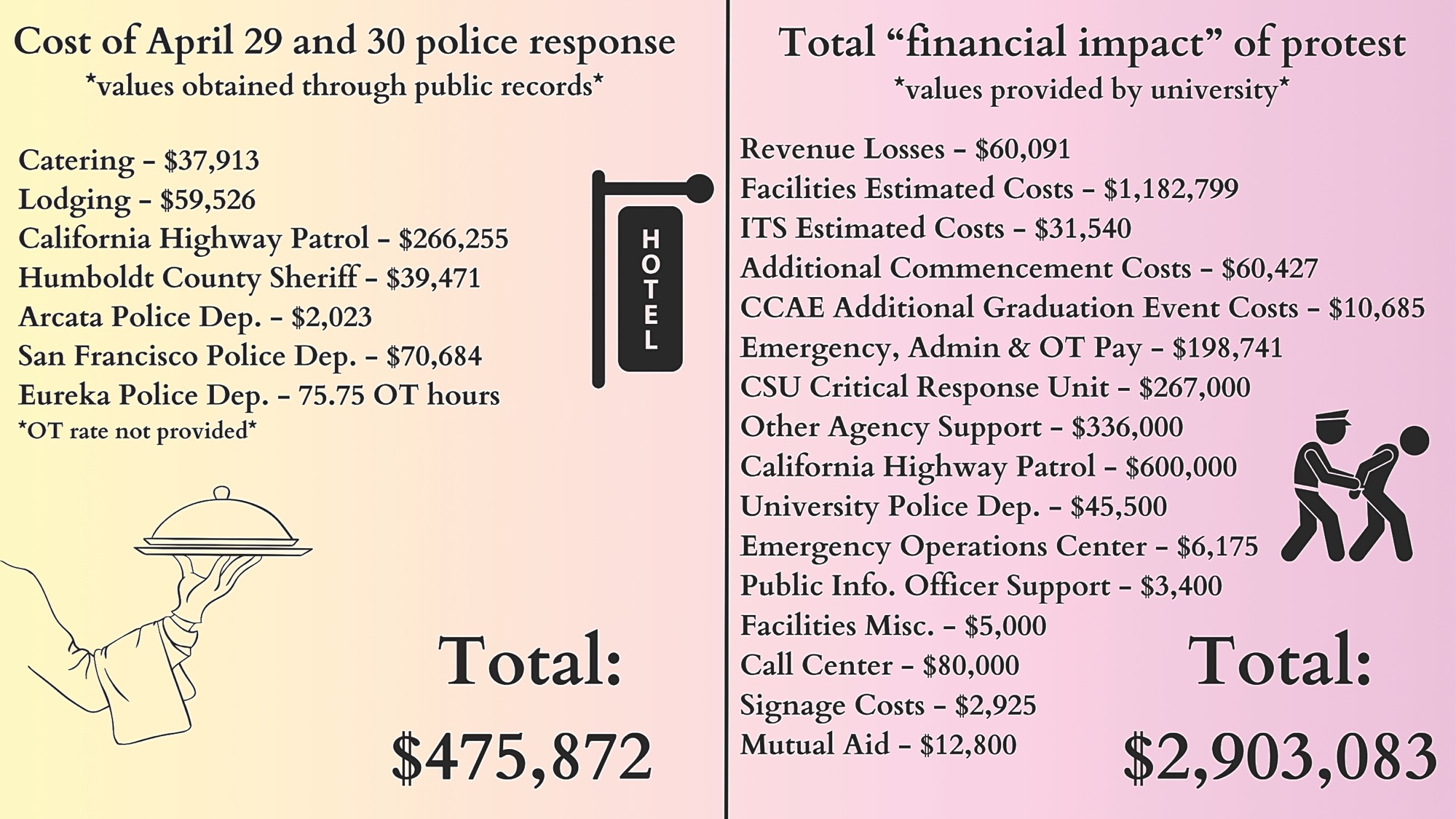
To date, the initial estimate is that there is more than $1.9M in financial impact, which includes physical damage to the campus and emergency operations. This number is not final due to the campus still assessing physical damage, costs to restore the damage, and gathering a full picture of the financial impact. 
 
It was difficult to dialog with the protesters to leave the building because there was no clear leadership. There were only a few students that began the protest that were on site during the arrests, which is what made ending the protest without arrest so difficult. 
 
More than half of those arrested were not students.
 
The tagging and efforts to reoccupy buildings on campus have continued since the arrests, which is why the campus has not yet been reopened.
    The Lumberjack article: "320 faculty and staff demand ‘immediate termination’ of President Tom Jackson & chief of staff Mark Johnson"

    Wednesday 5/8/24

    3:57 p.m. 
    Cal Poly Humboldt Notification - Emergency Pay for CSUEU and Teamsters and Extension of Administrative Pay
    The President has approved Emergency Pay for certain California State University Employees Union (CSUEU Units, 2,5,7 and 9) and Teamsters (Unit 6) employees who are physically working on campus during the closure from Tuesday, April 23 through Sunday, May 12. For detailed information, refer to the Teamsters collective bargaining agreement and the CSUEU Emergency Pay Extension. 

The President has also authorized the extension of Administrative Pay for certain employees who were both scheduled to work and either don’t have access to campus or are unable to telecommute due to the closure through Sunday, May 12.  

Emergency Pay

Eligible: 

CSUEU (Units 2,5,7 and 9) non-exempt employees, only while working on campus during the closure from Tuesday, April 23 thru Sunday, May 12
Teamsters (Unit 6) non-exempt employees, only while working on campus during the closure from Tuesday, April 23 thru Sunday, May 12
How to Request: 

Use these instructions to request emergency pay.
Employees not represented by CSUEU or Teamsters are not eligible for Emergency Pay. Please direct questions to hr@humboldt.edu.
Compensatory Informal Time Off

Exempt CSUEU Employees who are working on campus during the closure from Tuesday, April 23 thru Sunday, May 12  are eligible for compensatory Informal Time Off at one half hour per hour worked on campus. Compensatory informal time off shall be scheduled at such time agreed upon by the employee and Appropriate Administrator. 

Administrative Pay (Leave) for Staff and Students

Eligible: 

Staff: Either exempt or non-exempt, who were both scheduled to work and either don’t have access to campus due to the campus closure and/or are unable to telecommute due to lack of proper equipment and/or the nature of their job assignment. 
Students: Those who were both scheduled to work and either don’t have access to campus due to the campus closure and/or are unable to telecommute due to lack of proper equipment and/or the nature of their job assignment (paid for scheduled hours)
Note: Exempt staff who are able to work remotely will be paid their regular pay. Non-exempt staff who are able to work remotely should report their regular hours worked. Hours not worked will be eligible for Administrative Pay subject to the above conditions. 

Not Eligible: 

Staff who had already scheduled sick leave, vacation, personal holiday, or compensatory time off during the closure will still be charged for the time, unless called in to work due to the nature of their position or job assignment.
    Staff who would have been absent on any day of the closure because they were in non-pay status will not be granted leave due to the campus closure. 
Intermittent hourly employees who were not scheduled to work.
All University employees who were scheduled and able to work but had an unexcused absence.

    Thursday 5/9/24

    2:22 p.m. 
    Cal Poly Humboldt Notification - Spring 2024 Commencement Graduate and Guest Information
    Graduates, this week we will celebrate the culmination of your hard work at Cal Poly Humboldt during the various Commencement ceremonies and Cultural Graduation Celebrations. Your resilience and dedication to completing your degree is extraordinary, and the entire Lumberjack community is incredibly proud of you.

As in previous years, graduates and guests are expected to follow standard Commencement safety protocols. Due to smaller venue spaces, additional restrictions will be in place to ensure it is a momentous experience for all graduates and families. See the Commencement website for the locations and ceremony times.

We know that some graduates may feel compelled to exercise their right to free speech. Out of respect for fellow graduates and the many families and friends who will be attending, it will be important for us to work together to ensure the ceremonies are enjoyed by all.

Access and check-in

Graduates, guests, and faculty and staff must be registered to attend the ceremony. No walk-ins can be accommodated due to venue capacity restrictions.
Arrive with your black cap and gown 45 minutes prior to the start of the ceremony for your major. 
At the check-in area outside the venue, pick up your wristbands for the anticipated number of guests you entered when you registered. Distribute the wristbands to your guests.
Graduates, guests, and faculty will need a wristband to enter the venue and will need to wear them for the entire ceremony. 
A no-touch visual search for any prohibited items will take place upon entry. 
Parameters for a safe and positive experience

Signs to celebrate graduates are welcome, but the following guidelines are applicable:
Signs may not be attached to a pole or structure, or have offensive language, as determined by event personnel. 
Signs may not be larger than 11" x 17" to prevent obstructing the view of other guests, or in any way create a safety hazard for others as decided by event personnel.
Prohibited items:
Larger bags and backpacks. However, clear bags, small clutches, and medical and parental bags are permitted. 
All of our venues are not able to accommodate space for skateboards, scooters, bicycles, and bicycle u-locks 
Weapons or anything that can be used as a weapon
Noise makers and confetti cannons 
Outside food and beverages
Animals, except for working service animals
Tobacco products (including e-cigarettes), alcohol, and illegal drugs
Drones and unmanned aircraft systems
Structures such as canopies and pop-up tents
We look forward to celebrating your important achievements during the Commencement festivities later this week, and we appreciate your support in making sure all graduates and families are able to enjoy these special occasions.

    Friday 5/10/24

    4:07 p.m. 
    Cal Poly Humboldt Notification - Information Regarding Campus Soft Opening and Transition Timeline to Normal Operations
    The University will begin a soft opening of campus on Monday, May 13, with the intention of transitioning to an open campus for the start of the summer session on Tuesday, May 28.


On Monday, May 13 all employees—including student employees—whose work necessitates it, may come to campus. Authorized personnel will no longer need to check in to the G11 parking kiosk when coming onto campus. 

Employees will continue to work remotely when possible, but if the nature of the work requires staff and faculty to work on campus, the appropriate administrator may grant approval. 

Students needing access to research or other business on campus may do so under the supervision of a faculty or staff member on a 5:1 ratio. 

Buildings will remain locked, but employees will have their regular key access to buildings and offices starting at noon on Monday. Contact Facilities Management with issues related to key access.

During this period, cement and wooden barriers on campus entryways will be removed. However, access inside Siemens Hall and Nelson Hall East is prohibited, as are the areas near both buildings and the University Quad within the fenced area, as recovery of those areas continues. 

Parking lots will be open for anyone accessing campus during this week, and parking permit enforcement will resume as normal. Bus pick up at Library Circle will resume starting Monday afternoon. 

The Cashier's Office will operate out of The Campus Store in Arcata on Wednesday, May 15, through Friday, May 17, from 11 a.m. – 4 p.m. Students and employees will be able to pick up paychecks, financial aid checks, reimbursement/refund checks, and cash advance checks as well as make payments on student or staff accounts. Photo ID is required at the time of pick up. 


On Monday, May 20 campus will reopen to all students, staff, and faculty for normal summer operations. On-campus services in the Student & Business Services Building will resume and the Library will reopen.


On Tuesday, May 28 the campus will fully reopen to the public. Summer instruction will continue as planned with in-person and online instruction. 

External and campus events will resume. The Student Health Center will be open for limited summer medical services. Check the website for more details.

The College Creek Marketplace will remain open throughout the summer, but the J and Depot will be closed, which is typical for summer operations.

    Saturday 5/11/24

    Commencement is split into 17 ceremonies and held at 3 different off-campus locations; Sapphire Palace at Blue Lake Casino, the Eureka Theater, and the Eureka High School Auditorium.

    The Lumberjack article on commencement: "Off-campus graduation and a quarter million dollar fleet of security guards – Cal Poly Humboldt flexes its muscles"
  • Preserving Our Community Forest

    Preserving Our Community Forest

    A PSA to New Cal Poly Humboldt Students

    By Emma Wilson

    Walking down the fire trail from the cypress campus dorms, across the bridge, and going down to jolly giant creek around the redwood log, I noticed A LOT of cigarette buds, joint filters and papers. As students, there is a duty and importance of preserving our Arcata Community Forest behind our campus. It is important to keep it clean, triple check your surroundings, and pick up after yourself – especially those nasty cigarette butts and joint roaches. 

    Amelia Hillburn, a wildlife conservation and management major, emphasizes the importance of maintaining the Arcata community forest for the enjoyment of students and the community. She notes that the forest often becomes messy on weekends when maintenance workers are less active, with issues like littering and improper disposal of waste. 

    Hilburn suggested that people should adopt what has been called the pack it in, pack it out principle – where people bring their own trash bags to keep the forest clean. She stressed that the forest is a shared space for everyone, not just students, and encourages responsible use to preserve its environmental and wildlife value. 

    “Our campus is a community for everybody, not just students,” Hillburn said. “For everybody, like the families that walk through here. Just bring a doob tube.” 

    Jonathan David Juarez, a data science major and the co-director from the Waste Reduction Resource Awareness Program (WRRAP), and Reusable Office Supply Exchange (ROSE) at Cal Poly Humboldt, discussed the importance of environmental stewardship, particularly in the community forest. 

    Jaurez noted the importance of composting and proper disposal of cigarette butts. 

    “For future students and new, I would recommend treating [the community forest] as if it’s one of the greatest gifts that you were ever given,”Jaurez said. “Because that is what it is, it’s a gem. It’s here for you, to be there for it.”

    Jaurez expressed disappointment and frustration over the graffiti in the community forest, emphasizing the importance of respecting the environment.

    He shares his cultural shock coming from LA, where parks and forests are not as clean and well-maintained.

    “I stand guilty as charged when coming from LA,” Jaurez said. “We don’t have parks and forests like this; not this beautiful, not this clean. So, it’s not an excuse for people to be like, ‘Oh well, I don’t know any better.’ Then learn to be better.”

    Interdisciplinary studies major Ro Meisler discussed the importance of environmental stewardship, emphasizing the need to respect and preserve the natural ecosystem. 

    Meisler mentioned the prevalence of plastic waste and non-biodegradable items in the community, advocating for responsible behavior to protect the environment and its inhabitants. 

    “There’s lots of living things that deserve clean water, clean air, clean land, healthy soil, free of plastic, and you know we gotta play our part to not disrupt their little lives,” Meisler said. “Leave it better than you found it. Be aware of yourself and your impact.”

    Marcella Casteta, a cellular and molecular biology major, emphasizes the importance of maintaining the community forest by picking up trash to leave it better than found. She advised students to clean up even if the trash isn’t theirs, to preserve the community forest for everyone’s enjoyment. 

    “If I see it, it’s nasty [to pick up], but you have to,” Casteta said. “You know, leave nothing but footprints, take nothing but pictures. It’s a space that we can all enjoy if we take care of it, and it’ll take care of you back. So, pick up trash – even if it’s not yours.”

  • Communication failures lead to A.S. president impeachment

    Communication failures lead to A.S. president impeachment

    By Brad Butterfield

    After a university-wide election this April, Ethan LeVering was elected Associated Students president of Cal Poly Humboldt, receiving 196 votes, with the runner-up receiving only ten votes. On July 1, the student-run board of directors of Associated Students, consisting of seven voting members, voted to impeach LeVering. The board of directors accused him of neglecting duties, misusing power, and causing tension within the board. The impeachment was voted on only a few meetings into LeVering’s presidency and before the fall semester had even begun. The impeachment led to the appointment of Wysdem Singleton, an accounting major, to the presidency. Singleton was initially elected as Administrative Vice President, receiving ten votes. 

    Communication Breakdown

    Among the reasons cited for LeVering’s removal, poor communication appears to be the most prevailing and heavily cited factor. Various examples of communication difficulties between LeVering and the rest of the board of directors dominated the articles of impeachment. 

    The articles of impeachment were co-authored by five members, including Singleton. 

      The articles called LeVering’s communication style aggressive while also citing a lack of proper communications with all involved parties. Additionally, they described LeVering as defensive and was unwilling to listen to criticism.

    The authors of the document did not mince words in their characterization of Levering, He is also described as unreliable, disrespectful and “not ready to handle such an important position.” Perhaps most severely, LeVering is accused of not valuing input from other board members as well as having a tendency to interrupt. LeVering acknowledged a need to improve his listening skills and emphasized that the interruptions were not intentional.

    “Sometimes I need to keep myself a little bit more reserved,” LeVering said.

    LeVering’s first meeting as president, held on May 10, set the tone for his short presidency. According to the articles of impeachment, the meeting was dominated by LeVering discussing his own agenda and amendments.

    “Ethan made constant interruptions and changes to previous amendments, elongating and complicating the meeting,” reads the articles of impeachment.

    Leverings attempts to amend the agenda, coupled with his tendency to dominate the conversation both frustrated and confused the inexperienced board of directors.

    “Most of the board – this was their first time in this position. Ethan had seemed to go through some of the A.S. processes before, so he knew a little bit more than we did,” Singleton said.

    The board of directors’ frustrations were born — at least in part — by their own lack of experience, which is cited several times in the articles of impeachment.

    Levering’s communication difficulties extended up the chain of command to the Dean of Students, Mitch Mitchell. According to the articles, during a meeting on June 20, LeVering addressed Mitchell without using his title and didn’t correct this mistake until prompted. Mitchell escalated the situation by calling LeVering an unfit representative of the university. Levering responded in kind.

    “I decided, once he [Mitch Mitchell] was done speaking, to remind the board that he had been voted in ‘no confidence’ by the previous board, and that the words he was saying against me should be taken with a grain of salt,” LeVering said. “I meant no disrespect by not saying doctor in front of his name. However, he, at many points, referred to me simply as Ethan, and did not refer to me as president. I don’t know why we’re getting all stuck up about titles.”

    The resulting atmosphere created by LeVering’s leadership style was not an environment that the rest of the board wanted to be a part of. Citing the stress created by LeVerings leadership, members considered resigning.

    “I mean, honestly, it was either Ethan would be impeached, or we would lose half of our board just because we were not working well together,” Singleton said. “We couldn’t seem to come to a compromise.”

    As eroding as the personality conflicts were, the miscommunications were perhaps most damaging. Atop the tall tower of miscommunications appears to have been confusion whether he even wanted to be president at all. In fact, on May 31, LeVering sent a letter of resignation to Kendra Higgins, Executive Director of Associated Students, and Chelsea Belden, Board Coordinator for Associated Students. LeVering later rescinded this letter, saying that it stemmed from a period of misunderstanding.

    The rescinded letter read in part, “It appears unlikely that the global human condition will be significantly improved through means of political simulacra before an inevitable world-changing catastrophe.”

    LeVering’s mention of political simulacra is cited in the articles of impeachment and led the board of directors to believe that LeVering would not be able to work within the bureaucratic pathways necessary in the Associated Students.

    According to Singleton, it was difficult to work with LeVering, in part because of his own indecisiveness surrounding his presidency.

      “He seemed like he was ready to resign and go to CCAT,” Singleton said.

    As it would turn out, Levering was not eligible for the role he wanted at CCAT.

    “Once I found out I was no longer eligible to be the CCAT co-director, it was my full intention to continue on with being the president and do my best job,” LeVering said. “Fulfilling and serving the student body’s interest to the best of my ability.”

    Conflict at the PANETTA Conference

    Another issue raised in the articles of impeachment relays occurrences at a conference in Monterey called PANETTA, which took place in June. The conference was organized and paid for by the university and LeVering would have received credits upon completion, which he did not.

    According to LeVering, lack of sleep and a feeling of culture shock because of the opulent golf course near the conference led him to step away from the group without informing anyone beforehand.

    “I started looking around at a golf course and feeling really bad at all the environmental degradation that was clearly happening around me,” LeVering said. “So, I stepped off for about thirty minutes to feel bad about the environment by myself.”

    After his return to the group, LeVering was asked why he appeared upset. 

    “I told them that this place was causing a ton of environmental degradation, and that it was wrong for them to send the president of Cal Poly Humboldt to this place and think of it as a good time,” LeVering said.

    Later, LeVering received a call from Higgins who told him that he was being recalled by the president’s office for the breaking of decorum. He was ordered to get back on a plane the following morning. 

    “I hadn’t really been given a clear answer to why I was being recalled at that point,” LeVering said.

    According to LeVering, he awoke the morning of his new return flight incredibly stressed and even vomited. He missed his return flight and then took an Uber in an aim to make the connecting flight.

    As a result, LeVering’s actions and inactions caused the Associated Students to spend money on unused travel items.

    In addition to the wasted money, the articles of impeachment make note of LeVering’s alleged failure to take accountability for failing to complete the PANETTA conference.

    “Ethan has yet to take full accountability for his actions at PANETTA and continues to place full blame on administration for why he was unable to continue,” the articles read.

    Sam Parker – former A.S. president – questioned whether the drama at PANETTA should have been included in the articles of impeachment in the first place.

    “I don’t really think that part should have been included,” Parker said. “I don’t think they should have sent him home for what he did. You know, we’re allowed to have emotions.”

    Still, Parker emphasized the importance of communication, particularly in a position of leadership. According to Parker, he witnessed many instances of bad communication from LeVering, which highlighted a missing component in the LeVering leadership.

    “That’s really the role of the president, if more than anything,” Parker said. “To build bridges between everyone and synthesize everyone’s ideas together, figure out how to all advance them together, and not just kind of go renegade.”

    An Illegal Meeting?

    According to LeVering, late at night before a special meeting was held, he was reading through the Gloria Romero act to prepare for the special meeting.

     “I was very unfamiliar with parliamentary code,” LeVering said.

    This late night reading through the Gloria Romero Act led LeVering to believe that since local newspapers had not been notified of the special meeting, the meeting was being held illegally. LeVering took it upon himself to contact The Lumberjack and El Leñador to notify them of the meeting.

    “When we went into that meeting, we asked if they had reached out to the newspapers in order to make the meeting legitimate,” Levering said. “Apparently they had not, which I think made that meeting illegal.”

    Levering’s concerns over press access to the special meeting and shaky knowledge of the Gloria Romero Act were cited in the article of impeachment.

    “President Ethan LeVering attended the Association’s meeting with knowledge that it was being illegally held,” the articles of impeachment read.

    Our Elected President, Impeached

    Among the many issues raised by the Board of Directors, LeVering’s character, advocacy for his fellow student and motivation to affect change were never called into question. 

    At a special meeting held on June 13, at least five students spoke in support of LeVering. Among the voices of support was a letter written by Mary Mangubat, where she praised LeVering’s consistent participation in many programs across campus, including A.S., WRRAP, and the University Senate.

    “Ethan has shown genuine interest and care to provide necessary resources for students and our campus community,” read Mangubat’s letter.

    In any case, LeVering ran on a platform of shaking shit up. This evidently resonated with the campus community as LeVering completely dominated the vote. 

    “I will make no political promises to the outcomes that I can achieve. Doing so would amount to little more than a lie. If voting changed anything, they’d call it an act of violence,” LeVering’s campaign statement read.

    President Singleton

    Singleton, for her part, hopes to be the bridge builder that Levering wasn’t during his brief time in power. As a part of her goals as president, Singleton aims to strengthen the board of directors and increase student involvement in A.S. 

    “I really want people to get involved,” Singleton said. “There’s so much more that we can do besides just making noise, and there’s so many ways we can do it, and they will have to listen to us, because we pay to go here, right?”

    The Lumberjack contacted all five co-authors of the articles of impeachment, but were only granted an interview with Singleton.

    Brad Butterfield is employed by the Bicycle Learning Center, an organization under the WRRAP umbrella.

    A white red head and red beard guy posing while holding a water jug in his right hand. He is wearing a pirate hat with a grey dress coat and white button up shirt and black pants.
    Photo by Brad Butterfield Former A.S. President Ethan LeVering poses with a water jug in front of Nelson Hall West.
  • State of Affairs

    Project 2025: The Blueprint for a Radical Conservative Future

    By Jordan Huber

    Bio: Jordan is a senior political science major and the president of the Politics Club. With a keen interest in current affairs and a passion for informed debate, Jordan brings a well-rounded perspective to their opinion column. Through their studies and leadership, Jordan is dedicated to exploring the complexities of political issues and fostering meaningful discussion.

    Disclaimer: Jordan Huber is an election worker. The views and opinions expressed in this column are solely those of the author and do not reflect the official policy or position of the Humboldt County Office of Elections.

    As we rapidly approach the November presidential election, Project 2025 has cast its shadow on American politics. The contents of it are not hidden, but the documents are so lengthy and dense that it is inaccessible to many. I dove into this topic to try and understand why Republicans are trying to distance themselves from Project 2025 and Democrats are relentlessly attacking its policies. 

    But what is Project 2025, what organization is behind it – and most importantly – why did a Washington D.C. think tank feel compelled to write it? Project 2025 is a multifaceted blueprint designed by alleged conservative policy experts on how to best reshape the American political landscape. Project 2025 consists of Four Pillars: 

    1. Restructuring Federal Agencies: A 900-plus-page document that will either get rid of or privatize each department of our government. Pressing issues in the document that stand out to me are: the wipeout of the Department of Education, the end of national abortion access is labeled as only the beginning to further restrictions, the federal government will no longer be able to combat misinformation, and the incalculable environmental harm due to drilling increases impacting indigenous communities. An upheaval of this kind has not been seen in modern-American history, and harm will be felt by every non-wealthy American.
    1. Appointment Profiling: A system for creating profiles for individuals interested in federal positions, enabling Project 2025’s leadership to better identify suitable candidates for various government roles. Many people currently occupying civil service positions will have their jobs changed to politically appointed positions so that a president could appoint people loyal to their values. Think of this as a Republican Indeed, where The Heritage Foundation can vet people that are willing to carry out the agenda the Foundation sets for the Trump administration.
    1. Training Program: A training program designed to cultivate a new generation of conservative government officials. Essentially a Political Science 101 course, it aims to educate participants on how the government operates and how they should manage the remaining functions of the federal government after the government is gutted through laws outlined in Pillar One. 
    1. Executive Orders Playbook: A playbook will be made outlining what changes that need to be made in each agency from day one of the Trump administration. This includes executive orders and regulations to implement within the first 180 days. Not much is known about what some of these orders will be exactly, but certainly the policies outlined in pillar one will be present. We were lucky in some ways that Trump’s first term was riddled with missteps and a lack of a plan, so many of his campaign promises did not come true. This final pillar ensures that he will not make the same mistakes again.

    The Heritage Foundation, a powerful force in shaping Republican platforms since the 1970s, is behind Project 2025. President Reagan read out policies from the Foundation in his second inaugural address, and forms from the Foundation were distributed throughout his White House. They have since been linked to every Republican President, and are applauded by conservatives as champions of traditional family values. This link between think tanks and the head of our country should scare everyone, and Trump’s administration will be more linked to The Heritage Foundation than ever before.

    What are the connections between The Heritage Foundation and Trump? J.D. Vance, potential Vice President under a second Trump administration, and Trump himself, are deeply tied with the organization. Vance wrote a foreword for an upcoming book written by Kevin Roberts, President of The Heritage Foundation. The Trump campaign has tried to distance themselves from Project 2025 and the former president has stated that he is not aware of who is behind it. Yet, Trump was also photographed with Roberts on a plane headed to a Heritage Foundation meeting – along with over 100 former members of his first administration being hired by the foundation. While overlap between similar foundations and political offices is common, to claim that he has no idea who is behind is simply not true. 

    While Trump can choose to ignore all of Project 2025’s seminars, playbooks and policy decisions, The Heritage Foundation boasts that over half of their policies enacted in both the Reagan and Trump administrations. The policies I outlined are just the tip of the iceberg. I encourage everyone to look at the document, and see for yourself how the United States will be irrevocably harmed if Trump and The Heritage Foundation are able to carry out Project 2025. 

  • New UPD chief Greg Allen comments on protest

    New UPD chief Greg Allen comments on protest

    By Savana Robinson

    Just after nine p.m. on April 29, a Cal Poly Humboldt Police SUV pulled up to a barricade made of chain-link fence, dumpsters, metal chairs, and tables. Protesters and journalists looked on as tension rose. With its red and blue lights flashing, it parked between the Music B building and the stairs to Founders Hall.

    “I am Peter Cress, the Chief of Police for the Cal Poly Humboldt Police Department. I hereby declare this to be an unlawful assembly,” a loud, crackly recording of the voice of Cress emitted from the vehicle’s PA system. “Break up this assembly and leave the area. If you do not do so, you may be arrested. You may also be subject to other police action including the use of … rubber bullets, plastic bullets and tear gas.”

    After five hours of this recording playing in various locations around the epicenter of the pro-Palestine protest, more than 100 Unified Command officers forcibly broke up the protest. 32 protesters were arrested in the early hours of April 30. 20 days later, Greg Allen began his tenure as the new police chief of Cal Poly Humboldt’s University Police Department, with the administrative title of Associate Vice President for Safety & Community Wellbeing. 

    Why was there a change of chiefs?

    According to Cal Poly Humboldt News & Information, Allen’s onboarding was a result of a several-months-long process that began at the start of the year. Allen clarified that his introduction to the department was not influenced by the protest, and the timing was due to  the lengthy hiring process. The university had also been looking for a permanent chief for two years since the departure of Anthony Morgan in 2022, with Cress acting as interim chief during the protest. Cress and previous Interim Chief Fernando Solorzano had been taking turns every six months. Cress was interim chief from Jan. 2022 to June of that year, then Solorzano took control for the remainder of the calendar year. They continued this process until Allen assumed the position in May.

    Allen’s background

    Allen is an alumnus of Humboldt State University, having graduated in 1994 from the social work program with a minor in ethnic studies. The late renowned R.W. Hicks was a mentor to Allen and was a large part of why he came to the university, played sports, and became the President of the Black Student Union on campus.

    Police activity at the protest

    Allen was one of the responding officers on the evening of April 22, the night that the pro-Palestine protest began. Protesters barricaded themselves inside Siemens Hall that evening and dozens of police officers from various local agencies responded to the incident. After hours of the protesters and police clashing verbally and physically, the officers retreated at almost 11 p.m.. The protest continued for seven more days.

    “What I saw was [that] most of the people out there protesting were doing it legally and lawfully,” Allen said. “When you have big protests like that, you have a very few that come and decide to cross that line to where now you make it illegal. There has to be some type of response, because now we’re talking about safety, accessibility for everybody on campus.”

    Allen said that it would be difficult at this point to determine what he would have done differently if he were chief of police during the protest. He also expressed how he felt about how the protest was forcibly broken up.

    “It’s unfortunate it got to that point,” Allen said. “It is hard to prevent illegal activity. If somebody wants to do something then that’s their choice. Then, there’s got to be consequences to that. We want to work with people. When we have a protest, we want to be able to protect that First Amendment right. We also want to be able to make it accessible to everybody because there’s always two sides to the story. We want to [create] a safe environment for everybody to do that peacefully. I think that I still have to look to figure out what was actually done and why it was done. So, all that stuff is being reviewed as we speak.”

    What will change?

    Stepping into the role of university police chief after a historical protest and occupation of campus buildings for over a week is a daunting task. However, Allen has a plan.

    “I think right now is a time for, basically, assessment and evaluation of all our processes and all our programs that we’re doing to see if we do need to improve on [them] to see if they’re efficient, if we’re doing them the most effective way that we can do them,” Allen said. “See if there could be an innovative way to do things differently and all that’s in play right now.”

    Allen plans to build trust with the campus community by focusing on communication and community engagement.“Community engagement will always be a priority, and that’s a priority in all law enforcement,” Allen said. “Engaging with your own community to understand their wants and needs, as well as to explain some of the things that you do and why you do those things. Communication; whether that’s written or oral, we have to communicate effectively. Even if …  we don’t agree on things, we have to have those kind of difficult conversations to basically understand each other.”

  • Off-campus graduation and a quarter million dollar fleet of security guards – Cal Poly Humboldt flexes its muscles 

    Off-campus graduation and a quarter million dollar fleet of security guards – Cal Poly Humboldt flexes its muscles 

    By Brad Butterfield

    On the heels of the week-long pro-Palestine protest and its dramatic 300 riot police conclusion, the administration decided to hold commencement ceremonies at the Blue Lake Casino, Eureka High School, and Eureka Theatre. A small army of security guards and police officers were brought in to ensure order throughout the 17 ceremonies, which were led by the deans of each college. The decision would come with a notable price tag and sparked further controversy and frustration within the campus community.

    Why hold commencement off-campus?

    The exterior of Siemens Hall, a beige two-story university building. The graffiti that once covered the walls has been painted over and there are dried patches on the grass in front of the building where tents were pitched.
    Photo by Brad Butterfield. Barricades were removed from Siemens Hall on May 1. Graffiti on the building was covered and tents were removed.

    Notification of the off-campus commencement ceremonies arrived by way of email on May 3, which also explained that the campus would remain closed through the end of the semester due to building safety concerns, an ongoing clean-up effort and ongoing investigations.

    “Facilities staff on campus typically spend a month or more preparing for commencement, and that has not been possible,” read the university email. “There is no way, at this point, to get the campus ready to host graduates and thousands of guests.”

    The university’s news and information department did not respond when asked what preparation had been underway prior to the protest, which began on April 22.

    To some graduates, the reasoning for off-campus commencement seemed suspicious given that the Redwood Bowl–commencement’s typical spring location–had been unaffected by the protest. Among those not convinced by the university’s reasoning was Tori Budke, who graduated at the Eureka High School auditorium ceremony on May 11.

    “It confirmed my suspicion that our school was trying to weaponize the student protesters against graduating students and against the rest of the student body,” Budke said. “They had to play along that narrative about there being millions of dollars of damage, and the best way to play along that narrative is not allow people to come to Ground Zero. Keep them away from where it all happened.”

    A close-up view of the inside of a dumpster. A blue tarp rests on top with grey metal poles sticking out from underneath it.
    Photo courtesy of anonymous source. Tents and supplies from the pro-Palestine protest in a campus dumpster on April 30 at 7 p.m.

    Following the protest’s conclusion on April 30, an army of facilities workers began a well-coordinated cleanup effort. Photos taken May 1 show that most of the exterior graffiti had already been painted over with a coat of primer. The protesters’ barriers, tents, makeshift kitchen, and all other supplies had been removed by the university by this point as well. 

    Supplies sit at the bottom of a dumpster. There are tarps and poles for tents, plastic bags, water bottles, and cardboard.
    Photo courtesy of anonymous source. More supplies from the protest like camping gear and water bottles found in a campus dumpster on April 30 at 7 p.m.

    According to Aileen Yoo, director of news and information for the university, the university disposed of perishable foods, and donated non-perishable packaged foods. Yoo also said that the UPD retained some personal items of arrested protesters, all of which have since been claimed, according to Yoo. 

    Everything else, “including broken furniture,” was composted, recycled, or thrown away, according to Yoo.

    Yoo did not respond when asked which organization the university donated the non-perishable food to. Additionally, Yoo did not respond when asked what was done with the large number of tents, cooking supplies and toiletry items left behind by protesters.

    Photos taken on April 30th at 7 p.m., 14 hours after the protesters were forced off campus, show dumpsters full of tents and supplies. 

    A very large price tag

    According to documents obtained through the California Public Records Act, the university rented the Eureka Theatre for $5,000, the Sapphire Palace at the Blue Lake Casino for $2,904, and the Eureka High School auditorium for $982.50. The streets in front of the Theatre and High school in Eureka were shut down to traffic by local police. 

    The university hired AX9 Security, whose closest office is in San Francisco, to help with security on campus and at the off-campus commencement ceremonies. The university paid AX9 Security a total of $203,730 for around-the-clock security on campus from May 9 – 20, according to a contract obtained through the California Public Records Act. The out-of-town security racked up $19,800 in hotel costs and $15,958 in Per Diem charges, according to the contract. On commencement day alone the university spent $26,870 for 27 guards providing security on campus and at the three commencement sites. 

    A sign with metal letters reading "Cal Poly Humboldt" and a spray-painted message below reading, "Funds genocide!!!"
    Photo courtesy of anonymous source. Pro-Palestinian graffiti on a Cal Poly Humboldt sign off of LK Wood Blvd.
    A large cement sign with metal letters fixed to it reading "Cal Poly Humboldt." Below that, a spray-painted message reads, "Funds genocide."
    Photo courtesy of anonymous source. Pro-Palestinian graffiti on the Cal Poly Humboldt sign on the corner of 14th St and LK Wood Blvd.

    AX9 contract for security on campus
    AX9 contract for security at off-campus graduation sites

    Despite the unarmed battalion of AX9 Security, on May 11, in the early hours of the morning, pro-Palestinian graffiti appeared on multiple university entrance signs. “Funds genocide” appeared under two prominent street corner signs with another reading “disclose + divest.” 

    Communication breakdown

    After a dizzying two weeks of Humboldt Alert emails, confidence in the university sank for some in the campus community. 

    “It’s beyond me to think that they couldn’t just hold it at campus,” said Budke. “It seems like more work and more logistical planning to do at multiple locations and to organize all of that last minute. That doesn’t really make sense to me. It seems like they ended up creating more work for themselves.”

    Communication, or lack thereof, throughout the protest sowed doubt into some members of the campus community. From the initial police response, to the campus hard closure, to the busloads of riot police – there is a growing number of unanswered questions about the university’s decision-making process.

    “This just shows how a lack of transparency can cause a lot of issues,” said graduate Hannah Wohl Sanchez. “It makes sense why they want to hide everything though, because they don’t want the truth to get out. They want their narrative to get out, but I feel like that all circles back and makes it worse for them in the end.”

    Six administrators were contacted for an interview, including President Tom Jackson and his Chief of Staff Mark Johnson. None responded.

    University prepares for battle

    An email from the university on May 9 detailed “parameters for a safe and positive experience,” which included restrictions against large bags and backpacks, poles attached to signs, and signs with “offensive language, as determined by event personnel.” The max allowed sign was 11″ x 17″ according to the email. The university had set up a mandatory “check-in” station at each of the ceremonies, which all attendees were required to register at before entering the ceremony. At the check-in, a “no-touch visual search” would be conducted, according to a May 9 university email. After the check-in process, visual inspection, and walkthrough metal detector, attendees of the Sapphire Palace commencement were joined by seven police officers stationed at each corner of the Sapphire Palace. The heavy police presence seemed an overreaction to Budke.

    A Cal Poly Humboldt staff member wearing black clothes and a yellow cap stands to the right at the top of a set of red brick stairs. In the background, guests check-in at a booth with a Cal Poly Humboldt branded canopy.
    Photo by Brad Butterfield. The check-in station in front of the Eureka Theater venue, one of the three off-campus venues for Spring 2024 graduation.

    “It definitely throws off your energy when you’re like holding hands with your friends and you’re lining up to walk across the stage and get your diploma and within arm’s length there’s a police officer holding his belt, weapons in full view,” said Budke. “A lot of fearmongering, a lot of overmilitarization. It was unnecessary.”

    Similarly, environmental science and management graduate Indigo Thorson voiced frustration that their final memories of Cal Poly Humboldt would be marked by heavy police presence, both during the final weeks of the semester and at graduation.

    ‘The good with the bad’

    The abnormal gradation brought a familiar strangeness for those who had graduated high school during the peak of the COVID-19 pandemic. Among those COVID high school graduates was Nicholas Pelascini, who graduated with a degree in psychology at the Eureka Theatre. Pelascini said that although the experience “felt a little off,” he was simply glad that the graduation occurred at all.

    “I was really looking forward to doing it at the Redwood Bowl,” Pelascini said. “You know, gotta take the good with the bad.” 

    For many students, graduation is the only time that family is able to walk the college campus and experience first-hand where the graduates spent their time. With the hard closure of campus and off-campus ceremonies, this was not possible. Worse yet, many students’ family members were no-shows due to the uncertainty surrounding the commencement.

    “Some of my members weren’t able to show up because of this change that their administration made. And the people that did were really bummed because they couldn’t see the place that I spent my most time at. We couldn’t even go take pictures at the school, besides the front of the site,” said Thorson.

    Additionally, the rushed planning for the off-campus graduations led to some details falling through the cracks. Sanchez, who had ten family members attend the ceremony, said the university was “not helpful” when she attempted to get information about ADA accessibility for older relatives.

    Justo-Jose Tapia-Padron, who majored in freshwater fisheries biology, had only two of the planned 12 family members attend due to the uncertainty and confusion surrounding commencement.  

    “That was very disappointing. I have a lot of friends and family that are back home right now,” said Tapia-Padron.

    Tapia-Padron added that the campus closure caused him an “immense amount of stress,” unable to access the library for weeks. Importantly, from his point of view, the university did what had to be done.

    “They did as much as they could to remedy the whole situation.” Tapia-Padron said. “It was obvious that there was chaos and anarchy and the students weren’t listening.”

    Notably, despite the short time to plan, many students commented that the commencement ceremonies were well-organized. Another bonus to the modified ceremonies was their brevity. 

    “I have a nephew who is three years old. I don’t think they could have actually done a two or three-hour long ceremony. Ours was only like 30 minutes,” said Thorson.

    Administrators M.I.A.

    President Tom Jackson, as well as his cabinet, were absent from the commencement ceremony stages. Instead, the deans of each college presented the diplomas and shook hands with the graduates. This was seen as a huge positive by many graduates. Sanchez said having the dean of each college lead, instead of unfamiliar administrators, made the ceremony feel more personal. Sanchez added that if Jackson was there, she would not have shaken his hand – a sentiment shared by both Budke and Thorson. 

    “I would kind of probably also feel this taste in my mouth, seeing [administrators] on the stage representing my accomplishment,” said Thorson. “If Thomas Jackson was there, I wouldn’t shake his hand, even if he attempted to.”

    The administration’s absence from commencement added to a growing frustration with the university’s uncollaborative and uncommunicative leadership style.

      “I think it’s a little bit cowardly to not show face. They’re probably afraid of what students’ parents are going to ask and they’re probably afraid of being confronted,” said Budke. “If you feel confident in what you did, and you feel proud of what you did as an administrator as well as a professional, then you shouldn’t have to hide.”

  • Protest Timeline from Faculty Senate Chair James Woglom

    Senate Chair’s Report for the Week of May 7th, 2024

    From Senate Chair James Woglom:

    This week’s Senate Chair report outlines my experiences in the role of Senate Chair and General Faculty President between the evening of Monday April, 22nd and the night of Monday, April 29th/early morning of April 30th, the duration of the occupation of Siemens Hall. My memory is imperfect, so there is the potential that I have omitted or misreported aspects of this narrative, but I have done my best throughout to be truthful and thorough in my representation of the week. I have further tried to be unbiased and impartial in my description of events, but have retained some description of my reactions and mindset to help to contextualize (not rationalize or soften the perception of) my decisions and actions. I acknowledge that I have made mistakes throughout this week, and though I welcome feedback and critique, please know that no one is more critical of my actions than I am. I have refrained from attempting to summarize broad takeaways from these events, as several wiser others have suggested that conclusion and healing cannot be pursued until a full accounting has taken place. This is my attempt at as full an account as possible from my limited perspective.


    I have removed names where it seems prudent to have done so, and retained them where I think it is important to know who did what.

    We have a lot of work to do. Take care of yourselves and each other.

    jim

    Monday, April, 22nd

    I attended a 4-5 PM Zoom meeting scheduled to discuss logic models for an in-progress update of the University’s Strategic Plan. The meeting included Cal Poly Humboldt’s Chief of Staff and three staff members. While the meeting was in progress there was considerable noise in the background, and the Chief of Staff walked away from the camera on a number of occasions and muted himself at several points to communicate with someone off camera. All four of the other attendees on the call were in Siemens Hall, and one of the staff members in attendance said that the noise was the product of a protest regarding the ongoing violence in Gaza that was occurring in the building. The Chief of Staff left the meeting before its scheduled end. Slightly concerned, but assuming that this event was in keeping with the four other protests that occurred on campus earlier this year, I walked home after this meeting at 5pm.

    I soon received texts from several faculty members that there was a police action of some sort in Siemens Hall. I texted the Chief of Staff and Provost to see if they were ok and they both confirmed they were. I messaged the Vice President of Administrative Affairs asking how I could help, but received no response. I felt I should know what was going on to inform my Senate leadership role, but other faculty I spoke with had no factual information to share. I headed down to campus at some point after 9:30 PM.

    Walking onto campus, I was surprised to see long lines of police vehicles from all the surrounding communities: Rio Dell, Eureka, McKinleyville, Fortuna, and Arcata, beyond the University Police Department. Others estimated that there were as many as a hundred officers present, and while I can’t confirm that, it does not seem unrealistic based on my memory of the scene. The officers were loaded down with what seemed like an excessive amount of weaponry to engage with a student protest.

    As I approached the Guttswurak Quad I saw a group of likely hundreds of students massed incredibly close to the lines of police surrounding the front entrance to Siemens Hall. On the other side of that entrance, visible through the entance’s front windows, several students who had barricaded themselves inside the building were waving signs through the window at the protestors. Many of the police at the front of the building were dressed in what I would uninformedly describe as riot gear, and many were holding clubs and shields.

    The situation was more restrained at the other entrances but largely mirrored the front. I took several laps around the building trying to make sense of what was happening. Eventually, I saw and talked to a faculty member who had been present for most of the night. He informed me that two students had been hurt through interaction with the police (distributed video later showed police striking students with clubs and a student striking police with a water cooler jug). Three students had been arrested. A faculty member had been hit in the abdomen, but was reported to be ok. I was informed by the Chief of Staff during our call the next morning that police officers had been injured as well. After these injuries, things had escalated to a standoff. The faculty member I was speaking with said about a dozen students were still inside the building. I saw two other faculty members I knew as well, present and engaging in conversation with students and police.

    Students were yelling at the police, and as rhetoric became more heated, the facial expressions of the police were becoming more irritated. In some instances, students yelled profanity in their faces, and law enforcement officers’ hands were on or near weapons. The standoff was tense and loud, and I was certain that at any moment further violence would occur. I felt a very deep fear that someone was going to get shot.

    I texted Provost Capps and she asked that faculty do anything they could to deescalate the situation and encourage students to leave the building peacefully. As stated, there were a couple of faculty on-site, but not nearly enough to be heard or followed in that context, and though I talked to a few students about how things seemed to be getting out of hand, few seemed to care about my presence or thoughts.

    At one point I saw Interim Academic Personnel Services Lead Kim White and Provost Capps walking away from Siemens Hall. I later heard that they had entered the building to talk to student demonstrators on two separate occasions, so this might have been one of those attempts to communicate, but I can’t be sure and I didn’t do a time check.

    At around 10:50 PM, police slowly walked away from the building. The tension of the crowd abated considerably. Students ran in through the now unguarded doors to Siemens Hall. The front entrance remained barricaded, but at this point none of the other doors had been obstructed and protestors moved freely around the interior and exterior of the building. I remember giggling when I heard one protestor ask another where they should go to eat. At around 11:30 PM, I decided that things had relaxed and the crowd would likely dissipate overnight, and so I went home.

    Tuesday, April 23rd

    I woke early intending to go down and check things out at the scene of Monday night’s protest event before a 9 AM meeting on campus. At 8:20 AM, the Chief of Staff texted asking me to call him. We talked about the incident at Siemens, and he gave an account of what had happened that was not factually dissimilar from what the faculty member had shared with me the prior night. We agreed that we should address it during that afternoon’s Senate Meeting. Faculty had similarly emailed requesting a discussion of the proportionality of the University’s response to the protest, so I was glad he was amenable to the idea. I read the University’s message that the classes were canceled in my email. I walked to campus thinking it was important to be present, and that the class cancellation was just meant to allow an opportunity to clean up and reset after the protest.

    Walking towards the center of campus, I was surprised to see that there had been considerable change to the site overnight. There were makeshift barricades erected at many entrance points to the center of campus, constructed using dumpsters, chairs, and other such objects. Many buildings had spray-painted slogans and messages on them, some related to the violence in Gaza and others pointed more towards the University’s administration. Students slept in tents encircling the building. Pop-up party tents had been erected at the front entrance of Siemens Hall and were staged as first aid, supply, and makeshift kitchen zone.

    There has been considerable discussion about protesters slipping into antisemitic messaging throughout campus conversations and corresponding media. I saw little evidence of this. There was a cardboard sign that said “Fuck Israel” amongst an array of such signs outside Siemens Hall, and I saw two students argue about whether that constituted antisemitism. They decided it did and discarded the sign. It seemed overtly antisemitic to me, but that was the only example of unambiguously concerning rhetoric I remember seeing, and I was encouraged to see that protestors were self-policing in regards to it.

    There has also been considerable talk about dangerous or lawless behavior by student protesters during this period. I’ll comfortably say there was a lot of graffiti on buildings and damaged furniture, to be sure, and the barricades closing off the building had to break some sort of University policy or fire code, but to be honest, during this time students were just cooking food and talking about politics. It had the feel of a camp at a music festival.

    Chairing the University Senate largely consists of being present at myriad committee meetings, so my schedule during this Academic Year had been packed from at least 9AM to 5PM on most weekdays. On this day, all of my meetings for the day were canceled in succession by other parties. With newfound freedom in my calendar, I thought a good use of my time would be to talk to student protestors. One, who later became the person I talked to most consistently, and who became a spokesperson for the group in Siemens, told me that their demands were derived from a Boycott, Divestment, Sanctions (BDS) website, and were available on a related Instagram account. I was not familiar with the BDS group, and the demands on the Instagram account were very broad, so I tried to get more clarity on the students’ needs and demands as a local group so that I could bring them to the Senate meeting at 3:00 PM that afternoon. This was not particularly successful; there was little agreement on the specifics of the demands amongst the students at the Kitchen Zone in front of Siemens Hall.

    At 11:58 AM I texted the Chief of Staff and told him that I had been talking to student protesters about their demands, and asked that he call me to talk about them. I outlined their platform as I had come to understand it. He talked to me about divestiture and a couple of the other topics raised, and though he seemed skeptical about meeting those demands, he didn’t wholly come out against my continued engagement with the protest collective to draft achievable demands. He asked me to make sure they know that they are in trouble, but they will be in much more trouble if this occupancy continues, or something to that effect. I stayed with the students, prying them for further information until about 2 PM when both my laptop and phone died. I ran home to charge them and use stronger wifi than what was available on the quad for that day’s Senate Meeting.

    During my time in the quad, from about 8 AM to 2 PM, I saw the Dean of Students walking around the site. I saw the Dean of the College of Professional Studies and APS Lead do a couple of laps of the area. I saw four or five faculty come and drop off supplies and check in on students. I saw a couple of staff seemingly assessing the facilities implications. These were the only University employees I saw during this time. I was not omnipresent, but the front door area of Siemens Hall was obviously the central communication space at this time, and no one from the President’s Administrative Team, besides those listed above, approached it.

    The Senate meeting, which regularly occurs between 3-5 PM on alternating Tuesdays, began with an information item about the protest, per the Chief of Staff and my earlier discussion and the faculty’s request for further information. Over 130 persons were in attendance at this meeting, far above the usual attendance of University Senate Meetings. Administrators ran late to this meeting, so the only real information at the time of the new agenda item was what little I had derived from my discussion with the students. I remember looking down at the Google doc I had worked on all morning through conversation with student protestors and realizing there was not a lot of intelligible substance to it. We held our usual 3:15 PM open forum and several students and a couple faculty spoke regarding the protest. I was, at this point, hoping to discuss some of the closing business of the Senate year, especially as there were, at that time and in that context, pressing matters to address, including the annual budget recommendation, so I was initially strict with the time of the open forum. But as other folx began expressing a need to ask questions and talk, we continued allowing speakers for about 45 minutes.

    During this time, the Chief of Staff arrived and gave a speech that notably forefronted the injuries of police officers and destruction of property over students, and thus agitated the group broadly, and further upset students in the quad who were communicating with me through direct messages to the Senate’s Administrative Support Coordinator. During this speech the Chief of Staff introduced the notion that decisions were being made by the Emergency Operations Center (EOC), an anonymous group of staff and administrators who advised the President.

    After the discussion of the protest ended, we moved to other University Senate Business. It wasn’t clear at that time what more could be said or done regarding the protest, and given it was the next to last Senate meeting of the year, the body was inclined to address the business on the agenda. The meeting ran over its allotted time frame by 30 minutes. At the close of the meeting, my feeling was that things would begin to move towards resolution through continued communication and engagement between all parties.

    After the meeting, the Provost and I talked by phone, per her request. She was out of town but would be returning to campus the following day. I advocated for her to encourage more engagement between faculty and the EOC regarding both decision-making and transparent information sharing, and she agreed. We planned for a meeting of all faculty at 4 PM on Wednesday, April 24th, and we agreed to keep in touch as things developed. At 6:32 PM, The California Faculty Association sent out an email announcing that they would be holding a Teach-In on the Gutswurruck Quad from 12-2 PM on Wednesday as well.

    Wednesday, April 24th

    I went up to the campus at 8 AM and stayed until just before the planned 4 PM faculty meeting with the Provost. The Provost was heading back to campus with a projected time of arrival of about noon.

    Faculty contacted me via text and email with recommendations for third party mediators, which I passed on to administrative contacts. It was conveyed to me that one suggested mediator was out of town, and another rejected an offer to take on the project. Faculty continued to offer suggestions that I conveyed throughout the day. To my knowledge, no professional mediator was hired.

    Faculty also asked that there be more committed movement on students’ demands. I continued to work with a graduate student who was working with the protest collective on what they understood to be the student’s core desires. We talked about them and worked on a document for much of the morning. During this time, considerably more faculty were coming to the quad, and at one point another faculty member joined the grad student and I during our demand-writing/discussion session, more as a show of solidarity than as a co-author, but did engage in our conversation.

    The California Faculty Association’s Teach-In began promptly at 12 PM, as announced. There were hundreds of students and faculty in attendance, and there was a sense of community and solidarity between folx present. There were lectures on history and philosophy, on the traditions of non-violent protest. At one point there was a yoga lesson. Folx sat around and talked. A band played. With the exception of the knowledge of the students occupying Siemens, it was a peaceful and comforting scene.

    The Provost committed to making a brief appearance on the quad prior to the community meeting at 4 PM. I saw her walk onto the quad a little after 2 PM and went and talked to her.

    She left soon thereafter, saying she had to talk to administrators prior to the 4 PM meeting.

    My partner picked me up on campus so I could use our home wifi for the faculty meeting. During the 4 PM meeting between the faculty and Provost Capps, the Provost started with a presentation that included commentary by Kim White regarding concerns that faculty and staff personnel files had been breached and student protestors might damage the files or make them public. This framing was poorly received by many participants in the meeting who felt that paperwork and property were being forefronted over the safety of our students. The chat function had been on when we entered the Zoom Meeting, but the rhetoric in the chat became heated and had to be turned off at the request of those present. Prior to that happening, someone in the chat let us know that the meeting was being broadcast on KRFH. The Dean of the College of Arts Humanities and Social Sciences (CAHSS) explained that the radio station had been picking up the audio from the quad, where someone had been sent the link and was broadcasting the meeting to the students gathered on the quad through a PA system.

    At 4:45PM, the Dean of Students asked me, through the Google Message app, to help connect him to the student protest leaders I had been talking to. After the community meeting concluded, at 5:32 PM, I emailed two student contacts with the protest collective and asked if the protesters would be willing to meet with administrators. One asked “Do you have any sort of action plan that can be shared? They want to see what steps you are thinking about taking before considering meeting anyone.” This seemed backwards to me at the time, as it seemed that they should be framing their expectations for the negotiation, and I said so, gently. I said that I had been working on the demands doc with some of them earlier in the morning, and asked if they could elaborate on what an action plan would look like. They replied:

    We won’t meet with admin until there is tangible evidence that change is happening. That means an action plan so there is proof that action will be taken and admin isn’t just trying to provide lip service to get occupiers to shut up and leave. This might mean making a plan for short and long term commitments. Long term might be working with CSU to divest from where we receive/put funds. Short term could be academic and consumer boycott. At the very least we need written, signed confirmation that protesters will not face any disciplinary action (academic, legal, physical).

    Examples of short term actions:

    – Removing Haifa university from the list of schools we do an exchange with.

    – A written, signed commitment to stop selling products from Coca Cola or Sabra. Here is the official BDS list and if we have any association with companies on it we want them cut. https://bdsmovement.net/Act-Now-Against-These-Companies-Profiting-From-Genocide

    – Commitment to review and change the time & place policy including creating an article to no longer request police presence for student protests.

    Some stakes & donors that we want more info/disclosure on (not a comprehensive list):

    BAFWX

    PFPWX

    DODFX

    CGBIX

    When we see meaningful actions being taken we will revisit setting up a meeting. Know that I’m also in talks with folks who have more direct experience with BDS than I do. So, as usual, this list is not comprehensive. Just a starting point.

    This was the most comprehensible and seemingly actionable version of a demands list I had received up to this point, so I was pretty excited. I copied and pasted this message into another email to protect the student protester’s identity and forwarded it to Provost Capps and Mitch Mitchell.

    Later in the evening, at the suggestion of several faculty members, I asked that faculty be appointed to the Emergency Operations Center (EOC) through texts to Provost Capps. She replied that this would not be possible “due to being represented” (I think this may have been a typo, as it doesn’t make sense as a sentence). I then asked that an advisory panel of faculty be assigned to engage with EOC regarding decision-making, and gained some traction there, with a promise to ask. I was informed that faculty have historically been included on the EOC by a colleague with historical knowledge, and that this would be important given the standoff between administrators and students.

    At this point in the week I was pretty stressed out. I did not sleep that night.

    Thursday, April 25th

    A Zoom meeting link was sent to me at 10:16 PM on Wednesday night with the title “Team Peace Plan”. I likely wouldn’t have seen the invite for a 6:45 AM meeting if I had slept that night. I joined the meeting and was greeted by a group of University leaders and members of the Emergency Operations Center who informed me that the decision to forcibly vacate the building had been made, and there was no plan to negotiate or pursue peaceful solutions, regardless of the injuries that occurred on campus on Monday, and that the timeline, though unconfirmed, was likely about 72 hours until the action. I was told the “ink was dry on the paper”. No details were given to me regarding the agencies that would be involved.

    I was horrified and immediately furious. I don’t think I’ve ever experienced such a physical reaction to a piece of information. At this point, there were reports (unsubstantiated, but plausible) of as many as 50 students in Siemens Hall, and any forced extraction would, in my mind, lead to further student injury. I ranted to the EOC members present in the Zoom call about going to the press and enacting a vote of no confidence in the President, but was told that those actions would only speed the decision or “pour fuel on the fire”. I offered melodramatic plans to get faculty to surround the building and protect the students inside, but was told this would only escalate and expand the number who could be hurt. I said I would reach out to the Governor and Chancellor’s Office, but it was implied that my concerns would fall on deaf ears in those contexts.

    I asked the administrators what I could do, and was directed to collect a list of trusted faculty to engage students in dialogue and any possible negotiation that could lead to the withdrawal of lives from the building before the forced extraction action. I was also told that I should start telling students how to be arrested safely. I told this group that I would have to bring on some other faculty to consider next steps, and we closed the call so that they could attend their next meeting.

    At about 8:15 AM, I convened a Zoom meeting of the last five Senate Chairs of Cal Poly Humboldt’s University Senate to advise me and help me to work the problem. They gave me considerable advice and support over the next week and began reaching out to their respective contacts on their own. I can’t thank them enough for their efforts and unerring support during this time.

    Concurrently, Dean of the College of Arts Humanities and Social Sciences gathered a group of faculty members who he knew were respected amongst the protesting students as potential mediators. This group did amazing work talking to and caring for our students over the course of this week. I appreciate their efforts so much.

    At about 9:00 AM, I went to campus and began working on improving or addressing the demands document that I received overnight from the student contact. My hope was to engage students in this process with renewed immediacy, but they were mostly asleep, and many had become wary of my presence and repeated, probably manic-seeming attempts to converse with their leaders. I received conflicting messages from different protest collective members regarding whether the students would be willing to talk to administrators.

    The Provost and I maintained text contact starting at 8:25 AM through the rest of the day. I requested that the Provost come join me on campus. She did, and we were told by members of the protest collective to wait in the Art Quad for a representative to meet us. The Vice Provost and Dean of Students joined us soon thereafter. We were led by the promised representative to a group who agreed to meet with faculty later in the day. At the same time, representatives of the Dean’s faculty team had met with students to arrange the space, time, and framework for the initial meeting.

    We met with members of the protest collective, faculty, the Dean of CAHSS, Provost, and DoS at 1 PM, first at the North End of B Street, but then moving under the awning of the Theater Building to avoid the rain that persisted through that day. Demands were discussed, and students gave accounts of the attacks by the police on the initial protestors, at times crying. One student showed the blood stains on their clothing from another student having been clubbed in the head. Dean Crane facilitated a dialogue that pointed to potential paths forward, through regular meetings and safety checks through the night. One student asked that we try to ensure that there were faculty present at all times.

    At one point during this meeting, four uniformed law enforcement professionals approached the group, and while and the Provost went to send the police away, the faculty present stood between the student protesters and police. The students looked terrified.

    The broad takeaway we derived from this meeting was that the entire protest collective, including those occupying Siemens Hall, was committed and entrenched and unlikely to feel satisfied by any deviation from their expressed demands. In a debrief meeting that followed, the faculty and administrators present determined that the best course of action, then, was to meet as many of those demands as quickly as possible to show commitment to the students’ needs. As such, some worked on studying and replying to the demands list received through staff and faculty support, while faculty Senators began to work on a call for a Vote of No Confidence in the President and Chief of Staff before a 4 PM meeting that we planned between faculty and student protestors. Our thinking was that this was the biggest thing we could deliver for the students in that time frame of about 1:45-4:00 PM.

    Though hesitant when asked to call a vote of no confidence earlier in the week, I was, personally, very ready to pursue it at this point. The University was, as far as was being conveyed to me, heading towards a likely violent police action against students without so much as a message from the President or Chief of Staff to our campus community outside of boilerplate emergency alert missives. The dereliction of duty suggested by the President, having already decided to engage in force without having once tried to talk to a single student, was maddening to me.

    By contrast, the Provost was doing her damnedest to build trust, and faculty and deans were engaging student protestors as best they could, but there was no evidence of material or informational support for those actions from other members of the President’s Administrative Team. We were all flailing in a vacuum of leadership.

    It has since been suggested that it was unkind to call this vote of no confidence without informing either of these men that this was coming. I have had a professional relationship with both, and it is certainly a betrayal of their trust. I had also been asked not to pursue this tact by the folx on the EOC who had brought me information earlier that morning, and I apologize for that breach. I just honestly didn’t know what else we could do, and the folx that I trusted most agreed that this was our best option to send a clear message to the students that the faculty did not support the police action that occurred on April 22nd.

    I went and sat in front of Siemens in a camp chair and typed and sent emails and made phone calls. At around 2:11 PM student protesters became upset that there was a police officer on the roof of the library, so I texted the Provost and she committed to taking care of it. The officer left the roof soon thereafter.

    The official voting members of the Senate Executive Committee were asked via email to vote to hold a General Faculty Meeting, which would allow us to forego the necessity of a three-day agendized notice, per the General Faculty Bylaws, and we received a majority of 7 Aye votes and 1 Abstention from Senate Leaders to hold the meeting. I appreciate all of y’all for showing up for this impromptu request in a compressed time frame.

    With SenEx confirmation achieved, some folx in my support network worked on making sure we followed University Policy explicitly, while others worked to write the resolution conveying no confidence and demanding immediate resignation. I asked CFA members and chairs to mobilize their membership for a 3:00 PM vote. We successfully achieved quorum (at least one-third of the General Faculty’s 437 members, or 146 people), with 203 eligible voters in attendance or having conveyed proxies. 193 out of those 203 eligible voters voted in the affirmative, 3 voted in the negative, and 7 abstained. The motion passed by a 95% margin.

    We announced the tentative result of our vote (there was a need to accurately confirm the roll call vote before officially announcing results) at our 4 PM meeting with student protesters. I was informed that the Lost Coast Outpost had received an inaccurate announcement of the vote and its result from representatives of the CFA and asked them to retract the story, and they did.

    Though some students were impressed by this achievement, others sort of scoffed at it as performative. This was crushing to me; I had very quickly done something that would likely weigh on me for the rest of my professional life in hopes that it would lead to peaceful resolution of the building occupation, and it was met with general indifference. There was further discussion of demands that had been put forward by the protest collective, and University responses to many of them were proffered as a paper handout to students. Like the vote of no confidence, these responses, too, seemed insufficient, and though the meeting was seemingly a meaningful step, few commitments were agreed upon by either the students or the administrators present, and my concern that the timeline for students to exit the building was becoming much too long to avoid the police action. Things were moving way too slowly, and many students did not seem to grasp the gravity of the situation as I understood it, with some suggesting at several points that talking with administrators was not a meaningful use of their time.

    After the meeting, I intended to leave campus, feeling dejected. The Dean of Students walked up to me as I was exiting Nelson Hall and said, “walk with me”. I followed him briskly from Nelson Hall to Founders Hall (I was tired, and those stairs nearly did me in), where we talked to four uniformed police officers who were inside that building. They claimed that they had come to check that the doors were locked, and had entered the building in order to use the bathroom inside. Dr. Mitchell explained that their presence was agitating students, and asked them to leave. They seemed incredulous but promptly left. As we walked back down the steps, I thanked Mitch for having done that, and he said, “I’m responsible for the safety of all our students.”

    My intention earlier on this day was to stay physically on the quad until we had gotten the students out of the building. In order to allow me time to sleep and eat, incredible colleagues in the Art + Film Department offered to hang out in my stead for the rest of the night, in keeping with student protesters’ request for folx to help ensure their safety. My art friends sat in the cold so I didn’t have to, so I could get some sleep, and I can’t talk about it without crying a good bit.

    A student I care about was amongst the leadership contingent of the protestors. Eating dinner before the 9 PM safety meeting that had been agreed upon by the protesters, I told my partner, Jenny, that I wish I could just tell the student that when action happens, they should “run, or submit to peaceful arrest”. A version of this message, along with requests for nonviolent protest training, had been suggested to me several times that day but hadn’t been affected, and one day of what I understood to be a three-day window was over. We talked about it for a while and then she said, “Maybe you should just do that.” 

    After the proposed 9 PM safety meeting was put off due to scheduling confusion, I circled Siemens Hall and delivered my “run, or submit to peaceful arrest” message to about five groups of students (at first those I recognized, and then just groups bunched together in the rain). Two of the protestors sought clarification regarding my intent, and it was communicated on a student protester text message chain that I was just giving advice and that the threat of force was not immediately imminent. This should have been my first indication that the protesters’ text chain was prone towards inaccurate messaging, but it didn’t sink in. A faculty member called to tell me that my message had been received poorly and that it was anxiety-inducing. I replied that “this was a dangerous context, and that they should be more anxious,” and then slept, content that I had done all I could do, for about 8 hours.

    Friday, April 26th

    I woke early and headed to campus with my camp chair and the intention of calling legislators and the Chancellor’s Office all morning to ask them to persuade President Jackson not to initiate a police action that day. When I arrived and sat near Siemens Hall, around 9 AM, a group of students were gathered for a meeting nearby. The first discussion during this meeting was an assertion that what I had done the prior night was fear-mongering. I don’t think they knew I was there, but it was emotionally impactful. I had not thought of this potential read of my actions, at all. I honestly was shocked the students were not thinking about the threat of force as very real, that it was something I was making up to scare them; they were sort of reveling in the joyful freedom of the space they had structured, rather than considering conclusion scenarios.

    Several speeches from faculty and protest collective members followed, but I was near the kitchen area where there was considerable noise related to food preparation, so rather than follow those presentations, I began to call contact numbers that had been provided to me by various faculty. The first of these calls was with an individual who had some access to or relationship with the Chancellor’s office.

    This representative told me that all they knew was that there had been advocacy to discourage forced entry into the building until at least the end of day, but that this had not been agreed to at the time of our call. This heightened my anxieties considerably: the implications I took, but that wouldn’t be confirmed, were that the best we were getting was delayed action until the end of the day, but even that was not met with a firm ‘yes’. Concurrently, in the kitchen next to me, students were audibly discussing what band was going to play on the quad that night. My brain broke.

    I began to tell everyone I saw, including students, faculty, and community members, that “The threat of force was real, the threat of force was imminent, and folx should either run away from armed people or submit to peaceful arrest.” My choice of phrase meant to be alarming, in hopes that it might change as many minds as possible in as short a time as possible, but it came off as histrionic, and in retrospect, it certainly raised tensions on the quad.

    Luckily, two of the people I told that there was imminent danger and that they should be prepared to leave quickly were our Ombudspeople. Shouting nonsense at Suzanne and John was probably one of the best moves I made on this day. The Ombuds worked thoughtfully, committedly, and far more wisely than myself throughout this day and those that followed to affect peace. They acted as impartial support for all parties, as negotiators and confidantes, assisting in planning potential solutions, and generally listening to people. All the while they were kind, took people seriously, and never gave up. At this point, they were able to contact members of the EOC and Chancellor’s office to confirm that there was no confirmed timeline for forced entry, but that forced entry was a foregone conclusion if students didn’t exit the building.

    Around this point, I had my first phone call with the Chief of Staff since hearing about the extraction plan. I was angry, and thus it was not as productive a conversation as it could have been. His concern was that it was irresponsible to tell people as much as I was, that it was escalatory to talk about potential force, and that my insistence on continued negotiation was unrealistic. I remember using the nonsensical metaphor that we should try to “turn orange to purple if it kept students safe.” I’m not sure what I meant by that. I insisted that students’ safety should be prioritized over all other considerations. He said he was concerned with students’ safety, too, but that telling students to leave at this point was not helpful..

    He asked how he had earned the dubious distinction of being the only Chief of Staff at Cal Poly Humboldt to ever receive a vote of no confidence. I said, “You didn’t even try to talk to the students on Tuesday.” He said he was dealing with the fact that officers had been injured on Monday night. I don’t know what was intended by that explanation, but I was too frustrated to continue, conveyed that I doubted we would ever agree on this point, and hung up.

    Dean Crane asked that we move our 4 PM meeting between the protest collective and faculty up to 1 PM via email. This, too, raised my internal tension considerably, as I knew he was as worried as I was about the impending threat of violence. It was still well before 1, but during this time the tensions I had raised amongst the protestors, along with other factors, led to a long meeting in Goodwin Forum that I was asked not to attend. The faculty member who had been the main agent of communication between the protestors and other faculty and administrators, emailed to inform us that the students were no longer willing to meet as they had lost trust due to lack of action on their demands since the meeting of the preceding evening. I replied via email:

    If they don’t meet, it will speed escalation. This is not a threat or fear mongering, it is a real and timely fear. The statement read last night has been distributed and posted on websites, there was a vote of no confidence and call for resignation for the president, and I will literally do anything you ask me to, but good faith meetings are imperative. Advising otherwise is knowingly putting students in danger.

    This message was, again, likely more dramatic than necessary, and probably did not improve trust.

    Around this time, there was a campus-wide email and alert that communicated that the campus would be closed through May 10th. The faculty member in the meeting in Goodwin Forum communicated that this message had been catastrophic in the efforts to bring students back to the table. Opening campus back up was one of their major concerns, as they felt they were being blamed for the disruption of other students’  education.

    Meanwhile, another faculty member received information that there was going to be a sort of offer of amnesty to students at the 1 PM meeting. They texted this information to the faculty member who was inside the students’ circle of trust, and my understanding is that it was sufficient to bring the protestors back to the table. Thanks are due to both of these faculty members for achieving this.

    At the 1 PM meeting between faculty, students, staff, and administrators, students opened with a speech in which they expressed their incorrect understanding that there was a brief amnesty period underway (that was nearing conclusion), that there was an ultimatum regarding physical violence being made by admin, and that we had attempted to undermine their demonstration through threats and fear-mongering, and that all of these were damaging to the negotiation process. I realized through context clues that I had made things much worse this morning. While I did not use the phrase ultimatum in any of my communications with people, I can see how those conclusions occurred. I apologized during that meeting to the protesters, and I apologize for it again, to all of you readers, profusely.

    Following this, students and faculty spoke, and Dean of CAHSS, the Provost, and Dean of Students outlined a student checkout system that would be set up at the library circle where students could volunteer to identify themselves and leave the campus with slightly minimized repercussions. I understand a copy of this offer is available in emails to students who had been identified as participants in the protest. It was not well received. At the conclusion of this meeting, students were told that the period for exiting would be between 2-4 PM, a window which was later extended to 5 PM. Four staff from the Dean of Students office were posted at folding tables with paperwork to fill out near Library Circle. I was told by the Dean of Students and Vice President of Enrollment Management that few students pursued this offer, but I didn’t follow up on the totals.

    I stayed on campus until 3 PM to talk to faculty. At this point, students had made it clear they were not comfortable with me around, with one calling me “that faculty member that observes us.” I grew tired and depressed, so my partner asked that I go home and regroup for an hour. While at home I received news that the Siemens Hall had been opened and that protesters had left the building.

    I returned to campus later in the evening to check to see how things were going. I brought the remnants of a pair of CostCo Sheet Cakes we had left over from a School of Education event that had occurred that day. The space was now completely relaxed and students were outside the building, with the front doors to Siemens Hall wide open. Faculty were hanging out and observing. It was so serenely, surreally calm. I felt extremely relieved, and, feeling I had exhausted all of the actions I was capable of, and that I had burnt through all the goodwill I had amongst the various constituencies of the University, I left campus. A colleague forwarded me an interview in the Times-Standard with the University President, but I didn’t want to read it.

    Saturday, April 27th

    I received notice from colleagues that the President’s interview, which described the protestors as criminals and claimed/threatened that all potential actions were on the table, had agitated the crowd on campus overnight. Students had reentered and re-barricaded Siemens Hall. Provost Jenn Capps and Dean Crane had been shouted off campus with a chant of “Admin go home!” The work of the last few days had been reversed, seemingly through more tone-deaf, uncoordinated messaging.

    I have lived with clinical depression for much of my life. These messages, paired with days of stress and little sleep, were damaging. I needed to take a step back to preserve and repair my own mental health. I communicated to the Provost and other colleagues that I was not well and could no longer engage on campus. I stopped reading emails and tried to focus on doing anything else.

    I was told at some point that there had been an announcement of a “Hard Closure” of campus.

    Sunday, April 28th

    I further removed myself from communication and engagement. I tried to avoid leaving my house or reading updates.

    Monday, April 29th/Tuesday, April 30th

    I reengaged on this day, working on emails and phone calls in response to students, faculty, staff, and administrators. I did not return to campus.

    Past Senate Chairs and I met with Provost Capps at Cafe Brio in downtown Arcata at 1:45 PM at her request. We provided feedback and guidance, and discussed next steps. I had trouble keeping my cool on a couple of occasions, still feeling a little raw. We were seated outside, and a helicopter circled overhead.

    Later that night my partner told me that there was a live stream of the campus showing that protesters had been ordered to disperse. I was told that police entered the quad and arrested those present at around 2 AM. I couldn’t watch.

    Editor’s note: This document was amended at the request of the original author on May 8, 2024.

  • Letter: Cal Poly Humboldt faculty demand resignation

    Cal Poly Humboldt Faculty & Staff Demand for Immediate Termination of Jackson, Johnson

    Cal Poly Humboldt Faculty & Staff
    Demand for Immediate removal and termination of President Tom
    Jackson and Chief of Staff Mark Johnson

    A group of staff and faculty drafted this preamble to the letter below, which we are sharing with the media on behalf of 320 staff and faculty members at Cal Poly Humboldt.

    On April 29, 2024, we sent the following letter to leaders who have the power to hold President Tom Jackson and Chief of Staff Mark Johnson accountable for unilateral decisions that have significantly hurt all of us: Chancellor Mildred Garcia, Governor Gavin Newsom, and the CSU Board of Trustees. We have not yet heard from any of them. So we now turn to the media to explain our position and to make visible to the Humboldt community and broader public our solidarity on the issue of termination of Jackson and Johnson. The campus cannot move toward any kind of healing with Tom Jackson and Mark Johnson in leadership positions at our university. Their removal are necessary precursors for restoring a safe educational environment for students and community members.

    Over its history, our campus has seen a number of building occupations and angry demonstrations by students. Previous actions by students have been handled by the university in a completely different manner than what we just experienced. The violent and fearful response by our administration is unprecedented. It contradicts the myriad of respectful and positive ways that our previous campus leaders engaged with students involved in protests and demonstrations.

    From the beginning of the sit-in in Siemens Hall on April 22, 2024, some administrators, faculty, and staff were on the ground working with student protesters through de-escalation, productive dialogue, and non-violent resolution, in line with past practice and precedent. We were committed to keeping all students, including student protestors, from harm. Yet on both April 22 and April 29, President Tom Jackson authorized multiple law enforcement units to arrest student protestors.

    Without notice, Jackson also authorized a “hard closure” of the University on April 27, prohibiting all students, staff, and faculty from access to campus. HUMBOLDT ALERT messages to employees about the hard closure include the language that “Failure to follow this directive may lead to corrective or disciplinary action, up to and including termination of employment.” The hard closure escalated fear and stress for students and campus employees. It exponentially increased the labor of campus staff, such as facilities managers, grounds people, and information technology resources staff. It has forced faculty to hold office hours on their phones or in their driveways as students scramble to study for finals. Students have not been able to access the library or their work in science labs and art studios. Most crucially, the hard closure made our campus community feel unsafe, and it especially caused worry and confusion for students. Faculty and staff were and still are opposed to the hard closure. It was yet another leadership decision made without consultation of faculty and staff. It remains in place as of this writing.

    Faculty and staff don’t agree on everything. As per the 320 signatories below, what we do agree on is that Tom Jackson and Mark Johnson have demonstrated that they do not align with our values and repeated calls for peaceful resolution, and they should not be engaged in any additional decisions regarding the situation on campus. Their decisions only created unsafe conditions for all of our students. Our demand for immediate termination of Tom Jackson and Mark Johnson is only one of our current priorities in regard to all of the work we have in front of us. It marks a shared commitment of 320 staff and faculty, and it represents what we believe is the consensus of the university community. _____________________________________________________________________________________

    We, the faculty and staff of Cal Poly Humboldt, urgently demand the immediate removal and termination of President Tom Jackson and Chief of Staff Mark A. Johnson from their positions at our institution. Their repeatedly extreme and reckless actions in response to recent campus protests have systematically endangered students, staff, and faculty, undermined the

    principles of shared governance, and shattered any remaining trust in their leadership.

    President Jackson and Chief of Staff Johnson’s decision to deploy law enforcement against student demonstrators on April 22, 2024 resulted in direct physical harm to members of our campus community. The President’s decisions to bring in law enforcement, before even attempting to communicate with student protestors, followed by the “hard campus closure” on April 27, 2024 has intensified rather than de-escalated the situation. The president has not communicated with members of the campus community, including faculty and staff, at any point since April 22. Jackson and Johnson’s permission for excessive use of police force, coupled with a complete absence of consultation with us, and Jackson’s repeated avoidance of communication and visible leadership since his hire, demonstrate a disregard for the safety of our students, disrespect for faculty and staff, and an alarming lack of understanding of our campus culture.

    Furthermore, the administration’s persistent lack of transparency throughout this crisis has eroded our ability to function as a collaborative academic institution. Decisions affecting the entire university have been made without any input from shared governance bodies. This unilateral approach renders meaningful dialogue and problem-solving impossible.

    The faculty’s overwhelming vote of no-confidence in President Jackson on April 25th underscores the gravity of this situation. Vote tally out of 203 present voters was 193 affirmative; 3 nos, and 7 abstentions. We have lost faith in President Jackson and Chief of Staff Johnson’s ability to lead Cal Poly Humboldt with integrity, foresight, or concern for the well-being of our learning community.

    We demand President Tom Jackson and Chief of Staff Mark Johnson’s immediate removal to restore the principles of shared governance, transparency, and accountability that are essential for Cal Poly Humboldt and the California State University system to thrive.

    1. James F. Woglom, Chair of the University Senate and General Faculty President, Co-Chair of the School of Education
    2. Monty Mola, Immediate Past General Faculty President & University Senate Chair, Chair of the Department of Physics and Astronomy,
    3. Mary Virnoche, ASCSU Senator, Past General Faculty President & University Senate Chair, Professor of Sociology
    4. Stephanie Burkhalter, ASCSU Senator, Past General Faculty President & University Senate Chair, Professor of Sociology, Professor, Politics
    5. Timothy Miller, Vice Chair of University Senate Chair of Faculty Affairs Committee, Librarian
    6. Nicole Jean Hill, Faculty Senator, Chair and Professor of Art, Department of Art & Film
    7. Christopher W. Harmon, Faculty Senator, Department of Chemistry and Biochemistry
    8. Shelbi Schroeder, Faculty Senator, Art and Film,
    9. Arianna Thobaben, Faculty Senator, Learning Center, School of Education
      1. Kimberly Stelter, Faculty Senator, Librarian, University Library
      2. Marissa Ramsier, Faculty Senator, Professor and Chair of Anthropology
      3. Jim Graham, Faculty Senator, Environmental Science & Management
    1. Ara Pachmayer, Faculty Senator, School of Applied Health
    2. Rouhollah Aghasaleh, Faculty Senator, School of Education
    3. Frank Cappuccio, Faculty Senator, Dept of Chemistry & Biochemistry, Biological Sciences
    4. Lisa Tremain, Associate Professor and Chair of English, Chair of Philosophy
    5. Tani Sebro, Associate Professor, Politics
    6. Gabi Kirk, Assistant Professor, Geography, Environment, and Spatial Analysis
    7. Holland Heese, Lecturer, Mathematics
    8. Christina Hsu Accomando, Professor, Critical Race, Gender & Sexuality Studies & Education and English
    9. Sarah Ray, Chair, Environmental Studies
    10. Dawn Goley, Biological Sciences
    11. Prof. Marschke, History
    12. Cindy Moyer, Chair , Dance, Music, and Theatre
    13. Howard Benjamin Shaeffer, Philosophy
    14. L. Rae Robison, Theatre
    15. George Wrenn, Librarian, University Library
    1. Maria Bartlett, Professor Emerita, Social Work
    2. Bonnie Ludka, Assistant Professor, School of Engineering
    3. Andrea Delgado, Faculty, Department of English, Cal Poly Humboldt
    4. Torisha Khonach, PhD, lecturer and alumni, Sociology
    5. Kerry Marsden, English
    6. Dr. Roberto Mónico, Critical Race, Gender & Sexuality Studies
    7. Marcos Hernandez, Lecturer, English
    8. Nicolette Amann, Cal Poly Humboldt
    9. María Corral Rocha, Lecturer, Critical Race, Gender & Sexuality Studies
    10. Janaee’ N. Sykes – Academic Advisor
    11. Dominic Corva, Director of Cannabis Studies, Department of Sociology
    12. Sarita Ray Chaudhury, PhD, Cal Poly Humboldt
    13. Savannah Carpenter CAHSS Staff
    14. Caglar Dolek, Assistant Professor, Department of Sociology
    15. Abigail Smithson, Lecturer, Art+Film
    16. Jennifer L. Eichstedt, Professor, Sociology
    1. Eliseo Casiano, Art + Film
    2. Marianne Ahokas, English
    3. Janet Winston, Professor, English
    4. Julie Alderson, Professor, Department of Art + Film
    5. Tristan Gleason, School of Education
    6. Nate Swenson, Forest, Fire, & Rangeland Management, Lecturer
    7. Jennifer Brown, English
    8. Dave Woody, Art + Film
    9. Alyssa Semerdjian, Biological Sciences
    10. Heal McKnight, Lecturer, Dept. of English
    11. Jocelyne Takatsuno, Sponsored Programs Foundation
    12. Julie Slater North, Faculty, Social Work Department
    13. Qualla Jo Ketchum, Assistant Professor, School of Engineering
    14. Mary Glenn, Professor, Anthropology
    15. Stacey Salinas, Critical Race, Gender & Sexuality Studies and Education, Ethnic Studies
    16. Rob Keever, Dean of Students Office
    1. Carly Slade, Assistant Professor, Art + Film
    2. Dave Jannetta, Assistant Professor, Art + Film, Film Program Lead
    3. Nicola Waugh, Art + Film
    4. Stephen Nachtigall, Art + Film
    5. Noah Zerbe, Professor, Politics
    6. Frank Fogarty, Assistant Professor, Department of Wildlife
    7. Tyler Hooker IST-II Physics & Astronomy
    8. Katie Koscielak, Lecturer ENST & GEOG
    9. Pamela Brown Professor Emerita
    10. Danielle Cenotti, Community Relations Support Assistant
    11. Gillian Black, Academic and Career Advising
    12. Lindsay Kessner Art + Film
    13. Erin M. Sullivan, Lecturer, Department of English
    14. Cara Peters, Sponsored Programs Foundation
    15. Sondra Schwetman, Associate Professor, Art +Film
    16. Tanner Hooven, Lecturer, Department of Physics and Astronomy
    17. Amanda Dinscore, Library
    1. Angela Turner, Sponsored Programs Foundation
    2. Cinthya Ammerman, Assistant Professor NAS
    3. Russell “Carlos” Gaskell, Department of World Languages and Cultures – Spanish Program
    4. Roxann Schroeder, Lecturer, Biology and ESM
    5. Mary Scoggin, Professor, Anthropology
    6. Brianne Hagen, CPH Librarian Faculty
    7. Grace Coleman ASC II School of Business
    8. Joshua Smith, Chair of Chemistry & Biochemistry
    9. Daniel Barton, Chair and Associate Professor, Department of Wildlife
    10. Sharon Tuttle, Professor, Computer Science
    11. Guy Aronoff, Emeritus Instructor Humboldt
    12. Nicole Kita, Lecturer, Art + Film
    13. Shannon Rocha, Engineering Professional Experiences Coordinator
    14. Sintana Vergara, Associate Professor, Environmental Resources Engineering
    15. Tyler J. Evans, Professor of Mathematics
    16. Llyn Smith, Professor Emeritus Anthropology
    1. Mat Whiteley – Lecturer, Art and Film
    2. Paul Michael L. Atienza, Critical Race, Gender & Sexuality Studies and Education
    3. Hallie Lepphaille, Program Coordinator & Academic Advisor, School of Education
    4. Michihiro Sugata, Associate Professor, Sociology
    5. Sara Hart, Lecturer and Program Leader, Religious Studies
    6. Jocelyn Heaney English Dept.
    7. Edward Carpenter, EOP/Student Support Services
    8. Leslie WS Rodelander, Sponsored Programs Foundation
    9. Brianne Lee, Greenhouse Collections Manager
    10. Jeremy Nichols, Administrative Coordinator, Native American Studies/Critical Race, Gender & Sexuality Studies and Education
    11. Kate Foley-Beining, World Languages and Cultures
    12. Kerry M. Byrne, Associate Professor, Environmental Science and Management
    13. Marilyn Koch, Lecturer, Art + Film
    14. Carisse Geronimo, Schatz Energy Research Center
    15. Ryder Dschida, History Education, Cal Poly Humboldt
    1. Richard N Brown, Faculty in Wildlife
    2. Anthony Silvaggio, Sociology
    3. Stefanie Israel de Souza, Assistant Professor, Sociology
    4. Elizabeth A.Eschenbach, Professor and Program Lead of Environmental Resources Engineering, School of Engineering
    5. Isaac Torres, Critical Race, Gender & Sexuality Studies and Education Lecturer & Academic Advisor
    6. Justin Egan, Lecturer, English.
    7. Jean Pfaelzer, Affiliated Professor of History
    8. Susan Morrison – Biology stockroom manager
    9. Dan Aldag, Music
    10. Dr. Laura Johnson, Geography, Environment, and Spatial Analysis
    11. Emily West, Lecturer, Dept of Physics and Astronomy
    12. Julie Raich Dieme, World Languages & Cultures
    13. Maral N. Attallah, Distinguished Lecturer, Dept. of Critical Race, Gender & Sexuality Studies
    14. Robert Cliver, Professor of History, Cal Poly Humboldt
    15. Christiana Frye Sponsored Program Foundation
    16. Tessa Head, Lecturer, English
    1. Mark Wilson. Biological Sciences
    2. Mark Castro, Lecturer Anthropology; Cultural Resources Facility
    3. JM Black, Wildlife Professor
    4. Nina Misch, Lecturer, Department of Social Work
    5. Gary Lewis, Music
    6. Daniel Busch, Research associate, Cultural Resources Facility
    7. Maghan Maberry Cultural Resources Facility
    8. Edward Brenneman, lecturer Chemistry
    9. Elizabeth Rivera, Dance Faculty
    10. John Chernoff, Music Department
    11. Allison Bronson, Biological Sciences
    12. JoAnne Berke, Professor Emerita
    13. Awbrey Yost, Lecturer, Environmental Science & Management
    14. Gina Tuzzi, Art and Film
    15. Taylor Picard, Lecturer and Research Associate, Department of Anthropology Cultural Resources Facility
    16. Su Karl, Learning Center
    1. M. E. Stone, Gallery Assistant
    2. Romi Hitchcock Tinseth, Communication
    3. Natalie Giannini, English
    4. Whitney Ogle – Associate Professor School of Applied Health
    5. Erik Jules, Department of Biological Sciences
    6. Jennifer Trowbridge, Lecturer, Department of Dance, Music, and Theatre
    7. Dr. Renée M. Byrd, Associate Professor of English
    8. Dylan McClure, Lecturer, Social Work
    9. Rosemary Sherriff, Professor, Department of Geography, Environment & Spatial Analysis
    10. Robin Bencie, Biological Sciences
    11. Henry Solares, Staff Member, RAMP
    12. Carly Marino, Librarian
    13. Christopher Cox, Music
    14. Kaz Wegmuller, Sponsored Programs Foundation
    15. Brandice Guerra, Art + Film
    16. Catalina Cuellar-Gempeler, Biological Sciences
    1. Gayle Olson-Raymer, Emerita, Department of History
    2. Yvonne Doble, Social Work
    3. Daniela Mineva, Professor Music
    4. Celesté Tamayo, Post-Master’s Resident, Counseling & Psychological Services
    5. Sharyn Marks, Professor, Biological Sciences
    6. Kelda Quintana, Academic Advisor, Academic Advising Center
    7. Austin Roberts, Lecturer, Religious Studies
    8. Jack Murphy, Lecturer, Dept. of Environmental Science and Management
    9. Meridith Oram, Academic Advisor
    10. Dane Oppenborn, Program Support Specialist College of Extended Education and Global Engagement
    11. Dakota Hamilton, Professor Emerita, Department of History
    12. Alison Holmes, Professor Politics & International Studies
    13. Joan Eleanor Trejo – Cal Poly Humboldt, Geography
    14. Tielor Stanger-Lopez, Research Associate with Cultural Resources Facility
    15. Paul Bourdeau, Biological Sciences
    1. Amy Rock, Geography, Environment, and Spatial Analysis
    2. Paul Geck, Lecturer, Dept. of History
    3. Elias Pence, Equal Opportunity Program/Student Support Services Advisor/Critical Race, Gender & Sexuality Studies and Education Instructor
    4. Zedekiah Minkin, Cultural Resources Facility
    5. Andrea Alstone, Facilities Management
    6. Stephanie Corigliano, PhD, Lecturer, Religious Studies
    7. Emily Jones, Biological Sciences
    8. Glenn Tinseth, Cal Poly Humboldt Chemistry Lecturer
    9. Kelly Fortner, Staff Member, Center for Community Based Learning
    10. Emily Lavrador, Lecturer, English
    11. Seth Bradley – Research Analyst (IRAR), Alum (Politics), Grad Student (Sociology)
    12. Alejandro Torres, CAPS Staff Psychotherapist
    13. Nassie Danesh, Staff Psychotherapist, Counseling & Psychological Services
    14. Ian Guerrero, Schatz Energy Research Center
    15. Gema Quiroz Torres, Staff
    1. Maritza Herrera, Staff
    2. Antonio Barillas, Staff Psychotherapist, CAPS
    3. Carrie Walpole, Lecturer, Dance, Music, and Theatre
    4. Shannon Rocha, Engineering Professional Experiences Coordinator
    5. Sarah Ben-Zvi, English Department Lecturer
    6. Maxwell Schnurer, Ph.D., Professor and chair of Communication
    7. Nicola Walters, Lecturer, Cal Poly Humboldt
    8. Joice Chang, Professor and Chair, Department of Politics
    9. Libbi Miller, School of Education
    10. Annika Bäckström, Music
    11. Rachael Wade, Assistant Professor, Dept of Biological Sciences
    12. Laura Levy, Associate Professor, Geology
    13. Betsy Rogers, Academic Advisor, College of Extended Education and Global Engagement
    14. Erica Ashby, Case Manager, Student Health & Wellbeing Services
    15. Melanie Michalak, Associate Professor, Geology Department
    16. Kelsi Guerrero, Lecturer Psychology Department
    17. Xelha Puc, Staff
    1. Sara K. Sterner, Assistant Professor, School of Education
    2. Enrique Guerrero, Visiting Professor, Department of Physics & Astronomy
    3. Kaitlin Reed, Assistant Professor, Native American Studies
    4. Laura Levy, Associate Professor, Geology
    5. Jacqueline Mayrand, LMFT, CAPS Clinical Coordinator and Counselor Faculty
    6. Matthew Dean, World Languages & Cultures
    7. Kevin Fingerman, Associate Professor, Environmental Science & Management
    8. Jacky Baughman, Assistant Professor, Geology
    9. Dr. Michelle Cartier – Art & Film | TRiO Educational Talent Search
    10. Virginia Ryder, Music
    11. Binta Wright, Sponsored Programs Foundation
    12. Elwira Salata, lecturer
    13. Stacy Becker – Center for Community Based Learning
    14. Amber M. Gaffney, Associate Professor of Social Psychology
    15. Howard Kaufman, Lecturer , Dance, Music, and Theatre
    1. Lisa Turay, Staff Psychotherapist and Training Coordinator, CAPS
    2. Nicholas Perdue – Associate Professor, Geography Environment & Spatial Analysis
    3. Christopher M Steenbock, Faculty, Biological Sciences
    4. Jennifer L. Oliphant, Psychology
    5. Benjamin Anjewierden, Lecturer, Department of Psychology
    6. Amanda Hahn, Associate Professor, Psychology
    7. Linda Maxwell – Dance Faculty, Dance and Theatre Program Leader
    8. Taylor Bloedon, Associate Professor, School of Applied Health
    9. Colin Wingfield, Technician, School of Engineering
    10. Alexandru Tomescu, Professor, Department of Biological Sciences
    11. Josh Meisel, Professor of Sociology
    12. Stefani Brandt, Biological Sciences
    13. Michael Fabian, Lecturer, Dance, Music, and Theatre
    14. Krista Pomeroy, Administrative Support
    15. Brandilynn Villarreal, Associate Professor of Psychology
    16. Gabriel Goff, Lecturer, Forestry Department
    17. Tony Wallin-Sato, Dept. of Critical Race, Gender & Sexuality Studies
    1. Sarah Lasley, Art + Film
    2. Erika Demers, Staff Psychotherapist, Counseling and Psychological Services
    3. Stephanie Souter, Lecturer Psychology
    4. David Tuttle, Lecturer in Computer Science
    5. Stephen C. Sillett, Department of Forestry, Fire, and Rangeland Management
    6. Kyleigh Brine, Dance, Music & Theatre
    7. Ben Kovitz, Assistant Professor, Computer Science
    8. Yoon G Kim, Professor, Dept. of Mathematics
    9. Darren Ward, Professor, Fisheries
    10. Jose R. Marin Jarrin, Department of Fisheries Biology
    11. Hyun-Kyung You, Child Development
    12. Garrick Woods, Music Department
    13. Garrett Purchio, Librarian, University Library
    14. Barbara Goldberg, Emerita Lecturer English
    15. Jeff Kane Forestry, Fire, and Rangeland Management
    16. Matthew J. Koelling Institutional Research, Analytics, and Reporting
    1. Kyle Morgan, Librarian
    2. Jennifer Marlow, Assistant Professor, Department of Environmental Science and Management
    3. Tim Payer, Lecturer, Math Department
    4. Toby Walker, Information Technology Services Staff and Alumni
    5. Aaron Donaldson, Communication Studies
    6. Beth Wilson, Department of Economics
    7. Iván González-Soto, Lecturer, Department of Environmental Studies
    8. Christine Cass, Chair and Associate Professor, Oceanography
    9. Edwin Espinoza, Information Technology Consultant, ITS
    10. Joseph M. Szewczak, Professor, Dept of Biological Sciences
    11. Nancy Perez, Assistant Professor, Critical Race, Gender & Sexuality Studies
    12. Marie Antoine, Department of Forestry, Fire, & Rangeland Management
    13. Jill Anderson, School of Applied Health
    14. Sonja Manor, Mathematics
    15. Kate Lancaster, Faculty Emerita and Lecturer, School of Business
    1. Christina Martinek, Lecturer, Sociology Department
    2. John Chandler, Philosophy
    3. David Franklin, Schatz Energy Research Center
    4. Azure Pellegrino, Lecturer, Psychology
    5. Melea Smith, Youth Educational Services
    6. Jo Archibald, Assistant Professor, Environmental Resources Engineering
    7. Mari Sanchez, Associate Professor, Psychology
    8. Claire Till, Associate Professor of Chemistry
    9. Peter Goetz, Professor, Department of Mathematics
    10. Jeffrey Frederick, Lecturer, Psychology
    11. Dr. Heather Ballinger, School of Education
    12. John Reiss, Professor, Biological Sciences
    13. Oscar M Vargas-Hernandez, Assistant Professor, Herbarium Director, Department of Biological Sciences
    14. Jen Petullo, Lecturer, Psychology
    15. Kevin Colando, Academic Analyst, Nursing/Psychology
    16. Justin Luong, Department of Forestry, Fire, and Rangeland Management
    1. Ramesh Adhikari, Faculty, School of Business
    2. Jen Maguire, Professor of Social Work
    3. Dove Byrne, School of Business
    4. Marlette Grant-Jackson – ITEPP Native American Center
    5. Jacqueline Silva, Lecturer, Dance, Music, and Theatre
    6. Mira Friedman, Lead for Health Education and Clinic Support
    7. Professor Berrill, Dept of Forestry, Fire and Rangeland Mgmt
    8. Kayla Begay, Chair, Native American Studies
    9. Sean Craig, Biological Sciences
    10. C.D. Hoyle, Professor, Department of Physics and Astronomy
    11. Pia Gabriel, Sponsored Programs Foundation
    12. Matt Johnson, Dept of Wildlife
    13. Sarah Peters Gonzalez, Academic Advising & Lecturer
    14. Alison O’Dowd, Environmental Science & Management
    15. Jennie Brown, Clinic RN II, Student Health & Wellbeing Services
    16. Julia Kandus, Psychology Department Lecturer
    17. Corrina Wells, Critical Race, Gender & Sexuality Studies and

    Education

    1. Marie Stoll, Lecturer. World Languages and Cultures
    2. Joseph Dieme, Professor, World Languages and Cultures
    3. Eden Donahue, School of Applied Health
    4. Sarah Whorf, Professor, Art+Film
    5. Deidre Pike, Professor Journalism
    6. Benjamin Graham, Associate Professor, Dept. of Psychology
    7. Niki Conley, Art Department
    8. Scott Paynton, Professor, Communication
    9. Jeff Abell Oceanography
    10. Amy Lennox, Office of the Registrar
    11. Brittany Sheldon, Art + Film Department
    12. Dr. Nikola Hobbel, English Education
    13. Laura K. Hahn, Professor Emerita
    14. Marissa O’Neill Social Work
    15. Ines Morales – Center for Community Based Learning
    16. Blake Brown, Lecturer, Department of Chemistry & Biochemistry
    1. Darci Miranda – Staff
    2. Erin Kelly, Forestry, Fire, and Rangeland Management
    3. Shalom Fletcher – Center for Community Based Learning
    4. Ross Mackinney, Lecturer
    5. Elena Padrón, Associate Professor of Psychology
    6. Gino Pitino, Center for Community Based Learning
  • 320 faculty and staff demand ‘immediate termination’ of President Tom Jackson & chief of staff Mark Johnson

    320 faculty and staff demand ‘immediate termination’ of President Tom Jackson & chief of staff Mark Johnson

    By Brad Butterfield

    A letter sent to Chancellor Mildred Garcia, Governor Gavin Newsom, and the CSU Board of Trustees on April 29 urgently demands the “immediate removal and termination” of President Tom Jackson, and his recently hired Chief of Staff, Mark Johnson. Signed by 320 faculty and staff, the letter details how Cal Poly Humboldt’s most senior leadership duo not only mishandled the response to the pro-Palestine protest, which began on April 22, but also endangered the campus community, inflamed the situation, and did not act upon the principles of shared governance core to campus culture. At the time of publishing this article, no response had been received from any of the three parties who received the urgent plea.

    The letter highlighted three keynote actions (and non-actions) related to the week-long protest, which the demand for both terminations hinged upon. (1) The leadership’s decision to bring in police on April 22 and the evening of April 29 and early morning of April 30, (2) a failure to communicate, collaborate with the campus community during the decision making process, and (3) the initial closure, and following ‘hard’ closure of campus.

    While some members of administration were present on the quad on Monday April 22, neither Jackson nor Johnson were. This detachment from the evolving protest, as well as a years-long absence from conversation, collaboration, and communication with the campus community led to the ill-informed decision to deploy police onto protesting students on that Monday, according to the letter.

    “The President’s decisions to bring in law enforcement, before even attempting to communicate with student protestors, followed by the “hard campus closure” on April 27, 2024 has intensified rather than de-escalated the situation,” reads the letter.

    The presidents’ complete absence of leadership during the protest, which ended after hundreds of riot police descended onto campus, has resulted in a complete loss of trust between the president and the campus community, according to the letter.

    “Decisions affecting the entire university have been made without any input from shared governance bodies. This unilateral approach renders meaningful dialogue and problem-solving impossible,” reads the letter.

    The letter closes by calling for the immediate termination of both Jackson and Johnson.

    “We have lost faith in President Jackson and Chief of Staff Johnson’s ability to lead Cal Poly Humboldt with integrity, foresight, or concern for the well-being of our learning community,” reads the letter.

    Read the full letter here.

    Neither Jackson nor Johnson were available for an interview. Jackson has been contacted for an interview over 60 times by The Lumberjack since Aug. 2023. He has never responded.

    The letter follows an April 25 general faculty vote of ‘no-confidence’ in Jackson and Johnson. The vote passed 197 affirmative, 3, negative, and 7 abstained.

    Read the full senate resolution here.

    The leadership’s closure of campus significantly impacted the ability for university faculty and staff to fulfill their roles effectively. Among those 320 signatories was Dan Barton, wildlife department chair, who held office hours adjacent to the cement blockades and police on LK Wood Boulevard near the library circle in the days during the campus closure.

    “I sat out there in a lawn chair and I met with students and I talked to them about how they were doing,” Barton said.

    After several days at his new crosswalk office, Barton was threatened with arrest by a Humboldt County Sheriff Department deputy. According to Barton,  the deputy stated that the university’s property line extended to the freeway, and therefore, Barton was violating the campus closure by conducting office hours on the crosswalk, next to the cement blockades. Additionally, Barton said, the deputy told him that he was violating a city ordinance which prohibits blocking a crosswalk. 

     “I have been threatened with termination by my employer and suspension by my employer and legal action for setting foot on the very campus that I, along with all my colleagues have helped to build and maintain into what it is now,” Barton said. “I have never been more deeply insulted than that.”

     Barton said that the two previous weeks have been two of the “most stressful” weeks of his career. 

    First on the list of faculty and staff signatures is James Woglom, chair of the university senate, who was in communication with both protest leaders as well as top university administrators throughout the week-long protest. On Friday, April 26, Woglom called a representative with “access to or relationship with the Chancellor’s office” who told him that forced entry into the protester-occupied Siemens Hall by Friday’s end had been discouraged, but not yet agreed upon. After this call, Woglom relayed the potentially imminent threat to students.

    “I began to tell everyone I saw, including students, faculty, and community members, that ‘The threat of force was real, the threat of force was imminent, and folks should either run away from armed people or submit to peaceful arrest,’” Woglom wrote in his Senate Chair Report.

    Read Woglom’s full Senate Chair Report here.

    Woglom said he now sees how his actions on the 26th were “probably fairly irrational.” As the clarity of hindsight begins to shine upon the chaos of late April on campus, what remains most prominent among those involved, -on all sides of the situation- is the great personal toll this has taken.

     “I’ve been about as sad and scared and angry as I’ve ever been in my entire life,” Woglom said.

    A large part of Woglom’s frustration stemmed from Jackson and Johnson’s complete failure to engage with the campus community during the weeks-long crisis.

    “There has been a backslide in good faith engagement with shared governance – with the idea that we all need to be making decisions,” Woglom said. “We’re not even that big of a school, you know. We’re a few 1000 people. And if we can’t engage in democracy on this scale, if we’re just gonna give up on it because it’s difficult, because it’s a slog, because it’s too nuanced and complex…I’m getting heated because I’m talking about it now.”

  • Compost contamination crisis on campus

    Compost contamination crisis on campus

    By Christina Mehr and Brad Butterfield

    Despite Cal Poly Humboldt’s expansive network of green compost bins and a history of leading the charge towards sustainability, nearly all of the green compost bins on campus eventually end up in landfill, according to two student recycling assistants. Committed to sustainability in the face of its difficulties, the university purchased a new composter (technically referred to as a dehydrator) for $147,017 in October 2023. However, the composter has not been functional since its first couple of weeks on campus due to a pungent, bothersome smell.

    The compost machine works as sold, according to Liz Whitchurch, director of facilities operations at Cal Poly Humboldt, but emitted a heinous smell that sparked complaints from several residents of the nearby Cypress and surrounding dorms. The machine is located behind The J dining hall. 

    “We immediately shut it down when we started getting those complaints,” Whitchurch said. “And so, we’ve been searching with the vendor for a solution to that smell problem and we haven’t implemented anything yet, but we’re looking at different options.”

    Once functional, the dehydrator will reduce the volume of biological waste by 90% over the course of its 24-hour cycle, according to Whitchurch. 

    “Every three days or so, we would extrude the output of the dehydrator,” Whitchurch said.

    The machine is halfway between a dehydrator and a digester, according to Whitchurch.

    Due to the powerful odor, the machine has not been able to stretch its wings yet and prove its usefulness. As soon as a solution to the dreadful smell is found, the machine will allow the university to generate its own compost with the food waste created on campus. That will then be used all across the campus grounds and replace the need to outsource fertilizer.

    “We haven’t gotten to the stage, so I can’t confirm that it actually works as EcoRich has sold it to us,” Whitchurch said.

    Currently, the university uses a shipping container that has been retrofitted to store food waste for about four weeks. The waste created at dining halls and housing, for those who’ve opted into an optional food waste program, is stored in the modified shipping container. The university currently pays Recology Humboldt County to transport the food waste to the Local Worm Guy, a local composter. 

    When the dehydrator’s stink is solved, the university’s ability to generate compost completely in-house will both save money and reduce campus pollution. 

    While the dehydrators’ dreadful scent is a problem, it is actually not the biggest issue with campus composting on campus. Compost contamination, according to student employees, is rampant across campus.

    Jacob York, a recycling student assistant at the university, explained the compost contamination on campus is so pervasive, that nearly all of the green compost bins eventually end up in landfill. 

    “Well, besides the food waste that is created by the J and The Depot for example, which doesn’t generally have a substantial amount of contaminants, everything else in the green topped bins around campus, probably 90% of it has to be thrown out,” said York.

    In fact, the constant contamination has resulted in the student assistants leaving behind the larger compost transfer bins all together when making their rounds on campus.

    “We used to carry a compost bin around in the truck as well,” said Zack Baker, a recycling student assistant. “But like, we just don’t carry it around anymore, just because it’s all contaminated.”

    California Assembly Bill 1383, which mandates a significant reduction in organic waste sent to landfills, became enforceable on Jan. 1 of this year. This requires campus food provider Chartwells Higher Ed to provide training to their staff, adequate signage, and uniform bins, according to Morgan King, lead climate analyst and Cal Poly Humboldt. Additionally, King highlighted that the university now has compost bins in departmental break rooms. Chartwells Higher Ed did not respond to an interview request. 

    In response to how the university could decrease its compost contamination rate across campus, CalRecycle highlighted education programs underway at other universities, like CSU Dominguez Hills and Sacramento State University. Importantly, Cal Poly Humboldt already has well-funded waste reduction outreach programs, such as Waste-Reduction & Resource Awareness Program (WRRAP.) Outreach programs like WRRAP educate and expand awareness about the basics of composting as well as engage the campus community at regular waste themed events throughout the semester.

    While education, clear signage, and accessible compost bins locations improve the probability of proper composting, it ultimately depends on the care of individuals to sort their waste properly. King acknowledged that there is a lack of incentives and disincentives for proper waste sorting on campus, and that education can only help so much.

    “The hard part is moving that awareness into action,” King said.

     At the end of the day, Whitchurch explained, the university does not have the capacity to sort through every single compost bin. Sorting must be done by the individual.

    “It’s a huge problem,” Whitchurch said. “We don’t have anyone whose job it is to sort through people’s food waste. That’s not a job description. It’s not what we do.”

  • University brings busloads of police in riot gear to end pro-Palestine protest

    University brings busloads of police in riot gear to end pro-Palestine protest

    By Brad Butterfield

    Pseudonyms have been used in some cases to protect people’s identity.

    Students, faculty, community members, and others sporting helmets, full-face coverings and goggles took control of Cal Poly Humboldt’s quad, Siemens and Nelson Halls, as well as the surrounding areas. Entrances to both Siemens Hall and the quad area were barricaded with tables, chairs, doors, benches, newsstands, office furniture, rope, tape, chains, dumpsters, and chain link fences. Tents lined the grass. Chalk, spray paint, and markers turned the ground and walls into message boards. This was Cal Poly Humboldt on Monday, April 30. What led to this historic pro-Palestine protest?

    Friday, April 26 – Five consecutive days of Siemens Hall occupation

    By Friday, the university had already announced its closure until May 10, citing building break-in attempts, vandalism, and theft. Select students, believed to be involved in the protest, received suspension notices without explanation of how they’d been identified. The university’s response to the protesters’ demands not only failed to fulfill any of them in a meaningful way, but added fuel to the fire of frustration. The campus quad became something resembling a commune, complete with a communal kitchen, medical tent, sporadic live music, janitorial and police scout sign-in sheets.

    The university did not respond before this article’s publication when asked how suspended students were identified.

    The protesters’ demands hinged primarily on 1) the university publicly calling for a ceasefire of the war between Palestine and Israel and 2) the university divesting from and cutting all ties with the state of Israel.

    The university’s response to the demands disclosed details of its indirect investments in Israel companies or organizations that comprised less than 1% of its portfolio, while adding that the university is open to discussing investment policies in the future. The university did not call for a cease fire and instead stated its support for a “peaceful and just” world.

    At 2 p.m. on Friday, the university began a ‘check-out’ procedure, with a deadline that had been extended from an initial 4 p.m. deadline to 5 p.m. The check-out was led by Chrissy Holliday, vice president for Enrollment Management & Student Success and Mitch Mitchell, vice-president of student success and dean of students, who set up folding tables by the library circle. According to Holliday, the university had come to believe that many students who wanted to leave Siemens Hall were hesitant for fear of arrest. The check out procedure with the administration leadership team would prevent immediate arrest, according to Holliday, though it did not protect them from future repercussions.

    According to student Jackie Zeibert, who had been involved with the protest since day one, the check-out procedure was pointless, as any protester was free to leave at any time, without turning themselves in and facing guaranteed consequences. 

     “It really is an offer of nothing,” Zeibert said. “Anyone can leave anytime they want. This includes people inside Siemens Hall; anyone who wants to leave and simply walk off campus. So the offer is nothing—it is less than nothing.” 

    Moreover, Zeibert highlighted that the protest was peaceful, and took a turn only when the police brought violence. 

    “The original idea was to protest towards the genocidal campaign in Gaza,” Zeibert said. “Students would occupy Siemens Hall, they would be present there, they would engage in chants, and they would make their voices known. The decision to call the police was enacted almost immediately and violence by the police made us weary.” 

    It was only after police violence that the protesters resolved to construct barricades and take things to the next level.

    Protesters perform a comedy act while a UPD vehicle plays a recorded message declaring an unlawful assembly, which was played around campus for five hours. Photo by Alex Anderson.

    Siemens Hall Exhibition

    Around 5 p.m. on Friday, April 26, protesters suddenly began moving both the (protester supplied) medical tent, as well as the mutual aid kitchen away from a centralized quad location in preparation to open up Siemens Hall.

    At this point, University Provost Jenn Capps, Executive Director of Initiatives Connie Stewart, and Dean of the College of Arts, Humanities, and Social Sciences Jeff Crane were in the quad. 

    “I’m a psychologist by training,” Capps said. “I’ve worked in prisons, jails, schools, and public health. I’ve worked in hospitals. I received victims from the theater shooting in Aurora, Colorado, I entered Columbine High school during the school shootings. I’ve been through some shit. This is up there — because I’m afraid, and I’m gonna prioritize student safety.” 

    Capps has been one of the university’s most prominent voices of the administration over the duration of the protest, even entering the building without police to negotiate with students during the first hours of the Siemens Hall occupation. In response, according to Capps, the students shouted and squirted her with water. 

    In a surprising turn of events, the protesters opened the doors to Siemens Hall just after 5 p.m. on Friday. Students, community members, faculty, administrators, and reporters began entering an unrecognizable Siemens Hall. The interior of Siemens Hall had been covered in messages of support for Palestine, as well as a significant amount of writing directly critiquing the university’s absent president, Tom Jackson Jr., whose office had been broken into by the occupiers. Despite rampant graffiti covering Jackson’s large office space, his personal belongings and files looked to be untouched by protesters. Upon entering Jackson’s office, Stewart was brought to tears. Not all university employees were sympathetic to Jackson, however. In fact, most everyone who entered his office relished the opportunity to finally access the president’s office, who has been consistently unreachable by those in the community he claims to lead. 

    Tony Silvaggio, sociology department chair, was among those most vocal about his excitement in entering the elusive president’s den. 

    “I’m the vice president of our faculty union [CFA] and we’ve never been in here for a lunch, or a, ‘hello,’ for four-plus years,” Silvaggio said. “He’s given us the cold shoulder like he’s given students right now. Our president has been absent from this campus. He doesn’t know his students, he doesn’t know [faculty].” 

    Silvaggio’s frustration toward the president was echoed by many others in the community, including a parent of a student suspended for their part in the Siemens Hall occupation.

    “When you see this kind of leadership coming from the top levels, you start questioning the institutions,” parent Alec Bell said.What the students are doing [during the protest] is tremendously less costly than the impact of his salary for incompetent leadership.”

    On Thursday, April 25, the university senate voted ‘no confidence’ in President Jackson and his recently hired Chief of Staff Mark Johnson for their mishandling of the protest, which led to injuries of students and faculty. 

    The Weekend – disorganization and strain 

    As the protest hit its sixth day, the strain on the weary protesters began to show. Cohesion and direction began to falter amongst the protesters. During a Sunday meeting, after failing to agree on the ‘next move,’ the protesters agreed to take a vote on whether or not to vote – and even this vote was hotly contested. The difficulties stemmed from the root ideologies of most in the group, who preferred horizontal leadership instead of vertical. Propelling the issues were outside groups who had largely replaced the original organizers. According to Zeibert, around eight folks arrived over the weekend from Berkeley, who did not share the initial protesters’ creed of nonviolence.

    “It could not be more clear that this is a non-violent movement,” Zeibert said. “It was like it was repeated to unanimous approval at multiple meetings.”

    Zeibert said several of the new outside members were willing to escalate things towards violence, a step Zeibert was not willing to take. 

    “That was the main reason why I had to defend myself,” Zeibert said. “I could not be a part anymore, and I know many students have felt the same.”

    UPD officer Joseph Conlin was on the receiving end of some of the new aggression added to the protest group. While responding to a call, Conlin entered into the protesters’ self-declared perimeter. Then, followed a 15-minute-long verbal confrontation by at least 30 protesters who blocked Conlin from exiting the protest zone.

     “Having 30 people telling you to go home, wishing for your death when they don’t know me… it’s kind of interesting,” Conlin said. “Like, someone can have that much hate for somebody they have no idea who I am. When you start dehumanizing people, then you see who the agitators really are.” 

    The incident ended without violence or arrests.

    The university also enacted a hard closure of campus on Saturday. A violation of which could lead to arrest, according to officials. Despite this, multiple Arcata police officers were not aware of the campus closure and said they were only “directing traffic.”

    Protesters gathered in front of the barricade between Siemens and Nelson Halls while one speaks into a megaphone on April 29. Photo by Alex Anderson.

    Monday, April 29th – The drums of war beat loud, the drums of peace beat louder

    As the protest hit the one-week mark, rumors of a pending police response began to grow hour by hour. Protest scouts had caught wind of the potential for buses to be used by the university to transport hundreds of riot police to quell the protest. While spirits remained high among many protesters, there was a noticeable shift in morale. While Friday had seen the group talking of how to protest could extend through May 10, Monday afternoon saw talks of survival, of having an impactful ending. Whether the police were coming Monday night or Thursday night was unclear, but the group knew the end was near. 

    The California Faculty Association (CFA) organized a march and gathering on 14th Street, of which about 40 students, faculty, and community members attended on Monday afternoon. Despite the divide between the protest and the direction it had taken over the weekend, the CFA remained steadfast in their support for and protection of the students.

    “Every protest throughout history has had naysayers frequently, people far away on the sidelines, nitpicking this tactic or that strategy we are faced with right now,” said Aaron Donaldson, a lecturer in the department of communications and CFA secretary. “It’s a nationwide confrontation of our individual complicity — wherever that may be — with an ongoing conflict that’s killed tens of thousands of people just since October.”

    At 7 p.m. Monday evening, a Seder was held at the barricades at the entrance to library circle, which was placed by law enforcement and stood as a marker of the new boundary to the closed campus. Hundreds of supporters attended the Seder, which was followed by over an hour of pro-Palestine chanting. The Seder would mark the penultimate gathering of the protest group — the final being their stand against law enforcement.

    Hundreds of Police Mobilize 

    Around 10 p.m., UPD began blaring a dispersal order at all of the fortified entrances to the protester controlled area. A recording of the voice of UPD Chief Peter Cress informed the protesters that failure to disperse the ‘unlawful assembly’ within 15 minutes may result in the use of rubber and plastic bullets, as well as chemical agents. The protest group, which numbered at least 300 at the time of the first warning, braced for impact. Cress’ message threatened protesters for over five hours without following through on its threats. By the time the hundreds of police officers dressed in riot gear descended, only a small fraction of the protest group remained. 32 protesters were eventually arrested without injury, according to officials. At least one university professor and one member of the press were among those detained.

    The arrested professor, Rouhallah Aghasaleh, an assistant professor in the school of education emphasized days prior to their arrest that no matter the final result of the protest, the movement held great personal value to them.

    “This is so beautiful,” Aghasaleh said. “I’ve just enjoyed being involved in this. I’m required to have publications, to write articles, to teach. If none of those existed, this alone is enough to exist on my CV.”

    A detained protester lays face-down on the ground while Unified Command officers stand over them. Photo by Savana Robinson.
  • Hundreds of riot police descend on Cal Poly Humboldt

    Hundreds of riot police descend on Cal Poly Humboldt

    32 protesters arrested, including a member of the press and a university professor

    By Brad Butterfield

    Update: as of 8 p.m. April 30, Cal Poly Humboldt says 32 people have been arrested.

    Some names have been changed to protect identities.

    After a week-long pro-Palestine protest at Cal Poly Humboldt, multiple law enforcement agencies descended onto campus grounds on Monday around 10:00 p.m. An audio message blared through a sound system strapped atop a University Police Department vehicle threatening use of plastic, rubber bullets, and chemical agents on protesters for over five hours. Eventually, around 3:30 a.m., hundreds of police officers dressed in full riot gear swarmed campus, arresting over 30 protesters, including students and at least one Cal Poly Humboldt professor.

    On Monday evening, April 22, protesters took control of the quad area, Siemens Hall, and Nelson Hall. Over the course of a week, entrance points to the quad had been fortified with dumpsters, chairs, doors, office furniture, tape, rope, and chain. Tents filled the grassy areas surrounding Siemens and Nelson Halls. Chalk, markers, and spray paint covered both pavement and wall surface-areas with messages making the protesters’ conviction and commitment to their cause clear: “Free Gaza,” “Stop Funding Genocide,” “Silence is violence.” were among the messages written by protesters. 

    Despite a coordinated police response surveillance system set by the protesters, the exact time the police would arrive, remained unclear. The inevitable police response finally arrived around 10 p.m. on Monday, with a University Police Department vehicle threatening protesters with rubber, plastic bullets and chemical agents should they refuse to disperse from campus grounds.

    The Chief of the University Police Department Peter Cress’ voice rang periodically throughout the protest grounds for over five hours as hundreds of protesters braced for impact, wearing bike helmets, goggles, and masks. Spirits remained high among the protesters through the night and early morning, with a protest ‘medic’ handing out cigarettes as well as snacks and beverages. Other protesters used the high beams of the UPD police vehicle to perform circus-like performances for the officers. 

    Still, memories of last Monday’s violent police response to protesters were fresh in some minds. Nerves were high amongst the group of protesters.

    “I’m scared. I don’t want to get tear gassed. I don’t want to get hit with rubber bullets. I just think I it’s cowardice on the part of the university,” said student Jacob Fullen.

    For some, the consequences of an arrest could not be overstated. 

    “I’m probably one of the most vulnerable. I’m not an American citizen. My arrest might result in me losing my job. My arrest might result in me being deported. So the consequences are unimaginable,” Rouhallah Aghasaleh, an assistant professor in the school of education at Cal Poly Humboldt said.

    Aghasaleh could be seen calmly praying as threats of kinetic projectiles and chemical agents echoed throughout the quad. The typically calm campus grounds of higher were now a dystopian scene that would inevitably be branded into Cal Poly Humboldt’s history.

    “I don’t personally care about Siemens hall or about Tom Jackson. I care about Palestine,” student Cindy Alcon said. “My people are here, and I’m gonna be here and stand by them whether or not I agree with what they’re doing, because this is my community, and I love them and I think that that’s what matters right now.”

    Cress’ announcement continued until 3:00 a.m., failing for 5 hours to follow through on the promise of rubber, plastic bullets and chemical agents. By this time, the protest group, which stood hundreds strong at 10 p.m., had dwindled to less than 50 visually present.

    At 3:01 a.m. the university released a shelter in place order due to “continued criminal activity.”

    Then came the cavalry. Hundreds of police officers dressed in full riot gear methodically arrested, removed, and angered the protesters. At least one member of the press and Cal Poly Humboldt professor Dr. Aghasaleh, were among the (about) 35 arrested by the police who were brought in on “Humboldt State University” buses.

    Aghasaleh released this statement upon his arrest:

    “In defiance of our wrongful arrest, I have chosen to reject any bond and embark on a hunger strike. I refuse to accept the label of criminal for standing up for an ethical reason. Our arrest on a stolen land and in a place that we consider home is an act of violence.

    Until all of my students and I are released and justice is served, I will endure this hunger strike as a testament to the strength of my convictions and unwavering commitment to truth and justice.”

    At 6:57 a.m. on Tuesday, the University released an email stating that law enforcement had restored order at Cal Poly Humboldt.

    “Law enforcement cleared and secured Siemens Hall and Nelson Hall East, as well as the area near those buildings. About 35 individuals were arrested, without incident. There were no injuries,” read a Humboldt Alert.

    As hundreds of police officers forced protesters off campus grounds, pro-Palestine protesters continued chanting en masse. 

    “Free Gaza,” “From the river to the sea, Palestine will be free.”

  • Dozens of protestors decide to stay on Cal Poly Humboldt campus, occupation continues

    Dozens of protestors decide to stay on Cal Poly Humboldt campus, occupation continues

    by Dezmond Remington

    Resolute hope mixed with a tinge of fear and anxiety have been the dominant emotions today on Humboldt’s campus after officials sent an email saying protestors participating in the ongoing Siemens Hall occupation should leave before 5 p.m. to avoid being arrested. 

    Though only a few people have been arrested, many more than that have received interim suspensions today. 

    Administration set up a “check out” booth next to the library circle, where activists who got a suspension could make a case that they didn’t deserve one and attempt to get it wiped. 

    According to Dean of Students Mitch Mitchell, the decision was made by an emergency operation committee with over 30 people on the board. They thought it was the best way for students to vacate without being physically harmed. Mitchell believed it was highly likely that many people would take the opportunity to leave. 

    “This is not a person’s normal dwelling,” Mitchell said. “Students walk out, same way they walked in.”

    Most of the activists are staying, and won’t leave until the university meets their demands.  Many of them say it’s worth getting arrested.

    “A lot of us have known that the university has problems caring about students,” one protestor who asked to remain anonymous said. “This just confirmed what I suspected.”

    Another protestor, who gave the pseudonym “Rosie”, thought the check out booth and insinuation that everyone else who didn’t use it could be arrested was an unnecessary scare tactic. To leave, Rosie said the CSU would have to commit to a system-wide divestment policy to stop investing in Israeli interests, a statement a lot of protestors echoed. 

    “If we stay here long enough, we can get the CSU to divest,” said one speaker in the UC quad with a megaphone. “We can be a thorn in the side of Genocide Joe [Biden] as long as it takes.”

    Although the vast majority of protestors have decided to stay, at least one who asked to go by “Tord” left because of the threat of violence. Tord had been staying on campus since Monday, and could not condone the possibility of physical harm coming from either law enforcement or protestors. 

    “I’m leaving for my own safety,” Tord said. “I want to be 100% peaceful and I won’t associate with violence. I just wanted community.”

    Humboldt County Sheriff William Honsal showed up to campus at around 4 p.m. to try and work with activists to devise a plan to get everyone to leave campus. He also said the sheriff’s office had no plans to breach the barricades and enter the occupied portion of campus, but only if the police and protestors could come to some agreements.

    “The last thing we want is violence,” Honsal said. “If we continue down this road, that [could] happen.”

    The occupation continues to disrupt campus life as in-person classes have been shut down for the rest of the semester. Many of the activists have little sympathy for students who are mad at the developments. One alumni said the protests are “land-based learning.”

    “If our demands are not met and if all we’ve done is show hope, I am happy,” one speaker said. “To those who have said this was a waste of time, or unproductive, or just a lot of needless destruction of property, I say we inspired hope.”

    Dean Mitchell doesn’t agree.

    “I think there’s been a lot of light shed on the situation [the war in Palestine],” Mitchell said. “My focus is the student body. What about the other students? There is no access to the cultural centers or study halls. How are we showing support for all of our campus? How do we restore our campus? I believe in disruption, not destruction. Don’t take it [destruction] home.”

    Protesters have been moved to Nelson Hall while university officials currently survey the damage in Siemens Hall.

  • Cal Poly Humboldt offers ‘Check-out Option for Protestors’ and ‘Chance to Leave Buildings with No Immediate Arrest’

    Cal Poly Humboldt offers ‘Check-out Option for Protestors’ and ‘Chance to Leave Buildings with No Immediate Arrest’

    by Jasmin Shirazian

    “For protestors who have continued to participate in the occupation of Siemens Hall and Nelson Hall, or are violating the Time, Place, Manner policy (such as camping illegally around those facilities), we are offering a one-time checkout process Friday, April 26, from 2 pm to 4 pm that will allow you to vacate the premises without fear of immediate arrest,” reads an email sent by Cal Poly Humboldt to students and faculty on April 26 at 1:50 p.m. 

    This comes after an email from the university responding to protesters demands this morning at 10:30 a.m. The university responded to each of the demands made by protestors in the email, but with minimal information. 

    “University policy and conduct violations will follow established procedures, and there will be consequences for actions that violate policy or law. However, students who elect to evacuate the building and support efforts to clear the building will have their actions considered as a mitigating factor within those processes,” was the response to the demand of dropping charges against and halting the harassment of student organizers by law enforcement.

    Now, the school is offering an opt-out of the ongoing protest. Many student protesters remain within the walls of Siemens Hall and they continue to have the solidarity of protesters outside.

    The University’s messages included a warning that though protesters will not be immediately arrested, this does not prevent future consequences. 

    “This in no way eliminates responsibility for any potential student conduct or criminal charges, but it does provide a safe and calm process for exiting campus. Voluntary participation in this check-out process WILL be considered as a mitigating factor in University conduct processes and may reduce the severity of sanctions imposed,” the email reads. 

    Another email regarding the offer sent at 2:05 p.m. included that this information had been shared with student protesters inside Siemens Hall earlier in the day.

    “For protestors who have continued to participate in the occupation of Siemens Hall and Nelson Hall, or are violating the Time, Place, Manner policy (such as camping illegally around those facilities), we are offering a one-time checkout process Friday, April 26, from 2 pm to 4 pm that will allow you to vacate the premises without fear of immediate arrest,” reads an email sent by Cal Poly Humboldt to students and faculty on April 26 at 1:50 p.m. 

    This comes after an email from the university responding to protesters demands this morning at 10:30 a.m. The university responded to each of the demands made by protestors in the email, but with minimal information. 

    “University policy and conduct violations will follow established procedures, and there will be consequences for actions that violate policy or law. However, students who elect to evacuate the building and support efforts to clear the building will have their actions considered as a mitigating factor within those processes,” was the response to the demand of dropping charges against and halting the harassment of student organizers by law enforcement.

    Now, the school is offering an opt-out of the ongoing protest. Many student protesters remain within the walls of Siemens Hall and they continue to have the solidarity of protesters outside.

    The University’s messages included a warning that though protesters will not be immediately arrested, this does not prevent future consequences. 

    “This in no way eliminates responsibility for any potential student conduct or criminal charges, but it does provide a safe and calm process for exiting campus. Voluntary participation in this check-out process WILL be considered as a mitigating factor in University conduct processes and may reduce the severity of sanctions imposed,” the email reads. 

    Another email regarding the offer sent at 2:05 p.m. included that this information had been shared with student protesters inside Siemens Hall earlier in the day.

    UPDATE FROM CAL POLY HUMBOLDT AT 4:40 PM:
    “The offer for protesters in the buildings to leave with a guarantee of no immediate arrest has been extended to 5 p.m.”

  • President Tom Jackson should resign, say Cal Poly faculty and CFA

    President Tom Jackson should resign, say Cal Poly faculty and CFA

    by Dezmond Remington

    University president Tom Jackson and his Chief of Staff Mark Johnson aren’t fit to lead Humboldt, according to both the Humboldt CFA and 174 Humboldt faculty.

    The executive board of the Humboldt chapter of the California Faculty Association passed a vote of no confidence today in Jackson’s leadership. The vote comes after Jackson’s handling of the student pro-Palestine protests this week.

    According to the faculty resolution, Jackson and Johnson were responsible for calling the police to campus, a move which led to police hitting several students with batons and three people being arrested. 

    In addition to the CFA’s vote, a university faculty meeting held on Zoom today also ended with a resolution calling for Jackson and Johnson’s resignations. Although the vote isn’t completely verified due to uncertainty about proxy votes, it was 174-10. 

    The resolution does not force them to resign.

    “[Tom Jackson and Mark Johnson], through their unfamiliarity with the Cal Poly student body, mishandled the protest by calling those law enforcement agencies to attempt to extract protestors from Siemens Hall, which led to the injury of students and faculty of Cal Poly Humboldt,” the resolution reads. 

    Faculty were divided on whether to include University Provost Jen Capps. Professor Nicola Walters thought she should be included, but the resolution went unamended so it could be passed as quickly as possible. 

    “[We’re doing this] so we can tell our students we’re doing something to protect their safety,” said James Woglom, who lead the meeting. “I will pass whatever resolution you want, as long as we get those kids out of there safely.” 

    Many of the faculty believe Jackson is doing a bad job leading the university through this moment, if he’s leading them at all.

    “We’re rudderless,” sociology professor Josh Meisel said. “There’s a complete lack of leadership.”

    Read the faculty resolution below.

  • Community member arrested during Cal Poly Humboldt protest for Palestine

    by Jasmin Shirazian

    Alice Finen, an elementary school teacher and artist in the Humboldt community, was charged with trespassing and obstructing and resisting a public officer during the April 22 protest. 

    Finen joined Humboldt student activists outside of Siemens Hall after hearing about students needing support. She said she was concerned for their safety.

    “I was trying to do whatever I could to stop them from hurting the students,” Finen said. “It was just instinct for me to not move, and tell the cops that they were hurting me and that I couldn’t move. They continued to push onto me and use their baton to push into me, pushing my neck and my chest.”

    Finen does not recall exactly what happened, but suddenly she was on the ground with zip ties around her wrists. Finen is an alum of the university, and is disturbed by the reaction from the school. 

    “It’s unbelievable,” Finen said. “I graduated from Humboldt in the early 2000s. It makes me sick that the students were treated that way on their own campus and that I was arrested for trespassing on my alma mater.”

    Police records show that Finen was the only person to be booked during the protests, but she recalls seeing other students being detained as well. Finen hopes that her arrest inspires students to continue their activism and show their support for the things they care about. 

    “I just want people to speak up and use their voice and to really think about what’s been happening to the Palestinians for so long,” Finen said. “This whole settler colonialism has to end. I would love for people to be inspired to speak up and speak out; to support student activism, because these people are putting themselves on the line.”

  • Student protestors barricade themselves inside Siemens Hall, demand end to war in Gaza

    Student protestors barricade themselves inside Siemens Hall, demand end to war in Gaza

    by Dezmond Remington

    Dozens of students barricaded themselves in Siemens Hall and hundreds more swarmed the UC quad to protest the war in Gaza and to demand Humboldt stop associating with Israeli organizations.

    At least one person, local teacher Alice Rose Finen, was arrested by the University Police Department. She was released on Monday night. 

    The protest started at around 5 p.m. on April 22, when a few protestors showed up to Siemens Hall. They piled chairs and tables up in front of entrances. The five classes being taught in Siemens were evacuated. Police arrived soon after, as did a California Highway Patrol helicopter.

    As of publication, the protest is still ongoing. Dozens of students occupy Siemens, and doors have mounds of office furniture blocking them. Though there’s no consensus, they plan on staying until their demands are met or they are forcibly removed. Several occupiers broke into university president Tom Jackson’s office by shattering the window on the door. Siemens Hall is covered in graffiti, as is the outside of the Van Duzer theatre. The American and Californian flags were taken off of the flagpole in front of the library by a man with climbing gear. 

    For hours, student activists inside Siemens Hall were only a few feet away from the police on the other side of the main entrance on the second floor. Cops showed up from all over Humboldt, including the California Highway Patrol, Humboldt County Sheriff’s Office, and even some officers from as far away as Rio Dell. At one point, police scanner traffic indicated riot control police from Redding were coming to campus, but they never showed up.

    Police left at 11 p.m. on April 22, and those inside tore the barricades down. Over 100 students entered the top floor, walked to the end of the hallway, turned around, and left. After that, the protest dwindled to less than 100 people, most of them outside. People played music and barbecued. 

    The occupation had been generally peaceful, but violence broke out at around 7 p.m. when police tore down the barricade and entered Siemens Hall. A line of law enforcement with riot shields and a crowd of activists crushed together, and a protester inside hit an officer with an empty water jug. At least one officer retaliated by bludgeoning a protester with a baton. Other reports of students being batoned are circulating, but unconfirmed. 

    The main demands of the protestors are: to end the war in Palestine, for the university to disclose any dealings with Israeli companies or the Israeli government (and end those relationships if they exist), cut all ties with Israeli universities, and for the university to end prosecution of student activists. Many of the same demands student activists all over the nation are demanding at universities such as Columbia and UC Berkeley.

    “We’re doing this out of principle and righteous rage for our comrades,” said Casey, one of the protestors who was inside the building before the police left. “We want to make this happen at other universities across the nation.”

    Another one of the protestors, who asked to be identified as “Bum,” was one of the first to blockade inside the hall. They decided they would join their friends the day before the protest was planned. 

    “When the homies started talking, I was like, ‘Yeah, dog,’” Bum said. “It’s time to fight genocide in general. It’s time to stand up with our Indigenous homies. [We’re occupying the building because] trying to dialogue with the oppressors doesn’t work well.”

    Cal Poly Humboldt has not responded to a request for comment on its ties to Israeli institutions.

    Some of the people at the protest weren’t there to demonstrate. Students thronged the balconies of the Student Activities Center and crowded around the main cluster of activists in front of Siemens Hall to watch the action, many of them on their way home from class. The helicopter hovering overhead attracted many sightseers.

    “Nothing ever happens in Arcata,” said Shawn Rogan, a curious student. “It’s novel for a small campus, and [the war in Gaza] is a cause worth protesting.”

    One of the biggest concerns the protestors had was the heavy police presence. Before they left, those barricaded inside the building said they would negotiate once the police were gone. One protester blockaded inside who asked that he only be identified as “Joe” said he would stay there until he was fought off by law enforcement.

    “I’m going to resist,” Joe said. “If they beat me, they beat me.”

    Protestors chanted anti-police slogans at law enforcement to try to get them to leave, and many of them tried to talk some officers into leaving. Communications professor Aaron Donaldson argued with Rio Dell’s Chief of Police Greg Allen and two other officers outside of Siemens Hall for over half an hour. Donaldson attempted to make the case that they could decide to leave. Allen disagreed. 

    Cal Poly Humboldt has made it clear they want protestors to leave Siemens Hall and to return home. As of April 23, graduation is still planned to happen on May 11.

    “The University supports free speech through open dialogue that is respectful and constructive, but will not tolerate endangering people, destroying property, and disrupting campus,” read an alert published on April 23. “As a community, we are committed to keeping our students, staff, and faculty safe and fostering a learning and working environment where the campus community can feel safe, included, and respected.” 

  • Cal Poly Humboldt faculty criticize administration for policing pro-Palestine protest

    Cal Poly Humboldt faculty criticize administration for policing pro-Palestine protest

    by Alana Hackman

    Cal Poly Humboldt students, faculty, and community members joined a virtual University Senate meeting on Tuesday, April 23. 

    “There is considerable interest in engaging with the open forum today. More than is likely to be possible, given due to time constraints,” meeting leader James Woglom said. “Given that, we’re going to prioritize guests. If you are a senator and we are unable to get to you today, I do apologize.”  

    Woglom then continued to introduce senators present in the meeting that evening, including Provost Jenn Capps and Chief of Staff, Mark Johnson, who would be present on behalf of the university president, Tom Jackson.

    Senator and graduate coordinator of the sociology department Mary Virnoche proposed the upcoming agenda be edited. Virnoche proposed a discussion item to be inserted into the agenda to receive an update on the campus response to the current protestors occupying Siemens Hall. No senate members objected. 

    Woglom began the discussion by citing their own experience observing the protest last night. They mentioned speaking with other individuals earlier in the day to discuss how they can make progress to meet the needs and demands of those occupying Siemens Hall. 

    Woglom then called for any member of the campus faculty or community to share any up-to-date information they may have regarding the current occupation. Each speaker was allocated a three-minute time limit.

    “I had a meeting with [Chrissy Holliday] right before this and it seems the current concern is that there [are] confidential documents in Siemens Hall,” Parker said. “So far, no one has made an attempt to reach those. If that continues, it sounds like they’ll be fairly hands off.”

    The open forum discussing the current state of the Siemen Hall occupation continued with Jamela Hashim, a social work student who was currently joining from a smartphone with other senate meeting attendees, Gabi Kirk of the geology department, and Janet Winston of the English department. All mentioned they were currently outside of Siemens Hall.

    Hashim urged meeting attendees that it was vital to address that internet services have been cut off within Siemens Hall so nobody inside would be able to comment. 

    “That seems like a bias that should be addressed in some way,” Hashim said. 

    Wolgom acknowledged the statement and encouraged protestors inside of the hall should text outside sources information they would like to be relayed during the meeting. 

    The proposed discussion by Virnoche lasted until about 4:12 p.m., until it was cut off to discuss the UPRC budget, CR/NC deadline, and Faculty Awards. 

    As the discussion unfolded many faculty, students, and community members spoke up about supporting the student protestors’ requested demands and urging for a ceasefire. 

    “Here at Cal Poly Humboldt, we pride ourselves on being student-centered and guiding our students’ academic journeys towards careers that will usher in a brighter and more empathetic world grounded in values of justice, diversity, equity, and inclusion,” said Kelly Fortner, Community-based learning faculty. “If we want to hold true to those values, as a university and campus community, we need to meet the demands of our students and make a stand against genocide.” 

    On the frontlines of the sit-in, Kirk and Winston used their three-minute speech slots to read a three-page letter collectively written by faculty deploring the University administration for the use of police force, and standing in solidarity with student protestors. As of now, the letter has 164 signatures from staff, students, and community members. 

    “We call on Cal Poly Humboldt to reflect on the real harm this crackdown on free speech inflicts,” the letter states. “And the message it sends to current and future students, their parents, faculty, and staff, and our communities within and beyond Humboldt”

    Following that, Chief of Staff Mark Johnson made a statement on behalf of the university and President Tom Jackson. Johnson encouraged meeting attendees to share possible ways they can move forward from the current events of possibly 40 to 60 protestors currently occupying Siemen Hall.

    Johnson explained that the students inside Siemens Hall were offered on several occasions to exit the building and protest in the quad or somewhere else suitable for them. He then explains that their denial to do so then equates to trespassing on public property. 

    “They refused that offer and insisted on occupying and effectively shutting down the nerve center of the campus,” Johnson said. “I think all of you understand what happened yesterday as we went through actions to try to remove those protestors who were effectively trespassing in the building.” 

    Johnson also commented that the police force was removed after the realization it was inflaming the situation rather than aiding it. Johnson mentions there are planning efforts moving forward to communicate with the protestors inside the building and provide a more peaceful and secure environment to the other students on campus. Johnson then opened the floor for constructive criticism on how to move forward with current events after reiterating that the police force involved was once again a result of the students refusing to protest in a content-neutral way. 

    “The president’s administrative team and President Jackson are making operational decisions based on real-time information about what is happening around voting and on campus,” Johnson said.

    California Faculty Association (CFA) president Marisol Ruiz laid out recommendations for moving forward on behalf of the CFA. Her requests included not prosecuting anyone involved, showing support for students’ organized efforts for Gaza, and rejecting the use of force and policing. Ruiz also called for a statement from Tom Jackson and Jenn Capps. 

    “The lesson should not be in the sacrifices that have to be made for advocacy but about the possibilities we find there for solutions,” Ruiz said.

    Geology professor Jim Graham followed Ruiz’s statement with a request for possible outside sourcing of an arbitrator to speak to the current protestors. Graham also reflected on the student sit-in in 2015 in regards to Native American Studies professor, Jacquelyn Bowman’s termination. Giving student protestors credit for their organizational abilities and dedication during that event.  

    Another attendee, Katie Koscielak the sustainability analyst at Cal Poly Humboldt then questioned if any of the student protestors’ demands were being met. A list of the demands had been circulating around social media. 

    Woglom spoke before Johnson stating that they are currently working with the students to make their demands more concise. Woglom and Johnson mentioned specifying the investments within the demands of the university can make them more achievable. 

    “The investments at the system level, at the state level, are not under our control in any way shape, or form,” Johnson said. “We do have some investments as part of the endowment and to add to James’ point we are looking into those investments, those portfolios to make certain that we understand what if, if any, percentage of those investments are already in better, broad terms, defense contractors.” 

    Johnson continued to state that President Jackson would not be making any statements in support of or against any political opinions or subjects. 

    “With regard to having a war or causing a ceasefire, causing the United States to divest in broader terms, those are things really outside of the control of anybody here on campus, and therefore are not actionable or realistic for the university to consider as demands to be met,” Johnson said. 

    After Johnson’s final comment, concerned community members shared their thoughts on the University’s handling of the student protestors. Concerns were made surrounding words used to villainize the protestors, hygiene following campus closures, and the overall prioritization of property safety over people. 

    One community member Genevieve Ameduri shared a strong message of disdain of the university’s call for policing the student protestors. Ameduri explained that she and her husband have recently moved to Arcata and adopted three Palestinian children who are hopeful to attend Cal Poly Humboldt in the future. She explains seeing a student hit over the head by police in riot gear in the first fifteen minutes of attending the protest was extremely upsetting and made her question the University’s priorities. 

    “Our children have the decency and the heart to stand up and we put them in violent outcomes, it’s unacceptable,” Ameduri said. “I am ashamed of all of you who have not spoken up and stood with them.” 

  • Behind the Barricades: Inside Siemens Hall

    Behind the Barricades: Inside Siemens Hall

    by Andres Felix Romero and Jasmin Shirazian

    Due to potential ramifications, some individuals interviewed for this article are only identified with pseudonyms.

    By the afternoon of April 23, President Tom Jackson’s personal porcelain throne was up for free use by the pro-Palestine protesters occupying Siemens Hall after a broken window allowed occupants access to the presidential suite.

    After the police had withdrawn from the entrances of Siemens Hall around 11 p.m. on April 22, the protestors opened the doors and barricades to embrace their compatriots outside. Once the students committed to staying the night, they got to work building barricades around the building entrances. Despite the action not being organized by a specific individual or organization within 24 hours, protesters such as Naomi Chambers felt compelled to act in support of Palestine.

    “[This action] was loosely organized,” Chambers said. “This has been six months of boiling rage. [This action is run by] like-minded youth that want to see Palestine liberated.”

    With law enforcement gone, the protestors got to work around Siemens hall to secure themselves inside out of fear of another clash with police. Protestors sealed the doors with chains, locks, and fire hoses. The occupants then gathered chairs and desks throughout the building and barricaded each of the entrances. Doors were removed from hinges and bulletin boards from walls to be recruited into the barricades. The staircases leading to the second floor of the hall was barricaded as well. 

    What was meant to be a sit-in protest had turned into a full-on occupation of Siemens hall following the clash between protestors inside the hall and the multi-departmental police force including agencies from Arcata, Eureka, Ferndale, Fortuna, California Highway Patrol, and Cal Fire. Students who clashed with the police, such as Friend UU, felt frustrated about the police’s action during a prayer circle led by an indigenous student. According to UU, it was officers in tan uniforms at the front lines against the protesters in Siemens Hall.

    “We were just chanting and [law enforcement] weren’t doing anything,” UU said. “But then, the second Indigenous students [began to pray], that was the moment they started pushing. I mean, how evil is that?”

    Meanwhile, protestors outside of Siemens Hall erected barricades at the entrances. Some also slept or stood guard outside of the hall, behind the outdoor barricades. 

    Jasmine Jolly, a child development and family relations major, was one of the student protesters outside. 

    “I’m really showing up as support,” Jolly said. “I have been trying my best to hold it down outside so that people inside know they are supported and that they have allies backing them up, and if necessary, blocking the entrances.”

    Jolly was at the protest from 8:30 p.m. on April 22 to 3:00 p.m. April 23. They carried a black megaphone that amplified their voice for the crowd. 

    “I was leading some chants last night, but I was not the only one by a longshot,” Jolly said. “It was very organic. When someone’s voice started to give in, another person’s voice would take over. It was like a community.”

    According to Jolly, the community came together to ensure the safety of protestors. There was not a single leader, but rather a collection of voices.  

    “This is a group of people really working together to try to get voices heard,” Jolly said. “This was a community showing up in support of those inside, and even people inside, there’s not a ‘single’ leadership.”

    After the building was secured, the occupiers settled in. Supporters outside of the building found ways to smuggle supplies such as food, water, medicine, hygiene products, and blankets into the building. 

    Students slept where they could. The occupants set up a sleeping area by the elevator, and a few students were able to erect tents in the hallways outside of the provost’s office. Some students chose to lay out sleeping bags in the hallway, while others found rest on the floors of empty classrooms left open. 

    The protesters began to create posters to hang on the windows as well as scrawled messages on the hallways throughout the building. One poster was created using bloodied bandages from an injured protestor. Messages in support of Gaza as well as condemning the police’s actions were scrawled on hallways, done with marker or spray paint. One protestor, Casey O’Connor, drew a mural depicting police striking their friend who was also protesting. 

    “I felt the need to convey what happened in a visual medium,” O’Connor said. “So that admin can not ignore the fact that students were bloodied in this building.”

    By the end of Siemens Hall rearrangement, the building felt surreal and almost out of a war zone. Doors were boarded up and students were camping underneath their written messages surrounded by supplies.

    The first night was spent resting, taking shifts watching the barricades for other potential law enforcement action, and strategizing next moves. There was a mix of emotions amongst the group such as anxiety, uncertainty, and exhaustion. However, the more prevailing emotions were a sense of pride and community. The protestors knew the odds may not be perfect, but they were emboldened by law enforcement withdrawing. 

    “I feel exhilarated,” Chambers said. “Everything in this world tells us [resistance] is impossible.”

    As the sun rose after the first night, some activists took more drastic measures to get a point across to campus leadership. At some point in the afternoon on April 23, an unknown individual gained access to Tom Jackson’s presidential suite through a door window and protesters entered the suite.

    Jackson’s suite had files looked through, wine taken, his desk left a mess, and as with the hallways, messages were written on the walls. Some of them noted the disgust they felt in their writings.

    “DO YOU CARE?” One message wrote. “Seeing this office made me sick. Students, Palestinians, so many people are in pain and struggling, while you have an empty office full of amenities. DO BETTER.”

    The protestors have vowed to remain occupying Siemens Hall until demands have been met. Despite the chaotic and stressful possibilities with this protest, the occupants are hopeful that the situation will be peaceful with its ending.

    “I was expecting to get arrested.” Chambers said. “I was prepared for everything to go wrong, but I was also prepared for everything to go right for us. I’m determined to hold onto that [hope].”

  • Day 3: Students occupy Siemens Hall

    Today, campus officials announced that campus will be closed through Sunday due to student protesters occupying Siemens Hall.

    Ongoing coverage of the student-led pro-Palestinian protest on the Cal Poly Humboldt campus @humboldtlumberjack on Instagram https://www.instagram.com/humboldtlumberjack/ and @ellenadornews https://www.instagram.com/ellenadornews/?hl=en

    Listen to live ongoing coverage streaming at KRFH-FM student radio: http://www.krfh.net/

  • Seven years after the killing of Josiah Lawson, Arcata still mourns his loss

    Seven years after the killing of Josiah Lawson, Arcata still mourns his loss

    By Eli Farrington

    On April 15, 2017, David Josiah Lawson, an HSU sophomore, community leader, and member of the Black community, was killed at a house party in Arcata. He was sprayed with bear mace and then fatally stabbed six times after he was falsely accused of stealing someone’s cell phone. 

    On the seventh anniversary of Josiah’s passing, members of the Arcata community gathered in the square to honor his time on earth with a candlelight vigil and call for justice to be served. 

    Sarai Bordeaux, community member and former Humboldt State University student, spoke about the lack of justice surrounding Josiah’s case. She was heartbroken to hear that nothing was being done to bring Josiah’s attacker to justice. 

    “The fact that people knew who did it, knew who was involved, and very much could have done something, but didn’t, has stuck with me throughout my entire context in moving back to Humboldt,” Bordeaux said. “I’m a substitute teacher, and I work in the community, and to hear that there’s an event to celebrate Josiah’s life in the midst of a space that has done nothing to get justice for him just made me really want to come out.”

    For Bordeaux, the vigil served as a firm reminder that the Arcata community hasn’t forgotten about what happened to Josiah, and that the strength, persistence, and power of the community as a whole has the power to make positive change and make Arcata a safer place for people of color. As much as she loves the tight-knit community of Arcata, Bordeaux knows that it can be a bit intimidating and unwelcoming to marginalized communities coming here for the first time, especially when it comes to getting housing, jobs, and meeting locals. 

    “As much as I love coming out here, and as much as I need to come out here and see the community and know that we’re all still grieving, as much as I want space to be held for us, I am tired of holding it in trauma. the vigils that we hold are a visible display of our trauma,” Bordeaux said. “[The vigils] are important because people need to know that this is what we’re still dealing with here. We have to keep holding vigils because our folks keep getting murdered. We have to keep coming out to honor the lives of those that we have lost.” 

    Marlon Jones II, a community leader, activist, and organizer of the vigil, shared Bordeaux’s desires to create a safer and more accessible Arcata for people of color. He acknowledged the hard work and dedication of places like El Centro and the Umoja Center, but he expressed the fact that many black and brown students still feel unsafe outside of these environments. 

    “Through the vigils, I’ve met so many amazing people who all have this common goal of just making this place safer for Black and brown people, and providing these spaces where we can just exist,” Jones said. “Places where we can be ourselves and not feel threatened by this white supremacist, patriarchal society that tells us that we have to conform to certain spaces, or that we don’t belong in them at all.”

    Jones believes that Josiah’s vigil will continue to impact the community and motivate people to take action and seek justice, even when it may not be easy. 

    “It’s important to remember how to remain hopeful in a place that surrounds you with hopelessness,” Jones said. “It’s important to be the answer to the question … to understand that we the people, as a community, are the solution to this. We have to understand how powerful we are.”

    A major source of hope for the Justice for Josiah Committee and all of its supporters is Charmaine Lawson, Josiah’s mother. After Josiah’s passing, Jones was introduced to Charmaine. She immediately took him under her wing and showed him unconditional love and support. While she wasn’t able to attend the vigil this year, she has attended every year in the past, and even often comes on a regular basis, making the long trip up to Humboldt from Southern California to honor her son’s life and continue to spread love in Arcata. 

    “[Charmaine] does so many things for the Arcata community, despite the lack of justice,” Jones said. “She does so many things out of love and gratitude because that’s just who she is. That’s who her son is, even though he’s no longer with us physically. This young man was on the path to changing the world positively, and he was taken from us, through that avenue. There’s been so much love and support behind getting that justice, behind putting those minute steps into action, going to the courthouses, calling the [District Attorneys], and making sure that they know that this is important. Not just to Arcata, but to California, and to anybody that has had to deal with a missing or murdered person.”

    Charmaine Lawson’s goal since her son’s passing has been to continue to uplift the Cal Poly Humboldt and Arcata community. Her passion and positivity inspired countless others to follow in her footsteps, including Romi Hitchcock Tinseth, a community leader and organizer of the vigil. When Tinseth heard about Josiah’s murder, she immediately knew that she had a responsibility as a mother to take action and help the cause in any way that she could. 

    “It’s no wonder that DJ [David Josiah] was a spectacular human being, because his mother is a spectacular human being,” Tinseth said. “She has devoted her energy to carrying on the love that DJ gave, that is a product of her love. So she comes here, she does good in this community, she does the work that DJ would be doing, and she has come often every single month on the 15th, for years now. And it has been seven years. This is the first anniversary of DJ’s death that she was not here, because she chose to surround herself with her family in Southern California and celebrate DJ’s life that way.”

    Seven years after his passing, Josiah’s positive impact on the community is still being felt in many different ways, giving Tinseth and many others an outlet for creating a better Arcata and a better world. 

    “[He was] an incredible student at Humboldt State University, a leader, a person who was dedicated to changing people’s lives for the better, and fighting for justice in the world,” Tinseth said. “In fact, he was a criminology and justice studies major. He was President of Brothers United at Humboldt State, and just an amazing, good human being.”

    Michihiro Sugata, Cal Poly Humboldt Criminology & Justice Studies Program Coordinator, Associate Professor of Sociology, and former teacher of Josiah’s, spoke about who Josiah was as a student and a man. According to him, Josiah had a contagious smile that brought people in and kept them engaged. Josiah brought so much light and energy to his class, and his positivity was infectious. He loved to learn new things and take on new challenges, and he wasn’t afraid to discuss difficult topics. 

    “Losing Josiah was like watching hope die,” Sugata said. “I’ve never articulated it this way before, but Josiah was the type of student that [educators] put our hope in. He was the type of student that makes you believe that the challenges of this world can be met and overcome — he instilled hope in all of us and to lose that was just devastating. But I know he wasn’t the only one, and to see young people showing up to the vigil, to see young people painting murals and writing poetry about Josiah, that brings back the hope.”

    The vigil was ultimately a celebration of Josiah Lawson’s life, a life that was taken far too soon. But it was also a sobering reminder that justice has still not been served. 

    “These vigils remain important for many reasons,” Sugata said. “They keep us connected to one another, and keep us connected to the broader fight for injustices in our community and beyond. Just as important, the vigil serves as a symbol for the continued struggle for racial justice within this community and this country. For those of us who knew Josiah, gathering in community and fighting for just causes isn’t just an act of remembrance. It’s a way to honor the man he was and the life he lived. These are the things he embodied.”