The art and film department at Cal Poly Humboldt are facing budget reduction cuts due to the university’s low enrollment number and lack of funding from the state. Programs under the department of art have been reported receiving less than their promised budget for their programs. In turn, the lack of funding will begin to impact students’ education.
The original 2023-24 budget was planned expecting 7,749 students to bring over $1,086,864. Only $786,000 was collected from 5,858 students this fall. This budget was approved by the previous A.S board and signed by President Tom Jackson on May 16.
Award winning documentary and narrative filmmaker Dave Jannetta teaches film production at Cal Poly Humboldt and is part of the University Resources and Planning Committee (URPC). The URPC is a standing committee of the university senate and is defined by the Senate Bylaws and Rules of Procedure.
“I am part of URPC, and we are currently looking at various scenarios for necessary budget cuts across the university,” Jannetta said. “But nothing is official yet.”
The Cal State System is anticipating more university-wide budget cuts as it faces expected cuts in state aid due to the state’s budget deficit for the 2024-25 budget year.
The budget cuts to the arts programs will have repercussions for students. Cal Poly Humboldt sculpture professor Sondra Schwetman shares concerns for the quality of students’ education.
“We will not be able to offer the sculpture curriculum as we have been for years,” Schwetman said. “We won’t even be able to purchase gasses for welding — I don’t know what we are going to do. ”
The sculpture department recently received a new furnace and kiln for their workspace. They are worried about it being operational in the future.
“I won’t be able to run the foundry,” Schwetman said. “The foundry has always been a signature program. We are one of a few CSUs that have one. Our program quality will go down – we will lose students – bottom line.”
Along with the budget cuts hitting the arts programs, historic art buildings on campus are planned to be torn down. The Laundry, also known as the ceramics lab, is a space for students enrolled in ceramics classes to dedicate time to their artistry. The space is scattered full of sculptures, murals, and memories. The ceramics studio will be moved to the old technology building, Jenkins Hall. Construction for this project began in early March and is expected to finish in Spring of 2025 and ideally open to students in Fall of 2025.
Included in the Housing, Dining, and Health Building renovation project is the renovation of Jenkins Hall to accommodate the relocation of Ceramics and Sculpture. Jenkins Hall will be transformed to an intentional workspace with the goal of promoting our hands-on learning experience in the arts. The total project budget is $108 million.
Cal Poly Humboldt Professor and Department Chair of the Arts Nicole Jean Hill explained the relocation of ceramics to the new building.
“We are incredibly excited about the renovations for a new space for ceramics and sculpture happening in Jenkins Hall,” Hill said. “Where those classes currently take place was never meant to be a permanent location and there are many issues with the upkeep of those physical buildings. Having a renovated space that is more accessible and closer to the other art facilities will be a big improvement for the department and campus in general. It’s the most exciting development we have had in our department in the 17 years I have been here, besides maybe our merger with the film program. It indicates a real investment in the future of our program.”
With the plan of relocation for the ceramics and sculpture department, comes the question of what will happen to the artwork that gives the studio its personality.
“Hopefully, some elements of the old space will be creatively repurposed in the new building as a nod to the history of the program,” Hill said. “Oddly enough, I believe that ceramics was originally housed in Jenkins Hall back when the program began, so now it is returning there again with a new and improved layout.”
The CSU system is facing a budget shortfall and Cal Poly Humboldt is no exception. To offset a gap in projected expenses and revenue of about $8.3 million, the University Resource Planning Committee (URPC) announced that methods such as reducing the student-faculty ratio, hiring fewer tenure-track professors, and having fewer classes in lower-demand majors will be implemented.
The shortfall has been caused by a combination of things. According to Provost for Academic Affairs Jenn Capps, the main contributor is increases in salaries for CSU employees.
“What happens in the CSU system is that the salary increases are bargained for through the different unions, and then negotiated and arrived at,” Capps said. “And it isn’t as if the resources to fund that come with both those agreements. [They do] a little bit, but not enough to cover the increases, so we’re left with a gap. So, as you can imagine, you have to figure out with existing resources to cover that.”
Rising prices of goods and utilities are also contributing to the gap.
Exactly how big that gap is won’t be known until fall semester, when enrollment numbers are in. The URPC has plans for 3, 5, and 8% reductions.
Many of the planned savings are hiring-related. Humboldt has had a student-faculty ratio of about 16-1 since its enrollment dropped from a peak of over 8,000 in the mid-2010s to under 6,000 today, one of the lowest in the CSU system. According to Capps, the number of faculty didn’t drop at the same rate. One of the reduction strategies is to leave some of those positions unfilled when people retire or quit.
“I get it,” Capps said. “Folks [say], ‘Well, Jane Smith left, so I want to hire somebody for Jane Smith.’ But when Jane Smith was hired, you had 200 more students in your department. Do you still need [them]? That one-for-one replacement thing just won’t work for us. What ends up happening is that all programs are starved for resources, and that’s not fair to anybody.”
Some lower-enrollment classes with multiple sections will likely also be canceled.
“As students are enrolling for the fall term, are we noticing places where students aren’t enrolling in classes, and should we cut those?” Capps said. “Or do we see places where there’s a waitlist and we should add a section to have flexibility? Sometimes it feels like the students just kind of wait. They don’t feel an urgency to register because they’re like, ‘Oh yeah, I’ll get there, whatever,’ whereas I’m used to campuses where students are like, ‘Oh, what’s the timeframe? I gotta get in there because I won’t get my class.’ So, maybe somewhere in the middle is good. I don’t want people to be totally stressed out, but I want people to register as soon as they can, so that we can get an accurate picture of what students need. And the more everybody waits [until] the last minute, the more difficult it is.”
The Cannabis Studies Program at Cal Poly Humboldt hosted a discussion on achieving social equity in California with United Core Alliance’s President and CEO Khalil Ferguson on March 22.
Ferguson is a social equity advocate, author, a business law and marijuana law student at Pacific’s School of Law, owner of a cannabis dispensary and the face of the United Core Alliance, a non-profit organization founded by social equity advocates, that works with communities affected by the war on drugs.
Ferguson spoke about the role of the legislative and constitutional limits, including California’s Proposition 209, in hindering equity efforts. The measure eliminated affirmative action programs in public employment, education and contracting and made it illegal for the government to show preferential treatment based on race, sex, color, ethnicity, or national origin.
“The civil rights movement was asking to ban discrimination based on that,” Ferguson said. “I don’t think that’s a drawback, but it poses a hindrance when it relates to wanting to solve issues such as how to get more women involved in the market.”
In the cannabis industry, affirmative action will sometimes look like state-wide licensing systems with a quota that would grant a certain percentage of licenses to racial minorities, allowing them access to capital and social mobility. Nationally, according to the Diversity, Equity and Inclusion in the Cannabis Industry special report, racial minorities account for less than 16% of cannabis business ownership, while also accounting for more than 40% of the total U.S. population. In places like Illinois, Black and Hispanic cannabis majority owners comprise only 1% of the industry.
“The issue of this decade is how to include diversity, equity and inclusion in programs, jobs, houses, services, etc.,” Ferguson said. “It’s kind of frustrating […] to talk about racial justice because we all want racial justice, […] but how can you be passionate about it without knowing what your constraints are?”
Following the legalization of marijuana in California, AB-1793 was passed into law, which automatically dismissed or reduced all marijuana convictions that disproportionately targeted Black and Brown communities during the war on drugs. Equity programs were created to address these impacted communities, but created more problems.
“[Equity] has been over-inclusive,” Ferguson said. “There are folks in North Hollywood who haven’t been impacted by the war on drugs who qualify for social equity benefits.”
Ferguson talked about equity programs across California, and acknowledges that while Sacramento’s Resolution 2018-0323 has its pitfalls, he still uses it as a reference when compared to other equity programs. He believes Los Angeles’ cannabis equity program, for example, is one of the worst equity programs, as it requires applicants to have a commercial lease in the city before applying for a cannabis business license. The average office lease in Los Angeles costs around $45-$55 per square foot.
Humboldt County’s equity program, Project Trellis, has come under fire for similar issues as many cannabis farmers, some of which faced decade-long sentences in the 90’s for growing marijuana, find themselves unable to qualify for the program.
“That’s inequitable in itself,” Ferguson said.
Social equity advocates are now trying to argue for a more narrow definition of what equity would entail.
“I have to say that social equity is not a monolith,” Ferguson said. “Social equity is also easily challengeable because of the restraints that are erected by Prop 209. So, as an advocate, our job and your job is to be very innovative with how we can get around that.”
More information on Khalil’s work can be found at United Core Alliance and Khalil Ferguson’s website.
There’s a group of about 20 students parked outside of the Reese Bullen Gallery screaming their best chants at the university administrators and jet-setting donors who are supposedly inside. None of the protestors have seen them in the hours they’ve been there, and the windows are covered in cardboard anyway.
At the top of 12 stone stairs facing the buildings opposite stand a few people with a megaphone speaking to those down below — and across the quad, and across the street, too. Their megaphone is crackly, but effective.
“All he cares about is getting more students and then fucking them over by making us pay more tuition and more in housing!” Mary Mangubat said, clad in a blue surgical mask and an undone black zip-up hoodie. The protestors nod, as does student Richard Toledo, who is holding the megaphone for her.
Mangubat and Toledo are constant presences at protests in and around campus. They’ve supported everything from Palestinians in Gaza to professors striking this semester. Mangubat even got a protest in her honor when the megaphone usage and other violations of the university’s Time, Place, and Manner restrictions on free speech at the Reese Bullen Gallery on Jan. 23 got her and Toledo yanked into a meeting with Dean of Students Mitch Mitchell and handed a “deferred probation”— in other words, a slap on the wrist. The next time one of them breaks the rules, they may face measures such as expulsion. As it was, they had to write a reflection essay on how to be a better organizer.
Signs from the student protest on Feb 8 prompted by Toledo and Mangubat’s deffered probation following a violation of the university’s Time, Place, and Manner restrictions. Photo by Griffin Mancuso.
Though many of the things people see Mangubat and Toledo do are similar, such as leading protests and showing up to meetings, how they approach those actions contrast heavily.
Mangubat, 20, started protesting when she was attending high school in San Francisco’s SoMa district, where she said there were issues with things like outdoors accessibility. Mangubat, a Filipina, said she had an early awareness of concepts like intersectionality when she noticed the other students working to raise awareness of those issues were richer and went to private schools.
She occupies many roles on campus. She’s the environmental educator at the Women’s Resource Center. She interns for the Student for Quality Education chapter at Cal Poly Humboldt. She works for the Environmental Science and Management department on their Justice Equity Diversity Inclusion committee. All of these titles add up, but at the end of it, Mangubat sees herself as a coordinator, setting people up with resources they need.
Toledo, 32, defines his role on campus similarly. However, the route he took to get to Humboldt was vastly different than Mangubat’s.
He developed an early sense of the unfairness in the world after watching his mom struggle to afford to house them while he was growing up. When Toledo was 18, he tore his ACL skateboarding a few days after his insurance provider dropped him and got thousands of dollars worth of debt when he couldn’t afford to pay it all. He hopes others can avoid that fate.
“I find purpose in anything that I can tell is making a difference of some kind,” Toledo said. “That’s why I want to work in restoration science as well. I think that being on the ground and watching those seeds literally grow – not even just metaphorically, but watching the seeds that I’ve planted grow, the things that I’ve done, develop. That makes me happy. Seeing an actual difference from my actions is something I really enjoy.”
Now in his third semester at Humboldt, Toledo is in his second go-round through a university. He got a multimedia production degree from CSU Northridge in 2020, but after a few years of working as a web developer, he decided to quit and get a degree in environmental studies.
“It turned out that I was pretty good at coding and there was a lot of money in it,” Toledo said. “So, I just kind of fell into it, and I ended up despising it. Something about just how tedious the work was, and seeing the news everyday, and watching what was happening outside of my bubble at work, and wanting to do something about it as well and not just be sitting behind the computer. After a certain point, you see enough climate headlines that the pay doesn’t really matter anymore, and you just want to do something good.”
Toledo, a self-described “de-colonial Marxist,” is deeply into studying leftist theory, and idolizes people such as Marxist revolutionary Thomas Sankara and Black Panther Fred Hampton. He’s currently working on organizing a chapter of the Students for a Democratic Society. His earliest memory at a protest was during the Occupy protests back in 2012, when he was 20 years old. Toledo met everyone from garden-variety Democratic Socialists, to anarchists, to socialists to full-blooded commies. The experience left a large impact on him. Now, he has too many books to store them all on the dorm bookshelves and leaves them in piles on his floor.
Mangubat’s style tends to be more accessible, not founded on turgid leftist musings or obscure revolutionaries. Though these self-appointed guardians of campus operate on distinct levels, what does make them come to the forefront of every anti-something shindig on campus is a love of disruption.
It’s what Toledo and Mangubat use to explain college students protesting events happening both half the globe away and close to home. Student activists get a lot of flak from the general student body because of the perceived irrelevance and disconnect from Arcata to places like Gaza or Washington D.C. They argue that that’s part of the point.
“The only avenue that people have is disruption,” Toledo said. “And if you disrupt as many things as possible, even if they may not be wholly related, it’s going to cause more problems for the people at the top. They’re going to take notice of that. If you have whole businesses shut down, if you have schools that are shut down on certain days, if you have more and more people that are sympathetic to the cause and getting out there in the streets, making noise and demanding things on the local level, that reaches up to the top. They realize that and they start to change their narrative, and they might even start to change things.”
Both Mangubat and Toledo feel the Time, Place, and Manner (TPM) restrictions they violated are excessive and defeat the point of protesting and organizing. One of the TPM restrictions requires organizers to make it clear to administration when and where they plan to protest, a rule Mangubat hates.
“The rule of protesting is that you’re disrupting systems,” Mangubat said. “You’re disrupting the place and the people who are oppressing you, so it’s not productive or efficient to just be like ‘Hey, here’s everything I’m doing,’ and then, admin will be like, ‘OK, now we know what they’re saying…’ They have every step to prepare to cover their own asses if they had to.”
Both Toledo and Mangubat do not have mixed feelings when it comes to Cal Poly Humboldt’s administration, which they characterize as aloof from campus and not held accountable often enough for things like last semester’s eviction of the van lifers. At the Jan. 23 protest, Dean of Students Mitch Mitchell called the university police department on them — something campus employees are supposed to do when there’s a protest on campus. It wasn’t a move that went over well with the students that were there, especially after he talked to some of the protestors there in a way many of them thought was overly confrontational. Mitchell left when protestors booed him and chanted the word “Shame” at him over and over again. Mangubat feels that outburst was reasonable because of his position as an administrator.
“From my perspective, I think it’s justified because every step that they had taken since my disciplinary notice to the students trying to put on this protest, they had been escalating everything …” Mangubat said. “So, I think in some way, it was needed for admin to see what students are capable of doing. Not in a harmful way, but in a human way, like a human response type of way … it’s a complicated situation because, you know, at the end of the day, people are human, they have feelings, but your hierarchy stands out so much more. And you’re acting in that position.”
“I’m proud of what we set out to try to do to try to get the attention of Tom Jackson,” Toledo said. “I’m not proud of exactly how it turned out.”
7:24 a.m. – Welfare Check – student’s phone is pinging to the area of the D street neighborhood center and parent says he should be in his dorm. Didn’t answer the door but his vehicle was on campus.
1:23 p.m. – Medical Aid – Alcohol related – Willow Residence Hall on Granite Ave.
Subject laying on ground with scratches on him in front of building.
Monday March 18, 2024
1:12 p.m. – Citizen Assist – Library
Subject reported unattended E-bike charging with keys still inside of it. Subject states bikes are not supposed to be in the library. Unable to locate owner.
Tuesday March 19, 2024
4:09 p.m. – Suspicious Circumstances – Nelson Hall West
Subject states there is a suitcase outside near a green electrical box.
6:05 p.m. – Grand Theft – Campus Apartments
Anonymous report of an E-bike that was stolen between March 18 and 19.
8:08 p.m – 911 Abandoned call – Shasta Resident Hall
8:16 p.m. – 911 Abandoned call – Humboldt Ave.
9:30 p.m. – 911 Abandoned call – Lot FS-6 on Plaza Ave
Laughing heard in the background.
Wednesday March 20, 2024
8:49 a.m. – Emergency Elevator Button – Behavioral and Social Sciences
1:53 p.m. – Vehicle Booted – Lot Library South on Laurel Dr.
Vehicle booted for unpaid parking citations.
5:13 p.m. – Vehicle Boot Removal – Lot Library South on Laurel Dr.
Fines paid, boot removed.
Thursday March 21, 2024
2:34 p.m. – Suspicious Person
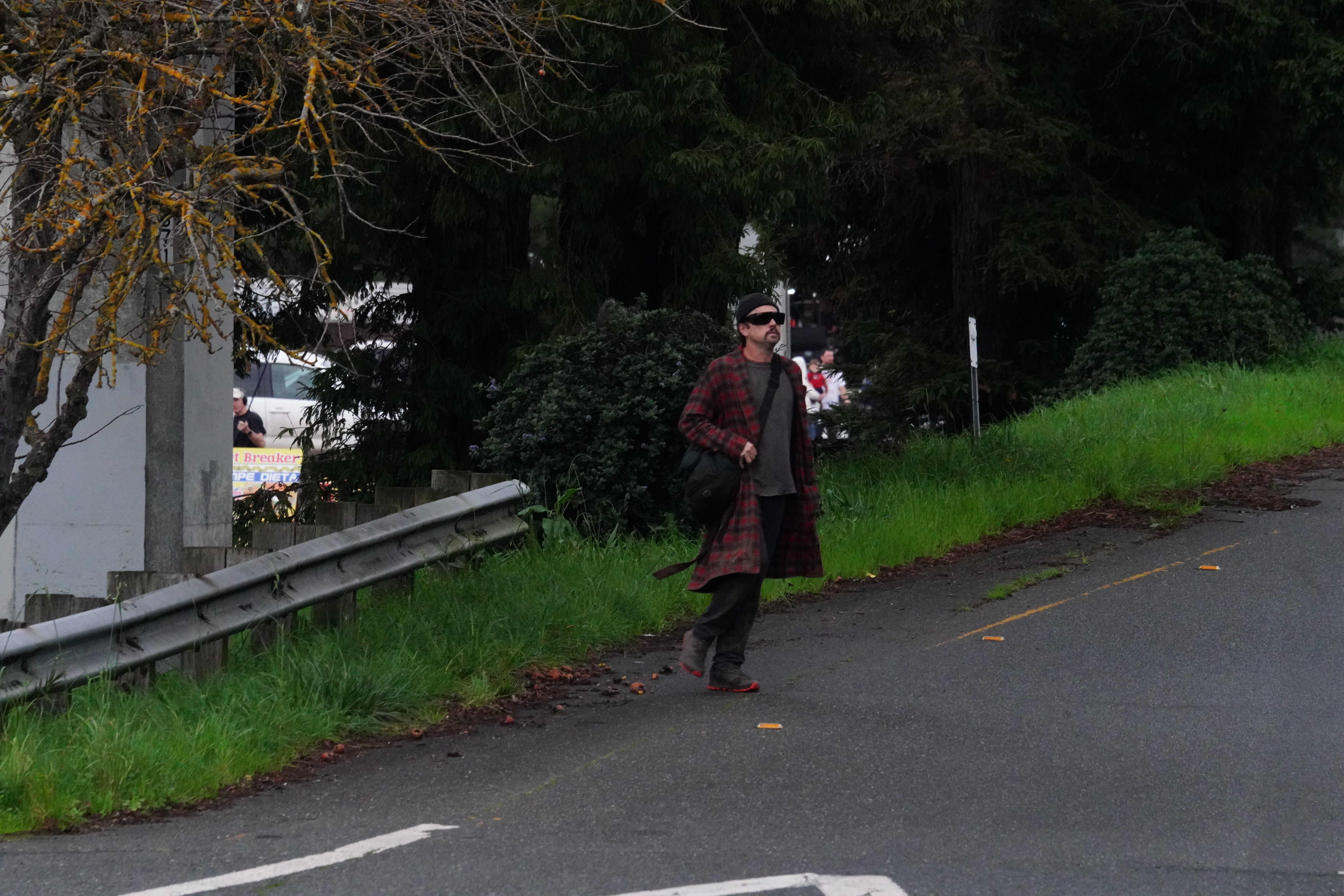
Subject and her friend were walking through the community forest when a male approached them and made a concerning statement regarding doing harm. Unknown if he is associated with campus.
4:20 p.m. – 911 Hang up/ No Response
Two 911 hang ups from two different 911 only phones.
6:17 p.m. – Drug Activity
Subject enroute to address a possible marijuana related incident. Residents are refusing to open the door for the RAs. Negative contraband, handled by housing.
11:35 p.m. – Patrol Check – Creekside Lounge
Subject calling to report hearing a female scream in unknown area of creekside
Friday March 22, 2024
3:36 p.m. – Disturbance – Library
Female in the first floor women’s restroom heard yelling and cussing. She was escorted out of the building and going to take the bus home.
Saturday March 23, 2024
3:16 p.m. – Suspicious Person – Craftsman Mall on St. Louis rd.
Subject wearing a raincoat walking through the property.
Sunday March 24, 2024
2:31 p.m. – Suspicious Person – Craftsman Mall on St. Louis rd.
Report of person walking through property. Only described as wearing a yellow rain jacket.
Monday March 25, 2024
2:46 p.m. – Disturbance – Library
Subject in the lobby filming another member. He is currently sitting at the cafe wearing an orange jacket. Subject contacted and decided to leave the premise for the day.
2:58 p.m. – Public Intoxication – Kinesiology & Athletics on Gymnasium Ln.
Intoxicated subject falling down the stairs. Arrested.
On Oct. 25, 2023, Cal Poly Humboldt sent out an email to the entire student body detailing a list of new parking regulations that were going to be enforced effective immediately. However, none of the new regulations actually pertained to the majority of the on-campus community, but rather to a much smaller and more vulnerable one: the van lifers.
Jan. 11, 2024, Assembly member Corey Jackson introduced bill AB 1818 into the state legislature. If passed, all California State Universities and California Community Colleges would be required, and all UC campuses requested, to allow students that live in their vehicles to park on campus overnight as long as they possess a valid parking pass issued from their institution.
A humble community of vehicle-dwelling college students, the van lifers lived comfortably and peacefully in the parking lots of Cal Poly Humboldt for many years before the university finally decided to crack down on them. After the university claimed that their presence in the parking lots created ‘unsafe and unsanitary conditions,’ the van lifers were forced to leave the campus and look for overnight parking elsewhere.
Caleb Chen, a first-year Cal Poly Humboldt masters student in the public sociology program, was one of the students who were forced to leave. At the time, he was living in his vehicle, and the uncertainty of not knowing where he was going to sleep that night took its toll on him.
“In November, when we all had to move, it scattered us all to different places, and some of us ended up at the Arcata Community Center,” Chen said. “It definitely felt less safe there. It caused a lot of [stress] at the end of the semester that got in the way of schoolwork and the research assistantship that I’d come to this school for. Cops locking the gate to the community center at night meant if I needed to drive off all of a sudden in the middle of the night due to a break-in attempt, I’d be stuck in that parking lot. That wasn’t ever a concern at the school parking lot.”
At the beginning of 2024, Chen’s vehicle broke down. He couldn’t afford to fix it, so he ditched the van life and moved into an apartment with his significant other. Regardless of his new living situation, Chen was still impressed with the opportune timing of AB 1818’s proposal.
“It’s very timely, and whoever introduced it must have had their finger to the pulse, because this isn’t only happening at Cal Poly Humboldt,” Chen said. “It just speaks to the widespreadness of this and the fact that students at Humboldt are really just a drop in the pond, so to speak, of people that are affected by this situation.”
In contrast to Chen, junior Hannah Barrett and sophomore Joshua Tarman left their overpriced one bedroom apartment at the beginning of the new year and moved into a camper together for a more favorable living situation. Barrett is a psychology major, while Tarman attends College of the Redwoods with a focus on early childhood education.
The couple originally planned to park their camper on Cal Poly Humboldt’s campus overnight, but when the Oct. 25 email was sent out they were forced to make other arrangements, including parking in areas of Samoa and Manila Dunes.
“I think that secure parking is something that should be a given for students,” Tarman said. “[Students are] paying to be in an environment where they’re supposed to learn, and so if a school wants to be able to provide all the facets for students to learn, they should definitely have a priority over their safety and their emotions. Students can’t learn when they’re just figuring out how to live in the first place.”
While Barrett and Tarman are doing well enough with their vehicle parked off campus, they would definitely prefer the safety and security of an on-campus parking spot if AB 1818 were to pass.
“I just think that if you’re able to park here overnight with a parking pass, it is a little silly that you just can’t physically be inside your vehicle,” Barrett said. “It’s like at that point, [the university] is just trying to make it more difficult for people, because there’s [nobody] – at least I didn’t see – being unsanitary or dumping anything.”
The unsafe and unsanitary accusations have rubbed many of the van lifers the wrong way, including junior and mechanical engineering major, Derek Beatty.
“That was a smear campaign,” said Beatty. “It was, I guess, the only way that they could find to try to make other students feel like, ‘Oh I guess that’s why they’re getting kicked out.’ It was like they needed to give some reason so that there wasn’t as much outrage, but obviously, I don’t think many people believed those claims, and I think that even made people a little more upset on our behalf. But yeah… it’s kinda bullshit that they said that and then didn’t have any evidence to back it up other than a picture of a rainwater collection bucket.”
The Lumberjacks request for complaints against van life students resulted in a total of two back-to-back complaints made by two anonymous people. Otherwise, no complaints were found.
Beatty is hopeful that AB 1818 will pass soon, so that he and others can park on campus again. He misses the safety net and the sense of community that on-campus parking provided for the van lifers, and having to park off-campus every night has taken that away.
One of the primary benefits of on-campus overnight parking is consistency. Having a dependable place to call home, even if it’s just a place to park a van or camper, can make all the difference in the world to the van lifers, one of Cal Poly Humboldt’s most at-risk communities.
“I spend all my time in this same parking spot,” Beatty said. “It’s just now for some reason I have to not be here from 10:00 p.m. to 7:00 a.m., when I could just stay parked here, not have to move all the time, and just have a consistent spot.”
Carrie White, a Cal Poly Humboldt senior and biology major, lived on campus in her camper starting in 2021, but it recently broke down and has been stuck at a mechanic shop for several weeks. Since then, White’s living situation has been volatile, sleeping sometimes with friends, and at other times on the floor at one of her places of work. She hopes that AB 1818 will pass, to give low-income, displaced, immigrant students like herself a safe and secure location for alternative living.
“I think that passing the California Assembly Bill AB 1818 is the bare minimum a multi-million dollar institution affiliated with the CSU organization owes to its students,” White said. “In general, folks living in their vehicles are amongst the most vulnerable students. We know from thousands of studies that homelessness is a risk factor for mental and physical health pathologies, increased loneliness and isolation, decreased academic performance, decreased quality of life, and suicide. Passing a bill allowing homeless students to stay on-campus, in their vehicles, with a valid permit shouldn’t be a discussion – it should be a glaringly obvious choice. This is a social crisis, a public health crisis, a humanitarian crisis – and it is here, on our campus.”
Student homelessness is a problem that plagues practically every college campus in California, and Cal Poly Humboldt is no exception. Cal Poly Humboldt students are still prohibited from sleeping in their vehicles on campus, but if AB 1818 passes, they can come back and the van life community can rebuild in a safe environment.
“I felt safer staying on-campus up until I was forced to leave,” White said. “In the act that I believe was an attempt to shame homeless students off campus – cue gross Cal Poly Humboldt email accusing homeless students of being ‘unsafe and unsanitary’ – the trust I have in this institution is null and void. Having said this, I would absolutely move back to campus if Bill AB 1818 passed; proud, in a state of activism, and don’t worry – safe and most definitely sanitary.”
California’s Division of Boating and Waterways (DBW) alleges that Cal Poly Humboldt has been misusing the Humboldt Bay Aquatic Center (HBAC) for its scenic views and now swanky administrative office space – thanks to a recent $412,000 renovation. The university is not, the breach of contract notice charges, fulfilling its commitment to boating instruction and safety training.
“[Cal Poly Humboldt] is not using the [HBAC] for the purposes for which the building was funded, or for which the property was leased from the city and approved by the state lands commission,” stated a notice of breach of contract notice sent to Cal Poly Humboldt President Tom Jackson Jr. in Dec. 2023. The notice outlined the key problem – that without notice nor written approval, which is required by the operating agreement, Cal Poly Humboldt transformed boater-funded classrooms, offices and storage spaces into alumni fundraising offices, private club rowing, storage of private club vessels and support for private university fundraising activities.
In understanding the breach of contract, it is helpful to recognize the complex web of involvement at the HBAC between the city of Eureka, the state of California and Cal Poly Humboldt. In summary, the Department of Boating and Waterways put forth $4.067 million to fund the construction of the facility, as well as $702,000 since 2003 to offset the costs of the university’s ongoing boating instruction and safety training. Cal Poly Humboldt leases the land the facility sits upon from the city of Eureka. Though the HBAC is fully owned and operated by the university, an operating agreement between the DBW and the university, as well as a lease agreement between Eureka and the university, outline specific guidelines for the expected uses of the facility, many of which have not been fulfilled by the university, according to DBW.
This room, formerly storage space, is one of the rooms that have been converted and expanded to create office space for Center Activities.
The operating agreement was signed in 2003 and it expires in 2028. While uses of the HBAC have consistently evolved, the university’s costly renovation to create office space for top administrators conflicts with the contracted uses of the HBAC, according to the breach of contract notice. Section 5 of the operating agreement states that the university shall operate the HBAC as a boating instruction and safety center, providing two key functions: (1) boating and water safety instruction for the general public as well as university students, faculty and staff and (2) recreational services, provided that it does not interfere with the boating and waterway safety instruction courses.
Furthermore, the operating agreement states that any material alterations or improvements to the Humboldt Bay Aquatic Center must have the prior written approval from DBW. The university did not obtain written approval for changes made at the HBAC, however the university did mention the Advancement Division’s move to the Eureka waterfront property on at least two occasions, according to DBW. First, in March 2022, the university told DBW that university fundraising teams had temporarily moved into the HBAC conference rooms, due to the pandemic. In September 2022, the university informed DBW that cubicles had been moved into the second floor classrooms of the HBAC for the Alumni Relations department, while the extended education program, OLLI, had been moved to campus. The DBW alleges that Cal Poly Humboldt has denied their recent request to inspect the building. DBW’s last inspection of the HBAC occurred on Aug. 15, 2018.
Additionally, the breach of contract notice highlighted the university’s failure to share copies of financial records showing investments and modifications to the HBAC. These records were requested on Sept. 20, 2022 during a conference call with Frank Whitlatch, Cooper Jones, and Tim Downs, according to the DBW. The records had still not been shared with DBW at the time of mailing the breach of contract notice on Dec. 19, 2023. Frank Whitlatch, vice president & executive director of the University Foundation, did not respond to an interview request.
Cal Poly Humboldt’s Response
On Feb. 8, Cal Poly Humboldt sent the requested financial records as well as a letter written by Nick Pettit, executive director of athletics and campus recreation, which directly responded to many of the issues raised by the DBW.
“While DBW claims that the University provides ‘negligible [HBAC]-offered public access and boating services,’ the numbers and the facts show otherwise,” Pettit said in his response.
Cal Poly Humboldt shared multiple Aquatic Center Grants Annual Report’s showing the tally of individuals who had enrolled in HBAC provided boating safety courses: 2020 (124 individuals), 2021 (70 individuals), 2022 (800 individuals), and 2023 (465 individuals).
In contrast, DBW’s investigation displayed a lack of courses available to the general public.
“As of Dec. 2023, the Department of Boating and Waterways’ internet searches did not reveal that courses were, or had been, available to the general public,” Adeline Yee, information officer for California State Parks, said. “Aquatic Center annual reports informed DBW that some private groups, school groups, and non-profit groups used the docks and outdoor areas of the HBAC for boating classes during that time frame.”
During DBW’s Feb. 1 search for current courses offered to students and the general public, they found that the five sailing courses are currently being offered by the HBAC, with a max capacity of 26 students between the five courses.
For context, DBW highlighted that a similar DBW investment, Sacramento State University’s Aquatic Center at Lake Natoma, teaches approximately 6,600 students annually.
In response, the university noted the higher enrollment at Sacramento State as well as the larger population of Sacramento County.
Aileen Yoo, Director of News and Information for Cal Poly Humboldt, confirmed that boating and outdoor programs have seen a slight decrease in participation in the 2023-24 academic year.
Pettit noted that the university has spent over $44,000 on student staffing since July 2021 for equipment rentals, while only bringing in $20,801 in revenue. More broadly, the university disagreed with DBW’s interpretation of the operating guidelines.
“To the extent DBW asserts that the agreement requires that the University exclusivelyuse the HBAC for those activities, the agreement has no such language. While it provides that the ‘University shall operate the PROJECT as a Boating Instruction and Safety Center,’ this does not mean that the University cannot utilize portions of the HBAC for other University purposes,” Pettit said in his response.
If anything can be agreed upon in the chaos, it is that the university has indeed used the HBAC for a plethora of uses over the last two decades. Eureka City Manager Miles Slattery said that the HBAC had previously taught classes in everything from home economics to cooking when the non-profit University Center managed the facility (currently, the HBAC is managed by Cal Poly Humboldt).
“[When] the University Center ran it, I would venture to say that there was an equal amount of non-complying uses, if not more,” Slattery said. “I think that somebody could have previously made the same accusations.”
Acknowledging that the catalyst for the breach of contract notice appeared to be the university Advancement Division’s move to the HBAC, Pettit emphasized that this move had not negatively affected boating and waterway safety instruction.
Advancement Division moves into the HBAC
The Advancement Division now uses 1,906 square feet of cubicle space, two waterfront offices and a renovated 606 square foot first-floor lobby in the HBAC, according to construction documents obtained through public record requests. The university spent $80,849 on furniture and supplies for the new office spaces created for the Advancement Division, including $11,076 on new chairs. The first-floor, waterfront office previously used by Center Activities is now occupied by Stephanie Lane, executive director of Alumni Relations. Lane did not respond to an interview request. An existing storage room on the first floor was modified and expanded to create a new office for Center Activities.
On five separate visits to the HBAC by a Lumberjack reporter, access was never given to the modifications made to the second floor to accommodate the university Advancement Division. More importantly, no representatives from Center Activities were present during any of these five visits to the HBAC. To schedule a viewing of the new office spaces on the second floor, Lane advised contacting Travis Flemming, director of Facilities Management. Neither Flemming nor Building & Program Coordinator Danielle Muniz responded to a request for an interview. Likewise, none of the 20 Advancement Division employees contacted for an interview granted one.
Pettit’s response to DBW concluded by stating that the university is open to an inspection of the HBAC, but emphasized that advanced notice and the presence of representatives from both parties was crucial. Pettit was contacted for an interview, but deferred to the university News and Information department for answers.
The breach of contract notice gives the university 90 days, until March 29, to remedy the noted breaches.
“The DBW looks forward to the HBAC being restored to a public access resource and the purposes for which it was constructed and the revitalization of a vibrant publicly accessible boating education program that stimulates boating recreation and safety in the north coast region,” Yee said in an email.
On a drizzly, cold Humboldt day, Madelyn Vink was getting ready for a first date. With her hair in two braids, she picked some jasmine flowers and placed them in the pleats. She remembers looking down and seeing them still in place when she woke up in the hospital hours later, with blood soaking the flowers.
On Sept. 1, 2023, Vink, a religious studies major with an art history minor, was in the crosswalk at the intersection of Harpst and Rossow St. when she and her date were struck by a vehicle.
“I had a crush on this guy, so we decided to meet up on campus as the seemingly safe place to go on a date,” Vink said. “We were just planning to go on a walk, because I thought that would be better than unsafe sex. Turns out that was wrong.”
They met outside of College Creek Marketplace, where Vink parked her bike. From there, they began their date. The first part went well, with them taking a stroll in the community forest. Later, Vink decided she was ready to go home, and together they planned to walk back to her bike. When they crossed the street, Vink and her companion were both hit by an oncoming car.
“The date was very fun at first,” Vink said. “Then, when I was going to get my bike, in the crosswalk in front of [the] Marketplace, we were both hit. I took most of the damage, having flown 22 feet. I suffered what is known as a traumatic brain injury.”
After being transported from three different medical centers, Vink ended up at UCSF where she received life saving treatment. For several months, Vink was in intensive care fighting for her life. However, she fought through and is now back in school. Some of her family has since moved up from their home in Turlock to Humboldt county to support her in her recovery.
Vink, who chose her major to make sense of the world both spiritually and practically, is considering enrolling at Cal Poly Humboldt. She is taking the summer to decide if she wants to continue her education here.
“I would’ve graduated this summer,” Vink said. “Given my injuries, it’s going to take another year at least.”
Despite the traumatic event, Vink is still as hopeful as ever. While the accident may have taken time out of her life, she refuses to allow it to take anymore.
“I’m going ok, everyday is a struggle, but I am so happy to be alive,” Vink said. “Most people that suffer my kinds of injuries don’t make it, or they are in a wheelchair the rest of their lives. I got lucky somehow.”
The lesson Vink wants people to take away from this horrific accident is to be more careful when behind the wheel.
“I’d like to encourage people to take more caution when driving, especially on campus,” Vink said. “All could’ve been prevented if care was taken while driving. Instead I got five of the hardest months of my life. So, please be careful.”
Besides that, Vink wants to remind people to live authentically. This experience has taught her to appreciate those around you and the life you live.
“Live the life you want to!” Vink said. “Life really is special, and equally fragile. There’s no time to waste. I want people to be happy. Life is a gift. Keep fighting in school and dancing in life. Love is everywhere, even in your darkest moments.”
If you vote yes on Measure A, you support changing local regulations for cannabis cultivation. The proposed measure limits the number, type, and acreage of permits available for cultivation of marijuana on a commercial basis. Measure A will also introduce many new rules and regulations, such as those surrounding water storage and generators. Opponents fear that these new rules will hamstring local growers. A no vote would oppose changing local regulations for growing marijuana.
Proponents say that the goals of the measure are to prevent large-scale grows that harm the environment, ensure greater participation and official accountability in decision-making, and make sure that existing farms are regularly inspected and compliance-verified. Along with these new standards, they are encouraging small, high-quality cannabis cultivation, water storage, and solar arrays, while limiting the use of generators. Proponents seem to focus a lot on goals, but not how to reach them.
Opponents of the measure claim that it evades public process. Due to stipulations incorporated into the measure, it would make it hard to amend if codified into law. Opponents also claim that it benefits large corporate growers at the expense of small-scale farmers. They say most of the provisions in the measure would hamstring small growers and wouldn’t support or incentivize small-scale marijuana growth, and would simply add more restrictions and red tape for new or already established growers. Opponents say that the legal cannabis industry is already well-regulated.
1:06 p.m. Welfare Check – First Floor Library Computer Lab
White male in his 40s with scruffy hair and tan baseball cap, red in the face and rocking back and forth, non-responsive to staff approaching him. He left on arrival of the officers.
8:04 p.m. – Investigation at JGC
Subject believes someone placed an Apple Airtag on her vehicle and is requesting contact.
11:42 p.m. – Patrol Check Kinesiology Building
4 skateboarders at the student recreation center advised of school policy on grinding and tricks. Subjects moved along.
Tuesday, Feb 20, 2024
08:36 a.m. – Vandalism – Humboldt Bay Aquatic Center
Rowing coach advised via email someone has been untying and tampering with the boats at night.
3:52 p.m. – Drug Activity- Alder Hall
Officers requested to pick up a bong. No marijuana present or resident on scene.
11:01 p.m. – Investigation at Mendocino Residence Halls
Subject called to report a possible missing person.
Wednesday, Feb 21, 2024
1:03 p.m. – Suspicious Circumstances – Kinesiology and Athletics Building
Subject’s car was tagged with #13 on the side mirror with a sharpie. She was able to remove it, but is concerned it may be a marking for someone targeting vehicles or people. She was parked off-campus on 16th and Spring St., but requested documentation in case there are other victims.
5:42 p.m. – Alder Hall – Grand Theft
Subject reported their bike was taken from the bike rack between Alder and Chinquapin.
7:41 p.m. – Vandalism – 2nd Floor Library
Custodial staff reported vandalism in the women’s handicap stall.
Thursday, Feb. 22, 2024
10:16 p.m. – Drug Activity – Chinquapin Residence Halls
RA requested the officer for drug paraphernalia.
Friday, February 23, 2024
11:09 a.m. – Vandalism – Kinesiology and Athletics Building
Eternal Heart graffiti found on the stairwell in the Kinesiology building.
2:53 p.m. – Suspicious Circumstances – 14th Street and Union
Subject reported male is on top of a moving vehicle. APD was contacted as vehicle was located off-campus.
5:15 p.m. – Misc. Parking Problem – Sunset Residence Hall
The Residence Life Coordinator requested the officer to respond to the garden area for a motorcycle and small jug of gasoline locked to the bike rack. Handled by housing.
Monday, Feb 26, 2024
2:45 p.m. – Fire Alarm – Mendocino Residence Hall
Fire Alarm [went off] as a result of burnt food. False Alarm.
5:03 p.m. – Welfare Check – Trinity Residence Hall
Mother of a student received a call at [3 p.m.] stating her daughter had been kidnapped and they were threatening to kill her if the mother didn’t send money. The daughter was contacted and the call appears to be fraudulent. Subject contacted her mother.
8:19 p.m. – Welfare Check – Plaza Circle
Subject called to report a 30-year-old white male in a bright blue sweatshirt acting erratically.
The 2024-2025 Free Application for Federal Student Aid (FAFSA) soft-launched in late December of 2023. The application has gone through some changes compared to previous years’ applications. The type and amount of questions will vary based on each student’s circumstances. The FAFSA website has not set a deadline for when the form will close, but mentions that the first round of applications will likely be sent out to universities through the middle of March 2024.
Cal Poly Humboldt’s financial aid office says the anticipated due date for FAFSA applications is April 2 but they recommend students fill out the application before March 2 to be eligible for Cal Grants and the Middle Class Scholarship Award. From their understanding, student’s won’t be able to go back into their FAFSA form and make corrections until mid March. The financial aid office urges students to complete the form before March 2 to give them the most time to work with students on the form if complications arise.
The scholarship application for Cal Poly Humboldt is also currently available until March 4, although some scholarships may have extended deadlines.
The financial aid office is located in the Student Business Services and open on weekdays for in person assistance from 9 a.m. to 4 p.m., and their phone line is available from 8 a.m. to 5 p.m. They have also implemented after-hour assistance twice a month through Zoom. The next dates are March 4 and March 20 from 3-6 p.m.
At face value, Proposition 1 amends the Mental Health Services Act to offer more behavioral health services. This requires authorizing $6.38 billion in bonds. Meaning that the state sells this amount in bonds, which is how the government borrows money and repays it, plus interest over time. According to the Legislative Analyst’s Office, it would increase state costs to repay bonds, amounting to $310 million annually for 30 years. This also means that an annual $140 million of existing tax revenue for mental health, alcohol, and drug rehabilitation shifts from counties to the state government.
So what will Prop. 1 do? If voted in, it will make counties’ mental health care and substance use treatment services more focused on housing and personalized support. The money could go to building more facilities and housing for people with mental health, drug, or alcohol issues. If it’s not voted in, nothing will change.
Arguments for Prop. 1 emphasize the importance of finding solutions to the homelessness, mental health, and addiction crises, and Prop. 1 may be a step in the right direction. Arguments against Prop. 1 point out that the proposition is expensive and this is not the time for more government debt. It may also take away funding from current community-based mental health services funded by the Mental Health Services Act, taking almost a third of the annual funding dedicated by the act.
According to the California Voter guide, those in favor of Proposition 1 include California Professional Firefighters, CA Assoc. of Veteran Service Agencies, and National Alliance on Mental Illness–Ca. Those opposing Prop. 1 include Mental Health America of California, Howard Jarvis Taxpayers Association, and CalVoices.
Voting day is March 5. To register to vote, visit registertovote.ca.gov/
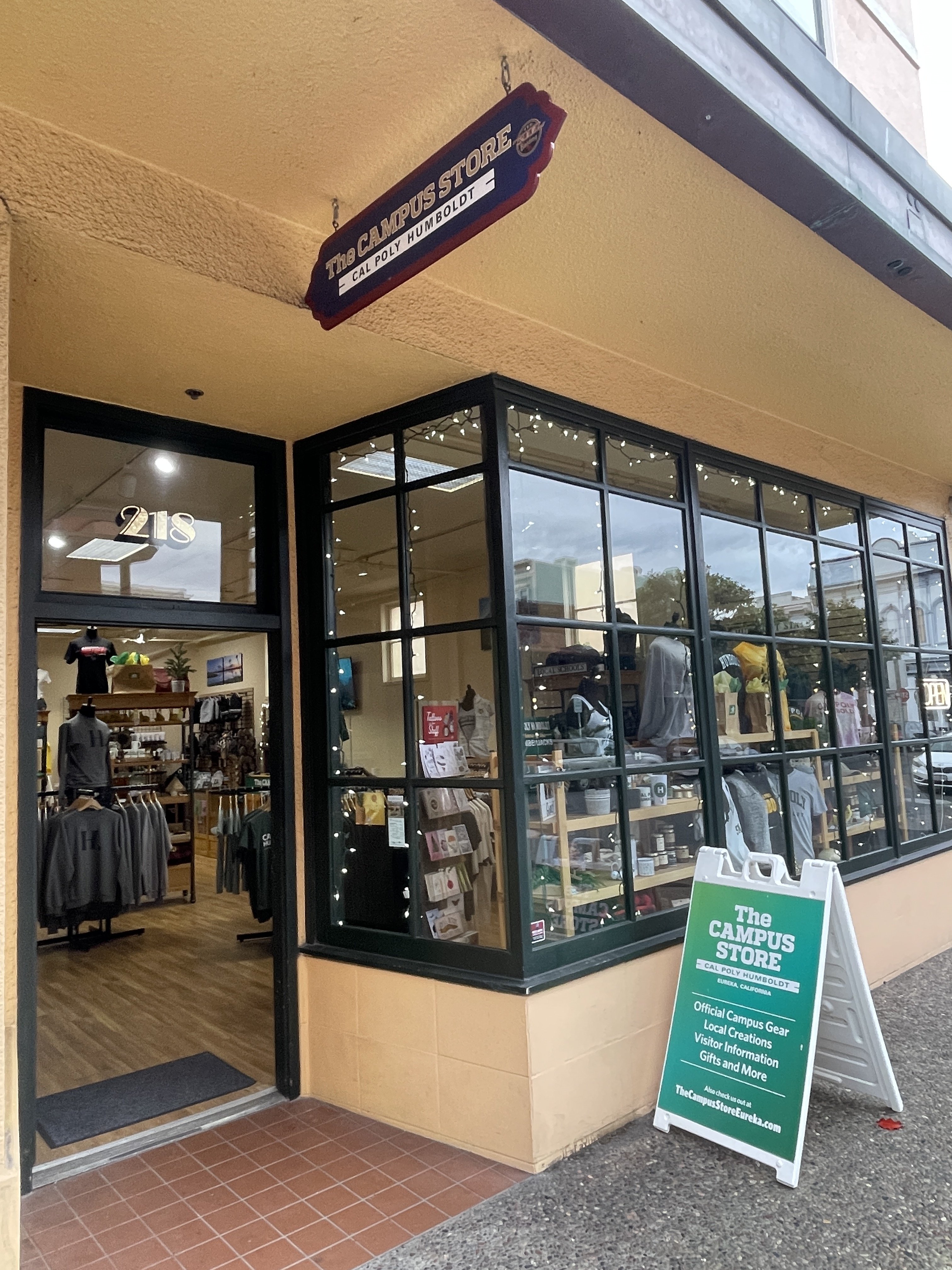
Since opening November of 2021, The Campus Store, Eureka’s revenue stands at $188,596, with expenses totalling $289,936, equating to $101,367 in losses during its first 25 months in operation. The storefront boasts prime location in Eureka’s Old Town and was opened with the aim of increasing the university’s presence in Eureka. Despite consistent financial losses, the university remains steadfast about the importance of the Eureka store for community engagement and accessibility.
Although sharing a name with The Campus Store, Arcata, the Eureka location is different in many foundational ways. Whereas the Arcata building space is owned by the Cal Poly Humboldt Foundation, the Eureka location is leased by Cal Poly Humboldt for $2,000 a month. This $2,000 per month excludes utilities, trash services, maintenance, taxes, permit, inspections and license fees, according to the building lease agreement obtained through public record request. While the Arcata location is operated by Follet, a nationwide store operator for colleges, the Eureka location is operated by Humboldt Outfitters, a locally owned company.
“They are able to bring in their own approved designs, which may be different than the Arcata Campus Store. They also bring in some of their successful products they feature in their Arcata store,” said Grant Scott-Goforth, communications specialist for Cal Poly Humboldt.
The deal with Humboldt outfitters arose from a request for proposal (RFP) put out by the University due to the fact that the Eureka location was too small to be operated by Follet, according to Scott-Goforth. Humboldt Outfitters was selected because of their success with their Arcata store, and their local screen printing and engraving capabilities.
David Neyra, owner of Humboldt Outfitters, deferred to university marketing and communications when asked for an interview. In his email response, Neyra copy and pasted questions and answers which had been asked directly to marketing and communications regarding the university’s perspective on operations at the store.
The Eureka location layout also differs substantially from the Arcata storefront. In Eureka, sections of the store are reserved for local school merchandise in addition to offering Arcata, CA and Humboldt County branded clothing items. Additionally, an entire corner of the store is reserved for non-university affiliated trinkets like cutting boards, cutlery, and toiletry items. The store also features Humboldt State branded gear, which is important to the vast majority of current Alumni who studied at the then named Humboldt State University.
At the Old Town store, Cal Poly Humboldt branded gear costs $89.99 for a zip-up fleece sweater, $69.99 for a plaid blanket with a white ‘H.,’ a pullover hoodie for $49.99, and $49.00 for a polo. However, the gear is name-brand. Nike, Holloway, and Port Authority all make items sold by the store.
Unprofitable since opening, The Campus Store, Eureka has run an average deficit of $4,055 a month for the 25 month period between Nov. 2021 to Dec. 2023. In spite of this, the university sees the store as a success in its main objectives of providing visibility and accessibility, expanding the relationship with the city of Eureka, and expanding logo wear offerings, according to Scott-Goforth. Naturally, running a consistent deficit is not ideal for any business, no matter how large the financial backing. This has led to the university’s constant changes to the store’s merchandise and marketing in an effort to attract more customers.
“The Campus Store, Eureka continues to optimize its inventory selection and online ordering, along with social media marketing to increase sales,” Scott-Goforth said.
The university’s Senior Director for Enterprise Services Todd Larsen, who oversees the Campus Stores, deferred an interview request to university marketing and communications. President Tom Jackson Jr., who was credited by Frank Whitlatch in his letter to the editor on Nov. 29, 2023 with the achievement of opening the Campus Stores, did not respond to an interview request.
From the city of Eureka’s perspective, the store is nothing but a major positive. City Manager Miles Slattery emphasized that any and all presence of the university in Eureka is hugely beneficial – and not only from an economic standpoint.
“It’s even more beneficial from a social standpoint of bringing in a younger and especially more diverse community to our area,” Slattery said. “Our emphasis in economic development has been working on BIPOC owned businesses, trying to expand on that and provide opportunities for folks to open up businesses. Having that population of folks in our Eureka commercial district is nothing but beneficial and expands the diversity of our businesses.”
For many students with dozens of responsibilities, doing their own taxes is byzantine, boring, and back-breaking. Though doing taxes is famously painful, there are resources to help.
The student tax clinic is open to almost all students and community members who make less than $70,000 a year. It’s free and staffed by accounting students. Book an appointment through their website, found through Humboldt’s School of Business website, which operates on Wednesday evenings in Siemens Hall.
International students filing international tax forms are not eligible for the clinic’s help, though Instructor of Record for the clinic Joshua Zender, said the clinic will help international students if they are filing domestic returns.
The clinic’s scope is limited to processing tax documents students provide, using the IRS-supplied TaxSlayer software, and then sending those returns to the IRS. Anyone seeking tax advice or anything more complicated should use a qualified accountant. But just because what the clinic can do is limited doesn’t mean people can’t benefit immensely.
“Oftentimes, we find that people we’re serving are simply not aware that they’re eligible for, maybe, a renter’s tax credit, or they’re eligible for a special tax credit because they happen to be going to college right now,” Zender said. “That’s always a really rewarding experience, to see somebody’s face light up and think, ‘Oh, well, I’m actually gonna get money back from the government that I didn’t know I was eligible for.’”
Another tax credit that’s worth looking into is the Earned Income Tax Credit (EITC), which Zender said some students qualify for. It’s open to low and moderate-income workers.
If someone earned less than $13,850 for the 2023 tax year, they can file and get all of their federal income taxes returned.
The students working at the clinic also benefit from helping people with their taxes. They get a $1,500 stipend provided by the Smullin foundation, an Oregon-based grant-giving organization, as well as a lot of experience.
“The main [benefits] are becoming proficient and more confident in using tax software to prepare a tax return,” Zeller said. “For accounting students, they’re looking for real world experience doing their field. But a second [reason] is establishing an ethos, or a commitment to serve a community, and in particular an underserved community, and so developing the skills to communicate and help and empower people who need assistance with their tax return is a really important skill to be developed from this experience as well.”
Student David Mata is an accounting student who has worked for the clinic for two years. He started doing tax returns six years ago at H&R Block and enjoys the people he gets to meet.
“You get to see people you don’t get to see,” Mata said. “I haven’t done much community stuff. This gives me a perspective on being a part of this community.”
Daniel Taylor, another accounting student in his second year on staff, agreed with Mata. He said the experience he got from working there was invaluable–and the stipend is good too.
“It’s nice to help people,” Taylor said. “Everyone loves free taxes.”
Cal Poly Humboldt may be faced with an $8 million budget deficit in the 2024-2025 school year.
At an Associated Students meeting on Feb. 9, Provost Jenn Capps and University Budget Office Director Amber Blakeslee gave a presentation on the university’s estimated budget and how they plan to address it.
Beyond Cal Poly Humboldt, the entire CSU system is faced with budget constraints. Each year, the state governor puts out a proposed budget for the CSU system. After months of discussion and advocacy, the governor publishes a revised budget in May, which is then finalized in June. Currently, the 2024-2025 proposed budget for California projects a $38 billion deficit. CSU campuses get most of their funds from the state budget and funds are distributed based on enrollment.
However, the governor and the CSU system have an agreement where their portion of state funding will increase by 5% every year, provided that the campuses continue meeting their student success outcomes. Because of the current deficit California is facing, the planned $240 million base increase will be delayed by a year and paid back retroactively. There is a chance that funding won’t be available for the 2025-2026 school year, so the CSU system is trying to redivide its funding among over-enrolled and under-enrolled schools.
“The system is sort of reshuffling, so for campuses that were under-enrolled, [that means] reducing the targets, which means reducing funding and shifting that to campuses that are above target,” Blakeslee said. “And so for our campus, we’re going to have our target reduced by 3% next year, which means 3% of the funding will pull back as well, so it’s about a $2 million impact to our campus that we need to navigate as part of budget planning.”
While the university’s revenue is increasing, expenses are increasing at a faster rate. For the 2024-2025 school year, the university is expecting funding from the state, the 6% tuition increase, enrollment, and California Polytechnic funding, totaling at $170 million. The deficit from compensation and benefits, financial aid, and other costs are estimated to reach $178 million.
Blakeslee described how budget planning for the campus looks at three different scenarios for enrollment, including a baseline scenario, the best case scenario, and worst case scenario. The baseline enrollment increase projected for next year is 2.6%.
“As a campus, we’re actively working toward ambitious growth,” Blakeslee said. “From a budget standpoint, we are conservatively planning but watching closely because we want to make sure that we are proactively supporting and growing capacity where needed as we realize the growth, but we also don’t want to spend it before it happens.”
Carla Ho’ā, the interim Chief Financial Officer and Vice President of Finance and Administration, emphasized the university’s priority being the student population and minimizing negative effects when making budget cuts.
“Financial resiliency is another aspect of this,” Ho’ā said. “It can be tempting at times to make short-term decisions that have long-term, and sometimes negative, consequences. [We’re] really needing to be thoughtful and looking out into the future and about the financial resiliency of the university for the long-term, like having sustainable decisions built into the process.”
When deciding where to allocate funds for Academic Affairs, Capps collaborates with the department heads of the colleges, the library dean, and other areas to share strategies and distribute funding. She said that the university hopes to provide more opportunities for student collaboration in the future.
“What has been asked in a lot of different spaces is, ‘Hey folks, could you share with the campus community what ideas you generate, what potential opportunities you might be going after, before you actually do it?’” Capps said. “So that you all know what we’re considering, what we’re thinking about, and potentially have a shot to weigh in.”
Capps also said that the University Resources and Planning Committee – a part of the University Senate with representatives from faculty, staff administration and students – is hoping to hold a public forum at least once a semester. The URPC has two seats reserved for student representation and is responsible for drafting a budget proposal for the university president.
The URPC budget recommendation will be finalized next April. The presentation encouraged students to provide input and engage with AS, administration, and other representative student communities. Several positions in AS are currently open, such as Environmental Sustainability Officer, Public Relations Officer, and college representatives. Elections for AS will be made public on March 6. For more information on the university budget and upcoming elections, you can visit the URPC and AS websites.
Shannon Rhodes already had a passion for fashion and makeup before delving into Humboldt’s drag scene. After attending several drag shows dressed to impress, Rhodes ran into drag artists Val de Flores and Sharon Taterz who offered them the opportunity to start booking their own performances. In May of 2023, Rhodes debuted as Killpop at the Septentrio Winery.
“I kind of blackout when I’m performing, because it’s very short,” Rhodes said. “It’s just like, three to four minutes. The energy—it’s addicting. The crowds are amazing. It’s awesome getting to perform in front of a fully queer space, where everybody’s there just to see you and support you and be positive. All the other girls, they’re super fun to hang out with.”
Killpop’s friend Seraphim Nagel joins their performance at the Septentrio Winery. Photo courtesy of Makayla Kuhnke.
Despite being a small county, Humboldt has a thriving drag community. Every member’s introduction to drag and their personal relationship to the art form is unique. Additionally, every drag artist’s reason for performing is different and reflective of their life experiences.
Paul Michael Leonardo Atienza, an assistant professor of Critical Race and Gender Studies at Cal Poly Humboldt, has been doing drag performances for 20 years. They began to explore their gender expression after attending an LGBT campus retreat during their senior year at UC Riverside.
“We were processing trauma in our lives, and what came out for me was how I was shamed as a child of my gender expression, and particularly feminine gender expression,” Atienza said. “Many of us were figuring out, ‘Well, how do we work to strengthen and remove less of the stigma that we learn?’”
Atienza took on the identity of Maria Arte Susya Purisima Tolentino during their drag performances. Ma Arte drifts between being an extension of Atienza and a separate persona, but Atienza considers her to be a creative collaborator. Together, Atienza and Ma Arte have collaborated with drag artists and members of the queer community across the world.
Lawrence Fobes King, a queer middle schooler from Ventura, California, was murdered in 2008 by a classmate. This tragedy moved Atienza to use drag as a form of protest by bringing awareness of injustices against the queer community.
“At that time, [drag] was still quite small, but people were really into watching drag, and a lot of the drag at that time also was lip synching to popular music,” Atienza said. “And I was like, ‘Well, if you have this audience, what can you do to also add more social issues to it?’ And with the murder of Larry King, I tried to pair a song and created a performance in honor of his struggle and his memory.”
Drag also offers a secure support system to queer people and an opportunity to share queer joy. Joel Costello, who performs as Feral Fawcett, found his inspiration in popular drag queens like Trixie Mattell and Bob the Drag Queen. Performing since March of 2023, Costello found that Feral Fawcett had a positive impact on a wide range of community members.
“This mom asked if she could take a picture of us because her daughter was in grade school and was getting bullied for being gay,” Costello said. “There was a lot of drama against drag queens happening at the time, so that felt really good… it reminds me that there’s more to it than just being silly and collecting the bills.”
Feral Fawcett also provided Costello a space to explore feminine gender expression.
“I feel like she is a representation over the feminine side of myself, which is something that before I used to try to squash down,” Costello said. “I came from a hometown that was not very pro-LGBT, so I always tried to be like the manly gay guy. It was nice to have a release… I like blending my masculine and feminine side into one thing.”
Through drag, Rhodes has been able to gain confidence in their artistic skills and their body.
Thrash and Recycling (left), Gliterous Cliterous (middle), and Killpop (right) pose together at the Septentrio Winery. Photo courtesy of Makayla Kuhnke.
“I feel like my confidence was taking a hit for a while – you know, my body was changing,” Rhodes said. “That also means my favorite clothes that I like to wear don’t fit, I got to figure out new styles, new clothes. Having people just be like, ‘Damn, bro,’ and seeing photos of myself looking good performing in the body that I have is just like, ‘Alright, I guess your ass is kind of fat.’ The crowd really just shows you like, ‘I am cool. I’m doing this because I got so many awesome qualities to me.’”
Drag expects a lot out of its performers, both mentally and physically.
“What people don’t realize — until they maybe watch [RuPaul’s] Drag Race or something — drag queens have to be a comedian, a dancer, a seamstress, a hairdresser, a makeup artist, like your own manager,” Rhodes said. “You do everything for that performance. Even some are singers. You have to be so many things as a drag queen, and I think it’s a really pure form of art because you’re doing it all.”
Drag artists have a lot to carry on their shoulders, including the stigma and lack of education around drag.
In 2023, Tennessee legislators passed the Adult Entertainment Act, meant to prohibit adult cabaret entertainment on public property, including, “male or female impersonators.” The act’s broad language allowed law enforcement to potentially prosecute drag artists and trans people. After Tennessee, anti-drag bills have been introduced in at least 14 other states. Many conservative legislators have used concern for the safety of minors to pass anti-drag laws and censor openly queer expressions.
“A lot of people think it’s a super sexual thing and that it’s like a fetish,” Costillo said. “Most drag performers I know have a very distinct separation between the two.”
People of many different gender identities do drag, but their gender identities are separate from their identity when in drag.
“In general, people conflate gender expression, gender performance, [and] gender identity with sexual orientation, sexual behavior and practice. And all of those are separate,” Atienza said. “People who are drag performers are of all gender expressions and sexual orientations. I think that’s one thing that we need to challenge not just in drag, but in understanding gendered and sexual lives. We’re bodies that have different ways of feeling [and] expressing themselves and society has put us in specific boxes.”
Despite the adversities the drag community faces in the U.S. and the rest of the world, drag artists have been thriving in Humboldt County. The definition of drag is constantly changing and growing. Members of Humboldt’s queer community from all backgrounds have been able to find a safe haven in drag, allowing them to heal from trauma and play with gender performance.
“I do believe RuPaul in saying that we’re born naked, and the rest is drag, right?” Atienza said. “Drag is really a way to demonstrate the constructiveness of gender and how there’s so many possibilities out there. Drag to me is not just on stage, with queens and kings and in-betweens. Drag is every day.”
Hollywood has made its way into the Humboldt scene and Cal Poly Humboldt students are getting in on the action.
The filming of a new movie, dubbed “BC Project,” occurred right across the freeway from Cal Poly Humboldt. Directed by Paul Thomas Anderson and ushering in other big names like Leonardo Dicaprio, Regina Hall and Maya Rudolph, this film has gained tons of traction among local residents.
Among the crowds of bystanders who gathered to watch the filming take place on G street in Arcata, students reflected on their major film debut. Days prior, students were cast as extras for select scenes.
Jasmyn Lemus, a sociology major, signed up for the casting call reluctantly.
“I saw a casting call and it was [requesting] specifically Hispanic people, and I was like ‘oh my gosh, that’s me,’” Lemus said. “I didn’t know what the scene was going to be until [an email] said ‘booked,’ and I actually read it and it said ‘school dance.’ I was like, ‘uh, I’m playing a high schooler?’”
At Eureka High School, teenagers and young adults gathered to reenact a high school prom. Many of these extras were local high school and college students.
Michael Osswald, a computer science major, was one of those students. After seeing filming take place outside of his house, he looked into the project and was casted as an extra.
“I danced all day, jumping up and down,” Osswald said. “I liked getting to see the inside of Hollywood.”
Another student who got to jump up-and-down all day was John Farley, a film major at Cal Poly Humboldt. Farley found out about the casting call through an email from a professor.
“Through some internet sleuthing with a couple of my friends, we put the pieces together that it was probably going to be a Paul Thomas Anderson movie,” Farley said. “About two weeks before I came on set, an article was published announcing that Leo was casted in it. As far as actual production goes, I wasn’t even sure where we would film until the day before we were called to set. The casting people told us to dress warm, so after dancing for a while, I was definitely breaking a sweat. At the end of the day, I was absolutely tired.”
Lemus considered herself lucky for getting to sit down on a table rather than having to dance throughout the day.
“We got there at [6 a.m.], keep in mind we had to stay there until 8 p.m. I was working for 13 hours straight,” Lemus said. “It felt like a really low budget quality prom. I’m sorry, but I would be so disappointed if I had to pay 80 dollars to go to prom and my prom looked like that.”
Lemus mentioned sympathy she had for other extras who had to repeat more intense movements throughout the day, such as dancing in high heels and lifting crowd surfers.
“There was a really big lack of communication the whole time we were there,” Lemus said.
Jack McCann, an environmental studies major, found out about the casting call via Instagram and also recalled long work days.
“The first day, I was on set most of the day. We were there for around 12 hours. The second day, I was there around six hours before being needed on the set,” McCann said. “An interesting group of people for sure.”
Many locals have speculated on what the movie is about after watching filming take place. Multiple rumors have floated around, with some people more skeptical than others.
“I’ve heard from others that it may be based on the Thomas Pynchon novel, ‘Vineland,’” Farley said. “I would see this as a pretty good assumption as this is not the first time the director has adapted a novel from that author.”
“I heard some rumors about it being based on a book, but there was no conclusive evidence to convince me either way,” McCann said.
Despite differing opinions and theories, Cal Poly Humboldt students all agreed it was a unique experience to be a part of and an interesting day to be a Humboldt resident. After all, it’s not every day Leonardo DiCaprio is seen running down Highway 101.
“As a film major, the entire experience was a dream come true,” Farley said.
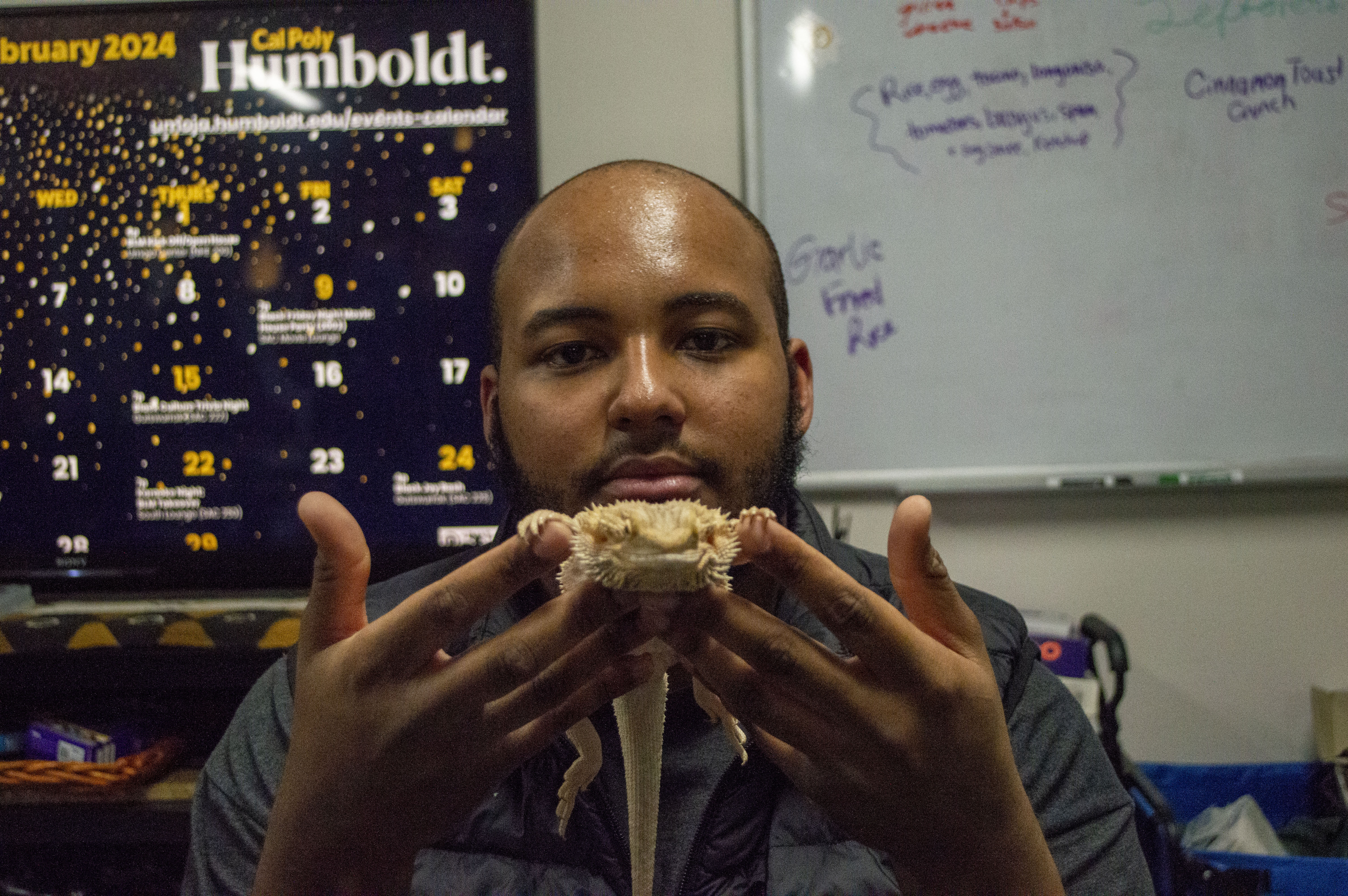
Tigger doesn’t have any stripes. He isn’t furry, and his jumping skills are horrible. His scales are nice and smooth, and his facial hair rivals a 19th century president’s. Tigger the bearded dragon is just one of many attractions people at the Umoja Center can offer.
The Umoja Center for Pan-African Student Excellence, located in Nelson Hall East, kicked off a month of events for Black Liberation Month on Feb. 1 with an open house.
Student art and photos of Black activists, athletes, musicians, and historical figures line the walls from floor to ceiling. “I love my melanin,” said one sign. A box with loanable art supplies sits at the front desk, free for anyone to use.
The center hosts many events, such as discussions about Black joy and movie screenings or even a Black trivia night. The center also offers academic advising and computers students can use, but the most important thing most students take from the center is community.
Many Black students have found community at the Umoja Center — a difficult thing to do when, according to the Cal Poly Humboldt website, only 3% of students at Humboldt are Black. Delaena Montes, a student assistant at the center, said it’s a place she could feel like herself.
“It’s an open space,” Montes said. “I can reach back to my roots here, my background. I felt like it was somewhere I could be myself. It’s freedom at a very white school. Having a place to escape is a great feeling. I feel comfortable here.”
Kamar Little holds Tigger the bearded dragon at the Umoja Center Feb. 1. Photo by Dezmond Remington
Jerry Turner, Tigger’s owner, agrees. He found the center when he was a freshman last year. He’s a mechanical engineering major with a lot of coursework, so having a place to relax and make friends is important to him.
“It’s a family,” Turner said. “That’s the best way I can put it… all of my friends I’ve met here, at the Umoja Center. It’s just beautiful.”
Ryen Price joined the Umoja Center last year after living in the Sankofa House, the Black culture-focused dorm in Cypress. She started coming to the Umoja Center to meet other Black students. She said she’s made a lot of good friends, the type she has potlucks and in-depth discussions with.
“I love how different we are, but also how similar,” Price said. “We’re like a family here.”
Montes is surprised more students don’t show up to the center, as well as other culturally-focused programs such as the Indian Tribal & Educational Personnel Program or El Centro, located down the hall from the Umoja Center.
“People should know about these places,” Montes said. “There’s a lot of culture up here [in Nelson Hall].”
That doesn’t surprise Kamar Little, a Student Advisory Group for Equity representative at the Office of Diversity, Equity, and Inclusion. Little works to connect students with those centers.
“I’m making them a bigger name,” Little said. “I’m letting people know things exist. There have been instances where people have never heard of [the programs].”
Price said anyone curious or doubting should lay those worries to rest and visit the center.
“People ask themselves, ‘[am I] black enough?’” Price said. “It’s the right place. Don’t think. You’re always welcome here. Don’t be shy, just come.”
This year marks a milestone for some Cal Poly Humboldt students: their first time voting in a presidential election. Besides potential presidential candidates, the ballot will include important propositions, like Proposition 1, a state-wide measure regarding funding within the mental health system.
Polls open for California’s Presidential Primary Election on March 5 and vote-by-mail ballots have already begun mailing out. To participate in any election, voters must be registered in their state. In California, that means registering no later than 15 days beforehand.
In order to vote in the primaries, the last day to register is Feb. 20. As a California resident, voting registration can be filed online at registertovote.ca.gov or by mail.
Paper applications can be found at County Registration Offices, Department of Motor Vehicles, public libraries, government offices and select post offices. Paperwork should be sent to the mailing address: Secretary of State Elections Division 1500 11th Street, 5th Floor Sacramento, CA 95814.
If registered with a political party, that party’s political candidates will show up on the ballot. To update party affiliations, a new registration form will need to be submitted.
16 and 17-year-olds are eligible to pre-register to vote and will automatically be registered upon turning 18.
Alongside the new wave of voters across the nation is a new wave of Humboldt County residents. To vote locally, or in the case of an address change, an updated registration form must be completed. Luckily, the process is quick and easy.
For more information visit the Cal Poly Humboldt legal lounge website for voting (studentlegallounge.humboldt.edu/voting) or call (800) 345-VOTE (8683).
University expects the new microgrid will provide about 25-30% of current annual campus electricity needs
by Brad Butterfield
Striving for sustainability and nestled in among the indomitable redwood giants of Northern California, California’s new polytechnic signed a contract on Feb. 2 for two megawatts of solar and three Tesla megapack batteries, which are expected to supply 25-30% of the university’s current annual electricity usage. Not yet immune from fossil fuel energy dependence, the university used 13,723,403 kWh of electricity and 922,559 Therms of natural gas, resulting in a combined 8,215.37 metric tons of carbon dioxide equivalent (MTCDE) of emissions during the 2022-23 academic year. The new microgrid/solar project is a tremendous step towards the university’s goal to become carbon neutral by 2045 and will change Cal Poly Humboldt’s energy portfolio for decades to come.
Where does Cal Poly Humboldt currently get its electricity?
Where a significant portion of Humboldt County purchases its energy from Redwood Coast Energy Association, Cal Poly Humboldt has opted to purchase electricity from Shell Energy, North America. This choice in energy procurement by the university is made possible by Cal Poly Humboldt’s direct access (DA) purchase of electricity, in congruence with 13 other DA CSU’s. “DA provides retail choice to customers by allowing them to purchase electricity directly from an Electric Service Provider (ESP),” according to the California Public Utilities Commission website. With DA, Shell, North America provides the energy, then that energy is transported by PG&E to Cal Poly Humboldt campus. DA is lottery based and allows universities to choose the most cost efficient energy option, rather than the county supplied utility in any given area. The negotiation of this DA energy procurement is handled by the chancellor’s office and allows Cal Poly Humboldt to access electricity at a competitive rate thanks to the aggregated 13-campus negotiation carried out by the CSU. While renewable energy sourcing is important, it has to be carefully balanced against the university’s broad range of financial needs, according to Cal Poly Humboldt’s Energy Manager Andrea Alstone. “As the Energy Manager, obviously, I want to use as little energy as possible and make it as renewable as possible. But, I also realize that costs are real and it’s kind of a zero sum game,” Alstone said. “What we’re spending on electricity means that we’re not spending on other things that the campus needs; we really want to be conscientious of that fact.”Importantly, CA Senate Bill 100 will require renewable energy and zero-carbon resources to supply 100 percent of electric retail sales to end-use customers by 2045. Californian’s are on a one-way road to renewable energy.“[Energy] use in California has to be 100% renewable by 2045. So, as a direct access customer, we will meet those standards, but there are other entities that are doing that sooner. “The choice to purchase from Shell, North America comes, primarily, down to cost – a fact not surprising nor impressive to environmental science and management senior Rain Lopez. “This school is a government institution, which is basically a business that is clearly more interested in maximizing its profits and reducing meaningful spending… so, it’s not surprising that the school made this choice,” Lopez said. Environmental science and management Junior Brooke Douglass put things more bluntly. “Shell is an evil company that has committed many environmental injustices,” Douglass said.
The Carbon Cost of Purchasing Energy from Shell
The university’s choice to purchase from Shell, North America has real world impact, as they do not source as much of their energy from renewables as Redwood Coast Energy Authority. Shell, North America sources its electricity from 34% renewables, (Biomass & Biowaste, Geothermal, Eligible Hydroelectric, Solar, Wind) whereas RCEA sources from 50% renewables. This gap is in large part due to the differing goals of each energy provider. Shell, North America looks to obtain the cheapest electricity possible for its customers, while still meeting California’s current renewable energy requirements, according to Alstone.“Whereas RCEA is more community focused and it’s like, ‘what does our community want and how can we meet that?’” Alstone said. “Cost is important, but it’s not the only factor in their decision.”
A (natural) gas need
Importantly, when talking about total campus energy consumption, electricity is only half the equation – actually, it’s exactly 35% of the equation, with the majority of energy consumption on campus coming from natural gas. The university’s main account for natural gas is with the Department of General Services, a branch of the CA government. Perhaps surprisingly, campus use and cost of electricityis a near perfect mirror image of its natural gas use and cost in 2022-2023, where electricity accounted for 35% of total energy usage on campus, but 61% of total energy cost. Natural gas accounted for 65% of total energy used but only 39% of overall energy cost. Cal Poly Humboldt, being the northernmost CSU, has a much greater need to heat its buildings as compared to other CSU’s. The necessity of heating its buildings nearly year round contributes to Cal Poly Humboldt’s ranking as 2nd highest in ‘campus gas purchased’ out of the 23 CSU’s, for the ‘22-’23 academic year, (when natural gas usage is normalized per-square-foot) according to the CSU energy dashboard. This equates to 0.46 therms/SF natural gas usage at Cal Poly Humboldt, only out-gassed by Cal State Fullerton. When thinking about MTCDE emissions, it’s incredibly important to factor energy efficiency into the equation. “If someone told me I had an infinite amount of money to spend on things, before I started spending them on more renewable energy, I would make things more efficient,” Alstone said. Meaning, the best way to obtain sustainability is to not require said energy in the first place. A better insulated building with triple pane windows requires less overall energy to heat and is thus more energy efficient, which of course leads to the dilemma of whether to allocate money towards infrastructure efficiency projects or towards renewable energy generation, i.e. solar panels. In 2022-23, Cal Poly Humboldt used 6.8kwh of electricity per square foot at a rate of $1.49/SF. Totalcampus emission for ‘22-’23 was 13,787.34 MTCDE, equivalent to 31,889 barrels of oil, according to university Climate Action Analyst Morgan King.That’s a substantial consumption of fossil fuels, no matter how one looks at it. For some students, this speaks to a disconnect between the university’s green-marketing and the campus’ actions. “Humboldt likes to claim it’s green though and it’s superficial… I think that being ‘green’ is a political buzzword,” Lopez said. “An institution of this size, regardless of having a relatively ‘small student body’ should have more resources to support its ‘green programs.’”
Solar energy on the horizon
The contract signed with EDP Renewables North America Distributed Energy on Feb. 2 means the university will not own, maintain nor pay for the installation of the solar system, however there will still be initial costs. Roof replacements are necessary for buildings that will be receiving solar panels, and sites on campus receiving the microgrid components will need to be prepared. The facilities yard, for example, is going to house three Tesla shipping-container-sized batteries. In total, the campus will have two megawatts of solar when the project is complete, which is about the max number of panels the university can physically support, currently.“I want as much as [solar] we can have, and that’s kind of the max given the roofs in the parking lots and the fact that we’re kind of physically constrained,” said Alstone.The battery will provide a peak power of 5.8MW and a total energy of 11.5MWh. Battery capacity is crucial to the systems function as a reliable microgrid.“If everything went out, we’d need a battery which can start our energy system from zero, so we’ve oversized the battery,” Alstone said.Annually, the solar system is expected to produce 3,300MWh of solar – with a guaranteed production of 2,866MWh. This equates to about 25-30% of the university’s current annual electricity usage. In addition to making strides to lower campus greenhouse gas emission, the solar is also expected to save the university money, in multiple ways. As per the contract with EDPR, the university will pay the company for the electricity generated by the solar, but at a much lower rate than the university currently pays for electricity from Shell, North America.“It will end up lowering our bill,” Alstone said.Additionally, thanks to the Inflation Reduction Act, the solar system will also save the university money through hand-me-down tax benefits.“The [tax] benefit will be passed on to the owners of the solar, EDPR, and they in turn pass it on to us in the form of lower electricity costs,” Alstone said. Another positive aspect to the contract with EDPR is a guaranteed minimum amount of electricity. If they don’t meet the minimum, then EDPR will pay the difference to the university, according to Alstone.Due to the need to install the solar arrays in multiple parking lots across campus, the installation will likely need to take place during the summer break, so as not to irritate the difficult parking situation on campus any further.“We anticipate the canopies will be installed over existing parking spaces Summer 2025 when classes aren’t in session with temporary, minimal impact to parking, “ said Aileen Yoo, Director of News and Information for the university.Cost savings, reduced reliance on fossil fuels for energy, no installation or maintenance cost – this is sounding like a killer deal. Naturally, there are two ways of looking at things.“In an ideal, ethical world, the university would invest in these solar panels as owners, [then] source and promote local unionized workforce for photovoltaic product repair, which would boost your local economy and probably reduce overall maintenance costs…” Lopez said. “But again, universities are businesses and will not operate from a place of long-term vision, just immediate costs.”In any case, the contract signing and soon-to-come microgrid and solar system seem a justified time for Cal Poly Humboldt to raise arms in victory – and that they are. “The microgrid project not only showcases Cal Poly Humboldt’s longstanding commitment and investment into sustainability, but it captures the spirit of what we do here: educate students who can help solve the world’s most pressing problems by providing a real-world example of the benefits of microgrids and how they work,” Yoo said.
Between cranking out assignments, having a social life, and enjoying living, most college students have enough on their plate. That’s why most colleges have off-campus housing offices. Humboldt had been without an off-campus housing liaison for over a month, but now one student has stepped up to the plate.
Iris Perla-Blanco is an engineering major currently working 10 hours a week at the Housing and Residence Life Center (HRLC). Since the liaison position has been empty, Perla-Blanco has assumed all of the position’s responsibilities.
“Students will contact the housing department and they will forward it to me and then I’ll send them resource emails, or more specific ones,” Perla-Blanco said. “If they are having legal issues with their landlords, I’ll direct them to sources I know or to the Student Legal Lounge.”
In addition, she handles all interactions, emails, phone calls, appointments, resources, and she writes a newsletter that gets sent out every Friday. Perla-Blanco enjoys writing the weekly newsletter because individual property owners can contact her, fill out a Google form, and then have all their information in one place for students.
“There are also the cases where a lot of people come from SoCal or the Bay Area and can’t get up here to look at a place, which is definitely something you want to do before committing to renting a property,” Perla-Blanco said. “We have 45-minute slots you can book and I will go look at the property and scout it out, ask any questions, take videos, get to know the [landlord], and then I’ll report back to them so they can have a better feel.”
Todd Larsen, Senior Director of Housing Ops and Auxiliary Services, oversees the program. Having a real estate license, he has his foot in the door with property owners. Larsen believes that the housing market is slow right now, but is ramping up for fall.
“The market is softer, so the volume of calls and inquiries has dropped significantly,” Larsen said. “Maybe one or two inquiries per day, but it’s picking up for fall.”
The HRLC is expecting a new employee starting Monday. Part of their duties will be working alongside Perla-Blanco by picking up some off-campus housing responsibilities. Larsen claims that as more housing buildings open, more stress will be taken off the off-campus housing team.
“As we build more buildings, like when Craftsman Mall opens in fall of 2025, we will need less and less off-campus housing support because that adds another 964 beds for upperclassmen,” Larsen said. “Then, we’re working on a new project – housing, dining, health, which is 305 beds, and that comes online fall of 2027. We are [also] being really intentional at pricing at the same price as College Creek on campus.”
Cal Poly Humboldt’s President Tom Jackson addressed the construction of Craftsman Mall in the Feb. 1 issue of the Eureka Times Standard.
“Once completed, this project will add nearly 50% more student housing,” Jackson stated. “It will help students today, and well into the future, be able to afford the Humboldt experience that our alumni value so highly.”
The program looks like it will always have a place for students.
“It will always be a student-assisted position because we want to employ students, and it’s great for resume building,” Larsen said.
Provost Jenn Capps held an Academic Address on Jan. 12 to update members of the Cal Poly Humboldt Campus on topics such as enrollment, budget and the way they’ve impacted each other.
University Budget
Although enrollment appears to be increasing, the University still took a financial hit this year as the California State University (CSU) Interim Chancellor Jollene Koster implemented enrollment recalibration. Essentially, CSU campuses that have been under their enrollment targets have had some of their funding given to campuses that are over-enrolled. The Humboldt campus enrollment target has also been lowered.
“We have taken a 3% hit,” Capps said. “Which equates to between $2.1 million and $2.3 million [taken from the] University [budget]. So, we’re losing those resources because they’re taking back some of the resources. What [the enrollment recalibration] also did was lower [the] target so our target is now 7,375 [down from 7,603].”
Other financial changes that hurt the University’s wallet include faculty compensation, which will cost $3 million, and an increase in insurance and utility costs. There is hope from administration that enrollment numbers will continue to increase and thus garner more financial support from the Chancellor’s Office.
Enrollment Numbers
Capps shared that this is the second year in a row that the University has begun to level out and see some growth rather than a loss in students.
“We had about a 2% increase in enrollment for the second year,” Capps said. “Pause for a moment because that’s a big deal. As you all know, many of you [faculty] have been here much longer than I have. We were in a literal freefall; our parachute wasn’t opening. The parachute opened, we leveled out and now we’re [increasing our enrollment].”
Luke Kennedy’s katana is heavy. He busts it out for parties, which he and his roommate Miles Conte throw every weekend. Except when there’s not supposed to be class on a Tuesday. Then, Mondays are prey too.
“We were trying to pick a date that would stand us out from the crowd,” Conte said. “We were just trying to start off the extension of winter break off with a bang.”
With the CFA strike eliminating class on Monday, Jan. 22 for college students all over California, Kennedy and Conte decided to host a bonus party at their place, a dayger that started at 3 p.m. 40 people showed up to party in their house. Though some people left when everyone got the news that the strike was off, most stayed until about midnight or so.
“When we [got the news] it was evening time,” Kennedy said. “It’s the height of the party. I’m walking around with the beer bong and loading it up with [left-over beers] and loading people up. And then [someone] said, ‘Hey, I think we have classes tomorrow!’ Everyone’s pulling up the email. And so there was this whole conversation — ‘Oh, what’s going on?’ And honestly, everyone was like, ‘Fuck it, I’m not going to class’… But I think, party or not, most people would have probably ditched that Tuesday.”
Conte said it was more fun when they realized the strike was off.
“The party vibe became immaculate when we learned we had class tomorrow,” Conte said.
He turned to Kennedy for a moment.
“What do you think?” Conte said. “Is ‘Immaculate’ a good word to use in this situation? Or not?”
Conte did skip class the next day; Kennedy attended.
“[When the strike only lasted one day], I was initially rebellious,” Conte said. “Because I am not going to my classes.”
Both Conte and Kennedy said if the strike had continued as planned, they likely would have thrown at least two more parties throughout the week. Any more than that likely would have been overkill. Conte laughed at the idea while he rolled a cigarette with gas station tobacco.
“We just party, all day, every day,” Conte said. “No sleeping allowed. That would have been hilarious. Like, yeah, ‘We’re going to have a continuous party for five days straight.’”
Freshman Bryn Urdi had a good time at the strike party. She was glad that she was in bed by the time she got the news that the strike was off. Urdi said she would definitely have attended again if given the opportunity, but the best part was seeing all of her friends again.
“It was really nice to come back from break and see all of my friends again,” Urdi said. “It was great just to be with them for a while.”
Kennedy believes that the parties he and Conte throw offer an important service to students they can’t get anywhere else.
“I think that the parties make students more excited to go to class because they get to see their classmates,” Kennedy said. “[Campus] feels like a zoo environment, in that it can become a goal, clocking in and out of class every day. You don’t really know anyone there. I feel like the mark [the parties make] makes the school a thing, versus just something you clock in.”
“We bring a full-charge mentality to partying,” Conte said. “We’re passionate about making people happy and having a good time.”
Despite the attitude, Kennedy isn’t just about drinking and getting rowdy.
“I respect somebody’s performance,” Kennedy said. “I look at somebody; are they a degenerate? Do they get good grades? Are they healthy? I don’t want to encourage students to just drink and party. There’s tuition. I think it’s important that students remember that they’re here to get a degree, hopefully learn something and become a better person.”
This website uses cookies to improve your experience. We'll assume you're ok with this, but you can opt-out if you wish. Cookie settingsACCEPT
Privacy & Cookies Policy
Privacy Overview
This website uses cookies to improve your experience while you navigate through the website. Out of these cookies, the cookies that are categorized as necessary are stored on your browser as they are essential for the working of basic functionalities of the website. We also use third-party cookies that help us analyze and understand how you use this website. These cookies will be stored in your browser only with your consent. You also have the option to opt-out of these cookies. But opting out of some of these cookies may have an effect on your browsing experience.
Necessary cookies are absolutely essential for the website to function properly. This category only includes cookies that ensures basic functionalities and security features of the website. These cookies do not store any personal information.
Any cookies that may not be particularly necessary for the website to function and is used specifically to collect user personal data via analytics, ads, other embedded contents are termed as non-necessary cookies. It is mandatory to procure user consent prior to running these cookies on your website.