The Lumberjack


Students Serving The Cal Poly Humboldt Campus and Community Since 1929

Category: Opinion

  • Yellow vests in the quad

    Yellow vests in the quad

    Clubs and activities fair disrupted by Party for Socialism and Liberation

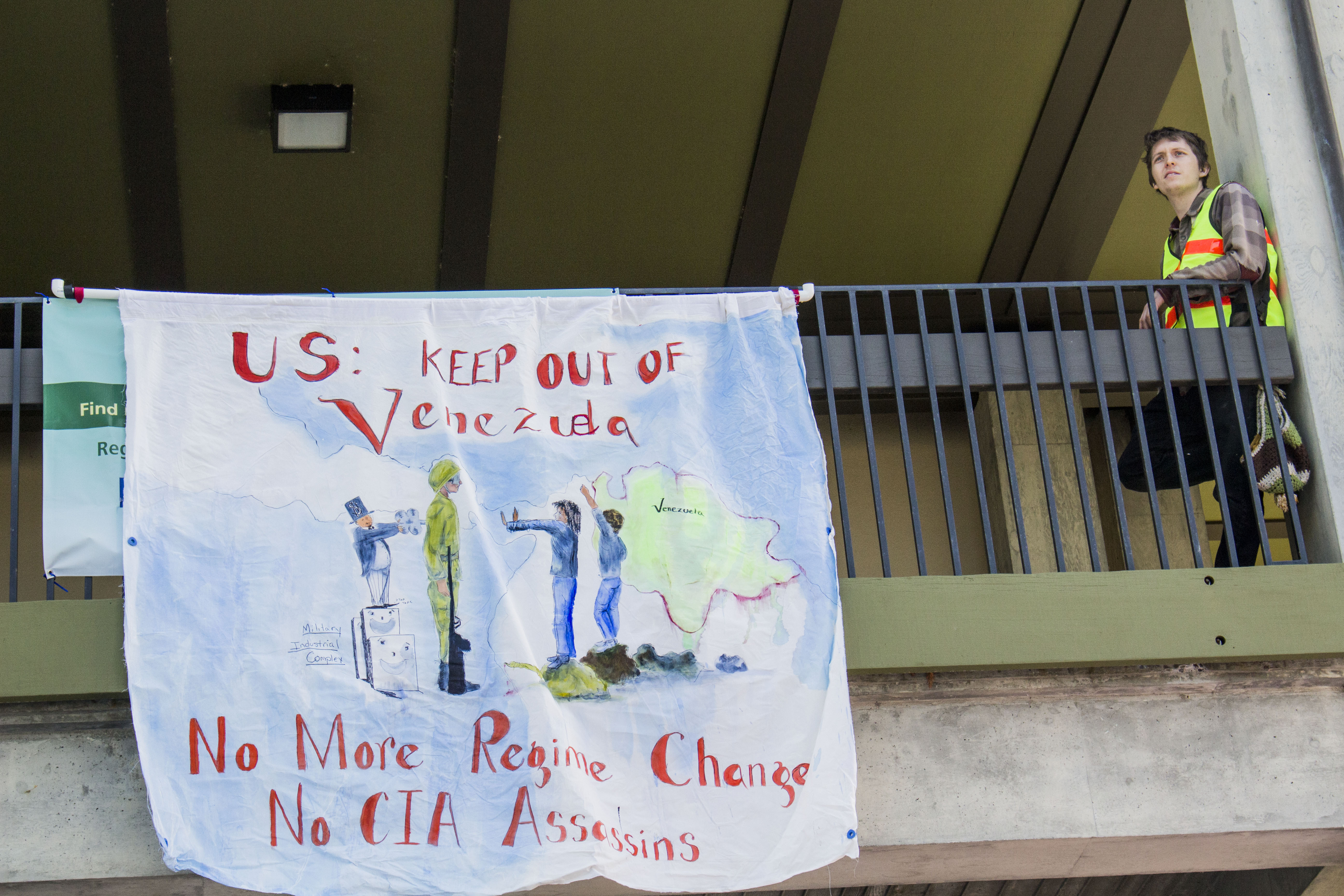
    Beneath scattered clouds and a radiant blue sky, HSU’s clubs and activities fair kicked off with students posing in yoga postures, walking along slacklines, juggling pins…and dropping an eight foot handmade banner protesting US involvement in Venezuela. The sun glared off yellow vested activists as they went around passing out fliers titled “Oppose the US-backed coup in Venezuela.”

    IMG_9900.jpg Nathaniel McGuigan, member of the Party For Socialism and Liberation, handed out fliers calling for oppostion of American involvement in Venezuela during clubs and activtites fair at HSU on February 6th 2019. By T.William Wallin

    “We’re here to disrupt this event and pass out information,” Nathaniel McGuigan, member of the party for socialism and liberation, said. “This is basically to tell people why to back Venezuela, to defend the Bolivarian revolution, the Venezuelan people, and president Maduro.”

    It’s of no surprise that the American government has had its hands in Latin America for decades, trying to influence its agenda by any means. They did it before with Guatemalan president, Jacobo Arbenz, in 1954, as well as Chilean president, Salvador Allende, in 1973, not to mention Ronald Reagan and the Contras in Nicaragua.

    Recently the democratically-elected government of Nicolas Maduro broke relations with the US government and ordered the removal of their embassy. The Trump administration is backing a member of the Popular Will party who gained no votes, Juan Guaido, and declaring him president even though Maduro was re-elected last year with 67 percent of the vote.

    “Students should support the revolution and as working class people it’s our duty to stand up to other countries sovereignty,” McGuigan said. “We oppose countries in power that overthrow regimes that benefit their people.”

    IMG_9907.jpg Simone Rani McGowan, member of Earth Guardians, and Nathaniel McGuigan, member of the Party For Socialism and Liberation, handed out fliers calling for oppostion of American involvement in Venezuela during clubs and activtites fair at HSU on Feb. 6. Photo by T.William Wallin

    Standing next to McGuigan, yellow vest included, was Simone Rani McGowan, an environmental studies major and member of the Earth Guardians. McGowan said her club and the PSL team up quite often, usually raising awareness on tuition struggles and campus climate, but with heavier topics as well such as marching in solidarity with the Honduran caravan.

    “This whole idea is to support community and to remind people of the compassion needed in these issues,” McGowan said. “Every day we have to reconnect with our humanity. It’s important to educate our youth in resistance.”

    Chad Friefeld, member of Climate Change Club, agrees with McGowan and said that one of the main things for students to know is American history is full of examples of US corrupted involvement in latin america.

    “We are trying to break through the western capital media which is not portraying the truth in Venezuela,” Friefeld said. “We want to talk to people about this coup and that the Trump administration and Venezuelan opposition is not democratic. We are standing in solidarity to help spread the word.”

    IMG_9895.jpg A handmade sign opposing American invovlement in Venezuela was hung above the clubs and activities fair at HSU on February 6th 2019. By T.William Wallin

    Among the handful of yellow vests and crowd of students tabling was UPD officer Chance Carpenter. Carpenter was at the event talking with all the clubs and opening up for any questions or comments to be addressed. Because it was Wednesday, it was Carpenter’s shift but he said he was the face of UPD for the day and acting as the safety advocate. When asked about the PSL banner, Carpenter said it was above his pay raise for a comment but he does like free speech.

    “I certainly do like people exercising their free speech,” Carpenter said. “I’ve had to actually protect people in the past on campus who had conflicting difference with other groups.”
  • OPINION: Modern day slavery

    OPINION: Modern day slavery

    Why we need to abolish prisons and stop talking about reform

    In America we have an inhumane amount of people rotting away between cold concrete walls and steel beam doors. I was one of them, walking through the rotating door between jailed and released over five years. The last time was a year’s conviction in a correctional facility. A short stint compared to the 2.2 million people who are currently housed in US prisons, a number that exceeds that of the strictest totalitarian countries. Ironically, we claim to have a system based on morals and principles that promote freedom and democracy.

    The Sentencing Project, which is a non-profit organization that works for a fair and effective U.S criminal justice system, has found a 500 percent increase in incarceration in the last 40 years, yet our crime rates have not changed. Why then, have we gone from less than 300,000 people housed in prisons in the 70s to where we are now?

    There are many sufficient answers; a modern-day slavery system that flies under the radar because treating criminals like slaves is legal. I could go on about how we got here, but that wouldn’t matter because we’re already here. What we should consider now is who’s in our prison system, what’re their barriers to reentry into society and what other avenues are there besides ruining the lives of those who enter the criminal justice system?

    Of the US population, 37 percent are people of color. Of the population of US prisons, 67 percent are people of color. This comparison is a red flag. There is a ridiculous over-representation of people of color in the prison system. The NAACP has found that both African-Americans and Caucasians have the same rates of drug use, yet African-Americans are six times more likely to be imprisoned for drug charges. Overall, the incarceration rate for African-Americans is five times the rate of Caucasians.

    Our prison system is a racist institution whose modus operandi is profit over people and discrimination. There are prisons that’ve banned Michelle Alexander’s “The New Jim Crow” but allow Adolf Hitler’s “Mein Kampf” along with other white nationalist claptrap. Are you kidding me? There is no “prison reform” in America. Laws and policies have changed through the decades, and the crisis only grows in the numbers of lives lost to the system.

    Ruby C. Tapia, who co-edited “Interrupted Lives: Experiences of Incarcerated Women in the United States” said, “Reforming the prison entails changing its existing practices to make the system a better one. Abolishing the prison entails dismantling it wholesale. Reformers object to how the prison is administered. Abolitionists object to the prison’s very existence.”

    The system itself doesn’t work in a way where reform is even achievable. We must abolish the very existence of the prison model. In the 60s and 70s Attorneys General and Republican congressmen were many of those arguing of the immorality of prisons, and we need to remind those in government of that.

    The Bureau of Justice Statistics found that within three years of release, 67.6 percent of people get rearrested, within five years 76.6 percent are rearrested and of all those rearrested, half of them are rearrested within their first year. Of those rearrested, 77.6 percent are drug offenders. If our prisons were built to reform and restructure those who enter their hellish gates, then our recidivism rates would be far lower or, should I dare sound optimistic, non-existent.

    The function of a prison is to take a “criminal” out of society, which is called incapacitation, for however long and then release them back better than when they came in, which is called rehabilitation. The Bureau of Justice Statistics found that 95 percent of those in prison will be released. If that is the case then the prison model is failing in rehabilitation if over 60 percent of those released return.

    One of the reasons for this recidivism is that once released, there is a laundry list of barriers that prevent one from integrating back into society. With this comes the revoking of many of the rights and privileges of those who have served their time. This is clearly a system setting up individuals for failure. Voting, government assistance, financial aid for school, employment, housing. Every single one of these is in jeopardy or stripped from someone trying to fit back into society. One never leaves prison without carrying a sign that reads “I’ve been to prison” for the world to see. The US has set up everyone being released for defeat.

    Instead of prison we need to find a rehabilitation system that creates pathways to success. We need to put money meant for education actually into education, on all levels. We need to start programs that direct more services to poor urban areas that suffer the most and all but guarantee a future prison sentence for the inhabitants.

    We need to separate those suffering from mental illness, in any form, from the criminal justice system and place them back into mental health care services. We need to work on destroying the class line and creating a lessened gap between lower, middle and upper. By destroying the existing prison system that we have, we can build institutions built on compassion, empathy and equality. Systems in which people get cared for instead of forgotten.

    We should all think of what the creator of Surrealism Andre Breton said of imprisoning people: “Unless you’ve been inside a sanitarium you do not know the madman are made their, just as criminals are made in our reformatories.”

  • OPINION: Fake service dogs a real problem

    OPINION: Fake service dogs a real problem

    Disguising your pet as a service dog is not only illegal, but a danger to those who actually need them

    Service dogs, defined by the Americans with Disabilities Act, is a “dog that has been individually trained to do work or perform tasks for an individual with a disability. The task(s) performed by the dog must be directly related to the person’s disability.”

    While you may miss your pup during school, bringing an untrained service dog on campus is dangerous to a trained service dog and their handler, sometimes referred to as a team. Not only are service dogs trained to alert and task to certain triggers, when untrained dogs are in the area acting up, it can distract a service dog from alerting their handler and can potentially be life threatening.

    Not all disabilities are visible, so you should not automatically assume that because you can’t see something “wrong” with a person, the service dog is fake.

    If you are unsure if the dog is a service dog, you can ask them two questions defined by the ADA, “ (1) is the dog a service animal required because of a disability? and (2) what work or task has the dog been trained to perform? Staff are not allowed to request any documentation for the dog, require that the dog demonstrate its task, or inquire about the nature of the person’s disability.”

    IMG_0030.JPG
    Christina Samoy waits for Kai, the service dog in training, to touch her hand with her nose on Sunday, February 3. | Photo by Bowie Cargile

    For those who are in need of a service dog, paying an organization to fully train a dog can be thousands of dollars. “Organization-trained service dogs can cost up to $25,000,” according to the American Kennel Club.

    Self training is an option. The only risk with self training is that not all dogs are suitable for working and it may take years for a dog to be fully trained. The AKC estimates “the dropout rate for organization-trained service dogs can be as high as 50 to 70 percent.”

    If you see someone training their dog in public or working with their service dog, ask to pet their dog before assuming you can. Although the team is in public, it does not mean you have the right to pet their working dog.

    Petting a dog when uninvited can be triggering for some when strangers get too close. It is extremely distracting to a team that is training in public when every few minutes someone asks to pet the dog or makes sounds to get the dog’s attention, so be mindful and wait until given permission.

    IMG_0023.JPG
    Kai looks back while practicing her wait command during training on Sunday, Feb. 3. | Photo by Bowie Cargile

    While Humboldt State University’s policy “strongly encourage[s] handlers to use an identifying vest, tag, leash, or other visible method to indicate to the general public that the animal is a service dog,” they are not required by the ADA.

    At the end of the day, a service dog and their handler is a team that would like the same respect as everyone else. If you get to know the dog’s name, make an effort to know their handler’s name.

    There’s no need to feel like you can’t make eye contact with the team, but just remember that when the team is working, it’s best not to distract them.

    If you’ve been given the option to have an emotional support animal, know the ADA does not give your animal the same access that service animals have.

    Many landlords have had potential renters lie about their animal being a service animal, so when people with actual service dogs apply for the space, they are sometimes rejected or are expected to pay additional rent for their animal, which is illegal under the Fair Housing Act. However, landlords can ask for a pet deposit to cover any damages that may be done by the service animal.

    The next time you think about bringing your pet to class or other areas where pets aren’t allowed, consider leaving your pet at home for the safety of others. If you aren’t in need a service animal, don’t buy a vest and put it on your pet so you can take them into public spaces.

    IMG_6439.JPG
    Christina Samoy and Kai, a service dog in training, take a break from their training session on Sunday, Feb. 3. | Photo by Bowie Cargile
  • EDITORIAL: Entrapment of undocumented students is not okay

    EDITORIAL: Entrapment of undocumented students is not okay

    The University of Farmington was created by the Immigrations and Customs Enforcement agency in order to capture undocumented students

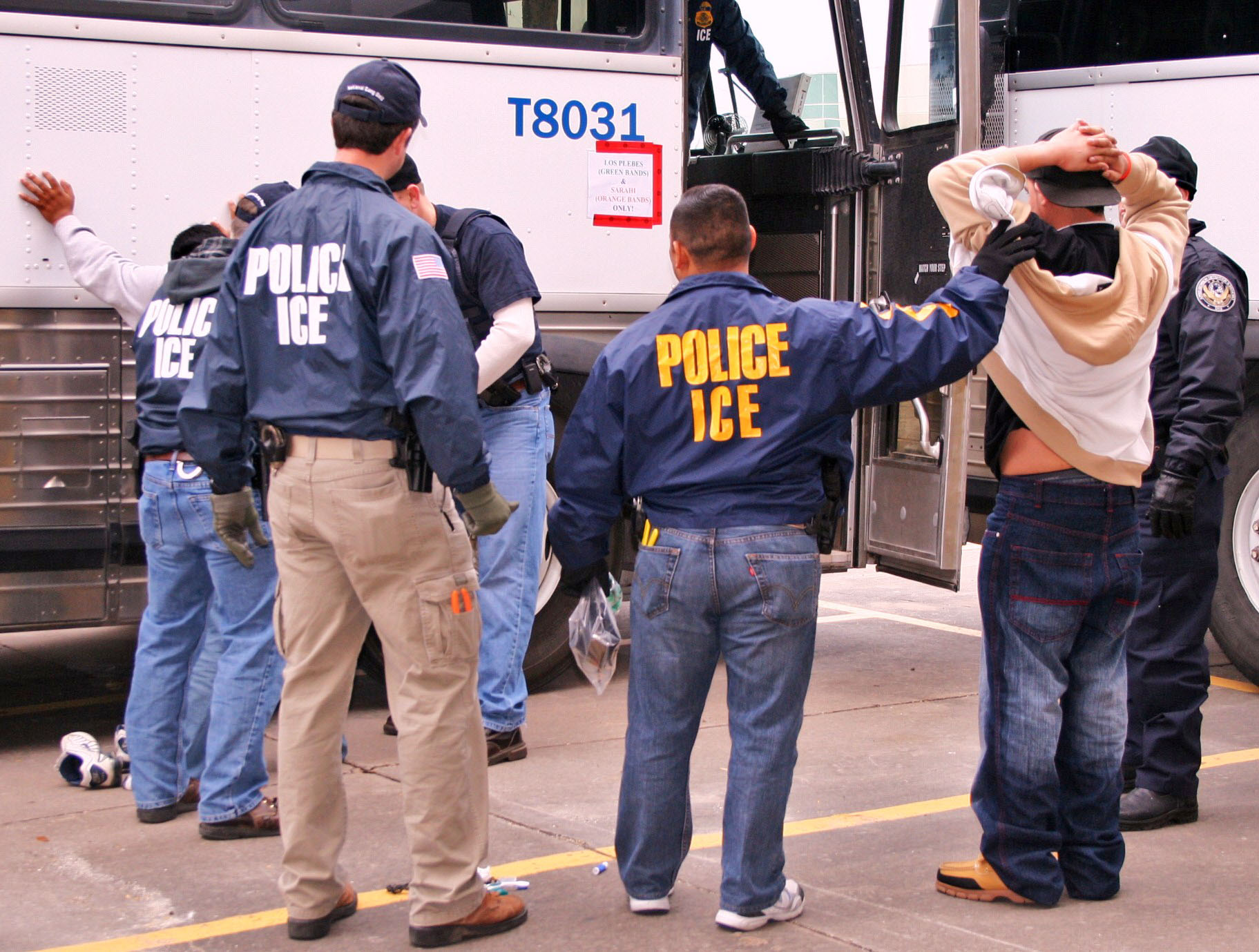
    Recently, the Immigration and Customs Enforcement agency was discovered to have made a fake University in order to capture students who were illegal immigrants. Immigrants who signed up were promised asylum to the United States through their student visa, even if their visa was expired. However, instead of being given an education and a stay at the United States, they were detained by ICE and deported back to their country. The discovery of the fake college was found by The Detroit News.

    This operation has been going on since 2015, and ICE did not specify how many students they have detained. A professor from San Francisco University School of Law, Bill Ong Hing, called this tactic a form of entrapment. Of those who were involved in the sting operation, eight individuals were arrested by authorities for committing visa fraud.

    When it comes to entrapment cases, some law enforcement agencies have practiced this tactic for years. In 2014, a high school student was arrested for buying weed from an undercover cop, which also lead to his permanent expulsion from the high school. Jesse Snodgrass, the high school teen, said that the undercover cop befriended him for months, and then pressured him to buy weed.

    The use of entrapment is an unfair tactic to use on people who are unaware and even taken advantage of. There’s no guarantee on whether the people who were detained will be sent back to the United States, while Many of the students that were attending the school legally came to the United States with an F-1 visa. The fact that the people who were detained by ICE were students seeking an education, is where their actions were deplorable.

  • OPINION: Parking pains

    OPINION: Parking pains

    What are students doing to avoid parking on campus?

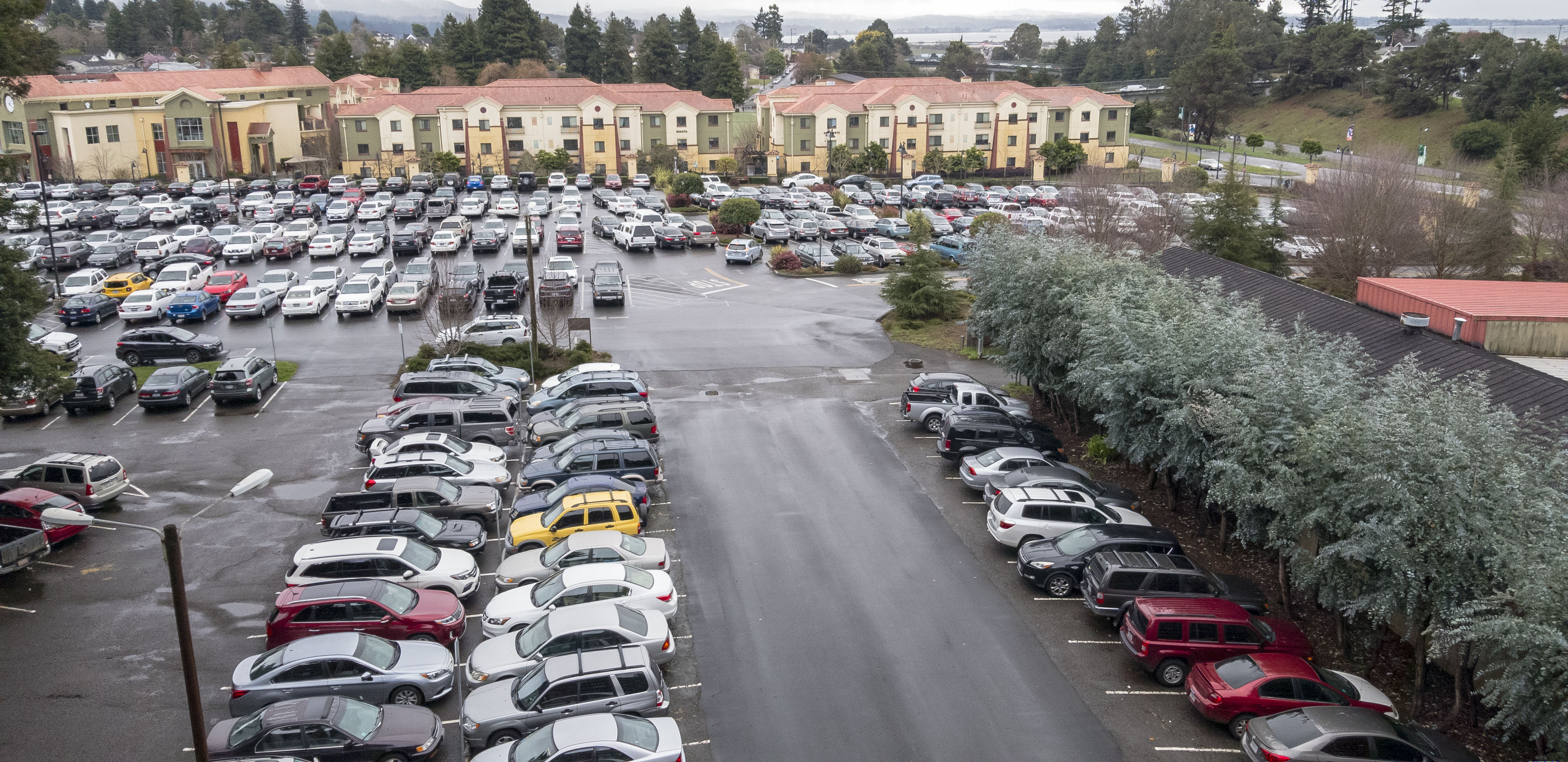
    One thing that I was most shocked about after moving off campus was the impossibility of parking. I had heard rumors here and there but it never settled on me, the idea of living off campus sounds great, right? Little did I know that part of adulting here at Humboldt State was that you had to suffer through a shortage of parking.

    I live in McKinleyville, and I had to learn to plan my whole morning around parking. I wake up early and I leave at least an hour before my class so that I have enough time to find a spot. Some mornings are smoother and it will take me about fifteen minutes, but more often than not there are mornings where I’d rather walk on bare feet from McKinleyville to campus. The more people I met at HSU, the more I’d learn their strategies to avoid the dreaded daily task.

    I spoke with some students about this issue and here are their thoughts. As I asked these students about parking and driving to school, their first initial reaction would be a sigh or a sound of frustration.

    Justin Eicher, is one of many students who chooses to bike to school.

    “I park far away [from school] and bike from there to avoid this crap,”Eicher said. “That’s honestly the way to do it.”

    I was surprised to hear that a fair amount of the students that I talked to had a pretty similar trick. Based off of the people I briefly interviewed, a good number of students live within range of HSU and will walk or bike, on the other hand, many students drive to a certain location and bike or take public transit to school from there. I have found myself considering the same thing on the worst of days, it sounds so much easier to go and park at a friend’s house who lives near a bus stop and go from there.

    “On the days that I have to be at school all day, I will drive from my house to the bus stop in Eureka where I live, and take the bus to school,” Evan Goetz, a forestry major at HSU, said. “It saves me the effort and money to make the trip.”

    The issue of parking has become a game of how to avoid it or how to get there early enough to grab a spot. The students that have class at 8 a.m. tend to get the better end of the stick, but the rest of the students that don’t have a class that early need to plan accordingly.

    “I have to go to a friend’s house who lives closer to school than I do, park at their house, and take the bus with them so I don’t have to deal with parking at HSU,” Lauren Gaul, another student who lives in McKinleyville, said.

    Respectfully, limited parking should encourage more carpooling to and from campus, and many of the students that I talked to said they rode their bike for environmental reasons. The strategies that some of these students have are logical, but some have to go out of their way to avoid parking. Students find what works best for them whether they like it or not.

  • Superdome swindle

    Superdome swindle

    Referees shaping the NFL is ruining its future

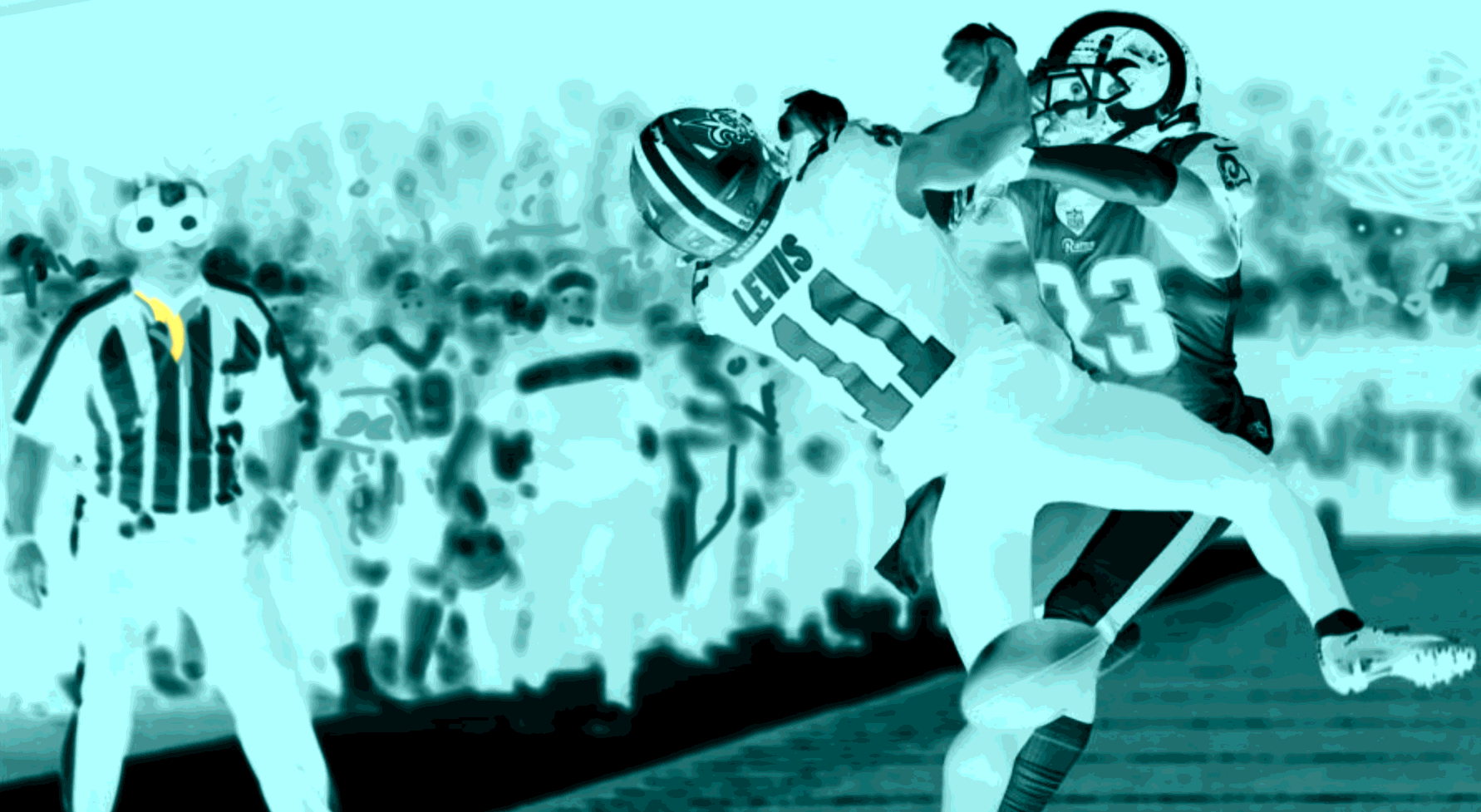
    The most blatant missed penalty in NFL Playoff history occurred in the NFC Championship game (the game before the Super Bowl) with one minute and 46 seconds left. It occurred on third and ten at the five-yard line, when as Drew Brees threw a pass down the sideline to Tommy-Lee Lewis, Nickell Robey-Coleman hit Lewis straight in the face before the ball got to him.

    In the NFL officiating rulebook this play was a penalty for helmet to helmet and also a penalty for pass interference. This penalty would have given the ball to New Orleans inside the five-yard line while the Rams had one timeout remaining, the Saints would have run out the clock and kicked the game-winning field goal with little time remaining.

    Neither penalty was called as 75,000 people in the Superdome in New Orleans all saw the same thing, while four referees who live in Southern California did not. This penalty was so obvious, but a hit to the face of Tom Brady in the AFC Championship in Kansas City, which did not seem like it was even the call to make was called, which led to the Patriots making the Super Bowl. Senior Vice President of Officiating Al Riveron talked to the head coach of the Saints minutes after the game ended and explained to Payton that his crew missed the call and potentially cost the Saints the opportunity to go to the Super Bowl.

    “The reason they didn’t call that penalty was because they wanted to build the fan base in Los Angeles, and make more money,” John Park said. “Flying from Los Angeles instead of from New Orleans would make them more money.”

    Even the player Nickell Robey-Coleman that committed the act admitted and said, “Yes, I got there too early. I was beat, and I was trying to save the touchdown.”

    There were a lot of penalties throughout the game but only one ended the game and decided it. The worst missed call on the Saints was the missed face mask on Goff that would have given the Rams the ball at the 1-yard line and the Rams a lead of 24-20.

    The penalty on the next drive was the missed one that Robey-Coleman committed that wasn’t called. This could have set up the Saints for the game-winning touchdown to take a 27-24 lead with under 30 seconds remaining and no timeouts for the Rams.

    If the integrity of the game can’t be upheld then do us fans still want to watch a game that is not executed to the best ability, with implications from outside forces (refs) deciding the outcome of the game? Not just Saints fans, but all football fans should be upset with a call (or no call) that decides who’s going to the Super Bowl.

  • OPINION: The Super Bowl was disappointing

    OPINION: The Super Bowl was disappointing

    Patriots and Brady earn 6th Super Bowl in low scoring game but did they play the right opponent?

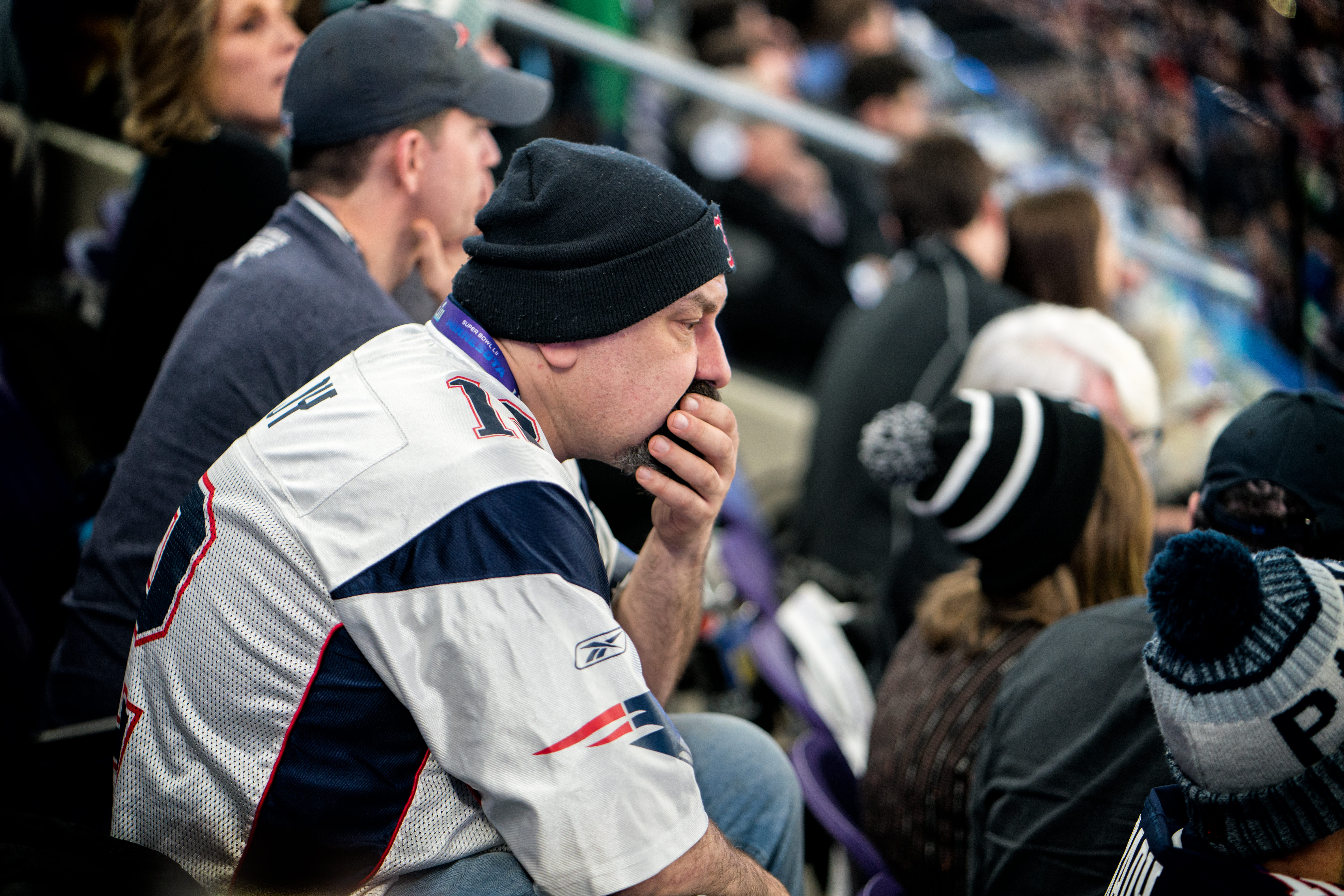
    The New England Patriots tied the Pittsburgh Steelers with the most championships in NFL history with six, beating the Los Angeles Rams 13-3 in Super Bowl 53. Patriots were led by five-time Super Bowl winner Tom Brady, age 41, while the Rams were led by the 24 year old Jared Goff. It was the largest age gap between starting quarterbacks in Super Bowl history.

    John Park, a business major at LA Harbor Community College, said that,“The game was a good defensive battle. The Patriots got more pressure on Goff and made him make crucial mistakes. Not the most exciting game but still good.”

    The Rams had a potent offense coming into the game that was steered by running backs Todd Gurley, who was held to just 35 yards rushing, and C.J. Anderson, who had just 22 yards. Wide receiver Brandin Cooks had 120 yards but had two crucial dropped passes that in the end would be massive. Fellow WR Robert Woods was held to just 70 yards on five catches. Their defense, led by Defensive Player of the Year Aaron Donald who had 20.5 sacks on the year, and Ndamukong Suh, was for the most part good at containing Brady. Although they couldn’t come up with the stop down the stretch when they needed it.

    Screen Shot 2019-02-04 at 4.57.37 PM.png
    Quarterback Jared Goff of the Los Angeles Rams.
    (Associated Press)

    Olivia Gainer, a Philosophy major at HSU, said that, “I personally don’t like the NFL based on the statistics of bodily & mental harm to the players as the foundation to the game. But, it was a really uneventful Super Bowl, not worth what the players put their body through for the incentive of profit.”

    Patriots’ offense was star studded with running back Sony Michel who had 94 yards rushing and the only touchdown in the whole Super Bowl. Along with tight end Rob Gronkowski who made the biggest catches of the game down the stretch as he had 87 yards receiving. The MVP of the Super Bowl was receiver Julien Edelman who posted 141 yards on 10 catches, he was unstoppable from the slot position making big catch after big catch for Brady.

    Patriots’ defense was a great group that contained Goff and the Rams, led by linebacker Donta Hightower, who posted two huge sacks, along with corner-back Stephon Gilmore, who made the biggest defensive play of the day with the interception on Goff with four minutes left. The whole night the Patriots’ defense shut down Goff and the offense, making stop after stop on third down, giving Brady and the Patriots their sixth Super Bowl.

  • OPINION: Why Bob Dylan is still relevant today

    OPINION: Why Bob Dylan is still relevant today

    Recently I attended a Bob Dylan concert at the Beacon Theater in New York, his adopted hometown. It was my third and by far the best. Five shows in a row and every one of them sold out. No Frank Sinatra covers during these shows only a raw energetic performance that ranged from old favorite anthems to gritty forlorn melodies of his later years. I will be the first to tell you the mysterious troubadour did not disappoint.

    Dylan, who has been on a never ending tour since July 7 1988, is believe it or not 77 years old and doesn’t look like he’s letting up anytime soon.

    More than ever with where our fascist leaning country is at politically, economically and socially we need Dylan. We need a figure that can speak of marginalized voices, that can articulate death and life in the same sentence, someone that can tell the government “you ain’t worth the blood that runs in your veins” and “I’ll stand over your grave ‘til I’m sure that you’re dead”. Most importantly we need something that Dylan symbolizes but appears to have faded away completely: The American Dream.

    Dylan, a middle class Jewish kid from the middle of nowhere Minnesota, became the world’s most popular figure in not only music and popular culture but beyond any category that can be conceptualized. He is the first singer-songwriter to win the Nobel Prize for Literature, (he defines himself as a song and dance man), and first American to win the prize in over two decades. If you have any doubts of the Nobel Prize Committee’s decision to choose Dylan just listen to his speech (bob-dylan-nobel-lecture).

    Dylan continues to break the barriers of what it means to write a song that digs deep in the listeners psyche and examine the state of the world around them. Instead of his contemporaries at the time, Dylan was singing about racial tension and divide in America with songs like The Death Of Emmett Till, When The Ship Comes In, Oxford Town, and Hurricane, a song about the famous boxer Rubin “Hurricane” Carter who was falsely accused and imprisoned for murder and eventually set free. Together with Joan Baez he sang during the opening act of Martin Luther King Jr’s “I Have a Dream Speech” during 1963’s March on Washington. Need I even say more?

    We have Dylan to thank for bridging a gap between young white suburban college kids and the civil rights movement. We have him to thank for spreading along messages of hope above despair, of listening for answers that blow in areas where we don’t normally pay attention to, to defy the establishment and question all those with authority.

    I am well aware that there was a whole generation before Dylan that influenced him and those around him, but Dylan took what Kerouac wrote and Pollock painted and Guthrie experienced and reached an audience well beyond what anyone thought possible in the decades before him and influenced the generation of his time to fight alongside justice, compassion and empathy.

    As a writer he puts himself in other people’s shoes widening his perspective on the world. Jeremy Sherman, writer for Psychology Today and professor of rhetoric and language at the university of San Francisco said a first rate capacity for empathy is the ability to hold two opposed positions in mind at the same time and still retain the ability to think for yourself. He calls this “shoe-shifting”, a fundamental skill of extraordinary power caused by the ability to put yourself in someone else’s shoes.

    Dylan explores the idea of timelessness and changing viewpoints to get feelings across that allow the listener to transport their own consciousness. By doing this it opens up their world and allows for a fluid movement of looking at people in a more similar fashion, in short “I” am “you” and “you” are “me”.

    With his rhetoric devices and stream of poetic magniloquence he fought against conforming what is arguably as relevant today than when Dylan began; the military industrial complex. America’s war in Afghanistan is now at its 16th year and the longest foreign war in American History. Dylan’s Master of War still echoes through the movements of today, whether it be Occupy or Black Lives Matter, and everything in between. Dylan said of the song ‘a sort of striking out…a feeling of what can you do?”

    It’s time we all ask ourselves the same question.

  • OPINION: How I learned to embrace the reusable water bottle

    OPINION: How I learned to embrace the reusable water bottle

    Humboldt State hasn’t sold water for years now, is it the right call?

    HSU banned water bottles from campus almost nine years ago. This was done to combat plastic waste and instead have students bring their reusable bottles by using the campuses water bottle station.

    It’s great that the University is making an effort in removing plastic waste. According to Humboldt State Now, HSU was the third public university in the nation to remove water bottles from campus. The issue however, is why is there still sugary drinks like soda, sports drinks, and juice still being stocked on campus?

    At first, I was annoyed with the fact that water bottles were banned for sale, but after an interview with Tall Chief Comet, HSU’s sustainability director, it made me consider that there are good intentions to the ban.

    “There was economic, social justice, and natural sustainability reasons why the ban was put in place,” Comet said. “Most of the people who wanted the ban were HSU students, not just faculty.”

    According to Comet, the production that goes into making water bottles for sale, is sold to consumers for nine times more than the price of getting water from the municipal taps.

    Just from 2009 alone, HSU’s Waste- Weduction & Resource Awareness Program Humboldt’s Take Back the Tap discovered that the total number of water bottles sold at HSU was 80,000.

    “The production, transportation, storage and disposal of bottled water to meet HSU’s annual bottled water demand requires approximately 43 barrels of oil per academic year and releases 35,300 pounds of carbon dioxide into the atmosphere,” the WRRAP website said.

    While the ban does have good intentions, there is a negative side-effect to the ban. Students who come to places like the J or the Campus Marketplace to eat only have unhealthy choices of drinks loaded with sugar. You must have a reusable water bottle in order to drink water.

    “The Oh SNAP! program from HSU is looking into the nutritional trade off of the ban,” Comet said

    Ron Rudebock, HSU’s dining service director, mentions how 15 years ago HSU was licence with Pepsi, only carrying Pepsi products in campus stores. However, a couple of years ago Pepsi failed to renew the license. HSU was then free to sell whatever products they wanted.

    “Since then, we’ve been able to expand our variety of choices for students to drink,” Rudebock. “We have Kombucha and tea’s for a healthier choice; what we have in stock is based on how it (beverage) does in sales.”

    There are many factors as to why the ban was put into place and they are valid reasons. The trade off was students’ health on what choices they have on campus, unless students are bringing reusable water bottles.

  • Make it free, make it through

    Make it free, make it through

    The need for a publicly funded higher education system is apparent

    Since I moved to the United States for my study abroad semester, one thing that I’ve noticed that puts a lot of pressure on students here in general is tuition fees.

    With growing stress and mental health issues for students in general, the United States as a country should actively be working towards introducing a publicly funded higher education system.

    Being from Sweden, where university is free for all citizens, the fact that students have to pay to get an education baffles me. The U.S. is a country with split views in general on heavy topics like this. However, the fact that some students have to say no to getting a higher education because they can’t pay for the tuition is just wrong.

    One argument for introducing a publicly funded higher education system is taking the pressure away from students. Over the short period that I’ve been here, I’ve had multiple discussions with different people about their fears of having to drop out because they can’t pay for tuition, or they can’t afford food because the fact that they’ve just paid for school that month.

    Many students worry about their parents spending money they don’t have to put them through school. While considering the fact that one of the major mental health issues facing students at this time in history is stress and anxiety, always walking around worrying about how to pay for tuition can’t be helping this in any way. If anything, it should be argued that the stress of having to pay to stay in school could lead students not performing as well as they could.

    Another argument for introducing a tuition free higher education system is that a majority of Americans want it. According to a poll conducted in November of 2017 by Peen Schoen Berland on behalf of the Campaign for Free College Tuition, there is a general support from America, from both red and blue states, for free tuition at public universities and colleges for students who are academically qualified. According to the poll the overall support is strong with 73 percent of the people asked in favor.

    Some people might argue that introducing a free tuition college system would lead to students not taking their education seriously because of the fact that there is less pressure on them with not having to pay. While understandable, while looking at numbers from countries such as Sweden, where the average student performance indicator in 2013/14 showed that 82% of all higher education students in Sweden were achieving all the HE credits they registered for, that argument becomes void.

    The best way for the United States to help students attending higher education would be to seriously consider how they as a country can deal with the issue of tuition.

    By introducing a free tuition college system for students that are academically qualified, they introduce a system with less pressure of payments where students can focus on what really matters, getting an education.

  • OPINION: The shutdown of the government helps no one

    OPINION: The shutdown of the government helps no one

    This government shutdown is out of control and it needs to end

    The Government Shutdown of 2018-2019 is the longest shutdown in US history, now being over a month since the shutdown has started. This is due to President Donald Trump’s decision to shut down the government for not funding the Mexican border wall that he’s promised since his campaign. President Trump has promised to prolong the shutdown, going so far as to suggest a year-long shutdown.

    There’s a lot of blame being cast between Democrats and Republicans. Yet at the end of the day, the most affected are the government workers who are going to work without pay and those who rely on government aid like military benefits and food stamps.

    For students, financial aid disbursement is not affected by the shutdown. However there have already been instances of schools being affected by the government shutdown. Signing up for financial aid requires documents from the IRS, however the department that oversees those documents is shutdown.

    U.S. citizens will also still need to pay their taxes this year despite the shutdown. As a result of the shutdown, the IRS is short on staff. This will lead to longer waits and people are expecting their tax refunds to be late. The IRS has issued an order to have employees work without pay during the tax filing season starting Jan. 28.

    Those who rely on the Supplemental Nutrition Assistance Program will be receiving their food stamps early, around February. The downside is recipients will have to budget what they receive, as there’s no clear indication when recipients will receive their next set of stamps.

    Many national parks have been closed due to shortage of staff, human waste flooding the area and even vandalism. The National Parks Service website does list all the closures and conditions of national parks, but even their website is not up to date because of the shutdown.

    For those who are expecting to take a flight, there is a possibility of waiting in longer lines to enter TSA security checkpoints. Many airports are short on staff because TSA staff are expected to work without pay. While some are promised to receive bonus pay during the government shutdown, many TSA staff are calling in sick.

    Many people from the government have been opposed to the shutdown. Even some Republican members have voiced their concerns. Lindsey Graham (R-South Carolina) and Lamar Alexander (R-Tennessee) have called for a temporary reopening of the government to open negotiations for the wall. It’s surprising, especially from Lindsey Graham, who has been loyal to Trump’s decisions.

    Trump has already signed a bill into law to ensure that government workers who worked on days during the government shutdown are paid for their work. While this is a good thing for those who are working without pay, they still won’t receive pay until after the shutdown ends.

    The only way for a solution to be reached is for negotiations between Donald Trump and the Democratic house, but from what happened on the Jan. 15 and Trump’s offer being rejected, it looks like there isn’t a sight for resolving citizen’s woes. It’s time for Trump to get off his high horse and open the government. He was put into office to help protect and lead the country, but with his actions he is holding the entire country hostage to get what he wants.

  • From the Editor: Dare to dream unapologetically

    From the Editor: Dare to dream unapologetically

    The Lumberjack has its first African American woman as editor-in-chief in 90 years

    In 1929 the Lumberjack as we know it today put out its first newspaper. Ninety years later I became the very first African American editor-in-chief in the history of the Lumberjack. To be true to myself, I identify first as an African American but I am also a woman who has made monumental history. Without first acknowledging that it took 90 years for someone who looks like me to hold this position disregards our history.

    If I’m being honest, it is disheartening that it took nine decades for an African American to be elected for this position. It shouldn’t have taken that long. However, I’m very pleased that the past 90 years of the LJ will soon be digitized. History will be made easily available for the public. They’ll be able to look back on our past and reflect or criticize how far we have came as a university and as a society.

    The way that the editor-in-chief is elected is through a democratic election process. Each candidate gives their statements to our classmates that explain who we are, our experience and our plans for the newspaper. Afterward, there is an election where each student votes who they think should be the next editor-in-chief.

    As a young black journalist coming from Oakland, I naively doubted my abilities to lead this paper, but my peers were confident in my leadership. After all, flowers never pick themselves.

    When I look around my peer group, I see young journalists who motivate me to become the best that I can be. They motivate me to challenge the current ideologies that surround us and they dare me to dream of accomplishing things much bigger than myself.

    My goals for this paper is to keep it cultured and to represent its student body. However, I plan to remain truthful to the realities that surround us and to do so unapologetically.

    I invite you to stand with me on this platform and walk this journey with me. As Dr. Martin Luther King, Jr. said, “Faith is taking the first step, even when you don’t see the whole staircase.”

    Sincerely,

    Dajonea Robinson

  • EDITORIAL: Overcoming this final stretch of stress

    EDITORIAL: Overcoming this final stretch of stress

    Breathe in. Breathe out.

    Stress and anxiety are an everyday part of student life. But with the final weeks of school upon us, there are more triggers than ever to make students feel stressed. The Lumberjack knows several tips to ensure that you perform your best in the last days of the semester.

    It’s easy to neglect the self and only focus on the tasks you’ve been assigned. Although your projects and homework are important, it’s critical to consider your physical and mental health as you finish up the semester.

    Many CSU students struggle with getting enough sleep. Exhaustion makes it harder to maintain a low level of stress, and higher levels of stress make it difficult to sleep, so the cycle continues.

    Make sure to get enough sleep during the final weeks, as insufficient amounts will affect your performance on final projects and exams. It’s counter-intuitive to sleep less while trying to get more done, as the quality and speed of work will be lower than if you had enough sleep.

    If you’re having trouble relaxing your mind and body to sleep, an effective, healthy method to calm yourself is drinking a mug of hot herbal tea. Not all teas will help you sleep, though. The best teas for relaxation and sleep are herbal teas like lavender, chamomile, peppermint and Valerian root.

    Caffeine is a popular choice for college students when it comes to finals week studying. While a cup or two of coffee can definitely enhance focus and drive to complete a tedious task, it can also have unpleasant side effects, especially when too much is taken quickly. It’s especially important to moderate your caffeine levels during these busy times.

    Think for a second, is that fourth cup of coffee or second yerba mate tea really worth it? Too much caffeine can cause extreme anxiety and restlessness, making it even harder to stay mentally healthy during these last weeks. Drinking caffeine too late in the night can also make it difficult to get quality sleep, making challenging finals even more intense.

    Just because finals are here doesn’t mean school is all you should focus on. It’s smart to take breaks and have time to yourself, where your studies aren’t the priority. It’s unrealistic to think we can devote all our time and energy into academia. Treat yourself to something nice and relaxing, especially if your anxiety levels are soaring through the roof.

    Remember folks, it’s not the end of the world and you can get through this. Moderate your caffeine consumption, do something nice for yourself and don’t forget to breathe. It will be over before you know it!

    For additional stress relief, in the coming week HSU will be hosting a few different events throughout campus including a game night, the annual pancake dinner and therapy dogs visiting the library.

  • OPINION: We deserve a W

    OPINION: We deserve a W

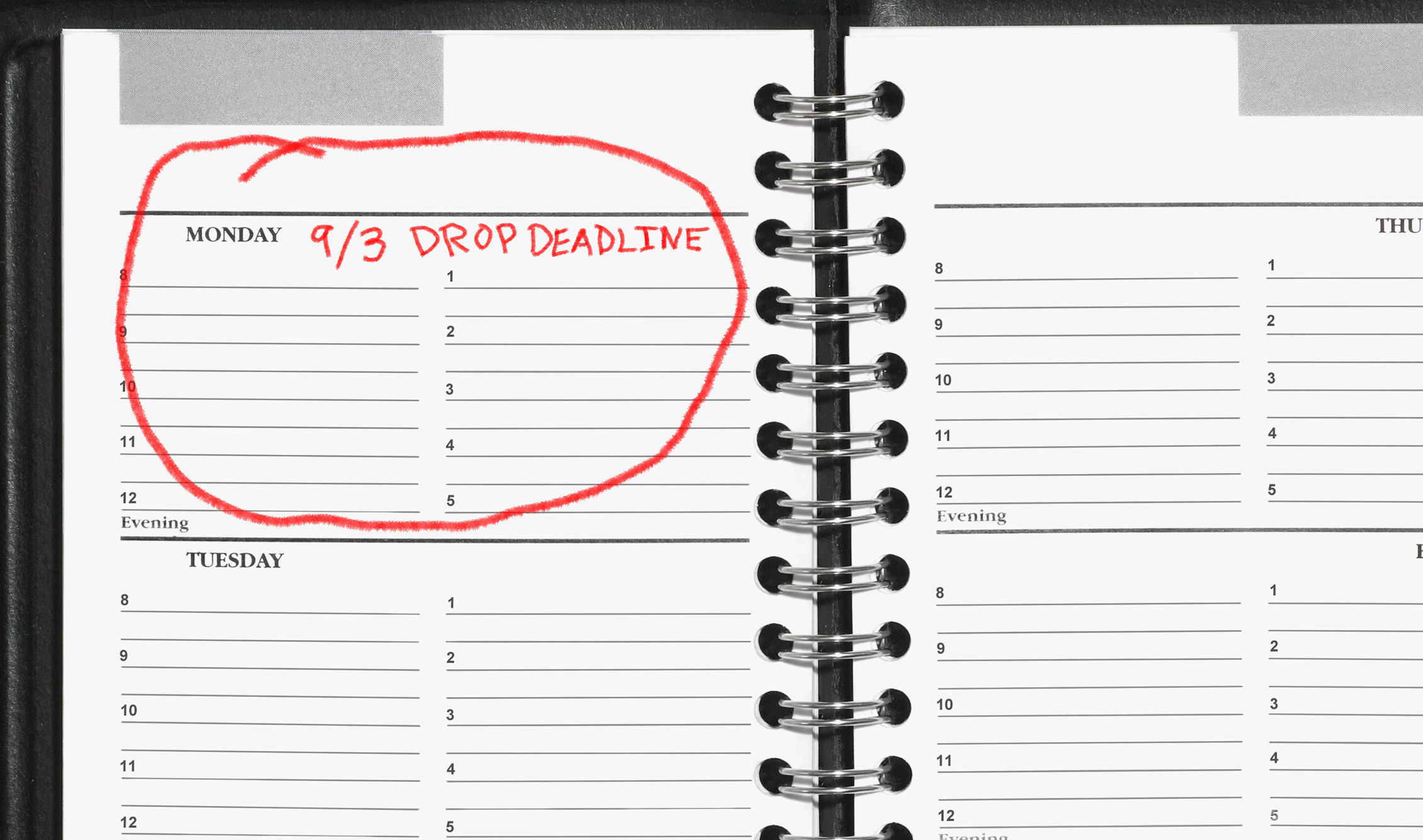
    Drop date deadlines too strict and for students to decide on keeping a class

    As I end my academic career, I reflect on the ways I could have been a better student, and how Humboldt State could have better assisted me in learning and navigating my student experience.

    My biggest concern is that academic deadlines need to change. Add/drop dates need to be extended, and reason for withdrawing from a class should not be as difficult as it is. Being a student is more than just being in the classroom — we must also manage learning outside the classroom.

    We must learn to navigate on our own for the first time in our lives and learn to provide for ourselves as adults. We need to learn how to balance school and work, and to prosper in both activities. For this reason, academic deadlines should be more flexible for students.

    We need more than two weeks to decide whether or not we can stay in a class. We cannot definitely know in two weeks if we can endure a semester’s worth of school and work. We need time to adapt. The add/drop date should be edited to a month rather than two weeks.

    If we are unable to stay in a class for whatever reason (personal, fiscal, family, mental or emotional health reasons), it should be our right as students to be able to receive a W in our transcripts. The policy for withdrawals are concrete. According to Humboldt State’s website, the following constitutes a withdrawal from a course:

    •Psychological issues

    •Inappropriate behavior of someone else in the class

    •Severe illness or injury

    •Called to military service

    •Death of a close family member

    •Loss of care of dependents

    •Serious reversal of your financial situation

    There are even restrictions for what are NOT considered “serious and compelling or catastrophic in nature:”

    •Deciding to change majors after the deadline to add/drop classes

    •Not being aware of a deadline

    •Anticipating you may earn a low or failing grade

    •Taking too many units

    •Being too busy with other classes to do the work

    •Work or extracurricular activities

    •Not liking the class

    •Not knowing how or when to drop

    Of course, this also poses the argument that students should not be working while attending school, but in some cases students do not have the luxury to not work. We need more assistance from our university.

    We deserve more from our institution. It is overwhelming enough to be a working student and if it happens that we slip up and cannot keep up with course work, we should be able to receive a W.

  • EDITORIAL: Abandon the word accuser

    EDITORIAL: Abandon the word accuser

    The Lumberjack editorial board recognizes the sensitivity of this topic and the affect this discussion can have on victims and survivors. We would like to remind readers that the North Coast Rape Crisis team has a 24-hour hotline for those in need. You can reach the NCRC hotline at 707-445-2881.

    Brett Kavanaugh, Bill Cosby, Larry Nassar, Kobe Bryant, Donald Trump, and Harvey Weinstein. This brief and incomplete list of men with sexual violence and harassment charges are referred to by the media with their formal titles: Judge, doctor, priest, actor, athlete, president of the United States and so on.

    The women, and in some cases men, who came forward to speak up against these perpetrators, alleged or guilty, were almost always addressed as “accuser” or “accused.”

    Moving forward and after publication of this article we have decided to stop using this word in reference to victims of all forms of sexual violence or harassment and urge all news and media to do the same. We reached this decision after Humboldt State University’s Journalism professor Victoria Sama gave a presentation on Oct. 23 on the history of the use of the word accuser by mainstream media.

    In law, when referring to a victim of other crimes such as murder or robbery, we never call those victims “accusers.”

    Former trial attorney Michele Sharpe addresses this concept in an opinion on the Washington Post called “Who’s a victim? Who’s an ‘accuser’? The loaded language of sexual assault.”

    “American law has never had special terms for victims of crimes other than rape: We have only the generic terms ‘victim’ or ‘witness,’ as in murder victim and robbery witness,” Sharpe said.

    The language used to refer to sexual assault victims separates them from the definition of victims of other crimes. In the end, the word “accuser” implies that victims of sexual assault have something to prove.

    Sharpe encourages journalists reporting on sexual assault to include both names or to use identifying titles for both parties in case of requests for anonymity.

    Sama said in California state system, dating back to 1850, she found uses of the word “accuser,” but generally in reference to policy and law rather than an individual or party. Sama said the word began to carry with it “inferences of doubt,” in the 17th century for common English law and carried over to American law.

    During this time English Chief Justice Matthew Hale required instruction for juries to judge women. Women were the ones who primarily brought rape cases to trial in the 17th century. Hale claimed that rape was an easy charge to make and defend and juries should require cautionary examination of female persons in question.

    Eventually in 1975, this cautionary instruction was done away with after People vs. Rincon Pineda. A case concerning a woman who left her window open for her cat and was sexually assaulted by a drunk man who entered her home through the window.

    On a religious spectrum, the term accuser has adversarial or enemy implications. In the King James bible, the term accuser is a term used to reference the devil as the “accuser of the brethren.”

    The use of the word accuser is also written into some journalism standards. The Associated Press Style Book, quite often referred to as the journalist’s bible, guides journalists on grammar, punctuation, ethics and how to address people in specific circumstances and more. The style book is updated to reflect current happenings and terms every year.

    AP has updated entries in its 2018 edition with victim and survivor. According to this entry, “use those terms with care because they can be imprecise and politically and legally fraught.”

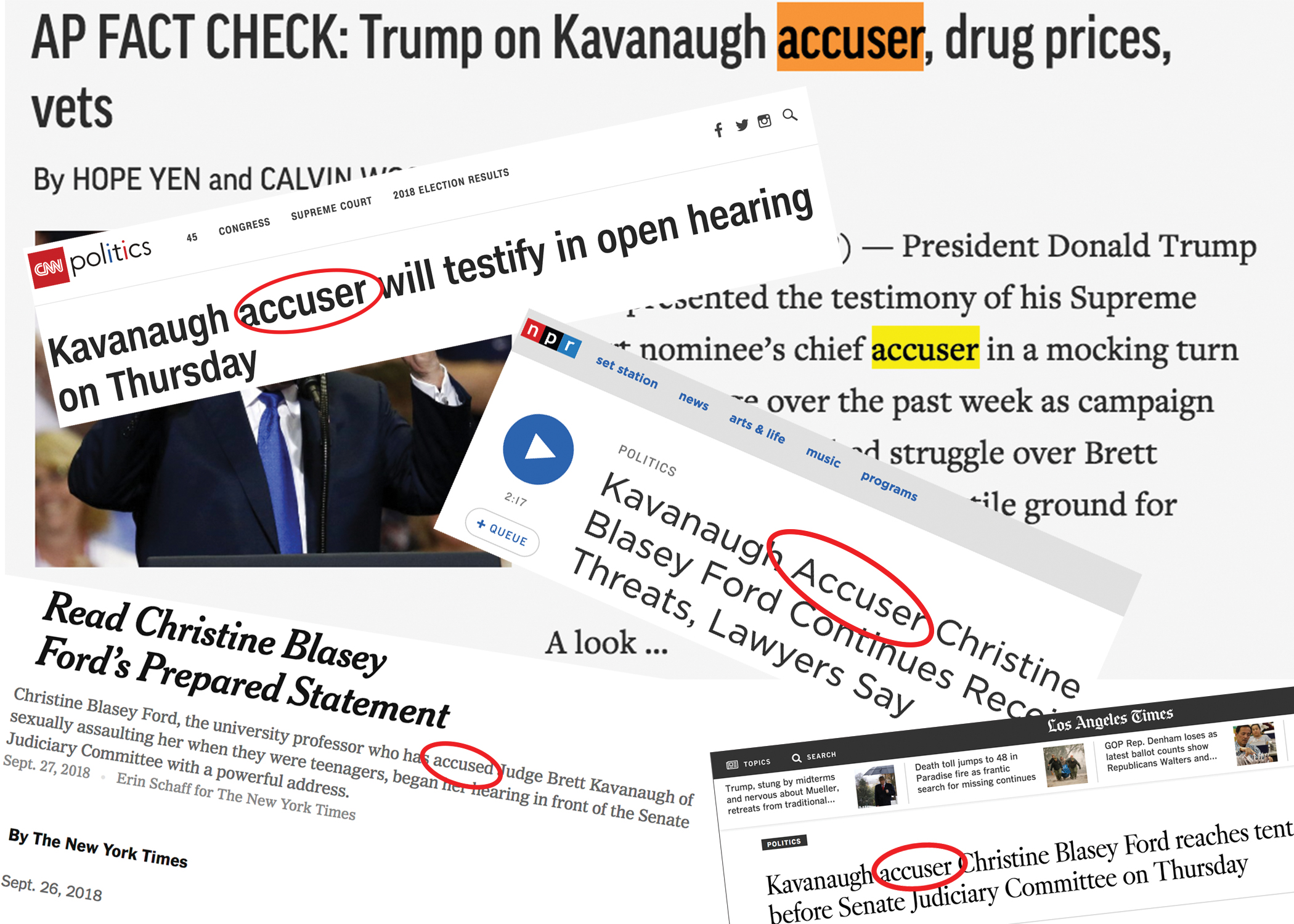
    The AP, the Washington Post, The New York Times, the Los Angeles Times, NPR, CNN and more, consistently use the word accuser when reporting on sexual assault and the victims thereof.

    As news publications that lead in responsibility to accurately report the news with clarity, we strongly urge them to stop using the word accuser. We ask that the Associated Press edit the terms victim and survivor in their style book. We ask that the media starts to consider the seriousness of separating victims of sexual assault from victims of other crimes.

    After exploring the history and trends of the word accuser in the media, law, religion and by definition we reached the same conclusion as Sharpe and Sama:

    “The word accuser is a superficially neutral term.”

  • OPINION: More than a wave

    OPINION: More than a wave

    Thanks to fed up women and voters who took action, the Nov. 7 primary election was a night of firsts. The change we are witnessing is groundbreaking and we must sustain this shift in political power and build on it.

    One hundred and twenty three women were elected to the United States House of Representatives, 12 women were elected to the U.S. Senate, 9 women were elected to serve as governor and out of a grand total of 123 women elected, 42 of them were women of color.

    And of those 43, at least three are LGBTQ. These numbers are still rising as results are still being calculated.

    To put these numbers in perspective, one out of five congress members are women.

    Prior to this election, 84 women served in the House out of 435 members, and in the Senate, 23 women served in the Senate out of 100. Six women served as governors, out of 50.

    All of these women in positions of political power represent a beacon of hope during a polarized and dangerous political climate. Election by election, women, women of color and people of color must fill offices of power and influence until we are accurately and fairly represented in our government.

    Let’s rewind to how many women won nominations for state legislatures.

    According to the Los Angeles Times, the amount of women who decided to run for office was also a record high number, “more than any other election in U.S. history.”

    According to the Center for American Women and Politics 3,379 women won nomination for state legislatures across the country, breaking 2016’s record of 2,649.

    Two hundred and thirty five women won nominations in U.S. House races. This broke 2016’s record of 167. In addition, 22 women won major-party nominations for the U.S. Senate. The record previously stood at 18 in 2012.

    The numbers are proof of change that isn’t coming in waves, but rather in tsunami proportions. However, to any young women of color looking toward a future in politics, we still need you.

    Though what women have accomplished this election cycle is substantial, women are still not the majority in congress and we can not lose momentum.

    Do not forget the youngest you can be to run for office, per the constitution, is 35 years old for President or Vice President. California specifically requires a candidate to be at least 18 years of age and registered to vote.

    When the women elected take their well earned seats among the men who have grown comfortable there, we must not forget what it took for them to get there. It’s more than a foot in the door but there is more work to be done.

    Let the storm rage on.

  • OPINION: 13 lives lost, but does it even matter anymore?

    OPINION: 13 lives lost, but does it even matter anymore?

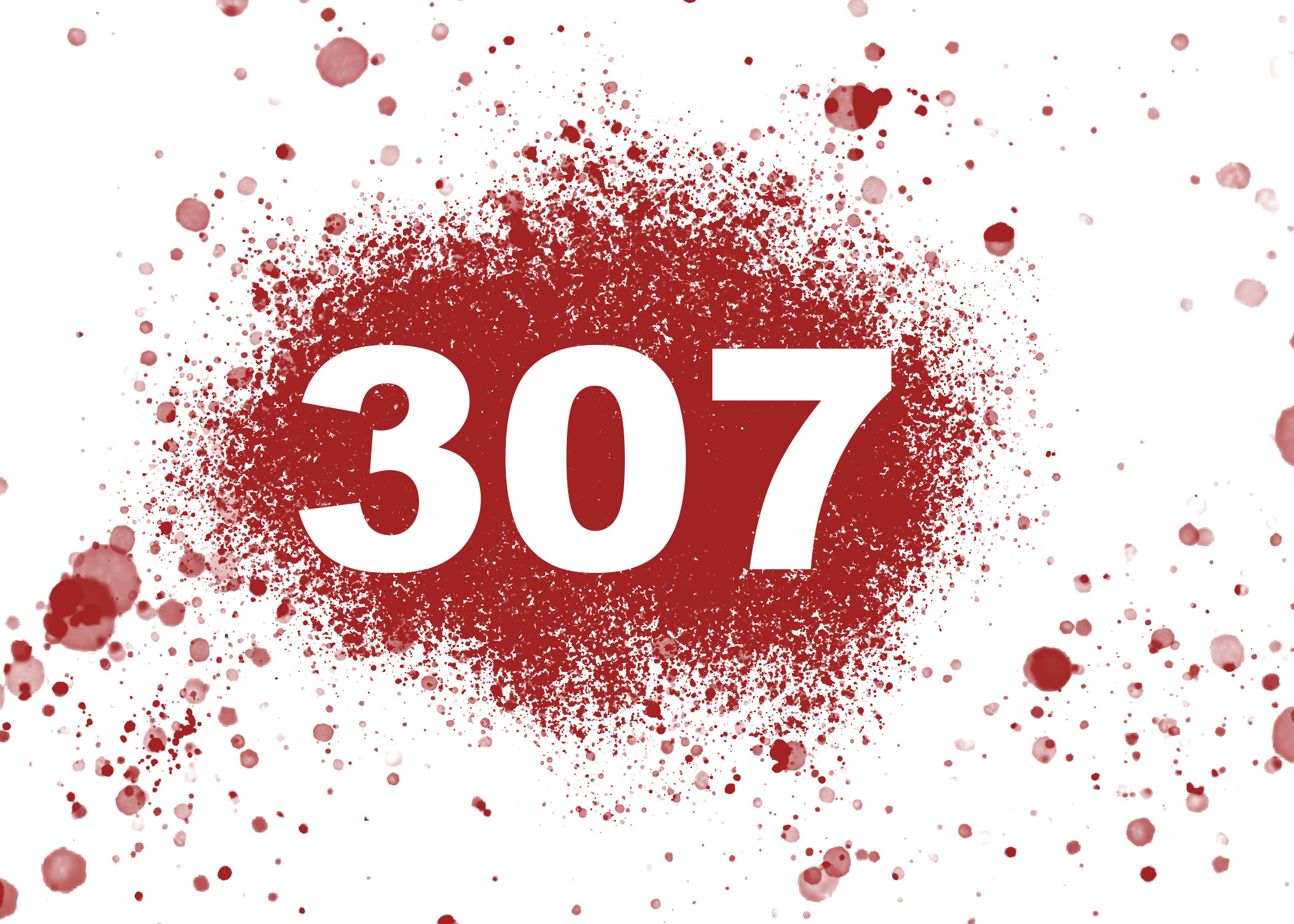
    Three-hundred and eleventh day of the year, the 307th mass shooting

    Four days total without any mass shootings in this country.  Good job team.

    It terrifies me that when I wake up to news of another mass shooting, I can’t find the empathy and compassion in my heart to question why massacres keeps happening. I know why it keeps happening.

    Our generation is desensitized to news of mass shootings, bombings, students killing students, religious slaughter, and a general understanding that the world doesn’t revolve around the small cliques we put ourselves in. We can’t take more than a moment to grieve before accepting the reality of the situation, and quickly moving on with daily life.

    But why wouldn’t we be desensitized? The people who commit these heinous crimes are being given the spotlight. Their names are being projected for all the world to see, and people eat it all up. They glorify the means, they find influence in the troubled experiences, they forget that this is a person we could have prevented.

    In effect, the media are giving more power to potential school shooters who see coverage of news of this morning’s Thousand Oaks shooting, and see it as an opportunity for recognition, whether positive or negative.

    The event that occurred last night at the Borderline bar in Thousand Oaks, Ca., came just two weeks after a highly publicized mass shooting at the Tree of Life Synagogue in Pittsburgh that left 11 dead.

    The sad reality is that there have been 11 other mass shootings in this country since Pittsburgh, with 10 more victims being added to the tally

    It seems more likely now that Humboldt State University is just another place where these statistics could continue to grow. There are real fears from students that at any moment, our small college will end up on some major media site with a body count looming, and someone trying to “understand” how things could have been prevented.

    I’m scared. Truly.

    We need to stop covering these shootings in a way that give any credit to the shooters. We cannot give them the power or recognition they’re so desperately trying to get.

    I think media should stop using the names and faces of mass shooters in our media coverage, and describe them based on their actions as murderers.

    As a journalist, I find it hard to withhold information from stories. But I think in the case of mass shootings, we need to shift the focus from the shooter and their motives to the victims, and how we can work harder to prevent more kids, students and people from waking up and walking out the door for work, school, or to hit the clubs, and never coming home again.

  • EDITORIAL: Life, liberty and the pursuit of self care

    EDITORIAL: Life, liberty and the pursuit of self care

    We the people have a right to life, liberty. . . and self care.

    This has been an election with record high early voter turnout for a gubernatorial race just after two years of America’s most polarizing and unpopular president in history.

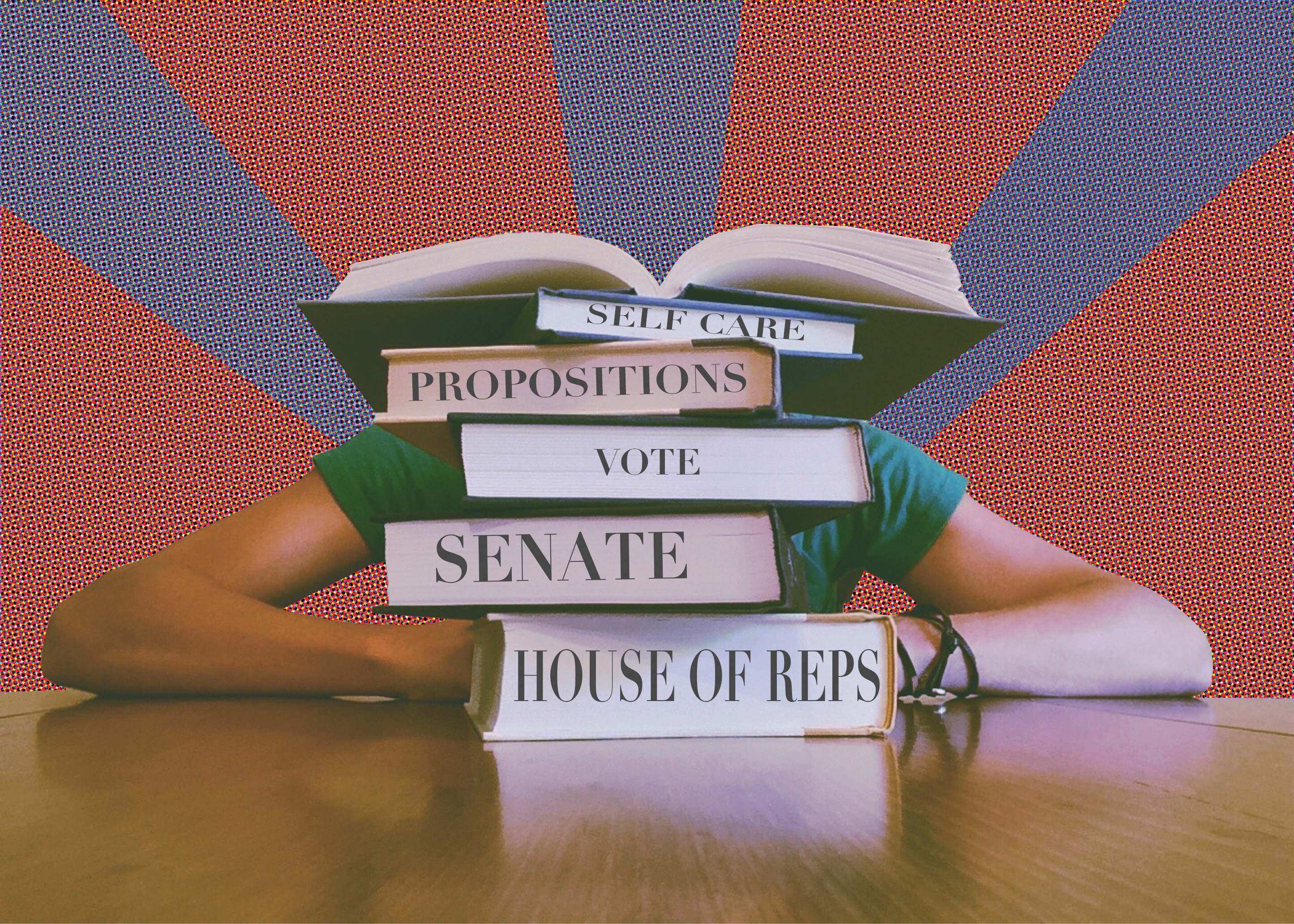
    There are also many critically important ballots and measures which could affect everyday life for people in Humboldt county, and it’s very important to take care of yourself during such a high pressure election.

    One of the most critical ballots for people’s livelihoods this year is measure K, an initiative to make Humboldt County a sanctuary county prohibiting local law enforcement with cooperating with federal immigration officers. Proponents of K claim this measure protects families of undocumented persons by granting custodial power and avoids unnecessary pain.

    This measure could likely make or break the practice of separating families in our county. Family separation can cause irreversible harm to kids and their parents. It makes sense that the people whose livelihoods and security depends on this measure will feel the stress this election season.

    Resources for undocumented students and/or citizens are available on both a national and local level.

    • Humboldt State University offers multiple resources through the Student Health and Wellbeing center for students including financial aid options, health care options and legal help.
    • The California State University system offers various resources for legal or con campus help for undocumented students.
    • Teresa Foster, Immigration Consultant 707 255-8666 – According to the St. Joseph’s Community Resource listing, Foster helps immigrants re-unite with loved ones through various visa processes, up to and including residency and citizenship; based in Napa, office serves the immigrant community throughout the state. Foster is not an attorney, she is a consultant with a bond on file at the CA Secretary of State. Because this location is farther away consider calling for information.
    • Catholic Charities, Immigration and Citizenship Services offers mostly legal services regarding citizenship classes, refugee resettlement, DACA, preparing documents for visa petitions, adjustments of status, affidavits of support, consular processing documents and work authorizations. This location involves a four hour drive south, but you can visit their website for general information on any of these topics or family reunification.
    • Those in need of help and advice can also find the closest resource to them through the National Immigration Legal Services Directory. A zip code search will bring up a list of near by resources. Click here to find resources around this a

    Though there is not an explicitly a decision on immigration, this election has the potential to sway the political power in both the House of Representatives and the Senate. We recognize the results of this election can still cause great distress about the future of important topics like immigration policies and reform.

    On a mental health care level, this election season, The Lumberjack has some suggestions for people who are feeling uneasy about the future. For whatever reason voters may feel stressed, depressed, angry, sad or happy, people can decompress by taking breaks from social media, watching funny animal videos, yoga and meditation, and emotion management.

    Taking a break from social media is a strong preemptive measure to reduce anxiety and depression for the election. Research from Anxiety and Depression Association of America suggests that social media usage is significantly associated with mood instability, including a prevalence of depression.

    If you see content that might cause you discomfort, turn your phone over for a little bit. There is no shame in logging off in the name of self care.

    Crying also has mood benefits, depending on the person. The act of crying leads to tension relief, and can help with psychological recovery from distress. It is possible that people may feel distress when realizing their candidate has lost, like when President Trump was elected. A healthy cry gets the job done to move on to the future.

    Try watching some online videos like funny animal videos or fail compilations. These are a great way to take the edge off a long election night. Skip the viral videos and play your favorite video game instead.

    Make some time to sleep or exercise as healthy distractions if viral videos and video games won’t cut it.

    Last, but most certainly not least, if you are feeling that you can not handle the pressure alone, here are some resources to connect to the person you need.

  • OPINION: 90 years and a slap in the face

    OPINION: 90 years and a slap in the face

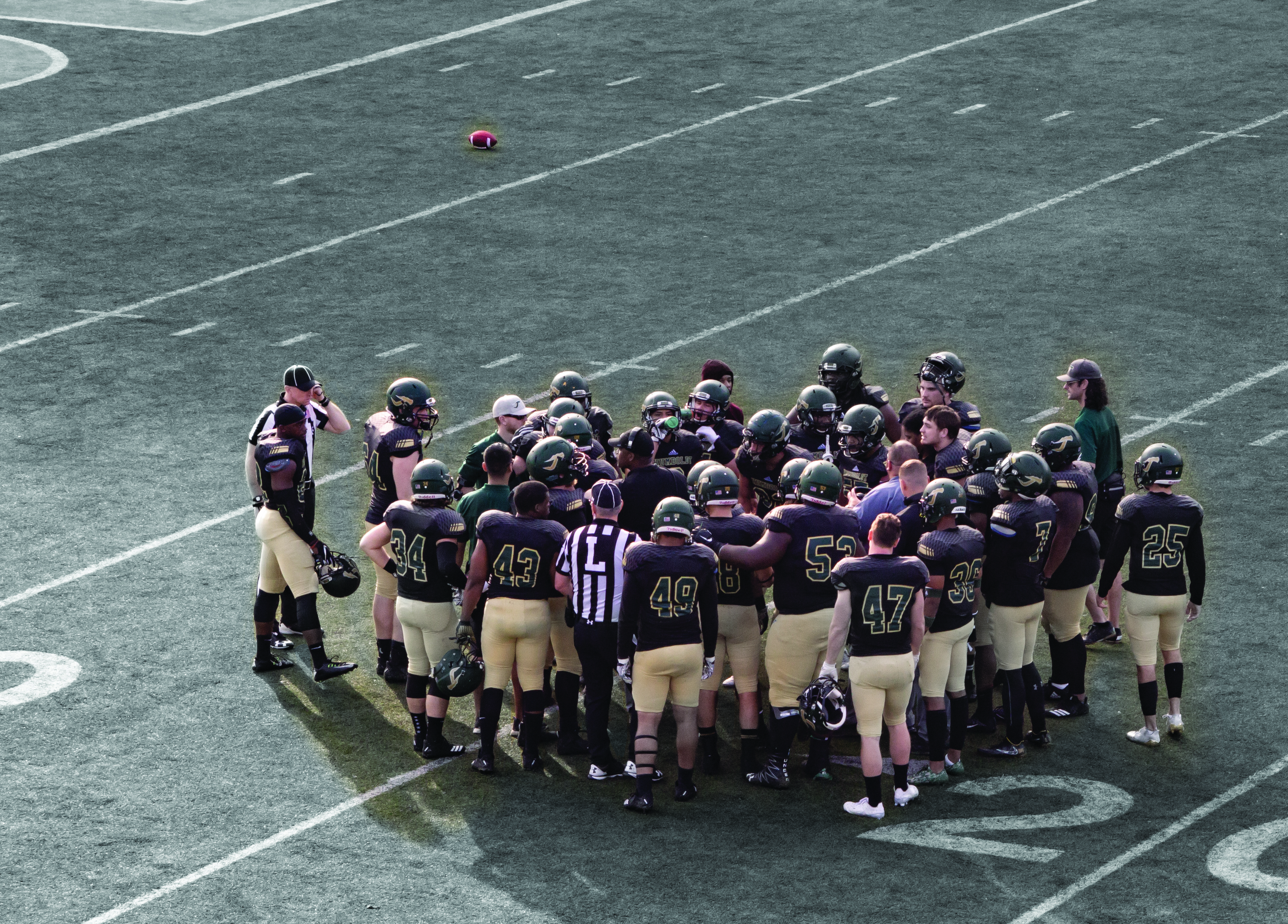
    The Azusa Pacific field goal that beat the Lumberjacks on Nov. 3 sailed through the uprights. At this moment it dawned on me that this was the final play of HSU football. The empty feeling in my gut is all too familiar.

    Born and raised in San Diego, I could never tell local Jacks fans how to feel or how they should feel. However, after over 30 years of cheering for the San Diego Chargers, I have a pretty good idea.

    Year after year, heartache after heartache, I remained loyal to the Chargers. When they went 1-15 after using the second pick in the draft on University of Washington Cougars quarterback Ryan Leaf (the biggest flop in professional sports history), I stuck with it. When management fired head coach Marty Schottenheimer after going 14-2, I stayed true to my team. Get rid of L.T? Why not? There was no quit in me.

    Then, Chargers owner Dean Spanos made the decision to move the Chargers to Los Angeles in Jan. 2017 because he felt it couldn’t compete with the rest of the league financially at his old stadium in San Diego. Loyalty was never on the menu for ownership and I no longer have a team.

    The same can be said for HSU administration. People are pointing the finger at HSU president Lisa Rossbacher and rightfully so. This is the second football program to be eliminated under Rossbacher’s watch.

    Many locals will be getting their wish. Rossbacher’s announced retirement begins at the end of the Spring 2019 semester. One must wonder if future university presidencies are in her future and which team will be on the chopping block next.

    After playing the blame game, the reality of the loss begins to set in. For me, it was the fact that my home team that I had literally bled for was going to leave my city for our rival city to the North. Watching them be successful in Los Angeles this season has been hard to watch to say the least.

    There’s no more cheering for Lumberjacks football even if you wanted to. The game against Azusa was the last game to ever be played at the Redwood Bowl. That is the reality.

    Never again will locals be able to come down early on a Saturday to tailgate before a big game. There won’t be any more Lumberjacks moving on to the NFL, like Jacks All-American offensive lineman Alex Cappa in this year’s draft. At least not in the near future.

    The people with the most to lose in this situation are the players. Many of whom moved up to Humboldt County away from their comfort zones just to play the game of football. For some, HSU was the only offer received. For others this university was their choice.

    Even though HSU won’t fully admit to having a diversity problem, many students would agree that there is one. Losing Jacks football will have a negative effect on the diversity that HSU tries so much to promote.

    90 years of Jacks football apparently means nothing to HSU administration.

    The program is over and the lights at the Redwood Bowl are off. It’s a slap in the face and the feeling will never go away.

  • Vote because you can

    Vote because you can

    Formerly incarcerated Humboldt State student encourages utilizing your right to vote

    When I was released from Rio Cosumnes Correctional Facility in 2014, I was told three things: I could no longer receive government assistance (like food stamps), I was no longer eligible for financial aid (FAFSA), and lastly I had lost my right to vote.

    At that time, to be honest, I only cared about the first two. Voting was the last thing on my mind when I was stumbling my way back into society and trying to forget what I had seen while I was incarcerated. But as time went on I was getting more involved in my community and volunteer outreach, and voting became more important.

    I say that because there were candidates on the ballot in Sonoma County that would further help organizations I was working with and others that wouldn’t. I became more interested and started to understand the interdependence.

    Although I was keeping track of the candidates running for office, I knew it didn’t matter because I couldn’t even vote for any of them. That all changed when in 2015, California Secretary of State Alex Padilla announced that the state would settle litigation over laws that had barred low-level felony offenders under community supervision from voting.

    This meant that myself and tens of thousands of others who had lost their voting right could vote for the 2016 election. (Bernie lost, but I still feel like my vote mattered, and if anything else I experienced a sense of freedom with casting a ballot.)

    The Sentencing Project estimates that nearly six million Americans cannot vote as a result of previous criminal convictions. We may think we’re quite progressive in California, but Maine and Vermont are the only two states that allow voting rights be retained for those still in prison.

    According to Nonprofit Vote, there are 15 states ahead of California that allow automatic voting rights restored the second you are released from prison. California doesn’t even do that. In blue states like Colorado and New York, you can only vote until you’re off parole.

    Florida, Iowa, and Kentucky are the three states where voting rights can only be restored through individual petition to the government. So even if you do your time and are off parole or probation, you still have no right to vote. They layer punishment atop punishment atop punishment.

    If re-entry programs are supposed to help those integrate back into society, but our political voice is taken away, then it undermines the entire purpose of the sentencing. If I pay taxes and am affected day to day by political figures both nationally and locally, then why would I not be able to act on my right to vote?

    According to the Prison Policy Initiative there are 242,000 people behind bars in California. That means there is a quarter of a million people who are unable to vote in this state. The Sentencing Project also said that Black Americans are five times more likely to be imprisoned than White Americans, giving more evidence of the modern day slavery that is our prison-industrial complex.

    We may think we live in a democratic country, but voter suppression is still happening. Crooked politicians are finding loopholes to keep people from casting their ballot. If voting doesn’t matter, then why would voter suppression be such a big issue?

    According to the Brenna Center for Justice, there is a growing range of threats to voting for the 2018 election. North Dakota has been blessed by the Supreme Court for strict voter ID laws that will make it harder for Native Americans to vote. Texas adopted a similar strict voting law and Georgia has passed stricter voter registration that will create hurdles for minority voters.

    The Brenna Center for Justice found that there has been a huge increase of vote purging in the states of Florida, Georgia and North Carolina, meaning that names identified for removal are determined by faulty criteria that wrongly suggests a voter be deleted from the rolls.

    These are just a few examples of how voter suppression is taking form before the 2018 elections, although this has always been happening. Our government have been suppressing votes for as long as they have been an entity.

    Know who is running for office. Know the measures and propositions. Whether or not you think your vote doesn’t matter, you will be affected by whatever passes or what doesn’t. When you vote, you are voting for everyone who can’t.

  • OPINION: White boys will be white boys

    OPINION: White boys will be white boys

    Cut the “locker room” talk

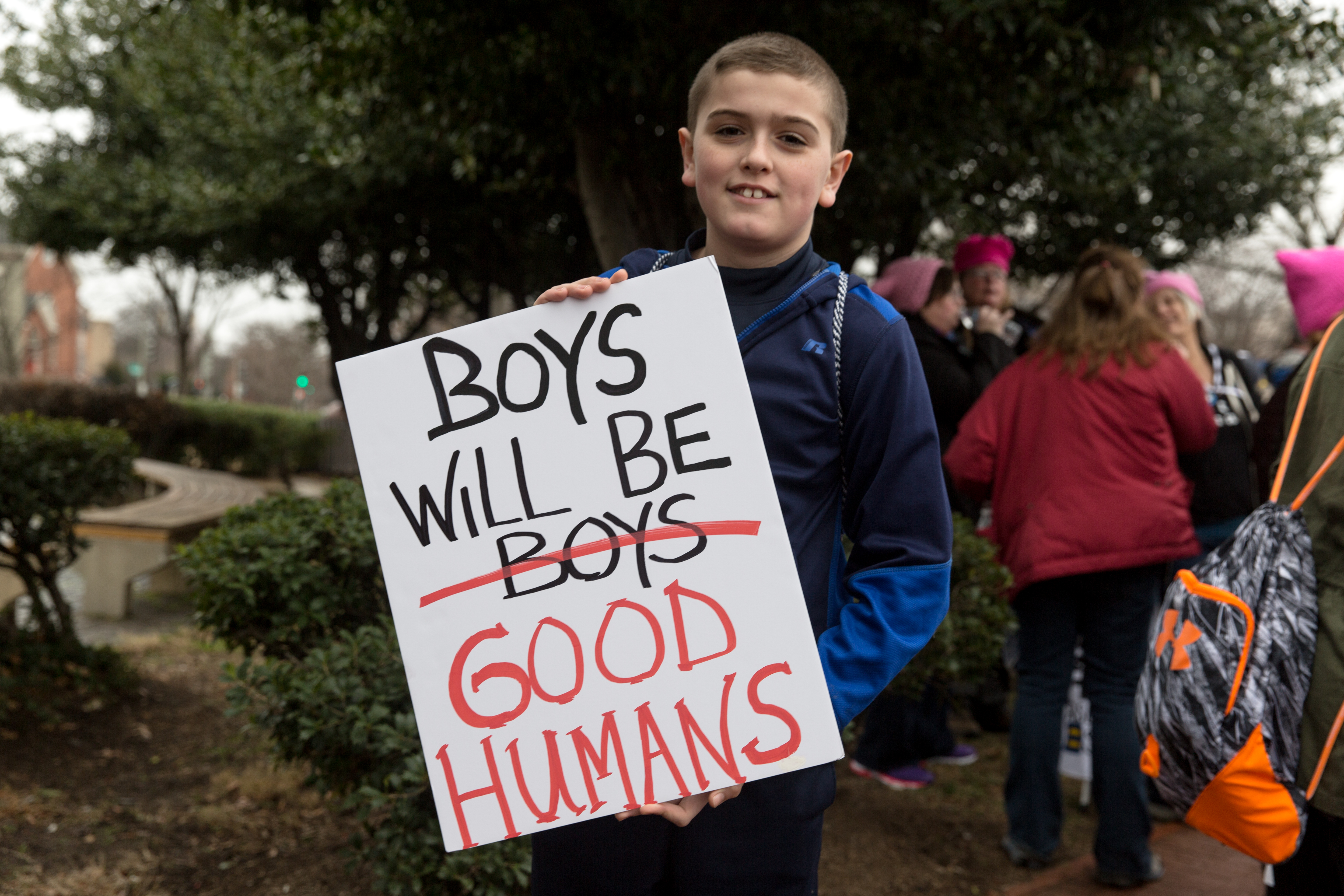
    There is a saying uttered over and over again in response to when those who do harm or commit a crime are affluent and privileged enough to never deal with the consequences: “boys will be boys.”

    It is stated in many different ways such as “locker room talk,” “boy talk” and more, but all of these sayings mean the same thing.

    Many attempt to argue its definition as leniency to adolescent youth who commit petty crimes or get into some mischievous trouble.

    But what if that mischievousness is assault, rape or murder?

    Ultimately, what these words conjure is the privilege and ability to deflect any culpability when it comes to one’s own actions.

    Take our own president, for example, in the wake of the Access Hollywood tape where Trump infamously utters the line, “Grab’ em by the P****.”

    Melania Trump, in an interview to CNN reporter Anderson Cooper, attempts to justify the sexual assault with the idea that it sounds bad because its just “boy talk.”

    Labeling this behavior this way is an attempt to placate the idea of male pedagogy and violent sexism because men are implicitly allowed to be violent or aggressive towards women. Most men in the U.S. are part of this problem, but most do not have the privilege, whether white or economic, to get away with these crimes.

    White male pedagogy specifically uses brown and black bodies to make the law seem more impartial to sexual assault and violence. This is by arresting them at much higher rates or portraying them in the media as committing more of these crimes, even though statistics show white males commit sexual assault and crimes at a much higher rate than any other ethnicity.

    A study done by the United States Bureau of Justice Statistics, from 2005 to 2010, found that 57 percent of male perpetrators of sexual assault are white. In that same study, the BJS found black males to commit 27 percent of sexual assaults. This is not reflected within our mainstream media.

    Many local news and mainstream news affiliates use black and brown crimes as ways of filling air time, because if anything sells the news, it’s white insecurity. These media outlets use the trope of the “devious stranger,” who is oftentimes portrayed as a poor male of color.

    When we look at the statistics of people who commit sexual assault at higher rates, people with intimate or close relationships with the victim are far more likely to commit the assault.

    According to the 2005-2010 BJS study on sexualized crime, 78 percent of sexual assault crimes are committed by someone with close relationships to the victim. Out of that 78 percent, 34 percent are intimate partners, 6 percent are relatives and 42 percent are well known acquaintances or friends.

    This shows that the attempt to frame sexualized violence as something committed by strangers or the desperate is uninformed and at worst, racism incarnate. The media also imagines sexualized violence as a problem of poverty or upbringing, which ignores the white male pedagogy that runs the US.

    I believe this allows for many white males to ignore their own problems and instead shift blame onto things like music, video games, movies or TV. And although some of those do play a role, they do not instigate the sexual power dynamics that exist between the white pedagogical hierarchy and everyone else in the US.

    That is done simply by the power and meaning behind these words “boys will be boys.”


  • Letter to the Editor: Democratic Minority

    Letter to the Editor: Democratic Minority

    To The Editor:

    I seem to find myself in the minority in today’s national Democratic Party.

    I disagree with the tendency of most Democrats (including political candidates for Congress and those in the news media) to constantly bash Donald Trump over his obnoxious personality and his divisive comments.

    As very-conservative “Morning Joe” Scarborough said on his MSNBC show, when Democrats talk negatively about Trump, his supporters become angrier. It makes his supporters angrier and more protective of him while corroborating their paranoid belief that the Democrats and the liberal part of the media are out to get Trump.

    Rather, as Joe suggests, Democrats need to focus on communicating their humanistic, caring, and compassionate values to the American people and telling the people how the federal government can be a force for a lot of positive good in our country and can make life better for all Americans.

    They don’t seem to realize that research over the past 40 years has consistently shown that most Americans agree with them that we need to protect the safety-net programs such as Social Security, Medicare, Medicaid, food stamps, college student loans, and unemployment insurance benefits.

    These are winning issues and popular programs that we should constantly be talking about, not trashing Trump.

    Sincerely,

    Stewart B. Epstein

    2266 Westside Drive

    Rochester, New York 14624

    585-594-0610

    phenom51@mail.com

    P.S. I am a retired college professor of Sociology and Social Work.

    I taught at West Virginia University and Slippery Rock University.

  • EDITORIAL: Ensuring safety must be group effort

    EDITORIAL: Ensuring safety must be group effort

    Safety a primary issue for Humboldt community

    For students at Humboldt State University, Arcata plaza is the place to go to grab a drink after a stressful day of exams or just to hang out. As a result, the bars are incredibly busy, loud, and dense with drunk people who make drunken mistakes. It’s a recipe for disaster when a person is in the wrong place at the wrong time with the wrong people.

    On Oct. 25, a man was stabbed to death near Arcata plaza. The suspect was later arrested according to Arcata Police Department.

    This stabbing is close to home for HSU students. Students have witnessed several murders over the past five years including the murder of David Josiah Lawson, who was murdered at a party of campus. This stabbing could have easily been another student death.

    The incident calls to question the safety of Arcata and who is responsible for keeping it safe? How do we ensure that students can enjoy their cheap pints safely?

    The usual people we turn to are the police, and in cases involving students, we turn to HSU. As public servants, police are supposed to ensure security for the general welfare, and HSU brings students into that public.

    The APD say they have police patrolling Arcata Plaza at all times. They are often out and about, biking around and engaging with the local people. This is a great way to connect with the people and see them face to face.

    But with the amount of people that typically visit the bars, the police may have too much work to do. Interactions between people happen very quickly and in the case of a crowded bar or busy street, someone may not be around to help at a moment’s notice.

    Additional police would be great to have, but in reality, labor costs money and suggesting more police may not be cost effective. If HSU wants to invest in security for students, they can’t leave out the downtown Arcata nightlife. just like how HSU subsidizes the bus systems in Humboldt County.

    HSU and Arcata should consider having emergency blue light emergency phones extending from campus to Arcata plaza. Students, or people in general can have direct contact with Arcata or campus police. They offer a sense of security like a beacon in the fog. Just like security cameras, the presence of phones should at least deter violence in general.

    Arcata bars should also share the responsibility of security for their patrons. Bouncers are often posted outside of the bars, but rarely check people’s belongings. Weapons can be easily concealed and should be checked.

    Ultimately, safety still lies with the individual. Being aware of your environment and surroundings is the best way to rely on your safety. There won’t always be security nearby, so if you ever feel something fishy about the situation you’re in, whether it be the setting or the people you’re with, listen to your instincts.