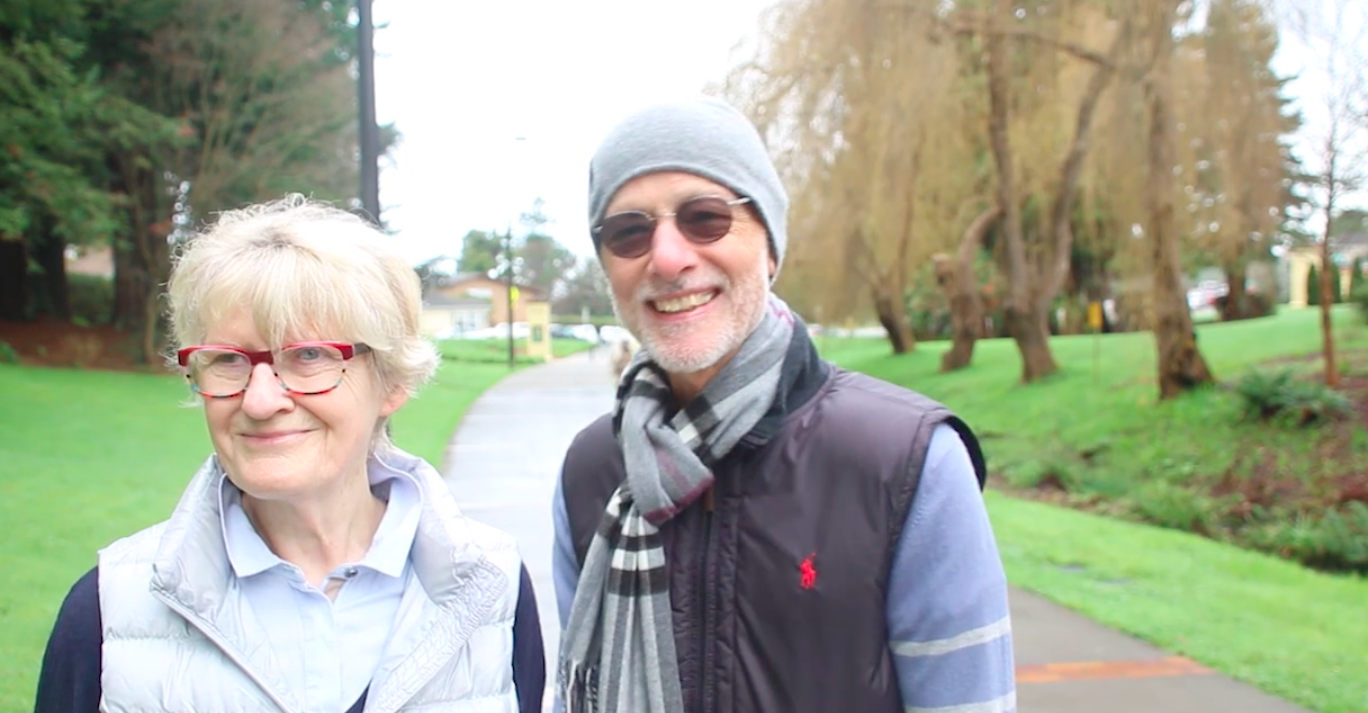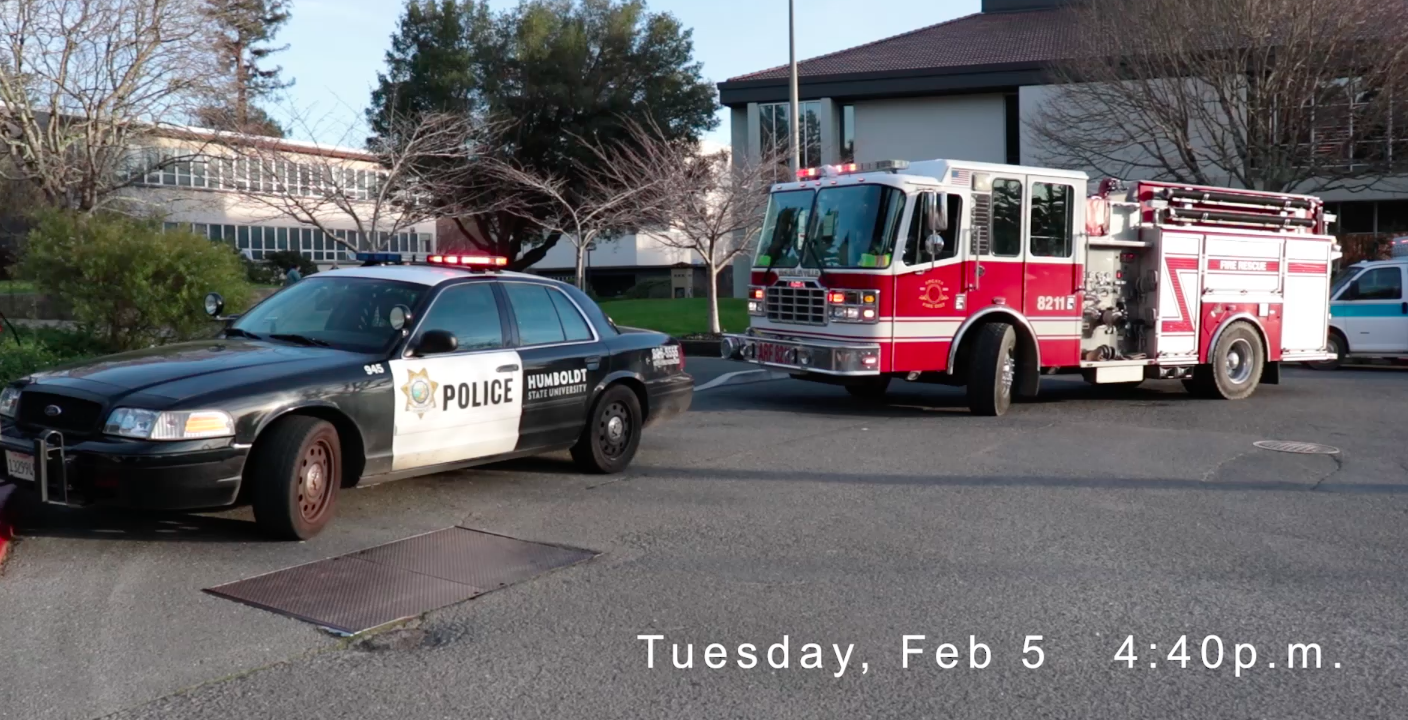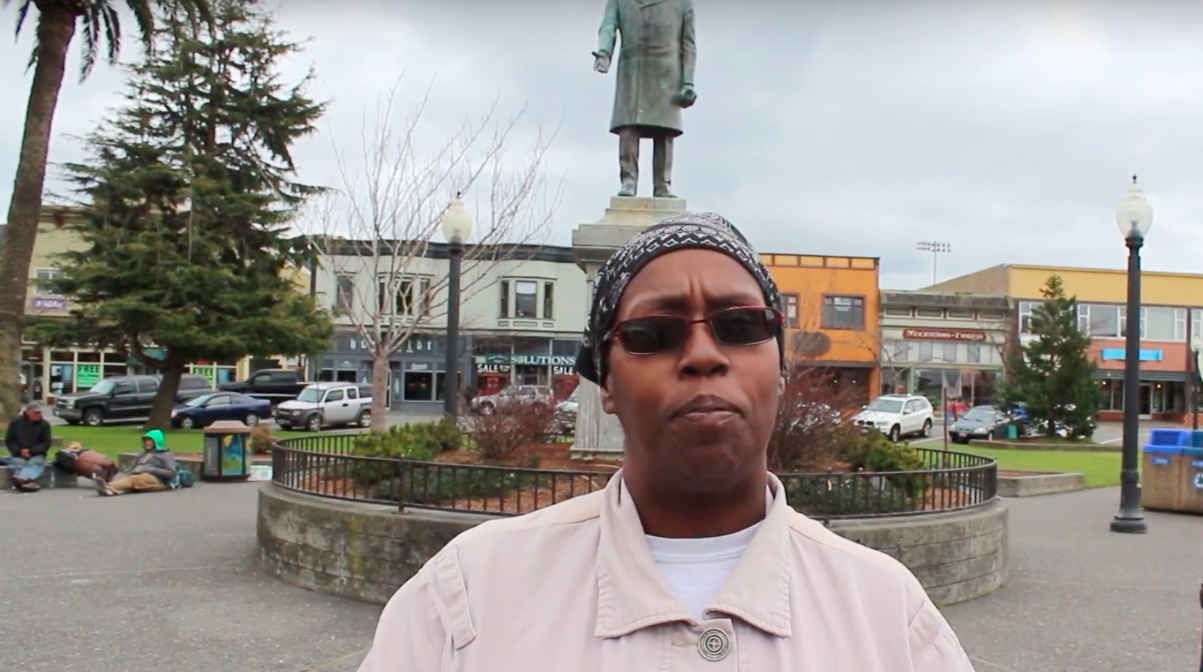
Arcata City Council votes to take down the statue of past President William McKinley on Feb. 21. Lumberjack reporter Dajonea Robinson asked the people of Arcata what they’d like to see in place of it.
Category: Video
-
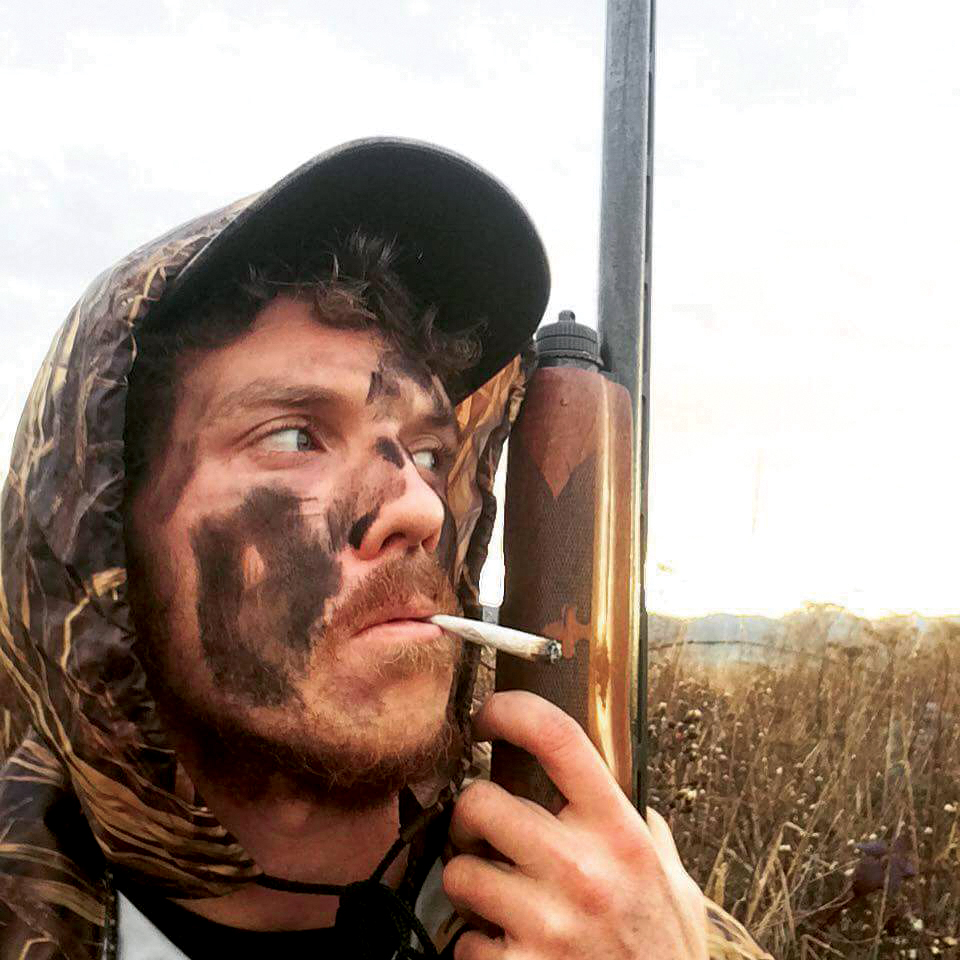
Wild West in Humboldt County
Humboldt County is known worldwide as a safe haven for hippies, liberals and gun-toting conservative cowboys.
Gun violence is on the rise around the country, especially in regards to mass shootings, as was just seen in Florida. Gun culture is being examined everywhere, questioned in many states and threatened all together.
“It puts gun owners in a hard position,” Humboldt resident and registered gun owner Liam Doherty said. “We get lumped in with the demonization when we’re trying to be responsible and use these tools for useful purposes.”
Mass shootings are on the rise, however. There have already been 30 mass shootings in 2018, according to the nonprofit Gun Violence Archive. Protests have erupted all around the United States in attempts to bring about gun law reform to make it harder or even impossible for American citizens to purchase firearms.
Video by Patrick Maravelias.
Alexis Pritchard, Humboldt State graduate with a bachelor’s degree in sociology, said if she had the power, she would take everyone’s guns away.
“I believe that the root of the problem comes with the National Rifle Association and the lobbyists that are paying off these politicians to keep guns like AR-15’s that should only be used in the military,” Pritchard said.
Arcata in particular has a reputation for being a progressive college town; pro-choice, pro-gun control and proactive in fighting for human rights. Outside of Arcata, however, is a jungle full of conservatives, cannabis and lots of firearms.
“Arcata’s the only place you don’t see it,” Doherty said. “It’s the only town in Humboldt without guns in it.”
HSU created a small, safer and more progressive circle than the rest of Humboldt. In addition, Arcata has a reputation for hippies, potheads and other stereotypes. But the truth is the majority of the country is very conservative. Fortuna, Ferndale, Rio Dell and Scotia all have more registered conservative voters than liberals, according to an article by the Times-Standard.
“Arcata is a bubble, even compared to Mckinleyville,” Pritchard said. “I believe that the gun culture in Humboldt is very diverse in that we have one city specifically that has completely different ideals than the rest of the county as a whole.”
The recreational cannabis industry is booming in California, and Humboldt is at the center of it. Currently, registered cannabis growers aren’t allowed to own firearms, which has created a mecca for illegal firearm trafficking in Humboldt as well.
Cannabis is legal to grow and use in California within certain limitations. But on the federal level, cannabis remains illegal, forcing farmers to use cash-only for business transactions, because banks are in control. This has indirectly created a community of farmers who are forced to own unregistered firearms in order to protect their assets.
The issue of illegal gun trafficking will be discussed further in the video on The Lumberjack website.
-

McKinley statue is no more
The Arcata City Council votes to remove the McKinley statue on Feb 23. amid strong support from the community.
Footage by Stephanie McGeary and Garrett Goodnight. Edited by Stephanie McGeary.
“Hey! Ho! McKinley’s got to go!” Humboldt State students shouted as they marched to the Arcata Plaza on Feb. 23. Supporters stood up for their support of the removal of the McKinley statue and Jacoby Building plaque. A crowd of people then crammed into City Hall to participate in the city council meeting where the council voted to remove the statue.
“It’s like pulling the thorn out of a festering sore,” 64-year-old activist Fhyre Phoenix said.
Phoenix was among the many who came to show his support for the removal of the statue, which he has been protesting for several years. Since December, Phoenix spent 26 days on the plaza demonstrating against the statue.
“My goal was to start a conversation with 100 people every day I was there,” Phoenix said. “I found the response overwhelmingly positive. I had 15 positive responses for every one negative.”

A crowd of people making their way to Arcata Plaza on Feb. 21. to participate in the decision to remove the McKinley statue. Photo by Patrick Maravelias. Among others supporters were the people of the Weott, Yurok and Pomo tribes, the Seventh Generation Fund for Indigenous Peoples, Earth First, Humboldt Unitarian Universalists Fellowship and HSU students.
Elijah Lechman, 25, is the board of directors representative of Associated Students. Lechman says the Historic Justice Alliance, a group which includes Seventh Generation, HSU’s Movimiento Estudiantil Chicano de Aztlan, or MECha, and AS Lobby Corps, worked hard to get the word out about this pivotal moment. Lechman says it doesn’t matter if there are plans to replace the statue with something else. The bottom line is it needs to be removed.
”It’s distressing people having it there and it would be hurting no one to have nothing there,” Lechman said.
Chris Peters, president and CEO of Seventh Generation Fund for Indigenous Peoples, spoke during the rally on the plaza of his concern that the city would try to delay this issue again.
“They raise issues of cost and environmental impact reports,” Peters said. “We need to make a firm stand that we are adamant.”
Cost issues were presented during the council meeting. City manager, Karen Diemer, estimated the cost to remove the statue at roughly $65,000.
The decision to change the Jacoby Building plaque, however, seemed easy to agree on. Owner of Jacoby Storehouse Bill Chino agreed to help cover costs for that project.
The main issue of the meeting was voting on the removal of the statue. Although member Paul Pitino voiced clear support, other council members were on the fence about the issue. There was the discussion of placing the issue on a ballot, to have the public vote in November. Mayor Sofia Pereira did not support this option.
“I think we lose the nuance of people’s perspective on it,” Pareira said. “As a council, we should give our best effort to resolve it at this level.”
In the end, the city council did resolve the issue. In a vote of four to one, the council voted to remove the McKinley statue from the Arcata Plaza.
The estimated $65,000 cost still presents an issue, but Phoenix offered to help run the campaign to earn the funds. The project is currently in the early stages.
Phoenix said the community support will make this an achievable task.
“People who want to help move forward can donate to the campaign,” Phoenix said. “This is for people who didn’t make it to the rally or to the meeting to show support. Here’s your chance to make a mark.”
People interested in contributing can inquire by emailing fhyrephoenix@gmail.com.
This story has been changed from its original version on Feb. 27 at 4:22 p.m.
-
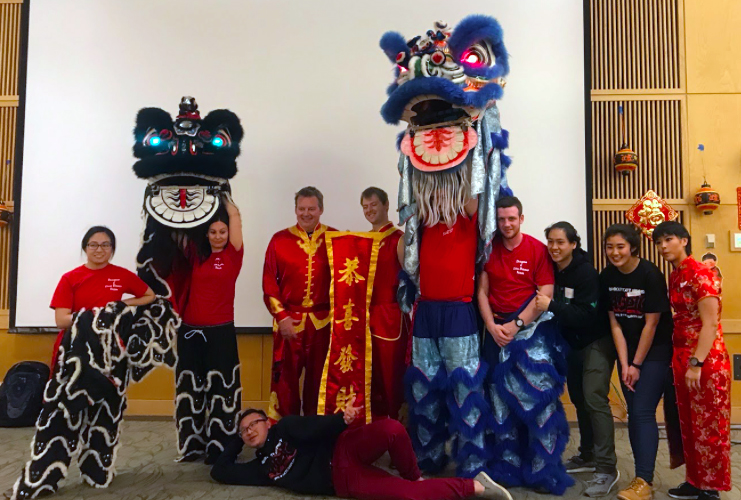
Humboldt State celebrates the Lunar New Year
Video recorded by Dajonea Robinson. Edited by Surya Gopalan.
Allan Hubbard, martial arts instructor for Eastern Ways Martial Arts, and his team made the six-hour drive from Sacramento to perform the traditional lion dance for the Lunar New Year event on Feb. 16.
“The significance of the lion dance is normally the kickoff to any event during the Lunar New Year to bring good luck, prosperity and good health for the new year,” Hubbard said.
Hubbard said in a typical performance, the audience should expect the lions to be very animated as they move throughout the crowd.
“There’s a segment of the routine where the lions will play and then take nap. They’ll wake back up, scratch and stretch and then they eat lettuce. They then perform three bows, which are the humility of the lion to the crowd,” Hubbard said.
Jacob Langley was one of the performers in the lion dance routine. Langley has been lion-dancing for five to six years and has been training for kung fu for 16 years.
“I’ve always loved it here, [and] I’ve been a few times. We had some other teams that were going in to perform at casinos and we figured this would be the better one to come to,” Langley said. “It’s just always fun to travel and do lion-dancing anywhere we can go. I had a great time, the audience was a blast and we had a really successful dance.”
Aaron Gardener is one of the instructors for Eastern Ways Martial Arts and he was also part of the lion-dancing team.
“Every year around Chinese New Year we do a lot these lion dances,” Gardener said. “It’s always a lot of fun. I like entertaining people and making them laugh.”
Gardener has been training for lion-dancing for about four years and has been training for kung fu for about eight years.
“At our school, everybody does the martial art aspect first,” Gardener said. “Once they get down the basic stances and skills balance, then we allow people to be lion-dancers.”
Gung hay fat choy (happy new year)!
-

The evolution of biology 105
Do sports drinks lie about their sugar content?
In biology 105, HSU oceanography major Courtney Dressler and her classmates tried to answer this question.
“We are adding dinitrosalicylic acid into solutions of Gatorade and Vitamin Water Zero,” Dressler said. “The acid helps us identify how much sugar is in these drinks.”
Dinitrosalicylic acid, or DNS, binds to sugar molecules in a solution. When this binding occurs, the solution’s color can transform into a shade between orange and red.
Wesley Warren, also an oceanography major at HSU, explains how these color changes are detected.
“We put the solutions into a spectrophotometer, which tells us how much light they absorb,” Warren said.
Orange solutions absorb a different amount of light than red solutions. By comparing the sports drinks’ light absorbance values to those of the standards, or solutions with known sugar content, the drinks’ actual sugar concentrations can be determined.
Dr. John Steele, one of the instructors for biology 105, elaborated on how this experiment fits into the course’s schematic.
“Biology 105 provides an introduction to topics that a cell/molecular biology, microbiology and general biology major would encounter in their undergraduate studies,” Steele said. “[The experiment] is used to teach students how to make diluted solutions from a stock solution and how to determine the concentration of [molecules] in a given solution.”
In prior semesters, two laboratory periods were given for students to complete the experiment and learn these essential techniques. Now, students are allowed three periods to conduct the experiment.
A few other labs in biology 105 were also modified to include more time.
Video by Linh Pham and Surya Gopalan.
Dr. Brigitte Blackman, who teaches a section of biology 105, explained the factor that prompted these changes.
“We try to take feedback from students every semester and change the course based on their comments,” Blackman said. “In past semesters, some students have felt the labs were too long and covered too much in one period.”
“By spreading out the labs, we hope that students will be able to better understand the principles covered in lab and apply these principles to test a scientific hypothesis,” Steele said.
For Marjani Ellison, an environmental science major who’s retaking biology 105, the order in which the experiments are conducted also seemed to change.
“Last semester, the labs and lectures materials did not coordinate. I felt as if the two were separate classes,” Ellison said. “This semester, the labs follow the lectures. I feel that I’m actually learning this time.”
In addition to student feedback, current trends and issues in biology also determine the necessary changes for the class.
“Last semester, we incorporated the Small World Initiative into our laboratory curriculum,” Blackman said. “The initiative was introduced to the course by [professor] Mark Wilson. As part of this initiative, students sampled and grew bacteria from the local environment, such as the Arcata Marsh, then searched for bacteria that were producing antibiotics.”
This semester, biology 105 replaced the Small World Initiative with gene-editing using CRISPR as the current topic in biotechnology.
“CRISPR is a gene editing system made by two scientists named Jennifer Doudna and Emmanuelle Chapentier. To use this tool, all you need to know is the DNA sequence where you would like to make an edit,” Steele said. “Because of its versatility and popularity in biotechnology, bio 105 students need to learn the basics of this tool and the first step of building it.”
Learning CRISPR at the introductory biology level could increase the horizon of opportunities for HSU students.
“This topic has grown from being a sentence in a textbook to a paragraph, and soon, probably full sections of a chapter,” Steele said. “Biotech companies are looking for people who know how to use CRISPR and gene editing technologies. Learning this technique early could really put HSU students ahead of the competition.”
Steele also claimed a selfish reason for teaching students CRISPR.
“If more students know how to use this tool, then more students will be able to work for my lab,” Steele said. “My lab uses this tool everyday!”
-
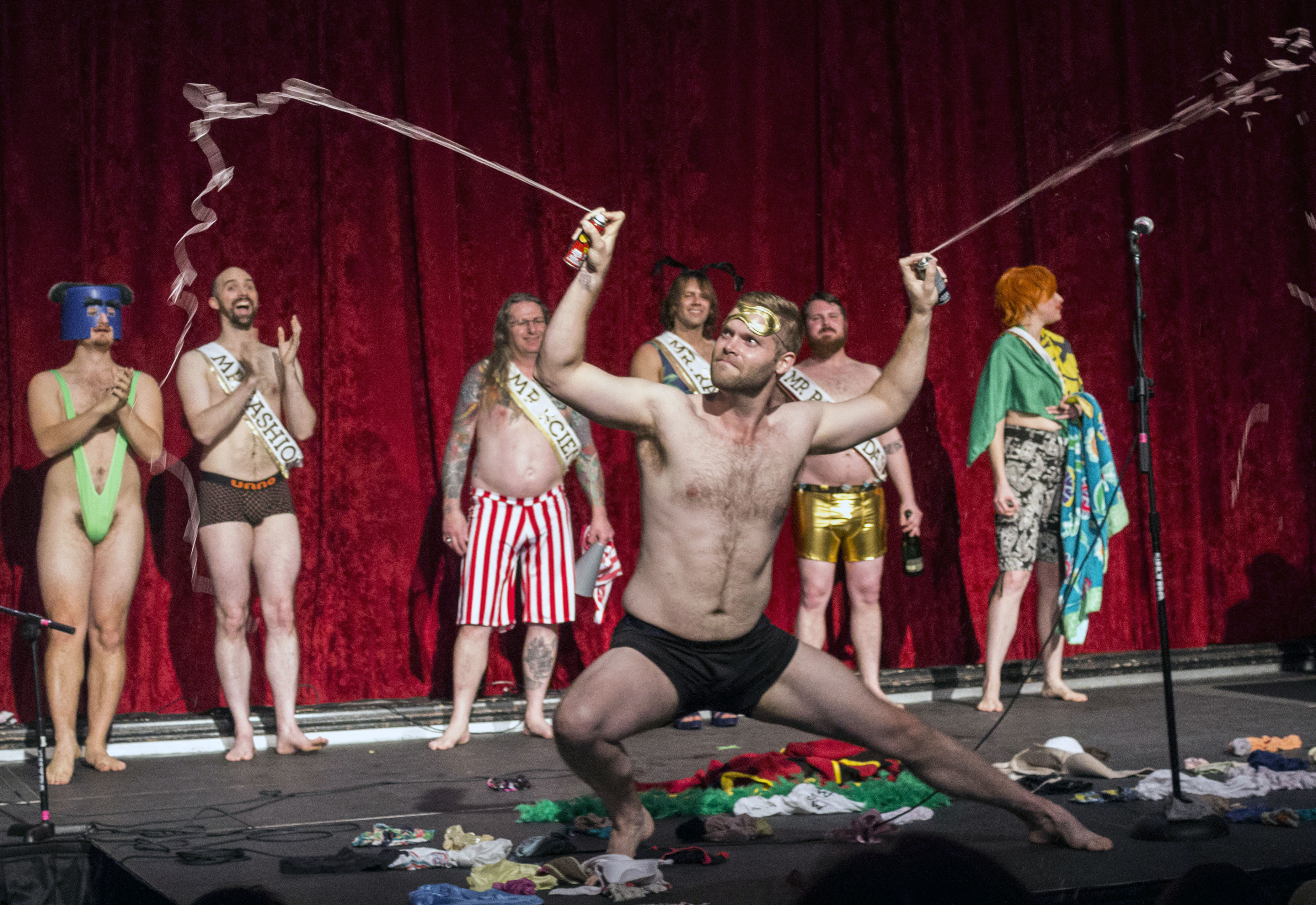
Mr. Humboldt 2018
Video by Stephanie Mcgeary.
Panties were strewn across the stage at the Arcata Theatre Lounge on Feb. 10 where eager event-goers crowded in to find out who would be named Mr. Humboldt 2018.
The fifth annual fundraising event invited nine contestants to show off their wits, talents and body in competition for the highly coveted crown.
Jeff Mason, winner of Mr. Humboldt 2015, also known as Mr. Dairy Man, was impressed with this year’s contestants and felt they were all bringing their A-game.
“They are not holding back,” Mason said. “My job as a past Mr. Humboldt is to cheer everybody on.”
The nine contestants consisted of Mr. Culprit, Mr. Hans Buckethead, Mr. Fashion, Mr. Science, Mr. Rabbit, Mr. Breakfast Daddy, Mr. Chameleon, Mr. Shakespeare and Mr. Edible, a cardboard cutout of a gingerbread man.

Mr. Rabbit competing at the 2018 Mr. Humboldt pageant at Arcata Theatre Lounge on Feb. 10. Photo by Patrick Maravelias. They were all competing for not only the crown and title, but a donation to the charity of their choice.
One contestant who had huge support in the audience was Shayne Sines, or Mr. Science. Sines is an HSU graduate who teaches special education at Morris School in McKinleyville.
“I love giving to the community,” Sines said. “As an HSU alumni, I’ve got to.”
This year’s panel of judges included Arcata mayor Sofia Pereira, KHUM DJ Bayley Brown, Eric Hall, also known as Captain Awesome, the first ever Mr. Humboldt, and Eureka City Council member Austin Allison. The judges scored each contestant in the categories of question and answer, swimwear, talent and formal wear.
Equally entertaining were the swimwear and talent portions. Audience members were entertained by science experiments, rollerblading, body waxing, bacon, ukulele, weightlifting and an eye full of flesh.
Ryan Howe, also known as Mr. Hans Buckethead, is a 20-year-old Dell’Arte student. Having moved to the area recently, it was Howe’s first time experiencing the pageant. He had no expectations and was pleasantly surprised.
“It’s so excellent,” Howe said. “It could not have been anyplace else in the world.”
Howe was one of three contestants who made it to the finals, along with Mr. Fashion and Mr. Breakfast Daddy.
There were, however, some awards for those who were eliminated. Mr. Rabbit was named “Mr. Congeniality” and Mr. Shakespeare was given the annual “Cougar Award,” presented by local public figure Alex Stillman.
Though all the contestants were entertaining, there could only be one Mr. Humboldt.
In the end Nathan Davis-Floyd, Mr. Breakfast Daddy, proudly took the title and crown.

Mr. Humboldt 2018 champion, Mr. Breakfast Daddy, also known as Nathan Davis-Floyd, at Arcata Theatre Lounge on Feb. 10. Photo by Stephanie McGeary. Davis-Floyd, 28, is an HSU philosophy student who has lived in Humboldt County for 10 years. Davis-Floyd felt he was finally worthy of the honor of being Mr. Humboldt as he felt the title should go to a long-time resident.
“I was never comfortable calling myself a local,” Davis-Floyd said. “At least I can call Humboldt my home.”
Davis-Floyd chose to donate his winnings to True North Organizing. One of the services provided by this local nonprofit is the Humboldt Rapid Response Network, which responds to calls about Immigration and Customs Enforcement raids.
In his acceptance speech, Davis-Floyd stressed the importance of donating whatever you can to nonprofits like True North or Planned Parenthood.
“Even if its five dollars a month,” Davis-Floyd said, “you spend that on beer in a day.”
-
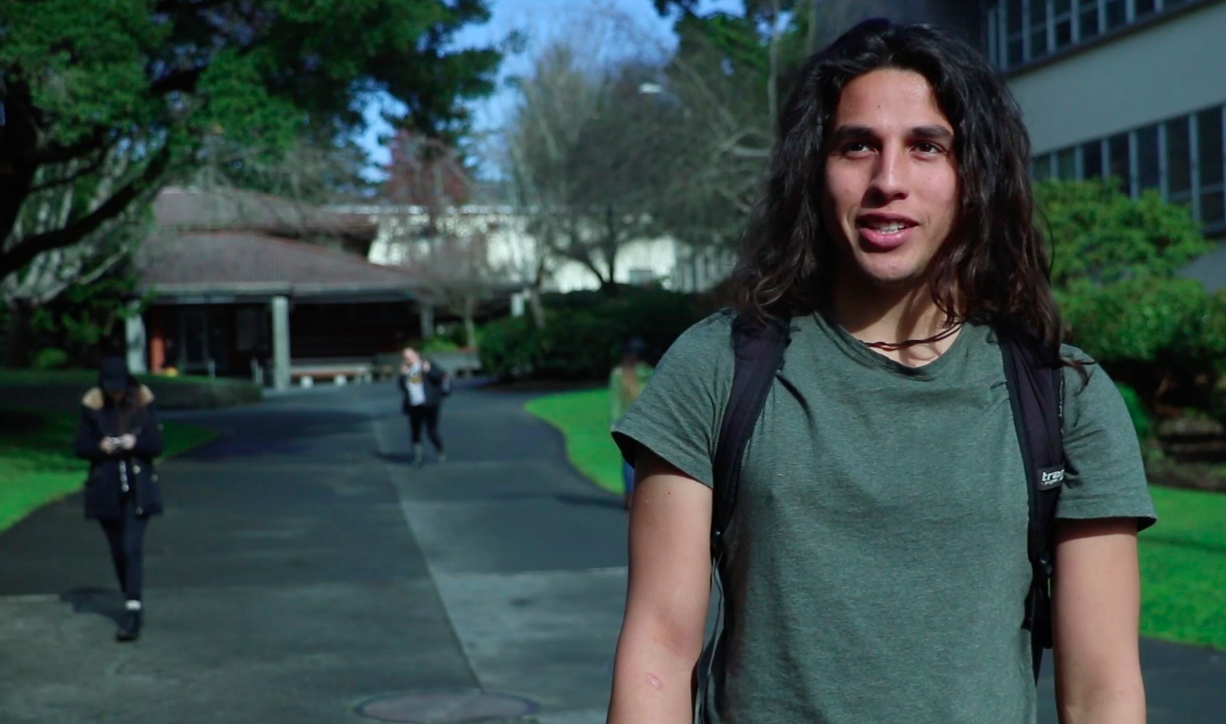
Man on Street: The McKinley statue
Humboldt State University students were asked a single question regarding a controversy surrounding the Arcata community: the presence of the McKinley statue.
The results were rather polarizing:
Video by Garrett Goodnight.
-
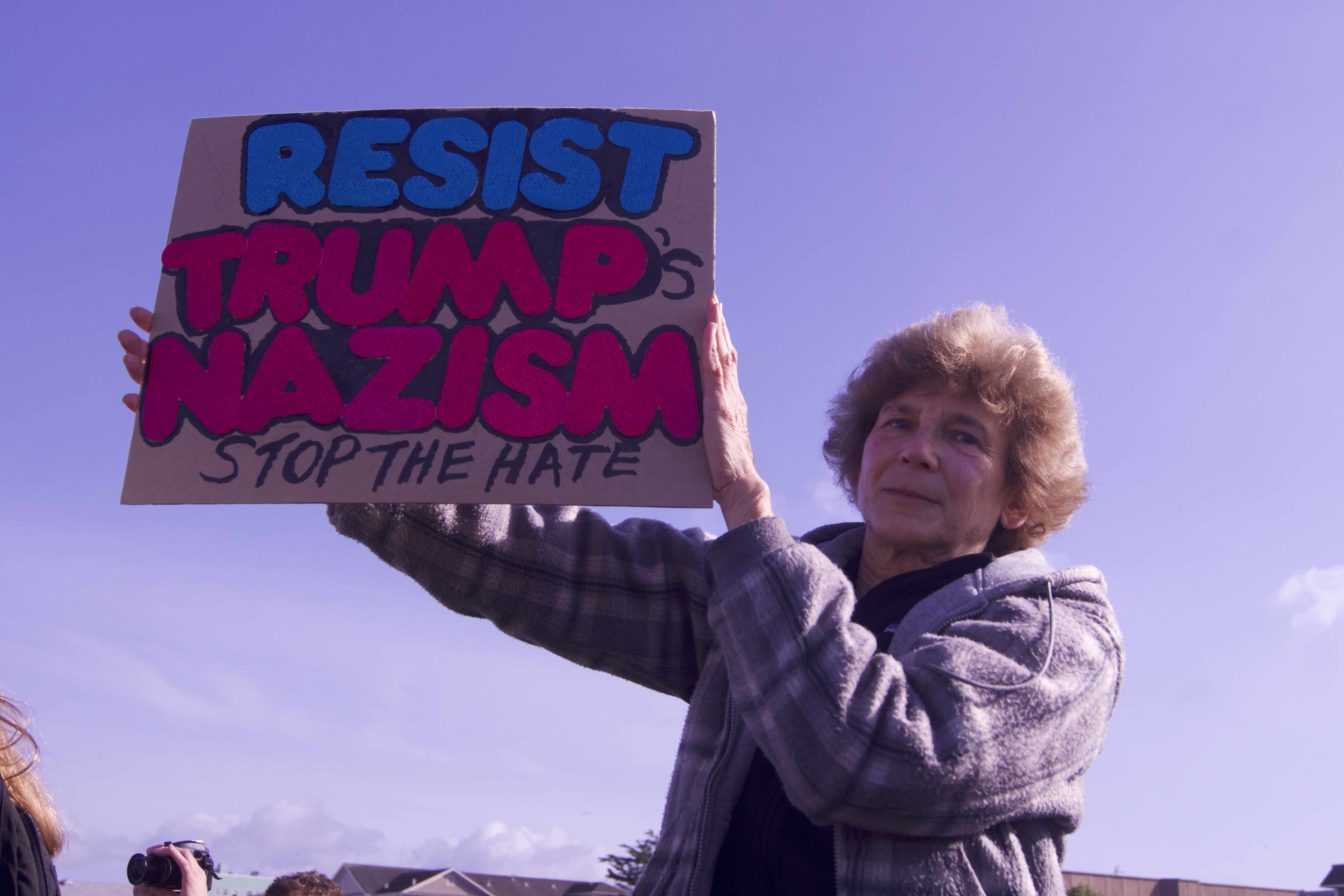
Gaining ground: marching for human rights
Video by Michelle Meyers.
Protesters lined the streets of downtown Eureka on Jan. 21 to be part of the worldwide Women’s March.
This year’s Women’s March occurred on the one-year anniversary of Donald Trump’s inauguration. It is now considered to be the largest single-day protest in U.S. history.
The march in Eureka was part of the larger Women’s March movement that took place not only here, but around the globe. The intention of this movement is to protest the attitudes put forth about women by Trump and to promote women’s rights as human rights.
The initial rally began at 1 p.m. on C Street Market Square.
Speakers representing an array of local organizations, including the North Coast Rape Crisis Team, Centro Del Pueblo, Move to Amend and Seventh Generation Fund for Indigenous Rights, took to the stage to address their local and global communities.
Organizers concluded the rally with an inspiring performance by The Raging Grannies, a local women’s music group that sings about social justice issues.
The march began around 2 p.m.
Protesters beared signs that read statements like, “together we rise,” “don’t mourn, organize” and “anything you can do, I can do bleeding” around the streets of downtown Eureka.

A protester holds a sign at the Women’s March in Eureka on Saturday, Jan. 21, 2018. Photo by Michelle Meyers. They chanted statements that rang through the crowded streets, such as “me too,” which is in reference to the prevalent #MeToo movement.
“No Trump, no KKK, no fascist U.S.A.” and “I am a woman, hear me roar!” were also heard amongst the crowd.
This all plays in part of starting a conversation that “just gets brushed under the rug,” protester Loganberry Fernandez said. “Human rights is something that shouldn’t be ignored.”
Conversation is merely the first step.
Many protesters lined the streets of downtown Eureka and around the globe to express one purpose: “To be here for women,” protester Athena Gore said.

HSU students stand by a light post in downtown Eureka, located near the Women’s March on Saturday, Jan. 21, 2018. Yomayra Mora (left), Myranda Dominguez (top left), Noel DiBenedetto (top right), Sydney Long (right) and Rowan McClelland-Bishop (center) protest with their signs. Photo by Garrett Goodnight. “Whether it’s immigrants, Native Americans or people of color, what will forward the movement is unifying voices and hearing other groups talk about advocating in strength and in numbers,” protester Raquel Lee said.
For Brenda Perez, a voice for Centro Del Pueblo, this is her first time participating in the Women’s March.
“[The Women’s March] represents the recognition of our neighbors as workers, as students,” Perez said. “For me, saying that we are here isn’t just a statement. We are here.”
Perez is joined by Yojana Miraya, a fellow voice for Centro Del Pueblo from the Andes of Peru.
“If injustice happens, women and men come together in Latin America, especially in indigenous communities,” Miraya said.
When asked if she was afraid of what the future holds for her, as well as for women everywhere, Perez said, “We are going to do it. We have to do it.”
So in the name of human rights, they will march.
Number of marches: 673
Number of marchers: 4,956,422
-
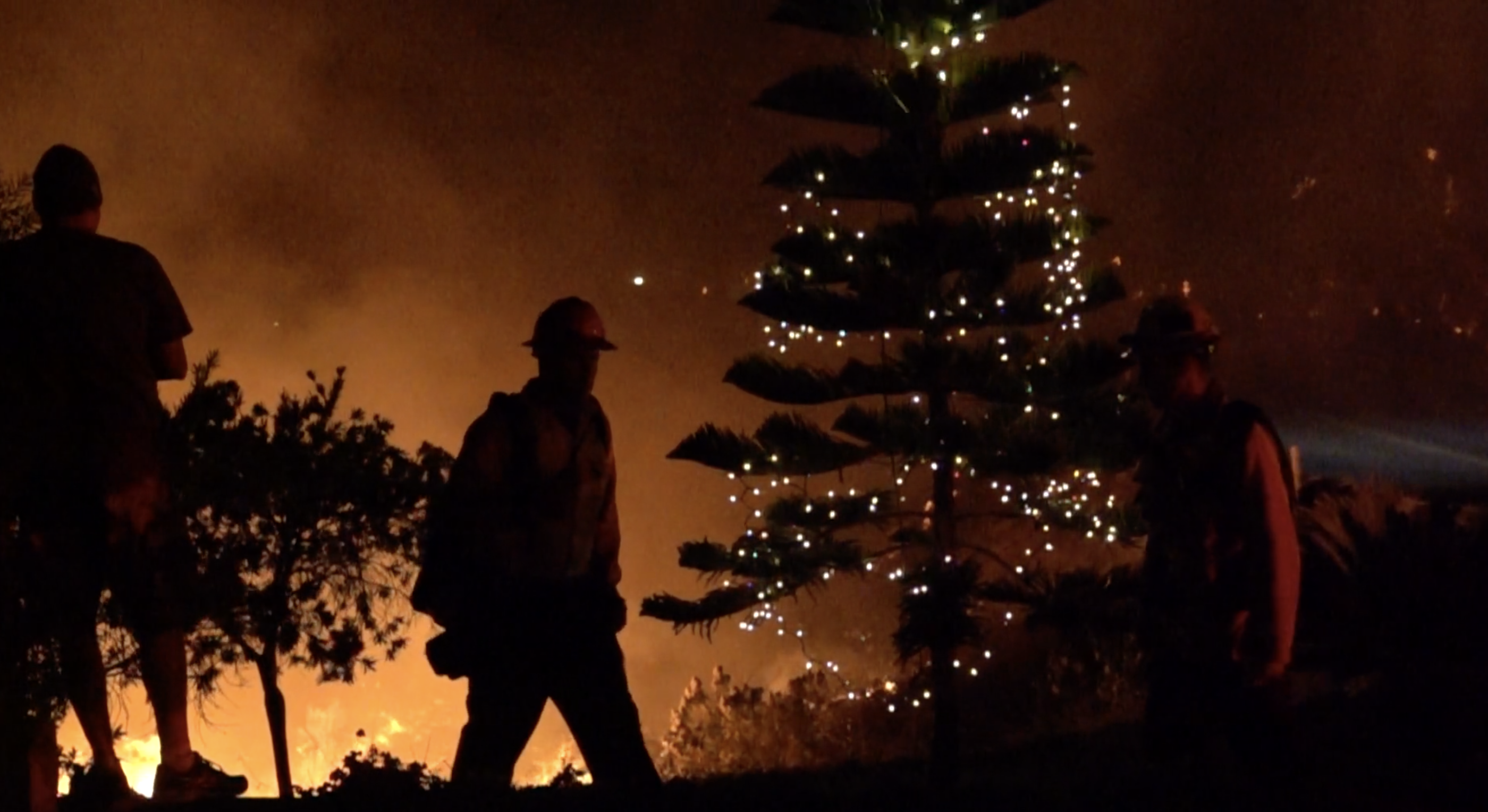
The Ventura Thomas fires
By | Gilbert Martinez
The Ventura County Thomas Fires, which started on Dec. 4, has grown to the the fifth largest fire in California’s recorded history. The video was captured among the hills of Ventura and Santa Barbara throughout the first week of the fire. You can see one of Ventura’s favorite land marks, a giant wooden cross, completely surrounded by flames, yet remained intact the following day.
-

Surfing giants in Humboldt
Waves upwards of 20 feet tossed and turned against the Humboldt coastline this week.
According to the National Weather Service Marine Forecast, a small craft advisory is also in effect until Sunday afternoon. While the first big swells of the season are already arriving, the winter swell season has merely just begun.
With more swells and even bigger waves on the way this season, it begs the question:
How do such massive waves come to be?
According to the National Oceanic and Atmospheric Administration (NOAA), water does not actually travel in waves. Waves are merely the transfer of energy, moving from one neighboring water molecule to the next.
The NOAA says that waves are most commonly generated by wind. Wind-driven waves, or surface waves, start out when changes in temperature produce a change in air pressure. Air then follows its natural path, moving from an area of high pressure to an area of low pressure. This movement is referred to as wind.
As the wind blows across the ocean’s surface, it generates ripples. This happens in a similar way to how ripples are created when you blow over the surface of a cup of water. These ripples increase in intensity to eventually become waves.
What determines the size of a wave?
The NOAA says that the size of these waves are determined by three main factors:
Wind Speed: How fast the wind is blowing.
Wind Duration: How long the wind blows.
Fetch: Distance over water that the wind blows in a single direction.
The biggest waves occur when wind speed is at its highest, wind duration is at its longest and when fetch is long or unlimited.
There are several other factors that can affect wave size in a certain area, some of those factors include:
Swell Direction: The direction in which the swell originated from.
Ocean Floor Topography: Forms or physical features on the ocean floor.
Tide: Rising and falling tides are caused by a gravitational attraction between the earth, moon and the sun.
Why are these big waves in Humboldt?
“It is because the storms that come out of the North Pacific are incredibly powerful,” said Dr. Jeffry Borgeld, Oceanography professor at HSU who specializes in Geological Oceanography. These storms “can be as energetic as a tropical storm, typhoon or a hurricane.”
Despite the cold, powerful and often unforgiving conditions, there are a few individuals that can be seen bobbing amidst the chaos and gliding over the massive surf.
HSU psychology student William Doudna is one of them.
“There’s something very cleansing about surfing that if i don’t do it, i just don’t feel comfortable in my own skin,” said Doudna. “I feel like a better person every time I come out of the water.”
Video by Michelle Meyers.
-
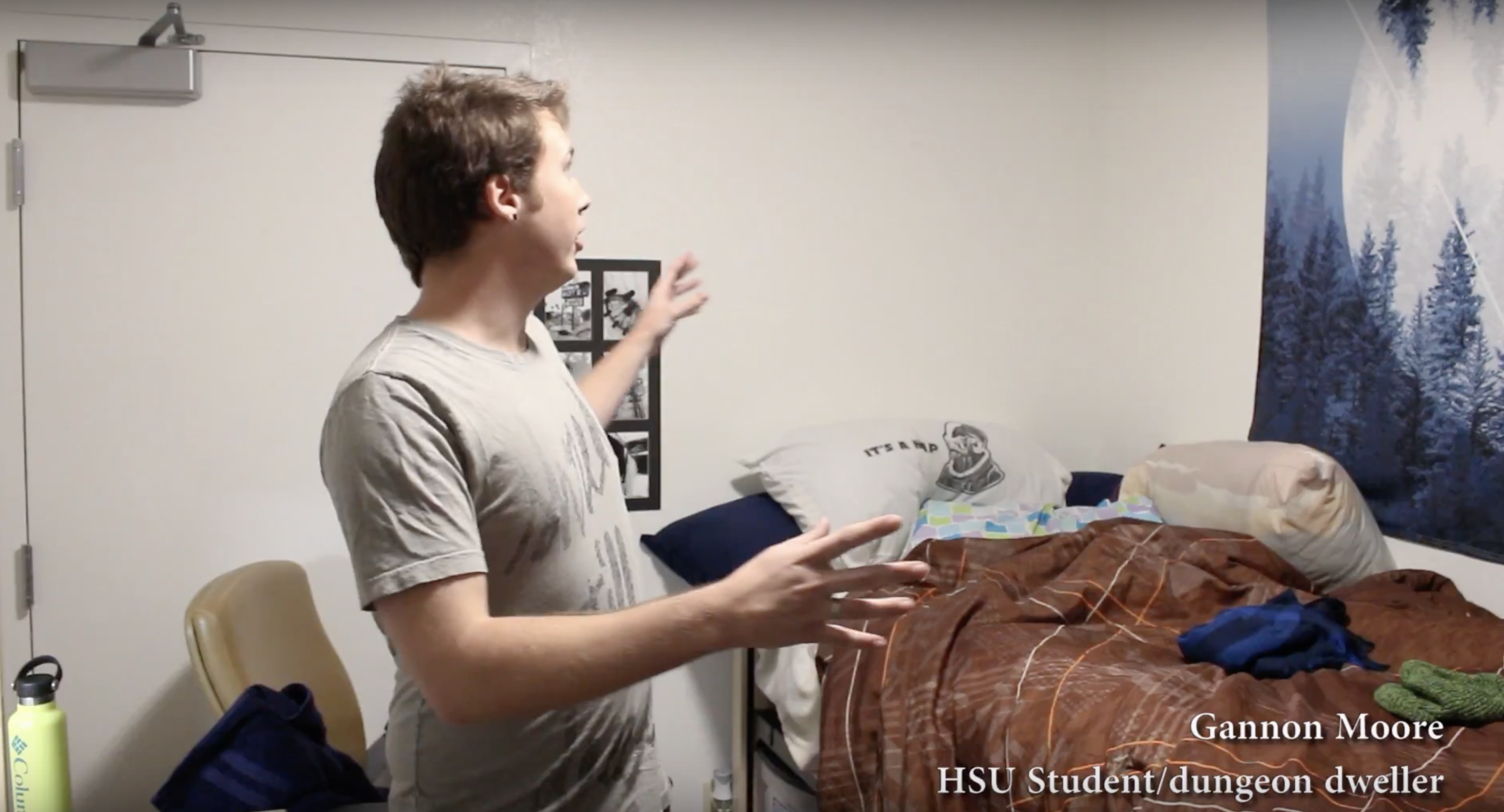
Living in a windowless room
Video by Ian Thompson.
HSU student Gannon Moore was excited to have his own room for the first time, but his excitement didn’t last long. It died out when he saw his assigned windowless bedroom for the first time.
“As soon as I got there a lot of those hopes were dashed, everything was dashed,” Moore said.
In the summer of 2016, HSU housing and residence life decided to convert 23 kitchens in Juniper and Laurel at Creekview into bedrooms with no windows to accommodate more student housing.
The Director of Housing and Residence Life Stephen St. Onge said these rooms were built because of the urgent need for housing. He said that housing is not trying to capitalize on it, but only trying to combat the issue of homelessness.
Freya Mitchell is an international exchange student from the United Kingdom. She also was assigned a similar bedroom with no windows. Freya Mitchell was disheartened when she arrived this past August to her windowless assigned room after a long flight from the UK.
“Is this what I came for? Why have I flown all this way to this tiny room? It’s a bit claustrophobic and you can’t have any natural air flow in it,” Freya said
David Mitchell is Freya’s father and is an architect from the UK. He said he was shocked to know that there are dorm bedrooms with no windows.
“We [his family] were surprised that they even have that sort of room, to be honest,” David Mitchell said. “We’ve paid for a legitimate room and what we’re getting is a storeroom.”
He said windowless bedrooms like the ones in Creekview are illegal in the UK. In his opinion, those rooms shouldn’t have been used as bedrooms.
As an architect, David Mitchell thinks that there are several fundamentals that are wrong with such bedrooms, one of which is the lack of natural daylight and natural air flow.
“I don’t think that room should be used as a bedroom,” David Mitchell said. “I think their [HSU housing] decision to convert that room is driven by money. I think it’s driven by profit.”
Freya’s mom, Michelle Mitchell, also doesn’t think it’s acceptable to have a room without a window.
“Our friends would say ‘how’s Freya getting on in America?’ and we say she’s living in a cupboard,” Michelle Mitchell said. “Everybody we spoke to about it was horrified.”
After several efforts have been made by Freya, her family, and the HSU’s international students office, Freya was assigned a different room with windows.
“I didn’t wanna stay in that room it was horrible,” Freya said. “I just can’t believe that they’ve got rooms like that.”
According to the international residential code, bedrooms are required to have windows or a second door for air ventilation, natural light and to be used as an escape in case of an emergency. Though the 23 converted bedrooms in Juniper and Laurel at Creekview don’t have a window, they have another exit door that leads to the outside.
Patricia Rivera is another student who moved into Mitchell’s windowless room after she moved out. Rivera lives right across the hallway from Moore and both of them agree that their small converted windowless bedrooms lack proper ventilation and have no natural light.
“It gets really stuffy within like five minutes,” Rivera said. “It’s constantly dark no matter what’s in there.”
When the heat is turned on in Moore’s suite, his room gets very hot compared to other rooms in the suite due to the insufficient ventilation.
“My room gets boiling hot because there’s no ventilation,” Moore said. “All the heat from the vent gets into the room and just sit it has nowhere to dissipate to.”
Moore used to open the door that leads to the outside to get some fresh air, but he can’t prop the door open anymore.
“I can’t leave my door open because the RAs say ‘you gotta close your door, you can’t leave your door open’ even if I’m in the room.” Moore said.
Moore said he’ll sometimes wake up sweating from his overheated room.
“When I’m overheating at night, I have to open my door, go walk out into the hallway and just stand there,” he said. “I stand there sometimes in my boxers because I’m freaking overheating and I have nothing else to do.”
Both Mitchell and Moore agree that living in a room like this affected their mental health. Moore noticed that he started to get frustrated easier than ever before.
“I started getting angrier and it’s honestly because I’m not seeing any natural light,” he said. “It’s like I’m in solitary confinement.”
Before Mitchell was relocated and during the time she was in one of the windowless bedrooms, she tried to stay away from her room as much as possible.
“I didn’t spend much time in the room really I stayed out as much as I could,” Mitchell said. “You’re going to go crazy if you stay there.”
J.D. Andreas is another student also currently living in one of the converted windowless bedrooms. He said he wakes up not knowing what time it is because it’s always dark in his room.
“You wake up, you don’t know if it’s midnight, you don’t know if it’s 3 p.m. because it’s just pitch black in there,” Andreas said.
Andreas and his suitemates found humor in what they called “messed up things.”
“My roommates and I were always like ‘yo I’m going to take a nap in J.D’s room. I don’t know if it’ll be three hours or 18,’” Andreas said.
Moore’s girlfriend, Hannah Klein, calls him Harry Potter because he lives in a “cupboard,” she said. He said his windowless room also became an inside joke for him and his friends.
“Anytime anybody complains about their room,” Moore said. “We tell them at least you have a window, at least you don’t have the dungeon room.”
-
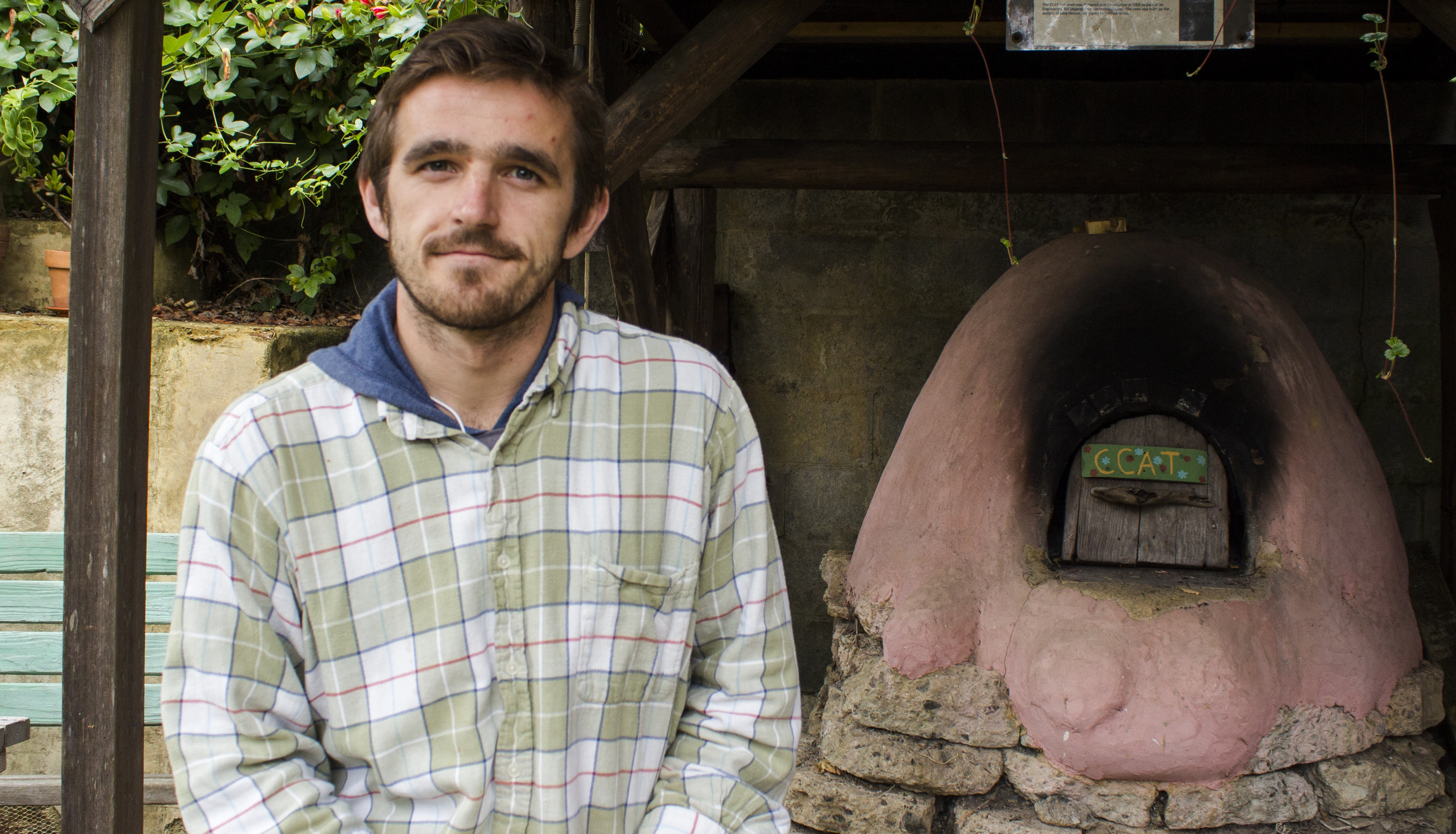
CCAT’s new hydroponics system
Video by Kyra Skylark.
CCAT, the Campus Center for Appropriate Technology at HSU has installed a new hydroponics system at the house. The system was installed this semester and everyone at CCAT is excited to see how the project develops.
-
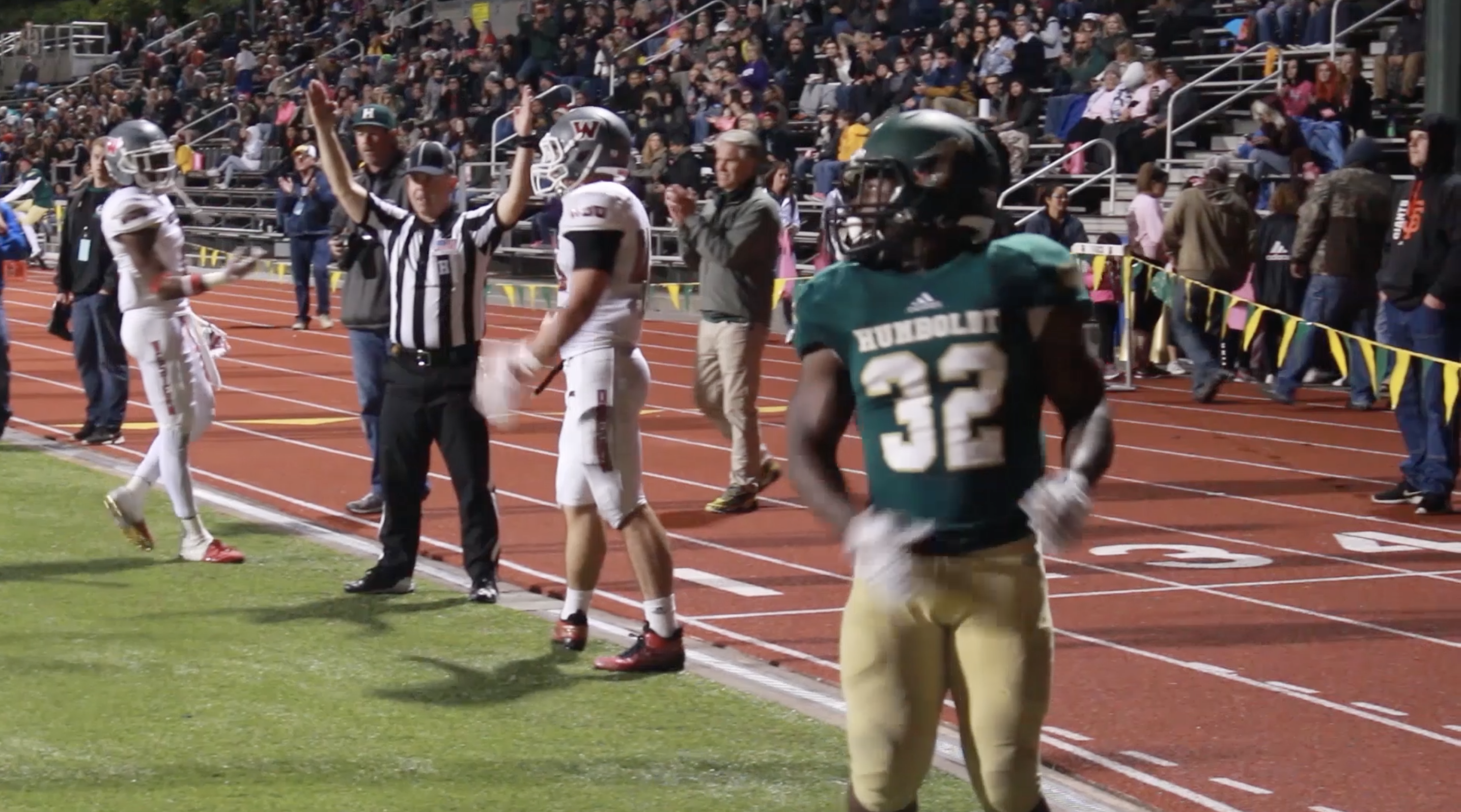
Ja’Quan Gardner best of HSU football
By | Keaundrey Clark
Senior Running Back Ja’Quan Gardner will go down as one of the best football players to ever wear a Humboldt State Lumberjack football jersey. The respect he gets from the community, coaches and his teammates is what keeps him going on the field. Keaundrey Clark has a profile on Gardner.
-
Let the deceased rest in peace
By | Bryan Donoghue
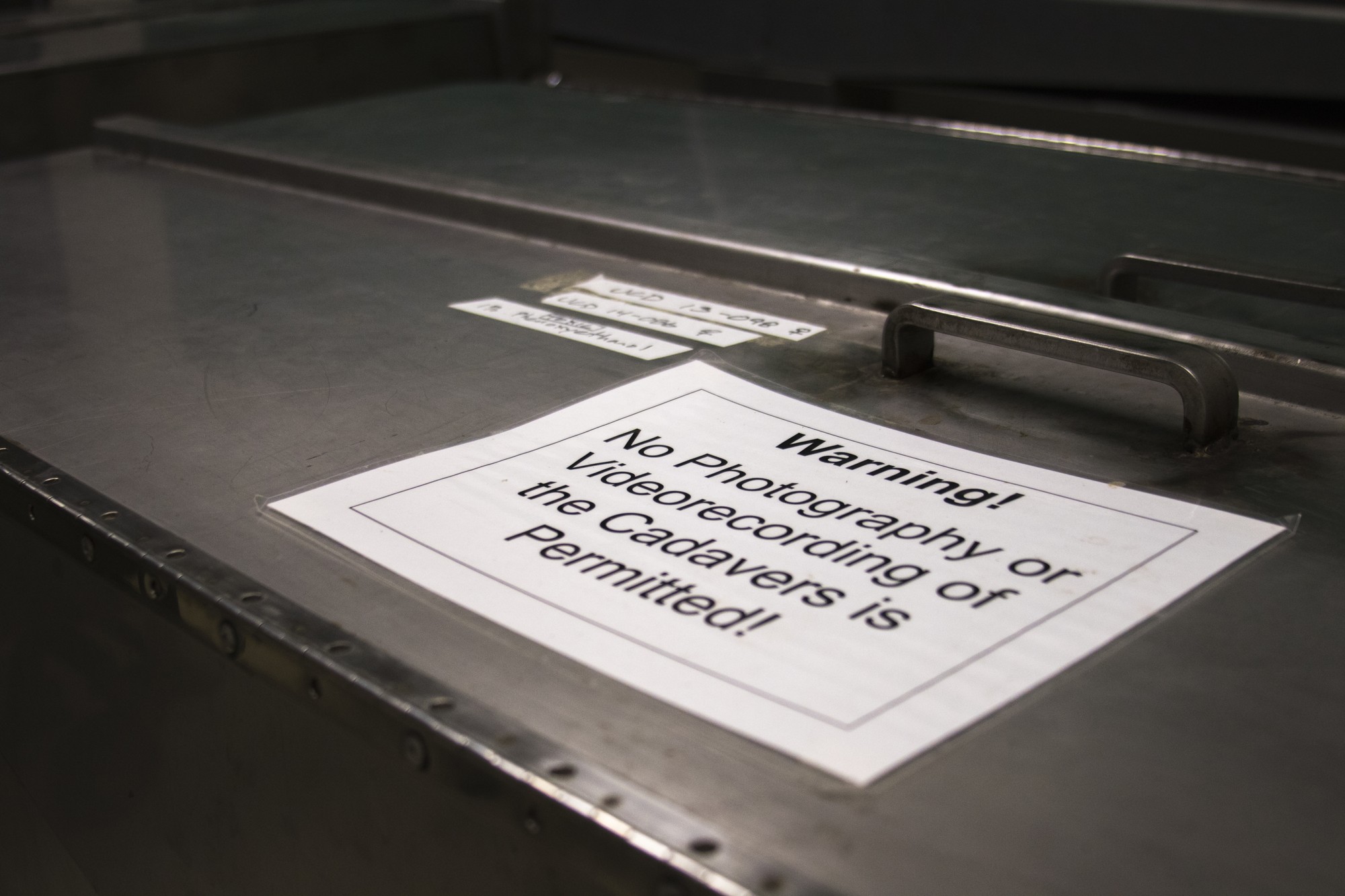
The Humboldt State University Biological Sciences department rents out four cadavers at a time from UC Davis’s Body Donation Program. John Reiss, a professor of the Anatomy Lab at Humboldt State University explains that cadavers on campus are not allowed to be photographed or shot on video. However, Reiss expresses that he’s seen some interesting things with his class.

Skulls of HSU’s Anatomy Lab. “Most of the anatomy class here is focused on just learning the normal anatomy, but when something shows up it’s interesting,” Reiss said. “Some of the things we’ve seen are enlarged hearts, associated with congestive heart failure. The heart is extra big.”
Christopher Mardis-Ruelas is a student who believes in the right to privacy after seeing bodies be dissected. He’s seen some of the private things like an enlarged heart be presented from a donated body.
“If I was dead, I wouldn’t want people taking pictures of my dead body.” Mardis-Ruelas said.
Kimberley H. Pipe, the assistant director for the Body Donation Program at UC Davis, talked about why confidentiality is so important. She expresses it in the way of the deceased being a member of your family.

John Reiss in HSU’s Anatomy Lab with classroom skeleton. Photo credit: Tyler Boydstun “So, think about this. Your loved one, for example let’s say you have a mom who donated to our program, and someone decides to take a picture of your dead mother and then put it up on social media and it’s out there,” Pipe said. “Your deceased mother is, images of her deceased body, are out there on the internet. It’s disrespectful.”
Videography and photography are strictly forbidden in the

John Reiss and Phillip Robinson in the Anatomy Lab at HSU. Photo credit: Tyler Boydstun Anatomy Lab. If you visit the lab to see the cadavers, make sure it’s only to pay your respects.
-
The celebration of Diwali at Humboldt State
Video by Sarahi Apaez.
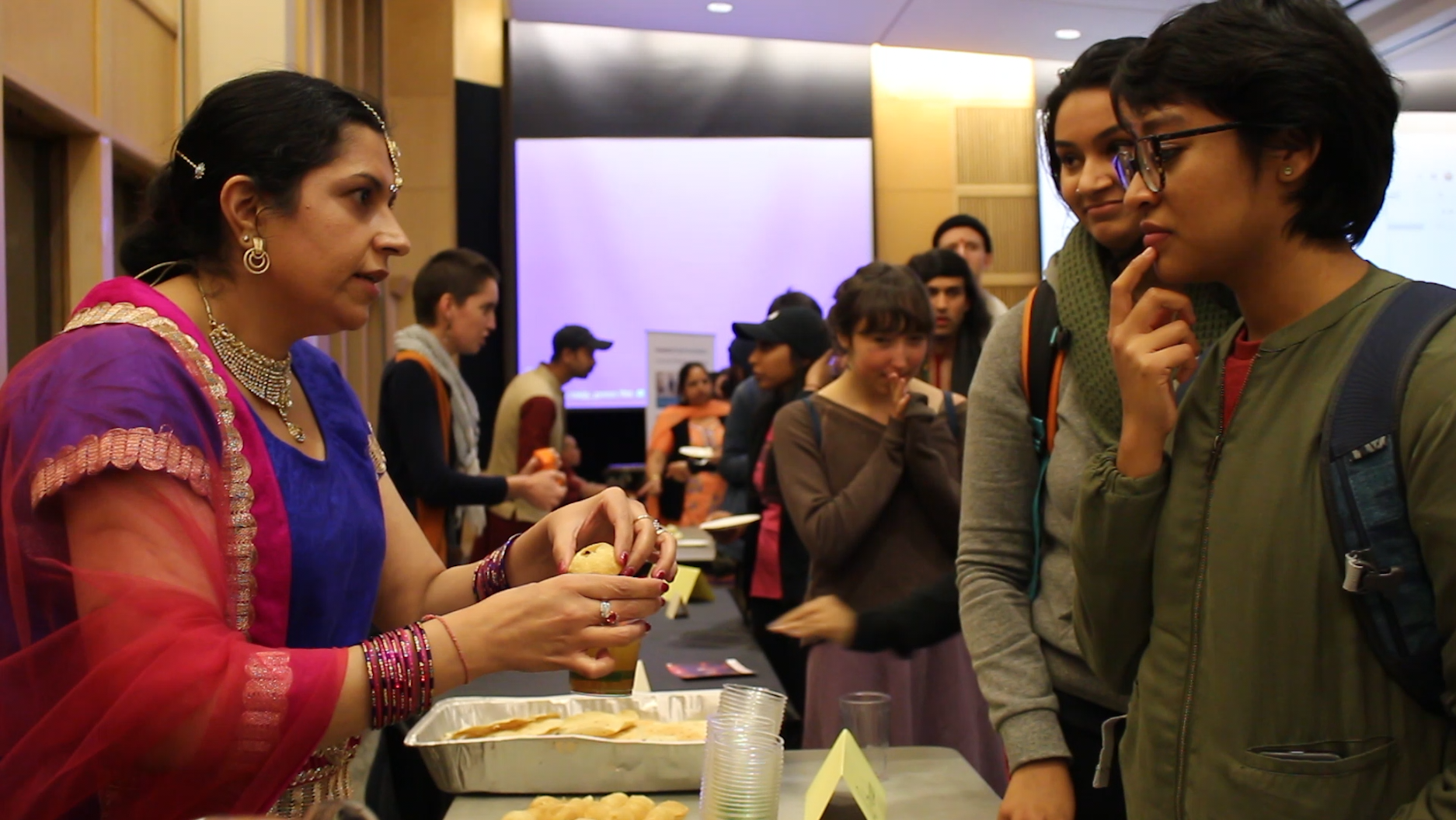
India’s most significant holiday of the year brought light and blessings to the Kate Buchanan Room and the Humboldt State community.
Diwali Prakash, or more commonly known as the Festival of Lights transformed the KBR with traditional food and dance. The smell of food prepared by the Indian family owned restaurant Tandoori Bites filled the room as students and community members took on the experience of the festival.
The story behind Diwali and the manner of celebration vary from region to region but one particular theme remains, the festival is celebrated to remember that light triumphs over dark and good triumphs over evil.
Diwali was last celebrated at Humboldt State in 2014 and made it’s return to campus this year with the help and collaboration of the Asian Desi Pacific Islander Collective, the MultiCultural Center, and HSU faculty.
Assistant Professor of Child Development Meenal Rana said it is important to celebrate Diwali at HSU in order to bring visibility to a part of the community that is otherwise invisible in the Arcata McKinleyville and Eureka areas.
“There are community members, and it is important for HSU students, faculty, and staff to have a moment of interaction,” Rana said.
-
Día de los Muertos at the MCC
By | Ian Benjamin Finnegan Thompson
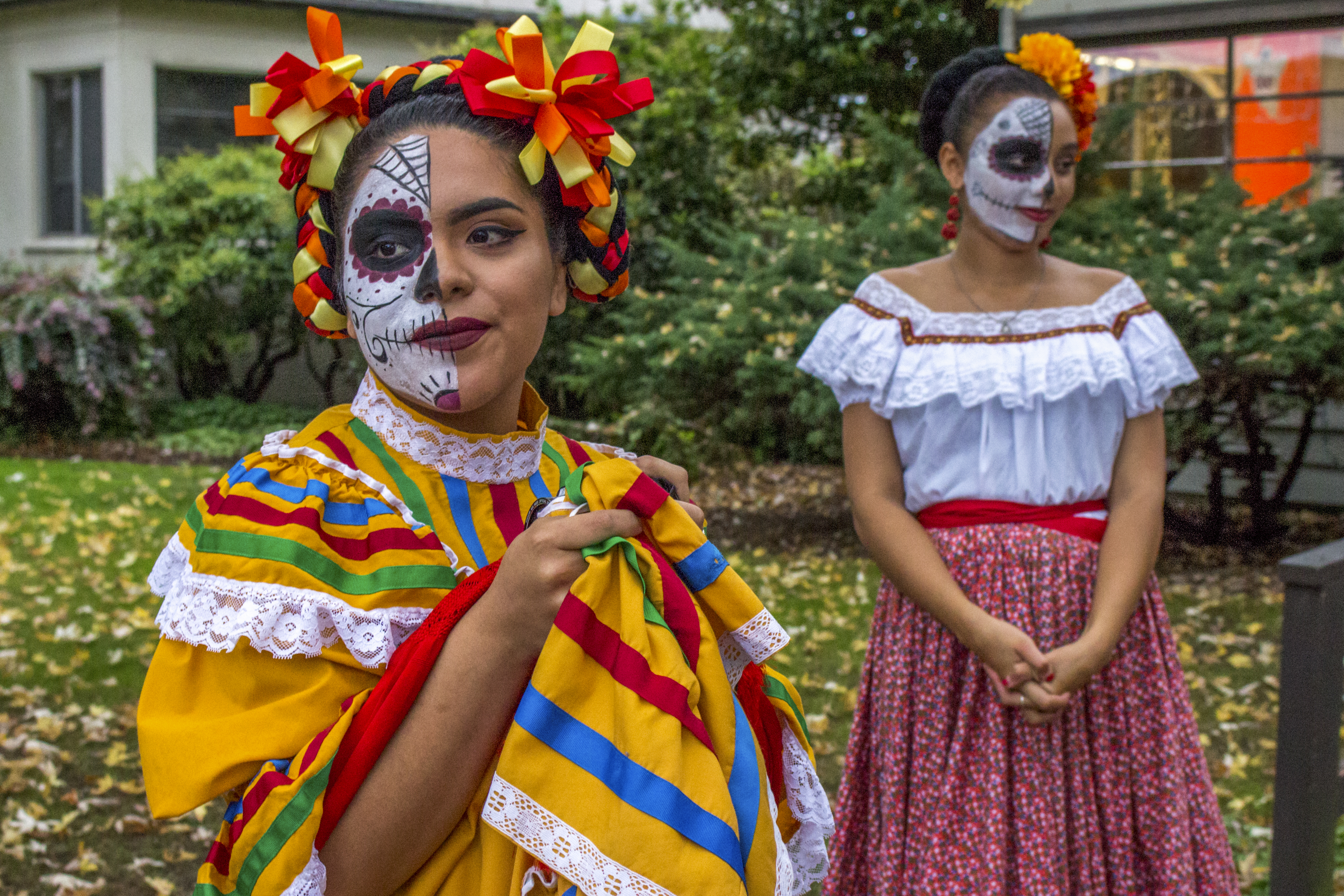
Dancing, Mexican food and ephemeral art were all part of the celebration at the multicultural center of HSU last Thursday for the Mexican holiday of Día De Los Muertos. Food was provided free for students by Los Giles and paid for by the multicultural center. Local artist Lilia Valencia Duran created an ephemeral sawdust dye art piece in collaboration with students who wanted to participate. Ballet Folklorico De Humboldt put on a traditional Mexican dance performance. Vice President of the Ballet Folklorico De Humboldt club Daniel Gomez said the dances and attire for the dance performance were from varying parts of Mexican regions including Veracruz, Jalisco and Sinaloa.

Samantha Garcia helps create a sawdust dye piece of art for the Dia De Los Muertos event on Thursday in front of the multicultural center at HSU. 
A close up of one corner of the ephemeral sawdust dye art created last Thursday for Dia De Los Muertos in front of the multicultural center at Humboldt State University. 
HSU senior student Sarahi Apaez before her dance performance at the Dia De Los Muertos festival last Thursday at Humboldt State University. *Sarahi Apaez is The Lumberjack Video Editor 
Octavio Acosta jamming out in a tree at the Dia De Los Muertos festival in front of the multicultural center at HSU. 
HSU freshmen Carlos Lemus helps create sawdust dye art at the Dia De Los Muertos event last Thursday at HSU. -
Thriller dance class
By | Ian Benjamin Finnegan Thompson
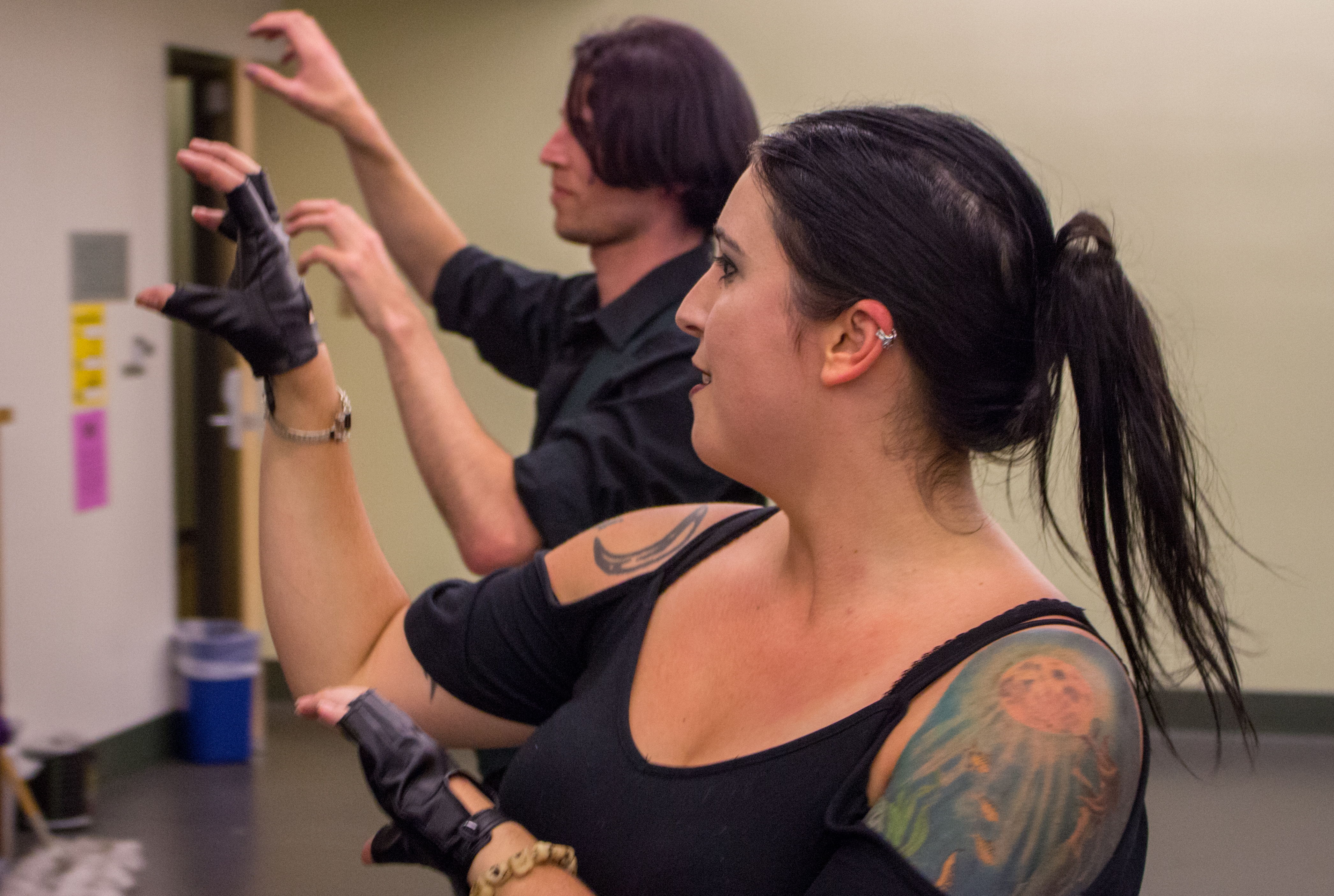
Center Activities held a Thriller dance class last Thursday in preparation for Halloween. The participants will be holding a flash mob of the dance at 1pm on Halloween at the UC Quad.


-
The Freaks Lament – A Humboldt Circus Presentation
By Keaundrey Clark and Bryan Donoghue
Humboldt State Circus is hosting The Freak’s Lament Circus Show from Oct. 26-28 in the Gist Hall Theatre
“Come have some laughs,” said co-president Ashley Bowles. “Don’t take life too seriously.”

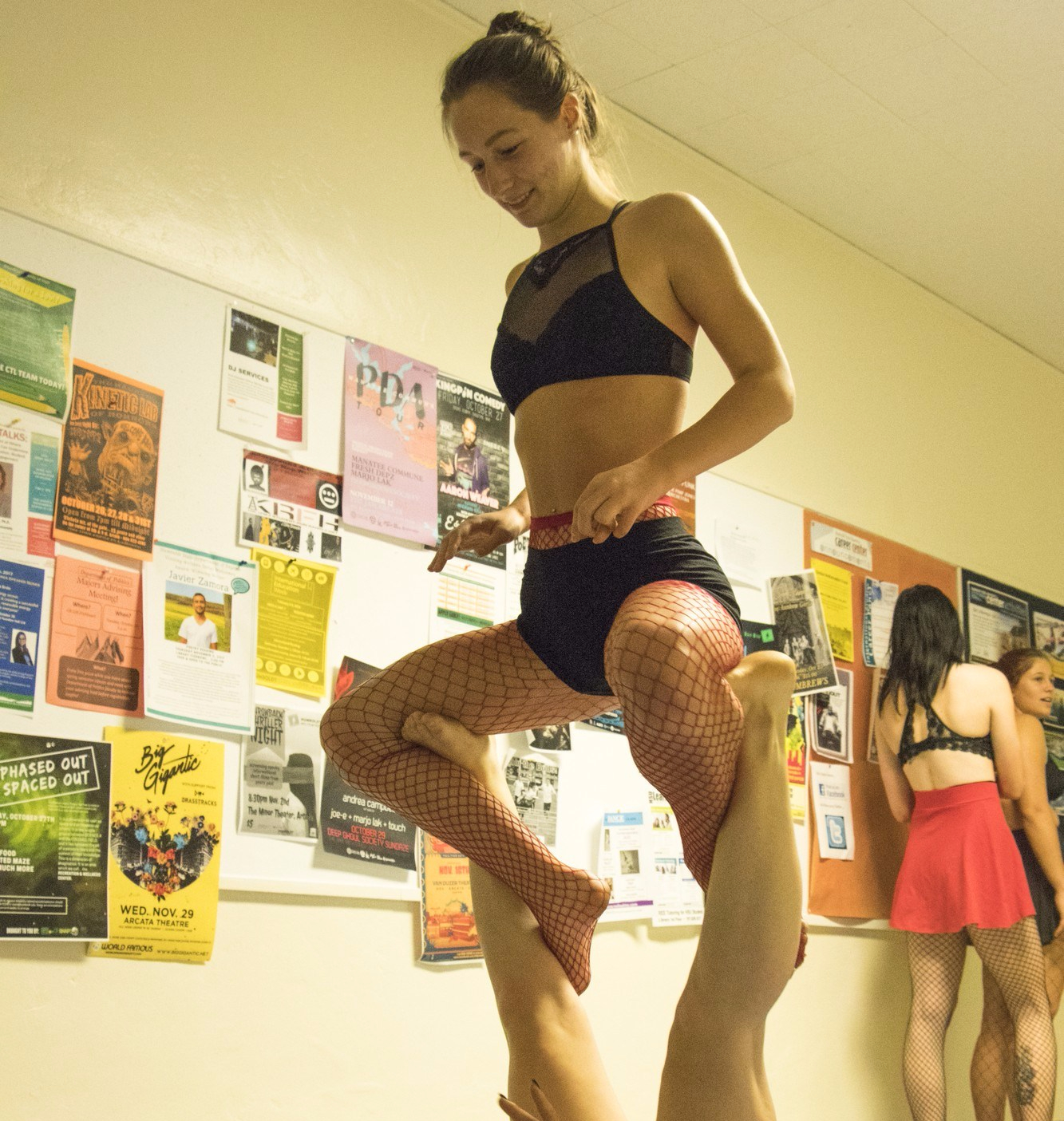
Acroyoga club president Darci Kudrna (top) and Michael Perez (bottom) practice AcroYoga in Gist Hall. Photo credit: Tyler Boydstun HSU’s Circus Club has been around for 17 years. It’s a place where students go to have fun, express themselves.
“Beacon for anyone who wants to come in be weird and have fun,” said Bowles
Every semester, the club puts on a performance for HSU and the community. Sometimes they’ll be joined by other groups on campus like The Marching Lumberjacks.
This year, AcroYoga Club will be performing with them.

Ariana Catanuso and Michael Perez practice AcroYoga inside Gist Hall. Photo credit: Tyler Boydstun “We’re practicing AcroYoga for the circus show,” said club president Darci Kudrna. “There’s a circus performance and circus club, and we collaborated with AcroYoga.”
AcroYoga is a mix between gymnastics and yoga. It’s partner-based yoga involving a lot of gymnastic based flips and turns, all with partners.
“We have two acts and both of them have a theme,” said Kudrna. “The general theme of a circus show is the death of a circus.”

Ariana Catanuso (top) and Darci Kudrna (bottom) practice AcroYoga in Gist Hall. “We wanted to stick with that theme in our first act, which is death oriented. We wanted to incorporate colors of red and black to show death,” said Kudrna. “The second one is afterlife, is what we called it. It’s going to be a little more flowy, and gold and white, and have the lighting to show more of the afterlife slower and more different skills they have.”
Clubs like these on campus are a place where students can go and feel accepted without being judged.
“It’s a safe free space, we don’t discriminate. said Bowles. “We invite anybody and everybody to come by.”
The circus is $10 dollars for students and $12 for general admission.
AcroYoga meets Tuesdays and Thursdays from 5-7 p.m. in the Rec and Wellness Center in room 126.
Humboldt Circus meets Tuesdays and Fridays at 5 p.m. in the West gym.
Here is video of the AcroYoga and Circus Clubs practicing for the Fall Circus Show.
-
Pastels on the Plaza
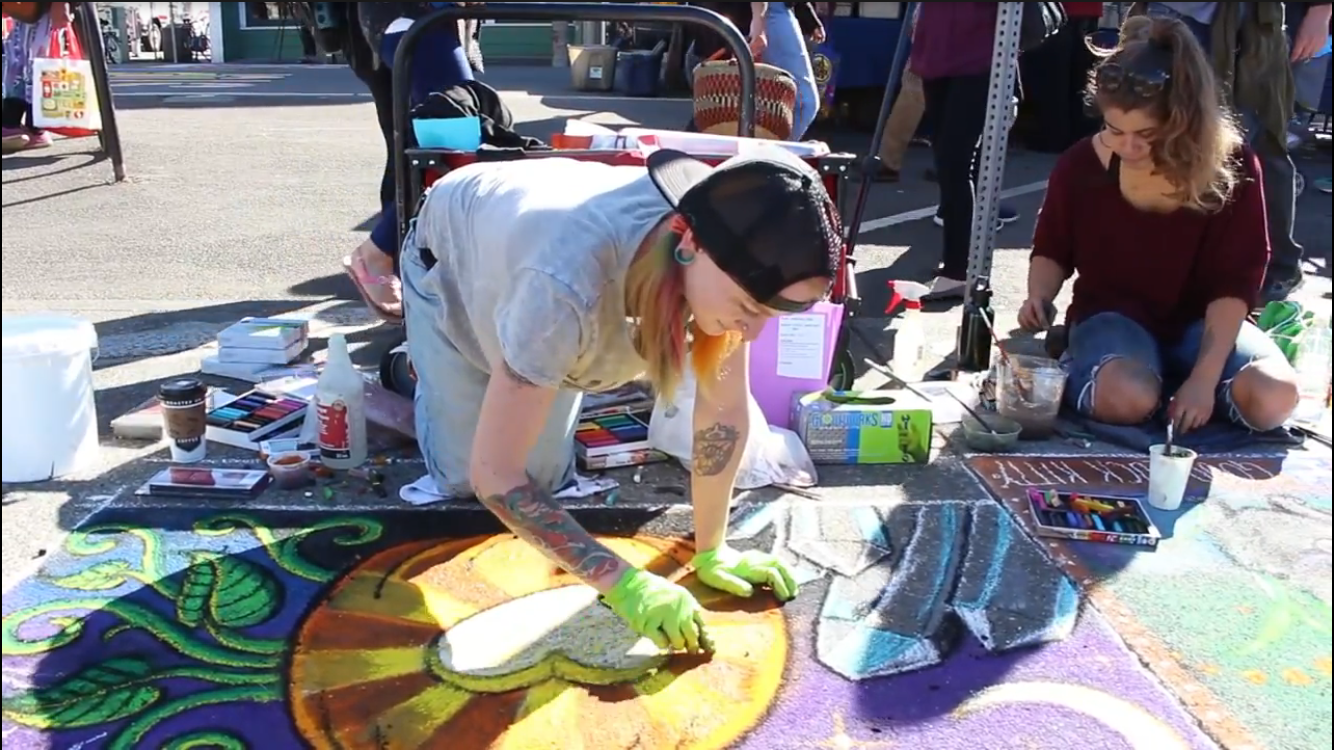
Last Saturday was the 30th annual Pastels on the Plaza. Hundreds of people showed up to the event which happened at the same time as the weekly farmers market at the Arcata Plaza. Local businesses purchased squares around the plaza to pastel. Proceeds from the event went to the Northcoast Children’s Services, a non-profit based off of early childhood education in Humboldt.