Category: Video
-
Editor’s Choice: Spooky Song Favorites
We came up with some of our favorite Halloween jams and put them in a playlist for everyone to get spooky too.
Enjoy!
-
Krushin’ it
By Jonathan Bratthall Tideman and Ross Milne
Student by day, resident Redwood Drag Queen by night
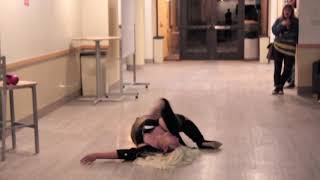
In many ways Bryan Pendant is just like other students at Humboldt State University: going from class to class, studying hard at the end of each day and hanging out with friends. However, every Friday night, he performs a drag show as his female alter-ego, Kandy Krush.
Kandy is bold and brash. She is a self-confessed “diva” who doesn’t care what anyone thinks about her.
Pendant, a child development major at Humboldt State, said as Kandy Krush he will “drop it so low, I won’t be able to get back up.”
Pendant started doing drag after taking part in a dance battle with one of his close friends. After hearing the audience cheer for him, he felt they would love him as a drag queen. After that night, Kandy Krush was born.
On average around fifty people turn up every Friday to Kandy Krush’s performances at the Redwood Dorm’s common area, this, unfortunately leads to many of the shows being shut down due to the excess of people as it is considered a fire hazard.
“When I perform I’m like, oh my god, all these people are here to watch me,” Pendant said. “How did they hear about me? I thought there was going to be like a few people, but there was like eighty or ninety people and they had to shut it down because it was a fire hazard.”
Pendant said he has always felt he has needed to do something different with his life, being very introverted throughout his teen years and coming to college. He felt he needed to change and drag artistry appeared to be the answer.
“Through drag I express myself and my feelings,” Pendant said.
As Kandy Krush, Bryan sings, dances and mimes for the audience putting on a show that is bursting with emotion. He often starts off with fun, early-2000’s pop songs including Avril Lavigne’s “Girlfriend” which perfectly sets the tone for his show and gets the audience cheering immediately.
Pendant’s favorite song to dance to is “Dontcha” by The Pussycat Dolls and it is clearly an audience favorite also. He said he loves the song because it allows him to have fun with the people watching him, getting up close and giving them personal dances. Kandy Krush clearly has her fan-base, and they’re a dedicated one too. However, he often ends with a slower song to play himself out.
The favorite part of performing for Pendant Bryan he says, “is getting up close with my audience and giving them a personal dance.”
Pendant hopes to one day take Kandy Krush on the road and be on the hit TV series, Rupaul’s Drag Race, by the time he is 30 years old. By then he hopes to have developed his act a lot more and have more routines.
He loves the art of drag, performing it gives him a “rush of adrenaline” and the most rewarding part of performing in Pendant’s eyes is seeing the look on the faces of his audience.
-
Pep rally pride prevails
Humboldt State University celebrates rain or shine
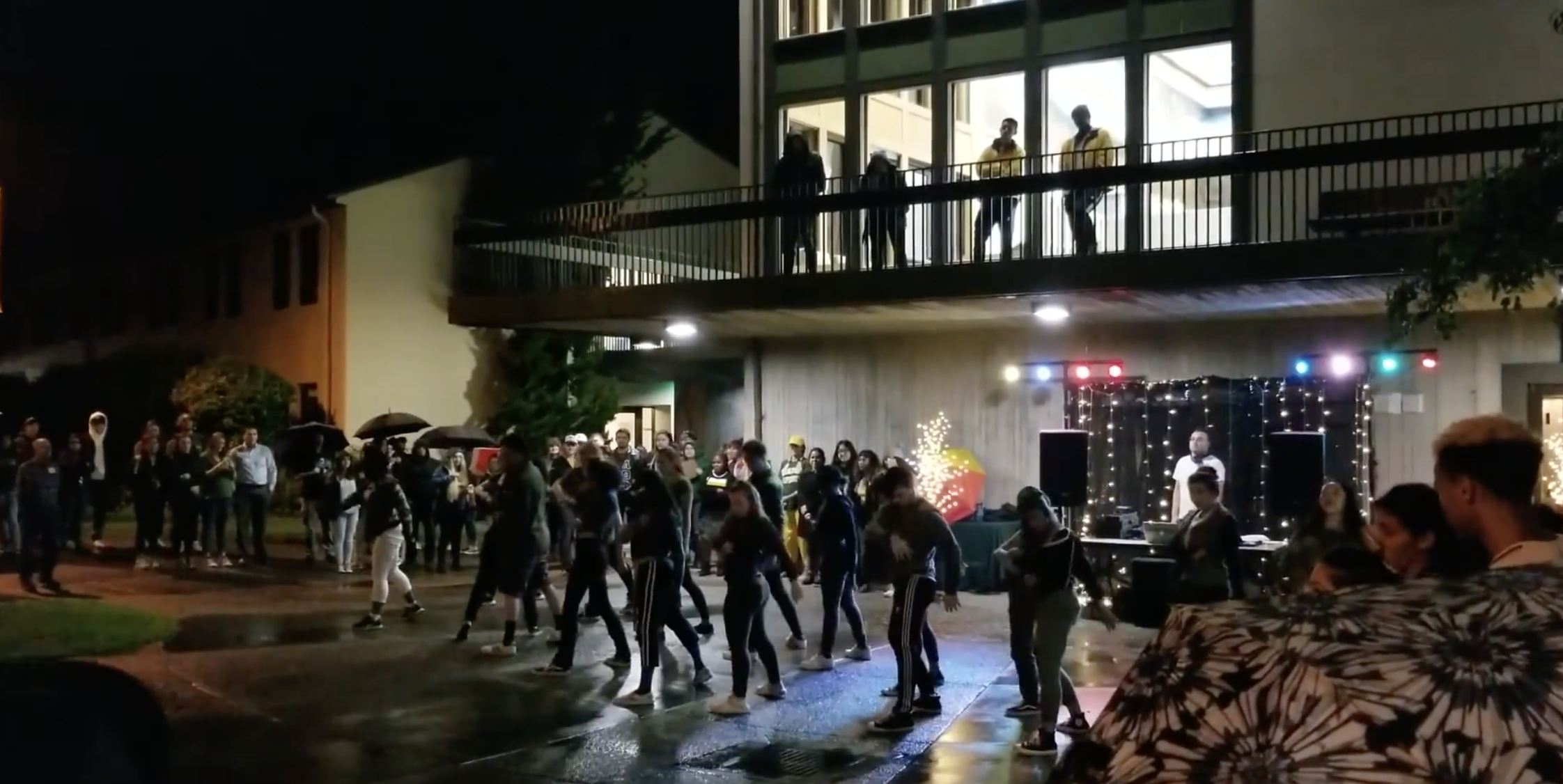
Humboldt State students came out to celebrate their homecoming week, and not even the rain could stop them.
With performances from various HSU clubs, everyone gathered in the UC Quad at 7 p.m. as Associated Students kicked off the festivities by introducing our very own Marching Lumberjacks.
“Honestly, Humboldt has a lot of pride and I’m not quite used to it,” junior transfer student Valeria Banuelos after watching the Marching Lumberjacks storm the quad playing Black Sabbath’s “Crazy Train.” “I’m from SoCal and all the schools I’m used to don’t have school spirit whatsoever.”
The Marching Lumberjacks were then joined by HSU’s Cheer Club as they played songs like “Heartbreaker” by Pat Benatar and “Rubber Ducky” from Sesame Street.
“It’s crazy to have us be adults and still have all this school spirit,” Banuelos said . “I’m so out of my comfort zone meeting new people and just how friendly people are here is really helping this feel like home.”
As the Cheer Club and the Marching Lumberjacks ended their performances, there were also performances by the Global Connections Club, Lambda Theta Phi Latino frat and Lambda Theta Alpha Latina sorority. These performances help bring culture to Humboldt State, something that AS Legislative Vice President Gabriella Valdovinos Balandran strives for.
“I’ve been a part of a Associated Students programs since the 10th grade,” says Valdovinos Balandran. “Bringing students and culture together like this has always been a passion of mine. This unity also helps our students mental health and that’s one of our missions.”
As the homecoming pep rally ended, most students left to go warm up and dry off at home. Some chose to stay and dance in the rain as the DJ continued playing his set.
“It isn’t about just wearing colors, it’s about promoting unity and inclusivity here on campus,” said AS member Estrella Corza. “Regardless of major, hometown or income, this is a place we can be together.”
-
Chico brings their brooms to HSU
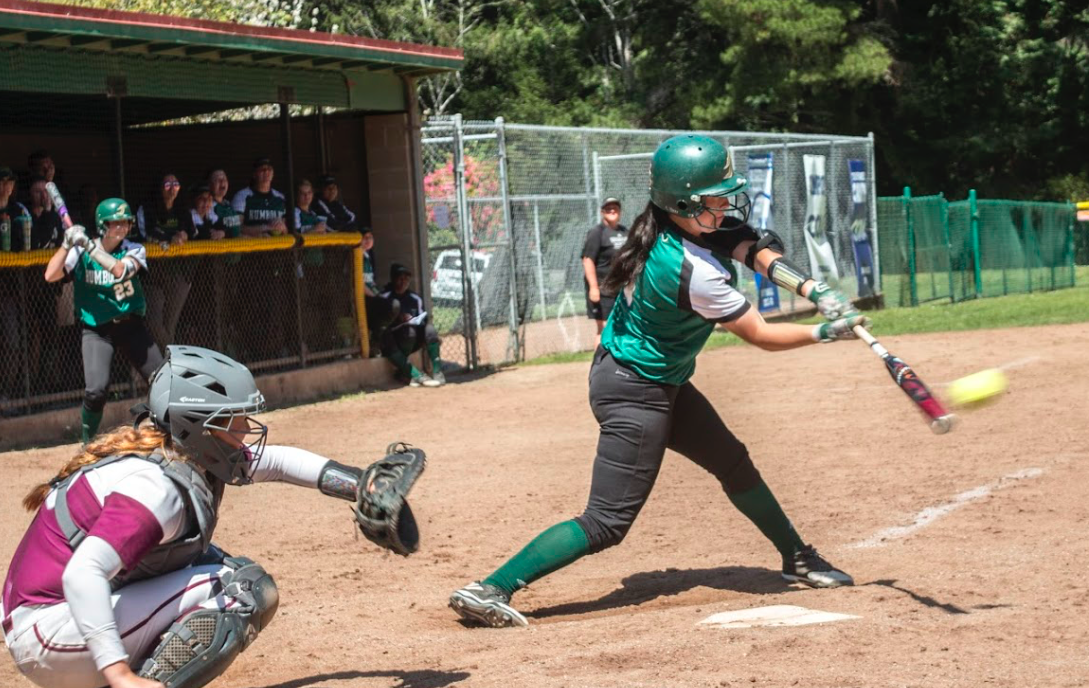
The Lumberjacks softball team concluded their four-game series with No. 3 ranked Chico State University on April 21 by taking a pair of losses to complete Chico’s sweep.
Video by Bailey Tennery.
The Jacks were shut out in the first game (9-0) in only five innings because of the mercy rule. The game must end if a team is losing by eight or more runs after the fifth inning.
The second game was more of a slugfest, however, as that ended 16-13.
Jacks head coach Shelli Sarchett remained optimistic, despite the team’s troubles.
“This whole weekend I saw a difference in this team and how they reacted to things. They played with a lot of energy,” Sarchett said. “If we’re gonna lose, that’s how I want it to happen.”
The visiting Wildcats recorded nine runs on 13 hits in the first game. The damage was spread throughout the game, as they tallied three runs in the second, third and fourth innings.
The win moved Chico State’s winning streak to 18, while the Jack’s losing streak was extended to four games.
Chico State starting pitcher Haley Gilham (21-2, 1.25 ERA) was locked in all game, as she limited HSU to just three hits over five innings of shutout ball. Jacks starter Jasmine Hill took the loss as she allowed six runs on seven hits to go with five walks.
When Chico’s Gilham was not on the mound, the Lumberjacks thrived at the plate. The Lumberjacks jumped on Chico State starting pitcher Naomi Monahan (15-1, 2.41 ERA) for three runs in the first.
The damage came from an RBI double from Hanna Holland, a run-scoring single courtesy of Micaela Harris and a wild pitch.
Chico State responded with a vengeance in the top half of the second, as they scored seven runs on six hits to take an 8-3 advantage. The Jacks kept fighting though, as they plated a run in the second before a six-run third inning put them in the driver’s seat.
The Jacks’ lead was short lived as a run-scoring error, and a Wendy Cardinali three-run homer in the next inning, put the Wildcats back on top.
Jacks first basemen Rylie Carlier continued her power surge with a team-leading eighth home run in the fifth inning.

Humboldt State softball team played Chico State Wildcats on April 21. Game played at the Lumberjacks home field. HSU’s Winona Vigil (15) running to first base. Final score 9-1. Chico won. Photo by Bailey Tennery. HSU’s 1-2-3 hitters in the lineup each finished the game with three hits, and Winona Vigil and Harris each drove in three runs each.
When talking about her approach at the plate, Harris had a simple answer.
“I just tried to attack the first pitch, and be aggressive,” Harris said.
The series sweep moves the Lumberjacks’ CCAA record to 14-16 and 19-25 overall, which puts them in seventh place in the CCAA standings.
HSU will host Sonoma State University next weekend at HSU Softball Field. The series begins April 27 at 1 p.m.
-
Humboldt State debates Irish National Debate Champions
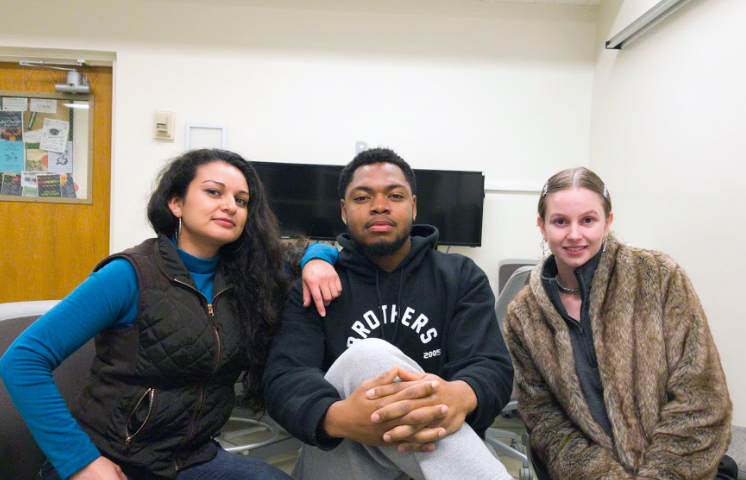
Humboldt State University’s debate team dedicates 13 hours a week discussing uncomfortable subjects.
The HSU debate team debated against the Irish National Debate Champions on April 11. The team spoke on why “violence is necessary for political action.”
The HSU debate team argued the positives of the topic.
The three competing members of the HSU debate team are Ruby Aguirre, Olivia Gainer and DaMon Thomas. Aguirre and Thomas have been on the debate team for two years. Gainer has been on the debate team for a year and is the team’s vice president.
Ruby Arguirre of the HSU Debate team. Video by Luis Lopez.
Aguirre is a masters social work graduate.
“People always get nervous when we talk about heavy topics,” Aguirre said. “But people need to understand that what we talk about happens everyday.”
Thomas is majoring in communications.
“One of the topics that we talk about that gets me passionate is Black rights or minority diversity,” Thomas said. “Debating is like doing reps. I get comfortable talking about these topics.”
Gainer is majoring in philosophy.
“When it comes to being nervous in front of people, that’s something that never goes away,” Gainer said. “But with practice, I overcome those nerves.”
The way a debate works is each member presents their argument to the audience. The affirmative (HSU debate team) speaks on the topic, and the opposition (Irish debate team) can raise their hand to question the argument. After the affirmative is done speaking, the opposition can argue about the negatives of the affirmative’s argument.
Aodhan Peelo of the Irish National Champions. Video by Luis Lopez.
Judgement was done by the audience’s vote. The audience voted in favor of the Irish debate team by 70 percent.
Both teams presented their arguments with passion on the controversial topic.
Aaron Donaldson is the coach of the HSU debate team.
“The debate team has traveled eight times each year to attend debate exhibitions,” Donaldson said. “This will be the first time this year that the debate team will be having a debate on campus.”
From April 12-16 the HSU debate team attends the U.S. National Debate Championship held at Stanford University.
“I think especially now more than ever it is important to have debates on difficult subjects,” Donaldson said.
-
Out of the darkness comes light
Survivors of sexual violence share their experiences through the events of Take Back the Night
Take Back the Night delivers the message that domestic partner violence, intimate partner violence and other types of violence will not be tolerated.
Xochitl Cabrera runs the Humboldt State’s Women’s Resource Center, which hosts Take Back the Night every year.
“Sometimes people don’t need you to help them, you may need to take a step back. Some people just need to heal themselves,” Cabrera said.
The Women’s Resource Center is a campus resource for people who need a safe place to study or find the help you need for survivors of sexual violence experiences.
“The Women’s Resource Center knows that sexual violence and domestic violence happen all of the time, but it is up to the survivor to reach out to the Women’s Resource Center,” Cabrera said. “Take Back the Night is not for everyone. People tend to avoid the trauma it brings up.”
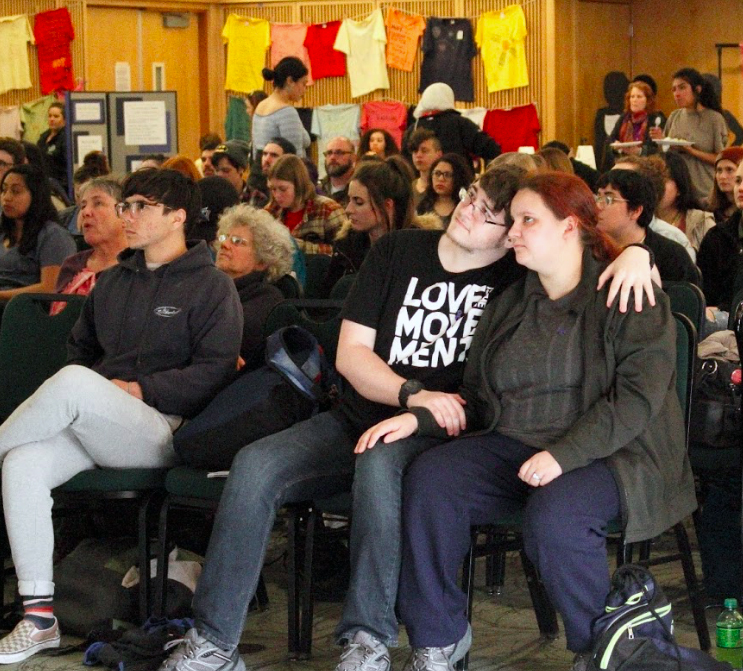
Hanging on the walls of the Kate Buchanan Room are T-shirts from survivors of sexualized violence and friends of people who died from sexualized or domestic violence. The T-shirts had messages written telling of horrible acts of sexualized violence from family members, friends and others.
“The T-shirts are difficult to look at, but their story needs to be heard. They are not nice. It is painful but necessary,” Jodie Huerta, HSU sociology major, said.

Messages written on T-shirts decorating the walls of the KBR. Photo by Ahmed Al-Sakkaf. Assistant professor of Native American studies Cutcha Risling-Baldy was the guest speaker for Take Back the Night. Risling-Baldy’s talk was based on systemic violence toward people of color. Before her talk on missing and murdered indigenous women, Risling-Baldy acknowledged the death of HSU student David Josiah Lawson.
“If David Josiah Lawson were not a person of color, his death would be on the news every day,” Risling-Baldy said.
The Native Americans view domestic violence differently.
“In an interview with a Wiyot woman, the anthropologist asks what happens if a man rapes a woman,” Risling-Baldy said. “The Wiyot woman replies, ‘That never happens.’ Asked why it never happens, the Wiyot woman said, ‘Because that person would be killed.’”
Speaking out can trigger traumatic experiences for people.
“People choose to come if they feel comfortable speaking on their testimony, and they choose not to come because they don’t feel comfortable speaking on their testimony,” Cabrera said.
Some of the speak-out testimonies were about sexual violence that occurred during childhood and adolescence, while some of the testimonies were about sexual violence that happened at HSU. Sexual violence happens to HSU students, for which most of us are unaware.
“Everybody knows that sexual violence is happening, but nobody is doing anything about it. It is just getting swept under the rug,” Grace Lamanna, HSU recreation major, said.
People tend to restrain themselves from being in these spaces, because of the trauma it brings to them.
“Some folks don’t feel safe in this space, because they don’t identify with domestic violence and sexual assault. People feel like they are taking up space and say, maybe this isn’t the space for me, I’ll take a step back,” Cabrera said. “That’s totally fine, because we want to prioritize those individuals that have experienced sexual assault and sexual violence at some point in their lives. That is what this space is mainly for.”

Students hold hands in a circle behind the McKinley statue on the Plaza. Photo by Ahmed Al-Sakkaf. HSU sociology major Omar Miranda helped as a monitor for the Take Back the Night march as part of his class.
“I feel like I made a difference. Big or small. Something small to me could make the biggest difference to the survivors,” Miranda said.
The survivors gathered after the speak-out for the Take Back the Night march. Marchers wore orange safety vests, gathered in groups of five and were assigned a monitor. Monitors had received tactical training for this march and could protect the group if some danger presented itself.
The marchers left school chanting, “Hey! Ho! The patriarchy has got to go!”
The marchers went from school to the plaza downtown and were heckled by a few passersby in cars, as well as people along the route.
On the plaza, the Take Back the Night members and public in attendance gathered in a memorial for the people who have died from sexualized and domestic violence. In silence, the less fortunate victims of this violence were honored.
As the Take Back the Night march left the plaza, the declarative chanting could be heard echoing off buildings and down alleyways.
“Take back the moon, take back the stars, take back the night because the night is ours!”
-
Alchemy Distillery holds its monthly Saturday open house
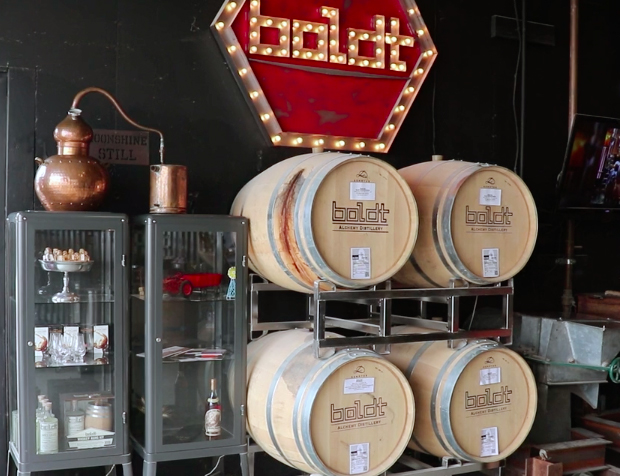
Alchemy Distillery is located at 330 South G St. in Arcata, across from the Arcata Marsh.
On March 31, owners Amy and Steve Bohner held their monthly Saturday open house tour of their distillery. This open house includes free tours every hour from 2-6 p.m., along with complimentary drinks for visitors 21 years or older.
The typical tour shows visitors how their signature BOLDT spirits are made, as well as the distillery process starting from grain section to bottling and labeling.
The Lumberjack reporter Dajonea Robinson takes you behind the scenes.
Video by Dajonea Robinson.
-
Rallies at the State Capitol for sufficient CSU funding
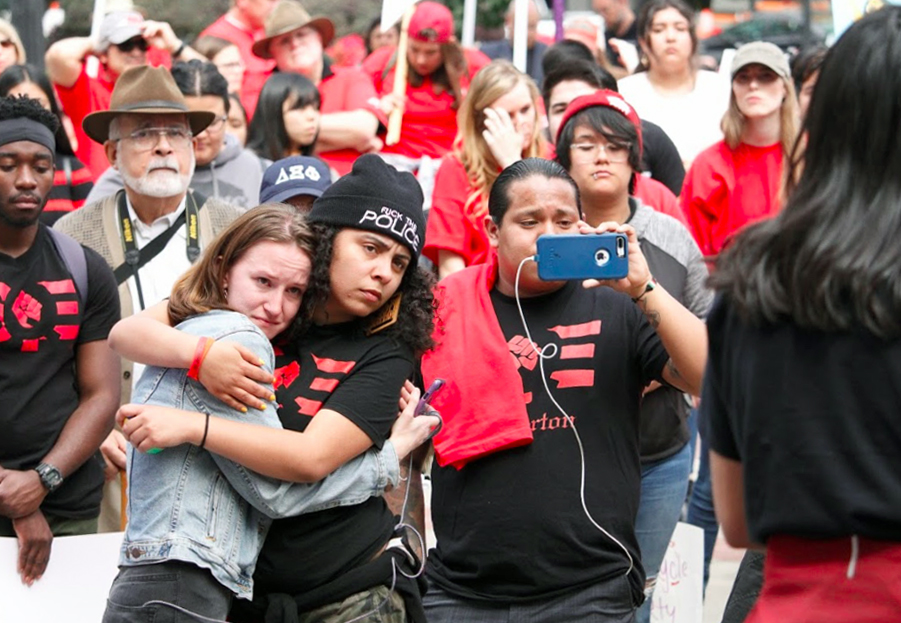
Students, faculty and allies of the California State University system from all 23 campuses made the journey to the State Capitol to send Gov. Jerry Brown a message, it is time to fully fund the CSU.
Video by Dajonea Robinson.
Allison Rafferty is a biology major and was one of many students who came down on a bus from Humboldt State to join the demonstrations on April 4. Rafferty rode down to represent HSU and to call for funding for the CSU system.
“I request Gov. Brown to consider opening the fund that he’s allocated for CSU,” Rafferty said. “The CSU requested money and Gov. Jerry Brown approved a third of that. Right now, they’re in revisions. In May, they’re going to post their revisions and in June, they’re going to propose the final budget that goes to a vote.”
Rafferty hopes more funding will come through so people in her major and others will be able to get classes and graduate on time.

HSU student warns others of the potential outcome of funding crisis. Photo by Dajonea Robinson. Jacqueline Delgado is also an HSU student. Delgado decided to come to the Capitol to stand in solidarity with everyone and to get justice for Josiah Lawson.
“I’m also here to get [Justice for Josiah] and this unsolved murder to be recognized. It is an unsolved murder of a fellow student that was murdered a year ago in Humboldt County,” Delgado said. “The school and the county does not recognize that this happened. It has been an entire year that nothing has been happening and we’re trying to get this movement to be heard. We will no longer be silenced.”
David Bradfield is the California Faculty Association representation chair and board of directors member who now lives in Humboldt County. Bradfield spent 34 years teaching music and digital media arts at CSU Dominguez Hills. Bradfield decided to take the trip down to the Capitol.
“I care very deeply. I spent 34 years teaching at Dominguez Hills and I care very deeply about the mission that we do, the people that do that mission and the people that we serve,” Bradfield said.
Reza Sadeghzadeh is a communications major at HSU. Sadeghzadeh traveled with his peers to the Capitol from HSU to express concern of the insufficient funds of the budget.
“Since they cut the whole CSU budget, we’re going to see a tremendous negative effect on our campus. A lot of professors are being laid off, activities and cultural centers are being defunded, so it’s a very serious issue,” Sadeghzadeh said. “The governor really needs to understand that the students here and the students in the CSU are the future of the welfare of California. In order to thrive as a state, we need to take care of the foundation, which is the students.”

HSU students not only stand in solidarity with fellow CSU peers during the rally, but demand justice for their fellow student. Photo by Dajonea Robinson. Elizabeth Phillips is a student on campus who also came down on the bus from HSU.
“Students like me who need an education are about to be priced out of our education. Education is not for the people, it’s not supposed to be free. They don’t want us to get an education so we’re stuck working the remedial jobs,” Phillips said. “We need to see more people of color being a part of the faculty. The only way we’re going to get there is if we can afford to get in the door. I’m $25,000 in debt just from two years at HSU. That’s a lot of money, and for other students, I don’t want them to take on that burden. So I’m here for the future, and I’m here for me, now.”
Phillips works for the Multicultural Center as the social justice summit co-coordinator. Phillips is also a part of a loose coalition of students who started the walkout for WASC to protest the budget cuts.
“I worry that if we give the CSU full funding for free tuition, the students will get it for the first couple of years, but then after, people get greedy and start skimming the surfaces,” Phillips said. “I’m happy that we’re here, but I want people to keep a watch and understand we don’t need as many administrators as we have. We need more students and faculty, counselors–there’s other stuff that we need that we’re just not allocating our resources correctly. Everyone needs to watch out for the future.”
-
Justice for Josiah rally
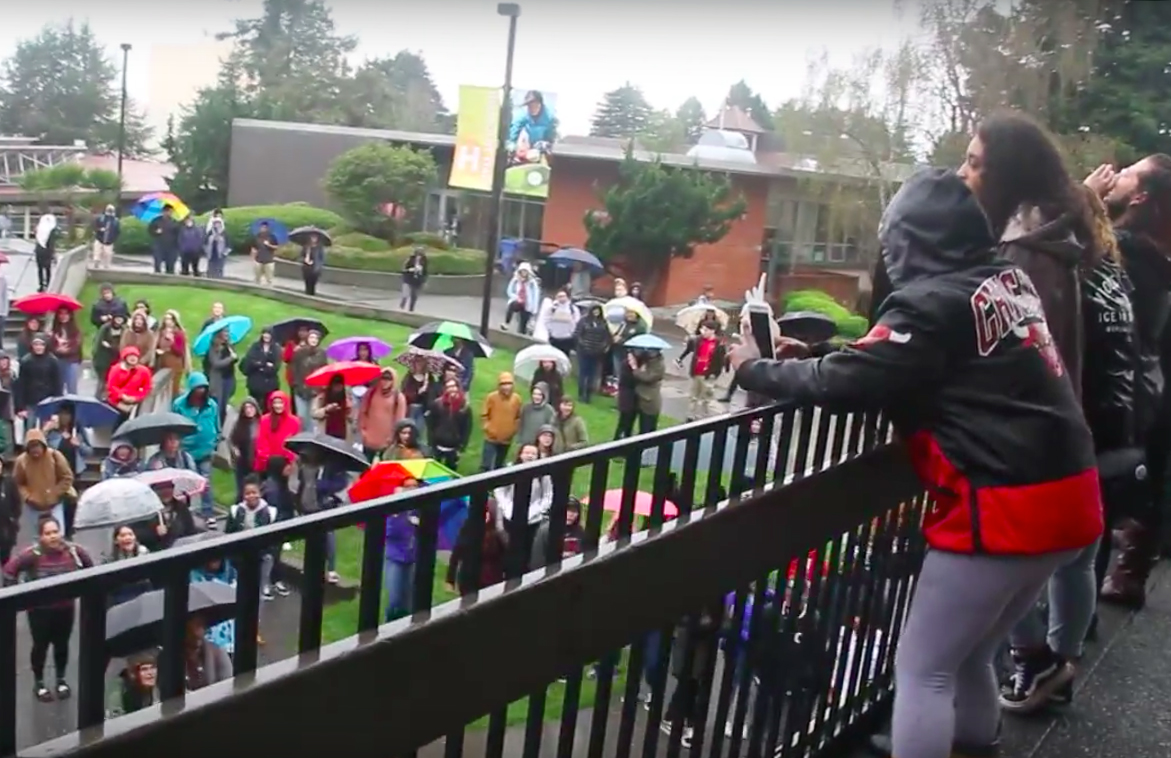
On April 5 at 1:30 p.m., students at Humboldt State left class to attend a rally on the UC quad in remembrance of David Josiah Lawson, a student who was stabbed to death at a party in Arcata almost a year ago.
“It’s been a year, and that is fucking ridiculous,” Barbara Singleton, president of the Black Student Union at HSU said.
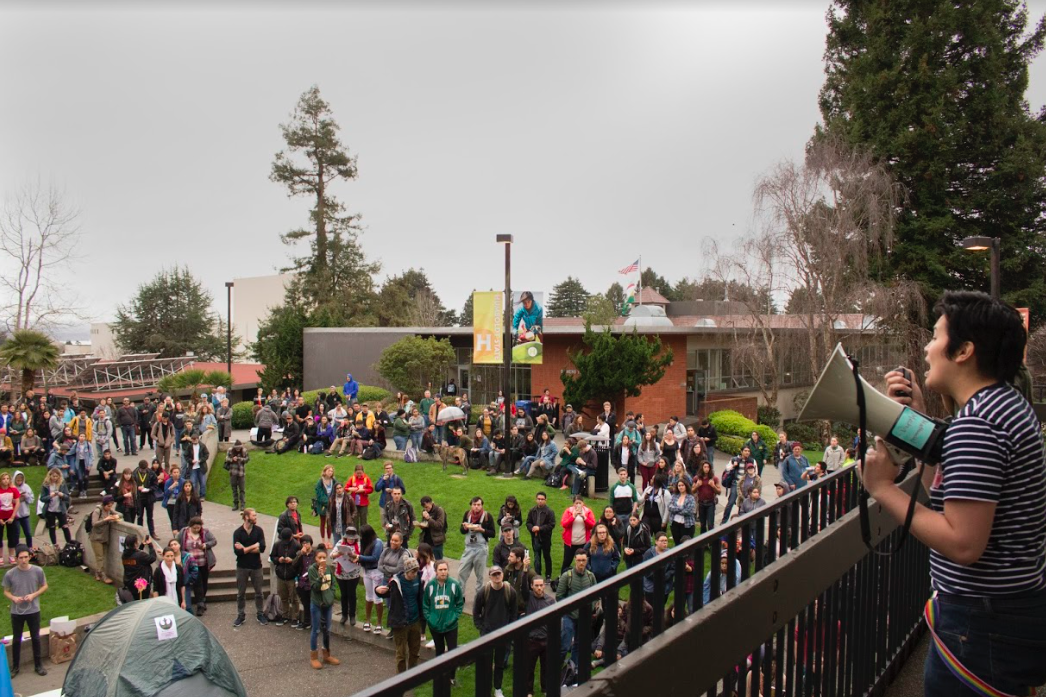
Singleton stands on the second floor of The Depot, surrounded by a crowd of students who all left class as a part of the student-led walkout for safety in honor of David Josiah Lawson. The rain pounds down relentlessly, seemingly undetturent to all in attendance. The walkout is a part of 12 days of events being hosted in honor of the anniversary of Lawson’s unsolved murder.
Video by Surya Gopalan.
A year ago at a party in Arcata, Lawson, a black HSU student, was stabbed to death. There are currently no persons in custody. Students walked out of class at 1:30 p.m. on April 5 to be present at the 2 p.m. rally to bring justice to Josiah and demonstrate for student safety.
Kalyn Garcia, 18, social work major, left class to be present at the rally.
“I think that it is way bigger than Josiah,” Garcia said. “Any black, Mexican or children of color should not be concerned to leave their house.”
As the rally began, two students, Singleton, as well as Daniel Segura, 23, a critical race, gender and sexuality studies major, began leading the rally. They began by explaining there have been rumors about the Justice for Josiah movement being involved in illegal or destructive activities, and that they do not condone any violence or illegal actions.
Angel Sylva then performed a poem she wrote for Lawson, which will be performed again on the vigil held for Lawson on April 15.
“If it happened to one of us, it can happen again,” Sylva said.
With no sound equipment available to students after 1:00 p.m., due to campus policy, Sylva projects her voice as her only tool to spread her message to students.
Students then began calling out the members of administration in the crowd. Alex Enyedi, the provost of HSU, as well as Wayne Brunfield, the interim vice president of Student Affairs, were two of the members of administration in attendance.
“They have been silent this whole 12 months,” Singleton said.
Singleton directly addressed HSU administration, the Arcata city council and the police department.
“They have blood on their hands,” Singleton said.
The crowd screamed for administration to speak, one individual saying, “It’s fucked up for you to be here and not say anything.”
Eventually, Enyedi took the stage after much student call-out. He thanked the crowd for the opportunity to speak, then began.
“Students are told you need to be patient, but I get it. How long should you be patient for?” Enyedi said. “I share your frustration, I share your impatience. It shouldn’t take this long.”
Enyedi is not the one the students want to hear from. The question on everybody’s mind is where is Lisa Rossbacher, president of HSU? Students call out to Enyedi, demanding answers.
“I’ll tell her you’re unhappy she isn’t here,” Enyedi said.
A voice from the crowd screams, “We aren’t unhappy, we’re angry!”
President Rossbacher never showed up.
Brumfield was not getting away with silence either. Singleton and Segura called from the stage, “Wayne, where are you?”
Brumfield did go up to the stage and approved students to use a megaphone, but never addressed the crowd. Many continued asking why he did not speak.
When asked, Brumfield spoke of a racial equity plan he says he is currently working closely with students on. He said students deserve a voice in how equity and inclusion are happening in the community.
“We’re working with the two chiefs of police, students and community members to look at policies of police reacting to students, both on and off campus,” Brumfield said. “I think we are moving in the right direction.”
As the rally continued, a song written about Josiah was performed and then different chants were yelled throughout the crowd.
The event coordinators then relayed the message of future events and concluded the event, inviting students to continue their activism and presence in the coming weeks.
“The Justice for Josiah movement is very peaceful,” Singleton said.
At one point in the rally, a group of people visiting for spring preview walked past the UC quad.
“Anything they tell you will not justify his murder,” Segura said to the passersby.
Segura, being in his 10th semester at HSU, he says he has seen how the administration deceives students. He said HSU goes down south and recruits students of color without disclosing the violence toward people of color that has happened in the area.
“How are we supposed to welcome students of color when they trick you?” Segura asked.
This article has been updated from its original version on Monday, April 9 at 5:58 p.m.
-
Power of protest in pursuit of peace
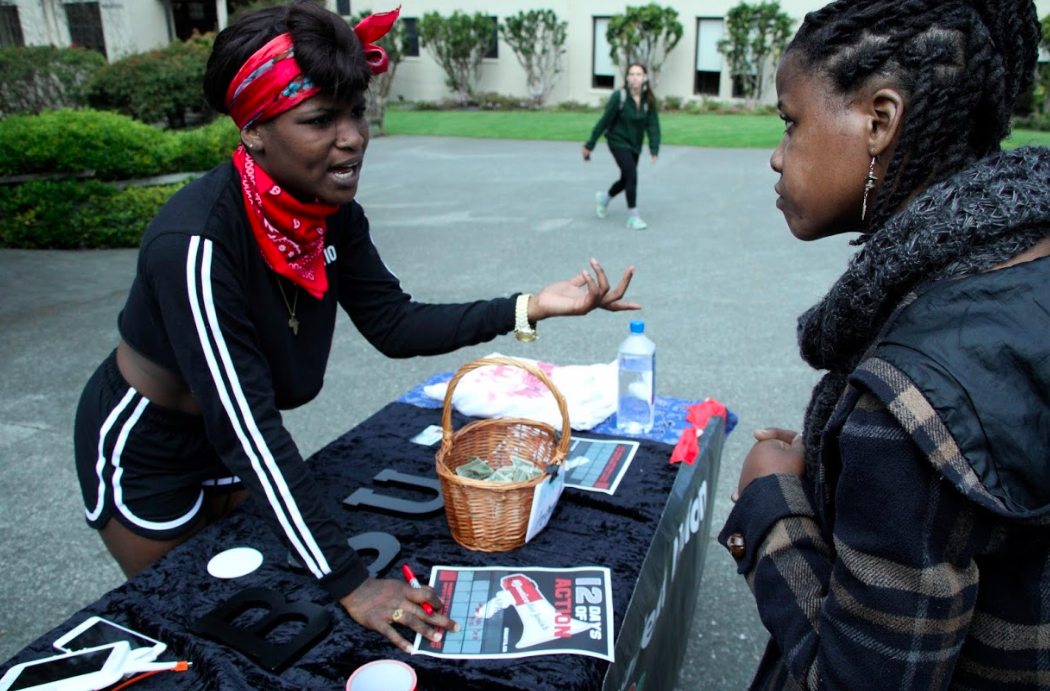
With the song, “JUSTICE FOR JOSIAH (RIP)” by Oboy Flocka playing in the background, sophomore criminology student Barbara Singleton stood near the front of Siemens Hall with pamphlets, spreading awareness on the events planned for the following 12 Days of Action.
“The university needs to commemorate the death of Josiah so we can get a mural or a plaque with his face,” Singleton said. “We’re asking the university to put up a legal fund to help out his mom.”
Humboldt State University students are organizing a 12-day plan of action to gain national attention and investigative help to assist the process of bringing justice for the murder of 19-year-old, David Josiah Lawson.
As the one-year anniversary of Lawson’s death approaches, students, family and friends continue to grieve over the lack of acknowledgment and support from surrounding members of the community, and most importantly the university.
Humboldt State students stand together to bring awareness to the case of David Josiah Lawson on April 4, 2018.
Video by Garrett Goodnight.
Do not confuse the university’s scripted statements with signs of actual progress.
The lack of support and desirability to create change within the university’s setting reflects the mere comfort within the administration and presidential office. The lack of motivation to bring awareness to Lawson’s case demonstrates that the university may not actually support the students’ movement at all.
Current race relations surrounding our campus environment is met with “optional” racial awareness training for students.
By making this type of training optional, the campus is refusing to take responsibility for the perpetuation of racist behavior, and by refusing to mandate this training in every department.
The ability to brush over racial tensions on and around our campus, staging it as an optional training, makes it easy for the university to trap new students of color in its institution, making them believe that our campus is a perfect, safe-haven for incoming freshmen and transfer students.
Even though the campus may claim that the university is inclusive, they do not inform students about the murder of Lawson before recruiting them here.
Freshman student, Marianna Baines, was frustrated with the university. She was not informed about the murder of Lawson before she transferred to HSU.
“I wasn’t told the truth,” Baines said. “If I knew about this, it would have given me more clarity.”
When it comes to voicing their opinions, students do not shy away from expressing their true feelings about the institution and what it is lacking.
Student organizer, Vanessa Cota explained that protests are extremely powerful in the sense that they are inspirational movements.
“It matters that people get their voice out there,” Cota said. “Protests can mobilize people, that’s where the power of protest is!”
-
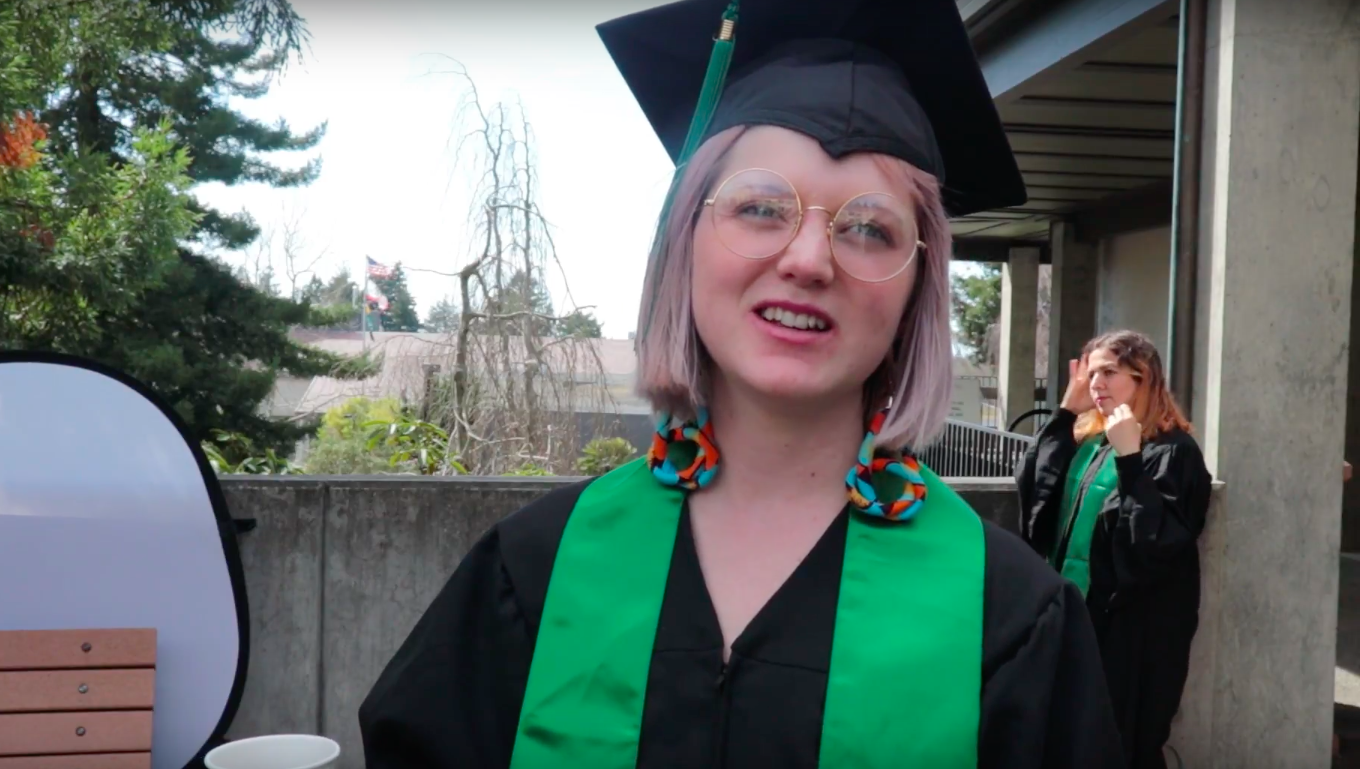
What will you miss most about Humboldt?
Lumberjack reporter Dajonea Robinson asked graduating seniors what they will miss most about Humboldt during Grad Fair on March 29.
Video by Dajonea Robinson.
-
Rumbling in the redwoods
Eureka citizens boo and jeer as the loud music kicks in. Boyce LeGrande, a pro wrestler, walks in with a stride of confidence and pride, mocking the audience as he makes his way to the ring.
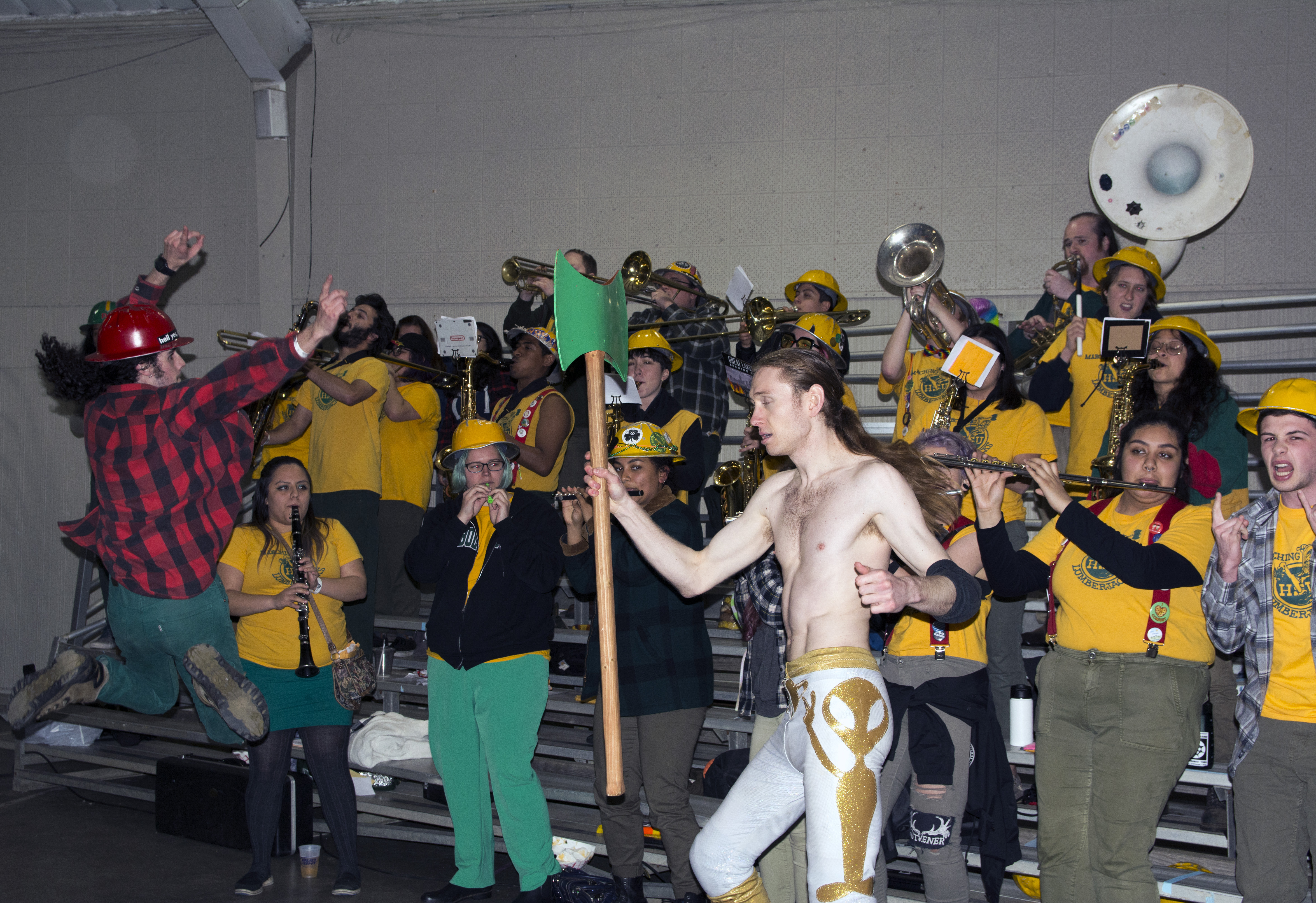
As soon as LeGrande hits the ring, the Humboldt State University band plays the HSU anthem, which is the music for the next pro wrestler, Rocket Boy. The crowd cheers as the wrestling local walks around the audience, giving high fives, waving and dancing with the Humboldt Lumberjack axe. Rocket Boy steps into the ring with LeGrande and gets ready to fight for the title of Pacific North Coast Champion.
Video by Luis Lopez.
The Rumble in the Redwoods pro wrestling event was held at the Redwood Acres in Eureka. Joe Sousa is the host of the event and oversees the pro wrestling scene. It was his idea to get the HSU band to play music for Rocket Boy.
“I wanted to give more cred to the people of Humboldt by having someone like Rocket Boy represent their county,” Sousa said.
Many of the wrestlers in Rumble in the Redwoods are from different parts of California. One pro wrestler at the event is Modesto resident Daniel Torch, which is both his real name and stage name. Torch loves being involved in the pro wrestling scene and has been doing it for eight years.
“I come here looking for a fight,” Torch said. “I’m the bad guy when I’m in the ring. Everyone loves seeing a good bad guy on stage.”
Rocket Boy, or Brett Walters, is an HSU alumnus who graduated with a degree in communications in 2015. When he’s not wrestling, Walters works in an office.
“My wrestling background is not something I bring up when I walk into job interviews,” Walters said.
Since 2012, Walters has been involved in the pro wrestling scene and trained with other pro wrestlers.
“The people who have mentored me through my wrestling career [have] been Lethal Logan X, Bo Cooper, Seth Skyfire and Robbie Phoenix,” Walters said. “When I walk into the ring, I become a totally different person.”
The match the audience anticipated most was the fight between Boyce LeGrande and Rocket Boy for the North Coast Championship belt. The match stipulations were a best of three. The stakes were tied at one with LeGrande, winning once by pin maneuver and Rocket Boy once by submission.
Video by Luis Lopez.
However, at the end of the match, LeGrande won the Pacific North Coast Champion title after Rocket Boy stayed out of the ring for too long, therefore being disqualified.
Even with the egotistical persona LeGrande gave off, he still showed sportsmanship to Rocket Boy.
“I came to the ring thinking it would be a cakewalk, but instead [Rocket Boy] gave me a challenge,” LeGrande said. “You have a lot of heart.”
Walters said the feeling he gets when he steps into the ring is indescribable
“This is therapy for me when I hear the crowd cheering,” Walters said.
-
Students v. admins: frustrated conversations at the budget cuts walkout
“Students’ rights! Students’ rights!”
“Where the fuck is Lisa? Where the fuck is Lisa?”
“Cut her pay! Cut her pay!”
Video by Bailey Tennery.
HSU students could be heard storming through Siemens Hall yesterday, demanding the school’s administration to face students’ anger surrounding the budget crisis.
Trevor McDowell, a wildlife major at HSU, was among the crowd of student protestors.
“We are marching to find President Rossbacher, wherever she is meeting with WASC,” McDowell said.
WASC, or the Western Association of Schools and Colleges, is a reviewing body that determines whether a school is capable of preparing students for the next steps in their careers.
Dr. W. Wayne Brumfield, interim vice president of student affairs, explains the significance of a WASC approved institution.
“WASC accreditation happens all across the country, and is important to a student’s degree. Having the accreditation is a sign of a healthy institution with good academics,” Brumfield said.

Interim VP of Student Affairs Dr. W. Wayne Brumfield listens to student demands in Siemens Hall on March 21. Photo by Philip Santos. David Alvarez, a student protestor, wanted Brumfield to know that HSU is not healthy.
“Why is there a lottery to live on campus? That’s not healthy,” Alvarez said. “I am scared to be homeless. We are not healthy.”
The students’ protest, led by Moxie Alvarnaz, started in the UC Quad.
“How do you feel about the budget cut? The administration just got another raise,” Alvarnaz said.
A collective “boo” swept through the crowd.
Dr. Alexander Enyedi, HSU’s provost and an administrator, was in attendance at the protest.
“I think we should keep the focus on the budget structure,” Enyedi said. “A deficit is different from a budget cut. The colleges’ budgets are mostly untouched, but we are asking them to not spend more than what they are given.”
Enyedi was certain that using the school’s degree auditing system, or DARS, to gather an idea of what classes students need will ensure that students have the right classes to graduate on time, in spite of the deficit reduction effort.

Tents in the UC Quad at Humboldt State during the student-organized event to protest budget cuts on March 21. The walkout was organized by Students Coalition for Organized and Direct Action. Photo by Matthew Hable. As students marched into Siemens Hall from the UC Quad to find President Lisa Rossbacher, they confronted Enyedi in front of his office. William Cooke, a student protestor, disagreed with Enyedi on the class offering strategy.
“If you think that we should be prepared for the rest of our lives, then why offer only the classes we need?” Cooke said. “I pay so much money for my education. Why can’t I take the classes that I want to take and experience college fully?”
Footage by Garrett Goodnight. Edited by Bailey Tennery.
David Alvarez, an undeclared major, expressed concerns for students’ ability to explore different majors.
“I am undeclared. What if I want to become a biology major? Are you going to cut biochemistry [and] botany classes?” Alvarez said.
Kelsey Meusburger, another student protestor, explained what students are seeking from administrators.
“We are asking for an income cap to make HSU a more equitable place,” Meusburger said. “Is that something you’d be open to?”
“Always, always,” Enyedi said.

Ben Gorham and other HSU students ensure they are heard while WASC reviewers meet in Siemens Hall 222 on March 21. Photo by Philip Santos. Brianna Allen, who was missing a capstone class to be at the protest, expressed frustrations with the responses Enyedi has given to students’ questions.
“I need to see you take action,” Allen said. “I need to know if you will advocate for us, on the board of admin, to take budget cuts through your money.”
“I will advocate for you,” Enyedi said. “I will discuss with the cabinet about the ideas that are being put through.”
Dixie Blumenshine, a biology major, brought up the recent firing of CNRS’s dean, Dr. Richard Boone.
“Why did Rich Boone leave early? His resignation isn’t effective until June,” Blumenshine said.
“He wasn’t interested in doing his job anymore,” Enyedi said. “If he was committed, he wouldn’t resign.”
Kylie Brown, a general biology freshman student, was watching the protest from the UC Quad.
“I am here today because I heard that some classes, which I’m hoping to take, will be cut,” Brown said. “I hope to become an endangered species biologist. If the [budget deficit] cuts botany classes at HSU, I will not be prepared for my career. This makes me angry. I haven’t been able to experience all the classes I want to take, and they’re already taking it away.”

Lizzie Phillips (left), one of the members of Students Coalition for Organized and Direct Action who participated in the HSU walkout on March 21, stands in front of a makeshift mural where students air our their grievances on the budget cuts at Humboldt State. Photo by Matthew Hable. Hana Watanabe and Kotaro Kawakubo, international students, were present at the protest in the UC Quad.
“We heard about this protest through our professor, who told us to come see the cultural differences,” Watanabe said.
“We’re also here because we’re worried about the office of international programs,” Kawakubo said. “Our boss has already been fired. We don’t want the office to close. Losing this program would be like losing a home for us.”
Students are encouraged to attend the Associated Students budget forum on Monday, March 26th, from 5-6:30 pm in the KBR for further questions.
See what the HSU budget looks like at URPC.
Information on HSU’s WASC accreditation can be found here.
-
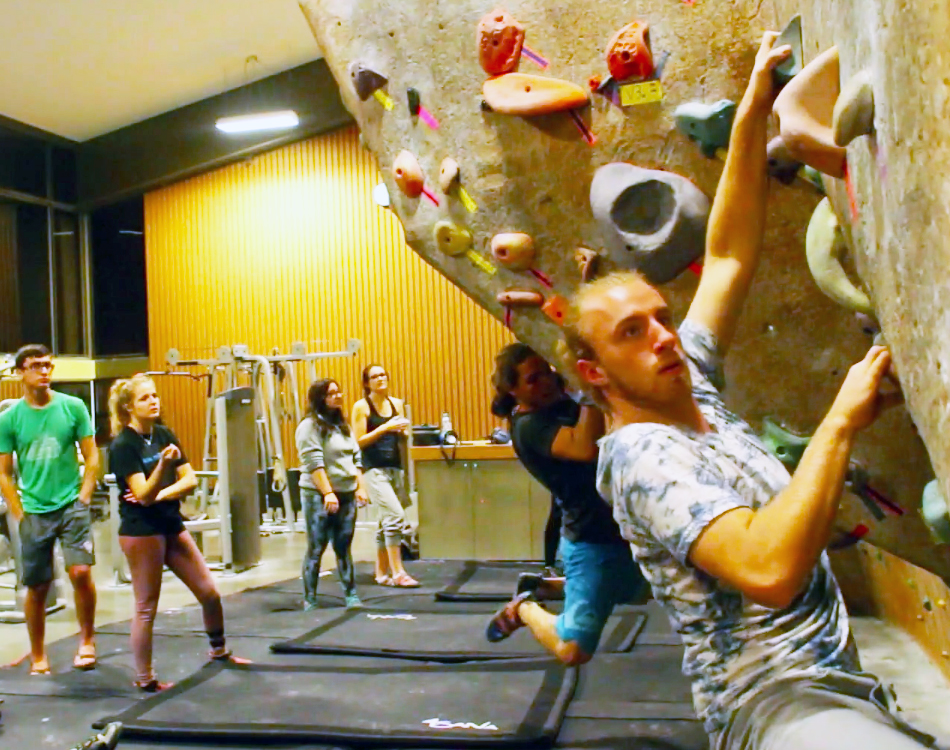
Fear of heights versus rock climbers
Do rock climbers have a fear of heights? Watch the video to find out!
Members of Humboldt State’s rock climbing club Andrew Musgrave, Becky Bell and Journey Ibe dive into their fear of heights. The video was created on Nov. 8, 2017 and filmed in the HSU West Gym.
Video by Bailey Tennery.
-
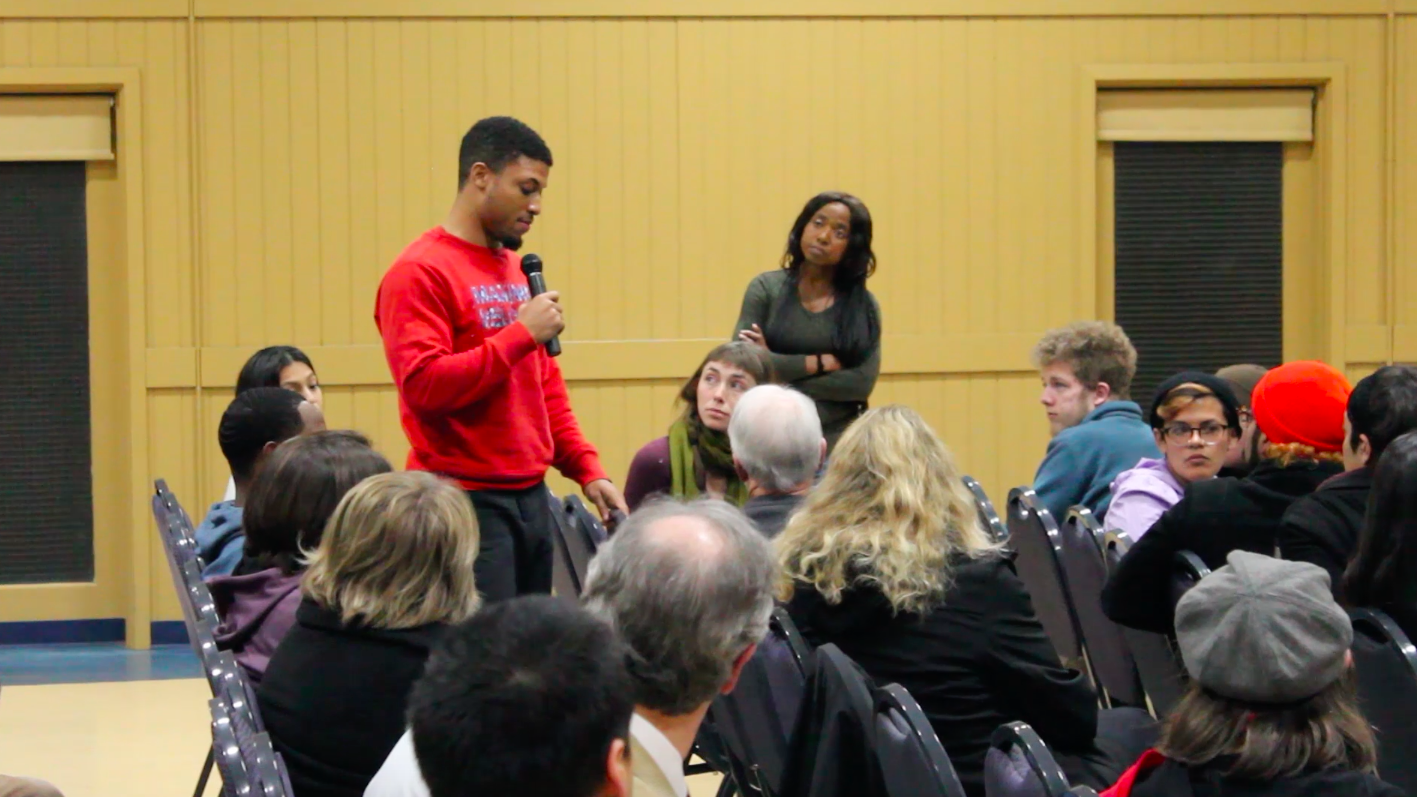
“Unsolved Hate,” the case of David Josiah Lawson
The murder of David Josiah Lawson happened almost 11 months ago. On April 15, 2017, the 19-year-old HSU student Lawson was stabbed multiple times at a house party in Arcata and he died shortly after. The case remains unsolved and justice has yet to be served. Suspect Kyle Zoellner was arrested at the scene, but was later released due to lack of evidence. Lawson’s death is still felt deeply by students and community members.
Close to 100 people gathered at the D Street Neighborhood Center for a showing of the documentary “Unsolved Hate” last Thursday, which was directed by Courtney Wagner. The film focuses on the Lawson case and how his murder affected our small college town. The NAACP Eureka Chapter hosted the event as a part of the three-part film series they are showing for Black History Month.
A discussion followed the film screening in which students and community members were able to discuss the case and the social issues surrounding Lawson’s death. The discussion was similar to the six forums the city council promised the students of HSU. The original meetings were meant to be a place to discuss the safety of minority students and provide community updates on the case. The six meetings that the city council promised were stopped after the fourth one with no notice. Community members are attempting to work with city officials to reinstate these forums without the updates on the case, because the case is ongoing and therefore cannot provide certain information.
Footage by Patrick Maravelias. Edited by Kyra Skylark and Patrick Maravelias.
Wagner is a recent graduate of Sacramento State University. She directed “Unsolved Hate” as her graduation project. Wagner got a panicked call from a friend at HSU the night Lawson was murdered in which she learned of the homicide and the potential mishandling of the case on behalf of the authorities.
Footage by Patrick Maravelias. Edited by Kyra Skylark and Patrick Maravelias.
“I want even the smallest amount of change, even if it’s just one local [who] watched it and thought, ‘Damn, I was raised with racist values and it affects all the people around me,’” Wagner said. “Even just one person becoming self-aware would be amazing, but I would really like to see some actual justice happen.”
Community member Rachel Garcia attended the showing to get more information. She wanted to know what exactly happened the night Lawson died and if anyone filmed the cops to hold them accountable for how they handled the situation.
“I think if people were cognizant that they have the right to [film the cops on the scene], it might help situations like this,” Garcia said.
She learned at the showing that, no, the cops were not properly filmed by individuals on the scene.
Footage by Patrick Maravelias. Edited by Kyra Skylark and Patrick Maravelias.
HSU student Jamila Salih attended the screening to support the #JusticeforJosiah movement.
“I’m here to bring consciousness to Humboldt,” Salih said. “There is no platform where black students are talking about black things, minority students or anyone talking about things that are uncomfortable. So I just wanted to create that platform for students. ”
All Melanated Everything is a show on KRFH 105.1 that airs every Tuesday at 5 p.m. and Thursday at 3 p.m.
Salih created All Melanated Everything as a platform to have “uncomfortable conversations about racism, classism, anything basically that the social construction is – you don’t talk about it.”
Footage by Patrick Maravelias. Edited by Kyra Skylark and Patrick Maravelias.
Deborah Sanchez, a board member on the Seventh Generation Funds Board and a Superior Court Judge in Los Angeles, attended the showing while in town.
“There is enough information here to show that this is a possible hate crime and if the local authorities are not going to take this seriously, then perhaps we need to be looking into civil rights issues and putting pressure from the Federal authorities to take care of the situation,” Sanchez said during the discussion.
Footage by Patrick Maravelias. Edited by Kyra Skylark and Patrick Maravelias.
Whether it’s seeking justice for David Josiah Lawson in 2017 and HSU student Corey Clark in 2001 on a federal level, getting their story to a national publication or keeping their legacy alive here, the students and community members who attended the film showing will not stop searching for answers.
“It’s gonna be a long road, but I also think that it’s definitely something the community can rally around, the community will eventually heal from and will also change the trajectory of everything that will happen in the future,” Sanchez said.
To stay updated on the case and events related to the case, visit the Justice for Josiah Lawson site, the SLAWSON GIRL blog or the #JusticeforJosiah Facebook page.
————
If you are wondering what you as a community member can do to help the Lawson case, you can contact the Arcata City Council members to reinstate “the promised monthly meetings where we will be discussing racism in the community,” and to inquire about the status of the investigation.
City Council members:
- Mayor Sofia Pereira, 707-633-8015, SPereira@CityofArcata.org
- Vice-Mayor Brett Watson, 707-293-3585, BWatson@CityofArcata.org
- Paul Pitino, 707-822-2556, PPitino@CityofArcta.org
- Michael Winkler, 707-822-1857, MWinkler@CityofArcata.org
- Susan Ornelas, 707-826-2722, SOrnelas@CityofArcata.org
Contacting Democracy Now and NPR to encourage them to cover David Josiah Lawson’s case and the mishandling of the case as a nation-wide story is another way to show your support that was brought up during the film discussion.
UPDATE: The monthly community meetings for updates on the case and discussion regarding student safety have been reinstated. The next will be held on Thursday, March 22, 2018.
————
-
One man’s trash is another man’s supercomputer
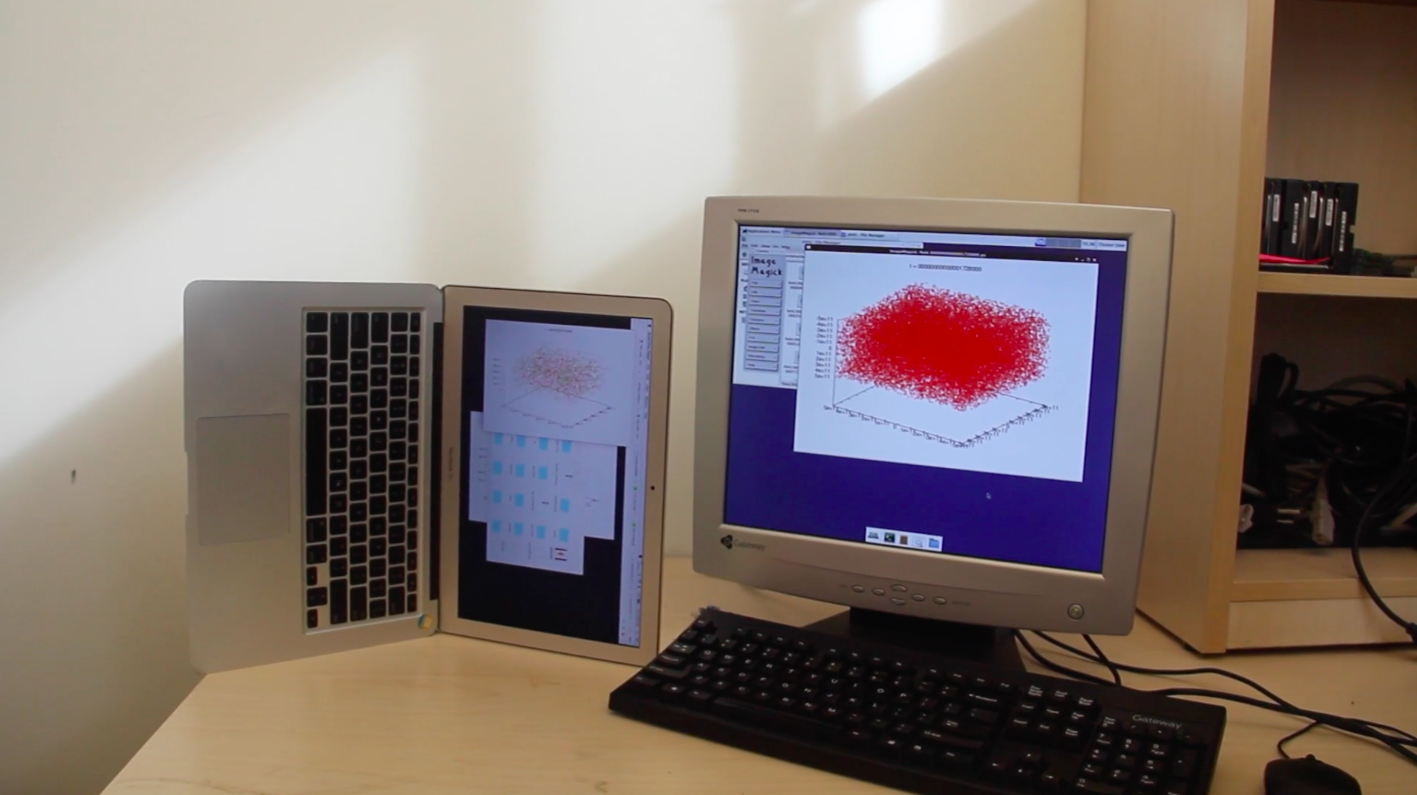
HSU students Sean Haas and Jack Eicher build a supercomputer to better conduct biophysics research on campus.
At large research institutions such as Lawrence Livermore National Laboratory and International Business Machines, or IBM, supercomputers can cost anywhere from $100 million and $250 million to design and assemble (Wagstaff, 2012).
Sean Haas, an astrophysics student, and Jack Eicher, a biochemistry student, built a supercomputer for nothing.
“All of the parts we used for the supercomputer came from eWaste and ITS,” Haas said. “Professor Chris Harmon from the chemistry department donated the rack that houses the supercomputer.”
Eicher said that students also donate computer components.
Information given to computers is stored in their short-term memory, known as the random access memory, or RAM, and the long-term memory hard drive. Supercomputers have an enormous amount of both storage types.
“Computers’ storage capacity are measured in bytes. The larger the bytes value, the more memory the computer can store,” Haas said. “A normal computer contains between four and eight gigabytes of RAM. Our supercomputer has 106 gigabytes of RAM.”
Processors are components that pull information from the RAM and hard drive to perform calculations. A processor is divided into multiple cores. The core amount determines how many calculations a processor can perform at one time.
“Our supercomputer contains 96 cores, which means that it can perform 96 calculations at one time,” Haas said. “When combined with the computer’s large memory, these 96 cores should allow us to do more calculations in a shorter period of time.”
Haas is now testing the supercomputer’s capacities using galaxy formation simulations. Galaxies are large collections of gas, dust and various materials that exist in space. By giving these particles different physical properties, computer simulations can change the the particles’ locations until they form galaxies.
Footage by Surya Gopalan. Edited by Linh Pham.
“On my normal computer, I can put 8,000 particles under the galaxy simulations, but galaxies are really big, and could contain millions of particles,” Haas said. “8,000 particles isn’t really enough to accurately resemble galaxy formations.”
Using the supercomputer, Haas has put 30,000 particles through the galaxy simulations.
“My own computer would melt if I try to do that many particles,” Haas said.
The supercomputer was born out of Jack Eicher’s wish to study biophysics at Humboldt State.
“I remember checking out library books about biophysics during my sophomore year and wanting to learn more about this topic in my classes, but there were no classes that teach biophysics,” Eicher said.
Biophysics is the study of living organisms using math principles and the laws of physics. The lack of resources for biophysics at HSU motivated Eicher to start his own biophysics learning community.
“I’m currently the president of the biophysics club on campus,” Eicher said. “Our club is very research-focused. We develop [biophysics-related] research projects based on the interests of both faculty and students.”
In biophysics, computer models are often used to explain how a biological phenomenon may work, especially when the phenomenon cannot be observed with previously existing methods. Some of these models, such as models that describe protein formation, require a supercomputer’s capabilities.
“Proteins are made from long chains of building blocks, or amino acids. Amino acids have different properties, allowing them to interact with each other. These interactions cause the chains to fold in different ways, eventually forming big proteins,” Eicher said. “Calculating all the ways that amino acids can interact to form a protein really requires a supercomputer’s power.”
“In the future, we plan on showing the galaxies simulation results to tech companies,” Haas said. “We hope that this would encourage the companies to donate more components for our supercomputer, such as graphics cards. This would allow Jack to start studying protein folding.”
Haas and Eicher’s supercomputer has already garnered interests from students and faculty, such as Ruth Saunders, a professor in the physics department.
“In my lab, we study how very small carbon tubes, called carbon nanotubes, are formed,” Saunders said. “We use computers to model these tubes’ formation, but some of our calculations would require two days to do on a normal computer. Using the supercomputer, we may be able to reduce our computing time, and simulate the formation of more nanotubes at the same time.”
For Eicher, building the supercomputer taught him an important lesson on resourcefulness.
“I honestly didn’t think that we would be able to build this supercomputer, given that our school has very low funding for research,” Eicher said. “But when we were able to put this project together, it made me realize that even if we have constraints to what we want to do, if we really want to do it, we can make it happen.”

Illustration by Jen Kelly.