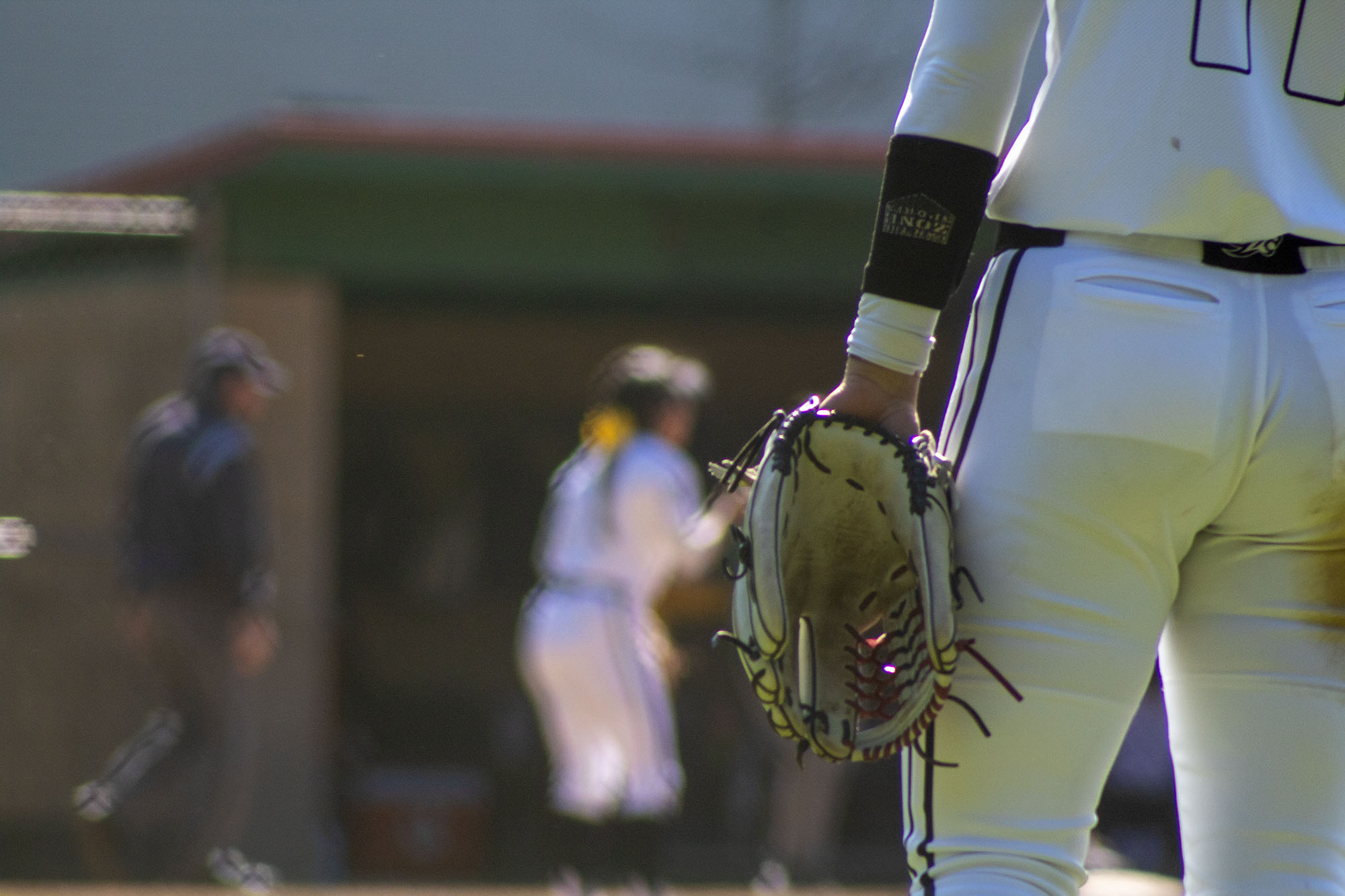
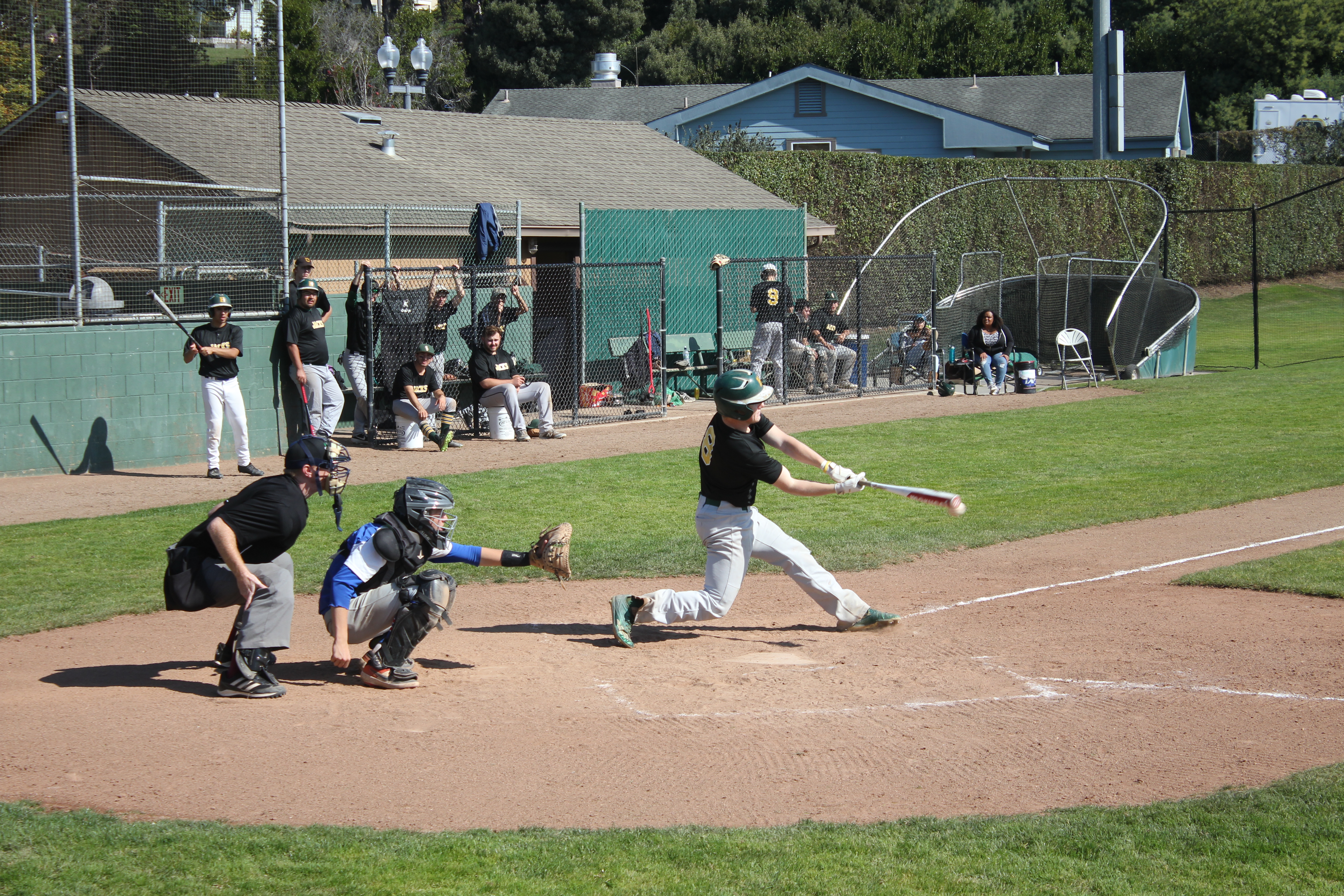
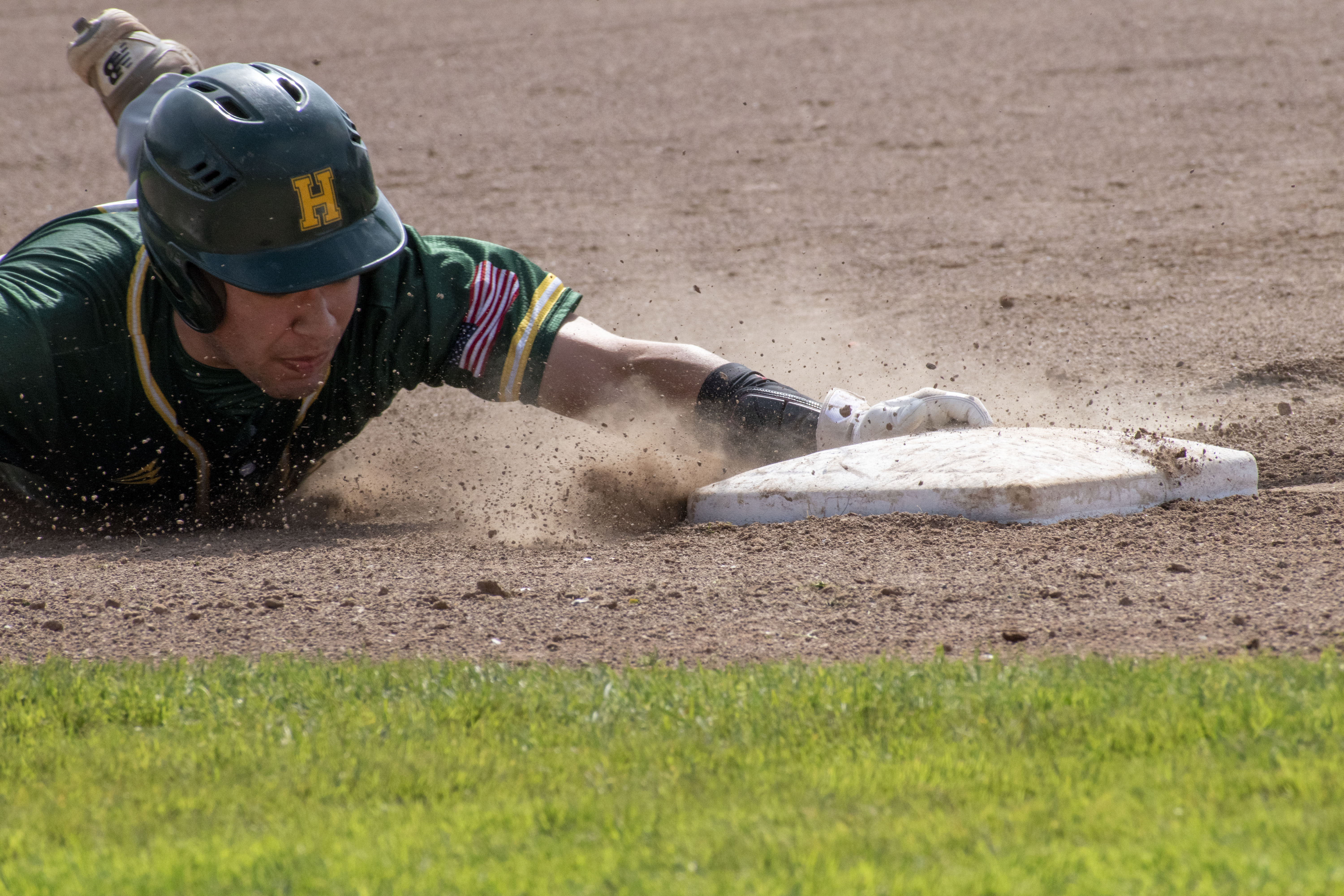
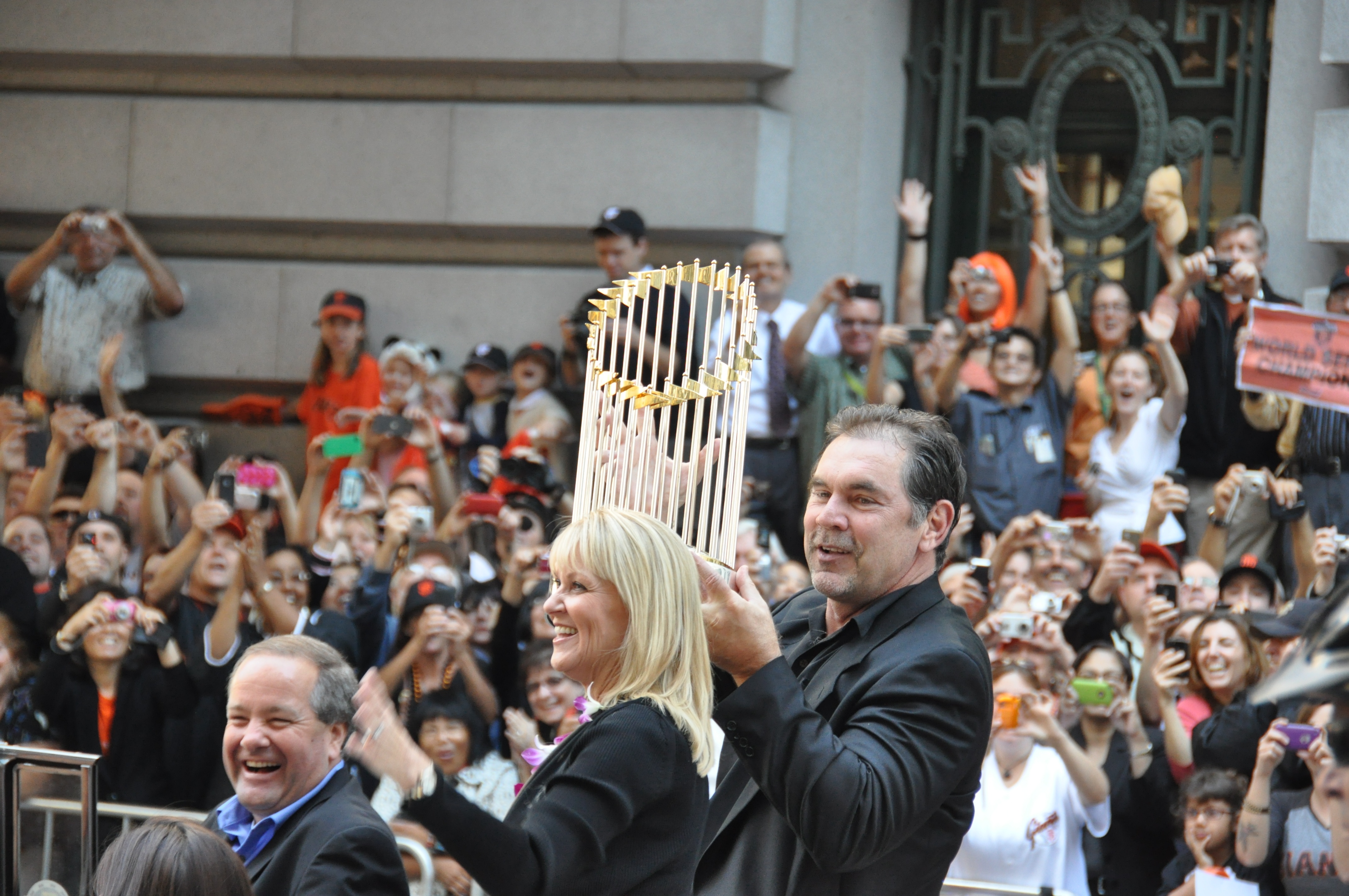
On March 5, the Cal Poly Humboldt softball team held their first home game this year. I was reminded of an easier time, where relaxing to live sports was an everyday escape from the rigor of school and work. During the next couple of hours, I experienced camaraderie, screaming fans and most importantly, tailgate food.
Photo by Gabriel Zucker | Junior Pitcher, Megan Escobar pitches against Chico State on Saturday
Walking around the softball diamond, my eyes fell on a group of parents huddled around a BBQ, waiting on the drumsticks to finish cooking. Walking closer and closer to the food I tried to avoid eye contact, instead focusing on taking photographs of the game. Almost immediately, one of the parents called me over.
Richard Guevara, the father of one of the freshman softball players, yelled out, “Do you like ceviche?”
Looking over I saw a stocky gentleman, decked out in Humboldt softball gear, a giant smile stretched across his face. He beckoned me over with the promise of ceviche and chicken. Next thing I knew I was talking and laughing with the parents, enjoying their food, and praising the beauty of Humboldt.
Taking a bite of ceviche now, I’m transported to a time where sports was a shared experience. A time when sports was more than just the game, it was about the connections you made. After taking a moment to relish in the memories, I opened my eyes to a giant smile and a chicken drumstick.
Sports is never just about the game; it is about the shared experience. At the softball game, a feeling I hadn’t experienced in year swept over me. Screaming fans, a sound I only recently heard in my dreams, washed over me like a wave. My heart flittered and danced, and as the smell of food and freshly cut grass hit me in the face. I stopped to smile.
MLB rule changes go against what the game is all about
America’s pastime. The phrase has become synonymous all over Major League Baseball. As baseball evolves into new seasons, rules are being implemented in an effort to quicken the game and appeal to a younger audience. Many of the rules aren’t too debilitating to the way the game is played, but several key rule changes will do more harm than good.
There are the more radical, long-term rules like getting rid of the shift or implementing a pitch clock, and then there are the more pressing rules like forcing pitchers to face a minimum of three batters and totally changing up the structure of the postseason.
Three-batter minimum rule:
Baseball is all about strategy. One of these strategies involves using a left-handed reliever to get one or two batters out and then bring in another reliever to close out an inning or game. A new rule, which will go into effect beginning this upcoming season, will make it so all relievers need to face at least three batters before being able to leave the mound.
On its own website, MLB called the rule an effort to reduce the number of pitching changes and cut down the average length of the game.
On the surface, it seems MLB Commissioner Rob Manfred and his entourage are making the game run more smoothly. Digging a little deeper reveals that this is far from the truth.
Again, baseball revolves around strategy. To mess with the strategy of the game is to play with fire—a big, multi-billion dollar fire. As Sports Illustrated put it, “Messing with strategy to attempt to solve a pace of game problem is a wrong-headed approach.”
Take the San Francisco Giants for example. In the 2010s, they would frequently use left-handed relievers like Javier Lopez and Jeremy Affeldt to get critical outs against left-handed batters.
If the three-batter minimum rule was ushered in back then, it would’ve been a different ballgame for all involved. The Giants may not have even won all three of their World Series titles.
Bringing in the new rule would not only be a strategist’s nightmare, but also would fail to accomplish the initial goal to make the game go faster. It’s an odd rule all around, and other stats weren’t taken into account before its inception.
Altered postseason structure:
The details of the new postseason format are very intricate, but to put it in broad terms, the number of teams in both leagues making it to the postseason would increase from five to seven. Opportunities to automatically advance to the next round and manually pick their opponents on a live television show would come to fruition.
No words can describe the sheer ridiculousness of these new postseason rules. It seems as if Rob Manfred has lost his mind.
Baseball is already becoming a money-grab reality TV show. The powers that be don’t need to add insult to injury.
The point of the postseason is only a select few make it in, and an even smaller number move on to higher rounds without weird caveats. Luckily, these new postseason rules are just proposals, as they would destroy baseball from the inside out.
Yet again, baseball has been and should continue to be about enjoying the game for what it is and not trying to throw curveballs into the mix. These rules are ambitious, but aren’t beneficial to anyone except the people at the very top of the totem pole. It’s in the best interest of Rob Manfred and his cohort to leave the game alone and stay faithful to the notion of baseball being America’s Pastime.
Why HSU should bring back baseball in the post-football era
It has been over a year since the Humboldt State University football team played their final game ever, leaving local sports fans wondering how we are going to fill the void the HSU football team left in its wake.
Now that I’ve had some time to get used to a fall semester without the green and gold jerseys at the Redwood Bowl, it’s begun to feel more normal for HSU to be a school without a football team.
I know that bringing back the football team, at least in the near future, is an idea that seems like a pipe dream. Once you cut a program that was as much of a financial strain as the football team was, it is really hard to justify bringing such a program back. I think we need to explore alternatives of bringing back other, less expensive sports to HSU, and I know exactly what sport it should be.
Humboldt State needs to revive its baseball program, and I know that HSU baseball would be very well supported by the community.
For one, sports fans in Arcata and the rest of Humboldt County love baseball. There is no bigger example of this than the support that Arcata’s summer collegiate baseball team, the Humboldt Crabs, receives every summer from June until early August.
“From a baseball perspective, an HSU baseball team would be a huge benefit to both the athletes that would play here and the Humboldt Crabs organization.”
Liam Warner
Experiencing a Crabs game is one of the purest forms of Arcata that you will ever experience. From the world-famous Crab Grass Band to the unique heckling coming from the fans, thousands of people pack the Arcata Ballpark every summer to watch the Crabs play. Unfortunately, this is when most of the student population is home for the summer.
Another reason why an HSU baseball team would be easy to start is because finding a facility to play at won’t be a problem. The Arcata Ballpark, which is located right next to Arcata City Hall, is considered to be one of the best ballparks on the summer baseball circuit. For a Division II baseball school, I’m sure we would have one of the best baseball facilities on the West Coast.
Having an HSU baseball team that plays at the Arcata Ballpark would also give fans a lot more opportunities to watch baseball in downtown Arcata. Typically, college baseball season runs from February into late April. The Humboldt Crabs season starts in late May or early June, meaning that we would have six months of baseball with a gap in May between the seasons.
I’m sure extending the season of high-level baseball in Arcata would provide a boost to the economy downtown, as it would allow the opportunity for more people to watch quality baseball at the ballpark.
From a baseball perspective, an HSU baseball team would be a huge benefit to both the athletes that would play here and the Humboldt Crabs organization. The Crabs draw quite a few of their homegrown players from the College of the Redwoods baseball team, so an HSU baseball team would naturally become a feeder of players to play on the Crabs during the summer.
HSU Jacks players would have the opportunity to continue their season on a well-established summer baseball club, and the Crabs would have a local pool of baseball players they could pick from.
Ultimately, it’s up to HSU athletics to make the decision to bring back a sport. But I think all of the factors are there to make an HSU baseball team a successful part of the community.
Humboldt Eagles shut down Humboldt State Lumberjacks in a double header on Oct. 13. The Eagles won with scores of 2-1 in the first game and 2-3 in the second.
During the first pitch of the game, Ryin Alexander opened the 1st inning with a double and found himself reaching 2nd base. Other batters approached the plate and managed to send teammates around all bases, but the Eagles managed to secure three outs against the Jacks. However, Alexander ran for home plate putting the Jacks on the scoreboard.
At the bottom of the 1st, Jack’s pitcher Chris Friedley stepped up to the mound, and despite walking a player and giving up a base hit, he kept his composure and pulled three outs from the Eagles. The Jacks were able to keep a 1-0 lead over the Eagles during a heated exchange of base hits and outs.
Stolen bases were a frequent occurrence between the Jacks and Eagles. Despite their efforts to get players around the diamond, the pitching stalemate remained in effect. The exchange of outs was broken around the bottom of the 6th inning.
Hitter Nick Mavrolas strikes out during the Jacks’ second game of the day against the Humboldt Eagles, at the Arcata Ballpark on Oct. 13. | Photo by Skye Kimya
Eagles put a run on the scoreboard tying the game with the Jacks. Both teams now had a common goal for the next inning, scoring first. At the top of the 7th, a base hit by outfielder Lorenzo Hernandez gave the Jacks an upper hand but were routed by outs. It was then the bottom of the 7th and the Eagles were up to bat, but they faced similar challenges with one base hit and two outs.
Up to bat was catcher Parker Johnson and under dire circumstances closed the inning with a walk-off which gave the Eagles a 2-1 win over the Jacks. With game 2 underway, the Jack’s and Eagles faced off in one more showdown.
Martin Gordillo and Alejandro Caravalho helped the Jacks find an early lead on the scoreboard with an RBI. The Jacks had a 2-0 lead heading into the 4th inning, but tides turned when it was time for the Eagles to bat. With two players on base, the Eagles left fielder Miles Standysh hit a solid ball and secured a tie game.
Another battle for a tie-breaker ensued but the Jack’s dropped their second game against the Eagles with a final score of 2-3.
HSU club baseball doesn’t start until Spring 2020. Even though the season is months away, this is an opportunity for players to figure out effective playmaking and overcome obstacles that the team could potentially face in the upcoming season.
Jacks win both games on Saturday but postpone Sunday games due to weather
The Humboldt State club baseball team was scheduled to play a doubleheader on both Saturday and Sunday at the Arcata Ballpark. They swept their doubleheader on Saturday under sunny skies, but wet and cold weather conditions on Sunday forced the Jacks to cancel the rest of the home-stand after only playing two and a half innings.
The fall season is about development and chemistry building before the team begins its competitive season in spring, but the players were happy with the results of their doubleheader.
Jacks pitcher Nick Mavrolas at the top of his pitching motion. HSU baseball played a doubleheader against local teams at the Arcata Ballpark. | Photo by Liam Warner
The Jacks played two scrimmages against local teams mostly comprised of high school players from around the county, the Northern Humboldt Giants and the Humboldt Eagles. The two teams proved to be good competition for the Jacks.
Pitching and defense was the theme of the day for Saturday’s games. Nick Marvolas started game one for the Jacks against the Northern Humboldt Giants, only giving up two runs in three innings pitched.
The Jacks started scoring in the third inning when catcher Alejandro Caravalho ripped a line drive into right-center field giving the Jacks a 1-0 lead. Unfortunately, Caravalho was tagged out trying to advance to third base on the play. After the Giants took a 2-1 lead in the third inning, the Jacks responded in the fourth when Christian Amador hit an RBI single and then scored on a wild pitch to give the Jacks a 3-2 lead. In the seventh inning, Xander Gonsalves scored on a steal of home and the Jacks won game one by a score of 4-2.
Ryin Alexander in his batting stance as he waits for the pitch. HSU baseball played a doubleheader against local teams at the Arcata Ballpark. | Photo by Liam Warner
The second game of the day against the Humboldt Eagles followed a similar pattern.
Caravalho started the game on the mound for the Jacks and put together a spectacular performance against the Eagles hitters. He went five innings, allowing no runs despite allowing five hits and three walks. Christian Amador pitched the last two innings, only giving up one earned run. Offensively the Jacks made the board early again and took a 1-0 lead in the second inning as Willie Cestarollo drew a walk with the bases loaded.
The Jacks added three more runs in the fourth inning with the aid of a Justin Miller triple and a Lorenzo Hernandez double. A couple of runs came across in the seventh for the Eagles, but the Jacks held on for another 4-2 win.
Shortstop Christian Amador heads for third base. HSU baseball played a doubleheader against local teams at the Arcata Ballpark. | Photo by Liam Warner
On Sunday, in the typical Humboldt spirit and despite the downpours and the chilly weather, the Jacks attempted to play their first game against the Humboldt B52’s. After two and a half innings, the weather conditions forced the teams to cancel the rest of the day’s action.
Despite their homestand getting cut short, the Jacks were happy to be out on the field playing. For Jacks’ first baseman Chris Friedley, who grew up in Humboldt County, being able to play on the same field that he watched his baseball heroes play on when he was growing up made the whole experience special.
“I’ve been playing on this field since sophomore year of high school,” Friedley said. “Having my family be able to come out and watch, honestly it’s a gift.”
Capping off a legendary career, Bruce Bochy retires as manager of the San Francisco Giants
When Bruce Bochy got his job as manager of the San Francisco Giants in 2007, the Giants hadn’t won a World Series title since the franchise moved from New York in 1958. The Giants weren’t necessarily a lousy franchise since moving to San Francisco, reaching the World Series in 1962, 1989 and 2002 but they were never able to claim baseball’s ultimate prize.
Bochy’s first few years as manager of the Giants were subpar, but in 2010 Bochy gave San Francisco something the city had waited for decades to get: a World Series title.
As a die-hard Giants fan, things have gone pretty well over the last decade with Bochy at the helm (with the exception of the last few seasons). The Giants won the World Series three times in a span of five years: 2010, 2012 and 2014. Which is something the Giants’ blue colored rivals to the south haven’t done since before I was born.
Bochy ended his hall of fame career today after the Giants played their last game of the regular season at Oracle Park in San Francisco. It’s been an emotional day for every single person that is a fan of the Giants or has been a part of the organization. There have been tributes from players and coaches past and present. I guarantee that tears have been shed, including my own.
It may be hard to understand what Bochy has meant to San Francisco and the game of baseball if you’re not a Giants fan. The impact he has made on both the franchise and the game of baseball is hard to put into words. It starts with the way that he treats his players and the way that he situated his players to win three World Series titles.
In 2010 the Giants had few superstar players and no one expected them to make the postseason, much less win the World Series. The team had a budding superstar as catcher, Buster Posey, and Tim Lincecum, a Cy Young Award winner, as its pitching ace. Outside of that the Giants were never expected to be a World Series contender.
After winning the division and beating the Braves and Phillies, the Giants found themselves in the World Series against the Texas Rangers and were able to beat them in five games to capture the title.
The players are the ones that win the game, but the manager moves the pieces around so that the team has the best chance to win. Baseball is a very detail-oriented game, and Bochy was able to create lineups and use his pitching rotation to put his teams in the best position to win. It also speaks to Bochy’s character that he treated his players with respect. In every World Series team that Bochy managed, his players bought in and played their absolute hardest for him.
Another aspect of Bochy’s style that is unique in this day and age, is that he manages with his gut. Nowadays, baseball is about advanced metrics and stats. Almost every lineup and pitching decision is made off of computer data. Bochy still manages the game the old-fashioned way, using his knowledge of the game and scouting reports of opponents to set his lineups and make pitching changes.
The entire 2019 season, at every ballpark that Bochy visited for the last time, he was presented with a gift from the opposing manager and given a standing ovation by opposing players and fans. But there was one moment in particular that stood out to me during Bochy’s farewell tour.
On Sept. 7th at Dodger Stadium in Los Angeles, a place where pure hatred of the Giants is felt every time they make the trip down, the Dodgers’ manager Dave Roberts presented Bruce Bochy with a gift. A montage of Bochy’s highlights played on the big screen, including his World Series highlights.
For those who don’t understand the rivalry between the Giants and the Dodgers, the teams and the fans hate everything that has to do with the other. When the presentation was shown at Dodger Stadium that night, fans cheered. In a rare moment, the SoCal team and its fans showed respect for the Giants and their manager that had been their adversary for so long.
Bruce Bochy will forever live on as one of the greatest managers in San Francisco Giants’ history. After today, the Giants will search for a new manager and hopefully return to the glory days of beating the Dodgers and parading the World Series trophy through the streets of San Francisco.
HSU’s club baseball team gets ready for competition with informational meeting
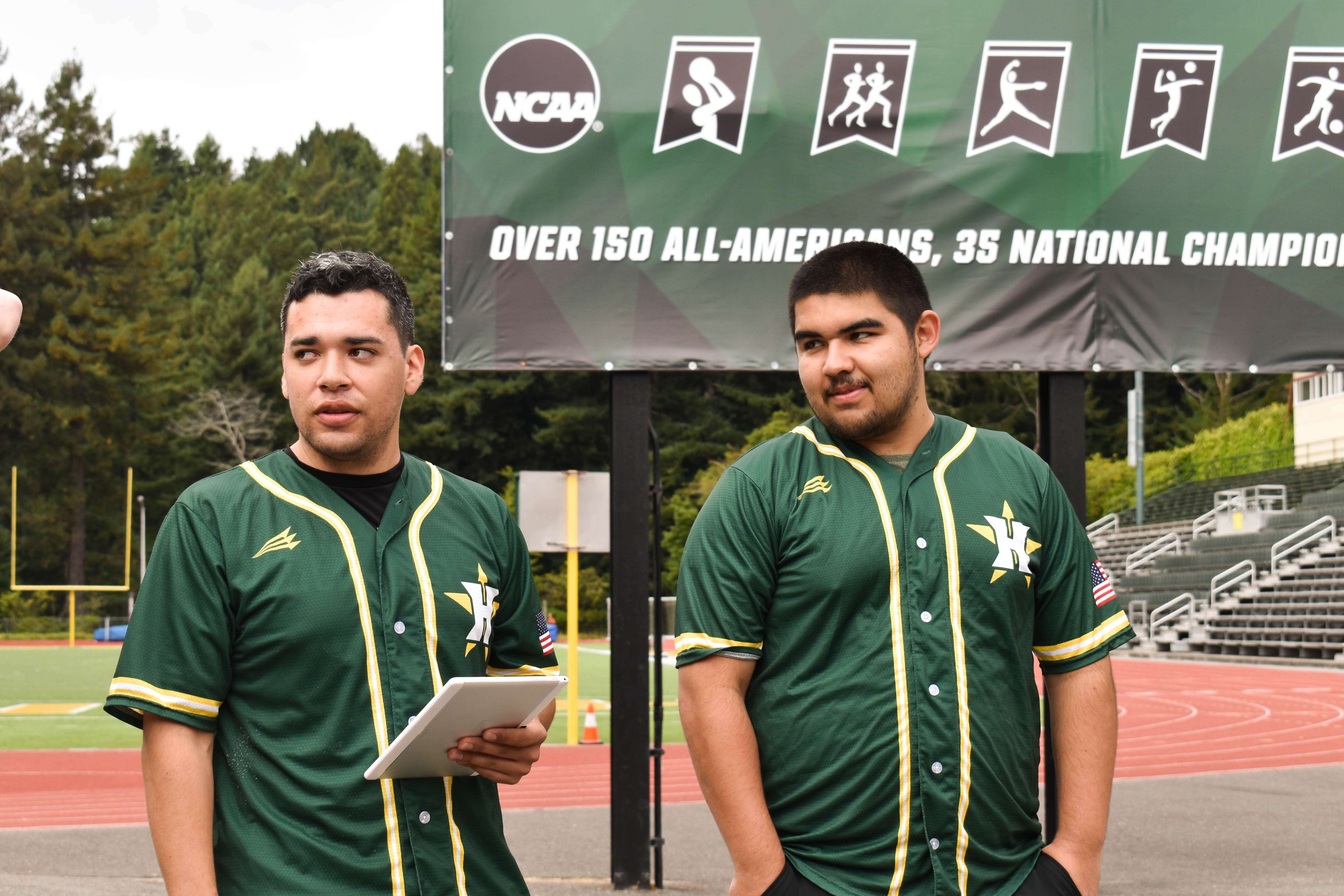
The Humboldt State Baseball Club prepared for its upcoming fall season with an informational meeting on Sept. 7 at the Redwood Bowl. The team went over basic information like club dues, practice times, expectations of the players and their tentative season schedule.
HSU’s Baseball Club President Martin Gordillo at the Redwood Bowl on Sept. 6. | Photo by Liam Warner
Even though Humboldt State does not have an intercollegiate baseball team that would have the benefit of being in the NCAA and able to recruit players on athletic scholarships, the club team offers a more tight-knit atmosphere. It also allows players of all skill levels the experience and play time that they might not receive elsewhere.
According to the club’s president Martin Gordillo the important part of being on the team is the experience and having a good time.
“You get the travel experience, and you get the playing time,” Gordillo said. “It’s like when you were playing baseball in high school.”
HSU Baseball Club Vice President Alejandro Caravalho at the Redwood Bowl on Sept. 6. | Photo by Liam Warner
The club baseball team is completely student-coached. For Alejandro Caravalho, the club’s vice president who transferred from the College of The Redwoods baseball team, the student-coached model allows for more flexibility and more player choice in how the team is run.
“It’s more collaborative, rather than a dictatorship where the coach’s word is law,” Caravalho said. “I have a more informed role on the team where we discuss finances, and we get a say as opposed to a coach telling us what to do.”
The club baseball team also gets the benefit of practicing and playing their home games at the Arcata Ballpark in downtown Arcata. The park is home to the Humboldt Crabs during the summer months.
Travel Secretary Willie Cestarollo (#6) practices his pitching motion at the Redwood Bowl on Sept. 6. | Liam Warner
During the meeting, Travel Secretary Willie Cestarollo talked about the Arcata Ballpark being one of the best baseball facilities in Northern California and mentioned how visiting club teams praise the ballpark as one of the best facilities that they visit.
The team plays in the National Club Baseball Association, which is comprised of club baseball teams from schools across the country. HSU’s division consists of teams such as Stanford, Sacramento State and St. Mary’s and are teams that HSU will play in the spring.
Slated for the fall season is a trip down to Chico State and two non-conference home series games at the Arcata Ballpark. The first one is September 28-29 against the Humboldt Eagles and then November 16-17 versus Sonoma State, weather permitting.
“I like the team because it’s small,” Gordillo said. “It’s easier for us to get closer with one another.”
Benjamin Shaeffer’s double life as an HSU philosophy professor and Crabs’ baseball announcer
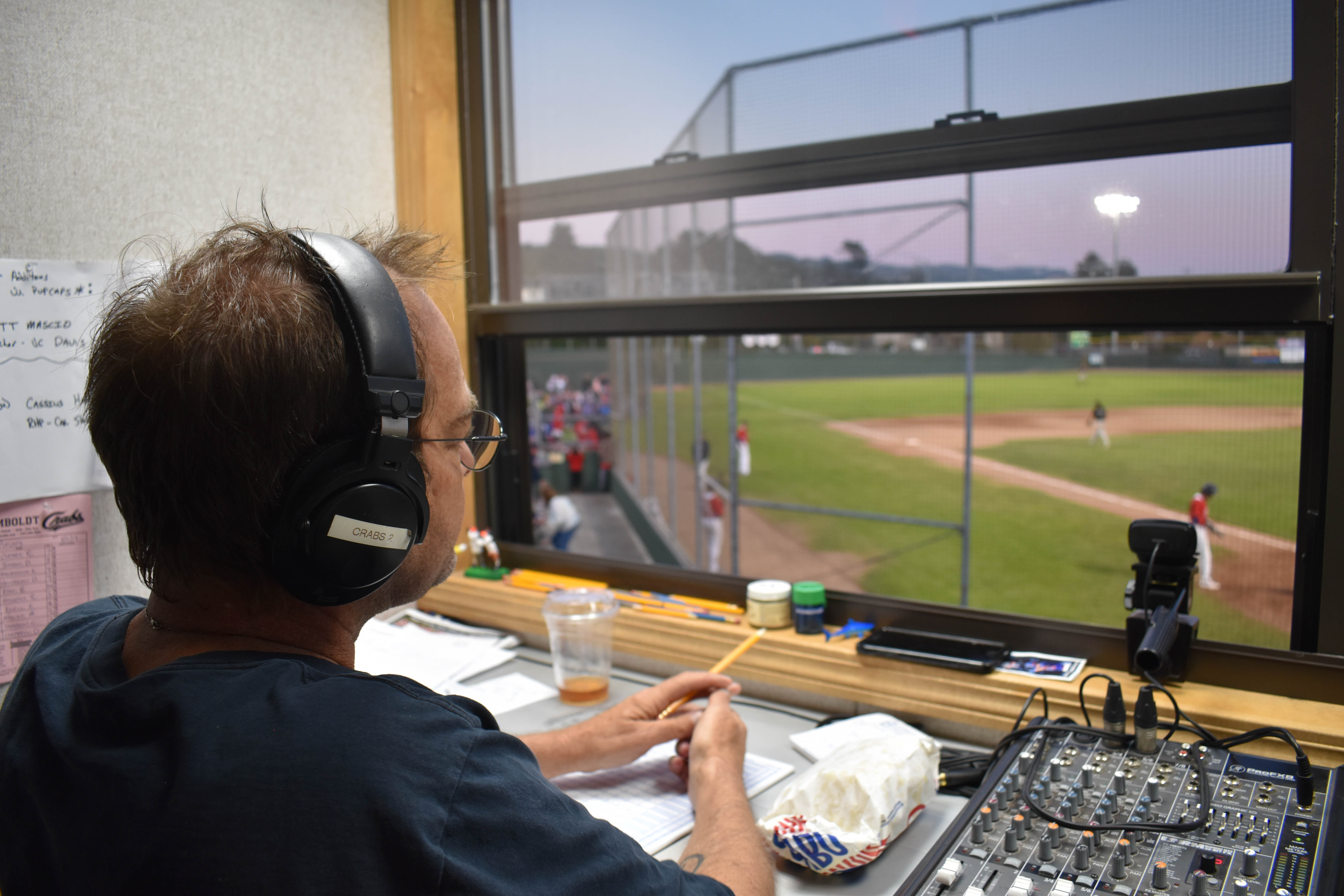
It’s a brisk June night in downtown Arcata as Benjamin Shaeffer arrives at the ballpark around 6:30 in the evening. He climbs up the ladder to the media booth, sets his personal belongings down, and says hello to the other people working in the booth that night.
Before the game starts, Shaeffer will usually talk to the others in the booth about world events of that day, philosophical musings, or about how bad the Giants are doing. He looks over the lineups for both teams, noting the pronunciation of the players’ names and he fills out his fielding chart, putting a player’s name in each position on the baseball diamond.
It’s around 6:45 p.m. when Shaeffer gets ready to put his voice on air, connecting to hundreds of radios, phones, and computers across Humboldt County and beyond. He puts his headset on, waits for the countdown to go on air, then begins the broadcast with, “Good evening Crabs fans around the world and around the block, on the world wide web, and on the radio, it’s time for Crabs baseball!”
Shaeffer is the current philosophy department chair and for almost 10 months of the year he teaches philosophy full time at Humboldt State University. For two months every summer, he spends his evenings in the Arcata Ballpark broadcast booth.
Shaeffer grew up in the Southern California city of El Monte, 13 miles east of downtown Los Angeles at the base of the San Gabriel Mountains. Journalism was his primary interest as he was the editor of his high school paper and then majored in journalism at Pasadena City College. But it wasn’t long before he started to lose interest in journalism, and it was then that he began to find what he believed to be his true calling in life.
“When I discovered philosophy, I realized that these are the questions I’ve been wondering about my whole life. I just didn’t know that you could get paid to ask them.”
Benjamin Shaeffer
“It seemed like it was more about selling papers than it was about informing people what was going on in the world,” Shaeffer said. “When I discovered philosophy, I realized that these are the questions I’ve been wondering about my whole life, I just didn’t know that you could get paid to ask them.”
Shaeffer went on to get his bachelor’s degree at UC Santa Cruz and then later received his Ph.D. at UC Santa Barbara. In 1998, not long after earning his degree at UCSB, Shaeffer accepted what he thought at the time was a one-year teaching position at Humboldt State University. Like many students and faculty who make the trek from LA to Humboldt, Shaeffer was not sure what to expect and was anxious about living in an unfamiliar place so far from home. He was certain that he wasn’t going to be in Humboldt for long and imagined he would return to his job in SoCal soon.
“I had this image of Humboldt,” Shaeffer said. “I thought I was going to live in the woods and it was going to be quiet like a small town. But when I got to Eureka and saw the Bayshore Mall, I was a little bit upset.”
Benjamin Shaeffer fills out his scorebook prior to the game. | Photo by Liam Warner
Aside from his interest in philosophy, a constant presence and a dear friend throughout Shaeffer’s life has been baseball. Shaeffer does not consider himself a sports fan as he has never been interested in other popular sports like basketball or football, but when it comes to baseball, he can recall the exact moment he fell in love with the sport.
“When I was seven, at the end of the street I grew up on, there was a park with a little league field,” Shaeffer said. “I remember going down there and just being fascinated by watching these kids plays baseball. I started to play as soon as I was old enough to play, but I didn’t get past little league.”
Thankfully, it wasn’t long before Shaeffer discovered the Humboldt Crabs baseball team that played their summers in downtown Arcata.
“I was in heaven,” Shaeffer said.”I started to hang out at the games, and in 1999 there was an opening for a ballpark announcer. I wanted to be the ballpark announcer.”
Although Shaeffer didn’t get the ballpark announcing gig, there was an opening for an official scorer and he took that position. After being the official scorer for a year and hanging out in the booth next to the radio broadcasters, Shaeffer was given a chance to be on the radio. He would then join Robert “Hoke” Holcomb on the Crabs radio broadcast, and that started a summer tradition that continues to this day.
“I always said that if you didn’t get along with Benjamin Shaeffer you had a personality disorder and you needed to see somebody.”
Hoke Holcomb
“So I sat right next to [the radio broadcasters],” Shaeffer said. “I would interject things over the air, and then after the first season Hoke asked me if I wanted to volunteer. He asked me ‘why don’t you be my color man?’”
Benjamin Shaeffer and Hoke Holcomb would develop both an on-air and off-air friendship that would last 19 summers before Hoke retired at the end of the 2018 season. Shaeffer and Hoke both came from an academic background, were politically active, but most importantly loved the game of baseball, and that made for instant on-air chemistry.
“I always said that if you didn’t get along with Benjamin Shaeffer you had a personality disorder and you needed to see somebody,” Holcomb said. “I think he brings enthusiasm to the broadcast without having that enthusiasm drown out what he’s conveying.”
Throughout his summers as the voice of the Crabs, Shaeffer has brought a unique perspective to the sport of baseball, often sprinkling philosophical musings throughout the broadcast. His philosophical background allows him to view the game in a different light, valuing the slow and building moments of the game rather than the high energy, action-packed moments.
Photo by Liam Warner
“I think the thing about baseball that is philosophical is its slowness and its meditative quality,” Shaeffer said. “It creates tension and that’s the source of its excitement, rather than speed and things moving really fast. It builds to these moments of tension that have to get resolved.”
Tim “Tres” O’Brien is one of the Crabs’ current ballpark announcers. He worked in the booth back in 2004 and then returned to his ballpark announcing duties in 2016. Tres has listened to Shaeffer both in the booth and on the radio, and he talked about what made Shaeffer a unique baseball announcer.
“Benjamin, while I think his style is more straightforward, he would have intellectual humor that would come out here and there,” O’Brien said. “He would ‘mini ponder’ about a certain play, and he would bring this other element to announcing a baseball game.”
Shaeffer’s day job might be teaching philosophy for most of the year, but to him, there is no better place to be during the summer than high up on that perch above the Arcata Ballpark, watching baseball.
“If I find somewhere where there’s baseball, I go,” Shaeffer said.
On an overgrown high school field in Sacramento, the Jacks were able to come back from an opening game defeat and win the final two games against the Sacramento State Hornets.
The Jacks dropped game one 6-5 in a hard-fought nail-biter. Freshman Chris Friedley started on the mound and needed to set the tempo. With emotions high, Friedley was unable to find the strike zone and provided the Hornets early baserunners.
The Hornets cashed in on their first opportunity. Friedley managed four and third innings while walking six, and allowing six runs on six hits, an eerie start to say the least. The Jacks then turned to Sophomore Lorenzo Hernandez, who allowed just one hit over one and a third, while striking out two.
Hernandez also added a single and a key RBI to help the Jacks rally in the sixth to cut the deficit to two. Sophomore Mateo Hamm worked a walk to lead off the seventh and final inning and worked his way to third.
Senior Shane McNair was able to knock him in with a two-out base hit to cut the lead to one. The Jacks couldn’t capitalize, however, giving the Hornets game one.
Head Coach and HSU alum Tanner Wise was content with game one.
“I liked the way we started the series,” Wise said. “But honestly we should have won game one, we just didn’t capitalize on our opportunities.”
The Jacks took game two 10-4 with help from Hernandez, McNair, Hamm, and juniors Adrian Mercado, and Alejandro Caravalho.
[perfectpullquote align=”right” bordertop=”false” cite=”Jacob Adams” link=”” color=”” class=”” size=”18″]“He was lights out. The fastball was working, and he was able to build off it all day, and gave us a lot of momentum heading into game three.”[/perfectpullquote]
The Jacks tallied three runs in the third, and another in the fourth. These runs allowed them to relax and play defense. This is precisely what they needed to do to support Hamm, who struck out 13, while only allowing four during his complete game.
Sophomore first baseman Jacob Adams spoke highly of Hamm’s outing.
“He was lights out,” Adams said. “The fastball was working, and he was able to build off it all day, and gave us a lot of momentum heading into game three.”
The Jacks were able to pad their lead in the sixth by adding six runs by putting the ball in play and capitalizing off errors made by the Hornets. The Jacks played excellent defense and were able to tie the series at one, with one final game to play.
Game three was a battle, as both teams managed a run in the first, and four more in the third. With the game tied at five, the Jacks managed to score two more in the fourth, and never looked back.
McNair added three hits, and three runs on the day that stretched the lead to 9-6 in the sixth with a key two-run single. The Jacks were again helped by Hamm, who added three hits, three runs, and an RBI to conclude his influential series.
Caravalho added two hits and was able to pitch a complete game while surviving 16 hits, and six walks while only allowing seven runs.
Wise was complimentary of Caravalho’s outing. Wise said Caravalho did everything the team needed him to do.
“We needed him to throw as many innings as possible and give our defense a chance to make plays,” Wise said. “He survived out there.”
Game three ended 9-7 in favor of the short-handed Jacks to give them their first series victory of the season. The Jacks will look to build off the strong road performance during home games against Stanford the weekend of May 4.
Stay tuned for start times, field locations, and come out to see HSU’s club baseball.
April 25, 1976 – Former San Antonio Spurs power forward Tim Duncan is born in Christiansted, United States Virgin Islands. Widely considered to be the greatest power forward of all time, he is a five-time NBA champion, two-time NBA MVP, three-time NBA Finals MVP and an NBA All-Star Game MVP. He is also a 15-time NBA All-Star and the only player to be selected to both the All-NBA and All-Defensive teams for 13 consecutive seasons. He is undoubtedly the highest decorated Spur of all time. Duncan started out as a swimmer, and only began playing basketball in ninth grade after Hurricane Hugo destroyed the only Olympic-sized pool in his hometown of Saint Croix, U.S. Virgin Islands.
April 27, 1947 – Babe Ruth Day is declared a national holiday by then baseball commissioner Albert “Happy” Chandler Sr. The commissioner was aware of Ruth’s rapidly deteriorating health, and designated Babe Ruth Day at Yankee Stadium. Ruth would address the Yankee faithful, 27 years after first slipping on the pinstripes. Baseball fans around the world still celebrate the day designated for the Great Bambino.
April 28, 1967 – Boxing world champion Muhammad Ali refuses to be inducted into the U.S. Army and is immediately stripped of his heavyweight title. Ali, a Muslim, cited religious reasons for his decision to forgo military service.
“I have the world heavyweight title, not because it was ‘given’ to me, not because of my race or religion, but because I won it in the ring through my boxing ability,” Ali said in a press statement. “Those who want to ‘take’ it and hold a series of auction-type bouts not only do me a disservice, but actually disgrace themselves. I am certain that the sports fans and fair-minded people throughout America would never accept such a ‘title-holder’.”
April 14, 1941 – Baseball legend and pariah Pete Rose is born in Cincinnati, Ohio. Rose has the most hits of all time in Major League Baseball history, but is more well known for his involvement with gambling on baseball games. Rose was given a lifetime ban from baseball after a scandal focused on his habit of betting on games broke out in the late 1980s. He agreed to be declared permanently ineligible from the sport in 1989.
April 15, 1947 – Jackie Robinson becomes the first African American to play in a MLB game in the modern-era. Robinson broke the baseball color line when the Brooklyn Dodgers started him at first base on April 15, 1947. When the Dodgers signed Robinson, they paved the way to the end of racial segregation in professional baseball that had consigned black players to the “Negro leagues” since the 1880s.
April 17, 1820 – Alexander “Alick” Cartwright, who is recognized as the inventor of modern baseball, is born in New York, New York. Although he was inducted to the Baseball Hall of Fame and referred to as the “father of baseball,” his role as developer of the game has been disputed by many skeptics. After the myth of Abner Doubleday having invented baseball in Cooperstown in 1839 was debunked, Cartwright was inducted into the Hall of Fame as a pioneering contributor 46 years after his death.
March 7, 1857 – Baseball decides that their game will last nine innings. Before this, a full game was decided when the first team scored nine runs. Games have remained nine innings for the last 160 years.
March 8, 1971 – In their first boxing match against each other, Joe Frazier defeated Muhammad Ali in 15 rounds for the heavyweight title. The two would fight twice more that became known as “The Rumble in the Jungle” and “The Thrilla in Manila.” Ali won both matches.
March 14, 1988 – Golden State Warriors star Stephen Curry was born. Curry has become a household name in the NBA and his style of play has changed the way the game is played and coached.
March 14, 2010 – Jacks softball pitcher Gracie Perez throws a no-hitter versus Chico State. Perez was one walk away from throwing a perfect game and had six strikeouts for the game.
March 14, 2017 – The world’s oldest golf club, Muirfield in Scotland, votes to admit women to their club for the first time in the 273-year history of the rule that banned women.
Miki Fukasawa’s journeyed from Sagamihara City, Japan, to Arcata, Calif. in his pursuit of playing baseball in America.
“My lifelong dream was to play baseball in America and now I am,” Fukasawa said.
Fukasawa is a catcher on the Humboldt State Intramural Baseball team. Fukasawa came to HSU in a study abroad program. He previously attended J.F. Oberlin University, located about an hour outside of Tokyo, Japan. There, Fukasawa was studying English. Fukasawa was also a catcher on the J.F. Oberlin baseball team and hopes to rejoin the his former team after his semester at HSU.
“When I move back to Japan, I want to learn more English, and play baseball as long as possible,” Fukasawa said. “The dream would be to become a professional baseball player either in Japan, or even for Major League Baseball.”
Fukasawa found out about the study abroad program, from some friends at his university back home.
Fukasawa said that so far he cannot complain about the Humboldt life. His favorite food since arriving at HSU has been the pizza from The Depot on campus. Fukasawa said that he feels no added pressure to perform on the baseball team, and that he enjoys his teammates very much
Fukasawa found housing in Arcata with fellow intramural teammate and HSU student Christian Clouthier. Clouthier is a second year transfer student from Sacramento. This is Clouthier’s second season with the team, while also acting as the team treasurer. These duties include getting people reimbursed for away games, collecting the dues of the players, and estimating the total cost of the season expenses.
Clouthier has done more than that, he has opened his apartment to Fukasawa for the semester. Clouthier lives in the same complex with an international student coordinator at Humboldt State, who told him about Fukasawa.
“It was just me and my girlfriend in the apartment, she is half Japanese and thought it would be a good idea,” Clouthier said. “We had an extra room, so we thought it would be a good thing to do.”
Fukasawa is not the only Japanese ball player on the HSU intramural squad, Shinya Arai is from Kanazawa, the capital city of Ishikawa, Japan. He also plays catcher and a little bit of third base for the intramural team.
“I have always wanted to attend an American university. I chose HSU because I like the California climate,” Arai said.
Arai started playing ball around when he was around 9 years old, but stopped around junior high school. He was fortunate to have the opportunity to contribute to the HSU team.
Arai has enjoyed his time in Humboldt County, he is staying in an apartment in McKinleyville. His favorite food so far has been from the Chinese restaurants around town.
Arai likes playing on the baseball team, but says at times there can be confusion on the field with the language barrier.
When Arai returns home he will continue with school, and learn more about travel and english, in hopes of one day becoming a sightseeing organizer.
This website uses cookies to improve your experience. We'll assume you're ok with this, but you can opt-out if you wish. Cookie settingsACCEPT
Privacy & Cookies Policy
Privacy Overview
This website uses cookies to improve your experience while you navigate through the website. Out of these cookies, the cookies that are categorized as necessary are stored on your browser as they are essential for the working of basic functionalities of the website. We also use third-party cookies that help us analyze and understand how you use this website. These cookies will be stored in your browser only with your consent. You also have the option to opt-out of these cookies. But opting out of some of these cookies may have an effect on your browsing experience.
Necessary cookies are absolutely essential for the website to function properly. This category only includes cookies that ensures basic functionalities and security features of the website. These cookies do not store any personal information.
Any cookies that may not be particularly necessary for the website to function and is used specifically to collect user personal data via analytics, ads, other embedded contents are termed as non-necessary cookies. It is mandatory to procure user consent prior to running these cookies on your website.