The Lumberjack


Students Serving The Cal Poly Humboldt Campus and Community Since 1929

Tag: Cal Poly University Humboldt

  • Indigenous Foods Festival highlights the importance of food sovereignty

    Indigenous Foods Festival highlights the importance of food sovereignty

    by Krisanne Keiser

    On a bright sunny Saturday morning, students, faculty, and local tribal peoples came together to celebrate the Rou Dalagurr Food Sovereignty Lab & Cultural Workspace at the Indigenous Foods Festival. The event was held on the Cal Poly Humboldt campus on April 16 and was part of a month-long Food Summit that is focused on educating students, staff, and the public about food sovereignty. The event featured special featured films, keynote speaker presentations, and numerous outdoor volunteer opportunities working with plants and learning thoughtful ways to gather that respects Indigenous self-determination of land.

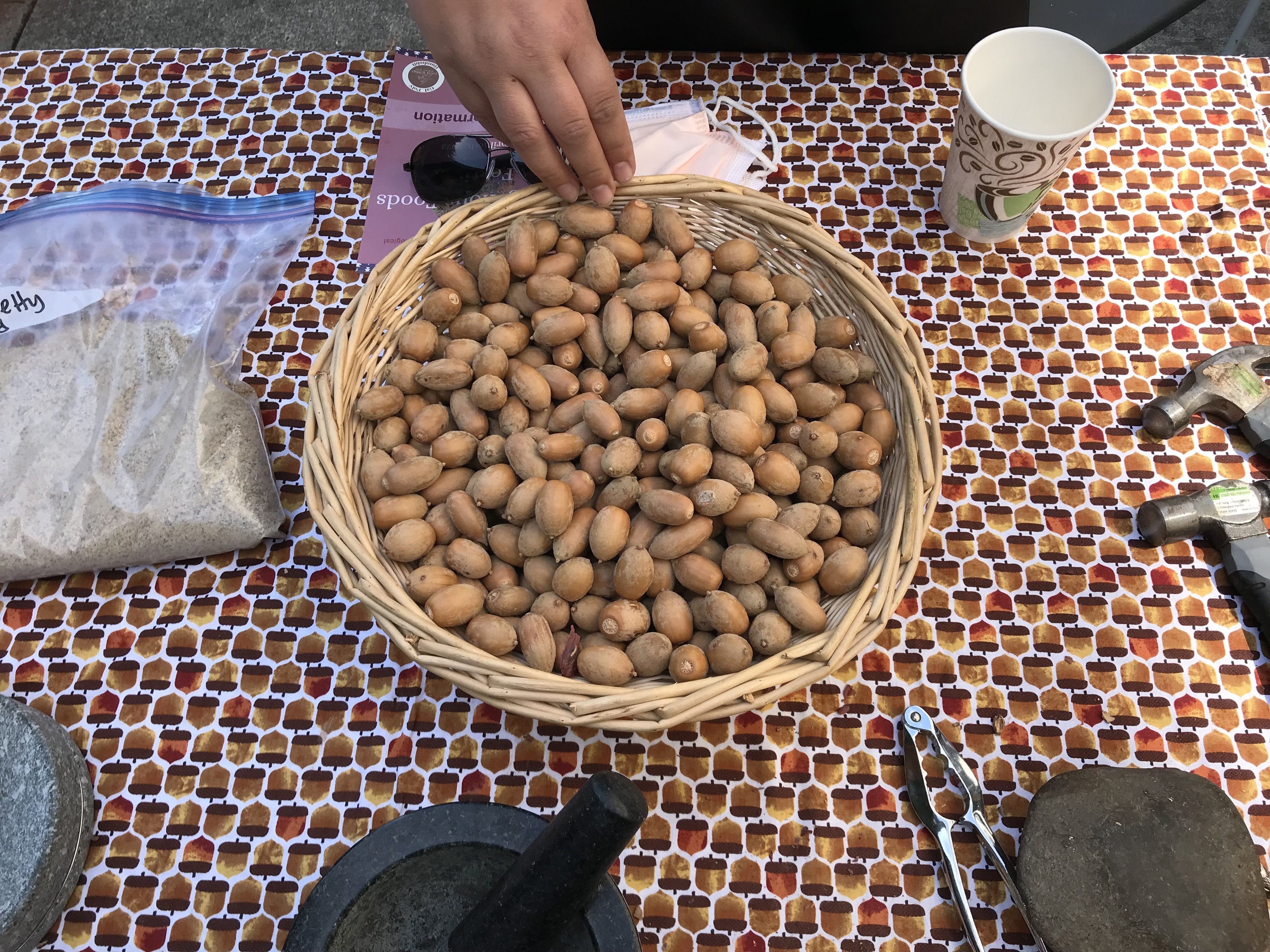
    Several speakers presented in the Native American Forum, each giving information about their respective organizations and how they are practicing food sovereignty. One event hosted by the California Indian Museum & Cultural Center was incredibly informative. Executive Director Nicole Myers-Lim led the presentation and discussed the projects their native youth are working on as part of the museum’s Tribal Youth Ambassadors program. One of those projects was creating acorn bites, which was an idea that came from one of the youths, and was being sold during the event. I must add that they were extremely delicious!

    During the presentation, Myers-Lim reminded the audience that in order to practice food sovereignty, there are several elements to consider such as land access, settler laws and regulations within park systems, as well as handling public harassment and racism when gathering on public lands. Additionally, the monetization and over-harvesting of natural foods such as abalone have prevented their tribe— the Pomo Tribe— from utilizing this natural resource, which is a large part of their culture.

    “Our Pomo food that we love is abalone…we can’t eat abalone right now but when abalone was harvested, it was overharvested,” said Myers-Lim. “We’re really trying to educate non-native communities that this is our cultural resource; we need it for the continuity of our culture. It doesn’t have to be sold for $70 dollars on a plate at Oma’s in San Francisco.”

    Another aspect that Myers-Lim highlighted was how native youth had gradually lost interest in gathering natural foods and resources due to being subjected to harassment by the public. At one point the racism and harassment became so severe that the youth feared practicing their traditional gathering activities at local parks on local trails. To help mitigate this issue, the Native Youth Program created an educational card pamphlet called the ‘Culture Card: Tribal Member Educational Handout’ to give to park visitors who questioned, disturbed, and accused them of harming the environment while they were gathering. The culture cards discuss the cultural significance of traditional harvesting and gathering as well as explaining how and why gathering is a healthy activity. It also highlights gathering and harvesting permits.

    “We’re out there praying and giving gratitude to the plants that are sustaining us and so to be accused of abuse is ironic,” said Myers-Lim. “After hundreds of years of the abuse that’s happened through the Gold Rush, the wildfires and the dams and everything else.”

    If that wasn’t harmful enough, the program also has to obtain special 24-hour permits before gathering which is just another hoop to jump through.

    “We have to work with them to have ancestral gathering rights that are recognized throughout the state,” said Myers-Lim. “As tribes we need to advocate for that through our consultation policies and try to change that on those levels.”

    Past Cal Poly Humboldt chemistry major, Sunny Rojas (Yurok/Karuk/Apache) stated that his people were not equipped to consume processed foods, and doing so has caused much damage to the health of his community.

    “It has a devastating effect on Americans and my people…we never ate like that in the past and our bodies are not quite equipped to deal with a lot of things that are surprisingly allowed in our food,” said Rojas.

    He expressed that one of his goals as a chemistry major was to learn more about the components of the earth, people, and the contents of America’s food.

    “I wanted to try and find some way to help this poisoned food system we have in America right now,” said Rojas.

  • Why do Cypress residents need an All Access meal plan?

    by Shane Jarvie

    I find it extremely redundant that Cypress residents are required to own an All Access meal plan. When I’ve asked school officials why they’re needed, they’ve just responded, “Cypress residents are required to have one of the All Access meal plans. Upperclassmen living areas that do not require a meal plan are College Creek and Campus Apartments, both of which have shared kitchen areas.”

    I’m a junior who’s lived on campus for three years now, and Cypress has the best kitchen out of every residence hall I’ve seen. Yes, even better than the one in College Creek apartments. Having lived in College Creek apartments as a sophomore, I’ve found that Cypress has more counter space and many more cabinets for storage space. The Cypress kitchen has offered my suitemates and I enough room and resources to cook for 20+ people once a week for Cypress eighth floor’s “family dinners,” where both sides of the floor come together for a weekly feast.

    A suite on Cypress can house up to twelve students, so I’d understand if we were required to have a meal plan due to the number of suitemates who share the kitchen. However, I can’t understand why we’re required to have an All Access meal plan.

    As a student working in the housing department as a Resident Student Services Assistant, I’ve had the opportunity to study each housing option and meal plan that the school offers. The more I learn, the less it makes sense that Cypress suites require an All Access meal plan.

    For anyone who isn’t aware how the on-campus meal plan system works, here’s a quote directly from the Meal Plans page on our campus housing website: “All living areas require a meal plan except College Creek and Campus Apartments. Residents of the Hill, Canyon, Cypress and Creekview Suites are required to have one of the All Access meal plans. Residents of Creekview Apartments are required to have any one of the meal plans.”

    The cheapest All Access meal plan is the 5-day All Access plan. It’s $5,000 per academic year, and contains all access meals to the J five days a week, including 300 Flex dollars and 66 or 62 meal exchanges per semester. (The housing website says 66, the dining website says 62.)

    One of the alternative meal plans that I’ll be using as a comparison is the Lumberjack 125. This meal plan that Cypress residents don’t have access to costs $3,500 per academic year, provides 125 meals in the J (which is honestly still more than enough J food for me), has 525 flex dollars, and 31 meal exchanges per semester.

    As someone who isn’t impressed with the food that Chartwells has to offer at the J, I’d much rather have the Lumberjack 125, which has 225 more flex dollars and costs $1,500 less per year!

    If I can’t convince school officials that Cypress residents should have access to the other meal plans available, I at least want an adequate answer to why we shouldn’t.

  • Teamsters Union demonstrate for better wages at Cal Poly Humboldt

    Teamsters Union demonstrate for better wages at Cal Poly Humboldt

    by Carlos Pedraza

    The Teamsters union marched across campus on Thursday, April 6 demonstrating against the California State University system offer, during union contract negotiations. The Teamsters union represents the service and maintenance workers in the CSU.

    The demonstration began at the administration building at the quad. The demonstrators marched around the campus shouting slogans and demands. They ended their march in the quad where they continued to chant slogans until music was played from the stage in the quad.

    During the pandemic, the union made an agreement with the CSU administration to avoid layoffs. The union will not renegotiate its contract with the CSU. Union member and housing maintenance worker Brian Wheeler spoke out on the issue.

    “We asked for 15%, 5% for 2020, 5% for 2021, and 5% going forward,” Wheeler said. “They offered us 3%.”

    He feels that with inflation increasing and the sacrifice the workers made during the COVID years, they deserve a higher wage increase.

    There were other teamster demonstrations across other California university campuses. The Teamster Local 2010 held demonstrations on the UC Berkeley campus, San Francisco State University, and Chico state campuses demanding the same contract renegotiation that the Cal Poly Humboldt workers are demonstrating for.

    When asked about the current negotiations, CSU spokesperson Kelly Hazel made it clear that the CSU organization is currently negotiating with union representatives.

    “The CSU values its employees and is committed to providing appropriate levels of compensation. We continue to meet at the bargaining table with the teamster representative,” said Hazel. She continued, explaining that the CSU’s main goal is a balanced budget and that the CSU will work towards this in the negotiations.

    The negotiations between the CSU and Teamsters are still ongoing, with the CSU offering a 4% wage increase for 2021-2022 but no wage increase for 2020.

    Photo by Carlos Pedraza | Union demonstrators end their march at the university quad.
  • Humboldt State has officially been erased and replaced, but at what cost?

    by Ione Dellos

    From the new signs at the campus entrance to the Cal Poly header on your “Possible COVID Exposure” email from the Student Health Center, the new polytechnic status of Humboldt has been hammered home to students many times in the past few months. Despite the many open forums and countless emails the University has sent to students explaining the new polytechnic status, does anyone really know how much things cost?

    Starting in August of 2021, California Governor Gavin Newsom approved a $458 million investment in Cal Poly Humboldt. The allocation of funds is supposed to overhaul the university, with investments in updating aging infrastructure, adding several new majors by fall 2023, and several new buildings on campus. The impressive financial package also includes a yearly infusion of $25 million from the state, which Humboldt has built into its initial planning estimates.

    Graphic by Ione Dellos
    Graphic by Ione Dellos

    Initially, the $25 million will be used primarily for one-time spending initiatives, like rebranding and marketing the campus. For the 2021-2022 school year alone, $1.3 million has been set aside for rebranding/marketing efforts. Another $665,000 has been set aside for rebranding through campus signage, and if you didn’t think all of the Cal Poly Humboldt signs seen while fighting for your life up the stairs to Founder’s Hall were excessive, the University has set aside $983,000 for additional campus signage for the 2022-2023 school year. This does coincide with the school’s budgeting plans, as 2021-2022 costs are supposed to cover program start-up costs, while 2022-2023 costs will ramp up with the ongoing new projects. Additionally, the 2022-2023 school year will cover the first round of faculty hiring ahead of the 2023 program launch.

    Higher education marketing firm SimpsonScarborough is working with the University to “energize and elevate” their brand, as stated in a December email to students. They are rolling out a multiple-phase branding campaign. The campaign started last November with the announcement of Humboldt’s polytechnic status, and will continue for years to come as Humboldt aims to get their brand out to students nationwide. This is the start of a multiple-year effort that begins with extensive research with the campus community, and the full timeline is displayed below:

    PHASE 1: November 15 – January 14, 2022
    Transitional communications and marketing plan; audience research to inform the brand.

    PHASE 2: January 14 – May 6, 2022
    Brand strategy and development; creation of graphic identities; brand awareness campaign; prospective student recruitment collateral.

    PHASE 3: May 6 – August 5, 2022
    Refreshed digital presence and web templates; assessment of internal capacity and structures.

    ONGOING EFFORT: Starting August 6, 2022
    Sustained buildout and implementation of the brand through digital and traditional media, advertising strategies, media relations, and more.

  • USA TODAY investigation brings Humboldt Professor’s sexual assault allegations to light, one department chair who spoke out has experienced retaliation

    by Liam Gwynn

    Correction: The department chair who has spoken out against John Lee was not fired but was put on temporary suspension.

    USA TODAY released an investigative expose on a professor and former Dean of Professional Studies accused of sexual assault and how the school has continued to employ him for years. One dean who spoke out against the school in the article has already been fired for unstated reasons.

    Last week the USA TODAY published an extensive expose, unearthing sexual assault allegations against a former dean and current professor who is currently teaching in the College of Professional Studies at Cal Poly Humboldt. Since the release of the story, another dean has been fired and Lee continues to work, even if people aren’t showing up to class.

    In 2015, John Lee was a dean at Cal Poly Humboldt but after an investigation organized by the school found evidence of four counts of sexual harassment, Lee was given three months of paid leave and transitioned into a tenured professor position. The two women who accused Lee were forced to work in the same department as the man who allegedly assaulted them.

    One unnamed professor told the USA TODAY that Lee had groped and tried to forcibly kiss her on three occasions. Her husband corroborated the story saying that on one occasion he had to physically pull Lee off his wife. Before the sexual harassment claims were submitted, the school had already received numerous complaints about Lee, citing bullying and abusive behavior.

    Lee was able to maintain a position at the school because he evoked “retreat rights” that can be found in a majority of CSU dean contracts. “Retreat rights” give deans the right to a full-time professor position if they are ever fired from their position as a dean. These contracts did not have any stipulations regarding Title IX violations. This is how Lee was able to get a teaching job paying $154,000 a year working in the same department as the two women who accused him of sexual misconduct.

    School representative Grant Scott-Goforth told USA TODAY that Cal Poly Humboldt changed the contracts after John Lee’s case so that retreat rights wouldn’t apply to faculty that violate campus policies. However, USA TODAY reporter Kenny Jacoby found two contracts from administrator’s currently working at Cal Poly Humboldt, neither of which had any changes that the school claimed they made.

    In a conversation with the Lumberjack, Jacoby says that he contacted the school asking about the two aforementioned contracts. The representative simply asked who gave the contracts to him and when he told them, they never responded. The Lumberjack also reached out for a response regarding the John Lee situation, but after asking about the changes in the contracts, they stopped responding.

    The school’s official response to the situation has been very limited so far. They sent out an email three days before the USA TODAY story was released, attempting to reassure students and faculty that the school has resources for sexual assault survivors followed by instructions on what to do if contacted by the media.

    “For media inquiries about campus policy, decisions, and similar, spokespeople are designated by News & Information. You should not speak to the media on behalf of the campus unless you have been designated to,” states the email. “This is important to maintain consistency and to ensure that questions are answered as completely as possible.”

    That email is important because three days after the USA TODAY article was published, a dean who was quoted in the article speaking out against the school, was quietly relieved of his position as dean. The now-former dean, who wishes to remain anonymous, told the Lumberjack that he had already spoken to the reporter weeks prior to them sending out the notification not to talk to the media. That didn’t stop him from being demoted to a professor position, although officially, he was given no reasoning for the termination of his position.

    The school has yet to address whether or not they plan on reconsidering Lee’s position. Lee still vehemently maintains his innocence and although he originally would not speak to the press, he recently issued a statement to the Lumberjack which is linked below. In this statement, Lee denies all accusations and claims the investigation conducted by the school was biased against him and didn’t provide the proper due process. Lee also claims he had evidence that was dismissed and believes the school treated him unfairly. He goes on to detail all the work he’s done for women and minorities on campus and how the pushback he received was really just because people disagree with his decisions supporting BIPOC and women.

    Although the statement gets a little off-topic, he makes his stance clear, he is owning up to nothing. With the school making it so difficult for people to speak out, it’s unclear if we will ever see any change with the contracts here. However, the Lumberjack will continue to investigate this story as the situation unfolds and if anyone has any information regarding John Lee you can reach out to us at contactthelumberjack@gmail.com as well as the Campus Advocate Team’s 24/7 confidential line (707) 445-2881.


    Official Statement give to The Lumberjack by John Lee

    The allegations brought against me in 2015 are false. Like you, I condemn sexual harassment in any form. As I said back then and continue to maintain today, I did not sexually harass anyone. The allegation is simply untrue. The investigation conducted by the campus at the time was biased and flawed from the very beginning and in no way provided me due process. Evidence provided by me as well as testimony provided by others was ignored and dismissed. A few months after my appeal was denied, I was notified that my contract as dean was non-renewed. There was no cause mentioned for the non-renewal. My position was at will, so there were no legal avenues for me at the time. I had done nothing wrong, yet was told I was not to discuss the case, making it impossible for me to defend myself against the rumors I knew were spreading like wildfire.


    My life’s work has been about fighting for justice and creating a better and safer world for all, but especially women and children and those who face adverse experiences or discrimination of any kind. I was hired in 2010, because my mission aligned with the changes the university under then President Rollin Richmond and Provost Bob Snyder wanted to make. One of the goals was to provide better support for our increasingly diverse student body, which included creating paid internships and increasing our recruitment of faculty of color. During my tenure, we increased student enrollment, continued to diversify our student body, and significantly increased our hiring of BIPOC and female faculty.

    Most of my conflicts as dean stemmed from the push back I received from some who did not embrace these changes. I was also an outspoken critic of the well-publicized dismissal of an administrator who held to account the new administration for recruiting but not providing the supports Native American students needed to feel welcomed and thrive at Humboldt. The period before and after the non-renewal of my contract saw the dismissal and non-renewal of numerous administrators. Although there were few administrators of color at the time, most of them were either non-renewed, pushed out,
    or encouraged to move on. We have seen similar trends on the faculty side and student body since.


    So I have had conflicts for sure and I would be the first to admit that I have also made my share of mistakes. People who know me know I am not the person described in the USA Today article. Had other people been interviewed who were present during the time of the alleged events, a story closer to the truth could have emerged. But that was clearly not the author’s purpose. I strive to learn from my mistakes and experiences, but none have involved sexual harassment or other repugnant violations. While I do not seek conflict, I will continue to be vocal, combat injustices and work to improve the lives of those who have not been given fair access to education and life opportunities.


    DISCLAIMER: We at The Lumberjack post John Lee’s statement for the benefit of the public and the community’s right to all information regarding this subject, not in agreement or support.

    Extra Note: While in Lee’s statement he says “Had other people been interviewed who were present during the time of the alleged events, a story closer to the truth could have emerged. But that was clearly not the author’s purpose,” we were told by the original author Kenneth Jacoby that he had reach out to John Lee for an interview but was ultimately turned down.

  • Interview with Humboldt Hog Riley Switzler

    by Eddie Carpenter

    Photos and Editing by Eddie Carpenter
  • Cal Poly Humboldt admin can’t be fired, even after investigations conclude he sexually harassed colleagues

    by Angel Barker

    USA Today published an article on Monday, April 18 describing how a current Cal Poly Humboldt professor is still employed with the university, even after investigations concluded that he “groped two colleagues.” 

    John Lee, current professor in the School of Education and former dean in the College of Professional Studies, is still working at the university because of a loophole in his contract, called “retreat rights.” Retreat rights mean that even though he was fired as an administrator, through his contract he has the right to remain employed as faculty.

    The full story published by USA Today can be found at https://archive.ph/iifTo and a followup story will be published in The Lumberjack on April 27.

  • Take Back the Night coordinators raise concerns about event speaker

    Take Back the Night coordinators raise concerns about event speaker

    by Matthew Taylor

    Corrections: The event was not hosted by CAT or the North Coast Rape Crisis Team but instead the Women’s Center at CPH, they were important guests and coordinators there.

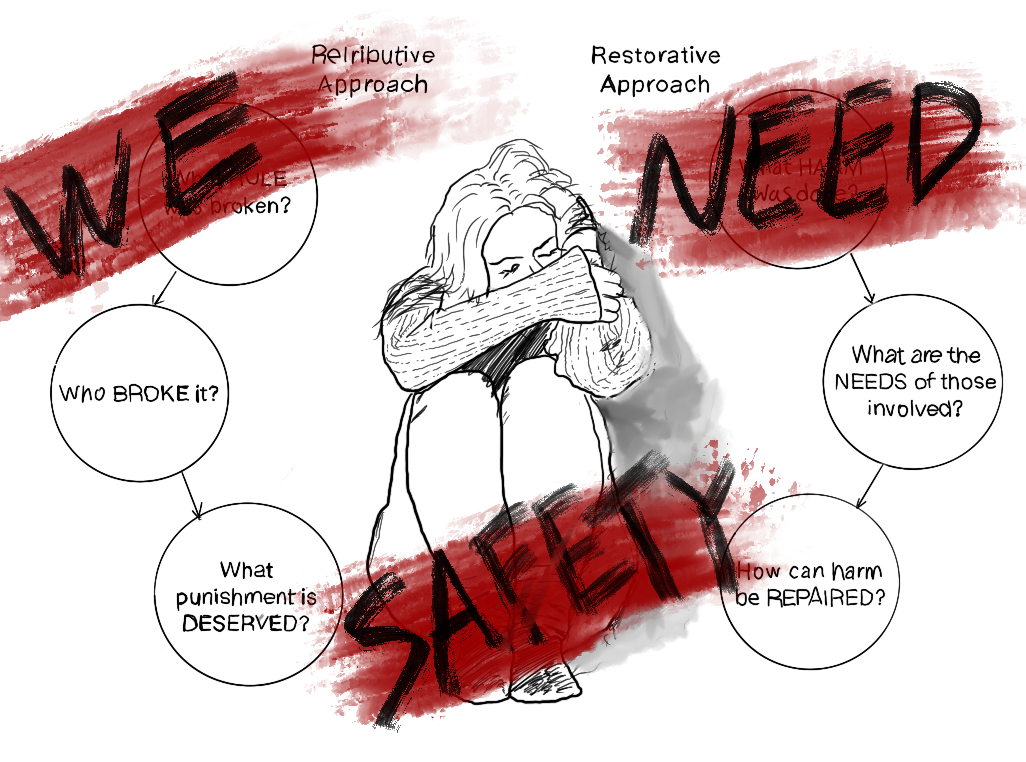
    Cal Poly Humboldt’s Campus Advocacy Team (CAT), along with the help of the North Coast Rape Crisis Center, hosted the annual international event known as Take Back the Night last Friday. This college campus-focused event looks to empower women and other vulnerable minorities. This year’s event began with a presentation by Dr. Rachel King, a specialist in issues of sexual misconduct within higher education. Her presentation explored the usage of restorative justice in situations of sexual assault on college campuses.

    Restorative justice focuses on the rehabilitation of offenders through reconciliation with their victim(s) and the community at-large. The framework often assumes that the offender committed their crime due to a perceived need in their life that wasn’t being met or a lack of knowledge towards the harm they inflicted. Proponents say that restorative justice has the capability to be incredibly effective and healing to all parties involved in a crime. However, should we assume sexual assault falls into this category of effectiveness?

    An hour into the presentation, many participants were disheartened, disgusted, and frustrated. At multiple points in the Zoom-based presentation, King implied that many perpetrators of sexual assault did so based on a simple ignorance or misunderstanding of the situation. While this could be true for a minority of cases, statistically, the vast majority of sexual assaults are done with the explicit understanding that these actions were unwanted.

    “It’s not about ignorance, it’s about power and control,” an event coordinator said after the presentation.

    Many of the event coordinators present refused to speak on the record regarding their feelings on the hour-long speech. Their reasons ranged from the sensitivity of the topic to a perceived backlash from the administration.

    “I personally have a very hard time with restorative justice as a survivor myself, working as an advocate, and hearing survivors on a daily basis,” another event coordinator said. “I’m not saying that the normal system is [made] to protect the survivors in any way. It’s not. The traditional justice system is very re-victimizing and very re-traumatizing for survivors, but the model that was shown today could also be set up for survivors to be re-victimized and re-traumatized.”

    Whether intentional or not, restorative justice processes can put the offender and the victim on equal levels of legitimacy. In the case of sexual assault, this makes little to no sense. As advocates in this area, the members of CAT and the North Coast Rape Crisis Center know that these actions predominantly come from an abuse of power or a complete apathy towards the victim, not due to innocent miscommunication.

    “I feel like this presentation weighed a bit too heavily on the perpetrator and their choices,” a coordinator said. “It just wasn’t all that comfortable for me to hear, it’s like ‘if they get this little bit of accountability, then they’ll never do it again’ when we know that that’s not true.”

    The event ended four hours earlier than its intended conclusion, in part due to the extremely low turnout. It is unknown if CAT and the North Coast Rape Crisis Center will continue to use Rachel King as a resource for sexual assault trainings, especially in light of the negative reaction towards her presentation.

    Both teams stand firm in their mission to empower survivors on campus, whether they wish to take a restorative justice approach or a traditionally retributive one. Their concern lies solely with the victims and their personal well being.

    The Campus Advocate Team runs a 24 hour anonymous support line for any and all student victims of sexual assault that can be reached at (707) 445-5881.

  • Humboldt Hogs play last home game

    Humboldt Hogs play last home game

    by Eddie Carpenter

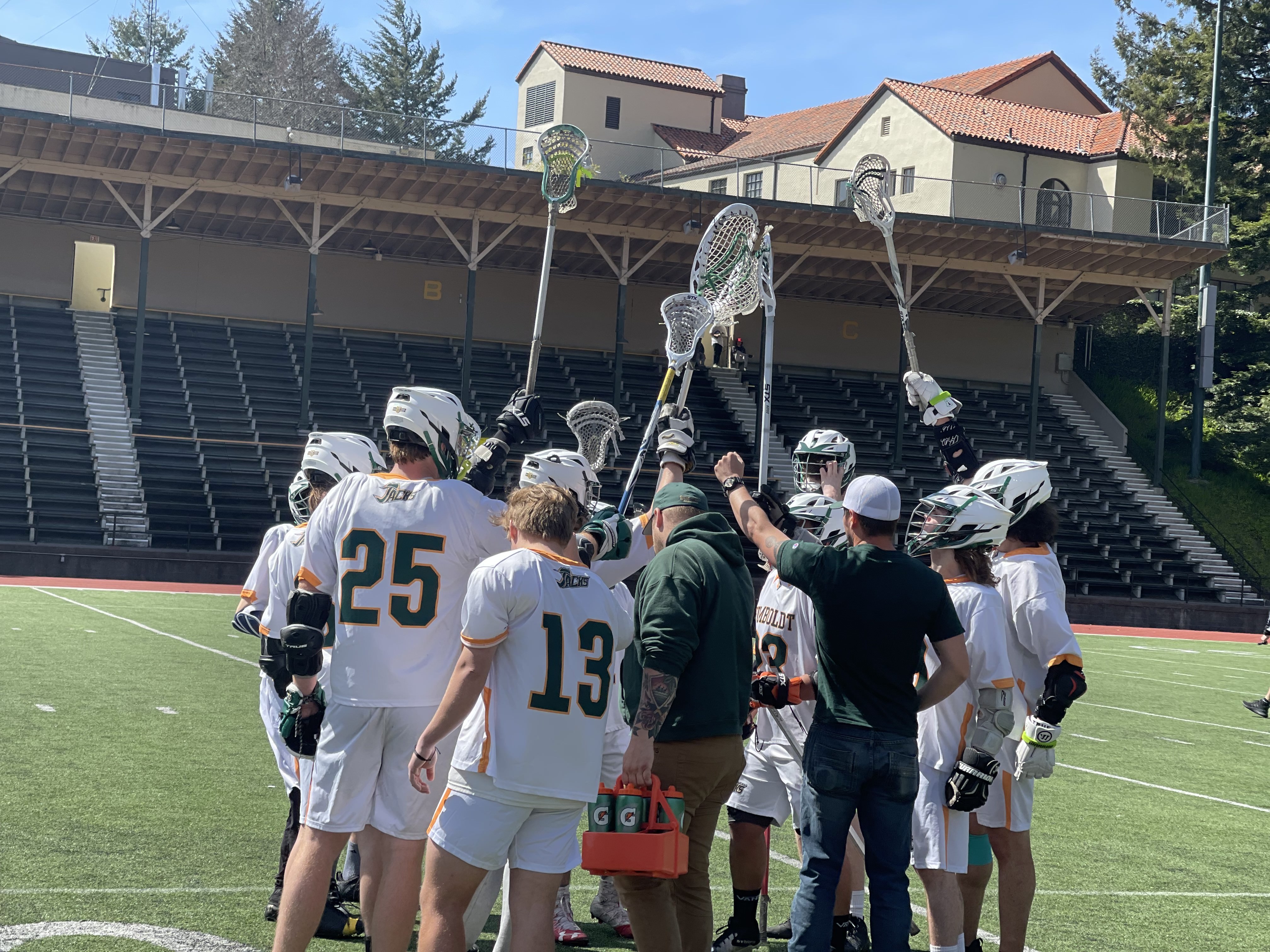
    On April 9, Humboldt Men’s Lacrosse Team competed against UCSC Banana Slugs in their final game of a winless season. The Humboldt Hogs fought against significant gusts of wind at the Redwood Bowl under a cloudless sky.

    Freshman Gino Grier expressed an insurmountable passion for the sport itself.

    “This sport is beautiful,” Grier said. “There’s barely enough time to think! It’s like driving too fast, really. If you think, you’re behind someone… It’s gotta be animalistic in a way. You see everyone out here? They’re happy not because we lost, but they’re happy with a loss. That’s my team right there, and I’m proud as hell of that!”

    As a long-stick midfielder, Grier loves lacrosse because it keeps him balanced. The Hogs have played the whole year with the minimum number of players necessary to compete. Seth Velasco, the senior team captain, gave it his all on the field on Saturday.

    “This is my last game. I would’ve liked… a win, but I mean, I just enjoy playing lacrosse,” Velasco said. “Ever since I started playing it in high school, I enjoyed it. It was my favorite game to play. I enjoy being a part of this team. We only had three guys starting this season off, so recruiting a bunch of guys getting them to join the sport. It was fun. I wouldn’t want to play with another team.”

    During halftime, the Humboldt Hogs take mustard shots for muscle cramps. Currently, there’s no scientific evidence regarding the effectiveness of using mustard to help treat or prevent muscle cramps. Needless to say, the Hogs are hungry to rebuild after two seasons lost to COVID-19. Before the season opener, the team hadn’t had a home game in 753 days due to the pandemic.

    Zack Gamble is Humboldt’s other senior team captain. Gamble expressed how his team overcame a lot of adversity this season.

    “Seth, Riley, and I worked really hard to bring the team back from nothing,” Gamble said. “And we’ve got a solid squad of guys here now. And these guys just have no quit in them. I mean it’s just been an honor playing on this team. Despite having no subs [and] no help— half of the time, we don’t really have enough guys at practice. We were able to put a season together and really show people what Humboldt Lacrosse is about.”

    Humboldt Men’s Lacrosse is all about heart and soul. The team has a new coach under a new school name and they are preparing for their 40th anniversary. The Hogs have shown that the sport was about putting up a good fight when the odds were stacked against them.

    Senior defenseman Riley Switzler expressed the need for his squad to work like clockwork.

    “I would like to see everyone come together as a team more,” Switzler said. “I’d like to see more team camaraderie. Everybody being friends with each other and being there for each other on and off the field… We could put up more of a fight against these bigger schools.”

    Photo by Eddie Carpenter | Humboldt Hogs posed for a team photo. From left to right: Assistant Coach Gus Johnson, Brandon Nordenstrom, Riley Switzler, Gino Grier, Foster Smith, River Galas, Hunter Hartman, Sam Emerson, Chase Harwell, Seth Velasco, Logan Sorenson, Zack Gamble, Johnathon Macias, and Coach Danny Eggert.
  • Cal Poly Humboldt campus hosts Food Summit

    Cal Poly Humboldt campus hosts Food Summit

    by Angel Barker

    A three-week-long Food Summit is on campus, and you’re invited. On-campus organizations El Centro, HEIF, Umoja Center, the Food Sovereignty Lab, Oh Snap!, WRAPP, and La Comida Nos Une all collaborated to make this event happen.

    Liszet Burgueno, Developmental Manager for the Humboldt Energy Independence Fund (HEIF) and environmental resource engineering major, talked about the nature of the event.

    “The Food Summit is a collaborative event where multiple campus organizations came together to start conversations about food justice, food sovereignty, and to give people food,” Burgueno said.

    The first week was about the general topics to introduce people to the issues of food sustainability and justice. This week is about jobs and exploration in the food industry, and next week is about environmental justice and social justice.

    HEIF is funding the Food Summit according to Katie Koscielak, Cal Poly Humboldt’s sustainability analyst and advisor for the event.

    “The campus has done other food summits, but not in several years, and this is the first one funded by HEIF,” Koscielak said.

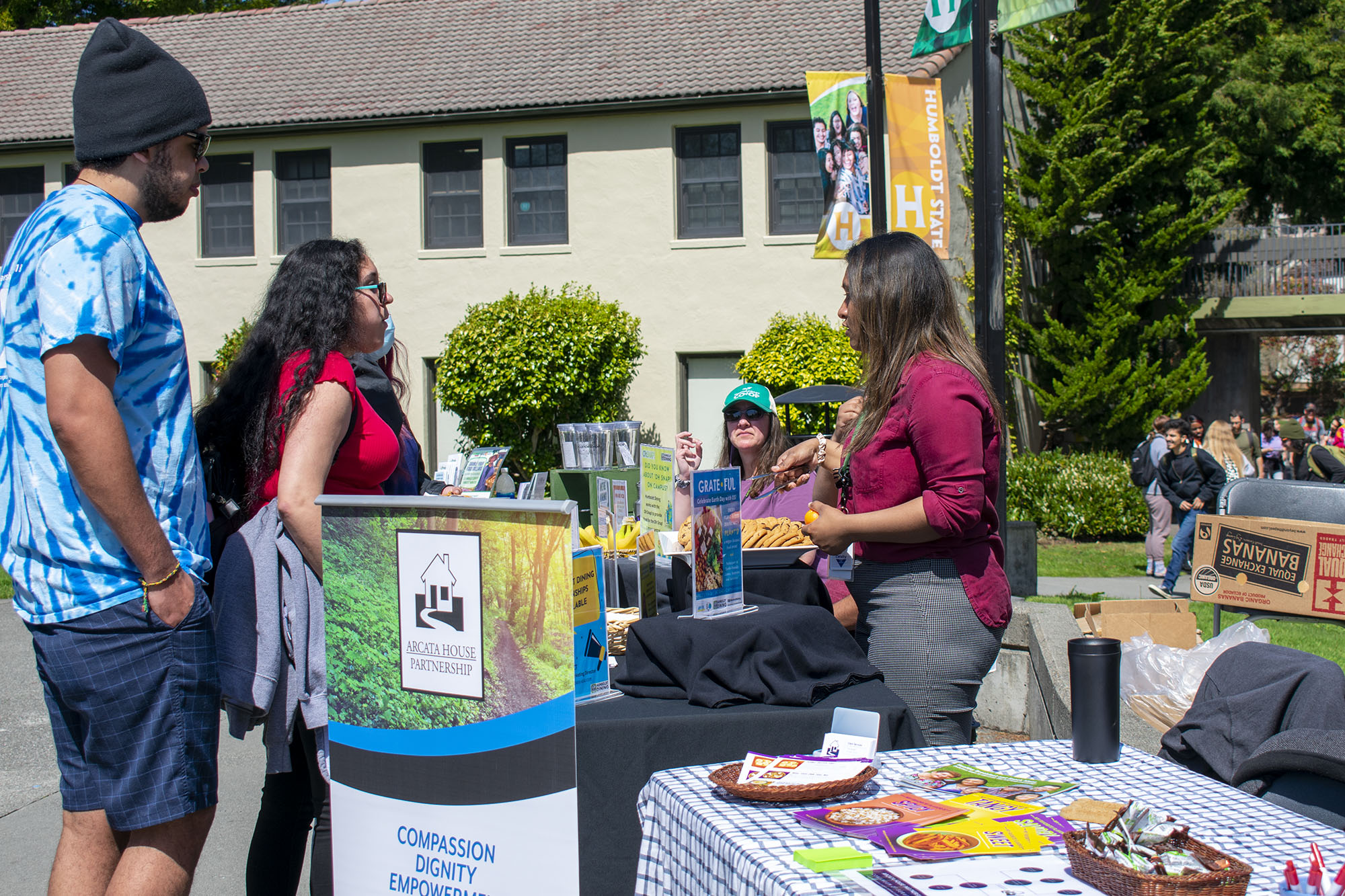
    Photo by Angel Barker | Katie Koscielak, sustainability analyst for the campus, and Liset Burgueno, development manager for HEIF and environmental resource engineering major at the table for HEIF at the food summit on April 6.

    HEIF funds sustainability projects on campus through instructionally related activities fees that students pay for each semester. Past projects have included water refilling stations, compost bins, lots of lighting upgrades throughout campus, hand dryers, and many more. These projects take effect when students submit proposals to the organization.

    “Last semester, El Centro came to HEIF and submitted an idea paper, where they wanted to get reusable utensils,” Burgueno said.

    Darin Torres, criminology and journalism major, pitched the idea this semester for a food summit. Torres spearheaded the ideas and planning, and after months of collaborating with many campus groups and local organizations, the event planning has been successful.

    “I am really proud of what we’ve done so far,” Torres said. “Education is power.”

    This event is not only to educate, but to get students involved with interactive events to help make the planet a better place. This event is really important to Torres, as food insecurity is a huge part of the greater Humboldt community.

    “We have issues with indigenous cultures’ food not being respected,” Torres said. “Food is a major insecurity in Humboldt County, we have students who face hunger and homelessness so much. So we just wanted to incorporate it all into the food summit.”

    “We have regenerated, and hopefully it will continue,” said Fernando Paz, coordinator for El Centro.

    According to Paz, the event itself is, a way to really reflect on our carbon impact in terms of food that we use.

    This Thursday, April 14, there will be a film screening of Gather hosted on Zoom, and on Friday there is a plant tour on campus and an opportunity to volunteer at Bayside Farm. Many more events are also scheduled throughout the week. To find the whole event schedule, go to https://lcae.humboldt.edu/food-summit.

    “This event is made for you in mind, it was made for students, by students,” Torres said.

  • Students show out in solidarity for El Salvador

    Students show out in solidarity for El Salvador

    by Alana Hackman and Carlos Pedraza

    Cal Poly Humboldt students and Arcata residents gathered around the plaza Thursday, April 7 in solidarity with El Salvador. The event was led by Klara Hernandez, a senior environmental studies student at Cal Poly Humboldt. Hernandez organized the event through her senior project and organization Eko Social Justice. Hernandez was also joined by Centro de Pueblo, an immigrant rights organization for Southern Indigenous communities also joined the event.

    Photo by Carlos Pedraza | Gathered crowd looks on during the speech at the Arcata Plaza on April 7.
    Photo by Carlos Pedraza | Gathered crowd looks on during the speech at the Arcata Plaza on April 7.

    The protest began at 4 p.m. and carried on into the evening around 6 p.m. Hernandez walked to the center of the plaza megaphone in hand and began her speech with a land acknowledgment and thoughtful address to her family who fled to the U.S. from El Salvador. Hernandez called for solidarity with the people of El Salvador and pointed out problems of racial discrimination against Indigenous and Afro-Salvadorian citizens as they are forced to adopt Spanish culture.

    Hernandez also addressed abortion laws in El Salvador and the rising violence and femicide rates in the country.

    “They imprison [women] even if it’s not your fault the baby didn’t make it,” Hernandez said.

    She continued to speak against many problems, including corporations privatizing and contaminating water, Bitcoin being adopted as their main currency is hurting those who don’t have access to it, and the LGBTQ+ community facing discrimination and violence in the country.

    An attendee of the protest was Alice Turk who heard of the protest from social media. The women’s rights issues spoke to her most and she feels people need to stand in solidarity with women everywhere.

    “I think the fact it’s a crime to have [an] abortion is something that needs to change, it’s a problem that is happening all over the place,” Turk said.

    Cal Poly Humboldt students Ben Cross and Evina Romero came out to the event also after being sent the social media post by friend and Cal Poly Humboldt psychology major Cheyanne Elam. Elam found out about the event through a class and was attending to learn more about what she can do for the people of El Salvador. All agreed it was important to use their privilege to be at this event and show their support for the citizens of El Salvador.

    “Immigrants from El Salvador and all over South America are being turned away at our borders, and the U.S. really has the ability to rectify these things,” said Cross.

    Photo by Carlos Pedraza | Klara Hernandez gives her speech to crowd while standing in the center of the plaza at the Arcata Plaza on April 7.

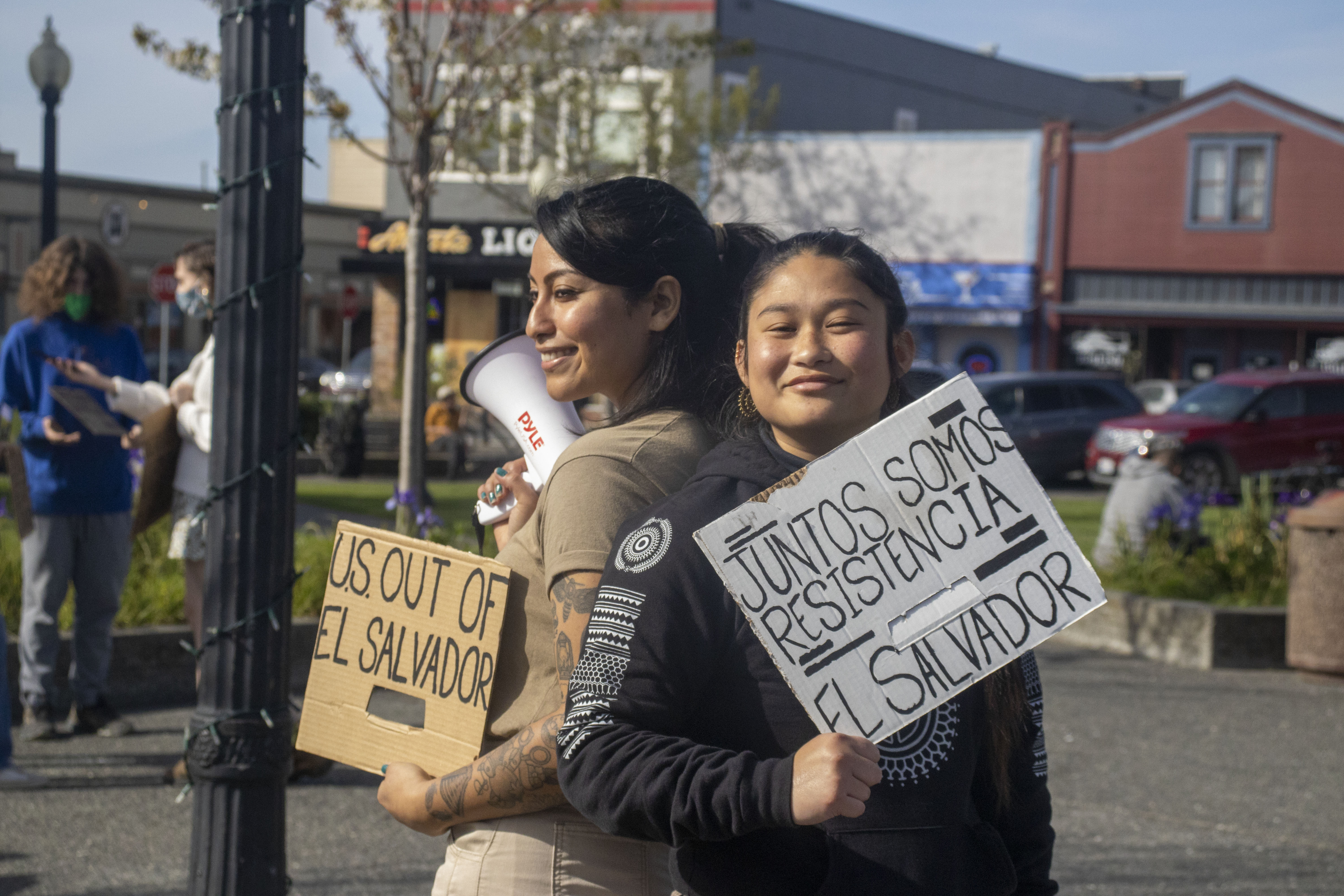
    Hernandez ended her initial speech with a call to action toward environmental justice and immigration rights for all. The crowd wavered cheers and screams from around the plaza flashing cardboard signs reading, “U.S. out of El Salvador,” “Women’s rights in El Salvador,” and “Indigenous sovereignty in El Salvador.” The signs were written in both English and Spanish. Hernandez mentioned her organization, Eko Social Justice, and that this event is an effort to use her voice for good and represent her home country of El Salvador in Humboldt County before her graduation and departure to Los Angeles this May.

    “The [Salvadorian] community is so tiny here that these things don’t get addressed. It’s like we’re invisible in this area so I wanna speak it out,” Hernandez said.

    Hernandez will be holding an art show at Brainwash Thrift Thursday, April 21 in solidarity with El Salvador. The event will be held from 2 p.m. to 6 p.m. and will include Hernandez’s own photography and art.

  • Voting virtually for your student representatives

    by Matthew Taylor

    Associated Students’ elections are coming fast, yet empty seats and uncontested positions stay plentiful. Fifteen positions stand open for election with only nine candidates on the ballot and write-up so far. Current A.S. members Chase Marcum and Giovanni Guerrero are running for the only contested seat, the presidency. Students have until April 14 to run as a write-in candidate, however.

    Four particular candidates bring unique attention from outside the rotation of previous A.S. board members. One such candidate is Sawyer Chrisman, a communications major, seeking out the position of Administrative Vice President. Similar to most eventual members of the A.S, Chrisman was encouraged by a current member to run.

    “I’m good friends with Chase,” Chrisman said. “We were talking about A.S because beforehand when I got to Humboldt, I was president of my student government community college.”

    Other first-time A.S. members running for positions include Payton Belle, Gerardo Hernandez, and Sebastian Taylor.

    Elections will take place between April 18 to April 22 via emails sent to each Cal Poly Humboldt students’ official school email. The election will be done by choice voting, in which students choose candidates from most preferred to least preferred. The candidate who receives the most preferred votes in an amount of 50% plus one wins. Certain positions which represent the university’s specific colleges, such as the College of Natural Resources & Sciences Representative, may only be voted on by students majoring in that particular college. Before elections take place, however, candidates will be expected to participate in a public debate and campaign speech on April 14.

    “Candidates will debate against those candidates that are running under the same position,” current A.S. President Lizbeth Cano Sanchez said. “It will be a 20-minute debate [for each position]. These debates will take place via a Zoom webinar and in-person in Nelson Hall East 106.”

    Candidates who run uncontested are only expected to give a speech. Prior to and after the debates, candidates are highly encouraged to campaign all across campus after seeking approval at the Office of Student Life located within the SAC. This is especially imperative to late write-in candidates whose names will not explicitly be found on the ballot.

    “Do not pressure anyone, do not make anyone feel like they need to vote for you,” Cano Sanchez said. “We do not want to make our students uncomfortable, especially if you’re about to be one of their leaders.”

    Final results will be first published on April 25 and the transitional A.S. Board meeting on May 6.

    Only 5.6% of students eligible to vote did in last year’s A.S. election cycle. In order for a true majority of student participation, the A.S. must encourage a little under 3,000 students to vote. A lack of time and contesting candidates only serve to prove the difficulty that the association has ahead of itself. For more specific information about the elections, you can email as-staff@humboldt.edu or call (707) 826-5410.

  • Archers take shot for first

    Archers take shot for first

    by Carlos Pedraza

    The Cal Poly Humboldt Archery Club held a mock tournament on Saturday, March 28. The club meets in the field house of the SRC building setting up bails with targets to shoot at. In the casual tournament, participants kept track of their scores. When all their arrows were let loose, members would stand behind the shooting line talking with each other.

    Each round of shooting began with archers waiting to hear the commands of “anyone in the closet!”, “anyone behind the curtain!” It is shouted before every round for safety, so no one is hit by a loose arrow. The archer would advance to the shooting line with the command “archers to the line!”

    The club members have different levels of experience ranging from lifelong archers to recent archers. Neri Traugot, a second-year theater arts major, is an experienced archer who’s been shooting for most of her life. “Since I was five years old when I could pull a five-pound bow,” said Traugot.

    Henry Myers is a third-year political science major. Myers has been in the club for a semester. He used to shoot in the past but took a hiatus.

    “I had to re-get good at it,” Myers said.

    The club is led by Vice President and current acting President Josh Bagg. He has been an archer for five years. Bagg explained how the club is open to everyone no matter the level of experience.

    “We have many members who are coaches,” Bagg said. “The club provides all the equipment someone will need to participate . . . just try it out, it won’t hurt to try.”

    The tournament ended with everyone winning a club t-shirt for participating but the people with the highest scores were Juliana Suzukawa in first place, Jovani Villasenor in second, and Josh Bagg in third place.

  • Toyon volume 68 heals tender wounds

    Toyon volume 68 heals tender wounds

    by August Linton

    The 68th edition of Toyon, Cal Poly Humboldt’s multilingual literary magazine, was released on Tuesday, March 29. It is the culmination of a year of work by the staff, through forced distancing caused by COVID-19, across vast distances, and from a multitude of perspectives.

    Contributions to this year’s Toyon came from countries around the globe. The submission base’s broad scope means that works in many languages are featured. Some of the works originally submitted in a language other than English are presented in both languages, and some of the translation work is only available online on Toyon’s website.

    Maurizio Castè’s ‘Germogli verdi,’ or ‘Sprouts of green,’ published in both the original Italian and translated into English by Toti O’Brien, is a gently insistent witness to the beauty of spring, and to nature’s resilience in the face of climate change. This is a theme that surfaces at other points in Toyon 68, in Dobby Morse’s “The Fate of the Earth,” “Climate Change” by Larissa A. Hul-Galasek, and Meghan E. Kelley’s “What’s Left for the World to Say?”

    In these works, there is a deep veneration of both nature’s delicacy and of her strength. There is also an anger that seems to well up from deep within the Earth; anger for the future of humanity in the face of a climate apocalypse and for the fate of the natural world in our aftermath.

    There are many other standout poetic works in Toyon 68. The magazine’s opening work “Each Time I Held a Dying Bird” by Grace E. Daverson pulls the reader into delicately described and emotional pocket memories. As Daverson methodically describes each bird she has known, the wild joy of holding a bird in one’s hand and the childlike wonder of shining a flashlight into developing eggs organically melt into the glass-sharp grief of not being able to protect the ones you love.

    Toyon also publishes short stories, academic literature, and visual art.

    “Dismantling Structural Systems of Oppression Through a Revolutionized Pedagogy” by Ambar A. Quintanilla systematically explores the institutional barriers to education which Latinx and Black students face, multiplied by conditions during the COVID-19 pandemic. Quintanilla’s emotional connection to the subject matter as someone who has experienced these barriers (and who has seen the people she cares about be affected by them) is as important to the piece as her efficient and insightful analysis of the complex contributing socioeconomic factors.

    Among the magazine’s small selection of visual art, “Thinking” by Ernie Iñiguez and Mario Loprete’s “Concrete Sculptures” stand out. “Thinking” is a polished and pastel digital illustration of a meditating robot, while “Concrete Sculptures” is photos of the artist’s graceful and haunting sculptures of folded clothes.

    The theme of Toyon 68 is “hope and healing,” which is self-evident from the works within. The contributors’ love for this world and for the always painful process of healing is strung throughout the magazine, as taut and musical a guitar string. Healing takes time, passion, work, and love, and Toyon 68 has all of those. On the back cover of the volume, their sendoff is this:

    “WARNING: This product contains love, anxiety, dysphoria, tenderness, birds, affection, grief, orange juice, trauma, anger, and maternal bonds. Side effects may include self-reflection and a sense of inner peace.”

    Toyon 68 is available now in print and online.

  • Freshman FOMO

    Freshman FOMO

    by Nina Hufman

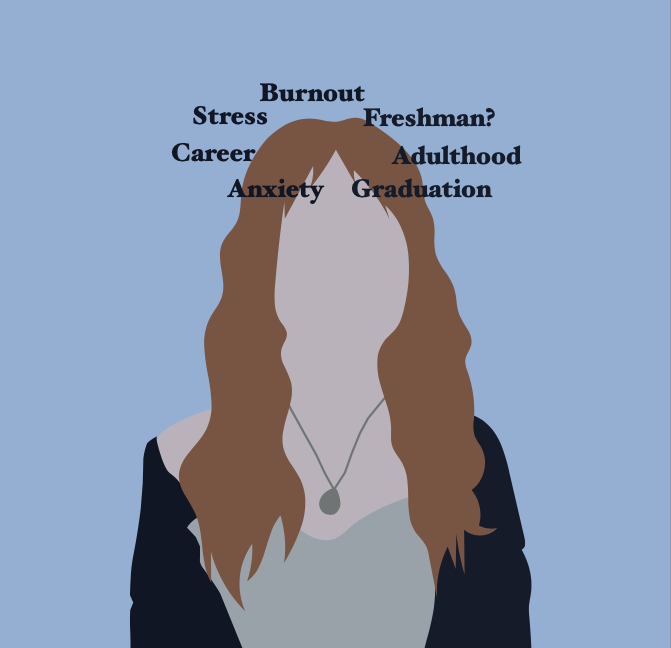
    I recently had an internal crisis: I realized that I am nineteen years old and almost done with my junior year of college.

    I just got out of high school a year ago and I already have to be thinking about real life. I just started college and it’s already almost over. I am most likely going to do a second major and stay in school for two years, partially because I really want a second degree and partially because I feel so unprepared to graduate.

    I was lucky enough to be able to be concurrently enrolled in college classes while in high school. I started taking online classes from a nearby community college when I was a sophomore and was able to earn my Associate’s degree halfway through my senior year. I transferred to Cal Poly Humboldt at eighteen years old as a junior. While I am grateful to have been able to save money and time, my circumstances come with their own set of challenges.

    It’s really difficult to relate to my peers, because my experience is not a very common one. I have one friend who is in pretty much the exact situation that I’m in. She transferred as a junior right out of high school. We talk a lot about how we missed out on the freshman experience and how difficult it is to relate to people who haven’t been in our situation.

    I don’t live in the dorms, I don’t eat in the dining hall, and I don’t have to take any annoying GE classes that have nothing to do with my major. While most people would agree that these experiences are awful, they get to commiserate and bond with others over those experiences.

    All of my friends and the people in my classes are juniors and seniors. I went straight from being in high school to being surrounded by people who are, for the most part, actual functioning adults who have goals and life plans. I feel like I’m so far behind; they’ve had three or four years to figure these things out and I’ve had one.

    My friends also don’t want to do any of the fun Humboldt things that freshmen do when they move here. I want to go to the beaches, go hiking, and explore this beautiful area, but I don’t want to do it alone. My friends have been here for years, they’ve already seen and done all of those things.

    People are usually shocked when they find out my age. They hit me with ‘I thought you were at least 21,’ ‘you’re so mature for your age,’ and ‘wow, you must be really smart.’

    The reality is that I have been a mini-adult since I was fifteen because I had to learn how to interact with adults in my college classes. The result of this is feeling out of place literally all the time. I’m simultaneously too young and too old for everything. I’m ready to start my life and be an adult, but I also feel like I missed out on my own adolescence.

  • Cal Poly Humboldt music department performs a once-in-a-decade recital

    Cal Poly Humboldt music department performs a once-in-a-decade recital

    by Sophia Escudero

    One o’clock on a Tuesday afternoon is not the usual time for a music recital. However, this particular performance was more than just a display of student skill. Accreditors from the National Association of Schools of Music were in attendance, after two days on campus visiting classes, listening to students perform, and ensuring the university meets standards for music programs. According to music department chair Cindy Moyer, this process is one that happens only once every ten years.

    “For this particular recital, what they wanted to see was the full spectrum of the program, which is why you can see there were all different music concentrations and students performing,” Moyer said.

    A highlight of the afternoon’s performances was staff accompanist John Chernoff’s rendition of a moody piano piece by composition major Theo Singer. The audience watched in captivated silence as Chernoff played through to the last, lingering note with an intensely focused expression, leaving the music hanging in the air for a moment, before breaking the spell as he turned to the audience with a wide smile and a quick bow, freeing the listeners to rapturous applause. Singer is a senior, but the performers comprised the full range of experience.

    “This was hard because we needed a real breadth of things, we had to find freshmen and sophomores,” Moyer said. “We do an honors recital every year and that’s pretty easy, students audition and the very best play— but that was not the goal here. The goal was not the most advanced, most skilled performers entirely, it was the whole spectrum of performers.”

    Marimba player Makani Bright was singled out by Moyer as a particularly talented senior performer. Bright has been playing for about 12 years, and has an upcoming senior solo recital on April 10. They are a double major in percussion performance and applied mathematics, finding beauty in both.

    “The way that I relate both of my majors in my mind is that I think of them artistically,” Bright said. “I think of mathematics as an art form, it’s perfect and there’s many beautiful things you can do within mathematics. Both of them, to me, are an art.”

    Bright’s piece, “Chain” by composer Kazunori Miyake, was not one they had previously performed before an audience. The instrumental composition had almost narrative elements, combining multiple different feelings and rhythms into a complex and beautiful melody.

    “I feel really good about it,” Bright said. “I feel like I was able to express what I wanted to express and I really enjoyed myself.”

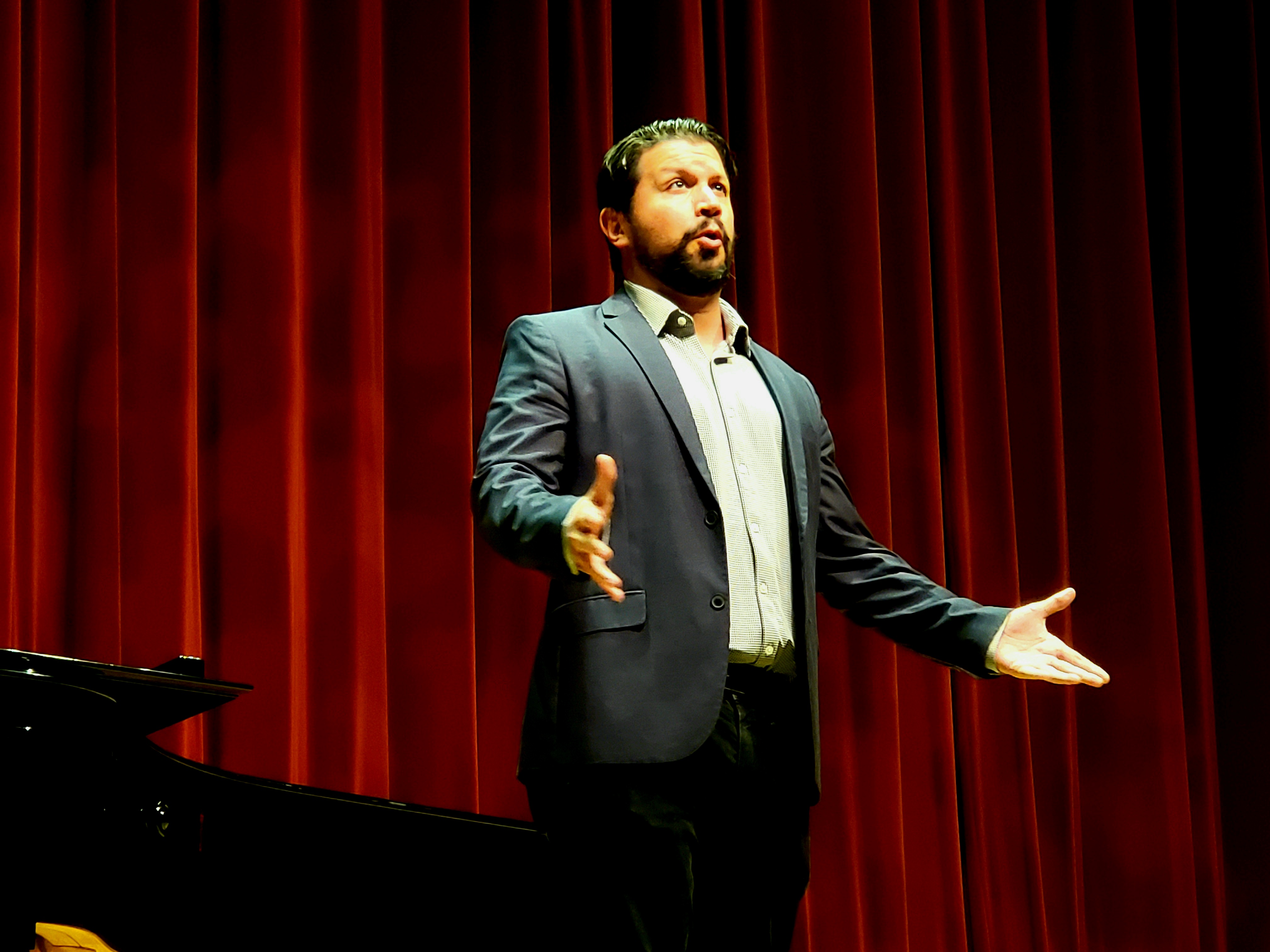
    The majority of the music on display was instrumental, with pianists, percussionists, and a saxophone quartet as standouts, but music education major Pablo Murcia was selected to represent the vocal arts.

    “I’m very honored, honestly,” Murcia said. “I was the only singer chosen, and that’s quite an honor. I’m very flattered, and happy that some people came out to support me. That was nice.”

    Murcia’s piece was an aria from Mozart’s Don Giovanni, “Deh, vieni alla finestra.” He performed in Italian, but his smooth baritone voice, expressive performing style, and connection with the music (which has been part of his repertoire since last semester) carried the story of the song to the audience.

    “Don Giovanni, he’s a Don Juan, he’s a player, and he’s trying to get the attention of a woman at her window,” Murcia said. “The whole piece is just him saying, come to me, come to me, trying different tactics to get her attention, and she just keeps sort of playing coy, and finally, by the end of the piece, she finally gives into his charms.” He laughs. “Quote, unquote charms— he’s kind of a narcissistic jerk, but yeah.”

    Music department ASA Samantha Heppe was excited to be involved in such an important production for the university.

    “I’m just excited for our music students to showcase their talents,” Heppe said. “This recital is in honor of the accreditation team, so this type of recital won’t happen again for another ten years.”

  • A University Center hidden on campus

    A University Center hidden on campus

    by Matthew Taylor

    The University Center (UC) is a husk of what it used to be since its contract was terminated by Cal Poly Humboldt’s administration back in December of 2020. Before then it was an auxiliary organization to the university in charge of many student events and activities. Many members had been left hurt, with most refusing to speak on the record due to a fear of legal or social reprimand by the university. A majority of the UC’s responsibilities have been transferred to the Student Activity Center. In its current state, the UC exists to provide pensions to its retirees and use reserve funds for various student programs. There are some members, however, who see its end as a bittersweet conclusion.

    “In my position, I see both sides,” said Wendy Sotomayor, UC Executive Director and Student Activity Center Director, the bittersweet sadness in her voice apparent throughout the interview. “I’m excited but I’m also sad. The UC was very valuable and did a lot of good for the students here. In the end, though, I think the students are getting a better package.”

    She expressed, along with many of her colleagues, that she still saw the letter of termination as the administrations ‘means to an end’, but also saw the validity in the problems stated within it. In some ways, the UC’s own response to the administration may have further solidified its decision to end the contract.

    “Our response didn’t really include any [tangible] changes to the actual administration’s complaints,” Sotomayor said.

    Much of the mistakes made by the UC at the time, referenced in the letter of termination, were based simply on miscommunication and misunderstanding. Certain allegations, such as that of fraud, were later confirmed to be completely unfounded. Still, legitimate mistakes existed and deserved to be fixed. The financial risk of loaning the Arcata Community Pool $300,000 was huge in hindsight of the COVID-19 pandemic, and due to its distant relationship to the university didn’t qualify well under “its mission”. Steps were made to fix these problems before termination, but in the eyes of the university’s administration that wasn’t enough.

    “We couldn’t fix it after the fact,” Sotomayor said.

    The introduction of lawyers to the mix didn’t make the situation any better in her eyes either. Instead of coming to the table it became only lawyers talking to lawyers. In the end, lawyers on each side may have convinced them that each was totally in the right.

    “[Many UC members] wholeheartedly believed they did nothing wrong,” Sotomayor said, expressing that at the time even she felt similarly.

    Since the termination, the administration has given most of UC’s previous tasks to the Student Activity Center. The program controls Center Arts, General Operations as well as a new program called Conference and Event Services (CES). Center Activities is now under Athletics and is located at the Student Recreation Center (SRC).

    “So much personal feelings got involved,” Sotomayor said. “And [I’m] not sure we could have gotten [to where the SAC currently is ourselves].”

  • César Chavez Day with YES

    César Chavez Day with YES

    by Eddie Carpenter

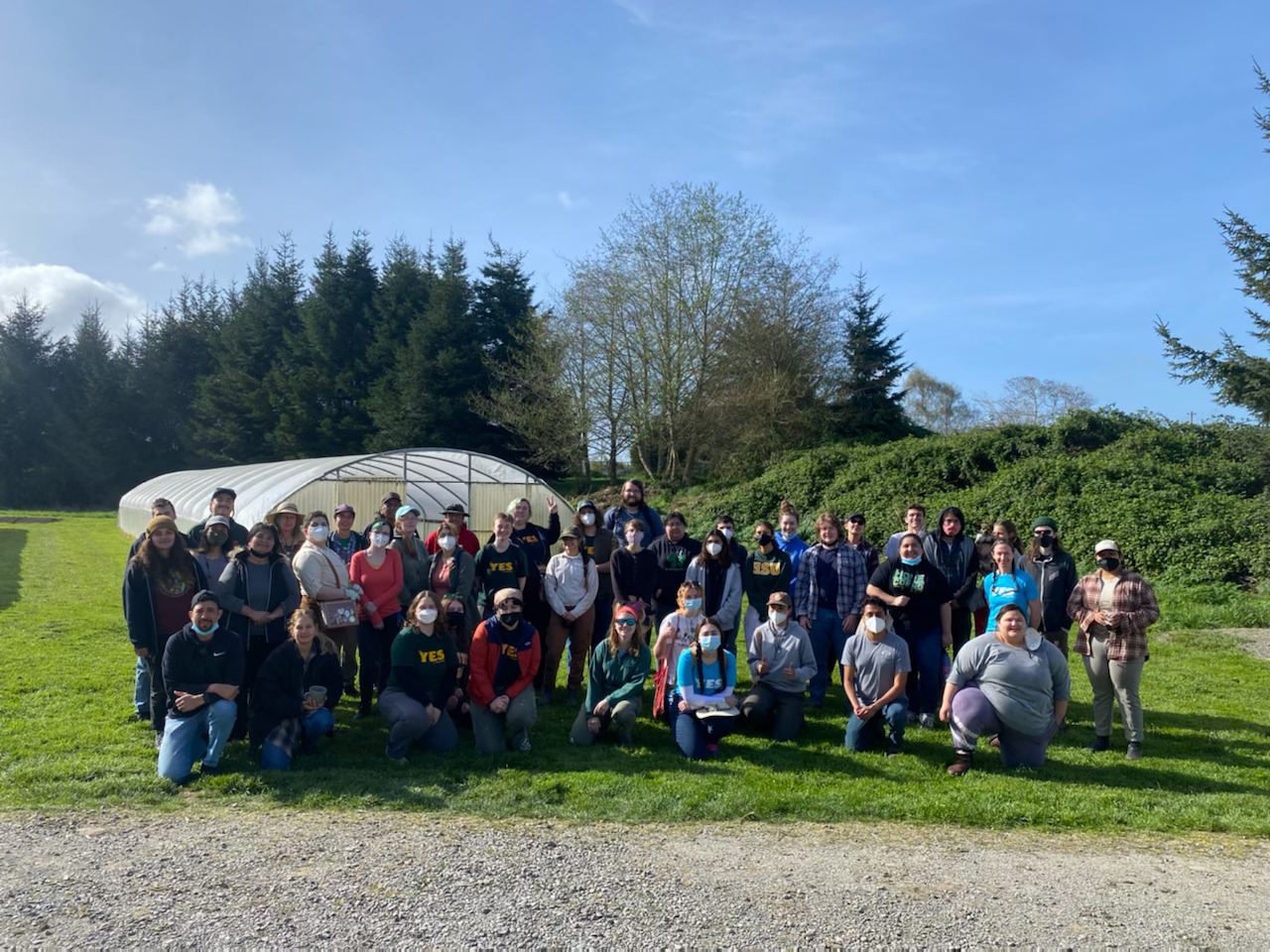
    In honor of César Chavez Day, the YES program hosted a volunteer event at the Potawot Community Food Garden in Arcata. It had an amazing turnout with a whopping 40 volunteers in attendance, caressed by the sunny blue skies and the refreshing Humboldt breeze.

    We were assigned tasks by being divided into five groups. I was grateful to be a part of a group that planted beds of squash. We did everything from scratch, laying out layers of black cover material across the four rows to keep the weeds from robbing the plants of their nutrients. We also covered the tops of the rows with white cloth.

    Gardening skills have practical value in my daily life. Prior to this experience, I had been a volunteer at Potawot through a program called the Intertribal Agriculture Council. Potawat’s head gardener Ed Mata gave me a handbook about gardening and I was mentored by a professional development specialist named Elaini Vargas.

    Maybe I was a little rusty on the terminology, but basic knowledge about soil health has since been ingrained into the recesses of my brain. I learned in a soils class that if you live in a mild climate, it’s estimated that it took 200 to 400 years for 1 centimeter of the soil to form. Vargas’ and Mata’s teachings directly impacted the mindset I had going into the YES serve-a-thon on César Chavez Day.

    Youth Educational Services (YES) is a collective on campus that provides students with opportunities to volunteer at local school and community sites. One of their goals is to connect hands-on service and in-class learning with awareness of the injustices and oppressions experienced by those they serve. Actions sometimes speak louder than words. Making donations and saying nice things about a cause is totally different from donating your time and bodily energy to a cause.

    According to mentalhealth.org, helping others can possibly help make you happier as a person. Through volunteering, I was able to make temporary connections through teamwork and group communication. This gave me a sense of community and made me feel like I belonged to a noble cause.

    If you want to see change in your self-esteem, you might want to consider doing good deeds, so we can manifest the world into a better place. Indeed, an outward reflection of finding happiness can in turn make you a happy person.

  • Painting it teal for sexual assault awareness

    Painting it teal for sexual assault awareness

    by Matthew Taylor

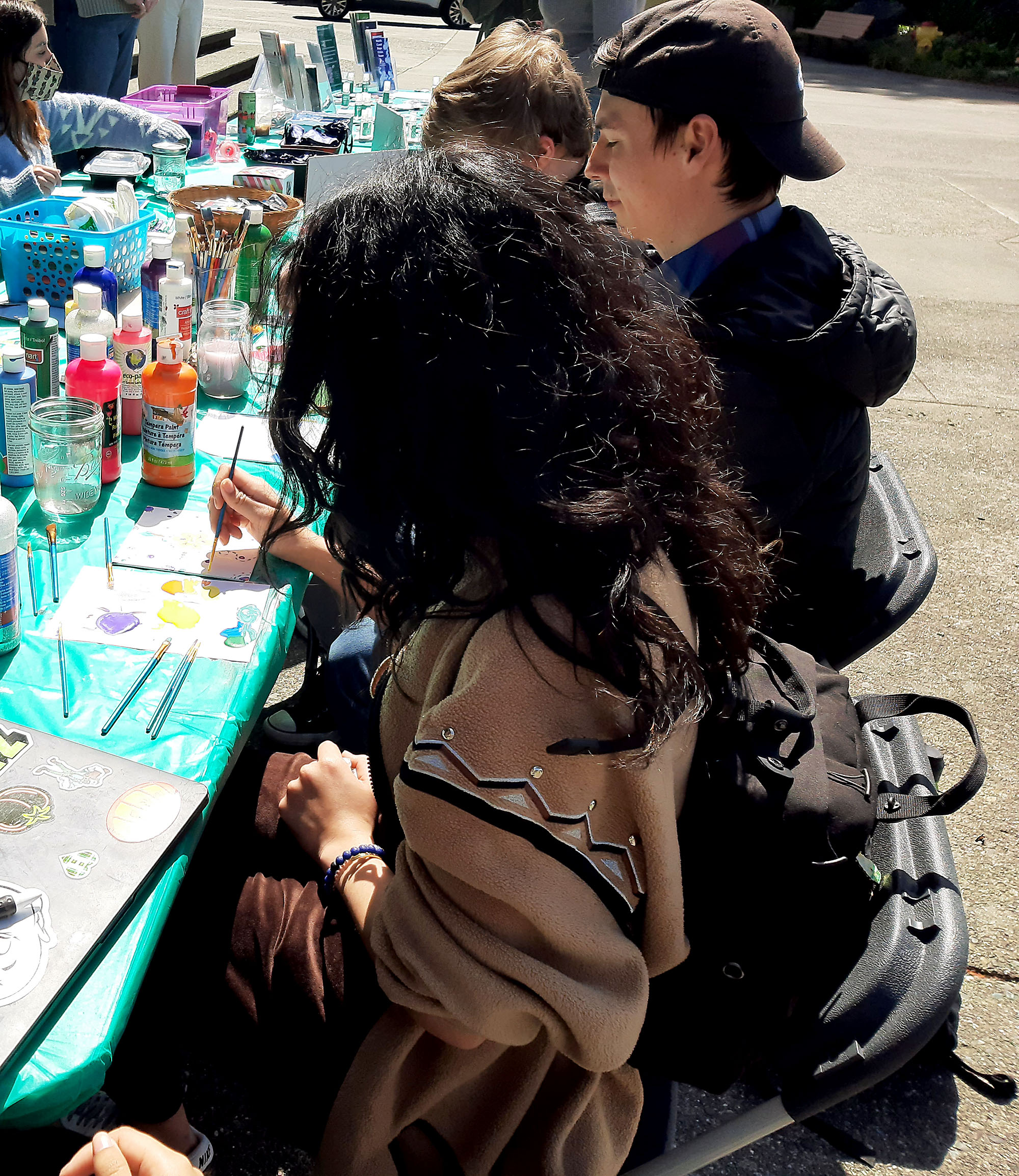
    Pamphlets and papers flew around the UC Quad. Three teal blue tables stood to the right of The Depot entrance, pushed up close to the SAC’s concrete stairs. Dozens of paint bottles cluttered the leftmost table while various pins cluttered the right. April is international recognized as Sexual Assault Awareness month and The North Coast Rape Crisis Team alongside its on campus program Campus Advocate Team (CAT) have worked together to host its annual Take Back the Night week. The week-long event lasts from April 4 to April 7 and includes activities such as Denim Day, Clothesline Project Workshop, and Take Back the Night.

    Photo by Matthew Taylor | Liliana Cortez (center) speaking with students on the UC Quad about Teal Day on April 4.

    Tuesday marked Teal Day, a day dedicated to the awareness of sexual assault survivors and their stories. Students at the tabling event were encouraged to paint their expressions of positive growth and healing. By the end, all the small canvases would be placed together to form a larger mural. Liliana Cortez, the Violence Prevention Advocate at the Women’s Resource Center, expressed that the mural was an optional part of the activity.

    “It’s up to them,” Cortez said. “If they want to create their piece and keep it, or if they want to go ahead and give it to us so we can make it part of [the mural].”

    Together with Cortez, CAT Education Coordinator Kira Morse was also present at the table.

    “We provide services here on campus for survivors of sexual assault,” Morse said. “We have counseling, we have an office here, and we also respond out if there’s any incidents or things like that and help with [things] like Title IX and accommodations.”

    Rachel Mack, a Rangeland Resource Management major, was one of the handful of students painting at the table.

    Photo by Matthew Taylor | Painting by Rachel Mack created during the Teal Day event at the UC Quad on April 5.

    “It’s nice to have something positive as well as it being important for what it stands for,” Mack said, whilst painting her sunflower piece. “I think [it’s] really important for survivors to be able to have control over their own situation.”

    Alexa Farias, a Critical Race, Gender & Sexuality Studies major, expressed this event is very important to her work and role within Students for Violence Prevention.

    “We actually want to be part of the whole Speak Out, because it’s a really good way to show people what it feels like to really look through the situations,” Farias said.

    Speak Out is one of the many sub-events planned within Friday’s Take Back the Night program. This event will provide a safe space with counselors on hand for survivors to ‘speak out’ about their experiences and tell their stories.

    “The main movement and push with Take Back the Night is that people can feel safe here on campus and have their voices heard,” Morse said. “I feel a lot of times that survivors feel like they’re hush hushed. There’s not that open space where people can name their experiences. Take Back the Night, there is a lot of this amazing support where people feel comfortable.”

    Friday’s event will begin with a speech by Dr. Rachel King that will culminate into a rally and the aforementioned Speak Out event. Lasting between 6 to 10 pm, the event will end in a vigil dedicated to the victims of sexual violence.

    “I feel like [this] is really good,” said psychology major John Clark. “If this could happen at most events, then people would start to see that this is a [common] thing that we should talk about.”

  • Slack is Back at Cal Poly Humboldt

    Slack is Back at Cal Poly Humboldt

    by Liam Gwynn

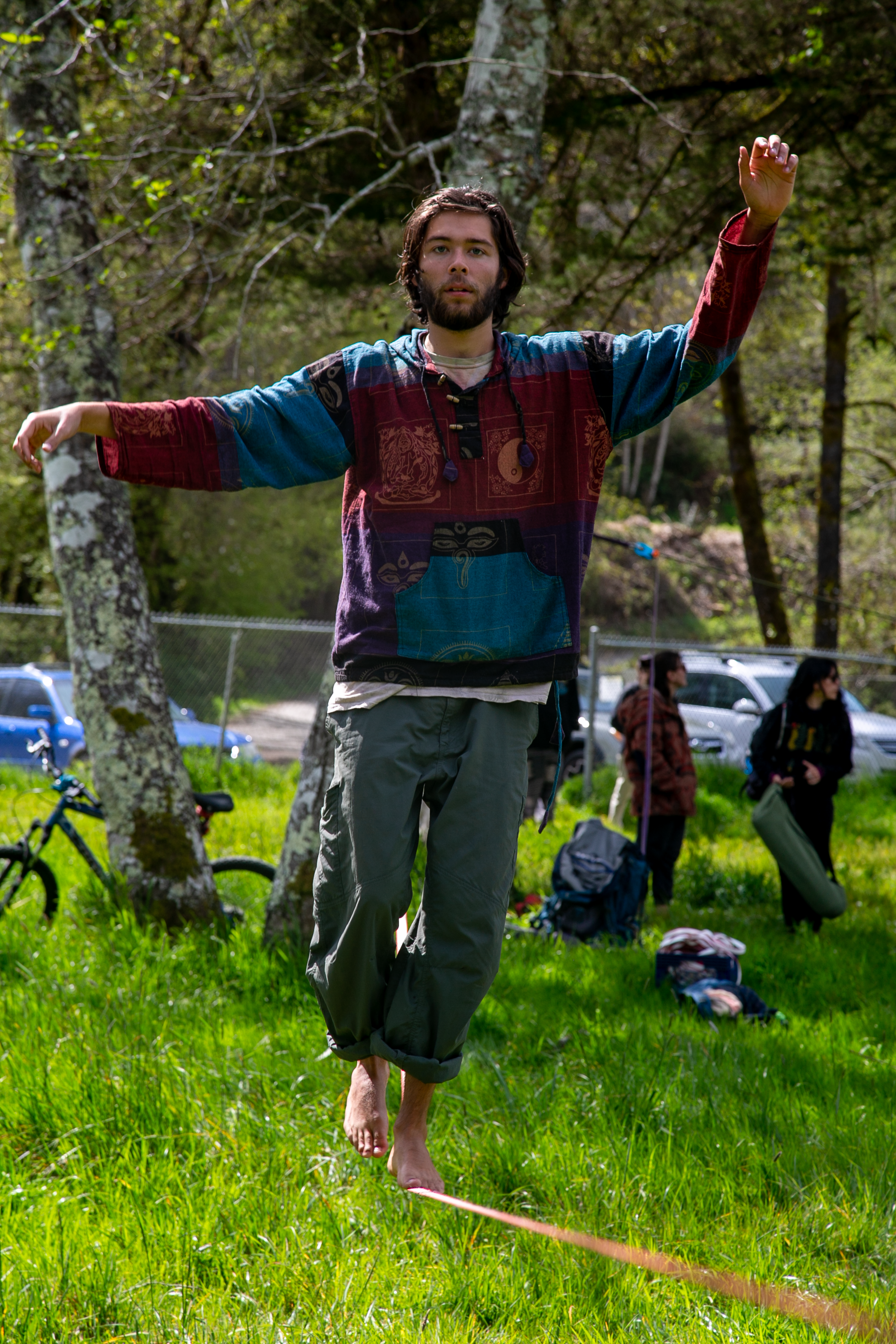
    Ethereal flute, harmonious tarot prophecies, and a faint vaguely skunkish smell: you’d think it was a description of a sixties wet dream. However, you would be wrong, that dream is very much alive in Humboldt county, particularly with a group of students who have started a slacklining group that meets every Sunday.

    Before the pandemic, Cal Poly Humboldt had a thriving slacklining community with a club that would meet weekly. The club fell apart in 2020, however, one former member has gathered a group of fellow slackers and begun the process of getting this group turned into an official club at Cal Poly Humboldt. Joseph Aguilar, organizer of the prospective slacklining club, joined the original club in 2019 and has been slacklining ever since.

    “I love how when you’re on [the slackline] it’s just you, you have to be focused and present, and in that moment and you have to be hyperaware of all the muscles in your body,” Aguilar said. “It’s really good for core strength and all sorts of stuff.”

    Aguilar decided to start throwing “Slack Sundays” with a group of his friends and it gradually blossomed into a communal gathering of musicians, slack enthusiasts, and an assortment of nature lovers.

    The atmosphere at “Slack Sunday” was laid back and welcoming. Unlike many sports activities, there was no sort of competitive spirit or pressure to perform perfectly. People stretched back on picnic blankets and relaxed while others painted, played a variety of instruments, gave tarot card readings, threw a frisbee, and even tossed around a boomerang. Others came just to meet new people and hang out.

    The skill levels at “Slack Sunday” were equally diverse. For some, it was their first time and veterans held their hands and gave tips on how to cross. On the opposite side of the spectrum, genuine professionals showed off their skills with remarkable tricks on a line five feet off the ground.

    Photo by Abraham Navarro | Gabriela Vargas and Joe Mallory, both experienced slackliners do tricks and balance on their lines at the Mad River Pump Station on March 22.

    One of those professionals was Gabriela Vargas. She started by slacklining in her hometown Mexico City and moved to the US after receiving a sponsorship for competing in a trick line competition. Vargas originally moved to Colorado but was attracted to Arcata because of the slacklining culture that exists here.

    One issue that many professional slackliners face is debilitating injuries. Vargas said one injury she had forced her out of the competitive space after a leg injury that took six months to recover.

    “I like to take my healing slow, because if you don’t let it fully heal and just go back to doing it, it can get chronic and I don’t want that to happen,” said Vargas.

    Despite the setback from her injuries, Vargas has continued to expand her skills and has become proficient in highline, when a slackliner is harnessed to the slackline and balances over massive heights. Vargas showed a picture of her slacklining over an incredible drop of over 6,500 feet.

    People enjoy slacklining for a variety of reasons but one central theme is the benefits of achieving mental and physical balance when on the line. The appointed treasurer of the prospective club Ella Feick explained how her passion for slacklining stemmed from that need for balance.

    “You’re thinking in your head, you’re breathing in your body, and you’re focusing on your balance in a way that you’re not typically. If you’re stressed out or having a hard day you can’t really be thinking about all that stuff, you’re just there,” Feick said. “It’s a very present activity.”

    “Slack Sundays” are hosted every Sunday from 12-5 p.m. at the Mad River Pump Station 4 – Disc Golf Course.

    Photo by Abraham Navarro | Destiny Vera, Joey Agualar, Ella Feic, Ang Younger and Younger, all students interested in the Slacklining club on campus, at the Mad River Pump Station on March 27.
  • Hustle and bustle at the Associated Students

    Hustle and bustle at the Associated Students

    by Matthew Taylor

    In the wake of reimagining the Associated Students, all hands are on deck. More staff and members have resigned over time as the major deadlines of AS’ yearly budget and the next election cycle fast approach. The Board of Directors has played musical chairs with itself after Finley’s impeachment in a scramble to fill the most critical positions. The AS is quickly becoming a phoenix out of its ashes. Reinvigoration among its most loyal members has been felt across the organization, and student participation and interest have been at an all-time high since the pandemic first hit.

    “[We’re] tapping into the core program,” Chase Marcum, the current Administrative Vice President, said. “Teamwork makes the dream work.”

    Since refocusing on the budget, Marcum and the Finance Committee have utilized all the help they can get from resources such as the Student Legal Lounge, CCAT, and the work of their predecessors.

    “We forget that a lot of passionate previous leadership had the foresight to give students templates and guidance,” Marcum said. “[We have] the ability to look back.”

    The yearly budget plans to increase funds for the Asian, Desi, Pacific Islander Collective (APIC) and various other cultural centers on campus. Funding is also being put into Scholars without Borders and expanding the list of study-abroad countries provided at Cal Poly Humboldt. The Student Legal Lounge may also receive higher funds to put into aid for Dreamer students.

    Discussions around previous legislation, bylaws, and organizational structures continue. Plans to review and update the AS Personnel Code along with many of Finley’s previous legislation are in the works. Reviews will ensure that all legislation and bylaws protect student representation and autonomy within the organization. The Bylaws Committee, alongside Legislative Vice President Gio Guerrero, has also begun negotiations with the Dean of Students to utilize the resources from HR to avoid future internal conflicts.

    Above all, the AS is hopeful for the new election cycle. Voting will commence between April 18-22, and students will be emailed the ballot. Guerrero said that last year only 3-4 people ran for mostly uncontested positions, but this semester almost all the positions have at least one person running for so far. The signature process to get on the ballot has also been waived, making it easier to apply. The results of the elections will be posted on May 6.

    “There’s some work ahead of us, but we’ll make it through and persist,” Guerrero said. “We’re going to be okay as an organization.”

    The next Board of Directors meeting will be held this Friday, April 8, at Nelson Hall East 106 from 3 to 6 p.m. As always, these meetings will be open to the public and are now entirely accessed via Zoom. For access to meetings or further inquiries, the AS can be contacted at (707) 826-5410 and through its email at as-staff@humboldt.edu.

  • Students jam out on campus

    Students jam out on campus

    By Lex Valtenbergs

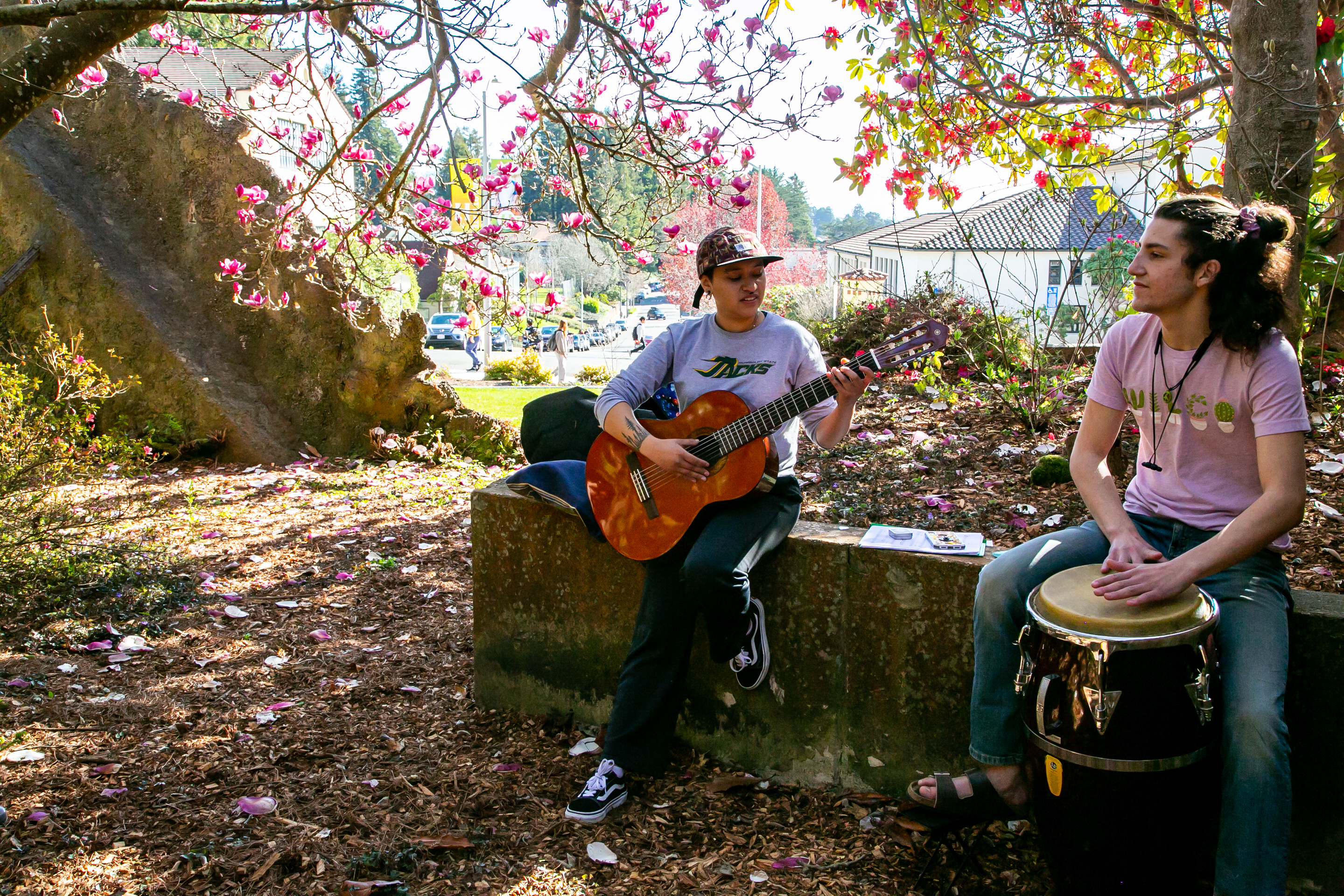
    On a sunny day in early March, Wildlife sophomores Olie Espinoza and Dee Naranjo played guitar and conga drums in a hidden alcove near the Art Quad. The sound of the impromptu music could be heard from several feet away.

    Photo by Abraham Navarro | Dee Naranjo Plays the Conga drum he uses for for class near the art quad on March 7.

    Espinoza (@itsolie_909 on Instagram) just started learning how to play guitar last year and has been playing it ever since.

    “I picked it up in maybe June of last year,” Espinoza said. “It’s definitely something that I always wanted to do and I never got a chance to do it.”

    Espinoza and Naranjo met in the dorms during their freshman year and jam together whenever they get a chance. Naranjo (@deedeedeedeedeedeedeeeeeee on Instagram) didn’t play any drums prior to learning how to play the congas in a class that they took to fulfill a General Education requirement.

    “I just took it as a GE class for the credits, for the art section of GE,” Naranjo said. “I saw it, it sounded cool. I’ve only been taking it for a month so far, so I don’t know much but it’s been really fun.”