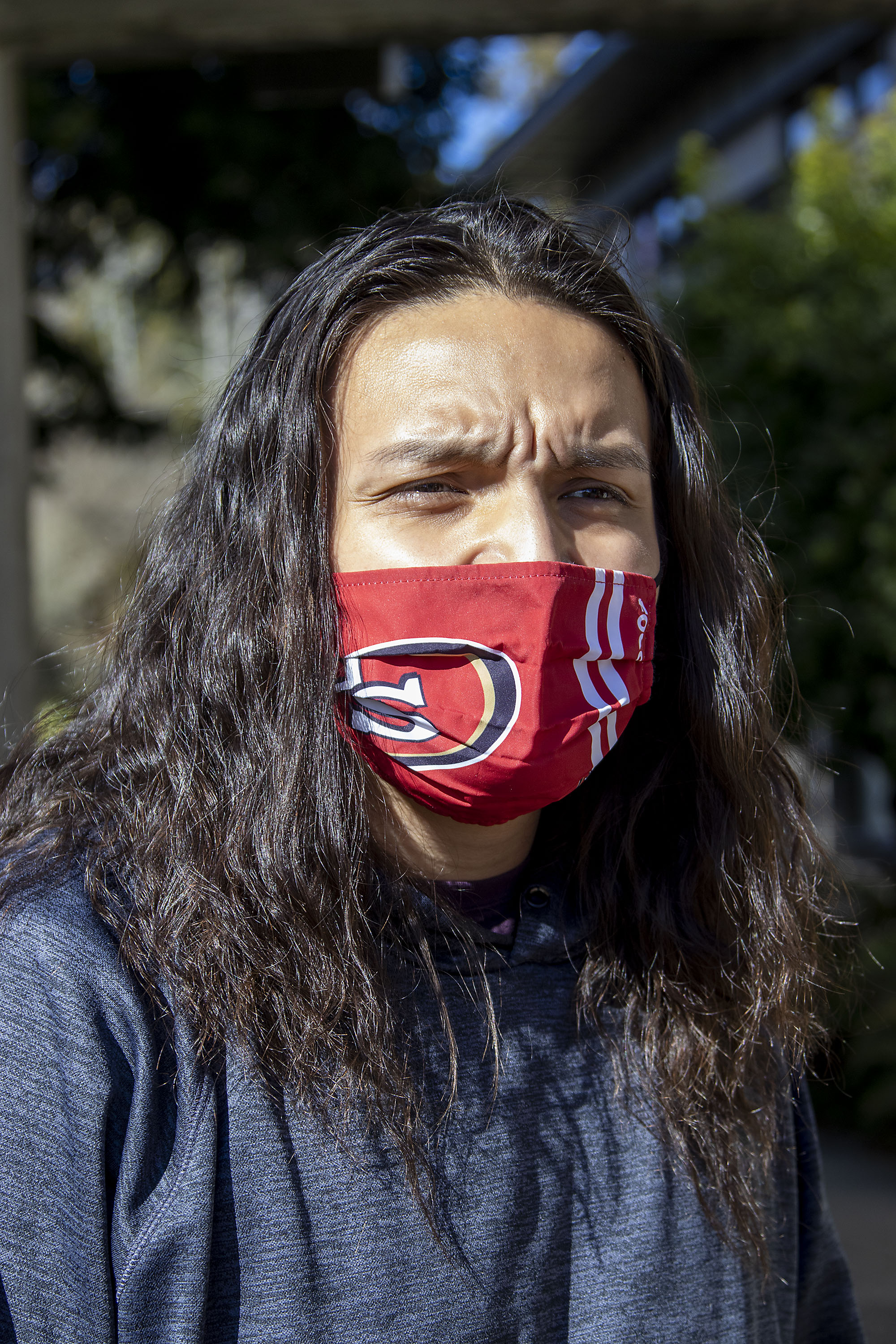
Madison Parry started playing basketball when she was 6. Now, she’s a freshman on the Cal Poly Humboldt’s women’s basketball team. Throughout this season that lifetime of practice has become apparent with her contribution to the ‘Jacks.
Parry leads the team with 363 points total for the 2021-22 season and started in 23 games. She said that Family, friends, and her teammates are all factors that keep her motivated to continue pushing herself and playing her best.
“[The coaches] challenge me every day with practices and games,” Parry said. “They always motivate me to be the best version of myself.”
The practices involve competition that makes it fun for Parry and gives the athletes a reason to push themselves.
After all the practice Parry finds her joy in the crowd when she plays home games. She said that her favorite part of the games is the atmosphere.
“When playing in the Lumberjack arena, It’s really amazing,” Parry said.
Parry said she appreciates the energy and motivation that having a crowd full of Cal Poly Humboldt students brings and while they don’t have that at away games, Parry believes that the away games bring the team together more.
“A highlight from this season would probably be the Chico game,” Parry said. The Chico game resulted in a Humboldt win after the game had 3 overtimes. Parry scored 20 points in the game against Chico.
For the remainder of the season, Parry hoped to finish strong with more wins. “We’re not gonna make the tournament,” Parry said. “But if we win these games we can change other team’s rankings.”
The Basketball season came to an end for the ‘Jacks on Feb. 26 where they fell to the Cal State San Marcos Cougars 47-75.
It felt like he had become a completely different person. This was a sentiment that current and previous A.S. members echoed in detailing their experiences with ex-A.S. president Jeremiah Finley over the years.
On Sunday, Feb. 20, Finley was officially impeached and removed from his office. Due to the Legislative Vice President role being empty, the role was given to previous Social Justice and Equity Officer, Lizabeth Cano Sanchez. A unanimous vote on an impromptu Feb. 8 meeting approved this decision. Currently, six positions within A.S. remain open, with an important and daunting budget season right around the corner.
Many inside and outside A.S. remain both worried and hopeful for the association, along with many still healing from their time serving under Finley’s terms.
“I have witnessed many great powerhouses of [the] Associated Students’ with strong voices drop off of the A.S. Board [of Directors],” Representative Tashenea Burns Young said. “Because of the negligence, [disrespect] and [inability] to do their job to their full potential, because of President Finley.”
For longtime members of A.S. such as Malluli Cuellar, Finley’s change in demeanor beginning in the Summer of 2021 was both shocking and confusing, akin to a light switch being flipped.
“If we ever had any disagreements it was still very respectful,” Cuellar said, explaining his previous demeanor. “He was still actively listening, I felt like he was taking in a lot of the feedback that we would get back then and you would see your feedback implemented into the work.”
For Cuellar, much of this seemed to change after the pre-agenda meeting of August 2021, which can be read about in our A.S. impeachment article. However, for previous Administrative Vice President (AVP) David Lopez, this had begun as early as June that year.
As AVP, Lopez was expected to be the head of the association’s yearly budget proposal. This was a task he took very seriously and based on feedback he had assumed he successfully did that year. A phone call from Finley days after the budget books should have been closed and signed told him differently.
Under the advice and pressure of the university, Finley had almost completely revised the budget without Lopez’s or the Board’s input. When asked what changes he had made, Finley refused to respond until the next board meeting two days later.
“I’m not ready to share those at the moment, I’ll bring them up tomorrow at our meeting,” Lopez said, directly quoting Finley’s words at the time.
Huge cuts were made to General Operations, and funds given to student employees under A.S. programs such as WRAPP and CCAT, along with money taken out of the reserves for reallocation. Lopez also expressed that over the pandemic, Finley repeatedly proposed legislation that directly or indirectly centered power into his presidential position.
“He’s not like that,” Lopez said. “He doesn’t portray himself as someone who is into power [in that way], he’s the perfect politician.”
Despite the turmoil, both past and present A.S. members have hope for the future of the organization.
“As for Associated Students, we are working together to further engage in collaboration,” Burns-Young said. “Understanding that we are students and most importantly we are human. With the support of our advisors, core programs, and staff we are the Associated Students who will once more rise above the conflict to further empower our student body.”
The next A.S. meeting will be March 4, at 4 p.m. in Siemens Hall 117.
The Cal Poly Police Department has a total of eight vacant spots in its organizations: two administrative, three dispatchers, one officer, and two sergeants. The CPD has enough staff to work all necessary operations, but this significant gap in positions and recruitments is now common throughout the nation.
Sergeant Chance Carpenter has noticed fewer people willing to become officers. The College of the Redwood police academy has also had lower recruitment.
“When I went to an academy in 2006, approximately 27-28 graduated from that police academy,” Carpenter said. He explained how the current number of graduates has dropped to only twelve at an academy that once graduated over double the members yearly. Carpenter added most law enforcement is having staffing issues, not just the ones in Humboldt. Speaking of his feelings, Carpenter feels some portion of society is less supportive of law enforcement.
Black Lives Matter protests and reaction to police violence changed the public opinion on policing. A recent Black History Month protest in the Arcata Plaza articulated community concerns regarding police officers.
“I think society should always be critical of professionals that offer services,” said Carpenter in response to questions about the change in the public view of police. Carpenter explained in his view that law enforcement should be invested in their communities and positive changes in policing should be supportive.
There is still a disconnect between students and the CPD despite Carpenter’s hopeful sentiment. Cal Poly Humboldt freshman Elaina Wargala expressed her feelings about law enforcement.
“I think that a portion of society may be less appreciative of the work law enforcement does,” said Wargala. She expressed her own discomfort with law enforcement in general.
“I think a lot of people take advantage of their position,” Wargala said.
The disconnect between campus law enforcement and the student body makes it difficult to maintain staff and even harder to hire new staff. Despite the high number of vacant positions, the CPD has still been able to maintain operations successfully.
This year’s keynote speaker, Mary Akpovi, who was born in Nigeria but has lived most of her life in California, inspired us to be both local and global citizens. While Akpovi has spent most of her career in public accounting, her true passion, in recent years, has been charity work. Having been involved with several charity organizations here in the United States and abroad, she has a lot of wisdom to offer.
Photo courtesy of Mary Akpovi
In California, Akpovi was previously a board member for the Exceptional Children Foundation, an organization that provides services to children and adults with learning and developmental challenges. She also worked with Hope of the Valley Rescue Mission, an organization that assists people experiencing homelessness.
Her international work has been centered in Sierra Leone, Uganda, and Kenya. She has been instrumental in opening vocational training centers in these countries and continues to support several vocational schools, primarily in tailoring, catering and salon care.
When asked where her passion for charity work comes from, she said it was the support she received in her own life, from her father, her religion, and from others. Now, she is paying it forward by mentoring, and it is at the heart of everything she does. In her opinion, it is one of the best investments a person can make. She hopes participants got the overall message that everyone has potential. That potential can be fostered by encouraging one another, being intentional, and “staying in your lane,” a phrase that Akpovi holds close to her heart.
by Rachel Hood
Movement and Identity
In light of forced displacements, violence, and complex geo-political issues, Dr Tani Sebro (PSCI) explored the cultural performances that have served the critical function of Myanmar’s refugee population in her session “Aesthetic Nationalism: The Dance of War and Exile along the Thai-Myanmar border.”
In the context of conflict and exile, music, dance, and the performing arts play a pivotal role in creating a sense of national and community, according to Sebro. As a cultural ethnographer who also underwent training in the traditional performance arts called Jaad Thai, Sebro was able to experience how dance and performing arts made life possible outside the contemporary nation-state system for exiled people. In essence, physically synchronized rhythmic movement promotes a strong sense of unity within all cultures, religions, and nations. It also holds potential for expressing ethnic identity for refugees, especially for the Tai living in a time of danger.
by Johnny Mendoza
IEW Highlights Black Voices
On Feb. 14, Professor Maxwell Schnurer kicked off International Education Week with a presentation about the music and activism of Fela Aníkúlápó Kuti, a Nigerian Pan-Africanist and musician.
During his life, Kuti reinvented African culture as a revolutionary act to subvert colonialism and reassert his autonomy as a Black person. “I never thought about it, being African as such,” Kuti said in an interview from the 1970s. “It didn’t mean anything to me until much later in my life.”
Schnurer deconstructed the sociology of colonialism to provide a framework for cultural appropriation, a phenomenon that exploits indigenous Black cultures in particular. Colonialism is a kind of discourse that perpetuates a narrative of European superiority.
“You’re born out of the womb into a world of discourse,” Schnurer said. “Your grandparents, your aunts and uncles had language on this planet, before you arrived.”
Umoja Center for Pan-African Academic Excellence Coordinator and International Studies alumnus Doug Smith also spoke, sharing his ongoing master’s research about Pan-African identity.
“For many people of color, the use of English as a language, as a means of communication, is very tied into their history and engagement with colonialism and settler colonialism,” Smith said.
by Emma Roberts and Lex Valtenbergs
Levels of Connection
International Education Week helps inform us about the issues that connect us wherever we are in the world; two presentations made this point very clear.
COVID-19 is perhaps the most immediate example of how globalization affects our daily lives. Economics professor Beth Wilson brought this idea closer to home by looking at the impact of the pandemic on education.
Wilson’s information-packed presentation examined the different ways that the pandemic has affected the lives of one billion students worldwide, particularly in developing countries with little access to technology. Short term decisions made by local authorities will have long term economic consequences Wilson argued that “COVID-19 is the biggest education disruption in history.”
To finish out the week and bringing the world back to Humboldt, alum Viridiana Preciado discussed the work done by the Sovereign Bodies Institute, an organization that helps locate missing and murdered Indigenous women.
Preciado’s presentation highlighted the injustices that indigenous communities face on a daily basis and talked about the work SBI has done locally with the Yurok tribe and offered ways people can support this effort. She concluded her presentation by pointing out that she got her job after meeting the CEO of her organization at an IEW session two years ago.
“I just followed my heart and introduced myself after the session. I told her I really wanted to help make a difference and here I am,” said Preciado.
by Laura Gurney
Following the Flow: Coffee and Gold
We are very fortunate here at Cal Poly Humboldt to have professors who are passionate about the work they have done, and who want to share their knowledge and experience. International Education Week offers faculty from across the university the opportunity to showcase their work.
Gordon Ulmer and Noah Zerbe traced the “social life” of two very different commodities economically and culturally.
Together, they explored the impact of global markets for gold and food (and specifically for coffee) on local communities around the world. Each of these common goods ties together different social, cultural, political, and economic ideas. They also asked us to think about our own responsibility in that global exchange.
“Starting my day with a cup of coffee connects us, connects me, connects all of us to these broader economic, political, cultural, environmental questions,” Zerbe said.
by Abby Reina-Guerra
Only 1% of College Students Study Abroad – Stand Out from the Crowd
Despite COVID-19 and lockdowns, Cal Poly Humboldt is beginning to plan for study abroad again. Five different sessions during International Education Week helped students prepare for their trips. Videos are available on the IEW website (iew.humboldt.edu/schedule) where you can hear from students about their own experiences; from budget planning and cell phone plans to what it was like to be a student of color in a strange place.
Professors Matthew Dean and Joseph Diémé also hosted a session to talk about their Leon, Spain and Nantes, France programs scheduled to take place this summer. They discussed the appeal of faculty-led programs, including the ease of transferring credits and even the possibility of gaining a minor. More information can be found on the Humboldt Study Abroad website, which also includes information about other programs through the CSU or third-party providers. All programs are available to any student at Humboldt regardless of major.
Photos Courtesy of Danika McGeever on her trip abroad to South Korea.Photos Courtesy of Danika McGeever on her trip abroad to South Korea.
A final look at study abroad was presented by Jonathan Maiullo of College of the Redwoods, who discussed the importance of recognizing the impact you have in the communities where you travel. He stressed the importance of “responsible storytelling” as a way to share your experiences with others while respecting the culture you visit. If you are thinking study abroad is not for you because of cost, there are a number of scholarships with deadlines coming soon.
Kicking off on Valentine’s Day, it seemed natural for anthropologist Mary Scoggin to speak of love in the context of China.She discussed the many different ways in which we understand and express our affection, and how even our most cherished emotion is rooted in our own cultural history.
Educating the next generation is deeply rooted in culture. Vincent Biondo, Department Chair of Religious Studies at Cal Poly Humboldt, talked about Islam and citizenship education in Europe. Biondo addressed the question of how Europe should respond to diversity and incoming migrant communities, specifically Muslims. Biondo argued that Europe should invest in schools that teach pro-social values.
“There’s a lot of evidence that shows that people solidify their prejudices by the time they’re in middle school,” Biondo said.
In other words, if one educates students at a younger age about diversity, communities would become more accepting.
On the other end of the spectrum, Kerri Malloy of San Jose State discussed a workshop he was asked to help host in 2019 on promoting and protecting civil and human rights. That year the seminar was exclusively designed for members of the US civil service like ICE and FBI agents. Perhaps more importantly, it took place at the Auschwitz concentration camp as organizers felt there was no better place to talk about the erosion of human and civil rights.
As Malloy showed multiple pictures of the camp, he asked his audience to consider these images not simply as foreign, but to think of places here in California that are also places of violence.
As he repeatedly observed, “These places were built to last – they have a permanence – they mark the landscape forever.”
by Haley Rodden and Cataleena Tchieng
Work Around the World
International careers offer an extraordinary experience for anyone to branch out of their comfort zone and explore the world. Through your experience abroad you can gain a stronger understanding of other types of cultures, peoples, environments, and governments depending on the work you choose. People who work in an international setting are often pushed to confront extraordinary new elements that open any number of lifetime options.
Careers extend from working on a campus to help students to build their own international experience. Nora Montoya of Cal Poly Humboldt’s Academic and Career Advising Center took time to work for the Peace Corps, and Ryan Gliha worked for the State Department. He has since spent his career helping build strong relationships between the United States and other nations around the world. Now, as the diplomat in residence for California, Gliha is helping students join the foreign service.
Even while still in college there are ways to build a strong international profile. For example, the State Department has remote internships around the world and every government department hosts internships that could help you build your career.
“International work is an opportunity like no other,” Gliha said. “It will change your life”.
For support or more information contact ACAC and Nora Montoya (nora.montoya@humboldt.edu), John Keller, Peace Corps (Jkeller2@peacecorps.gov) or Ryan Gliha, State Dept (DIRnorthwest@state.gov).
by Leslie Ortiz
About International Studies
Photo courtesy of the International Studies dept.
International studies is an interdisciplinary major that examines the drivers of globalization. The goal is to better understand the forces that shape the world so we can make changes in that world. Students study other languages and are required to study abroad as part of their own exploration of the interconnections between people and places local and global.
International Education Week, now in its 23rd year at Humboldt, is a 1-unit colloquium crossed-listed by six majors and open to the community, but required for international majors. This year, IEW brought together faculty and staff from across Humboldt, California and the world via Zoom to present 30 hours of programming to well over 700 attendees.
Students in this year’s international capstone class acted as hosts for each session and wrote this report of the week’s events. We are honored to be guest reporters for The Lumberjack and hope this helps you feel less distanced in a time of COVID-19. We are rooted in this community but still reaching for the world.
If you have any questions about IEW or international studies, my door is always open.
International Education Week would like to thank its sponsors and all of our presenters. The full schedule and videos of sessions from 2022 (and 2021) can be found online: https://iew.humboldt.edu/.
International Studies Capstone Class Spring 2022 Laura Gurney, Rachel Hood, Johnny Medoza, Leslie Ortiz, Abby Reina Guerra, Debora Rios, Emma Roberts, Haley Rodden, Cataleena Tchieng, Lex Valtenbergs
John Chernoff doesn’t carry most of the music he plays with him. Instead, the students he plays with bring it to him. He’s been the on-staff piano accompanist at Cal Poly Humboldt for what he figures to be about 16 years, playing a larger volume of music daily than probably anyone else on campus.
Chernoff plays at choral rehearsals, other ensemble practices, and individual sessions with any music student who needs accompaniment. Piano is often a catch-all substituted for what will eventually be other instruments, so Chernoff ends up filling a lot of roles for almost every type of music student.
“I play with basically anybody who needs a piano to be played with them,” he said.
One of his favorite types of music to play during working hours is when he accompanies the school’s musical theater rehearsals. He studied classical music up to the post-grad level, but says he appreciates the multi-faceted nature of musical scores.
Chernoff practices his craft almost every day. He’s able to sight-read any piece of music put in front of him almost flawlessly, and it seems ridiculous that the Music Department ever functioned without him. Learning new music quickly has always been one of his strengths, he says.
However, he is only one person, solely responsible for the needs of many students. Anybody who works with him knows well his constant, almost harried-seeming air as he rushes from practice room to practice room.
“The transition between [personal and professional] worlds is a rough one for me,” Chernoff said. “I have to confess, once you’ve heard vocal warmups enough times it’s kind of like water torture. It’s an inexorable ascent of key. So sometimes I’m not too eager to get to the beginning of certain things.”
Becoming a professional musician wasn’t always Chernoff’s goal. He first learned to play piano as a child, and says it was something he deeply loved, but mostly fell into. Even while seriously studying music, he thought that he would fall back to working in tech.
“I think the moment it happened actually was, there was a year where I was working as a computer programmer … I remember I would go into the office, and there would be people who didn’t know who Mozart was.”
At conservatories, concert pianists mostly learn virtuosic solo music, but he found that playing collaboratively was more fulfilling to him as a musician.
Photo by August Linton | John Chernoff plays the piano in a Music Room B practice room on Feb 22.
“There’s only so many notes you can jam into your brain when you’re learning solo piano music, before it starts to become kind of obnoxious … chamber music always seems like it has a more genuine purpose,” Chernoff said.
Upcoming March 4 and 5, the Eureka Symphony Orchestra will be debuting an original piano concerto composed by Chernoff as a part of their show ‘Inspirations, New and Timeless.’ He’s been working on the piece since before the pandemic.
“I have often been pressed into duty to play piano concertos with the Eureka Symphony, which is a fun thing to do,” Chernoff said.
The piece, simply titled ‘Piano Concerto,’ is Chernoff’s way of melding the 19th century golden age of classical piano with 21st century sensibilities.
“The 19th century tends to be the era where the piano shines particularly, so many great composers wrote for the piano at that time,” said Chernoff. “So that’s sort of part of my DNA. The thing is we can’t really write in that idiom today completely, because it’s not us. But it is a lot of us.”
The idealism of Debussy or other composers involved in the romanticism of the 19th century created an extreme, modernist reaction, according to Chernoff. He views this concerto as a sort of counter-counter reaction.
“I think what’s happened, is … [the cynicism of modern musical sensibilities] not really enough, modernism in a lot of ways has not worked out that well for humanity,” Chernoff said.
Another aspect of the piece, one which is uniquely reflective of Chernoff himself, is what he describes as a sort of awkwardness.
“When we write music, we can’t help but express our own personalities and such,” he said. “It’s alright to see the strings once in a while; I hope people can forgive the imperfections, the awkward turns of phrases, that all-too imperfect humanity the piece tends to have.”
Even after playing piano for other people’s projects all day, Chernoff goes home and continues to pursue his musicality. He plays jazz piano, and explores what bluegrass on the piano would sound like.
He’s also a zealous chess player, and still codes for fun occasionally. Merging three of his largest passions, he created a computer program which assigns musical traits to different moves within chess games.
Chernoff also livestreams on Twitch as @zugaddict: playing chess, performing different piano pieces, or even streaming the digital fantasy card game Hearthstone. He says he tried playing chess and piano simultaneously on a stream once, but that the act of multitasking took away the musicality.
“I try to do a lot of different things,” he said. “This piano piece of mine too, does this a lot, it has trains of thought it gets obsessed with.”
Dr. Christopher Aberson came forward to the Lumberjack with a story about how he was symptomatic and asked to teach online but was denied the opportunity and asked to teach in person instead. Provost Jenn Capps responded to these accusations after Aberson’s story was released. Capps claims that a majority of the time teachers are allowed to change modality, however, they have to meet certain requirements.
According to Capps, a professor seeking a modality change has to be verifiably ill and then has to seek approval from their department head to change modality. In cases like Aberson’s where the department head is the one asking, they have to seek approval from Capps directly. Capps couldn’t speak on Aberson’s case specifically due to confidentiality reasons, yet she was able to speak on similar hypothetical situations.
“I’d say eighty percent of the time a request for a change is being granted, when it’s not being granted, it’s because perhaps a person is operating off of being afraid or they are like ‘something could happen therefore I don’t want to teach in person I’m just going to shift my course online and I’ll let you know when I wanna come back,’” Capps said. “Well, that’s not somebody who is sick and that’s not the agreement that was made with the students.”
Aberson never tested positive for COVID-19 but he did claim he was symptomatic. In times where COVID-19 takes up the majority of the conversation, people are still getting sick with other illnesses and it can be confusing when symptoms of one illness overlap with COVID-19 symptoms. According to Capps and school policy, just coming in contact with COVID-19 is not enough to warrant staying home or teaching online.
“For students, faculty, and staff our current policy is that if you are vaccinated and you come into contact with somebody with COVID and you’re masked and vaccinated, that doesn’t mean that anything needs to change,” said Capps, continuing. “What you need to do is continue about your work and life and monitor and keep doing wellness checks, and if you start to experience symptoms then you get tested and isolate.”
Strangely enough, that is what Aberson was trying to do according to his accounts of the event. He came into contact with COVID-19, started feeling symptoms, and then requested a modality change. Aberson was under the impression that his request was possibly denied due to him being outspoken against different school policies. When asked about whether this was a genuine possibility, Capps firmly denied any bias in the deciding process.
“Oh of course not, that would be all kinds of wrong,” Capps said. “It’s just really centering on a couple of things, making sure the student gets the instructional experience that they desired and making sure that faculty and staff and student health is protected.”
In 2019, Cal Poly Humboldt students envisioned a project that would re-indigenize the campus by creating the Rou Dalagurr Food Sovereignty Lab & Cultural Workspace.
According to the summer 2021 FSL Progress Report, this new indigenized space is “dedicated to the research, practice, and preservation of food sovereignty and traditional ecological knowledge. The purpose of the FSL is to provide an opportunity to work directly with the surrounding communities, tribal nations, and national and international scholars and community leaders to center, learn, and engage with Indigenous science, environmental management, and preservation practices.”
The Food Sovereignty Lab serves to “unify our students, faculty, local tribes, and communities; to center and support tribal sovereignty, natural resource management, and preservation practices; and to provide students with culturally appropriate education in Indigenous natural resource management that respects Indigenous sovereignty and self-determination and serves our community.”
To help the public and Cal Poly Humboldt students understand the practice of food sovereignty, there will be an online film series via zoom that highlights the importance of revitalizing traditional food sources in March and April.
The first film, “Inhabitant: Indigenous Perspectives on Restoring Our World,” will be presented by the Social Justice Summit on Thursday, March 3 at 7 p.m. PST.
The second film, “Voices From the Barrens: Native People, Blueberries & Sovereignty,” will be shown Thursday, March 24 at 7 p.m. PST.
“Gather” will be shown on Thursday, April 14 at 7 p.m. PST.
The third part will be a double feature. “El Cacao: The Challenge of Fair Trade,” and “No Place to Grow,” featuring a discussion with filmmaker Michelle Aguilar, will be shown on Thursday, April 24 at 7 p.m. PST.
Student-made poster boards detailing the lives and legacies of Black artists and activists filled the Gold and Green Room in Founders Hall during the Black History Month Art Exhibit hosted by the Umoja Center on Feb. 17.
The exhibit was an opportunity for Cal Poly Humboldt’s Black students to express themselves and celebrate their African heritage, much as their forebears did before them in a self-determined push to resist the injustices of slavery, segregation and ongoing oppression.
“It is a creative way to show our unity and stand for everyone who identifies as Black,” said Demi Ogunwo, a Masters student at Cal Poly Humboldt and Charter President of the National Society of Black Engineers. “It’s a lot of activists, a lot of people who broke out of the norm of oppression to make a name for themselves.”
Photo by Abraham Navarro | Asia Anderson, a Cal Poly Humboldt chemistry senior stands next to a photo of her great aunt Marion Anderson.
Biochemistry senior Asia Anderson comes from a line of radical Black women who defied the norm during their lifetimes. She made a poster board about her late great aunt Marian Anderson, a renowned Black opera singer. It was a popular exhibit among the attending students.
“I don’t sing worth beans, but I do chemistry,” Anderson said. “I still think about her strength and not letting a ‘no’ close doors. That was passed down through the line of women in my family.”
Jovie Garcia-Diaz, a senior majoring in Environmental Engineering, was a student attendee at the exhibit. Her favorite poster board detailed the appropriation of Black culture in popular social media culture.
“That’s something that I see a lot on social media that stands out to me,” Garcia-Diaz said. “People who aren’t Black get praised and get popular for [appropriated elements from Black culture.]”
Cal Poly Humboldt students and faculty alike visited the exhibit as the evening went on. Frank Herrera happens to be both. He is a student pursuing a Masters degree in Business Administration and the Coordinator of the Social Justice, Equity, and Inclusion Center on campus.
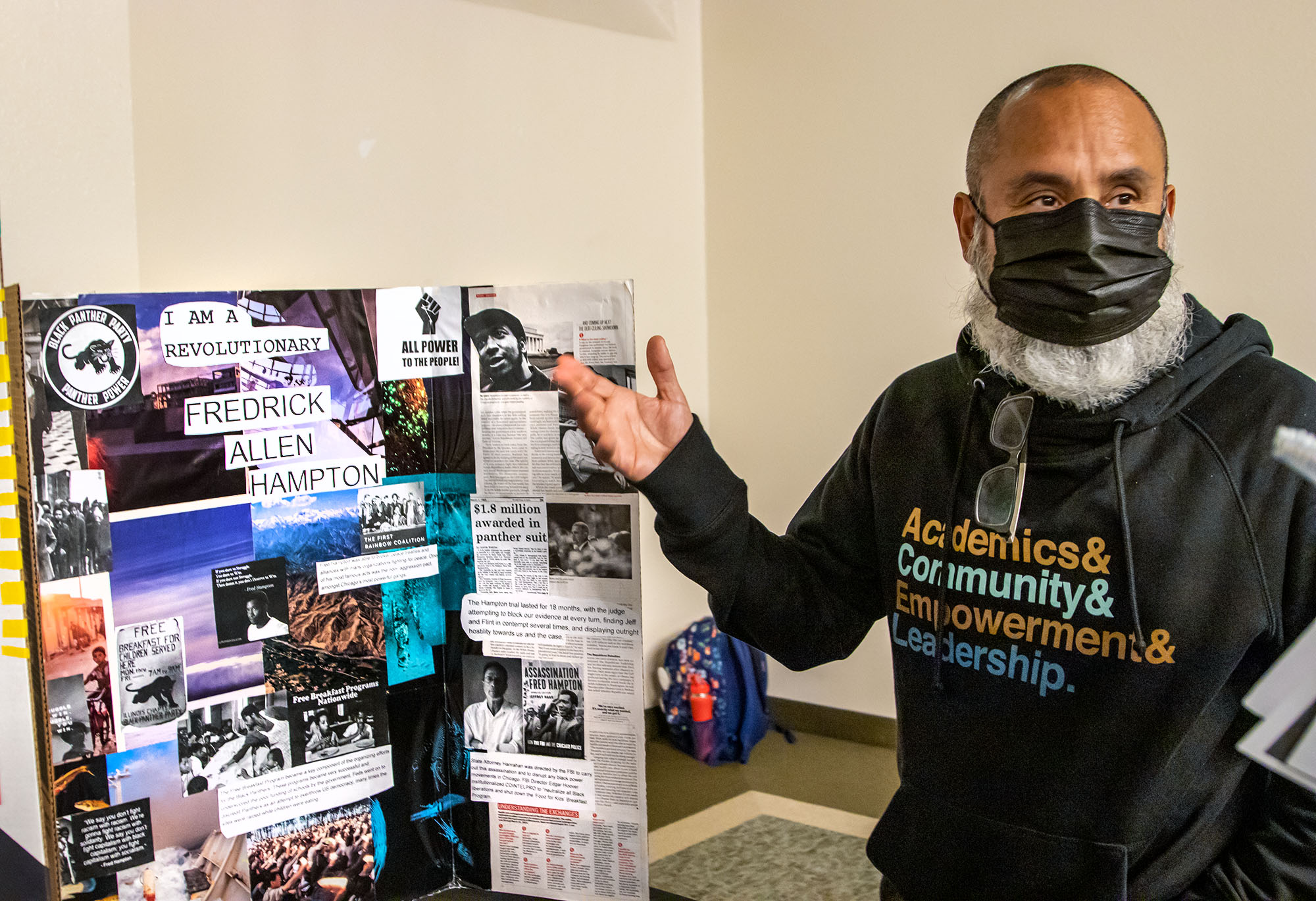
A collage poster board about the life of Fredrick Allen Hampton, former Chairman of the Black Panthers, stood out to Herrera. Herrera was alive in the final years of the Black Panthers’ existence before it dissolved.
“I had met folks who were involved, I just remember the guys in leather jackets and the energy,” Herrera said. ”It’s amazing what they were doing, the bravery and courage they had during the time.”
Photo by Abraham Navarro | Students look at posters of black leaders and events in history during the Black History Expo in the Green and Gold room in Founder’s Hall on Feb. 17.
According to Ogunwo, the art exhibit in general characterized three of the seven guiding principles of the Nguzu Saba, or African heritage, that the Umoja Center stands They are Kuumba (creativity), Umoja (unity) and Kujichagulia (self-determination).
“The pillars reinforce what we stand for and how we want people to see us,” Ogunwo said.
Anderson feels a deep connection to her great aunt and to her heritage that empowers her. To her, the exhibit was a chance for Black students to see themselves in the trailblazers before them.
“They weren’t the first,” Anderson said. “You’re not going to be the last. It feels good because one day, those boards are going to be about you.”
Former A.S. President Jeremiah Finley was impeached Sunday, Feb. 20, after an almost seven hour trial. All members of the Board were present, many providing their testimonies and evidence against Finley. Impeachment was under the violations of A.S Government Codes Section 9, subsections F, J, L, M, and O. He was voted guilty on four of these five charges.
Photo by Abraham Navarro | Social Justice and Equity Officer Lizbeth Cano Sanchez crying at the Associated Students meeting in Siemens Hall on Feb. 5.
“In order to effectively serve students, we must eliminate fear,” said Social Justice and Equity Officer Sachez, the opening speaker for the trial. “Fear that we will not be allowed to speak our minds without retaliation and fear that, despite mediation, nothing will change.”
Under subsection F, overstepping the bounds of their office without the advice or consent of the Board of Directors, Finley was found guilty of unilateral decision-making, violation of California Law AB 361, and violation of the Gloria Romero Open Meeting Act of 2000.
College of Natural Resources & Sciences Representative Tashenae Burns-Young gave testimony towards these violations. She stated that President Finley refused to give her Zoom access to Feb. 4’s meeting unless she divulged personal reasons to her non in-person attendance. At the time, only Parliamentarian Kate Bourne was given Zoom access by President Finley.
“I would like to start as being a black woman on Associated Students,” Burns-Young said. “I have never felt [more] oppressed by my former BIPOC peers, than by our current president.”
While Burns-Young was able to attend the meeting thanks to Bourne’s own decision to give the Zoom link to all other members, Finley did not count her as quorum and ignored any votes she made during that meeting.
Under subsection L and M, President Finley was found guilty of conduct that was deemed to be causing distress to the Board as a collective whole and continuous displays of disrespect aimed at students of the association. Resigned A.S. member Malluli Cuellar gave testimony to this section.
She gave examples of her many conflicts with President Finley as an A.S. member. In the summer prior to fall 2021, during an agenda prep meeting, Finley had requested that she include a talking point within the agenda that he wished to speak on. She expressed discomfort in allowing this agenda item to be added purely in its state as it wouldn’t allow for a debate between the Board, instead she offered similar alternatives.
“He expressed to me that if the chair was unwilling to work with him,” Cuellar said. “He would simply amend it on to the agenda [in the state he wanted it in].”
This incident caused her immense embarrassment and a growing panic towards speaking with President Finley. While she explained that they later spoke one-on-one and he apologized for his actions, his disrespectful words and actions continued up again not long after.
Lastly, the violation of subsection o. negligence to thoroughly communicate with fellow board members, was testified by both Executive Director Jenessa Lund and College of Natural Resources & Sciences Representative Mark Bulgara.
“When I would support the President in putting agendas together,” Lund said. “I always encourage, like ‘hey can we link it here it’s always best to provide things ahead of time, so people have time to review it and digest it.’ I always got denied.”
Bulgara stated that Finley had neglected to properly educate him on important legislation and his voting rights when he appointed him to his current position. In the end, this ignorance often led him to blindly follow President Finley’s own words on any matter.
“Seeing [this] now, I regret every second that I voted yes for him,” Bulgara said. “Because he has done nothing but betray our trust and he abused my ignorance in being a new member.”
Photo by Abraham Navarro | Student Affairs Vice President Chase Marcum and Social Justice and Equity Officer Lizbeth Cano Sanchez speak to President Jeremiah Finley at the Associated Students meeting in Siemens Hall on Feb. 5.
Throughout the entire trial President Finley expressed that all accusations against him were refutable and that he never did anything to break any legal laws nor did he mean to hurt any member with purposeful intent. While he did extend apologies when explicitly asked to by Bulgara, he also expressed himself as a victim to these accusations. He believed many of these accusations to actually stem from personal disagreements and opinions to his own past decisions.
“I don’t see anything in here that results in the punishment that this board is wanting to pursue,” Finley said. “In fact, I feel as though I am being retaliated against for a lot of the ways that I’ve advocated for our students.”
The impeachment trial ended with a unanimous vote by all Board members to impeach Jeremiah Finley from his role as A.S. president.
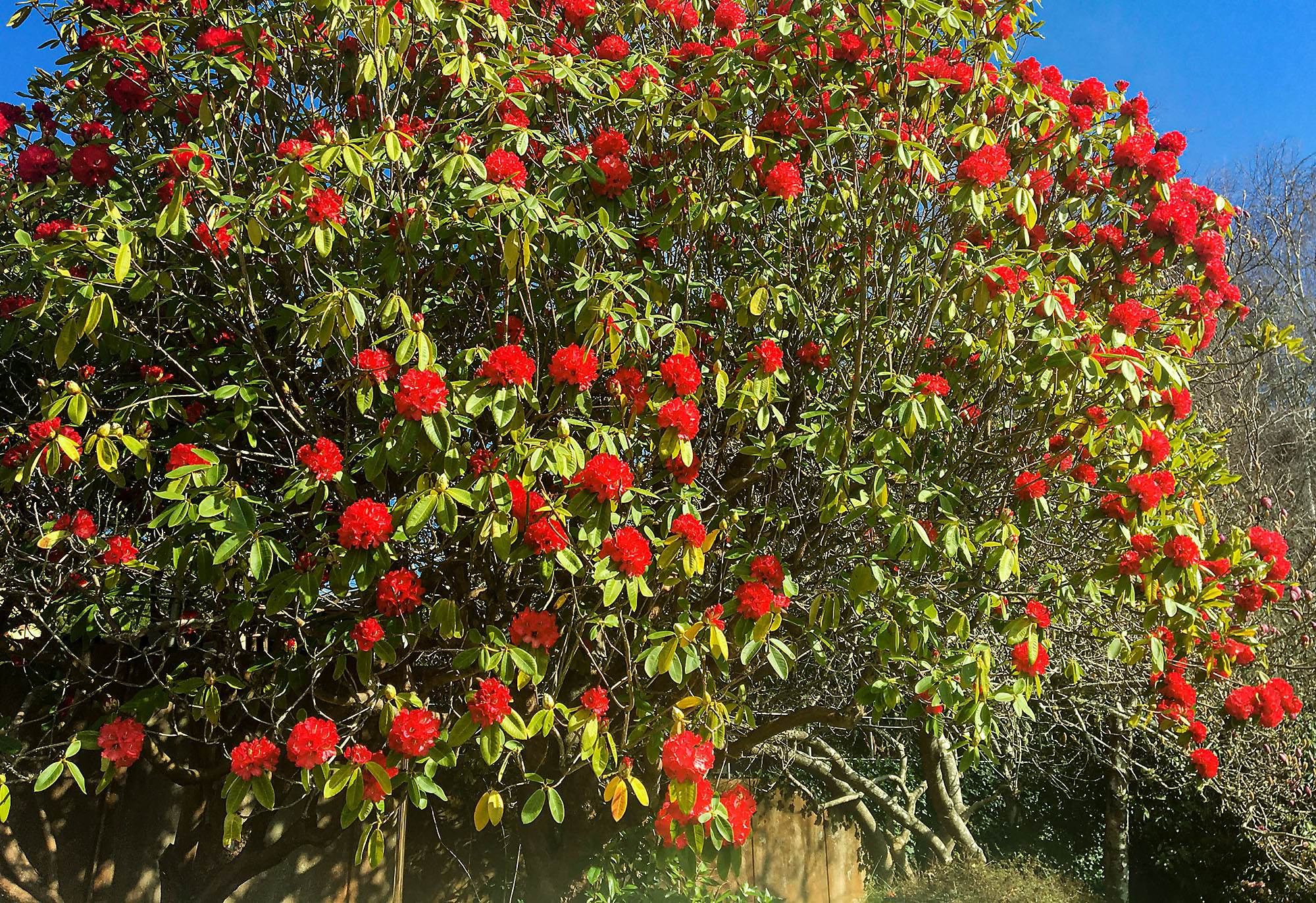
One of the most noticeable flowers on the beautiful CPH campus is the Rhododendron. The scientific name of this particular species is Rhododendron delavayi. According to the American Rhododendron society, the plants are native to India, Burma, China, Thailand, and other regions of Eastern Asia. This species of tree is identifiable by its bright red blossoms and elliptical-shaped leaves.
Dense indumentum, or hairlike structures, cover the underside of the plant’s leaves. These help the plant to absorb water and discourage predation by insects.
Photo by Nina Hufman. Bright red Rhododendron blossoms on the tree between the theatre and art buildings on Feb. 15, 2022.
Rhododendrons are members of the Ericaceae, an expansive family which also encompasses cranberries, blueberries, and huckleberries.
Despite the inclusion of these common edible fruits, many other members of this family are known to contain toxic compounds. According to the study ‘Phytochemicals and Biological Activities of Poisonous Genera of Ericaceae in China,’ “the toxic ingredients in the poisonous genera are mainly tetracyclic diterpenes, which exhibit toxic effects on the digestive, cardiovascular and nervous systems.”
The study also states that these poisonous plants’ traditional use in Chinese medicine makes them a good candidate for further scientific study.
According to the National Capital Poison Center, honey produced by bees from rhododendron nectar can concentrate the various toxic chemicals. The effects of poisoning by this method include disorientation, mouth irritation, nausea, and vomiting, leading to it’s colloquial name, “Mad Honey.”
Rhododendron trees can be seen in multiple places on the Cal Poly Humboldt campus including the area between the theater and art buildings, where the above photos were taken. They are considered early bloomers, usually producing flowers from late February to May. Go out while they’re still blooming and enjoy the beautiful, bright red rhododendron.
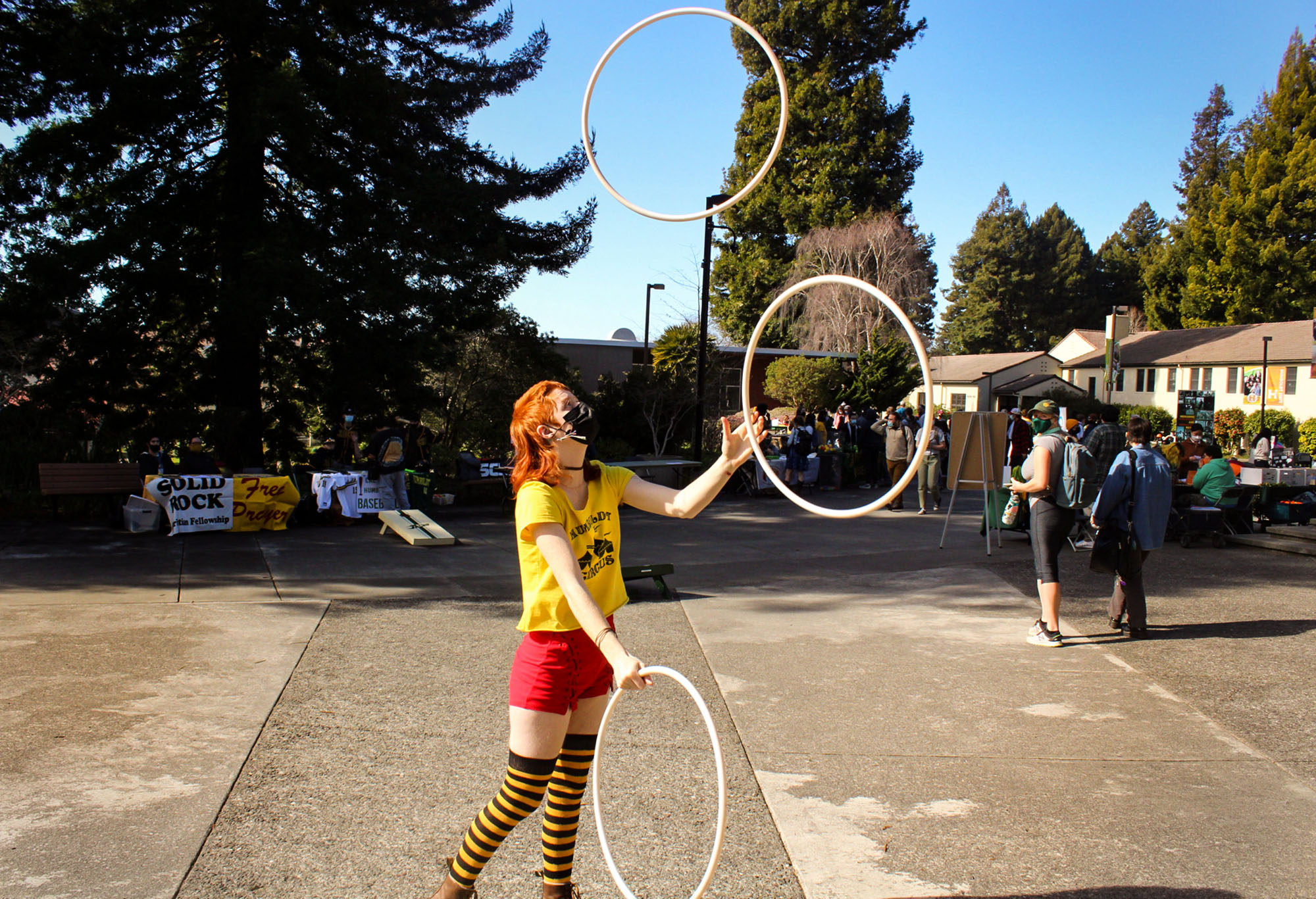
As his staff flew around his body. It became an extension of himself, twirling over the pavement. Man and tool became one through dance. Liam Boyd, a transfer student, and part-time circus performer ran up to the booth with a clown nose and a staff in hand. He had no idea Humboldt had a circus club and was overjoyed to meet everyone. Boyd started to perform with his staff and soon was joined by others, slowly growing into a full-grown performance.
The Humboldt Circus is one of many student-led Cal Poly Humboldt clubs. These clubs give students a safe place to meet like-minded individuals and learn new skills.
Photo by Gabriel Zucker | Louis Parr and Isla Marten sit behind the Circus Club banner, calling people over to check them out. Feb. 11.
On Wednesday, Feb. 10, student clubs set up booths around the Quad. This gave new students a chance to learn about and join these clubs, opening the door for new friendships and experiences.
Louis Parr, President of Humboldt Circus, brought a box full of circus props to their booth. Immediately the traffic in front of the booth increased.
“Circus is a magical place, full of fun and free creativity,” Parr said. “You are allowed to do whatever you want to, within the circus.”
Every week Circus hosts “Play Time” Monday from 5-8 pm at the West Gym. There they give students a chance to let their inner freak out in an artistically unique way. In this space, students are given complete freedom to explore and experiment to their heart’s content, trying new things every time, or perfecting one act over the course of the year.
Isla Merten, a longtime member of Humboldt Circus, walked around the Club Fair. They juggled everything from bowling pins to thin disks. Soon they were joined by more and more interested students, all signing up for the club and trying out some of the cool props. By the end of the club fair, multiple students had stopped what they were doing and taken a couple of minutes to try out different props and write down their emails.
Photo by Gabriel Zucker | Louis Parr, President of Circus Club, does bike tricks around the quad, during the Club Fair on Feb. 11.
Humboldt Circus gives its members endless possibilities for what they can perform and act out. Character acting and improv also have a place in Humboldt Circus. Props are used for tricks, laughs, and skits, adding a new layer to the performance. This year Merten moved away from the props and instead focused on improv and clowning.
“A clown means being creative and open to work with what you are given,” Merten said. “The spirit of play and creation.”
Embodying the clown, they act out scenes by themselves and with others. Merten uses improv to expand and perfect their character. Humboldt Circus, like all the other student clubs, gives a social place for students to bond with one another. When asked about who usually joins the club, Merten didn’t miss a beat.
“It’s a club for introverted weirdos,” Merten said with a laugh. “We have extroverted weirdos too.”
Associated Students do not stand nor condone any kind of disrespect. We value everyone’s thoughts, opinions, and presence within AS.
We are aware of an unsettling situation that occurred during our Executive cabinet meeting on Feb. 4 concerning members of the Associated Students and members of AS Core Programs at Cal Poly Humboldt.
During the meeting, President Jeremiah Finley was uncooperative with fellow board members and had cut the meeting short. During this meeting, the WRRAP’s R.O.S.E branch team was expecting a response from the board, but would not move forward due to solely wanting in-person attendance.
In addition to this, President Finley neglected his team by failing to acknowledge the presence of appointed members who joined through Zoom, assuming that, “they only joined through Zoom simply because they didn’t want to be in attendance in person,” though this was not the case.
First and foremost, we, the Associated Students do not accept or tolerate the sort of behavior that was presented on that evening. We understand the concern, the anger, and the feelings of disrespect. You are heard and your feelings matter.
Next, we find it critical, to be honest with our student body and with each other. Unfortunately, there has been an unhealthy power dynamic within AS. There have been many issues regarding communication, equality, and access to opportunities. These are issues AS members have been dealing with but have managed to persevere through while keeping our student body and AS Core Programs at the top of their priority list. We are actively working towards community building and furthering our relationships with our staff and student leaders.
Due to the continuous amounts of disrespect and unacceptable behavior, AS will be moving forward with the impeachment process.
Associated Students stands for the purpose to educate, empower, and most importantly elevate all student voices.
Photo by Morgan Hancock | Gracie Kasberger finishing the 400M Log Relay on Feb. 12 at the Cal Poly Humboldt Redwood Bowl.
Athletes live in a culture of perfection and pressure that can lead to high stress, these Cal Poly Humboldt students want to address that. Gracie Kasberger founded this campus’ branch of Dam Worth It. Dam Worth It is a nonprofit that supports athletes struggling with mental health. Athletes’ mental health has become a bigger conversation since the recent double feature Olympics. High-profile athletes are setting precedents by putting their mental health first. Students like Kasberger are laying the groundwork for a new culture in athletics.
Kasberger is a kinesiology major and track athlete, she saw a need to support her peers. The athletics department doesn’t have any counseling services for athletes, so students are on their own. They balance classes, practice, work, and self-care. Kasberger expressed that students will often put their mental health on the back burner.
“I’ve noticed more pro athletes coming out about their mental health and saying that they are struggling,” Kasberger said. “It’s something that is being normalized. Athletes go in and get help when they’re injured, but they’re not doing the same for their mental health. We’re bringing attention to it, we want athletes to have access to help and feel like they can speak out.”
Photo by Morgan Hancock | Travis Allen in the 60M hurdles on Feb. 12
Travis Allen is a track athlete who opened his season at the Green and Gold event last weekend. Allen expressed how sports can offer a mental haven for athletes, but with it also comes added stress.
“Mental Health is often overlooked, especially with athletes,” Allen said. “Teammates are like a family, there is a lot of support from each other.”
Each athlete filled out a card with the reason why they are ‘dam worth it’.
“I’m ‘dam worth it’ because I am me,” Allen said.
Sue Grigsby, Lumberjack class of ‘79 track hall of famer and record shatterer, attended the legacy event. Grigsby has seen the pressures change for students over the years. Students have increased pressures from athletics and an unstable world.
“If you have a vision problem or dental problem or a knee injury you seek help,” said Grigsby. “Athletes should do the same for their brains. It’s okay to seek help, there are ways to get help.”
Student-Athletes often define themselves by their sport. They use athletic success as a measure of their worth. Clara Lenihan struggled to define herself outside of her sport once she ended her soccer career.
“When I introduce myself I start with ‘oh I play soccer,” Lenihan said. “Now that I don’t play anymore I don’t know what to say. Sports is such a big part of our lives.”
Photo by Morgan Hancock | Track Athletes Kaela Dennert-Frederick, Emily Bath, Joy Hano, Grace Kasberger pose for a photo at the Green and Gold Event Feb. 12 Photo by Morgan Hancock | Track Athletes Kaela Dennert-Frederick, Emily Bath, Joy Hano, Grace Kasberger pose for a photo at the Green and Gold Event Feb. 12
Prior to the AS meeting last Friday at Siemens Hall, President Finley received a letter by the collective student body calling for his resignation that evening. If he failed to do so, actions would be taken towards impeachment. This letter was written in part due to his actions at the previous AS Meeting on Feb. 5th, which can be read about here.
“I have come to understand that recently there are many that felt disrespected,” Finley said, in response to the letter during the meeting. “Reduced to only a vote to count as opposed to the valued team member they are throughout the year by my unintentional behavior.”
The president continued in offering apologies to any members he may have unintentionally hurt over the past months. He pleaded with the student body to talk personally with him and to allow him to end his final semester, both as a student and president, without burnt bridges. He explained that the extra weight of responsibility expected of him as a Black leader in a predominantly white university may have also gotten the better of him.
“I cannot leave till I have had a chance to put in order what is out of place for those that are hurt and be your champion once again,” Finley said, ending his speech and thus refusing to resign.
No members present at the time had further comment. Conflict between Board members and the president continued later on in the meeting, however, as Finley attempted to appoint a new student for Legislative Vice President.
“First, I want to apologize to you,” At-Large Representative Gio Guerrero said, to the new candidate. “Our Associated Students are in a really big hurdle at the moment, internally. I don’t feel confident that we can support an additional new member on this Board until we get through [this] storm.”
All other Board members, excluding Finley, concurred with this sentiment. Members expressed that they did want the candidate to be appointed but only once internal conflicts had been figured out. Finley accused the Board of allowing personal opinions of him to cloud their decision. All members present disagreed and appointed Student Affairs Vice President Marcum and Guerrero to keep in contact with the candidate. Plans to properly vote in this appointee are scheduled to happen at the next AS meeting.
The next AS meeting will be held on Friday, Feb. 18, at 4 pm in Siemens Hall 117.
Cal Poly Humboldt is struggling to find a new police chief in the wake of yet another resignation
For the last two years, Cal Poly Humboldt’s University Police Department has been plagued with resignations at the very top of their hierarchy. Anthony Morgan, the most recent chief, resigned early in Jan. 2022 after a year in the position.
UPD is still in the early stages of searching for a new chief.
“Cal Poly Humboldt has not yet made the public announcement for accepting applications,” said Grant Scott-Goforth, a communication specialist in the CPH’s News and Info department.
The search for UPD’s next leader will be nationwide. Representatives from different university sources will be involved in the decision, including students, faculty, and university police department staff.
“The University aims for a July 1, or sooner, start of the new permanent chief,” said Scott.
Morgan was only the latest chief of the campus police to resign. Cal Poly Humboldt’s current acting chief of police is Peter Cress, a 25-year police veteran. He started his career at what was then Humboldt State before moving to Sacramento, and eventually returning to UPD in 2021. Cress stated he will likely apply to become the permanent chief of police.
Even if the position is filled, the UPD has barely enough officers to be fully staffed. With a more critical eye on police nationwide, the UPD is struggling to maintain leadership and swear in new officers.
“A lot of people have just said no, they are not interested in living under that kind of criticism,” said Cress.
For students interested in giving their input for the hiring process or for UPD, the police conduct bi-weekly phone calls with students. The university directory also provides all officers’ contact information, and the general UPD contact number is 825-55-55.
Dr. Christopher Aberson came into contact with COVID-19 the weekend before he was supposed to teach. He requested the school let him teach over zoom and his request was denied. The school would not let him switch his modality despite the Omicron surge and the numerous COVID-19 cases reported on campus.
“I was told I was not authorized to change modality. After several emails, clarification came that I could not move online. I have symptoms. I am well enough to teach. Not allowed to,” said Dr. Aberson.
Dr. Aberson is the Professor of Psychology at Cal Poly Humboldt and came into contact with the virus after one of his son’s friends tested positive. He claims that this issue is larger than his individual case.
“My issue with the surge has and continues to be that faculty who agreed to teach in person are not being allowed to change to online. Faculty agreed to teach in person at times when it seemed we had gotten over the hump and were headed toward a better situation,” said Dr. Aberson in an email, he continued. “In both the fall and spring semesters, as I understand it, most requests to change to online were denied. Both semesters began during surges.”
Dr. Aberson has been outspoken about a number of issues on campus and believes that could be playing into why he wasn’t allowed to teach online.
“I have been outspoken about under-compensation of chair duties — it is a full-time job but during the summer and other off times, we are grossly under-compensated for our time. Also, campus safety and working conditions during both the delta and omicron surges,” said Dr. Aberson.
The California Faculty Association (CFA) negotiated a Memorandum of Understanding (MOU) with campus administration regarding teaching during COVID-19. The document was signed by CFA and Cal Poly Humboldt management. Dr. Aberson presented a passage from the MOU that explicitly supports his position.
“During the time that an employee may be waiting for an appointment or for testing results every effort should be made for them to be able to work remotely,” states the MOU.
Prior to Dr. Aberson’s situation, the CFA had already made an official statement addressing the administration and their lack of leniency.
“No faculty member should be forced to work in conditions that put themselves or their loved ones at risk, especially when there are alternatives,” states a press release provided by the CFA.
CFA Humboldt president Loren Cannon still supports this idea and thinks the administration needs to be more flexible in situations like Dr. Aberson’s.
“We have urged that Administration approve all such requests for temporary, or sometimes permanent change in modality,” said Cannon.
Cannon acknowledges that for some cases transitioning to online can be difficult, however for many other classes transitioning online for a week or two is relatively easy.
“I believe that at this time, as we still are not ‘in the clear’ of this incredible health crisis, we need to trust each other and make decisions that recognize the complexity of individual context,” said Cannon.
Leadership has yet to make an official statement regarding the MOU breach and has also failed to respond to our request for an interview.
Claps and cheers echoed through Founders Hall 118 during the Umoja Center’s Black Excellence in STEM event, probably far more than had graced the room in quite a while. Many HSU community members filled out the seats, just as their enthusiasm and passion filled the room.
Dr. Kim White, Cal Poly Humboldt professor of chemistry, hosted the event at the request of Umoja Center for Pan African Academic Excellence.
After an indigenous land acknowledgement, she began by paying homage to several Black scientists under whom she studied. One of these was Dr. Loyd Noel Ferguson, the first Black person to earn a PhD in chemistry from UC Berkeley.
“He was the original backyard chemist, he synthesized moth repellent and stain removers in his backyard in Oakland when he was growing up,” White said. “He also used his academic talent not only to propel his own career but also to create opportunities for others.”
She also spoke fondly about Dr. Phillip Crews, a UC Santa Cruz professor of chemistry known for his involvement in diversity programs.
“Phil instilled in me a strong desire to use my privilege for the benefit of others… seeing him use his strengths to lift up others was pretty fundamental in the trajectory of my career,” White said.
Dr. Chris Harmon, another member of Cal Poly Humboldt’s chemistry department, spoke next. He spoke on the importance of acknowledging and celebrating the growing diversity within science.
“It matters where you come from, it matters what language you grew up speaking, and absolutely the color of your skin matters, Harmon said. “When I got into chemistry, one of the things that I loved was all of these rich, beautiful colors that you would see in the lab… if we celebrate the colors of the chemicals why can’t we celebrate the colors of the chemists?”
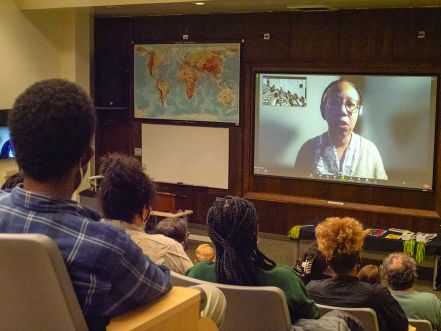
Photo by Morgan Hancock | Dr. Kensha Clark speaks to students of her work in chemistry via Zoom at Founders Hall on Feb 11
Harmon introduced Dr. Kensha Clark, a highly celebrated and accomplished Black chemist currently teaching at the University of Memphis.
After brief technical problems, she appeared on the projector screen, Zooming in to the event.
Clark discussed her work, both as a private sector chemist with Chevron and as an academic. Her current fields of interest include molecular electronics, solar energy conversion, and small molecule activation, among others.
In her lab, she makes sure that students of all backgrounds feel welcome.
“I think [our diversity] makes our science all the better,” Clark said.
When she was a student, however, Clark felt that her interest in science was quashed. She described only being encouraged to become a writer or an artist, all the while never wavering from her passion for science.
Even though strong familial support allowed her to achieve her dream, Clark is still faced with a shocking lack of diversity in her field.
“By default, you are the representative of your people,” Clark said. “It makes it exciting when one sees up-and-coming scientists of color.”
Photo by Morgan Hancock | Asia Anderson explains her research into membrane protein isolation on Feb 11.
Cal Poly Humboldt student Asia Anderson took the stage after Clark, to a joyous round of applause from the audience. A transfer student from College of the Redwoods, Anderson is obviously beloved to the campus community.
She spoke about the community and support that she has found while studying chemistry at Cal Poly Humboldt, and how her mother’s going back to school to study English inspired her.
“I feel like every step of the way I’ve had this ushering of peers around me… I will also be the first person in my family to graduate from college,” Anderson said.
Anderson’s research during her undergraduate degree at Cal Poly Humboldt has been in the targeted extraction of membrane proteins. She said that the proteins’ sensitivity to light means that further study could illuminate ways to use these proteins for targeted medication delivery.
After graduation, Anderson will study to receive a graduate degree at UC Santa Cruz.
The Umoja center hosted this event in collaboration with NSBE, the National Society of Black Engineers. Demi Ogunwo is a masters student in Cal Poly Humboldt’s Energy Technology and Policy Program, and spoke at the event as the president of the school’s NSBE chapter.
“NSBE offers a platform for students to network and get mentored by … Black professionals,” Ogunwo said. “It’s not for engineers alone, it’s for all STEM students.”
NSBE is a community focused on supporting Black scientists, whether academically or professionally. They will be hosting a social hangout for students potentially interested in joining this Friday Feb. 18, from 1 pm to 3 pm in the University Upper Quad.
CCAT courses are back this spring. One of the classes on the roster this semester is Organic Gardening. In this one-unit course, students will learn the basics of gardening. Students grow their plots in the campus community garden using sustainable techniques.
Since the pandemic disrupted CCAT operations, the course has not been offered. Now, the course has returned, and students have a lot of work ahead of them. Ben Cross is a political science major who’s more than excited to be back in the Buckhouse.
“I’ve got lots of passion for this, and it’s an amazing area to learn it,” Cross said. “If there is a place I’d want to take this class, it’s at Humboldt. I want to have my garden and tend to it with confidence.”
Julia Simmons is the student instructor of ENST 123.
“We’re teaching the basics of what goes into gardening,” Simmons said. “I want to focus on how plants affect each other. Some plants have nitrogen-fixing properties and support other plants in the soil. I want to teach students to cultivate ecology and grow food forests.”
Food forests are a farming technique that mimics the natural patterns found in ecosystems. Growing plants interact with each other in a network of reciprocal relationships. The result is healthy biodiversity, nutrient-rich soils, and a sustainable food source.
Agroecologic farming methods have the potential to localize food systems and make them more efficient. A 2018 study titled “Permaculture—Scientific Evidence of Principles for the Agroecological Design of Farming Systems” by the EU Institute for Environmental Science establishes environmental damages caused by industrial agriculture. Monoculture causes biodiversity loss, soil degradation, and alteration of biogeochemical cycles and greenhouse gas emissions. The study cited food forests to remedy the damage done by monoculture.
Monoculture is the standard agricultural practice in the United States. Crops are planted in rows, where they can be most efficiently harvested by machine. Though it is convenient for machinery, this practice does not benefit plants or local ecologies. Without ecological support and context, isolated crops require fertilizers and pesticides to grow.
Plants can fend off pests and fertilize each other in food forests. One example Simmons describes is the three sisters. This pairing of beans, squash and corn, comes from traditional ecologic knowledge.
“They grow really well together, and they use each other to grow well,” Simmons said. “The beans provide nitrogen for the other plants to grow. Ground cover [from the squash leaves] keeps weeds from growing.” The tallest sister, corn, acts as a trellis for the beans to climb up. Growing together, they protect each other and help one another flourish.
“We’re going to be working in the community garden. We’ll design food forests with their own ecologic networks,” Simmons said. “I want anybody to be able to garden, and everyone should garden.”
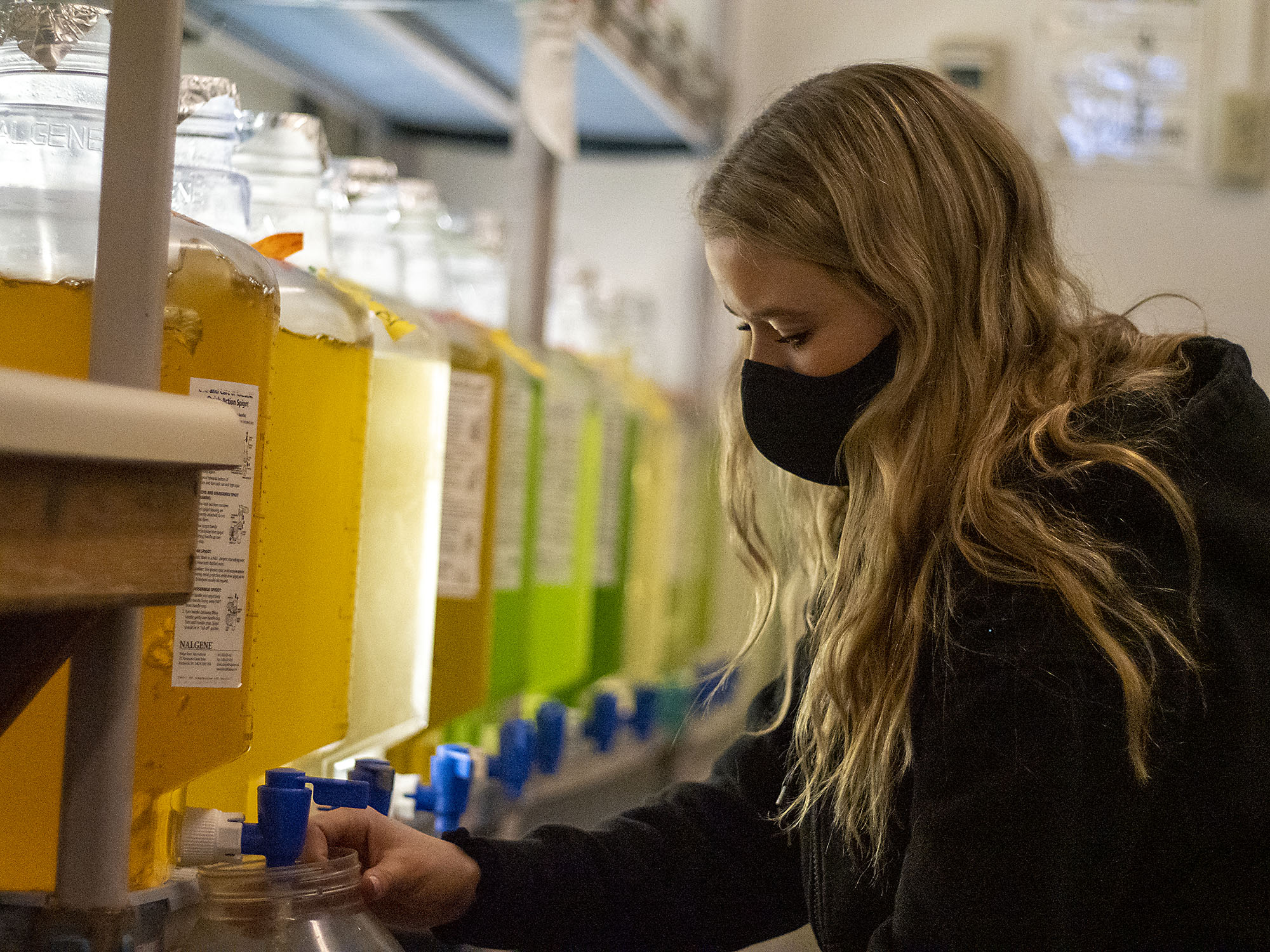
At Cal Poly Humboldt’s marine lab, graduate students run between the workspaces and laboratories, students stir beakers of brine shrimp instead of cups of coffee, and Percy the giant pacific octopus (Enteroctopus dofleini) tugs on the fingers of the lab tech feeding him.
Photo by Morgan Hancock | Percy the giant Pacific octopus (Enteroctopus dofleini)
Percy’s isn’t the only interesting face one can see at the lab. Other notable critters include Gaia the red octopus (Octopus rubescens), Eleanor the Wolf Eel (Anarrhichthys ocellatus), and Butters the Albino Dungeness Crab (Cancer magister). Sea stars, baby jellyfish, sea urchins, clingfish, nudibranch, sea cucumbers, and anemones are among the lab’s other aquatic residents. There are also rockfish older than most of the people working at the lab.
“There’s so much potential at this place for doing even more than we are now,” said Lab Director Rick Zechman.
Although it’s currently closed to the public due to COVID-19, the students and staff of the Telonicher Marine Lab are offering guided virtual tours and virtual educational programs. Cal Poly Humboldt students also have the option to visit and explore the lab in person.
If they want more experience than a visit will offer, students can sign up for courses in oceanography, fisheries biology, and marine biology, which all include instruction at the marine lab.
Marine naturalist Jordyn Neal is in charge of tours.
“Most of my job is public outreach,” Neal said. “I try to inform the public on the fish here, and conservation.”
Neal gives guided tours of the lab and is in charge of the summer school program. She says that one of her main goals is to bridge the gap of scientific literacy.
Neal is a fifth year marine biology major who is currently doing shark research outside of her degree. She takes CT scans of shark species living at different depths in the water column and looks at the morphology of their ears. Neal’s focus is on how the depth of the water in which a species lives impacts the structure of its ears.
Photo by Morgan Hancock | Eleanor the Wolf Eel (Anarrhichthys ocellatus)
The marine lab also hosts a number of grad students doing research projects, including Rose Harman. Harman is currently working on her master’s thesis and grant applications to fund her research. This summer, Harman will be studying habitat usage and predation of leopard sharks in Humboldt Bay.
“Our new plan is to do field work combined with lab experiments,” Harman said. “One of my goals is to publish my research.”
Graduate students Marzia Fattori and Kalani Ortiz are doing their research on growing bull kelp in Humboldt Bay. Ortiz’s project is focused on kelp as an agricultural product. She is currently growing the seaweed on string, and will be outplanting it to kelp farms in the bay until it reaches a harvestable size.
Fattori’s project is focused on conservation. She is growing bull kelp on gravel and on ceramic tiles to see which substrate is more effective. In the second stage of her research, Fattori will grow the bull kelp in warmer water to examine the impact that rising ocean temperatures will have on kelp populations.
The marine lab has two classrooms, a running seawater system, and access to the Coral Sea, a 90ft research vessel. Lab director Zechman says the lab is situated on an important part of the Pacific coastline, where students can expect a learning experience that is unique to Cal Poly Humboldt.
“Our intention is to be a different kind of polytechnic,” Zechman said. “How many CSUs have a marine lab and a research vessel?”
Cal Poly Humboldt hosted the annual Green and Gold track meet at the Redwood Bowl on Feb. 12. In the past, the Green and Gold has been an invitational meet open to alumni as well as all local athletes, but due to precautionary measures and local COVID-19 restrictions, only collegiate entries were permitted.
The event kicked off with the national anthem, and the Cal Poly Humboldt track and field athletes all joined at center field for an ecstatic cheer. It was a beautiful, sunny day with nothing but blue skies, perfect weather to run in.
Head track and field coach Sarah Ingram says a huge amount of effort went into preparing the Jacks for this event.
“We’ve been training since August… both on the track and in the weight room,” Ingram said. “It was a really fun atmosphere. The 400-meter log relay is not something we usually have, but it was a team bonding event.”
Women’s team captain Joy Hano is also proud of her team’s strategy for game day.
“We spent a lot of time visualizing and training. Mindful training is what we did the most,” Hano said. “I do the 100-meter hurdles, long jump, and today I did the 150 meter and the log relay. It felt great. There were a lot of nerves, but being here in front of our home crowd made it all worth it and made the nerves go away.”
College of the Redwoods coach Reed Elmore shared what it was like to see his former athletes compete at last weekend’s scrimmage.
“[As a coach], you don’t always get the best athletes. Our main goal is to get our athletes to work together as a team. We want them to compete with each other and not against each other,” Elmore said. “It’s exciting! We’re a developmental program. We take kids that need love and a little extra time. Humboldt does something different. We’ve been working with Sarah and Jamie to bridge that gap. [We make] sure everyone feels supported. We had a good performance, but our important races are at the end of the season.”
Junior thrower Savannah Henninger wrote down all the marks for the throwing events. She is one of those athletes who transitioned from a Corsair to a Lumberjack.
“It was definitely super weird. It’s not necessarily better or worse,” Henninger said. “It was a different atmosphere. Both Sarah and Reed are amazing advocates for their athletes, so that really helped a lot. I saw a lot of team support. Everybody was cheering their teammates on as best as they were able to, there was a lot of camaraderie going around.”
In the latter half of the scrimmage, many athletes participated in the 400-meter annual log relay. As the last athlete rounded the corner, a member of the crowd shouted out, “Better start running with a purpose!”
You sleep too much or too little and neglect your personal hygiene. You’re a ticking time bomb that can’t be defused. You oscillate between extremes like a pendulum. Your own thoughts wage war against you and, in some circumstances, the people around you.
Being mentally ill is a constant struggle, and that is only the surface of it.
In my case, I have undiagnosed traits of borderline personality disorder (BPD), specifically a subset of the disorder called quiet BPD, as well as comorbid anxiety and depression.
To be clear, I am not diagnosed due to being assigned female at birth (AFAB) in a rural county, one with a disproportionately high rate of Adverse Childhood Experiences (ACEs) and inaccessible or understaffed mental healthcare facilities.
Seeking and getting a diagnosis from a psychiatrist is also protracted and difficult, especially during the ongoing COVID-19 pandemic.
It must also be said that being branded borderline in our society is not ideal, especially as someone who was is perceived as female. There is a lot of stigma around the four Cluster B personality disorders: narcissistic, borderline, histrionic and antisocial personality disorder.
I stigmatized narcissism in particular, before I became self-aware and realized that narcissism is merely the inverse of codependency. Both stem from traumatic formative experiences with maladaptive object constancy and abandonment, but they manifest differently. For me, narcissism was a mirror into my own dark traits that I wasn’t able or willing to peer into.
Most borderlines are stuck in an incredibly alienating and painful catch-22. The people who understand us aren’t necessarily healthy for us, and the people who don’t understand us are usually stabilizing for us. Couple that with the chronic emptiness that borderlines endure daily and you quickly rack up a series of short, toxic relationships that end in violent staccato.
The Western culture of individualism makes things worse for mentally ill people. In our society, we have a tendency to overlook our ability to affect other peoples’ lives. We also have the tendency to sell ourselves short. We would rather shrink than dare to take up space. The latter is contingent upon us being vulnerable, which includes the risk of failure.
Because my judgment is skewed by my mental illness, I make a lot of mistakes. I assume the worst of people who don’t deserve it. I misread peoples’ intentions before giving them the benefit of the doubt, or idealize people who haven’t yet earned my trust or respect. These behaviors open me up to exploitation and abuse. I can also be abrasive, intense and even callous, but that doesn’t mean that I don’t have compassion or remorse.
If anything, I feel too much, more strongly and longer than the average person does. I constantly emotionally regulate myself, to grapple with my volatile moods and intense emotions. Most of these emotions go inward towards myself rather than radiate outward.
Believe it or not, my mental illness makes me a better leader. Because I am mentally ill, I have put myself in situations where I needed to be held accountable for the sake of myself and people around me.
I couldn’t play the victim. I had to own up to my behavior, even though it stemmed from something out of my control. At the end of the day, I am fully responsible for my choices and the consequences.
Owning up to your dark side every time it creeps up and wreaks havoc enables you to build healthy, strong relationships. Relationships are hard work.
Good leaders have good relationships. Good relationships are contingent on accountability, boundaries, trust and clear communication.
The first step of realizing your ability to lead others and trying it is hard no matter what, but mentally ill people just have more barriers to overcome.
I have had to learn how to use the dark side of my mental illness to harness my light and use it to influence others around me. The skills that I’ve developed to cope with my borderline traits, anxiety and depression allow me a self-insight which is extremely useful.
Every day, we have the choice to be a positive or negative influence in the lives of people we know. Try to go against the grain of your darkest tendencies of your humanity and use your light as a guide.
These past few years have created this heavy and strange feeling that has found itself settling on my chest. It’s a constant feeling of disconnect—a disconnect from my peers, professors, friends, and even family. I’m staring at a black screen or the muted faces of people I should know, but it feels like I’m watching a TV show.
I was 21 when COVID-19 hit, and now I’m 24. I’ve already lost most of my early 20s, and I don’t know when I’m ever going to get it back. A lot of people are telling me, “well, you could have gone out and partied with your friends or traveled” as if COVID-19 doesn’t exist or like I’m not terrified of getting sick. I was supposed to be a graduate and living in another state working a dream job, but here I am, sitting in my room in my hometown, waiting for my next class to start while getting ready for work. I’m not unhappy with where my life is, but I’m not exactly delighted with everything. I love my jobs, my coworkers, and the fact that I’m living with my childhood best friend, but some part of me is mourning the loss of what could have been, just like many people.
I miss having exciting conversations with my peers and being excited about my classes. The disconnect and lack of inspiration are like a smack to the face when I sit down to log onto Zoom for my lecture. I’ve become one of those black screens that remains muted, and I hate it. Even writing has become a struggle for me. I’m a storyteller, but all I have is nothing when I sit down to write. There’s no ‘aha’ moment of what story needs to be told or list of potential events to look to reporting on.
I know I’m not alone in this feeling because I see it everywhere. Other college students are no longer being inspired by their studies. I just wish I had some great advice on mediating a solution, but I don’t. It’s a dreadful feeling, and I feel a particular type of guilt for not having a remedy.
Humboldt State University no longer exists. On Jan. 26 at the hour of high noon, the California State University’s (CSU) Board of Trustees voted in unanimous agreement to allow HSU to become the state’s third official polytechnic university. Instantly, students all across campus within mere minutes after the vote could find that every website, social media, and program owned by HSU had changed their titles to Cal Poly University Humboldt.
However, the name change is far from the only changes to come for Cal Poly Humboldt. Aside from furthering the school’s expansion into more hands-on learning approaches, the university also hopes to strengthen and add a plethora more to its collection of STEM majors including cannabis studies, applied fire science & management, data science, energy systems engineering, engineering & community practice, geospatial information science & technology, mechanical engineering, and software engineering.
According to Provost Jen Capps, a substantial amount of funding towards this transition will also go to new student housing developments on campus, more diverse staff employment, and increasing tribal membership from the 13 local surrounding tribes. By 2029, they hope to at least double the current average enrollment rate.
There’s no doubt that the change will spark a new era of existence for what was once Humboldt State University, though in the opinion of many students this development feels like nothing more than a simple name change.
“It’s just a name I guess, it’s the same school,” said Brandon Patino, a major in environmental science & management, while playing pool with his friend in the Students Activity Center. His friend agreed and expressed honestly his own lack of knowledge regarding the whole change.
“Honestly, I’m graduating this semester,” said Nataly Cruz, a major in zoology, explaining that the change will barely affect her. “Not sure if this is true but we’ll be graduating as Cal Poly [alumni].”
Her friend, on the other hand, expressed a level of excitement regarding the university’s official change to a polytechnic.
“I think the name gives it a type of prestige and I like that,” said Kamaya Killebrew, a major in cellular molecular biology. “I hope they hold true to the name.”
Killebrew further explained that she hopes the school continues its hands-on approach to teaching as it was one of the key traits that drew her to enrolling to begin with. While speaking with her friend, she said that the two should obtain HSU labelled merchandise before it’s all gone.
As should be expected, not everyone was as happy about this announcement. Over the past months, arts and humanities majors have been particularly anxious about this change as traditionally polytechnics largely focus on STEM majors. Many believe that this change could lead to even less budget and enrollment rates being allocated to these departments.
Other anxieties such as tuition prices and alumni diploma validation have also sprung up, especially on Cal Poly Humboldt’s Instagram announcement post.
“Can y’all keep tuition the same until I graduate please and thanks” commemted Anna Caro, a major in marine biology.
While California polytechnics on average do run slightly lower than the average CSU university, it is hard to tell whether this change is general will cause prices to stay the same or rise over the coming years.
In another comment, Jenny Martinez Cortes, an alumni in Spanish language studies and communications, asked whether or not their diploma under the name HSU would still be valid. The official Instagram stated, “Very. Arguably more than ever.”
This website uses cookies to improve your experience. We'll assume you're ok with this, but you can opt-out if you wish. Cookie settingsACCEPT
Privacy & Cookies Policy
Privacy Overview
This website uses cookies to improve your experience while you navigate through the website. Out of these cookies, the cookies that are categorized as necessary are stored on your browser as they are essential for the working of basic functionalities of the website. We also use third-party cookies that help us analyze and understand how you use this website. These cookies will be stored in your browser only with your consent. You also have the option to opt-out of these cookies. But opting out of some of these cookies may have an effect on your browsing experience.
Necessary cookies are absolutely essential for the website to function properly. This category only includes cookies that ensures basic functionalities and security features of the website. These cookies do not store any personal information.
Any cookies that may not be particularly necessary for the website to function and is used specifically to collect user personal data via analytics, ads, other embedded contents are termed as non-necessary cookies. It is mandatory to procure user consent prior to running these cookies on your website.