The Lumberjack


Students Serving The Cal Poly Humboldt Campus and Community Since 1929

Tag: Cal Poly University Humboldt

  • Cultural Connections Without Community

    Cultural Connections Without Community

    By Jasmin Shirazian

    A dish served to distinguished lecturer Maral Attallah of the department of critical race, gender and sexuality studies at a Palestinian restaurant in the Bay Area, and a conversation with the owner in Arabic, brought her to tears. When community is limited, sudden access to cultural connections, like a meal and communication, can be incredibly emotional. The constant feeling of isolation that is so abundant in Humboldt County is amplified for minority communities. 

    “My father passed away in June of 2024, so I don’t speak Arabic to people — I don’t hear Arabic, people don’t speak Arabic up here. It’s not a part of my daily life anymore, and that makes me really sad,” Attallah said. “[The owner] basically told me in Arabic, to enjoy your meal — and I lost it, because the last time I heard someone say that to me was my dad. My dad used to say it every time he’d bring me my meal.” 

    Students of color who choose Cal Poly Humboldt often leave behind communities more diverse and supportive than what can be found in Humboldt County. According to 2025 U.S. Census Data, out of 131,647 residents in Humboldt County, 82% were white, with the second largest demographic being Hispanic or Latino at 14.6%. As of now, there is no categorization available for those of North African or Middle Eastern descent to differentiate from or collect data on, which can make it even more difficult to connect and form communities. Though some minority groups are able to find a semblance of similarity to what may feel like home through established groups and organizations, for students with Middle Eastern, North African and West Asian ancestry, cultural connections can be much harder to find. 

    Attallah is of Armenian and Assyrian descent on her father’s side. She has made it her life’s work to tell the facts and stories of the victims of the Armenian Genocide, which includes her grandfather. Through her work, she connects with her heritage; she keeps her father and grandfather’s experiences alive, refusing to let their stories be told for them.

    Food in many cultures serves as a pillar of community; it can provide an opportunity to sit, relax and take time to connect with loved ones. For Attallah, language and food are key components of her connection to her roots. However, enjoying a West Asian, Middle Eastern or North African dish, like the Kafta bil Saniyeh that brought Attallah to tears, often means venturing outside of Humboldt County. Though there are a handful of establishments that serve Mediterranean foods and inspired dishes, the selection is limited. Attallah, when able, will leave Humboldt County specifically to get back in touch with diversity. 

    “Any opportunity I get to leave Humboldt, I do,” Attallah said. “I have to leave — I need the food, I need the language, I need to see people who look like me. Not even like me, but just different.” 

    The simple act of shared words over a dish can have unexpected impacts on minority communities that have limited access to their culture. When going out is not an option, learning to cook at home is something many diaspora, like fisheries biology major Neshwa Rabie, must  do to reconnect with their roots. Rabie, of Jordanian descent on her father’s side, lived in Jordan until she was six years old. Like Attallah, she finds that speaking Arabic, especially with her family, is what helps her feel most at home. 

    “I have my old pictures from Jordan that I have in my room,” Rabie said. “But, mostly, it’s just speaking to my family, because that gives me a chance to speak Arabic and that makes me feel really connected to my roots.”


    Rabie also stays connected with her roots through her pride of being Arab. The comfort and joy she has in her identity are undeniable aspects of her person. 

    “I like to think that every room I go into, I want people to know I’m Arab, I’m Jordanian,” Rabie said. “This is who I am. This is a very big part of my identity. This affects how I do everything, and everybody should know that that is who I am.”

    While food and language can serve as the connection for many, other students like Leyla Craven use art and art history to reconnect with their heritage. 

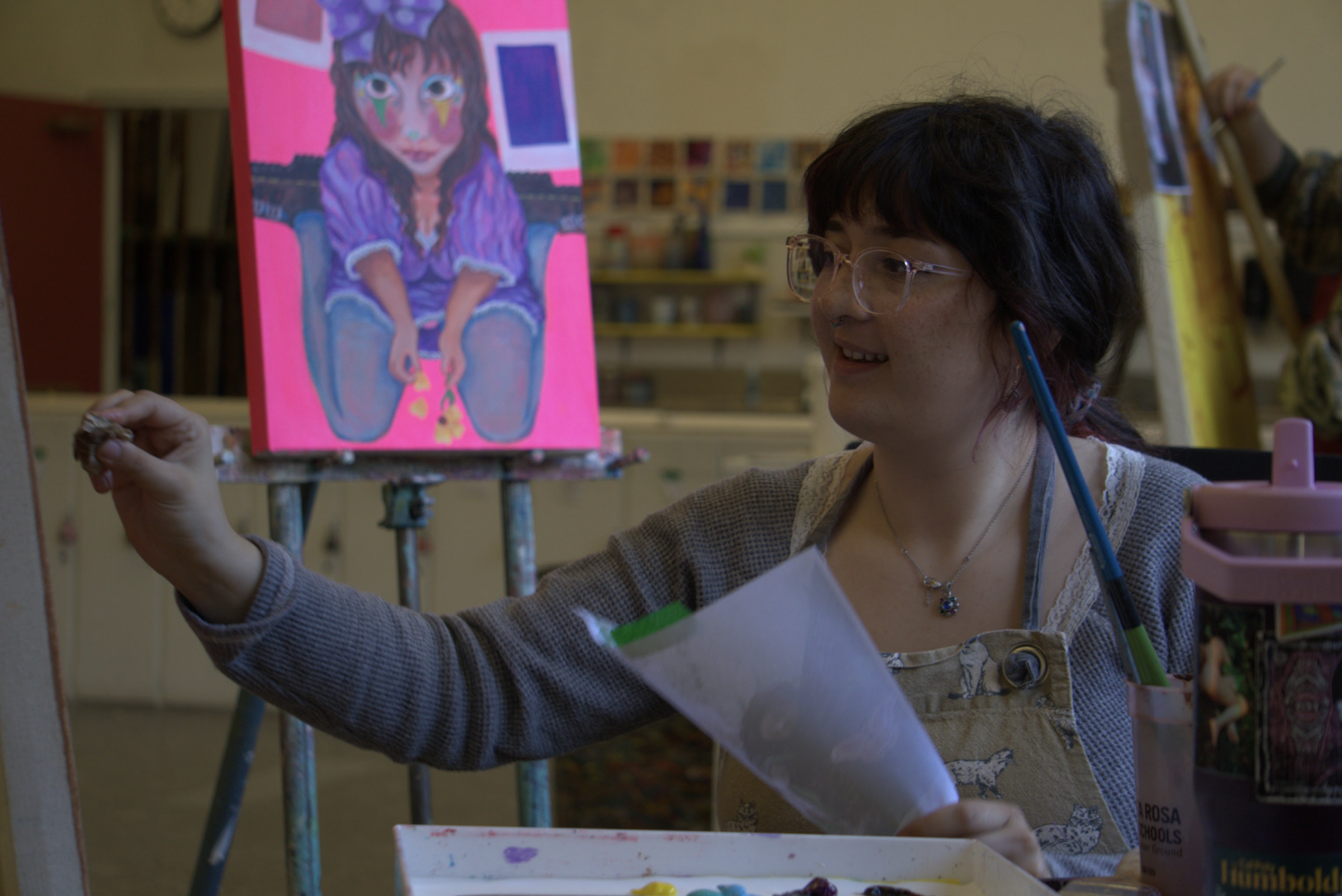
    Craven, a double major in art history and art education, is Iranian on her father’s side and has based her thesis on Iranian artist Shirin Neshat. Craven also incorporates traditional Iranian motifs into her art as a way to reclaim and reconnect with her heritage. One of her main reasons behind her art is her insistence that Iranian voices must be heard. She believes that through art, Iranian voices can be amplified to show the nuances that are often pushed aside due to distance, misinformation or propaganda. 

    “Obviously, especially here in Humboldt, but just in the whole Western world in general, there’s not a lot of Iranian representation,” Craven said. “So, we should make as much stuff and get our voices out there as much as possible, especially to avoid [being] turned into a monolith.” 

    For Craven, creating Iranian-inspired art also further connects her to other Iranian diaspora. The act of creation can feel like the connection that has been fractured from both civil wars and foreign intervention. For diaspora, it can be one of the few ways to form community. The disconnect felt being removed from a home that housed generations of a person’s family can be slightly remedied through the connection found within the diaspora. Through these connections, Middle Eastern, West Asian and North African diaspora are able to rebuild their community.

    “I think a lot of Iranian artists are about being a part of the diaspora, about being disconnected from their cultures and from their families,” Craven said. “We’re all connected internationally through the act of making art and communicating with each other as a way for us to sort of reclaim a sense of heritage or belonging. Because for so many of us, our families are so fractured and traumatized, it’s a way to find connection.”

    Jasmin Shirazian is the award-winning, curly-headed copy editor of The Lumberjack. Her beats range from breaking news to complaining about minor inconveniences. In her free time, she enjoys leaving the country and spending time with her cat. Inquiries can be sent to js760@humboldt.edu.
  • UPD BYTE

    Compiled by Ariana Wilson and Nico Patakidis

    Tuesday, April 7

    12:44 p.m. – Animal Call

    The reporting party stated that a large dog bit the reporting party’s coworker about 20 minutes prior to the call. Medical assistance was declined by the subject.

    Wednesday April 8

    11:36 a.m. – Emergency Elevator Button

    A 911 call was reported from the elevator at the natural resources building.

    2:31 p.m. – Patrol Check 

    A male subject was reported walking around the Jolly Giant Commons parking lot with a large metal pole. An officer patrolled the area and found the subject locking his vehicle on CCTV, not as reported.

    Thursday April 9

    10:31 a.m. – Welfare Check

    Subject climbing a tree near the Art fire lane. The reporting party is concerned for their safety and requests an officer to check.

    Saturday, April 11

    12:11 a.m. – Outside Assist – APD

    Officers enroute to assist Arcata Police Department (APD) at the Arcata Theater Lounge with the subject being detained by security after attempting to rush the entrance of the building.

    3:17 p.m. – Outside assist – APD

    A farmers market vendor locked their keys in their vehicle and the vehicle was blocking the roadway. APD requested assistance unlocking the vehicle and was unable to provide assistance. 

    Sunday, April 12

    6:42 a.m. – Miscellaneous Service

    A reporting party called to request assistance from Facilities Management to get a key card reader on the door at college creek fixed so the coaches can access the coach locker room. The reporting party stated he requested assistance on April 10 and it does not appear to have been handled.

    Monday, April 13

    10:12 a.m. – Drug Activity

    Report of a black bag filled with drug paraphernalia was left at Sun Valley Bulb Farms by a transient who was escorted off the property approximately 45 minutes ago.

    2:00 p.m. – Trespassing

    Reporting party reports that an unauthorized subject was on the Sun Valley Bulb Farm property, inside the fence closer to the gate by the solar panels. Subjects were advised that they were in violation of criminal trespassing.

  • The Drama is akin to laughing at a funeral 

    The Drama is akin to laughing at a funeral 

    By Julia Kelm

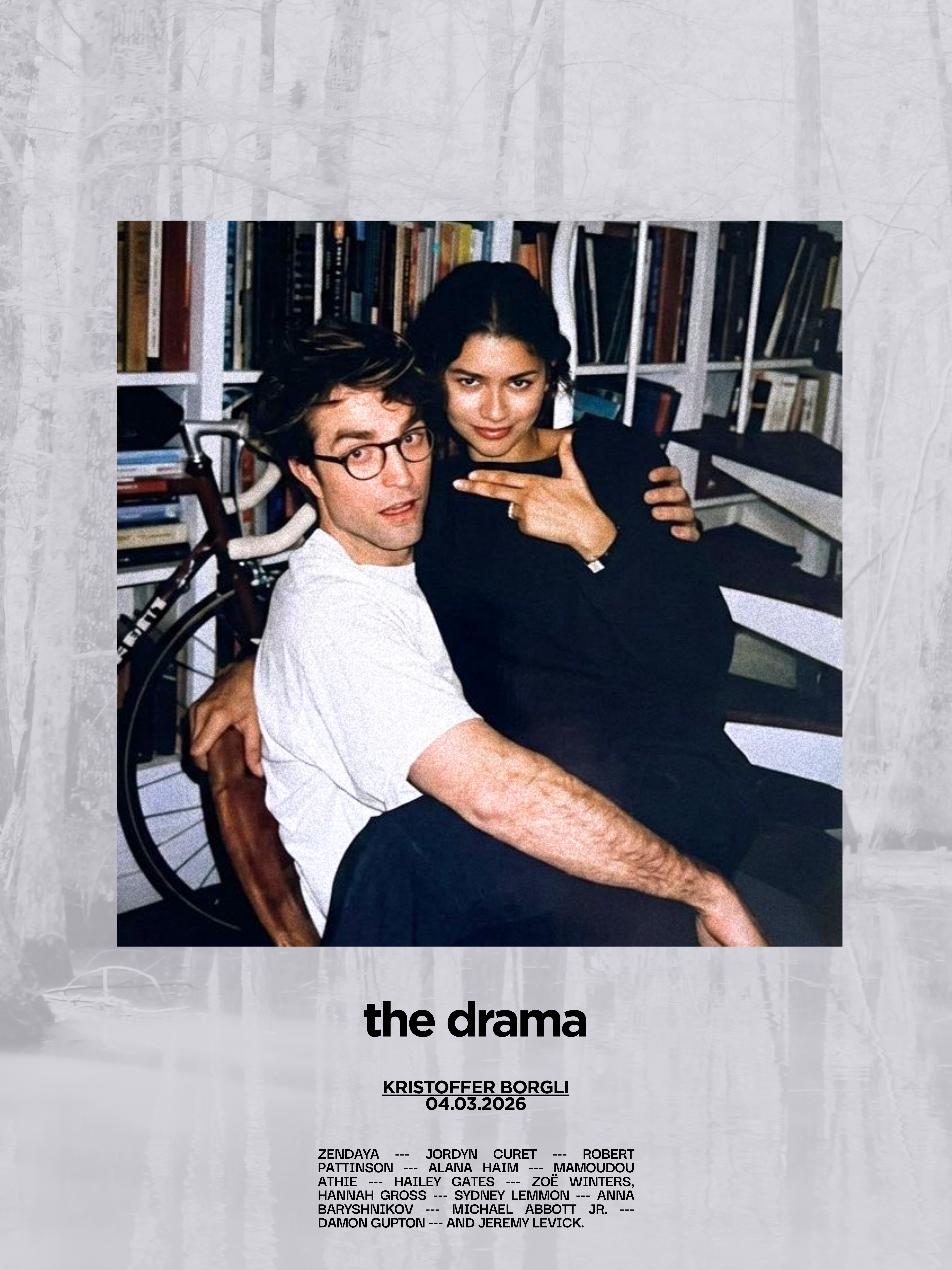
    The Drama follows a happily engaged couple, Emma and Charlie — played by Zendaya and Robert Pattinson — as they prepare for their upcoming wedding. However, their relationship is put to the test when an unexpected detail of Emma’s past is revealed during a conversation between friends. The question, “What is the worst thing you’ve ever done?” sends their relationship and wedding week completely off-track.

    The Drama is the latest addition to the repertoire of the emerging Norwegian director, Krisoffer Borgli. You may be familiar with his last A24 collaboration, Dream Scenario (2023), which starred Nicolas Cage. For me, however, The Drama was my first introduction to his work.

    I highly recommend going into this film blind, as the twist Emma reveals hits best when unexpected. I luckily — somehow — avoided spoilers before seeing this film Easter Sunday at the Minor Theatre in Arcata. 

    It takes a while for this film to get the ball rolling. However, once it does, it just leaves you in the wake of this massive twist. It places you in an achingly awkward and anxious state that is shared by both Emma and Charlie’s post twist. This feeling is heightened by Borgli’s surrealist auteurship, which is just a fancy way of saying a filmmaker’s style. Scenes where Emma’s ear bleeds while at dinner with Charlie, or when Charlie reflects on memories with Emma, seeing as her high school self; both act as excellent scenes in making the viewer feel the anxious stress and distrust Charlie feels for Emma.

    The aforementioned detail that Emma reveals is a hot piece of gossip and an even hotter topic within American society. The subject is handled in a mildly humorous way, which has already created mixed responses within online debates, with many who call the approach distasteful. I, for one, enjoyed the approach, finding it bold and unafraid to make audiences uncomfortable and encourage self-reflection.

    Zendaya and Pattinson were perfectly cast in their respective roles. Zendaya plays this seemingly idealized woman in the beginning — spunky and charismatic — who then becomes reserved, overtly anxious and paranoid. Pattinson plays an endearing, dorky British guy that turns into a man completely absorbed by delusion. Their performances are truly what made this film come alive for me.

    Another character worth mentioning is Rachel — Alana Haim — who is Emma’s bridesmaid and friend — honestly though, if that’s the kind of friend you like to keep, you should do some second guessing. Rachel is the embodiment of an entitled mean girl who can’t forgive Emma for the dark secret she reveals during the climatic conversation. Rachel is a primary factor in worsening things for Emma and Charlie, even though the secret Rachel reveals is debatably worse, or at least similar to Emma’s. To me, this represents the double standards we hold ourselves compared to others. 

    It’s often simpler to forgive ourselves because we can more easily rationalize our own actions and thoughts. I think the film acts as a reminder to pull the plank out of our eye, before criticizing the sawdust in our friends — or however the metaphor goes.

    Overall, I thought this was a solid film and I look forward to watching more Borgli in the future. 7/10 Julia’s.

    Julia is a journalism major and the co-Editor in Chief of the paper. She loves film and is a regular on Letterboxd. She also enjoys going on walks in the forest and taking pictures to relax. If you have a movie you’d like her to review, please email her at jk328@humboldt.edu.

  • Bat Boy: The Musical

    Bat Boy: The Musical

    By Kaylon Coleman

    Over the weekend, I attended the last show for Bat Boy: The Musical hosted by the Cal Poly Humboldt Department of Dance, Music and Theatre. To fully immerse myself in the experience, I decided to channel my inner bat and walk in blind. I know it’s in the name, but it wasn’t until I was smack-dab in front of the Van Duzer that I realized I was attending a musical. 

    Now, it’s been a minute since I’ve basked in the theater arts, ironically six or seven years probably — but I believe this is the first time I’ve ever witnessed a musical live. The play itself lasted about two-and-a-half hours, with an intermission included. For those unaware, Bat Boy is about… well, a bat-boy. Bat Boy, later dubbed Edgar, is stumbled upon by some cave explorers while spelunking. After getting captured and brought to the surface, Edgar is caged as the townspeople decide whether to string him up as entertainment or to put him down via the town doctor, Dr. Parker.

    The first act of the musical consisted of Edgar getting accustomed to human life, learning how to walk the walk, talk the talk, so on and so forth. This presented itself through 13 different songs sprinkled throughout the first act. I know musicals get a bad wrap a lot of the time, but I think the fact that I was watching this live immersed me more than a traditional movie-musical. I need to give props to Rylan McClain, a.k.a Dr. Parker. Everybody who sang did a great job, but McClain’s vocals stuck with me. He was belting up there like his rent was due. 

    The play, while more serious leaning, did indulge in some bouts of comedy. One moment that made me laugh was when Edgar was showing off his progression as a civilized individual, and replied to someone with the term, “indubitably.”

      It took me some getting used to, but by the end of act one, I was fairly brought on board the Bat Boy train. All this changed during act two however. After a brief intermission, the play resumed with Edgar attending the revival service they chose to hard launch his progression at. After some snafu’s, Edgar flees into the wilderness, with the townsfolk hot on his tail. This is where the play started to lose me, to no fault of the performers. It just seemed as though the story completely flipped from where I thought it was going. There was a plot twist that I assumed would be the case, but did not end how I thought it would. 

    Bat Boy: The Musical is one of few productions I’ve seen that have left me speechless for the most part, which might just be a symptom of live theater, who knows. I applaud the performances of each cast member, and extend my applause to the band as well, which did an amazing job of immersing the audience. Keep live theater alive!

    Kaylon Coleman is a senior journalism major with a concentration in news and a minor in communications. He is the Life & Arts editor for LJ, Marketing and Communications lead for the Umoja Center and  and a part-time radio DJ and merch manager for KRFH. If you have a topic you want him to discuss, email him at kc403@humboldt.edu.

  • Bird Nerd: A starting guide

    Bird Nerd: A starting guide

    By Sadie Shields 

    Whether you’re walking through the Arcata forest with its lush trees and greenery, or surfing in the bay, you may hear or notice a feathered friend moving by you. Birds come in many shapes, colors and sizes, and here in Humboldt County, we get a lot more species than your typical city environment. 

    For many birders, the interest begins long before they pick up a field guide or scope.

    “I’ve always been proud to identify whales and red-tailed hawks when I was younger. There was one time a red-tailed hawk flew over and I’m like ‘that’s a red-tail hawk because it’s got a red tail.’ I was so excited about it,” said Cedrik Von Briel, a senior wildlife and communications major and president of the birding club. “I wasn’t really a birder until my brother started getting into it, and eventually dragged me onto something called a Christmas bird count. I was just fascinated by the amount of cool named birds that were out there.” 

    Humboldt county offers an amazing environment for birding, one of the many places close by to campus being the Arcata Marsh or the South Jetty. For beginners, the advice is simple: start where you are. 

    “There’s no right way to do it. Just go and do it, find your favorite spot, there’s absolutely no rush,” Von Briel said.

    Wildlife photographer Kristinza Scheef resonated with the idea that aspiring birders need patience and awareness when entering natural spaces.

    “You have to remember: we are playing in their home, in their world, so we need to be ethical and nice to them,” Scheef said.

    Scheef also notes that expectations can sometimes get in the way for beginners.

    “A lot of times, wildlife will reward you with a beautiful photo — but, you have to be patient,” Scheef said.

    As new birders head out into the Humboldt forests, marshes and coastlines, or decide to go to the Godwit Days birding event Friday, Saturday and Sunday, learning to slow down, take your time to breathe and observe is enough to make a difference. 

    “The more you see and fall in love with nature, the more protective you’re going to get of it,” Scheef said.

    Sadie is a reporter who has an interest in covering and taking photos for sports and science. She can be reached at sls331@humboldt.edu.

  • Dorm dwellers stake in the SAC for Casino Night

    Dorm dwellers stake in the SAC for Casino Night

    by Nick Escalada

    Cal Poly Humboldt’s highest rollers, many of whom were under 21, arrived at the Student Activities Center (SAC) lounge dressed to the nines for an evening of non-monetary gambling. Student employees at the center appeared as the house’s dealers, hosting games of poker, roulette and blackjack across a U-shaped arrangement of tables in the familiar hall bathed in red light.

    The event drew swaths of students living in the on-campus dorms to what many saw as a flicker of night life at a university with a usual nine-o-clock bedtime. Amanda Kachevas, programming coordinator of the SAC, was excited to provide residents with the opportunity for after-hours recreation for the fourth year in a row.

    “There’s so many people who live on campus and don’t necessarily have things to do in town. Not everyone’s 21 or has a party to go to on the weekend,” Kachevas said. “This event kind of fulfills that party atmosphere. And we used to always get requests to stay open late for events, and we found that this event specifically has like the big draw all the way into the night, almost more so than concerts sometimes.”

    As fun as it would be, the SAC does not have a gambling license under the State of California, so its tables were open to all ages and dealt in imaginary cash. Guests were each given a Santi book, named after Operations Coordinator Santiago Menjivar, which granted them a starting total of $10,000 to play with throughout the night.

    “It’s really low stakes, and we just teach people how to play so that they can have poker nights at their house and stuff like that,” Kachevas said. “At the end of the night, whoever has the most chips at the end can win a poker set.”

    The idea for Casino Night came about when staff looked at events held in the student centers of other universities, and some version of a dapper gambling function seemed to always pop up.

    Professional dealers were hired for its first outing, but after slashes to funding and requests from SAC student workers, attendees now receive their hands from decks shuffled by their peers.

    “There’s a lot of tiny, nitty gritty things, like getting our student staff together and asking them, ‘Okay, do we want student dealers this time? Do we want to bring in a professional dealing company?’” said Events and Media Lead Riley Hemenober. “But, the students always want to just deal themselves, because it makes it more fun. You can go sit at a table and your friend is the dealer, and I think it makes it fun.”

    Guests were encouraged to dress their best to match the lounge’s glitzy atmosphere, and a ‘best couple’ fashion contest was held at the end of the night and decided by the cheers of the surrounding crowd. Clad in black and red blazers and dresses, the congregation of high rollers seemed worlds apart from their casual daytime appearances.

    “Students love the opportunity to dress up and dress fancy, because there’s not really events [like this] that happen on campus,” Hemenober said. “Students also love some free giveaways, and so we always try to do that too. We hand out little gifts and [hold] different competitions. So, that way, students have that opportunity to get something on their way out.”

    Student workers are eager to bring more opportunities for late night fun to the SAC in the future. The Kate Buchanan Room in the lounge was formerly a venue for frequent musical performances, which included student bands. The room has since become a reservable space for on-campus organizations, but the push for the return of live concerts continues.

    Nick is the news editor at The Lumberjack, and studies wildlife and journalism with the goal of spreading his love of nature through media. Chat with him at ne53@humboldt.edu!

  • AI vs student creativity

    AI vs student creativity

    By Jacqueline Zuniga

    As artificial intelligence (AI) becomes more present across different majors, students in art, journalism and English share similar thoughts about how it will affect creativity. While some may see AI as a helpful tool for brainstorming or drafting, some think it could weaken the originality of people’s creativity. On April 10, Journalism Professor Yumi Wilson at San Francisco State University led a discussion at Humboldt’s 2026 Media Day where local high school students could learn from fellow journalists about the field. Wilson explained how she sees AI used in her daily life and work, and that it should be utilized rather than ignored. “AI is being used, whether we talk about it or not,” Wilson said. “We need to talk about it… and maybe even set guardrails in place.” 

    Rather than replacing core reporting skills journalists have, AI is being used as a tool in the newsroom. Wilson explained that journalists can use AI to help generate story ideas, proofread drafts and analyze information they have gathered. But, she does emphasize that it shouldn’t be replacing core skills journalists have. She emphasizes that journalists still have to use AI responsibly and not allow it to do all the work. 

    “I think we need to be open about the usage, and maybe even set guardrails in place,” Wilson said.

    Wilson thinks that the process of using AI tools is like being in a newsroom. You’re not working alone, you’re getting help from editors, photographers and others to help improve your story. They provide feedback and fix errors they might see. She made the argument that AI could help support some of those processes. 

    “If we could think about AI tools doing some of that work, but not replacing what we do, might it be a good application?” Wilson said.


    The conversation and concern surrounding AI impacts many fields. Another area where AI usage is heavily debated is within the arts. Adrian Conner, a studio arts major, feels that because AI isn’t part of their coursework at Humboldt, it hasn’t had an impact on their education or artistic practice. He feels that art students’ work is more physical and requires hands-on activities, whereas AI is all digital. Within that, Conner worries about people using AI for creative work.

    “Art, for me, is the human mind and the human experience, and if you’re using a chatbot to come up with ideas for you, maybe your ideas aren’t good enough to be shared,” Conner said.

    Some art students see AI as a tool that must be used carefully.

    Studio arts major Jennifer Flores said that AI can be helpful in certain situations, but it can’t replace human work. Flores added that while AI may continue to grow and have its useful moments, it cannot replace the value of human expression. The AI conversation continues to impact a wide range of students and fields, with varying stances. Junior English major Riley Torres feels that AI can actually hurt people’s writing creativity and voice. 

    “It may reduce a person’s creativity and make them rely on technology instead of developing their own ideas and voice over time,” Torres said. 

    Fellow English major Nathan Casey shared his  perspective on AI. He acknowledges that there are risks when it comes to using AI for writing, but he also sees the potential in using tools to help generate ideas. He still thinks students should be responsible for what they write and not let AI do all the work. 

    “AI can help students explore ideas more easily, but it’s often used inappropriately,” Casey said. “If you give all your writing to AI, you’re not improving — and you won’t get better.”

    Jacqueline is a journalism major, a news manager for KRFH and she aspires to be a sports journalist one day.

  • The Beauty of Hope

    The Beauty of Hope

    By Kaylon Coleman

    For as long as I can remember, I’ve always looked at life through the lens of a glass half full. A guiding mantra I’ve carried with me since inception is that everything will work out. I love being an optimist. But as I’ve gotten older, I’ve realized that optimists are few and far between in a world full of pessimists and pragmatists — which unfortunately, is extremely valid given the current state of our world. 

    Why should I expect a better and brighter future when everything that I see online and in my day to day and online such a lifestyle? I’ll tell you, I didn’t become an optimist purely because of my cheerful disposition on life, but because I recognize the beauty of hope.

    Just like other metaphysical concepts throughout life, such as love or faith, hope is a double-edged sword. On the one hand, hope provides you with aspiration. It fills you with a fire and desire for a better future like Drake; but on the other hand, it can lead to insurmountable disappointment and heartbreak, like Drake.

     When you allow yourself to be vulnerable and to feel something so personal like your raw unadulterated feelings, you open the door to letting those same feelings tear you up. If you’ve watched the newer Spider-man movies you may have heard MJ say, “If you expect disappointment, then you can never really get disappointed.” While she has a point, I just can’t co-sign this way of thinking.

    Living your life on a half measure is no way to live. In a relationship, you can’t half-love to walk out half-hurt. It’s not fair to either side. You must burn brightly the whole way through. If things don’t work out, c’est la vie. At least you can say you went full throttle the whole way and never sold yourself short of your emotions — which is the exact sentiment you should hold when it comes to optimism.

    Everyone wants to live a better life, everyone prays for better days. So, why not embrace it all gas no brakes, regardless of how it may turn out? Yes, not everything is gonna work out, but when does it ever? It’s like Princess Leia says in The Last Jedi, “Hope is like the sun. If you only believe in it when you see it, you’ll never make it through the night.”

    And, for those who may be struggling to find their optimism — I get it. Even I don’t wake up bright and cheery everyday; it’s impossible. There will be just as many bad days as good ones. I’d love to have the answers, but I don’t. Although, I can tell you about some of the things that have gotten me through tough times: Friendship. Community. Music. Food. Movies. Video games. The Sun. The outside. Aimless drives. Weed. 

    Find your support system. It’s easy to scroll and to rot and to wallow in your misery, thinking “this is the worst,” but know that this too shall pass. Frank Ocean said it best, “Every night fucks every day up. Every day patches the night up.”

    Hope is beautiful. It’s inspiring. It spawns resilience in all those who embrace it. As someone on the verge of graduating, with no prospects but plenty of  dreams, I can’t help but be excited for the future laid out for me, because I know everything will work out — I have to believe that. Not only does it make life worth living, but it adds a kick of spice to everything. Am I gonna make it big one day? Damn right. Do I know how I’m gonna get there? Absolutely not. But that’s where the fun comes in. Life is Roblox; I have no idea what’s in store for me and neither does anyone else. So, why let negative attitudes steer your direction? In a world of pessimists and pragmatists, be an optimist. I promise you, it’s much more fun that way.

    Kaylon Coleman is a senior journalism major with a concentration in news and a minor in communications. He is the Life & Arts editor for LJ, Marketing and Communications lead for the Umoja Center and a part-time radio DJ and merch manager for KRFH. If you have a topic you want him to discuss, email him at kc403@humboldt.edu.

  • Softball Recap

    Softball Recap

    By Sadie Shields

    After two weeks of playing on the Cal Poly Humboldt home field, Cal Poly Humboldt Softball heads down to Cal State San Marcos this week and then will be back at home against Chico State on April 24th for Strikeout Cancer day. 

    While at home on April 3, softball put up a 3-1 game win against Cal State Monterey Bay from -4 and then a one win and one loss record against Cal State San Bernardino last Thursday, April 9. Two of the games that were meant to be last Friday April 10 were canceled due to weather.

    Across the four games against Cal State Monterey Bay, Humboldt averaged five runs, nine hits and five strikeouts. 

    The Lumberjacks averaged five hits, five runs and four strikeouts against San Bernardino.

    In their two week home stint, the Jacks walked away with four wins and two losses at home leaving the team with a 10-8 conference standing. 

    Sadie is a reporter who has an interest in covering and taking photos for sports and science. She can be reached at sls331@humboldt.edu.

  • Wren’s Whimsical Window: Pest Control

    By Wren Salazar

    I received the strangest call earlier today from an unknown number. I was told to peer out my window tonight and if I did, I’d see something unlike what I have ever seen before. Afterwards, there was some stifled giggling and they hung up. What a strange proposal. Obviously, I’m not quick to trust the random caller. As I decided I would look to see what’s going on, my phone buzzed once more. Unknown number again, but I picked up.

    “A little birdie told me you might need some pest control,” a different voice said. “I will take care of them for you. Surely, it will be a spectacle.”

    Pest control? For what? Could it be unlike what I’ve seen before? Sensing my hesitation, the voice continued.

    “The fae will arrive for you tonight,” he said. “Best to be safe, don’t look outside, no matter what you’ve heard or seen.”

    Then, he hung up. This has to be a coordinated prank. Fae don’t exist. Why would it be bad to look outside tonight? I doubt anything will happen, but I’m closing my blinds anyway.

    I lounged in my room, as it got closer to evening — a creeping anxiety grew stronger with each passing minute. I heard a knock at my door, but a spark from behind my blinds caught my attention. Then, another spark, blink after blink, numbers rapidly increasing. Flittering and flickering light poured through the blinds in bursts of orange, purple and blue, floating as though they were refracted through water. I felt as though I’d been placed inside a kaleidoscope. I had to look. Banging on my door and muffled yelling made me hesitate, but I had to look. It’s beautiful. No matter the cost.

    Wren is an artist and story writer looking to add some whimsy and curiosity to those around her. A lover of all things, Wren seeks to help others around her with advice or humor. She can be reached at ws81@humboldt.edu.

  • Taxidermy is a dying art kept alive inside the walls of Cal Poly Humboldt

    Taxidermy is a dying art kept alive inside the walls of Cal Poly Humboldt

    By Julia Kelm

    While the sight of an animal carcass might make some people queasy, for Wildlife Museum Curator Anna E. Goldman, it is an area of fascination. 

    “I’ve always been interested in dead things,” Goldman said as she ripped the skin from the body of a recently thawed squirrel for a taxidermy demonstration. “In 3rd grade, for show and tell, I brought in a severed deer leg that still had fur on it. I was really excited, and then the principal called my mom… they thought I was a serial killer.” 

    This love of death led Goldman to an unconventional career as a taxidermist and museum curator for the Cal Poly Humboldt wildlife department.

    Goldman explained that since she’s the only one who maintains it, the museum is hers to manage as well as take care of.

    “All of the collections, duties, the databasing, the cataloging, setting up and taking down for classes… everything that happens here is on me,” Goldman said.

    Goldman’s day-to-day work weeks can vary greatly. From simply cataloging specimens for the museum to racing off to the shoreline when a whale washes up, things are constantly in flux for Goldman.

    When it comes to directly working as a taxidermist, Goldman described a process called museum prep. A procedure in which the skin of an animal is dried out and preserved emphasizing its anatomical structure. It then is placed inside drawers and cabinets at the museum, accessible for students and researchers to take measurements.

    “I’m most classically trained in how to prepare specimens for the museum collection, which takes up the least amount of space possible, but also allows you to see all of the notable features of this animal,” Goldman said.

    The museum is in the fisheries and wildlife building, only accessible with supervision. Those with access will find drawers and cabinets filled with furs, skins and stuffed critters like chipmunks, mice and beavers lying peacefully as if tucked into bed.

    Goldman admitted that taxidermy and museology work is a difficult career field to break into. If it weren’t for her stubborn determination to make taxidermy a career, she would not be where she is today. 

    Goldman’s journey began in 2006 after finishing her undergraduate degree in biology, with a focus in entomology, at the College of the Atlantic in Bar Harbor, Maine. She moved back to her birthplace of Chicago, Ill., to work at the Field Museum of Natural History. 

    There, she spent her early career working primarily with insects. However, when museum positions temporarily dried up due to the lack of immediate long-term work position, Goldman had to take up various retail jobs to make ends meet.

    “[I was] still volunteering for the insect division, and then the mammals preparator job at the Field Museum opened up,” Goldman said. “I got so lucky to get [that] job, and it kind of just snowballed.” 

    Although working with mammals began as a pivot of Goldman’s original love of insects, she has enjoyed this new direction. 

    In 2015, Goldman desired to go after her PhD in biological science. Unfortunately, she was first met with a massive roadblock. To apply for grad school, she would need to take a standardized test. Goldman said she was never a good tester.

    “I was told by the dean of one of these universities that I applied to that, ‘there are museum people, and there’s academics. You’re just a museum person,’” Goldman said. “Give up, basically.” 

    Every U.S. school that Goldman applied to denied her based solely on her test scores, despite the experience she gained during her time at the Field Museum. 

    Fortunately, there was a loophole that allowed Goldman to pursue her dreams. 

    “I figured out that international programs don’t do standardized tests to get in, and a lot of your experience actually is very beneficial,” Goldman said. “So, I was able to get into the University of Hong Kong.” 

    After Goldman graduated from the University of Hong Kong in 2021, she looked for work back in the States and ended up in Humboldt County.

    Now retired, the previous museum curator, Tamar Danufsky, said Humboldt’s collection, though small, boasts many regional specimens. 

    “Nobody from [University of California], Berkeley is driving up here to pick [roadkill] up and take them back to their collection,” Danufsky said. “It’s an impressive collection for this little university… it’s not what you would expect.”

    Goldman explained that the 16,000 specimens housed in the wildlife building provide an excellent resource for study to students and researchers alike for years and years to come. 

    Junior wildlife major Josh Gellens said the museum is an incredible resource for wildlife majors.

    “The specimens curated from the wildlife museum — as well as the zoology department’s vertebrate museum — play such a huge role throughout your courses and interests when it comes to studying anatomy, adaptations and diversity of all the different taxa,” Gellens said. “It’s truly an integral part of being able to get that unique hands-on learning.”

    In addition to the museum being a resource for students, it acts as an archive to record history. 

    “We kind of view natural history museum collections as these libraries of empty books that have yet to be written. There are numerous questions that can be asked and can be discovered just by looking at specimens.” Goldman said.

    Goldman said that her position here at Humboldt was a rare blessing; both taxidermy and museum jobs like hers are hard to come by and hardly ever make a lot of money. Despite these factors, Goldman never gave up on her love of dead things and turned her passion into a career.

    “I always find it really beautiful that we’re able to give life and preserve this dead animal for so long,” Goldman said. “And that there’s actually scientific value to this otherwise decomposing mess.”

    Julia is a journalism major and the co-Editor in Chief of the paper. She loves film and is a regular on Letterboxd. She also enjoys going on walks in the forest and taking pictures to relax. If you have a movie you’d like her to review, please email her at jk328@humboldt.edu.

  • AstroloTea for the Week of April 6th

    AstroloTea for the Week of April 6th

    By Serah Blackstone-Fredericks

    This week, the sun is squaring Saturn and Jupiter and we are offered a gauge on if we overdo things or are too cautious. We are feeling the impacts of the world, so connect with your community for some gentle and consensual co-regulation. How can we be present with ourselves and others?

    For fire signs Aries, Leo and Sagittarius (sun, moon, rising):

    This is your season; the energy of fire is rising, and the warmth of the sun offers you hope for a more encouraging tomorrow. Avoid burnout by ensuring you are not saying yes to everything that comes your way. Spring is here, and there is so much to see, share and do. This is a year to ensure you are not missing connections with those you want to spend time with. Invite in joy by saying yes to whatever feels like a hell yes and save the rest for later. Good teas for this week would be jasmine, and to combat those terrible allergies, try nettle.

    For water signs Cancer, Scorpio and Pisces (sun, moon, rising):

    Despite how disorienting the world feels right now, watch how much you are latching onto bad news. Have some awareness around your sensitivity this week and reach out to friends for support if you find yourself caught in emotional turbulence. Be mindful of your emotional state and if you feel stuck, remember if you can’t take care of yourself, you can’t extend it to others, so be considerate of your own needs too. For the energy of this season, make sure your lungs are supported with mullein, elecampane and licorice.

    For air signs Gemini, Libra and Aquarius (sun, moon, rising):

    Are you present right now in your body? Do you know how you are feeling right now? If you don’t have clarity on where you are at right now, find a time on your calendar to schedule a pause. I find it takes a moment to pause, so it can help to schedule it in. A pause can look like putting your phone down, sitting on a bench and watching a bee pollinate a flower. It can look like taking a walk and searching for five blue things for each sense, starting with one you see, one you smell, etc. Supportive teas for this week will be anything that has a root in the ground such as ashwagandha, dandelion and astragalus.

    For earth signs Taurus, Virgo and Capricorn (sun, moon, rising):

    Sometimes, we lean into collapse when we are overloaded. Sometimes we shut everyone out when life feels hard. Where do you feel struggle and where do you feel joy? In this season of emergence and growth, I want you to be aware of your thinking patterns. Reflect on your self talk and how you feel mirrored by those around you. Remember, you see things differently and you can hold two truths and accept this. Now is a good season to clarify if you see yourself how you actually are showing up in the world. Ground and be present with rose, thyme and sage.

    However you use this week’s guidance, remember where your boundaries are. Have reverence for the walls which keep you safe and comfortable and be open to the stretching that is available to you in the spring time

     Serah Blackstone-Fredericks is a cross-disciplinary anthropology major, minoring in arts in health and narrative medicine. A multidisciplinary artist, mother, and multilingual global citizen, you can find her prancing in her garden or in her kitchen baking, fermenting, and exploring natural dye via experiments. Her work explores storytelling from a perspective of cultural humility, ever curious on  shaped connections and how we live and heal. Feel free to connect with her at sb625@humboldt.edu.

  • Campus Q center emerges after decades in the making

    Campus Q center emerges after decades in the making

    By Sadie Shields

    An idea formed by clubs and organizations 25 years ago has finally come into fruition as the LGBTQ+ center opens its doors. The Q Center aims to provide coordinated support, resources and advocacy which was originally unable to be provided.

    It all began with one man, Eric Rofes, an openly gay professor at Humboldt who tragically passed in 2006 of a heart attack. Before he passed, Rofes served as director of the Los Angeles LGBT center and as executive director of the Shanti Project, a non profit AIDS service organization.

    For many queer representing students, faculty and staff at this institution, his loss was heavy.

    “He passed away unexpectedly… and he was a pretty strong presence here,” said Loren Cannon, a professor and author at Cal Poly Humboldt.

    In remembrance of Rofes’ work and contribution to the university in 2006, one of the first queer spaces created on campus was named the Eric Rofes Center (ERC) in his honor. After its creation, the ERC became a foundation for queer community-building on campus — but while meaningful, the space was confined.

    Efforts to establish a fully funded Queer Center have been ongoing, but repeatedly stalled over the years.

    “There have been more than a few attempts to have an actual queer center,” Cannon said. “Most schools have had queer centers for 20 to 30 years.”

    Constant administrative turnover was believed to be the main obstacle preventing the center from opening. 

    “Typically, they stay around for three to six years…and then you’re kind of back to the starting place,” Cannon said.

    Another roadblock was the lack of clear data on LGBTQIA students, due to long standing stigma around identity disclosure.

    “When I was here in ‘06, I was the only out trans faculty member,” Cannon said. “Now, we have many more students identifying.”

    Elias Pence, coordinator at the Q center, also noticed the shift and how more students are openly identifying as LGBTQIA members today.

    “People are identifying openly, which helps us get an idea of our population,” Pence said.

    Since then, Cal Poly Humboldt has taken steps towards inclusion, including gender-inclusive housing, restrooms and tracking of LGBTQIA student data.

    “I think we certainly have a more accepting place,” Cannon said. “But, it’s kind of mixed. Sometimes it feels like the tide’s coming in, sometimes it feels like the tide’s going out.”

    Despite this progress, it is very evident that the rising political tensions, especially around transgender rights, have created a major concern within the community. One of these ways is scapegoating, which is a process of blaming a person or group for problems they did not cause.

    “What we’ve seen now looks like classic scapegoating,” Cannon said. “You have a relatively small group, and then, you conjure the monster of trans people.”

    This type of scapegoating has not decreased the queer population that is now coming out, but has created signs of anxiety. 

    “I have not seen any decrease; what I have seen is a lot of fear and a lot of distress,” Pence said.

    Still, no matter the environment, students will continue to be who they desire to be.

    “We’re still gonna transition, we’re still gonna change our names,” Pence said. “We’re gonna do all of it.” 

    The Queer Center marks the first step on a long journey, and the work is still ongoing.

    “We have to realize this is a marathon, it’s not a sprint,” Cannon said. “We might have to be involved in this work for a long time.” 

    After 25 years of advocacy, setbacks and most importantly persistence, the Queer Center does not just stand as one of the newest resources available for Queer students on this campus, but also as a symbol of a community that, now more than ever, refuses to be invisible. 

    “Let’s fight back, let’s resist dehumanization, let’s protect each other,” Pence said. “Let’s build beautiful things.”

    Sadie is a junior communications major, journalism minor at Cal Poly Humboldt who has an interest in covering and taking photos for sports and wildlife journalism, and a slight interest in breaking news. She can be reached at sls331@humboldt.edu.

  • Humboldt rowers paddle fast and fight back!

    Humboldt rowers paddle fast and fight back!

    By Barley Lewis-McCabe

    A rowing fan only needs two things to appreciate the sport: a good jacket and a better imagination. Early in the morning, a hefty crowd gathered at the finish line to await the bombastic conclusion to an action packed race they’d only heard about up to this point. Dozens of people stood locked in suspense, comforted by an assumption that their beloved Lumberjacks were at the front of the brigade. 

    “It’s a really great way to start my morning every single day,” sophomore Lily Storseth said. “I love going out and getting to see the sunrise. There’s something just super cool about being out here with the strongest group of women I know and pushing ourselves together.”  

    At 8 a.m., under a blanket of thick cloud cover and above cold water, the men’s varsity rowing club took to the bay for the first race in the Blue Heron Regatta. Early on, the Jacks held a strong lead as they stayed true to their namesake and chopped through the water four oars at a time, cutting through the competition until they won in an unsurprising — but no less enjoyable — finish. 

    Afterwards, the Jacks women’s NCAA (National Collegiate Athletic Association) Division 2 varsity team faced Division 1 team Saint Mary’s College out of Moraga, Calif., in a match that would not be forgotten. As the boats crested into view, the audience could see a Saint Mary’s boat begin to swerve into other lanes. 

    “It was a little bit chaotic, because we had six boats and some of them were kind of drifting into our lane,” sophomore and second semester rower Emily O’Keefe said. “That kind of messed us up a little bit, and it wasn’t perfect. But, I think our rowing was the best it could be and I feel really good about that.”

    Nevertheless, the Jacks zig-zag across the water brought them a victory in a close race. The crowd was especially unified and had a consistent routine when it came to cheering. When the race began 2000 feet down the bay, people were obviously energized, but commotion turned to scattered claps until they eventually returned to ambient conversation — but suddenly,  everyone went silent. The crowd could see them. Rapidly approaching the finish line, a green and gold torpedo glided through the water with a precision that can only come from exuberant passion and the skill to back it up. 

    The Jacks delivered strong performances throughout the regatta. While they may not have been at the top of the podium, they were the snarky puppy biting the heels of a D1 school, never letting any of the other racers get too comfortable. 

    “We were able to build a gap to the boat behind us and stick as close as we can to the boat in the front,” junior coxswain Elise Evans said. “And I didn’t crash, so I call that a success. Especially considering the competition here and how hard we competed in each and every race, I think we did amazing.”

    Barley is the opinion editor and an untraditional reporter who focuses on social change and stories with a real human impact. If you’d like to reach him for whatever reason email bl258@humboldt.edu.

  • University steering towards community resilience 

    University steering towards community resilience 

    By Nico Patakidis

    Formed in the fall 2025 semester, Community Resilience Steering Group (CRSG) has provided presentations across campus to inform students, faculty and staff about what procedures the university will follow if Immigration and Customs Enforcement (ICE) were to come onto campus.

    What is CRSG?

    CRSG was formulated at the request of the University Senate to have a larger team that could prepare for, and respond accordingly to, potential ICE activity on campus. In a special Associated Students (A.S.) meeting held on April 1, Division of Enrollment Management & Student Success Vice President and CRSG member Chrissy Holliday discussed in detail what the University response to ICE presence would look like in different scenarios and how students can respond themselves. 

    In the presentation to A.S., Holliday discussed two kinds of responses that CRSG would take, formal and informal. Formal responses to ICE activity include actions that are based in California State University (CSU) policy and California law. 

    “The university self-selected to create a group to help build a larger scaffold of initiatives to bolster our work,” Acting Vice President for Administration & Finance and CRSG member Mike Fisher said. “[CRSG works] particularly around preparation and response, but during an event is really what’s part of CSU policy, state law and some other things.”

    Informal responses are the actions CRSG will take to connect with the community, and make others aware of what procedures would be followed. CRSG has been meeting with groups such as university housing staff, the Dreamer Center and A.S. in order to get feedback from the campus community. 

    “We’re trying to capture the audiences that are very different across campus and pull them into this important work in a more cohesive way,” Fisher said. 

    What if ICE comes on campus?

    ICE is not permitted entry to any buildings on campus as they are considered private, which Holliday said includes residence halls and the library. ICE may only enter private spaces on campus if they have the correct judicial warrant — not an administrative warrant. A judicial warrant that would allow entry must be signed by a judge, whereas an administrative warrant is signed by an employee of the federal government. CRSG has staff who are trained to verify these warrants before ICE can take any further action. Should ICE enter any private spaces, Holliday said that members of CRSG and UPD would arrive to remove them, although it may not be immediate and could take time. Additionally, any action that ICE takes in a private space without the correct JUMP warrant is illegal. While ICE does not have access to private spaces such as buildings on campus, they may still walk around campus pathways, sidewalks, the main quad and art quad. 

    “We’re notified, we respond immediately, we intercept, we create time and space,” Fisher said. “We need to follow the law as an institution in the state of California… to create time and space is to allow for our community to react appropriately, to allow them time to make an informed decision about what they would need to do to protect themselves.” 

    Holliday said that there are other scenarios in which ICE may come to campus for reasons other than immigration enforcement. This can include activity related to the Student and Exchange Visitor Program, administrative matters such as reviewing visas or career fairs. In this case, the university would notify the campus ahead of time. Holliday also said that in the unlikely event that ICE attends a career fair the university is not allowed to prohibit them, but would notify campus ahead of time. In any other case that ICE is on campus, planned or not, the university would first verify ICE presence and then send notifications via text and email. 

    Should anyone on campus be approached by ICE or see them on campus, CRSG encourages that person to call Interim AVP and Chief Human Resources Officer Michelle Caisse at (707) 826-4501 or UPD at (707) 826-5555 immediately and not engage. Holliday said that CRSG does not want anyone to worry about facing charges and to allow the designated staff from CRSG handle any interactions with ICE.

    “Our intent is to follow the law and to do what needs to be done…” Holliday said. “I don’t think we have any way of knowing what would happen in the moment. What we can do is try to limit who on campus feels the weight of that by saying, ‘Here are the people who are interacting’.”

    Warrants and Subpoenas

    CRSG has staff that are trained to understand warrants and verify whether or not it is the correct warrant that would grant ICE entry into private spaces. Staff are also trained to verify subpoenas that would provide access to student or staff records. However, even if ICE provides a correct warrant, they will not be granted immediate access to private spaces or records. Following verification, CRSG would notify the campus community of this information. 

    Will UPD enforce immigration law?

    Under California State Code SB-54, state, local and school law enforcement may not enforce immigration law or assist in enforcement. University Police Department (UPD), as well as Arcata Police Department, can not investigate, detain or arrest any person due to their immigration status. Anyone approached by ICE is encouraged by CRSG to contact UPD and Human Resources and let them handle any further interactions. 

    What if a campus community member needs legal aid?

    Currently, CRSG does not offer any legal resources. Holliday instead said that the CSU has been in partnership since 2019 with The Coalition for Humane Immigrant Rights (CHIRLA), an organization that provides a variety of immigration related legal services and support for undocumented students. Holliday said that in the case someone in the campus community is involved in immigration activity, CHIRLA is a resource that can provide legal support.

    “There are state and CSU-sponsored resources that we can tap into because of our affiliations, and that is where I think the power lies with our students, faculty and staff being supported by the university directly,” Fisher said.

    Addressing demands for a sanctuary campus

    During the two occupations on campus this semester, protestors demanded that the university implement a sanctuary campus policy. Since 2017, Arcata has been declared a sanctuary city. Fisher said that the university and CRSG have been following the generally-accepted guidelines for what sanctuary cities are despite the university not being officially declared a sanctuary campus. 

    “The use of the term ‘sanctuary’ in this political climate can have adverse affects,” Fisher said. “But we’re doing all the protections that the sanctuary title would carry with it… that’s why sanctuary is, in this political climate, problematic for our vulnerable communities, not the university.”

    Holliday said that she feels the work CRSG is doing is bigger than what a sanctuary campus would be, because the university would not be acting individually and would instead be backed by state law and CSU policy, which she believes offers a broader depth of protection. Along with demands for a sanctuary campus, protestors advocated for the university to offer legal resources to members of campus that may need it.  

    “I think all of the things people are wanting us to say we will and won’t do are exactly what we’ve said,” Holliday said. “We want to make sure that anything we’re doing is adding value and not duplicating.”

    El Centro Coordinator and CRSG member Brenda Perez, one of the advocates and leaders of the sanctuary county campaign, said she will always defend the importance of declaring spaces as safe sanctuaries for Indigenous migrant communities. However, she still respects the perspectives of other CRSG members and believes it’s important to listen to experiences from those who have been on other universities campuses where ICE has been present. Perez said she believes that when the campus is ready to become a sanctuary, the community will know — but it is a process. 

    “Students should know that through their everyday actions, they are the ones who create sanctuary,” Perez said. “There is a difference between a title or a legal designation, and daily practice. Sanctuary must be something we live collectively, every day.”

    How will CRSG continue?

    At the moment, CRSG is only a steering group, which is a group meant to oversee a specific project or initiative, without plans to solidify the group as its own committee. However, Fisher said that the group has been discussing potential professional development opportunities through training student mentors in CRSG procedures. CRSG is still developing and seeking feedback on how to better support the community from groups across campus.

    “We hope that this initial momentum will be operationalized for a long run,” Fisher said. “This will always be something that we want to do as a university.”

    Nico is the photo editor with an interest in covering local government and political affairs. In his free time he enjoys hanging out and having fun with his friends. Reach him at np211@humboldt.edu.

  • West Gym Showcases the rich tapestry of Indigenous traditions

    West Gym Showcases the rich tapestry of Indigenous traditions

    By  Sadie Shields

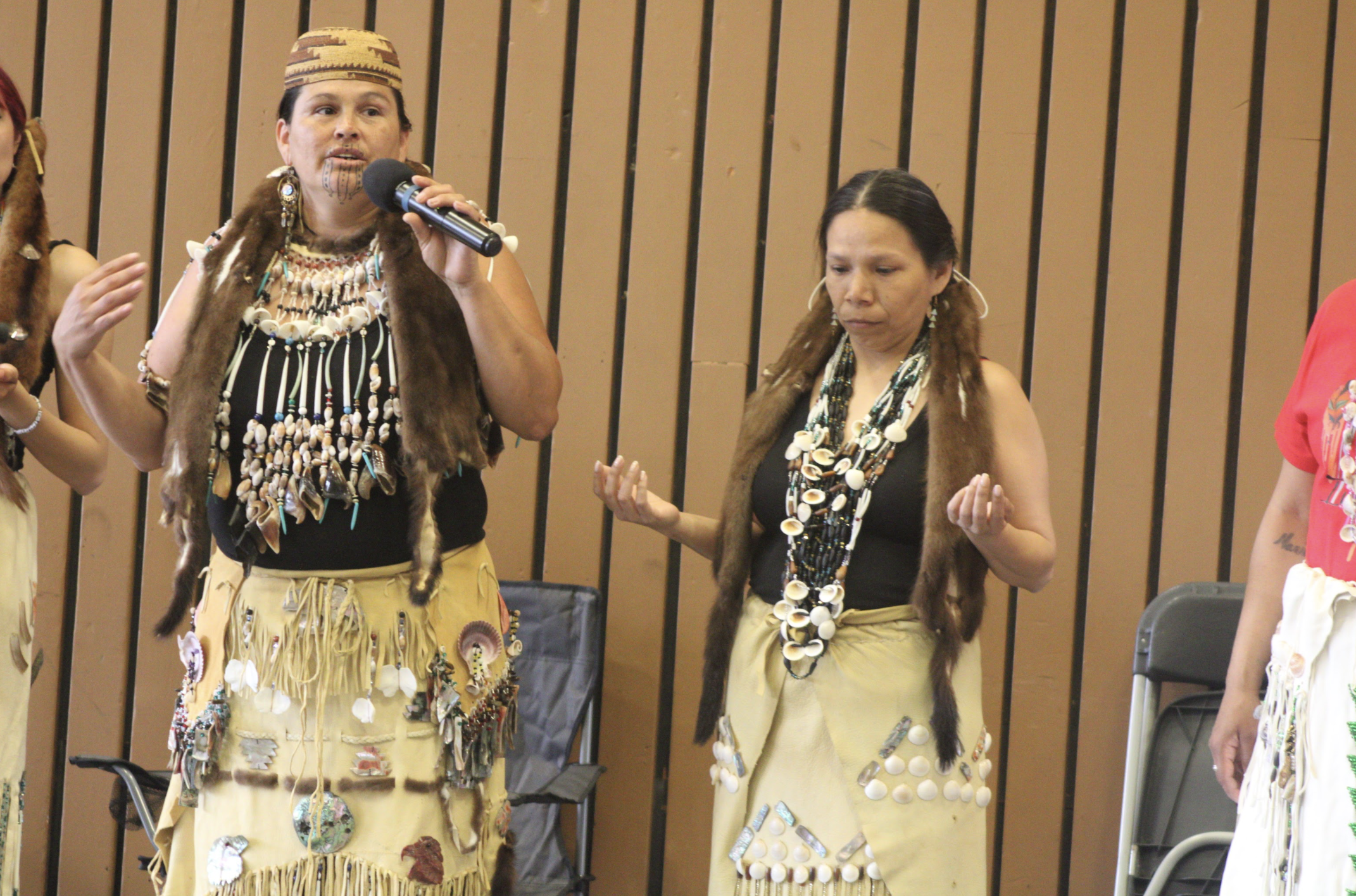
    As the sun rose high in the sky and the wind carried a gentle breeze, students, staff, family and Humboldt locals gathered in the West Gym to celebrate Indigenous culture. 

    California Big Time, organized by the Indian Tribal and Educational Personnel Program (ITEPP), gave students, alumni and family members a space to perform traditional dances and songs to form community connections.

    Lead singer Tim Snow of the Xa Batin Feather Dancers from Lake County, Calif., and member of the Habematolel Pomo of Upper Lake California, shared the cultural importance of the dances.

    “We call them feather dances – shakehead dances – and they date back 100 years,” Snow said. “They all have different meanings, for the plants, for the wind, rain, earth; it’s an important thing for us to be able to carry this on.” 

    The event itself was designed to support Indigenous students and act as an Indigenous campus preview, as well as an opportunity for students to relax and recuperate for the rest of the semester.

    This sense of renewal reflects a change that occurred with the creation of the American Indian Religious Freedom Act in 1978 that allows indigenous tribes the right to believe, express and exercise their traditional religions. The act aimed to end government suppression of ceremonies, protect access to sacred sites and allow the use of sacred objects.  

    Coordinator of ITEPP, Sasheen Raymond, explains how indigenous communities were unable to practice their beliefs before this act was instated. 

    “For a long time, there was a loss in culture due to laws and policies from the U.S. Government… The American Indian Religious Freedom Act changed a lot of the policies where previously people weren’t able to participate in their ceremonies… it’s really phenomenal that we are able to revive this next group and continue for many generations to come,” Raymond said. 

    The gathering has also changed and evolved over time; what was once a more powwow style gathering changed to become Big Time through student ideas.

    Former ITEPP Coordinator and current special assistant to the President for Tribal Relations and Community Engagement Adrienne Colgrove-Raymond recalls how the idea came about.

    “It doesn’t have to be a powwow, it could be something different… a Big Time, which focuses on California Indian culture and dances.” Colgrove-Raymond said.

    California Big Time stands as a source not only for community, but also to provide a sense of balance for Indigenous students in their life and culture. 

    “Your cultural balance is the most important thing in your life; understanding where you come from and the places that you’re from,” Colgrove-Raymond said. “And so, I think that’s what those dances are about.” 

    Sadie is a junior communications major, journalism minor at Cal Poly Humboldt who has an interest in covering and taking photos for sports and wildlife journalism, and a slight interest in breaking news. She can be reached at sls331@humboldt.edu.

  • Cannabis redefines runner’s high 

    Cannabis redefines runner’s high 

    By Marielle Winuk

    In 2024, the National Collegiate Athletic Association removed marijuana from its banned drug list because it was considered a downer that does not improve one’s performance. However, the World Anti-Doping Agency (WADA) classifies it differently.

    The WADA develops policies regarding drug use internationally for athletes. They follow three standards to determine whether a substance is legal or not. For a drug to be legal by their definitions, the drug cannot improve an athlete’s performance, potentially harm the athlete or violate the spirit of sport. Whitney Ogle is the co-director of the Humboldt Institute of Interdisciplinary Marijuana Research and an associate professor at Cal Poly Humboldt. 

    “Cannabis, or THC, specifically meets all three criteria, which is interesting, because it’s saying that it can improve performance and also be harmful,” Ogle said.

    Cannabis can improve an athlete’s performance by potentially decreasing stress while improving sleep and recovery. Cannabis can also harm the athlete through smoking, which damages the lungs. However, some athletes choose to partake when they exercise to simulate a runner’s high through their endocannabinoid system. The endocannabinoid system helps your body maintain homeostasis by regulating sleep, mood, appetite, memory, reproduction and fertility, immune function and pain control. The system produces molecules called endocannabinoids that bind to receptors in your brain. Specifically, the Cannabinoid Receptor 1 (CB1) which is found in the brain and nervous system, and the Cannabinoid Receptor 2 (CB2)  which is found within the immune system receptors. Once they have performed their function of regulating the body, they are broken down by enzymes. 

    “That runner’s high feeling? That’s actually stimulation of your endocannabinoid system,” Ogle said. “We have receptors inside of our body that pick up cannabis molecules or receive cannabis molecules. And then, we also have a system that releases [naturally occurring] cannabinoid molecules with exercise.”

    Runner’s high is commonly falsely attributed to dopamine or endorphins being thought of as the cause of the high-like feeling. While dopamine is released as part of the reward system during exercise, it’s actually the naturally occurring endocannabinoids promoting a feeling of euphoria, peace and reduced pain. Exercise increases the levels of endocannabinoids going into the bloodstream and, unlike endorphins, endocannabinoids can move easily through the cellular barrier from the blood to the brain.

    If you consume cannabis when you exercise, you get the runner’s high feeling earlier on. However, it actually decreases your natural endocannabinoid response. 

    “If you are consuming cannabis, then it makes your own internal system of releasing cannabinoids lower and not as effective,” Ogle said. Through a survey, Ogle found out people are using cannabis before, during and after workouts. 

    “Name a type of exercise people are doing, and someone’s getting high and doing it,” Ogle said. 

    Even though science shows your natural endocannabinoid release is lowered, people who use cannabis then exercise see benefits ranging from improving recovery and overall enjoyment of the workout. 

    “The research typically shows that people enjoy the exercise experience a lot more when they’re under the influence and exercising,” Ogle said.

    Many athletes prefer to not be under the influence while they’re training and will use it later on to help with recovery. As stated previously, endocannabinoids — both natural and from cannabis consumption — can help regulate inflammation and pain by bonding to the CB2 receptors. 

    Cannabis can be ingested in many forms and can have a variety of different effects on people. In Ogle’s survey, she learned that smoking was the most common way people would consume cannabis when they exercised. 

    “One of the benefits of smoking as a method of administration is you can self titrate, which means that you can just take one hit or two, and you can just stop when you feel like a certain level,” Ogle said. “Versus an edible, you take it, and then you kind of have to wait for a little while and see. And so, once you’re [starting to feel] stoned, you have no idea how stoned you’re gonna get.”

    Different cannabis products can also make you more associative or dissociative while you’re exercising. 

    “There can be some products that make you more aware of your body, and some people see that as a positive thing,” Ogle said. ”If you’ve been on a run and you’re thinking about, like, ‘Oh, do I have even weight in both of my feet? What’s going on with my arms right now?’ You’re kind of in your body, more thinking about your body. But then, some other products can make you dissociate.” Dissociative products make you focus less on what your body feels. 

    “You’re just paying attention to the music, and you’re just running and you’re not paying attention to your body at all,” Ogle said. To safely consume cannabis and also have it benefit your workouts, it’s important to track your own data. 

    “There’s an app called tetragram, and that’s a place where you can put in all the information about the cannabis product that you’re consuming,” Ogle said. 

    The app will check in with you 15 minutes after your consumption, and will collect information like how high you got and how fast your run felt. This data is crucial to studies such as the one Ogle is continuing to research. 

    Researchers are continuing to learn more about your endocannabinoid system and how it regulates your body. The natural production of cannabis has shown that it can benefit athlete’s recovery and make their workout more enjoyable. 

    Marielle is a junior journalism major with an interest in politics and sports. She can be contacted at mmw146@humboldt.edu

  • CPH Foundation ignores its policy by indirectly investing in oil and defense

    CPH Foundation ignores its policy by indirectly investing in oil and defense

    By Barley Lewis-McCabe

    This semester, student protestors occupied two different buildings on two separate occasions with an identical trio of demands each time. The first was for the Cal Poly Humboldt Foundation to fully divest from companies associated with Israel, or the U.S. military industrial complex. The Foundation is a board of fiduciaries who invest donations they receive on behalf of donors for the sake of funding student services, primarily scholarships. 

    The Cal Poly Humboldt website details the university’s Socially and Environmentally Responsible Investment Offset Policy (SEROP) and how the Foundation tries to follow it.

    “The Cal Poly Humboldt Foundation continues to abstain from any direct investment in Concerning Sectors (including fossil fuels) and to cut indirect mutual fund investments in Concerning Sectors…,” the policy reads. “Furthermore, the Foundation has expanded its definition of socially concerning sectors to include aerospace and defense…” 

    The Foundation follows an Environmentally and Socially Responsible (ESR) investment policy, meaning it prioritizes investments in companies that follow their ESR guidelines and intends to reach 100% ESR investment. The Foundation is currently invested in 3 mutual funds with ESR policies that also hold stock in companies with defense contracts: Calvert International Equity,  Kennedy Capital and Touchstone Non-Us Equity – which also has stock in fossil fuel company Shell Plc. 

    The Foundation doesn’t invest in stocks directly, but rather in 10 mutual funds, which are bundles of stocks sold as one package. The Foundation receives guidance from the Portland-based investment advice firm RVK. Similar to the Foundation’s ESR metric, RVK also has environmentally-responsible investment criteria, but declined to comment when Lumberjack reporters asked how they define a socially-responsible investment.

    “There’s not a standard that companies have to meet to call themselves ESR mutual funds. They have their own philosophy on that piece of it,” said Cal Poly Humboldt Foundation Executive Director Steve Karp.

    Karp elaborated on how out of over 6000 mutual funds, roughly 280 have ESR policies. 

    “It is absolutely impossible, right?” Karp said. “So, if some have Shell in there — I’m not saying that’s not true — then they try their best to keep no oil stocks in there.” 

    The Cal Poly Humboldt Foundation is unable to buy individual stocks, due to the time commitment and expertise required to manage stocks. Mutual fund managers manage each stock individually and adjust what stocks they own, and how much daily to ensure a high return on investment for their customers. Because mutual funds are so large, no individual investor can tell the fund not to buy a certain stock — the foundation either buys the package or they don’t. 

    Currently 72% of the Foundation’s investments are accepted by its ESR policy, with a possible maximum of 83%. The remaining 17% are placed in organizations that are not ESR eligible, such as real estate or government bonds. 

    “We are trying to close that gap. I promise you that, but we also have to return on investment,” Karp said. “And so we’re now down to where we’re doing little increments, but we look at it constantly.” 

    Some students feel frustrated with the Foundation’s slow pace in divesting. 

    “They say that they’re going to divest from [defense companies]. It still hasn’t happened yet,” said Humboldt Youth Democratic Socialists of America Vice-President James Menendez.  “I want to give them the benefit of the doubt. I want to trust their word because in the end, I don’t hate anyone. We’re all here together… so, if they say they’re going to divest, I believe that they’re going to, but it hasn’t happened yet.”

    Barley is the opinionated opinion editor and an untraditional reporter who focuses on social change and stories with a real human impact. If you’d like to reach him for whatever reason email bl258@humboldt.edu.

  • Resident Evil Reviewquiem

    Resident Evil Reviewquiem

    By Will Bishop

    It’s been 30 years since the T-virus outbreak in Raccoon City. During the events of Resident Evil Requiem (RER), survivor, Leon S. Kennedy, must return to the crucible in which he was made in hopes of finding answers about The Umbrella Corporation’s curse. Forged in a trial by fire which rapidly mutated him from a remarkably brave rookie cop — who’s really, really hot — into a ludicrously badass superhero who can roundhouse kick someone’s jaw off of their face — who’s still really, really hot. But, Leon’s is not the only story being told here.

    Enter Grace Ashcroft, a new addition to the Resident Evil (RE) roster. The series has long made its name by functioning as an inversion of the usual horror formula. In most horror media, ordinary individuals are placed in extraordinary circumstances and forced to then become extraordinary or face the penalty of death. In RE, you are playing as elite counterterror operatives, the president’s bodyguard — individuals uniquely and highly suited to deal with the extraordinary circumstances they find themselves in, yet still become entrenched in fear. In keeping with the last couple installments, Resident Evil 7: Biohazard and Resident Evil Village — both helmed by stubborn and perpetually bewildered everyman Ethan Winters — our new hero in RER is a regular person. Albeit an FBI agent, but a sedentary one surrounded by towers of files threatening to fall off her desk. Unlike Ethan, Grace is smart enough to be afraid.

    The game is split between these two vastly different perspectives, both embodying unique design philosophies which permeate all aspects of their gameplay and the scenarios they face. Leon can stylishly obliterate an entire room full of zombies, and is highly incentivized to do so. Grace, on the other hand, must be careful, methodical, patient, seizing every advantage she can and avoiding conflict whenever possible. 

    In the game’s first half, the back and forth provided by a dual protagonist setup is absolutely ingenious. It essentially condenses the progression of an RE title to level sized loops of fear and catharsis. The series has always operated according to this paradigm, in the early game resources are scarce, your combat capabilities are limited, and even a small number of assailants can be an enormous threat. By the third act, you become a wrecking ball, armed to the teeth and massacring every grotesque abomination that comes your way. You are rewarded for your suffering and your fear. This often leads to the downfall of many RE games; as by the final act, all tension is out the window and you are simply cruising to the finish line, waiting to count the amount of eyeballs possessed by whatever G-virus flesh ball you’re squaring up with in the big showdown.

    RER subverts this by shifting its power dynamic on a constant basis. Spend an hour making panicked runs back to the item box with Grace, chipping away at a level one hastily obtained item at a time in the vein of Resident Evil 2, then spend ten minutes with Leon, running through the same environment decapitating everything in sight with a hatchet in Resident Evil 4 fashion.

    Rather than working against itself, this implementation of the fear and catharsis paradigm works brilliantly. Highlighting the strengths of its level design, resource economy and enemy placements while it’s in survival horror mode, then allowing itself to flex its best in class combat and myriad execution animations in action mode. 

    If there is one area where the game falters, it is in its failure to fully commit to this tag team approach for the entirety of the game. It never fully abandons it, but it never does it quite as well or with as much consistency in its second half. It continues to be a great game, but it stops feeling so clever. In a surprising turn, the main strength of the game over its back half is actually the narrative itself, which successfully weaves Grace and Leon’s stories together while telling a poignant story of regret, hope and motorcycle duels.

    Will Bishop is a Cal Poly Humboldt journalism major. He is prone to writing essays about things that bother him, and fictional works about things that also bother him but in different ways. A highly bothered individual, and a lover of cinema, music, and large trees/rocks. He can often be found in the woods, dancing to bring down the sky.

  • Women’s Rowing Team

    Women’s Rowing Team

    By Barley Lewis-McCabe


    “We had won a national championship my freshman year and it felt like nobody really knew about it I guess, everyone was like, ‘oh, rowing’s a thing?” senior rower Ellie Walters said. 

    Members of Humboldt’s highly decorated women’s rowing team have felt frustrated with how the Cal Poly Humboldt Athletics department advertises the rowing team, compared to some of the other sports. 

    Senior coxswain Giania Bogacki felt the rowing team received an unexpected drop in attention after the initial hype of their National Collegiate Athletic Association championship in 2023 slowed down compared to other teams.

    “I see a lot more promotion for some of the other teams who maybe haven’t won titles like we have,” Bogacki said. “They’re all doing great work — I think a lot of our teams have improved over the past years in how far they’re getting in their conferences. [Women’s rowing isn’t] seeing that same sort of promotion as we’re making those same accomplishments, if not going even further.”

    A few team members got access to women’s rowing Instagram and began posting about their games themselves since the account hadn’t been actively advertising games or promoting the team as much as they’d like.

    “I think maybe some of it has to do that we’re like a women’s team, and so we don’t get as much attention as some of the other teams. But I think the major component is the lack of understanding and familiarity with rowing from this region,” said Bogacki.

     Rowers on the team also had to create some of the promotional materials themselves, “[Members of the team would] create a race day boat line up or a roster and they’ll have the accurate names posted,” former coxswain and 2025 CPH graduate Emily Daniels said. “The students have to do a lot more stuff and even when they are trying to do things to get the word out for the time, it just doesn’t get used.”

    “We’re constantly working to improve what we do to support our athletes as best we can given the resources that we have,” said Deputy Athletics Director and 2012 rowing team captain Amanda Nelson. “Athletics is an ever changing environment, obviously, which has different pressures and we have an extremely limited staff… we’re always looking for feedback from our student athletes and ways that we can improve.”

    In the past, the athletics department has shuttled people from campus to the Eureka waterfront for the open boathouse event. Daniels suggested the university could start shuttling people to the waterfront for home races, as well. 

    “[The Athletics department does] do so much so it’s the little things and the nitty-gritty that we see and take away from it. It feels to us and the team like we’re not asking for that much more, we’re just asking for the same thing,” Daniels said. “If the track team gets posts consistently about their races, with their names spelled correctly, then we should get the same.” 

    Barley is the opinionated opinion editor and an untraditional reporter who focuses on social change and stories with a real human impact. If you’d like to reach him for whatever reason email bl258@humboldt.edu.

  • After four years, BTS creates a new album 

    After four years, BTS creates a new album 

    By Alba Galvan 

    The internationally renowned K-pop band Bangtan Sonyeondon (BTS), known for top song’s Dynamite and Butter, released Arirang, their first album in four years.

    The seven members of BTS have been on a hiatus while they finished their mandatory South Korean military service, which they completed in June 2025. During their time serving, the band members were also working on their own solo projects.  

    Arirang released on March 20 — BTS’ comeback was widely celebrated by millions of fans, resulting in the song Swim becoming their seventh number one song on the Billboard Hot 100.

    The album has a total of 14 tracks — and let me just say, each song hits. 

    Body to Body starts with lyrics telling ‘Army’ — the fandom name — to live in the present and enjoy life.‘Put your phone down, let’s get all the fun.’  

    At the end of the song, you feel the blend of hip-hop and Korean folk music in a way that draws the listener in, wanting to hear more of the song. 

    Hooligan is the song you go with if you miss their earlier work. This was peak trap-pop, and I think the clashing of knives was interesting and added character to the song. 

    Aliens is really interesting, ‘The nerve on you, shameless. Show some respect, we aliens.’ I interpret that as their way of saying they paved the way for other Korean artists in western media. 

    2.0 was also neat, you can just feel their well-deserved egos in this song with lyrics like, ‘came back for what’s mine.’ Fun fact: Mike WiLL Made-it produced both songs. 

    FYA is a song I hope to listen to in a club. This is a new style for them, it’s definitely unlike anything I have listened to by BTS and it’s very catchy. 

    No.29 is not a song, but the sound of the sacred bell of the great King Seongdeok, which is an important part of Korean history.

    SWIM — UGHHHHHH, this shit was so good. As someone who was previously a big supporter of the group, this reminds me so much of their older albums when I first fell into the whole fangirl era of my life. 

    Merry Go Round was very emotional, with English translated lyrics that brought tears to my eyes, “Feel like I’m grown up now, but my worries are just the same. Every day the same routine, merry-go-round.” 

    Normal is beautifully written — it highlights the struggles of how normal looks different for others and how fame has become a challenge when it comes to wanting a normal life. 

    Like Animals feels more R&B and is fully in English. This song, once again, is beautifully written, and I have had it on repeat. I won’t be surprised if it’s on my top five Wrapped Spotify songs. 

    They Don’t Know ‘Bout Us feels like a message towards critics — they do this in a cool, dark trap and hip-hop style. 

    One More Night has an interesting house style music mix with synths, and Into the Sun has a more robotic-rock feel to it. Both songs are experimental for the group and I think they were a good addition to the album. 

    Please has an R&B style with intimate lyrics and an easy-going beat, and I know younger me would be squealing like such a fangirl because it’s a love song. 

    I truly believe this is a very well-written and beautiful album. It almost makes me wish I had succeeded in getting their concert tickets, as I would call this the comeback of the year. 

    Alba, she/her, Lumberjack reporter. Journalism major who loves to read and write. She’s very passionate about sharing and listening to different opinions and loves self-expression. Contact email: agg83@humboldt.edu 

  • Hawthorn Gathering

    Hawthorn Gathering

    By Ursula Newman


    On a warm, sunny afternoon on Foster Avenue in Arcata, eager helpers gathered at the newly-purchased university farm plot for a volunteer work day. The March 27 event brought together some of the Humboldt community to support the Critical Agriculture Studies & Agroecology program (CASA). The day consisted of an unofficial launch of the student farm’s Healing Justice Garden with the planting of a black hawthorn tree alongside other medicinal herbs and flowers.

    The program — housed in the College of Arts, Humanities & Social Sciences within the Department of Environmental Studies — aims to educate students about agricultural practices through a social justice lens. 

    Throughout the day, conversations focused on the importance of planting for protection and healing in the context of interpersonal and state violence. The intimate group of volunteers primarily consisted of social work students and faculty — many connected to Project Rebound and justice system–impacted research — a handful of university staff and faculty in sustainability, environmental studies and critical race and gender studies, as well as a few graduate students in anthropology and environmental studies. 

    Although the event was public — in the sense that it was posted to the new CASA instagram account — many of the attendees were already acquainted with program leader and Environmental Studies Professor Renée Byrd.

    “I don’t know that we’ve advertised a work party for the whole farm yet, but, we’re kind of trying to build up in a sustainable way, and manage the flow of all the different people that want to be involved,” Byrd said. “It’s slower, maybe than all of us would want, but I feel like we’re kind of [still] building up capacity and infrastructure.”

    When asked about how attendees heard about the Healing Justice Garden workday, Byrd referenced the need to develop a network of working groups to manage interest. 

    “[Its] people who I know have particular expertise, or were excited about various aspects that are out here working,” Byrd said. “We’re developing a network of working groups underneath the land collective that will focus on various areas, [or ways] people can plug in. Like a pond and hydrology working group, a compost working group ect.”

    As volunteers arrived, Byrd expressed her interest in leading abolition and re-entry focused, land-based healing work, and using this space as part of that vision.

    “There are a lot of answers that we as humans don’t have right now. But, if we look to the more-than-human world, there’s so many ways that we can be guided,” Byrd said. “I’m interested in thinking about plants as [a bridge] to help us in that transition between the world we have now and the world we’re building.” 

    The gathering focused on the design and development of the Healing Justice Garden, one of many projects starting up on the 2-acre section of land that’s currently in use. Modeled after a medicine wheel, the garden will have a central space with a stone altar and four paths leading to garden rooms, each featuring different plants and benches for visitors. On the southern edge, volunteers planted the native black hawthorn tree, known for its heart health benefits and significance in various cultures throughout history.

    Other projects on the property include a planned student gathering space with medicinal herbs, a space for the Rou Dalagurr Food Sovereignty Lab to farm and a Black Ecology space at the end of the plot with a greenhouse designated for student-led projects. In the coming months, they will be allowed to expand farther into the approximately 20-acre plot and begin to work the soil on 8 acres total. 

    Another project in the space is hosted by the Milpa club on campus, where students and community members part of the Aquilli Metzli group work to bring people together to discuss cultural identity and agriculture practices. They plan to host monthly events on the land and grow traditional crops like corn, beans and squash.

    Adrianna Salgado, a cooperative member with Aquilli Metzli, described the importance of making space for cultural reconnection. 

    “We’re thinking a lot about Indigenous peoples of the Americas as our ancestors, and how do we make space for that within this new agriculture department?” Salgado said. “How do we make space for traditional agriculture and reclaim that? So much of the food we consume comes from exploited Latinos, our culture, our traditions. So, how do we create a space to bring students to reconnect with that on a different level, especially with so many Latino students coming to Cal Poly [Humboldt]?”

    This sentiment reflects a key goal of the student farm space: to bring together diverse knowledge systems into a shared space for learning and rehabilitation.

    That interdisciplinary collaboration is also taking form in building infrastructure. Engineering students are currently designing a handwashing station to support future workdays on the farm.

    First-year engineering student Addison Gartenlong is part of a team working on the project through her Engineering 205 class. She explained that currently, all water use is coming from a tank that must be filled with water for them to then use.

    “The [new handwashing] system is going to work with the rain catchment system that’s out here, that a previous [Engineering 205] class had built last semester.” Gartenlong said.

    The goal is to complete construction of the handwashing station by the end of this semester. In the case that the rainwater catchment were to run dry, the station will have the ability to use the tank as backup. However, Gartenlong explained so far the rainwater catchment seems to be sufficient.

    Plans for a nearby greenhouse will allow water from both the handwashing station and rainwater catchment to be used for irrigation, supporting sustainable water use.

    Byrd emphasized that the student farm’s strength lies in its ability to bring together different forms of knowledge and apply lived experience to the agricultural approach.

    “Part of our Polytech vision, right, is that it’s about being place-based. It’s about being hands-on,” Byrd said. “Right now we have a long, long legacy of environmental justice and ecological justice-centered programming. This [project] very much makes sense for who we are. Part of the argument that I’ve made is that the North Coast has a very distinctive food system with a lot to teach the rest of California.”

    While projects on the new land begin to start up, Byrd expressed that this event is an important step towards more community engagement.

    As the semester comes to a close, organizers are working to develop systems that will allow more students and faculty to participate in the space. With more volunteer days and possibly an opening ceremony hosted on the farm in the fall, those interested in getting involved have much to look forward to.

    “We’re developing the forms for faculty to fill out to decide to bring a class here; a research proposal process, so the graduate students, undergrads and faculty can propose the research they want to do out here,” Byrd said. “There’ll be lots of different ways to plug in and contribute. We’re just still developing the infrastructure processes to manage the number of people who are excited about it.” 

    Ursula Newman is a journalism major, Lumberjack science editor and Humboldt local. You can find her all over the county doing all kinds of things. Contact her at uon1@humboldt.edu.

  • KyleGPT: What it means to be human

    KyleGPT: What it means to be human

    By Jasmin Shirazian 

    At the crossroads of human connection and technological development sits an app on the app store that comments on the ever-evolving reliance on artificial intelligence (AI): KyleGPT. Over a span of three nights, Kyle Roshan Namgostar developed KyleGPT out of frustration with how humans have interacted with AI — and partially because he thought it would be funny. Namgostar graduated from Cal Poly Humboldt in 2025 with a degree in computer science, and has been developing software since he was 10 years old. 

    “KyleGPT is a human-to-Kyle communication channel,” Namgostar said. “That answers the artificial intelligence problem of people transitioning from relying on one another to relying on a machine, which inherently removes us from what it means to be human.”

    Namgostar is a first generation college student of Iranian and white descent. As a child, he used Youtube to learn how to create different worlds online as he played games like Five Nights at Freddy’s and Minecraft. Namgostar’s background in tech gives him ample opportunities to blend digital realms with artistic commentary on his field. While his qualms with AI usage fuel his art, his main frustration lies with the lack of ethics poised by tech companies that push the software out. Namgostar understands and sympathizes with the masses who are being told that if they don’t learn to incorporate AI into their work, they will become redundant. 

    “I think that human beings are special because of their ability to adapt and cooperate with one another and socialize,” Namgostar said. “It is very scary to be told over and over again in your classes, by potential employers, the Internet and influencers online, CEOs and the executives that run this world, that if you don’t learn how to use artificial intelligence to your benefit, eat it for breakfast, lunch and dinner, that you are going to fall behind and you are going to fail.”

    In turn, he created KyleGPT: an app with a similar interface to that of ChatGPT, where anyone can ask questions that Namgostar can answer directly himself — and there’s a chance one of his responses will be to Google it yourself. But, nevertheless, he created an app to get people to text him instead of using AI; an app that holds a mirror to the human connection lost in AI conversations. Namgostar also worries about the risks that come with unstructured AI use, such as underage access to character AI apps. 

    “Kids are forming parasocial relationships with fictional characters and people,” Namgostar said. “Kids who cannot fully grasp the fact that what they’re talking to is not a real person.”

    Traditional machine learning and generative AI are two separate beasts, according to Namgostar. Generative AI is generally built on massive foundation models, such as large language models, that then runs through massive datacenters that deplete communities of local resources, such as water. Smaller scale models, on the other hand, can be run with much less energy. 

    “Generative AI is a whole monster, and it uses a lot of energy,” Namgostar said. “It’s the kind of thing that’s running constantly on those data centers that are using a shit ton of water, and then there’s smaller models, because I think it’s more of a spectrum. [For smaller models], there’s data in and there’s data out, and it doesn’t try to expand on that, interpolate or extrapolate that. It’s usually really quick and can usually run locally on [a personal] machine, rather than on some data somewhere.”

    Through concern, frustration, anger and angst, Namgostar retaliates against big tech by using ethically sourced, locally hosted AI to create software that can be mutually beneficial for both the user and the creator without using excessive amounts of energy.

    “I still believe that, because a group of people are so set on using AI to collect our data, train it and commit all these atrocities, make us economically and socially and culturally and educationally rely on them,” Namgostar said. “It is important for us to fight back, and for me, that means prioritizing human connections and prioritizing human intelligence, while recognizing that they are going to move a lot faster with their tools.”

    While KyleGPT is Namgostar’s first development, it is far from his last — he is currently working on a social media platform where users can interact with one another, rather than just him. For now, KyleGPT is available on the App Store for human-to-Kyle connection. 

    Jasmin Shirazian is the award-winning, curly-headed copy editor of The Lumberjack. Her beats range from breaking news to covering local performances. In her free time, she enjoys leaving the country and spending time with her cat. Inquiries can be sent to js760@humboldt.edu.