National Police Foundation identifies issues and makes recommendations
By Grace Caswell and James Wilde
The National Police Foundation assessment team reviewed the first 72 hours of the Josiah Lawson homicide case and released a 65-page review on Feb. 20. The report included NPF’s response to the case and feedback for the Arcata Police Department.
NPF said APD responded professionally to the crime scene at 1120 Spear Ave. on April 15, 2017, but the crime scene lacked proper security and management.
“Many basic tenets of crime scene security and management were not followed in this case,” NPF said.
The Arcata City Council commissioned the report in September 2018 for $30,000. NPF is an independent, nonpartisan organization that analyzes police cases.
From August 2018-2019, NPF conducted 24 interviews and reviewed reports, transcripts and court procedures, including 50 hours of recordings and 6 hours of APD dashboard camera video. Due to the ongoing status of the case, NPF couldn’t interview any witnesses or partygoers other than first responders.
NPF said APD personnel weren’t trained or given access to necessary equipment, which are common issues in small law enforcement teams. As a result, APD couldn’t sufficiently manage the crime scene and investigation.
NPF recommended APD do more to communicate and build relationships with the Arcata community.
“The APD chief has an opportunity to institute a culture of ongoing evaluation of the department’s performance—especially in critical incidents or unusual responses,” NPF said. “This is how organizations grow, evolve, learn, and improve.”
Members of the community rally to celebrate the life of Evelyn Andrews
When Evelyn Andrews came to Humboldt State University, she had already beaten cancer once. In her senior year of high school, Andrews successfully fought off lymphoma and made the decision to redshirt her freshman year to recover fully. She expected to be back on the field for her sophomore season.
Things changed in late September when a bad hop at practice hit Andrews in the face, causing continuous bleeding. After spending time at Mad River Hospital, Andrews went to University of California, Davis, where she was diagnosed with acute myelogenous leukemia.
Andrews underwent chemo treatment and beat leukemia. Following the treatment, she went back to the hospital for 10 days due to a blood infection that caused additional blood clots throughout her body. Andrews died after being taken off life support Feb. 17.
Roommate and teammate Morgan Brant took Andrews to the hospital after the injury at practice and knew her since they were both 12 years old.
“She would just go into a room and light it up.”
Morgan Brant
“It crushed her to redshirt her freshman year,” Brant said. “She was just the type of person to put her head down and work and to get the job done. She was always there. She gave you the brutal truth even if you didn’t want to hear it. But you then found out that it was coming from a place of love and a place of compassion. She wanted the best for everybody.”
Brant said that this was even more clear knowing Andrews off the field.
“She would just go into a room and light it up,” Brant said. “She had the best sense of humor. She had the best smile and she was just like everybody has said, like a ray of sunshine. She really held a lot of love for everybody in her heart.”
One thing Andrews brought to the team that has been embraced by the whole organization has been a ‘Don’t Suck’ mentality. Brant said this is something that originally came from Andrews’ family and spread to the rest of the team.
“It was kind of like a thing that they said when she was struggling at bat,” Brant said. “She said it to Shelli one time and it just kind of became her thing. It was her thing since she was little kid and it just kind of stuck with the team and it showed that brutal honesty. Don’t suck as a person, don’t suck as a player and then you’re going to be successful.”
Head Softball Coach Shelli Sarchett said the ‘Don’t Suck’ mentality has really been accepted by the whole team, especially when Andrews began cancer treatment for the second time.
“Once this happened to her we adopted it as a team,” Sarchett said. “It doesn’t mean don’t suck, don’t be afraid to lose. It just means go out there and give your best. And even if your best isn’t good enough at that time, doesn’t mean that you did wrong.”
Members of Evelyn Andrews’ family applaud after a speech at her celebration of life ceremony at Lumberjack Arena on Feb. 23. | Thomas Lal
A small picture frame stands in the entry to Lumberjack Arena before the Humboldt State Athletics Department holds a celebration of life on Feb. 23 for Evelyn Andrews. | Thomas Lal
Members of the Humboldt State softball team and other programs comfort each other at a celebration of life for Evelyn Andrews on Feb. 23.
As her coach, Sarchett also observed Andrew’s ability to be caring and honest with people as she interacted with her teammates.
“She was the first person to hug you when you were down and the first person to kick you in the ass when you needed it,” Sarchett said. “She was a role model pretty much and she’s a superhero in our books. She’s a fighter and I think we could all take a little bit from Evelyn and learn about her spirit and use it to our advantage and to help us be better people.”
Another thing that stood out to Sarchett was how much Andrews cared for the people around her, whether that was her parents and brother or her teammates.
“It’s been amazing. The outpouring of support from not only the community but the softball community in general.”
Shelli Sarchett
“She loved her family,” Sarchett said. “It was all about family for her. Whether it be her actual family or her softball family. She defines that sense of family, that culture that we want here when it comes to family and she’s the daughter that everybody should want. If my daughters have half the heart she does, I’ve done pretty well.”
Sarchett also said she had never been through anything like this before, but the support from Humboldt State Athletics and the softball community as a whole has been fantastic as herself and the team work through this hard time.
“It’s been amazing. The outpouring of support from not only the community but the softball community in general,” Sarchett said. “How many coaching colleagues of mine reached out to me and to my assistants. And former coaches of my players reached out and her story has gone a long way, and we can only hope that it’s a lesson in just how to fight for things.”
Andrews never got the chance to take the field for the Lumberjacks for a game, but her memory will remain with the people she played with and interacted with during her time among the redwoods. Brant was confident that she would remember Andrews for the rest of her life on and off the field.
“I think we should remember Evelyn as a ray of sunshine,” Brant said. “We were saying it all last weekend when we played Chico. We were playing home games in February. We don’t do that here with the rain. So we really knew that she brought out that sunshine for us and she’s just this positive light and this big ball of energy. She had this beautiful smile and a beautiful mind and she was just always happy. I want people to remember that.”
Brant pointed out that Andrews wouldn’t have wanted to be remembered as a patient.
“She wasn’t a cancer patient,” Brant said. “She was someone who just fought cancer. So separating that from who she was as a person was very important to her. She was a ball of life, a ball of sunshine.”
ARCADA opens soon for lovers of video games and drinks
Correction: this story previously implied ARCADA serves liquor. ARCADA only serves beer, cider and wine.
If you thought Humboldt State University’s parking meters had a strong appetite for your coins, it’s time to put your pocket change to better use, because Humboldt’s first bar arcade is set to open soon.
The team work of Kristen “P-Nut” Thompson and Amber Saba went above and beyond to create an establishment for arcade fans. Thompson and Saba are well renowned for running local restaurant A Slice of Humboldt Pie, and the next step was to introduce Humboldt’s bar arcade.
Thompson and Saba have been working on the ARCADA project for some time. They chose 6th and K Street in Arcata for their location.
“In our minds this project has been in development for five years, but physically we have been working on that building for a year,” Saba said.
The arcade machines are budget friendly, so there is no need to break the bank trying to finish a level. An urge to break a machine might arise, but that’s the joy of vintage games.
Arcada held a preview opening Feb. 23 and invited a limited number of people to check out the establishment. Thompson said even though their credit card machines weren’t set up, it helped give off an old school arcade vibe.
“Due to our credit card processing company we get to pretend that it’s the 80s,” Thompson said. “So we are only accepting cash transactions.”
The arcade machines are budget friendly, so there is no need to break the bank trying to finish a level. An urge to break a machine might arise, but that’s the joy of vintage games.
Kristen Thompson and Amber Saba presenting a welcoming environment for their preview opening of ARCADA Feb 23. | Photo by Alberto Muro
A Jurassic Park-themed pinball machine to match the vintage theme of ARCADA. | Photo by Alberto Muro
When it comes to playing video games, people tend to enjoy the experience by themselves. Saba had those people in mind while developing ARCADA.
“We have some introverted gaming people in the community who are very excited to have a public hangout space,” Saba said. “Where they don’t necessarily have to talk to someone, or if you go alone you don’t have to sit and be awkward.”
ARCADA will be open for business Feb. 26 from 2 p.m. to 10 p.m., so don’t be alarmed if you come across heavy traffic from people waiting to get in.
Department of Health and Human Services quells concerns
The Humboldt County Department of Health and Human Services informed the public Feb. 20 via press release they had received confirmation of one confirmed case of coronavirus in Humboldt County. A close contact of the confirmed patient has symptoms and is also being tested for the disease.
Information has come, and will continue to be provided from the California Department of Public Health and the U.S. Centers for Disease Control and Prevention.
The DHHS has since been fielding questions from the concerned community.
The Lumberjack spoke with Hava Phillips, the supervising public health nurse at DHHS. If you are concerned that you may have contracted the disease, she asked that you call them before visiting their department.
For now, the county is not considering this a public outbreak, and the ill individuals are self-isolated and under close watch by the Public Health Communicable Disease Surveillance and Control Unit. This doesn’t mean they’re not prepared for the disease to spread.
“We are making sure we have the infrastructure in place if this were to become a larger outbreak,” Phillips said.
Phillips said because it’s also flu season, people should be following basic precautions to prevent the spread of communicable diseases of all varieties, summed up by these tips from the DHHS press release:
• Stay home when you are sick.
• If you have a fever, stay home or go home if you are already at work or school, and stay home for at least 24 hours after you no longer have a fever (without the use of fever-reducing medicine).
• Wash your hands frequently and particularly before eating or drinking.
• Promote good hand hygiene in your home by educating household members and making sure soap, hand sanitizers and tissues are available.
• Avoid touching your face, particularly your eyes, nose and mouth.
• Encourage proper cough etiquette. Cough or sneeze into a tissue, sleeve or arm. Do not use your hands.
• Perform routine surface cleaning, particularly for items which are frequently touched such as doorknobs, handles, remotes, keyboards and other commonly shared surfaces.
Being a college student, adult and overall human being on this planet can be very difficult sometimes. Whether we can explain what we’re going through or not, we very well know that we are going through it.
“Going through it” is a phrase that has come up in today’s culture and is spelled on social media as “going thru it.” Regardless of how it’s spelled, it usually means a certain aspect of your life, or maybe everything in your life, is getting the best of you and you’re feeling weighed down.
“Usually when I’m going through it there are a lot of things going on around me and it makes things harder to do. My mind is taking over everything.”
Emily Lopez
“When I say I’m going through it, I’m just kind of not feeling it,” Xochilt Reyes said. Reyes, 22, believes the phrase has a lot of emotion behind it. Reyes said you can usually tell someone is going through it before they tell you that they are.
“You can hear it in their voice and see it in their face,” she said.
Emily Lopez, 20, is a third-year criminology and justice studies major at Humboldt State University. Lopez agreed when she is going through it, it’s a state of being overwhelmed or sad that makes everyday tasks hard to do.
“Usually when I’m going through it there are a lot of things going on around me and it makes things harder to do,” she said. “My mind is taking over everything.”
Going through it is just a simple way for us to share how we’re feeling without having to go super in-depth into how we’re actually feeling. It’s three words that explain why we might have been slacking. This three-word phrase says enough to where we are able to understand our friend either needs a little space or a little help to get through the day.
Going through it is an unpleasant experience, but one that we have all gone through at least once.
Although this phrase has a negative connotation, the brand Viva La Bonita, who is known for creating clothes to empower women of color, turned the phrase going thru it into growing through it. The growing implies things might be rough right now, but they lead to a learning experience from which we grow and move forward. We use the experience to handle futures in which we find ourselves going through it again.
Personally, it makes me look back at times where I was going through it and evaluate how I’ve grown from those times.
Going through it is an unpleasant experience, but one that we have all gone through at least once. The important thing to know is that you’re not alone and that almost everyone knows what you mean when you say you’re going through it. Resources are out there if you ask for them, and friends are almost definitely there when you need them.
MLB rule changes go against what the game is all about
America’s pastime. The phrase has become synonymous all over Major League Baseball. As baseball evolves into new seasons, rules are being implemented in an effort to quicken the game and appeal to a younger audience. Many of the rules aren’t too debilitating to the way the game is played, but several key rule changes will do more harm than good.
There are the more radical, long-term rules like getting rid of the shift or implementing a pitch clock, and then there are the more pressing rules like forcing pitchers to face a minimum of three batters and totally changing up the structure of the postseason.
Three-batter minimum rule:
Baseball is all about strategy. One of these strategies involves using a left-handed reliever to get one or two batters out and then bring in another reliever to close out an inning or game. A new rule, which will go into effect beginning this upcoming season, will make it so all relievers need to face at least three batters before being able to leave the mound.
On its own website, MLB called the rule an effort to reduce the number of pitching changes and cut down the average length of the game.
On the surface, it seems MLB Commissioner Rob Manfred and his entourage are making the game run more smoothly. Digging a little deeper reveals that this is far from the truth.
Again, baseball revolves around strategy. To mess with the strategy of the game is to play with fire—a big, multi-billion dollar fire. As Sports Illustrated put it, “Messing with strategy to attempt to solve a pace of game problem is a wrong-headed approach.”
Take the San Francisco Giants for example. In the 2010s, they would frequently use left-handed relievers like Javier Lopez and Jeremy Affeldt to get critical outs against left-handed batters.
If the three-batter minimum rule was ushered in back then, it would’ve been a different ballgame for all involved. The Giants may not have even won all three of their World Series titles.
Bringing in the new rule would not only be a strategist’s nightmare, but also would fail to accomplish the initial goal to make the game go faster. It’s an odd rule all around, and other stats weren’t taken into account before its inception.
Altered postseason structure:
The details of the new postseason format are very intricate, but to put it in broad terms, the number of teams in both leagues making it to the postseason would increase from five to seven. Opportunities to automatically advance to the next round and manually pick their opponents on a live television show would come to fruition.
No words can describe the sheer ridiculousness of these new postseason rules. It seems as if Rob Manfred has lost his mind.
Baseball is already becoming a money-grab reality TV show. The powers that be don’t need to add insult to injury.
The point of the postseason is only a select few make it in, and an even smaller number move on to higher rounds without weird caveats. Luckily, these new postseason rules are just proposals, as they would destroy baseball from the inside out.
Yet again, baseball has been and should continue to be about enjoying the game for what it is and not trying to throw curveballs into the mix. These rules are ambitious, but aren’t beneficial to anyone except the people at the very top of the totem pole. It’s in the best interest of Rob Manfred and his cohort to leave the game alone and stay faithful to the notion of baseball being America’s Pastime.
Wikipedia shows collaboration is crucial for accuracy
We’ve all been there. You’re sitting in a class. Your professor wants you to write a paper on the different types of asexual reproduction of the Sanderia malayensis jellyfish or some other arcane drivel. Your first reaction is to hit up Wikipedia. Then comes the kicker. You can’t cite Wikipedia. You scowl and snarl under your breath.
Wikipedia deserves more credit than we give it. Turning a blind eye to Wikipedia as a reliable source is shortsighted and has implications beyond the realm of encyclopedias. Distrusting Wikipedia represents academia’s unwillingness to open the gates of collaborative truth-seeking.
Scientific papers, meanwhile, are far from perfect.
Contrary to what your professors may tell you, Wikipedia, as a source, is statistically just as accurate as published encyclopedias for most of its content. A 2005 study by the Nature research journal, “Internet encyclopaedias go head to head,” found errors in both encyclopedias, but among the entries tested, the difference in accuracy was small.
Wikipedia, in their signature self-aware style, has reported on their own reliability as well. Wikipedia does not guarantee validity, but it is an invaluable research resource.
Inaccurate information on Wikipedia is usually corrected quickly. Hyperlinked citations back up nearly every claim made on an entry. The Sanderia malayensis jellyfish’s page hosts six sources from international professionals, biologists and a handbook on poisonous jellies.
Scientific papers, meanwhile, are far from perfect. Soft sciences have suggested cures to unhappiness or boosts to confidence through simple behavioral change, but as other researchers try to replicate the experiments, their conclusions are significantly different. This indicates a serious error in the scientific method. If science isn’t replicable, science is null.
In the last few years, a plethora of papers have fallen under criticism after researchers have failed to reproduce their results—it’s been called the replication crisis. The crisis may have a few sources.
Mistakes happen on Wikipedia too and it is always essential to be critical of anything read.
First, it’s not hard to get published. The University of World News said in 2018 that too much scientific research is being published. It estimated nearly 30,000 scientific journals are in circulation, publishing approximately two million articles each year. They said the volume burdens the peer review system and makes it dysfunctional.
Second, the media likes to be the first to report on news, including science news. Journalists can be wrong and often are when it comes to reporting on science, especially when they’re grasping to be the first to report on new findings. These bad practices report inaccurate, unconfirmed, flawed science to their audience before the study can be replicated.
Mistakes happen on Wikipedia too and it is always essential to be critical of anything read. Search around, find supporting articles for any claim made and be aware that there may be flaws. But be able to recognize valid and sound knowledge.
Critical review by the editors of Wikipedia—who can be any person—is what makes Wikipedia so powerful and so accurate. It’s the world’s largest encyclopedia—about 50 times larger than Britannica—with over six million entries and over 200,000 contributors. Wikipedia should serve as a banner for collaboration—especially between diverse groups.
In “The wisdom of polarized crowds,” a 2019 study from Nature Human Behavior, researchers found politically-diverse teams created more accurate entries than teams with less political diversity.
Wikipedia comes in clutch, often. Using it as a source may be frowned upon by professors, but a short chat with most of them and they’ll say Wikipedia is an excellent place to start. The website is a tool, not a cheat code. It would be ignorant to ignore it, but if it’s used appropriately, maybe, just maybe, we could learn something about jellyfish.
Ask Evergreen is a weekly advice column by the students of The Lumberjack
Dear Evergreen,
How do I manage my time when my schedule is jam-packed with work and school?
Dear Busy Bee,
It’s always good to be productive and a hard worker, but don’t run yourself ragged by foregoing a much needed break. You can schedule in some “you time” by organizing and maintaining a healthy and punctual schedule.
Do your homework before relaxing and turning on Netflix. You should reward yourself only after accomplishing certain tasks. Set realistic goals for yourself, like reading two pages from your textbook before checking your phone notifications.
Find a space where you can feel comfortable and concentrated. If you are able to complete your school work in a stress-free environment, you might power through it faster and be able to relax sooner.
Don’t go home straight after class if you know you won’t work on homework once you get there. It’s easy to get distracted or lazy in a home-setting, so make sure you commit yourself to finishing, or at least starting, assignments before you leave campus.
When it comes to work, don’t work more hours than you possibly can. We all need money, but don’t sacrifice your time by working more and focusing on school less.
Communicate with your boss or manager about your time restraints because of school. Don’t agree to work more and neglect your school priorities. Give yourself time to breathe in between work shifts and classes.
If your employer isn’t as forgiving to you as a student, then it could be wise to find a more respectable employer. If that isn’t an option, you should still set boundaries, even if that means taking less hours or bad shifts at work.
The ultimate time management tool is a planner. You can plan your weekly schedule hour by hour to see when you’ll have downtime to get other things out of the way or even relax.
Write down your class times and work schedule, and fill in the gaps with study sessions and break times. If you can visualize your week, you’ll be able to discern the best times to be productive or peaceful.
Don’t waste the little free time you may already have. Use your free time wisely by getting ahead of assignments. Chip away at projects bit by bit when you have the chance. You’ll thank yourself later when you’re in a time crunch.
You’ve got this!
Sincerely,
Evergreen
If you have any questions you’d like to send in, email us at contactthejack@gmail.com. We won’t publish any names and you don’t need to use one.
HSU adds another pro football player to its record, but not for the league you think
The XFL is back after a 19-year break and is the next football league to try to fill the gap between NFL seasons. Former Humboldt State University running back Ja’Quan Gardner has joined the Seattle Dragons along with former NFL prospects and players.
This isn’t the first professional league that Gardner has played in. A story by the Lost Coast Outpost said he spent a short time in the NFL after being signed as a non-drafted free agent by the San Francisco 49ers, only to play one preseason game in 2018 before being waived. He also played for another rival league to the NFL, the now-defunct Alliance of America Football where he led the league in rushing on the San Diego Fleet before having to undergo shoulder surgery.
It may seem like just another NFL, but the XFL does have some aspects that make it stand out.
The XFL originally started in 2001, and ran for a season with poor ratings as it tried to turn football into a reality show similar to the WWE. After learning his lesson the first time, WWE Chairman and founder of the original XFL Vince McMahon has brought the league back with familiar faces.
In October, Gardner was drafted to the Seattle Dragons, who lost their opener 31-19 against the D.C. Defenders with Gardner rushing for only 36 yards in nine attempts. In their second game against the Tampa Bay Vipers on Feb. 15, they came out victorious with the Dragons winning 17-9. Gardner rushed for 27 yards in 10 attempts.
It may seem like just another NFL, but the XFL does have some aspects that make it stand out.
An NPR article explained the league has a few notable rule changes that make it unique.
In the NFL, nearly every score ends with an extra point try. In the XFL, they have ditched the kick and replaced it with 3-point, 2-point and 1-point tries from the 10-yard, 5-yard and 2-yard line, respectively. Paired with this is a so-called comeback period where the clock will stop after every play in the final two minutes of each half. This will give trailing teams a better chance at making a comeback.
The play clock has been shortened to 25 seconds, teams only have two timeouts, halftime is only 10 minutes and the clock doesn’t stop after incomplete passes and out-of-bound plays like in the NFL. These time changes are in an attempt to shorten the three-hour-long games the NFL is accustomed to and limit the downtime in the game.
These are just a few of the new rules the XFL is changing to try and become a reasonable substitution for the NFL during the spring.
You can watch Ja’Quan Gardner and the Seattle Dragons take on the Dallas Renegades Feb. 22 at 5:00 p.m.
Learning to forage for sustenance is a convenient and exciting way to spend a day. In Humboldt County you can find your next snack or meal on the coast or in the forest—if you know what to look for.
One easy item you can forage for is sea lettuce, an edible green algae scientifically known as Ulva lactuca. Sea lettuce looks similar to garden-grown lettuce, as it has ruffly, thin leaves that bunch together, forming a head.
This vibrant green algae is found along coastlines worldwide, typically in tidal zones on rocks and docks. Ollie Relfe, a British blogger and self-professed nutrition expert, says sea lettuce offers antioxidant qualities and is a great source of vitamins A, C and E, to name a few.
Sea lettuce thrives in areas with high levels of nutrients or pollutants, which makes harvesting for consumption depend on water quality. A bushel of sea lettuce from a remote beach is surely more pristine than a bushel harvested from the mouth of a boat harbor.
According to Capital Regional District, a Canadian governmental sustainability organization, sea lettuce is a valuable food source to numerous creatures. Grazing sea animals, including snails, amphipods and sea urchins, all rely on seaweeds like Ulva lactuca to provide nutrients. Too much sea lettuce can inhibit the growth of other seaweeds, especially when large, floating blooms block sunlight from reaching other oceanic plants below the surface.
As sea lettuce decomposes, it releases hydrogen sulfide, a chemical compound which smells like rotten eggs. The United States Occupational Safety and Health Administration says this toxic gas can be harmful to humans and animals alike, and can even be deadly in high amounts.
When foraging for anything, it’s important to take only as much as you need. Harvesting sea lettuce is no different. However, foraging for sea lettuce can help reduce its decomposition and subsequent toxic contamination.
It’s important to verify the safety of any body of water you plan on foraging in. You can do so by checking local biotoxin warnings. During hotter months, steer clear of consuming coastal collections due to potential red tide contamination.
You don’t need a fishing license to recreationally collect seaweed in California. The daily limit is 10 pounds of wet seaweed, and you must carry a scale with you to ensure you’re within regulation standards.
To collect sea lettuce, one needs a sharp knife and a bucket. Only harvest bushels that are large enough to leave some behind after collecting. Be sure to leave a good amount to ensure you don’t affect the holdfast of a sea lettuce head so the algae can grow back next time.
Before heading out to the coast to collect sea lettuce, check local regulations and make sure you aren’t harvesting on protected land.
On Feb. 11 HSU welcomed its third potential candidate for its next athletic director
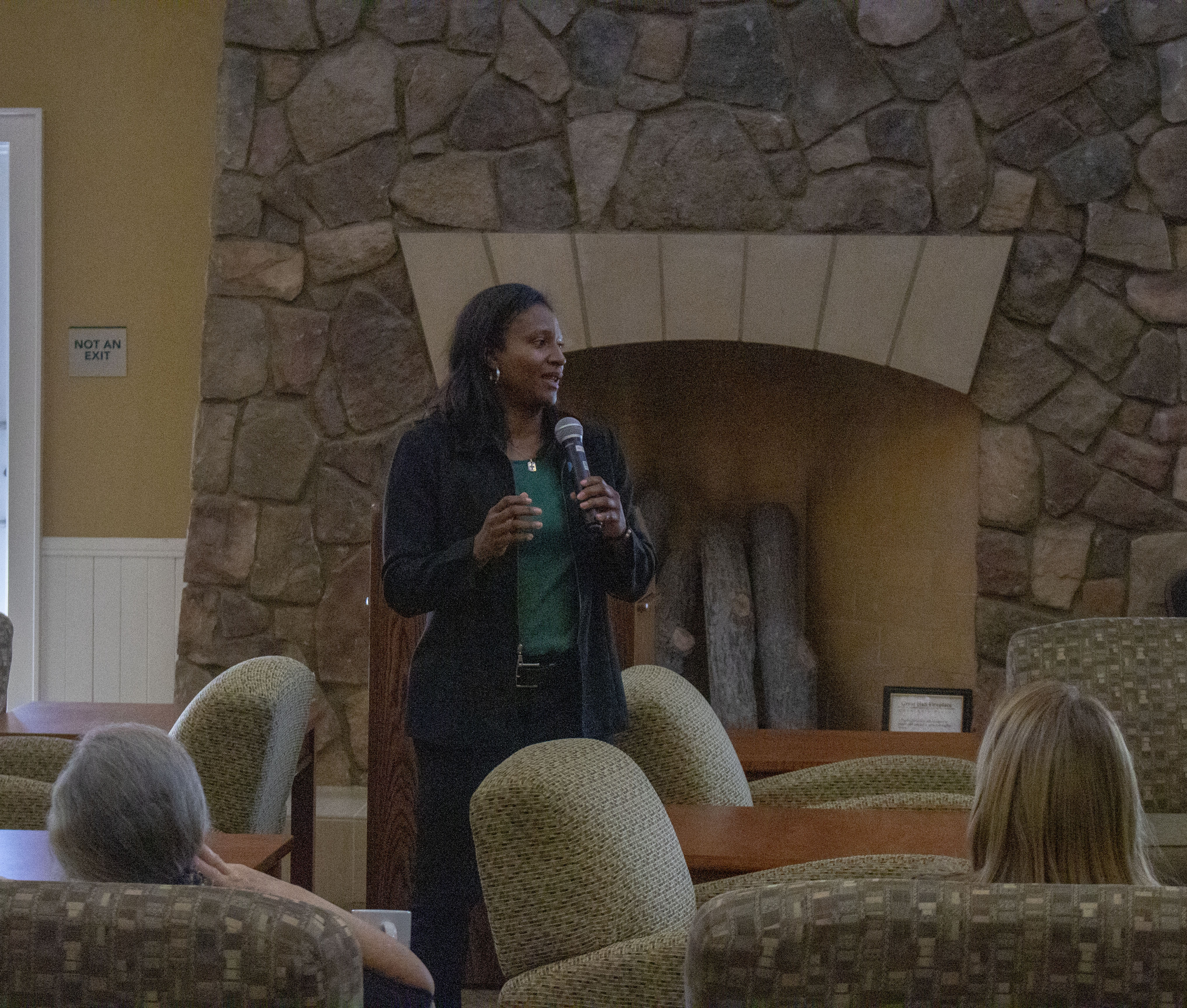
Jane Teixeira intends on bringing her 25 years of experience working with higher education as an administrator, coach, student-athlete and leader to Humboldt State University. Upon her arrival, Teixeira personally greeted everyone in attendance and made them feel comfortable. In return, staff took it upon themselves to show her the view of the College Creek Field from the Great Hall balcony.
Once everyone got to their seats, Teixeira introduced herself and began speaking on the importance of establishing a connection with student athletes.
“Cultivation is important. I’m a relationship builder and I have constructed my career on that,” Teixeira said. “I want to know about people I interact with. I want to know what you bring to the table and how I can help.”
Athleticism is not the only concern Teixeira spoke about. She also reached out to student athletes at HSU with concerns of life outside of their sports. Whether the concern is athletics or socializing, Teixeira has shown that she can incorporate her goal of unification between students and the community.
“I also want to see us build championships, not only from wins and losses, but being a champion in the community. And by that I mean leadership.”
Jane Teixeira
“I spoke with student athletes yesterday about job interviews,” Teixeira said. “I told them, remember the skillset you bring. Time management and organization as athletes are beneficial in the workforce.”
Her next talking point was about being competitive––whether it’s on the field or in the classroom. Student athletes at HSU experience obstacles such as going on the road for games, which hinders their focus on academic work. Teixeira also talked about championships, but not in the tone of filling trophy cabinets.
“I also want to see us build championships, not only from wins and losses, but being a champion in the community,” Teixeira said. “And by that I mean leadership.”
After introducing herself and the ideas she has planned if she were to become athletic director, Teixeira began taking questions from the audience. The first question involved her unique experiences that she would bring to HSU.
“Humboldt State Day would be great and you can have it at the plaza or the quad.”
Jane Teixeira
“I have worked with 14 institutes and their presidents, their athletics directors, SWAs, their coaches and student athletes on various levels,” Teixeira said. “My claim to fame was cleaning the Reggie Bush mess, not only by myself.”
The Reggie Bush mess she mentioned involved University of Southern California football player and Heisman Trophy winner Reggie Bush and basketball player O.J. Mayo accepting gifts from agents. This act resulted in Bush relinquishing his trophy. Sanctions were also placed on USC athletics.
The next question focused on the discontinuation of HSU’s football program and the effect it has had on homecoming. Other sports are capable of hosting the event, which would alleviate any concerns. Teixeira responded with alternatives to homecoming.
“You can center it around any sport, or any big time of the year for the community,” she said. “Humboldt State Day would be great and you can have it at the plaza or the quad.”
For the last question, Teixeira was asked if non-traditional sports like esports would have a place at HSU. She said she believes technological growth is important and she wouldn’t disregard esports.
“Esports is a hot trend right now,” Teixeira said. “In fact the Peach Belt Conference is the first NCAA Division II conference as a whole to have esports. I believe there are six or seven institutions in that conference and we have to be on that innovative technology side. We don’t know if it’s good or bad unless we try it. I’m gonna have to learn it too so it’s exciting.”
Sex is a heck of a thing in the animal kingdom. Species of birds, insects, mammals and fish have developed a whole bunch of strategies to get laid. From mating dances to beautiful plumage to carefully engineered bachelor pads, the birds have come up with all sorts ways to strut their stuff.
Wildlife junior Hannah LeWinter commented on how much effort birds put into reproducing. She remarked on the McGregor bowerbird’s tower—a three-foot-tall structure made of carefully placed twigs, attesting to the bird’s dedication.
“When we think of animals, we assume they do the basic things like mate and get food and make shelter, but they really do have complex [behaviors] too,” LeWinter said. “They make these intricate structures to impress females to say that they are the best suitors but those structures serve no purpose besides attracting a mate.”
“We think of animalistic sex of doing it only because you need to reproduce, but there are these animals that create these gestures like a pebble or a structure or a dance.”
Hannah LeWinter
Commitment to the craft is just the first step of courtship. The picky female bowerbird inspects her suitor’s structure, carefully judging sturdiness of the construction before joining the male on the forest floor. Then, the show really starts.
The male bowerbird possesses the ability to imitate sounds and begins a showcase of what he’s learned. His voice can emulate everything from birds and animals in the forest to the sounds of human civilization.
Once she’s satisfied with his performance, the male begins his dance. A chaotic shuffle from one side of his tower to the other, darting towards the female while flashing a bright orange haircut at her. Once he’s done with his groove, she submits and they do their thing.
“We like to think we’re the only people or the only species who do that,” LeWinter said. “We think of animalistic sex of doing it only because you need to reproduce, but there are these animals that create these gestures like a pebble or a structure or a dance.”
The McGregor bowerbird works every year to maintain his tower, but there is no expectation in the species to mate with the same female every year. Jeff Black, a wildlife professor at HSU who studies birds, published a collaborative book with 20 other ornithologists titled “Partnerships in Birds: A Study in Monogamy.”
“We asked the question, ‘How special are bird partnerships or pair bond?’” Black said. “We asked, ‘How long do mates stay together?’ ‘Are they really faithful?’ ‘Do the faithful ones fare better than the ones that alternate and are less monogamous?’”
The answer: it depends. Black and his fellow ornithologists quantified bird fidelity on a sliding scale ranging to very faithful to not at all faithful. They also investigated the behaviors between social pairs—pairs who spend their time together raising the young, foraging and nesting together—and genetic, or mating pairs.
“Birds lay their eggs in a basket,” Black said. “When you look at all the 10,000 different types of birds, some birds even though they’re monogamous, when you look at their babies, the genes come from someone else.”
“When you look at all the different studies, you can plot out how faithful they are. Swans are 100% faithful, the jays would be about in the middle and other species are just having sex everywhere.”
Jeff Black
Faithfulness or lack there of may have a couple of purposes, although the hypotheses are not totally fleshed out. One hypothesis is that, if a female searches for a new male mate, she may be looking for a more fit male than her social partner, and engage in what Black called extra-pair copulation.
HSU River Ecologist Alison O’Dowd explained fitness is a measure of the ability for an individual to pass on their genes. Similar to natural selection, sexual selection is when a female looks for certain characteristics in their male partner, ranging from vibrant feathers to well constructed towers to perfectly executed dances.
Black endorsed fidelity in birds. He said in geese and swans for example, more faithful pairs are more likely to successfully reproduce. Their offspring are also more fit for when they’re looking for a mate of their own. There may be a case for faith yet.
“When you look at all the different studies, you can plot out how faithful they are,” Black said. “Swans are 100% faithful, the jays would be about in the middle and other species are just having sex everywhere.”
CAPS will provide 36 more appointments per day by next year
On Jan. 9, the California State University Office of the Chancellor gave Counseling and Psychological Services a grant of $150,000 under the California Budget Act of 2019 to provide Humboldt State University students with more counseling services to combat mental health issues.
Director of Counseling and Psychological Services and Associate Director of Student Health and Wellbeing Services Jennifer Sanford was closely involved in the acceptance of the grant.
“I’m most excited about the pilot project to get innovative programs off the ground that’s focused on high-risk students,” Sanford said. “In developing this program we will be doing some specialized training that we’re doing research on now to launch next year.”
“Mental health doesn’t get the recognition that it should. When you’re not mentally well, your body reacts to that. If you’re stressed out, you’re only going to make it worse. More people should pay attention to it.”
Danele Quijas
Lobby areas will be built to hold more students and allow for an increase in counseling appointments. The grant will also fund two new therapy offices in the Behavioral and Social Sciences building, which will allow therapists to extend their hours. More tables and chairs will be added to the waiting areas to eliminate standing-room-only appointments. Construction will begin this summer.
The funds are expected to help students learn life skills, cope, regulate stress and manage moods. CAPS says improving these areas can improve class attendance, retention in school and promote graduation. With anti-stigma campaigning, CAPS hopes to make students feel comfortable talking about their problems.
Danele Quijas, a 22-year-old biology major, said students don’t pay enough attention to their mental health.
“Mental health doesn’t get the recognition that it should,” Quijas said. “When you’re not mentally well, your body reacts to that. If you’re stressed out, you’re only going to make it worse. More people should pay attention to it.”
A pilot project of $25,000 was also accepted by CAPS and will allow the growth of an intensive treatment program for high-risk students with disabling and chronic mental health issues. This treatment plan will include individual and group therapy as well as the highly-researched dialectical behavior therapy. CAPS hopes to continue this growth by providing other California State Universities with the tools to rebuild their own programs to be as effective as possible.
Casey Pederson, a senior majoring in business marketing, said HSU should do more to make resources clearly available to students.
“In a case like this with mental health, there can never be too many resources—so I definitely think it would help,” Pederson said. “I also think a big issue about it is getting people to know. Like I said, I had no knowledge that this was happening, and the big thing with mental health is the lack of knowledge and getting help. And there are resources available.”
The Humboldt County Department of Health & Human Services Public Health Branch has received confirmation from the California Department of Public Health and the U.S. Centers for Disease Control and Prevention (CDC) of one case of COVID-19 in a Humboldt County resident. A close contact who has symptoms is being tested as well.
This marks the first confirmed case of the novel coronavirus in Humboldt County. Presently, the ill individuals are doing well and self-isolating at home, while being monitored for symptoms by the Public Health Communicable Disease Surveillance and Control Unit.
Close contacts of these individuals will also be quarantined at home and monitored for symptoms by Public Health staff. With the amount of foreign travel by county residents, including travel to China, it is not surprising that a case has emerged locally. Additional cases may occur either in returning travelers or their close contacts.
“It’s important to remember that the risk to the general public remains low at this time,” said Humboldt County Health Officer Dr. Teresa Frankovich. “Despite the fact that Humboldt County now has a confirmed case of COVID-19, there is no evidence to suggest that novel coronavirus is circulating in the community at large.”
Frankovich added that transmission in the U.S. to date has been among close contacts and not among the general public.
Public Health suggests the following precautions to prevent the spread of COVID-19 and all infectious diseases, including common illnesses like colds and flu:
Stay home when you are sick
If you have a fever, stay home or go home if you are already at work or school, and stay home for at least 24 hours after you no longer have a fever (without the use of fever-reducing medicine).
Wash your hands frequently and particularly before eating or drinking.
Promote good hand hygiene in your home by educating household members and making sure soap, hand sanitizers, and tissues are available.
Avoid touching your face, particularly your eyes, nose and mouth.
Encourage proper cough etiquette. Cough or sneeze into a tissue, sleeve or arm. Do not use your hands.
Perform routine surface cleaning, particularly for items which are frequently touched such as doorknobs, handles, remotes, keyboards and other commonly shared surfaces.
The county’s Communicable Disease Surveillance and Control Unit will continue to provide updated information about COVID-19 to health care providers, hospitals and schools, as well as the general public.
The county’s Communicable Disease Surveillance and Control Unit will continue to provide updated information about COVID-19 to health care providers, hospitals and schools, as well as the general public.
If you are ill and in need of medical care and have been in China within the previous two weeks or have been in contact with an individual who has COVID-19, please contact your health care provider or emergency department before presenting for care. Arrangements will be made to have you evaluated in the safest manner possible for health care staff and other patients.
Activist creates new database to track violence against Indigenous women
Accounts of violence and murder toward Indigenous people are lost in history or left unrecorded. This became an even bigger problem for Indigenous women in places occupied by white men, such as mining or gold rush communities.
The Sovereign Bodies Institute was founded about a year ago by Annita Lucchesi, a Native American and activist. Lucchesi realized the need for a database of violence and murder against Indigenous women after needing one, and it not existing.
“It really bothered me because at that time in my life, I had just escaped a really abusive relationship that almost killed me,” Lucchesi said. “I also was being trafficked through that relationship, so I had a number of experiences where I almost was one of these missing and murdered Native women, so for me it was really personal and it really bothered me that if that had happened to me there was no guarantee that my story would be used to make sure that doesn’t happen to other women or girls.”
Four years ago, Lucchesi created her own database for missing and murdered Indigenous women, which eventually became the kickstarter idea for the Sovereign Bodies Institute.
“Humboldt County is amongst one of the highest counties of missing and murdered Indigenous peoples.”
Chelsea Miraflor Trillo
Sovereign Bodies Institute’s website says SBI is a home for generating knowledge of how Indigenous communities are impacted by gender and sexual violence and looking into how they can continue to heal and find freedom from such violence.
Lucchesi has acquired around 4,000 missing and murdered Indigenous women cases in her database. Lucchesi founded SBI with the help of the Seventh Generation fund, an international organization for Indigenous peoples.
Chelsea Miraflor Trillo, an Indigenous woman and participant of SBI, received her masters from Humboldt State. Trillo continues to work with SBI and families of missing and murdered Indigenous women to advocate awareness towards these issues.
“Humboldt County is amongst one of the highest counties of missing and murdered Indigenous peoples,” Trillo said. “Students are usually in the area where community awareness and political action happen.”
According to Lucchesi, Humboldt and Del Norte County hold a third of missing and murdered Indigenous women in California. Lucchesi said the justice system contributes to missing and murdered Indigenous women and the lack of action taken. Lucchesi said Indigenous women are considered non-human, and the justice system refuses to hold non-Native perpetrators responsible.
Tammy Carpenter is a member of the SBI organization and an HSU alumna. Carpenter was subjected to the mistreatment of Indigenous people personally.
“I, myself, am a mother of a victim that was murdered,” Carpenter said. “It’s still unsolved as of today, so I like to support the organization for the awareness for all women. Not just Indigenous women. All women.”
Editor’s note: members of the editorial staff of The Lumberjack are part of and have been part of KRFH. The author of this article had no previous affiliation with KRFH.
Following winter break, KRFH has returned with its entirely student-staffed programs, TALX, MIXX and Local LIXX. Each of the programs bring on guests to participate in their show, providing a platform for community members to show off their skills and speak their mind.
Local LIXX, the longest running program at KRFH, invites local artists to display their talent live on the radio.
Co-Manager of LIXX, Michael Freire first became part of the program in 2017.
“It’s like a really, really cool special thing to have a fully student-run radio station that is promoting a local music scene in a town that has a surprising number of good musicians per capita,” Freire said.
One of the main focuses at LIXX is to create a diverse program that speaks to all music genres and tastes.
“One of the few limitations is that I obviously only have a view on the part of the music scene that I’m familiar with,” Freire said. “So I also try to like reach out to as many friends as possible for suggestions of places I can go, ’cause I don’t want to just put one genre of music or one group of friends on the radio.”
To scout talent for LIXX, Freire attends as many shows as he can, searching for sounds that he feels are a proper fit for the program.
LIXX Co-Manager Michael Freire preps the board for the big show. Photo by Dakota Cox
Konner Bouyette and Quentin Wall of Quentin Wall of Sound rockin’ out on air.
Quentin Wall and his band, Quentin Wall of Sound, were the first guests of the spring semester. This was Wall’s second appearance on the program, but his first with the new band.
“Playing on air is fun,” Wall said. “It’s scary because anything you do, there’s no take-backs. But it’s fun because anyone can listen, and it’s a lot of people that I would never meet.”
Not to be mistaken for LIXX, the MIXX program currently abides by a first come, first serve policy. This allows the platform to seek out the hungriest, most enthusiastic artists first.
Manager of MIXX Alejandro Zepeda does a final for ChopsJunkie before showtime. Photo by Dakota Cox
ChopsJunkie hard at work spinning records on the KRFH MIXX program. Photo by Dakota Cox
MIXX Manager Alejandro Zepeda is currently in his sixth semester with the radio program.
“It’s really fun to watch the different DJs and their different techniques and how they’re doing it,” Zepeda said. “It’s a really great learning opportunity for myself and anyone else on the MIXX crew if they’re interested in DJing, just because you don’t really get to be this close to the performer usually when you’re out at an event, and you know there’s all sorts of other stuff going on.”
TALX is the odd man out of the programs. Instead of placing the focus of an entire show on a single guest act, TALX incorporates their guests as part of a larger conversation. Unlike MIXX and LIXX, TALX doesn’t require a guest in order for the show to go on. Instead, students are given direct control of the content they create.
Members of TALX discuss the days trending topics. Left to right, Manager Delaney Duarte, & Deserie Carias. Photo by Dakota Cox
Members of TALX discuss the days trending topics. Left to right, Paul Hilton & Ayrton Flaherty. Photo by Dakota Cox
Delaney Duarte is currently in her second semester as manager of the TALX program.
“When you’re in there you’re gonna meet a bunch of other people, and then you kinda create like this bond with everyone,” Duarte said. “Everyone knows you and it’s like a really good community. I love the radio community a lot here on campus.”
KRFH is one of the last student-run free-from radio stations. Students are given complete creative control over their content, so long as they conform to Federal Communications Commission regulations. KRFH programs provide an opportunity, not only for community members to showcase their talents, but for students to express, explore and share their identities.
“There’s just something about being in the booth, something about being in this radio station,” Zepeda said. “It’s calming for me despite all the crazy things that happen, and there’s always something ridiculous happening. It’s my happy place, and I’d like to continue that for other people that need to find something like this in their lives.”
Another prospective athletic director gives their pitch
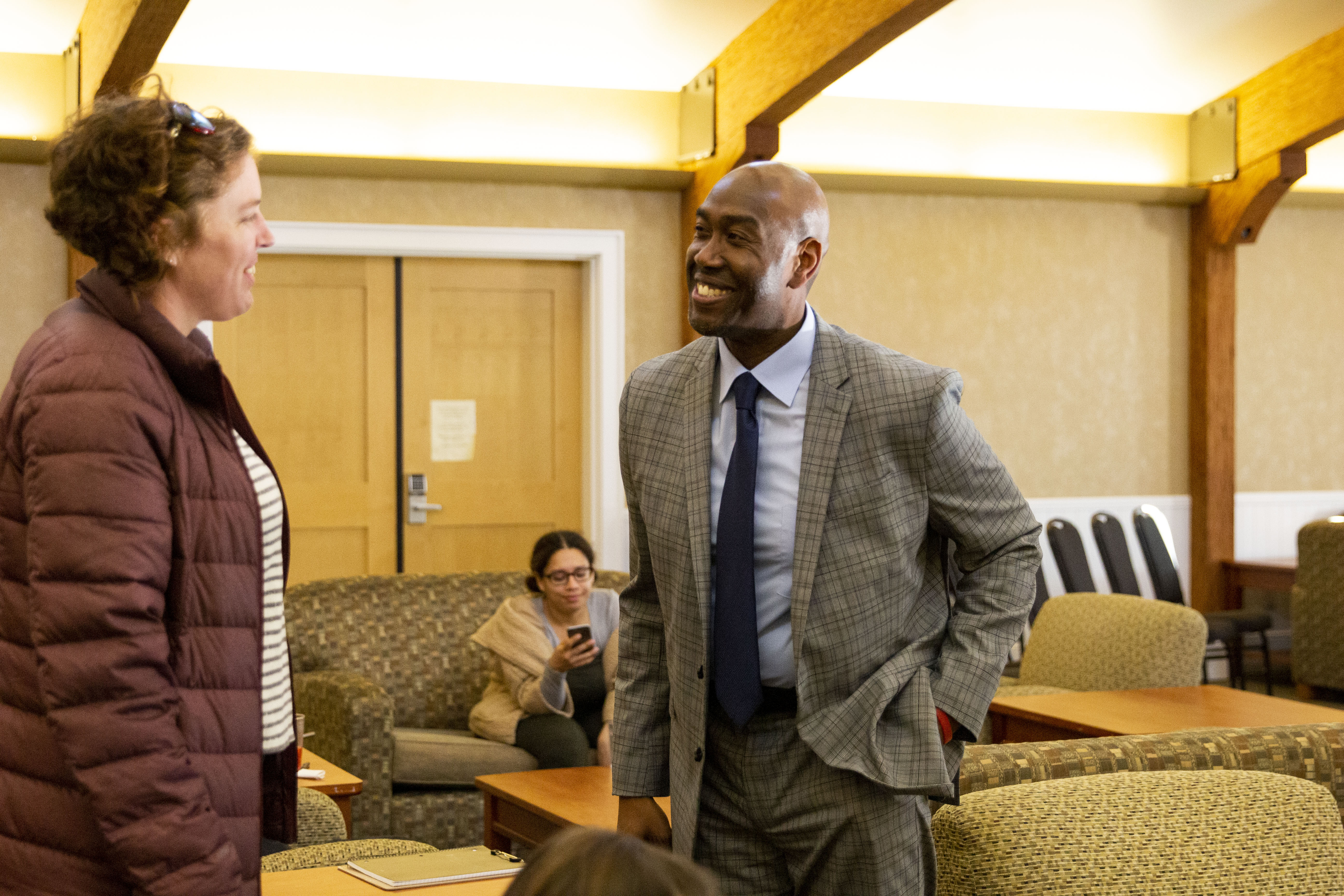
Marcus Manning is the second of three candidates for Humboldt State’s athletic director position. Manning, who began his athletics department work in recreation at Southern Illinois University, Edwardsville, said he saw the opportunity for HSU to excel in intercollegiate athletics and recreational sports.
“The vision that I have for Humboldt State athletics and recreation is to be a premiere program both in intercollegiate athletics and recreation,” Manning said. “Providing opportunities for our students that involve personal development, academic success and competitive excellence.”
Manning has also had experience at University of California, Irvine, Indiana University South Bend, and the National Association of Intercollegiate Athletics in Kansas City, Missouri. Manning also has experience at Maryville University, the BASE Foundation in St. Louis, Missouri and Centenary College.
Manning was confident that the future of sports has great potential at HSU. He said the department should look toward students for what direction to take. One example he gave was the possibility of backing esports on campus.
“Young people have led us to competitive gaming,” Manning said. “They’ve shown us the way and so that’s an opportunity for us to look at that and say, ‘Okay, can competitive gaming—can esports—happen at Humboldt State University?’”
Manning said it would be a collective effort to involve student athletes in the campus and make sure they are an active part of the community.
“I was charged with adding programs to help increase enrollment and doing that with strategic speed. Also from a fundraising standpoint, taking our fundraising budget from a negative $11,800 to making sure we were in a surplus of $1.3 million.”
Marcus Manning
“That means everyone within the campus community all-in in terms of that type of experience,” Manning said. “Our alumni base and surrounding community also playing a part in that student experience.”
When asked why he thought he would be the best candidate for the job, Manning pointed to his years of experience with athletics as a base for his merit.
“Seventeen years of broad-based experience,” Manning said. “I got a chance to work at University of California, Irvine in recreation, but it was under athletics. So I was director of club sports and specialty events. When you look at this unique opportunity at Humboldt, it includes recreation. I cut my teeth on rec sports and I had a blast.”
He also mentioned that he’s added programs for universities in the past and that he could do that for HSU too.
“I was charged with adding programs to help increase enrollment and doing that with strategic speed,” Manning said. “Also from a fundraising standpoint, taking our fundraising budget from a negative $11,800 to making sure we were in a surplus of $1.3 million.”
Manning said the signs he saw while researching the Humboldt area pointed to potential.
“Just doing homework. I’ve seen some of the new things that occurred in terms of partnership with local schools and scholarship opportunities,” Manning said. “Seeing those opportunities that Dr. Jackson has talked about, so that really put me on notice to say, ‘Okay, these are some potential opportunities that we can really take advantage of.’”
Though prevalent, there are many free treatment and prevention options
Syphilis rates are spiking throughout California, and Humboldt County is no exception. If left untreated, syphilis can cause a brain condition that resembles dementia, heart problems, skin ulcers and blindness.
Nurse Practitioner Andrea Shoup is taking an active role to better inform the community about risk factors, prevention and treatment of syphilis.
“It’s totally treatable,” Shoup said. “People don’t really get tested. If they do, it’s not enough.”
Syphilis can manifest, but then seem to disappear. If a person doesn’t get regularly tested, they may never know they have it and spread it without knowing. There are also risk factors that increase the likelihood of contracting syphilis. Men who have sex with other men are at a higher risk than men who only have sex with women.
“It’s just the butthole,” Shoup said. “The anus tears more easily than the vagina.”
Other risk factors include finding sexual partners using social media, which can create a false sense of trust between partners. Methamphetamine use is also linked to high rates of syphilis. People under the age of 26 are also more likely to contract syphilis than any other age group.
“That just comes down to promiscuity,” Shoup said. “It’s true in my own life. I kind of doubled down at 20.”
Dr. Teresa Frankovich, the health officer for Humboldt County, said she is not surprised about the local rate of syphilis.
“I somewhat expect we would see the same trend as elsewhere,” Frankovich said. “There’s ultimately a large amount of people at-risk.”
Though the actual number of cases are going up, Frankovich thinks there’s more to it.
“Part of it is we’re doing a better job at screening individuals,” Frankovich said. “We’re catching more cases of it.”
“Notifying your partner if you have a positive test is really important.”
Dr. Teresa Frankovich
There is a lot that can be done to limit the risk of exposure to syphilis. Frankovich suggested limiting partners. Abstinence and monogamous relationships are ideal for limiting exposure to STDs. Condoms are available at most medical treatment facilities, including the Student Health Center on campus. Condoms are also available by prescription.
Shoup says condom prescriptions, though important for limiting STD rates, still cause controversy.
“I had some Republican coworkers that were all, ‘I’m paying for people’s pleasure,’” Shoup said.
Along with condom prescriptions, yearly screenings are recommended. Since syphilis and other STDs such as chlamydia can go unnoticed, there is no way of knowing the STD status of a partner without a test.
“Notifying your partner if you have a positive test is really important,” Frankovich said.
Frankovich acknowledged that communicating with past partners about syphilis can be a challenge for many, which is why the Public Health division of the Humboldt County Department of Health and Human Services provides a service called the Partner Services Program. Public health will assist in contacting partners and inform past partners in order to jump the hurdle of uncomfortable situations.
The Student Health Center, the Open Door Clinics, Planned Parenthood and any general practitioner can help with preventative measures, testing and treatment.
“Really it’s a lot of bad things that you don’t want,” Shoup said. “You don’t see the consequences until much later.”
Ilyasah Shabazz discussed her background with loving energy on Feb. 12
Ilyasah Shabazz, one of six daughters of Betty Shabazz and Malcolm X, came to Humboldt State University Feb. 12 to discuss her book, “Growing Up X.”
Despite the title, the book is not about Malcolm X. Rather, it surrounds the lessons and experiences that of Shabazz as she grew up living in her father’s radical legacy.
“One of the benefits of being my parents’ child is that I grew up with a lot of love,” Shabazz said. “It’s really what drives my work because I realized there are a lot of young people who realize they are not worthy of love, or worthy of a quality education, or worthy of all of these things that life is supposed to provide us.”
Shabazz dedicated her career to sharing the importance behind love and support being provided at a young age.
In an exclusive interview with The Lumberjack, Shabazz emphasized the importance of love and humanity and the awareness that people are a reflection of one another.
“In high school, I was at a prep school and not too far down the street was a group home, so we would go and tutor these young people,” Shabazz said. “I was tutoring them in math and then I started realizing that they didn’t have love—that there was no self love.”
Shabazz dedicated her career to sharing the importance behind love and support being provided at a young age. She began advocating for the younger generation and their educational opportunities.
“As I got older, I started realizing that it was really important for me that young people understood that they were worthy of love—that they were worthy of a quality education,” Shabazz said. “Because our education curriculum is not inclusive of historical facts, it makes young people feel that they are not worthy.”
Shabazz felt inspired to write books because she wanted to change how children saw themselves portrayed in history. She specifically wanted to change the narrative of Black history and liberation for children.
“That’s why I write my books,” Shabazz said. “So that children could open up a book, learn some history—learn good history—and then see a reflection of themselves in the story.”
Her family’s legacy and the lessons shaped Shabazz into the person she has become today. An activist who has dedicated her life to working and representing the younger generations.
“It’s about recognizing the humanity in everyone,” Shabazz said. “That we’re all brothers and sisters in the fatherhood or family of God or the creator. That we’re interconnected just because we’re human beings. Just imagine how much better life could be if we didn’t have to fight for someone to stop pressing us or, you know, committing these criminal acts on us and seeing them for as they are.”
Potluck seeks to bring together and welcome students to the community
Equity Arcata’s Home Away From Home Potluck is an event that happens four times a year. There are two during the spring semester and two during the fall semester. The purpose is to bring together all students, community members and local businesses and make them feel welcome within the community while enjoying a free meal.
The trials and tribulations of finding parking on campus
Parking on campus sucks. And I’m not the only one that thinks so.
I try my best to walk or take the bus whenever I can. Sometimes I’m just too slow in the morning and have to drive to avoid being late. The problem is that between the hours of 9 a.m. and 3 p.m. it’s ridiculously hard to find an open parking spot on campus.
Usually I end up parking on a residential street nearby. To put that into perspective, my apartment is a 21-minute walk from campus according to Google Maps. From where I usually end up parking, it’s an 11-minute walk to get to class. When I add the four minutes it takes to drive there, I only end up getting to class six minutes faster. Sometimes, that’s exactly what I need to make it to class on time.
“If people have to pay even more for parking permits there HAVE TO BE SPOTS AVAILABLE FOR THEM TO PARK IN.”
Parking Survey Response
A 2018 study by Walker Consultants included an anonymous survey on the state of parking on campus. The full results of this study are available, and boy, a lot of people were mad about parking.
“Prices as they are, are already ridiculous. One should not have to pay $315 a year to only find parking between 7:00-8:00 a.m and after 5:00 p.m.,” one person wrote.
The survey had multiple respondents to the parking issue.
“If people have to pay even more for parking permits there HAVE TO BE SPOTS AVAILABLE FOR THEM TO PARK IN,” another person wrote.
In addition to the sentiments behind these two comments, a large number of the comments suggested building both on-campus parking structures and off-campus parking with shuttles to campus.
One question on the survey struck a nerve with many respondents when it suggested the cost of parking passes may have to be raised in order to meet the demand. Many of the answers to this question were filled with colorful language.
“What in the world do you do with all the money that you are unable to sustain the program without raising prices again?” one of the less expletive-prone respondents wrote.
Another respondent offered to try and get the extra funds themselves.
“Perhaps we can lobby the state for funds? I’ll go to talk to Jerry on behalf of HSU. Dunno if he’ll see me, but I’ll go,” wrote the hopeful respondent.
Unfortunately, Jerry Brown is no longer our governor, so if this respondent had it in with Jerry Brown, that won’t work anymore. Even more unfortunate is that this is an issue that is going to take a lot of work from the school if it’s going to be fixed. It’s also likely that even if it is fixed, it’ll take longer than many of our students will be here. In the meantime, it’s still a great excuse for being late to class.
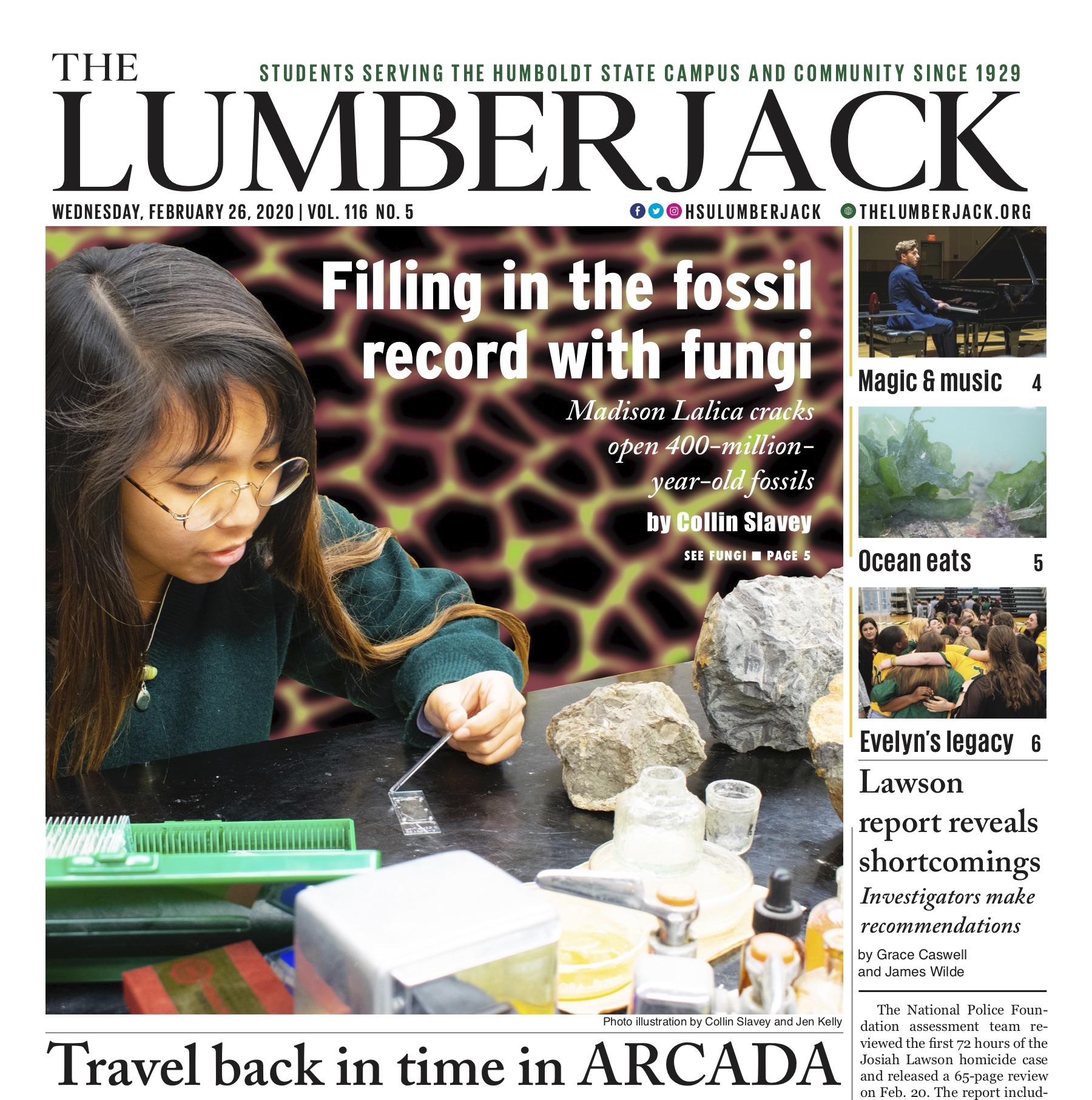
The fourth issue of The Lumberjack for the spring 2020 semester
This website uses cookies to improve your experience. We'll assume you're ok with this, but you can opt-out if you wish. Cookie settingsACCEPT
Privacy & Cookies Policy
Privacy Overview
This website uses cookies to improve your experience while you navigate through the website. Out of these cookies, the cookies that are categorized as necessary are stored on your browser as they are essential for the working of basic functionalities of the website. We also use third-party cookies that help us analyze and understand how you use this website. These cookies will be stored in your browser only with your consent. You also have the option to opt-out of these cookies. But opting out of some of these cookies may have an effect on your browsing experience.
Necessary cookies are absolutely essential for the website to function properly. This category only includes cookies that ensures basic functionalities and security features of the website. These cookies do not store any personal information.
Any cookies that may not be particularly necessary for the website to function and is used specifically to collect user personal data via analytics, ads, other embedded contents are termed as non-necessary cookies. It is mandatory to procure user consent prior to running these cookies on your website.