The Lumberjack


Students Serving The Cal Poly Humboldt Campus and Community Since 1929

Tag: Humboldt County

  • Cal Poly Humboldt considers Clayco – a company with record of wrongful death, wage theft and malpractice – for $100 million construction contract

    Cal Poly Humboldt considers Clayco – a company with record of wrongful death, wage theft and malpractice – for $100 million construction contract

    by Andrés Felix Romero and Emma Wilson

    A giant stood on LK Wood. It was twice the height of the men around it, armed with a massive hammer and a demonic scowl. It pointed with a long, curled finger at every soul underneath its gaze, framed by a wooden wig and caterpillar eyebrows. It was a judge, and judge it did. 

    Photo by Alex Anderson | Members of the carpenters union placed a tall judge statue in front of the Cal Poly Humboldt entrance sign to protest Calyco

    “Judgment day is coming,” it said. “Shame on you. Shame, shame, shame!”

    No ogre was laying waste to Arcata. It was built as a protest by Local Carpenter’s Union 751 against Clayco, one the companies in the running to bid on the Cal Poly Health, Housing and Dining Infrastructure project, also referred to as #PLY106. The Union and their main goal is to bring the company’s legal issues and history of malpractice to the attention of the campus committee that awards infrastructure projects, and to the community in general.

    THE CONSTRUCTION PROJECT

    Construction on the Housing, Health, and Dining building is set to begin fall 2024. The new facilities include a new health center and dining hall, and will be able to house roughly 450-500 students. The facilities are planned to be operating by August 2026, or summer 2027 at the latest. The direct construction will cost at least $108.9 million and the guaranteed maximum budget is $131.9 million. The winning contractor will be announced in October of this year.

    MALPRACTICE AND WORKING CONDITIONS 

    In a legally fact-checked letter from Union Local 751 to the CSU Board of Trustees, there is a list that cites Clayco’s history of legal issues due to allegations of malpractice. Clayco has been a defendant in at least 22 cases since March 2000. Since 2010, they have had at least 17 OSHA violations brought against them, resulting in fines around $81,336. Clayco’s legal issues include an active investigation by the Federal government concerning allegations of violating worker’s rights and harassment of union members, a pending case concerning allegations of wage theft, and a wrongful death lawsuit concerning a worker’s death that was settled last year.

    OSHA Citation against Clayco documents details on Kirk Smith’s accident

    In August 2017, Kirk Smith, an employee of the subcontractor Watson Companies Inc., fell 35 feet to his death while working on the construction of an Ulta Beauty warehouse in Fresno CA. The fall was a result of a weakened roof not being fixed for employees to safely work on, as well as a lack of warnings concerning the stability of the roof. Smith left behind a wife and children, who then sued Clayco along with Ulta and Watson for wrongful death in April 2018. Clayco, along with the other defendants in the case, eventually settled with the Smith family for $5 million in 2022. Attorney Brett D. Beyler, representing Smith’s family, wrote in the court settlement document that the incident was entirely avoidable.

    “On August 9, 2017, Kirk Smith (the decedent) arrived at the Project,” Beyler wrote in the settlement document. “He was directed by Watson [Companies Inc.] foreman, Mr. Rabideau, to cut out the membrane and insulation on top of the metal decking. As Mr. Smith was cutting the membrane and insulation out with a hand knife, the weakened metal decking gave way like a trap door, causing Mr. Smith to fall nearly 40 feet to his death. This incident was entirely avoidable. Unfortunately, due to the negligence of Clayco and NDBS [National Design Build Services], Mr. Smith is no longer alive.”

    WAGE THEFT

    Decision by US District Judge John Mendez gives background info on allegations of wage theft

    Clayco is currently in an active case regarding wage theft. These allegations are brought forth by labor rights organization, The Workforce Defence League (WDL), representing laborers who worked on Amazon Fulfillment Centers in Sacramento and Tracy who say that they have not been compensated for their overtime work or use of their own tools in the construction project. 

    According to the WDL, the laborers worked 58 hours a week and were promised $20-24 an hour. They weren’t fully paid for their regular or overtime hours, and they didn’t receive their work breaks and only got one meal break. They also didn’t get compensated for the missed breaks.

    HARASSMENT OF UNION REPRESENTATIVES

    NLRB charge against Clayco for allegations of harassing Union members

    Clayco is also under current investigation by the federal government for allegations of violating workers’ rights as well as harassment of union representatives. Two separate documented charges brought against Clayco by the National Labor Relations Board were filed as recently as November 2021. They claim that the contractor unfairly fired a subcontractor from their position, and attempted to prevent the Carpenter’s Union from conducting their activities by barring them from Clayco properties and instructing Clayco employees to limit contact with Union representatives. Additionally, videos on the Local 751-run website, Claycofails.com, show alleged harassment of Union organizers. One instance alleges that a Clayco foreman followed and videotaped an organizer.

    “[Clayco] interfered with the exercise of protected rights by firing a Union signatory subcontractor when Union Agents tried to access the site,” one document read. 

    “[Clayco] interfered with the exercise of protected rights by calling the police when the Union tried to access the job site, surveilled and videotaped Union agents and ordered workers not to talk to the Union,” according to the other document.

    CLAYCO’S RESPONSE

    In an email, Clayco’s Vice President of Marketing and Communications Sarah Green forwarded a statement from Clayco’s legal team. The statement said that Clayco is the target of a campaign of Union harassment. The statement made the case that the Union has no legal right to access any Clayco properties and that the Union’s ultimate goal is to get Clayco to sign a collective bargaining agreement with them.

    “Since 2021, [Union members] have filed 11 unfair labor practice charges against Clayco with the National Labor Relations Board (NLRB),” according to the email. “8 out of these 11 charges have either been withdrawn or dismissed, and the remaining three charges will go to hearing in October [2023]. Nor does the [Union] report that the NLRB matters arise from the [Union] and/or its members attempting to forcibly enter two Clayco California projects despite having no legal bona fide right to enter those projects – resulting in them having to be removed by police.”

    Labor Counsel for Clayco, Andrew Martone, adds that no one affiliated with Clayco has brought charges against the company through the National Labor Relations Board, and that any Federal investigation against Clayco is a result of Union actions only.

    “No Clayco employee and no employee at any Clayco worksite has filed a complaint with the NLRB,” said Martone. “Charges brought are by the [Union], and they don’t represent any Clayco employee.”

    Court document provided by Clayco that has been given a red flag by Westlaw

    Green also stated that the Union has been misleading in their campaign.

    “The [Union] misleads the reader to believe OSHA citations were issued against Clayco that were in fact issued to other entities,” said Green, “and reports OSHA Citations without informing the reader that OSHA found no violations existed.”

    However, Lumberjack reporters were able to find OSHA violation documents concerning the death of Kirk Smith. Clayco shared a court statute with Lumberjack writers that documented tactics by the Union. However, the statute was labeled as “amended, repealed, superseded, or held unconstitutional in whole or part” by Westlaw, a legal research company. Unfortunately, since Lumberjack writers were unable to gain further access to Westlaw files, we are unable to say why it was labeled as such.

    UNIVERSITY INVOLVEMENT 

    Lumberjack writers reached out to Procurement Specialist, Addie Dunaway of Contracts and Procurement department of Cal Poly Humboldt, as well as Humboldt Director Planning, Design & Construction, Kassidy Banducci of the Facilities Management Department. Both expressed a desire to comment, but were limited in their ability to speak as the bidding process is still active. Any comment on Clayco’s involvement from Cal Poly Humboldt staff and admin could violate legal obligations, as well as compromising fairness to the other three potential contractors. 

    University documents confims that Clayco, Sundt, and Swinerton are three companies on the shortlist for the #PLY106 contract. A fourth potential bidder is currently unconfirmed. The Union has also sent a letter to the Board of Trustees concerning Sundt’s history of malpractice.

    Communications Specialist with the News and Information department, Grant Scott-Goforth, shared some information on the infrastructure project, though he was unable to comment on any allegations brought against potential contractors.

     “The Committee remains diligent in their work towards a fair and equitable evaluation process governed under the provisions of the law in the state of California,” according to a statement released by the University. “Cal Poly Humboldt is committed to its responsibility under California regulations for public work projects and the better good of the construction industry. Any information regarding the performance or behaviors of proposing firms will be considered against CSU policies and State regulations.”

    UNION AWARENESS

    Union Organizers from Local 751 spread awareness to the campus community about where their money may be going—especially the funds that students give to the school as part of their tuition.

    “How has a contractor with this history got this close to a major project?” said Harvey McKeon, a field representative for the Union. “Which, at the end of the day, is [funded by] public money, and it’s also by extension student’s money, and [the students] should have some sort of control and say over how that money is spent.”

    The organizers from Local 751 want to make it clear that although they are a union, their endgame isn’t to try and have a union-backed construction company be awarded the contract. Rather, they want to ensure that a company with multiple legal issues and allegations of malpractice isn’t able to gain a foothold in the community and public works projects, and to try and create a better and safer working environment for all laborers.

    “As a union, our recent track record has been to lift standards for workers whether they’re union or non-union,” McKeon said. “The reason why we are seeking to generate awareness about Clayco is because we want to draw attention to what Clayco does to workers that we don’t formally represent, but we care about their working conditions.” 

    Beyond a desire to bring Clayco’s past and current legal issues to light and try to create safer environments for workers, some organizers such as McKeon feel a personal responsibility to ensure a safe working environment for both contractors and the community at large due to their personal experience as a worker without union support. The union also wants those at Cal Poly Humboldt that awards infrastructure projects like #PLY106 and potential contractors that there must be precedence for companies rooted in ethics.

    “I’ve been in jobs before I was a labor union organizer where I didn’t have anyone looking out for me because I wasn’t in a union, and I don’t think that’s a reason why you shouldn’t have people not look out for you,” McKeon said. “We’re trying to represent [all laborers] even if they’re not currently union members. It’s like trying to plant a tree whose shade you may never sit in.”

    Editing note:

    On Sept. 6, this article was edited to clarify that Clayco’s Vice President of Marketing and Communications Sarah Green shared Clayco’s statement from legal team with a reporter via email. The statement made the case that Clayco is the target of a campaign of Union harassment and that the Union has no legal right to access any Clayco properties and that the Union’s ultimate goal is to get Clayco to sign a collective bargaining agreement with them.

    The article was also edited to remove reference to a contractor who’s bid on the project could not be confirmed.

  • California State Universities propose 6% tuition increase 

    California State Universities propose 6% tuition increase 

    By Peyton Leone and Carlina Grillo and Christina Mehr

    The California State University Board of Trustees will vote on the Multi-Year Tuition Proposal on Sept. 13. If passed, tuition at all CSU campuses would rise by 6% for five years starting fall 2024 until fall 2028.

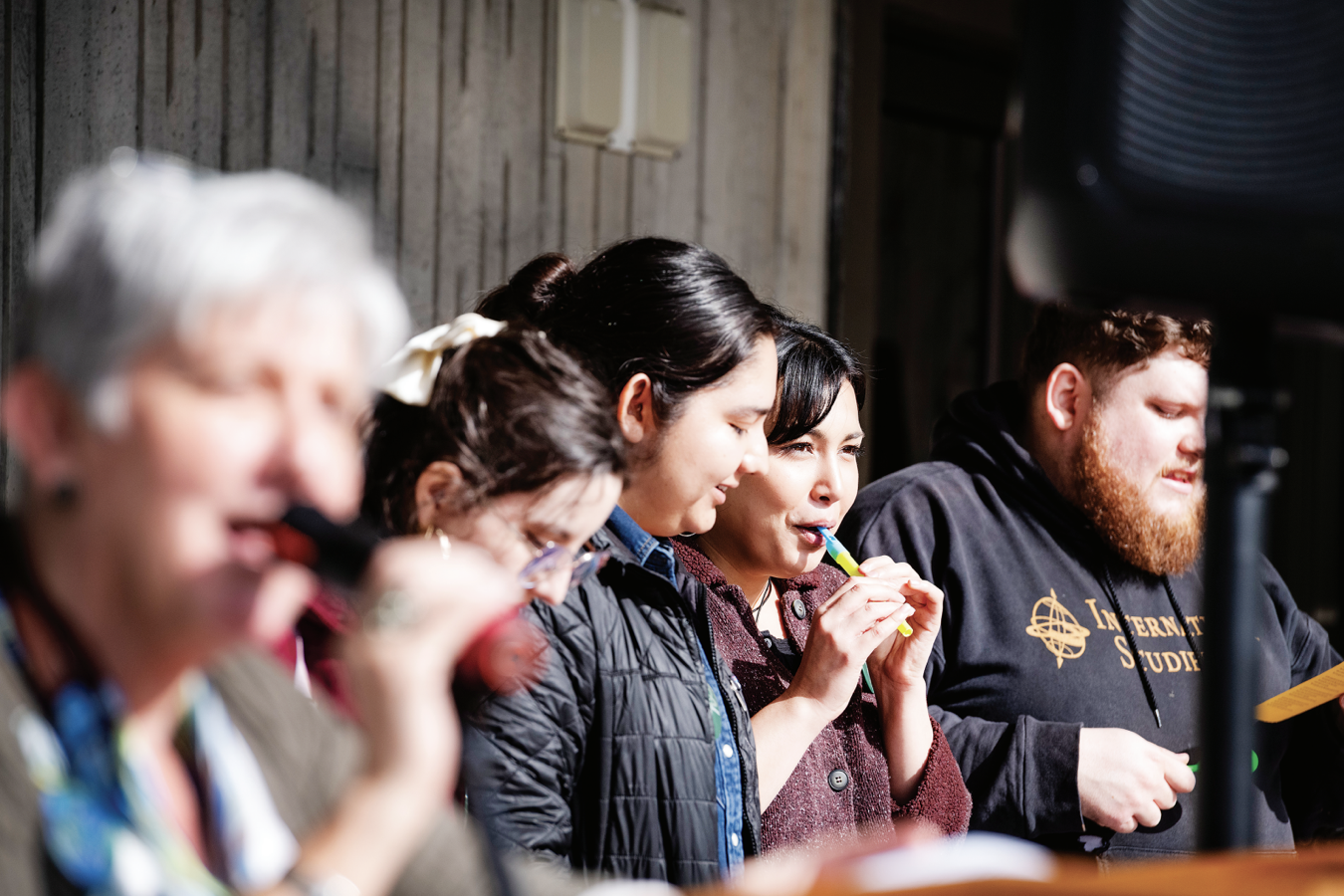
    On Thursday Aug. 31 Cal Poly Humboldt’s Associated Students held a meeting to inform students about the tuition increase proposal. There were more than 30 people in attendance.

    Photo by Jillian Wells. Students and staff gather at the Tuition Increase Town Hall on Aug. 31.

    “The 6% increase covers all of the different levels of education,” said Amber Blakeslee, Executive Director of Finance and Budget at Cal Poly Humboldt. “So that’s undergraduate, credential and graduate student tuition. It also covers in-state tuition, out-of-state tuition, and the graduate business professional fees.”

    For example, the proposal would raise the tuition rate of an in-state full-time undergraduate degree from the current $5,742 to $7,682 in fall 2028, a 34% increase over the first five years. This does not include the fees for each campus, which vary. This semester full-time student fees at Cal Poly Humboldt totaled $2,170.

    The CSU system is funded from two main sources: tuition and state funding.

    CSU reported in a document titled the “Sustainable Financial Model Workgroup Report” that there was a nearly $1.5 billion gap between money the system received and the costs to keep the CSU system running in 2021-2022.

    The same report concluded that “even with aggressive assumptions about increases in-state general fund and tuition” would not be enough to close the gap.

    The California State Student Association, a nonprofit group representing nearly 500,000 CSU students, unanimously voted to oppose tuition increases according to AS president, Sam Parker.

    “The proposal lacks measurable outcomes, a clear termination date, and fails to articulate plans for generating other revenue sources,” CSSA said in a July 11 press release.

    According to the Multi-Year Tuition Proposal, 60% of students at the CSU system would not be affected by increases. Their attendance is covered by the Cal Grant, Pell Grant or tuition waivers.

    The proposal notes that increases will exceed the maximum Pell Grant award by over $280 by the 2028-2029 school year, and that Cal Grant may not rise to cover tuition raises into the future given.

    Photo by Jillian Wells. Peggy Metzger, Director of Financial Aid, (left) addressing questions by Nova Presley (right) at the Tuition Increase Town Hall on Aug. 31.

    “It discourages me from even wanting to continue through school,” said sophomore Sonny Buckner after the town hall meeting, noting that affording school and finding housing were affecting his time as a freshman. “…I barely even passed all my classes. It’s ridiculous that these are the things I have to put my priorities on when I came here to be a student.”


    The CSU Board of Trustees will meet from Sept. 10-13 in Long Beach, California. The board will take public comment on the proposal on Sept. 12 at 9:00 am. Public comment can be sent to trusteesecretariat@calstate.edu. before Sept. 11. Instructions on how to give live public comment virtually or in person can be found at www.calstate.edu/csu-system/board-of-trustees/Pages/information-for-bot-attendees.aspx
    Caption: Data from https://www.calstate.edu/attend/paying-for-college/tuition-increase/Pages/proposed-tuition-adjustments.aspx

  • Cal Poly Humboldt’s lacrosse team celebrates 40 years

    Cal Poly Humboldt’s lacrosse team celebrates 40 years

    by Kae Dennert

    Cal Poly Humboldt’s Lacrosse team is celebrating its 40th year as an official club on campus. The team has grown in size to be the largest they have ever been, with nearly 30 members. They practice three days a week, yet still ensure that  their athletes can prioritize school and keep the sport fun. 

    Head Coach Danny Eggert has been a part of the team for the past three years and is excited about the growth of the team. He’s looking forward to the improvement of the team and wants to see the players do the best they can.

    “[The] goal [is] to win,” Eggart said. “To do better than before.”

    Eggart is proud of the team’s club status and has no plans to push for the team to be a part of the NCAA sports. For now, their club is to hang out and have fun, and not be a job for his athletes.

    Sophomore geology major and athlete Luca Ricci has been on the team since he came to Cal Poly Humboldt. Going into his second year, he is excited for the prospects of the upcoming season.

    “I’m on the lacrosse team because I love the teamwork,” Ricci said. “We have a brotherhood on and off the field.”

    Assistant Coach Gus Johnson himself used to be on the team from 2008-2011 and has been coaching since 2020. Though they are still early into their pre-season, he is excited for the competition coming into their upcoming season. 

    “It’s early, it’s the off-season,” Johnson said, “but playoffs are definitely the target this year.”

    The team only had four athletes graduate out last year, and have eight to ten coming in. Their main goal for this season is to make it to the playoffs,  try their best, while still having fun and making sure they aren’t overloading their students.

    “We try to respect that they’re students first, it’s college and we want them to have fun,” Johnson said. “It means a lot. These guys have been here forever and to be consistent and still fill the team, it really speaks to how much these students care about it and want to play.”

    With 40 years as a club, the team has made a name for themselves, continuing to grow and enjoy the space they have on campus. Anyone is welcome to join the club and can apply online under the recreational sports section of the Humboldt website.

    “Hopefully, we come out as a winning team to represent 40 years of hard work.” Eggart said. “We have possibly 30 right now on the roster, so having numbers on there is amazing.”

  • First fall for fresh Cal Poly Humboldt Admin

    First fall for fresh Cal Poly Humboldt Admin

    by Andres Felix

    Three new individuals with years of experience in education and community service have been selected for the roles of Dean of Students, Dean for the College of Extended Education and Global Excellence, and the Vice President of Enrollment Management and Student Success. Hailing from all corners of the nation, these leaders are here to accept the challenge to provide support to the academic institution and its community from their respective roles and offices. 

    Dr. Mitch Mitchell – Dean of Students

    Fresh Dean of Students (DOS), Dr. Mitch Mitchell, began his position in Spring of 2023. He made his first major appearance in his role in the commencement ceremony. Mitchell wants to provide support to the students in any way he can to ensure their best chances of success.

    “[My focus is] anything outside of the academic environment,” said Dr. Mitchell. “What students are thinking, what they’re passionate about, what they’re feeling, what they’re doing. I help cultivate whole students that are holistic that can go out and make a difference in this world.”

    Dr. Mitchell wants to focus on supporting and expanding cultural centers on campus such as ITEPP and Umoja, as well as ensuring that this community is safe for students to be able to get their education and enjoy themselves.

    “My goal is to make Cal Poly [Humboldt] the best place to live, learn, and thrive,” said Dr. Mitchell. “It’s ok to be your authentic self and be different. You’ll find people here that are part of your community here, so this is a place for everybody.”

    Dr. Mitchell came of age with many of the odds stacked against him.

    “I grew up with a survivor mentality,” said Dr. Mitchell. “I grew up in [Washington] D.C. during a tumultuous time, the height of the crack epidemic and it was the murder capital.”

    Dr. Mitchell credits his introduction to higher education and the guidance of his fraternity brothers to smoothing out his rougher edges, and for providing a space where he felt safe to be his authentic self.

    A lover of the outdoors, Dr. Mitchell wanted to come to Humboldt due to the lovely nature in the area. When he first visited Humboldt in Spring of 2023, he fell in love with the energy of the area. He noted that it wasn’t just the redwood backdrop, but the people of Humboldt that added to his love of this community.

    “From the moment I stepped into Humboldt County, I felt the energy and people pouring into me.” said Dr. Mitchell. “When you come here and you feel the energy and you feel the love, it changes you, and you realize the difference from [other communities] is that it’s really an oasis here.”

    From his first visit to the campus in April 2023, many noted his sharp suits and outfits, many of which have the school colors. When asked about his style, Dr. Mitchell explained that dressing sharp is essentially in his DNA.

    “Fashion is an art form and a way to express yourself,” Dr. Mitchell explained. “It’s like music, it’s like painting. I will say that the [artform] is in my bloodline. My grandfathers on both sides were really some fly people. My father specifically had monogram collared shirts with his initials on them. I would say [fashion is] in me, and it’s on me.”

    Dr. Cindy Bumgarner – Dean for the College of Extended Education and Global Engagement

    Photo courtesy of Cal Poly Humboldt.

    Coming off a position as Assistant Vice Provost for the Division of Undergraduate Education at UC Berkeley, Dr. Cindy Bumgarner became the Dean for the College of Extended Education and Global Engagement (CEEGE) on July 1st. 

    Dr. Bumgarner and her office focuses on supporting international students and students who study abroad through Global Engagement by offering immigration service support and academic counselors. On the side of Extended Education, Dr. Bumgarner supports graduates in their professional career, as well as students that are returning to their degree following a hiatus. 

    “I would imagine that some [students] just had life circumstances or needed to go out and do some work,” said Dr. Bumgarner, “or had something happen in their family, and they just really want to get back and complete their degree.”

    On top of this, Dr. Bumhgarner and her office are working on developing certificates from the college such as one in IT. Although she has many tasks, she is excited to rise to the challenge. It’s this opportunity for growth and previous vacations to the Humboldt area while teaching at CSU Chico that drove Dr. Bumgarner to take up a position on this campus.

    “[Humboldt] was a spot for me to cool off [from Chico in the summers], but I got to know the community and always sort of paid attention to what was going on the campus,” Dr. Bumgarner explained. “So the idea that I could bring a bunch of knowledge and positively contribute to a campus trying to reaminge itself just really appealed to me.”

    Dr. Bumgarner is no stranger to intensity, challenge, and being under pressure. In her early college days, Dr. Bumgarner competed in Division I basketball for Indiana State University. It was this time as an athlete that she developed tenacity to prepare her for future challenges.

    “The piece I learned from sports,” said Dr. Bumgarner, “is that when you set some goals,  even if they’re not fully defined, if you know, ‘I want to help more, I want to do more, I want to contribute more,’ that can lead you in interesting ways.”

    These lessons helped her as she was working on her undergraduate degree as well.

    “In the educational process it was transformative to me,” said Dr. Bumgarner. “As a young poor kid, to realize that this undergraduate degree was going to completely change my life, and it did.”

    Dr. Chrissy Holliday – Vice President for Enrollment Management and Student Success

    Photo courtesy of Cal Poly Humboldt.

    The honor of being Cal Poly Humboldt’s newest Vice President goes to Dr. Chrissy Holliday. Although she began her term in the position in January this year, this is her first fall on the Humboldt campus. In her role as the Vice President for Enrollment Management and Student Success, she is leading the team behind admissions, and continuing to support students that choose Humboldt as their campus to study.

    “[We] make sure that our current students have the best experience they possibly can,” said Dr. Holliday, “and they successfully get to graduate and have their careers after that.”

    Currently, Dr. Holliday is focusing on the growth of the new Cal Poly, and ensuring the infrastructure is available to sustain that growth. By renovating housing and dining, she aims to improve students’ overall academic experience. Overall, Dr. Holliday wants students to feel at home on the Humboldt campus, similar to how she felt at home in the community when she arrived at Humboldt.

    “[Humboldt] feels like home,” said Dr. Holliday. “I want our students to have that same feeling. A lot of what we’re doing is looking at everything from recruitment all the way through graduation and asking, ‘how can we make this a better experience for our students?’”  

    Dr. Holliday is originally from North Carolina, just outside of Charlotte. For most of her education career, she has been steadily moving westward, working at South Carolina and then Colorado. The opportunity for challenge and growth at Humboldt pushed her to come to Arcata.

    “[Cal Poly] Humboldt is poised for growth and greatness in a very different way than most higher-ed institutions right now,” said Dr. Holliday. “It really is the opportunity to be part of something different to help strategize how we serve all students in California.”

    Besides professional reasons, Dr. Holliday also had personal reasons to take up a position at California’s newest Cal Poly.

    “This place spoke to me a lot,” Dr. Holliday said. “I came here, smelled the ocean…growing up in the South, I had spent a lot of time on the coast. I told my husband that [Humboldt] smells like home.”

    Outside of Dr. Holliday’s professional life, Dr. Holliday has a love for the horror genre. Her passion began with books through authors such as Christopher Pike and Stephen King. Her husband later helped to develop a fondness for horror films. One of Dr. Holliday’s favorite horror villains is Damien Thorne of The Omen.  

    In addition, Dr. Holliday  is also an avid fan of music and concerts. One of her favorite experiences with live shows was seeing Nirvana and the Red Hot Chili Peppers perform at the same music festival. Dr. Holliday’s personal favorite show to date was Five Finger Death Punch. Even today, Dr. Holliday tries to make time for music.

    “I’m going to one of my bucket list shows later this fall,” said Dr. Holliday. “I’m going to go see Rob Zombie and Alice Cooper!” 

  • Humboldt County boasts beginner-friendly bike camping

    Humboldt County boasts beginner-friendly bike camping

    by Valen Lambert 

    Do you like riding your bike? Do you like camping? Why not both! Humboldt county is a great place for beginner bike tourists to hit the road for the weekend to camp in its plethora of campgrounds and extensive open land. 

    This summer I rode my bike up the coast from Arcata to Crescent City, a total of 80 miles. Any time I go on a bike trip, I often hear people express their desire to do the same but feel like it’s beyond their reach physically or financially. I felt this way until a few years ago, when a group of women at my local bike shop hosted a beginner bikepacking workshop and group ride. 

    I’ve always been a bike commuter, but the longer mileage was new to me at the time. They lent me the bike bags to store my camping supplies and gave me the assurance I needed to do the ride. I’ve been hooked ever since. To be totally reliant on my own body, with everything I need on my bike, is the most liberating feeling I’ve ever experienced in my short existence. 

    Photo by Valen Lambert.

    The first day of my Crescent City trip, I biked 40 miles up to Elk Prairie Campground in Prairie Creek Redwoods State Park. Many campgrounds have hike and bike sites for the less vehicular travelers and are as cheap as $5 a night. 40 miles may sound like a lot to some, but if you’re able-bodied, you’ll find that you’re more capable than you think you are.

     Think of it this way: on average, a 40 mile day is typically (depending on elevation gain) a four hour ride, mainly spent in awe of the surrounding beauty. Depending on the time of year, that gives you plenty of daylight to take the time you need. The bike does a lot of the work for you, given you have several gears. Pedaling for a while is trance-inducing enough to make you forget you might be hurting. If you require frequent or long breaks, or feel you need to walk your bike at any point, you have every right to. Take some time and get yourself an ice cream, a beer, whatever. You’ve earned it.

    The second day was the remainder of the 40 miles to Crescent City, where I stayed with a friend. Biking Newton B. Drury Scenic Parkway through Prairie Creek State Park was an unforgettable experience. Redwoods hundreds of feet tall swaying above, a lush and verdant old growth forest stretching in either direction. Going over Last Chance Grade was a bit of a mortality trip to say the least – heavily trafficked, steep, logging truck after logging truck and little to no shoulder. But when you go up a hill, you come down a hill, and that hill is long and electrifying. I had to clean off all the bugs flying into my big fat smile. 

    Crescent City is a place I never thought I’d be excited to talk about but alas, it’s in close proximity to some of the most beautiful spots I’ve seen on the California coast. The Smith River is the largest undammed river in California; clear, blue, and serene as can be. The Tolowa Dunes provided some enchanting and remote gravel-biking trails. The Pacific is not nearly as threatening of an ocean as it is at many of Humboldt’s beaches – in fact it was rather inviting. Will I live, love, and die in Crescent City? No. Would I write an article about it? Absolutely. 

    Photo by Valen Lambert.

    I don’t think I’d recommend biking to Crescent City for a total beginner, only because of The Grade, but don’t fret because there’s plenty more opportunities for bike-bumming. Sue-Meg State Park is only an easy-breezy 23 mile northerly ride from Arcata, with plenty of hiking and bike sites. Roughly 25 miles north of Arcata is Big Lagoon State Park, equipped with hike and bike sites along, well, a big lagoon. Grizzly Creek Redwoods State Park sits on the beautiful Van Duzen River on Highway 36 and is a relatively flat 45 miles away.   

    First things first, you need a bike. Ideally with a rack on the back where you can hang your bags and strap whatever else on. Bike bags (AKA panniers) are pretty important, and can be found at Revolution Bicycles and Adventures Edge. You’ll also need some relatively lightweight camping gear. I personally just bring a down sleeping bag and an inflatable sleeping mat that I bungee on the top of my back rack, but some like to also pack a single-person backpacking tent. 

    Not sure if you want to drop some money on them yet? Check in with any camp or bike savvy friends of yours to see if you can borrow gear. Getting your hands on some bike bags and camping gear is your first step to freedom. The second step is to just start pedaling.   

  • Barbie Review

    Barbie Review

    She’s everything, he’s just Ken

    By Nina Hufman

    Barbie is everything –everyone and their mother was excited for the movie’s July 21st release, myself included. I was not disappointed. I laughed, I cried and I got “Push” by Matchbox Twenty stuck in my head for weeks. 

    In Barbieland, women can not only be anything; they are everything. The Kens however are simply there; they exist because Barbie exists, only living to get her attention. Ken (Ryan Gosling) himself says that his job is “just beach.” The Barbies believe their existence has solved issues for women, that their ability to be anything and everything in Barbieland extends to women in the real world. 

    Stereotypical Barbie (Margot Robbie), discovers the truth. She is exposed to the reality that women face each day, discovering that even the company that created her is not run by women. Meanwhile, Ken discovers the reality of being a man in the real world. He feels respected and empowered and someone even asks him what time it is. 

    Ken brings his new knowledge of the patriarchy to Barbieland. The Kens take over, turn all of the Barbie Dream Houses into Mojo Dojo Casa Houses, and brainwash all of the Barbies to serve them. To complete the patriarchy picture, the Kens are negatively impacted too. They sacrifice aspects of themselves in an effort to seem masculine and embody the “ideal man.” When Barbie returns, she breaks, feeling defeated after her experience in the real world and having her home taken away. Even worse, she has to suffer through a man playing the guitar and singing on a date. 

    Barbie feels that she isn’t pretty enough, smart enough or accomplished enough. Barbie is supposed to be perfect; always beautiful, always happy and always accomplished. This same standard is applied to women in the real world. We are expected to be beautiful but approachable, talented but humble, well dressed but modest. We’re told we’re too fat, too skinny, too emotional, too cold, too slutty, too uptight, too intimidating, too easy, too loud, too quiet – there is no way to win.

    Despite this, my favorite moment in the movie is not one showing female rage, but female joy. Barbie is sitting on a bus bench, taking in the real world. She notices an old woman sitting on the other end of the bench. Barbie tells the woman that she’s beautiful. The woman responds, “I know it,” and Barbie laughs. This moment feels so special and beautiful to me. It made me ugly cry in the theater. I also liked that it called back to the Barbies all unapologetically owning their accomplishments and praising their own hard work. 

    In addition to the hard hitting themes, Barbie had an iconic wardrobe and soundtrack. “I’m Just Ken,” was obviously a standout, just one of Ken’s incredibly memorable moments. The dynamics of Barbieland were genius; of course the Barbies would float out of their houses, no one walks their Barbies down the stairs. I loved Weird Barbie. Alan was so endearing. It was cathartic to see America Ferrara, an actress who is often typecast, vent her frustrations at a society designed to work against her. 

    I loved Barbie. The movie showed that Barbie is not just a toy, she is a feminist icon and a source of inspiration. I felt seen, like my experiences and the experiences of other women were being validated. The joys and sadnesses of being a woman were perfectly shown in Barbie. I am Kenough and so are you.

  • The great Humboldt diner crawl

    The great Humboldt diner crawl

    by Valen Lambert

    In a Western world fraught with the tasteless chrome of modern design (AKA gentrification), we seek refuge in vestiges of the past. That’s why nothing hits home more than the timelessness of a good ol’ fashioned diner.

    Americans love diners; besides baseball, rock n’ roll and the worst gun violence in the world, it’s a sliver of culture we can really call our own.

    What does it take to be a diner? I can tell you it is not looking like the nauseating drab that is Toni’s. What they need is a waitress who is certainly going to call you hun. They need to serve eggs, sausage, bacon, toast and pancakes. They need to have the worst coffee you’ve ever had in your life. The food is always mediocre at best and the interior design needs to look like the inside of a 1970’s old folk’s home, or the kind of retro where you’d expect Elvis to walk out of the bathroom at any moment. 

    Deb’s Great American Hamburger Co. – 5/5 stars

    Tucked away in the 1,500 person town of Redway, just a 5 minute drive from Garberville, lives Deb’s Great American Hamburger Co. If you ever really want to wow a hot date or need a moment of respite on your heinous commute to anywhere south of Humboldt county, this is the place to go.

    Walking in, I could tell it’s the kind of spot that serves as a living room for locals. A little boy was running around while his parents watched a show on their laptop. In the corner were several arcade games where two guys drank beer and cussed over a deer hunting game. Then there was me, bent over a slice of pie. 

    It’s got faded black and white checkered floors, and the walls are adorned with tacky Betty Boop memorabilia and pictures of motorcycles. It’s got classic American breakfasts and dinners. It’s wonderfully retro; the ghost of an American past. It’s the closest you’ll ever get to a Twin Peaks diner around here. If you need a muse to write a Tom Waits song, this is the place. 

    Kristina’s – 5/5 stars

    Kristina’s is a place you can’t miss, resting right at that sharp turn as you drive the 101 north, just before that shady strip through downtown Eureka. It’s got an inviting pink exterior and abundant booth and bar seating that makes it look hauntingly empty on a quiet night. It lies more on the old-folks-home side of the design spectrum, but just a tad saucier with pink neon lights, red accents and funky carpeting. 

    Here, you can eat a classic diner breakfast anytime between 6 a.m. to 9 p.m., or go crazy and get some New York steak and scampi for dinner. My waitress didn’t call me hun but she was wearing 4-inch platform knee high goth boots and that was good enough for me. 

    Samoa Cookhouse – 6/5 stars

    Dear reader, I am saving the best for last. In the odd little town of Samoa lives the revered Samoa Cookhouse, which has literally been in business for 150 consecutive years. It was originally an old dining hall that fed 500 mill workers at a time but opened up to the public sometime in the 1960’s. 

    It’s a huge red building overlooking the bay that always has stray cats lurking around outside. Inside is a massive cafeteria layout with plaid tablecloths and old logging equipment adorning the walls. They even have a little museum where you can eat amongst rusty old chainsaws and other ambiguous logging paraphernalia.

    Their only menu item is a breakfast, lunch or dinner special that changes everyday of the week that they serve family style. You can eat breakfast until you pop and it’ll only be $14.25. To my luck I landed on their sausage, scrambled eggs, and homemade toast special, but I was weak, and barely made it through two rounds of their perfect diner breakfast. 

    When this world gets a little too shiny for you, when the fluorescent lighting of the classroom starts to burn a hole in your brain, when TikTok starts digging your personality into a grave, you can time-travel away from all your problems in the dusty neon lights of Humboldt’s diners.

  • Aftershock: the nuance of Humboldt geology

    Aftershock: the nuance of Humboldt geology

    by Harrison Smith

    Hey – did you feel it? That little jolt? The coffee on your desk is even rippling! I think we just felt an aftershock! 

    For some, aftershocks are a fun little jolt that give you something to talk about in line at Los Bagels. For others, they are terrifying reminders of Humboldt’s earthquake vulnerability. 

    For almost a month following the Dec. 20 earthquake that devastated parts of the county, over 80 aftershocks of magnitude 2.5 or greater have gently shaken Humboldt- most too small to be felt. Large earthquakes in fault-prone areas like Humboldt may change the stresses on adjacent faults. 

    “The kind of earthquake that fault produced, with that kind of slip, can produce a pattern of stresses which, in some instances can promote a nearby fault to be closer to failing,” said Dr Mark Hemphill-Haley, a geology professor at Cal Poly Humboldt.

    Some shifts release stress to delay an earthquake, while some increase stress. This can trigger new movement as the fault system searches for a new equilibrium. The pattern of aftershocks can provide important clues into the state of the fault system. 

    “From just the 2.5s, you can kind of get an idea of how they ruptured along the subduction zone,” said John Bellini, geophysicist at the USGS National Earthquake Information Center. 

    However, accurate triangulation of the Ferndale quake’s epicenter and those of its aftershocks is complicated by the fact that the fault system lies largely offshore. 

    “Because all of the stations are onshore and the main shock was just offshore, you don’t get as meaningful distribution,” said Bellini.

    Judging from the distribution of the aftershocks, one might think that they followed East-Northeast running faults. However, data is often deceptive. 

    “If you look at the trends of the faults, they are Southeast to Northwest,” said Bellini. “This misleading artifact of the map is due to imprecision in triangulation- in order to locate the epicenter of an earthquake, it must be recorded from three different seismic stations.” 

    The more surrounded the earthquake is by seismic stations, the greater one’s ability to measure it precisely. Because the closest ‘western’ seismic stations are in Hawaii, precise observation of seismic activity off the Humboldt coast is difficult. 

    Image courtesy of USGS | Fault distribution in the North American Plate.

    “Most of the stations for most of those quakes are going to be to the east, with nothing to the west for most of them… when that happens, the error ellipsoid for them is going to be stretched in an east-west direction,” said Bellini.

    Humboldt County sits at the very south tip of the Cascadia subduction zone, where the Gorda/Juan de Fuca, Pacific and North American tectonic plates come together in a geologically complex region called a triple junction. 

    The difficulty of studying the complex tectonic interactions at this triple junction is compounded by the fact that it lies half offshore, however new developments in geology have lifted the veil on offshore tectonics. 

    Last summer, researchers from Cal Poly Humboldt’s geology department along with researchers from the US Geological Survey, UC Berkeley, and University of Washington installed over 40 seismometers along an optical fiber cable that runs from Aracata to Eureka. Instruments connected to the optical fiber along with the seismometers provided high resolution about the local seismicity. The instruments were removed after their testing period was complete, but they were reinstalled immediately in the aftermath of the Dec 20, 2022 Ferndale earthquake. 

    The use of fiber optic cables for monitoring earthquakes is very recent, but a huge development for geology in areas like Humboldt.

     “We’ve already recorded more than a hundred aftershocks associated with that recent quake,” said Dr. Hemphill-Haley.

  • Eagle protectors clash with PG&E over nest

    Eagle protectors clash with PG&E over nest

    Activists known as eagle protectors rallied together on Sunday, Jan. 8 in defense of a bald eagle’s nest on Northern Pomo Land in Potter Valley, California. PG&E had planned to cut down the tree that the nest is in, citing public safety as the tree sits too close to a power line. 

    This is PG&E’s second attempt to cut down this tree. Last year they were stopped by a group of activists led by eagle protector Monkey Gonzalez, who were able to defend the tree until it became legally protected due to nesting season beginning on Jan. 15. 

    The group defending the nest this year included protestors from Idle No More SF Bay, Mattole Forest Defense, and members representing the Pomo Tribe. 

    To Indigenous people, eagles and their feathers are one of the most sacred aspects of their culture.

    Isabella Zizi of Idle No More SF Bay and of the Northern Cheyanne, Arikara, (Uh-rich-ka-rah) and Muskogee Creek tribes says this connection motivated her to protect the nest.

    “For me, eagles represent power, protection,” Zizi said. “What I learned growing up was that the reason we use eagle feathers during ceremony, it’s to connect us to the creator and our ancestors that are up above and not on this earth. The eagle feather takes our prayer higher.”

    Polly Girvin, an elder of the Pomo people and retired federal Indian Law lawyer, was protecting the nest to fulfill what they feel is an obligation to the eagles, as an Indigenous person. They said they want to set an example for Indigenous youth.

    “I’m here for the eagles, but I’m also here for the preservation of, and enhancement of Indian culture. To me, they are connected,” Girvin said. “Our connection to the sacred animals, our connection to the trees, it’s all part of a familial connection.”

    PG&E’s stance differs from that of the Protectors. “The dying tree, that contains an inactive bald eagle’s nest, is a hazard and is at risk of failing and 

    striking a PG&E line in a high fire-threat area,” said PG&E spokesperson Tamar Sarkissian in an email. “PG&E will not take chances with public safety.” 

    Protesters disagree with PG&E’s claim that the nest is inactive, as bald eagles were spotted coming to and from the nest as early as Jan. 4 and as recently as Jan. 16 of this year. Zizi reported seeing the eagles and captured images of them.

    Zizi said that the protesters’ goal was again to protect the tree until January 15, when it will have legal protection. PG&E returned to the tree Wednesday Jan. 11, with law enforcement. One PG&E employee was filmed pushing past protesters and threatening legal action against them.

    Zizi described the rough conditions that activists experienced at the site, including heavy rains, winds, mud, and lack of food and water. “First day all we had was some bread, some slices of cheese,” she said. “We created a carpet using fallen twigs.”

    Despite these conditions, the protectors remained in high spirits due to their connection to the eagles, particularly for the Indigenous protesters there. The eagle protectors eventually received support with food, water, and firewood on the second day of the protest. 

    Currently, the protectors remain at the site of the nest. Despite the nesting season protections, PG&E remains a threat to the nest and its potential inhabitants. Until the tree is under legal protection, the activists are prepared to continue defending it. 

    “We will blockade the incoming PG&E trucks. I’m sure some people will even put their bodies at the base of the tree. Everyone’s spirit grabs them in a different way. But we are here to do nonviolent direct action resistance to prevent the cutting of this tree,” said Girvin.“We will endure the elements, we are here for the long haul, we will be here for the next 6 days, and these birds will not be extracted and these trees will not be cut down under our watch.”

    Girvin and Gonzalez have spoken to lawyers and Congressman Jared Huffman’s office to file lawsuits against PG&E and to raise more support for the eagle’s nest.

    “I don’t expect PG&E to have any reverence for these birds,” Girvin said. “I can’t change PG&E management to have reverence. But we do, and they are going to have to look us in the face.”

  • Humboldt’s frogs are thriving

    Humboldt’s frogs are thriving

    by Sophia Escudero

    Humboldt County, with its streams and rivers, undeveloped wild spaces, and above-average amount of rain, is an ideal habitat for amphibians.

    The Pacific tree frog, also known as the Pacific chorus frog, is the most common local frog. Its habitat spans from Northern California to Alaska, and it makes its home in ponds, rivers, forests, grasslands, and even urban settings. The distinctive “ribbit, ribbit” song of the Pacific tree frog can be heard clearly in spring as the male of the species attempts to attract a mate. However, they can be harder to spot than to hear.

    “They seem to blend with their background,” said adjunct professor Brian Hudgens of the Cal Poly Humboldt wildlife department. “It’s not as fast as a chameleon, but they do. If you put a green one against a brown background for a couple days and then come back, it will turn brown.”

    Less audible is the California red-legged frog, which gives its call underwater and can be found in slow-moving water and ponds. The California red-legged frog has a celebrity history, having been named the California state amphibian and starring in a Mark Twain short story, “The Celebrated Jumping Frog of Calaveras County.” This frog is a threatened species due to habitat loss, despite efforts being made by the state of California and the federal government.

    Photo courtesy of Brian Hudgens. A foothill yellow-legged frog pokes its head out of Honeydew Creek.

    Another protected frog is the foothill yellow-legged frog, which is a species of concern. The yellow-legged frog lives in streams and, although they vary in coloration, can be identified by their rough skin and habit of jumping into moving water. Their historic range extends from Oregon to Baja California.

    “The foothill yellow-legged frogs are breeding now, and you might be able to see egg masses attached to rocks and cobble near the shallow edges of our local rivers,” Hudgens said. “I actually would appreciate hearing if any of your readers see an egg mass and want to pass along the location and any photos.”

    While both the California red-legged frog and the foothill yellow-legged frog are listed as threatened or endangered species in the state of California, the Humboldt populations are thriving.

    “Most of the places where it lives, or where its historic range covers, are the foothills on the edge of the Central Valley,” Hudgens said of the yellow-legged frog. “And those are areas that are under a lot of developmental pressure, a lot of agricultural pressure, and the rivers and streams around here don’t have the same kind of pressure.”

    To help out local frogs, the most important thing you can do is speak out against the development of their natural habitats. Humboldt is a haven for native frog species, and protecting their habitats protects them. When you are in a frog breeding ground, such as a river or pond, it’s important to keep an eye out for eggs and tadpoles underfoot. Washing shoes and swim equipment before and after going to the river can help stop the spread of disease to different populations.

    You can create a habitat for frogs in your own backyard. Providing any size pond or standing water can encourage frogs to lay eggs, especially if you live near an existing frog habitat. Hudgens recommends allowing the pond to dry out fully once a year in order to discourage invasive bullfrogs, which prey on native species and compete with them for resources. Bullfrogs take two years to fully mature, while native frogs reach adulthood in a matter of months.

    “If you’ve got a stream running through your backyard, maintaining a nice cobble area will really help out the yellow-legged frogs,” Hudgens said. “If you’re in an area with bullfrogs, trying to keep them out is probably the biggest thing we can do for all of our amphibians.”

  • COVID-19 cases make a comeback

    by Sophia Escudero and August Linton

    Positive COVID-19 cases are once again on the rise in Humboldt County. According to the Humboldt County Public Health Department, 137 confirmed cases were reported between April 19 and April 26, bringing the total number of confirmed cases in Humboldt County up to 17,311.

    A Humboldt Notification was sent out to the campus community in response.

    “The University encourages the campus community to continue wearing face masks,” the email reads. “We want to remind everyone that N95 masks are recommended and effective for reducing transmission for the wearer.”

    Tina deProspero is one of the COVID-19 testing staff currently working on campus. Despite the inherent risk of exposure that comes with her job, she says that she’s not that worried about being infected. She hasn’t tested positive since she started this job in August 2022

    “I make sure I’m wearing my N95, and if somebody looks like they’re going to sneeze I’ll put my goggles down,” said deProspero.

    According to deProspero, about half of the people come to the testing center are “weekly testers,” those who are mandated by the university to test weekly as a result of their vaccine exemption or other special circumstance. Visiting sports teams make up another large portion of the people they test. DeProspero says that she always sees an uptick in testing after breaks and after weekends.

    While mask restrictions have been lifted for campus, the CDC recommends wearing a mask indoors regardless of vaccination status if you are sick, have been in close contact with someone who is sick, live with someone who is at high risk, or are in a county with a high COVID-19 Community Level. The current level for Humboldt County is low.

    University testing services now require that students and staff being tested have insurance coverage. DeProspero said that in the case that a patient does not have insurance, the testing center gives them a rapid antigen test.

    “That really bugged me though, I was like, we better be able to test everybody,” said deProspero.

    Aside from wearing a mask, hand washing, avoiding crowds and poorly ventilated spaces, and socially distancing are still strongly recommended.In an interview with the Washington Post, National Institute of Allergy and Infectious Diseases Director Dr. Anthony Fauci said that although rates of death and hospitalization have been decreasing, the pandemic is still active.

    “Right now we’re at a low enough level that I believe that we’re transitioning into endemicity. We’re not in the full-blown explosive pandemic phase,” Fauci said. “That does not mean that the pandemic is over. A pandemic means widespread infection throughout the world.… In our country we’re transitioning into more of a controlled endemicity.”

    That outcome is what deProspero is also anticipating.”I’m just hoping that it’ll work its way through,” she said.

    Free N95 and surgical masks can be found at the College Creek Mailroom, the Jolly Giant Commons mailroom, the University Police Department, the Admissions Welcome Center, the Library, and the Gutswurrak Student Activities Center.

  • Magnificent Magnolias

    Magnificent Magnolias

    by Nina Hufman

    Chinese magnolia trees all over campus have been shedding their flowers, covering walkways in a blanket of magenta and white petals. Their cup-shaped petals range in color from pink to lavender-purple, with white interiors.

    Like other species of magnolia, the Chinese magnolia (Magnolia soulangeana) has large, fragrant blooms that grow singularly at the ends of each branch. Because it generally blooms in early spring, the flowers are vulnerable to late freezes.

    According to the Missouri Botanical Gardens, the tree blooms from late March to mid-April before the foliage comes in. It can then bloom sporadically throughout the rest of the growing season. The leaves turn from green to yellow in the fall before the tree sheds them for the winter.

    Magnolias are considered small trees. According to the North Carolina Extension Gardener, the trees can grow to be 33 feet tall but usually are between 20 and 25 feet tall. They have a sporadic, multi-trunk, shrubby growth pattern. Their bark is dark or light gray in color and has a smooth texture.

    The Chinese magnolia has a simple leaf type, with alternating veins. The leaves are oblong shaped and have a margin that extends up the entire length of the leaf. Hairlike structures, or indumentum, are present on the leaves. These hairs help the plant to absorb water and deter predators.

    This tree is a hybrid cross between two other magnolia species, M. denudata and M. liliflora. According to Lake Forest College, the hybrid was created by Etienne Soulange-Bodin, an officer in Napoleon’s army who later became a horticulturist. The tree was created in France in 1814.

    Though the trees may bloom the rest of the spring and summer, they are currently giving their most beautiful display. Go out and see the magnificent Chinese magnolia today.

  • Students show out in solidarity for El Salvador

    Students show out in solidarity for El Salvador

    by Alana Hackman and Carlos Pedraza

    Cal Poly Humboldt students and Arcata residents gathered around the plaza Thursday, April 7 in solidarity with El Salvador. The event was led by Klara Hernandez, a senior environmental studies student at Cal Poly Humboldt. Hernandez organized the event through her senior project and organization Eko Social Justice. Hernandez was also joined by Centro de Pueblo, an immigrant rights organization for Southern Indigenous communities also joined the event.

    Photo by Carlos Pedraza | Gathered crowd looks on during the speech at the Arcata Plaza on April 7.
    Photo by Carlos Pedraza | Gathered crowd looks on during the speech at the Arcata Plaza on April 7.

    The protest began at 4 p.m. and carried on into the evening around 6 p.m. Hernandez walked to the center of the plaza megaphone in hand and began her speech with a land acknowledgment and thoughtful address to her family who fled to the U.S. from El Salvador. Hernandez called for solidarity with the people of El Salvador and pointed out problems of racial discrimination against Indigenous and Afro-Salvadorian citizens as they are forced to adopt Spanish culture.

    Hernandez also addressed abortion laws in El Salvador and the rising violence and femicide rates in the country.

    “They imprison [women] even if it’s not your fault the baby didn’t make it,” Hernandez said.

    She continued to speak against many problems, including corporations privatizing and contaminating water, Bitcoin being adopted as their main currency is hurting those who don’t have access to it, and the LGBTQ+ community facing discrimination and violence in the country.

    An attendee of the protest was Alice Turk who heard of the protest from social media. The women’s rights issues spoke to her most and she feels people need to stand in solidarity with women everywhere.

    “I think the fact it’s a crime to have [an] abortion is something that needs to change, it’s a problem that is happening all over the place,” Turk said.

    Cal Poly Humboldt students Ben Cross and Evina Romero came out to the event also after being sent the social media post by friend and Cal Poly Humboldt psychology major Cheyanne Elam. Elam found out about the event through a class and was attending to learn more about what she can do for the people of El Salvador. All agreed it was important to use their privilege to be at this event and show their support for the citizens of El Salvador.

    “Immigrants from El Salvador and all over South America are being turned away at our borders, and the U.S. really has the ability to rectify these things,” said Cross.

    Photo by Carlos Pedraza | Klara Hernandez gives her speech to crowd while standing in the center of the plaza at the Arcata Plaza on April 7.

    Hernandez ended her initial speech with a call to action toward environmental justice and immigration rights for all. The crowd wavered cheers and screams from around the plaza flashing cardboard signs reading, “U.S. out of El Salvador,” “Women’s rights in El Salvador,” and “Indigenous sovereignty in El Salvador.” The signs were written in both English and Spanish. Hernandez mentioned her organization, Eko Social Justice, and that this event is an effort to use her voice for good and represent her home country of El Salvador in Humboldt County before her graduation and departure to Los Angeles this May.

    “The [Salvadorian] community is so tiny here that these things don’t get addressed. It’s like we’re invisible in this area so I wanna speak it out,” Hernandez said.

    Hernandez will be holding an art show at Brainwash Thrift Thursday, April 21 in solidarity with El Salvador. The event will be held from 2 p.m. to 6 p.m. and will include Hernandez’s own photography and art.

  • Local manhunt for homicide suspect ends with arrest

    by Sophia Escudero

    After one week at large, the suspect in a Kneeland homicide was taken into custody on April 10. Austin Michael Medeiros, 27, of Rhode Island, had been the subject of a search involving the Humboldt County Sheriff’s Office, California Highway Patrol, Arcata Police, and University Police following the suspicious death of a Kneeland woman, 28-year-old Emily Rose May Lobba, on April 3. Medeiros was apprehended in Santa Cruz attempting to steal a boat and was transferred to the Santa Cruz Police Department. SCPD officers found a stolen loaded gun and psychedelic mushrooms in Medeiros’ possession during a search.

    Official mugshot of Austin Michael Medeiros take April 10.

    On April 3, a caretaker arrived at Lobba’s residence and was denied entrance by Medeiros, leading to an argument. According to the caretaker, Medeiros and Lobba knew each other and had been spending time together the time prior to the incident. Medeiros assaulted the caretaker and fled the scene in Lobba’s vehicle, and the caretaker found Lobba deceased inside the home and contacted the authorities. A car chase between Medeiros and law enforcement ensued, ultimately resulting in Medeiros fleeing on foot into the Arcata Community Forest.

    Poppy Cartledge, a journalism student, witnessed the chase, driving to a sporting event with her partner when she heard police sirens and pulled over.

    “This van came right at us and swerved into our lane, and at first I thought it was a civilian driving, like, ‘ah, I gotta get out of the way real fast,’ but I realized they weren’t gonna stop, and then they ran the stop sign, and at that point I realized, this was a chase,” Cartledge said. “At that time, I thought it was just something with drugs, but it was crazy to find out it was a murder.”

    This case is particularly close to the campus community after an alert to the student body informing them of a search in the Arcata Community Forest, followed by an update just two hours later saying that the search had ceased. Still, the suspect had not been found.

    According to interim chief of University Police Peter Cress, the Sheriff’s Office had handled the majority of the search.

    “We had one unit on duty that day, one officer, and when the pursuit finished up on Fickle Hill Road and it was reported that the subject had fled into the woods, our officer on duty, Sergeant Carpenter, went up to Redwood Park and asked folks to stay out of the park,” Cress said. “Obviously, if the suspect had run through the park, he would have detained him or gone after him, but he was mostly there just to keep people out of the park at that time.”

    The search was conducted from about 11 a.m. to 3 p.m and involved multiple ground crews, ATVs, and K-9 units. Officials called off the search when the suspect could not be found. According to Sheriff’s Office public information specialist Samantha Karges, it is believed that the suspect had fled the area soon after escaping the chase.

    “It’s my impression that he got out pretty quickly,” Karges said. “A lot of the time people won’t hang around where they escaped. They know it’s a hot area, people are going to be looking for them, and they want to get out of town.”

    It’s believed that Medeiros escaped to Santa Cruz by hitchhiking. No related violent incidents or injuries were reported during Medeiros’ time as a fugitive. Still, Karges urges members of the campus community always to be careful.

    “You could be a victim of a crime at any time,” Karges said. “It’s really important that we are aware of our surroundings, who we’re hanging out with, where we’re going, what we’re doing, those sorts of things. I know in university, we meet a lot of people, we make risky decisions when we’re young, so really think through who you’re getting in a car with, whose house or room you’re going to. Be cautious of new people, and get to know them before you invite them where you live or get into a car with them. Just use an abundance of caution.”

    Medeiros is currently being held in the Santa Cruz County Jail on charges of grand theft, carrying a loaded stolen firearm, and possession of a controlled substance. He ispending extradition to Humboldt County on charges of murder, evading an officer, assault and battery, and possession of a controlled substance. The bail is at $1 million.

  • Toyon volume 68 heals tender wounds

    Toyon volume 68 heals tender wounds

    by August Linton

    The 68th edition of Toyon, Cal Poly Humboldt’s multilingual literary magazine, was released on Tuesday, March 29. It is the culmination of a year of work by the staff, through forced distancing caused by COVID-19, across vast distances, and from a multitude of perspectives.

    Contributions to this year’s Toyon came from countries around the globe. The submission base’s broad scope means that works in many languages are featured. Some of the works originally submitted in a language other than English are presented in both languages, and some of the translation work is only available online on Toyon’s website.

    Maurizio Castè’s ‘Germogli verdi,’ or ‘Sprouts of green,’ published in both the original Italian and translated into English by Toti O’Brien, is a gently insistent witness to the beauty of spring, and to nature’s resilience in the face of climate change. This is a theme that surfaces at other points in Toyon 68, in Dobby Morse’s “The Fate of the Earth,” “Climate Change” by Larissa A. Hul-Galasek, and Meghan E. Kelley’s “What’s Left for the World to Say?”

    In these works, there is a deep veneration of both nature’s delicacy and of her strength. There is also an anger that seems to well up from deep within the Earth; anger for the future of humanity in the face of a climate apocalypse and for the fate of the natural world in our aftermath.

    There are many other standout poetic works in Toyon 68. The magazine’s opening work “Each Time I Held a Dying Bird” by Grace E. Daverson pulls the reader into delicately described and emotional pocket memories. As Daverson methodically describes each bird she has known, the wild joy of holding a bird in one’s hand and the childlike wonder of shining a flashlight into developing eggs organically melt into the glass-sharp grief of not being able to protect the ones you love.

    Toyon also publishes short stories, academic literature, and visual art.

    “Dismantling Structural Systems of Oppression Through a Revolutionized Pedagogy” by Ambar A. Quintanilla systematically explores the institutional barriers to education which Latinx and Black students face, multiplied by conditions during the COVID-19 pandemic. Quintanilla’s emotional connection to the subject matter as someone who has experienced these barriers (and who has seen the people she cares about be affected by them) is as important to the piece as her efficient and insightful analysis of the complex contributing socioeconomic factors.

    Among the magazine’s small selection of visual art, “Thinking” by Ernie Iñiguez and Mario Loprete’s “Concrete Sculptures” stand out. “Thinking” is a polished and pastel digital illustration of a meditating robot, while “Concrete Sculptures” is photos of the artist’s graceful and haunting sculptures of folded clothes.

    The theme of Toyon 68 is “hope and healing,” which is self-evident from the works within. The contributors’ love for this world and for the always painful process of healing is strung throughout the magazine, as taut and musical a guitar string. Healing takes time, passion, work, and love, and Toyon 68 has all of those. On the back cover of the volume, their sendoff is this:

    “WARNING: This product contains love, anxiety, dysphoria, tenderness, birds, affection, grief, orange juice, trauma, anger, and maternal bonds. Side effects may include self-reflection and a sense of inner peace.”

    Toyon 68 is available now in print and online.

  • Gas prices are guzzling away my bank account

    Gas prices are guzzling away my bank account

    by Angel Barker

    When I started driving in high school, my mom and I had a deal that she would buy gas every other time I needed to fill my tank. Once I started driving upwards of 500 miles a week, that went away and I had to start paying my own way. To be fair, it was reasonable: I had a part time job and was driving a lot.

    I have a different part time job now that pays more. However, with the rising price of gas and how far out everything is in Humboldt county, it doesn’t make a difference. I am still spending an average of $300 a month on gas, and my car takes regular.

    On average (when I am not traveling) I only drive to work, school, home, and Eureka once a week for an appointment, and I time it right so I can get gas at Costco where it is the cheapest.

    I should also say that I am not a thief. I did not actually steal my mom’s Costco card, she knows I have it. It is her way of helping me pay for gas.

    I was sad in high school when I had to pay around $40 to fill up my tank. Now I am hoping and praying to pay that again. My car holds 16 gallons of gas, so with the California average of $5.91 per gallon as of March 29, it would take $94.70 to fill my gas tank if it was empty.

    That’s almost $100 to fill up my little mini SUV! I cannot afford to buy a hybrid or electric car, so I am stuck paying these gut wrenching prices. I used to go to Dutch Bro’s a lot in high school, and it is crazy to me that a gallon of gas is now more expensive than a Rebel or a cup of coffee. I know all of us are feeling this pain, and a little piece of my soul dies every time I go to the gas station.

    I recently took a road trip towards Redding and down to Modesto, and gas was cheaper everywhere, even in Paradise, the town that completely burned down in 2018. They are still rebuilding the city and there are only a handful of open gas stations, and they are still cheaper than here.

    The only place where it was the same price or 10 cents more was in a tiny town that was out of the way of everywhere. Humboldt is not a tiny town in the middle of nowhere, it is a whole county in the middle of nowhere. I am now realizing why it is called the Lost Coast, because no one knows about us and it is expensive as heck to get gasoline here.

    As much as I am complaining about gas prices, I am still going to pay them. What am I going to do, bike to work? No, driving already takes 25 minutes. It would take forever to bike, and I do not have the option to not go to work or school.

  • Jimmy Baca brings poetry to the people with Project Rebound

    Jimmy Baca brings poetry to the people with Project Rebound

    By Abraham Navarro

    A group of formerly incarcerated students picked up their ultra-wide pizza slabs and towering salad mounds from the counter at the Arcata Pizza Deli. They dragged two tables together, commandeering chairs from the surrounding tables and gathered for the feast. Each of the Project Rebound members were hungry for conversation with the famous award-winning Chicano poet, memoirist and member of the family Jimmy Santiago Baca.

    One of them asks him across the table as he takes a sip of his drink, “So, what’s the pale white monster that’s coming up to get you, Jimmy?”

    They were asking about an excerpt he read from a story where he steps out over frigid ice as it splinters beneath his weight to prove his love for his wife, Stacy.

    “Ah when you’re a kid you look deep in the water under the ice, you imagine all sorts of things,” Baca says.

    Photo by Abraham Navarro | Jimmy Santiago Baca, Chicano Poet, speaks to Cal Poly Humboldt Project Rebound in the Great Hall on March 23.

    Baca has a deep raspy voice, and he lights up when he talks to the student. He has a shaved head, furrowed brow with welcoming brown eyes and a warm complexion. Although he’s bundled up against the Humboldt evening chill in a black turtleneck and a blue down jacket, he feels cozy and right at home amongst the formerly incarcerated and system-impacted students from Cal Poly Humboldt’s chapter of Project Rebound.

    Earlier in the evening in the Great Hall above the College Creek Marketplace he read exclusive excerpts from some of his unpublished work and other poems and stories of his during the Project Rebound’s third annual Reentry Forum.

    Project Rebound is a program for formerly incarcerated and system impacted students at Cal Poly Humboldt. According to their website they aim to empower individuals convicted of a crime in a county, state, or federal jurisdiction who have clearly expressed their desire and readiness to earn a degree at Humboldt.

    Baca has been to previous reentry forums, even attending via Zoom during the pandemic restrictions to show his support for Project Rebound and getting to know the members like Tammy Phrakonkham, 30, a Cal Poly Humboldt Project Rebound member and a returning graduate student majoring in geology in the fall.

    When Phrakonkham heard Baca read his stories and share his wisdom, she felt as though her experiences being formerly incarcerated were validated. Her family comes from Laos as refugees to the United States. Growing up in impoverished conditions, she remembers her brothers and uncles all working in gangs, and she followed suit. Phrakonkham was incarcerated for stealing cars and trafficking ecstasy.

    “It was all I knew,” she said. “When I listen to Jimmy, I feel like I’m not the only one.”

    Despite years of isolation due to the pandemic, Baca was happy to make an appearance in Humboldt to visit his friends at Project Rebound, the first event he said he has been to since COVID-19 caused the shift to online events.

    “You all have become like my adopted family,” he said to them. “If it wasn’t Project Rebound I wouldn’t have even gotten on that flight!”

    Baca was adamant that poetry was for the people, those who suffer and work, play, cry, feel, live and die; poetry was not something that could be hoarded by the wealthy, kept from the poor. It was created by the people and it should be given back to the people. By sharing his work with Project Rebound, Baca feels like he has done that, and he has made a family out of them in the process.

  • Trespassing cannabis grows threaten natural spaces

    Trespassing cannabis grows threaten natural spaces

    By Krisanne Keiser

    The environmental impacts of legal and illegal growing operations are not well understood by many of the residents of Humboldt County, however, it is important that we are aware of how extractive industries impact the environment and all its relatives.

    “The rush mentality is what founded Humboldt County…people act like that was a long time ago and we have definitely moved on, [that] we’re this very green friendly place, we’re liberals, we’re leftists,” said Department Chair of Native American Studies, Cutcha Risling Baldy (Yurok/Hupa/Karuk). “This is how people think of Humboldt County, but what founded us is this Gold Rush and we have been rushing ever since…so after the Gold Rush ‘well, gold didn’t make us enough money, lets rush any kind of minerals that we can get’ and then after that ‘well that didn’t make us enough, let’s rush timber’…and I think we’ve been rushing since 1849.”

    Assistant professor of Native American Studies Kaitlin Reed (Yurok/Hupa/Oneida) is the author of “From Gold Rush to Green Rush.” In the book, she illustrates the correlation between the destructiveness of the Gold Rush period and the marijuana industry in Humboldt County (Green Rush).

    Reed’s presentation “Cannabis & Environmental Justice in Humboldt County,” explains that environmental injustice comes into play when settler-colonial infrastructures further dispossess and exploit Indigenous lands for capital gain.

    The marijuana industry perpetuates settler-colonial harm by damaging sensitive ecosystems and cultural areas that Indigenous peoples rely on for survival and health. Just like the Gold Rush, marijuana cultivation poses many threats to Native peoples who rely on the land and rivers for their livelihoods.

    According to Reed, trespass cultivation, in which growers illegally occupy public or tribal land to cultivate their grow sites, is the most harmful type of growing operation.

    “These types of grows are most frequently associated with the most severe environmental impacts,” Reed said.

    Trespass growers hike into the mountains and hills to clear-cut a crop site, which has a devastating impact on the sensitive biodiversity of that natural place. These growing sites are chosen for cover and secrecy, so it’s more likely that a grow sites will disturb highly sensitive bio-diverse ecosystems.

    In addition to clear-cutting, growers use and bring certain supplies that are horrible for the environment. These include soil that contains noxious chemicals, herbicides, and insecticides that are released into the earth as well as garbage, plastics, batteries, homemade invasive structures, vehicles, petroleum products, etc.

    Additionally, chemicals and other contaminants left by growers poison wildlife species like the West Coast Fisher. Reed explained that rodenticide is an over-the-counter rat poison which causes animals to bleed out internally after consumption.

    Research wildlife ecologist Mourad Gabriel led a study in 2015 that examined rodenticide poisoning in the West Coast Fisher population. It was concluded that between 2012 and 2015 the federally threatened species faced an increased number of deaths due to exposure to rodenticide poisoning from illegal pot farms.

    Reed explained that rodenticide is usually a slow death, and causes animals to be easy prey for predators. This creates a vicious cycle where the poison gets passed from animal to animal. It’s easier for predators to catch an animal that is slow and weak, and so the contamination process continues through the predator who consumed the poisoned prey.

    Indigenous communities are also heavily impacted by trespass grows. During our interview, Reed relayed a story that she heard from the Yurok tribe in which they located several abandoned trespass cultivation sites on their land.

    One site had a shocking one hundred five-gallon buckets,overflowing with human feces. Growers will often defecate in rivers, streams, and tributaries. Because marijuana cultivation requires a significant amount of water, the water levels become extremely low, magnifying the effect of those contaminates. Tribal members who consumed the contaminated water were struck with E.coli, including a Yurok Tribal Chairman.

    “We ingest the water from our rivers. We’re salmon people, we depend on the fish in those rivers,” said Reed. “In a western framework, there’s a distinction between human beings and nature … settler colonial resource extraction perpetuates violence not only against the landscape but it also perpetuates violence against Indigenous bodies because we depend on that landscape.”

    Yurok tribal members are afraid to go out on the land to gather food and other cultural resources in fear of accidentally walking into a grow site, according to Reed. Typically, grow operations are dangerous and harbor some threatening people who will do what they must to protect their crops, including acting violently.

    “From a trespass cultivator’s perspective, your goal is to remain undetected. You don’t want anyone to find out what you’re doing or where you are,” Reed said. “It makes little difference if there’s an FBI agent approaching your grow or if it’s an eighty-year-old woman looking for hazelnut sticks.”

    She expounded that Indigenous peoples have many reasons to access their ancestral territory: to gather, practice ceremonies, pray and manage landscapes. However, doing so has led to tribal members being subjected to violence from trespass growers.

    “There have been stories of tribal members being held at gunpoint because they’ve accidentally stumbled upon a grow,” she continued, “I’ve had people tell me they are scared to go down certain roads in broad daylight because of trespass cultivation.”

    Today, around 60% of the marijuana grown in California is grown on public or tribal lands, and the responsibility of cleaning up environmental degradation left by growers falls to Indigenous communities.

  • Activist calls out Humboldt community for limited BIPOC support

    Activist calls out Humboldt community for limited BIPOC support

    By Liam Gwynn

    Nikki Valencia hosts a protest in the Arcata Plaza with a group of supporters on the last Thursday of every month. These protests are meant to raise awareness for the problems facing the BIPOC and LGBTQ communities and March’s protest had an emphasis on Women’s History Month. Despite Valencia’s poster gaining traction ahead of time online, only a handful of people showed up for the actual protest.

    The first hour of the protest consisted mostly of a few people meandering around the plaza while Valencia and her group of supporters sat at booths handing out flyers and selling art created by Valencia. After a few more people arrived, Valencia took out her megaphone and gave an impassioned speech to the twenty or so people who had gathered.

    The protests around these issues weren’t always so small in Humboldt County. In previous protests, during the peak of the Black Lives Matter movement, the community rallied and supported the causes in a far more substantial way.

    Valencia is a Cal Poly Humboldt student and she organized her first protest in McKinlyeville in 2020 and over three hundred people showed up.

    “A lot of supposed allies fell off,” Valencia said. “When I had my protest in 2020, you know, I had three hundred people, all these people cared and it was easy to care because black death you know, it doesn’t take much for that.”

    The problem activists are facing now is getting people to still care and be active when there isn’t a sensational story playing through social media constantly.

    “What I learned from a lot of people is a lot of that (community support) was outrage and outrage runs out fast and then you see who’s really there,” said Valencia.

    Valencia thinks a lot of these problems stem from students lacking intersectionality in their social circles. They said that people will post infographics on their Instagram stories but that doesn’t actually mean they’re attending protests or even connecting with people outside of their race and social circle.

    “People can hide behind their infographics and say that they’re progressive by like sharing something and they don’t have to really read it, apply it or really like care about that,” said Valencia, continuing. “It takes no energy to do that and a lot of people can barely do that.”

    The best way that Valencia thinks allies can show their support for these issues is by diversifying their social circle and embracing intersectionality, educating themselves on topics so others don’t have to do it for them, and finally showing up for events and protests that support BIPOC and LGBTQ communities.

    For more information regarding future protests, follow Nikki Valencia on Instagram @soulbunni. The protests are held in the Arcata Plaza the last Thursday of every month from 3-5 pm.

  • Gander at these Geraniums

    Gander at these Geraniums

    by Nina Hufman

    These lavender-blue blooms belong to the Wallich geranium, also known as the Wallich cranesbill. The full scientific name of this species is Geranium wallichianum. The flowers pictured here are of the Buxton’s Blue variety, distinguishable by their purplish-blue petals with pale centers and purple veins.

    Like other species of geranium, Wallich geranium flowers have five petals and five sepals, the green leaf-like structures surrounding the petals. The plants grow low to the ground and have wide leaves with three to five lobes. Another noticeable feature of these flowers is their dark purple stamens, or pollen organs, that project from the flowers’ centers. Stamens are usually present in multiples of five. The National Gardening Association says that Wallich geraniums are pollinated by various insects including honeybees, bumblebees and butterflies.

    According to the Missouri Botanical Garden Association, Wallich geraniums are native to highland regions in the Himalayas from Afghanistan to Kashmir. These hardy plants can grow at elevations up to 3500 meters. The Buxton’s Blue variety is a result of a naturally occurring, whole plant mutation and was discovered by Sylvia Morrow in 1999. This particular variant received a U.S. Plant Patent in 2010.

    Wallich geraniums belong to the herbaceous family Geraniaceae. This group of flowering plants is characterized by low-growing foliage, lobed leaves, and floral features such as petals, sepals and stamens in multiples of five.

    According to nativeplants.org, members of Geraniaceae either actively eject their seeds or use hook-like structures to grip onto the fur of animals in order to disperse their seeds. In addition to geranium, the Geraniaceae family includes the genuses Erodium and Pelargonium.

    Wallich geraniums can be seen in several places in the Cal Poly Humboldt campus, including in the flower bed in front of the theater building. These plants bloom throughout the spring and summer, so we can look forward to seeing these lavender-blue blossoms in the months to come.

  • Humboldt Hot Air takes over local radio airwaves

    by Eddie Carpenter

    Nearly four years ago, Cal Poly Humboldt decided to abandon local-based programming for KHSU. This heartbreaking decision left local radio personalities with no creative outlet to broadcast from. Recently, some of those same people were able to redeem themselves on a radio station known as Humboldt Hot Air. In its humble beginnings, the station began as a simple recording studio. Any content that was created would be sent to a community-based radio station known as KZZH. In October 2021, station manager Neroli Devaney had set up a live streaming service, which gave rise to an underdog known as Humboldt Hot Air.

    “We are an online internet radio station,” Devaney said. “We are based in the Arcata Playhouse. We are very eclectic and diverse in our programming. We have talk shows [and] lots of music shows. We program every other day of the week except for Tuesdays.”

    Devaney made it clear that she was not the one who founded Humboldt Hot Air. However, the 24-year-old manager also shared what inspired her to take on this role.

    “I did four years of radio at UC Santa Cruz. When I was there, I worked at KZSC, which is the radio station on campus there,” Devaney said. “When I was there, I did a bunch of different stuff, I was also a hip-hop director through a bunch of events, I just found myself really into radio and really passionate about it. I am from Arcata and when I graduated from UC Santa Cruz, I came back to Arcata. When I was in high school, I used to volunteer with the Arcata Playhouse with their teen program, which is called Apprentice Entertainment. Jackie Dandeneau, who is executive director of the Arcata Playhouse reached out to me. [She] said that she started this project called Humboldt Hot Air. They were recording audio and they had this goal of eventually having a live stream…She asked if I wanted to get involved and I said yes. [I] thought it sounded really fun.”

    Devaney also explained how the former KHSU audience had become her most avid listeners.

    “When we started a lot of people felt that there was this need for community radio in Arcata. A lot of the DJs saw that we were doing Humboldt Hot Air and I started getting a couple old KHSU DJs,” Devaney said.

    “We’re still kind of attracting that crowd, which has been really awesome, especially for our own publicity,” Devaney said. “KHSU had this huge fanbase in the community, so to be able to bring DJs back and have them do their shows again– a lot of the community has had a positive response to that, those are our most popular shows, people will be like, ‘oh my god I listened to that show for thirty years and it’s back, that’s so amazing! It’s the same DJ.’ It’s just been really fun.”

    Humboldt Hot Air strives to one day become an FM station.

  • Goth Night at Richard’s Goat

    Goth Night at Richard’s Goat

    by Cherish Fulcher

    Photo by Lexi Rangel | (left to right) Lalo Rivera, Gigi Salazar, Chris Servi, and Josie Licavoli pose for a photo at Goth Night at Richard’s Goat on Feb 25.

    On Friday, Feb. 25, Richards’ Goat Tavern & Tea Room hosted its first ever Goth Night, created by recent Cal Poly Humboldt graduate Jamie Cocking. The event was a tribute to the Goth subculture, which originated in the United Kingdom in the early 1980s. The subculture is open ended, yet is heavily saturated with darker tone aesthetics and music.

    “I think goth subculture is all about expressing yourself in your truest form,” Cocking said. “Since I’ve lived here and have turned 21, I haven’t found any clubs or events with the music that I love to dance to, so I just decided to do it myself.”

    Being a small town, Arcata is not well-known for its nightlife. However, contributions to the scene, such as Goth Night, keep it going.

    “I just wanted to create a space where people could dress up as much as they wanted and not feel like they are sticking out like a sore thumb,” Cocking said. “Because for me, I mean everyday is Halloween.”

    Richards Goat will be hosting another Goth Night on April 9.

  • To change or not to change

    To change or not to change

    by Eddie Carpenter

    Humboldt State University is now Cal Poly Humboldt, and with this shift comes a lot of rebranding. Cal Poly Humboldt’s marketing partner SimpsonScarborough recently sent out a survey regarding possible logo concepts. If the marketing and rebranding is at the heart of this process, I think that we are in a dire need of new mascot. After all, what does a lumberjack really represent?

    At first glance, it’s a kind of nod to how pervasive the culture of the timber industry used to be in Humboldt County. At one point in time, it dominated the local job market.

    My father was among the masses who used to log up in the hills and work the mill yards. Nowadays, the industry’s number of workers has been reduced to a fraction of what it used to be. Therefore, this figure has sort of faded to the background of the public imagination.

    When my friend used to go to the campus bookstore, she was always greeted by a lumberjack cutout that you could put your face in. This is where you too could’ve been a large bearded white man wielding an ax.

    Even in advertising, lumberjacks are portrayed asserting their dominance over nature with brute force.

    When I look at our mascot, I am reminded of the horrors committed by American settlers in Northern California. In my Native American Studies class, I learned about a book called Genocide in Northwestern California by Jack Norton. In the 1850s, white settlers saw the forests and valley floors as barriers to Manifest Destiny.

    There are pictures that depict how the invaders swaggered around mutilated tree trunks. In their final judgment, the white settlers had set fire to the entire forest in order to make sure that the redwoods were vanquished. In turn, Indigenous populations saw their homelands turn to ruins.

    I do not think an icon with such a checkered past is very representative of the social equity and diversity that our departments wish to strive for. It is the manifestation of white, cisgendered, heterosexual and patriarchal values.

    The question still remains: what should our new mascot be, if not Lucky the Lumberjack? I think that we should consider rebranding ourselves as the Cal Poly Humboldt Bigfoots.

    If a tree falls down in the forest and nobody is around to hear it— it must be Bigfoot! He is an anomaly that simply cannot be contained. He thrives by hiding in the foliage and greenery of his environment. Bigfoot could come to represent our local community’s stewardship of the environment.

    Whether you’re a skeptic or believer (or perhaps somewhere in between), you cannot deny the impact that the mighty Sasquatch has left around the world. Graduating as Cal Poly Humboldt Bigfoots could mean leaving nothing but footprints in our wake instead of taking from others.