The heavy rain that poured on the Redwood Bowl exposed the gritty nature of Cal Poly Humboldt’s track & field athletes at the Green and Gold Invitational, a celebration of competition, recognition, and tradition.
“We get used to doing things the hard way and having a good attitude about it,” said Sarah Ingram, head track coach. “I think that that’s something that’s been really sort of contagious throughout our program and forever, you know, our alumni are sturdy. It’s the same with our freshmen … they learn it pretty quickly. It’s a gritty bunch.”
The event on Feb. 17 represented the start of the track & field outdoor season and allowed the athletes to come together, share some fun and break into the competition mindset. Track & field alumni were recognized for their achievements and contributions to the program as part of the day’s festivities.
Cal Poly Humboldt’s CCAA champion Joy Hano mid hurdle at Green & Gold Invitational.Cal Poly Humboldt’s Walker Dorris hurdling down the track at the Green & Gold Invitational on Feb. 17.
Coach Ingram saw the Invitational as a “rust-buster” for her athletes, a re-entry into the race season. Ingram’s main goal for the event was for the athletes to enjoy themselves and stay healthy.
“Biggest goal of today, especially with the weather that we have, is having some fun getting exposure to the sport again,” Ingram said. “Being outside, getting exposed to that and dealing with it and staying healthy.”
In typical Humboldt fashion, poor weather conditions set the tone for the event, as HSU track & field alumnus and current assistant coach Kate Eilers explained what makes Humboldt’s program special. Serving as the event’s main alumni honoree after her recent induction into Cal Poly Humboldt’s Hall of Fame, Eilers believes that the program is set apart from the rest.
“There’s a lot of schools that will just recruit runners, and they’re either good or they’re not good, and they’re just seen as points on the board,” Eilers said. “Our Jack’s family builds athletes. We’re ‘Hum-built’ across the board in every sport, and I don’t think that’s typical in the college environment. We bring in athletes, we give people chances, we bring them into the family and we encourage their growth as a human being not, just as an athlete. You have to be the person capable of achieving your goals before you can achieve those goals. That takes a lot of character development beyond just the physical aspect of competing… Humboldt cares.”
Humboldt is indeed a special place for athletes, including pole vaulter Justin Vigna, who attributes Humboldt’s beauty and tight knit community to the program’s uniqueness.
“It’s a little bit smaller of a team, so everybody can talk to each other,” Vigna said. “I see these people all the time, every day. We get to know each other and it’s really like a family.”
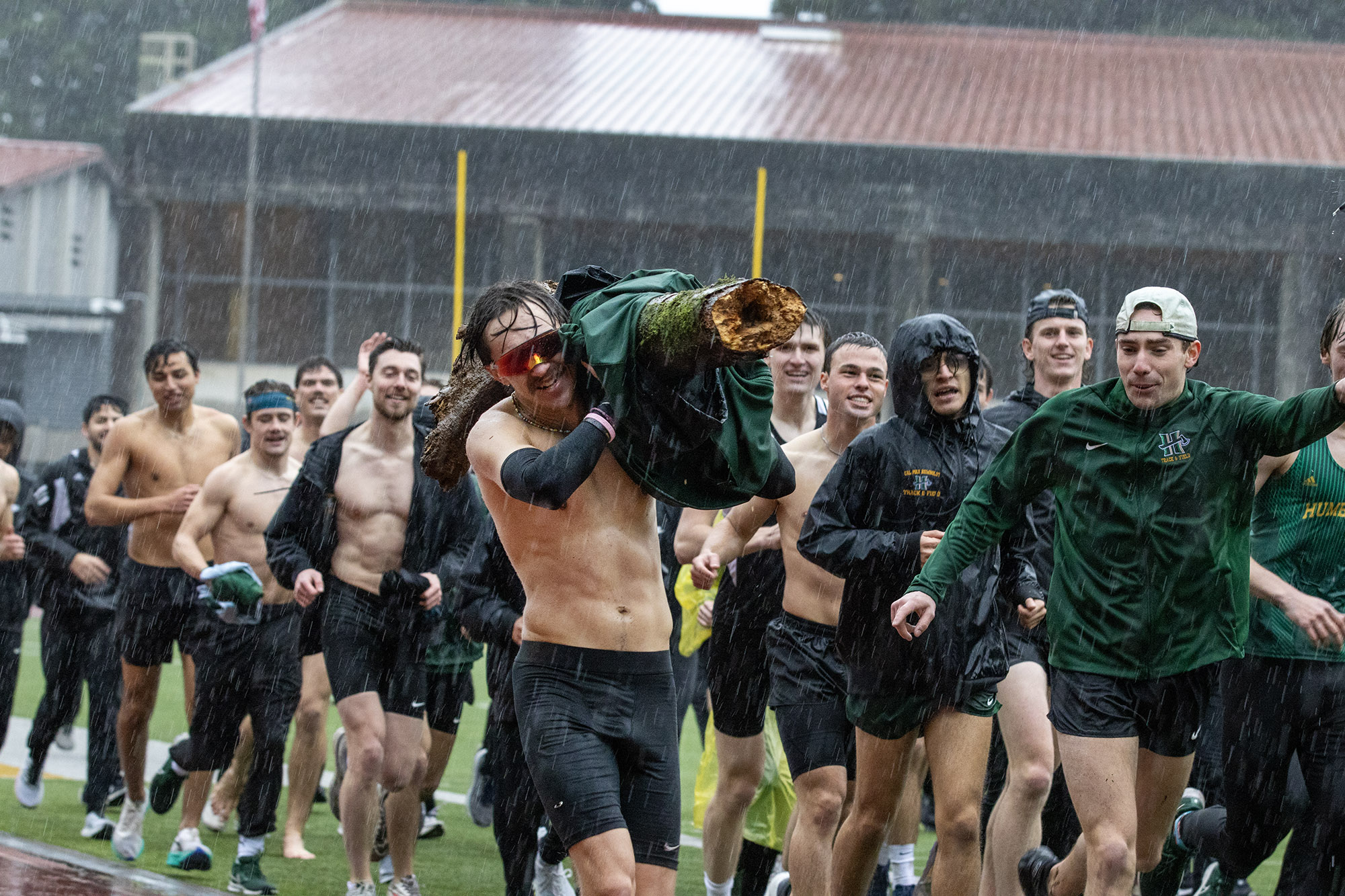
The meet ended with a fun tradition, the infamous redwood log relay, where teams of about 5 athletes grab logs from the surrounding forest and race with them in hand. This year, one team brought up the rear, slowly making their way around the track with one of the biggest stumps out of all the teams. Dead last, the entire track & field team went back and ran alongside the last straggler, cheering him on all the way to the finish line, shirtless in the pouring rain. That’s Humboldt track & field.
Cal Poly Humboldt’s Daniel Gober digging deep to carry the log across the finish line during track & fields famous redwood log relay.
Cal Poly Humboldt may be faced with an $8 million budget deficit in the 2024-2025 school year.
At an Associated Students meeting on Feb. 9, Provost Jenn Capps and University Budget Office Director Amber Blakeslee gave a presentation on the university’s estimated budget and how they plan to address it.
Beyond Cal Poly Humboldt, the entire CSU system is faced with budget constraints. Each year, the state governor puts out a proposed budget for the CSU system. After months of discussion and advocacy, the governor publishes a revised budget in May, which is then finalized in June. Currently, the 2024-2025 proposed budget for California projects a $38 billion deficit. CSU campuses get most of their funds from the state budget and funds are distributed based on enrollment.
However, the governor and the CSU system have an agreement where their portion of state funding will increase by 5% every year, provided that the campuses continue meeting their student success outcomes. Because of the current deficit California is facing, the planned $240 million base increase will be delayed by a year and paid back retroactively. There is a chance that funding won’t be available for the 2025-2026 school year, so the CSU system is trying to redivide its funding among over-enrolled and under-enrolled schools.
“The system is sort of reshuffling, so for campuses that were under-enrolled, [that means] reducing the targets, which means reducing funding and shifting that to campuses that are above target,” Blakeslee said. “And so for our campus, we’re going to have our target reduced by 3% next year, which means 3% of the funding will pull back as well, so it’s about a $2 million impact to our campus that we need to navigate as part of budget planning.”
While the university’s revenue is increasing, expenses are increasing at a faster rate. For the 2024-2025 school year, the university is expecting funding from the state, the 6% tuition increase, enrollment, and California Polytechnic funding, totaling at $170 million. The deficit from compensation and benefits, financial aid, and other costs are estimated to reach $178 million.
Blakeslee described how budget planning for the campus looks at three different scenarios for enrollment, including a baseline scenario, the best case scenario, and worst case scenario. The baseline enrollment increase projected for next year is 2.6%.
“As a campus, we’re actively working toward ambitious growth,” Blakeslee said. “From a budget standpoint, we are conservatively planning but watching closely because we want to make sure that we are proactively supporting and growing capacity where needed as we realize the growth, but we also don’t want to spend it before it happens.”
Carla Ho’ā, the interim Chief Financial Officer and Vice President of Finance and Administration, emphasized the university’s priority being the student population and minimizing negative effects when making budget cuts.
“Financial resiliency is another aspect of this,” Ho’ā said. “It can be tempting at times to make short-term decisions that have long-term, and sometimes negative, consequences. [We’re] really needing to be thoughtful and looking out into the future and about the financial resiliency of the university for the long-term, like having sustainable decisions built into the process.”
When deciding where to allocate funds for Academic Affairs, Capps collaborates with the department heads of the colleges, the library dean, and other areas to share strategies and distribute funding. She said that the university hopes to provide more opportunities for student collaboration in the future.
“What has been asked in a lot of different spaces is, ‘Hey folks, could you share with the campus community what ideas you generate, what potential opportunities you might be going after, before you actually do it?’” Capps said. “So that you all know what we’re considering, what we’re thinking about, and potentially have a shot to weigh in.”
Capps also said that the University Resources and Planning Committee – a part of the University Senate with representatives from faculty, staff administration and students – is hoping to hold a public forum at least once a semester. The URPC has two seats reserved for student representation and is responsible for drafting a budget proposal for the university president.
The URPC budget recommendation will be finalized next April. The presentation encouraged students to provide input and engage with AS, administration, and other representative student communities. Several positions in AS are currently open, such as Environmental Sustainability Officer, Public Relations Officer, and college representatives. Elections for AS will be made public on March 6. For more information on the university budget and upcoming elections, you can visit the URPC and AS websites.
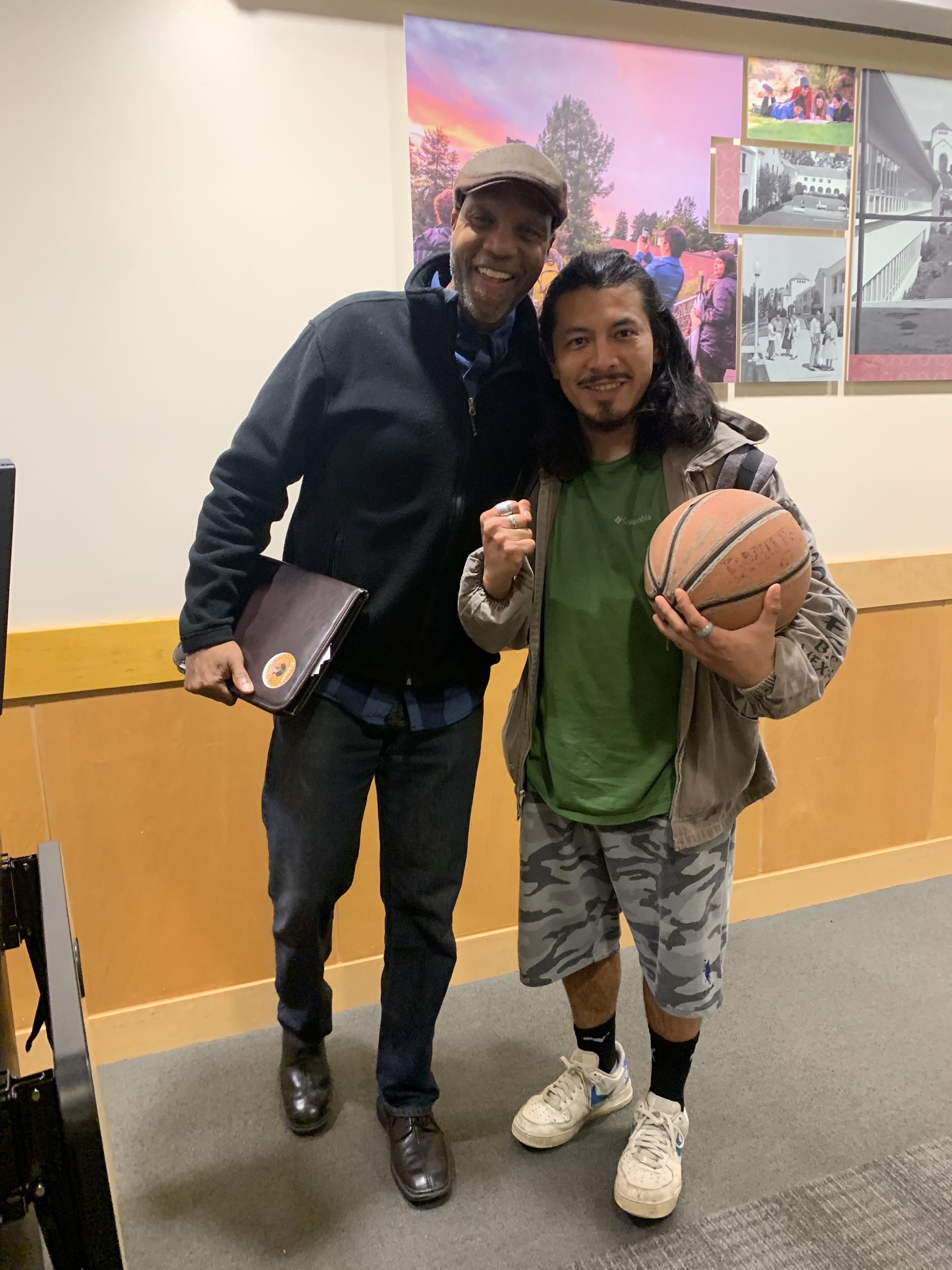
If money is the root of all evil, when do people feel joyful about it? Kirby Moss, a professor and head of the journalism department at Cal Poly Humboldt, asked nearly 20 students and community members last Tuesday, Feb. 13. It left people stumped.
Topics discussed were Black representation in the media, feelings around finances and money, how to navigate being a first generation student while saving money for college, and hypotheticals about splurging on a life experience or saving and investing said money.
Rather than lecturing, Moss guided a conversation by asking plenty of thought-provoking questions.
“We’re in college, this is an academic setting, this is a setting of intellectual exploration. Do you think we should be learning more about money or not?” Moss said. “This conversation today is about money, but it’s not about material stuff. It’s about autonomy, it’s about options.”
Aundrea All’love is a community member and business owner who was invited to share their experiences. One experience they have as a Black business owner is balancing mental health and community value, while still recognizing their worth and being paid a sustainable amount.
“From going from homeless, to some stability, to slowly growing my business now, the biggest shift I did was to focus on what brings me joy. Having faith in my ability and understanding my value,” All’love said. “I have been choosing more opportunities to make money and less scrumping down on my savings.”
Jeremiah Keys is a sophomore at Cal Poly Humboldt who shared experiences about college being the foundation for the rest of his life.
“It’s not just going to be college then careers. It’s like college, then another college, then career and then struggles in between those things, but I’m still going to get through it,” Keys said. “Providing for my family and friends suits me, because I love doing it. That’s the expression that we love. Do something that suits you, but don’t push yourself to where you end up judging yourself more and more and more, and not looking at all the good that you’ve already done and all the good you can possibly do in the future.”
This event was a part of a month-long series of events for Black Liberation Month, held by The Umoja Center for Pan African Student Excellence. For more information on upcoming events the Umoja Center can be found on Instagram at @umojahumboldt.
“Money is not power. It’s all about us,” Moss said.
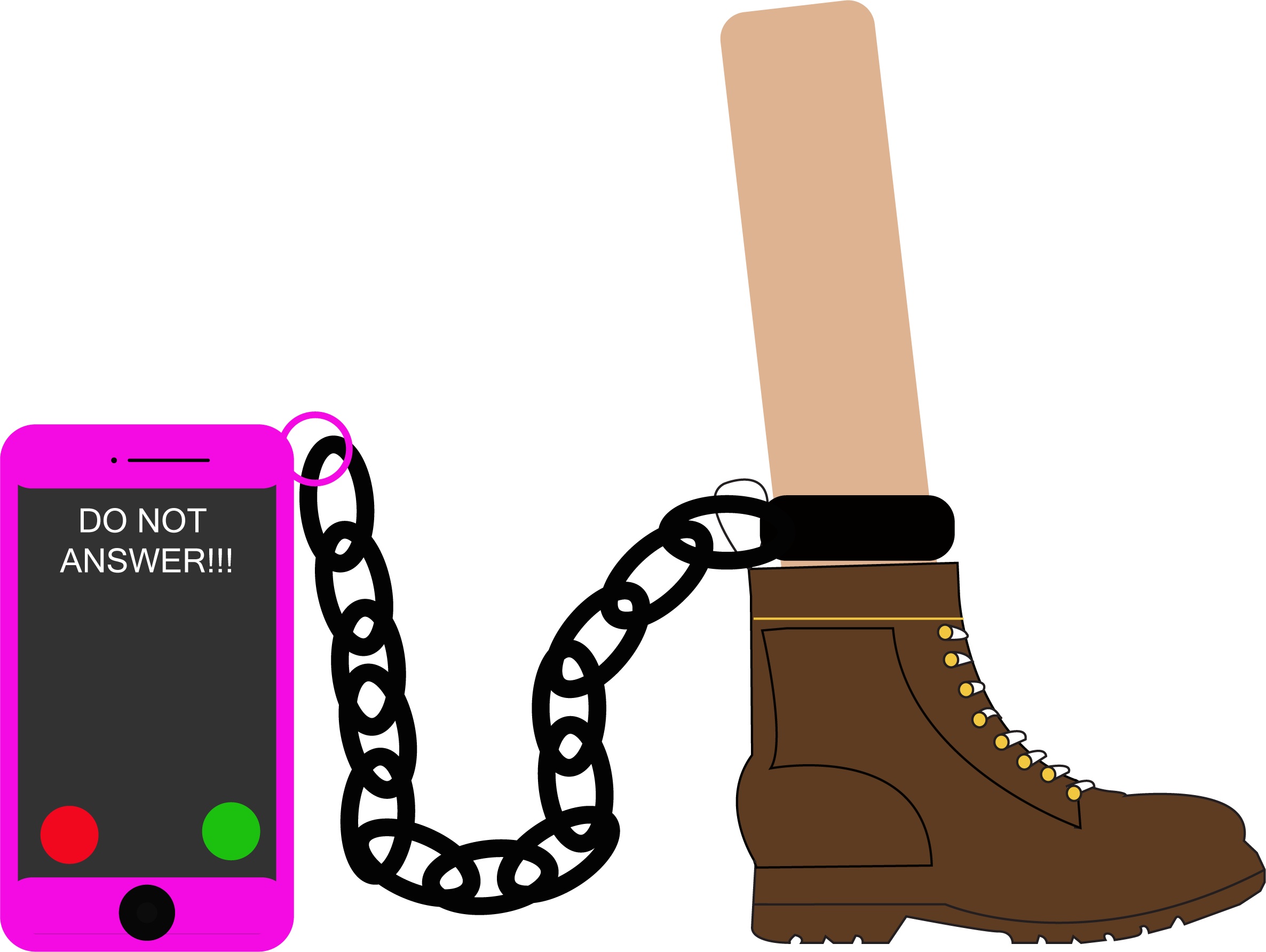
Imagine this: you’re in your dorm room getting ready for a night out with friends with the cheap vodka your one friend with a fake ID supplied, and nothing but pure 18-year-old confidence. Adrenaline is pumping as you sashay around your roommates makeup bag strewn about your shared bedroom floor, careful to avoid speaking to them as they apply their liquid eyeliner. All of a sudden, your phone that was blasting some 2014 alternative indie throwback is buzzing. The music stops and everyone turns to you, wondering if your DJ rights should be revoked. You scramble to your smartphone, and as you flip it, over there lies an incoming Facetime call from your long-distance boyfriend. Pink heart emojis act as bookends to his contact name as you look at yourself on the screen and contemplate answering this call.
“Oh, it’s (some boring hometown man’s name),” you say to your friends.
They know the weight that generic name holds in that dorm household. It’s 9 p.m. and they already called a cab, which should be there in about two minutes. You look at your phone as it vibrates in your hand, you look at the flock of young girls on your bed giving you the look – you know the one. The bordering Kubrick stare and eyes of disappointment, non-verbally asking, “Are you really gonna answer it right now?” You gaze back at your phone and quickly say “I have to take this,” as you disconnect from the bluetooth speaker and rush out into the dank hallway of your shared living space, hoping to god your name isn’t part of the conversation that’s happening behind the door you just slammed.
I, too, was a victim of the unplanned long-distance boyfriend call. From my freshman year of college to my junior year, I was enraptured in my long-distance relationship. I wouldn’t say it was all bad but I will say it just took way too much energy in the long run. I was fresh out of highschool and still carrying the weight of my highschool boyfriend around. I spent nights having sleepovers over Facetime, or watching some movie that we had to perfectly time to sync over the phone. Long-distance relationships can truly show you love someone, but when does it reach the point of total time consumption?
It was fun in the beginning, when you were excited for each other and the different paths you took, but long-distance success is based on clear communication, and sometimes that isn’t even enough to hold the relationship together. When college and life in your new town away from your partner picks up, lots of factors come into play; jealousy, accessibility, and just the plain old feelings of missing each other.
When your time gets so constrained to the point of only being able to call your partner in your LDR (long-distance relationship) once a week, it can really throw an axe into your dynamic. Even if it’s clearly communicated and you’re transparent with your busy schedules, it can feel hard for your LDR partner to not feel neglected or forgotten about. They aren’t with you – they aren’t seeing your day to day schedule, and when you have to pencil in time to call them and try to keep their attention as you talk to them about your mind numbing statistics lecture, the spark can easily fizzle out.
You can try and keep it alive by doing movie nights for each other or sending care packages, but at the end of the day, it’s hard to feel truly loved and cherished when you’re six hours away from each other and not sure when you’ll see eachother again.
Honestly, I don’t think any 18-20-year-old has the emotional or physical capacity to do that either. These are such developmental ages, and trying to entertain an LDR partner in between it all can feel like a maze of confusion and a tow truck of effort. I’m not saying dump your LDR because it’s gonna ruin your social life. I don’t think I missed out much when I was in my LDR as a baby-faced college freshman, but I will say it caused some baggage in the long run.
Long-distance relationships seem to only be a blanket to hold on to the inevitable factor that you will break up; holding on to the very end until you have to throw in the towel. It usually isn’t pretty, and is the reason why most LDRs end over the phone or text with little-to-no closure at all. That’s gonna cause more pain in the end than just parting ways after highschool for the purpose of doing it for each other’s own benefit. Breakups are never easy, but it can give you a lot more peace of mind. You did it for your partner’s and your own self-preservation.
I can’t speak much on the mid-20s LDRs, but I’d have to say it’s the same. Open communication just isn’t possible without at least some weekly face-to-face conversations. Interaction in the digital world can feel awkward, less genuine and allows more time for feelings of neglect and loneliness to build up. Long distance has its expiration date; I can only see it as a temporary thing of a year max. Anything past that is just a waste of time.
I think I need therapy, but I’m afraid. I’m not the type of person who likes to share my sad feelings with anybody, so I shove them down and pretend like they aren’t there. Recently, I’ve been noticing that my sad emotions are starting to catch up to me and are taking over my thoughts. I can’t really sleep because of them and it’s making all of my days seem mushed together. So back to the therapy thing, I’m afraid to tell someone about how I feel because I don’t want to get judged. In my mind, I feel like it’s silly for someone like me to be sad because I don’t really have anything happen to me recently to have sad emotions.
If you think you need therapy, you need therapy. If you don’t think you need therapy, you’re wrong and you need it more than anyone else. To me, therapy is just as important as a regular doctor or dentist appointment. Your mental health is just as relevant as the physical stuff.
Shame, pride and embarrassment are what stop many people from seeking help, but you can’t let your fear prevent your growth. Therapists are awesome because they get paid to care, so you don’t have to feel like you’re burdening anyone in your life with your problems. Their job isn’t to judge you, but to help you, though it may take a few tries to find a therapist that you feel comfortable with. Life is about trial and error.
Journaling your feelings throughout the day can be a good starting point in expressing your feelings. Getting them down on paper can help organize your thoughts and maybe recognize some patterns, like certain triggers. At the end of the day though, a proper diagnosis can seriously help you navigate your emotions and make sense of your brain.
You have to take chances and put yourself in uncomfortable positions to create change in your life. Being vulnerable is one of the strongest things you can be, which is why it can be so hard to get to a point of comfortability within it.
There’s no reason to feel silly for having emotions just because you’re not actively going through a tragedy or a trauma. If you can’t find the means to validate yourself, let me put it clearly: you are allowed to have feelings. More than anything, you are allowed to feel your feelings.
Shoving your feelings down into an endless pit will only fill it with emotional-vipers that’ll come back to bite you in the ass later in life. Make your life easier and deal with them now.
“I love you,” I said to my boyfriend this afternoon. “I’ll see you in a month.”
With a heavy heart, I walked away from him. Our eyes met with one last glance and we went our separate ways.
We’ve been a long-distance couple for a year. It was hard at first because we went from working and living together to seeing each other every few weeks. This school year, we’re going longer without seeing each other. I’m working weekends and can’t come home on a whim. Also, I have a bunkmate this semester. We have to plan his visits and get a hotel when he does come. But, I’m only two and a half hours from him, so it’s not a problem for him to come up just for a night at a time.
So, here’s my hot take: I like long distance. Don’t get me wrong, I love my boyfriend and I miss him every day that I’m not with him, but I’m a very independent person. To be honest, I’m very needy when I am with him, because he does all kinds of things for me – acts of service are my love language. But because I’m an independent girly, I do okay as long as I’m staying busy.
I think that everyone should do long distance at least once in their relationship. I think having some space from each other is healthy. You can find out who you are without them while being with them at the same time. Even if it’s a two-week family vacation without your partner or a temporary school or work relocation, it can fortify your relationship.
The most important thing to remember when you’re in a long-distance relationship is that communication is key. In this modern age, we have technology that keeps us connected better than ever. My boyfriend and I video call each other on Snapchat at least once a day; several times if possible.
Another thing that’s important is to remind them that you love them just as much when you’re apart as when you’re together. A great way to do that is sending letters. I know there are more efficient ways to communicate, but letters make great keepsakes that will foster fond memories you can look back on in the years to come.
If I could choose, I’d still do long distance. Maybe not for a year – it’ll be two when I’m done with school – but at least for a few months. Because of this trial of our love, we are stronger than ever.
Shannon Rhodes already had a passion for fashion and makeup before delving into Humboldt’s drag scene. After attending several drag shows dressed to impress, Rhodes ran into drag artists Val de Flores and Sharon Taterz who offered them the opportunity to start booking their own performances. In May of 2023, Rhodes debuted as Killpop at the Septentrio Winery.
“I kind of blackout when I’m performing, because it’s very short,” Rhodes said. “It’s just like, three to four minutes. The energy—it’s addicting. The crowds are amazing. It’s awesome getting to perform in front of a fully queer space, where everybody’s there just to see you and support you and be positive. All the other girls, they’re super fun to hang out with.”
Killpop’s friend Seraphim Nagel joins their performance at the Septentrio Winery. Photo courtesy of Makayla Kuhnke.
Despite being a small county, Humboldt has a thriving drag community. Every member’s introduction to drag and their personal relationship to the art form is unique. Additionally, every drag artist’s reason for performing is different and reflective of their life experiences.
Paul Michael Leonardo Atienza, an assistant professor of Critical Race and Gender Studies at Cal Poly Humboldt, has been doing drag performances for 20 years. They began to explore their gender expression after attending an LGBT campus retreat during their senior year at UC Riverside.
“We were processing trauma in our lives, and what came out for me was how I was shamed as a child of my gender expression, and particularly feminine gender expression,” Atienza said. “Many of us were figuring out, ‘Well, how do we work to strengthen and remove less of the stigma that we learn?’”
Atienza took on the identity of Maria Arte Susya Purisima Tolentino during their drag performances. Ma Arte drifts between being an extension of Atienza and a separate persona, but Atienza considers her to be a creative collaborator. Together, Atienza and Ma Arte have collaborated with drag artists and members of the queer community across the world.
Lawrence Fobes King, a queer middle schooler from Ventura, California, was murdered in 2008 by a classmate. This tragedy moved Atienza to use drag as a form of protest by bringing awareness of injustices against the queer community.
“At that time, [drag] was still quite small, but people were really into watching drag, and a lot of the drag at that time also was lip synching to popular music,” Atienza said. “And I was like, ‘Well, if you have this audience, what can you do to also add more social issues to it?’ And with the murder of Larry King, I tried to pair a song and created a performance in honor of his struggle and his memory.”
Drag also offers a secure support system to queer people and an opportunity to share queer joy. Joel Costello, who performs as Feral Fawcett, found his inspiration in popular drag queens like Trixie Mattell and Bob the Drag Queen. Performing since March of 2023, Costello found that Feral Fawcett had a positive impact on a wide range of community members.
“This mom asked if she could take a picture of us because her daughter was in grade school and was getting bullied for being gay,” Costello said. “There was a lot of drama against drag queens happening at the time, so that felt really good… it reminds me that there’s more to it than just being silly and collecting the bills.”
Feral Fawcett also provided Costello a space to explore feminine gender expression.
“I feel like she is a representation over the feminine side of myself, which is something that before I used to try to squash down,” Costello said. “I came from a hometown that was not very pro-LGBT, so I always tried to be like the manly gay guy. It was nice to have a release… I like blending my masculine and feminine side into one thing.”
Through drag, Rhodes has been able to gain confidence in their artistic skills and their body.
Thrash and Recycling (left), Gliterous Cliterous (middle), and Killpop (right) pose together at the Septentrio Winery. Photo courtesy of Makayla Kuhnke.
“I feel like my confidence was taking a hit for a while – you know, my body was changing,” Rhodes said. “That also means my favorite clothes that I like to wear don’t fit, I got to figure out new styles, new clothes. Having people just be like, ‘Damn, bro,’ and seeing photos of myself looking good performing in the body that I have is just like, ‘Alright, I guess your ass is kind of fat.’ The crowd really just shows you like, ‘I am cool. I’m doing this because I got so many awesome qualities to me.’”
Drag expects a lot out of its performers, both mentally and physically.
“What people don’t realize — until they maybe watch [RuPaul’s] Drag Race or something — drag queens have to be a comedian, a dancer, a seamstress, a hairdresser, a makeup artist, like your own manager,” Rhodes said. “You do everything for that performance. Even some are singers. You have to be so many things as a drag queen, and I think it’s a really pure form of art because you’re doing it all.”
Drag artists have a lot to carry on their shoulders, including the stigma and lack of education around drag.
In 2023, Tennessee legislators passed the Adult Entertainment Act, meant to prohibit adult cabaret entertainment on public property, including, “male or female impersonators.” The act’s broad language allowed law enforcement to potentially prosecute drag artists and trans people. After Tennessee, anti-drag bills have been introduced in at least 14 other states. Many conservative legislators have used concern for the safety of minors to pass anti-drag laws and censor openly queer expressions.
“A lot of people think it’s a super sexual thing and that it’s like a fetish,” Costillo said. “Most drag performers I know have a very distinct separation between the two.”
People of many different gender identities do drag, but their gender identities are separate from their identity when in drag.
“In general, people conflate gender expression, gender performance, [and] gender identity with sexual orientation, sexual behavior and practice. And all of those are separate,” Atienza said. “People who are drag performers are of all gender expressions and sexual orientations. I think that’s one thing that we need to challenge not just in drag, but in understanding gendered and sexual lives. We’re bodies that have different ways of feeling [and] expressing themselves and society has put us in specific boxes.”
Despite the adversities the drag community faces in the U.S. and the rest of the world, drag artists have been thriving in Humboldt County. The definition of drag is constantly changing and growing. Members of Humboldt’s queer community from all backgrounds have been able to find a safe haven in drag, allowing them to heal from trauma and play with gender performance.
“I do believe RuPaul in saying that we’re born naked, and the rest is drag, right?” Atienza said. “Drag is really a way to demonstrate the constructiveness of gender and how there’s so many possibilities out there. Drag to me is not just on stage, with queens and kings and in-betweens. Drag is every day.”
For the better half of my teenage and young adult life, I’ve dealt with intense bouts of sadness in the days leading up to my menstrual cycle. These episodes usually only lasted around a week and were characterized by heightened irritability, anxiety, fatigue, decreased interest in activities and in the most extreme cases, suicidal ideation. Due to these symptoms, I chalked it up to being some form of major depressive disorder that was exacerbated by the hormonal shift during that week. However, thanks to a couple Google searches and several trips to my doctor, I was diagnosed with Premenstrual Dysphoric Disorder (PMDD) and was able to start taking the steps to learning to live with PMDD.
According to Dr. Alison Palacios, a physician at the Cal Poly Humboldt Student Health Clinic, PMDD is considered the most severe form of Premenstrual Syndrome (PMS) as maintained by the American College of Obstetricians and Gynecologists.
“Patients’ symptoms must include behavioral symptoms and often include physical symptoms. The most common behavioral symptoms are mood swings and frequently include irritability, anxiety/tension, sad or depressed mood, increased appetite/food cravings, sensitivity to rejection and diminished interest in activities,” Palacios said. “The most common physical manifestations of PMS are abdominal bloating and an extreme sense of fatigue.”
While PMS symptoms and PMDD symptoms can look extremely similar, PMDD differs in that feelings of sadness, hopelessness, and anxiety are almost consistently present. Both may include symptoms such as bloating and intense mood swings, but PMS is not considered a mental disorder and is typically pretty manageable. PMDD on the other hand, is considered a mental disorder by the Diagnostic and Statistical Manual of Mental Disorders (DSM) and can be debilitating in some extreme cases.
In order to be diagnosed with PMDD, at least five of the symptoms presented in the DSM must be present in the week leading to menstruation, start to improve with the start of menses, and be minimal to gone by the end of the menstrual cycle. These symptoms include marked depression, anxiety, affective mood, irritability, decreased interest in activity, difficulty concentrating, lethargy, change in appetite, hypersomnia or insomnia, and physical symptoms such as joint or muscle pain. This criteria presented in the DSM must have also been met for most menstrual cycles that occurred within the last year. Yet despite PMDD being a recognised mental disorder, it is an underrepresented condition.
“It is not well reported, but worldwide prevalence is 2%, and in the U.S., it was 2.9% among Black females versus 4.4% White females,” Palacios said. “It is probably quite underdiagnosed and especially so in Black females and other people of color. Some with the diagnosis assume their symptoms are ‘normal’ for menstruating people or seek healthcare for years to decades before receiving the correct diagnosis.”
As per Palacios’ advice, moderate to severe symptoms can be treated with antidepressants, hormonal birth control and cognitive behavioral therapy. Milder symptoms may be treated with exercise, herbal remedies and supplements. Bilateral oophorectomy, the surgical removal of the ovaries, is reserved for the most extreme cases of PMDD.
There are resources on campus for those who may think they are experiencing PMDD. The Student Health Clinic can help address symptoms and provide diagnostics and treatment for the condition. They can also refer to specialists if needed. TalkNow sessions with TimelyCare and the Counseling and Psychological Services line are also helpful resources for managing PMDD symptoms. If you are experiencing any thoughts of harming yourself, the Suicide and Crisis Lifeline (phone number 988) is available 24 hours.
PMDD can be extremely hard to live with, but like most conditions, finding coping mechanisms and support can help dramatically. For LJ Ferris, coping looks like realizing that PMDD shouldn’t affect their self-worth.
“In the midst of it, it seems like it’s never going to end. Then, your period comes and you realize you indeed are still a human deserving of love,” Ferris said. “It is not supposed to be normal to want to die leading up to your period. It is not supposed to be normal to have such severe physical and emotional pain around periods.”
“Wrap it before you tap it.” We’ve all heard that before.
Condoms and other forms of contraceptives help prevent the spread of sexually transmitted infections and diseases. However, condoms don’t protect you from all STIs, such as herpes, genital warts, syphilis and mpox, which can be spread from skin-to-skin contact.
According to the Center for Disease Control, more than 2.5 million cases of chlamydia, gonorrhea, and syphilis were reported in the United States in 2022.
Humboldt’s Student Health Center offers information and counseling in a safe, confidential setting. They offer PAP smears, breast exams, and other sexual health screenings, pregnancy tests and even medication abortions. At the health center, they screen, test, and treat sexually transmitted infections (STIs) as well. As far as keeping safe, they also provide many contraceptive options such as long acting contraception, birth control pills, patches, rings, condoms, and much more.
If you’re concerned about privacy with sexual health and need resources, you can sign up for the family pact card to access these services in person at the health center.
Cal Poly Humboldt also has the Peer Health Education Center in the Recreation and Wellness center (RWC). They offer free harm reduction supplies, condoms of all kinds, emergency contraception, narcan and test strips, menstrual products and more.
There are many ways you can maintain sexual health. Practice consent; remember an enthusiastic and informed yes means yes. Communicate with your partner and explore your body, discover what you like and share that with your partner(s). Be safe and protect yourself and your partner(s) against sexually transmitted infections and unwanted pregnancy.
Most importantly, get yourself tested and educate yourself about the risks of having unprotected sex. Don’t be afraid to ask questions and communicate with your partner(s).
We’ve all heard of straight, gay, and bisexual people. But what about asexual people?
Asexual people are people who do not experience sexual attraction.
Abigail Vonderschmitt, a music major who is in her first year at Cal Poly Humboldt, has always known that she is asexual. When she discovered the term a couple of years ago, she instantly related to the term. When she came out, nothing really changed. People treated her normally.
She made it clear to her partner early on, and she was blessed with an understanding partner.
“There’s more to it than what the media portrays,” Vonderschmitt said. “I know how to express myself and know how to put into words how I feel,” she said.
A history major going only as Adam with a concentration in education, currently identifies as demisexual, which is an identity that is on the asexual spectrum.
“It’s something I’ve been exploring for about a year now,” he said.
He acknowledges that for masculine people, questioning your (a)sexuality is not the norm. Adam has not really come out, at least not to his parents. He has noted that people don’t understand asexuality the way they do other sexualities.
“I imagine there’d be a lot of explaining to do,” Adam said.
Adam believes that it’s important to continue educating people and that gender roles need to be addressed. He wishes people understood the intricacies of asexuality, and that people could go beyond stereotypes and understand how identities can be fluid. Being on the spectrum of asexuality has definitely made for some challenges in the dating realm, because for many, sexuality goes hand in hand with romantic attraction.
“People come in with expectations and you can’t deliver on them,” Adam said.
He believes it would be easier to fit into the societal norm, but has done the work to break free.
“I love understanding myself better and understanding I’m not broken for not wanting to be a certain way,” Adam said.
An anonymous computer science major, who asked to be called “Jane”, knew she was asexual back in middle school. When she tried to speak about it to others, she got backlash; some told her it wasn’t a real thing. Jane went back into the closet after that. It was only recently that she started to accept herself again. She is not out to her parents, as they are not very queer friendly. Her former partner told her that asexuality wasn’t possible, which is one of the reasons they broke up. Her current friend group is accepting, however. She doesn’t want to explain or defend herself, so she hasn’t come out to very many people.
“I still get imposter syndrome,” Jane said.
Jane has seen doubtful comments on social media, but tries to surround herself with supportive people. She wishes people understood that sexual attraction is different from arousal. Asexuality is not feeling sexual attraction to people, no matter how your body reacts.
“It’s a wide spectrum,” Jane said. “[It’s impacted my dating life] a lot.”
“Honestly, I haven’t had any luck finding asexual guys,” Jane said. “[However], I feel like I have a deeper understanding of sexuality, and how diverse and fluid it can be.”
She’s had sex, though she doesn’t feel much of anything during it.
Another asexual student, going by E., is an Environmental Studies major with a concentration in ecological restoration in her third year at Cal Poly Humboldt. She first realized she was asexual in middle school. She changed her mind for several years, but a couple of years ago, rediscovered the asexual spectrum and has identified as asexual ever since. According to her, it has been a winding journey. Her parents didn’t take her ace identity seriously. They thought it was a phase and didn’t care much. She also came out as a trans woman, and this was taken more seriously by her parents. Most of her friends accept her, however. She said that being asexual has never been used against her very directly, though many people are ignorant about it. She has found it very annoying, but it hasn’t caused her real issues. She says she wishes people knew there isn’t just one option, or way, asexuality can look.
“Asexuality is a really broad spectrum,” E. said. “People have different interests.”
The biggest impact for her is if a person has expectations, it will turn out badly for them. E. noted that since she doesn’t experience sexual attraction, she is drawn to people by aesthetic attraction. E. is also aromantic, meaning she doesn’t experience romantic attraction either. However, she still wants deep emotional relationships. She is currently in a relationship, and cares for her partner deeply, more than a close friend even. E. wishes people would be more aware of this.
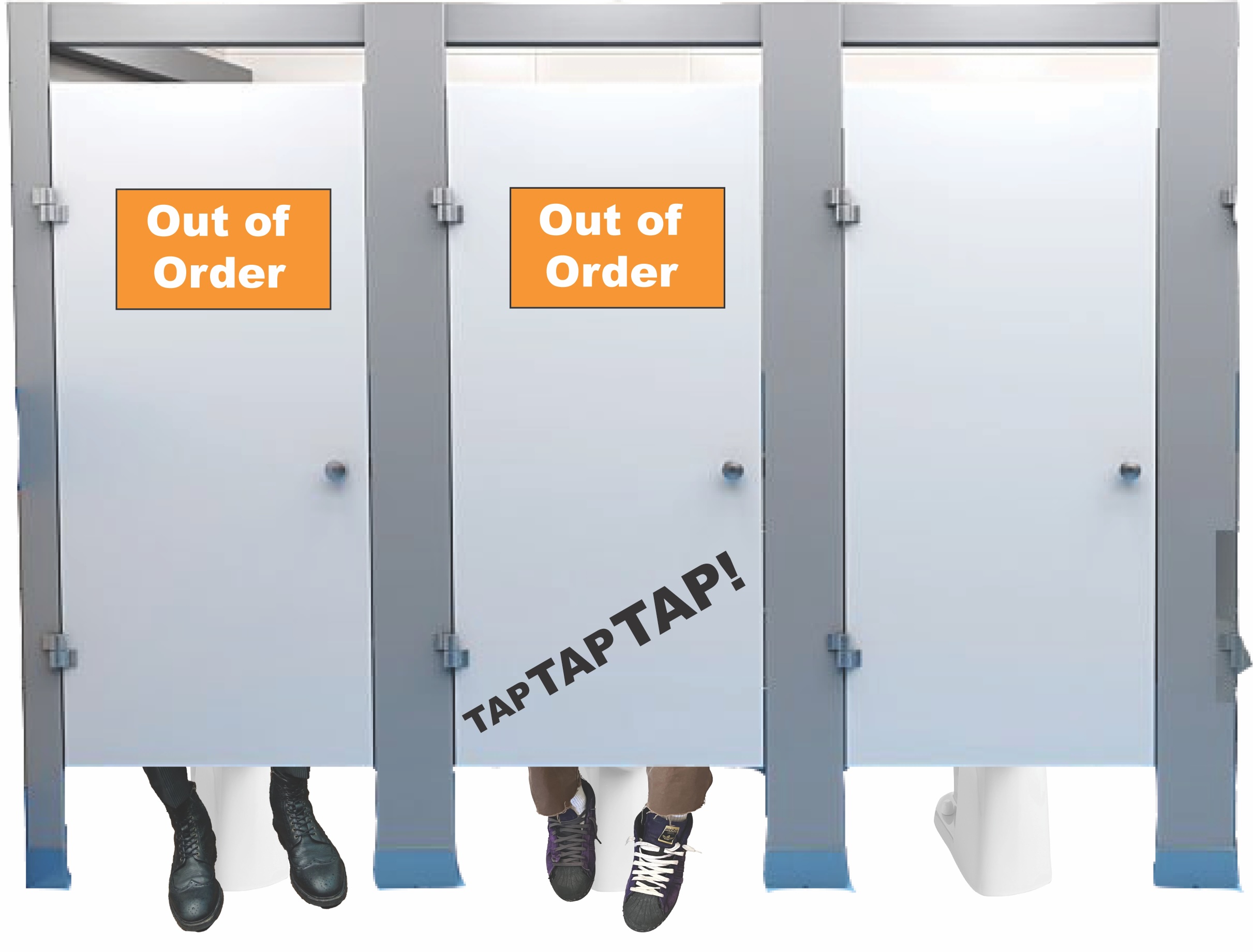
Waiting in a bathroom stall, hoping to see a tapping foot. Hearing someone enter and then going into the empty stall next to you. All of a sudden – that tapping foot appears. They’re not just listening to music or procrastinating in between classes. This person is looking for some kind of sexual encounter in the public restroom. This encounter is an age-old tradition many people call cruising.
“[Cruising is] walking or driving about certain areas, called cruising grounds, looking for a sexual partner. These meetings are usually one-off, anonymous encounters,” Birmingham LGBT, a queer health and community resource, stated on their website.
It’s not for everyone, but it is popular and a somewhat underground activity that typically happens discreetly everywhere and anywhere. Gloryholes are a classic example of cruising
that you might be familiar with, but not always required for a good experience while searching for a public sexual encounter.
On campus at Cal Poly Humboldt, cruising does in fact happen. Without revealing the popular spots, bathrooms and the community forest are classic places that students go to cruise. People typically look for hidden spots with either quick access to hide or an easy escape. Around the corner and behind the tree some might say.
While looking for cruisers to contribute to this piece, I did notice an irregular lack of horny guys. Typically, there are plenty of headless profiles on Grindr looking to “blow their load” or “swap some head” but no one was around willing to share about their sexual desires.
I guess students on campus are too busy to cruise right now in the semester. Maybe they’re finding themselves stuck in committed relationships, or just not horny enough to wait on the bathroom floor for an anonymous penis to slide under a stall. But I can assure you cruising is alive and well in Humboldt County.
Baker Beach is the only nude beach in Humboldt County and is a well-known cruising spot for regular cruisers. On the beach, down the shore, and around the big rocks, guys wait for someone willing to get down and dirty. Aside from this popular spot, parks, hiking trails, and parking lots are places where cruisers can find others looking for sexual encounters.
Despite your desperation though, protecting yourself is always important while having sex, especially with random men. Condoms, PrEP, and getting regularly tested are the easiest ways to protect yourself while hooking up with sexy men in the forest and random restrooms.
Free sexual health resources are provided at the Student Health Center and in the Peer Health Center. To contact the Student Health Center you can email health@humboldt.edu or call (707) 826-3146.
Moonlight shone through the bedroom window. A plethora of naked bodies wriggled and writhed. This was the experience of Cal Poly Humboldt sophomore Calvin Kulpa, a psychology major who recently embarked on his first ever sexual encounter with more than one other person.
“I might have been feeling a little frisky or adventurous being in college as a young adult, and I got myself into a couple of sexual situations,” Kulpa said.
Senior anthropology major Alfonso Aviles also began to experiment with group sex once he got to college. Aviles has had mostly positive experiences with group sex in the past, and the only time he experienced anything negative was when there was a lack of communication.
“A lot of people think of sex as a one-on-one thing, and that’s fine, but if you decide to bring in a third party, or if you are the third party, there’s often a lot of boundaries that have to be discussed,” Aviles said. “It’s a good way to explore a whole different route and open yourself up to new opportunities.”
Aviles also stressed the importance of open communication during group sex as a way to make sure that everyone in participation is on the same page. He believes that keeping an open mind and being honest with each other is the key to having a positive group sex experience.
“If you’re curious about it, and you know that you want to try it eventually, don’t be afraid to discuss it with a partner, or whoever,” Aviles said. “Just put it out there, talk about it, establish boundaries, and try to stay open-minded. Acknowledge your emotions before, during and after, and talk about it after. See how you feel, and if you don’t like it, don’t let that ruin what you had.”
Sophomores Chloe Nye and Sophia Fox have also dabbled in group sex. Nye is a studio art major and Fox is studying business marketing. The two of them are good friends, and have engaged in group sex together in the past.
“I think it brought me and Chloe a lot closer,” Fox said. “We became a lot more comfortable around each other.”
Although they both enjoyed the experience, they agreed that they each prefer one-on-one sex over group sex.
“I think it’s fun, but I don’t think it’s as personal to be honest,” said Nye. “I would say that it’s fun for the story, but it’s not necessarily as intimate and meaningful as one-on-one sex.”
Kulpa was on the same page with Fox and Nye, and explained that while group sex can be a blast, he prefers the intimacy of sex with just one partner.
“It’s like a whole different thing,” Kulpa said. “It’s not as intimate because there’s more people involved. It does seem more fun, but one-on-one sex is more intimate because it’s just you two.”
Lots of college students are open minded when it comes to group sex – but it’s not for everyone, and that’s okay.
“I don’t think I would go seek out another something-some,” Kulpa said. “But the door is open.”
Having sexual relations with the same person for an extended amount of time can become monotonous, but it doesn’t have to. Here are some ways to spice up your sex life with your significant other, or if you just want to try something new with a partner. We’ll start with simpler (more vanilla) things first and work our way up to the dirtier bits. Of course, make sure you’re both into whatever you’re trying and don’t pressure or feel pressured to try anything you’re uncomfortable with.
Nipple play
Sucking titties. That’s it.
Light spanking
A little slap on the bum-bum can be fun. Next time you’re going at it doggy-style, either ask your partner for a spank, or give your partner a bit of a slap on the rear. Keep in mind that bottoms bruise easily, so try not to hurt whoever’s on the receiving end.
Toys
There is a toy for everyone. Whether it’s a vibrator, cock-ring or butt-plug, you can find a toy that fits your liking. Toys can be used on their own or as a supplemental piece to intercourse. Adding a toy to your bedroom happenings can make your sex more fun and more intimate.
Location, location, location
Having the house to yourselves can be a blessing. Put a blanket over the couch, coffee table or the kitchen floor and enjoy the freedom of making love outside the bedroom. You might be thinking, “what about the car?” Don’t get arrested for going at it in public, but if you have a garage, the car is yours to play in.
Roleplay
Maybe you have a work uniform you look good in. For example, you work retail, you can pretend your partner is a customer you’re going above and beyond for in customer service. However you want to play, it can be fun to spice it up by adopting a new persona or profession or make up a situation you’ve always fantasized about.
Love is in the air and in the bedroom during this time of the year. Enjoy yourselves and rejoice in the shared desire to bump uglies with the one you love, or happened to stumble upon, during Valentines day. The bedroom, living room couch, or steamy vehicle is where it typically happens, but one needs to read the room – or SUV – and contemplate what really needs to be in said room when the romance gets hot. Maybe some candles, speakers, a throw blanket to protect the furniture, but your pet does not make the list. Keep the pets out of the bedroom during the heat of battle. They do not need to fall victim to your bad angles.
Pooches, felines, hedgehogs or guinea pigs should not bear witness to your sensual endeavors. Subjecting your pets to such debauchery is not the move in today’s somewhat civilized world. Boundaries need to be set and your pet should be aware of those boundaries. Be a good parent and send the fur babies out of the room or to a friend’s house if needed.
I know that some of you may be in sticky situations where you don’t have the opportunity to send your furry friend out of the bedroom. I do have sympathy for you but I hope you know that the pet knows you’re terrible at sex. I don’t care how bloated your ego is, they know the truth.
I’m aware that I am spoiled with a one-bedroom apartment and the ability to close doors on curious pets. My partner recently moved into the apartment, bringing all four of her cats and her chihuahua that sleeps over occasionally. These animals, plus my glorious cat named Tibbles, brought the total to five cats and one shit-eating chihuahua. I love them all, which is why I now try to protect their sanity.
I used to be a degenerate, not caring what these animals witnessed, but several instances have forced me to reverse my opinion. I am not proud of it. Trust me. The last thing you want is your partner’s chihuahua licking your feet while journeying to the promised land. Or when you regret having the mattress less than a foot off the ground and one of the cats decides it’s a great time to purr in your ear when you’re quite preoccupied. I know this is Humboldt and standards are typically thrown out the steamy window, but there’s a time where lines need to be drawn.
You spent money on a nice dinner, watched “The Notebook,” and turned on the Lumberjack’s pleasure playlist to lay the framework of a beautiful sexual experience. Then, your partner’s blind cat yearns for help after getting stuck at the top of the cat tree in the middle of your romantic exploration. I can only laugh during these moments, but damn I feel bad for the little critters. They definitely did not sign up for this sort of weird connection to their owners and they most definitely talk shit behind your back.
Handmade cards: Handmade gifts are always better, even if they come out looking like a kindergartener made it. A quick Youtube search will show you a variety of cards to make, from a Victorian love-note to a pop-up book.
Love letter: Literally, just tell them why you love them. If you’re bad at writing or expressing your feelings, do it in bullet points. Put it in an envelope, write their name and spray it with your favorite perfume or cologne. It doesn’t have to be perfect, it just has to be thoughtful.
Valentine gift basket: All you need is a basket, a pair of fuzzy socks, some of their favorite snacks, maybe a bottle of lotion or hand cream, a gift card, anything. The world is your oyster and it doesn’t have to cost more than $20.
Flowers and a stuffed animal: Come on. Easy. Classic gift – even if it’s corny, it really does make a difference.
Playlist: You can do this on just about any music platform; Spotify, Apple Music, Soundcloud. Make them a playlist. It’s our generation’s version of a mixtape.
Order something online: That way, you can blame the post office for it not coming on time, and pretty much everyone but yourself for not planning ahead.
Dates:
Cafe Mokka: Already regretting listing one of my favorite spots in town, but they seriously have some of the best $5 hot chocolate in town, made with homemade whipped cream and love. Cash only.
Paul’s Pizza: You can sit next to each other in a booth and share a giant slice of pizza for no more than $8. So yummy and so cheap.
Arcata Marsh: It can be a little stinky sometimes, but it’s got one of the best views of the sunset and it’s accessible without a car. Smoke a joint or bring some sandwiches and watch some freaking birds.
Picnic in the Plaza: If the weather permits, a picnic in the Plaza can be super fun. With a couple finger foods and snacks, you can watch the Plazoids in their natural habitat.
Movie/TV show night: Fairy lights, pillows, blankets, snacks and a streaming service. All of which can be borrowed or acquired for cheap.
At the end of the day, your partner just wants to feel seen. Take a moment and think about who they are, what they like, and you will know exactly what to do for Valentine’s Day.
I have been dating my boyfriend for nearly 2 years now. I’ve known for a long while that we aren’t compatible as people, but we still have fun together. He’s just not emotionally mature, and lacks sincerity. We don’t ever really have substantial conversation – most of the time we spend just rotting together. I love his friend group though and things aren’t all bad. I just don’t want to lose everything I’ve built with him. I’m also so scared of how painful the breakup would be, ruining my semester and making it so hard to do the things I need and want to do. I am at a point where I feel stuck and have no clue what to do. Please help!
Stuck is exactly where you need to be sometimes to realize you have to force some change in your life. No one wants to feel stuck – but no one’s gonna save you from it, either.
Two years is a pretty long time to get to know someone. What I think you should ask yourself is, would you still date the person you’re with if you knew everything you knew now? Would you still date them as they are? Or, are you dating this person with the intention of changing them?
We often find ourselves fixing things into the ways we want them to be, and unfortunately, people just aren’t like that. If they aren’t willing to put the work in to change for themselves, they aren’t going to put the work in to change for you – and they shouldn’t. You should date someone you feel is on your level and they should date someone who accepts them as they are.
Of course, you can grow together, but sometimes one person grows faster than the other. It’s okay to outgrow people, but we have to be willing to accept the consequences of letting them go.
Being alone is scary, and the Humboldt dating pool is even scarier. To me, however, nothing is scarier than being stuck.
In your comfortability, you’re losing time and opportunity. Your relationship isn’t a death sentence unless you let it be; you can find someone new to build with, you can make new friends and you can feel good. Yes, you’re somewhat comfortable now, but imagine how happy you could be.
Be honest, do you really see yourself marrying this person? If they proposed to you tomorrow, would you be excited? It doesn’t seem like it.
Free yourself of your love-made shackles, let yourself be uncomfortable and find yourself within your pain.
Humboldt County Residents were recently buzzing with excitement as Warner Bros. Pictures’ mysterious new production codenamed, “BC Project,” began filming in Eureka and Arcata. The film, directed by Paul Thomas Anderson, is set to star Leonard Dicaprio, Regina Hall, and Sean Penn. Other than that, little to no information is available on the secretive motion picture. Until more information on the “BC Project” is made available, here is a list of 10 other movies shot in Humboldt County to watch in the meantime.
“A Lass of the Lumberlads, Episode 1: The Lumber Pirates,” (1916).
This silent film serial, or chapter film, was the first fictional movie series to be shot in Humboldt County, starring Helen Holmes and Thomas G. Lingham. The episode follows Lingham in his pursuit of purchasing land from a tribe of Klamath Native Americans so that he can use their lumber to fulfill a contract for 10-million-feet of timber. He ultimately succeeds, but ends up murdering the chief of the tribe in the process. His wife, who witnessed the murder, fears for her life and flees with their newborn daughter, but is swept away in a river clinging to a log.
“East of Eden” (1955).
Based on the acclaimed novel by John Steinbeck, this film adaptation follows Cal Trask played by James Dean as he attempts to win his father’s approval from his golden child brother, Aron, played by Richard Davalos. The storyline is loosely based on the biblical story of Cain and Abel, and follows Cal’s venture to gain his father’s love by pursuing a business opportunity that could save the family farming business. Along the way, Cal meets his estranged mother (Jo Van Fleet) and begins to develop feelings for Aron’s girlfriend (Julie Harris).
“Star Wars: Episode VI – Return of the Jedi” (1983)
Once they have rescued Han Solo from Jabba the Hutt, Luke and Leah join back up with the rest of the growing rebel fleet and prepare for their final battle with the empire. At the same time, Palpatine and his troops have constructed a new death star above Endor, and the rebels must team up with the Ewoks, Endor’s furry inhabitants, in order to defeat the evil empire once and for all.
“Ganjasaurus Rex” (1987).
This cult classic was originally conceived by the Reagan Administration as an attempt to infiltrate the stoner community and curb cannabis consumption, but after numerous budgeting problems, rewrites, and directorial changes, Reagan’s vision backfired and the film became the hilarious masterpiece that it is today. Andy Serkis stars as the mesozoic pothead in this surprisingly well-received horror comedy.
“The Lost World: Jurassic Park” (1997).
After the destruction of the main park, John Hammond (Richard Attenborough) and Ian Malcolm (Jeff Goldblum) venture to a secret secondary site where other dinosaurs are being kept in hiding. Chaos ensues as Malcolm attempts to monitor the beasts, who have been released into the wild to fend for themselves.
“Butterfly” (2000).
This TV Documentary follows the journey of Julia “Butterfly” Hill’s protest of the Pacific Lumber Company in Humboldt County. She set up camp over 100 feet in the air in the branches of a 1,500-year-old redwood tree to protest the clear cutting of ecologically important forests. Hill resided in the tree, which she nicknamed “Luna,” for a total of 738 days without letting her feet touch the ground until the lumber company agreed to her terms.
“Humboldt County” (2008).
An aspiring doctor’s (Jeremy Strong) life is thrown off course when his father and medical school professor fails him. Unsure of his next move, he aimlessly wanders the streets of Los Angeles until a one-night-stand sweeps him into a journey up the coast to Humboldt County. Once there, he finds himself stranded in a community of weed farmers and immersed in a culture that he never imagined himself in.
“The Love Witch” (2016).
Elaine (Samantha Robinson), a gorgeous young witch, moves to Arcata to practice witchcraft and search for a man who will love her. She enchants and seduces multiple men to be with her, but her spells are too powerful and she ends up with a collection of men who are all obsessed with her. Eventually, she meets her dream man, but her compulsive need to be loved will come at a cost. This delightfully raunchy romance/horror film tackles gender roles of both men and women, and is a must-watch.
“Weed and Wine” (2020).
This documentary explores the similarities and differences between two farming families that are continents apart. One family – a French mother and her son, tend to their classy old-school vineyard and winery in Southern Rhônes. The other Family, a father and son from Humboldt County, manage and operate a legal organic cannabis farm. This documentary compares and contrasts the centuries-old winemaking traditions of France with the practices of California’s blossoming cannabis industry.
“Sasquatch Sunset” (2024).
Starring Jesse Eisenberg and Riley Keough, this comedy follows the day-to-day lives of two sasquatches over the course of a year as they try to navigate the constantly changing world around them. Directed by David and Nathan Zellner, this highly anticipated hilarious adventure is scheduled to release later this year.
On Aug. 23, 2023, the University of California and the state of California announced they would be awarding over $80 million in climate action grants. These grants will find solutions that directly address state climate problems. In total, the grant is funding 38 projects across California, involving over 130 communities, California Universities and industries, while also taking perspectives from local tribes.
Justin C. Luong, is a new forestry, fire, and rangeland professor at Cal Poly Humboldt. He previously worked as a restoration coordinator at the Cheadle Center for Biodiversity and Ecological Restoration, where he is still currently a research affiliate. He is also a leader in the conservation community, working in key leadership positions in the California Native Grassland Associated, Big Sur Land Trust, and the Ecological Society of America’s Restoration Ecology Section. He was awarded a $1.5 million California Climate Action Seed Grant. He named his grant proposal, “Establishing drought resilient grassland restoration networks in California.”
According to Luong’s grant proposal, biodiverse grasslands are a key part of California’s ecosystem and economy. These habitats take up 25% of California, offering services like flood mitigation, ecotourism and forage production, while also being the foundation of the ranching economy. Currently, most grassland restoration projects use easily cultivated species that are known to work, but do not give any future benefits. This not only creates biodiversity loss, but also ignores the need for adaptation in a changing climate.
“We find that practitioners across the entire state tend to be using the same seven species, even though California Grasslands support thousands of native species,” Luong said. “The reason people use these same seven species is because they know they’ll do well and that they’ll be successful… they have to use those species because there’s no other information about these less common species.”
Luong is taking a three pronged approach to his research. First he is creating an online database called, The Grassland Restoration Action, Science, and Stewardship Network (GRASS-Net) focused on seed sharing and education. He is also studying three different grassland sights around California, taking data from the soils, looking at climate adaptive characteristics, and finding out what the best combination of plants are for the location. Lastly, he is conducting greenhouse studies by looking at samples from the sights, and is conducting research on different grassland species’ ability to survive a changing climate. His goal is to create a climate aware toolbox to help future projects with drought resilient plant selection and site assessment.
“Those three things all go together to help inform restoration projects across the state,” Luong said. “To better understand when we should use climate adaptive plant sourcing or when we should use locally sourced plants.”
Luong is working in collaboration with the Bureau of Land Management, Cal Poly San Luis Obispo, CSU Chico, California Department of Fish and Wildlife, Hedgerow Farms, Mattole Restoration Council, Pepperwood Preserve and California Native Grassland Association, Point Blue Conservation Science, UC Irvine, UC Santa Barbara, Watsonville Wetlands Watch and the Wiyot Tribe. He is also working with another Cal Poly Humboldt professor Kerry Byrne, and is taking on five graduate and undergraduate students to help him with his research.
Graphic by Griffin Mancuso
Field study
Luong is conducting field studies across three sites in California. Focusing on lesser known species that are currently not used in grassland restoration.
“I am working with my grad student to evaluate site characteristics, the climate, the soil, and all the plants that occur at those different sites at three different Grasslands across the state,” Luong said.
Byrne, an associate professor in applied ecology at Cal Poly Humboldt is working closely with Luong on his field research.
“We’re going to be collecting information or characterizing both plants and roots and soils at three sites,” Byrne said. “The Coastal prairie from up here in Humboldt, our central site is going to be in Sonoma County, and then our southern site is down near San Luis Obispo.”
Ernesto Chavez-Velasco is a national resources graduate student at Cal Poly Humboldt. He has worked with Luong before when they both attended UC Santa Cruz and is working on his graduate thesis while working with his old mentor.
“We’re looking at soil and climate and their neighboring plants essentially. We’re seeing how all of those three things affect the plants we’re studying,” Chavez-Velasco said. “The goal of this is to generate a lot more information for plants that aren’t really used in restoration.”
Byrne’s said that they will be using a standardized protocol across all three sights.
“We’ll collect some soils that we bring back to the lab for analysis,” Byrne said. “We’re going to look at root production or root biomass across all those sights.”
The goal of this research, according to Chavez-Velasco, is to understand how the species react in different environments across a giant gradient.
Greenhouse study
Luong is also doing greenhouse research on campus. By focusing on environmentally resistant species, he is finding the best species for an ever changing climate and environment. Specifically, he is conducting a Lethal Drought 50 (LD50) Experiment.
“Essentially, when 50% of the plants in a pot die from drought, we measure their soil moisture levels and we see at what level do these plants experience death?” Luong said.
Byrne is a big part of the greenhouse study, focusing on plant traits and culturally relevant plants to the local tribes.
“We’ll collect some soils that we bring back to the lab for analysis,” Byrne said. “Then we’re going to look at root production or root biomass across all those sights, using a standardized protocol.”
The Grassland Restoration Action, Science, and Stewardship Network (GRASS-Net)
GRASS-Net is the final step in Justin Luong’s project. He wants to create a website with information that all grassland restoration projects can use, no matter the location. The website will include climate-smart protocols, information and tools to help with drought-resilient plant selection, and an increased access to rarer plants, native to the area.
“We’re working with that Grassland Restoration Network to do essentially interdisciplinary work,” Luong said. “We’re first starting with conducting interviews and surveys with practitioners from across the state to best understand engagement methods to engage people in a network, and how to get people to actively participate for the network to continue to persist over time. We also talked to them about how we could share knowledge and about species selection; about what species do well.”
A problem a lot of scientists have is how to communicate their findings to the masses, while also collaborating with multiple agencies and people.
For Chavez-Velasco, this is the first time he is engaging with people in the field as a graduate student, not just conducting research.
“I feel more involved with engaging practitioners and communicating and sharing,” Chavez-Velasco said.
The idea of communication in the field is not new to Luong. He understands the shortcomings of scientific communication and teaches his students how to communicate their ideas.
“When you get into the workforce, you can’t choose who you’re interacting with,” Luong said. “You have to know how and learn how to interact with everyone to be effective in your position. Ecology is [the] absence of people, and we can’t understand ecological responses without understanding human responses.”
Hollywood has made its way into the Humboldt scene and Cal Poly Humboldt students are getting in on the action.
The filming of a new movie, dubbed “BC Project,” occurred right across the freeway from Cal Poly Humboldt. Directed by Paul Thomas Anderson and ushering in other big names like Leonardo Dicaprio, Regina Hall and Maya Rudolph, this film has gained tons of traction among local residents.
Among the crowds of bystanders who gathered to watch the filming take place on G street in Arcata, students reflected on their major film debut. Days prior, students were cast as extras for select scenes.
Jasmyn Lemus, a sociology major, signed up for the casting call reluctantly.
“I saw a casting call and it was [requesting] specifically Hispanic people, and I was like ‘oh my gosh, that’s me,’” Lemus said. “I didn’t know what the scene was going to be until [an email] said ‘booked,’ and I actually read it and it said ‘school dance.’ I was like, ‘uh, I’m playing a high schooler?’”
At Eureka High School, teenagers and young adults gathered to reenact a high school prom. Many of these extras were local high school and college students.
Michael Osswald, a computer science major, was one of those students. After seeing filming take place outside of his house, he looked into the project and was casted as an extra.
“I danced all day, jumping up and down,” Osswald said. “I liked getting to see the inside of Hollywood.”
Another student who got to jump up-and-down all day was John Farley, a film major at Cal Poly Humboldt. Farley found out about the casting call through an email from a professor.
“Through some internet sleuthing with a couple of my friends, we put the pieces together that it was probably going to be a Paul Thomas Anderson movie,” Farley said. “About two weeks before I came on set, an article was published announcing that Leo was casted in it. As far as actual production goes, I wasn’t even sure where we would film until the day before we were called to set. The casting people told us to dress warm, so after dancing for a while, I was definitely breaking a sweat. At the end of the day, I was absolutely tired.”
Lemus considered herself lucky for getting to sit down on a table rather than having to dance throughout the day.
“We got there at [6 a.m.], keep in mind we had to stay there until 8 p.m. I was working for 13 hours straight,” Lemus said. “It felt like a really low budget quality prom. I’m sorry, but I would be so disappointed if I had to pay 80 dollars to go to prom and my prom looked like that.”
Lemus mentioned sympathy she had for other extras who had to repeat more intense movements throughout the day, such as dancing in high heels and lifting crowd surfers.
“There was a really big lack of communication the whole time we were there,” Lemus said.
Jack McCann, an environmental studies major, found out about the casting call via Instagram and also recalled long work days.
“The first day, I was on set most of the day. We were there for around 12 hours. The second day, I was there around six hours before being needed on the set,” McCann said. “An interesting group of people for sure.”
Many locals have speculated on what the movie is about after watching filming take place. Multiple rumors have floated around, with some people more skeptical than others.
“I’ve heard from others that it may be based on the Thomas Pynchon novel, ‘Vineland,’” Farley said. “I would see this as a pretty good assumption as this is not the first time the director has adapted a novel from that author.”
“I heard some rumors about it being based on a book, but there was no conclusive evidence to convince me either way,” McCann said.
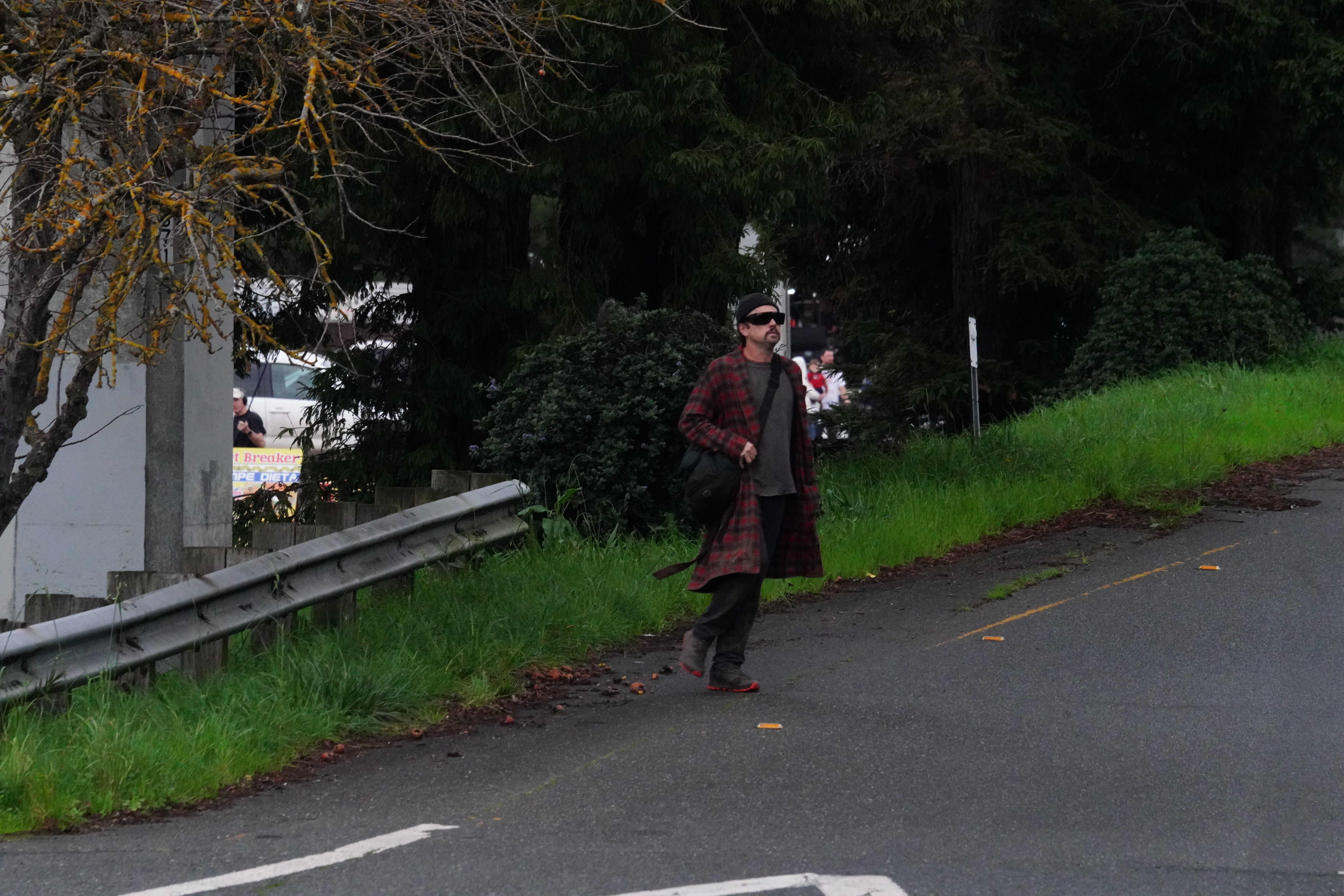
Despite differing opinions and theories, Cal Poly Humboldt students all agreed it was a unique experience to be a part of and an interesting day to be a Humboldt resident. After all, it’s not every day Leonardo DiCaprio is seen running down Highway 101.
“As a film major, the entire experience was a dream come true,” Farley said.
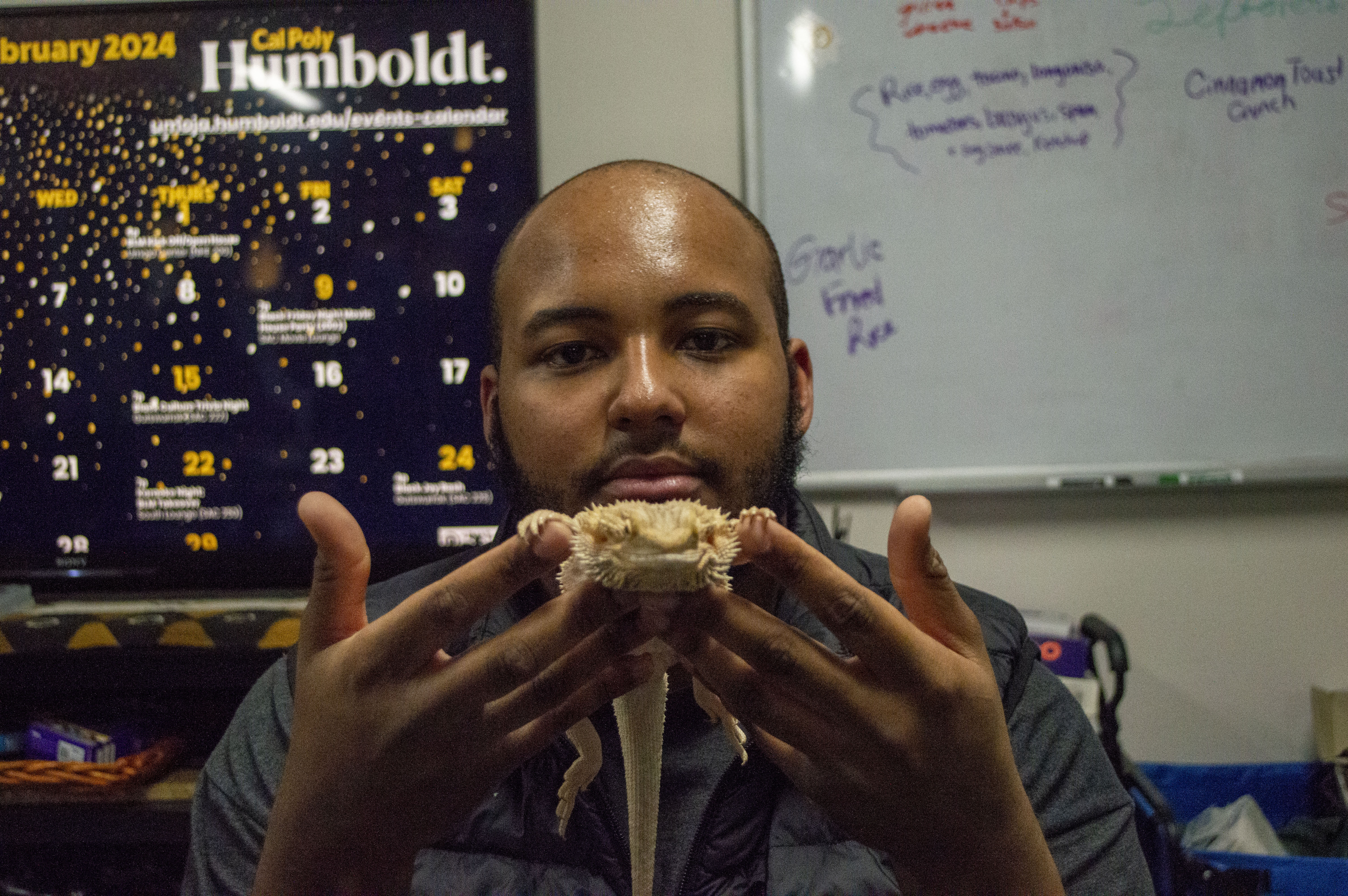
Tigger doesn’t have any stripes. He isn’t furry, and his jumping skills are horrible. His scales are nice and smooth, and his facial hair rivals a 19th century president’s. Tigger the bearded dragon is just one of many attractions people at the Umoja Center can offer.
The Umoja Center for Pan-African Student Excellence, located in Nelson Hall East, kicked off a month of events for Black Liberation Month on Feb. 1 with an open house.
Student art and photos of Black activists, athletes, musicians, and historical figures line the walls from floor to ceiling. “I love my melanin,” said one sign. A box with loanable art supplies sits at the front desk, free for anyone to use.
The center hosts many events, such as discussions about Black joy and movie screenings or even a Black trivia night. The center also offers academic advising and computers students can use, but the most important thing most students take from the center is community.
Many Black students have found community at the Umoja Center — a difficult thing to do when, according to the Cal Poly Humboldt website, only 3% of students at Humboldt are Black. Delaena Montes, a student assistant at the center, said it’s a place she could feel like herself.
“It’s an open space,” Montes said. “I can reach back to my roots here, my background. I felt like it was somewhere I could be myself. It’s freedom at a very white school. Having a place to escape is a great feeling. I feel comfortable here.”
Kamar Little holds Tigger the bearded dragon at the Umoja Center Feb. 1. Photo by Dezmond Remington
Jerry Turner, Tigger’s owner, agrees. He found the center when he was a freshman last year. He’s a mechanical engineering major with a lot of coursework, so having a place to relax and make friends is important to him.
“It’s a family,” Turner said. “That’s the best way I can put it… all of my friends I’ve met here, at the Umoja Center. It’s just beautiful.”
Ryen Price joined the Umoja Center last year after living in the Sankofa House, the Black culture-focused dorm in Cypress. She started coming to the Umoja Center to meet other Black students. She said she’s made a lot of good friends, the type she has potlucks and in-depth discussions with.
“I love how different we are, but also how similar,” Price said. “We’re like a family here.”
Montes is surprised more students don’t show up to the center, as well as other culturally-focused programs such as the Indian Tribal & Educational Personnel Program or El Centro, located down the hall from the Umoja Center.
“People should know about these places,” Montes said. “There’s a lot of culture up here [in Nelson Hall].”
That doesn’t surprise Kamar Little, a Student Advisory Group for Equity representative at the Office of Diversity, Equity, and Inclusion. Little works to connect students with those centers.
“I’m making them a bigger name,” Little said. “I’m letting people know things exist. There have been instances where people have never heard of [the programs].”
Price said anyone curious or doubting should lay those worries to rest and visit the center.
“People ask themselves, ‘[am I] black enough?’” Price said. “It’s the right place. Don’t think. You’re always welcome here. Don’t be shy, just come.”
This year marks a milestone for some Cal Poly Humboldt students: their first time voting in a presidential election. Besides potential presidential candidates, the ballot will include important propositions, like Proposition 1, a state-wide measure regarding funding within the mental health system.
Polls open for California’s Presidential Primary Election on March 5 and vote-by-mail ballots have already begun mailing out. To participate in any election, voters must be registered in their state. In California, that means registering no later than 15 days beforehand.
In order to vote in the primaries, the last day to register is Feb. 20. As a California resident, voting registration can be filed online at registertovote.ca.gov or by mail.
Paper applications can be found at County Registration Offices, Department of Motor Vehicles, public libraries, government offices and select post offices. Paperwork should be sent to the mailing address: Secretary of State Elections Division 1500 11th Street, 5th Floor Sacramento, CA 95814.
If registered with a political party, that party’s political candidates will show up on the ballot. To update party affiliations, a new registration form will need to be submitted.
16 and 17-year-olds are eligible to pre-register to vote and will automatically be registered upon turning 18.
Alongside the new wave of voters across the nation is a new wave of Humboldt County residents. To vote locally, or in the case of an address change, an updated registration form must be completed. Luckily, the process is quick and easy.
For more information visit the Cal Poly Humboldt legal lounge website for voting (studentlegallounge.humboldt.edu/voting) or call (800) 345-VOTE (8683).
University expects the new microgrid will provide about 25-30% of current annual campus electricity needs
by Brad Butterfield
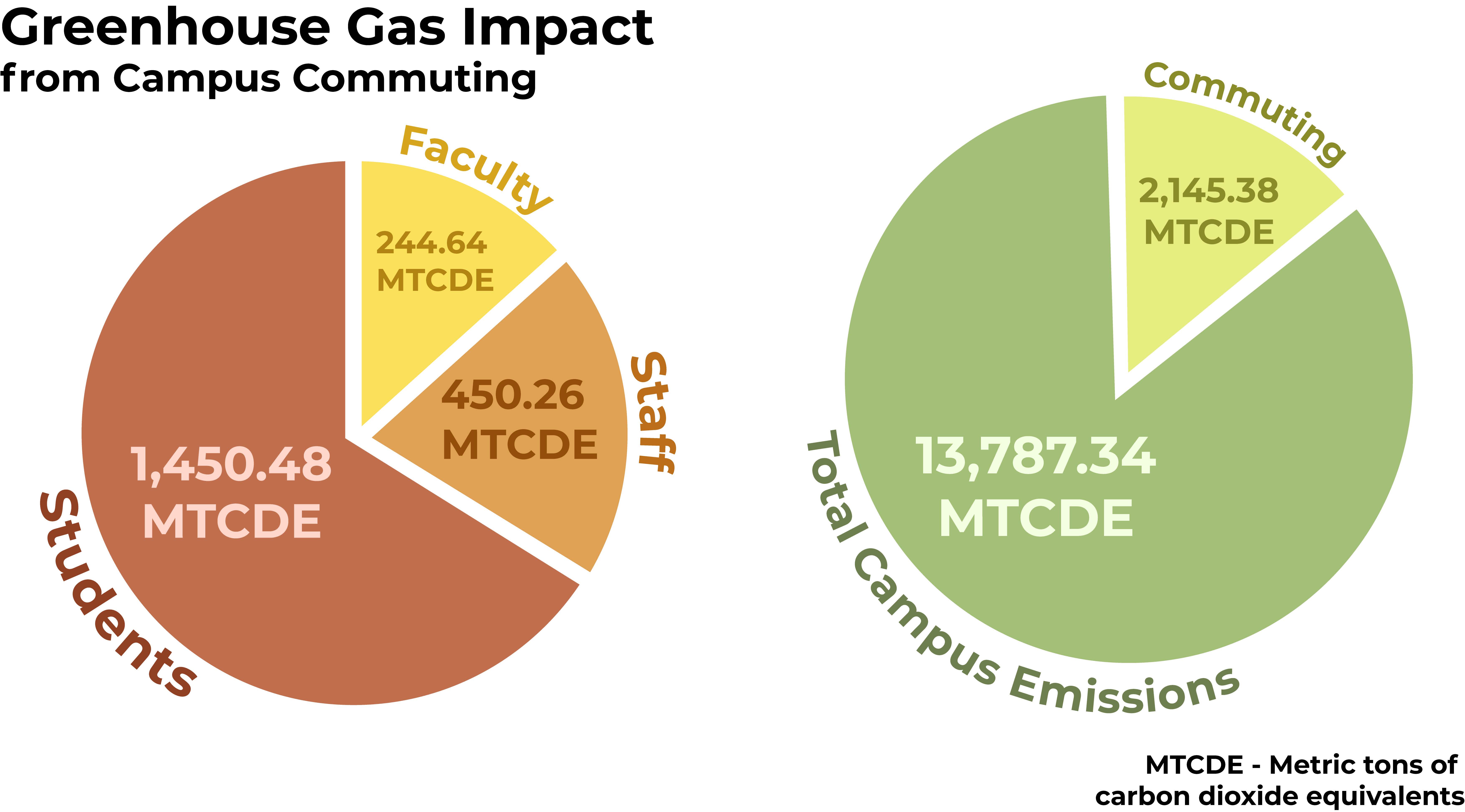
Striving for sustainability and nestled in among the indomitable redwood giants of Northern California, California’s new polytechnic signed a contract on Feb. 2 for two megawatts of solar and three Tesla megapack batteries, which are expected to supply 25-30% of the university’s current annual electricity usage. Not yet immune from fossil fuel energy dependence, the university used 13,723,403 kWh of electricity and 922,559 Therms of natural gas, resulting in a combined 8,215.37 metric tons of carbon dioxide equivalent (MTCDE) of emissions during the 2022-23 academic year. The new microgrid/solar project is a tremendous step towards the university’s goal to become carbon neutral by 2045 and will change Cal Poly Humboldt’s energy portfolio for decades to come.
Where does Cal Poly Humboldt currently get its electricity?
Where a significant portion of Humboldt County purchases its energy from Redwood Coast Energy Association, Cal Poly Humboldt has opted to purchase electricity from Shell Energy, North America. This choice in energy procurement by the university is made possible by Cal Poly Humboldt’s direct access (DA) purchase of electricity, in congruence with 13 other DA CSU’s. “DA provides retail choice to customers by allowing them to purchase electricity directly from an Electric Service Provider (ESP),” according to the California Public Utilities Commission website. With DA, Shell, North America provides the energy, then that energy is transported by PG&E to Cal Poly Humboldt campus. DA is lottery based and allows universities to choose the most cost efficient energy option, rather than the county supplied utility in any given area. The negotiation of this DA energy procurement is handled by the chancellor’s office and allows Cal Poly Humboldt to access electricity at a competitive rate thanks to the aggregated 13-campus negotiation carried out by the CSU. While renewable energy sourcing is important, it has to be carefully balanced against the university’s broad range of financial needs, according to Cal Poly Humboldt’s Energy Manager Andrea Alstone. “As the Energy Manager, obviously, I want to use as little energy as possible and make it as renewable as possible. But, I also realize that costs are real and it’s kind of a zero sum game,” Alstone said. “What we’re spending on electricity means that we’re not spending on other things that the campus needs; we really want to be conscientious of that fact.”Importantly, CA Senate Bill 100 will require renewable energy and zero-carbon resources to supply 100 percent of electric retail sales to end-use customers by 2045. Californian’s are on a one-way road to renewable energy.“[Energy] use in California has to be 100% renewable by 2045. So, as a direct access customer, we will meet those standards, but there are other entities that are doing that sooner. “The choice to purchase from Shell, North America comes, primarily, down to cost – a fact not surprising nor impressive to environmental science and management senior Rain Lopez. “This school is a government institution, which is basically a business that is clearly more interested in maximizing its profits and reducing meaningful spending… so, it’s not surprising that the school made this choice,” Lopez said. Environmental science and management Junior Brooke Douglass put things more bluntly. “Shell is an evil company that has committed many environmental injustices,” Douglass said.
The Carbon Cost of Purchasing Energy from Shell
The university’s choice to purchase from Shell, North America has real world impact, as they do not source as much of their energy from renewables as Redwood Coast Energy Authority. Shell, North America sources its electricity from 34% renewables, (Biomass & Biowaste, Geothermal, Eligible Hydroelectric, Solar, Wind) whereas RCEA sources from 50% renewables. This gap is in large part due to the differing goals of each energy provider. Shell, North America looks to obtain the cheapest electricity possible for its customers, while still meeting California’s current renewable energy requirements, according to Alstone.“Whereas RCEA is more community focused and it’s like, ‘what does our community want and how can we meet that?’” Alstone said. “Cost is important, but it’s not the only factor in their decision.”
A (natural) gas need
Importantly, when talking about total campus energy consumption, electricity is only half the equation – actually, it’s exactly 35% of the equation, with the majority of energy consumption on campus coming from natural gas. The university’s main account for natural gas is with the Department of General Services, a branch of the CA government. Perhaps surprisingly, campus use and cost of electricityis a near perfect mirror image of its natural gas use and cost in 2022-2023, where electricity accounted for 35% of total energy usage on campus, but 61% of total energy cost. Natural gas accounted for 65% of total energy used but only 39% of overall energy cost. Cal Poly Humboldt, being the northernmost CSU, has a much greater need to heat its buildings as compared to other CSU’s. The necessity of heating its buildings nearly year round contributes to Cal Poly Humboldt’s ranking as 2nd highest in ‘campus gas purchased’ out of the 23 CSU’s, for the ‘22-’23 academic year, (when natural gas usage is normalized per-square-foot) according to the CSU energy dashboard. This equates to 0.46 therms/SF natural gas usage at Cal Poly Humboldt, only out-gassed by Cal State Fullerton. When thinking about MTCDE emissions, it’s incredibly important to factor energy efficiency into the equation. “If someone told me I had an infinite amount of money to spend on things, before I started spending them on more renewable energy, I would make things more efficient,” Alstone said. Meaning, the best way to obtain sustainability is to not require said energy in the first place. A better insulated building with triple pane windows requires less overall energy to heat and is thus more energy efficient, which of course leads to the dilemma of whether to allocate money towards infrastructure efficiency projects or towards renewable energy generation, i.e. solar panels. In 2022-23, Cal Poly Humboldt used 6.8kwh of electricity per square foot at a rate of $1.49/SF. Totalcampus emission for ‘22-’23 was 13,787.34 MTCDE, equivalent to 31,889 barrels of oil, according to university Climate Action Analyst Morgan King.That’s a substantial consumption of fossil fuels, no matter how one looks at it. For some students, this speaks to a disconnect between the university’s green-marketing and the campus’ actions. “Humboldt likes to claim it’s green though and it’s superficial… I think that being ‘green’ is a political buzzword,” Lopez said. “An institution of this size, regardless of having a relatively ‘small student body’ should have more resources to support its ‘green programs.’”
Solar energy on the horizon
The contract signed with EDP Renewables North America Distributed Energy on Feb. 2 means the university will not own, maintain nor pay for the installation of the solar system, however there will still be initial costs. Roof replacements are necessary for buildings that will be receiving solar panels, and sites on campus receiving the microgrid components will need to be prepared. The facilities yard, for example, is going to house three Tesla shipping-container-sized batteries. In total, the campus will have two megawatts of solar when the project is complete, which is about the max number of panels the university can physically support, currently.“I want as much as [solar] we can have, and that’s kind of the max given the roofs in the parking lots and the fact that we’re kind of physically constrained,” said Alstone.The battery will provide a peak power of 5.8MW and a total energy of 11.5MWh. Battery capacity is crucial to the systems function as a reliable microgrid.“If everything went out, we’d need a battery which can start our energy system from zero, so we’ve oversized the battery,” Alstone said.Annually, the solar system is expected to produce 3,300MWh of solar – with a guaranteed production of 2,866MWh. This equates to about 25-30% of the university’s current annual electricity usage. In addition to making strides to lower campus greenhouse gas emission, the solar is also expected to save the university money, in multiple ways. As per the contract with EDPR, the university will pay the company for the electricity generated by the solar, but at a much lower rate than the university currently pays for electricity from Shell, North America.“It will end up lowering our bill,” Alstone said.Additionally, thanks to the Inflation Reduction Act, the solar system will also save the university money through hand-me-down tax benefits.“The [tax] benefit will be passed on to the owners of the solar, EDPR, and they in turn pass it on to us in the form of lower electricity costs,” Alstone said. Another positive aspect to the contract with EDPR is a guaranteed minimum amount of electricity. If they don’t meet the minimum, then EDPR will pay the difference to the university, according to Alstone.Due to the need to install the solar arrays in multiple parking lots across campus, the installation will likely need to take place during the summer break, so as not to irritate the difficult parking situation on campus any further.“We anticipate the canopies will be installed over existing parking spaces Summer 2025 when classes aren’t in session with temporary, minimal impact to parking, “ said Aileen Yoo, Director of News and Information for the university.Cost savings, reduced reliance on fossil fuels for energy, no installation or maintenance cost – this is sounding like a killer deal. Naturally, there are two ways of looking at things.“In an ideal, ethical world, the university would invest in these solar panels as owners, [then] source and promote local unionized workforce for photovoltaic product repair, which would boost your local economy and probably reduce overall maintenance costs…” Lopez said. “But again, universities are businesses and will not operate from a place of long-term vision, just immediate costs.”In any case, the contract signing and soon-to-come microgrid and solar system seem a justified time for Cal Poly Humboldt to raise arms in victory – and that they are. “The microgrid project not only showcases Cal Poly Humboldt’s longstanding commitment and investment into sustainability, but it captures the spirit of what we do here: educate students who can help solve the world’s most pressing problems by providing a real-world example of the benefits of microgrids and how they work,” Yoo said.
Between cranking out assignments, having a social life, and enjoying living, most college students have enough on their plate. That’s why most colleges have off-campus housing offices. Humboldt had been without an off-campus housing liaison for over a month, but now one student has stepped up to the plate.
Iris Perla-Blanco is an engineering major currently working 10 hours a week at the Housing and Residence Life Center (HRLC). Since the liaison position has been empty, Perla-Blanco has assumed all of the position’s responsibilities.
“Students will contact the housing department and they will forward it to me and then I’ll send them resource emails, or more specific ones,” Perla-Blanco said. “If they are having legal issues with their landlords, I’ll direct them to sources I know or to the Student Legal Lounge.”
In addition, she handles all interactions, emails, phone calls, appointments, resources, and she writes a newsletter that gets sent out every Friday. Perla-Blanco enjoys writing the weekly newsletter because individual property owners can contact her, fill out a Google form, and then have all their information in one place for students.
“There are also the cases where a lot of people come from SoCal or the Bay Area and can’t get up here to look at a place, which is definitely something you want to do before committing to renting a property,” Perla-Blanco said. “We have 45-minute slots you can book and I will go look at the property and scout it out, ask any questions, take videos, get to know the [landlord], and then I’ll report back to them so they can have a better feel.”
Todd Larsen, Senior Director of Housing Ops and Auxiliary Services, oversees the program. Having a real estate license, he has his foot in the door with property owners. Larsen believes that the housing market is slow right now, but is ramping up for fall.
“The market is softer, so the volume of calls and inquiries has dropped significantly,” Larsen said. “Maybe one or two inquiries per day, but it’s picking up for fall.”
The HRLC is expecting a new employee starting Monday. Part of their duties will be working alongside Perla-Blanco by picking up some off-campus housing responsibilities. Larsen claims that as more housing buildings open, more stress will be taken off the off-campus housing team.
“As we build more buildings, like when Craftsman Mall opens in fall of 2025, we will need less and less off-campus housing support because that adds another 964 beds for upperclassmen,” Larsen said. “Then, we’re working on a new project – housing, dining, health, which is 305 beds, and that comes online fall of 2027. We are [also] being really intentional at pricing at the same price as College Creek on campus.”
Cal Poly Humboldt’s President Tom Jackson addressed the construction of Craftsman Mall in the Feb. 1 issue of the Eureka Times Standard.
“Once completed, this project will add nearly 50% more student housing,” Jackson stated. “It will help students today, and well into the future, be able to afford the Humboldt experience that our alumni value so highly.”
The program looks like it will always have a place for students.
“It will always be a student-assisted position because we want to employ students, and it’s great for resume building,” Larsen said.
This website uses cookies to improve your experience. We'll assume you're ok with this, but you can opt-out if you wish. Cookie settingsACCEPT
Privacy & Cookies Policy
Privacy Overview
This website uses cookies to improve your experience while you navigate through the website. Out of these cookies, the cookies that are categorized as necessary are stored on your browser as they are essential for the working of basic functionalities of the website. We also use third-party cookies that help us analyze and understand how you use this website. These cookies will be stored in your browser only with your consent. You also have the option to opt-out of these cookies. But opting out of some of these cookies may have an effect on your browsing experience.
Necessary cookies are absolutely essential for the website to function properly. This category only includes cookies that ensures basic functionalities and security features of the website. These cookies do not store any personal information.
Any cookies that may not be particularly necessary for the website to function and is used specifically to collect user personal data via analytics, ads, other embedded contents are termed as non-necessary cookies. It is mandatory to procure user consent prior to running these cookies on your website.