While the rest of the planet suffers, what will become of the Redwood Forests?
While climate change continues to cause destruction around the globe, scientists are finding hope in a local tree: The Giant Redwood, or Sequoiadendron giganteum.
The trees are currently in the midst of a growth spurt, producing more wood in the past century than any other time in their lives, according to Save The Redwoods League, a nonprofit organization who protect and restore the California redwood forests. Researchers from Humboldt State University, UC Berkeley, Natureserve, United States Geological Survey and Colorado State University are working alongside Save The Redwoods League to understand the growing trees and how they will continue to respond to climate change.
The Save The Redwoods League and HSU published findings concerning the impact of climate change in the recent research paper Aboveground biomass dynamics and growth efficiency of Sequoia sempervirens forests. They found that within the redwood forests, there are massive amounts of carbon sequestration. “Sequoia forests may be the most effective to [sequester carbon], because they accumulate more above ground biomass than any other vegetation, sustain higher rates of productivity than any other forest, and protect biomass produced via superlative fire- and decay-resistance.”
Carbon sequestration is “the capture and secure storage of carbon that would otherwise be emitted to, or remain, in the atmosphere,” according to Encyclopedia of Energy, 2004. This means carbon is trapped in forests, soil, or oceans for long periods of time instead of entering the atmosphere. It can be done naturally or artificially, and is becoming a researched effort to delay global warming which is caused by increase of greenhouse gases, such as carbon dioxide.
This is why scientists are so interested in the natural carbon sequestration of the redwood forests. While this seems to be good news, there is still much research to be done.
NASA scientists have started to create a global map of where carbon is being stored, and how much carbon is being released through deforestation. The redwood forest is only a tiny part of that map.
Humboldt State University Professor Steve Sillett has worked on the research with Save the Redwoods League.
“Redwoods can do little to fight climate change as they occupy a TINY proportion of the landscape,” Sillett said in an email. “Even though they are impressive in many respects, too little of the landscape is covered by them to make much difference at the global scale.”
While the redwoods alone cannot create a global change, scientists are continuing to research the storage of carbon in forests and what this means for the future of the planet.
Asynchronous classes allow students flexibility at the cost of self-discipline.
Following the disastrous transition to online learning, students returning this fall express concern about the quality of their college experience moving forward.
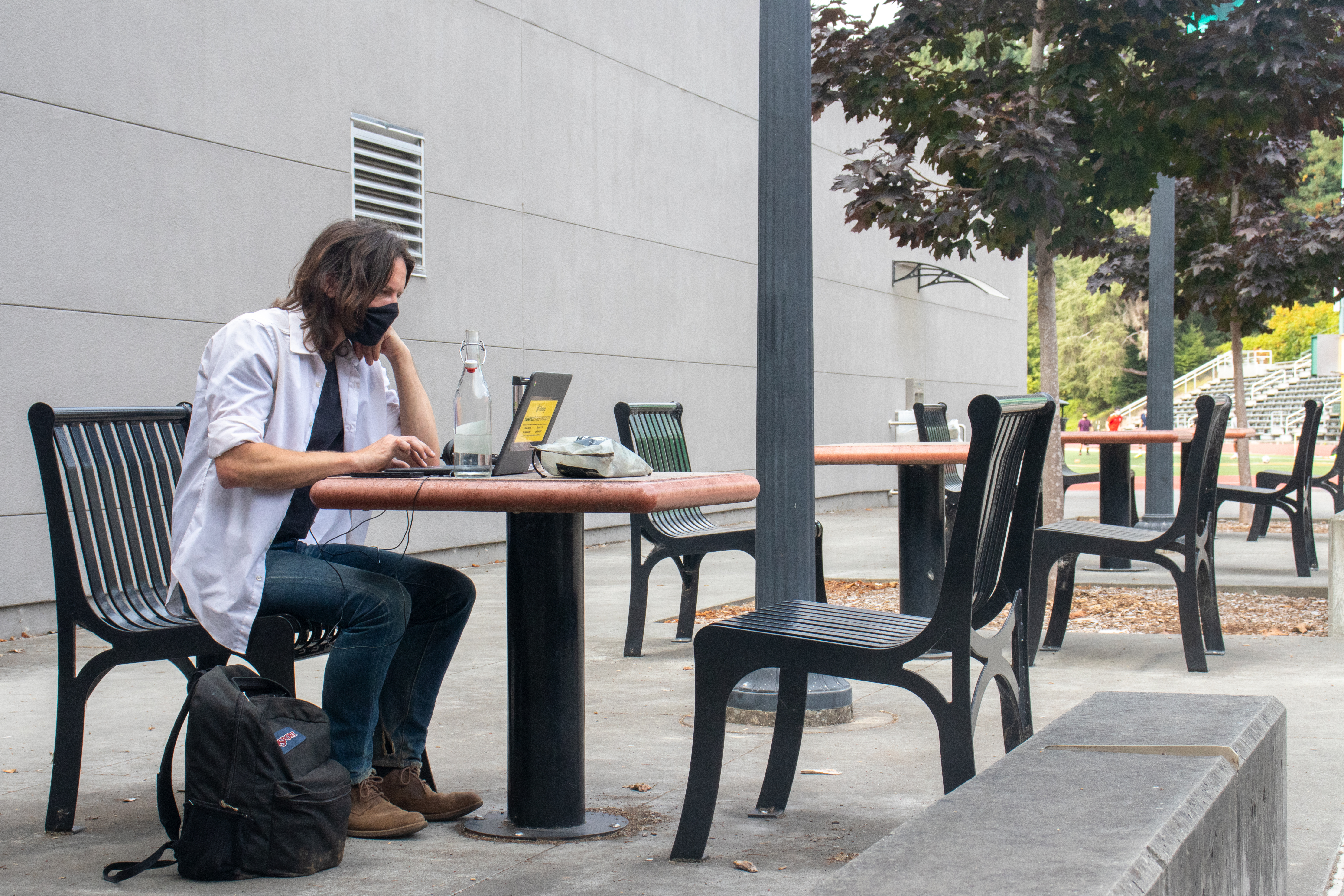
Matthew Moretti is a botany major at Humboldt State University. Moretti took spring semester off after a particularly challenging fall but decided to return because he felt it was his only option in the pandemic.
“If there’s any time to rush through the rest of college, I feel that online courses are in a way easier, even if they have their unique challenges to them,” Moretti said. “I think the asynchronous classes are particularly difficult and I need to have a lot more self-discipline than I think I have any other semester before.”
Moretti’s biggest gripe with online learning is missing out on the practical knowledge that comes with the hands-on experience of lab classes. He’s delaying as many labs as possible, in hopes they’ll be held in-person in the near future. Unfortunately, Moretti couldn’t avoid taking an online entomology, study of insects, lab this semester.
“We will not be able to collect or curate insects,” Moretti said. “Which I feel is a real disservice to really understanding the ins and outs of the insect properly. You lose a lot without being in person.”
Chris Bignery, HSU wildlife major, plans to become a herpetologist, working with amphibians and reptiles. His online lab means missing out on educational field trips and important labs with species samples, but he couldn’t risk losing his spot.
“It’s the class I’ve been waiting for, for three years,” Bignery said.
Bignery came down from Oregon to live on campus this semester because he loves Humboldt’s redwood forests, beaches and small cities. Although claiming the county has everything he needs, Bignery described his life on campus this semester much more bleakly.
“It’s like a prison,” Bignery said. “It’s very lonely.”
Sara White, environmental studies major, enrolled in two classes that were moved online at the last minute. Regardless, she’s carrying a positive attitude into the semester.
“Honestly, I’m really excited, I like all of my classes so far,” White said. “I mean, I wish that things were different obviously but I’m still happy to be here.”
White was attending community college last semester and like other students was forced to convert to online learning mid-semester. Her only concerns are the three asynchronous classes she’s signed up for.
“I feel like it’s a little bit harder to keep track of things,” White said. “I think that’s true of being online in general. It feels like things can get lost in the void.”
Drake Woosley, HSU mathematics major, believes asynchronous classes are much more efficient because he doesn’t have access to an internet connection at home, so he has to walk to campus every time he has class. He feels, generally speaking, there’s a lot less being covered this semester than in normal circumstances and the tuition should reflect that.
“It’s an online school, it shouldn’t be the same tuition. That’s kinda ridiculous,” Woosley said. “There’s almost nothing— no facilities are open. You’re not getting anything other than the accredited university online degree.”
A quick and easy breakdown of how the university was impacted by budget cuts.
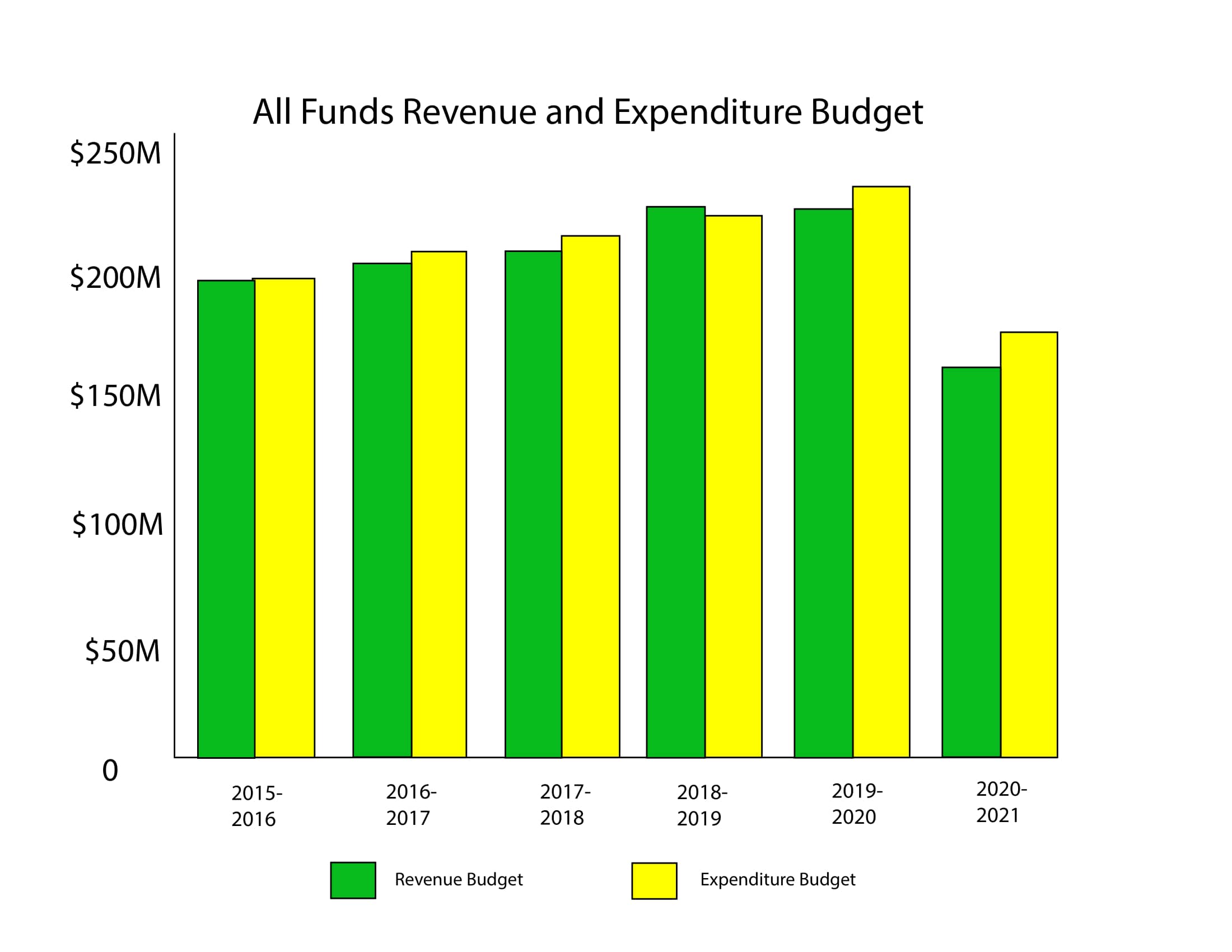
The budget for this academic year was released on Sept 15. There are two sets of budgets laid out, the University Operating Fund and the All Funds Budget. Each budget provides the expenditure and revenue breakdown.
The All Funds budgets dates back to the 2015-16 academic year to display all changes that the budget had gone through throughout the last five years.
Both the Expenditure and Revenue All Funds budgets have significantly decreased in various ways.
The budget released this past week does not reflect any Center Activities, Center Arts or HSU dining services funds.
The revenue budget, is based on how Humboldt state University receives its money, is $164.6 million. According to the 2020-21 All Funds Revenue budget, this was decreased by $58.2 million. This is the first major decrease since 2015 and the lowest the budget has ever been since the last recorded academic year, 2015-16.
Educational Appropriations, which is just another way of saying state and local funding, make up over 50 percent of HSU’s revenue. The amount of appropriations received for the 2020-21 academic year is $85.6 million, resulting from a $5.1 million decline. This is the first reduction recorded since the 2015-16 academic year.
A quarter of the revenue comes from higher education fees, which includes tuition, student health, AS fees, graduation fee, etc. This portion stands at $42.2 million which is an $8.2 million decrease from last year. This could be the result of COVID-19 causing drops in enrollment.
The expenditure budget, which is the budget based on what the university will spend their money on, is $180.5 million. According to the All Funds Expenditure budget, this was decreased by $43.8 million. This is the first reduction in the budget since 2015 and the lowest the budget has been since the last recorded academic year, 2015-16.
The salaries and wages of HSU employees reflects 44.5 percent of the budget. These include not just tenured professors and lecturers but also department chair members, assistants, teaching associates, support staff and the university president.
The Regular salaries and Wages budget did have an overall decrease of $8.9 million. With the budget dropping across the board, the president managed to increase his salary by $10,000.
This is also the first time the revenue budget was significantly smaller than the expenditure budget since 2015. The usual trend is having the numbers very close in amount with a maximum $5 million gap. This year’s budget has a $15.9 million gap.
HSU student shares their experience of sexual assault from a non-student member within their club.
Title IX is a federal law protecting students from facing discrimination within any federally funded academic institution. Title IX prioritizes the significance of equal treatment of students, however, flaws in the investigation process leave some students feeling abandoned.
David Hickcox is the Title IX coordinator at HSU. When the Title IX office conducts an investigation into a sexual assault, they’re required to remain impartial through the process.
“I think it’s human nature to want to assume that every person bringing a report is telling the truth,” Hickcox said. “In some cases, it’s pretty clear cut that the person accused is responsible for that behavior, but I can’t rush to judgment. I can’t start treating that person unfairly and not giving them access to advice.”
In a Title IX investigation, an investigator will be assigned to conduct interviews with the parties involved and witnesses willing to cooperate. They will also gather any relevant documentary evidence they can, including text messages, social media posts are collected. The investigator will then present the evidence to both parties, allowing for any questions, before writing up a report with their findings.
Prior to 2019, Title IX investigations were entirely done on paper by a single investigator. A CSU-wide policy change requires that all students be given access to a live-hearing, with the opportunity to question and respond to evidence used in the investigation before a finding is made.
In the case of non-students who participate in campus activities like rec-sports and clubs, the Title IX office has almost no jurisdiction as they’re only able to investigate students or staff members.
“I can’t compel a member of the community to come on the campus and talk to me and give me an interview statement,” Hickcox said. “I can with a student, because guess what, I can put a hold on your student account and you won’t be able to progress in your degree.”
An HSU student-member came forward, wishing to remain anonymous. They shared their experience of being sexually assaulted by a non-student club member and demanded accountability and reform within club policy to exclude non-student members from joining.
“I read through a couple of cases where it was pretty clear that the students had lost faith in the process, because it was taking so long.”
David Hickcox
Hickcox hasn’t found there to be a disproportionate number of sexual-misconduct cases coming from the clubs department, and doesn’t believe non-student members should be excluded.C
“I think that might be a bit like the sledgehammer on the fly,” Hickcox said. “But I think we could definitely target that behavior.”
Through auditing cases, Hickcox discovered the office wasn’t properly following through with several victims. He took his concerns to the HSU Chief of Staff.
“I read through a couple of cases where it was pretty clear that the students had lost faith in the process, because it was taking so long,” Hickcox said.
California State University executive order 1068 allows for non-students to become non-voting members of clubs on campus, provided they constitute less than 20 percent of each club.
Molly Kresl is the office of student life coordinator and oversees the clubs department. Kresel says this is a prevalent issue that’s been happening at the CSU level for a while now, claiming non-student members pose a higher risk.
“It is because of push back from student groups who rely on their alumni and community members to support their events and outreach that we permit the 20 percent max non-student membership,” Kresl said.
It’s ultimately up to each club to allow or not allow non-students to become members. Kresl works with clubs to put together plans of action to address problematic non-student members. Students can obtain a no-contact-order against another student or non-student.
Under CSU executive order 1095, all campuses are required to have a survivors advocate – a person to whom students can confidentially report sexual-assault, without any obligation to report to the University.
Rather than hire a single advocate to work from within HSU, the University has been contracting the local North Coast Rape Crisis Team. The NCRCT provides victims with a 24-hour hotline, one-on-one counseling and general advocacy.
Paula Arrowsmith-Jones is the community outreach coordinator of the NCRCT. Her job is to hear, believe and support victims of sexualized-violence.
“Our services are available to any person of any age or gender,” Arrowsmith-Jones said. “Who has ever in their lifetime been impacted by some form of sexualized-violence.”
HSU’s Title IX office has recently been granted two new full-time positions, tripling the size of their department and expanding their opportunities to stop, remedy and prevent sexual misconduct on campus.
“No one should ever have to go through the betrayal and violation that an assault invokes,” Anonymous said. “It’s not just physical – it’s also an overt psychological trespass that forces you to question the entire relationship you thought you had with the person who assaulted you. It’s a form of injustice on the interpersonal level, a trickle-down of our society’s attitude and response toward sexual assault, and it needs to be addressed.”
Humboldt Domestic Violence Services
24-hour crisis line: (707) 443-6042
North Coast Rape Crisis Team
24-hour crisis line – (707) 445-2881
Humboldt County Mental Health
720 Wood Street, Eureka, CA 24-hour crisis line – (707) 445-7715
Elise Fero recounts her experiences after 10 days of isolating in her dorm
Isolation felt like home, not the home you want to be in, the home you’re stuck with until life gives you an opportunity for change. I spent days journaling and staring out the screen door at a single pinecone stuck between the boards of the porch I wasn’t allowed to step foot on.
After ten days, I finally received the call informing me it could be my last day in isolation. My first thought, ‘well shucks I just ordered groceries.’
As excited as I was, something inside me was terrified to leave. Most of my anxiety surrounding COVID-19 had disappeared. I was recovering fast and my parents, friends and boyfriend all tested negative, but I was experiencing a new kind of anxiety. Life after COVID-19.
My life had suddenly become full of consequences I had no control of. I watched friends lose opportunities because they were required to quarantine after spending time with me. I feared the current science could be wrong, that my release could be lethal. I was consumed by an overwhelming fear that someone could’ve died because of me. Yet selfishly, all I wanted was to be set free.
When I was cleared for release, I let out a sigh of relief and broke out into tears and uncontrollable laughter. The second the call was over, I opened the door and felt the cool air rush past me without the filter of a screen standing between us for the first time in over a week. The simple act of stepping outside was an indescribable joy I’ve never felt before. I was finally able to pick up the pinecone that had stared at me for so long.
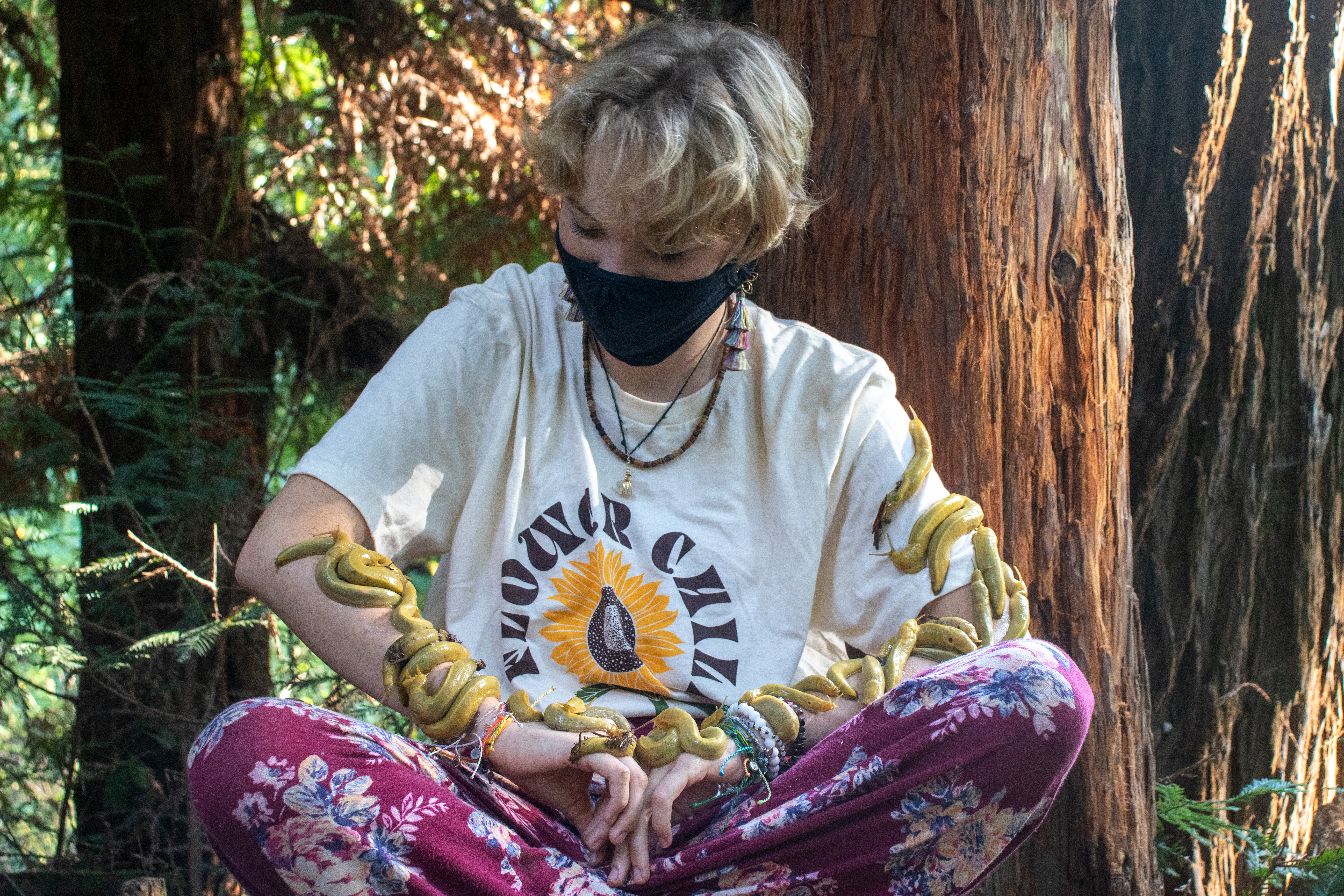
During those ten days in isolation, I’d planned exactly what I’d do when I was released. My list consisted of finding a dog to pet, reuniting with an army of banana slugs and going to the beach.
I was determined to return to the coffee shop where I had received the bad news that I tested positive for COVID-19. That first sip of coffee tasted like the conclusion to my horror.
I’ve never felt closer to nature than that day, on the beach and in the forest. The same day, I was reunited with my best friends the banana slugs.
For the next week, I spent as much time as possible outside. I abandoned my introverted tendencies and greeted everyone I saw. It was an awakening. For the first time, I experienced the world without taking it for granted.
Coronavirus was not just unpleasant, it was living out the nightmare the world warned us to fear and facing the possibility of dying alone. The experience robbed me of all my comforts and left me deserted. Watching others claim that my illness was a lie and that they would never catch it. To be honest, I never thought I would either.
This virus is not prejudiced. It will try to kill anyone given the chance. Doctors pour their lives into patients who may not live to see tomorrow. Family members are forced to say goodbye, praying it’s not for the last time. Survivors are absorbed in guilt after watching others die from the virus they passed on. It never leaves your mind, the fact that you could’ve been a statistic on the list of those who passed.
For those who experience this virus, I share my story to provide you comfort. I was lucky to have survived. Not everyone is. I always had it in the back of my mind that others in isolation spend their final days alone.
I thank the universe this wasn’t my fate and for giving me more time to share my story and grow from it.
2020 has been a year of disruption felt throughout the globe let alone Humboldt State campus. Like most industries in America, live sports has been subjected to repercussions stemming from the COVID-19 pandemic.
With most states banning the gatherings of large amounts of people, sports organizations such as the NBA and MLB have attempted to salvage the remaining portions of their seasons in order to keep fans entertained and revenue coming in. As the fall has drawn closer many have worried the pandemic would stifle the incoming football season. Though the arenas in which these teams rival for the next few months may be empty, the fans at home are champing at the bits for the action their hearts long for.
Despite the current pandemic stifling most ways fans enjoy football season, one thing remains as popular as ever: Fantasy Football.
Though it might be daunting from an outsider looking in, fantasy football is a pretty easy game to get into for fans of all ages.The first step of the game for any prospective fantasy football franchise owner is finding a league.This can be accomplished by joining or starting a league with a group of friends, coworkers or family members, if not joining a league online.
For the novice beginner with no previous experience we suggest joining a league with people you know first. Each league ranges in size from eight to sixteen team owners.The league fee also ranges from group to group, often varying from twenty to a few hundred dollars per individual participating in the season.This pool of money is then distributed to the team that come in first place.
Fantasy football is a game that can be learned as the season progresses but the gist is that the better your players perform during the regular NFL season, the better they will perform each week against other teams in your league. The players’ stats from each week are added up and the team with the most points is the winner.It is important to start your franchise off with a solid roster. As draft day approaches here’s a few tips and tricks that will help you curate a team that will hopefully perform well throughout your season.
Select players that you project will continue to perform well from last season.
Be weary of players that have the same by weeks during the season because this will dramatically affect your teams chances of winning during such weeks.
Steer clear of players that are prone to injuries, suspensions or any lackluster performance from previous seasons.
At the end of the day what you learn throughout the season will be as a result of trial and error. Have fun with it, learn from your mistakes and don’t be afraid to take a chance on certain opportunities that may arise during the season.
Journalism student looking to study abroad is questioning her decision
My study abroad program in Prague, Czech Republic, takes place next semester.
I speak in the present tense because it has not been canceled or postponed. The program is still set to happen. With this information, I keep asking myself, if the European Union miraculously opens up to the United States by Dec. and I am given the ability to travel to Prague, would I go?
Well, yeah, most likely.
However, there’s a lot to take into account.
The program takes place from Feb. 2, 2021, to May 22, 2021.
I bought my plane ticket back in April 2020 when it was ridiculously cheap, so there’s that going for me.
I got my passport in Jan. which was super exciting. I would need to start getting my documents together to obtain my visa by Jan. 2021.
There’s a lot of planning involved in something that is very uncertain.
I’ve been having a lot of conflicting thoughts about studying abroad during COVID-19. Would I feel safe flying on a plane for 20 hours to get to Europe? What if there was another global shutdown while I was overseas? Would I be satisfied with my classes and internship being online? If I didn’t go, would this be one of the biggest regrets of my life?
I’ve been so careful since March. I have been wearing my mask correctly, I’m constantly washing my hands, using hand sanitizer, keeping my distance, and I’m staying at home unless getting groceries or working. I’ve following all the rules here, why would it be any different there?
Airlines have been taking the extra mile to deeply cleanse and sanitize the cabins, as well as limiting the number of people being put on an airplane. Would this still happen in 2021 for an international flight? I really don’t know.
Upon arrival, I’m fully aware that I would have to self-quarantine for two weeks. Although self-quarantining sucks and is extremely boring, it would be absolutely necessary and worth it because I’d be living there for four months anyways.
Now, another question would be, why would I travel across the world just to take some online classes for a few months. The experience! Being in a different country, experiencing the culture and of course eating the food. There wouldn’t be another time in my life that I’d have the chance to temporarily live in another country to go to school. It’s an opportunity unlike any other.
Why would some students travel back to Humboldt State University just to take online classes? For the town, the environment, to get away from home, or even to just be here.
If there was another global shutdown, I think I’d be okay being in the Czech Republic considering the U.S., specifically California, hasn’t been doing so great with the shelter in place order anyways. Would I technically be safer? I mean, maybe. The Czech Republic as a country has a smaller population than California and a lower rate of positive cases. So, yeah, it’s a possibility I could be safer.
The program is being very transparent and answering a lot of questions that students like me had been having for the past four months. The information being provided has to do with the possibility of online internships, whether or not obtaining my visa is still worth it, how refunds would be issued, and even safety protocols for housing and such.
I feel as though, as long as I am not being irresponsible and acting like an ignorant American tourist, it would be okay.
I would just be wearing my mask (correctly) and minding my own business.
However, this is only if the EU lifts the U.S. travel ban, which may not happen anytime soon.
What life is like as climate change begins to worsen
Waking up in Arcata, CA on Sept. 9, 2020 was similar to an apocalyptic movie. The sky was as orange as street lamps. Cars had their brights on and were dusted in ash. Air quality numbers began to rise.
Air quality states how polluted the air is to the public, measured by the air quality index, or AQI.
AQI levels range from good to hazardous, based on numbers from 0-500. As the number rises, the health risks worsen. Any number above 500 is considered beyond hazardous.
As wildfires continue to rage across California, the air quality has been majorly impacted. California has seen AQI’s above 500 during this wildfire season. In Arcata, despite being 100+ miles away from the nearest wildfire, the skies that were once full of fog are now full of smoke.
According to AirNow, a site that tracks AQI around the globe, by 12 a.m. on Sept. 11 Arcata had hit a peak AQI of 269.
The AQI states that air quality above 201 is considered very unhealthy and above 301 is considered hazardous: “Health warnings of emergency conditions. The entire population is more likely to be affected.”
The HSU campus closed due to the condition of the air. Students were told outdoor activities could not be moved inside due to COVID-19. “Air quality has worsened to very unhealthy levels since Thursday,” said Humboldt State University in an email to its students. “Please note those levels may fluctuate throughout the day.”
They also warned students to stay indoors with closed windows, use a portable air purifier if possible and wear a mask that filters air rather than just cloth if they must go outside.
Despite being advised to wear a mask for filtration, most students are wearing cloth masks. HSU freshman, Dev Lebhar, wore a gas mask when they went outside. They had two other gas masks and two respiratory masks in their dorm.
“The combination of the respiratory disease and the smoke outside means if your lungs get damaged by the smoke and you get COVID, you’re in big trouble,” Lebhar said.
They claimed they haven’t felt any effects from the smoke, but do struggle to breathe while wearing the gas mask due to its layered filtration.
According to the CDC, going out in such unsafe conditions can result in similar symptoms to COVID-19, like cough and difficulty breathing. It can be especially bad for those in high risk groups. Other side effects can result in stinging eyes and throat, increased heartbeat, chest pain, irritate respiratory systems and worsen existing heart and lung diseases. Wildfire smoke can even make you more prone to catching the virus COVID-19.
According to Berkeley Earth, a nonprofit organization on environmental science, China experiences some of the worst air quality, claiming “on bad days the health effects of air pollution are comparable to the harm done smoking three packs per day (60 cigarettes) by every man, woman, and child.” A typical day in China is equivalent to 2.4 cigarettes. “1 cigarette is equivalent to an air pollution of 22 μg/m3 for one day.”
On September 11 Arcata’s average AQI was 243, according to AirNow. That means the average air quality if you were breathing it all day was about equal to smoking 8.7 cigarettes. These hazardous conditions exist all across California, including areas like Arcata that aren’t necessarily close to a fire.
The best way to protect yourself is to stay inside. Any exposure to the smoke can damage your health, especially if large amounts of time are spent outside or if you have other existing health conditions.
Not the senior year I anticipated or signed up for.
For the previous three summers, it had been a tradition of mine to spend time in Colorado with my father’s half of the family. My first summer working 50 hours a week in the bow shop, without the time to explore and appreciate the nature of a mostly foreign land. It only took a few weeks before I began to grow homesick and impulsively withdrew my enrollment at San Diego State University and submitted a late application to Humboldt State University.
My first couple weeks at HSU were typical to that of any new school. New faces and new spaces took warming up to, but it was hardly a choice. Majoring in journalism, I found myself faced with the earth-shattering task of walking up to complete strangers and asking them personal questions in the first week of beginning reporting. This was quickly followed by photo assignments that required me to take pictures of strangers and ask for their names, for print publication. I found myself interviewing professionals in their field, on camera, for video production class.
First semester opened my eyes to a reality where most strangers are willing and eager to share their experiences with anyone willing to show interest. Those experiences became a newfound passion for sharing the stories of my community.
Unfortunately, for me especially, the semester was not without a few hiccups. Less than two months into classes, northern California’s largest power-supplier, Pacific Gas & Electric, was forced to shut off their customers’ electricity in efforts to reduce the risk of causing more wildfires. These blackouts not only interrupted HSU instruction and ultimately cost me learning opportunities with scrapped assignments, the first and only full day without power happened to be my 21st birthday. Instead of going out with my friends, having my first legal drink in a bar, I spent the night listening to Kid Cudi in the dark like I was thirteen again.
The pitfalls of my first semester at HSU didn’t stop there. In one of my rare random acts of kindness, I agreed to give a ride to a stranger. Unfortunately, in life, when you give some people an inch, they’ll take a mile. Non-confrontational by nature, my inability to tell others ‘no’ landed me 30 minutes later with the middle-aged man I’d picked up telling me to ‘hand over the keys.’
Believing my lack of cooperation would be met with violence and me losing the keys to my car, I complied with his demand. Although my car turned up a few weeks later, all of its contents stripped, I wasn’t able to enjoy winter break because my roommates moved out without notice. I spent most of my time scrambling to find a new place and my new roommate.
Despite the emotionally taxing events of the fall semester, everything seemed to fall into place for the spring. My first semester reporting for The Lumberjack. The first story I wrote about the HSU Bicycle Learning Center found its way into the hands of administration and the BLC budget was increased. I was immediately hooked.
By the time California reacted to the COVID-19 pandemic, cancelling in-person instruction at HSU and putting the shelter-in-place policy into effect, writing for The Lumberjack had become my only priority. When assignments in other classes were significantly shrunk and cancelled altogether, I wrote more articles to pass the time.
Over the summer, my annual Colorado trip to visit the family was cancelled by the pandemic. It’s been over a year now since I’ve seen my little sisters and my brother Travis. As I navigate my life in the pandemic, I’ve come to realize now more than ever, the power of family, the people standing by your side when you need them most. I’ve come to find a second family in the friends I’ve made in my short time with The Lumberjack and despite the disappointment of returning to online instruction in the fall, I’m grateful to be returning home.
Housing struggles at Humboldt State continue to be a problem for students
Homelessness at Humboldt State University is a major issue. The mess is only becoming more muddled and students are left to fend for themselves.
Senior at HSU majoring in history, Alfred Silva, is mostly living out of his car. His housing search has been limited because he owns a dog and because he’s a single male, which according to Silva is unattractive to landlords. Not having an address has proven particularly challenging for him.
“I need to take medication all the time,” Silva said. “Now I don’t have anywhere for my medication to be mailed to my house. So, I gotta figure out other ways to get it. I gotta go to the doctor’s office and bug them there and it’s kind of hard.”
Silva has been looking for alternative methods of living including camping, but hasn’t had any luck.
“I can’t find anywhere to camp,” Silvia said. “The only place I found that will allow me to sleep is the back of the HSU parking lot.”
If anything, Silva believes COVID-19 has attracted more people to Humboldt than in past years, and that’s become a big roadblock for him when it comes to finding a home.
“I think the influx of people coming into town right now is just ridiculous,” Silva said. “It’s like you got people that are not even students – many, many, many people that are not even students – they’re just flooding the place right now.”
On the flipside, Silva believes the landlords are as equally guilty in manufacturing the housing crisis in Humboldt County.
“It kind of hurt their wallets a lot because they’re relying on HSU students to pay rent all this time and then when they took off and that happened, it really hurt them,” Silva said. “So now they’re just trying to survive like everyone else but charging rent. When one person’s drowning, they’ll do anything to survive. They’ll even drown another person.”
In a similar situation, HSU senior and biology major Grace Rhoades, moved back up to Humboldt because of a job opportunity they got working for one of the labs at HSU. Landing secure housing has been difficult, but they’re grateful to be subletting a friend’s house until the end of the month.
“There’s just a lot of applying for things, application fees,” Rhoades said. “With COVID, you don’t even really get to see anything or meet anybody in person, you just pay the fee and then like maybe a third of the time they get back to you about the status of your application.”
Even with a roof over their head, Rhoades is still feeling the anxiety of not knowing where they’ll live next month.
“I’m definitely a homebody, I like to know that I have a place,” Rhoades said. “I’ve kind of moved away from home and that’s not really much of an option anymore.”
HSU Off-Campus Housing Coordinator Chant’e Catt recognizes how students are being affected by COVID-19 and finding housing.
“What’s been really hard is students who moved out of town needing people to take over their leases and landlords not being really flexible sometimes with that,” Catt said.
For Catt, another issue that arises is between roommates because of disputes over the extent to which they will abide by COVID-19 rules while sharing a communal living environment.
“People have wanted to break their leases because their roommates don’t respect the restrictions around COVID,” Catt said. “Which puts them in precarious situations where they have to find a new place to live or find somebody to replace their roommate, which could put them into situations where they can’t pay rent.”
Catt has her doubts surrounding the idea that COVID-19 contributed to homelessness at HSU.
“I don’t know if COVID changed anything,” Catt said. “I feel like it’s all the same and that’s because it’s always been so bad.”
Students survive COVID-19 by cooking for themselves and avoiding college cafeteria
Whether they live on or off-campus this semester, students are facing new challenges in just about everything they do and dining is no exception. Meal plans are offered to students living on the campus at a steep price, but this semester students have resorted to cooking for themselves.
Humboldt State University botany major, Zeen Vincent, purchased a mini-meal plan but finds cooking in his dorm more affordable and enjoyable.
“It’s just easier to cook at home and just buy groceries once a week than it is to go out and eat all the time.” Vincent said.
Although the pandemic has turned trips to the grocery store into an uncomfortable mission, Vincent hasn’t allowed it to affect him much. When he does prepare food, it’s often raw ingredient based meals or snacks.
“I’ve been making a lot of sandwiches,” Vincent said. “I am making burgers tonight so that’s kind of special. I usually don’t eat that on a daily basis.”
HSU freshman, Jesse Barragan, lives on campus and has the green meal plan which is recommended for students who plan to cook on the weekends. Barragan eats at the J cafeteria weekly but is forced to occasionally cook when the J lacks in vegan options.
“Sometimes for dinner they may not have a lot of options,” Barragan said. “Maybe like a few sautéed squash and rice but usually it is good.”
With more vegan and vegetarian options than most places, Barragan is able to eat well on a budget. Barragan’s meals involve easy-cooking in his dorm kitchen, using mostly veggies and produce.
“Lately I’ve been eating a lot of potatoes, squash, tomatoes and salads,” Barragan said.
Although most students who came back to campus moved in at the end of Aug., HSU junior Vanessa Odom, stayed to pursue a work opportunity on campus.
“There were no dining services,” Odom said. “The J and everything closed back in March after spring break.”
Odom discovered they could acquire free food from the Oh SNAP! program. Receiving mostly raw foods, Odom took the opportunity to sharpen their cooking skills.
“I really enjoy cooking for myself,” Odom said. “Obviously it’s a life skill to have and I’ve learned a lot about different kinds of cooking.”
Richard Shilts is a sophomore at HSU and has a job at Domino’s Pizza in Eureka. He applied shortly after moving back to Humboldt and has been working as a delivery driver since July.
“I work just about every day of the week,” Shilts said. “I work about 30 hours. I was working like 40 before school started.”
Shilts’ main concern is work interfering with his education but the job pays too well to quit. Unfortunately, Shilts puts up with customers that are unwilling to abide by COVID-19 protocol, putting himself at a powerless, higher risk of getting sick.
“I can’t do anything about it,” Shilts said. “I just have to deliver to them.”
It’s unique like a snowflake and it fits like a glove, it’s more important than arriving on time, it’s the defining aspect of our image — it’s hair. Whether we love it or hate it, it’s ours, and we do our best to maintain it.
With the state of social media in 2020, an overwhelming degree of how we perceive each other has become smothered by appearance. With many of us lacking excess money to afford material possessions like designer clothes and expensive jewelry, hair is the aspect of our appearance where we have the most control.
In 2015, a “no hair, don’t care” campaign was launched, with young women shaving their heads to get in touch with their true identities. Breaking gender norms, these women are able to grow confidence as they discover their inner beauty and channel it to the surface.
Whether we do it to stick out or to fit in, by wearing our hair the way we do each day, we communicate to others a glimpse into the possibilities of what could be our lives. An ordinary haircut often insinuates a more serious approach towards life, while unusually long hair on a man communicates a more laid back approach and unusually short hair on a woman creates the perception of authority. No matter which walks of life we choose, each comes with its own expectations that will soon shape our behaviors, eventually our personalities, and oftentimes, our hair.
Synonymous with her role as Hermione Granger in the Harry Potter series, Emma Watson famously cut off almost all of her hair as soon as the series wrapped. After spending a decade with the same style, she explained in a 2010 interview, she felt it was a necessary change to escape the character.
At certain times in our lives, we may find we’ve relinquished power to our hair, allowing it to influence our identities rather than the other way around. Whether it be a reluctance to give up the life we’ve grown so accustomed to, or perhaps fear of exploring the unknown that holds us back from moving forward, it is a certainty of life that we will encounter change. Even as we enter the later years of our lives, long after we’ve fallen into our respective routines, we will experience our first gray hairs or perhaps receding hairlines – and we are sure to feel betrayed by our bodies. Whether we’re ready or not, change is always on the way, and the best thing we can do is embrace it. Letting go of your old hair can be a therapeutic release, relieving weight from your shoulders with each severed follicle.
We love to play with it and we hate to part with it, but for some of us, the perceptions broadcast by our hairstyles don’t match the personalities that lie beneath. Especially now, in the midst of a pandemic as we find ourselves cut off from much of what we considered ordinary life, we should take the opportunity to step back and assess our core values. If for some reason we find ourselves in a place we no longer want to be, or where we feel we don’t belong, something as simple as a haircut can be the first step in a positive new direction.
As the late, great King of Pop Michael Jackson, put it in his song, “Man in the Mirror,” “if you wanna make the world a better place, take a look at yourself and then make a change.” You are only truly at your best when you feel that way inside and reflect it outwardly. Only then, can you make a difference.
Student athletes do not have the luxury of taking a break because once COVID-19 is over, it is right back to the game they play. Athletes not only have to worry about the lack of open gyms, but also the ongoing social justice movement that swept across the country. Some athletes found it easier to cope and build a healthy diet and workout routine around these problems than others.
Benicio Benavides-Garb, a sophomore soccer player for HSU, has stayed in shape by using his personal weights and running. Benavides-Garb lifted with his barbell and set of dumbbells whenever he could. The running app Strava played a large role in Benavides-Garb’s fitness still being at a top level.
“Strava allowed me to try and break all my previous records I had on all my runs before,” Benavides-Garb said.
Benavides-Garb has also stayed in shape by passing the soccer ball with his little brother. Benavides-Garb’s passing has really improved since he trained with his little brother. The training not only improved both of the brothers’ skills, but also their relationship.
“Practicing with my little brother has led to a lot of bonding between the two of us,” Benavides-Garb said. “We are probably the closest we have ever been.”
One athlete has taken the all natural approach to staying in shape for their season. Kahanu Amantiad is junior and member of the Humboldt Rowing team. Amantiad trained over summer on her rowing machine. The rowing machine was essential in Amantiad staying in shape for her season. Additionally, Amantiad has been surfing all quarantine in her home state of Hawaii.
“I’ve spent most of my days surfing at my secret spot,” Amantiad said. “There are about two other people in the lineup, so we socially distance very easily. I’ve been working on my bottom turn and a couple snaps here and there.”
For some athletes like sophomore basketball player Joey Rodrick, there are more distractions to training than just COVID-19. Rodrick spent most of his time in quarantine lifting in his homemade weight room and training with a socially distanced trainer. When quarantine was over and parks reopened, Rodrick was able to play with the top talent of Portland. Rodrick worked on his jumpshot and other moves for his upcoming season.
“Playing with the best of the best definitely allowed me to work on my skills and improve as a player for HSU,” Rodrick said.
However, training came to a halt when Rodrick chose to be a part of a call for social and racial change. Protests rightfully proved to be more important than playing basketball for Rodrick.
“It’s been hard to train and practice because of all the protests,” Rodrick said. “I have been taking part in them and have really been adamant on doing my part for social justice.”
Awaiting approval from President Jackson, the food sovereignty lab is the first of its kind
After facing rejection multiple times from administration, the request to use the former Hilltop Marketplace as the location for an entirely student-lead food sovereignty lab is finally getting attention from the higher-ups.
Last semester, on the first day of class, professor of Indigenous Natural Resource Management Practices Cutcha Risling Baldy, posed students with two questions they would have the entire term to answer: first, what do you think HSU needs? Second, what do you think we can accomplish as a class in the semester?
The idea students came up with is a food sovereignty lab that could be used for academics, events and gatherings and it would be connected directly to food security. The food-lab would be the first of its kind available in all California Universities, possibly all colleges in the country.
Amanda McDonald is a leader of the Waste Reduction Resource Awareness Program at HSU and one of the student participants in the food-lab project. According to McDonald, food security is the number one student need across all CSU campuses. She feels our current food security program, OhSNAP! is a huge help, but students need more.
“The OhSNAP! student food pantry has done an outstanding job at helping meet basic student needs in the past two years, however, it is simply not enough,” McDonald said. “The Food Sovereignty Lab will work in tandem with organizations like OhSNAP! to address innovative solutions to food security, food sovereignty and sustainability. Through conducting research, writing grants and collaborating with community gardens in our region, the potential of this Lab has yet to even scratch the surface.”
The student-led project is backed by award-winning research. Carrie Tully is a graduate student in the environmental and community program at HSU and also one of the students that participated in the food sovereignty project.
“My classmate presented this research to the CSU research competition and our classes’ research was selected by the University to participate in the competition,” Tully said. “They won second place in the graduate level behavioral and social sciences field.”
The University’s initial decision to deny the space was especially frustrating after their achievement, considering they were selected by the University to participate in the competition.
“Our request was denied by the committee in a very casual email,” McDonald said.”
The University’s Space and Advisory committee’s response stated they believe the former Hilltop Marketplace would better serve as a general student space, accessible to all.
“The Coronavirus pandemic has highlighted the need for local sustainability, food security and food sovereignty.”
Ted Hernandez
McDonald couldn’t make sense of the committee’s decision. The last use of the location was a marketplace, designed specifically for the purpose of putting food in the hands of students. McDonald and the others also envisioned the food-lab as a place that would be available to everyone – the diverse student-population, surrounding communities, tribal nations and national and international scholars. It would be a kitchen space that could be used for academics, events and gatherings.
“If they’re thinking it is better suited as a lounge, there is a lounge on every floor of the BSS,” McDonald said. “Or they can build a lounge on any part on campus.”
In response to the committee’s decision to deny the space request, there was a significant outcry of community support for the food sovereignty project, including over 80 letters received from students, staff, faculty, local organizations and members of tribal nations in a single week.
Wiyot Tribe Chairman, Ted Hernandez, is one of the many to have sent a letter supporting the project. In his letter, Hernandez explains how the food-lab would be especially beneficial to us now, given the pandemic.
“The Coronavirus pandemic has highlighted the need for local sustainability, food security and food sovereignty,” Hernandez said.
Hernandez supports the food lab because it will benefit HSU, the local community and local tribes.
“The end result would be an interdisciplinary learning lab worthy of HSU that would both attract Indigenous people and students from out of the area,” Hernandez said. “While also serving the local Indigenous peoples by helping to preserve their food sovereignty and native food security.”
Students from NAS 331 presented their proposal to the Associated Students board of directors and the University Senate this summer. The former Hilltop Marketplace was approved to be used for the food sovereignty lab, May 28, by the University Space and Facilities Advisory Committee. Then again on July 19, by AS President Jeremiah Finley – suggesting it be adopted into the next HSU academic master plan.
The project is still currently awaiting approval from the President’s office, the Academic Master Plan group and Facilities Management. For now, it seems the COVID-19 pandemic has caused another roadblock in the project and the grand-opening of the food-lab is yet to be determined.
The first commercially-approved seaweed farm in California will be on the map.
Humboldt State University is known for its cutting-edge science projects. One of these projects is an upcoming commercial seaweed farm in Humboldt Bay. A trailblazer in its own right, this project was spearheaded by HSU natural resource grad student Erika Thalman.
“I went into grad school originally wanting to do fish pathology, so this was something different for me, but I also really love algae,” Thalman said. “I was like ‘I also really kind of want a farm of my own someday.’ And I was like ‘Oh! Algae! Farm!’ so I was excited to be able to say ‘I’m a seaweed farmer.’”
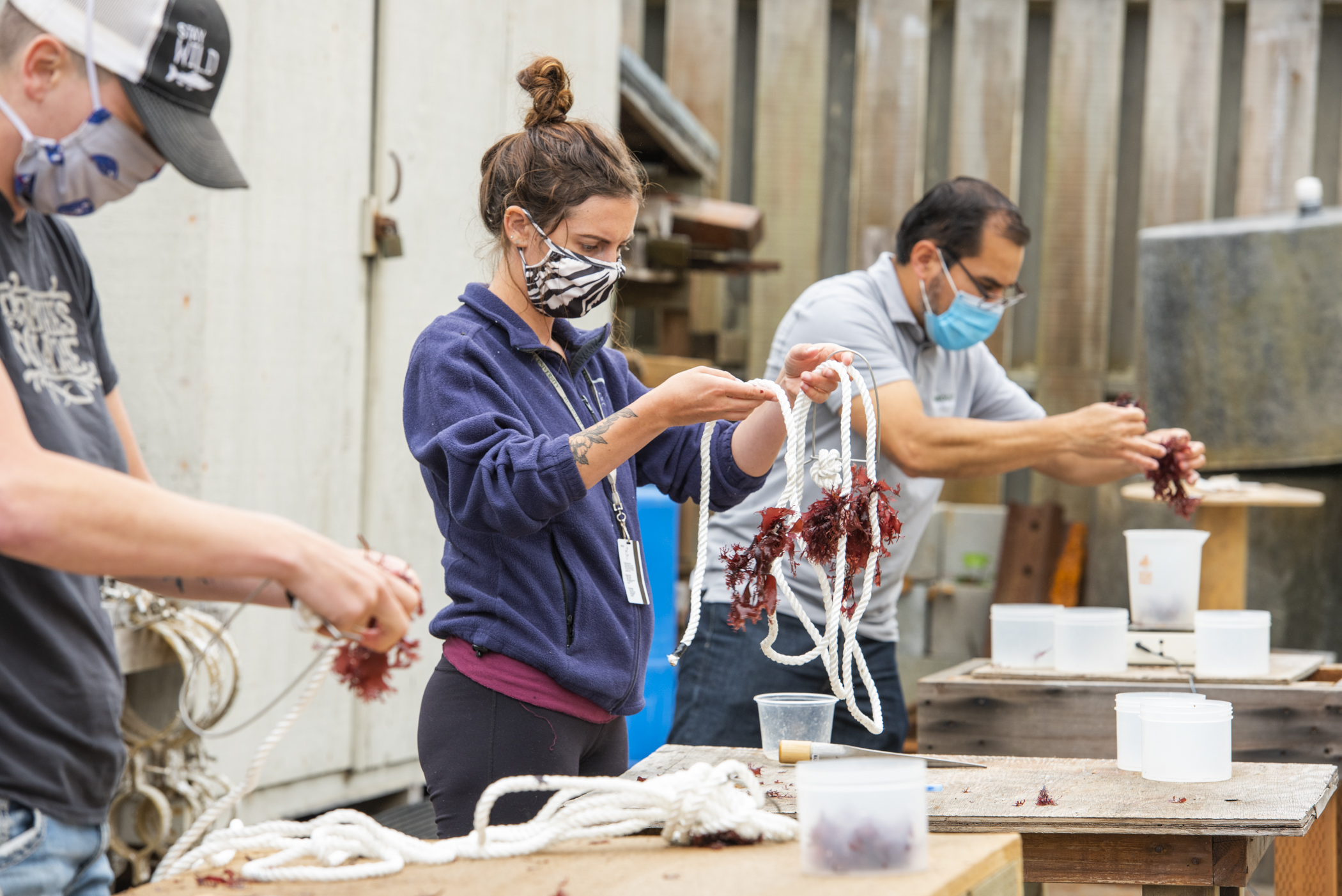
Thalman has been growing seaweed at the HSU Marine Lab in Trinidad for the past year. This seaweed incubation process begins with sablefish, at the top of the food chain. The sablefish eat food from lower on the food chain and then produce feces that act as nutrients for the seaweed, which absorb them in turn.
“The seaweeds act as part of a bio-filter, which then sends less nutrient-dense water back to the fish,” Thalman said.
This bio-filter acts as kind of a recycling system with different levels of the food chain helping each other out.
Bren Smith is the executive director of Greenwave, a nonprofit that assists with training environmentally-focused farmers, and is a big proponent of the seaweed farm. Smith is excited about the future of regenerative agriculture among the oceans in a world already seeing the effects of climate change.
“There needs to be a transition in the oceans,” Smith said. “But what’s exciting about that is we get these opportunities to learn from the mistakes of land-based farming and the mistakes of industrial agriculture and really do it the right away. It’s all hands on deck.”
Thalman would like to put her seaweed to good use, whether that be food for consumption or fertilizer for gardens. The grade of seaweed dictates what it will be used for. If the seaweed is a lower grade, it can only be used for fertilizer and fodder, but if it has a high enough grade where it is deemed edible for humans, then it can be commercially sold.
Unfortunately, due to permitting issues, the seaweed is currently unable to be sold in any capacity, but when the time comes to sell the seaweed, Thalman plans to donate all the profits.
Smith is mindful of the extent to which the farm is financially sustainable.
“And the key from a farming perspective is how much grows — what volume do you get per meter,” Smith. “Because if you don’t get enough volume, then it is not a profitable farm.”
Before anyone could even worry about making money from the project, they had to worry about finding the money to fund it first.
Dr. Rafael Cuevas Uribe, an assistant professor in the fisheries biology department at Humboldt State, is another driving force behind the seaweed farm as he was the one that wrote the grant that helped fund the project. As Uribe explained, within the California State University system, there are a number of campuses that do agricultural research and subsequently get grants called the Agricultural Research Institute Grants to fund agricultural-related projects. Because HSU is one of the CSU campuses that is in that boat, it receives said grants, which are managed by Sponsored Programs.
Uribe tried to get one of these grants but ran into a major roadblock along the way. As it turns out, he had to monetarily match 50 percent of the requested amount of funding.
“And that was kind of an issue in our project and we thought that we had everything figured out and at the last day when the project was due, we found out that we did not have the match to do this project,” Uribe said. “And we were almost dropping the ball right there.”
Also stepping in are a growing number of people and agencies interested in getting into the seaweed farming industry. However, as Thalman noted, there are a lot of heads being scratched.
“People don’t know what to do,” Thalman said. “They don’t know how to get permit regulations, so we’re kind of the guinea pigs. They’re watching what we do and then they’re going to use what we learned to set up their farms in the future.”
Dr. Frankovich took on the role of Humboldt countries public health officer back in Jan., less than a month before the county reported its very first case of COVID-19.
Frankovich submitted her resignation to the Board of Supervisors, which will take effect when the new replacement is hired.
Frankovich says that due to the emergence of COVID-19 and the amount of responsibility it requires, the health officer position has changed from the part-time position to a full time commitment.
She added that it makes the most sense to plan for a replacement when we are in a fairly stable position.
“I am grateful for the opportunity I have had to witness, first-hand, the integrity and commitment of an amazing team and for the incredible support of many of our elected officials and community members, who embody the best of what drew me back to Humboldt,” Frankovich said.
Moving forward, Dr. Frankovich plans to work in a part-time capacity under the new Humboldt County Deputy Health Officer, Dr. Josh Ennis.
Dr. Frankovich released a letter to residents regarding her full resignation that can be viewed online.
Students and faculty voice discontent with treatment of Aquatic Center
The Humboldt Bay Aquatic Center continued to be a pressing topic in University Center Board meeting.
At the Sept. 10 UC Board meeting, members of the board including Faculty Representatives Steve Martin and Mark Rizzardi showed continued frustration at the decisions made by members of HSU Administration that affected the Aquatic Center.
According to Martin, moving the Office of Alumni & Engagement and the HSU Foundation into the HBAC office spaces, displacing employees happened without approval of the UC Board.
An anonymous source close to the situation said, “Of the inside office space, they’ve taken over about 95 percent.” The problem is, according to the source, HSU is now accumulating the spaces outside.
Acting Interim Executive Director Todd Larsen claimed he visited the center to talk to employees and listen to concerns, but did not speak further on the matter or address any issues brought up by members of the public during the meeting.
The anonymous source stated that while Larsen did meet with members of the HBAC to discuss the possible solutions and issues occurring, he also sent out an email that stated he wanted full control of the situation.
“An email went out saying not to talk to the media,” the source said. “That Larsen wanted to control everything we were discussing.”
Mairead Sardina, operations supervisor at the HBAC, said during the Zoom meeting that the UC Board’s lack of leadership on the issue was discouraging.
“The Aquatic Center has major changes happening and the Board is yet to address that,” Sardina said. “It is very important that we feel that there is not this apathy or lack of urgency that are everyday affecting our staff members.”
Sardina said that while she has been working with Larsen to find a proper balance, there is simply not enough space to allow external programs within the HBAC and maintain the level of safety needed to operate.
“They have taken all of the space upstairs and the downstairs front lobby office,” Sardina said. “At first I was told that my new office was the maintenance closet, which was just truly OSHA unsafe. I really, truly do not believe that it is not safe for this city to be putting people out on the water without an office that overlooks the water and the dock.”
Sardinia’s sentiments were reinforced by the anonymous source, who called the HBAC a command center. Working with both the city of Eureka and the state of California to teach proper boating, waterway safety and acting as onsite lifeguards, the HBAC struggles to remain in active command when faced away from the water.
“This is a command center. We can’t command if we are facing the road,” the source said. “HSU cannot afford to lose one more student.”
Associate Professor Genevieve Marchand said that she was also surprised about the lack of action but focused on the safety risks posed to students and the community due to the changes.
Marchand worked with Center Activities and the Aquatic Center to create the the Outdoor Assistantship Program, where students can learn valuable skills like boating safety and making risk management positions.
“In this case, we are talking about the life of people and the future employment of our students,” Marchand said. “I feel like it has been completely disregarded.”
According to Rizzardi, the University’s disregard of safety protocol may be in direct violation of the agreement made between the city of Eureka and HSU.
The agreement created and signed in 2003, stated that the HBAC, then known as the Boating and Instruction Safety Center, would be leased to the university on the agreement that they use to space “…to provide a program of boating and water safety instruction and other educational uses to students, faculty and staff of Humboldt State University and boating and water safety instruction to the general public.”
Recreational use of the space can only occur when it does not interfere with the ability to teach the needed lessons.
The lease also stated that HSU could not “…assign, sublease, or otherwise convey ant interest in this Lease…” without the prior consent of the city. In addition, any organization that the city does consent to occupy space within the HBAC must adhere to the same rules as HSU itself.
“As far as I can tell, we are in total violation of that agreement right now,” said Rizzardi. “I think this seriously needs to be looked into.”
If the City of Eureka finds that the contract has been violated, they are allowed to take legal action against HSU, including fines and the possibility of voiding agreements.
The Property Management Division of Eureka was reached for comment, but did not respond in time of writing this article. No members of the Board of Directors or HSU administration stated if the required written notice of changes were given to the city.
For better or worse, Big Sean is likely gone for good.
After taking a three year hiatus, following luke-warm reception to his 2017 album “I Decided,” and an overwhelmingly negative response to the collaborative album he released later that year with Metro Boomin – ironically titled “Double or Nothing” – Big Sean’s new album “Detroit 2” marks a permanent step away from superstardom.
Sequel to the 2012 mixtape “Detroit,” part two – the album version – delivers a much different experience in almost every regard. Each project boasts features from some of the biggest artists in the game at the time and each project features interludes from three highly respected entertainers, however, the similarities end there.
Previously rapping about fame, fortune and the fast-life, with 2017’s “I Decided.” Sean took his music in a new direction of peace, positivity and personal growth. Doubling down on these new themes in “Detroit 2,” Sean delivers his second solo-album in a row without an undeniable hit-record like “I Don’t Fuck With You” or “Clique.”
Leading up to the release of “Detroit 2,” Sean set the tone releasing “Deep Reverence,” featuring the late Crenshaw king, Nipsey Hussle. On the track, Sean opens up about his overblown beef with Kendrick Lamar, the baby he lost and thoughts of suicide. Sean, only displays this level of vulnerability once more on the song “Lucky Me,” where he speaks to his public break-up with R&B singer and current girlfriend Jhené Aiko and having been diagnosed with heart disease at 19-years-old. These topics are all left at the surface level and unfortunately, we never get to hear directly how Sean feels about any of it – only that he’s gone through it.
After focusing an entire album around the theme of reflection with “I Decided,” Sean captures his life path and what it’s cost him with an effortless delivery, resembling conversation, on the track “Everything That’s Missing.” Along with “Guard Your Heart,” “Full Circle” and “Feed,” in which he focuses on the conflictions within fame. These are the songs where Sean is in his element.
On the flip side of things, time and time again on this project, Sean falls short of a hit-record – lacking the undeniable catchiness factor on the song “Harder Than My Demons,” not giving Post Malone the entire chorus of “Wolves” or letting Travis Scott give up half-way through the hook on “Lithuania.” For someone with as much experience as Sean, it’s as if he’s actively trying to avoid a hit.
Fortunately, Sean saves the best for last, ending the album on an extremely high note, beginning with the song “Don Life,” featuring a strong verse from Lil Wayne and sampling the legendary Michael Jackson’s classic song “Human Nature.”
For the next track, “Friday Night Cypher,” Sean recruits 10 fellow Detroit MCs to rap over eight different beats that mostly cater to each artist. Sean delivers two of his best performances of the album on these songs and the latter is a moment not soon to be forgotten by fans of hip-hop.
With “Detroit 2,” Sean delivers a project more honest and open than anything he’s released before but at the cost of the quality of his music. After three years off, Sean’s musical abilities remain unchanged and his concept of quality has suffered. Most songs are ruined by a bad flow here, a lazy hook, poor arrangements or overproduction that make them hard to listen to outside of the context of the album.
An inside look at how Humboldt State students’ are staying busy with pandemic hobbies.
Just because life has begun to resemble a sci-fi movie, doesn’t mean students aren’t having fun. Abiding by COVID-19 protocol, students are cooped-up indoors more than usual. While video games, Netflix and sleeping becoming more common in the household, others have chosen instead to spend their time creatively.
Rebekka N. Lopez, a music education major at Humboldt State University, was the drum major for the Marching Lumberjacks in the spring. When classes were brought online and health-guidelines were put in place, the Marching Jacks’ season was cut short and they remain on the bench this semester. Undeterred, Lopez continues to practice through quarantine.
“That’s what I did almost every day this quarantine,” Lopez.
Lopez enjoys practicing as a hobby and intends to pursue a professional career in music. Recenty, she’s been learning to play new instruments.
“I play a couple, I play the flute and the saxophone mostly and, I’m still learning other instruments like ukulele, guitar, clarinet and piano,” Lopez said. “It’s my job to know even more than that so I’ve got a long way to go,” Lopez said.
Hobbies are not only great outlets for self-expression, they can also make it easier to co-exist with the anxious attitude of the difficult times we live in. HSU psychology major Madelynne J. Avila uses some of the extra time she has during quarantine to practice singing.
“For me personally, singing has always been an outlet for you know relieving stress and just kinda getting my mind off of whatever may be going on right now,” Avila said.
Along with singing, Avila also enjoys volunteering. In the spring, before quarantine, she volunteered at her local animal shelter and at a local wildlife rehabilitation hospital. Once quarantine started, volunteer opportunities were no longer available. She was able to transfer into the education department at Lindsay Wildlife Experience and continues helping those in need.
“Volunteering has been something that I’ve really wanted to do for a while, and really kinda just go all into it,” said Avila.
Jared Schroter, a sophomore at HSU, is an Eagle Scout with the Boy Scouts of America, the highest rank earned by completing various tasks and demonstrating expert survival skills. Schroter is also a leader in the Venture Scouts program, composed of male and female scouts between the ages of 14 and 21.
“I started to make a crew when I was 18 because I aged out of Boy Scouts,” Schroter said.
As the president of crew 200, Schroter continues to plan and hold meetings over Zoom, keeping him more or less occupied most days. Schroter also enjoys outside activities like golf to fill in gaps during the day.
“I’m horrible at golfing but I’ve become somewhat decent at it now,” Schroter said.
Being stuck inside for long periods of time is not healthy, so for students willing to follow social-distancing guidelines, like anthropology student Scarlet Chapman, they can still experience the joy of nature.
“I’ve been getting out a lot, spending a lot of time in nature,” Chapman said. “Been trying to put my phone down more.”
One of Chapman’s new quarantine hobbies is drying flowers. She got inspired to spend her time more creatively when she saw friends posting their hobbies on social media.
“I saw a lot of gardening on Instagram,” said Chapman. “And I was like ‘oh that looks fun’, so I’ve been adding to my garden outside,” Chapman said.
Quarantine can be an opportunity for personal growth for those willing to work for it. Finding the silver lining and keeping yourself on track will help repel negativity and boost morale.
“Just to know that even during quarantine you’ve improved on something or you’ve like gotten better at a certain skill, I think that’s really great for personal morale and you can only get so much from watching a show,” Lopez said.
Humboldt State demands double masking on campus, does more layers equal more protection?
You’ve probably read the headlines: Wearing a Mask Prevents the Spread of COVID-19. But which mask you choose could affect how protected you and others really are.
Masks were first mandated in Humboldt County on April 24 when Health Officer Dr. Teresa Frankovich introduced an order requiring all members of the public wear facial coverings while inside a facility other than their residence. Since Humboldt State University was required to close campus prior to that, the university announced safety precautions on Aug. 4, which included wearing face coverings with at least two layers of 100% cotton. This was done in conjunction with the reopening of campus for the fall semester.
The Centers for Disease Control and Prevention (CDC) urges people to wear masks with at least two or more layers of washable, breathable fabric. Masks need to be worn covering both your mouth and nose at all times.
Director of News and Information Aileen Yoo stated, “HSU is following recommendations from the CDC. Its website is also a great resource for information on different types of protective gear.”
According to the Association of American Medical Colleges (AAMC), “studies have shown a double-layer cloth face covering was significantly better at reducing the droplet spread caused by coughing and sneezing, as compared to a single-layer one.”
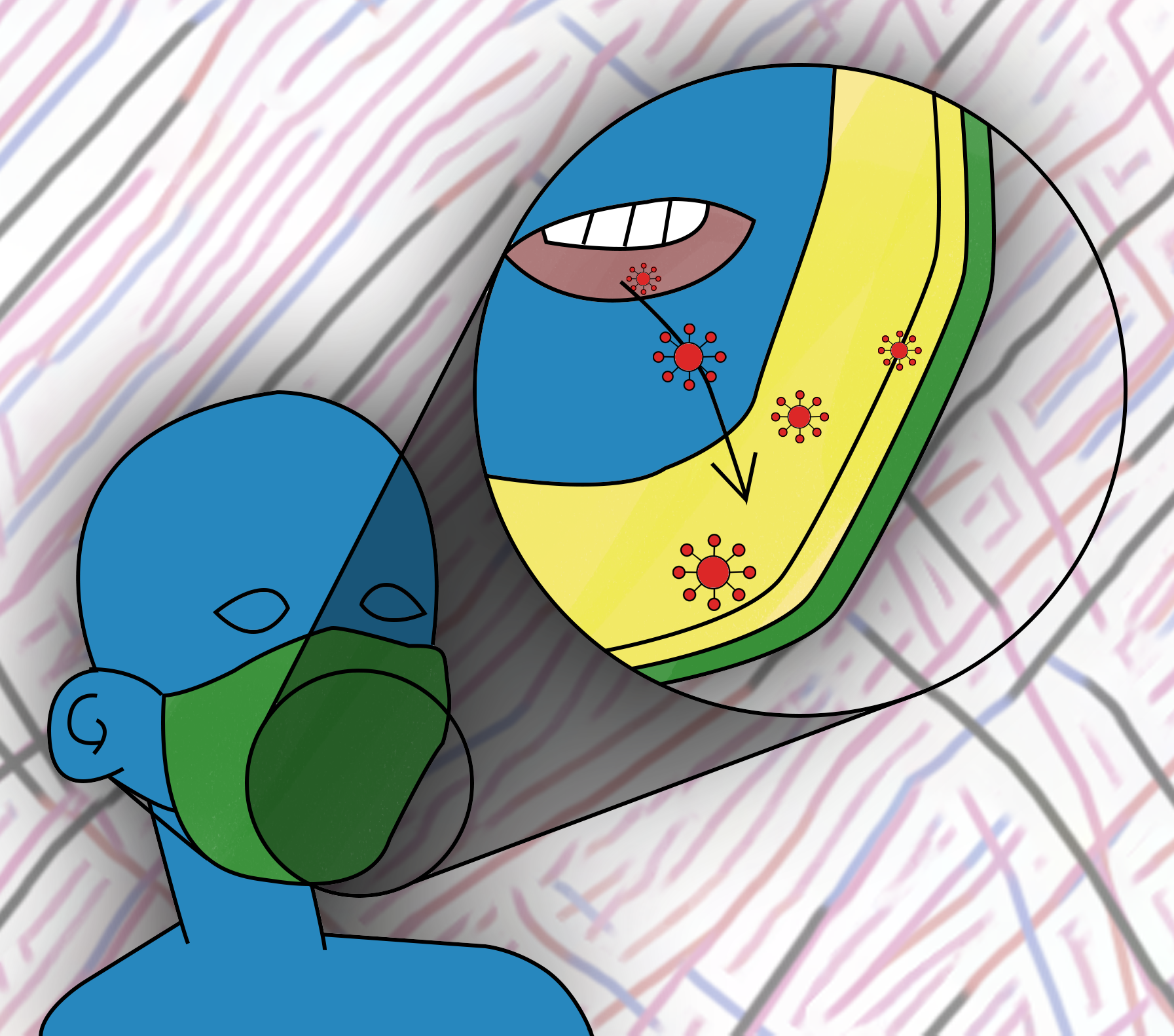
Mark Wilson, a microbiology professor at HSU believes that “the main goal of mask wearing is to reduce the emission of droplets and aerosols from a person infected with the coronavirus, by trapping emitted droplets in the fabric. Mask-wearing can reduce the transmission of airborne diseases like coronavirus.”
Wilson added that when deciding on the type of masks, “the tighter the weave of the material, and the more layers it has, the more effective it will be at filtering out particles.”
May Chu, an epidemiologist at the Colorado School of Public Health, as quoted by NPR said, “a good option is a mask made of two layers of a tight-weave fabric with a built-in pocket where you can place a filter.”
A University of California, San Francisco article reported that based on a simulation, researchers predicted that 80 percent of a population who wear masks would reduce the spread of COVID-19 more than being on lockdown. Further, the Institute for Health Metrics and Evaluation projected that 33,000 deaths could be prevented by October 1 if 95 percent of the population wore masks in public.
Many researchers have looked into N95 masks which are made out of many layers of fine polypropylene fibers. They are able to block at least 95% of small airborne particles but only when worn correctly. Though they are proven to be effective, the short supply should be reserved for medical professionals and first responders.
A recent Duke study rated a fitted N95 and a three-layer surgical mask as the top two protectors, followed by two layer cotton masks.
According to an article by Science Daily in July, a team of Australian researchers did a study comparing the effectiveness of single and double layer cloth face coverings. They used LED lighting to film the airborne droplets. Their results showed that double layer face coverings prevented more droplets from spreading.
HSU students can be provided with double layer masks at the campus Police Department, the first floor of Student and Business Services building, Jolly Giant Commons, College Creek Market and the Parking Kiosk.
Ethnic Studies will thankfully become mandatory for all California State University students – as it should be.
College is meant to be the epi-center of uncomfortable conversations, meeting people we normally wouldn’t and learning about the world. How does one go through college and not participate in education regarding the systemic oppression impacting those around you?
Assemblywoman Shirley Weber proposed Assembly Bill 1460, which requires all enrolled California State University students take a 3-unit ethnic studies course.
Governor Newsom signed the bill on Aug 17.
This was a monumental decision to be made because ethnic studies require students to learn about various cultures’ histories, struggles and successes.
Since we were in grade school, we learned about Christopher Columbus discovering America, that Thanksgiving was when the pilgrims and Native Americans sang kumbaya while eating turkey and potatoes, and that George Washington had wooden teeth. The history we were taught when we were younger was just one point of view, one perspective, and that was the white man’s point of view.
I didn’t even learn about my own Black history until I attended college and took an African-American History course. That’s when I learned that Christopher Colombus did, in fact, not discover America, because he never made it to what is now considered America. He came across the Caribbean and was rescued by the natives because he was found drowning. I think we all know what he did after that. The first Thanksgiving was pretty much the pilgrims killing the majority of the native Indians, pillaging their land and then having a feast on it. Now George Washington’s teeth? They were actually made of hippo ivory and his own slave’s teeth. Great guy.
Taking ethnic studies courses will force you to unlearn the lies you were taught growing up and relearn the facts, the stories, the culture and how it all impacts these groups today. It doesn’t take a rocket scientist to know that people of color had a history of oppression that still takes place to this day. Denial of that is pure ignorance.
We need ethnic studies more than ever. With various protests going on nationwide, there should be no excuse as to why you wouldn’t know what each one stands for. From Black Lives Matter movements to ICE detention centers, and from racist COVID-19 statements to Indigenous lands being destroyed, we need to acknowledge what has been happening and understand that it is not okay. This is where the necessary education comes in.
Lucky for us, Humboldt State University has an amazing ethnic studies program run by phenomenal professors. From the introductory courses to the Dialogue on Race, having these conversations are extremely important and should have been mandatory a long time ago.
How fire suppression is a mixed bag in Humboldt County
Every fire season, blankets of smoke roll over Humboldt County. Here on the coast, that’s as close to wildfires as some of us get. But our practice of fire suppression is a relatively new state for our woodlands and the lack of fire is taking its toll on the county.
“Humboldt county’s interesting. Most of the county really hasn’t experienced much fire over the last few decades,” said Jeffery Kane, associate professor of fire ecology and fuels management at Humboldt State University.
High levels of rainfall and a more temperate climate contribute to a lower risk of fire, but that doesn’t mean fire isn’t a natural part of Humboldt’s environment.
“When there are ignitions, and there are ignitions here from lightning and humans from time to time, they are usually fairly easy to put out,” Kane said. “That nice fog layer, that’s going to moderate fire behavior.”
Inland Humboldt county is not as protected by our temperate, coastal environment. But Kane said that quick fire suppression may not be the safest or most environmentally friendly way to manage wildfire in the long term.
“The thing that we know is most effective is to treat areas with a combination of thinning and burning,” Kane said.
The suppression of small wildfires can make future fires more difficult to control. Dense canopies and the buildup of dry fuel makes fire more dangerous. By thinning the forest, the trees become less tightly packed. When the canopy has more gaps, fires spread slower. Then after the canopy is thinned, a prescribed burn can take care of the natural dry fuels and remaining debris created from thinning. Thinning and burning can make an area less vulnerable to uncontrolled wildfires.
Although Humboldt is relatively protected, this area still would see wildfire activity every few years if not for the relatively recent introduction of American colonizers. Due to the danger of wildfire to settlers and property, wildfire is almost completely suppressed.
Disturbance Ecology Professor Rosemary Sherriff studies the impact fire suppression has on local woodlands. She thinks there can be a balance between protecting settled areas and letting wildfires run their course.
Lightning strikes and Indigenous burning would have introduced fire to local oak woodlands. These woodland areas suffer without the fire that shaped the ecosystem.
“In the past few years we’ve had fires that have gone into more urban areas, a lot of it stemming from more wildland areas,” Sherriff said. “There’s been a substantial amount of urban-woodland interface and these are really extremely hazardous places to live.”
In addition to providing more fuel to fires, the removal of wildfire has come at the cost of native biodiversity. Removing a natural phenomenon that was encouraged by local Indigenous tribes has consequently impacted our landscape. Local ecosystems are adapted to wildfire and removing fire allows fire sensitive species to grow without natural inhibitors.
“Inland we have oak woodlands, for example, that historically would have had a lot of fire,” said Sherriff.
Lightning strikes and Indigenous burning would have introduced fire to local oak woodlands. These woodland areas suffer without the fire that shaped the ecosystem.
“What we’ve seen is a lot of encroachment of native douglas fir into these oak woodlands,” Sherriff said. “So there’s been a loss of the oak woodland open areas.”
This loss of oak woodlands can be seen throughout Humboldt County. This destroys native biodiversity. But fire suppression is not the only consideration.
“Fire suppression has certainly shaped the landscape,” Sherriff said. “We can’t disregard the fact that settlements and communities and ranches and homeownership and the cannabis that’s happening also shapes and reshapes the landscape and can contribute significantly to shifts in fire behavior.”
The balance between human settlement and fire suppression is a difficult medium to reach.
“It becomes extremely tricky when it’s someone’s livelihood,” Sherriff said. “It’s very easy to sit at the university and say ‘yeah, more fire on the landscape’ but it’s extremely hard to make it happen with all the structures and policies in place.”
Lenya Quinn-Davidson is an advisor for the University of California Cooperative Extension. One of her projects is the Humboldt County Prescribed Burn Association. It’s a loose cooperative of land owners and community members that implement prescribed burns. While structures and policy is slow to change, they’ve proactively decided to put fire back into their land themselves.
“A lot of people want to use prescribed fire,” Quinn-Davidson said. “By the time we’re actually there lighting the fire, there’s already been a ton of work making sure that it’s safe, effective and that it won’t get out of control. It’s not like we’re just going out and lighting things off.”
Prescribed burning is a tool that landowners can use for fuels management, invasive species control and habitat restoration. The encroaching firs that Sherriff studies are a main target of controlled burn.
“We’re losing our oaks at a pretty astonishing rate,” Quinn-Davidson said. “So a lot of the landowners that have oak woodlands really want to use prescribed fire to get in there while those firs are small and kill the firs. The oaks survive just fine because they’re very fire adapted.”
Though douglas firs are native, there are some invasive species that landowners can keep back with prescribed burns. There are invasive species of grass like the medusa head that smother local grasslands. Ranchers want to make sure their cattle grazing lands are free of medusa head.
“It creates this thick thatch that prevents other plants from growing, so it turns into this homogeneous field of grass that nothing can eat.” Quinn-Davidson said.
Fire is necessary for keeping our natural landscape healthy and biodiverse. Where forest and human settlements meet, controlled burning can help maintain a healthy habitat with less danger to human life. With those buffer zones established, wildfire can be allowed to burn in a controlled manner, establishing a careful balance between fire and safety.
Quinn-Davidson thinks getting to a meaningful scale of fire management will take a combination of state intervention and owners taking control of their land.
“It’s a real community thing.” Quinn-Davidson said. “People just love it.”
Incidents of racism from the former UPD Chief, past examples of excessive force from current officers and a shrinking university budget.
In recent months, demonstrations against police brutality and the killing of Black and Brown people have increased. Black Lives Matter protestors have called not only for the demilitarization of police but for a move towards defunding the police and reinvesting those funds to community-centered organizations for public safety.
On Sept. 4, Humboldt State University students and other community members met at the Arcata Plaza in support of defunding HSU’s campus police department. As of last quarter, HSU’s University Police budget sits at over 3 million dollars a year. The University Library sits just below 3.5 million dollars a year.
According to the HSU’s Annual Security Report for 2018, 89 percent of law enforcement on campus consists of drug and alcohol referrals. UPD made a single drug-related arrest in 2018. The other 11 percent of cases reported were theft and assault. Referrals are basically reports filed directly to HSU that are not criminal but often result in administrative action. This job is something expected of R.A.’s who report alcohol use as referrals.
Incidents of racism from the former UPD Chief, past examples of excessive force from current officers and a shrinking university budget
With the existence of the Arcata City Police, and their own $6 million dollar budget, the necessity of an entire force for these offenses leaves the HSUPD as an utter redundancy.
HSU student and Check-It staff member, Shelley Magallanes, compiled research about complaints against HSUPD for use of excessive force and shared it on their Instagram. Currently on the payroll is Delmar Tompkins who has been involved in two accusations of police brutality, cases were settled for $135,000 and $43,000. As well as Justin Winkle who was involved in an incident of excessive force that left the victim dead in his jail cell hours later. The City of Eureka settled this case for $4.5 million.
Former University police Chief Donn Peterson resigned on May 31 while he was on leave and under fire from a multitude of accusations including racist remarks and manipulation of crime statistics. Peterson served as police chief of UPD for six years and to assume that his actions are that of “one bad apple” just doesn’t do this issue justice. His actions exemplify the prevalence of a racist culture that pervades the criminal justice system.
The nationwide movement for defunding the police has been sparked by the way that force is used and applied recklessly to BIPOC. This comes after a long history of police operating as a militant arm of white supremacy and working to disproportionately incarcerate POC, leading to further widespread racial inequities. Allowing the persistence of unjust systems on campus, while alternatives are proven to work more effectively at promoting public safety is negligent. We have an opportunity to work towards a more just and equitable campus through the many organizations that we already have established.
HSU is facing widespread budget cuts, losing funding to the array of vital multicultural centers, diverse academic programs and student-led organizations, the UPD budget and existence looks especially obsolete.
This website uses cookies to improve your experience. We'll assume you're ok with this, but you can opt-out if you wish. Cookie settingsACCEPT
Privacy & Cookies Policy
Privacy Overview
This website uses cookies to improve your experience while you navigate through the website. Out of these cookies, the cookies that are categorized as necessary are stored on your browser as they are essential for the working of basic functionalities of the website. We also use third-party cookies that help us analyze and understand how you use this website. These cookies will be stored in your browser only with your consent. You also have the option to opt-out of these cookies. But opting out of some of these cookies may have an effect on your browsing experience.
Necessary cookies are absolutely essential for the website to function properly. This category only includes cookies that ensures basic functionalities and security features of the website. These cookies do not store any personal information.
Any cookies that may not be particularly necessary for the website to function and is used specifically to collect user personal data via analytics, ads, other embedded contents are termed as non-necessary cookies. It is mandatory to procure user consent prior to running these cookies on your website.