With the pressures of the pandemic mounting, people are stuck with an impossible choice
On Friday, May 1, around 100 people gathered in front of the Humboldt County Courthouse to demand the reopening of businesses deemed non-essential by the government. With signs like “Every Business Is Essential,” it is clear that the protesters are not being properly supported during this time of crisis.
The government’s attempts to mitigate the spread of the virus have been controversial with over a million reported cases so far. Social distancing is the most effective measure we can take to prevent unnecessary deaths since the swab test is inaccurate and limited at the moment. Unfortunately, mandatory lockdowns and halts to employment in order to support social distancing efforts have left many without jobs and a way to earn a steady, livable wage.
“This crisis is really illustrating both the violence of inequality and also the need for another economic system.”
Thomas Piketty
Everyone has a wide range of debts, rents and other expenses to pay for during this time. If we want to prevent the spread of the virus we need to support disenfranchised workers, not force them back into unsafe working conditions. With 59% of Americans living paycheck to paycheck, for those keeping track at home, the percentage cuts for units is not reasonable to expect them to be able to handle all of their expenses with a one-time stimulus check of $1,200. The writer of the book “Capital in the Twenty-First Century” and economist Thomas Piketty believes that a pandemic like this holds the potential to change dominant narratives about how we should organize our society and build our economy.
“This crisis is really illustrating both the violence of inequality and also the need for another economic system,” said Piketty.
The Americans most impacted by the pandemic are going to be the poorest, most vulnerable members of our society. For as long as our country has existed, so has the divide in quality of life, poverty, and access to government assistance in times of crisis.
We need a societal structure that values every life.
Due to our country’s reliance on employer-based healthcare, every company that is forced to lay off its workers in this necessary time of crisis is creating large swaths of vulnerable, uninsured people. The natural response is to want to go back to work and blame the government for taking away your insurance and employment so you can continue to provide for yourself and your loved ones. The only problem is that we have a virus on our hands, so one is forced to either ignore the dangers of returning to work or slowly drain themselves financially as the dues of existing in our society add up. This is not a fair choice nor a choice we should have to make.
This is our societal structure functioning as it was designed to. When healthcare is tied to employment and to wealth, we are nudged into believing our right to exist is tied to employment and to wealth. When certain marginalized groups are underemployed or possess less wealth, our system is tacitly stating that those groups are worthless.
We need a societal structure that values every life. That means universal healthcare, education, job guarantees, housing and access to technology. Without universal healthcare, there isn’t a solid system for distributing care during a pandemic, and the right to one’s own life is decided by socioeconomic status. Without job guarantees, people are set adrift during emergencies, not knowing if they will be able to get back to work after it’s all over. Without universal housing, a pandemic can leave many unsure if they will have a roof over their head in a month’s time. Without access to technology, some will lose education, jobs, communication with the outside world and entertainment to occupy the time.
But more than all these things, we need a structure that prioritizes us. If everything starts falling apart because of one pandemic, maybe it wasn’t the most stable structure to begin with. An economy that does better when its workers die is like a car that goes up in value when it kills the passenger. The structure should exist to support you. This pandemic is exposing our economic structure for what it has always been. A burden that crushes the marginalized and the vulnerable. A $1,200 check, a rent freeze and a free face mask are only small band-aids on a gushing head wound. Normal, everyday life is why everything is falling apart in the first place.
All we can do is build a system that protects every person within it and values life from the ground up. A system that lets numbers of people die will die along with them. It is a system bound to fail.
President Jackson speaks with Faculty Senate over virtual teaching
Editor’s note: Grace Caswell is a student of Journalism Department Chair Vicky Sama. Almost the entire staff of The Lumberjack has also had Sama as an instructor in journalism courses.
Tuesday, May 19, President Tom Jackson of Humboldt State University resurfaced from his hiatus to discuss the fall 2020 semester instruction plan with the Faculty Senate due to COVID-19.
The transcripts of the meeting between Jackson and HSU Faculty Senate were provided in an email by Journalism Department Chair Vicky Sama. The meeting regarding online instruction for the Fall 2020 semester built off of CSU Chancellor’s Timothy White’s recent statement.
“The chancellor’s statement last week, which we were pretty sure was coming, we knew that was the direction he wanted to take, that leads us in this position as a university that we are 100% virtual,” Jackson said in the email transcripts. “That’s done. We are 100% virtual but we also knew we would have an opportunity to ask for an exception.”
The exception will be sent to the Chancellor requesting face-to-face instruction for classes that are unable to make the direct translation to online instruction. About a quarter of HSU’s classes are hands-on courses, Jackson provided examples that would be included in the request.
“We are preparing a request, in response to the Chancellor’s statement, that HSU be allowed to establish a hybrid approach to instruction in the fall.”
HSU Interim Provost Lisa Bond-Maupin
“One of which was our labs– labs activities-based work– studio, art, ceramics– those elements that can’t easily be converted to a virtual modality but is a really strong core of who we are as a university, could be a reason to make an exception,” Jackson said in transcripts. “Another one, in general, would be the continuation of very specific research or farms or agriculture, forests, oceans, rangelands, other things like that.”
The request is almost finished and asks that HSU be considered for hybrid instruction. HSU Interim Provost and Vice President of Academic Affairs Lisa Bond-Maupin stated that the request for hybrid instruction would still operate and emphasize online curriculum with little in-person contact.
“We are preparing a request, in response to the Chancellor’s statement, that HSU be allowed to establish a hybrid approach to instruction in the fall,” Bond-Maupin said in an email. “That would include virtual instruction, and very limited face-to-face instruction where it’s safe to do so per county health guidelines. This planning requires extensive work, and no final decisions have been made yet.”
Jackson elaborated on Bond-Maupin’s emphasis of following and abiding by county health guidelines. Fall instruction really depends on the Chancellor’s decision to approve or dismiss HSU’s exception request which is estimated to take a day or two. Then, if permitted by the Chancellor to proceed, a chain of discussion will occur between administration, faculty and department chair members.
“With that decision we will know if we are 100% virtual or if we have been permitted to develop face-to-face curriculum based upon on our request,” Jackson said in the email transcripts. “It then shifts to the faculty and the chairs of those specific sections, which are 593, as far as lab-based activities going into the fall, that’s a rough number, and it may change here or there. And then specifically what items need to be taken care of in terms of a safety protocol in accordance with public health, and that will occur very rapidly over the summer.”
Over this coming summer, HSU will enact development plans for professors and lecturers. Those teaching lecture classes that can operate in tandem with online instruction will continue developing those skills. Those who teach labs or studio classes have a chance of having to develop hybrid teaching methods over the summer.
“If you’re scheduled to teach a lecture class, the answer is already there. We’re in virtual mode,” Jackson said in the email. “But if you’re scheduled to teach a lab or studio art or something like that then I encourage you to give it some thought and chat with your chair because there is a 50-50 chance.”
Face-to-face instruction for Humboldt State’s fall 2020 semester has been canceled due to COVID-19. California State University Chancellor Timothy White announced Tues. May 12 that instruction will primarily be offered online. A virtual plan is expected to be implemented into the entire CSU system as the possibility of a second COVID-19 wave of cases is predicted.
“Our planning approach will result in CSU courses primarily being delivered virtually for the fall 2020 term,” Chancellor White writes in a CSU press release. “With limited exceptions for in-person teaching, learning and research activities that cannot be delivered virtually, are indispensable to the university’s core mission and can be conducted within rigorous standards of safety and welfare.”
Academics that can not make the direct translation to an online format, such as artistry and laboratory classes, will be conducted through a hybrid approach which limits in-person contact as much as possible and continues to emphasize online instruction.
HSU, along with other CSU systems, are subjected to differing class standards based on the level of necessity placed behind face-to-face instruction. The fall semester is projected to primarily remain online, however, updates and further information will be announced later in the week.
Drake drops surprise project, “Dark Lane Demo Tapes”
Nearly two years following the release of his last commercial project, “Scorpion,” Drake is back with more music than ever. Surprising fans April 30, Drake hopped on Instagram to announce his upcoming sixth studio album, set to be released this summer. He also announced a new mixtape, “Dark Lane Demo Tapes,” that dropped hours after.
Ashton Pomrehn is a Humboldt State University alumnus from the psychology department. His thoughts on Drake have dramatically changed over the course of Drake’s decade and a half long career.
“I love Drake,” Pomrehn said. “I tried to hate on Drake early in his career but he’s put so much good music out that I’m excited for anything he puts out.”
Kathleen Madrid is an environmental resources engineering major at HSU. She’s not the biggest Drake fan but she is heavily invested in the hip-hop genre and enjoys watching it evolve.
“I will say that I think he has been really influential,” Madrid said. “Drake really brought a different topic of discussion to hip-hop. Males are not traditionally encouraged to express their feelings and I think Drake gave young men that voice.”
Despite his undeniable contribution to the industry, Drake has received heavy criticism in the past over cultural appropriation of different regions’ music, beginning with his 2016 single “One Dance.” Despite featuring one the genre’s prominent artists, WizKid, Drake’s 10-minutes with afrobeats were seen by fans of the genre as a Hollywood actor taking the Broadway stage. The song was also a blend of Jamaican dancehall music – a style that Drake sprinkled throughout “Views” and his “More Life” playlist, without ever featuring an artist from the genre. Drake continued to catch flack for appropriation of UK Grime on “More Life,” however, the project features several guests from across the pond.
“There is a fine line between appropriation and appreciation. Paying homage or showing love may be necessary, but I think it’s more important to educate yourself before you participate in another culture’s genre.”
Kathleen Madrid
Drake set the tone for a possible new release in late Dec. 2019, with the track, “War,” taking the sound of the United Kingdom’s take on drill music and running with it. Similarly, on the song “Demons,” Drake hops on a New York drill beat, this time providing guest spots for the artists that popularized the genre. However, the missing presence of the recently-deceased leader of the movement, Pop Smoke, is heavily felt on the track.
Madrid acknowledges that Drake is in a tough position, but it’s ultimately his own decisions that repeatedly put him there.
“Cultural appropriation is a muddy concept,” Madrid said. “There is a fine line between appropriation and appreciation. Paying homage or showing love may be necessary, but I think it’s more important to educate yourself before you participate in another culture’s genre.”
In this new release, Drake pays his respects to some of the most prominent cities in modern hip-hop on “Dark Lane Demo Tapes,” with tracks like “From Florida With Love” and “Chicago Freestyle.” The later track was originally paired with the song “When To Say When” and released on Leap Day earlier this year as a music video. “When To Say When” samples one of Jay-Z’s most-famous tracks, “Song Cry,” and some of the footage from the video was shot outside the Marcy Projects where Jay-Z grew up.
Despite mixtapes almost always receiving significantly less care and budget than studio albums, when it comes to top-tier artists like Drake, fans still expect top-tier material. With features from Future, Young Thug and Chris Brown on the track list, fans will be let down to find out Young Thug only receives half a placement on the chorus of “D4L.” Chris Brown only provides a handful of background vocals on “Not You Too” and of Future’s two verses on the project, his better performance is significantly shorter. Despite consistently creating a dominant presence on songs where he is featured as the guest, including “Life Is Good,” “No Guidance” and “Going Bad,” Drake has proven unwilling to provide artists with a fraction of space on his own records.
With an entire album on the horizon, a number one record with “Toosie Slide” and a classic track with “Losses,” Drake fans have nothing to complain about – drill fans, however, are a whole other story.
Faults give clues to the history of the earth’s crust and how it impacts our future
Earthquakes are more than just shaking. Turns out the rumbling is sound vibrations from the massive snap caused by slipping, bending and breaking rock.
Deep below Earth’s crust, a mantle of plastic-behaving rock bends and twists under immense pressure. Its mass is 67% of the Earth’s mass. Its temperature ranges from 392 degrees Fahrenheit at the upper boundary of the crust to an incendiary 7,230 degrees Fahrenheit at the core-mantle boundary. Sometimes the overlying, thin 50 to 20 kilometer thick crust cracks.
“The earthquake is the sound waves moving through the rock, elastic waves propagating through it,” said Dr. Mark Hemphill-Haley, a Humboldt State University neotectonics professor and the co-chair of the geology department. “People who have seen the ground moving are seeing the surface waves of rock bending back and forth.”
According to Hemphill-Haley, imagining the scale of the mantle is challenging both in size and as a metric of time. Some people have compared the movement in the mantle to lava lamps or boiling water, a force called convection, where hot liquid bubbles up through cooler liquid, but Hemphill-Haley said that can be misleading.
“We’ve had these old models of the mantle convecting but it’s probably less like that- we’re talking about solid rocks,” Hemphill-Haley said. “They’re solid but they are plastic too. Tectonic plates, which consist of the crust and the upper mantle are in motion and can move faster than four to five centimeters per year. Mantle convection is likely a more slow process than that.”
Like the snap one hears when a pencil breaks, the sound vibrations from the snapping rock shake the ground all around the breaking point, quaking the earth.
Giragos Derderian, a fourth year geology student, explained the nuance between elastic, plastic and brittle rock. Generally, a rock seems solid but if enough force is applied, the rock can change shape. Derderian said the change in a rock is called deformation.
“Plastic deformation is when structures change shape due to a force and the rock stays deformed when the force dissipates,” Derderian said. “After elastic deformation, the rock returns to its original shape when the force is removed.”
Brittle deformation, Hemphill-Haley said, is when forces are so great, the stress exceeds the rock’s elastic limit and snaps it, like a pencil bent too far. An earthquake is when massive bodies of rock experience so much force that they become brittle and break. Like the snap one hears when a pencil breaks, the sound vibrations from the snapping rock shake the ground all around the breaking point, quaking the earth.
The earth’s crust is made up of massive plates that fit together like an ill-constructed puzzle with some plates pushed too hard into each other and some plates pulling away from each other. Force builds up where these plates meet and can deform each other in elastic, plastic and brittle ways.
Hemphill-Haley said the big thing that causes plate motion is the weight of oceanic plates. In this example, oceanic plates have converged with continental plates. he denser oceanic plates are diving below the less dense oceanic or continental plate.
These convergent plates cause a few things to happen on the surface. The leading edge of the less dense plate can crumple into massive mountain ranges like the Klamath Mountains. The oceanic plate descends deep into the mantle at submarine trenches referred to as subduction zones like off our coast—the Cascadia subduction zone. Geologists research the effects of plate tectonics here on the northern California coast in a variety of ways.
Hemphill-Haley’s colleague Dr. Melanie Michalak researches the Klamath Mountains in northern California and Oregon, and the Coast Range closer to HSU. In one research effort, she and her team trench the ground and look at rock layers that have been changed by faults. They seek material that can be used to estimate the age of the rock. Some of her research is also on recently active faults.
“As a geologist I care about all faults, the ancient ones, the active ones, I don’t discriminate,” Michalak said. “But people though, from a risk perspective, they’re more concerned about which ones will cause an earthquake and damage their house.”
Despite in-person instruction coming to a halt in the wake of COVID-19, student-run radio shows are still an option for KRFH students. For students not interested in going to great lengths to produce a weekly show, there is an alternative.
When Humboldt State University first transitioned to online instruction following spring-break, KRFH students were given the option to continue doing shows, as long as they comply with strict CDC regulations. This includes leaving three-hour gaps between shows, having only one student in the booth at a time and wiping down everything inside the booth before and after shows.
The new protocol lasted less than two full weeks before students were no longer allowed back in the booth. Instead, they were given the option to pre-record shows.
Ayrton Flaherty has a show with Debate Team coach, Aaron Donaldson, called “Debate and the News.” It was the first show at HSU to utilize Zoom while broadcasting live over the air-waves having Donaldson contribute from the safety of his home and Flaherty sit in the booth for their final live shows of the semester.
“It’s hard to do radio if you’re not in the station,” Flaherty said. “I guess cause we do a talk show, we’re able to get away with that. Because, rather than having music and occasionally talking, it’s talking and occasionally having music for us.”
Flaherty has found pre-recorded shows to be far more forgiving, with options to edit and re-take segments. However, they have created hours of post-production time that wouldn’t exist with live shows, in addition to hours they spend on pre-production. But, both Flaherty and Donaldson believe their show is worth the effort.
“I think all the DJs feel a little bit of a responsibility to stay involved, because otherwise there’s the chance that KRFH could get shut down if people aren’t showing interest.”
Shelley Magallanes
“This education is as important as ever,” Donaldson said. “The resources, as always, are very vulnerable and threatened, and students should get involved if they think it’s important.”
Shelley Magallanes hosts multiple shows on KRFH and they completely agree with Donaldson. Magallanes only intends to attend the class if it’s offered in-person next semester, although, they still might sign up if the program is in danger.
“I think all the DJs feel a little bit of a responsibility to stay involved, because otherwise there’s the chance that KRFH could get shut down if people aren’t showing interest,” Magallanes said.
They don’t think the course should be offered next semester if students can’t meet in person, unless that would put the future of the program in jeopardy.
“If we’re just doing it the way we’re doing it right now,” Magallanes said. “Then the main reason to hold onto the class is just to ensure that later semesters, it still gets put on.”
Anwaar-Khabir Muhammad is in his first semester with the radio and based on his experience, he doesn’t think the course should be offered next semester unless classes resume in-person and on campus.
“The radio station in and of itself is the learning experience,” Muhammad said. “I understand trying to maintain a sense of familiarity, but if that maintenance comes at the expense of the student’s overall learning experience, don’t do it!”
Alice Peterson won best show at KRFH last year with her program, “Ear Hugs.” The program mixes lighthearted discussion with relaxing tunes.
“Sending out your part and being a storyteller and providing that comfort and that service,” Peterson said. “It just makes you feel good.”
Since live shows have been taken away, Peterson forgets to attend her Zoom classes and turn in her alternative assignments, which are a five-minute weekly update that are aired on KRFH of students describing how they are navigating their lives through these stressful times.
“I kept forgetting to do my recording,” Peterson said. “Which was weird for me, because with the radio shows I never missed a show.”
As a result of missing classes, Peterson was unaware of the option to produce pre-recorded shows. As a senior without a graduation, she takes solace in the fact that she can at least put on a final show.
With administration still waiting to make an official decision about how classes will be conducted next semester, the future of KRFH remains uncertain and at risk.
The pandemic forces people to re-imagine their birthday plans
When it comes to a birthday, you’d expect a party, a night out, a small get together with friends and family, or maybe a chill day at home. Unfortunately, with social distancing still in order, celebrating alone is the closest option to a party.
Because social distancing is still in order, many have had to accept the fact that their big birthday plans aren’t going to happen anytime soon. Without the streamers and drinking games, people have found ways to remain somewhat festive on their special day. While some have taken to Zoom for video chat parties, others have spent their day with their fellow quarantine pals.
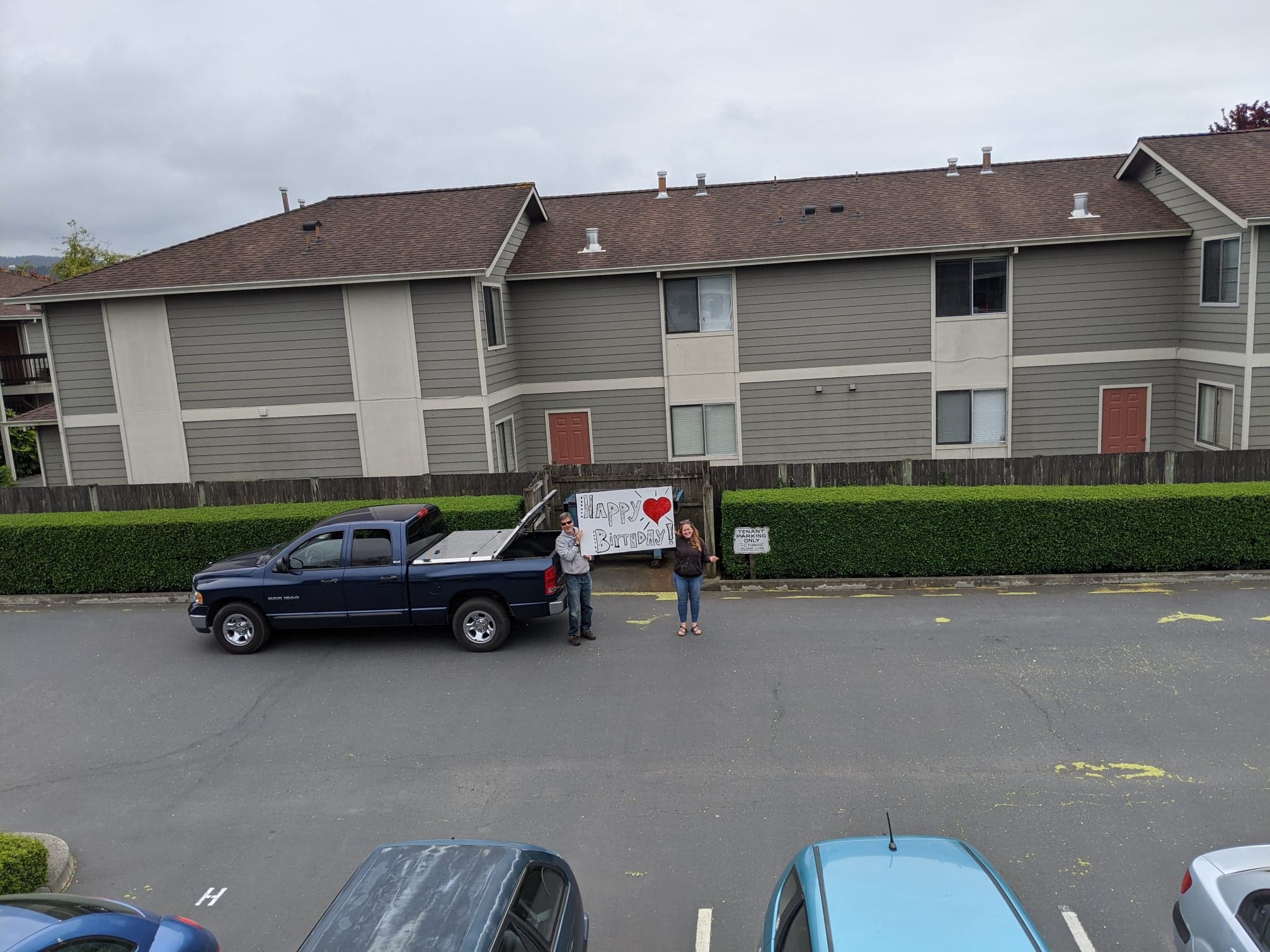
Tracy French’s, a Humboldt State University alumna from the geology department, birthday was on April 30. French celebrated it with her two good friends, who are also alumni, and have birthdays that same week.
“My birthday was on April 30,” French said. “It’s one day after a friend’s birthday, and the day before another friend’s birthday.”
The three had originally planned for a big get together, and reserved the Arcata Common Hall for a huge party. With entertainment and plenty of drinks to go around, it would’ve been one heck of a birthday bash.
“We were planning on getting a live band called ‘Old Dog’ at the Arcata Common Hall,” French said. “I went to Facebook and invited over 150 people, but that got cancelled.”
Instead, French spent her day enjoying the warm sun in her backyard along with her friends.
HSU psychology major, Shelley Magallanes, was hoping to have a night full of fun back home in Los Angeles for their 21st birthday. With social distancing likely to be in order, Magallanes had to cancel their original plans.
“Because I’m turning 21 I was planning to have a big thing with friends,” Magallanes said. “We’d go into LA and go clubbing.”
“I had plans to go to the bar with some pals on my 21st to see what it was all about. I had planned to have 30+ people invited to my birthday.”
Bryan Gambrel
Magallanes plans to return home around June, but with their big plans ruined by COVID-19 they’re preparing for the second best thing, spending it with the people they love most.
“I’ll probably end up spending it with my family,” Magallanes said. “Maybe go swimming and eat some cake.”
Bryan Gambrel, a junior at HSU, originally planned his celebration to be like any other 21st birthday, going out for a drink — legally.
“I had plans to go to the bar with some pals on my 21st to see what it was all about,” Gambrel said. “I had planned to have 30+ people invited to my birthday.”
Because of social distancing, going out was a no-go. Regardless, he was happy to celebrate his birthday with a small gathering of close friends and some quality-time with his mother.
“The most memorable thing was having my mom and I build a garden bed out of spare wood palettes I’ve collected. It was a fun, crafty project,” Gambrel said. “While it was much smaller than I was hoping for, it was very memorable.”
For those celebrating birthdays during this time, something as simple as a phone call or a video-chat can make all the difference. Drinking with roommates and creating fun games, or even sitting out on a nice sunny day can make this year’s birthday a bit more pleasant. No matter how you decide to celebrate, stay safe and it will definitely be a birthday to remember.
The CSU Travel Suspension has just been extended until July 31
The California State University travel suspension for all international and non-essential domestic travel has officially been extended until July 31, according to an update email from the CSU Chancellor’s office on April 29.
The update also says that the determinations are made with guidance from the CDC and the US State Department. At the time of the update, the State Department had issued a level 4 Travel Advisory to worldwide travel. Level 4 advisory is a warning level caused by a higher likelihood of life-threatening risks.
“We regularly monitor data from local, state, national and international agencies and organizations,” wrote the Chancellor’s office. “And may modify the temporal or geographical restrictions in this directive if warranted by future developments.”
A plan to reevaluate the restriction has been projected to be in discussion again by mid-June.
The campus presidents are allowed to make exceptions to this rule but only for “extenuating and compelling circumstances.” The authority of these decisions cannot be delegated. Factors for contributing to these exceptions are:
Necessity of the proposed travel, including consequences of postponing travel.
Needs and preferences of the individual.
Availability of safe and secure shelter at the destination.
Availability of appropriate medical care at the destination.
Availability of transportation, services, and other necessities at the destination.
Assessment of risks associated with traveling versus risks of remaining in place.
As well as “other relevant factors as determined by the president.”
The update also clarified what will happen for an essential traveler is allowed.
“Individuals granted exceptions to travel must observe local health guidelines upon their return. Presidents who grant an exception to the travel suspension must create a written memorialization of how the circumstances were extenuating and compelling, using the factors above.” said The Office of the Chancellor’s COVID-19 update.
The update ends saying that circumstances and conditions may change at any time and the Chancellor’s office will provide updated information as it becomes available.
NFL Green Bay Packers pick up Eureka standout in the 2020 Draft
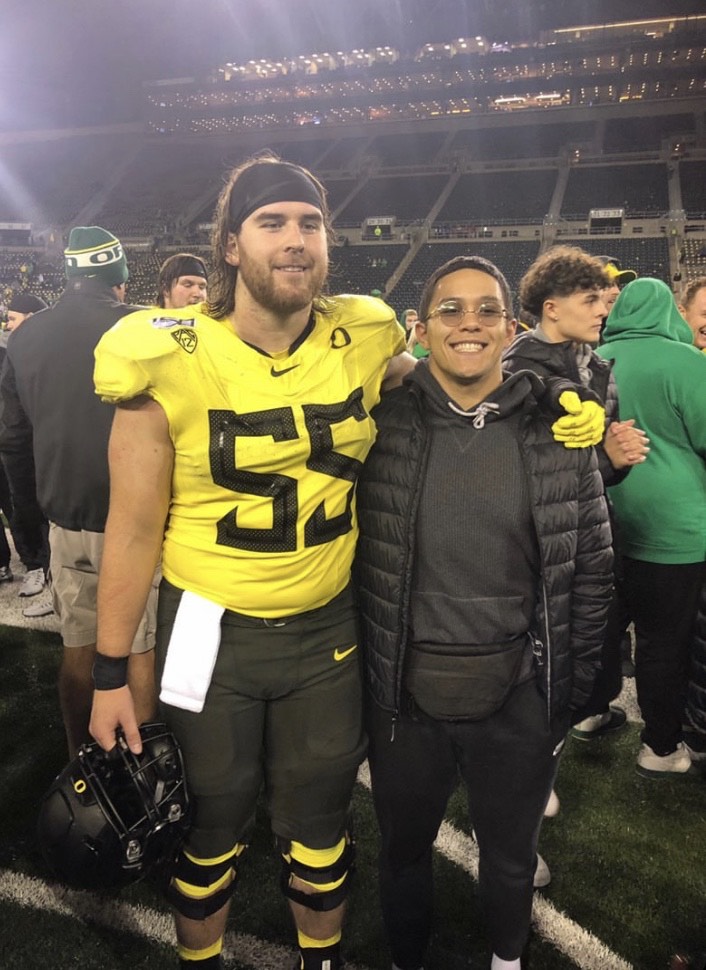
You’re watching the 2020 NFL Draft. It’s the sixth round and the Green Bay Packers are on their 29th pick. The Packers are about to make a life altering call to a player who will soon have the chance of playing alongside the quarterback legend, Aaron Rodgers. A familiar Humboldt County name flashes across the screen. Former local Eureka high school alumnus and University of Oregon center, Jake Hanson has just been drafted as the 208th overall pick for the Green Bay Packers for this upcoming 2020-21 season.
A key component of Hanson’s journey began when he signed to play for the Oregon Ducks in 2015. During his four seasons playing with the Ducks, Hanson started almost every game. During his first three seasons, Hanson didn’t allow a single sack with a total of 2,738 snaps. The starting center received a total of two honorable AP second team Pac-12 All Conference recognitions.
Tyson Miller is a local MMA pro fighter, former high school teammate and good friend of Hanson’s. Miller and Hanson initially met in kindergarten but it wasn’t until the two went to a football camp together their freshman year when they really hit it off and started hanging out. Miller sees what many fans have noticed on social media since the draft. Hanson comes in at almost 6’5”, 303 lbs, his size works to his advantage.
“First of all, his size,” Miller said, “He was bigger than most of the other lineman on the field.”
Size is not the only key feature that stands out about Hanson. Miller points to Hanson’s effort on the field as a big upside.
“He’s going to be a professional football player.”
Tyson Miller
“Jake is going to give it 100%,” Miller said. “If somebody demanded more than 100%, he was more than willing to give more than 100% right back.”
The dedication and game mentality that Hanson possesses is one that is truly admired by not only Miller, but by others as well. The ability to turn up the heat in a game is sets athletes apart from one another.
“[He is] going to be a professional athlete,” Miller said, “He’s going to be a professional football player.”
Hanson is going to be a memorable name within the community and make an unforgettable mark for the Packer Nation.
In an article by Forbes, Packers General Manager Brian Gutekunst pointed out Hanson’s work ethic and personality as a positive for the teams newly acquired offensive lineman.
“Just really a model of consistency and another culture guy,” Gutekunst said. “The kind of guys that we like to bring into our offensive line room.”
While the Packers have their seven year veteran center Corey Linsley under contract for another year, there is no doubt that Hanson will be Linsley’s backup for this upcoming season. Hanson is going to be a great asset to the Packers. His strength, size and quick feet will play a pivotal role in his movement of helping block the defensive line. I am predicting that with time, after the team continues to work with him and his snap consistency, he will be their starting man.
If you’re looking to watch some football and don’t know what to do without Humboldt State’s football program but still want that local spin, be sure to tune into some of the Green Bay Packers match ups. Remember to look for #67 on the field.
FAFSA just released its first wave of emergency CARES grants earlier this month to over 5,200 students enrolled at HSU.
With classes being switched completely online, unemployment at an all-time high, and major debt underway, college students have been hit hard during these times.
Colleges across the country are losing money as time continues and with no definite sign of an end to this crisis, the stimulus package that was issued in late March, sent out emergency grants to all colleges/universities.
The stimulus package conjured up about $14 billion for higher education. Around $12.5 billion will be distributed to every college, while the remaining funds will be given to minority and smaller institutions. Many students will receive extra money to help with whatever they need.
Each college has been sent a set allocation, some higher than others. Humboldt State has been granted an allocation of $10 million, with $5 million to be divided and distributed to enrolled students.
The financial aid services confirmed that each student should expect to see $500-$1000 directly deposited into their banking accounts. Those who do not have direct deposit should expect a check to come in the mail during the months of May and June.
For students who haven’t filed for a 2019-2020 FAFSA and are worried about not receiving the grant, you are still eligible for it. Students can still apply for the CARES emergency grant, the deadline for the application is June 15.
Newly Elected Associated Student Board prepares from the 2020-21 school year
Former Associated Students, Student Affairs Vice President and AS Legislative Vice President Jeremiah Finley will be returning to Humboldt State University next year as the President of AS.
“We’re here to deliver some genuine change,” Finley said. “We’re in a place where we haven’t been before. But I’m optimistic and we should all be optimistic about the direction we’re about to head in.”
Over the summer Finley will be focusing on creating guidelines for allocation processes and beginning to tackle the four-point approach he campaigned on.
“It’s gonna take more than just one person to advocate that something happens,” Finley said. “My leadership style is not centralized. I’m very much a person who’s gonna take input from everybody.”
Finley acknowledges there are students on campus that didn’t vote for him, and not without reason.
“Ultimately, I know that 258 students voted for the runner-up. With that being said, I know 258 students still believe that those points that that candidate brought up were valid, so we want to recognize that.”
Unique to this year, the new AS board will be meeting several times through out the summer, to get a much needed head start.
“This platform allows me to be a voice for all students. I don’t take that for granted.”
Jeremiah Finley
“I think that the work needs to be done,” Finley said. “That way when we move into the actual academic year, we’re able to hit the ground running.”
AS Representative for the College of Art, Humanities and Social Sciences for the 2019-2020 academic year, Montel Floyd will be returning to the AS board next year to serve as an At-Large Representative. He chose to shift roles to gain access to the entire student body.
“This platform allows me to be a voice for all students,” Floyd said. “I don’t take that for granted.”
Malluli Cuellar, Social Justice Equity Officer for AS 2019-2020, is also moving into a new role as the Legislative Vice President-Elect. Cuellar chose to run for the new position largely due to her interest in chairing the Board of Directors.
“I hope to foster an inclusive and welcoming environment at each Board of Directors meeting,” Cuellar said. “While also making sure that Associated Students is running as best as it can internally, and that our codes and bylaws are setting up Associated Students to be the best it can be.”
Floyd intends to spend his next year with the board focusing on breaking down communication barriers between students and administration and ensuring student safety.
“I love advocating for students,” Floyd said. “Listening to their concerns and finding ways to solve the concerns as a collective is what I do best.”
Cuellar believes in the power of student advocacy and students’ collective ability to promote institutional change on campus.
“I want to push for Associated Students to continue to actively uplift the student voice and encourage our students to become involved in the governance of our campus by joining committees or writing resolutions.”
Malluli Cuellar
“The student advocacy that occurs within Associated Students is what inspired me to run for elected office for the very first time,” Cuellar said. “And it is what has kept me involved with Associated Students.”
One of Cuellar’s goals for the coming year is to build and foster an environment that is inclusive and provide a safe space for collaborative thinking and change.
“I want to push for Associated Students to continue to actively uplift the student voice and encourage our students to become involved in the governance of our campus by joining committees or writing resolutions.”
With only seven students elected to the AS board for 2020-21, there are still plenty of positions open for students interested in joining. Incoming AS President Finley advocates that all students take the opportunity to share their voice.
“I would recommend everybody to do it,” Finley said. “It’s empowering. You get the chance to show who you are and put your twist and your spin on what advocacy is and what it should look like, and you end up creating some really creative solutions to old problems.”
Justin Everett continues his basketball career in the Republic of Georgia
Justin Everett was on the Humboldt State University men’s basketball team for five years. After graduating with a major in business marketing and a minor in economics, he decided to continue his athletic career as a professional athlete with the BC Cactus Tbilisi out of the Georgian Basketball League in the Republic of Georgia.
During the signing process, teams based in different countries were interested in Everett, but he didn’t have a specific place in mind that he wanted to play for. He and his sports agent solely based their decision on which team would be the best fit for him to showcase what he can do and get more exposure.
“My goal was to get my feet in the door in a respected league, where I can perform and establish myself as a high level player to propel my career in years to come,” Everett said.
Everett played a total of 15 games during his 2019-20 season with Cactus Tbilisi. He averaged a total of 13.8 points, 7.6 rebounds and 1.3 assists per game. On Dec. 7, 2019, Everett set his season high with 23 points and a season high of three assists in just 35 minutes against BC Titebi. He had a season high of 12 rebounds in 36 minutes against Dinamo Tbilisi on Dec. 22, 2019. Everett also recorded 5 double-doubles, scored in double figures 12 times in 15 games, and had 20 points or more in three games.
Due to COVID-19, his season was cut short. The transition of playing in Georgia to moving back to the States was a big change for Everett. He moved back in with his family, who he hadn’t lived with since he moved away for college. The hardest part has been not having the facilities he normally had. Everett hasn’t been able to shoot a basketball since he got back to the States.
Everett was first inspired to play basketball when he was only two years old, but he didn’t start playing at a competitive level until he was in the second grade. His role models growing up were Kobe Bryant and Shaquille O’Neal, as well as his father, who taught him how to play after he showed an interest.
“I was born in 1996, so Kobe had just gotten into the league,” Everett said. “I grew up watching him and Shaq win all those rings in LA and my dad played college basketball so I kind of just got into it. Once I started working out and started playing, it just felt comfortable and I enjoyed it.”
Everett was born in Glendale, CA but was raised in Clovis from third grade up until he graduated from Buchanan High School. He started taking his basketball career more serious the summer after his freshman year in high school.
“We put in a lot of work after my freshman year of high school,” Everett said.
Looking back on his career as a professional athlete, Everett says he never imagined getting this far. Although he is very passionate about playing basketball and loves the game, he says he had a backup plan of going straight to the workforce if he didn’t get any college offers after high school.
“Honestly, I didn’t think I would make it to college basketball,” Everett said. “I almost didn’t make it to Humboldt State and then Steve Kinder ended up giving me an opportunity to go play basketball over at Humboldt on a full ride scholarship.”
“Humboldt County, the Arcata area and just all the fans and the support was tremendous. They always packed the gym and they were loud every night we were in there. I enjoyed the process of it all.”
Justin Everett
Kinder was the head coach for HSU men’s basketball and was there throughout the entirety of Everett’s college basketball career. After Everett’s sophomore season, he tore his ACL and redshirted the following year of 2016-2017, he went through the rehab process and fully recovered before playing again the last two years he had left at HSU.
During his last season, Everett led the Jacks with 15.6 average points per game and a 6.6 rebounding average. The 2018-19 All-California Collegiate Athletic Association First Team honoree shot 50% from the field and 76% from the charity stripe during his senior season.
Everett says he really enjoyed the years he played basketball at HSU and all the road trips he took with his team.
“Humboldt County, the Arcata area and just all the fans and the support was tremendous,” Everett said. “They always packed the gym and they were loud every night we were in there. I enjoyed the process of it all.”
He said the best part was getting to grow and evolve his game and play for a super league.
“I definitely want to try and play, five, ten, 12 years,” Everett said. “See where it takes me and try to get to the highest league possible.”
For those wishing to follow in Everett’s footsteps, he recommends lifting weights, eating right, getting a routine going, stay disciplined and consistent. With that, he says the results will follow.
Based on projected enrollment, the Associated Students budget is expected to decrease 20% each year, for the next five years
The Associated Students Board finalized their proposed budget for the upcoming academic year, during the April 24 board meeting. The budget includes cutting the entire budgets of the Asian, Desi, Pacific Islander Center, the Eric Rofes Multicultural Queer Resource Center or ERC and the Women’s Resource Center, among other programs.
Jeremiah Finley was elected the incoming AS President for the 2020-21 academic year. He wants to assure students they won’t be losing their programs.
“The reality is that we want to support y’all so bad,” Finley said. “That we’re willing to go into our reserves almost $100,000 to be able to still support in some type of way.”
Budget Administrator of the Campus Center for Appropriate Technology Justin Hawkins was baffled by the budget decisions and spoke out during the meeting.
“How does the budget increase $14,000 and it’s going directly to the AS government in-between these recommended budgets, and yet, all of us are getting cut.”
Justin Hawkins
“It’s just tragic, honestly, to see these massive cuts to the ERC and the Women’s Resource Center,” Hawkins said. “I’m a male body person, I identify that way, but that doesn’t mean that I don’t empathize and really appreciate the services that are provided.”
Hawkins questioned the justification for the AS budget increase after having several thousand dollars of his own program cut.
“It’s really troubling what I see going on,” Hawkins said. “How does the budget increase $14,000 and it’s going directly to the AS government in-between these recommended budgets, and yet, all of us are getting cut.”
Despite losing one of their three staff positions, the AS general operations budget has increased over $15,000 for the upcoming academic-year. This comes as a result of general operations losing miscellaneous revenue, largely made up of compensation for the oversight of Instructionally Related Activities. Without the $35,000 miscellaneous revenue provided for the 2019-20 year, the general operations budget requires additional funds to function.
As a result of budget reductions, AS was forced to down-size their office administrator position. This sharp deadline made it impossible for AS to administer payroll for the upcoming year and as a result student-wages have been removed from AS and most of its funded-programs. Executive Director of AS, Jenessa Lund, said the current system isn’t working.
“Even with three employees,” Lund said. “When we have eight programs spread across campus, the oversight is impossible. It’s a huge liability!”
In order to compensate students for their time, AS has come up with several loopholes to get around the extra paperwork that comes with administering official wages. These include paid-internships and stipends for students, both of which have been allocated specific funds in the final budget.
These allocations include a $15,000 committee compensation package that increased the AS government budget. The package is specifically set aside for non-AS board members that are involved in AS committees.
“The optics on the final number of $111,000 looks bad,” Lund said. “But if you really look at what’s inside of it, it’s support to the students.”
The finalized proposal includes a significant increase to the clubs’ budget, with money that can be used for student-stipends and internships. Programs that didn’t receive any funding from AS have the option to transition their organization into a club and can apply for funding through AS and the clubs’ office. Programs that weren’t given a budget for the upcoming year have also been allocated specific funds.
“I don’t think that all of the clubs should have an equal opportunity for that funding.”
Alexia Siebuhr
Queer Coordinator for the MultiCultural Center, Alexia Siebuhr voiced her concerns about access to AS grants distributed through clubs, at a board meeting on May 8. Siebuhr pointed out a white supremacist club on campus, who promotes hateful behavior towards groups denied an AS budget, is competition for club funding.
“I don’t think that all of the clubs should have an equal opportunity for that funding,” Siebuhr said. “They have the equal opportunity to apply for those grants. That just rubs me a little bit the wrong way.”
President-Elect Finley addressed Siebuhr’s concerns, explaining the reasoning behind the allocation.
“Every fee-paying student has to be able to have access to these funds,” Finley said. “If we do not allow them to have access to these funds, then we are doing a dis-service to our students.”
Programs with a department and a state employee overseeing paperwork are the only ones able to maintain regular wages because their payroll doesn’t go through AS. For programs that didn’t receive a budget from AS, finding a department to adopt them and re-applying for funding is currently their only option.
AS is already in discussion with the Student Access Gallery, the Waste-Reduction and Resource Awareness Program, the Campus Center for Appropriate Technology and several departments about the possibility of adoption. Executive Director Lund believes this will be the most beneficial direction for the programs, moving into next year.
“We didn’t have enough time to do that for every program,” Lund said. “That would’ve been ideal.”
AS is prepared for the possibility of refunding fee-paying students for potentially cancelled events and other unspent student-fee funds. Ultimately, if they aren’t providing the services outlined by student-fees, they shouldn’t be charging them.
With Humboldt State University anticipating lower enrollment for the upcoming academic year, the athletics department has been preparing to make budget adjustments in alignment with the rest of the university. While the department is still waiting on official numbers from the administration to what the budget will look like next semester, Athletics Director Jane Teixeira has been actively working towards making changes with athletics.
“We are going to start going through program by program, looking at ways that we can reduce costs or maximize our benefits and resources,” Teixeira said. “We look at everything from corporate partnerships and how we can maximize those, to donations, to can we live without a second pair of tennis shoes if that’s something we were buying.”
Student enrollment is directly linked to the budget through the Instructionally Related Activities fee that every student pays each semester. The fee currently costs students $337 and covers coach salaries as well as operational expenses for athletics. The funds generated by the IRA fee are also split among the IRA Committee Fund, Jack Pass Fund and Humboldt Energy Independence. A large majority of the money goes to athletics. However, with the department receiving $3.3 million for the 2019-2020 academic year. There is no talk at this time of the fee being raised even if enrollment drops in the future.
The IRA Fee may not be changing, but faculty salary which applies to coaches and is determined with unions and includes automatic increases is at risk. Associated Students Executive Director Jenessa Lund points out that at a certain stage this model will simply stop working as salaries fall out of balance with the fee.
“Salary increases for positions paid by the state are included in the state allocation, as the state builds in a cost of living increase when funding for CSU’s,” Lund said. “When salaries are paid by a flat fee, eventually the salary increases will exceed the amount of fees.”
Newly elected Associated Students President Jeremiah Finley believes that students should not be having to pay for athletics faculty and instead should be paid with state-side funds.
“Ultimately I believe that the wages should be off the back of students. So I’ll advocate that it moves back to state-side.”
Jeremiah Finley
Moving faculty wages back to state-side funding is something the budget office has been looking into since Spring 2018 according to Lund. If this move is made then the money allocated by the CSU system would take rising salaries into consideration. While the current flat fee does not.
Athletics will certainly take a financial hit if enrollment drops as the university predicts. Teixeira was adamant that even though the department has been asked to make changes, the existing programs will not be going anywhere.
“There’s no talk of contracting on our sports,” Teixeira said. “I know there has been some thought from some individuals that were nervous about that because you’re starting to see that happen across the country.”
With enrollment down significantly in the Fall semester, athletics will be leaning more heavily on other sources of revenue; state-side, private donations and corporate sponsorships. Teixeira was unable to provide exact numbers on how much money comes from these sources, but did say that support from the community is especially important for athletics. However with the long term effects following COVID-19, donors contributions will potentially be affected.
“I appreciate the individuals who have given to us and hope we can continue to gather their support for that,” Teixeira said. “We’re going to need it as we move forward in this budgetary time. But we also are aware that this pandemic has affected people. It’s affected our neighbors and we have to be really smart about that.”
“Rec sports is a huge part of what HSU does for students. So it’s not just an athletic issue, this is a student issue.”
Athletics Director Jane Teixeira
If student enrollment takes the anticipated dip for the 2020-2021 school year, recreational sports would see a dip in funding, since they’re part of the athletics department. Teixeira said that recreational sports had already taken a reduction and needs support since it applies to so many students.
“Rec sports is a huge part of what HSU does for students,” Teixeira said. “So it’s not just an athletic issue, this is a student issue.”
The potential to use unspent money from this semester to bolster athletics is being explored as an option. While the final numbers haven’t been released, track and field, softball and rowing all had their seasons cancelled before completion. Meaning funds that are normally spent on travel and lodging are still available. This money could be used for other operations in the future.
Finley thinks that any athletic money not spent due to COVID-19 should be dispersed back into the program.
“Ultimately if that money is allocated, which it currently is, for our student athletes,” Finley said. “Then our student athletes should still benefit from that. I don’t know what that looks like, but that’s why we have different bodies in different pockets of excellence around campus to get that input.”
Without certainty from HSU’s administration, the athletic department continues to create scenarios for possible budget outcomes they will face going into the 2020-21 school year.
When the entire world is going mad and cities are in disarray and the economy is through the tubes and the government is ordering the people to stay indoors and keep distant from human contact and all the unknowns and uncertainties and precariousness are causing anxieties and confusion and insane isolated thinking, then the only logical solution is to search for the magnificent eternal golden light in Big Sur where Jack Kerouac lost his illumination and was succumbed to mad mad maddening disillusion and deterioration of mind.
Amidst a global pandemic and forced isolation (both for curving the spread of the disease and government say-so) Kerouac’s “Big Sur” may seem like an unlikely companion during cabin fever tendencies but he nails the coffin of loneliness surrounded by madness…and we are swimming in madness in 2020 and social distancing is causing us loneliness…he may be known for traveling on the road but the majority of his writing deals with the personal struggle of the unrevealed and intangible and intrapersonal relationships with exile and aloneness.
It was time to go back to find some sanity while the whole world was ravaging in chaos.
Last week I received a card from my obaasan written in shaky cursive:
“I’m not myself now/can’t think much things now…” Her youngest son died in the middle of all this virus business and the experience of losing her youngest before her own passing into the next existence and not being able to perform a proper Japanese funeral has weighed a heavy heart on my nearly 90-year-old reincarnation of the bodhisattva Quan Yin. The letter is marked from Monterey, my hometown, just a couple dozen miles from Big Sur, which I am currently in the thick of. Whereas Kerouac fell into his madness, I was born into mine…and it was time to go back to find some sanity while the whole world was ravaging in chaos.
Passing San Jose on the 280 at rush hour, or what normally is, and we stop not one time and I am convinced there is a God in heaven and miracles exist and coincidences mean something more than just what they don’t.
A pitter patter of rain began to fall as my partner and I sped away from our Arcata apartment and headed down the curvy empty roads of the 101 en route to console an ailing mother from 6 feet away. My paint-scratched and hood-dented Volkswagen happily ate the white lines through redwood country, wineries, extending bridges and golden rolling hills full of deer and foxes and chirping birds. With everyone staying in doors, the urbanized are becoming again what Gary Snyder calls “wild.” Only 10 cars on the Golden Gate Bridge and all of the city, void of the Tenderloin, which sidewalks are unseen due to the amount of popup tents and stretched out tarps and rucksacks rolling in the gutters. Passing San Jose on the 280 at rush hour, or what normally is, and we stop not one time and I am convinced there is a God in heaven and miracles exist and coincidences mean something more than just what they don’t. Seven hours and not a minute more since we left Humboldt County the magnificent sand dunes of my childhood explode into view as the sun sinks behind cannery row, the fisherman’s wharf and into the pacific.
We knock on the windowpane glass without warning. My obaasan, 4-foot-5 in frame in blue uwabaki and nearly all white thick Hokkaido curls reminiscent of the ancient Ainu people of our ancestors opens the door white as a ghost. We appear as road warriors traveling to find oil but she is happy nonetheless to see her most handsomest grandson and granddaughter in law (I know this because she tells us so in a faint whisper of grief). She is nearly silent and full of half smiles and sad lonely eyes staring off into a point in space I am unable to see. There is nothing more difficult than to deny a Japanese grandmother’s invitation of hot food and conversation… but these are harrowing times and one must put down their foot for the betterment of others… especially kindhearted compassionate grandmothers who want nothing more than to fill bellies and tell stories.
Without being able to hug her or get close enough for her to hear me hurt my soul but the space we shared amidst all the craziness going on filled my heart with such joy that I could feel the sanity I had lost while sheltering in place replenish.
We part for the night with three bows and head to Big Sur first thing in the morning. We were supposed to spread the ashes of my uncle but bureaucracies have slowed down (who would have thought possible they could move even slower) and checks clearing takes longer and so we had no urn and only mandatory intention of flying down the beautifully rugged pacific coast cliffs hugging the Santa Lucia Mountains to the east and infinite deep neon blue waters crashing west. All parks are closed and scattered hikers from who-knows-where park along the highway to hike in. We stop at Bixby Creek of Kerouac’s “Big Sur” but it is not the same for all the turnoffs are filled with parked cars and tourists and selfies… or maybe it is the same because on his last hitchhiking adventure up from Big Sur to Monterey 1,000-2,000 cars passed him by and he was no longer able to relate. We ate lunch beneath the shade of an oak tree 100 feet above the water and 15 miles from the hot springs. We were by ourselves with the lonely wails of the sea and the roaring of the waves and the ghostly spirits of Kerouac and my uncle.
On our way out of town we said goodbye to my grandmother. She stood behind the screen door as we stood in the sun with bandanas and masks wrapped around our faces. She was in a cheerier mood and her energy level was heightened. She wore full smiles behind her grief and talked about the chaos of the world being unbalanced. Without being able to hug her or get close enough for her to hear me hurt my soul but the space we shared amidst all the craziness going on filled my heart with such joy that I could feel the sanity I had lost while sheltering in place replenish. Kerouac pronounces, “The more ups and downs, the more joy I feel. The greater the fear, the greater the happiness I feel,” and I believe it to be important we share the same intimacies while we are submerged in the unknown dangers of threats and hazards.
Where we were, what went wrong & how we build a brighter future
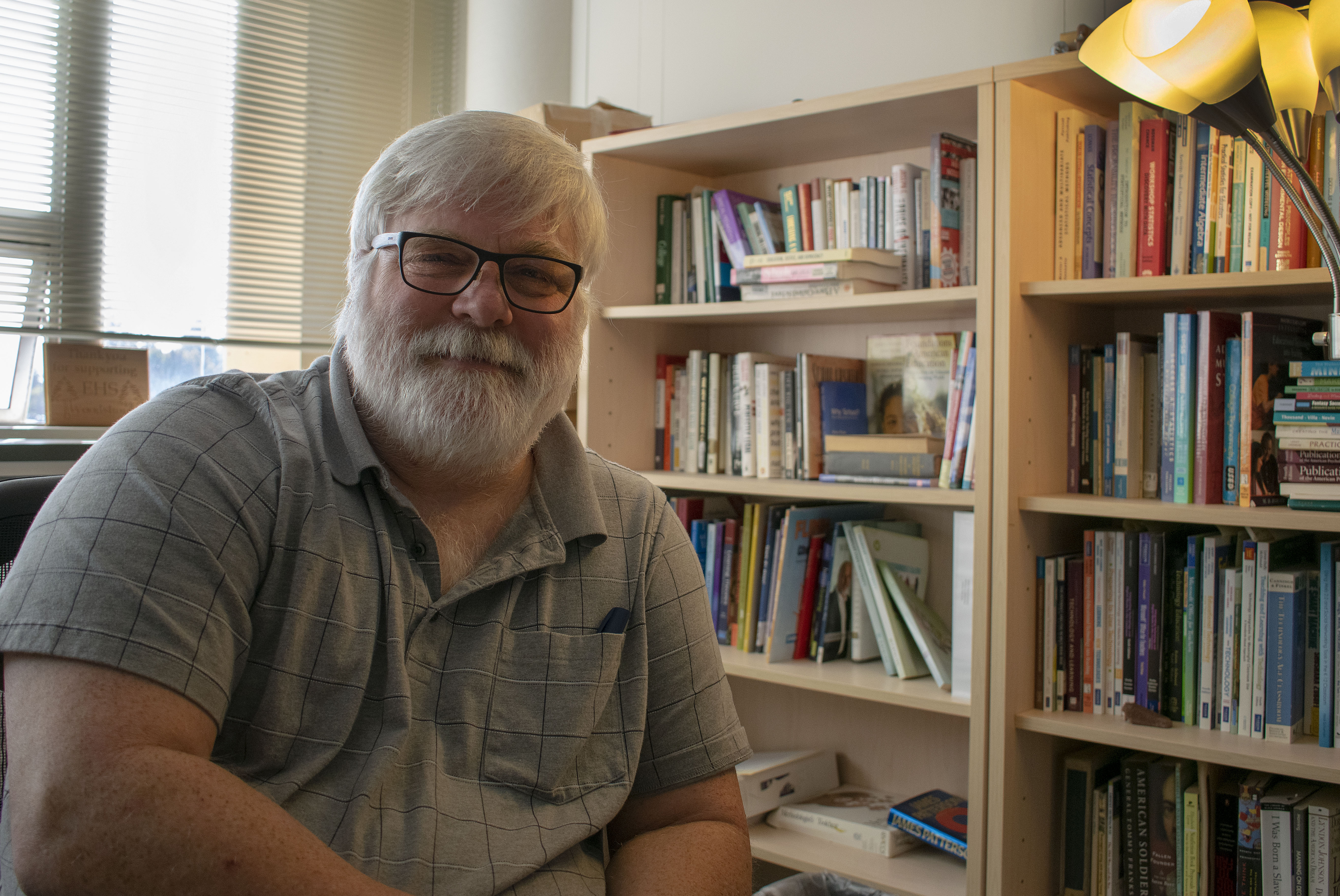
This is a letter to the editor from Humboldt State University Education Department Chair Eric Van Duzer, Ph.D. It has been edited only for minor punctuation and grammar style preferences.
As I reflect back on nearly 30 years at Humboldt State University, first as a student and then for the past 20 years as a faculty member, I wanted to share some of the thoughts that I have about HSU’s current situation and where the campus might go from here.
As a student I experienced a remarkable education where faculty were fully invested in my intellectual and personal development. There were so many opportunities to explore areas of interest and develop new ones. I have spent many hours trying to encapsulate the nature of the schooling I experienced in a way that would really represent the experience.
The best analogy I have been able to come up with was that HSU offered a graduate education to undergraduates. The small classes typical of graduate school encouraged faculty to fully invest in their student’s growth. The university, set so far from the oversight of CSU headquarters in Long Beach, offered a great deal of flexibility to shape our experiences.
This would be impossible today. In those days HSU had the third smallest class sizes in the 23 campuses of CSU. But more than that, it had a unique faculty ethos that reflected nearly 100 years as a student-focused institution that exalted excellence in teaching above all else.
I was the first student CEO of the Institute of Industrial Technology, a self-supporting club that allowed us to use the skills and knowledge we were developing to grow in business acumen, engage in manufacturing and light construction on campus as well as conduct experiments for local agencies. In its second year, Bill Wilkinson used the institute to earn enough profit making desks for campus offices that it paid for several pieces of expensive equipment for the department.
This would be impossible today. In those days HSU had the third smallest class sizes in the 23 campuses of CSU. But more than that, it had a unique faculty ethos that reflected nearly 100 years as a student-focused institution that exalted excellence in teaching above all else.
Faculty came to campus because this is where they wanted to spend their career. Unlike most universities where faculty play academic hopscotch building their resume through research reputations and earning ever-higher salaries as they bounce from college to college, HSU faculty built their reputations on teaching. These were inherently local reputations, not very valuable if one wanted to move on, but rather a reflection of the values and attitudes associated with a culture of excellence in the service of students’ intellectual growth.
As anyone who has worked with university budgets will tell you, graduate education is expensive. That is why through the first 100 years, the administration and other services were done on a shoestring. It was common for a variety of upper administrative positions to be filled by faculty who served temporarily. Staff was thin and overworked and processes were slow and inconsistent.
What happened? In the early 2000s the CSU was facing the onslaught of a Generation X student bulge. Chancellor Charles Reed decided the best strategy to deal with this situation was to homogenize campuses so that if a student could not get into Sacramento State because it was impacted, they could simply go to another campus and get a similar experience.
Yet, the campus, with significant leadership from the faculty, focused its significant resources on classroom instruction, and through that dedication, produced exceptional graduates who were deeply committed to HSU when they graduated.
I remember an administrator in the early years telling me that he had been in a restaurant on the East Coast and overheard a group of students talking at a nearby table. He was so impressed with their sophistication and the values they held he found out where they came from and immediately applied for a job at HSU.
He was the first person hired under then-president Rollin Richmond to manage our enrollments in the early 2000s. The diversity on our campus is a credit to him and Richmond, who reached out across the state to bring in students from urban areas. Sadly he became disillusioned and left. So did most of the faculty leaders.
What happened? In the early 2000s the CSU was facing the onslaught of a Generation X student bulge. Chancellor Charles Reed decided the best strategy to deal with this situation was to homogenize campuses so that if a student could not get into Sacramento State because it was impacted, they could simply go to another campus and get a similar experience.
Shortly thereafter the upper administration received inflated titles and significant raises in an apparent effort to reduce resistance. Then the attack on the faculty began.
Naturally, faculty on campuses such as HSU who were proud of their traditions and niche identities resisted. Fiercely. At one point, three campus presidents, including Rollin Richmond, suffered through votes of no confidence by their faculty as they implemented this strategy.
To achieve the required changes in the face of faculty resistance, campuses, including Humboldt, began shifting to a corporate structure of top down management. Faculty who had held a privileged position in campus life were systematically reduced to workers with only a symbolic voice in campus decisions. The administration turned its focus inward towards improving the functioning of the bureaucracy. They eliminated administrators such as Rick Vrem, an ethical provost, who refused to implement changes that hurt the traditional focus on instruction.
Vrem was replaced with a provost who had no such compunction. Shortly thereafter the upper administration received inflated titles and significant raises in an apparent effort to reduce resistance. Then the attack on the faculty began. Nearly 80 faculty positions were eliminated over several years and during the same time period, a similar number of new staff positions were created and filled to support administrative functions.
Over the majority of the intervening 15 years, budget reductions for academic programs have been the norm: reductions in staff, program availability and courses. This year it was a 6% cut, last year another and many like it before. The funds have been shifted to an ever-expanding variety of administrative initiatives.
Now we sound more like a parks and recreation office than a university. Come for the redwoods, the beaches, the bike riding—that is wonderful and I love it, but it is not why people pick a university.
We spend nearly 68% of our budget on administration and campus facilities. Despite the results of a study commissioned by Rollin Richmond’s administration that showed the two most important factors that cause a student to come to HSU are quality of education and availability of the program they are interested in, both have been repeatedly attacked, sliced and diminished.
It is surprising that no one seems to notice that every time we cut academic programs, fewer students want to come here. And when fewer students come here, the budget suffers and HSU responds by cutting academic programs even more severely—a cycle the faculty in 2004 described as a “death spiral.”
As we address our current crisis and try to figure out what we need to become in order to grow back to a sustainable enrollment, we might want to engage in some soulful reflection. What would cause a 20-year-old to come to a place five hours from major centers of civilization and spend four years with us? What do we have to offer them that is so valuable, so different from what they can get at any of the other CSU campuses which are closer, cheaper and offer a great deal more college life in the community?
We stopped selling the small classes and close academic relationships with faculty when the hypocrisy became too much to bear as campus priorities shifted. Now we sound more like a parks and recreation office than a university. Come for the redwoods, the beaches, the bike riding—that is wonderful and I love it, but it is not why people pick a university.
When I arrived here as a faculty member in 2000 we had one staff member, John Filce, doing institutional research. He was wonderful and badly overworked. I am sure he still is. Now we have nine staff members listed in the directory in the Office of Institutional Effectiveness, including a vice president. I am sure their work is valuable, but to pay for it we had to cut 64 class sections.
Today, we are an organization of inflexible rules and their keepers.
We have proliferated the bureaucracy, which is unfortunately necessary to achieve top-down control of a professional organization. Had our leadership studied industrial technology with me, they would know what companies in the 1970s learned: that this form of management is ineffective and inefficient in a professional organization.
To achieve control requires monitoring, which in turn requires more staff. For a top-down organization, where the vast majority of employees serve at the will of their manager, fear prevents innovation and compliance is key. Before the shift to this model, administrators were problem solvers. In fact, the standing joke in those days was that everything was an exception. Faculty, staff and administrators had the flexibility to serve the needs of students even when it required bending the rules.
Today, we are an organization of inflexible rules and their keepers. It has greatly diminished the effectiveness of the organization and its ability to make decisions that best serve our students. The resulting bureaucratic culture has seen a proliferation of forms, rule books and rigid adherence to often dysfunctional orders.
This is no way to run a university. Perhaps a grocery store, but not an organization of 500 highly educated experts with thousands of years of collective experience. Top-down decision-making, particularly when the president and upper administrators are drawn from institutions that do not share the culture and values of the campus, is inherently poor compared to what would be possible if faculty once again had a meaningful voice in campus affairs.
No student has ever come to HSU because we have a wonderful registrar’s office or because the president’s office is fully staffed. These only matter when they impact the quality of the education a student receives.
The proof of this is apparent everywhere at HSU. When Rollin Richmond came, he had no interest in what made HSU special. Like a white suburban principal coming to a school in Watts, he thought he knew what needed to be done to remake the university into his vision of a modern institution. That ignorance has cost us immeasurably. Today we face the consequences. The failure to fundamentally change direction of subsequent presidents has simply deepened the mess. We now have a new president, perhaps we can find a new vision.
In my view there are two key concerns that need to be addressed from a rational and values-driven perspective. First, an effective budget model that allows funding to follow enrollment is essential to support growing programs while shifting resources to where they will best serve student needs and interests. This can refocus the campus on providing the service/product students come here for—classroom instruction—and it is essential.
There are so many amazing faculty and academic staff here. They are people with a heart for their students, struggling in a system that constrains and conflicts with their efforts. Let their voices guide the future and we may yet have one worth celebrating.
No student has ever come to HSU because we have a wonderful registrar’s office or because the president’s office is fully staffed. These only matter when they impact the quality of the education a student receives.
Second, we have to decide how we are going to rebuild the excellence we once were known for in our student’s academic programs. The day Rollin Richmond refused to give the Outstanding Faculty Award to a physics professor (selected by the faculty based on his ability to delight and inspire students) because that professor had not published, is the day we snuffed out the soul of the old HSU campus.
Now we need to find out what animates us in ways that provide an experience worth the isolation, cost and struggles required to live in this remote community. Redwoods are not enough; we need a reinvestment in education.
I am retiring from HSU at the end of this May. I am sad to see what has happened to my university. There are so many amazing faculty and academic staff here. They are people with a heart for their students, struggling in a system that constrains and conflicts with their efforts. Let their voices guide the future and we may yet have one worth celebrating.
A recipe for when you have too many bananas and don’t know what to do with them
I’ve read enough recipe blogs to know you open a recipe with an autobiography.
It all began when the plague hit. I panicked and bought too many bananas. This was immediately followed by remembering I don’t even like bananas that much. However, I do love bread, and banana bread works best with bananas just on the brink of going bad. Assuming you were able to gather the energy to wear socks in isolation, here’s a recipe that will knock your socks right off.
With no further ado, here’s the “Oh No, I Bought Too Many Bananas—Banana Bread” recipe (this yields 2 loaves):
Ingredients:
4-6 very ripe bananas, mashed 2 cups sugar 2 eggs 1/2 cup vegetable oil 3 cups flour 2 tablespoons baking soda 2 tablespoons salt
walnuts or chocolate chips, to personal preference (optional)
Directions:
1. Preheat the oven to 350 degrees and grease two loaf pans. 2. In a large bowl, combine bananas, sugar, eggs and oil. It will look lumpy, and that’s OK. There’s bananas in there—there’s only so much you can do. 3. In a separate bowl, combine flour and baking soda. Fold into the banana mixture and combine until no dry ingredients remain. 4. Add salt and any additional, optional mix-ins, and combine thoroughly.
5. Bake for an hour or until a toothpick inserted into the bread comes out mostly clean.
There’s no time like the pandemic to get a start on a starter
Sourdough starters are a great project for the apocalypse, as yeast and other baking materials are becoming hard to come by. Hopefully you’ve still got that bag of flour sitting in the back corner of your cupboard, because with just a couple minutes of work a day, you’ve got yourself a sour new addition to the family. After day seven, your starter will be ready for use in bread, pancakes, muffins or any other baked good that includes flour and water.
Ingredients and supplies:
Flour
Lukewarm water (around 85 degrees Fahrenheit)
A scale
A mason jar with a lid
Patience
Directions:
Day 1 – Beginning the starter
Weigh your jar empty, without the lid, and write the weight down
Add 100 grams of flour to your jar
Add 150 grams of lukewarm water to your jar. Mix thoroughly until combined, making sure you don’t leave any clumps
Attach lid loosely to the jar (not too tight, or you will make a bread bomb)
Wait 24 hours
Day 2: Feeding the starter
Remove starter from your jar until there is 70 grams of the starter remaining (that’s 70 grams added to the original weight of your jar)
Add 100 grams of flour
Add 100 grams of water
Mix thoroughly until combined without clumps
Attach loosely fitting lid to jar
Day Three: Onwards
Repeat instructions from day two until you forget for a couple days and accidentally kill it.
Tips
Your starter can range in smell from yeasty “footy-ness” to a nail polish remover or a boozy smell which changes from day-to-day.
Adding a little more water or a little more flour will affect the scent and taste of your dough drastically.
Excess starter removed during feeding is perfectly safe to eat after being fried in a bit of oil. It makes wonderful fry bread with a bit of a funnel cake consistency.
Keep your starter in a warm place. Warm temperatures encourage fermentation, and cold temperatures can kill your starter.
DaBaby releases his third album in 13 months, “BLAME IT ON BABY”
Capitalizing on a unique sound and unique circumstances, with COVID-19 providing more available listeners than ever before, DaBaby is flooding the market—a strategy that’s proven most useful to artists like Lil Wayne and Young Thug in the past. Coming less than seven months after his previous effort, “KIRK,” and only a year after his extremely successful debut, “Baby on Baby,” DaBaby has returned with his third album, “BLAME IT ON BABY.”
Since his introduction to mainstream hip-hop with his platinum-hit-record, “Suge,” DaBaby has kept his name relevant in the media with a string of negative headlines, most recently “accidentally” slapping a female fan. Despite the negative nature of these incidents, each headline only seems to contribute to his success.
A great deal of DaBaby’s launch into the mainstream can be credited to arguably the most impressive feature run from a rookie, landing himself a verse on songs with the likes of Chance the Rapper, J. Cole and Post Malone and playing a standout role on each of the associated albums. This earned DaBaby the attention of hip-hop fans everywhere.
“He’s just different from everybody else—his style, the way he goes about it. I just like him cause you can never tell what direction he’s gonna go with it.”
“BLAME IT ON BABY” is still mostly filled with the party music that we expect from DaBaby, with raw lyrics about guns, girls and guap laid over high-energy beats intended to be played at high volumes.
Jesus Ontiverof plans to transfer to Humboldt State University after completing the nursing program at College of the Redwoods. As a casual fan of DaBaby, Ontiverof enjoys all his music.
“He’s just different from everybody else—his style, the way he goes about it,” Ontiverof said. “I just like him cause you can never tell what direction he’s gonna go with it.”
“A lot of his music sounds the same, which is kind of a bummer. But I do like some of his shit when he mixes it up.”
Jay Coch, kinesiology major
HSU kinesiology major Jay Coch has a different view and experience with DaBaby’s music.
“A lot of his music sounds the same, which is kind of a bummer,” Coch said. “But I do like some of his shit when he mixes it up.”
Even though Coch wasn’t eagerly awaiting the new release, he can’t knock the hustle.
“For him, it seems like he’s being pretty successful putting out a lot of music,” Coch said. “A lot of people like that. They’re like ‘Drop more music, drop more music,’ but it would be cool [if] he took a little more time and really mixed it up and thought about his lyrics more, and actually put himself out there as a musician more than just a big name in the rap industry.”
Despite having its moments on the song “ROCKSTAR,” with a feature from the other hottest new name in rap, Roddy Ricch, and another feature on the song, “NASTY,” with DaBaby’s biggest featured guest to date, Ashanti, “BLAME IT ON BABY” is easily his most forgettable album yet.
A note from a local bus driver longing for a crowded bus again
This is a letter to The Lumberjack from local bus driver Mark Condes. The letter has been edited only for grammar and punctuation.
I drive a bus around Arcata, California. I frequent the Library Circle and the 14th Street & B intersection. Lately, on very infrequent occasions, I drop off an HSU student at one or the other. But this has been dwindling down to rare moments. I’m writing this because I just wanted to say that I miss all the students and faculty who have been my passengers for over a year now. . I miss making the rounds on LK Wood down to Camp Curtis, rolling out to Sunny Brae for my three stops there, the long drive down to Greenview Market to pick up the handful of students and a professor in that little corner of Arcata, and out to the Valley West loop where we scoop up the largest busload of students along Alliance and Foster streets, packing them in like sardines, as we like to say, with a call out to the back of the bus, “Do we have room for just ONE more?” . I’m a lucky person lately because I’m still working, still driving all over town. During these times, we only run what’s called the ‘Orange’ route. No more Red, no more Gold, just a mashup of both. . Truth be told, I feel a bit unlucky also. While we still pickup a handful of Townies going about their ‘Essential Needs’ business, nothing replaces all the bustling energy, the fantastic smiles, the mix of voices of my student riders. . I suppose I’m getting to the point, or heart, of the matter… ‘My’ student riders. Maybe I’m just a softie. I know I’m not some old lonely guy grasping at any human interaction, desperate for some validity that I still exist and matter. But yeah, I suppose I’ve formed an attachment at some level. Perhaps it’s a mix of all things that make me who I am, that have allowed me to feel some level of connection with the younger people heading off to HSU and their open road to the future. I have had the pleasure of watching my own kid go through the same process and life experience of college, and that was just a few years ago. I’m sure there’s a relationship here also. . While I ride around, one large circle each hour… hour-after-hour, I will often feel that tinge of loss, that nudge of sadness as I reflect on how alive this lumbering conveyance once felt, and now how hollow and empty it’s become. And then there’s that other factor, an anomaly I hope… the separation of driver from passengers via a vinyl wall. So impersonal, a clear Berlin Wall, if I may. . As I arrive at each stop, in particular the ones where I would pick up students, I still pause while glancing out in the distance. I find myself looking for those waving arms, that transition from a walk to a full-bore run, as a student realizes they may miss their bus ride to school. I grew to know a number of them well enough that I could only grin and patiently wait for them to arrive, panting, fumbling for their student ID to swipe once they clambered up inside. . I realize school will return to business in the future, and students will once again ride the bus. Yet, as with so many derailed aspects of our lives currently, there’s no firm date on when that will take place. . So I drive. I still take in those sweeping views as I top Union Street on my way to the Parkway Apartments, coax the bus up steep grades, and round the circle at the HSU Library. And when I pick up a familiar student, I still take off my sunglasses, pull down my mask, and with a smile call out through my plastic membrane, “Good Morning!” . From time-to-time as I roll through town, I catch a glimpse of a former, frequent student rider or professor, who no longer rides the bus. In those transitory moments, we may glance each other’s way at just the right instant. As recognition unfolds, so do the smiles, the nods, the waving of the hands, and I am granted a brief respite from the isolation imposed upon me by this COVID-19 experience. . While I am grateful to still be working, still driving, I am even more grateful for all the friendly smiles, the greetings, the eye-rolls, headshakes, and laughter over my bad jokes and puns, that I experienced these past semesters. I wonder how ‘My’ students are doing, how they are faring during these trying times… I care. . I look forward to life resuming in a more normal manner, and the days of a busload of students once again bringing their energy, excitement, and friendliness through the doors. I honk and wave whenever I see students in graduation caps and gowns getting their pictures taken by the gates of the university. I shake off that bit of sadness and drive on.
On-campus food pantry provides for students in need
With the J dining hall closed and grocery stores inducing anxiety, some students are relying on Humboldt State’s OhSNAP! pantry for food.
OhSNAP! will remain open for the rest of the semester, serving students Wednesdays from 10 a.m. to noon and Thursdays from 1 to 3 p.m. on the bottom floor of the Jolly Giant Commons. OhSNAP! can also deliver food directly to you if you can’t make it to campus (email mira@humboldt.edu for more information).
Pasta, the go-to, easy-to-do meal, but with avocado
Pasta is the go-to meal when nothing else sounds good. I’m sure many of you have eaten pasta during quarantine—it’s just so convenient. However, it’s nice to finally switch it up a bit after having the same ol’ spaghetti for days on end. A sauce I discovered a while back is an avocado-based sauce. At first I was a bit skeptical, but then I thought “I love avocados and I love pasta, it shouldn’t be that bad.” After looking through and trying out a few recipes online, I got the hang of it and decided to just do it on my own. With a few modifications, I have a great recipe for you to try. It’s simple, fast and delicious.
Awesome Avocado Pasta recipe:
Ingredients:
2 ripe avocados
1 whole yellow onion
3 cloves garlic
2 teaspoons of lemon juice
1/4 cup of olive oil
1/2 a box of penne rigate or regular spaghetti (more or less depending on how hungry you are)
Seasonings:
Salt
Pepper
Oregano
Basil leaves
Cayenne pepper (for a little spice)
Directions:
1. Dice the onion along with three cloves of garlic.
2. Grab a medium sized pan, coat it with a tiny amount of olive oil and turn on the burner. Once the pan is hot, add in the diced onion and garlic. Cook until the onion is caramelized. Once caramelized, turn the heat off.
3. Grab a blender. Slice and open the 2 avocados. Scoop the avocados in the blender, then transfer the cooked onions and garlic from the pan to the blender. Add 1/4 cup of olive oil and 2 teaspoons of lemon juice and blend until the sauce looks smooth and creamy.
4. Once the sauce is ready, start the pasta. Grab a pot and bring the water to a boil. Add in your pasta and follow the directions on the box.
5. After the pasta is cooked to your liking, drain and put back in the pot. Take the avocado sauce from the blender and spoon in to the pot of pasta.
6. Add in spices to taste and stir (remember to taste as you go).
7. Once it’s seasoned to your liking, get a bowl and enjoy!
No one person is to blame when millions of people are at risk
A cultural perception of coronavirus has been under scrutiny for people’s repeated insistence on referring to it as “Chinese virus.” This became known when a photographer shared a photo they took of Donald Trump’s script at a press conference March 19, which showed the word “corona” crossed out and replaced with “Chinese” above it.
The World Health Organization has guidelines that diseases should not be named after geographical locations, partially in response to the consequences of disease names such as Spanish flu, Rift Valley fever or Singapore virus.
These guidelines were first announced in 2015, with the reasoning that there are numerous other ways to refer to the name of a disease easily without identifying a specific place. One example is the SARS virus, which “avoided stigmatizing any place or any person. And then because of the acronym SARS, it also gave the media and everybody an easy way to refer to the disease.”
Unfortunately, even outbreaks in recent years are given names such as Ebola, which is the name of a river in Congo, or swine flu, which indirectly blames an entire species of animal.
When we call illnesses Singapore virus, Chinese virus or swine flu, it shifts the focus away from combating the outbreak and toward the myth that some place or group of people must be at fault for a problem that affects millions of people.
Those arguing in favor of naming diseases in this manner will cite its supposed “accuracy,” and push back against the suggestion that it might be racist. Senator John Cornyn defended referring to it as the Chinese virus.
“China has been the source of a lot of these viruses like SARS, like MERS and swine flu,” he said.
“We’re talking about China, where these viruses emanate from,” he later said.
Despite what Cornyn and others might claim, citing other examples of names that refer to people or places does not excuse continuing to use the same practice. Naming diseases like this serves as a means of ostracizing people.
Numerous reports of violent attacks, both verbal and physical, against Asian-Americans occurred in the past few weeks, perpetrated by those who buy into the idea that China has to serve as the scapegoat for this outbreak. Identifying one group of people to blame for a pandemic only serves as a form of fearmongering and reinforces racist ideas among Americans.
When we call illnesses Singapore virus, Chinese virus or swine flu, it shifts the focus away from combating the outbreak and toward the myth that some place or group of people must be at fault for a problem that affects millions of people.
Even if a specific source for this pandemic does exist, dwelling on that serves little purpose when the problem is this widespread. It absolves the U.S. government of much of their responsibility to protect their citizens, which they need to be held accountable for.
Violating World Health Organization policy and reinforcing outdated racist practices that should never have been practiced to begin with will not end this pandemic any sooner, nor make dealing with it any better. The only people that benefit from such ideas are those who do not understand that we are all at risk and need to be taking action, the same as everyone around us.
This website uses cookies to improve your experience. We'll assume you're ok with this, but you can opt-out if you wish. Cookie settingsACCEPT
Privacy & Cookies Policy
Privacy Overview
This website uses cookies to improve your experience while you navigate through the website. Out of these cookies, the cookies that are categorized as necessary are stored on your browser as they are essential for the working of basic functionalities of the website. We also use third-party cookies that help us analyze and understand how you use this website. These cookies will be stored in your browser only with your consent. You also have the option to opt-out of these cookies. But opting out of some of these cookies may have an effect on your browsing experience.
Necessary cookies are absolutely essential for the website to function properly. This category only includes cookies that ensures basic functionalities and security features of the website. These cookies do not store any personal information.
Any cookies that may not be particularly necessary for the website to function and is used specifically to collect user personal data via analytics, ads, other embedded contents are termed as non-necessary cookies. It is mandatory to procure user consent prior to running these cookies on your website.