The Lumberjack


Students Serving The Cal Poly Humboldt Campus and Community Since 1929

Tag: Humboldt State

  • MLK day of service zoom event

    MLK day of service zoom event

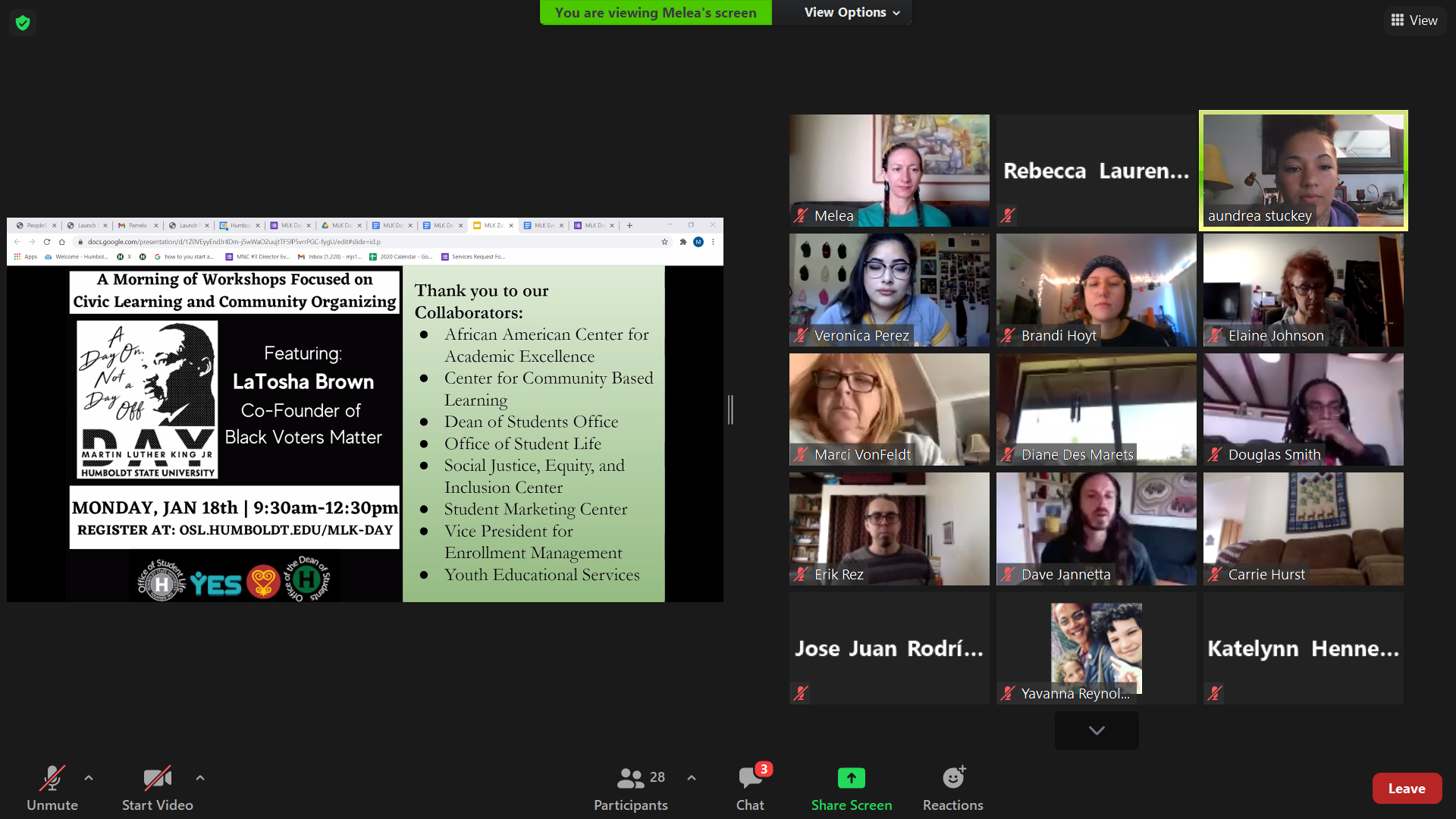
    MLK day of service is a national initiative. This year at HSU there was an event hosted via Zoom for Martin Luther King Jr. that began with a keynote speaker, LaTosha Brown and continued into two breakout rooms with workshops such as Art and Community Activism by Aundrea Stuckey from Youth Art Will Succeed (YAWS).

    Prior to the event, Molly Kresl, the student life coordinator, was excited about the event still going on regardless of not being able to host it in person due to the pandemic protocols.

    “Last year we did MLK day of service and we had three different volunteer sets and over a hundred people to volunteer and eighty participated,” Kresl said. “It was totally successful and we were so happy.”

    Kresl wanted to continue the event virtually to allow the community to be able to participate in the event from the safety of their home and still get a meaningful experience.

    “Us being in a virtual semester, we wanted to continue the tradition because it is a brand new tradition, we think it is a really valuable and important event,” Kresl said. “So we had to kinda reinvent what it looked like.”

    Towards the end of introductions, a slide was dedicated to labor and land recognition such as native land in Humboldt county and acknowledging the labor that built this country.

    LaTosha Brown was the first keynote speaker and spoke about what MLK day means, the work she has done for Black Voters Matters, experience, and motivating the audience. In the beginning, she sang a song and spoke on the impact of the song.

    “A song in their heart, they had hope,” Brown said.

    Brown’s speech related to addressing those who have been affected by COVID-19 and this year in general.

    Within the break, there was an option to join breakout groups composed of participants and main speaker interactions through the chat and aloud. Most of the content of the breakout rooms was back and forth conversation and understanding the importance of MLK day.

    Stuckey’s breakout room focused on subjects within the art community and involvement with POC artwork in Humboldt county.

    “Where do you see black art? Black people?” Stuckey said.

    The second breakout room was dedicated to discussion between participants and main speaker Ron White from the Humboldt Area Foundation discussing his presentation “The Salvation of Democracy: Civic Engagement of the Dispossessed.” Sarah Hammoudi, a senior bachelor’s social work major, attended the second breakout session with White and was a participant for the event.

    “I then attended the workshop held by Ron White on civic engagement and it was an amazing opportunity,” Hammoudi said. “I was even able to speak in a small breakout group with him which gave me even more insight and inspiration.”

    Overall the end of the event ended with questions from participants to the main coordinators and speakers and leveled into a deep discussion.

    “LaTosha Brown, the keynote speaker, was absolutely inspiring and provided amazing insight,” Hammoundi said. “ She said ‘we are called to evolve’ which makes me remember despite how unpredictable the past year’s circumstances have been, we surely can be a piece to making real change one day.”

    Hammoundi was inspired not only by Brown but also the event, the other speakers, and the meaning behind the day itself.

    “MLK day to me definitely is a reminder to do good for others as you wish to receive,” Hammoudi said.

  • Update on HSU’s Climate Action Plan

    Update on HSU’s Climate Action Plan

    As Humboldt State students prepare to graduate, they take a pledge before they walk across the stage and receive their diplomas.

    “I pledge to explore and take into account the social and environmental consequences of any job I consider and will try to improve these aspects of any organizations for which I work.”

    The university makes it clear they want all students to take sustainability into account throughout their careers, but does the school itself practice what it preaches?

    The answer to this question by many standards is yes.

    In 2017, a Climate Action Plan (CAP) was put forth by HSU in order to integrate climate change and sustainability into the curriculum, conduct more research on climate change and resiliency, and reduce the direct and indirect greenhouse gas emissions of the school.

    The plan also includes strategies to curb emissions from energy and utilities, transportation, and waste. This is just a small fragment of what the 26 page plan aims to achieve.

    The most ambitious aspect of the CAP was to reduce the university’s emissions to complete carbon neutrality by 2030, and begin on a carbon negative path thereafter. This course of action comes with progress reports that include an update on the implementation of the CAP’s 55 strategies used to lower greenhouse gas emissions.

    The last report was released in November of 2019, and it states that out of the strategies, 45% were completed, 18% are in implementation, 22% are in development, and 15% are not yet started. While the school is making significant progress, the ambitious goal of reaching carbon neutrality was pushed back to 2045.

    The university budget cuts caused by the COVID-19 pandemic have not had a significant impact on the progress of the CAP.

    “Many of those initial strategies that were completed [in the CAP] were zero to moderate cost (e.g., policy or procedural changes or non-construction related),” Morgan King, climate action analyst for HSU, said. “But some projects requiring a large initial capital outlay (e.g., solar, electric vehicle charging) did not move beyond an initial exploratory phase in part because of funding, but that was an issue before the pandemic.”

    Some of the goals in the 2019 progress report include a reduction in facility and fleet greenhouse gas emissions to 1990 levels by the end of 2020, a further reduction in emissions to 80% below 1990 levels by 2040, and an achievement of carbon neutrality by 2045.

    King is drafting an update to the CAP which the university is calling the CAP 2.0. “We currently have leadership actively engaging with sustainability into all facets of the university,” King said. “So I am optimistic that we will be able to push forward some of the more capital intensive strategies in the CAP 2.0. For example, the campus is already pursuing a microgrid with solar and battery storage, which is a critical element to building resilience and drawing down emissions.”

    The university practices sustainability throughout its curriculum as well. Environmental Studies Associate Professor and Department Chair Dr. Sarah Ray emphasizes the importance of environmental awareness in a social justice based interdisciplinary curriculum.

    “The work of Katie [Koscielak] and Morgan [King] in sustainability is cross-cutting; they go beyond the facilities box and are doing what has to happen on all campuses of merging academics and facilities much more intensely,” Ray said. “The biggest thing we can do to achieve this even better is to continue to center the conversation around social and racial justice– how might those lenses shape what we do environmentally? What and whose traditions are we hoping to sustain, and how do we know what approaches are best for the environment?”

    Environmental studies student August Andrews says that he sees various ways in which environmental awareness is presented by the university outside of the classroom.

    “I definitely see HSU doing so outside of the courses they offer,” Andrews said. “HSU is not only known for its environmental curriculums but, simultaneously, it seems to be rapidly striving to be as ‘green’ of a university as possible, which is inspiring.”

  • Letter to the Editor: This Bus Driver Misses Students and Faculty

    Letter to the Editor: This Bus Driver Misses Students and Faculty

    A note from a local bus driver longing for a crowded bus again


    This is a letter to The Lumberjack from local bus driver Mark Condes. The letter has been edited only for grammar and punctuation.

    I drive a bus around Arcata, California. I frequent the Library Circle and the 14th Street & B intersection. Lately, on very infrequent occasions, I drop off an HSU student at one or the other. But this has been dwindling down to rare moments. I’m writing this because I just wanted to say that I miss all the students and faculty who have been my passengers for over a year now.
    .
    I miss making the rounds on LK Wood down to Camp Curtis, rolling out to Sunny Brae for my three stops there, the long drive down to Greenview Market to pick up the handful of students and a professor in that little corner of Arcata, and out to the Valley West loop where we scoop up the largest busload of students along Alliance and Foster streets, packing them in like sardines, as we like to say, with a call out to the back of the bus, “Do we have room for just ONE more?”
    .
    I’m a lucky person lately because I’m still working, still driving all over town. During these times, we only run what’s called the ‘Orange’ route. No more Red, no more Gold, just a mashup of both.
    .
    Truth be told, I feel a bit unlucky also. While we still pickup a handful of Townies going about their ‘Essential Needs’ business, nothing replaces all the bustling energy, the fantastic smiles, the mix of voices of my student riders.
    .
    I suppose I’m getting to the point, or heart, of the matter… ‘My’ student riders.
    Maybe I’m just a softie. I know I’m not some old lonely guy grasping at any human interaction, desperate for some validity that I still exist and matter. But yeah, I suppose I’ve formed an attachment at some level. Perhaps it’s a mix of all things that make me who I am, that have allowed me to feel some level of connection with the younger people heading off to HSU and their open road to the future.
    I have had the pleasure of watching my own kid go through the same process and life experience of college, and that was just a few years ago. I’m sure there’s a relationship here also.
    .
    While I ride around, one large circle each hour… hour-after-hour, I will often feel that tinge of loss, that nudge of sadness as I reflect on how alive this lumbering conveyance once felt, and now how hollow and empty it’s become.
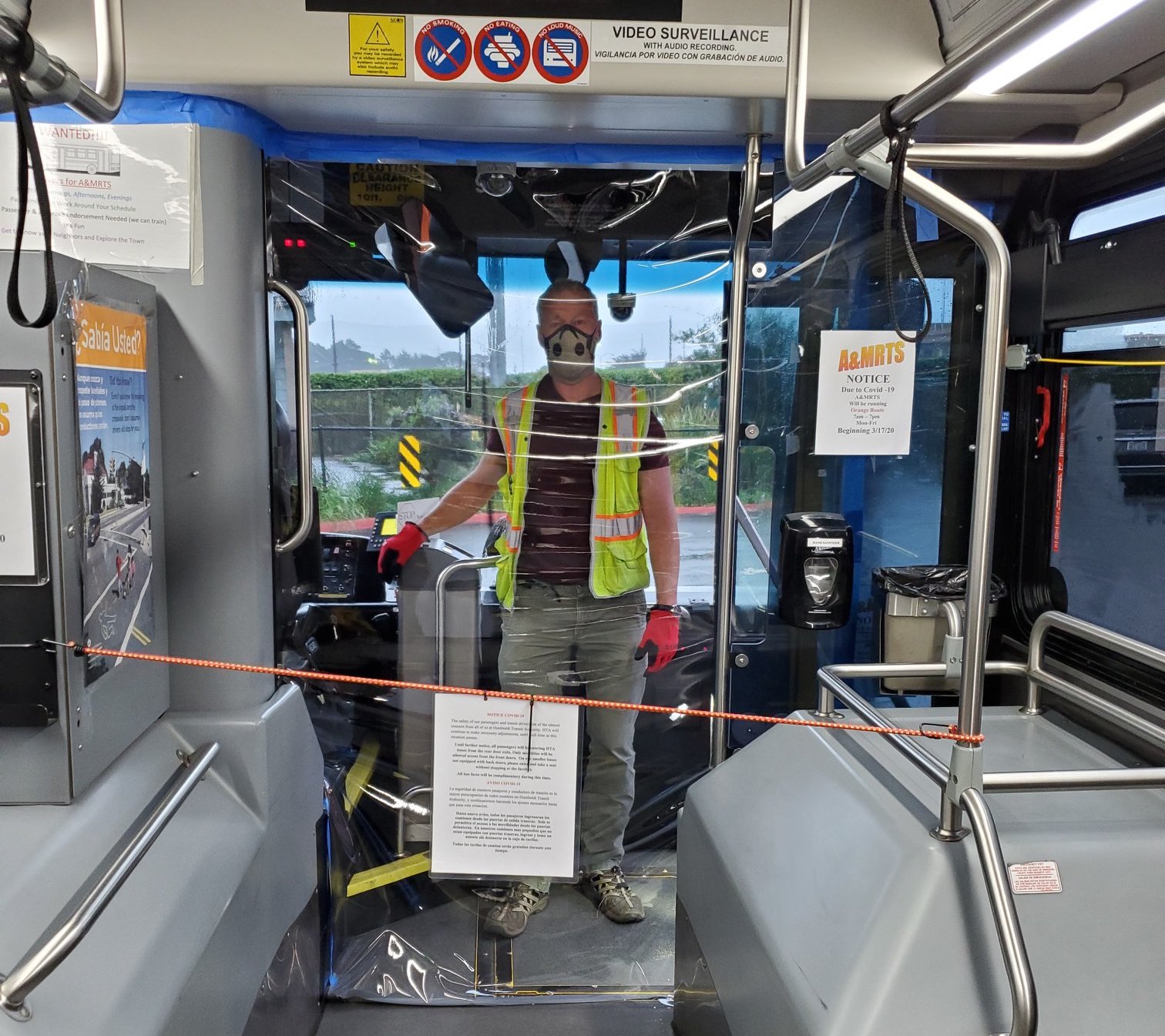
    And then there’s that other factor, an anomaly I hope… the separation of driver from passengers via a vinyl wall. So impersonal, a clear Berlin Wall, if I may.
    .
    As I arrive at each stop, in particular the ones where I would pick up students, I still pause while glancing out in the distance. I find myself looking for those waving arms, that transition from a walk to a full-bore run, as a student realizes they may miss their bus ride to school. I grew to know a number of them well enough that I could only grin and patiently wait for them to arrive, panting, fumbling for their student ID to swipe once they clambered up inside. 
    .
    I realize school will return to business in the future, and students will once again ride the bus. Yet, as with so many derailed aspects of our lives currently, there’s no firm date on when that will take place.
    .
    So I drive. I still take in those sweeping views as I top Union Street on my way to the Parkway Apartments, coax the bus up steep grades, and round the circle at the HSU Library. And when I pick up a familiar student, I still take off my sunglasses, pull down my mask, and with a smile call out through my plastic membrane, “Good Morning!”
    .
    From time-to-time as I roll through town, I catch a glimpse of a former, frequent student rider or professor, who no longer rides the bus. 
    In those transitory moments, we may glance each other’s way at just the right instant. As recognition unfolds, so do the smiles, the nods, the waving of the hands, and I am granted a brief respite from the isolation imposed upon me by this COVID-19 experience.
    .
    While I am grateful to still be working, still driving, I am even more grateful for all the friendly smiles, the greetings, the eye-rolls, headshakes, and laughter over my bad jokes and puns, that I experienced these past semesters. I wonder how ‘My’ students are doing, how they are faring during these trying times… I care.
    .
    I look forward to life resuming in a more normal manner, and the days of a busload of students once again bringing their energy, excitement, and friendliness through the doors.
    I honk and wave whenever I see students in graduation caps and gowns getting their pictures taken by the gates of the university. I shake off that bit of sadness and drive on.

  • HSU Wraps Up Faculty Sex Solicitation Investigation

    HSU Wraps Up Faculty Sex Solicitation Investigation

    Faculty member no longer employed by HSU

    Humboldt State issued a press release today notifying the campus community that it had finished its investigation into a faculty member soliciting students for sex. According to the release, HSU no longer employs the faculty member, but since no formal criminal charges have been filed, the University Police Department is not able to bring charges.

    Read the full release below:

    HSU Concludes Faculty Misconduct Investigation

    Humboldt State University has concluded an administrative investigation into anonymous allegations of faculty misconduct, in which a faculty member was accused of soliciting students for paid sex.

    Upon discovery of the allegation, the University took immediate steps to protect students from harm, and the employee subject to the investigation is no longer employed at Humboldt State. Because this is a personnel matter, the University is not able to provide details of the investigation or the outcome. However, the University is confident that it responded strongly and appropriately, and that it reached a resolution that ensures the safety and well-being of our students, faculty, and staff.

    The University Police Department has also been investigating the incident for any potential criminal violations and charges. Because no formal criminal complaints have been filed, University Police is not able to bring criminal charges at this time. However, the University Police Department’s investigation remains open. 

    The University encourages anyone who may have been harmed to seek assistance through the following campus support services.

    • Counseling & Psychological Services (CAPS) provides a variety of support services. You may make an appointment by calling (707) 826-3236. If you are having a crisis, you may reach a CAPS therapist 24 hours a day at the same number (707) 826-3236.
    • The Campus Advocate Team (CAT) is an on-campus resource for students, staff, and faculty at HSU. CAT is a program of the North Coast Rape Crisis Team, a private nonprofit organization that has been contracted by HSU to provide specialized services to the HSU community. CAT provides 24-hour, confidential support to any HSU student, staff, or faculty who wants to talk about harm they’ve survived (sexual harassment, sexual assault, dating/domestic violence, stalking), or explore their options for support and/or holding accountable the person who harmed them. CAT can be reached at (707) 445-2881, 24 hours a day. On-campus appointments are available.
    • The Dean of Students Office can help students navigate the steps of any reporting process and provide support and advocacy while navigating a formal complaint, as well as helping students find resources on- and off-campus to best meet their needs. You can reach the office at (707) 826-3504.
    • Human Resources handles staff employment as well as Title IX matters and can be reached at (707) 826-3626. Academic Personnel Services handles employment and related responsibilities for faculty, and can be reached at (707) 826-5086.

    The University also requests that anyone with information report it to one of the offices listed below. The Title IX Office helps students navigate accountability and accommodation for incidents of harm. The University Police Department, which operates from a trauma-informed perspective, assists with accountability and responds to reports of criminal activity.

    • Title IX Office, David Hickcox at office (707) 826-5177, cell (707) 296-4032, or david.hickcox@humboldt.edu.
    • University Police Department at (707) 826-5555.

  • Humboldt State Violated California Law by Requiring Registration for a Public Meeting

    Humboldt State Violated California Law by Requiring Registration for a Public Meeting

    HSU briefly required registration for two public webinars as a security measure

    Update, April 22: Humboldt State Vice President of Enrollment Management Jason Meriwether penned a letter to The Lumberjack, making the case that HSU did not violate California law. Read it here.

    Editor’s note: Grace Caswell is a student in Journalism Department Chair Vicky Sama’s media law course. Almost the entire staff of The Lumberjack has also had Sama as an instructor in journalism courses.

    Humboldt State University hosted public meetings via Zoom to inform the public about its projected enrollment decline and budget cuts April 13 and 15. However, as a security measure protecting the university from “Zoom bombings,” HSU enacted mandatory registration requirements prior to entering the meetings in violation of California state law.

    “Zoom bombings” describe a new term for an infiltration or hijacking of a Zoom session with the intent to harass and disrupt the session. With an increase in Zoom users, from 10 million in December 2019 to more than 200 million in March of 2020, Zoom CEO Eric S. Yuan released a statement April 1 detailing additional measures being taken to enhance Zoom security over the next 90 days.

    HSU Vice President of Enrollment Jason Meriwether claimed HSU has experienced Zoom bombings and enacted the registration as an additional security measure. The additional measures required the public to respond twice via Google forms before being sent the Zoom meeting invitations, basically giving the administration, a government body, the power to sift through and deny public access.

    An approved registration screen for one of HSU’s enrollment and budget webinars held April 13 and 15.

    HSU Chair of the Department of Journalism and Mass Communication and media law professor Vicky Sama alerted and engaged with HSU administration, specifically Meriwether, on the violations being committed.

    “Using ‘security’ reasons to require the public additional registration to access a public meeting on the people’s business does not satisfy the openness and liberties that our Constitution provides,” Sama said in an email. “In addition to violating state law that I explained in my earlier email.”

    “The unintentional message is that some people are not welcome and/or we at HSU don’t want the public to know what is going on.”

    Vicky Sama, HSU journalism chair

    Sama said the additional requirement for the public to register prior to receiving an invitation was tantamount to reviewing their qualifications.

    “The email did not justify the registration nor did it outline its purpose, raising suspicions that the university doesn’t want certain people to attend or know what is going on,” Sama wrote. “The unintentional message is that some people are not welcome and/or we at HSU don’t want the public to know what is going on.”

    Specifically, HSU’s actions against the public violated the Brown Act and Bagley-Keene Act. Both California state acts provide assurance of rights to the public. Sommer Ingram Dean, staff attorney for the Student Press Law Center, explained how these security measures directly conflict with both acts.

    “Section 54953.3 of Brown says ‘A member of the public shall not be required, as a condition to attendance at a meeting of a legislative body of a local agency, to register his or her name, to provide other information, to complete a questionnaire, or otherwise to fulfill any condition precedent to his or her attendance,’” Dean explained in an email.

    “Section 11124 of Bagley Keene says ‘No person shall be required, as a condition to attendance at a meeting of a state body, to register his or her name, to provide other information, to complete a questionnaire, or otherwise to fulfill any condition precedent to his or her attendance.’”

    Sommer Ingram Dean, staff attorney for Student Press Law Center

    Additionally, Dean cited the Bagley-Keene Act and the measures it provides ensuring the public’s rights.

    “Section 11124 of Bagley Keene says ‘No person shall be required, as a condition to attendance at a meeting of a state body, to register his or her name, to provide other information, to complete a questionnaire, or otherwise to fulfill any condition precedent to his or her attendance,’” Dean wrote.

    Sama informed Meriwether of the illegal activity violating both the Brown and Bagley-Keene Acts April 13, citing the specific sections mentioned above. In response, Meriwether continued with the registration in place and adjusted the meetings by offering public links.

    “Since this issue was just raised today, it appears to me that the best thing to do is to move forward with today as planned,” Meriwether said in an email. “We will also explore hosting a third event. We will provide both the option for registration and the public link for the already scheduled event on Wednesday. The entire point of having these events was to be transparent.”

    Since then, the links to the April 13 and 15 meetings went public. However, the concern more surrounds HSU’s decision to filter through the public’s right to access a public meeting regarding matters directly impacting them.

    The registration requirement, Sama wrote, amounts to intimidation and goes against the spirit of openness and transparency, and “reeks of sneakiness.” In a time of crisis, government bodies can use the mirage of security to deny the public their right to voice their opinions. Ultimately, it can amount to an abuse of power against the public.

  • Happy Birthday, Graduation is Canceled

    Happy Birthday, Graduation is Canceled

    An account from an HSU senior living on campus

    I woke up on St. Patrick’s day—my birthday—to sobbing. My roommate was curled up on her bed, across the room, crying her eyes out. She cried for half an hour, if not more, because she’d just received the Humboldt State email canceling our graduation and asking students to leave campus if they were able. An achievement she has been working toward for seven years and one I have been busting my ass off for four years was all taken away in seconds. 

    Instead of celebrating and going to the bars—in true St. Paddy’s day fashion—I spent the day in quarantine having to tell my family to cancel their plane tickets and Airbnb reservations because I wasn’t going to be able to walk. 

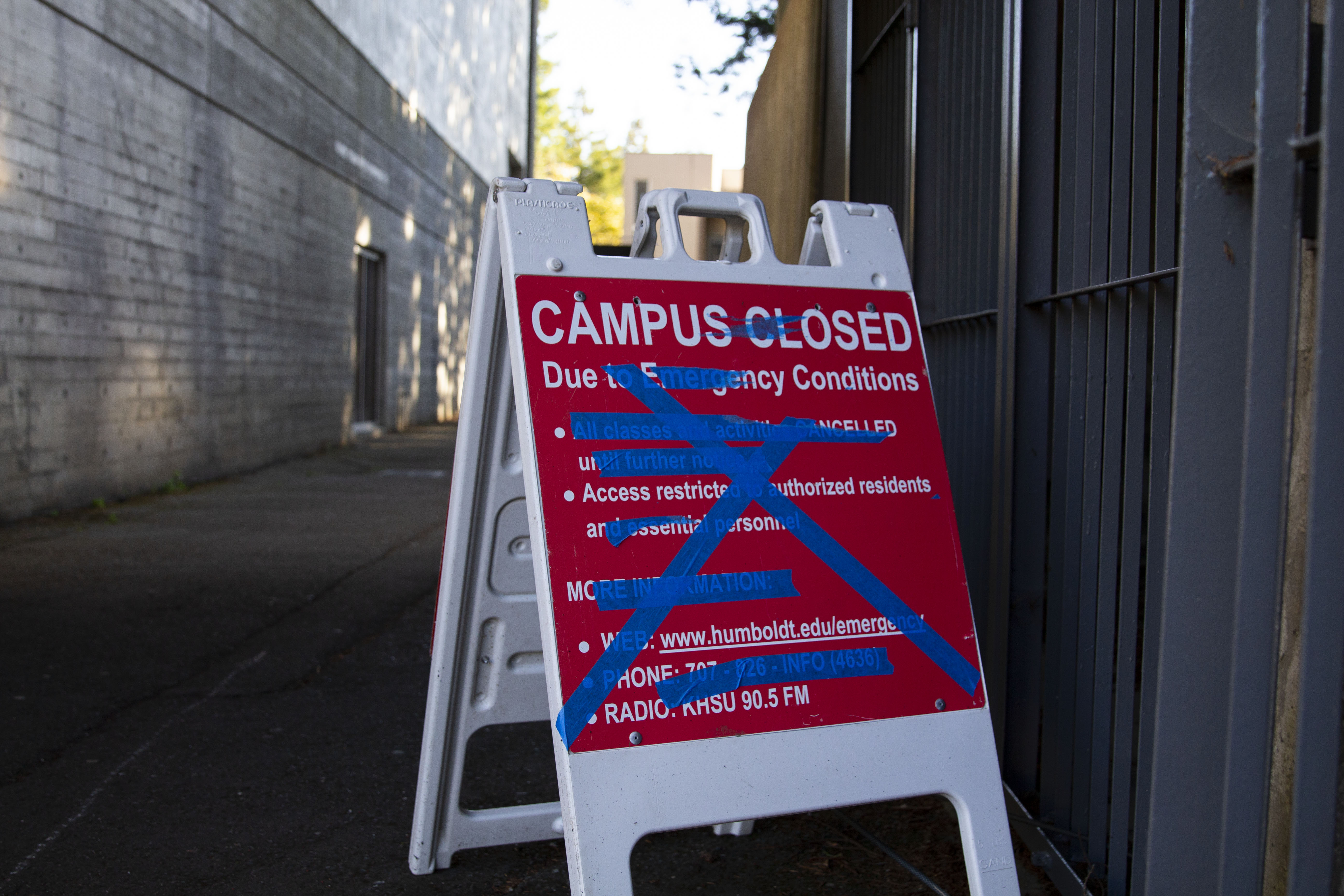
    As one of the students left on campus, it’s strange, to say the least. When my roommate and I go for walks or head to get food from OhSNAP!, the university looks like a nightmarish scene from some dystopian novel. Usually, the only people you’ll find walking around campus are construction workers, nurses or other essential HSU staff. Every once in a while there’s the odd student or two, using what little resources are left available on campus.

    In front of the health center, a tent is set up to greet all students where they sanitize their hands and grab a face mask before being allowed to enter the building—even students who just need to pick up medication from the pharmacy. 

    The only students allowed to be seen at the health center are those who show severe symptoms like a fever, sore throat or difficulty breathing. But for those of us who need regular prescriptions through their pharmacy, be it for anxiety medication, emergency inhalers, birth control pills or other medications they offer, we can still access the pharmacy during their posted hours. 

    In my opinion, this is one of the most concerning aspects of COVID-19. Students and community members cannot be tested through campus for the illness unless they are extremely sick, which leaves carriers with less severe symptoms to go untested.

    Before campus was closed, my roommate and I came down with a cough and fatigue that wouldn’t seem to go away so we decided to visit the health center to see what was wrong, maybe a bit paranoid that we might have contracted the coronavirus somehow. But who isn’t a little paranoid during this pandemic? 

    We were seated outside and only admitted into the entrance of the health center one-by-one. A blood pressure monitor, thermometer and other equipment were set up in the hallway, with two nurses wearing masks and gloves. We were given masks, examined and told that, unfortunately, if we did not show severe symptoms, they were unable to test us. 

    In my opinion, this is one of the most concerning aspects of COVID-19. Students and community members cannot be tested through campus for the illness unless they are extremely sick, which leaves carriers with less severe symptoms to go untested.

    My roommate and I were told we had post-viral infections and given medicine to treat that, but the truth is, we could very well have had the illness and not known because of arbitrary rules only allowing people very ill to access tests.

    I’m still sad that graduation was canceled and I know that it’s a momentous accomplishment that I will never get back. But it’s more important to me that we keep people safe than having the chance to walk across the football field to accept a degree. 

    There are “asymptomatic” carriers of COVID-19, meaning there might be tons of people in the area infected with the coronavirus without any knowledge they are sick. There might be people who have mild symptoms who are unable to be tested and are unintentionally spreading illness because they think they aren’t that sick. We aren’t only putting the health of students at risk by not testing those concerned they might have the illness, we are endangering the nurses and doctors who are still working through the health center, members of the community that students might come into contact with while grocery shopping or performing essential tasks during quarantine. 

    But this isn’t only a concern in Arcata. The reason behind such arbitrary testing rules is because, as reported by The New Yorker, there is a critical shortage in medical equipment necessary to perform tests. This is why those who are extremely ill are being prioritized over people who don’t show as many symptoms. We simply do not have the resources to test everyone, so people infected with the illness are falling through the cracks, living their normal lives and potentially spreading the illness because they are unaware they even have it.

    While those who are sick, but not sick enough, cannot get tests, celebrities who show no symptoms of COVID-19 are allowed to be tested, leaving medical professionals, sick patients and community members to wonder if their lives are less important than the rich.

    I’m sitting in my dorm right now going a bit stir-crazy, still trying to find things to do to occupy my time while I practice social distancing in quarantine. Last week, my roommate and I painted canvases to pass the time. I started learning embroidery because I was that bored and today I went to my Zoom English class, then spent the day writing and watching movies with my roommate. We’ve downloaded TikTok just to pass the time.

    I’m still sad that graduation was canceled and I know that it’s a momentous accomplishment that I will never get back. But it’s more important to me that we keep people safe than having the chance to walk across the football field to accept a degree. 

  • 14 Books to Read While Self-Isolating

    14 Books to Read While Self-Isolating

    There’s never been a better time to start reading books

    You’re stuck inside. You’ve already watched all the best shows on Netflix. You’ve already done your homework. Instead of wasting away the hours on social media, do something good for yourself and your mental state. Read a book.

    Maybe you’ve never read a book for fun, but don’t let that discourage you. Reading is for everyone. You don’t have to be an intellectual to enjoy books.

    Listed below are a few my favorite books—hopefully you can find something to check out.

    If: you want to read a dystopian satire set in a world eerily similar to our current pandemic-stricken one,

    Then read: Severance, by Ling Ma

    If: you want a thrilling, can’t-put-it-down time travel science fiction novel paced like an action movie,

    Then read: Dark Matter, by Blake Crouch

    If: you want to read a smartly plotted story of the very real lives of modern, urban Native Americans in Oakland,

    Then read: There There, by Tommy Orange

    If: you want a masterwork of combining science fiction and fantasy and also race relations in the first of a trilogy,

    Then read: The Fifth Season, by N.K. Jemisin

    If: you want the best damn story of friendship chronicling two women in Italy from the 1950s onward,

    Then read: My Brilliant Friend (and the next three books in the series), by Elena Ferrante

    If: you just want some relaxing, in-touch poems about nature,

    Then read: New and Selected Poems, Volume One, by Mary Oliver

    If: you want to experience Nobel Prize-winning literature mixed with a little science fiction fun,

    Then read: Never Let Me Go, by Kazuo Ishiguro

    If: you like history and want to reframe your perspective of society without feeling like you’re read a history book,

    Then read: Sapiens: A Brief History of Humankind, by Yuval Noah Harari

    If: you want to discover what it’s like to grow up without ever going to school and somehow ending up at Cambridge,

    Then read: Educated, by Tara Westover

    If: you want to read a saga about a Korean family living through multiple generations, spanning topics of love, family and history,

    Then read: Pachinko, by Min Jin Lee

    If: you want to get lost in the long, engrossing story of one kid’s slip into darker and darker rungs of society,

    Then read: The Goldfinch, by Donna Tartt

    If: you want some truly strange and original dystopian fiction with a giant floating bear,

    Then read: Borne, by Jeff VanderMeer

    If: you just want to read the words of a fearless, always-interesting filmmaker,

    Then read: Werner Herzog – A Guide for the Perplexed: Conversations with Paul Cronin

    If: you want to get existential and ponder how you experience life,

    Then read: Why Time Flies, by Alan Burdick

    Where should you buy a book if you want to pick one up?

    I always recommend supporting your local, independent bookstores, especially right now. Each book above is linked to Powell’s bookstore—probably the most famous independent bookstore, located in Portland, Oregon.

    If you’re in Arcata, you can order books online from Northtown Books and pick it up on the curb as of March 25. You can also order a book from Tin Can Mailman, which is shipping orders of $10 or more for free to anywhere in Humboldt, and orders of $40 or more for free outside Humboldt.

    Eureka Books and Booklegger in Eureka can also ship books to you.

    If you’re outside Humboldt, look up your local bookstore and see how to grab a book. More than ever, they could use your support.

    If you’d rather not have anyone handle your books, your alternative is to try the e-book versions. Happy reading!

  • Joyner Drops Disappointing Debut

    Joyner Drops Disappointing Debut

    Grammy-nominated rapper Joyner Lucas shares his debut album, “ADHD,” with the world

    Joyner Lucas, the 31-year-old rapper, first caught traction with his 2015 music video, “Ross Capicchioni.” In the video, Lucas reimagined the true story of a gang initiation gone wrong that nearly claimed the life of a high school student.

    The video’s success can be attributed to the unique strategy Lucas chose, taking on both the perspective of the victim and the criminal. Lucas has managed to keep his name relevant over the years with a string of viral music videos, including the critically praised “I’m Not Racist” and the polarizing “Devil’s Work.”

    Humboldt State University alumnus De’Aundray Gooden has been a fan of Lucas since “Ross Capicchioni.”

    “I think he brings a lot of awareness to certain subjects people don’t feel comfortable talking about,” Gooden said.

    Gooden’s favorite Joyner Lucas songs are “I’m Sorry” and “Devil’s Work.” The first track follows a suicide note as it’s being written into the hands of the victim’s brother or cousin. In the latter song, Lucas calls out to God, questioning his choices in the young men and women he’s chosen to take.

    “We don’t pay attention to people until they die,” Gooden said. “We need to pay attention to the people who are alive, and appreciate them for what they’re doing now.”

    Lucas also racked up hundreds of millions of views on YouTube over a short series of remixes, between 2016 and 2018, and eventually caught the attention of rap god Eminem. Lucas secured a spot on the highest performing song from 2018’s “Kamikaze,” “Lucky You.” The high-tier rapping ability that earned Lucas the legendary co-sign has also contributed to beef with platinum-selling rapper Logic and R&B singer Tory Lanez. The beefs have since been squashed, both resulting in gained exposure and new content, including the third single from “ADHD,” “ISIS,” featuring Logic.

    HSU’s soccer goalkeeper, Tab Heinz, is a fan of old school hip-hop, and appreciated Lucas’ meaningful lyrics and authentic sound.

    “I appreciate the older stuff a little bit more than the newer stuff,” Heinz said. “I like the older style of making music. He has a super cool flow and rhyme scheme. I like the way he doesn’t sound too mainstream. He kinda has more of the underground style.”

    Lucas followed up “ISIS” with the rags to riches track, “Broke and Stupid.” The song paints a picture of all the hard work that has paid off for Lucas. With no chorus, it still competes for best song on the album. Apparently unready to release the project, Lucas proceeded to drop five more singles over the next nine months, at least three of which would’ve been better off left for the album.

    Just two days before the release of “ADHD,” Lucas dropped his ninth single, “Will,” along with another viral music video paying homage to Will Smith. With four skits on the album, including voicemails from Chris Tucker and Kevin Hart, Lucas left fans with a total of five new songs out of 18 on the album.

    Fans were given hope, with features from R&B legend, Chris Brown, industry favorite, Young Thug, and veteran-rapper, Fabolous, that “ADHD” would deliver. Unfortunately, out of the five new songs, only the “I Lied” intro track lives up to the hype. Brown and Thug’s features on “Finally” and “The War” are the most memorable moments of the remaining new tracks.

    After two years of waiting, as Tucker points out in his skit, and with how much of the project we had already been teased leading up to the official release, the anticipation for “ADHD” worked to its detriment. Despite Lucas arguably not producing a bad single, anything less than greatness from all of his new efforts on the album would’ve been a letdown. With most of the new content generating nothing to write home about, fans will be disappointed. Those just now discovering Lucas are much more likely to enjoy what “ADHD” has to offer.

  • With Future Unknown Amid Pandemic, HSU Plans for Enrollment Drops and Budget Cuts

    With Future Unknown Amid Pandemic, HSU Plans for Enrollment Drops and Budget Cuts

    HSU, like all colleges, prepares for tough times and serious measures

    Humboldt State University is preparing for an enrollment drop of around 20% for the fall and a budget cut of around $20 million by the 2022 fiscal year, according to a joint press release from HSU and College of the Redwoods.

    Before the COVID-19 pandemic, HSU projected an enrollment drop for total students of around 14% for the fall and had proposed a budget cut of around $5.4 million by the 2022 fiscal year. 

    Given the uncertainty of the next year, HSU is planning for an even larger enrollment decline and budget cut. HSU currently projects new student enrollment to drop by 30%. The specifics of what the budget cuts will mean are still being worked out.

    “Many options are being looked at, including combinations of a hiring chill, spending freeze, operational changes, incentives for retirements, travel reductions, and more,” the press release said.

    In a Zoom interview, HSU Vice President of Enrollment Management Jason Meriwether said a worst case scenario projection might be only 500 new students and 500 transfer students admitted to HSU in the fall. 

    These numbers, to be clear, are projections. No one knows exactly how the next year will play out. Meriwether hoped HSU could keep enrollment and retention as high as possible.

    “The sad part is, I don’t know,” Meriwether said. “There’s no benchmark. There’s nothing to project against. We could be doing all this and, you know, 1400 students show up—which would be wonderful.”

    HSU is not alone. As noted in Meriwether’s Tuesday enrollment management report to the HSU Senate, colleges everywhere are facing enrollment drops amid the pandemic. The report cited articles from Forbes and the Associated Press along with some early data suggesting one out of every six college-bound students won’t attend college in the fall.

    With education expected to shift to a more local focus, Meriwether pointed out that HSU already shifted to local recruitment in the last year with measures like the Humboldt First Scholarship.

    Compared to an average of about 32 local students attending HSU per year in the last three years, HSU currently has 208 local students confirmed to attend HSU in the fall with the Humboldt First Scholarship. 

    “The good news is we’re not starting local recruitment today because there’s a problem,” Meriwether said. “That’s the best part of all this—is that we already have a really solid foundation that we built in the community over the last eight or nine months.” 

    The enrollment management report includes a graph of enrollment scenarios, with red lines for lower enrollment scenarios and a blue line for a growth scenario. Meriwether hoped for HSU to remain close to the blue line.

    “Essentially, pray we get as close to the blue line as possible,” he said. 

    Meriwether pointed out that, since COVID-19 has hit everywhere, current students might not have much reason to transfer. If classes are still online in the fall at HSU, they will presumably be online everywhere. 

    “Let’s say a student says, ‘OK, well, you know, I want to transfer because I didn’t want this experience,’” he said. “OK. Well, the question will be, ‘What school are you going to transfer to?’ Because every school is stuck in this scenario right now.”

    Nevertheless, the pandemic will likely temporarily derail HSU’s efforts to improve enrollment. 

    “Long term, you know, prior to COVID-19, prior to this hit, we had a plan of getting to an FTE of 7600 students [full-time students] in about four years,” he said. “So now, what if the COVID-19 environment says, well, gosh, it can make us take eight years to get there.”

    Meriwether was optimistic that eventually, HSU would get through this.

    “I believe that we will bounce back, and I believe we will bounce back strong if the hit is really bad,” he said. “This is a marathon. Enrollment is a marathon.”

  • Humboldt State’s Theatre Fraternity Tries a Comeback

    Humboldt State’s Theatre Fraternity Tries a Comeback

    Alpha Psi Omega attempts a comeback with new students and adviser

    Humboldt State University’s theatre fraternity is trying a comeback to campus (or it was, prior to the COVID-19 outbreak). Alpha Psi Omega intends to allow students to increase funding for competitions and student-directed shows.

    Rae Robinson, the faculty adviser for APO, said the return of the fraternity excited her.

    “The first chapter was like 1919 or 1920,” Robinson said. “There have been a few different departments as long as there has been Humboldt State.”

    Robinson said APO was reinstated when she arrived at Humboldt State 14 years ago. APO had a few years of club work, but the group of students interested in the fraternity graduated. APO went dormant.

    “We want to pull all of our performing art students together so we can all support each other better.”

    Jaiden Clark, APO president

    “Those kids graduated, the MFA was dissolved by the university, and it went under the radar for a while,” Robinson said. “Last year we had a new group of incoming students and they said, ‘We want a theatre club again,’ and I said, ‘We have Alpha Psi Omega.’”

    APO President Jaiden Clark said they’re passionate about creating change within the theatre department by unifying performing arts students through APO.

    “We want to pull all of our performing art students together so we can all support each other better,” Clark said. “We want to make more connections with more clubs around the school like the improv club and the circus club.”

    APO’s fundraisers will allow students to determine how the money is used instead of the theatre department allocating funds. The fundraiser money will allow for student competitions and student-operated shows.

    “School-wide enrollment is down, and as far as I understand, the school can’t afford to hire another faculty member to the theatre department. We need the students to feel empowered to do more.”

    Jaiden Clark

    “They don’t give us the money that we need in this department,” Clark said. “Neither have any schools in any theatre department that I have ever been to. So the students are going to pick it up.”

    Clark said the theatre department is low in faculty members, and having a more unified body of performing arts students would better support the students.

    “We lost a lot of faculty all at once,” Clark said. “School-wide enrollment is down, and as far as I understand, the school can’t afford to hire another faculty member to the theatre department. We need the students to feel empowered to do more.”

    Professor Patrick Ulrich, assistant adviser for APO, looked forward to working with the students to reach their goals.

    “I would like to work directly with the students,” Ulrich said. “Making money for their goals, serving their community, getting our name out to everybody and really just having an avenue for an honors fraternity.”

    APO would give the students freedom to advertise themselves how they see fit.

    “It really is in the hands of the officers,” Ulrich said, “who are all students.”

  • Students Bused Back to HSU Met with Mixed Messages

    Students Bused Back to HSU Met with Mixed Messages

    Locals react to HSU students bused back to Humboldt from coronavirus-afflicted areas

    A bus chartered by the Humboldt State Homeward Bound program picked up 31 HSU students March 21 from San Francisco and Los Angeles—two cities where the coronavirus has become more and more prominent—and brought the students back to Humboldt.

    Lost Coast Outpost posted an article about the bus March 24. The Facebook post for the story has 433 comments as of March 29, many of which are critical of HSU.

    “This is beyond irresponsible of HSU,” one comment reads.

    “And one more reason we feel GREAT about not sending our kids to HSU,” reads another.

    Sarah Ray, an environmental studies professor, defended the students.

    “Quite a few of our students live here and have moved here and have their lives here and they were visiting family,” Ray said. “So, just like we would expect and hope that kids and students who are from Arcata and the area—we would fully respect and appreciate that they would want to come home and be home with their families once their classes got cancelled in this really frightening moment—it’s reasonable that students would want to go where they’re most comfortable and feel at home.”

    She went on:

    “There’s also a lot of research out there about how many students across the nation going through this exact problem are not safe at home, and this might be a safer place for them,” Ray said.

    “I feel like it’s not a simple solution to just say, ‘Go back there,’ because many of these students live here.”

    Xochitl Andrade, HSU English and biology major

    Grant Scott-Goforth, communications specialist for HSU, explained the precautions implemented on the buses returning to HSU.

    “The buses were partially full so that people could have social distancing on the buses while they rode,” Scott-Goforth said. “And then, obviously when they return, we’re asking everyone to shelter-in-place, to quarantine if you’ve been exposed or been to an area with exposure, and to contact the Student Health Center or hospitals with concerns about health.”

    As much as HSU wished it could’ve been in command over which students came and which students left Humboldt, there was no way to do that. Of course, as Scott-Goforth asserted, the coronavirus situation is nothing to sneeze at.

    “I think it’s terribly unfortunate and I’m very sad for them and I feel very protective of students because it’s what I do.”

    Sarah Ray, HSU environmental studies professor

    Xochitl Andrade, an HSU senior majoring in English and biology, said the situation is complicated.

    “I feel like it’s not a simple solution to just say, ‘Go back there,’ because many of these students live here,” Andrade said. “They may have no where else to go if they were told to go back. We don’t know if they were just visiting friends or family. And for those who don’t have any family to go back to, what are they supposed to do?”

    While Andrade agrees that the students should be quarantined, she said she thought HSU knows what it’s doing.

    Ray hoped the harsh words toward HSU students from the Lost Coast Outpost article weren’t representative of the Arcata community.

    “I think it’s terribly unfortunate and I’m very sad for them and I feel very protective of students because it’s what I do,” Ray said. “I would like to think that it’s only an extreme, fringed, vocal, internet types of social media people who are saying those kinds of things. The vast majority of the university, especially the community and many people in the community—that’s not the kind of sentiment I see.”

  • Updated: Summarizing HSU’s COVID-19 Updates

    Updated: Summarizing HSU’s COVID-19 Updates

    All classes to go online for the rest of the semester and other plans, plus a translation

    Humboldt State University informed its students March 12 through email that classes would be going online following spring break. Concerns of spreading COVID-19 led the California State University system to suspend face-to-face instruction. HSU initially said it would be shifting to online classes March 26 until at least April 17. But in a March 17 message from President Tom Jackson, HSU announced classes would be taught online for the rest of the semester.

    Jackson’s message said all exams, labs, field trips and in-person meetings are canceled. HSU encouraged students living on-campus to return home if possible. However, HSU promised it would not displace students living on campus.

    Other notes from Jackson’s message included: non-essential student employees will work from home. Campus will close to the general public. Most of campus will close, with the exception of the Student Health Center, the University Center and the library, all of which will remain open with reduced staff. Finally, HSU said it will review alternatives to celebrate commencement.

    HSU has also launched a web page with resources for working from home. HSU plans to provide laptops for students without computers and internet hotspots for students with no internet at home. Programs like the Adobe Creative Cloud Suite and SPSS are expected to be available on HSU’s remotely accessible virtual lab and for downloads to personal computers. Multiple phone and internet companies have also agreed to waive late fees, not cutoff service and open up internet hotspots.

    HSU began updating students and staff through emails starting Feb. 24, when it informed them of the single case of COVID-19 confirmed in Humboldt County. They continued to provide updates weekly on how HSU would be handling a potential pandemic. The week before students were meant to head home or hunker down in Humboldt, HSU ramped up its online communications.

    HSU suspended all international and non-essential domestic travel March 10 for the remainder of the spring semester. In a March 11 email, they defined essential domestic travel as travel for academic credits that are necessary for graduation and cannot be postponed or substituted.

    Through several emails on March 11 and March 12, HSU canceled all instruction from March 23-25 to allow faculty to prepare for online classes. HSU then canceled all intercollegiate and club sports.

    HSU canceled non-essential events on and off campus March 13. Essential events—following HSU’s previous definition of essential—are any events done for academic credit necessary to meet a graduation requirement that cannot be postponed or substituted.

    On March 15, HSU noted the closure of local K-12 schools, and how that may affect staff and faculty. HSU later advised faculty aged 65 and older, or those with underlying health issues that make them more vulnerable to COVID-19, do not come to campus. HSU will arrange telecommuting for adaptable positions, but anyone not able to work remotely will be placed on administrative leave at their current rate of pay and for their normally scheduled work hours.

    Find all HSU COVID-19 updates here.


    Humboldt State University President Tom Jackson’s March 17 Message to Campus:

    Message from President Tom Jackson on Plans for the Semester

    Dear Campus Community: Over the last week, I have had the privilege of observing the amazing work of so many people in their efforts to assist others. The work by all of you to not only protect yourself, but to care for your family and our students is beyond remarkable. We are a very caring Lumberjack Family and I thank you.

    Things are changing rapidly and these updates are subject to change based on the fluidity of this situation. Every day, nearly every hour it seems, we are asked to pivot and address a new challenge in our efforts to reduce the spread of COVID-19. Our guiding light remains the health and safety of our Lumberjack Family while also helping our students to progress in their education. At times these efforts may appear in conflict, but they are not. At the root of all we do is our humanity and our underlying willingness to do what must be done.

    The time has come for HSU to implement a number of additional contingency plans and bolster our COVID-19 precautions. While there are no known active COVID-19 cases in our County at this time, and there have been none on campus, these additional precautions are consistent with recent federal and state health directives. In short, we must now do more to protect the health and safety of our campus and local communities.

    HSU will operate virtually through the end of the semester.

    1. Beginning today, we will shift as quickly as possible to virtual operations. Non-essential employees, including student staff, are to work remotely (telecommute) once they have received direction from their supervisor. Please continue to work with your supervisor on your work assignments and technology support needs.
    2. It is important we reduce the number of people on campus. We encourage students who can return to a home off-campus to do so. We will not displace students who are facing housing insecurities or homelessness. More information will follow.
    3. From Monday to Wednesday, March 23-25, the faculty will prepare for a complete shift to virtual instruction by Thursday, March 26. All professional development and preparation activities will now occur remotely. For the remainder of Spring 2020, all instruction is to be virtual and the primary operational state of campus is to be virtual. There will be no face to face meetings, events, instruction, exams, instructional labs, field trips, live performances, or small group seminars.
    4. We have closed all access to campus facilities to the general public.
    5. Most campus facilities will be closed to the campus community, including all sports and recreation facilities. We have also suspended all intramural and recreational activities for students. Any services remaining open for students – such as the library, student health center, and university center – will be operating with reduced staffing and must implement social distancing.
    6. As a campus we must continue to carefully practice social distancing techniques for those essential individuals who remain on campus, including students in our residence halls who truly have no other place to reside, and the food services and other staff who are supporting those students.
    7. Lastly, and sadly, we must review other ways to celebrate degree recipients instead of the traditional Commencement. We are a very creative campus and we will find alternative ways to celebrate our students’ success.

    There are many questions to be answered, and we will do our best to answer them in a timely way. We will share more information soon as we prepare campus to shift to virtual operations.

    We are resilient. From the Marching Lumberjacks doing what they do, to alumni making a difference in the world, to hiking in the Redwoods, to kayaking in the great Pacific ocean, we are Humboldt. This pandemic is challenging us but it will not break us. We are Humboldt, and while we may be socially distant for now we remain close at heart.

    Thank you for all that you are doing. I ask you to be flexible and understanding as we work together to protect the health and safety of the campus community. You are appreciated.

    Respectfully,

    Tom Jackson, Jr.
    President


    El Mensaje en Español:

    Mensaje del Rector Tom Jackson sobre los planes para el semestre

    Estimada comunidad universitaria, durante la última semana he tenido el privilegio de observar el increíble trabajo y esfuerzo de tantas personas que quieren ayudar a otros. El trabajo de todos ustedes, no sólo para protegerse, sino que también para cuidar a su familia y a nuestros estudiantes es notable. Somos una familia muy cariñosa de leñadores y se los agradezco.

    Las cosas están cambiando rápidamente debido a la fluidez de la situación. Todos los días, parece que casi cada hora, se nos pide que viremos y abordemos un nuevo desafío en nuestros esfuerzos para reducir la propagación del COVID-19. Nuestra luz guía sigue siendo la salud y seguridad de nuestra familia de leñadores y, al mismo tiempo, el apoyo necesario para que nuestros estudiantes progresen en su educación. A veces, estos esfuerzos pueden aparecer en conflicto, pero no lo están. La raíz de todo lo que hacemos está nuestra humanidad y en nuestra voluntad fundamental de hacer lo que sea necesario.

    Ha llegado el momento de implementar en HSU una serie de planes de contingencia adicionales para reforzar nuestras precauciones acerca del COVID-19. Si bien no hay casos activos conocidos del COVID-19 en nuestro Condado en este momento, y no ha habido ninguno en el campus, estas precauciones adicionales son consistentes con las recientes políticas de salud de nivel federal y estatal. En resumen, ahora debemos profundizar nuestros esfuerzos para proteger la salud y seguridad de nuestro campus y comunidades locales.

    HSU va a funcionar virtualmente hasta el fin del semestre.

    1. A partir de hoy, pasaremos lo más rápido posible a operar virtualmente. Los empleados no esenciales, incluyendo el personal estudiantil, deben trabajar de forma remota (teletrabajo) una vez que hayan recibido instrucciones de sus supervisores. Por favor continuar trabajando con su supervisor en sus tareas de trabajo y apoyo técnico.
    • Es importante que reduzcamos la cantidad de personas en el campus. Alentamos a los estudiantes que puedan regresar a sus hogares fuera del campus que lo hagan. No desplazaremos a los estudiantes con inseguridad de vivienda o falta de vivienda. Proveeremos más información sobre este tema.
    • Del lunes 23 al miércoles 25 de marzo, los profesores se prepararán para un cambio completo a la instrucción virtual, a comenzar el jueves 26 de marzo. Ahora todas las actividades de capacitación profesional y preparación se realizarán de forma remota. Durante el resto de la primavera del 2020, toda la instrucción será virtual y todo el campus funcionará de forma virtual. No habrá reuniones presenciales, eventos, instrucción, exámenes, laboratorios, excursiones, presentaciones en vivo, o seminarios de grupos pequeños.
    • Hemos suspendido todo acceso público a las instalaciones del campus.
    • La mayoría de las instalaciones del campus estarán cerradas a la comunidad del campus, incluyendo todas las instalaciones deportivas y recreativas. También hemos suspendido todas las actividades extracurriculares y recreativas de los estudiantes. Cualquier servicio que permanezca abierto para los estudiantes, como la biblioteca, el Centro de Salud Estudiantil y el Centro Universitario, funcionará con un personal reducido y se deben implementar distanciamiento social.
    • Como campus, debemos continuar practicando cuidadosamente técnicas de distanciamiento social. Esto se aplica a aquellas personas en roles esenciales que permanecen en el campus, incluyendo a los estudiantes en las residencias universitarias que realmente no tienen otro lugar donde ir, y proveedores de servicios de comida y otro personal que apoya a estos estudiantes.
    • Por último, y lamentablemente, debemos explorar otras formas de celebrar a los nuevos licenciados ya que no podrán tener una ceremonia de graduación tradicional. Somos un campus muy creativo y encontraremos formas alternativas de celebrar el éxito de nuestros estudiantes.

    Hay muchas preguntas por responder y haremos todo lo posible para responderlas de manera oportuna. Compartiremos más información pronto, a medida que preparemos el campus para cambiar a operaciones virtuales.

    Somos resistentes. Desde la banda de los “Marching Lumberjacks” que hacen lo que saben hacer, y los egresados que hacen una diferencia en el mundo, y las caminatas en los bosques de los gigantes rojos, hasta el paseo en kayak en el gran océano Pacífico, somos Humboldt. Esta pandemia nos desafía, pero no nos romperá. Somos Humboldt y aunque es posible que estemos socialmente distantes por ahora, seguimos estando cerca en el corazón.

    Gracias por todo lo que están haciendo. Les pido que sean flexible y comprensivas/os mientras trabajamos juntos para proteger la salud y seguridad de nuestra comunidad universitaria. Todos son apreciados. 

    Respetuosamente,

    Tom Jackson, Jr.
    Rector
  • Trackside Tales with Elliott Portillo

    Trackside Tales with Elliott Portillo

    First-hand account from Humboldt State distance runner Elliott Portillo

    For track and field athletes like myself, March usually means a return to early season competition after a long, cold winter of preparation and training. On March 6 and 7, Humboldt State University’s Track and Field team traveled to Turlock, California to participate at the 2020 Kim Duyst Invitational at Stanislaus State University.

    Traditionally, this meet brings together programs from across Northern and Central California to post early season times and marks. For myself and other track-based Lumberjacks, it means a long and winding drive down Highway 101 on a large and cumbersome charter bus with very little leg room and one bathroom for around 40 runners, jumpers and throwers.

    As the trip progressed, the foggy redwood canopy gave way to neat rows and columns of orchards and, eventually, the urban jungle on both sides of the I-5 through Stockton, Modesto and Turlock.

    As a whole, my race, a morning event, was uneventful. I found myself heading to the front of a large pack of runners after a few laps, and wound up leading the race for a good two miles in a very strong headwind. The racers must have enjoyed my wind-breaking, as nobody made a move to pass me until a few laps to go. Three runners passed me in the last few laps, leaving my decrepit body in their wake after all of my heavy lifting.

    One advantage of racing early in the morning is the opportunity to watch teammates compete, and boy was I in for a show. I got to see senior Jaye Washington finish second in the long jump, while Brailee VandenBoom tied for first place in the high jump. These were just a handful of the performances I was able to view during my downtime after my race. Even if an athlete didn’t make it to the podium, there was plenty to celebrate—a new personal best, or out-leaning someone at the line to gain one more spot.

    Things only heated up as the day progressed. The weather alternated between sunny and overcast, with swaths of clouds blanketing the vast expanse of the Central Valley. In the evening, eight Humboldt State women toed the line for the fastest race of the 5,000 meter run, made up of 12 and a half laps and just over three circular miles of Stanislaus’s faded red oval.

    Of those eight Humboldt runners, six women ran fast enough to qualify for the California Collegiate Athletic Association championships in May. Junior Cessair McKinney ran with the top group for most of the race, at one point running to the front and pushing the pace, showing no regard for how bad she might feel later. Her teammate, freshman Lucy Atkinson, hung back in the next pack of runners.

    Eventually, the two groups strung out and splintered, as the dense pack turned into a single file parade around the track. McKinney finished six, while Atkinson finished fourth.

    It was just our luck that just as we began packing up to leave, the skies, which had been threatening rain all day, finally opened up and unleashed a downpour.

    I guess we brought a bit of Humboldt with us after all.

  • Clubs Budget Crunched in Wake of Declining Enrollment

    Clubs Budget Crunched in Wake of Declining Enrollment

    Associated Students takes over remains of the clubs budget

    The Associated Students Programs Grants budget has been cut by more than half of the previous academic year’s budget to $25,000 from $52,000. With student enrollment on the decline since 2016, student fees. which make up the entire AS budget, have taken a significant hit.

    As a result of the cuts, it was decided the control of the budgets would be kept within the Associated Students Board of Finance for this academic year. All student clubs are allowed to apply for AS grants, either for events or travel.

    Grant requests are brought to the Associated Students Board of Finance for evaluation before being handed off to the Associated Students Board of Directors, made up of 15 voting and three non-voting members, for final approval.

    In the past five years, between about 10-18% of the AS Programs Grants budget has gone to AS category two programs like CCAT and the MultiCultural Center, which receive separate funding through different outlets. This year, AS decided clubs will receive the entire AS Programs Grants budget in the 2019-2020 academic year.

    The AS Board is currently in the process of their third and final grant allocation for the 2019-2020 academic year. So far, the Board of Directors has approved grants to all 29 clubs that requested—however, not all requests have been entirely met.

    As a result of the budget reduction, AS put in place a cap of $500 per event, $800 per cultural event and $100 per person for travel. The Board of Directors will hold their final vote on March 13 to decide the 11 remaining grant requests for the academic year.

    AS Legislative Vice President Jeremiah Finley is working to provide a fair opportunity for all clubs to receive funding.

    “AS is doing the best with the situation that they’re having to navigate through.”

    Molly Kresl

    “I think clubs always need more access to more funds across the board,” Finley said. “I think the goal of AS here is to really try to make sure that they do have access to funds. And so, in trying to do that, we’re trying on our part, to find ways in our budget to make sure they have access.”

    The clubs budget reduction has forced everyone involved to be more responsible with their spending, according to Clubs and Activities Coordinator Molly Kresl.

    “That’s something that’s been really cool that’s come out of this unfortunate situation,” Kresl said. “Even though we have a decrease in funding, there’s an increase in collaboration with student-initiated programs.”

    However, there’s still much improvement to be made. AS wants to hear the voices of students that are affected by these decisions. For students who want to take matters into their own hands, they can sign up as a candidate for the AS Board.

    “AS is doing the best with the situation that they’re having to navigate through,” Kresl said. “It’s important to recognize the complexity of the situation, and that there are ways that we can help our students be successful and do what they wanna do on campus.”

  • Mike Bloomberg is Democratic Trump

    Mike Bloomberg is Democratic Trump

    Mike Bloomberg is just another billionaire with outdated views looking for attention

    We’ve all seen the campaign ads. “Mike will get it done,” they profess. What exactly has he done? He’s had 64 sexual harassment cases brought against him. He’s expanded the infamously racist stop-and-frisk policy in New York. He’s spied on the Muslim community. And he has bought his way into the primary.

    Not to bring everything back to another bigoted New York billionaire who got bored with having too much money and went into politics, but Mike Bloomberg certainly does remind me of someone.

    Were it not for the mark on the ballot calling him a Democrat, people would assume based on his fiscal policy and social track record that he was at least a centrist-Independent, if not a conservative-Republican.

    Despite being a registered Republican from the beginning of his political career up until 2007, and an Independent until 2018, he chose to run as a Democrat. Presumably, to gain the support of both Republicans and party-line Democrats.

    He’s an authoritarian, plain and simple. Party isn’t the real issue here. He cares about power.

    Bloomberg has a long history of bigotry. While his predecessor, Rudy Giuliani, first implemented stop-and-frisk, it was under his watch that the program grew to the widespread excuse for police brutality and racial profiling.

    When it was brought up by critics that New York police officers were disproportionately targeting black and brown communities, he gave the rationale that, “That’s where all the crime was.” In addition, he justified having undercover officers stalk Muslim New Yorkers as preventative measures against another 9/11.

    “We had just lost 3,000 people at 9/11,” Bloomberg said in an interview with PBS Feb. 27. “Of course we’re supposed to do that.”

    If anything, Bloomberg is a more dangerous version of Trump. He’s smart. He knows that putting up a polished front and playing up the establishment card will make him look like the opposite of the current president.

    Aside from his dubious past, Bloomberg’s current policy proposals are anything but progressive. While his website claims that Bloomberg will defend equal rights for LGBTQ+ Americans, he has stated as recently as 2019 that he considers transgender individuals as just “some guy in a dress,” or “he, she, or it.”

    On his website, aside from a reference to overturning the military ban, he has nothing to say on transgender rights. By considering equal rights for the transgender community to be reaching too far, he betrays the entire LGBTQ+ community.

    Being progressive is about supporting the oppressed and the marginalized. No ally insults the people they claim to stand with behind their backs and considers the value of their identities negotiable.

    According to his website, his plan for climate change is to “restore America’s leadership in fighting the global climate crisis, propel the United States toward a 100% clean energy future, make environmental justice a national priority.” These promises are all incredibly vague, and his campaign has been silent on the specifics of how they’d achieve any those goals.

    General promises of somehow solving climate change aren’t going to help us. If we want this planet to be livable for ourselves, our children and our grandchildren, we need to take serious and quantifiable steps to ensure it. The science says we need ambitious action. All he offers are glossy advertisements.

    If anything, Bloomberg is a more dangerous version of Trump. He’s smart. He knows that putting up a polished front and playing up the establishment card will make him look like the opposite of the current president.

    I’m not afraid that he couldn’t defeat Trump in an election. If Bloomberg wins the Democratic primary, the general election won’t matter. It’s a self-serving billionaire in office either way.

  • The Lumberjack in Print: Feb. 19, 2020

    The Lumberjack in Print: Feb. 19, 2020

    The fourth issue of The Lumberjack for the spring 2020 semester

  • Ask Evergreen: Lootless Lover

    Ask Evergreen: Lootless Lover

    Ask Evergreen is a weekly advice column by the students of The Lumberjack


    Dear Evergreen,

    What do I do for my significant other on Valentine’s Day when I’m broke?

    Dear Lootless Lover,

    Valentine’s Day is this Friday and with that comes the societal expectation to shower your lover in materialistic gifts. But for those with limited funds, making an extravagant gesture isn’t always possible. There are many creative ways to express your love this Valentine’s Day that don’t involve spending loads of cash.

    If you’re a wizard of words you can charm your valentine with a thoughtful card of appreciation. Words are free, so come up with a clever poem for your partner to make them feel special. Bust out your artistic talents and create some art from the heart. You can even doodle some cute cartoons inside a card for a more personal touch to a standard Valentine’s Day card.

    With spring inching closer and closer, flowers have already started blossoming. Take a walk and gather some wildflowers and foliage to make a bouquet. Be careful not to pick any poisonous plants. You wouldn’t want to infect your valentine with anything other than love.

    Baking a sweet treat for your sweetheart is sure to satisfy. Check your cupboards for basic baking ingredients and whip up something good. If you aren’t the best baker you can easily make chocolate-covered strawberries to set the mood.

    Chances are you already have some type of streaming service, so put on some Netflix and chill with your valentine. Pop some popcorn and cozy up with your favorite movie or show. Light candles or incense for an extra touch. Soon enough you’ll be having consensual fun while Netflix asks if you’re still watching.

    You can also try going out and sightseeing with your partner instead of a movie night. Go on a scenic walk or take a stroll with your lover somewhere beautiful. If you can swing it, try planning a picnic on the beach or in the redwoods to share some quality, heart-to-heart time together. There’s nothing more pure—and free—than talking with someone you care about.

    Think outside the box this year. Whether you can afford it or not, there are plenty of thoughtful and creative ways to express your love.

    xoxo

    Sincerely,

    Evergreen


    If you have any questions you’d like to send in, email us at contactthejack@gmail.com. We won’t publish any names and you don’t need to use one.

  • Campus Construction Nears Completion

    Campus Construction Nears Completion

    You’ve seen it. You’ve heard it. You’ve become annoyed by it. When will it end?

    The seismic retrofitting project in the Humboldt State University library is a five-year project of additions and renovations to the library that aims to ensure the safety of the building in the event of a major earthquake. Much of the work of the project is done or is underway.

    The completion date of phase three of the project, which includes improvements and expansions to the basement of the library, has been moved to April 14—although there is a chance that it could get moved back again. Much to the dismay of students and faculty, this means jackhammering and drilling will continue throughout the coming weeks. Director of Planning, Design and Construction, Mike Fisher, pointed to a number of factors contributing to the delayed timeline.

    “We have to excavate through a number of existing conditions, and through that action, we reveal things we didn’t know about,” Fisher said.

    An example Fisher mentioned was the stairs in the library needing to be redone as his workers discovered that the original stairs were poorly designed.

    “It’s little instances like that that compound to lead to a time delay,” Fisher said.

    Fisher went on to talk about the permitting process.

    “During the project, we were moving through permitting and one of the jurisdictions having authority is the Office of the State Fire Marshal,” Fisher said. “Their permitting process took much longer than expected and we had to halt production until we could get that permit secured.”

    Fisher also said he and his crew have been working on retrofitting the theatre arts building alongside the library. They considered the theatre arts building to be a higher priority building, as it’s home to regular instruction.

    Deema Hindawi, a senior at HSU and a co-coordinator at the Multicultural Center, is one of many directly feeling the effects of the construction. She said it’s hard for her to function in the MCC both as a student and a co-coordinator because she has had meetings interrupted by construction noise.

    As a critical race, gender and sexuality studies and criminology double major, she has found it difficult to function because she has been constantly battling jackhammering and drilling.

    “It sucks that we don’t really get much of a say in it and it somehow always comes back onto us.”

    Maya Habis

    Hindawi also noted that there used to be a sign on the side of the MCC that was placed there as part of the retrofitting project without taking into consideration the impact of its words.

    “Having people look at that sign is really uncomfortable, especially when you identify as a part of a marginalized community and having to see the sign that constantly is blaring in your face that reads, ‘No trespassing,’” Hindawi said.

    Maya Habis, a junior critical race, gender and sexuality studies major and also a co-coordinator at the MCC, echoed much of what Hindawi said.

    Habis added their own two cents on being moved around to the bungalows and back.

    “It sucks that we don’t really get much of a say in it and it somehow always comes back onto us,” Habis said. “We kind of get put in between these two things—it’s an ultimatum.”

    Dean of the University Library, Cyril Oberlander, said he likes to see himself as part of the student body. He has been told and has noticed for himself that students are not enjoying the noise in the library. He wanted to make it clear that he understands the difficulties of the noise. He invited students and faculty to voice their displeasure with him directly along with suggestions for how he and his staff can make being in the library a better experience for all.

  • Dr. Cornel West Talks Truth

    Dr. Cornel West Talks Truth

    Selling out in less than a week, Dr. Cornel West commanded the stage with emotion and power

    Around 800 people formed a line wrapping around campus, anxiously awaiting Dr. Cornel West’s lecture. In high demand, tickets sold out in less than a week. Community members desperate for tickets resorted to bribery.

    Brothers United took the John Van Duzer Theatre stage first with the introduction of Humboldt State University Vice President of Enrollment Management Jason Meriwether. After a quick selfie snap and a booming introduction, Meriwether invited West to the stage where a standing ovation followed.

    West was the powerhouse speaker of Black Liberation Month and began his lecture with the recognition of the meaning of the month of February to reflect on the history of our ancestors and to recognize and pay respect to their sacrifices.

    “When you’re talking black history, you’re talking the best of history,” West said. “February is for the brown, red, yellow and black peoples to dig deep into their r-o-o-t-s so their r-o-u-t-e-s can become international.”

    The lecture surrounded West’s book, “Race Matters.” Originally published in 1993 during a time of tense racial turmoil following the trial of Rodney King—a survivor-turned-activist of Los Angeles Police Department police brutality—and the Los Angeles riots—which broke out in response to the trial and heightened racial tensions—the book brings morality into question when analyzing racial disputes. Resurfacing in the modern day, West believes the same issues that arose 27 years ago remain today.

    “We live in a highly polarized society,” West said. “It’s polarized by race, it’s polarized by class, it’s polarized by preaching, it’s polarized by politics and I think I was trying to get at some of the ways in which we can understand the polarization and try to create a higher moral, spiritual ground to keep alight the best of our democracy. That’s what I was doing then and it becomes relevant now, all over again.”

    Highlighting the best of our democracy and of any situation was a recurring message from West. When asked about polarized education systems, West attacked it with the same approach.

    “All institutions are ambiguous and ambivalent in having the best and the worst,” West said. “It depends on the particular features being highlighted. Must be very candid about the ups and the downs, the bests and the worsts.”

    “Disabilities aren’t necessarily sad or scary, but just another way to live life.”

    Crystal Pasztor

    A Q&A session followed his lecture where members of the audience had the opportunity to grab the mic and connect with West. As hands shot up, West emphasized the importance of selecting participants of diversity within the crowd and hearing those voices.

    Crystal Pasztor is a sociology major at HSU. She asked West for a favor of recognition, rather than a question.

    “My favor was to talk about disability and people as a group because you can’t ignore that every group has a disability,” Pasztor said. “Disabilities aren’t necessarily sad or scary, but just another way to live life.”

    Pasztor brought HSU’s own lack of disability recognition into question, describing feeling abandoned by the school and its services.

    “When you’re fighting for something as precious, you never give up because the love too deeply and the commitment too real.”

    Dr. Cornel west

    West ordered the entire theatre to applaud Pasztor in recognition of her feeling of campus abandonment.

    “I felt so much better,” Pasztor said. “I was very nervous to say anything because the president is here.”

    After a standing ovation for West, the audience flooded to the stage for an opportunity to interact and shake West’s hand. One student handed West their cell phone with Charmaine Lawson on the line. An emotional conversation led to West commending Lawson’s love and fight for her son, Josiah Lawson.

    “When you’re fighting for something as precious, you never give up because the love too deeply and the commitment too real,” West said. “So when I was talking to sister Lawson I could just see in her eyes and feel in her heart oh so much love for her precious son and she’ll never give up. That’s what love is—it’s never giving up.”

    Justice remains lacking for the Josiah Lawson case. For community healing, West emphasized morality and spirituality as a light in the search for truth and justice.

    “You got to re-energize people in a moral and spiritual way,” West said. “So that you can create the kind of awakening that brings people together. That want to fight for truth and justice. But, every generation is re-energized in some way.”

    West placed extreme importance on the new generation and their ability to model, lead and revitalize the ongoing dispute over conflicting dialogues and conversations that divide our country. In an exclusive interview with The Lumberjack following West’s lecture, he commended HSU and its administration for their role in developing the new generation by leading by example.

    “By example,” West said. “That’s why I salute what president here doing and dear brother Jason Meriwether. Leadership makes a difference in an institution of higher learning.”

    West remained humble and credited much of his character and success to the leaders, activists and icons of the past. He spoke highly of notable black leaders like Martin Luther King Jr. and Malcolm X, but more importantly, he credited an intangible spirit of truth and justice.

    “I tell them don’t look up to me, look up to truth and justice,” West said. “Truth and justice bigger than all of us, bigger than all of us. We all want to try and be exemplars of living truly and fighting for justice in a moral and spiritual way.”

  • HSU Students’ Home Remedies

    HSU Students’ Home Remedies

    We asked HSU students for their home remedies to get over colds and flus

    It’s about that time of year when empty seats and sniffles become a daily thing in class. Hopefully everybody is taking care of themselves during the winter, because the common cold or even the flu can creep up on you. I asked students and staff what home remedies and tips they use when they feel a cold coming.

  • News Recap: HSU Budget

    News Recap: HSU Budget

    The Humboldt State University budget proposal is under overview from President Jackson

    What?

    The University Resources Planning Committee of Humboldt State University submitted its budget proposal to HSU President Tom Jackson on Dec. 23, 2019. The URPC spent last semester meeting each week to form a new budget to address a projected $5.4 million budget deficit for the next three fiscal years.

    The proposal includes $2,500,000 of cuts from instruction, $720,000 of cuts from academic support, $420,000 from student services, $1,070,000 from institutional support and $690,000 from operations and maintenance of plant.

    The total cuts amount to 4.4% of the total budget. The cuts would equal 4.4% of the instruction, academic support and operations and maintenance of plant budgets, 3.5% of the student services budget and 4.9% of the institutional support budget. The proposal must be approved by Jackson to come into effect.

    When?

    The URPC discussed the proposal in the University Senate Jan. 28, and will discuss it again Feb. 11., according to URPC Co-Chair James Woglom.

    Why?

    The budget deficit stems from HSU’s enrollment decline. Less tuition makes for a smaller budget. When Woglom spoke with The Lumberjack previously, he noted that the URPC has designed a scalable budget model, or a budget that allows HSU to be more flexible with its money as the University’s priorities change. Despite the cuts, Woglom assured The Lumberjack that the URPC was seeking to limit any negative impacts on students’ education. Thus far, HSU has publicly announced plans to phase out employees only through attrition, or not rehiring select employees, rather than outright cutting positions.

    See more of the HSU Budget here.

  • News Recap: Coronavirus Outbreak

    News Recap: Coronavirus Outbreak

    The coronavirus continues to spread across the globe

    What is it?

    A new coronavirus strain has afflicted over 20,000 people across the globe, according to data from Johns Hopkins University. A coronavirus is a type of virus found in mammals and birds. Most coronaviruses are mild, but certain strains can be severe and potentially fatal. Previous notable strains include SARS (severe acute respiratory syndrome) and MERS (Middle East respiratory syndrome).

    The new strain, scientifically called 2019-nCoV, has symptoms including fever, cough and shortness of breath. As of Feb. 4, over 400 people have died from the virus in China, with one reported death in the Philippines and one reported death in Hong Kong.

    Where is it?

    The virus strain began in Wuhan in China’s Hubei province. Eleven people have been confirmed with the coronavirus in the United States, with hundreds being screened. A case has been confirmed in the Bay Area, but no cases are known in Humboldt County.

    Should I be concerned?

    Thus far, those who have died from the disease have had other illnesses that limited their immune system, according to the World Health Organization. The disease is mainly spread through coughing or sneezing. The virus can cause pneumonia.

    The United States State Department raised the threat level of the virus to level four, the highest level, on Jan. 31, meaning that travel to China is no longer advised. Many airlines have since canceled or reduced flights to China.

    The World Health Organization determined coronavirus to be a Public Health Emergency of International Concern on Jan. 30. The virus has spread to at least 27 countries.

    According to a report by The Guardian, the current estimated mortality rate for the coronavirus is around 2% (though this is likely high, as many people without severe symptoms may not have gone to hospitals). Seasonal flus typically have around 1% mortality rates, while SARS has a mortality rate of 10%. Given current evidence, panic doesn’t appear warranted.

  • Walking and Wildlife Tracking

    Walking and Wildlife Tracking

    A group of students and community members wandered around Redwood Creek to track the local wildlife

    On Saturday, Feb. 1, Phil Johnston, the mountain lion biologist for the Hoopa Valley Tribe, stopped the group of 20 mixed retirees and Humboldt State University wildlife majors to quiz them on the tracks he had noticed in the sand.

    The participants all went to the headwaters of Redwood Creek, just south of Orick, to learn about the tracks, scat and other markings of the animals in our area. Some were there to learn what they could and enjoy the hike, and others were looking for a leg up in their future careers.

    “If you’re good enough at interpreting signs and staying on the trail, it’s pretty close to watching them.”

    Phil Johnston

    Throughout the day, Johnston stopped and drew circles in the stand with his walking stick around particular markings, scat or tracks and asked the group to weigh in on the different features and aspects of it. He asked leading questions about what family the suspected animal may belong to as well as what it most certainly did not belong to.

    “If you’re good enough at interpreting signs and staying on the trail, it’s pretty close to watching them,” Johnston said.

    Johnston leads these wildlife tracking workshops at the Natural History Museum in Arcata. Evaluators certified by CyberTracker will be coming to Humboldt County to test 10 people on their tracking skills, according to CyberTracker standards. People who pay the $170 certification fee must pass the certification exam on April 25 and 26 to receive their certification.

    Louis Salas is a 31-year-old wildlife major pursuing the CyberTracker certification. Salas hopes to work in predator conflict mitigation after he graduates, and figured that if he can earn this certification, he would have a leg up in the competitive field of wildlife biology.

    “I’m an older student and I’m competing with a bunch of 18 to 22-year-olds,” Salas said.

    The community impact of the workshop didn’t pass him by. Salas said the workshop was a welcoming environment and he enjoyed seeing older people getting out and learning. Salas said when people learn about wildlife, they care about it more.

    “If nobody cares about the landscape that we live on, no one’s gonna protect it,” Johnston said.

    He wants people to have a connection to the place that they live so that they will want to preserve it for future generations. Johnston said that tracking gives people the ability to feel like a participant in the ecosystem instead of a tourist.

    Dave Ramirez is a forestry major and Deanna Lopez is a zoology major. Neither were after the certification and just came out with a friend to learn more about tracking. Both of them said they would probably come back. The commentary and teaching turned what would normally be a quick walk on the beach into something better.

    “It’s more meaningful than just hiking,” Ramirez said.