The Lady Lumberjacks’ dynamic duo Tyra Turner and Alexia Thrower show no signs of slowing down
Editor’s note: after publishing this story it came to our attention that the author of this story is partnered with one of the subjects of this story. We recognize that this presents a conflict of interest regarding our coverage. This is not a regular policy. We will keep this post as-is for the sake of transparency.
When it comes to sports, a dynamic duo is rare. Humboldt State University’s women’s basketball team is lucky with the elite duo of Tyra Turner and Alexia Thrower. The two have been storming through the California Collegiate Athletic Association and don’t seem to be slowing down.
“I’m just trying to finish this season off strong since it will be my last one of my college career,” Turner said. “I don’t want to have any regrets going forward. I love going out there and playing hard for my teammates because I feel like it is infectious when you play as hard as possible and it leads to all of us playing hard for each other.”
The Lady Lumberjacks have leaned on their two star players heavily this year as both Turner and Thrower lead the CCAA in scoring and assists. Thrower leads the CCAA at 21.1 points per game while Turner leads the CCAA in total assists at 88.
Tyra Turner drives to the net during the Lady Lumberjack’s game against University of California, San Diego at Lumberjack Arena on Jan. 11. | Photo by Elliott Portillo
HSU’s Alexia Thrower jumps up to shoot a lay up during the Jacks’ match against Seattle Pacific at Lumberjack Arena on Nov. 8, 2019. | Photo by Thomas Lal
The team feeds off the pair, as they are 11-8 overall and 7-7 in 2019-2020 Women’s Basketball Conference play—and they seem to be hitting their stride at the right time with postseason play right around the corner.
Turner, the team’s point guard, is the engine of the Lady Lumberjacks. She constantly has the ball in her hands, making key decisions and often guarding the best guard on the opposing team. Turner doesn’t mind having these tasks as she tries to finish off her career as one of the best point guards to ever lace shoes up for the Lady Lumberjacks.
Turner has been playing her best lately, as she’s fresh off being named CCAA Player of the Week on Jan. 29 after averaging 21.5 points, seven assists, four rebounds and three steals in the previous week’s games. Turner currently sits at 1,060 points and 473 assists for her career, and those totals will likely grow before the season ends.
“I really just let the game come to me. I know if we continue to win and I continue to play the way I can, then everything else will fall into place.”
Alexia Thrower
The second half of the duo is Thrower, who is currently in her second season at HSU after transferring from Grays Harbor College in Washington. It didn’t take long for her to take the CCAA by storm as one of its best players. Thrower was the 2018-19 Newcomer of the Year in the CCAA and is on track to receive more awards by the end of the season.
“I never try to focus on trying to win awards,” Thrower said. “I just try to go out there and play my game every night. I don’t really focus on stats or anything like that. I really just let the game come to me. I know if we continue to win and I continue to play the way I can, then everything else will fall into place.”
Thrower currently sits atop the CCAA in scoring, is second in rebounding and is shaping her career as one of HSU’s best women players as she sits at 879 points and 466 rebounds in her two seasons at HSU. If her play continues, expect awards to fall in her favor.
Completing and contemplating Mac Miller’s final album
Mac Miller‘s family and record producer, Jon Brion, released his final album, “Circles,” on Jan. 17. “Circles” completes his previous album, which was under works during his accidental overdose a month after “Swimming” was released in 2018.
“Circles” goes deeper into his personal life and the struggles he was dealing with. Songs such as the last song, “Once a Day,” hit home. Miller had posted a snippet of the song on his Instagram story the day before his death.
Jena Schuh, a zoology student at Humboldt State University, said she knew this album was going to be one of, if not the greatest, album Miller worked on when she first started listening.
Miller’s album goes deeper into the idea that although he was rich and famous, he still dealt with struggles.
“The style of ‘Circles’ truly portrays who Mac as a person was,” Schuh said. “Even though he had a lot of money and fame, he still went through the daily struggles that a lot of normal people have too.”
Throughout the album, Miller openly talks about how he was feeling and some of his darker thoughts about the world and himself. He displays vulnerability to himself and is more transparent in “Circles” than any other album he made.
Miller’s album goes deeper into the idea that although he was rich and famous, he still dealt with struggles. In the song “Circles,” Miller talks about how he’s tried to change, but can’t.
“He’s just so creative and so unique. I feel like no one could ever guess what Mac would want, you know?”
Hazel Belair
This album in particular has a lot of things that people can relate to, such as going around and around in circles in life. In his song, “Blue World,” Miller describes the craziness of the world and the devil being on his doorstep, but carrying on and shining. It’s an album of pain and tribulations, but also triumph. He continues to talk about himself rising up, shining or continuing on.
This album gave Mac Miller fans mixed emotions. Hazel Belair, a 21-year-old Arcata resident, said she chose to avoid listening to the album because it wasn’t finished by Miller himself.
“He’s just so creative and so unique,” Belair said. “I feel like no one could ever guess what Mac would want, you know?”
The family asking Brion to complete the album was an important part of keeping the authenticity. Brion had been working with Miller on not just “Circles,” but also on his last album, “Swimming.” They had been experimenting with different sounds, instruments and lyrics.
With the amount of time the two spent together, Brion learned a lot about Miller, but particularly about his music style and preferences. After countless hours in the studio with him, Brion picked up on what Miller was looking for in the album and how he wanted it to sound. There isn’t anyone else who could have made this into a more pure Mac Miller album than Brion did.
HSU geography student Olivia Dorenkamp thought Brion did a great job on the album and brought out new sounds.
“‘Good News‘ and ‘Woods‘ put me in a state of bliss and remembrance of his past music,” Dorenkamp said. “Overall into a groovy state of mind.”
Although “Circles” was Mac Miller’s final contribution to the music world, it was one of his most beautiful. He died over a year ago, but his memory continues to live on through his lyrics and the musical creativity that’s portrayed in “Circles” and his other albums.
Survive the spring semester with these essential school apps
There are five apps you should download this semester to help with organizing your school life and keeping your mind at ease. While not all of these apps are accessible on all types of phones, they’re typically compatible with phones that host Google Play or the Apple App Store.
1) Google Drive
The Google Drive app is one of the best apps you can use as a student. It hosts all of the accompanying Google Drive features like Google Sheets, Slides and Docs. You can download each app individually for more convenience, but thankfully they’re still accessible through the Drive.
2) Canvas
The Canvas app is helpful for doing assignments on the fly or for getting in touch with classmates for projects. Don’t turn off the notifications for this app because you could miss important class reminders from your professors. This app allows you to submit assignments from wherever you have a WiFi or data connection. It’s also compatible with Google Drive, which makes submitting assignments simple. You can check the to-do list to stay on top of your work and review the app calendar to see upcoming deadlines.
3) The Transit App
The Transit app is essential for any student who commutes to campus. This free app will save you time and stress by showing you local transit routes, schedules and live updates. A helpful feature on this app is the ability to locate the closest route from wherever you are, as long as your GPS is on and active. Not only does the app display bus routes, but it also shows rideshares in the area like Lyft.
4) Humboldt State Mobile:
The Humboldt State Mobile app is a useful tool for checking the school directory, campus life events and other school-related information. You can register or drop classes, check your student center and browse semester class schedules. There’s even a campus map with marked locations for print kiosks and dining services. Although the app can be glitchy, it’s still a valuable and free resource that the school offers.
5) Music streaming apps:
According to a report on the neuroscience of music published by the United States National Library of Medicine, several studies found that listening to music can be therapeutic and may provide stress relief and improvements to cognitive function. Throwing on a study playlist might help you decompress while you review material. Check out Spotify, Pandora or SoundCloud for free music streaming services. Premium versions for music apps are also available if you wish to upgrade your music accessibility. The next time you sit down to study, turn on some tunes to help your cognitive functioning.
The loss of a legend leaves impact on fans and HSU students
NBA legend Kobe Bryant died last Sunday in a helicopter crash at the age of 41, along with his 13-year-old daughter Gianna Bryant and seven others.
Humboldt State University’s Alexia Thrower, a star player on HSU’s women’s basketball team who leads her team and conference in scoring and rebounding, admired Bryant not only for his mentality and approach to the game, but also the advocacy he had toward women’s basketball.
“I loved the way Kobe played,” Thrower said. “He was always in attack mode, regardless of if he missed shots or made mistakes his foot was always on the pedal and that’s how I play. He had four daughters and Gigi was a baller so he had a real passion for women’s basketball and really respected us as basketball players too, and that means everything coming from one of the greatest basketball players ever.”
There’s no words to express the pain Im going through with this tragedy of loosing my neice Gigi & my brother @kobebryant I love u and u will be missed. My condolences goes out to the Bryant family and the families of the other passengers on board. IM SICK RIGHT NOW pic.twitter.com/pigHywq3c1
There’s a saying in the world of sports: “Heroes come and go, but legends never die.” This saying was challenged in the early morning hours of Jan. 26 when Bryant died. His death sent shockwaves around the world, and athletes and celebrities mourned him on social media.
Longtime teammate, fellow NBA legend and self-proclaimed big brother Shaquille O’Neal was one of many left heartbroken. O’Neal took to Twitter to speak about Bryant’s death.
“There’s no words to express the pain I’m going through with the tragedy of losing my niece Gigi and my brother Kobe, you will be loved and missed,” O’Neal said. “My condolences goes out to the Bryant family and the families of the other passengers on board. I’M SICK RIGHT NOW.”
Bryant was a 20-year NBA veteran who played entirely with the Los Angeles Lakers. Over the course of his career he became a five-time NBA champion, 18-time All-Star, league MVP, two-time Finals MVP and finished his career ranking third all-time on the NBA’s scoring list. By the end of his career, he was widely considered one of the greatest players to ever set foot in the NBA.
Bryant influenced generations of future basketball players, including boys, girls and student athletes like HSU freshman Isaiah Sampson, who plays on the men’s basketball team. Sampson viewed Bryant as a role model.
“The way he worked inspired me and helped me change my whole mindset to achieve my goals. He was a role model for me,” Sampson said. “Everyone has their time, but you hate to see someone with his impact go so soon and tragically.”
Bryant is survived by his wife Vanessa Bryant and three daughters Natalia, Bianka and Capri.
Ask Evergreen is a weekly advice column by the students of the Lumberjack.
Each week we answer anonymous questions sent in by readers about anything and everything.
Dear Evergreen,
Is driving to Eureka for Costco gas worth it?
Dear Fretful Fueler,
Gas prices in California are some of the highest in the nation, with prices often spilling over $4.00 a gallon, but Costco offers some of the cheapest gas.
Costco is a popular gas supplier, and here in Humboldt we are fortunate to have one locally. But although Costco gas is an option in the area, it’s not accessible to all.
To get gas from Costco you must have a membership or a Costco gift card. As someone who doesn’t have a Costco membership, I can’t say for certain that Costco gas is the best alternative.
For those who can afford the $60 yearly subscription, it makes sense to go to Costco if you’re already using their other services. However, if you plan on getting a membership just for a gas discount, I wouldn’t suggest it.
If you aren’t a heavy commuter then Costco gas definitely isn’t a good source for fuel. According to Business Insider, the price of a membership won’t be paid off with your gas savings until you gas up around 37 times.
Costco gas stations are also notorious for having chaotic waiting lines and times. If you do consider Costco gas, be mindful of the time of day you head over, as rush hour times are often busier. It would be counterproductive to wait upwards of 10 minutes for gas while idling in your car wasting fuel.
If you aren’t inclined to fuel up at a Costco gas station, there are other places you can gas up at. You can find local gas prices with the site and app GasBuddy, which can help you shop around for the best option.
In Arcata, the cheapest gas can be found at the Patriot station for $3.87 a gallon on Giuntoli Lane. In Eureka, the most affordable gas is from the Costco station which is currently $3.49 a gallon.
Happy gassing!
Sincerely,
Evergreen
If you have any questions you’d like to send in, email us at contactthejack@gmail.com. We won’t publish any names and you don’t need to use one.
Humboldt State students partner with Campaign One At A Time to raise money for a child’s dream
Lecsi Prince, Brittney Odion and Cameron Calder will be up and early Saturday morning breaking a sweat and hoping to see the community support their goal of raising funds for a child in need.
Humboldt State University students Prince, Odion and Calder are organizing a group workout called FUNd the Good that starts at 10 a.m. at HSU’s Student Recreation Center Field House on Dec. 14. The three students are fundraising for a national nonprofit called Campaign One At A Time.
“Their mission is to provide positive experiences and fulfill the dreams of children fighting life-threatening illnesses, one child and one campaign at a time,” Prince said. “They do this by trying to help create normalcy for the child at a time when life is anything but.”
“A lot of these kids don’t get to live a normal childhood due to treatments, but this organization helps their dreams come true.”
Lecsi Prince
FUNd the Good is working with Campaign OAAT in sending 6-year-old Joshy and his family to Universal Studios for Grinchmas. Joshy was diagnosed with Acute Lymphoblastic Leukemia in 2017, and since then, his normal has become hospital stays and treatments.
They are hoping to raise $1,500 before the end of December. Kinesiology majors Prince and Odion and finance major Calder worked with Campaign OAAT in the past, and still continue volunteering for the children.
“The first event I volunteered at, I got to meet some of the kids and it’s cool seeing the direct effect our support has on these children’s lives,” Prince said. “A lot of these kids don’t get to live a normal childhood due to treatments, but this organization helps their dreams come true.”
Prince said FUNd the Good will consist of a circuit training workout and will be set up for anyone to participate, no matter their athletic skill level.
The students are asking for a minimum of a $5 cash donation for Saturday, but hope more people will donate and get Joshy and his family to Universal Studios. Both groups are also accepting any donations online.
“People should come because they will get a great workout and affect real children’s lives,” Prince said. “Everything helps. We have a fundraising page up where people can donate however much money to the cause.”
Inside the multi-pronged battle against declining enrollment
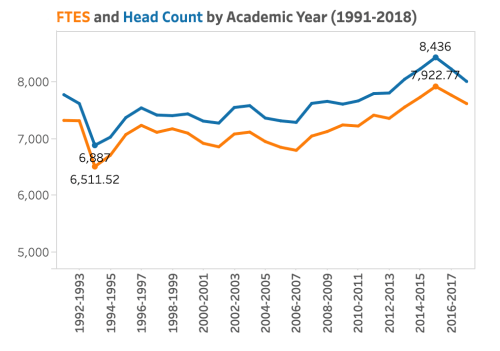
Enrollment numbers are down and Humboldt State University is looking for ways to keep them stable. With just 6,900 students enrolled in 2019, administration and faculty are exploring recruitment strategies and program changes to stimulate growth on campus.
Vice President of Enrollment Management Jason Meriwether is on the front lines of the enrollment situation.
“We’ve lost well over 2,000 students in the last four or five years,” Meriwether said. “It’s a symptom of a few things. We’re graduating larger classes and our graduation rate has gone up. So that does have an impact. Part two is from a recruitment standpoint. There have been a number of things in place that have changed this year to get us to be a viable recruiting option.”
Humboldt State University enrollment has declined to around 6,900 students in 2019. | Graph adapted from HSU Office of Institutional Effectiveness
Meriwether divided the recruitment efforts into three elements. First, the school got rid of barriers to campus visitors like fees for preview day, parking and lunch. Second, the Division of Enrollment Management is focusing its efforts to draw students from local communities to the campus. Third, the school is using data-driven strategies to make enrollment and engagement decisions.
“We’re using data analytics to mine our top feeders and where we’re getting most of our applications,” Meriwether said. “And we’re using that type of data to make decisions about where we put our time and our energy for the maximum benefit for HSU. We want the community to know HSU is a first-choice university.”
“I think that budget component has overshadowed the fact that we still have students here to serve.”
Casey Park Former chair of the University Center Board of Directors
Historically, HSU regarded low enrollment in a more negative light. A decrease in student enrollment was correlated with a decrease in campus revenue, and campus policies reflected the budget deficit. Casey Park, former chair of the University Center Board of Directors, offered some insight.
“I think that budget component has overshadowed the fact that we still have students here to serve,” Park said. “And the narrative for the last two years was that we just didn’t have enough.”
To help staff make decisions based in reality rather than through hypothesis and conjecture, the Office of Institutional Effectiveness provides data and information to faculty and staff. Lisa Castellino, the associate vice president of the Office of Institutional Effectiveness, acknowledged student resources being out-of-date with the current demographic.
“We have a student demographic that has changed over the last five to seven years,” Castellino said. “It has become more diverse. There are more first generation students. It’s more low income. It’s the institution’s responsibility and priority, and it has been the last five to seven years, to help students, because going to college is complicated.”
Thus, on-campus resources are evolving. With low enrollment, Molly Kresl and the Clubs and Activities office said they are being more deliberate and intentional with campus programming by engaging students in a way they prefer.
Meriwether and Enrollment Management said they are promoting HSU’s educational experience to potential students in Humboldt, Siskiyou and Trinity Counties as a first choice rather than a backup. Beyond administration, academic departments are attempting to provide quality education for their students, regardless of enrollment numbers.
“Often during times of change is also our greatest opportunity for growth,” Kresl said. “We stop doing things that really aren’t working that we’ve just done forever because we’ve always done it that way, and we start saying, ‘Okay, then why are we doing this?’”
Why HSU should bring back baseball in the post-football era
It has been over a year since the Humboldt State University football team played their final game ever, leaving local sports fans wondering how we are going to fill the void the HSU football team left in its wake.
Now that I’ve had some time to get used to a fall semester without the green and gold jerseys at the Redwood Bowl, it’s begun to feel more normal for HSU to be a school without a football team.
I know that bringing back the football team, at least in the near future, is an idea that seems like a pipe dream. Once you cut a program that was as much of a financial strain as the football team was, it is really hard to justify bringing such a program back. I think we need to explore alternatives of bringing back other, less expensive sports to HSU, and I know exactly what sport it should be.
Humboldt State needs to revive its baseball program, and I know that HSU baseball would be very well supported by the community.
For one, sports fans in Arcata and the rest of Humboldt County love baseball. There is no bigger example of this than the support that Arcata’s summer collegiate baseball team, the Humboldt Crabs, receives every summer from June until early August.
“From a baseball perspective, an HSU baseball team would be a huge benefit to both the athletes that would play here and the Humboldt Crabs organization.”
Liam Warner
Experiencing a Crabs game is one of the purest forms of Arcata that you will ever experience. From the world-famous Crab Grass Band to the unique heckling coming from the fans, thousands of people pack the Arcata Ballpark every summer to watch the Crabs play. Unfortunately, this is when most of the student population is home for the summer.
Another reason why an HSU baseball team would be easy to start is because finding a facility to play at won’t be a problem. The Arcata Ballpark, which is located right next to Arcata City Hall, is considered to be one of the best ballparks on the summer baseball circuit. For a Division II baseball school, I’m sure we would have one of the best baseball facilities on the West Coast.
Having an HSU baseball team that plays at the Arcata Ballpark would also give fans a lot more opportunities to watch baseball in downtown Arcata. Typically, college baseball season runs from February into late April. The Humboldt Crabs season starts in late May or early June, meaning that we would have six months of baseball with a gap in May between the seasons.
I’m sure extending the season of high-level baseball in Arcata would provide a boost to the economy downtown, as it would allow the opportunity for more people to watch quality baseball at the ballpark.
From a baseball perspective, an HSU baseball team would be a huge benefit to both the athletes that would play here and the Humboldt Crabs organization. The Crabs draw quite a few of their homegrown players from the College of the Redwoods baseball team, so an HSU baseball team would naturally become a feeder of players to play on the Crabs during the summer.
HSU Jacks players would have the opportunity to continue their season on a well-established summer baseball club, and the Crabs would have a local pool of baseball players they could pick from.
Ultimately, it’s up to HSU athletics to make the decision to bring back a sport. But I think all of the factors are there to make an HSU baseball team a successful part of the community.
HSU notifications lack conviction or specific plans of action
If you’ve checked your email at all within the past couple of months, you’ve most likely read one of the several notices Humboldt State University sent to the campus in regards to incidents of vandalism, racist messages or off-campus crimes.
Just this semester, HSU notified students via email of numerous instances including racist graffiti on Dec. 7, racist vandalism in a residence hall restroom on Nov. 13, anti-Semitic flyers put up around the campus on Oct. 25 as well as on Sept. 17 with an email notification of a stabbing that happened off campus.
An HSU notification sent out Dec. 7 regarding racist graffiti found on campus.
The emails for the first three incidents listed came a day or less after the occurrence and after the police department had found and cleaned up the perpetrators’ messes. However, the notice about the off-campus crime was sent out a month after the crime itself, which was the stabbing of a student on Aug. 26. HSU seemingly weighed in to clarify because, “recent media accounts and headlines about the incident were filled with many different narratives.”
Each message HSU sends follows a general formula.
One paragraph is what the University allots for all of these incidents of crime on or near campus. They follow it up with multiple paragraphs about how the University has no place for racism or violence, and provide the usual list of resources students can take advantage of if they need support.
But aside from erasing the evidence of the crimes and repeating where students can go ad nauseam, they have never taken any direct action to combat the trend that is clearly going on.
The messages claim that the University Police Department is investigating these issues, but they have not given any further information as to what they actually plan to do to prevent any further instances of hate speech or vandalism in the future.
Students have a right to get their education at a school that strives for active protection, not just passive written defense.
Benjamin Zawilski
El Leñador reported that “the NAACP penned a letter in April of 2018 condemning HSU’s administration for failing to take an active role in addressing racism and safety concerns in the City of Arcata and Humboldt County, thus endangering the lives to whom it extends acceptance letters.”
HSU students ought to be able to trust the administration of their school to communicate with them in these situations. But the administration’s lack of vigilance and initiative extends even to direct threats to the safety of students. Last April, they took almost a full 24 hours to send a message that a student had committed assault on campus.
The administration will not show any sign of actually protecting the safety of the students like they claim to until they take real steps to improve their transparency.
Students have a right to get their education at a school that strives for active protection, not just passive written defense. The first step might be for administration to disclose crimes that have happened before they have absolutely no choice but to do so.
HSU administration cannot tell student media what to publish
Press at any capacity in the United States is protected by the First Amendment against federal censorship of speech. The government cannot make editorial decisions, retractions or content suggestions. Student press publications in California are protected not just by the First Amendment, but also by the California Student Free Expression Law of 1977, or California Education Code 48907.
When a government entity such as a state university interferes with the press by policing publications on what is appropriate to publish, it inhibits the independence of the press.
Recently, Humboldt State University administration sent out a school-wide email regarding material printed in a student parody newspaper, called The Dumberjack, found in an insert in the Nov. 20 issue of The Lumberjack.
The public announcement accused the students in the parody news class that produced The Dumberjack of reinforcing rape culture and gender-based discrimination through a photo that depicted a “sexist ‘riddle’” which was displayed on a sign in a window of an all-female room at the College Creek Apartments.
The school administration held The Dumberjack staff responsible for a joke on a sign they did not create nor stage. A student-journalist outside of the parody news class observed and documented campus culture with this photograph. The parody news class simply featured it in the paper and in no way amplified any perceived gender-based discrimination with the story that ran alongside the photo.
Parody facilitates the palatability of relevant information through comedy.
No one in The Dumberjack class or on The Lumberjack staff supports gender-based discrimination or wants to reinforce rape culture. But journalism, of any kind, is not public relations. The publication of a photo of a sign on campus does not represent endorsement of what the sign says. Journalism draws attention to troublesome realities by documenting them and showing them to the public. When a publication reveals a sign that a university finds offensive, the university’s focus ought to be on the sign, not on the journalists who documented it.
Administration officials invited the class to have a conversation to “discuss the impact and implications of the cover photo.” The meeting was intended to be an open dialogue surrounding the development of “critical lenses.”
Instead, on Thursday, Dec. 5, the class became the site of a direct act of administration intimidation.
Two school officials—only one of whom had been momentarily invited—came to the class and lectured journalism students on how to make editorial decisions. Chair of the Sexual Assault Prevention Committee Kim Berry and Dean of Students Eboni Turnbow, both of whom are government employees, reprimanded a class of students educated in journalism ethics.
The administration is demonstrating unprofessional behavior of questionable legality by attempting to contain this incident and filter what student press can and cannot print. The administration cannot tell student media what to publish.
Parody writers take real world situations and use a critical lens to highlight a topic in a juxtaposed way. These satirical pieces can sometimes be offensive, but the key is that the subject matter is still being discussed.
The goal of parody is to create a dialogue on topics that are either overshadowed or too controversial to be discussed openly. Parody facilitates the palatability of relevant information through comedy.
The First Amendment protects speech, including satire and parody. Satire and parody are used as impressionistic language that aim to create commentary on sensitive issues through the use of humor, absurdity and exaggeration. Utilizing these writing tactics serves as a more approachable way of tackling uncomfortable yet prominent issues.
Journalists aim to relay information in the most accurate and concise manner as possible. Censorship defeats that purpose. The government censoring the media is illegal and obstructs the transparency of journalism. It creates bias and subjectivity, as journalists become fearful of backlash for what they print.
When censorship appeases a specific group of people, it’s a domino effect. Censoring one thing for a single group leads to censoring all material to please everyone. That defeats the purpose of journalism as an independent eye intended to expose overlooked issues.
In today’s political climate, journalists are constantly under fire. The fourth estate, journalism, is as vital to uphold as the fifth estate, non-traditional media like parody news. When federal figures undermine the editorial freedom of a publication, even a parody news publication, a slippery slope follows in which government infringes upon the freedom of the press.
The students behind the sign comparing Humboldt to genitalia discuss their curated material
Humboldt State University has been abuzz in the last few weeks with speculation about a photo of a joke written on a sign by women. This photo, taken by myself, was printed in a parody newspaper, The Dumberjack. The Dumberjack, while produced as parody of The Lumberjack, is created as part of a separate class.
The stated intention behind the sign was to poke fun at the Humboldt County climate by relating the rainy weather to female genitalia. Six girls, Caroline Voorhees, Marian Porter, Rashell Martell, Sabrina Ott, Shannon Coburn and Whitney Burns, live in a College Creek apartment together. The original creator of the sign was Caroline Voorhees, but all of the girls have their own take on the sign’s meaning.
Question: What are your feelings toward the sign?
Marian Porter: “I personally thought it was funny. There definitely were no negative intentions for the sign. Before Caroline puts out a new sign, we all give our consent to what is being represented to our dorm.”
“I guess I am sort of happy the school takes things seriously, but they should focus on other things because there are other things more important than a dorm sign.”
Rashell Martell
Caroline Voorhees: “I felt bad that I might have hurt someone’s feelings and hurt their day. Being the person who wrote the sign, I never would have thought about it as being non-consensual. I wouldn’t want to hurt someone’s feelings or make them feel like I was making light on their bad situation. That wasn’t what I was trying to do, I was trying to talk about sex culture and have fun.”
Whitney Burns: “I also think anyone can read anything and take it in a wrong way which shouldn’t stop people from making jokes.”
Rashell Martell: “I was actually the one to find out our sign was the one being talked about in the email and I mentioned it to everyone in our group chat. More or less I found it funny. Even though I didn’t make the sign, I gave consent for the sign to be put out. I guess I am sort of happy the school takes things seriously, but they should focus on other things because there are other things more important than a dorm sign.”
Shannon Coburn: “I didn’t think anything of it and I thought we had so many worse signs. I could see how you can take it that way if you wanted to, but it was weird that they focused their time on a sign and not things that are actually happening on campus.”
Sabrina Ott: “It seems like they blew things out of proportions and it doesn’t seem like something people are focusing so much on. I also felt really bad for the newspaper. We were more worried that the newspaper took fault for something we did.”
Question: Did you think the sign meant what HSU administration decided it meant?
Caroline Voorhees: “When you are in a frame of mind to read something negatively you will. Whoever misinterpreted my joke must have been having a bad day, or had a friend that had a bad encounter, and that wasn’t the purpose of the sign. I feel bad for those people who are going through something in their life in order for them to think that statement was negative, because it was a positive statement.”
Question: How did you personally come up with the joke?
Caroline Voorhees: “It started off as just a joke living in Humboldt where it is raining all the time, but the other part came about because I did a paper on sex positivity and culture about sex and how it is not talked about often. It is definitely shamed, for women especially. So I tried to incorporate that with the weather and being sex positive and how you should enjoy yourself before you have sex with someone and how everyone should be happy all the time.”
A message from the whole dorm: “We do take people’s opinions and complaints seriously and we are sorry that we hurt anyone’s feelings, but that is not going to change our sense of humor and we will try to be more mindful in the future.”
Students from various majors hone their argumentative skills
With winter break fast approaching and students preparing for finals, Humboldt State University’s debate team is pushing through with consistent practice sessions and preparing for scheduled competitions that start as soon as the spring semester begins.
Responding to a topic may seem like an easy task, but compiling synchronized responses with a teammate can be overwhelming, especially when the goal is to not contradict each others’ claims.
“Try publicly speaking about controversial issues, not knowing whether or not you will be speaking for or against your own values until 15 minutes before you have to do so.”
Kimberley Nguyen
Kimberley Nguyen, a philosophy major, is in her third semester with the debate team. She stresses over the challenging lack of preparation time before debates.
“Public speaking on its own is a difficult task,” Nguyen said. “Try publicly speaking about controversial issues, not knowing whether or not you will be speaking for or against your own values until 15 minutes before you have to do so.”
HSU’s debate team is currently practicing the British parliamentary debate method as they prepare for spring. This consists of team members pairing up, debating sides and creating counter arguments.
During one of their practice sessions, assistant coach Olivia Gainer presented the teams with the topic. The topic surrounded the opening monologue of “All the World’s a Stage” from William Shakespeare’s play, “As You Like It.” The four teams proceeded to exit the room to prepare and come back later with their responses.
“The team dynamic is definitely important and affects the way each round goes, it helps balance arguments off each other,” Gainer said. “Right now I’m looking at how well the team dynamic is and will give my input on their performance.”
Research and compiling a strong argument is a must. With evenings being the only time frame to practice their tactics, the debate team optimizes their time wisely to alleviate obstacles in later competitions.
HSU’s debate team is open to all and brands itself as a competitive sport. Exercising one’s mind to develop well constructed argument is as crucial as athletes utilizing their plays to put points on the scoreboard.
Georgetown study shows HSU graduates receive lowest pay over 40 years
Humboldt State University has the lowest earnings for graduates out of all 23 California State Universities, according to a recent Georgetown study.
The study said the average HSU student makes $752,000 within 40 years after graduating, which makes HSU the lowest earning CSU on the list. The average for other CSUs was around $1 million. For comparison, Chico State students reportedly made $1,018,000, while CSU Los Angeles students averaged $1,019,000.
The study measured the value of a college degree in net present value. According to the study, NPV is how much a sum of money in the future is valued today. According to Telegram.com, “this metric includes costs, future earnings and the length of time it would take to invest and earn a certain amount of money over a fixed horizon.”
“I believe it’s very important to think about the fact that the 30, 40, 50 years of a person’s working life are a lot more satisfying if it’s a job you enjoy and allows you to do the things you are passionate about.”
Alison Holmes
This fixed horizon is split into increments of 10, 15, 20, 30 and 40 years. This number is calculated by subtracting the amount of money a person can make at a minimum-wage job over that same time period, as well as taking into account student loans. This number contrasts against working a job that doesn’t require a degree. The result is the return on one’s investment.
Alison Holmes, associate professor in the Department of International Studies at HSU and a participant in the development of the career curriculum for the arts and humanities, believes the study isn’t taking enough into account.
“The frame of this research is clearly about size of income over the years after graduation,” Holmes said. “And while I would never say that is unimportant, I believe it’s very important to think about the fact that the 30, 40, 50 years of a person’s working life are a lot more satisfying if it’s a job you enjoy and allows you to do the things you are passionate about.”
Gina Kelble, an HSU freshman who sees herself going into environmental law, expects to make a decent living.
“I’ll probably end up going to [University of Colorado] Denver or CU Boulder for grad school,” Kelble said. “I have connections back at home through past internships, so those will be stronger than my Humboldt ones.”
Kelble is confident in her ability to get into grad school and dodge the bullet of making the average income of an HSU graduate.
“The study also makes the point that it’s about knowing yourself or, put another way and as I say to students, choices have consequences,” Holmes said. “There is nothing wrong with wanting money, if that’s lots and lots of money or just basic financial security. But you need to be clear that jobs have a pay scale. As a society we can work to get better pay for people, but for now, it is important to think about jobs with a very clear understanding of the pros and the cons of that choice.”
Holmes said that while money is a necessity, it stands among many others things that should be taken into account.
“As long as we send students into the world prepared to do what they want to do and always striving to fulfill their amazing potential, I am not going to spend too much time worrying about a study based on a scale based on the size of a paycheck,” Holmes said.
Humboldt State has no direct input on chancellor search committees
No one from Humboldt State University sits on the search or advisory committees for the next CSU chancellor, and the closest forum to give feedback to the committee is in Sacramento.
“It’s roughly a dozen people on these committees combined, and unfortunately,” CSU Senior Director of Public Affairs Mike Uhlenkamp said. “Unfortunately we’re not able to get that far north because of the travel considerations.”
The CSU Board of Trustees has appointed a search committee and an advisory committee to select the next chancellor. The search committee includes the Board of Trustees Chairman Adam Day, the vice-chair, current CSU Chancellor Timothy White and eight other trustees.
The stakeholder committee includes two CSU faculty representatives, a staff representative, a student representative, an alumni representative and two campus president representatives. These representatives hail from Sonoma State, San Francisco State, CSU Sacramento, San Diego State, CSU San Marcos, California Polytechnic San Luis Obispo and Cal Poly Pomona.
“There isn’t currently anyone from HSU on those committees,” HSU Communications Specialist Grant Scott-Goforth wrote in an email.
According to CSU data, graduation rates are currently at all-time highs. Four-year graduation rates for first-time college students have risen from 19% in 2015 to 27% in 2019, and six-year graduation rates have risen from 57% in 2015 to 62% in 2019.
The two committees are currently undergoing what they are calling a “listening tour” to gather feedback for the search process.
“It’s a fairly tight group and so they went with, for all intents and purposes, the leaders from those groups,” Uhlenkamp said.
Four public forums at Sacramento State, CSU East Bay, the Chancellor’s Office and Cal Poly Pomona were held on Nov. 12, 13, 20 and 22, respectively. Two more public forums were held on Dec. 3 and 5 at CSU San Marcos and Fresno State.
All of the forums can be streamed or viewed online, where you can also submit feedback.
“We are 23 campuses, one university,” Uhlenkamp said. “So we’re looking for everyone to provide some sort of feedback. And everyone’s going to have different forms of feedback, and one of the great things about the University is that we’re so diverse and so different.”
White announced his plan to retire on Oct. 22. He has served as chancellor since 2012 and will remain chancellor until the end of the 2019-2020 academic year.
White, a first-generation Argentinian-American, most notably launched in 2015 the Graduation Initiative 2025, a CSU-wide push to increase graduation rates.
According to CSU data, graduation rates are currently at all-time highs. Four-year graduation rates for first-time college students have risen from 19% in 2015 to 27% in 2019, and six-year graduation rates have risen from 57% in 2015 to 62% in 2019.
“The Board of Trustees is very pleased with the current direction of the University,” Uhlenkamp said. “And by direction, I refer to the fact that enrollment is close to an all-time high, graduation rates are at all-time highs, the funding from the state of California is at an all-time high. The dollars that we receive from donors is also at an all-time high—so it’s effectively a golden age of being a CSU student. So they want to maintain that trajectory.”
Uhlenkamp said the committees will take the feedback they receive over the next two months to make a position description and then use that to gather a pool of candidates. Following multiple rounds of interviews, the committees will choose a group of finalists to be interviewed by the full 25-person Board of Trustees.
“More than using students as photo opportunities, we need a Chancellor who will do whatever it takes to secure what students need to succeed.”
Uhlenkamp said the committees want someone who can maintain the current CSU trajectory while also bringing their own vision. As for the longevity of the next chancellor, Uhlenkamp said current higher education leaders tend to serve for shorter lengths than in the past.
“While, yes, we do want to have consistency, I don’t think that there is a specific number put on how long they want this individual to serve for,” Uhlenkamp said.
On Nov. 20, the California Faculty Association wrote an open letter to the CSU Board of Trustees detailing its desires for the next chancellor.
The letter began by asking for a chancellor dedicated to student success.
“More than using students as photo opportunities, we need a Chancellor who will do whatever it takes to secure what students need to succeed,” the letter said. “Knowing that success means more than four-year graduation rates, our new Chancellor should be committed to helping students follow their own paths unfettered.”
The letter went on to call out the lack of labor representation in the stakeholder committee, calling it “a serious oversight.”
“We need a leader who will change the toxic culture of disrespect for labor at the CSU, and value the work of all employees who serve the system,” the letter said.
The letter ended with a request for an open search process allowing participation.
“We look forward to working with a new Chancellor who will partner with us in these efforts,” the letter concluded.
The committees expect to select the next chancellor by summer 2020.
Dennis K. Walker Greenhouse provides a haven for a diversity of plant species
A sky full of grey clouds smothers the sun and with a chilling breeze even the most layered person shivers down to their toes. One step into the Dennis K. Walker Greenhouse transports you away from the cold into a world of warm, enticing, vivacious plants.
There are six rooms in the greenhouse: temperate, tropical, desert, fern, aquatic and the subtropical dome. Each room has an appropriate climate and a resident community of plants. Greenhouse manager Brianne Lee, along with student assistants Dabid Garcia and Courtney Harris, maintain the greenhouse at Humboldt State.
The entrance to the primary green room at Dennis K. Walker. | Photo by Deija Zavala
Leaves of a gum palm, otherwise known as a dioon spinulosm, in the subtropical dome. | Photo by Deija Zavala
Inside the Subtropical Dome at the Dennis K. Walker Greenhouse at Humboldt State University. | Photo by Deija Zavala
Anthurium scherzerianum, known as flaming flamingo, is generally native to Central America, but can be found in the Tropical Room at the greenhouse. | Photo by Deija Zavala
Spike Moss, selaginella biformis, in the Fern Room at the Dennis K. Walker Greenhouse. | Photo by Deija Zavala
Artocarpus heterophyllus, known commonly as jackfruit, in the Tropical Room. | Photo by Deija Zavala
“Essentially, the greenhouse is a living museum,” Harris said. “It’s something that we are trying to preserve here and not kill with love.”
The large botanical collection contains more than 1,000 species of plants belonging to 187 families. According to the Department of Biological Sciences website, students and faculty studying botany and biology use the greenhouse and its plant life to research and learn.
Harris, a botany major, said the greenhouse is a magical place, especially since there are only two student positions. After transfering from the College of the Redwoods in 2017 Harris was hired as an assistant.
“It feels like a unique experience being that this is such a cool staple and an important part of the botany program,” Harris said.
The job of a greenhouse assistant consists of maintaining the facility and its residents residents, which means sweeping the rooms, hand watering plants, managing pests and propagating plants.
“Essentially, the greenhouse is a living museum. It’s something that we are trying to preserve here and not kill with love.”
Courtney Harris
Garcia, a rangeland resource science major, said that there’s a lot of care and research that goes into the plants, but the goal is to make sure the plants are happy and thriving.
“Every species needs their own little formula of fertilizer,” Garcia said. “Some require more nitrogen than phosphorus and some others more potassium. We have to do our own research and sometimes that research isn’t available, so we’ll give the plant fertilizer and see how the plant reacts to it. A lot of our plants are really rare in the wild.”
The trio look out for signs indicating whether something might be wrong, such as droopy leaves and discoloration. The team also checks soil moisture levels, but all plants indicate issues to caretakers in unique ways.
Greenhouse Assistant Courtney Harris inspects a Bird of Paradise, strelitzia reginae, plant. Part of Harris’ job is to help plants pollinate. | Photo by Deija Zavala
Brooke Sharp, a child development major, explores the Fern Room at the Dennis K. Walker Greenhouse. | Photo by Deija Zavala
Inside the subtropical dome, flowers in bloom adorn many of the residents. | Photo by Deija Zavala
The Twin Spined Cactus, known scientifically as mammillaria geminispina, in the Desert Room. | Photo by Deija Zavala
Greenhouse assistants Dabid Garcia and Courtney Harris pose in the sub-tropical dome at the Dennis K. Walker Greenhouse. | Photo by Deija Zavala
“The biggest challenge is understanding how each plant reacts and responds to the care that we give it, and adjusting our behavior accordingly,” Harris said. “It requires a tremendous amount of teamwork and communication between us.”
Harris added that some plants don’t like attention while others, if left alone, will wilt and die.
Mihai Tomescu teaches plant morphology, plant anatomy, paleobotany and general botany. The trio’s work supports Tomescu in the botany department, as well as supporting the biological sciences. Faculty often use plant specimens during lectures and labs.
“Plants don’t move, and yet they are exposed to pretty much the same challenges that we are exposed to in terms of surviving. There’s all sorts of stressors. They have to procure their food and because of that, just like other types of organisms, have to have some type of behavior.”
Mihai Tomescu
Tomescu said his area of expertise and research is plant structure, including topics like how plants are put together, how they grow, how they look and how their features evolve over generations. Some of his methods include digging deep into geologic time.
“I know how they grow at the cellular level,” Tomescu said. “So coming from that perspective, I realized that one of the most fascinating things about plants that people don’t realize is that compared to us animals, and compared to what we think of in our culture about aliens, is that plants are more alien to us than the craziest aliens that human imagination has come up with.”
In his classes, Tomescu has his students visit the greenhouse three to four times a semester for assignments and brings live samples for labs when examining roots, leaves, stems, cells and other internal parts of plants.
“If you have a big botany program that emphasizes organismal biology, the diversity of plant groups and so on, then it makes sense to have something like this,” Tomescu said. “How else are you to teach your students about the diversity of plants if you can’t show it to them alive.”
Some people may question the general interest in plants because at the surface they seem not to do anything. But Tomescu said that if you are able to slow down and get pass the green blur of a forest of plants, you’ll come to find some interesting organisms.
“Plants don’t move, and yet they are exposed to pretty much the same challenges that we are exposed to in terms of surviving,” Tomescu said. “There’s all sorts of stressors. They have to procure their food and because of that, just like other types of organisms, have to have some type of behavior.”
Courtney Harris pets the cone of a dioon spinulosm in the subtropical dome. Harris was enthralled by the cone’s soft texture. | Photo by Deija Zavala
Some plants, like this one, keep pollen outside their flower ready to be blown off by wind gusts. | Photo by Deija Zavala
Because the Dennis K. Walker Greenhouse doesn’t have the aid of natural pollinators like birds and wind, assistants sometimes take pollen carefully from one plant to another. | Photo by Deija Zavala
Plant behavior is what a plant does, including how it grows. According to Tomescu, plants have control of their growth, from the depth of their roots to the direction of their leaves.
“The plant makes a lot of choices because growing in one direction or another means spending energy,” Tomescu said. “It’s very calculated — not consciously calculated– but basically plants sense their environment very well.”
In the broader sense, he said that plants make him think. Tomescu hopes more people will become interested in plants since they are so different compared to other life forms.
“It’s kind of exhilarating to realize that we live next to these super weird organisms,” Tomescu said. “It maintains this fascination that there are these organisms that do the business of living in a very different way from us.”
The Dennis K. Walker Greenhouse is available to instructors and students in the Department of Biological Sciences, and access is limited by the availability of instructors or greenhouse staff.
It is open to the public by appointment or when greenhouse staff are available. If you are interested in making an appointment contact Brianne Lee at 707-826-3678 or schedule a visit via email at bms561@humboldt.edu.
Martin Wong’s lost art reemerges to bring awareness to a new generation
Designer street style brand Supreme’s new collection highlights the life and art of Martin Wong.
Wong, who embodied creativity, empathy and empowerment, lost his battle against an AIDS diagnosis in August of 1999, but his artwork continues to inspire and act as socio-political commentary after his death.
Wong attended Humboldt State University in 1964, enrolling himself in every available art class before focusing his studies in ceramics. After graduating, Wong left the comfortable walls of university-life to influence the art scene and bring widespread awareness to minority groups often overshadowed by society.
Wong’s family, friends and supporters partnered together on a collaborative collection with Supreme showcasing Wong’s lost works.
“Tell My Troubles to the Eight Ball (Eureka)” 1978-81 | Courtesy of the Estate of Martin Wong and P·P·O·W, New York
Example from the Fall/Winter 2019 Supreme clothing line featuring Martin Wong’s work.
Example of the Fall/Winter 2019 Supreme clothing line featuring Martin Wong’s work.
Example of the Fall/Winter 2019 Supreme clothing line featuring Martin Wong’s work.
Anneliis Beadnell, Senior Director and Director of Estates at P.P.O.W Gallery, a contemporary art gallery in New York that represents Wong and his work, explains Wong’s appeal to Supreme.
“Over a year ago the artistKAWS, who is a good collector and friend of P.P.O.W, approached us to see if the Estate of Martin Wong would be interested in supporting a collaboration between Martin Wong’s work and Supreme,” Beadnell said. “The Estate was supportive, Martin’s circle of friends were encouraging and the collaboration felt right on many levels.”
The collaboration, as well as the overwhelming support towards the partnership of artist and brand, reinforces the importance of Wong’s legacy, advocacy and support represented through his artwork.
“Since Martin was interested in cultures that lived on the fringe of society, or outside the realm of the ‘art world,’ we felt that this collaboration would be successful in bringing his imagery into a new demographic.”
Anneliis Beadnell
“Through Supreme’s platform, a new generation who may not have had access to the works through visiting galleries or museums, will have a new way to enter into his work,” Beadnell said. “Since Martin was interested in cultures that lived on the fringe of society, or outside the realm of the ‘art world,’ we felt that this collaboration would be successful in bringing his imagery into a new demographic.”
Like most of Wong’s art, the graphics showcase political and sometimes controversial subjects. Elements of poverty, misfortune and ruin bring attention to the unfair and inhumane treatment of minority groups. Encapsulating inclusion and representation was Wong’s strong suit.
The ability to take those underrepresented into the spotlight ripples throughout his work. Idolizing the “unprofessional” and disrespected street artists allowed for new perspectives to emerge not only in Wong’s works, but in the art world in general.
“In his lifetime, Martin gathered one of the largest graffiti collections in the world,” Beadnell said. “Martin turned to his friendship with the graffiti [artists] for collaboration and inspiration in his own works, which often took them as the subjects of various paintings.”
According to Beadnell, Wong also created several paintings with skateboarders as the primary subjects, like “Sweet ‘Enuff,” a 1987 painting which is in the collection of the de Young Museum in San Francisco.
Capturing moments ignored by mainstream society gifted Wong the ability to cast a new light on the struggles and discrepancies in subcultures, raising widespread awareness in the art world.
“Big Heat” 1988. | Courtesy of the Estate of Martin Wong and P·P·O·W, New York
“Sharp Paints A Picture” 1997-98. | Courtesy of the Estate of Martin Wong and P·P·O·W, New York
Iglesia Pentacostal 1986. | Courtesy of the Estate of Martin Wong and P·P·O·W, New York
Amigos 19xx. | Courtesy of the Estate of Martin Wong and P·P·O·W, New York
“Malicious Mischief” 1997-98. | Courtesy of the Estate of Martin Wong and P·P·O·W, New York
This type of socio-political activism is still growing today, but there is a need for inclusion of identity and culture regardless of differences. Beadnell emphasized this and said the goal of the collaboration with Supreme was to reinforce those ideals with younger generations.
“Wanting to extend his demographic outside of the ‘art world’ speaks to wanting to continue his legacy of influence and inspiration as an artist,” Beadnell said. “There is a strong youth culture that follows Supreme and the collaboration with Martin’s work may open a door for those that purchase the items and want to learn about Martin Wong’s contribution to our visual history and culture.”
Wong’s work revolutionized the stigmas that dismissed groups from society, specifically focusing on the disadvantaged and underrepresented. From sexual orientation and economic standing to uncontrollable impairments, capturing the essence of groups often labeled insignificant or unworthy earned Wong his title of an activist and a visionary.
“Being that Martin was a gay Asian American, we hope this level of visibility will inspire others, that may have shared histories and identities, to look to Martin as a point of inspiration.”
Anneliis Beadnell
“Martin’s paintings connect to the denizens of the Loisaida, the crumbling tenement bricks and urban landscapes, the places where creative subculture thrived and since has been erased by gentrification,” Beadnell said. “The iconography that emerged through Martin’s depiction of the Lower East Side, of closed storefronts, firemen, ASL symbols, constellations and flaming eight balls became graphic points of interest for the line.”
The re-emergence of previously destroyed creative outlets allows the newer generation access to the extinguished memories and documentation of the past. The revamped accessibility stems with the hope of generating more activism for the future.
December 1 is World AIDS Day, recognizing and bringing awareness to the pandemic caused by HIV and mourning those who have died from the disease.
“Being that Martin was a gay Asian American, we hope this level of visibility will inspire others, that may have shared histories and identities, to look to Martin as a point of inspiration,” Beadnell said.
A week of open dialogue to learn about cultures within the Humboldt community
This week, Humboldt State kicks off its annual Campus & Community Dialogue on Race workshops. Starting Nov. 4 and lasting through to Nov. 8, the theme is Dismantling & Deconstructing To Build.
Lectures and workshops offer an opportunity for people to come together and have an open dialogue to learn about subcultures within the community. The workshops are open to all students, faculty and locals.
Programs cover topics such as intersectionality, racial justice, mental health, election activism and more. A wide variety of workshops are offered throughout the week and provide plenty of opportunities to participate. Workshops include an Intro to Social Justice Seminar, an overview of Critical Muslim Studies and a Dia De Los Muertos celebration that includes food and movies.
Several guest are scheduled to speak in the Kate Buchanan Room, University Center 225, during this event. Assistant Professor of Anthropology at Stockton University Nazia Kazi, Ph.D. speaks on Tuesday, Nov. 5. Director of the Center for Diversity & Inclusion at Sacramento State University John Johnson, Ph.D. speaks Thursday at 5 p.m. Professor and Associate Dean of the College of Integrative Sciences and Arts at Arizona State University Asao Inoue, Ph.D is scheduled to speak Nov. 8 at 10 a.m.
The CDOR started in 1998 as a recognition of America as a diverse society. Their mission statement fleshes out the intent of the multi-day event.
“The vision of Campus & Community Dialogue on Race is to achieve racial, social, and environmental justice,” the statement says. “The program’s mission is to promote and facilitate social and environmental change by engaging a diverse range of individuals, communities, and viewpoints to explore the impact of racism and its intersections with all forms of oppression.”
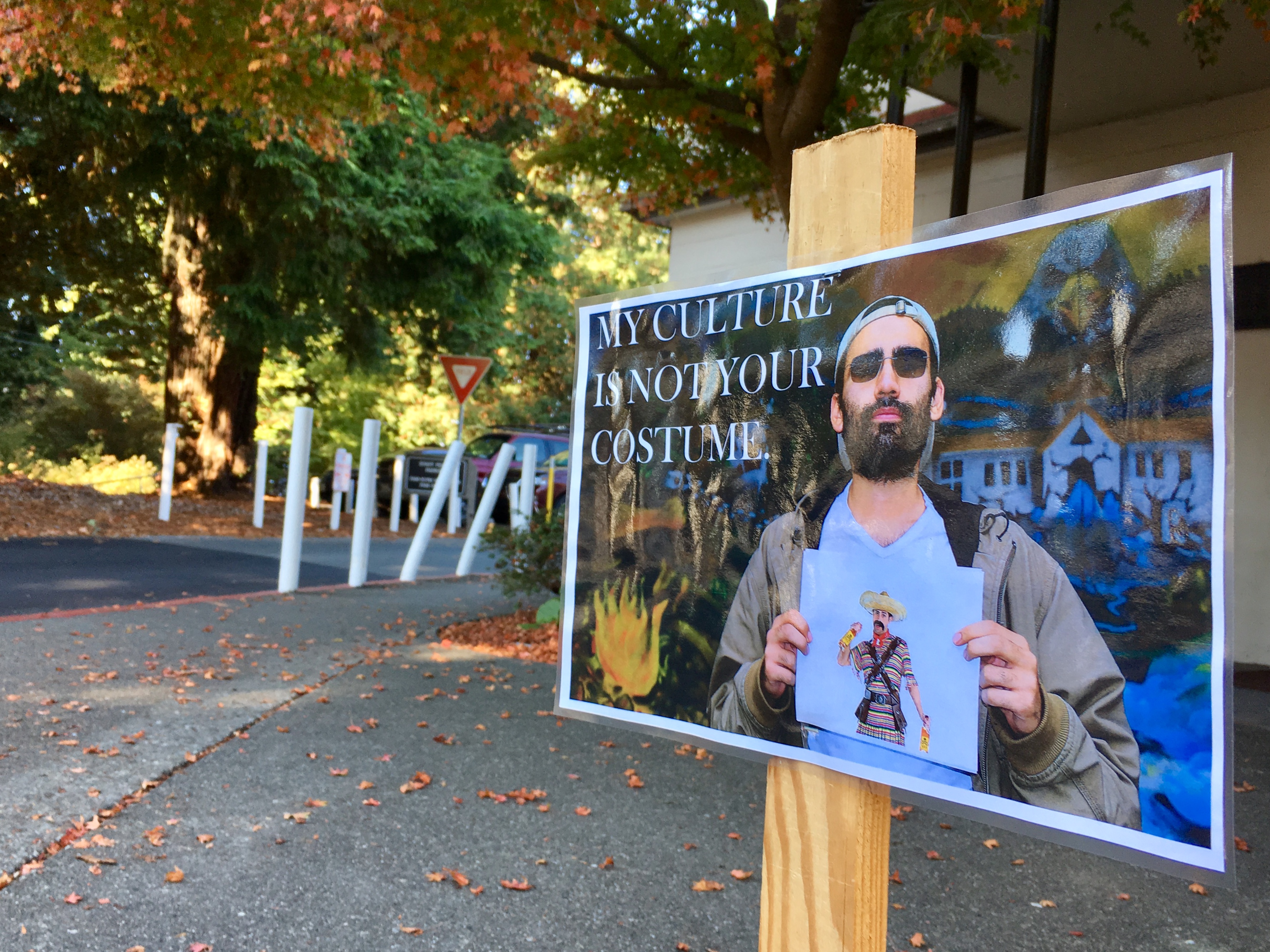
Many costumes portray culture and lifestyle in an insensitive manner
Humboldt State students hurry last minute to piece their Halloween costumes together but find no comfort in commercial Halloween stores as the stores will often have sections full of costumes that are ignorant or insensitive.
Sierra Cosper, a forestry major, expressed her discontent in the commercial Halloween store, Spirit Halloween.
“I went through Spirit Halloween and they had a whole aisle of Pocahontas and it’s not cool,” Cosper said. “It’s 2019, can we move on from that now?”
Students agreed that Pocahontas and Native American themed costumes were disrespectful and unacceptable to wear. Haley Fedalizo, a liberal studies elementary education major, found another commercial Halloween store, Party City, to be disrespectful toward culture and body weight.
“Obviously the [costumes] that are in your face like the Native American one is not okay,” Fedalizo said. “I was literally at Party City yesterday and I saw a “fat costume” and that’s not cool.”
Jose Moreno, a social work major, also found fault in the commercial chain Party City. Moreno practices an ironically ‘fun’ tradition at the store every year. Often losing count of the inappropriate costumes.
“I went through Spirit Halloween and they had a whole aisle of Pocahontas and it’s not cool. It’s 2019, can we move on from that now?”
Sierra Cosper
“When I go to Party City or anything like that, I count how many cultural appropriation outfits there are,” Moreno said. “I’m like ‘there’s one right there, and right there! I lost track.”
Beyond the recognizable commercial chains, the internet continues to advertise culturally insensitive and inappropriate Halloween costumes and accessories.
HSU student Gabrielle Sturm, an environmental studies major, went online to browse for the Halloween season and couldn’t believe what was advertised.
“I was looking up costumes online and I was a little surprised to see how many [inappropriate costumes] there still are,” Sturm says. “I think they’re bad but a lot of people still do it.”
While cultural appropriation continues to popularize social media with cultural awareness movements, HSU promotes a safe and respectful Halloween season. Of course, the message on campus has no influence on commercial chains.
Garage-band veterans rock Humboldt with their psychedelic sounds and brutally honest themes
The CT Bombers are a local band consisting of best friends Wyatt Brenner, Willem Kernkamp, Delphin Browne and Quonton Waull. Brenner and Kernkamp play guitar while Browne and Waull play double drum sets.
The band formed in July 2016 after finishing high school in Temecula, California, where they grew up together and played in numerous bands over a span of 10 years.
After high school, some members of the band relocated to different states, but the separation was short lived. They all eventually ended up in Humboldt and reformed the CT Bombers. Since then, the band has consisted of alternating guitars, drums and vocals to create a garage and psychedelic rock influenced sound.
“The common theme is just spending a lot of money really,” Browne said. “People want to say it’s not about the money, but it is. That’s just the blunt truth.”
The band says the Arcata music scene has been overwhelmingly supportive. Even though the band travels to many different areas, Kernkap says they have yet to find a place as unique as Arcata to display their musical talents.
“The Arcata scene is really, really good for live music,” Kernkap said. “People love to dance and people love new ideas. No one here is stuck up and everyone just wants to dance and everyone doesn’t care if you’re weird. I don’t know what it is, but you don’t get that anywhere else. At least not where I’ve been.”
Brenner is the mastermind behind orchestrating their music and boasts his songwriting contribution.
“I think we thrive more as a live band than as someone you find online. Our internet presence isn’t nearly as big as our chops on the scene.”
Willem Kernkamp
“I learned how to lucid dream, “Brenner said. “And would go into my lucid dreams and just write songs. It sort of all comes together when I bring it to them. They’re the glue, you know? We record, we mix, we master, we send the masters to a pressing plant. Then we make designs for album art.”
They release their music as physical copies, but also on streaming services such as BandCamp, Youtube and Soundcloud.
“I think we thrive more as a live band than as someone you find online,” Kernkamp said. “Our internet presence isn’t nearly as big as our chops on the scene.”
CT Bombers played at Richard’s Goat on Oct. 18. The band will also be releasing their second project with a music video. The name couldn’t be released, but will consist of new material and will be released on most streaming platforms. In addition, they’ll make physical copies through a label created by Brenner.
“We have a label thing that we release our stuff through, just ourselves,” Brenner said. “We call it DataRoomRecords. So we have a website and we will do cassette tapes.”
Along with the release of new material, music videos and shows, the friends have experience touring alongside other bands.
“We haven’t done CT Bombers yet, but we’ve been meaning too,” Brenner said. “I think we are going to plan something for the spring.”
Overall, the band has been more than just shows and money to the four friends.
“It’s nice to be in a real band that actually does stuff, and it’s really fun,” Waull said. “I used to think music was very straightforward and you got to get paid and instant gratification. But I’m learning with these guys, they are showing me that it’s more than that. It’s something we can all be around and do.”
Although areas of Humboldt County have the “all clear” for power restoration, another PSPS may be scheduled for Tuesday morning
Parts of Humboldt have been given the “all clear” to begin line inspections and restorations for the current Public Safety Power Shutoff.
“PG&E notified Humboldt County Office of Emergency Services (OES) that portions of Humboldt County have been given the “All clear” for the weather event and will begin the restoration process as soon as conditions allow,” the latest update from the Humboldt County Office of Emergency Services said.
However, PG&E has also notified the county that another PSPS event may affect Humboldt as early as Tuesday morning.
“PG&E also notified OES that another weather event is scheduled for Tuesday 10-29-19 at 6 a.m. which will also result in a possible Public Safety Power Shutoff (PSPS),” the update said.
OES says it expects “a small window of time” between the two shutoffs, and urges residents to use the time to once again prepare to have no power.
“As always, this information from PG&E is subject to change,” the update said. “Updates will be provided as soon as they become available.”
Playing collegiate sports and taking a full-time schedule is the equivalent of having two full-time jobs
During an online-only episode of “The Shop,” California Governor Gavin Newsom signed Senate Bill 206, or the Fair Pay to Play Act on Sept. 30.
Along with several other former college athletes, Newsom believes college athletes, especially Division I athletes, deserve compensation for their hard work and dedication to the game that makes their “bosses” rich.
“Colleges reap billions from student athletes but block them from earning a single dollar,” Newsom tweeted. “That’s a bankrupt model.”
Despite Humboldt State being a NCAA Division II program, we still agree that our athletes deserve some type of compensation based on the amount of revenue our athletic program brings in.
“The Shop” is a HBO talk show owned under the digital sports media company Uninterpreted. During the episode, Newsom was accompanied by NBA star LeBron James and they both shared the news on Twitter by posting a video snippet.
In a world that is so divided, sports can bring people together. Whether an athlete plays for a professional team or a college team, the support and compassion they receive from fans remains loyal.
In professional sports, athletes sign contracts with a team or an organization. When they sign, they are agreeing to the specific payment details they were offered or that they negotiated with their organization. For collegiate sports, college athletes are offered a scholarship breakdown and have the decision of accepting it or not.
However, anyone who is up to date with our budget crisis around campus knows that our athletic program probably receives close to no money to provide to our athletes. Especially considering that we still have athletes attending HSU out of pocket to participate in an intercollegiate sports.
HSU may not seem like a great example when pushing the idea that college athletes deserve compensation, but the Fair Pay to Play Act doesn’t allow athletes to be paid by their university, it just gives them the leeway to find sponsorship and make money off their hard work.
When we consider professional athletes, endorsement deals are contracted regularly. These deals allow companies to use athletes’ names, numbers and any other marketing facet that’s agreed upon, in exchange for money paid to the athlete. College athletes do not receive endorsement offers, but they still partake in similar marketing techniques that bring in revenue for their college and coaches.
The counterargument to this case states that college athletes are provided a scholarship that pays their tuition and resources that help them get through the academic portion of school.
Although this is true, many fail to realize the dedication and time commitment it takes to be a successful student-athlete. Being a student-athlete is essentially equivalent to holding two full-time jobs: studying and playing. This doesn’t leave time for a job off-campus to provide a steady source of income.
The fact that colleges and head coaches make money off their players’ successes is ludicrous, especially when the players themselves aren’t receiving any portion of that revenue. It is this exact argument that Newsom brought to light.
The proposed bill allows college athletes to receive a portion of the revenue that their college receives and sign endorsement deals like the pro athletes they aspire to be. Although the NCAA fought against the signing of this bill, Newsom stuck to his belief. He proposed providing the NCAA with a grace period to narrow down rules and regulations in hopes of making the transition smooth and effective. Therefore, the bill does not play any effect on college sports in California until Jan. 1, 2023.
Bridging the cultural gap between the campus and community
Douglas Smith drove up to Humboldt State for the first time in 2013 as a transfer student with big eyes for a small school.
Smith was seeking same the small school feeling that he got while attending College of the Canyons, away from his home in Los Angeles. At first, Smith experienced anxiety about being one the few people of color in Arcata, but he found a way to adapt and thrive in time.
Today, he’s the director for the African American Center for Academic Excellence, and is four months into his new role. Smith holds his own college experiences as reference when approaching the job.
“My big benefit to coming to Humboldt State was that I had these opportunities for cultural exchange with different kinds of people,” Smith said.
Smith believes the center should be a place that highlights the black experience and culture, a space where students and community can freely speak and learn. Smith hopes the center will strengthen the campus community and bridge the gap between the campus and locals.
Smith emphasized intercultural exchange as an important part of learning. One way the center achieves this is through Talking Drum, a safe space that gives students the agency to converse over the issues that matter to them.
HSU sophomore Brooklyn Reed is the new facilitator for Talking Drum. She met Smith tabling in the quad and offered some of her ideas on how the center’s discussions could be run.
“I talked to him about how to facilitate it, about what I wanted it to look like, how I wanted to build community,” Reed said. “He was just very, super supportive. Just yes, like, ‘let’s do this!’”
Reed wants to run the discussions the way she learned back home in Los Angeles. She also wants the chief of police to attend some meetings so that the center can hold the police accountable if they disagree with their conduct.
Smith’s approach to working with Reed speaks to how he wants to take a step back when it comes to campus dialogue. For his first couple of months, Smith said he spent the majority of his time listening to student feedback.
“I’m trying to come in with this idea of like, ‘Okay, I have some ideas for things,’” Smith said. “But I really want to learn and listen to what students’ needs are, and identify those needs before I go in and start making decisions here and there.”
In Talking Drum, students have a safe space that gives them the agency to converse over the issues that matter to them. | Photo by Michael Weber
This approach allows the Dean of Students Office to be informed by what the center is doing, versus managing from the top down. Letting students take control of the dialogue means that they will be directly influencing the Dean of Students.
“I have been wanting every [discussion] to be student-led, student-driven, and have that peer to peer connection,” Smith said.
Smith promotes the free exchange of ideas because he believes dialogue and cultural exchange is important to becoming part of the community.
One of Smith’s most profound influences on the way he approaches intercultural exchange occurred in his senior semester spent abroad in Santiago, Chile. When he landed, Smith recognized the feeling of being alone and started to familiarize himself with the local area.
“My experience in Humboldt County and at HSU as the ‘other,’ and learning how to move from a perpetual state of survival mindset to adapting and thriving prepared me in so many ways for my time abroad,” Smith said.
Smith’s directive for the center is a culmination of his experiences learning about other people.
“Having that cultural exchange and different kinds of people allowed me to have more diverse viewpoints,” Smith said. “I’m an extrovert. Inside, I might feel anxiety about me, but I’ve always kind of pushed myself to engage with people.”
HSU’s CAPS is working to combat mental health concerns among HSU students
Rates of attempted suicide in Humboldt County stand far above national and state averages, according to Humboldt State University Health Center Director Brian Mistler, Ph.D.
“Suicide attempt rates in Humboldt County are nearly twice the national and California averages,” Mistler said in an email response facilitated by HSU Communication Specialist Grant Scott-Goforth. “And HSU students face greater systemic barriers to access health care than in other more affluent and less isolated parts of the country.”
An estimated 40% of HSU students felt elevated levels of depression according to a 2016-2017 Healthy Minds Study led by Daniel Eisenberg, Ph.D of the Healthy Minds Network, which performs web-based mental health surveys on college students.
Eisenberg has been leading an analysis of student mental health at all 23 California State Universities. In the 2016-2017 analysis of HSU, an estimated 42% of students had elevated levels of anxiety, while an estimated 4% of students attempted suicide in the last year.
Mistler tied Humboldt County’s lack of expert services to mental health.
“…HSU students face greater systemic barriers to access health care than in other more affluent and less isolated parts of the country.”
Brian Mistler, Humboldt State University Health Center Director
“Mental health is a critical basic need and it’s tied to others like having enough food, shelter and physical health care and safety,” Mistler said in the email. “Psychological needs become more important as chronic resource insecurity increases.”
Mistler clarified that HSU’s relatively high rates of mental health conditions do not appear to be caused by Humboldt itself.
“From what we know today, the increased needs among students appear to be present on the first day,” Mistler said in the email. “That is, it’s not caused by being here.”
Mistler added that many HSU students may arrive with a history of limited health care access.
“It’s also true that many students arrive at HSU having not had access to their fair share of health and counseling services in the past,” Mistler said in the email. “It’s clear from all the data that HSU’s team of health experts do a phenomenal job of helping those students who choose to seek help.”
Counseling and Psychological Services Staff Psychologist and Outreach Coordinator Dr. Elizabeth McCallion in a CAPS office on Oct. 1. McCallion said most students who visit CAPS report positive experiences. | Photo by James Wilde
HSU Counseling and Psychological Services Staff Psychologist and Outreach Coordinator Dr. Elizabeth McCallion is one of the experts working to help students.
McCallion hopes to mitigate the stigma around mental health.
“Mental health support doesn’t just have to be for when you’re having severe symptoms,” McCallion said. “It can be a way of just generally taking care of yourself. Kind of like preventative health care.”
McCallion said CAPS is working to meet students where they are, including through library SkillShops and outreach by Multicultural Specialist Cedric Aaron.
McCallion praised HSU’s mental health services but did acknowledge a lack of services in the surrounding community.
“I think in terms of the counseling center, the counseling center does a wonderful job with that support,” McCallion said. “In terms of our community, there is a need for additional mental health care. But that’s not just mental health, that’s health care in general because of where we live.”
Both McCallion and Mistler emphasized that those students who do use HSU’s services see verifiable benefits.
“Dozens of studies confirm that medical and counseling services reduce the risk for students of catastrophic outcomes, help with anxiety and depression, and increase the chances of students graduating,” Mistler said in the email. “If there’s a message here, it’s to encourage people to use the available resources.”
Mistler noted that HSU’s outreach efforts have produced an increase in student visits to counseling services of about 5% each year.
Mistler also pointed out that students that receive counseling show improved retention rates and a higher likelihood of graduating.
Mistler and Eisenberg plan to prepare a CSU-wide analysis of mental health in spring 2020, which they hope will provide more information on the state of student mental health.
Per the CAPS website: You can reach a CAPS therapist by phone at all hours at (707) 826-3236. In emergency situations, you should call Humboldt County Mental Health at (707) 445-7715 or dial 911.
You may also reach the National Suicide Prevention Lifeline at 1-800-273-8255.
This website uses cookies to improve your experience. We'll assume you're ok with this, but you can opt-out if you wish. Cookie settingsACCEPT
Privacy & Cookies Policy
Privacy Overview
This website uses cookies to improve your experience while you navigate through the website. Out of these cookies, the cookies that are categorized as necessary are stored on your browser as they are essential for the working of basic functionalities of the website. We also use third-party cookies that help us analyze and understand how you use this website. These cookies will be stored in your browser only with your consent. You also have the option to opt-out of these cookies. But opting out of some of these cookies may have an effect on your browsing experience.
Necessary cookies are absolutely essential for the website to function properly. This category only includes cookies that ensures basic functionalities and security features of the website. These cookies do not store any personal information.
Any cookies that may not be particularly necessary for the website to function and is used specifically to collect user personal data via analytics, ads, other embedded contents are termed as non-necessary cookies. It is mandatory to procure user consent prior to running these cookies on your website.