The Lumberjack


Students Serving The Cal Poly Humboldt Campus and Community Since 1929

Tag: Humboldt

  • Finalized census shows only 2% growth this fall, yet administration remains confident

    by Brad Butterfield

    Cal Poly Humboldt’s official census has been finalized and shows a one year increase of 118 students, or a 2% growth compared to last fall. The increase is important for the new polytechnic, which hasn’t seen consecutive growth in over seven years. The university is far below the projected 2,000 more students that were expected this fall semester. Because of the far-off prediction, over half a million dollars in Associated Student funded programs has been cut and millions dollars of funding may be withheld by the CSU for the next school year. What caused this gross over-prediction? What is the administration planning to do about it? And, maybe most critically, why does the school need to grow anyway?

    The projection for 2,000 additional students this fall arose primarily due to a record 86% surge in freshman applications. 

    “It really did look like it could be possible,” said Chrissy Holliday, Vice President for Enrollment Management and Student Success, regarding the expected inflow of students this fall. “What’s less known is how serious students are in the very beginning about an institution that’s just changed its identity,” Holliday added. 

    Cal Poly’s Humbodt’s recent transformation to become California’s third polytechnic has rendered the historical data typically used to predict enrollment, unuseful. As the school is changing, so are students’ behavior in response to it. In understanding how the university operates, it is useful to compare it to the way businesses function.

    “Think about companies that shift their identity or create something completely different that they’re putting into the marketplace, whether it’s a new brand or a new product,” said Holliday. “You never know right in the beginning exactly what reaction is going to be and then you start setting new baselines and adjusting to that.” 

    2,000 new students was both a worst and best case scenario for the university, which has promised to grow, but has not yet completed the planned infrastructure projects to support such an influx of new students. 

    “We planned for everything on the continuum. The worst possible thing would be to have growth like that and not be prepared for it right. You can imagine the chaos that would have ensued,” said Holliday.

    Cal Poly Humboldt is 2,473 students under their target for this fall, which could lead to 3.4 million dollars in funding being withheld by the CSU.

    “It’s a budget challenge we’re planning for. We knew that that was a possibility,” said Holliday.

    Additionally, the school spent over a million dollars on a contract with the Comfort Inn to house students, with hundreds of bed spaces on campus vacant. Further, the inaccurate enrollment estimation means that Associated Student funded programs have been cut by $528,717. This includes major cuts to the children’s center, government and even the university’s pool. 

    Still Cal Poly Humboldt is faring much better than most other schools in the CSU system.

    “If you look at all the CSU for this fall, headcount is actually down across the CSU and their full time enrollment, the resident ‘FTES,’ grew by about 1%, where for us that was 3.4%,” said Holliday. 

    In an effort to spread the word about the new polytechnic in northern California, the university has ramped up its advertising efforts. This includes the deployment of recruiting staff across California, digital advertising, improving communications and increasing engagement with prospective students, allowing ‘instant admissions’ for eligible students, enhancing the community college to Cal Poly Humboldt pipeline, increased presence at college fairs and streamlining the admission process.

    It appears that two statements are congruently accurate. The university will grow because it is now a polytechnic, and the school must grow because it is now a polytechnic. In fact, Governor Gavin Newsom and the state legislature approved $433 million in initial funding for polytechnic transition and $25 million per year thereafter. The pressure to grow is evident.

    “There’s definitely pressure because we put forth this polytechnic transformation, right, and said, ‘This is what we’re going to do,’” said Holliday. “There’s definitely a responsibility to follow through on what we promised.” 

    In spite of the low enrollment numbers this fall, Holliday remains confident that the school will achieve their overarching goal of 11,000 students by 2028.

    “I have zero doubt that we’re going to meet the targets that we have in the out years,” said Holliday.

    Holliday went on to explain that gradual growth will allow for changes to be done in a way that doesn’t take away the aspects of Humboldt county and campus life that separate the Lumberjack’s campus from any other. 

    “The more steady growth that we’re seeing currently gives us that time to make sure we don’t lose those things that helped make us special,” said Holliday.


  • Jewish Student Group is stronger than hate

    Jewish Student Group is stronger than hate

    by Valen Lambert and Dezmond Remington

    In the lonely strip of land that is the North Coast, Arcata is famed for being a haven for tolerance and relative diversity. Cal Poly Humboldt in particular is a shelter for people of all creeds and beliefs. However, it isn’t immune to hatred. 

    According to the University Police Department, an unidentified suspect vandalized the sukkah set up on the UC quad with an anti-semitic message at around 1:30 pm on Oct. 9. The sukkah, set up for eight days during the Jewish holiday of Sukkot, symbolizes the Jewish people’s dependence on God. No update on the suspect has been reported.

    Student response was immediate. The rabbi for the Jewish Student Group, Chabad took the sukkah down immediately when they realized what had happened. Members of the club were disappointed. President Noach Guttman, who had attended a Jewish private school his whole life, said it was his first time experiencing anti-semitic hate speech ever. 

    “I’ve only found interested people,” Guttman said. “They [say things] like, ‘Hey man, I like your yarmulke.’ I’m like, sweet… I was just disappointed that this happened the day after the largest Jewish massacre since the Holocaust [referring to the Oct. 7 bombing of Israel by Hamas]. That’s what upsets me the most.”

    Despite the act of hatred, Guttman does not have plans to return the favor.

    “I hold no hate for this person whatsoever,” Guttman said. “I truly believe they’re just misinformed… the sukkah has no connection to the state of Israel. It’s a solely Jewish structure… if they understood the gravity of Hamas murdering [about] 1,400 people, I feel like they would have the respect to not say a message like this.”

    Guttman believes that the university has done a good job at supporting the Jewish Student Group through this time, with staff reaching out to Guttman and other Jewish students. Administrators worked with the rabbi to craft the email sent out on Oct. 10. 

    “In keeping with Cal Poly Humboldt’s commitment to maintaining the safety of our campus community, the University has a zero tolerance policy for acts of hate or discrimination against anyone, no matter who you are and where you come from,” said Associate Vice President of Student Success and Dean of Students, Mitch Mitchell. “The incident is an unfortunate reminder that world events often impact our students. We are fully committed to supporting them in any way we can and I want to encourage all students who may need additional support to use the resources that are available to them on campus.”

    Despite repeated efforts to contact other members of the group, no other members would respond to requests for comment. However, Guttman said all other members of the club he’s talked to feel similarly disappointed, but appreciative of the community’s support. 

    “I’ve always been very active about my Judaism,” Guttman said. “I’m very vocal about it. And this is definitely not going to stop. If anything, it’s going to make me louder. You know, I’m still always going to wear my yarmulke. We’re still going to hold our Jewish events. We’re hoping to do a candlelight vigil within the next week or so. This is not going to [distract] us at all. We’re strong people. If anything, I’m hoping it’ll make us stronger.”

  • The Journal Entries: how to not lose yourself in work

    by Kianna Znika

    “I really need to get my shit together. This is getting my shit together, though.” – my last journal entry

    Is a person just the things that they do? I really hope not, because lately I feel like being busy is my only personality trait. 

    I miss the things I never have time for anymore; the walks in the forest, the intentional journaling and spellwork time, the acoustic guitar I haven’t touched in weeks. If it weren’t for the fact that I’m in music classes and a local punk band, not even I would know that I’m a musician, or that I once wrote songs and created art that inspired me to come to Humboldt in the first place. 

    I miss feeling fun and interesting. I miss not being so stressed and overworked all the time. I miss having more free time to spend with friends. I constantly worry about how I’m perceived by them: do they only get to see me as this constantly-busy, burnt-out person now? Do they even like me anymore? I have to remind myself not to think about that last question too much – it’ll only make things worse.

    In moments like this, it’s usually good to look at the big picture. One day, all this hard work will be worth it. I’d like to argue that going to college is significantly harder than working in your desired career field, because at least at work you’re focused on one thing and there’s an opportunity to “clock out.” When going to school, you’re juggling multiple classes, extracurriculars and jobs. Doing everything you can in the hopes that you’ll one day land that dream job that opens up the next chapter of your life where you can plop down in a home of your own, let out a sigh of relief and say, “I made it.” You’ll have finally made it. Taking 8 classes a semester while working and managing extracurricular activities will have all been worth it. 

    Right? I really need that to be true. 

    I’m holding on to the aspirations and hope that a past version of myself had, the one who was filled with so much excitement and motivation. She planned out the last two years of our undergraduate career, saying you’re going to do this, this and that, and it’ll all be worth it.

    I want to say that I’m doing this all for her. It’s easy to say that when looking at the big picture, the eagle-eye view of my life. But right now, I’m living in the reality of those aspirations and I don’t feel like I’m that person anymore. Maybe losing myself to my work and studies is a necessary part of the process, but it makes me sad. Should losing yourself be a necessary part of anything?

    And who am I now? Am I just the things that I’m constantly busy with? I really hope not.

  • Women on two wheels

    Women on two wheels

    by Savana Robinson

    As far as I’m aware, there are only two women on motorcycles that regularly park on the Cal Poly Humboldt campus. I am one, and the other is Marilyn Koch, a jewelry and small metals instructor at Cal Poly Humboldt. She rides a 2014 Kawasaki Ninja 250 named Trixie and has been riding for 13 years. 

    I think it’s a shame that only two women on this campus ride, mopeds aside. We’re talking highway-legal bikes. A lifelong goal of mine is to inspire other women to ride and claim their freedom. Koch is also in favor of other women riding.

    “I’m so pro-women riders because I don’t understand why it’s such a male-dominated activity,” Koch said. “This is an activity that should be void of gender. Everyone should be on a bike.”

    Koch has always had an affinity for two-wheeled machines.

    “I’ve always thought motorcycles were just really badass,” Koch said.

    Prior to riding, her taste in men was the more rebellious type, especially those with motorcycles.

    “I realized instead of looking for a guy on a bike, why couldn’t I just be that badass person myself?” Koch said.

    Koch decided to take a motorcycle safety course and get her license.  California Highway Patrol and other riding schools offer the California motorcyclists safety program all over the state. Koch spoke well of the program because it not only provides everything needed to learn, including a motorcycle, but it also gives riders the knowledge and confidence they need to ride safely.

    “I highly encourage anyone that’s even interested in riding a motorcycle to take one of those courses,” Koch said.

    Koch spoke of how the course is a great option for women especially.

    “Generally, if you’re a guy, you maybe know somebody that has a bike or you’re a little bit more interconnected with the riding circle,” Koch said. “A lot of the female riders I’ve noticed are just so disengaged from that community.”

    Koch noted that the exception to this stereotype is women who find groups such as The Litas Humboldt, who are only one part of a worldwide collective of women riders. They allow women of any riding level to join. Being part of a riding group is a great way to learn and become more comfortable riding and having fellow women to ride with can boost confidence.

    I joined The Litas Humboldt in Dec. 2022, fulfilling my dream of several years. Part of the reason I came to Cal Poly Humboldt was because of The Litas. Being part of an all-ladies collective makes my heart soar; it’s like having a bunch of sisters to ride with. Erin Taylor, cofounder of The Litas Humboldt, once referred to that experience as ‘wind sisterhood’. There’s no other feeling like it.

    Sometimes, men come up to me on my bike and say that I’m a badass. It feels good to hear it, but I can’t help but wonder if they would say that to another man. Koch shared a similar sentiment.

    “When I get on my bike and I see people sort of staring at the bike… wondering who the owner is, and then realizing that the owner is a lady, they’re always somehow mystified as though it is even cooler that it’s a lady and not a guy,” Koch said. “It tickles me, but it also disappoints me. Why is it so astonishing for a lady to have a motorcycle?”

    My dream is to have a bunch of girls on motorcycles riding to school. It would be so cool to see other motorcycles with scrunchies and pink bandanas on their mirror stems in any of the many Cal Poly Humboldt motorbike parking areas. I could talk all day about yass-ifying Harleys and other makes, but I digress, we need more women on two wheels. 

    I would greatly encourage anyone that’s thinking about getting a motorcycle to take the motorcycle safety course, and for any woman that rides to join The Litas Humboldt at thelitas.co/humboldt and on their Facebook page.

  • The attendance trap: time to set grades free

    The attendance trap: time to set grades free

    by Jake Hyslop

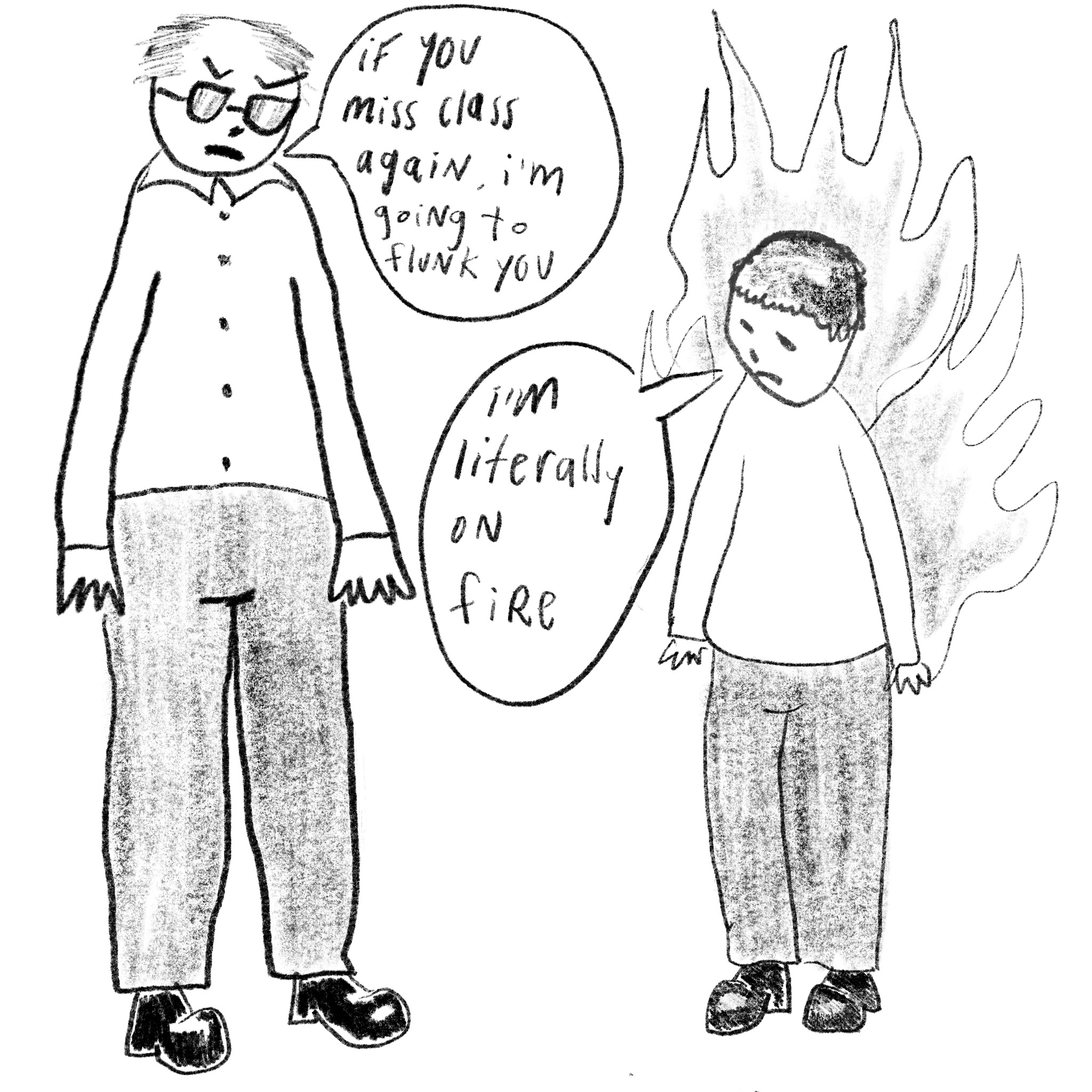
    Over a month into the semester, most of you are probably familiar with your professors and their grading policies by this point. Some require you to show up to every class to get a decent grade, while there are others who simply don’t care if you show up to class (spoiler alert: these are the cool professors).

    I stand very firmly in the belief that attendance should not factor into a student’s grades. They should be graded on their performance instead. 

    Maybe this is crazy, but if I miss two or three classes, yet demonstrate knowledge of the course materials by performing well on exams/essays/projects/you-name-it, I shouldn’t be punished. That A grade should stay an A. 

    Too often a class I’ve had has spent a week or two teaching something I already know fairly well (especially those classes that teach a broad range of practical skills in a major), but I am forced to sit through lectures bored to tears. I often think about the tens of things I could be doing instead, which are more often than not, assignments for other classes I could be using this valuable time for. 

    Allow me to introduce the concept of life. Life has this crazy habit of happening. It happens to you, to me, even to the professors here. When a professor has a wedding they plan to attend, or are feeling a little sick, they call off class. 

    Tell me then, why when I missed a class due to a personal loss, I was emailed a “sorry for your loss,” followed by a Canvas notification of my attendance grade being lowered by 7%? When I’m paying for my college credits, what valid reason is there for attendance affecting my grade? Professors don’t get paid based on class attendance, so the only person negatively affected when a student misses class is the student. 

    Let’s dig into how the supposed function of classroom attendance is to motivate students. I’m willing to bet money that mandatory attendance doesn’t motivate any student to do better in class. It sure doesn’t motivate me to do better in class. 

    A student should want to attend class. If a student is paying to take a class, they should be engaged by and with the course material, and that interest will intrinsically motivate the student to keep attending and learning. Requiring the student’s presence, and actively lowering the grade if not graced with their presence will extrinsically motivate the student to attend class. It will not motivate the student to learn. 

    Extrinsic motivation, like keeping a seat warm to satisfy an arbitrary requirement, doesn’t hold a candle to the intrinsic motivation of actually being interested in what’s being taught. Otherwise, self-motivation is taken away from the student and butchered in the slaughterhouse of butts-in-seats and vacant stares. 

    According to a 2010 report by the American Educational Research Association, while attending class can assist in getting better grades, mandatory attendance has a very small impact on how the students perform. 

    For all of you professors out there balking at the idea, slow down and take a deep breath. I promise you that most of us would attend the majority of our classes, just like usual. After all, it’s our money on the line. If you think that nobody will attend your class without graded attendance, chances are your class sucks and you should step it up. Make us want to come to class. If I’m able to accomplish the majority of your coursework well without paying a lick of attention to your lectures, they’re probably not all that engaging. 

    Oh, and participation grading is fine. After all, the professor has to keep track of students contributing. In the case of discussion-based classes, maybe offer students who miss class a discussion board on Canvas to post things on. 
    Stopping mandatory attendance puts the power and capacity to learn into the hands of the student. It restores that joie-de-vivre that graded attendance robs us of and allows us to feel like students, eager to learn instead of prisoners chained to our degrees.

  • Straight people look gay

    Straight people look gay

    by Zack Mink

    Dating in Arcata can be rough. As a visibly queer person, I find that I attract all kinds of different people. The most frustrating breed is the queer-passing straight men.

    This is the man who is either being friendly or flirting – you’re always questioning if they’re into you or if you’re just being delusional.

    In the past, it has been super tricky because I wasn’t the only one convinced these queer-passing straight men were into me. What made it so difficult was my friends being able to corroborate my beliefs as audience members of my disastrous love life. For the two most impactful love interests of mine, my besties were right by my side, able to witness the main events, the flirting, the looks, the attention, etc. So after multiple experiences discovering one of my interests is actually straight, I have to ask myself… what made me think they weren’t? 

    Aside from a basic level of human connection, and the undeniably flirtatious energy I could feel whenever we would talk, my confusion about a guy’s sexuality ultimately would come down to two things: their emotional intelligence and their sense of style.

    Apparently the bar is on the floor when it comes to the emotional intelligence of a straight man (no offense to straight men), because when a guy is comfortable with himself, confident and generally aware of others and his surroundings, I’m absolutely convinced he is queer. There’s just a certain depth that I find straight men don’t have because of their privileges.

    When taking a step back, I also realize that I definitely don’t associate a good sense of style with straight men (no offense again). I did notice however that I was stereotyping clothes. When I saw something I believed was not traditionally masculine, it would lead me to make assumptions about people’s sexuality. As a breaker of many stereotypes myself, believing them is something I want to avoid. 

    With this goal in mind, I learned a few things about myself and this genre of man. The first thing I reminded myself of is that anyone can have a good sense of style because clothing is for everyone. I can’t gatekeep dangly earrings and head scarfs for the girls, gays and theys. The second thing was that by having a sense of style, trying new accessories and having fun with clothes, a man is fighting society’s standards of masculinity. This was my “A-ha” moment as Oprah would say, because as someone who partially identifies as a guy, I have never fit in with the standards of masculinity. I actually think that not fitting in and being treated differently encouraged me to not accept societes standards for myself. Yes, I’ll blame the conservative people from my childhood for me being queer. 

    So despite my struggles differentiating a straight guy with style from a queer person, and despite the time I’ve wasted on people who aren’t interested in me, I will show my appreciation for the authenticity of the ambiguous straight men.

  • Bottoms Review: A raucously punchy queer teen comedy

    Bottoms Review: A raucously punchy queer teen comedy

    by Jake Hyslop

    If I had a nickel for every new movie in 2023 that was an eccentric, campy satire about feminism and gender roles, mocking the blatantly evil patriarchy and boasting a giant choreographed fight scene, I would have two nickels – which, to quote Dr. Doofenshmirtz, isn’t a lot, but it’s weird that it happened twice. 

    Bottoms is the sophomore feature from writer-director Emma Seligman, reuniting with star (and writer) Rachel Sennott (“Bodies Bodies Bodies”) from their previous collaboration, the stressful and hilarious Shiva Baby. Opposite Sennott is Ayo Edibiri, perhaps best known for her voicework in Big Mouth and her performance as Sydney in the hit Hulu show The Bear (watch it if you haven’t). 

    Sennott and Edibiri star as PJ and Josie respectively, two teens at the bottom of their high school’s social ladder. Not only are they losers and gay, but they attend a high school that literally worships its straight himbo star-athlete (there is a giant mural depicting him as the biblical Adam in the cafeteria). Even the principal calls them the “ugly, untalented gays” over the intercom. Through a series of plot contrivances, the two unpopular teens start an all-female fight club in order to have sex before they graduate. 

    If the above doesn’t alert you to the surrealness of the world of Bottoms, allow me to inform you that Jeff (the aforementioned himbo) and his teammates are depicted sitting in the cafeteria like Jesus and his apostles in Da Vinci’s The Last Supper. It’s a comical sight to say the least. Oh, and murder is just shrugged off as a normal occurrence. 

    The teen sex comedy isn’t exactly a new genre, but to have a brief resurgence put a queer spin on the genre keeps it fresh and subversive. It brings the tone of movies like Wet Hot American Summer and Superbad to the Gen Z crowd, borrowing the campy tone of “But I’m a Cheerleader,” a queer cult classic in its own right (it even paid homage in a scene at a diner named “But I’m A Diner”). Bottoms is unapologetically and explicitly gay at nearly all times. We’ve come a long way from the woeful and tokenistic “gay best friend” trope in comedies.  

    I was particularly delighted at the film’s parallels and references to Fight Club, a film famous for its satirical portrayal of toxic masculinity. It’s unfortunate that many men read the film’s message completely wrong, idolizing the dangerous men at the center of the narrative. How refreshing that this movie completely upends and pokes fun at those notions. The football players here are utterly moronic, and actors Nicholas Galitzine and Miles Fowler channel their Ken-ergy into their diva performances. 

    Despite a plot that can be convoluted and predictable at times, the cast and writing carry this movie to victory. Sennott and Edebiri’s palpable chemistry provides the groundwork for some truly impressive improv sequences, interwoven so well with the hilarious script that it’s hard to tell what is improv and what is written. Marshawn Lynch nearly steals the film as the divorced teacher who sponsors their club, misguided in his attempts to embrace feminism (fair weather allies are the worst). In fact, the entire ensemble here puts in the work, and I found my chest hurting from all the funny bits, as there’s hardly a minute that goes by without one. To address the Margot Robbie-sized elephant  in the room: yes, there are a lot of similarities to Barbie, the hit blockbuster of the year. I liked Barbie a lot, but my biggest issue was just how commercial it was, and how I wished every minute of its runtime was as campy as Barbieland; Bottoms scratched that itch for me. It’s acerbic and surreal the entire time, but it’s also surprisingly dark and bloody. Bottoms never compromises its weirdness for even a second to please anyone. It’s brash and unapologetic, and also the funniest movie I’ve seen all year.

  • Student spreads joy through public singing

    by Savana Robinson and Alina Ferguson

    Walking through the Cal Poly Humboldt Student Activity Center quad, one might hear a voice singing spiritual hymns. Echoing up the stair of Founder’s Hall, the voice carries a sense of warmth. The singer Fred Bossman can be heard a couple times a week, usually in the mornings.

     47-year-old Bossman studies physics at Cal Poly Humboldt with a focus in astronomy. He sings in public because he believes God told him if he sacrifices himself for the good of man, He will grant him unlimited power. Bossman wants to use this power to heal the world through singing. 

    He started singing at College of the Redwoods, but his favorite place to sing is the Arcata Plaza. He thinks it has a nice echo. Though he has no formal training, Bossman has traveled in states all over the west singing in public trying to spread warmth and joy. 

    “I have been singing for many years,” said Bossman. “It’s been a long time.”

    Bossman has received mixed reactions from people about his singing.

    “People have said that I sound beautiful,” said Bossman. “Other people have told me to be quiet.”

     One day, he was singing in the quad at Cal Poly Humboldt and thought that a lady who was studying was irritated with his singing. 

    “I went up to her and told her I was sorry and she said, ‘No it was beautiful. Thank you,’” said Bossman.

    Bossman said that he’s not trying to create problems.

    “I’m just trying to do what I believe I’m supposed to do,” stated Bossman.

    Bossman can get nervous when singing in public. 

    “It’s sometimes nerve-wracking because I don’t know what to expect,” said Bossman

    Bossman used to wear sunglasses to help ease his anxiety, then, when the pandemic hit, he would wear a mask.

    “Sometimes people would look around and not know who was singing until they got close to me,” said Bossman. “This was when I didn’t sound that good.”

    “I used to scream,” said Bossman. “Over many years it turned into a harmony. At first, I didn’t know how to sing but I was just getting it out there.”

    Now, Bossman takes the mask off so that his voice doesn’t sound muffled.

    After struggling with a meth addiction, he found God at a low point in his life. He had woken up from being in a coma for seven days and was given a copy of the New Testament. It was just the sign he needed.

    “The Lord has delivered me from methamphetamine, marijuana, tobacco, alcohol and gambling for over four and a half years,” said Bossman.

    Growing up in an agnostic household, he does not belong to any specific denomination. He simply follows Jesus. He receives messages from God through prayer, visions and dreams.

    Bossman said God showed him a vision of him winning a Nobel prize and becoming an astrophysicist, and he knows this is something he will do. 

    His favorite passage is the 91st psalm of the Book of Psalms: “He is my refuge and my fortress, my God, in whom I trust.”

    Bossman has 38 songs in his repertoire. All of the songs that he sings, he hears on K-Love, a Christian radio station based in Sacramento, California.

    “I would hear a song and go home, look it up on the internet, learn the words and put it in my repertoire,” said Bossman.

    Bossman’s favorite song to sing is “Glorious Unfolding” by Steven Curtis Chapman.

  • Associated Students cuts $500,000 out of student programs: resource centers struggle

    Associated Students cuts $500,000 out of student programs: resource centers struggle

    by Angel Barker

    This is an extended version of the story that was published Friday, September 29. This version was printed on Wednesday, October 4.

    It was a misty Friday morning in Arcata. Fewer than 20 people met in person to discuss the budget reform for funded student groups on campus. Tensions were high and budget cuts were higher.

    Faced with a deficit of more than $500,000, the Associated Students (A.S.) met to make huge cuts to student programs. There were over 20 funded program cuts that were approved.

    A $500,000 deficit heightened the tensions between A.S. and core funded student groups on campus. With thousands lower in enrollment numbers than originally projected by the university, it left a sour taste in the mouths of everyone whose budget was about to be cut by thousands of dollars.

    Associated Students Administrative Vice President (AVP) Andres Olmos facilitated the discussion for the necessary cuts of the budget. According to Olmos, because of lack of funds, they are essentially starting from the ground up with the bare minimum of only wages for student workers. That still leaves them over budget. The revenue is much less than predicted in the spring due to the high enrollment projections made by the university.

    The original revenue number was $786,000. Using A.S. reserve funds, the number would have been $865,000. According to Olmos, the financial office told A.S. to get to $750,000, meaning the total number of funds cut were $528,717 because the approved budget when the university thought enrollment would be much higher, a whole $1.2 million.

    A screenshot of the finalized budget of the funded student programs. The left column is the original budget approved in spring and the right column is where the budget is now.

    Olmos acknowledged that it was important to A.S. that student workers were able to keep their jobs, and that the main priority was keeping each budget at least at their current wages, only so students could continue to survive.

    Over 20 student groups like cultural centers, service organizations and more, saw cuts that ranged anywhere from $2,500 (Drop-In Rec Open Gym) to $186,498 (A.S. General Operations). 

    Some individual budgets were getting cut entirely because they have trust funds that they can survive on for the year; others were biting their nails to try and get more than just enough to pay student workers.

    “The money that is now allocated to us is strictly for wages,” Isabela Acosta, the Fiscal Coordinator for the Women’s Resource Center said in an interview after the A.S. meeting. “Not for supplies and hospitality or events.”

    A.S. President Samuel Parker said that the university told A.S. in the beginning of September that they would need to cut the budget. With less than a month to make the adjustments, it was difficult.

    “It was pretty difficult to have to deal with in such a tight time frame,” Parker said. “Also we have a very limited amount of people at the moment, so it is hard to get the adequate amount of communication out to everyone to let everyone know and have them chime in with their perspectives.”

    Marketing and Communications Director of News and Information Aileen Yoo said in an email statement that the budget office had informed A.S. about the budget shortfall on Aug. 30. 

    “One of the reasons for the budget deficit had to do with fee revenue estimates being lower than anticipated due to enrollment growth being more modest than initially anticipated during budget planning last spring,” Yoo said. “This led to needed adjustments to many of our budgeted operations across campus, including our main Operating Fund as well as our fee supported areas, such as AS.”

    The Eric Rofes Queer Multicultural Resource Center (ERC) approved budget for the 2023-2024 school year was $42,500. It was cut to $30,000 after Ascher Marks, the fiscal director for the ERC, and AVP Olmos talked. Olmos told Marks that the ERC employees might not be able to work over summer and winter breaks.

    “We cannot really consider that because our bills don’t stop during winter and summer break,” Marks responded. “We need to be working over the breaks because this is our job and how we make money.”

    Other organizations like the Women’s Resource Center are struggling to do anything except pay their employees.

    “We can’t buy menstrual products,” Acosta said. “Our sole responsibility as a resource center is to provide menstrual products for campus.”

    Acosta explained that due to a law passed in California in 2021, that the university should be stocking the bathrooms with menstrual products, but they have not been.

    “Our school should be [providing] menstrual products because of California Bill 367, which makes California public institutions required to have free and accessible menstrual products, and the school has not instilled this bill,” Acosta said. “So we have basically been taking out large portions of our yearly budget to provide menstrual products for campus when it is not even our responsibility to do so.”

    Yoo responded to this in an email statement.

    Photo by Kae Dennert. Ella Moore, Rose Co-Director, raises her hand during the A.S. meeting on Friday.

    “This [law] has been funded previously by the university, through Student Health & Wellbeing Services and other institutional resources, with staffing resupply support through the Office of Student Life and other university departments. The Women’s Resource Center provided additional supplies and locations and has done so since before the bill was passed. A group of those folks plus Facilities Management are now meeting to streamline the process and ensure funding and coordination of effort.”

    When asked about the backstock of menstrual products and when the center could possibly run out, she said that if they were to stock every bathroom regularly they would run out by next week. With the stock they have (about 20 boxes of pads, 100 menstrual cups and 18 boxes of tampons), she is hoping they will make it to the end of the semester. 

    Some organizations still have enough to sustain for the year, like the Waste Reduction Resource Awareness Program (WRAPP). The Program was cut by $9,200 leaving them below the A.S. recommendation of only wages, yet they remain optimistic.

    “We are so excited to have $44,000,” Ella Moore, Rose Co-Director said. “It means we are going to be able to pay our employees and [have] a little wiggle room for basic operations.”

    The Social Justice, Equity and Inclusion Center will still be open after their $16,500 cut. Frank Herrera, the Center’s Coordinator, is optimistic despite the small funds. Herrera said that the primary goal is to keep student staff, the secondary is to have high impact events. He understands that budgets change and the Center just needs to be more intentional with events.

    Aside from the difficulties cutting a budget by this much, Parker is proud and optimistic, particularly of AVP Olmos.

    “There were a lot of factors that made it pretty difficult for everyone. I am very proud of everyone for managing to pull it off.”

  • College night: flop or bop?

    College night: flop or bop?

    by Jillian Wells

    Sweaty students, creepy men, and lots of crappy EDM-remix music. That’s how I would describe the “College Night” hosted by the Arcata Theater Lounge (ATL). College Night, a fairly frequent event, is popular because it’s one of the few places in Humboldt County where people who are over 18 but not yet 21 can go to have a nightclub-like experience.

    You may be wondering what my qualifications are. I’ve been to College Night at least seven times at this point. I have also been to several nightclubs in South Korea and a few in Europe, so this isn’t my first rodeo. I know it’s not quite fair to compare these foreign nightclubs with the ATL, but this does give me a good perspective about what makes a nightclub, well, fun. 

    So let’s address the elephant in the room – the music. While the ATL does feature some great songs, the experience often gets soured by the sheer amount of EDM remix tracks they play. It feels as though the remixes really drown out the best parts of the song that make you want to dance and let loose. It’s frustrating when I’m really enjoying a song then they completely gloss over the song with an awful EDM remix version. It’s important to note that music is a key element in any nightclub setting, and the ATL could significantly enhance the overall experience by having a more diverse playlist, with less remixes. After all, music has the power to elevate the atmosphere and make a night out all the more enjoyable. 

    I respect the concept of College Night. It gives the poor souls who aren’t 21 the chance to have a nightclub experience which, in Humboldt County, is extremely hard to find. Despite the issues I have with the music, I will continue to attend College Night (with a fair amount of liquid courage) because it holds a special place in the hearts of many, including myself. In fact, it was at College Night where I first met my current boyfriend over nine months ago, so even though these nights have very questionable music, I have some great memories associated with them. Is the music often questionable? Yes. Will I keep going back? Absolutely.

    So, my advice is if you’re looking to go to College Night at the ATL, pregame (drinks are expensive), go with people you trust and know you’ll have a good time with, and make some unforgettable college memories. 

  • Cal Poly Humboldt alumni destroy women’s rugby team

    Cal Poly Humboldt alumni destroy women’s rugby team

    by Savana Robinson

    The Cal Poly Humboldt alumni dominated the 2023 women’s rugby alumni game on Sept. 30. Both teams played for the same university and put their all into the match. With an end score of 87 to 5, the alumni defeated Cal Poly Humboldt, whose team is mainly made up of newcomers, many who saw their first game on Saturday.

    Cal Poly Humboldt’s team captain Courtney Campuzano caught a couple of breakaways in the game, meaning took off with the ball, escaping players trying to tackle her. Campuzano is a senior majoring in social work. Campuzano was excited to see so many alumni back to play in the match, stating it felt awesome to see alumni happy to come out. She noted that some new players played the most they ever had. 

    Rachel Gonzales runs with the ball to score during the Cal Poly Humboldt Alumni game on Sept. 30.

    “I saw these rookies get stuck in,” Campuzano said. “One’s been here for maybe two weeks.”

    Saturday was Ashlyn Broeland’s first game as a player for Cal Poly Humbolt’s women’s rugby team. A junior majoring in environmental studies with an emphasis in education, Broeland is number nine on the team. Her position on the team is scrum half, which is an important role because it forms the link between the forwards and the backs.

    “I’m really excited for our new players to get out there,” Broeland said. “This is a really good chance for them to learn the game.”

    Cal Poly Humboldt’s cheer team came to support Broeland, their cheer captain, who has been on the team for three years.

    Sophia Nielsen played on the alumni side, having graduated in 2021 with a degree in wildlife.

    Senior Courtney Campuzano avoids being tackled with the ball by Rachel Gonzales during the Cal Poly Humboldt Alumni game on Sept. 30

    “[The most fun part was] being with my teammates I haven’t seen in over a year,” Nielsen said.

    Wynnie Savageford graduated in 2023 with a bachelor’s in criminology and justice studies.

    “[I like] the camaraderie of being around everybody and just being back in the pitch together,” Savageford said.

    Head coach Catalina Leon was most excited for the team to put together the skills they’ve been working on in an actual game. Leon stated that the biggest part of their strategy was communication and putting those fundamentals to work.

    “We were able to do that because we were able to get some breakaways and it worked,” Leon said. “It also showed us the areas that we still need to work on.”

    Leon said that overall the girls played well, especially considering that the majority of the girls joined this September.

    Lauren Bankerd, a junior majoring in kinesiology, scored the only try (goal) on Cal Poly Humboldt’s side. It was her third career goal, having previously played one semester.

    “[The most exciting part is] sprinting down the line, the adrenaline pumping because you don’t know if someone’s behind you or not, and you’re just gunning,” Bankerd said. “The crowd screaming and everything.”

  • University releases annual security report

    by Jake Hyslop

    Cal Poly Humboldt made its annual Security Report under The Jeanne Clery Disclosure of Campus Security Policy and Campus Crime Statistics Act public. The report details crime statistics that have occurred during the past three years, from 2020 to 2022. 

    The Jeanne Clery Act was signed into law in 1990. The act is a consumer protection law meant to provide transparency to the public around campus crime policy and statistics. Nicki Viso became the Clery Director in February 2022, heading up the Clery Compliance Team which is composed of representatives from many Cal Poly Humboldt departments. 

    The crimes reported are sorted into four categories based on where they happened. These include reported incidents on the general campus, on campus residencies, non-campus locations affiliated with the school, and public property near or adjacent to the campus. 

    There were no hate crimes reported during the three year stretch of 2020 to 2022 in the report. While there were no reports of murder or non-negligent and negligent manslaughter, there was a large increase in rape cases, from two incidents in 2021 to 11 in 2022. There were also increases in incidences of fondling, robbery, aggravated assault, burglary, arson, and other crimes. Some were small increases (like robbery from zero to one case) and some were larger (like weapons law violations from three to seven). 

    The Clery Compliance Team noted these increases in the report. August 2022 was the point that campus opened fully, with an increase of people on campus and returning to in-person classes as the reasons. Another change the team cited was that Comfort Inn in Arcata, currently housing students, was included and classified under “Non-campus Property.”  

    It’s important to clarify that any allegation that fits the criteria of a specific crime and occurs within the geographical locations specified by the Clery report are included. Not every crime statistic included in the report is proof that a crime definitively happened. Furthermore, crimes are recorded under the year they’re reported, even if they occurred a previous year. 

    The Clery Act Report is available on Cal Poly Humboldt’s Clery Act Compliance webpage, as well as information to help understand it.

  • One pole, seven strippers

    One pole, seven strippers

    by Zack Mink

    “I love stripper bitches!” the crowd yelled. This one-of-a-kind call and response was very much appropriate.

    On Sunday, Sept. 24, Clubussy broke down barriers by being the first-ever pop-up strip club event in all of Humboldt County. The event was hosted at the queer-owned thrift store Krave in Arcata, continuing the theme of providing a safe space for all.

    With help from volunteers, the store was transformed into an intimate and safe setting, with one pole centered in the room highlighting the seven talented performers throughout the night. 

    Setting the mood with what one performer described as bisexual lighting, casting blue, pink, and purple shadows across the room. 

    The excitement was building as the performers changed in the back room. Everyone reflected joy and felt proud to be in a space where they could be their authentic selves. 

    “As someone who felt bullied out of sex work, this space is super important to me,” said Baby Fontaine.

    Fontaine, aka the “Dollar Daddy,” was a volunteer responsible for exchanging dollar bills with the crowd making sure everyone had cash to tip the performers. 

    Orange haired-diva Big Billy, a co-founder of the Humboldt based pole dancing group, LXIX Crew, began with an emotional and entrancing number, paired with a mix of opera and club beats. Next up was Felix Void, who was serving punk, with loud clacks from the stomping of their tall black heels. Dahlia was after, delivering androgyny in their performance to “But It’s Better If You Do” by Panic! at the Disco. Their splits and unbelievable spins continued to get hoots and tips from the audience. Big Billy took the stage again with their “Shreksual” performance of “All Star” by Smash Mouth, garnering laughs and cheers from the audience. Felix Void and Dahlia did one last number each before the group birthday dance in celebration of Kai Flores, the owner of Krave. 

    Krave’s owner, Kai Flores, even got a birthday treat. Six strippers danced on Flores’ lap, did handstands while shaking ass, and enveloped their face with their breasts, leaving Flores laughing with tears falling down their cheeks. It was their first strip club experience and they got the whole shabang.

    The second half of the show started with Boofy the Clown. Boofy, a co-founder of the Foolish Kinks,performed their comedic version of “Oops I Did It Again” by Britney Spears. Channeling her inner bimbo, Boofy trotted on stage, fluffy nose first and ended by revealing a miniature pink rubber chicken from her bikini bottom. Following Boofy, Karma dropped it low at the audience’s feet before climbing back onto the pole to impress with their acrobatic spins. After Karma’s performance came Bunny with a flamenco inspired set. Once everyone performed twice, GUTTERPUKE, the organizer and MC of the event, surprised the audience with a last minute pole performance coming back from their extended hiatus. 

    The grand finale involved a sheet cake and balloon-boobs. Everyone cheered as Boofy and Dahlia dropped from the pole into the splits on top of the sheet cake, proceeding to lick the frosting off of each other and feed each other chunks of cake, eventually popping the balloon-boobs with Dahlia’s long black acrylics in honor of Flores’ birthday. 

    The performance left an impact on the crowd, leaving them curious what the event might mean for the future of Humboldt County. 

    “It’s going to inspire others… change the future of pole dancing in Humboldt,” said Patrick Shannon, an audience member supporting one of their performer friends.

    “There’s so many people here who know people who dance at clubs and have wanted to support them, but are too afraid to go into the club because of violent homophobia and because of the transphobia we are seeing in our nation,” said GUTTERPUKE. “Not only is this radical and reseizing the means of our production, it’s also radical in a way of creating space for queer people to feel comfortable accessing sex workers.”

    GUTTERPUKE has six years of experience performing, as well as experience fighting the constrictive systems that make being a stripper and/or sex worker difficult. This passion for creating a safe and equitable environment for sex workers and strippers stems from GUTTERPUKE’s own traumatic past. At one of the previous clubs he worked at, he was illegally fired. From that experience, he discovered Strippers United, an organization striving to dismantle whorephobia and decriminalize sex work. This organization provides financial and legal support for strippers and helped GUTTERPUKE win his case against the club. They were forced to hire him back and pay him for the days he wasn’t allowed to work because of the illegal termination.

    Clubussy was created as the solution to this problem and the other issues strippers regularly face. 

    “Let’s do some problem-solving. Let’s make an event where sex workers are platformed and invited. Let’s make a space that celebrates us in a really joyous manner and it’s not degrading, it’s not fetishization or tokenization,” said GUTTERPUKE.

    Along with the mistreatment of performers, the financial aspect of running a strip club is something GUTTERPUKE is passionate about improving.

    “When you are a stripper, you have to pay the club to work. Part of Clubussy is that strippers keep 100% of their fucking money. Often performers are told ‘you will get a percentage of ticket sales,’ but they’re never transparent with their finances so you have no idea how much the event organizers are paying themselves, you have no idea how much the event actually made. So, as part of my ideals to be transparent and community-based with all of the performers and volunteers, the financial records will be made available,” GUTTERPUKE said to the audience.

    The event followed the intentions of being transparent, encouraging and safe for everyone. It also was a chance for these local strippers and sex workers to represent themselves, share their art, and give credit where credit is due. 

    “Oftentimes, pole hobbyists get more opportunities to be performers, get more opportunities to go on tour, get more opportunities to do so much when pole is a craft that was shared by strippers with non-strippers because it’s something that brings us joy,” said GUTTERPUKE. “Being on the stage, doing your thing, it is positive for your body, it is positive for your mental health and we shared that gift.

  • Breaking the stigma

    by Savana Robinson

    On Feb. 25, 2023, I was transported to Mad River Hospital after Sergeant Andy Martin of Cal Poly Humboldt University Police expressed concern for me. I had lost my phone at the Student Activity Center, and after I got it back I told him and other officers that someone had bugged my phone, people were following me and there were recording devices in my dorm room. Because of Martin’s commitment to helping, I was later given a diagnosis that answered so many questions: schizophrenia and bipolar I. If it weren’t for Sergeant Martin, I don’t know what would have happened, or where I would be.

    Martin knew me before the incident because he had picked up my knocked-over motorcycle for me. I brought him and the dispatcher, Jennifer Gomes, Harley-Davidson keychains and candy as a thank-you gift. Martin and Gomes knew that something was wrong with me because they knew me as a confident, Harley-riding girl – not a scared, paranoid kid.

    “Law enforcement’s role in mental health is complicated, to say the least,” said Martin. “Mental [illness] is not a crime.”

    Because my paranoia was high, the emergency room and the hospital in general was a scary place to be.

    “Some of the [hospital] staff and I have had conversations. They know that it’s not the ideal,” said Martin.

     Following the Lanterman-Petris-Short Act, those under 5150 hold must be taken to a facility designated by the county, which is either the emergency room or county mental health, which has only been taking voluntary patients since COVID. To me, this is a shame. I strongly believe that they should be transported to an inpatient facility for those in immediate mental crisis.

    “It’s designed for medical care, not psychiatric care,” said Martin, referring to the hospital. He recognized that there could be some overlap in the type of care needed for patients. In my case, my second hospital stay warranted medical care because I ran three miles barefoot thinking my hometown was littered with explosives, which tore my feet up. This happened the night after I was released from Mad River to my dad, who took me home to Redwood Valley.

    College is a time in life in which mental illness often manifests. The American Psychiatric Association states that 75% of mental illnesses start by the age of 24. 

    “We see more than our fair share of it,” said Martin. I was given my diagnosis at the age of 22, which is right in that sweet spot for when such illnesses surface.

    5150, also known as the Welfare and Institutions Code, is what allows police to detain a person if they are deemed a danger to themself or others.

    “Those are actually very strict criteria, the idea being that law enforcement shouldn’t be able to detain somebody without good cause,” said Martin.

    The way it works is that if an officer is concerned about someone, they’ll express their concern and give two options, voluntary admission to the hospital or 5150 if the case is severe enough. I was technically voluntarily admitted and I just learned after the fact that I could have left if I wanted to, but hospital staff repeatedly told me that I couldn’t leave.

    If someone refuses admission to the hospital, UPD can put them in contact with an on-campus counselor or county crisis. UPD also works with the Office of Students Rights and Responsibilities (OSRR), who work with Counseling and Psychological Services (CAPS)  and Campus Assistance, Response and Engagement (CARE).

    I have a great support system, and I’ve been told that by several people, including Sergeant Martin. I consider him and all of UPD to be part of my support system. I’m very blessed to have so many compassionate and caring people in my life.

    If you are concerned about yourself or another student, please fill out “Reporting Students of Concern” at deanofstudents.humboldt.edu/CARE or call UPD at 707-826-5555. If it’s an emergency, call 911.

  • Pets keep students healthy and happy

    Pets keep students healthy and happy

    by Savana Robinson

    Finals week: a stressful, anxious time for all. During this time, Raymond Haeckel, a forestry major at Cal Poly Humboldt, had a public panic attack.

    “It was really embarrassing and not the best on my mental health,” Haeckel said. “I’m thinking about how all those people saw me freak out. It sucks.”

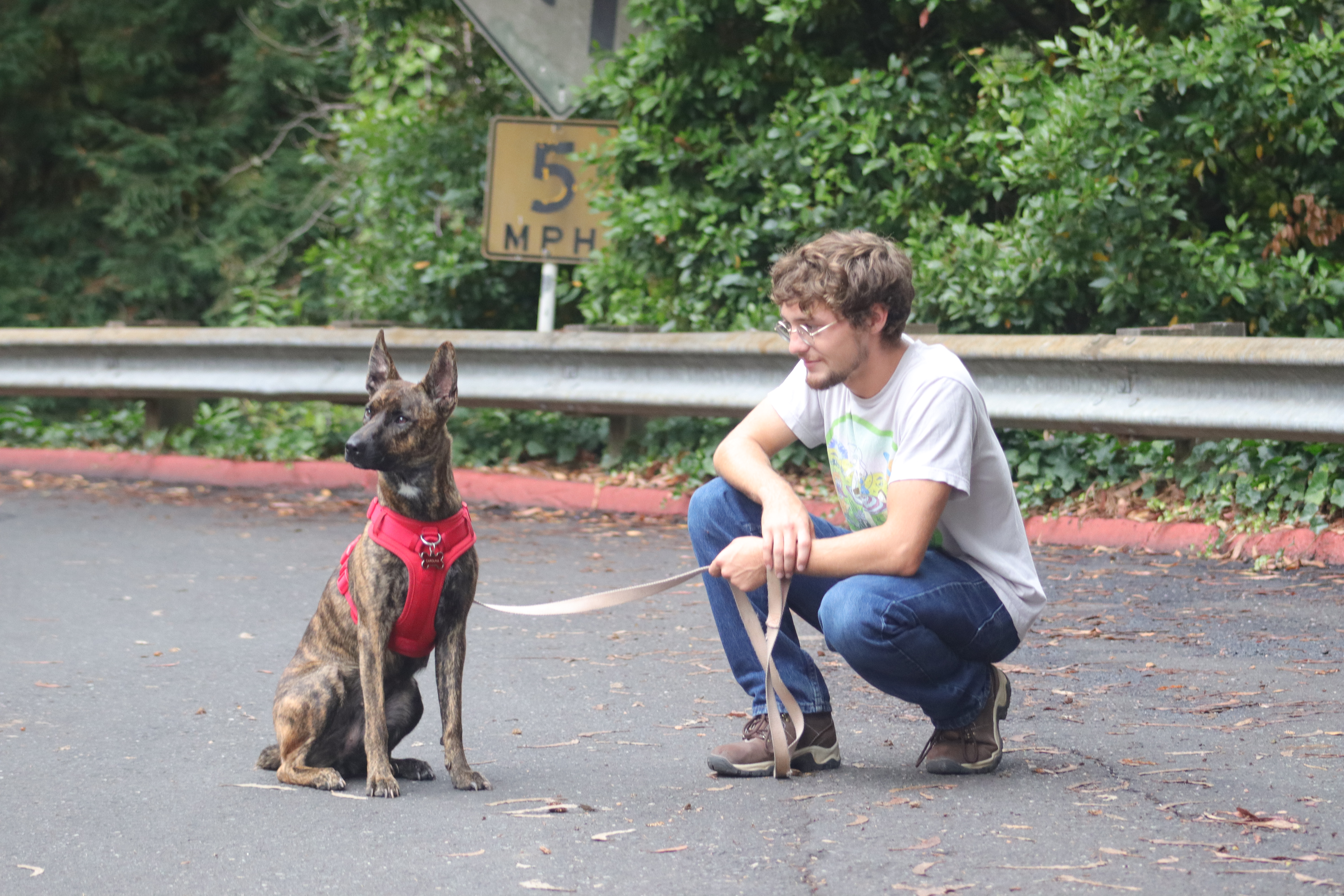
    After the panic attack, Haeckel decided to adopt a companion that would ease his troubles and calm his mind; he is now the owner of a beautiful cattle dog mix, Carolina. He is certain that having an animal companion has helped support healthier habits.

    “It’s a really good, big motivator to keep on a healthy schedule in my life,” Haeckel said. “When I’m feeling depressed, I have trouble keeping up with my daily habits. Having a dog to calm me down when I’m feeling anxious is really important for my mental health. It’s thanks to her that I was able to overcome my inability to sleep through the night.”

    Vanessa Hidden, a leadership studies major at Cal Poly Humboldt through the College of Extended Education and Global Engagement, believes having a pet or emotional support animal can be one of human’s deepest connections.

    “Our pets can stimulate the healing process within ourselves,” Hidden said. “They can help us look forward to tomorrow and get out of bed.”

    Hidden is the administrator for the Co-Sheltering Collaborative, a peer-to-peer support network by My Dog is My Home. The organization is a national nonprofit focused on supporting people experiencing homelessness and their pets.

    Having had pets most of her life, Hidden feels a certain sense of comfort and safety from having animals around. She has struggled with depression and anxiety disorder, and her pets were a core part of her healing process.

    “To this day, [they] provide the connection and consistency I need to get through new challenges,” Hidden said. “Being fully remote for school and work… is a challenge that I don’t know I would be able to sustain without the company and emotional stability that my pets provide for me.”

    Maia Ryan, a Counseling and Psychological Services therapist and campus outreach coordinator at Cal Poly Humboldt, provided some insight on how emotional support animals can improve their owner’s mental health. Social connection is crucial to overall wellbeing and there is ongoing research to prove that the positive interactions with animals offer psychophysiological and psychosocial benefits like lowering anxiety, alleviating loneliness and normalizing heart rate and blood pressure.

    “People who may have difficulties with medical or emotional conditions exacerbated by stress could potentially benefit from having an emotional support animal,” Ryan said.

    Mental health is heavily influenced by social connection and animals can provide that necessary companionship. The unique bond between humans and animals is a powerful source of comfort and healing, underscoring the vital role animals play in bolstering our emotional resilience and overall mental health.

  • From DMs to DII National Championship: Isabel Perez-Zoghbi

    From DMs to DII National Championship: Isabel Perez-Zoghbi

    by Vanessa Saltos

    Isabel Perez-Zoghbi is a 2nd year student from Merced, California. Perez-Zoghbi was a long distance runner throughout her whole life, running cross country and track. She thought her career would be done after highschool and was planning on attending Cal Poly Humboldt in Fall 2022. While scrolling through social media, she came across a video of Cal Poly Humboldt’s very own Joy Hano running the 60-meter hurdles. 

    “I saw Joy and I thought she was amazing, and I was just like clearly they must have some good hurdles coaches there because Joy’s doing fantastic,” Perez-Zoghbi said. 

    Once realizing there was a track program, she took it upon herself to direct message Hano. According to Hano, Perez-Zoghbi asked about the program, what Hano’s favorite part about running in college was, and how she wanted to get better at hurdles. Perez-Zoghbi had only started running hurdles her junior year of high school, so she saw this as a learning opportunity. This direct message on Instagram led to a recruitment visit with the track coaches, and Hano was able to meet her in person for the first time. 

    “Meeting her for that first time, it got me excited about hurdles again cause I could just feel her pure love for the sport, and at that point in my season I was, not going throughout, but it was just a low part of season,” Hano said. “Having her energy around, even just on her recruit visit, brought up my energy, brought up [my] team’s energy, and I just had a great feeling about her.” 

    Hano was right about that feeling, because during Perez-Zoghbi’s first year at Cal Poly Humboldt she made huge waves in the program. She qualified for the NCAA Division II Outdoor Track & Field National Championships after running a personal record of 1:00.54 in the 400-meter hurdles. At Nationals in Colorado, she finished nineteenth overall. 

    During her 2023 campaign, she did face some setbacks. Dealing with a hamstring injury, she was kept from competing in a couple of races. Hano recalls a moment at the 2023 Stanford Invitational where Perez-Zoghbi was scratched from the weekend last minute due to her hamstring. Hano and Perez-Zoghbi took walks around Stanford’s facilities and reminded each other about the amazing opportunities they both have. 

    “Isa’s really good about remaining grateful, and it was just during that weekend that I just had to remind her we are in an amazing opportunity to do the thing we love and if anything, missing this right now is just going to make you want it more,” Hano said. “Sure enough after that point in season she continued to rehab her hamstring, she continued to play smarter not harder with her hamstring and made the most out of every day she could.”

    The knowledge that her coaches bring has helped grow her obsession with the sport. Her teammates contribute to this as well. They inspire her daily with their dedication to training and work ethic. She sees how happy people are just to be given the opportunity to participate. What keeps Perez-Zoghbi motivated through it all is her love for pushing herself to her limits.

    “I am always trying to improve and get a better time, and push myself to where I am like dying at the end of practice and I’m like on the floor, can’t breathe,” Perez-Zoghbi said. “Just like that physical challenge and mental challenge of pushing yourself to your limit that’s why I do it.”

    Her teammates feed off of this mindset as well. Hano views her as a role model, despite Perez-Zoghbi being younger. Hano knows that whenever they train together, there will be no slacking of any kind. This has only pushed Hano mentally and physically. Her coaches see this determination as well. Cal Poly Humboldt Assistant Sprint and Hurdles coach Kate Eilers expressed Perez-Zoghbi’s tenacity on the track and compared her competitive drive to that of a veteran. 

    “I love coaching Isabel. She recognizes the value of the time she has here as an athlete and uses every second of it. She is always looking to improve, asking questions and diligently implementing feedback,” Eilers said. “She’s a joy to coach, a supportive teammate and an all around incredible person who knows how to pursue success.”

    Perez-Zoghbi expressed her goals for this upcoming season, which are becoming an All-American and breaking the school record. The current record holder is Alyssabeth DeJerez with a time of 58.68 in 2017. The main goal this season though is winning the conference. Currently Perez-Zoghbi is training for the 2024 season which is set to start on Feb. 18.

  • Cal Poly Humboldt spending $1.34 million on hotel lease while having 331 vacant beds on campus

    Cal Poly Humboldt spending $1.34 million on hotel lease while having 331 vacant beds on campus

    by Brad Butterfield

    Two-and-a-half miles north of campus stands the seven-figure “temporary solution” to Cal Poly Humboldt’s current housing crisis. However, this fall semester did not bring the thousands of additional students that had been expected, and 331 bed spaces remain vacant in the on-campus dorms. Despite the difficulties presented by living out of a hotel room, students spoke – mostly – positively about life at the Comfort Inn.

    Cal Poly Humboldt’s lease agreement with the Comfort Inn commenced on Aug. 11 and will expire May 12, 2024, for a total of 275 nights. The 49 rooms at the hotel cost the university $100 per night. By the end of the lease, the university will have paid $1,347,500 to the Comfort Inn.

    During normal hotel operations, the city of Arcata charges a ‘transient tax’ of 10% the cost of the room. With the university’s lease, the city of Arcata will not earn its normal 10% tax from the Comfort Inn for the 275 nights that students will call it home. Representatives from the city of Arcata were not immediately available for comment regarding the loss of tax revenue.

    Given the fact that 331 empty bed spaces remain vacant on campus, the Comfort Inn lease could appear like an ugly $1.3 million stain on the university’s management of funds, but perhaps that’s not fair. Enrollment was expected to jump by 2000 students this fall and the university had an obligation to plan for every scenario. Additionally, the university allowed students who were accepted this fall to defer enrollment until next spring, creating a potential housing shortage come spring. The Comfort Inn lease was kept as an insurance measure by the university. 

    “To meet the needs of our students and prepare for a possible influx of more students, the university provided the option of living in university-managed off-campus bridge housing like the Comfort Inn,” said Aileen Yoo, Director of News & Information in a statement. “It’s meant to be a temporary solution as we move forward with building additional housing facilities over the next several years.” 

    In spite of the price tag and lower-than-predicted enrollment, the university kept the Comfort Inn as a housing option, in part because they had to. They had advertised the hotel as a housing option for many students.

    “We also sought to honor the fact a number of students specifically chose to live in the Comfort Inn, even when offered the option to move back onto campus,” Yoo said. “Continuing our contract allows us to not only plan for the future, but to reduce uncertainty and disruption of housing locations for those students.”

    Importantly, all students currently housed at the Comfort Inn are there by choice. 

    “Students who are currently residing in the Comfort Inn have chosen to stay there, even when the university offered them the opportunity to move back on campus and live in residential halls,” said Yoo.

    Neither Sherie Cornish Gordon the Vice President of Administration & Finance, Donyet King the Senior Director for Housing & Residence Life, nor Steve Relyea the Executive Vice Chancellor responded to interview requests.

    The money spent is particularly concerning on the backdrop of the recent CSU tuition hike. Regardless, the students of Cal Poly Humboldt that have been caught in the crosshairs of the university’s rapid expansion, should be the number one priority. Happily, it seems that students now housed in the Comfort Inn are quite content, one might even say they are… (relatively) comfortable. 

    “It’s not a shitty place, it’s really not. People are like, ‘Oh that sucks you guys are living there,’” said Luis Castro, a student living in the Comfort Inn. “I’m like, ‘No, it’s chill. It’s our own thing.’ In my opinion it’s better than living on campus.”

     In fact, there are a number of notable benefits to life in the Comfort Inn that students are stoked on. 

    “It’s quiet. You don’t have the loudness of the community on campus,” said Dylan Harrison, another student who resides in the hotel. “We have our own community here. We have breakfast every morning. We got a pool downstairs if I want to go swimming, or go to Jacuzzi. We have our own laundry as well.”

    In addition to the jacuzzi and laundry, students housed at the Comfort Inn have cleaning services twice a week, free breakfast, and gated parking. Still, there are drawbacks to making a hotel room a home. Namely, the absence of a kitchen. Fortunately, the university has crafted a creative compromise for the students living without a kitchen.

    “They got a deal with this diner called Pepper’s and we use our meal exchanges there, or flex money,” Harrison said. “If I want a burger, instead of going and getting a burger that some student made on campus, who just wants to get paid – I could go to a diner where these people want to make burgers. And they like making burgers. And they got good burgers.”

    In addition to top notch burgers, students are relishing the first floor snacks provided by the hotel.

    “If you want to get something to eat – let’s say you want snacks on campus – then you have to go to the marketplace and pay for it. And here you just go downstairs and just get a yogurt that’s already stocked,” Castro said.

    Naturally, the perks of life at Comfort Inn must be weighed against its inconvenient undesirable location miles from campus.

     “There is a little bit of a disconnect, socially, you know, between big events that are going on [on campus]. But, I mean, the people that I have met here are pretty cool,” said Andres Arteaga, another student resident of the hotel. “Seeing as it’s my first year here, I did actually really want to be on campus. I do like the vibe on campus, but at the same time, It just feels like our own area here in this section of the town.” 

    All things considered, the situation seems decent for students living at the Comfort Inn, but it is far from an ideal college housing arrangement. Directly across the street from the Comfort Inn stands, ‘The Grove,’ a hotel recently converted to a homeless shelter. Behind that, in an undeveloped stretch of land that backs up to highway 101, a small community of homeless folks have put up shop and don’t appear to be leaving anytime soon. 

    “It’s like a 15 feet deep pool and 20 feet diameter wide and there’s tarps and there’s like, people just living over there,” Harrison said. “It’s crazy. You see it off the 101, they’re always burning fires. There’s a lot of people over there. You hear them at nighttime, [and] they’re always screaming.”

    Logistically, it appears the university has set students up for success with multiple options for transport to the campus grounds. Working in tandem with Arcata Mad River Transit, the university created a new route that runs 7am to 10pm to transport students, for free, to and from the campus. The bus does not run on Sundays, but students have the option to call the University Police Department for a ride at any time, if need be.

    “I take the bus to school,” Harrison said. “There’s three options every hour. If you miss all three buses, you’re a dumbass.”

  • Cal Poly Humboldt students ride the waves

    Cal Poly Humboldt students ride the waves

    by Savana Robinson

    It was an overcast morning at Moonstone Beach in Trinidad, California on the morning of Sept. 17. A group of Cal Poly Humboldt students ran out into the waves, surfboards under their arms and wetsuits on their bodies. For some, it was their first time surfing. For others, it was just one of many sessions. All of the students had signed up for the surf class through Center Activities, which also offers classes in climbing, backpacking, kayaking and more.

    The intro surfing class on Sept. 17 was Hannah Doran’s first surf lesson. At the beginning of the class break, she emerged from the water with a wide grin on her face and her hand displaying a shaka sign. Doran has previously surfed in New Hampshire, Maine and Scotland. Doran is a junior at Cal Poly Humboldt majoring in oceanography with a diving minor.

    “Surfing is cool and Humboldt’s the place to surf,” Doran said. “I’m having a great time.”

    She was most excited about getting more comfortable in the water, the Pacific specifically. She was also stoked to get solid advice from good instructors. Plus, $40 for five hours of instruction is a great price.

    Grady Hechd was the assistant instructor for the class. He has been working at Center Activities on campus since Feb. 2022.

    “It’s really rewarding watching people that have never surfed before get out there and watching them learn,” Hechd said. “It kind of clicks for some people.”

    Chris Isola, an environmental science transfer student, had gone surfing six times in Humboldt before the Sept. 17 class, but it was his first lesson. Throughout the lesson, Isola caught several waves with a smile.

    Alumna and lead instructor, Annalisa Rush, has been teaching surf lessons for over 25 years.

     “[The best part of the job is] sharing the joy of being on the ocean and watching people get super stoked on the thrill,” Rush said. 

  • North Country Fair celebrates creativity and strives for social change

    North Country Fair celebrates creativity and strives for social change

    by Alex Anderson

    Students and the surrounding community came together to celebrate creativity and strive for social change at the 49th annual North Country Fair in Arcata Plaza on Sept. 16 and 17. 

    The North Country Fair strives to recognize the eccentric beauty of Arcata and the vibrant people who call it home; celebrating healthy community, environment and cooperation. According to northcountryfair.org, nearly 200 vendors were in attendance to sell their art or deliver their messages to the public. This year’s fair revolved around the theme of ‘Creating The Flow,’ referring to the process for which artists develop their work and embodying the sentiment: you must be the change you wish to see in the world. 

    According to North Country Fair Director Alex Ozaki-Mcneill, there were roughly 4,000 people in attendance throughout the weekend. Ozaki-Mcneill explained how the event focuses on the creativity of local artists, as well as a desire to spark environmental change in the community with the event’s responsible waste initiative. Every year, event staff and volunteer groups weigh all of the trash, recycling and compost, keeping tally of totals and focusing on keeping as much as possible out of the landfill. Ozaki-Mcneill also touched on the friendships formed as one of the stand out aspects of this event.

    “All of the friendships that are formed between [the] community who have favorite vendors that they look for every year,” Ozaki-Mcneill said. “One of our vendors describes it as a giant community hug and I’ve really adopted that, I really like that.”

    Each year the North Country Fair features two parades, the All Species and Samba parades, which bring hundreds of community members together to witness the creativity of their neighbors. With this year’s theme focused on positive change, the main component of this year’s All Species Parade was a depiction of the demolishing of the dams along the Klamath river. Parade participants wore fish heads and carried decorated cutouts of salmon and sturgeon, which were created with the help of Arcata Playhouse Arts and the Yurok Tribal council. 

    Cal Poly Humboldt students were in attendance taking in the vibes of the North Country Fair. Rize Oliveira, a Cal Poly Humboldt student studying forest hydrology, characterized the fair as a fun place to see the community gather. Not knowing that the event was taking place, Oliveira stumbled across the fair with a friend to see what all the commotion was about. She explained her favorite part of the event. 

    “For me: everyone’s energy,” Oliveira said. “It’s a good way to see everyone come together, gather around with similar interests and appreciate local artists and their work that they’re doing.” 

    Other Cal Poly Humboldt students saw the fair as a special way to signify the changing of the seasons, gearing the community towards the coming shift in weather. Nicole Pastori, a critical race and gender studies major who grew up in Humboldt, described the event as a nice way to wrap up the summer and celebrate the coming of fall. The parades featured in the event are very characteristic of Arcata, according to Pastori. 

    “I think it’s so quintessentially Arcata,” Pastori said. “It’s in your face about it. I think anyone who wasn’t from here would have a hard time understanding, if they weren’t themselves on the plaza. It’s a hard-to-describe event, but it was good this year.”

  • Too small for football but on the track to attack

    by Dezmond Remington

    The track is vicious and painful, and Aris Valerio was ready because he has dealt with vicious pain. He ran a half mile in less time than it takes to get out of bed, a minute and 49 seconds to secure a spot at the National Championships back in May of 2023; the only man sent from Cal Poly Humboldt to race in Pueblo, Colorado. The evening shadows were long on the track as the 800m final was due to start, and Valerio lined up in the pole position on the inside lane. 

    It was already a long shot to get there. One of the fastest Division II 800m runners in the nation couldn’t compete because of a family emergency, allowing Valerio to take the final qualifying spot after the prelim races. The next 110 seconds were going to hurt, even without the added stress of a fast prelim the day before and the knowledge that a victory was unlikely. Valerio felt dead tired and scared. But there was no room to think about any of that when the gun boomed and the race started. A journey that started with failure and random chance went a little further. 

    Valerio picked up distance running his freshman year of high school, only after his mom wouldn’t let him play football because he weighed about a hundred pounds. He had always been fast as a kid, so he figured he’d give it a shot after a neighbor told him exactly what cross country was. It wasn’t love at first sight. Valerio still isn’t sure why he stuck with it. Training is boring to him – racing is what makes it worth it. 

    “I just love the anxiety of the races,” Valerio said. “I think it’s fun. It makes it more exciting because that’s what everyone’s feeling. Makes you show that you’re just more locked in than everyone else when you win. I think that’s exciting.”

    His legs churn, eating up ground at a pace of over 18 miles an hour. The first 200 meters are gone in less than 26 seconds, and he’s still at the back of the seething pack. The screams of the crowd are loud, but it’s lost in the rhythm of pounding feet and gasping breath. His mind is blank. It always is at moments like these.

    Valerio’s first brush with greatness came his senior year at Murrieta High School in 2019, when he ran 1:53 in the 800m and ended up being ranked in the top 20 high schoolers in the nation that year. He didn’t even really understand that it was a big deal right when he crossed the finish line. Someone had beaten him. 

    It was a huge margin of improvement from even a month before that, over six seconds in an event that separates a talented collegian from the world’s best. He spent a year training at California Baptist University before transferring to Humboldt in 2020. One of his high school teammates had gone to Humboldt and recommended him to head distance coach Jamey Harris, who gladly accepted him on the strengths of his past races. 

    Valerio’s career has had its ebbs and flows in his time in Humboldt. He’s one of the fastest 800 runners to ever compete for Humboldt, but he’s also suffered from hamstring injuries that left him unable to train and compete for far longer than he would’ve liked. Harris doesn’t regret recruiting him. 

    “With any injury, anybody’s going to have a setback in their enthusiasm, and he was not immune to that,” Harris said. “But whenever he would have a little bit of a setback, he would climb out of it. He’s persistent in that way…on race day, he always brings everything he’s got. I never doubt that we’re going to get a full effort…he may not always be at 100% confidence, but we always know we’re going to get 100% effort.”

    It’s hot, and the guy in front crushed the first half of the race in 50 seconds. Valerio is a few seconds back. Shoes thin as ballet slippers slam on hard rubber, the metal spikes grabbing the track. Reverberation swims up his legs. It hurts, but he’s had worse.

    It wasn’t easy getting to Nationals. Setbacks weren’t solely those of muscle, bone and sinew. Some came from the brain. 

    For a while, a bout with depression during the track season made Valerio consider not racing at Nationals at all, but after running 1:50.3 at the conference meet he reconsidered. He is open about his struggles with mental health. He said his depression comes from the death of his little brother, who passed away when he was in high school. Running, and the team surrounding him, has been one of the things that helped him get through it.

    “I’ll go through spurts of being super unmotivated,” Valerio said. “And it’s super hard to catch myself and get back on my feet. [Coach] Jamey [Harris] and [the team] know all that. They’ve been super supportive about it.”

    Valerio is a lot more than just an athlete to Harris.

    “He’s a complicated beast,” Harris said. “It could be easy to see his consistent success on the track and think that things have come easy for him, but they definitely haven’t. He’s had a lot of difficulties that he’s had to work through and challenges that he’s had to overcome. I think that’s probably the greater accomplishment than being an All American and All-Conference a couple of times and being the second fastest 800m runner in school history. What’s more impressive is what he’s gone through and what he’s overcome to get there.” 

    600 meters have come and gone, and the time has come for a last, desperate drive to the finish. There is no more sun in these last moments, the light blocked by the stadium seating full of screaming spectators. Way ahead, the front runner is run down like a deer in the dying moments of the race. Valerio is still in the back, driving for a First Team All-American spot. A thousand miles away, people watch.

    Valerio’s role on the team goes far beyond simple competition and point scoring. One of his closest teammates and a roommate during the track season when Valerio went to nationals, Sebastian Vaisset-Fauvel considers Valerio a crucial part of the team, although not necessarily always beloved.

    “He’s just really down to the point,” Vaisset-Fauvel said. “He’ll tell you what’s up. He’ll tell you the truth, and sometimes people can’t take the truth… I think that’s what helps him stay true to himself.”

    Although Valerio does sometimes take the abrasive role, Vaisset-Fauvel stresses that that’s not nearly the entirety of Valerio. 

    “Aris can seem like an intimidating guy, but once you get to know him, he’s like a little baby,” Vaisset-Fauvel said. “He’s like my little child, even though I call him my dad sometimes. He’s a really good guy. Really good athlete. 1:49? That fits him, you know? That just fits him.”

    Despite the incredible accomplishments on the track, Harris and Vaisset-Fauvel make it clear that Valerio is a human just like everyone else on the team, and that makes his appeal to his teammates that much more potent. 

    “This is a regular guy,” Harris said. “I’ve seen this guy spill milk. This is a fallible human that I’ve ran with, that is running really fast, and that makes those accomplishments seem more attainable to me.”

    Valerio crosses the finish line, his hands going to his knees as he bends over the track. Last place, but still Second Team All-American. Next year will be better, he thought later. Next season will be the last, the best. It wasn’t just for him.

    “I’m trying to go to Nationals to represent our team, our school in the middle of nowhere,” Valerio said. “‘Who is this Humboldt guy? This is crazy.’ I think you should want to run for everyone, not just yourself. You’re not going to get that far, only running for yourself.”

  • Life on campus

    Life on campus

    by Alina Ferguson

    I lived on campus for two years without a car. I am now currently living off campus, in another city actually, with a car and I can say without a doubt, to me, living on campus was actually a very nice experience. I will explain why, and I promise it will make sense. 

    I miss the convenience of living on campus. I could walk across the grounds in ten minutes, which is good because if it’s late at night, and I want to visit a girlfriend, it is not a problem. I felt safe and confident walking long distances across campus. 

    It’s just about accessibility and location to me; I could easily rest after class, it’s been a long class day but I still have another couple to go. I could chill in my room, change my clothes, eat, maybe get to watch an episode of my favorite TV show and still make it to class EARLY. Campus is also centrally located, making it easy to walk into town or go to the grocery store. You can explore and get in some exercise, two birds with one stone. 

    Living off-campus makes me long for the redwoods. Living on-campus allowed me to go on a hike between classes. I am in the redwoods after all, and it is amazing that we have trails here in our backyard when living in the dorms. 

    I also feel like most on-campus quarrels begin with sharing a room. For many, it’s their first time  doing so. I’ve been used to sharing a room my whole life, so it was never an issue for me. Having an older sister really prepared me for any roommate, as I learned how to communicate efficiently, calmly and just learned to let some things go. Yes, you may get a bunk, or a roommate, but at least if you’re locked out, someone can let you in. 

    Of course, living on-campus does require you to make some compromises, like the fire alarms. They do not stop unless an RA comes and calls someone else. With maintenance requests, they did do good work when requested, with the work being done quickly and efficiently. Also one of the maintenance men was really cute. I miss that. 

    Okay, hear me out on this one, in a way, you save money, because you have to buy less. If you are anything like me – I sincerely hope you are not – then a trip to Target for one thing turns into buying so much that I need a UHaul to bring it back, and guess what? There is no room in the dorms for all of that stuff. So, it keeps me from buying an insane amount of junk, which I have been doing since moving off-campus. I apparently need 6 pillows and 40 wooden bowls, because I’m into the look of wood currently.  I love wood, wooden bowls, wooden plates, just wood. 


    At the end of the day, for me it is all about nostalgia. Campus was the first place I lived by myself, without my parents. The convenience and accessibility campus gave me makes me miss it now.

  • Living on campus sucks

    Living on campus sucks

    by Kae Dennert

    I hated living on-campus. The mold, the roommates, the noise? I only lived on-campus for a year, but I could never go back. Don’t get me wrong, if you have no other choices, I get it – I really do –  but other than that, no thanks. 

    I don’t get why anyone would want to put themselves in a situation where they have to slum it with a shit-ton of other people when they could have their own space. I’m not paying 10k+ a year to live in half of a room with no private bathroom for 7 months, when I can pay half that and have a house year-round (AND MY OWN ROOM). 

    I lived in campus apartments on the ground floor, which meant I would wake up with ants crawling on me, and get sick at least once a month from the mold. Not to mention my roommate had the opposite schedule as me, staying up until 3 A.M. laughing and talking while I was trying to sleep, because I had practice at 6am the next day. 

    It was nearly impossible to fit all of the things I needed into my dorm room, considering we’re given such little space for our objects. Sharing a regular sized closet between two people and having no other space besides under our beds was obnoxious, and anytime I needed anything new I had no idea how I was going to fit it.

    Off-campus is significantly nicer because I’m able to be in charge of my own spaces, I don’t have to share a room, and I have a private bathroom. I also got to choose my own roommates (shout out to them), which means no more randoms that make life extremely more difficult. 

    I will end by saying this: I spent my last 3 months of on-campus living on my friend’s couch walking a half mile each way to school so I didn’t have to share a room with my roommate and deal with the dorm space. It isn’t worth it to live on-campus.

  • Sylvan Esso Electrifies the Van Duzer

    Sylvan Esso Electrifies the Van Duzer

    by Monica Robinson and Andrés Felix Romero

    Under the indie music umbrella lies the popular eccentric duo, Sylvan Esso. The band fuses electronic, folk and pop. Originally from Durham, North Carolina, singer Amelia Meath (35) and producer Nick Sanborn (40) played in Humboldt County for the first time at Cal Poly’s Van Duzer Theatre on August 28th. The band formed in 2013 and released their debut self-titled album a year later. Since then, they married in 2016 and have released five albums.

    I was beside myself when I heard them playing “Die Young” from their second album, “What Now,” as I walked through the doors during soundcheck backstage. Being the fan I am, I immediately started singing and dancing on my way to my seat.

    People of all ages – from kids to adults – were there grooving along. The stadium was packed. A lady tapped me on my shoulder and asked if her daughter could stand on my seat. I was happy to give her a better view, so I grabbed my things and b-lined to the balcony.

    At the balcony, my favorite song, “Dress,” off their first album, started playing. The theater’s acoustics emanated the howling songbird of Meath’s voice and the crunching technicolor synth of Sanborn. 

    The funky duo that makes up Sylvan Esso fits in perfectly with Humboldt’s eccentric culture. Meath sported a bleached mullet and wore a leather two-piece and accompanying mesh gown at the beginning of the show that gave her an appearance similar to a singing phantom. Sanborn’s brown khakis and oversized long-sleeved shirt reminded me of the outfits you’d see freshman wear in the Canyon dorms. At one point, Meath disappeared backstage during one of Sanborn’s solos, only to reappear in an outfit that resembled a giant multicolored loofah, in which she danced happily.

    Meath’s dance moves showed her skills not only as a singer, but a performer as well, invoking infectious feelings of freedom. There was a lovely moment between the married artists where Meath couldn’t help but smile as she sung their songs and stared into her partner’s eyes.

    The set had a delightful amount of variety. It could be loud and poppy or could slow down and swoon the audience hypnotically. The dreamy kaleidoscopic lights and visuals kept up with the mood of the set.

    Concert-goer Mike Hanson and his partner were visiting Arcata for the first time from Brooklyn, NY. Hanson has been a fan for a decade.

     “Since it was at a college, we didn’t know what we were walking into,” Hanson said.

    He was giggling while scanning the crowd of students and realized he was the same age as them ten years ago, when he would blast Sylvan Esso’s first album in his car smoking a blunt. 

    Nostalgia is why Allison Walstrom came to the show. “Die Young” brought tears to her eyes as it reminded her of her ex.  She cringed and laughed. 

    “When you think about it, what a twisted relationship song,” Walstrom said. 

    Walstrom moved to Humboldt County in 2005 and pointed out how this was the first time it felt like a show from back in the day in Humboldt. I couldn’t agree more. Once the black market cannabis industry began its descent around six years ago, the big names in music rarely came anymore because Humboldt’s economy declined. 

    The university is finally reawakening Humboldt’s music scene again. At the end of last semester, I was excited to see a long-time favorite band, Portugal the Man, in the parking lot behind the Gist Hall. Another big name, Thundercat, will be playing soon at the Van Duzer Theatre on September 29th. Safe to say, people are looking forward to crushing good music again in Humboldt County.