While students enjoy the time off of classes, outages act as wake up for emergency preparedness
Humboldt State University students are coping with the mass power outages that hit Humboldt just after midnight.
Kinesiology freshman Malik Bobino, who sat in the afternoon sun by the library circle, spent the day hiking. Nevertheless, Bobino said the outage was stressful.
“It’s just dead,” Bobino said of campus. “It’s like Mad Max.”
Bobino said that campus Wi-Fi is largely off, although he has been able to get signals in a few small areas.
Zoology freshman Jeanette Carini said she has mostly lounged around in the dorms.
“I slept a lot because there wasn’t much to do,” Carini said.
The view of Humboldt State University from 14th Street. | File photo by Lauren Shea
While Carini spent time catching up on lost sleep, Wildlife freshman Max Manson said the time off school is relieving.
“It’s nice not having classes today,” Manson said.
However, Manson also confirmed that, aside from the door keycard locks, all power to the dorms it shut off. Hot water is not available in the dorms, as electric water heaters are off as well.
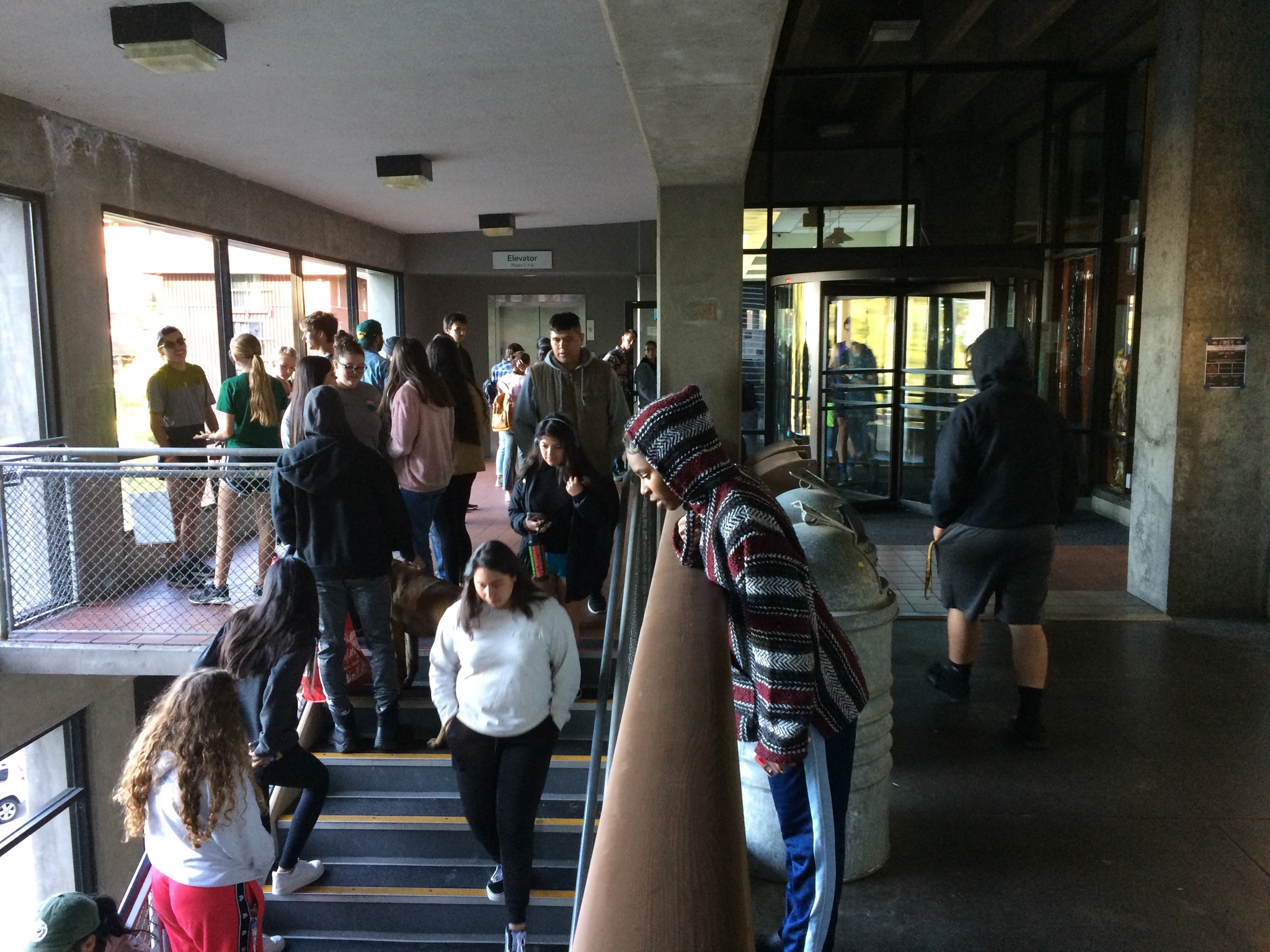
Manson and Carini both noted that food has been hard to come by, as the lines to the J stretch out the doors and down the stairs.
As the PG&E outage affecting over 800,000 California customers enters its first official night, no definite date is set for the return of electricity.
HSU student Max Blaettler said they slept in until 3 p.m. and went to the J at 4 p.m., where they enjoyed a free barbecue dinner.
“It was alright,” Blaettler said. “And it was free.”
As the PG&E outage affecting over 800,000 California customers enters its first official night, no definite date is set for the return of electricity.
However, reporting by Lost Coast Outpost has suggested that power could return as early as tomorrow, if high winds die down and PG&E finds no damage to transmission lines.
At HSU, students said they have already learned prepare better for next time.
“Next time we’ll stock up,” Manson said.
“Definitely have supplies,” Bobino said. “Like back-up chargers.”
Humboldt County residents prepare for a power outage
A power outage will hit Humboldt County as soon as midnight, and may last as long as five days according to the Humboldt County Sheriff’s Office of Emergency Services.
PG&E notified OES today that parts of Humboldt County may see power shutoffs as a result of transmission line shutoffs in California’s Central Valley, due to high winds raising the risk of wildfires.
OES Public Information Officer Meriah Miracle said Humboldt County residents should prepare for an outage.
“Humboldt County should expect power outages as soon as midnight,” Miracle said. “PG&E has not given a time frame yet, but it could be as long as five days.”
Miracle added that PG&E is currently looking into using the local King Salmon power plant to offset any shutoffs. At 4 p.m., Miracle expected an update from PG&E over the following couple hours.
According to a Humboldt County press release, OES is working with response partners and has notified local health services.
“Humboldt County should expect power outages as soon as midnight. PG&E has not given a time frame yet, but it could be as long as five days.”
Meriah Miracle, Office of Emergency Services Public Information Officer
Humboldt State University has posted a statement on their website promising further information when available, including whether classes will be cancelled. The statement urged students to charge phones and critical electronics.
Miracle said residents should follow normal emergency preparedness procedures.
“OES is urging residents to prepare just like they would for any other events,” Miracle said.
For more information, multiple press released are posted below.
A message sent out to some PG&E customers today:
Dear Valued Customer,
To protect public safety, PG&E may turn off your power overnight. Power will remain off until weather conditions improve and it is safe to restore service. To view a list of your impacted locations visit pgepsps.com. Here is what you need to know:
Please have your emergency plan ready.
If you have a backup generator, please do a safety check and make sure you have enough fuel to last a few days. Generator safety tips can be found here. Power will remain off until weather conditions improve and it is safe to restore service. We will continue to monitor conditions and will contact you with further updates. In most cases, we would expect to be able to restore power within 24 to 48 hours after weather has passed. Depending on weather conditions or if any repairs are needed, outages (weather event plus restoration time) could last longer than 48 hours. For planning purposes, we suggest preparing for multiple-day outages. If you see a downed power line, assume it is energized and extremely dangerous and report it immediately by calling 911.
For more information, including regular updates, visit pge.com or call 1-800-743-5002. Thank you,
Pacific Gas and Electric Company
From the Humboldt County website:
Humboldt County Sheriff’s Office of Emergency Services (Sheriff’s OES) is preparing for the potential shutdown of PG&E power to areas of Humboldt County. On Tuesday, Oct. 8, PG&E notified the county that it may activate Public Safety Power Shutoff (PSPS) protocols in neighboring counties due to extreme weather. Transmission lines that power Humboldt County could be affected as a result of a shutdown in another county. The shutdown could impact parts of Humboldt County within the next 24 hours.
Humboldt County is ready to respond to the effects of the power outage; however, the decision to turn off the power and the speed at which it is restored is managed solely by PG&E. The utility is working on a solution to generate power locally at its King Salmon power plant that would help offset the effects of any shutoff.
Sheriff’s OES has taken steps in preparation for a potential power shutdown after being notified by PG&E of their new PSPS program earlier this year. OES is currently operating the Emergency Operations Center (EOC) and is actively coordinating with our operational area response partners and monitoring the situation.
Sheriff’s OES has notified community partners including hospitals, skilled nursing facilities, Humboldt Senior Resource Center, PACE, Open Door Community Health Centers and other critical service providers in the county. Adult Protective Services staff are working on contingency plans to protect the most vulnerable. Local emergency services including 911 dispatch have backup power and should remain active in the event of a power shutoff.
Learn more about PG&E’s Public Safety Power Shutoffs and sign up for PSPS alerts at prepareforpowerdown.com or call 1-877-9000-PGE. PG&E is monitoring weather patterns and will provide updates to customers and Humboldt County when information is available.
Sign up for Humboldt ALERT at humboldtgov.org/alerts to receive safety information and be informed of imminent threats to personal safety or property, tailored to an address of your choosing. To receive updated information from PG&E, update your contact information at prepareforpowerdown.com. Talk to your medical provider about a power outage plan for medical devices powered by electricity and refrigerated medicines. Plan for batteries and other alternatives to meet your needs when the power goes out. Many medications are still usable for two to three days at room temperature, including insulin, which can keep for 28 to 30 days. However, if you are in doubt, please be sure to check with your medical provider. Review the supplies that are available in case of a power outage. Have flashlights with extra batteries for every household member. Have enough nonperishable food and water. Use a thermometer in the refrigerator and freezer so you can know the temperature when the power is restored. Throw out food if the temperature is 40 degrees or higher. Keep mobile phones and other electric equipment charged and gas tanks full. Know how to manually open electric garage doors and gates.
Looking into ICF International’s report on HSU’s economic impact
According to a recent ICF International report, Humboldt State University generates over $567 million in annual industry activity.
ICF International, a global consulting firm based in Virginia, previously studied California State Universities in 2010. ICF uses a model that tracks HSU institutional, student and alumni spending and then calculates the resultant impact.
The report splits HSU spending into three categories: operational, auxiliary and capital.
HSU spent $166 million in the 2017-2018 fiscal year on operational expenses, which includes instruction, research, public service, academic support and student services.
HSU spent $26 million on auxiliary expenses, which includes the bookstore, campus restaurants and research institutes. $16 million went to dining services while about $10 million was spent on parking and housing.
HSU spent $5.5 million on capital expenses, which includes construction and renovations. The report said HSU expects to spend $33 million on capital projects over the next two years.
“University expenditures supported a total of 3,920 jobs in Humboldt County, as well as over $96 million in labor income and more than $293 million in industry activity,” the report said.
To reach the final figure of $567 million of industry activity, the report includes $70 million of student spending and $207 million of regional alumni impact.
“ICF used the average “Cost of Attendance” estimates from the HSU Financial Aid Office to calculate the total student spending impact,” the report said.
The report calls the alumni impact figure conservative, as it does not account for California’s relatively high wages in comparison with the rest of the country.
“California wages tend to be higher than the national average,” the report said. “In 2017, California real per capita income was approximately $2,650 dollars higher than the U.S. national average.”
The report says 58,000 HSU alumni are still in the workforce, while 23% of alumni live in Humboldt County.
“In 2017-18, HSU degree holders living in Humboldt County earned $973 million in wages,” the report said. “HSU degree holders statewide earned more than $3 billion.”
The most comparable CSUs in terms of student population are CSU Channel Islands, CSU Monterey Bay and Sonoma State University. While the locations of each of these universities makes them significantly different, HSU appears on par when compared.
In terms of regional impact, HSU placed second out of the four aforementioned CSUs of comparable student population size.
The CSU website lists summaries of each CSU’s economic impact, as recorded in the previous 2010 ICF analysis.
In terms of regional impact, HSU placed second out of the four aforementioned CSUs of comparable student population size.
In 2010, CSU Channel Islands generated $114 million of regional impact from $135.5 million of spending. CSU Monterey Bay generated $133 million of regional impact from $155 million of spending. HSU generated $190 million of regional impact from $232 million of spending. Sonoma State generated $330 million of regional impact from $213 million of spending.
The new ICF report was conducted only on HSU, so it’s not known whether HSU remains on pace with other CSUs.
“It should be noted that the previous study’s methodology is not directly comparable to the current study,” the report said.
The report includes benefits beyond direct economic impacts, such as research, small business development and contributions to the community and local education.
Most of the report’s findings in these extra-economic areas appear to have data behind them. However, the report includes public radio station KHSU as one of HSU’s contributions to the community.
“Through its innovative, high quality programming, KHSU hopes to educate, enrich, enlighten, and entertain its listeners on local, national, and international issues,” the report said.
HSU abruptly fired all seven KHSU employees last April, citing a need for reorganization and streamlining. KHSU is run by one employee under a short-term agreement lasting until the end of October.
Nevertheless, HSU’s impact on the surrounding community appears significant, even in the midst of an enrollment decline.
HSU’s CAPS is working to combat mental health concerns among HSU students
Rates of attempted suicide in Humboldt County stand far above national and state averages, according to Humboldt State University Health Center Director Brian Mistler, Ph.D.
“Suicide attempt rates in Humboldt County are nearly twice the national and California averages,” Mistler said in an email response facilitated by HSU Communication Specialist Grant Scott-Goforth. “And HSU students face greater systemic barriers to access health care than in other more affluent and less isolated parts of the country.”
An estimated 40% of HSU students felt elevated levels of depression according to a 2016-2017 Healthy Minds Study led by Daniel Eisenberg, Ph.D of the Healthy Minds Network, which performs web-based mental health surveys on college students.
Eisenberg has been leading an analysis of student mental health at all 23 California State Universities. In the 2016-2017 analysis of HSU, an estimated 42% of students had elevated levels of anxiety, while an estimated 4% of students attempted suicide in the last year.
Mistler tied Humboldt County’s lack of expert services to mental health.
“…HSU students face greater systemic barriers to access health care than in other more affluent and less isolated parts of the country.”
Brian Mistler, Humboldt State University Health Center Director
“Mental health is a critical basic need and it’s tied to others like having enough food, shelter and physical health care and safety,” Mistler said in the email. “Psychological needs become more important as chronic resource insecurity increases.”
Mistler clarified that HSU’s relatively high rates of mental health conditions do not appear to be caused by Humboldt itself.
“From what we know today, the increased needs among students appear to be present on the first day,” Mistler said in the email. “That is, it’s not caused by being here.”
Mistler added that many HSU students may arrive with a history of limited health care access.
“It’s also true that many students arrive at HSU having not had access to their fair share of health and counseling services in the past,” Mistler said in the email. “It’s clear from all the data that HSU’s team of health experts do a phenomenal job of helping those students who choose to seek help.”
Counseling and Psychological Services Staff Psychologist and Outreach Coordinator Dr. Elizabeth McCallion in a CAPS office on Oct. 1. McCallion said most students who visit CAPS report positive experiences. | Photo by James Wilde
HSU Counseling and Psychological Services Staff Psychologist and Outreach Coordinator Dr. Elizabeth McCallion is one of the experts working to help students.
McCallion hopes to mitigate the stigma around mental health.
“Mental health support doesn’t just have to be for when you’re having severe symptoms,” McCallion said. “It can be a way of just generally taking care of yourself. Kind of like preventative health care.”
McCallion said CAPS is working to meet students where they are, including through library SkillShops and outreach by Multicultural Specialist Cedric Aaron.
McCallion praised HSU’s mental health services but did acknowledge a lack of services in the surrounding community.
“I think in terms of the counseling center, the counseling center does a wonderful job with that support,” McCallion said. “In terms of our community, there is a need for additional mental health care. But that’s not just mental health, that’s health care in general because of where we live.”
Both McCallion and Mistler emphasized that those students who do use HSU’s services see verifiable benefits.
“Dozens of studies confirm that medical and counseling services reduce the risk for students of catastrophic outcomes, help with anxiety and depression, and increase the chances of students graduating,” Mistler said in the email. “If there’s a message here, it’s to encourage people to use the available resources.”
Mistler noted that HSU’s outreach efforts have produced an increase in student visits to counseling services of about 5% each year.
Mistler also pointed out that students that receive counseling show improved retention rates and a higher likelihood of graduating.
Mistler and Eisenberg plan to prepare a CSU-wide analysis of mental health in spring 2020, which they hope will provide more information on the state of student mental health.
Per the CAPS website: You can reach a CAPS therapist by phone at all hours at (707) 826-3236. In emergency situations, you should call Humboldt County Mental Health at (707) 445-7715 or dial 911.
You may also reach the National Suicide Prevention Lifeline at 1-800-273-8255.
Many of these games are crap, immensely complicated or so dry they would bore even your grandparents. But some are actually fun.
I’ve been playing board games for years. Here are some of my most accessible favorites for various crowds.
For the actor:
“Monikers” is charades, but with a reliable set of cards to act out. To make things better, Monikers offers three rounds of increasing difficulty.
In the first round, you can do anything and say anything but the title of your card to try to get your friends to guess what’s on the card. In the second round, you get one word. In the third, you get only your miming ability. Monikers makes you laugh.
Monikers. | Photo by James Wilde
For the detective:
“Sherlock Holmes Consulting Detective” hands you a pamphlet for a crime mystery and tells you to go solve it. You and your friends work together, going to locations on a map to find clues or reading from facsimile newspapers to find leads.
The goal is to use as few clues as possible to solve the case. The game is reading-intensive and the cases often involve illogical jumps, but if you’ve ever wanted to be a detective this is probably the closest you can get without actually becoming one.
Sherlock Holmes Consulting Detective. | Photo by James Wilde
For the artist:
“A Fake Artist Goes to New York” begins with everyone secretly receiving the same object to draw. However, one player, the fake artist, has no idea what they’re supposed to be drawing.
Everyone goes around in a circle adding one line to the same drawing, and the players must then suss out who the fake artist is, before the fake artist successfully guesses what the object is. Bonus points to this game for coming in a tiny box.
A Fake Artist Goes to New York. | Photo by James Wilde
For the talker:
“Funemployed” is like a riff on “Monikers.” You get a hand of cards with varying words on them. When it’s your turn, you have to “apply” for a a job determined by a card drawn from a deck. Essentially, you’re giving your pitch in front of your friends.
The catch is that in your pitch, you have to include the terms from all of the cards in your hand. Good luck fitting “Fifty Cats” or “Scientology” into your pitch for that internship. Another game that’s guaranteed to make you laugh, so long as you play with people comfortable ad-libbing and talking a lot.
Funemployed. | Photo by James Wilde
For the gambler:
“Lords of Vegas”makes you into a prospective businessperson setting out to build Las Vegas. Compete with your friends to buy lots, build casinos, and talk your way into questionable trades to win the game.
It’s also very probable that at some point you’ll gamble your money at another player’s casino and lose everything. This game is basically what Monopoly should be. It’s also a little more complex than other games on this list.
Lords of Vegas. | Photo by James Wilde
For the storyteller:
“Tales of the Arabian Nights” is a choose-your-own-adventure book on steroids. You and your friends traverse around a map while reading from a booklet of stories and choosing your reaction to said stories.
There’s not much of a game here. Mostly, there are lots of laughs as your character gets captured by fire worshippers, turned into an elephant or has some other bizarre encounter. I recommend using the app to streamline the choose-your-own-adventure part.
Tales of the Arabian Nights. | Photo by James Wilde
HSU officers cast an almost unanimous vote of no confidence in police chief
The Statewide University Police Association published a press release on Monday stating that officers of the Humboldt State University Police Department submitted an almost unanimous vote of no confidence in Police Chief Donn Peterson.
Nine of the ten officers in the department cast a “no confidence” vote while one abstained. Peterson has allegedly manipulated crime reports, frequently left the office to go out of state, created a hostile discriminatory work environment and violated labor laws.
In a phone interview with Peterson, he said he does not agree with the allegations. However, he enthusiastically supported the association’s examination.
“I have a profound respect for the seriousness of the allegations and the people who made them,” Peterson said. “So I want to respect that.”
Peterson said he wants to be as transparent as possible, but he hopes to continue to be the UPD Chief.
Associated Students President Yadira Cruz said she was surprised when she learned about the vote on Monday.
“I was genuinely shocked,” Cruz said. “Like what the fuck?”
After thinking about it more, Cruz said she wasn’t all that surprised. Cruz said UPD’s problems probably go beyond the chief.
HSU’s Vice President for Administration and Finance Douglas Dawes sent out a campus memo at 4:50 p.m. on Monday, Sept. 30. Dawes said he has high expectations for all employees within UPD and remains committed to helping them be effective.
“Chief Peterson and his team have enhanced outreach to students through the Chief’s Advisory Panel, created the safety escort program, and worked closely with Equity Arcata,” the memo said. “We will thoroughly investigate all of the allegations brought to our attention.”
While the Justice for Josiah movement previously worked closely with UPD, they also inspired the Chief’s Advisory Panel. On Monday the Justice for David Josiah Lawson Facebook page posted a call to action in regards to the news.
“Who is going to protect our students, because it is obvious Humboldt State does not give a damn about their safety?” the post read. “It’s time to start cleaning house President Tom Jackson, get rid of the slackers. Put OUR students first.”
The press release noted that the vote does not automatically oust Peterson. However, UPD Officer Billy Kijsriopas hopes a new chief will take Peterson’s place.
“The damage to morale and the risk to campus safety is too great,” Kijsriopas said in the memo. “It’s past time we had a new chief.”
The full press release from Statewide University Police Association:
Arcata, CA. — According to officials with the Statewide University Police Association (SUPA), its officers at the Humboldt State University Police Department have cast a vote of no confidence in the Department’s police chief, Donn Peterson. Nine of 10 officers who completed the survey voted against the Chief, while the remaining voter abstained.
SUPA conducts annual leadership surveys at each CSU campus. The most recent nearly unanimous vote of no confidence in Police Chief Donn Peterson is in line with previous year’s results. Chief Peterson took the job at HSU after leaving his former post with Florida’s Broward County Sheriff’s Department amid scandal. Peterson still regularly spends time out of state with his family in Florida.
According to HSU Officer Billy Kijsriopas, “Chief Peterson’s frequent, extended bouts of time out of state leave the department in the hands of a Lieutenant who also spends an unusual amount of time away from campus. Our officers look to the Chief for guidance and leadership, but he has fallen short of the standards they and the University community deserve.”
According to Officer Kijsriopas, absenteeism is only a fraction of the failure in leadership the Department has seen since Peterson came to HSU in January 2015. Among the Chief’s other offenses, Kijsriopas cites manipulation of crime statistics reporting, creating a hostile work environment including making racial slurs aimed at minority officers, multiple violations of the Public Safety Officer’s Procedural Bill of Rights Act and blatant violations of labor laws that include a derogatory, anti-labor letter which Peterson authored and posted publically [sic].
Says SUPA president Jeff Solomon, “Our members in the Humboldt State University Police Department have consistently reported absenteeism, mismanagement and more in departmental leadership. When you have a department united like this, clearly there is a problem.”
When asked what steps he and other HSU officers would like to see, Kijsriopas replied, “The damage to morale and the risk to campus safety is too great – it’s past time we had a new chief.”
Arcata incident renews doubts of local safety and transparency
A black 18-year-old HSU student reported being slashed with a knife near 14th and G streets in Arcata on Aug. 26, according to a Humboldt State University press release sent out Friday, Sept. 27.
The incident occurred more than a month ago, but students are only just hearing about it. Associated Students President Yadira Cruz wished HSU had notified students to avoid feelings of mistrust.
“To avoid that, just send out an email as soon as it happens,” Cruz said. “Just develop that transparency.”
The press release went on to summarize the events after the student fled Arcata and returned to HSU.
“Paramedics were called, and they were taken to Mad River Community Hospital where they were treated for the injury,” the press release, written by HSU Interim Vice President of Enrollment Management Jason Meriwether, said.
Cruz said the student has reported being physically fine as of Monday.
The incident, which largely flew under the radar until reporting from Lost Coast Outpost dug it up for a story published on Thursday, Sept. 26, is now under investigation by the Arcata Police Department.
The HSU press release noted multiple media narratives and sought to clarify the situation. On the night of the incident, HSU determined that no threat to the campus existed, and did not send out a notification.
The release also noted no evidence of the incident being a hate crime, which would warrant notification.
“If there had been an imminent threat or evidence of a hate crime, the campus community would have been alerted by text and email using HSU Alert,” the release said.
Cruz, along with several HSU faculty and staff, reviewed and gave consultation for the release.
Cruz first heard about the incident from a Lost Coast Outpost reporter seeking her comment. Cruz wondered whether HSU would’ve notified students if it weren’t in the midst of an enrollment decline.
In any case, Cruz wished HSU had notified the campus, regardless of whether the incident appeared to be a hate crime.
“Saying it’s not race-related is not a valid excuse,” Cruz said.
The press release emphasized Humboldt’s close-knit community and called HSU the “Humboldt Family.” However, Cruz doubted the sincerity.
“The campus tells us they care about us only when something bad happens,” Cruz said.
Die-in protest advocates for action on climate change
Motionless bodies lay in the Humboldt State University quad on Friday.
Junior wildlife major Olivia Brock joined a die-in protest put on by Extinction Rebellion with help from Earth First.
“We want to show them that if they’re gonna kill us, then they have to see us,” Brock said.
A variety of HSU students pretended to be dead on the ground, with many holding flowers in their hands and some wearing face paint.
HSU student Vanessa Argonza lying prone for a die-in climate protest in HSU’s quad on Sept. 27. | Photo by James Wilde
Signs at a die-in climate protest in HSU’s quad on Sept. 27. | Photo by James Wilde
John Powell (tie-dye), College of the Redwood agriculture student, and J.T. Abbott, HSU botany student, hugging on the ground for a die-in climate protest in HSU’s quad on Sept. 27. | Photo by James Wilde
Extinction Rebellion and Earth First advocate and protest for governmental action on climate change and environmental issues.
Junior forestry major Arvel Reeves joined the protest despite not knowing about it beforehand.
“Climate change is something I really worry about,” Reeves said. “It’s only going to get worse.”
Lily Price, HSU botany student, played a morose tune over the protesters’ bodies on a harmonium, an organ instrument that sounds similar to an accordion.
The protest came one week after a global climate strike that saw thousands of protests around the world, including one in Arcata.
Ellis Hanson, a junior wildlife biology major, wanted to help stand for the earth.
“I did this to do a demonstration,” Hanson said. “To make sure everyone remembers the crisis we’re in.”
Ellis Hanson, HSU wildlife biology junior, lying down for a die-in climate protest in HSU’s quad on Sept. 27. | Photo by James Wilde
Lily Price, HSU botany student, plays a somber song on a harmonium for a die-in climate protest in HSU’s quad on Sept. 27. | Photo by James Wilde
Protesters lying down for a die-in climate protest in HSU’s quad on Sept. 27. | Photo by James Wilde
Protestors gathering in a circle after a die-in climate protest in HSU’s quad on Sept. 27. | Photo by James Wilde
Students passing by showed mixed reactions to the protesters. Some stopped and watched. Others took photos on their phones. Others scurried along without a second glance.
Brock hoped the visual nature of the protest would draw attention.
“We want to make the people of Humboldt County see the future we’re being handed,” Brock said.
Heri Hawthorn, a local activist, helped create some of the signs and banners for the protest. Hawthorn held a sign above the protesters while they lay still.
“There’s nothing else to do except support others and curb what’s happening,” Hawthorn said.
Early on, when a University Center employee took down an unpermitted protest banner. Brock took notice.
“Don’t you care about your children?” Brock asked the employee. “The earth is dying!”
Blu, HSU environmental studies senior, lies covered up for a die-in climate protest in HSU’s quad on Sept. 27. | Photo by James Wilde
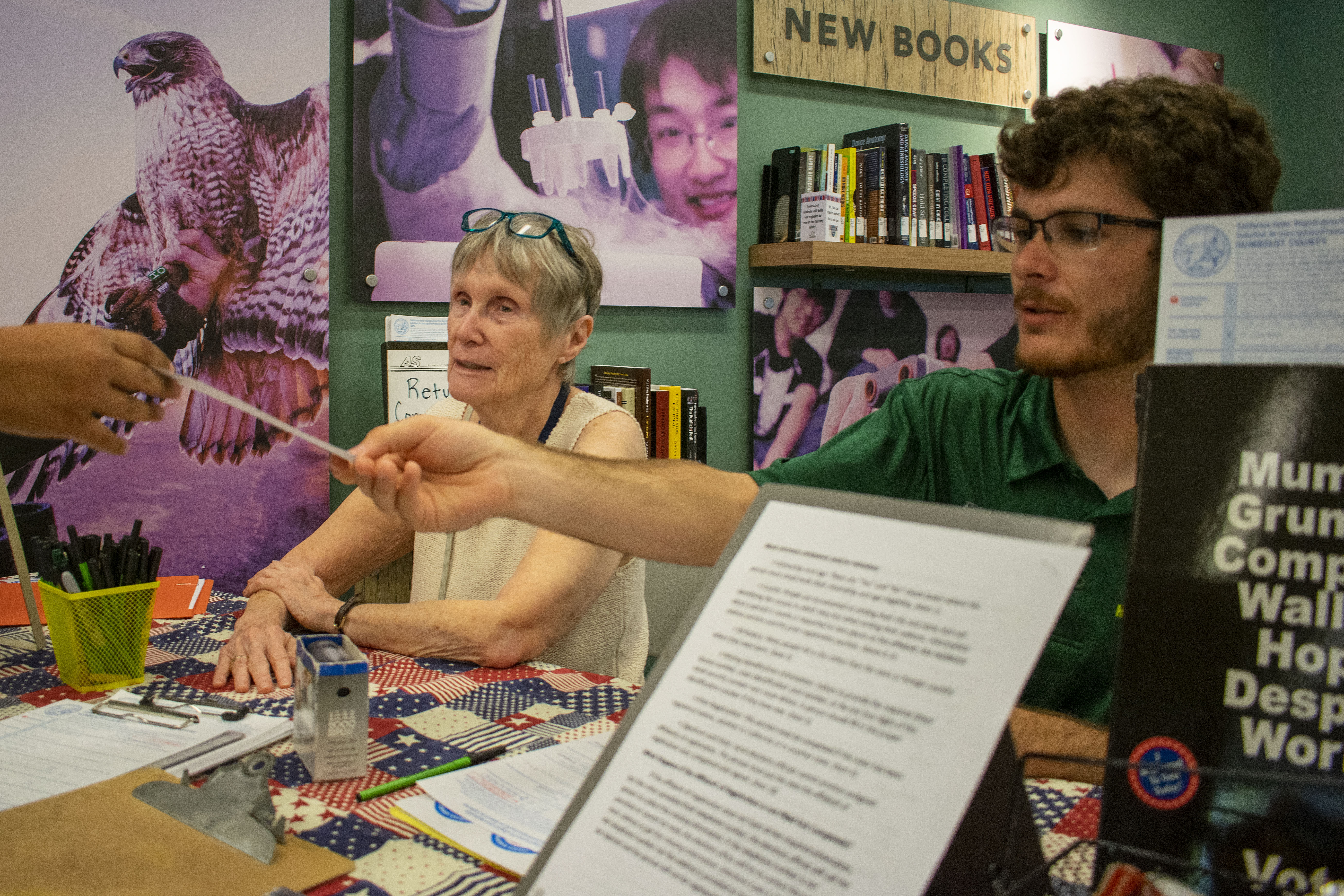
Representatives working with Humboldt’s League of Women Voters tabled at the Humboldt State University library on Tuesday for National Voter Registration Day.
With national elections just around the corner, Vincent Thomas, environmental resources engineering senior and receptionist for Associated Students, urged library visitors to register.
“Voting gives you the right to complain about what’s going on,” Thomas said. “If you don’t vote, you can’t complain.”
Beside Thomas sat Margaret Augustine, a 20-year-old Eureka resident and member of the League of Women Voters. Augustine simply wanted to provide students with information on how to vote.
“It’s non-partisan,” Augustine said. “We just get people to vote and express their opinion.”
According to National Voter Registration Day’s website, the holiday has been held on the fourth Tuesday of every September since 2012. The holiday’s goal is simple: get people to vote. According to the site, 800,000 people registered to vote on the holiday in 2018.
The U.S. Census’ website also reports that 61.3% of U.S. citizens registered to vote in 2018, and 49% actually did so.
The lowest voter turnout in 2018 came from citizens between the ages of 18 and 24, at 30.1%. Voter turnout increased with age, with the highest voter turnout from citizens between 65 and 74, at 65.6%.
Thomas emphasized that voting gives citizens a voice.
“Just getting people to register to vote so they have that option to vote if they need to is very important,” Thomas said. “We want to get as many people to have their voices heard as possible.”
At midday on Tuesday, Thomas said around a dozen individuals had registered.
“Most of the students who have come by said, ‘yeah, they’ve already got it done,’ which is pretty good,” Thomas said.
Thomas said registering only takes about five minutes. Outside of National Voter Registration Day, a prospective voter can register at their local election office or online at Vote.gov, an official website of the U.S. government that helps people figure out how to register. The nearest election office to HSU resides in Eureka at 2426 6th St.
AHS and HSU students strike to advocate for climate action
Video by James Wilde & Collin Slavey | Editing by Chelsea Wood
Anxious and irritated with the lack of governmental action against climate change, masses of young people and students from Arcata High School and Humboldt State University took to the streets surrounding the Arcata Plaza on Friday as part of the Global Climate Strike.
Inspired by the International Youth for Climate Action, the Humboldt Sunrise Movement in association with the Extinction Rebellion and students of AHS organized and executed the local school strike protesting climate change.
Students were excited to show how strong their voices could be when used in unison. Maddie Marriott, a member of Extinction Rebellion, said the organization was aimed at gathering people for peaceful protest and that is what they hoped to achieve.
Maddie Marriot stands out in the crowd of demonstrators as she walks down I Street on Sept. 20. | Photo by Collin Slavey
Locals with an interest in helping the environment and pushing the government toward action participated in the youth strike too. | Photo by Collin Slavey
Maddie Marriot and Vanessa Argonza march down I street, shouting out chants and slogans on their way to the plaza. | Photo by Collin Slavey
“We dance, yell, sing and chant to show our energy,” Marriott said. “This shows we are cheerful and hopeful and happy in the face of this threat. It is rejuvenating and these friends are empowering. Now we have to wait and see if our voice is being heard.”
Marriott ended up agreeing to hold a sign that said “Protect Rainbow Ridge, our forests and our climate.” Ecological protection is one of the main goals of the movement, but Extinction Rebellion as a national organization demands governments tell the truth about climate change and act now to prevent species loss and lower greenhouse gas emissions.
Vanessa Argonza, a Humboldt State student and member of the Extinction Rebellion, said speaking out and advocating for action is important. Change requires people to care and be passionate about an issue, while also realizing we can come together to create change.
Members of the Extinction Rebellion stand and watch the demonstrations on Sept. 20 in the Arcata Plaza. | Photo by Collin Slavey
Creative signs were a centerpiece to the demonstrations. | Photo by Collin Slavey
Maddie Marriot walks down I Street on Sept. 20 on her way to the Arcata Plaza. | Photo by Collin Slavey
Demonstrators gather in Arcata plaza, carrying with them a blow up planet earth. Hundreds of people were in attendance. | Photo by Collin Slavey
Signs help spread messages aiming to educate and advocate for action. | Photo by Collin Slavey
Vanessa Argonza leads the crowd of young people standing against climate change on Sept. 20. | Photo by Collin Slavey
“In moments of injustice you must speak out because if you do not, you are part of the problem,” Argonza said. “The youth is well aware and willing to be part of the change because it affects them. We can come together and make change. You just have to be aware of your footprint and educate yourself before you speak out.”
The protest did run into some technical issues as it spilled out into the Arcata Plaza. Unfortunately, the strike organizers failed to bring a speaker system that was loud enough for all of the attendees to hear, causing the message to fall flat. Joanne McGarry, a local supporter of the Environmental Advocacy and self-prescribed ‘gadfly’ suggested better planning in the future for a more impactful demonstration.
Jene L. McCovey delivers a powerful, emotional speech about the threats to the Earth faces. | Photo by Collin Slavey
“I am more than happy to let young people lead, they just have to lead well,” McGarry said. “Having music is important when you’re walking into the plaza, during the demonstration and as you exit the plaza. Having a speaker that is loud enough for the entire crowd to hear is unbelievably important.”
The Sunrise movement was originally created as a youth advocacy group to show support for the Green New Deal, a stimulus package proposed by politician and activist Alexandria Ocasio-Cortez in February of this year. The Sunrise Movement intends to work within ‘the system’ while actively changing the system, in pursuit of environmental and social justice through nonviolent and direct action. They are building an army of young people to stop climate change and create millions of good jobs in the process.
Tribal elder Jene L. McCovey began the rally in the plaza with a song called “Feeling Sorry for My Womenfolk,” a somber tune that spoke of hate and woe. She went on to tell stories and sing more songs to give purpose to the actions of the demonstrators.
“The stumps are really big- that is all we have left of the old forest,” McCovey said. “Clear cutters, defilers, denude the land down to the earth and they burn it. Wherever you find your trials, be that healer. Be that person that walks with people in that good way. Be the water protectors.”
Humboldt State’s Budget Committee seeks best path forward
Humboldt State University’s University Resources and Planning Committee met on Sept. 12 to begin planning a three-year university budget.
Art Education Assistant Professor and Co-Chair of URPC James Woglom said URPC hopes for a budget that will allow HSU to be its best.
“My hope is to have the best university we can be in the context of what we have,” Woglom said. “I think that is the hope of everybody involved.”
URPC exists as part of the University Senate, with 14 members, including administration, faculty and students.
URPC released an update on Sept. 16 in which it estimated a $5.4 million budget gap by the fiscal year of 2021 to 2022.
HSU Budget Director Amber Blakeslee said HSU has already made over $10 million of budget reductions in the last few years. The $5.4 million projected gap comes from the continuing decline in student enrollment.
Assistant Professor of Art Education and Co-Chair of the University Resources and Planning Committee James Woglom in the HSU library on Sept. 20. Woglom emphasized the need for imaginative thinking to create the best budget possible for HSU. | Photo by James Wilde
“If there are less students on campus there’s less tuition coming in the door,” Blakeslee said. “So it’s not that all-of-the-sudden we’re spending more. It’s that there’s less revenue coming in to support the spending that we have.”
HSU’s enrollment dropped from 7,774 to 6,763 students this year. Projections expect enrollment to continue to drop. HSU has yet to update its website, which still lists 7,774 students enrolled and advertises having over 8,000 students.
HSU issued a press release on Tuesday, Sept. 24 detailing new efforts to increase enrollment, including a focus on local recruitment, improving student analytics and decreasing costs.
However, Blakeslee said that HSU’s plans to recover enrollment numbers will take time. Until then, the budget gap must be reconciled.
Blakeslee hoped the budget cuts won’t have an impact on students, but Blakeslee acknowledged that any cuts will be difficult.
“There’s not a single thing we do on this campus that doesn’t have strong, passionate people behind it,” Blakeslee said. “If you’re talking about cutting things, you’re talking about the difference between multiple good things.”
“If there are less students on campus there’s less tuition coming in the door. So it’s not that all-of-the-sudden we’re spending more. It’s that there’s less revenue coming in to support the spending that we have.”
Amber Blakeslee
At this early stage, neither Blakeslee nor Woglom could rule out any specific cuts.
“We do need to have everything on the table in terms of our discussion so that we can make the best decision,” Woglom said.
Woglom emphasized multiple times that URPC will have to use its imagination to maintain HSU’s educational mission while cutting back financially.
“We do need to be creative within the context of the resources that we do have,” Woglom said. “If a course is not offered, how do we make sure that the curricular needs of the students is met with what we do have?”
Blakeslee said that while HSU is currently reducing expenditures, it is still trying to improve the student experience.
“There is simultaneous new investment happening, so it’s not like we’re just in a reduction mindset purely” Blakeslee said.
URPC expects to complete a plan by Dec. 6. Before then, both Blakeslee and Woglom emphasized the importance of seeking input from the HSU community.
“As much stakeholder input as we can get, the better our decisions are going to be, and the more interpersonally-invested we’re going to be,” Woglom said.
Blakeslee and Woglom said URPC will be holding public forums to discuss the budget, but no dates have been set.
Once URPC finalizes its plan in December, the plan will go to University President Tom Jackson, Jr., who will have the final say over the plan.
This article was updated Sept. 26 to include information from Humboldt State’s press release on the topic.
It’s not just Humboldt State that has a parking issue
Arcata’s Transportation Safety Committee held its monthly meeting on Tuesday, in which they opened up for public comment on city parking restrictions.
Netra Khatri, staff liaison of the committee and Arcata assistant city engineer, thanked the small crowd of about ten locals gathered in the City Council Chamber of Arcata City Hall.
“We decided to make this meeting annual three years ago, where we can take public comments and hopefully make changes from input,” Khatri said.
After discussing minutes from a previous meeting, the committee of eleven opened the meeting for public comment.
The comments varied in severity and scale, but revolved around one central theme: the city of Arcata lacks sufficient parking.
Arcata resident Vernon Price proposed a plan to allow some Arcata citizens to park their cars freely from dusk til dawn. Price said he was unhoused for 15 years, and wanted the committee to keep the homeless in their hearts and minds.
“There are people who have lost their homes, and their only tangible property is their homes—and they live in those,” Price said.
The committee noted Price’s suggestion and promised to look into designating overnight parking spaces.
Arcata resident Collin Wingfield brought to attention a parking overflow resulting from the recent construction of the 142-apartment Sunset Terrace complex located between Sunset and Foster Avenues.
Wingfield, who said he lives on Wilson St., just off of Sunset, has noticed an influx of Sunset Terrace residents parking their vehicles along Sunset Ave. and even on his street.
Even though Sunset Terrace residents are allotted one parking space in their complex, Wingfield said residents often park their cars along Sunset Ave., leaving other homes with insufficient parking.
“They will leave their cars parked for weeks at a time,” Wingfield said.
The committee sympathized with Wingfield and discussed possibly issuing parking permits for Sunset Ave. residents.
Arcata Library Branch Manager Susan Parsons brought to attention a lack of parking for library visitors. Parsons said parents with children often have to walk through a lot marked by uneven terrain and frequent drug users.
“Parking for visitors of the library is an issue of safety,” Parsons said.
In response, the committee suggested designating specific parking spots for the library or enforcing time limits on the spaces outside of the library to prevent them from filling with non-library visitors.
Tisha Farrer, an employee of the North Coast Co-Op, urged the committee to get rid of parking meters and two-hour spaces. The Co-Op, Farrrer said, reserves its lot for customers only and employees often have to park far away.
“I just want them to feel safe and have parking where they work,” Farrer said.
The committee noted Farrer’s concerns while making clear that Arcata’s parking shortage comes at a tricky time as the city tries to encourage the reduction of personal vehicular use to reduce greenhouse gas emissions.
TSC will now take the public comments and bring their recommendations to the Arcata City Council on Oct. 16. TSC meets the third Tuesday of every month at the City Council Chamber.
Dr. Kimberly Perris leads the reestablishment of HSU’s bachelor of science in nursing program
Four weeks into the job, Humboldt State University’s nursing program Director Kimberly Perris has started putting the pieces in place to reform HSU’s bachelor of science in nursing program.
Perris said she wants to empower local nurses to fill empty leadership roles in local health services.
“My excitement, what I’m hopeful for and why I’m grateful to be here is because I really envision a role for nurses where they can go beyond the hospital walls, work in team-based care models and just take on more autonomous roles,” Perris said.
Director of Special Projects and Executive Director of HSU’s California Center for Rural Policy Connie Stewart at HSU on Sept. 14. Stewart, an HSU graduate and former Arcata mayor, believes HSU’s BSN program will be essential for Humboldt County’s future. Photo by James Wilde.
HSU canceled its BSN program in 2011, citing a lack of funding and qualified faculty. After years of a lack of BSN-educated nurses, HSU is relaunching the BSN program with the help of a $2 million dollar grant from St. Joseph Health.
Director of Special Projects Connie Stewart leads the California Center for Rural Policy, an HSU program designed to improve rural communities. Stewart currently oversees fundraising for the BSN program, and she hinted the receiving of more than just the St. Joseph Health grant.
Stewart, a former Arcata mayor who has served the community for more than thirty years, said that Perris is perfect for the job.
“She’s got really great, fresh ideas about how to improve health care in Humboldt County,” Stewart said. “I couldn’t be more excited to be working with her.”
Stewart emphasized the importance of the BSN program not just for Humboldt County, but for HSU. HSU students and faculty, Stewart noted, need healthcare too.
“I’m grateful that we can provide the opportunity for nurses to expand on their education—I know for me it was life-changing to do that.”
Kimberly Perris
“This program has to be successful in order for HSU to thrive,” Stewart said.
Perris dabbled in health-related fields in her youth, where she said she picked up a passion for helping and educating patients.
Perris graduated with an Associate of Science in Nursing in 1991. She worked in family planning before she worked at the HSU Student Health Center from 2004 to 2016 as a nurse, a job Perris said she loved.
“I loved the education piece of it,” Perris said. “Working there is where I really decided to go back to school, and I saw a role for nurses that could be a little bit more fulfilling and autonomous and help improve access to care.”
Perris earned a Doctor of Nursing Practice Executive Leadership from the University of San Francisco in 2018. Perris said she’s driven to give other nurses the same educational opportunities she had.
“I’m grateful that we can provide the opportunity for nurses to expand on their education—I know for me it was life-changing to do that,” Perris said.
HSU’s BSN program is designed for already-registered nurses who want to further their education. Perris said this will allow nurses to become more involved with the community and work outside of hospitals.
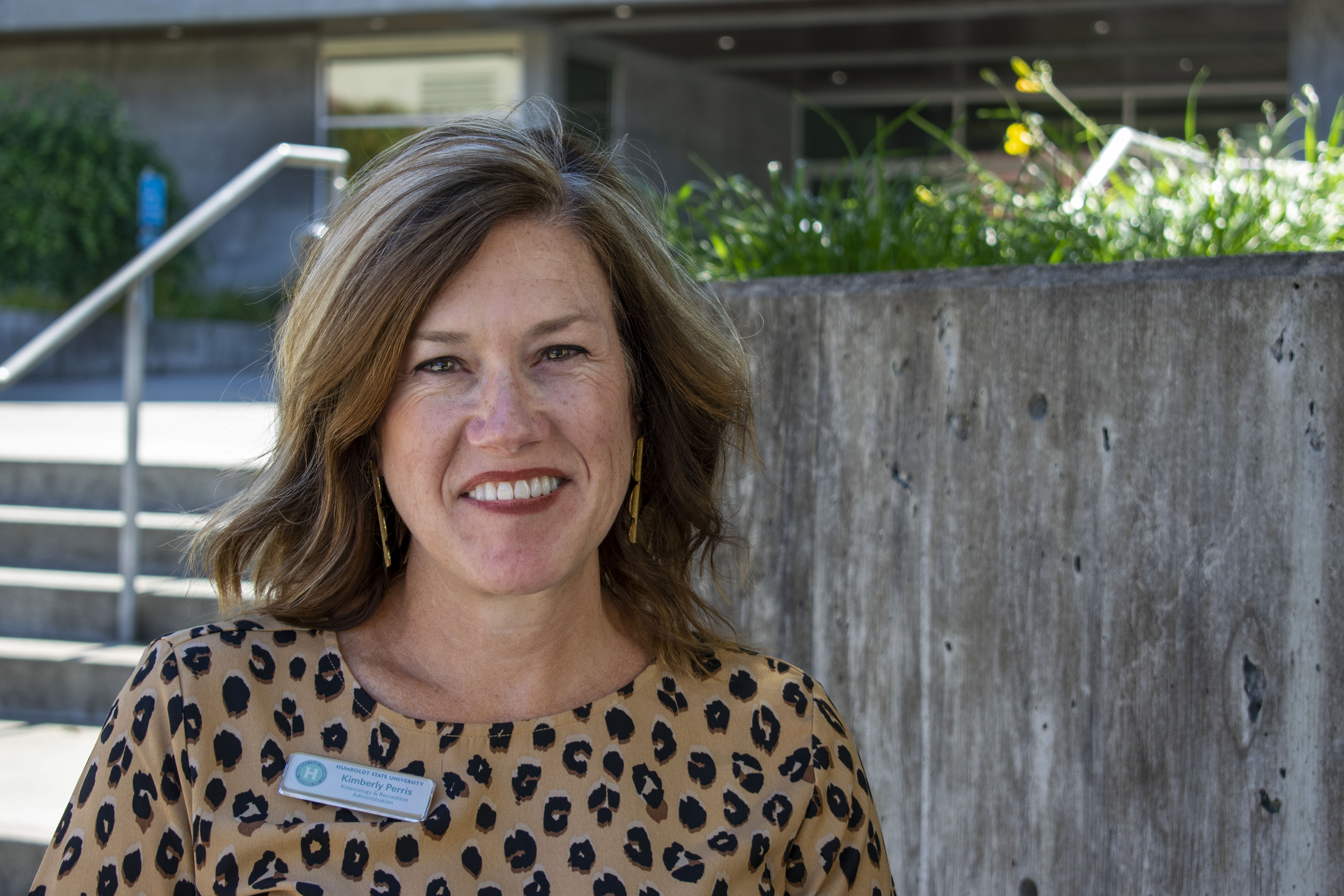
HSU’s new BSN nursing program director, Kimberly Perris. Perris is working towards a goal of graduating 50 nurses from the BSN program by 2022. | Photo by James Wilde.
The program’s goal is to graduate 50 nurses in 2022, with 25 students entering a part-time, two-year program in 2020, and another 25 entering a full-time, one-year program in 2021.
Perris said she’s developing relationships with local health centers for BSN nurse roles. She’s also working to make the transfer process from College of the Redwood’s RN program seamless.
CR’s Director of Nursing and Health Operations Roberta Farrar echoed Perris’ hopes.
“My hopes and goals would be to see each class filled to capacity with a waitlist of those wanting to enter the program,” Farrar said in an email. “That the registered nurses who choose Humboldt State are satisfied with their education and use knowledge gained to make necessary changes in any healthcare setting they are employed.”
Both Farrar and Perris said the program won’t bring more nurses to the community, but will instead give more opportunities to nurses in the area, enticing them to stay in Humboldt.
“We have a struggling health care system right now and I think nurses are one of the missing pieces that can help to improve that… The missing links.”
Kimberly Perris
“A lot of nurses leave the area because they want to continue their education or there aren’t the kind of positions that they’re looking for,” Perris said. “So this role will provide more nurse leaders for the community and nurses to have more of a systemic look at the population.”
While Perris said she has felt overwhelmingly supported in her first few weeks, she did acknowledge the pressure of her position.
“I feel pressure because I want this to be successful,” Perris said. “And I want to make sure I have all the details in place to keep moving it forward and not let anything fall in through the cracks.”
Despite the pressure, Perris said she doesn’t have any significant fears.
“There will be likely a little series of things that don’t work, and that’s normal in a new project,” Perris said. “I’m sure there will be some hopefully-just-mini failures because this is a brand-new program, but that’s okay.”
Long-term, Perris said the BSN program will help nurses have a broader understanding of the community and its healthcare needs.
“We have a struggling health care system right now and I think nurses are one of the missing pieces that can help to improve that,” Perris said. “The missing links.”
El Centro event welcomes and connects Latinx students and community members
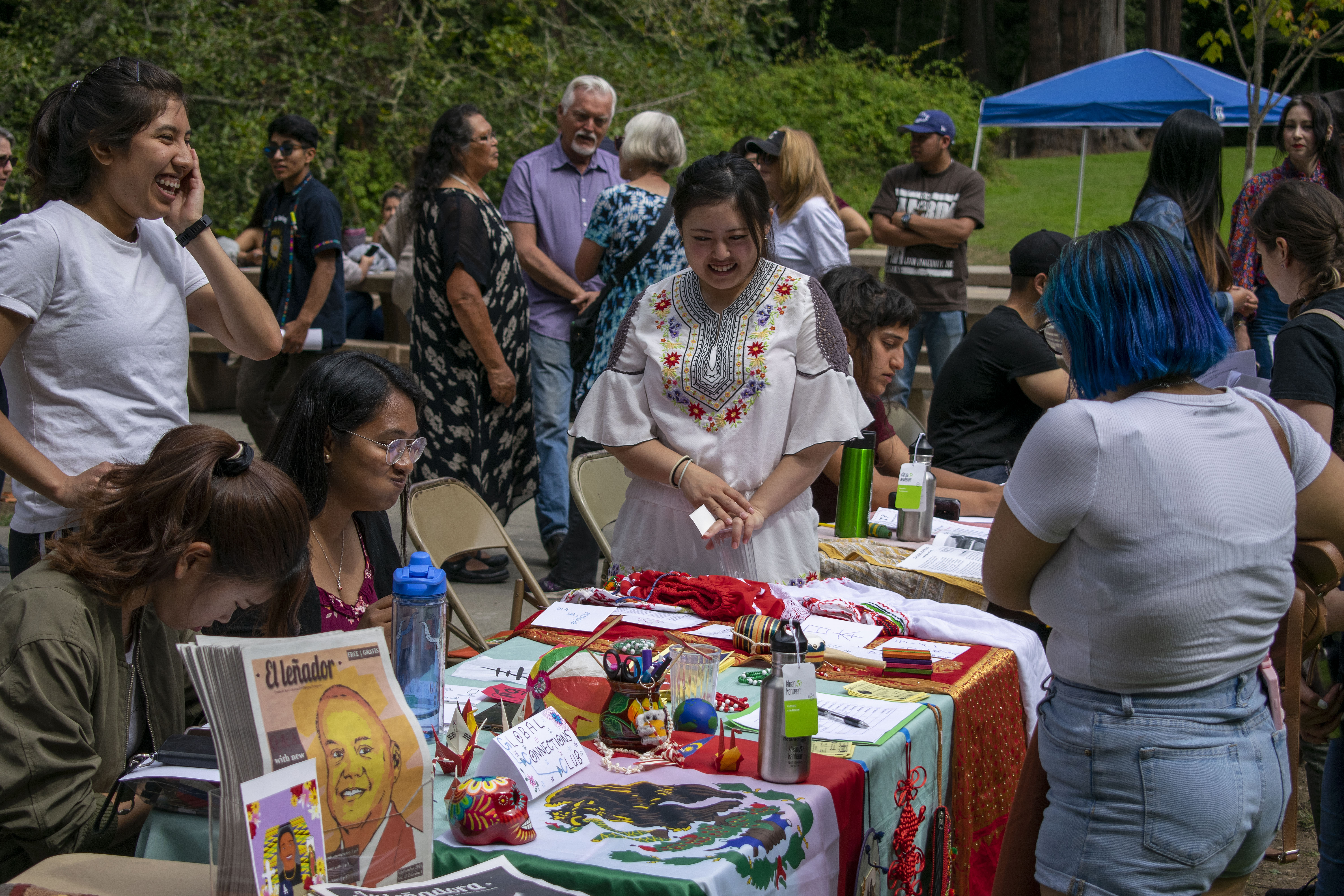
Music and cheerful chatter filled Arcata’s Redwood Park on Sunday as Humboldt State University’s El Centro Académico Cultural held its Convivio de Bienvenida, a convivial welcoming event.
Ritz Garcia, a junior and critical race, gender and sexuality studies major and liaison for El Centro, said he has loved being a part of El Centro.
“It’s made me feel like family,” Garcia said. “Like there’s somewhere I belong.”
Ritz Garcia, junior critical race, gender and sexuality studies major, at the Convivio de Bienvenida on Sept. 15. Garcia is a liasion for El Centro. | Photo by James Wilde
The gathering served as an opportunity for Latinx students, families and community members to convene and connect with one another.
Resource centers from HSU and the local community offered information on a wide range of topics that included parenting lessons, food pantries, housing insecurity, drug addiction recovery, communication with law enforcement and the expansion of diversity in the community.
Meanwhile, children played in the grass and members of Latino Outdoors led hikes into the surrounding redwoods every 30 minutes.
Daniel Gallardo, vice president of LatinoNet and coordinator for the Assisting Families to Access Change Through Resources Americorps program, hoped to connect attendees with community offerings.
“There’s a perception of Humboldt not having a lot of resources,” Gallardo said. “We’re trying to debunk that.”
Gallardo emphasized that resources for the Latinx community are available in Humboldt but can be difficult to access. Gallardo urged students to join the AFACTR program, which has a goal of preventing child abuse in Humboldt County. AFACTR awards up to $10,000 per year in services.
Jorge Matias, health educator for St. Joseph Health, pushed table visitors to check out health classes offered in Eureka and Fortuna. Matias promoted a Zumba class for physical health but also emphasized the importance of mental health.
Vice President of Latinonet and Program Leader at Americorps Daniel Gallardo at the Convivio de Bienvenida, a Convivial Welcome from HSU’s El Centro Académico Cultural on Sept. 15 at Arcata’s Redwood Park. Gallardo hopes to make resources more available for the surrounding community. | Photo by James Wilde
“We want to get rid of the stigma with mental health,” Matias said.
Before rain clouds crept in, attendees enjoyed a free lunch alongside a brief mariachi performance. A table for Adventure’s Edge offered raffle tickets for two new backpacks while another table for Equity Arcata offered information on housing, employment and education.
El Centro intentionally designed the event with inclusivity in mind. El Centro, which was previously known as the Latinx Center for Academic Excellence, changed its name to better represent those it serves.
Lunch at the Convivio de Bienvenida, a Convivial Welcome from HSU’s El Centro Académico Cultural on Sept. 15. The event, held at Arcata’s Redwood Park, had free food for all attendees. | Photo by James Wilde
“Not everybody identifies as Latinx,” Garcia said. “El Centro sounds more inviting.”
HSU’s Hispanic Serving Institutions STEM grant, a $3.9 million U.S. Department of Education gift spread over five years, from 2016 to 2021, funded the event.
Each table offered its own brand of services focused on improving the local community. Bertha de la Cruz, a representative for Food for People, sought to connect attendees with free food resources.
“There’s tons and tons of food,” de la Cruz said. “I wish I would’ve known all of this as a student.”
Devon Hernandez, academic and career adviser, helmed a table for HSU’s Academic and Career Advising Center.
Academic and Career Advisor Devon Hernandez at the Convivio de Bienvenida, a Convivial Welcome from HSU’s El Centro Académico Cultural on Sept. 15 at Arcata’s Redwood Park. | Photo by James Wilde
“We’re here to make sure students have the resources they need,” Hernandez said.
For attendees of the Convivio de Bienvenida, resources appeared abundant. More information on El Centro and their upcoming events can be found in room 205 of Nelson Hall East or on their website which is still branded as the Latinx Center for Academic Excellence.
HSU chatbot introduced to new students to answer campus questions
This fall, Humboldt State University introduced artificial intelligence chatbot HumBot to provide basic information for new students and transfers.
Director of Communications and Marketing for Enrollment Management Josh Smith led the project over the last two months until its release.
Thus far, HumBot has received more than 1000 questions and comments.
“There is a good chance that those questions may not have been asked if that avenue was not available to them at the time,” Smith said. “We get them at all hours of the day.”
Provost and Vice President of Academic Affairs Alexander Enyedi initially pushed for the development of a chatbot two years ago after hearing about a chatbot at Georgia State University. Pounce, the name for GSU’s chatbot, delivered more than 200,000 answers to incoming freshman within the first few months of its implementation in 2016.
Enyedi, with help from Smith and Associate Professor of Social Work Jen Maguire worked together to create HumBot.
“I’ve been a passionate proponent for the chatbot technology for over two years,” Enyedi said in an email.
HumBot is one chatbot among seven within California State Universities. AdmitHub, an AI chatbot service designed for students, developed all seven chatbots.
HSU created HumBot in the last two months after receiving an $80,000 grant from the Irvine Foundation.
AdmitHub handed over HumBot pre-seeded with answers to the 700 most common questions asked by first-year students. HSU then needed multiple departments to analyze the answers.
“It was started off by everybody just going in there, reading all the questions and answers, and first making sure that it was accurate, and second, trying to make it a little bit more friendly,” Smith said.
HSU staff and summer students then seeded HumBot with an additional 150 questions before it was released this fall. HumBot will continue to learn as students interact with it.
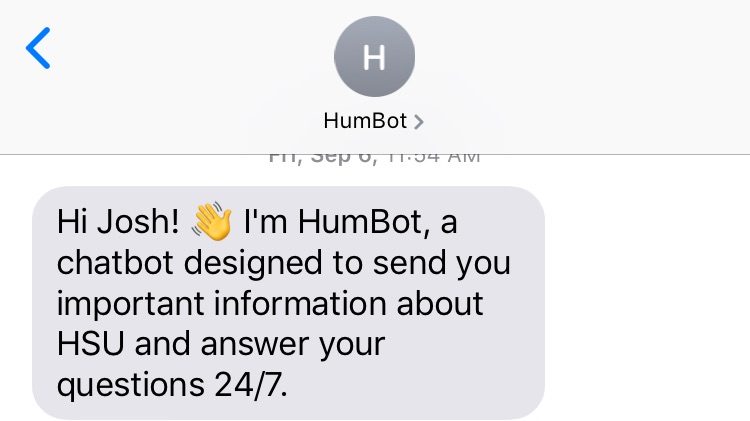
HumBot responds to fisheries transfer student Matthew Howe on Sept. 3. HumBot has answers to over 850 questions so far. | Photo courtesy Matthew Howe
“That is going to be an ongoing, multi-year, get smarter each time kind of thing,” Smith said.
Associate Professor Maguire is conducting research through the bot and Smith said she has been shaping HumBot to address issues specific to HSU. Maguire could not be reached for an interview.
“She is kind of the intellectual arm of the chatbot,” Smith said. “She and her colleagues are seeding the knowledge base of the chatbot with questions that relate to housing insecurity, food insecurity—HumBot is still learning those things, but it is our particular brand.”
Transfer fisheries student Matthew Howe used HumBot to find out where to pick up his mail. Howe admitted to being surprised by how well HumBot worked.
“I thought it worked fairly well,” Howe said. “I was expecting it to not perform at all. I was surprised at how well it did work.”
Howe said he would use HumBot again, although he doubts he would ask it anything personal.
Smith noted that questions sent to HumBot can be viewed by the project staff. HumBot is unlikely to be helpful for personal matters, although with the possibility of endangerment HumBot can notify university police.
Smith hopes HumBot can play an important role in the modernization of HSU’s accessibility.
“I would just encourage students to kind of re-look at those things that maybe they don’t know about or maybe weren’t up to par with a couple years ago,” Smith said.
For now, HumBot is only available to new students, but it is expected to roll out for second and third-year students next fall.
CCAT plans to keep pigs on campus to reduce food waste
Humboldt State University’s Campus Center for Appropriate Technology plans to house two pigs on campus as soon as next week.
CCAT will loan the pigs from the Tule Fog Farm in Arcata for the duration of the fall semester. CCAT plans to feed the pigs food waste from HSU’s J dining hall.
Jacob Gellatly, environmental resources engineering major and former CCAT Co-Director, helped lead the project from concept to reality.
“We want to show how animals can be raised in a residential environment, and how you can use urban byproducts such as food waste to raise animals in an urban setting,” Gellatly said.
EnvironmentalRresource Engineering majors Jacob Gellatly (right) and Kong Vang (left) prepare a log on Sept. 6 to be used for the roof of a pig pen. | Photo by James Wilde
The plan to house the pigs began last fall when students in the CCAT Student Club vocalized interest in keeping animals on campus. CCAT contacted Shail Pec-Crouse from the Tule Fog Farm in Arcata. Pec-Crouse recommended pigs as the most viable animal.
“The easiest animal for us to raise would be pigs,” Gellatly said. “The reasoning for that is—a big thing is predators. So it’s a lot harder for something to come and get a hold of a pig as opposed to a chicken.”
As part of their plan, CCAT realized they could feed the pigs food waste from the J. While CCAT couldn’t feed the pigs food thrown away by customers of the J, CCAT could feed the pigs pre-consumer waste, such as food trimmings or spoiled foods not suitable for people.
“Another goal with the project was how can we divert food waste on campus,” Gellatly said. “And with that we can feed almost, and in some cases, their entire diet from food waste that’s at the school here.”
Once CCAT decided to loan the pigs from the Tule Fog Farm it needed approval from HSU’s Associated Students, Institutional Animal Care and Use Committee, Facilities Management, Risk Management and an environmental health and safety specialist.
The pig pen-in-progress on Sept. 6. CCAT plans to house two pigs in the pen for the duration of the fall semester. | Photo by James Wilde
Humboldt State’s IACUC reviews the use of animals on campus to ensure the animals are treated humanely under the requirements of federal and state law. College of Natural Resources Associate Dean Rick Zechman, who chairs IACUC, said the IACUC proactively reviews and inspects over 100 animal-involved projects on campus each year.
“There’s varying kinds of emotional feelings about the use of animals, and that’s respected and honored in the system of review,” Zechman said. “And that’s why the Animal Welfare Act was developed, to prevent mistreatment of animals. And I think, you know, in our committee, that’s sort of our first principle.”
While Zechman could not comment on the details of CCAT’s proposal, which is still pending, CCAT has worked over the last year to assuage concerns raised by various HSU faculty.
CCAT started by building a pig pen out of reclaimed wood from a local logging operation in Fieldbrook. CCAT has since integrated plans for a roof to prevent flooding of the pen and security to prevent people from getting harmed by the pigs.
In the long run, Gellatly hopes the project might convince the University to keep animals around for good.
“Big picture, I would like the school to see this and see, with what we’re having to deal with—getting rid of all this food—we could be raising meat for the school and have locally-produced meat with a byproduct of our current dining system,” Gellatly said.
Environmental Rresource Engineering majors Jacob Gellatly (right) and Kong Vang (left) working with a log for the pen. | Photo by James Wilde
CCAT’s plan to house pigs has only recently become known to the wider HSU campus. Saraí Escalante, psychology graduate student and president of HSU’s Vegan Club, sees the value of reducing food waste but wonders about the sustainability of the project.
“I think the underlying problem is that we see them as a convenience, as objects, so we see them as a tool to help us fix a problem or make our problems or our lives easier,” Escalante said. “And from a sustainability point of view, you still waste a lot of water in all of the slaughter process and the cleaning up of the meat. In that way, it wouldn’t be sustainable.”
Escalante said she’s considering starting a fundraiser to purchase the pigs and send them to a sanctuary instead of a slaughterhouse. However, Escalante said she plans to talk with CCAT to exchange thoughts, as she does like the idea of reducing food waste on campus.
Gellatly, for his part, noted that the current plan as registered with Tule Fog Farm and IACUC is for CCAT to house the pigs only for the rest of the semester.
“I think it’s, in theory, possible for them to buy the animals from the farmer if that’s something they’re inclined to do,” Gellatly said. “But, as far as our scope goes with the IACUC, once the project’s done, we’re taking the animals back to the farm and that’s where it ends for us.”
The project’s beginnings are dependent on approval from IACUC, but the pigs could arrive at CCAT as early as the week of Sept. 8 through 14.
This website uses cookies to improve your experience. We'll assume you're ok with this, but you can opt-out if you wish. Cookie settingsACCEPT
Privacy & Cookies Policy
Privacy Overview
This website uses cookies to improve your experience while you navigate through the website. Out of these cookies, the cookies that are categorized as necessary are stored on your browser as they are essential for the working of basic functionalities of the website. We also use third-party cookies that help us analyze and understand how you use this website. These cookies will be stored in your browser only with your consent. You also have the option to opt-out of these cookies. But opting out of some of these cookies may have an effect on your browsing experience.
Necessary cookies are absolutely essential for the website to function properly. This category only includes cookies that ensures basic functionalities and security features of the website. These cookies do not store any personal information.
Any cookies that may not be particularly necessary for the website to function and is used specifically to collect user personal data via analytics, ads, other embedded contents are termed as non-necessary cookies. It is mandatory to procure user consent prior to running these cookies on your website.