On-campus food pantry provides for students in need
With the J dining hall closed and grocery stores inducing anxiety, some students are relying on Humboldt State’s OhSNAP! pantry for food.
OhSNAP! will remain open for the rest of the semester, serving students Wednesdays from 10 a.m. to noon and Thursdays from 1 to 3 p.m. on the bottom floor of the Jolly Giant Commons. OhSNAP! can also deliver food directly to you if you can’t make it to campus (email mira@humboldt.edu for more information).
With life disrupted, lecturer Kerri Malloy perseveres with flexibility and humor
A professor noticed students often left Kerri Malloy’s class laughing. One day the professor asked what he was teaching.
“Oh, that’s my genocide class,” Malloy said.
Malloy teaches courses in the Humboldt State Native American studies department on colonialism and genocide. With such somber subjects, Malloy relies on humor and honesty to engage students. Now that classes have gone online during the pandemic, Malloy has employed those traits, alongside plenty of flexibility, to keep students connected.
“The hurdle is going to be maintaining that connection with the students,” he said.
He created class blogs for students to post what they want—questions, memes, dog or cat or reptile pictures. Glance through Malloy’s Instagram, Twitter or Snapchat accounts, and you’ll find lots of memes, like one he posted April 3 on Instagram:
“The year 2020. Brought to you by the letters W, T & F.”
“I think you have to walk into it—at least my plan is to walk into it—with an incredible amount of flexibility.”
Kerri Malloy
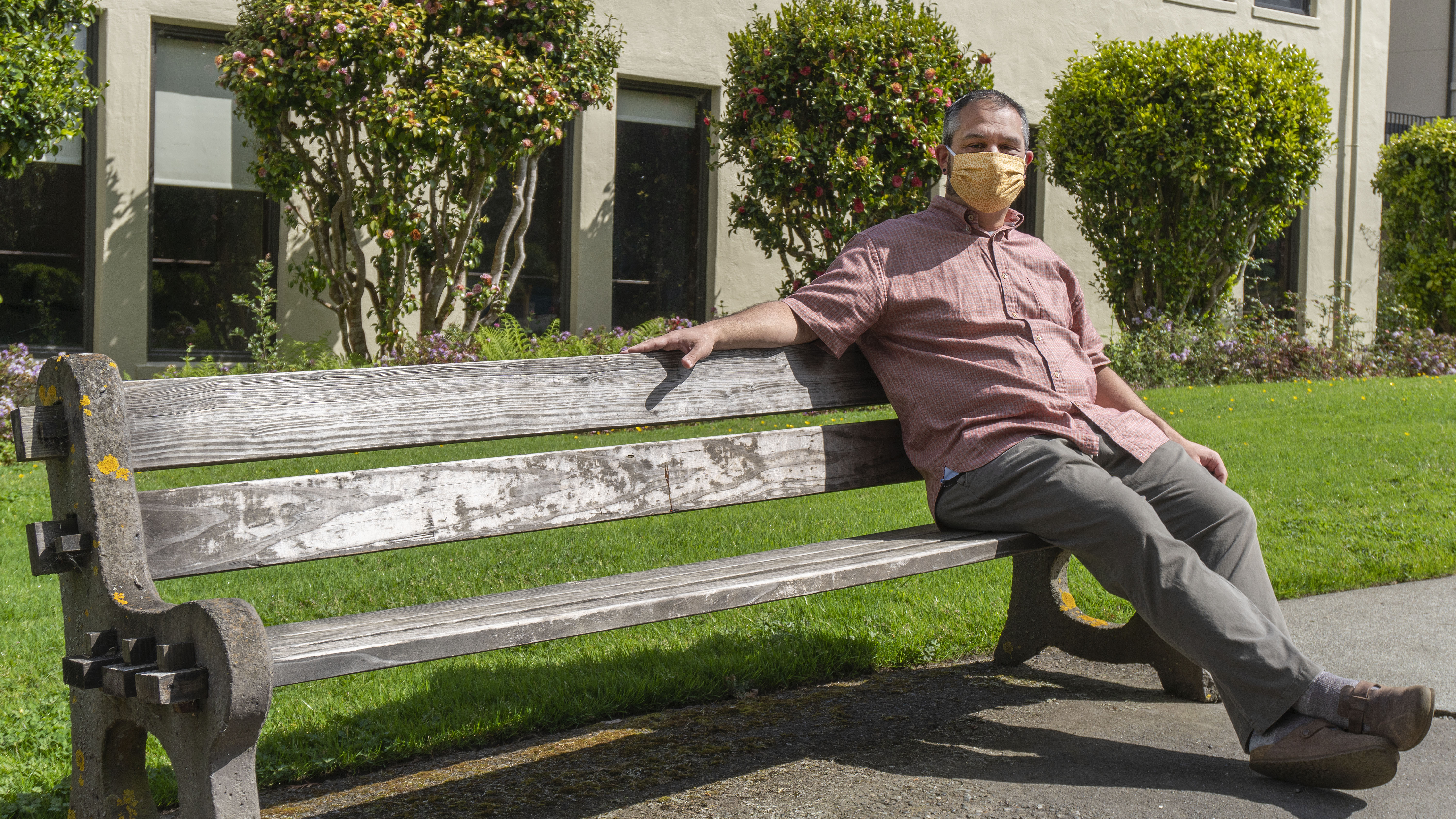
“I love a good meme,” he said in one of two Zoom interviews. He sat in his home office. Behind him, family photos and a Star Wars Yoda action figure topped a bookshelf. He wore glasses and a button-up shirt.
Memes dominate Malloy’s social media accounts, but there’s more to the accounts than humor. They make him accessible to students. He receives messages on those accounts about class, and he replies happily.
“There are times where I’m like, ‘Why am I doing this?’” he said. “And then I realize, I’m getting to see a different side of students, and my colleagues, too.”
Malloy also emphasized the importance of flexibility.
“I think you have to walk into it—at least my plan is to walk into it—with an incredible amount of flexibility,” he said. “And let them—let the students—help guide where we’re going to go.”
Yurok and Karuk by heritage, Malloy was born on the Oglala Lakota Reservation in South Dakota, but he grew up on the Quinault Indian Nation Reservation in Washington.
Marlon Sherman, chair of the HSU NAS department, knew Malloy from working together for the Yurok tribe. Sherman and Malloy have a family connection, as Sherman grew up on the Oglala Lakota Reservation where Malloy was born.
“If it wasn’t for Kerri, there might not be a NAS department right now.”
Marlon Sherman, chair of the Native American studies department at Humboldt State
After working together for the Yurok tribe, Sherman and Malloy parted. About six years ago, Sherman asked Malloy to come to HSU to teach two courses for a semester.
Shortly after Malloy came on board, Sherman had to take time off. He had cancer. Sherman returned in about a year, but Malloy became program leader and helped steer the department. Sherman said Malloy basically did all the work and helped the department hire two professors.
“If it wasn’t for Kerri, there might not be a NAS department right now,” Sherman said over the phone.
Malloy said Sherman was too generous, but there’s no doubt that Malloy works, a lot—so much so that Sherman joked it might be illegal.
Malloy wakes up around 4:30 a.m. every day. He gets up so early partly because he finds those early hours productive, and partly because his back is built on metal rods and pins that make lying flat for too long unbearable. He’s not exactly sure how he damaged his back—maybe a car accident—but he had to have surgery that put him out of commission for three years.
He estimated he’s on eight to 10 HSU committees, from the University Resources Planning Committee to the Diversity, Equity and Inclusion Committee. Malloy does this while teaching multiple classes as a lecturer—a position with an uncertain future amid HSU’s projected enrollment decline and budget cuts. He joked when asked how he has the time.
“People usually don’t like my answer,” he said. “How do I have the time? A calendar.”
Kumi Watanabe-Schock, a 23-year HSU employee, works in public programming and as the library media coordinator. She first met Malloy when he was an HSU student getting degrees in economics and Native American studies.
Since then, Watanabe-Schock has worked with Malloy on committees and for classes. Every time she talks to Malloy, he seems to be attending workshops or giving talks around the world. She praised his willingness to help out.
“He’s not good at saying, ‘No,’” she said over the phone. “I don’t know if he’s that way with everybody, but when you ask him to do a favor he always follows through and he always says, ‘Yes.’ So I really am appreciative, yeah. He’s a good person.”
When not working, Malloy is more private. He has a husband and three dogs. He has two sisters and 14 nieces and nephews he tries to see every year. Around 8 p.m. every night, he tries to unwind. Maybe he’ll watch some TV, or maybe he’ll read a book about genocide. Fun.
While COVID-19 has pushed teaching online, Malloy has found his courses as relevant as ever.
A key concept in Native American studies is survivance, a portmanteau of survival and resistance. Survivance is about the living of Native American lives in the present tense. By surviving, Natives resist, and by resisting, Natives survive.
Malloy said people must fight right now to have their voices heard, like many Natives must do at all times. He said individual voices humanize current events and prevent people from kicking the ball of reality down the road.
On that note, Malloy told a story. Last summer, he taught Native history in a program that spent two days in Auschwitz I, the main site of the Nazi concentration camp. One day he stopped and looked out a window. The bizarreness of the situation dawned on him. Here they were, decades later, standing in a place of horror and trying to learn from it.
A window at Auschwitz I, the main site of the Nazi concentration camp on August 20, 2019. | Photo courtesy Kerri Malloy
Later that night he received an email from then-HSU President Lisa Rossbacher. She was checking in, so he wrote back.
“If we can educate in such a place of incredible horror and death, we have the ability to change the world,” he remembered writing. “We really do. If we can actually go into these places and find this incredible darkness and turn it into something that allows us to reach out to other human beings and get us to talk to each other and push the things that really don’t matter aside, I think we can do this.”
To get people to talk, Malloy uses humor, which he said can get us past anything—and Malloy does seem capable of getting past anything. It seems strange to call research on genocide a passion, but Malloy approved the descriptor.
“Passion’s a good word for it, actually,” he said. “You’ll find that for those of that this is what we do, it is a passion.”
Every student interviewed for this story agreed on a few descriptions of Malloy. He’s open and funny, they said, and he can be brutally honest. They warned against getting into an argument with him.
“If you’re gonna have an argument with him, you better have good stats and have all your ducks in a row, because you’re not gonna win Kerri in an argument—I’ve tried,” HSU biology major Michelle Navarette said over the phone.
“And he told me, like, ‘You can’t let the system fuck you up and throw you down.’”
Michelle Navarette, Humboldt State biology major
Navarette, a senior, first had Malloy for a 9 a.m. general education course. Once she got to know him, she tried not to miss his class. Since that first course, she’s tried to have a course with him every semester.
Navarette’s appreciation of Malloy goes beyond the classroom. She said she was losing her job last semester due to discrimination from her boss. She didn’t know what to do, so she went to Malloy.
“He sat me down and was like, ‘You know what, this is just a portion of how life is,’” she said. “’You’re gonna have these obstacles all the time.’ And he told me, like, ‘You can’t let the system fuck you up and throw you down.’”
When she thinks of Malloy, she remembers his honesty.
“I think he was like the first person to tell me, ‘This shit is going to be hard.’”
As a lecturer of general education courses, he usually has to work for the attention of students. He goes into his courses hoping for students to leave with more questions than answers. Students have told him he gives too many assignments, but no interviewed students said Malloy graded harshly.
“My philosophy,” he said, “is if I can get one brain cell to function per student on an assignment, we’ve succeeded.”
Malloy once had a student he didn’t think he had triggered any brain cells in. Malloy said the student believed everyone should be committed to a single belief. Malloy respected the devotion, but he worried about the implications.
About a year after the student left his class, Malloy received a message on one of his social media accounts. The student wanted to know if a site he shopped on looked like a hate group.
“I went and checked the site out and went, ‘Yeah, this is definitely an organization that supports anti-Islam—very Islamophobic,’” he said.
The student thanked him and decided to shop elsewhere. Malloy remembered that as a success.
“It’s when you see those little things, you’re like OK,” he said. “Even at some small level, we were able to plant some idea, some seed that is getting people to think differently, or at least question.”
Like many of Malloy’s students, Joshua Overington, an HSU environmental science senior, only took Malloy’s introductory Native American studies course for a general education requirement.
The class was so good Overington signed up for more. He eventually worked with Malloy on the Northwest Genocide Project, an online archive Malloy manages.
Overington also worked with Malloy on a research project on Tuluwat Island for HSU’s IdeaFest, which led into a research paper Overington is now finishing.
“He is incredibly passionate in what he does and he is uncompromising in his views,” Overington said over the phone. ”If Kerri feels something or has an opinion, he always speaks his mind and really, he’s always the one who’s honest and puts himself out there. And that’s not something I see at all in other teachers.”
“If we can make those connections on that level, this is much more understandable. And then we get to be more willing to go, ‘Alright, maybe I need to look in the mirror.’”
Kerri Malloy
Malloy likes to tell people teaching about genocide is fun. People usually give him a blank stare and change the subject. But if asked, Malloy will elaborate.
“And what it means is not fun as in, ‘Yay, happy stuff.’ It means that it’s fundamental,” he said. “Atrocity is a fundamental part of the human existence. Peace is a fundamental part of the human experience. It’s understandable—we can understand why it happened, how it happened, what needs to be done to prevent it. And it’s necessary.”
Malloy knows most people don’t want to talk about atrocities all day. To get past that, Malloy said we have to be willing to look at ourselves.
Malloy tries to relate concepts directly to his students. He sometimes asks if students curate their social media profiles—do they post every photo they take? They admit they do some curating, and he suggested history books do the same.
“If we can make those connections on that level, this is much more understandable,” he said. “And then we get to be more willing to go, ‘Alright, maybe I need to look in the mirror.’”
Malloy teaches because he believes we’re all here to learn. He admits his own ignorance and encourages others to do the same. That openness to learning is perhaps what makes Malloy love his job. His willingness to let students guide his classes is perhaps what makes students love him.
“I tell my students this directly: ‘This is not my class,’” he said. “’This is yours. You guys are the ones who are paying for it. I am just the tour guide on this expedition.’”
Malloy always ends each of his classes—each chapter of the expedition—with the same message.
“Go out and learn something,” he tells his students. “Go out and breathe.”
Humboldt State faces enrollment drop, budget cuts and academic department reorganizations
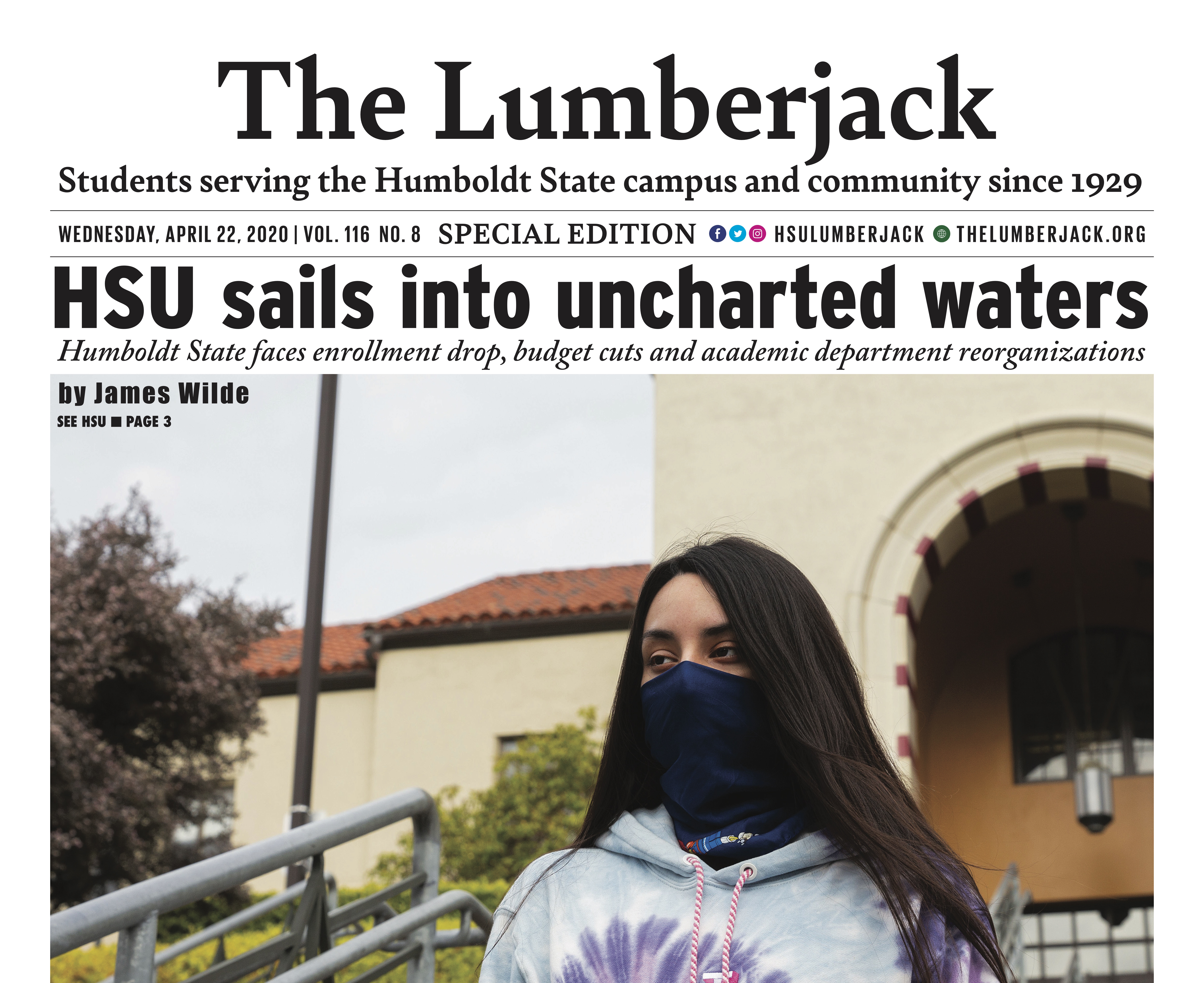
If Humboldt State University was a ship, it would be sailing straight into uncharted seas, thick with fog.
Atop the tallest mast, HSU administrators spy an enrollment drop of around 20% for the fall semester, mainly due to COVID-19. Administrators project a resulting budget cut of around $7.4 million for the next school year and $20 million in the next two years, according to HSU’s most recent enrollment report and webinars held April 13 and 15.
Faculty and staff are scrambling across the deck to reorganize HSU’s academic departments.
Vice President of Academic Affairs and Interim Provost Lisa Bond-Maupin said HSU’s colleges are looking at combining department staff and faculty and adjusting fall course schedules for a smaller student population.
“Those are the strategies we’re looking at—combining staffing where it makes sense and combining chair leadership where it makes sense,” Bond-Maupin said via Zoom interview. “We’re not doing away with academic programs.”
A proposed plan emailed to department chairs of the College of the Arts, Humanities and Social Sciences divided CAHSS departments into four schools, each of which would have one chair. The presumed thinking behind the plan would be to eliminate the need for each department to have its own chair and free up chairs to teach more courses—reducing the number of other needed faculty.
Bond-Maupin did assure that HSU has no plan to cut any academic departments—but semester course offerings will depend on what students need.
Bond-Maupin said that exact proposal probably would not move forward. Bond-Maupin said she and the deans of the HSU colleges are still figuring out what they will do.
With department reorganizations and course offerings expected to be adjusted for the fall, lecturers will likely end up with fewer courses to teach. Bond-Maupin said schedules for a reduced number of students inevitably affect the availability of work. In other words, if all of a lecturer’s courses are pushed off the fall schedule, they would be thrown overboard too.
Bond-Maupin did assure that HSU has no plan to cut any academic departments—but semester course offerings will depend on what students need.
“As enrollment changes, we need to sort of follow the needs of the students,” Bond-Maupin said.
Over 2,000 individuals signed a change.org petition asking for HSU tuition to be reduced for the spring. Bond-Maupin said a change in tuition would come from the California State University Chancellor’s Office, not HSU.
Tuition reduction or not, HSU faces serious challenges. In an April 13 webinar HSU held on the enrollment decline and budget cuts, Vice President of Enrollment Management Jason Meriwether delivered dire news on enrollment.
“If the CSU is in a recession for enrollment, Humboldt State needs to worry about being in a depression for enrollment,” Meriwether said. “I hate to use those terms, but it just forecasts the impact HSU could face in the terms of COVID-19.”
HSU has refunded nearly $2.5 million to students for housing, parking and dining and projects to lose around $7 million by the end of June.
“We are hearing from the governor that there may be some return to being together but with some new social distancing parameters—so that’s possible.”
Lisa Bond-Maupin
Vice President of Administration and Finance Douglas Dawes emphasized the importance of the campus understanding the need to make quick budget cuts. Dawes said HSU is looking into a mix of measures, including hiring chills, spending freezes and retirement incentives.
These hits to the hull come despite progress HSU made before it entered the murky waters of the pandemic—208 local students accepted the Humboldt First scholarship, up from 32 local students per year for the last three years.
Both Meriwether and Bond-Maupin said details of the fall semester remain uncertain and hinge on public health recommendations. Bond-Maupin said HSU is preparing for a variety of potential scenarios, from remaining online to opening partially.
“We are hearing from the governor that there may be some return to being together but with some new social distancing parameters—so that’s possible,” Bond-Maupin said. “We might work with spacing. We also may look at timing. One scenario I can think of is that we are delayed in going back fully to face-to-face, so we begin online. I think we just have to plan for all those scenarios.”
The Lumberjack requested an interview with HSU President Tom Jackson multiple times for this story, but he could not be reached. HSU Communications Specialist Grant Scott-Goforth cited an “incredibly busy time.”
Here’s how HSU received the trees and where you can find them
Humboldt State University has a handful of redwood trees grown from seeds that went to the moon.
In 1971, astronaut Stuart Roosa brought around 500 tree seeds with his personal items on the Apollo 14 NASA mission to the moon. Roosa intended to test the seeds to see if space radiation would affect their germination. While he never set foot on the moon, he orbited the moon 34 times while his colleagues walked the lunar surface.
When Roosa returned, he sprouted most of the seeds. NASA then sent the seedlings around the world. Around 1976, HSU received a handful of redwood seedlings and planted them around campus. Some of those trees remain near the theatre arts and natural resources buildings and near the Campus Center for Appropriate Technology and Facilities Management.
Some unedited recommendations and brief reviews from some of our staff
Life and Arts Editor Grace Caswell
What I’m watching:
Just finished “Tiger King.” It’s the most ridiculous and unbelievable show I’ve seen yet with a surprising amount of depth.
What I’m reading:
“Noam Chomsky” by John Lyons.
What I’m playing:
None :/
What I’m listening to:
Lots of new music is being released but right now Toro y Moi and Jhene Aiko.
What else I’m doing:
Yoga and meditation has been a go to as well as cooking healthy foods. Anything to keep my mind at ease and health immunity high.
Managing Editor Chelsea Wood
What I’m watching:
I’ve been watching the final season of “Schitt’s Creek” which has been a bittersweet reflection of the last five seasons.
What I’m reading:
I’ve been reading more of a book I started last summer. It’s called “The Spaceship Next Door” and it about a teenager who grew up in a small town where a spacecraft crashed years ago but never left.
What I’m playing:
Minecraft. I trash talked this game as a teen, but it’s amazing and I love creating things on it. It’s extremely entertaining and relaxing.
What I’m listening to:
I’m listening to lots of downbeat songs—music that soothes the soul with catchy beats. Just stuff to satisfy this melancholy phase I’m swimming through.
What else I’m doing:
I picked up an old hobby, basket weaving. It’s a relaxing and simple task that yields a useful item. And no that’s not a BS excuse, basket weaving is the shit.
Editor-in-Chief James Wilde
What I’m watching:
I just finished season three of “Ozark.” It’s a crime drama with superb characters and writing that had an unexpected depiction of mental illness that probably hit a little too close to home and (full disclosure) made me tear up.
What I’m reading:
I just finished “Why Time Flies,” by Alan Burdick, a fun little foray into the way we think about time. Next up: “The Glass Hotel,” by Emily St. John Mandel.
What I’m playing:
Call of Duty: Warzone with my brother and some friends. I hate the premise of Call of Duty and, you know, shooting people, but as long as I ignore that it’s lots of fun.
What I’m listening to:
Kind of all over the place, which isn’t out of the ordinary. Indie stuff to hip hop to alt rock to electronic stuff to jazz to whatever else. Oh, and random Tiny Desk Concerts.
What else I’m doing:
Walking or going on runs to get out of the house. Drowning in schoolwork. Lying on the floor.
Opinion Editor Alexis Parra
What I’m watching:
“Gentrified”- A show that hits home for people of color. “Tiger King”- A cult war in the world of big cats.
What I’m reading:
“Z: The Beginning of Everything”- the untold story of Zelda Fitzgerald and beautifying her life.
What I’m playing:
None.
What I’m listening to:
My playlist on LJ- All of my favorites songs and energy that I carry into one playlist. “La Platica”- A bilingual podcast where the host is funny and talks about dumb shit and real shit.
What else I’m doing:
Painting. Make-up. Face masks. Talking to my family. Getting creative while also taking care of my skin and keeping in touch with my loved ones.
Sports Editor Thomas Lal
What I’m watching:
“Drive To Survive,” a super fun look into the 2019 F1 season with the dramatic thrills and spills to match!
What I’m reading:
“Permanent Record” by Edward Snowden. An intriguing and somewhat terrifying read.
What I’m playing:
The Witcher 3. This game has consumed my life. Loving the story and exploring the world.
What I’m listening to:
So much music, mostly ska, punk and jazz along with the “Every Little Thing” podcast.
What else I’m doing:
Being sad without any sports to watch.
Web Editor Seth Finnegan
What I’m watching:
“Community.” The always funny comedy about students at a community college.
What I’m reading:
None.
What I’m playing:
Dead Rising and MLB The Show 19. Filling the sports void with hitting baseballs and zombies with baseball bats.
What I’m listening to:
The “Adventure Zone” podcast. Three brothers and their dad play D&D together.
What else I’m doing:
Learning to play darts. It’s very frustrating but very fun!
Video Editor Benjamin Zawilski
What I’m watching:
The filmography of David Fincher and Hayao Miyazaki, and “The Good Place” on Netflix.
What I’m reading:
Rereading “Peter and the Starcatchers” by Dave Barry and Ridley Pearson, which was one of my favorite book series as a child
What I’m playing:
Overhearing my sister play Animal Crossing.
What I’m listening to:
The film scores of Mark Mancina, Alexandre Desplat, and James Newton Howard.
What else I’m doing:
Hiking at least five miles a day, sometimes up to seven, and have done a considerable amount of housecleaning.
Reporter Deion Alston
What I’m watching:
“Coffee & Kareem.” Cop dates kid’s mother and him and kid (Kareem) uncover a conspiracy of dirty cops.
What I’m reading:
Haven’t been reading books tbh, but a lot of news article pertinent to sports, COVID-19, crimes etc.
What I’m playing:
Fortnite and NBA 2K 20. Fortnite is a shooting game and 2K is professional basketball at your finger tips.
What I’m listening to:
For podcasts, I listen to “Up in Smoke” hosted by two former NBA players, Matt Barnes and Stephen Jackson. It’s very interesting—great interviews and guests as well. For music I’m listening to a lot of Lil Uzi, G Herbo, Tory Lanez. So basically rap, hip-hop and R&B.
What else I’m doing:
I’m cooking a lot more—takes time up in the day. Do my 250 push-ups everyday and step-ups for some cardio. And occasionally throw the football in the drive way.
Reporter Dakota Cox
What I’m watching:
“Seinfeld” & “Empire.” “Seinfeld” is a wonderful waste of time. “Empire” is a must-binge, cutthroat musical.
What I’m reading:
“Hurricanes” by Rick Ross is a fairly generic success story in terms of rapper autobiographies. “The Alchemist” is an extraordinary journey of the body, mind and soul.
What I’m playing:
Animal Crossing; don’t ask questions, go pick up the game!
What I’m listening to:
Going back and forth between oldies and hip-hop, gotta keep the serotonin up. Michael Jackson, Bob Marley and The Beatles are timeless, go listen! Gambino got the best album of 2020, @ me!
What else I’m doing:
Slipping out of sanity; would not recommend. Get a mask-on walk in when the sun shows it’s face; I like to play a little game called guess the gang members.
Reporter Sarah Blunt
What I’m watching:
I just finished “I am not okay with this.” It was a really good show with short episodes that have a lot going on in them. 10/10. I also just recently watched “Freedom Writers.” That one was really good and empowering, also took place in Long Beach (where I’m from) so that was relatable (kind of).
What I’m reading:
“Looking for Alaska.” I’ve already seen the show on Hulu but I realized I had the book. So far it’s really good and John Green (the author) writes really descriptively so I never feel bored when I’m reading it.
What I’m playing:
None.
What I’m listening to:
Tons of music. Nothing in particular just going through my music apps and looking for things I haven’t heard before, or even music from shows i’ve watched that I liked the soundtrack. That’s most of what I spend my free time doing.
What else I’m doing:
Lately I’ve been taking bike rides alone just to get fresh air and not be stuck in the same surroundings. I never ride bikes but lately it’s just been a really nice way to get out the house but also keep my social distance from others. 10/10
Reporter Ivan Ramirez
What I’m watching:
“Castlevania,” the show. “Mewtwo Strikes Back: EVOLUTION,” the movie.
Meditating, talking to people on Discord, Instagram.
Reporter Alberto Muro
What I’m watching:
I have started watching the Amazon Prime series “The Boys.” It has an interesting take on superheroes proving that not all of them are super. It’s a world where super heroes exist, now imagine their lack of empathy for saving people.
What I’m reading:
Currently reading through my textbooks so that I don’t fall behind on homework.
What I’m playing:
I am currently playing the remake of Resident Evil 3 which has updated graphics and character development.
What I’m listening to:
I am listening to the “Tinfoil Hat” podcasts since conspiracies take my mind on a wild ride
What else I’m doing:
I have transitioned from a student using critical thinking to an essential asset during a global pandemic thus turning me into a critical drinker.
There’s never been a better time to start reading books
You’re stuck inside. You’ve already watched all the best shows on Netflix. You’ve already done your homework. Instead of wasting away the hours on social media, do something good for yourself and your mental state. Read a book.
Maybe you’ve never read a book for fun, but don’t let that discourage you. Reading is for everyone. You don’t have to be an intellectual to enjoy books.
Listed below are a few my favorite books—hopefully you can find something to check out.
If: you want to read a dystopian satire set in a world eerily similar to our current pandemic-stricken one,
Where should you buy a book if you want to pick one up?
I always recommend supporting your local, independent bookstores, especially right now. Each book above is linked to Powell’s bookstore—probably the most famous independent bookstore, located in Portland, Oregon.
If you’re in Arcata, you can order books online from Northtown Books and pick it up on the curb as of March 25. You can also order a book from Tin Can Mailman, which is shipping orders of $10 or more for free to anywhere in Humboldt, and orders of $40 or more for free outside Humboldt.
HSU, like all colleges, prepares for tough times and serious measures
Humboldt State University is preparing for an enrollment drop of around 20% for the fall and a budget cut of around $20 million by the 2022 fiscal year, according to a joint press release from HSU and College of the Redwoods.
Before the COVID-19 pandemic, HSU projected an enrollment drop for total students of around 14% for the fall and had proposed a budget cut of around $5.4 million by the 2022 fiscal year.
Given the uncertainty of the next year, HSU is planning for an even larger enrollment decline and budget cut. HSU currently projects new student enrollment to drop by 30%. The specifics of what the budget cuts will mean are still being worked out.
“Many options are being looked at, including combinations of a hiring chill, spending freeze, operational changes, incentives for retirements, travel reductions, and more,” the press release said.
In a Zoom interview, HSU Vice President of Enrollment Management Jason Meriwether said a worst case scenario projection might be only 500 new students and 500 transfer students admitted to HSU in the fall.
These numbers, to be clear, are projections. No one knows exactly how the next year will play out. Meriwether hoped HSU could keep enrollment and retention as high as possible.
“The sad part is, I don’t know,” Meriwether said. “There’s no benchmark. There’s nothing to project against. We could be doing all this and, you know, 1400 students show up—which would be wonderful.”
HSU is not alone. As noted in Meriwether’s Tuesday enrollment management report to the HSU Senate, colleges everywhere are facing enrollment drops amid the pandemic. The report cited articles from Forbes and the Associated Press along with some early data suggesting one out of every six college-bound students won’t attend college in the fall.
With education expected to shift to a more local focus, Meriwether pointed out that HSU already shifted to local recruitment in the last year with measures like the Humboldt First Scholarship.
Compared to an average of about 32 local students attending HSU per year in the last three years, HSU currently has 208 local students confirmed to attend HSU in the fall with the Humboldt First Scholarship.
“The good news is we’re not starting local recruitment today because there’s a problem,” Meriwether said. “That’s the best part of all this—is that we already have a really solid foundation that we built in the community over the last eight or nine months.”
The enrollment management report includes a graph of enrollment scenarios, with red lines for lower enrollment scenarios and a blue line for a growth scenario. Meriwether hoped for HSU to remain close to the blue line.
“Essentially, pray we get as close to the blue line as possible,” he said.
Meriwether pointed out that, since COVID-19 has hit everywhere, current students might not have much reason to transfer. If classes are still online in the fall at HSU, they will presumably be online everywhere.
“Let’s say a student says, ‘OK, well, you know, I want to transfer because I didn’t want this experience,’” he said. “OK. Well, the question will be, ‘What school are you going to transfer to?’ Because every school is stuck in this scenario right now.”
Nevertheless, the pandemic will likely temporarily derail HSU’s efforts to improve enrollment.
“Long term, you know, prior to COVID-19, prior to this hit, we had a plan of getting to an FTE of 7600 students [full-time students] in about four years,” he said. “So now, what if the COVID-19 environment says, well, gosh, it can make us take eight years to get there.”
Meriwether was optimistic that eventually, HSU would get through this.
“I believe that we will bounce back, and I believe we will bounce back strong if the hit is really bad,” he said. “This is a marathon. Enrollment is a marathon.”
Update 11:10 a.m.: a second email sent yesterday from College of Natural Resources Dean Dale Oliver and obtained by The Lumberjack makes similar points but does not give a specific number to the expected enrollment drop for fall beyond noting that a 15-20% drop was expected prior to the COVID-19 outbreak. We will update this story when we have confirmed the numbers below. The second email is pasted below.
Humboldt State University has issued a budget directive to take immediate action to prepare for the fall semester, including the freezing of open staff positions and the reduction of the number of academic departments, according to an email sent to faculty and staff of the College of Arts, Humanities and Social Sciences Tuesday morning.
The email, sent by Interim Dean of CAHSS Rosamel Benavides-Garb, projected a freshmen class for fall 2020 of around 500 students, down from around 1,400 students five years ago and down from around 1,000 students for fall 2019.
“The scale and impact of our current predicament is grave and as a result our budgetary practice has to be reconsidered and reformulated based on the simple equation of demand and resources,” the email said. “We have become, de facto, a much smaller institution, which compels us to undertake a comprehensive reset at HSU.”
The email listed six directives, including requests to freeze all vacant staff positions, reduce the number of academic departments and develop online programs for current and transfer students to complete their degrees.
The email promised to make the process consultative and sustainable.
“We remain committed to “the student first” approach,” the email said, “and are extremely aware of the critical importance, now more than ever, of issues of social justice, equity, and inclusion in all we do.”
The full email is copied below:
Dear CAHSS Colleagues,
On April 2, the deans of all three academic colleges received new administrative directives from Interim Provost Lisa Bond-Maupin regarding the coming academic year. The directives are a call to action, issued in response to the budget and recruitment/retention reality at HSU. The Interim Provost reiterated these directives yesterday, Monday, April 6 in her Provost/VPAA Report to the senate.
As we all know, our student enrollment has been declining for several years and the institutional budget has been negatively impacted. The administration’s efforts to address the problem must now be reframed in light of new and profound challenges the current COVID-19 pandemic poses for HSU, and the CSU system in general.
We are projecting a freshmen class of 500~ students across all three colleges. Five years ago, the freshmen class numbered 1,400+ students. The scale and impact of our current predicament is grave and as a result our budgetary practice has to be reconsidered and reformulated based on the simple equation of demand and resources. We have become, de facto, a much smaller institution, which compels us to undertake a comprehensive reset at HSU.
The Interim Provost has directed the three academic deans to reduce spending and grow retention/recruitment. Her directives require our college to implement the following action areas immediately:
1. Freeze all vacant staff positions: This is indefinite or until each college develops a plan to organize staff support within colleges and across colleges.
2. Reduce the number of academic administrative units (departments): This needs to be planned immediately and be in place for this next fiscal year so we are reorganized starting fall 2020.
3. Develop online degree completion opportunities for certain existing majors in the last two semesters of their programs.
4. Develop two-year degree online completion opportunities for transfer students of certain majors beginning fall 2020.
5. Develop a partnership with CEEGE related to workforce development, responding particularly to a post COVID-19 context.
6. Integrate the Center for Teaching and Learning (CTL) in the development and implementation of new teaching capacity.The Interim Provost has also indicated that she expects this process to be:
The Interim Provost has also indicated that she expects this process to be:
· Consultative with unit leadership.
· Consultative and collaborative across colleges.
· Sustainable by creating new retention and recruitment opportunities.
The deans of the three colleges have already begun discussing the directives. I have also initiated planning within CAHSS, in collaboration with the three associate dean fellows, and will continue to discuss budget with the chairs. We will move forward together, exploring multiple budget management opportunities to make our colleges strong and resilient in the face of present and future challenges. We can also regard these adjustments as unique opportunities to explore new and exciting programs to attract and serve our ever-diverse student population in a shifting and challenging workforce environment. We remain committed to “the student first” approach and are extremely aware of the critical importance, now more than ever, of issues of social justice, equity, and inclusion in all we do.
Sincerely and in solidarity,
Rosamel
Email from CNRS Dean Dale Oliver:
April 6, 2020
CNRS Faculty and Staff
Dear Colleagues,
Earlier today Interim Provost Lisa Bond-Maupin sent out her report to the HSU University Senate in preparation for Tuesday’s meeting. Included in her report was a call for collective action to prepare for fewer students and fewer resources in the next academic year. I’ve pasted the relevant section of the Provost’s report below my signature.
Current estimates indicate we could have 20% fewer students in Fall 2020 that we had in Fall 2019. This reduction is significant, and we must plan over the next weeks and months so that those students who start or continue with us in the fall experience high quality, engaged learning that will prepare them well for STEM professions and advanced study.
Three items from the Provost’s report that I want to highlight are personnel, administrative re-structuring, and online education.
Personnel: Although we will be finishing out the two faculty searches currently underway, and ensuring we have sufficient temporary faculty to deliver our curriculum, all other hiring is frozen for the moment, including those which are currently vacant and those which will soon be vacant due to expected retirements. Through improving business processes, realigning and reorganizing staff positions, and targeting professional development we will find a way to support our educational enterprise without hiring additional personnel. This work will be both necessary and challenging, and require collaboration with relevant unions and careful consideration of multiple factors.
Administrative restructuring: At the Dean’s level we were already planning a partial re-assignment for Associate Dean Rick Zechman to manage the marine lab while marine lab director Brian Tissot transitions from full-time director to FERP faculty. We are also being asked to reduce the number of administrative units in the college, meaning that some departments will be merged or reformed. This work will be done in close collaboration with the CNRS Council of Chairs and the other two academic deans.
Online Education: There are some programs in CNRS for which one of the following scenarios might make sense: provide an online degree-completion option for a group of students who have a year or less left to complete their degree; provide a degree-starter program for a group of first year (or transfer) students to get started with HSU from home during the fall 2020 semester, and then begin on campus in Spring 2021; provide more online sections of general education courses for undeclared students or majors from outside CNRS. For the moment, I recommend that faculty discuss within their departments whether one or more of these scenarios might be appropriate for their program.
For this week I am collaborating with the Provost’s office, with the other academic deans, and with a working group of CNRS Chairs to create possible models for administrative restructuring that can then be discussed among all of the CNRS chairs the following week. Relatively soon I will also set up a mechanism by which input can be given from across the college.
We face a significant challenge as a college and university over the next few months and years, but I am confident that we will find solutions that serve our students and the citizens of California well. My confidence rests solidly on the incredible talent, dedication, and creativity of our faculty and staff, whom I am proud to serve.
Best wishes, safety, and health to you and your families,
Dale R. Oliver, Dean
College of Natural Resources and Sciences
From Interim Provost Lisa Bond-Maupin’s report to HSU’s University Senate, April 6, 2020
Realignment of Spending with Reduced Revenue
In addition to supporting instructional continuity and Academic Master Planning, our division leadership is turning our attention to budget planning for next fiscal year and beyond. Prior to COVID-19, our enrollment picture for next academic year was apparently trending toward a 15-20% fall-to-fall (one year) student headcount decline. We were likely headed toward a reduction to the HSU budget for next fiscal year that was double that anticipated when the URPC created its annual budget recommendations to President Jackson. While the college-going enrollment impact of the pandemic is unknown for all in higher education across the nation, it is clear that the CSU and HSU will experience further decline in student enrollment. Given the enrollment challenges felt across the state, it is likely that impaction at our southern campuses will be lifted. It is highly likely that more students will choose for financial and other reasons, in the shorter term at least, to remain at home or closer to home to study.
While we await the release of up-to-date enrollment projections and budget information, Academic Affairs is implementing a few immediate strategies toward student retention and recruitment on the heels of the pandemic and toward further reducing our spending. As we do so, we are guided by the URPC principles and our own commitments to meeting the instructional needs of our students and protecting employment. In addition to continuing to adjust our academic offerings for Fall, immediate strategies also include:
• Working with each dean and director to reduce budget allocations for FY 21
• Freezing hiring in all open staff positions for now and planning to absorb staff attrition
• Working collaboratively with staff within and across colleges and budget units in Academic Affairs to reimagine and reorganize our staff support
• Working collaboratively with department chairs and faculty to condense the number of separate academic administrative units in the colleges
• Working within the Office of the Provost to realign and reorganize staffing
• Identifying academic programs ready to continue to offer upper division major courses online into next year and beyond to: a) help students in their final semesters to study from home and complete their degrees, and b) offer new transfer students an opportunity to complete their degrees online
• Identifying a COVID-era retention specialist in Academic Affairs who will support the continued offering of all existing retention efforts in a virtual format and will work in collaboration with ODEI to implement inclusive retention practices at a distance.
Each one of us will be implicated in and needed for this work. It is tough and unavoidable at this time. Each one of us has a very important role to play, now, more than ever in maintaining close connections with our students, helping them to problem-solve their educational needs and connect to resources and to stay connected to HSU. We need our students. And I think we are finding in their response to our transformed instruction – they need us. This powerful connection will ultimately move HSU through and beyond this tough moment in our collective history to the future we envision. Thank you.
A reminder of the few things we know that help prevent the spread of COVID-19
I received a text from a housemate recently recommending we all drink hot liquids and think happy thoughts to get us through the COVID-19 pandemic. Sadly, happy thoughts and hot liquids won’t save us.
In the midst of a pandemic, it makes sense that people will seek home remedies—they can give you actionable measures to take to try to inoculate yourself against COVID-19. But peddling bunk medicine like a medieval plague doctor only makes things worse.
Random herbs, hot liquids and happy thoughts do nothing against COVID-19 (neither does weed). What can help stop the spread of COVID-19 are these much less sexy things you’ve probably already heard, adapted from the Centers for Disease Control and Prevention:
Social distancing. Hang out with yourself for a while. The crushing introspection may seem scary, but who knows, maybe you could learn something about yourself. The CDC gives suggestions on how to cope in this stressful time.
Frequent hygiene. Wash your hands with soap and water for at least 20 seconds. Sanitize doorknobs in your home. Sanitize your debit or credit card if you’re grocery shopping. You might even go so far as to ask to scan your own groceries at the checkout stand.
Don’t touch your face. According to disease expert Michael Osterholm, the virus behind COVID-19 chills out in the throat and lungs, and it likes to get in your body through your eyes, nose and mouth. Your hands provide an Uber ride for the virus straight into your system.
Also, cover your face. The CDC have shifted course and now recommend people cover their face with a cloth mask in public, especially in high-risk areas like grocery stores or pharmacies. If you have a sewing machine, here’s how to make your own mask. If you don’t have a sewing machine, the CDC provides a video on its site on how to make a mask out of any old cloth and a couple rubber bands.
Keep your body healthy. Eating a well-balanced diet, getting enough sleep and exercising all maintain a healthy immune system.
Find a new hobby. Don’t allow depression to set in from all the time spent indoors. Netflix is nice, but it’s not a hobby. Try reading, painting, knot-tying or bread-making. Blogger Matt Gilligan compiled a list of 19 inexpensive hobbies for self-quarantining.
Connect with your friends and family. Don’t gather with people in person. (No group hugs.) Instead, take advantage of your phone and call up your friends and family. For a more socially stimulating experience, use FaceTime or Zoom to have a video chat. Invite all your pals and make it a virtual party. If you happen to be posted up in a house with a friend, try to hang out with them rather than hiding away in your room.
We have no cure for COVID-19. A vaccine, by all accounts, remains a long way off. If you end up with the coronavirus, we only have treatments that can relieve symptoms as suggested by the Mayo Clinic, like Tylenol, cough syrups, rest and fluid intake.
I’m no stranger to distrusting authority or being suspicious of science—I grew up in Southern Humboldt and wasn’t vaccinated until I was a teenager. But for the sake of yourself and the rest of the world, put your suspicions aside and have a little faith in the only proven measures we know against COVID-19.
The latest Public Safety Power Shutoff by Pacific Gas and Electric is not expected to hit Humboldt County, as of Tuesday afternoon.
PG&E announced Sunday it was monitoring the weather for a possible PSPS event beginning Wednesday, but it has not included Humboldt County in any of its expected shutoff zones. The latest press release on Tuesday said the PSPS will affect 16 counties across northern California. Six counties initially expected to be impacted were removed from their list.
PG&E said the PSPS is once again caused by high winds through dry areas, leading to a high risk of fire.
“Weather forecasts continue to be dynamic with significant variation across different portions of PG&E’s service area,” the Tuesday release said. “As an example, some parts of PG&E’s territory are under a Red Flag Warning issued by the National Weather Service, while other locations are subject to a Winter Storm Advisory.”
PG&E estimated the PSPS, which ranges from Mendocino to Butte to Sonoma Counties, will affect 181,000 customers. PG&E estimated that each customer account serves three residents, so the PSPS may affect over 540,000 residents.
PG&E said it expects the winds to subside by Thursday morning, and that it hopes to restore power to most customers by the end of Thursday.
“High winds are currently expected to subside Thursday mid-morning,” the Tuesday release said. “PG&E will then inspect the de-energized lines to ensure they were not damaged during the wind event. PG&E will safely restore power in stages as quickly as possible, with the goal of restoring most customers by end of day Thursday, based on the current weather conditions.”
HSU opts for local scholarships over new residence hall
Humboldt State University originally had plans to build a new residence hall, but with enrollment declining, Vice President of Enrollment Management Jason Meriwether decided to invest in scholarships for students living on campus instead.
“With enrollment down, we are not in a position to build a new building anytime soon using the traditional path,” Meriwether said in an email. “So, instead of sitting on the money, I wanted to reinvest the funds in our students.”
Over the last five years, HSU housing has been saving to put a 10% down payment on a new residence hall, according to Meriwether.
Instead, Meriwether reallocated the savings to the $1,000 a year, four-year scholarships for all HSU students that live on campus, beginning fall 2020. Announced Nov. 3, the scholarship is one part of HSU’s plans to improve enrollment and retention.
In the last month, HSU has announced three different scholarships. Two of them will be funded by donors, while the housing scholarships will be funded with the housing reserves.
“Within the limits and scope of how we may use housing dollars, the best and most strategic and student-first option was to create these scholarships,” Meriwether said.
This is an update for our article “Road to Recruitment and Retention.” For the original story, click here.
Scholarships mark first steps toward tackling enrollment decline
Humboldt State University’s battle against declining enrollment continues.
In the last month, HSU announced three four-year, $1,000-a-year scholarships for local students (‘Humboldt First’), for Fortuna High graduates and for students living on campus.
“‘Humboldt First’ reflects a direct investment in our local service area,” Interim Vice President of Enrollment Management Jason Meriwether said. “As part of our strategy to grow enrollment, we need to dramatically increase the number of students from our local area. In fact, our goal is to triple the number of local students in the next four years.”
The Humboldt First scholarship will be provided to all new HSU students graduating from high schools in Humboldt, Del Norte, Mendocino and Trinity counties. The Dan and Cindy Phillips Fortuna Scholarship will be available to all Fortuna High graduates, even those transferring from the College of the Redwoods. HSU’s scholarship for on-campus residents will be awarded to students as long as they live on campus, up to four years.
All three scholarships begin in Fall 2020.
Meriwether said HSU is in the process of implementing multiple strategies to recruit local students, including educating locals about the programs offered at HSU and introducing ceremonies for Humboldt-area high school students who qualify to attend HSU.
“We sincerely want to compete for students who want to leave Humboldt or don’t want to go to college,” Meriwether said. “So we are working harder to make sure they know that HSU is a real option for them.”
Interim Vice President of Enrollment Jason Meriwether in his office on Oct. 25. Meriwether said the Humboldt First scholarship is one effort among many by HSU to attract more local students. | Photo by James Wilde
Paul Hilton, an HSU political science major, journalism minor and McKinleyville High School graduate, said he liked the sound of the scholarship.
“Contrary to what maybe a lot of people think, there is a want—there is a desire—to go straight to HSU from some of the local schools,” Hilton said.
Hilton went to College of the Redwoods after graduating high school to avoid the higher costs of HSU. Hilton said he probably would’ve gone straight to HSU had the scholarship existed previously.
However, Hilton acknowledged that many local students don’t want to go to HSU regardless of cost.
“I think a lot of it just has to do with opportunities,” Hilton said. “A lot of locals dislike growing up here, and a large part of that is because of a lack of opportunities. But there are a lot of locals, myself included, who love Humboldt but still hate the lack of opportunities.”
After CR, Hilton nearly attended Southern Oregon University, where he thought he saw more certainty in finding a future career path. Yet, in the end, he opted for HSU.
“I came here because of proximity,” Hilton said. “Some people might just call that laziness, but because of the costs and everything I just decided that it would be easiest for me to stay here.”
Hilton attributed HSU’s enrollment decline mainly to a lack of opportunities in the area, but he also noted a lack of support for minorities.
“I think the main common factor between years and semesters has been opportunity in the area,” Hilton said. “But now it’s even more and maybe even a little overlapped by the lack of sense of security for minorities.”
Meriwether said he believes HSU does offer opportunities, but the university doesn’t do enough to let people know they exist.
“I think local students think they know Humboldt, but I don’t think we’ve done the job we need to do of reintroducing them to Humboldt,” Meriwether said.
Eureka High School Principal Jennifer Johnson shared Meriwether’s excitement for the new scholarships. Johnson said she has already seen four to five times the usual number of EHS students going to HSU’s preview day. Johnson said only one EHS student went to HSU in 2018. For context, EHS has 1,230 enrolled students this year.
“We have to also re-recruit our current students. We can’t just take for granted that they’re going to be here. We also have to give them a positive campus experience.”
Jason Meriwether
“We only had one last year,” Johnson said over the phone. “I think it was a real wake-up call for HSU administration when they actually ran the numbers on our school.”
Johnson said local students that want to stay in Humboldt often opt for CR instead of HSU due to the costs—although Johnson said she thinks many students and parents just don’t understand how cheap HSU can be with financial aid.
As for the local students that want to leave Humboldt, Johnson echoed Meriwether by saying that HSU is not like the rest of Humboldt.
“I tell them, ‘Move to Arcata, it’s a whole different world,’” Johnson said.
Meriwether said HSU is currently restructuring its recruitment strategies to include more social media targeting along with more visits to schools. Meriwether also pointed to recent recruitment improvements such as an increase in available tour times and the elimination of tour fees.
Meriwether added that HSU has to not only improve recruitment, but also retention.
“We have to also re-recruit our current students,” Meriwether said. “We can’t just take for granted that they’re going to be here. We also have to give them a positive campus experience.”
Ultimately, Meriwether hopes HSU can begin telling a new story for itself that will attract and retain more students.
“History is important,” Meriwether said. “But we also have to share that there’s a different approach to leadership, there’s a different approach to response and if things happen on campus it’s because we are trying to create a student-first experience. That’s what it’s all about.”
Getting to the bottom of a rumor of an HSU club embezzling money
Student clubs aren’t guilty of embezzling money, but they have misused funds.
A rumor from a recent Humboldt State University clubs meeting said that a student club embezzled money. According to Tay Triggs, the director of the Office of Student Life, that rumor was false.
Triggs said the embezzlement mentioned in the meeting was an illustrative example from another college of how clubs might mishandle money. However, Triggs did acknowledge that some HSU clubs fail to follow proper financial procedures.
Triggs said she has seen students use club funds to pay for necessities, including textbooks, but that she wouldn’t label that as embezzlement. For Triggs, embezzlement is applicable only to long-term, premeditated theft.
“Some clubs can accidentally misuse funds if they didn’t get permission to do something,” Triggs said. “There’s all kind of cash handling rules. If they don’t follow them, that can technically be a misuse of funds.”
Triggs said she tends to take a forgiving stance when a student club is found to have mishandled money.
“When it comes to clubs, I’m more educational than punitive,” Triggs said. “I would rather meet with them and make sure they knew what the policy was—if they didn’t, then I’m going to give them a warning.”
Our students are learning all of this. Managing budgets as if they’re tiny nonprofits—which all of them are—is not easy and so we definitely recognize that, especially understanding that the state is a very bureaucratic system.
Molly Kresl, HSU Clubs and Activities Coordinator
HSU student clubs have seen changes in their financial management in recent years in an effort to comply with the Integrated CSU Administrative Manual for student clubs defined by CSU Executive Order 1068, passed late 2011.
HSU Clubs and Activities Coordinator Molly Kresl said all student club advisors, presidents and treasurers undergo financial management training before handling money. Nevertheless, Kresl said policy violations do happen.
“Mismanagement does occur,” Kresl said. “And sometimes it’s unintentional and sometimes there is mal-intent there. And more often than not that mal-intent is coming from a place of need from an individual, but whatever it is, we have these policies and procedures in place to protect that money, to protect our organizations and to protect our students.”
Kresl said Clubs and Activities promotes proper financial management procedures like the taking of inventory, the use of receipt books and the use of dual-custody, which Kresl elaborated on.
“Dual-custody is important because it ensures accountability that one person’s watching another,” Kresl said. “You’re less likely to mishandle money if there’s someone else there. Also to ensure the safety of the students, so an individual student who’s maybe handling like $100 or $200 dollars, doesn’t get targeted and then potentially attacked—not that I would expect that to happen in our community.”
Kresl said club funds are stored in HSU accounts, so transactions are monitored. A club’s advisor and president, or treasurer, must sign for any withdrawals from the accounts. Clubs and Activities tries to aid student clubs as much as possible to avoid financial mismanagement.
“Our students are learning all of this,” Kresl said. “Managing budgets as if they’re tiny nonprofits—which all of them are—is not easy and so we definitely recognize that, especially understanding that the state is a very bureaucratic system.”
Ryen Cosgro, recreation administration senior and president of the recreation club, said he underwent almost nine hours of training to become a club president. Cosgro agreed that learning to manage a club was difficult.
“There’s kind of a steep learning curve, and that’s something that I could tell the clubs office was trying to provide us resources to avoid,” Cosgro said.
Despite the time and effort Cosgro had to put in, he said he was grateful for the training he received.
“A lot of the educating, I was like, ‘Man, I have to go to a lot of meetings and orientations,’ but coming out of it, okay, I learned a lot,” Cosgro said. “That was very helpful.”
Cosgro had doubts about how anyone at HSU could pull off embezzlement, as he said any large expenses require prior approval.
Ryen Cosgro, recreation administration senior and president of the Humboldt State University recreation club, standing outside the HSU recreation and wellness building on Nov. 1. Cosgro said his only gripe so far as a club president has been a small travel budget. | Photo by James Wilde
“From my point of view, it seems really hard to do that,” Cosgro said. “I don’t really see how you can do that unless you’re making false receipts or something.”
In the event that mishandling does occur, Triggs will typically meet with students, gather information and divide up the responsibility of the mishandling based on what she finds.
If an entire club has benefited from mismanagement, Triggs would likely implement conduct policies upon the whole club.
Otherwise, Associated Dean of Students Roger Wang would oversee conduct procedures for individual students.
Depending on the severity of the mishandling, Triggs said she could put the club on probation or revoke its status as a club. Triggs also said she tries to keep an eye on any mishandling to prevent it from impacting all of Clubs and Activities.
“I’d rather confront and deal with one club to eliminate it happening again than to take the chance of it happening more and more and more and then we get into some kind of trouble,” Triggs said. “I’ve never had an audit finding and I don’t plan on it happening any time soon, because I know they’re not fun to rectify.”
Even for clubs caught mishandling money, both Triggs and Kresl emphasized that they ultimately aim to support and educate students.
“Our goal is ultimately to keep students here whenever we can and to support our students as best as we can,” Kresl said. “The whole reason we exist is as a learning institution and our goal is to help our students learn.”
Hold PG&E accountable for its reckless and unprofessional behavior
During the most recent Public Safety Power Shutoffs, the Pacific Gas & Electric Company’s communication with its customers was awful.
The first time the utility shutoff power in Humboldt County was on Oct. 9. The county had less than 12 hours of notice for residents to prepare for a possible four-day outage. Humboldt was the only county in California to lose all power and initially wasn’t even on the list of affected counties.
After the outage, Michael Lewis, PG&E’s senior vice president of electric operations, said that Humboldt County shouldn’t have lost power in the first place. Although extreme weather and fire risk were at play in other counties’ outages, Humboldt went dark because of scheduled maintenance on one of the transmission lines coming into the county.
On Saturday, Oct. 26, reports from PG&E said only about 2,000 customers in Humboldt would be affected. Several hours later, PG&E corrected itself and acknowledged that all Humboldt residents would be hit with the outage.
During the most recent PSPS, the utility released news that another outage would likely hit Humboldt early Tuesday morning. Additional updates said that while many residents would regain power, it was possible that residents still without it may continue to be in the dark through to Tuesday’s outage.
When Tuesday morning came and went, locals wondered when the outage would hit. Those who regained power the day previous still had it, and conflicting reports from PG&E, the Redwood Coast Energy Authority and the Humboldt County Office of Emergency Services led to mass uncertainty about when –and if– the power would go out again.
For those PG&E customers who tuned in to one of the company’s many streamed press conferences, they were forced to wade through jargon including “operational event,” “incident commander,” and the terribly-named “Public Safety Power Shutoffs.”
Late Monday night, the Redwood Coast Energy Authority posted on Facebook that PG&E said that power in Northern Humboldt wouldn’t go out until 9 p.m. That same night, OES made its own Facebook post stating that PG&E said power was still planned to go out early in the morning.
On Tuesday morning, OES continued to stand by what it had learned from PG&E.
PG&E’s own updates from Tuesday morning listed the outage time for Northern Humboldt as 9 p.m., and as the day went on, that seemed to be likely.
Humboldt State University had no better idea of when the power would go out, as it noted in its update on Tuesday morning.
“HSU is seeking clarity from PG&E regarding the timing of a possible power shutdown,” HSU’s update said. “There has been conflicting information from the company, and in local news reports, over the last 24 hours.”
PG&E later updated its estimated timing to 7 p.m., and then, around 5 p.m., it called off any PSPS for Humboldt at all. On Facebook, OES said PG&E had given it inaccurate information.
“PG&E has provided the Humboldt County Office of Emergency Services (OES) inaccurate information regarding times of de-energization in our County,” OES said.
Communication is everything. PG&E changing times of planned outages makes sense, especially since the outages are primarily based around weather patterns. But failing to provide accurate information to emergency services and county officials is ludicrous. The company’s communication strategies are unacceptable.
As a community and state we need to hold PG&E accountable and remove ourselves from its firm corporate grip. These blackouts should be the push California needs to turn toward alternative energy and municipal utility boards, ridding the state of monopolized power once and for all.
For the second outage to affect Humboldt in less than a month, students and staff were better prepared for the darkness and the subsequent time off
After Humboldt County’s first Public Safety Power Shutoff, students and staff at Humboldt State University were better prepared when the latest outage hit the county the night of Saturday, Oct. 26.
Marine biology sophomore Tyler Nagle spent his Sunday at a beach in Trinidad with friends.
“I went to the beach, got a campfire going, roasted some s’mores and looked at the stars,” Nagle said.
While Nagle said he’s learned how to prepare for these outages, he did have concerns about the outages’ impact on classes.
“I definitely think this has taken a hit on my learning,” Nagle said. “But I hope these will be more few and far in between.”
Vice President for Administration and Finance and HSU Emergency Operations Center Director Douglas Dawes said it’s too early to make any calls about how the outages will affect the semester’s class schedule, but he said HSU will be in touch with its academic accreditor.
Otherwise, Dawes said he’s proud of the way the campus has handled the outages.
“There have been some hiccups, but we’re getting through it,” Dawes said.
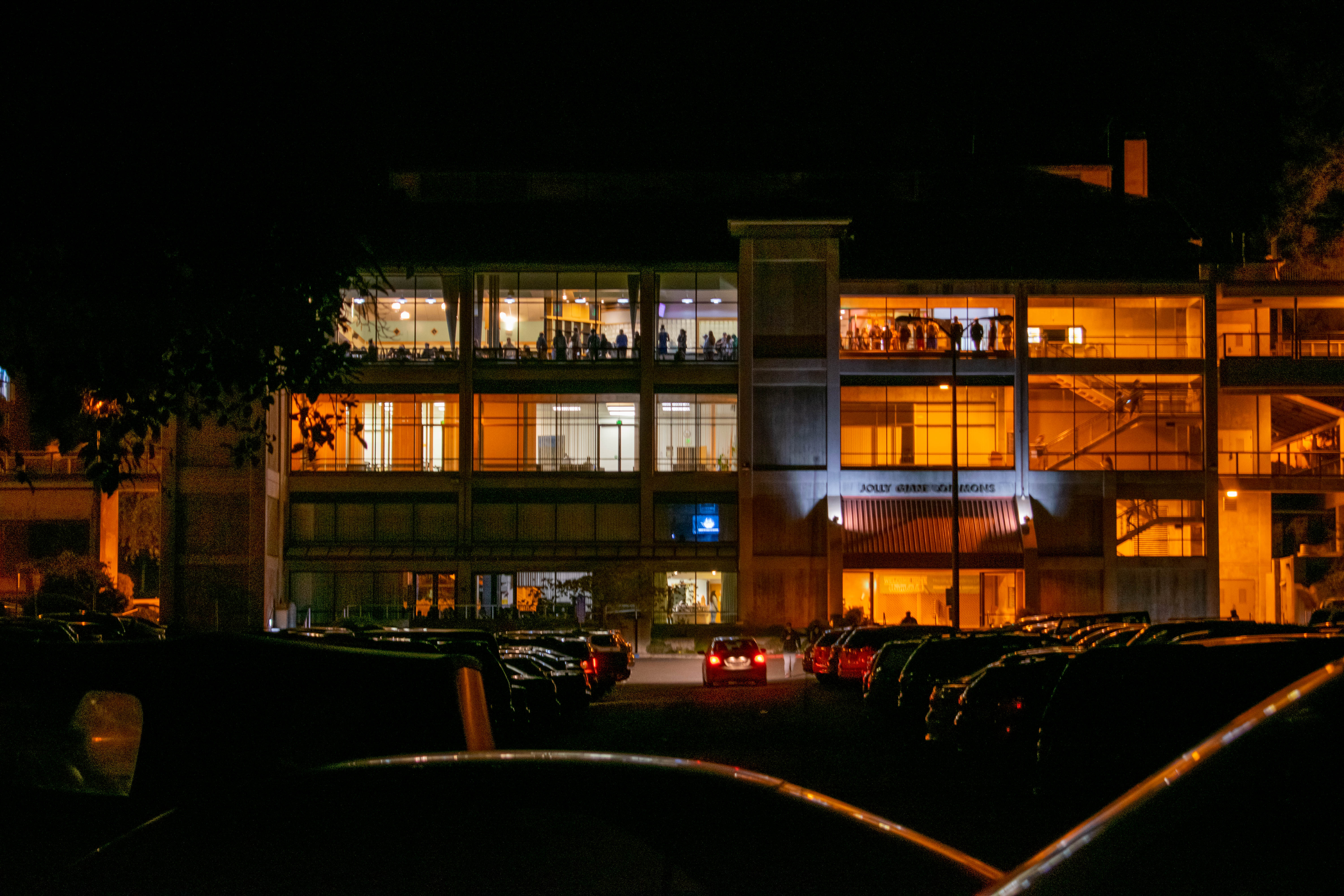
Dawes said one generator failed over the weekend, but Facilities Management quickly moved around generators to keep providing power to the most essential buildings on campus including the Jolly Giant Commons, Student Recreations Center and residence halls.
“They’ve been champions,” Dawes said. “Our facilities team has been keeping everything together.”
Daniel Valencia, a sophomore kinesiology major, normally works at The Depot. During the outage, Valencia helped out at The J. When not working, Valencia said he enjoyed his hobbies.
“I picked up skating more,” Valencia said. “And I’ve been looking into hobbies like reading and painting.”
Zane Eddy, a master’s student in the environmental science and management program, came from an undergraduate program at the University of Oregon. Eddy said he was surprised by the outages.
“It’s really odd having these power outages,” Eddy said.
Eddy spent his free time going to Clam Beach and picking chanterelle mushrooms. Eddy said he believes the outages will make people understand their dependence on others for power.
“We’re part of a larger system and we’re part of a larger environment,” Eddy said.
While preparing for the outages on Friday, Interim Vice President of Enrollment Management Jason Meriwether echoed Dawes and said he was proud of how HSU handled the first outage.
“That was a positive thing that we responded to the power outage in that way,” Meriwether said. “Now, in my opinion, that’s how it should always be and that’s how it will be. But I think students were happy to know we took that approach.”
Dawes said HSU served 4,400 meals on Sunday. While he admitted that HSU incurred some significant costs in diesel and food, he said a percentage of those costs can be covered by disaster funds.
On Tuesday, HSU uploaded a response page for students wondering why classes are cancelled during the outage. The page noted concerns over safety, non-functioning technology and a focus on personal wellbeing. The page also explained why it takes time to reopen campus even once power is restored.
“It takes a great deal of time to safely re-open the campus, including powering down and disconnecting generators, resetting locks, and ensuring fire suppression systems are working,” HSU’s post said.
As of Tuesday afternoon, HSU classes are set to resume on Thursday, Oct. 31.
In the future, Dawes said HSU will likely look toward generating more of its own power.
“Having more generation for the campus would be a huge help,” Dawes said. “So we’ll be looking into doing that.”
For now, Dawes wanted to thank staff, faculty and students for restoring his faith and hope in humanity.
“We’ve got really good students that want to provide for others,” Dawes said. “And staff that really care about providing for students as well.”
With the recent Public Safety Power Shutoffs, blackouts may be a big push toward renewable energy
Public Safety Power Shutoff, blackouts could aid the push toward renewable energy. Solar micro-grids, local offshore wind farms or more well maintained power lines could be the answer to back-to-back outages.
Pacific Gas and Electric Company’s PSPS events are triggered by environmental conditions that threaten parts of their power grid. For example, a third consecutive power shutoff was originally scheduled for Tuesday morning, but changing weather patterns pushed back the timing. On Tuesday at 5:22 p.m. the county was removed from the PSPS affected counties list.
PG&E’s PSPS events are triggered by environmental conditions that threaten parts of their power grid.
“Due to diminished weather conditions, Humboldt County is no longer in the scope for a Public Safety Power Shutoff tonight and power will remain on,” said Humboldt OES in an email alert. “There are still communities without power but PG&E advises they hope to have those areas re-energized tonight.”
The nature of the power grid in Northern California renders Arcata and Eureka subject to power outages if other areas of the grid are at risk. The energy used in Northern Humboldt is imported through transmission lines to the Eureka Humboldt Bay Generating Plant, where it’s amplified for local use. If energy stops flowing through the lines to Humboldt, there is no source of energy and therefore, no electricity.
Terra-Gen, a Manhattan-based wind power company, has proposed a wind generation project for the Monument and Bear River Ridges that could provide nearly half of Humboldt’s energy. A panel discussion on the project will be held Nov. 6 at 5:30 p.m. in Founders Hall 118.
“Anticipated project features include a significant contribution to North Coast renewable energy generation and to California’s clean energy mandate,” the panel flyer says.
According to Terra-Gen, benefits of the project could include the creation of local green jobs and Humboldt Bay development. However, some local community members see the project as more consequential than not.
As California’s dry and windy seasons become the new normal, power shutoffs will likely become common occurrence.
The proposed area of development, Monument and Bear River Ridges, sit on Wiyot territory. According to the Wiyot Tribe and the California Department of Fish and Wildlife, the Monument and Bear River Ridges aren’t appropriate for wind development. The turbines could harm or destroy some of the rare and protected species that call the area home.
“Concerns raised include impacts on bat and bird deaths; tree removal; effects on sites with cultural and ecological significance to Native American Tribes; erosion and sedimentation from sub-river drilling and road expansion; visual impacts; light and noise pollution; and traffic congestion,” the flyer says.
The upcoming panel lists some of these concerns as additional talking points, but it is unclear if the company or the county have come to a conclusion on how to proceed with this particular option of alternative energy.
Alternatively, PG&E maintains that shutoffs are necessary to prevent dangerous wildfires like the Camp Fire of 2018. Any at-risk transmission line can be shut off. As California’s dry and windy seasons become the new normal, power shutoffs will likely become common occurrence. However, some individuals are taking advantage of the winds, rather than suffering from them.
Blue Lake Rancheria has tested local energy generation since 2011. The Rancheria has yet to be seriously impacted by the power shutoffs because they have solar electricity and battery storage, forming a microgrid.
Their microgrid works as a system of solar panels which power the Casino and other buildings during the day while also charging up a bank of Tesla batteries for the night. The grid can be connected or disconnected from PG&E’s grid as needed, making them sustainable without any power from the utility.
The primary barrier to building offshore wind turbines and micro grids or improving PG&E’s transmission lines is cost. Alternative energy projects cost significantly more upfront that traditional fossil fuels. The economic costs of the recent power shutoffs, however, may be enough to kickstart real conversations about alternatives.
Once again, PG&E did not initially include all of Humboldt in its outage prediction. But according to OES, all of Humboldt County will be affected.
Due to possible extreme weather conditions and fire risk, all of Humboldt County is expected to lose power when Pacific Gas and Electric implements a Public Safety Power Shutoff early Saturday afternoon.
“The latest information from PG&E is that all of Humboldt County is now in scope for this PSPS power outage,” a Humboldt County Office of Emergency Services Facebook post said on Thursday evening.
PG&E began notifying specific customers of the possible outage on Thursday evening and will continue to do so. The utility also told OES that their online address look-up tool wasn’t up to date as of Thursday night, but will be updated soon.
According to a post from the Humboldt County Government’s website, the outage is expected to last longer than the previous, which was only 28-hours, and residents should prepare to be without electricity for up to four days. The county also said the length of the outage and estimated time power could return is completely up to PG&E.
OES also made a post with nine tips for preparing for the outage. The list is copied below.
Are you prepared in the event the PSPS affects Humboldt County? There is still time to gather supplies and take steps to be ready if the power shuts off.
Here are some tips to help you get prepared.
1. Have food for 2-3 days on hand that doesn’t require refrigeration and can be cooked on a camp stove or outdoor grill. Remember though, never use a camp stove indoors.
2. Have 1 gallon of water, per day, per person for drinking and cleaning.
3. Have flashlights, battery operated lanterns or candles in a convenient location. Remember, if you are using candles, never leave them unattended, within reach of children, and keep them away from flammable items.
4. Keep your refrigerated items cold by freezing water bottles. When the power goes out, transfer the frozen bottles around items in your fridge to help keep them cold. You can also transfer items to the freezer once the power is out to keep them cold. Remember to only open your fridge when absolutely necessary and make it quick. Don’t open your fridge to check to see if it’s cold.
5. If you are getting close to needing a refill on prescriptions, do it soon.
6. Fuel up your vehicle.
7. Have cash on hand. When we lose power retailers may lose the ability to run debit and credit cards.
8. Remember to check on your neighbors. We are all in this together and we strengthen our community by pulling together.
9. Sign up for Humboldt Alert, Humboldt county’s emergency notification system. We will send out notification alerting you to any emergency that may affect you, not just a PSPS event. Click our link at the top of our Facebook page or visit Humboldtgov.org/alerts to sign up today.
For more information on preparedness, visit Ready.gov.
Due to an expected severe wind event anticipated to occur around 10 pm Saturday night, Pacific Gas & Electric (PG&E) notified the county this afternoon that it will de-energize some power lines in Humboldt County as part of the utility’s Public Safety Power Shutoff (PSPS) program. At this time, PG&E expects that 2,188 customer connections in Humboldt County will be affected. Electricity is expected to be turned off for those PG&E customers Saturday evening, possibly several hours before the wind increases.
This PSPS event is expected to last longer than the roughly 24-hour event earlier this month, which means residents who are affected may have electricity shut off for a longer period of time. The Humboldt County Sheriff’s Office of Emergency Services (Sheriff’s OES) will provide updated information from the utility as it becomes available.
The length of the outage and estimated time of restoral [sic] is entirely up to PG&E. For information about PSPS or to sign up for alerts, go to http://www.prepareforpowerdown.com or call 1-877-9000-PGE.
PG&E expects to issue maps later today that show the anticipated affected areas. The Humboldt County Sheriff’s Office of Emergency Services (Sheriff’s OES) will provide those maps and any information regarding affected areas as it becomes available. If the shutoff is isolated in Humboldt County, or includes distribution lines in our area, ground inspection may take longer than the aerial inspection completed after the Oct. 9th shutoff before restoration can begin.
The overall PSPS is expected to affect 32 California counties and approximately 640,000 customer connections. As conditions may continue to change and the scope of this event may be expanded, the county recommends that all county residents be prepared for an extended power outage beginning Saturday night.
Alison Holmes, Ph.D. spent her sabbatical researching whether California acts as its own nation
California has the means to be its own nation. It’s big, it’s wealthy and it’s been disrupting the status quo by acting internationally.
“California has been acting outside the box,” Humboldt State University Associate Professor and International Studies program leader Alison Holmes said. “They’ve been going and doing stuff with China, Mexico and Canada. It’s like, ‘Wait, you’re not supposed to do that. That’s not what international relations theory says, it’s not what the U.S. Constitution says, it’s not what all kinds of other rules suggest.’ So how are they doing that?”
Holmes spent her sabbatical last school year researching California and talking with state officials and those the state has dealt with.
In August, Holmes presented her research to the Center for California Studies at Sacramento State University in a presentation called, “California as a Nation-State: Innovative or Inevitable?”
In her research, Holmes found that cities and industries within California may act internationally, but the state itself doesn’t typically act as its own nation.
“We do things internationally but we don’t do them in a coordinated fashion,” Holmes said.
Holmes grew up in Oklahoma, but she moved to the United Kingdom after volunteering in Belfast during college. Holmes lived in the United Kingdom for 25 years, where, among other things, she worked for and advised the Liberal Democrats and worked as the Deputy Head of Corporate Communication Strategy for the BBC.
In 2005, Holmes completed her doctorate in London and then became a speechwriter for Ambassador Robert Tuttle.
“When I worked for the ambassador, I became very interested in international relations and diplomacy,” Holmes said.
California likes to think that it’s an innovator. We’re really big and proud about how we do stuff. And actually we’re not at the front of that innovation edge; a lot of other places in the world have been doing this for a long time.”
Alison Holmes, Ph.D.
When Holmes moved to California, she saw a perfect opportunity for research.
“California makes an excellent case-study, because it is the fifth largest economy in the world,” Holmes said. “But it is a sub-national unit of a huge, hegemonic, vast, largest-nation power.
Holmes said California’s international actions are part of a larger globalization trend.
“What a lot of international relations theory will tell you is that globalization has meant a bunch of people who aren’t nation-states have started to do things on the international stage,” Holmes said.
With this in mind, Holmes said that while California might be innovative for the United States, it isn’t elsewhere.
“California likes to think that it’s an innovator,” Holmes said. “We’re really big and proud about how we do stuff. And actually we’re not at the front of that innovation edge; a lot of other places in the world have been doing this for a long time.”
Holmes also said non-state entities acting internationally brings up questions about the very nature of sovereignty.
“When does a sovereign not have sovereignty?” Holmes said. “At what point do state relations at the international level become a foreign policy? My point here is that our traditional ideas of sovereignty are ill-equipped to describe what we see in the real world.”
Holmes says there are three future goals for California: the establishment of an agency focused on international policy, the honoring of tribal relations and the inclusion of tribes in international policy, and the coordination of city and county international efforts with state efforts.
Holmes ended her research presentation with an urge to take advantage of California’s diversity across all of its communities.
“That is the only way to create a robust local-global citizenship and to turn California’s state-nation vision of unity from diversity into a reality,” Holmes said.
Locally, Holmes said Humboldt is more global than it might think. Holmes urged Humboldt residents to connect local actions with outside, global forces.
“I worry that Humboldt is a little too proud of being the Lost Coast or being behind the Redwood Curtain,” Holmes said. “Privileging what they perceive to be the local over the global, to the point of seeking to disconnect from rather than engage with the world outside.”
Holmes said ignoring global events has consequences.
“If you don’t understand these things, you’re not really paying attention to what’s happening, how you can take advantage of that, how you can be a part of that and how it doesn’t have to roll over you like a steamroller,” Holmes said. “Because otherwise it will.”
However, Holmes cautioned that connecting local issues with the rest of the globe doesn’t mean people should start blaming external forces for all local problems.
“Trying to understand it is not the same as trying to find somebody else to blame,” Holmes said.
Holmes suggested that freshmen coming to HSU would likely benefit from learning intercultural communication strategies that international studies students use.
“There is culture shock,” Holmes said of new HSU students. “There is intercultural communication issues between the different groups of people who turn up here.”
While HSU politics professor and international relations teacher Noah Zerbe said Holmes’ work goes beyond the scope of his expertise, he did agree with the importance of paying attention to the rest of the globe.
“Stuff that happens globally affects us everywhere,” Zerbe said. “It affects us here as well.”
California’s prowess has led some to believe that California should secede from the United States.
Marcus Ruiz Evans, president of Yes California, the largest organization dedicated to California’s secession, said he believes California would be better off on its own.
“The basic idea is that California is held back financially because it’s part of America,” Ruiz Evans said over the phone.
“The basic idea is that California is held back financially because it’s part of America.”
Marcus Ruiz Evans
Ruiz Evans said Yes California and the #CalExit movement started back in 2011. Since then, it has seen significant growth, especially following the election of Donald Trump.
However, Ruiz Evans said that the movement’s growth led to a divide in its supporters that left the movement momentarily stagnant.
“With success came civil divorce,” Ruiz Evans said.
Nevertheless, Ruiz Evans said he firmly believes California should secede. Ruiz Evans said that California, on its own, wouldn’t have to fight with the president or the rest of the country, wouldn’t have to fight with federal immigration laws and would save billions of dollars.
Ruiz Evans also said California is held back politically and financially, and that he believes a split is only logical.
“We think it’s inevitable,” Ruiz Evans said.
Yet, when asked, Holmes put a damper on such enthusiasm.
“I am not sure ‘doing it alone’ is ever a great idea,” Holmes said. “I think while California is rich by many standards, if they had to pay for all the things that the federal government currently does, our situation would change rapidly. California could go that route, but revolutions rarely end well or the way the instigators intended. Be careful what you wish for.”
Dry vegetation and high winds were a major factor in PG&E shutoff
The morning of Oct. 8, Humboldt County residents were notified that Pacific Gas & Electric may shut off power county-wide. HSU students and faculty began rapidly preparing for the possible outages, but some wondered what forced the utility giant to turn off the power.
Leading up to the blackout, rumors spread as people speculated why PG&E decided shutting off power was the best option, and others wondered how long the outage could last. It seemed there was a lack of communication, as only some local professionals seemed to know the details.
On the night of Oct. 9, HSU Facilities and Management employee Brian Wheeler was responsible for filling up HSU’s generator. The diesel generator was the only thing standing between powerless students and the cold, dark night.
Wheeler said he had heard about an algorithm PG&E made to inform them when to shut off the power. This was confirmed by Megan McFarland, a spokesperson for the company. McFarland said no single factor drives a Public Safety Power Shutoff since each situation is unique.
PG&E carefully reviews many criteria when determining if power should be turned off for safety. These factors generally include, but are not limited to:
A Red Flag Warning declared by the National Weather Service.
Low humidity levels, generally 20% and below.
Forecasted sustained winds above 25 mph and wind gusts in excess of approximately 45 mph, depending on location and site-specific conditions such as temperature, terrain and local climate.
Condition of dry fuel on the ground and live vegetation (moisture content).
On-the-ground, real-time observations from PG&E’s Wildfire Safety Operations Center and observations from PG&E field crews.
To get a better grasp on the situation and its factors, The Lumberjack contacted the Woodley Island National Oceanic and Aeronautic Administration. Meteorologist Jeff Tonkin understood the specifics and why PG&E could be forced to make such a decision, but believed that Humboldt County wasn’t initially a part of the plan for a reason.
“PG&E shuts down based on wind speed if it is projected to cause a disruption or a failure,” Tonkin said. “Locally in Eureka, the power wasn’t shut down because of local high winds. We’re just collateral damage.”
Tonkin said NOAA had meetings with PG&E meteorologists in the past, but PG&E doesn’t consult NOAA for weather information. While getting in contact with one of PG&E’s scientists would likely be key to understanding why the power was shutoff officially, Deanna Contreras, another PG&E spokesperson, answered the call instead.
Contreras said, for this particular shutoff, the weather patterns were somewhat unique and widespread. Many forecasters compared the conditions to the devastating conditions from October 2017.
In response to the rapidly changing environmental conditions in our state, beginning with this year’s wildfire season, PG&E expanded its Public Safety Power Shutoff program to include all electric lines that pass through high fire-threat areas – both distribution and transmission.
Cotreras said there weren’t any PG&E meteorologists available but had plenty of details about PG&E’s weather system.
“Beyond PSPS information, weather geeks will find a lot to love about the new weather page,” Contreras said. “With PG&E’s weather map at your fingertips you’ll be able to check humidity, precipitation, temperatures, wind speeds and wind gusts across 70,000 square miles of Northern and Central California.”
Contreras said the page offers a seven-day regional forecast. PG&E’s Wildfire Safety Operations Center team monitors all these conditions and evaluates whether to proactively turn off electric power lines, in the interest of public safety, if extreme fire danger conditions are forecasted.
McFarland said a lot of PG&E employees live and work in regions that are affected by the shutoff and that she understands how frustrating it is to have the power turned off. She said the decision was not made lightly.
“We want customers to know that although you may not live or work in a high fire-threat area,” McFarland said, “Your power may be shut off if the line serving your community relies upon a line that runs through an area experiencing extreme fire danger conditions.”
PG&E cut power to more than 700,000 homes and businesses across Northern California, including Humboldt County, beginning early the morning of Oct. 9.
State officials have criticized PG&E, including Governor Gavin Newsom.
“This is not, from my perspective, a climate story as much as a story about greed and mismanagement over the course of decades,” Newsom said in a press conference on Thursday.
Humboldt County residents had less than 24 hours of notice, as PG&E’s initial warnings did not include Humboldt as an affected county.
PG&E sent warnings out to customers for some time about possible outages, but few were prepared for such a sudden total power shut down.
The shutoff came as a new last-resort tactic by PG&E called a “Public Safety Power Shutoff.”
The California Public Utilities Commission issued a resolution in May, supporting PSPS tactics to prevent wildfires like the Camp Fire, a wildfire that tore through Butte County, Calif. in November of last year.
“Clearly something needs to be done. There are lines breaking and they’re causing fires.”
Jeffrey Kane
The Camp Fire burned over 153 thousand acres, destroyed over 18,000 homes and killed 85 people, making it the deadliest and most destructive wildfire in California history.
California state investigators determined poorly-maintained electrical lines as the cause of the fire. PG&E was thus made responsible for the fire, and faced potential liabilities of $30 billion dollars. In January, PG&E filed for bankruptcy.
PG&E and U.S. District Judge William Alsup have since gone back and forth over the details of PG&E’s restructuring plans to repair the aging electrical lines. According to PG&E Spokesperson Megan McFarland, the utility has been working on a variety of operations.
“Our ongoing and expanded efforts include further enhancing vegetation management around power lines, conducting accelerated safety inspections of electric infrastructure in high fire-threat areas, and hardening our electric system,” McFarland said in an email.
Businesses around Humboldt reported tens of thousands of dollars in losses in sales and spoiled foods.
Humboldt State University Associate Professor of Fire Ecology and Fuels Management Jeffrey Kane said PG&E and the rest of the state are going to have to learn to manage vegetation to reduce the risk of wildfires.
“Clearly something needs to be done,” Kane said. “There are lines breaking and they’re causing fires.”
While Kane did not know the details of PG&E’s lines and practices, he said keeping vegetation away from transmission lines will require continual maintenance.
In the long-term, one model for PG&E’s future might come from San Diego Gas & Electric, as suggested by reporting in the Los Angeles Times. After a 2007 fire, SDG&E spent over $1 billion burying and insulating lines. SDG&E also sectioned off areas into separate micro-grids, so that shut offs could be more targeted and less widespread.
However, both of those practices will take time and money. Until then, PG&E will implement outages like the one triggered last week by a National Weather Service Red Flag Warning of high winds and low humidity.
The outage hit over 700,000 customers across California. In Humboldt, a late notice meant residents had only about 12 hours to prepare for what was predicted to be a three-to-five day outage.
While the outage only lasted about 24 hours in Humboldt, the outage caused widespread closures and the activation of the Humboldt County Emergency Operations Center.
Businesses around Humboldt reported tens of thousands of dollars in losses in sales and spoiled foods.
A news release from the Eureka Police Department noted a 26% increase in dispatches during the outage, but attributed the increase to nearly 40 false alarms. The five traffic collisions and three burglaries both fell within normal ranges, according to the release.
Office of Emergency Services Administrative Officer Sean Quincey said he was proud of the way the county responded and supported one another through the outage, which he said is essential in any emergency in Humboldt.
“Humboldt County is isolated,” Quincey said over the phone. “It’ll take time to get resources up here. Until then we need to support each other, and I was happy to see that happened.”
Arcata City Manager Karen Diemer shared a similar outlook over the phone.
“Humboldt County is isolated. It’ll take time to get resources up here. Until then we need to support each other…”
Sean Quincey
“I saw a lot of residents helping other residents and making sure that their neighbors were safe,” Diemer said. “So the resiliency of our community is strong.”
Unlike Humboldt, Quincey said some communities farther south received 48 hours notice—which, ideally, Humboldt will have in the future. McFarland echoed that statement.
“Our goal, dependent on weather, is to send customer alerts at 48 hours, 24 hours and just prior to shutting off power,” McFarland said.
Just before the outage, there were efforts at the Humboldt Bay Generating Plant to provide electricity for at least part of Humboldt County. But McFarland said HBGS doesn’t have the capabilities to operate when disconnected from the grid.
However, McFarland suggested that HBGS may be able to provide energy to Humboldt in future emergencies.
“PG&E does have an engineering study underway to evaluate what plant modifications would be required to add that capability,” McFarland said. “Including changes that may be required to the existing air permit to allow HBGS to operate over the range necessary when disconnected from the grid.”
The outage ultimately served as a wake-up call for the county.
“We’ve learned that this is something that we need to be more prepared for,” Quincey said.
In a press conference held at the PG&E headquarters in San Francisco on Oct. 10, PG&E CEO Bill Johnson apologized for the outage and for failures in their website, maps and call centers.
“To put it simply, we were not adequately prepared to support the operational event.”
Bill Johnson, PG&E CEO
“To put it simply, we were not adequately prepared to support the operational event,” Johnson said.
As for the future of PSPS events, Johnson said PG&E is working to prevent outages from becoming the new normal. However, Johnson made the statement with a caveat.
“Given the risk to public safety, there’s a desire to have zero spark during conditions like the ones we had over the last several days,” Johnson said. “We will very likely have to make this kind of decision again in the future.”
Corrections: A previous version of this article listed the Camp Fire’s acreage in the millions, not the thousands.
Humboldt businesses take stock of losses from county-wide power outage
Local businesses scrambled to recover from two days of frantic sales and attempts at saving perishable foods on Oct. 10.
North Coast Co-Op General Manager Melanie Bettenhausen said she had been up for most of the previous 36 hours.
When the Co-Op learned of the outages, Bettenhausen said they had to choose between trying to store and preserve perishables, or trying to sell them off as quickly as possible.
They chose the latter and marked down all perishables at 50% off.
“And that resulted in madness in our stores,” Bettenhausen said.
Bettenhausen said more customers visited the Co-Op than on even their busiest days. Bettenhausen thanked the community for coming and helping salvage some of their losses. Nevertheless, their losses were significant.
“My best guess is somewhere between $25,000 and $30,000, because we were able to mark down and sell some products,” Bettenhausen said.
On Oct. 10 the Co-Op was documenting tens of thousands of dollars of perishable items that had to be thrown away, as temperatures rose outside of legal limits.
Bettenhausen estimated a dozen shopping carts full of items were tossed just from the dairy section at their Eureka store.
North Coast General Manager estimates losses between $25,000 and $30,000. | Photo by James Wilde
Conrad Coelho, the store manager of Murphy’s Market in Westwood, shared similar experiences.
“It was very busy,” Coelho said. “The busiest we’ve ever been since we opened in 2010.”
Coelho said lines inside stores stretched down aisles on Wednesday as customers waited 30 to 40 minutes to check out. While Coelho couldn’t give a number on their sales, he predicted significant losses from the frozen section.
Wildberries Marketplace President and owner Phil Ricord said the store experienced a rush of customers before the outage.
“Around 5 p.m. on Tuesday we got slammed big-time with customers buying canned foods and candles and stuff like that,” Ricord said.
Due to aging electrical infrastructure, Wildberries does not have a backup generator, and did not open on Wednesday. Instead, employees stored perishables in cold boxes, where they were able to maintain cold enough temperatures to save most of their foods.
Ricord did say that some produce was lost, and the sales lost from the Oct. 9 closure would be significant.
“We probably lost about $40,000 in sales,” Ricord said.
Gas stations also saw rushes the night of Oct. 8, with several gas stations running out of gas by the next day.
Any stores with ice quickly sold out as residents tried to keep their perishables cool. When local radio station KHUM broadcast that Murphy’s Markets in Westwood and Sunny Brae had received shipments of ice, customers rushed the stores, creating lines outside at the ice chests.
Arcata City Manager Karen Diemer echoed the statements by local businesses. Diemer praised “heroic efforts” by community members to purchase and salvage perishable foods, but did acknowledge the overall loss.
“I think we had a real economic loss in our restaurant and retail establishments throughout the city,” Diemer said over the phone. “But at this point it’s too early to really have any totals or numbers.”
This website uses cookies to improve your experience. We'll assume you're ok with this, but you can opt-out if you wish. Cookie settingsACCEPT
Privacy & Cookies Policy
Privacy Overview
This website uses cookies to improve your experience while you navigate through the website. Out of these cookies, the cookies that are categorized as necessary are stored on your browser as they are essential for the working of basic functionalities of the website. We also use third-party cookies that help us analyze and understand how you use this website. These cookies will be stored in your browser only with your consent. You also have the option to opt-out of these cookies. But opting out of some of these cookies may have an effect on your browsing experience.
Necessary cookies are absolutely essential for the website to function properly. This category only includes cookies that ensures basic functionalities and security features of the website. These cookies do not store any personal information.
Any cookies that may not be particularly necessary for the website to function and is used specifically to collect user personal data via analytics, ads, other embedded contents are termed as non-necessary cookies. It is mandatory to procure user consent prior to running these cookies on your website.