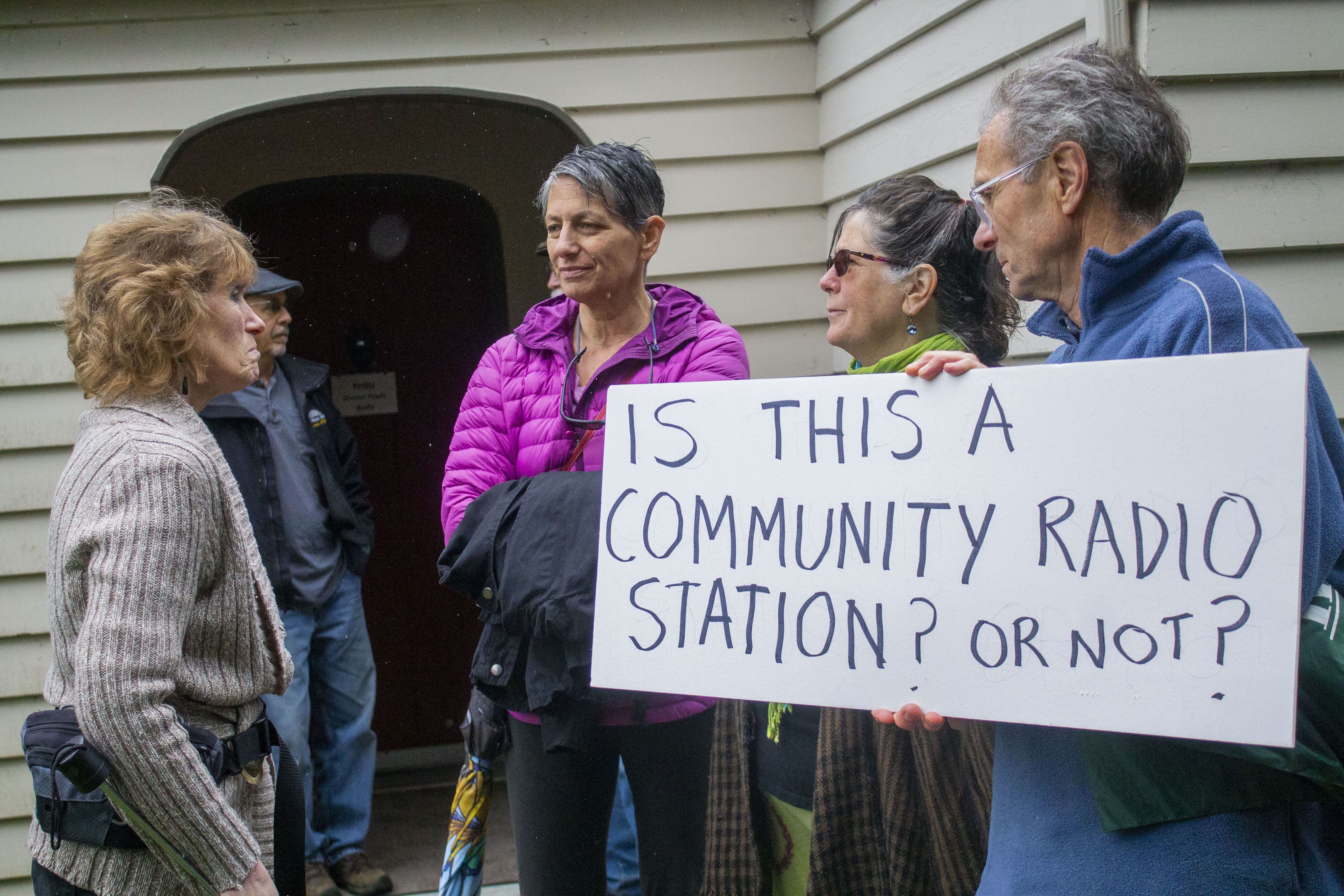
Nearly four years ago, Cal Poly Humboldt decided to abandon local-based programming for KHSU. This heartbreaking decision left local radio personalities with no creative outlet to broadcast from. Recently, some of those same people were able to redeem themselves on a radio station known as Humboldt Hot Air. In its humble beginnings, the station began as a simple recording studio. Any content that was created would be sent to a community-based radio station known as KZZH. In October 2021, station manager Neroli Devaney had set up a live streaming service, which gave rise to an underdog known as Humboldt Hot Air.
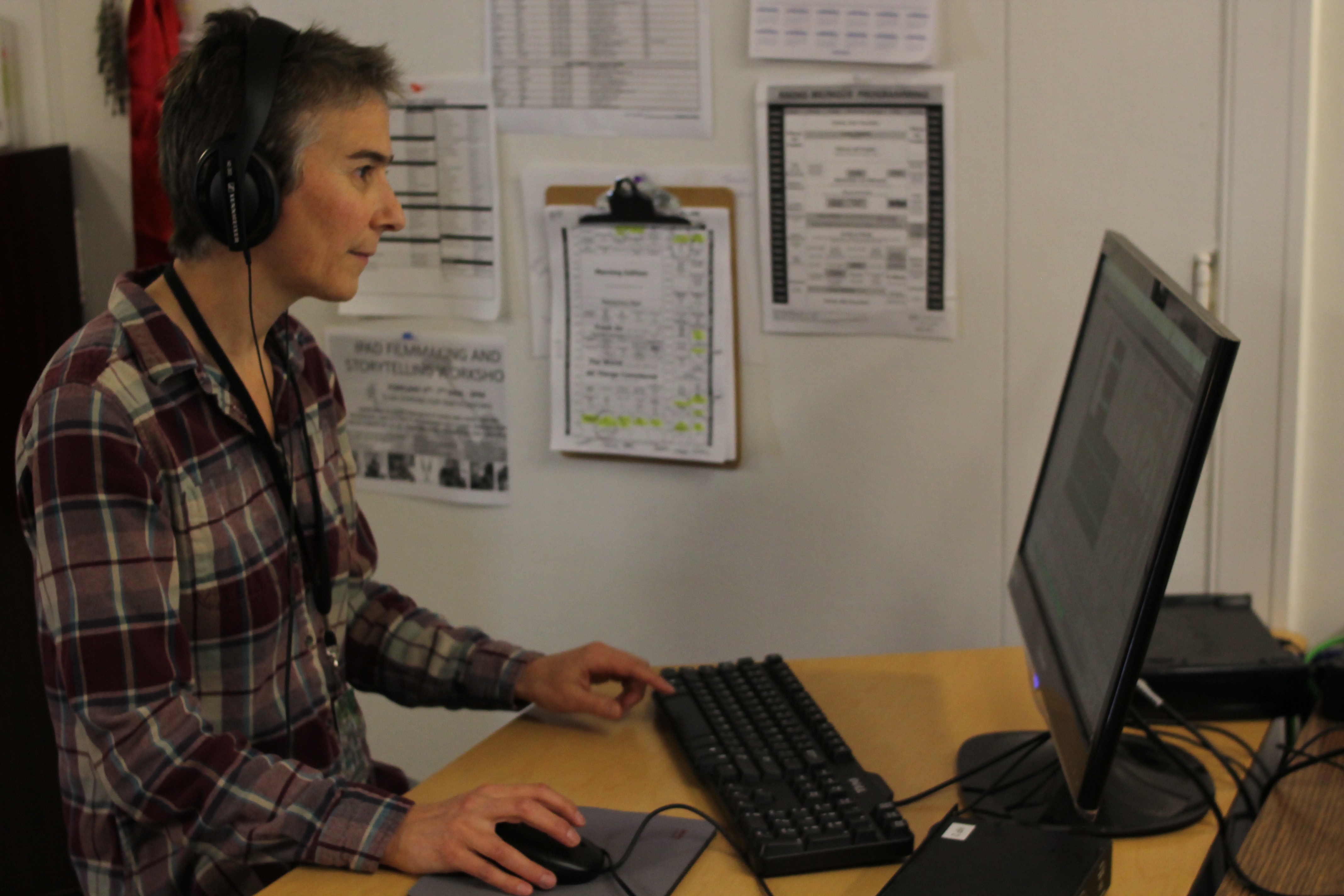
“We are an online internet radio station,” Devaney said. “We are based in the Arcata Playhouse. We are very eclectic and diverse in our programming. We have talk shows [and] lots of music shows. We program every other day of the week except for Tuesdays.”
Devaney made it clear that she was not the one who founded Humboldt Hot Air. However, the 24-year-old manager also shared what inspired her to take on this role.
“I did four years of radio at UC Santa Cruz. When I was there, I worked at KZSC, which is the radio station on campus there,” Devaney said. “When I was there, I did a bunch of different stuff, I was also a hip-hop director through a bunch of events, I just found myself really into radio and really passionate about it. I am from Arcata and when I graduated from UC Santa Cruz, I came back to Arcata. When I was in high school, I used to volunteer with the Arcata Playhouse with their teen program, which is called Apprentice Entertainment. Jackie Dandeneau, who is executive director of the Arcata Playhouse reached out to me. [She] said that she started this project called Humboldt Hot Air. They were recording audio and they had this goal of eventually having a live stream…She asked if I wanted to get involved and I said yes. [I] thought it sounded really fun.”
Devaney also explained how the former KHSU audience had become her most avid listeners.
“When we started a lot of people felt that there was this need for community radio in Arcata. A lot of the DJs saw that we were doing Humboldt Hot Air and I started getting a couple old KHSU DJs,” Devaney said.
“We’re still kind of attracting that crowd, which has been really awesome, especially for our own publicity,” Devaney said. “KHSU had this huge fanbase in the community, so to be able to bring DJs back and have them do their shows again– a lot of the community has had a positive response to that, those are our most popular shows, people will be like, ‘oh my god I listened to that show for thirty years and it’s back, that’s so amazing! It’s the same DJ.’ It’s just been really fun.”
Humboldt Hot Air strives to one day become an FM station.
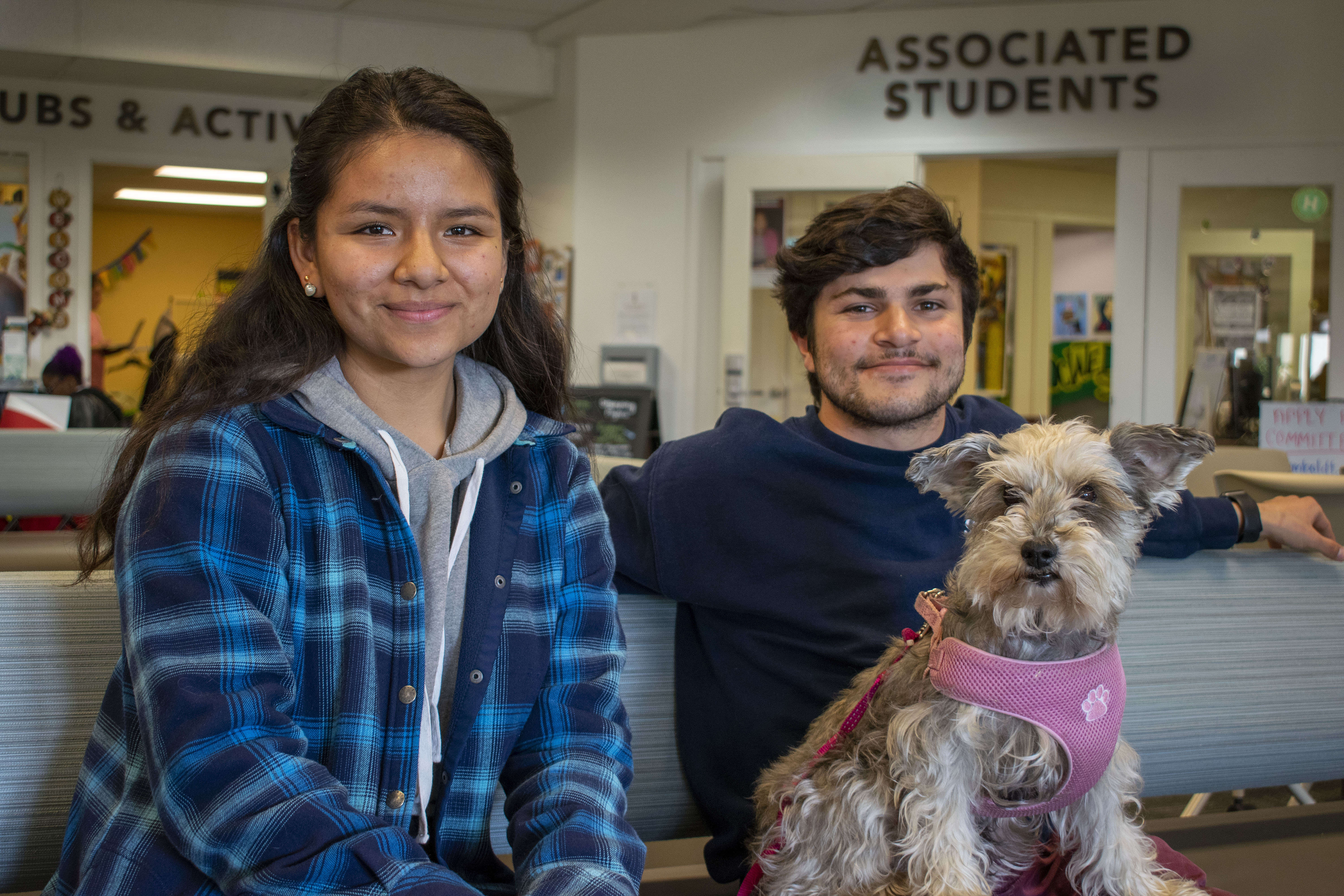
Only four students attended the first University Resources and Planning Committee’s public budget forum, according to Associated Students President Yadira Cruz.
Around 50 faculty, staff and community members were in attendance as well, according to Art Education Assistant Professor and URPC Co-Chair James Woglom.
Woglom said the URPC’s presentation, which can be found online at budget.humboldt.edu, focused on the URPC’s work toward creating a scalable budget model, or a budget that can be altered periodically to represent changing values.
“It ends up bringing more people into the process of decision-making, and thus hopefully reflecting more people’s feeling of what we want this organism to do,” Woglom said of the URPC’s new model.
James Woglom, art education assistant professor and University Resources and Planning Committee co-chair, checking his laptop in the Humboldt State Univeristy library on Nov. 14. Woglom said the URPC has created a new scalable budget model that allows for more flexibilty and input from the HSU community. | Photo by James Wilde
URPC has been meeting over the course of the semester to form a three-year budget for Humboldt State. Woglom said the first step for deciding where to allocate funds is to clarify which values HSU should prioritize.
Besides the forum, the URPC is taking feedback online through an online submission form, a Google survey designed to scale which campus values are most important and a pie chart budget simulator that allows proposals of how HSU should divide funds. Woglom said he’d also be happy to take suggestions through direct emails.
While Cruz said she appreciated the existence of the online feedback forms, she said they can be obscure due to budgetary jargon.
“Although it’s available, it might not be accessible in that way,” Cruz said.
The Google survey, which is not yet released, lists a series of California State University values and asks the respondent to rate how much they agree with each one.
“It’s not saying that we want to devalue any of them, but it’s trying to get a quantitative sense of where the University’s priorities are in terms of allocation of resources based across a series of ideas,” Woglom said. “And then hopefully with that quantification we can make decisions based on where we can make things happen.”
The URPC’s current projections show a $5.4 million budget gap by the 2021-2022 school year, which reflects the impact of reduced tuition due to declining enrollment. According to the presentation, every 100 students generate about $560,000 in tuition.
The University Resources and Planning Committee pointed to declining tuition numbers as the cause of HSU’s current projected $5.4 million budget gap.
Joseph Reed, a political science and economics double major and a student representative on the URPC, said the key challenge has been ramping down the budget with the declining student body.
“It’s kind of been hard to keep this budget for about 8,000 students when we don’t have 8,000 students anymore,” Reed said.
Cruz said the budget should focus on the students HSU has now, and not the students it had in the past.
“Being in that cutting mindset is potentially jarring for morale. I mean, you’re coming from a space where you’re like, ‘Alright, what do we have to not do this year?’”
James Woglom
“I think every campus goes through these sorts of financial challenges, but I think how we move forward is centering students,” Cruz said.
Reed said the URPC has no plans to cut whole departments. Instead, Reed said cuts are more likely to be smaller and broader across the board.
“Every department is being affected, but each one has its own budget, so each one has its own certain amount that it’s being reduced by,” Reed said.
Over the past three years, URPC reduced the budget by $11.5 million. However, Woglom emphasized a difference between past and future cuts due to the new scalable budget model.
“[In the past] we’ve cut what we’ve determined to be at the fringe of the project of the University—so maybe not in direct agreement with the strategic plan of the University or the general values of the University,” Woglom said. “Being in that cutting mindset is potentially jarring for morale. I mean, you’re coming from a space where you’re like, ‘Alright, what do we have to not do this year?’”
The University Resources and Planning Committee showed three possible enrollment and budget scenarios in its Nov. 7 public forum presentation.
With the new model, Woglom said HSU can start with a specific budget number and then distribute it to the things HSU values most. Woglom said the budget can be continually changed, which allows HSU to scale back up or down if monetary realities change.
“We don’t want to make hurried and necessary decisions every year,” Woglom said.
The URPC uses Financial Information Reporting Management System codes, which are used in higher education to categorize expenses by their function, to compare HSU’s spending to other CSUs.
FIRMS codes break down HSU’s spending into five categories: instruction ($56.6 million in the current budget), institutional support ($21.6 million), operations and maintenance of plant ($16.3 million), academic support ($15.6 million) and student services ($12 million). Each of these categories represent a FIRMS program, and the budget determines what percent of the total amount of funding goes to each category.
Using these categories, the URPC also compares HSU’s spending to other CSUs. According to the presentation, spending at HSU in comparison to similar-sized campuses for the 2017-2018 school year was 17% higher at HSU for instruction, 24% higher for academic support, 3% higher for student services, 10% higher for institutional support and 1% higher for operations and maintenance of plant.
The presentation also showed three possible scenarios for the future of enrollment and its effects on the budget. The best case scenario, called the growth scenario, shows a leveling off of the enrollment decline and a budget gap in the $4 million range by the 2021-2022 school year.
The current scenario, upon which URPC’s projections are based, shows a continued decline that leads to the budget gap of $5.4 million. The worst-case scenario shows further decline and a budget gap of up to $7 million by the 2021-2022 school year.
The URPC’s current budget plans are based on the middle scenario of a $5.4 million gap.
Woglom said the URPC still has to figure out how to allocate its funding to keep current programs intact.
Budget projections from the University Resources and Planning Committee’s Nov. 7 public forum presentation show a $5.4 million budget gap by the 2021-2022 school year.
“It raises interesting questions about where you can move within that,” Woglom said.
Just one day after the URPC’s public forum, HSU released a campus announcement detailing the process for filling staff vacancies during the current enrollment decline and budget deficit. The announcement said that while current staff positions will not be eliminated, positions deemed “non-critical” by the vice president of the relevant division won’t be backfilled when a person leaves that position.
Woglom confirmed that announcement.
“The intention of the University at this point is to work to determine where attrition will happen and backfill positions in that manner,” Woglom said.
This backfiring process does not apply to faculty, according to the announcement.
The URPC’s next and final public forum is scheduled for Dec. 3 at 11:30 a.m. in the Goodwin Forum, during which the public can review the URPC’s draft plan before it is sent to the University president for review. Woglom urges everyone to give their input.
“Any ideas that people have that they’d like to share with us, the better our decision-making process can be,” Woglom said.
“I think [student input is] a challenge in itself,” Cruz said. “But I think that just because it’s challenging doesn’t mean it shouldn’t be pursued.”
Yadira Cruz
Reed and Cruz said they don’t think two public forums are enough to gather sufficient student input.
“I think overall we should be making a stronger effort to connect with students and get their overall opinions,” Reed said.
Reed suggested that the URPC should seek to get input not just from some students, but from the majority of students. Cruz agreed.
“I think that’s a challenge in itself,” Cruz said. “But I think that just because it’s challenging doesn’t mean it shouldn’t be pursued.”
Administration rehires union protected station broadcast engineer
Humboldt State University has rescinded the lay off of one KHSU employee out of the seven laid off in April.
Kevin Sanders, a full-time employee who primarily works in Information Technology Services was rehired after his union, the California State University Employees Union, pushed back against the university. Sanders was and is the National Public Radio affiliate’s only broadcast engineer.
“Kevin is employed, working mostly in the Information Technology Services area, but is available to assist with broadcast engineering for KHSU if the need arises,” HSU Communication Officer Grant Scott-Goforth said in an email.
[perfectpullquote align=”right” bordertop=”false” cite=”Steve Tillinghast” link=”” color=”” class=”” size=”18″]”Humboldt realized over the last several months that the chief engineer of KHSU is a critical employee and that the station could not operate, even in its reduced form, without him.”[/perfectpullquote]
Humboldt chapter president of CSUEU Steve Tillinghast said in a press release that HSU management did not expect the Union to care.
“Or perhaps they did not even realize that one of the employees in the group they terminated was part of a Union and that they would be held accountable,” he said. “Humboldt realized over the last several months that the chief engineer of KHSU is a critical employee and that the station could not operate, even in its reduced form, without him.”
KHSU runs with the help of Chico’s North State Public Radio station to air its programming off and on since April.
At the beginning of August HSU signed a short-term interim agreement with Capital Public Radio in Sacramento for programming assistance with KHSU Public Radio. The agreement will keep KHSU running till the end of October.
According to a press release, “the agreement allows KHSU to continue airing national and state programming as the University considers various approaches for KHSU’s future.”
HSU will be assessing ways to ensure KHSU aligns with the university’s teaching missions after an advisory audit report. The audit report, ordered by the previous HSU president Lisa Rossbacher, found the station lacking in the opportunities it was supposed to provide for students.
The report suggested that over time the station had evolved from an exclusive student training ground to primarily a community servicing station. The report said the university should assess student involvement at KHSU and determine whether or not to develop more opportunities for students through “employment, internships, academic programs and coursework.”
The advisory team did not, however, suggest laying off employees as an answer to any suggested shortcomings.
For now, the university is considering joining the discussion of a three-way regional partnership with the Chico and Sacramento stations.
This partnership could bring about certain opportunities such as a Public Service Operation Agreement, which would formalize cost-sharing for programming and management.
Structural organization was also an area of improvement listed on the KHSU audit.
HSU President Tom Jackson wants to gather input from faculty and students to learn more about their interest in KHSU before committing to anything further.
I’m not sure how else to describe the shuttering of KHSU in the last month of my education.
Interning for KHSU has been rocky from the day I signed the paperwork. I began in the summer of 2018. Katie Whiteside, the beloved program director, hired me and on my first day of work she was unexpectedly fired. We have since bumped into one another, but I was unsure of how to proceed when the only string we had tying us together had been broken so quickly. Now we have a lot more in common…
The station also had a physical shift in my first days. The studios were moved from the top floor of the Theater Arts Building to the sunny, albeit noisy, Feuerwerker House.
I mention these abrupt changes to point out that my time at KHSU has been anything but stable. I’ve come to expect some level of shaky ground, but not like this…this felt off the Richter scale.
I finally felt this internship was paying off. Literally. I began getting paid for my work for the first time and I had my first solo-produced audio feature run on the station two weeks ago. It felt fitting that the culmination of my work at HSU would be disseminated professionally the day before I turned 30 and just a month before I graduate. I was already excitedly working on my next piece and I made plans to stay for the summer. This was Wednesday, April 3.
Tuesday, April 9 KHSU held a going away party for HSU alum Michael Roccaforte at Richard’s Goat. We ate tacos, drank beers and espoused the success of (and waking up for) the pledge drive that had concluded just two days prior. Nobody had any idea it would be a going away party for all of us. I’m partially glad for that, because it was a blast.
Wednesday, April 10 would be the last full day of KHSU as we knew it.
Thursday morning KHSU was gutted of nearly all its employees. Two remained, but not for long. My only indication anything was amiss that day were the cop cars parked on either side of the studios. Nothing was said prior to myself or any other intern. We learned at the same time as everybody else, standing in the rain in front of the studio. Later that afternoon I read a story on the Lost Coast Outpost with a quote which vaguely informed me that I, as a student, might still have a job. Why was I reading the status of my employment through a news outlet instead of being told directly?
Myself and the two other interns, Damian Jimenez and Destiny Hill-Brekke, received a generic email at 5:35 p.m. apologizing for the the silence on the university’s end, saying that it was an “oversight.”
KHSU was shut down because it had “drifted” from the interest of the students. Which students? Hypothetical students? Because I’m a real student and I still had a deep interest in finishing my internship. I had an interest in the connections not to mention references I was gaining. I had an interest in the paycheck I counted on. I had an interest in having the last month (and summer) to fill out my portfolio with professional audio journalism, the thing I came to school for in the first place.
KHSU wasn’t the first community institution to get cut by an ax-wielding budget committee and it likely won’t be the last, but I feel cheated. At least the football team got to finish their season before they got cut…
To KHSU: You’ll be sorely missed by more than just me. From the bottom of my heart, thanks for experience and thanks for all the laughs.
I am writing to express my rejection of the recent unilateral dismantling of KHSU by the Humboldt State University administration. As a producer for National Public Radio’s “Here and Now” program, a Humboldt State University alum (class of 2010) and an Arcata native, I have benefited greatly from the existence of KHSU and have several concerns to express over this decision.
I know KHSU plays a huge role in the community in Humboldt County. I think you know that by now, too. And yet, the university did not properly support the station or communicate about drastic changes, as evidenced by the outcry from the people who pay for the programming, the staff who make the content and all the listeners who have written about their frustrations, anger and sadness.
The way that the university handled the reorganization of KHSU goes against everything Humboldt stands for. Humboldt State’s mission statement says it serves students from around the world by offering them “access to affordable, high-quality education that is responsive to the needs of a fast-changing world.”
As a professional journalist working in a volatile environment, I can say that a rural community news outlet working to educate people about the truth is essential right now. Gutting it without input from anyone from the public is irresponsible and shameful. Public radio is, and should always be, driven by the public.
I believe there is room for conversation about the future of KHSU and closing the door now without further discussion after decades of service is unconscionable.
The reason I feel so strongly about this is that I know firsthand how important KHSU is. I was the first person in my family to graduate from college and got my first taste of what NPR sounded like listening to KHSU as a student at Humboldt State. I joined the station as a volunteer during my senior year, eager to help. I was trained to do on-air announcements and run the board – opportunities I would not necessarily have had at a larger commercial station.
KHSU even aired some of my first broadcast stories before any other stations would. I volunteered for the pledge drive and heard from listeners about how much the local programs meant to them. This was a huge educational experience for me. I took what I learned and worked my way up to where I am now, producing content for NPR. This rural station was a valuable resource to so many. I can’t believe the disrespect Humboldt State administrators have shown to the people who worked and volunteered there and to the entire community that listens.
I ask that you, Chancellor White, reinstate KHSU’s long-term staff and reverse the related budget issues, as expressed in the recent Humboldt State Senate Resolution on KHSU. I believe there is room to correct what happened here and give others in the community the same opportunities that I had to succeed.
Megan Martin and Damian Jimenez are out a job, out a class and wondering if the past few weeks of their work at KHSU was all for nothing.
They are just two of the student interns that worked at the radio station before it was gutted on April 11 by the Rossbacher administration. Martin and Jimenez were working under the tutelage of staff and volunteers, some of whom had been working at the station for over 30 years.
But now, with just a few weeks left in the semester, the former interns are left wondering, “WTF am I going to do now?”
“I feel cheated out of these last couple of weeks,” Martin said. “I really felt that these last few weeks were going to be beneficial to my college career.”
Hmuboldt State University student and former KHSU employee Megan Martin hugs former station manager Lorna Bryant outside of the station on April 11, 2019. | Photo by Thomas Lal
Martin and Jimenez were enrolled in the “KHSU Experience” class this semester and had their learning experience cut short by the decision to gut the radio station. HSU President Lisa Rossbacher said that part of the decision for the drastic cuts to the radio station was to promote more student involvement at the station. However, the interns at the station were given “zero notice” about the station firings.
“I walked up to the school and saw cop cars at KHSU and that’s how I knew something weird was happening,” Martin said. “I was reading stories on the Mad River Union about how the student interns were out of luck. [Frank Whitlach] was giving interviews about us students, without ever reaching out to us.”
Trying to find someone in the administration to answer any questions about the lack of student notice has a been quite the ordeal. Frank Whitlach, associate vice president of marketing and communications, has been hard to reach and is currently on vacation.
Vice President of University Advancement, Craig Wruck, and one of the main persons in charge of the firings, has been out of his office since at least the day of the KHSU firings and “isn’t available for an interview.”
President Rossbacher commented on the KHSU firings on the day of the kerfuffle, but has not been available since then.
On the day of the firings, Whitlach sent an email to the student interns reassuring them that their “student assistant positions will continue as planned for the remainder of the semester.”
However, that “reassurance” seems to have fallen apart. As of now the future of the student interns is being discussed with the Journalism Department Chair Deidre Pike and Whitlach about what the steps moving forward will be.
One option is to pay the students out for the remainder of the semester and to figure out how they will be given course credit for their work so far.
“We were student assistants, getting paid,” Jimenez said. “I depended on that money.”
The Associated Students of HSU also played a role in the gutting of KHSU. In an email obtained by the Lumberjack, Student Representatives Maddie Halloran and Eden Lolley were co-authors of the Associated Students Draft Resolution No. 2018-19-08 “An Act of Formal Support for Increased Student Involvement in KHSU Radio Station.”
The email says that the goal of the resolution is to “encourage the KHSU station to increase student positions, student-produced content, student air time, and more.”
“Craig Wruck came to our board in the fall and said that funds from HSU students is going towards funding [KHSU] and that there isn’t a lot of students employed there,” Halloran said. “The KHSU gutting took us all by surprise.”
Danielle Orr who has volunteered at KHSU for 39 years talks with former paid intern Damien Jimenez outside of Feuerwerker House where the KHSU station has been based on the HSU campus on April 11, 2019. | Photo by Thomas Lal
Both Martin and Jimenez said that they were never spoken to about their roles at KHSU and that the whole situation lacked clear communication between those in charge and the ones now suffering from the fall out.
“The university keeps on having this top down management style that says ‘more students need to be involved in the station,’” Jimenez said. “But I don’t think they understand the value of the station to me as a student. No one ever asked me why it’s important. I could go there and get professional experience. If there is just a bunch of students there, what’s going to make it not just KRFH 2.0.”
Also missing from the AS resolution is recognition of the declining numbers of the KRFH news class. Amy Berkowitz, faculty advisor for KRFH news, said there has not been “enough bodies to support it” recently.
“I have been asked on several occasions about helping KHSU and we have said that is not necessary because we have KRFH,” Berkowitz said.
The future of the KHSU radio station is still in limbo. Currently there are zero employees or volunteers at the station and a broadcast out of Chico fills the airwaves. With the dismantling of the radio station, the football program, and the 3rd Street Art Gallery, one has to wonder what’s next?
We were surprised and dismayed at last week’s layoffs at KHSU radio station. Because students, alumni and community partners have asked, we would like to make it clear that our department was not involved in the university’s decision to fire the employees.
We are deeply concerned about the fate of KHSU, a National Public Radio affiliated station with a long history on our campus and in our community. We are also deeply concerned about the fate of Radio Bilingüe, now also silenced, which broadcasts the only locally-produced Spanish-language radio news programs in Humboldt County. The dismantling of KHSU abruptly ended a for-credit college course for senior journalism students at the station.
Still going strong is HSU’s KRFH student-run radio station, which broadcasts on a low-powered frequency at 105.1 FM and online at KRFH.net. KRFH offers student-crafted news weekdays at noon, 2 , 4 and 6 p.m. during the semester. However, this is not the same type of programming as the content produced by professionals and community volunteers at KHSU.
It is important to distinguish between the KHSU community radio station located at the HSU campus Feuerwerker House and our student-run radio station KRFH in Gist Hall. KHSU began as student media 58 years ago, but over the decades, it matured into a professional NPR-affiliate station operated by staff and community volunteers.
KRFH radio station is completely managed and operated by HSU students. The Journalism Department oversees the student radio station in addition to a number of other student media organizations: The Lumberjack weekly newspaper, El Leñador monthly bilingual newspaper and Osprey magazine. While journalism faculty members advise these student media organizations, students control the content.
KHSU has served an important role on campus and throughout the county and has complemented our student-run media. Our journalism students benefited from the opportunity to move from their training ground in the KRFH radio booth to work at KHSU under the experienced guidance and mentorship of the paid staff and community volunteers. Several journalism alumni work at radio stations across the country because of the combined experience they acquired at both KRFH and KHSU radio stations.
Having two stations on one campus, a professional community station and a student-run station, has distinguished Humboldt State from other campuses in the Cal State system and around the country. We hope this clears up any confusion over the connection between KHSU and our student radio station KRFH. We are strong supporters of local media, and it is our hope that out of the current turmoil, a strong community-run station will rise.
Signatories:
Department Chair Deidre Pike
Professor Vicky Sama, Osprey faculty adviser
Professor Marcy Burstiner, The Lumberjack faculty adviser
There is no excuse for the HSU administration to gut KHSU
We at the Lumberjack newspaper stand behind KHSU. We stand behind the staff members and all the volunteers. We do not stand with HSU administration, Lisa Rossbacher, Craig Wruck or Peter Fretwell in their decision to dismantle our beloved local community radio station.
There is no excuse they can give that will ever justify how they decided to gut an entire radio station. Lisa Rossbacher was given the audit report a couple days before the firing of all but two paid staff members at KHSU.
If this was not a premeditated decision, then we would like some explanation as to how a decision as destructive and community-shattering as this one could be made in just 48 hours.
To make matters even shadier, a week before this decision KHSU was having their annual spring pledge drive. Where does all the money go?
Major underwriters and community members have stopped their monthly donations and are no longer supporting whatever KHSU will become. This shows HSU’s lack of respect for transparency and community relationships. What does this mean for us at the Lumberjack as journalists? Are we next to go?
KHSU has been here for over 50 years with a slogan of “diverse public radio.” It appears HSU would like to keep the radio waves less diverse and fill it with non-local syndicated programs.
Since the beginning KHSU has been talking about major issues like student housing shortages (still a problem today) and soothing the towns of Humboldt with jazz and folk music.
Volunteers have always been a part of KHSU, building a bridge between the school and the community. By 2010 over 80 volunteers accounted for over 68 hours of day-to-day programming as well as over 63 hours of music production.
There was a connection between the community and KHSU because the community had a part in the content being produced.
Today more than ever we need more local involvement with the day-to-day occurrences of where we live. Throughout the country we are losing local media and getting our news and music replaced with syndicated programs that are no longer sourced in our towns.
In Noam Chomsky and Edward Herman’s book “Manufacturing Consent” they criticize the consolidation and commodification of media. Large corporations must bend over backwards for their shareholders and financial interests, which trickles down to what they publish or produce. This in turn influences what gets to the public and what gets omitted.
Local involvement means getting our news from our community, not a giant corporation intent on capitalist domination. HSU’s decision to gut KHSU can only mean they’re putting profit over people.
HSU doesn’t care what’s being broadcasted on the airwaves as long as it makes them money, but they’ve just thrown themselves into a pit of controversy. With the loss of all staff and volunteers at KHSU, we are losing a piece of what makes this school special.
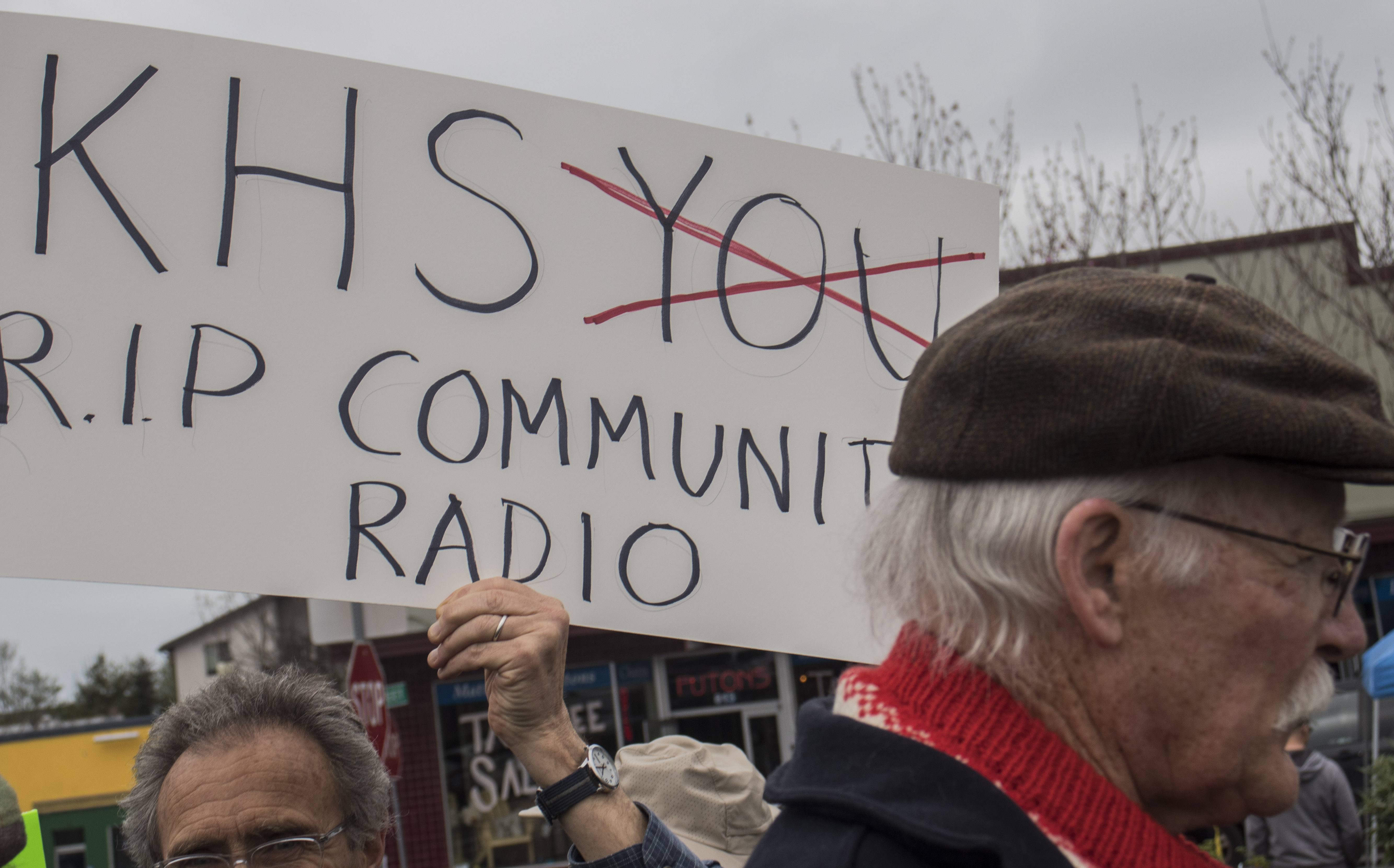
As a community member at the recent KHSU protest during the Arcata plaza farmer’s market said, “we are losing a family member.”
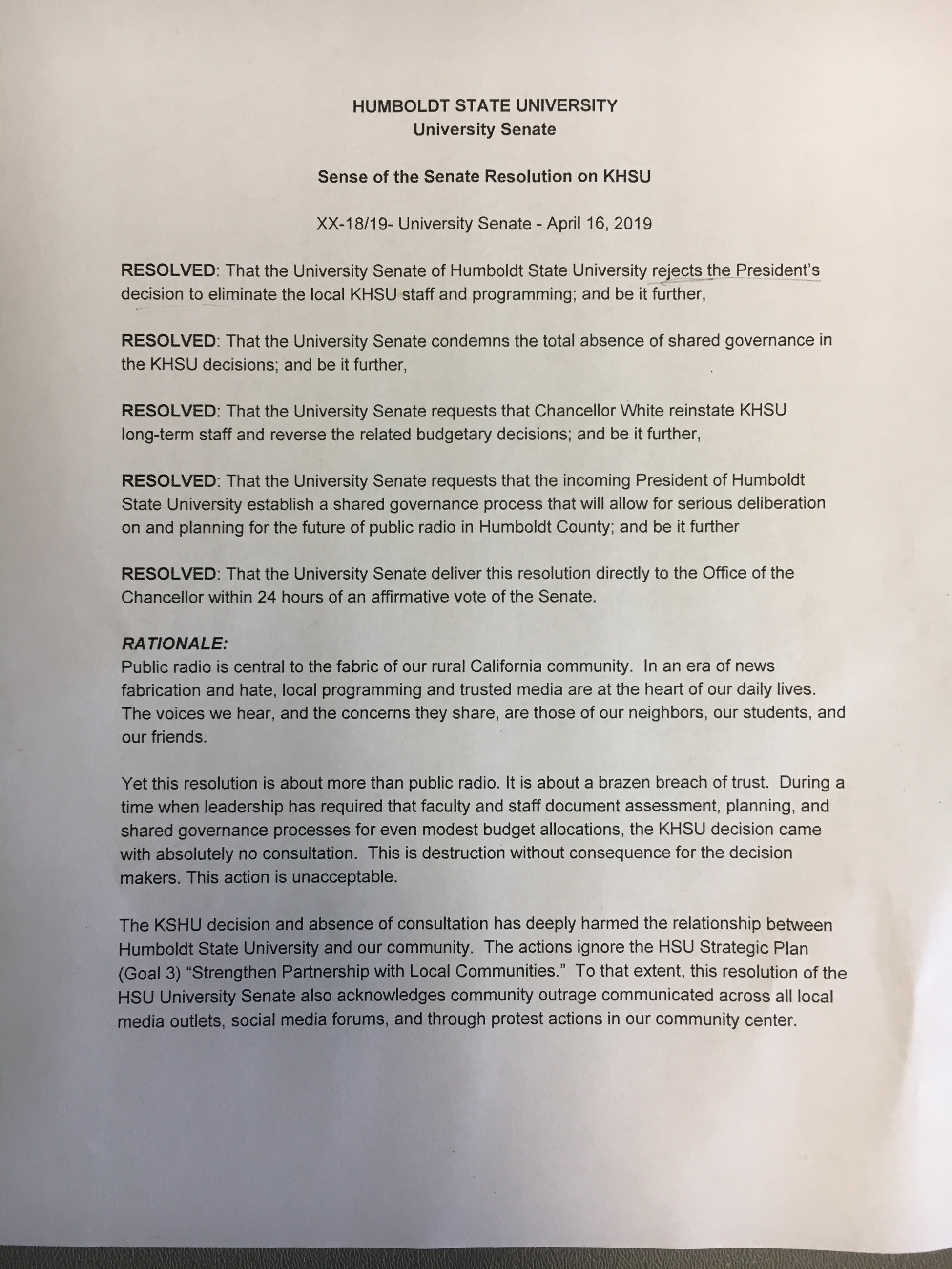
Humboldt State senate condemns actions taken against community radio
Humboldt State University Senate voted to pass a resolution condemning the actions of the Rossbacher administration to gut KHSU. The resolution passed with 75% in favor of, 7% opposed, and 18% of the senators abstaining.
Two amendments will be added that address preventing the sale of the items and library of KHSU and for the archived work to be returned to the creators. Missing from the Senate meeting were HSU President Lisa Rossbacher and Craig Wruck, Vice President of University Advancement.
The last remaining KSHU staff members resign, join a peaceful gathering of a few dozen held during weekly farmers market
Forty-eight hours after the artery of the community was severed, a few dozen KHSU supporters took to the plaza in protest during the weekly farmers market.
Natalya Estrada resigned her position this afternoon as the last remaining paid staff member of KHSU. Estrada’s resignation came after administrators at Humboldt State University decided to fire all volunteers and terminate all but two paid positions at KHSU on April 11. David Reed was the second of the two remaining employees but resigned on Friday, April 12.
Estrada was at the protest to show support and said staying in the position would not only compromise her career in journalism but affect her overall health.
“There comes a time in life when you need to make a decision in life and I made that decision,” Estrada said. “I knew what I was going to do but I needed to know how and when.”
Local artist Lisa Enge holds a sign in support for KHSU during a peaceful protest at the weekly Arcata plaza farmer’s market on Saturday April 13. | Photo by T.William Wallin
After Reed resigned Estrada was the last staff member running the station. Estrada said when the California Report came on she put on Caroline King and cried at her desk.
“It was very lonely being the last person left,” Estrada said. “It felt like 48 hours on the 405 during rush hour traffic.”
Tom Cairns was one of the volunteers to be let go during the dismantling of KHSU, but he isn’t just any volunteer. Cairns has been with KHSU for 47 years, making him the longest running volunteer at the station.
Community member, Carrie Slack, and former host of Jazz with a Groove, Rob Enge, hold signs in support for KHSU during a peaceful protest at the weekly Arcata plaza farmer’s market on Saturday April 13. | Photo by T.William Wallin
Cairns was at the protest because he felt the way everyone was fired was wicked and shameful. Cairns felt the audit report done on KHSU was just an excuse for firing everybody and HSU administrators were planning this even before then.
“The way they handled it was bold face lies,” Cairns said. “They had checks written out already even before the meeting. They had it all planned.”
In the 47 years as a volunteer Cairns has seen KHSU have its ups and downs but “it’s always continued and was never shut off the air.” Cairns said the unfortunate thing about the station now is it has become a typical NPR station with all news and very little music.
“Basically it’s just another McDonald’s public radio station,” Cairns said.
Public citizens, Mark Mueller and Lisa Hockaday, hold signs in support for KHSU during a peaceful protest at the weekly Arcata plaza farmer’s market on Saturday April 13. | Photo by T.William Wallin
When asked what he felt the biggest loss was Cairns said the community of the station. Cairns said those that work with KHSU are very active in the larger northwest community and engaged in the arts, food, and news.
“The music, public affairs, and local programming is what made KHSU unique and a viable source for the community,” Cairns said.
A few dozen protesters gathered with signs during the Saturday farmer’s market at Arcata Plaza to show support for KHSU on April 13. | Photo by T.William Wallin
Rob Enge, former host of Jazz with a Groove, was a member and sustainer with KHSU for 25 years and agreed with Cairns. Enge said this has been a loss of a community forum where connection was made.
“This was a good place for people to put their energy,” Enge said.
Enge moved to Humboldt in 1992 and the first thing he did was get connected with the local radio station. Enge was an avid listener of KPFK in southern California and said public radio stations are an important way in getting connected with community.
“This has been an erosion of community,” Enge said. “This isn’t social media from out of the community, this is real people talking locally and when we lose that its a shame.”
Community members show support for KHSU during a peaceful protest at the weekly Arcata plaza farmer’s market on Saturday April 13. | Photo by T.William Wallin
Local artist Lisa Enge has also been a supporter of KHSU since 1992 and felt the loss of KHSU was like losing a friend. She said KHSU was a treasure in the community and it was a cruel way that it was cut.
“Cutting volunteer and staff is unconscionable, shameful really,” Lisa Enge said.
Jax Stuber (left) has been listening to KHSU everyday for the last six years and said she will miss all the music and diverse programming. | Photo by T.William Wallin
Lisa Enge said once general manager Peter Fretwell fired KHSU program director, Katie Whiteside, the love for KHSU waned. She said as an artist the radio kept her company while she worked and she didn’t feel so lonely.
“The people, DJs, and programmers became friends,” Lisa Enge said. “It’s like losing a friend, or a family member really.”
Former KHSU employee Natalya Estrada speaks up after submitting her resignation
My father always told me: Do no harm, but take no shit. It appears I’ve been surrounded by a monumental amount of fecal matter within the past few days. But make no mistake; I will not be buried by this.
I came to KHSU in 2017, under the guise of needing to make a bit extra cash because I was paying double rent—my boyfriend at the time was helpful, but I still had two months left on my apartment lease. On the day of the interview, I had literally been under a fence. A large possibly, 300 pound wooden fence had fallen off of the rail on top of me as I was opening it so I could move my car out of the drive way. Was it a premonition? Was it a bad omen? I don’t know—one thing’s for sure, it made for a great interview topic. There were leaves in my hair, my red jacket had fresh mud stains and my legs were slightly swollen as I sat in the general manager’s office telling KHSU how much I love public radio. I got the job on the spot.
And then a week later, I quit the Times-Standard, which was and still is one of my favorite jobs. It was where I met my best journalism friends and how I managed to come back to “Homeboldt” after a disappointing stint as a reporter in Southern California.
Several months later, Katie was fired from KHSU; abruptly and without warning. It was chaos. I don’t have to remind everyone about how many sustainers canceled their membership, how much underwriting was lost to our bad reputation and how much of the community felt betrayed by the decisions of an institution. I was at a loss. Katie Whiteside was the first person I met at KHSU back during my internship as an undergrad at Humboldt State. She taught me how to manage the board during Wait, Wait Don’t Tell Me, and Car Talk (RIP). She was the quintessential gem of KHSU, and I know I wasn’t the only person who felt like a piece of the station was forever lost with her dismissal.
More months had passed and staff meetings became less and less about the station’s content and more about what kind of station we were pressed to become. Who were we in the eyes of the community, of the university and of the higher ups who seemed determined to challenge the format of good vibes, good words and good people?
Eventually, we started having pledge drives again. None of us were sure we’d even get any kind of support—but we did. Why? Because despite the outrage, people believed we would come back, that we would get past this. And for I while, I also believed this. I was wrong.
Thursday, April 11, 2019 does not seem like it happened in real life, but it did. While two of us were told to attend a separate meeting, our friends, our colleagues and basically our radio family were told of their fates. The two of us were left scrambling to figure out why this was happening.
“David, what do we do? “
“I don’t know honey. I had to go home.”
Those were some of the last messages David and I sent to each other before the following day, when I was informed via phone call about his resignation. A couple minutes later, after texting Thad Greenson, Marc Valles and Andrew Goff, I read David’s Facebook post. I cried hysterically as I toggled between Morning Edition and the California Report. I switched on the mic and read the weather report: mostly cloudy and chances of rain—the weather has never represented me so well.
It was done. KHSU was done.
I called my friends, my sister, my mother and several of my editors. The bulk of the text messages I sent were: “I am fine. Please don’t worry about me.”
But the reality was, I was crying to Carol King in studio A, and wanting to hide from the phone which kept ringing.
“Something inside has died and I can’t hide and I just can’t fake it.”
I think I answered close to 25 calls on Friday.
Megan Bender, of The Osprey messaged me. Not about work, but about emotional support. At noon, on Friday, we met in Gist Hall to talk. She handed me an iced matcha latte and a breakfast sandwich. Damien Jimenez, a KHSU intern, waved me down as I was driving and gave me a hug through my car window—I asked him to pretend he doesn’t notice how messy my car is. Lumberjack reporter Freddy Brewster shook my hand and smiled warmly at me —it’s reassuring to know the future of journalism has compassion.
Then came the hard part: the official part. Three meetings and perhaps the most “Don Draper” attitude I’ve ever had, prevented me from openly crying in front of two men in suits and one on a speaker phone. I don’t understand their narrative or their reasons. Perhaps I never will.
Thank you all for letting me into your morning commute, for telling me your stories of hope, tragedy, triumph and love. Thank you for letting me speak your truths through an omni-directional microphone. Thank you for letting me take your photos and for calling me in the morning to let me know it’s White-THORN not Whitehorn. I will forever hold KHSU in my heart and memory as a place of acceptance, peace and home to the hardest working folks I’ve ever met.
What now you may ask will a local unemployed radio gal do in this crisis?
I’ll survive. I always do.
I know many of you believe I was indifferent to the situation and that my stairway to the “top” consisted of bricks made of manure. I advise you to check my shoes and notice they’re crap-free.
So, I haven’t yet communicated with all of the People Formerly Known as the KHSU CAB. Yes, I’ve been in touch with my friends. I’ve noticed that some of us have responded to emails or Facebook postings. But about half have been silent.
That makes me wonder. Did some of you know something the rest of us did not? I’ve spent the day in turmoil, I’m going to take half my day as vacation time because I got nothing done at work. Granted some of you may not have as flexible of an employer as I do. But I feel there have been two factions in our group for some time. I don’t know if some of you are secretly happy about all this, and have confidence you’ll be involved in the new KHSU. I don’t know if some of you still think Peter, Craig, and Lisa are honorable folk, deserving of respect. I don’t know if some of you unwittingly contributed to this outcome, and further if you’re happy or you’re bummed.
I only know that the station I have listened to since September 19, 1975, has now silenced our local voices, and life here on the North Coast will NEVER be the same.
Yes, I sound melodramatic. It’s affected me that deeply that I’m prepared to pull out all the stops. Juliet and Ophelia, hold my beer.
So what do think, those of you that previously appeared to think we should be more accepting of the changes? Do you think it would have changed anything? I’m really curious. The People Formerly Known as the KHSU CAB, could our playing nice with the Visioning Statement have saved our little slice of heaven? Or do you see that we were played? Lied to (and gods know I hate ending a sentence with a preposition)? A plan was in place, maybe not fully formed, but taking shape.
Lisa Rossbacher lied to us. The review report was a sham. She and Craig Wruck get to retire with lovely pensions, courtesy of the taxpayers of California. But a group of my friends are now trying to figure out how to pay next month’s rent.
I’m still processing. Obviously not as affected as those employees who were ESCORTED BY UPD to clean out their offices.
And I haven’t even touched on the stalwart employees of “Advancement” who have had to answer the calls of all the betrayed supporters who are asking for their pledges back. Or the unsuspecting folks at NSPU in Chico who had no idea the the request to help out a “colleague” was really a disingenuous ploy.
I’ve been living with this anxiety since Monday night, when Lisa breathlessly communicated her “just now” receipt of the review. But by Wednesday night, they had it all figured out – although to the People Formerly Known as the KHSU CAB, she said they were still trying to formulate a plan. No details. Asking us to take a “hiatus” as if we would ever be invited back.
Abrupt firings at KHSU send shockwaves, not sound waves, throughout the community
In a blow to the local community, administrators at Humboldt State decided to fire all volunteers and terminate all but two paid positions at the local NPR affiliate, KHSU, on April 11. The firings, and other reorganizations, came after months of tense back and forths with the administration and the KHSU Community Advisory Board. Some in the community felt that the hostile tensions were behind and that future broadcasting was no longer in jeopardy.
“This is fraud. KHSU is community radio. You just don’t knock the community out like that.”
Joyce Houston
Last week Joyce Houston volunteered during the KHSU fund drive and donated money to the future of the station. Houston said she has volunteered and donated money to the station for the last 30 years and felt that she was scammed given the administration’s decision for the firings.
“This is fraud,” Houston said. “KHSU is community radio. You just don’t knock the community out like that.”
According to a press release from HSU, changes to station include the elimination of five staff positions, the General Manager and Chief Engineer positions and an “indefinite suspension of volunteer-run programs.”
The press release mentions the administration will look into allowing students to take on a more active role at KHSU, however there is already a student-run radio program at HSU. Amy Berkowitz, KRFH radio news faculty advisor, said she has been contacted numerous times by the administration asking for students to be more involved at KHSU but said that was not necessary because of the student run station.
“KRFH is for students, by students,” Berkowitz said. “KHSU is for the community. Our area relies on the radio for emergencies. Having this gone is a loss to the safety of our community.”
Berkowitz said that the loss of the community programs is why it is such a blow. Some of the programs that were broadcast on KHSU had been on air for over 30 years, according to Berkowitz.
“Right now, they are just rebroadcasting out of Chico,” Berkowitz said. “We can all just ask our smartphones to play NPR, but that is not why we listen to KHSU.”
Some of the programs currently cut from the air are the KHSU magazine, The Race Beat hosted by Lorna Bryant, the Thursday Night Talk with Eric Kirk, and Immigrant Voices hosted by James Floss.
Lisa Rossbacher, president of Humboldt State University, said the reasoning for the abrupt firings was because of budget reasons, a realignment of the mission between KHSU and the university, and an advisory review from the CSU chancellor’s office that she received on “Monday or Tuesday of this week.”
“People think of volunteers of not costing anything, but in fact it takes two to three hours of paid staff time to support every hour of programming that is generated by volunteers,” Rossbacher said.
When questioned on how much oversight and time that paid staff have to give to volunteers who have been part of KHSU for over 30 years, Rossbacher acknowledged she didn’t know the exact details of the matter.
“I can’t speak to the details of how that programming gets produced, but it requires staff involvement to support them,” Rossbacher said.
On the future of KHSU, Rossbacher said the university is looking for partners to collaborate with and could not speak of the details of what that collaboration would look like or who it would involve.
[perfectpullquote align=”right” bordertop=”false” cite=”Cliff Berkowitz” link=”” color=”” class=”” size=”17″]“I understand budget concerns, but one of the main jobs of being president is trying to strike a balance. Cutting a vital part of the community is foolish.”[/perfectpullquote]
“We still want to have local programming,” Rossbacher said. “We still have to cover it within our budget and so I can’t tell you right now exactly what that looks like. If any of the volunteers ask to be able to take any of the programs that they have already produced with them, we are absolutely cool with that. Some of what has appeared in the past may show up again through other media, but I don’t know exactly what the future is going to hold.”
During Rossbacher’s five-year term at HSU she has oversaw the closing of the HSU Third Street Art Gallery, the cutting of the football program, and now the massive firing and change of direction at KHSU—all integral components of the Humboldt community. When asked about the reasoning on why she made these decisions Rossbacher said it had to deal with shortfalls in money.
“My goal is to get to a balanced budget,” Rossbacher said. “There have been some difficult choices in the process of getting there. Over the last two years the university overall has managed to reduce spending by about $9 million, with another million dollars we need to find in the next year.”
Cliff Berkowitz, husband of Amy Berkowitz and fellow KRFH faculty member, felt that the abrupt firings were a betrayal of the community and noted that KHSU has been an integral part of the Humboldt community for over 50 years.
“I understand budget concerns, but one of the main jobs of being president is trying to strike a balance,” Cliff Berkowitz said. “Cutting a vital part of the community is foolish.”
Cliff Berkowitz has been teaching at HSU for 11 years and said that the announcement of the KHSU firings was a “gut punch.”
“The most telling example of how sinister this is, is evident in the letting go of the volunteers,” Cliff Berkowitz said. “Their shows and their connection to the community are the reason why the underwriters have contributed. And it is gone.”
KHSU, 90.5 FM, has been abruptly shut down this morning with little to no notice given to the employees and volunteers. Currently University Police are inside the station and only granting access to individuals with the explicit approval of Craig Wruck, Vice President for University Advancement and Executive Director of the HSU Advancement Foundation. Ryan Lee, a station volunteer and radio host since 1990, was standing in the rain outside of the station confused and upset about the abrupt closure.
Michael Fennell, who volunteered for KHSU, carries out a basket of CD’s from Feuerwerker House where the station has been on Humboldt State campus on April 11. | Photo by Thomas Lal
“The station is shut down, everybody is fired, all the volunteers have been let go,” Lee said. “All accounts for current staff have been locked. We have been denied access to Wagner House without an escort. We have no plans for programming. There may be nothing.”
Lee said that he came to the station this morning at 8 a.m. and his keycard worked at the time but when he tried hours nothing happened.
“Jeff Demark noted that [KHSU] just had a pledge drive and that everybody that pledged their money should be refunded,” Lee said. “Maybe because it was gotten under false pretenses. We all knew that there was something coming down the pipe, but nobody knew it was going to be like this.”
David Montoya, Associate Vice President of Human Resources, answered the door at the KHSU headquarters but declined to comment on the situation.
The press release reads as follows:
Humboldt State University is reorganizing and streamlining operations at its public radio station, KHSU, with the goal of preserving quality programming for the North Coast. The changes are intended to address operational challenges at KHSU, prevent further negative impact to the University’s budget, and better align HSU’s financial support with its mission and with opportunities for students. Station employees were told of the changes earlier today. Because the reorganization and budget reductions include the elimination of positions, a number of individuals will no longer be employed at HSU. The University is working to provide clear information to them, and to ensure they receive any benefits they are entitled to. The steps taken today include: Elimination of HSU’s direct payroll support, including the General Manager position and Chief Engineer position, saving the University more than $250,000 annually. Elimination of five other staff positions, generating significant savings in the portion of KHSU’s budget that comes from government support, underwriting, and listener contributions. Appointment of an Interim Station Director, to be supported through non-HSU funding. Consolidating all KHSU operations in Feuerwerker House, reducing the inefficiency of having two separate spaces. Indefinite suspension of volunteer-run programs. The University will evaluate how students can return to a more substantial on-air role at KHSU. Actively pursuing collaboration with other public radio stations and seeking CPB funding to support this effort. The decision to realign the station reflects a comprehensive assessment. Factors included the station’s increasing cost to the University; KHSU’s limited capacity for additional fundraising and underwriting; challenges identified by the CSU Office of Audit and Advisory Services; feedback from listeners and volunteers; the University’s commitment to public service; and the appropriate role of student involvement in station operations and programming. The report from the CSU Office of Audit and Advisory Services (pdf), which was recently received by HSU, includes an in-depth program review of the station that identified a number of issues with operations and administration. It was initiated at the request of HSU President Lisa Rossbacher, and she shared it yesterday with KHSU’s Community Advisory Board. In addition to issues identified in the report, there are serious budget issues at the station. KHSU is heavily subsidized by the HSU general fund, and the station’s budget deficits have continued to worsen. At the end of the 2017-18 year, HSU had to cover a budget deficit of nearly $135,000 beyond its regular subsidy, and this year’s projected budget deficit is even larger. KHSU’s budget challenge largely reflects increases in payroll costs. In addition, community support has been flat or declining, with underwriting revenue down approximately 14 percent for the year and listener support down approximately 17 percent. And while volunteers create a great deal of local programming, their efforts also come at a cost, requiring significant support by paid staff. The budget challenges at KHSU come as HSU has been working to address an overall structural deficit as well as funding declines related to an enrollment drop. The University has reduced its spending by $9 million over the last two years, and is making nearly $1 million in additional reductions for the coming year. For context, over the last year HSU has funded nearly half the cost of KHSU. Listener support provided about 22 percent, corporate underwriting 17 percent, and government grants 12 percent. HSU directly paid more than $265,000 in salary, covered at least $250,000 for space and utilities, and spent at least $80,000 receiving and processing contributions to the station. Even with the changes at KHSU, listeners will continue to have access to high-quality national programming and news. The most recent audience data reaffirm this is, by far, the station’s most popular programming.
Earlier this morning, Humboldt State issued a press release regarding their NPR affiliate KHSU. The radio station will be undergoing drastic changes including the removal of all but two staff members.
Now former volunteers and station supporters meet outside of Feuerwerker House after hearing about the elimination of jobs and volunteer positions at KHSU on April 11. | Photo by Thomas Lal
HSU press release is as follows:
Humboldt State University is reorganizing and streamlining operations at its public radio station, KHSU, with the goal of preserving quality programming for the North Coast.
The changes are intended to address operational challenges at KHSU, prevent further negative impact to the University’s budget, and better align HSU’s financial support with its mission and with opportunities for students.
Station employees were told of the changes earlier today. Because the reorganization and budget reductions include the elimination of positions, a number of individuals will no longer be employed at HSU. The University is working to provide clear information to them, and to ensure they receive any benefits they are entitled to.
The steps taken today include:
Elimination of HSU’s direct payroll support, including the General Manager position and Chief Engineer position, saving the University more than $250,000 annually.
Elimination of five other staff positions, generating significant savings in the portion of KHSU’s budget that comes from government support, underwriting, and listener contributions.
Appointment of an Interim Station Director, to be supported through non-HSU funding.
Consolidating all KHSU operations in Feuerwerker House, reducing the inefficiency of having two separate spaces.
Indefinite suspension of volunteer-run programs. The University will evaluate how students can return to a more substantial on-air role at KHSU.
Actively pursuing collaboration with other public radio stations and seeking CPB funding to support this effort.
The decision to realign the station reflects a comprehensive assessment. Factors included the station’s increasing cost to the University; KHSU’s limited capacity for additional fundraising and underwriting; challenges identified by the CSU Office of Audit and Advisory Services; feedback from listeners and volunteers; the University’s commitment to public service; and the appropriate role of student involvement in station operations and programming.
The report from the CSU Office of Audit and Advisory Services (pdf), which was recently received by HSU, includes an in-depth program review of the station that identified a number of issues with operations and administration. It was initiated at the request of HSU President Lisa Rossbacher, and she shared it yesterday with KHSU’s Community Advisory Board.
In addition to issues identified in the report, there are serious budget issues at the station. KHSU is heavily subsidized by the HSU general fund, and the station’s budget deficits have continued to worsen. At the end of the 2017-18 year, HSU had to cover a budget deficit of nearly $135,000 beyond its regular subsidy, and this year’s projected budget deficit is even larger.
KHSU’s budget challenge largely reflects increases in payroll costs. In addition, community support has been flat or declining, with underwriting revenue down approximately 14 percent for the year and listener support down approximately 17 percent. And while volunteers create a great deal of local programming, their efforts also come at a cost, requiring significant support by paid staff.
The budget challenges at KHSU come as HSU has been working to address an overall structural deficit as well as funding declines related to an enrollment drop. The University has reduced its spending by $9 million over the last two years, and is making nearly $1 million in additional reductions for the coming year.
For context, over the last year HSU has funded nearly half the cost of KHSU. Listener support provided about 22 percent, corporate underwriting 17 percent, and government grants 12 percent. HSU directly paid more than $265,000 in salary, covered at least $250,000 for space and utilities, and spent at least $80,000 receiving and processing contributions to the station.
Even with the changes at KHSU, listeners will continue to have access to high-quality national programming and news. The most recent audience data reaffirm this is, by far, the station’s most popular programming.
KHSU is still having trouble with its general manager
The weekly KHSU staff meeting was abruptly cancelled at the last minute this morning by general manager Peter Fretwell. This cancellation comes after changes were made in the KHSU Facebook admin settings and the removal of long time staff and volunteer, Geraldine Goldberg from the website. Office manager, Lorna Bryant, and content director, Jessie Eden, were also removed from their admin position to a lower status as editors. Part of the email sent to Goldberg read:
“Hi Geraldine, You’re getting this email to confirm that you’re no
longer an admin on KHSU. You were removed on January 29, 2019 at 12:05pm.”
“Geraldine has been the backbone of this station for decades,” Eden said. “I have no idea why she was removed from the website. Its very strange.”
Eden said they were not informed of any changes being made to the Facebook page’s admin status. Goldberg has posted content to the website and helped edit other people’s content involving public affairs programs.
“There’s not rational for her removal,” Eden said. “She has done nothing. I don’t think she’s seen posted anything for many months and this is a surprise to me.”
Eden said she wasn’t sure who removed Goldberg but the only people that have that power are paid staff and general manager Peter Fretwell. The status changing of Bryant and Eden was made by KHSU development assistant, Monica Topping. Those with admin status on Facebook are now Monica Topping, David Reed, MarComm, and Peter Fretwell’s wife, Becky Fretwell. Monica Topping has also took the place of moderator for KHSU, which used to be Lorna Bryant’s position. Eden said the moderator is essentially an editor of messages that approves whether or not those messages get sent out to everyone else.
“Lorna used to be the moderator but was removed and now is getting moderated herself,” Eden said. “She set up the whole moderator system. Because she’s being edited she cant just send out messages to the volunteers at the station, even though she’s responsible for their parking permits, and keys and all manner of day to day function of the station. She needs to be able to communicate”
Because Topping doesn’t work five days a week, Eden said messages involving technical issues would sit and not reach everyone when needed, which was an increasing problem. The last KHSU staff meeting the question was raised why KHSU’s broadcast engineer needed to be moderated. Eden said that has now changed and the broadcast engineer is able to send out messages with out having them approved by Topping but message for Bryant to the CAB still need approval. A recent Facebook post involving tonight’s CAB meeting was immediately removed right after Bryant posted it. Eden said she had never heard that the KHSU Facebook page could not post about CAB meetings.
“The CAB is the community liaison between KHSU and the community,” Eden said. “The CAB is essential for any public radio stations which is why the corporation of public broadcasting, which gives us money, wants public radio stations to have a board. They recognize we need that liaison for connection with community and to know what their needs are.”
Tonight at 6:30pm the CAB will being having a meeting in the Karshner Lounge.
Police are past their estimated time for solving the more than one-year-old crime
He was smart. He had goals. He came to Humboldt to avoid the challenges of South L.A.
These words were spoken outside of Arcata City Hall by Karim Muhammed, a friend of David Josiah Lawson. Lawson was murdered on April 15 2017 and his case still remains unsolved.
Discussion on race and safety in the community were the main subjects amongst community members on Oct. 15. Tears streamed down faces as homemade posters of Lawson were hung on the walls in front of Arcata City Hall.
Muhammed met Lawson their freshman year in the dorms at HSU. He said he misses Lawson and was at his dorm everyday.
“He was one of the first people I met when I moved to Humboldt,” Muhammed said.
Muhammed said he thought Arcata was safe compared to south L.A but that isn’t his experience. How to keep moving forward he said is to bring awareness and continue to inform incoming students about Lawson’s murder.
“We need to get it solved, get new people in power, get people informed and vote,” Muhammed said.
Muhammed said the goal is to make the community safer but many people in the community are still oblivious to the death of Lawson or they just don’t care. When he learned of the roster release of the HSU’s predominantly African American student clubs to the Arcata Police Department, Muhammed said that was a big red flag. He said this shows where they stand with the situation and further proves their indifference.
“People choose what they want to believe or they just don’t want to believe,” Muhammed said.
Meg Stofvsky, a retired school psychologist, said the vigil’s are held to continue remembering Lawson as well as inform people who are new in the area. Stofvsky was representing Charmaine, Lawson’s mother, and said Charmaine has caught the interest of the California State University system about her son’s murder. She said Charmaine has been travelling to other CSU’s to talk about safety on campus and will be in Sacramento later this week.
“We need a firm insistence we are not going to continue to let this happen,” Stofvsky said.
It has been 18 months since Lawson’s murder and Stofvsky said the county seems to be sliding backwards. She said we need to continue having resilience and hope and to keep the Arcata Police Department accountable. Stofvsky said the APD recently gave a six to eight week time limit to solve the case and that limit is up.
“We hear a lot of talk about progress from the APD but we haven’t seen any,” Stofvsky said.
When Charmaine Lawson comes into town for court hearings or monthly vigils she stays at Sharon and Michael Fennell’s house. Both are HSU alumni and have been proponents seeking justice for Lawson. Sharon Fennell, was a KHSU DJ under the name Sista Soul and said she met Charmaine at the second vigil held for Lawson.
“We show up once a month. This is a beautiful thing and Charmaine knows,” Fennell said.
Fennell offered ideas to start selling “Justice for Josiah” shirts at the HSU bookstore to continue to bring awareness of his murder. She said that way Lawson would be seen more on campus and students would be reminded of what happened. A conflict Fennell has is that students come to HSU but then leave after they graduate, which keeps Humboldt from changing.
“People need to come, stay, build businesses and change the community,” Fennell said. “If not we stay 80 percent white. Boring.”
A member of the “Justice for Josiah” movement, Jill Larrabee, said actions by CSU and California Faculty Association are starting to take hold regarding safety on campuses but society needs to change. Larrabee said we need to learn, educate, heal and grow and get more people in office.
“Humboldt County has the good ol’ boys club in power,” Larrabee said.
To move forward Larrabee said white people need to converse with other white people about racism. Larrabee said racism is still a big problem here in Arcata but more and more people are coming out and acknowledging their privilege.
“When we hear white people say we can’t guarantee safety, then we are going to demand it,” Larrabee said.
Humboldt State’s radio station, KHSU, is facing a 16 percent funding decrease under Donald Trump’s proposed 2018 Budget Outline.
KHSU has an annual operating budget of just over a million dollars. In 2016, KHSU received $175,061 in grants from the Corporation for Public Broadcasting. CPB is the largest source of funding for public radio. With the complete defunding of the CPB, KHSU would have to look elsewhere for funding.
Peter Fretwell, KHSU’s new general manager, was attracted to the position as general manager at KHSU due to it’s large community involvement.
“KHSU is near the top, if not the top of the most listened to stations in Humboldt county,” Fretwell said. “In my experience community involvement is important and I was attracted to Humboldt county and KHSU because of the deep community engagement.”
KHSU is a noncommercial, public radio station, supported by Humboldt State University. KHSU is largely community based on and acts to provide intellectual perspectives on local and national issues.
KHSU receives a large amount of their funding from donations from the community. In 2016 $336,289 was donated in listener support. It is this kind of support from the community that will be able to maintain KHSU’s ability to broadcast.
KHSU is a vital resource for the community. Humboldt is relatively cut off from the world and in the face of potential natural disaster, public radio would be vital for public service.
The recent budget outline, released on March 16, called for a complete cut to CPB funding. Similar stations with similar communal obligations all around the country face these cuts as well. Patricia Harrison, CPB’s president and CEO, outlined the importance of public media in a statement made after the budget outline was released.
“The elimination of federal funding to CPB would initially devastate, and ultimately destroy public media’s role in early childhood education, public safety, connecting citizens to our history, and promoting civil discussions,” Harrison said.
Fretwell has seen proposed cuts to CPB before and believes that, as before, the CPB will be able to retain its funding.
The grandaddy of all structures on Humboldt State’s deferred maintenance list will have to wait at least another year before seeing some much needed tender love and care. The Theatre Arts building is set to remain atop the list for another year as recent building code changes forced 2017’s earthquake retrofit plans to be put on hold.
The Theatre Arts building has been on deferred maintenance for over 15 years. In 2017 the building was supposed to receive the renovations it needed. The money was allocated, the plans were drawn up, and the contracts were signed all before 2016 came to a close. The staff of KHSU and other campus offices located in Theatre Arts all had prepared for temporary relocation, a task itself that took months and planning and scrambling.
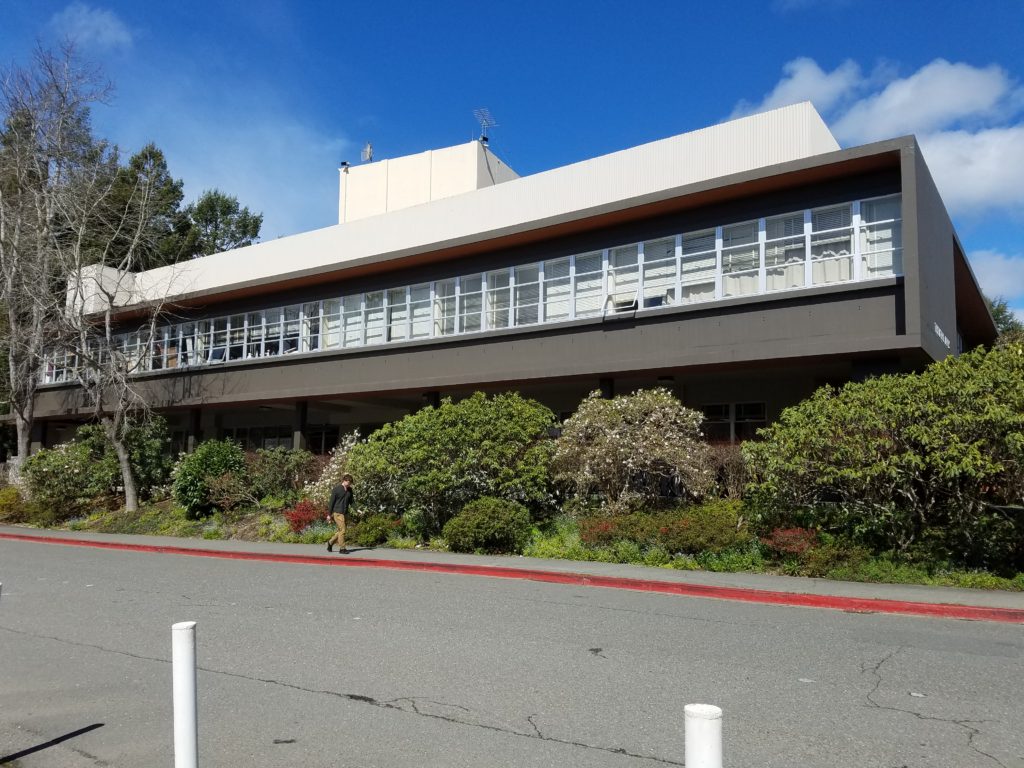
The Theatre Arts building at HSU. Photo by Liam Olson
David Reed, development director of KHSU, was tasked with much of the preparation for what would have been KHSU’s temporary relocation if construction had not been delayed.
“It’s frustrating, we spent months preparing to move. We have a large operation, many moving parts,” Reed said. “The only good side is that we digitized much of our paperwork in preparation for the move.”
Fast forward to the beginning of March, 2017. With less than a week until the retrofit was to begin, the HSU office of Facilities Management realized all the planning that went into the retrofit had been worked around a set of building codes that changed January 1, 2017.
Traci Ferdolage, director of Facilities Management at HSU is in charge of coordinating the construction funds once they are dispersed to HSU from the CSU main office. According to Ferdolage, the building codes, which are periodically reevaluated and changed about every three years, are calculated independently from outside the California State University system by state officials. Construction plans, such as the ones for the Theatre Arts building are issued by the CSU main office in accordance to the building codes in place at that given time.
“Once the CSU board allocates us the money for a project, we act,” Ferdolage said. “We don’t take into consideration the possibility of changing building codes.”
The CSU Seismic Peer Review Board periodically sends an independent reviewer to various CSU campuses to conduct a review of the buildings and deem if any retrofits or other construction is needed. The CSU main office then reviews the reports and grants money to campuses based on need.
The Theatre Arts building at HSU. Photo by Liam Olson
The Theatre Arts building is currently not yet classified as unsafe for use, the proposed construction is to bring the building up to par with the most modern of structural standards.
“Facilities Management staff have done a wonderful job at keeping the building operational considering the levels of predicted renewal needs not funded by the State,” Ferdolage said.
Construction on Theatre Arts is expected to begin in May of 2018 according to Ferdolage.
There is no oversight board between state building officials and the CSU board to ensure that proposed projects are outlined with the most current building codes in mind. Construction grants are expected to be used promptly. The only way a campus can keep receiving grants is to keep spending the money as it comes in. Part of the money given to HSU for the Theatre Arts project was spent on building plans that are now essentially wasted funds. While the CSU chancellor’s office selectively audits how grant money is spent from time to time, there is not full time office or administrator in charge of ensuring that the tuition and taxpayer money used for campus construction is spent as efficiently as possible. That task is left to the university once the money is allocated. The rush to spend, mixed with a lack of communication between offices may not always lead to error, but it does pose the question: Who is in charge of the money?
“Projects are managed under fairly complex and defined financial guidelines which help ensure taxpayer and student fee money is handled responsibly,” Ferdolage said.
Building code officials, CSU seismic peer review board, facilities management, and a set of guidelines, all with no unifying oversight have left the Theatre Arts building in limbo for another year.
Local radio station KHSU is set to temporarily relocate from its broadcasting station in the Theatre Arts Building. The building is undergoing construction to make sure it is fit to stand an earthquake. A staggering $7.6 million will be allocated from bond and CSU funding to start the project this summer. The Theater Arts building will operate normally through the end of this semester and work will begin this summer, according to Jarad Petroske HSU public affair specialist. HSU is still in the process of sorting out where classes will move, but for the rest of the semester it’s business as usual.
However, the third floor of the Theatre Arts Building has been home to KHSU since 1960. KHSU is a noncommercial public radio station licensed to Humboldt State. Unlike classes, there is no summer vacation for KHSU. All day, seven days a week, KHSU is broadcasting to about 135,000 listeners. David Reed, KHSU Development Director & Interim Station Manager, explained that he has been told the project may take up to a year, but that won’t stop the airwaves from broadcasting from the radio station, it just may be from a few different locations.
“It will be hard, it will be fun, it will be an adventure,” Reed said.
Reed said the station will transition from three studios in the Theater Arts building to two temporary studios in Gist Hall and Wagner House.
Vinyls, satellite equipment and what Reed called the “brains of the studio”will stay on the third floor. The “brains” are the racks of equipment the station needs to be able to receive audio signals by satellite from NPR, automate local programming and stream over the internet. One of the biggest challenges of the transition is finding a home for the 25,000 cds in their music library that is accessible at all times to the over 90 staff, students interns and community volunteers.
Kevin Sanders, chief engineer for KHSU, explains that consolidating three studios to just two smaller ones could potentially affect scheduling issues. Although he is still waiting on the final word from facilities management, he does know that one studio will always be on air and the other will be strictly for production purposes. The way the studios are set up now, broadcasters are able to switch all studios from production to on air, which creates lots of space to pre-record and automate late night shows.
The new studios may not block outside noise as well as the old one, but Reed doesn’t believe listeners will notice a change in sound. “You know they might hear an occasional leaf blower,” Reed said. “But I am keeping happy thoughts.”
The current projected move date for the radio station is June 1. , two weeks before the KHSU June Pledge drive. Although the details have yet to be finalized, one thing is for certain KHSU will remain across the airwaves throughout Northwest California and Southern Oregon.
Thursday Night Talk, a weekly KHSU radio program, is set to hold an open town hall style forum Jan. 19 in HSU’s Kate Buchanan room. The event will feature local law enforcement members, educational administrators and advocates, and academic professors.
The host of Thursday Night Talk, Lorna Bryant, hopes to start a dialogue about the new presidency any ways in which it may impact locals, and how to deal with those impacts.
Included in the talk will be conversation around potential new laws and regulations under trump, concerns for undocumented citizens, racially motivated crimes, and what the new president should know about our community.
“This talk will be the beginning of the discussion,” Bryant said. “We are giving those frustrated by the election a place to air their concerns and feelings.”
The forum is part of KHSU’s “Race Beat” series; a series that talks about issues of race in the community.
Anyone in the public is welcome to join the forum and be part of the audience. Questions from both the audience and radio listeners will be a part of the show.
Listeners can email questions before the forum to ThursdayNightTalk@khsu.org or call in that night to 707-826-4805 or send a text message to 707-492-5478
This website uses cookies to improve your experience. We'll assume you're ok with this, but you can opt-out if you wish. Cookie settingsACCEPT
Privacy & Cookies Policy
Privacy Overview
This website uses cookies to improve your experience while you navigate through the website. Out of these cookies, the cookies that are categorized as necessary are stored on your browser as they are essential for the working of basic functionalities of the website. We also use third-party cookies that help us analyze and understand how you use this website. These cookies will be stored in your browser only with your consent. You also have the option to opt-out of these cookies. But opting out of some of these cookies may have an effect on your browsing experience.
Necessary cookies are absolutely essential for the website to function properly. This category only includes cookies that ensures basic functionalities and security features of the website. These cookies do not store any personal information.
Any cookies that may not be particularly necessary for the website to function and is used specifically to collect user personal data via analytics, ads, other embedded contents are termed as non-necessary cookies. It is mandatory to procure user consent prior to running these cookies on your website.