The Lumberjack


Students Serving The Cal Poly Humboldt Campus and Community Since 1929

Tag: life and arts

  • Polish Professor Melds Magic and Music

    Polish Professor Melds Magic and Music

    A dream of illusions and piano prowess with Igor Lapinski

    I know a little about magic. And by the end of Polish pianist and magician Igor Lapinski’s Feb. 22 show, I knew I had witnessed something good.

    “Your free will,” Lapinski said in an almost-cliché line that sounded much more convincing with his Polish accent and navy suit, “is just an illusion. A dream.”

    He then pulled a signed dollar bill out of an unopened kiwi.

    Lapinski interlaced illusions with piano pieces by Frédéric François Chopin, the Polish composer. Lapinski, originally from Poland, teaches as an assistant music professor at the University of Oklahoma.

    “He’s going to do something I think we haven’t seen in Humboldt,” music Professor Daniela Mineva and former teacher of Lapinski said before he took the stage. “I’ve been waiting 18 years to bring him here.”

    Hands, he said, are capable of both the sublime and the violent.

    The crowd of mostly older locals sat in a semicircle on the Fulkerson Recital Hall stage around Lapinski and his piano. Rather than have the crowd sit in the hall seats, Lapinski had chairs arranged around him for an intimate experience.

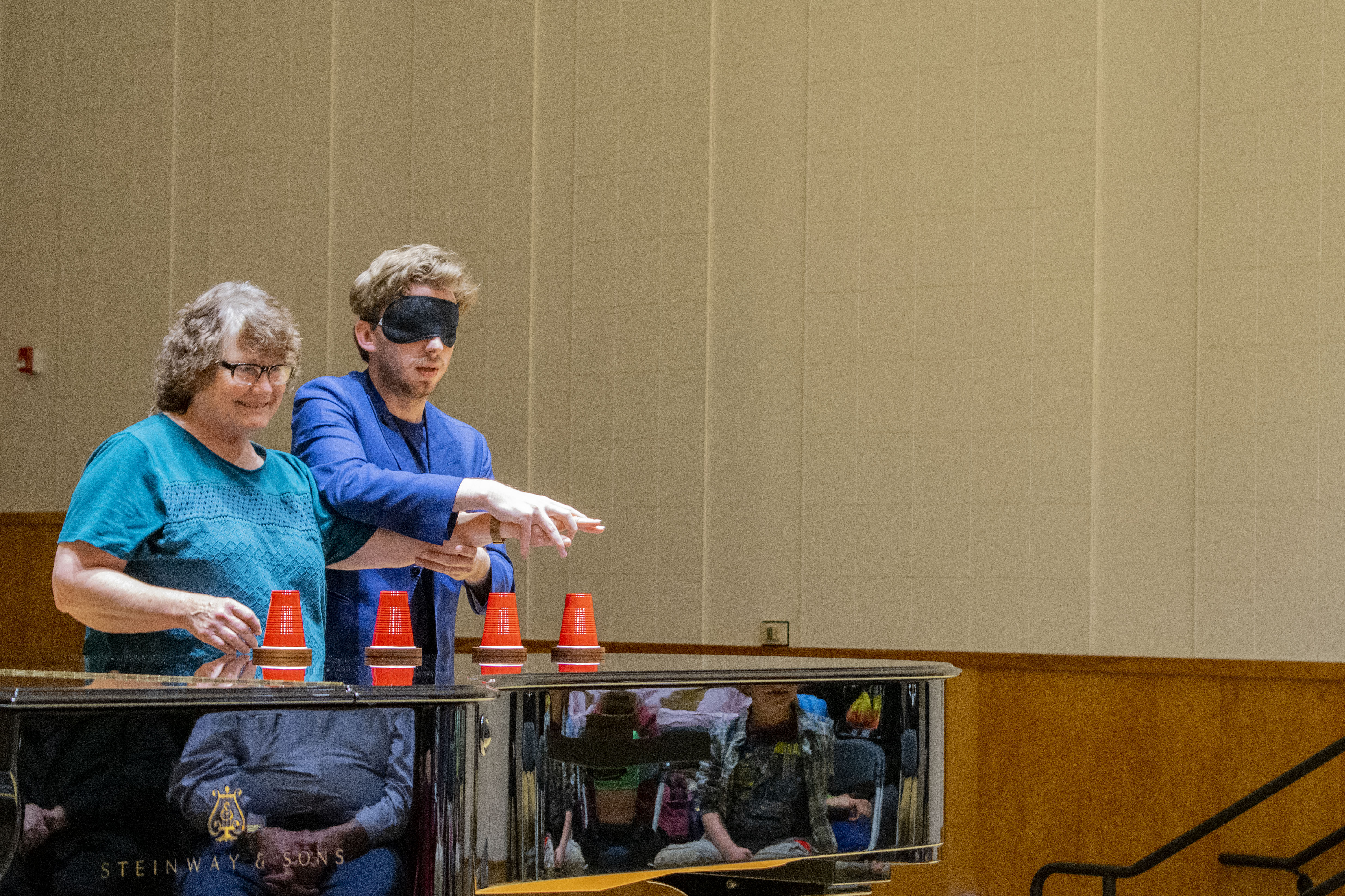
    Lapinski fluctuated between musical pieces of chaos and pieces of order. He rapped on “a haunting desire to belong.” In a three card monte-style routine with red solo cups and a single metal spike, he noted the opposing potentials within people.

    Hands, he said, are capable of both the sublime and the violent.

    He then shrugged off the thought and smashed his and an audience member’s hands down onto the cups in a game of Russian roulette.

    Multiple effects relied on the appearance and disappearance of letters—mostly written by Lapinski, with one supposedly written by his mother. The letters framed the performance in the idea of belonging, as Lapinski brought the audience along on an imaginary plane ride and read letters from home.

    I have to confess, because I know a bit about magic, I’m not a good judge of it. I spent about two of my teenage years learning magic tricks. I know the basics, and I can recognize standard sleight-of-hand moves.

    I’m no longer what magicians call a layperson. Even when I don’t know exactly how a trick is performed, it’s conceivable. It’s rare for me to see something inexplicable. But it does happen.

    Any attendee of Lapinski’s show can expect to exit with a smile on their face, or at least, a warm feeling in their mind. I can deduce how Lapinski performed his effects—but several of them I can only grasp loosely. For a layperson, his performance may be miraculous, not just puzzling.

    Magicians ultimately seek to produce miracles. The central argument of “Designing Miracles,” a well-regarded book by magician Darwin Ortiz, is that a magician should seek to produce an effect that doesn’t make the audience ask, “How do they do it?” Instead, the goal is, “How is that possible?”

    It’s slight, but this marks the difference between a trick and a miracle. A trick is a matter of deception that can be explained by a magician’s actions. A miracle is just that: pure magic that a magician merely facilitated. In the ideal, the performance transcends trickery and becomes magic.

    In the moments after Lapinski’s show, the audience agreed on his excellence.

    “He’s totally amazing,” a woman behind me said.

    “He’s a delight,” Mineva, the professor, said.

    “He’s hilarious,” a man beside me said. “He’s great.”

    At the very least, you can escape into a dream for just over 60 minutes. Lapinski finished with one last letter and one last piece by Chopin.

    “And so with this piece,” he said, “I wish you all a good night.”

    The night, indeed, was good.
  • Sovereign Bodies Brings Awareness

    Sovereign Bodies Brings Awareness

    Activist creates new database to track violence against Indigenous women

    Accounts of violence and murder toward Indigenous people are lost in history or left unrecorded. This became an even bigger problem for Indigenous women in places occupied by white men, such as mining or gold rush communities.

    The Sovereign Bodies Institute was founded about a year ago by Annita Lucchesi, a Native American and activist. Lucchesi realized the need for a database of violence and murder against Indigenous women after needing one, and it not existing.

    “It really bothered me because at that time in my life, I had just escaped a really abusive relationship that almost killed me,” Lucchesi said. “I also was being trafficked through that relationship, so I had a number of experiences where I almost was one of these missing and murdered Native women, so for me it was really personal and it really bothered me that if that had happened to me there was no guarantee that my story would be used to make sure that doesn’t happen to other women or girls.”

    Four years ago, Lucchesi created her own database for missing and murdered Indigenous women, which eventually became the kickstarter idea for the Sovereign Bodies Institute.

    “Humboldt County is amongst one of the highest counties of missing and murdered Indigenous peoples.”

    Chelsea Miraflor Trillo

    Sovereign Bodies Institute’s website says SBI is a home for generating knowledge of how Indigenous communities are impacted by gender and sexual violence and looking into how they can continue to heal and find freedom from such violence.

    Lucchesi has acquired around 4,000 missing and murdered Indigenous women cases in her database. Lucchesi founded SBI with the help of the Seventh Generation fund, an international organization for Indigenous peoples.

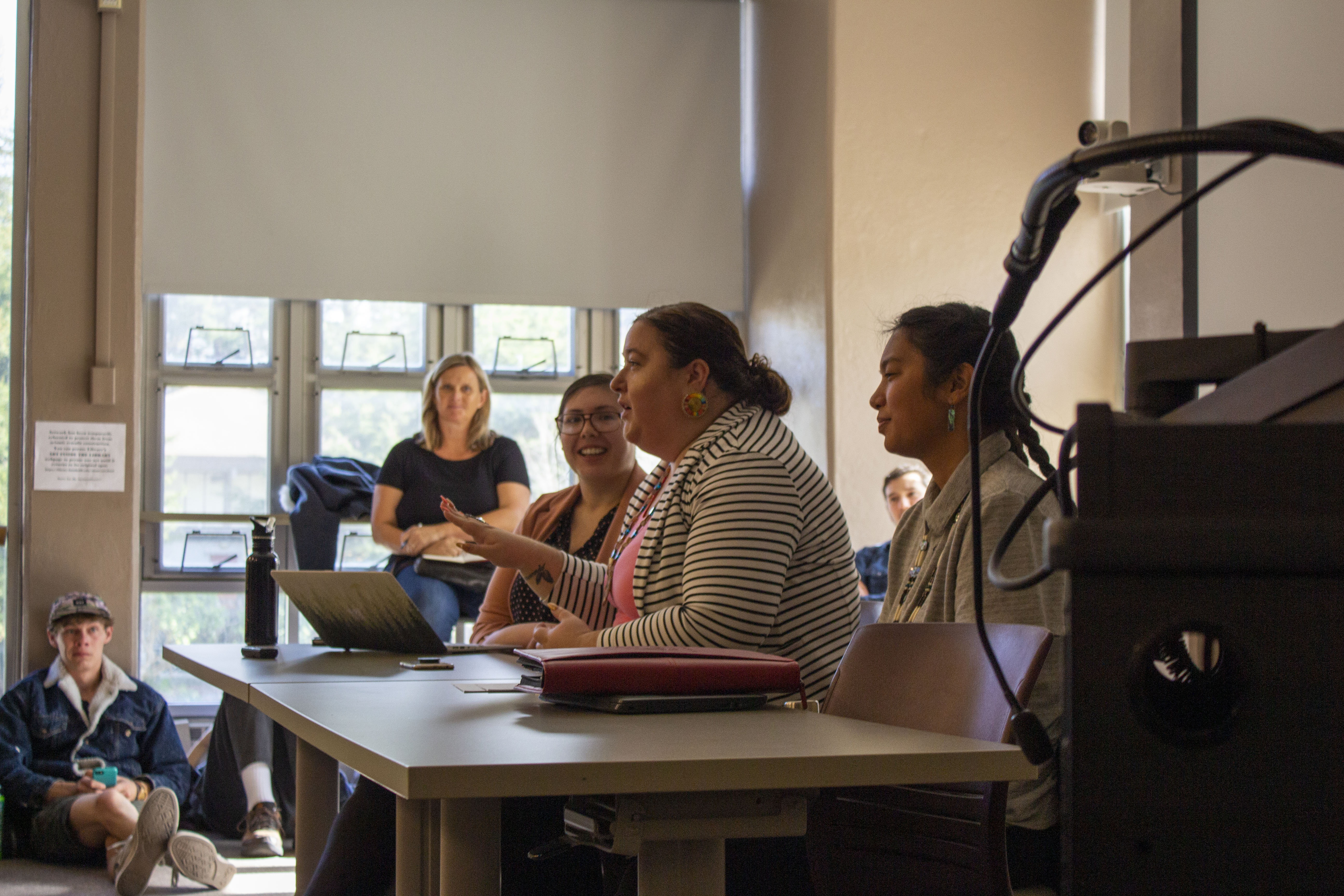
    Chelsea Miraflor Trillo, an Indigenous woman and participant of SBI, received her masters from Humboldt State. Trillo continues to work with SBI and families of missing and murdered Indigenous women to advocate awareness towards these issues.

    “Humboldt County is amongst one of the highest counties of missing and murdered Indigenous peoples,” Trillo said. “Students are usually in the area where community awareness and political action happen.”

    According to Lucchesi, Humboldt and Del Norte County hold a third of missing and murdered Indigenous women in California. Lucchesi said the justice system contributes to missing and murdered Indigenous women and the lack of action taken. Lucchesi said Indigenous women are considered non-human, and the justice system refuses to hold non-Native perpetrators responsible.

    Tammy Carpenter is a member of the SBI organization and an HSU alumna. Carpenter was subjected to the mistreatment of Indigenous people personally.

    “I, myself, am a mother of a victim that was murdered,” Carpenter said. “It’s still unsolved as of today, so I like to support the organization for the awareness for all women. Not just Indigenous women. All women.”

  • Growing Up in the Shadow of Malcolm X

    Growing Up in the Shadow of Malcolm X

    Ilyasah Shabazz discussed her background with loving energy on Feb. 12

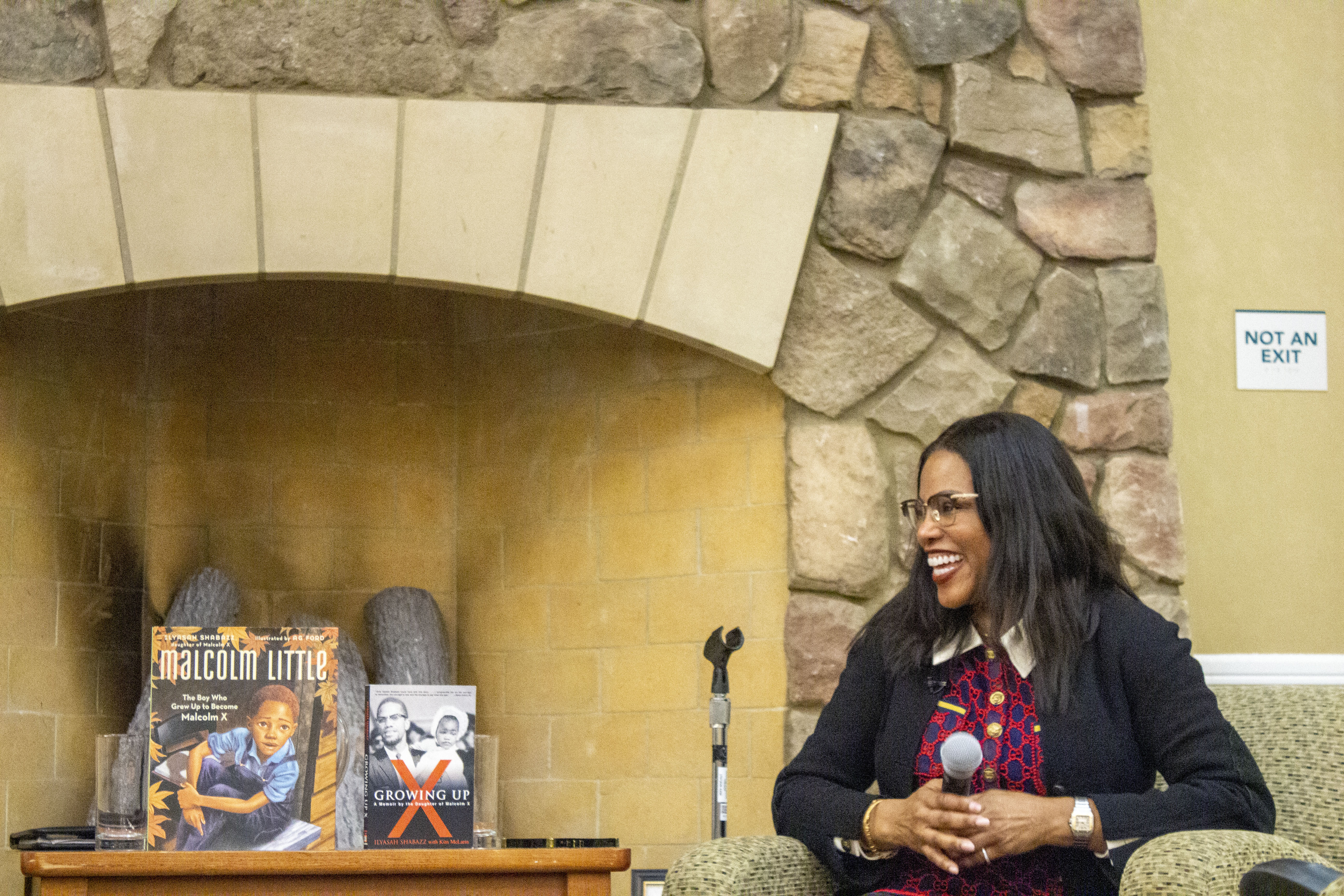
    Ilyasah Shabazz, one of six daughters of Betty Shabazz and Malcolm X, came to Humboldt State University Feb. 12 to discuss her book, “Growing Up X.”

    Despite the title, the book is not about Malcolm X. Rather, it surrounds the lessons and experiences that of Shabazz as she grew up living in her father’s radical legacy.

    “One of the benefits of being my parents’ child is that I grew up with a lot of love,” Shabazz said. “It’s really what drives my work because I realized there are a lot of young people who realize they are not worthy of love, or worthy of a quality education, or worthy of all of these things that life is supposed to provide us.”

    Shabazz dedicated her career to sharing the importance behind love and support being provided at a young age.

    In an exclusive interview with The Lumberjack, Shabazz emphasized the importance of love and humanity and the awareness that people are a reflection of one another.

    “In high school, I was at a prep school and not too far down the street was a group home, so we would go and tutor these young people,” Shabazz said. “I was tutoring them in math and then I started realizing that they didn’t have love—that there was no self love.”

    Shabazz dedicated her career to sharing the importance behind love and support being provided at a young age. She began advocating for the younger generation and their educational opportunities.

    “As I got older, I started realizing that it was really important for me that young people understood that they were worthy of love—that they were worthy of a quality education,” Shabazz said. “Because our education curriculum is not inclusive of historical facts, it makes young people feel that they are not worthy.”

    Shabazz felt inspired to write books because she wanted to change how children saw themselves portrayed in history. She specifically wanted to change the narrative of Black history and liberation for children.

    “That’s why I write my books,” Shabazz said. “So that children could open up a book, learn some history—learn good history—and then see a reflection of themselves in the story.”

    Her family’s legacy and the lessons shaped Shabazz into the person she has become today. An activist who has dedicated her life to working and representing the younger generations.

    “It’s about recognizing the humanity in everyone,” Shabazz said. “That we’re all brothers and sisters in the fatherhood or family of God or the creator. That we’re interconnected just because we’re human beings. Just imagine how much better life could be if we didn’t have to fight for someone to stop pressing us or, you know, committing these criminal acts on us and seeing them for as they are.”

  • Savage Comedy with a Side of Hops

    Savage Comedy with a Side of Hops

    Savage Henry Comedy Fest fills Blondies with laughter

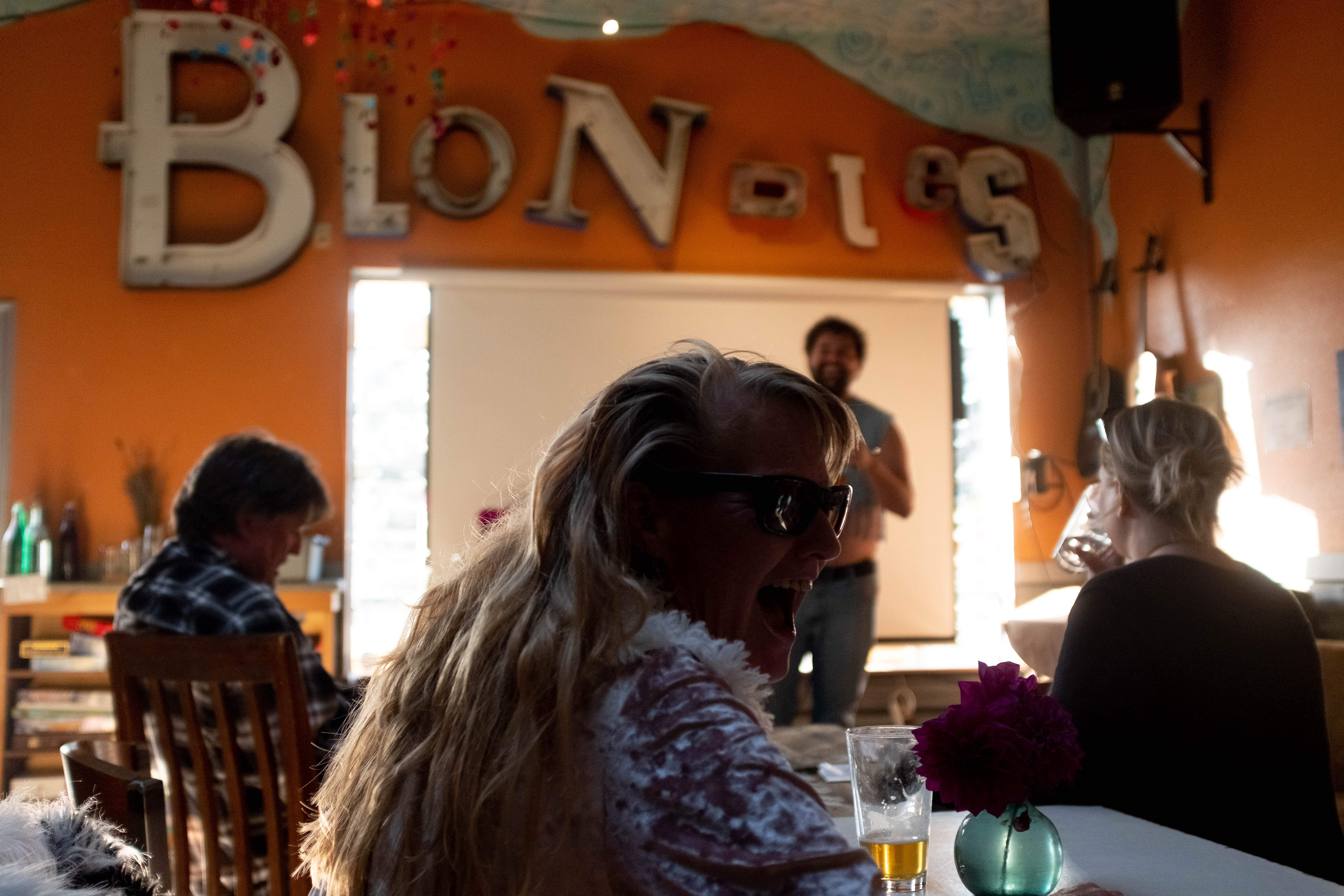
    Savage Henry’s 8th Annual Comedy Festival attracted 130+ comics from all over the nation to Humboldt County.

    Cher-ae Heights, Eureka and Arcata organize venues for the comedy festival and Savage Henry provides the necessities to get the laughter going and the entertainment rolling.

    This year, one of Arcata’s venues included Blondie’s Food and Drink where a dozen comedians took to the stage to test their material, hopeful of making the audience laugh.

    Peter Nellis, a resident comedian at Savage Henry, hosted for the evening and he was by no means a stranger to the comedic atmosphere.

    First up was Sydney Hupp from Chico, California. Hupp was ecstatic to kick off the Friday show as echoes of laughter followed her relatable humor. Hupp’s material centered around the perks of living in a small town and tips on not succumbing to unhealthy vices.

    After 10 minutes, Hupp thanked the audience and exited the stage, triggering another applause. The next comic to the stage was Tiffany Greyson, a comedian from Portland. Greyson joked about her past relationship dilemmas and distaste towards her son’s girlfriend.

    Challenge arose when not all scheduled comedians showed up to perform. This, however, did not prevent comedians from finishing their sets. Instead, it was an opportunity for comedians to welcome new faces into Blondie’s by including them into their material.

    James Couture pops open a bottle of champagne at the beginning of his set on Oct. 11 at Blondies in Arcata. | Photo Michael Weber

    Comedian Michael Cella endured slight heckling from audience members and patrons, with one audience member distracting Cella as he carried beers to his friends. However, Cella was quick to respond and adapt, joking of making sure to sit down and enjoy the beers. Another audience member asked Cella a question, believing the event to be an open panel, but Cella politely answered the question and reminded them to not interrupt.

    If the audience was testing Cella’s endurance, Cella was victorious and met with applause when he finished his set. After, Nellis took the stage again to give a big thanks to those in attendance and encourage others to attend the other comedy shows happening through the weekend.

    The official Savage Henry venue in Eureka kept its doors open throughout the festive weekend and hosted an additional social gathering for comedy after dark.

    “Tom Brady is not the devil. Bill Belichick is.”

    Andrew Boydston

    Bakersfield comedian Andrew Boydston told stories about his life and a set about substitute teaching quickly changed to sports and more specifically, Boydston’s distaste for the New England Patriots.

    “Tom Brady is not the devil,” Boydston said. “Bill Belichick is.”

    Boydston elaborated on his fantasy league and how Belichick impacted it. Boydston’s entertaining stories garnered positive audience reactions, with people laughing and nodding in agreement.

    “Bill Belichick said ‘screw you’ to the fans by making these trades and then he demolishes our fantasy football teams,” Boydston said. “I hate him.”

    With multiple shows happening around Humboldt County, Nellis and fellow Savage Henry members worked to make sure people enjoyed their time and most importantly, laughed.

    “It’s been busy since it started,” Nellis said. “Moving from different locations and setting up, but everyone is enjoying themselves and that’s all that matters.”