The Lumberjack


Students Serving The Cal Poly Humboldt Campus and Community Since 1929

Tag: Science

  • Alaska Wildlife Refuge Vulnerable to Drilling

    Alaska Wildlife Refuge Vulnerable to Drilling

    The Department of the Interior finalizes the plan for leasing out the Arctic National Wildlife Refuge’s Coastal Plain

    The Federal Government has finalized the Environmental Impact Statement to open Alaska’s Arctic National Wildlife Reserve for oil drilling.

    The hands of industry and development have clawed at wilderness since pioneers began pushing westward. Oil has tempted landowners for decades, but the Arctic National Wildlife Reserve denied the resource to industry interests in order to preserve its unique, ancient landscape.

    gwichin_streering_committe-07

    That landscape is threatened. In the perpetual words of writer and wilderness activist Robert Marshall, “And so the path of empire proceeded to substitute for the undisturbed seclusion of nature the conquering accomplishments of man.”

    “[The Oil and Gas] Leasing Program will help meet the long-term energy needs of the nation, support job creation and economic growth of rural Alaskan communities,” The Department of the Interior, acting through the Bureau of Land Management, announced on September 12. “The [Tax Cuts and Jobs] Act directs the Secretary of the Interior, through the Bureau of Land Management (BLM), to establish two area-wide leasing sales, not less than 400,000 acres each, along the Coastal Plain of the Arctic National Wildlife Refuge.”

    The legal authority for the Oil and Gas Program is found in Public Law 115-97, otherwise known as the Tax Cuts and Jobs Act. Written into Title II, section 20001(page 184) are simple yet powerful exemptions for the oil industry’s special interests. For example, “Section 1003 of the Alaska National Interest Lands Conservation Act (16 U.S.C. 3143) shall not apply to the Coastal Plain.”

    The intent of the Tax Cuts and Jobs Act is clearly to honeypot Alaska into opening up the refuge to industrial interests. The Act sets aside standards in the Mineral Leasing Act as the Federal Government plans on claiming royalties at a rate of 16.67%, when standard royalties are 10%.

    While the Mineral Leasing Act Section 35 gives 37.5% of money made from sales, bonuses, royalties and rentals of public lands to the State, the Tax Cuts and Jobs Act declares 50% of the money made will go to the State Treasury.

    The Trump Administration declared $1.8 billion dollars of oil could be mined, essentially promising Alaska $900 million in revenue. The latest federal report suggests the potential income is half of that, approximately $905 million in revenue for the government and significantly less for Alaska.

    The pristine wilderness within the Alaskan Arctic Wildlife Refuge. | Photo by Greg Wiler, U.S. Fish and Wildlife Service

    The projections continue to fall as independent studies conclude significantly lower revenue opportunities based on other local lease sales. How low can you go? Alaska’s governor is prepared to open up the wildlife refuge no matter the cost.

    “Forty years after Congress selected the Arctic Coastal Plain for potential energy development, the Trump Administration is making good on that decades old potential,” Alaska Governor Mike Dunleavy said. “I join with all Alaska Governors since 1980 in assuring the nation and the world that we develop our natural resources responsibly. I look forward to the lease sale scheduled for later this year.”

    In 1929, a 28-year-old forester named Robert Marshall visited the landscape which would eventually become Alaska’s Arctic National Wildlife Refuge on summer vacation. He chose that area because it was the most remote section of Alaska.

    Marshall published an essay titled The Problem of the Wilderness where he describes the extraordinary benefits of the wilderness, considers the drawbacks of preserving wild lands and calls wilderness allies to action in the face of society’s aggressive advance into nature.

    “Within the next few years the fate of the wilderness must be decided,” Marshall wrote. “This is a problem to be settled by deliberate rationality and not by personal prejudice. Fundamentally, the question is one of balancing the total happiness which will be obtainable if the few undesecrated areas are perpetuated against that which will prevail if they are destroyed.”

    Alaska Governor Mike Dunlevy is prepared to open up the wildlife refuge no matter the cost.

    The U.S. Fish and Wildlife Service manages the network of protected lands in the United State’s National Wildlife Refuge System. The mission of the National Wildlife Refuge System is “to administer a national network of lands and waters for the conservation, management and, where appropriate, restoration of the fish, wildlife and plant resources and their habitats within the United States for the benefit of present and future generations of Americans.”

    The Arctic National Wildlife Refuge has been referred to as “The American Serengeti” for its rich biodiversity and untouched landscape. The ANWR is home to a caribou herd nearly 170,000 strong and other beasts including polar and grizzly bears, snow hares, mink and beavers. None of the revenue from Oil and Gas sales will go toward reserve restoration efforts.

    The Coastal Plain is “Iizhik Gwats’an Gwandaii Goodlit,” the sacred place where life begins, to the native Gwich’in people. Both the Gwich’in and Inupuat people have depended on caribou and the land for food, clothing and resources to support their way of life. Gwich’in Elder Jonathon Soloman acknowledged his people’s connection to the land.

    “It is our belief that the future of the Gwich’in and the future of the Caribou are the same.” Solomon said. “Harm to the Porcupine Caribou Herd is harm to the Gwich’in culture and millennia-old way of life.”

    It seems, despite the 89 year difference, Robert Marshall’s word still ring true.

    “There is just one hope of repulsing the tyrannical ambition of civilization to conquer every niche on the whole earth,” Marshall wrote. “That hope is the organization of spirited people who will fight for the freedom of the wilderness.”

  • Redwoods Growing at Remarkable Rates

    Redwoods Growing at Remarkable Rates

    Some coastal redwoods are growing faster than expected and scientists aren’t certain why

    Many redwoods in Northern California are growing at unexpected—even record-breaking—rates. While redwoods only remain in a tiny portion of the world, they appear to be in good health.

    “People talk about saving the redwoods,” Humboldt State University Professor of Forest Ecology Steve Sillett said. “The redwoods, as long as we don’t cut them down, are doing just fine. The question is, can they help save us?”

    The answer is complicated.

    “The Redwoods and Climate Change Initiative found that one Del Norte County redwood put on 2,811 pounds in 2014, a record-breaking annual growth.”

    Many coastal redwoods are growing faster today than they have in the last thousand years, according to a 2019 report from the ongoing Redwoods and Climate Change Initiative.

    The RCCI, a research partnership studying redwood health since 2013, found surprising growth in redwoods located away from dry forest fringes or recent fires.

    By estimating tree weight based on the tree’s measured width, height and volume, the RCCI found one Del Norte County redwood put on 2,811 pounds in 2014, a record-breaking annual growth.

    The cause of the increased growth is uncertain. Sillett, who sat in his lab beside tree rings which he used to measure age and growth, said climate change may or may not play a role in the increased growth. Sillett said the Clean Air Act of 1970 may have cleaned the air enough to allow more sunlight on the trees.

    “What happened is, the air cleared,” Sillett said. “And with clear air, you get more light, and so it could very well be that this increase in growth rate that we see very strikingly in some of these trees, starting in the late 60s and early 70s to present, is just because of increasing air quality.”

    Beyond climate and air quality, Sillett said multiple factors likely contribute to increased growth. Sillett also said the growth won’t necessarily last.

    “I think that there’s very much a limit to what redwoods or any vegetation can achieve,” Sillett said.

    A redwood tree ring in HSU Professor Stephen Sillett’s lab Aug. 28. | Photo by James Wilde

    A sudden spread of redwood forest also seems unlikely, Lucy Kerhoulas, an assistant professor of forest physiology, said. Kerhoulas said redwoods already have to work hard to reproduce via seed. Climate change might make reproduction even more difficult.

    “Successful seedling germination and establishment might be really challenging under a warming and drying climate,” Kerhoulas said.

    In other words, redwoods are doing well, but they’re not about to reclaim their lost forests.

    Sillett emphasized that many living redwoods are maintaining their normal growth despite less successful reproduction.

    “It’s not the case that they’re responding uniformly,” Sillett said. “But what we do see is that in the prime parts of their range, which is, say, north of San Francisco and relatively close to the coast, the rates of wood production are higher than they were in the not-too-distant past.”

    Redwoods store large amounts of carbon, especially in their prime ranges, but Sillett said that won’t offset the carbon dioxide produced by humans.

    “There’s not enough land in the world to plant with redwood forest,” Sillett said, “that would allow them to save us from what we’re doing to the atmosphere’s chemistry.”

  • #ExploreHumboldt: The Arcata Community Forest

    #ExploreHumboldt: The Arcata Community Forest

    Forest bathing can be the cure to the daily hustle and bustle of student life

    Humboldt’s natural areas are world-class, but many students don’t take full advantage of the resources that surround us. Between classes, homework, employment, friends, clubs, housing and family (are you stressed yet?) it can be hard to find time to wander around in the woods.

    This column will provide information on my favorite natural areas to visit around Humboldt County. There’s so much to see and with such a low barrier for entry, I feel like more people should be getting out there.

    Humboldt is home to many creatures large and small. This Coastal Giant Salamander was found posing in the middle of a trail. Watch your step! | Photo by Jett Williams

    Opening your senses to a natural environment is a process called forest bathing, and has been proven to slow heart rates and decrease depression and anxiety.

    In the coming months, classroom life and elongated periods of sitting will become the new norm, making any opportunity to go out and stretch our legs extremely valuable.

    Most of us are transfers, as only 15 percent of the student body is from this area. I’m one of the 85 percent, having moved here from the Bay last summer. When I first arrived in Arcata, it took me a while to get out of my shell and start exploring.

    After a year up here, I’m still finding new spots to check out. The natural areas are so dense and varied, you never run out of things to do.

    Deeper in the Arcata Community Forest is Trail 13. One of the standout features of this bike-centered trail is a massive burned log you walk or ride through. | Photo by Jett Williams

    For newcomers, some of these spots might seem intimidating or unattractive. We’ve all seen “Murder Mountain,” and heard the stories about Humboldt County’s missing person rate. But these sensationalized tales do little to reflect the true nature of the area we now call home.

    The truth is, exploring Humboldt is as safe as exploring anywhere else. A multitude of dark forests and narrow roads give the illusion of being miles from nowhere, but there’s tons to explore within a short drive, bike or bus ride, or even a walk.

    Because this is the first week of school and we’re still getting settled into our routines, we’ll start with something close and easy: The Arcata Community Forest.

    The Arcata Community Forest’s map looks dense and confusing, but the forest becomes more intuitively navigated the more time you spend under its dense canopy.

    This is the most accessible area for the majority of HSU students, as it starts right where the East side of campus ends. A 10-minute walk from anywhere on campus and you’re surrounded by towering redwoods and bright green ferns and breathing humid forest air.

    Some majors like Forestry use the ACF as a place to get hands-on training and experience. But students are never required to walk the gravel roads and twisting trails that crisscross the forest’s 790 acres.

    Some parts of the ACF have limited cell service, so I recommend downloading Avenza PDF Maps. This app is recommended by the City of Arcata and allows you to download free maps of the local parks. These maps provide you with accurate trail info without relying on a cell signal and are a valuable asset to keep you from getting lost.

    Because of its proximity to campus, one of the best ways to experience the ACF is by working it into your weekly schedule. The lower section of the ACF offers a small network of interlaced multi-use trails perfect for a quick walk before or after class. Fill your mid-day gap by taking the access trail from the corner of Union and 14th up to Redwood Park for a picnic lunch!
    The terrain of the Arcata Community Forest is unique and varied, and tight single track often gives way to vast open views. | Photo by Jett Williams

    More ambitious explorers can climb to the upper regions of the park for a more private experience, but solitude comes with a cost. The coastal mountains gain elevation quickly and will leave you feeling equal parts sore and satisfied.

    It’s all worth it, as some of the park’s most scenic trails can be found in the remote Western regions. Road 14, a gated gravel road which starts off of Granite Ave., takes you along the Jolly Giant creek up to a scenic picnic table on the site of the former Jolly Giant Reservoir. From there, you have a multitude of options to extend your route, create loops back to campus or return the way you came.

    The ACF is a valuable source of solitude and stress relief for HSU Students, as it couldn’t be any closer to campus. Use this resource to your advantage, and don’t forget to tag #ExploreHumboldt on your next adventure.

  • Pollinator Predicaments

    Pollinator Predicaments

    Climate change affects the lives of birds, butterflies and bees

    Pollinators matter! Right under our noses a huge community of ants, butterflies and bees are hard at work to make sure the world gets fed. The climate crisis is turning up the heat on these poor guys, and our many-legged friends are at risk. Here’s some information on how pollinators are still doing their best to help us out.

    A solitary silver bee perches on a yellow flower to drink nectar. Notice the yellow pollen on its legs which it will bring to the next flower it drinks from. | Photo by Rand Rudland

    Flowering plants and pollinators have a unique relationship with one another. Ecologists and biologists pay attention to special events in these organisms’ lives which mark growth and development. The science of studying life events is called phenology.

    Ideally a pollinator will hatch from its egg or develop from its pupa and leave the hive around the same time its flower of choice blooms. The timing of these life events is important because if a bug emerges too early or late, it may miss a plant’s flowering completely. No flower equals no food, and that’s no good.

    After emerging, the pollinator goes searching for nectar. The sweet liquid is energy-packed food for bugs. When a pollinator lands on a flower, it picks up pollen. As it continues to look for nectar, the pollen is shaken off and sticks to other flower’s pistils, the female organ of the plant. Pollen travels down a shaft to fertilize the ovary, which begins to go through mitosis and eventually produces fruit.

    Tayloranne Finch and Melanie Honda are two farmers working on the Bayside Park Farm in Sunny Brae who get to interact with pollinators every day. Without pollinators, their farm would be a bunch of fruitless bushes.

    Finch said the farm was working with the City of Arcata to build a permanent solution, a perennial native pollinator garden. The garden would have year-round plants that local pollinators prefer, supporting the local habitat organically.

    Tayloranne Finch, left, and Melanie Honda, right, are farmers at Bayside Park Farm. They spent a sunny afternoon pollinating corn by walking through the rows, swaying their arms back and forth. Every week is a volunteer friday at Bayside Park Farm on Old Arcata Road in Arcata, CA 95521. | Photo by Collin Slavey

    “We’re installing plants that will be there forever. It makes it easier for pollinators to establish themselves on the farm and it is mutually beneficial for us,” Finch said.

    Small changes in abiotic, or physical non-living factors, can alter life events. There are many changes in an ecosystem that can affect how a plant or pollinator does its job. Dr. Rachael L. Olliff-Yang and Dr. Michael R. Mesler published a paper in 2018 titled The potential for phenological mismatch between a perennial herb and its ground-nesting bee pollinator.

    In the paper they investigate how temperature affects the phenology of the silky beach pea (Lathyrus littoralis) and its main pollinator, the ground-nesting solitary silver bee (Habropoda miserabilis).

    “Temperature best predicted both flowering and bee activity, although soil moisture influenced the timing as well,” the paper said.

    Their findings imply that in the face of the climate crisis, an average increase in temperature may cause the silky beach pea and the solitary silver bee to fall out of sync.

    “Comparison of linear regression slopes of phenology against temperature suggests that bee nesting time is more sensitive to differences in seasonal maximum temperatures, and may advance more rapidly than flowering with temperature increases,” the paper said.

    A bumblebee looking for lunch landed on this flower to get a drink of nectar. The bee will help pollinate nearby flowers as it continues on its flight. | Photo by Collin Slavey

    Olliff-Yang and Mesler said that it’s important to understand what factors influence flowering and pollinator activity. Their investigation into the bee and the pea is just an example of a broader issue in the world.

    Building habitat is invaluable to local animal communities, as shelter, food and water are critical needs for every living organism. The most simple thing to do is to plant native plants in the front yard, as this will attract local pollinators.

    Local nurseries like Mad River Gardens will be more than happy to teach you about native plants and how you can attract and support our flying friends. As active members of the ecosystem, we all need to do our part.

  • OPINION: What’s in the black hole?

    OPINION: What’s in the black hole?

    Will you be ready for whatever is to come with, or even out of black holes?

    Earlier this month the science community exploded when the first images of a black hole were taken. This new development got me thinking, what’s in the black hole?

    Until this photo no one knew what an actual black hole looked like. Scientists weren’t even completely sure they existed, it was all a theory.

    Some people think if we go into a black hole we’ll just die. Others believe that going into a black hole will take us into another dimension in time or space.

    I want to have some fun and make some guesses to what I think is the black hole. One guess is that when we go into the black hole, we’ll end up on a new foreign land filled with aliens who all look like Beyoncé.

    Another theory is maybe after getting sucked into a black hole, we could all come out like Looney Toon characters or deformed in some way.

    What I truly believe is that there is nothing on the other side of black holes. Maybe, if you fall into a black hole you just never come out. What if there is no end point to a black hole? The universe is always expanding and growing, what if black holes just keep growing?

    What is also interesting about this discovery is how spot-on the pictures of digitized or drawn black holes are. I mean, the movie “Interstellar” was spot on compared to the real image of the black hole. This is not the first time Hollywood has eerily predicted future events before they happen. Which is a whole other opinion, for a different day.

    Whatever ends up being in the black hole will be a question that I may or may not be alive to see answered. I think while we’re doing all this exploring in space people should be ready for whatever comes our way.

  • Pollution sours Freshwater field trip

    Pollution sours Freshwater field trip

    Editor’s Note: This an editorial contribution from Deija Zavala. The author currently works for the Lumberjack as an Online Editor.

    I went in search of ferns and ivy, I found instead disgusting evidence of human existence.

    Ecotopia.Fav.10.13.18.DSC_0093
    Assorted garbage trailing down the hill just off Greenwood Heights Dr. on Saturday Oct. 13 in the Freshwater area, east of Eureka. | Photo by Deija Zavala

    On Saturday I explored a local watershed in the Freshwater area. The field trip was for an Environmental Science Management class where the goal was to visit a local watershed and observe.

    I’d seen the beautiful landscape of Freshwater once before and hoped the trip would give me an excuse to get lost for a few hours with nothing but my camera and the wildlife.

    Ecotopia.Fav.10.13.18.DSC_0094
    Pieces of cupboards, particle board, aluminum cans, and other miscellaneous debris pile up less than 15 feet from a sign threatening prosecution over illegal dumping on Oct. 13 in Freshwater. | Photo by Deija Zavala

    At first, it was lovely. I did a short hike and found myself taken by how separated I was from my Eureka apartment and all the rumbling of engines and people on a sunny weekend morning.

    Eventually, I came to a roadside area that had so much debris it looked like a dump. Carcasses, bones and trash of all kinds lay on the side of the road. There were boxes, tiles, kitchen cabinet pieces, bottle caps, cigarette butts and Taco Bell wrappers. It was awful to witness such disregard for the wildlife.

    Ecotopia.Fav.10.13.18.DSC_0087
    A cattle bone found next to chunks of kitchen tile and fallen redwood needles on Oct. 13 in Freshwater. | Photo by Deija Zavala

    The Environmental Protection Agency website states that this kind of pollution is called nonpoint source pollution. After a big rain or when snowfall melts, nonpoint source pollution can ultimately find its way into drinking water sources such as rivers or lakes and even into ground water.

    If you come across an illegal dump, especially if its near a watercourse, you can report it to the Humboldt County Division of Environmental Health at 707-441-5410.

    Ecotopia.Fav.10.13.18.DSC_0091
    Abandoned kitchen tiles sit haphazardly amongst trash just off Greenwood Heights Dr. on Oct. 13 in Freshwater. | Photo by Deija Zavala

  • Voices of student science

    Voices of student science

    By | Bryan Donoghue

    BDVoices_Web-1.jpg
    Samuel Vassallo, sophomore, Wildlife major Photo credit: Bryan Donoghue

    Samuel Vassallo, sophomore, Wildlife major — “I hope to work outdoors and possibly for government agencies like the U.S. Fish and Wildlife Service, or the park service, or the U.S.G.S., or any of the state agencies that are equivalent to national agencies like those. I could work for a nonprofit like the World Wildlife Foundation, or Nature Conservancy, or I could work for a company that needs to do environmental impact and see if there are any endangered species on their property, so if they could log or mine. Probably not as much into working for a private company, I would like to work for the government. I love the classes, it’s great. When I chose this major I just thought it sounded cool and looked at the course list and chose it. You had to pick a major as a freshman to be in the Klamath Connection, which was a program I was in. We show up a week early to school and meet our professors, and I just picked Wildlife because it sounded cool and when I got here I’ve been loving every minute of it, so I feel like I’m in the right major, it’s pretty lucky.”

    BDVoices_Web-2.jpg
    Romeo Javier Dominguez-Rameriz, recent graduate, Criminology major Photo credit: Bryan Donoghue

    Romeo Javier Dominguez-Rameriz, recent graduate, Criminology major — “I’m doing an extra semester to see what I want to do with my graduate program. Right now I’m looking into international relations, so I’ve been looking in to see what programs I can go into that are in Germany. Nothing set in stone or anything. Personally, I love it up here. I’m from the SoCal area, the main reason why I came here was because of the environment and everything and I pretty much enjoy the people and environment like I hoped I would. The staff from my department is pretty rock-on, so I’m most fortunate for our faculty.”

    BDVoices_Web-3.jpg
    Jade Simms, senior, Engineering major Photo credit: Bryan Donoghue

    Jade Simms, senior, Engineering major — “I’m hoping to get a job. I think it would be cool to work in river restoration, but we’ll see who wants to hire me. I think the Engineering department is a very supportive department, I’ve been given a lot of opportunities to learn what I want to learn. For future Engineering majors, do it! Don’t be afraid. I’ve talked to a lot of people, I know women especially are a little intimidated, but screw it, just do it.”

  • Compassionate Bonds — New HSU Chem Prof Goes Above and Beyond

    Compassionate Bonds — New HSU Chem Prof Goes Above and Beyond

    By Bryan Donoghue

    For many students at Humboldt State University, any chemistry class is on a list of the hardest courses a student can take. Humboldt State has taken on a new temporary chemistry professor whom students are dubbing “passionate,” “exuberant,” “enthusiastic,” and “caring.” Walking into his office, some may mistake him for a student. He’s listening to Selena Gomez, One Direction and country music. But it’s his demeanor, not his music preference, that makes Puminan Punthasee so approachable.

    punthasee
    Puminan Punthasee | Photo Credit: Humboldt State University Chemistry Department

    “I’m not afraid to approach Pete, which I sometimes am with other professors,” said Kathryn Buzanski, 29-year-old student and Marine Corps veteran. “With Pete, I can email him, I can approach him, talk to him face-to-face, and have no worries.”

    Punthasee’s approachability follows into his relationships with colleagues in the chemistry department. Joshua R. Smith, chair of the Department of Chemistry, recalls that the first time he met Punthasee. He found him to be funny and deeply empathetic. But it was his passion for teaching that struck Smith the most in the hiring process.

    “He clearly had a passion for teaching, based on what he wrote in his application, and he clearly got that across during the interview as well,” Smith said.

    This enthusiasm and commitment Punthasee brings to teaching chemistry blossomed long before Humboldt State. Dating back to his high school years in Thailand, Punthasee had to take science courses every semester in high school. Thailand’s education system requires six science courses in order to graduate.

    “I wasn’t really a smart kid, I was slow, and couldn’t grab anything that the teacher taught us,” Punthasee said. “My grades were okay but weren’t as high as I wanted them to be.”

    Before graduating high school, Punthasee discovered his passion for learning, as he found a role model at his tutoring school.

    “This chemistry teacher at my tutoring school made chemistry understandable,” Punthasee said. “And that was the starting point that made me realize that if I could understand chemistry, maybe there’s some other stuff that I can understand as well.”

    Following high school, Punthasee graduated from the University of Thailand, and continued to expand his horizons by enrolling in University of Missouri’s Ph.D. program for chemistry.

    “I was in a Ph.D. program at the University of Missouri, and I hated the program,” Punthasee said. “It’s the nature of the Ph.D. program that makes you do a bunch of research, but I don’t like doing the research, so I found myself looking at the clock every five minutes.”

    Although he isn’t passionate about research, Punthasee found his calling as a teacher. He’s won three awards for being a teaching assistant through his graduate program. He’s been awarded with the Number One T.A. Choice award twice, and has also accepted the Green Chalk award for being an excellent teaching assistant.

    “I bet you that no science teacher does things like I do, not in this state,” Punthasee said. “Only two people follow my “Pete” style. Me, and my role model in Thailand.”

    His efforts to reach out to students outside of the classroom further solidifies their appreciation for Punthasee as well. As a professor, he will send three emails each day on average, all for varying, but positive reasons.

    “Pete really likes to send out encouraging emails,” said chemistry student Kate Panebianco.

    Brooke Holdren, a 20-year-old science and art major at Humboldt State, also expressed how much the emails help her.

    “I’ve gotten both general and personal encouragement emails. He’s really taking the time out to say specifically, ‘You’ve done this really well today’,” Holdren said.

    “He sends the most emails out of any teacher I’ve ever had. It’s really great and encouraging, sometimes a bit over the top, but that just shows how involved he is in comparison to the other teachers I’ve had.”

    What makes Punthasee such a well-liked professor boils down to how relatable he is. He’s just like any regular college student, and he likes to keep things simple because simplicity is easier to understand.

    “It’s just human nature,” he said. “We don’t like complicated stuff, we like fun stuff.”

    Attributing his best quality to being a “tremendously freaking hard worker,” Punthasee said his talent lies in his ability to simplify and socialize.


    Buzanski explained this in a way that many of Punthasee’s students can empathize with. “He does want to be our friend, but more importantly, he wants to be our friend while we know he’s our teacher,” she said.

  • This week in science (April 26 – May 3)

    This week in science (April 26 – May 3)

    By Bryan Donoghue

    Graphic | Joe DeVoogd

    Technology – Bioprinted Cartilage

    Researchers at Sahlgrenska Academy in Sweden have managed to generate cartilage tissue by bioprinting stem cells using a 3D bioprinter. Researchers found a procedure that ensured cell survival from printing so they could multiply. This allowed researchers to develop a protocol that causes the cells to differentiate to form cartilage. The bioprinted tissue is not only able to repair cartilage damage, but can be used to treat osteoarthritis, a condition where joint cartilage degenerates and breaks down.

    Source: medicalxpress.com


    Graphic | Joe DeVoogd

    Technology – Artificial Womb

    A team of researchers at the Children’s Hospital of Philadelphia in Philadelphia, Pennsylvania have engineered a fluid-filled “biobag” that allows premature lambs to develop in an artificial womb. Alan Flake, a pediatric surgeon and the head of the research team said his goal is to help premature infants with this artificial womb. It may be a while before it’s implemented in hospitals. Flake estimates that human testing is at least three years off.

    Source: sciencemag.org


    Graphic | Joe DeVoogd


    Space – Cassini to go through Saturn’s Rings

    The Cassini spacecraft, which has been circling Saturn for the past 13 years, skimmed over the planet’s largest moon, Titan, last Saturday. Titan’s gravity will pull Cassini into the narrow gap between Saturn and its innermost ring, a place where no man made satellite has gone before. The spacecraft will enter that gap about once a week until Sept. 15, when it will crash into Saturn and be destroyed.

    Source: nytimes.com


    Graphic | Joe DeVoogd

    Paleontology – Ancient Humans in California

    An archeological research team headed by study leader and paleontologist at the San Diego Natural History Museum, Tom Deméré, said they’ve found signs of ancient humans in California between 120,000 and 140,000 years ago. This is more than one hundred thousand years before humans were thought to exist in the Americas. If the research team’s findings are correct, their findings at the Cerutti mastodon site could rewrite the history of humankind.

    Source: nationalgeographic.com

  • Restoring the Largest Old Growth Forest in the World

    Restoring the Largest Old Growth Forest in the World

    By Kelly Bessem

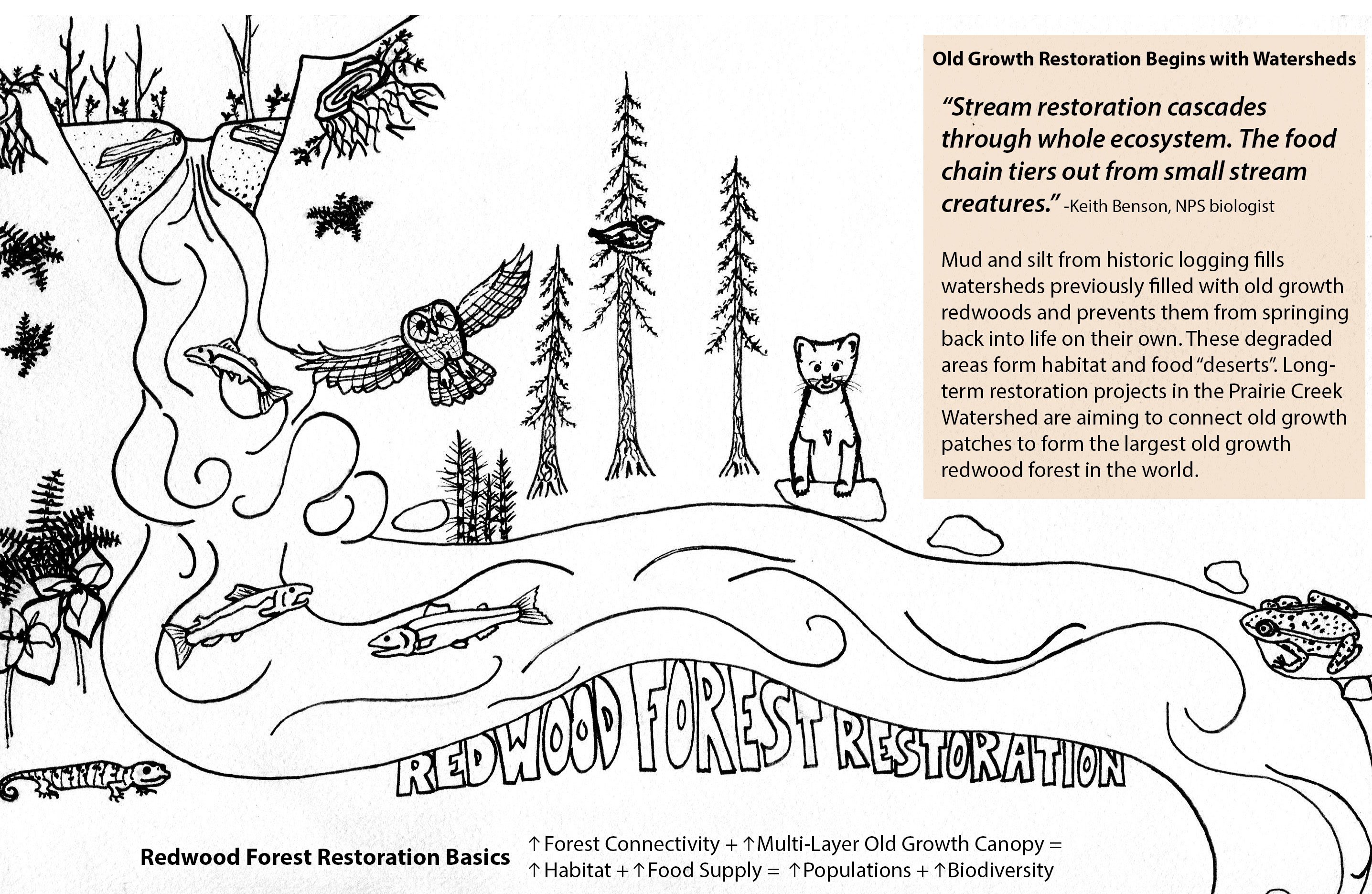
    Portions of the Prairie Creek Watershed, one hour north of Arcata, are still being restored 50 years after being clearcut. Proposed restoration plans by the National Park Service (NPS) will make this region into the largest remaining old growth redwood forest in the world. This will be done by connecting 14,000 acres of old growth redwood patches. This designation is currently held by the 10,000 acre Rockefeller forest in Humboldt Redwoods State Park.

    Map showing future Prairie Creek Watershed restoration plans that will connect old growth redwood forest. Map | National Park System

    The Berry Glen cut area that’s next in line is will see an estimated 45,000 cubic yards of total mud and gravel removed from the stream channel. That’s equal to approximately 18,750 average US cars. All of this sediment washed down from the hillsides there post clearcutting in 1964.

    Berry Glen played a pivotal role in the original formation of a Redwood National and State Park. According to NPS, this startling clear cut in full view from Highway 101 spurred enough criticism from travelers to warrant the finalization of protections there.

    Removing mud and gravel that chokes stream channels, such as Berry Glen, allows the ecosystem to breathe new life. Thinning the even-age stands of second growth so that light can reach the forest floor is also part of the restoration process. Keith Benson, an NPS biologist of the Orick, California area, explained that freeing watersheds in this way allows restoration to cascade through the whole ecosystem of an area.

    “The food chain cascades out from small stream creatures,” Benson said. “Restoration resets what the area has evolved to in the past, complex redwood forests. Then species composition can restore itself.”

    Benson likened a restored redwood forest to a Costco warehouse for species in the region, versus a uniform second-growth forest to a 7-Eleven convenience store.

    The basics of the ecology behind redwood forest restoration can be understood with a simple equation:

    ↑ Forest Connectivity + ↑ Multi-Layer Old Growth Canopy = ↑ Habitat + ↑ Food Supply = ↑ Higher Populations + ↑ Diversity

    Forest connectivity provides protection for prey while simultaneously providing more hunting abundance for predators. It also allows for easier gene-sharing among species as traveling between areas becomes safer. Increased gene variety creates more resilient species as better traits surface among diverse populations. Having Multi-layer old growth canopy instead of one uniform layer for trees lets in sunlight and increases a forest’s 3D space. This increases the availability of Habitat and Food Supply, resulting in Higher Populations and Diversity since both predators and prey have what they need in the ecosystem to thrive.

  • Art by Claire Roth

    Art by Claire Roth

    Claire Roth’s Art for This Week in Science Spring 2017

  • My Jeff Corwin Experience

    My Jeff Corwin Experience

    By | Ali Osgood

    Super-star naturalist Jeff Corwin walked out onto the stage at HSU’s Van Duzer Theatre to a cheering and excited crowd. Immediately, the child in me bubbled over and I was thrown back to my younger years when the world was for exploring and Jeff Corwin was showing me how. This particular evening would be very similar, only my childhood hero would be talking less about exotic animals and instead be tackling climate change.

    Corwin visited HSU this past Saturday as part of the Distinguished Speaker Series: Tales From the Field. He is an emmy award winning television host and wildlife biologist who has been on the Discovery Channel, CNN, Disney Channel, NBC, Animal Planet, and even the Food Network. Currently he is the host of the television show “Ocean Treks”, but he is best known for his show in the early 2000s, “The Jeff Corwin Experience”.

    I grew up watching Corwin travel the world talking about wild animals and nature. I have looked to him for guidance as an adult conservationist, and he has inspired my wonder for the natural world. I had been looking forward to seeing him in person for the first time in my life, and anticipated he would give the crowd something to walk away with.

    “We do not inherit the earth from our ancestors,” Corwin said. “We borrow it from our children.”

    Corwin spent over three hours talking and answering questions about his career and his concerns on climate change. He reminded the audience of the dangers it poses to our planet. But unlike so many climate change talks I have witnessed, Corwin had a sense of optimism despite the alarming figures he shared.

    He used multiple examples of endangered species to move through his points. He profiled species that were on the brink of extinction that recovered because of the efforts of humans. Corwin seems to believe that with the right amount of passion and scientific approach that humankind can slow climate change and save wildlife.

    “We can do amazing things,” Corwin said. “I don’t think conservation is about politics. You can look at incredible conservation stories, successful and disastrous, that happened from both [political parties].”

    Throughout the evening Corwin took the audience through his life as a television host. I have always loved the energy and sense of humor Corwin has brought to his adventures, and to hear about what was going on behind the scenes was very special.

    The charismatic television host spoke for about an hour before taking questions from the audience. As the night pressed on, he continued taking questions until he had answered every last one, over 25 personal questions. Corwin did an excellent job combining inside facts about his life while inspiring his audience to continue defending the environment.

    “The best thing you can do is begin in your community,” Corwin said. “Find some level of passion in whatever you do.”

  • This week in science (March 15 – March 22)

    This week in science (March 15 – March 22)

    By Claire Roth

    Wildlife – New Colombian bird species

    Graphic Illustration by Claire Roth

    Twenty-five years after its initial sighting, the Tatama Tapaculo has been been identified as a new species. The Tatama Tapaculo resides in the rainforests of the Western Andes in Colombia and was discovered due to research on its call and mitochondrial DNA. The black-brown bird is small at an average of 10 to 23 centimeters in length and 10 to 185 grams in weight. It spends its days on the forest floor and underbrush, scratching away with sturdy legs in search of food.

    Source: Sci-News

    Geology – Canadian crust

    Graphic Illustration by Claire Roth

    Whether you’re the kind of person who enjoys pizza crusts or banishes them after eating the good stuff, a very different and much more ancient kind of crust was detected in the Superior Province of Canada, and geologists are simply eating up (metaphorically). This crust hails from around 4.2 billion years ago when the Hadean eon was in full swing. The Hadean eon received its name after the Greek god and ruler of the underworld, Hades, because it was the time of Earth’s formation and boasted a hellish landscape. The crust was dated through analyzing an isotope of the element neodymium that was present in rock samples. Neodymium itself is a result of the radioactive decay of an extinct element known as samarium. Samarium disappeared within the first few pages of Earth’s history and had been studied in early meteorites from Mars and the Moon, indicating to scientists the age of the rock samples.

    Source: Sci-News

    Wildlife – Hungry hungry spiders

    Graphic Illustration by Claire Roth

    A recent study found that you don’t need to be the largest predator in size to be the largest predator in impact. The Science of Nature journal published research by scientists at the University of Basel finding that spiders consume the same amount of weight in insects as humans consume per year in fish and meat. Let that sink in for a second, but not before noting, for perspective, that the world’s population of spiders cumulatively weighs 24 million tons and that same population consumes somewhere in the ballpark of 400 million tons and 800 million tons of insects per year. The positive impacts of this voracious diet and population size include controlling insect-related damage to plants and also feeding larger critters who enjoy munching on spiders themselves.

    Source: BBC

    Wildlife – Fluorescent frog

    Graphic Illustration by Claire Roth

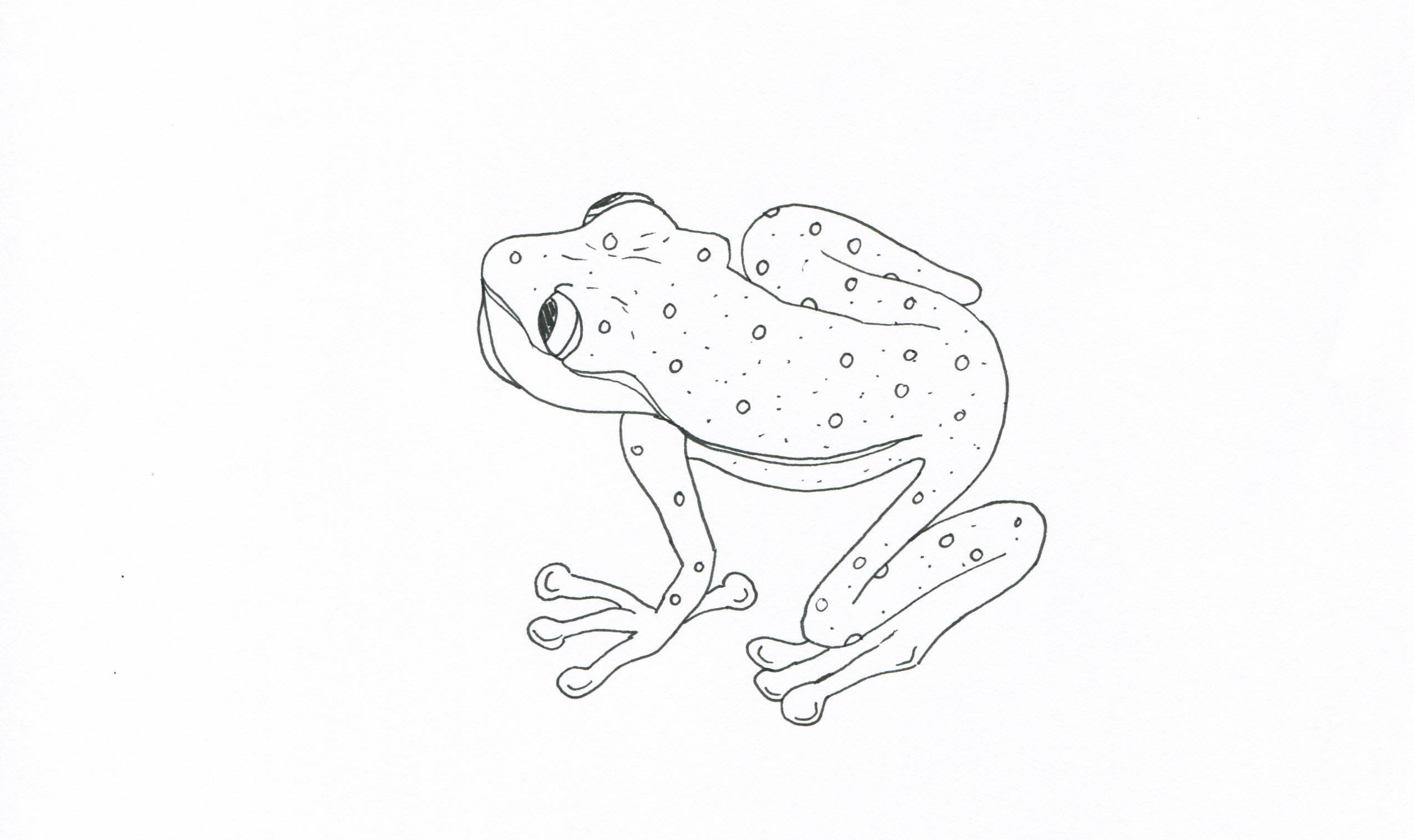
    A study published in the Proceedings of the National Academy of Sciences noted the discovery of the first ever naturally occurring case of fluorescence in an amphibian. Fluorescence occurs when light is absorbed and then emitted. The amphibian, a frog called the South American polka dot tree frog, has a particular structure of molecules within its skin, lymph tissue, and gland secretions that allow it to glow when ultraviolet light is shone on it. This creates a much different spectacle than its normal olive shade under regular light.

    Source: The Huffington Post

  • Underrepresented minority groups in science

    Underrepresented minority groups in science

    By Iridian Casarez

    HSU science professors and staff organized an event last Saturday, March 4, dubbed “You belong here!” Created for underrepresented minority groups in science, the event served as a community  building function for women in science. The event focused on discussions about what a scientist looks like, how to be a badass scientist and understanding imposter syndrome. Although the event named women specifically, anyone was welcomed to join in.

    Paola Rodriguez Hidalgo is a professor in physics and astronomy at HSU. Rodriguez Hidalgo was a collaborative organizer that helped put the event together with a group of other science professors and staff.

    Rodriguez Hidalgo said students in science sometimes feel like they don’t belong. Women and underrepresented minority groups in the science field often leave the field they are trying to pursue.

    “The percentages of women in science are really low,” Rodriguez Hidalgo said. “We want this seminar to make women and underrepresented groups feel a sense of belonging in the science field.”

    Melanie Michalak is a geology professor at HSU. Michalak also helped organize the event.

    “We noticed in science classes the students consist of 50 percent male and 50 female but the male students often tend to speak up more,” Michalak said.

    Michalak said that women and underrepresented groups often feel the imposter syndrome.

    The imposter syndrome is a condition that any student may feel. Imposter syndrome is when a student feels unqualified and doesn’t feel smart enough to the point that they think they are fooling others into believing they are smart and successful in a class that is challenging to them. In reality, they are not fooling anyone but themselves, according to Claire Till, an assistant professor of chemistry at HSU.

    “A lot of people who feel imposter syndrome are all actually very successful,” Till said.

    Till ran the imposter syndrome workshop at the event alongside another HSU assistant professor Kerri Hickenbottom.

    Till said that the event organizers wanted to let people know what imposter syndrome was a normal thought that exists and a lot of people feel it. Till also said that women and underrepresented minority groups are more likely to feel imposter syndrome.

    According to the university enrollment dashboard, 50 percent of students in the college of natural resource and science are women and 35 percent of those students are underrepresented minority ethnic groups.

    Jenna Schoelkopf is a chemistry major. Schoelkopf said she attended the event because she wanted to know more about imposter syndrome.

    “As I was reading what imposter syndrome was I started crying because I have felt that way since I was 7 and I have that feeling in class,” Schoelkopf said. “It was super weird reading it.”

    Julianne Sison-Ebitner is an environmental resource engineering major. Sison-Ebitner said she attended the event because she wanted to get advice from people who share the same experiences as women in science and how they have overcome the obstacles they faced.

    “I come from a really traditional Filipino family,  the only science my family was exposed to was nursing, so when I told my them I wanted to be an engineer it really confused them,” Sison-Ebitner said. “It’s been a battle to get here.”

    Sison-Ebitner said that the seminar uplifted her and gave her the confidence and reassurance that she is a woman of science.

    “I am a woman of science and that is not going to change,” Sison-Ebitner said.

  • Pruitt to head US Environmental Protection Agency

    Pruitt to head US Environmental Protection Agency

    By | Bryan Donoghue

    President Donald J. Trump and his administration have selected the Oklahoma Attorney General Edward Scott Pruitt to head the Environmental Protection Agency (EPA). This action could disrupt former President Barack Obama’s efforts to combat climate change and could also limit the power held by the EPA.   

    According to The Washington Post, Pruitt has long been a critic of the EPA and has led legal challenges against some of the agency’s actions. These actions include efforts to lessen greenhouse gas emissions from power plants and determining which wetlands and streams are subject to federal regulation.

    William Fisher, HSU economics professor, said of Pruitt, “He’s openly hostile to things like climate change and he’s representative of the fossil fuel industry.”

    Under Pruitt’s leadership of the EPA, incommensurate views on various environmental topics may result in inhospitable outcomes.

    The most crucial concern of Pruitt’s appointed position among the local Humboldt community seems to be budget cuts.

    “He has the power to defund research,” said biochemistry major Marcella Atencio. “So if something doesn’t support his political view or agenda, he does have the ability to defund that. If he does, there’s not much the research can do about that unless they get a private investor. The odds are that he has to agree with that and that makes things much more difficult.”  

    The sentiment around budget cuts in the EPA seem to be universal among students and faculty. Fisher doesn’t know for certain whether the EPA will receive budget cuts. He believes that it is likely under this specific administration, though not necessary, for overall budget concerns nationally.

    “Really, you see in many different administrations, they don’t have to eliminate certain programs, or even the budgets for those,” said Fisher.

    According to The New York Times, Pruitt plays a hero to conservative activists. He is one part of a group of Republican attorney generals who allied with some of the nation’s leading energy producers to push back against the Obama administration’s plans. This conflict of interest surrounding fossil fuel has been received with controversy, but played a large part with President Trump’s selection of Pruitt.

    Journalism major Alex Gonzalez pictures the change in EPA leadership as backtracking all progress the nation has made over the past few years to lessen our effects on the environment. 

    “It’s saddening to think how little our country will care about the environment because the U.S. sets an example for all the other nations to follow,” Gonzalez said. “Under new conservative views, other countries will follow leading to an overall decline to the health of the earth.”

    An unavoidable hurdle in the EPA that will most likely happen under Pruitt’s leadership is dormancy of the agency.

    “He could attempt to gut a lot of the regulations of the EPA, some of that would take time,” Fisher said. “So probably the biggest impact that he’d be able to have immediately would be not utilizing the powers of the EPA.”

    Though Pruitt will likely still utilize the EPA’s power, a change in policy takes time.

    “Dismantling things like the Clean Water Act and Clean Air Act can take a lot of time and effort, and underfunding the EPA will probably happen,” Fisher said. “It’s almost guaranteed that they won’t police what they’re supposed to be policing.”

    The Washington Post states that dismantling regulation, if it survives the courts, would not be simple because the EPA has already finalized it. This means that to undo and replace regulations would require a public notice and comment process. Environmental groups would likely sue the agency over such a move. 

    Pruitt has yet to take his seat as the head of the EPA, as he still needs to be approved. According to a recent article in The Huffington Post, Pruitt is now being backed by the Koch Brothers, a name synonymous with success in the crude oil industry. For now, we can only wait to see which actions Pruitt will take.

  • Healthy back to school habits

    Healthy back to school habits

    By: Claire Roth

    Pulling yourself out from your winter pile of blankets with the words back to school ringing in your ears can be difficult. The vision of the never-ending staircase of Founders Hall you’ll have to climb to get to class can be daunting after a month of collegiate downtime. It could start you off on the wrong foot for the spring semester. The Lumberjack has compiled a short list of healthy, back-on-your-feet habits to take up so you can get back into the academic swing of things.

    1. Eat Breakfast – Sound familiar? You’ve likely been told this all of your life, but now that you’re getting your body back on track to learn it’s especially important. Fruits like apples and bananas can be the difference between getting that extra boost of energy or becoming ‘that’ person who falls asleep in class on the first day.
    2. Make a Calendar – Time seems more relative when you have a monthly calendar staring right at you. Stay on top of assignments for your new classes by taking some time to write all big deadlines down such as essays and exams.
    3. Get Moving – If you’re in a class longer than 50 minutes you may have noticed a tingling feeling in your legs after about an hour: this is your body telling you that it’s time to get up and moving. Sitting down, in class or out, for more than an hour can be detrimental to various parts of your body. It always pays to take a short stroll down the hallway before returning to your studies.
    4. Pace Yourself – Allowing yourself the time to reset and check in with how you are doing is one of the most important, yet least practiced, self-care tactics out there. Simple actions such as stopping what you’re doing, closing your eyes, and taking three slow breaths could help you clear your head and stay on the track for success.
    5. Find Some Nature – There’s a reason that the phrase nature deficit disorder exists these days; we simply do not find the time to place ourselves in natural settings. HSU’s campus is fortunate enough to be situated next to a serene redwood forest with a babbling creek and chirping birds, the perfect playlist for a healthier train of thought.