Ask Evergreen is a weekly advice column by the students of the Lumberjack.
Each week we’ll answer anonymous questions sent in by readers about anything and everything.
Dear Evergreen,
I’m a third-year switching majors. Is that a big issue, or should I worry about not graduating on time?
Dear third-year major switcher,
Switching your major as a third-year student can be a blessing and a curse. On one side, it’s the perfect time to do it because you’re still enrolled in school. It’s better to do it now than to come back years later to try to major in your new studies. On the other side, switching now might create an unwanted financial hassle as you’re most likely starting from square one with your new major. Unless you’re switching to a major that has similar course requirements that you’ve already fulfilled.
College is not a race. It is completely normal to not finish a degree within four years. Don’t beat yourself up or compare yourself to your peers. Make sure to schedule a meeting and talk with your adviser to map out the smoothest route for your degree transition—you might have less to do than you expect. You could even consider minoring in the major you want to change to. But remember, many people take gap years, change their majors or come back to school years later. Be proud of yourself for making this decision now.
Best of luck!
Sincerely,
Evergreen
If you have any questions you’d like to send in, email us at contactthejack@gmail.com. We won’t publish any names and you don’t need to use one.
It’s not just Humboldt State that has a parking issue
Arcata’s Transportation Safety Committee held its monthly meeting on Tuesday, in which they opened up for public comment on city parking restrictions.
Netra Khatri, staff liaison of the committee and Arcata assistant city engineer, thanked the small crowd of about ten locals gathered in the City Council Chamber of Arcata City Hall.
“We decided to make this meeting annual three years ago, where we can take public comments and hopefully make changes from input,” Khatri said.
After discussing minutes from a previous meeting, the committee of eleven opened the meeting for public comment.
The comments varied in severity and scale, but revolved around one central theme: the city of Arcata lacks sufficient parking.
Arcata resident Vernon Price proposed a plan to allow some Arcata citizens to park their cars freely from dusk til dawn. Price said he was unhoused for 15 years, and wanted the committee to keep the homeless in their hearts and minds.
“There are people who have lost their homes, and their only tangible property is their homes—and they live in those,” Price said.
The committee noted Price’s suggestion and promised to look into designating overnight parking spaces.
Arcata resident Collin Wingfield brought to attention a parking overflow resulting from the recent construction of the 142-apartment Sunset Terrace complex located between Sunset and Foster Avenues.
Wingfield, who said he lives on Wilson St., just off of Sunset, has noticed an influx of Sunset Terrace residents parking their vehicles along Sunset Ave. and even on his street.
Even though Sunset Terrace residents are allotted one parking space in their complex, Wingfield said residents often park their cars along Sunset Ave., leaving other homes with insufficient parking.
“They will leave their cars parked for weeks at a time,” Wingfield said.
The committee sympathized with Wingfield and discussed possibly issuing parking permits for Sunset Ave. residents.
Arcata Library Branch Manager Susan Parsons brought to attention a lack of parking for library visitors. Parsons said parents with children often have to walk through a lot marked by uneven terrain and frequent drug users.
“Parking for visitors of the library is an issue of safety,” Parsons said.
In response, the committee suggested designating specific parking spots for the library or enforcing time limits on the spaces outside of the library to prevent them from filling with non-library visitors.
Tisha Farrer, an employee of the North Coast Co-Op, urged the committee to get rid of parking meters and two-hour spaces. The Co-Op, Farrrer said, reserves its lot for customers only and employees often have to park far away.
“I just want them to feel safe and have parking where they work,” Farrer said.
The committee noted Farrer’s concerns while making clear that Arcata’s parking shortage comes at a tricky time as the city tries to encourage the reduction of personal vehicular use to reduce greenhouse gas emissions.
TSC will now take the public comments and bring their recommendations to the Arcata City Council on Oct. 16. TSC meets the third Tuesday of every month at the City Council Chamber.
Pro sports is a two-sided business in need of a power redistribution
Owners of professional sports teams have made headlines the last few years for all the wrong reasons. The primary issue regards team owners treating players as property instead of as people, and a good amount of this coverage surrounds the National Basketball Association and the National Football League.
Since 2014 there have been numerous situations where owners of sports teams made racially-toned remarks concerning their athletes, who are predominately black. Simply referring to whomever controls the majority of the team as ‘owner’ can have its own racial implications in leagues where most players are people of color.
According to the NBA’s 2015 Racial and Gender Report Card and a 2014 NFL Census, 75% of NBA players and 68% of NFL athletes are black. The NBA also has the largest percentage of people of color in its fan base, whereas NFL fans are primarily white.
In 2014, The NBA forced former LA Clippers’ shareholder Donald Sterling to sell his team after a tape of him spouting racist remarks was released to TMZ. But in the NFL it seems like their majority shareholders are able to get away with more. NFL team owners were more vocal than ever this past season due to the outrage from many fans about players kneeling during the National Anthem.
While NFL contracts may seem ridiculous compared to other high-grossing sports, professional football players receive the lowest percentage of guaranteed money in their contracts. In contrast, NBA athletes make every cent of their contracts and are often considered to be involved in the daily running of the league as opposed to just their respective teams’ shareholders making all the decisions.
When it comes to the relationship between owners and their athletes, a large factor in the athlete’s treatment is how fans act. Rhetoric during the kneeling protests relayed many of the players who took a knee as unpatriotic, spoiled and privileged, with fans telling players to “shut up and play.”
Fans treat players as if they are toys for amusement instead of human beings. And team owners treat players like property that can be replaced at any moment. But when there is a media storm of fans and others calling for change like with the Clippers in 2014, progress can be made. Fans hold more power than they know and can directly affect how teams are handled and how athletes are treated.
The hands of industry and development have clawed at wilderness since pioneers began pushing westward. Oil has tempted landowners for decades, but the Arctic National Wildlife Reserve denied the resource to industry interests in order to preserve its unique, ancient landscape.
That landscape is threatened. In the perpetual words of writer and wilderness activist Robert Marshall, “And so the path of empire proceeded to substitute for the undisturbed seclusion of nature the conquering accomplishments of man.”
“[The Oil and Gas] Leasing Program will help meet the long-term energy needs of the nation, support job creation and economic growth of rural Alaskan communities,” The Department of the Interior, acting through the Bureau of Land Management, announced on September 12. “The [Tax Cuts and Jobs] Act directs the Secretary of the Interior, through the Bureau of Land Management (BLM), to establish two area-wide leasing sales, not less than 400,000 acres each, along the Coastal Plain of the Arctic National Wildlife Refuge.”
The legal authority for the Oil and Gas Program is found in Public Law 115-97, otherwise known as the Tax Cuts and Jobs Act. Written into Title II, section 20001(page 184) are simple yet powerful exemptions for the oil industry’s special interests. For example, “Section 1003 of the Alaska National Interest Lands Conservation Act (16 U.S.C. 3143) shall not apply to the Coastal Plain.”
The intent of the Tax Cuts and Jobs Act is clearly to honeypot Alaska into opening up the refuge to industrial interests. The Act sets aside standards in the Mineral Leasing Act as the Federal Government plans on claiming royalties at a rate of 16.67%, when standard royalties are 10%.
While the Mineral Leasing Act Section 35 gives 37.5% of money made from sales, bonuses, royalties and rentals of public lands to the State, the Tax Cuts and Jobs Act declares 50% of the money made will go to the State Treasury.
The Trump Administration declared $1.8 billion dollars of oil could be mined, essentially promising Alaska $900 million in revenue. The latest federal report suggests the potential income is half of that, approximately $905 million in revenue for the government and significantly less for Alaska.
The pristine wilderness within the Alaskan Arctic Wildlife Refuge. | Photo by Greg Wiler, U.S. Fish and Wildlife Service
The projections continue to fall as independent studies conclude significantly lower revenue opportunities based on other local lease sales. How low can you go? Alaska’s governor is prepared to open up the wildlife refuge no matter the cost.
“Forty years after Congress selected the Arctic Coastal Plain for potential energy development, the Trump Administration is making good on that decades old potential,” Alaska Governor Mike Dunleavy said. “I join with all Alaska Governors since 1980 in assuring the nation and the world that we develop our natural resources responsibly. I look forward to the lease sale scheduled for later this year.”
In 1929, a 28-year-old forester named Robert Marshall visited the landscape which would eventually become Alaska’s Arctic National Wildlife Refuge on summer vacation. He chose that area because it was the most remote section of Alaska.
Marshall published an essay titledThe Problem of the Wildernesswhere he describes the extraordinary benefits of the wilderness, considers the drawbacks of preserving wild lands and calls wilderness allies to action in the face of society’s aggressive advance into nature.
“Within the next few years the fate of the wilderness must be decided,” Marshall wrote. “This is a problem to be settled by deliberate rationality and not by personal prejudice. Fundamentally, the question is one of balancing the total happiness which will be obtainable if the few undesecrated areas are perpetuated against that which will prevail if they are destroyed.”
Alaska Governor Mike Dunlevy is prepared to open up the wildlife refuge no matter the cost.
The U.S. Fish and Wildlife Service manages the network of protected lands in the United State’s National Wildlife Refuge System. The mission of the National Wildlife Refuge System is “to administer a national network of lands and waters for the conservation, management and, where appropriate, restoration of the fish, wildlife and plant resources and their habitats within the United States for the benefit of present and future generations of Americans.”
The Arctic National Wildlife Refuge has been referred to as “The American Serengeti” for its rich biodiversity and untouched landscape. The ANWR is home to a caribou herd nearly 170,000 strong and other beasts including polar and grizzly bears, snow hares, mink and beavers. None of the revenue from Oil and Gas sales will go toward reserve restoration efforts.
The Coastal Plain is “Iizhik Gwats’an Gwandaii Goodlit,” the sacred place where life begins, to the native Gwich’in people. Both the Gwich’in and Inupuat people have depended on caribou and the land for food, clothing and resources to support their way of life. Gwich’in Elder Jonathon Soloman acknowledged his people’s connection to the land.
“It is our belief that the future of the Gwich’in and the future of the Caribou are the same.” Solomon said. “Harm to the Porcupine Caribou Herd is harm to the Gwich’in culture and millennia-old way of life.”
It seems, despite the 89 year difference, Robert Marshall’s word still ring true.
“There is just one hope of repulsing the tyrannical ambition of civilization to conquer every niche on the whole earth,” Marshall wrote. “That hope is the organization of spirited people who will fight for the freedom of the wilderness.”
A look at what Charles Leclerc’s win did for the 2019 season
Ferrari may only have an outside chance of winning the Formula 1 championship this year, but fans of the longest-tenured team in the sport cheered plenty as Charles Leclerc crossed the line first at the Italian Grand Prix in Monza. In his first season with the team, Leclerc took his second career and consecutive win, giving Ferrari their first home win in almost 10 years.
Formula 1 is the top category of open-wheel motorsport supported by the Fédération Internationale de l’Automobile (FIA) and races internationally in 21 different countries. The current grid features 10 teams, most of which are based in Britain. Each team runs two cars for each race with championship points being scored in the top 10 positions and fastest race lap. Front-running teams like Mercedes, Ferrari and Red Bull Racing Honda are currently spending anywhere between $315 million and $410 million per season to stay competitive.
Since a shift to turbo-hybrid V6 engines in 2014, the Mercedes F1 team has been dominant, winning eight combined drivers and constructor’s championships. This has left fans of Ferrari in a painful situation, watching their team lose time and time again. Italian fans of Ferrari are also known as the Tifosi, and the recent pecking order had deprived them and Formula 1 of Ferrari success at the legendary Monza circuit only two hours away from their Italian factory in Maranello.
The win for Ferrari at the 2019 Italian Grand Prix is more important than just another win for the Italian automaker. There has been a sense of dissatisfaction with F1 over the past few years due to Mercedes being mostly untouchable. This was not the case when Leclerc won in Italy this season though. Social media accounts relating to F1 blew up as Ferrari fans and the motorsports community celebrated the 21-year-old winning in front of the Tifosi.
The race itself was exciting, with wheel-to-wheel battles happening all over the track. Leclerc proved himself in an outright fight against four-time champion Lewis Hamilton and his Mercedes teammate Valtteri Bottas in a series of moves that toed the line between legal and penalty-inducing. This was perfect in a gutsy on-track performance that had the fans present cheering all day. The strategic aspect of the race kept fans on the edge of their seats wondering who would come out on top after all the pit stops had been completed.
While the race was a spectacle, the podium celebrations were where it became clear that this Grand Prix will likely go down in F1 history. The loyal Tifosi flooded the track below the podium in a sea of scarlet smoke and flags. The cheers only grew louder as the champion of the Italian fans stepped onto the top step punching the air in victory. Leclerc’s win may be heralded as the start of a legacy in F1, but even if Hamilton goes on to claim the championship Ferrari fans will remember the 2019 season because of this win.
Volleyball bounced back, women’s soccer took a loss and cross country preps for an upcoming meet in Oregon
As Humboldt State sports fans wait for Jacks games to return to College Creek Field and Lumberjack Arena, the volleyball and soccer teams competed along the West Coast and beyond. Volleyball suffered an initial setback at the West Region Showcase in San Francisco, but bounced back with two wins. Women’s soccer managed a loss and a draw in Portland and men’s soccer traveled to Billings, Montana and won both of their games. Cross Country did not compete last week, but they are training for their upcoming meet in Monmouth, OR.
The weekly HSU Athletics press conference at Lumberjack Arena featured comments from the coaches and chosen players from each sport.
Volleyball
The Jacks traveled home from San Francisco with a 2-2 record. Thursday brought a doubleheader loss to both San Francisco State and Cal State Dominguez Hills, both by a score of 3 sets to 1. Friday and Saturday proved to be much better, as the Jacks swept Fresno Pacific and Dominican 3 sets to 0.
Outside Hitter Lenox Loving scored 60 kills in the four matches, earning her HSU student-athlete of the week honors. She talked about how the team chemistry and energy have improved over last season, with the benefit of the team returning ten players from last year’s squad.
“Even when we lost everyone was working hard,” Loving said. “I think it’s just that the team chemistry is so much better this year, and everyone has the same attitude of working hard and getting the job done.”
Cross Country
The Jacks weren’t in competition this week; however, they were still hard at work as they prepare for their upcoming competition at the Sundowner Invitational in Monmouth this weekend. Head Coach Jamey Harris talked about the team’s preparation and what to expect with the course in Monmouth.
“We’ve been training hard out in the marsh and in the forest trying to make ourselves better,” Harris said.
He also talked about the course that the Jacks are going to race this Friday, saying it is milder than the home course in Arcata and he expects times to be faster.
“It’s almost all grass, so it’s similar to our home meet,” Harris said. “It’s not nearly as hilly, but most of it is not entirely flat.”
Men’s Soccer
The long days of air travel paid off for the Jacks in Montana, as they swept their road trip and won both games convincingly. On Friday they beat MSU-Billings 2-0, and things only progressed as they put the University of Mary away with ease in a 5-1 win on Sunday. The Jacks made history in the second game as Isaiah Dairo scored just 10 seconds into the match, which broke a team record for the fastest goal in a game. Dairo took us through the process of the goal that started at the opening whistle and how he noticed the defenders playing farther away from their own goal.
“From the start, we had seen that they were playing a high line,” Dairo said. “My teammate Dalton Rice plays a fantastic ball, and it took maybe two touches at most.”
Women’s Soccer
The Jacks are still searching for their first win. Their trip Portland included a 3-1 loss to Concordia and a 0-0 tie in double overtime to Saint Martin’s. Head Coach Paul Karver talked about the need to finish their chances, as the team only had two goals on 63 shot attempts over the two games. He also discussed the pressure on the team as they search for their first win.
“It’s a big old gorilla on the back and the girls feel the weight,” Karver said. “It’s just that in that final moment we’re not making the right decision.”
Asian, Desi and Pacific Islander Collective holds annual Mid-Autumn Moon Festival
The Mid-Autumn Moon Festival is an annual Chinese celebration dating back to the Zhou dynasty. At Humboldt State, the Asian, Desi and Pacific Islander Collective observed the traditional holiday with a free event on campus. Students and members of the community were invited to enjoy food and conversation with others in the Kate Buchanan Room.
Students and community memebrs work on Chinese calligraphy druing the Mid-Autumn Moon Festival put on by ADPIC in the Kate Buchanan Room on September 13. | Photo by Thomas Lal
Attendees were provided utensils to paint Chinese characters throughout the event and of course, enjoy mooncakes to properly celebrate the creation of their art. Mooncakes are a wheat based pastry seen as an essential part of the festival in Chinese culture.
A short presentation from the ADPIC officers helped show the meaning of the event. They talked about how the Mid-Autumn Moon Festival is traditionally a time to spend with family or in absence, think of family members.
Jonathan Haeteurn performs a breakdance routine at the Mid-Autumn Moon Festival on September 13 in the Kate Buchanan Room. | Photo by Thomas Lal
After this, ADPIC member Jonathan Haeteurn and fellow Humboldt Rockers’ member Romel Robinson entertained the crown by break dancing. The dance may not have been expected from the event, but it was very well received with Haeteurn and Robinson being applauded throughout the performance.
“I want students, like me, to feel like they’re welcome. I’m from Kansas City. I get out here and there’s no one here that looks like me, I feel like I don’t belong. I feel like I’m always having to bring my chair to the table.”
Tammy Phrakonkham
Maria Castillo took her friend Afua Mensah to the event after hearing about it earlier that day. Mensah was happy that she had decided to join Castillo for her first Mid-Autumn Festival and said that she might be interested in attending more ADPIC events in the future.
Students and community members write Chinese calligraphy during the Mid-Autumn Moon Festival put on by ADPIC in the Kate Buchanan Room on September 13. | Photo by Thomas Lal
“I really enjoyed it,” Mensah said. “I’ve never had a mooncake before so I’m like, ‘this is pretty good!’”
The event was marked as the first event for ADPIC since becoming an Associated Students program. ADPIC President Tammy Phrakonkham was happy with the turnout from the campus and community, especially considering the lack of attendance at the events earlier in the week. She also believed that the amount of people that came out proved that there should be more support for the program from the school.
“I want students, like me, to feel like they’re welcome,” Phrakonkham said. “I’m from Kansas City. I get out here and there’s no one here that looks like me, I feel like I don’t belong. I feel like I’m always having to bring my chair to the table.”
Students and coummunity members enjoy a meal courtesy of ADPIC featuring mooncakes at the Mid-Autumn Moon Festival on Seotember 13 in the Kate Buchanan Room. | Photo by Thomas Lal
The ADPIC program passed around a petition supporting the goal of eventually having an ADPIC center on campus strictly dedicated to the progress and success of the program. In addition to aiming for a center space, the program recently procured a garden plot from the Campus Center for Appropriate Technology with the hopes of adding workshops for students to make different cultural cuisines.
“For five years prior, we were a club,” Phrakonkham said. “We have always been trying to fight to have our own center because a lot of the students felt like we weren’t represented here. When you think of Asians you aggregate that they’re all smart, they’re all rich or whatever. But half of us are South Asians or Southeast Asians. We’re also first generations and children of refugees.”
Dr. Kimberly Perris leads the reestablishment of HSU’s bachelor of science in nursing program
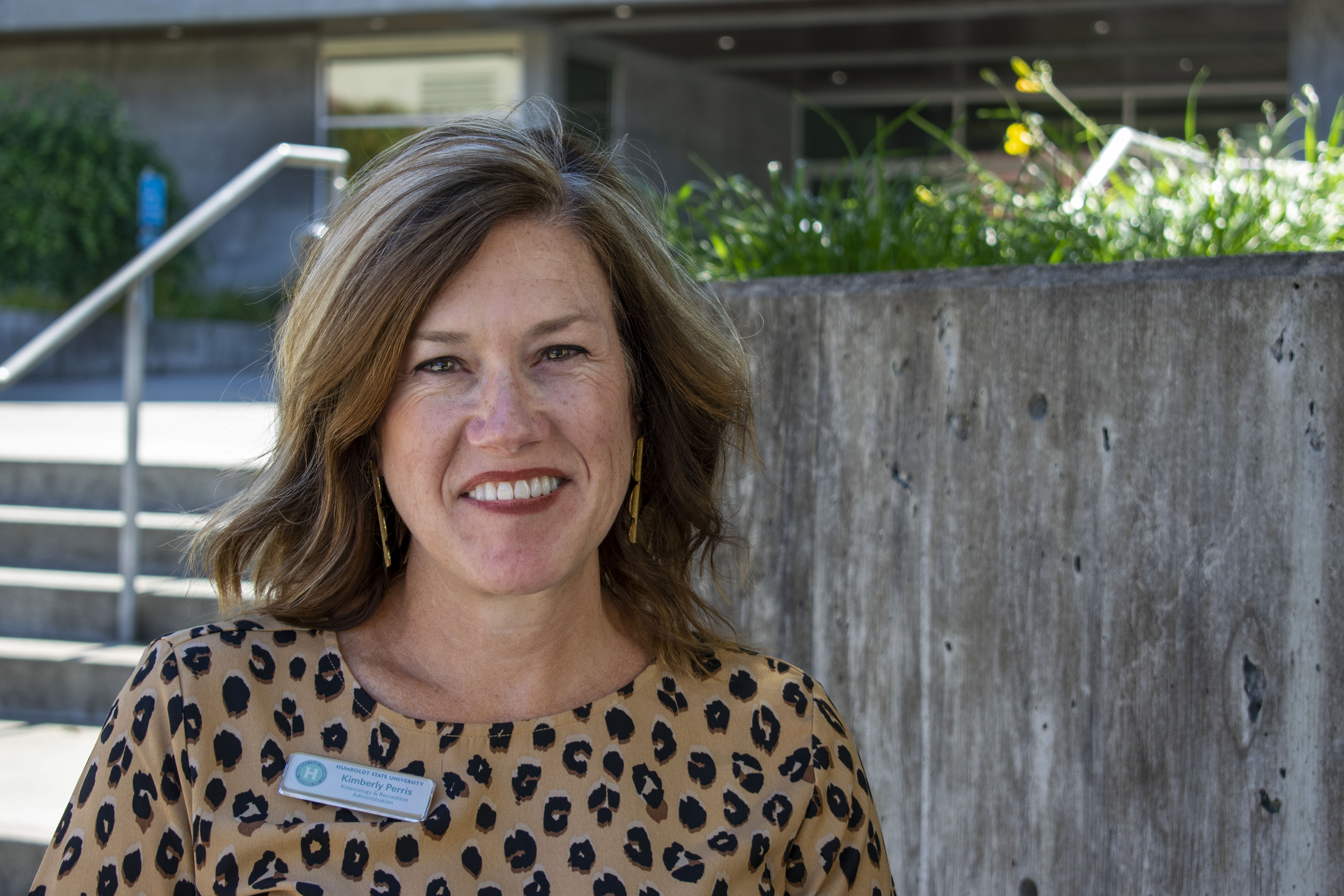
Four weeks into the job, Humboldt State University’s nursing program Director Kimberly Perris has started putting the pieces in place to reform HSU’s bachelor of science in nursing program.
Perris said she wants to empower local nurses to fill empty leadership roles in local health services.
“My excitement, what I’m hopeful for and why I’m grateful to be here is because I really envision a role for nurses where they can go beyond the hospital walls, work in team-based care models and just take on more autonomous roles,” Perris said.
Director of Special Projects and Executive Director of HSU’s California Center for Rural Policy Connie Stewart at HSU on Sept. 14. Stewart, an HSU graduate and former Arcata mayor, believes HSU’s BSN program will be essential for Humboldt County’s future. Photo by James Wilde.
HSU canceled its BSN program in 2011, citing a lack of funding and qualified faculty. After years of a lack of BSN-educated nurses, HSU is relaunching the BSN program with the help of a $2 million dollar grant from St. Joseph Health.
Director of Special Projects Connie Stewart leads the California Center for Rural Policy, an HSU program designed to improve rural communities. Stewart currently oversees fundraising for the BSN program, and she hinted the receiving of more than just the St. Joseph Health grant.
Stewart, a former Arcata mayor who has served the community for more than thirty years, said that Perris is perfect for the job.
“She’s got really great, fresh ideas about how to improve health care in Humboldt County,” Stewart said. “I couldn’t be more excited to be working with her.”
Stewart emphasized the importance of the BSN program not just for Humboldt County, but for HSU. HSU students and faculty, Stewart noted, need healthcare too.
“I’m grateful that we can provide the opportunity for nurses to expand on their education—I know for me it was life-changing to do that.”
Kimberly Perris
“This program has to be successful in order for HSU to thrive,” Stewart said.
Perris dabbled in health-related fields in her youth, where she said she picked up a passion for helping and educating patients.
Perris graduated with an Associate of Science in Nursing in 1991. She worked in family planning before she worked at the HSU Student Health Center from 2004 to 2016 as a nurse, a job Perris said she loved.
“I loved the education piece of it,” Perris said. “Working there is where I really decided to go back to school, and I saw a role for nurses that could be a little bit more fulfilling and autonomous and help improve access to care.”
Perris earned a Doctor of Nursing Practice Executive Leadership from the University of San Francisco in 2018. Perris said she’s driven to give other nurses the same educational opportunities she had.
“I’m grateful that we can provide the opportunity for nurses to expand on their education—I know for me it was life-changing to do that,” Perris said.
HSU’s BSN program is designed for already-registered nurses who want to further their education. Perris said this will allow nurses to become more involved with the community and work outside of hospitals.
HSU’s new BSN nursing program director, Kimberly Perris. Perris is working towards a goal of graduating 50 nurses from the BSN program by 2022. | Photo by James Wilde.
The program’s goal is to graduate 50 nurses in 2022, with 25 students entering a part-time, two-year program in 2020, and another 25 entering a full-time, one-year program in 2021.
Perris said she’s developing relationships with local health centers for BSN nurse roles. She’s also working to make the transfer process from College of the Redwood’s RN program seamless.
CR’s Director of Nursing and Health Operations Roberta Farrar echoed Perris’ hopes.
“My hopes and goals would be to see each class filled to capacity with a waitlist of those wanting to enter the program,” Farrar said in an email. “That the registered nurses who choose Humboldt State are satisfied with their education and use knowledge gained to make necessary changes in any healthcare setting they are employed.”
Both Farrar and Perris said the program won’t bring more nurses to the community, but will instead give more opportunities to nurses in the area, enticing them to stay in Humboldt.
“We have a struggling health care system right now and I think nurses are one of the missing pieces that can help to improve that… The missing links.”
Kimberly Perris
“A lot of nurses leave the area because they want to continue their education or there aren’t the kind of positions that they’re looking for,” Perris said. “So this role will provide more nurse leaders for the community and nurses to have more of a systemic look at the population.”
While Perris said she has felt overwhelmingly supported in her first few weeks, she did acknowledge the pressure of her position.
“I feel pressure because I want this to be successful,” Perris said. “And I want to make sure I have all the details in place to keep moving it forward and not let anything fall in through the cracks.”
Despite the pressure, Perris said she doesn’t have any significant fears.
“There will be likely a little series of things that don’t work, and that’s normal in a new project,” Perris said. “I’m sure there will be some hopefully-just-mini failures because this is a brand-new program, but that’s okay.”
Long-term, Perris said the BSN program will help nurses have a broader understanding of the community and its healthcare needs.
“We have a struggling health care system right now and I think nurses are one of the missing pieces that can help to improve that,” Perris said. “The missing links.”
No pee, hair or spit. One blow is all it takes to show marijuana intoxication levels with new breathalyzer.
Marijuana has been a touchy topic since Colorado and Washington made their first moves to legalize recreational use in 2012. Since then, 29 states have followed and declared marijuana legal for medicinal and/or recreational use.
Tension forms at the discrepancy between state and federal opinion on where marijuana falls legally as a drug. The lack of legal confirmation from the federal government makes it difficult for government employers, especially police officers, to execute and process circumstances surrounding marijuana intoxication. Recent developments in marijuana detection technology suggest a breathalyzer is in the works.
Current marijuana testing requires a hair, urine or blood sample. The test results detect past use up to six months and reports the current THC level in the body. This testing proves to be unreliable as past use of marijuana will distort a current reading of bodily intoxication, which is what law officials care about.
The two technology companies racing to release their version of a more accurate breathalyzer are Hound Labs and SannTek.
Hound Labs was established five years ago and is leading the race with an expected release of late 2020. The Hound Labs breathalyzer operates on a specified time basis. It can detect marijuana if it’s been used in the last three hours. The three-hour window comes from two findings; one, marijuana is only detectable for the first three hours. Afterward, THC levels drop so low and so fast that it becomes virtually undetectable. Second, the initial three hours of intoxication are the most impaired and therefore the most crucial.
The breathalyzer method proves to be more accurate and better suited for law and medical officials, as alternative testing can take hours to produce results. In addition, this method is also beneficial to the participant, as the regulated three hour time interval doesn’t hold participants liable for past usage beyond that time frame.
If this new testing method becomes normalized, the three hours prior to testing will be the most critical, but anything before those three hours is merely tangential. Ideally, someone tested for their marijuana use could not be held liable for their marijuana use prior to the that three-hour window because the breathalyzer would not be able to detect it.
The opposing company, SannTek, and their breathalyzer the SannTek 315 will operate similarly to the Hound Labs breathalyzer. SannTek 315 is still in early development so the company is not providing much information. Like Hound Labs, their product will utilize a time interval to reveal the last ingestion of marijuana and current intoxication.
Hound Labs conducted clinical testing in 2017 in cooperation with University of California, San Francisco. However, no findings have been concluded publicly due to the small sample size. SannTek 315 lacks any formal testing or trials at this time.
El Centro event welcomes and connects Latinx students and community members
Music and cheerful chatter filled Arcata’s Redwood Park on Sunday as Humboldt State University’s El Centro Académico Cultural held its Convivio de Bienvenida, a convivial welcoming event.
Ritz Garcia, a junior and critical race, gender and sexuality studies major and liaison for El Centro, said he has loved being a part of El Centro.
“It’s made me feel like family,” Garcia said. “Like there’s somewhere I belong.”
Ritz Garcia, junior critical race, gender and sexuality studies major, at the Convivio de Bienvenida on Sept. 15. Garcia is a liasion for El Centro. | Photo by James Wilde
The gathering served as an opportunity for Latinx students, families and community members to convene and connect with one another.
Resource centers from HSU and the local community offered information on a wide range of topics that included parenting lessons, food pantries, housing insecurity, drug addiction recovery, communication with law enforcement and the expansion of diversity in the community.
Meanwhile, children played in the grass and members of Latino Outdoors led hikes into the surrounding redwoods every 30 minutes.
Daniel Gallardo, vice president of LatinoNet and coordinator for the Assisting Families to Access Change Through Resources Americorps program, hoped to connect attendees with community offerings.
“There’s a perception of Humboldt not having a lot of resources,” Gallardo said. “We’re trying to debunk that.”
Gallardo emphasized that resources for the Latinx community are available in Humboldt but can be difficult to access. Gallardo urged students to join the AFACTR program, which has a goal of preventing child abuse in Humboldt County. AFACTR awards up to $10,000 per year in services.
Jorge Matias, health educator for St. Joseph Health, pushed table visitors to check out health classes offered in Eureka and Fortuna. Matias promoted a Zumba class for physical health but also emphasized the importance of mental health.
Vice President of Latinonet and Program Leader at Americorps Daniel Gallardo at the Convivio de Bienvenida, a Convivial Welcome from HSU’s El Centro Académico Cultural on Sept. 15 at Arcata’s Redwood Park. Gallardo hopes to make resources more available for the surrounding community. | Photo by James Wilde
“We want to get rid of the stigma with mental health,” Matias said.
Before rain clouds crept in, attendees enjoyed a free lunch alongside a brief mariachi performance. A table for Adventure’s Edge offered raffle tickets for two new backpacks while another table for Equity Arcata offered information on housing, employment and education.
El Centro intentionally designed the event with inclusivity in mind. El Centro, which was previously known as the Latinx Center for Academic Excellence, changed its name to better represent those it serves.
Lunch at the Convivio de Bienvenida, a Convivial Welcome from HSU’s El Centro Académico Cultural on Sept. 15. The event, held at Arcata’s Redwood Park, had free food for all attendees. | Photo by James Wilde
“Not everybody identifies as Latinx,” Garcia said. “El Centro sounds more inviting.”
HSU’s Hispanic Serving Institutions STEM grant, a $3.9 million U.S. Department of Education gift spread over five years, from 2016 to 2021, funded the event.
Each table offered its own brand of services focused on improving the local community. Bertha de la Cruz, a representative for Food for People, sought to connect attendees with free food resources.
“There’s tons and tons of food,” de la Cruz said. “I wish I would’ve known all of this as a student.”
Devon Hernandez, academic and career adviser, helmed a table for HSU’s Academic and Career Advising Center.
Academic and Career Advisor Devon Hernandez at the Convivio de Bienvenida, a Convivial Welcome from HSU’s El Centro Académico Cultural on Sept. 15 at Arcata’s Redwood Park. | Photo by James Wilde
“We’re here to make sure students have the resources they need,” Hernandez said.
For attendees of the Convivio de Bienvenida, resources appeared abundant. More information on El Centro and their upcoming events can be found in room 205 of Nelson Hall East or on their website which is still branded as the Latinx Center for Academic Excellence.
HSU football brought two communities together and now we’re at a loss
In July of 2018, with most of the student population home for the summer, former Humboldt State President Lisa Rossbacher and former Athletic Director Duncan Robins made the announcement that the HSU football team would be cut following the conclusion of the 2018 season.
The efforts of many community members to raise money for the football program earlier in the year were seemingly for nothing. Many community members, including myself, were outraged about the decision to cut the football team, but some applauded the move, saying that a football program was unnecessary and a drain on academics. Either side you may be on, it was a polarizing move for the university to make.
I am part of the small percentage of HSU students that grew up in Humboldt County. In fact, I grew up right here in Arcata about a mile away from the HSU campus. I am as local as a local student can get. I spent a good portion of my life going to HSU football games and it became a significant source of pride that my small town had a Division II college football team. When I started attending HSU, this was not just my school’s football team, this was my hometown team as well.
When I transferred to HSU from College of the Redwoods, the first thing that caught me off guard about HSU was how separate it seemed from the rest of Arcata. Even though I was going to school in my hometown, HSU felt like a world of its own, far from the Arcata I grew up in. I felt that my identity as a native of Arcata and a student at HSU were two separate worlds, even though in a geographic sense I was in the same place.
HSU football games were one of the only times that these two worlds felt one and the same. The games became some of the only times where I saw both students and local community members in the same place, at the same time, rooting for the same team. People from Arcata and Los Angeles alike, all rooting for the Jacks.
It wasn’t just about the football team itself, but it was how football brought the entire community together. Getting rid of the football team felt like severing one of the last ties between the campus community and the local community.
The only good news I can gather from this is that the Redwood Bowl is actually seeing more football this season than when the HSU football team was active. My alma mater, College of the Redwoods will be playing their football games at the Redwood Bowl starting on October 5, and both Arcata High and McKinleyville High are playing their football games on campus as well.
I hope that someday HSU football will be brought back, but in the meantime, all of the other HSU athletes that are still here deserve our full support. Go Jacks!
“It doesn’t have to be a human, and that way you don’t have to get into a big debate.”
Humboldt State University is known for its tree-filled campus and our lovable Lucky the Lumberjack mascot. However, some take offense to the patriarchal figure, so we asked HSU students what they’d replace our mascot with if Lucky were to be changed.
HSU chatbot introduced to new students to answer campus questions
This fall, Humboldt State University introduced artificial intelligence chatbot HumBot to provide basic information for new students and transfers.
Director of Communications and Marketing for Enrollment Management Josh Smith led the project over the last two months until its release.
Thus far, HumBot has received more than 1000 questions and comments.
“There is a good chance that those questions may not have been asked if that avenue was not available to them at the time,” Smith said. “We get them at all hours of the day.”
Provost and Vice President of Academic Affairs Alexander Enyedi initially pushed for the development of a chatbot two years ago after hearing about a chatbot at Georgia State University. Pounce, the name for GSU’s chatbot, delivered more than 200,000 answers to incoming freshman within the first few months of its implementation in 2016.
Enyedi, with help from Smith and Associate Professor of Social Work Jen Maguire worked together to create HumBot.
“I’ve been a passionate proponent for the chatbot technology for over two years,” Enyedi said in an email.
HumBot is one chatbot among seven within California State Universities. AdmitHub, an AI chatbot service designed for students, developed all seven chatbots.
HSU created HumBot in the last two months after receiving an $80,000 grant from the Irvine Foundation.
AdmitHub handed over HumBot pre-seeded with answers to the 700 most common questions asked by first-year students. HSU then needed multiple departments to analyze the answers.
“It was started off by everybody just going in there, reading all the questions and answers, and first making sure that it was accurate, and second, trying to make it a little bit more friendly,” Smith said.
HSU staff and summer students then seeded HumBot with an additional 150 questions before it was released this fall. HumBot will continue to learn as students interact with it.
HumBot responds to fisheries transfer student Matthew Howe on Sept. 3. HumBot has answers to over 850 questions so far. | Photo courtesy Matthew Howe
“That is going to be an ongoing, multi-year, get smarter each time kind of thing,” Smith said.
Associate Professor Maguire is conducting research through the bot and Smith said she has been shaping HumBot to address issues specific to HSU. Maguire could not be reached for an interview.
“She is kind of the intellectual arm of the chatbot,” Smith said. “She and her colleagues are seeding the knowledge base of the chatbot with questions that relate to housing insecurity, food insecurity—HumBot is still learning those things, but it is our particular brand.”
Transfer fisheries student Matthew Howe used HumBot to find out where to pick up his mail. Howe admitted to being surprised by how well HumBot worked.
“I thought it worked fairly well,” Howe said. “I was expecting it to not perform at all. I was surprised at how well it did work.”
Howe said he would use HumBot again, although he doubts he would ask it anything personal.
Smith noted that questions sent to HumBot can be viewed by the project staff. HumBot is unlikely to be helpful for personal matters, although with the possibility of endangerment HumBot can notify university police.
Smith hopes HumBot can play an important role in the modernization of HSU’s accessibility.
“I would just encourage students to kind of re-look at those things that maybe they don’t know about or maybe weren’t up to par with a couple years ago,” Smith said.
For now, HumBot is only available to new students, but it is expected to roll out for second and third-year students next fall.
Universal Pictures cancels release of HBO thriller after Trump slams movie in tweet
“Elites” killing “Deplorables” may sound like an extreme interpretation of today’s politics. “Deplorables” is a recognizable term from the 2016 presidential election that Hillary Clinton used to describe Trump supporters; the word alone draws an immediate connection between the plot of the movie and real-life political strife.
“The Hunt” is a new movie created by Nick Cuse and Damon Lindelof. The movie drew inspiration from real-world politics and the short story “The Most Dangerous Game” by Richard Connell. The thriller quickly morphed into an uncomfortable and realistic take of today’s world.
Advertising for the satirical thriller was stopped out of respect for the mass shootings. However, even after the cancellation, both the president and public continued to express concern and disapproval over the plot.
Ultimately, the vocalized disapproval resulted in Universal Studios pulling the plug and releasing a press statement:
“After thoughtful consideration, the studio has decided to cancel our plans to release the film. We stand by our filmmakers and will continue to distribute films in partnership with bold and visionary creators… but we understand that now is not the right time to release this film.”
Donald Trump’s tweet that finishes his previous message on Aug. 9.
The ‘now’ Universal references is modern-day society. Recent events have created a tense and polarized political atmosphere that has resulted in a hypersensitive society. The idea of hunting and killing those who have opposing views, regardless of the satirical message, is too intense for the people of today’s political climate. Violence is quickly becoming a normalized aspect of society, in other words, a reaction to everything.
The president agreed with the public, tweeting the plot, “Elites” versus “Deplorables”, is bad for the country and, in a classic Trump response, that the creators of the thriller are racist.
“They like to call themselves “Elite,” but they are not Elite… The movie coming out is made in order to inflame and cause chaos… They are the true Racists, and are very bad for our Country!”
The following day, Universal released its statement regarding the cancellation of the thriller. While the racist accusation stands unsubstantiated, I agree with Trump in regards to the way the movie encourages chaos and violence.
Is the fantasy of killing others who oppose our morals that far-fetched from what is on the news today?
While the thriller seems to be a fully canceled ordeal, Cuse and Lindelof will continue with the release of the thriller through “bold and visionary creators.” Maybe there is hope for those wanting to see the film.
Cross country dominated at home, volleyball won two of three games and soccer had mixed results
The Humboldt State men’s and women’s cross country teams stood out at the Baywood Golf and Country Club on Sept. 6, while women’s soccer lost on the road and men’s soccer started the season with a 1-1 record. The volleyball team won two out of their three games at the Toro Classic in Carson, CA.
The HSU cross country team performed well in front of the home crowd as they walked away with sweeping wins in men’s and women’s competition. Senior Daniel Tull took first place for the Lumberjack men, and freshman Hannah Hartwell nabbed first place for the HSU women.
The HSU volleyball team lost their first match in Carson against Cal St. Dominguez Hills (3-0), but were able to bounce back with sequential wins against Academy of Art (3-0) and Notre Dame De Namur (3-2).
Women’s soccer went 0-1-1 on their Bay Area road trip, losing to Academy of Art (2-0) and tying against Notre Dame De Namur (1-1). Men’s soccer was able to go 1-1 on their San Rafael road trip, pulling off a comeback win against Dominican (4-3) in overtime and falling to Holy Names (3-2).
At the Sept. 10 HSU Athletics press conference, each coach and player from their respective sport spoke on their team’s performance and looked ahead to upcoming matches.
Cross Country
Head Coach Jamey Harris was ecstatic about his team’s performance in front of the home crowd at Baywood, and it helped that the Jacks had a supportive home crowd behind them. Harris noted the fact that HSU President Tom Jackson was in attendance, along with several members of the local running community.
“I couldn’t have asked for the season to start any better,” Harris said. “This was sort of an early-season meet just to see where we are at as we go into more specific training.”
Harris also talked about how important it was to the team that the community came out to support and noted how it works both ways, with the team also wanting to contribute back to the community.
“It shows our runners that the community cares and that the campus cares,” Harris said. “It helps them see the value in investing their time in the community, and it becomes a great cooperative relationship that way.”
The cross country team has a little more than a week to train and prepare before they make their way up to Monmouth, Oregon for the Sundowner Invitational on Sept. 20.
Volleyball
Head Coach Kelly Wood was happy about the Jacks bouncing back after losing the first match against Dominguez Hills. Wood talked about the unforced errors that the team made, but also acknowledged that the season had just started.
“We absolutely looked like a team playing its very first match of the season against Dominguez Hills that first night,” Wood said. “We made 36 hitting errors. That’s an insane amount of hitting errors, and that’s a recipe for disaster.”
Despite a rough first match, the Jacks were able to steal wins against their next two opponents at the Toro Classic. According to junior outside hitter Lexi Riggs who had the second-most kills during the classic with 37, the group raised their energy level for those next two matches.
“Everybody stepped up,” Riggs said. “Every single person on the team stepped up and got themselves going. I think what turned it around for us was the energy.”
The volleyball team will travel to the West Region Showcase in San Francisco for matches Sept. 12-14.
Men’s Soccer
The Jacks had a mixed weekend against Dominican and Holy Names, but the win against Dominican was a season opener that many on the team won’t forget anytime soon.
Going into the 53rd minute, the Jacks trailed 3-1. They were able to score twice and force overtime, and then defender Gus Baxter drew a foul in the penalty box and buried the game-winning goal to complete the comeback.
Baxter gave credit to his teammates for putting him in the position to draw the game-winning penalty. He gave credit to Dalton Rice for his two clutch goals, one in the first and one in the second half of the game.
“There were a couple of good passes around the box and then all of a sudden the ball is at my feet,” Baxter said. “I shoot, and it hits the guys hand. I took a deep breath, stepped up to it and buried it.”
The Jacks will get on a plane early Thursday morning and head to Billings, Montana this weekend where they will play Montana State University at Billings and the University of Mary.
Women’s Soccer
The Jacks weren’t able to get a win on their road trip, but they did get the tie in a hard-fought game against Notre Dame De Namur. Despite the results, Head Coach Paul Karver was able to see early-season improvements in the team.
“I think we saw a lot of the hard work that was put in over the offseason,” Karver said. “Going 2-0 would be super fun, but in a weird way, I’ll take where we’re at. The lessons we learned were really important, and that is what the preseason is all about.”
The Jacks will travel up to Karver’s hometown of Portland, Oregon this weekend for matches against Concordia and Saint Martin’s.
“The Office” is a globally popular show that many return to watching when other TV series come to an end. Personally, I have rewatched this show over 20 times from start to finish. This is a show that can be rewatched over and over. The jokes are still as funny as the first time you heard them, thanks to its balanced use of comedic tropes.
For many people, the show is background noise to fall asleep to.
Anyone who falls asleep to “The Office” knows that the sound of the intro and credits is loud enough to wake the dead.
This show has had a huge impact on many people’s lives, whether it results in having a good laugh after a long day or it just plays as a favorite binge watch series on a Sunday afternoon. “The Office” is so impactful that there are groups online dedicated to talking about it all day, every day.
It is ridiculous to have to pay for another streaming service just for the one show, but some of us just might. I think Netflix is just fine for the simple fact that it has a variety of shows and movies from multiple TV networks, but we are losing a beloved show thanks to NBC’s corporate greed. Make sure to watch “The Office” as much as you can before it leaves Netflix in January 2021.
As Michael Scott once said, “I don’t hate it. I just don’t like it at all and it’s terrible.”
HSU Women’s Rugby trains for a new division placement and tougher opponents
An evening of practice with the Humboldt State Women’s Rugby team consisted of preparation for their first home game of the season on November 23 against Sacramento State. The team has recently moved to Division II which means this season they will be competing against 10 schools as opposed to five.
HSU athletics is no stranger when it comes to long distances of travel. Rugby athlete Libby True spoke on the recent division transition.
“I began playing during my freshman year,” True said. “We started off playing against 10 games then to six games and now back to 10.”
Having additional opponents gives the team an opportunity to capitalize on more wins and get an early lead in their division. They are making modifications to their practice routines to prepare for the extensive weeks of play against opponents they have never faced.
“We’ve never played against them, so we aren’t sure what we’re up against,” player Hanna Hartman said. “But with the way we’ve been practicing it shouldn’t be a problem.”
Despite the unknown challenge that awaits, there is no denying that the team will utilize techniques that keep their players operational. Whether it’s taking hits or falling, Hannah explained that playing efficiently is key to avoiding unwanted injuries.
Junior Zelaya Ceja throws the ball to a teammate during a touch game in practice for the women’s rughby team on September 5. | Photo by Thomas Lal
“We learned how to hit and fall properly,” Hartman said. “There’s a right way to do it safely.”
Rugby is physically demanding with frequent body collision and the occasional injuries, therefore players are encouraged to work on their endurance to take hits routinely.
Claire Branson has played rugby for three years at HSU and provided her input on avoiding injuries.
“Keep your core muscles strong, when you get tackled it’s a lot of core strength,” Branson said. “Make sure it’s tight, so you’re not pulling muscles.”
During practice, players utilize precautions to ensure safety. When playing an impact sport like rugby, building endurance is essential.
Safety Officer and player Janay Aoga has high expectations with endurance training, since it lands on days that players invest their time working out.
“On our conditioning days we focus on staying strong and fast because fit rugby is fun rugby,” Aoga said.
A sport can’t be fun if there’s no one around to play, but it’s a different tone when it comes to the HSU women’s rugby team. Their love for the sport shines through their resilience and determination.
CCAT plans to keep pigs on campus to reduce food waste
Humboldt State University’s Campus Center for Appropriate Technology plans to house two pigs on campus as soon as next week.
CCAT will loan the pigs from the Tule Fog Farm in Arcata for the duration of the fall semester. CCAT plans to feed the pigs food waste from HSU’s J dining hall.
Jacob Gellatly, environmental resources engineering major and former CCAT Co-Director, helped lead the project from concept to reality.
“We want to show how animals can be raised in a residential environment, and how you can use urban byproducts such as food waste to raise animals in an urban setting,” Gellatly said.
EnvironmentalRresource Engineering majors Jacob Gellatly (right) and Kong Vang (left) prepare a log on Sept. 6 to be used for the roof of a pig pen. | Photo by James Wilde
The plan to house the pigs began last fall when students in the CCAT Student Club vocalized interest in keeping animals on campus. CCAT contacted Shail Pec-Crouse from the Tule Fog Farm in Arcata. Pec-Crouse recommended pigs as the most viable animal.
“The easiest animal for us to raise would be pigs,” Gellatly said. “The reasoning for that is—a big thing is predators. So it’s a lot harder for something to come and get a hold of a pig as opposed to a chicken.”
As part of their plan, CCAT realized they could feed the pigs food waste from the J. While CCAT couldn’t feed the pigs food thrown away by customers of the J, CCAT could feed the pigs pre-consumer waste, such as food trimmings or spoiled foods not suitable for people.
“Another goal with the project was how can we divert food waste on campus,” Gellatly said. “And with that we can feed almost, and in some cases, their entire diet from food waste that’s at the school here.”
Once CCAT decided to loan the pigs from the Tule Fog Farm it needed approval from HSU’s Associated Students, Institutional Animal Care and Use Committee, Facilities Management, Risk Management and an environmental health and safety specialist.
The pig pen-in-progress on Sept. 6. CCAT plans to house two pigs in the pen for the duration of the fall semester. | Photo by James Wilde
Humboldt State’s IACUC reviews the use of animals on campus to ensure the animals are treated humanely under the requirements of federal and state law. College of Natural Resources Associate Dean Rick Zechman, who chairs IACUC, said the IACUC proactively reviews and inspects over 100 animal-involved projects on campus each year.
“There’s varying kinds of emotional feelings about the use of animals, and that’s respected and honored in the system of review,” Zechman said. “And that’s why the Animal Welfare Act was developed, to prevent mistreatment of animals. And I think, you know, in our committee, that’s sort of our first principle.”
While Zechman could not comment on the details of CCAT’s proposal, which is still pending, CCAT has worked over the last year to assuage concerns raised by various HSU faculty.
CCAT started by building a pig pen out of reclaimed wood from a local logging operation in Fieldbrook. CCAT has since integrated plans for a roof to prevent flooding of the pen and security to prevent people from getting harmed by the pigs.
In the long run, Gellatly hopes the project might convince the University to keep animals around for good.
“Big picture, I would like the school to see this and see, with what we’re having to deal with—getting rid of all this food—we could be raising meat for the school and have locally-produced meat with a byproduct of our current dining system,” Gellatly said.
Environmental Rresource Engineering majors Jacob Gellatly (right) and Kong Vang (left) working with a log for the pen. | Photo by James Wilde
CCAT’s plan to house pigs has only recently become known to the wider HSU campus. Saraí Escalante, psychology graduate student and president of HSU’s Vegan Club, sees the value of reducing food waste but wonders about the sustainability of the project.
“I think the underlying problem is that we see them as a convenience, as objects, so we see them as a tool to help us fix a problem or make our problems or our lives easier,” Escalante said. “And from a sustainability point of view, you still waste a lot of water in all of the slaughter process and the cleaning up of the meat. In that way, it wouldn’t be sustainable.”
Escalante said she’s considering starting a fundraiser to purchase the pigs and send them to a sanctuary instead of a slaughterhouse. However, Escalante said she plans to talk with CCAT to exchange thoughts, as she does like the idea of reducing food waste on campus.
Gellatly, for his part, noted that the current plan as registered with Tule Fog Farm and IACUC is for CCAT to house the pigs only for the rest of the semester.
“I think it’s, in theory, possible for them to buy the animals from the farmer if that’s something they’re inclined to do,” Gellatly said. “But, as far as our scope goes with the IACUC, once the project’s done, we’re taking the animals back to the farm and that’s where it ends for us.”
The project’s beginnings are dependent on approval from IACUC, but the pigs could arrive at CCAT as early as the week of Sept. 8 through 14.
Part 1: We discuss the opening seasons of competition for Humboldt State sports including cross country, volleyball and soccer. We also provide an update on HSU basketball alumni Justin Everett’s move to professional basketball in the Republic of Georgia.
Part 2: With hockey season just around the corner we recap the San Jose Shark’s 2019 playoff finish and offseason. We also talk free agency with the Sharks’ losing Captain Joe Pavelski, and give our thoughts on the re-signing of Defenseman Erik Karlsson as well as Timo Meir and Kevin Labanc.
Part 3: Conversation turns to the start of the NFL season and the teams we support. We talk about some of the more notable scorelines form the weekend. We also dip into some NCAA news, with California attempting to pass a bill that would see college players compensated for having their likenesses used by schools.
Part 4: In the closing segment we talk some Formula 1 off the back of the Italian Grand Prix heading into Singapore and speak about the death of Formula 2 driver Anthoine Hubert. We also address the international basketball scene with the U.S.A. being eliminated from the 2019 FIBA World Cup.
Companies outed on social media for funding political advocacy groups
A long list of companies that use profits to fund pro-Trump advocacy groups was recently published to several social media sites.
This scandal begs an important question, are our purchases worth it if they support a larger cause, or person, we might not necessarily support ourselves?
Companies including SoulCycle, Equinox, CVS and Taco Bell were just a few of those exposed on Twitter and Instagram.
SoulCycle and Equinox were the first two companies to feel the heat. Equinox was quickly trending on Twitter but for all the wrong reasons. With hashtags such as: “#BoycottEquinox” and “#BoycottSoulCycle,” both companies went under fire from paying subscribers.
The social media frenzy didn’t go without notice for long, as both gym facilities soon released a public disclaimer on social media. Both claimed that the day-to-day operations are in no way affected or influenced by the owner, Stephen Ross, and his political affiliations.
The boycott continues as news of Ross hosting a fundraiser for Trump in the Hamptons surfaced with tickets costing as much as $250,000.
SoulCycle and Equinox were not the only major players under scrutiny.
The boycott hashtag trend lives on with CVS. “#BoycottCVS” was created as the company donated $35,000 to the Trump Victory PAC (Political Action Committee), becoming one of four biggest donors involved in the reelection campaign. Additionally, they donated $500,000 to America First Policies in 2018.
America First Policies, is a “non-profit organization supporting key policy initiatives that will work for all citizens in our country and put America first,” however, Mike Pence’s face is the first thing you see upon opening the homepage of the website; giving a strong indication of who is involved and what political beliefs are represented.
Recently, the organization has been accused of being racist, homophobic, sexist and anti-Muslim after several outbursts containing these sentiments from the advocacy director were found online.
Taco Bell, specifically the Taco PAC, is reportedly one of four companies to donate the most to the Trump election campaign in 2016. In regards to the 2020 election, however, no donations have currently been made to the Trump PAC.
There are larger consequences to the spending decisions we make. This new information should make us challenge our mindfulness behind the actual value behind a purchase, knowing our money, in a way, is going toward supporting a larger cause. Ultimately, losing leverage and control over our money and what it is funding is an uncomfortable reality.
However, between public disapproval and social media boycotts, the power in being a consumer is important to remember. Consumers have the power to persuade companies. All the recent public outcry towards Taco Bell has coincided with the withholding of any 2020 campaign donations from them and that is no coincidence.
Regardless, the power of being a consumer is something we often forget and take for granted. The next time you find yourself in a Taco Bell drive-thru, ask yourself: is the taco really worth the dollar?
Sharks Forward Evander Kane speaks out about racism in the NHL
On August 28, the San Jose Sharks’ forward Evander Kane shared a comment, left by a fan, on his recent Instagram post. The fan was telling the 10-year National Hockey League veteran to stick to basketball. Kane stands out on the ice not only due to his physical play and scoring prowess, but also because of his ethnicity.
Kane is the only player who openly identifies as black on the Sharks roster and is one of only a handful of active black players in the NHL.
Kane responded to the post by reaffirming his belief that racism surrounding the NHL needs to be more thoroughly addressed.
“This exact thing was shouted at me in the penalty box in Denver during game 4,” Kane wrote on Instagram. “It’s racially motivated. It’s a problem in society and in sports. There is a focus on racism in football, basketball and baseball but in the hockey world it’s easier to ignore, dismiss and forget because let’s face the facts; hockey is a white sport.”
Kane’s remarks point to the fact that although the NHL was never officially segregated when it was founded, it wasn’t until 1957 when Willie O’Ree took to the ice for the Boston Bruins that a black player played. Even after O’Ree broke through the unspoken color barrier, there was never an influx of black players in the league.
“There is a focus on racism in football, basketball and baseball but in the hockey world it’s easier to ignore, dismiss and forget because let’s face the facts; hockey is a white sport.”
Evander Kane
According to a 2016 survey by TD Ameritrade, parents generally spend $100 to $499 per month on youth sports. The San Jose Junior Sharks list on their website costs of $1,800 to $6,900 for a full season of hockey depending on age that typically lasts around six months. The median income for a family household in the U.S. is approximately $77,000 per the Census Bureau while for black families, the median is only around $40,000. This adds yet another opportunity barrier for young black players to participate in youth hockey.
In addition to the upfront cost, there are constant purchases needed to maintain sporting equipment and replace broken gear. This massive price presents an additional difficulty for families in minority groups who historically may not have the disposable income to support the financial burden of hockey for their children.
If the financial support and skill are present to allow a player of color to make their way through the youth hockey system into the NHL, players tend to have experiences similar to that of Kane.
After scoring a game-winning playoff goal in 2012, Joel Ward was the subject of racial bigotry on social media. Also in 2012, two-time All-Star Wayne Simmonds had a banana thrown at him during a pre-season game in London, Ontario.
In 2018, Washington Capitals forward Devante Smith-Pelly was the victim of several fans chanting ‘basketball’ at him while he was in the penalty box, suggesting the black winger was in the wrong sport.
These overt displays of racism within the NHL fanbase prove that there is still a long way to go to educate and diversify fans of the sport. While some fans may complain that players are speaking about their experiences, the only way to improve matters will be through players like Kane speaking out and bringing attention to the problem.
A few ways to get to sleep easier according to science
Being relaxed, refreshed and clear-minded are common themes for getting to sleep. Going to sleep and waking up at the same time each day is touted as the most effective way to ensure good sleep. Beyond that, here are seven other great strategies for passing out.
1. Sleep in a colder room: To initiate sleep, your body has to cool down a couple of degrees. A colder room will get you there faster.
2. Take a hot shower or bath before bed: When you’re exposed to hot temperature, blood vessels on your skin’s surface swell to release heat. This will help you cool down.
4. Don’t nap too late in the day: A late-day nap can make it harder to fall asleep at night, since your brain’s already had some rest and may want to stay up.
5. Relax before bed: Relaxing before bed will prepare your brain for bedtime. Doing a relaxing activity such as reading or yoga for an hour or so before bed will prepare you for sleep.
6. Avoid bright screens at night: Screens emit blue light, a wavelength of light which tricks our brain into thinking it’s daytime. Putting the phone away an hour or two before you go to sleep will make it easier to fall asleep.
We all have our own methods for falling asleep. Personally, I like to lay on my belly and cover myself in pillows, but I’m weird like that. I asked students on campus what their methods were for falling asleep. Here is what they said:
Stephanie Rodriguez and Krystal Padilla both have pre-sleep rituals that prepare them to crash.
“I feel like de-stressing,” Rodriguez said. “Taking a shower, doing a face mask, smoking a bowl. You have to turn off your brain before actually going to sleep. I hate going to bed actually thinking about stuff.”
“I have these Christmas lights in my bedroom and I turn those on, I smoke a blunt, I listen to music,” Padilla said. “I’m just relaxing, I feel refreshed and I just brush my hair. It helps me go to sleep.”
Gigo Derderian and Seamus Begley have straightforward methods for getting to sleep. Allowing sleep to wash over them, they lay in bed either meditating through discomfort or rolling around until maximum coziness is achieved.
“One thing I do is I lie down and try to stay as still as possible,” Derderian said. “Even if I feel an itch or something I just ignore it. I will kinda start with my toes and work my way up. I try to make sure I’m comfortable and relaxed in every point in my body. By the time I get to the top, I’ll already be dozing off.”
“Whenever I’m going to sleep, I’ll lay down and I just need to get really comfortable,” Begley said. “I’m always rolling around for the first five minutes and then I find a spot where I’m like ‘yeah, that’s it,’ and then I’m just out.”
School demands a lot from students. We can be pushed to a limit as project deadlines approach. The stress we face is definitely real, but we shouldn’t let that get in the way of some shut-eye. Sleep is just as important as eating and exercising when it comes to health. Get some.
Humboldt County firefighters, community members and HSU students walk HSU’s Founders Hall stairs in honor of those who died at the World Trade Center on Sept. 11, 2001.
Arcata Fire Disctrict Battalion Chief Sean Campbell’s gear and water bottle sit by the base of the Founders Hall stairs on Spetember 11 as Arcata Fire Department prepares to walk 20 flights of stairs in memory of those who lost their lives at the World Trade center.
Arcata Fire Captain Luke Walker walks with his wife Sinei and their daughter Lina on Spetember 11 in remembrace of those who lost their lives at the World Trade Center.
Humboldt County firefighters, Arcata Police officers and community members walk 20 flights of stairs at Founders Hall in remembrance of those who lost their their lives at the World Trade Center on September 11.
Arcata firefighter Russell Kadle makes his way up the Founders Hall stairs with a New York hook on September 11 in honor of those who lost their lives at the World Trade Center.
Arcata Fire Disctrict Battalion Chief Sean Campbell (Center) walks up the Founders Hall stairs while others head down in remembrance of those who lost their lives at the World Trade Center on September 11.
Public Information Officer Amy Conlin and James Hamilton walk up the Founders Hall stairs on September 11 for Humboldt Bay Fire and Cal Fire Del Norte Unit repectively in remembrance of the firefighters and civillians who lost their lives at the World Trade Center.
Volunteer with Kneedland Fire Ruger West walks up the Founders Hall stairs on Spetember 11 in remembrance of those who lost their lives at the World Trade Center.
HSU president Tom Jackson cariers an oxygen tank while walking with firefighters and community members on September 11 in recognition of those who dies at the World Trade Center.
Kneeland Fire Captain Everett Buell makes his way up the Founders Hall stairs on September 11 in honor of those who lost their lives at the World Trade Center.
Arcata firefighter Luke Walker gives a brief speech about walking in remembrance on those who lost their lives at the World Trade center as firefighters from around Humboldt County and community members prepare to walk 20 flights of stairs on September 11.
Students from Arcata Christian School wave American flags as firefighters and community members walk up and down the Founders Hall stairs on September 11 in honor of those who lost their lives at the World Trade Center.
This website uses cookies to improve your experience. We'll assume you're ok with this, but you can opt-out if you wish. Cookie settingsACCEPT
Privacy & Cookies Policy
Privacy Overview
This website uses cookies to improve your experience while you navigate through the website. Out of these cookies, the cookies that are categorized as necessary are stored on your browser as they are essential for the working of basic functionalities of the website. We also use third-party cookies that help us analyze and understand how you use this website. These cookies will be stored in your browser only with your consent. You also have the option to opt-out of these cookies. But opting out of some of these cookies may have an effect on your browsing experience.
Necessary cookies are absolutely essential for the website to function properly. This category only includes cookies that ensures basic functionalities and security features of the website. These cookies do not store any personal information.
Any cookies that may not be particularly necessary for the website to function and is used specifically to collect user personal data via analytics, ads, other embedded contents are termed as non-necessary cookies. It is mandatory to procure user consent prior to running these cookies on your website.