By Barley Lewis-McCabe
“Some of the rules that still apply to [US Senate], for instance dueling between two consenting adults, is still there,” Department of Homeland Security Secretary and nutjob Fascist Crybaby Markwayne Mullin said during a tense senate hearing to decide whether he would take control of our country’s least reputable department.
“It’s been illegal for over 170 years,” Rand Paul, the lowly homeland security commission chief interrupted.
This isn’t an article about Mullins’ disastrous senate hearing, nor his recent appointment. No, I’m not here to harp about how a short tempered chud with anger issues that likes to play army-man is the worst person to be in charge of our country’s barely-regulated wholly unnecessary ultraviolent white-supremacist militia. I’m not even gonna talk about the despicable caning of Charles Sumner back in 1856. Mullins’ hearing reignited one of the longest standing debates in American history; what’s so bad about dueling?
For those who aren’t familiar with the hit musical Hamilton, a duel is a battle between two people when conventional conflict mediation techniques have been exhausted and someone’s honor offended in such a way that they would kill to reclaim it.
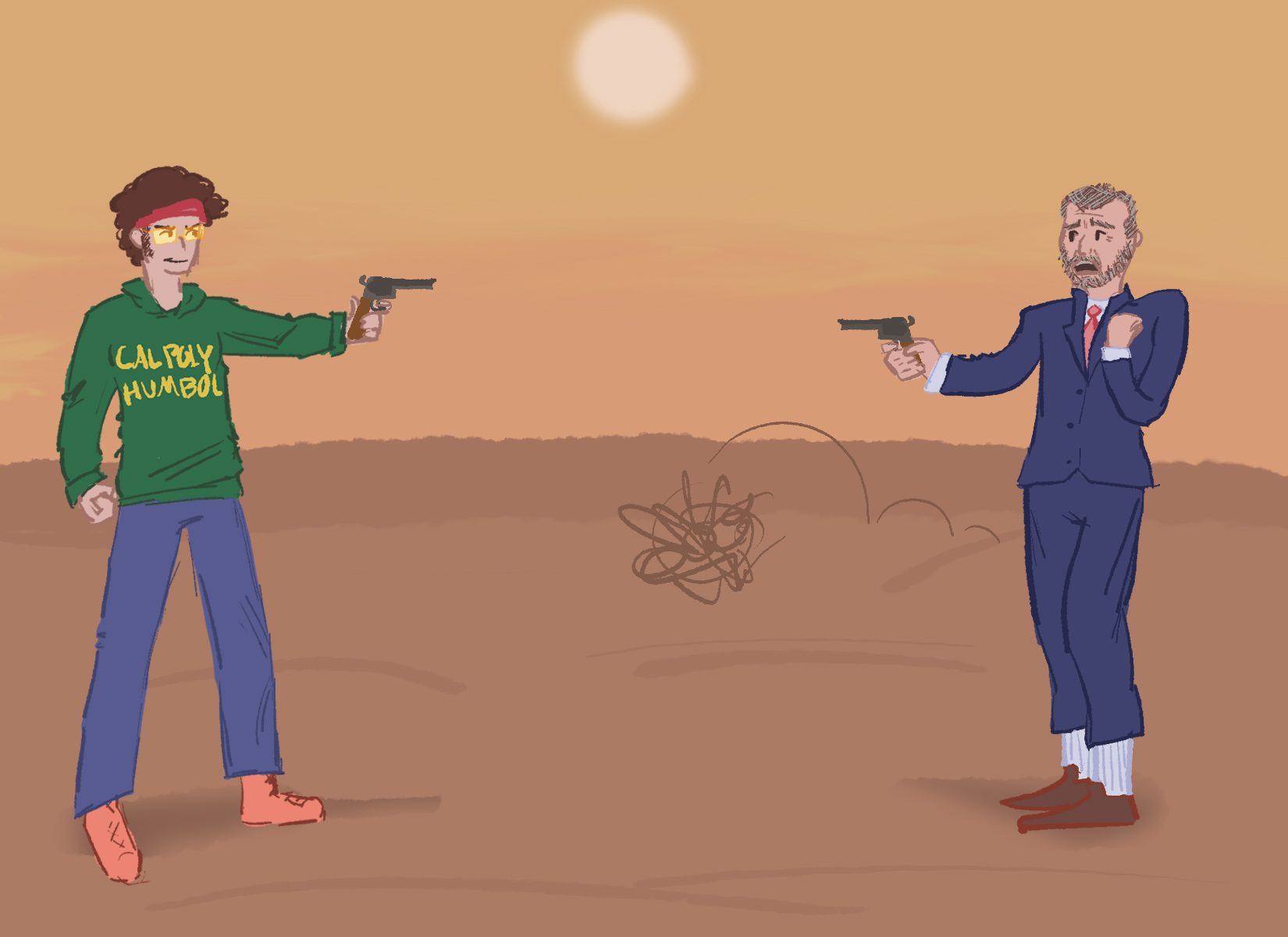
As a weed-smoking, bandana-wearing, Grateful Dead-listening Cal Poly Humboldt journalism student, I am, of course, against violence. But, despite everything, I’d have to agree with Marky-boy that dueling between two consenting adults is perfectly reasonable.
Yes, people can die, but duels were never just an easy way to kill someone; they were a way for two people, who are awful at communicating and don’t know the meaning of ‘forgive and forget,’ to fairly settle a dispute and reclaim lost honor.
Since people wanted a game of life or death to be as fair as possible, dueling followed a strict code. The most popular of which — Code Duello — was written in Ireland in 1777 and spread throughout the Western world. After the invitation to duel is accepted, both parties select a second, someone to ensure the duel is fair, attempt reconciliation on their friends behalf and hopefully prevent an unnecessary death. The challenger decides where they meet, and the challenged picks the weapons. Former Newspaper Columnist and — better known — President Abraham Lincoln once avoided a duel by exploiting his seven inch height advantage and choosing cavalry broadswords of the largest kind frightening his opponent, Newspaper Editor James Shields enough to reconcile. It’s not known if Abe apologized for the distasteful poems he published about Shields.
The duelers discuss their issues one more time; if no one apologizes, they battle. They each fire two shots at their opponent and if neither of them are injured, the duelists try to talk out their issues one more time. If that doesn’t work, they fight until someone is injured, killed or begged for mercy. A person could also apologize during a duel to avoid death, which was also considered highly honorable whether you started it or not.
Dueling isn’t just bloodsport, there’s no shortage of clauses in Code Duello that exist to prevent death. It’s simply a way to settle the classic immovable object vs unstoppable force dilemma. In the late 1800s, dueling lost popularity to the sport of fisticuffs — AKA, boxing — or mutual combat — all of which are, for the most part, legal.
Yes, duels are a relic of the past, and before you ask, no, our senators probably shouldn’t duel each other live on Kick. Violence is awful when exerted unnecessarily and on an innocent person, such as caning — which is still bad. If two people just can’t agree with each other, then they should be allowed to respectfully duel it out in accordance with Code Duello, with a mutual understanding that an apology would always be preferable to a kid without a parent.
Barley is the opinionated opinion editor and an untraditional reporter who focuses on social change and stories with a real human impact. If you’d like to reach him for whatever reason email bl258@humboldt.edu.
Leave a Reply