The Lumberjack


Students Serving The Cal Poly Humboldt Campus and Community Since 1929

Category: News

  • Power to The People

    Power to The People

    HSU students encourage voter registration

    The National Voters Registration Drive was held Sept. 25 at the Humboldt State University quad to re-register voters, register students that had not be registered and to educate students on state and local measures for the upcoming Nov. 6 election.

    Associated Students Board Coordinator, Casey Park, has participated in four tabling events this year to advocate students on voting. The drive was another way to get students to be more active in voting. With an influx of students predominantly not from this area, many students are unaware of having to re-register to vote when moving to Humboldt County.

    “Have you moved?” Park said. “Because you then need to re-register.”

    One challenge Park has during the tabling event is getting students that are moving in and out of classes to stop and listen to re-registration tips.

    “The challenge is figuring out the flow of students, and which one phrase in a day will get people’s attention to stop and listen,” Park said.

    The League of Women Voters and the Party of Socialism and Liberation collaborated on the drive to register students. They helped students who needed to re-register for Humboldt County and to emphasized the importance of voting.

    Students that are not originally registered to vote in Humboldt County can still vote through mail and will be able to vote on state and local measures.

    Associated student member and environmental science major, Roxana Mostafavi, had just moved to Humboldt County from Los Angeles County this semester. Hearing Park speak about re-registering got her attention so she stopped to re-register.

    “We’re the younger generation, it’s our world, it’s our planet,” Mostafavi said. “I think we need to be more active.”

    Being active in events like the National Voter Registration day gives a push to those who tend to believe that their vote does not actually count.

    According to the League of Women Voters voter service director, Anne Hartline, the following months leading up to the upcoming ballot is of the most important times of the year.

    “When it comes time to vote, and your not registered, how can you make a difference?” Hartline said. “Our goal is to get at least one student that didn’t plan to vote, to go and make a difference by voting. I feel today we got many more than one.”

    There are two local measures that will be on the Nov. 6 ballot. The first, Measure K, would make Humboldt County a sanctuary county. Yes on K would prohibit local law enforcement agencies from cooperating with federal immigration officials. No on K is deciding against prohibiting local law enforcement agencies from cooperating with federal immigration officials.

    The other is Measure M, which regards the removal of the statue of William McKinley in Arcata plaza. No on M would grant the removal of the statue and yes on M would allow the statue to remain in the plaza.

    For more information on registration, voters rights, and measures call League of Women Voters of Humboldt County (707) 444-9252 or contact the Associated Students at HSU.




  • Program tackles STD stigmas

    Program tackles STD stigmas

    Peer to Peer addresses nationwide increase of STD rates 

    Helping to fight the cultural stigmas that surround the rise of sexually transmitted diseases and testing is the new program at Humboldt State University, Peer to Peer.

    Mira Friedman, lead of health education and medical clinic support services, started Peer to Peer as her Master’s program at HSU. Friedman said she started the program because she wanted to fulfill students’ needs and offer access to reproductive services.

    “There isn’t a lack of education in college but an inaccuracy in sex education,” Friedman said.

    The program is unique in that students get help provided by other students. There are four medically trained students who run Peer to Peer giving consultations as well as no hassle access to STD testing and birth control. The idea is, it is easier for students to seek help from their peers.

    According to St. Joseph Health, the United States hit an all-time high in sexually transmitted diseases and Humboldt County is no different. Over 2 million cases throughout the country according to Centers for Disease Control and Prevention.

    Public health nurse of the communicable disease program at the Department of Human and Health Services (DHHS), Hava Phillips, said Humboldt county is following both the national and statewide trend of increase in STD’s. The numbers across the board are all the same and differences between populated and rural makes no difference.

    “It’s something we are worried about,” Phillips said.

    The most common STD is Chlamydia. Not far behind is Gonorrhea and at a far distant third is Syphilis, which can pose the greatest health risk if left untreated because it has more potential to cause damage.

    According to Humboldt County Public Health syphilis in Humboldt county is up 172 percent. There have also been 665 reported cases of Chlamydia in Humboldt in 2017.

    According to the California Department of Public Health 218,728 cases of Chlamydia cases were reported in 2017 statewide. Over half of them were younger than the age of 25. Gonorrhea amounted to 75,372 cases with 33 percent younger than 25. Both diseases were the highest since the numbers began to get reported. Syphilis cases reached 13,719. This has been the highest since 1987.

    “Stigmas contribute discomfort for people to get tested,” Phillips said.

    The cultural stigmas surrounding STD’s and getting tested create extra dilemmas for people seeking services. Phillips said there is a huge need for educating people to get tested for STD’s and to treat it like anything else. Anyone sexually active is at risk of getting an STD just like someone breathing is at risk of getting the flu.

    “They need to be just another normal thing you get tested for,” Phillips said.

    There are lots of theories as to why there is an increase, but nothing concrete. The highest risks are unprotected sexual activity, individual anonymous sex and sex with multiple partners.

    Celene Lopez worked as a peer educator as an undergrad with Planned Parenthood before returning to HSU to earn her masters in counseling psychology. She knows the challenges posed on people who aren’t seeking help. On college campuses information is everywhere but in the general public it’s harder to be reminded.

    “Lots of people think they’ll just know if they have contracted an STD or not, and really they don’t know,” Lopez said, “the most common symptom is no symptom.”

    Both Chlamydia and Gonorrhea usually have no symptoms. People who have contracted these diseases go untreated and in turn spread them to more people. Lopez believes the increase of STD’s is because of services lacking education as well as lacking health care.

    “People don’t know where to go, they don’t know where to get help,” Lopez said.

    Lopez is also well aware of the cultural stigmas that surround STD’s which makes it difficult for people to feel comfortable enough to get tested. To combat these stigmas Lopez suggests creating safe environments for people to get confidential health care, like what Peer to Peer is doing.

    “We need to change the culture of sexual health,” Lopez said.

    This includes the demonizing of people for having sex and to show people there is no judgments. Easy access to resources, like Peer to Peer, helps minimize long waiting periods of being seen by health services and allows doctors to see patients who have symptoms.

    Lopez compares STD’s to the flu, we don’t shame people for getting the flu yet when it comes to STD’s people are shamed all the time.

    “People don’t know what to expect. They feel the stigma, they feel dirty, but we’re here because we care. No one is here to judge,” Lopez said.

    For questions or to book an appointment Peer Health Educators can be reached at 707-826-3146 or hsuphe@humboldt.edu.

    The Clinical Peer Health Educators office is located in RWC 127.


  • Confusion on the airwaves

    Confusion on the airwaves

    KHSU CAB members requested to halt further meetings

    Humboldt State University president, Lisa Rossbacher, has recently requested KHSU’s community advisory board cease further meetings until individual and private communication takes place.

    A community advisory board letter sent to Rossbacher on June 29 left her confused on the decisions made during their June meeting. The letter addressed to HSU administration states that the community advisory board voted a ‘no confidence’ towards general manager Peter Fretwell and have requested his termination.

    “I have become aware of confusion and disagreement about whether the advisory board’s action last June was intended to communicate feedback that the CAB had received from some members of the public or to reflect a formal vote of no confidence by the CAB itself in KHSU general manager Peter Fretwell,” Rossbacher wrote in a letter on Sep. 17.

    The minutes report, which is the written record of the meeting that took place, states under ‘New Business’: “Discussion of the CAB response to the community’s call for a vote of no confidence.”

    Frank Whitlatch, assistant vice president of marketing and communications at HSU, said Rossbacher is asking for clarity involving who made the decision at the meeting.

    Whitlatch said the initial reporting of the advisory group made a ‘no confidence’ vote on general manger, Peter Fretwell, but later on in the meeting the minutes said it was a community decision.

    “Did the board make the vote or the community?” Whitlatch said.

    Whitlatch said the story was incorrectly reported by Mad River Union and the Lost Coast Journal but since has been revised and that has furthered rumors suggesting Rossbacher has banned the community advisory board from meeting together.

    “They can meet if they want, they’re grown ups,” Whitlatch said. ‘The president just wants to speak individually to clear up confusion on the decision.

    To further tension between HSU administration and KHSU, the program, Thursday Night Talk, was recently cancelled by Fretwell when four community advisory board members were supposed to be guests.

    Whitlatch said Fretwell has the final say of all editorial content at KHSU, and it was his decision alone.

    There is a firewall blocking editorial content between KHSU and HSU management. Fretwell didn’t believe KHSU could be objective and report on itself.

    “I do not have the ability to call KHSU and tell them what to produce on the air,” Whitlatch said. “No administrator does.”

    KHSU development director David Reed was one of three staff members who attended the community advisory board June meeting. Reed said the last few months 25 to 100 people have showed up and 100 to 160 people in May, June, and July, a higher number than in the past.

    The meetings have been getting more community involvement since the firing of Katie Whiteside. Reed said three percent, about 120 out of the 3000 station’s donors have left along with four supporting brand or organization underwriters.

    “There was a lot of public comment at the meeting, it was an unusual one,” Reed said of the June meeting.

    Reed said he did not know about the vote confusion and it never occurred to him at the meeting. Ultimately it would have to be to the community advisory board to answer that question.

    A CSU revisory team has been looking at the operations of KHSU. Rossbacher requested in a July 19 letter to vice chancellor of California State University system Larry Mandel, asking advisory services to evaluate “operations, administration, oversight, review of accounts payable processes, communications among staff between KHSU and HSU, oversight FCCC broadcast station licenses, volunteer engagement and training processes and suggestions on whether voluntary compliance audits should be requested from the California Broadcasters Association,” at KHSU.

    “It’s hard to manage opinions at KHSU,” Whitlatch said. “Disagreements and opinions have been stifled.”


  • Rent repeal

    Rent repeal

    Party of socialism and liberation club host workshop on affordable housing proposition

    Nathaniel McGuigan, a Humboldt State University senior in biology and minister of communications for the HSU Party of Socialism and Liberation branch, invited special guest Gloria La Riva to Humboldt State University on Sept. 21 to direct a workshop on Proposition 10.

    “The party is growing and workshops like the one on Prop. 10 are for reaching out to community members,” McGuigan said.

    McGuigan said the reason for the workshop was to bring awareness of social issues to the growing working class because it affects them the most.

    Proposition 10 supports the Affordable Housing Act. According to the proposition, approval would restore the rights of communities in California to pass stronger rent control by repealing the Costa-Hawkins Rental Housing Act, a law that has given landlords and developers unlimited power.

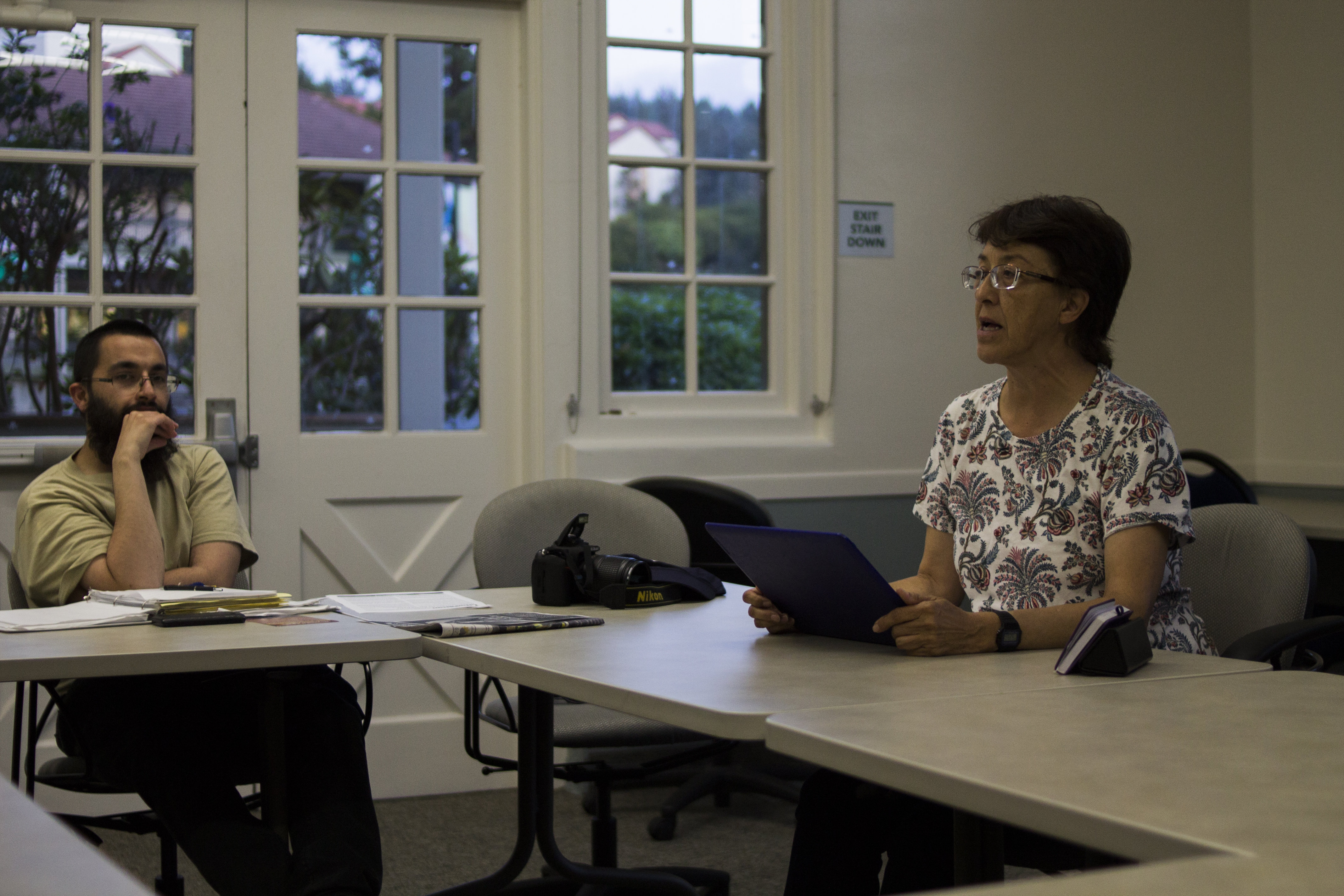
    Gloria La Riva, once a presidential candidate for the Party of Socialism and Liberation, directed the workshop on the rent control measure. Room 206 of Nelson Hall became homebase for socialist discussion on activism and renters rights.

    The workshop started five minutes late due to lack of attendance, but soon there were five sitting at the table’s rectangular set up which eventually filled to nine. Eight interested students and an eager La Riva, enough for a revolution.

    “No working class people can pay what landlords are wanting to charge,” La Riva said.

    In an hour and a half La Riva discussed the different laws pertaining landlords and renters that have been passed, personal experiences of travelling the world as an activist, and a brief history of rent control, not only in the United States but other countries as well. This isn’t your typical tedious history class though, it is filled with entertainment, compassion and challenges that don’t make normal media coverage.

    La Riva said people in power like city officials and councils don’t want rent control to pass. When she was running against Diane Feinstein for mayor of San Francisco in the 80s, Feinstein was promising vacancy control, which is regulation of rent levels and evictions of tenants. Feinstein never fulfilled her promise, La Riva said that was because Feinstein’s husband is a landlord with lots of properties, something typical with people in office.

    At some point a student asked La Riva why she was hopeful that this proposition would be successful when others in the past have failed.

    “We have to keep fighting. We have to keep doing,” La Riva said.

    The night went into heavy depth of socialism, the myths of socialism and what it means to be socialist. Under socialism everything is built by the workers, so everything that is done is for the collective of the community.

    In a capitalist society, La Riva said, “There is only a handful of people at the top who own everything while everyone below builds everything and stays poor.”

    At 7:30 the table opened up for free discussion to the students who were mostly political science majors. It was mainly McGuigan and english senior, Max Hosford, that took up the rhetoric regarding solutions.

    “Once I decided Humboldt was going to be my new home, that’s when I started getting more serious about politics and researching these issues,” Hosford said.

    Hosford offered recent books and political podcasts such as ‘revolutionary left radio’ for others to listen to that discuss the topics that were talked about at the workshop.

    “Propagate, agitate, educate,” Mcguigan said on plans for the future. This includes their interest in the November election by focusing local and bringing awareness to issues like the removal of the McKinley statue and turning Arcata into a sanctuary city.

    The flyers that McGuigan made advertising Proposition 10 brought awareness to political science senior, Owen Donnell. Donnell heard about the proposition but wasn’t really sure what it was. He knew if it was about rent control it would be beneficial.

    “With how hard and unaffordable rent is, some reform is needed,” Donnell said.

    Having members from the community become informed is why McGuigan wanted to have the workshop. McGuigan said being a part of PSL is solidification to his own consciousness.

    The night ended after the discussion on solutions and everyone exchanged numbers. New ideas were shared and many were informed with new open ways to look at not only rent control but government parties.

    “Everything is made from social production,” La Riva said, “but those that own everything are getting smaller and smaller.”

  • University Police Alert: Suspicious Individual

    University Police Alert: Suspicious Individual

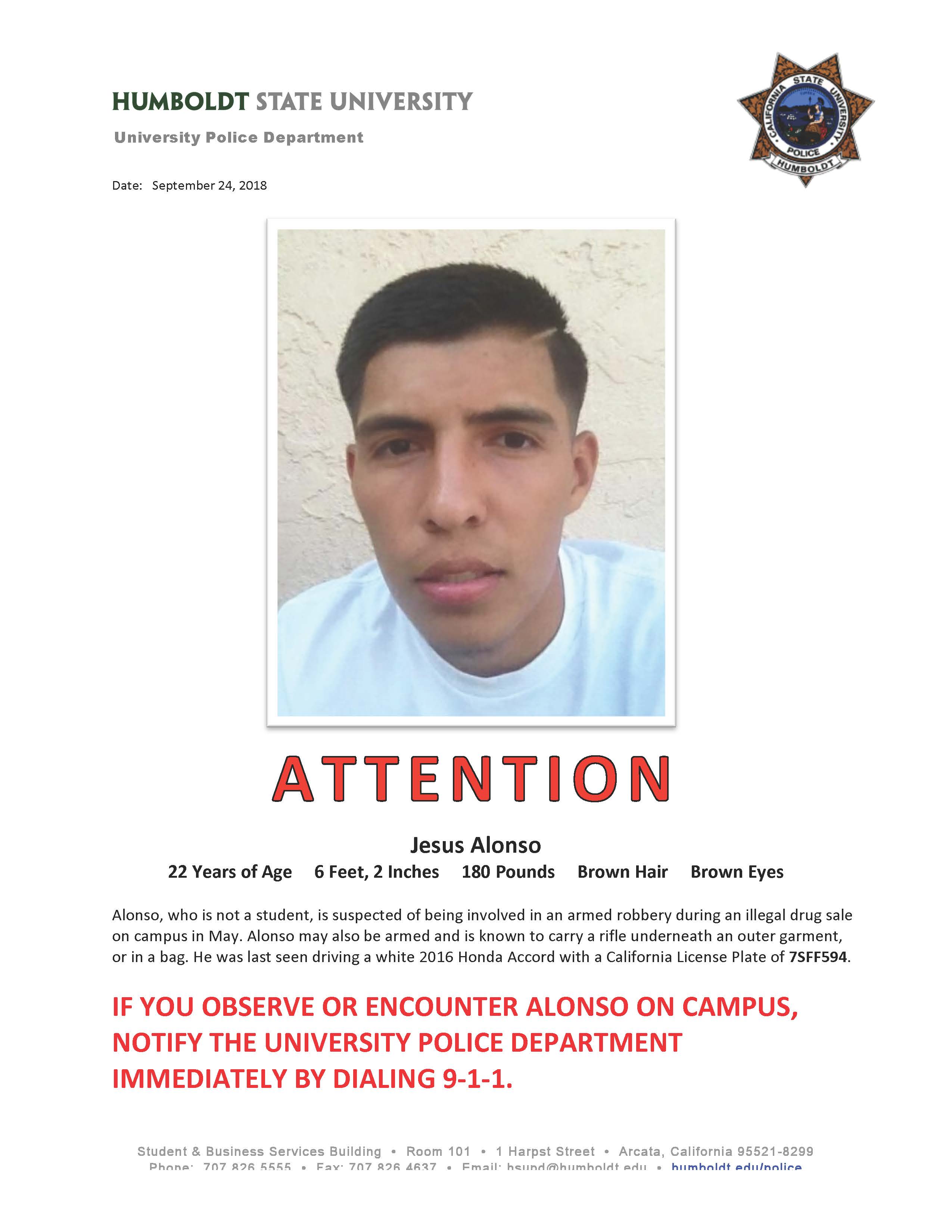
    University Police Department just released a campus-wide alert about 22-year-old Jesus Alonso. Alonso is suspected of being involved in an armed robbery in an illegal drug sale on campus.

    UPD also reported Alonso may be armed. Alonso was last seen on campus Saturday night, Sep. 22, and asked to leave, according to the alert.

    The alert is below:

    The University Police Department is advising the Humboldt State University community to be on the alert for a suspicious individual.

    In May 2018, 22-year-old Jesus Alonso, who is not an HSU student, is suspected of being involved in an armed robbery during an illegal drug sale on campus. A criminal investigation by University Police was conducted and forwarded to the Humboldt County District Attorney’s Office for review. However, criminal charges against Alonso were not filed, based primarily on a lack of admissible evidence.

    Last seen on campus Saturday night, he was asked to leave and has been warned that he is not allowed on campus.

    Alonso may also be armed and is known to carry a rifle underneath an outer garment, or in a bag.

    He is described as 6 feet, 2 inches, 180 pounds, with brown hair and brown eyes. He was last seen driving a white 2016 Honda Accord with a California license plate of 7SFF594.

    If you see or encounter Alonso on campus, please contact University Police immediately by dialing 911, calling (707) 826-5555 or extension 5555 from any campus phone.

    Safety tips from University Police:

    • Keep a safe distance from vehicles with occupants unknown to you.
    • If an unknown individual talks to you, do not hesitate to walk away or call for assistance.
    • Be aware of your surroundings at all times, on and off campus.
    • Immediately report any suspicious persons or activities to University Police.

    You may contact University Police at (707) 826-5555 or extension 5555 from any campus phone. In case of emergency, dial 911.


    This is a close up of the provided photo.

    Screen Shot 2018-09-24 at 4.55.23 PM

  • EDITORIAL: Check your prices not our backpacks

    EDITORIAL: Check your prices not our backpacks

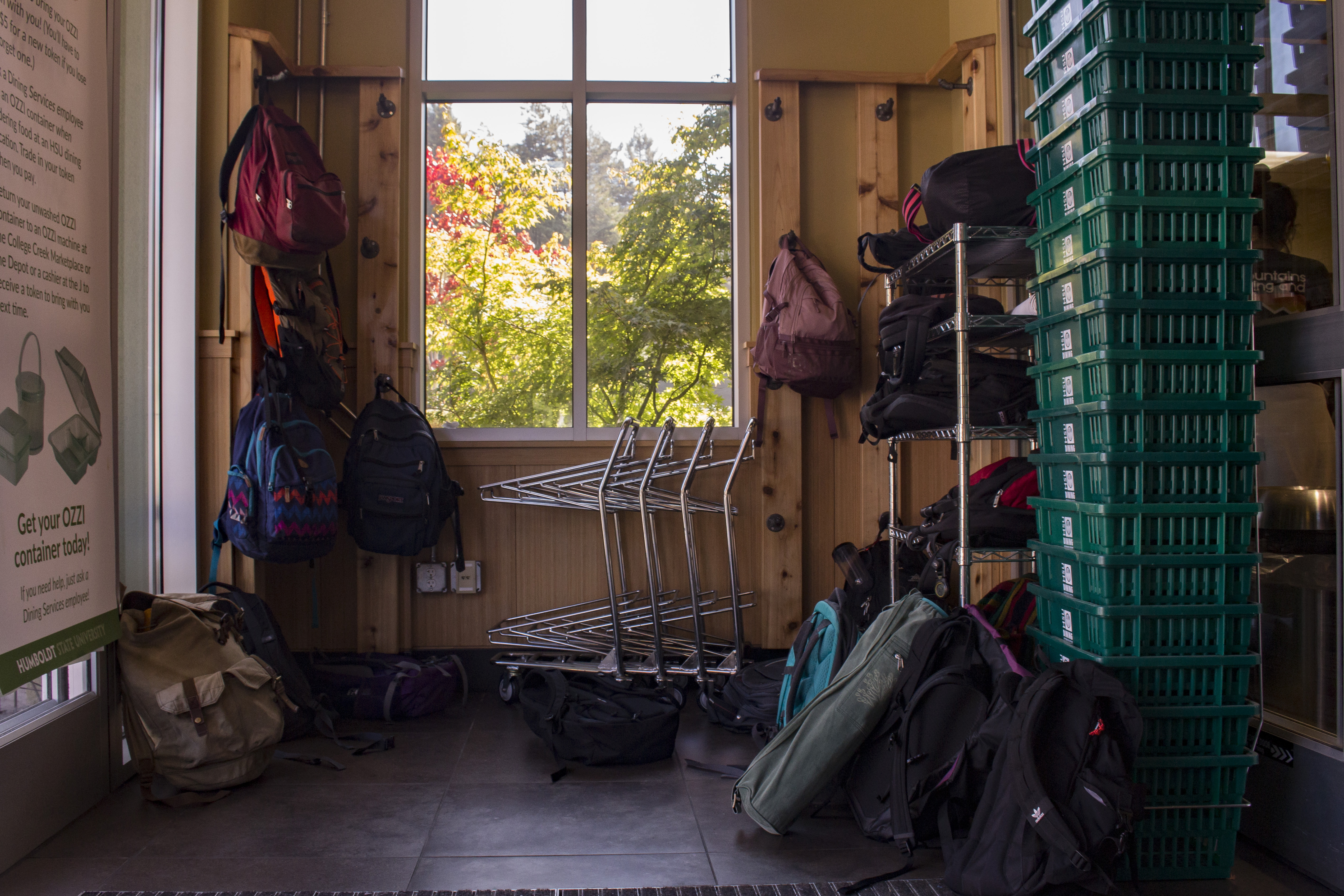
    The marketplace forces students to leave their backpacks at the door so they don’t steal. Meanwhile, they’re stealing your money by overpricing their merchandise.

    In addition to abolishing this stupid rule, it’s time this university lowers their prices on food and beverages and provides a convenient, healthy and cheaper option for students that struggle to pay the bills.

    “I just think it’s more convenient for the store rather than the students,” HSU psychology major Natalia Ruiz said. “They don’t want us stealing but they have our backpacks right next to the door. They don’t care. They just care what’s easy to them.”

    Racing right past the notion that they’re calling out students to be thieves with the backpack tactic, one has to wonder why the pricing is so high in the first place?

    Taking a look at the prices of some fairly common student favorites, there definitely seems to be a correlation with price gouging products that are useful to students.

    The very popular Guayakí Yerba Mate sells at the Marketplace for about $3.70 per bottle or can if you’re paying with your hard-earned cash. If you load money onto your C-point account you get a whopping five percent off that price which comes to a huge discount of $0.19 coming to just about $3.51 each. Wow. What a deal. (sarcasm)

    “There’s not many places for students to buy food on campus,” Ruiz said. “This is the only thing we got and they’re not really giving us an option to go somewhere cheaper.”

    That same bottle of Yerba Mate sells at Target for just $3. That’s 19 percent off of the Marketplace’s regular price, or 14 percent more of a discount than your C-card. Yerba Mate goes for only $2.50 at Texaco. That is a huge discount of about 32 percent from the Market’s regular price.

    The C-point price for Yerba Mate is obviously five percent better in price than the regular pricing. It’s not enough and the prices need to come down. Some naysayers may try to push meal plans into the discussion but not everyone can afford a meal plan.

    If you’re really down on your luck and a Kraft Easy Mac is the only warm meal you can afford, you better have at least $2.19 for it. The same Easy Mac sells in bulk at Costco for $0.82 per bowl. Walmart has them for around a buck each and surprisingly, target is the cheapest, at just $0.53 per bowl.

    If cereal is something you want, you better be prepared to fork up $7.09. Even with the highly touted J-card, you’re still spending $5.17 plus tax on a box of Cheerios. The same box goes for about $3 everywhere else.

    The backpack plan was instituted poorly by administration further showcasing their ineptitude in matters of decision making for student’s lives.

    According to an article in Fortune magazine, employees in the U.S are responsible for 43 percent of lost revenue. The $18 billion total loss is $2 billion more than what is shoplifted by the customers.

    So, instead of hiring a loss prevention employee, the Market now employs a person to stand at each doorway to tell students to leave their backpacks behind. They also managed to pay construction workers to build the useless backpack racks. Where else can the administration waste our money?

  • 17 going on 18

    17 going on 18

    But still no justice for David Josiah Lawson and his family

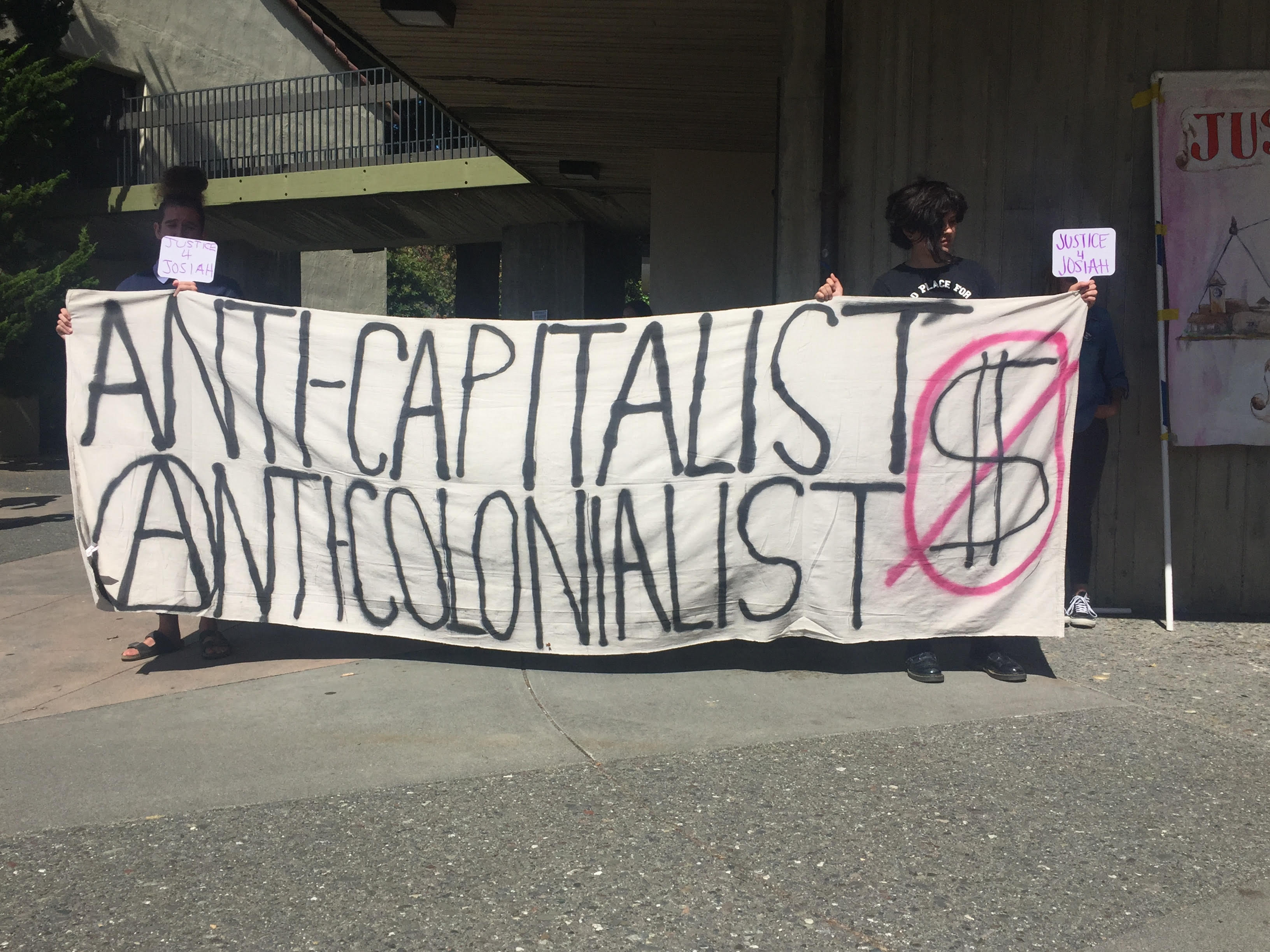
    On the 15th of every month for the past 17 months the advocacy organization Justice for Josiah, which is led by his mother Charmaine Lawson, holds a vigil in memory of David Josiah Lawson in the wake of his murder.

    This month the vigil was held at the Manila Community Center, adjacent to Josiah Lawson and his friends most cherished beach.

    “I chose this spot today because my son loved the beach,” Charmaine Lawson said. “I wanted to be in a place were my sons presences was often.”

    There were around 30 to 40 in attendance. Community members, Humboldt State University faculty members and family and friends of David Josiah Lawson gathered around to eat barbecue and listen to music.

    This did not detract from the seriousness of why people were gathered that day. Many wanted to talk about both the lack of transparency within the HSU administration and Arcata Police Department and overall trust in them.

    Sylvia DeeRoy, a local community member and HSU alumni, said she has had enough of HSU President Lisa Rossbacher and the HSU administration’s avoidance to answer questions they deem vital for family and friends of David Josiah Lawson, and other HSU alumni.

    “Ages have gone by,” Derooy said. “As an alumni (Rossbacher) doesn’t even care about me.”

    The vigil happened 25 days after the Aug. 20 roster release of the HSU’s predominantly African American student clubs to the Arcata Police Department. Many community members are unaware of this but those who are seem to take a deep frustration with the events that have transpired.

    Meg Stofsky a community advocate and member of the Justice for Josiah Movement, had words that seemed to resonate with many at the Vigil.

    “I thinks it’s racist as hell,” Stofsky said.

    Although there has been a deep mistrust of the HSU Administration and Arcata Police Department, many family and friends of Josiah say they appreciate the community support of those who know or didn’t know him.

    Berenice Roman, a student at College of the Redwoods and friend of Josiah, said that although she is frustrated and this situation is difficult, she is glad some in the community are concerned and willing to support them and Josiah.

    “It’s really cool that people in the community are mad about it, and are still coming to support Ms. Lawson and his friends,” Roman said. “It just makes us feel like we are not alone.”

    As the day drew on, the vigil turned its sights on the remembrance of the memory of David Josiah Lawson. Charmaine Lawson, aunt of Josiah Stacey, and friends Alex Foster and Karim Muhammad led the walk to Josiah and his friends’ favorite beach.

    Charmaine lead community members following the vigil and attendees chimed in harmony the ethos of these vigils and protest:

    “Justice for Josiah, long live D.J. and say his name, Josiah!”

    The procession winded down to the beach as their calls for justice echoed out into the humboldt-sphere. After, the vigil attendees gathered in a circle with their hands clasped together, which was formed around hearts with texts inside them that read, “Josiah” and “D.J.”

    Attendees were asked to go around and say something about Josiah that they remembered, or the reasons for why they were there that day.

    No one seemed to be able to get a word out without a semblance of confusion or sorrow.

    The vigil ended with the symbolic throwing of roses and petals into the ocean. Although this was supposed to be the most powerful image of the vigil Charmaine Lawson’s words seemed to transcend the moment.

    “I know he is not here in the physical but he’s here in spirit,” Lawson said. “I know he is shining and saying ‘Mom thank you, for not forgetting me and thank you strangers who are now family for being here and standing with my mom and our family.’”


  • Welcome back to the block

    Welcome back to the block

    Clubs host first block party on the plaza

    Hundreds of students gathered around the Arcata Plaza at the first Humboldt State University Block Party to enjoy free barbecue and live music as a way to kick off the new school year on Sept. 14.

    A long line wrapped around the plaza as the first 500 students awaited a free meal provided by the school including hamburgers, coleslaw and beverages.

    As an alternative to the Associated Students BBQ on the quad, AS along with Center Arts, Forever Humboldt and a few other organizations teamed up over the past year to organize this event as a way to familiarize new students with the town of Arcata. The event was held in the Arcata Plaza and many new students were able to check out what this city has to offer.

    Transfer student Amy Garcia enjoyed free food and the bustling crowds as she attended this event in downtown Arcata with her friends.

    “This is probably my third time actually being over here in this area,” Garcia said. “I love how it’s a really small community and the weather is awesome.”

    Many clubs and organizations on campus set up information tables in order to inform students about their services as well as handing out free stuff including pins, art, stickers, and flyers. By tabling, these clubs were in hopes of convincing more students to join.

    Live music was provided by The Chulita Vinyl Club and Calafia Armada as guests walked around enjoying the information tables, art, and food.

    Calafia Armada, a cumbia event collective based out of Oakland, drew a huge crowd as their upbeat songs inclined many to start dancing. Their lively performance was also accompanied by a short story they told about Queen Calafia, a fictional warrior queen California was named after.

    One of the many students attending, Matthew Bahloul enjoyed the live performance by Calafia Armada.

    “I was looking forward to the food and music,” Bahloul said, “The vibe is cool; I really enjoy live music.”

    In between all of the music, a raffle for prizes was held by Associated Students. Giveaway prizes including tickets to upcoming AS Presents and CenterArts shows were provided by the university. Other raffle prizes were provided by local businesses such as Mia Bella Cupcakes, Bubbles, and Humboldt Jiu-Jitsu.

    Both new and returning students enjoyed this event as it was a way to meet people and participate in a school related event without actually being on campus. Throwing the block party at the Arcata Plaza also allowed community members to enjoy the music and crowds, as well as learn more about the university itself.

    Ashley Arcega, a senior at HSU, sat in the plaza with a friend enjoying the Friday evening as the event wound down. Since this was the first time the university has thrown an event like this, she was excited to see what it was all about.

    “I think this event brings a sense of community,” Arcega said. “It brings all different kinds of people and students together which is really awesome.”

  • Room for improvement

    Room for improvement

    University sustainability assessments reveal strengths and weaknesses of Humboldt State University’s campus wide environmental impact

    Humboldt State University’s total energy consumption from clean and renewable resources is .07 percent, according to figures from a 2017 sustainability assessment report.

    In another assessment, HSU ranked 31 out of 269 college institutions as being a sustainable “cool school” according to Sierra Club rankings.

    The ranking was based on unique Sierra Club metrics which the Club said were designed to measure how a university is addressing the climate crisis. The ranking included scores from categories such as research, air & climate, energy, water, and waste.

    According to the Sierra Club website, the organization ranks schools on sustainability in order to serve as a guide for prospective students, and to raise environmental standards on university grounds.

    HSU sociology major Isaiah Hall said he wasn’t aware of the Sierra Club ranking. Hall, who plays on the Lumberjacks football team, said students would benefit if the university focused on sustainability upgrades such as LED lights and more solar panel arrays.

    This was the first year HSU participated in Sierra Club’s annual ranking system. Notable universities that ranked higher than HSU included: UC San Diego, Chico State and UC Irvine. Chico State was ranked 9.

    In order to participate in the Sierra Club “cool school” ranking HSU had to forward data from a separate and more comprehensive university sustainability tracking report which was compiled in 2017.

    The more extensive report, The Sustainability Tracking, Assessment, and Rating System, is an online tool that universities can use to measure their campus-wide sustainability.

    Katie Koscielak works as a Sustainability Analyst for HSU and is responsible for coordinating the campus sustainability report.

    Koscielak said compiling data for participation in the assessment was an expansive project spanning collaboration from 25 university departments.

    Humboldt State has participated in two Sustainability Tracking, Assessment & Rating System reports. The first STAR report was in 2013. The latest report in 2017.

    According to Koscielak between the first and latest reports HSU improved by 14 percent and went from a silver to gold rating. The reports are public and specific details about HSU’s score can be found online.

    “This indicates we’re performing well,” Koscielak said.

    In the latest rating HSU received a gold star, which requires a minimum rating score of 65. HSU received a score of 69.28.

    Gold is the second highest rating category currently in place. Platinum, which requires a score of 85 or higher, is the highest. Only four schools have platinum ratings: Colorado State, Stanford, UC Irvine, and the University of New Hampshire.

    Ratings are considered valid by The Association for the Advancement of Sustainability in Higher Education for three years.

    In the 2017 report, HSU scored high in academics, engagement, and the planning and administration credit sections. The school received poor marks in operations.

    The operations credit section includes: air and climate, buildings, energy, food & dining, grounds, purchasing, transportation, waste, and water categories. The university scored lowest in buildings, energy, food & dining, grounds, and transportation.

    HSU strongly promotes social and environmental responsibility in its mission statement as well as commitment to sustainability and environmental economic and social responsibility in its vision and values.

    However, In the report HSU energy received poor scores due considerably to having a total energy consumption from clean and renewable sources of less than 1 percent.

    “We have room for improvement,” Koscielak said.

    Koscielak said that launching renewable energy projects can be extremely expensive and larger universities tend to have advantages in this regard because of more funding opportunities.

    By comparison UC Irvine has a total energy consumption from clean and renewable sources of 2.14 percent. In fall of 2017, Irvine had enrollment of over 35,000.

    Another category HSU received low scores on in the operation category was Grounds. Credit was given to institutions who have official integrated pest management programs or an organic land care standard or landscape management program which uses ecologically preferable materials.

    According to Koscielak HSU uses integrated pest management strategies but does not have an official plan.

    HSU Waste, Recycling, and Grounds Coordinator Megan Tolbert said one of the integrated pest management strategies that the university currently uses is live traps. Poison is never used to control rat pests on campus and using live traps also helps prevent harm to other wildlife.

    HSU masters student Megan Awwad said she wasn’t surprised about the universities low renewable energy statistic. Awwad, who previously attended University of Calif. Riverside, said Riverside promoted itself as being a sustainable school.

    “That’s how universities function,” Awwad said.

  • Ripple in the radio

    Ripple in the radio

    Conflicts continue within KHSU

    Live air shows after 10 p.m. could be headed towards syndication after new time changes at KHSU.

    The decision to limit the operations of KHSU from 7 a.m. – 10 p.m. is the latest administrative decision that has left staff, volunteers and community at odds of where KHSU is heading.

    Kimberly Comet is the director of risk management and safety at HSU and says that the majority of building hours on campus is 7 a.m. – 10 p.m. With KHSU moving buildings due to the construction for seismic retrofitting they are moving to a building that isn’t staffed by employees past 10 p.m.

    “We are trying for consistency and safety for all,” Comet said.

    Comet says that volunteers are there to augment the university, not to be in the place of an employee. Staff-employees would be needed to keep the doors open past 10 p.m.

    “Employees have training, follow different directions and have different tasks,” Comet said.

    KHSU general manager, Peter Fretwell, says they would blow a hole in the budget for a paid staff. He asked risk management if they could change the time to midnight and they told him no. Some hosts say keep the times and others say no due to safety.

    “The radio side of me disagrees. The human side of me agrees,” Fretwell said.

    Others are not convinced with the decision. They feel it was too fast and had no time for a group discussion. Barbara Boeger has been on KHSU’s community advisory board (CAB) since the early 2000s and said that the decision was made rapidly although the move of buildings had been known for a while. She was very disappointed in the last minute notice that came in the form of an email to all staff and volunteers from Fretwell.

    “I feel like he threw us under the bus,” Boeger said, referring to the HSU community.

    The big concern is whether or not shows will disappear as well as the connection with the local DJs.

    Lorna Bryant, KHSU office manager as well as late-night host, said the recent decisions have affected morale at the station as well in the sense of long time listeners who won’t be able to call in and make requests.

    “It seems there is no alternative and no plan to find a remedy applicable for all parties involved,” Bryant said.

    With the direction that HSU administrators are heading, Bryant can’t see a change anytime soon.

    In regards to the new building Bryant said the disadvantage is losing the ambient sound they once had, but there are some advantages. KHSU may be losing real estate in the building they were in but because of the move they are gaining an extra studio that has all brand new equipment.

    “We’re in a very well taken care building and that’s a cool thing,” Bryant said.

    Liam Warner, host of the Buck Jr. show at KRFH and son to Tim Warner, the host of KHSU’s Buck Calhoun show, isn’t impressed with the moving of buildings and rather see shows running instead of cancelling.

    “KHSU was doing fine before administration hired a new general manager,” Warner said. “Since then things have spiraled out of control from there.”

    Both Warner and Boeger raise concerns on the administration’s intent regarding KHSU volunteers. They agreed that there is a dismantling of the volunteer base and it is a for-profit decision.

    Volunteers are harder to manage than employees when it comes to bringing change into the station. Warner said KHSU and the University realize they can make money off the radio station and this is the reason for the recent changes.

    With hours cut and late live-shows unavailable, everyone is concerned about the station becoming a more pre-recorded program. There are shows that won’t be able to be accommodated and local DJs that won’t be able to host.

    “If people stop criticizing the direction of the radio (KHSU) while still supporting it then it’s heading towards a syndicated program,” Warner said.

    With syndicating programs, connection will be lost between community and station. The local flavor that listeners get would soon be pre-recorded programs. It would be a different station than the one Warner and many others chose as a reason to attend HSU.

  • Students seek justice for all

    Students seek justice for all

    The HSU community was burdened with the loss and murders of David Josiah Lawson in Arcata, California April 15, 2017 and Corey S. Clark in Eureka, California Oct. 6, 2001.

    The justice movement for Lawson and Clark has continued to gather students in efforts to raise awareness to other students and the community they live in.

    ‘The Diversity Is Not Inclusion Rally’ brought students together at the HSU quad on Sept. 12, to further inform students about the loss of Lawson and Clark, and speak about universities who should be held accountable for failing to protect and support students of color.

    Vice President of the Black Student Union, Barbara Singleton lead the rally held at the quad, and voiced her concerns about HSU and the handling of students of color.

    “At Humboldt State, students here are viewed as economical commodities. If they (Humboldt State University) bring us up here, they have to know we are bringing in black and Hispanic culture. If they can’t respect us, then don’t bring us up here,” Singleton said.

    Hot topic issues such as student homelessness and budget cuts to the universities institutions were also some of the issues brought to the students attention in attendance. The focus of the rally was to reiterate the issue of the two unsolved murders of HSU students, Lawson and Clark, and to raise awareness for students that there lays a capitalistic mentality towards students on and off campus.

    Senior Nathaniel McGuigan, part of the Justice for Josiah movement, first came to HSU as a freshman completely unaware of any racism,

    “Like many other new students, I was unaware of what happened in the community, I did not learn about many of these issues until my second year,” McGuigan said.

    The rally further voiced more awareness to future HSU students, in order to keep them informed of a divide that seems apparent between students on and off campus.

    “We want the Humboldt State Administration, to get involved in the case, to actually put pressure on the Arcata City Council and helping us seek justice for Josiah,” McGuigan said.

    Meg Stofsky, one of the speakers at the rally, spoke about her view of the racism she feels that is present in Arcata.

    “I came here and found…really a ghetto. HSU feels like a ghetto to me, and so does Arcata, where the systemic and historic racism means that you can kill people and get away with it, and it does not matter,” Stofsky said.


  • 110 flights of stairs

    110 flights of stairs

    Humboldt County firefighters honor the fallen on 9/11

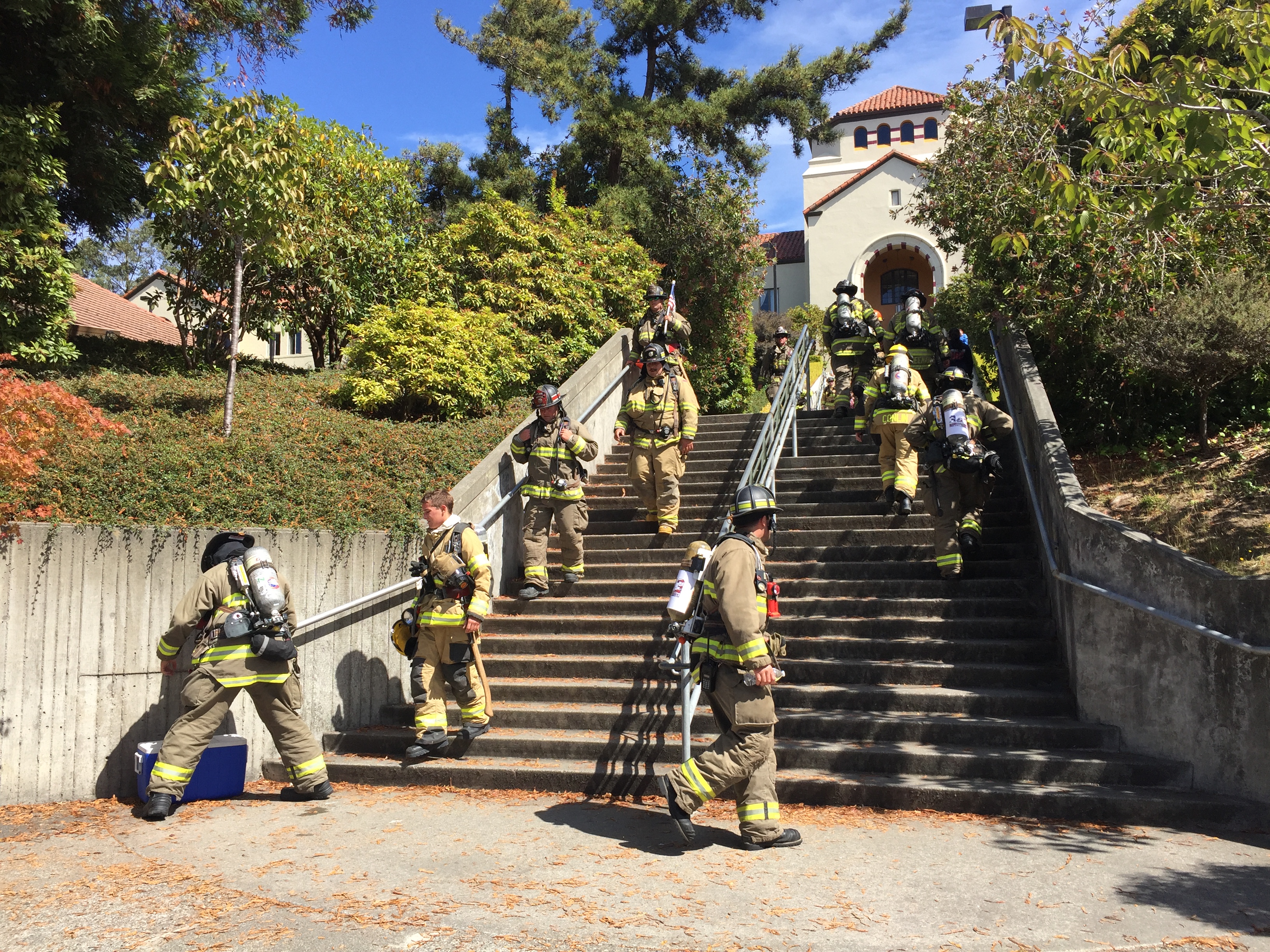
    Within 45 minutes, local firefighters and nearby volunteers walked up and down Humboldt State University’s Founders Hall 18 times in memory of 9/11.

    Of the 2,977 victims that were lost during the attack on the World Trade Center in New York City on Sept. 11, 2001, 343 of them were firefighters.

    For several years now, fire departments nation wide walk an equivalent of 110 flights of stairs to honor those that entered the buildings.

    “I think I speak for every firefighter when I say that this is a very daunting day for us,” said Arcata firefighter Jacob Cliff.

    Cliff has now organized this event for the past two years to assure that Humboldt County firefighters continue to show their appreciation and recognition of their fellow fighters that endured the unfortunate happening of 9/11.

    Last year Arcata Fire Department walked HSU’s Cypress Hall stairs after briefly deciding to start the event over a dinner table conversation.

    This year, several nearby departments came out to participate, including: Arcata Fire Department, Fortuna Fire Department, Humboldt Bay Fire Department, Rio Dell Fire Department, and Samoa Peninsula Fire District.

    “They are carrying their 75-100 pound gear on their backs as they walk these steps,” said President of the Volunteer Firefighter Association, Rob Cannon. “Because that is what those 343 firefighters had to do that day.”

    Several nearby students and faculty members joined the local firefighters on the walk up and down Founder’s Hall. The departments provided gear for the volunteers that wanted to experience the walk with the extra pounds on their back.

    “I decided to participate out of respect to those that actually had to do this,” said volunteer Fortuna firefighter Morgan Tuel. “It was a lot more challenging than I was expecting.”

    At the bottom of the stairs was a blue cooler full of cold water bottles for any participants who needed a quick thirst quencher. Anybody passing by was welcomed to join, and most that were curious about what was going on, did not fail to do so.

    “It is a nation wide patriot day,” said Cliff. “It is very humbling to see others out here honoring our fellow brothers and sisters as well.”


  • Out of the Darkness Community Walk

    Out of the Darkness Community Walk

    American Foundation for Suicide Prevention Walk Sept. 9.

  • Fact and Flattery

    Fact and Flattery

    The Academic and Career Advising Center hosted a grad school workshop for science majors in the Humboldt Scholars Lab in the library Sept 5. Career Adviser Kristina Hunt attempted to prepare prospective graduate students for what’s to come when applying to colleges across the country.

    Hunt clicked through slides aimed at arming students with application information and timelines often available, but almost never compiled into one place. The presentation was designed to streamline the process and nuances of applying to grad school.

    The to-do list was lengthy but calculated to optimize time and resources. The tips were varied, but insightful; ranging from hunting for fee waivers, to rationalizing a gap year, to quantifying the social compatibility of prospective new research groups.

    After the last slide faded, two students attending the seminar had mixed reactions to the workload ahead.

    Hannah Atwood, a student of environmental science and management, left convinced her window to apply had already shut.

    “I should have been at this presentation last year,” Atwood said.

    Atwood redrew the blueprints from research to a career in teaching.

    “I started working with a youth program when I moved here last year,” Atwood said. “And as Kristina mentioned experience in research being important, it made me realize that I already know I enjoy working with kids.”

    By shifting gears towards education, Atwood stands to save thousands of dollars and can expect to earn teaching credentials in one year at HSU.

    Though Atwood left the seminar courting other options, one student left with hope for the lengthy process.

    Junior student Matthew Lotakoon, who studies Hydrology in the Forestry department, is looking forward to grad school, and wants to be “at 100 percent.”

    “I want to put together a plan like I did in high school,” Lotakoon said.

    Assembling a plan hasn’t always been easy for Lotakoon. During his first two years at HSU, Lotakoon, like many others, struggled with balancing a full schedule and his part in the many clubs he’s joined. That’s in the past. The weight of what’s ahead isn’t stopping him from attempting to be the first in his family to bring home not only a college degree, but a Ph.D.

    Hunt sees many students in both Atwood and Lotakoon’s position. Building the foundation to implement the dream of grad school or otherwise is what she does daily in the Career Advising Center.

    “I try to pave a path,” Hunt said.

    She deals with many different types of students. Some, Hunt said, come in twice a week. Those students are on their own path to graduate school. It’s Hunt’s job to help put it down on paper. Others, she sees only once and is left to wonder.

    Hunt does have hope for the job prospects surrounding students pursuing careers at any level in science. Though the sciences, especially environmental, have seen public funding slashed, Hunt says there is hope in the private sector.

    With environmental innovations being funded by corporations, there are still research jobs available, with potentially higher pay. Hunt noted that companies like Apple are likely to pay scientists more than the federal government would.

    Science students at HSU have options after graduation. There is research work to be done right here in Humboldt County. There is still more literally everywhere else.

    Regardless of the next big step the seminar reinforced something for Atwood, a senior looking at graduation, that most students can relate to.

    “Applying for school again,” Atwood said. “It stresses me out.”

  • Student life after prison lacks resources

    Student life after prison lacks resources

    Nine California State University campuses offer programs assisting formerly incarcerated students, HSU is not one of them

    The current nationwide prison strike has shed light on the inhumane conditions reflecting slave labor, prisoner mistreatment and the absence of education within prison walls.

    But life after prison is still a challenge for prisoners. Specifically for those who go back to school.

    Steven Ladwig, associate director of admissions at HSU, says there is definite need for some kind of program at HSU for formerly incarcerated students.

    When Ladwig was an Educational Opportunity Program advisor 20 years ago there was a formerly incarcerated student running Operation U-Turn, which was a club helping other incarcerated students. Since that student graduated the club ended and Ladwig hasn’t seen anything like it since.

    “We need a safe space for the incarcerated attending HSU. We need a center, advisors, the whole nine yards,” Ladwig said.

    Stigmas and stereotypes can create barriers and separations for the formerly incarcerated. These judgments follow them outside prison walls and make it difficult to adjust into the real world, especially when wanting to further their education.

    The Opportunity Institute and the Stanford Criminal Justice Center, both designers of Renewing Communities, state that to address the staggering mass incarceration in the nation, over 2.2 million people, California is using higher publication education but is still falling short.

    Before 2014 there was no one enrolled in face-to-face community college in CDRC. After California Senate Bill No. 1391 was passed there were 4,443 inmates enrolled in fall 2017.

    According to Correction to College, there are currently 700,000 Californians in the correctional system and another 8 million residents with arrest records. 30 of the 35 prisons in California teach face-to-face community college.

    One-third of the 114 California community colleges have student groups or programs that build support systems for recently incarcerated students.

    20 miles south of HSU, College of the Redwoods in Eureka, has partnered with the Humboldt County Jail to create an educational pipeline for inmates, howvever Humboldt State itself has nothing to offer formerly incarcerated students.

    Renee Byrd, assistant professor of sociology whose current research areas are mass incarceration and prisoner re-entry, said some of her best students have been formerly incarcerated.

    “There’s definitely space and a need for resources,” Byrd said.

    But HSU has nothing specifically targeting formerly incarcerated students. She knows that there are barriers for people getting out and education is the number one way to improve their lives and economic standing and HSU should make it easier.

    Schools such as UCLA, UC Berkeley and UC Davis offer The Underground Scholars Initiative. Nine CSU campuses, Sacramento, Bakersfield, Fresno, San Bernardino, Fullerton, Los Angeles, Pomona, San Diego, and San Francisco, all successfully support the Rebound Project: a 50-year old program started at SFSU in 1967 by John Irwin that offers support to those who have been incarcerated in transitioning to life on an University campus.

    When asked about a program like Project Rebound migrating north to HSU, Byrd said she is very supportive but it would not only take time and money but a coalition of faculty and administrators who are having a hard enough time making sure students are housed.

    “I think this is precisely where this institution should go,” Byrd said. “HSU should be a leader in this rather than following.”

    In 2016, a Humboldt County Reentry Resource guide was published along with an HSU master thesis called “Reintegration in rural community; strengths, barriers, and recommendations for reentry in Humboldt County.” The author Vanessa Vrtiak, who has since earned her masters in sociology and is active in the community’s prison activism, said there hasn’t been a difference before or after the resource guide was published.

    This might be because it isn’t posted anywhere easily accessible or in any HSU buildings. If one wants to find it they have to search for it on the internet.

    Vrtiak created the resource guide because there was nothing put together for anyone who had been formerly incarcerated to know what resources were available in that community, especially for those people who aren’t from the area. It is still like that on campus for those searching for some kind of help.

    “Not a lot of people organizing in our community,” Vrtiak said.

    While a student she coordinated a week long criminal justice dialogue on campus that had an event each day. The topics included housing, employment, success stories, resources and barriers. But just like Ladwig, this was all she witnessed that addressed formerly incarcerated students and once the week of events ended there wasn’t anything else.

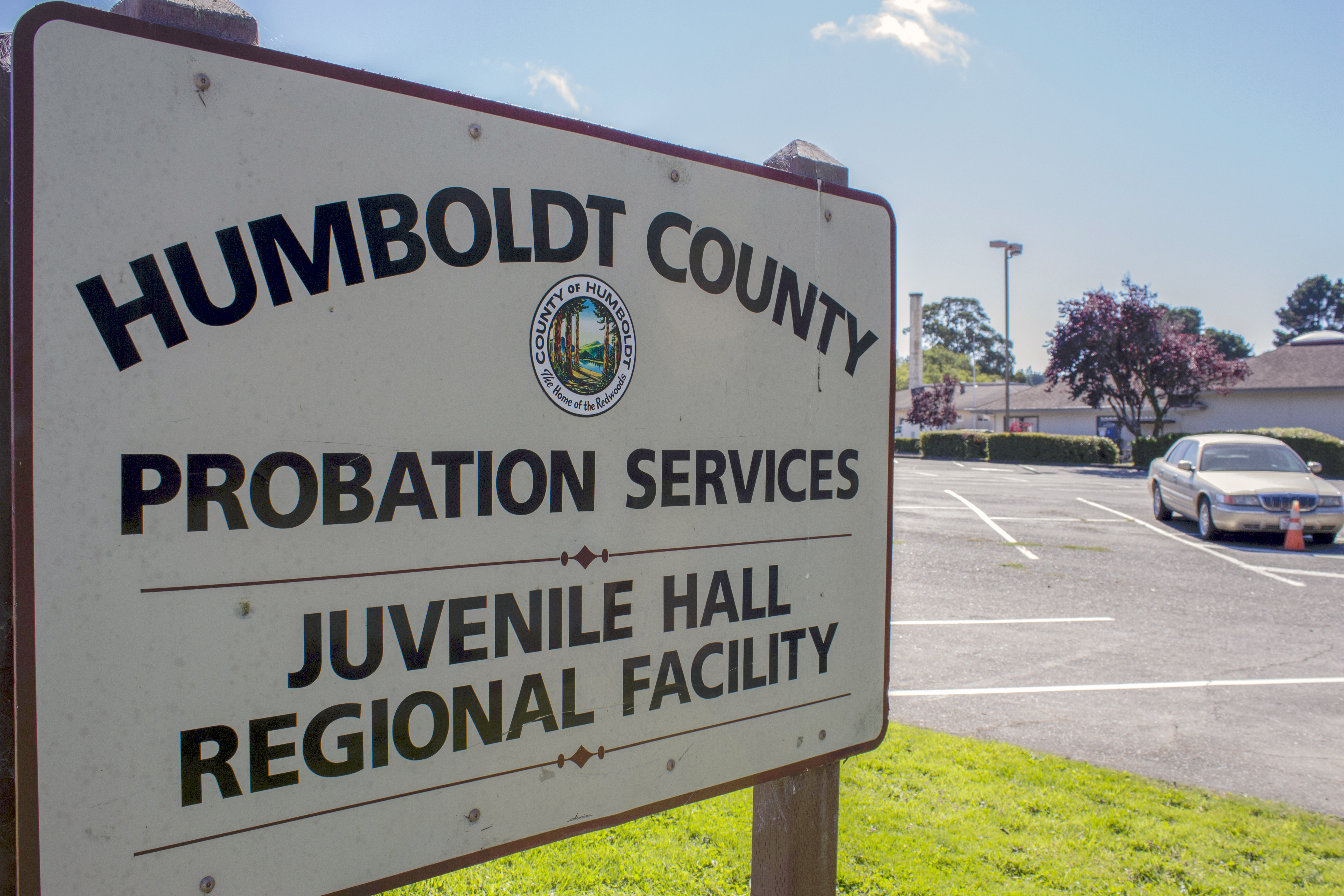
    Vrtiak had Project Rebound come up to HSU in the past and thinks it would be great if the program was integrated permanently because the biggest resource at the moment is the probation office. If you were formerly incarcerated but off probation or parole you no longer have that option of resources.

    With a 400 inmate capacity jail in the middle of Eureka and Pelican Bay only 60 miles away this problem is in Humboldt county’s backyard. California is starting to address the need for educational transitions from correctional facilities and support is needed to move north to HSU.

    “The goal always is to educate the community and ask for compassion for people who are incarcerated,” Vrtiak said.

    Formerly incarcerated students with questions on resources or who would like to talk can reach Tony Wallin at tww22@humboldt.edu or Vanessa Vrtiak at vp24@humboldt.edu and https://www.facebook.com/HumboldtCountyReentry/

  • Sister city ties

    Sister city ties

    I Street block party helps Arcata fund sister city Camoapa, Nicaragua

    Hosted over the Labor Day weekend, Arcata had its 33rd Annual I Street Block Party located on I street between 10th and 11th street outside of Los Bagels. This annual block party continued its fundraiser for the Arcata Sister City Project.

    All proceeds raised from the block party went to the outreach city of Camoapa in Nicaragua, which has been connected with the city of Arcata since the 80’s.

    Thirty years ago the citizens of Arcata wanted to have a sister city in the country of Nicaragua, and then mayor of Arcata, Thea Gast, believed it to be a great idea but wanted to make sure it was a supported issue.

    “I wanted it to be supported by a broad range of people in the city, rather than some that were against what was happening at that time politically with the Nicaraguan Revolution between the Condinstas and Contras,” Gast said.

    To Gast, it was a political statement to support the people rather than supporting the fighting that was going on in Nicaragua.

    The block party originally started off as donations sent to the city to help fund the now recognized sister city in Camoapa. After three years of receiving donations from the citizens of Arcata, founder/owner of Los Bagels, Dennis Rael, was one the first project members to help create the I Street Block Party, and continues to host the party there since 1985.

    “Everybody here donates their time. Every year we come close to netting $10,000 that goes straight into the project,” Rael said.

    The fundraiser goes to different projects that the Arcata Sister City Project have on going. Currently the Arcata Sister City Project run some scholarships in school programs in Nicaragua. In the past they have redone medical clinics, dental clinics, and help set up preschools.

    One of the first trips down to Camoapa a bus was taken down that was filled with medical supplies, school supplies, and clothing. The bus was also donated to help with transportation for the locals.

    Since that first trip down to Camoapa, the city of Arcata has continued to do a great service for their sister city. A recent 8-year-project to get a hospital in Camoapa and a steady source of water was completed. A well was dug and a transit line and pump were installed.

    According to Chuck Swanson, staff engineer at SHN Engineers & Geologists, Inc., there is a lot of bureaucracy which ends up slowing that progress down.

    “There is local politics down there that turn over and change regularly, and when that happens a lot of the opinions and support for these projects change as well,” Swanson said.

    Project member David Maccuish likes the idea of keeping close relationships with the communities.

    “Progression I don’t think is the right word, I think it’s a continuance of the relationship,” Maccuish said. “People from both cities like each other. We have created a lot of bonds between a lot people in these two communities and maintaining those bonds are very important. What is important is that the love between the two communities stays strong.”

    Monday’s block party was a good representation of the love in Arcata. Steady beats flowed through the streets that came from the parking lot of Los Bagels that had old and young people alike dancing to music. The hungry conjured to the hot grill that provided patrons with barbeque chicken, grilled fish, and tofu.

    For 33 years the Arcata-Camoapa Sister City Project has had people going south and north, connecting families from Arcata and Camoapa.

    Nora Wynne, a member of the Sister City Committee for about 20 years summed up the importance of what the connection between the block party and what it does for Arcata and Camoapa.

    “The most important thing it does is create real people to people relationships,” Wynne said. “With that, peace is more likely in the world, because you know people and you know what their struggles are.”

  • Buses running… out of time

    Buses running… out of time

    Part-time driver hourly limits, retirements and failed drug tests put stress on transit system schedules

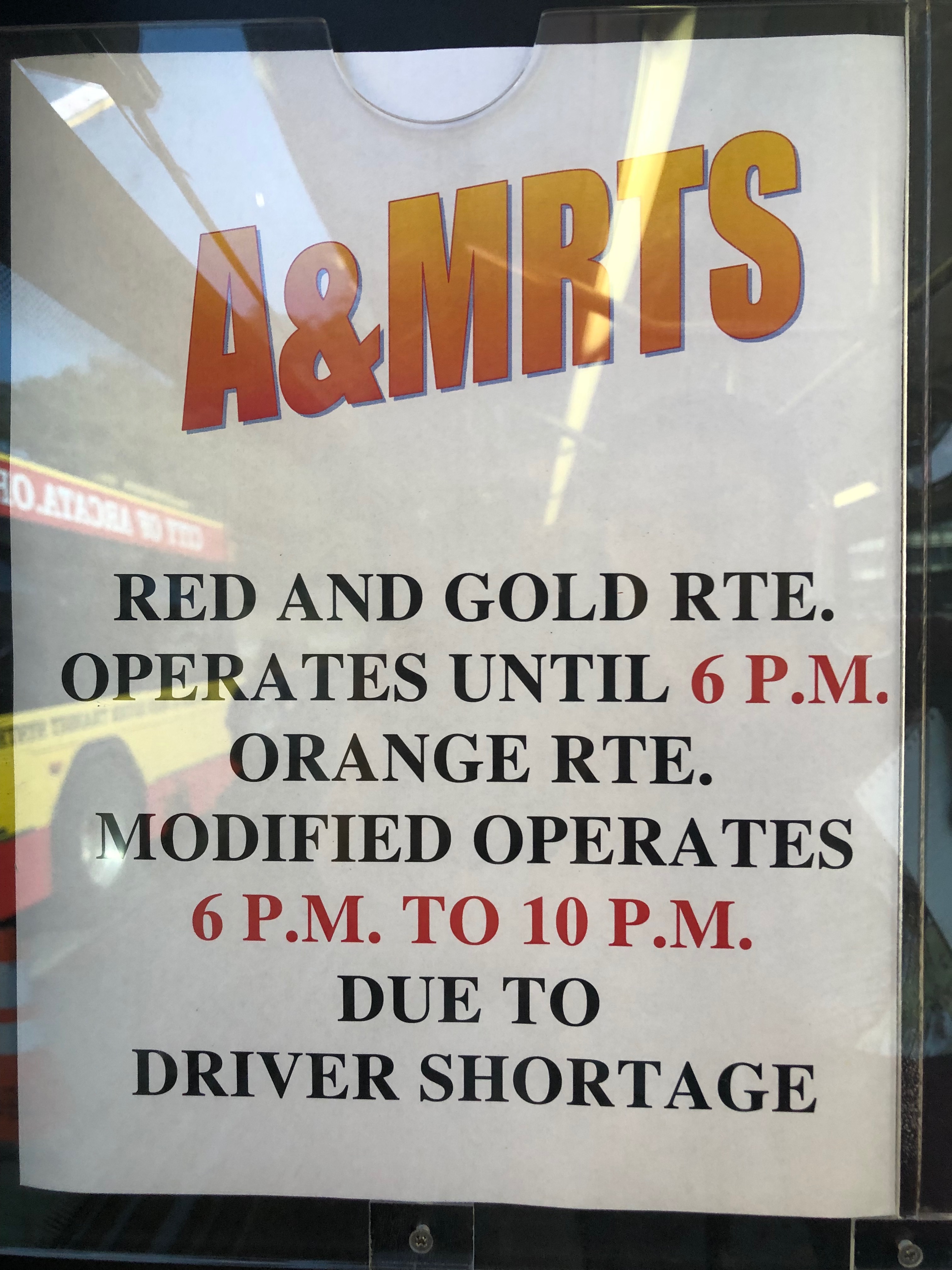
    The Arcata and Mad River Transit System, run by Arcata Public Works Department, is experiencing a shortage of bus drivers. A problem which has affected bus routes and scheduling.

    The Red and Gold bus routes now merge into the Orange bus route from 6-10 p.m. on weekdays.

    Director of Public Works Doby Class said a few drivers had to retire during the summer for age and health related issues.

    Since then, replacements have been hard to come by for Arcata Public Works.

    “We’re actively trying to contact agencies, temp help,” Class said. “We’re doing much more outreach than in the past.”

    Finding qualified candidates has been the most difficult road block for A&MRTS.

    “It’s so hard to find people who can pass a drug test, wants to work with the public, reliable and can drive a bus,” said bus driver Doug Thompson. “Lots of my friends who would love this job can’t (do it), simply because they can’t pass a drug test.”

    Class said transit manager for A&MRTS LeAnn Schuetzle, whose main job is to manage the bus system, hire and train drivers, has been driving the bus herself due to the shortage.

    A&MRTS also has another hiring predicament which may worsen existing conditions.

    The Arcata bus system only hires part-time drivers in order to save on costs. Part-time bus drivers are limited to 1,040 hours a year, meaning that if a driver is to reach their limit, they are no longer allowed to work for the rest of the year.

    According to Class, there are current employees who are nearing the 1,040 hour limit and may soon be unable to work. This means their current driver shortage may become worse.

    “We’re running on borrowed time,” Class said.

    Class hopes that by Jan. 2019 the driver shortage issue will be resolved.

    There are proactive plans to get new drivers including a joint training program with Redwood Transit System in Eureka to provide a bus driver’s “learner permit” in order to train new drivers for a B-class driver’s license.

    Students and citizens, including retired workers, are eligible for this “bus driver in training” position so long as they are willing to work and can pass a drug test.

    Some residents of Arcata have been affected mildly by the driver shortage.

    According to Joannah Harris, her old route had been cut off by the new routes.

    “I had to get used to the new scheduling,” Harris said.

    According to Frank Moldy, the change happened abruptly with no notice and left him stranded at a bus stop. “Let people know, have some ads so we know,” Moldy said.

    “It didn’t really affect us,” resident Annie Bernier said. “But, we would be stuck (here) without the bus.”

    Beyond the scope of the driver shortage, Class wants to expand the current bus system. He wants Arcata residents to have the same half-hour bus stops that HSU students enjoy. There are also plans with HSU to connect the University with off campus parking south of G Street, according to Class.

    “We want to be the best little bus system in the west,” Class said.

    Until A&MRTS can solve their driver shortage effectively, future expansion will have to wait.


  • California fights fire with fire

    California fights fire with fire

    California fire season far from over

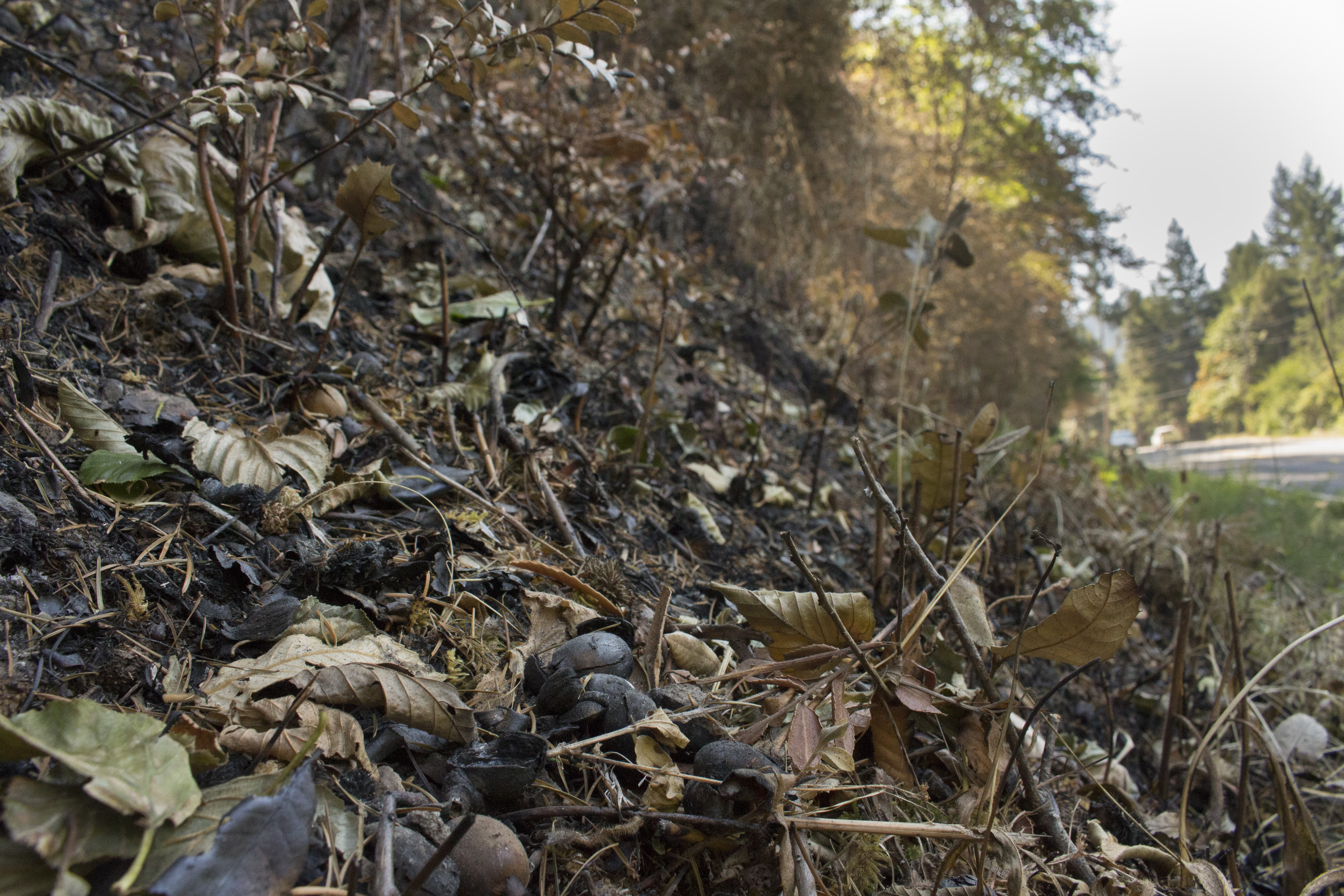
    As fire crews fighting the Humboldt County Mill Creek Fire wrap up local operations after 100 percent containment, California State officials warn that this year’s record breaking fire season is far from over.

    According to California’s Climate Change Assessment released last week, a study found that by 2100, if greenhouse gas emissions continue to rise, the frequency of extreme wildfires would increase and the average area burned statewide would increase by 77 percent.

    Locally, firefighters at the Mill Creek Fire, reached 100 percent containment last Thursday Aug. 30. The fire, which has been burning since Aug. 16, is located just north of Hoopa, and has burned over 3,600 acres.

    The wildfire is believed to have been sparked by arson. There is a $10,000 reward offered for information regarding the origins of the fire.

    According to Jeff Knudson of the Great Basin National Incident Management Team 6, no one was harmed by the Mill Creek Fire, and no infrastructure was damaged, but there was significant damage to the Hoopa Tribe’s timber base.

    Knudson, the Deputy Incident Commander, said the team is made up of firefighters from federal, state, and local partners from Nevada, Oregon, Wyoming, Utah and Idaho. He has over 30 years of experience fighting wildfires and says that over the years he has seen some changes in wildfires.

    “We’re seeing longer fire seasons,” Knudson said. “The fires are more intense.”

    On Friday Aug. 31 Great Basin Team 6 was getting ready to head home after returning command of the Mill Creek Fire to the Hoopa Fire Department.

    Meanwhile, last Friday Aug. 31, Cal Fire released a Labor Day Weekend news release warning that wildfire risk remains high. The Director of Cal Fire, Chief Ken Pimlott, said that this year firefighters have been busier than ever with record breaking wildfires.

    “This year, Cal Fire has responded to 4,434 fires that burned 876,428 acres, compared to last year when we responded to 4,170 fires for 228,803 acres,” Pimlott said.

    Cal Fire, with collaboration from the California Environmental Protection Agency, and the California Natural Resources Agency announced earlier this year in their California Forest Carbon Plan that increasing fire treatments through prescribed fires is a California State goal. A recent study has attributed 55 percent of the increase in dry fuels to human-caused climate change.

    By 2020 Cal Fire wants to double the current rate of forest restoration and fuels reduction treatments, including planned fires, to 35,000 acres per year for non-federal forest lands.

    Additionally, findings from the state’s Fourth Climate Change Assessment supported Cal Fire’s goal further with scientific backing that doubling forest restoration and treatments statewide, by 2020 is an important step.

    Jeffrey Kane is an associate professor of Fire Ecology and Fuels Management at HSU and Chair of the Northern California Prescribed Fire Council. Kane said he is encouraged that California is taking steps to scrutinize its legacy of fire suppression. Kane said that the bottom line is California is a fire prone state.

    “California needs fire like it needs water and sunlight,” Kane said.

    Lifelong Hoopa resident Matthew Sylvia said growing up in the area fires weren’t as severe as they are now. He said regular prescribed burning used to be a tribal practice and spoke of some of the benefits they see from routine low intensity fires such as the thinning of the forest from brush and the removal of pests such as ticks and acorn infesting weevils.

    “We also burned for basket weaving materials, and mushrooms,” Sylvia said.

    Sylvia said that after a fire, edible mushrooms and grasses used to make baskets would spring up from the ashes.

    Kane said the integrated pest management and ecological benefits after a prescribed fire that Sylvia described is called traditional ecological knowledge.

    Sylvia, a business major, said being so close to Redding, Calif. and coming off the heels of the Carr fire there was an initial panic in the community from the fire.

    “People were worried about it sweeping up the whole valley,” Sylvia said.

    Kane said that increasing the amount of prescribed fire treatments isn’t a magic solution but it is a step in the right direction.

  • EDITORIAL: Football program cut will create ripple effect

    EDITORIAL: Football program cut will create ripple effect

    Loss of football program also means loss of diversity, opportunity

    Lumberjacks football has been a staple of Humboldt for over 90 years. But this season will be the last for the foreseeable future and this community is losing more than just a team.

    Football brings more to the table than just sports. Student-athletes chose this school to pursue their education and to chase their dream of playing college football.

    Terminating Jacks football will be the conclusion of a program that has been a part of Humboldt since 1924, not long after HSU’s founding. The program has seen some standout stars and big-time players along the way. Lumberjacks 2017 All-American offensive lineman Alex Cappa was selected 94th overall by the Tampa Bay Buccaneers in this year’s NFL draft.

    HSU says they do their due diligence to remain somewhat ethnically balanced while bringing in students from all over California. This practice is misleading as the university’s surrounding areas have many racial undertones. The football team is one part of the school that was true to HSU’s message of inclusivity.

    Where there were once young men of all races working diligently towards the same goal, there will no longer be. The locker room that once brought men together will be empty.

    HSU will honor scholarships for eligible players through the 2018-19 academic year, and coaches and staff will also help players contact other programs. At the end of the season, players will get a full release, which means they could choose to play at another institution.

    President Lisa Rossbacher called it an unfortunate but necessary step in addressing the University’s structural deficit and protecting the school’s core academic mission. In her “mission” she has neglected a big part of what is supposed to make this university great.

    The closing statement of our mission states: “We help individuals prepare to be responsible members of diverse societies.”

    Less than four percent of HSU’s student population is African American and less than two percent of faculty are African American. Where is the diversity? Where is the care for the individual student?

    HSU has experienced lower enrollment over the last two years. Fall enrollment has dropped by more than 400 students. This dip has had a measurable impact on the budget and the loss of football will expectedly lead to an additional decline in enrollment, which in turn will bring less people of color.

    While getting rid of the football program could possibly be the right decision fiscally, the loss will be felt by many. People may not have ever met, had it not been for the football team. Familiar faces will change into strangers faces. What once brought a sense of camaraderie to this campus will now no longer exist.

    HSU hopes that contributors and boosters will continue to support HSU athletics but the $200,000 or more increase in contributions last year was for football. Loss of the football program will have a long-term ripple effect. Where and what gets hit the hardest remains to be seen.

  • Latinx Center Kick-Off preps for Mes De La Culture

    Latinx Center Kick-Off preps for Mes De La Culture

    LCAE ready to celebrate Latinx Heritage Month 

    During a fogless sunny afternoon, music could be heard from the top of the hill at Founder’s Hall. Below, in the UC quad, large speakers were outputting music from Latin artists from all over South America, including Mexico, Brazil and Chile.

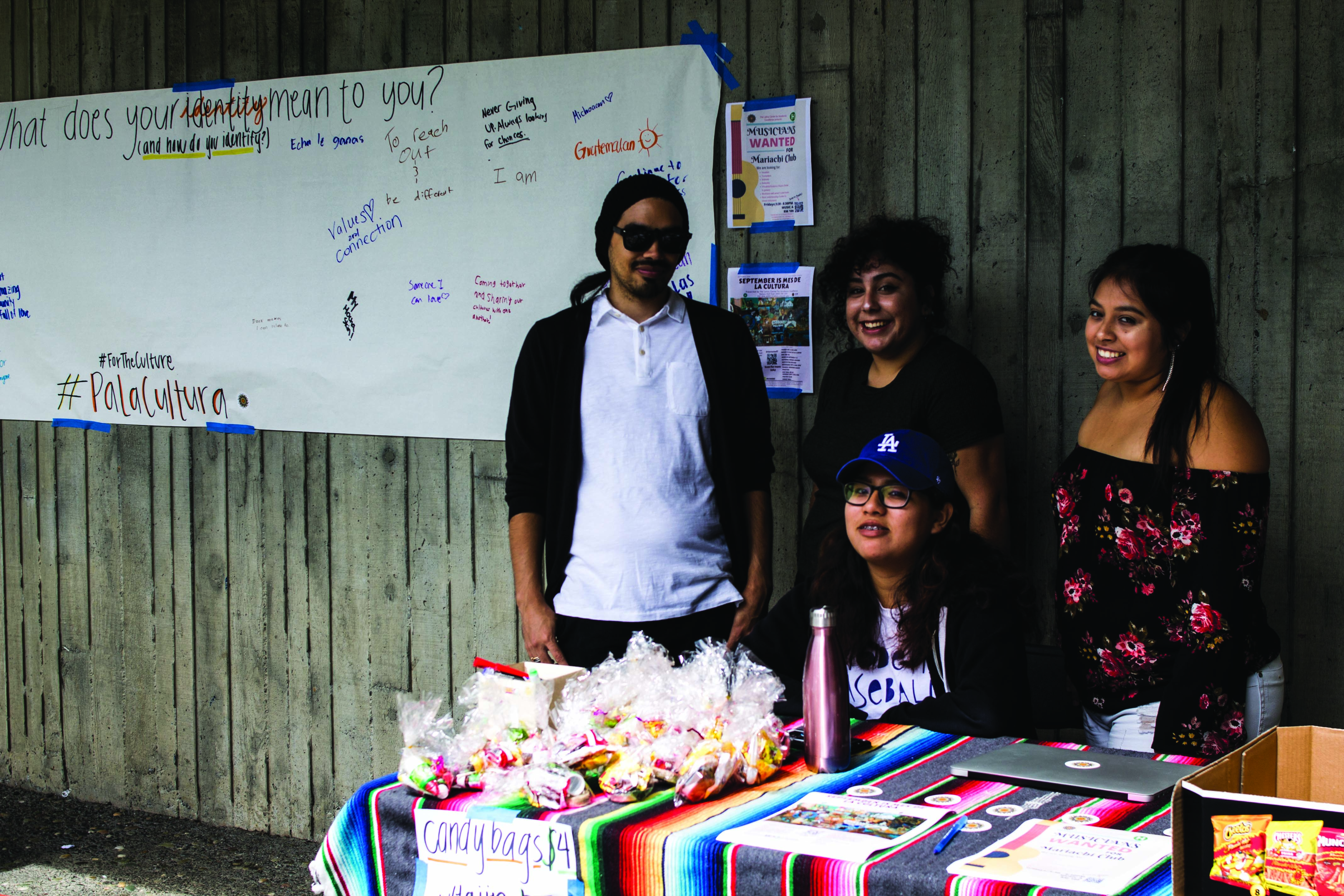
    The Latinx Center for Academic Excellence had a table set up in front of the Depot on Aug. 31 for Mes De La Cultura, month of the culture, spreading awareness of Hispanic Heritage month in September.

    Junior Mayra Sanchez, a critical race and gender studies major, has been working with the LCAE for a year. She said this event was created to spread word for more upcoming events. LCAE will kick of Hispanic Heritage month on Sept. 6 with live music and the Los Giles food truck.

    The club said they are trying to host different events to become more visible in the community.

    “We’re trying to bring up the question what does it mean to be a Hispanic-serving institute here on campus and if they are really serving that purpose,” Sanchez said.

    Behind a table full of bags of Mexican candy with tajin and chips with the option of cheese, was a long white poster that asked the question “What does your identity mean to you? (and how do you identify?).”

    A box of markers sat at the table and everyone was invited to write down what these questions meant to them. A couple dozen answers were scattered across the poster sheet, some read: “values and connection,” and “coming together and sharing our cultures with one another.” They all shared community support and heritage pride.

    “They do a lot of cultural events and they really inspire the Hispanic community to stand up for themselves, to be active, to represent your culture and be proud of who you are.” Sophomore Alexandra Gonzalez said as to why she wanted to become a part of LCAE.

    Gonzalez, a business major, started working at the center this year. She said the center inspires asking the question ‘what is my identity’ on a daily basis and to be who you want to be.

    “It’s a good resource,” she said. “Its just there and helps people be the best self of themselves and be the identity they want to be.”

    Justin Carnero, a business masters student, said these events help bridge the gap between community building and academic excellence and that’s why he got involved.

    “A lot of students are coming from out of the area and so don’t have an essence of community,” Camero said. “A lot of students come here and then leave because they don’t have that sense of community.”

    Junior Caia Santana, an Art Studio major, hosted and DJ’d the event with phone. Santana has been involved with LCAE since last year but started officially working for them since the beginning of the month. Santana’s

    “I like helping people,” Santana said. “I like advocating for the ethnic community or just POC in general.”

    LCAE has multiple events lined up for Hispanic Heritage Month.

    • Sept. 5 – Community and Belonging Fair.
    • Sept. 6 – Mes De La Cultura Kick-Off at The Great Hall.
    • Sept. 12 – Afro-Latinx: Time to Talk seminar at NHE 106.
    • Sept. 14 – Queer To Stay! Life as a QPOC in NHE 106.
    • Sept. 17-21 – National Hispanic-Serving Institution week, in the main quad and art quad.
    • Sept. 19 – Danza! Indigenous dance practice in Gist Hall 102.
    • Sept. 24 – Poetry Slam at The Great Hall.


  • Account not verified

    Account not verified

    By Alex Harris & Tony Wallin

    Parody profile  has significant following

    Over 1,000 or so Instagram users, whether knowingly or not, have been following an account parodying as the official Humboldt County Instagram profile.

    Although some are aware @humboldtcounty is a parody, the account’s high number of followers has bolstered it as the top result when searching for Humboldt County on Instagram.

    KRFH News reporter Tera Winston-Doble said she was told by a friend about this seemingly official page with questionable content. She said she found it to contain some posts, under the guise of parody, to have racist rhetoric and others that seem to shame the homeless community.

    instascreenshot2 (1)
    Screenshot of @humboldtcounty Instagram

    “It’s the first thing that shows up on Humboldt County on Instagram.” Winston-Doble said. “Lots of people are sharing posts and tagging it.”

    Many unknowing Instagramers use the hashtag that links to this account with a variety of posts such as people doing yoga or dogs on the beach.

    (Screenshot of one of the posts)

    Some of the accounts posts address controversies such as those regarding the drug trade across the southern border of the United States and engage with followers in comments.

    At the top of the accounts page, 1st district Supervisor Rex Bohn’s email is linked, suggesting affiliation and credibility. Rex Bohn appeared to have barely any knowledge of Instagram in general let alone the account.

    “No clue, I have no Instagram or plan on one, never used that medium,” Bohn said in an email.

    The account states at the top of the page that it is a parody page. However, the Humboldt County official seal is set as the profile picture, creating confusion for some followers.

    3rd District Supervisor Mike Wilson also had no knowledge but let his “media guy” Sean Quincy know about the account.

    “It’s an account that is using the county logo without permission and is misrepresenting itself as an official County of Humboldt social media account,” Quincy said. “I am reaching out to them to see if they are willing to more accurately identify themselves.”

    The owner of the parody account has also not yet responded to the Lumberjack.

  • A ‘Village’ divided

    A ‘Village’ divided

    By Tony Wallin & Alex Harris

    City council vote stops student housing project

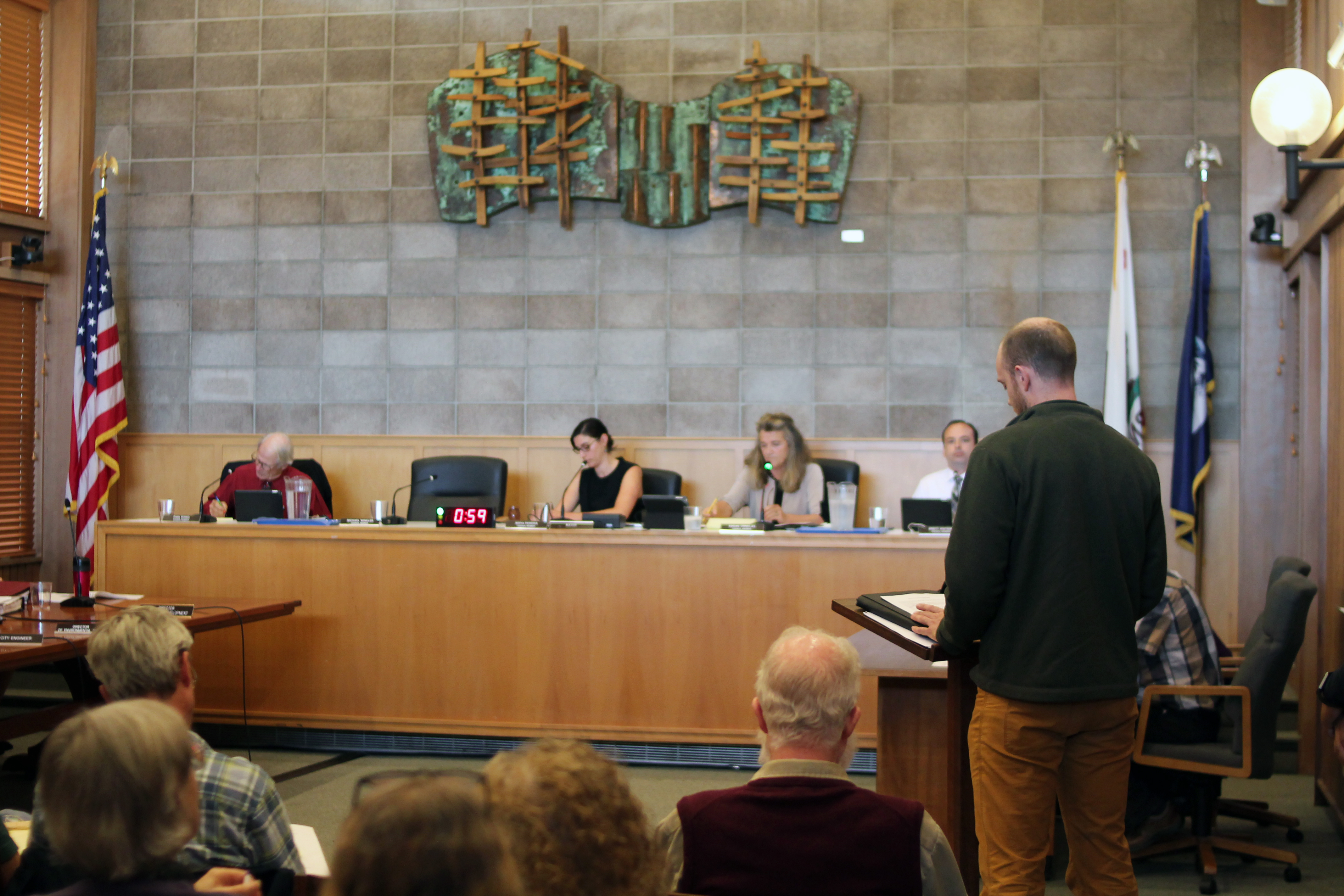
    The Arcata community filled the city council chamber on Aug. 29, only to witness a deadlock between their city council members over a student housing project.

    Mike Pitino and Mayor Sofia Pereira denied council member Susan Ornelas’ motion to approve the project as a concept if Humboldt State University and developer AMCAL were willing to adjust their proposal.

    Another motion laid out by Pitino to continue as is was also denied from a protest vote by both Ornelas and Brett Watson, who abstained from voting. No agreement was able to be met, three council members were unable to vote the same way.

    This was the sixth meeting to address the controversial AMCAL housing project known as The Village. HSU has now supported the proposed 240 unit four 4 story building that will house 800 beds which has also raised concern with residents.

    Retired HSU Biology professor, Milt Boyd, who was with the department for 38 years said he was there to observe the actions of the city with much concern regarding the project.

    “I am a strong advocate for students and actions that will be beneficial to students, but this certain project is not going to end up benefiting students,” Boyd said. “Its going to be a problem for them.”

    The majority of those who attended agree with Boyd. Many HSU faculty and retirees brought up problems dealing with traffic safety, noise pollution in the surrounding neighborhoods, affordability and lack of family units, which an administrator for HSU said they were unwilling to accommodate since their isn’t a need for it.

    Out of 14 people to publicly speak, 10 denied moving forward with the project. Erik Jules, one of the directors of Arcata Citizens for Responsible Housing and HSU biology professor was one of those to declare no.

    “The problem that HSU has is retention, people come here and then leave. If we build more housing will it solve that problem?” Jules said. “Ill tell you what our problem is, we have a budget problem…We’ve lost teaching powers, we don’t have enough classes for students.” Jules said that building houses will not solve HSU’s budget problem.

    Jane Woodward, a member of ACRH, had main concerns with safety regarding students and of those that live on the hill.

    “I worry about the seniors that live on the hill. With 600 students crossing there it’s dangerous,” Woodward said. “They don’t have appropriate walkways to get students to HSU safely, there’s only one way in and one way out.”

    It seemed as though all of the councilmembers were disappointed with the outcome of the meeting, as well most who attended. This disappointment seemed to resonate in the final comments by Arcata Mayor Sofia Pereira:

    “I’m disappointed in the outcome,” Pereira said. “Students are struggling to find housing in this community and this was not a perfect project by any means but it met a lot of needs that we have in our community. So I am disappointed we are unable to move forward on it.”

  • Sitting Hens

    Sitting Hens


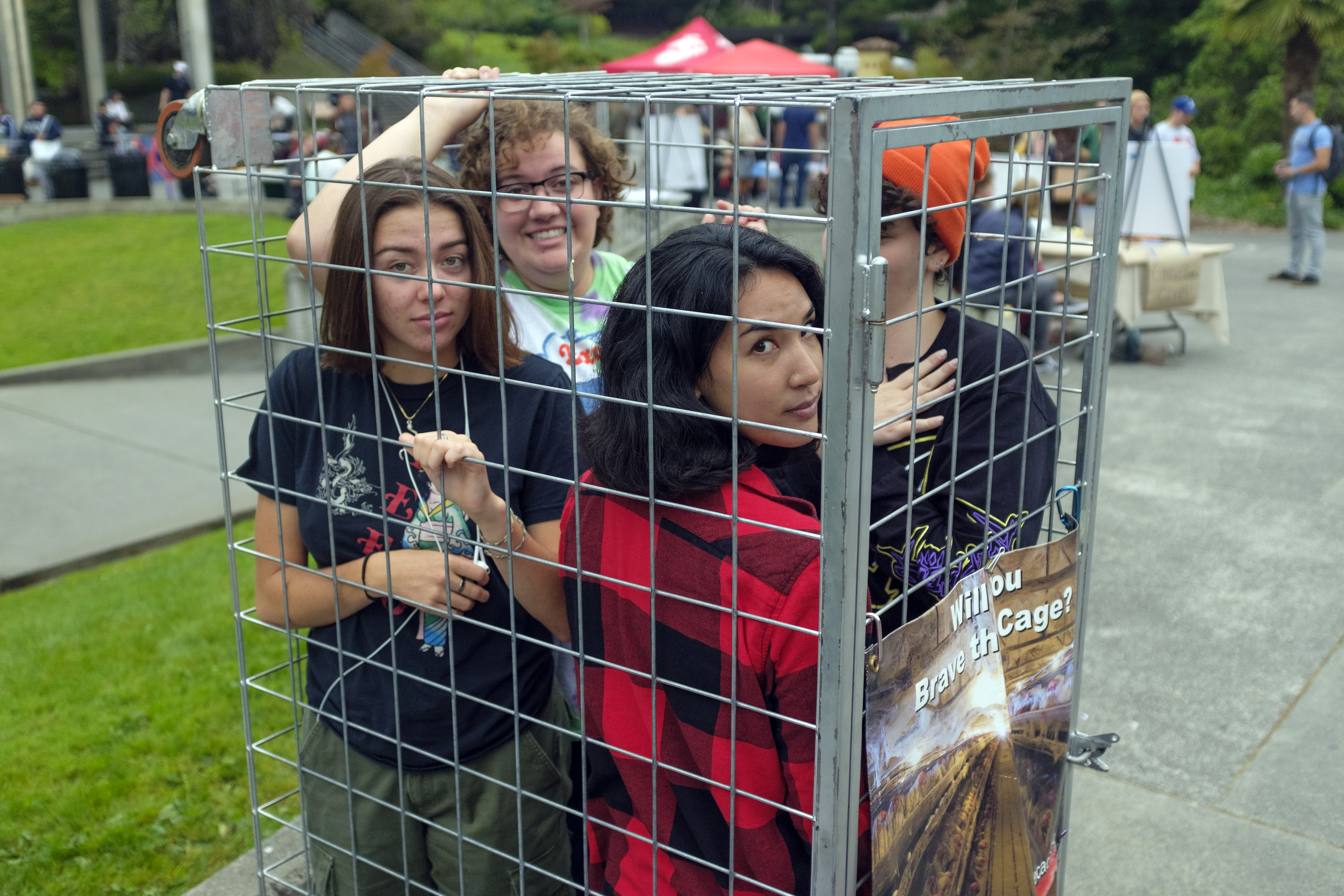
    Animal Place uses human cage to address industry realities for hens

    Grace Amico, volunteer for Animal Place, set up a human sized caged enclosure on Aug. 24 at the UC Quad to challenge Lumberjacks to “Brave the Cage,” a one minute challenge to simulate living conditions for hens in the egg industry.

    Amico has been volunteering for Animal Place, a sanctuary for farmed animals, in running the “Brave the Cage” campaign at Northern California college campuses.

    “We’re about rescuing farm animals from neglect and abuse situations while also educating the public because we believe that education is really important,” Amico said. “When we do our campaigns, a lot of the time we don’t wanna be telling people ‘don’t do this, do do that,’ We want to give them the tools to make the decision themselves.”

    The tool, in this example, was the inside of a giant chicken cage.

    While most students were rushing along to class, the challenge caught the eye of students Sara Galli, Alex Rumbel and Allie Battista. The trio joined Amico inside the cage for the one minute challenge.

    “I was up against the cage, so I was like I don’t want to touch these people anymore,” Rumbel said. “If I had to be in there for a while, it’d be pretty annoying.”

    The cage caused students to reflect on much more than simply being uncomfortable.

    “It definitely has a shock factor. It’s like, ‘what… I’m in a human sized cage’,” Galli said.

    Student Lily O’Connell added insightful comparison for human needs.

    “It sucks. And it’s really sad that we’re able to exploit animals,” O’Connell said. “They’re not given any rights and every organism deserves to be outside and breath fresh air and sunlight. The same thing with prisons for humans too, totally inhumane.”

    Though students only had to endure one minute of an awkward uncomfortable situation, the hens that Animal Place advocate for don’t have it as good.

    “For this cage, people are wearing shoes that hens don’t have, so like if people were to take off their shoes and stand on the wire floor, that would be more accurate as to what the hens are going thorough,” Amico said. “Hens in the egg industry, their cages are stacked on top of each other, so you have manure raining down from the top cages to the very bottom.”

    Amico said hens also have their beaks cut, or are “debeaked” to reduce injury from other hens in the case of irritation or to fight for food. The only time hens are let out of the cage is when they’re being depopulated.

    “It’s basically a fancy word for being killed,” Amico said. “Farmers will do this by gassing them or starving them and throwing them into a dumpster or landfill.”

    Amico said she has been volunteering for Animal Place for six months. Animal Place is a sanctuary for those hens and other animals. More information is available at http://www.animalplace.org/.