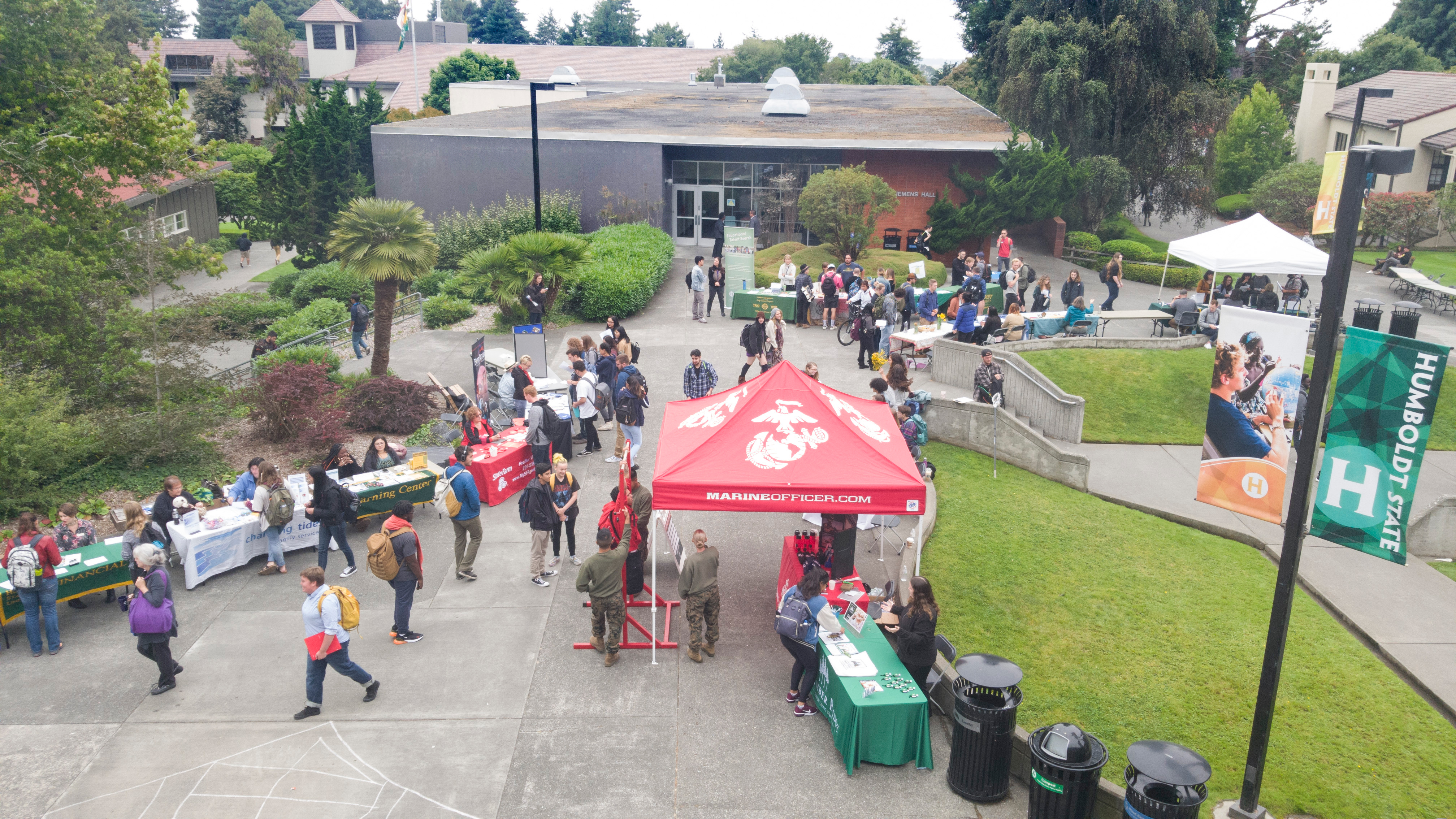
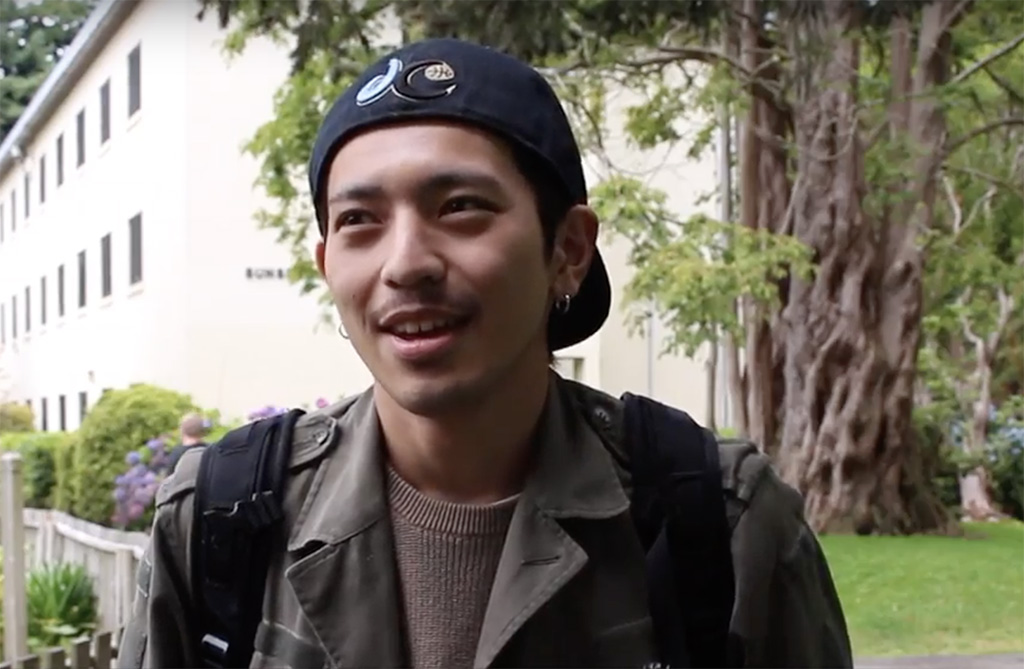
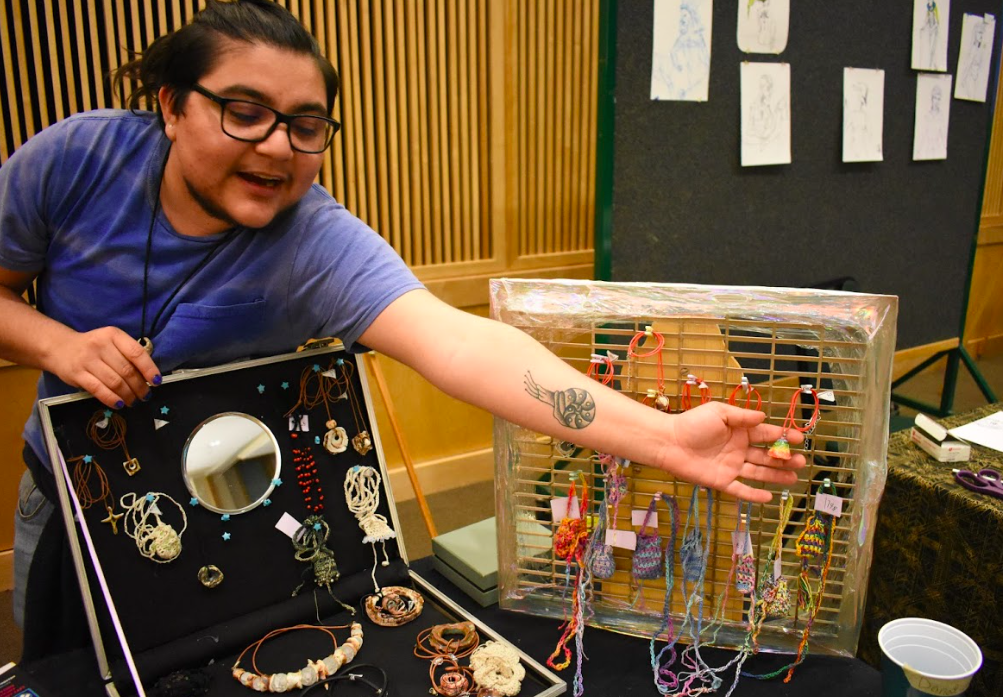
With a sharp navy blue dress shirt, and black slacks, HSU’s business graduate Zachary Jimenez, dressed for success as he looked for work opportunities at HSU’s Job Fair.
“After I graduated, I didn’t want any entry level low paying job,” Jimenez said. “I’m more eager to find a full time job, and so far I found 3 opportunities here, I’m still looking for more.”
HSU’s Job Fair is open on the first Wednesday of the first school week. It allows for students to get in touch with many organizations on campus, and outside the campus.
Academic Career Advising Center Career Adviser Joy Soll helped organize the event.
“We have about 1,000 students every year stopping by the job fair looking for work,” Soll said. “We help out students who are new to HSU and those who are coming back.”
The job fair offers a variety of job opportunities. This year’s job fair had 35 organizations hand out job applications to students, such as Humboldt State University’s YES program and Papa Murphy’s pizza.
One of the newer jobs offered at the job fair was Cal Fire. Human Resources for Cal Fire Isaiah Matthew was there to answer questions for students who are interested in being involved in Cal Fire.
“This is our first time in HSU’s job fair,” Matthew said. “As long as students are interested in what we do, we are more than happy to hire HSU students.”
The Academic Career Advising Center advisors were also eager to introduce their online job search website, HSU Handshake. HSU Handshake, formerly known as Springboard, offers more job opportunities for HSU students.
“HSU Handshake connects all colleges nationally in order to expand students job opportunities,” Soll said.
On Aug. 29, HSU will also be hosting a Volunteer fair for those who are interested, from 10 a.m.to 2 p.m.
Seismic retrofit has turned the Theatre Arts building and the basement of the library into construction zones.
Roughly 20 years ago there was a campus wide assessment of seismic risk on all of the 23 California State University campuses and each university was provided with priority groups of which buildings held the largest seismic risk by the CSU Seismic Review Board.
“Theatre Arts and the Library are the last Priority 1 buildings to receive seismic retrofit on this campus,” said HSU’s Associate Director of Planning, Design, and Construction, Michael Fisher.
Fisher is responsible for all construction and master planning around campus and he has been working on the engineering and design of this project for two years now. Seismic safety is the essential goal and purpose of this project; and the construction will consist of strengthening the concrete and steel within these buildings.
“These buildings today are not unsafe by any means,” said Fisher. “The seismic retrofit just ensures that pedestrian egress is accessible.”
Based off of a Humboldt State Now press release published over the summer, this project will also modify and upgrade nearby doorways, restrooms, elevators, drinking fountains, and improve accessibility of parking.
The Theatre Arts building and the south side of the first floor in the library have been vacated for this academic year.
“I want to make sure that students know the rest of the first floor, as well as the second and third floor of the library will remain open and operational,” said Fisher.
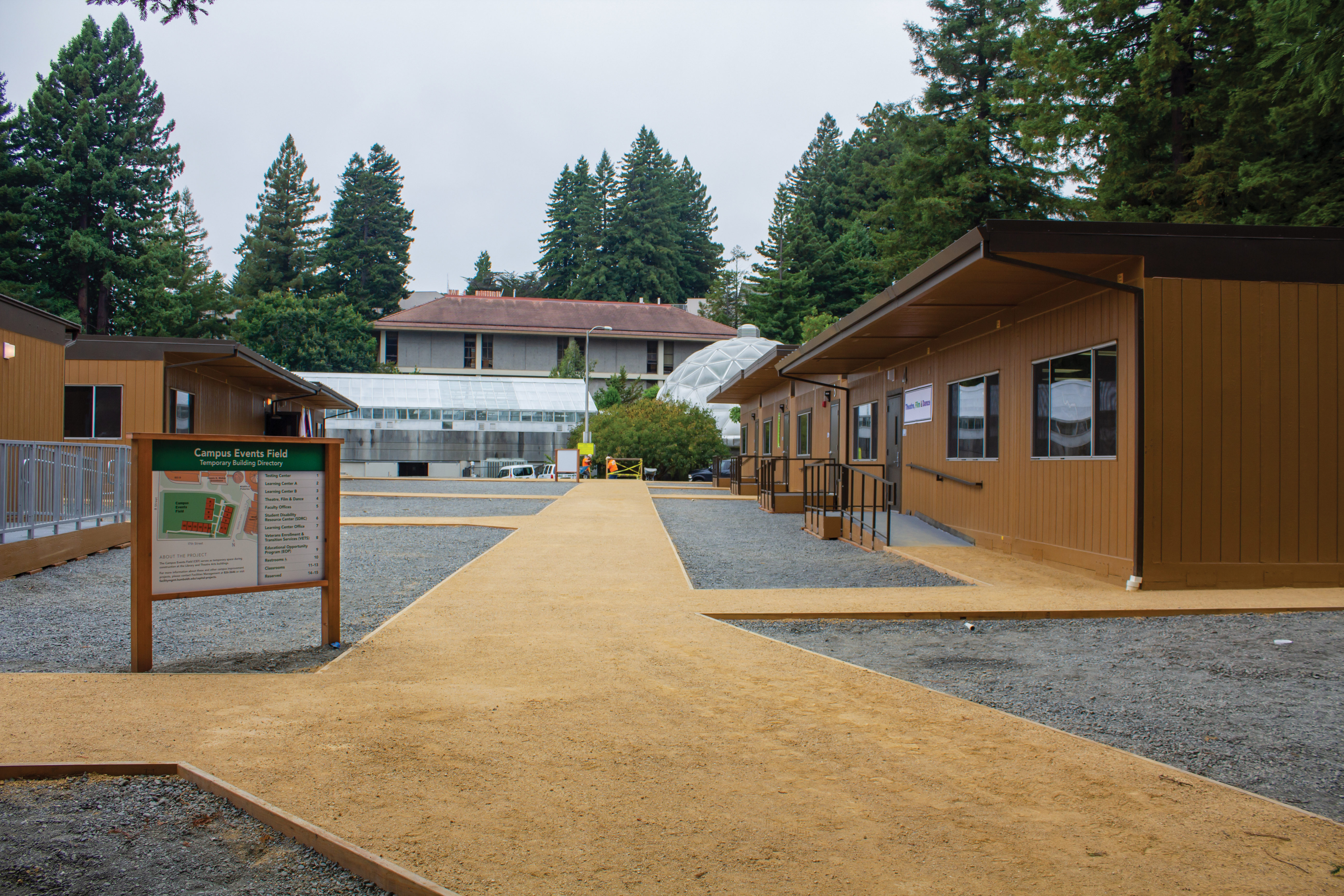
The vacated classrooms, offices, and resource centers have been relocated to either the Student Business Services building, Jenkins Hall, or the Campus Events Field.
Over the summer, project manager Jason Baugh worked to ensure that the transformation of the Campus Events Field be completed just in time for Fall classes beginning August 20.
“Holding to timelines was important for this project,” said Baugh. “[The Campus Events Field] is now a new functioning portion of campus.”
There are now 14 classrooms/office spaces on the Campus Events Field as well as fully functioning restrooms. However, this space is temporary and is planned to be taken down after the completed seismic construction on the Theatre Arts and library building.
According to the Humboldt State Now press release, the seismic retrofit is scheduled to begin this fall and is hoped to be completed by Summer 2019. The project is completely funded by the CSU system and will cost a total of $34 million.
“I plan to occupy the reconstructed buildings in summer 2019,” said Fisher. “In preparation for Fall 2019.”
Students still have full accessibility to resources such as the Learning Center and the Student Disability Resource Center that are now located at the Campus Events Field.
Please refer to the updated campus map for construction zones and revised disability access pathways.
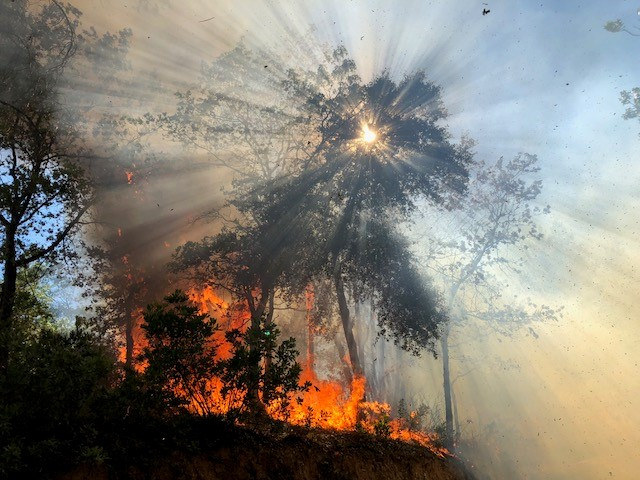
The Hoopa Valley Indian Reservation has lost 1,500 acres to the Mill Creek 1 fire as of Aug. 20.
According to KRCR the fire is only five percent contained. The Mill Creek 1 fire started on Aug. 16 close to Hoopa and are reported to be caused by arson.
The Mill Creek is one of many fires that have raged up and down California in the last two months. Fires across the state are burning as far away as Orange county and as close as Shasta and Trinity county.
The Carr fire in Trinity and Shasta county started July 23, at 1:15 p.m. and is still burning as of Aug. 20.
According to Cal Fire a mechanical failure of an automobile caused the fire. The incident happened around state Route 299 and Carr Powerhouse Road. The Carr fire has burned 229,651 acres of land. As of Aug. 20, it is now 88 percent contained.
At least six have died, including three firefighters. Many buildings have been destroyed including “1,079 residences, 22 commercial structures, 503 outbuildings destroyed – 190 residences, 26 commercial structures, and 63 outbuildings damaged.”
Cal Fire authorities describe the condition of affected areas to have heavy smoke that helped decrease fire activity.
“Fire spread remains fuels and topography driven with high potential for roll out and spot fires,” authorities said. “Heavy timber fuels still challenge firefighting efforts.”
The fire is still actively burning within its containment lines. State Route 299 is accessible by the public as there are still emergency crews working in the affected areas.
Cal Fire recommends people to practice vehicle safety in order to prevent wildfires. Some safety rules they suggest for motorists is to follow is “secure (chains, no dragging parts, check tire pressure, carry a fire extinguisher in your vehicle, and properly maintain brakes.” By following these guidelines nearly all vehicle related fires can be prevented.
Women’s soccer hosted a scrimmage against College of the Redwoods last Friday, August 17 at 4 p.m.
Upcoming:
Aug. 21 – Jacks exhibition vs. Corban 4 p.m.
Aug. 30 – Jacks vs. Concordia (Rohnert Park, Ca) 1:30 p.m.
Sept. 1 – Jacks vs.Dominican (Rohnert Park, Ca) 2 p.m.
Men’s Soccer hosted a scrimmage against Southern Oregon last Saturday, August 18 at 1 p.m.
Upcoming:
Aug. 23 – Jacks scrimmage vs. Oregon Tech 5:30 p.m.
Aug. 25 – Jacks scrimmage vs. College of the Redwoods 4 p.m.
Aug. 30 – Jacks vs. Holy Names 3 p.m.
FOOTBALL
Football held their last fall scrimmage in the Redwood Bowl on Saturday, August 18, at 3 p.m.
Upcoming:
Sept. 1 – Jacks @ MSU Texas 5 p.m.
Sept. 15 – Jacks @ Central Washington 4 p.m.
Sept. 22 – Jacks vs. Western Oregon 6 p.m.
WOMEN’S VOLLEYBALL
Women’s volleyball held their annual alumni game in the Lumberjack Arena last Friday, August 17, at 4 p.m.
Upcoming:
Aug. 23 – Jacks vs. Pacific Union (Rohnert Park, Ca) 2 p.m.
Aug. 24 – Jacks @ Notre Dame De Namur 9 a.m.
Aug. 25 – Jacks vs. Georgia College (Turlock, Ca) 10:30 a.m.
Cross Country
Cross country just wrapped up their four day training camp at Walnut Creek Education Center. Come September, they will host the Humboldt Invitational at Patrick’s Point State Park in Trinidad.
Upcoming:
Sept. 8 – Humboldt Invitational Trinidad, Ca
Sept. 29 – Willamette Invitational Salem, Or
Oct. 13 – Bronco Invitational Sunnyvale, Ca
Further game schedules for all HSU sports can be found on hsujacks.com
Community radio station KHSU and Humboldt State University are at odds after the sudden firing of program and operations director Katie Whiteside on May 15.
In spite of push back from volunteers, staff and listeners and a vote of no confidence from KHSU’s Community Advisory Board , general manager of KHSU radio station, Peter Fretwell, remains in his position after suddenly firing Whiteside.
Due to the personal nature of the issue, Fretwell and HSU administration said they could not reveal reasons for termination.
Concerned patrons wrote to the advisory board in “unprecedented levels” expressing their concern. In response the CAB took a vote of no confidence against Fretwell after their June 27 public meeting, but with no results.
According to the Mad River Union, this meeting presented complaints of a hostile work environment due to Fretwell’s behavior.
“The members of the KHSU community who have voiced their opinion, through the conduit of the KHSU CAB, formally submits their vote of no confidence in Peter Fretwell as General Manager of KHSU, and respectfully requests his termination,” the letter said.
HSU President Lisa Rossbacher responded to the advisory board’s letter and offered no action or solution. Rossbacher said in the letter that “we must ensure that all personnel matters, including those affecting both staff and leadership, are handled with respect and confidentiality.”
According to Mad River Union and a letter sent to HSU President Rossbacher, soona fter Whiteside’s firing, KHSU office manager Lorna Bryant alleged abusive and traumatizing behavior from University Advancement Vice President Craig Wruck, Fretwell’s supervisor.
In an email to HSU President Lisa Rossbacher, that Bryant also sent to the Mad River Union, Bryant said she finally felt comfortable addressing the situation a week later after processing the situation.
“On July 11, 2018 during a weekly KHSU staff meeting, I was subjected to abusive behavior from Craig Wruck, HSU University Advancement vice president…” she said in the email. “I was yelled at; I felt disrespected; and there were consistent attempts to keep me from speaking.”
Bryant also said the majority of the staff was present and no one stepped in on her behalf, including Fretwell.
The KHSU advisory board met July 25 with both Wruck and Bryant in attendance. The meeting focused on a number of issues including a draft of suggested changes to KHSU’s mission statement and values from Wruck, the altercation between Wruck and Bryant and Fretwell’s position.
Following Whiteside’s firing, at least one sponsor made a choice to pull their funding until Fretwell was removed. Others, such as Wildberries Marketplace owner Phil Ricord, said at the July meeting that he would not pull his funding of the station but urged the university to find a middle ground.
Fretwell was absent from the meeting per Wruck’s request. Community in attendance rose concerns with the draft, Fretwell and Whiteside at great lengths, causing the meeting to be extended an extra hour.
“The problem that I see…is that the person that leads (KHSU) isn’t being effective or successful,” Ricord said to Wruck at the July meeting. “And I think that you and the university has a responsibility to address that.”
Ricord said he met with Rossbacher per his request and after asking her “tough questions” that he believes both she and the university are aware of “what they’ve gotten themselves into.”
Volunteers, staff and listeners in attendance also expressed disagreement with the introduction of a draft to change the mission statement and values without first consulting the community.
Wruck continuously assured the draft was just an attempt to get ideas going and not an attempt to undermine the community.
Finally, after over two hours of questioning from the majority of the audience on several issues, Wruck confirmed Fretwell was not being asked to step down.
“At this point Peter is meeting my expectations and his job is not in jeopardy,” Wruck said.
The KHSU advisory board will meet again on Aug. 29.
Humboldt State University Press Release sent out from President Lisa Rossbacher at 12:44 p.m. on receiving 8-year accreditation from the Western Association of Schools and Colleges:
Dear University Community,
We are pleased to share that Humboldt State University has received the final report from our reaccreditation site visit by the WASC Senior Commission for Universities and Colleges (WSCUC), and our accreditation has been reaffirmed for eight years. The status of accreditation indicates that HSU has fulfilled the requirements for accreditation via core commitment to: student learning and success; quality and improvement; and institutional integrity, sustainability, and accountability.
With this action, WSCUC recognizes the important opportunities that HSU provides students and the quality of an HSU education. We can all be very proud of this reaffirmation, and we’re thankful for all the hard work on this process by countless individuals across campus.
In addition to informing us of the accreditation decision, WSCUC shared some important steps going forward, including the schedule for the next reaffirmation of accreditation process. HSU will have a follow-up visit (Spring 2021), a Mid-Cycle Review (May 2022), an Offsite Review (Fall 2025), and an Accreditation Visit (Spring 2026).
The WSCUC letter included several commendations that highlight campus efforts, as well as recommendations to further enhance student success.
The commendations were related to:
• Recruitment of diverse students,
• Alignment of University mission with issues pertaining to the environment, sustainability, and social justice,
• Hands-on learning experiences that actively engage students,
• Co-curricular programming that involves collaboration among multiple programs across campus, and
• Development of a robust institutional research capacity that informs data-driven decision-making.
Recommendations to further enhance student success:
• Evaluate campus support services to ensure the needs of a diverse student body are being met,
• Ensure that recruitment efforts inform potential students of challenges related to our rural setting and the availability of support services,
• Expand leadership’s communication efforts to ensure budget transparency and help the University community navigate change,
• Implement a university-wide assessment plan and program review for continuous improvement,
• Prioritize diversification of staff and faculty to reflect student demographics, and
• Focus on a sustainable budgeting process, enrollment management, and diversification of revenue.
We are pleased that WSCUC recognized the important work that is happening at HSU, and we hope you are as well. Also, we are not surprised by the specific recommendations, and we look forward to sharing progress during the 2021 follow-up visit. In particular, the University is well on its way to a sustainable budgeting process, having completed more than half of the two-year plan to reduce expenditures by $9 million, and we have nearly finalized a new strategic enrollment management plan.
Once again, thank you to everyone who participated in this important reaccreditation process. It has provided a valuable opportunity to reflect on our priorities, to identify areas where we can improve, and to showcase the accomplishments of HSU’s students, faculty, and staff.
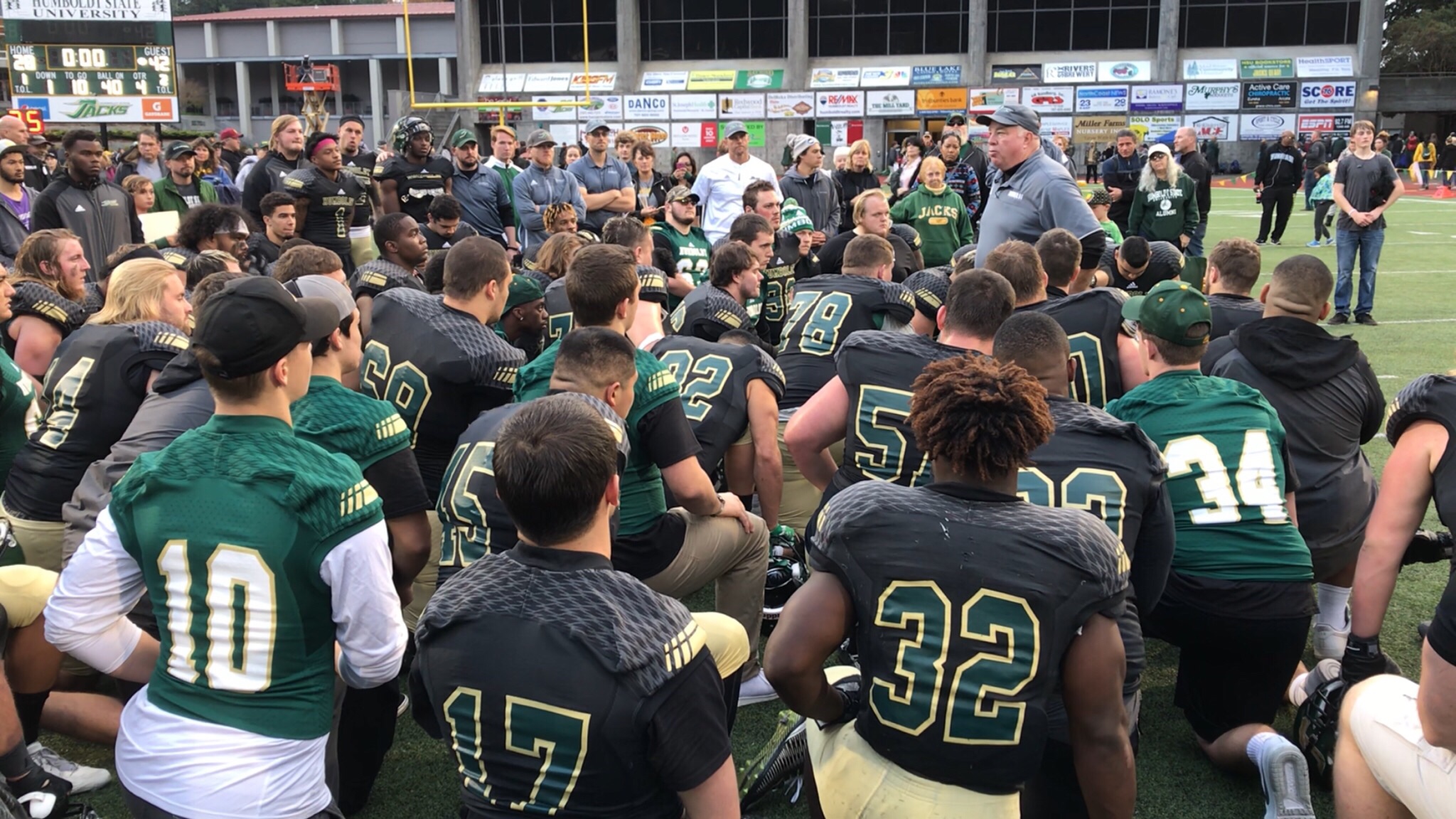
Early this afternoon, Humboldt State University announced that after this 2018 season the football program will be cut.
“This [decision] is due to ongoing financial challenges within athletics and at the university as a whole,” Humboldt State University President Lisa Rossbacher said. “We cannot allow the budget deficit in athletics to continue or to deepen further.”
This April, Rossbacher announced the two-year budget plan in reducing costs by at least $9 million and many hoped that the football program would not be a part of this cut. However, according to the HSU Athletic Department, the net cost of about $1 million annually became too expensive for the University to support and subsidize indefinitely.
“It is the only realistic path for us to take,” Rossbacher said.
Redshirt Sophomore Kyle Martorella called home as soon as he received the news. He said he was very surprised and upset after hearing the program would be cut.
“I can really only see myself playing at Humboldt so it sucks,” Martorella said. “I thought we were guaranteed another five years and that was what the money was raised for.”
Since December 2017, HSU boosters, alumni and community members put forth their utmost effort in reaching a goal of $500,000 that would have ensured another solid year of football at the Redwood Bowl. During that time Rossbacher announced if $500,000 was collected by January of each year, for the next five years, the University would match it with another $500,000 to keep the program.
Although SaveHSUAthletics confirmed nearly $511,000 in pledges last fall, only $329,000 in cash donations were collected in June, according to Rossbacher.
However, SaveHSUAthletics Co-Founder and HSU alum Jim Redd shared that in fact, a total of $410,000 was collected.
“I know that a payment of $80,000 was scheduled to come in, and received on July 15th,” said Redd.
The total amount of donations that were collected will be used for this last football season at HSU and all of the scholarships awarded will be honored to eligible players through the 2018-2019 academic year.
“We are going to be very supportive of the current players and coaches this year,” Redd said. “The support is going to drop way off for HSU athletics as a whole.”
Although several boosters donate to other HSU athletic programs as well, Redd and his fellow boosters believe cutting the program was all a part of Athletic Director Duncan Robins’ plan and because of that, many supporters no longer want to give money to HSU athletics at all.
“There are a lot of donors upset and wanting their money back,” said Redd. “I just feel like Robins was hired to get rid of the program. It took him seven months longer than he would have liked but he succeeded.”
HSU’s athletic department said it plans on providing as much support as needed for current players, whether they choose to complete their academic years at HSU or to transfer to another school and continue playing football.
HSU junior and 2018 captain Isaiah Hall said he plans on “riding out” with a strong team for this last HSU football season and hopes to ensure his team that this decision should not interrupt what they have accomplished for the success of this season so far.
“I always had a feeling that this was bound to happen,” Hall said. “When [Rossbacher] was on the podium talking about keeping the program, her words felt untruthful.”
After this season, Hall is eligible to play two more collegiate years of football and after speaking with his family he plans to have a successful season and transfer to play at another university come spring.
As for new recruits, Chris Quirarte from Buhach Colony High School and Braden Gordon from Independence High School, new beginnings have already come to an end. Both of the newly announced Jacks from Southern California said they were not sure what to think about the news and immediately contacted family for support.
“I am stuck on whether I want to redshirt or play this year,” Quirarte said. “The decision changes my outlook on the season a little but I am not trying to pull the trigger on my decision too early.”
Last year, HSU athletics held a deficit of about $750,000 in which the university covered; and three years ago that deficit was at $250,000. The rate of cost increases in the athletics department at HSU has been roughly double of the university costs in whole.
Rossbacher said she still plans on maintaining a Division II athletics program at HSU and in order to remain eligible for NCAA Division II competition, the University is required to have 10 sports. According to the HSU Athletic Department To remain in the California Collegiate Athletic Association, HSU’s primary conference, the 10 sports are required to be chosen from a specified list, and football is not included on that list.
After this 2018 football season, HSU will sponsor 11 sports: men’s and women’s basketball, men’s and women’s soccer, men’s and women’s cross country, men’s and women’s track & field, crew, softball and volleyball.
“At this point we just have to come together as a team,” Martorella said. “We still have 10 games like any other season and we can still win a ring like any other season.”
This article has been updated on May 3 at 3:35 p.m.
This semester has been plagued with budget cuts, walkouts and campus strikes. Tension between faculty and administration have reached a peak.
Amidst all this, Physics and Astronomy professor Paola Rodriguez-Hidalgo decided to turn in her resignation. At the end of her third year here at Humboldt State, her office is filled with boxes that have yet to be unpacked ,and won’t be until she settles in at the University of Washington Bothell.
“I wanted to make my home here but, in my humble opinion, I believe HSU is experiencing an identity crisis,” Rodriguez-Hidalgo said. “There is a lack of balance between the teaching I’m supposed to do and the research I’m supposed to do, and at the end of the day I felt that research component was not really valued that much. When I came to HSU, I was expecting a better balance between the two; I don’t know how much I was misled or how much I misinterpreted what I was told.”
Rodriguez Hidalgo said she believes HSU is asking too much of its faculty. She explains how they are expected to plan hours of lecture, lead student research, guide advisees, sit on committees, attend conferences, grade papers and show up to class every day.
Rodriguez Hidalgo thinks as more jobs are put on professors, they will have less time and energy for teaching and research.
“I think the faculty want to put the hours into creating good learning experiences which is what students are going to remember,” Rodriguez Hidalgo said. “But if you don’t have the time at some point you need to give up on the excellence. Last semester I was working 80 hours plus a week and I was burning out. If I stayed here, how much longer was I going to like my job? I love being a professor; this is a job I don’t want to hate.”
Rodriguez Hidalgo said she doesn’t place the blame on HSU or any administrator in particular. To her, it’s the system that HSU exists in. She said our current situation is the consequence of years of a constant revolving door of administrators.
“It is very hard to have a vision when people are always coming and going,” Rodriguez Hidalgo said. “For me, personally, I wasn’t seeing that leadership. I wasn’t seeing that heart. I wasn’t seeing that support. What the faculty needs is a support structure that allows me to do my job to the best of my capabilities.”
3:35 p.m.: The professor’s title has been corrected from physics to physics and astronomy. Her quotes have been updated to reflect direct quotes.
The Eureka chapter of the NAACP posted a press release on their website on April 26 asking recruiters from Humboldt State University to stop going to majority-minority areas and recruiting students of color.
The press release listed several demands of the university changes and a call on the university to “forgo” the access to money that this recruitment opens up to the university.
In the press release the NAACP said “HSU recruiters continue to travel to minority-majority communities, with the intent to enroll more students of color. Yet there has been no consistent presence of HSU administrators at the monthly vigils organized and facilitated by the students and Charmaine Lawson, the mother of Josiah Lawson.”
The NAACP also expressed that HSU should be more transparent to students of color when it comes to racism in HSU.
“If HSU is ‘number one for Social Justice’ as advertised, the University must accept responsibility for the negative impacts of its actions and inactions on students of color immediately,” the NAACP said..
The NAACP also called out the college’s responsibility to protect students from “foreseeable violence on campus and in school-related activities off campus,” claiming that HSU was not taking action to do so. This responsibility is based off a California Supreme Court ruling in March that colleges must protect their students from foreseeable violence in a classroom setting.
HSU President Lisa Rossbacher sent out a brief statement in response, expressing her thoughts on the NAACP’s press release.
“I was astonished that the Eureka NAACP chapter would suggest that HSU could or should stop recruiting students of color,” Rossbacher said in her statement. “HSU is deeply committed to diversity and equality, and that would be a giant step backward for the values and mission of this university.”
It‘s no secret to some that Humboldt State University’s administration has been facing criticism from students for lack of acknowledging racism around the campus, and its failure to protect students from the murder of HSU student Josiah Lawson to the students who have shared experience of rampant racism in Humboldt county.
Middle East peace and the role of the U.S. was a panel discussion from three professors from Humboldt State and an Israeli filmmaker. The three professors from HSU were history teacher Leena Dallasheh, and political science teachers Swati Srivastava and Kathy Lee. The Israeli filmmaker was Udi Aloni. The moderator was John Meyer, HSU chair of the history department.
The panelists discussed how to give the Palestinians a voice. Palestinians have been consistently prevented from being heard.
“There is an exclusion of Palestinians in public space, and they are villainized in their representation by the media,” Dallasheh said. “American weapons have been used consistently against Palestinians. American money has been used to support a system that continues to suppress millions of people and continues to prevent millions of others to return to their homes, despite international decisions. That is why as Americans, we have a responsibility to address the plight of the Palestinians.”
There are Palestinian refugees in Berlin and Europe doesn’t want them.
“If something terrible happened to a Jew in France, they can come home to Israel and be surrounded by Jewishness. An experience I’ll never forget is seeing Palestinian refugees in Berlin. They come to find refuge in Berlin where Europe doesn’t want them, when really their home is in Palestine,” Aloni said.
The Palestinian situation is much worse than apartheid, it is an occupation.
“In apartheid, you don’t have people shooting at you from point blank range,” Dallasheh said.
It is not so much that Israel is using America, but America is using Israel. America pushes weapons on Israel.
“Israel is a place of colonialism in the Middle East to serve the purpose of America,” Aloni said.
The United Nations is supposed to support Palestine. In order to receive help from the UN, you must be an international state with recognition.
“You have to be a state to have international recognition. Palestine can’t just call itself a new state, it must have international authority and recognition. This needs to happen and it hasn’t so far,” Srivastava said.
The occupation of Palestine has something to be hopeful about.
“With the decline of the U.S. in the world stage, and the decline of the U.K. because of Brexit, does not automatically mean that the new right will take over. It might mean that the new left will take over and perhaps different kinds of nationalism will flourish that will not rely on antiquated ideas of what a state is,” Srivastava said.
A huge piece of the puzzle is the American arms industry and moving the American economy away from an industry of war.
“Vote for people that pledge to move the U.S. economy away from where it is today,” Lee said.
“The U.S. will enter trade agreements that will have nothing to do with weapons and make a provision in the agreement that the country will have to buy American-made weapons. That is something that we have been exporting for a long time. We should move away from these old models of trade agreements, supplying arms to countries that don’t even need them,” Srivastava said.
Why should we care about this?
“It is problematic that students coming to my class don’t know about this,” Srivastava said.
In closing, we are reminded that this is a tough topic.
“Gandhi said, ‘Almost everything that you do is insignificant, but it is important that you do it.’ That is the approach that we have to take,” Lee said.
Humboldt State senior Jonathan Salinas is no stranger to discrimination in this community. Salinas was even told once to move out of Humboldt by a community member. Though moments like this dishearten Salinas, helping organize events like Q-Fest inspires him.
Students of the Eric Rofes Center and the Multicultural Center organized Q-Fest at Humboldt State University from April 16-20. This year’s celebration focused on queer and trans people of color in the visual and performing arts.
“Because of a lot of the tension that’s been going on in the community around issues of race, we wanted to focus on people of color,” Salinas said.
Q-Fest started out nine years ago as a queer film festival. It has now expanded into a series of events including a film showing of “Pick Up the Mic,” workshops with Arisa White, a QTPOC panel, QTPOC self-care and zine making workshop, a student showcase and more.
Eric Rofes Center fiscal director, Neesh Wells, became involved in Q-Fest for the first time this year. Wells said they wanted to expand to include queer artists and students this year, because there is not always a lot of respect paid to them.
Wells helped organized the self-care and zine making workshops as a space for queer folks to help develop their words and identities.
“A lot of our allies don’t acknowledge that there are many facets of our identity,” Wells said.
Wells defined self-care as “providing the time for one’s self and engaging in activities that help prevent exhaustion,” and said it can be as simple as checking in with yourself, making sure you eat and drink enough water.
Wells finds creating spaces like this to be especially important, not only at Humboldt State, but in the community as a whole where there aren’t as many resources for queer folks and people of color as there are in big cities.
Photo by Megan Bender.
“The biggest difference for me, being in Humboldt, is a lot of the spaces have been spaces I’ve had to make on my own. It can be very difficult. There’s not only a lack of resources, but a lack of funding,” Wells said. “I don’t feel compelled to seek out a community outside of HSU and I think that’s very telling.”
Wells is not the only person who feels there is a lack of resources for queer folks in the community. The Eric Rofes Center and Q-Fest aim to provide that needed support.
“We just want to put out resources for students who feel like they don’t have anything,” volunteer and resources director for ERC Belen Flores said. “We don’t want them to be scared. We want to show them that it’s going to be ok and that we’re here to help.”
Flores contacted this year’s keynote speaker for Q-Fest, poet and writer Arisa White. White and fellow poet Europa Grace hosted a workshop on Thursday afternoon and a poetry reading and talk on Thursday night.
Q-Fest ended with the student showcase, a gallery and performance featuring work by queer artists. The event included tables with queer literature, information on safe sex and an array of student art.
Luciano Duran, a 23-year-old HSU art major, displayed portrait photographs and an original zine.
“[It’s] to address the theme of being gay and coming out and owning your identity,” Duran said. “Art is a coping mechanism for a lot of us.”
Salinas was please with the turnout of Q-Fest, which increased since last year. Salinas said it is the hard work and passion of the students that make events like this possible.
“These are some of the most dedicated students you will ever see,” Salinas said. “Fuck administrators. Because they’re not going to do it. So we’re going to do it.”
El Leñador has been publishing monthly bilingual stories for Humboldt State University since 2013. El Leñador has given a voice for the people whose voices are never heard, and its staff has been carrying on that drive to serve the community for five years.
Diana Borman and Caroline Moira are students at HSU and read El Leñador in their spare time.
“It gives a platform for Latino and Hispanic voices to be heard,” Moira said. “It also gives voices to people of color in general, which is something that is needed in this time we are living,” Borman said.
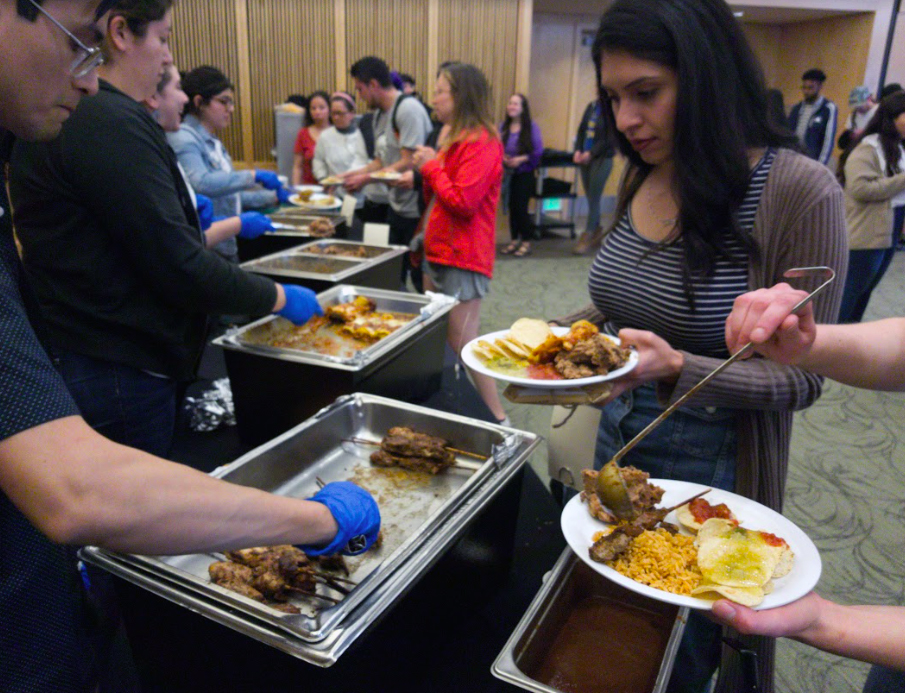
April 19 marked El Leñador’s fifth anniversary. To celebrate, they offered free food and a place to hang out and learn the progress that El Leñador has made over the years.
Hector Arzate is the current editor-in-chief.
“I never imagined being involved in El Leñador,” Arzate said. “I went into the publication voluntarily, but it led to me overseeing the bilingual newspaper.”
Many were in attendance of the celebration. Some were even former editors of El Leñador.
Sam Armanino was a photo editor for El Leñador in 2016. He is now working as social media coordinator for the North Coast Journal.
“There is a lot of room for creativity in a student-run publication,” Armanino said. “Working for El Leñador was a great experience.”
Another editor from El Leñador who attended the event was Carmen Peña-Gutiérrez. She was editor-in-chief of the newspaper in fall 2017 and is now working as workshop organizer for the Check-It program.
“I’m very happy to see that El Leñador has grown to become a news source for people,” Peña-Gutiérrez said. “What helped me write stories for El Leñador was helping the community that is underrepresented be heard.”
Meg Bezak was announced to be the next editor-in-chief of El Leñador for fall 2018.
“I’ve had two years of involvement in El Leñador,” Bezak said. “I fell in love with El Leñador. The staff has been exceptional and supporting.”
El Leñador’s advisor, Andrea Juarez, has been involved with the newspaper since 2015.
“The goal of this newspaper is to allow students to tell the stories they want to share,” Juarez said. “The students who write for El Leñador are getting experience for their careers.”
In the future, one of the changes El Leñador wants to make is to create more multimedia content for their website, as well as expanding their staff. One thing that won’t change for El Leñador is providing stories for the community.
“This job has a lot of big shoes to fill,” Arzate said.
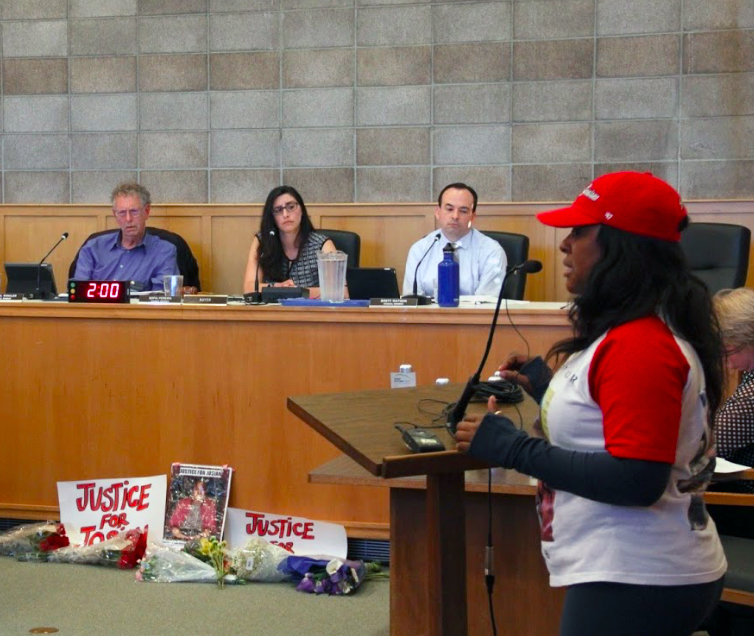
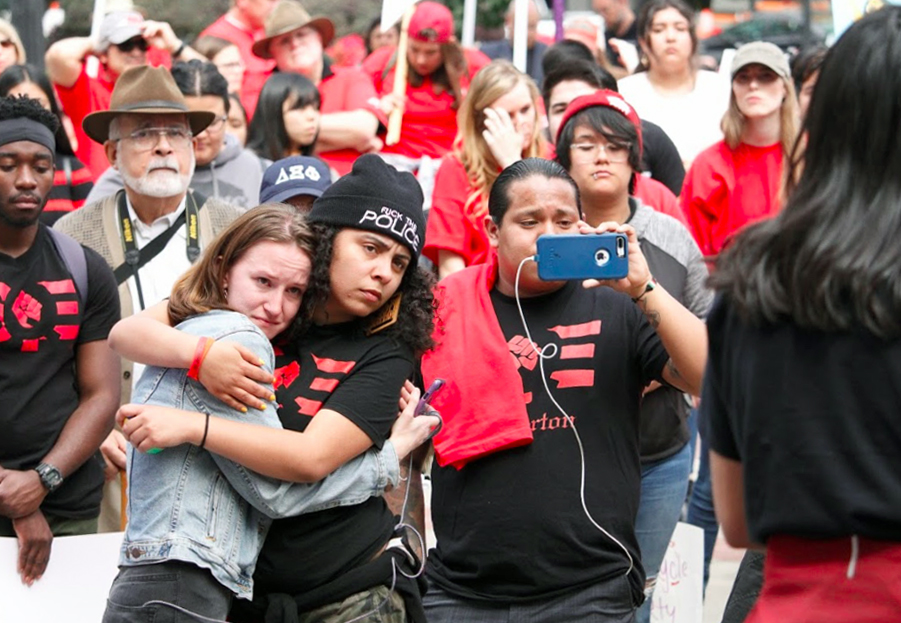
Angry mothers, students and community members all marched in solidarity with Charmaine Lawson from Humboldt State’s Library Circle to Arcata City Hall demanding Justice for Josiah on April 18.
Just a few days after the one-year anniversary of the death of HSU student David Josiah Lawson, who was fatally stabbed at an off-campus party on April 15, 2017, people are impatient for answers.
“We demand justice for Josiah and we want Tom Parker back,” Charmaine Lawson said.
Tom Parker is a retired FBI agent who was brought up to privately inspect the case for the last eight months. He resigned last week.
The march made its way from HSU to City Hall through F Street. The city council was meeting that day and the shock could be seen on their faces when up to 100 people marched into the hall chanting, “Justice for Josiah!”
The mayor of Arcata, Sofia Perreira, was in attendance, as well as city council members Brett Watson, Paul Pitino and Michael Winkler.
The forum opened up for members of the public to address the board and a line started to form.
“There is a killer on the loose and if I feel unsafe as an old white lady, how are these students of color supposed to feel safe?” Arcata resident Denny Dorsett said.
As many other people came up to speak their minds, the energy in the room began to grow more charged.
“I grew up in this place and I don’t feel safe anymore. Why are you not trying to protect me?” Faith Shaineider, an Arcata High School student who came to show her support said.
Shaineder’s mother, Zera Starchild, was also in attendance and had some heavy words to deliver.
“This town has already changed because of this,” Starchild said. “Arcata will never be the same again.”
While many brought up concern for their own safety, others brought up different reasons justice needs to be served.
Leslie Rodelander is a grant analyst at the Sponsored Programs Foundation at HSU.
“If compassion doesn’t move you, hopefully economics will,” Rodelander said. “I see the sheets, and the number of students coming to HSU is dropping and will continue to drop if this does not get fixed.”
After every other person spoke their mind, it was Charmaine Lawson’s turn. Mayor Perreira did not impose a time restriction on Charmaine Lawson as she had on everybody else, so she was able to deliver a powerful message.
“I demand Tom Parker back. Call him in the morning Sofia,” Charmaine Lawson said. “If the roles were reversed, I know my son would be sentenced already. I need to know what happened to my son!”
Cheers and applause could be heard around as people shared their support.
After hearing from everybody who wanted to speak, Mayor Perreira motioned for a 10-minute recess, during which she approached certain members of the audience. In a strange turn of events, Perreira returned from the recess and adjourned the meeting. People tried to figure out why, but were given no answers.
It has been over a year since Charmaine Lawson lost her son and the case is still wide open.
Demands for justice for David Josiah Lawson increase as the anniversary of his death arrives and his life is celebrated with family, friends and community members.
Charmaine Lawson gave everything she had to make sure that her son David Josiah Lawson was safe, secure and educated for 19 years. Within a matter of minutes, at a house party in Arcata, one individual decided to take all of that away by plunging a 10-inch kitchen knife into the abdomen of her child. It was around 3 a.m. on April 15, 2017, when David “D.J.” Lawson was murdered over the loss of a cell phone.
“I sacrificed so much to make sure my children were safe,” Charmaine Lawson said. “There’s absolutely nothing I wouldn’t do for my children.”
It has been a year and there is no one in custody for the murder. Tension on campus and in the community for justice to be served has been building since the event. Kyle Zoellner, a McKinleyville local, was originally arrested at the scene and later released by Humboldt County Superior Court Judge Dale Reinholtsen for insufficient evidence.
Protest from the Lawson family, Justice for Josiah Committee, community members and students began following the release, and efforts have been increasing as the one-year mark of the incident was arriving.
Barbara Singleton speaks at the Justice for Josiah rally in the UC Quad on April 12. Photo by Nick Kemper.
The Justice for Josiah Committee began 12 days of action leading up to the anniversary ending with a Celebration of Life for Lawson on April 15. As the week continued, pop-up events occurred after developments in the criminal case.
From August of last year until April 9, retired FBI and licensed private investigator Tom Parker had been assisting the Arcata Police Department in the Lawson investigation. Parker had joined the case after receiving a call from a friend telling him the details. Parker specializes in expert witness work on police practices, mostly for wrongful convictions.
Parker came up from Santa Barbara and met with the police department. He said he would see the case, but only if they would allow him to review all of the police files.
“I could see a lot of problems with the way the police had handled the case,” Parker said.
Parker agreed to take the case pro bono if the city would pay his expenses, and began working toward solving this case. He provided suggestions for improvements on protocol. He said he was met by resistance and obfuscation from the Arcata Police Department.
“I had been telling chief Chapman and detective Wiler that they were not moving the case the way they needed to,” Parker said.
He said his recommendation to Karen Diemer, the city manager, was to get a new police chief and that a lack of leadership was impacting the entire department. Parker threatened to quit, but Diemer asked him to wait. On April 9, after hearing nothing from Diemer, Parker resigned from his position.
He said though his official position is terminated, his involvement with the case is not over. Parker will continue to make the trip from Santa Barbara regularly until justice for Josiah is served.
From left to right: attorney Shelley Mack, former FBI agent Tom Parker, Charmaine Lawson and a man comforting her at the D St. Community Center during the Justice for Josiah celebration on April 15. Photo by Nick Kemper.
Less than 24 hours after Parker resigned, Arcata chief of police Tom Chapman resigned from his position after 24 years with the department.
In Chapman’s statement to coworkers in an email, he said this decision was driven by what is best for himself and his family, as well as the department.
There has been no confirmation on whether his decision to resign was related to Parker in any way.
On April 12 at noon, the Justice for Josiah committee held a rally in light of the new developments within the APD and the Lawson case. Daniel Segura, 23, a critical race, gender and sexuality major, was leading the rally.
“I have a lot of information on the case of Josiah Lawson,” Segura said.
Segura began informing the crowd about the resignation of Parker and Chapman, saying that himself and other individuals went to City Hall to ask Diemer how these resignations would impact the Lawson case. Segura said they were met with resistance and gaslighting, continually being placated. He claimed the cases were undeniably related.
“I remember [Diemer] laughed at one of our questions,” Segura said.
At the rally, quotes from Parker were provided and read, and Segura read a personal letter he had written to Humboldt State President Lisa Rossbacher, challenging her involvement in this case.
“She needs to stop this silence,” Segura said. “When you silence, you silence with the voice of the oppressor.”
Students were allowed the opportunity to share testimonies of their experiences dealing with racism in Humboldt. Student Rahkiv Lewis, 23, said he has been here for five years now, and as much as he loves this community, he can’t deny that people of color are targeted. He challenged students to step up and make a change now to improve the situation for further generations.
“Once we leave, people will forget. That’s how history happens,” Lewis said.
The protest ended with more information being provided to students, including the plan for Josiah Lawson’s vigil to be held on April 15, one year after his death.
In the early afternoon of April 15, friends, family and community members began filling the D Street Neighborhood Center as the rain continued to fall outside. The protest had been moved from the Arcata Plaza due to the torrential downpour. As people arrived, the Marching Lumberjacks were performing outside and a large grill barbecuing meat was set up under a pop-up tent.
A man grilling chicken outside of the D St. Community Center during the Justice for Josiah celebration on April 15. Photo by Nick Kemper.
Inside, there were tables for guests, as well as a bouncy castle for kids. In one corner, a long table is covered with plastic baggies filled with toiletries and snacks.
Christina Accomando, HSU professor and member of the local NAACP, said it was Charmaine Lawson’s idea to package toiletries for students of donated supplies, which they called “starving student care packages.”
The celebration of life began with Charmaine getting onto the stage and giving a powerful speech. She described for the crowd her experience, beginning at 3:37 a.m. on April 15. She describes being asleep on the couch when she received a call from Josiah’s phone. Surprisingly, it was not her child on the other end of the line, but rather one of his friends.
Charmaine hears from the girl, “He’s here at the Mad River Hospital and they’re not telling us anything.”
The hospital told Charmaine Lawson her child was in surgery, but refused to give any information to Josiah’s girlfriend, regardless of Charmaine encouraging them to do so. She said the person on the phone told her there was over 100 students present at the hospital.
Within a matter of hours, she would get the call that her child was dead.
The emotional weight in the room is tangible as Charmaine Lawson is unable to keep her composure for another moment. She gathers herself as family members rush to comfort her, and continues telling how Josiah valued education, for not only himself, but for both of his younger siblings. She said he wanted them to know how important getting an education was.
“I was so proud of my son,” Charmaine Lawson said. “We are still proud. We are still proud of D.J.,”
She then took the time to thank Humboldt County, HSU and College of the Redwoods students, as well as a number of individuals from her family and friends. Charmaine Lawson thanked Diemer as a mother, saying exuberantly, “Thank you. Thank you. Thank you.”
Charmaine Lawson also took time to talk about the recent tragedy that impacted HSU. On April 13, two HSU students were killed in a car crash on the southbound 101 freeway, south of Myers Flat.
KHSU office manager Lorna Bryant (left) and Charmaine Lawson. Photo by Nick Kemper.
The driver of the car was Emely Selina Carreno-Arenas, 20, and the passenger of the vehicle was Michelle Segundo, 19. Charmaine Lawson told the crowd the two girls were friends of her son that would have attended the vigil, had it not been too difficult for them to bear.
“We are going to celebrate Emely, Michelle and David Josiah Lawson,” she said.
Pastor Roger Williams and Lorna Bryant, community liaison and officer manager at KHSU spoke, and the celebration began. Food was served to the crowd. Charmaine Lawson helped the kitchen staff to cook up a celebrated meal of chicken, macaroni and cheese, collard greens, as well as vegan options, pink lemonade and baked goods at the end.
Students were entered into raffles for care packages, and donated supplies from community members, including a skateboard, which one of Josiah’s fraternity brothers from Brothers United received.
Randi Darnelle Burke, HSU dean of students, was the next guest to speak. He was announcing the university’s decision to designate a memorial grove on campus to honor and celebrate and a memorial will be held there in Josiah’s memory.
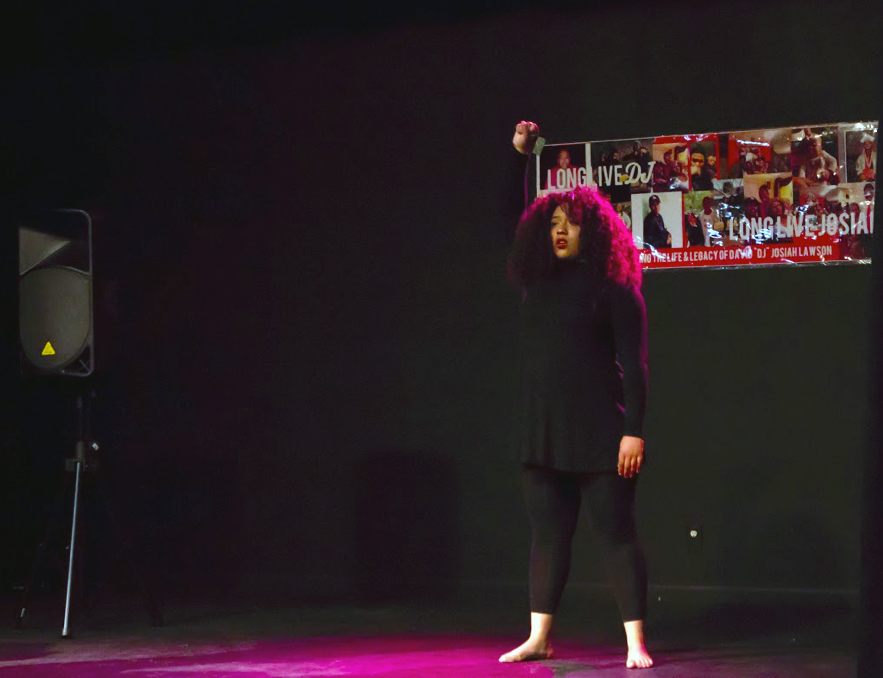
Individuals took the stage and told stories about Lawson’s life. Angel Sylva and dancer Ayanna Wilson came up stage and performed a powerful poem written by Sylva and an interpretive dance by Wilson.
“No matter what, we are going to thrive. No matter what, we are going to survive,” Sylva said.
Charmaine returned to the stage and began discussing the criminal aspect of her son’s case, saying she was pleased with former chief Chapman’s resignation. She also passionately thanked her lawyer and Tom Parker, who both made statements to the crowd.
Parker addressed his resignation and reassured that though he had officially resigned, he would still be present in attaining justice for Josiah.
“It should have been solved 30-45 days after this tragic incident happened,” Parker said.
Lorna Bryant returned to the stage and gave Charmaine Lawson praise in her efforts, and told her she was tied with her own mother as the best she had met.
Charmaine Lawson continues to drive every month from Southern California to Humboldt County seeking justice for her son’s unsolved murder.
Bryant announces a podcast, which will be going live the following day, April 16, on KHSU and can be streamed and shared anytime at KHSU.org.
Within a matter of hours of the release of the KHSU podcast with Tom Parker, the City of Arcata sent out a press release, also available on KHSU.
In a quote from the press release, the city stated, “The events of the last week have not deterred the investigative team from their ultimate purpose, which is to deliver a prosecutable case on behalf of David Josiah Lawson.”
One staff member was let go from their position, two more members soon to follow.
Kotaro Kawakubo is an international student from Tokyo, Japan who will lose his friend when a second language program shuts down in July.
“A friend I met here from China is leaving and going to a university in Seattle to study English. I will miss him,” Kawakubo said.
The International English Language Institute has been open for 30 years. The Center for International Programs that houses the IELI program is downsizing, resulting in a lack of funds. Humboldt State’s financial crisis is the cause.
“Without this program I will lose my friends I made here that came from other countries to learn English,” Kawakubo said. “They want to stay here, and keep studying English, but they have to go to other universities where there are English language programs.”
This year Kawakubo returned to the IELI program for a second round. He returned to Humboldt County on March 9.
Kawakubo plans to go to College of the Redwoods to study English after the program ends, and then transfer back to Humboldt State University.
He heard about the program closing from his host mother who works at the center.
“One day, she looked so sad,” Kawakubo said. “She told me the program is closing. Her coworker can’t get next year’s job at the office. She had to move to a different job because of the budget cuts.”
Tyler Bradbury, academic program coordinator of IELI, emailed host families on April 3 to inform them about the program closing.
“This was a somewhat sudden and surprising decision I was informed of late last week. I cannot thank you enough for opening your homes and your hearts to the students,” Bradbury said in an email. “It breaks my heart to have to deliver this news.”
Mikayla Kia is an international studies major who works closely with the IELI students. Kia is also vice president of the Global Connections Club.
“Not having the international students would leave an empty space, because when the IELI students come to the club meetings, that is like half the room,” Kia said. “I don’t know what it’s going to be like without them.”
An employee at the center connects the IELI students to the club. At the club IELI, students play board games, sports and go on sightseeing trips around Humboldt.
“I’m sad and confused. They bring such joy here. It’s crazy to know they won’t be here,” Kia said. “I feel like they pay so much to come to this school. It doesn’t make sense to me how cutting the program can save money?”
Angelica Huerta is a chemistry major who works at the center. She is a coordinator for Takachiho University, a Japanese school in Tokyo.
Huerta plans activities every day for three weeks for the students, and helps integrate the students into American life.
“A lot of the IELI student recommend the program to other student in their country,” Huerta said. “The students make a presentation in their school about their experiences, and what they learned. They promote for us.”
Ge-Yao Liu, director of the center, lost his job. A second staff member accepted a job at a different department on campus. A third staff member will transfer to another department when IELI closes.
Huerta said that Ge-Yao Liu made the students a priority.
“Ge-Yao Liu was super nice. He would constantly say hi to students. He would ask the students their name, ask where they were from and why they came here. He was like a cheerleader,” Huerta said.
Carl Hansen, the dean of Extended Education, met with the provost Alexander Enyedi last month.
“When I looked at the numbers, it was very clear that they did not have the student population to support the program,” Hansen said. “I made a recommendation to the provost looking at the financial report. Once I laid things out for the provost, we had conversations and he agreed that this would be the best thing to do.”
Hansen said he struggled with creating a sustainable program. A large part of the budget was strictly for recruiting, which meant sending staff abroad to visit partners.
“We eliminated positions that the general fund was paying for,” Hansen said. “In some ways, it made the budget situation worse because the recruitment effort had not delivered. The budget gave us the incentive to make the program changes.”
The center is relocating from the Feuerwerker House to the Student and Business Services building. The center will be inside the office of the College of Extended Education.
“We are still interested in attracting international students, particularly exchange students,” Hansen said. “The difference is those students have the language skills. They would take English in their home university where they are at a level to speak, and then come here.”
Humboldt State University’s debate team dedicates 13 hours a week discussing uncomfortable subjects.
The HSU debate team debated against the Irish National Debate Champions on April 11. The team spoke on why “violence is necessary for political action.”
The HSU debate team argued the positives of the topic.
The three competing members of the HSU debate team are Ruby Aguirre, Olivia Gainer and DaMon Thomas. Aguirre and Thomas have been on the debate team for two years. Gainer has been on the debate team for a year and is the team’s vice president.
Ruby Arguirre of the HSU Debate team. Video by Luis Lopez.
Aguirre is a masters social work graduate.
“People always get nervous when we talk about heavy topics,” Aguirre said. “But people need to understand that what we talk about happens everyday.”
Thomas is majoring in communications.
“One of the topics that we talk about that gets me passionate is Black rights or minority diversity,” Thomas said. “Debating is like doing reps. I get comfortable talking about these topics.”
Gainer is majoring in philosophy.
“When it comes to being nervous in front of people, that’s something that never goes away,” Gainer said. “But with practice, I overcome those nerves.”
The way a debate works is each member presents their argument to the audience. The affirmative (HSU debate team) speaks on the topic, and the opposition (Irish debate team) can raise their hand to question the argument. After the affirmative is done speaking, the opposition can argue about the negatives of the affirmative’s argument.
Aodhan Peelo of the Irish National Champions. Video by Luis Lopez.
Judgement was done by the audience’s vote. The audience voted in favor of the Irish debate team by 70 percent.
Both teams presented their arguments with passion on the controversial topic.
Aaron Donaldson is the coach of the HSU debate team.
“The debate team has traveled eight times each year to attend debate exhibitions,” Donaldson said. “This will be the first time this year that the debate team will be having a debate on campus.”
From April 12-16 the HSU debate team attends the U.S. National Debate Championship held at Stanford University.
“I think especially now more than ever it is important to have debates on difficult subjects,” Donaldson said.
Survivors of sexual violence share their experiences through the events of Take Back the Night
Take Back the Night delivers the message that domestic partner violence, intimate partner violence and other types of violence will not be tolerated.
Xochitl Cabrera runs the Humboldt State’s Women’s Resource Center, which hosts Take Back the Night every year.
“Sometimes people don’t need you to help them, you may need to take a step back. Some people just need to heal themselves,” Cabrera said.
The Women’s Resource Center is a campus resource for people who need a safe place to study or find the help you need for survivors of sexual violence experiences.
“The Women’s Resource Center knows that sexual violence and domestic violence happen all of the time, but it is up to the survivor to reach out to the Women’s Resource Center,” Cabrera said. “Take Back the Night is not for everyone. People tend to avoid the trauma it brings up.”
Hanging on the walls of the Kate Buchanan Room are T-shirts from survivors of sexualized violence and friends of people who died from sexualized or domestic violence. The T-shirts had messages written telling of horrible acts of sexualized violence from family members, friends and others.
“The T-shirts are difficult to look at, but their story needs to be heard. They are not nice. It is painful but necessary,” Jodie Huerta, HSU sociology major, said.
Messages written on T-shirts decorating the walls of the KBR. Photo by Ahmed Al-Sakkaf.
Assistant professor of Native American studies Cutcha Risling-Baldy was the guest speaker for Take Back the Night. Risling-Baldy’s talk was based on systemic violence toward people of color. Before her talk on missing and murdered indigenous women, Risling-Baldy acknowledged the death of HSU student David Josiah Lawson.
“If David Josiah Lawson were not a person of color, his death would be on the news every day,” Risling-Baldy said.
The Native Americans view domestic violence differently.
“In an interview with a Wiyot woman, the anthropologist asks what happens if a man rapes a woman,” Risling-Baldy said. “The Wiyot woman replies, ‘That never happens.’ Asked why it never happens, the Wiyot woman said, ‘Because that person would be killed.’”
Speaking out can trigger traumatic experiences for people.
“People choose to come if they feel comfortable speaking on their testimony, and they choose not to come because they don’t feel comfortable speaking on their testimony,” Cabrera said.
Some of the speak-out testimonies were about sexual violence that occurred during childhood and adolescence, while some of the testimonies were about sexual violence that happened at HSU. Sexual violence happens to HSU students, for which most of us are unaware.
“Everybody knows that sexual violence is happening, but nobody is doing anything about it. It is just getting swept under the rug,” Grace Lamanna, HSU recreation major, said.
People tend to restrain themselves from being in these spaces, because of the trauma it brings to them.
“Some folks don’t feel safe in this space, because they don’t identify with domestic violence and sexual assault. People feel like they are taking up space and say, maybe this isn’t the space for me, I’ll take a step back,” Cabrera said. “That’s totally fine, because we want to prioritize those individuals that have experienced sexual assault and sexual violence at some point in their lives. That is what this space is mainly for.”
Students hold hands in a circle behind the McKinley statue on the Plaza. Photo by Ahmed Al-Sakkaf.
HSU sociology major Omar Miranda helped as a monitor for the Take Back the Night march as part of his class.
“I feel like I made a difference. Big or small. Something small to me could make the biggest difference to the survivors,” Miranda said.
The survivors gathered after the speak-out for the Take Back the Night march. Marchers wore orange safety vests, gathered in groups of five and were assigned a monitor. Monitors had received tactical training for this march and could protect the group if some danger presented itself.
The marchers left school chanting, “Hey! Ho! The patriarchy has got to go!”
The marchers went from school to the plaza downtown and were heckled by a few passersby in cars, as well as people along the route.
On the plaza, the Take Back the Night members and public in attendance gathered in a memorial for the people who have died from sexualized and domestic violence. In silence, the less fortunate victims of this violence were honored.
As the Take Back the Night march left the plaza, the declarative chanting could be heard echoing off buildings and down alleyways.
“Take back the moon, take back the stars, take back the night because the night is ours!”
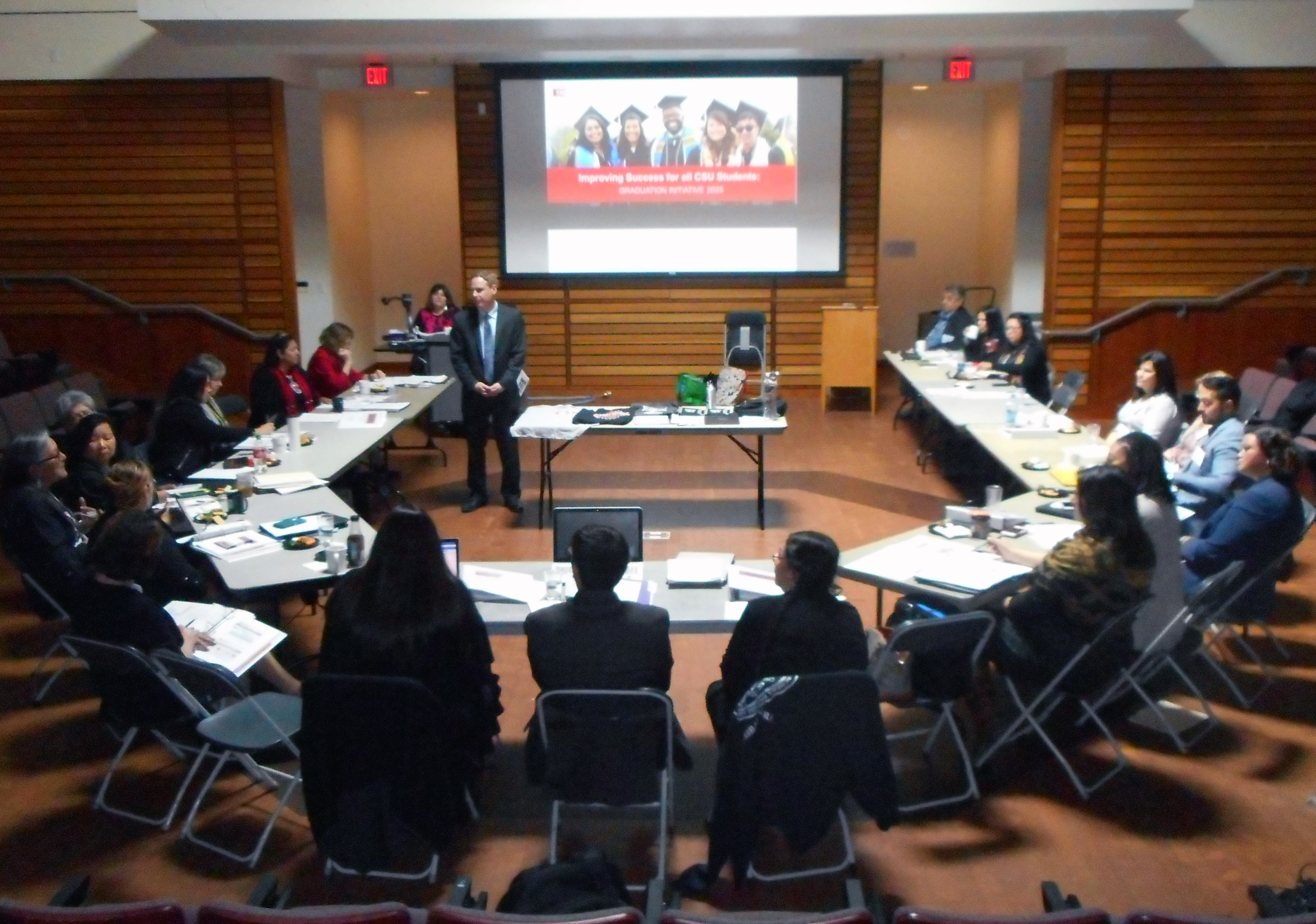
The California State University Native American Initiative began in March 2006 as the result of a CSU summit with the representing leaders of 40 California Tribes discussing strategies to instill a pathway to higher education for Native American families. Humboldt State President Lisa Rossbacher will lead the Native American Initiative council.
Last week, HSU hosted the California State University Native American Initiative statewide meeting in the Native American Forum on campus. Representatives from the California State University Chancellor’s Office, along with representatives from 19 of the 23 California State Universities, met with Rossbacher.
Former HSU president Rollin Richmond was chair of the initiative, too. During that time, there were two summit meetings.
Rossbacher was appointed by CSU Chancellor Timothy White to lead this initiative in February.
“I am truly honored to be asked to serve as the presidential liaison with this council,” Rossbacher said.
During the summit, Rossbacher laid out the overall goals of the Native American Initiative council.
“One of our overall goals is to identify, share and support strategies that will help the graduation initiative [of 2025] and [Native American] student success. Strategies that will help us recruit students, retain students and graduate Native American students, and help them be successful beyond their time in the CSU,” Rossbacher said.
Item two on the agenda was to support Native American studies research.
“One of our goals is to engage and support faculty, staff and student research into the wide variety of fields related to Native Americans in the state and national Native American studies,” Rossbacher said.
Another subject Rossbacher wanted to focus on was sharing information.
“How can we share information that we are discussing and coming up with to support [Native American] student success? How do we share that with the tribal leaders throughout the state and the tribal communities? How do we share that critical information with the chancellor, his staff and the presidents throughout the CSU system?” Rossbacher said.
The goals of the April 4 meeting were different than the overall goals of the Native American Initiative.
The first goal of the April 4 meeting was to learn about updates and current CSU data on Native American student success, including recruitment, retention and graduation.
“Look at the achievement gap or the opportunity gap that may be affecting Native American students on our campuses,” Rossbacher said.
The third goal on the agenda was learning about some of the trends, practices and successes of the K-12 level and how that assists Native American students moving on to the California State system.
The fourth goal of the meeting is developing strength.
“Because I am the campus president, I want to be sure that you all know that there is something we are doing here at Humboldt State to accomplish those goals,” Rossbacher said.
There are funds available from the Chancellor’s Office to support academic programming.
“We do have funds that were established through the president’s council for underserved communities. It is a grant to the campus for academic preparation to strengthen the graduation initiative,” Maryann Jackmon of the CSU Chancellor’s Office said.
“Funds can help students travel and see what is out in the world waiting for them after graduation,” Theresa Gregor, CSU Long Beach faculty said.
The Tribal Liaison from the California State University of San Marcos, Tishmall Turner, is also the vice-chair of the Rincon Tribe.
“President Rossbacher seems really genuine and sincere and she will do a good job of leading the Initiative,” Turner said.
“President Rossbacher has been very supportive of Native American studies since she came to HSU,” Dale Ann Sherman, retired HSU Native American studies faculty said.
The initiative will provide support to Native American faculty and students.
“It gives you that lift to do the work. You don’t have to fight just to get to the point where someone will say go ahead,” Leece Lee-Oliver, CSU Fresno director of American Indian studies program and department of women’s studies said.
The Indian Tribal and Educational Personnel Program (ITEPP) hosted their 11th Annual California Indian Big Time and Social Gathering event on April 7.
Hundreds of people gathered from across California to celebrate and express their cultural heritage inside Humboldt State University’s West Gym.
Out of those hundreds of people, in particular, were a lot of youth in attendance.
One of the youth who attended the event was Harmony Taylor. Taylor is 8 years old, and has been dancing for four years.
Taylor looks forward to attending Big Time every year.
“I like to dance with the girls I grew up with,” Taylor said. “I only get to see those friends about two or three times a year.”
Harmony Taylor smiles near the West gym at Humboldt State on April 7. Photo by Garrett Goodnight.
Cutcha Risling Baldy, Ph.D. is an assistant professor of Native American Studies at HSU, and discussed how Big Time helps inform and empower the youth.
“It is important because we get to show our next generations that their culture is real and a part of their everyday lives,” Risling Baldy said.
Arya Mettier, Ph.D., Risling Baldy’s daughter, was also in attendance, and partook in the Women’s Coming of Age demonstration that her mom and many others have been working to revitalize.
“There’s a lot of people, and you can get a lot of stuff,” Mettier said. “I get to see a lot of different cultures.”
Sammy and Jon Luke Gensaw are two brothers who have also been inspired by this event ever since they can remember.
“When I was younger, this was a go-to thing,” Jon Luke said. “I would see people that I haven’t seen all year.”
The Gensaw brothers created their own non-profit organization, the Ancestral Guard. Through the Ancestral Guard, the Gensaw brothers are able to make direct action on a local and global scale. They recently returned from visiting and speaking at Yale University.
There were over 60 vendors in attendance along with live demonstrations, a food stand and a catering food truck Los Giles.
One of the highlights was by far the food. The popular choices were fry bread and Indian tacos, with a line wrapping around the building all day long.
A restorative vendor at the event was the Indigenous California Language Survival booth. One of the organizers of this booth was HSU assistant professor in Native American Studies, Kayla Begay, Ph.D.
At this booth, kids were encouraged to share a word in a native language to win a prize.
“Even if you’ve never heard a native language before, we encourage the children to learn today,” Begay said.
Humboldt State ITEPP alum Briannon Fraley explained that Big Time gives her children the opportunity to see other cultural representations.
“Living in a multicultural society, your identity gets lost, and it’s hard to engage,” Fraley said. “This event instills pride and promotes cultural identity.”
Students, faculty and allies of the California State University system from all 23 campuses made the journey to the State Capitol to send Gov. Jerry Brown a message, it is time to fully fund the CSU.
Video by Dajonea Robinson.
Allison Rafferty is a biology major and was one of many students who came down on a bus from Humboldt State to join the demonstrations on April 4. Rafferty rode down to represent HSU and to call for funding for the CSU system.
“I request Gov. Brown to consider opening the fund that he’s allocated for CSU,” Rafferty said. “The CSU requested money and Gov. Jerry Brown approved a third of that. Right now, they’re in revisions. In May, they’re going to post their revisions and in June, they’re going to propose the final budget that goes to a vote.”
Rafferty hopes more funding will come through so people in her major and others will be able to get classes and graduate on time.
HSU student warns others of the potential outcome of funding crisis. Photo by Dajonea Robinson.
Jacqueline Delgado is also an HSU student. Delgado decided to come to the Capitol to stand in solidarity with everyone and to get justice for Josiah Lawson.
“I’m also here to get [Justice for Josiah] and this unsolved murder to be recognized. It is an unsolved murder of a fellow student that was murdered a year ago in Humboldt County,” Delgado said. “The school and the county does not recognize that this happened. It has been an entire year that nothing has been happening and we’re trying to get this movement to be heard. We will no longer be silenced.”
David Bradfield is the California Faculty Association representation chair and board of directors member who now lives in Humboldt County. Bradfield spent 34 years teaching music and digital media arts at CSU Dominguez Hills. Bradfield decided to take the trip down to the Capitol.
“I care very deeply. I spent 34 years teaching at Dominguez Hills and I care very deeply about the mission that we do, the people that do that mission and the people that we serve,” Bradfield said.
Reza Sadeghzadeh is a communications major at HSU. Sadeghzadeh traveled with his peers to the Capitol from HSU to express concern of the insufficient funds of the budget.
“Since they cut the whole CSU budget, we’re going to see a tremendous negative effect on our campus. A lot of professors are being laid off, activities and cultural centers are being defunded, so it’s a very serious issue,” Sadeghzadeh said. “The governor really needs to understand that the students here and the students in the CSU are the future of the welfare of California. In order to thrive as a state, we need to take care of the foundation, which is the students.”
HSU students not only stand in solidarity with fellow CSU peers during the rally, but demand justice for their fellow student. Photo by Dajonea Robinson.
Elizabeth Phillips is a student on campus who also came down on the bus from HSU.
“Students like me who need an education are about to be priced out of our education. Education is not for the people, it’s not supposed to be free. They don’t want us to get an education so we’re stuck working the remedial jobs,” Phillips said. “We need to see more people of color being a part of the faculty. The only way we’re going to get there is if we can afford to get in the door. I’m $25,000 in debt just from two years at HSU. That’s a lot of money, and for other students, I don’t want them to take on that burden. So I’m here for the future, and I’m here for me, now.”
Phillips works for the Multicultural Center as the social justice summit co-coordinator. Phillips is also a part of a loose coalition of students who started the walkout for WASC to protest the budget cuts.
“I worry that if we give the CSU full funding for free tuition, the students will get it for the first couple of years, but then after, people get greedy and start skimming the surfaces,” Phillips said. “I’m happy that we’re here, but I want people to keep a watch and understand we don’t need as many administrators as we have. We need more students and faculty, counselors–there’s other stuff that we need that we’re just not allocating our resources correctly. Everyone needs to watch out for the future.”
This website uses cookies to improve your experience. We'll assume you're ok with this, but you can opt-out if you wish. Cookie settingsACCEPT
Privacy & Cookies Policy
Privacy Overview
This website uses cookies to improve your experience while you navigate through the website. Out of these cookies, the cookies that are categorized as necessary are stored on your browser as they are essential for the working of basic functionalities of the website. We also use third-party cookies that help us analyze and understand how you use this website. These cookies will be stored in your browser only with your consent. You also have the option to opt-out of these cookies. But opting out of some of these cookies may have an effect on your browsing experience.
Necessary cookies are absolutely essential for the website to function properly. This category only includes cookies that ensures basic functionalities and security features of the website. These cookies do not store any personal information.
Any cookies that may not be particularly necessary for the website to function and is used specifically to collect user personal data via analytics, ads, other embedded contents are termed as non-necessary cookies. It is mandatory to procure user consent prior to running these cookies on your website.