The Lumberjack


Students Serving The Cal Poly Humboldt Campus and Community Since 1929

Category: News

  • HSU professor Kevin Murray exits race for California’s 2nd State Assembly district

    HSU professor Kevin Murray exits race for California’s 2nd State Assembly district

    “Politicians are owned by corporations and businesses.”

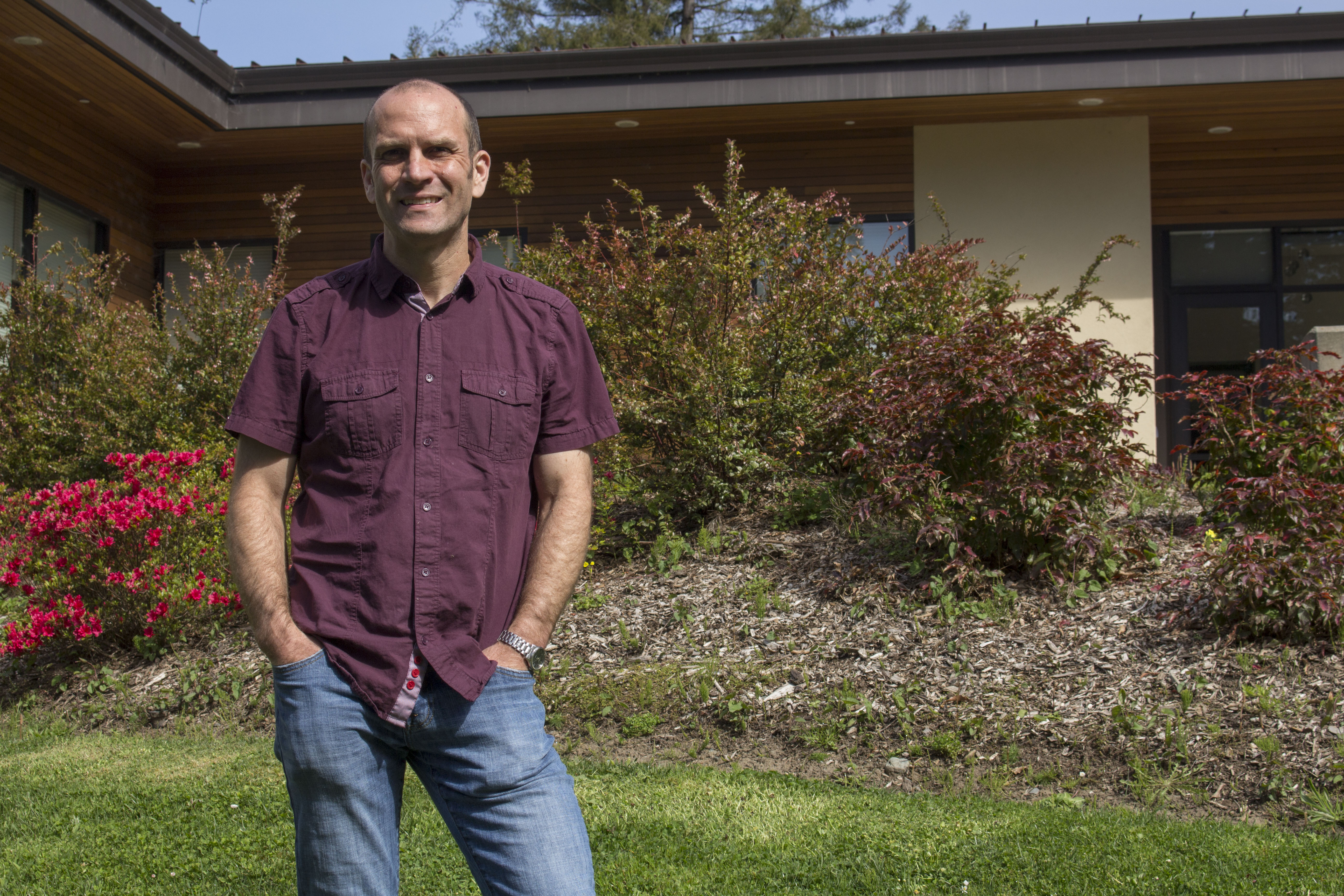
    Humboldt State political science professor Kevin Murray announced that he is exiting the race for California’s 2nd State Assembly district on March 18. It’s Murray’s third year of lecturing political science at HSU and his 27th year of teaching in total.

    Campaign donations play a big role in winning an election, and the majority of the people in the 2nd State Assembly district live in Sonoma County. The 2nd State Assembly district stretches from north of Santa Rosa and ends at the Oregon border.

    Murray’s opponent, Jim Wood, lives in Healdsburg, which is a city located in Sonoma County.

    “Politicians cannot afford to run for office unless they raise money,” Murray said. “Politicians raise money from the traditional contributions of [businesses] and corporations.”

    Murray said that the Democratic Party has turned into “Berniecrats” and “Corporatecrats.”

    “Politicians are owned by corporations and businesses,” Murray said.

    Murray chose to only accept private campaign contributions and no corporate or business campaign contributions.

    “If I were to take business contributions, I would be obligated to [vote] for those business contributors’ interests,” Murray said.

    In Murray’s press release about stepping out of the race, he talked about the need for publicly financed campaigns.

    Murray has keen insights into the social, political and capital interests prevailing in America.

    “The marketplace of Ideas is a fallacy and a farce until we have publicly financed campaigns,” Murray said. “It takes any candidate at least two years to raise enough money to run for office, and that is no guarantee the candidate would have raised enough money.”

    Murray believes in single-payer healthcare, where the California State Health Care Commission receives healthcare benefits and the commission would, in turn, pay the doctors. This eliminates the insurance companies with public stock.

    “Health care should never be surrendered to the marketplace,” Murray said.

    Murray is for farmworkers receiving overtime pay, as Murray’s mother was a farmworker.

    Murray is for corporations that don’t hire personnel from overseas at half the salary of an American citizen and those that don’t have a negative impact on the environment. He also measures corporations and businesses on how well they treat their employees.

    “Arcata has no rent control. Every student at Humboldt State will see their rent increase at least once in the time they spend at school,” Murray said. “What if their rent doubled? It could happen without rent control.”

    Murray said that our society is based on special interest groups funded by the wealthy and powerful.

    “We cannot elect progressive members who are not beholden to corporate and business interests to pass policies to provide the majority with more money, time and a higher quality of life,” Murray said.

  • Students v. admins: frustrated conversations at the budget cuts walkout

    Students v. admins: frustrated conversations at the budget cuts walkout

    “Students’ rights! Students’ rights!”

    “Where the fuck is Lisa? Where the fuck is Lisa?”

    “Cut her pay! Cut her pay!”

    Video by Bailey Tennery.

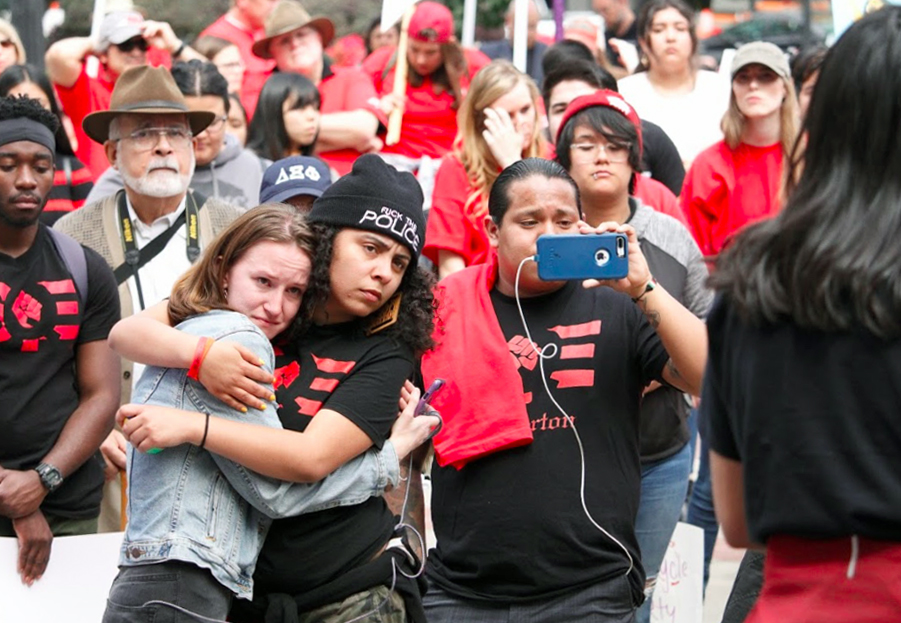
    HSU students could be heard storming through Siemens Hall yesterday, demanding the school’s administration to face students’ anger surrounding the budget crisis.

    Trevor McDowell, a wildlife major at HSU, was among the crowd of student protestors.

    “We are marching to find President Rossbacher, wherever she is meeting with WASC,” McDowell said.

    WASC, or the Western Association of Schools and Colleges, is a reviewing body that determines whether a school is capable of preparing students for the next steps in their careers.

    Dr. W. Wayne Brumfield, interim vice president of student affairs, explains the significance of a WASC approved institution.

    “WASC accreditation happens all across the country, and is important to a student’s degree. Having the accreditation is a sign of a healthy institution with good academics,” Brumfield said.

    Interim VP of Student Affairs Dr. W. Wayne Brumfield listens to student demands in Siemens Hall on March 21. Photo by Philip Santos.

    David Alvarez, a student protestor, wanted Brumfield to know that HSU is not healthy.

    “Why is there a lottery to live on campus? That’s not healthy,” Alvarez said. “I am scared to be homeless. We are not healthy.”

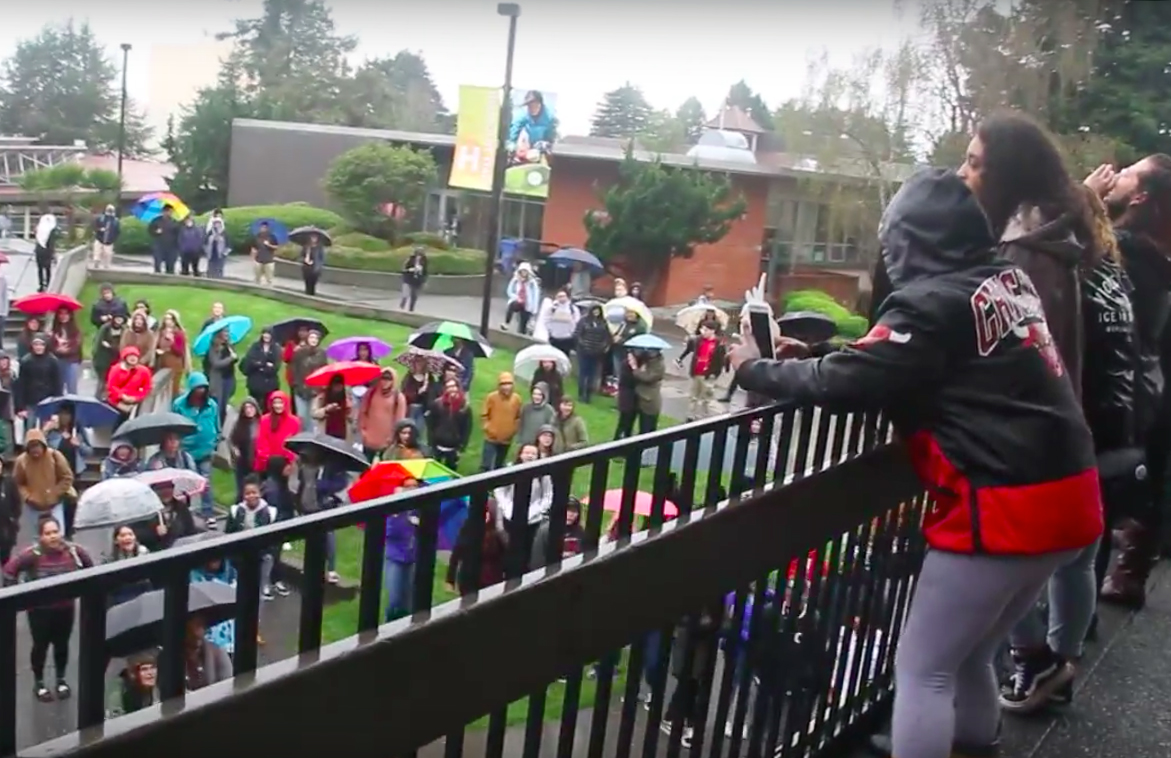
    The students’ protest, led by Moxie Alvarnaz, started in the UC Quad.

    “How do you feel about the budget cut? The administration just got another raise,” Alvarnaz said.

    A collective “boo” swept through the crowd.

    Dr. Alexander Enyedi, HSU’s provost and an administrator, was in attendance at the protest.

    “I think we should keep the focus on the budget structure,” Enyedi said. “A deficit is different from a budget cut. The colleges’ budgets are mostly untouched, but we are asking them to not spend more than what they are given.”

    Enyedi was certain that using the school’s degree auditing system, or DARS, to gather an idea of what classes students need will ensure that students have the right classes to graduate on time, in spite of the deficit reduction effort.

    Tents in the UC Quad at Humboldt State during the student-organized event to protest budget cuts on March 21. The walkout was organized by Students Coalition for Organized and Direct Action. Photo by Matthew Hable.

    As students marched into Siemens Hall from the UC Quad to find President Lisa Rossbacher, they confronted Enyedi in front of his office. William Cooke, a student protestor, disagreed with Enyedi on the class offering strategy.

    “If you think that we should be prepared for the rest of our lives, then why offer only the classes we need?” Cooke said. “I pay so much money for my education. Why can’t I take the classes that I want to take and experience college fully?”

    Footage by Garrett Goodnight. Edited by Bailey Tennery.

    David Alvarez, an undeclared major, expressed concerns for students’ ability to explore different majors.

    “I am undeclared. What if I want to become a biology major? Are you going to cut biochemistry [and] botany classes?” Alvarez said.

    Kelsey Meusburger, another student protestor, explained what students are seeking from administrators.

    “We are asking for an income cap to make HSU a more equitable place,” Meusburger said. “Is that something you’d be open to?”

    “Always, always,” Enyedi said.

    Ben Gorham and other HSU students ensure they are heard while WASC reviewers meet in Siemens Hall 222 on March 21. Photo by Philip Santos.

    Brianna Allen, who was missing a capstone class to be at the protest, expressed frustrations with the responses Enyedi has given to students’ questions.

    “I need to see you take action,” Allen said. “I need to know if you will advocate for us, on the board of admin, to take budget cuts through your money.”

    “I will advocate for you,” Enyedi said. “I will discuss with the cabinet about the ideas that are being put through.”

    Dixie Blumenshine, a biology major, brought up the recent firing of CNRS’s dean, Dr. Richard Boone.

    “Why did Rich Boone leave early? His resignation isn’t effective until June,” Blumenshine said.

    “He wasn’t interested in doing his job anymore,” Enyedi said. “If he was committed, he wouldn’t resign.”

    Kylie Brown, a general biology freshman student, was watching the protest from the UC Quad.

    “I am here today because I heard that some classes, which I’m hoping to take, will be cut,” Brown said. “I hope to become an endangered species biologist. If the [budget deficit] cuts botany classes at HSU, I will not be prepared for my career. This makes me angry. I haven’t been able to experience all the classes I want to take, and they’re already taking it away.”

    Lizzie Phillips (left), one of the members of Students Coalition for Organized and Direct Action who participated in the HSU walkout on March 21, stands in front of a makeshift mural where students air our their grievances on the budget cuts at Humboldt State. Photo by Matthew Hable.

    Hana Watanabe and Kotaro Kawakubo, international students, were present at the protest in the UC Quad.

    “We heard about this protest through our professor, who told us to come see the cultural differences,” Watanabe said.

    “We’re also here because we’re worried about the office of international programs,” Kawakubo said. “Our boss has already been fired. We don’t want the office to close. Losing this program would be like losing a home for us.”

    Students are encouraged to attend the Associated Students budget forum on Monday, March 26th, from 5-6:30 pm in the KBR for further questions.

    See what the HSU budget looks like at URPC.

    Information on HSU’s WASC accreditation can be found here.

  • Humboldt State faces healthcare shortage

    Humboldt State faces healthcare shortage

    One part-time psychiatrist working six hours a week.

    Students at HSU are facing a healthcare shortage. Brian Mistler has been the director of the Student Health and Wellness Services for two years.

    “I spent the first week on the job really understanding it,” Mistler said. “Students have been telling me weekly how the wait times are increasing and how we need more staff.”

    There is one part-time psychiatrist working six hours a week on HSU’s campus.

    “Students have trouble getting their medication,” Mistler said. “They have to wait two or three months to see the psychiatrist. Right now, it’s March and he’s booked for the rest of the year.”

    Mistler says local hospitals and open door clinics are backed up, and they do not have extra capacity.

    “When we send a student off campus often times that means the student just doesn’t get care and then they are forced to leave school,” Mistler said.

    There is no Kaiser facility within five hours of Humboldt County.

    “We’re isolated,” Mistler said. “Other universities solve this is by sending students off campus to a local hospital.”

    Delays in regular facilities maintenance are affecting the current state of the health center. Mistler said the temperature inside certain areas of the facility overheat.

    “The lab where we do our blood tests overheats, because the heating doesn’t flow right in the building,” Mistler said. “The temperature gets too hot and we have samples that have to be stored at a specific temperature in order to test.”

    Mistler said the student health center building is 20 percent over capacity.

    “There is not enough room to hold the staff,” Mistler said.

    There are multiple solutions to the healthcare shortage being discussed. One option is telepsychiatry. Telepsychiatry is a video conference with an outsourced psychiatrist in a different location.

    “Students would come in the health center, sit in front of a large screen and have a conversation with a psychiatrist who is somewhere else in California,” Mistler said.
    “The psychiatrist will work with our team on campus. The student will be able to walk down to the pharmacy and pick up their prescription.”

    Health Education and Clinic Support lead Mira Friedman supervises the clinical peer health educators on campus. The peer-to-peer service helps with the clinic’s wait times.

    “It allows our medical providers to see more students with complex issues,” Friedman said.

    The clinical peer educators are not physicians. They are paired up with a medical provider if they have medical questions. Each peer educator is paid minimum wage.

    Clinical peer educators work a minimum of 10 hours and a maximum of 20 hours a week. Friedman holds weekly staff meetings as well as an individual weekly check-in with the clinic’s peer educators.

    Kelsey Meusburger, a clinical peer educator since August of 2017, says she feels empowered helping students.

    “I only talk to students who are not showing signs of symptoms,” Meusburger said. “When they show signs of symptoms I refer them to the Gold Clinic.”

    The Gold Clinic is reserved for more urgent matters.

    The state of the student health center building was designed 60 years ago and has not been updated. The building needs to have repairs made in order to function.

    “The front of the building where the roof is rotting,” Mistler said. “We had to replace a beam, [and] that’s why there is construction outside.”

    There are two separate fees that go toward health services. One fee is for the physicians, the second is for the health center facilities. Both fees are being proposed to increase in order to improve the current healthcare conditions.

    “It would cost about $66 per student per semester to repair. For another $10, a brand new health center could be built,” Mistler said. “It seems like a much better idea than spending a lot of money fixing the current health center.”

    The Student Fee Advisory Committee is helping to decide the best way to adjust the health fees and increased funding.

    “We can’t provide better service in the current space, [because] we’ve outgrown it,” Mistler said. “Part of the reason we’ve outgrown it is because health services aren’t just the services we provide. Other things that are tied to health is physical, mental and other basic needs.”

  • Pro-life protest through positivity

    Pro-life protest through positivity

    The sun streaks through the patchy white clouds and the breeze blows cold off the bay against Moriah Nelson’s face as she sits alone on a corner in Eureka. Next to her are white signs with black lettering stating the message of her protest.

    “Pray to End Abortion,” the sign reads.

    Nelson, 25, has been involved in anti-abortion activism for three years now, working with the Eureka branch of the 40 Days for Life.

    This is a protest that goes on throughout the length of Christian Lent, where protesters sit outside of Planned Parenthood in a peaceful demonstration.

    “It is compassion and Christ-like love that will change and help these women,” Nelson said.

    Nelson said that when she first found out about abortion, she was horrified.

    “I had a lot of misplaced anger as a teenager,” Nelson said.

    Nelson began her anti-abortion activism, as well as volunteering, at a local Pregnancy Care Center in order to initiate change. The center provides clothing and supplies to women and children in need, as well as hosting a medical facility equipped with volunteer nurses.

    “I like being able to serve in a tangible way,” Nelson said, “Women say to us that they are so thankful.”

    Nelson is the oldest of her eight siblings, the youngest is four. They all live together in their Eureka family home, and all of the children are part of a strong homeschool community.

    The family is involved with activism in the community. Nelson said her grandfather was heavily involved in solving the homeless issue up until his passing in 2016. Her brother Courtland, 20, is continuing the legacy.

    “We’re hoping we can build a relationship with the homeless and try to get them to a better place,” Courtland said.

    Every Friday night, Courtland goes out with a group of his friends and some sandwiches to talk and pray with the homeless in Eureka. He is also involved with a pregnancy clinic, painting for them and serving at the annual banquet.

    Courtland is not as active on the issue as his sister.

    While Nelson’s family and service is a huge component of her life, another big focus is her future husband and upcoming wedding in September.

    Her boyfriend Johnny Wisan, 25, is also a Eureka local currently working with at-risk children for an internship at a church in Wales. The program involves mentoring, praying and activities every night.

    The couple met at the age of seven through the homeschool community and she said they immediately knew they would get married.

    Nelson has been to Wales twice, and after their marriage, the couple plans to relocate if he is able to acquire a paid position at the church.

    Though she has never left her childhood home and family, Nelson said that through prayer, she and Wisan realized that Wales was where they could best serve the children.

    “How can I say I am pro-life if I don’t step up and make a change?” Nelson said.

  • Provost speeds up dean’s resignation

    Provost speeds up dean’s resignation

    “I couldn’t compromise the values of CNRS and my own.”

    Richard Boone, the former dean of College of Natural Resources and Sciences at Humboldt State, was let go before his resignation came into effect. Earlier this month, Boone formerly announced his resignation, effective June 30. But Alexander Enyedi, provost and vice president for Academic Affairs, informed him in a meeting on March 9 that his resignation was accepted and effective immediately. Steve Smith took office as the new interim dean for CNRS, replacing Boone.

    Boone planned to remain dean of CNRS until June 30, as he said to the provost when he resigned. He was surprised during the meeting that he didn’t have the time to continue working on the things he planned out.

    It was important for Boone to carry out his plans leading up to the initial June 30 resignation. He and his staff were in the process of finalizing the steps to reduce the budget for next year.

    “Having the remaining time was important for me, personally and professionally,” Boone said. “Also for the college and my role in the college, I was looking forward to working in Humboldt until the end of June.”

    Boone said he doesn’t know why he was asked to leave office four months before his initial resignation date.

    “I had conveyed to [the provost] my resignation was effective June 30 and he had not rejected the date when I met with him,” Boone said.

    The Lumberjack reached out to the provost to comment on Boone’s resignation, but was directed to HSU’s public relations team. Humboldt State communications specialist, Grant Scott-Goforth, responded about why the provost adjusted his resignation date.

    “Unfortunately, because it’s a personnel issue, the school can’t release anymore details about the resignation,” Scott-Goforth said. “We have a duty to protect individual privacy in these kinds of matters. I’m sorry I can’t help more.”

    Boone left the area and is now in the process of relocating to Fairbanks, Alaska.

    “I’m leaving Humboldt with a great deal of sadness,” Boone said. “I loved Humboldt and I really loved Arcata. This is a part of me and it will always be a part of me.”

    Reflecting on his time at HSU, Boone said he really enjoyed his time working as dean.

    “It was an honor to serve as the dean,” Boone said. “It was really a joy to work for the CNRS faculty, staff and students.”

    According to Rick Zechman, associate dean of CNRS, Boone was respected across HSU and concerned about CNRS.

    “He was very concerned about the health and vitality of the college, its students, faculty and staff,” Zechman said.

    Why did Boone resign?

    Boone and HSU provost Enyedi had conflicting views regarding the depth of the cuts to the CNRS budget.

    “I decided to resign, because it became clear the provost and I had irreconcilable differences over the depth of budget cuts and priorities for CNRS,” Boone said. “I couldn’t compromise the values of CNRS and my own.”

    Boone said his strength is in building new programs, developing interdisciplinary teams, integrating research in teaching and graduate education. With the current budget crisis HSU is facing, there’s going to be some downsizing. In such an environment, Boone thinks he can’t put his skills to practice.

    “I felt that I couldn’t utilize that experience and skill set sufficiently to make me satisfied and to help the college as much as I wanted to,” Boone said.

    Boone said he is proud of the work he has done as the dean of CNRS.

    “I think I did good work in my time there and would have continued doing good work through June,” Boone said.

    Though Boone is proud of his work as dean, he said he could’ve done better if not for the current budget cuts.

    When he joined HSU on July 25, 2016, Boone was aware of CNRS budget deficit, but not the university deficit.

    The cause of CNRS deficit wasn’t clear to Boone at first. Last year, he spent time understanding the budget for CNRS and the university.

    “It wasn’t clear to me initially why there was a mismatch between the budget and the expenditures in the college,” Boone said. “I learned the mismatch is primarily due to the under-budgeting of lectures in college.”

    Boone started the CNRS strategic planning committee. One of the goals of this committee is to find ways to achieve a balanced budget.

    “I took my responsibilities seriously to eliminate the deficit,” Boone said. “I believe that the strategic planning process we started this year would’ve led to recommendations for a balanced budget.”

    According to Zechman, the strategic planning committee is one of Boone’s major initiative during his short time as dean for CNRS. This initiative will guide the college for coming years.

    “[Boone] has a collaborative leadership style that was reflected in one of his major initiative during his brief time as dean of CNRS, a strategic planning effort involving faculty, staff and students that will guide the college over the next several years,” Zechman said.

    Over the last eight years, the college grew in terms of majors and number of full-time students. To accommodate the growth, the college hired around 57 lecturers. Costs for most of those lecturers were not added to the college budget.

    “Last year, if the money for the lecturers that we employed was in the budget, there would not have been a deficit,” Boone said.


  • Students return to campus by Homeward Bound bus

    Students return to campus by Homeward Bound bus

    Humboldt State students from Los Angeles and San Francisco take the long journey back to HSU with the Homeward Bound buses.

    The trip takes about 14 hours for those who board the bus in Los Angeles, while it takes eight hours for those who board the bus in San Francisco. The buses travel approximately 650 miles to get back to Arcata. There are occasional pit stops within the commute.

    Ana Vazquez is one of the many students who took the bus from Los Angeles.

    “I had a nice break,” Vazquez said. “I got a chance to sleep more than I did when I was at Humboldt, so that’s a plus.”

    Another student, Jason Barnes, said he prefers traveling on the Homeward Bound bus.

    “I like to take long trips like this,” Barnes said. “On Amtrak, there’s weird people, but here it’s easier to sleep throughout the ride.”

    Students like John Martinez come prepared for long trips.

    “My phone kills a lot of time when it comes to taking trips like this,” Martinez said. “I’m either listening to music or texting to friends and family when I have cell service.”

    Even with the long hours students endure when traveling by bus, the Homeward Bound services have proven to be a better alternative for students to travel out from Humboldt.

  • Protest for gun control leads Arcata High students to walk out

    Protest for gun control leads Arcata High students to walk out

    Arcata High School students joined a nationwide walkout on March 14. The walkout was in reaction to the recent shooting in Florida at Marjory Stoneman Douglas High School, where a man with a semi-automatic rifle took the lives of three faculty members and 14 students.

    Arcata High sophomore Fiona Murphy left her class to join the rest of the students and faculty participating in the walkout last Wednesday morning. The destination was the Arcata Plaza.

    The walkout was led by Arcata High sophomore Skaidra Pulley and freshman Maddie Lankarani. Pulley compiled a six-page list of victims of semi-automatic weapons. The names were read during the 17 minutes of silence.

    “During those 17 minutes I went through a range of emotions,” Murphy said. “I went from crying to pure anger that this is happening, to crying again.”

    Jennifer Rosebrook teaches American history at Arcata High. She stayed on campus during the walkout. Rosebrook graduated from Humboldt State and has been teaching at the high school for 22 years.

    “I stayed on campus during the walkout as per my contract,” Rosebrook said. “It’s just like if you worked in a factory, you don’t just get up and leave in the middle of it.”

    The administration found a teacher who wasn’t teaching in order to cover for those who wanted to be part of the walkout.

    “That allowed those teachers who really wanted to go down with the kids and keep them safe,” Rosebrook said.

    The Trump Administration’s proposal to provide school personnel with firearms and training brought criticism from Rosebrook.

    “I’m not a big fan of any weapons to be honest. It doesn’t matter if they’re a rifle, a gun or nunchucks,” Rosebrook said. “I would never consider carrying a gun on [campus]. I think it is a reaction to what’s going on, not a proposal to fix it.”

    Not all high school students attended the walkout. James Manion, a senior at Arcata High, chose to stay in school and go to class.

    “I was thinking about going, but at the same time, I didn’t really want to get involved with something like that,” Manion said. “I stayed in my English class, but everyone in the English class left. I just sat in the parking lot waiting for my next class to start.”

    Murphy went around writing the words “Who’s next?” on people’s hands with a Sharpie as they held their hands up.

    “Our arms started to cramp, because we had to hold our hands up while all the names were read,” Murphy said. “We didn’t have to hold our arms up, but we wanted to.”

    Murphy said that Pulley told her the list of names originally compiled was going to be a list of every student and teacher who had been killed in a school shooting by a gun. The list was 11 pages long and hadn’t been completed.

    “People are dying. We have to remember the names of the victims and not the shooter,” Murphy said. “You feel like you’re in a bubble when you just see it on the news, but participating and hearing the names of all the people who died makes it real.”

    In the last two minutes of the silence, someone in a pickup truck drove around the Arcata Plaza two or three times blasting music out of their car.

    “It turned out to be a McKinleyville student,” Murphy said. “I think he was doing it to be antagonistic and break up the memoriam.”

    When the memorial for the Parkland victims ended, Murphy didn’t go back to school. She stayed in the plaza with a small group until 5 p.m., writing letters to Congress.

    “We packed pens, pencils and papers to write to Congress,” Murphy said. “Throughout the day, different moms were bringing us food, tea and cookies,”

    Students wrote the letters to Paul Ryan, Donald Trump and others, asking for more restrictions on AR-15 rifles. They also sent thank you notes to congressman Jared Huffman for lobbying for gun control.

    “Since it is national, it is putting more pressure on the government to do something,” Murphy said. “Even if our little walkout doesn’t directly affect it, it’s making a ripple. It’s laying a foundation for getting something done.”

  • Zero to Fierce Festival for womanhood

    Zero to Fierce Festival for womanhood

    Celebrating the matriarchy and raging grannies.

    The Arcata Playhouse hosted the Zero to Fierce Woman’s Festival last week. More than 30 events took place from March 5-11. Events ranged from musical performances to movie screenings to meditation.

    On March 8, the Women’s International League for Peace and Freedom organized their seventh annual women’s day celebration inside the Arcata Playhouse.

    An activist organization called the Raging Grannies made an appearance. The organization is composed of elderly women that mock the granny stereotype by dressing in mismatched clothes.

    Sandy Lynn has been a Raging Granny for five years. She grew up in Palo Alto and has been in Humboldt since 2001.

    “I like that we are not polished. When you are older, people give you slack,” Lynn said. “When old ladies sing protest songs, it makes it easier for others to hear hard issues, like rape or violence.”

    The Grannies sing well-known songs, but change the lyrics to add a political message. During the performance, Lynn played a ukulele.

    “The ukulele is easy to cart around and very granny-like,” Lynn said. “I have been performing since I was 12. I don’t get nervous.”

    An audience member, Angela Davis, said she loves to sing.

    “The older I get, the more I want to celebrate life,” Davis said. “Here, we breathe together. You can’t feel desperation or be depressed in a place like this.”

    Sue Hilton, member of Women’s International League, has been celebrating Women’s International Day since 1973.

    “We need to value women more than we do now in our society,” Hilton said.

    Humboldt State lecturer of women and Native American studies Sara Obenauer spoke on stage at the Arcata Playhouse. She grew up as a first-generation Filipino American woman, and was raised in a matriarchal society.

    “I was raised by women,” Obenauer said. “However, like many women across the world, I experienced masculine imbalance.”

    Obenauer spoke about the idea of masculine imbalance, meaning power is disproportional and is taken away from woman

    “I find it vital that we need to embrace and celebrate womanhood, since we live in a really sexist and misogynistic society,” Obenauer said. “I don’t think I need to stress how necessary this is for us, especially in our cultural-political climate.”

    Obenauer said we need to believe in ourselves and our abilities in order to put an end to self destruction.

    “Nothing new will be created until women collectively take the lead and heal within themselves,” Obenauer said.

  • International students promote diversity at Global Cafe

    International students promote diversity at Global Cafe

    A collective gasp was heard across the HSU Library Fishbowl after Pakistani exchange student and Humboldt State business major Archana Nilhani made a shocking statement.

    “You can go to jail just for celebrating Valentine’s Day there,” Nilhani said.

    Nilhani delivered an insightful presentation on her home country of Pakistan during Global Cafe on Tuesday.

    The presentation is part of a semester-long series put on by HSU Clubs & Activities and Associated Students, known as the Global Cafe.

    With 61 students in attendance, attendees were offered coffee and a traditional Pakistani dessert known as gulab jamun at the entrance.

    The presentation consisted of basic information about Pakistani geography, the different cultures within the country and a brief look into the history of how Pakistan came to be. The presentation went so far as to even address certain social justice issues in Pakistan and contrasted them to issues we have to deal with in the United States.

    Nilhani was excited to be at HSU and enjoyed her experience as an international ambassador. She also shared what she planned to do with her experience as a business major.

    “I want to help blend cultures through clothing and fashion design. I am really lucky to be here on a scholarship,” Nilhani said. “The government wants me to pursue my dreams.”

    Of the many students in attendance, Gary Ploenus, an international student from Germany, looked forward to this event.

    “Being an international student myself, I thought it would be very interesting to not only learn about other cultures, but see how Americans react to learning about other cultures,” Ploenus said.

    Molly Kresl is a coordinator for the Clubs & Activities office.

    “The school has been trying to do a better job [of] getting international students engaged in the student life,” Kresl said. “We are hoping to give current HSU students a chance to understand other cultures and see what they are like.”

    Kresl hopes to include presentations by people of indigenous descent for the next semester and also encourages students to approach her if they want to do their own presentation.

    The next Global Cafe, presented by an Italian HSU student, will be on March 21 in the same location at 5 p.m.

  • HSU Library expands special collections

    HSU Library expands special collections

    Humboldt State students now have access to more research materials than ever before. On Feb. 27, the HSU library hosted the grand opening of the new special collections section, previously contained to a tiny room on the third floor.

    “It’s one of the biggest archives north of Sonoma,” HSU librarian Carly Marino said.

    The special collections section is home to archived materials about many local topics of interest, including natural resources, native peoples, the fishing and logging industries, history of local buildings and the history of HSU.

    “This is the spot where students and members of the community do research,” Marino said. “We’ve had people fly in from Germany to learn about the redwoods.”

    With HSU currently in a budget crisis, this expansion of the special collections section was made possible primarily by grants and private donations from the Van Kirk family and retired librarian Joan Berman.

    One of the ways the HSU library is working to make the resources more accessible is by digitizing many of the materials.

    “When I came in here for the first time, it was very archaic,” Jorge Ambriz, HSU Early Outreach Department staff and former library scholar intern said.

    Ambriz works with a team of people to do the painstaking task of digitizing some of the books and materials in special collections. It has taken them up to four months to digitize one book. But Ambriz finds the work and access to the material valuable, especially for history students.

    “As students, we sit for months and months learning methods and theories,” Ambriz said. “This place lets you put those methodologies into practice.”

    HSU Library scholar intern Alex Childers has also been working hard on digitizing materials and making them more accessible. Childers and other interns are working on a project adding historical articles, photos and letters to Redwood National Park’s Researching the Redwoods.

    “It’s going to raise awareness for not only students, but also the community,” Childers said. “This is a really great place to start for research about anything. People use it for independent research, projects or for fun. ”

    Special collections is on the third floor of the HSU library.

    Hours are Monday 1-7 p.m. and Tuesday-Friday 1-4 p.m. or contact Carly Marino carly.marino@humboldt.edu for an appointment.

  • College of the Natural Resources and Sciences holds budget forum

    College of the Natural Resources and Sciences holds budget forum

    Lecturers and students are potentially affected by budget deficit.

    Richard Boone is the dean of the College of Natural Resources and Sciences. Boone attended the open budget forum on March 1 to share valuable information to students, staff and faculty about the financial situation of the CNRS.

    “We’ve been in deficit mode for the last five years so it’s in the academic year of 2012-2013,” Boone said.

    Boone wanted those who attended the forum to know there are many reasons as to why there is a deficit within the CNRS.

    “I wanted them to understand more information about the status of the college’s financial condition and why it is that we have a deficit, who has been influenced by changes in the number of students in the college [and] changes in the number of instructors in the college,” Boone said. “I felt that they should be as informed as possible to help them better understand our situation in the college and also university wide.”

    As the dean of the CNRS, Boone said it is his responsibility to bring the deficit spending down and that he and his team are taking actions to move in that direction.

    “Reduction of weighted teaching units, offering a class every other year instead of every year, every other semester instead of every semester or combining sections in some cases or reducing the required class for a major,” Boone said. “There are some trade-offs here that are difficult trade-offs.”

    At this point, it is unclear what the final decisions will be about the reductions.

    “We take our job very seriously, and we value students highly. It’s our mission here,” Boone said. “The values of the faculty here and the administrators of the college are as strong as ever and we’re dedicated as ever to students’ education and their success at Humboldt State.”

    Anthony Julien is a zoology major at HSU and is part of the CNRS.

    “I greatly appreciate the professors who have a little more stability in their job for speaking up and saying the things ever single person in there wanted to ask,” Julien said. “One professor informed us that because of budget cuts, there will be 700 less seats available in the biology department, the department with the greatest volume of new and current students. Now there will be less courses available and I am worried if I’ll be able to get into my courses and graduate.”

    Anthony Baker is the budget analyst for the CNRS. Baker came to the forum to support the dean with the budget presentation.

    “It’s a pretty complex problem, as the dean had mentioned, because of the deficit that’s associated with the lecturer budget,” Baker said. “It’s easy to point to that and say this is where the deficit came from. It’s a complex college, but that’s the primary place where we can see the greatest amount of money spent where we didnt have money to spend.”

    Baker said there’s a variety of different ways the deficit can be resolved.

    “One way to approach that is to reduce the total number of seats that a lecturer may be teaching. This is one of many different ways we can do this. It’s really depending on how we want to approach it,” Baker said.

    Melanie Michalak is part of the strategic planning committee for the CNRS. Michalak’s role in the committee was to look at bottleneck courses, which are courses that have low success rates. In those classes, students either get the letter grade of an F, D or WU.

    “If we’re able to eliminate or lower [the] success rate we can potentially have more seats for students,” Michalak said. “We’re really trying to identify those courses and work with instructors to provide more opportunities for students to pass the classes. That speeds up their time for graduation and it decreases our cost for tuition, we can offer slightly less seats and everyone can graduate. That’s what everyone on the committee talks about. That’s our goal the future.”


  • Housing and international program directors lose jobs

    Housing and international program directors lose jobs

    The reality of Humboldt State budget cuts sets in as three departments recently lost employees. The positions of Associate Director of Housing Facilities, Steve McKenzie, Director of Center for International Programs, Ge-Yao Liu, and Associate Vice President for College of Extended Education & Global Engagement, Alex Hwu, were brought to an end.

    When contacted to speak on this matter, Liu did not wish to make a comment on his dismissal or the budget reductions.

    “All I want to say is to wish the university the best, and I am grateful for the opportunity to serve as the director of International Programs for a bit over one year,” Liu said.

    All other employees contacted at the International Center did not respond or did not wish to comment.

    Since the open budget forum held on Feb. 2, it hasn’t been a mystery to HSU students and faculty that the school is facing a major budget crisis. In the summary of the University Cabinet outline of Budget Reduction Decisions, an immediate plan is to “Reduce five administrator positions and eight vacant staff positions.”

    In a message sent to HSU students on Feb. 26, President Lisa Rossbacher wrote that HSU must reduce its budget spending by $9 million over the next two years.

    “I am writing today to reassure you that our very highest priority remains your educational experience,” Rossbacher wrote. “Even as we make reductions, we are protecting the core offerings of classes and support to help you progress toward completing your degree. Our budget decisions will lead to a ‘Students First’ budget, which I will share with the campus community by March 29.”

    It is not yet clear what the “Students First” budget will look like, but some students are worried about the way the budget cuts will affect them.

    “I came in from a break and people kept saying, ‘We’re gonna lose our jobs,” student assistant in Housing and Residence Life, Zach Pole, said.

    Though Pole says he is still in denial, he believes students losing their jobs is a possibility and thinks this will affect the department negatively.

    “The student assistants kind of do all the really basic, remedial and trivial stuff,” Pole said. “Without us, they’re gonna have to do this themselves when there’s more important things going on.”

    Pole said in a Housing and Residence Life meeting last week that Housing and Facilities Management are merging, and that McKenzie’s position was eliminated.

    Director of Housing and Residence Life, Stephen St. Onge, did not have time to give an interview, but wrote an email responding to student concerns.

    “We have not cut any student assistant positions for budget cuts,” St. Onge. “In fact, we added resident advisor positions last year to best support the building of community on campus.”

    This story has been changed from its original version on March 12 at 11:09 a.m.

  • Homeward Bound bus won’t break bank

    Homeward Bound bus won’t break bank

    payedFor students struggling with travel arrangements from San Francisco and Los Angeles, relief can be found in the form of a charter bus. Approximately 44 percent of Humboldt State students originated from L.A. or the San Francisco Bay Area.

    HSU began a program in the winter of 2016 designed to provide students access to a safe, affordable and fast method of travel to these locations during school breaks.

    Wildlife major Emily Adams, 19, said she enjoyed her experience on the Homeward Bound Bus to San Francisco.

    “I prefer the bus to driving,” Adams said.

    Adams said the whole process was simple. Students swipe their IDs upon arrival. When they would like to get off, they pull the string, which encircles the ceiling of the bus. She said even though the bus takes longer than driving, getting to do anything she wanted made the bus more enjoyable.

    Currently, tickets are priced at $125 round trip to L.A. and $95 round trip to San Francisco.

    Journalism major Andreas Schneider said when he took the Greyhound roundtrip to San Francisco, he paid $120 for the ticket.

    “I took the Greyhound and it was kinda pricey,” Schneider said.

    Communications major and library technology resource employee Jesse Santana said he encourages students to take advantage of this opportunity.

    The program happens three times a year: Thanksgiving, Christmas and spring break. The 2018 spring break bus is sold out.

    Krista Paddock, parking coordinator and coordinator of the program, said it has been successful. She said security and money are the two primary factors that draw people to the program. In addition, it is also faster than other buses because of fewer stops.

    Paddock assigns a host on each bus, who functions much like a student chaperone for the trip. Hosts take roll, ensure all riders are present, rides the bus for free and receives paid compensation for their working hours.

    “Since I can’t be there, it gives me peace of mind,” Paddock said. “It’s a great resource for student’s to get affordable tickets to Southern California.”


  • Humboldt State presents Social Justice Summit

    Humboldt State presents Social Justice Summit

    The MultiCultural Center presented their 24th annual Social Justice Summit at Humboldt State on Saturday.

    Deema Hindawi is an HSU student and a co-event coordinator of the summit.

    “The theme for the summit this year is ‘Who Am I? [Back to Our Roots],’” Hindawi said. “We want people to look beyond their skin color and look into their roots. That is the purpose of this event.”

    HSU student Lizzie Philips is also a co-event coordinator of the summit.

    “We want to give students here at HSU a platform to hear their voice,” Philips said. “There are those who feel like their voices are not heard, but we want to change that with Social Justice Summit.”

    Various workshops hosted by the MultiCultural Center were open to anyone. Topics ranged from social identities, sexual orientation and environmental justice.

    Alixa Garcia and Namia Penniman are multimedia hip-hop artists from the group Climbing PoeTree. They came all the way from Brooklyn, New York to share their thoughts on environmental justice.

    “Since we were kids we’ve been advocating for environmental justice,” Garcia said. “We came to Humboldt to highlight environmental issues and create awareness that there are groups that are fighting for the environment.”

    One of the projects that Garcia and Penniman shared with those who attended the workshop was their S.T.I.T.C.H.E.D. workshop, a mural made of fabric where strangers wrote uplifting and positive messages that others can read.

    “In a way, we [Garcia and Penniman] want to show how art can empower social and environmental activism,” Garcia said. “Because we’re all living [on] planet earth, right? We only have one shot at fixing it. If we don’t, where can we go? Mars?”

    For those who missed the chance to meet Garcia and Penniman, they will deliver a keynote performance in the Kate Buchanan Room at 7 p.m. tonight.

  • “Unsolved Hate,” the case of David Josiah Lawson

    “Unsolved Hate,” the case of David Josiah Lawson

    The murder of David Josiah Lawson happened almost 11 months ago. On April 15, 2017, the 19-year-old HSU student Lawson was stabbed multiple times at a house party in Arcata and he died shortly after. The case remains unsolved and justice has yet to be served. Suspect Kyle Zoellner was arrested at the scene, but was later released due to lack of evidence. Lawson’s death is still felt deeply by students and community members.

    Close to 100 people gathered at the D Street Neighborhood Center for a showing of the documentary “Unsolved Hate” last Thursday, which was directed by Courtney Wagner. The film focuses on the Lawson case and how his murder affected our small college town. The NAACP Eureka Chapter hosted the event as a part of the three-part film series they are showing for Black History Month.

    A discussion followed the film screening in which students and community members were able to discuss the case and the social issues surrounding Lawson’s death. The discussion was similar to the six forums the city council promised the students of HSU. The original meetings were meant to be a place to discuss the safety of minority students and provide community updates on the case. The six meetings that the city council promised were stopped after the fourth one with no notice. Community members are attempting to work with city officials to reinstate these forums without the updates on the case, because the case is ongoing and therefore cannot provide certain information.

    Footage by Patrick Maravelias. Edited by Kyra Skylark and Patrick Maravelias.

    Wagner is a recent graduate of Sacramento State University. She directed “Unsolved Hate” as her graduation project. Wagner got a panicked call from a friend at HSU the night Lawson was murdered in which she learned of the homicide and the potential mishandling of the case on behalf of the authorities.

    Footage by Patrick Maravelias. Edited by Kyra Skylark and Patrick Maravelias.

    “I want even the smallest amount of change, even if it’s just one local [who] watched it and thought, ‘Damn, I was raised with racist values and it affects all the people around me,’” Wagner said. “Even just one person becoming self-aware would be amazing, but I would really like to see some actual justice happen.”

    Community member Rachel Garcia attended the showing to get more information. She wanted to know what exactly happened the night Lawson died and if anyone filmed the cops to hold them accountable for how they handled the situation.

    “I think if people were cognizant that they have the right to [film the cops on the scene], it might help situations like this,” Garcia said.

    She learned at the showing that, no, the cops were not properly filmed by individuals on the scene.

    Footage by Patrick Maravelias. Edited by Kyra Skylark and Patrick Maravelias.

    HSU student Jamila Salih attended the screening to support the #JusticeforJosiah movement.

    “I’m here to bring consciousness to Humboldt,” Salih said. “There is no platform where black students are talking about black things, minority students or anyone talking about things that are uncomfortable. So I just wanted to create that platform for students. ”

    All Melanated Everything is a show on KRFH 105.1 that airs every Tuesday at 5 p.m. and Thursday at 3 p.m.

    Salih created All Melanated Everything as a platform to have “uncomfortable conversations about racism, classism, anything basically that the social construction is – you don’t talk about it.”

    Footage by Patrick Maravelias. Edited by Kyra Skylark and Patrick Maravelias.

    Deborah Sanchez, a board member on the Seventh Generation Funds Board and a Superior Court Judge in Los Angeles, attended the showing while in town.

    “There is enough information here to show that this is a possible hate crime and if the local authorities are not going to take this seriously, then perhaps we need to be looking into civil rights issues and putting pressure from the Federal authorities to take care of the situation,” Sanchez said during the discussion.

    Footage by Patrick Maravelias. Edited by Kyra Skylark and Patrick Maravelias.

    Whether it’s seeking justice for David Josiah Lawson in 2017 and HSU student Corey Clark in 2001 on a federal level, getting their story to a national publication or keeping their legacy alive here, the students and community members who attended the film showing will not stop searching for answers.

    “It’s gonna be a long road, but I also think that it’s definitely something the community can rally around, the community will eventually heal from and will also change the trajectory of everything that will happen in the future,” Sanchez said.

    To stay updated on the case and events related to the case, visit the Justice for Josiah Lawson site, the SLAWSON GIRL blog or the #JusticeforJosiah Facebook page. 

    ————

    If you are wondering what you as a community member can do to help the Lawson case, you can contact the Arcata City Council members to reinstate “the promised monthly meetings where we will be discussing racism in the community,” and to inquire about the status of the investigation.

    City Council members:

    1. Mayor Sofia Pereira, 707-633-8015, SPereira@CityofArcata.org
    2. Vice-Mayor Brett Watson, 707-293-3585, BWatson@CityofArcata.org
    3. Paul Pitino, 707-822-2556, PPitino@CityofArcta.org
    4. Michael Winkler, 707-822-1857, MWinkler@CityofArcata.org
    5. Susan Ornelas, 707-826-2722, SOrnelas@CityofArcata.org

    Contacting Democracy Now and NPR to encourage them to cover David Josiah Lawson’s case and the mishandling of the case as a nation-wide story is another way to show your support that was brought up during the film discussion.

    UPDATE: The monthly community meetings for updates on the case and discussion regarding student safety have been reinstated. The next will be held on Thursday, March 22, 2018.

    ————

  • People of Arcata share what they’d like to see in the plaza

    People of Arcata share what they’d like to see in the plaza

    Arcata City Council votes to take down the statue of past President William McKinley on Feb. 21. Lumberjack reporter Dajonea Robinson asked the people of Arcata what they’d like to see in place of it.

  • Check-It celebrates fourth anniversary

    Check-It celebrates fourth anniversary

    Students and staff get to share why they check it.

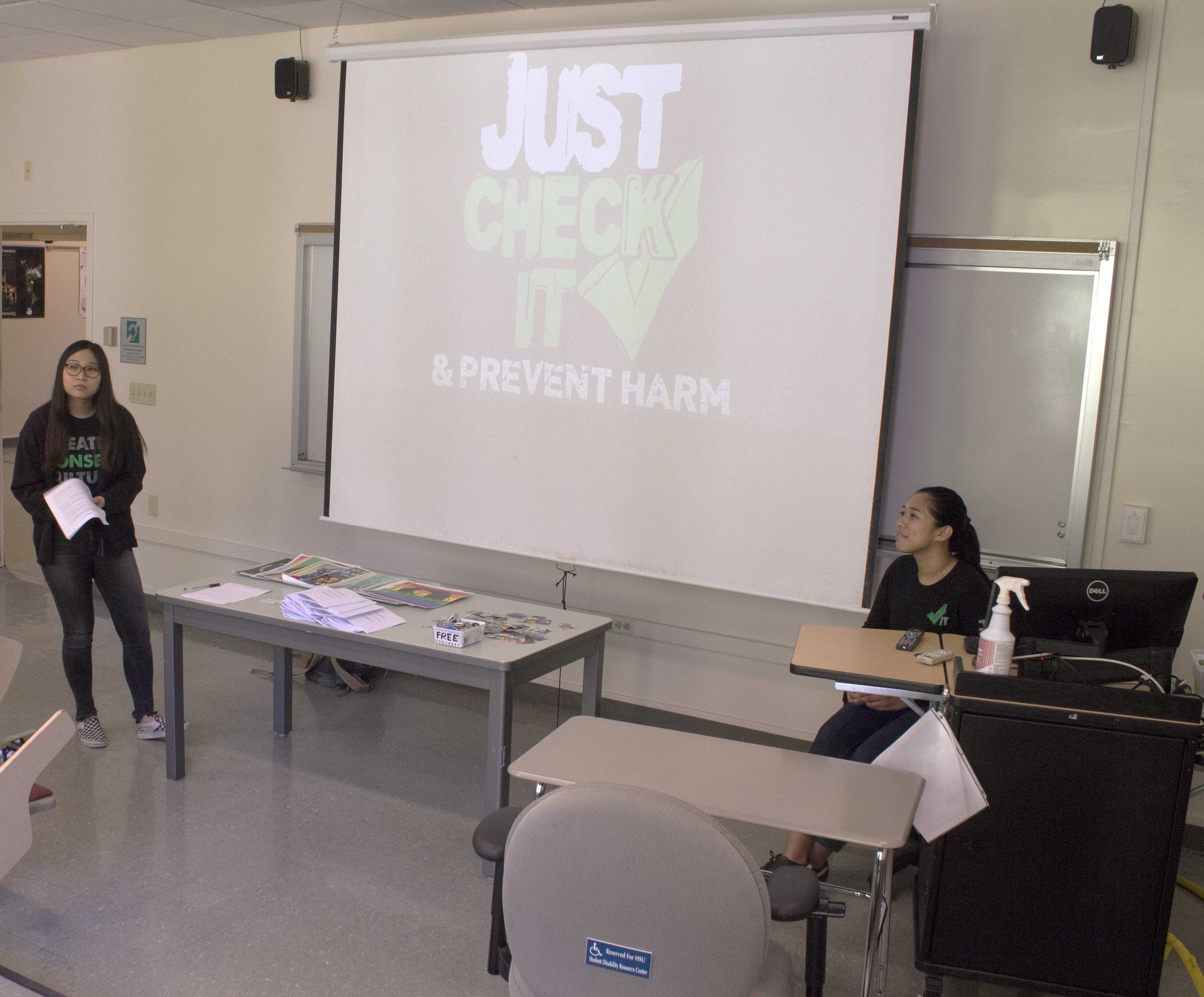
    Check-It had their fourth anniversary party in the Kate Buchanan room on Feb. 23. There was free food, karaoke and a variety of clubs that performed from 7-8 p.m. The lights-out dance party was from 8:30-10 p.m.

    Mary Sue Savage is the prevention coordinator at Humboldt State. Savage has been here all four years and says this anniversary party has become a tradition.

    “To ‘check it’ means to intervene, to take action when we witness a potential moment of harm, specifically addressing sexual assault, dating violence and stalking,” Savage said.

    Savage checks it for many reasons. She checks it for her family, her community and for her future children.

    “I check it, because I want to live in a world where harm is not the norm. I want to live in a world where we have a consent-centered culture,” Savage said. “It’s really exciting knowing we can use Check-It as a tool to create the culture and the world we all wanna live in.”

    Esmeralda Hurtado is the student coordinator for consent culture. Hurtado checks it, because she wants to continue to spread the knowledge of respecting consent and people’s boundaries.

    A time where Hurtado personally checked it was when she first moved into the HSU dorms.

    “I had just came home from class and I heard a lot of commotion outside. I stopped and I heard screaming and things being thrown,” Hurtado said. “I ran out of the dorm and I knocked and that stopped it. I still felt that something was not okay so I ran and grabbed a [community advocate], and they were able to asses the situation and handle it properly.”

    Bridget Ocampo is a peer health educator with Oh SNAP!

    “I feel like back in high school, we didn’t have much education within that. When I came up here, I became aware that it’s really important,” Ocampo said. “When I personally checked it, [it] was at work. One of [my] coworkers tapped my friend on their rear end, so I confronted them. At the time, my friend was too afraid to tell them anything.”

    Lemia Wells was an attendee at the Check-It anniversary party. Wells came to the event to support the program and those who have been sexually harassed.

    “I check it, because consent is important. If it’s not a for sure consent, then it is an assault,” Wells said. “Last week, I checked a guy who was yelling at a girl. The girl was telling the guy to leave her alone, but he wouldn’t so I told him that it wasn’t necessary. He got frightened and stopped yelling at her.”

    HSU acapella club member Christian Placet was one of the karaoke performers. The acapella club checks it, because it’s important that everyone should feel respected in any situation.

    “There were moments where i’ve been a bystander, where I wished I checked it.” Placet said. “Back in high school, there were a lot of nerds that were picked on and I really should’ve done something.”

  • Don’t get lost in the Szechuan sauce!

    Don’t get lost in the Szechuan sauce!

    Rick, McDonald’s is really out here!

    Seth Distefano is a Humboldt State freshman majoring in wildlife. Distefano has been working at McDonald’s for just over four months and he was shocked when he learned about the Szechuan sauce’s return.

    “It was all over the news that people were selling them for crazy amounts of money,” Distefano said. “I heard that one girl traded a packet for a car!”

    The packet of dipping sauce that people are raving about is a condiment that was created for Disney’s animated film “Mulan” in 1998.

    Beginning in 1996, McDonald’s and Disney agreed to promote and work with each other leading up to the film. For 10 years, Disney products were making their way into every McDonald’s kid’s meal.

    The sauce resurfaced, thanks to the help of cartoon series Rick and Morty. The animated series originally aired on Cartoon Network’s Adult Swim in 2013. The first two seasons was released a year apart, while the third season took two years to produce.

    The first episode of season three was released on April Fool’s Day in 2017.

    At the end of the episode, Rick fills the audience in on important information. Rick says he has been on a very long adventure attempting to relocate the special Szechuan sauce.

    This elaborate story surrounding the sauce was attached to Rick’s escape plan, where he was able to break out of the Galactic Federation Prison where he’s been locked up since the ending of season two.

    Originally, McDonald’s promised Rick and Morty fans they would revive the Szechuan sauce for one specified day. On Oct. 7, 2017, all hell broke loose as McDonald’s was not prepared for the amount of fans that demanded for the sauce.

    Diana Naal is a sophomore majoring in economics at HSU and a fan of Rick and Morty. She worked for McDonald’s in Arcata during the time of the initial release last October.

    “Our store didn’t receive any of the sauce,” Naal said. “Some people came in three days afterwards and were asking for the sauce.”

    On Feb. 22, McDonald’s broke silence about the Szechuan sauce.

    Anna Lueras is a local store manager at McDonald’s in Arcata.

    “I didn’t even know we were getting it,” Lueras said. “We were given three boxes of the sauce.”

    Each box contains a total of 250 individual dipping cups. The Arcata McDonald’s, located off of Giuntoli Lane, was shipped 750 cups of the Szechuan sauce. At 50 cents per pack, they are estimated to sell out quickly.

    As stores across the United States receive the special sauce over the weekend, fans rejoiced.

  • Give your brain a break at Brain Booth

    Give your brain a break at Brain Booth

    There is a sanctuary on the second floor of the HSU Library. Turn right at the top of the main second floor stairwell, walk straight ahead and you will run into the Brain Booth. The relaxing feeling in the Brain Booth envelops the visitor, washing off the mental fatigue of the day.

    HSU music major Malachai Ennis says the Brain Booth is a place for him to destress.

    “It is a helpful experience for someone caught up in the stress of school, similar to lying down and arising well rested,” Ennis said. “You need that resting time to have the energy to face the intensity of academics and human life.”

    Brain Booth’s therapeutic tools, such as virtual reality goggles and light therapy lamps, can be checked out at the main desk in the HSU Library.

    A passage from one of the Brain Booth books by Jon Kabat-Zinn, Full Catastrophe Living, caught Ennis’s attention.

    Kabat-Zinn writes, “Is there any waking moment of your life that would not be richer and more alive for you if you were more fully awake for it, while it was happening?”

    Christopher Pavlakovitch, an HSU environmental studies major, studies near the Brain Booth.

    “I have never used the Brain Booth but I have met some people who used it and thought it was relaxing taking your mind off school, drawing and chilling with friends,” Pavlakovitch said.

    In the Brain Booth, the stationary bike looks out across the Redwood staff parking lot. As you pedal, you are at the same level as the woods. Behind the bicycle is a large impressionistic painting of foliage, bringing a sense of the outdoors into the bike corner.

    HSU biology major Lydia Cazares says the Brain Booth is conducive to mind power that increases studying.

    “I haven’t used the Brain Booth, yet I have found that I get more studying accomplished here than I do downstairs,” Cazares said.

    “Ultimately, meditation is something you can find any place, anywhere,” Ennis said. “It’s good to have a dedicated space to remind people it is there. Drop in the Brain Booth so you don’t drop out of HSU.”

  • Speaker from Melbourne talks cannabis

    Speaker from Melbourne talks cannabis

    Jenny Williams, a professor at the University of Melbourne, spoke with Humboldt State economics students on Feb. 19 about her findings in a 15-year study of the effects of cannabis users and their choice of job professions.

    “In today’s age, cannabis use is something that is socially acceptable,” Williams said. “Today, more of the population who start using cannabis are young, between the ages of 14-18.”

    In Williams’s study, 49 percent of 1,000 male high school seniors used cannabis. Within that 49 percent, most of them either stayed in low-wage jobs after graduation or continued their academic career.

    Williams’s study also shows theories that cannabis users have a present mindset.

    “Users of cannabis are more willing to go into lower wage jobs,” Williams said. “This potentially leads to users being less likely to complete their education.”

    Brea Smith, a student at Humboldt State, said marijuana use is likely going to increase due to the recent legalization in California.

    “I won’t be surprised if the number of younger users increases in a couple of years.” Smith said.

    Eureka resident Jacob Rice has been a cannabis user for years.

    “I wanted a job for the sake of getting money,” Rice said. “I guess the study is accurate in some way, but I would take it with a grain of salt.”

    Williams plans on conducting a similar study to look into female high school seniors.

    “Socially, cannabis has become more acceptable than it was years ago,” Williams said. “I think it’s important to look at a students’ financial wellbeing in the long term when it comes to long-term cannabis use.”

  • College Creek Marketplace introduces new bag rule

    College Creek Marketplace introduces new bag rule

    Students will now be required to leave their bags with cashiers when shopping at the College Creek Marketplace. This new rule is administered by Humboldt State University’s dining services.

    Ron Rudebock, dining services director, said theft has become a bigger issue this semester than the last.

    “It’s why this new system is being put into place,” Rudebock said. “We need to take the precaution to prevent more theft from happening.”

    The way the system works is customers will leave their bags in a rack supervised by an employee and receive a pin with a number.

    Once they’re done shopping, customers return to the rack where they left their bag, give the pin back to a supervising employee and receive their belongings.

    Rudebock expresses that he didn’t want to use this system, but is required to avoid an increase of the price of items sold in the marketplace.

    “We’ve already had people calling to say that they think it’ll be inconvenient for everyone involved,” Rudebock said. “But for us to not increase the price of items in the marketplace, we need to use this system.”

    Selena Ponce is a College Creek Marketplace employee.

    “There is some frustration at first when we ask for [a customer’s] bag,” Ponce said. “When we explain that theft is the reason for the new rule, people are willing to leave their bags with us.”

    Rudebock said dining services will consider implementing a similar bag rule in The Depot and The J if theft becomes more common in those locations.

    “It was much easier to just go in, get what you need and get out,” HSU student Natalie Carbarl said. “It’s kinda dumb, but I understand why [the Marketplace] need to enforce this rule.”

    “People who are stealing from the Marketplace are hurting the school more than they actually think,” Rudebock said.

  • McKinley statue is no more

    McKinley statue is no more

    The Arcata City Council votes to remove the McKinley statue on Feb 23. amid strong support from the community.

    Footage by Stephanie McGeary and Garrett Goodnight. Edited by Stephanie McGeary.

    “Hey! Ho! McKinley’s got to go!” Humboldt State students shouted as they marched to the Arcata Plaza on Feb. 23. Supporters stood up for their support of the removal of the McKinley statue and Jacoby Building plaque. A crowd of people then crammed into City Hall to participate in the city council meeting where the council voted to remove the statue.

    “It’s like pulling the thorn out of a festering sore,” 64-year-old activist Fhyre Phoenix said.

    Phoenix was among the many who came to show his support for the removal of the statue, which he has been protesting for several years. Since December, Phoenix spent 26 days on the plaza demonstrating against the statue.

    “My goal was to start a conversation with 100 people every day I was there,” Phoenix said. “I found the response overwhelmingly positive. I had 15 positive responses for every one negative.”

    A crowd of people making their way to Arcata Plaza on Feb. 21. to participate in the decision to remove the McKinley statue. Photo by Patrick Maravelias.

    Among others supporters were the people of the Weott, Yurok and Pomo tribes, the Seventh Generation Fund for Indigenous Peoples, Earth First, Humboldt Unitarian Universalists Fellowship and HSU students.

    Elijah Lechman, 25, is the board of directors representative of Associated Students. Lechman says the Historic Justice Alliance, a group which includes Seventh Generation, HSU’s Movimiento Estudiantil Chicano de Aztlan, or MECha, and AS Lobby Corps, worked hard to get the word out about this pivotal moment. Lechman says it doesn’t matter if there are plans to replace the statue with something else. The bottom line is it needs to be removed.

    ”It’s distressing people having it there and it would be hurting no one to have nothing there,” Lechman said.

    Chris Peters, president and CEO of Seventh Generation Fund for Indigenous Peoples, spoke during the rally on the plaza of his concern that the city would try to delay this issue again.

    “They raise issues of cost and environmental impact reports,” Peters said. “We need to make a firm stand that we are adamant.”

    Cost issues were presented during the council meeting. City manager, Karen Diemer, estimated the cost to remove the statue at roughly $65,000.

    The decision to change the Jacoby Building plaque, however, seemed easy to agree on. Owner of Jacoby Storehouse Bill Chino agreed to help cover costs for that project.

    The main issue of the meeting was voting on the removal of the statue. Although member Paul Pitino voiced clear support, other council members were on the fence about the issue. There was the discussion of placing the issue on a ballot, to have the public vote in November. Mayor Sofia Pereira did not support this option.

    “I think we lose the nuance of people’s perspective on it,” Pareira said. “As a council, we should give our best effort to resolve it at this level.”

    In the end, the city council did resolve the issue. In a vote of four to one, the council voted to remove the McKinley statue from the Arcata Plaza.

    The estimated $65,000 cost still presents an issue, but Phoenix offered to help run the campaign to earn the funds. The project is currently in the early stages.

    Phoenix said the community support will make this an achievable task.

    “People who want to help move forward can donate to the campaign,” Phoenix said. “This is for people who didn’t make it to the rally or to the meeting to show support. Here’s your chance to make a mark.”

    People interested in contributing can inquire by emailing fhyrephoenix@gmail.com.

    This story has been changed from its original version on Feb. 27 at 4:22 p.m.


  • Tunnel of Oppression demonstrates discrimination

    Tunnel of Oppression demonstrates discrimination

    While Black History Month is in full swing, students who found themselves in Nelson Hall on Feb.15 discovered something a little different.

    The Tunnel of Oppression was a demonstration put on by Housing & Residence Life. The tunnel consisted of a series of skits that were meant to spread awareness of different forms of oppression, some that we see every day.

    Sasha Wallace, an area coordinator for Housing and Residence is one of the facilitators of this project.

    “We try to do this every year, but we were unable for the past two years,” Wallace said. “I’m really excited to get it going again.”

    At the start of the tunnel, you are given a guide to lead you through the demonstration and help ensure that anyone who feels uncomfortable can be escorted out.

    The first skit depicted two students walking and conversing in Spanish. A bystander approaches and barrages them with a wall of insults and racial slurs. The interaction ended with the attacker telling the pair to go back to Mexico. The skit was short, but it was something that most people have seen in their lives.

    The second skit was something more relatable for Humboldt State students. Two students were on a computer looking for potential housing options. They get an opportunity to speak to a landlord who sounds assuring that they will get the place. When they arrive to see it, the landlord notices they are a lesbian couple. Immediately, the situation changes when she tells them the place is no longer available.

    Elizabeth Alvarez, an HSU student and the landlord in the previous skit, felt being part of this project would be a good idea.

    “I know there’s a problem with housing discrimination in Humboldt County,” Alvarez said. “I think it plays a huge part as to why HSU students have trouble finding housing.”

    Between the skits, you can look at the various posters on the walls that contain information about different kinds of oppression.

    Another skit showed a young woman at a bar by herself. She is approached by a man who persistently buys her drinks and makes her drink them. Another woman at the bar sees this happening and quickly takes the drunk girl from this man. She sits her down and helps her find a way to get back to her own house. This situation at HSU is often known as a “Check-It” situation.

    Samantha Mariscal, an HSU student and a guide for the tunnel, was excited to be part of this project.

    “It challenges you out of your comfort zone and it makes you think differently,” Mariscal said. “I witness some of these things every day and I just want people to be more aware.”

    The final skit portrayed a student going to a meeting with his career advisor. The student shares his plans to go to UC Santa Cruz to be closer to his single father. He also discloses that English is his second language and he is having some trouble communicating. The career advisor refuses to even make eye contact with the student. Throughout the meeting the advisor is constantly putting him down and telling him to think about more “realistic” options. It gets to the point that the student feels so uncomfortable he asks to see another advisor, to which his request is denied. This skit was unique, as it showed faculty-to-student oppression, which is something a lot of people would not think of.

    The event was in honor of Black History Month, a time designated to recognize the oppression black people face in our country, but was not specifically tailored to the topic.

    At the end of the tunnel, you are taken to a debriefing room where you sit down with another person who lets you unpack everything you just saw.

    Tyler Ramsey, an HSU student, was one of the people helping with debriefing.

    “I’m always talking about social justice and I wanted to debrief so I can hear what other people thought of their experience here,” Ramsey said. “We want to show this to spread awareness. All we can do is educate people and hope they learn.”