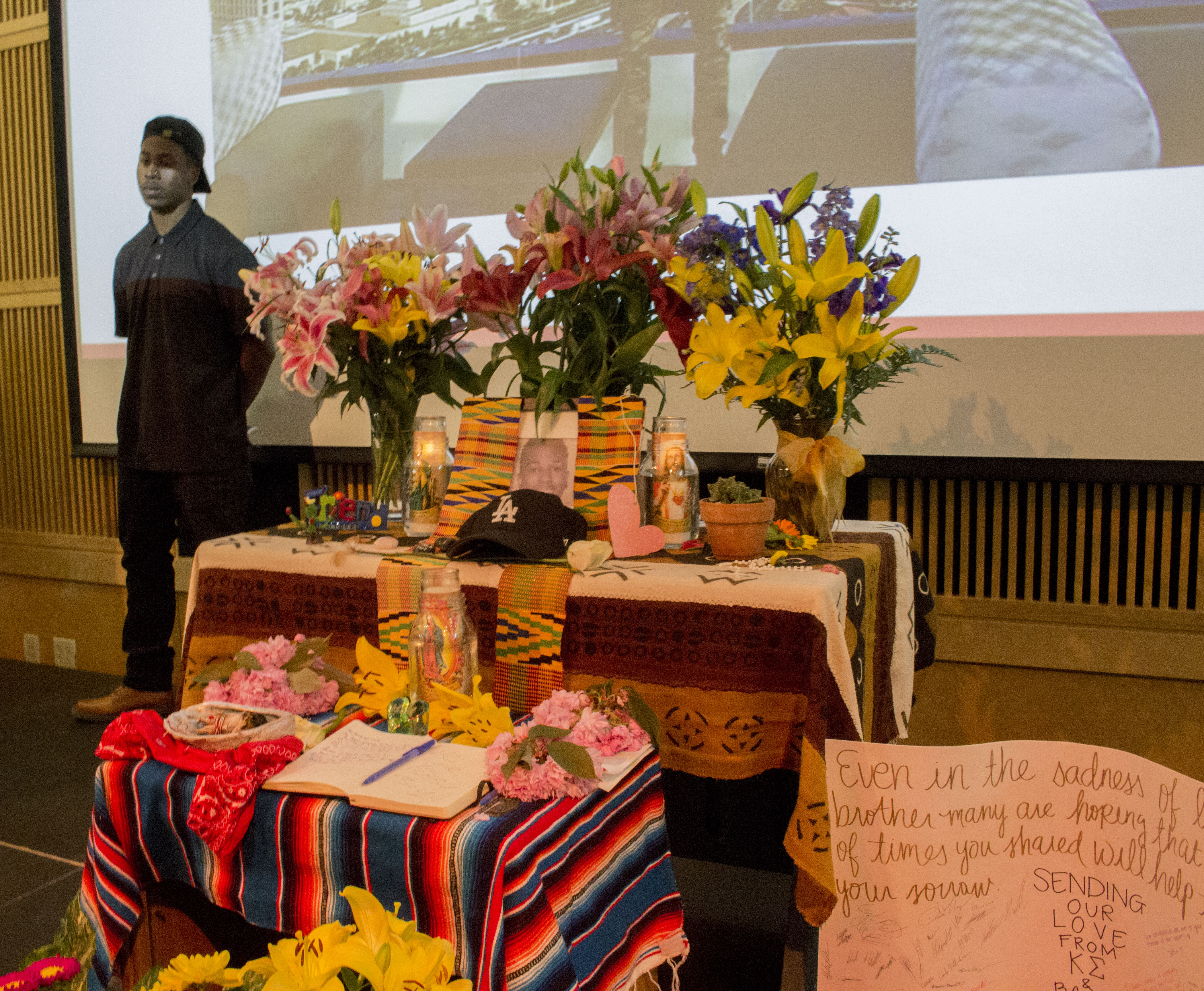
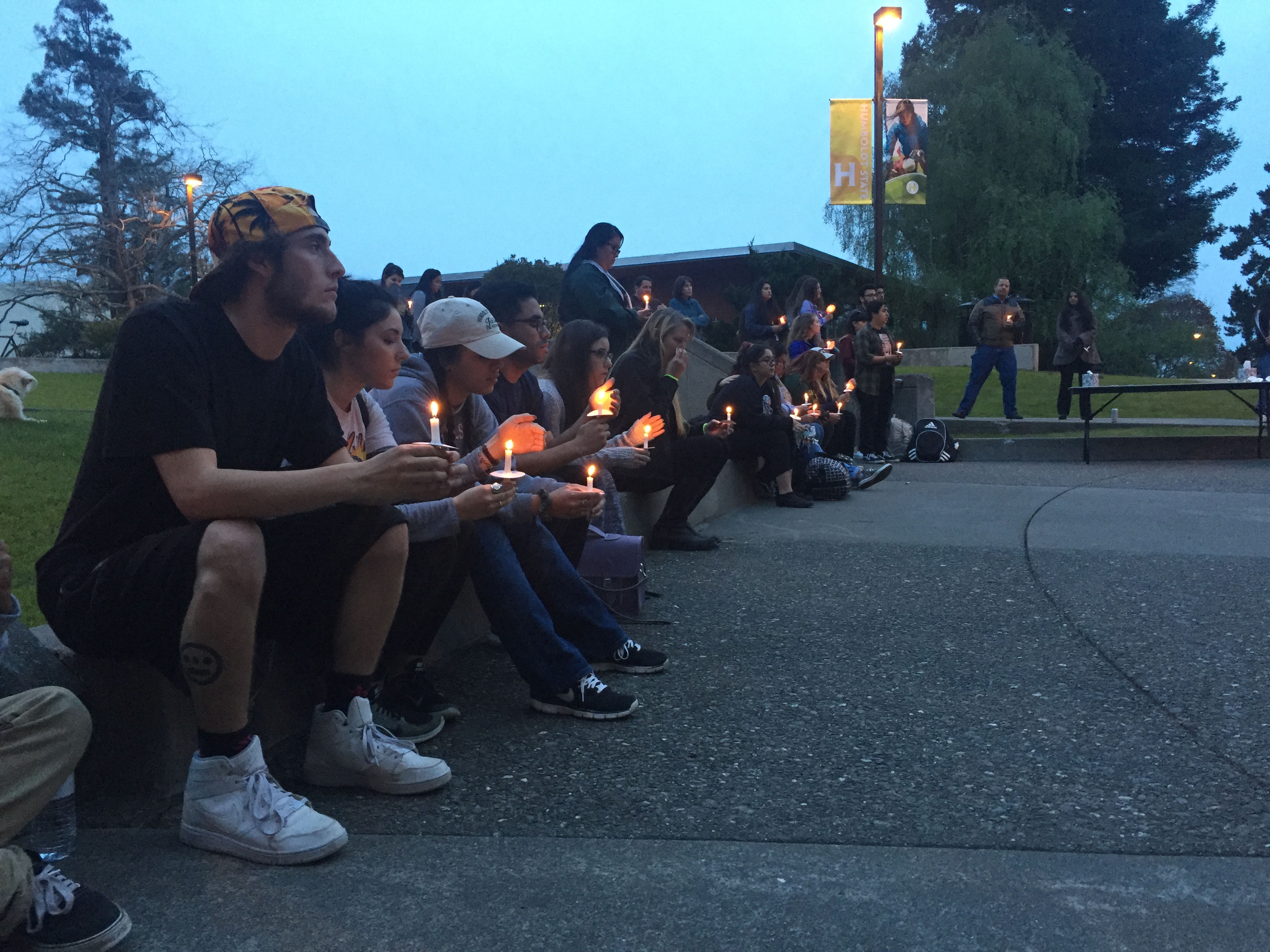
Family, friends, students, faculty and community members filled the KBR to remember David Josiah Lawson.
Lawson, a second year criminology major and president of Brothers United was stabbed and killed on the early morning of Saturday April 15.
Brothers United organized a vigil to remember their brother. The audience consisted of Lawson’s family members who traveled from Riverside, California.
Family members remembering Lawson at the vigil at the KBR on Thursday, April 20 2017. | Photo by Iridian Casarez
Brothers United remembering Lawson at the KBR on Thursday, April 20 2017.
Charmaine Michelle Lawson comforted by her children after the vigil on Thursday, April 20 2017. | Photo by Iridian Casarez
Lawson’s family hugging each other after the vigil on Thursday, April 20 2017. | Photo by Iridian Casarez
Family members, friends, community members and facutly filled the KBR to remember Lawson on April 20. | Photo by Iridian Casarez
Pastor Phil, Lawson’s old track coach and family Pastor, getting ready to say a prayer at the KBR on Thursday, April 20 2017. | Photo by Iridian Casarez
Chief of Police, Tom Chapman speaking at Lawson’s vigil at the KBR on Thursday, April 20 2017. “We’re going to get justice for Josiah,” Chapman said to the audience. | Photo by Iridian Casarez
Kyle Zoellner, the 23 year old McKinleyville man accused of murdering HSU student David ‘Josiah’ Lawson pleaded not guilty to murder late this afternoon.
Zoellner also denied the District Attorney’s special allegation that he used a knife during the crime.
Although multiple eyewitnesses say race was a motivator in the attack, the DA did not charge Zoellner with a hate crime.
Judge Stephen Mock set a bail of $1 million. The preliminary hearing date is for May 1.
A new bill was presented to the State Assembly Committee in the state of California that will effectively eliminate the bail system.
The State Assembly’s Committee voted on the bill, Assembly Bill 42. According to the Los Angeles Times, Assemblyman Rob Bonta and Assemblyman Bob Hertzberg wrote the bill to allow individuals to be released on their own bail and at no cost will await trial. It also gives judges and pretrial service agencies more authority to keep potentially dangerous individuals in jail to await their trial without bail. Pretrial services procedures would assess whether a defendant’s release would pose a safety threat and make sure they show up for their court dates. There is another identical bill from the Senate, SB 10, that will also contribute to the elimination of the bail system.
The bill, AB-42, was written with the intention of making the justice system fairer for people who cannot afford bail, unlike wealthy individuals who can make bail.
According to Mercury News, the ACLU (American Civil Liberties Union) is one of the proponents of the bill saying that the reform is long overdue. The ACLU says that too many people wait in jail for their trial because they cannot afford to post bail.
Margaret Dooley-Sammuli is a criminal justice and drug policy director for ACLU of
California.
“We support the bills they’re gonna fix the broken money bail system California has,” Dooley-Sammuli said. “It creates a system that works for all Californians.”
According to Dooley-Sammuli, after the bills get passed from the State Assembly Committee, it gets passed on to the Appropriations committee then goes to floor vote in house. The current bail system determines whether or not a person would get out of jail based on money without using a risk based approach.
According to the Los Angeles Times, there were dozens of opponents of the bill at the hearing including various bounty hunter and bail agencies.
Three buildings at Hoopa Valley High School were engulfed in 40 foot flames early Monday morning.
According to Times Standard, Hoopa Valley High School’s auto shop, wood shop and choir room went up in flames due to a “suspicious” fire. An investigation is underway by the multi-agency Humboldt County Arson Task Force.
Hoopa Volunteer Fire Department Chief Amos Pole said to the Times Standard that the fire was deemed suspicious due to the way the fire spread from each building.
Authorities arrived at the scene around 3 a.m. where they were able to prevent the fires from expanding. It took the Hoopa Volunteer Fire Department two and a half hours to put out the flames.
There were no fire personnel injuries.
According to the Times Standard, the three buildings that were burned were closed down due to mold infestations. The Klamath-Trinity Joint Unified School District had spent a lot of money on renovations and designs for the building to be reopened mold-free.
One person died and eight others were injured in a car collision on Highway 299 Monday afternoon.
Source: News Channel 3
-Myers Flat burglary and shooting
Three people have been detained after a burglary and shooting in a Myers Flat home. Ramon Aviles, Ervin Dixon, and Alberto Garcia were arrested and transported the Humboldt County Correctional Facility. Two other suspects are still being searched for.
Source: News Channel 3
-Humboldt geologist
Lori Dengler, a tsunami and earthquake expert, commemorated the 1992 Cape Mendocino Earthquake at the Clarke Museum Saturday. The earthquake was a 7.2 magnitude temblor that hit the region on April 25, 1992 and caused over $60 million in losses.
Source: Times Standard
U.S.
-The Tax March on Trump
People marched and demanded President Trump to release his tax returns all throughout the United States on Saturday. The “Tax March” was organized in more than 150 cities and wanted to call attention to Trump’s refusal to disclose his tax history.
Source: Newsweek
-Facebook live homicide
A man broadcasted himself killing an old man on Facebook live Sunday afternoon. Steve Stephens, 37, shot and killed Robert Godwin, 74, as an act of revenge on his girlfriend. Authorities are still searching for Stephens and have offered a $50,000 reward for his whereabouts. On April 18, Stephens was chased by the Cleveland Police Department in Erie County in Pennsylvania. The chase culminated with Stephens killing himself in his car.
Source: CNN
-Arkansas Supreme Court
The Arkansas Supreme Court cancelled eight scheduled executions on Sunday. The executions were going to be the first executions in the state in a decade. Death-row inmates and their legal teams had been fighting the courts on their executions.
Source: The Washington Post
World
-Education in Chile
As lawmakers prepared to debate planned reforms, thousands of students took the streets in various Chile cities to protest demand improvements to the nation’s higher education system.
Source: Reuters
-Syrian civil war
At an evacuation point on Sunday, a deadly explosion reportedly killed at least 100 people, including dozens of children, government supporters and opposition fighters.
Source: NBC News
-Former south Korean president
The former South Korean president, Park Geun-hye, was indicted for bribery and abuse of power. Park was forced from office in March amid a massive corruption scandal that engulfed not just her government but also major companies like Samsung and Lotte Groups.
PepsiCo and HSU have spent the last five years in a contractual partnership. PepsiCo pays HSU athletics $35,000 a year in scholarships, HSU gives PepsiCo 80 percent of available shelving space for its drinks, and the students are left to choose between diet or original.
The current five year pouring rights contract ends June 30, and many around HSU’s campus would like to see HSU break away from its corporate ties with PepsiCo. The Associated Students council has taken up the fight, urging HSU administration to explore alternate partnerships with more reputable companies – preferably local ones.
AS representative Tessa Lance has been working to rally her fellow students in support of breaking away from PepsiCo. “At first there was little interest, but since the start of this semester, students have been increasingly involved,” Lance said. “ PepsiCo has a long history of committing environmental injustice. The values HSU claims to represent, the values that students come here to uphold, have nothing in common with PepsiCo,” Lance said. Lance along with the help of other students brought their concerns to Joyce Lopes, Vice President of Administration and Finance. Lopes in turn set up a “Pepsi Task Force” to meet regularly and discuss the impact PepsiCo has on HSU.
The Task Force included representatives from Dining, Athletics, upper Administration, and a few students, including Lance. These meetings found that administration and students have a lot of common ground, and both are in favor of a more sustainable contractual obligations.
On Monday, April 17, the AS council held a town hall in the Nelson Forum for students and community members to voice their concerns over the PepsiCo contract. Dozens of students showed up to have their voices heard by members of the Pepsi Task Force, including Lopes and Athletic Director Tom Trepiak. Meredith Garrett, a HSU student, was the first to speak. She first recited the HSU graduation pledge found posted in large font on the wall above her. Garrett said that the reasons students came to HSU were being abandoned within the PepsiCo contract. One of the main concerns echoed again and again by students was that PepsiCo and the Athletics were in a mutually beneficial partnership that left the majority of students out. PepsiCo funds roughly eight athletic scholarships a year under the current contract. Additionally, PepsiCo gives money to athletics for one time expenditures such as new scoreboards, totalling roughly $20k a year. There are about 400 athletes at HSU, and around 200 athletes receive partial or full scholarships a year. Although PepsiCo only covers a small percentage of scholarships, losing PepsiCo’s money would only add to the deficit problem within the Athletic Department and subsequently HSU as a whole.
Senior communications major and Lumberjack football player Jared Layel attended the meeting and expressed a sentiment in stark contrast from the general tone of the meeting. “AS never asked athletes if they wanted to see PepsiCo go,” Layel said. “Breaking ties with PepsiCo would only force HSU to again raise tuition, and it would worsen the deficit.”
HSU cannot begin the process of exploring a new contractual agreement with a different vendor until the last 30 days of the current contract; that period begins June 1. Until that time, Tessa Lance, the AS council, and the Pepsi Task Force will continue exploring ways in which HSU might find a sustainable alternative to PepsiCo. As of now, there is no concrete plan to replace PepsiCo and the money it brings HSU.
President Trump is claiming that he cannot be sued because he is now President of the United States, his defense in lawsuit said Trump incited rally-goers to violence that assaulted protesters in his 2016 campaign.
President Trump signed an executive order in Wisconsin that will make it harder for tech companies to replace American workers with cheaper foreign labor and will strengthen rules barring foreign contractors from bidding on government projects.
President Trump has yet to release his tax returns thus threatening one of his campaign promises to enact a sweeping overhaul of the tax code.
Donald Trump signed an executive order to revamp a temporary visa program used to bring foreign workers to fill jobs in the US.
3:14 p.m. 4/19: The District Attorney’s office said Kyle Zoellner’s case is still under review, and a decision has not yet been made. Arcata police are urging that the author of an e-mail giving an eyewitness account of the incident come forward to APD.
9:24 a.m. 4/17: Arcata police have arrested Kyle Zoellner, 23, in connection with the killing of 19-year-old David Lawson.
1:01 p.m. 4/16: The victim’s name was David Lawson, a 19 year old sophomore attending HSU. The incident occurred on the 1100 block of Spear ave in Arcata, CA.
A HSU student died early Saturday morning after a stabbing that took place at an off-campus location in Arcata. Arcata police have taken a suspect into custody. The name of the victim is being withheld until the family is notified.
The Lumberjack will update as more details become available
1:44 pm 4/15:
The student was 19 years of age. The suspect detained by APD is not a student at HSU. The stabbing took place at 3 a.m. Saturday morning, during a fist fight at a house party (source: The Journal).
HSU President Lisa Rossbacher released the following statement:
“Dear University Community:
I am deeply saddened to share news with you that one of our students has died after a stabbing last night. I have no words to adequately describe the sorrow of this loss. This tragedy is heartbreaking for all of us, and most especially the family and friends of the victim. Our thoughts are with them and we extend our condolences.
We are reaching out to provide support and counseling to members of our University community. We will also be in contact and offering support to family members.
The student’s name is currently confidential while his family is being notified. Because the incident occurred off campus, the investigation is being led by the Arcata Police Department with significant assistance from University Police.”
HSU Marketing and Communications released the following: “Students who are in need of support during this time are encouraged to contact the Dean of Students office at 707.826.3504 or visit that office in Siemens Hall 211. For after-hours assistance, students can contact Counseling & Psychological services at 707.326.3236. Staff or faculty seeking additional support may utilize the Employee Assistance Program at 707.443.7358.”
President Trump ordered an airstrike on a Syrian government air base on Friday in response to the chemical weapons attack that killed dozens last week. Six people were killed in the airstrike.
Trump offered a traditional Hebrew Passover greeting to Jewish people on Twitter on Monday evening. He tweeted “Happy Passover to everyone celebrating in the United States and around the world. #ChagSameach.” Chag Sameach means “joyous festival” in Hebrew.
President Trump has spent close to $20 million on each presidential trip he has taken since becoming President of the United States. He will soon spend more money on presidential trips in his first 80 days in office than President Obama spent in his eight years in office.
President Trump’s nominee for Supreme Court Justice, Neil Gorsuch, was confirmed on Friday and was sworn into the Supreme Court Monday morning.
Trump has gone golfing 16 times since being elected president eleven weeks ago. During his campaign trail, Trump was very critical about President Obama’s golfing trips while he was in office.
The Baywood country club is broke and is soon planning a golf course timber harvest. The country club is going to file a Timber Harvest plan that looks to lodge roughly 73 forested acres in and around its 18 holes. The harvest could make as much as $700,000 for the country club.
Source: Mad River Union
-New tech for St. Joseph’s
St. Joseph’s Hospital in Eureka has new technology that could help take a closer look at people’s lungs and chest. St. Joseph’s Hospital has the first and only Endobronchial Ultrasound, a device that helps doctors take a closer look at the lungs and chest.
The machine helps evaluate and examine lymph nodes, identify chest infections, diagnose non cancerous inflammatory disease like sarcoidosis, detect lymphoma and determine stages of lung cancer.
Source: Times Standard
-Eureka Moose Lodge
The Eureka Moose Lodge donated $10,000 to local fire and law enforcement agencies. One donation of $2,000 went to the Humboldt County Sheriff’s Office Animal Shelter for use towards the shelter’s emergency medical fund. The money will be used to help animals in need of medical attention.
Source: News Channel 3
-Karuk tribe cuts salmon count
The Karuk tribe is going to limit their ceremonial salmon harvests for tribal members because of the record low forecast for returning Chinook salmon on the Klamath River.
Source: Times Standard
U.S.
-San Bernardino shooting
A man walked into North Park Elementary school and started shooting. Cedric Anderson, 53 walked into the elementary school and fatally shot his estranged wife and an 8-year-old boy and injured one other students. The shooting came 15 months after the terrorist attack San Bernardino endured November of 2014.
Source: Washington Post
-United Airlines passenger dragged
A United Airlines passenger was dragged from an overbooked flight Sunday evening. A security officer involved in the incident has been placed on leave. The federal Transportation Department is investigating whether the airline complied with rules regarding overbooking.
Source: New York Times
-Gun shop burglary
A man suspected of a gun shop burglary is on the run after allegedly sending a manifesto to President Donald Trump on his grievances about the government. Joseph A. Jakubowski, 32, allegedly robbed the gun shop in Janesville, Wisconsin last week.
Source: CNN
-Texas voter ID law discriminates
A federal judge ruled that the voter identification law the Texas Legislature passed in 2011 was enacted with the intent to discriminate against Black and Hispanic voters. The judge found that the law violates the federal Voter Rights Act.
Source: New York Times
-NY State free tuition
The Governor of New York, Andrew Cuomo, announced free tuition in the state of New York. New York is the first state in the country to offer free tuition for middle-class students from households earning less than $125,000 a year.
Source: Now This
World
-Stockholm truck attack
A truck ran into pedestrians in one of the busiest streets in Stockholm killing four people. Two suspects were arrested. One suspect, a 39-year-old man from the central Asian nation of Uzbekistan, was known to intelligence services before he was arrested on Friday. He had shown sympathies for ISIS.
Source: BBC News
-Growing tensions with North Korea
The U.S. Navy sent an aircraft carrier and three guided-missile destroyers and cruisers to the Korean peninsula on Saturday, in response to growing tensions with North Korea. On Monday, officials in China and South Korea agreed to impose a tougher stance on North Korea if Kim Jong Un continues to launch nuclear or long range missile tests.
Humboldt State University’s athletics department will face a budget deficit as the fiscal year comes to a close on June 30, 2017 for the second consecutive year. The athletic department is expected to come up $669,000 short, once again requiring HSU to divert $500,000 from its general fund to help curtail the deficit.
HSU students spend $4.3 million a year on athletics, resulting in the highest Instructionally Related Activities fee of any CSU, at $674 a year for full-time students. The next highest IRA fee at a CSU is $460 a year, at Sonoma State. 77 percent or $518 of HSU’s IRA fee goes towards athletics. In 2015, HSU students paid $4,221,825 toward athletics. The median of all other CCAA schools in the same year was $2,181,874, and a median of $16,737 for all of Division II.
HSU track and field. Photo by Iridian Casarez
It’s important to note, in respect to athletics, that along with an abnormally high student fee, athletics also generates far above the median when it comes to advertisements and donations. Athletics raised $345,775 in royalties, licensing, advertising and sponsorships in 2015. The CCAA median was $34,775 and the Division II median was $15,045. HSU also raised in-kind donations, such as goods and services, of $246,280 compared to $13,189 for other CCAA schools.
In November 2016, HSU President Lisa Rossbacher contracted Strategic Edge Consulting LLC to conduct a review of HSU’s various intercollegiate athletics programs and the athletic department as a whole. The 100-page report viewed the athletic deficit holisticly and highlighted areas HSU’s administration could improve.
The report reads, “It also became clear that there appears to be a “divide” between athletics and other parts of campus…One of the things that became obvious through the sessions with the Advancement Foundation Board, Athletics Department staff, the Philanthropy staff and others on campus was that the Athletics Department and the Advancement Office do not communicate well and have not historically worked with each other.”
Frank Whitlatch, associate vice president of Marketing and Communications at HSU, in partnership said that the athletic deficit issue isn’t due to an indifference to teamwork between departments. “HSU is essentially a very large organization,” Whitlatch said. “It’s easy for individuals in various departments to put their heads down and work at solving an issue to the point that communication suffers.”
President Rossbacher responded indirectly, through a mediary, to a couple of questions from The Lumberjack that were related to the Strategic Edge report.
“I requested that Athletics and Advancement meet regularly for the next six months, with very specific outcomes required. The first meeting has taken place and work is ongoing to improve coordination in the areas of fundraising and communication.”
When Rossbacher was asked if HSU athletics are “too big to fail,” she said, “General funds have already been used to offset the deficit in Athletics. We have to consider every option to ensure that all HSU programs are financially sustainable.”
The 2016-2017 year also saw a 3.5 percent reduction in enrollment at HSU. Additionally, HSU expects to see another dip in enrollment for the 2017-2018 year. On whether or not a public deficit issue might dissuade potential students from enrolling at HSU, Whitlatch said, “I don’t believe that a visible deficit will affect potential enrollment, the reality is most CSU’s have some level of a deficit issue.”
Strategic Edge suggested a few options for HSU athletics. Among these were HSU remaining a member of the NCAA and changing divisional affiliation to NCAA Division III, remaining a member of NCAA Division II and moving to the Great Northwest Athletic Conference for all sports, or transferring to the National Association of Intercollegiate Athletics .
In a memo sent in March to all administrators and coaches affiliated with Athletics, President Rossbacher indicated that HSU intends to remain within Division II and make no changes to its divisional affiliation.
In the memo, Rossbacher left potential cuts to athletic programs on the table. Sports such as baseball, women’s swimming, and wrestling have been cut in the past. Former and current HSU athletes are making their voices known with the potential upheaval of HSU Athletics.
“It makes me feel uncomfortable for the student athletes that are currently there and it saddens me every time I hear, ‘they might cut this,’ ‘the school is getting rid of this,’ ‘there isn’t enough money to do this,’” said former HSU soccer player Emily Huska. “It happened all throughout my four years of being a student athlete.”
HSU soccer player McCalla Madriago is also concerned about potential cuts.
“Honestly, it would hurt HSU and the community because HSU athletics are the closest thing to having live sporting events anywhere in Humboldt county,” said Madriago. “We’re isolated and sports bring the community together or makes it excited and a topic to be shared. Not only that, HSU athletes are a huge influence on the younger generations around here.”
In November 2017, HSU will review the deficit issue both within athletics and HSU in general. Any potential cuts, revenue hikes, or other changes will be left to speculation until then.
Humboldt State’s radio station, KHSU, is facing a 16 percent funding decrease under Donald Trump’s proposed 2018 Budget Outline.
KHSU has an annual operating budget of just over a million dollars. In 2016, KHSU received $175,061 in grants from the Corporation for Public Broadcasting. CPB is the largest source of funding for public radio. With the complete defunding of the CPB, KHSU would have to look elsewhere for funding.
Peter Fretwell, KHSU’s new general manager, was attracted to the position as general manager at KHSU due to it’s large community involvement.
“KHSU is near the top, if not the top of the most listened to stations in Humboldt county,” Fretwell said. “In my experience community involvement is important and I was attracted to Humboldt county and KHSU because of the deep community engagement.”
KHSU is a noncommercial, public radio station, supported by Humboldt State University. KHSU is largely community based on and acts to provide intellectual perspectives on local and national issues.
KHSU receives a large amount of their funding from donations from the community. In 2016 $336,289 was donated in listener support. It is this kind of support from the community that will be able to maintain KHSU’s ability to broadcast.
KHSU is a vital resource for the community. Humboldt is relatively cut off from the world and in the face of potential natural disaster, public radio would be vital for public service.
The recent budget outline, released on March 16, called for a complete cut to CPB funding. Similar stations with similar communal obligations all around the country face these cuts as well. Patricia Harrison, CPB’s president and CEO, outlined the importance of public media in a statement made after the budget outline was released.
“The elimination of federal funding to CPB would initially devastate, and ultimately destroy public media’s role in early childhood education, public safety, connecting citizens to our history, and promoting civil discussions,” Harrison said.
Fretwell has seen proposed cuts to CPB before and believes that, as before, the CPB will be able to retain its funding.
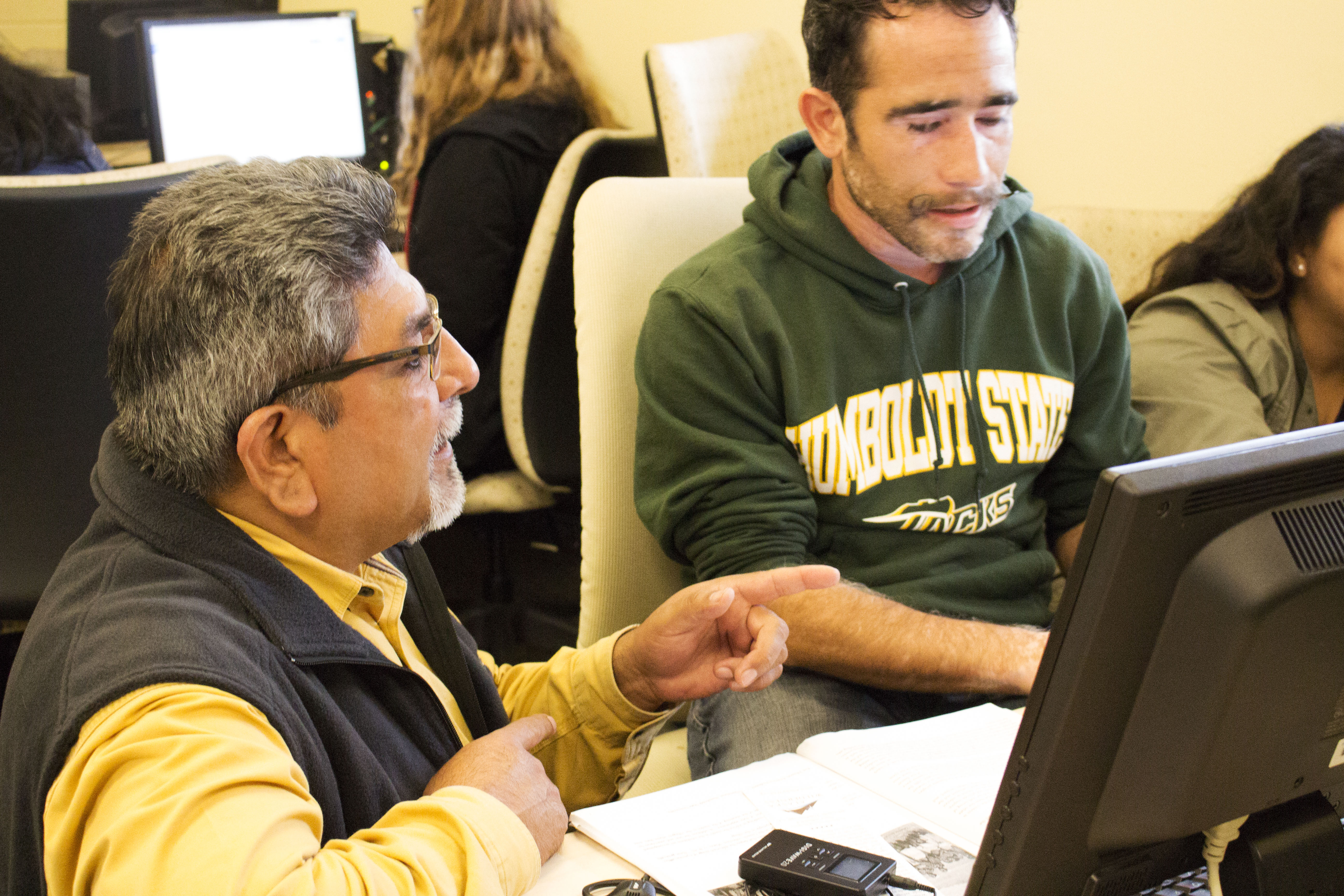
During the spring preview introduction in the Lumberjack Arena, Rosamel Benavides-Garb watched and listened through his headset as his students translated for the parents of incoming HSU freshmen.
Benavides-Garb, the chair of the department of world languages and cultures, teaches a translation and interpretation class at HSU. Students get to experience real service learning through translating for middle schools and high schools in the county during parent teacher conferences through a community outreach partnership with the Humboldt County Office of Education, as well as events at HSU such as spring preview.
These students are helping their community and the wave of Latinx students with parents who don’t speak English. Most high schools and middle schools are not in compliance when it comes to the need for translators at parent teacher conferences according to Benavides-Garb. HSU students get to play a huge role in translation services when it comes to student success in the county.
Rosamel Benavides-Garb listening through his earpiece during Spring Preview.
Benavides-Garb feels that translation and interpretation services are very necessary especially in the high school setting.
“Parents have never heard their child’s teachers say that their child is an excellent student,” Benavides-Garb said. “Students are forced to be translators for their parents during these interactions and they have no idea how to translate that they themselves are excellent students.”
Students like Carlos Sanchez have been translating alongside Benavides-Garb since taking his translation and interpretation class in 2014.
Sanchez believes that through the field work for the translation and interpretation class has provided him with many opportunities for him to grow as a student and as an individual.
These students get real practice that they put on their resume through this service orientated class. They help their community as they take these classes.
“Bilingualism is something that is dear to me,” Benavides-Garb said.
With HSU as a Hispanic-Serving Institution with an influx of Latinx students, classes offered and taught by Benavides-Garb serve a very important purpose to students, the institution, and the community.
Rosamel Benavides-Garb assisting students in the translation of the book African Masks.
Rosamel Benavides-Garb assisting students in the translation of the book African Masks.
“HSU makes students into bilingual professionals,” Benavides-Garb said. “It takes a lifetime to acquire a second language but a lot of students at HSU are already bringing that.”
But just because a student is bilingual does not mean they can translate. Students learn interpretation in Benavides-Garb’s class which is the exact translation with all of the cultural complexions.
Benavides-Garb’s translation and interpretation class has had the opportunity of translating the book “African Masks” by James Gaasch from English to Spanish. The class is currently in the proofreading process where they work in groups to editing the translations bit by bit.
The book about the collection which was on exhibit at HSU is currently being sold on Amazon and after being translated in Spanish, it will be available for sale in Spanish speaking countries.
Alejandro Arredondo, a senior psychology major, is currently in the translation and interpretation field study class and has been translating the book “African Masks”.
“It’s a great opportunity to share a culture’s story in various languages,” Arredondo said.
After learning about the context and the message of the book, Arredondo feels confident about contributing to these stories and documents.
The Department of world languages and culture is creating a connection to these stories and documents to HSU.
“It has been a relentless call for service, providing translation services for our community,” Benavides-Garb said.
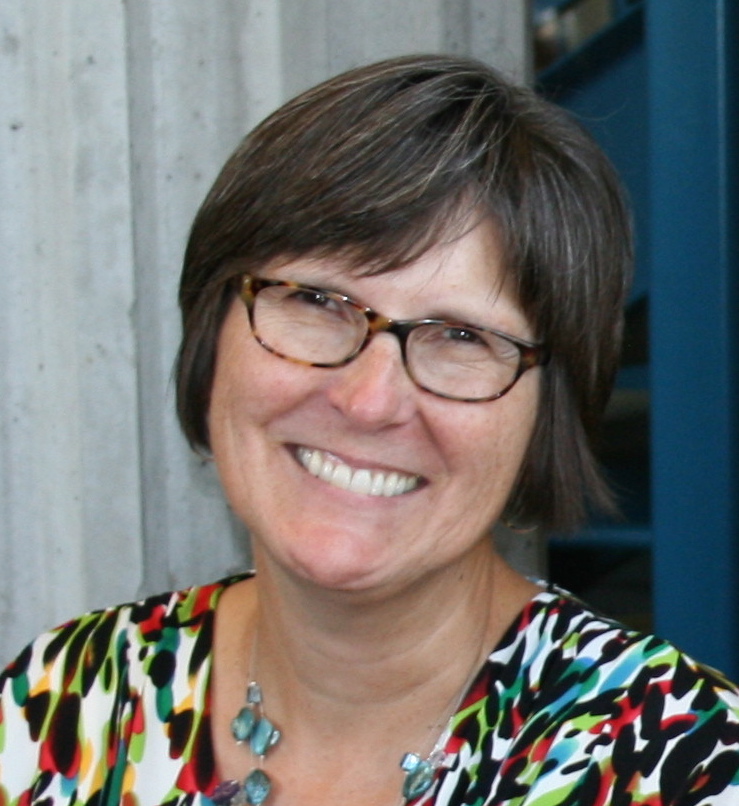
HSU will soon welcome its new dean of the College of the Arts, Humanities and Social Science, Lisa Bond-Maupin. Bond-Maupin is starting as the new position in July. She is coming from the University of Arkansas.
Q: Where are you from?
A: I grew up mostly on the coast of California and Baja California. We lived in Ensenada BC ( Baja California), Inglewood, Chula Vista, San Diego, Santa Cruz, and Ferndale, California. Much of that time we lived on a sailboat my father built. We sold the boat and moved to dry land when I was in high school. I attended Ferndale High School until my senior year when my parents bought a farm in Missouri and we moved to the Ozarks. I loved Humboldt County as a young person. And I still do.
Q: Where are you currently working now?
A: I became the Founding Dean of a brand new college of Social Sciences and Communication at the University of Arkansas Little Rock three years ago. I have had the privilege of working with students, staff, and faculty to build this college and establish a college identity and community. That is what I am doing now and until my last day here at the end of May.
Q: What made you interested in applying for the dean position at HSU?
A: Humboldt State University has had a clear and consistent identity and set of commitments as long as I can remember. I knew of HSU’s reputation for leading in environmental sustainability before it was something people were really talking about. I was aware of HSU’s commitment to social justice. I have always been intrigued by HSU’s uniqueness.
Q: What can you bring to HSU as the new dean of the College of the Arts, Humanities and Social Sciences?
A: I look forward to using my experience to support faculty in the achievement of their professional goals as I learn more about their passions. I know that HSU is different in significant ways and my knowledge will grow as I learn from my colleagues there. I am ready to partner to explore meaningful and sustainable approaches to growing programs and deploying resources at HSU. I am committed to student success.
Q: What are you looking forward to most?
A: I am looking forward to making new friends and being part of the community of scholars at Humboldt State University. I look forward to collaborating, celebrating, and laughing together. I look forward to contributing to a sustainable and strong future for our programs, college, and university.
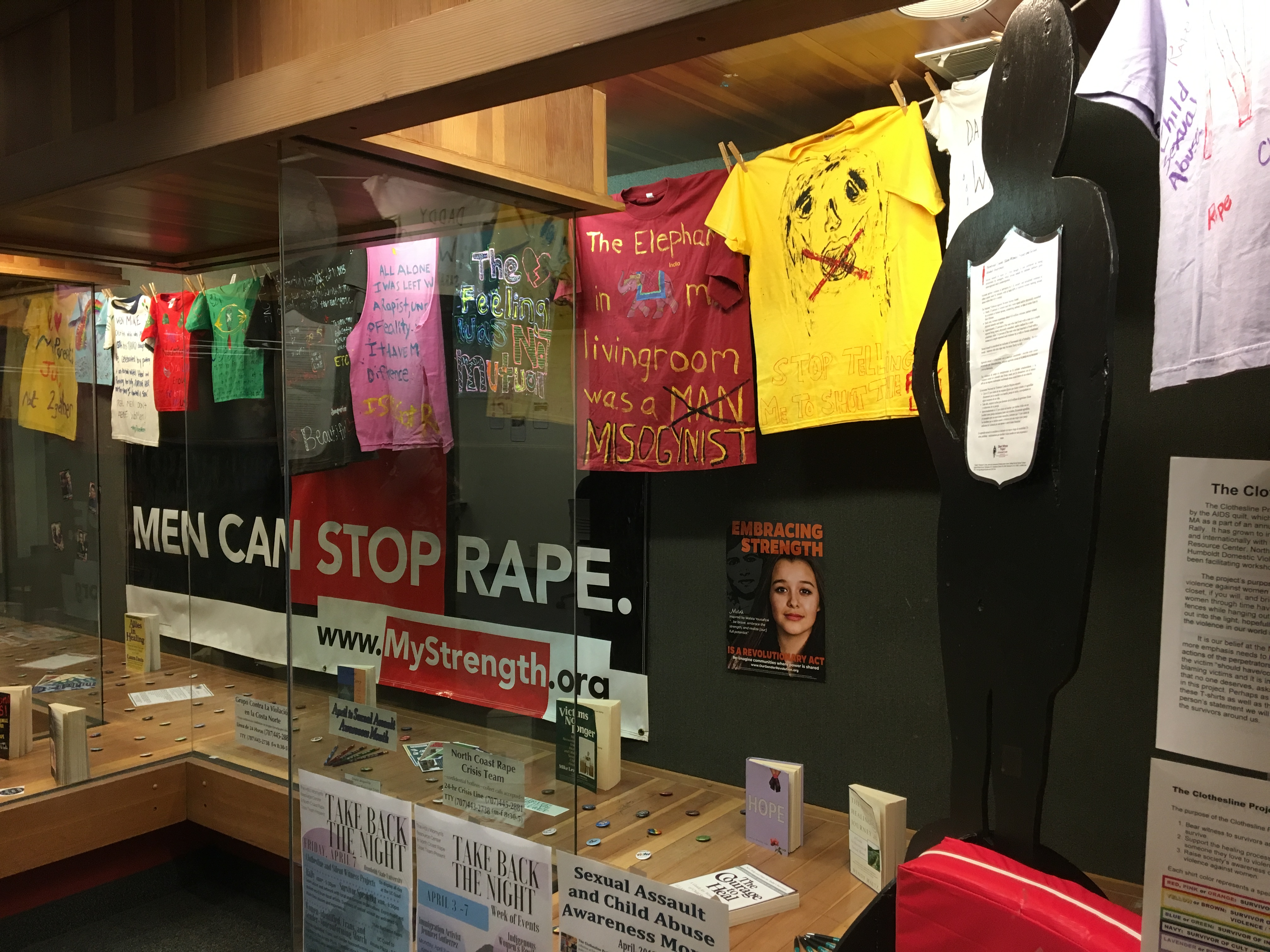
Students, faculty and members of the community came out to the Kate Buchanan Room this past Friday to show their support for survivors of sexualized violence.
One student who came out to show support was graduate student Irene Vasquez.
“I think it’s wonderful that the university cares about the students and is spreading awareness like this,” Vasquez said.
The university has been the host of the take back the night events since the mid-1980’s. Take Back the Night was co-sponsored by the North Coast Rape Crisis team and the Women’s Resource Center.
Paula Arrowsmith-Jones, Community Outreach Coordinator for the North Coast Rape Crisis Team, said that these events have been going on since the 1970s but have been held on and off campus since the mid-1980s.
“Back in the 70s women were told not to go certain places at night without a male chaperone,” Arrowsmith-Jones said. “Because if something happened it fell on the women. These events were created to reclaim everyone’s right to go somewhere and not get hurt.”
According to Arrowsmith-Jones, it’s important for the university to hold events like this because there is so much shame, secrecy and denial that surrounds sexualized violence, it’s about raising awareness for those who don’t think it happens.
Take back the night student coordinator and graduate student Ariel Fishkin said we are living in a rape supported society, where individuals are taught that “rape culture” is okay and where victim blaming is too common.
“I have experience with sharing,” Fishkin said. “People don’t realize that it’s a systemic thing that’s why we have these events.”
Take Back the Night was part of a week long event to let survivors know that they are believed. The week long event took place during sexual assault awareness month.
“Sexual violence is so prevalent,” Arrowsmith-Jones said “we want to show people affected that they are supported, we have counselors at all the events to help.”
The university does have a lot of student activism with Check It, Peer Health Education, and the Women’s Resource Center. Fishkin hopes to continue to bring awareness to this issue as a campus to the community.
Sophomore zoology major Katie Marks said it is amazing that the university is doing this because she knows people who have experienced sexualized violence and she wants to be a part of the change for a world without violence.
“Hopefully this will inspire other universities and communities to change too,” Marks said.
An HSU student assembled a candle lit vigil to remember the 2014 Spring Preview bus crash.
Yulisa Salas, a second year English and critical race and gender studies major, put together a vigil to honor the victims of the 2014 Spring preview bus crash that killed 10 people, including potential HSU students.
“I put together the vigil for one of my friends who passed due to the accident, Adrian Castro,” Salas said. “There was no vigil last year for the incident so I decided to take matters into my own hands.”
Enter a caption
In 2014, a Spring Preview bus filled with faculty, staff and potential HSU students from southern California was headed toward HSU when a Fedex truck collided into it. Salas’ friend and classmate, Adrian Castro, was one of the victims in the crash. Salas said she felt angry, hurt and disappointed that there was no vigil planned to remember and recognized those impacted by the bus crash. According to Salas, it only took her a day to put together the vigil, relying on social media and the support of her friends and family.
“I told myself there needs to be a vigil that recognizes those that were affected,” Salas said. “If HSU didn’t plan a vigil it just shows that HSU doesn’t care about their students, especially those who were affected by the crash that are now students.”
The vigil started out with Salas speaking about memories she shared with Castro. She then opened the mic to those who wanted to talk and open up about the bus accident.
Angie Flores-Cruz spoke about how the bus accident affected her.
Monica Ramirez speaking about how the bus crash has impacted her. Photo by Iridian Casarez
“I take this experience not to let it hold me back but to push me to achieve,” Flores-Cruz said to the crowd. “I feel stronger to hear from other survivors, thank you for your support.”
Many other survivors and friends of victims took the mic to express the way the bus crash impacted them and how it is still impacting them.
Karina Rivas, an economics major, came to support her friend and roommate who was on the bus that crashed. Rivas was a freshman at HSU when the bus crash happened. She said when news broke out about the crash her parents called her worried about her.
“I didn’t know that my roommate was a part of the crash until we became roommates,” Rivas said. “It’s very tragic what happened, so I came to show my moral support.”
Salas said she hopes to continue to put together the vigil every year for victims and people affected by the crash.
“It’s important for us and the school to recognize that this tragedy is still impacting lives,” Salas said. “It’s important for us to keep the memories and stories of those who have passed alive.”
The who’s who of Humboldt State University gathered on April 4 at 10 a.m. to discuss the University’s budget deficit. The meeting was lead by the University Resources and Planning Committee, a sub-committee made up from HSU administrators, faculty, and students. The committee, known as URPC, works as a conduit between the CSU main office and HSU’s administration to help address and deal with budget issues.
The URPC first addressed a charge made by Lisa Rossbacher, who was absent from the meeting. Rossbacher called for the URPC to balance the 2017-2018 budget, identify solutions to the recent drop in enrollment, and create a two-year plan for HSU’s budget. This plan is split into two phases.
Phase one will take effect this coming year and will save HSU $1 million over the next year. Phase one will draw 83 percent, or about $800,000 from personnel cuts. Phase two will not be set in stone until the end of October, this year. However, URPC has discussed areas of the university open to cuts. Possible phase 2 cuts may include: $1 million from the Instructional/academic colleges, $250,000 from Student Services, $400,000 from Administrational costs, and $400,000 from Informational Technologies.
HSU will face its eighth consecutive year of deficit spending. The deficit is expected to grow by $500,000 during the 2017-2018 year, to a staggering $6 million. In addition to a growing deficit, HSU is expected to see its second consecutive year of decreased enrollment; roughly 3.5 percent less students are expected to attend HSU during the 2017-2018 year.
Furthermore, HSU expects to be 543 students short of its expected 7,603 Full Time Equivalent Student Enrollment, set by the CSU main office. Failing to reach this threshold could result in further cuts to HSU’s funding.
The budget deficit continued to grow even as HSU’s enrollment rose during the first half of this decade. HSU simply spends too much money per student, and a solution to HSU’s budget deficit will include cuts to how much money is spent on each student’s education during their time at HSU according to URPC. HSU spent $15,810 per student during the 2015-2016 year. The average amount of money spent per student for other small CSU schools during that year was $14,339. Matching the CSU average would save HSU $5.7 million a year.
These potential budget cuts will occur during Rossbacher’s new graduation initiative. The initiative calls for a doubling of HSU’s current graduation rate by 2025. This includes bringing underrepresented minority students and student beneficiaries of the Pell Grant graduation rate to even with the rest of HSU. UPRC did not explain how Rossbacher’s graduation initiative would coincide with budget cuts that affect students.
Mark Rizzardi, faculty co-chair on the URPC, led much of Tuesday’s budget discussion. At the conclusion of the meeting Rizzardi said, “all the low hanging fruit has been picked, so it’s time to cut.”
The URPC only briefly addressed the nearly $1 million athletic department deficit, and did not discuss any possible cuts to athletics. Read The Lumberjack next week for an in-depth look into the athletics deficit and the future of HSU athletics.
*This story has been edited to fix the correct date for the meeting. From March 4 to April 4.
23-year-old Kyle Zoellner will be released following the week long pre-trial hearing that took place this week.
Judge Dale Reinholtsen decided after hearing four and a half days of testimony that the prosecution did not have sufficient evidence to proceed to trial.
Zoellner was arrested and held on the April 15 stabbing death of 19-year-old Humboldt State student, David Josiah Lawson.
The Arcata Police Department released a statement shortly after Judge Reinholtsen made his decision.
“After five days of testimony, this afternoon a Superior Court Judge ruled there was insufficient evidence to hold Kyle Zoellner in the death of David Josiah Lawson. The following are statements from Arcata Vice-Mayor Sofia Pereira and Police Chief Tom Chapman:
Vice-Mayor Pereira: ‘My thoughts are with the Lawson family, our community and the students at HSU. We continue to grieve and search for answers to this senseless act of violence. The city and the police department’s focus must continue to remain on achieving justice for Josiah. I have been in communication with the Police Chief and I know our officers are continuing their work on this case. Once the investigation is complete the city will also review all aspects of our response to this tragedy. I have confidence in our police department’s dedication to solve this murder and I support their efforts to find the truth.’
Chief Chapman: ‘The result of the preliminary hearing does not change the vigor in which we will continue to pursue this case. The men and women of the Arcata Police Department are committed to justice for Josiah. As shown by the sworn testimony at the hearing, this case is difficult. However, we will not stop our investigation. Our focus will remain on this investigation and the pursuit of justice.’”
The Lumberjack will continue to provide updates as more information becomes available.
HSU has been discussing making the switch to the cloud network over the last year, in hopes to improve file access for students and increase storage space.
Anna Kircher, who is the chief information officer for Information Technology Services, said currently students have 200 megabytes available on the user drives provided by the university, and about 15 gigabytes available through their school google account, though those 15 gigabytes include Gmail, Google drive and Google photos.
“The university is at the point to either move to the cloud or buy more servers,” Kircher said. “It’s cheaper and better to move to the cloud then to buy more hardware.”
Kircher said moving to a cloud network would allow for larger individual students files and office collection files.
Switching to a cloud network may sound like a good idea to some, but for students like junior marketing major Jessica Rocha, it raises concerns.
“I do have concerns about the safety and privacy of things stored in the cloud,” Rocha said.
Kircher said the university has been spending a lot of time talking about security.
“Two of the most important things to us are making sure that students only have access to their own files,” Kircher said. “And two, that this new system would not be hackable.”
Kircher said the university will most likely decide the vendor based off of the level of security they offer.
According to Kircher, who said the technology services budget is not going up, it would be less expensive to switch to the cloud network, though the end cost would depend on the vendor that the university chooses to go with.
According to Kircher there are four different vendors that the university is looking into for switching to their cloud network, Drobox, Box.net, Microsoft One Drive, or Google.
This switch would take place over the summer to be fully available in the fall of 2017.
The HSU Big Time, presented by the Indian Tribal & Educational Personnel Program, is a social gathering with dancing and cultural sharing events. What makes this event unique from other gatherings, is that it takes advantage of the campus to use this event as an educational opportunity for the community. Vincent Feliz, Chumash Master of Ceremonies, explained the songs and prayers during the event and introduced the dance groups from the Santa Ynez Chumash to the Tolowa Nation in Del Norte County. Each dance group also said who they are and where they come from, then lists the songs they sing. Along with the dance demonstrations, there were many cultural sharing events outside the arena that featured men’s and women’s gambling, basket weaving, carving, and a children’s tour of the fish hatcheries.
Photo by Stella Stokes
Feliz began the Big Time with a prayer with Julian Lang, a local Karuk storyteller. Then Feliz sang a grounding song with Lyn Risling, a local Yurok/Karuk/Hupa artist.When Feliz introduced the first dancers, the Maidu tribe, he explained they were one of the first tribes ITEPP invited to dance. They invited more tribes to dance and incidentally, Feliz said they decided to bring other California tribes. Chairs surrounded the dance arena in the West Gym, and each dance demonstration brought in a bigger crowd.
After the Chumash singers finished, Feliz invited the ITEPP alumni and students who are graduating this year to the arena. He called out everyone by each name.
“People wonder how we treat our introvert Indians,” Feliz said to the crowd. “We call them out.”
A crowd of 30-40 people came, including some HSU faculty like Pimm Allen, who is one of the coordinators of the Big Time. They were met with a Chumash honoring song to thank them. Earlier that morning, ITEPP hosted an alumni breakfast to honor them.
Photo by Stella Stokes
Feliz emphasized the importance of educated Indigenous people and the need for the Indigenous youth to succeed on a national and state level. On the HSU Fast Facts of the fall 2016 semester, there were a total of 89 students identifying as American Indian which makes up about one percent of the total student population. That population reflects the one percent of the national American Indian population in the U.S. at nearly three million citizens, according to the 2010 U.S. Census. The ITEPP’s mission is, “to facilitate and promote academic success and self-efficacy for primarily Native American Indian students at Humboldt State University.”
Students in ITEPP like Bryce Baga and Adrian Romo would hang out at the Brero House, where ITEPP is located. They would study, talk to the advisors, or just hang out with other students. Baga also offers beading classes on his free time. He admits that being a double major in Native American Studies and Economics can be difficult.
“It’s two completely different ways of thinking,” Baga said. “In my NAS classes, it’s all about community and connection. But in Economics, it’s all about-”
“Supply and demand,” Romo said.
“Yeah,” Baga said. “Just make money.”
They were on the table to sell t-shirts to benefit ITEPP. There were more tables that featured non-profits and health programs from United Indian Health Services. The men’s gambling tournament was hosted by a newly founded non-profit called Ancestral Guard, whose goal is to teach Indigenous youth their culture. Founder Sammy Gensaw IV hopes to connect with Chile to fight for their water rights, just as the local tribes are fighting for water rights on the Klamath River. Having a student’s culture validated helps them succeed and help their communities, and the Big Time celebrates that.
A new sanctuary shelter is available for those being affected by the political storms set off by the statements of President Trump. The shelter is called Extreme Bullshit Shelter (EBS), operated by the Arcata Shelter Collective. According to Mad River Union, the shelter keeps track of each time the president makes rude comments or undermines another American institution. The shelter then offers a place where no cell phones, tablets, computers, TV, radio or even recent newspapers and magazines are allowed. Participants may stay up to three days at the EBS to restore some of their emotional stability and psychic balance.
Source: Mad River Union
-New juvenile hall in the works
Developers began the replacement of the new Humboldt County juvenile hall on April 3. The new juvenile hall will improve the safety of all who go inside and will provide more appropriate program space to address the needs of youth who go into the detention facility.
Source: Times Standard
-Costco evacuates
A gas leak at Costco evacuated the building. A forklift operator accidentally struck the gas line supplying one of the store’s heaters. Humboldt Bay Fire responded and ventilated the building.
Source: News Channel 3
U.S.
-Ads are pulling out
Advertisements from Mercedes-Benz and Hyundai are pulling their ads out from Fox News after reports revealed that the show’s host Bill O’reilly paid off five women to settle allegations of sexual harassment and verbal abuse.
Source: Chicago Tribune
-Teen punches shark
A Louisville teen punched a shark in the face as it started attacking her in Destin, Florida. The teen, Caitlyn Taylor, was visiting Florida on her spring break. Taylor only suffered a bite wound on her leg.
Source: USA Today
-California passes sanctuary state bill
The California Senate passed a bill that limits the state and local police cooperation with federal immigration authorities. Federal immigration authorities would be prohibited from asking people about immigration status and would prohibit federal immigration authorities to interview a person in custody and would prohibit local law enforcement agents from assisting immigration enforcement.
Source: CNN
World
-Colombia landslide
A landslide hit southwestern Colombia on Saturday morning. The landslide filled with mud and debris killed over 250 people and more than 200 people are still missing.
Source: Now This
-Bomb in Russia metro
11 people were killed and 50 were injured in an explosion that hit a metro station in St. Petersburg, Russia. The Russian prime minister, Dmitry Medvedev describe the incident as a terrorist attack. According to CNN, The explosion tore through a train as it was traveling between two stations. A second bomb was found and defused at a different station.
Source: CNN
-Chemical attack in syria
58 people were killed and dozens were wounded in a chemical attack in a northwestern town in Syria. Warplanes were reported to have attacked Khan Sheikhoun 30 miles south of the city of Idlib.
President Donald Trump has donated all of his earnings as President of the United States to the National Park Service. Trump donated $78,333, his first salary installment which covers the first 10 weeks he’s been in office. $78,333 is 0.005% of the money Trump’s budget would cut from the National Park Service.
President Trump wants to warn China that the clock will run out in North Korea when they meet in Florida later this week. President Trump would like Chinese President Xi Jinping to take a tougher stance on North Korea regarding the country’s nuclear program.
On Monday President Trump signed legislatures to diminish many Obama-era regulations. One of the legislatures included issue about education and school performance. One of President Trump’s new legislation scraps new requirements for programs that train new K-12 teachers and rolls back a set of rules outlining how states must carry out the Every Student Succeeds Act, a bipartisan federal law meant to hold schools accountable for student performance.
President Trump signed a legislative on Monday that repeals the Federal Communications Commission’s privacy protection for internet users. The new legislature would diminish the landmark policy from President Obama’s time in office. President Obama’s policy would have stopped internet providers from collecting, storing, and selling data from internet users without their consent.
At just 2 years old Eddie Medrano and his four siblings were forced into the foster care system. Medrano is now a 22-year-old Humboldt State graduate, and soon to be USC masters graduate, who created and owns his own business. Medrano was in and out of eight foster homes between the ages of 2 to 5, and diagnosed with Langerhans Cell Histiocytosis tumors. He is now graduating from the University of Southern California with a master’s in business.
“My mother had a drug addiction and was an alcoholic,” Medrano said. “My father was nowhere to be found.”
They were taken into the foster care system after their mother left them home alone for three days. When Medrano was 6 years old, he and his oldest brother Jorge were adopted by the Medrano family. He finally felt like a normal kid after being adopted.
“They gave me my first holidays, birthdays but best of all they gave me the feeling of unconditional love,” Medrano said. “They helped me with my PTSD, depression, ADHD and so many other things that I was finally living my dream childhood.”
Medrano lost contact with his oldest sister Bonnie. His second oldest sister Lupita committed suicide at 23. Angel, his second oldest brother, was adopted to a separate family.
Then, when Medrano was 9 years old, he was diagnosed with Langerhans cell histiocytosis tumors.
Photo by Eddie Medrano
According to the National Cancer Institute’s website, “Langerhans cell histiocytosis is a type of cancer that can damage tissue or cause lesions to form in one or more places in the body. Langerhans cell histiocytosis is a rare cancer that begins in LCH cells [a type of dendritic cell which fights infection].”
Medrano’s basketball coach was the one who helped catch the signs of cancer by noticing that Medrano was limping during a game. The doctors found tumors in Medrano’s hips and skull after performing x-rays and Magnetic Resonance Images.
“I went through countless radiation treatments, surgeries and chemotherapy treatments,” Medrano said. “I felt cheated and because I was brought up with Catholicism, the only person I could ask why me, was God.”
Medrano didn’t understand why get got cancer. He was afraid of everything being taken away from him after finally getting the life he wanted.
“I had no control of what was going on but luckily I started improving slowly through countless treatments and surgeries, I was on my way to remission,” Medrano said. “When I was young I was blinded by the pain and anger to see the amount of support I had throughout my battle.”
After graduating high school Medrano went on to Cuyamaca Community College in San Diego. He was on their track team and received an AA degree in communication. He then transferred to Humboldt State and joined the track team, but his major changed.
“After one semester, my passion for business directed me to work more in class in hopes of attending USC Marshall’s MSEI [Master of Science In Entrepreneurship & Innovation] Program,” Medrano said. “Whether it was selling things on craigslist, working as a marketing employee or starting my own company, business was something that has always been in my life.”
Medrano had a love for skateboarding and figured that he could find a way to make a business out of it. Hunter Fine, Humboldt State communication instructor, was not only an instructor to Medrano but also a friend. Fine also loved skateboarding like Medrano.
“He gifted me a poster of Eazy-E that featured him with a local venice brand deck,” Medrano said. “I knew right then and there that I had to continue my dream of starting a skate brand company.”
Medrano saw skateboarding not just as a hobby but a business venture. It wasn’t until after he graduated HSU and started at USC Marshall’s MSEI program that he learned how hard it was going to be to turn his dream into a reality.
“It wasn’t that easy, yeah I had all these great ideas and designs, but as my professor for the feasibility class at USC, Albert Napoli would say, what problem are you solving?” Medrano said. “I took a step back, visited some local skate parks in Long Beach, where I currently live and just watched the skaters until something enlightened me.”
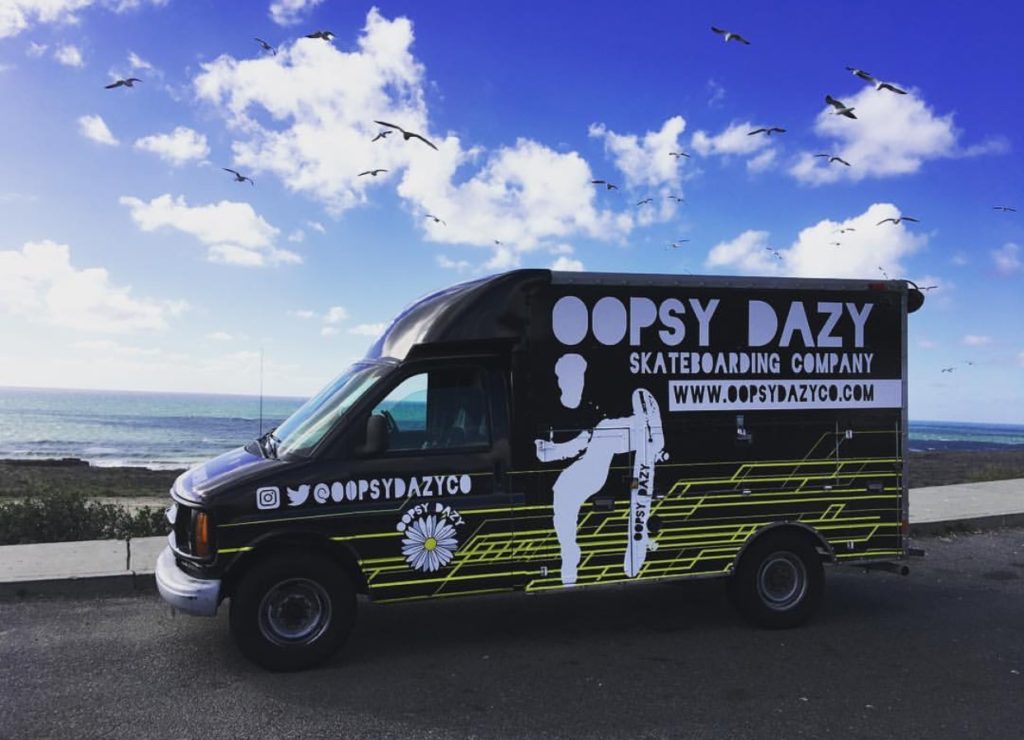
Medrano learned after watching the skaters for hours that the skaters boards were snapping or getting damaged. The skaters would have to stop skating until they found a shop to get their skate boards fixed. His business would be a mobile truck to help the skaters fix their boards and get back to skating. The mobile truck is available in Los Angeles and San Diego at skate parks.
“This is where OOPSY DAZY Co. comes in,” Medrano said. “We provide on-site products through our mobile store but overall we fill that huge gap and problem of distribution that typical skate-shops create.”
Medrano saw skaters needing a place to fix their boards on the spot immediately at the skate parks so they don’t have to wait to get back on their boards. He noticed that boards can break down easily after hours of skating and that wax for the boards were hard to find also.
This website uses cookies to improve your experience. We'll assume you're ok with this, but you can opt-out if you wish. Cookie settingsACCEPT
Privacy & Cookies Policy
Privacy Overview
This website uses cookies to improve your experience while you navigate through the website. Out of these cookies, the cookies that are categorized as necessary are stored on your browser as they are essential for the working of basic functionalities of the website. We also use third-party cookies that help us analyze and understand how you use this website. These cookies will be stored in your browser only with your consent. You also have the option to opt-out of these cookies. But opting out of some of these cookies may have an effect on your browsing experience.
Necessary cookies are absolutely essential for the website to function properly. This category only includes cookies that ensures basic functionalities and security features of the website. These cookies do not store any personal information.
Any cookies that may not be particularly necessary for the website to function and is used specifically to collect user personal data via analytics, ads, other embedded contents are termed as non-necessary cookies. It is mandatory to procure user consent prior to running these cookies on your website.