The Lumberjack


Students Serving The Cal Poly Humboldt Campus and Community Since 1929

Tag: Arcata

  • Students should support the CFA strike

    by Alexandra Berrocal

    First, they came for our housing.

    Then, they came for our alternative housing students.

    Now, they are coming for our professors.

    When is this going to end?

    At this time, it is easier than ever to develop an ‘us versus them’ mentality. However, we need to remember that students and professors are all in this together. When we stood up for the right to basic housing last year, professors stood with us. When students living in their vehicles were, for heaven’s sake, cruelly kicked out of the school parking lots, professors stood with us. Professors have always been our allies in a world that seems to be squeezing us tighter and tighter. 

    Let’s make this clear: the world is becoming a harsher and harsher place to live, and universities, unfortunately, are not exempt from this. Students can still struggle throughout their college experience for all kinds of reasons. Despite the university attempting to make it easy for students to access mental health resources and disability accommodations, accessing those services can still be hard for people. We need them now more than ever.

    I personally cannot justify the university only giving staff a month of parental leave. How can anyone justify leaving a new baby without their parent at daycare after only a month? Professors should have a semester of parental leave, at least. That should just be common sense, and I don’t understand how that isn’t the law of the land. I also cannot believe that some of the lecturers who are so willing to share their expertise with the students are not making liveable wages. This is unconscionable. I believe that college professors and lecturers deserve the greatest respect because they pass down important knowledge and educate the new generation. This respect should extend to transgender and non-binary staff. It is basic common sense that there should be access to gender-neutral bathrooms for faculty. Students these days claim to care about trans rights, yet fail to advocate for their leadership’s rights to these same facilities. Universities claim to be bastions of progressive ideals yet they pay lip service to trans students, while simultaneously neglecting their own faculty. Speaking of faculty, my former faculty advisor was swamped with work that was completely unrelated to teaching last semester and I know that he is not alone. My advisor has had to do more administrative work lately with less time to focus on her passion for teaching. From my point of view, that’s pretty crazy – and not in a good way.

    When we protested, our teachers stood with us. It’s time for us to stand with them.

  • The best discounts for Cal Poly Humboldt students in Arcata

    The best discounts for Cal Poly Humboldt students in Arcata

    by Zack Mink and Jasmin Shirazian

    Student ID required at all locations.

    Food:

    Wildberries: 10% off every Saturday

    Romans Kitchen: 15% off everyday

    Cafe Brio: 10% off everyday

    The Couxp: $1.50 off of your order

    Blondies: 10% off everyday 

    Gyro Shop: 15% off everyday

    Fiesta Grill Cantina and El Chipotle: 10% off everyday

    Coffee and tea: 

    Northtown Coffee: 10% off everyday

    Coffee break: $5 bagel and 12oz coffee everyday 

    Moonrise Herbs: 5% off bulk herbs and teas

    Home:

    Ace Hardware: 10% off your purchase (ranges per item)

    Bubbles: 25% off any personal clean bottle refill

    Fun:

    Pacific Paradise: 10% off every Sunday

    Heart of Humboldt: 10% off every Sunday

    The Fireplace: 10% every Saturday 

    Heart of the Emerald: 10% off everyday

    Livity: 10% off everyday 

    Herb & Market: 10% of every Sunday

    Humboldt Premium: 10% off everyday

    Body High Pole: 15% off any class with code CALPOLY

    Adventures Edge: 10% off everyday 

    Hatchet House: $3 off everyday

    Thrift: 

    The Hospice Shop: 10% off every Saturday

    Youth Ability: 15% off every weekday (Monday-Friday)

    Eco-groovy Deals Clearance Outlet: no tax on purchases for the rest of January

  • CFA settles and calls off strike after one day, Teamsters settle over weekend

    CFA settles and calls off strike after one day, Teamsters settle over weekend

    by Andres Felix Romero

    Across the California State University system, thousands of students expected a pause in classes, thousands of faculty expected to trade in their pens and markers for picket signs and thousands of skilled laborers were prepared to drop their tools for the week of Jan. 22-26 to strike.

    However, the Teamsters 2010 announced Friday, Jan. 19 they reached an agreement with the Chancellor’s Office. After one day of a weeklong planned strike, it was announced by the California Faculty Association (CFA) the night of Jan. 22 that they and the Chancellor’s office had settled with a tentative agreement as well. Campus operations are set to return to full swing by the end of this week. 

    Teamster’s Agreement Highlights

    The Teamsters were able to secure an immediate 5% pay increase, with back pay retroactive to July 1, 2023. They were also able to establish a step-pay system, meaning that skilled laborers within the CSU system will have a pay increase each year. Teamsters were also able to maintain their pension, medical benefits, and their emergency pay.

    With the Teamsters able to get back to work and have an agreement for a solid contract in order with better pay, skilled laborers on the Humboldt Campus such as locksmith Phillip Bradley felt a sense of relief. 

    “Obviously [having an agreement in place] just takes a lot of stress off,” Bradley said. “Uncertainty creates a lot of anxiety.”

    Librarian Carly Marino drums while crossing 14th St. | Photo by Griffin Mancuso

    CFA Agreements Highlights

    The CFA also secured a 5% increase in pay retroactive to July 1, 2023. There is planned to be another 5% increase on July 1, 2024, effectively giving faculty a roughly 10% increase in pay. However, the 2024 increase is contingent on the state not cutting CSU funding. There will also be more protections in place for faculty dealing with police, and improved access to gender-inclusive restrooms and lactation spaces. Also for faculty that are new parents, paid parental leave has increased from six to 10 weeks.

    Faculty, such as English professor Sarah Ben-Zvi, had to find ways to balance parenthood with work. Despite the support of her department to make her maternity leave as smooth as possible, she still felt some struggle. She felt that the increase in time for maternity leave was appreciated, but it may not be enough. 

    “It’s definitely a step in the right direction, but I still don’t think it’s enough time,” Ben-Zvi said. “I feel like it was not until maybe three months after my kid was born, that I started to feel almost human again… and able to give my students what they deserve, which is a great teacher who is on her game.”

    Another mother and professor with a newborn is English professor Tessa Head, who was on the picket line with her 14-month-old child. Head feels that a paid semester of parental leave would be beneficial for not just parents but the students as well. 

    “[A semester of parental leave] would give you time to bond with your babies and take care of them, to form that secure attachment,” Head said. “And for students, I think it would provide better learning conditions because they would have a faculty member who is present for the whole semester.”

    CFA faculty rights chair Loren Cannon was present on the picket line striking his drum and leading strikers. He shared his thoughts on the outcome of the tentative agreement.

    “We really did make some gains,” Cannon said. “I guess [the Chancellor’s Office] didn’t expect us to actually pull off a strike or something, because we only struck for one day [then came to a tentative agreement with the Chancellor’s Office].”

    Richard Toledo leads faculty and students across 14th St. holding signs on the picket line. | Photo by Griffin Mancuso

    Student Reactions

    With notice being given by faculty not to expect classes this week, some students made plans for work or travel. Students like Criminology and Social Justice Major Jocelyn Douglas faced some struggles when they scheduled extra shifts at work this week, only to be told that class would be back in session. The short notice has left students such as Douglas feeling disorganized.

    “I took this opportunity of thinking that I had a week off of school to work 60 hours with both jobs that I work at, to be able to catch up on bills,” Douglas said. “Being a full-time student and working full-time, sometimes conflicts with each other. And with less than a 24-hour notice that we do have to attend school, and with my classes being mandatory for attendance, I’m kind of conflicted about [choosing] between work and school. Thank God the teachers are being pretty lenient so far.”

    Scene of Strike

    As for the strike itself, dozens of faculty and their supporters were on the picket line. They danced with their signs to the passing cars that honked their support, all the while they moved to energizing music blaring over speakers. Some signs read, “5% don’t pay the rent,” “California Strike University” and “You can’t put students first if you put faculty last.”

    Students were present on the line to support their faculty. Students such as accounting major Lealu Freedom felt an obligation to support their professors due to the past support they have given to her. 

    “[If faculty have better conditions they] can devote more time to their students, and create a more enjoyable experience versus focusing so much on trying to get their needs met,” Freedom said. “It’s kind of like a student. You know, if the student’s struggling with housing, they’re not gonna be able to learn. Same thing with a teacher, if they’re struggling with basic needs, they are not gonna be able to teach.”

    What’s Next

    Language for the contracts will be rewritten based on the tentative agreement, and the CFA is expected to vote on whether or not to officially ratify the contract within the coming weeks to months.

    Although the CFA and Teamsters unions made gains in this situation, CFA President Marisol Ruiz acknowledges that there is still work to be done.

    “When we are striking, we’re striking for better working conditions for all,” Ruiz said. “For all the faculty and the students, we should all be supportive and in unison working together to fight. There’s still a 6% increase of tuition hikes, and that’s a fight that needs to continue to happen.”

  • Self-diagnosed autism is a trend

    by Kae Dennert

    I would like to preface this with the words: I AM NOT TALKING ABOUT PEOPLE WITH DIAGNOSES; I believe autism is incredibly real, and a struggle a lot of people deal with, but I also believe that with the internet these days, it has become trendy to have the newest popular mental illness. 

    I have been diagnosed with many things in the past few years, so I am aware how tricky getting a diagnosis is, so I’m not going to shut down self diagnosis as a whole, as it isn’t that black and white. Walking down memory lane, back in 2016 it was incredibly “quirky” to post about how depressed you are, and it became something where everyone tried to outstage each other, which also brought along people who felt they felt similarly to the creators posting about it, which led to people self-diagnosing. 

    This again happened in 2019-2020, where it suddenly became a trend to have anxiety, and that was once again followed in 2021 where it was a trend to have ADHD. Now where am I headed with this? Earlier this year there was an uptick in trending conversations on what symptoms could mean you are possibly secretly autistic. This led to many “oh my god maybe I’m autistic I keep seeing these videos” comments. 

    Now, there are certainly people who saw these videos, felt like they saw themselves, and decided to take steps to use tools to help them, or help them get diagnosed, and I think that it’s amazing that awareness online can help people, but I also think it has become hard to decipher who is pretending for attention, and who actually needs the help. It has been trendy to make videos about what symptoms are “autistic” (which also overlap heavily with other disorders, like ADHD, anxiety, depression, OCD, etc.) with no further context of what could be going on besides autism.

    These narrowings into one answer don’t take into account each person’s individuality and their struggles and what that can mean for them. Because diagnoses overlap, the trending diagnosis is the one that is going to stick. This can shut people down and discourage them from finding more answers that could have helped them more in the long run.

    It locks people in a corner, and they can believe there is no other option for them besides aligning with that determination. Because of this many people don’t search for answers that could lead them to help, because other illnesses become stigmatized while being “neurotypical” gets you scrutinized for not understanding the viewpoint of neurodivergence. I think that everyone should be able to be themselves without having to shape themselves into different people for others, but doesn’t everyone want that? 

    At the end of the day, a new trend will inevitably pop up, and people will swear up and down in their life that they “never had autism” and instead have the new hip trending illness.

  • This week in Lumberjack athletics

    This week in Lumberjack athletics

    by Vanessa Saltos

    MEN’S BASKETBALL

    Over Thanksgiving break, men’s basketball competed at home in Lumberjack Arena. On Saturday, Nov. 18, the ‘Jacks faced Cal Maritime. They were down in the first half with a score of 37 – 40. Humboldt took the game in the second half after a hard fought battle, the final score being 80 – 70. The following week, they competed against Northwest Indian College on Tuesday, Nov. 21. This was a high scoring game for the ‘Jacks. Rob Diaz III recorded 21 points and four steals, four other Lumberjacks also posted double digits. The final score was 104 – 71. Thursday, Nov. 30, they will be back in Lumberjack Arena playing against Cal Poly Pomona. Tip off is set for 7:30 p.m. Then, on Saturday, Dec. 2, Cal State San Bernardino will be traveling to Arcata for a game time of 7:30 p.m. 

    WOMEN’S BASKETBALL

    On Saturday, Nov. 18, women’s basketball had their home opening game against Concordia University Irvine. The ‘Jacks competed hard and took the game with a score of 72 – 63. Some standouts were Sara Ahmadpour leading the team with a career high of 21 points and nine rebounds, Emilia Long followed suit recording 20 points. In the fourth quarter alone the ‘Jacks recorded 30 points. After their home opener, Humboldt traveled to the Azusa Pacific Thanksgiving Classic. Friday, Nov. 24, they played Azusa Pacific. Despite coming off of a victory, the ‘Jacks fell with a final score of 64 – 87. Saturday, Nov. 25, they faced off with Biola, and their hunger to win showed by taking the game into overtime. The final score was 63 – 53. The ‘Jacks are back at home this week. Thursday, Nov. 30, they are opening CCAA play with Cal Poly Pomona, tip off is set for 5:30 p.m. Humboldt will also be playing at home Saturday, Dec. 2 against Cal State San Bernardino at 5:30 p.m. 

  • The Aquatic Center’s $412,000 facelift

    by Brad Butterfield

    To date, $412,000 has been spent on renovations at Humboldt Bay Aquatic Center (HBAC) to allow for half of the University Advancement Division to move their operations into the Eureka waterfront building. According to Marketing and Communications for the university,  this transition, which began in the Fall of 2020, led to a change in management of the building from the non-profit ‘University Center’ to Cal Poly Humboldt. 

    Marketing and Communication states that the relocation of the Advancement Division to HBAC has provided an easier landing pad for donors and Alumni to interact and opened up space on campus for the Associated Students to utilize. In effect, this move has forced many of the previous operations at HBAC to alter and many to exist as shells of their former selves. Additionally, the Advancement Division’s move to HBAC forced Center Activities employees out of their offices and workspaces without giving them a say in the matter. 

    The money spent:

    While Marketing and Communications Director, Aileen Yoo and Communications Specialist, Grant Scott Go-forth stated in separate emails that renovations and upgrades to the HBAC total $412,000 to date, public records requests submitted under the Freedom of Information Act, led to the release of only three construction contracts totalling $22,700, leaving $389,300 unaccounted for. 

    In an effort to establish a complete framework of work done at HBAC, a second public records request was submitted on Nov. 16, asking for all publicly disclosable records related to renovations/construction carried out at the Humboldt Bay Aquatic Center from 1/1/2019 – 11/16/2023. This second request was denied by Records Access Officer, Michelle Williams citing, “Balancing Test. Records where the public interest against disclosure outweighs the public interest in disclosure. Cal. Govt. Code §7922.000.” 

    The Advancement Division moves into the HBAC:

    Yoo wrote, on behalf of Marketing and Communications that, “The location improved accessibility for donors and alumni to interact with Alumni Relations, the Cal Poly Humboldt Foundation, and other areas of the Division. Having a more prominent presence in Eureka has helped improve community outreach.”

     There are now 16 University advancement employees working in the HBAC’s new cubicle spaces and pre-existing offices.

    Under its previous management, the HBAC was focused on aquatic equipment rentals, scenic tours, OLLI classes, education on local wildlife and Humboldt Bay and, critically, water safety. The moving in of the Advancement Division led to some of the HBAC’s equipment being stored off-site and a diminished ability for the Aquatic Center to continue its services to students and community as a waterfront property.

    Renovation’s cause chaos: 

    An employee with direct knowledge of the reworking of HBAC spoke under the condition of anonymity fearing repercussions for speaking out. They will be referred to as J. Doe in this article. When word came that Center Activities was expected to vacate the HBAC offices, there was confusion as to where that left them to operate from. After initially vacating their offices, Sherie Gordon, Vice President for Administration and Finance, paid a visit to the building to assess the situation.

    “Sherie Gordon came around to look at the situation on the waterfront. It was agreed that there is no reason why Alumni [Relations] would need a waterfront office when Center Activities was responsible for monitoring waterfront safety,” Doe said.

    After Gordon’s visit Center Activities was allowed to maintain use of the office for a couple of months before being kicked out again.

    Under HBAC’s new management, a creative solution was found for the employees who’d unwillingly forfeited their workspaces. 

    “They took what used to be a maintenance closet, and they turned it into an office. So, Center Activities doesn’t have a front door office anymore where people can come up to a counter and ask questions. They have this tiny, hidden little space that used to be a closet that is now an office without access to any of the other rooms or lobby. So they can’t do community services, program coordination or classes in other rooms unless it is reserved out in advance,” Doe said.

    According to Doe, Stephanie Lane, Executive Director of Alumni Relations, has the final approval on all reservation requests submitted for the building through 25Live.

    Yoo, on behalf of Marketing and Communications wrote through email that in addition to adding cubicle spaces for Alumni Relations, they would also be occupying two offices that didn’t require any updates. According to Doe, one office went to Lane who was adamant about getting it.

    “That’s one thing that never changed. She was gonna get that waterfront office.” Doe said.

    The second office went to one of the Advancement Departments VP’s. 

    Stephanie Lane declined to be interviewed for this article, deferring to statements from Marketing and Communications.

    HBAC’s waterfront safety obligations:

    Regardless of who occupies which office or what departments operate out of the HBAC, there are a few operational guidelines that HBAC must adhere to. These guidelines stem largely from who owns the land, who paid for the HBAC to be built, and who owns the building itself.

    According to Scott-Goforth, the building is on land that is leased long-term from the City of Eureka, the HBAC was built with a grant from CA Boating and Waterways and it is currently fully owned and operated by Cal Poly Humboldt. 

    Pat Hyland, who has been a member of the women’s rowing team coaching staff for 30 years as well as lecturer in Kinesiology, provided valuable context that the HBAC was originally one of three CA Boating and Waterways safety facilities. With that, came an obligation to provide waterway safety.
    “[The university] may have been a little light on that,” Hyland said.

    From the perspective of the city of Eureka, Miles Slattery, City Manager, points out that operations at HBAC have been ever-evolving and have always included ancillary conferences and classes unrelated to water safety.

    “Our whole thing was the original permit for that [HBAC] needed to make sure that they did maintain a certain aspect of the boating safety requirements,” Slattery said. “From what I can tell on the outside – I’m not working there anything – the operations don’t seem to have drastically changed,” Slattery said.

    Center Activities struggles to continue operations:

    From the outside, HBAC sure does look peachy with her extensive (and currently unsafe for use) balconies and expansive windows which reflect the bay’s glistening, choppy waters. However, the situation within the building is much more complicated. Doe said the University Center’s space is down to about an eighth of the building, and approval is required before using any other part of the HBAC.

    “Our whole department was kind of being gunned for, and we felt very threatened. So, you know, we had to focus a lot on explaining to the university over and over again, through all of the different administration changes that we’ve had, there’s a valid reason for us to be a part of this campus community,” Doe said. “A lot of time was spent just justifying what we do and how we do it and why it’s important.”

    This constant fight to validate their right to exist took away from their ability to teach waterway safety and keep eyes on the dangerous waters of Humboldt Bay.

    Though the transition has been painful for some, there are some important silver linings. Most notably, Men’s Rowing has now joined Women’s rowing at HBAC. Hyland said that with the available space at HBAC, a good job has been done to optimize it.

    “Both rowing teams use it early and late. They don’t use it in the middle of the day. Then the center of the day is primetime and advancement uses it the whole time then.”

    Additionally, from the University’s standpoint, taking over management of the building has been a major victory.

    “HBAC is available at no cost for ad hoc meetings and events put on by campus and community groups,” Yoo wrote in an email.

     Previously, under the management of the University Center, the university would be charged a nominal fee to host events in the building in order to support the work that the non-profit was doing. Naturally, losing that income and the management of the building has been a huge blow to Center Activities.

    “When the Center Activities department would ask questions regarding funding to replace lost income, they received mixed messages and unclear guidance on what they should expect from the Athletics Department, which Center Activities is now managed by,” said Doe.

    With renovations yet to be completed at HBAC, Scott-Goforth provided a look into the usage of the building thus.

    “There have typically been two or more events occurring each week in the space. Examples include: multi-day placement orientation activity by the Social Work program; program meetings by the California Center for Rural Policy; one-day retreat for areas including Intercollegiate Athletics, Enrollment Management, University Advancement, Advising Center, and Financial Aid Office; Nursing alumni gathering; CSU,” Scott-Goforth wrote in an email on behalf of Marketing and Communications.

    Apparently the upper echelon of Cal Poly Humboldt wasted no time in using the waterfront property for one-day retreats.

    Who drove for this change?

    With budget cuts widespread at Cal Poly Humboldt, it seemed an unorthodox initiative, to Doe, to spend nearly half a million dollars to renovate the HBAC for the benefit of Alumni, Donors, and the University Advancement Division.

    “We were told that the changes at HBAC were happening due to initiatives set forth by President Jackson using presidential funds,” Doe said.

    Jackson’s involvement was corroborated by Hyland, answering who he thought drove for the changes at the HBAC.

    “That was all President Jackson.”

    Further, Marketing and Communications provided extra context for HBAC’s expensive facelift.

     In answering the question of which administrators had driven for the renovations at HBAC, Goforth wrote through email, “Frank Whitlatch, VP for University Advancement, in close consultation with colleagues and with President Jackson.”

    The winners and losers:

    The renovations at HBAC benefitted many people and departments, while hurting many others. It is, of course, a very nuanced topic. What can’t be overlooked is the effect this had on those involved. Of which, feelings are mixed.

    For Slattery and the city of Eureka, all developments that increase Cal Poly Humboldt’s presence in Eureka are beneficial.

    “The presence of the university here in the city of Eureka is extremely important,” Slattery said. “I think that having that influx of not only just people in general, but the diversity of that is something that Eureka would benefit from extremely and I think that Cal Poly would benefit from it as well.”

    Hyland said that practices for Women’s Rowing have not been interrupted because of the renovations and explained that the space is being divided as best as possible.

    “The men’s team would love to have more space, just as Center Activities would. I’d love to have more space and I’m sure that Advancement would love to have more space, but we’ve got a finite thing and I think we’re playing nice as far as sharing goes,” Hyland said.

    Unfortunately, for students and faculty who grew and learned through the courses and services provided by HBAC under its previous management, the renovations and addition of the Advancement department has been quite negative. 

    “This has seriously impacted students’ abilities to learn and have viable professional careers before leaving school. They used to hire a lot of students who would come down to work at the Aquatic Center, get professional experience and do internships down there,” said Doe. “They still try to have internships but they are not the same, people aren’t getting the same out of it. They’ve kind of pulled back on doing student based programming at the same level we used to because we just can’t function with less space, less ability to manage a building. There’s less for them to do honestly.”

  • Veterans find healing through the arts

    Veterans find healing through the arts

    by Andrés Felix Romero

    On a gloomy Thursday afternoon, a Gulf War Marine Corps Veteran brought a warm energy to the ceramics studio, nicknamed, “The Laundry.” The veteran, Ehren Tool, is the senior laboratory technician for the ceramics studio at UC Berkeley, and has created and given away over 26,000 ceramic cups. Tool’s art documents the pains that military veterans struggle with after their service. Tool smiled behind his bushy beard and told stories about his healing journey, from his time as a Marine to his time as an artist. Tool expressed how his ceramic cups convey aspects of military culture that are difficult to openly discuss.

    “The cups are an opportunity to talk about unspeakable things,” Tool said. “War is murder, and military sexual trauma is rape, that happens in the civilian world too. Where can you talk about that? Where in polite society do we talk about these things that happen with too many people and the effects they have on their lives?”

    Ceramic students in attendance to Tool’s demonstration, such as Jack McCann, were inspired by how veterans have found ways to express the grief they feel. 

    “I really felt like in the art there’s a lot of pain, every piece is almost like mourning,” McCann said. “It’s helpful to see people grow even after experiencing something like war.”

    The class that Tool was a guest instructor for was part of a weekend-long veteran’s day celebration, organized by Humboldt College Corps, Cal Poly Humboldt’s College of Arts, Humanities and Social Sciences and College of the Redwoods. The events aimed to focus on how veterans can heal from their traumas in the military. Part of the weekend events was a dinner and panel by veterans at the Arcata Veterans Hall on Nov. 9. Tool was part of the panel alongside Air Force veteran Mark Walker. Walker is the East Bay Deputy Director for the veteran’s support non-profit, Swords to Plowshares. Walker and his wife Lynn were in attendance at Tool’s demonstration in The Laundry. Lynn Walker hopes that the arts can help veterans similar to how ceramics have helped Tool. 

    “For me, [art] allows you to open up [feelings] that are suppressing you, to things that you don’t want to say,” Lynn Walker said. “[Art] opens up your being to where there’s a healing process as you identify [your emotions] through art.” 

    Alongside Tool and Walker for the Nov. 9 panel were Air Force Veteran Joe Fox, Marine Corps Veteran Ryan Jensen, Veterans Affairs Health Nurse Ella Price, and U.S. Army veteran and Dean of Arts, Humanities, and Social Sciences Jeff Crane. Crane shared his experiences on how education in his college has supported veterans.

    “I’ve thought about this in my own work,” Crane said. “Arts and Humanities have a critical role to play in veteran’s transition, in supporting veterans, and in educating people about the role of the military in American life and in the world.”

    Panelist Joe Fox is an interdisciplinary studies major at Cal Poly Humboldt and also facilitates a veteran’s ceramics class at College of the Redwoods

    “I found healing in significant ways through playing with clay,” Fox said. “My only plan in all of this [art] is that somehow I’ll be able to connect some resources in our community, and there will be space for other people to find [healing].”

    The main event was the 3rd annual Veteran’s Day at McKay Community Forest in Eureka, CA on Nov. 11. There was a five and ten kilometer walk/run, as well as free barbeque, music, and painting. There was an opportunity for attendees to decorate their own ceramic mugs to be completed later. On Nov. 13 and 14, there was another ceramic demonstration at College of the Redwoods by Jessica Putnam-Phillps.

    No matter how veterans try to overcome their traumas and suffering, Mark Walker holds onto hope that his fellow vets will find whatever sustainable means available to find their healing, art or otherwise.

    “Different veterans find different things of purpose, inspiration, and therapy,” Walker said. “Whether it’s formal or informal therapy. It’s just about what veterans find to be healthy, get healthy, and stay healthy.”

  • Teamsters union strikes against unfair labor practices and bad faith bargaining

    Teamsters union strikes against unfair labor practices and bad faith bargaining

    by Andrés Felix Romero

    Beginning at 5:30 a.m. in the cold rain on Nov. 14, members of Teamsters 2010 began their one day strike picketing outside of the College Creek Marketplace, the Library Circle and the parking lot of the J. It was the first official strike by any California State University union for the first time in 28 years, and the one day demonstration was performed by the other Teamster 2010 chapters across all 23 CSU campuses. The union members adapted to the weather by bundling up, sporting Teamster 2010 rain ponchos and covering their picket signs with plastic coverings. 

    The union’s picket line had two main goals. One, to establish that the unions are ready and willing to strike. Locksmith for Housing and Teamster member, Phil Bradley, said that the Teamsters are ready for more strikes.

    “The one day strike today is to show the CSU we are serious about this, and to come to the table and bargain with us,” Bradley said. “It’s to show that we have the resolve to do this if that’s what it comes down to. If they don’t show up and start working with us, we’re gonna have to do a longer strike.” 

    Teamsters 2010 represent skilled trade laborers across the CSU system such as plumbers, painters, mechanics and electricians. Campus painter Jeff Robinson shared his thoughts on how campus will be impacted if the Teamsters decide to strike for a longer period of time in the future.

    “Say you have a rainy day,” Robinson said. “You have old buildings on campus, so you’re getting leaky calls that aren’t getting attended to. [You’ll get] clogged toilets, lights that are out, or the heat’s not working.”

    The second goal is for the Teamsters to draw attention to unfair labor practices.

    “[We want] to bring awareness that the CSU has been conducting unfair labor practices,” Bradley said. “There’s rules on what the [CSU] can and can’t do such as, retaliation, delaying, and bargaining in bad faith.”

    Maintenance lead Daniel Bouchard crosses the street in the rain in front of the Jolly Giant Commons parking lot. Photo by Griffin Mancuso.

    The Teamsters have expressed frustration at what they feel are continued practices of bad-faith bargaining by the CSU Chancellor’s office.

    “[The bargaining team for the Chancellor’s office] show up to meetings completely unprepared, and they keep canceling negotiating sessions,” Bradley said. “They’re basically just doing whatever they can to delay and obstruct.”

    Although the primary focus of the strike wasn’t financial, some on the picket line highlighted their grievances with a lack of an adequate wage-increase structure. Campus Building Service Engineer Steve Brands felt lucky that he was able to receive some increase in wages during his time employed with the CSU, but he feels frustrated that his colleagues haven’t had the same opportunity.

    “We used to have a very defined step-structure,” Brands said. “As long as you were getting good evaluations and things were going well, you got the raises until you moved to the top of the range. And now, nobody really moves through the range.”

    Teamsters such as campus automotive mechanic Ryan Moore explained how they have struggled with a lack of increase in wages, especially as inflation continues to rise

    “I live out towards Willow Creek and I have kids to commute to school and sports,” Moore said. “Fuel and [groceries] goes through the roof just trying to raise a family. I never thought I’d actually be out on the picket line here at the college.”

    On Nov. 9, Cal Poly Humboldt released a statement addressing the Nov. 14 strike. The message clarified to the campus community that the Humboldt and other CSU campuses have contingencies in case of an event such as a strike. As promised in the email, the Humboldt campus remained open and operational on the day of the strike. The email also promised to not pay any of the employees who participate in the strike. The email also asks the campus community to remain patient as the Chancellor’s office continues the bargaining process with the Teamsters 2010 and the other CSU unions.

    The Teamsters weren’t the only union on the picket line that day. Members of California State University Employees Union (CSUEU) were there with picket signs and chanting alongside the Teamsters. The California Faculty Association (CFA) also showed solidarity that day. Some members joined the picket line and some faculty even refused to host class. CFA Faculty Rights Chair and philosophy lecturer Loren Cannon is excited to work alongside other lecturers.

    “CFA is fully in solidarity with the teamsters right now, and with our other sister unions,” Cannon said. “We’re all in this together. Without the teamsters doing their work, without teachers doing their work, without staff doing their work, this place can’t run. And so we are together, supporting each other’s rights to a fair contract to make sure that we don’t have unfair labor practices.”

  • The campus parking patrol sucks

    by Brad Butterfield

    I have this old 1978 Mercedes 300d named Cocoa. I spent somewhere around 100 hours over summer repairing her rust-holes and fixing a plethora of engine issues. Cocoa runs pretty well now, and most of the holes are patched – most, but not all. As a result, I’ve been covering her during Humboldt County’s rainy days. Throughout summer and the fall semester, Cocoa has been parked on campus, covered, without issue. She is properly permitted to park on campus.

    Then, on Monday, Nov. 13, along with two parking citations on my RV, Cocoa had a nasty $40 citation taped to her cover. The RV parking tickets list “no use of vehicle for living/overnight” and “beyond designated lines,” as reasons for citation. The comment section of the $53 “overnight” violation reads, “windows covered,” as proof I was occupying the RV overnight. My RV, Tibby, was parked within the designated lines, as shown by the Parking Patrol’s own photos. 

    That’s $173 in parking fines for properly parked and permitted vehicles in two days.

    Monday marked the first morning of the university’s sudden enforcement of the regulation against overnight sleeping in vehicles on campus. Three weeks of meetings with administrators on this issue resulted in more confusion than clarity. I had been told by Lt. Peter Cress of university police that multiple days of probable cause and/or reasonable suspicion proving one’s vehicle was being used for sleeping would have to be established before citation or other disciplinary actions like academic probation, suspension or arrest could be considered. Cress was either misguided, misinformed or purposefully misleading, as nearly every van, bus and RV was cited on the morning of Nov. 13. Even van-dwelling students who had accepted the university’s offer for temporary dorm housing received parking citations. Most of us vehicle dwellers, aware of the university’s attempt to evict us, were not in our vehicles when given citations. We stayed at friends’ houses, on gym floors and in dorms. No attempts were made to discern if the vehicles were actually occupied. The university went ahead with a blanket citation for all potential vehicle dwellers citing ‘windows covered’ as reason for the expensive citations.

    In black sharpie on an old pizza box, I wrote my permit number and placed it on Cocoa’s (covered) windshield so as to avoid further citation on the 14th. Despite this I, again, awoke to a $40 citation on Cocoa taped next to my blatant pizza-box-sign showcasing my permit number. 

    Whether or not I have been targeted for my weeks of advocacy for Cal Poly Humboldt’s homeless students is difficult to prove –  especially with an administration that governs like a closed-off dictatorship. Particularly suspicious are the citations on Cocoa, which had been parked and covered, in the G11 lot adjacent to the Parking Patrol kiosk during most of the fall semester without issue. Regardless, four parking tickets totalling $173 for properly parked and permitted vehicles is ludicrous. 

    After Cocoa’s second citation, I asked Krista Paddock (Transportation & Parking Services) questions to clarify the reasoning behind the citation. Paddock was immediately hostile, wholly unhelpful and displayed a total lack of professionalism and respect.

    I attempted to set up a meeting with Cris Koczera, Director of Risk Management & Safety Services, and Mark Johnson, Chief of Staff, mediated by university Ombuds, Suzanne Pasztor, to discuss parking enforcement and the creation of a safe parking program on campus. Kozcera agreed to the meeting, but Johnson did not.

    “I heard back from Mark Johnson this afternoon.  He is stating that neither he nor Chris Koczera will be meeting with you. He is indicating that the university’s policy on this, and its stance on the options presented is clear. For this reason, he thinks that no constructive discussion is to be had,” Pasztor sent in an email on Monday evening.

    Johnson introduced himself to The Lumberjack team as the “relationship builder,” and said he would commit to being available during a presentation on Sep. 28. So far, every meeting I have attempted to schedule with the grand relationship builder has been ignored, canceled or cut short. 

    Every conversation with parking patrol officers regarding these unjust citations has resulted in them repeating, “You’re welcome to contest the citation online.” Well, that’s not good enough for me. I’ve been wrongly cited four times in two days. I’ve paid to park on campus and should not be cited without just cause.

    Hey Parking Patrol, leave me alone – please!

    Your Friend,

    Brad Butterfield

  • Triathlon ends season in Arizona

    by Vanessa Saltos

    Swimming, cycling, running; all great sports on their own, but some people tackle all three at once. For Cal Poly Humboldt, seven triathletes took on this challenge. On Saturday, Nov. 11, the Lumberjacks traveled to Tempe, Arizona for the NCAA National Championship. 

    After their last race on Oct. 1, they had about four weeks to prepare to finish out their fall season. Head Coach Kinsey Laine wanted to ensure she was getting the best out of her athletes for this last stretch of the season. What Laine wanted to focus on in practice was speed and maintaining health. 

    “The deeper you get into the season, the greater the chances are for injury and illness. After regionals, I did have them take a week where it was easier,” Laine said. “They had an extra day off, just because I wanted to make sure they were healthy and not go right back into challenging training, and maybe compromise their immune system or put them at a higher risk for injury.”  

    This is the second season Cal Poly Humboldt has had a triathlon team. The growth from the players and the team is evident. Last season, they finished 12th out of 12 teams. Going into this race, they have earned the 7th spot out of 13 teams. Laine attributes this growth to the culture shift she has seen within the team. She notices her athletes wanting to not only get the best out of themselves, but out of each other in a positive way. 

    “It’s been phenomenal. It’s been such a joy to watch this team grow and improve,
    Laine said. “I think probably the biggest difference is that the new athletes that are here this year came in knowing part of the reason they came to Humboldt was to do triathlon.”

    One of the new athletes this year is Sierra Erlandson, a freshman majoring in environmental resource engineering. Erlandson had no experience with collegiate triathlon, and didn’t know what to expect when joining the team. She was pleasantly surprised to be a part of what she now calls family. Erlandson understands that the deeper you get into the season the more mental strength it takes. 

    “Right now, we’re just supporting each other, and we’re just so proud of how far we’ve come so far as it is, that we’re not looking for some miraculous outcome from nationals,” Elandson said. “We’re looking for strong finishes and smiling faces”. 

    Six out of the seven Lumberjack athletes crossed the finish line in Tempe, Arizona this weekend. Leading the way was freshman Eve Wendley placing #137 out of 208 athletes. Racers were either from division I, II or III programs. As a team, Cal Poly Humboldt placed 10th out of the 12 division II teams in attendance. 

  • Cal Poly Humboldt issues parking citations to students living in vehicles

    Cal Poly Humboldt issues parking citations to students living in vehicles

    by Jillian Wells

    On the morning of Nov. 13, students living in alternative housing such as vans, RVs, campers and motorhomes on campus awoke to parking tickets on their vehicles. The parking tickets each cost between $40-$53, with some students receiving multiple citations. 

    The enforcement of parking regulations came 19 days after the university sent out an initial email, notifying students that they would be enforcing a previously overlooked policy that prohibits overnight camping.

     This decision to enforce this policy sparked community backlash and has gained national attention, as there was a Los Angeles Times reporter interviewing students this week. 

    The citations issued to students outlined various violations, including “No Use of Vehicle for Living/Overnight” and “Beyond Designated Lanes.” Additionally, comments on the tickets highlighted specific infractions such as “windows being covered.”

    Cris Koczera, the Interim Director of Risk Management & Safety, did not respond to requests about further clarification about the criteria for determining if a student is sleeping in a vehicle by press time.

    Student Derek Batty lived in a vehicle on campus, but made the decision to move into temporary housing to avoid receiving a citation.

    “I feel more homeless in this place [temporary housing] than I did before,” Batty said. “I’m grateful for it for sure, but I wish we just didn’t get kicked out.”

    Batty also said that despite moving into temporary housing, he received a parking ticket on the morning of Nov. 13 because his windows were covered up. 

    “They can’t prove that we’re sleeping in the vehicle based on having [the windows] covered,” said Brad Butterfield, vice president of the Alternative Living Club, in an impromptu meeting on Nov. 13.

     They expressed frustration and asserted that just because their windows are covered up isn’t evidence that they are sleeping in their vehicles. 

    Ethan LeVering, an Associated Students (A.S.) delegate for the University Senate, pointed out a lack of consideration in the enforcement process.

    “They did not knock on the vehicles, they did nothing to check if anyone was in there,” LeVering said. “They simply left the little ticket and ran off.”

    The University Police Department (UPD) declined to comment. LeVering also criticized the university’s approach.  

    “These students have not been given a presumption of innocence, which is outright un-American,” LeVering said.

    Carrie White, a student who lives in their vehicle, emphasized the economic ramifications of the parking citations.

    “That’s what they’re [Cal Poly Humboldt] working on, the economic punishment,” White said. “They know we don’t have any money, so they’re going to ticket us until we have no choice. They’ll break the bank before they break our will.”

    Caleb Chen, another impacted student, expressed his concerns about the timing of the ticketing. He believes that the university is starting the citation process just before fall break to limit potential media coverage and keep the ticketing discreet.

    “They could tow us at the beginning of fall break… to remove the vehicles silently while all the students were gone,” Chen said.

    Chen added that while he appreciates the option of temporary housing, he’s not interested.

    “At this point, it’s about making sure there’s a solution for future students and all their [Cal Poly Humboldt’s] solutions only go until December 18.”

    Brad Butterfield is a member of The Lumberjack. He did not help write or edit this article.

  • Pool budget drained by Associated Students

    Pool budget drained by Associated Students

    by Valen Lambert

    Since the Associated Students cut nearly $500,000 from student programs in September because of the administration’s faulty admission estimate, students and faculty are enduring the collateral damage. The cut of the campus pool’s budget from $25,000 to $7,500 means a big shift for its 15 employees and the hundreds of students and faculty that recreate in it, and pool staff claim that the AS correspondence has been less than professional.

    The budget cut isn’t anything new to the pool’s programs, which are a part of the School of Applied Health. Lawre Maple, who has been the pool’s program director for nine years, notes that the pool hasn’t had full budgeting since COVID. Every year the program struggles to stay open, and every year staff have to fight to get the funding they need.

    “We’re only open right now because the [Dean of Professional Studies] came in and found us some funding and gave us $10,000,” said Maple. 

    This year, however, according to Maple and student lifeguards, A.S. confused the pool program with an entirely different department. Initially, A.S. reached out to the pool program that sent over the necessary paperwork about what the budget will be used for. When A.S. came back to clarify the budget, they reached out to Paul Wells, who is the Recreational Sports Coordinator and totally unaffiliated with the pool programs that got their budget reduced. 

    “A.S. had accidentally included drop-in pool hours with the same funding as drop-in sports when we first applied for funding,” said Wells. “I believe the similar naming convention caused the confusion when I first applied for funding earlier this year, during the spring semester.”

    “To verify the information or to gain more information about the pool, we were not told that they reached out to a faculty member [Paul Wells] in [Rec Sports],” said student lifeguard Kaden Tobin. “A.S. claimed they were a part of our staff, but they are not and in no way connected to the staff that works at the pool. A.S. claimed at the board meeting on Oct. 13 to have contacted the pool staff directly, but only through email. Only one member [Andres Olmos] of the A.S. board ever came to the pool in person to talk, which was on Oct. 12. All it takes is a simple search on Google or the school website to figure out who to talk to.”

    This miscommunication resulted in Maple not hearing about the budget cut until Oct. 4, five days after they passed the cut. At an A.S. meeting on Oct. 13, The Marching Lumberjacks also claimed A.S. failed to notify them of the Sep. 20 budget meeting where they would have had an opportunity to fight for their funding. Student lifeguard Sam McLane attended the Oct. 13 meeting where he asked the A.S. board if they even knew where the pool was.

    “I asked the Board of Associated Students ‘How many of you know where the pool is?’” said McLane. “I think two out of nine of them knew.”

    “There were some mistakes made,” said A.S. President Samuel Parker. “We had to make the budget in such a short time frame. We could have done better. We went with the allocation that the previous board had suggested.”  

    Interim executive director of AS Kendra Higgins commented on the budget discrepancy.

    “Last year, the Board of Directors collected budget applications for A.S. funding for the 23-24 school year,” said Higgins. The application had incorrect contact information for the swim program that had been copied from previous years,” Higgins said in an email statement. “Upon realizing this discrepancy, our Administrative Vice President, Andres Olmos, personally visited the pool for further clarification, apologized for any confusion, and invited representatives from the pool to participate in our board of directors meetings and the finance sub-committee, where the recommended budget for the next year is discussed.” 

    The budget cuts are not affecting the classes that take place in the pool, but the hours of its open lap time are affected. Decreasing from 25 hours to about 12 hours of open lap swim each week means that its 15 employed lifeguards have significantly reduced hours. Grace Kasberger, a student lifeguard, is seeing her hours diminish from around 15 hours a week to just four, and is scrambling to make up for the loss.

    “This is one of my only jobs, and the only job that can work because I’m also a student athlete,” said Kasberger. “Most other places on campus aren’t very lenient with an athletic schedule as well as my school schedule. This all happened in the middle of the semester. I had the security and now I don’t, and so it’s kind of a little bit of a panic.” 

    Student staff aren’t the only ones affected by the significant cut. Students of the nationally acclaimed scientific diving minor rely on the open hours of the pool to practice their diving in a safe space instead of in Humboldt’s dangerous and unpredictable ocean. Student athletes utilize the pool for cross training or training with their PT’s if they have an injury. According to Tobin, they’ve already had at least 950 people recreate during lap time in the first eight weeks, when usually they’ll get that many in a whole semester, and the amount of faculty passes sold this semester is already above average. All of these people will be affected by the diminishing open hours.

    “You have people that swim for wellbeing, mental and physical,” said Maple. “People that can’t do traditional workouts. They have different needs. They have different bodies. Swimming is one of the only sports that everybody can do.”

  • Men’s Basketball starts the season in Lumberjack Arena against Simon Fraser

    Men’s Basketball starts the season in Lumberjack Arena against Simon Fraser

    By Vanessa Saltos

    Roaring fans and clapping hands fill Lumberjack Arena, as player #44 Cam Timmons scores the first basket of the ‘Jacks home opener Friday night. Cal Poly Humboldt is stepping into a new culture being led by first year Head Coach Chris Tifft. This new team is composed of eight freshmen, six transfers and two returners. Since the start of school in August, men’s basketball has been working hard in the weight room, conditioning and practicing leading up to their first game of the season. 

    In a press conference interview posted by Humboldt Jacks on YouTube on Oct. 31, Tift gave some insight on team values and what to expect this season. With having almost a whole new team this season it has been a huge priority to connect on and off the court to keep the team moving in the same direction. 

    “I think everything is connected. How you do anything is how you do everything. We really try to do things as a team. We talk a lot about our presence, our image, away from the floor, on the floor, just our image on campus [and] in the community.” Tifft said. “We want to make sure we are a program that is on the same page and moving in the same direction, and I think the more times we can do things like that, the more it will help us when things get tough.”

    Point Guard Emanuel Steward (left) sidestepping Simon Fraser University defender’s during the season opener on Nov. 10. Photo by Alex Anderson.

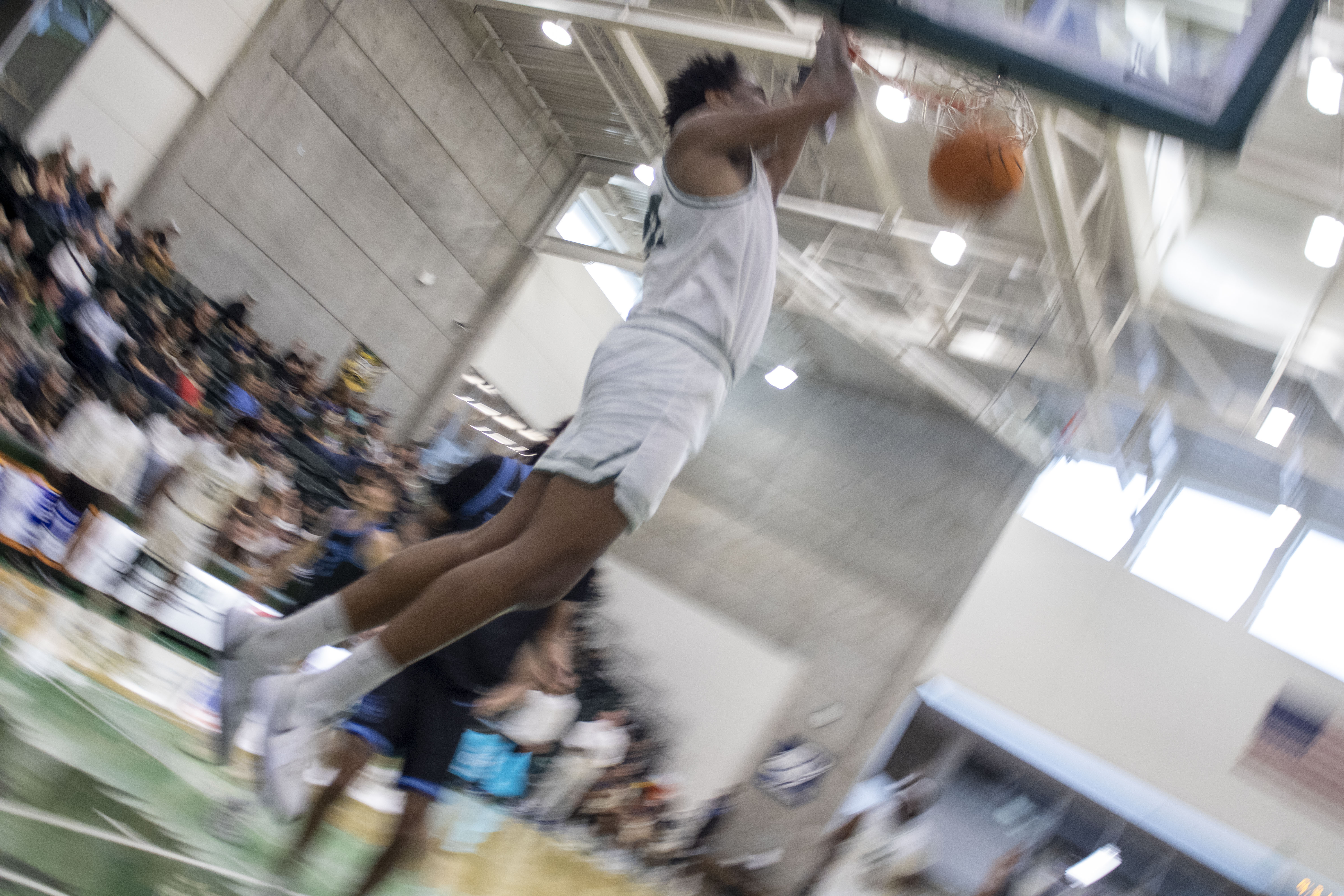
    During the first half, fans were able to see that preparation and connection shine as the ‘Jacks jumped on top early with a score of 37-21 in the first half. After the break they continued to work hard but Simon Fraser started inching their way back. The last five minutes of the game is when it started to slip away for the ‘Jacks. The Red Leafs player, Elliot Dimaculangan, tied the game up at 68-68 with a steal followed by a layup in the paint. Simon Fraser’s Nigel Hylton went for a rebound and was able to take the lead with a layup. Then the Lumberjacks’ very own Pejan Slater responded back with a dunk that energized the crowd but wasn’t enough to take the lead. The Red Leafs continued to score and ultimately took the game in a 83-75 victory. 

    Going into this game Tifft talked with Humboldt Jacks about not looking at losing as a do or die situation for the team. He was excited to be able to start the season in Lumberjack Arena with fans cheering and supporting the team.

    “We’re fortunate to have the opening challenge on our home court and you know even though it’s important for us to have home games and try to have some success, we can’t look at it as if we lose a game that it’s a do or die situation for us,” Tifft said. “I mean we’re obviously a brand new program with a lot of new faces and for us we just need to put the blinders on and keep moving forward. The results will take care of themselves.” 

    Some Lumberjack standouts for this game: Emmanuel Steward led the team with 20 points and eight rebounds; Rob Diaz III followed with 13 points; Pejan Slater had one dunk and tied with Liyongwei Xie at 10 points for the game. 

  • Should we own pets?

    Should we own pets?

    by Griffin Mancuso

    Many of us consider our pets to be our children. And like children, they become a focal point in our lives. Some of us may have social media accounts dedicated to our furry, feathered, or scaly children and our experiences raising them. Some may have shirts or bags proudly declaring our status as pet parents. Some even spend hundreds of dollars a month on toys, gear, and other enrichment for their pet. We make the choice to let a living being into our lives and take care of them, giving us a sense of fulfillment and joy. We would give them the whole world if we could.

    But is the world you’re giving your pet making them happy?

    There are limits to what we can provide our pets. Unfortunately, we are raising our animals in a world made for humans. For dog and cat owners, we cannot let them run free outside without the risk of them getting hurt or ending up in the back of an animal control van. Reptile owners cannot give their pets a perfect replica of the desert or jungle they were meant to live in. Bird owners can’t give their feathered companions the sky to explore and rodent owners have to keep their pets confined to cages and pens for most of the day.

    Does that mean we should trash the collars and cages and set our animals free? Not necessarily.

    The most common household pets like dogs, cats, rabbits, or hamsters are domesticated species and, at the very least, tolerate human interaction. Independent bioethicist and writer Jessica Pierce suggests that dogs and cats in particular may have been active participants in their domestication process. 

    For example, a study headed by psychologist Juliane Kaminski with the University of Portsmouth, UK, found that dogs evolved to have “puppy dog eyes” as a means of communicating with humans. Cats also developed a unique way of communicating with humans—meowing. Cats rarely meow at each other, but rather use it to ask their humans for attention, food, or other needs.

    Having a pet isn’t inherently unethical, but the way in which we love our pets and care for them needs to come from a place of well-researched knowledge and compassion for them.

    Research and reflection is a critical step before adopting a pet. If you want to adopt a pet, do you have the financial means to take care of one? What type of pet will you get? How will you obtain this pet ethically? Are you ready to handle potential physical or mental health issues your pet may experience? Does the type of animal you want live better alone, as a pair, or in a group? How much space will they need? Are you able to take them to the vet regularly? What physical and mental stimulation will this pet need and do I have time to give it to them? If you go out of town, should you hire a pet sitter or board them in a facility?

    Once you have obtained your pet, you are making a commitment to take care of them for their entire life. Now the second-most difficult part of pet ownership begins. Some requirements for pet ownership are objective, like giving them adequate food, water, shelter, and not causing them unnecessary suffering. But like children, everyone raises them differently. 

    There are endless choices of enclosures, gear, food, enrichment, training, and medical decisions to make. You can ask an expert like a veterinarian or trainer for advice or do research on your own time.

    The first and most painful part of owning a pet is the guilt. There will always be someone telling you that you aren’t doing enough, and usually that someone is yourself. You may spend hours researching and hundreds of dollars buying the best food and toys, but the brief rush of dopamine is ever fleeting. 

    I find that spending some quality time with your animal baby helps combat the random surges of panic and guilt—take your dog out on a hike, play with your cat, give your rodent or reptile an extra piece of fruit and give them very gentle pets if they are up for it. If you have a fish, stare lovingly at them through the glass.

    Education is a powerful thing, and by taking the time to learn how to keep your pet fulfilled and happy, you are helping shift the tide in today’s pet industry. Your pet is a responsibility and a living being with feelings and wants, and you need to treat them as such. If you were a couple inches or a couple feet tall, you wouldn’t like being ignored and stuck inside with nothing to do all day. 

    While more people are adopting pets, there is also a greater number of people advocating for responsible pet ownership, and you can be one of them. You may not be able to give your pet the world, but you can get pretty darn close.

  • A woman’s sanctuary is a man’s cave

    by Valen Lambert

    Guys, give a shit about your rooms. I’m looking at you Mr. Floor-mattress who sleeps next to the dirty laundry you throw on your bed. I’m not kidding around. Get a plant, thrift some art, perhaps invest in some fine linen. Us ladies (or whoever) are tired of “going back to your place” and it smells like wet dog and Mountain Dew.

    You’ve ever been in a girl’s room? It’s like entering a church where she worships herself. Candles, incense, the world’s biggest comfiest bed, ambient lighting, art on the walls, succulents, a healthy and thriving monstera. If it’s messy, it’s messy in a cool, hot, sexy way. When a man’s room is messy it’s just gross. A girl will spill a glass of wine on her bed but a guy will straight up vomit on his carpet. 

    Our bedrooms should never be taken for granted. It’s a safe space where we can truly be ourselves and feel at home. It gives us a space to really express ourselves through the way that we decorate it. It takes us out of the homogeneity of society and into the fantasy of ourselves. 

    In it we can display the artifacts of our lives. The mementos from our travels, photographs, notes from our loved ones, anything of emotional significance can go on our walls and remind us of how alive we are. Give it a shot fellas! Embrace your tenderness and sentimentality! Get soft and self-reflective! And then maybe your mess will be as cool, hot and sexy as a lady’s. 

    I will say I’ve been in some vibey ass rooms belonging to men. Not every guy is sleeping on the ground in a fluorescently-lit sensory deprivation chamber. I’ve also been in some whack girls’ rooms. Things aren’t black and white. So honestly no matter who or what you are, give a shit about your room. It’s the only place you get to call your own. Do something about it! Because you won’t be able to decorate your coffin. 

  • Think of the critters

    Think of the critters

    by Jake Hyslop

    Ah, the rainy season is upon us. Despite the odd sunny, muggy day that Humboldt likes to shuffle into the fall and winter seasons like a wild card, it is getting cloudier and more drizzly, slowly but surely. 

    I quite like rainy weather, so I couldn’t be happier in that regard. With an umbrella or other rain gear, the inconvenience can be diminished into an enjoyable aesthetic. Sometimes I be out here just raw dogging the downpour with a T-shirt and shorts. Yes, swampy shoes are the worst, but watching where you step is an easy way to avoid that nightmare. 

    Speaking of watching where you step, that brings me to the point of this ramble. I am not the only creature who thrives in the rain (as are many of you, excluding the rainphobic). Allow me to paint a picture for you. 

    Thousands of students, staff, and faculty traverse campus on foot to some degree, day-in and day-out. They avoid puddles and stroll along the sidewalk to their class or job. Every once in a while, someone hears a crunch or a pop underfoot, but often it’s so small they think nothing of it. Little do they know, the blatant endangerment they are causing.

    Yes dear reader, from the arboreal salamander to the simple snail, and all the slugs, worms, and more in-between, there is an entire ecosystem of creatures that love the rain more than we do. In fact, rain is an outright necessity for these creatures. 

    Snails and slugs rely on moisture to survive, making them extremely active during the rain. All kinds of worms use rainy days to migrate, as above ground is normally too dry for them. Salamanders and frogs migrate and breed in the rain as well. 

    These creatures have no choice but to sometimes venture onto the cold, wet pavement in order to fulfill their quests. But often, too often, they never make it. 

    That’s right. Martha the earthworm travels the equivalent of many human miles in order to meet her lover, Jim, only for her soul to be snuffed by a single checkerboard Adidas slip-on. 

    The worst thing about these literal crimes against nature, is that they are crimes of negligence. It is incredibly easy to not step on and crush a helpless critter. All it takes is a little look down every few steps.

    Unless you have some sort of neck mobility issue, there is no excuse not to look where you’re stepping and avoid crushing a snail into paste. No, they cannot move to a new shell. That is a myth. Snails ride or die for their shell. 

    We cannot blame the critters for getting in the way. After all, there didn’t used to be concrete on their path. We must be better. Next time you’re out on your travels during a particularly damp day, think of the critters and watch where you step.

  • Ultimate frisbee makes the world go ‘round: a sport built on community and spirit

    Ultimate frisbee makes the world go ‘round: a sport built on community and spirit

    by Griffin Mancuso

    The pristinely green field of Hiller Park, normally home to gophers, was taken over by pirates last weekend. These pirates were not armed with swords, but sturdy, white frisbees. After warming up with expert frisbee throws and swift catches, they gathered in a circle on one side of their playing field. They started a lively chant to match their pirate attire, jumping with their fists in the air:

    “Yo-ho yo-ho, a bug’s life for me!”

    The ultimate frisbee teams of Cal Poly Humboldt, the Buds and the Hags, came together for the weekend as the Bugs for a community tournament, the Humboldt Harvest. Humboldt Harvest is one of the longest running ultimate frisbee tournaments in Humboldt County, and it isn’t surprising to see why. The presence of young alumni and older alumni teams made it clear that ultimate frisbee is a lifelong passion and community.

    Ultimate frisbee is a no-contact sport that consists of two teams of seven players trying to get the disc to their end zone. Players cannot run with the disc and must pass it to other players to get it to the goal line and score a point. If a pass is not made successfully, it is turned over to the other team. The disc can be taken back if a player fails to catch the disc, or if a defense player knocks it out of the air.

    Ultimate frisbee sets itself apart from other sports by upholding the spirit of the game. The sport has no referees and requires its players to hold themselves and their team members accountable. Players must be able to call out fouls, retract unnecessary calls, have good sportsmanship and discuss outcomes for fouls. This integrity-based system fosters a unique bond between teams and their opponents.

    Photo by Griffin Mancuso. Old alumni team member Mason Banner makes a leaping dive for a frisbee at the Humboldt Harvest tournament.

    Both the Buds — the men’s ultimate frisbee team — and the Hags — the women’s ultimate frisbee team — grow stronger with the foundations of teamwork and trust that ultimate frisbee provides.

    Cate Roscoe officially joined the Hags as their coach this semester, but also offers some assistance to the Buds. She played ultimate frisbee professionally for 34 years and previously coached for the Hags for a couple years during grad school. She feels that her specialties have been a good fit for the current team. 

    “I really like to teach foundational skills, the biggest one of course being throwing,” Roscoe said. “But then also things like defensive footwork and positioning, offensive cutting and positioning, communication, a little teensy bit of strategy, two different styles of offense and a couple different defensive strategies.”

    She also emphasized the sense of community that ultimate frisbee players have, no matter how far apart they are.

    “There’s a lot more genuine friendship and camaraderie across teams and throughout the country,” Roscoe said. “I literally had a friend who played community in Tacoma who needed heart surgery in Kansas City. I was able to contact the Kansas Ultimate group through other connections of Ultimate I had. They picked her up at the airport. They housed her for over a month, fed her, drove her to all her appointments and took care of her while she had heart surgery. They had never met her — they had never even met me. But we all played ultimate [frisbee], and we’re in that same community.”

    Andre Sargissian, the current captain of the Buds, has been playing ultimate frisbee for two years at the university and has great hopes for the newer team members this semester.

    “We have so many [promising rookies], man. It’s been so exciting,” Sargissian said. “I feel like a lot of our soccer people who played soccer in high school, they always really succeed. I don’t know, it’s really cool because anyone can pick it up, anyone can throw the frisbee, anyone can run a cut, so anyone can be really good all of a sudden.”

    The Hags is a gender-inclusive team that aims to empower their players. Captain Jillian Snowhook has been a Hag for five years, becoming captain in the Spring 2023 semester.

    “From last semester to this semester, there were only five returning players, and there are five officer positions, and I was the only one who had played for more than a year,” Snowhook said. “I had also been one of the co-captains the previous year, so I took on the presidential role as well as captain because I do love this team, and there’s no way that I could let anything happen to it by not stepping into that role.”

    Roscoe described the Hag name as a subversion of a term that has historically been used to oppress women who held power and knowledge. Today, many of the team members take pride in being a Hag.

    “It means being burly. We are the burly Hags, and that basically means you show up for your team, for the game, in all conditions, with all you have, with your whole heart, with all the energy you have,” Snowhook said. “It’s really just being a part of a community that loves to do the same thing together, which is chase down frisbees like golden retrievers.”

    Natalie Christenson, previously a soccer player, is in her first semester with the Hags. There has been a sharp learning curve, but the support system built into ultimate frisbee has helped.

    “It’s super different to be a new person on the team and trying to learn what I’m supposed to be doing, as well as how I’m supposed to be communicating, so it’s kind of a lot of overwhelming things all at once,” Christenson said. “I’m mostly looking to the veteran players, and also our captain, Jill, who really takes hold of the team and coaches us.”

    Otto Berndt, a long-time member of the Buds, emphasized how ultimate frisbee has given him a solid support system.

    “The reason I have good grades is because I come out to ultimate [frisbee] and have a support group of people that care for me, and I care for them,” Berndt said. “We exercise, we have fun and we get to travel to other schools, and it’s just like — it’s a family, and anyone can be part of that family.”

    Christenson has greatly enjoyed her time with the Hags and encourages other students to consider joining.

    “I love the team so much and I cannot recommend it enough for anyone that is a little scared to try out or anything,” Christenson said. “I mean, I’m a first year and it has been a great experience. Everyone’s so welcoming that there’s no fear in trying something new.”

    Roscoe suggests ultimate frisbee for people who might not feel like they fit into traditional sports communities.

    “It’s a place where you can really surprise yourself and you can come for a lot of different reasons,” Roscoe said. “It doesn’t just have to be about the sport, but, um, it’s amazing to discover what our bodies are actually capable of.”

  • Buy, Sell, Trade: Daydream

    Buy, Sell, Trade: Daydream

    by Zack Mink

    Thrifting for second-hand clothing has become a hobby and part of the culture for many Cal Poly Humboldt students, making the community an eclectic and stylish one. This combats the destructive industry of fast fashion. At Arcata’s new thrift store, Daydream, you can buy high-quality clothing and make money by clearing out your own closet.

    Daydream, is a new buy-sell-trade second-hand clothing store on the corner of 9th and H St. across from the Arcata Plaza. The store provides a space for students and locals to make some cash while discovering a new sense of style. The warm-toned inviting store opened two months ago and is one of three local second-hand clothing stores co-owned by Jayna Nix and Ben Blair. Open seven days a week from noon to 6 p.m., you can go in to buy, sell, or trade any time before 5 p.m. and walk away the same day with cash or store credit.

    What makes Daydream unique in comparison to the many other second-hand stores in the area is that they buy everything from the public and provide compensation either with store credit or cash on the spot. This process can be quite quick and is guaranteed to be completed within a single day. The store’s warm, clean, and inviting energy is represented in its curated racks of vintage clothing, rows of used trending shoes, and a wall filled with scented candles and accessories. Styles range from cottage-core to street style to retro and everything in between.      

    Photo by Zack Mink. Daydream boasts a collection of cute and colorful vintage.

    Unlike the duo’s other stores, Redwood Retro and Modern Finds, both in Eureka, Daydream brings a focus to the art, styling, and sustainability of fashionable clothes. Rather than organizing the racks by gender, they are organized by size, style, and even season. This not only represents their push for gender and size inclusivity, but it encourages buyers to be more intentional and thoughtful when purchasing seasonal clothes that will last a lifetime.

    The buy-sell-trade business model is also unique as the entire store relies on customers and locals bringing in their clothing to exchange. 

    “It creates a community hub where people come in, hang out while we go through their clothes and shop,” Nix said.

    Daydream’s high standards for buying and trading clothing does highlight a downside of this model, which is that the sizing availability takes a hit when locals don’t have petite or plus-size clothes to bring in.

    “We can’t control what people bring to us or the sizes we have… although we want to have more size inclusivity,” Nix said. With this being said, they are always looking for more variety in the sizes that are being traded and sold.

    Despite facing challenges curating wide size ranges, Nix’s goal to recycle as much high-quality, sustainable clothing as possible is easily attainable with their buying standards and community support. 

    “Part of our mission is sustainability and recycling clothing. We try not to accept more

    of the fast fashion brands and the buy-sell-trade model creates a space where we can recycle… what we already have,” said Nix.

    Rather than buying clothes from fast fashion brands or selling old heirlooms to help  partially cover monthly bills, Daydream is the place for students and Arcata locals to step up their style game, be financially responsible in a struggling economy, and stay committed to having a low impact on the environment.

  • The Life of Galileo delivers a spunky opening night

    The Life of Galileo delivers a spunky opening night

    by Alana Hackman

    It was a full house for the nearly two hour long production and helped feed into the performers liveliness. Cal Poly Humboldt’s Theatre Arts Department presented their fall semester play, “The Life of Galileo,” Nov. 3 in the Gist Hall black box theater.

    I had yet to attend a play at the black box in my time at Humboldt State, and I believe it has to be my favorite location so far. The stage was smaller and a lot more intimate. It was also a lot easier to hear the actors more clearly. 

    Immediately, the prop and set design caught my eyes. Working with such a small space, they were able to create multi-purpose prop designs to be used throughout the entire production, and create separate rooms and energies on such a limited stage. Bookshelves of Galileo’s scriptures and studies that doubled as Roman columns — and even circus tents when flipped around — were genius to me.

    The use of projections and other media really brought the whole production together. Like a silent film, they projected title cards on the castle walls to set the scene, which was a really creative way to occupy the crowd while stagehands moved props for the following scene.

    Even the stagehands added to the artfulness of the play. They were adorned in plague masks and cloaks to blend into the scenes, which kept things interesting during an otherwise liminal transition.

    Everything involved with props and set design was very thorough. Hanging planetary orbs and stars above the theater to back the play’s theme was gorgeous, as well as the creative use of such a small stage. A large brick castle with a spiraling staircase was tucked away in the background, and the use of hidden tables and raised platforms allowed for Galileo to easily bop around the stage. The production had no mics and was fully reliant on the actors belting capabilities, which proved successful. 

    Graphic by Griffin Mancuso.

    The cast seemed much larger than what I have seen in other productions put on by the theater department. The play itself was more comedic than I expected it to be, through youthful banter and sassy characters like Galileo’s pupil, Andrea, played by Jenny Campos. 

    Although I will say the humor does seem a bit dry and for a specific audience, which I myself was not a part of. The one-liners seemed reliant on historical knowledge and for more of an older audience.  One audience member continuously giggled throughout scenes in the first act while the rest of us remained silent, it felt I was missing something, or maybe we all were. 

    It wasn’t until the second act that I fully grasped the commentary of the play itself, a humorous meditation on the historical battle between religion and science, following Galileo returning from his near death experience after his scientific discovery that Earth was not the center of the universe. 

    The lead Galileo (Troy Lescher) had many asides within the show that seemed necessary for witty comments, but I feel they did fall a bit flat. 

    Although it took a bit for me to get into the play, the second act’s circus scene was fantastic. Actress Penny Dellapelle carried three roles in the production and was phenomenal. Her line delivery was hilarious and she really proved to be a firecracker on stage. Especially in her roles as the ballad crier in the circus performance and the snarky philosopher turning down Galileo’s scientific discoveries. The audience’s giggles also seem to reflect my opinion.

    Lake Terre’s playing of the Bursar of the University of Padua was also quite animated and entertaining to watch on stage, especially during his scenes where he was trying to avoid interaction with Galileo. Although, I will say some of his scenes with Galileo kind of skewed the curtain of acting and reality for me. 

    The acting of all cast members was quality work in nearly all of the scenes. Some of the more busy scenes really shifted the veil of reality and performance for me. Watching a group of callow, college-age actors surrounding the obviously decade-older lead threw me off a little bit, and made the production feel more juvenile and high school-esque than I was prepared for. 

    All of the characters within the play were seemingly near the same age, so watching a baby-faced Bursar or philosopher scold Galileo, an obviously older actor, made me snap out of the entertaining theater-goer energy quickly. 

    The production brought a modern commentary on the history versus religion theme. Projections of Elon Musk, Mark Zuckerberg and Bill Gates to describe “elite Italian families of the 1500s” was extremely comical. Also projecting images of COVID-19 deniers when discussing the relationship of science with the priest was super timely and the cherry on top of the production. 

    Overall, the Theatre Arts Department put on a spectacular production and really killed it with The Life of Galileo. Opening night brought lots of energy from the performers and a packed audience. The technical aspects really tightened the show up completely. The production’s ability to play off the recent historical events of science-deniers really lightened the mood in such historically dense productions. 

  • New Yurok office will support South District

    New Yurok office will support South District

    by Andrés Felix Romero

    On the first day of November on a pleasantly warm sunny afternoon at the edges of Old Town in Eureka, members of the Yurok Tribal Council gathered in front of their office building at 930 Third Street, Eureka. The council smiled as they cut the big red ribbon to signify the grand opening of their new office space for the Yurok’s court services. The new building houses a meeting place for the council within the South District. Eureka is located in what is known as the South District for the Yurok tribe.

    Among other duties, the council is responsible for managing the ancestral lands of the Yurok that they are in direct control of, as well as managing the salaries of tribal personnel.

    Lana McCovey is the council member of ten years who oversees the South District (and held the large scissors to cut the ribbon). McCovey was ecstatic about the opening of the space as now employees and residents can be closer to court services.

    “What we found is that there’s a large amount of employees and members down in this area,” McCovey said. “We found it necessary to accommodate them. People from [the South District], to do normal, everyday business, would have to drive to [Klamath] to get that done. So we want to be able to offer [tribal court services in Eureka] also.”

    This is the second office that the Yurok holds in Eureka; however, the 930 Third Street address focuses on court services. One service that the office will provide are diversion programs Court services that the Yurok offer in the space focus on supporting at-risk youth and elders, supporting victims of crimes such as domestic violence, probationary services, visitation services, foster services, and more. Space for council operations and an office for the tribal prosecutor also reside at the new address.

    The Yurok staff that occupy the new building have found the space to increase their productivity in a number of ways. Besides the new office being able to support individuals in Yurok’s South District, Court Director at the Yurok Tribe Jessica Carter notes the building is only blocks away from Humboldt County’s courthouse.

    “We can walk and get coffee and food,” said Carter, “And we can go to the jail if we have to file something or go visit our clients. Definitely accessible.”

    COVID-19 played an important role in the development of the office building, as it was paid for thanks to the CARES Act during the pandemic. The tribe acquired the building in 2020. After renovations, the court services began to steadily move their court services away from their previous location, the Aawok Bonnie Green Site. The former site was located at Worthington Elementary School, and the office there was a portable classroom. The Yurok are now able to house many of the employees hired during COVID, who now need an in-person desk to work at.

    “You can hire all the people you want for the job,” said McCovey, “but if you don’t have the space for them, then what’s the point?”

    The new office space is much larger than the previous location. Now that many of the court services within the Yurok court system have their own suite within the office space, communication has become more efficient. The Yurok Tribal Child Support Services (YTCSS) staff enjoy the opportunities for more efficient and safe communication with each other now that each program has its own suite to chat amongst themselves.

    The YTCSS staff is happier now that each court program has their own defined space within the new building. Each department has increased confidentiality thanks to the privacy and are able to speak to each other about cases rather than needing to communicate through emails.

  • Policy, protest, and pirates: students protest against campus evictions

    Policy, protest, and pirates: students protest against campus evictions

    by Jillian Wells

    Other contributors: Alex Anderson and Dezmond Remington

    In a powerful show of unity, students and faculty members gathered in the rain at Cal Poly Humboldt to protest the recent decision to evict students living in vehicles on campus. The protest, which took place on Thursday, Nov. 2, highlighted the larger problem of homelessness in Humboldt County. 

    The protest started at 11 a.m. in the G11 parking lot and lasted throughout the night. At 12 p.m., protestors marched to the quad in the rain chanting, “Hey, ho, hey, ho student eviction has got to go!”

    Photo by Cedrik Vonbriel. A sign at the protest.

    The protest was led by Maddy Montiel and Brad Butterfield, the president and vice president of the Alternative Living Club, who were dressed as pirates because of a long-running joke of them being “land pirates” and their RV’s being ships on wheels. Furthermore, the initial eviction email occurred during Halloween week, and since then Montiel and Butterfield have been solely focused on securing safe housing, but didn’t want the situation to take celebrating Halloween from them. 

    “The university took a lot from us last week,” Montiel said. “We decided we wanted to keep one thing for ourselves and still dress as pirates and give our outfits a chance to see the light of day.”

    Photo by Cedrik Vonbriel. A sign at the protest.

    The protest also featured an open discussion, where Montiel and Butterfield stated their list of demands from the university. 

    Their demands included the university allowing overnight camping or sleeping in vehicles through the end of the fall semester, at least, a formal apology for the dehumanizing language in the initial eviction email, the establishment of a committee for long-term solutions, more transparency in defining camping and its implementation, and evidence of the “unsafe and unsanitary conditions” that was stated in the email.

    At the protest, Butterfield stated students living in their vehicles are open to finding a solution that works for them and the university, but that the university hasn’t been willing to negotiate. For the students living in their vehicles, protesting was a last resort. 

    “For the school to assume that they can just get rid of us and push us out onto the streets and we’re going to go away quietly, is wrong,” Butterfield said.

    On Tuesday, Nov. 7, the University Senate passed a resolution that would pause the enforcement until the end of the 2023-2024 academic year; this resolution was sent to President Jackson’s office. It awaits a decision. Mark Johnson, the President’s Chief of Staff, who attended the meeting on behalf of Jackson, declined to answer any of The Lumberjack’s questions, as did Dean of Students Mitch Mitchell.

    During the protest, various speakers articulated their concerns, frustrations, and demands, emphasizing the need for understanding and fair solutions. The protest featured many voices and perspectives within the community, stressing the importance of addressing the issue with attainable solutions and compassion.

    Photo by Cedrik Vonbriel. A sign at the protest.

    Rouhollah Aghasaleh, an assistant professor in the School of Education, attended the protest and said that he sympathizes with the students who are being evicted.

    “Living in a [vehicle] doesn’t make you less human.” Aghasaleh said.

    Meheret Vasquez-Suomala, a religious studies major, expressed disappointment in the administration and hopes that they will listen and work with students, not evict them. 

    “You [Cal Poly Humboldt] are deliberately misplacing lower-income students and that’s what’s frustrating.” 

    Raymond Haeckel, another one of the speakers at the protest, questioned the accusations made by the university and stated that without proof of the unsafe and unsanitary conditions. Haeckel will continue to believe this is an effort to force these students into on-campus housing and collect housing fees.

    “This is motivated by money and money alone,” Haeckel said.

    Jules Tatum, another student at the protest, condemned the university’s decision to evict students.

    “To say that these people are unsanitary, unsafe, dangerous individuals is just a slap in the face. The only dangerous conditions are being created by the institution,” Tatum stated.

    Ultimately, the protest highlighted the need for realistic and attainable solutions that work with students, not evicting one of the most vulnerable student populations. 

    If you’re interested in learning more about this on-going issue, the Alternative Living Club is meeting on Friday, Nov. 10, at 3:30 in front of the library. 

    Disclaimer: Brad Butterfield is a member of the Lumberjack. He did not help write or edit this article.

  • Where to get drunk in Arcata

    Where to get drunk in Arcata

    by Valen Lambert

    Arcata is a great place to drink. During these long, dreary winters, what better way to pass the time than to head on over to one of our many local dives and question all your life decisions? Whether you’re newly 21, or simply do not get out much and are seeking some guidance on where to spend your big night out on the town, allow a seasoned bar hopper to show you the way.

    Everett’s

    I had to start at an all-around fan favorite; really just a gem of a dive. It’s a dark, dingey, hedonist’s paradise. Look closely around the taxidermied walls and you’ll always find a new nick-nack or picture (hint: look for the boobs next to the stuffed deer). If you’re lucky enough to order from Robert, you can count on a questionably dirty joke. Beers and cocktails are dummy cheap. Watch out, you’ll come here thinking you’ll stay for one drink and end up hanging out ‘till close, eventually getting kicked out to the curb with the Plazoids. Daytime is when this place really shines though; flies buzz around en masse while Arcata’s day-drunks play a dusty game of pool.

    Graphic by Valen Lambert.

    The Alibi

    Punk bar. Great place to use the bathroom when the lady’s line is too long at Everett’s – also makes a mean bloody mary.

    Dead Reckoning

    Love this bar and its bisexual lighting. Kind of your classic cool hip craft beer joint; they solely spin great vinyl (lots of afro-future and jazz) and have a great tap selection. It’s a huge selection though, and looking at the menu is like scrolling through Netflix trying to pick a movie. Good place for a date, or if you want to get a drink with friends and actually be able to hear each other. The best part is that it’s got a whole mini arcade. Come on Tuesday nights to watch (or join) a bunch of pinball wizards duel it out for the pinball league. 

    The Local Cider Bar

    Best place to get drunk on cider at 5:00 p.m., and a great option for all our gluten-free baddies. Casual, cute, cozy – The Cider Bar is great for autumn vibes. A Slice of Humboldt Pie also shares the building, so after tossing back a couple Blurberrys, you can get a slice of pie or an empanada.

    Richard’s Goat

    Definitely the most vibed out of these joints – stained glass windows and bisexual lighting abound. If you have a hankering to dance, this is the spot. Always live shows and DJs. Yummy cocktails and non-alc options. Plus, probably the best damn karaoke nights (Thursdays and Sundays) this side of the marsh. It’s a total hoot. If you come to sing, you’ll definitely stay for the lady that does opera staccatos in a tutu (you’ll know what I mean). 

    The Pub

    Good place to get drunk and eat dinner. Gentrified, but free pool. 

    The Basement

    Ah, finally, a place of sophistication and class. Or, as some women have put it, a place where they don’t feel preyed on. This newly reopened lounge is a great place to roleplay as someone with good taste. Live music and comedy abound. Expensive drinks so make sure you go with a date who’s gonna pay for them. My only suggestion is, more bisexual lighting.

    The Jam

    Almost forgot to mention this place because I usually avoid it for no good reason except I’m pretentious. A watering hole for local wooks and the occasional biker or metalhead. It’s a great place if you love EDM and getting freaky on the dance floor. Whomp Wednesdays is a classic – it’s exactly what it sounds like. 

    Blondies

    Hands down best spot for local music. Plus, you don’t need to be 21 to get in. Quirky venue with a real DIY bodega sort of vibe, and they sell food. Sunday nights they host the jazz jam, and open mics are every Thursday. Always something going on, so make sure to check their Instagram for events.

  • Professors on teaching Gen Z

    Professors on teaching Gen Z

    by Valen Lambert

    The past few years have been undoubtedly some of the strangest to be coming of age. A global pandemic, inflation, social unrest, war, climate change, political turmoil and the insidiousness of social media has Gen Z – AKA “Zoomers” – shook. Attending college through these trying times is no small feat, and professors who have taught multiple different generations are attentive to what makes Zoomers different.  

    Recognized as the first generation to not know a world without the internet, they have been labeled with many different stereotypes: short attention spans, anxious, weary of face-to-face interaction, lazy, coddled. Ouch, right? Professors are quick to recognize that things aren’t that black and white, and that Zoomers have a unique edge because of their balanced set of experiences.

    “I feel like Gen Z just came of age in much more difficult times,” said Dr. Heal McKnight, an English professor at Cal Poly Humboldt who has been teaching for over 20 years. “And as such, they have a real sense of their own durability, and they do not have an inflated sense of what they’re entitled to. It seems like they have a much more realistic way of forming relationships with each other and with adults… I feel like Gen Z has a ballast to them.”

    But others are worried these experiences may have caused delays in social development. Cal Poly Humboldt art history professor Dr. Julie Alderson has been teaching for 20 years, and noticed a remarkable amount of timidity in passing students when she used to throw dance parties on the quad. 

    “I just watched the students have so much anxiety about it,” said Alderson. “I could see them in the distance putting in their earbuds, or pretend they’re talking on their phone, or not catch our eye. They’re still kind of in that high school, ‘I don’t want to be weird,’ mindset. And it’s because they were sort of sheltered in this way… their development towards being adults who don’t care what other people think about them is not as far along as students in the past.”

    Professors have evolved with the changing generations to make the classroom more student-friendly. Recently, Alderson noticed that students have become savvy of a multitude of up-and-coming artists thanks to social media, and opens up space in her projects for students to explore them. 

    “The thing that I do feel is especially important to know in order to connect with [Gen Z] is that they want to be doing stuff that feels relevant to them,” said Alderson. “And I love doing that because they are way more excited and what they do is a lot more interesting.”

    McKnight has noticed the impact that the Digital Age has on students’ focus in the classroom and found out a way to cater to these new tech generations, but in the process, realized it’s a better system for students of all ages.

    “I think as soon as I realized I was teaching millennials, I understood that I needed to switch things up and run a classroom that goes in 20 minute cycles,” said McKnight. “I don’t think that Gen Z is any different from the generation above them in terms of that. I don’t think any person really can pay quality attention outside of a 20 or 30 minute bite.”

    At the end of the day, professors agree that it’s a sweeping generalization to try and define Gen Z.

    “It’s always so funny to label people as a whole generation,” said Alderson. “It’s so much more complex than that – it’s cultural. Like, it’s gonna be different here than it is in the city.”