The Lumberjack


Students Serving The Cal Poly Humboldt Campus and Community Since 1929

Tag: Eureka

  • The Aquatic Center’s $412,000 facelift

    by Brad Butterfield

    To date, $412,000 has been spent on renovations at Humboldt Bay Aquatic Center (HBAC) to allow for half of the University Advancement Division to move their operations into the Eureka waterfront building. According to Marketing and Communications for the university,  this transition, which began in the Fall of 2020, led to a change in management of the building from the non-profit ‘University Center’ to Cal Poly Humboldt. 

    Marketing and Communication states that the relocation of the Advancement Division to HBAC has provided an easier landing pad for donors and Alumni to interact and opened up space on campus for the Associated Students to utilize. In effect, this move has forced many of the previous operations at HBAC to alter and many to exist as shells of their former selves. Additionally, the Advancement Division’s move to HBAC forced Center Activities employees out of their offices and workspaces without giving them a say in the matter. 

    The money spent:

    While Marketing and Communications Director, Aileen Yoo and Communications Specialist, Grant Scott Go-forth stated in separate emails that renovations and upgrades to the HBAC total $412,000 to date, public records requests submitted under the Freedom of Information Act, led to the release of only three construction contracts totalling $22,700, leaving $389,300 unaccounted for. 

    In an effort to establish a complete framework of work done at HBAC, a second public records request was submitted on Nov. 16, asking for all publicly disclosable records related to renovations/construction carried out at the Humboldt Bay Aquatic Center from 1/1/2019 – 11/16/2023. This second request was denied by Records Access Officer, Michelle Williams citing, “Balancing Test. Records where the public interest against disclosure outweighs the public interest in disclosure. Cal. Govt. Code §7922.000.” 

    The Advancement Division moves into the HBAC:

    Yoo wrote, on behalf of Marketing and Communications that, “The location improved accessibility for donors and alumni to interact with Alumni Relations, the Cal Poly Humboldt Foundation, and other areas of the Division. Having a more prominent presence in Eureka has helped improve community outreach.”

     There are now 16 University advancement employees working in the HBAC’s new cubicle spaces and pre-existing offices.

    Under its previous management, the HBAC was focused on aquatic equipment rentals, scenic tours, OLLI classes, education on local wildlife and Humboldt Bay and, critically, water safety. The moving in of the Advancement Division led to some of the HBAC’s equipment being stored off-site and a diminished ability for the Aquatic Center to continue its services to students and community as a waterfront property.

    Renovation’s cause chaos: 

    An employee with direct knowledge of the reworking of HBAC spoke under the condition of anonymity fearing repercussions for speaking out. They will be referred to as J. Doe in this article. When word came that Center Activities was expected to vacate the HBAC offices, there was confusion as to where that left them to operate from. After initially vacating their offices, Sherie Gordon, Vice President for Administration and Finance, paid a visit to the building to assess the situation.

    “Sherie Gordon came around to look at the situation on the waterfront. It was agreed that there is no reason why Alumni [Relations] would need a waterfront office when Center Activities was responsible for monitoring waterfront safety,” Doe said.

    After Gordon’s visit Center Activities was allowed to maintain use of the office for a couple of months before being kicked out again.

    Under HBAC’s new management, a creative solution was found for the employees who’d unwillingly forfeited their workspaces. 

    “They took what used to be a maintenance closet, and they turned it into an office. So, Center Activities doesn’t have a front door office anymore where people can come up to a counter and ask questions. They have this tiny, hidden little space that used to be a closet that is now an office without access to any of the other rooms or lobby. So they can’t do community services, program coordination or classes in other rooms unless it is reserved out in advance,” Doe said.

    According to Doe, Stephanie Lane, Executive Director of Alumni Relations, has the final approval on all reservation requests submitted for the building through 25Live.

    Yoo, on behalf of Marketing and Communications wrote through email that in addition to adding cubicle spaces for Alumni Relations, they would also be occupying two offices that didn’t require any updates. According to Doe, one office went to Lane who was adamant about getting it.

    “That’s one thing that never changed. She was gonna get that waterfront office.” Doe said.

    The second office went to one of the Advancement Departments VP’s. 

    Stephanie Lane declined to be interviewed for this article, deferring to statements from Marketing and Communications.

    HBAC’s waterfront safety obligations:

    Regardless of who occupies which office or what departments operate out of the HBAC, there are a few operational guidelines that HBAC must adhere to. These guidelines stem largely from who owns the land, who paid for the HBAC to be built, and who owns the building itself.

    According to Scott-Goforth, the building is on land that is leased long-term from the City of Eureka, the HBAC was built with a grant from CA Boating and Waterways and it is currently fully owned and operated by Cal Poly Humboldt. 

    Pat Hyland, who has been a member of the women’s rowing team coaching staff for 30 years as well as lecturer in Kinesiology, provided valuable context that the HBAC was originally one of three CA Boating and Waterways safety facilities. With that, came an obligation to provide waterway safety.
    “[The university] may have been a little light on that,” Hyland said.

    From the perspective of the city of Eureka, Miles Slattery, City Manager, points out that operations at HBAC have been ever-evolving and have always included ancillary conferences and classes unrelated to water safety.

    “Our whole thing was the original permit for that [HBAC] needed to make sure that they did maintain a certain aspect of the boating safety requirements,” Slattery said. “From what I can tell on the outside – I’m not working there anything – the operations don’t seem to have drastically changed,” Slattery said.

    Center Activities struggles to continue operations:

    From the outside, HBAC sure does look peachy with her extensive (and currently unsafe for use) balconies and expansive windows which reflect the bay’s glistening, choppy waters. However, the situation within the building is much more complicated. Doe said the University Center’s space is down to about an eighth of the building, and approval is required before using any other part of the HBAC.

    “Our whole department was kind of being gunned for, and we felt very threatened. So, you know, we had to focus a lot on explaining to the university over and over again, through all of the different administration changes that we’ve had, there’s a valid reason for us to be a part of this campus community,” Doe said. “A lot of time was spent just justifying what we do and how we do it and why it’s important.”

    This constant fight to validate their right to exist took away from their ability to teach waterway safety and keep eyes on the dangerous waters of Humboldt Bay.

    Though the transition has been painful for some, there are some important silver linings. Most notably, Men’s Rowing has now joined Women’s rowing at HBAC. Hyland said that with the available space at HBAC, a good job has been done to optimize it.

    “Both rowing teams use it early and late. They don’t use it in the middle of the day. Then the center of the day is primetime and advancement uses it the whole time then.”

    Additionally, from the University’s standpoint, taking over management of the building has been a major victory.

    “HBAC is available at no cost for ad hoc meetings and events put on by campus and community groups,” Yoo wrote in an email.

     Previously, under the management of the University Center, the university would be charged a nominal fee to host events in the building in order to support the work that the non-profit was doing. Naturally, losing that income and the management of the building has been a huge blow to Center Activities.

    “When the Center Activities department would ask questions regarding funding to replace lost income, they received mixed messages and unclear guidance on what they should expect from the Athletics Department, which Center Activities is now managed by,” said Doe.

    With renovations yet to be completed at HBAC, Scott-Goforth provided a look into the usage of the building thus.

    “There have typically been two or more events occurring each week in the space. Examples include: multi-day placement orientation activity by the Social Work program; program meetings by the California Center for Rural Policy; one-day retreat for areas including Intercollegiate Athletics, Enrollment Management, University Advancement, Advising Center, and Financial Aid Office; Nursing alumni gathering; CSU,” Scott-Goforth wrote in an email on behalf of Marketing and Communications.

    Apparently the upper echelon of Cal Poly Humboldt wasted no time in using the waterfront property for one-day retreats.

    Who drove for this change?

    With budget cuts widespread at Cal Poly Humboldt, it seemed an unorthodox initiative, to Doe, to spend nearly half a million dollars to renovate the HBAC for the benefit of Alumni, Donors, and the University Advancement Division.

    “We were told that the changes at HBAC were happening due to initiatives set forth by President Jackson using presidential funds,” Doe said.

    Jackson’s involvement was corroborated by Hyland, answering who he thought drove for the changes at the HBAC.

    “That was all President Jackson.”

    Further, Marketing and Communications provided extra context for HBAC’s expensive facelift.

     In answering the question of which administrators had driven for the renovations at HBAC, Goforth wrote through email, “Frank Whitlatch, VP for University Advancement, in close consultation with colleagues and with President Jackson.”

    The winners and losers:

    The renovations at HBAC benefitted many people and departments, while hurting many others. It is, of course, a very nuanced topic. What can’t be overlooked is the effect this had on those involved. Of which, feelings are mixed.

    For Slattery and the city of Eureka, all developments that increase Cal Poly Humboldt’s presence in Eureka are beneficial.

    “The presence of the university here in the city of Eureka is extremely important,” Slattery said. “I think that having that influx of not only just people in general, but the diversity of that is something that Eureka would benefit from extremely and I think that Cal Poly would benefit from it as well.”

    Hyland said that practices for Women’s Rowing have not been interrupted because of the renovations and explained that the space is being divided as best as possible.

    “The men’s team would love to have more space, just as Center Activities would. I’d love to have more space and I’m sure that Advancement would love to have more space, but we’ve got a finite thing and I think we’re playing nice as far as sharing goes,” Hyland said.

    Unfortunately, for students and faculty who grew and learned through the courses and services provided by HBAC under its previous management, the renovations and addition of the Advancement department has been quite negative. 

    “This has seriously impacted students’ abilities to learn and have viable professional careers before leaving school. They used to hire a lot of students who would come down to work at the Aquatic Center, get professional experience and do internships down there,” said Doe. “They still try to have internships but they are not the same, people aren’t getting the same out of it. They’ve kind of pulled back on doing student based programming at the same level we used to because we just can’t function with less space, less ability to manage a building. There’s less for them to do honestly.”
  • New Yurok office will support South District

    New Yurok office will support South District

    by Andrés Felix Romero

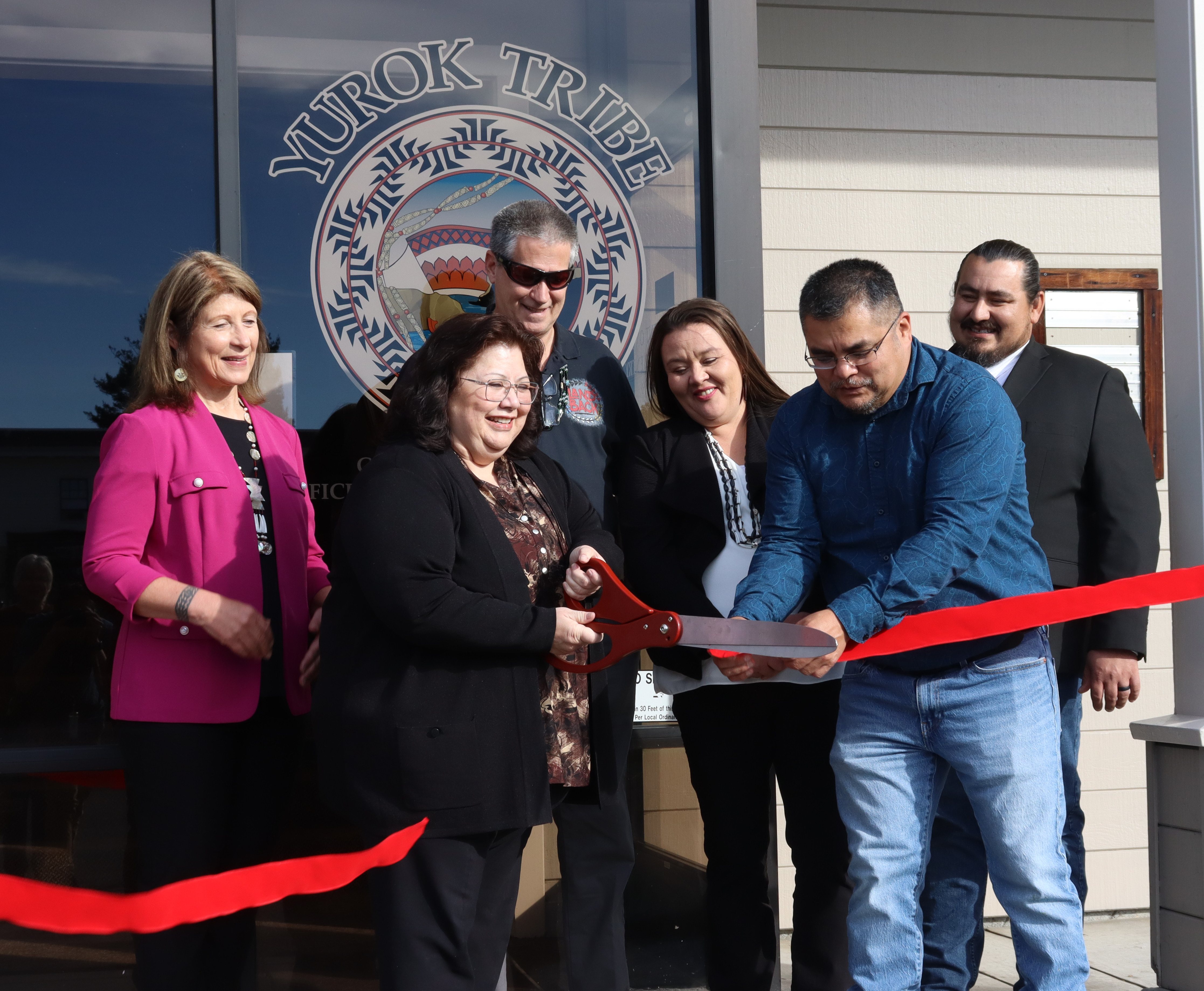
    On the first day of November on a pleasantly warm sunny afternoon at the edges of Old Town in Eureka, members of the Yurok Tribal Council gathered in front of their office building at 930 Third Street, Eureka. The council smiled as they cut the big red ribbon to signify the grand opening of their new office space for the Yurok’s court services. The new building houses a meeting place for the council within the South District. Eureka is located in what is known as the South District for the Yurok tribe.

    Among other duties, the council is responsible for managing the ancestral lands of the Yurok that they are in direct control of, as well as managing the salaries of tribal personnel.

    Lana McCovey is the council member of ten years who oversees the South District (and held the large scissors to cut the ribbon). McCovey was ecstatic about the opening of the space as now employees and residents can be closer to court services.

    “What we found is that there’s a large amount of employees and members down in this area,” McCovey said. “We found it necessary to accommodate them. People from [the South District], to do normal, everyday business, would have to drive to [Klamath] to get that done. So we want to be able to offer [tribal court services in Eureka] also.”

    This is the second office that the Yurok holds in Eureka; however, the 930 Third Street address focuses on court services. One service that the office will provide are diversion programs Court services that the Yurok offer in the space focus on supporting at-risk youth and elders, supporting victims of crimes such as domestic violence, probationary services, visitation services, foster services, and more. Space for council operations and an office for the tribal prosecutor also reside at the new address.

    The Yurok staff that occupy the new building have found the space to increase their productivity in a number of ways. Besides the new office being able to support individuals in Yurok’s South District, Court Director at the Yurok Tribe Jessica Carter notes the building is only blocks away from Humboldt County’s courthouse.

    “We can walk and get coffee and food,” said Carter, “And we can go to the jail if we have to file something or go visit our clients. Definitely accessible.”

    COVID-19 played an important role in the development of the office building, as it was paid for thanks to the CARES Act during the pandemic. The tribe acquired the building in 2020. After renovations, the court services began to steadily move their court services away from their previous location, the Aawok Bonnie Green Site. The former site was located at Worthington Elementary School, and the office there was a portable classroom. The Yurok are now able to house many of the employees hired during COVID, who now need an in-person desk to work at.

    “You can hire all the people you want for the job,” said McCovey, “but if you don’t have the space for them, then what’s the point?”

    The new office space is much larger than the previous location. Now that many of the court services within the Yurok court system have their own suite within the office space, communication has become more efficient. The Yurok Tribal Child Support Services (YTCSS) staff enjoy the opportunities for more efficient and safe communication with each other now that each program has its own suite to chat amongst themselves.

    The YTCSS staff is happier now that each court program has their own defined space within the new building. Each department has increased confidentiality thanks to the privacy and are able to speak to each other about cases rather than needing to communicate through emails.

  • New food truck serving a Japanese-Mexican fusion cuisine

    New food truck serving a Japanese-Mexican fusion cuisine

    by Maranda Vargas

    Have you visited Cali Crew Hibachi Grill and Sushi yet? There’s a new food truck serving delicious Japanese cuisine parked in front of Pacific Outfitters in Eureka. 

    Cali Crew Hibachi Grill and Sushi has only been operating for two months and is the project of Alejandra Romero and Edir Nevaro. They began planning the business last year as a way to have more freedom to be with their young family, while also pursuing their culinary passion.

    As I waited in line I could hear crisp sizzling sounds from the grill, sending my belly rumbling. The rich smell of garlic butter that all the meat is cooked in wafted from the kitchen.  

    The menu boasts grilled steak, chicken, shrimp and even scallop combinations along with a medley of sauces. I had my eyes on the chicken hibachi bowl with a side of spicy mayo and sriracha. 

    Photo by Maranda Vargas. Alejandra Romero, owner of Cali Crew Hibachi Grill & Sushi, smiling at the order window.

    Having only been in business two months, there was already a steady flow of customers. Romero smiled warmly as she handed me my chicken bowl. The bag felt heavy as I carried it away to dig in – always a good sign. Steam billowed out from the bowl as I removed the lid. 

    Photo by Maranda Vargas. A grilled chicken hibachi bowl from Cali Crew Hibachi Grill & Sushi next to a side of spicy mayo.

           There was a generous amount of seasoned grilled chicken on top of rice, lined with fresh broccoli, zucchini, onions and carrots all grilled to perfection. Not mushy, not hard; the perfect al dente. A side of lemon wedge brightened the flavor and with the addition of the sauce, the dish was next level. 

    Romero’s favorite menu item is a grilled steak hibachi burrito, which can be found on the “secret menu”. 

      “It’s my favorite,” said Romero. “There is grilled steak, noodles, veggies, rice and a chipotle mayo.”

    If you’re craving the experience of a new treat, you can find Cali Crew Hibachi and Sushi at Pacific Outfitters parking lot in Eureka during the week, or at The Bigfoot Taproom on Saturdays. 

  • The Eureka Street Art Festival

    The Eureka Street Art Festival

    by Maranda Vargas

    If you have driven through Eureka, you have probably seen at least one spectacular mural along your travels. The beyond life size artwork peeks out from historic buildings all the way to bridge pilings, overpasses, park benches and sidewalks. The Eureka Street Art Festival is a week-long event where local and international artists transform public spaces into an immersive art experience for the community. 

    The quaint coastal town of Eureka boasts a historic district known as Old Town that’s nestled by Humboldt Bay. Old Town is filled with Victorian era architecture and a variety of art galleries, unique shops, bookstores and a myriad of locally crafted fare. Art installations and murals have become part of the Old Town ambience since its designation as a California Cultural Arts District.

     In 2017, The Black Faun Gallery commissioned two large murals to be created in Old Town. The buzz and interest in the new murals had created an opportunity for further art tourism to the area. Seeing an interest from the community, Michelle Cartledge, Swan Asbury and Jenna Catsos created the Eureka Street Art Festival the very next year. 

    “We saw a desire for murals in the area and we realized that this could really benefit the community,” said Catsos. “We work to make sure that everyone who passes through Eureka can see themselves in the artwork that we present in the city.”

    The festival just completed its sixth year and has added at least 100 new murals to Eureka since its induction. Catsos says one of her passions is to help develop the next generation of mural artists locally, as well as artists of other media transferring their skills into becoming a mural artist. The festival website has information on how to apply to be an artist as well as an apprenticeship program. 

    Photo by Maranda Vargas. ‘Tortured Beauty’ by Artist Tony Diaz for the 2021 Eureka Street Art Festival.

    Local artist Tony Diaz of Ripe Mind Productions has created several murals for the festival. Diaz graduated from Humboldt State University with a degree in the Arts,  with printmaking and graphic design being his focus at that time. It wasn’t until later that he would transform his printmaking skills into a new passion of painting murals. Diaz created his first mural for the 2019 Eureka Street Art Festival. After the first mural, his interest snowballed into a career. 

    The vibrant mural titled ‘Cruising for a groovin’ featured in this year’s festival was one of Diaz’ creations. Diaz invited his fiancé and younger sister to be on his painting crew for the event. The larger than life mural took the crew a week of ten-hour days to complete. Diaz as a college student was uncertain if he was going to be successful having a career as an artist. 

    Photo by Maranda Vargas. ‘Cruising for a Groovin”painted by Artist Tony Diaz for the Eureka Street Art Festival.

    “It’s all about putting yourself out there and just really not giving up,” Diaz said. “If you really want to do it, you’re gonna find that you can make as much money if you just take the leap, and sometimes it’s great to take the leap.” 

    The Eureka Street Art Festival commissions both local and international artists to create murals throughout Eureka. The mission of the project is to create accessible art while enlivening public spaces, revitalizing the community and attracting art tourism to Eureka.

    The murals from this year’s festival have all been completed and are ready for your viewing pleasure. You can find pictures of past murals along with a map of all murals and the names of the artists on the Eureka Street Art Festival website.

  • Hometown heroes celebrated in Rhododendron Parade

    Hometown heroes celebrated in Rhododendron Parade

    by Andres Felix Romero

    Originally printed May 5, 2023

    Crowded together on all sides of Henderson and C street sidewalks in Eureka, local Humboldt residents excitedly waited for the 2023 Rhododendron Parade to commence. When the clock struck 10:00 AM, the Eureka branch of the fraternal organization Native Sons of the Golden West presented the American flag for the National Anthem, sung by Taylee Mullins on the announcers’ stage. Following the presentation, 62 different organizations in the local area paraded through the streets of Eureka beginning at 7th and E streets. 

    The annual community gathering was held on Saturday, April 29, and was organized by various organizations from Humboldt County, primarily the Old Town Eureka Rotary Club. They’ve been involved with the Rhododendron Parade for at least 30 years, and have been the primary organizers of the annual celebration for the past decade. Old Town Rotary Club President Amanda Moxon takes pride in her organization’s involvement with the community event, especially bringing back the Parade post-COVID.

    “Last year was the first year [after the pandemic],” Moxon said. “We’re getting back to our pre-COVID activity. It’s just so good to see everybody out and volunteering their time to make [the parade] happen.”

    The Grand Marshal of the parade is a notable person who rides in an open car in the front of the parade to honor them. This year’s Grand Marshall was owner of Shafer’s Ace Hardware, Jack Reike, along with his wife Michele Reike.

    “I’m super proud of my husband,” Michele Reike said while preparing for the parade to begin. “We’re excited to be here and involved in this longtime community event.”

    The Reikes led the parade in their crimson red 2013 60th Anniversary Corvette along with their grandchildren tossing toys to the crowd. When asked about how he became Grand Marshal, Reike remained humble.

    “Just years of helping out in the community,” Jack Reike said, smiling at his Corvette. “I really appreciate [Rotary] asking me.”

    The Reike’s appointment to Grand Marshal follows the Rhododendron Parade’s 2023 theme of Hometown Heroes, celebrating individuals like the Reikes who have spent years in service to the community. There were a plethora of other people participating in the parade that supported the communities. Organizations ranging from the children’s service group the Shriner’s to emergency responders such as emergency medical technicians (EMTs).

    Paige Hannemann is an EMT with City Ambulance of Eureka. She along with her team were ecstatic to interact with the Humboldt community in a positive way.

    “We’re excited to see the community in a better light than we normally do,” Hannemann said. “We see people in the worst days of their lives. It’s nice to see them on their good days and when they’re happy.”

    Other local heroes were present that provide sanctuary to those in need for those who walk on more than two feet such as Sequoia Humane Society, a no-kill shelter. They were being led in part by Tracy Lizento, a volunteer present with her own rescue, 16 year-old precious. Lizento was happy to be at the parade to represent pets in need, and to educate the community on proper care.

    “We’re excited to be here and to show our animals,” Lizento said. And to let everyone know they need to neuter their pets.“

    There was no shortage of the variety of methods the parade participants used to mobilize themselves throughout the Eureka streets. There were riders in horse-drawn carriages, motorized trolleys, an appearance by Smokey the Bear in a Forestry truck, a variety of vintage vehicles including VW Buses, and of course the classic method of human transportation was reserved for the marching bands, walking. 

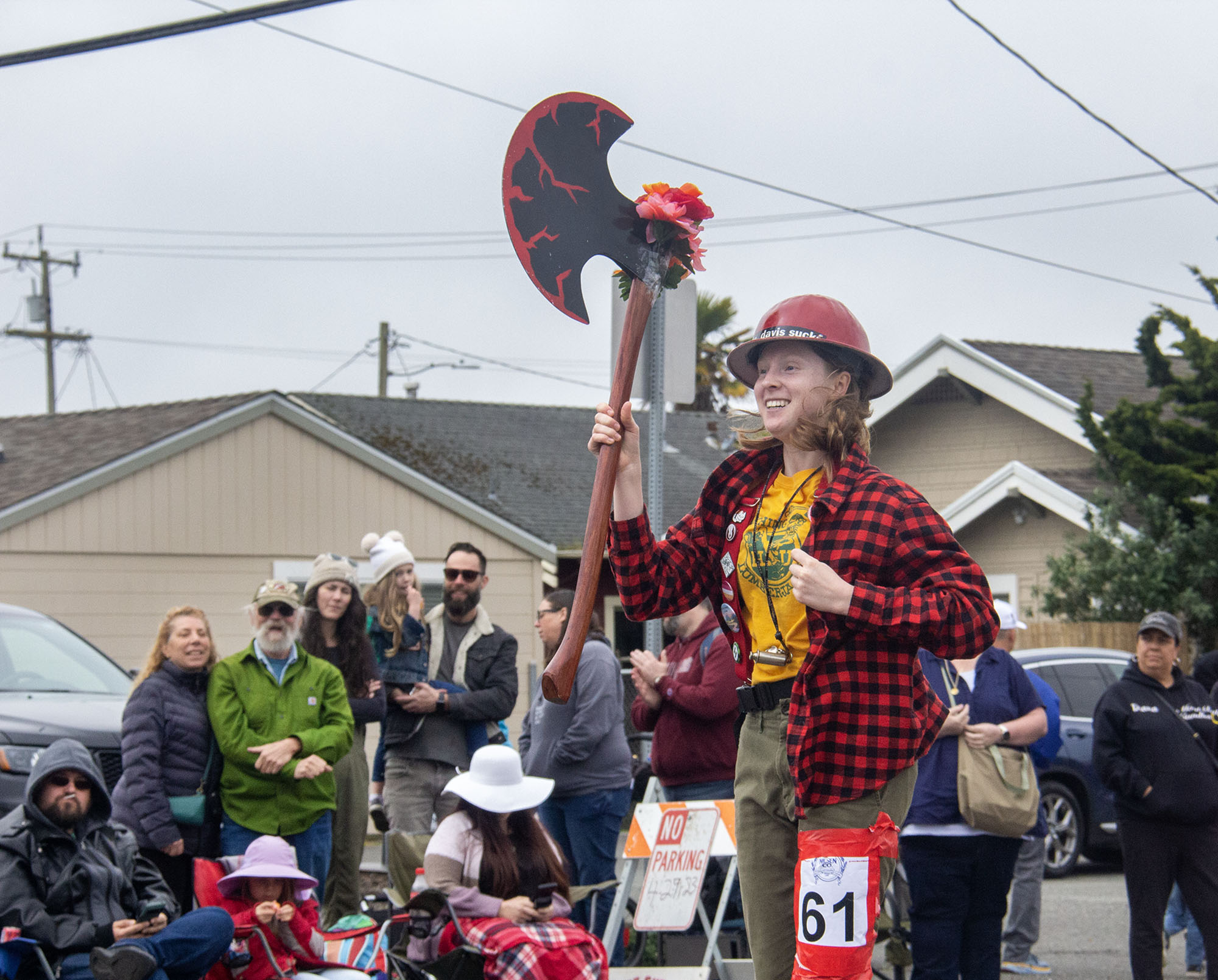
    The Rhododendron Parade also marks the final performance of the semester for the Cal Poly Humboldt’s marching band, The Marching Lumberjacks. Brand new band member Sammie Malcom led the Marching Lumberjacks as their Axe Major.

    “This is my first year,” Malcolm said while reflecting before the parade. “Now I’m leading it which is pretty crazy.”

    General Manager Chris Perez was proud to continue the Marching Lumberjack’s participation in the parade following the University’s transition to Cal Poly Humboldt and to serve an important role in the celebration.

    “It’s been tradition,” Perez said. “ We’ve been doing this since we were Humboldt State. [Marching Lumberjacks] gets the last position of the parade because we’re the anchor”

    Mellophone player Michael Caban enjoyed being able to play one last time with graduating seniors, and having his last performance of the year be with an interactive crowd and great bandmates. 

    “It’s always fun performing with the Lumberjacks,” Caban said. “And this wasn’t the exception. We’re an energetic group.”

  • Humboldt hosts late-night legend Jay Leno

    Humboldt hosts late-night legend Jay Leno

    by Andres Felix Romero

    Originally printed March 1, 2023

    He’s been burned by gasoline, cracked both his kneecaps after being clotheslined by a wire while riding a motorcycle, and he testified at Michael Jackson’s 2005 trial. He’s the hardest working man in show business, and he’s met several sitting presidents. He’s Jay Leno. 

    The Centre Arts Department of Cal Poly Humboldt hosted two Jay Leno stand-up comedy shows on Feb. 26 at the Arkley Center for Performing Arts in Eureka, CA. Centre Arts puts on many performances for the Humboldt Community, but Leno’s first outing in Eureka is undoubtedly one of the biggest names they’ve booked. 

    I was amazed to see that Jay Leno, an entertainment legend known for his shows such as Jay Leno’s Garage and The Tonight Show with Jay Leno, was going to be down the street from campus.

    Being a huge fan of stand-up comedy, I was pleasantly surprised when Leno managed to hit my favorite markers in any comic’s set in his first punchline; personal stories, social commentary, and just the right amount of dark humor. He began his show by telling us how the process of healing from a garage accident last fall had left his face with burns that came with  a surprising expense.

    “The most expensive part of the situation was the gasoline that burned my face,” Leno said to the crowd. 

    Not every joke landed for me, and some plain went over my head. Granted, I don’t always understand humor or sarcasm. Leno also knew his audience and jokes were directed to an audience more his age. I enjoyed the self-awareness the seasoned comedian displayed.

    Despite this, I still appreciated hearing Leno compare different aspects of society from decades ago to today, such as how the Sears catalog is the original Amazon Prime. Also hilarious are his own personal thoughts as an elder in a world that is always changing socially and developing technologically. 

    My favorite parts of Leno’s show came from his social commentary, which he often gave through jokes on topics such as backwards values on violence in entertainment. His set included stories of his wife refusing to watch animal violence on television, but enjoyed a scene where a woman brutally stabs her husband to death. One of the highlights of the night was the story about a mafia member venting to Leno about how The Sopranos was offensive, because a mob boss going to therapy in the show highlights the strange value system in entertainment. 

    “Oh, it’s not the murder and beheadings,” said Leno, “It’s the mental health aspect he’s upset about.”

      Towards the end of his set, Leno began to stray away from personal anecdotes and began to rapid-fire jokes and punchlines on a variety of subject matter, some risky and others lighthearted. Getting the audience to laugh at a topic as heavy as Bill Cosby’s abuse allegations to something as stupid as remote control breast enhancements showed me Leno’s veteran status as a stand-up comedian. 

    My favorite of these punchlines was on the topic of politics and how just about anyone from either side of the political aisle can enjoy them, like when he poked fun at the investigations into Joe Biden.

    “You know what you call someone who digs up dirt on Joe Biden?,” Leno questioned the audience. “An archeologist.”

    After the show, some of Leno’s fans waited behind the Arkley Center for a chance to meet him. A half-hour later, Leno popped out the back door of the building. 

    He greeted us, took pictures, shook hands and signed autographs. He still carried the same calm demeanor he had had on stage that made it feel easy to talk to a man who has a chin known by most of the nation. It was cold outside, he was likely exhausted from flying into Humboldt earlier in the day, but he still took a few minutes to chat with us. It was a great lesson on humility.

    Before he left, I asked Leno if he could share any advice to Cal Poly Humboldt students trying to figure out how to succeed in their fields. Leno recommends that when trying to contact someone in your field, be personable by writing a letter to stand out in a digital age and be professional.

    “But if you actually handwrite a letter, you got to have decent penmanship.” Leno said. “Don’t write in crayon on a paper bag.”

  • Restaurant Review: Curry Leaf’s expansive options transport customers across the world plate by plate

    Restaurant Review: Curry Leaf’s expansive options transport customers across the world plate by plate

    by Oden Taylor

    Get out your wallets, folks, this is not your average Asian eatery.  

    Curry Leaf: Asian Fusion and Sake Bar opened earlier this month in Eureka, making its place as the only restaurant in Humboldt county to serve Malaysian, Indian, Chinese, Japanese, Korean, Thai food, and more, all under one roof. 

    Opened by Chef Joe Tan, who designed the sushi bar at Bayfront Restaurant in Eureka, as well as partnering to open Nori in Arcata, Curry Leaf is Tan’s third Humboldt restaurant and it’s gearing up to be a major success.

    Walking into Curry Leaf, you are greeted by a pair of Chinese guardian lions. The restaurant space feels refreshed and has undergone renovations since its days as the restaurant Gonsea. 

    My partner and I were greeted warmly and seated quickly at a purple leather booth near the back of the bustling restaurant. I was beyond thrilled when I looked at the menu and saw the range of options available to me. 

    Photo by Oden Taylor | Beef Chow Fun

    Curry Leaf is a cultural explosion for the city of Eureka, bringing many new foods to the diners of Humboldt county. The menu includes ingredients like screwpine leaves, dried chili coated anchovies and fried taro nests, to name a few.  

    To start off the meal, I ordered the fried street wontons with special szechuan red chili sauce. The wontons come either steamed or fried and contain ground pork, shrimp, yellow onion, and black mushrooms. 

    They were so crunchy and flavorful. The red chili sauce is made with a savory spicy bright red chili oil that really compliments the wontons. 

    Even the side salad we ordered was beautifully plated and had crisp, fresh ingredients with a delicious tangy sweet miso dressing. 

    Make sure to order appetizers because though the waitstaff is friendly and professional, it can be a bit of wait due to the popularity of the restaurant. 

    For our entrees my partner and I shared the beef chow fun and the honey glazed prawns. 

    The beef chow fun is a large portion of velvety beef, rice noodles, bean sprouts, soy sauce and green onions. This dish is hearty and perfect for sharing. 

    The honey glazed prawns were the star of the evening. The prawns are lightly fried and coated in a succulent honey lemon glaze. The portion is huge and is served with perfectly cooked broccoli and aromatic steamed rice. 

    For lovers of classic honey walnut shrimp, the honey glazed prawns at Curry Leaf elevate this dish to the next level.  

    As our meal came to a close we shared the almond pudding—a Chinese soft-style jelly made of apricot kernel milk, topped with whipped cream, honey and bright goji berries. 

    This dish is served cold and has a similar texture to flan, but tastes like an almond vanilla ice cream. It’s sweet and rich, making it the perfect ending to a very well crafted meal.

    All of the food was cooked perfectly and plated professionally. Even the drink menu is fantastic with desert alcohols like chocolate nigiri and pineapple sake, as well as more traditional beer, wine and sake. The restaurant also offers free refills on non-alcoholic specialty drinks like Roy Rogers and Shirley Temples.  

    If you are looking for a delicious meal and a good night out, Curry Leaf is the place for you. Curry Leaf is located at 2335 US-101 in Eureka and can be reached for take-out at (707) 798-2049. It is open from 11:30 a.m. to 9 p.m. Wednesday through Monday.

  • Getting stuck on the Trump train

    Getting stuck on the Trump train

    Writer Anthony Aragon details his experience of accidentally joining a pro-Trump car rally.

    It all started on Sun., Nov. 1, when hundreds took to the streets of Humboldt County to embark on a political car rally to voice adamant support for current President Donald Trump. The organized caravan of Trump loyalists began the trek in Fortuna around 2 p.m., ending in McKinleyville later that afternoon.

    What came as no I surprise to me with a track record of bad luck, I got stuck in the middle of this parade while out in Eureka doing my normal, weekend errands.

    Once I merged from the corner of Sixth street onto Broadway, I knew I was in trouble.

    Surrounding me was a fleet of lifted trucks and muscle cars boasting banners and American flags flooding the majority of the street. The sounds of revved truck engines and chants of USA from vehicles grew louder as we traveled north towards Arcata.

    As we approached the Eureka courthouse I could see protestors lining the sidewalks on both sides of the street. The small restless crowds chanted in disapproval of the arrival of the conservative coalition. Adversaries were clearly at odds with one another, each party growing more aggressive in verbal taunts. At one point while waiting for the street light to turn green I looked to the individuals on the left side of the road and gave a small smile of approval against the other vehicles stuck in traffic. Evidently, this smirk was mistaken as a sign of disrespect and two female protestors began to shout and throw middle fingers at me while I sat in dismay.

    After what seemed like an eternity the light finally turned green. Trying my best to maneuver past the vehicles participating in the rally, I couldn’t help but begin to read the flags plastered with Trump propaganda. Amongst the various banners that waved freely through Highway 101, one struck me in particular:

    “Trump 2020 NO MORE BULLSHIT.”

    The irony of watching the divide between local, sprung a question into my mind that I’m still trying to come to terms with: how did we become this divided as a nation?

    In the last four years since Trump’s administration has taken office, our culture has become separated in which respecting political beliefs that differ from your own is increasingly more difficult. Polarizing topics such as immigration reform, the constant fight for equality amongst BIPOC, climate change and dealing with the repercussions of COVID-19 have added fuel to the already volatile fire that is in America.

    As time grew closer to election day, the uncertainty of what direction the United States would be headed towards became nerve racking. Attending college during a pandemic in a rural area that lacks diversity has been shrouded in lingering doubts. Paying full-priced tuition for an education that feels subpar, while studying an industry that has been bastardized by Donald Trump is hard to reconcile with. The feelings of frivolity I’ve felt as a college student in such an uncertain era have been amplified by the fear of what is to come in Humboldt County since Trump has lost the election.

    Four days after Tuesday’s, Nov. 3, election it has been officially announced democrat candidate, Joseph Robinette Biden Jr., has won the presidential race of 2020. Though the future seems hopeful, the divide in our nation doesn’t dissipate when Biden takes his eventual oath in office.

    On Nov. 7, Biden held a press conference in Wilmington, Delaware to announce his victory. Within minutes of his speech, it felt incredibly refreshing to not be subjected to coded language and devised rhetoric that became the norm in past years.

  • Eureka Protests Erupt After George Floyd Murder

    Eureka Protests Erupt After George Floyd Murder

    Eureka protesters gathered in front of the Humboldt County Courthouse

    Hundreds of community members gathered in the rain outside of the Humboldt County Courthouse, Sat. May 30, to protest the death of George Floyd who was murdered while in police custody in Minneapolis, MN. From 3 to 10:30 p.m. demonstrators marched through Eureka up to the Slough Bridge, back through town and then down Broadway. Law enforcement was largely cooperative with demonstrators, blocking intersections as people made their way through traffic. Chants could be heard the entire way even as groups split up and went to various parts of the city. 

    As the group returned to the courthouse tensions flared at the sight of several police vehicles, which were soon removed from the scene. Eureka Police Chief Steve Watson was present at the protest and spoke with demonstrators as the crowd dispersed and headed away from the courthouse. These demonstrations in Humboldt are some of countless that have sprung up across the nation following Floyd’s murder. 

  • Determined and Dedicated: Eureka Local Paves the Way to the NFL

    Determined and Dedicated: Eureka Local Paves the Way to the NFL

    NFL Green Bay Packers pick up Eureka standout in the 2020 Draft

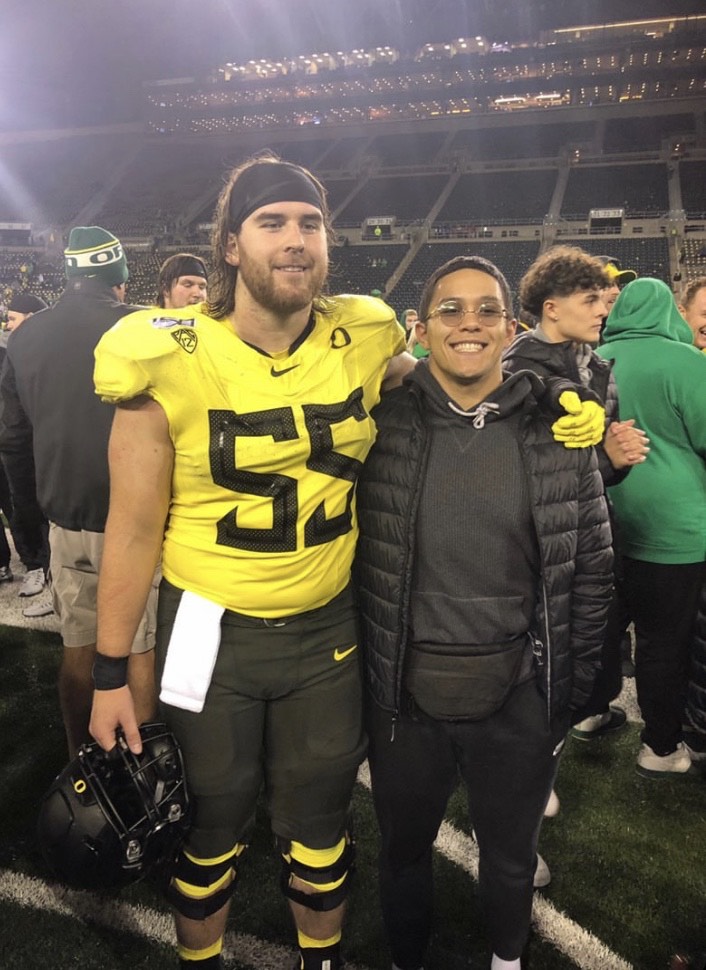
    You’re watching the 2020 NFL Draft. It’s the sixth round and the Green Bay Packers are on their 29th pick. The Packers are about to make a life altering call to a player who will soon have the chance of playing alongside the quarterback legend, Aaron Rodgers. A familiar Humboldt County name flashes across the screen. Former local Eureka high school alumnus and University of Oregon center, Jake Hanson has just been drafted as the 208th overall pick for the Green Bay Packers for this upcoming 2020-21 season.

    A key component of Hanson’s journey began when he signed to play for the Oregon Ducks in 2015. During his four seasons playing with the Ducks, Hanson started almost every game. During his first three seasons, Hanson didn’t allow a single sack with a total of 2,738 snaps. The starting center received a total of two honorable AP second team Pac-12 All Conference recognitions.

    Tyson Miller is a local MMA pro fighter, former high school teammate and good friend of Hanson’s. Miller and Hanson initially met in kindergarten but it wasn’t until the two went to a football camp together their freshman year when they really hit it off and started hanging out. Miller sees what many fans have noticed on social media since the draft. Hanson comes in at almost 6’5”, 303 lbs, his size works to his advantage.

    “First of all, his size,” Miller said, “He was bigger than most of the other lineman on the field.”

    Size is not the only key feature that stands out about Hanson. Miller points to Hanson’s effort on the field as a big upside.

    “He’s going to be a professional football player.”

    Tyson Miller

    “Jake is going to give it 100%,” Miller said. “If somebody demanded more than 100%, he was more than willing to give more than 100% right back.”

    The dedication and game mentality that Hanson possesses is one that is truly admired by not only Miller, but by others as well. The ability to turn up the heat in a game is sets athletes apart from one another.

    “[He is] going to be a professional athlete,” Miller said, “He’s going to be a professional football player.”

    Hanson is going to be a memorable name within the community and make an unforgettable mark for the Packer Nation.

    In an article by Forbes, Packers General Manager Brian Gutekunst pointed out Hanson’s work ethic and personality as a positive for the teams newly acquired offensive lineman.

    “Just really a model of consistency and another culture guy,” Gutekunst said. “The kind of guys that we like to bring into our offensive line room.”

    While the Packers have their seven year veteran center Corey Linsley under contract for another year, there is no doubt that Hanson will be Linsley’s backup for this upcoming season. Hanson is going to be a great asset to the Packers. His strength, size and quick feet will play a pivotal role in his movement of helping block the defensive line. I am predicting that with time, after the team continues to work with him and his snap consistency, he will be their starting man.

    If you’re looking to watch some football and don’t know what to do without Humboldt State’s football program but still want that local spin, be sure to tune into some of the Green Bay Packers match ups. Remember to look for #67 on the field.

  • Letter to the Editor: This Bus Driver Misses Students and Faculty

    Letter to the Editor: This Bus Driver Misses Students and Faculty

    A note from a local bus driver longing for a crowded bus again


    This is a letter to The Lumberjack from local bus driver Mark Condes. The letter has been edited only for grammar and punctuation.

    I drive a bus around Arcata, California. I frequent the Library Circle and the 14th Street & B intersection. Lately, on very infrequent occasions, I drop off an HSU student at one or the other. But this has been dwindling down to rare moments. I’m writing this because I just wanted to say that I miss all the students and faculty who have been my passengers for over a year now.
    .
    I miss making the rounds on LK Wood down to Camp Curtis, rolling out to Sunny Brae for my three stops there, the long drive down to Greenview Market to pick up the handful of students and a professor in that little corner of Arcata, and out to the Valley West loop where we scoop up the largest busload of students along Alliance and Foster streets, packing them in like sardines, as we like to say, with a call out to the back of the bus, “Do we have room for just ONE more?”
    .
    I’m a lucky person lately because I’m still working, still driving all over town. During these times, we only run what’s called the ‘Orange’ route. No more Red, no more Gold, just a mashup of both.
    .
    Truth be told, I feel a bit unlucky also. While we still pickup a handful of Townies going about their ‘Essential Needs’ business, nothing replaces all the bustling energy, the fantastic smiles, the mix of voices of my student riders.
    .
    I suppose I’m getting to the point, or heart, of the matter… ‘My’ student riders.
    Maybe I’m just a softie. I know I’m not some old lonely guy grasping at any human interaction, desperate for some validity that I still exist and matter. But yeah, I suppose I’ve formed an attachment at some level. Perhaps it’s a mix of all things that make me who I am, that have allowed me to feel some level of connection with the younger people heading off to HSU and their open road to the future.
    I have had the pleasure of watching my own kid go through the same process and life experience of college, and that was just a few years ago. I’m sure there’s a relationship here also.
    .
    While I ride around, one large circle each hour… hour-after-hour, I will often feel that tinge of loss, that nudge of sadness as I reflect on how alive this lumbering conveyance once felt, and now how hollow and empty it’s become.
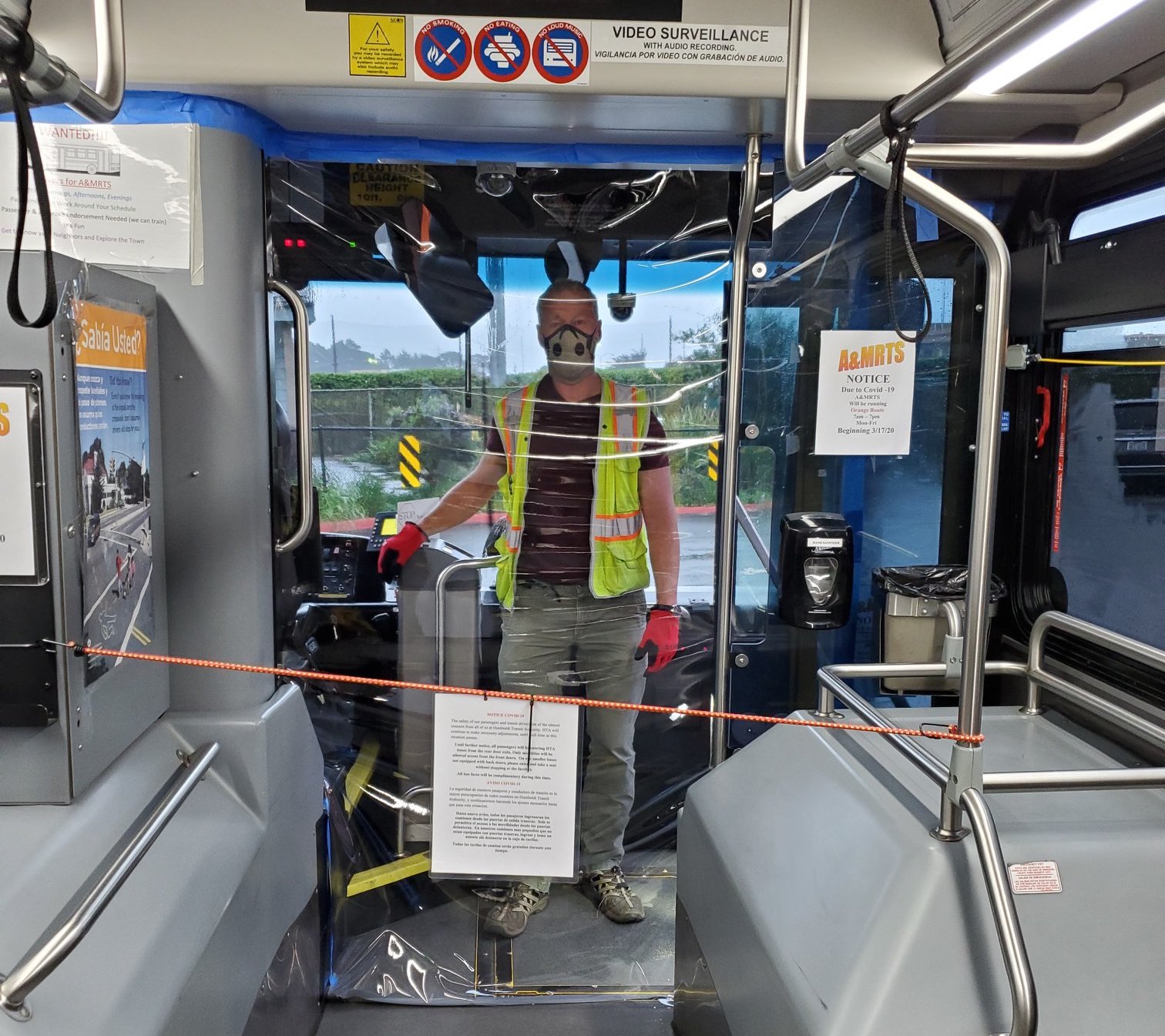
    And then there’s that other factor, an anomaly I hope… the separation of driver from passengers via a vinyl wall. So impersonal, a clear Berlin Wall, if I may.
    .
    As I arrive at each stop, in particular the ones where I would pick up students, I still pause while glancing out in the distance. I find myself looking for those waving arms, that transition from a walk to a full-bore run, as a student realizes they may miss their bus ride to school. I grew to know a number of them well enough that I could only grin and patiently wait for them to arrive, panting, fumbling for their student ID to swipe once they clambered up inside. 
    .
    I realize school will return to business in the future, and students will once again ride the bus. Yet, as with so many derailed aspects of our lives currently, there’s no firm date on when that will take place.
    .
    So I drive. I still take in those sweeping views as I top Union Street on my way to the Parkway Apartments, coax the bus up steep grades, and round the circle at the HSU Library. And when I pick up a familiar student, I still take off my sunglasses, pull down my mask, and with a smile call out through my plastic membrane, “Good Morning!”
    .
    From time-to-time as I roll through town, I catch a glimpse of a former, frequent student rider or professor, who no longer rides the bus. 
    In those transitory moments, we may glance each other’s way at just the right instant. As recognition unfolds, so do the smiles, the nods, the waving of the hands, and I am granted a brief respite from the isolation imposed upon me by this COVID-19 experience.
    .
    While I am grateful to still be working, still driving, I am even more grateful for all the friendly smiles, the greetings, the eye-rolls, headshakes, and laughter over my bad jokes and puns, that I experienced these past semesters. I wonder how ‘My’ students are doing, how they are faring during these trying times… I care.
    .
    I look forward to life resuming in a more normal manner, and the days of a busload of students once again bringing their energy, excitement, and friendliness through the doors.
    I honk and wave whenever I see students in graduation caps and gowns getting their pictures taken by the gates of the university. I shake off that bit of sadness and drive on.

  • Lessons from When the Spanish Flu Hit Humboldt in 1918

    Lessons from When the Spanish Flu Hit Humboldt in 1918

    Looking to the past to learn about the present pandemic

    There’s a saying that goes something like, “In order to prevent future mistakes, we should look to the past for guidance.” While this current pandemic may be new to all of us, humans have gone through this before. Some of the more recent pandemics include the SARS virus, the H1N1 virus, Ebola and HIV.

    The term pandemic is defined as something “occurring over a wide geographic area and affecting an exceptionally high proportion of the population.” Obviously, the current COVID-19 virus fits into this category. While some of the aforementioned pandemics did not enact a devastating, history-altering toll on Humboldt County, another pandemic did.

    From 1918 to 1920, the Spanish flu swept across America, resulting in an estimated 675,000 deaths according to the U.S. Department of Health and Human Services. The first official report of the Spanish flu in California was reported Sept. 27, 1918, just two weeks after an outbreak on the East Coast. By November 1918, the total cases throughout the state hit about 115,000—overwhelming doctors and government officials from north to south.

    One of three doctors that helped Spanish flu patients in the Ferndale area.

    Although Humboldt County sits in an isolated area protected by the “Redwood Curtain,” the area was soon amassed in its own troubles combatting the illness. Humboldt County had a population of about 37,000 people with Eureka holding around 12,000. The Spanish flu resulted in around 200 deaths (although it is thought to be much higher) and thousands grew ill.

    In 2012, Humboldt State alumnus and McKinleyville native Jeff Benedetti-Coomber wrote a detailed history of the impact the Spanish flu had on Humboldt County. For it, he was awarded the Charles R. Barnum History Award by HSU’s history department. For his research he scoured through old newspaper clippings for primary source documentation. He read academic analysis on how the Spanish flu affected the entire nation and he cited Matina Kilkenny, a researcher and local author for the Humboldt Historical Society who also wrote about the impacts the Spanish flu had on Humboldt County.

    What prompted Benedetti-Coomber to focus on the Spanish flu was its lack of local research. As his peers decided to look into European history, he decided to focus his attention on the effects locally.

    “I was walking through the graveyard in Arcata and noticed a family of graves, not necessarily related to the [Spanish] influenza but it got me thinking about what effects the flu may have had because it was around the same time,” he told me over the phone from his place in Los Angeles. “Once I started researching it I saw how it did affect the county and I was pretty amazed.”

    Benedetti-Coomber’s senior thesis, titled “Death In the Redwoods: The Effects of the Spanish Influenza on Humboldt County,” spans 30 pages and breaks down how each town dealt with the outbreak. He highlights what preventative measures seem to have worked and where officials, the public and the media went wrong and what they got right.

    “It’s just like today when you tell people to do something and they kind of resist. A lot of people had that with the Spanish influenza and it was a reason a lot of people died, because they didn’t take it seriously.”

    Jeff Benedetti-Coomber

    Some of the highlights from his research that still stand out to him are how Eureka initially closed all schools, which flooded the streets with children. They soon changed their minds and brought the kids back into the school to try to quarantine the children. Another nugget of research that sticks out in his mind has to do with masks and the public’s initial reluctance to wear them.

    “It’s just like today,” Benedetti-Coomber said, “when you tell people to do something and they kind of resist. A lot of people had that with the Spanish influenza and it was a reason a lot of people died, because they didn’t take it seriously.”

    When the Spanish flu hit Humboldt, the United States was in the middle of World War I and young men from Humboldt were signing up to join the war effort. There were war rallies and large gatherings of people throughout the towns in Humboldt in the fall of 1918 as the Spanish flu began to creep in.

    “Although the Great War was still the main focus in Humboldt County, more and more citizens were beginning to take notice of the spreading pandemic,” Benedetti-Coomber wrote.

    Some of the newspapers in Humboldt at that time seem to have downplayed the seriousness of the Spanish flu. Benedetti-Coomber points to an ad that was in the Humboldt Standard by Vicks VapoRub that was “disguised as an article… and it assured readers that the [Spanish flu] was ‘Nothing new simply the Old Grippe and la Grippe that was the epidemic in 1889-90.’”

    Benedetti-Coomber wrote that it is believed the Spanish flu was brought to Humboldt County by locals traveling to other parts of the state to help care for sick family members and then returning before symptoms started to show. By mid-October 1918, reports of the Spanish flu were starting to pop up in the local newspapers.

    “The Humboldt Times also reported that there were roughly 150 cases in Eureka by [Oct. 22] and hospitals were short staffed. Doctors were so busy they did not have the time to report new cases or treat the majority of their patients.”

    Jeff Benedetti-Coomber

    “The Humboldt Times and Humboldt Standard newspapers offered daily accounts of what was happening,” he said, adding that they also seemed to not care about the Spanish flu at first.

    On Oct. 12, 1918, four cases were reported in the Humboldt Times and those infected were quarantined in a “‘safe house’” on 8th Street where they could be quarantined and cared for,” Benedetti-Coomber wrote.

    At first, the mayor of Eureka downplayed the danger to the public, but two days later, five more people were infected. By Oct. 22, 1918 there would be more than 150 cases and one death.

    “According to the Humboldt Times, Mrs. Garber Dahle was the first person in Humboldt County to die from the deadly virus,” Benedetti-Coomber wrote. “The Humboldt Times also reported that there were roughly 150 cases in Eureka by [Oct. 22] and hospitals were short staffed. Doctors were so busy they did not have the time to report new cases or treat the majority of their patients.”

    Action to combat the Spanish flu across the county began to take root. Arcata was the first town to pass a requirement that all residents had to wear a mask while out in public, and by Nov. 7, 1918, the entire county was required to do so. Emergency hospitals were soon established across the county with some residents offering up their homes for the infected.

    Arcata escaped the pandemic with only four deaths, but the same can’t be said for Eureka and especially for the logging camps in the remote areas of the county. The number of cases grew in the urban areas, and by Oct. 23, 1918, the logging camps were left to fend for themselves.

    “Logging camps and small towns were informed by the newspapers and from local physicians that they would have to face the Spanish Influenza on their own as all of the county hospitals were completely full,” Benedetti-Coomber wrote while citing a Humboldt Times article titled “Influenza Increases Alarmingly in Two Days.”

    Young women wearing masks in Humboldt County.

    But one logging camp was able to escape the pandemic with no cases at all. In her article, “Missing Faces,” Matina Kilkenny reported how Carl Munther set up a quarantine system for his workers who decided to go into town. (Kilkenny’s article has a number of great photographs of life in Humboldt County during the Spanish flu.)

    “Munther required every person returning to camp… to stay four days in a tent he’d pitched some distance from the workers’ cabin,” Kilkenny wrote, adding that the returning workers were also required to work and eat separately from their peers. “Thanks to their boss, very few men chose to leave the Barrel Company camp and not one case of influenza occurred there.”

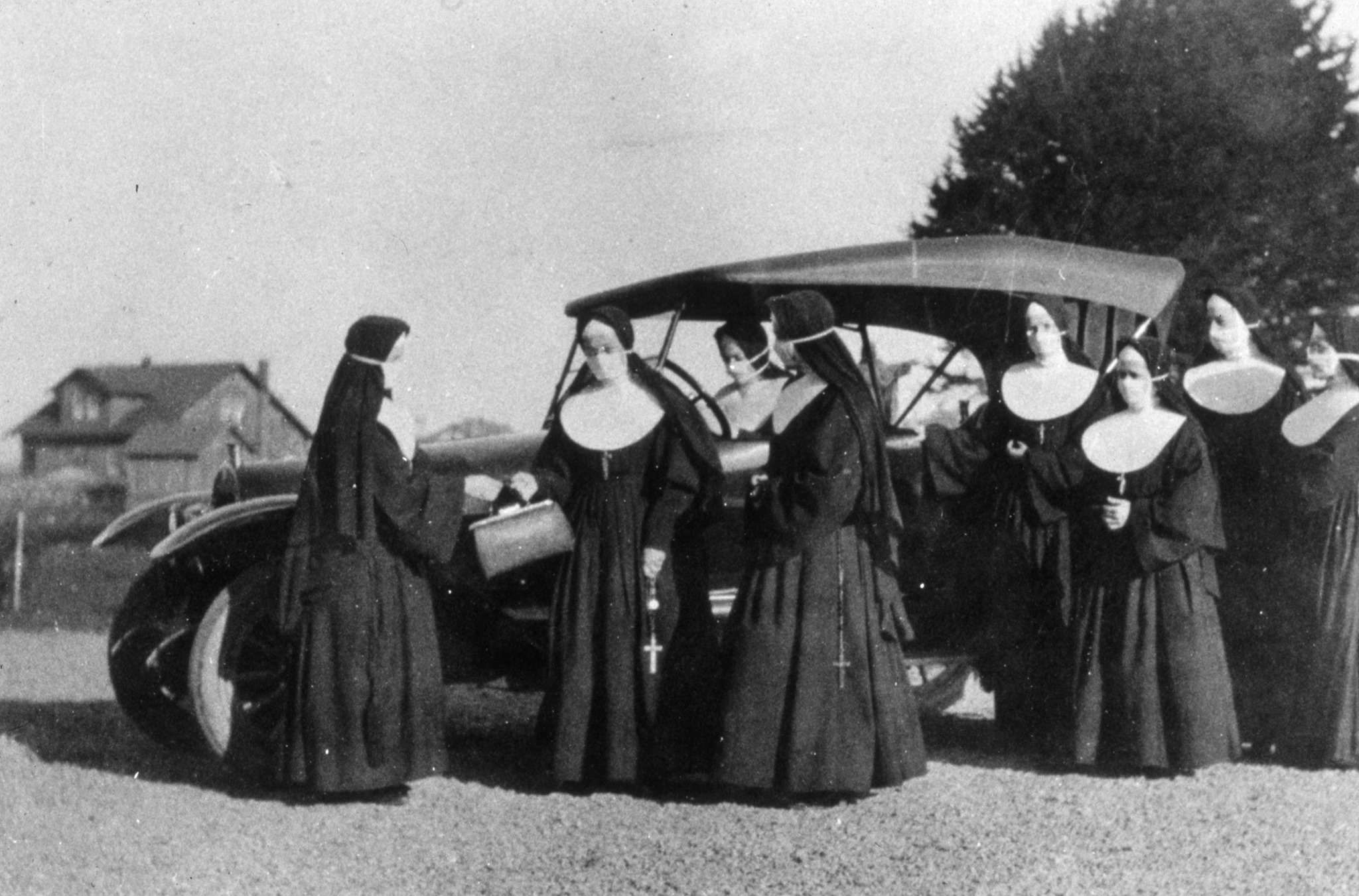
    Sisters of St. Joseph wearing masks during the Spanish flu. The sisters helped many patients in Humboldt from 1918-1920.

    Throughout her research, Kilkenny was able to find where a number of hospitals were set up across Humboldt. There was a Red Cross Hospital in Korbel, Arcata, Blue Lake and Eureka. Kilkenny also came across an interview between a member of the Sisters of St. Joseph of Orange in Eureka and a man named Brad Geagly. Kilkenny wrote the following:

    “[Mother Bernard] sent [the Sisters] out in twos, in cars provided by the Red Cross. She armed each Sister with a kit containing camphor and sweet oil, castor oil, and mustard plasters. Into the homes… the sisters came, arriving at seven o’clock and leaving at the end of a 12-hour shift, to be replaced by two other Sisters. They would attend first to the adults….They would bathe the delirious victims completely, rubbing their chests deeply with the camphorated oil. Mustard plasters would be applied, and then the sisters would wrap the sick tightly in whatever woolen material they could find; then they would tend the children. Once they had been bathed and medicated, the sisters turned to washing linens or cleaning house. They fed their charges warmed milk and broth prepared from the food furnished by the Red Cross.”

    Kilkenny noted that, generally, it was the poor who were admitted into the hospitals, while the more well-off were cared for in their homes. Because of this the actual tally for those infected and the deaths attributed to the Spanish flu is unknown. Kilkenny also points out how the Native American tribes were hit hard by the Spanish Flu as well.

    “Of the [11] Native Americans whose deaths are on record at the County Courthouse, five were from Table Bluff, two from Hoopa, one from Miranda, one from Orleans, one from Requa, and one was a laborer at Korbel,” Kilkenny wrote. She also noted evidence that many Native Americans often refused treatment by White settlers around this time period.

    Kilkenny was also able to find county death records from that time and noted that between Sept. 1, 1918 and April 1919, 175 Humboldt residents died with 91 of them between the ages of 20 and 40.

    And so what can we learn from this history?

    There is evidence that social distancing works by the example set by Carl Munther at his logging camp and how travel throughout the state can spread the virus. We can see how hospitals were eventually inundated with those infected with the Spanish flu and how staff were stretched thin. We can also see how it is important to get ahead of a pandemic and try to prepare as much as possible.

    Humboldt County seems to be doing just that. They have recently distributed around 30,000 pieces of personal protective equipment to first responders and medical staff across the county. Humboldt State chipped in and prepared 1,250 COVID-19 test kits. Also, as I’m sure you are aware, we are in a “shelter in place” order that was enacted to help stop the spread of the virus and to give medical staff the ability to fight the virus without being overwhelmed.

    Towns across Humboldt are also doing their part to help prevent an outbreak. Trinidad passed a moratorium on all short-term rentals and added some pretty forceful consequences to anyone who breaks it.

    “Over the course of the meeting, council members added some teeth to the resolution with language saying that a single violation may result in the City revoking a proprietor’s short-term rental license for up to a year,” the Lost Coast Outpost’s Ryan Burns recently reported, adding that the county may consider a similar measure.

    A stained glass piece by Humboldt artist Colleen Clifford.

    As this thing progresses, we are all going to have to make some sacrifices, but we’ll get through it. Help out the elderly and the immunocompromised if you can. Help out each other by not going out or attending pretty much any gathering of any number of people.

    Let’s all work together — but at least six apart — to help “flatten the curve.”

  • New In-N-Out in Eureka

    New In-N-Out in Eureka

    “Quality You Can Taste” in Humboldt County

    In 2018, In-N-Out Burger announced the start of construction for a new location in Eureka. Now at the beginning of March, the new restaurant located at 2616 Broadway Street nears completion.

    The upcoming restaurant currently seeks job applicants for entry-level positions, suggesting the location will be opening soon, but an exact date is currently unavailable. They plan to interview applicants on March 2 and 3.

    The first customer at the new store will receive a free meal and a T-shirt as well.

    Eureka continues to expand its collection of restaurants as new locations for Chipotle and Mod Pizza are also under development nearby.

  • Spreading Warmth for Winter

    Spreading Warmth for Winter

    Many organizations around Humboldt County provide warm clothing for little or no cost

    With winter right around the corner, it’s important that less fortunate and displaced individuals have access to food, shelter and basic necessities.

    Humboldt County has among the highest rates of homelessness in the state. With the steep temperature decline of the winter, coats, socks and warm clothes become an extreme necessity.

    Robert Lohn, the founder of Coats for the Cold, one of the largest coat drives in the county, spoke on the need for warm clothes during the upcoming months.

    “There’s a flock of families, individuals and couples who go to food banks and can’t afford food,” Lohn said. “Let alone warm clothing.”

    Lohn started the movement 12 years ago with just 20 coats. Since then, the movement has gained major recognition from across the county to help collect, clean and store clothes that are redistributed to underprivileged children in schools. The amount of jackets received has greatly increased over the years, but Lohn still prioritizes spreading the word.

    “The big picture is to show other parts of the community what we do, how we did it and how the other areas could do it as well,” Lohn said.

    Coatsforthecold.org provides a lengthy list of drop-off locations ranging from McKinleyville to Garberville. Drop-off boxes are distributed at the beginning of December through to January.

    “If anybody is in desperate need of a pair of pants or some shoes, and we have it, we will get it to them.”

    Steven Thompson
    St. Vincent de Paul Employee

    A drop-off box for warm clothes was placed on the first floor of the Behavioral Social Sciences building on Monday, Dec. 2 and will remain there through January. Warm clothes to donate include: jackets, sweaters, pants, hats, blankets, socks and gloves. Backpacks are welcomed as well.

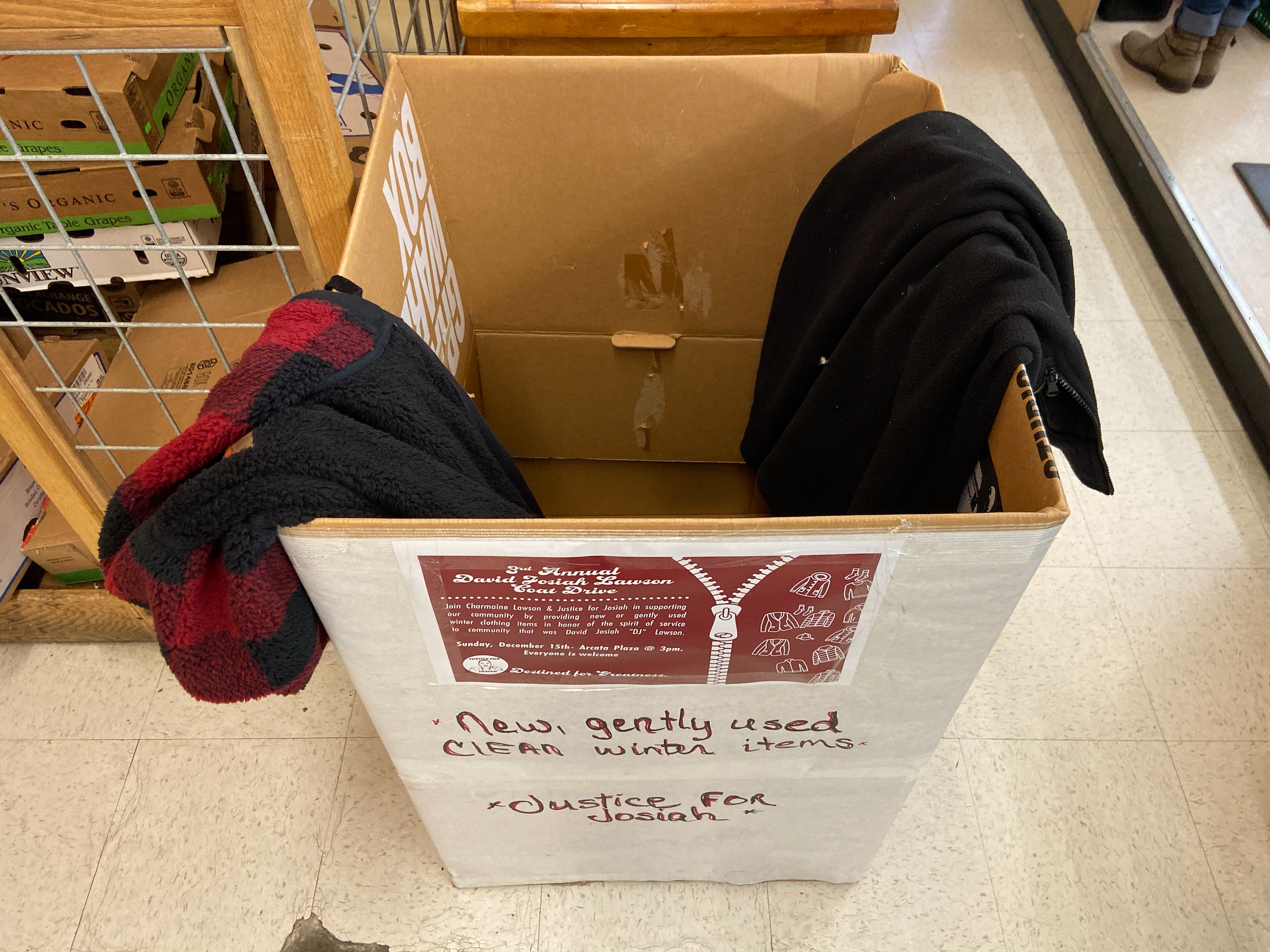
    Another place to donate is the at the Third Annual David Josiah Lawson Coat Drive, which takes place on Dec. 15 at 3 p.m. on the Arcata Plaza.

    The St. Vincent de Paul non-profit organization in Old Town Eureka is also a great resource for people who would like to donate, or are in need of daily necessities. They provide bag lunches and free clothing. They are open seven days a week, besides the first two weekends of the month.

    Steven Thompson, a worker at St. Vincent’s, says there is no specific criteria needed in order to receive the items that are offered.

    “If anybody is in desperate need of a pair of pants or some shoes, and we have it, we will get it to them,” Thompson said.

    Not only do shelter and coat drives work for donating, but Angel’s of Hope Thrift Store is another place where people can donate their warm clothes.

    According to employee Jasmine Oakshotte Angels of Hope is open every Tuesday, Wednesday and Friday, 11 a.m. to 4 p.m.

    Oakshotte says that they have plenty of warm clothing, but it is the process of getting it out to the public that makes it difficult.

    “It’s just about man power for us because we are a small group,” Oakshotte said. “There’s only four of us that price the stuff. So getting through it all, like we have bunches of it, it’s just that we have to get it out.”

    Volunteers are more than welcome and will receive store credit by volunteering for the thrift store. They also have deals throughout the week for enrolled HSU students, including receiving half-off clothing Wednesdays, Saturdays and Sundays.

    If you’re in need of warm clothes this winter, consider using the above organizations and stores around Humboldt County that provide them at either no cost or for very cheap.

  • Next Outage Could Hit Humboldt As Early As Tuesday

    Next Outage Could Hit Humboldt As Early As Tuesday

    Although areas of Humboldt County have the “all clear” for power restoration, another PSPS may be scheduled for Tuesday morning

    Parts of Humboldt have been given the “all clear” to begin line inspections and restorations for the current Public Safety Power Shutoff.

    “PG&E notified Humboldt County Office of Emergency Services (OES) that portions of Humboldt County have been given the “All clear” for the weather event and will begin the restoration process as soon as conditions allow,” the latest update from the Humboldt County Office of Emergency Services said.

    However, PG&E has also notified the county that another PSPS event may affect Humboldt as early as Tuesday morning.

    “PG&E also notified OES that another weather event is scheduled for Tuesday 10-29-19 at 6 a.m. which will also result in a possible Public Safety Power Shutoff (PSPS),” the update said.

    OES says it expects “a small window of time” between the two shutoffs, and urges residents to use the time to once again prepare to have no power.

    “As always, this information from PG&E is subject to change,” the update said. “Updates will be provided as soon as they become available.”

  • The only noods you need

    The only noods you need

    Arts Alive! is the hub of delicious and interesting foods on a Saturday night

    There’s something about meals served from food trucks that satisfies the soul in a different way. Walking through downtown Eureka, all you hear is music and chatter from the community, and all you smell is the wonderful aromas from a variety of food spots. Food trucks and street vendors come off as more authentic, which draws in larger crowds. Arts Alive! in Eureka encourages community members and friends to get together and enjoy some quality meals from quality food spots.

    My first spot I tried was Southside Mike’s Original Bar-B-Que, a food truck parked behind the horse carriage. I ordered the Mac, and it was an ooey-gooey sensation I’ve never had before. There were bits of toasted cheese and a fresh seasoning to top it off. The mac ‘n cheese is made up of four cheeses, but the cheese alone gets placed on the griddle, creating a smokey crust. I’ve had some good mac ‘n cheese, but nothing like Southside Mike’s.

    “The key is good, simple ingredients,” said owner Mike Ross. “That’s it!”

    Ross explained that the food truck is all about southern Louisiana cooking, similar to what his family made growing up.

    My next stop must have been the longest line at Arts Alive!. Casamiento is El Salvadorian and Cambodian food, and there’s no surprise that the name means ‘marriage’ in Spanish with this kind of street food. I ordered the Khmer Banh Mi, a sandwich made from a perfectly seasoned beef mixture, with cucumbers, jalapeños, and an exquisite pickled daikon and carrots. The sandwich was superb with the vegetables adding a great crunch to every bite. The food as a whole was loaded with flavor.

    “The idea is to marry the people and culture,” said Casamiento owner Jennifer Be.

    My last stop was Humboldt Fresh, a food truck that looked like it would have your traditional American food, but it surprisingly packed a punch. I ordered the C.B.G. sandwich, with chicken breast, bacon bits, cheese, tomato, and cilantro. Something that could have stayed a classic sandwich was created as something more. The cilantro added an extra fresh taste, and the chicken and bacon combo was out of this world. The best thing about this food truck is that the food is, as its name claims, fresh.

    “That’s the whole theme of this truck,” said Humboldt Fresh owner Kyle Scott. “Everything is prepped the day of and we only use fresh produce and grass-fed meats.”

    Let it be known that you will not starve at Arts Alive!, it is simply not possible. The event brings people together, creating a food hub for the community. Arts Alive! allows you to taste true authentic food, as well as introduce you to a mix of new foods, and join in with the community.

    “I get to see and hang out with the community, I think that’s the best part,” said Ross. “It’s a good excuse to come out and have a good time with the community together.”

    Arts Alive! takes place in downtown Eureka every Saturday evening.

  • Missing ship fails to damper spirits at inaugural Salt and Fog Fish Fest

    Missing ship fails to damper spirits at inaugural Salt and Fog Fish Fest

    Participants enjoyed live music, gift and food vendors despite absence of Tall Ship Lady Washington

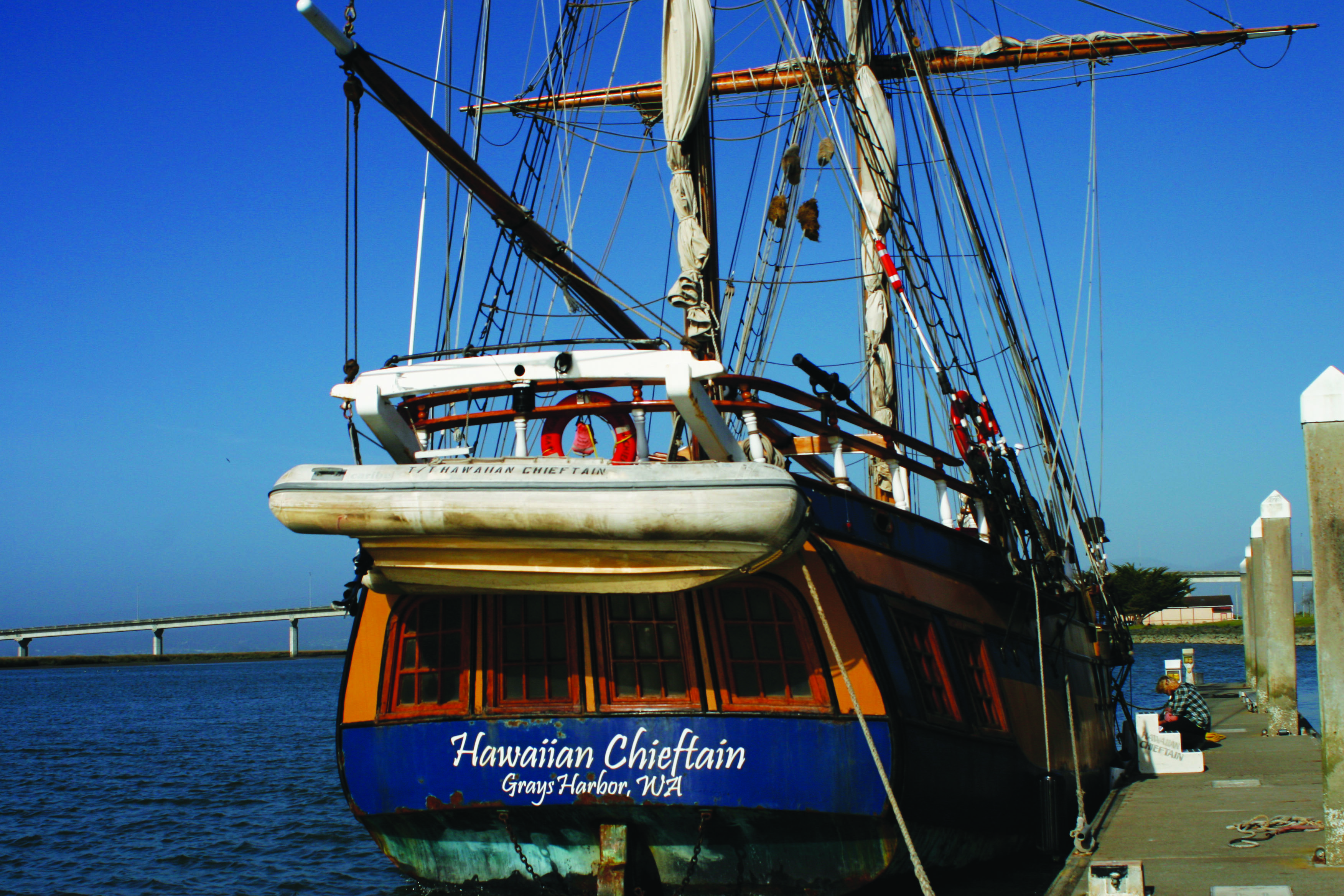
    Nautical fanatics flocked to the Eureka wharf last weekend for the arrival of the Tall Ship Hawaiian Chieftain and the inaugural Salt and Fog Fish Fest.

    Guests were invited to tour the ship, which serves as a mobile home for its crew of 14. The festival was scheduled to coincide with the arrival of the ship, and participants could take a trolly car from the main event to the nearby harbor where the ship was docked.

    Originally, the Hawaiian Chieftain was supposed to arrive with her sister ship, the Lady Washington. But stormy weather forced the wooden-hulled vessel to turn back and seek shelter in Bodega Bay.

    _MG_7454.JPG
    To the crew of the Hawaiian Chieftain, the ship is both their home and their livelihood. | Photo by Silvia Alfonso

    Chieftain’s Program Coordinator and Chief Gunner Kate Dingus said the Chieftain only made it through because its twin motors allowed it to maintain speed through the storm.

    “It was pretty rough going for us as well, but luckily we made it through without having to turn around,” Dingus said. “The Washington should be meeting us up here Sunday afternoon.”

    According to Dingus, the Chieftain is a unique vessel, sort of a ‘frankenboat’ with a steel hull and a unique sail set referred to by Dingus as a “split topsail gaff-rigged ketch.”

    _MG_7341.jpg
    The Hawaiian Chieftain was constructed in 1988, and served as a cargo vessel before being acquired by Gray Harbor in 2005. | Photo by Silvia Alfonso

    Launched in 1988, the ship transported cargo between the Hawaiian islands before being acquired by Grey Harbor in 2005. Now the ship tours the coasts with its sister vessel, providing sailboat enthusiasts with the unique opportunity to tour a tall ship.

    One of those enthusiasts was Beth White. She drove down from Oregon with a friend just to see the ships this weekend, and paid to sail around the bay on the Chieftain.

    “I was hoping to get to see the Washington, but I still had a great time,” White said. “My favorite part was the cannon firing, it was so loud!”

    _MG_7362.JPG
    Kate Dingus demonstrates the gyroscopic abilities of the Hawaiian Chieftain’s specialized compass, called a binnacle. | Photo by Silvia Alfonso

    Several blocks away from the Chieftain’s dock, the Salt and Fog fest was bustling, with live music, a chowder cook-off and a Coast Guard helicopter fly-by. The event spanned the entire weekend, with a pub crawl featuring 21 local bars and restaurants Friday, and a by-the-bay 5k foot race on Sunday.

    Event Coordinator Tera Spohr said the festival was intended to pay homage to Eureka’s seafaring and ocean-fishing heritage, and was scheduled to coincide with the Tall Ship’s arrival.

    “Everything we do locally has to do with the bay, and we thought we should celebrate some of our local artists and businesses with an event on the harbor,” Spohr said. “Every booth you see here is locally owned and operated.”

    _MG_7324.JPG
    The crew of the Chieftain know when to take things seriously, and all safety precautions are rigorously practiced. | Photo by Silvia Alfonso

    The festival hosted a wide variety of local shops. The standards like Humboldt Chocolate and Mad River Brewing were drawing big crowds, but more unique businesses like Phyl’n cold-pressed juice delivery and All Dogs Biscuit Bakery, which serves boutique doggie treats, also received lots of attention.

    The most eye-catching exhibit belonged to Dan McCauley, a local scrap artist who showed up with a massive metal crab with articulating legs mounted to the back of a pickup truck. Named “Decapodium” and originally built for Burning Man, the crab sat at the entrance of the festival, drawing in people off the street.

    _MG_7109.JPG
    The Hawaiian Chieftain pulls in after a successful tour around the Humboldt Bay. | Photo by Silvia Alfonso

    McCauley was selling his beautifully crafted scrap sculptures, and said he liked the effect his artwork had on people.

    “It’s nice to inspire people to not throw shit out,” McCauley said. “Reusing is important. Really important for my life, as it’s how I make a living.”

    As the festival died down, the Chieftain‘s crew was celebrating a successful day with pizza, a treat they only have access to while docked. Dingus has spent several weeks aboard the Chieftain, and several months on the Washington before that.

    As a member of the crew, she follows a set schedule and routine for meals and daily chores and responsibilities. She described life on the ship as very free, but said there was a lot to take seriously at the same time.

    “You feel a different kind of love, both for the people and the boat. It’s not platonic, but it’s not romantic either,” Dingus said. “They become your family, or closer than your family, because there’s stuff you can talk about with your crew that your family would never understand.”

  • Jazz in the most unlikely of places

    Jazz in the most unlikely of places

    The Speakeasy in Eureka Old Town holds true to its name

    On a rainy Tuesday night tucked away in a dimly lit Old Town Eureka alleyway, a tenor saxophone can be heard echoing off the brick-patterned mural-covered walls. A multistory Billie Holiday painting stands as a beacon of light covering the entrance to the 1920s-style jazz joint, The Speakeasy. Every Tuesday and Friday night The Opera Alleycats can be seen and heard performing covers ranging from Miles Davis’ “So What” to Thelonious Monk’s “Straight, No Chaser”.

    This particular Tuesday night the small and cozy New Orleans-style bar is full. Local musicians and bar patrons have gathered solely to hear the quintet wail the not-so-long-ago Bebop style of jazz that hit America with a left hook harder than Muhammed Ali himself.

    WALLIN.FEATS.JAZZ.02.12.19.jpg
    The Opera Alleycats’, Tim Randals, plasy keyboard at The Speak Easy in Eureka during The Opera Alleycats’ once a week jazz show. | Photo by T.William Wallin

    The brass players, keyboardist and percussionist all play in sync on the same level, feeding off their improvisations and individual solos. The trombone player embodies J.J Johnson, a low beat from the percussionist leads his rhythm and after the last blowing exhale all the hands in the bar are clapping enthusiastically.

    One wouldn’t think of Humboldt County as a destination for authentic jazz. Typically places like New York, New Orleans and San Francisco come to mind. But if you’ve ever heard jazz in any of these cities than you would be pleasantly surprised to realize jazz is at your front door.

    Once you step through the doors of The Speakeasy you are transplanted to when the consciousness of America was widening and bebop jazz could be heard in every dingy dive bar from coast to coast. The low lighting sets a hipcat mood, while the selection of booze behind the mahogany colored bar makes one feel as if they’ve walked into a Humphrey Bogart movie. The only thing missing is the ability to light up a newly packed Camel wide while crossing one’s leg and asking the person next to them for a light.

    WALLIN.FEATS.JAZZ.02.12.1920190212 (4).jpg
    Brian White blows the trombone during The Opera Alleycats weekly jazz night at The Speak Easy in Eureka. | Photo by T.William Wallin

    Trombone player Brian White said that the Speakeasy is his favorite place to play.

    “We don’t really make any money, but The Speakeasy is the only place we can play with such freedom and people actually come to just listen to us,” White said.

    He is right. Sam the bartender was busy making Manhattans and whiskey gingers for a crowd unable to keep their legs from tapping or their bodies from moving in rhythm to the band.

    WALLIN.FEATS.JAZZ.02.12.1920190212.jpg
    Sam the bartender makes cockatails at The Speak Eay in Eureka during The Opera Alleycats’ once a week jazz show. | Photo By T.William Wallin

    Local musician Anna Hamilton said this is the best group of musicians playing together in Humboldt County.

    “I travelled up here from Southern Humboldt because I needed to hear some great music tonight,” Hamilton exclaimed in between sips of whiskey sour.

    Most of the band are transplants to Humboldt County, bringing their musical influences with them. White is from Los Angeles and has been in Humboldt for over 20 years. He said he wouldn’t want to play jazz anywhere else besides Humboldt because although he has regular job, he is allowed room to breathe and play what he wants with his friends.

    The youngest member of the group is the saxophonist Issac Williams, who was born and raised in McKinleyville. The Opera Alleycats have been playing together for six years at The Speakeasy with most members interwoven into other Humboldt County musical groups.

    WALLIN.FEATS.JAZZ.02.12.1920190212 (1).jpg
    The Opera Alleycats’, Issac William, plays saxophone at The Speak Eay in Eureka during The Opera Alleycats’ once a week jazz show. | Photo By T. William Wallin

    Tonight, the band’s lineup is Brian White on trombone, Issac Williams on sax, Tim Randals on keyboard, Ken Lawrence filling in on bass and filling in for drums is Mike Labolle. They play three sets and in each intermission are out in the crowd, sipping I.P.A.’s and engaging in hearty laughter. Humboldt County being so small and rural, naturally the band and the audience are all good friends.

    The band ends on a nine minute ride of Miles Davis’ “So What”. The crowd is aware right as the first key is struck. The keyboard keys start slow and mellow, the bass riff comes in setting the tone, and everyone’s involved by the time the brass comes in. Even without a trumpet player the band is able to summon the feeling of Davis and keep the spirit of jazz alive.

    WALLIN.FEATS.JAZZ.02.12.1920190212 (8).jpg
    The Opera Alleycats’ Issac William, saxophone, Brian White, trombone, Ken Lawrence, bass, and Mike Labolle, drums at The Speak Eay in Eureka during The Opera Alleycats’ once a week jazz show on Tuesday February, 12, 2019. By: T.William Wallin

    After each player gets a chance to express their skills on their individual instruments, they all come together center stage, right toes tapping, lungs filled with inhalation blowing from the Hara outwards.

    They all end the night on the same note, with a ringing of a tenor saxophone echoing across the brick-patterned alleyway walls covered in murals close to midnight.

    WALLIN.FEATS.JAZZ.02.12.1920190212 (7).jpg
    The Opera Alleycats jazz night every Tuesday at 7:30 pm at The Speak Easy in Eureka. By: T.WIlliam Wallin

  • Pollution sours Freshwater field trip

    Pollution sours Freshwater field trip

    Editor’s Note: This an editorial contribution from Deija Zavala. The author currently works for the Lumberjack as an Online Editor.

    I went in search of ferns and ivy, I found instead disgusting evidence of human existence.

    Ecotopia.Fav.10.13.18.DSC_0093
    Assorted garbage trailing down the hill just off Greenwood Heights Dr. on Saturday Oct. 13 in the Freshwater area, east of Eureka. | Photo by Deija Zavala

    On Saturday I explored a local watershed in the Freshwater area. The field trip was for an Environmental Science Management class where the goal was to visit a local watershed and observe.

    I’d seen the beautiful landscape of Freshwater once before and hoped the trip would give me an excuse to get lost for a few hours with nothing but my camera and the wildlife.

    Ecotopia.Fav.10.13.18.DSC_0094
    Pieces of cupboards, particle board, aluminum cans, and other miscellaneous debris pile up less than 15 feet from a sign threatening prosecution over illegal dumping on Oct. 13 in Freshwater. | Photo by Deija Zavala

    At first, it was lovely. I did a short hike and found myself taken by how separated I was from my Eureka apartment and all the rumbling of engines and people on a sunny weekend morning.

    Eventually, I came to a roadside area that had so much debris it looked like a dump. Carcasses, bones and trash of all kinds lay on the side of the road. There were boxes, tiles, kitchen cabinet pieces, bottle caps, cigarette butts and Taco Bell wrappers. It was awful to witness such disregard for the wildlife.

    Ecotopia.Fav.10.13.18.DSC_0087
    A cattle bone found next to chunks of kitchen tile and fallen redwood needles on Oct. 13 in Freshwater. | Photo by Deija Zavala

    The Environmental Protection Agency website states that this kind of pollution is called nonpoint source pollution. After a big rain or when snowfall melts, nonpoint source pollution can ultimately find its way into drinking water sources such as rivers or lakes and even into ground water.

    If you come across an illegal dump, especially if its near a watercourse, you can report it to the Humboldt County Division of Environmental Health at 707-441-5410.

    Ecotopia.Fav.10.13.18.DSC_0091
    Abandoned kitchen tiles sit haphazardly amongst trash just off Greenwood Heights Dr. on Oct. 13 in Freshwater. | Photo by Deija Zavala

  • No rain on this Parade

    No rain on this Parade

    Redwood Pride Parade held at the Jefferson Center in Eureka

    Gray clouds overcast the skies of Humboldt County on Sept. 29. However, a rainbow was over Eureka, all thanks to the Humboldt Pride with a Purpose event.

    The day-long event started at 10 a.m. and continued until 4 p.m. at the Jefferson Community Center, offering many activities like making tie-dye shirts and getting in touch with local community shops and organizations.

    One of the organizations was the Redwood National and State Parks (RNSP) services. Interpretive Ranger Steven Krause was happy to be at the event.

    “Since 2016 we’ve (RNSP) been involved in the Pride with a Purpose event,” Krause said. “Personally, this is not my first pride event I’ve showed up to, I’m happy to be here.”

    Many who were attending were dressed in the colors of the rainbow, dancing and overall having a good time at the event. Ariel Stelljes, Humboldt State University student and piccolo player of the Marching Lumberjacks, was with her band members to show support of the LGBTQ community of Humboldt County.

    “We’re all dressed up very gay, and we’re super excited to play,” Stelljes said.

    At 4 p.m. over at 2nd and I St. many groups and organizations were present waving rainbow flags and playing music for all attending the parade including the Redwood National and State park float.

    Overall, it was a fun event, full of many people showing their love and support for the LGBTQ community of Humboldt County.

    Caroline Isaacs, a social actions committee member from the Temple Beth El Synagogue, showed up to march at the Pride parade to show support.

    “I think it’s extremely important to show support for the LGBTQ community of Humboldt County,” Isaacs said. “As Jews we know the struggles of being seen as outcasts by the community, we want to show the LGBTQ community that they’re not alone.”


  • The community speaks at town hall  opioid meeting

    The community speaks at town hall opioid meeting

    California state senator Mike McGuire and County Supervisor Virginia Bass hosted a town hall meeting on March 29 to discuss the opioid crisis in Eureka. Panels of statewide experts, health professionals, local leaders and addiction specialists were present.

    Social work major at Humboldt State, Ana Guerrero said, “I have seen teens shooting up in alternative schools. The thing is that in TV they show drugs as cool.”

    Mike McGuire who is currently representing California’s second congressional district began the meeting speaking behind the podium.

    “Our job is to clean up the streets of syringe land, and to deliver as many resources as possible,” McGuire said. “Our job is to better manage syringe distribution, and to go after pharmaceutical committees and hold them accountable. The unfortunate thing about this crisis is that there won’t be an easy solution.”

    Aegis Treatment received a $4.8 million investment for a medication-assisted treatment center and needle collection program, which was announced last November at the first opioid town hall meeting.

    “The grant is designed to do a few things,” Alex Dodd, Aegis CEO said. “It is designed to extend addiction treatment into primary care, to extend and expand medication treatment. It is also used to help people pay for treatment.”

    Before Dodd talked about the new center that will be open in the former Eureka Pediatrics. He wanted to clear up a misconception about the funding Aegis received.

    “This $4.8 million federal funding is coming through us to give to the communities. It isn’t being given to us to do what we want with it,” Dodd said. “The funding is not being given to Aegis to open the clinic. We don’t see one dollar of that money ourselves.”

    Technical difficulties arose with planned video conferences with outside experts. Director of technology for Humboldt County Office of Education, Doug Lee, worked behind the scenes to fix the problem as well. The problem was fixed, and the video conference ran smoothly.

    “We had 10 microphones going into one microphone jack, and one mixer. Our system didn’t understand it,” Lee said. “We muted all the mics from the control panel. Once I did that, it was fine. All things considered, I think it went well.”

    A man walking into the Sequoia Conference Center for the opioid town hall meeting. The meeting was hosted on March 29 by Senator Mike McGuire and County Supervisor Virginia Bass. Photo by Bailey Tennery.

    Lesley Hunt, project manager for the Hoopa Valley Tribe planning department, said there is a huge taboo on substance abuse.

    “In my community, we are dealing with adolescents from a heartbreak age of 10 dealing with some of the stuff talked about tonight,” Hunt said. “It is how we address it from here and how we move forward.”

    Hunt said the Aegis funding is a step in the right direction, and believes it gives us a hope and some breathing room.

    “It’s a set if money you don’t want to talk about, but it has strings attached,” Hunt said. “Sometime those strings don’t match up to what our community needs, which is infrastructure money, the facilities are outdated and overcrowded.”

    John McManus, executive director of Waterfront Recovery Services, addressed a comment about empty beds in recovery programs.

    “For the beds you are concerned with, it would be about more measures Z funding,” McManus said.

    Crossroads, a drug and alcohol rehabilitation center, and Waterfront Recovery Services are all working on being drug Medi-Cal certified, to be able to treat people who have Medi-Cal.

    “We have submitted our application. Hopefully it will take less than nine months to a year,” McManus said. “The certification standards will raise the level of Medi-Cal care we are providing for the rest of the residents.”

    In the midst of the question and answer portion, Trish Cottrel, a social work major at HSU was given the microphone.

    “I also want to encourage you to have a tribal representation at the next meeting, because I think that community really needs to be served, they are disproportionately affected.”

    Blue Lake resident Alex Bodie works for a non-profit attended the meeting. She said she liked how experts who were outside of the region commented on the problem.

    “Our numbers are high with it, but this is happening all across the country. There are root things that are underlying the problem that happens within this,” Bodie said.

    Bodie said the hosts of the meeting didn’t realize there was no tribal representation until the community members brought it up.

    “They needed to include other folks. There definitely needs to be more inclusion for the people who are doing the work on the ground,” Bodie said.


  • Needles remain a thorn in the side of Humboldt County

    Needles remain a thorn in the side of Humboldt County

    Programs that let heroin users trade their used needles in for clean ones polarize Humboldt County and the debate around hard drug use.

    “The best way to deal with a harm reduction program is an open dialogue,” Brandie Wilson, executive director of the Humboldt Area Center for Harm Reduction, or HACHR, said.

    Wilson has been the target of physical threats from community members for running one of Eureka’s needle exchange programs.

    “I’ve been told I need a bullet between my eyes,” Wilson said. “Someone also told me I need my teeth kicked in.”

    Wilson’s car was also vandalized outside of city hall in February.

    “I feel unsafe when I go to the city council meetings,” Wilson said.

    Holding a masters in sociology, Wilson has been advocating for marginalized groups in Humboldt for years.

    “This started because someone I’d been dating died of an overdose New Year’s Day 2012. A lot of people in my life have been dealing with Hepatitis C,” Wilson said. “That’s why I’m so passionate, this is my fight.”

    The Eureka city council met again on March 20 to re-read and vote on a needle exchange ordinance that would call for increased oversight in the programs currently running in Eureka.

    The ordinance passed on a 3-2 vote with council members Austin Allison and Kim Bergel voting “no.”

    The ordinance calls for exchange programs to give quarterly reports to city manager, Greg Sparks, about needle exchange numbers, including exchange rates, referrals made for other services and “law enforcement incidents related to the syringe exchange programs.”

    Rubber bands, condoms and other sterile supplies at Humboldt Area Center for Harm Reduction in Eureka on March 20. They are free for anyone who needs them. Photo by Zac Sibek.

    Citizens of Eureka are concerned the ordinance isn’t doing enough to keep exchange sites accountable.

    “If you look at this ordinance, it has no teeth,” Eureka resident Harry Wilcox said. “Where is the enforcement? What’s the penalty if people in harm reduction aren’t doing their job?”

    Eureka’s syringe exchange ordinance requires syringe exchange programs to give people that utilize the service avenues to seek treatment for substance abuse, and stick to a 1:1 needle exchange rate.

    “[HACHR’s] goal is to meet people where they’re at and affect positive change in their lives,” Wilson said. “We support them through whatever progress they find appropriate.”

    Jorge Reyes, volunteer coordinator of HACHR, challenged opponents of the city ordinance to gain firsthand experience at the facility, instead of spreading rumors.

    “I’d like to recruit you to be volunteers at HACHR to see what we do instead of just misinformed fragments,” Reyes said.

    Michelle Costantine, the leader of the watchdog group Take Back Eureka, thinks needle exchange programs need improvement.

    “I’m not against harm reduction as a whole, because I do believe in a lot of aspects of harm reduction, it’s not just about needle exchange,” Costantine said. “I think the way that [syringe exchange programs] are currently run is where the problems lie, there’s no oversight.”

    Oversight was a main concern for citizens that are tired of seeing used needles or “sharps” laying around Eureka, in parks, on sidewalks and in plain view for children.

    “There needs to be a little more medical professionalism as far as volunteers going out and doing clean-ups,” Costantine said.

    The ordinance put in place now requires weekly cleanups of needle litter around Eureka. Those numbers will be reported every three months to Dr. Donald Baird, the medical professional in charge of oversight at HACHR.

    “It wasn’t until the last couple of years where we started having these major issues with the needle litter. We weren’t seeing half of what we’re seeing now,” Costantine said.

    Nathan Edward Lockhart, a 33-year-old homeless man, uses Wilson’s harm reduction center frequently.

    “HACHR helps with cleaning up the community,” Lockhart said.

    He has been using heroin for five years and says he uses the drug on a daily basis.

    “[HACHR] allows us to have clean needles, Band-Aids and medical supplies, sanitary supplies to make our usage safer, cleaner and reduce risk for the spread of disease and infection as well as abscesses,” Lockhart said.

    Syringe exchange programs have been found to increase the chance of people using them to seek treatment for drug abuse by five times.

    The American Medical Association also supports the study of how supervised injection facilities, a place where self-provided intravenous drugs can be administered under the supervision of a medical doctor, help to reduce the transmission of bloodborne illnesses like the HIV virus.

    “We’re enabling people to be autonomous human beings, connect with other people. Enabling people to make plans to get out of chaos in their life. Syringe exchange is a part of harm reduction,” Wilson said.

    This article was changed from its original version on March 31 at 2:25 a.m.

  • Dog Expo has its day

    Dog Expo has its day

    Longtime dog owners in the community showed off their pooches to raise money for spay and neutering funds on March 4 at the Redwood Acres.

    The 31st annual fundraiser was organized by the Humboldt Dog Obedience Group, also known as HumDOG. The local non-profit was founded in 1978 and provides services to “encourage responsible dog ownership.”

    The event presents an opportunity to meet with various dog breeds, share experiences and advice with fellow dog lovers and prospective dog owners.

    Proceeds from the event benefit the Terri Lockett Memorial Spay/Neuter Fund. Lockett started the spay and neuter fund through HumDOG in 1995 and was known as “the spay and neuter queen” to her friends.

    Tricia Morgan of Eureka said Lockett was passionate about the cause and worked to make spaying and neutering available to anyone.

    “If someone didn’t have money, she would pay for it herself,” Morgan said.

    Since Lockett’s death in 2005, Morgan and the HumDOG members have kept her dream alive. The organization hosts fundraisers, such as DogExpo, and receives funding from grants.

    Morgan, who has now taken the title of “spay and neuter princess,” sported a tiara at the event and performed in multiple demonstrations along with her dog Shylo, a Nova Scotia duck tolling retriever.

    Numerous families approached the president of HumDOG, Marilyn Backman, and her two Shetland sheepdogs, Indy and Dunnigan.

    “The training and classes we offer really isn’t for the dogs,” Backman said. “It’s more for the humans.”

    Eureka citizen Sara Borok is a dog trainer and owner of Siberian Huskies Karma and Hildy, who race for the Northern Humboldt Sled Dog Team.

    Karma (left) and her daughter Hildy. Photo by Lora Neshovska.

    “We are an urban mushing team,” Borok said. “We sled even without snow.”

    Dogs train up to months at a time prior to their first race. Karma, who is now 10 years old, led Borok on their first race at only nine months old.

    “This is the first year we are going to have other breeds in the team,”

    Anthony Rojas, a history student at Humboldt State University, is a dog fanatic and volunteers at the Sequoia Humane Society. Rojas, along with the society, took part in the Dog Expo on Sunday.

    “It’s a no-kill shelter and I believe everyone deserves a second chance,” Rojas said. “I volunteer here because it’s important to raise awareness for adoption, spaying and neutering.”