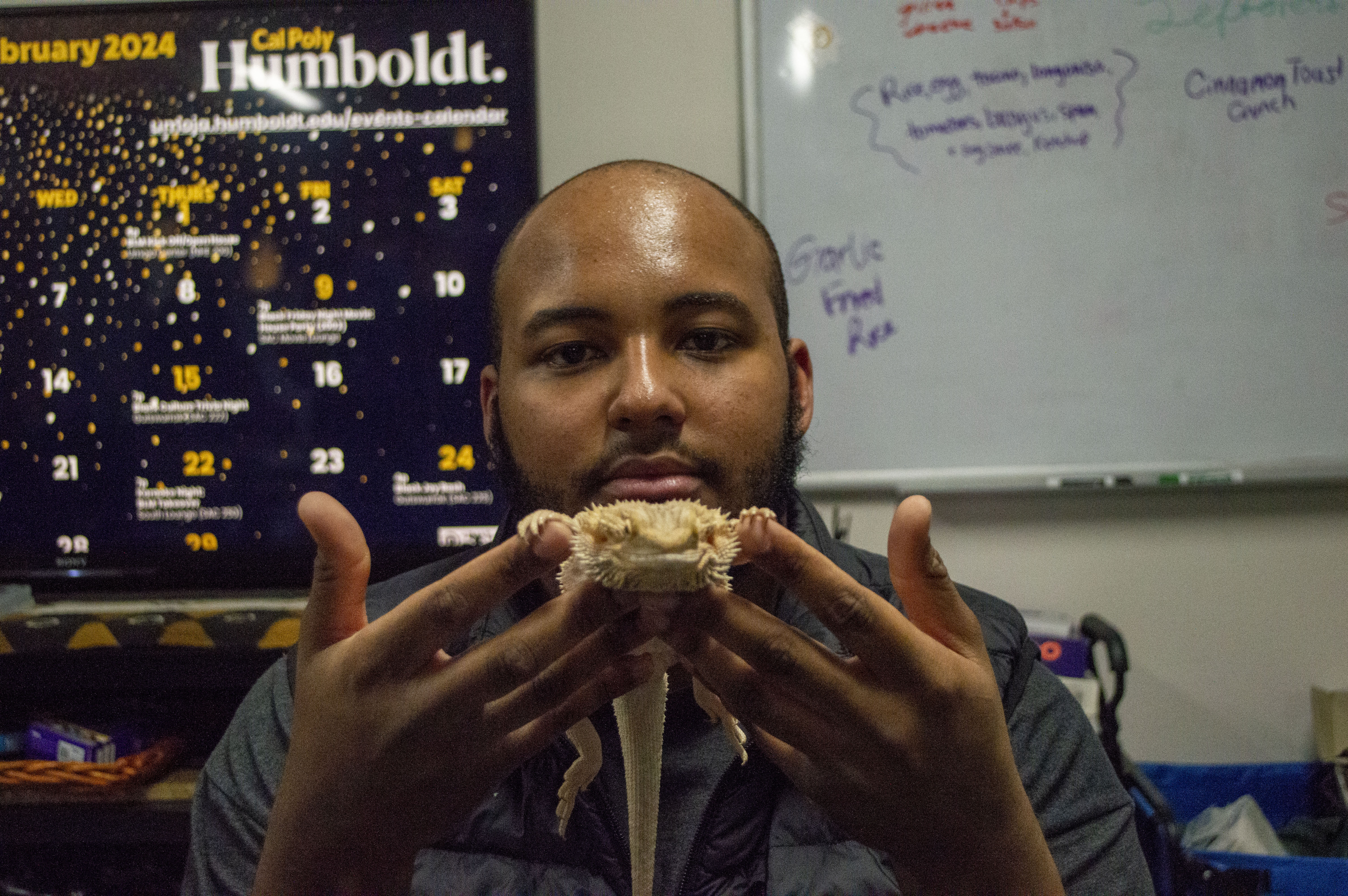
Tigger doesn’t have any stripes. He isn’t furry, and his jumping skills are horrible. His scales are nice and smooth, and his facial hair rivals a 19th century president’s. Tigger the bearded dragon is just one of many attractions people at the Umoja Center can offer.
The Umoja Center for Pan-African Student Excellence, located in Nelson Hall East, kicked off a month of events for Black Liberation Month on Feb. 1 with an open house.
Student art and photos of Black activists, athletes, musicians, and historical figures line the walls from floor to ceiling. “I love my melanin,” said one sign. A box with loanable art supplies sits at the front desk, free for anyone to use.
The center hosts many events, such as discussions about Black joy and movie screenings or even a Black trivia night. The center also offers academic advising and computers students can use, but the most important thing most students take from the center is community.
Many Black students have found community at the Umoja Center — a difficult thing to do when, according to the Cal Poly Humboldt website, only 3% of students at Humboldt are Black. Delaena Montes, a student assistant at the center, said it’s a place she could feel like herself.
“It’s an open space,” Montes said. “I can reach back to my roots here, my background. I felt like it was somewhere I could be myself. It’s freedom at a very white school. Having a place to escape is a great feeling. I feel comfortable here.”
Kamar Little holds Tigger the bearded dragon at the Umoja Center Feb. 1. Photo by Dezmond Remington
Jerry Turner, Tigger’s owner, agrees. He found the center when he was a freshman last year. He’s a mechanical engineering major with a lot of coursework, so having a place to relax and make friends is important to him.
“It’s a family,” Turner said. “That’s the best way I can put it… all of my friends I’ve met here, at the Umoja Center. It’s just beautiful.”
Ryen Price joined the Umoja Center last year after living in the Sankofa House, the Black culture-focused dorm in Cypress. She started coming to the Umoja Center to meet other Black students. She said she’s made a lot of good friends, the type she has potlucks and in-depth discussions with.
“I love how different we are, but also how similar,” Price said. “We’re like a family here.”
Montes is surprised more students don’t show up to the center, as well as other culturally-focused programs such as the Indian Tribal & Educational Personnel Program or El Centro, located down the hall from the Umoja Center.
“People should know about these places,” Montes said. “There’s a lot of culture up here [in Nelson Hall].”
That doesn’t surprise Kamar Little, a Student Advisory Group for Equity representative at the Office of Diversity, Equity, and Inclusion. Little works to connect students with those centers.
“I’m making them a bigger name,” Little said. “I’m letting people know things exist. There have been instances where people have never heard of [the programs].”
Price said anyone curious or doubting should lay those worries to rest and visit the center.
“People ask themselves, ‘[am I] black enough?’” Price said. “It’s the right place. Don’t think. You’re always welcome here. Don’t be shy, just come.”
This year marks a milestone for some Cal Poly Humboldt students: their first time voting in a presidential election. Besides potential presidential candidates, the ballot will include important propositions, like Proposition 1, a state-wide measure regarding funding within the mental health system.
Polls open for California’s Presidential Primary Election on March 5 and vote-by-mail ballots have already begun mailing out. To participate in any election, voters must be registered in their state. In California, that means registering no later than 15 days beforehand.
In order to vote in the primaries, the last day to register is Feb. 20. As a California resident, voting registration can be filed online at registertovote.ca.gov or by mail.
Paper applications can be found at County Registration Offices, Department of Motor Vehicles, public libraries, government offices and select post offices. Paperwork should be sent to the mailing address: Secretary of State Elections Division 1500 11th Street, 5th Floor Sacramento, CA 95814.
If registered with a political party, that party’s political candidates will show up on the ballot. To update party affiliations, a new registration form will need to be submitted.
16 and 17-year-olds are eligible to pre-register to vote and will automatically be registered upon turning 18.
Alongside the new wave of voters across the nation is a new wave of Humboldt County residents. To vote locally, or in the case of an address change, an updated registration form must be completed. Luckily, the process is quick and easy.
For more information visit the Cal Poly Humboldt legal lounge website for voting (studentlegallounge.humboldt.edu/voting) or call (800) 345-VOTE (8683).
University expects the new microgrid will provide about 25-30% of current annual campus electricity needs
by Brad Butterfield
Striving for sustainability and nestled in among the indomitable redwood giants of Northern California, California’s new polytechnic signed a contract on Feb. 2 for two megawatts of solar and three Tesla megapack batteries, which are expected to supply 25-30% of the university’s current annual electricity usage. Not yet immune from fossil fuel energy dependence, the university used 13,723,403 kWh of electricity and 922,559 Therms of natural gas, resulting in a combined 8,215.37 metric tons of carbon dioxide equivalent (MTCDE) of emissions during the 2022-23 academic year. The new microgrid/solar project is a tremendous step towards the university’s goal to become carbon neutral by 2045 and will change Cal Poly Humboldt’s energy portfolio for decades to come.
Where does Cal Poly Humboldt currently get its electricity?
Where a significant portion of Humboldt County purchases its energy from Redwood Coast Energy Association, Cal Poly Humboldt has opted to purchase electricity from Shell Energy, North America. This choice in energy procurement by the university is made possible by Cal Poly Humboldt’s direct access (DA) purchase of electricity, in congruence with 13 other DA CSU’s. “DA provides retail choice to customers by allowing them to purchase electricity directly from an Electric Service Provider (ESP),” according to the California Public Utilities Commission website. With DA, Shell, North America provides the energy, then that energy is transported by PG&E to Cal Poly Humboldt campus. DA is lottery based and allows universities to choose the most cost efficient energy option, rather than the county supplied utility in any given area. The negotiation of this DA energy procurement is handled by the chancellor’s office and allows Cal Poly Humboldt to access electricity at a competitive rate thanks to the aggregated 13-campus negotiation carried out by the CSU. While renewable energy sourcing is important, it has to be carefully balanced against the university’s broad range of financial needs, according to Cal Poly Humboldt’s Energy Manager Andrea Alstone. “As the Energy Manager, obviously, I want to use as little energy as possible and make it as renewable as possible. But, I also realize that costs are real and it’s kind of a zero sum game,” Alstone said. “What we’re spending on electricity means that we’re not spending on other things that the campus needs; we really want to be conscientious of that fact.”Importantly, CA Senate Bill 100 will require renewable energy and zero-carbon resources to supply 100 percent of electric retail sales to end-use customers by 2045. Californian’s are on a one-way road to renewable energy.“[Energy] use in California has to be 100% renewable by 2045. So, as a direct access customer, we will meet those standards, but there are other entities that are doing that sooner. “The choice to purchase from Shell, North America comes, primarily, down to cost – a fact not surprising nor impressive to environmental science and management senior Rain Lopez. “This school is a government institution, which is basically a business that is clearly more interested in maximizing its profits and reducing meaningful spending… so, it’s not surprising that the school made this choice,” Lopez said. Environmental science and management Junior Brooke Douglass put things more bluntly. “Shell is an evil company that has committed many environmental injustices,” Douglass said.
The Carbon Cost of Purchasing Energy from Shell
The university’s choice to purchase from Shell, North America has real world impact, as they do not source as much of their energy from renewables as Redwood Coast Energy Authority. Shell, North America sources its electricity from 34% renewables, (Biomass & Biowaste, Geothermal, Eligible Hydroelectric, Solar, Wind) whereas RCEA sources from 50% renewables. This gap is in large part due to the differing goals of each energy provider. Shell, North America looks to obtain the cheapest electricity possible for its customers, while still meeting California’s current renewable energy requirements, according to Alstone.“Whereas RCEA is more community focused and it’s like, ‘what does our community want and how can we meet that?’” Alstone said. “Cost is important, but it’s not the only factor in their decision.”
A (natural) gas need
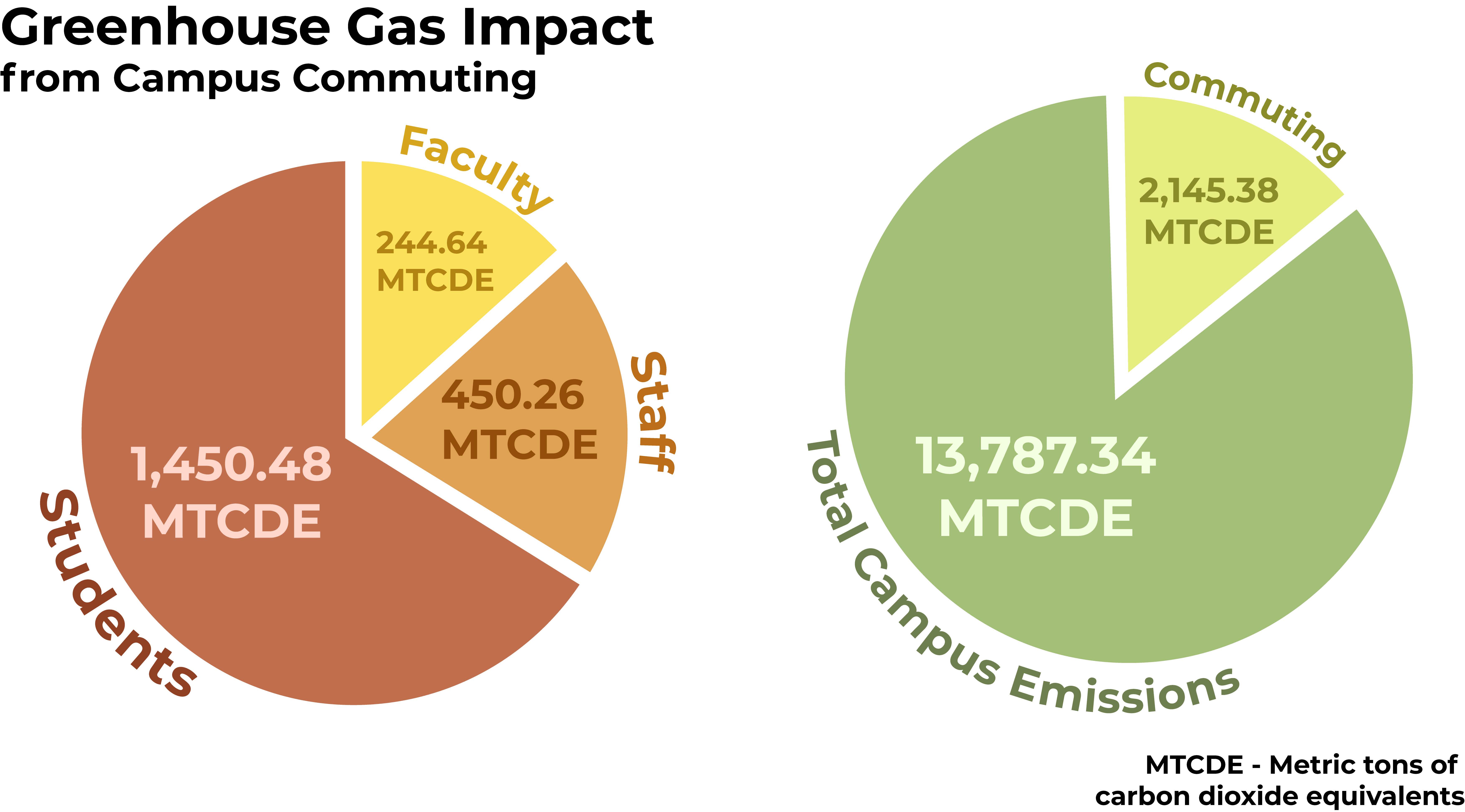
Importantly, when talking about total campus energy consumption, electricity is only half the equation – actually, it’s exactly 35% of the equation, with the majority of energy consumption on campus coming from natural gas. The university’s main account for natural gas is with the Department of General Services, a branch of the CA government. Perhaps surprisingly, campus use and cost of electricityis a near perfect mirror image of its natural gas use and cost in 2022-2023, where electricity accounted for 35% of total energy usage on campus, but 61% of total energy cost. Natural gas accounted for 65% of total energy used but only 39% of overall energy cost. Cal Poly Humboldt, being the northernmost CSU, has a much greater need to heat its buildings as compared to other CSU’s. The necessity of heating its buildings nearly year round contributes to Cal Poly Humboldt’s ranking as 2nd highest in ‘campus gas purchased’ out of the 23 CSU’s, for the ‘22-’23 academic year, (when natural gas usage is normalized per-square-foot) according to the CSU energy dashboard. This equates to 0.46 therms/SF natural gas usage at Cal Poly Humboldt, only out-gassed by Cal State Fullerton. When thinking about MTCDE emissions, it’s incredibly important to factor energy efficiency into the equation. “If someone told me I had an infinite amount of money to spend on things, before I started spending them on more renewable energy, I would make things more efficient,” Alstone said. Meaning, the best way to obtain sustainability is to not require said energy in the first place. A better insulated building with triple pane windows requires less overall energy to heat and is thus more energy efficient, which of course leads to the dilemma of whether to allocate money towards infrastructure efficiency projects or towards renewable energy generation, i.e. solar panels. In 2022-23, Cal Poly Humboldt used 6.8kwh of electricity per square foot at a rate of $1.49/SF. Totalcampus emission for ‘22-’23 was 13,787.34 MTCDE, equivalent to 31,889 barrels of oil, according to university Climate Action Analyst Morgan King.That’s a substantial consumption of fossil fuels, no matter how one looks at it. For some students, this speaks to a disconnect between the university’s green-marketing and the campus’ actions. “Humboldt likes to claim it’s green though and it’s superficial… I think that being ‘green’ is a political buzzword,” Lopez said. “An institution of this size, regardless of having a relatively ‘small student body’ should have more resources to support its ‘green programs.’”
Solar energy on the horizon
The contract signed with EDP Renewables North America Distributed Energy on Feb. 2 means the university will not own, maintain nor pay for the installation of the solar system, however there will still be initial costs. Roof replacements are necessary for buildings that will be receiving solar panels, and sites on campus receiving the microgrid components will need to be prepared. The facilities yard, for example, is going to house three Tesla shipping-container-sized batteries. In total, the campus will have two megawatts of solar when the project is complete, which is about the max number of panels the university can physically support, currently.“I want as much as [solar] we can have, and that’s kind of the max given the roofs in the parking lots and the fact that we’re kind of physically constrained,” said Alstone.The battery will provide a peak power of 5.8MW and a total energy of 11.5MWh. Battery capacity is crucial to the systems function as a reliable microgrid.“If everything went out, we’d need a battery which can start our energy system from zero, so we’ve oversized the battery,” Alstone said.Annually, the solar system is expected to produce 3,300MWh of solar – with a guaranteed production of 2,866MWh. This equates to about 25-30% of the university’s current annual electricity usage. In addition to making strides to lower campus greenhouse gas emission, the solar is also expected to save the university money, in multiple ways. As per the contract with EDPR, the university will pay the company for the electricity generated by the solar, but at a much lower rate than the university currently pays for electricity from Shell, North America.“It will end up lowering our bill,” Alstone said.Additionally, thanks to the Inflation Reduction Act, the solar system will also save the university money through hand-me-down tax benefits.“The [tax] benefit will be passed on to the owners of the solar, EDPR, and they in turn pass it on to us in the form of lower electricity costs,” Alstone said. Another positive aspect to the contract with EDPR is a guaranteed minimum amount of electricity. If they don’t meet the minimum, then EDPR will pay the difference to the university, according to Alstone.Due to the need to install the solar arrays in multiple parking lots across campus, the installation will likely need to take place during the summer break, so as not to irritate the difficult parking situation on campus any further.“We anticipate the canopies will be installed over existing parking spaces Summer 2025 when classes aren’t in session with temporary, minimal impact to parking, “ said Aileen Yoo, Director of News and Information for the university.Cost savings, reduced reliance on fossil fuels for energy, no installation or maintenance cost – this is sounding like a killer deal. Naturally, there are two ways of looking at things.“In an ideal, ethical world, the university would invest in these solar panels as owners, [then] source and promote local unionized workforce for photovoltaic product repair, which would boost your local economy and probably reduce overall maintenance costs…” Lopez said. “But again, universities are businesses and will not operate from a place of long-term vision, just immediate costs.”In any case, the contract signing and soon-to-come microgrid and solar system seem a justified time for Cal Poly Humboldt to raise arms in victory – and that they are. “The microgrid project not only showcases Cal Poly Humboldt’s longstanding commitment and investment into sustainability, but it captures the spirit of what we do here: educate students who can help solve the world’s most pressing problems by providing a real-world example of the benefits of microgrids and how they work,” Yoo said.
Between cranking out assignments, having a social life, and enjoying living, most college students have enough on their plate. That’s why most colleges have off-campus housing offices. Humboldt had been without an off-campus housing liaison for over a month, but now one student has stepped up to the plate.
Iris Perla-Blanco is an engineering major currently working 10 hours a week at the Housing and Residence Life Center (HRLC). Since the liaison position has been empty, Perla-Blanco has assumed all of the position’s responsibilities.
“Students will contact the housing department and they will forward it to me and then I’ll send them resource emails, or more specific ones,” Perla-Blanco said. “If they are having legal issues with their landlords, I’ll direct them to sources I know or to the Student Legal Lounge.”
In addition, she handles all interactions, emails, phone calls, appointments, resources, and she writes a newsletter that gets sent out every Friday. Perla-Blanco enjoys writing the weekly newsletter because individual property owners can contact her, fill out a Google form, and then have all their information in one place for students.
“There are also the cases where a lot of people come from SoCal or the Bay Area and can’t get up here to look at a place, which is definitely something you want to do before committing to renting a property,” Perla-Blanco said. “We have 45-minute slots you can book and I will go look at the property and scout it out, ask any questions, take videos, get to know the [landlord], and then I’ll report back to them so they can have a better feel.”
Todd Larsen, Senior Director of Housing Ops and Auxiliary Services, oversees the program. Having a real estate license, he has his foot in the door with property owners. Larsen believes that the housing market is slow right now, but is ramping up for fall.
“The market is softer, so the volume of calls and inquiries has dropped significantly,” Larsen said. “Maybe one or two inquiries per day, but it’s picking up for fall.”
The HRLC is expecting a new employee starting Monday. Part of their duties will be working alongside Perla-Blanco by picking up some off-campus housing responsibilities. Larsen claims that as more housing buildings open, more stress will be taken off the off-campus housing team.
“As we build more buildings, like when Craftsman Mall opens in fall of 2025, we will need less and less off-campus housing support because that adds another 964 beds for upperclassmen,” Larsen said. “Then, we’re working on a new project – housing, dining, health, which is 305 beds, and that comes online fall of 2027. We are [also] being really intentional at pricing at the same price as College Creek on campus.”
Cal Poly Humboldt’s President Tom Jackson addressed the construction of Craftsman Mall in the Feb. 1 issue of the Eureka Times Standard.
“Once completed, this project will add nearly 50% more student housing,” Jackson stated. “It will help students today, and well into the future, be able to afford the Humboldt experience that our alumni value so highly.”
The program looks like it will always have a place for students.
“It will always be a student-assisted position because we want to employ students, and it’s great for resume building,” Larsen said.
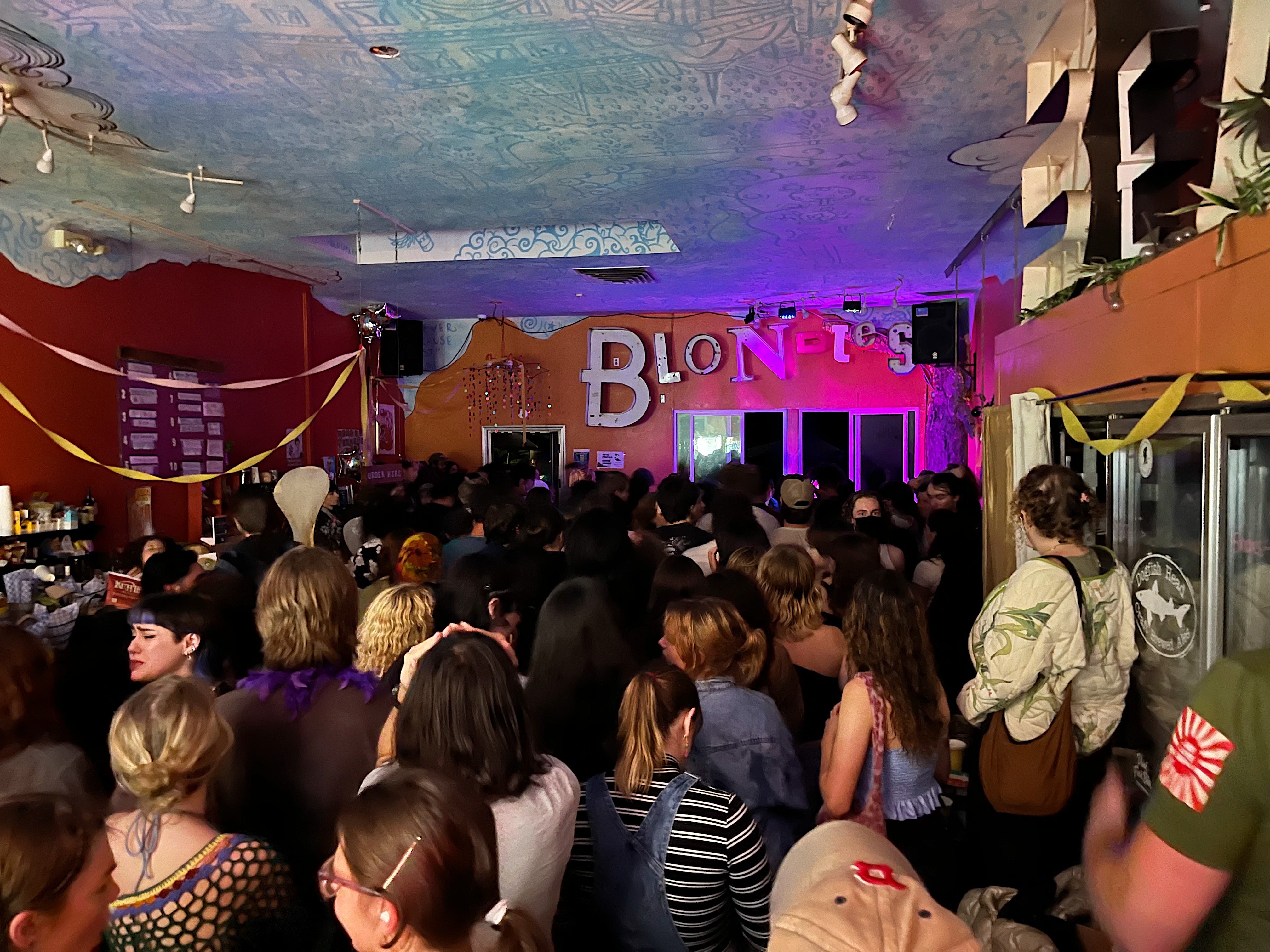
Distorted guitars and the punch of a kick drum reverberated off the muraled walls as Humboldt locals and music lovers alike crammed into the cozy one-room venue. The energy was electric. Bodies contorted in the neon light, pushing and pulling to the brink of exhaustion. There was a euphoric yet somber tone to the room; an acknowledgment amongst the crowd that this feeling was fleeting, as that night was the last Blondies show they would ever attend.
Saturday, Jan. 27 marked the last live show at Blondies, with over ten bands on the lineup. Celebrating their 15th anniversary, the beloved venue advertised the show as a birthday party, adorning the entrance with balloons and handing out festive hats at the door. Music started at 5 p.m. and went on into the night as the room swelled to the boom of the bass. Faster sets were accompanied by moshing and crowd surfing.
Blondies has been a staple in the Arcata music scene for years. However, they didn’t get their start with putting on live shows. Blondies owner, Johanna Nagan, recalled getting their foot in the door with open mic nights. Open mic gave community members a chance to showcase their musical abilities in a safe and judgment free environment.
“I think it was important for us to have a yes attitude towards if people had an idea, or if they wanted to try something,” Nagan said. “We intentionally made this space not too precious, so that people could feel relaxed enough to try something new. We felt like that was really important for people to have.”
Eventually, Blondies would go on to host all sorts of live music events such as live shows and jazz nights.
Nagan and the rest of the Blondies crew committed themselves to providing a secure and inclusive spot for seasoned performers and novices. On days when there was no live music, people could be found enjoying sandwiches, craft beer or what some would consider the best tater tots in town. The news of Blondies closing struck the hearts of many because of the environment they had fostered. The announcement was met with many customers reminiscing in the comments of Blondies’ Instagram.
On Sept. 24, the Blondies Instagram account, @blondiesfoodanddrink, announced that the business would officially be for sale after a 15 year run. The caption detailed how to contact the owner with regards to buying Blondies as well as a thank you to all of their faithful patrons over the years.
While many have questioned why Blondies has closed after all these years, Nagan said that they had faced some challenges in expanding the business. There was also concern expressed by the landlord over the types of events they were holding in the building. It is important to note that Blondies also had their liquor license suspended on Jan. 18 after it was revealed an employee had sold alcohol to an underaged patron who was working with the Alcoholic Beverage Control’s Minor Decoy Program. However, there is talk of potentially opening a similar space when and if the time is right.
Blondies can now be immortalized as the spot where many Arcata bands got their start. Cal Poly Humboldt alumni and members of local Arcata self-proclaimed “loser rock” gfjuband Porcelain Dog, Jack Hallinan and Vivian Dawn, were able to squeeze in a show right before they closed.
“The owners were so cool,” Dawn said. “They were just super interested in helping the scene, and as a new band it was super encouraging.”
The Arcata music scene may have lost an iconic venue this weekend. However, all of those jazz nights, open mics and lasting memories will never be forgotten.
“It’s kind of hard to put a feeling into words,” said Bailey Allott, junior at Cal Poly Humboldt and guitarist for Mambo Green and Queen Karma. “You build up all this energy during the week and that was the one night that you could just let it all out. Just feeling like no matter what you’re going through, you just felt like you were a part of something bigger.”
Concert-goer crowd surfing at Blondies during California Poppies set. Photo by Mia Costales
Provost Jenn Capps held an Academic Address on Jan. 12 to update members of the Cal Poly Humboldt Campus on topics such as enrollment, budget and the way they’ve impacted each other.
University Budget
Although enrollment appears to be increasing, the University still took a financial hit this year as the California State University (CSU) Interim Chancellor Jollene Koster implemented enrollment recalibration. Essentially, CSU campuses that have been under their enrollment targets have had some of their funding given to campuses that are over-enrolled. The Humboldt campus enrollment target has also been lowered.
“We have taken a 3% hit,” Capps said. “Which equates to between $2.1 million and $2.3 million [taken from the] University [budget]. So, we’re losing those resources because they’re taking back some of the resources. What [the enrollment recalibration] also did was lower [the] target so our target is now 7,375 [down from 7,603].”
Other financial changes that hurt the University’s wallet include faculty compensation, which will cost $3 million, and an increase in insurance and utility costs. There is hope from administration that enrollment numbers will continue to increase and thus garner more financial support from the Chancellor’s Office.
Enrollment Numbers
Capps shared that this is the second year in a row that the University has begun to level out and see some growth rather than a loss in students.
“We had about a 2% increase in enrollment for the second year,” Capps said. “Pause for a moment because that’s a big deal. As you all know, many of you [faculty] have been here much longer than I have. We were in a literal freefall; our parachute wasn’t opening. The parachute opened, we leveled out and now we’re [increasing our enrollment].”
Luke Kennedy’s katana is heavy. He busts it out for parties, which he and his roommate Miles Conte throw every weekend. Except when there’s not supposed to be class on a Tuesday. Then, Mondays are prey too.
“We were trying to pick a date that would stand us out from the crowd,” Conte said. “We were just trying to start off the extension of winter break off with a bang.”
With the CFA strike eliminating class on Monday, Jan. 22 for college students all over California, Kennedy and Conte decided to host a bonus party at their place, a dayger that started at 3 p.m. 40 people showed up to party in their house. Though some people left when everyone got the news that the strike was off, most stayed until about midnight or so.
“When we [got the news] it was evening time,” Kennedy said. “It’s the height of the party. I’m walking around with the beer bong and loading it up with [left-over beers] and loading people up. And then [someone] said, ‘Hey, I think we have classes tomorrow!’ Everyone’s pulling up the email. And so there was this whole conversation — ‘Oh, what’s going on?’ And honestly, everyone was like, ‘Fuck it, I’m not going to class’… But I think, party or not, most people would have probably ditched that Tuesday.”
Conte said it was more fun when they realized the strike was off.
“The party vibe became immaculate when we learned we had class tomorrow,” Conte said.
He turned to Kennedy for a moment.
“What do you think?” Conte said. “Is ‘Immaculate’ a good word to use in this situation? Or not?”
Conte did skip class the next day; Kennedy attended.
“[When the strike only lasted one day], I was initially rebellious,” Conte said. “Because I am not going to my classes.”
Both Conte and Kennedy said if the strike had continued as planned, they likely would have thrown at least two more parties throughout the week. Any more than that likely would have been overkill. Conte laughed at the idea while he rolled a cigarette with gas station tobacco.
“We just party, all day, every day,” Conte said. “No sleeping allowed. That would have been hilarious. Like, yeah, ‘We’re going to have a continuous party for five days straight.’”
Freshman Bryn Urdi had a good time at the strike party. She was glad that she was in bed by the time she got the news that the strike was off. Urdi said she would definitely have attended again if given the opportunity, but the best part was seeing all of her friends again.
“It was really nice to come back from break and see all of my friends again,” Urdi said. “It was great just to be with them for a while.”
Kennedy believes that the parties he and Conte throw offer an important service to students they can’t get anywhere else.
“I think that the parties make students more excited to go to class because they get to see their classmates,” Kennedy said. “[Campus] feels like a zoo environment, in that it can become a goal, clocking in and out of class every day. You don’t really know anyone there. I feel like the mark [the parties make] makes the school a thing, versus just something you clock in.”
“We bring a full-charge mentality to partying,” Conte said. “We’re passionate about making people happy and having a good time.”
Despite the attitude, Kennedy isn’t just about drinking and getting rowdy.
“I respect somebody’s performance,” Kennedy said. “I look at somebody; are they a degenerate? Do they get good grades? Are they healthy? I don’t want to encourage students to just drink and party. There’s tuition. I think it’s important that students remember that they’re here to get a degree, hopefully learn something and become a better person.”
On the morning of Wednesday, Jan. 24, students and faculty in and around the Gutswurrak Student Activity Center (SAC) stopped their activities and looked towards the quad. They could hear the chants and the drums long before the roughly two dozen demonstrators marched into the quad after beginning their demonstration at the Cal Poly Humboldt’s Children’s Center.
The action was organized in part by Humboldt for Palestine, a collective of individuals from the community to support Palestine and protest apartheid. The demonstrators waved Palestinian flags, held their fists in the air, and held signs reading, “Resistance is not equal to terrorism,” “Don’t look away” and “Mourn the dead, fight like hell for the living.” Alongside this, the crowd chanted led by a demonstrator wielding a microphone.
“Ceasefire now!” The demonstrators chanted. “Free, free Palestine! Gaza, Gaza can’t you see? Palestine will be free! No peace on stolen land!”
After about 15 minutes, the demonstrators continued their march, passing by the library and chanting all the way.
“Let. Gaza. Live!” They chanted to the drums. “No peace on stolen land!”
The demonstrators eventually marched off campus, heading towards Wildberries. Maria Fragoso Calzada, a student who marched in the demonstration, feels that there are many parallels between her struggles growing up in Mexico and the struggles of the Palestinians in Gaza.
“[I want] everyone to be liberated and supported,” Fragoso Calzada said. “[We need to] keep educating, because education is power and it’s liberation.”
College can be a challenging time for everyone, but one way to make it easier is by utilizing the resources offered at the Academic Career and Advising Center (ACAC). Academic Advisors help students with myriad academic-related matters: creating a DARS plan, creating a schedule, staying on track to meet degree requirements and graduating within their desired time frame.
Kelda Quintana is an academic advisor at the Academic Advising Center. She would like to encourage all students to meet with an academic advisor at least once.
“All students could benefit from meeting with an academic advisor,” Quintana said.
Having an advisor to help navigate all aspects of college can help students succeed rather than stumble through challenges, such as course selection and even deciding on a major. Loren Collings is the interim director. He explained the mission of the Academic Advising Center.
“Our goal is really to help people approach college holistically,” Collins said.
Amy Martin is the interim associate director. She discussed the ways that academic advisors can help support students.
“Our professional advisors are really amazing at connecting students with the resources on campus,” Martin said.
Students can receive support in several ways by meeting with an academic advisor. Advisors care about more than academics. They want to ensure that all students have the resources necessary to succeed in and out of the classroom. This ranges from housing to food security to mental health. Advisors can help students with such needs by putting them in touch with the proper organizations, such as housing liaisons, Oh SNAP and the CARES team.
All students are encouraged to meet with an advisor at the Academic Advising Center, located in lower library room 27, is open for drop-ins Monday through Friday, 10 a.m. to 3 p.m., in-person and online.
Last Thursday, on the third floor of Cal Poly Humboldt’s library, a very important first birthday was celebrated. Students, faculty and community members gathered to enjoy cake, pizza, pie and refreshments to celebrate the launch of the world’s first 3D herbarium.
Hosted at 3dherbarium.org, the 3D herbarium has digitized 3D models of various plants with information on each species. At time of publication, 39 models are available to view. From the seaside daisy, Erigeron glaucus, to the coast redwood, Sequoia sempervirens, each plant’s page has a classification breakdown, profile and information on the model itself.
Library Dean Cyril Oberlander started the opening speech for the event, thanking everyone for attending and emphasizing the project’s testament to hard work, dedication and collaborative efforts.
“We chose 3D modeling of plants because, well, not really anybody was doing it,” Oberlander said. “You can imagine how hard it is to do a three-dimensional shape of a two-dimensional leaf. While creating the 3D digital herbarium has never been done — and because plants are so crucial to life on Earth, and for our understanding of plants — this was incredibly important.”
The project has been in development for over a year and students have been anticipating its release, including botany major Juniper Beke.
“Last semester, I believe it was teased at the end of a session on satellite information using satellite data,” Beke said. “[The teaser] had appeared there at the end and so I was hyped up for it.”
Many students, like engineering and community practices major Filip Amborski, had ideas for what the program could accomplish. Amborski thinks the herbarium will be a great resource.
“I’m hoping that they have notes on anything that’s been identified as culturally significant to Native tribes,” Amborski said.
The seeds of inspiration
The 3D herbarium was created by Team Flora, which is comprised of computer science and botany students. Botany graduate student Heather Davis, undergraduate botany student Grayson Prater and computer science major David Yaranon helped create the website under the management of computer science graduate AJ Bealum.
AJ Bealum, computer science graduate and manager of Team Flora, credited the idea for the 3D herbarium to Oberlander. The university library was the sole sponsor for this project.
“His main source of inspiration was the anatomage table downstairs and he thought, ‘Why isn’t anyone doing this with plants?’” Bealum said.
Located on the second floor of the library, the anatomage table is a 3D human anatomy system where users can simulate cadaver dissection.
Prater wanted to join Team Flora to bring botany to those unfamiliar with the topic and introduce them to scientific language. Through this project, he has learned about programming and the difficulties that come with scanning plants.
“I really love writing about plants. This was a great job to start doing that and practicing that skill, especially science communication, making botany accessible to other non-botanists,” Prater said.
Davis accepted the position on Team Flora to satiate her passion for bringing the joy of botany to others. Her decision to join the team was inspired by Oscar Vargas of the botany department. Vargas is an assistant professor at Cal Poly Humboldt and director of the university’s Vascular Plant Herbarium.
“Dr. Oscar Vargas has been my professor, mentor and boss for the last couple of years,” Davis said. “Over the summer last year, the job got posted and he had been talking to AJ, so he reached out to me and sent me the link for the herbarium. I applied for it after that and joined the team.”
Current growth
The 3D herbarium website currently has a collection of 3D plant models, plant photos contributed from around the world and a plant identification component.
Each 3D model was created using a process called photogrammetry. Photogrammetry requires around 100 to 300 photos of a single plant from many different angles in order to convert it into a 3D model. Yaranon created many of the plant models for the 3D herbarium.
“As you take more photos, the processing time increases exponentially,” Yaranon said. “In the beginning, we were running these off of rented laptops from the library, so we would have to wait a couple of days per model. Now we’re on a server, so we can put these out a lot quicker.”
Davis collaborated with the computer scientists on Team Flora to annotate each plant model. She collected plant specimens for Bealum and Yaranon to photograph and create a model from. Then, she annotated different parts of the plant model with information for people with all levels of experience.
“It’s a really challenging subject for many people when they’re first introduced to it, especially with the names and all of the different scientific terms you have to learn,” Davis said. “So this project has been [a] really fun [way] to be able to give access to that knowledge and to make it a fun, engaging activity, instead of challenging and being afraid of a new topic.”
The herbarium also adds to its database with photos from iNaturalist, a website that allows users to upload photos of plants and animals to create a public database. Visitors can search up the common or scientific name of a plant and peruse a gallery with hundreds of photos taken around the world.
Additionally, the website has a plant identification program. Once a photo of a plant is uploaded, the program will provide a list of possible species and a short description. The program pulls from websites like Wikipedia, iNaturalist and the Global Biodiversity Information Facility.
From left to right, Team Flora members Grayson Prater, Heater Davis, David Yaranon and AJ Bealum stand in front of a touchscreen monitor displaying the 3D herbarium in the Cal Poly Humboldt library on Jan. 25. Photo by Savana Robinson.
Plan(ts) for the future
During the opening speech, Oberlander announced a planned second version of the 3D herbarium. The day before the ceremony, Team Flora got approval to start a full grant proposal to the Institute for Museum Library Services to get funding for further development of the program. Version two will include models that are applicable for other majors like anthropology or zoology. Oberlander mentioned that Team Flora hopes to receive the funding this summer.
“Our next version is going to be something that is anything that wants to be a 3D model, whether it’s art or something else. People can do all sorts of things with this 3D exhibit tool,” Oberlander said. “It’s either intended for students with projects or a classroom that wants to use this as a lab notebook, as opposed to the print version.”
Team Flora also hopes for other groups on campus to contribute to the 3D herbarium. They plan to make the process of photogrammetry more accessible so that clubs or classes can add to the website’s model collection. Bealum described meeting with the mycology club to help them learn how to use photogrammetry software so they could produce a fungus model for the website.
“Our ultimate goal with this [website] is to make it a school-incorporated tool,” Bealum said. “So that instead of us sitting in our office trying to pump out these 3D models and working with the botany students as assistants, the botany department can ultimately kind of take this over. [They can] make it a part of their classes, make it so that students can submit models as part of a class.”
Walking into the arena, music blaring, teammates running onto the court mentally preparing to go to battle. Coming together and huddling as one, teammates are there for each other. Lining up with signs in hand, showing the world why they are damn worth it.
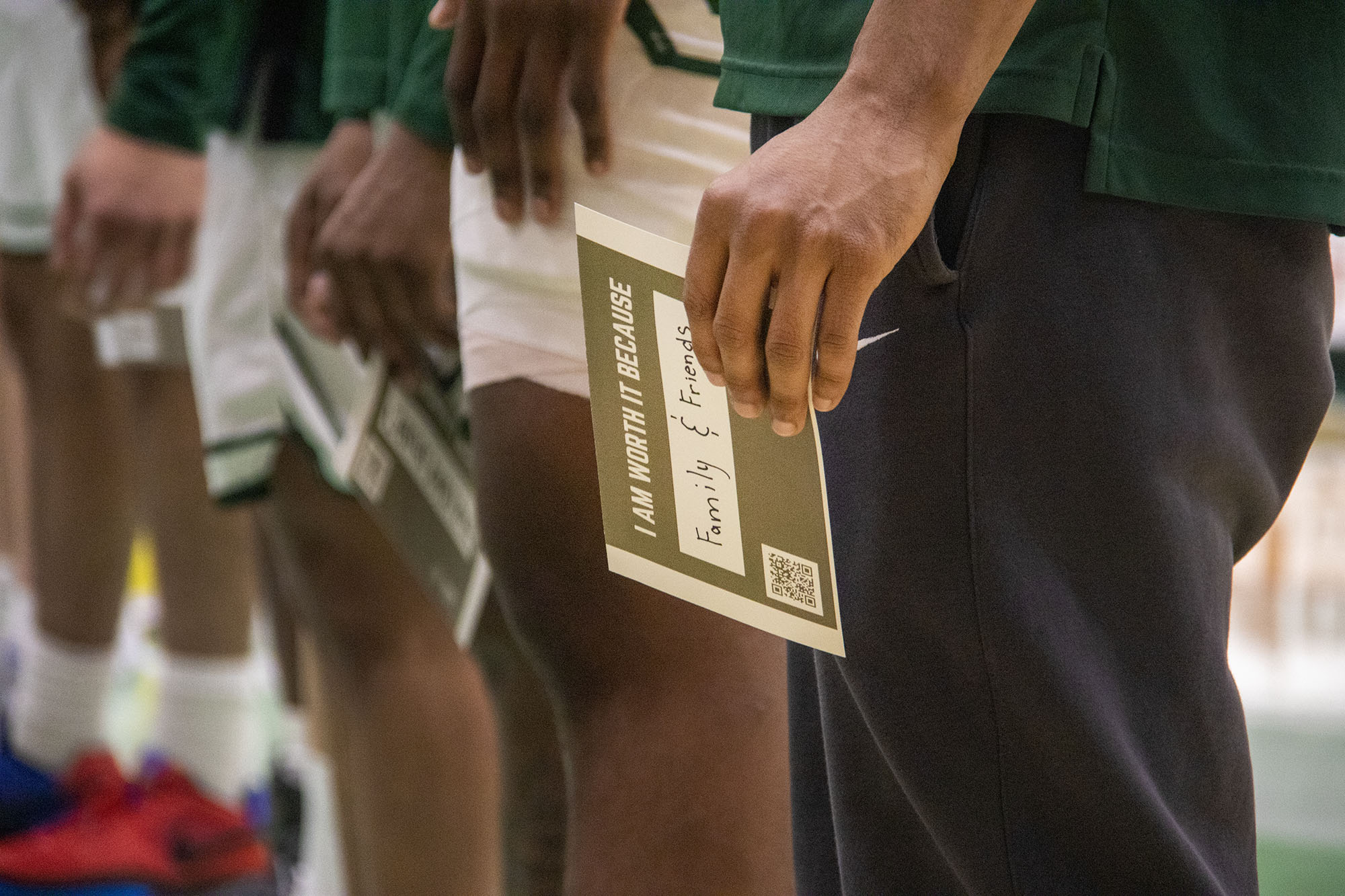
The Humboldt branch of Dam Worth It (DWI) celebrated Cal Poly Humboldt men’s and women’s basketball in the Lumberjack Arena on Saturday, Jan. 27. Despite the Lumberjacks losing both games against Cal State San Marcos, athletes from both teams came together as a community to recognize the significance of mental health awareness.
DWI started in 2017 as a campaign to end the stigma surrounding mental health, and has been raising awareness and fueling conversations around mental health in college sports ever since. Coaches, players, cheerleaders and fans celebrated DWI, shedding light on mental health through storytelling and community.
Vice President for DWI’s Humboldt branch and former Cal Poly Humboldt athlete Gianna Giacomotto described what DWI’s mission is among college athletes. According to Giacomotto, a senior studying psychology, opening the dialogue about her struggles has helped her find comfort through hard times, and has facilitated the ability to help others going through the same struggles.
“I have struggled with mental health for a lot of my life and it’s really affected both my ability to perform on and off the court,” Giacomotto said. “I have found that by talking about it and being open about my mental health that I find personal ease through that and I also am able to find that I help others by making it less controversial to talk about and helping people get the help they need.”
Fans in attendance at the game were encouraged to fill out their own Dam Worth It signs to signify why they matter.
Opening the dialogue about the mental health struggles athletes face is a key component of DWI. Introducing the tough conversations that help facilitate healing and combating the stigma against mental health struggles in sports is the ultimate goal of the organization. As part of that goal, DWI organizes college sports events, such as the basketball games in the Lumberjack Arena, to show athletes that they matter.
“Having these games for our athletes lets them know that they’re not alone, we provide resources to all of our student-athletes and try [to] remind them that they are damn worth it,” Giacomotto said. “You are more than just your sport and your identity that comes with your sport.”
Juggling college athletics while trying to pursue an education is no easy feat. College athletes bear a heavy load navigating the world of performing on a team as well as in the classroom. Maneuvering through practices, competing in games, managing homework on the road, communicating with professors and combating injuries – all while trying to excel athletically and academically is the reality for college athletes.
Cal Poly Humboldt Women’s Basketball team in the group huddle during the Dam Worth It game against Cal State San Marcos on Jan. 27.
Delilah Kimble-Gray is a junior studying kinesiology and plays guard for Cal Poly Humboldt’s women’s Basketball team. Kimble-Gray knows firsthand how much time and effort is needed to succeed on the court and inside the classroom. On the Dean’s list from 2019 to 2022, as well as the Presidential List, Kimble-Gray puts in the time but knows the significance of communication and the ability to ask for help.
“Being able to continue, to keep going, keep your head on, being able to communicate with others I feel like is a challenge because as an athlete you don’t want to be seen as, ‘Oh, I’m not strong enough, or I feel weak’ but really you need that help,” Kimble-Gray said.
Currently sidelined due to a recent ACL injury, Kimble-Gray appreciates the need for community and communication.
“It’s hard. It’s my first major injury to my ACL. It’s the team, coaches and trainers that keep you going like a family, because it’s hard,” Kimble-Gray said. “You’re doing it by yourself, but you’re not – you know, everyone here is here to help you. It goes back to just asking for that help. That’s the challenge, being accepting of it and embracing the journey. Being within the injury is the hardest part, but everything else is super easy, as long as you just keep going and ask for help.”
Cal Poly Humboldt volleyball player Kaitlyn Patterson views Dam Worth It as a crucial safe space where athletes can share their stories. To Patterson, building a community and helping other athletes feel comfortable about having difficult conversations is indispensable. College athletes such as Patterson endure the difficulties that come with playing sports because they truly love the game.
Cal Poly Humboldt Men’s Basketball team watching the introductory Dam Worth It video before the start of the game.
“I would say just like the pressure of performing, trying to be perfect, of what the world wants,” Patterson said. “Ultimately, [I] have to dial down and really take it back, and realize that I am playing this sport for me – because I love it and not for anything else, not for the outside attention.”
Athletes such as Giacomotto, Kimble-Gray and Patterson embrace Dam Worth It’s mission of fostering community and dialogue. Ending the stigma related to mental health only strengthens that community.
“No matter what anyone says to us or what anyone dislikes about you, whatever you’re going through, you’re worth it,” Kimble-Gray said. “You can overcome any and everything as long as you know that you’re worth it.”
The best piece of advice my mom has ever given me is to trust my gut. Intuition is an amazing thing and as a highly sensitive individual, I have finally come to appreciate the signals my body tells me.
Sometimes, we can’t explain why we get these strong instinctive hunches. The uneasiness in your tummy or the tightness of anxiety in your chest. Even when we don’t have all the information, our gut can lead us in the right direction. There’ve been a few situations where this has saved me.
Recently two people very close to me, one being my cousin and the other my best friend, kept a secret from me. They had begun having romantic feelings for each other and instead of telling me, began sneaking around with their exciting new relationship.
Over the course of the next six months, I began to notice a shift in dynamics. People on the outside of a relationship can usually tell something is happening before they even know it themselves. Before the advance in their relationship, I knew I was a priority in this trio, being the one who introduced the two in the first place.
My friends around me would comment on their closeness, asking if I thought they were anything more than friends. I defended them to everyone who asked me what was going on, trusting that my cousin and best friend would be telling me the truth.
My entire family and friend group noticed how they had become increasingly close, even to the point where she was coming over for Thanksgiving and Christmas, being included in family plans without me knowing about it.
When I started specifically asking my best friend about it, I was very quickly gaslit and manipulated into doubting the things I was noticing and the way I was feeling. They kept assuring me that nothing had been going on.
Things came to a head on New Year’s Eve, when I witnessed them sharing a kiss and began pushing me off to the side. Since I wasn’t getting the truth, I looked through my best friend’s phone and saw messages that confirmed my initial feelings. This reassured me that I was not delusional and that my feelings were justified. I was not just making things up.
I now know to never second guess the way I’m feeling. When I get that pit in my stomach and my mind begins to run, I take a second to validate the way I’m feeling. I believe gut feelings are a result of our subconscious mind processing information and making quick judgments, protecting us from what we already may have suspicions of.
The biggest challenge with being Jewish on campus at Cal Poly Humboldt used to be the lack of community. There are small groups here and there but nothing that reminds me of home: a more reformed, modern take on Judaism. After the massacre on Oct. 7, 2023, being Jewish on campus has led to issues that I would not have expected from a school or peers that seemed to hold an immense amount of respect for minorities and Indigenous people. I still see these empathetic and humane values in some individuals, but from my experience it has become too easy for people to pick and choose who they respect, value, or who they are open to hearing from. This in turn has led to a new level of blatant antisemitism that I have not experienced before.
I want to make it clear that this piece is not about my opinions on the current geopolitical conflict between Israel and Hamas in Gaza, because I couldn’t even begin to take on that responsibility. I’m here simply to share that antisemitism is alive and well at Cal Poly Humboldt, and that finding a middle ground, having empathy and seeking peace is productive rather than dismissing, accusing or blatantly hating someone for sharing their lived experiences.
Something that I have made clear since Oct. 7 is that I don’t want people to die. I don’t want death, destruction, genocide, ethnic cleansing or anything else that brings harm to Palestinians in Gaza or the civilians in Israel. This may seem basic to just objectively have empathy for human life, yet that is something that I always feel is missing when people send me hateful anti-semitic DMs accusing me of white supremacy, or of being a genocidal colonist. What they don’t see, or perhaps turn a blind eye to, is me consistently looking to educate myself as an American Jew using resources by Jews, Palestinians, Israelis, historical experts and anyone else providing concrete facts (modern or historical), because one perspective isn’t enough.
Just two days after Oct. 7, anti-semitic messages were written on the sukkah on campus. A sukkah is a traditional Jewish structure used to celebrate the holiday Sukkot. The one thing that was on campus representing Jews (with no connection to the state of Israel) was vandalized. This outward act of anti-semitism was simply the beginning for me.
Just days after, a close friend and business mentor of mine who prides themselves on their knowledge of Indigenous history as well as supporting minorities self-determination and equal rights began discussing Jewish history with me. Since I trusted her as someone who is extremely educated on these topics, I wanted to understand her perspective on the current conflict, however different it might be from mine. A conversation I assumed would lead to progress for both of us. After this conversation, I discovered that she had unfollowed me, unshared her location, and essentially cut me out of her life completely. When I asked why, or if she would have another meaningful conversation with me, she said no because of our fundamental disagreements—the fundamental disagreement being that Jews are from the land of modern day Israel.
With thousands of years of documentation, it is quite clear and flat out historically accurate that Jewish people come from the Kingdom of Judea (previously colonized by the British, Ottomans, Crusaders, Arabs, Romans, Greeks, etc.) Does this take away from Palestinians’ lived experiences today? Absolutely not. Does it justify the actions of the Israeli government? Absolutely not. Is denying this fact erasing Jewish history and their connection to the land? Absolutely.
While I sit here holding empathy for Palestinian civilians in Gaza, acknowledging their pain, struggles and lived experiences, I simultaneously speak about Jewish lived experiences and Jewish history. We can and need to strive for peace, acknowledge and appreciate each other’s connection to the land, value life and not invalidate others to validate ourselves.
Signs of Passage: Nostalgia and New Beginnings debuted in the Reese Bullen Gallery at Cal Poly Humboldt on Nov 8. The exhibition runs through Dec. 9 [2023] in the Art Building.
The Reese Bullen Gallery is named in honor of a founding professor of the Art Department and has been an addition to Humboldt since 1970. The gallery usually contains the university’s permanent collection of art and sponsors exhibitions of works by professional artists related to many different areas of instruction. The Reese Bullen Gallery also presents an annual exhibition of student art in May, the Graduating Student Exhibition.
The mission of the Reese Bullen Gallery is to offer free and publicly accessible exhibitions representing artists from all demographics. Extending beyond Humboldt, the Gallery seeks to strengthen partnerships with local communities as well as stimulate support and participation in the arts.
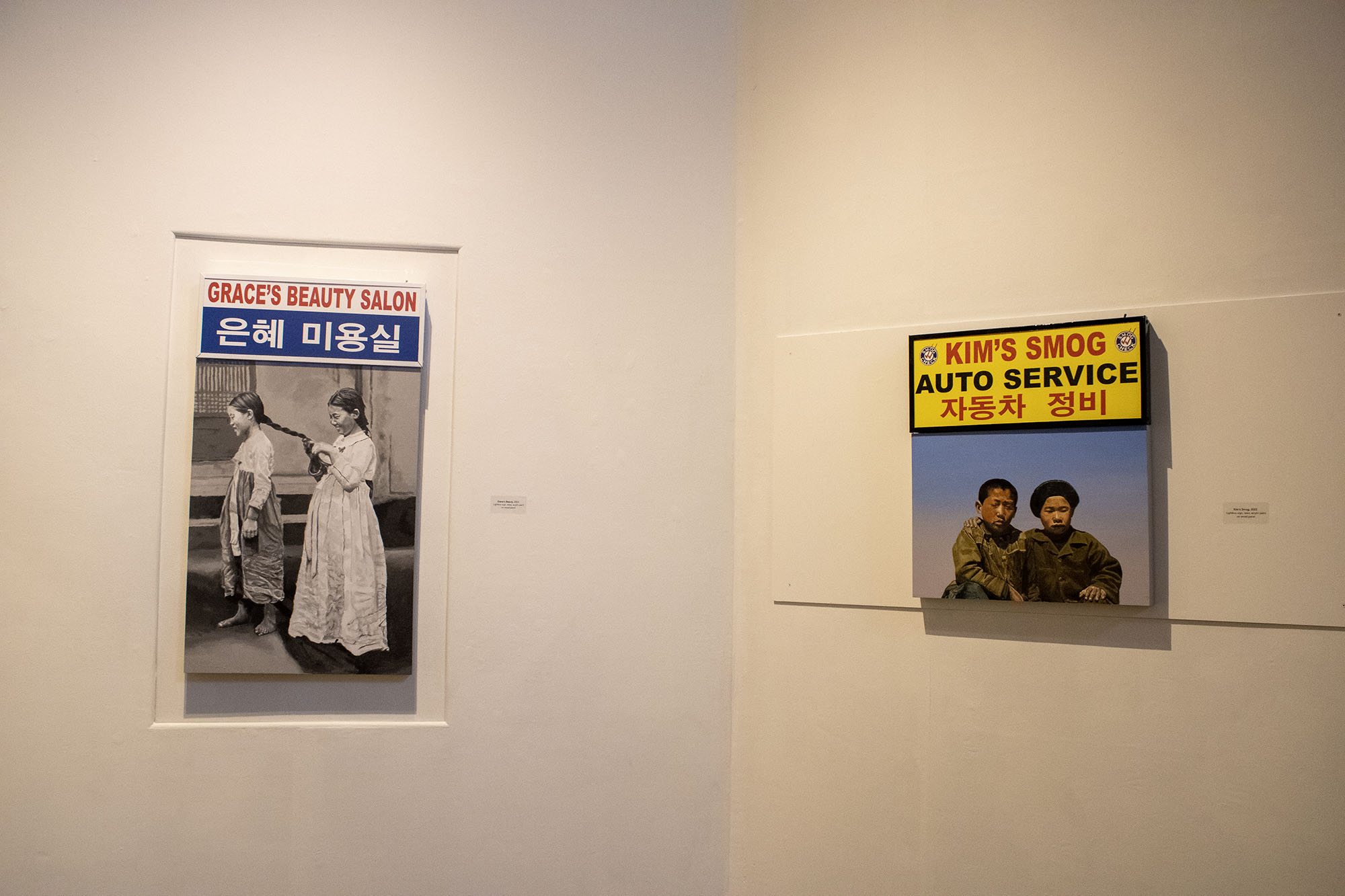
This new body of work presented by Dave Young Kim at the Reese Bullen Gallery uses latex paint on wood panels.
Dave Young Kim is a Los-Angeles based artist who visited Humboldt County with a newly created body of work for his solo exhibition at the Cal Poly Humboldt Reese Bullen Gallery. Kim is a fine artist, born and raised in Los Angeles. He received his Bachelors of Fine Arts Degree in Studio Art from the University of California, Davis, and a Master of Fine Arts in Studio Art from Mills College.
His current display of work engages with the quality of home and explores themes of nostalgia, war, conflict and displacement. Through his work, Kim explores the unifying search for belonging across disparate conditions. In 2020, he co-founded the Korean American Artist Collective (KAAC), which is a group of artists building a community around work rooted in the Korean-American experience. In 2021, he was a selected muralist for the Eureka Street Art Fest and in connection with the Eureka Chinatown Project to paint a mural named Fowl.
“My work plays with that idea of manufacturing nostalgia as integrated with my family history, memory, and identity,” Kim said. “My artistic approach is drawn from a sense of loss or longing, looking for a place to belong.”
Goudi’ni Native American Arts Gallery displays “Tintah: Amongst The Trails”
Robert Benson’s Redwood Sculptures and Watercolor Studies
By Christina Mehr
In collaboration with Cal Poly Humboldt, Robert Benson presents his work in “Tintah: Amongst The Trails” at the bottom floor of the Behavioral & Social Sciences Building.
The art installations of Native art used the mediums of watercolor and wood pieces. Focusing on a new body of work, Tintah, Hupa language for amongst the trails, features newly carved salvaged old-growth redwood sculptures and watercolor studies. Robert Benson, is a leading figure among artists in the NorthWest California art world. He has worked as a teacher for more than 30 years at the College of the Redwoods, as well as being a curator of Native art.
Tall sculptural wooden carvings adorn the exhibit and viewers must make their way through the art, almost like walking amongst the trails. Redwood slabs carved into beautiful sculptures lined the room.
His current paintings and sculptures are filled with imagery of trails, both of the literal kind and suggested. With Benson’s deep connections to the environment and land, those motifs clearly shine throughout his work.
“There is the trail into our family hunting camp that I traveled for more than 50 years, there are trails handed down through stories and mythologies, and there are the trails of imagination,” Benson says. “When we consider that at the most basic level, a trail is just something connecting two points, even the ladder and stairway forms that populate my work can be viewed as kinds of trails. To be amongst the trails is to find your rhythm, your place and to discover the interplay between that rhythm and the melody of the universe.”
This solo exhibition was installed by the Art + Film Department Museum & Gallery Practices class under the direction of Assistant Professor Berit Potter and Gallery Director Brittany Britton. This exhibition was partially funded by Instructionally Related Activity Fees.
Photo courtesy of Goudi’ni Native American Arts Gallery
Can I be in love with someone I’m not dating? This situationship has got me fucked up.
How do I answer this without coming off like a complete bitch? Your situationship is not real. That’s not to say your feelings aren’t real, or that the love doesn’t exist – but a situationship is not a real thing. The creation of the label “situationship” has opened the doors for this generation to participate in an unwinnable battle: The IDGAF wars. I like you, so let’s find out which one of us can care the least to keep the other person interested without fully committing?
What is a situationship? To me, it’s one person caring more than the other. One person giving more than the other. One person receiving more than the other — you get it. A situationship will never fulfill you in the ways you’re looking for. Rather, this infatuation will leave you feeling more hollow. One person will always have more power than the other.
That’s not to say I don’t understand where you’re coming from; you caught feelings for the wrong person. It happens to the best of us. At the core of it, we are all just creatures looking for love, security, comfort, happiness; we want to feel desired and safe. There is no safety in a situationship. In fact, more often than not, they all have a three month shelf life. Seriously, name one situationship where things stayed good after that three month mark — if that existed, it would evolve into a relationship.
“We accept the love we think we deserve.”
Everyone, their mother and their mother’s single best friend knows this phrase. It’s true though! We often don’t love ourselves enough to believe we deserve better, and so we stay in the situation(ships) we know because it’s the space we’ve decided to fill. You deserve to take up space with someone who will appreciate how you light up the room.
When I was 14 going into my freshman year of high school, my mother enrolled me with a new therapist shortly before school started. My parents were concerned about the transition to high school and wanted me to have a support system. I also went to my hair stylist right before so that I’d look presentable for the first day of school.
Just after getting my modernized Karen cut trimmed and getting in the car to go to my appointment, my mother turned to me and told me I was diagnosed with autism spectrum disorder (ASD) at four years old. She didn’t want to confuse me when I was younger and didn’t want the therapist to tell me first.
I was livid, but somehow relieved. I finally had a reason for the continual failure to connect with my peers as a child; I had an answer to the “why?” that had plagued me since I started my education. I had a reason, which meant I had a path forward.
Besides telling the entire campus I am autistic before even getting into this article, it’s normally something I don’t bring up. I had witnessed how neurodivergent people were treated throughout my childhood, and my greatest fear was being associated with them. I didn’t want to be “special.” I hated being talked down to by adults and peers. I was infantilized and dismissed until I eventually figured out how to pass as neurotypical.
When I tell people I’m autistic, I’m usually met with surprise. I’m ashamed to say that I feel a bit relieved when I’m told that I don’t seem autistic or that they never would have guessed I was. Internalized ableism is a hell of a beast. I want to embrace my autistic identity, but I also want to blend into neurotypical society. Letting myself unmask means less built-up stress and being able to get things done, but blending in means having friends and job opportunities.
With the life experience I have now, I have found that there is a lack of education on ASD among the general public and the medical field. I have been assessed for ASD twice because a therapist I had a few years ago didn’t believe I was autistic. Since autism assessments are based on outdated research, I was genuinely afraid that the psychologist doing the test wouldn’t believe me either. I’ve been met with hospital staff declaring me neurotypical after two minutes of knowing me.
An autism assessment is almost traumatic in and of itself. There is no established test for older children and adults. The current test is made for young children and involves playing with toys and reading picture books. Having to play pretend with Barbies at 17 years old to prove you’re autistic is a little humiliating. I stomached the preschool voice that all adults use with autistic people and whatever juvenile task I was given to prove that my experience was real.
I don’t want my autism to be defined by suffering and shame. I try to make connections with other neurodivergent people and allow myself to use resources that will help me. Being a part of a community has helped me cope with the stress of blending into neurotypical society. I still put on the mask when I go about my day, but I now have times when I can unwind with people who understand my experience.
Autism has become much more visible in mainstream media since I was younger. There are autistic social media influencers and shows with autistic characters. While we aren’t quite there yet as a society, I have seen monumental progress in the normalization of autistic people. We now see a wider diversity of experiences and, with new social media platforms, we can see those experiences in everyday life.
Our society was not made with neurodivergent people in mind. Being neurodivergent can look different for every person, and who are we to decide who gets to have the label and who doesn’t? Neurotypical people haven’t taken me seriously even with a diagnosis.
One of the biggest contributors to internalized ableism is worrying about what the majority thinks; worrying that the autistic community won’t be taken seriously because of your individual experience. You don’t have to prove to anyone that you are autistic, nor do you have to tone yourself down to make everyone else comfortable. You are allowed to put a label on your experience so you don’t have to continue asking yourself, “Why?”
I’ve always wanted to be one of those girls with zero online presence; carrying around a flip phone, spending their downtime reading classic literature in a field of flowers. If you’re one of those people, feel free to stop reading now.
I, like many young people today, am the victim of chronic social media usage and the (more than) occasional doom scroll. I’ve always had a hard time embracing my social media crutch, but especially since middle school. It started one day after I lost a year-long “snap streak.” I rage-quit off the app, and never looked back. After getting the ick from Snapchat, I couldn’t fully quit. Some may say it made me cling onto other platforms, like Instagram, even more.
Now at this point you might be thinking to yourself, “What do you mean Carlina? Why can’t you be both a nature girly and an Instagram baddie?” I can, but if I am reading classic literature in a flower field, you already know it’s going on my Instagram story. Maybe even on the main feed with a cute little caption like, “love this life <3.”
But then… am I actually reading my book or did I all of a sudden get distracted and start looking at memes -– dare I say, doom scrolling -– even though I’m supposed to be enjoying the outdoors? It’s a vicious cycle.
Now look, this opinion isn’t to rant about social media, and maybe I just have a toxic relationship with the internet, but I’ve become honest with myself and my daily social media intake. Although there’s a lot of bad, there’s so much good, too. From new career opportunities to media coverage on a whole new level, social media is undeniably an important resource in today’s society.
That being said, the essential role social media plays in everyone’s day-to-day life has made certain platforms evolve from a place where you can see what your cousin in Idaho is doing to a constant stream of media published by people you’ve never met. Depending on how many accounts you subscribe to, the posts you’d like to see, like your Aunt Susan’s new pumpkin pie recipe, might get drowned and lost forever to the mainstream. That’s where the headline comes in.
I feel very strongly about the new(ish) social media platform: BeReal. I suppose I should mention this is not sponsored, although I wish it was.
BeReal is an app where users get a notification at a random time everyday. The notification goes off at the same time for each user, and at a completely different time each day. When you get the notification, you’re prompted to take a selfie, then a photo with the back camera. This quick photo spree creates a completely unfiltered feed of/for your close friends. If you give the app permission, it will even document your general location and what you’re listening to, so your friends on the app can get the whole vibe. For me, this ranges from my bestie sitting on the toilet, to that cousin in Idaho grinding homework, or maybe even a colleague at a concert.
It’s a beautiful thing, seeing what everyone is doing at the same time. Don’t fret though, if you miss the notification, you can post a late BeReal. Everyone sees you posted late, and you’re limited to one photo instead of the newly added feature where if you post your first photo on time, you get to post two more.
One time, after I had missed the BeReal notification, I decided to take my late BeReal during my maid of honor speech at my sister’s wedding. It was an epic ice-breaker, a beautiful moment and a memory captured on camera from my POV that will be forever cherished.
In summary, here’s a few of the reasons you should ditch your current favorite social media and make the switch to BeReal:
The rush of getting a BeReal notification. The joy of exclaiming, “It’s time to BeReal!” and seeing everyone pull out their phones.
Seeing everyone’s unfiltered, and at times ugly, selfies.
Limited posts, so you’re unable to doom scroll.
If you need more of a social media fix, you can see what your friends-of- friends are up to.
Getting an inside look into what your friends actually do day to day.
Having a collection of daily selfies to look back on.
And as a journalist, no news! Just a lighthearted escape from the stress of reality, and the constant stream of media we are always consuming.
One soft launch and a three month delay later, the revamped 2024-2025 FAFSA form has officially opened for submission. Dubbed the, “Better FAFSA, better future,” FAFSA.gov was made available 24 hours a day on January 8, after a tedious waiting period.
According to the FAFSA website, for most financial aid programs in California, the application is due no later than April 2, 2024. Along with an application submitted, the Cal Grant requires a school-certified GPA.
Historically, FAFSA has always launched on Oct. 1. This year, tensions were high as FAFSA waited until two weeks before the form was released to announce their availability date as Dec. 31. During this time, the website headlined with words like “soft launch” and “available periodically.” Community response to this change was overwhelmingly negative.
The comment section on the FAFSA Instagram @federalstudentaid is constantly streaming with complaints from customer service being unresponsive to the dashboard not refreshing.
“No one’s getting a Pell Grant if we can’t actually fill out and submit our FAFSA forms,” one commenter said .
“The new FAFSA form will also help 1.5 million more students receive the maximum Pell Grant amount,” according to the federal student aid instagram account.
Finally, if you have a parent contributor who isn’t exactly tech-savvy, make sure to have them on speed dial for their inevitable questions. The form may have gotten simpler, but it’s not always fool-proof.
The Cal Poly Humboldt financial aid office was unavailable for comment at the time of this article.
The Local Cider Bar is a chill sit-down spot that would be perfect for a mellow first date vibe or an end to a great date. Imagine having a piece of pie and a cider to bond over, or end your night.
However, our only drawback is that food does close at 8 p.m.
The music was okay, more on the chill indie side.
They do offer free water which is a bonus.
The Cider Bar did have clean selfie-worthy bathrooms.
The Cider Bar was well-lit and had a relaxing atmosphere with soft indie music playing over the speakers. The environment there felt safe.
Seating Options and Decor
The large windows, giving patrons a view of the patio and street, gave the somewhat smaller interior a more spacious atmosphere. If you are someone who loves nautical themes, the big barrels used for seating and tables are a huge plus. The Cider Bar itself has a large wooden bar for patrons to sit alongside a host of tables. The interior design, with its mix of wood and industrial vibe, would allow the Cider Bar to fit into cities like Berkeley.
The outdoor seating is also a great option for those who want some fresh air, rain or shine. Canopies with space heaters and strung-up light bulbs give your senses a warm and dry feel to the outdoor area of the Cider Bar. However, no smoking is allowed.
Alcohol
Flights for $15.
Swipe right – was sweet and fruity with a hint of cherry .
Black current – good, but a deeper wine flavor.
Chile Guava – not spicy enough and a dry cider.
Dragon Fruit – had a sweet aftertaste, like an adult Capri Sun.
Blurberry – stronger aftertaste, dark, strong, packaged as wine and wasn’t cidery enough.
Strawberry – sweet, juicy, good solid cider. Can’t go wrong with strawberries.
Mango daydream – not enough flavor, Le Croix lookalike. A hint of piss if you’re into golden showers.
Gingergrass – very ginger acidic. If you’re a ginger lover then its right up your alley
Food Review
Had a wide selection of pies with vegetarian options included.
Sweet pies:
Apple Crumble with Ice Cream – This was my favorite pie. The warm pie with the cold ice cream was an enjoyable temperature contrast.
Black Bottom Coconut Pie – It was rich and thick, with chocolate mousse and whipped cream.
Savory pies:
Veggie Pie – Made my soul feel warmed, which was great considering the cold weather outside.
Chicken Pot Pie – Crust was flaky, and the pie overall was moist and gooey in a delicious way. There was a very nice hint of sage present with the taste. The pie was warm, homey, yummy and definitely made with love.
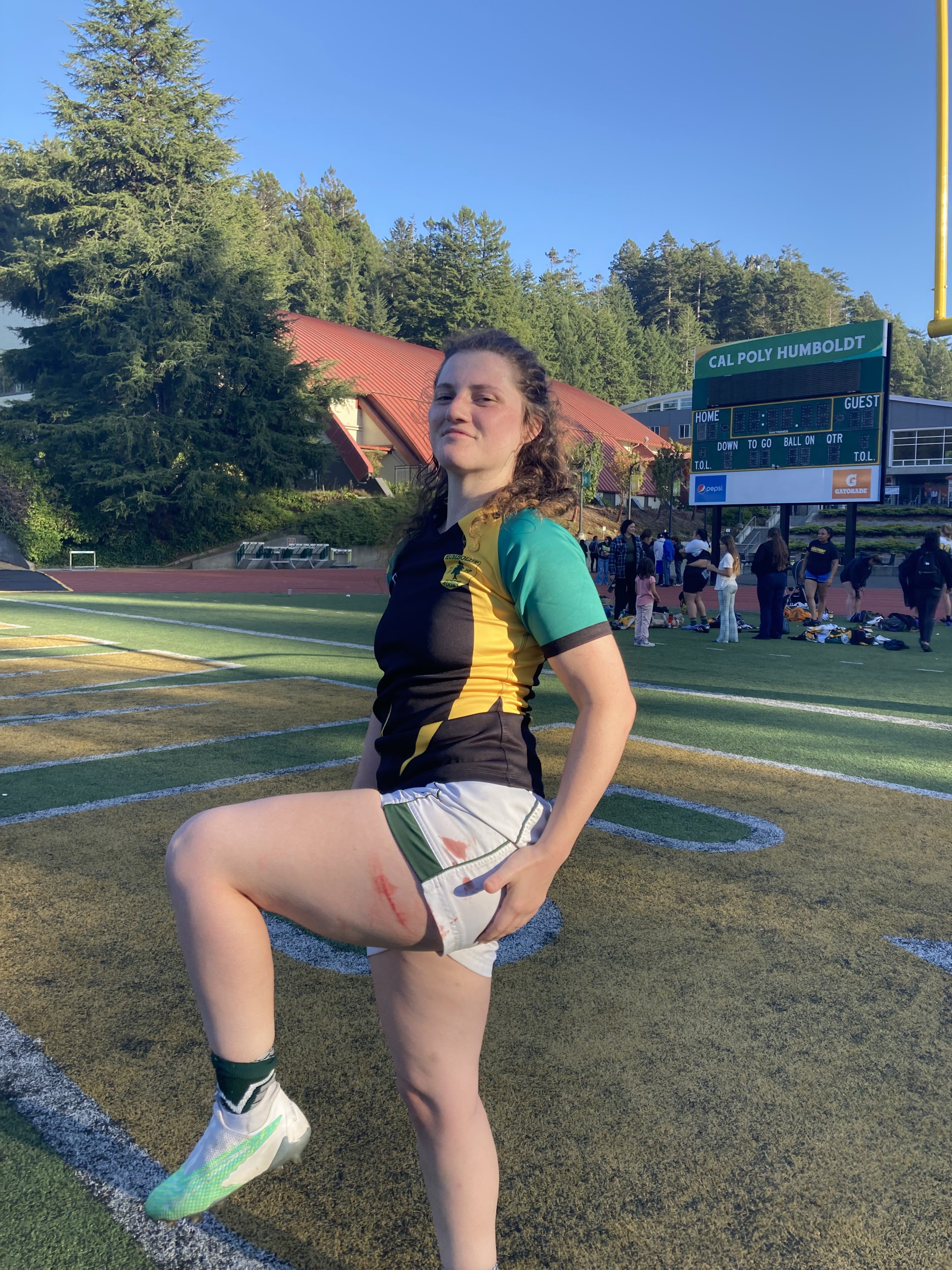
It was the first minute of the rugby match between Cal Poly Humboldt and University of San Francisco (USF). USF kicked the ball, Humboldt made a play, forwards crashed and Courtney Campuzano got a breakaway. After she broke through the defense, she took off towards the try line. A player pulled her back by her shorts. As she leaned down to touch the ball down to score, another player fully tackled her on the back of her leg. There was a crack, and she tore her ACL. Campuzano made the point, but her season was lost.
A senior studying social work at Cal Poly Humboldt, Courtney Campuzano is the president and co-captain of HP Rugby.
Identifying as a lesbian, Campuzano said that rugby is a safe space for queer folks.
“I love how many queer people are in the sport,” Campuzano said. “It makes me feel so comfortable and safe.”
Campuzano said that even though it’s a women’s team, there are non-binary people, too.
“We’ve had questions about that with the team, naming it women’s rugby and just saying Cal Poly Humboldt Rugby, HP Rugby,” Campuzano said.
HP Rugby is the club’s moniker, but what HP stands for is a well-kept team secret.
“I’m not at liberty to say,” Campuzano said. “The teammates know.”
Campuzano also said that rugby is a size-inclusive sport.
“Rugby is a sport for everybody,” Campuzano said. “There’s people of all sizes playing. That’s one of my favorite things about it.”
Her recent knee injury has robbed her of the rest of her season, but she continues to help the team. Campuzano described the moment her ACL tore as feeling like she had just been called into the principal’s office.
“Your heart drops to your ass,” Campuzano said.
Before her injury, Campuzano played the position of 10, or fly-half, this season, but said she’s happiest playing center. The fly-half is usually the first player to get the ball from the forwards after the scrum, which is what restarts play. Campuzano has been playing rugby for six years and started on a whim.
“My roommate’s partner at the time came into the dorm one day and was like, ‘Can you come to practice with me? I don’t want to go by myself,’” Campuzano said. “I loved it.”
Campuzano said that rugby has taught her how to better deal with issues in her everyday life.
“[Rugby] taught me to go into things head-on,” Campuzano said. “Even things that aren’t physical.”
Campuzano said that rugby attracts a certain type of person.
“People who want to blow off steam and are comfortable hitting people ethically,” Campuzano said.
There are a plethora of rugby terms, but Campuzano said their favorite is “hooker.” This term is a position where the player tries to hook the ball with their foot during the scrum.
“People love that on shirts,” Campuzano said. “Like, ‘I can say I’m a hooker and my mom’s proud.’”
Everyone’s seen it: alley-oops, slam-dunks. Nothing but net and jumpshots galore. For the people at the Lumberjack Arena last Wednesday night, basketball was flipped on its head, spun around on a single finger and reimagined by none other than the Harlem Globetrotters. Athletes, theater lovers and comedy fanatics came together as the Globetrotters faced off against their unrelenting rivals, the Washington Generals.
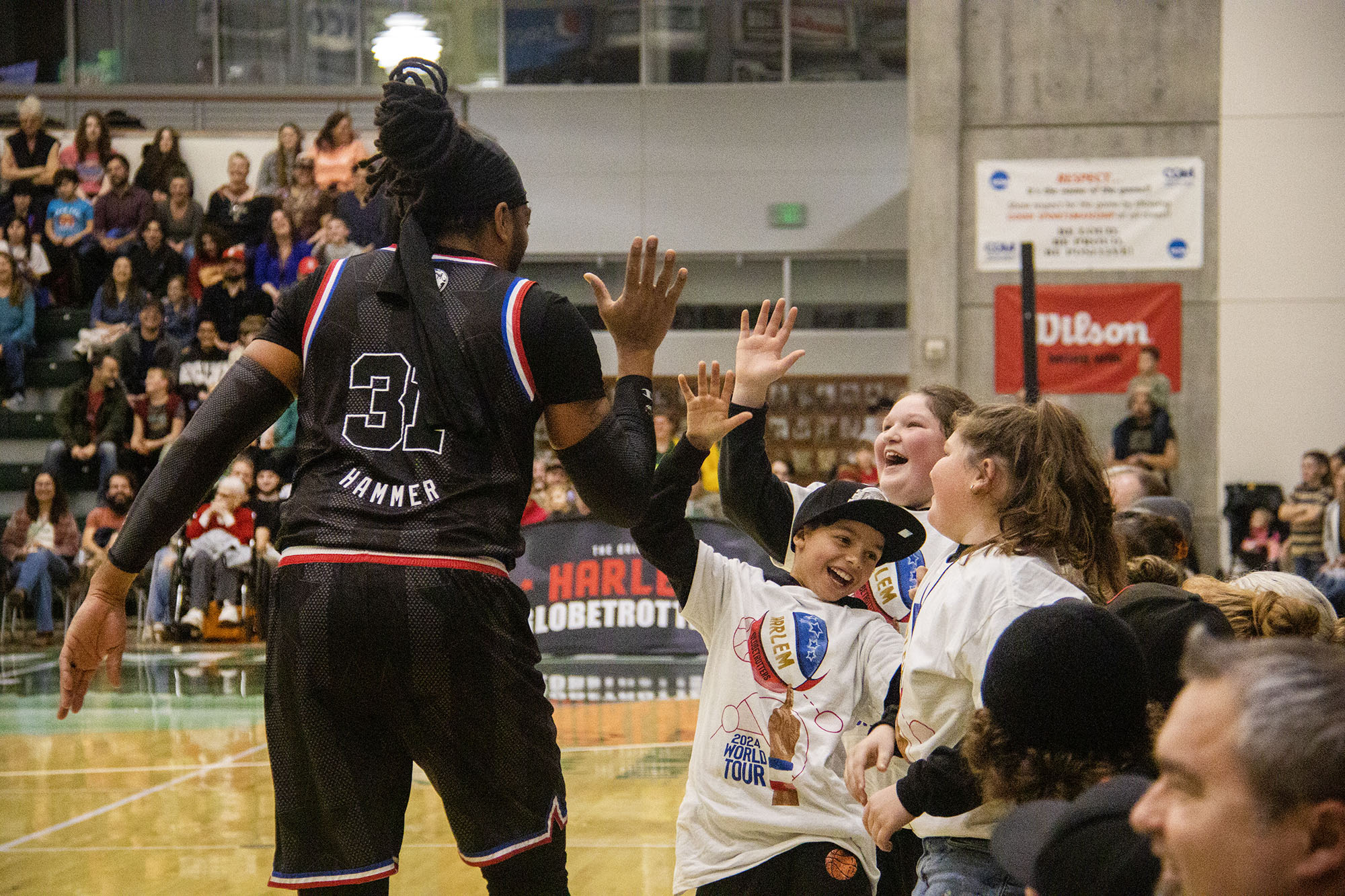
Before the game, select kids and adults alike got the experience of attempting trickshots in front of hundreds of people. If you weren’t lucky enough to give the warmups with the Globetrotters a go, you might’ve had a run in with their mascot, Globie, who roamed the bleachers & isles getting the crowd hyped for the main act. Between the dances, selfies, community involvement and unironic athleticism, there wasn’t a single person left unimpressed by the Globetrotters performance, although it was more of a party. All this was before the beginning buzzer.
photo by Alex Anderson
Elena German, an English education major, had never been to a Globetrotters game. As a surprise Christmas gift, she got tickets to attend the event with her brother Ethan. Despite not being a sports fan and having minimal basketball expertise, there was plenty for her to enjoy.
“I love a good show, I like to be excited,” German said. “I’m expecting a lot of energy from the crowd. It’s a lot of kids, which is exciting… Definitely the comedy and theatrics aspect of it, that is what was kind of appealing when I looked into it.”
Unlike typical basketball games, the Globetrotters had their very own MC and DJ. The combination of music, quick commentary, goofy dances and trickshots made for a chaotic night. Audience members, such as Cal Poly Humboldt student Ethan German, couldn’t contain their excitement at the sold out performance.
photo by Alex Anderson
“It absolutely exceeded my expectations, wonderful show,” Ethan German said. “The tall player and the short player chasing each other. That was definitely something I did not exactly expect, but it was a great addition.”
This basketball game was one-of-a-kind in more ways than one. The Globetrotters had the traditional trick shots, like having their back to the hoop and throwing the ball “grandma style,” but they also had a handful of unique yet iconic moments. Originators of the “four point line,” the Harlem Globetrotters took every opportunity to sink four-pointers. If the four pointer missed, there was another player ready to slam dunk a rebound.
At one point during the game, the MC announced their special rule: game changers. At any point during the game, if the DJ played the special sound, the audience was prompted to shout, “CHANGE! THE! GAME!” In which case the Globetrotters would proceed to do something extremely goofy. The most normal of the game changers included doubling points, resulting in some epic eight pointers, and a dunk contest where the audience voted on the winner.
More surprising game changers included having kids from the audience shoot free throws, bringing a football onto the court and roleplaying the NFL. After running the ball into the “end-zone,” the audience did the wave and the players did their touchdown dances. Naturally, a referee called a foul and needed to see a replay, so everyone did everything in reverse – including a slow-motion reverse wave across the gym.
Globie, the Globetrotter’s mascot | photo by Alex AndersonA Globetrotter dunking | photo by Alex Anderson
Other oddities included every parent simultaneously holding their baby in the air as the Lion King soundtrack played. One player stole an audience member’s shoe just to give it back Cinderella-style in center court and the same player pulled flags out of the referee’s pocket clown-style.
Mikey Crispin, a Cal Poly Humboldt graduate and a lifelong Harlem Globetrotters fan, was blown away. After the show, he was one of many jumping out of his seat.
“When I was a kid, the Globetrotters were all men,” Crispin said. “Now, there’s women in there, and that’s really amazing because they show a lot of girlpower and encouragement. I felt like that was really important… and that’s what we need to see.”
Chaotic, impressive and goofy are a few words used to describe the night, but none do it justice. Despite the lack of descriptors, everyone can agree it was an unforgettable night at the Lumberjack Arena.
This website uses cookies to improve your experience. We'll assume you're ok with this, but you can opt-out if you wish. Cookie settingsACCEPT
Privacy & Cookies Policy
Privacy Overview
This website uses cookies to improve your experience while you navigate through the website. Out of these cookies, the cookies that are categorized as necessary are stored on your browser as they are essential for the working of basic functionalities of the website. We also use third-party cookies that help us analyze and understand how you use this website. These cookies will be stored in your browser only with your consent. You also have the option to opt-out of these cookies. But opting out of some of these cookies may have an effect on your browsing experience.
Necessary cookies are absolutely essential for the website to function properly. This category only includes cookies that ensures basic functionalities and security features of the website. These cookies do not store any personal information.
Any cookies that may not be particularly necessary for the website to function and is used specifically to collect user personal data via analytics, ads, other embedded contents are termed as non-necessary cookies. It is mandatory to procure user consent prior to running these cookies on your website.