The Lumberjack


Students Serving The Cal Poly Humboldt Campus and Community Since 1929

Year: 2018

  • “It was infuriating to see that the Arcata Police Department did not show up”

    “It was infuriating to see that the Arcata Police Department did not show up”

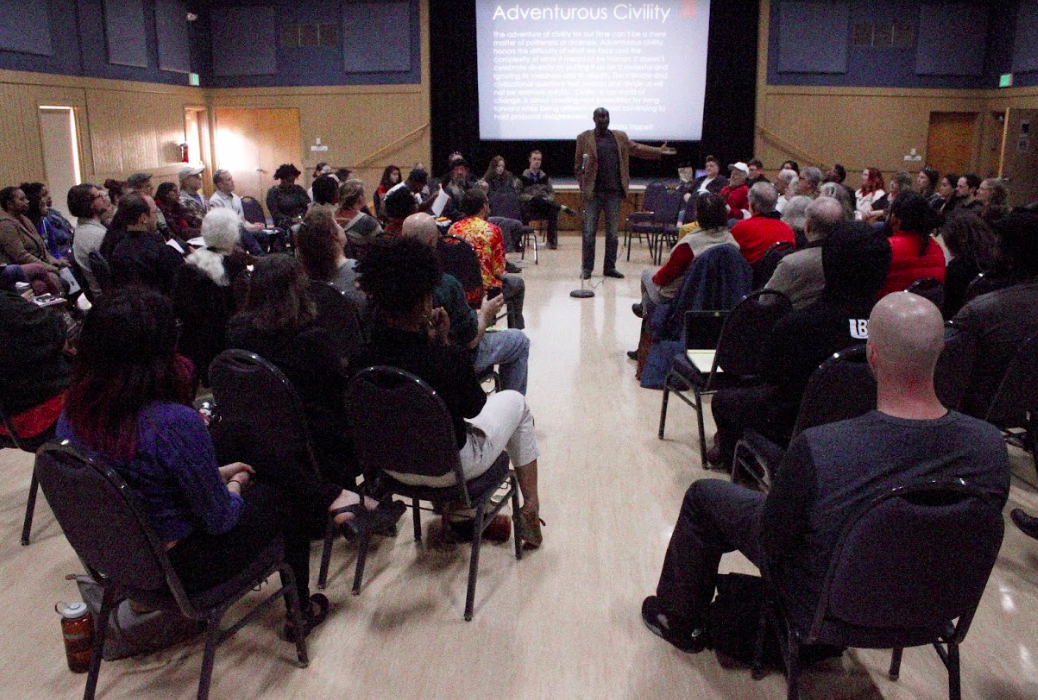
    City of Arcata supported a Dialogue on Race forum at the D Street Neighborhood Center on March 22.

    Mayor of Arcata Sofia Pereira attended the forum in hopes to create a space for the Arcata community to discuss racial discrimination.

    “There’s a lot of pain in this community based on what people of color have experienced here. It’s not going to be overnight, ending that pain,” Pereira said. “The more we have a space for these conversations and concrete actions, we can take [those] as individuals and as a community. I think that can get us to place of healing.”

    Pereira wanted to absorb everything that was discussed in the forum in order to get a sense of the right direction to take moving forward.

    “As for the next steps, I heard the feedback for making sure that we have representation from the Arcata Police Department, along with making sure we’re inviting Humboldt State’s administration,” Pereira said.

    Arcata mayor Sofia Pereira attends the monthly forum on race and public safety at the D Street Community Center on March 22. Photo by Nick Kemper.

    The City of Arcata gave Pastor Roger Williams the opportunity to facilitate the discussion on race.

    “I’m here because it’s a heart condition of mine, where I want to see people come together. I know it’s not easy, but it’s a passion of mine,” Williams said. “In a potentially charged environment with potentially angry people, with city hall here in the same building and in the backdrop of an unsolved murder, it went well.”

    Williams said that the point of the forum gue was to make people more aware of the fact that we live in a community where racism exists. He wanted to make those unaware of it to address racism in their community.

    “It’s not so much about black folk standing up and talking about race because we’ve been doing it forever,” Williams said. “It’s white folks taking some responsibility for themselves and not just not taking responsibility for being woke, but trying to wake other people. Come with an open mind and with the intent to understand [than] just reply. That’s where grassroots change happens.”

    Community member Paula Jones speaks at the D Street Community Center forum on race and public safety on March 22. Photo by Nick Kemper.

    Community member Erik Rydberg went to the forum, because he felt that the subject of race in this country needs to be talked about everywhere, regardless of how uncomfortable it makes people feel.

    “We need to understand the construct of race,” Rydberg said. “What it means historically in this country and why it was developed by the elite ruling class in this country in order to keep a select few people in control of the apparatuses of society.”

    Rydberg said this discussion matters to him, because he has experienced the injustices people of color have endured in this country, particularly in California.

    “As an indigenous person, the legacy of genocide and the holocaust of the American Indian, especially here in California, is an erased history,” Rydberg said. “[It] makes people who are really proud to be American extremely uncomfortable to talk about what’s transpired here in California, as far as the colonization of my continent.”

    Rydberg was one of the many people who decided to speak out at the forum. He decided to share the realities of racism, because he felt that it would be helpful to hear from an indigenous person’s point of view.

    “It was infuriating to see that the Arcata Police Department did not show up,” Rydberg said. “You’re in a position of authority. You need to be the most educated on this. You’re holding people’s lives in their hands every time you put [on] that belt buckle with your gun in it, every time you hop in your car with your shotgun [or] every time you have an AR-15 with you, with the legal authority to use that force.”

    Rydberg has a message for people who didn’t attend the forum.

    “You can’t stand in solidarity with somebody if you don’t know anything about their culture or their people,” Rydberg said. “Authority figures need to be [the] ones packing these kinds of events to learn about the people whose lives you hold in your hands.”


  • Community for women in math and sciences

    Community for women in math and sciences

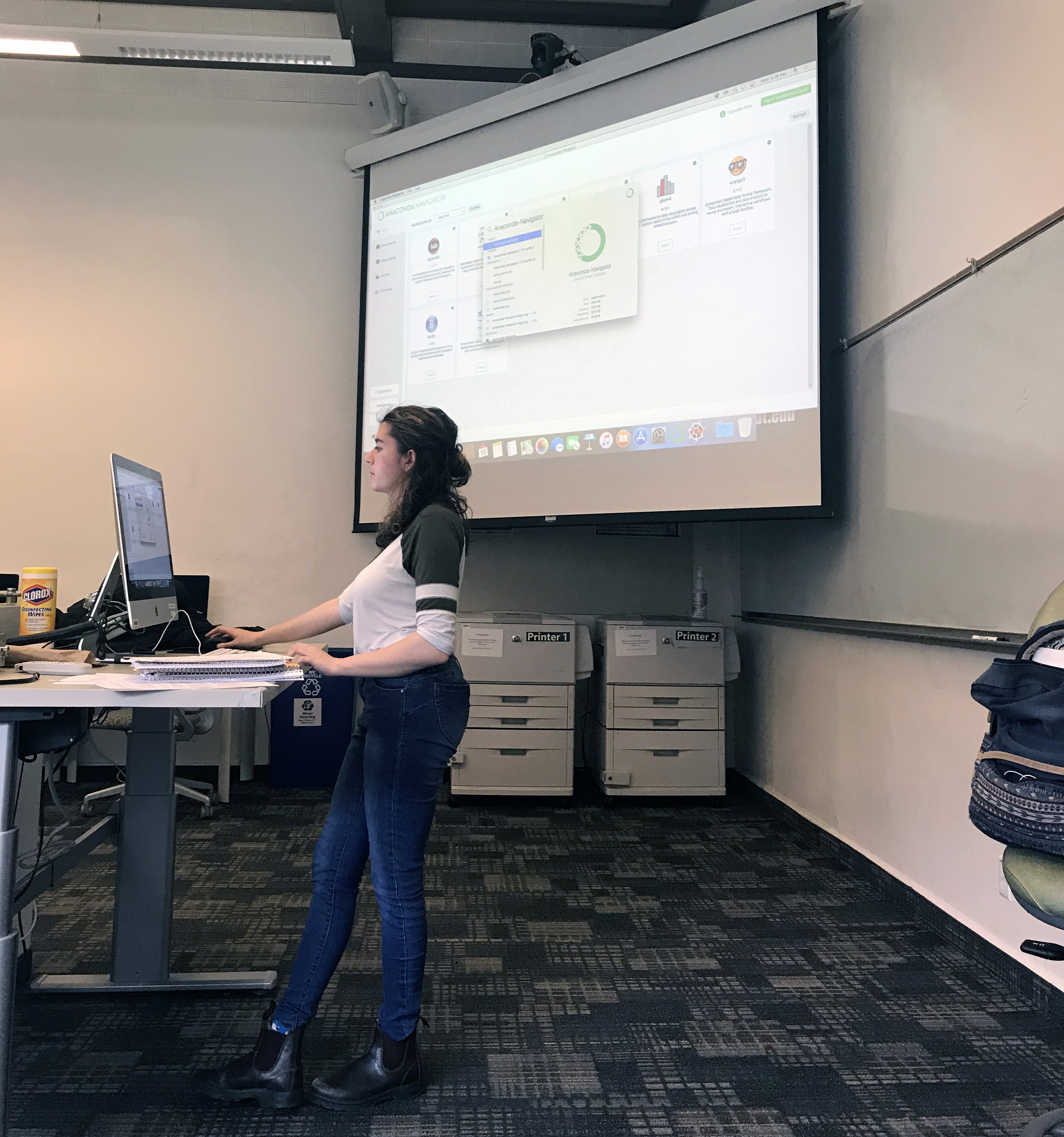
    Paola Rodriguez Hidalgo is a faculty member in the department of physics and astronomy at Humboldt State. She is also the advisor for the Society of Women in Math and Sciences, or SWiMS.

    “Sometimes I feel that people don’t see the scientist inside the woman,” Rodriguez Hidalgo said. “It can get very tiring and erode your confidence and your energy.”

    The group is student-run and acts as a support system for women in science, technology, engineering and math majors. They are working to improve conditions in these fields by making the space diverse and inclusive for all groups of people that are not traditionally represented, not only women.

    Kayleigh Migdol is a sophomore computer science major who is on the leadership board for SWiMS. She runs Codernoon, a coding workshop, for the club every Monday and Wednesday.

    After years of desensitization, Migdol became used to being the only girl in her science classes. Then she came to HSU, where she found the Society for Women in Math and Sciences.

    “By my senior year of high school, I was one of two girls,” Migdol said. “Building this sense of community is really important. It may seem like you are alone, but we want people to know that they are not.”

    McKenna Rayburn, a junior majoring in oceanography, has felt alienated as one of the only women in her program.

    “Women should feel motivated to continue with their careers in math and sciences,” Rayburn said. “We need women in these fields, but it’s hard when you don’t feel that connection with your classmates. It’s even harder when you’re surrounded by just men.”

    Belen Brashears, a sophomore environmental science major, thinks now is the best time to be a woman in the sciences due to our current political climate. She feels a connection with other scientists and enjoys being around likeminded people.

    “At Humboldt State, there’s a really supportive scientific community,” Brashears said. “It’s welcoming to everyone and offers tons of opportunity for anyone to get involved.”

    Rodriguez Hidalgo says she promotes building a safe community space where students won’t feel judged. In addition, students feel comfortable when everybody shares some of the same struggles.

    “We have created a beautiful community where we support each other,” Rodriguez Hidalgo said. “As scientists, we are good problem solvers, but very often it is much easier to solve somebody else’s problems than your own. When you have a community, you help the person next to you and they help you.”

    This article was changed from its original version on March 28 at 2:12 p.m. 

  • Sarah Ray keeps emotions and knowledge together in her teachings

    Sarah Ray keeps emotions and knowledge together in her teachings

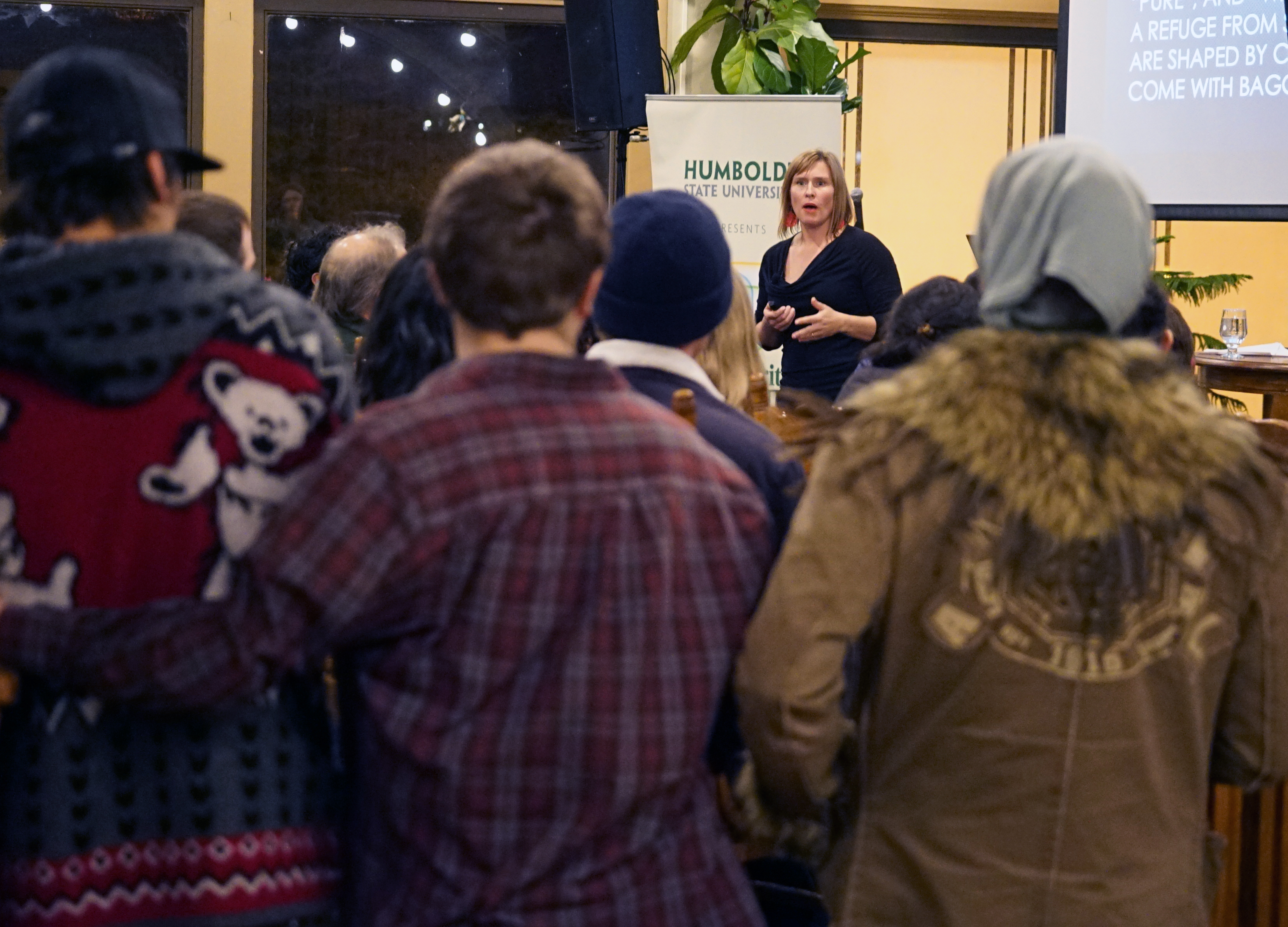
    Sarah Ray inspires students and faculty at Humboldt State. During her lecture, “Coming of Age at the End of the World: Eco-Grief, College Students, and Teaching Climate Change,” she inspires community members as well.

    Sarah Ray, environmental studies professor at Humboldt State, spoke as part of the “My Favorite Lecture” series at the Plaza Grill in Arcata on March 8.

    The lecture discussed ways to be empathetic to students’ emotions and the methods Ray uses to inspire her students, all while acknowledging the grim realities of past environmental decisions.

    “Emotions take on a life of their own in the classroom,” Ray said.

    When Ray took the position to lead the environmental studies program at HSU in 2013, there were 11 environmental studies majors in her program. As of 2018, there are 150 environmental studies majors at HSU.

    Ray says that humans emotions play a big role in environmental studies.

    “Not surprisingly, guilt, despair and negative news do not inspire students to [take] action,” Ray said. “It creates apathy and nihilism. There is a lot of research that shows this is not an effective tool.”

    Over time, students’ emotional responses became overwhelming for Ray herself. Out of self-preservation, and for the success of her students, Ray has come up with new teaching strategies for environmental studies.

    Ray believes these strategies will be beneficial to everyone who questions the importance of their own environmental role.

    “Teaching students environmental content is going to have a negative affect on them,” Ray said. “If the affects can be anticipated, the more effective the curriculum will be.”

    As a professor, Ray has watched many environmental studies students learn that their college journey is not what they expected.

    Faced with intractable, unsolvable problems, students become incapacitated. Ray calls this “getting the rug pulled out from underneath you.”

    After watching students repeatedly get the rug pulled out from underneath them, Ray realized these students need emotional support to deal with the curriculum.

    Brooke Holdren, a biology major at HSU, attended Ray’s talk and thinks ethics should be part of science.

    “There needs to be more critical scientists,” Holdren said. “Science is political as fuck.”

    Ray utilizes inclusive pedagogy to promote not only a students academic success, but their social, cultural and physical success.

    Inclusive pedagogy is a way of teaching that uses varying learning techniques, multicultural content and multiple means of assessment.

    Going off of Bell Hooks teachings, Ray said, “We have to make the personal political and we have to make content relevant to students.”

    Ray also uses social movement theory in her teaching.

    “The outcome of social movement theory is to give students a sense of belonging in a larger community. They are not isolated against the tidal wave of society,” Ray said. “Students are involved in a bigger group of people working towards the same goals.”

    Ecopsychology uses both ecological and psychological ideas to study the relationship between human beings and the natural world. Ecopsychology includes theories about emotional responses to climate change and has become useful in Ray’s teaching, showing how environmental change causes emotional distress.

    Last semester, Ray tried a change-vision-action workshop with her students. Ray had students list how they would like to see changes in the world, and make a personal action plan. Students have put these ideas into actions. This has given Ray inspiration to improve and instill greater lessons onto her students.

    Ray doesn’t simply tell her students how to fix the current environmental issues. Instead, she gives them the information and emotional support they need to come to their own conclusions.

    “Efficacy is better than hope,” Ray said.

    Efficacy is the ability to produce a desired result. Students envision new ways of living with their outcomes.

    “Sometimes the outcomes are hopeful and lead to resiliency, while other times outcomes are negative,” Ray said. “These workshops are not monolithic. They can go in many different directions.”

    HSU alumnus Larry Goldberg, who started the Campus Center for Appropriate Technologies at HSU in 1978, attended Ray’s lecture.

    “You can’t get incapacitated by fear and depression. Get off your ass. You got to do something,” Goldberg, said.

    The changes and theories Ray has implemented in her classroom have inspired her to write a book on emotions in the classroom. Ray’s book will look at different aspects to the emotional consequences of climate change. She plans to write the book on her sabbatical next year.

    “You have to come up with your own reasons and solutions to our problems, because self-righteousness is not enough,” Ray said.

  • Upset students storm WSCUC open forum

    Upset students storm WSCUC open forum

    Cold and wet students gathered in the lobby of the Native American Forum at Humboldt State on March 21 for the WSCUC student open forum.

    The WSCUC, or Western Association of Schools and Colleges Senior College & University Commission, is a team of multiple administrators from different colleges across the country. This agency is given the task of reviewing an institution’s accreditation every 10 years and compiling a report that shows the results of this review.

    The open forum was for HSU students to share their input with WSCUC, and students were not happy. While this was not an opportunity to have questions answered, or problems addressed, it was a chance for students to tell WSCUC what concerns them about HSU.

    The issues that were brought up to WSCUC concerned student homelessness, financial issues, racism in the surrounding areas and, most commonly, the lack of communication between the students and administration.

    “Many of the students were informed of your arrival through this screensaver on all HSU computers,” HSU student Jessa Anderson said as she presented the Star Wars-themed flyer on the computer that informs viewers of WSCUC’s visit.

    Other students said they were not aware of the open forum until the budget cuts walkout that occurred in the UC Quad and Siemens Hall on the same day.

    Rita Cheng, the president of Northern Arizona University, is a member of WSCUC and mediated this open forum.

    “We are just peer reviewers, and it allows us to get a better look when we look from this perspective,” Cheng said.

    Students continued to speak of the pattern of poor communication between administration and students. Students also expressed how the stresses of not knowing what will be cut might affect their lives.

    Toward the end of the forum, the conversation shifted to the ignored racism problem in the university and surrounding areas.

    “I don’t feel safe and I don’t even know how to begin to feel safe here,” HSU student DaMon Thomas said.

    While HSU’s administration was not at the open forum to hear these grievances directly, many students were able to have their voices heard by WSCUC.

  • Community doubles down on McKinley statue

    Community doubles down on McKinley statue

    Community straightens out Arcata City Council on removing McKinley statue.

    The Arcata City Council held a meeting at the Arcata Community Center on March 21 concerning the McKinley statue on the Arcata Plaza. Over 200 community members attended.

    The Arcata City Council voted 4-1 with one abstention on Feb. 21 to remove the McKinley statue from the plaza.

    The March 21 council meeting was an attempt to invalidate the recent vote and years of community protest against the statue in the town square.

    Council member Susan Ornelas put the ballot item on the March 21 council meeting agenda as part of a “no project alternative.”

    “I felt I could trust the citizens of Arcata to see this issue deeper than people have been projecting they would see it,” Ornelas said. “I thought I could trust people [to] see why [the statue] should be there.”

    Council member Paul Pitino spoke on the subject of a public ballot.

    “In reality, it is not going to be an option to have the statue remain in the middle of the plaza,” Pitino said. “I see we have this thing handled already. We don’t need a vote.”

    Mayor of Arcata Sofia Pereira also commented.

    “Given that we have already made a vote to move the statue, I believe that putting this to a vote doesn’t give us the information we need in a public process,” Pereira said.

    When Pereira opened up the public comment, 121 people were signed up to give a three-minute comment on the McKinley statue removal. Public comment lasted for over three hours.

    The first speaker during the public comment, Claudia Johnson of Arcata, said that the only people who should determine if the statue should be removed are the voters.

    “That statue was a gift to the citizens of Arcata and the city council is responsible for caring for it,” Johnson said. “Right now, [the city council is] not taking care of it.”

    Arcata resident Rob Hepburn has been the gardener at Veterans Memorial Park in Arcata for 15 years.

    “I’m a Vietnam combat veteran and that is why this is really important to me,” Hepburn said. “I know what happened in the Philippines. That started under the watch of McKinley. It started with an ideology called ‘manifest destiny,’ which in essence says that white men are determined by a God-given right to take the lands of non-white peoples and civilize them into imitation white men.”

    Hepburn ties the Philippine-American War to Vietnam War.

    “The results in the Philippines were 250,000 civilian deaths. Massacres in the Philippines were precursors to the My Lai Massacre and other massacres in Vietnam,” Hepburn said. “That is why I feel so strongly that this statue should not be in a place of honor in the center of Arcata. The legacy of imperialism and racism needs to stop here. It needs to end with us.”

    Arcata resident Joanne McGarry stands for peace on the Arcata Plaza.

    “McKinley invaded the Philippines and Hawaii,” McGarry said. “He does not stand for peace. I want a peaceful plaza.”

    McKinleyville resident Maureen Kane also made a statement during the public comment.

    “If we are to have peace, we must openly and knowingly acknowledge all of our wrongdoings so we can ask to be forgiven,” Kane said. “Atrocities occurred in our town square.”

    Allison Lundahl, a Humboldt State student pursuing a masters in social work, spoke at the meeting.

    “I encourage [the city council] to include historical trauma [and] the impact of the symptoms of colonialism in your CEQA report,” Lundahl said.

    CEQA, or the California Environmental Quality Act, is a California environmental statute requiring state and local governances to comply with environmental guidelines.

    Tia Oros Peters of the Seventh Generation Fund in Arcata spoke next.

    “I request that the city council open every council meeting recognizing that we are on Wiyot territory as a right of indigenous peoples, recognizing the sovereignty and determination of the Wiyot people,” Peters said.

    Peters also requested the council to stand firm in their decision.

    “We should not be having this meeting,” Peters said. “You already voted to remove the statue.”

    At the end of public comment, the council agreed to honor their earlier decision to remove the McKinley statue from the plaza.

    “At this point, I’m saying I would just continue with what we’re doing,” Ornelas said. “I’m sorry we took all of this time.”


  • CNRS students want answers

    CNRS students want answers

    Humboldt State students from College of Natural Resources and Sciences, or CNRS, gathered for a talk on Thursday, March 8 to address the CNRS budget crisis. The talk was facilitated by Stephany Salgado, a biology major. Both the interim dean, Steve Smith, and associate dean of CNRS, Rick Zechman, attended the talk.

    “I want to make sure CNRS is getting the students involved,” Salgado said.

    The CNRS is facing $2 million in budget cuts and students are concerned their fall 2018 semester classes will be cut.

    Smith is filling the position that Richard Boone held until March 5. Smith was the dean of CNRS between 2010-2016. Being back from retirement for only two days prior to this talk, Smith revealed some ideas of possible solutions to the CNRS budget deficit. Smith mentioned possible changes, but would not go into any specific details.

    Smith explained how the department spending works and, how in the past, the reserve would take care of expenditures exceeding the budget. There is currently little reserve funds and the CNRS department spending is required to stay within the budget.

    “For a long time, the university has been deficit spending and we have to turn that around,” Smith said.

    Smith expressed the most important factor of all is to meet the students’ academic unit demand.

    “We are going to meet the academic demand for student courses. What might change is who is teaching the course,” Smith said.

    Smith did not go into details about allocating teaching modes.

    Smith assured the students the same courses will be available this fall, but he doesn’t know when or if he can solve all of the budget deficit problems.

    “This is the short version of a very complicated problem,” Smith said.

    A student asked Smith if professors could teach more and spend less time on research. Smith responded that it would be up to the tenure-line faculty.

    Smith also reminded students that professors belong to a labor union that directs their hours, and that tenure-line faculty are expected to do research.

    A student asked if graduate student programs will be adversely affected.

    “Graduate funding will increase, if anything,” Smith said.

    Another student asked about a fall class that is listed as unavailable. Smith assured the student that will change before registration. He also assured that all classes will appear on the schedule for registration.

    One student asked about reductions in programs. Smith didn’t think there would be reductions.

    “I don’t see anything along the lines of downsizing, probably elimination,” Smith said. “I don’t see that in the cards. Please don’t rush out and say we are going to cut programs.”

    Zechman pressed on the importance of having students’ degree audit reports, or DARS, planned out for three semesters ahead of time.

    “It is critically important to have your DARS planned out for three semesters ahead so CNRS knows how many seats it needs to offer for that class,” Zechman said.

    President Lisa Rossbacher reassures students the administration is working to guarantee them the classes they need to graduate.

    “We are doing everything possible to make sure students get the classes they need to make progress towards graduation and graduating on time,” Rossbacher said. “We still have one of the best science departments in the country with our natural resources and outdoor labs.”

  • This week in sports history

    This week in sports history

    March 22, 1988 – Houston Texans All-Pro defensive end J.J Watt is born in Waukesha, Wisconsin. Watt became famous across the nation in 2017 during the aftermath of Hurricane Harvey when he began his Houston Flood Relief Fund and raised over $37 million for the victims of the storm.

    March 23, 1994 – NHL Hall of Famer Wayne Gretzky passes hockey legend Gordie Howe’s all-time goals record of 801. Gretzky’s record now sits at 894 and is highly regarded as a record that will never be broken.

    March 26, 1992 – Former heavyweight boxing champion Mike Tyson is sentenced to six years in prison for raping Desiree Washington, an 18-year-old college student who told the police and later testified in court that Tyson raped her in his hotel room and laughed about it as she wept.

    March 27, 1939 – The first ever NCAA Men’s Basketball Championship game is played. The University of Oregon beat Ohio State University 46-33.

    March 28, 1982 – The first ever NCAA Women’s Basketball Championship game is played. Louisiana Tech University beat Cheney University 76-62.

  • “Thoroughbreds” is a richly dark comedy

    “Thoroughbreds” is a richly dark comedy

    People are terrible and horses will take over the world.

    “Thoroughbreds” is the debut film of writer and director Cory Finley. It is about two rich girls plotting their stepfather’s murder, but there’s more to it. It’s less a murder mystery, but a character study on emotions and impulses.

    The character Amanda is an emotionless girl who hasn’t fully outgrown her horse phase. She speaks her mind and is blunt about it, including her lack of emotions. Lily is an emotionally overwhelmed girl who guards herself from hurting others.

    The two were formerly friends until high school separated them, only to be reunited by studying for the SAT’s.

    After taking down their reservations, they become friends again. Lily hates her health-obsessed stepdad who talks down to her and forced her mom to send her to a different boarding school. Amanda casually suggests killing him and Lily’s impulsive mindset kicks into gear to plotting his murder.

    This film doesn’t focus on the girls’ lavish lives. It’s just a perfect background to plot a murder without getting caught. The mansions look big and beautiful to fill in the background of the actors’ symmetrical framing.

    The sound editing and mixing stand out with it’s unsettling and chic percussion. The rhythmic score gave it a constant edge that could lead to a psychotic breakdown, which compliments the impulsiveness of the characters.

    Little sounds fill the scenes that reflect the emotions of the characters. Lily’s tapping of a pen mimics a clock too well, the rowing of her stepdad’s row machine irritates her and the sliding sound is invasive like Edgar Allan Poe’s “The Tell-Tale Heart.”

    The characters aren’t simply rich brats. Even if Amanda doesn’t understand emotions, she is still expressive and her brutal honesty is refreshing. Lily is sympathetic when she feels helpless not standing up to her stepdad yelling at her mom.

    The rest of the cast is good, but the highlight is Anton Yelchin, which was his last film since his death in 2016.

    Lily and Amanda grow by the end of the film, yet whether if it was for their own good is up to you.

  • HSU professor Kevin Murray exits race for California’s 2nd State Assembly district

    HSU professor Kevin Murray exits race for California’s 2nd State Assembly district

    “Politicians are owned by corporations and businesses.”

    Humboldt State political science professor Kevin Murray announced that he is exiting the race for California’s 2nd State Assembly district on March 18. It’s Murray’s third year of lecturing political science at HSU and his 27th year of teaching in total.

    Campaign donations play a big role in winning an election, and the majority of the people in the 2nd State Assembly district live in Sonoma County. The 2nd State Assembly district stretches from north of Santa Rosa and ends at the Oregon border.

    Murray’s opponent, Jim Wood, lives in Healdsburg, which is a city located in Sonoma County.

    “Politicians cannot afford to run for office unless they raise money,” Murray said. “Politicians raise money from the traditional contributions of [businesses] and corporations.”

    Murray said that the Democratic Party has turned into “Berniecrats” and “Corporatecrats.”

    “Politicians are owned by corporations and businesses,” Murray said.

    Murray chose to only accept private campaign contributions and no corporate or business campaign contributions.

    “If I were to take business contributions, I would be obligated to [vote] for those business contributors’ interests,” Murray said.

    In Murray’s press release about stepping out of the race, he talked about the need for publicly financed campaigns.

    Murray has keen insights into the social, political and capital interests prevailing in America.

    “The marketplace of Ideas is a fallacy and a farce until we have publicly financed campaigns,” Murray said. “It takes any candidate at least two years to raise enough money to run for office, and that is no guarantee the candidate would have raised enough money.”

    Murray believes in single-payer healthcare, where the California State Health Care Commission receives healthcare benefits and the commission would, in turn, pay the doctors. This eliminates the insurance companies with public stock.

    “Health care should never be surrendered to the marketplace,” Murray said.

    Murray is for farmworkers receiving overtime pay, as Murray’s mother was a farmworker.

    Murray is for corporations that don’t hire personnel from overseas at half the salary of an American citizen and those that don’t have a negative impact on the environment. He also measures corporations and businesses on how well they treat their employees.

    “Arcata has no rent control. Every student at Humboldt State will see their rent increase at least once in the time they spend at school,” Murray said. “What if their rent doubled? It could happen without rent control.”

    Murray said that our society is based on special interest groups funded by the wealthy and powerful.

    “We cannot elect progressive members who are not beholden to corporate and business interests to pass policies to provide the majority with more money, time and a higher quality of life,” Murray said.

  • Students v. admins: frustrated conversations at the budget cuts walkout

    Students v. admins: frustrated conversations at the budget cuts walkout

    “Students’ rights! Students’ rights!”

    “Where the fuck is Lisa? Where the fuck is Lisa?”

    “Cut her pay! Cut her pay!”

    Video by Bailey Tennery.

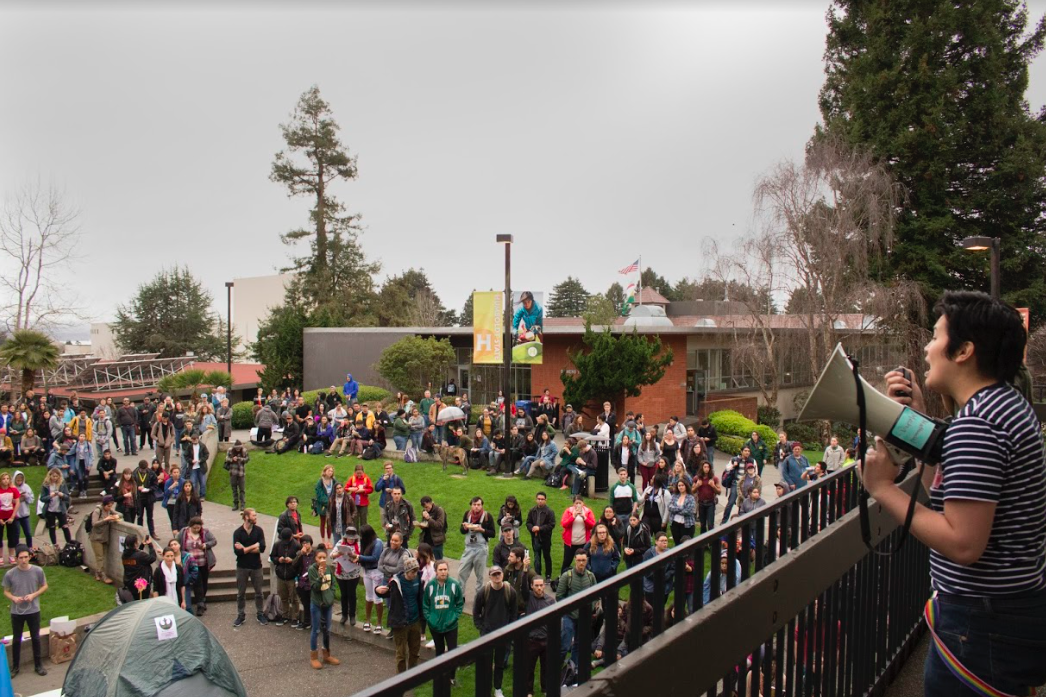
    HSU students could be heard storming through Siemens Hall yesterday, demanding the school’s administration to face students’ anger surrounding the budget crisis.

    Trevor McDowell, a wildlife major at HSU, was among the crowd of student protestors.

    “We are marching to find President Rossbacher, wherever she is meeting with WASC,” McDowell said.

    WASC, or the Western Association of Schools and Colleges, is a reviewing body that determines whether a school is capable of preparing students for the next steps in their careers.

    Dr. W. Wayne Brumfield, interim vice president of student affairs, explains the significance of a WASC approved institution.

    “WASC accreditation happens all across the country, and is important to a student’s degree. Having the accreditation is a sign of a healthy institution with good academics,” Brumfield said.

    Interim VP of Student Affairs Dr. W. Wayne Brumfield listens to student demands in Siemens Hall on March 21. Photo by Philip Santos.

    David Alvarez, a student protestor, wanted Brumfield to know that HSU is not healthy.

    “Why is there a lottery to live on campus? That’s not healthy,” Alvarez said. “I am scared to be homeless. We are not healthy.”

    The students’ protest, led by Moxie Alvarnaz, started in the UC Quad.

    “How do you feel about the budget cut? The administration just got another raise,” Alvarnaz said.

    A collective “boo” swept through the crowd.

    Dr. Alexander Enyedi, HSU’s provost and an administrator, was in attendance at the protest.

    “I think we should keep the focus on the budget structure,” Enyedi said. “A deficit is different from a budget cut. The colleges’ budgets are mostly untouched, but we are asking them to not spend more than what they are given.”

    Enyedi was certain that using the school’s degree auditing system, or DARS, to gather an idea of what classes students need will ensure that students have the right classes to graduate on time, in spite of the deficit reduction effort.

    Tents in the UC Quad at Humboldt State during the student-organized event to protest budget cuts on March 21. The walkout was organized by Students Coalition for Organized and Direct Action. Photo by Matthew Hable.

    As students marched into Siemens Hall from the UC Quad to find President Lisa Rossbacher, they confronted Enyedi in front of his office. William Cooke, a student protestor, disagreed with Enyedi on the class offering strategy.

    “If you think that we should be prepared for the rest of our lives, then why offer only the classes we need?” Cooke said. “I pay so much money for my education. Why can’t I take the classes that I want to take and experience college fully?”

    Footage by Garrett Goodnight. Edited by Bailey Tennery.

    David Alvarez, an undeclared major, expressed concerns for students’ ability to explore different majors.

    “I am undeclared. What if I want to become a biology major? Are you going to cut biochemistry [and] botany classes?” Alvarez said.

    Kelsey Meusburger, another student protestor, explained what students are seeking from administrators.

    “We are asking for an income cap to make HSU a more equitable place,” Meusburger said. “Is that something you’d be open to?”

    “Always, always,” Enyedi said.

    Ben Gorham and other HSU students ensure they are heard while WASC reviewers meet in Siemens Hall 222 on March 21. Photo by Philip Santos.

    Brianna Allen, who was missing a capstone class to be at the protest, expressed frustrations with the responses Enyedi has given to students’ questions.

    “I need to see you take action,” Allen said. “I need to know if you will advocate for us, on the board of admin, to take budget cuts through your money.”

    “I will advocate for you,” Enyedi said. “I will discuss with the cabinet about the ideas that are being put through.”

    Dixie Blumenshine, a biology major, brought up the recent firing of CNRS’s dean, Dr. Richard Boone.

    “Why did Rich Boone leave early? His resignation isn’t effective until June,” Blumenshine said.

    “He wasn’t interested in doing his job anymore,” Enyedi said. “If he was committed, he wouldn’t resign.”

    Kylie Brown, a general biology freshman student, was watching the protest from the UC Quad.

    “I am here today because I heard that some classes, which I’m hoping to take, will be cut,” Brown said. “I hope to become an endangered species biologist. If the [budget deficit] cuts botany classes at HSU, I will not be prepared for my career. This makes me angry. I haven’t been able to experience all the classes I want to take, and they’re already taking it away.”

    Lizzie Phillips (left), one of the members of Students Coalition for Organized and Direct Action who participated in the HSU walkout on March 21, stands in front of a makeshift mural where students air our their grievances on the budget cuts at Humboldt State. Photo by Matthew Hable.

    Hana Watanabe and Kotaro Kawakubo, international students, were present at the protest in the UC Quad.

    “We heard about this protest through our professor, who told us to come see the cultural differences,” Watanabe said.

    “We’re also here because we’re worried about the office of international programs,” Kawakubo said. “Our boss has already been fired. We don’t want the office to close. Losing this program would be like losing a home for us.”

    Students are encouraged to attend the Associated Students budget forum on Monday, March 26th, from 5-6:30 pm in the KBR for further questions.

    See what the HSU budget looks like at URPC.

    Information on HSU’s WASC accreditation can be found here.

  • Humboldt State faces healthcare shortage

    Humboldt State faces healthcare shortage

    One part-time psychiatrist working six hours a week.

    Students at HSU are facing a healthcare shortage. Brian Mistler has been the director of the Student Health and Wellness Services for two years.

    “I spent the first week on the job really understanding it,” Mistler said. “Students have been telling me weekly how the wait times are increasing and how we need more staff.”

    There is one part-time psychiatrist working six hours a week on HSU’s campus.

    “Students have trouble getting their medication,” Mistler said. “They have to wait two or three months to see the psychiatrist. Right now, it’s March and he’s booked for the rest of the year.”

    Mistler says local hospitals and open door clinics are backed up, and they do not have extra capacity.

    “When we send a student off campus often times that means the student just doesn’t get care and then they are forced to leave school,” Mistler said.

    There is no Kaiser facility within five hours of Humboldt County.

    “We’re isolated,” Mistler said. “Other universities solve this is by sending students off campus to a local hospital.”

    Delays in regular facilities maintenance are affecting the current state of the health center. Mistler said the temperature inside certain areas of the facility overheat.

    “The lab where we do our blood tests overheats, because the heating doesn’t flow right in the building,” Mistler said. “The temperature gets too hot and we have samples that have to be stored at a specific temperature in order to test.”

    Mistler said the student health center building is 20 percent over capacity.

    “There is not enough room to hold the staff,” Mistler said.

    There are multiple solutions to the healthcare shortage being discussed. One option is telepsychiatry. Telepsychiatry is a video conference with an outsourced psychiatrist in a different location.

    “Students would come in the health center, sit in front of a large screen and have a conversation with a psychiatrist who is somewhere else in California,” Mistler said.
    “The psychiatrist will work with our team on campus. The student will be able to walk down to the pharmacy and pick up their prescription.”

    Health Education and Clinic Support lead Mira Friedman supervises the clinical peer health educators on campus. The peer-to-peer service helps with the clinic’s wait times.

    “It allows our medical providers to see more students with complex issues,” Friedman said.

    The clinical peer educators are not physicians. They are paired up with a medical provider if they have medical questions. Each peer educator is paid minimum wage.

    Clinical peer educators work a minimum of 10 hours and a maximum of 20 hours a week. Friedman holds weekly staff meetings as well as an individual weekly check-in with the clinic’s peer educators.

    Kelsey Meusburger, a clinical peer educator since August of 2017, says she feels empowered helping students.

    “I only talk to students who are not showing signs of symptoms,” Meusburger said. “When they show signs of symptoms I refer them to the Gold Clinic.”

    The Gold Clinic is reserved for more urgent matters.

    The state of the student health center building was designed 60 years ago and has not been updated. The building needs to have repairs made in order to function.

    “The front of the building where the roof is rotting,” Mistler said. “We had to replace a beam, [and] that’s why there is construction outside.”

    There are two separate fees that go toward health services. One fee is for the physicians, the second is for the health center facilities. Both fees are being proposed to increase in order to improve the current healthcare conditions.

    “It would cost about $66 per student per semester to repair. For another $10, a brand new health center could be built,” Mistler said. “It seems like a much better idea than spending a lot of money fixing the current health center.”

    The Student Fee Advisory Committee is helping to decide the best way to adjust the health fees and increased funding.

    “We can’t provide better service in the current space, [because] we’ve outgrown it,” Mistler said. “Part of the reason we’ve outgrown it is because health services aren’t just the services we provide. Other things that are tied to health is physical, mental and other basic needs.”

  • Pro-life protest through positivity

    Pro-life protest through positivity

    The sun streaks through the patchy white clouds and the breeze blows cold off the bay against Moriah Nelson’s face as she sits alone on a corner in Eureka. Next to her are white signs with black lettering stating the message of her protest.

    “Pray to End Abortion,” the sign reads.

    Nelson, 25, has been involved in anti-abortion activism for three years now, working with the Eureka branch of the 40 Days for Life.

    This is a protest that goes on throughout the length of Christian Lent, where protesters sit outside of Planned Parenthood in a peaceful demonstration.

    “It is compassion and Christ-like love that will change and help these women,” Nelson said.

    Nelson said that when she first found out about abortion, she was horrified.

    “I had a lot of misplaced anger as a teenager,” Nelson said.

    Nelson began her anti-abortion activism, as well as volunteering, at a local Pregnancy Care Center in order to initiate change. The center provides clothing and supplies to women and children in need, as well as hosting a medical facility equipped with volunteer nurses.

    “I like being able to serve in a tangible way,” Nelson said, “Women say to us that they are so thankful.”

    Nelson is the oldest of her eight siblings, the youngest is four. They all live together in their Eureka family home, and all of the children are part of a strong homeschool community.

    The family is involved with activism in the community. Nelson said her grandfather was heavily involved in solving the homeless issue up until his passing in 2016. Her brother Courtland, 20, is continuing the legacy.

    “We’re hoping we can build a relationship with the homeless and try to get them to a better place,” Courtland said.

    Every Friday night, Courtland goes out with a group of his friends and some sandwiches to talk and pray with the homeless in Eureka. He is also involved with a pregnancy clinic, painting for them and serving at the annual banquet.

    Courtland is not as active on the issue as his sister.

    While Nelson’s family and service is a huge component of her life, another big focus is her future husband and upcoming wedding in September.

    Her boyfriend Johnny Wisan, 25, is also a Eureka local currently working with at-risk children for an internship at a church in Wales. The program involves mentoring, praying and activities every night.

    The couple met at the age of seven through the homeschool community and she said they immediately knew they would get married.

    Nelson has been to Wales twice, and after their marriage, the couple plans to relocate if he is able to acquire a paid position at the church.

    Though she has never left her childhood home and family, Nelson said that through prayer, she and Wisan realized that Wales was where they could best serve the children.

    “How can I say I am pro-life if I don’t step up and make a change?” Nelson said.

  • Year of the women 2.0

    Year of the women 2.0

    2018 is looking to be another year for woman in politics. Why stop now?

    1992 has often been declared as the last “Year of the Woman” for politics.

    According to the United States House of Representatives History, Arts & Archives website, “a record 71 California women were nominated to run in the fall elections for federal and state offices” in 1992.

    Now, according to Politico, a whopping 575 women “have declared their intention to run for the House, the Senate or governor.” But why stop there?

    The increase in political interest from women should encourage younger women to step forward more than ever before. Women starting college should even plan to run for government offices.

    Most government offices have age minimum requirements for candidacy.

    According to the U.S Legal website, “in the U.S., a person must be at least 35 years of age to be president or vice president, 30 years to be a senator or 25 years to be a representative, as specified in the U.S. Constitution.”

    The average age of college students is 18-24, and last fall, according to the National Center for Education statistics, an estimated 11.5 million women attended college this academic school year. That’s 11.5 million potential representatives. This doesn’t include women above the 24-year-old mark.

    For even slightly older students, opportunities as a senate, president or vice president, might already be available. Though the number of women declaring their intentions to run for office has increased since 1992, the fire needs to be fueled more.

    “Women make up only about a fifth of Congress, despite comprising half of the population,” Politico reported. “And only six states have women as governors, while 22 states have never had a female chief executive.”

    Change is coming slowly but surely as women see around the political shortcomings.

    In an article in the New York Times, several women decided to become politically involved after seeing, hearing and experiencing these shortcomings.

    “None of the women had seriously contemplated entering politics before,” the article said. “They had no money or organization. But they were dismayed with the direction of the country, they said, starting with the election of President Trump, and finally decided to act.”

    Currently, the youngest member of Congress, Elise Stefanik, is 34 years old. Though 10 years above the minimum, this should be seen as encouragement.

    Young age does not mean ignorance, and experience must start somewhere. Getting involved politically is a way to create change for anyone. Increasing women’s representation in local and federal government has never been more important.

    There’s guidance for you if you’re interested, yet hesitant. She Should Run is a non-partisan group that jump starts women on their path to running for office and directing them toward starting campaigns.

    Even if becoming involved seems a long way off, the time to start is still now, during the year of the woman 2.0.

  • Jacks spring break round-up

    Jacks spring break round-up

    Jacks Softball

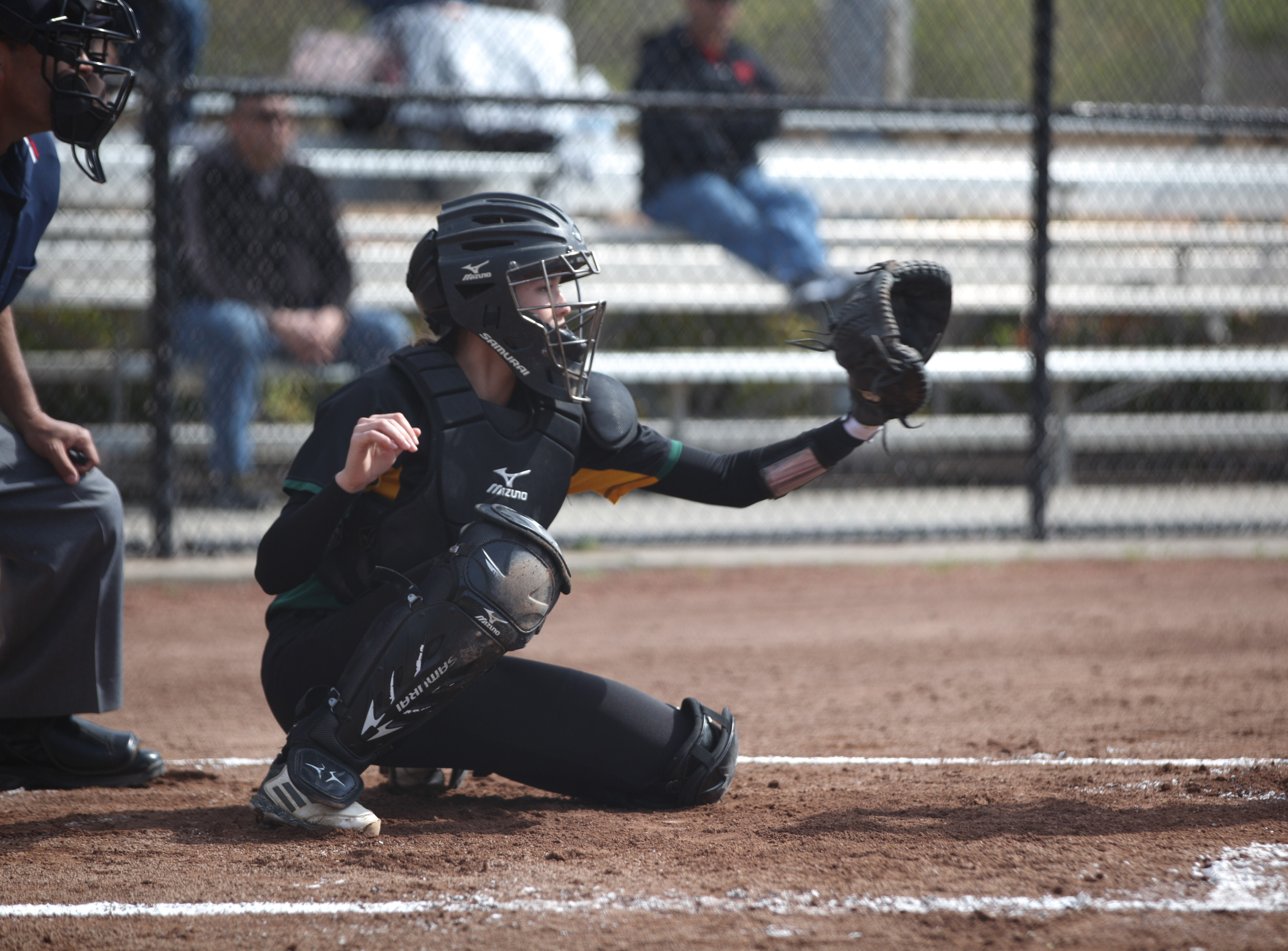
    The Jacks softball team had its seven-game win streak come to an end on March 18 after dropping a doubleheader versus Cal State East Bay. East Bay dominated the third game of the series 15-1 in five innings and took game four of the series 4-3 in extra innings.

    Jacks senior pitcher Jasmine Hill took the loss in the second game of the afternoon. She logged 8.2 innings and allowed 12 hits and four runs, three of which were earned runs.

    The day prior, the Jacks won both games of the doubleheader and head coach Shelli Sarchett notched her 200th career win. Sarchett has guided the Jacks to the NCAA National Championships in each of the last two seasons and finished one win shy of the program’s third title in 2016. She is one of the NCAA West Region’s most decorated coaches and has led the National Fast-pitch Coaches Association Regional Staff of the Year in 2016 and 2017.

    Jacks softball head coach Shelli Sarchett collected her 200th career victory on March 17 against Cal State East Bay. Photo by Stephen Ellis.

    HSU moved to 14-11 overall and 10-8 in conference play with the losses. Their next home game is scheduled for April 20 against Chico State.

    Jacks Track and Field

    Jacks long distance runners had a successful day at the Hornet Invite in Sacramento on March 17. Three different runners from HSU achieved provisional qualifying marks in their events.

    Jacks senior Annie Roberts finished first in the women’s 5k with a time of 17:13.75. Her time marks the third best all-time for HSU. Roberts finished a full 11 seconds ahead of the next runner to cross the finish line.

    “[Roberts] took the bull by the horns and went for it,” head distance coach Jamey Harris said. “It was a tough effort and a very mentally strong performance.”

    Jacks senior distance runner Annie Roberts (3) finished first in the Women’s 5k with a time of 17:13.75 at the Hornet Invite in Sacramento on March 17. Her time is the third best in HSU history. Photo by Josh McKinney.

    Jacks freshman Brayden Leach crossed the finish line in the men’s 800m at 1:51.13, which is just under the provisional qualifying mark of 1:52.16.

    The Jacks third runner to qualify with a provisional time was senior Dustyn Salomon. Salomon ran the steeplechase in 9:05.23 and finished fourth place overall.

    “He ran a solid race and he can definitely run faster,” coach Harris said. “This is his first steeplechase of the season and the result is very encouraging.”

    The Jacks look to build on their success in the next meet. They play at home for the Humboldt Invite on March 24 at the Redwood Bowl.


  • Provost speeds up dean’s resignation

    Provost speeds up dean’s resignation

    “I couldn’t compromise the values of CNRS and my own.”

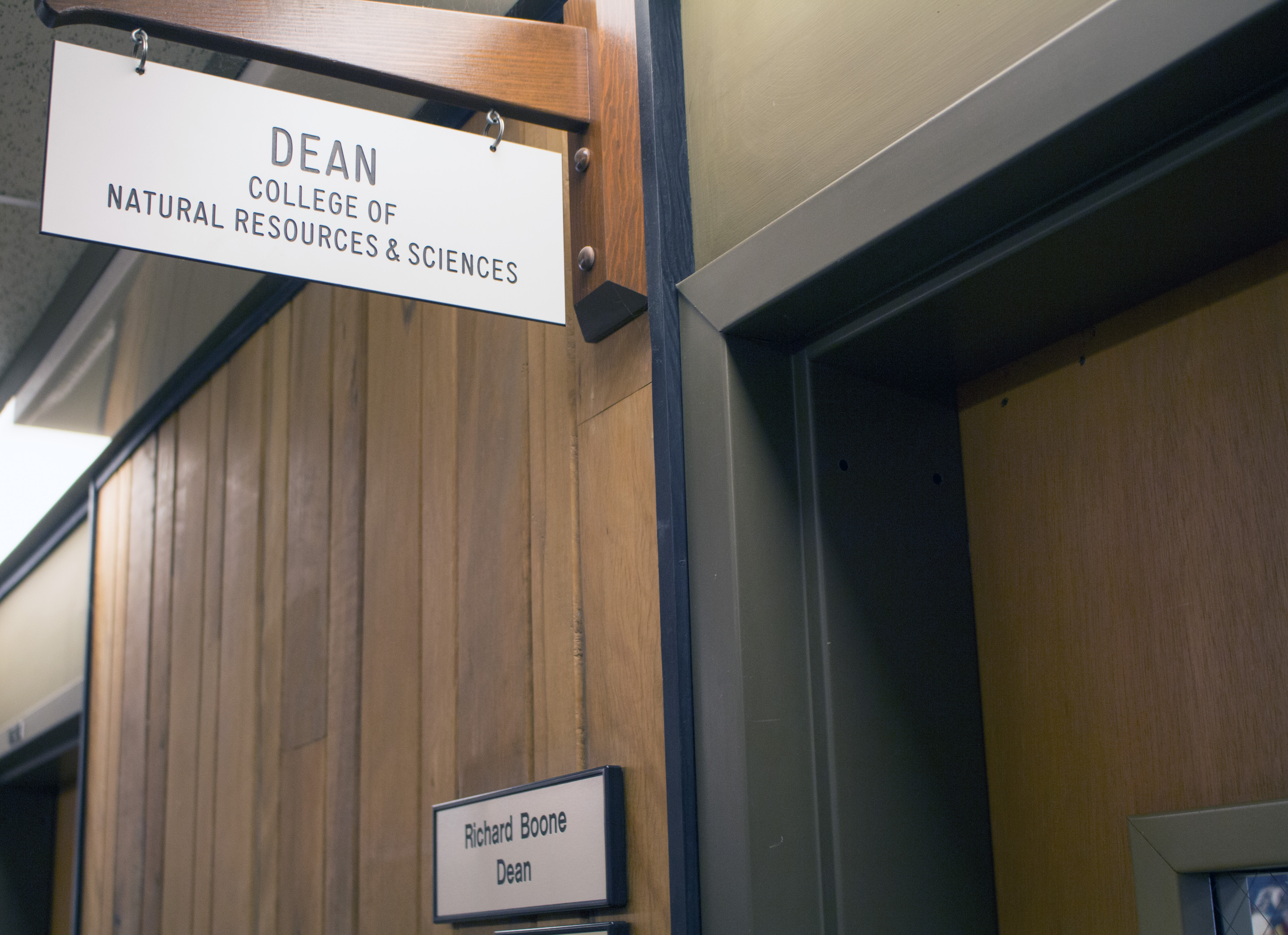
    Richard Boone, the former dean of College of Natural Resources and Sciences at Humboldt State, was let go before his resignation came into effect. Earlier this month, Boone formerly announced his resignation, effective June 30. But Alexander Enyedi, provost and vice president for Academic Affairs, informed him in a meeting on March 9 that his resignation was accepted and effective immediately. Steve Smith took office as the new interim dean for CNRS, replacing Boone.

    Boone planned to remain dean of CNRS until June 30, as he said to the provost when he resigned. He was surprised during the meeting that he didn’t have the time to continue working on the things he planned out.

    It was important for Boone to carry out his plans leading up to the initial June 30 resignation. He and his staff were in the process of finalizing the steps to reduce the budget for next year.

    “Having the remaining time was important for me, personally and professionally,” Boone said. “Also for the college and my role in the college, I was looking forward to working in Humboldt until the end of June.”

    Boone said he doesn’t know why he was asked to leave office four months before his initial resignation date.

    “I had conveyed to [the provost] my resignation was effective June 30 and he had not rejected the date when I met with him,” Boone said.

    The Lumberjack reached out to the provost to comment on Boone’s resignation, but was directed to HSU’s public relations team. Humboldt State communications specialist, Grant Scott-Goforth, responded about why the provost adjusted his resignation date.

    “Unfortunately, because it’s a personnel issue, the school can’t release anymore details about the resignation,” Scott-Goforth said. “We have a duty to protect individual privacy in these kinds of matters. I’m sorry I can’t help more.”

    Boone left the area and is now in the process of relocating to Fairbanks, Alaska.

    “I’m leaving Humboldt with a great deal of sadness,” Boone said. “I loved Humboldt and I really loved Arcata. This is a part of me and it will always be a part of me.”

    Reflecting on his time at HSU, Boone said he really enjoyed his time working as dean.

    “It was an honor to serve as the dean,” Boone said. “It was really a joy to work for the CNRS faculty, staff and students.”

    According to Rick Zechman, associate dean of CNRS, Boone was respected across HSU and concerned about CNRS.

    “He was very concerned about the health and vitality of the college, its students, faculty and staff,” Zechman said.

    Why did Boone resign?

    Boone and HSU provost Enyedi had conflicting views regarding the depth of the cuts to the CNRS budget.

    “I decided to resign, because it became clear the provost and I had irreconcilable differences over the depth of budget cuts and priorities for CNRS,” Boone said. “I couldn’t compromise the values of CNRS and my own.”

    Boone said his strength is in building new programs, developing interdisciplinary teams, integrating research in teaching and graduate education. With the current budget crisis HSU is facing, there’s going to be some downsizing. In such an environment, Boone thinks he can’t put his skills to practice.

    “I felt that I couldn’t utilize that experience and skill set sufficiently to make me satisfied and to help the college as much as I wanted to,” Boone said.

    Boone said he is proud of the work he has done as the dean of CNRS.

    “I think I did good work in my time there and would have continued doing good work through June,” Boone said.

    Though Boone is proud of his work as dean, he said he could’ve done better if not for the current budget cuts.

    When he joined HSU on July 25, 2016, Boone was aware of CNRS budget deficit, but not the university deficit.

    The cause of CNRS deficit wasn’t clear to Boone at first. Last year, he spent time understanding the budget for CNRS and the university.

    “It wasn’t clear to me initially why there was a mismatch between the budget and the expenditures in the college,” Boone said. “I learned the mismatch is primarily due to the under-budgeting of lectures in college.”

    Boone started the CNRS strategic planning committee. One of the goals of this committee is to find ways to achieve a balanced budget.

    “I took my responsibilities seriously to eliminate the deficit,” Boone said. “I believe that the strategic planning process we started this year would’ve led to recommendations for a balanced budget.”

    According to Zechman, the strategic planning committee is one of Boone’s major initiative during his short time as dean for CNRS. This initiative will guide the college for coming years.

    “[Boone] has a collaborative leadership style that was reflected in one of his major initiative during his brief time as dean of CNRS, a strategic planning effort involving faculty, staff and students that will guide the college over the next several years,” Zechman said.

    Over the last eight years, the college grew in terms of majors and number of full-time students. To accommodate the growth, the college hired around 57 lecturers. Costs for most of those lecturers were not added to the college budget.

    “Last year, if the money for the lecturers that we employed was in the budget, there would not have been a deficit,” Boone said.


  • Letter to the editor: We want student housing, but not the AMCAL way

    Letter to the editor: We want student housing, but not the AMCAL way

    Author Maureen J. Jules is a former HSU student and active member of Arcata Citizens for Responsible Housing.

    Dear editor:

    AMCAL, a large corporation from Southern California, wants to join the Arcata housing scene, claiming to help students find affordable, off-campus housing that is convenient for walking and biking to class. However, it is no accident that in 2012, AMCAL jumped into the profit-driven student housing market that’s worth $200 billion dollars. Since then, its luxury student housing projects have made rents even less affordable. AMCAL’s projects have exploded into college towns throughout California and Texas. Not surprisingly, similar corporations have carried this profiteering trend across the nation.

    The effect of these privatized dorms increases rent for everyone and isolates students from the larger community. In Flagstaff, Arizona, for instance, private dorms have resulted in less affordable housing for all.

    “At $700 a bedroom in most student complexes, that effectively sets the price of a three-bedroom apartment at $2,100 a month,” the editorial board of the Arizona Daily Sun said. “That means a family of four should be earning $6,500 a month to afford that rent (30 percent of income) while the median income in Flagstaff is well below that.”

    Now, AMCAL is at our doorstep, where they hope to finance the construction of a 700 to 800-bed, yet highly restrictive dorm complex off campus (think gated, enforced quiet hours, corporate residential assistants and no alcohol or legal recreational drugs). I oppose their student housing project called The Village.

    Since I love HSU students, how can I possibly oppose student housing? We are a college town and our students are cherished, valued, vibrant and intelligent community members. Students help define Arcata and they have just as much a right to live here as anyone.

    That said, Arcata is a small town hemmed in by the bay, the farmland bottoms and the forest. I also have a serious shortage of housing and buildable land.

    The property eyed for The Village is a rare, eleven-acre parcel surrounded on three sides by non-commercial residential neighborhoods. The site is not ideal for dorms, because there is no easily accessed grocery store and it is far from downtown. Plus, it is on the opposite side of Highway 101 from HSU, yet nowhere near the Northtown footbridge. This means those supposedly “convenient” walking, biking and driving routes to both classes and shopping will take The Village residents through congested and convoluted areas, like the Sunset/LK Wood intersection, several limited access trails and neighborhoods without adequate lighting or sidewalks. Furthermore, The Village plan would only provide about 300 parking spots for 700-800 beds, and residents who need cars would have to pay extra for parking.

    This project would increase student housing, but only for those who can afford to live in upscale dorms where limited parking costs extra. These new off-campus dorms would lack all the conveniences and services on campus, including access to campus police and meal plans.

    Greenway Partners is a consulting firm working on an alternative with ACRH. They are working together with over 150 ACRH members to create a pro-housing, pro-density and pro-infill alternative. I want our housing alternative to include apartments that HSU students will enjoy renting. I hope student apartments will be mixed in with other uses: light retail and single-family homes, some with mother-in-law units which HSU students might also like renting.

    When students fledge the coup, I want them to have access to more neighborhood housing where they can easily get to know the non-student community. Dorms belong on or next to campus, not plunked down in distant neighborhoods absent of food and shopping. It isn’t that I don’t want student rentals or students for neighbors; I don’t want AMCAL dorms. We can build community by living together, working side by side and getting to know one another. You, the students, are our community and Arcata should be the village, not AMCAL.

    Arcata Citizens for Responsible Housing is actively seeking student input and can be reached at: arcatacrh@gmail.com

  • Queso is king in Loleta

    Queso is king in Loleta

    Nobody is re-imagining one of America’s classic foods as deliciously as the Queso Kings.

    Now and then, life gets hard. Our jobs, our studies, hell, even our passions can wear us out. When it comes to getting away from it all and finding our happy places, there are all sorts of way to do it. One of the ways to de-stress is with some good old comfort food. Sometimes, finding that perfect meal can feel impossible.

    Comfort foodies, your search is over. Nestled in a modest farm town of 750 people lies Humboldt County’s cheesiest secret: Queso Kings Grilled Cheese Bar in Loleta.

    What could be so special about a piece of melted cheese between toasted bread? Queso Kings is delicious, and it won’t hurt your wallet either. Any sandwich on the menu is $7, unless you want a meal, which comes with soup for $11.

    Walking in to the cheese bar there is a chalkboard menu with names like “Mardi Gras,” “Smokin’ Pig” and “After School Special.” Around the corner, cheese samples line the walls, creations from the Loleta Cheese Factory who supplies the grilled cheese bar with their queso, with a variety that will make you happier than a hungry college student at Costco on a Saturday.

    The first was “The Divine Order,” a simple and yummy combination of herb and spice havarti with grilled chicken on rustic country bread. The havarti was gooey, sweet and buttery, pairing perfectly with the chicken. The toast was crunchy and light, but the cheese was just bomb. The “Divine Order” tasted like it was anointed by the pope and kissed by Jesus before it was put into the basket.

    Next up was the “Bay Area Brisket,” made with tender and juicy brisket, roasted garlic jack and smokey cheddar on sliced sourdough. The combination of garlic jack and smoked cheddar brought together a savory flavor that will send your taste buds on a vacation. It is the perfect comfort food with the brisket to top it off, adding an extra layer of flavor and heartiness to the sandwich.

    Next to the “Divine Order,” the brisket was the absolute winner. The gooey jack cheese mixed with the sharpness of the cheddar made that sandwich and you will definitely be going back to get another bite.

  • Students return to campus by Homeward Bound bus

    Students return to campus by Homeward Bound bus

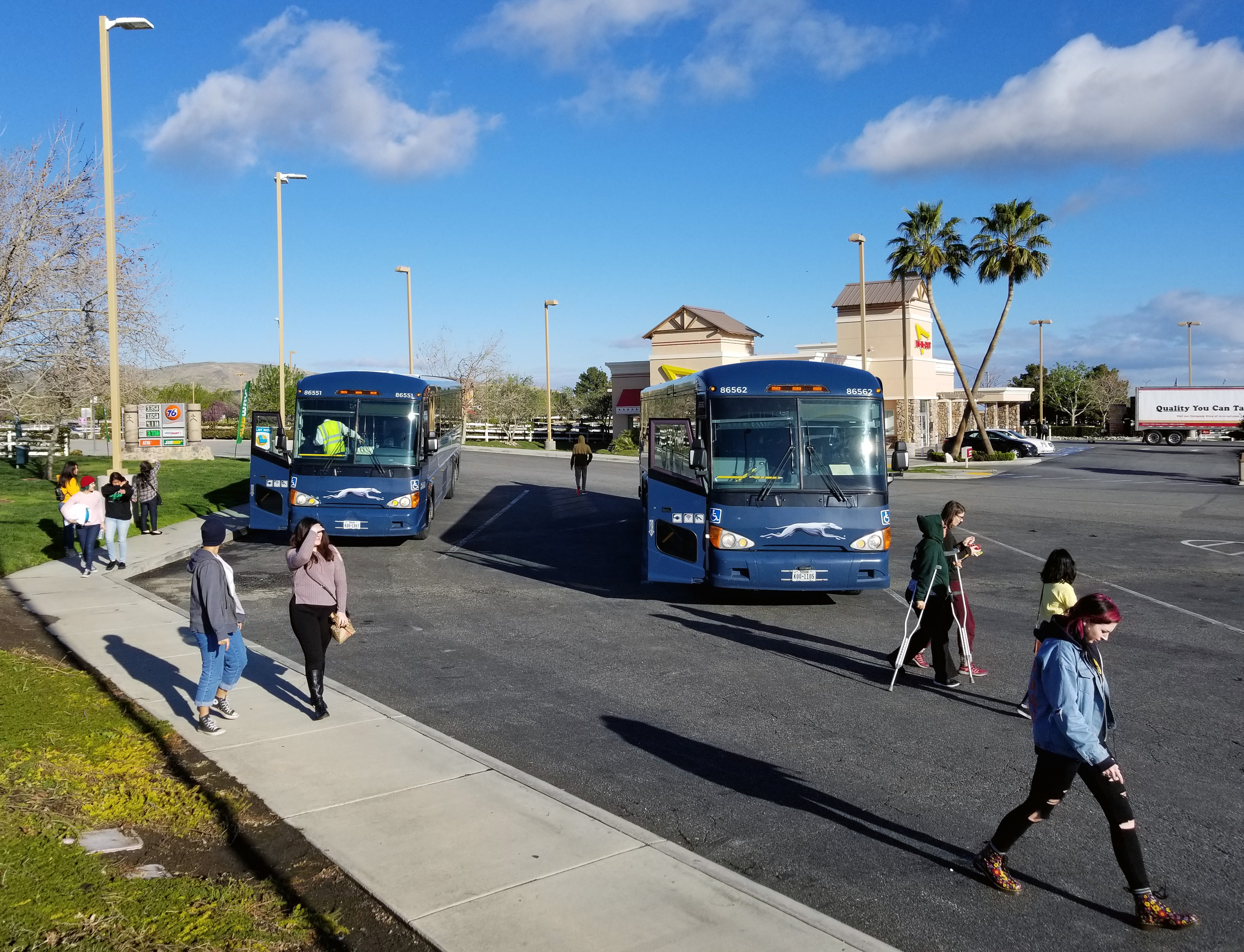
    Humboldt State students from Los Angeles and San Francisco take the long journey back to HSU with the Homeward Bound buses.

    The trip takes about 14 hours for those who board the bus in Los Angeles, while it takes eight hours for those who board the bus in San Francisco. The buses travel approximately 650 miles to get back to Arcata. There are occasional pit stops within the commute.

    Ana Vazquez is one of the many students who took the bus from Los Angeles.

    “I had a nice break,” Vazquez said. “I got a chance to sleep more than I did when I was at Humboldt, so that’s a plus.”

    Another student, Jason Barnes, said he prefers traveling on the Homeward Bound bus.

    “I like to take long trips like this,” Barnes said. “On Amtrak, there’s weird people, but here it’s easier to sleep throughout the ride.”

    Students like John Martinez come prepared for long trips.

    “My phone kills a lot of time when it comes to taking trips like this,” Martinez said. “I’m either listening to music or texting to friends and family when I have cell service.”

    Even with the long hours students endure when traveling by bus, the Homeward Bound services have proven to be a better alternative for students to travel out from Humboldt.

  • “If you can’t be rational, at least be real”

    “If you can’t be rational, at least be real”

    A conversation with science and beer.

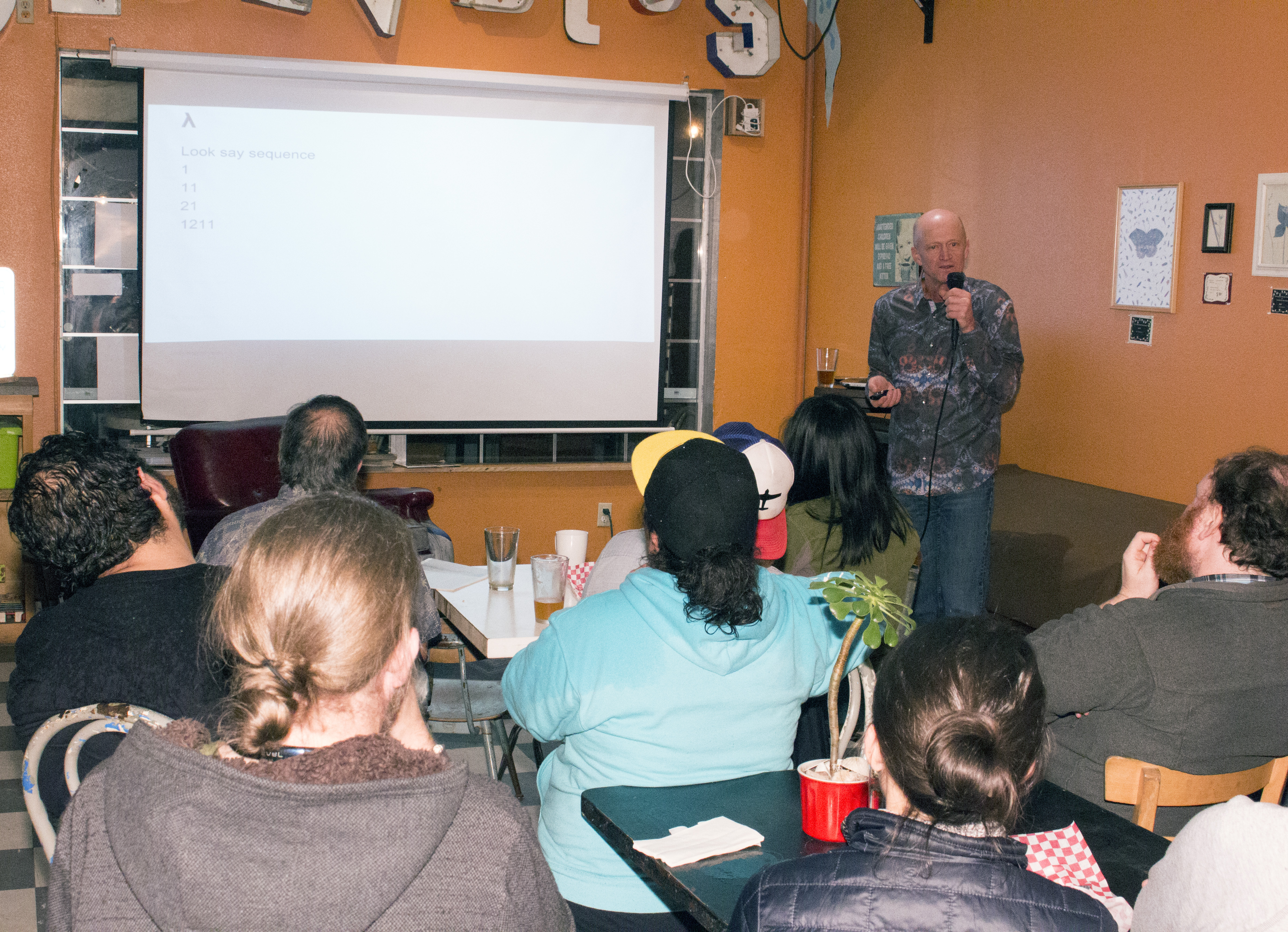
    Pythagoras, the Greek philosopher and mathematician, died from an angry mob because he refused to cross a field of beans.

    Followers of his cult, the Pythagoraeans, believed all numbers were either whole or ratios of whole numbers, which means they have either terminating or repeating decimals. To a Pythagorean, a number such as 1.1234567891011… did not exist. The Pythagoreans believed this so strongly that they killed Hippasus, a fellow Pythagorean, by throwing him into the ocean when he proved the square root of two is an irrational number.

    The square root of two’s origin story was presented by Jeff Haag, a professor from the math department, as part of his talk, “If You Can’t Be Rational, At Least Be Real,” at Blondie’s Science on Tap event on March 7 in Arcata. This is Haag’s second time presenting at Science on Tap.

    ”My primary goal for coming back is to spread the joy of mathematics,” Haag said. “I want to take every opportunity to help people understand simple things deeply. I also enjoy coming back for the free beer!”

    Science on Tap is a monthly public science talk hosted at Blondies. Attendants can be found drinking beer and munching on snacks while learning about a new science-related topic. C.D. Hoyle from the physics and astronomy department brought Science on Tap to Humboldt State.

    “I first got into Science on Tap because there was one at University of Washington where I went to graduate school,” Hoyle said. “I started the first Science on Tap at HSU in Dec. 2011. There was a huge turnout for the first one. Someone from NOVA the TV show came up to help us promote the event as part of their Cosmic Cafe program.”

    Chris Harmon, a professor from the chemistry department, was fascinated with Science on Tap when he first arrived at HSU.

    “I really thought that Science on Tap is what science [communication] should be — having fun with a broad audience about science topics, and not just learning about these topics in class,” Harmon said. “When [Hoyle] went on sabbatical, I took over with organizing the talks and I enjoyed being involved.”

    Harmon and Hoyle, now co-organizers of these talks, credited Johanna Nagan, the owner of Blondies, for providing the means necessary to make Science on Tap happen.

    “Blondies helped to promote our event on their websites,” Hoyle said. “Johanna installed a projector screen system so we don’t have to bring our equipment over for the talks anymore.”

    Now in its seventh year, Science on Tap continues to receive strong support from students, faculty and community members.

    “Blondies would often get calls from community members who want to know when the next Science on Tap is scheduled. We usually have a full room at every event,” Hoyle said. “When I send out talk invitations to faculty, I get volunteers pretty quickly.”

    Harmon is one of the faculty who has given a few talks at Science on Tap.

    “I think that preparing for a Science on Tap talk is more difficult than preparing for a seminar at a conference or for class,” Harmon said. “I have to engage a broad audience without leaving out the experts in the audience. Even though this is challenging, I find it to be really fun as well.”

    John Rosa, a HSU biology alumnus (‘79) and community member, has regularly attended Science on Tap for the past three years.

    “The talks at Science on Tap do make sense to me, and I feel that I actually learn more when I don’t know anything about the topic to start,” Rosa said. “There was a talk about stem cell biology by Dr. Amy Sprowles that I found really interesting. There was also a political science talk on how science is having a tough time in the current politics that I enjoyed.”

    Hoyle believes public science communication avenues such as Science on Tap are important in today’s political climate.

    “In the past couple years, science has been under attack by politicians,” Hoyle said. “Public exposure to how evidence-based science works and the confidence limits in science will lead to more sound decision-making.”

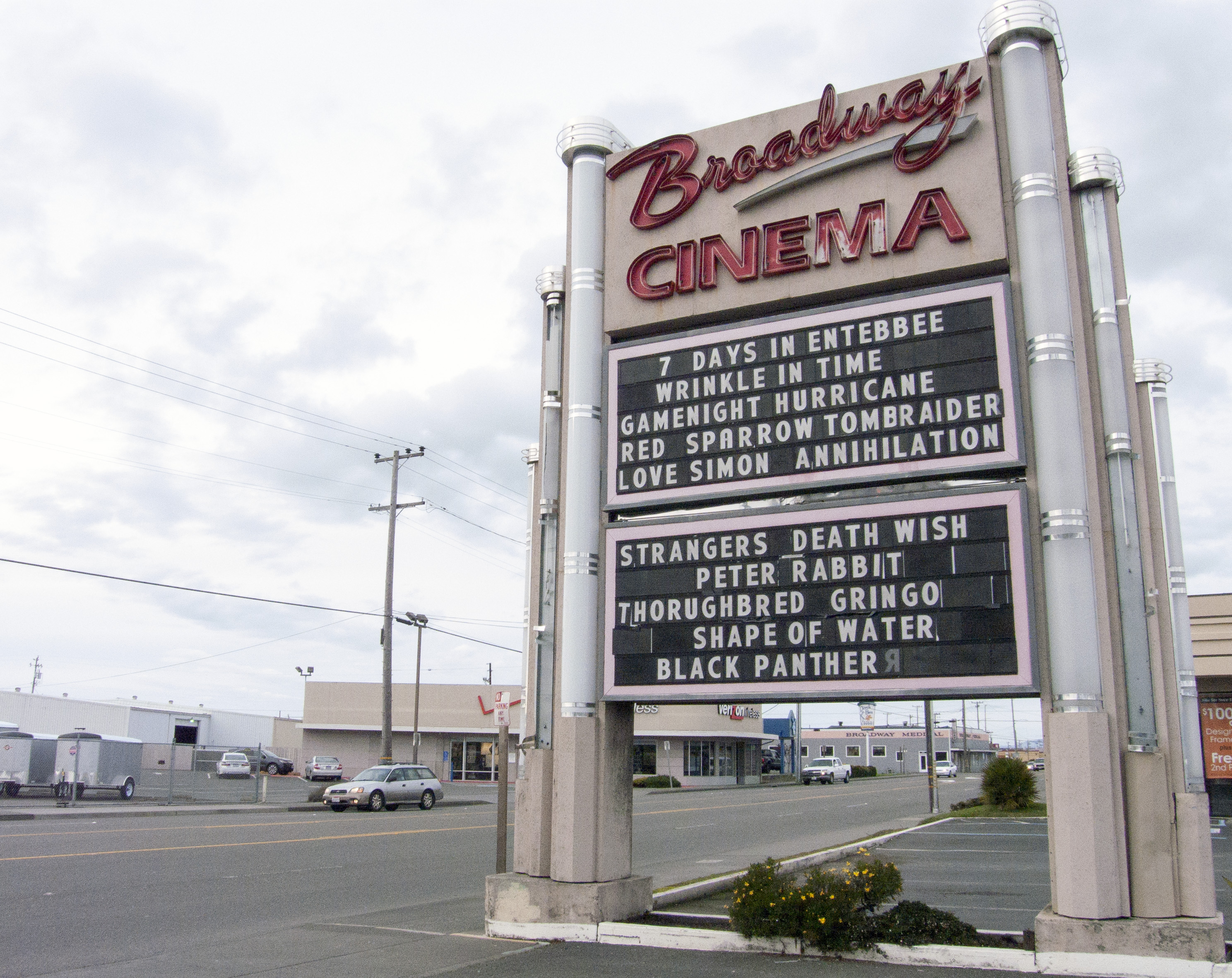
  • “A Wrinkle in Time” is passable

    “A Wrinkle in Time” is passable

    Just because a director makes a small, successful movie, doesn’t mean Disney should give them over a hundred million dollars to make another one. Take Ava DuVernay, director of “Selma” and “13th,” for example. The initial success doesn’t guarantee similar success with a big blockbuster film.

    DuVernay’s adaptation of “A Wrinkle in Time” was a big deal as the first black female director with a $103 million budget. Following a renewed interest in the book, an all-star cast and more actors of color in the movie, including the main character Meg, there was plenty of hype for this movie.

    The film begins with a younger Meg and her father Mr. Murray (Chris Pine) having fun in his office while he teaches her physics. This is the only scene establishing their relationship, which is less than what the book reveals. The film then flashes forward to present time depicting her father’s four-year disappearance.

    As the film moves on, Meg struggles with her classes and shuts people out. This is expressed by Meg throwing a ball at a bully’s face after being teased about her dad’s disappearance.

    Later that day, Meg and her adopted brother Charles Wallace meet Mrs. Whatsit, (Reese Witherspoon), Mrs. Who (Mindy Kaling) and Mrs. Which (Oprah Winfrey), three immortal women from the universe who came to help them find their father. They tell the kids that their father traveled to a different part of the universe using a theory he and their mother had been working on for years. This act is called “tesseract,” where you pinch space to make time travel instantaneous, like wrinkling space and time.

    The three immortal ladies guide Meg, Charles and Meg’s classmate Calvin O’Keefe through the universe to find Mr. Murray.

    Watching the different destinations felt like binging an entire season on Netflix. There was so much going on, and it felt rushed to get to the visuals and the elaborate costume changes of the three Mrs.

    The computer-generated images look obvious and didn’t blend in well with the colorful environments. The different scenes that were filmed to distinguish between the planets looked amazing, notably New Zealand.

    The scene that was filmed in Sequoia Park was brief. If that scene was longer, you could probably guess where in the park they filmed it (Duck Pond? Windstorm Meadow? By the swings?). Also, the ending of the film felt like it came out of nowhere, which shows the overall message of “love defeats evil.” It didn’t make much sense for the story or the characters, except to show Meg’s character arc.

    What DuVernay brought to the movie was good overall, especially with casting the main character as a bi-racial girl interested in physics. Certain scenes appeared more impactful, like when Calvin kept complimenting Meg’s hair, a moment that happens in the book, but felt more heartwarming to see her black curly hair.

    Whether or not this film spawns a franchise to expand on the five-book series, it would be exciting to see a huge Disney franchise with more people of color as the lead.

  • 11 months and no justice for Josiah

    11 months and no justice for Josiah

    David Josiah Lawson was a victim of a hate crime and has become the poster child of the racism that exists in Humboldt County. Though the Arcata Police Department has been working through the investigation using physical evidence and witness statements, the trail remains cold in the pursuit to bring justice to Lawson.

    Lawson was a black 19-year-old criminal justice student at Humboldt State when he was stabbed to death at a house party in Arcata on April 15, 2017. The efforts of local authorities attempting to solve the case of his death fall short to this day. Those who spoke up after the incident hold little water in the eyes of the law due to conflicting reports of hearsay and lack of evidence. So much is against Lawson under these unfortunate circumstances.

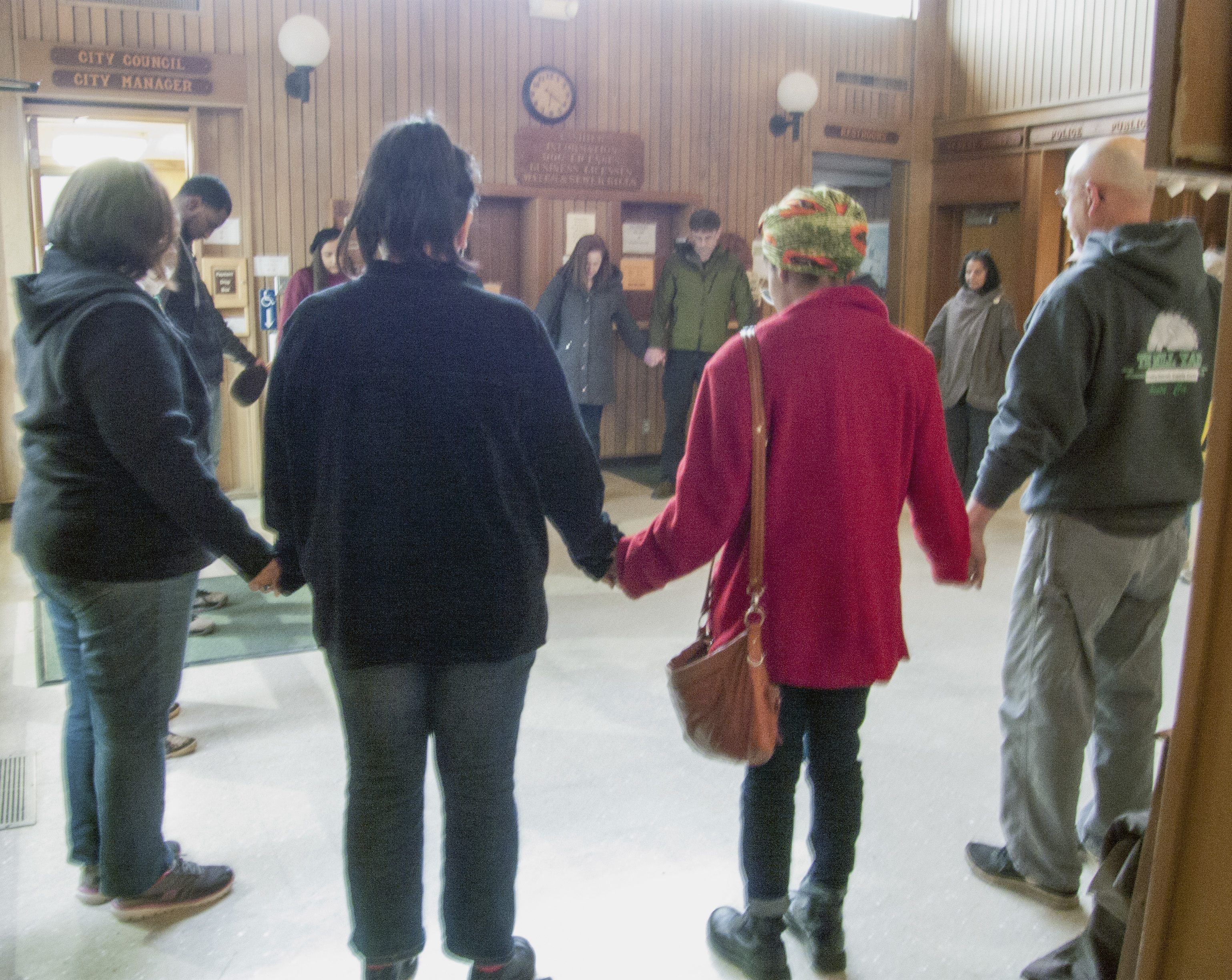
    A vigil has been held for Lawson every month since his untimely death last April. The turnout of the 11th vigil on March 15 at Arcata City Hall was lower than usual due to spring break and heavy rain, but over a dozen people participated in solidarity of Lawson nonetheless.

    During the vigil, Alex Foster, a leading force in finding justice for and preserving the memory of Lawson, said mixed messages aired by the media continue to hamper with the development of the murder case.

    “There’s a lot of rumors and false narratives, especially from newspapers,” Foster said. “It’s just different perspectives.”

    McKinleyville resident Kyle Zoellner was arrested for allegedly stabbing Lawson, but was released by Judge Dale Reinholtsen for lack of evidence. During the preliminary hearings, contradicting testimonials by eyewitnesses include Zoellner’s physical condition when Lawson was murdered.

    In a report by Mad River Union, Zoellner’s family said Lawson was stabbed to death while Kyle was unconscious due to a brutal assault. However, the Lost Coast Outpost reported Elijah Chandler, a friend of Lawson who was at the scene of the crime, witnessed Zoellner “drop something shiny on the ground” a moment after discovering someone had been stabbed. Conflicting reports such as these only muddy the waters of the case.

    What students, police officers, politicians and other community members need to understand is that the murder of Lawson brings up broader issues of social injustice and public safety.

    If people continue to downgrade the importance of this case or stay disinterested, then we are doing ourselves a huge disservice. We are allowing criminals to get away with hate crimes in a town that brings in innocent students year after year.

    Despite some of the challenges Foster and other tenacious supporters face, the search for justice carries on.

    Though the case remains open, relentless efforts are made to not only keep Lawson’s memory alive, but to spread awareness about the injustices that people of color still face in the area.

    April 15 will mark the one-year anniversary of Lawson’s death. Though details for the next vigil are in the works, tentative plans include a community gathering at the Arcata Plaza and a march to the D Street Neighborhood Center. Full details will be announced on the Justice For David Josiah Lawson Facebook page.

    In addition, the City of Arcata is supporting a safe space for a Community Dialogue on Race on March 22 at the D Street Neighborhood Center, located at 1301 D St. in Arcata. The meeting starts at 5:30 p.m.

  • Protest for gun control leads Arcata High students to walk out

    Protest for gun control leads Arcata High students to walk out

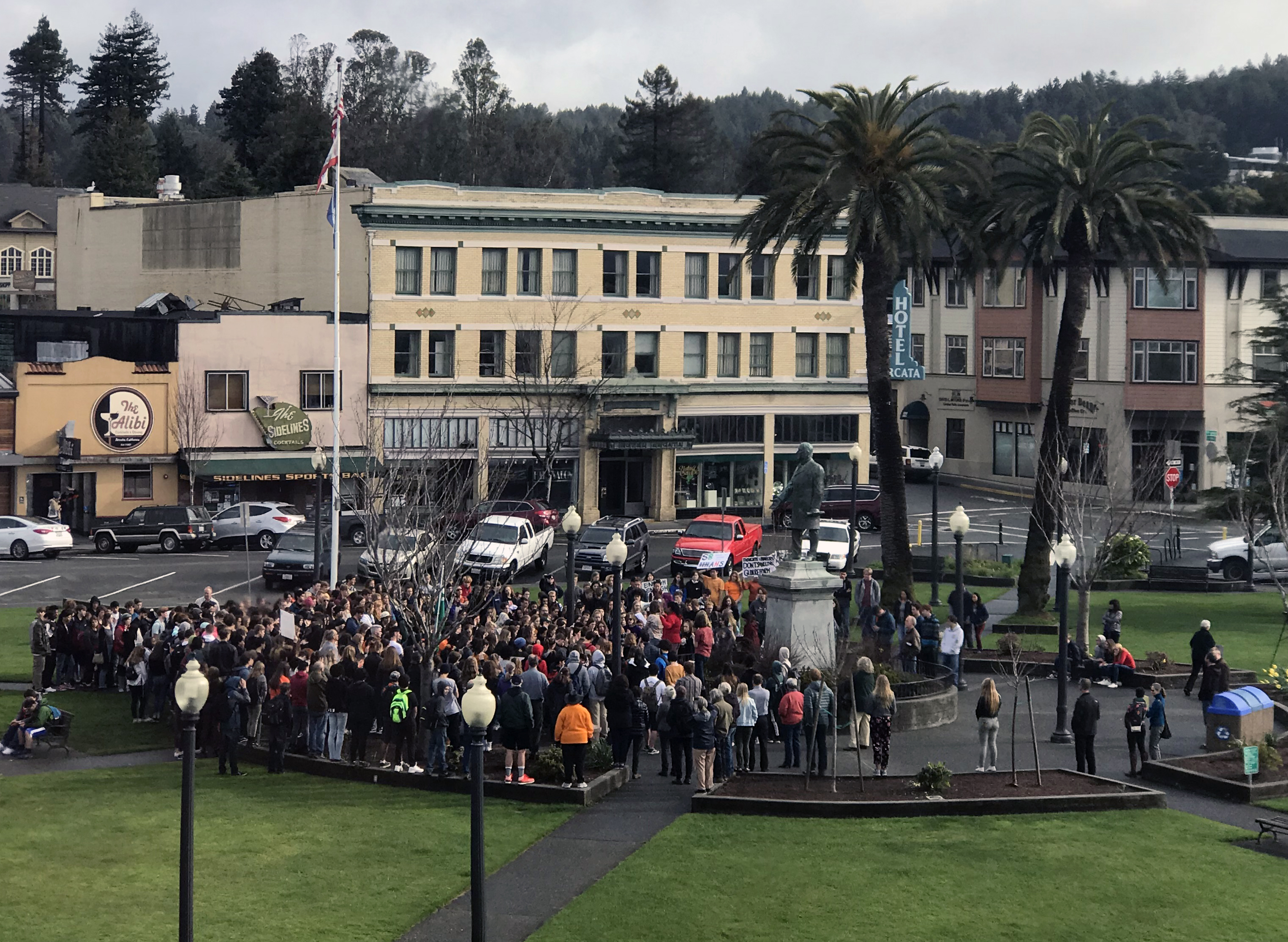
    Arcata High School students joined a nationwide walkout on March 14. The walkout was in reaction to the recent shooting in Florida at Marjory Stoneman Douglas High School, where a man with a semi-automatic rifle took the lives of three faculty members and 14 students.

    Arcata High sophomore Fiona Murphy left her class to join the rest of the students and faculty participating in the walkout last Wednesday morning. The destination was the Arcata Plaza.

    The walkout was led by Arcata High sophomore Skaidra Pulley and freshman Maddie Lankarani. Pulley compiled a six-page list of victims of semi-automatic weapons. The names were read during the 17 minutes of silence.

    “During those 17 minutes I went through a range of emotions,” Murphy said. “I went from crying to pure anger that this is happening, to crying again.”

    Jennifer Rosebrook teaches American history at Arcata High. She stayed on campus during the walkout. Rosebrook graduated from Humboldt State and has been teaching at the high school for 22 years.

    “I stayed on campus during the walkout as per my contract,” Rosebrook said. “It’s just like if you worked in a factory, you don’t just get up and leave in the middle of it.”

    The administration found a teacher who wasn’t teaching in order to cover for those who wanted to be part of the walkout.

    “That allowed those teachers who really wanted to go down with the kids and keep them safe,” Rosebrook said.

    The Trump Administration’s proposal to provide school personnel with firearms and training brought criticism from Rosebrook.

    “I’m not a big fan of any weapons to be honest. It doesn’t matter if they’re a rifle, a gun or nunchucks,” Rosebrook said. “I would never consider carrying a gun on [campus]. I think it is a reaction to what’s going on, not a proposal to fix it.”

    Not all high school students attended the walkout. James Manion, a senior at Arcata High, chose to stay in school and go to class.

    “I was thinking about going, but at the same time, I didn’t really want to get involved with something like that,” Manion said. “I stayed in my English class, but everyone in the English class left. I just sat in the parking lot waiting for my next class to start.”

    Murphy went around writing the words “Who’s next?” on people’s hands with a Sharpie as they held their hands up.

    “Our arms started to cramp, because we had to hold our hands up while all the names were read,” Murphy said. “We didn’t have to hold our arms up, but we wanted to.”

    Murphy said that Pulley told her the list of names originally compiled was going to be a list of every student and teacher who had been killed in a school shooting by a gun. The list was 11 pages long and hadn’t been completed.

    “People are dying. We have to remember the names of the victims and not the shooter,” Murphy said. “You feel like you’re in a bubble when you just see it on the news, but participating and hearing the names of all the people who died makes it real.”

    In the last two minutes of the silence, someone in a pickup truck drove around the Arcata Plaza two or three times blasting music out of their car.

    “It turned out to be a McKinleyville student,” Murphy said. “I think he was doing it to be antagonistic and break up the memoriam.”

    When the memorial for the Parkland victims ended, Murphy didn’t go back to school. She stayed in the plaza with a small group until 5 p.m., writing letters to Congress.

    “We packed pens, pencils and papers to write to Congress,” Murphy said. “Throughout the day, different moms were bringing us food, tea and cookies,”

    Students wrote the letters to Paul Ryan, Donald Trump and others, asking for more restrictions on AR-15 rifles. They also sent thank you notes to congressman Jared Huffman for lobbying for gun control.

    “Since it is national, it is putting more pressure on the government to do something,” Murphy said. “Even if our little walkout doesn’t directly affect it, it’s making a ripple. It’s laying a foundation for getting something done.”