The Lumberjack


Students Serving The Cal Poly Humboldt Campus and Community Since 1929

Year: 2018

  • Fear of heights versus rock climbers

    Fear of heights versus rock climbers

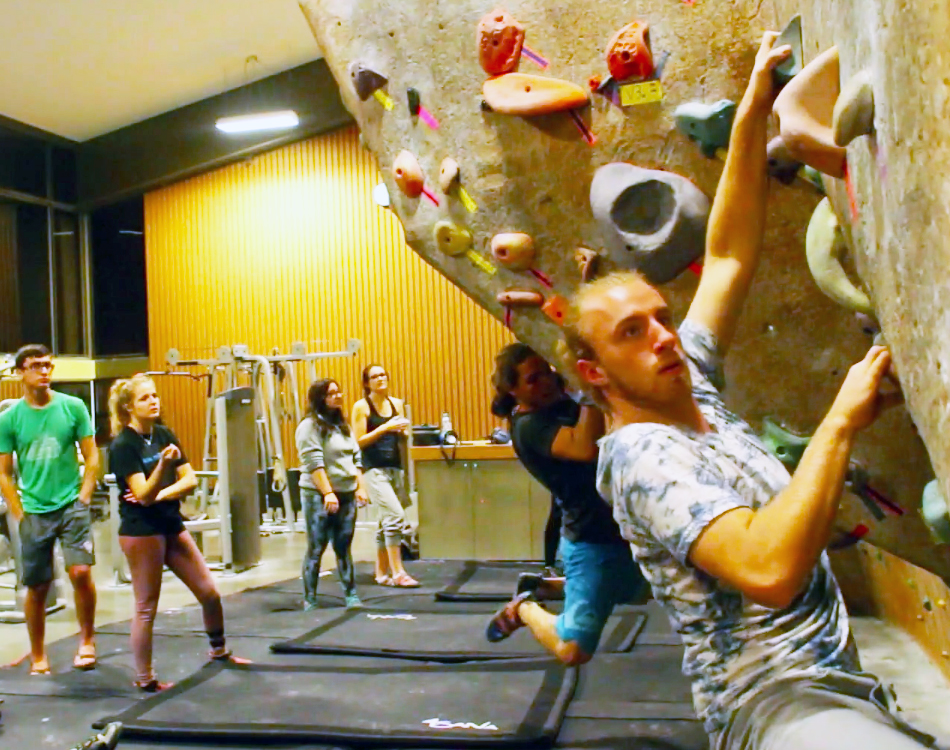
    Do rock climbers have a fear of heights? Watch the video to find out!

    Members of Humboldt State’s rock climbing club Andrew Musgrave, Becky Bell and Journey Ibe dive into their fear of heights. The video was created on Nov. 8, 2017 and filmed in the HSU West Gym.

    Video by Bailey Tennery.


  • Restrict age limit on firearm and ammunition purchases

    Restrict age limit on firearm and ammunition purchases

    Cabelas and Bass Pro Shops should follow Dick’s and Walmart.

    In the grieving shadow of the Parkland, Florida high school shooting, sporting goods company Dick’s Sporting Goods and large retailer Walmart have changed their sales policies and limitations on firearms and ammunition.

    Soon after, Kroger, a supermarket chain, followed suit by changing policies for their Fred Meyer stores located across the U.S. Big retailers, such as Cabelas and Bass Pro Shop, should follow the lead of Dick’s, Walmart and Krogers.

    “There are a total of over 160 Cabela’s and Bass Pro Shops retail stores in the U.S. and Canada,” according to a Time magazine article. “These stores sell high-capacity magazines, which allow shooters to fire a higher number of rounds without needing to reload.”

    This sort of reform and change is only powerful if everyone is on board and unified. If they don’t make efforts to change their policies, it will only be a matter of time before they become a primary seller to those who seek to use these weapons for senseless murders.

    On a state legislative level, Florida is attempting to take the lead. According to Griffords Law Center, Hawaii and Illinois are the only states that have an age minimum of 21 for long guns or rifles. Other states have a minimum age of 18, and some even have a minimum of 16 years old.

    The government on a federal and state level has continuously failed to implement change and gun reform that has a lasting improvement or effect on these massacres. Dick’s, Walmart and Krogers have done the right thing by taking it upon themselves to move things in the right direction with as much force as they can.

    According to the New York Times, Florida passed a gun reform bill on March 7 that follows the lead of these stores by raising the age limit to purchase guns to 21, create a wait period for approval on background checks of up to three days and ban bump stocks.

    In other states, some citizens are fighting back. A 20-year-old man from Oregon is suing Dick’s for raising the age limit.

    According to CNBC, the man is suing for discrimination because Dick’s refused to sell him a rifle when Oregon law says residents may purchase shotguns or rifles at the age of 18.

    Even California law dictates that residents must be 18 to purchase rifles, but must be 21 to purchase handguns. By changing their own policies, these businesses are taking change into their own hands, and the states should follow suit.

    Granted, guns of all sorts are still available to buy at shows and private shops, including the AR-15, which is what was used in the Florida shooting. However, change is possible and must start somewhere.

    If businesses make efforts to improve the way people are able to purchase guns, it will increase the possibility of better reform. All firearm retailers and states must follow suit or be part of the problem.

  • HSU shows works of killer bunnies and neon crocodiles

    HSU shows works of killer bunnies and neon crocodiles

    Humboldt State hosts the artworks of Illinois-based professor and artist Laurie Hogin. Dozens of her paintings are displayed in the art department’s Reese Bullen Gallery, most of which highlight Hogin’s signature neon colors depicting chaotic scenes that involve brightly plumed birds, psychedelic bunnies and hyper-saturated flowers and fruit.

    Most of the paintings are oil on canvas, but some are sketches from Hogin’s personal notebooks and watercolors on paper.

    Hogin says her works primarily consist of “allegorical paintings of mutant plants and animals in languishing, overgrown settings or posed as though for classical still life or portraiture.”

    Hogin’s paintings are fascinating, evoking memories of Henri Rousseau – leafy greenery and subjects nearly phosphorescent in color and brightness.

    HSU sophomore Kelsey Briscoe, 20, agrees.

    “These paintings are super interesting,” Briscoe said in front of Hogin’s painting “Sugar Trilogy I: Tricks,” which depicts a rather murderous blood-soaked bunny seated in front of an Easter candy. “This is definitely some commentary on capitalism and that sort of ‘Hallmark-holiday-card’ consumerism.”

    HSU junior Logan Clark stopped by to check out the exhibit on a whim and was pleasantly surprised by the display.

    Looking at “Echo Turnpike,” a painting that depicts several formidable tangerine crocodiles in front of the wreckage of a turnpike, “All the subjects of her paintings tend to be bright, while the background is monochromatic or even dull,” Clark said. “She seems to really focus on one main thing.”

    Visitors also have the opportunity to utilize skills demonstrated to them through HSU’s art department. Patricia Ely, a 19-year-old sophomore at HSU visited the gallery during her 20th century art class.

    “It’s crazy being in here and seeing actual parallels in this artwork and what I’m currently learning about,” Ely said. “I feel like this is all really familiar to me.”

    The exhibition to Hogin’s works is located at the Reese Bullen Gallery (Art B, room 101) until March 31. 

  • Pi Day pie recipe!

    Pi Day pie recipe!

    An easy pie recipe for all your mathematical celebrations. Happy Pi Day from The Lumberjack!

    Preheat oven to 420 degrees.

    CRUST:

    • 1 1/4 cups of flour
    • 1 stick (½ cup) of COLD butter, cubed
    • Sprinkle of salt
    • 1 tablespoon of sugar
    • ~6 tablespoons of ICE water
    1. Mix flour, salt, and sugar together.
    2. Work in butter cubes by kneading with your hands.
    3. Add in water by the tablespoon until it is all incorporated.
    4. Mold dough into disk and refrigerate in a Tupperware for AT LEAST an hour (up to five.) Don’t skip this step! It is the secret to a flaky crust
    5. Flatten one disk with a rolling pin (or wine bottle) until even thickness.
    6. Place your rolled dough in pie tin.

    FILLING:

    • 4 cups blackberries (Substitute any berry or 4 sliced apples)
    • ¾ cup sugar
    • 2 tablespoons of lemon juice
    • 2 tablespoons of flour

    7. Toss berries in sugar, lemon juice, and flour before filling pie crust.

    TOPPING:

    • ½ stick (¼ cup) of butter, starting to soften
    • ¼ cup sugar
    • ¼ cup flour
    • ¼ cup uncooked oats

    8. Mix all ingredients together until crumbly, then spread across the top of the blackberries.

    9. Put the pie in the oven and bake for about 55 minutes, until browned and bubbly.

    10. Cool slightly, top with ice cream, and munch out!

  • Zero to Fierce Festival for womanhood

    Zero to Fierce Festival for womanhood

    Celebrating the matriarchy and raging grannies.

    The Arcata Playhouse hosted the Zero to Fierce Woman’s Festival last week. More than 30 events took place from March 5-11. Events ranged from musical performances to movie screenings to meditation.

    On March 8, the Women’s International League for Peace and Freedom organized their seventh annual women’s day celebration inside the Arcata Playhouse.

    An activist organization called the Raging Grannies made an appearance. The organization is composed of elderly women that mock the granny stereotype by dressing in mismatched clothes.

    Sandy Lynn has been a Raging Granny for five years. She grew up in Palo Alto and has been in Humboldt since 2001.

    “I like that we are not polished. When you are older, people give you slack,” Lynn said. “When old ladies sing protest songs, it makes it easier for others to hear hard issues, like rape or violence.”

    The Grannies sing well-known songs, but change the lyrics to add a political message. During the performance, Lynn played a ukulele.

    “The ukulele is easy to cart around and very granny-like,” Lynn said. “I have been performing since I was 12. I don’t get nervous.”

    An audience member, Angela Davis, said she loves to sing.

    “The older I get, the more I want to celebrate life,” Davis said. “Here, we breathe together. You can’t feel desperation or be depressed in a place like this.”

    Sue Hilton, member of Women’s International League, has been celebrating Women’s International Day since 1973.

    “We need to value women more than we do now in our society,” Hilton said.

    Humboldt State lecturer of women and Native American studies Sara Obenauer spoke on stage at the Arcata Playhouse. She grew up as a first-generation Filipino American woman, and was raised in a matriarchal society.

    “I was raised by women,” Obenauer said. “However, like many women across the world, I experienced masculine imbalance.”

    Obenauer spoke about the idea of masculine imbalance, meaning power is disproportional and is taken away from woman

    “I find it vital that we need to embrace and celebrate womanhood, since we live in a really sexist and misogynistic society,” Obenauer said. “I don’t think I need to stress how necessary this is for us, especially in our cultural-political climate.”

    Obenauer said we need to believe in ourselves and our abilities in order to put an end to self destruction.

    “Nothing new will be created until women collectively take the lead and heal within themselves,” Obenauer said.

  • EDITORIAL: FCC aims to impose internet road blocks

    EDITORIAL: FCC aims to impose internet road blocks

    Why you need to pay attention to net neutrality regulations.

    Since its introduction to the general public in 1990, the internet became a powerful tool by placing the world at the fingertips of the average American. Information to almost anything is now a click, a Google search and a Wi-Fi connection away.

    Now, the internet is a colossal asset in the everyday life of the consumer. However, the Federal Communications Commission wants to repeal previous regulations that allow the internet to remain free and open. This will make your internet access slower, limited and expensive. Understanding net neutrality and fighting back is vital to keep the internet a free and open method of exchanging of ideas.

    What’s going on?

    When we open up our browsers on our desktops, laptops and mobile devices, we expect quick and easy access to whatever website or information we seek, and maybe a Wi-Fi hotspot. With current net neutrality regulations from the Obama-era in place, we can rely on our internet service providers to not interrupt that flow of information or require us to pay more to access faster connection and specific streaming services or sites.

    On Dec. 14, 2017 the FCC, led by chairman Ajit Pai, voted to repeal the 2015 regulations on internet. Pai was appointed by President Donald Trump in 2017 and formerly worked as a Verizon lawyer. Pai is responsible for introducing the idea that by creating internet fast lanes, the internet will thrive.

    With current net neutrality rules in place, the internet is already able to thrive as a free market. The most prominent argument against repealing this level of neutrality is that the FCC would be infringing on free speech by putting a price on access.

    What does that mean?

    According to the Washington Post, internet providers such as Verizon, AT&T and Comcast will have the ability to charge for speed without regulations in place. Streaming companies like Netflix or Hulu will most likely be asked to pay for access to these fast lanes and in turn, end up increasing their prices.

    This means not only will we as consumers pay for internet packages that allow us minimal access, but now we will also have to pay for fast and reliable connection to only parts of the internet. This also creates a similar situation to when big businesses drown out small businesses. Websites and streaming services that can not afford to pay for these faster lanes of internet connection will be drowned out by companies that can afford it.

    Shady business

    According to the Pew Research Center, in a study on the feedback the FCC collected from the public reported that results of their surveying came “inaccuracies and duplicates.”

    The report also stated that many of the submissions recorded “seemed to include false or misleading personal information,” cotinated “clear evidence of organized campaigns to flood comments with repeated messages” and “often thousands of comments were submitted at the precisely the same time.”

    This was in addition to the email validation process set up by the FCC only working about three percent of the time. The report stated that even emails such as “example@example.com” made the cut for public comment on net neutrality.

    The FCC is not only making unconstitutional steps toward limiting the flow of information and placing the power of those limits in the hands of corporations, but they are playing dirty to do it.

    How you can fight back

    The states are just beginning to take action, but you can too. On March 5, Washington became the first state to fight back against the FCC on repealing net neutrality.

    According to the New York Times, Gov. Jay Inslee signed a bill preventing internet providers from “blocking and slowing down content online.”

    On a smaller level, as a citizen, you can voice your opposition by visiting websites that help you locate your House of Representatives and Senate representatives. Write to them and express your opposition to what the FCC is doing and encourage them to act against these changes. In turn, getting involved locally will encourage more states to join Washington in passing state legislatures that disagree with the limitations the FCC wishes to implement.

  • Charlotte’s Web wins hearts

    Charlotte’s Web wins hearts

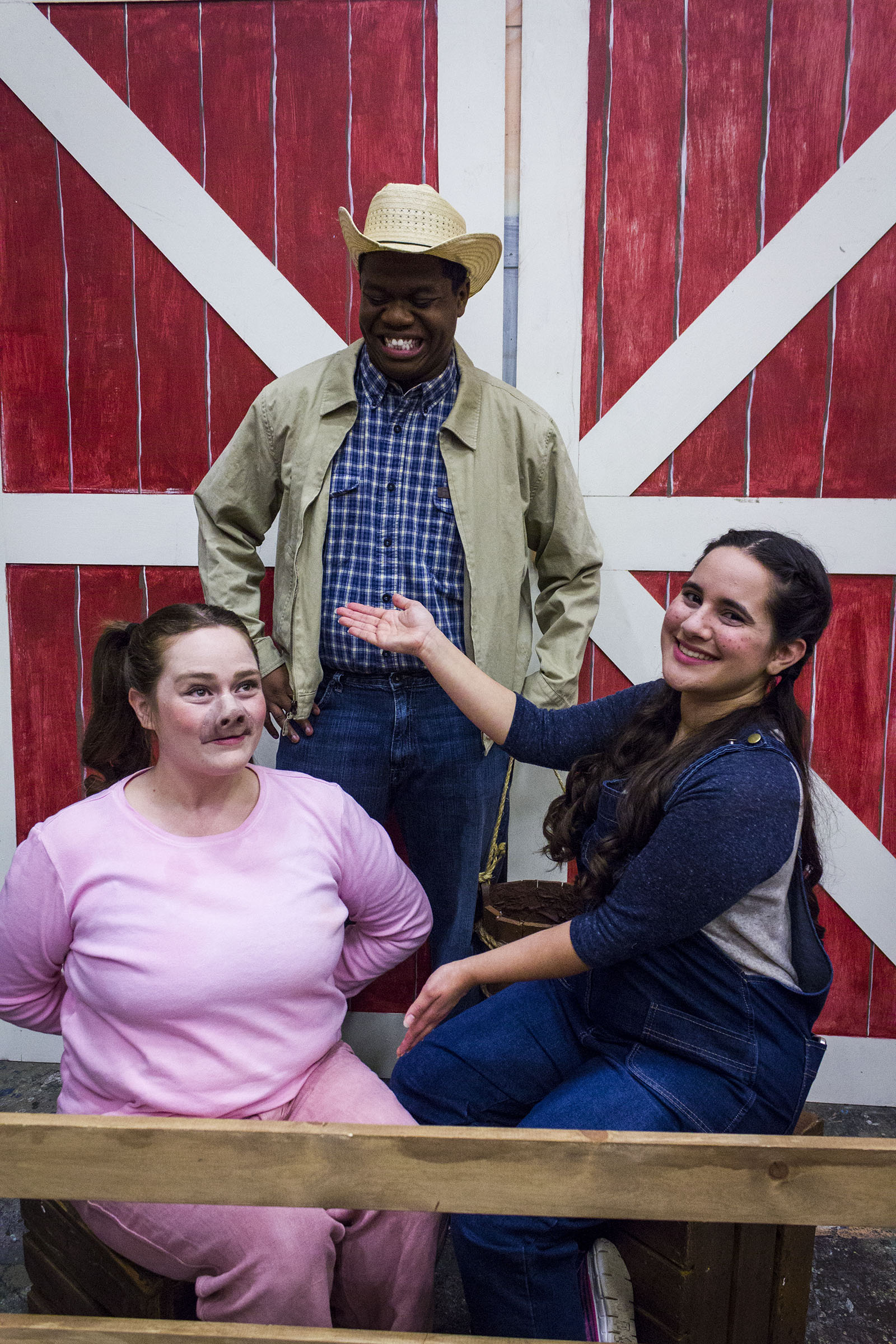
    Chances are you know about Charlotte’s Web, a bestselling children’s novel. Now that we are grown up, we can return to the days of being read to and tap into the inspiration of animals, language and the importance of community.

    Through the immaculate performance of Charlotte’s Web by Humboldt State students and the HSU theater department, this children’s story flows with laughter, touches you with sadness and sweeps you up and out the door in waves of joy. The cast hopes to bring happiness to families and give people the opportunity to take a break from the chaos of life.

    Director Derek Lane, HSU theater arts lecturer, used the play adaptation of Charlotte’s Web by Joseph Robinette and added his own composition from copyright-free music and lyrics.

    Charlotte is played by Camille Borrowdale, an HSU environmental science major.

    “Charlotte’s story is important,” Borrowdale said. “It’s about sticking together and being there for one another in our scary world.”

    During intermission, the lobby of the HSU Van Duzer Theatre was transformed into a carnival midway from the county fair. There were games and chances for children to win prizes.

    HSU theater major Roman Sanchez is the production manager of Charlotte’s Web and an activist for getting arts into education.

    “This might be some children’s first play,” Sanchez said. “We want to inspire them for a lifetime of the arts.”

    Sanchez believes the domino effect can change the world.

    “The togetherness of rehearsing with the cast and crew was really fun,” HSU zoology student and cast member Rachael Robinson said.

    Veronica Brooks is an HSU double major in theater and anthropology, as well as the costume designer for Charlotte’s Web.

    “Come and see Charlotte’s Web,” Brooks said. “It is happy and rewarding. It will knock your socks off!” .

    Charlotte’s Web continues tonight and tomorrow in the Van Duzer Theatre at 7:30 p.m., as well as a matinee show on Sunday at 10 a.m. You can find more information at centerarts.humboldt.edu.

  • International students promote diversity at Global Cafe

    International students promote diversity at Global Cafe

    A collective gasp was heard across the HSU Library Fishbowl after Pakistani exchange student and Humboldt State business major Archana Nilhani made a shocking statement.

    “You can go to jail just for celebrating Valentine’s Day there,” Nilhani said.

    Nilhani delivered an insightful presentation on her home country of Pakistan during Global Cafe on Tuesday.

    The presentation is part of a semester-long series put on by HSU Clubs & Activities and Associated Students, known as the Global Cafe.

    With 61 students in attendance, attendees were offered coffee and a traditional Pakistani dessert known as gulab jamun at the entrance.

    The presentation consisted of basic information about Pakistani geography, the different cultures within the country and a brief look into the history of how Pakistan came to be. The presentation went so far as to even address certain social justice issues in Pakistan and contrasted them to issues we have to deal with in the United States.

    Nilhani was excited to be at HSU and enjoyed her experience as an international ambassador. She also shared what she planned to do with her experience as a business major.

    “I want to help blend cultures through clothing and fashion design. I am really lucky to be here on a scholarship,” Nilhani said. “The government wants me to pursue my dreams.”

    Of the many students in attendance, Gary Ploenus, an international student from Germany, looked forward to this event.

    “Being an international student myself, I thought it would be very interesting to not only learn about other cultures, but see how Americans react to learning about other cultures,” Ploenus said.

    Molly Kresl is a coordinator for the Clubs & Activities office.

    “The school has been trying to do a better job [of] getting international students engaged in the student life,” Kresl said. “We are hoping to give current HSU students a chance to understand other cultures and see what they are like.”

    Kresl hopes to include presentations by people of indigenous descent for the next semester and also encourages students to approach her if they want to do their own presentation.

    The next Global Cafe, presented by an Italian HSU student, will be on March 21 in the same location at 5 p.m.

  • HSU Library expands special collections

    HSU Library expands special collections

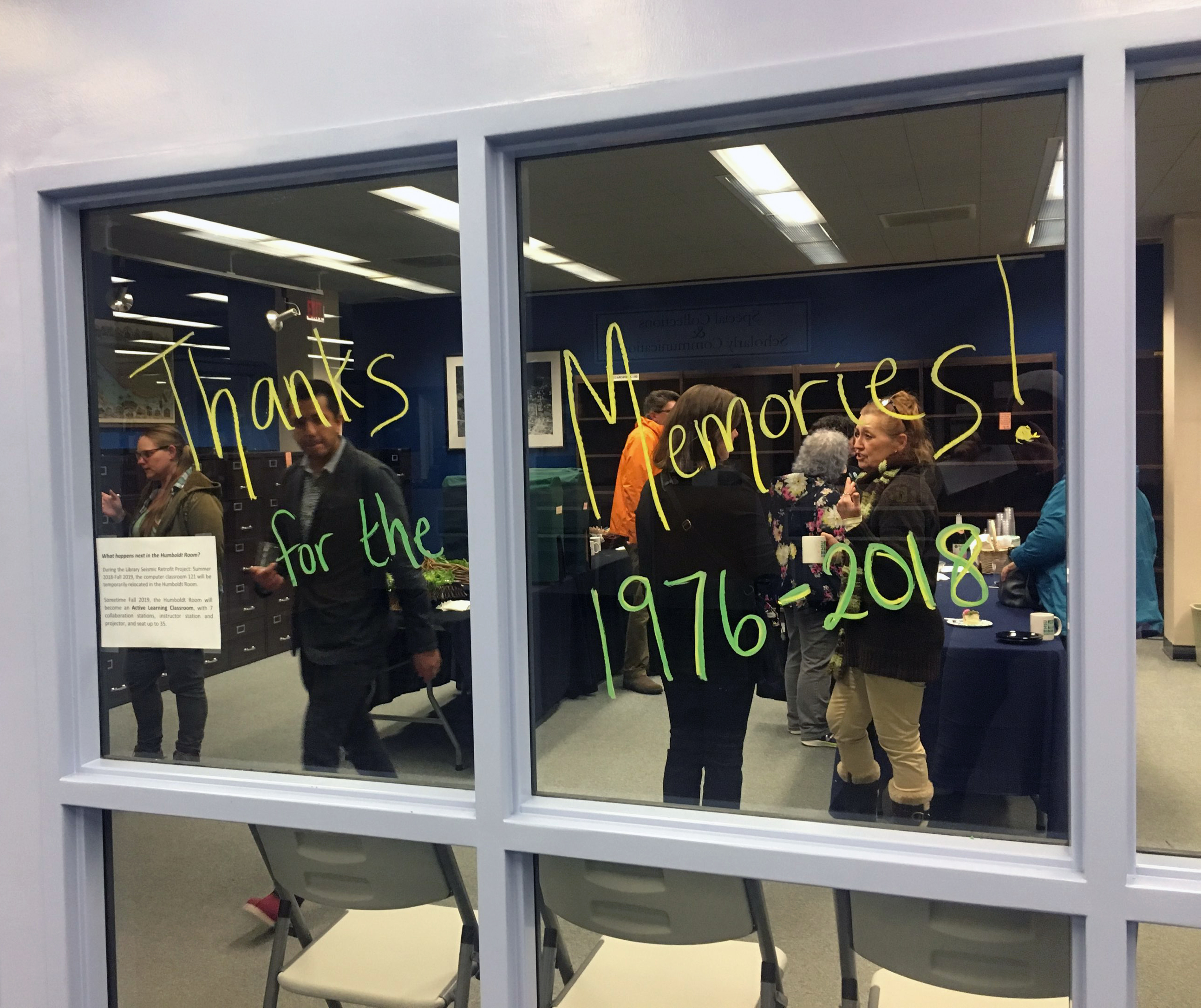
    Humboldt State students now have access to more research materials than ever before. On Feb. 27, the HSU library hosted the grand opening of the new special collections section, previously contained to a tiny room on the third floor.

    “It’s one of the biggest archives north of Sonoma,” HSU librarian Carly Marino said.

    The special collections section is home to archived materials about many local topics of interest, including natural resources, native peoples, the fishing and logging industries, history of local buildings and the history of HSU.

    “This is the spot where students and members of the community do research,” Marino said. “We’ve had people fly in from Germany to learn about the redwoods.”

    With HSU currently in a budget crisis, this expansion of the special collections section was made possible primarily by grants and private donations from the Van Kirk family and retired librarian Joan Berman.

    One of the ways the HSU library is working to make the resources more accessible is by digitizing many of the materials.

    “When I came in here for the first time, it was very archaic,” Jorge Ambriz, HSU Early Outreach Department staff and former library scholar intern said.

    Ambriz works with a team of people to do the painstaking task of digitizing some of the books and materials in special collections. It has taken them up to four months to digitize one book. But Ambriz finds the work and access to the material valuable, especially for history students.

    “As students, we sit for months and months learning methods and theories,” Ambriz said. “This place lets you put those methodologies into practice.”

    HSU Library scholar intern Alex Childers has also been working hard on digitizing materials and making them more accessible. Childers and other interns are working on a project adding historical articles, photos and letters to Redwood National Park’s Researching the Redwoods.

    “It’s going to raise awareness for not only students, but also the community,” Childers said. “This is a really great place to start for research about anything. People use it for independent research, projects or for fun. ”

    Special collections is on the third floor of the HSU library.

    Hours are Monday 1-7 p.m. and Tuesday-Friday 1-4 p.m. or contact Carly Marino carly.marino@humboldt.edu for an appointment.

  • Big trees, small trees, finding strengths in diversity

    Big trees, small trees, finding strengths in diversity

    For Chelsea Obeidy, an environmental science graduate from Humboldt State, a small senior capstone project studying how different factors affect seedling growth became a publication.

    “I approached professor Pascal Berrill with the idea to monitor seedling growths for my senior capstone project,” Obeidy said. “I was interested in seedling monitoring on the variable density retention patches that Berrill and Christa Dagley had developed.”

    Variable-density retention is a method of forest restoration that originated from HSU, according to Dr. Pascal Berrill, a professor in the department of forestry and wildland resources at HSU. In variable-density retention, overpopulated trees are thinned to maintain different densities while underpopulated trees are planted at different densities to encourage a natural-looking restoration. To apply this method, an area of the forest containing these trees can be divided into small regions or patches that receive varying levels of tree thinning and planting.

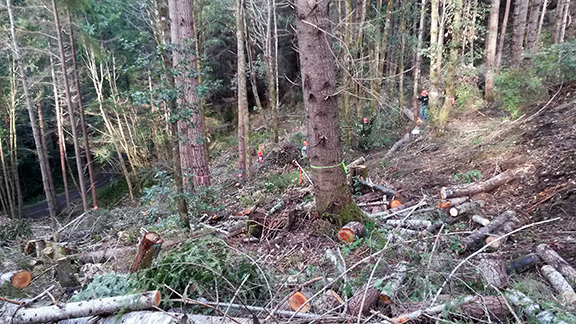
    Pascal Berrill, Obeidy’s research advisor, applies this method to restore the growth of conifers, specifically Douglas firs, in a forest area that has been dominantly populated by tanoaks.

    “About 50-60 years ago, people came in to harvest wood from the forests in California,” Berrill said. “When they did this, they only harvested Douglas firs and left the smaller hardwood trees, or tanoaks alone. Douglas firs are much more profitable comparing to tanoaks.”

    Alexander Goreman is a forestry senior at HSU on Berrill’s team.

    “Douglas firs are big trees and their trunks are straight, which makes them easier to process into lumber for different usages,” Goreman said. “Tanoaks have twisted trunks, which makes them harder to process and therefore, are only profitable as firewood.”

    Clearing away Douglas firs provides space for tanoaks to thrive and take over the forest. An increase in tanoaks density is a cause for concern.

    “Douglas firs are very fire resistant while tanoaks are not,” Berrill said. “Having a high density of tanoaks pose a greater wildfire threat to the forest comparing to Douglas fir. Introducing Douglas fir back into the population would decrease that risk.”

    In addition to decreasing wildfire, increasing Douglas fir population while decreasing tanoaks population would lead to more tree diversity in the forest system.

    “Increasing tree diversity would allow the forest to better fight off diseases among trees,” Obeidy said.

    “Restoring Douglas fir population to meet the area’s original Douglas fir-to-tanoaks ratio would also encourage populations of animals that are native to the area to come back,” team member Goreman said.

    To test which patch in the variable-density retention treatment produced the best growth for Douglas fir, Douglas fir seedlings were planted in each of the patches, then students collected growth measurement on the seedlings. The students also recorded factors that might affect seedling growth, such as light availability to the plants and resources competition.

    “We found that below-ground competition was the factor that affected seedling growth the most,” Goreman said.

    Below-ground competition occurs when plants decrease one another’s growth by competing for resources within the soil. The team found that when there were more tanoaks surrounding the Douglas firs seedlings, and at closer distances, seedling growth was greatly decreased. This is an indication that below-ground competition may be contributing to the change in growth.

    Conducting research with Berrill was a valuable experience for Goreman.

    “This was a cool opportunity for me to learn how to apply the things I learned in my classes and to collaborate with students from other departments,” Goreman said.

    Obeidy said his experience conducting research benefited his academic career.

    “This project specifically helped me find a beneficial approach to the scientific method, delineate a hypothesis and present the results in a meaningful way,” Obeidy said.

  • College of the Natural Resources and Sciences holds budget forum

    College of the Natural Resources and Sciences holds budget forum

    Lecturers and students are potentially affected by budget deficit.

    Richard Boone is the dean of the College of Natural Resources and Sciences. Boone attended the open budget forum on March 1 to share valuable information to students, staff and faculty about the financial situation of the CNRS.

    “We’ve been in deficit mode for the last five years so it’s in the academic year of 2012-2013,” Boone said.

    Boone wanted those who attended the forum to know there are many reasons as to why there is a deficit within the CNRS.

    “I wanted them to understand more information about the status of the college’s financial condition and why it is that we have a deficit, who has been influenced by changes in the number of students in the college [and] changes in the number of instructors in the college,” Boone said. “I felt that they should be as informed as possible to help them better understand our situation in the college and also university wide.”

    As the dean of the CNRS, Boone said it is his responsibility to bring the deficit spending down and that he and his team are taking actions to move in that direction.

    “Reduction of weighted teaching units, offering a class every other year instead of every year, every other semester instead of every semester or combining sections in some cases or reducing the required class for a major,” Boone said. “There are some trade-offs here that are difficult trade-offs.”

    At this point, it is unclear what the final decisions will be about the reductions.

    “We take our job very seriously, and we value students highly. It’s our mission here,” Boone said. “The values of the faculty here and the administrators of the college are as strong as ever and we’re dedicated as ever to students’ education and their success at Humboldt State.”

    Anthony Julien is a zoology major at HSU and is part of the CNRS.

    “I greatly appreciate the professors who have a little more stability in their job for speaking up and saying the things ever single person in there wanted to ask,” Julien said. “One professor informed us that because of budget cuts, there will be 700 less seats available in the biology department, the department with the greatest volume of new and current students. Now there will be less courses available and I am worried if I’ll be able to get into my courses and graduate.”

    Anthony Baker is the budget analyst for the CNRS. Baker came to the forum to support the dean with the budget presentation.

    “It’s a pretty complex problem, as the dean had mentioned, because of the deficit that’s associated with the lecturer budget,” Baker said. “It’s easy to point to that and say this is where the deficit came from. It’s a complex college, but that’s the primary place where we can see the greatest amount of money spent where we didnt have money to spend.”

    Baker said there’s a variety of different ways the deficit can be resolved.

    “One way to approach that is to reduce the total number of seats that a lecturer may be teaching. This is one of many different ways we can do this. It’s really depending on how we want to approach it,” Baker said.

    Melanie Michalak is part of the strategic planning committee for the CNRS. Michalak’s role in the committee was to look at bottleneck courses, which are courses that have low success rates. In those classes, students either get the letter grade of an F, D or WU.

    “If we’re able to eliminate or lower [the] success rate we can potentially have more seats for students,” Michalak said. “We’re really trying to identify those courses and work with instructors to provide more opportunities for students to pass the classes. That speeds up their time for graduation and it decreases our cost for tuition, we can offer slightly less seats and everyone can graduate. That’s what everyone on the committee talks about. That’s our goal the future.”


  • Housing and international program directors lose jobs

    Housing and international program directors lose jobs

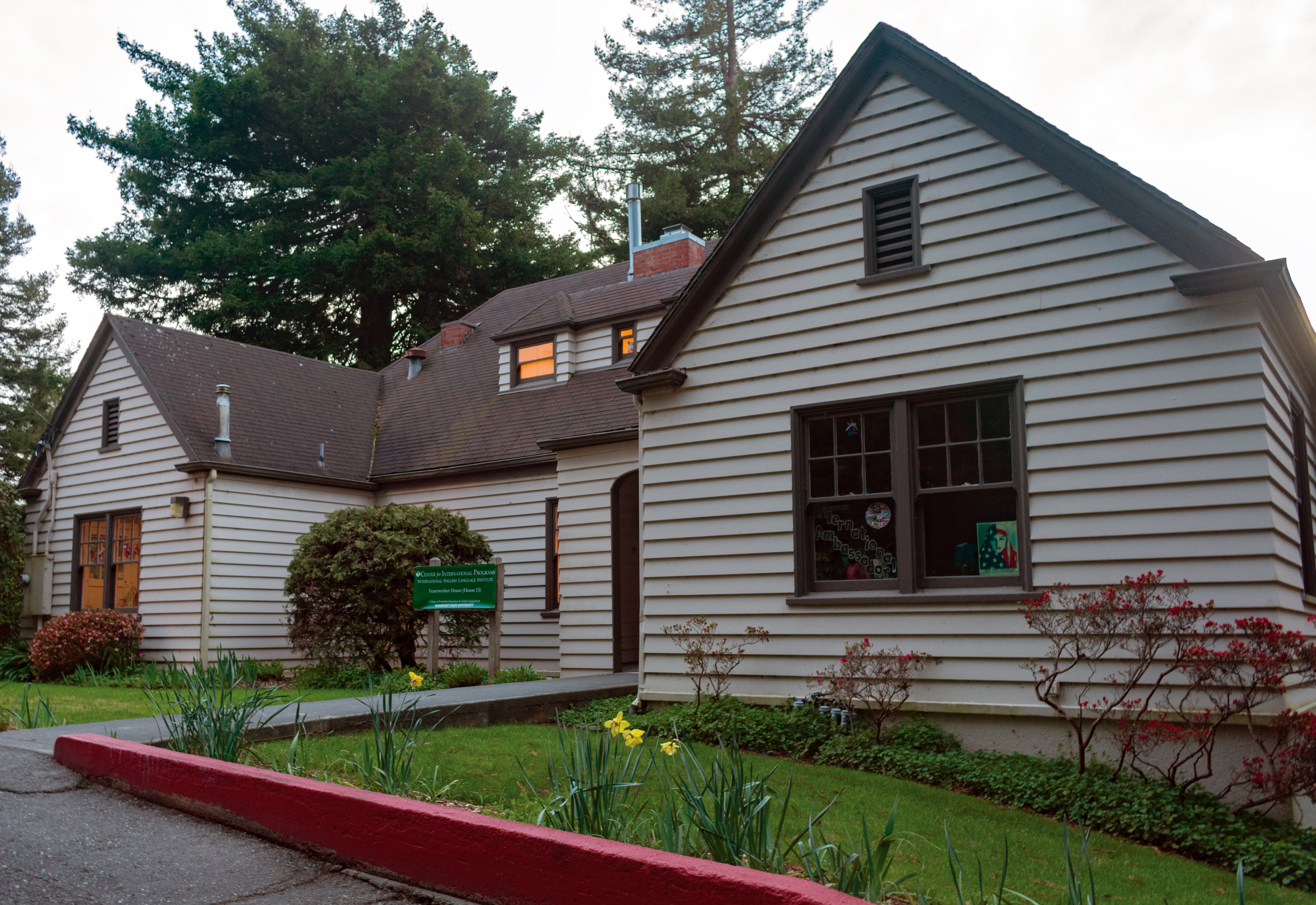
    The reality of Humboldt State budget cuts sets in as three departments recently lost employees. The positions of Associate Director of Housing Facilities, Steve McKenzie, Director of Center for International Programs, Ge-Yao Liu, and Associate Vice President for College of Extended Education & Global Engagement, Alex Hwu, were brought to an end.

    When contacted to speak on this matter, Liu did not wish to make a comment on his dismissal or the budget reductions.

    “All I want to say is to wish the university the best, and I am grateful for the opportunity to serve as the director of International Programs for a bit over one year,” Liu said.

    All other employees contacted at the International Center did not respond or did not wish to comment.

    Since the open budget forum held on Feb. 2, it hasn’t been a mystery to HSU students and faculty that the school is facing a major budget crisis. In the summary of the University Cabinet outline of Budget Reduction Decisions, an immediate plan is to “Reduce five administrator positions and eight vacant staff positions.”

    In a message sent to HSU students on Feb. 26, President Lisa Rossbacher wrote that HSU must reduce its budget spending by $9 million over the next two years.

    “I am writing today to reassure you that our very highest priority remains your educational experience,” Rossbacher wrote. “Even as we make reductions, we are protecting the core offerings of classes and support to help you progress toward completing your degree. Our budget decisions will lead to a ‘Students First’ budget, which I will share with the campus community by March 29.”

    It is not yet clear what the “Students First” budget will look like, but some students are worried about the way the budget cuts will affect them.

    “I came in from a break and people kept saying, ‘We’re gonna lose our jobs,” student assistant in Housing and Residence Life, Zach Pole, said.

    Though Pole says he is still in denial, he believes students losing their jobs is a possibility and thinks this will affect the department negatively.

    “The student assistants kind of do all the really basic, remedial and trivial stuff,” Pole said. “Without us, they’re gonna have to do this themselves when there’s more important things going on.”

    Pole said in a Housing and Residence Life meeting last week that Housing and Facilities Management are merging, and that McKenzie’s position was eliminated.

    Director of Housing and Residence Life, Stephen St. Onge, did not have time to give an interview, but wrote an email responding to student concerns.

    “We have not cut any student assistant positions for budget cuts,” St. Onge. “In fact, we added resident advisor positions last year to best support the building of community on campus.”

    This story has been changed from its original version on March 12 at 11:09 a.m.

  • Humboldt takes on the Public Interest Environmental Law Conference

    Humboldt takes on the Public Interest Environmental Law Conference

    Students and professors from HSU traveled to the University of Oregon to attend the Public Interest Environmental Law Conference focusing on environmental issues and global sustainability.

    A group of Humboldt State students drove six hours through rain, hail and snow to the Public Interest Environmental Law Conference, or PIELC, at the University of Oregon this past weekend.

    The four-day conference featured speakers, panelists, activists and organizers from all over the world. Two of them were Humboldt State professors. This diverse group of people came together in one space to discuss current environmental issues and the legal work fueling their fight to global sustainability.

    Brooke Holdren, a senior at HSU majoring in biology, brought a scientific perspective to the event. She encourages bridging the gap between the sciences and humanities in terms of environmental activism.

    “People from all different facets come here,” Holdren said. “So you have the people practicing law along with the anarchists and the homesteaders. And you see everyone working together in this really unconventional way.”

    This year’s conference pushed the theory of intersectionality, their “buzzword” for the weekend. Intersectionality is a concept that came from the early 1900s feminist movement and is the idea that all aspects of humanity – race, class, sexuality and geographic location – are all interconnected and cannot exist separately.

    Intersectionality is now being applied to environmentalism with the understanding that environmental problems and social injustice are interconnected.

    James Bradas is an environmental studies major at HSU who found a sense of agency in going to the conference.

    “I came cause I give a damn, and that’s half the battle,” Bradas said. “Our major is very activism-based, but you can’t escape the insular bubble, so being here is a real eye opener. To actually see the faces of the names we’ve read is a reminder that you don’t need a whole lot of money to do something and be active.”

    Conference guests ranged from guerrilla tree climbers and food justice-based farmers to representatives from the Center for Biological Diversity and EarthJustice – people pushing for justice and equity for humans, as well as the natural world. The event offered students an opportunity to network with other environmentalists and get more involved in the world of activism.

    Samantha Garcia, an environmental studies senior at HSU, thought the conference brought a welcome shift in the tone of environmental conversations.

    “As an environmental studies major, it can get depressing, and you absorb the negative energy from what we’re learning,” Garcia said. “So, it’s refreshing to be around all of these like-minded people.”

    The weekend provided a wide range of activities for conference attendees to participate in. However, not all came without criticism. Some were pushing a very aggressive version of activism. Holdren was able to take a step back and see the positives, even from this negativity.

    “There were a lot of things within and without of PIELC that were really problematic,” Holdren said. “It’s good to bring a critical lens to something like this and take what you want from it, but also learn from it in the sense of how not to go about things.”

  • Letter to the editor in response to “40-day anti-abortion protest begins in Eureka”

    Letter to the editor in response to “40-day anti-abortion protest begins in Eureka”

    Dear Editor,

    Regarding the Lumberjack article about the 40-Day Anti-Abortion Protest – HSU students need to know that not all religions or religious leaders believe that human sexuality is evil and something to be ashamed of. They need to know that some ways of faith regard sexuality as a blessing to be carefully and thoughtfully enjoyed between people as a way of communicating and sharing love – even if they aren’t married and even if they aren’t heterosexual.

    Like fire, human sexuality can, of course, hurt people both emotionally and physically. As people learn how to express their sexuality and share it with others, they learn by trial and error. Some religions shame people about this reality. Other religions offer factually accurate information and encourage people to make thoughtful and caring choices in keeping with their own deep values.

    The United States is a secular nation that works to guarantee freedom of religion for all its citizens. People whose faith calls them to abstain from all sexual activity before marriage or to abstain from birth control and abortion are free to follow the dictates of their hearts. And people whose faith or whose approach to life allows them more freedom around their sexual expression are also free to do as they see fit.

    Some religious people would like to do away with respect for religious freedom when it comes to human sexuality. But they do not speak for all religious people. Clergy for Choice is a group of interfaith religious leaders who support men and women in carefully finding their own way regarding their own sexuality. Clergy for Choice supports the compassionate and highly professional work of Planned Parenthood.

    So while some religious people practice 40 days of protest to end abortion and to end religious freedom around human sexual expression, other religious people practice a lifetime of supporting Planned Parenthood and thorough and effective reproductive health care for people as they make their own choices in this vulnerable and tender aspect of their lives.

    Sincerely,

    Rev. Bryan Jessup
    The Humboldt Unitarian Universalist Fellowship
    PO Box 506
    Bayside, CA 95524 – Phone: 707 822-3793

  • Homeward Bound bus won’t break bank

    Homeward Bound bus won’t break bank

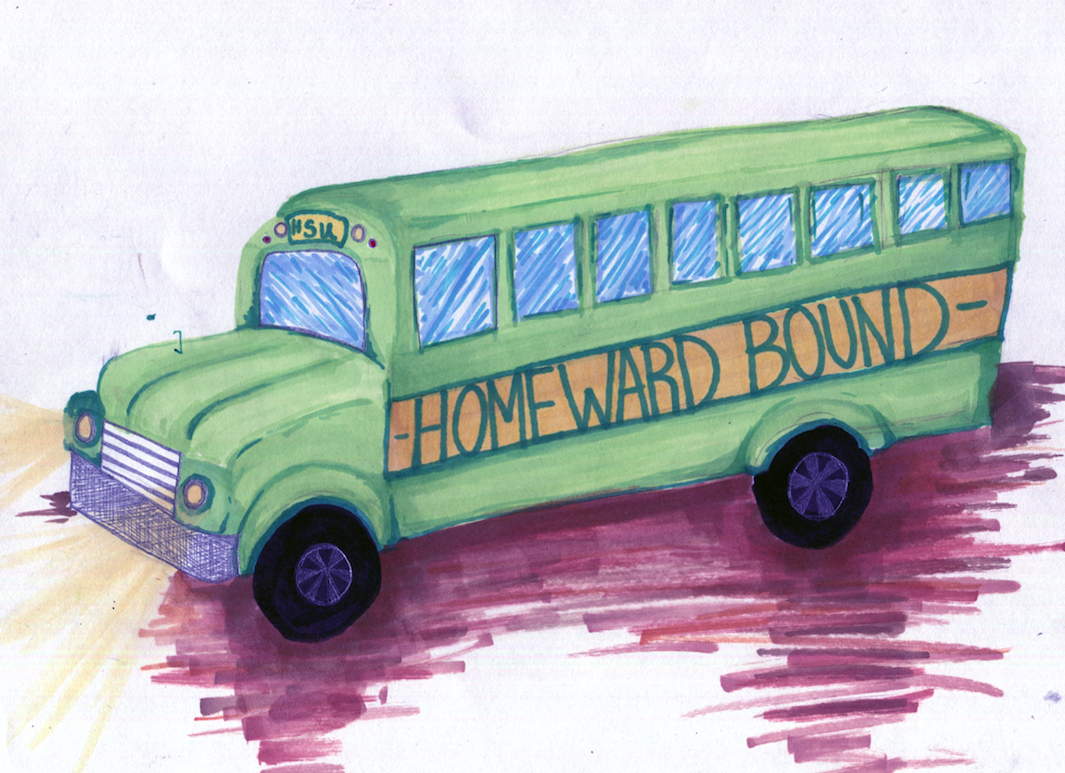
    payedFor students struggling with travel arrangements from San Francisco and Los Angeles, relief can be found in the form of a charter bus. Approximately 44 percent of Humboldt State students originated from L.A. or the San Francisco Bay Area.

    HSU began a program in the winter of 2016 designed to provide students access to a safe, affordable and fast method of travel to these locations during school breaks.

    Wildlife major Emily Adams, 19, said she enjoyed her experience on the Homeward Bound Bus to San Francisco.

    “I prefer the bus to driving,” Adams said.

    Adams said the whole process was simple. Students swipe their IDs upon arrival. When they would like to get off, they pull the string, which encircles the ceiling of the bus. She said even though the bus takes longer than driving, getting to do anything she wanted made the bus more enjoyable.

    Currently, tickets are priced at $125 round trip to L.A. and $95 round trip to San Francisco.

    Journalism major Andreas Schneider said when he took the Greyhound roundtrip to San Francisco, he paid $120 for the ticket.

    “I took the Greyhound and it was kinda pricey,” Schneider said.

    Communications major and library technology resource employee Jesse Santana said he encourages students to take advantage of this opportunity.

    The program happens three times a year: Thanksgiving, Christmas and spring break. The 2018 spring break bus is sold out.

    Krista Paddock, parking coordinator and coordinator of the program, said it has been successful. She said security and money are the two primary factors that draw people to the program. In addition, it is also faster than other buses because of fewer stops.

    Paddock assigns a host on each bus, who functions much like a student chaperone for the trip. Hosts take roll, ensure all riders are present, rides the bus for free and receives paid compensation for their working hours.

    “Since I can’t be there, it gives me peace of mind,” Paddock said. “It’s a great resource for student’s to get affordable tickets to Southern California.”


  • This week in sports history

    This week in sports history

    March 7, 1857 – Baseball decides that their game will last nine innings. Before this, a full game was decided when the first team scored nine runs. Games have remained nine innings for the last 160 years.

    March 8, 1971 – In their first boxing match against each other, Joe Frazier defeated Muhammad Ali in 15 rounds for the heavyweight title. The two would fight twice more that became known as “The Rumble in the Jungle” and “The Thrilla in Manila.” Ali won both matches.

    March 14, 1988 – Golden State Warriors star Stephen Curry was born. Curry has become a household name in the NBA and his style of play has changed the way the game is played and coached.

    March 14, 2010 – Jacks softball pitcher Gracie Perez throws a no-hitter versus Chico State. Perez was one walk away from throwing a perfect game and had six strikeouts for the game.

    March 14, 2017 – The world’s oldest golf club, Muirfield in Scotland, votes to admit women to their club for the first time in the 273-year history of the rule that banned women.

  • Dog Expo has its day

    Dog Expo has its day

    Longtime dog owners in the community showed off their pooches to raise money for spay and neutering funds on March 4 at the Redwood Acres.

    The 31st annual fundraiser was organized by the Humboldt Dog Obedience Group, also known as HumDOG. The local non-profit was founded in 1978 and provides services to “encourage responsible dog ownership.”

    The event presents an opportunity to meet with various dog breeds, share experiences and advice with fellow dog lovers and prospective dog owners.

    Proceeds from the event benefit the Terri Lockett Memorial Spay/Neuter Fund. Lockett started the spay and neuter fund through HumDOG in 1995 and was known as “the spay and neuter queen” to her friends.

    Tricia Morgan of Eureka said Lockett was passionate about the cause and worked to make spaying and neutering available to anyone.

    “If someone didn’t have money, she would pay for it herself,” Morgan said.

    Since Lockett’s death in 2005, Morgan and the HumDOG members have kept her dream alive. The organization hosts fundraisers, such as DogExpo, and receives funding from grants.

    Morgan, who has now taken the title of “spay and neuter princess,” sported a tiara at the event and performed in multiple demonstrations along with her dog Shylo, a Nova Scotia duck tolling retriever.

    Numerous families approached the president of HumDOG, Marilyn Backman, and her two Shetland sheepdogs, Indy and Dunnigan.

    “The training and classes we offer really isn’t for the dogs,” Backman said. “It’s more for the humans.”

    Eureka citizen Sara Borok is a dog trainer and owner of Siberian Huskies Karma and Hildy, who race for the Northern Humboldt Sled Dog Team.

    Karma (left) and her daughter Hildy. Photo by Lora Neshovska.

    “We are an urban mushing team,” Borok said. “We sled even without snow.”

    Dogs train up to months at a time prior to their first race. Karma, who is now 10 years old, led Borok on their first race at only nine months old.

    “This is the first year we are going to have other breeds in the team,”

    Anthony Rojas, a history student at Humboldt State University, is a dog fanatic and volunteers at the Sequoia Humane Society. Rojas, along with the society, took part in the Dog Expo on Sunday.

    “It’s a no-kill shelter and I believe everyone deserves a second chance,” Rojas said. “I volunteer here because it’s important to raise awareness for adoption, spaying and neutering.”

  • Natural History Museum displays amphibians and reptiles

    Natural History Museum displays amphibians and reptiles

    The HSU Natural History Museum in Arcata was the place to be on Saturday. Amphibian and Reptile Discovery Day was full of surprises, knowledge and amusement.

    “It turns me into a kid again,” Humboldt State biology major Victoria Yefremenkova said.

    Violet Cook, a third-grade student at Freshwater Elementary School, was excited and having a blast learning about nature. The HSU Natural History Museum is her favorite place.

    When asked what she liked best at the museum, Cook said, “the fossilized sea shells.”

    Entwined in the festivities with the snakes, lizards, turtles, frogs and salamanders was a scavenger hunt where children of all ages could fill in the names of live reptiles and amphibians.

    “I think they liked the scavenger hunt about the reptile facts the best,” Ann Walance, a community member who brought her grandchildren to the event, said.

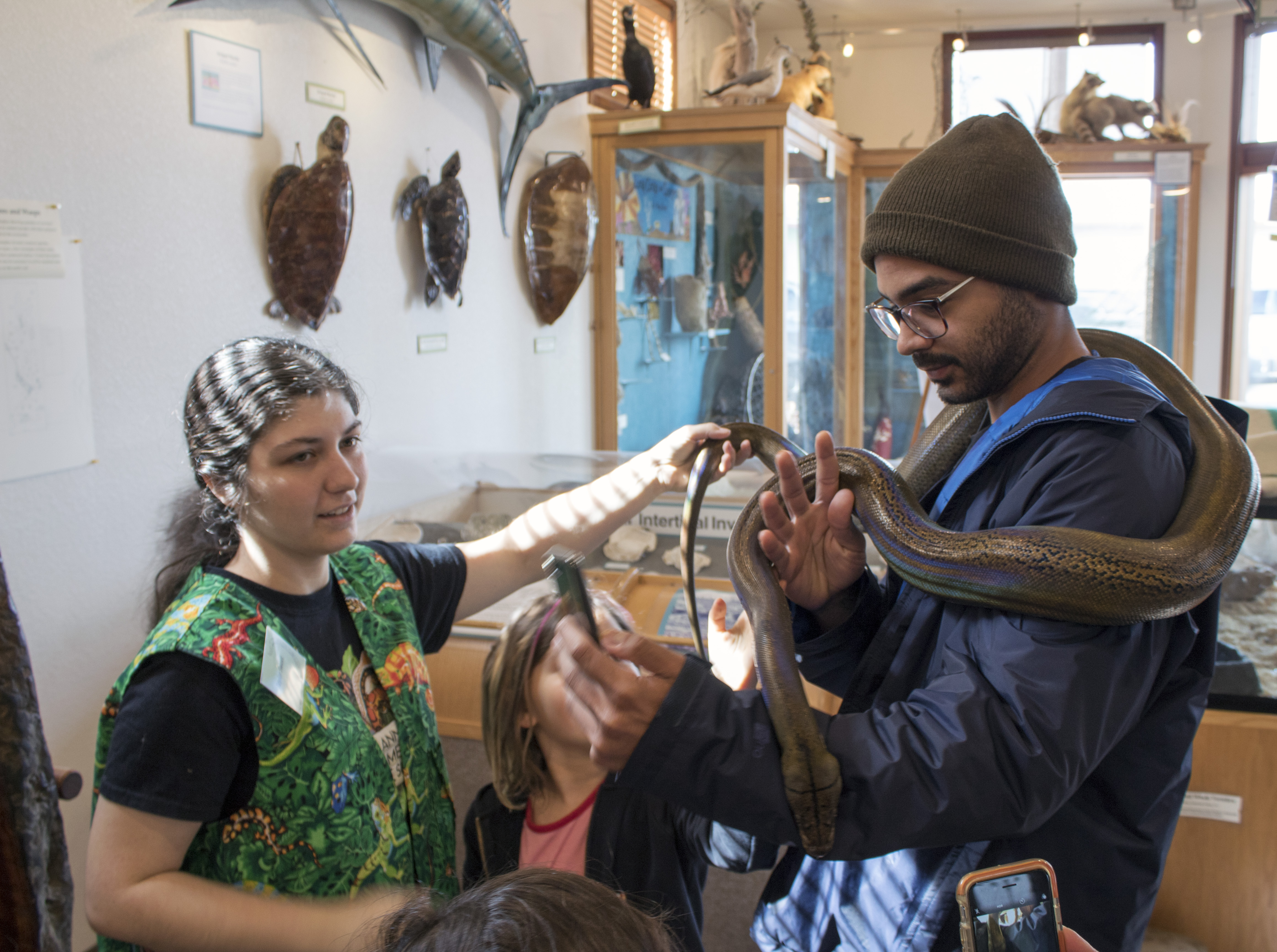
    Other activities of Discovery Day included snake and reptile photo button making, coloring and crafting a frog out of paper supplies and having pictures taken while holding a python or a bearded dragon.

    HSU student Aidan Brannney, a wildlife major, was taking the photographs of people holding the pet python or the bearded dragon for his herpetology class.

    “People come out and get exposed to the reptiles and find out they are not as creepy-crawly as they are often made out to be,” Branney said. “Some of them are actually endangered, threatened with extinction. It’s all in conservation, right?”

    The HSU Natural History Museum has internships and work study paid positions for students.

    “It’s a great way to get involved with the community through internships,” Allison Rafferty, HSU biology student and intern at the museum, said.

    Rafferty was wearing an inflatable Tyrannosaurs rex outfit in front of the museum for the event, waving and welcoming visitors to Discovery Day.

    “It’s all about connecting with people,” HSU biology graduate Adrian Macedo said.

    Macedo co-authored one paper that he submitted to be published in Herpetology Review, and co-authored a second paper that has not yet been submitted for publication. Macedo researches red tailed coastal frogs and coastal giant salamanders.

    “We need a baseline description of as many amphibians as we can find before things change and the species are gone,” Macedo said.

    Children who attended Discovery Day wanted to learn and were respectful. Where the tortoises are on display, one child who probably couldn’t read the posted sign politely asked Andrea Ortiz, the worker watching the tortoise, if they could touch the tortoise. The sign said “please do not touch,” but Ortiz allowed the children to touch the tortoise gently and not the head. The children touched the tortoise ever so softly and smiled.

    On another table, a reticulated python is devouring a mouse. Some kids rushed up in excitement, others moved on unaffected and some passed by with a little tear in their eye for the mouse.

    Siblings Quin, Lucy and Jack Biondo stop to watch the reticulated python eating.

    “Why don’t they chew their food? We do,” Quin asked.

    Quin and Lucy are twins in the first grade and Jack is in the sixth grade, all attending Jacoby Creek School.

    “You don’t usually get to pet a 10-foot snake,” Jack said.

    Dean Savieo attends Mistwood School where he is in group three. Group three is equivalent to the fourth grade. Savieo liked the Gila monster the best, because they are poisonous.

    When asked if he liked snakes, Savieo said, “Kind of. Snakes will strangle you, especially the ball python.”

    The reptiles at the museum belong to HSU students and alumni. The amphibians live at HSU where they are cared for by HSU professor Sharyn Marks and the herpetology department students.

    “Some of the axolotl salamanders came to the school 20 years ago as eggs to be part of the animal development course,” Marks said. “We used to give them away. Now they are a restricted species requiring a special permit.”

  • Seniors stunt in final home game

    Seniors stunt in final home game

    Kayla Maulson is a senior child development major at Humboldt State who has been affiliated with the rugby team for more than five years. Maulson took a year off, because she gave birth about a year ago. She felt incredible scoring in her last game as a Lumberjack.

    “If you’re not first, you’re last,” Maulson said.

    The Jacks women’s rugby team crushed the University of California, Berkeley in their matchup on March 3 at College Creek Field. Maulson was the first of seven Jacks to score in this matchup.

    It was a bittersweet moment for the Jacks, as it was their last home game of the season. Each senior who played for the Jacks was a key component in the game.

    The Jacks started off strong thanks to the help of head coach Meredith Conrad-Forrest. Before the game even started, Conrad-Forrest recognized that the defensive line needed to be shifted around.

    “The energy we had going into this weekend seemed really positive, because we beat Berkeley before,” Conrad-Forrest said. “It was beautiful for them to have their last game end that way.”

    At halftime, the score was 26-17. Even though the rain picked up, nothing was able to stop the Jacks from keeping their momentum alive.

    Out of the four seniors on the rugby team, each would cross the goal line, contributing to the 51 total points that were scored.

    Lila Bell, a senior child development major at HSU, was an important piece in this new formation. Typically, she plays the 13 position, which focuses on maintaining the outside lanes. She lined up at the 10 position, which is similar to a quarterback in the sense that you call out the shots and dictate where people will line up.

    The Jacks were in between the halfway point and goal when Libby Treu executed a play that Bell called out.

    “We picked a play that would allow me to run right through their defense,” Bell said. “We took them by surprise!”

    All together, the Jacks have won two and lost five games. Even though they have lost a total of five games, they still have a chance at making the playoffs, because of their total points scored throughout the season.

    The Jacks walked away in their final game with a 51-22 point victory over the Cal Golden Bears.

    The Women’s College Division 1 Elite Playoffs of rugby begins on April 20. The championship round of 16 takes place over a three-day period and will conclude with a championship bout on May 5.

  • Third time’s a charm

    Third time’s a charm

    Lady Jacks win conference title.

    The Lady Jacks basketball team played the UC San Diego Tritons for the third time this season on Saturday. Humboldt State lost the first two games. This time was for the conference title and it was the charm.

    “This was the moment that was most important to us,” tournament MVP Tyra Turner said. “This was the championship game and we knew they got us twice at our home and their home.”

    Jacks sophomore guard Tyla Turner (12) rises above Tritons forward Shandiin Armao (40) for the bucket. The Jacks beat UCSD 76-75 in the conference championship on March 3 and advance to the NCAA D-2 tourney beginning March 9. Photo courtesy of CPP.

    The Tritons got off to a scorching start from behind the arc with four early three-pointers and led 18-13 with four minutes left in the quarter. The Jacks responded in a big way by going on a 14-0 run to close out the quarter, making it 27-18. They moved effortlessly on offense and continually found open opportunities from beyond the arc.

    The Tritons finished the first half on a 6-0 run to cut the lead to just four after being down by as much as 12. It was much of the same in the second half as San Diego went on a 19-7 run to start the half and took an eight-point advantage.

    The ball movement stopped for the Jacks and the stagnancy killed their offensive flow. To make matters worse, the Jacks could not grab any rebounds due to the Tritons overwhelming size advantage, and were out-rebounded by 17 for the game. The Tritons had 21 offensive boards to the Jacks’ 23 defensive rebounds.

    “Our team stayed resilient the entire time,” head coach Michelle Bento-Jackson said. “We knew San Diego would keep punching and fighting. Our girls kept their heads up and continued to fight until the very last second.”

    Just when it looked like the Jacks were going to be sent home quietly, down by six with a minute left, sophomore Tyla Turner had a vintage Reggie-Miller-versus-the-New-York-Knicks moment. After nailing a clutch three from the baseline to cut the lead to three, she then stole the ball on the inbounds play and, while falling out of bounds, found her sister Tyra for the easy layup to bring the Jacks within one.

    After a miss by the Tritons with 10 seconds left on the clock and down by two, Tyra drove to the bucket, drawing Triton’s defenders, then dished it to an open Jovanah Arrington for a game-winning three from NBA range with half a second left – all net. Jacks win 76-75.

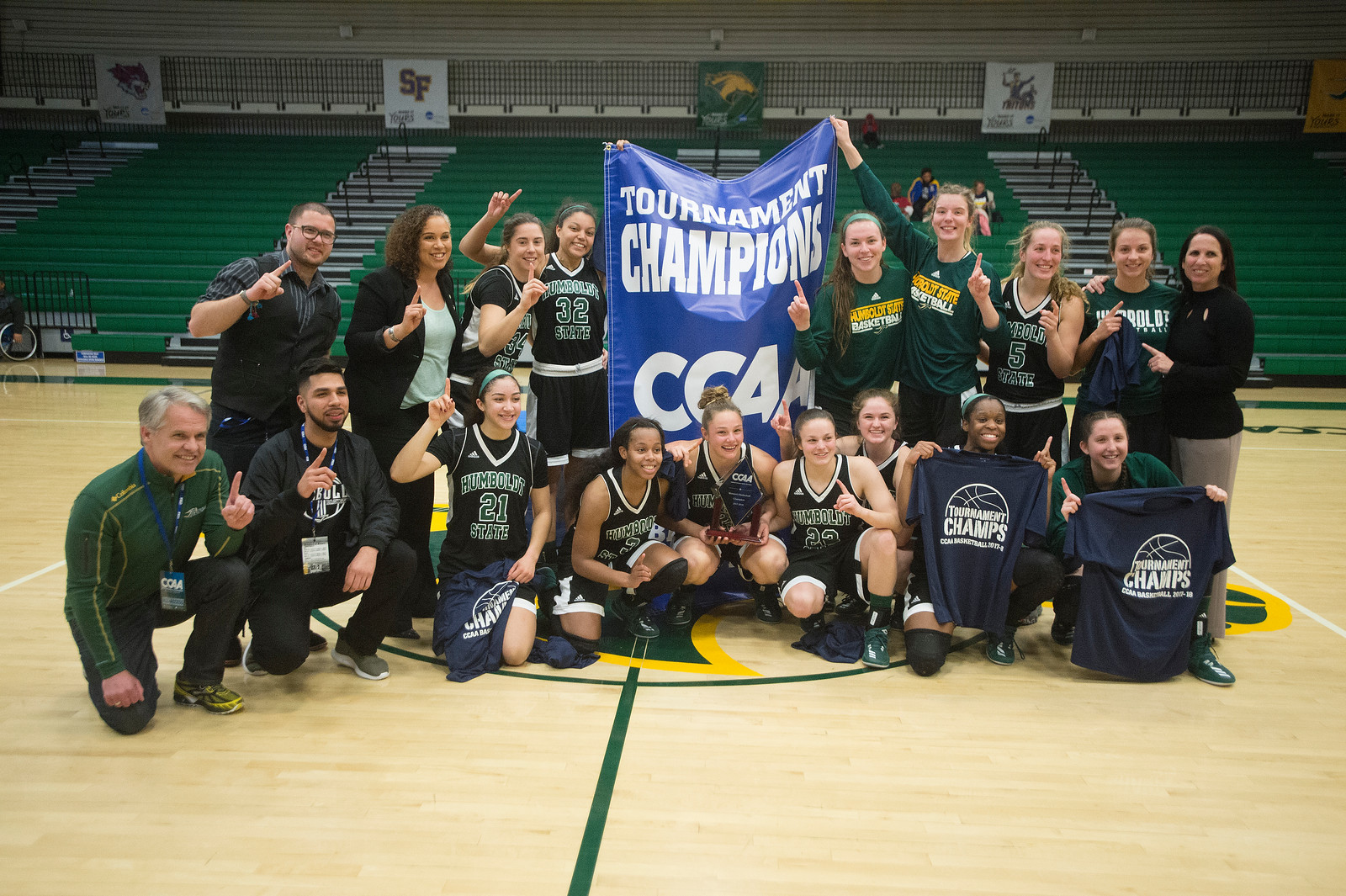
    The Lumberjacks celebrate their 76-75 last second win over UCSD in the CCAA title game on March 3 in Pomona, Ca. The Jacks move on to play No. 1 seed Azusa Pacific in the NCAA D-2 tournament beginning March 9. Photo courtesy of CPP.

    “Tyra did a good job of getting in the paint and drawing defenders,” Arrington said. “I just made sure to slide over to be in her vision. I knew time was running out and I had to get a shot up. I didn’t know how to react, because I thought the time was going out, but we still had a second.”

    The Jacks are now conference champions and move on to the NCAA tournament on March 9.

  • Humboldt State presents Social Justice Summit

    Humboldt State presents Social Justice Summit

    The MultiCultural Center presented their 24th annual Social Justice Summit at Humboldt State on Saturday.

    Deema Hindawi is an HSU student and a co-event coordinator of the summit.

    “The theme for the summit this year is ‘Who Am I? [Back to Our Roots],’” Hindawi said. “We want people to look beyond their skin color and look into their roots. That is the purpose of this event.”

    HSU student Lizzie Philips is also a co-event coordinator of the summit.

    “We want to give students here at HSU a platform to hear their voice,” Philips said. “There are those who feel like their voices are not heard, but we want to change that with Social Justice Summit.”

    Various workshops hosted by the MultiCultural Center were open to anyone. Topics ranged from social identities, sexual orientation and environmental justice.

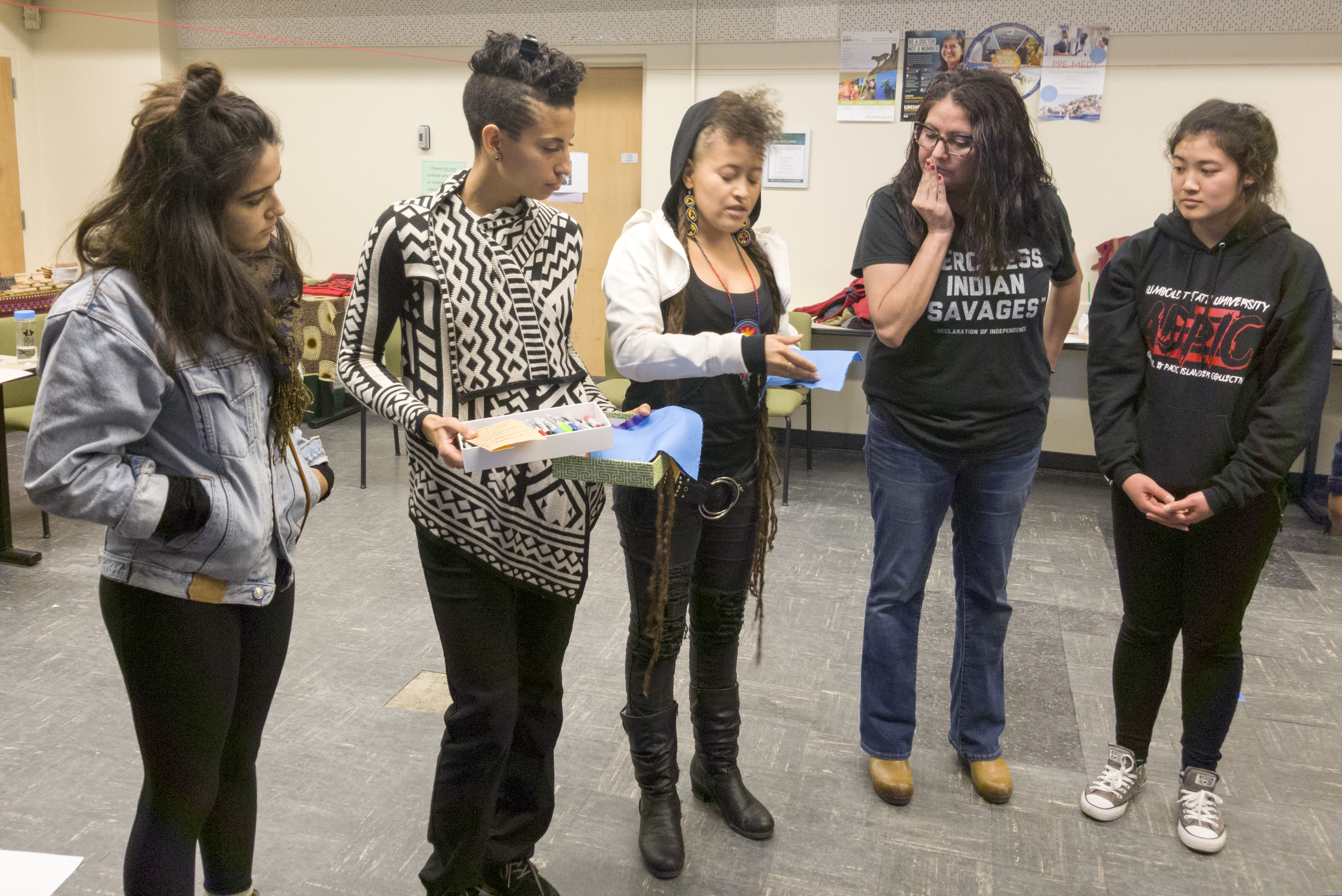
    Alixa Garcia and Namia Penniman are multimedia hip-hop artists from the group Climbing PoeTree. They came all the way from Brooklyn, New York to share their thoughts on environmental justice.

    “Since we were kids we’ve been advocating for environmental justice,” Garcia said. “We came to Humboldt to highlight environmental issues and create awareness that there are groups that are fighting for the environment.”

    One of the projects that Garcia and Penniman shared with those who attended the workshop was their S.T.I.T.C.H.E.D. workshop, a mural made of fabric where strangers wrote uplifting and positive messages that others can read.

    “In a way, we [Garcia and Penniman] want to show how art can empower social and environmental activism,” Garcia said. “Because we’re all living [on] planet earth, right? We only have one shot at fixing it. If we don’t, where can we go? Mars?”

    For those who missed the chance to meet Garcia and Penniman, they will deliver a keynote performance in the Kate Buchanan Room at 7 p.m. tonight.

  • Microgrid is in the works

    Microgrid is in the works

    Schatz Energy Research Center at Humboldt State was awarded a $5 million grant. The money is going to be used to build a microgrid at the Arcata-Eureka Airport in Mckinleyville. Peter Lehman, director of Schatz, said he was overjoyed when the good news broke.

    “Everybody was high-fiving and hugging,” Lehman said. “It is a big deal for us, and a big win.”

    Lehman spent about three months working on a proposal for the grant with his colleagues.

    “It was really competitive,” Lehman said. “The California Energy Commission only funded one proposal out of ten. There was a lot of universities that didn’t get funded, and we did.”

    The microgrid will be composed of a 2.3-megawatt photovoltaic array, or solar power system, and cover nine acres.

    “It is one thing to have an idea, but it’s gotta be based in reality,” Lehman said. “First you have to conceive the idea, flesh out the idea and decide what partners need to be assembled. It’s not easy.”

    Redwood Coast Energy Authority, or RCEA, partnered with Schatz, matching $6 million in funds to help the project. Executive director of the RCEA Matthew Marshall is optimistic about the project.

    “We were waiting to hear back from the Schatz Center to see if they received the grant before submitting the application for the loan, but it’s now in the works,” Marshall said. “I’m optimistic.”

    The RCEA is financing the upfront costs of the project with a low-interest loan from the United States Department of Agriculture’s Rural Utilities Service.

    “We’ve got a goal to support the development of local solar projects,” Marshall said. “The project is pushing the envelope. It’s exciting being on the forefront.”

    In addition to generating green electricity, the microgrid will create jobs for locals.

    “Somebody has to pour the concrete, drive the post into the ground to mount solar panels and run the wires,” Lehman said.

    In an emergency situation, the airports and United States Coast Guard could run for hours off energy gained from the microgrid .

    “The airport and the Coast Guard are really important,” Lehman said. “The Coast Guard can’t fly if the airport doesn’t have electricity.”

    RCEA owns the solar array and PG&E owns the wires, but who gets paid what for the electricity produced? How do customers get charged for that?

    “It’s all new, its never come up before,” Lehman said. “We are going to be plowing some new ground trying to figure that out.”

    The project is expected to begin this summer. PG&E will do a number of tests after the completion of the first multi-customer microgrid.

    “PG&E is careful about what goes on their grid,” Lehman said. “There are a number of tests we will have to pass with them, looking over our shoulder to make sure that is it safe.”

    PG&E communications representative Ari Vanrenen said PG&E is committed to clean energy.

    “We are a community partner dedicated to building a better, more sustainable future for all Californians,” Vanrenen said. “This includes understanding and responding to the different needs of our customers and communities.”

    Once the microgrid is established, the Schatz Center will spend a year writing reports on how it works and share their findings.

    “Lessons we learn are going to be valuable for other people. That’s how progress happens in technology,” Lehman said . “You do things and try something. You tell people about it. The next time you build it, you are a little smarter and you do a better job.”

  • Lady Jacks advances to first CCAA title game since 2010

    Lady Jacks advances to first CCAA title game since 2010

    Isa Conde poured it on for a season-high 26 points for Humboldt State en route to their 69-53 win against the Cal Poly Pomona Broncos. The win sent the team to the California Collegiate Athletic Association championship game, which was on Saturday in Pomona.

    Junior forward Isa Conde (32) looks for the open pass. Conde had a season high 26 points for the Jacks in their 69-53 win over Cal Poly Pomona. Photo by Trent Preston (CPP).

    “This is a great win for our program, and I am really proud of the girls,” HSU head coach Michelle Bento-Jackson said. “We had great balance on offense. We made it a priority tonight to take away the inside options from Pomona and force them to shoot from [the outside].”

    Conde started off the game scorching, as she scored 17 points in the first half. However, she was just one of four Lady Jacks who finished with double-digit points. She was joined by teammates Tyla and Tyra Turner, along with Mikaela Shannon, who had 13 points off the bench.

    “We really did a good job of sharing the ball and getting the best shot we can,” Tyra said. “We played smart and we were aware of our fouls. We made smart decisions on offense and defense.”

    Sophomore guard Tyra Turner (3) drives past Broncos defender Jackie Ricketson (13). The Jacks beat the Broncos 69-53. Photo by Trent Preston (CPP).

    The game was quite even heading into halftime, with the Jacks leading 34-29. However, they took over in the third, as they went on a 20-4 run at one point.

    “I thought we did a terrific job of sharing the ball,” Bento-Jackson said. “We really wanted to stretch out their defense, and when you see balance in the scoring, it’s because we were making the extra pass. We were being aggressive off the dribble and we got things going on the offensive end.”

    The Lady Jacks held the Broncos to 22.2% shooting in the second half as well as forcing 15 turnovers and taking six charges.

    The Lady Jacks advanced to their first conference tournament title game since the 2009-10 season.