by Emma Wilson
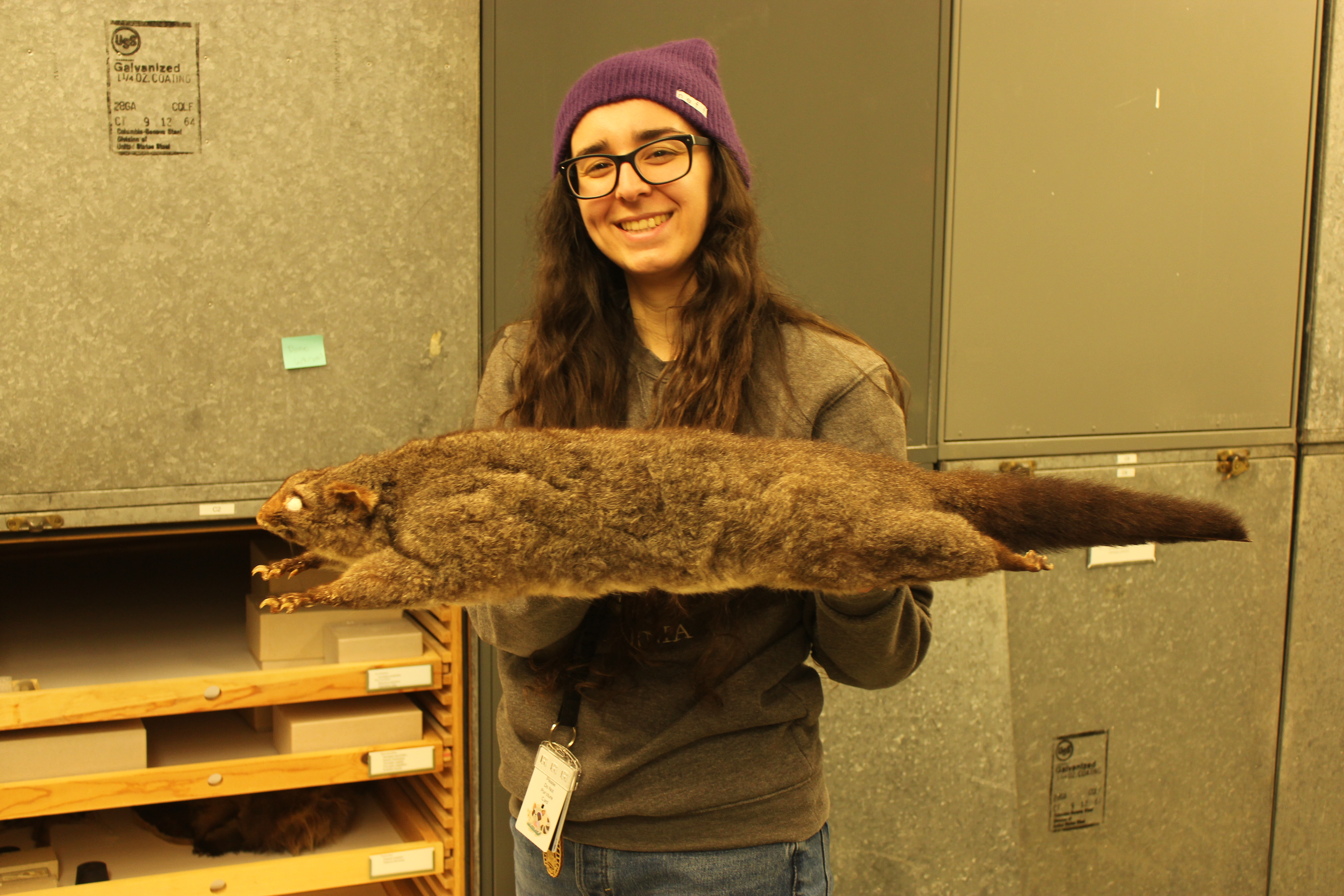
In the depths of The Science C building, the Vertebrae Museum is home to carefully preserved specimens to help students understand the diversity and evolution of mammals.
Dr. Silvia Pavan, a professor at Cal Poly Humboldt and museum curator for the Vertebrae Museum, moved to Humboldt County in Jan. 2022.
“I teach mammalogy, which is a popular course a lot of students take in the natural science programs,” Pavan said. “Mammalogy is a class offered that covers lectures and labs. In the lectures, we cover general aspects of mammals, starting with the characteristics of mammals, origin and evolution of mammals. That’s the first part of the three main blocks along the semester.”
The second block is functional morphology, a branch of biology that deals with the form and structure of organisms and their features. These include integument (hairs, glands and nerves), movement, acquiring and processing food, environmental adaptations mammals have to live in different habitats and communication.
Finally, in the third part of mammalogy, the lecture covers more ecology, social systems and living in groups. In the mammalogy class, Pavan also talks about conservation and museum science. This includes what they do with museum specimens, and how museum specimens can inform us about diversity, evolution, conservation, ecology and aspects of mammals.


Digitalization and making data available online is one goal curators like Pavan are organizing. At the museum, guests can look at which species they have a tissue sample of that could be used to assess DNA sequence and what tissue collections they have. This is going to be part of the database as well so the scientific community can use the museum’s collection.
“That’s what we are doing now. I think that’s the main thing for the museum, we are trying to make our collections broadly used for everybody,” Pavan said.
The vertebrae museum is also home to a colony of dermestid beetles. These are tiny little insects that feed on dead animal tissue and clean flesh to the core of the bone.
“When we prepare a specimen, and you get the flesh, it’s a way of getting the flesh out; they eat the flesh and they leave the bones,” Pavan said. “The beetle’s way of living off the bones and having the skeleton ready for being analyzed.”
Alyssa Semerdjian, the collections manager for the Vertebrae Museum, maintains the specimens and helps volunteers get their foot in the door.
Anyone can volunteer at the Vertebrae Museum on Friday, from 12 p.m. to 5 p.m. If someone wants to come work on something, Semerdjian can show them how to apply.
“If someone wants to come work on something, I’ll be the person that’s here to get them started and stuff,” Semerdjian said. “If they’ve never done it before, I’ll be the person to walk them through it. My job is general upkeep and database work,”
Semerdjian explains why mammalogy (study of mammals) and ornithology (study of birds) classes are important. Classes like these teach students about looking at details in a way that you don’t think about. This is true for anything where you’re looking at really fine-scale features.
“For birds, specifically, going into that class, the birds are brown, and they fly around. Then as you start to see them, you see that there’s so much more, there’s so much diversity and you can’t go back to thinking that they’re all the same once you’ve seen that they’re different,” Semerdjian said. “Even within that, there’s a couple of things when you look at a bird, you want to look for — big wing, bar, size, shape, whatever — there’s like a list of features and it really taught me to zoom in on those features. You can see the bird for a second and it flies away, and just from having glanced at it, you can figure it out.”
Having the skill of knowing what features to look for and how to apply them is useful in a lot of different contexts. If you can do that for one category, you can do that for any category. You just need to learn what features to focus on. There are some transferable skills like paying attention to the small details.
Knowing about the diversity that’s out there is important. There are people who didn’t know about some of the local species the university had until they checked out mammalogy. The really difficult mammals to find are some rare or endangered ones that people just don’t know about until they’re taught through these courses.
“If you want to do research or go into wildlife, taxonomy is important and is a big deal. In a lot of research fields, it ties into evolution and branches off into so many different niche fields that people can go into,” Semerdjian said.
Pricilla Ceja, a graduate student at the university, is in the biological science graduate program and is a TA for the mammalogy class with Silvia Pavan for the first time this semester.
One goal Ceja hopes for in the future of mammalogy classes is to have more animal fieldwork. In zoology, there isn’t much to do with animals other than invertebrates. For bigger mammals, there isn’t really any way to see these mammals up close and alive.
“People in my class say, ‘Oh, how come there aren’t live specimens?’ And I’m like, well, there’s no one to take care of them, there is no one to catch them and then there’s nowhere to put them,” Ceja said. “There’s just no room for people to bring in space. There’s just not enough resources for live mammals.”
Ceja wants the Vertebrae Museum to be recognized more at the university because they constantly need volunteers.
Anyone who finds dead animals that were hit by cars or found deceased can bring them into the museum for research and volunteers.
“You’re going to see all the weird little stuff we have. I’m surprised by every lab too. Like I didn’t know we had a fucking wolf!,” Ceja said. “I was like what the heck is this? That is so cool.”
Leave a Reply