In Paddington in Peru, maybe the road to El Dorado was the friends (bears?) we met along the way
By Julia Kelm
Paddington in Peru (2025) is the newest installment of the Paddington trilogy, featuring Ben Whishaw reprising his role as Paddington Brown, the very polite, marmalade-loving bear. The tale follows Paddington and the rest of the Brown family as they go on a trip to Peru to find Paddington’s aunt, who has mysteriously disappeared from the home for retired bears.
I saw this film at the Minor Theater in Arcata. They were kindly giving out free posters of Paddington in Peru, so I obviously took one. It now resides in my room next to a poster of Bob Dylan — as they intended, I’m sure.
This movie had a pretty high bar to reach following Paddington 2 (2017) — which it did not meet, unfortunately. However, that does not mean that this movie was not fun or as full of heart and whimsy as the first two.
Paddington in Peru is basically a fish out of water story, taking Paddington out of London and into the jungles of Peru. It was still entertaining, don’t get me wrong.
For me, what makes Paddington so endearing is its cozy cottage core vibe, something the other previous two films did so well.
Outside of the general plot of the film, Antonio Banderas and Oliva Colman deliver a memorable and stellar performance.
Banderas plays the ship captain, Hunter Cabot, who is haunted by his past ancestors — who are also played by Banderas — and has a desire to find the treasure in the mysterious El Dorado. He’s just so silly and goofy in this movie, and the recurring theme of characters wanting to eat Paddington is also amusing.
Colman, who plays the suspicious nun working at the retired bear’s home, is probably one of the finest living actresses still performing. Somehow, she always gives an amazing performance, even in less serious films like Paddington in Peru.
A notable part of the film, and something I found surprising, was its unexpected core message of adoption, being an immigrant and the lost heritage that communities often face when assimilating.
Something that is often overlooked about Paddington is his Latino roots. Considering how extremely British he is, it’s very easily forgotten.
Paddington in Peru focuses a lot on Paddington’s lore, with the ending showing us exactly where Paddington came from and reconnecting him with his culture to an extent.
Immigration really shouldn’t be politicized, but this film’s messages seem important — especially right now.
I should also point out that this film is viewed through the lens of the colonizing British, so take all that with a grain of salt. I think it’s worth mentioning for a kid’s film, these messages are leagues ahead of the AI crap kids are probably watching instead.
If you’re already a fan of Paddington, then you will likely have a delightful time watching this film. If you haven’t seen anything from Paddington, then a movie marathon should definitely be on your calendar.
Julia is a journalism major at Cal Poly Humboldt. She loves film and is a regular on Letterboxd. To quote Robin Williams in her all-time favorite movie, Dead Poets Society, “The powerful play goes on and you may contribute a verse. What will your verse be?”
Psychology continues to be a popular major at Cal Poly Humboldt, with it ranking 3rd behind biological sciences and mathematics for number of full-time students enrolled. The university’s Full Time Equivalent Student (FTES) enrollment report shows that it has maintained its popularity across the last decade. As a result of thoughtful research, innovation, and academic excellence, students Harmony Tryon and Povheng Yam have recently been celebrated by the psychology department. These are just two of the many outstanding psychology students on campus who have been recognized for their work recently, earning nominations and awards for their contributions to the field and the campus community.
Photo Courtesy of Harmony Tryon | Junior Psychology Major Harmony Tryon
Harmony Switzer-Tryon
In October of last semester, Tryon presented at the Society for Advancement of Chicanos/Hispanics and Native Americans in Sciences (SACNAS) National Diversity in STEM Conference, presenting her research that explored the relationship between narcissistic mothers and their children’s emotional intelligence scores. Tryon is a third year psychology undergraduate student, and Humboldt local. Her research project was facilitated by the McNair Scholars Program.
“This summer I conducted my own research study under the mentorship of Dr. Gregg Gold, and the McNair Scholars Program Summer Research Institute,” Tryon said. “My research interests involve investigating the lifelong impacts of childhood trauma on mental health, well-being, and relationships in adulthood. I’m also passionate about developing K-12 intervention and prevention programs to promote resilience from a young age.”
Her study titled “Emotional Intelligence Scores of Adult Children of Narcissistic Mothers” investigated a niche, yet never investigated area. The findings of the study showed a moderate and significant correlation. Harmony clarified, explaining that the more narcissistic participants’ mothers were, the lower their emotional intelligence score was. In October, Tryon presented a poster at the SACNAS, as one of 1,082 student posters and graduate student oral presentations. For her work she received an Outstanding Research Presentation Award, and judges noted her depth and breadth of knowledge in her research area, clear communication skills, and her ability to capture audience attention.
Recently nominated for the 2024 graduate student spotlight, Yam joined the graduate program early for academic research psychology through the blended path program.
“Seven years ago, I was a high school student in Cambodia, living in Battambang City, a place where art thrives, delicious food is everywhere and golden rice fields stretch across the countryside,” Yam said. “The idea of leaving Battambang to pursue an education in the U.S. had never crossed my mind until it became a reality. With tremendous support, I graduated from St. Bernard’s Academy, transferred to the College of the Redwoods and am now at Cal Poly Humboldt. Through the blended pathway, I was able to join the Academic Research Psychology Program early, gaining invaluable experience as a graduate student.”
His research examines factors that influence human stress response, from a neuroscience and endocrinology perspective. Yam’s work in the Behavioral Endocrinology Research Lab (BERL) as a research assistant kick-started his passion for research. Through the experiences there, he found inspiration for his thesis project.
“Beyond research, I have taken on leadership roles in the lab,” Yam said. “As a former lab secretary, I maintained detailed records and ensured clear communication among lab members. Now, as the lab manager, I support Dr. Amanda Hahn in overseeing research projects and mentoring research assistants. This role has been deeply rewarding—not only do I get to explore my academic interests, but I also have the opportunity to support students in their journeys, just as I was once supported.”
Yam expressed gratitude for being nominated for the Graduate student spotlight, and said it was a surprise. The support he has received throughout his academic journey has motivated him and helped him succeed.
“I especially want to thank my advisor, Dr. Amanda Hahn,” Yam said. “My mentor, Dr. Amber Gaffney, my family, and many others for their unwavering support throughout my personal and academic journey.”
Highlighting student achievements showcases the meaningful contributions that are being made in the psychology department. Congratulations to these two hardworking students!
Ursula Newman is a journalism major and Humboldt local. You can find her all over town doing all kinds of things, and talking to all sorts of people.
Guests began to gather into the Eureka Theater, showing up in their finest tuxedos and lavish furs to enjoy the 97th Oscars ceremony. Although the weather was less than pleasant, they were not deterred by the spectacle that was waiting behind the theater’s doors.
As guests strolled the red carpet into the historical theater, they had their photos taken by a professional photographer. Many of them posed as if they were about to win an Oscar of their own.
People filled the lobby, enjoying various types of hors d’oeuvres served by the Eureka Theater volunteers and ordering drinks from the bar.
Those who purchased a VIP ticket enjoyed a special lounge with a more private bar — in addition, they had access to the stunning vintage apartment fitted with mid-century modern style furniture and celebrity portraits.
The guests were also fed a respectable meal of sandwiches, meatballs, artichoke dip, and chocolate-covered strawberries as they sat down for the Oscars ceremony.
The main event of the night was full of more delights than disappointments, having practically no drama — outside of Adrian Brody’s undeserving win as Best Actor and substanceless five-minute speech.
Conan O’Brian was a fantastic host with plenty of funny bits, and he even called out Karla Sofía Gascón for her problematic tweets in his monologue, who was nominated for best actress for Emilia Pérez (2024).
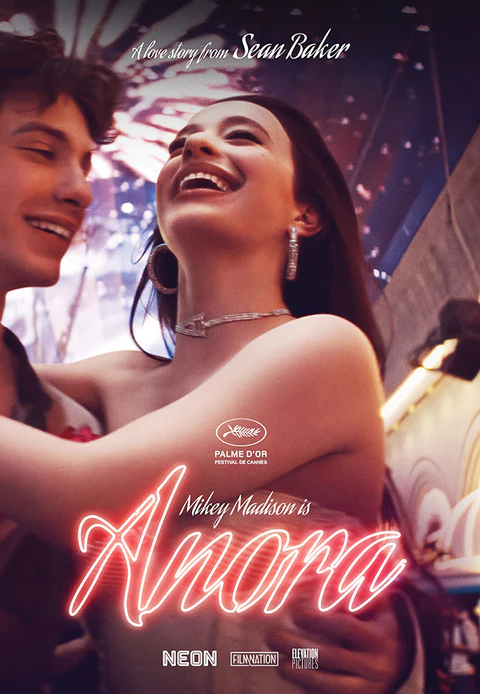
Anora (2024) surprisingly swept most of the categories, taking home five Oscars, including Best Director and Best Picture. Sean Baker, director of Anora, gave an incredible and important speech about the importance of going to your local theaters for movies.
“We’re all here tonight and watching this broadcast because we love movies,” Baker said in his speech. “Where did we fall in love with the movies? At the movie theater.”
He went on to emphasize what many of us film buffs know; there is no better place to enjoy a film than at the movie theater, and there is no better place to watch a film than your unique local theater.
“Right now, the theater-going experience is under threat,” Baker said. “Movie theaters, especially independently owned theaters, are struggling…We lost nearly 1,000 screens in the US, and we continue to lose them regularly. If we don’t reverse this trend, we’ll be losing a vital part of our culture.”
This felt so impactful and almost brought me to tears. I was literally sitting in one of those historical independent theaters that are so important to global society and culture and still in desperate need of public support.
If you love movies, go to your local theater, whether it be the Eureka Theater, the Minor, or your hometown Regal or AMC. Theaters are what keep film alive, and the home experience can never quite reach that magical feeling you get when you’re in a room full of strangers sharing the same screen.
Julia is a journalism major at Cal Poly Humboldt. She loves film and is a regular on Letterboxd. To quote Robin Williams in her all-time favorite movie, Dead Poets Society, “The powerful play goes on and you may contribute a verse. What will your verse be?”
by Noah Pond, Eli Farrington, Jasmin Shirazian and Barley Lewis-McCabe
A 4-foot-tall vagina with a disco ball clitoris stood at center stage as two women stormed on dancing to It’s Raining Men by The Weather Girls. The sausage fest to end all sausage fests, the first night of the Mr. Humboldt Pageant took place at the Arcata Theater Lounge this weekend for the first time in five years. Consisting of a series of weird and wacky competitions, activities and contestants, the pageant followed a format reminiscent of Ms. America, but with a unique Humboldt twist.
This year’s Mr. Humboldt Pageant was the first one to take place since before the COVID-19 pandemic, and also the first one to feature “all-stars” from past pageants. These “all-stars” were allowed to compete against a swarm of new contestants in a fantastically extravagant, unapologetically unfiltered and highly anticipated showdown of the ages.
Judge, local drag queen and former reigning Mr. Humboldt champion Komboujia provided some insights into the inner workings of the pageant and how the contestants were judged, which included a question and answer segment, a swimsuit contest and a talent show. Komboujia also noted her appreciation for the positive environment that the pageant creates.
Photo by Noah Pond | An audience member covered in condiments.
“What really brings me joy is being able to create space for people to feel safe and welcome, and have a good time,” Komboujia said. “Especially people who are like me, who may not feel like they have a lot of space here locally. Bringing those people into [this] community really brings me joy and motivation.”
Like any fundraiser, the proceeds are donated to a good cause, which is selected by the previous winner of the pageant.
“Since the [former] winner gets to choose where the proceeds go, I get to choose. My proceeds are going to the Raven Project, and a youth drag mentorship program called System Failure that runs out of Outer Space here in Arcata,” Komboujia said.
The event’s festivities were wild, packed full of little challenges, dances and even condiment splattered bodies. During the Q&A, Mr. Mckinleyville Statue was asked what Humboldt’s alternate mascot would be — he had a snarky political remark locked and loaded.
“You already had one, but everyone turned me down — bring back great Americans,” Mr. Mckinleyville Statue said. “You can’t get rid of me.”
Alex Stillman, Arcata Mayor and presenter of the Cougar Award, was a part of the local lady legends who sat as the judges of the event. Stillman has been an Arcata resident since 1971, and has been presenting the Cougar Award since the very first Mr. Humboldt, back in 2013. She accepted the honor of judging years ago when the pageant was in its early years and has continued to since then. She views the event as a play; an opportunity for men and women to be ridiculous and put on a fun show for a good cause.
“When an older woman is going after a younger man, they call ‘em cougars,” Stillman said. “A long time ago, I was asked to come to the very first Mr. Humboldt and I was a judge. Then they asked me — since I happen to be an older judge — if I would give out the cougar award.”
Stillman has been an Arcata resident since 1971, and has been presenting the Cougar Award since the very first Mr. Humboldt, back in 2013. She views the event as a play and an opportunity for men and women to be ridiculous and put on a fun show for a good cause.
The night rolled on as dirty jokes rang throughout the venue. Two male-presenting audience members were called onstage and asked to strip as the hosts explained that two female-presenting counterparts had been tasked with using various condiments to paint a portrait of Stillman on the torsos of the gents. The pungent scents of barbecue sauce, ketchup and mustard filled the nostrils of audience members all throughout the venue.
The contestants’ next challenge was a swimsuit contest. They each took their own approach to it; some threw bags of nuts from their pants and others shook their rumps in sparkly thongs. Baby Bigfoot even removed his suit to reveal a shredded, hairy bod. Covering his crotch was a gigantic, 15-inch banana slug plushie.
During the intermission before the next competition, the hosts informed the crowd that Mr. King of the Universe (Mr. KOTU) and Mr. Mckinleyville Statue had fallen in love, and Mr. KOTU had proposed backstage. A few moments later, they were on stage being joined in holy matrimony. Mr. KOTU wore a veil and Mr. Mckinleyville Statue wore a suit, and Komboujia performed the honors. They seemed to be a perfect fit, with Mr. KOTU being a Trump impersonator and Mr. Mckinleyville Statue being a former republican president and colonizer. However, moments after they were married, they tried consummating the marriage on stage. When Mr. KOTU “finished,” his heart stopped and he died in front of the crowd’s very eyes.
“My marriage was short but beautiful,” Mr. KOTU said. “Again, he’s no Ivanka, but it was beautiful. He was rock hard — nobody was as hard as that statue.”
The chaos continued as the hosts announced Mr. Mckinleyville Statue was shot and killed backstage, and replaced by Mr. Riptide — who was the same man, just without the statue in front of him. In yet another unexpected twist, Mr. KOTU was resurrected as Mr. Apocalypse.
Mr. Apocalypse, dressed head to toe in a red suit bedazzled in sequins and horns, brandished a pitchfork with dildos on the end of each prong. He won the pageant despite his Cheetos-dusted face and the poopy diaper he twerked in during the swimsuit section. He was not surprised by his victory as he was crowned Mr. Man of the Year.
“I feel it was inevitable, I knew there was no way I wouldn’t win especially as I was reborn from the death as the dildo king,” Mr. King of the Universe said.
Photo by Noah Pond | Mr. Baby Bigfoot hitting his classic pose.
The second night was just as extravagant. The line to get inside was down the block, with about 100 people standing in the intermittent rain, anxiously waiting for one thing — to see the best hunk o’ man meat in Humboldt County.
As the event began, the crowd was presented with a showstopping lip sync from co-host Komboujia. The competition went similarly to the night before, with a Q&A, a swimsuit competition, trivia, elimination rounds and so on.
When all was said and done, the winner was announced as Mr. Cowabunga. The energy of the audience was palpable as the crowd favorite was announced.
“We love the people of Humboldt County and we can work together to make this a better place,” Cowabunga said. “Be humble. Humboldt #1!”
The gender-bending extravaganza offered an avenue of safety and fun for members of the community, while also serving as an opportunity for participants to experiment with their identities. The competition advertises itself as a celebration of non-toxic masculinity, at a time when this pushback is needed more than ever.
Senior communications major Kelly Padrick and sophomore business major Alex Moore were in attendance on the first night of the performance. They looked on Instagram to find out if the Arcata Theatre Lounge was doing anything for Valentine’s Day and thought the Mr. Humboldt pageant looked peculiar.
“It was just the amount of weird that we expected,” Moore said.
The pair recommended that anyone who had the chance to go and see it should take it.
“I paid to be entertained,” Padrick said. “And I was.”
“What are we playing?” the pianist asked the drummer.
“Jazz,” the drummer said.
There’s an often repeated saying that Humboldt has more artists per capita than anywhere else in America. I don’t know if that’s true — or how it would be fact checked — but from what I saw, I wouldn’t be surprised. Every Sunday, Northtown Coffee — a small coffee shop five minutes away from campus — becomes the epicenter of jazz in Arcata. Dozens of people pack into the small room to drink and dance, listening to an ever-growing jazz combo.
True Laboissonniere, a freshman mechanical engineering major, gave some insight as to why jazz is so different in Humboldt.
“It has less people, but every person I’ve met about [jazz] is super passionate about the scene so that’s super cool, especially compared to other parts of California,” Laboissonniere said. “People here really take their passion to the next level but there aren’t as many people to do so”.
Due to the improvisational nature of jazz, it’s a lot more community-based than some other genres. It’s a genre that requires a level of listening, especially for proper improvisation. Because it’s such a cooperative genre, and due to the smaller size of the scene up here, it becomes incredibly close-knit, which just leads to better playing.
Jazz began in New Orleans in the early 20th century as a mix of blues and folk music, which both evolved from songs sung by enslaved people. Jazz was a form of self expression for black musicians who were oftentimes unwelcome in other musical spaces. Jazz provided them an opportunity to make their voices heard and experiment musically. Part of that experimenting included spontaneous improvisation. The person credited with being the first to do so is cornet player and bandleader Buddy Bolden, but trumpet player Louis Armstrong was one of the first to put heavy emphasis on the improvising soloist, which would then become the standard in the genre.
Jazz is freedom of expression in music. The most central pillar of jazz, the thing that truly sets it apart is the inherent sense of improvisation, and that’s appealing to a lot of folks.
Dan Aldeg, a jazz professor at the university, elaborated on this.
“I think there’s not just that sense of freedom of expression but that improvisation that’s inherent in jazz,” Aldeg said. “That sort of personality is more attracted to doing that in music and you might find that seeping into other people’s lives, in a more improvisational approach to living as well.”
The first performance I saw in Humboldt was a man playing a 5 string bass on the street, next to the Arcata plaza. He had a jerry-rigged set up of two amps and one speaker stacked on top of miscellaneous boxes. His veins were so varicose from years of playing that they almost burst out of his hand as he slapped the bass. It was improvised, it was jazz, it was incredible. This man was the epitome of what makes Humboldt jazz so special — the eccentric people who embody the free-spirited energy that makes jazz unique.
For some people, jazz is more than just music. Marvin, an 80-year-old Humboldt State University alumnus with a big white beard, a fisherman’s hat and a euphonium, shared how jazz has impacted him.
“I was born in 1945 — When my mom was five months pregnant, she and my dad won a jitterbug contest,” he said over the loud live jazz. “It’s always been there.”
Humboldt doesn’t have the smoky jazz bars of New York or San Francisco, or the vibrant New Orleans street bands with passionate buskers playing flamenco guitar.
When asked about the individuality of jazz,saxophone player and Cal Poly Humboldt student Mathias Severn said, “Jazz is like so unique because of the improvisational aspect where you can just kind of pour your heart out into the music and let whatever comes out come out [it] works as jazz.”
Barley is a freshman journalism major, Photojournalist, and untraditional reporter, they like to cover interesting stories that center on social change, and human impact.
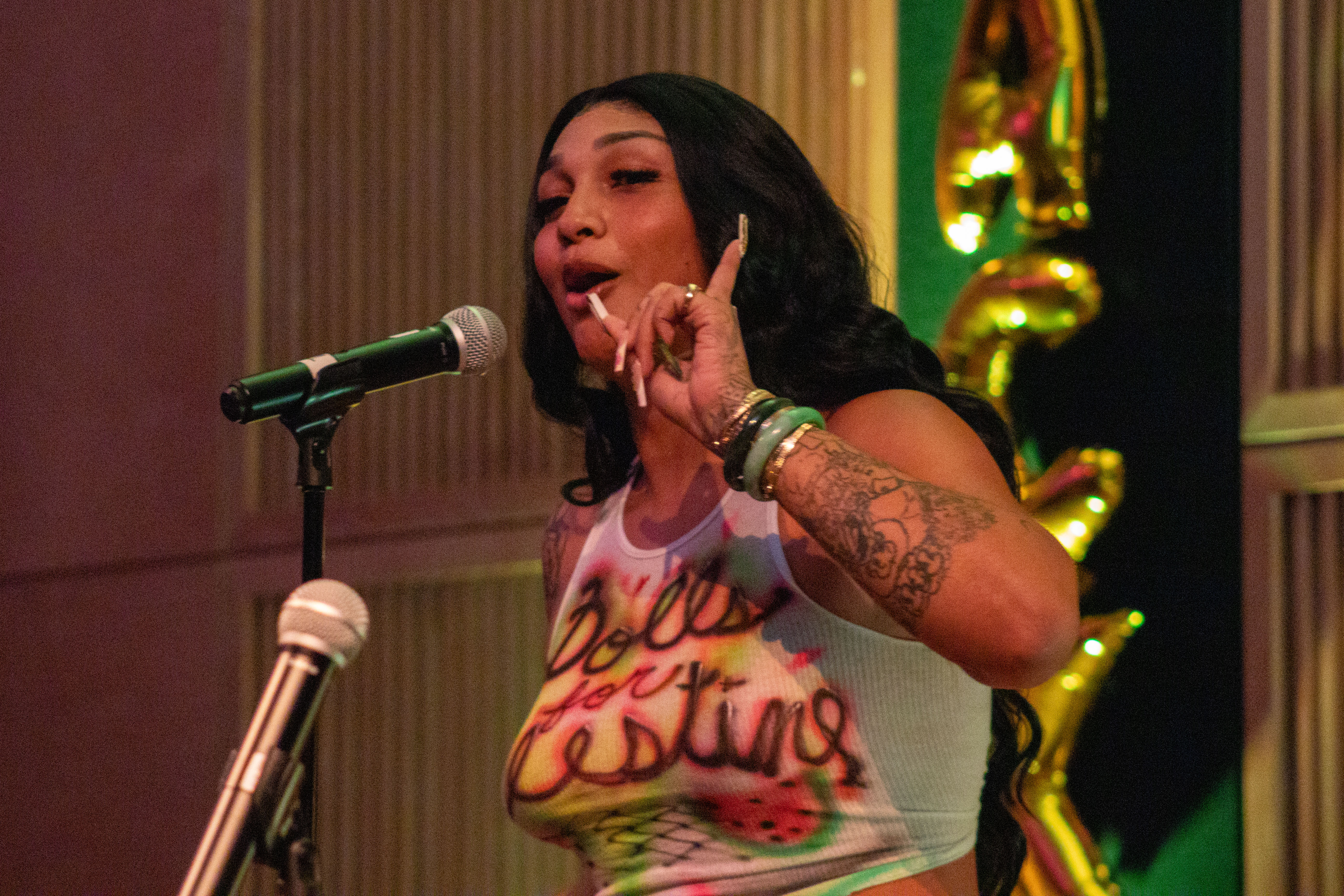
Photo by Griffin Mancuso | Sarai Bordeaux starts off the People’s Mic Poetry Slam calling for the audience to take care of themselves and let themselves process their emotions.
As the light faded from the towering windows lining the side of the Gutswurrak Student Activities Center and lively conversations dwindled into silence, Sarai Bordeaux stood at a podium in front of dozens of student and community members — fist pressed against their heart, breathing slowly and deeply. The silence was then broken by a loud, passionate holler.
“We are so glad you are here, glad your body is here, your mind and your spirit, too,” Bordeaux said. “Glad that you have accepted this invitation, agreed to the deeper learning — the deeper learning of our names through the stories of others.”
The People’s Mic Poetry Slam on Feb. 8, hosted by the Umoja Center and Black Humboldt as a part of Black Liberation Month, was a space where joy, grief, anger and hope let themselves loose. Students and local artists, including Sarai Bordeaux, Ra Mhtp, Bamidele and artist duo Mo’Love performed original works reflecting their experiences with Black culture, love, community and more. The night included a guest performance by LA-based artist and award-winning poet Bay Davis and an open-mic portion for the audience.
Alexus-Harrelle Deshazier, the head coordinator for the Umoja Center, emphasized the importance of engaging with Black students on campus and was overjoyed at the level of attendance and support for the poetry slam.
“We had close to 40 individuals sign in and attend throughout the event,” Deshazier wrote via email. “What I was most impressed with was the level of engagement from the audience with our performers. I truly felt they showed a genuine level of appreciation of their art and what the performers had to share.”
Sarai Bordeaux, a Humboldt State alum and Education Resource Innovator for Black Humboldt, who hosted the poetry slam initially became involved through Black Humboldt. They described poetry as a vessel for authenticity and honesty that they don’t always get to express.
“Poetry is the only space where I get to yell,” Bordeaux said. “And so that’s what really draws me to it is like, I don’t have to hold my tongue — it’s mine. It’s mine, so I can do what I want with it.”
All Love Aundrea, one half of Mo’Love, shared a blend of poetry and acapella with the crowd. She described her goal with poetry as healing racial trauma by uplifting Black arts and culture. She also hopes to provide a space for her and other Black women to feel the love of their community.
“You know that saying, ‘To know me is to love me?’” Aundrea said. “That is one of my biggest goals for my audience — to just let them see me, let them love me, because everybody who I symbolize as a Black woman, it will translate to them and to the Black community as well.”
Photo by Griffin Mancuso | All Love Aundrea (right) performs poetry about love and relationships as a part of the duo Mo’Love.
Deshazier hoped for attendees to take away the historical significance of art in the Black community and encourage everyone to join in celebration.
“I want people to leave this event, and all of our events, understanding the incredible impact the Black and Brown community provide in terms of art and culture in this country,” Deshazier said. “We have a long history of channeling our pain and frustrations into the beauty that is expressed in our art. This event was a representation of this history.”
Bay Davis began her performance with a grounding exercise before launching into a series of vulnerable poems on her experiences with Black culture and her queer identity, carrying the audience with her on an emotional journey that concluded with a standing ovation. Her first poem of the night challenged the idea of Black joy as a radical act or sacrifice, instead calling for it to be the standard rather than the exception.
“I’m gonna teach my grandchildren not to fight like a boy or a girl,” Davis said. “Are they Black? Are they Brown? I’m going to teach them to fight. I, God willing, am going to live long enough to teach my grandchildren to fight like they are going to win. That’s all that we can do.”
Aundrea described how Davis’ presence provided a space for trans people within the Black community.
“When we lift up people who don’t normally have those spaces, magic happens,” Aundrea said. “It felt like church in here — it felt better than church.”
The messages in Davis’ poetry resonated with Bordeaux in a way that they felt they needed. Davis called for dignity to be more than radical, the elements of prayer and her promises to herself were deeply impactful to them.
“We’re out here to thrive, and we’re being asked to put ourselves in a situation where we’re only thinking about our survival right now,” Bordeaux said. “But tonight, it shows that there’s so much more and no matter what we’re facing, we’re not just looking for survival.”
Griffin Mancuso is a journalism major and one of the managing editors of The Lumberjack. He has written stories for every category in the paper, but particularly enjoys writing human-centric stories. He has also freelanced for the North Coast Journal and News Decoder.
Photo by Griffin Mancuso | Bay Davis begins her poetry with a grounding exercise as the audience follows along.
Anora (2024) is about a young sex worker from Brooklyn, Ani — Mikey Madison — who gets a chance to live a more luxurious life when she meets and impulsively marries Vanya — Mark Eydelshteyn — the son of a Russian oligarch. Once the news reaches Russia, her new life is threatened as Vanya’s parents set out for New York to get their marriage annulled.
Everything about Anora felt well polished and concise, while also feeling unique and non-generic. I had high hopes for the film in general going in, due to already enjoying writer and director Sean Baker’s other works, such as The Florida Project (2017).
Baker is known for his unconventional female protagonists, often telling stories of people who are normally looked down upon in society.
“It’s just a response to what I’m not seeing enough of,” Baker said in an interview with Letterboxed. “It’s very simple. It’s just that the reason that there are marginalized communities and subcultures and groups of people is because they’re ignored, and so the antidote to that is in just stop ignoring.”
Anora continues the theme of telling stories of people who aren’t seen in the mainstream as real human beings.
This film was my favorite of what I’ve seen from Baker so far. It’s clear to me that Baker’s directorial style is beginning to be perfected. While I did feel like the beginning of this film dragged on for the first 30 or so minutes, the second act of the film shifts dramatically when a group of henchmen arrive to confront Vanya and Ani about their marriage.
What was once an overstimulating whirlwind of strip club, party and sex scenes transforms into an almost goofy chase as Vanya makes a run for it upon learning that his parents are on their way.
I found myself laughing out loud multiple times, along with the other moviegoers at the Minor Theater in Arcata — which was a surprise to me.
I knew Baker had the potential to be funny. I definitely remember exhaling air from my nose when I saw The Florida Project for the first time. I would even call Anora a comedy at times. It is noticeable with the editing style, and how the characters — mainly Ani and the henchmen — played off one another.
Keep in mind this film does have its dark moments, delving into some important themes of female autonomy and sex work, so don’t go expecting a straight-up comedy or something.
Lastly, I want to mention just how good Madison is in this role. Ani has this Jersey accent that is heightened when she’s with her patrons, and less so when she talks to her sister in a few scenes. To me, that by itself showed her dedication to the role.
I left the theater resisting the urge to talk in that Jersey twang, just because of how angelic Madison sounded.
Also, from what I understand, the way Madison portrays sex work is fairly accurate, despite it being a more glamorized interpretation.
I wouldn’t mind if she grabbed that Oscar for best actress this year. However, I doubt she would be the academy’s first choice. Demi Moore seems more posed for the award due to her win at the Golden Globes. I also foresee if Moore does win, the Academy would get a fair amount of positive press — and publicity is all the Academy really cares about.
Julia is a journalism major at Cal Poly Humboldt. She loves film and is a regular on Letterboxd. To quote Robin Williams in her all-time favorite movie, Dead Poets Society, “The powerful play goes on and you may contribute a verse. What will your verse be?”
Dirty Dancing (1987) Dirty Dancing is a romance film set in 1960s upstate New York, in the Catskills summer resort. Frances ‘Baby,’ played by Jennifer Grey, is there with her family, and expects the trip to be nothing special. That is until she stumbles upon a bunch of the resort’s employees, including soon-to-be love interest Johnny Castle — Patrick Swayze — dancing dirty in secret. One thing leads to another, and Baby offers to cover for a dancer, Penny Johnson, and must train with Johnny.
If you have not already seen Dirty Dancing, Valentine’s Day is the perfect excuse to see it. There’s a scene where Baby and Johnny are fooling around in this dance studio as Love Is Strange plays in the background that actually altered my brain chemistry when I saw it for the first time.
Desert Hearts (1985) Desert Hearts is set in the 1950s, and Vivian Bell played by Helen Shaver comes to Reno, Nevada to file for her divorce. However, she finds herself attracted by a carefree, and spirited woman named Cay Rivvers — Patricia Charbonneau — and they have a slow burn romance. It can be difficult to find LGBTQ+ films that are good and also have a happy ending.
I wouldn’t say this film has the happiest ending in the world, but hey, at least this one doesn’t have the “bury-your-gays” trope. I watched this for the first time earlier this year, and definitely think it’s a great choice for Valentine’s Day — especially if you have a special lesbian in your life.
I Love You Phillip Morris (2009) I Love You Phillip Morris is about a former police officer named Steven Russell — Jim Carrey — who becomes a conman after coming out as gay. Steven gets caught in one of his schemes, and goes to jail. There he meets the love of his life, Phillip Morris, played by Ewan McGregor.
For this one, I wanted to pick a more outside-the-box option — something that was a little more of a comedy, and something less people were likely to have already seen. Unfortunately, for how funny certain parts of this film are, there are also a few tear-jerker moments. However, if you wanna cuddle up to something a little more unorthodox, this may be the pick for you this Valentine’s.
My Beautiful Laundrette (1985) My Beautiful Laundrette is set in 1980s London. Omar, a young Pakistani man played by Gordon Warnecke, is given a dilapidated laundromat by his uncle — Saeed Jaffrey — who hopes to turn it into a successful business. Soon after, Omar is attacked by a group of racist punks, but the situation defuses when he realizes their leader is his former lover, Johnny, played by Daniel Day-Lewis.
I’ll be honest with you, for how exciting I made that teaser sound, this movie is a tad boring. However, it was pretty revolutionary for its time; not only did it center around a same-sex couple during the 80s, but it also talked about the serious racial issues against Pakistani immigrants in London at the time. This is a film to give you the excuse to talk about the political and economic state of the world with your film nerd partner this Valentine’s Day.
Hairspray (2007) Hairspray is set in 1960s Baltimore. Tracy Turnblad — Nikki Blonsky — is obsessed with the teen dance show, “The Corny Collins Show.” Upon hearing there’s an open spot on the show, she auditions for a spot on and secures it. She becomes an overnight celebrity, and a trendsetter for the show. Through her newfound fame, she becomes determined to help her friends and end the racial segregation that has been a staple of the show.
I don’t know if I’ve made my opinions on musicals clear before, but they usually are not my thing. However, Hairspray might be the greatest movie musical I’ve ever seen. John Travolta and Christopher Walken play Tracy’s parents, and they did make me believe in true love if that at all inspires you to watch Hairspray this Valentine’s.
10 Things I Hate About You (1999) Such an iconic movie, with so many niche references, such a dope cast, plot and soundtrack. The “promposal” scene is the reason my standards are so high. I love this movie so much.
13 Going On 30 (1999) This movie is literally my entire childhood. It’s based around a geeky 13-year-old in the 80s who manifests jumping into her cooler 30-year-old self’s timeline. She lives in New York City in the early 2000s, where she is, “thrifty, flirty and thriving,” and an editor for her favorite fashion magazine, Poise, while dating her school’s most popular and cutest jock-turned-pro-athlete. She finds herself unhappy with the adult she’s become, so she uses her 13-year-old self’s creativity, compassion and 80s influence to help become a better her while crossing paths with people from her childhood in the city.
50 First Dates (2004) Adam Sandler and Drew Barrymore… already iconic right? This movie follows Henry, a local veterinarian infamous for being a playboy with tourist women. One day, he meets and is wooed by Lucy, a local, and both of them are unaware Lucy has short-term memory loss. Lucy’s family replays the day she lost her memory everyday to not scare her. Henry must meet and woo her again and again to prove to her loved ones that he’s serious about pursuing her.
Starstruck (2010) This movie is responsible for my “she’s different” main character complex. A teen girl from Michigan goes to LA to visit her grandparents and accidentally meets LA’s biggest male pop star at the time, Christopher Wilde — a Justin Bieber dupe — who everyone, including her older sister, is obsessed with. However, she doesn’t see the hype. The film follows them as he shows her around LA. Will her perception of the pop star change?
Monte Carlo (2011) Grace, a recent high school graduate and waitress from Texas, saves up to fulfill her lifelong dream of visiting Paris, along with her older, diva best friend Emma, and her uptight unbearable step-sister, Meg. They accidentally get left at the Eiffel Tower by their rushed, budget-friendly tour group and fall down on their luck, until Grace is mistaken for British Socialite Cordelia Winthrop Scott.
Before you know it, they’re wheels up on a private jet to Monte Carlo, Monaco — a luxurious, all-expenses paid trip to attend a charity gala in the socialite’s honor — which she decided to ditch, to rebel and hang with friends instead. This movie is truly so amazing because we get a first-hand look into the world of the one percent through the eyes of three young and unique Texan women.
Dimly lit fluorescent lights hung from the ceiling as the unromantic scent of beans and gasoline wafted through the air. It was Valentine’s Day, and sophomore mechanical engineering major Jaimie Lerma was on her first date with her highschool boyfriend.
“I wanna say I was like 16 or 17,” Lerma said. I got taken to a burrito place next to a gas station, and his mom gave him money to pay for the both of us, and then he made me pay for myself so that he could keep the extra change. We also got Build-A-Bears afterwards and I had to pay for both of them.”
Lerma’s first date gone wrong resulted in a three year high school relationship, but despite her underwhelming past with Valentine’s Day, her experiences have not all been bad.
Nowadays, Lerma is in a happy relationship with her current boyfriend, who she describes as very sweet. Her favorite Valentine’s Day memories include beachside picnics and fun adventures with him.
Some folks don’t have a particularly bad date to look back on, but instead a lack thereof. The dean of arts, humanities, and social studies, Jeff Crane is in this boat.
“Does having multiple lonely valentines without a girlfriend or partner count?” Crane said. “Many sad lonely valentines.”
Luckily for Crane, he has happily spent the past 30 Valentine’s Days with his wife, and won’t have to go through one of those lonely days ever again.
Like Crane’s, some stories start off slow and build towards a happy ending, but for one Cal Poly Humboldt student who requested to be referred to as Alex, his experience was the complete opposite.
Alex’s date started off strong, with a trip to the beach, ice cream, a pit-stop at an arcade, and then a nice dinner.
“It was like a triple date. Honestly, it was on its way to being the best first date.”
The date began to take a turn for the worst when the pair decided to go on grinder together as a joke and look at other people in their vicinity.
“I was on, you know, Grinder next to him and he was [too]. We were talking to each other, like, as a joke, and then someone pops up zero feet away, and we’re like ‘Sure, what the hell.’”
The trio wound up in Alex’s car, with Alex sitting in the driver’s seat and his date sitting in the back with their new addition.
“So I invite this man into my car,” Alex said. “And I was not feeling it, and I thought, you know, he would maybe take the hint, but you know what — he [Alex’s date] just ended up getting fingered in the back seat of my car while I was scrolling on TikTok. The other guy didn’t wanna finger [my date] with his own spit because he didn’t have any lube or whatever. I was like ‘whatever’ and then I went and got lotion out of my bag just so that he could finish and I could get the other guy out of my car.”
Some first dates are so bad that they just can’t seem to end soon enough. This was the case for Alex. Even though he and his date never saw each other again, they still send each other Instagram Reels.
Eli Farrington is the opinion editor, and Noah Pond is the managing editor for The Lumberjack. In their free time, they like to encourage and support each other in becoming the intelligent, creative, and passionate men of tomorrow.
For the last four decades, Good Relations has been more than just a place to buy sex toys and lingerie. Founded by former Humboldt State University professor and clinical psychologist Dr. Melinda Meyers, the space has been a trusted community resource, chock-full of sex education, body positivity and inclusivity.
As a student at Humboldt, Meyers attended a home-based pleasure party — like a Tupperware party, but with toys — at a friend’s house. The presenter, Susan Anderson, was a nurse practitioner and women’s health specialist. Meyers was surprised by how educational the experience was, and soon began working at the company with Anderson. Within just a few months, she realized people needed lingerie.
“The most affirming sex-positive thing for everybody is not the same thing, and I wanted to have a broader range,” Meyers said. “So, I started my own company in 1983.”
Photo by Ursula Newman | A collection of stickers sold at Good Relations in Eureka.
After two thousand successful parties, she opened the first Good Relations store in Arcata. In 1994, she began teaching in the psychology and critical race and gender studies departments at Humboldt, and did so for 25 years. Meyers also worked as a licensed clinical psychologist for 16 years before retiring in 2021. During the pandemic, much of her time went into planning and designing the current location of Good Relations. In Nov. 2023, the store moved down the road and into the new space located at 329 2nd St. Today, it continues to serve the community by providing a welcoming, judgement-free space to explore pleasure, wellness and self expression.
Meyers and her small team fill the store with care, looking out for products and brands that are sustainable, gender and size-inclusive, made in the United States and BIPOC, LGBTQ+ or women-owned. By being intentional when bringing products into the store, they are able to cater to all bodies and gender expressions.
“I think people dress in ways that feel sexy to them, and or affirming to them,” Meyers said. “And sometimes feeling sexy is affirming, and sometimes the other way around. Part of feeling affirmed is being able to feel sexy. Our store definitely skews fem, but I have plenty of masc stuff, and fem and masc things that fit pretty much all bodies.”
Because of her background, and with help from the store’s code of conduct, Meyers has a strong relationship with customers and values their discretion. When you enter the shop, a sign reads: ‘Good Relations is an anti-racist, anti-sexist, LGBT+, and sex-positive business that celebrates diversity and aims to create a safe and comfortable place for everyone to shop.’ Their code of conduct is outlined stating: ‘Do not touch, comment about, or make sexual advances to anyone in our store. Shaming someone’s interest you don’t understand is disrespectful. This is a store for adults. Please act like one.’
“People’s business is people’s business,” Meyers said. “Especially right now, it has to be discreet — it just has to be.”
In a small town, being a trusted business is important. Meyers stressed that a lot of work has gone into establishing that Good Relations is there as a resource.
“We work to stay within what our community is comfortable with,” Meyers said. “The store goes mild to wild. If you’re walking by with grandma and the kids, you’re not seeing anything in the back. We do that intentionally, and as a result we’ve never had any issue.”
Good Relations focuses on providing an enjoyable shopping experience for all. To stay accessible, there is a range of price points —with good, better, and best in every category.
“I’ll always have 5 for $25 panties,” Meyers said. “Some of the panties in there will work on people who are tucking. There’s organic cotton in there when I can get it —that’s how we try to meet college students’ and other lower-income people’s needs.”
Talia Block, a sophomore at Cal Poly studying psychology, noted the reasonable prices and supportive atmosphere.
“I had a great experience there, they are so helpful,” Block said. “I went there the first time that I wanted to buy a sex toy, and they were so informative, kind, and helpful.”
When Good Relations started, advertising methods were much different. Meyers used advertisements on broadcast TV around 1996 that showcased and celebrated different bodies, and promoted inclusivity. The messaging of the store was unique. It was the only sex & body positive, education-focused store that Meyers knew of.
“41 years into this, I still love it,” Meyers said. “I think now, contributing to that is the fact that I’m not alone anymore.”
Photo by Tara Shapiro | A selection of toys and lingerie available at Good Relations.
Meyers offered a few suggestions to those who’ve never visited a sex shop before. Bringing a friend might help if you’re nervous, or check on Google and see when the shop is less busy. On the opposite side, come out during Arts Alive! on the first Saturday of every month. Blend in with the crowds, look at the monthly art on the walls, and browse the store.
Good Relations strives to uphold its commitment to normalizing discussions on pleasure and wellness. Its doors are open to everyone, every day of the week.
“Don’t be afraid and don’t be ashamed to say, ‘yes I want this,’ and ‘no, I don’t want that,’” Meyers said. “You get to like whatever you want — you’re not hurting somebody else, you don’t have to earn the right to pleasure. Sex is healthy and pleasure is good for you.”
Photo by Griffin Mancuso | Arlo Purnell and Jade Hisamoto pose together at the Queer Joy event.
EDIT: Information regarding the groups who responded to the Turning Point table has been edited for accuracy. While the group playing music had students who are members of The Marching Lumberjacks, it was not an officially organized event.
Turning Point USA, an organization that advocates for right-wing policies and ideologies, set up a booth at Cal Poly Humboldt in the GSAC quad this past Thursday, Feb. 6. Conservative activist Chloe Cole — who opposes gender-affirming care for minors — joined their tabling that day.
In response, dozens of students and faculty gathered with pride flags and pamphlets, and a group arrived to play music. On the same day, the Humboldt Peer Health Educators and Check It decided to host a queer joy event for LGBTQIA+ students and their allies to gather and socialize. Several students at this event shared their experiences with queer joy and how they connect with their community.
“The way I would see queer joy is [through] love, community, and safety. I think queer joy is walking down the street with your partner and not having people look at you strangely, or weird side eyes or double takes.”
Photo by Griffin Mancuso | Leo Alley stands in front of a pride flag.
Arlo Purnell Junior, psychology major and minor in studio art
“I’m in a queer relationship, so being able to be with my partner and be out in public and walk around with them, and being able to love publicly, I feel like, is queer joy to me.”
Jade Hisamoto Junior, studio art major
“We need [queer joy] now more than ever, so just do what you can instead of spiraling into a depression about everything that’s going on. Focus on uplifting yourself and making the impact that you can in your community before you worry about trying to change the world.”
Leo Alley Junior, wildlife major
“You deserve [queer joy]; every queer person deserves to have joy in their life. Everyone’s trying to take that away from us, and I think it’s easy for those voices to get in people’s heads, and I just want everybody to know that you deserve to be joyful in your queerness.”
LJ Ferris Senior, studio arts major
Photo by Griffin Mancuso | LJ Ferris smiles while standing in front of the trans flag.
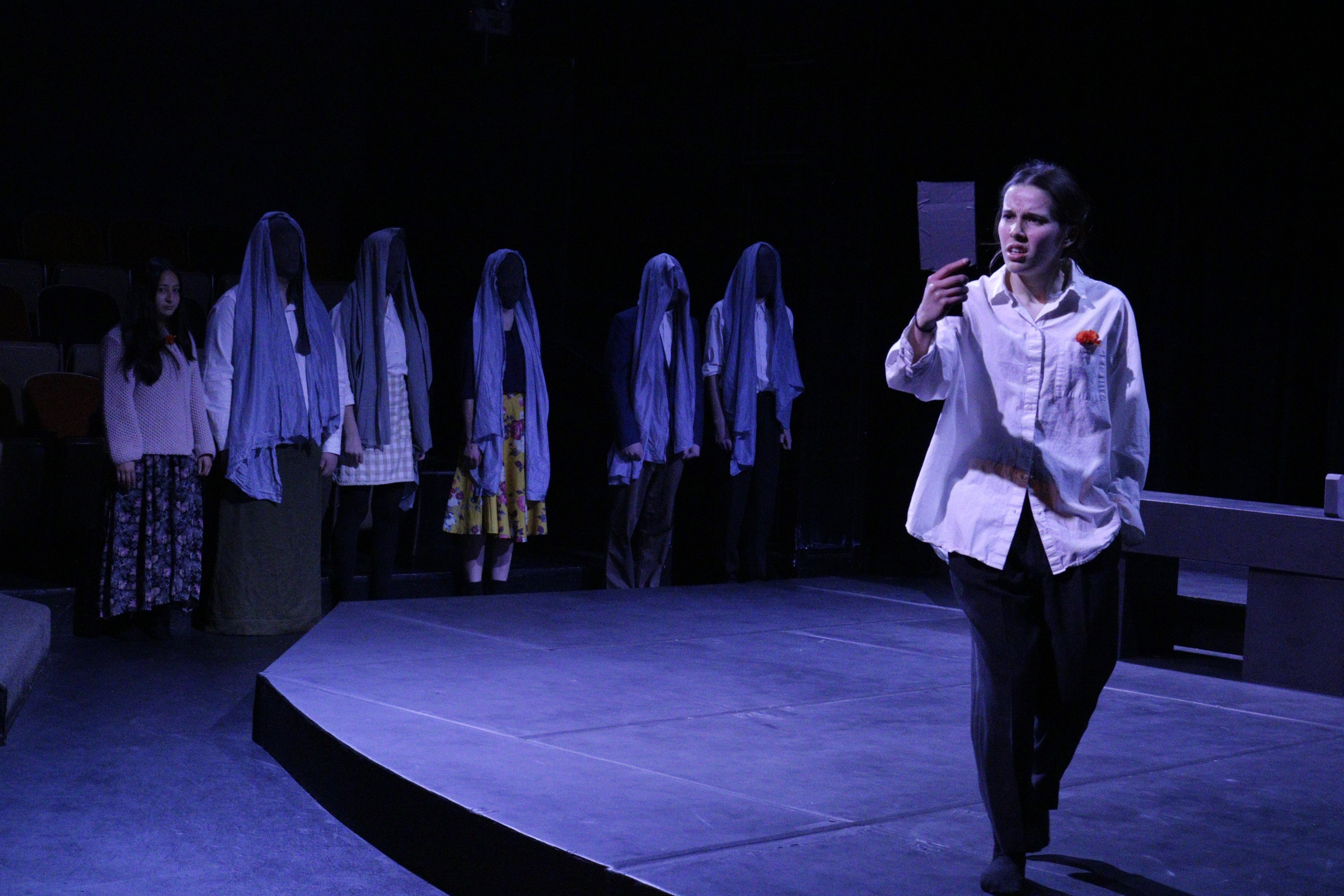
The Northcoast Preparatory Academy recently concluded its whirlwind theatre immersion exercise on Jan. 23-25. The performances were held in Gist Hall Theatre, allowing NPA juniors and seniors the creative liberty to design sets, props, and costumes, act, and collaborate with directors to adapt a play to their vision. This year’s play was Eugene Ionesco’s Rhinoceros.
Ionesco’s play is an absurdist social criticism of fascism in Nazi Germany. The rhinoceros symbolizes the savage nature of humanity and portrays the ease at which individuals can become conformists when influenced by a majority.
As upperclassmen and students of NPA, actors Margot Roscoe, Joey Hodges, and Richie Alvarez embodied the roles of Berenger, Jean, and Papillon, respectively.
“When you’re a character that is completely detached from the world, you can detach yourself from the world too, and you are completely limp to whatever else is happening, completely oblivious to the world around you,” Roscoe, who plays Berenger, said. “And then you get serious, and then you’re the only one left, and then you kind of have to face [yourself] and have to face humanity.”
Director Omar Gad was introduced to the project as students received scripts. Learning alongside the actors that were thrown into the “The idea was to introduce the scripts to [the students] and give them a feel for it,” Gad said. “I think people forget what absurdity feels like, and [we had to] bring them into the mentality of absurdism and fascism in a historical period.”
Directors Omar Gad and Rosemary Stevens had less than two weeks to rehearse and prepare for opening night. “It’s kind of a process that’s established at NPA,” Stevens said. “We read the script with the students, make sure they understand what’s going on. We do some theater exercises, build a little bit of the ensemble community beforehand, then we do auditions, and we give everyone their role.”
Berenger, identified as the town drunk, is relatively indifferent throughout the play and has no fundamental beliefs. Still, as more and more townsfolk begin to adopt this fascist mentality, deny humanism, reject individuality, and become rhinoceroses, Berenger starts to sober up and think for himself.
Director Rosemary Stevens reflected on Ionesco’s influence through the lens of her and Gad’s directorial vision.
“Ionesco’s interpretation of the times that he’s living was like, ‘Let me take all these horrible things happening and abstract it and make it almost so ridiculous and absurd,’” Stevens said. “So, we had to take some of the words Ionesco had written and give them to other characters but maintain the same story. And that was really fun, and it was really rewarding, seeing the way the students made it work.”
In the play, Berenger visits his steadfast and opinionated best friend, Jean, at his home following an argument the pair had at a local bar. Berenger shares his fears about the rampant rhinoceros with Jean as he watches everyone he knows morph into animals. Throughout their conversation, Jean paces in and out of his bathroom. Each time he returns, he resembles the savage animal more and more until he has completely transformed.
“When I’m turning into a rhinoceros, I say, ‘After all, rhinoceroses are living creatures, just like you and me. They have just as much right to life as we do,’ and I’m like, looking at the audience and saying, ‘Fascists are humans too,’” Hodges, who plays Jean, said. “And I’m like, ‘Why am I saying that?’ But NPA has always wanted us to voice our opinions [and be] advocates for everyone. NPA pushes you to go beyond what you are and then also reminds you that you’re not a horrible person.”
In the play’s final moments, Berenger is alone, the last unchanged human. His morals waver as he watches all his friends, colleagues, and loved ones become unfamiliar, horn-nosed beasts. He talks to himself to the point of invigoration, increasingly becoming aware of the importance of free will and accepting contradiction.
Rhinoceros is thought-provoking and timely. When politics and people are divided, it is easy to become detached, but Ionesco reminds us, “When you’re involved yourself, you can’t help feeling directly concerned.”
Photo courtesy of Heather Quarles | The Northcoast Preparatory Academy during their final bows.
Ariana Wilson is a junior majoring in journalism and minoring in scientific diving. She intends to merge her passion for the environment and conservation with her love of journalism as a science writer in the future. This semester’s goal: write one story per section.
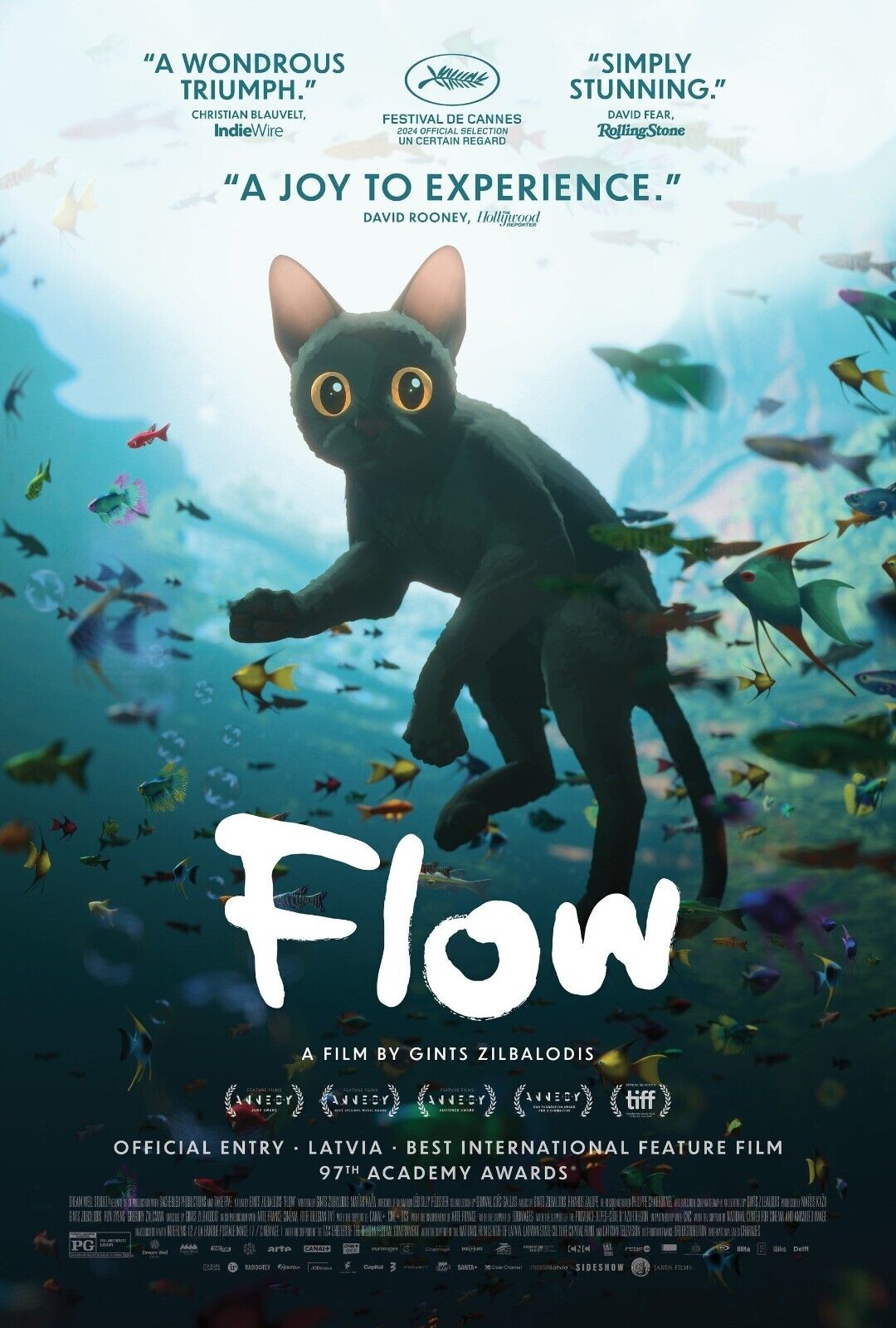
Flow was directed by Latvian filmmaker, Gints Zilbalodis, and was first released theatrically in France on Oct. 30 of 2024.
The film follows a nameless black cat as it is displaced by a great flood destroying their home. The cat finds refuge on a boat with various other animals and together they must navigate the challenges of their rapidly changing world.
It was great to have the opportunity to watch this film from the comfort of Arcata’s Minor Theater. It’s been a small dream of mine to sip a beer at the movies, and the pale ale I had did not disappoint.
Moving on from the theater itself, I want to mention how beautifully animated this film was. I thought maybe some sort of motion capture was used for the animals due to their very believable movement. However, Zilbalodis is paraphrased in Slant Magazine talking about how the film was animated. “It’s all animated by hand; we didn’t record any motion capture. Because it’s so specific, we needed to build everything frame by frame.”
The natural environment of the film was also stunning and very pleasing to look at. I could definitely imagine myself taking cat naps in some of those beautiful locations.
The art style and vibe of the film, to me, was very cartoony and full of life. I would say it’s reminiscent of the adventure video game Little Kitty, Big City, also released in 2024.
Having the viewer’s perspective of the world seen through the eyes of a cat, brings you down to earth. Reconnecting with the things we all need to live. Food, shelter, companionship—something that we can all relate to even.
When it comes to the plot of this film, I enjoyed it quite a bit. It’s amazing how attached I became to the animals without a single word being spoken throughout the entirety of the movie.
The cat has this especially sad meow it does whenever it’s in danger or afraid, and it really got to me, because I have a cat that looks just like the one here. I teared up on more than one separate occasion during the duration of the film—to say I was stressing any time this cat was in danger is putting it lightly.
I think the lack of dialogue in this film was an excellent choice — that’s a huge achievement for a film in its own right. I think there is a slight stigma associated with silent films, with some assuming that a movie without speaking characters would be boring. Flow completely tilts that perspective by creating a film that anyone from anywhere can understand.
This film also presents a majorly important message to the audience about the dangers of increasing climate change in our world. With the themes of the fragility of nature, and how we need to work together to get through uncertain and scary times.
If we place ourselves in the paws of these animals, maybe we can learn from them in terms of stewardship of our planet.
Julia is a journalism major at Cal Poly Humboldt. She loves film and is a regular on Letterboxd. To quote Robin Williams in her all-time favorite movie, Dead Poets Society, “The powerful play goes on and you may contribute a verse. What will your verse be?”
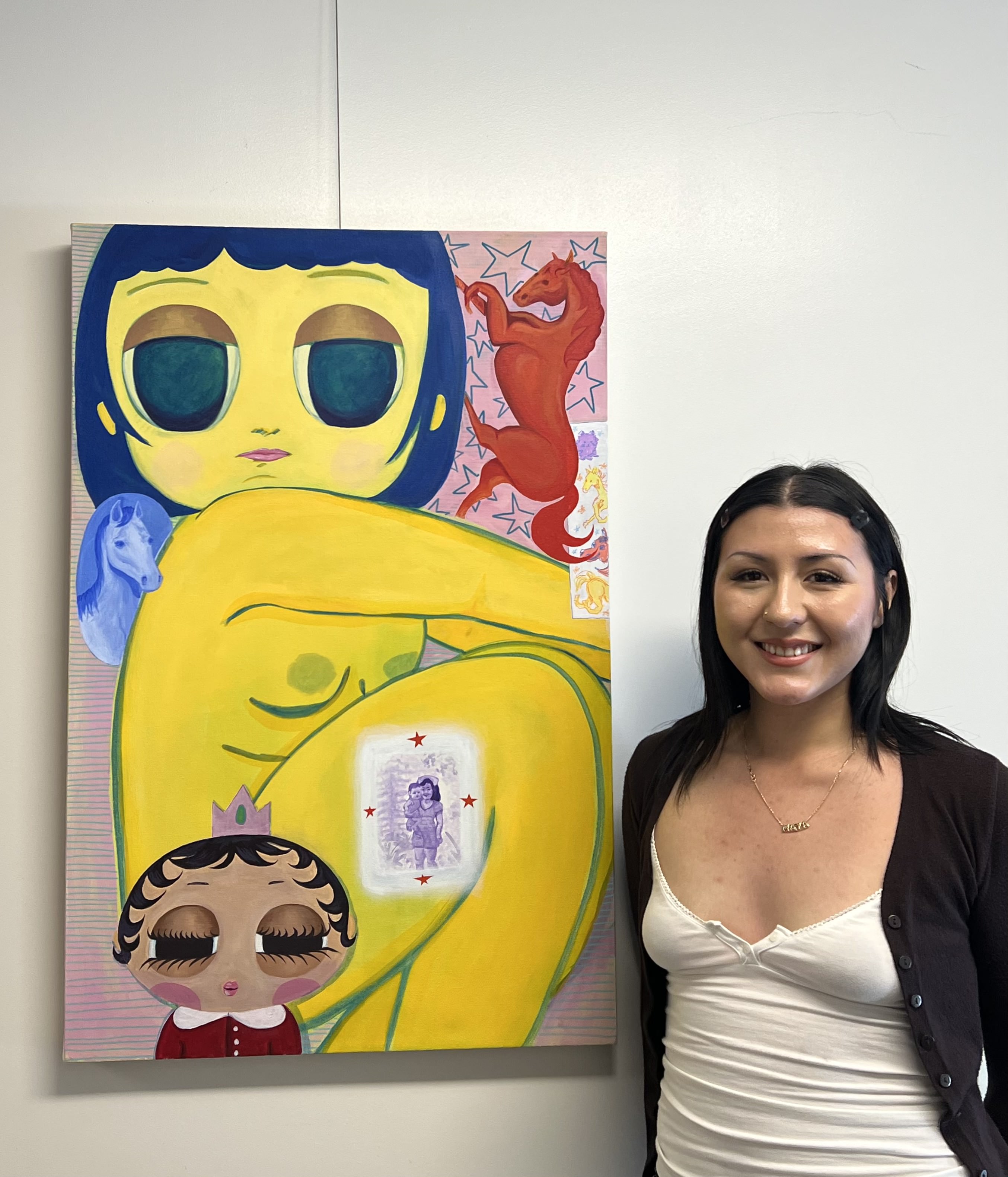
Senior studio art major Maya Song revels in creativity, acrylic paint and half-inch flat brushes. Originally from the Bay Area, Song grew up drawing, garnering inspiration from her aunt, a collage artist, and her father who enjoys architecture. When she was 14 years old, Song began taking her art more seriously by joining El Comalito, an art collective in Vallejo, CA, which allowed her to gain some experience through art markets.
Photo courtesy of Maya Song | Another untitled piece Maya Song has displayed in the Art B building.
“The first things I ever sold as paintings were because my brother was a skateboarder,” Song said. “He was sponsored by a deck company, so he had thousands of decks just at his disposal. I would sand them down, and repaint them, and then I would sell those at the market.”
In her last few semesters at Humboldt, Song has developed her skills as an artist, holding on to her childhood as inspiration. Song shared that her artistic style is often guided by children’s toys or images from sticker packs, digital art from the early 2000s and even equestrian themes.
“Every piece that I’ve ever done has had some sort of portraiture, essentially of family members,” Song said. “So, one of my maternal lineages — grandmas, aunts, my mom, stuff like that; a lot of exploration of generational womanhood.”
As many artists experience, there are moments when creativity lulls and there are moments of yearning for inspiration. In these moments, Song has sought out music and friends.
“I think it’s really important to sort of surround yourself with other creative people from different mediums, because what everybody else is working on pushes you to think outside of your normal streams of inspiration,” Song said.
Photo courtesy of Maya Song | A geometric art piece created by Maya Song.
Song reflected on some dream projects of hers in the future, including a project that she is currently working on, an Asian-American art gallery to recognize artists in the Humboldt County area. She also shared excitement in possibly seeing her art displayed alongside an inspiration of hers.
“We’ve always sort of talked about how there’s really a lack of representation in Asian-American art in the area, even though there’s so many amazing Asian creators that have come from this space,” Song said. “I think the cherry on top would be if we were to get some Martin Wong pieces in the exhibit.”
Song believes that art is for everyone, not just conventional artists, and that there’s no wrong way to go about it. “You gotta just do it,” Song said. “It really is all benefit and no risk. You don’t have to show your work to anybody. It’s just to make something for yourself, and be super selfish about it.”
Alexis Blue is a junior at Cal Poly Humboldt, majoring in journalism and minoring in writing. She enjoys drinking coffee, sunsets on the beach, and playing soccer.
Photo courtesy of Maya Song | Another artwork in Maya’s portfolio.
This past year felt like a prolonged clash of highs and lows for the film industry, with blockbuster hits like Dune: Part 2 and Furiosa: A Mad Max Saga being offset by the likes of Coppola’s disappointing Megalopolis and the universally ridiculed Madame Web.
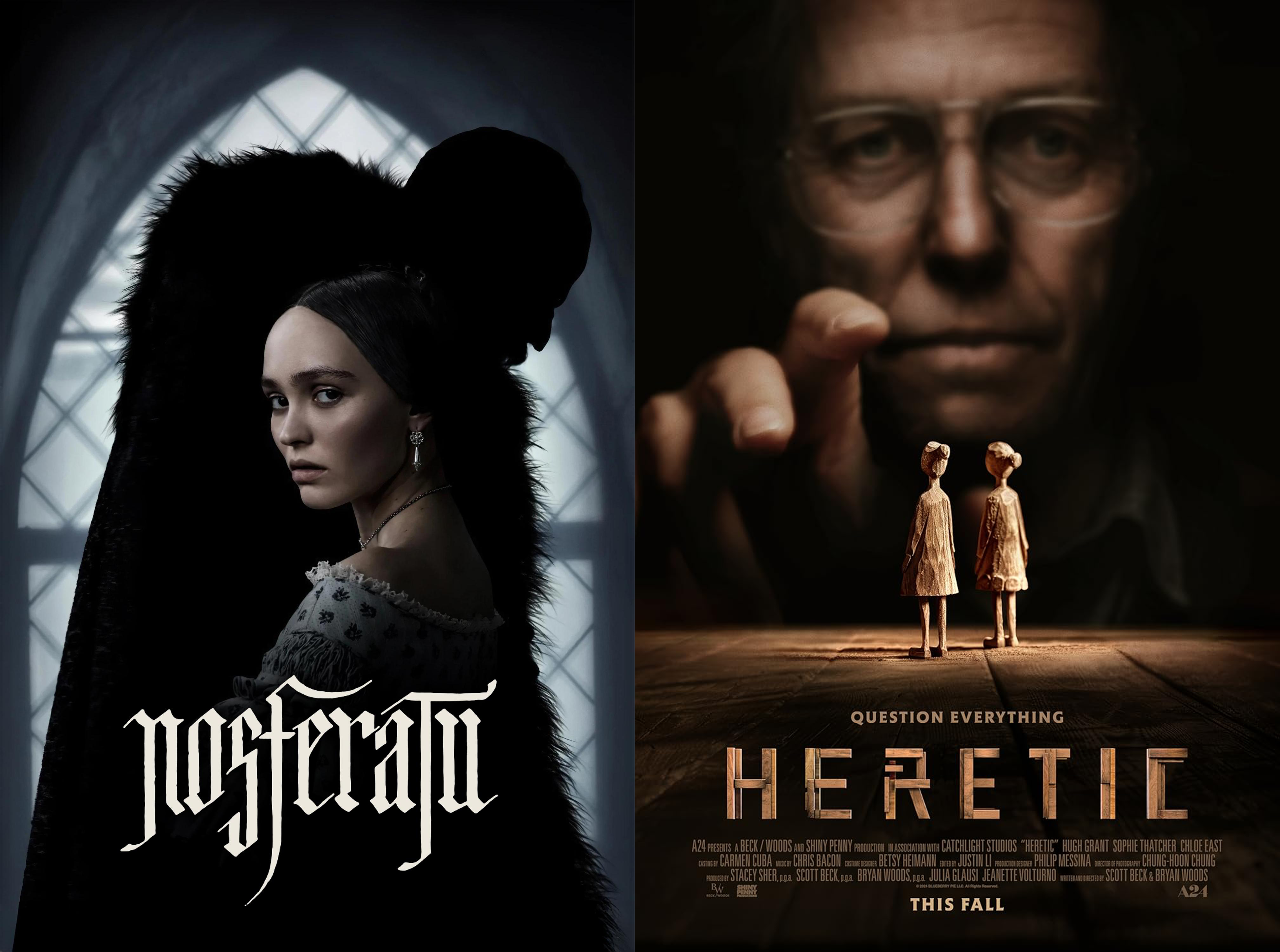
One 2024 genre that rarely let me down, though, was the horror/thriller movie, whose consistency was punctuated in the closing months by two standout releases: Scott Beck and Bryan Woods’ Heretic and Robert Eggers’s Nosferatu. As someone who’s only started to grow comfortable with the conventions of the horror genre, I’m delighted to have been kept on my toes by back-to-back films that shake up the formula in their own ways.
Heretic is a movie that almost demands a second watch. It is meticulously written in a way that asks you to pay attention, but also to take the time to reflect on what is being said. Plotwise, it turns the “find the killer’s weakness” trope on its head by making the villain a pedestrian-looking chatterbox, and instead draws your terror from not knowing what he plans to do and why. Two door-to-door missionaries are at first thrilled to be welcomed in by a man eager to discuss their faith, but they soon get the feeling that they won’t be leaving unless they play their cards right in the conversation.
As you might expect from a movie with this title, there is a hefty deal of religious commentary, much of which is unashamedly explicit. What I realized to some relief by the end, though, is that Heretic pushes no agenda of its own, and like any good work of art, it offers ideas only to facilitate discussion amongst its audience. This movie might spur you to evaluate your own faith and how different people and norms have shaped it, and if not, hopefully you’ll heed the warning it issues about judging intelligence and morality based on first impressions. Heretic is available now on Google Play, Prime Video, Apple TV, and Fandango, and I highly recommend it.
Nosferatu is a different beast entirely. Getting my gripes out of the way, its biggest pitfall is being marketed as a horror movie. Being an almost shot-for-shot remake of a 1922 silent film that somehow induced fear back then, Robert Eggers understandably sought to make this iteration hair-raising for a modern audience while retaining full reverence for its source material.
Unfortunately, I feel that the result is two hours of noise and embellishment surrounding a pretty underwhelming central terror whose mystique has been spoiled for over a century. The movie even seems to acknowledge this weakness, as it relies on cheap, nonsensical jumpscares in a few instances to artificially maintain its tension.
This is not at all to say that I didn’t enjoy my time with Nosferatu. The film excels narratively as an exploration of unconditional love and sacrifice. Count Orlock acts less as a villain and more as a calamitous force of nature that tests each of the main players’ devotions to one another, which manifest in varied and progressively tragic ways over the course of the story. Jokesters online are already poking fun at Lily Rose Depp’s frenetic performance as Ellen Hutter, but I think that the vampire-induced delirium coupled with Ellen’s unyielding affection for her husband Thomas makes her character all the more sympathetic and heart-wrenching. The star-studded cast is warranted with each actor deserving their own praise, and I’ll give a special endorsement to fans of dark gothic and Victorian atmospheres. Nosferatu is still in theaters and I advise that you don’t miss it!
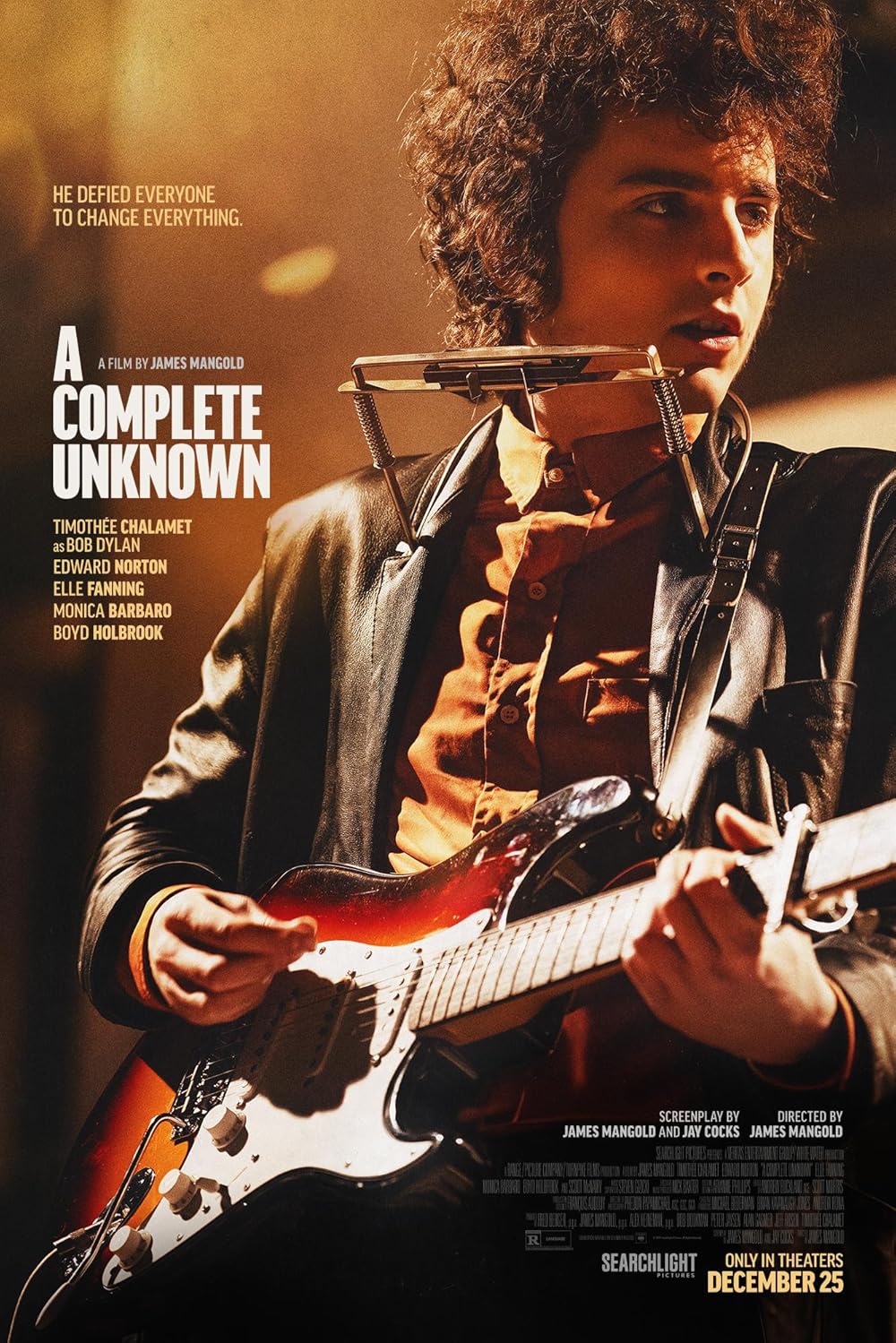
A Complete Unknown was released in theaters on December 25, 2024. The film was directed by James Mangold and follows Bob Dylan, aka Robert Allen Zimmerman, played by Timothée Chalamet. The plot is about Dylan’s early career in the 1960s and pursuing his very controversial and revolutionary decision that changed the course of folk and rock music in America forever.
I have been excited about this film ever since I heard about its production in February of 2023. I was even more excited when I saw the trailer, and realized Chalamet looked pretty convincing as Dylan.
I’ve been a fan of Dylan ever since my dad played his records for me as a kid, so I had relatively high expectations for the film. However, after seeing it on Friday, Jan. 7, I left the theater feeling mildly disappointed, but not surprised.
There were a few things I loved about this film. One aspect is that the film opens with Dylan going to find Woody Guthrie, played by Scoot McNairy, who he finds at a hospital in New York.
Just as some Bob Dylan lore, and to give some context for why this scene is so important, Guthrie is — in my opinion — the most influential American folk singer of all time. There is a clear chain of events for how his influence changed music forever.
Guthrie was Dylan’s inspiration and idol. Without him, Dylan would not have made the music he did. If Dylan hadn’t made his music, he presumably wouldn’t have given the Beatles marijuana — a moment that helped spark their evolution into creating more experimental and iconic albums, like Sgt. Pepper’s Lonely Hearts Club Band.
Are you following my insane string of logic here?
To put it more simply, Guthrie’s impact on music history is tremendous and underrated.
Seeing the moment Dylan met his idol and then singing “Song for Woody” did put quite a smile on my face. I was hoping this would be portrayed in the film beforehand and was not let down in that respect.
In addition, Chalamet’s depiction of Dylan was fantastic. He sang comparably well to Dylan, and really portrayed how much of a dick Dylan is, which was great to see.
I would not be mad in the slightest if Chalamet was nominated for an Oscar this year.
Now I can’t say I outright hated this film, because I think hate is honestly too strong of an emotion.
Ever since the success of Bohemian Rhapsody (2018), we have seen an overload of mediocre biopics almost every single year since.
I wanted so badly for A Complete Unknown to do something different. It needed to stand out in some way so it didn’t follow the overplayed rise to fame story we’ve heard over and over again. Alas, this film drags just like the rest.
The film focuses way too much on Dylan’s scandalous relationship with Joan Baez, played by Monica Barbaro. Instead, the time could have been spent on what an artist does at the expense of everything and everyone else to create their art. Making for a more venomous twist on the traditional, and overdone musical biopic.
Dylan is one of the most notorious assholes in the music industry. To this day, you don’t know if you’re gonna get a good show or not. It just depends on whatever his mood is like.
Instead, he gets whittled down to his “voice of a generation” status without regard for the labyrinth of contradictions that snake through Bob Dylan as a person and his discography.
To conclude, I’m not against more biopics being made. I think they can be fun and memorable like Dexter Fletcher’s Rocketman (2019) or Baz Luhrmann’s Elvis (2022).
It looks like we’re at least heading in a more creative direction with the release of Michael Gracey’s A Better Man (2024) which also just hit theaters on Dec. 25th. I won’t lie, the CGI monkey has me intrigued.
Whatever the future of biopics holds in Hollywood, I’ll continue to stay tuned in.
Fingers crossed they don’t fuck up the Bruce Springsteen movie starring Jeremy Allen White.
Julia is a journalism major at Cal Poly Humboldt. She loves film and is a regular on Letterboxd. To quote Robin Williams in her all-time favorite movie, Dead Poets Society, “The powerful play goes on and you may contribute a verse. What will your verse be?”
If you’ve ever visited McIntosh Farms Country Store off of Giuntoli Lane in Arcata, then you know the food is bomb and the line is long! That is why I was elated to see them appear on the DoorDash app. Well, visiting is becoming a regular habit now.
The menu boasts items such as freshly squeezed orange juice, coffee, pancakes, country fried steak, hearty sandwiches, burgers, and a variety of vegan options to suit a variety of taste buds.
There is something about their fresh, soft, spongy, homemade English muffin—it is the best English muffin around. This particular English muffin’s purpose is to hold all the ingredients of my favorite mini man breakfast sandwich together. I know, the name “mini man” seems so gender specific. Even the word mini is a stretch to describe the beyond average-sized breakfast sandwich.
Within the homemade English muffin is a layer of sausage, bacon, eggs, cheese — and yes — a thick stack of hash browns. My go-to is no meat, no cheese, substitute avocado, and then its magic. They kick down a healthy portion of avocado. There’s nothing basic about this breakfast sandwich — the thick hash browns elevate the sandwich in flavor and height. With each bite I think to myself, this is a really good sandwich and it’s big enough to feed anyone.
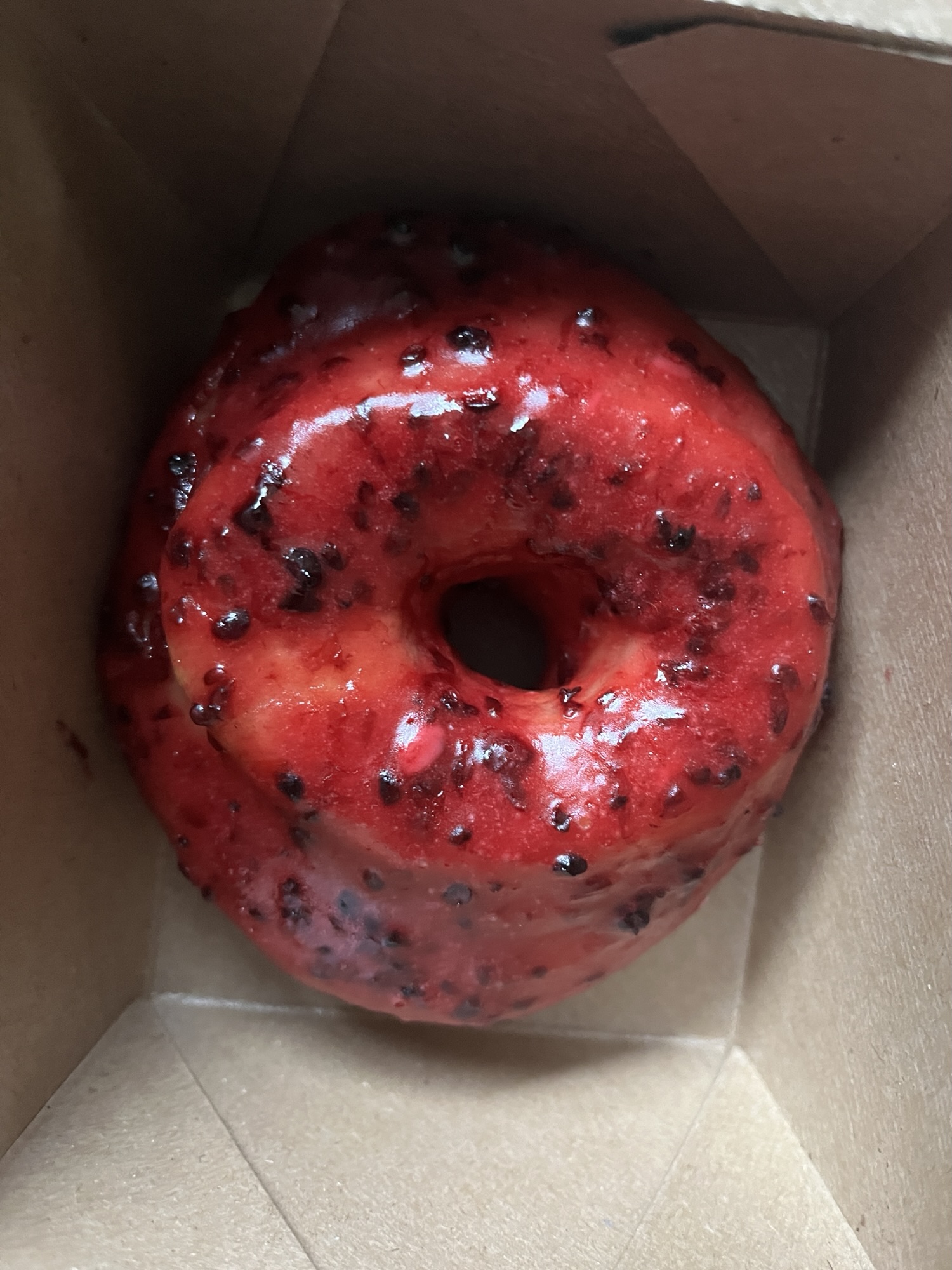
My hankering for the breakfast sandwich is not the only thing that keeps calling me back. The homemade blackberry raised brioche donut is delicious as well! The donuts rise for over a day before being fried and glazed for your morning treat. It is airy, sweet, and delectable, glazed in a tasty blackberry glaze that runs down the edges. The donut is slightly crispy on the outside with a soft, sweet, tangy inside laced with a delicate hint of nutmeg. It’s the real deal and the donuts sell out quickly, so get there early or dash it!
Maranda Vargas is a senior at Cal Poly Humboldt majoring in journalism with a minor in film production. She is a visual storyteller with a passion for covering stories on lifestyle, the arts and nature. She can often be found exploring the beauty of the world through her camera lens.
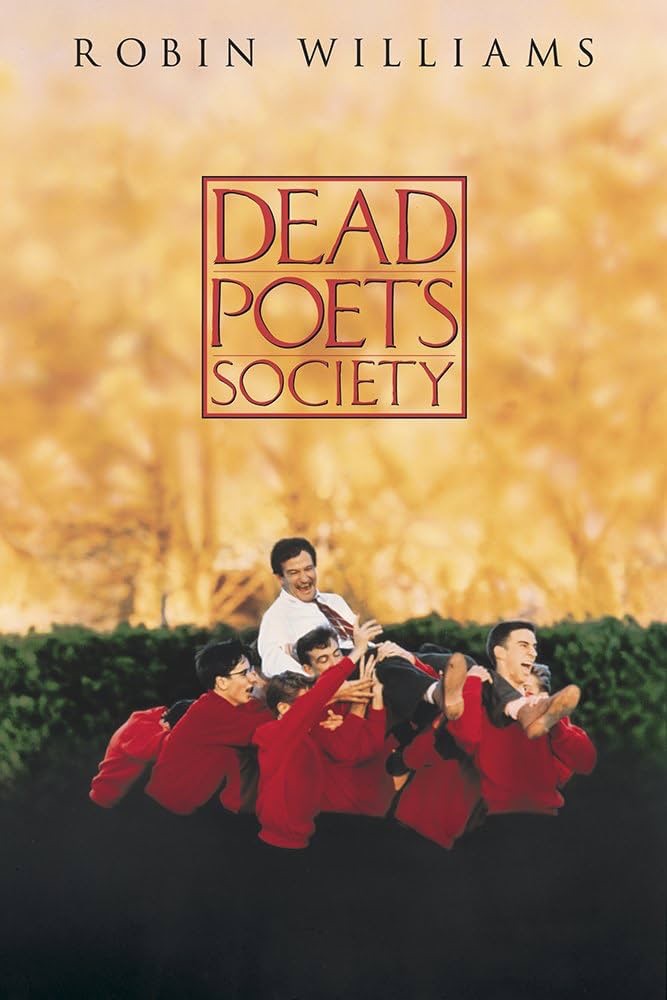
Dead Poets Society was released in 1989 and directed by Peter Weir. The film is adapted from a novel by the same name released in 1988 and written by Nancy H. Kleinbaum.
The movie takes place at an elite, old-fashioned, all-boys boarding school in New England. A passionate English teacher, played by Robin Williams, inspires his students to rebel against the conventional ways of thinking and seize the potential of everyday life.
I love this movie so much, not just as an enjoyer of good films, but as a writer as well. I apologize if this review feels more like a personal reflection on why I love it than a traditional review.
There are many moments in this film I love, but Robin Williams’ monologue about poetry hits a very special place in my heart.
“We don’t read and write poetry because it’s cute. We read and write poetry because we are members of the human race. And the human race is filled with passion. And medicine, law, business, engineering, these are noble pursuits and necessary to sustain life. But poetry, beauty, romance, love, these are what we stay alive for. To quote from Whitman, ‘O me! O life!… of the questions of these recurring; of the endless trains of the faithless… of cities filled with the foolish; what good amid these, O me, O life?’ Answer. That you are here – that life exists, and identity; that the powerful play goes on and you may contribute a verse. That the powerful play goes on and you may contribute a verse. What will your verse be?” Robin Williams said, performing asRobin Williams said, performing as John Keating..
Many of us in communications, art, or other less traditional majors often feel judged by family, friends, or those in *serious* fields — all majors are serious —, who ask, “What are you going to do with a degree in ____?”
I used to just say, “I don’t know” — and I still say that from time to time—because in reality, I really don’t know exactly what I will be doing after graduation. However, I get so emotional watching the scene in Dead Poets Society where Keating says “…medicine, law, business, engineering, these are noble pursuits and necessary to sustain life. But poetry, beauty, romance, love, these are what we stay alive for.”
It’s true that the world will always need more doctors and engineers, but we also always need more artists, more writers, more journalists. Calling these professions unprofessional is just plain stupid.
Could you imagine your life if your favorite author never wrote that book, or an album you love was never made. Where would you be today? I think I’d be a whole lot more depressed than I am currently.
We need reasons beyond the necessities to truly live, and anyone who says otherwise is probably lying. Which is why what you do, or want to do, is so damn important.
Keating continues, “That you are here – that life exists, and identity; that the powerful play goes on and you may contribute a verse. That the powerful play goes on and you may contribute a verse. What will your verse be?”
That last line, “What will your verse be?” might as well be the nail in the coffin for what makes me openly tear up while watching this movie. The way Keating looks at the character Todd Anderson (played by Ethan Hawke), a character who I also very much identify with, is just so important to me.
For such a long time in my life, I had no idea what I wanted to do. It made me anxious thinking about my future, dreading being a burden on my parents because I wasn’t good at anything.
It wasn’t until I took a creative writing class as part of my general education at Fresno City College that I discovered writing might be something I’m good at.
I still remember a comment from my teacher, Jeff Tannen, on a paper I did well on. Something along the lines about it could easily be an article for the Rolling Stone.
Little did Mr. Tannen know how much that compliment meant to me. He was my Robin Williams that day.
It wasn’t until later I discovered that journalism was a good avenue for me. Regardless, the moral of the story is, the path to achieving what you want isn’t always linear. The sooner you realize that, the happier you will be. After all, whatever your verse may be, it’s yours—and that’s what truly matters.
Julia is a journalism major at Cal Poly Humboldt. She loves film and is a regular on Letterboxd. To quote Robin Williams in her all-time favorite movie, Dead Poets Society, “The powerful play goes on and you may contribute a verse. What will your verse be?”
On my dreadful, unfortunately oh-so often 12-hour long Amtrak journey from Humboldt back home for the holidays, I was pleasantly surprised to find out — via literally everyone I follow sharing on their Instagram stories — that Kendrick Lamar released a 12-track surprise album titled GNX that very morning.
Now, y’all are gonna hate me for this, but I’ve lowkey given up on immediately streaming albums when they drop. No, don’t stop reading — blame Drake’s last 5 albums for turning me this way. I wait until the locals decide what’s good or not, and then from there, I decide if it’s good or not.
Upon hearing the album had a Debbie Deb sample, I had to stream ASAP — starting with that song. I pressed play and let out a scream on that heinously crammed 7 a.m. bus ride through SoHum. Squabble up is too good. I am a bit of a whore for a great sample. I especially love this one, since it samples a song that went 20 times platinum in my childhood home alone thanks to my LA Mexican mom — the music video needs a review of its own.
Upon streaming the album in its entirety, I don’t have much else to say, other than it’s really fucking good. Not like us was just a glimpse of how creative and down Kendrick could get. Kendrick brings in the beloved SZA, yet holds space for upcoming LA rappers such as Peysoh, Roddy Ricch, Azchike, Wallie the Sensei, and Lefty Gunplay on this 44-minute long record.
This album to me is an exceptional representation of the modern west coast music scene. It is a nostalgic — yet ahead of its time — mosaic of all of the creative, varying influences and styles from classic and new west coast rap & hip hop, along with synths and vocals of new and old neo-soul and R&B.
I am led to believe there is something for everyone on this album. KDOT and SZA pay a brilliant homage to the 1982 If This World Were Mine duet between 80s R&B legends Cheryl Lynn and Luther Vandross on Vandross, the third track of the album. The unique dark beat and flow on hey now reminds me of the late LA rapper Drakeo The Ruler, with a bit of early E-40. Lamar then pays homage to Mexican mariachi and the 90s G-funk era in reincarnated. We are surprisingly introduced to the isolated and powerful Spanish vocals of Dreya Barrera, a local Los Angeles based Mexican-American Mariachi singer. Interestingly enough, Lamar befriended and scouted the artist after viewing her emotional performance at the Dodgers Fernando Valenzuela Memorial in late October. We then hear the possible reincarnation and possession of a certain rap legend when Lamar begins to rap over a G-funk beat that is a sample from a song by the one and only Tupac Shakur… are y’all catching all these west coast parallels?
Now let’s bring up some of the infamous lyrics that have sparked convos on social media since the drop. Kendrick brings up the disrespect LA transplants cause the city, its people, and reputation in dodger blue — “Don’t say you hate LA if you don’t travel past the 10.” He brings up how transplants talk negatively about LA and LA culture, yet their arguments are invalid as they don’t bother to attempt to immerse themselves in the various neighborhoods and cultures that make up the real LA and its culture.
All in all, I would say this album is wonderful. It’s turnt, then it’s soulful, then it’s serious, then it’s goofy — yet it’s not overwhelming. This album is a mix of a love letter and yearbook signed to those on the west coast from Lamar. It’s rare for me to find albums these days that I consider no-skips, because I’m quite picky with what I let control my vibe and essence. I’ve genuinely enjoyed this album so much that I’ve proudly streamed it through and through multiple times since its release about a week ago. The question isn’t if GNX is on the way to becoming a West Coast Classic, but rather, are you in for the ride?
Kimberly Alexsandra Madrigal is a third year Journalism:PR Major at CPH, originally from Fresno, CA. She enjoys shoes, traveling, DJ-ing, dancing with friends and most of all serving cuntress! Catch her cool and iconic contributions on any of the student publications.
Well, it’s happened again. I’ve fallen in love with an artist only to find out they did a concert in Arcata years ago that I totally missed — I’m looking at you, Sierra Ferrell. However, I’m going to give my obliviousness a pass this time, because I’m genuinely just happy I found Magdalena Bay at all. I hear about four new songs a day just by scrolling through TikTok. However, when I discover a song through my “for you page,” it usually ruins the song for me forever. Something about the same clip of a track playing over and over leaves a sour taste in my mouth. “Image” off Magdalena Bay’s new album, Imaginal Disk, is the first exception to this phenomenon. Let’s be honest — with a hook like that, it’s hard not to get sucked into the world of Imaginal Disk.
When I say world, I mean WORLD. Nothing new for Mag Bay; Imaginal Disk includes a full story with multiple characters: The Doctor, Blue, and True Blue, a version of the character Blue after undergoing the titular Imaginal Disk procedure. The story examines numerous concepts, including loneliness, transformation and perfection, and whether perfection is attainable or even desirable in the first place. However, if you’re like me, the story might as well be an afterthought with this album. During one of my shows at KRFH, Cal Poly Humboldt’s student-run radio station — The Pet Sematary, Mondays & Thursdays at 1-2 p.m. — I openly said I never go into albums thinking about the possibility of a story being there. I believe if I did, I would go full-on conspiracy theorist, finding characters in elevator music. I think with that mindset, it only goes to show how good Imaginal Disk truly is, as I personally feel concept albums can fall short when not interacting with the story.
If I could describe the album in one word, it would be lush. I hate to use that word, as it is often overused in album reviews, but I genuinely can’t think of a better one. The world of Imaginal Disk is so precisely crafted with specific moments of dreamy vocals, like on True Blue Interlude, an advertisement in the album’s universe, and deep crunchy guitar such as in That’s My Floor. The album feels like a full-on rollercoaster ride, going from a nearly two-minute-long King Gizzard and the Lizard Wizard-esque jam at the end of Tunnel Vision into debatably the lightest song on the album, Love is Everywhere. However, unlike a rollercoaster, it doesn’t feel like you’re being whipped around. Something about this style of intimate synthpop makes it easy for you to settle in, trust the process, and enjoy the ride no matter how many twists and turns it takes you on.
Some of the standouts on this album for me are Image, with its aforementioned amazing hook and a breakdown that will have you checking if your speakers are broken — in the best way. Vampire in the Corner holds some of my favorite synth bleeps and bloops in the entire album, and That’s my Floor is one of those songs where you have to keep an eye on your speedometer while playing, because the energy in the song will make you unknowingly start speeding.
This album really surprised me. After hearing Image for the first time, I knew I’d like it, but I didn’t realize it would be one of those albums that you can play on a loop without even realizing it’s repeating. I recommend this album to basically anyone, but especially those in need of some dreamy sounds, catchy hooks and something to dance to. While listening to this album, it can be easy to believe that Love is Everywhere.
If you liked this album, I highly recommend Caroline Polachek’s Desire, I Want to Turn Into You.
Matthew Mazzucco is a Communications major/Journalism minor at Cal Poly Humboldt. He has an interest in music journalism and broadcasts weekly at KRFH and Humboldt Hot Air under the name DJ Jackalope.
This website uses cookies to improve your experience. We'll assume you're ok with this, but you can opt-out if you wish. Cookie settingsACCEPT
Privacy & Cookies Policy
Privacy Overview
This website uses cookies to improve your experience while you navigate through the website. Out of these cookies, the cookies that are categorized as necessary are stored on your browser as they are essential for the working of basic functionalities of the website. We also use third-party cookies that help us analyze and understand how you use this website. These cookies will be stored in your browser only with your consent. You also have the option to opt-out of these cookies. But opting out of some of these cookies may have an effect on your browsing experience.
Necessary cookies are absolutely essential for the website to function properly. This category only includes cookies that ensures basic functionalities and security features of the website. These cookies do not store any personal information.
Any cookies that may not be particularly necessary for the website to function and is used specifically to collect user personal data via analytics, ads, other embedded contents are termed as non-necessary cookies. It is mandatory to procure user consent prior to running these cookies on your website.